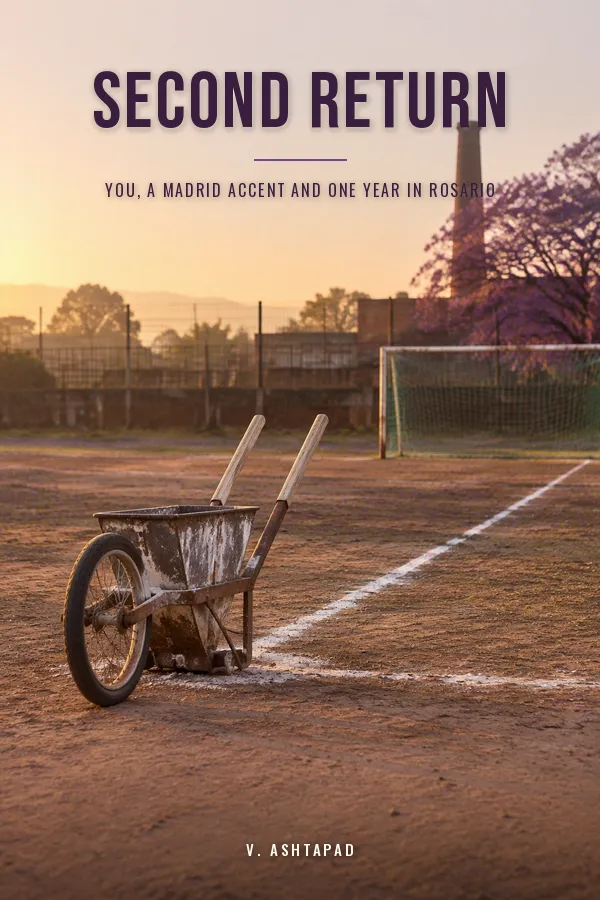
Second Return
You, a Madrid Accent and One Year in Rosario
by V. Ashtapad
Foreword
This is a work of fiction. Rosario is real, and so are the brown Paraná and its islands, the Flag Monument on the riverfront, the old port silos, and the barrios of Refinería, Arroyito, Pichincha, Fisherton and Alberdi. The great Paraná flood of 1983 happened, and so did the crisis of December 2001 that sent many families abroad. Rosario Central and Newell's Old Boys are the city's real football clubs and appear here only as the colors people wear. Everything else is invented: the Club Social y Deportivo Juventud de Refinería and its field, the riverside park and its hearing, the national ID office's window six, the bakery with the green awning, and every person in these pages, along with their matches, their nicknames and their arguments about who is who in an old photograph. Madrid's Lavapiés is real too, though the fourth-floor flat is not. Any resemblance to a real clerk, cousin or grandfather is the reader's own good luck.
For everyone who went back to the old neighborhood and found out it had kept a place for them.
Two Suitcases
Turno number 1: booked from Madrid, for the thirtieth of February.
You arrive with two suitcases and the wrong accent.
The suitcases are fine. One is gray and one is a dark green your mother bought on sale in the Rastro because she said green hides dirt, and both of them roll, mostly, although the gray one has started to pull left like a shopping cart with a grudge. The accent is the problem. You find this out before you have even left the bus terminal, when you ask a man at the kiosco for a bottle of water and he hands it to you and says, very kindly, as if offering directions to a lost child, "Welcome to Argentina, gallego."
You were not aware you had an accent. You have spoken Spanish your entire life, in a two-room flat in Lavapiés where your parents spoke it at dinner in a music you assumed was the same as yours. It was not. You, a child of Madrid classrooms and Madrid football commentary, absorbed another music, and it is written on your face like a price tag.
"I'm from here," you say. "My family is from here."
"Of course," says the man, and gives you your change, and you hear the word gallego follow you out into the heat, not unkindly, more like a dog that has decided you belong to it.
The heat. You had read about it on the plane, in charts, with the confidence of a man who once built a model predicting yellow cards in the second division from referee age and humidity. You had felt prepared.
You are not prepared. The air outside the terminal is thirty-eight degrees and wet, and it climbs into your shirt and settles there. It smells of diesel and hot pavement and, underneath, something green and enormous that you will later learn is the river. The only shade is under the buses, where three dogs have claimed it and are not taking applications.
Your grandfather is late.
You stand with your two suitcases and drink your water, which is warm in the time it takes to unscrew the cap, and you build a small table in your head. In the left column: reasons to have come. The firm that paid you to tell football clubs which of their players were running less in the seventieth minute decided it could tell them that from Dublin, without you. Your flat-share was ending. Your father said at dinner that your grandfather might like the company, and your mother gave him a look that meant there was more to it, and nobody explained the look. In the right column: everything else.
At twenty past two a small white car with one blue door comes into the lot at a speed that suggests either an emergency or a man who has driven in this city for sixty years and sees no reason to stop now. It parks across two spaces. The door that is blue opens first.
Rubén Ferraro, called el Tano by everyone who has ever met him, is eighty-three years old and roughly the size and texture of a walnut. He is wearing shorts, a short-sleeved shirt open over a white undershirt, leather sandals and a cap from a hardware store that closed in 1998. His legs are brown and thin and corded like a bicycle's cables. His eyebrows have a life of their own. He stands beside the car and looks at you across the asphalt as if you were a used refrigerator someone has offered him at a price he suspects.
"You got tall," he says.
"I was seven the last time you saw me."
"I know how old you were. I was there." He comes across the lot without hurrying, takes the green suitcase out of your hand, tests its weight, and gives it back to you. "You carry that one. I'm old."
"You just picked it up."
"To check you hadn't brought anything stupid." He takes the gray one instead, the one that pulls left, and wheels it toward the car, and it does not pull left for him. You will spend some time later thinking about that.
---
The car has no air conditioning. It has windows, which your grandfather rolls down by hand, a string of small plastic footballs hanging from the mirror, and a radio set forever to two men shouting about Rosario Central's preseason. The seat is covered in a wooden-bead mat that prints itself on the backs of your legs.
"Your father," says your grandfather, at a red light.
"He says hello."
"He doesn't say hello. He says nothing. Your mother says hello. Did she send the cheese?"
"There's cheese in the green suitcase."
"Good. That's what the green suitcase is for." The light changes. "And you. What are you for?"
You tell him about the firm, and Dublin, and the seventieth minute. You use words like distance covered and expected goals. He listens with the expression of a man being told about a new kind of tax.
"So you watch football," he says, "and you count."
"More or less."
"And they paid you."
"For a while."
"Hm." He drives for a block. "I've watched football for seventy-five years. Nobody ever paid me." He seems to consider this deeply unfair, then cheerful. "We'll find something for you to count."
You come through the center and out along the city's edge, and then the river appears on your left, suddenly, between two buildings, and you stop listening to the radio.
Maps lie. The Paraná here is not a river so much as a weather system lying down. It is the brown of wet cardboard, of the backs of your grandfather's hands, and so wide that the far side is only a low green line of islands floating in haze. You can see the whole surface slide south with a heavy patience, carrying a log, a raft of water hyacinth, a plastic chair. A cargo ship pushes upriver so slowly it seems parked.
"That's the river," your grandfather says, as if you might have mistaken it for something else.
"It's brown."
"It's carrying half of Brazil. You'd be brown too."
---
Refinería is low. That is the first thing. In Madrid you lived on a fourth floor with a view of other fourth floors. Here the houses are one story, two at most, flat-roofed and set straight onto the sidewalk with their doors and their tall shuttered windows, painted colors that the sun has been working on for decades: a pink gone to salmon, a green gone to mint, a blue so faded it has nearly gone over to the sky's side. Bougainvillea climbs over walls. Every few corners there is a kiosco with a hand-lettered sign and a grille over the counter and an old woman or a teenage boy behind it, selling cigarettes and candy and single eggs. A man is hosing the sidewalk in front of his house, barefoot, and the water hisses where it lands. Somewhere a radio plays cumbia, and then a passing car plays different cumbia louder, and then the car is gone and the first cumbia is back, triumphant.
At the end of every street toward the river there is the old rail yard, the dark brick of the sugar refinery that named the neighborhood, and the feeling of a place that used to make something very big and now makes something smaller and more stubborn.
Your grandfather's house is the salmon one. It has a front room with a tiled floor that is cool under your feet, a kitchen at the back, two bedrooms, and a patio with a grapevine growing over a wire frame so that the light comes down through the leaves in green coins. Under the vine there is a table, four chairs that do not match, a cement sink, and a grill built into the back wall of bricks blackened by a half century of Sundays.
At the grill, with his back to you, there is a man.
He is wide in the shoulders, in a sleeveless shirt with the blue and yellow of Central faded almost to white, poking the coals with a length of iron. He does not turn around when you come in, and you understand that this is a choice.
"Lautaro," says your grandfather. "Your cousin."
Lautaro turns around. He has a broad face and a short beard and the kind of eyes that have been laughing at something before you arrived and will keep laughing at it after you leave. He looks you up and down: the Madrid sneakers, white; the Madrid shorts, an unwise length; the Madrid sunglasses pushed up on your Madrid head.
"So," he says. "The gallego."
"I'm Tomás."
"I know who you are. I'm saying what you are." His handshake is hot and gritty with charcoal. "Welcome. How long are you visiting?"
"A year."
"A year." He nods, slowly, as if you have told him you plan to swim to Uruguay. "Good. That's a good long visit. Tourists usually only stay two weeks."
"I'm not a tourist."
"No, of course not." He turns back to the coals. "You want a choripán? Tourists love choripán."
You do, in fact, want a choripán, which is the worst part. You are hungry in the stupid, jet-lagged, all-the-way-down way, and the smell from the grill has been reaching for you since you came through the front door: fat dripping onto embers, the sweet char of the sausage casing, a sharp green note of something chopped in a jar on the table. You sit at the table under the vine. Your grandfather sits across from you and takes out a gourd and a thermos and a bag of green leaves and begins, without any discussion, to prepare mate.
You know mate. Your father drank it every morning at the window of the flat in Lavapiés with his back to the room, and you drank it now and then to impress a girl from Valladolid who thought it was exotic. You know the shape of it. What you do not know, you discover, is the grammar.
Your grandfather fills the gourd two-thirds with leaves. He covers the mouth with his palm and turns it upside down and shakes it, gently, then tips it at an angle so the leaves slope like a hillside. He pours a little warm water into the low side and waits. He pushes the metal straw down into the wet slope with one firm movement and does not touch it again. Then he pours the hot water from the thermos, carefully, into the same spot, and drinks the first one himself. He spits nothing out, but he makes a face.
"The first one is bitter," he says. "Always the one who makes it drinks the first one."
He fills it again and holds it out to you.
You take it. You drink. It is hot and grassy and bitter and good, and you drain it until the straw gurgles, and then, because you have manners, because your mother raised you in a flat in Lavapiés to be grateful for what you are given, you say, "Thank you."
Your grandfather takes the gourd back from you. He does not refill it for you. He refills it and passes it to Lautaro.
Lautaro, at the grill, does not even look round. "He said thank you," he says.
"I heard."
"First day, and he's already out."
"What?" you say. "What did I do?"
"If you say thank you," your grandfather explains, as if speaking to a very small, very foreign child, "it means you're finished. You don't want any more."
"I want more."
"Then don't say thank you."
"But that's rude."
"In Madrid." He shrugs. "Here it's a way of leaving."
You think about this for longer than a remark about hot water deserves. Then Lautaro puts a choripán in front of you on a square of brown paper, the sausage split down the middle and laid in bread that is crisp outside and soft inside, and spoons the green sauce over it, garlic and parsley and vinegar and a burn of chili, and you eat it in five bites with the sauce running down your wrist, and for a little while you do not think about anything at all.
---
That night you lie on a narrow bed under a ceiling fan that turns at a speed best described as ceremonial. The window screen has a hole in it shaped like Italy, and through that hole come the mosquitoes of Refinería. The mosquitoes of Madrid were occasional and apologetic. These arrive in squads. They have, as far as you can tell, a manager. They find your ankles and the soft place behind your ear and make a high thin whine that drills down into the middle of your sleep and sets up a small office there.
Outside, the cicadas are going in the plane trees, a dry electric rattle that rises until it stops being noise and becomes a sort of heat you can hear. A few houses down a television is showing a match, and every few minutes a whole family groans at once. A car goes past with its cumbia up and the bass shakes the window frame. Then, very late, a breeze comes up the street from the river, smelling of mud and wet leaves and ship diesel, and for about four minutes it is almost cool.
You open the confirmation from the national ID office on your phone, the one you booked from Madrid through a form that took three evenings. You had been proud of it. You read it again in the blue light, with a mosquito sitting on your thumb.
Your appointment is at nine in the morning, on the thirtieth of February.
You think about the gourd going from hand to hand under the vine, and the way your grandfather turned it so the straw faced the person receiving it, every time, and the way Lautaro took it without looking, as if the hand holding it out had always been there. The fan turns. Through the hole shaped like Italy, a ship on the river gives one long low note, and you slap your own ear in the dark.
The Chalk Wheel
Turno number 2: a real date this time, at an office that only does passports.
Your grandfather wakes you at a quarter to six by standing in the doorway and saying your name once, at normal volume, the way you would say the name of a dog you were sure would come.
"It's dark," you say.
"It's light in twenty minutes. In two hours it's thirty-five degrees. Get up, gallego. You wanted something to count."
You did not, technically, say that. He said that. But you get up, because your ankles are a constellation of mosquito bites and there is no point lying in a bed that has become a buffet. You put on the unwise shorts. He looks at them and says nothing so loudly that you go back and change into long ones.
The street outside is blue, the houses standing in a row like people waiting for a bus. The cicadas have stopped and the birds have started, sparrows and something larger in the plane trees that sounds like a rusty gate opened by someone in no hurry. A man is already sitting on a plastic chair outside the kiosco on the corner, drinking mate alone, and he lifts the gourd to your grandfather like a toast.
"Tano."
"Coco."
"This the one from Spain?"
"This is the one."
Coco looks at you. He is a big soft man of sixty-something in a sleeveless undershirt and he has a goalkeeper's hands, wide as dinner plates, resting on his knees. "Your father played left back for me in eighty-five," he says. "Couldn't head the ball. Closed his eyes. Every time."
"I didn't know he played."
"Everybody played," says Coco, offended on behalf of the whole barrio. "What else was there?"
---
The field is four blocks away, at the end of a street that stops at the rail yard fence. You smell it before you see it: dust, dry grass, the iron of old rails, the faint sweetness that still comes off the refinery's brick when the sun hits it. Then the street ends and there it is, and your first thought is that someone has made a mistake.
You have spent five years looking at pitches from above, with heat maps blooming red over the penalty spots of clubs worth more than this neighborhood. This is a rectangle of hard brown earth with grass growing in it the way hair grows on an old man's arm, in some places thick and in some places as a memory. The goals are welded steel pipe, painted white once, now mostly the color of rust with white opinions. The nets are not nets. They are fishing nets, green and knotted, the kind used on the islands, and someone has mended them with orange twine and, in one corner, with what appears to be a bra strap. Along one side runs a low wall with a hand-painted sign that says the name of the club in faded blue letters, Club Social y Deportivo Juventud de Refinería, and under it, smaller, Founded 1971, and under that, smallest of all, someone has added in marker that Central is the greatest, and someone else has crossed it out, and someone else has written it again.
At the far end there is a clubhouse. It is a single long building of concrete block with a corrugated tin roof weighted down at the corners with bricks. It has a door, two windows with bars, and a counter that opens to the outside under an awning, and from the awning hangs a chalkboard with the prices of choripán and soft drinks and, at the bottom, a line that says No credit. Not even for you, Pocho.
"Who's Pocho?" you ask.
"He knows," says your grandfather.
He unlocks a padlock on a shed at the side of the clubhouse and drags out a machine.
You do not know what to call it, at first. It looks like a child's drawing of a wheelbarrow. There is a single bicycle wheel at the front and two wooden handles at the back, and between them, mounted on a frame of welded rebar, a metal drum with a hole in the bottom. Beneath the hole there is a small rubber roller, and from the roller hangs a leather flap. On the side of the drum someone has painted, in red, a number: 71.
"I made it," says your grandfather, in case you were going to give anyone else the credit. "The first one was wood. This is the third. Seventy-one is the year."
"What does it do?"
He looks at you with real pity. Then he fills a bucket from the tap behind the clubhouse and pours in white powder from a paper sack, and stirs it with a stick until it is the thickness of milk that has ideas, and pours that into the drum. He takes a ball of string from his shirt pocket. He takes two iron pegs from the shed. He walks to the corner of the field nearest the clubhouse, sets a peg in a hole that is already there, as if the earth has been waiting for it since the last time, and hands you the string.
"Walk," he says. "To the other corner. Keep it tight. Don't think. You think too much, I can tell. You think with your forehead."
You walk. The string pays out behind you. The sun has come up while you were not watching, and it is already lifting off the rail yard in a white haze, and the dust under your feet is cool for perhaps the last time today. You get to the other corner, where there is another hole, and you set the peg in it and pull the string tight, and look back.
Your grandfather is coming down the line toward you with the machine.
He pushes it at a walk, steady, his sandals scuffing, his head bent. The wheel turns and the roller turns and the white comes out of the drum onto the brown earth in a line as wide as a hand, wet and bright, and it is straight. It is absurdly straight. It is straighter than the string. He does not look at the string at all. He looks at a point somewhere ahead of him, at the far corner, at you, and walks toward it, and behind him the line simply arrives, as if the field had always had it under the dust and he was letting it out.
When he reaches you he mops his forehead on his forearm. "Halfway line. Take the string."
You line the field for an hour and a half. You learn that the white is lime and water and a little glue, that it smells like a cave, and that it moves into the creases of your knuckles for days. You learn that the penalty areas are paced, not measured, eighteen of your grandfather's steps, which are not eighteen yards and have never been eighteen yards and are, he says, the correct distance for a penalty area in Refinería. You learn that the center circle is drawn with the string tied to a peg on the center spot and walked around, and that if you walk it too fast the circle comes out like an egg, and that if you walk it too slow you will be told so.
At the end of it you stand at the halfway line, sweating through your long trousers, chalk to the elbows, and look at the field with its new white bones, and it is, you have to admit, beautiful. It is still a brown rectangle with bald patches and fishing nets. But it has edges now. It knows where it begins.
"How often do you do this?"
"Every Saturday, fifty-five years. More when somebody important comes. Nobody important comes."
"Doesn't anyone help you?"
"Lautaro, when he's awake. Pocho used to, but Pocho's lines go like a snake that's had wine. And now you."
---
You find the notice by accident. It is pinned to the inside of the clubhouse door with a thumbtack shaped like a ladybug, between a schedule for the summer evening league and a hand-drawn poster for a raffle whose prize appears to be a lamb. The notice is printed on the city's letterhead, and it has a stamp, and it has been folded and unfolded so many times that the creases have gone soft.
You read it while your grandfather is putting the machine away. You read it twice. Then you read it a third time because the second time you did not believe it.
The city, it says, is moving forward with a riverside linear park connecting the old port to the northern neighborhoods. The parcel currently occupied by the Club Social y Deportivo Juventud de Refinería is municipal land, assigned to the club in 1971 by an ordinance which the city cannot at present locate in its archives. Under the provisions of something with a number, the assignment may be ratified permanently if the occupant demonstrates fifty years of continuous community use. Documentation is to be submitted for a public hearing in October. Failing which, the parcel will be incorporated into the project.
"Abuelo," you say.
"I know."
"It says they'll take the field."
"I know what it says. I can read. I've been reading since before your father's father knew what a ball was." He comes in, wiping chalk off his hands onto his shorts, which accounts for the state of his shorts. "It came in November."
"November? And you haven't sent them anything?"
"Send them what? They want fifty years. I'll send them me." He spreads his hands, and in the dim clubhouse with its smell of old frying oil and wet concrete he looks, for a moment, like a man presenting the evidence. "I was here. Coco was here. Ask anyone in the barrio. Ask the dogs."
"They don't want to ask the dogs. They want documents."
"We have documents." He gestures at a wall behind the counter, and you see, for the first time, that it is covered with framed photographs, a whole wall of them, teams in rows, kids squinting, the frames all different, some wood, some tin, one made from what looks like the lid of a cigar box. "There. Fifty-five years. Every team."
You go and look. The photographs are faded to the brown of the river, some with water stains creeping up from the bottom, each with a year on the frame or on masking tape stuck to the glass. 1971. 1974. 1979. There is no name on any of them. There are hundreds of children, standing and kneeling and squinting into the sun, and not one of them is named.
"Who are they?"
"Kids," says your grandfather.
---
That evening the summer league plays under two floodlights on telegraph poles, which draw moths the size of your thumb in a swirling white cloud that is the most organized defensive structure on the field. Families sit along the low wall, mothers shout instructions that contradict the coaches, and the kids ignore all of it and chase the ball in a pack, like birds changing direction all at once. When a goal goes in, a group of older boys behind the far goal starts up a chant, clapping in a three-beat rhythm that speeds up until it falls apart into laughing, and somebody bangs on an empty paint tin with a stick.
Lautaro is at the grill under the clubhouse awning. The smoke goes up yellow in the floodlights and hangs there, thick with sausage fat and the sweet burn of charcoal, and drifts over the field so that the kids are playing in a cloud of it, and the whole of Refinería, it seems, has come down to stand in it. Lautaro moves at the grill with a slowness that is not slowness. He turns sausages with his fingers, splits bread, makes change, insults a man in a Newell's shirt in a way that makes the man laugh, spoons the green sauce, and nothing burns.
You stand at the counter and tell him about the notice and the fifty years and the photographs with no names.
"We know," he says.
"So what's the plan?"
"The plan is we go to the hearing and say we've been here fifty years. All of us. We fill the room."
"That's not documentation."
"It's three hundred people in a room. That's documentation in Rosario." He hands a choripán over your shoulder to a kid of eleven with a split lip, who pays him in coins. "What, you have a better plan?"
You do, in fact. You have had it since about the third reading of the notice, in the clubhouse doorway, with the ladybug tack under your thumb. You can feel it in your forehead, where your grandfather says you think. "We name them," you say. "Every kid in every photo. We scan them all and get the old players to say who's who. We get the stories, the matches, the years. We find where everyone went. We put it in order. Fifty-five years, every season, with names and faces and dates. They can't argue with that."
Lautaro looks at you for a long moment over the grill. The smoke rolls between you. Then he starts to laugh. He has to put the tongs down to laugh properly.
"The gallego," he says, to the whole line, "is going to save the club with a spreadsheet."
The line laughs. The kid with the split lip laughs. A woman in a Central jersey laughs and says, not unkindly, that it's a lovely idea, sweetheart, and asks for extra sauce.
Behind you, your grandfather has come up the wall from his folding chair. He has a gourd in one hand and the thermos under his arm. He looks at Lautaro, and he looks at you, and he pours, and he holds the mate out, not to Lautaro, but to you.
"Let him count," he says.
You take it. You drink it to the bottom. You do not say thank you. You hold it out to your cousin across the grill, and after a moment, wiping his eyes, still grinning, Lautaro takes it.
Window Six
Turno number 3: right office, right day, wrong paper. "Where is the apostille?"
The national ID office is downtown, on the second floor of a building that was once grand and is now merely tall. You climb a marble staircase worn into shallow bowls by a century of people who also did not have the right paper. At the top there is a long hall with a ceiling so high that the four fans hanging from it seem to be stirring weather rather than air. Under the fans there are rows of plastic chairs bolted together in sets of five, a machine that dispenses numbered tickets, and a red digital sign that shows which number is being served. The number being served is 41. Your ticket says 117.
It is February, and February in Rosario is January wearing a heavier coat. Outside it is thirty-six degrees. Inside, under the fans, it is thirty-six degrees with a breeze. The hall smells of floor wax, damp paper, and the collective anxiety of two hundred people holding folders against their chests like shields.
You sit. You have a folder too. You put it on your knees and open it again to check everything is there, the way you have checked it four times on the bus. Your Madrid birth certificate, issued by the civil registry, with a seal. Your parents' Argentine birth certificates, photocopied and certified. Your Spanish passport. A photocopy of your father's old Argentine ID from 2009, which he gave you at the airport without a word, as if passing a note in class.
Beside you a woman of about seventy is knitting something enormous and orange. On your other side a teenage boy sleeps with his mouth open and his folder held perfectly upright on his lap. Ahead of you, a man is explaining to his wife, in a low steady voice that has clearly been going for some time, that he is not the one who forgot the marriage certificate, she is, and she is explaining back that she is not the one who married him.
The number goes to 42.
You build a model of the queue. Nine windows, four open; at window two a man is eating a sandwich. You estimate two hours and forty minutes and are pleased. You are wrong by an hour and ten minutes, in the wrong direction, because at a quarter to eleven windows three and seven close for lunch, and at a quarter past eleven a power cut kills the fans and the sign for twenty minutes, and during those twenty minutes nobody is served and the hall heats up like a bread oven and the knitting woman tells you, without your asking, the full story of her son-in-law.
At ten past one, the red sign says 117, window 6.
---
Window 6 is a counter of chipped laminate with a glass partition that has a semicircle cut out at the bottom for papers. Behind the glass there is a desk, and on the desk a monitor, and growing out of a pot beside the monitor, cascading over the top of it and down the far side and along the edge of the desk like a green waterfall that has made a decision, a plant. It is the largest houseplant you have ever seen in an office. It has leaves the size of your hand. One trailing stem has been taped to the partition, so that it grows along the glass toward you.
Behind the plant is Mirta.
You will later know her full name, Mirta Gaitán, and that she is fifty-six, and that she has worked at this window for twenty-two years, and that her hair is dyed a red that occurs nowhere in nature except possibly on certain tropical birds. Right now you know only that she has reading glasses on a beaded chain and is looking at you over them, and that the look has seen everything, including you, many times, with slightly different faces.
"Good afternoon," you say.
She raises her eyebrows at the accent. She doesn't say gallego. It is somehow worse that she doesn't say it.
"Papers," she says.
You slide the folder through the semicircle. She opens it, and turns over the pages with one finger, licking the finger before each page, and when she gets to your Madrid birth certificate she stops.
"Where is the apostille?"
"The what?"
She sighs. It is not an angry sigh. It is the sigh of a woman who has explained the apostille more times than you have eaten breakfast. "A foreign document," she says, "needs an apostille from the country that issued it. A stamp. A little certificate, stapled on, that says the document is a real document and not something your cousin made at a print shop. This" — she taps your birth certificate — "is very nice. It has a seal. It has a lovely coat of arms with a bear on it. But without the apostille, for me, it might as well be a menu."
"Where do I get one?"
"In Madrid."
"I'm not in Madrid."
"I noticed." She takes off her glasses. Her eyes are brown and amused and tired. "Do you have someone in Madrid?"
"My parents."
"Then your parents go to the Ministry, with this, and they get the apostille, and they send it to you. By post, not by email. I need the paper. The real paper, with the stamp." She closes the folder and slides it back to you. "And then you come back. And you get a turno. And you sit for three hours, and you come to me."
"Can I come to you specifically?"
She looks at you for a long moment. A fan overhead, back on now, turns and turns. The plant's taped stem quivers in the moving air.
"That depends," she says, "on whether you bring something from the bakery on the corner of Córdoba. The one with the green awning. Not the other one."
You open your mouth to say that this is surely not allowed. Then you look at her desk, and you see, under a stapler, a paper bag with a green stripe on it, flattened and folded into a neat square, as if kept for reference.
"Medialunas?" you say.
"The ones with the glaze. Not the ones with the fat. I'm not a barbarian." She puts her glasses back on and leans to the microphone. "Number 118."
---
That night you call your parents. It is one in the morning in Madrid. Your mother answers on the second ring because she has been waiting up, and your father is a shape behind her in the dim kitchen, at the window, with his back to the screen.
You explain about the apostille.
"I told him," says your mother, not to you. "I told you, Gustavo. I said, he needs the stamp, and you said, they never asked me for any stamp."
"They never did," says the shape at the window.
"In 2009 they didn't. In 2009 they didn't ask anyone for anything. It was chaos." She turns back to you. "We'll go to the Ministry Monday. How is your grandfather?"
"He made me line the field."
Behind her, your father turns around. It is the first time he has turned around in any call since you arrived. His face is lit blue by the screen. He looks older than he did a month ago, or you are seeing him from further away. "With the machine?" he says.
"With the machine. The one with seventy-one on the side."
"That's the third one," says your father. "The second one I broke." He looks as if he is going to say something else. Then he turns back to the window. "Put on sunscreen," he says, to the glass.
---
The back room of the clubhouse is where things go to be forgotten. It is a narrow room with no window, a bare bulb, a floor of cracked red tiles, and the smell of every summer since 1971 stacked one on top of the other: frying oil, mildew, chalk, mouse, a sweetish rot like old oranges. There are stacked plastic chairs, a broken goal frame, three bags of lime, a drum kit nobody can explain, and against the far wall, taking up most of it, a wardrobe.
It is green. It is the green of a pharmacy sign, painted over something darker, so that the dark shows at the edges where hands have worn through. It has two doors and a drawer underneath and a mirror on the inside of one door that has gone silver-gray and spotted, so that when you open it you see yourself as if through river water.
Inside the wardrobe, in no order whatsoever, is the club.
There are photographs loose and in envelopes and in shoeboxes and in a plastic shopping bag from a supermarket that no longer exists. There are match programs mimeographed in purple ink. There are ledgers, school exercise books with marbled covers, in which someone has written the results of every match in a careful slanted hand, and someone else, later, in a rounder hand, and someone else again in ballpoint that has bled. There are ribbons and paper rosettes and a pennant from a tournament in Villa Gobernador Gálvez in 1977. There is a single small football boot with the studs worn flat. There is a gecko, pale and nearly translucent, which watches you from the top shelf with the dignity of an archivist.
You stand before it a long time, your phone flashlight on it. Your shirt is stuck to your back. A mosquito is at your ankle and you let it.
"You're going to need a bigger forehead," says Lautaro from the doorway.
He has come in from the grill with a bottle of cold soda sweating in each hand. He holds one out. You take it and hold it against the back of your neck before you drink, and he watches you do this and almost smiles.
"Where did all this come from?"
"Everywhere. Every coach kept stuff. When they stopped coaching, they brought it here. When they died, their wives brought it here. When the abuelo cleans his house, he brings it here." He looks at the wardrobe with something you can't read. "Nobody ever opens it except to put more in."
"Can I take it?"
"Take it where?"
"Home. To the patio. To scan."
Lautaro shrugs, enormously, the shrug of a man disowning an entire wardrobe. "Ask the abuelo. It's his. Everything's his." He goes to the door, and stops, and says without turning, "Don't take the boot."
"Whose is it?"
"Just don't take the boot."
---
You buy a scanner from a man in Pichincha who sells broken things and things that will soon be broken, in a shop the width of a hallway. He tests it by scanning his own hand, which comes out on the screen pale and creased like a map of somewhere with many rivers. He charges you too much because of your accent. You pay anyway. Your Spanish does not have the muscles for the argument yet.
For the rest of February you scan at night, on the patio, at the table under the grapevine. You run an extension cord out through the kitchen window. The heat does not break after dark so much as bend. The cicadas go and go. Moths come to the screen of your laptop and sit on the faces of children from 1974 like enormous dusty freckles. Your grandfather sits across from you with his mate and watches the faces appear on the screen, one by one, out of the white light, and he says nothing for most of the first night, and then, near midnight, when a team from 1972 comes up, two rows of boys in white shirts that are too big for them and a dog lying in front of the goalkeeper, he leans forward and puts his finger on the screen, on the dog.
"That's Chapa," he says. "He went in goal when the goalkeeper had to go home for supper."
You make a note. Chapa, the dog, 1972. Substitute goalkeeper.
It is the first name you write down. It belongs to a dog. You decide this is not a bad start.
Your aunt Silvia comes by on Thursday after a twelve-hour shift at the hospital, still in her scrubs, smelling of disinfectant and the bus. She is your father's younger sister, Lautaro's mother, a small fast woman who looks at the photographs fanned across the table and the scanner humming and you sweating over it and says, "Ay, he's like Gustavo," in a voice you cannot interpret, and then goes into the kitchen and makes empanadas for everyone out of what is in the refrigerator, which turns out to be a great deal more than you thought, and burns her thumb on the oven, and swears in a way that makes your grandfather laugh so hard he has to put down the mate.
On the last night of February the kids on the street have a water fight for carnival. They have balloons and spray cans of foam and two buckets, and they shriek up and down outside the salmon house until after eleven, and one of them, a skinny boy of nine with a Central shirt down to his knees, lobs a balloon over the wall into the patio and it bursts on the table, on the scanner, on you.
You stand there dripping. The kids on the other side of the wall have gone silent, the terrible silence of children waiting to find out how much trouble they are in.
Your grandfather wipes his face with his sleeve. He picks up the empty bucket that lives by the cement sink. He fills it from the tap. He walks very slowly, in his sandals, to the front door, and opens it.
The shrieking that follows goes all the way to the corner and back. The scanner, when you dry it with a dish towel, still works. The photograph that was on the glass, a team from 1976, has a single drop of water on one boy's face, and when it dries it leaves a faint ring, like a halo that has slipped.
Naming Sunday
Turno number 4: postponed. The apostille is somewhere over the Atlantic, or in a sorting room near the airport, resting.
March arrives and nobody tells the weather. The calendar says autumn. The kids go back to school in white smocks that are clean for exactly one morning, and the plane trees on the street drop the occasional yellow leaf as a gesture, and the newspaper on your grandfather's kitchen table goes back to complaining about Central's defense. But it is still thirty-two degrees at noon. The only change is the early mornings. At six, when you go out for bread, there is a softness in the air that was not there in January, a damp, a smell of wet grass and river mud coming up the streets on a breeze that almost has an edge to it, and you stand on the corner in a T-shirt and feel your arms goose-bump, and you are absurdly, unreasonably happy about this, the way a man in a desert might feel about a single cloud.
The bakery on the corner is run by a family who have been baking since before the refinery closed. Its window is stacked at dawn with facturas in rows like a small brown army: medialunas glazed until they shine, crescents filled with pastry cream, rolled ones with quince paste, round ones crusted with sugar, and the long braided ones your grandfather calls by a name you are fairly sure is rude. You buy a dozen every Sunday now. The woman behind the counter, who is called Nilda and has forearms like a docker, puts them in a paper bag with a green stripe without asking what you want, because she has decided what you want. She says "the gallego" when you come in, the way you would say "the weather."
You take the bag home. You put it on the table under the grapevine, which is starting to lose its leaves, so that the light comes through bigger gaps now, in plates instead of coins.
"It's Sunday," says your grandfather.
"I know."
"Sunday is for the asado. And after the asado, sleep. And after sleep, mate." He looks at your laptop, which you have put on the table beside the facturas, and at the projector you borrowed from a teacher at Lautaro's old school, and at the white bedsheet you have pegged to the patio wall. "What is all this?"
"This is for after the mate."
---
The asado takes four hours, which you have stopped finding strange. Lautaro arrives at ten with the meat wrapped in brown paper and a bag of charcoal on his shoulder like a sailor. He builds the fire in the back corner of the grill, not under the grate, a separate little pyre of charcoal and split wood that he lights with newspaper and coaxes with a sheet of cardboard, fanning, until it roars and then settles and then glows. He rakes the embers under the grate a shovel at a time. He does not hurry. When you ask him why the fire is in the corner and not under the meat, he looks at you the way your grandfather looked at you when you asked what the chalk machine did.
"Because then you control the heat," he says. "You give it what it needs. You don't just throw it in the fire and hope. What do they do in Madrid?"
"They go to a restaurant."
He laughs so hard he has to turn away.
The sausages go on first, and the blood sausage, which you have decided to be brave about. Then the short ribs, laid out in long strips bone side down. Then the flank, and a whole provolone in a little tin dish, and peppers split and filled with egg. The smoke rises into the grapevine and stays there. It soaks into your shirt and your hair and the cushions of the chairs, and you will smell it on yourself in bed that night and it will be the best part of the day. Your aunt Silvia comes at one, off a night shift, and eats standing up and then sleeps on the sofa in the front room with her shoes on. Your grandfather drinks a glass of red wine with soda water in it, which in Madrid would get a man thrown out of a bar, and tells Lautaro every ten minutes that the fire is too hot, and Lautaro tells him every ten minutes that it is not, and they are both, you slowly understand, enjoying themselves enormously.
After lunch everyone sleeps. You lie on the narrow bed in the second room with the shutters closed and the street gone silent outside, so silent you can hear a neighbor's caged bird and the tick of the ceiling fan, and you think you will not sleep, and you sleep for two hours.
At five they come.
---
Coco Benítez comes first, because he lives closest and because, he says, goalkeepers are always early, they have to be, they're the last line. He brings his own folding chair and a plastic bottle of cold water with a sock wrapped around it to keep it cool. Then Pocho Aguirre, the Pocho of the chalkboard, a thin quick man with a pencil mustache and a Newell's cap that he wears, he explains, "to keep them honest," and who owes the club, by his own cheerful admission, the price of four hundred choripán since 1990. Then the Ramella twins, Hugo and Horacio, sixty-eight years old and identical down to the bald spot, who arrive arguing and continue arguing as they sit down, and do not at any point that afternoon stop. Then Chiche Montoya, who is tall and stooped and quiet and carries his grandchild, a solemn girl of two who stares at you for the entire evening with the steady contempt of a very small judge.
Your grandfather prepares the mate. You have been here two months now, and you have learned some of the grammar. You know that the person who prepares and pours it is in charge of it, and that he pours for each person in turn, around the circle, and that you drink the whole gourd and hand it back to him and not to the person beside you. You know not to say thank you until you are finished. You have learned this so thoroughly that the week before, at the bakery, you failed to thank Nilda for your change and she gave you a look that could strip paint.
What you have not yet learned is not to touch the straw.
You do it without thinking. The gourd comes to you, the leaves have gone a bit flat, the water isn't coming up properly, and you do what you would do with anything that wasn't working. You give the straw a stir.
Five old men inhale at once.
"What," says Pocho, "are you doing."
"It was blocked."
"It was not blocked. It was resting." Hugo Ramella takes the gourd out of your hands with the expression of a man rescuing a baby from a well. "You never move it. Never. Whoever pours puts it in, it stays. You move it, you ruin the whole mountain. Now the leaves come up the straw. Now everyone gets a mouthful of leaves."
"He gets a mouthful of leaves," says Horacio. "He did it."
"It's in the gourd now. Everyone gets the leaves."
"That's not how leaves work."
"How do leaves work, then, Professor?"
Your grandfather takes the gourd back, empties it into a flowerpot without a word, and starts again from the beginning with fresh leaves. It takes him four minutes. The twins use them to explain to Chiche, at length, what you have done. When he hands you the new one, he looks at you over it with his eyebrows doing something complicated.
"In Madrid," he says, "you stir your coffee?"
"Yes."
"This isn't coffee."
---
When it is dark enough you turn on the projector.
You had thought about this for a week. You could have shown them the photographs on the laptop screen, but the laptop screen is small and these are old men with old eyes, and you wanted the faces big. So the first photograph comes up on the bedsheet on the patio wall five feet high: the 1971 team, the founding team, eleven boys in white shirts and dark shorts, eight standing and three kneeling, in front of a goal that is clearly a goal and clearly not yet the welded pipe one, but two wooden posts and a crossbar that sags in the middle like a hammock. Behind them, the rail yard. Behind that, the refinery chimney. To the left, half out of the frame, a man in a cap with his arms folded.
"That's me," says your grandfather.
He is twenty-eight in the photograph. He has black hair and black eyebrows and the same cap, or its father. His eyes are not on the camera. They are on the boys.
The old men lean forward. The bedsheet stirs a little in the breeze from the river, so that the boys ripple, as if seen through water.
"Coco," says Pocho. "There. The fat one in front."
"I was not fat. I was solid."
"You were round, Coco. You were a ball that kept goal."
"That's Hugo," says Horacio, pointing. "Back row, second from the left."
"That's you," says Hugo. "I'm on the end."
"You were never on the end. You were always in the middle, you liked to be in the middle, you were the middle twin."
"There are only two of us."
"And you were in the middle."
You have the laptop open on your knees. You have built, for this, a very simple form: photograph number, position, name, nickname, who named them, any notes. You type as they talk. You type fast. Your forehead, as your grandfather would say, is working.
They argue for forty minutes about the first photograph. It is the best forty minutes you have had in Rosario. By the end of it, every boy has a name. Some have two names, a real one and the one everyone used, and one, the boy kneeling on the far right with enormous ears, has three, because the twins call him one thing and Coco calls him another and Pocho insists his name was a third thing entirely and that the other two names belonged to his brothers. You write all three. You write who said which. Chiche Montoya, who has not said a word all evening, leans forward at the end and points at a small dark boy at the edge of the back row, half hidden behind the shoulder of a bigger one.
"Chiche," he says, and then, because they all look at him: "Me. That's me."
His granddaughter, on his knee, looks up at the bedsheet and then at him and then at the bedsheet, and puts her hand flat on her chest, the way you do when you are trying to work out where you are.
---
Much later, when the others have gone home with their chairs and their arguments, you ask your grandfather if you can record him.
You ask it carefully. You have been thinking about how to ask all evening. You put your phone on the table between the thermos and the sugar bowl, the screen dark, not recording, so he can see it.
"Record what?"
"The stories. How the club started. The matches. Whatever you want to tell. On Sunday afternoons. Just you talking. I'll keep them, with the photographs. For the hearing. For the family."
He looks at the phone the way he looked at you in the parking lot in January, the way a man looks at a refrigerator he suspects.
"With my voice," he says.
"With your voice. And your name on it. That it's yours."
"Rubén Ferraro," he says. "Put Rubén Ferraro. Not Tano. Tano is what people call me when they want something." He pauses. "Which is everyone."
"Rubén Ferraro."
"And if I say something stupid you take it out."
"You never say anything stupid."
"Ha," he says, delighted. "Your father would disagree."
You press the button. A small red dot appears. He clears his throat, and looks at it, and then he looks away from it, out at the dark patio, at the bedsheet still pegged to the wall with nothing on it now, and he begins.
He tells you that in 1971 the lot at the end of the street was a dump. That there were tires and a burned-out truck and a mattress that a family of cats had lived in so long they had a sort of title to it. That he worked at the grain elevators by the port, loading the ships, and on Saturdays he and four other men from the street took shovels from their own sheds and started digging. That the first ball was leather and had a lace, and when it got wet it weighed like a melon and you could knock yourself out heading it, and a boy named Fito once did. That they asked the city for the land, and a man in an office signed something, and that was that, as far as anybody knew. That the goal posts came from a shipment of timber that was, as he puts it, "a little more than the ship needed."
"Is that true?" you ask.
"Put that I said it was a gift," says your grandfather, to the red dot, and you laugh, and he looks pleased with himself, and goes on, and the cicadas, the last cicadas of the summer, thinning now, go on with him.
Southeast Wind
Turno number 5: apostille accepted. Parents' certified copies expired. They last ninety days. Nobody told the copies.
You bring Mirta medialunas from the bakery with the green awning, the glazed ones, six in a paper bag, and she accepts them through the semicircle in the glass without comment and puts them in a drawer, and then she reads your apostille, front and back, holding it up to the light from the high window as if checking a banknote.
"Good," she says. "A real stamp. A Madrid stamp. Very serious people, in Madrid." She turns to the photocopies of your parents' Argentine birth certificates, and her mouth goes small. "These were certified in December."
"Yes."
"A certification lasts ninety days."
You count on your fingers, under the counter, where she can't see. You count again.
"Who decides that?"
"A resolution from 1998," says Mirta, "which is older than you and in better health." She pushes the papers back. "Your aunt can do it here. The civil registry on the boulevard. She takes the original books' numbers, they print a new certified copy, it costs a little, it takes a week. Tell her to go on a Tuesday. Tuesdays the woman at the registry is in a good mood. Her son plays on Monday nights and he usually wins."
"How do you know that?"
She looks at you over her glasses, and the plant that grows along the glass trembles in the fan's breath. "Twenty-two years at window six, pibe. I know everything." She leans toward her microphone. Then she stops and says, without looking at you, "Take an umbrella this week. The wind is turning."
---
You do not take an umbrella, because you are from Madrid, where weather is something that happens to other cities.
The wind turns on Thursday. In the morning it is the usual autumn morning, gray and soft, the air wet, the river smell strong in the streets. By noon the sky over the islands has gone the purple-black of a bruise, and the wind has swung round and is coming up the river from the southeast, steady and cold and enormous, pushing the water ahead of it. You go down to the riverfront after lunch to look, because you have never seen anything like it. The Paraná, which in January lay in the heat like a sleeping animal, has woken up angry. It is running high and fast and the wrong way, against itself, in short choppy waves the color of milky chocolate, and it is breaking over the steps at the bottom of the riverfront park where in summer people sat with their feet in it. Whole rafts of water hyacinth are being pushed upstream, against the current, like a crowd being shoved back by police. The wind is in your teeth. It is in your ears. It makes the flags on the Flag Monument, far down the shore, crack like whips, and you can hear them from here, or you think you can.
Then the rain arrives. It does not start. It arrives, all at once, as if a door has opened in the sky, and it is cold and sideways and it soaks you from the left, through your shirt and your trousers and your stupid Madrid sneakers, in the time it takes to say a word your grandfather taught you that your mother would not approve of.
You run home. The streets of Refinería are already rivers. Water is coming down the gutters a foot deep, carrying leaves and a child's sandal and a whole cardboard box, intact, sailing toward the rail yard with tremendous dignity. The plane trees are thrashing. Somebody's laundry is cartwheeling down the middle of the road.
Your grandfather is standing at the front door with a towel when you get there.
"Umbrella," he says.
"I know."
"Mirta told you."
"How do you know Mirta?"
"Everyone knows Mirta." He hands you the towel. "Dry your head, and then we go to the field."
---
It rains for three days.
The wind does not let up. It pushes the river up and holds it there, so that the water cannot drain from the low parts of the city into the river because the river is already in the low parts of the city. The rail yard floods. The streets nearest the water flood. The field floods.
You go down on the first evening in borrowed rubber boots that are two sizes too big and make a sucking noise at every step. Lautaro is already there with a flashlight and a broom. The field is a brown lake. The chalk lines your grandfather laid down on Saturday are gone, dissolved, though in one corner you can still see a faint white ghost of the penalty box under the water, like the outline of a body on a crime show. The goals stand up out of the lake, their fishing nets sagging, dripping. The water is moving, very slowly, toward the clubhouse.
"The roof," says Lautaro.
The clubhouse roof is leaking in four places. In the main room it is dripping into the buckets that live under the counter for exactly this purpose. In the back room it is not dripping. It is pouring, in a thin steady stream, from a gap where the tin has lifted at one corner, and the stream is falling directly onto the top of the green wardrobe.
You stand in the doorway with your flashlight on it and something happens in your chest that you were not expecting.
"The photographs," you say.
"I know."
"Most of them aren't scanned yet. I've done the seventies. I haven't done the eighties, the nineties. They're all in there. The ledgers."
"I know, gallego. I can see."
He goes past you into the back room and puts his shoulder to the wardrobe, and it doesn't move, and you go and put your shoulder next to his, and it still doesn't move, and you look at each other in the flashlight with the water drumming on the wood a foot above your heads.
"We empty it," he says.
You empty it. You do it in the dark with the flashlights in your mouths, the bulb having blown on the first night of rain, and you do it fast. Lautaro has a roll of black garbage bags from behind the grill. You fill them with shoeboxes and envelopes and ledgers and rolled pennants and the single small boot, which Lautaro puts in a bag by itself and ties the neck of very carefully, without comment. You double-bag everything. You carry the bags out through the main room with the buckets dripping and across the flooded field in your sucking boots with the rain hammering on the plastic, two bags each, four blocks to the salmon house, where your grandfather has cleared the kitchen table and the front room floor and spread towels. You go back. You do it again. It takes six trips. On the fourth trip you fall, flat on your face in a foot of brown water, and you hold the bags up above your head as you go down, both arms straight up like a man scoring, and you come up spitting river and the bags are dry.
Lautaro is standing over you with the flashlight.
He is laughing. Of course he is laughing. But he puts his hand down, and you take it, and he pulls you up, and when you are up he does not let go of your hand straight away. He looks at the bags, dry, held up out of the water, and then at you.
"Not bad," he says. "For a tourist."
---
The second night, the river is still up, and there is nothing more to carry, and the roof is as fixed as it will be until somebody can get on it with a hammer. So you sit in the clubhouse with Lautaro and wait for the rain to change its mind. He has lit the little gas camping stove on the counter and is heating water for mate in a dented kettle. He has brought bread and a lump of salami and a jar of pickled eggplant his mother made. The rain is a roar on the tin roof, so loud the two of you talk with your heads close.
"Why did you come?" he says.
"I told you. I lost my job."
"So you came because there was nothing there." He pours. He drinks the first one himself, makes a face, pours again, and hands it to you. "That's what I mean. You came here because there was a hole there. Not because there was something here."
You drink. The mate is very hot and very bitter, and the wind shoves at the walls.
"Is that a crime?"
"No. It's a visit." He takes the gourd back. "People come here on a visit. They come from Spain, from Italy, from Buenos Aires, they eat an asado, they cry at the river, they say, oh, the barrio, oh, the abuelo, so beautiful, so real. And then the hole closes, wherever they came from, and they go. Back to the place with the job." He fills the gourd. He does not hand it to you. He drinks it himself. "I'm not saying you're bad. I'm saying you're on your way somewhere. It's on your face."
"Like the accent."
"Worse than the accent."
You think about arguing. You would like to argue. But you are wet to the bone and the flashlight is flickering and you are not sure, if you are honest, that he is wrong.
"What about you?" you say. "Did you never want to go?"
He laughs, but not the big laugh. A short one, through his nose.
"I had a trial at Central," he says. "When I was fourteen. The youth division. I was a number nine. I could score with either foot, head it, anything." He holds the gourd up in the flashlight and looks at it as if it were a trophy. "They had me for two months. Then they said thank you." He gives you a look. "And you know what thank you means."
"It means you're finished."
"It means you're finished." He pours again, and this time he hands it to you. "So I came back here and I played for Juventud until I was twenty-two and my knee went, and now I fix tires at my friend's shop in the week and I run the grill on the weekend, and I help the abuelo with the lines when I'm awake. That's my career. I didn't go anywhere. I'm not on my way anywhere." He shrugs. "Somebody has to be here when the visitors come."
The rain roars. The kettle ticks on the gas.
---
On the third day the wind drops and the rain stops and the sun comes out over the islands as if nothing happened, and the river begins, sullenly, to go back down. You spend the afternoon on your grandfather's front room floor with the garbage bags, unpacking. Almost everything is dry. A shoebox of photographs from 1988 has taken some water at one corner and the faces at that end have bloomed into soft brown clouds, but you can still see them, mostly, and you lay them out on towels on the tiles to dry like fish.
Your grandfather sits in his chair and watches you and drinks his mate and tells you where each pile should go, and you ignore him, because you have a system.
And it is because you have a system that you find it.
The ledgers are numbered. You had not noticed before, but someone, once, years ago, wrote a number on each marbled cover in red pencil, one to nineteen. You lay them out in order across the floor. One, 1971 to 1973. Two, 1973 to 1975. On and on. Every season has its page, every match its line, written in the slanted hand, and then the round hand, and then the ballpoint that bleeds.
Ledger seven covers 1982 and 1983. You open it to 1983. The matches run from March to April, eight of them, results, scorers, a note that says Rain, abandoned at half time. Then nothing. Then empty pages. The lines are ruled, and the ruled lines go on, and there is nothing written on them, page after page, until a single line in September: Played again. Lost 4–1 to Alberdi. Nobody cares. We're back.
You look up at your grandfather. He is looking at the ledger in your hands.
"Five months," you say. "There's nothing for five months."
"Mm," he says.
"The city wants continuous use. Fifty years, continuous. If there's a hole, five months with nothing, they can say it stopped. They can say the club stopped."
"The club didn't stop."
"Then where is it? What happened?"
Your grandfather puts down the mate on the arm of his chair. He looks out of the front window at the street, where the water has gone down and left a line of brown mud on every wall at exactly the same height, like a ruler drawn across the barrio.
"The river came to visit," he says. "In eighty-three. For a long time." He picks up the gourd again. "That's a Sunday story. Not a Thursday one."
Where They Went
Turno number 6: every paper correct. The system is down. "Come back in June, pibe. Bring the glazed ones."
May comes in on a cold wind and the barrio puts on scarves as one person.
You had not known Rosario could be cold. You had packed for it the way you pack for a rumor: one sweater, one jacket. By the middle of the month the mornings are eight degrees and the salmon house, which was built to hold off thirty-eight, has no idea what to do about eight. The tiled floor that was so cool under your feet in January is now a sheet of ice. There is no heating. There is a gas heater on wheels in the front room, a squat metal thing with a blue flame behind a grille, which your grandfather moves from room to room behind him like a pet, and which you are forbidden to touch, because, he says, you will blow up the street.
The plane trees have given up all pretense and dropped everything. The sidewalks are thick with big brown leaves the size of plates, and they crunch and then, after rain, go soft and slick and smell of tea and wet bread. People burn them in the gutters in the evenings, and the barrio fills with a low blue smoke that hangs at the height of your knees. The light changes. It comes in low and long from across the river in the late afternoon, and the islands go dark against it, and the water turns for half an hour to hammered copper, and then it is night at six.
On the twenty-fifth, which is a holiday, everyone on the street makes the same thick stew of corn and squash and beans and pork skin in pots the size of oil drums, and you eat three bowls of it in three different kitchens and have to lie down.
And you begin the map.
---
By the middle of May you have six hundred and forty names.
That is the number on the screen of your laptop, in the cold front room, with the gas heater ticking beside you and your grandfather asleep in his chair under a crocheted blanket with his mouth open. Six hundred and forty kids, in eighty-one photographs, from 1971 to 1999, named by the people who stood next to them. Some of them are named three times over, by three different old players, and you have kept all three, with who said what, because you have learned by now that the arguments are part of it. You have a column for nicknames. You have a column for position. You have a column, which you added after the second Sunday, for "notes," and the notes column has become the longest column, because nobody in this barrio can give you a name without a story attached, the way you cannot buy a single medialuna from Nilda without being told about her knees.
But names are not enough. The city wants use. Community use. Fifty years of it. And you have been lying awake under three blankets working out that a community is not just the kids in the photographs. It is where they came from, and where they went, and whether they are still, in some way, here.
So you start asking where they went.
It turns out to be easier than you thought and much harder. Easier because everybody knows. Harder because everybody knows a different thing.
"Coco," you say on a Sunday, under the bare grapevine, everyone in coats. "Number fourteen in the 1979 photo. Ricardo Pérez. Where does he live now?"
"Ricardo? Fisherton. He married the girl from the shoe shop. Three kids."
"No," says Pocho. "That's the other Ricardo Pérez. That Ricardo is in Córdoba. He drives a bus."
"The bus Ricardo was never in a photo. He played for Alberdi."
"He played for us in seventy-nine, for two months, before his mother moved him."
"His mother moved him because he was playing for us."
You write all of it down. You write it as a question mark. You add a column called "check."
---
Lautaro, it turns out, is the answer to the check column.
You did not expect him to help. You did not ask. He arrives one evening at the salmon house when you are on the floor surrounded by printouts and the gas heater is ticking and your grandfather is asleep again, and he stands in the doorway in his work jacket with the tire shop's grease on his hands and looks at the screen over your shoulder.
"Who's that?"
"Number six, 1986. They think his name is Marcelo Ríos. Nobody's sure where he went."
"That's not Marcelo. That's Cacho Ríos. His brother." Lautaro leans down and points. "See the ear? Cacho's ear stuck out like that. He's in Arroyito, two blocks from the stadium. He has a bike repair place. I fixed his van last year." He straightens. "Marcelo's the one in Barcelona. Waiter. Every December he sends his mother a ham."
You type. You look up at him. He is looking at the screen, not at you.
"How do you know all this?"
"I fix their tires," he says. "Everyone in Refinería gets a flat tire eventually. And while they wait they talk." He sits down on the floor next to you, in his grease, on the cold tiles, and pulls one of the printouts toward him. "Who's next?"
You work until two. Then on Saturday, after the lines, he takes you around the barrio on the back of his motorbike, which is small and red and sounds like an angry hairdryer, and which he drives the way your grandfather drives his car, as if the traffic signals were advisory. You go door to door with a folder of printouts. You knock. A woman in a housecoat opens the door, and Lautaro says her name, Teresa, and says this is the Tano's grandson from Spain, and he has a picture of her Raúl from 1981. And Teresa looks at the printout and goes very quiet and then she shouts into the house, and three people come out, and a dog, and they all stand in the doorway in the cold looking at a boy of nine with a gap in his teeth, and the boy is now fifty-four and lives in Turin with an Italian wife and works in a car factory and calls his mother every Sunday at noon, and his mother takes your pen and writes his address in Turin on the back of the printout in a big round hand and underlines it twice.
You do this for three weekends. You drink mate in twenty kitchens. You are given four alfajores, two jars of quince paste, a recipe for a cake that requires an ingredient nobody can tell you the name of, and a small statue of a footballer made of bottle caps.
The map grows.
---
You build it on the laptop at night. A map of the world, with the city of Rosario in the middle, and around it, each family placed where they live now, each with their name and their year and the photo they came from. You do it slowly, by hand, one at a time, cross-checking with Lautaro's memory and the mothers' handwriting.
Most of them are close. That surprises you. Half the families of every kid who ever played for Juventud de Refinería still live within twenty blocks of the field. They are in Refinería and Arroyito and the edges of the center, a thick cluster around the river bend. Then a second ring: Fisherton, Alberdi, the newer barrios to the west and south, where the kids moved when they married and could afford a house with a yard. Then further: Buenos Aires, Córdoba, Santa Fe, Mendoza, a man in Ushuaia who fixes boats.
And then, across the ocean, a third cluster, smaller, and denser than it should be.
Spain. Madrid, Valencia, Barcelona, a scatter along the coast to Málaga. Italy, mostly Genoa and Turin and a village near Bergamo that six families from the same street all ended up in, one after another, like birds following a lead bird. A dentist in Miami. A woman in Sweden. Somebody in Australia who nobody can agree about.
You look at the dates on the ones across the ocean. You sort them. You stare at the column.
Most of them left between December 2001 and the end of 2002.
You sit back from the screen in the cold front room. The gas heater ticks. Outside, a car goes past slowly with its windows up for the cold, its cumbia muffled, a heartbeat through glass.
You put in one more family. It takes you a while, because you do not have a photograph to attach it to yet, and because you are not sure which year to put. In the end you put it in Madrid, in Lavapiés, two rooms on a fourth floor, and you write the names in, Gustavo Ferraro, Marcela Ferraro, and after a moment you add Tomás, and you sit and look at your own name on the map for a long time, as if it belongs to someone in a photograph you don't recognize.
---
Your mother starts the family space that week. It is her idea. You tell her about the map on a call and she goes quiet, and then she says that the family should have somewhere of its own, private, just them, the Madrid ones and the Rosario ones together, where they can put the photographs and the names and the stories in one place, and she sets it up that night from the kitchen in Lavapiés and sends the invitation to everyone. Silvia joins within an hour, from the hospital, on her break. Lautaro joins two days later and puts up a single photograph, of the abuelo at the chalk machine, from behind, with the line going away from him into the morning, and does not write anything under it.
Your mother begins a family tree. She puts in her own parents, and Gustavo's, and your grandmother Elsa, who you barely remember, a small woman with a laugh like a hiccup who was gone before you came back as a boy. Silvia adds her side. Silvia adds Lautaro's father, whom nobody mentions, and puts him in without comment, which you think is very fair. Your grandfather refuses to look at it for a week and then is caught at two in the morning by your aunt, at the kitchen table, scrolling with one finger, with his reading glasses low on his nose, muttering that half the dates are wrong.
Your mother posts a photograph she found in a box in Madrid: a boy of eleven in the white shirt and dark shorts of Juventud, all knees and ears and a terrible haircut, holding a ball under one arm and squinting into the sun. Under it she writes: Gustavo, 1983, I think.
Your father does not post anything. But that night your phone lights up at four in the morning, Madrid's nine, and when you look at the family space someone has changed the caption under the photograph. It now says Gustavo, 1984. Under-twelves. We lost the final.
---
At the end of May you go to see Graciela Quiroga.
She is the one name in the 1994 photograph that everyone agrees about, because the 1994 photograph is the only one with girls in it. Juventud's first girls' team. Eleven of them, in borrowed shirts that come down to their knees, and in the middle, holding the ball, a tall girl with a fierce face and a braid. The old players named her at once. They could not name a single other girl on the team.
Graciela is forty-four now, a physical education teacher at a school in Alberdi. She meets you at the field on a Wednesday in a track suit and a scarf, with her daughter, Julieta, who is twenty-three and coaches the club's under-twelve girls and who looks at you and your folder and your Madrid jacket with polite and total suspicion.
You show Graciela the photograph on the laptop. She looks at it for a long time, standing in the cold at the edge of the field, with the river wind pulling at the printouts in your hands.
"Who named me?" she says.
"Coco. Pocho. The twins. Everyone."
"And the others?"
"Nobody knew."
Graciela takes the laptop out of your hands. She does it gently, but she does it. She sits down on the low wall under the faded sign, with the screen on her knees, and puts her finger on the girl at the far left.
"Mónica Sosa," she says. "Left wing. Fast as a cat. She's a lawyer in Santa Fe." Her finger moves. "Patricia Gallo. Goalkeeper. She was terrified of the ball, she used to shut her eyes, we only had her because she had the gloves." She moves on. "Vanesa. Carla. The Ibáñez sisters, both of them, Romina and Lorena, they lived above the kiosco." On and on. All eleven. She knows where each one is now, or nearly: who married, who moved, who lost touch, who is in Valencia, who is three streets away and never comes down to the field.
When she is done, she hands the laptop back to you.
"Thirty-two years," she says. "Nobody ever asked."
Julieta is looking at her mother. Then she looks at you, and the suspicion has not gone, but something has moved over to make room beside it.
"Put them on the map," says Julieta. "All of them. Put them in the right places."
You do. That night, under three blankets, you put them in, one at a time, eleven girls from 1994, and the cluster around the river bend gets a little thicker, and somewhere on the coast of Spain one more small light comes on, in Valencia, by the sea.
River Fog
Turno number 7: fingerprints. The machine does not like your thumbs. "Too smooth," says Mirta. "Like a baby, or a man from an office."
In June the river makes its own weather and sends it up into the city every morning to see who is awake.
You wake at seven to a white window. Not a frosted window, not a dirty one: a window with nothing behind it. You go out onto the street in your jacket and your grandfather's scarf, which he has given you with the air of a man handing over a firearm, and the street is gone. The salmon house is there, and the house beside it, the mint one, and then the next house is a shape, and the one after that a rumor, and then there is only white. The plane trees stand bare in it like the frames of umbrellas. The kiosco on the corner has its light on, a smudge of yellow, and Coco is sitting outside it in a wool hat drinking mate, and he lifts the gourd at you out of the fog like a man signaling from a lifeboat.
The fog smells of the river. It smells of mud and cold weed and the diesel of the ships, and something else, sweetish, like wet bark. It beads on the wool of your scarf in tiny gray pearls. It gets into your throat. From the direction of the water, out there beyond the rail yard and the silos, the ships are calling to each other, long low notes like enormous cattle, and you cannot see them, and they cannot see each other, and every few minutes one of them answers another one from further off, and the sound comes rolling up the white streets and passes through you.
By eleven it burns off. The sun comes through it from above like a coin seen through milk, and then all at once the street is there again, wet and gleaming, and every leaf in the gutter shines, and the cold is clean and blue and you can see your breath.
"Good," says your grandfather, at the door, looking at the sky. "Saturday it'll be like this. We go to the islands."
"In the fog?"
"Before the fog lifts. That's when you go. Afterward it's just a beach."
---
Before Saturday, there is Flag Day.
You had known, the way you know a fact in a chart, that Rosario is the city of the flag; that it was first raised here, on the bank of the river, two hundred and some years ago; that there is a monument. You had seen pictures of it. Pictures are like maps. The monument rises out of the riverfront in pale stone, a great long ship of a thing with a tower at one end like a prow, pointing at the islands, and on the twentieth of June the whole city seems to come down to stand around it. Schoolchildren in their white smocks, in rows, holding up a flag so long it takes a whole school to carry it, so that it moves along the riverfront like a blue and white river of its own over a hundred small heads. Old men in suits, families with thermoses, vendors selling rosettes and roasted peanuts in paper cones and choripán, the smoke going up over everything. A brass band plays something stately and slightly flat. You stand at the back with your grandfather in the cold sunshine, with the river behind the monument wide and brown and calm, and the islands a dark green line beyond it, and the long flag going past, and you feel nothing in particular, and then the children all start singing at once, high and ragged, a song everyone around you knows the words to, and the old man in front of you takes off his hat, and something tightens in your throat that you did not ask for and do not want.
You glance at your grandfather. He is not singing. He is watching a boy of about eight at the edge of the line of children who has wandered out of formation to look at a dog.
"That one," he says. "Left back."
---
Chiche Montoya's brother has a boat. It is an aluminum launch, flat-bottomed, dented, painted green over many earlier greens, with an outboard motor that sounds like a cough with ambitions. It lives at a little mooring north of the city where the riverbank goes from concrete to mud and reeds, and on Saturday at six in the morning Chiche's brother, who is called Lito and who has a face like a boot left out in the rain, is waiting for you in the fog with the motor ticking and three blankets and a bag of charcoal.
"In," he says.
You get in. Your grandfather gets in after you, with no help, refusing a hand from either of you, in his cap and his scarf and a jacket so old it has gone soft as a dishcloth. Chiche gets in with a cooler. The boat rocks and settles. Lito pushes off with an oar against the mud, and the bank slides away behind you, and in about eleven seconds it is gone.
You are on the Paraná in the fog.
You will try to describe this later to your mother and fail. The fog is not around you. It is everything. It is above and in front and behind and to either side, white and close and moving, very slowly, in long curling sheets that you can see only where they thin. Below, the water is brown and smooth and thick, sliding past the hull with a low continuous hush, and it is the only thing that tells you that you are moving at all. The motor's noise goes out into the white and does not come back. Your grandfather sits in the bow, hands on knees, and looks ahead into nothing as if he can see the islands perfectly well and is merely being patient with them.
Then a tree.
It comes out of the fog all at once, a big willow leaning over the water with its branches trailing in the current. Then another. Then a bank of mud and reeds, and a little beach of pale sand, and a broken wooden post sticking up out of the water with a single cormorant on it, black and hunched, drying its wings like a man holding open his coat. The cormorant looks at you with total indifference. Lito cuts the motor and the boat slides in on its own weight and grounds on the sand with a soft crunch, and the silence comes down on you so suddenly that your ears ring.
"Here," says your grandfather.
---
It is not much of a place. A curve of sand, the size of a living room, backed by willows and a tangle of thorny scrub and, behind that, a low wood of trees you don't know the names of, their trunks dark and wet. There is a ring of blackened stones above the waterline. Somebody has made a fire here, many times.
"In 1971," says your grandfather, "when the man in the office signed the paper for the field, we came here. Five of us. Me and the four who dug. In a rowing boat, it took two hours. We made an asado right there." He points at the stones. "Same stones. We brought two kilos of sausage and a demijohn of wine and we ate it all and we sang until it was dark, and on the way back Fito's father fell in the river and we had to pull him out by the belt."
"Can I record?"
He looks at you. Then he looks at the stones. "You're always recording."
"You said yes in March."
"I said yes on Sundays. It's Saturday." He sits down on a log by the fire ring and holds out his hand, and Chiche puts a gourd and the thermos into it. "Go on. Put it on the log. Put my name."
You put the phone on the log beside him. The red dot comes on. Chiche and Lito build a fire in the stone ring, small and hot, a little pyramid of charcoal and dry willow sticks, and the smoke goes up white into the white fog and vanishes into it, and the smell of it, of willow smoke and charcoal and cold wet sand, will stay in your jacket until September.
"Eighty-three," you say. "The ledger."
"The river," says your grandfather.
He tells it slowly. He tells it while the sausages sizzle on a grate balanced on the stones and the fog moves on the water and the cormorant on its post shakes itself and settles again.
He tells you that in 1983 the Paraná rose and did not come down. That it rose for months, a little every day, all through the autumn and into the winter, because it had rained in Brazil and in Paraguay and everywhere upstream, for longer than anyone remembered. That the islands went under. That the streets by the river went under. That the field went under, first a few inches, a puddle in the goalmouth, then the whole thing, and then the water stood on it, brown and still, a foot deep, two feet deep, with the goal posts standing up out of it, and the crossbar of the goal by the clubhouse just showing, like the top of a fence in snow.
"But the clubhouse," says your grandfather, "stands up on a slab. You know that. You've seen the step. That's why. Because when we built it, Benítez's father, Coco's father, said, Tano, build it high, the river is your neighbor. And I said, the river never comes up this far. And he said, build it high anyway, you'll thank me. So we built it high." He drinks. "I thanked him. Every day of eighty-three, I thanked him."
"What happened?"
"Eleven families," he says. "From the streets by the rail yard. Their houses had water to the windows. So they came to the clubhouse. With mattresses, with their kids, with their dogs, with their grandmothers. Five months. We put the mattresses on the floor where the tables were. We cooked on the grill, all of us, every night, whatever anyone had. That's why there's nothing in the ledger. I was the one who wrote in the ledger. And I was busy." He looks at the fire. "I was busy peeling potatoes for forty people."
"And the kids?"
"The kids played." He smiles, the first time in the story. "What else were they going to do? The field was a lake. So we went up onto the embankment, the rail embankment, where the old line runs, you know it, where it's high. The trains had stopped because of the water. There was a strip of gravel between the rails and the edge, maybe as wide as this beach, and as long as you like. So I took the machine up there. The second one, the one your father broke later. And I lined a field on the gravel. Very narrow. Very long. Like a corridor. And the kids from the eleven families and the kids from the barrio played every afternoon on the embankment, in the cold, in their boots, with the water all around them on both sides. And if you kicked it off the side, you had to go in after it."
He laughs. Chiche laughs. Lito, who has not said one word since "In," laughs.
"Pocho went in after it about twenty times," says Chiche. "He said it was his job."
"Were there photographs?" you ask. You try to keep your voice level. "Of the embankment? Of the families in the clubhouse?"
Your grandfather thinks. The fog is thinning now, over the water. You can see the brown surface going away from the beach further than before, twenty yards, thirty, and something dark beyond it that might be the next island or might be a cloud.
"Pocho's sister," he says. "Ester. She had a camera. A little one. She took pictures of everything, she drove everyone mad." He shrugs. "If they're anywhere, they're with her. She lives in Fisherton now. With a husband who doesn't like football."
---
You eat the sausages in bread, standing around the fire, with the fog lifting off the river in long white tatters and the sun coming through in patches, and the patches moving on the water like spotlights looking for someone. The cold is in your feet and your hands. The fire is in your face. Chiche passes the mate. Lito passes a bottle of red wine that tastes like the inside of a barrel.
When the others have gone down to the boat to see about the motor, you sit on the log with your grandfather, and the phone is still there between you, but you have stopped it. You make sure he sees you stop it.
"Abuelo."
"Mm."
"What happened in 2009?"
He does not answer for long enough that you can hear the river.
"With my father," you say. "When we came. I was seven. I remember the heat. I remember a dog. I remember a boy calling me gallego, even then. I don't remember why we left."
"You don't remember because you were seven."
"So tell me."
He picks up a stick and pushes a coal back into the fire with it, carefully, as if the coal has somewhere to be.
"It's your father's story," he says. "I only have my half. If I tell you my half, you'll hear it the way I tell it, and then when he tells you his, you won't hear it at all." He tosses the stick in. "Ask him."
"He doesn't talk about it."
"Then ask him louder." He stands up, slowly, one hand on his knee, and looks out at the river, which is clear now, brown and wide and gleaming, all the way across to the green line of the next island and the far-off pale smudge of the city, the silos, the tower of the monument like the mast of a ship. "Look at that," he says, as if the river had done it on purpose. "Now it's just a beach."
Under-Nines
Turno number 8: fingerprints accepted on the third attempt. Photograph taken. "Don't smile, pibe. It's a document, not a wedding."
The winter holidays begin in the second week of July, and the children of Refinería are released into the cold like pigeons from a box.
There is frost on the field the first morning. You did not know there could be frost in a place where, six months ago, you lay awake in your own sweat listening to cicadas. But there it is at seven o'clock, when you go down with your grandfather to line the pitch for the winter tournament: a thin gray fur on every blade of the sparse grass, crunching under your sneakers, and your breath going up in clouds, and the goals white with it, the fishing nets stiff as lace. The rail yard is silver. The refinery chimney stands up out of a low mist with the sun behind it, red and small, like a coal somebody forgot to put out.
The chalk does not want to come out of the drum in the cold. Your grandfather warms the mix with a kettle of hot water from the clubhouse and stirs it with his stick and swears at it in a low, affectionate voice, the way you would talk to an old dog that won't get up. Then he pushes the machine down the touchline, and the line comes out white on the gray frost, and for a moment the white of the line and the white of the frost are almost the same, and you can only tell where the line is by the darker wet edge on either side of it, where the warm mix has melted the frost away.
"Eight teams," says your grandfather. "Four age groups. Two days. Every kid in the barrio and half of Arroyito. Lautaro does the food. Julieta does the girls. Pocho's grandson does the under-nines."
At nine o'clock Pocho's grandson calls to say he has the flu.
---
You are not a coach.
You want this to be understood. You explain it to your grandfather in the clubhouse doorway with your hands in your armpits for warmth. You explain that you have never coached anyone, that you analyzed football, that analyzing football and coaching football are as different as reading about the sea and swimming in it, and that in any case these are eight-year-olds.
"And nine," says your grandfather. "Some of them are nine."
"I don't know anything about nine-year-olds."
"You were nine."
"In Madrid."
"Children in Madrid are different? They have three legs?" He hands you a whistle on a string. It is old and dented and tastes, when you put it in your mouth, of metal and other people. "Twelve kids. They're on the wall. Go."
They are on the wall. Twelve of them, in red bibs that have been washed so many times they are the pink of watered wine, sitting in a row on the low wall under the faded sign, kicking their heels against the brick, all talking at once. Seven boys and five girls. One of them is wearing a Central shirt down to his knees and you recognize him, with a jolt, as the boy who threw the water balloon over the wall at carnival. He recognizes you too. He looks at you with deep alarm.
"I'm Tomás," you say. "I'm your coach today."
"You talk funny," says a girl with two missing front teeth.
"I'm from Madrid."
"Is that in Brazil?"
"It's in Spain."
"My uncle's in Spain," says another boy. "He sells phones."
"My dog's in Spain," says a third boy, which nobody questions.
You had brought a whiteboard. You had been planning, in a small secret way, to bring a whiteboard to the clubhouse ever since January; you had imagined explaining to Lautaro, with diagrams, why the club's under-thirteens kept losing to Alberdi in the last fifteen minutes. You set it up on the wall now, on a plastic chair, and draw a rectangle on it with a red marker, and a series of circles in a shape that you think of, privately, as a compact two-three-one with an aggressive press.
"So," you say. "When they have the ball, we squeeze. Everyone moves together. Like a hand closing."
Twelve faces look at the whiteboard. The girl with no front teeth puts her hand up.
"Can I go in goal?"
"We'll get to that."
"I want to go in goal because it's cold and in goal you can wear gloves."
"I want to go in goal," says the water-balloon boy.
"I want to go in goal," says everyone.
---
You lose the first match six to nothing.
It is not the score. It is the manner. Your aggressive press consists of twelve, no, seven children on the field, sprinting at the ball in a single cluster like a cloud of starlings, so that wherever the ball goes there is a dense pink knot of kids around it and absolutely nobody anywhere else. The other team, from a club in Arroyito, have a coach who is about seventy and wears a fur hat and does not say one word for the whole match, and their kids simply wait for your starlings to close, and then kick the ball over them, into the vast empty spaces where your defense should be, and then run after it and score.
Your goalkeeper, the girl with no front teeth, whose name is Abril, stands in the goal with enormous adult gloves on her hands like a pair of loaves, and when the first shot comes she steps aside from it, politely, to let it in.
"Abril!"
"It was going very fast," she explains.
Behind you, along the wall, the parents of Refinería are giving instructions. Every parent has a different instruction. Some of them are directed at the children, and some at you, and one or two at the referee, who is Chiche Montoya in a wool hat, and who blows the whistle at intervals that seem to have nothing to do with anything that is happening on the field. Further down, behind the goal, the older boys from the under-fifteens have found an empty paint tin again and are drumming a slow, sarcastic rhythm, and every time the ball goes in they shout the same short chant, three notes going up, a mournful howl like a pack of very happy wolves, and then collapse into each other laughing.
At halftime it is four to nothing. You crouch in front of your seven starlings on the frozen grass. They are red-cheeked and runny-nosed and ecstatic, because, as far as they are concerned, the match is going extremely well. They have touched the ball many times.
"Okay," you say. "Listen. You don't all have to go to the ball."
They look at you with pity.
"But that's where the ball is," says the water-balloon boy, whose name is Benjamín, and who everyone calls Benja, and who is wearing his Central shirt over his bib for warmth, so that he looks like a small sail.
---
Julieta finds you after the match, sitting on an upturned bucket behind the clubhouse with the whistle in your hand, staring at the frost.
"Six," she says.
"I'm aware."
"My girls won three to one."
"Congratulations."
She sits on the next bucket. She is wearing a long padded coat and a knitted hat with a pompom that does nothing for her authority, and she has a cardboard cup of hot chocolate in each hand, and she holds one out. The chocolate is thick and dark and sweet and very hot, and you put your face over it and let the steam go up into your eyes.
"I saw the whiteboard," she says.
"It's a good system."
"It's a good system for adults who listen." She drinks. "They're eight, gallego. They don't need a system. They need to know where the ball is, where the goal is, and that you won't shout at them if they get it wrong. That's the whole thing. That's what my mother told me when I started. You tell them where the ball is and you tell them who loves them, and the rest they work out."
"Where did she learn that?"
"From your grandfather." Julieta looks at you over her chocolate with something that, in better light, might be mistaken for amusement. "In 1994. When nobody else would coach girls. He used to come down on Wednesdays and stand on the wall and shout her name."
---
You do better on the second day.
You leave the whiteboard in the clubhouse. You give Abril the gloves and tell her that her only job is to stand in front of the ball, not beside it, and that the ball cannot hurt her very much, and that if she stops one you will buy her an alfajor. You tell the starlings that two of them can stay back and guard the goal like dogs guarding a house, and you pick the two smallest and fiercest, and you give them a name, the dogs, and they are so proud of being the dogs that they refuse to leave the penalty area even when you ask them to. You tell Benja to run up front and wait. You tell him that waiting is a skill. His face says you have asked him to learn to fly.
You draw the second match two each. Both your goals come from Benja waiting, because, at last, alone at the front, freezing in his sail of a shirt, he finds the ball arriving at him from the cluster, unexpectedly, as a gift, and he simply hits it as hard as he can, and twice it goes in.
You win the third match one to nothing, in the last minute, when a shot from the Arroyito side strikes Abril full in the chest as she stands bravely in front of it with her eyes shut, and rebounds off her, and bounces all the way up the field, and hits Benja, who is not looking, square in the backside, and goes in.
The parents on the wall go berserk. The under-fifteen boys behind the goal start drumming on the paint tin and singing, a long rolling chant this time, a dozen voices going up and down like a ship in a swell, and the whole wall picks it up, and you find, to your astonishment, that you are on the frozen grass on your knees with seven small children piled on top of you shrieking, and one of them has put an elbow in your eye, and you do not care.
---
Mirta is at the tournament.
You do not see her until afterward. She is at the counter of the clubhouse, in a long coat and a hat, with a cardboard plate of choripán, and around her neck she is wearing a scarf in the red and black of Newell's Old Boys.
In Refinería. In the Central half of the city. At your grandfather's club.
Lautaro, behind the grill, is staring at the scarf as if it has insulted his mother.
"Mirta," you say.
"Pibe." She raises her plate. "My nephew is on the Arroyito under-elevens. They lost. You were very bad yesterday and slightly less bad today."
"You're wearing that here?"
"I wear it everywhere. It's warm." She looks past you. "Tano."
Your grandfather has come up behind you. He looks at the scarf. He looks at Mirta. He looks, for a moment, like a man on a riverbank weighing the depth of the water.
"Gaitán," he says. "You still wear that rag."
"Ferraro. You still line the field like a drunk."
And then your grandfather does something you have never seen him do. He laughs out loud, and opens his arms, and Mirta Gaitán of window six puts down her choripán and steps into them, and they stand there at the clubhouse counter in the cold, an old Central man and a middle-aged Newell's woman, hugging like people at a train station.
"Her brother," says your grandfather, when he lets her go, to you, as if this explained everything. "Her brother Daniel. Played for me in eighty-two. Center back. Couldn't run, couldn't jump, never lost a header in his life."
"He's in Valencia now," says Mirta. "He has a print shop. He sends me pictures of the sea." She picks up her plate. She looks at you, and the look is the one from behind the glass, but warmer, as if someone has adjusted the light. "So you're the one doing the photographs. With the names."
"Yes."
"Is my brother in them?"
"I don't know yet. I haven't done eighty-two."
"Do it," says Mirta. "Do eighty-two next." She bites into the choripán, and chews, and swallows, and points the rest of it at you. "Your photograph has gone to Buenos Aires, by the way. With the fingerprints. Now it takes what it takes."
"How long does it take?"
"What it takes, pibe," says Mirta, and goes to find her nephew.
---
That evening, with the field dark and the frost coming back down on it, you take one more photograph. The under-nines, all twelve of them, on the wall in their pink bibs under the faded sign, with Benja in the middle holding the small tin cup that came with the win, and Abril beside him in the loaf gloves, and you at the far end, partly cut off, your arms folded, looking at them.
Then, while the parents are still there in the cold, stamping their feet, with the smoke from Lautaro's grill drifting over everyone, you go along the wall with your phone and the photograph and ask each family to name their own kid. Full name, nickname, how old, which street. You write it in. The first photograph of the year to be named on the day it was taken.
Abril's grandmother, a tiny woman wrapped in three shawls, insists on adding a note.
"Put that she stopped the ball," she says. "With her chest. Put that. In case anyone asks in fifty years."
You put it.
The 2009 Photo
Turno number 9: none. You are waiting. Mirta says waiting is also a trámite, and the hardest one.
You do eighty-two first, because Mirta told you to, and because you are learning that in Rosario when a woman in a Newell's scarf tells you to do something you do it.
There are four photographs from 1982. In the third one, the under-fifteens, there is a big slow-looking boy in the back row with a neck like a fire hydrant and the expression of a boy still working out a joke from last week. You send the scan to Mirta on a Tuesday night, and at seven the next morning there is a voice message from her, recorded, by the sound of the traffic, on the bus to work.
"That's Daniel," says Mirta's voice, over a horn and a man shouting about the price of something. "Back row, third from the right. Daniel Gaitán. Center back. He was fifteen and he already shaved. Put that he never lost a header in his life, the Tano will confirm it." A pause, the bus braking. "I sent it to him in Valencia. He called me at four in the morning his time. He says hello to you. He says who is this gallego who has his face." Another pause. "He cried a little. Don't put that."
You don't put that. You put the rest, and under it, in the notes, Named by his sister, Mirta Gaitán, who does not want to be thanked.
---
The end of July is gray and wet and the field is mud. The tournament is over. The kids are back in school. The fog comes in some mornings and some mornings it does not, and on the mornings it does not there is a thin cold drizzle instead, which the barrio treats as a personal insult. The grapevine over the patio is a skeleton of brown wire. The gas heater has acquired a second pet: a gray cat from the next street that has decided the front room of the salmon house is its winter residence, and sits in front of the blue flame for hours with its eyes half closed like a small furry judge.
On the last Sunday of the month, after the asado, which is held indoors in winter on a grill in the kitchen that smokes so badly you all eat with your eyes streaming, you set up the bedsheet in the front room and get to the two thousands.
The old men come. Coco, Pocho, the twins, Chiche. They have stopped bringing their own chairs. They have chairs here now, the same chairs every Sunday, and they sit in the same places, and they are territorial about it in the way of men who have spent their lives in the same café. Graciela comes too, now, most weeks. She sits next to Pocho and corrects him. Julieta comes when she can, and sits on the floor against the wall and laughs at all of them.
The two thousands go fast. The old men did not coach in the two thousands and do not know the kids as well, and you have learned by now to bring in the younger players for these, the ones who are thirty and thirty-five now, who come in their work clothes and stand at the back with their arms folded, embarrassed, and then forget to be embarrassed when their own faces come up on the sheet.
2005. 2006. 2007. A team in the new shirts, the ones with the blue stripe. A team in the rain. A team holding up a cup the size of an egg cup, every kid touching it at once.
2009.
You do not notice at first. You are typing. You put up the first 2009 photograph, the under-thirteens, and you are looking at the laptop, at your form, and it is only when the room goes quiet, really quiet, the kind of quiet in which you can hear the gas heater and the cat's breathing, that you look up.
The under-thirteens of 2009 are standing in two rows on the field in summer light. Behind them, the rail yard, the refinery chimney. Same as 1971. Same as always. In the front row, in the middle, kneeling, holding the ball, there is a broad-faced boy of twelve with his hair cut very short and a grin so wide it seems to be trying to get out of the photograph. And to the left, at the edge of the frame, half out of it, with his arms folded, there is a man of thirty-seven in a cap, not looking at the camera. Looking at the boys.
"That's Gustavo," says Coco, very quietly.
"That's your father," says Pocho, as if you might not know.
You know. You are looking at him. He is younger than you have ever seen him, younger than any photograph in the flat in Lavapiés, with black hair and black eyebrows, and he is standing exactly the way your grandfather stands in the photograph from 1971, at exactly the same place at the edge of the frame, with the same arms folded the same way, as if the edge of that photograph were a job someone handed down.
"And that," says Hugo Ramella, pointing at the boy in the middle with the ball, "is Lautaro."
---
You put up the next one before you can think. It seems the safest thing to do. You put up the next one, and it is the under-eights of 2009, a dozen tiny kids in shirts too big for them, squinting, and Chiche Montoya leans forward in his chair and points at the end of the front row.
"Look," he says.
At the end of the front row is a small boy with a pale face and dark hair cut in what you recognize, with horror, as a Madrid haircut, a fringe straight across like a curtain rail. He is not kneeling, like the others. He is standing, because nobody has told him to kneel, or because he did not understand. He is holding his arms tight at his sides. His shirt comes down to his shins. He is the only one not smiling. He is looking at the camera with an expression of total, wary concentration, as if trying to work out what language it speaks.
"The gallego," says Coco, and laughs, and then stops laughing. "That's you, pibe. That's you."
You had not remembered being on the team. You remember the heat. You remember a dog. You remember a boy calling you gallego. You do not remember this field, or these shirts, or this squint. And yet there you are, at the end of the row, on the sheet on the wall, five feet high, standing up when everyone else is kneeling, and you know the expression on that boy's face because you have worn it in the national ID office, at the bakery, in the bus terminal in January, every day for seven months.
You type your own name into the form. Your hands are a little unsteady. In the "named by" column, you write Coco Benítez, because it was Coco who said it first, and you realize that this is the right thing, that you could not have named yourself.
When you look up from the laptop, the doorway at the back of the room is empty.
Lautaro was standing in it a minute ago. He came in late, from the tire shop, in his work jacket, with grease on his hands. He was standing there when the under-thirteens came up. He is not standing there now.
---
You find him at the field.
It is dark and drizzling and the field is mud. The floodlights are off. There is one bulb on over the clubhouse door, and in its yellow circle the drizzle comes down in fine slanting lines, like scratches on an old film. Lautaro is not in the clubhouse. He is sitting on the low wall under the sign, in the rain, with his hood up, looking at the goal at the far end, which you can barely see.
You sit on the wall next to him. The brick is cold and wet through your jeans.
For a while he does not look at you. Then he says, to the goal, "He was the best coach we ever had."
You wait.
"He came in March. With you and your mother, and he took over the under-thirteens because the abuelo said so, and we thought, who is this, with his accent, he's been in Spain eight years, what does he know. And then he knew everything." Lautaro's voice is flat and even. "He made us run. He made us pass. He came down every evening after whatever job he had that week, he had a different job every week, and he stood on that line there and he talked to us like we were men. He told me I could be a nine. A real one. He said it like it was a fact, like the river is brown." He wipes his face. It is the rain, probably. "We hadn't won anything for six years. We got to the final. December. Against Alberdi."
"And?"
"And two days before the final, he was gone." Lautaro turns and looks at you for the first time, and in the yellow light from the bulb his face is wet and furious and twelve years old. "No goodbye. Nothing. Not to us. He just went. Back to Madrid. With you. The abuelo said he got his job back there and they had to take the flight. That's all anyone said. I came down here the morning of the final at seven o'clock, like he told us, seven o'clock, warm up, I came down with my boots on, and I waited at that gate for him. I waited for an hour."
"You lost," you say.
"Three to nothing. I didn't touch the ball." He laughs, the short one, through his nose. "I threw one boot in the river that night off the end of the rail yard. I couldn't throw the other one. I don't know why. I put it in the wardrobe." He looks back at the goal. "So now you know about the boot."
You sit in the rain. The drizzle comes down through the yellow light. Somewhere across the rail yard a dog is barking at nothing, steadily, as if being paid by the hour.
"I didn't know," you say. "I was seven."
"I know you were seven."
"He never talks about it. Not once. Not in seventeen years."
"And then you come," says Lautaro. "The same face. The same accent. The same arms, you stand on that line with your arms folded, did you know that? And you say, a year. A year, like he said, a year to see. And everyone in the barrio looks at you and thinks, here we go." He pulls his hood further down. "That's all. That's the whole thing. I'm not angry at you. I'm just waiting for December."
---
When you get back to the salmon house the old men have gone home. Your grandfather is alone in the front room, in his chair, with the cat on his knees and the gas heater ticking and the bedsheet still on the wall with nothing on it. The laptop is still open on the floor. On its screen, small, there is the photograph of the under-thirteens of 2009, with the broad-faced boy in the middle and the man at the edge.
Behind you, a minute later, the front door opens and shuts. Lautaro has followed you. He stands in the doorway, dripping, with his hood down. He does not come in.
Your grandfather looks at both of you. He scratches the cat behind its ears. The cat closes its eyes.
"The second machine," he says. "The one with seventy-one on the side was the third. You know that."
"My father broke the second one," you say. "He told me. In February."
"He did." Your grandfather nods slowly. "He broke it the night before he went. The night before the final. I heard him go out at two in the morning, and I didn't stop him. In the morning I came down to line the field for you," and here he looks at Lautaro, "and it was already lined. In the dark. Badly. The halfway line went off at the end like a dog's leg. The penalty box was too big. The circle was an egg. Nobody else in this barrio lines a field that crooked." He gives the cat a last scratch and lifts it off his lap and puts it on the floor, where it looks at him with outrage. "And the machine was in the shed with the wheel snapped off. He must have hit the post on the last line. In the dark. He couldn't see where he was going."
Lautaro does not move in the doorway.
"You were there at seven," says your grandfather. "Waiting at the gate. Did you not look at the lines?"
"I was twelve," says Lautaro, hoarse. "I was looking at the gate."
First Return
Turno number 10: you phone the office to ask. A recording says your call is important. It does not say to whom.
You ask him louder.
It takes you nine days to work up to it, and you do it, in the end, at two in the morning, which is seven in Madrid, because you know that at seven in Madrid your father is standing at the window of the flat in Lavapiés with his mate, before work, alone, and your mother is still asleep, and there will be nobody to turn around for.
You are on the patio. It is August and the worst of the cold has gone, the way a guest goes who has been told several times that it is late. The nights are still sharp. But in the afternoons now there are hours of a thin bright warmth, and the wind has started, the dry late-winter wind that comes up from the south and west across the flat country and fills the streets with dust and plastic bags and makes every dog in Refinería neurotic. Tonight it is moving in the bare grapevine overhead with a dry clicking sound, like someone counting on an abacus. You have a blanket around your shoulders and the gas heater dragged out to the doorway, and your grandfather is asleep, and the gray cat is on the table watching you with its paws tucked under.
Your father answers on the fourth ring. He is at the window. You can see the gray Madrid light behind him, and the corner of the building opposite, and a pigeon on the sill.
"It's two in the morning there," he says.
"I know."
"What's wrong? Is it your grandfather?"
"He's fine. He's asleep. He beat Pocho at cards and he's sleeping like a baby." You take a breath. "I want to ask you about 2009."
Your father looks at you on the screen for a long time. Behind him the pigeon walks the length of the sill and back.
"Your grandfather told you to ask me," he says.
"He told me to ask you louder."
Something happens to your father's mouth, which in a different man would be the start of a smile.
"That sounds like him," he says. And then he turns away from the window, for once, and sits down at the kitchen table, so that the camera is looking at him straight and the gray light is behind him, and he puts the gourd down beside the phone, and he tells you.
---
He tells you it was the crisis that sent them back. Not the old crisis, the one in 2001, which sent them to Madrid in the first place, with one suitcase each and a baby on the way. The new one, the one in 2008, which closed the firm in Madrid where he had kept the accounts for seven years. He tells you that when the firm closed he stood in the street outside it with a cardboard box and thought, well, if I'm going to be a foreigner with no job, I might as well be one at home.
"Except I wasn't at home," he says. "I didn't know that yet."
He tells you that you came back in March, and that the barrio was glad to see them, for about a week. That it was hot. That there was no work, or there was work for a week at a time, painting a house, driving a van, keeping the books for a butcher in Arroyito who paid in meat. That your mother had left behind, in Madrid, a chair in a hairdresser's and twenty years of clients, women who asked for her by name, and in Rosario she had nobody's hair to cut but her sister-in-law's, and she was very unhappy, and was very polite about it, which was worse.
"And you," says your father. "You hated school. They called you gallego. You came home every day and sat under the table on the patio with the dog and wouldn't talk. In Spanish, in any language. You used to say you wanted to go home, and you meant Madrid, and I used to tell you that this was home, and you looked at me like I was lying." He looks at the gourd. "I was."
"And the team."
"The team." He breathes out. "The team was the only thing that went right."
The abuelo had asked him to take the under-thirteens. He had not wanted to. He had not coached anyone in his life. But he went down on the first evening, and the boys were on the wall, and there was one in the middle with a broad face who looked at him with total contempt, and the contempt was so like his own father's that he laughed out loud, and the boy, Lautaro, was so outraged at being laughed at that he played the best game of his life to prove a point.
"He was a nine," says your father. "A real one. Both feet. He could see the whole field from inside a crowd. I told him every day. I don't know if he believed me."
"He believed you," you say.
Your father is quiet. The pigeon has gone from the sill.
"In November," he says, "my old boss called. From Madrid. A new firm, the same people, they wanted me back. Start on the fourth of January. And your mother cried. She sat on the bed and cried for an hour, because she was happy, and she was ashamed of being happy. And I sat down on the floor beside the bed. And I said yes." He picks up the gourd and doesn't drink from it. "The flights we could afford were on the tenth of December. After that, nothing until after the holidays, at three times the price. We had no money. The final was on the twelfth."
"So you went on the tenth."
"So I went on the tenth."
"And you didn't tell them."
"How do you tell twelve-year-olds you're leaving two days before their final?" Your father's voice goes up, for the first time, and then comes back down. "I thought, if I tell them, they'll lose. They'll go onto the field thinking about me instead of the ball. I thought, I'll just go, and the abuelo will tell them I had to go, and they'll be angry, and angry is good in a final. Anger makes you run." He shakes his head. "That's what I told myself. I was a coward. I didn't want to see their faces."
"You lined the field."
He looks up.
"The abuelo told me," you say. "The night before you went. At two in the morning. In the dark. He says the halfway line went off like a dog's leg."
Your father rubs his jaw with his knuckles, slowly, the way he does when a column of figures will not add up, and looks away, out of the frame, at the window.
"It was all I had," he says. "I couldn't say goodbye. But I could do the lines. So that when they came down in the morning the field would be ready. So that something of mine would be there." He laughs, very short, through his nose, and it is Lautaro's laugh, exactly, and you wonder who got it from whom. "And I broke the machine. I hit the post. I couldn't see a thing. I went home and packed and in the morning we went to the airport and I didn't look back at the barrio from the bus. I've never told your mother about the machine. She thinks it rusted."
---
On the third Sunday of August it is Children's Day, and the club throws its party, and the whole of Refinería under the age of fourteen descends upon the field like locusts.
The wind has dropped. The sun is out and it is warm, almost, eighteen degrees, and the sky over the rail yard is the hard clean blue of a swimming pool. Somebody has hired an inflatable castle, red and yellow and wheezing, from a man in Fisherton, and it is staked out in the corner of the field by the goal with forty children inside it at once, bouncing and screaming, and the whole thing heaving like a stomach. Somebody else has strung bunting from the clubhouse to the floodlight poles, blue and yellow and white, flapping. There is a table of alfajores, the round ones with milk caramel inside and white sugar glaze, and a table of cake, and a table of sandwiches cut into triangles, which in this barrio is considered sophisticated. There is music from a speaker on the clubhouse counter, cumbia, very loud, and the mothers dance on the touchline in twos and threes with their sunglasses on, and the fathers stand in a group by the grill pretending not to watch.
There is a clown.
The clown is Pocho Aguirre.
He has a red nose and a curly orange wig and a suit made of a patchwork of old club shirts, and enormous shoes, and he is doing a magic trick in which a coin disappears from a child's ear and reappears in the till behind the counter, which he explains is where all coins go eventually. The children adore him. He owes the club the price of four hundred choripán and he has been paying it off in clown, by his own account, since 1996.
Lautaro is at the grill. He has been at the grill since nine in the morning. The smoke goes straight up into the blue on this windless day, white and then blue-gray and then invisible, and under it there are rows and rows of sausages, more than you have ever seen, in ranks on the grate like an army, and he is turning them with his fingers and splitting bread and shouting prices and he has a whole line of kids in front of him with coins in their fists.
You have your phone in your pocket. Your father is on it.
You called him an hour ago, Madrid's afternoon. You asked him if he would. He said no. He said he wouldn't know what to say. He said it had been seventeen years. Then he said, "Is he there now?" and you said yes, and the line went quiet for a long time, full of the noise of Lavapiés behind him, a motorbike, someone shouting a name in the street, and he said, "Go on then."
You go up to the grill. You wait until the line is gone. Lautaro looks at you over the smoke and sees the phone in your hand and the screen with the gray Madrid light on it, and his face does a thing you will not forget.
"No," he says.
"He just wants to say something."
"I'm working."
"Lautaro."
He looks at the phone. He looks at the sausages. He wipes his hand on his shirt, slowly, front and back. Then he takes the phone out of your hand, and turns, and walks away from the grill, behind the clubhouse, around the corner where the shed is, where the third machine lives.
You stand at the grill. You have been left in charge of fifty-five sausages and you have no idea what to do with them. A boy of seven arrives with a coin and asks for a choripán. You look at the sausages. You pick the one that looks most finished. You split a piece of bread as you have seen it done two hundred times and it comes apart in your hands into three pieces like a cracked plate. You put the sausage in the largest piece and spoon the green sauce over it and give it to the boy, and the boy looks at it, and at you, and says, "You talk funny," and walks away eating it with great satisfaction.
You do eleven more. Four of them are acceptable.
After twenty-two minutes, Lautaro comes back around the corner of the clubhouse. His eyes are red, from the smoke probably. He holds out your phone. The screen is dark. He takes the tongs out of your hand and looks at the grill and says, with real pain, "What have you done to them," and starts moving the sausages around to the cooler edge, one by one, rescuing them.
You wait.
He does not say anything about the call for a long time. He turns sausages. He splits bread, perfectly. He takes coins from a little girl in a tutu. Behind you the inflatable castle heaves and shrieks and Pocho is pulling a coin from a dog's ear.
"He says my left foot was better than my right," says Lautaro, finally, to the grill.
"Was it?"
"No." He hands the little girl her choripán. "He's completely wrong."
---
That night your phone lights up at three in the morning. You look at it under the blanket. It is the family space, the private one your mother set up, the one with the tree. Someone has put up a new photograph. It is a scan, slightly crooked, of the old team picture your mother found in May: the under-twelves of 1984, eleven boys squinting in the sun, and among them a skinny boy of twelve with all ears and a terrible haircut.
Under it, every single boy has been named. Full names, nicknames, positions. Who was fast. Who couldn't head it. Who kept goal in his mother's gardening gloves. Who lives in Fisherton now and who is in Genoa. Eleven names, written out from memory in Madrid by a man at a kitchen table at seven in the morning, with a gourd beside him going cold.
At the bottom, after the eleventh name, there is one more line.
Named by Gustavo Ferraro, left back. Couldn't head it. Closed his eyes every time.
Tango Night
Turno number 11: Mirta calls you. Your file has "an observation." Your mother's surname is spelled two different ways on two different certificates, by two different men, in 1971.
Spring comes to Rosario the way your grandfather comes into a parking lot: all at once, from an unexpected direction, at a speed that is frankly irresponsible.
One week it is winter, gray and damp, the gas heater still ticking in the front room, the cat still in residence. The next week the sun is out at eight in the morning and the heater is off and the cat has left without a word to go and lie on a warm wall somewhere else, and the trees along the boulevards have exploded. Not the plane trees; the plane trees are only just putting out small pale green fists. It is the other trees, the ones you had not even noticed all winter, thin gray trunks on the corners and in the parks, which have burst overnight into flowers of an outrageous pink, a hot, loud, almost electric pink, with no leaves at all, just flowers, so many that they fall and lie on the sidewalk underneath in pink drifts, and the buses go past and blow them up into the air in little storms.
Your grandfather tells you what they are called, and you try to say it back, and he winces, so you just call them the pink ones, and he says that is a very Madrid thing to do.
The air smells different. It smells of cut grass, and of something sweet and heavy at night that comes over the walls from the patios, jasmine, a neighbor tells you, star jasmine, and of the river, which is warming up again and giving off its summer smell of mud and green. The mosquitoes come back in the third week, in small advance parties, scouting. On the twenty-first, the first day of spring, the parks fill with students having picnics, thousands of them, in Parque de la Independencia under the trees, on blankets, with guitars and thermoses and mate going round in a hundred circles at once, and from the top of the rose garden you can look out over the whole park and see the smoke of their little grills going up everywhere like the camp of an army that has decided not to fight.
You have one thousand one hundred and six names.
You have one hundred and forty-two photographs. You have thirty-one hours of your grandfather's voice, recorded on Sunday afternoons with his say-so, every file with his name on it, Rubén Ferraro, not Tano. You have the ledgers, scanned page by page. You have the map, with every family where they live now, from the river bend to Ushuaia to Bergamo. You have the 1971 assignment of the land, or at least you have your grandfather's account of a man in an office signing a paper, and three old men who swear they saw it.
You do not have 1983.
---
Ester Aguirre lives in Fisherton, in a white house with a lawn and a lemon tree and a husband who does not like football.
You go on a Saturday with Pocho, who has put on a jacket for the occasion, and a Newell's cap, and then taken off the cap at the gate, which you have never seen him do. The husband opens the door. He is a tall, mild, gray man in a cardigan who looks at Pocho the way you would look at a flood that has come to visit your house for the third time in a decade.
"Pocho," he says.
"Raúl."
"She's in the back. She's been in the back since Thursday. Since you called." He looks at you. "You're the one with the accent."
"I'm afraid so."
"Come in. Don't talk about football. She'll start, and then I'll have to go to the garage."
Ester is in the back room, on the floor, surrounded by albums.
She is seventy-four. She is small and sharp and quick, with a cloud of white hair, and she is sitting cross-legged on a rug as if she were nine years old, with photograph albums open all around her in a ring, dozens of them, the old kind with sticky pages and cellophane sheets, and shoeboxes of loose prints, and envelopes from a photo lab that has been closed since before you were born. The room smells of old paper and the lemon tree outside and something like vinegar.
"I took pictures of everything," she says, without getting up. "Everyone hated it. My mother hated it. My husband hated it. Pocho hated it." She points at Pocho. "Sit down. You've already ruined the carpet with your shoes."
"I just walked in."
"Exactly."
You sit on the rug. Ester picks up an album with a cracked brown cover and opens it in her lap and turns it around so you can see.
The first photograph is the clubhouse. You know it at once by the tin roof and the bars on the windows and the step, the high step, the slab Coco's father insisted on. But around it there is water. Brown water, flat and still, as far as the edges of the photograph go, with the goal posts sticking up out of it at the left, and the crossbar just showing. And on the step, in the doorway, in a row, there are people. Women in housecoats with their arms folded. A man in an undershirt holding a baby. Three dogs. A grandmother in a chair. Kids, a dozen kids, sitting on the step with their feet dangling toward the water.
Ester turns the page.
The inside of the clubhouse. Mattresses on the floor, rows of them, where the tables would be, with blankets and pillows. Washing lines strung across from wall to wall with shirts and diapers on them. A pot on the grill the size of a bathtub. And at the grill, stirring, with a dishcloth on his shoulder and a cigarette in his mouth and his black eyebrows down in concentration, a man of forty in a cap.
"Your grandfather," says Ester. "Peeling potatoes for forty people. Every day for five months. He wouldn't let anyone else cook. He said they did it wrong." She turns the page again. "And here."
The embankment.
It is exactly as he said on the island. A long gray strip of gravel between the old rails and the edge, as long as you like, as wide as a beach, with water on both sides, brown and flat and endless. And on the gravel, white, wet, slightly wavering, there are lines. A long narrow field, a corridor, with a halfway line and a box at each end, laid down on the gravel with a chalk machine. And on it, in boots and jumpers, in the cold, there are kids playing football, a dozen of them, a blur of them, and one of them has kicked the ball off the edge and is in the water up to his knees, laughing, reaching for it.
"Pocho," says Ester. "That's you."
"I was retrieving it," says Pocho, with enormous dignity. "It was my job."
You are holding the album very carefully. You do not want your hands to shake on it. On the back of the embankment photograph, when you lift the cellophane and turn it over, very gently, there is writing in pencil in a small neat hand. July 1983. The barrio still playing. Lines by the Tano.
"There's more," says Ester. She waves her hand around the ring of albums. "Every week. I did every week. The water, the families, the kids, the grill. Five months." She looks at you, sharp. "Is it enough? For the hearing?"
You look at the ring of albums around you on the rug, and then at Pocho, who has gone very quiet, and is looking at a photograph of himself at sixteen, up to his knees in the river, reaching.
"It's enough," you say.
"Then take them," says Ester. "Scan them. Bring them back. And put that I took them. My name. Ester Aguirre. Not Pocho's sister." She points at the door with her chin. "And now get out, Raúl has to go to the garage."
---
The tango night is your aunt Silvia's idea. The hearing is in October, and the hearing needs printing, and binders, and copies for the council, and a lawyer friend of Graciela's who will look at it all for free but who has to be bribed with an asado, and all of that costs money the club does not have. So the club does what the club has done for fifty-five years when it needs money. It throws a party and charges at the door.
The clubhouse is transformed. The tables are pushed to the walls. The concrete floor has been swept and then mopped and then swept again, and Lautaro has sprinkled it with something that he says makes it slippery enough to dance on and that smells like talcum powder. There are strings of colored bulbs across the ceiling, red and green and yellow, which give everyone the complexion of a traffic light. There is a band: three old men from Alberdi who play at a café on the boulevard on Thursdays, a bandoneon player with an instrument so old it wheezes between phrases like a man going up stairs, a guitarist with a cigarette behind his ear, and a violinist in a bow tie who is, he tells you, eighty-six, and who plays with his eyes closed and his chin pressed down on the wood as if listening to a secret.
The music, when it starts, is not what you expected. You expected something you knew from films, all drama and roses. This is slower, older, and sadder in a way that is somehow funny, a long dragging sobbing line from the bandoneon that keeps nearly stopping and then lurching on, and the guitar walking along underneath it with its hands in its pockets, and the violin going up over the top of both of them and staying there, high and thin, like a bird over a field. The old couples get up first. They have been doing this for fifty years. They walk onto the slippery floor and simply take hold of each other, and then they are moving, and it is not like dancing at all, it is like two people walking very close together through a crowd that only they can see, and stopping, and turning, and going on.
Your grandfather gets up.
You did not know he danced. You did not know a lot of things. He crosses the room in his good shirt, the one with the collar, and his sandals, and he stops in front of a chair by the wall, and holds out his hand.
The chair belongs to Mirta Gaitán. She has come in a red dress that is approximately the color of her hair, and her Newell's scarf, which she has not taken off, and which she says she will not take off, as a matter of principle.
She looks at his hand. She looks at the room. Every old person in the clubhouse is looking at her.
"Ferraro," she says, "you'll step on my feet."
"I've never stepped on anyone's feet in my life."
"You stepped on my mother's feet at my cousin's wedding in 1979."
"Your mother had very big feet."
Mirta stands up. They go onto the floor, an eighty-three-year-old Central man in sandals and a fifty-six-year-old Newell's woman in a red dress, and the bandoneon wheezes, and they begin to walk, very close together, very slowly, through the invisible crowd. He does not step on her feet. Not once. At the end, when the violin holds its last high note and lets it go, the whole room applauds, and someone whistles, and your grandfather bows like a matador and Mirta hits him on the arm.
You dance with Julieta. This is a mistake. It is a mistake you make willingly, but it is a mistake. She holds out her hand and you take it and she puts your other hand on her back in the correct place and says, "Walk," and you walk, and within four steps you have stepped on both her feet and she is laughing so hard she has to hold onto your shoulder.
"Do they not walk in Madrid?"
"Not like this."
"Like what?"
"Toward people."
She looks at you, under the traffic light bulbs, and stops laughing, though her mouth is still turned up at one corner, and says, "Try again," and you try again, and it is slightly less bad.
---
Late, when the band is packing up and the floor is sticky and the colored bulbs are going off one string at a time, you find yourself at the grill outside the back door with Lautaro, scraping it down. The night is warm. There are mosquitoes. There is the jasmine coming over the wall from the house next door, and the river smell coming up from the rail yard, and the last of the charcoal ticking in the grate.
You scrape. He scrapes. You do not talk about the call, or the boot, or the lines. You have not talked about any of it since August, and you have discovered that you do not need to. It sits there between you, at the grill, like the thermos.
"Saturdays," says Lautaro.
"What about them?"
"I need someone on the grill. Saturdays. Before the matches. Somebody to do the bread while I do the meat." He doesn't look at you. He looks at the grate. "You split it like a cracked plate. You have to learn. I can't have you ruining sausages in front of the whole barrio. It's bad for the club."
You scrape the grate. A mosquito lands on your wrist and you leave it there.
"Every Saturday?"
"Until you get it right." He knocks the scraper against the bricks to clear it. "So, for years."
The Hearing
Turno number 12: observation resolved. Mirta stamped it herself and said a word about the man who spelled it wrong in 1971 that you will not be repeating to your mother.
The jacarandas begin in the last week of October, on the boulevard first, then along the avenues, then on the corner by the bakery, where there is a single old tree you had not looked at twice all year. It goes overnight. You walk out for facturas at seven on a Thursday and it has happened: a whole cloud of purple standing over the sidewalk, a blue-purple, the color of a bruise on its way to healing, so dense with flowers that the branches cannot be seen. And under it, on the gray paving stones and on parked car roofs and in the gutter, a carpet of fallen blossoms, small trumpet shapes, soft and slightly sticky, that smell faintly of honey and dust and that squeak under your sneakers when you walk on them.
Nilda is standing in the door of the bakery with her forearms folded, looking at it.
"Every year," she says. "Every year it makes a mess and every year I don't sweep it." She looks at you. "When's your thing?"
"Tuesday."
"Tuesday." She nods, as if she has had her own information. "The whole street is going. I'm closing at ten. Tell the Tano to wear a jacket."
---
The heat is back. Not January's heat, not yet, but it is thirty degrees in the afternoons, and the mosquitoes are fully reinstated with their manager and a new deputy, and the river is warm again and brown and lazy, and in the evenings on the riverfront there are couples on the steps with their feet in it and kids fishing with lines tied to plastic bottles and the smell of grilling from every direction at once. The cicadas have not started. Your grandfather says they will start on the first of December, as they do every year, as if they have a contract.
You have three binders.
They are the thickest binders the stationery shop in Pichincha could sell you, and the man who sold them charged you the right price for the first time all year, because you argued, in an accent which is, Julieta says, now only seventy percent Madrid. The binders are blue. In them is everything. Every photograph from the wardrobe and from Ester's albums, in order, from 1971 to 2026, every child in every photo named, with who named them. The ledgers, scanned. The map, printed on a sheet that unfolds to the size of a tablecloth, with every family placed where they live now and lines going out from the river bend to the rest of the country and across the sea. A list of every one of your grandfather's thirty-four recorded Sunday afternoons, with dates and subjects and his name at the top of each one, Told by Rubén Ferraro. A section on 1983, with Ester's photographs of the clubhouse in the flood and the families on the mattresses and the long corridor of a field lined on the gravel of the embankment, and on every one of them, in the corner, Photograph by Ester Aguirre.
The lawyer reads it all in an evening, on the patio, with a glass of wine and soda, and a plate of Lautaro's flank in front of her that she does not touch until she has finished. She is a friend of Graciela's from school, a brisk woman of forty who wears two pairs of reading glasses at once, one on her nose and one parked in her curls, and when she gets to the end of the third binder she puts it down and takes off both pairs of glasses and rubs her eyes.
"Who did this?" she says.
"Everyone," you say. "I just typed it."
She looks at you for long enough that you begin to wonder if you have said something wrong in your seventy-percent accent.
"Don't say that on Tuesday," she says. "On Tuesday you say you did it. Then you say everyone else did it. In that order. They need a name to hang it on."
---
Your grandfather has a jacket.
It is navy blue, double-breasted, with brass buttons, and it lives in a plastic bag at the back of his wardrobe and comes out, as far as you can tell, for weddings, funerals and occasions on which a man in an office needs to be frightened. It smells powerfully of mothballs. It fits him in the way a jacket fits a man who has grown slightly smaller every decade since it was made, so that it seems to be wearing him rather than the other way round. He puts it on over his good shirt, the one with the collar, and his good trousers, and real shoes, black leather, polished by Lautaro the night before, and he stands in the front room in front of the mirror and looks at himself the way he looked at you in the parking lot in January.
"You look very good, abuelo," says Silvia, who has taken the day off.
"I look like a man selling insurance."
"You look like the founder of a club," you say.
He turns around and looks at you. He looks at your shirt, which is ironed, and your trousers, which are long, and your sneakers, which are white, and from Madrid.
"Change your shoes," he says.
---
The hearing is in a room in the municipal building in the center, an old grand building on the square with a clock and a lot of marble, and the room is the size of a basketball court and has a ceiling with painted clouds on it, and at one end there is a long raised table for the council committee and the planning office, and at the other there are rows of wooden benches, and the benches are full.
They are full of Refinería.
Lautaro was right. You see it as you come in through the tall doors with the binders in your arms and your grandfather beside you in his mothballs. The barrio has come. Not three hundred people, you will think later, when you have counted, but nearer four hundred, more than the room was meant to hold, standing three deep at the back, lining the walls, filling the doorway. Coco is there, in a tie. Pocho is there, without his cap. The Ramella twins are there, arguing about which bench is better. Chiche is there with his granddaughter on his knee, who looks at you with the familiar contempt. Graciela is there with all eleven of the girls from 1994, or nearly all, ten of them in a row, because Mónica has driven up from Santa Fe and Lorena has flown in from Valencia, and only one could not get the day off. Ester is there with Raúl, who does not like football, in a cardigan. Nilda is there, flour on her forearms. Abril and Benja and the under-nines are there in their pink bibs, brought by their grandmothers, sitting cross-legged before the front bench in a row like ducks. Julieta is there, at the end of a bench, and she lifts one hand at you when you look.
And Mirta is there, at the back, standing against the wall, in her Newell's scarf.
The planner from the city is a youngish man named Federico Salas with very neat hair and a gray suit, and he is not, it turns out, a villain. You had been prepared for a villain. He is a tired, careful man who has been given a park to build and a parcel with a missing ordinance, and he presents the city's case in a level voice with a projection on a screen behind him: the line of the riverside park running up the bank, the green shaded areas, the bicycle paths, the trees. It is a good park. That is the worst part. It is a beautiful park. You would walk in it.
"The ordinance of 1971 cannot be located," says Federico Salas. "The city does not dispute that the club has used the parcel. The question is whether the use has been continuous and communal for fifty years, as the regulation requires. The city's own records show no activity on the parcel during a period of 1983, during the flooding. In the absence of documentation for that period, the committee may consider that the use was interrupted."
He sits down. The benches behind you make a sound, a long low sound, like the river against the steps.
The chairwoman of the committee looks at her papers. "The club has submitted documentation," she says. "Who will speak for it?"
Your grandfather looks at you.
You stand up.
---
You will not remember much of what you say. You will remember that your knees are unsteady, and that the microphone is too low, and that the first word out of your mouth, in your seventy-percent Madrid accent, produces a single loud shout from the doorway, from a voice you would know anywhere.
"Go on, gallego!"
Lautaro.
The room laughs. The chairwoman bangs a small wooden hammer and the laughter does not stop for a while, and in that while your knees remember how to stand.
You say your name. You say that you did this. Then you say that everyone else did it. You say that in this binder there are one thousand two hundred and thirty-one children, in one hundred and seventy-eight photographs, from 1971 to this year, every one of them named by somebody who stood beside them on that field. You open the map. You unfold it across the committee's table, and it keeps unfolding, like a magic trick, and Federico Salas has to lift his water glass out of the way. You show them the river bend, and the thick cluster around it, and the lines going out to Fisherton and Alberdi and Córdoba and Ushuaia, and across the sea to Valencia and Genoa and Bergamo and a fourth-floor flat in Lavapiés. You say that a club is not only the ones who are standing on the field. It is the ones who went and the ones who came back and the ones who are still here.
And then you put Ester's photographs on the screen.
The clubhouse on its high step, with the brown water all around and the families in the doorway. The mattresses on the floor. The pot like a bathtub on the grill, and the man of forty with a dishcloth on his shoulder and his eyebrows down. And the embankment: the long gray corridor of gravel with the water on both sides, and the white lines laid on it, wavering, and the kids in their jumpers and boots, playing, and a boy of sixteen up to his knees in the river, reaching for the ball.
"July 1983," you say. "The city's records show no activity on the parcel. That's true. The parcel was underwater. So the club took the community up onto the embankment and kept going. Eleven families lived in the clubhouse for five months. The kids played every day. The lines were drawn by the man who founded the club, who is sitting there, in the second row, in a jacket he would like you to know he hates."
The room laughs again.
"And these photographs," you say, "were taken by Ester Aguirre, who is sitting in the fourth row next to her husband, who doesn't like football."
Raúl, in his cardigan, lifts one hand in polite acknowledgment. The room explodes.
---
Your grandfather speaks for ninety seconds. He stands up in his mothballs and does not use the microphone, because he does not need it. He says that the river is the city's neighbor and has always been, and that the city should build its park, because it is a beautiful park, and he would walk in it. He says that he is eighty-three and has lined that field every Saturday since he was twenty-eight, and that if the city takes it he will line the bicycle path instead, and the city will not like how straight it is. He sits down.
Graciela speaks about the girls of 1994. She asks them to stand. The other nine get up from the bench, a lawyer, a nurse, a bus driver, a woman who sells insurance and is not ashamed of it, and they stand there in a row like a team photograph until the chairwoman, with a slightly unsteady voice, asks them to sit.
The committee confers. It takes eleven minutes. The benches are full of whispering and the under-nines are asleep on the floor, and Abril has her head on Benja's shoulder.
"The committee," says the chairwoman, finally, "thanks the club for its documentation, which is extensive." She looks at the three blue binders and the map, still unfolded, covering most of the table. "The technical office will review it. The committee will issue its determination in December."
"December," says someone behind you, in the tone of a man who has been told his bus is not coming.
"December," says the chairwoman, and bangs the little hammer, and that is that.
---
Outside, on the steps of the municipal building in the hot afternoon, with the square full of pigeons and the jacarandas along the edge of it dropping purple onto the parked cars, four hundred people from Refinería stand about in their best clothes and do not know whether to celebrate.
Mirta comes down the steps to you. She has her Newell's scarf in her hand now, because it is thirty-one degrees, and she is fanning herself with it.
"December," she says.
"December."
"Everything in this country happens in December, pibe. You'll see." She puts her scarf back around her neck, heat or no heat. "Your file's in Buenos Aires. That's December too, probably. Don't make plans."
Across the square, under a jacaranda, your grandfather has taken off his jacket at last and is holding it out at arm's length like something he has caught in a river, and Lautaro is laughing at him, and Ester is taking a photograph of both of them.
Fifty-Five
Turno number 13: you check the tracking number. Your document is "in process." It has been in process for ninety-eight days, which is longer than some marriages.
On the second Saturday in November your grandfather hands you the machine.
He does not make a speech about it. You are at the field at six, the two of you, as on every Saturday, and the air is already warm and thick, and the jacaranda at the end of the street is in full purple over the rail yard fence, dropping its trumpets onto the dust. He fills the drum with the mix. He sets the first peg in its old hole. He walks to the far corner with the string himself and sets the second peg, and pulls the line tight, and stands there, at the far corner, with his hands on his hips.
You are at the near corner, beside the machine. You wait for him to come back.
He does not come back.
"Well?" he shouts down the touchline.
You look at the machine. The bicycle wheel. The two wooden handles, worn pale and smooth by fifty-five years of his hands, with two shallow grooves in them where his thumbs go. The red 71 on the drum.
You put your hands on the handles. Your thumbs go into the grooves. They do not fit. They are the wrong shape. You push.
It is heavier than it looks. The wheel catches on a stone and the whole thing slews left and you correct it and it slews right, and the white comes out of the drum behind you, and you do not dare look at it. You look at him, at the far corner, a small brown figure in a cap with his hands on his hips, and you walk toward him, steady, the way he did, not looking at the string, not thinking with your forehead, just walking at a man who is waiting for you at the end of a line.
When you get there, sweating, you turn round and look.
It is not straight. It wanders. In the middle there is a slight belly, like a hammock, where the stone was. But it is a line. It goes from one corner to the other. It knows where it begins.
Your grandfather looks at it for a long time.
"Like a drunk," he says. "But a cheerful drunk." He takes the string. "Halfway line. I'll hold. You push."
---
The anniversary is on the fourteenth, a Saturday, fifty-five years to the day from the afternoon a man in an office signed a paper nobody can find. Silvia has been planning it since September. The family has been planning it. The barrio has been planning it. You have been planning it, mostly at two in the morning, with the map.
Because the map has turned out to be good for something besides the hearing.
You had all those families placed, all those lines going out from the river bend. And you had their names, and their streets, and through the mothers and the tire shop and the old men's endless cousins, you had, for most of them, a way to reach them. So in October, after the hearing, Silvia had an idea, and you made it happen. You made a private page for the anniversary, one that only the club's own families could open, with the old team photographs on it, and the names, and a place for each person to say whether they were coming and what they would bring. You sent the invitation out along every line on the map. To Fisherton and Alberdi. To Córdoba and Mendoza and the man in Ushuaia who fixes boats. To Valencia and Genoa and the village near Bergamo. To Lavapiés.
Three hundred and twelve people said they were coming. Forty-one said they could not come but sent a photograph. Cacho Ríos said he was coming and bringing his brother Marcelo from Barcelona, who was coming anyway in December with a ham. Daniel Gaitán, center back, 1982, who never lost a header, said he could not come but would watch on his sister's phone from his print shop in Valencia, and would she please hold it up properly this time and not at her chin.
And the 2009 under-thirteens said yes, all of them. All fourteen. Now twenty-nine and thirty, a mechanic, two teachers, a delivery rider, a man who works at the port, a man who works in a bank in Buenos Aires and is flying in, a man who has three children and a beard down to his chest. And Alberdi's 2009 under-thirteens, the ones who won that December final three to nothing, said yes too, after a series of calls between Lautaro and their old captain that you were not allowed to listen to, and which ended with Lautaro putting down the phone and saying, "They're coming. They say they'll beat us again. They're bringing their own sausages, as if ours aren't good enough."
---
The field on the fourteenth is the most beautiful thing you have ever seen, and it is still a brown rectangle with bald patches and fishing nets.
It has the lines you and your grandfather laid down at dawn, wandering and white. It has bunting from the clubhouse to the floodlight poles. It has the jacaranda at the end of the street dropping purple on the low wall, and the wall is lined with people, end to end, three deep, and the folding chairs go back along the street to the corner. It has two grills going, Lautaro's and the one Alberdi brought on a trailer, and the smoke from both goes up into the hot blue afternoon and meets in the middle over the halfway line in a single great cloud of sausage and short rib and charcoal that you think could probably be seen from the islands. It has a table of empanadas a block long, every family's version, baked and fried, with beef and with chicken and with corn, each one closed with a different pattern of crimping on the edge like a signature. It has a speaker playing cumbia. It has the under-nines running everywhere at once like starlings.
The cicadas have started. Two weeks early. Your grandfather says it is because they wanted to see the match.
Your father is on Silvia's phone. She holds it up on the wall by the halfway line, propped against a brick, so that the screen faces the field. It is eleven at night in Madrid. You can see him at the kitchen table under the lamp, and your mother beside him, her chin on her hand. He is wearing, you notice, a shirt you have never seen: white, faded, with a blue stripe. A Juventud shirt. Too small for him. Very old.
"Where did you get that?" you say into the phone.
"It was in a box," says your father. "With the photograph." He looks past you at the field, at the wall, at the smoke. "Is he playing?"
"He's playing."
---
Lautaro plays at nine. Of course he does. He has strapped his bad knee in so much tape it looks like a mummy's, and he is wearing a 2009 shirt that somebody's mother kept, stretched across his shoulders until the blue stripe has become a diagram. His old teammates are around him in a ring, slapping each other's heads, pulling each other's beards. They are slow and heavy and out of breath before the kickoff. So are Alberdi. It is a match between two teams of men pretending to be boys, and every one of them, you can see it, is twelve years old.
Chiche Montoya referees, in his wool hat, in thirty-one degrees, because he says he has always refereed in that hat.
You stand on the touchline with your arms folded. You realize you are doing it. You do not unfold them.
Alberdi score first, after six minutes, a shot from distance that the Juventud goalkeeper, the man with the beard, watches go past him with an air of great interest. The Alberdi side of the wall erupts. Behind the far goal the under-fifteen boys have the paint tin out, and they start a chant, the slow three-beat clap, building, but this time they are not mocking anyone. It goes along the wall. It goes along the street.
Juventud equalize before half time, from a corner, when the ball strikes several people in succession and falls over the line and nobody is quite sure who scored, and three different men run away celebrating in three different directions.
Alberdi go ahead again in the second half. Two to one. Twenty minutes left. Then fifteen. Then ten. The old men of Juventud are walking now, hands on hips, purple in the face. Lautaro has not touched the ball in a quarter of an hour. He is standing at the front, alone, waiting, in his tape and his diagram of a shirt.
Waiting, you think, is a skill.
Seven minutes from the end, the ball comes out of a crowd of heavy legs in the middle, unexpectedly, as a gift, and rolls toward him on his left side. It is on his left. He has time to switch it to his right. You can see him think about it. You can see the whole wall see him think about it.
He hits it with his left.
It is not a beautiful goal. It is low and hard and slightly scuffed, and it goes in off the inside of the post, and the post, which is welded steel pipe, rings like a bell. Then the whole wall is on the field. The under-nines are on the field. Abril is on the field in her gloves. Benja is on Lautaro's back. Pocho is on the field in a clown nose that he appears to have put on purely in anticipation of this moment. The two grills are abandoned and smoking. The paint tin is being beaten so hard that it splits.
Lautaro has fallen down on the grass under the weight of everyone. He gets up. He pushes through them all, through the barrio, through the 2009 under-thirteens, through Chiche in his hat, and he goes to the wall by the halfway line, where Silvia is holding up the phone, and he looks into it. You cannot see the screen from where you are. You can see Lautaro's face, wet and red and furious and twelve years old.
"Left," he says into the phone. "You see? Left."
Then he walks away before anyone can see him do anything else.
It finishes two each. Nobody cares. Nobody even plays the last five minutes properly; the Alberdi men and the Juventud men stand about in the middle of the field with their hands on each other's shoulders, panting, laughing, and when Chiche blows the final whistle you think most of them do not hear it.
That night, at the clubhouse counter, under the bare bulb, with the empanadas gone and the bunting flapping in the warm dark, your grandfather opens ledger twenty, the new one, the one you bought him in Pichincha, with a marbled cover, and writes in it in his slanted hand.
Saturday, 14 November 2026. Fifty-five years. Juventud 2, Alberdi 2, the 2009 rematch. Goals: somebody, Lautaro (left foot). Everybody cares.
---
The call comes on the Tuesday.
You are on the step of the kiosco on the corner, because it is the only place on the street with a signal strong enough for a video call, and because it is shady, and because Coco is there with his mate and does not mind. It is thirty-three degrees and humid, and the mosquitoes have found your ankles, and somewhere down the street a car is playing cumbia with the windows open.
The woman on the screen is from a firm in Madrid. Not the old one. A better one. She is crisp and friendly and sitting in an office with a glass wall behind her and a view of somewhere gray and very clean. They work, she explains, with three clubs in the Spanish first division and two in England. They have read your old work. They have spoken to your old boss, who, it turns out, regrets Dublin. They need a senior analyst, starting in January. She says a salary. It is a number you have to ask her to repeat.
"Where are you?" she says. "There's a lot of noise."
You look up from the screen. The kiosco's hand-lettered sign. The grille over the counter. The jacaranda at the end of the street, gone past its best now, dropping its last purple on the dust. Coco, beside you on his plastic chair, holding out the gourd, without a word, the straw turned toward you.
"Rosario," you say.
You take the mate. You drink it to the bottom. You do not say thank you. The woman on the screen waits politely, in her clean gray office, for you to finish.
Two Envelopes
Turno number 14: none. For the first time all year, the trámite calls you.
December comes in at thirty-six degrees and the cicadas, who were early for the match, now act as if they invented the month.
You had forgotten. That is the strange thing. You had lived through January, you had lain awake under the ceremonial fan with the mosquitoes running their office behind your ear, and somehow in the fog of June and the frost of July your body had let it go, the way you forget the exact feeling of a fever. Now it comes back all at once. The air sits on the barrio like a wet towel. The tar on the street goes soft by noon and takes the print of your sneakers. The river lies brown and flat and steaming in the heat, and the islands across it float in a white haze, and the riverfront steps are crowded every evening with whole families sitting with their feet in the water. The grapevine over the patio is in full leaf again, heavy and green, with small hard bunches of grapes hanging under it, and the light comes down through it in coins, as it did when you arrived, and you sit under it at night with the scanner put away and nothing left to scan.
The cat has come back to the salmon house. Not to the heater, which is in the shed now. To the cement sink, where it lies in the drip of the tap with an expression of profound martyrdom.
On the balconies along the street the holiday lights have gone up, strings of colored bulbs, blinking in no particular rhythm, and on the corner Nilda has put a small plastic tree in the window of the bakery among the medialunas and is selling a sweet bread full of candied fruit that your grandfather pretends to dislike and eats by the half loaf.
---
The first envelope comes from the city.
It comes on a Wednesday, by post, in a long cream envelope with the city's seal on it, addressed to the Club Social y Deportivo Juventud de Refinería, care of Rubén Ferraro, president. The postman, who is called Gabino and who has been delivering to Refinería since he had hair, hands it to your grandfather at the front door with both hands, like a man handing over a baby, and then does not leave. He stands on the step in his shorts and his sweat-soaked shirt with his bag on his hip and waits.
"Go away, Gabino," says your grandfather.
"No," says Gabino.
Your grandfather takes the envelope through to the patio. You follow him. Gabino follows you. By the time your grandfather has sat down at the table under the grapevine and put on his reading glasses and found the right knife in the drawer to slit it open with, because he will not tear an envelope from the city with his fingers, there is also Coco, who saw Gabino go in, and Pocho, who saw Coco go in, and a boy of about ten you don't know who has simply attached himself to the procession.
Your grandfather slits the envelope. He takes out two sheets of paper. He reads them. He reads them for a long time.
The cicadas drill. The tap drips onto the cat.
"Well?" says Pocho.
Your grandfather takes off his reading glasses. He folds them. He puts them in his shirt pocket.
"Hm," he says.
"Tano!"
"The committee," says your grandfather, "having reviewed the documentation, which it describes as extensive," and here he glances at you over the top of where the glasses were, "finds that the parcel has been in continuous communal use by the club since 1971, including during the extraordinary flood of 1983, and resolves to ratify the assignment permanently." He puts the letter down. "And there's a second page. From the planning office. From the young man with the hair."
"Federico Salas."
"Him." He picks up the second sheet. "He says that the riverside park will be redesigned so that the bicycle path passes along the north edge of the field. He says the city will put in a row of trees there, and a bench. He says the city would be grateful if the club would consider letting people from the park use the clubhouse toilet." He puts it down. "The toilet."
"The toilet doesn't work," says Coco.
"I know the toilet doesn't work."
"We'll fix the toilet," says Pocho, who has never fixed anything.
And then your grandfather begins to laugh. He laughs at the table under the grapevine, with the letter from the city under his hand, a dry, high, delighted laugh, and he does not stop, and Coco starts laughing because he is laughing, and Pocho, and the boy nobody knows, and Gabino on the step, and you, finally, you, with the heat and the cicadas and the cat in the sink, laughing so hard that you have to put your forehead down on the table.
That afternoon, at four, in thirty-seven degrees, your grandfather takes the machine out of the shed and lines the field.
It is a Wednesday. He lines it on Saturdays. He has lined it on Saturdays for fifty-five years, and more when somebody important comes. You stand on the touchline and watch him do it alone, in his cap and his sandals, his head bent, the white coming out of the drum behind him onto the hot dust, straight as a ruler, all the way to the far corner, without the string.
You do not ask who the important person is.
---
The second envelope comes from window six.
Mirta calls on the Friday morning, at eight, just as you are coming back from the bakery with the facturas.
"Pibe," she says. "Your document is here."
"It's here?"
"It came last night. In a box. With nine hundred other people's documents. I found yours at ten to six this morning before anyone else got in, because I am a professional." A pause. "Come at eleven. Don't take a ticket. Come straight to my window. Bring the glazed ones."
You go at eleven. You climb the marble stairs worn into bowls. The hall is full, as it has been every time you have come, the same two hundred anxious people with the same folders held against their chests, the four fans overhead stirring the same weather. The red sign says 58. You do not take a ticket. You walk to window six past the rows of plastic chairs, and you feel the hall watch you do it, the way you would watch a man walk straight to the front of a bus queue, with a mixture of fury and awe.
Behind the glass, the plant has grown. It has reached the top of the partition and turned the corner along it and is now making its way down the other side, toward the next window, where a young clerk with a beard eyes it with alarm.
Mirta takes the bag of medialunas through the semicircle. She opens it, inspects the glaze, and nods. Then she opens a drawer and takes out a small brown envelope, the size of a playing card, and holds it up to the light from the high window, just as she held up your apostille in April. She does not hand it to you.
"Do you know," she says, "how many of these I have given out in twenty-two years?"
"No."
"Neither do I. Thousands. Every day. People take them and they go." She looks at you over her glasses on their beaded chain. "Most of them don't even look at me. They grab it and look at the picture and complain about the picture." She slides it through the semicircle. "You can complain about the picture. It's very bad."
You open it. It is the card. Your face, terrified, unsmiling, as instructed, a document and not a wedding, with your name under it and your date of birth and the words that say you are a national of the country your parents left in 2001 with one suitcase each and a baby on the way.
It is a very bad picture. You look like a man who has just been told about the apostille.
"Thank you," you say.
Mirta looks at you. Then she laughs, out loud, behind the glass, so that the young clerk with the beard looks up.
"You see?" she says. "Still a gallego. You're finished, and you don't even know it."
"I didn't mean it like that."
"I know how you meant it." She leans to her microphone. Then she stops, and takes something else from the drawer, and pushes it through the semicircle. It is a small key ring. Plastic. Red and black. The colors of Newell's Old Boys.
"For your keys," says Mirta. "Wherever they are." And then, into the microphone: "Number 59."
That evening, at the grill on the patio, you show the card to Lautaro. He wipes his hands on his shirt before he takes it. He holds it under the bulb and looks at the picture for a long time, and then at you, and then at the picture.
"You look like a man who's been arrested," he says.
"Mirta said it was very bad."
"Mirta was being kind." He hands it back. He turns a sausage with his fingers. He does not ask what you will do with it, or where you will carry it, or for how long, and you understand that this, too, is a choice, and that he is making it for you. "Bread," he says, and pushes the knife across the bricks, and you split the loaf in one clean stroke, and he looks at it and says nothing at all, which from Lautaro is a medal.
---
The third envelope is not really an envelope.
The firm in Madrid sends the offer on the Monday by email, a long attachment with a contract and a start date, the twelfth of January, and a salary and a relocation allowance and a line at the bottom, in bold, asking for your answer by the twentieth. You read it on your phone on the step of the kiosco with Coco beside you. You read it four times.
Then you take the bus to Pichincha and go to the stationery shop where you bought the binders, and you ask the man there to print it, and he prints it, all eleven pages, and charges you the correct price without being asked, and puts it in a long white envelope because you ask him to.
Because your grandfather does not believe in anything that is not paper. Because if it is going to be on the table, it should be on the table.
You bring it home. You do not show it to anyone. You put it in the drawer of the bedside table in the second bedroom, next to the small brown envelope from window six, and you lie on the narrow bed under the fan with the shutters closed against the afternoon and the cicadas drilling and you try to build the table in your head.
Left column: reasons to go. You can do this job. You are good at it. It is a better job than the one you lost. It is a lot of money. Your mother's voice on the phone, saying come home, and then, a second later, saying or don't, and then saying nothing. The cold clean Madrid light in January. The flat in Lavapiés with the gray window. The fact that you came here because of a hole, as Lautaro said in April, in the storm, and that the hole has closed.
Right column.
You lie under the fan. You start the right column four times. Every time, it fills up faster than you can write it, and gets out of order, and the items start to be people instead of reasons, and you cannot put a person in a column. You know this. You spent the year learning it. You learned it from six hundred and forty names and then twelve hundred and thirty-one, every one of which came with a story attached.
You give up on the table.
That evening, Silvia, who has been the keeper of the family timeline in the private space since May, adds a line. You see it at midnight, when your phone lights up on the bedside table. She has been building it all year, quietly, between shifts: the family's moves, one under the other, the way the ledgers do the matches. Club founded, 1971. 2001: Gustavo and Marcela, Rosario to Madrid. 2002: Tomás, born in Madrid. 2009: Madrid to Rosario. 2009: Rosario to Madrid. 2026: Tomás, Madrid to Rosario.
Under it there is a new line, added tonight. It has a year, 2027, and a colon.
And then nothing.
She has left it there, blank, for whoever it belongs to.
Last Asado
Turno number 15: none. One answer due by the twentieth, and nobody to give it to but yourself.
The season's last asado is on the nineteenth, a Saturday, and the sky spends the whole morning thinking about a storm.
You line the field at six with your grandfather. It is already thirty degrees. The air is so thick and still that the chalk mix comes out of the drum and lies on the dust without spreading, white and exact, and the dust does not rise behind your sneakers but stays down, heavy, as if it too is waiting. Over the islands there is a bank of cloud the color of wet slate, high and slow and swollen, with its top lit gold by a sun you cannot see. The river under it has gone the brown of a horse's flank, smooth and dull, without a ripple. The cicadas have not started yet. The birds have stopped. The whole barrio is holding something in its mouth.
You push the machine. He holds the string. Then, for the halfway line, he pushes and you hold. Then, for the center circle, he hands you the string and the peg and goes and sits on the low wall under the sign with his cap pushed back, and watches you walk the circle alone.
It comes out round. Almost. There is a slight flatness on the side nearest the clubhouse where you looked up to see if he was watching.
"An egg," he says. "But a good egg."
At eleven the cloud bank comes over the river and the light goes green and a wind gets up from nowhere and bends every jacaranda on the street, and the first drops come down on the dust as big as coins, each one leaving a dark round mark, and the whole barrio smells all at once of wet earth and hot stone. Then the wind drops. Then the drops stop. The cloud goes on over the city, northward, dragging its gray skirts, and grumbles away somewhere over Arroyito, and the sun comes out behind it scrubbed and furious, and the field steams.
"Good," says your grandfather, looking at the sky. "It's been and gone. Now it'll be a nice night."
---
By four in the afternoon there is a table down the halfway line.
It is not one table. It is every table the barrio owns, from every kitchen and every patio and every back room, carried down the street on shoulders and in wheelbarrows and on the roof of a car with one blue door, and set end to end along the white line you drew this morning, from one touchline to the other. They are all different heights. Some are wood and some are metal and one is an old door laid across two trestles. Silvia has covered them with tablecloths, also all different, flowered and checked and plain and one that is clearly a bedsheet, the same bedsheet you pegged to the patio wall in March and projected eleven boys from 1971 onto, five feet high, and which still has, if you look closely, a faint gray ring on it from a mate gourd. The chairs come from everywhere too. Nobody has a matching pair.
Lautaro has been at the grill since one. Not the clubhouse grill. A long trench grill he has built himself, over three Saturdays, out of bricks and iron bars beside the far goal, with the fire in the corner where he can control it and give it what it needs. On it there is enough meat to feed every family on the map. Short ribs laid out in long strips, bone side down. Flank. Sausages and blood sausages in ranks. Sweetbreads, which you have now eaten and which you have decided not to think about. A whole lamb opened out flat on an iron cross, leaning over the embers at an angle, crackling, the fat dripping down and spitting blue in the coals. The smoke goes up white into the scrubbed blue sky and does not drift, because there is no wind left, but stands over the field like a column holding up the evening.
You are on bread. You have been on bread since September. You split it in one stroke now, every time, and you have stopped looking at Lautaro to see if he noticed, because he always notices and never says.
---
They come.
You stop being able to count them at about two hundred, which, for you, is a significant moment. Coco with his chair and his sock-wrapped water bottle. Pocho with a cake he claims he baked and which everybody recognizes as Nilda's. The Ramella twins, already arguing about which end of the table is the head. Chiche with his granddaughter, who climbs onto the chair beside you and looks at you for the whole evening with a contempt that has softened, over the year, into something like professional respect. Graciela with Julieta, who sits two chairs down from you and steals your bread. Ester and Raúl, Raúl in short sleeves for the first time anyone can remember, and Ester with her camera, the little old one, taking pictures of everything and making everyone furious. Nilda in a dress, without flour, which nobody recognizes, so that for the first half hour people keep asking who the elegant woman is. Gabino the postman. The tire shop owner. The man from Pichincha who sells broken things, whom you invited on an impulse, and who brings you a gift of a second scanner, broken, as a joke, and laughs at it for ten minutes. Federico Salas from the planning office, in jeans, with his neat hair, looking deeply uncertain about whether he is welcome, until your grandfather hands him a glass of red wine with soda in it and tells him the toilet will be ready in March.
The under-nines are under the table. All of them. Benja and Abril and the dogs and the starlings, the whole team, crawling from one end of the table to the other under the tablecloths, between the legs of the chairs and the legs of the adults, stealing sausages from above with small greasy hands, shrieking.
Cacho Ríos comes with Marcelo, who has flown in from Barcelona with an entire ham in his luggage, a whole leg, and puts it on the table on its wooden stand as if it were a trophy, and carves it with a long thin knife into slices so thin you can see the jacaranda through them.
And Mirta comes at seven, in the red dress, with the Newell's scarf, in thirty-one degrees, and she walks the length of the table to where your grandfather is sitting at the middle, at the halfway line, at the place where the circle you drew this morning crosses the table, and she sits down beside him without being asked, and he pours her a glass of wine without being asked, and Lautaro, at the grill, sees the scarf, and closes his eyes, and opens them again, and goes on cooking.
Your parents are on Silvia's phone. She has propped it against the ham. It is midnight in Madrid, and they are at the kitchen table with the lamp, both of them, and your father is wearing the shirt again, the too-small one with the blue stripe. Every so often someone passing down the table leans in to the phone and shouts a greeting at it, Gustavo, Marcela, look at this, look at the lamb, and holds a piece of short rib up to the camera, and your father laughs. You have heard him laugh more in December than in the whole of the rest of your life.
---
They eat for four hours. You knew they would. You eat for four hours too, and you no longer think this is strange. The light goes long and gold across the rail yard, and the refinery chimney goes black against it, and then the sun sinks into the flat country to the west in a red smear, and the river goes copper, and then plum, and then dark, and the islands vanish. The floodlights come on. Within a minute there are moths in them, enormous ones, in a slow white swirling cloud, and the cicadas start all at once in the trees along the street as if someone had pressed a switch, and somewhere a car goes past with its windows down and its cumbia up and everyone at the table sways a little without noticing.
There is singing at some point. The old men start it. It is not a song you know. It is something they sang at this table, at other tables, at this field, in 1971 and 1983 and every year between, slow and then fast, with a part where everybody bangs on the table with the flat of their hands so that the glasses jump, and then a long held note at the end that the twins hold longer than anyone, out of competitiveness, until they run out of breath at exactly the same moment and collapse against each other wheezing. The under-nines bang on the underside of the table from below. Mirta sings the whole thing in her Newell's scarf, every word, which causes a minor scandal.
Later, when the dulce de leche has gone round in its jar and the alfajores have gone round on a plate and the lamb is bones, your grandfather asks for the phone.
Not his phone. Yours. He holds out his hand for it across the table.
"Put it on," he says. "The red dot. I want to say something."
You set it down before him, between his glass and the thermos, and press the button. The red dot comes on. Down the table, people go quiet, not all at once, in a wave, from the middle outward, the way the river goes still before a storm.
"Rubén Ferraro," says your grandfather, to the red dot. "The nineteenth of December. The last asado." He looks at it for a while. Then he looks away from it, as he always does, out at the field, at the white lines under the floodlights, wandering, slightly, where you pushed.
"In January," he says, "my grandson arrived at the bus station with two suitcases. I was late, because the car wouldn't start, and because I wanted to see if he'd still be there when I came. He was. He was standing in the sun with no hat, like a fool, drinking warm water. He had a gray suitcase and a green one. The gray one pulled to the left. I took it, to see. It didn't pull for me." He pauses. "That's all. I just wanted that on the record. Put that the gallego carried the green one. With the cheese."
He reaches out with one finger and presses the red dot, and it goes off.
---
It is very late. The families with small children have gone. The under-nines have been extracted from under the table one by one, asleep, and carried up the street on shoulders. The floodlights have gone off, one, then the other, and there is just the bulb over the clubhouse door and a row of candles in jars that Silvia has put down the middle of the table, and the stars over the rail yard, and the glow of the city over the river. The grill is ash, ticking. The cicadas have stopped. Through the warm dark comes, very faintly, from somewhere downriver, a ship.
There are perhaps twenty of you left at the middle of the table. Your grandfather. Lautaro, at last off the grill, with his feet on a chair and a glass in his hand. Silvia. Coco. Pocho, asleep upright. Mirta. Julieta. The phone propped against what is left of the ham, with your parents on it, in Madrid, at four in the morning, still there, still at the kitchen table, your mother with her chin on her hand and your father in his small striped shirt.
You put your hand in your pocket.
You take out the small brown envelope from window six, the size of a playing card. You put it on the table, on the old bedsheet, in the candlelight.
You take out the long white envelope from the stationery shop in Pichincha, with eleven pages in it and a date in bold at the bottom. You put it on the table beside the other one.
Then you take your hand away.
Nobody asks. You will remember that, later, wherever you are. Not one of them asks. Lautaro looks at the envelopes, and then at the grill, and takes his feet off the chair. Mirta looks at them over her glasses on their beaded chain, as if checking them against the light. Julieta looks at you. On the phone, propped against the ham, your father leans forward in Madrid, very slightly, toward the screen, and your mother puts her hand on his arm.
Your grandfather looks at the two envelopes for a long time.
Then he reaches for the gourd. He fills it two-thirds with leaves. He covers the mouth with his palm and turns it over and shakes it, gently, and tips it so the leaves slope like a hillside. He pours a little warm water into the low side, and waits. He pushes the metal straw down into the wet slope in one firm movement. Then he pours the hot water from the thermos, carefully, into the same place, and drinks the first one himself, and makes a face, because the first one is always bitter.
He fills it again.
He holds it out to you across the table, over the two envelopes, in the light of the candles, with the straw turned toward you, the way he has turned it toward everyone he has ever poured for, every time.
The ship downriver calls once more, long and low, and the sound comes up over the rail yard and across the white lines of the field and passes through all of you.
You reach for it.
About this book
You arrive with two suitcases and the wrong accent.
You are Tomás Ferraro, twenty-four, born in Madrid after your parents left Rosario in the crisis of 2001. You have just lost your job counting sprints for football clubs, and you have come back to the city you barely remember for one year: long enough, your father says, to get the national ID. Nobody mentions that he tried the same thing once, in 2009, and went home defeated.
Rosario has other plans. The heat is thirty-eight degrees and the mosquitoes have a manager. The barrio calls you el gallego before you have finished your first sentence. Your cousin Lautaro, who runs the grill at the club, treats you like a tourist on a long holiday. And your grandfather Rubén, eighty-three, healthy, sharp and impossible, still lines the children's football field he founded in 1971, every Saturday, with a chalk machine he built himself.
Now the city wants the field for a riverside park unless the club can prove fifty years of community use. So you open a mildewed green wardrobe of unnamed team photographs, gather the old players on Sunday afternoons to argue over every face, record your grandfather's stories with his say-so, and map where every family went.
Twelve months, one stubborn clerk, a flood nobody wrote down and a final nobody finished.
Pull up a chair. The mate is coming round, and in Second Return it is your turn.
Members can react to this book and talk about it in the members' Library.