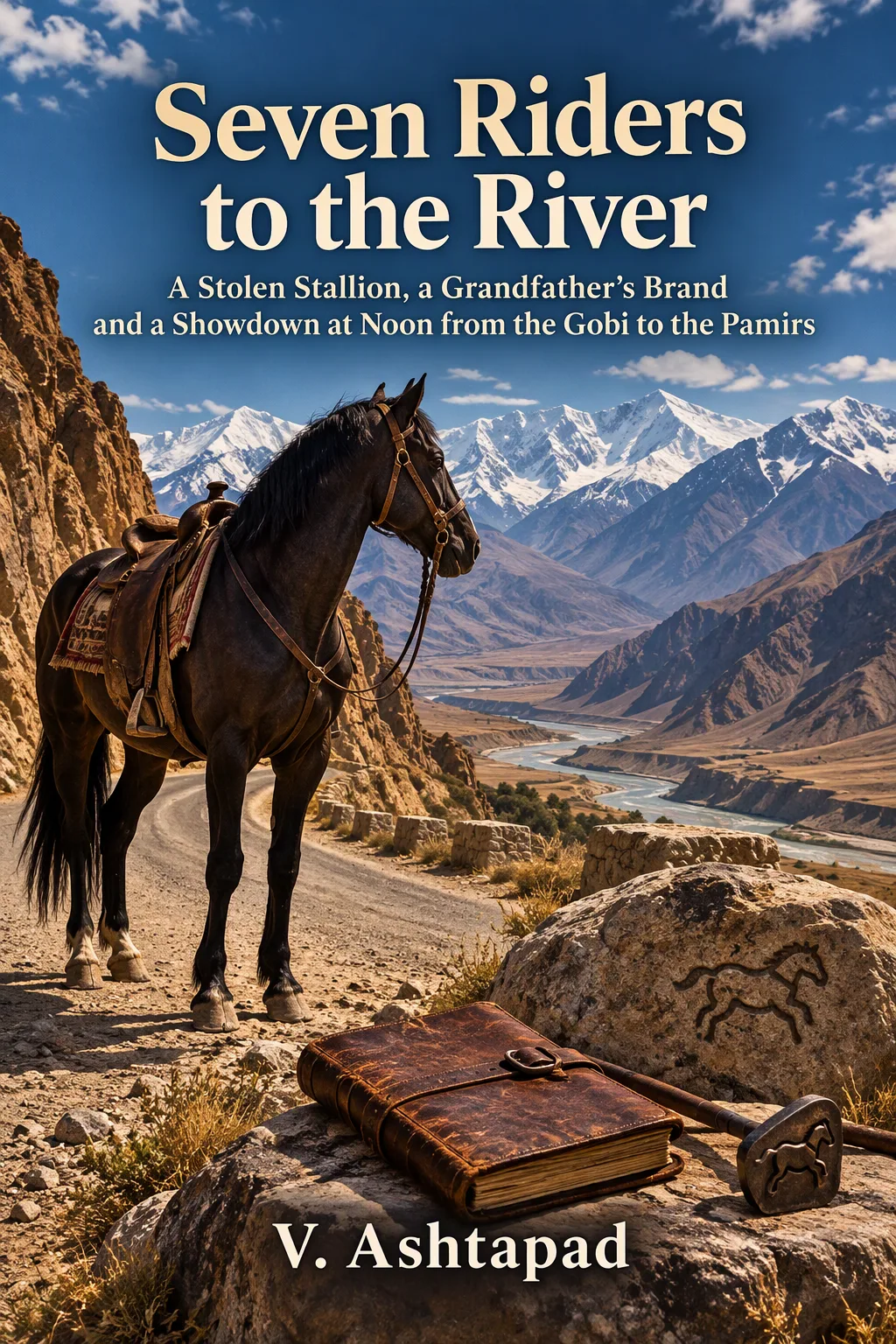
Seven Riders to the River
A Stolen Stallion, a Grandfather's Brand and a Showdown at Noon from the Gobi to the Pamirs
by V. Ashtapad
Foreword
This is a work of fiction. The Gobi and its singing dunes, the Kazakh and Kyrgyz steppe, Samarkand, the Pamir Highway along the Panj river and the horse cultures of Mongolia, Kazakhstan, Kyrgyzstan, Uzbekistan, Turkmenistan, Tajikistan and Afghanistan, from naadam racing and long-song to kokpar, Akhal-Teke horses and buzkashi, are real. The winter camp at Akbulak, the village of Ruzbar and its bridge market, the saddle workshop, the dealer and everyone in this book are invented.
For whoever comes when it needs carrying.
Khongor Sands
You asked me once why a woman who counts other people's money for a living keeps eleven horses and a dog that will not come when called. This is the answer. It is a long one, because the road was long, and I am going to tell it the way your great-grandfather told stories, which is from the beginning and without hurrying, so pour your tea now.
I was twenty-seven. I had never been east of Almaty. I had a gray wool coat that was wrong for the desert, city boots that were wrong for everything, and a green ledger in my bag, because I always had a green ledger in my bag, and a phone with no signal, and the name of a man.
The driver who took me out from Dalanzadgad was called Ganzorig. He was perhaps twenty-two and he talked the whole way, in Mongolian to his radio and in a cheerful, broken Russian to me, and every time the van came over a rise he took both hands off the wheel and spread them, as if he had made the view himself and wanted credit.
He was not wrong to want it. I had seen steppe before. I had grown up on the edge of it every summer, at my grandfather's winter camp in the Zhambyl country, where the grass goes to the horizon in every direction and you can see weather coming for an hour before it arrives. But the Gobi in October was a different animal. The ground was not sand, the way I had imagined from schoolbooks, but gravel, brown and gray and rust, with low clumps of saxaul scrub and something like wild onion, and a sky so wide it seemed to start at my ankles. The mountains to the south were blue and flat as if they had been cut from paper. Then, late in the afternoon, the dunes came up out of the plain, a long gold wall of them, the color of a lion, running east to west as far as I could see.
"Khongor," said Ganzorig, and took his hands off the wheel again.
The ger stood alone, a mile short of the dunes. White felt, a blue painted door facing south, a pipe with smoke going sideways in the wind. A pen of rough poles behind it. Six camels lying down in a row with their legs folded under them, chewing and looking at us with contempt. Horses, perhaps twenty, small and thick-necked, shaggy already with the beginning of their winter coats. A motorcycle with a carpet thrown over the seat. A black dog, big as a calf, who came out at a run and stood in front of the van and barked until the windows hummed.
Ganzorig shouted something out of his window. A voice shouted back from the ger. The dog sat down at once, as if a switch had been thrown.
"Hold the dog," Ganzorig said to me, which is the greeting you call out when you arrive at a ger, though nobody holds anything. It means: I am here, I am a guest, please do not let your dog eat me.
A man came out, bending under the low lintel. He was not tall. He wore a deel, the long wrapped coat of the herders, dark red gone brown at the cuffs, tied at the waist with an orange sash, and felt boots, and a fur hat with the flaps up. His face was the face of every old man who has spent his life outdoors, brown and seamed, the skin around his eyes pleated from squinting into distance. He looked at the van. He looked at me getting out of it in my city coat. He looked at the sky behind me, briefly, the way you check a clock.
"Dorj-aga?" I said. I did not know what the right word for uncle was in Mongolian. I used the Kazakh one.
He nodded once.
"I am Bekbolat's granddaughter," I said in Russian. "Bekbolat Seitkali. From Kazakhstan. You knew him. He says you knew him."
The dog looked at me. The camels looked at me. The old man looked at me for a long time. Then he took a small bottle out of the fold of his deel, a snuff bottle of green stone no bigger than a hen's egg with a little coral stopper, and held it out to me with his right hand, his left hand cupped under his right elbow.
I did not know what to do. Ganzorig, behind me, said quickly, "Take it. Right hand. Open it, smell it, give it back. Like that, with the hand under."
So I took it, and I lifted the stopper and sniffed the little spoon on it the way Ganzorig mimed, and it went up my nose like a struck match, and I sneezed so hard I nearly lost the stopper. Ganzorig laughed. The old man did not laugh, but the pleats around his eyes moved.
I gave him back the bottle with my hand under my elbow.
"Come in," he said in Russian. "Tea."
---
Inside, the ger was warm and smelled of dung smoke and mutton fat and milk. The floor was laid with felt and over the felt with carpets. The walls were a lattice of red-painted wood and the roof poles ran up to a painted wheel at the crown, open to the sky, with the stovepipe going out through it. There were two low beds against the walls, painted orange with blue clouds, a chest with photographs propped on it, a small television with a cloth over it, a solar battery under the bed with wires running up to one bulb. A woman of about seventy sat by the stove with a ladle, lifting milk tea and pouring it back into the pot from a height, over and over, to cool and mix it.
"Oyuna," said Dorj. His wife. She smiled at me, a quick bright smile with two gold teeth in it, and pointed at the bed on the left side, the side for guests.
The tea came in a wide bowl, pale brown, salted and with butter floating on it. I had had Kazakh tea all my life, strong and black with milk and sometimes a spoon of sugar, poured a little at a time so the bowl never cools. This was another thing. Salty and fatty and thin and hot, like soup that had decided to be tea. I drank it all. Oyuna filled it again before I could put it down. There was a plate of hard dried curd, aaruul, cut in little bricks, and a plate of fried dough twisted into shapes, and a bowl of sugar lumps, and I was supposed to take something from each.
Ganzorig sat by the door and talked to Oyuna. Dorj sat at the back of the ger, at the place of honor opposite the door, with his legs folded, and smoked a short pipe, and waited.
A girl came in, perhaps eleven, in a pink padded jacket and a knitted hat with a pompom, carrying a bucket. She stopped when she saw me, then put the bucket down and said hello in careful school English, and then asked me in Russian if I had come about a horse.
"Anu," said Dorj, and the girl sat down by her grandmother and was quiet, though her eyes were not.
So I told him.
I had practiced it on the plane, and in the hotel in Dalanzadgad, and in the van, and still it came out wrong, out of order, the way true things do. My grandfather, Bekbolat Seitkali, who had been born in Mongolia, in the west, among the Kazakhs of Bayan-Ölgii, and who had come over to Kazakhstan with his family when he was fifty, and who was now eighty-two, had been taken to hospital in Taraz with his heart on the fifth of October. While he was in the hospital, on the night of the eighth, my cousin Daniyar had loaded my grandfather's best stallion into a trailer and driven away. He had left a note on the kitchen table under the salt. The note said: I am doing what has to be done. Do not follow me. Tell Ata I am sorry.
The stallion's name was Zhuldyz. Star. He was nine years old, a golden dun with a white star on his forehead shaped like a thumbprint, and he was the best kokpar horse in the district and perhaps the province, and he carried my grandfather's brand on his left haunch, and his great-great-grandmother had come from this herd. From this pen, behind this ger. From a mare called Saran.
When I said the name Saran, Dorj took the pipe out of his mouth.
"My grandfather is in a bed with tubes in his arms," I said. "He made me write your name on a paper. He said: go to the Gobi, to Khongor, find Dorj, tell him Bekbolat asks. He said you would know what to do. He said you found him once when nobody else could. I don't know what that means. He wouldn't tell me. He said you would tell me if you wanted to."
I stopped. I had come four thousand kilometers to say that, and now it was said, and it sounded, in the warm ger with the stove ticking and the camels groaning outside, like the request of a child.
Dorj put his pipe back in his mouth. He looked at the crown of the ger, at the gray square of sky.
"Your cousin," he said. "He is a thief?"
"Yes," I said.
"You are sure?"
I opened my mouth to say yes again and found I could not.
Dorj nodded, as if I had answered.
He said something to Oyuna in Mongolian. She answered him, short and sharp, the way wives answer, and he answered back, shorter. Then she got up and went to the chest and took out a pair of thick wool socks and a folded cloth and began, without a word, to pack a bag.
Anu said, in Russian, outraged, "Grandfather, the naadam horses! Who will ride with me in the mornings?"
"Your uncle," said Dorj.
"Uncle is lazy."
"Then you will teach him."
He stood up. His knees cracked like sticks. He looked down at me on the guests' bed, at my coat and my city boots, and for the first time something that was almost a smile happened on his face.
"Tomorrow," he said. "Tonight you eat. Tomorrow we go. Those boots," he said, "are a crime."
© 2026 CRUNOD LLC. All rights reserved.
The Road to Dalanzadgad
I slept that night under three quilts on the guests' bed with my coat over the top and still woke in the dark with my nose cold. The stove had burned low. Somewhere outside the camels were complaining in their sleep, a sound like a door being opened very slowly in an old house. Through the crown of the ger I could see stars, more than I had ever seen, so many that the dark between them looked thin.
I lay there and thought about my cousin.
Daniyar was seven years older than me. His father, my uncle Yerlan, had been killed on the road to Shymkent when Daniyar was nine, a truck on a wet night, and his mother had married again two years later and gone to live in the city, and Daniyar had not gone with her. He had stayed at the winter camp with Ata and Apa. Everyone said it was for the school, but there was no good school out there, and everyone knew it was for the horses. When I came for summers, as a girl, Daniyar was the big cousin who could catch any horse in the herd with a rope from twenty meters, who rode bareback with no hands, who let me sit behind him and then took the ditch at a gallop to make me scream. When I was fourteen I stopped coming. There was school, then university, then the firm in Almaty with its glass doors and its quarterly reports. I saw him at weddings and funerals. He was always slightly too big for the suit, always standing by the door as if he needed to check on something outside.
He had sent me a message on my birthday every year. Always the same. Happy birthday, little sister. Come and ride. I always answered: Thank you. Soon. I always meant it, a little.
I did not know him. That was the truth I lay awake with in Dorj's ger. I was chasing a thief and I did not know the first thing about him except how he looked on a horse.
---
In the morning Dorj was already outside when I woke, standing in the pen in the half-light among the horses, not doing anything that I could see. Just standing. The horses moved around him, blowing steam. One by one they came up and put their noses against his deel, his hands, his hat, and he let them.
"He is saying goodbye," said Anu, beside me, with her hands in her sleeves. "He does it every time. Even when he only goes to the sum center for flour."
"What is he saying?"
She shrugged, an eleven-year-old shrug, the most eloquent gesture in any language.
"Nothing. He just stands there. Grandmother says he talks to them more than to her."
She told me, because I asked, that she was going to ride in the naadam in July for the third time. The horse races at naadam are run by children, boys and girls between about seven and twelve, over distances that would kill a city horse, fifteen, twenty, twenty-five kilometers across open country. The trainers are old men like her grandfather. They spend the whole summer getting the horses lean, sweating them under felt blankets, walking them at night, measuring their water. They sing to them. Anu sang me a little of what he sang, a long, wavering, wordless call, rising and falling, like wind going over the mouth of a bottle.
"Last year," said Anu, "I came fourth. Out of a hundred and sixteen. On Saaral." She pointed at a gray horse in the pen, old and nondescript, with a ragged mane. "He's nineteen. Everyone laughed when we came to the start. Nobody laughed at the end."
"Your grandfather trained him?"
"Grandfather trained everybody," she said. "Grandfather trained Grandmother."
Oyuna, coming out with a pail, said something to her in Mongolian that made Anu shriek and run.
---
We left after tea and mutton dumplings, Dorj with a canvas bag on his shoulder and a long bundle wrapped in felt that turned out to be a coiled rope and a bridle, an old one, the leather nearly black, with silver studs on the browband worn smooth. Oyuna stood at the door of the ger. She did not wave. She held a bowl of milk, and as the van pulled away she flicked milk from it with her fingers, three times, in the direction we were going. A blessing for the road. I watched her in the side mirror getting smaller and smaller until she was just the white dot of the ger against the gold of the dunes, and then the van went over a rise and she was gone.
Dorj sat in the front with Ganzorig. He did not talk. Ganzorig talked enough for three. He played the radio, which was mostly long-song, a woman's voice going up and up over a horsehead fiddle and holding a note so long that I kept waiting for her to breathe and she did not. Then a pop song. Then the woman again.
"You know Bekbolat-aga from long ago?" Ganzorig asked him, in Mongolian and then in Russian for my sake.
"Long ago," said Dorj.
"How long?"
"Forty-nine years."
I sat forward. "My grandfather says you found him. What did he mean?"
Dorj looked out of the window at the gravel going by.
"Winter," he said. "Bad winter. Dzud."
I knew the word. Everybody who has lived with herds knows it. In Kazakh we say zhut. It is the winter that kills. A summer of drought so the grass is thin, and then snow early and deep, and then a hard freeze on top so the animals cannot dig through to what grass there is, and then cold, weeks of it, forty below, and the herds stand and starve. A family can go into the winter with three hundred animals and come out in the spring with forty. Some years there are millions dead across the country. People who have lived through a dzud do not talk about it much, the way people who have lived through a flood do not talk about water.
"He was driving a truck," said Dorj. "Hay. Somebody's hay, from the north to the south. He was a driver then. He was thirty-three. I was twenty-two. The truck broke. In the snow. Thirty kilometers from anybody. He stayed in the cab two days. Burned the seat."
"How did you find him?"
"The horses found him." He was quiet for a while. Then he said, "I was looking for horses. Ours. Eleven of them broke out in the storm. I followed them. They were standing around his truck, eating the hay off the back. Eleven of my horses, standing in a circle in the snow, eating. And him inside, nearly dead." He made a small sound. It might have been a laugh. "He gave our horses his hay. The whole load. He said it was the only thing he could do and he was not going to die with a full truck. Somebody else's hay. He was in trouble for it after. But our horses lived. Eleven of them. Saran's mother was one."
The van rattled across a dry streambed. Ganzorig, for once, said nothing.
"He stayed with us eleven days," said Dorj. "One day for every horse, my father said. Then he went back to his own people. After, every year, when he could, he came. When he moved to Kazakhstan he came to say goodbye. I gave him a filly of Saran's line. Two years old. I said: this is the hay coming back."
"I know that filly," I said. I did; everyone in our family knew her. "She was Aisha. She lived to twenty-eight. Zhuldyz is her great-grandson."
Dorj nodded, as if this were a sum he had already done.
"So," he said. "We go and find her great-grandson."
---
At Dalanzadgad we caught the little plane north. Dorj had never been on a plane. He did not say so. He sat by the window with his felt bundle on his knees and his hat on, and when the plane left the ground he gripped the armrest so hard the plastic creaked, and then, as the desert opened under us, brown and endless with the white specks of gers scattered across it like grains of rice spilled on a table, he leaned closer and closer to the window until his forehead was against it, and he stayed like that all the way to Ulaanbaatar.
"Small," he said when we landed. That was all. "From up there. Everything is small."
In Ulaanbaatar I bought him a ticket to Almaty with my own savings and put it on the left-hand page of my ledger under Expenses, Recoverable, and then, after a moment, crossed out Recoverable. In the airport he would not take off his hat for the security man. There was a discussion. In the end the hat went through the scanner by itself, upside down in a gray tray, and Dorj watched it go into the machine with the expression of a man watching his horse go into a river.
On the plane to Almaty he slept. I did not. I took out my ledger and wrote down everything I knew, the way I did at work before an audit, in two columns. What I knew. What I did not know.
The second column was much longer than the first.
© 2026 CRUNOD LLC. All rights reserved.
The Winter Camp
My grandfather's winter camp sits where the Zhambyl steppe begins to lift toward the Karatau hills, two hours west of Taraz on a road that stops being a road about forty minutes before you get there. It is called Akbulak, White Spring, after a spring that comes up under a willow in a hollow behind the house and has never once frozen, not in the worst winter anyone remembers. That spring is the reason the camp is where it is. Water decides everything on the steppe. Where the water is, people put their houses, and where the houses are, people put their dead, and where the dead are, the living come back.
I drove us there from Almaty in my small white car, which was not made for that last forty minutes and complained about it. Dorj sat in the passenger seat with his felt bundle on his knees and watched the country go by. The steppe in October is the color of a lion's back, the feather grass gone pale and silver, bending all one way in the wind so that whole hillsides seem to be flowing. There were hawks on the telegraph poles. Once a herd of horses crossed the road ahead of us, sixty or seventy, mares and foals and a big bay stallion bringing up the rear, with a boy on a motorcycle behind them, and I had to stop and wait, and Dorj leaned forward and watched them the whole way across.
"Good horses," he said.
"Not ours."
"Good anyway."
The house at Akbulak is low and long, mud brick plastered white, with a tin roof painted green and a porch along the front. Behind it are the barns, the sheep pens, the stable, the hay ricks, the old yurt frame that comes out in the summer and goes up on the jailau, the high pasture, in the hills. In front of it is the gate, two posts of old poplar and a crossbar, and burned into the crossbar, deep and black, is our tamga. The family brand. It is a crescent with two short strokes standing above it, like a bowl with two sticks of steam rising. My grandfather says his grandfather's grandfather had it, and his before that, and that once every family on the steppe was known by its mark the way a man is known by his face.
The same mark was burned on Zhuldyz's left haunch, the size of my palm.
My grandmother came out on the porch when she heard the car. Apa was seventy-eight. She was small and straight and wore a dark velvet waistcoat over a flowered dress and a white scarf tied behind her head, and she had a way of standing with her hands folded in front of her that made you feel she had been waiting for you for some time and was not going to mention it.
She looked at Dorj getting out of the car. He took off his hat.
"So," she said in Kazakh. "You are the Mongol who fed my husband's hay to his horses."
"I am the Mongol whose horses ate it," said Dorj, in a Kazakh so old and western and strange that it took me a moment to understand him. He had learned it, I found out later, from my grandfather, forty-nine years before, in eleven days in a ger in the snow, and had kept it all that time like a coin in a pocket.
My grandmother looked at him. Then she laughed, which she did not do often, and came down the steps and took both his hands.
---
She had made beshbarmak, of course. You do not have a guest from four thousand kilometers away and not make beshbarmak. Boiled mutton and horse sausage on wide flat noodles, with onions softened in the broth, on a great round platter, and the broth itself in bowls on the side, and baursak, the little puffed squares of fried dough that she made every day of her life and that I have never in all the years since managed to make as light. We sat on the floor on the long cushions around the low table. Dorj was given the place of honor at the head, the tor, facing the door. He was given the sheep's head on a plate, the way an honored guest is, and he took his knife and cut the first pieces and handed them round, a piece of the cheek to my grandmother, a piece of the ear to me, because the ear is for the young, so they will listen.
"Listen," he said, handing it to me, in his strange old Kazakh. "Good advice."
It was a quiet meal. The empty place where my grandfather always sat was very loud.
Afterward my grandmother poured tea from the samovar, and Dorj asked to see the stable.
It was dusk by then. The stable was a long low building of the same white mud brick, with eight stalls on one side and the tack room at the end. Five of the stalls held mares, and one an old gelding called Kyzyl who had been my grandfather's riding horse for twenty years and now did nothing but eat and look wise. The last stall was empty. The straw had been raked out, and the floor swept, and the water bucket hung clean and empty on its hook.
"Daniyar did that," said my grandmother behind us. "Before he went. He cleaned it."
Dorj walked into the empty stall and stood in it. He looked at the walls. He looked at the floor. He put his hand on the manger, which was worn smooth and pale by years of a horse's chin. He looked at the hook where a halter should have been and was not.
"He took the halter," he said. "And the blanket. The good one?"
"The good one," said my grandmother. "The red felt with the pattern my mother made."
"And the bridle?"
"Not the bridle. He left the bridle." She pointed. It hung on the wall of the tack room, my grandfather's kokpar bridle, plain and heavy, the leather dark with sweat and years.
Dorj looked at it. He was quiet for a long time.
"A thief takes the bridle," he said at last. "A thief takes everything. This one took what keeps the horse warm. He left what the horse is ridden with." He turned to me. "Where is the note?"
---
I had it in my bag, in the back of the ledger, folded in four. I had read it so many times the folds had gone soft. I gave it to him, and he held it to the lantern and looked at it for a long time, though I knew by then he did not read Kazakh and barely read Russian. He looked at the shape of the writing. He turned it over and looked at the back. Then he gave it back to me.
"He pressed hard," he said. "Look. Through the paper. A man who is sure does not press so hard."
I looked. He was right. On the back of the page the words stood up from the paper like the brand on the gate.
Outside, in the yard, the light was going. Dorj walked the yard with a flashlight from my grandmother's kitchen, slowly, bent over, like a man looking for a coin. He walked to the gate and back. He walked out along the track toward the road, a hundred meters, two hundred, and back. He crouched once, by the ditch, and put two fingers into a rut in the mud and held them there.
"Trailer," he said, when he came back. "Two axles. One tire is bald, the back left. He went out slow. Not like a thief. Like a man carrying eggs." He clicked the flashlight off. "Then at the road he turned south."
"Taraz is east," I said.
"South," said Dorj.
My grandmother, on the porch, said quietly, "The Kyrgyz games. In the Talas valley. They play every Sunday in the autumn. He has been talking about them since August. He said a horse like Zhuldyz should be seen."
"Seen by who?" I said.
She did not answer. She went inside. A minute later she came out again with a cardboard folder, the kind with a string around a button to tie it shut, blue, the edges gone furry. She put it in my hands.
"Your grandfather's papers," she said. "He told me, if anything happened, I should give them to whoever came. You came." She looked at me. Her face in the porch light was very tired. "You are the one with the numbers. Read them. Then you will understand your cousin, maybe. Then you will understand your grandfather. I have never understood either of them. Fifty-six years, and they are both still strangers to me. Men and horses." She shook her head. "Go to bed. There is hot water for once. Use it."
© 2026 CRUNOD LLC. All rights reserved.
The Hospital in Taraz
I did not open the folder that night. I should have. I am telling you this so that you will know your mother was not always wise. I took it to my old room at the end of the house, the one with the window that looks out on the willow over the spring, and I put it on the chair by the bed, and I lay and looked at it in the dark, and I did not open it. I think I knew it would change something, and I had had enough of things changing for one week. I told myself I would read it in the morning. In the morning there was the drive to Taraz. Then there was the hospital. Then I forgot it was in the car at all for three days, and when I did read it, on the Tashkent road, it was in the worst place and at the worst time, the way it always is.
---
The hospital in Taraz was a long brick building from another century, with a newer glass wing stuck onto the side of it like a box added to a cart. My grandfather was in the old part, in a room with three other men, by the window. When we came in he was asleep, propped up on two pillows, with a tube in his nose and another in the back of his hand and a machine beside him making a small green line that went up and down. He looked smaller than I had ever seen him. He had always been a big man, broad, heavy in the shoulders, with hands like spades. Now the hands lay on the blanket and the skin on them looked thin as the paper of an old book.
Dorj stood at the foot of the bed with his hat in his hands.
I did not want to wake him. But my grandfather has never in his life slept through someone looking at him, and after a minute his eyes opened. They went to me, then past me. They stopped.
For a long moment, neither of the old men said anything.
Then my grandfather said, in Mongolian, something I did not understand, and Dorj answered him in Kazakh, something I did, which was: "You look terrible."
"You look old," said my grandfather in Kazakh.
"I am old. So are you. Older."
"Eleven years older. You still owe me respect."
"I owe you hay," said Dorj. "Not respect."
And my grandfather laughed, a terrible wet laugh that set the green line jumping and brought a nurse to the door, and Dorj went round the side of the bed and sat down on the chair there, and the two of them took hold of each other's forearms, the way men do on the steppe, gripping just below the elbow, and held on.
I went and stood in the corridor for a while. There was a window at the end, and through it I could see the mountains to the south, the first snow on them, and a man in the car park below trying to fold a pram.
---
When I came back in they were talking about Zhuldyz.
"He will go to the Kyrgyz first," my grandfather was saying. "Daniyar. He will want the horse seen. Talas, the games at Kara-Bulak. The coach there, Temirbek, Asanov, he knows the boy. They have played against each other for years. Temirbek will know where he went."
"And after?" said Dorj.
"After." My grandfather closed his eyes. "After, somebody with money."
"You think he will sell him."
My grandfather did not open his eyes. "I think he thinks he must."
"Why?" I said. "Ata, why would he think that? Why would anybody need to sell Zhuldyz? He is the best horse we have ever had. You said so yourself. You said it at Nauryz in front of everybody."
My grandfather opened his eyes and looked at me, and in his face there was something I had not seen there before and did not want to see, which was shame.
"Your grandmother gave you the folder," he said.
"Yes."
"Then you will read it." He moved his hand on the blanket, a small movement, toward me. I took it. It was very cold. "Aruzhan. Listen to me. You are the one with the head for these things. You always were. When you were six you counted my sheep and told me I had three more than I said. You were right. Your father has the head too, but he uses it for other things." He paused for breath. The green line hurried. "I want you to have the say. Whatever has to be decided. Not your father. Not Daniyar. You. I want a paper that says so. For the people who need papers."
"Ata, I don't know anything about horses."
"You don't need to know about horses," he said. "He knows about horses." He moved his eyes to Dorj. "You need to know about people. And numbers. And when to keep your mouth closed. You are bad at the last one. He is good at it. Learn from him."
So that afternoon a woman notary came up from the ground floor with a stamp and a pad of purple ink and a form in triplicate, and my grandfather signed it in a hand that wandered across the line like a horse with a loose rein, and the notary stamped it three times, hard, with a sound like a door knocking, and I put my copy in the back of the ledger with Daniyar's note, and that was the paper.
---
Before we went, my grandfather asked Dorj to come close. I was at the door. I did not hear all of what he said. I heard the end.
"Don't let them hurt the boy," he said. "Whatever he did. He stayed. You understand? When the rest of them went to the city, he stayed. Twenty-five winters he kept that camp with me. Nobody else stayed."
Dorj said nothing. He put his hand on my grandfather's shoulder, once, and stood up.
In the car park he lit his pipe and stood with his back to the wind, looking at the mountains.
"Your grandfather," he said at last, "is not angry with his grandson."
"He should be."
"Should be." Dorj blew smoke. It went away sideways, very fast, toward the east. "Should is a word for city people. Out here a horse is where it is. Snow is where it is. You start from there." He looked at me. "Tomorrow we go to the Kyrgyz. Tonight, call your father."
"How do you know about my father?"
"Everybody has a father," said Dorj. "Your grandfather made a face when he said his name. That is how I know."
© 2026 CRUNOD LLC. All rights reserved.
Talas Valley
My father did not want me to go.
I called him that night from my old room at Akbulak with the folder on the chair still unopened beside me. He was in his flat in Almaty. I could hear the television, and my mother in the kitchen behind him, the clatter of plates. My father was fifty-five. He worked for a bank, in a department that lent money to other banks, and he wore a good suit every day of his life and had not been on a horse since he was nineteen. He was not a bad man. I want you to understand that, because in this story he is going to sound like one for a while. He was a man who had left a place and had spent thirty-six years explaining to himself why it was right to leave.
"Let it go," he said. "Aruzhan. Listen to me. Let the horse go."
"He's Ata's horse."
"He's a horse. Your grandfather is eighty-two and in hospital with his heart. Your grandmother is seventy-eight. That camp is finished. It has been finished for ten years. I have told him and told him. Sell the herd, sell the land lease, come to the city, live in a flat with heating and a lift and a doctor around the corner. He won't listen. He has never listened. And now Daniyar has done the first sensible thing anybody in that family has done in a decade and you want to chase him across Central Asia with some old Mongolian?"
"Sensible?" I said. "Papa, he stole the horse."
There was a silence. In it I heard my mother turn off the tap.
"Ask your grandfather about the bank," my father said. "Ask him about the well. Then call me."
He hung up.
I sat with the phone in my hand. On the chair, the folder. I put out my hand to it. Then outside I heard Dorj's voice in the yard, talking quietly to the old gelding Kyzyl in that strange old Kazakh of his, and the gelding answering with a long soft blowing sound through his nose, and I took my hand away, and lay down, and slept. Not wise. I have told you.
---
The Talas valley is in Kyrgyzstan, but you can see it from our side, almost. It lies south of Taraz across a line of hills, a long green-and-gold valley running east to west between two ranges of mountains, the Talas Ala-Too on the south side, high and white, and the Kara-Too on the north, lower and brown. A river runs down the middle of it lined with poplars, tall and narrow and gold in October, standing in rows along every ditch and lane like soldiers who have been told to wait and have forgotten why. The crossing at the border took two hours, mostly sitting in my car in a queue behind a truck of potatoes. Dorj slept through most of it with his hat over his eyes.
The village of Kara-Bulak sits at the mouth of a side valley where the mountains come down close. It has one street, a school painted blue, a shop that sells bread and vodka and children's shoes, and at the far end, past the last house, a long flat field of stubble with a raised mound of earth at each end, the goals, and a line of trucks and cars parked along one side.
Temirbek Asanov's house was the last on the street before the field. A green iron gate, a yard with a walnut tree, a cow, a trellis of grapes gone yellow, and in the yard a white yurt standing even though the summer was over, its felt walls rolled up a hand's width at the bottom for air. On the gatepost someone had nailed a horseshoe.
Temirbek came out to meet us. He was fifty-eight, tall for a Kyrgyz, with a gray mustache and a belly he carried in front of him like something he was proud of, and on his head the tall white felt hat, the ak-kalpak, with the black embroidered lines up the sides and the brim turned up at the back. He knew who I was before I said it.
"Bekbolat's girl," he said in Kyrgyz, which is close enough to Kazakh that we could talk all day and only miss one word in twenty. "I knew you'd come. Or someone. I said to my wife, someone is coming for that horse, and when they do I will have to look them in the eye." He looked me in the eye. Then he looked at Dorj. "And who is this?"
"A Mongol," said Dorj, in his old Kazakh.
Temirbek's eyebrows went up into the brim of his hat.
"Then come in, Mongol," he said, "and drink some kymyz, if you can still drink it at your age. This is the last of the year. In a week the mares will be dry."
---
His wife was Gulmira, round and quick and loud, who had been a schoolteacher for thirty years and still spoke to everyone as if they might at any moment be asked to stand up and recite. She put us in the yurt, because the yurt was where guests went, summer or not. It was warm inside, out of the wind, with felt carpets on the floor in red and white and black, the patterns cut out and sewn together like pieces of a puzzle, rams' horns and waves and leaves, and the walls hung with embroidered cloths. At the crown, where the roof poles met, the tunduk, the wooden wheel that every Kyrgyz will tell you is on their flag. A low table. A bowl of boorsok, the Kyrgyz baursak, smaller and harder than my grandmother's, and a bowl of chopped onions and cucumber, and a saucer of homemade butter yellow as an egg yolk, and the kymyz.
Kymyz is mare's milk, fermented in a leather bag or a wooden churn, stirred hundreds of times a day with a paddle until it goes fizzy and sharp. In the summer the whole of Kyrgyzstan smells faintly of it. It is a little sour and a little bitter and a little like beer and a little like yogurt and nothing like any of them, and it is the best thing you will ever drink or the worst, and which one it is depends entirely on whether you grew up with it. I grew up with it. Dorj had grown up with airag, which is the Mongolian name for the same thing. He drank the first bowl in one long swallow, held it out to be filled again, and said to Gulmira, in Russian, "Better than ours."
Gulmira looked at him with great suspicion.
"He's lying," she said to me.
"He doesn't lie," I said. "He doesn't say enough to lie."
Temirbek laughed so hard he had to put down his bowl.
---
He told us about Daniyar over the second bowl.
"He came last Saturday," said Temirbek. "Saturday the eleventh. With the trailer, the horse inside. He stayed in this yurt. Same place you're sitting, girl. He was quiet. He's always quiet, that one, but this was different. Like a man with a stone in his boot. On Sunday he rode in the game." He shook his head slowly. "Twenty years I've coached kok-boru. I've seen horses. I tell you, I've never seen a horse like that one play. He goes into the scrum like a boat into a wave. He puts his chest in and the other horses move. He doesn't kick, he doesn't bite, he just goes in and the space opens. And then when your cousin has the goat, Zhuldyz turns, like this," he moved his hand, flat and quick, "and he's gone. Nobody catches him. Three goals in the first half. In the second half the other team stopped trying to catch him and just tried to be somewhere else."
"And then?" I said.
Temirbek and Gulmira looked at each other.
"There was a man," said Gulmira. "At the field. Not a Kyrgyz. From your side. Shymkent, he said. A big coat, camel hair, down to here. Pointed boots, like a film. Nobody wears boots like that to a kok-boru field unless he wants you to know he has never had to walk across one."
"A dealer," said Temirbek. "Ilyas. Bekov, he said. He gives out cards." He felt in his waistcoat and came out with a small white card, a little bent, and gave it to me. On the front it said in raised gold letters: ILYAS BEKOV. HORSES. And a phone number. On the back, in pen, someone had written: Thursday.
"He talked to Daniyar for an hour after the game," said Temirbek. "By the trucks. I didn't hear. On Monday morning they left together. The dealer's truck in front, Daniyar's trailer behind."
"Where?"
"West," said Temirbek. "Toward the Uzbek road."
Dorj had not said anything all this time. Now he put his bowl down.
"Tomorrow you have a game," he said. "Sunday."
"Every Sunday until the snow," said Temirbek.
"The men who talked to the dealer will come to the game?"
Temirbek considered this. "Some of them."
"Then we stay," said Dorj. "And we listen."
He held out his bowl to Gulmira for the third time. She filled it, still looking at him with deep suspicion, and then, almost against her will, she smiled.
© 2026 CRUNOD LLC. All rights reserved.
The Kok-Boru Field
The game began at eleven, or was supposed to. By eleven there were perhaps thirty trucks and cars along the edge of the stubble field and the same number of horses tied to their tailgates or held by boys, and men standing about in groups in padded jackets and felt hats and caps, smoking, talking, laughing, slapping each other on the back, and nobody was in any hurry at all. Women had set up a row of tables at one end under a tarpaulin and were selling tea from big enamel kettles and samsa from a clay oven on the back of a truck, triangles of pastry stuffed with mutton and onion and fat, so hot that you had to hold them in a twist of newspaper and blow on them, and the smell of them went down the whole field on the wind.
At the far end, on a folding chair by the goal mound, an old man in a long quilted coat sat with his eyes closed and recited.
I asked Temirbek what he was saying.
"Manas," he said. "The epic. You know Manas?"
I knew of it. Every child in our part of the world knows of it, the way children in other places know of the old poems of kings and wars. The Kyrgyz will tell you it is the longest poem in the world, half a million lines, more, and that it was never written down for a thousand years, only carried from one teller to the next, and that the great tellers learned it not by study but because it came to them in dreams. I had never heard it spoken.
The old man's voice went up and down. It was not singing and it was not talking. It had the rhythm of a horse at a long trot, the same beat over and over, rising at the end of each line and coming down hard. His hands moved in front of him as he spoke, slowly, as if he were shaping something out of the air. Men walking past slowed down to listen for a few lines and then walked on. Boys sat cross-legged at his feet with their mouths open.
"Which part is this?" I asked.
"The horses," said Temirbek, and laughed. "It is always the horses. Manas's horse was Ak-Kula. White-gray. The best horse in the world. When Manas went to war, Ak-Kula ran so fast the grass did not bend." He pulled his hat down. "Every man on this field thinks his horse is Ak-Kula. Every man on this field is wrong. But last Sunday, I thought, maybe that golden one of your grandfather's, maybe."
---
The game itself I will not describe for long, because I did not understand much of it that first time, and I will understand it better when I tell you about the other one, in the Pamirs. Two teams of riders. A goat's carcass, headless, soaked overnight in water to make it heavy, perhaps thirty kilos. It is put on the ground in the center of the field and the riders go for it, all at once, and one of them leans down off his horse, all the way down, one leg hooked over the saddle, his fingers in the dirt, and comes up with the goat and drags it across his saddle and goes, and all the others go after him. The aim is to carry it to the mound at the end of the field and throw it in. That is all. It is the oldest game on the steppe. It is the game we call kokpar and the Kyrgyz call kok-boru, gray wolf, because they say it began with herders chasing down wolves that had taken a sheep, and the Afghans and the Tajiks call buzkashi, goat-grabbing, and the Uzbeks call ulak. It is a game for horses as much as for men. A good kok-boru horse is worth more than a house. A great one is worth more than a village.
Dorj watched it standing by the rope, with his hands behind his back. He watched the horses, not the men. Every time a rider broke out of the scrum with the goat, Dorj's eyes went to the horse's legs, and then to its ears, and then to its breath.
"Good," he said once, quietly, about a little chestnut mare that came out of the crush on the far side with her rider bent almost double over the goat and her ears flat and went the length of the field like a thrown stone.
"Mine," said Temirbek, with enormous satisfaction. "Bred her myself. My son is on her. Adilet. Twenty-four. Useless at everything except this."
His son threw the goat into the mound. Half the field cheered. The other half shouted something unrepeatable about the mare's ancestry and then cheered as well.
---
Between halves we went among the trucks, and Temirbek did what he had promised. He talked. He moved from group to group with his hands in his pockets and his belly in front of him, slapping shoulders, taking a cigarette here and a samsa there, asking after people's mothers and people's mares, and at every group he said a few words about the man in the camel-hair coat from last Sunday, and I stood beside him with my hands in my sleeves like Anu and listened.
Most of them had nothing. A big coat, they said. Pointed boots. Smelled of cologne. Paid for everybody's tea, which was suspicious in itself. Then at the fourth or fifth group, a man of about forty with a broken nose and a red woolen hat looked at me sideways and then at Temirbek.
"That's the girl?" he said. "The family?"
"That's the girl."
He looked at me for a while longer. Then he said, to Temirbek, not to me, "He tried to buy my bay. Last year. Said he had a buyer down south. Afghans. Big money, good horses, they pay in cash and they don't ask questions. The buyer comes to a market in the Pamirs every Saturday until the snow closes the passes. Below a village, at a bridge over the river. Ruzbar. He said it like I should know where that was."
"And the golden one?"
"He said to me, last Sunday, by the trucks, while your boy was watering him." The man spat. "He said: that horse is going to make me a rich man by November. And then he laughed. And then he said, and his family doesn't even know what they've got."
Temirbek's face, under the white hat, went still.
"Thank you, brother," he said.
"Don't thank me," said the man in the red hat. He looked at me again. "Your cousin is all right. I played against him for ten years. He never once took a cheap line. He'd go round a man rather than through him. Whatever he's done, that dealer is the one who's enjoying it." He turned away to his horse.
---
In the afternoon, after the game was over and the goat had been given, as is the custom, to the family of the winning team to cook, and the trucks had begun to leave in long plumes of dust, Temirbek put me on a horse.
"You can't go to the Pamirs to bring back a kokpar horse," he said, "and sit on it like a bag of flour."
"I can ride," I said.
"You can sit," he said. "Sitting is not riding. Get on."
It was a mare, small and brown and very old, called Kara-Kyz, Black Girl, who had carried every one of his children and all of his grandchildren on her back and had seen everything a horse can see and was not impressed by any of it. I got on her from the wrong side. Temirbek said nothing. I got off and got on again from the right side. She stood like a table.
For an hour, in the empty field with the shadows of the poplars lying across it in long bars, Temirbek walked beside me and talked and Dorj stood at the rope and watched. Heels down. Back straight but not stiff. Hands low. Don't hold on with your hands; hold on with your seat and your legs; your hands are for talking to the horse, not for staying on it. Look where you want to go, not at the ground; the horse goes where your eyes go. Breathe out.
"Why breathe out?" I said.
"Because you are not breathing," said Dorj from the rope. It was the first thing he had said all hour.
I breathed out. Kara-Kyz, under me, breathed out too, a long rattle through her nose, and lowered her head, and walked on, and for the first time in my adult life I felt a horse move under me as if we were the same animal and not two things in disagreement.
"There," said Temirbek. "Now you are riding. Badly. But riding."
---
That night in the yurt Gulmira made a pot of shorpo, mutton soup with potatoes and carrots and a great deal of black pepper, and Adilet came in still smelling of horse and was introduced and ate three bowls without a word and went to sleep sitting up. Temirbek took his komuz down from the wall, the Kyrgyz lute, three strings, a long neck, no frets, and played. He played fast, the strings flickering under his fingers, and then slow, and Gulmira told us what each piece was. This one is a horse running. This one is a mother calling a lost camel. This one is two old men arguing about whose grandson is worse.
"Which one wins?" said Dorj.
"Both lose," said Gulmira. "Both grandsons are terrible. That is the joke."
Temirbek put the komuz down and looked at me across the low table.
"The Pamirs are far," he said. "You'll go by Samarkand, if you want to follow the dealer, because he has business there. Then down through Tajikistan and over the mountains and along the river. It's a long road, girl. And at the end of it is a man who thinks he's going to be rich, and he has your cousin, and your cousin has your grandfather's horse. You understand?"
"Yes."
"No," he said. "You don't. But you will." He reached into his waistcoat and wrote his number on the back of the dealer's card, under Thursday, and gave it back to me. "If you need riders," he said, "call me. Or men who can stand still and look large. I have both. I have sons, and the sons have friends, and every one of them owes your cousin a game."
© 2026 CRUNOD LLC. All rights reserved.
The Tashkent Road
We went west in the morning, back through the gap in the hills to Taraz, and then along the great road that runs from Taraz to Shymkent at the foot of the mountains with the steppe on the right hand going away forever and the snowline on the left hand coming closer. We stopped in Shymkent for petrol and for Dorj to buy a better pair of boots for me, sheepskin-lined, from a stall in the bazaar run by a man who swore on his mother that they had been made by his cousin and would outlive me. They were ugly. They are in the cupboard by the door to this day, and they have, so far, outlived nothing, but I am not finished yet.
At the border we left my car in a lot behind a café whose owner promised to keep an eye on it, and walked across, with our bags, through a long hall of glass booths and stamps and dogs and men with clipboards, and on the other side we took a shared taxi into Tashkent, an old sedan with four of us in the back, Dorj in the front with his felt bundle, and the driver smoking out of the window and playing an Uzbek song with a drum in it so loud the windows hummed.
In Tashkent we had a night before the morning train to Samarkand. A small hotel near the station, two rooms, a television that showed only a cooking program. Dorj went out to walk. I did not ask where. He came back two hours later smelling of grilled meat and said only, "Big city. Too many people. Not enough horses."
And then, because there was nothing else to do, and because the hotel room was very small and the folder was in my bag and had been in my bag for five days, I took it out and untied the string.
---
I am an accountant. I want you to understand what that means, because people think it means numbers, and it does not, or not only. It means stories. Every set of accounts is a story, about what somebody wanted and what they did about it and what it cost. You read the numbers the way Dorj read the ruts in the mud by our gate. A man who is sure of himself does not press so hard.
My grandfather's papers were in no order at all. Receipts for diesel and for hay. A vet's bill. Ten years of livestock registrations. A newspaper cutting from a regional paper with a photograph of Zhuldyz at five years old winning at Nauryz, my grandfather beside him in a fox-fur hat, grinning. Letters from the district about water. And at the bottom, in a clear plastic sleeve, the bank.
Three years before, I knew, there had been a hard winter. Not a true zhut, not like the one Dorj had found him in. But bad. Snow in October and a crust of ice on top of it in November, and then a cold that sat on the steppe for two months, and the spring at Akbulak was the only water for thirty kilometers that did not freeze. Every herder for a day's ride had brought his animals to it. My grandfather had let them all come. He lost forty-one horses that winter anyway, of the hundred and thirty he had. I knew that. Everyone knew that. What I had not known was what came after.
In the spring he had gone to the bank in Taraz. He had borrowed money to sink a deep well, a real one, a bore, two hundred meters down, with an electric pump and a tank, so that the next time the steppe froze there would be water not for his herd only but for everyone's. And he had built a new barn, a big one, a winter barn, with hay storage for three hundred animals, so that the next time the snow came early nobody would have to watch their horses stand and starve. He had borrowed against the land. Against the winter camp. Against the house and the spring and the willow and the gate with our brand burned into it. The loan was for seven years. He had paid it, every month, for two years and four months.
Then his heart.
Then nothing, since July. Four payments missed. Two letters from the bank, polite. One, in September, not polite. If the arrears and a portion of the principal, a sum which was written out in full, eighteen million and some hundreds of thousands of tenge, were not received by the thirty-first of December, the bank would take possession of the property known as Akbulak winter camp, in full, with all buildings and improvements.
With all buildings and improvements. Meaning the well. Meaning the barn. Meaning the things he had built so that nobody would have to lose their herd again.
I sat on the narrow hotel bed in Tashkent with the letter in my hand and the cooking program murmuring on the television, a woman in a white hat stirring a pot, and I did the arithmetic without wanting to. A good kokpar horse, a champion, in the right market, in the south, to a man who paid in cash. Eighteen million tenge. It was about right. It was almost exactly right.
Daniyar had not stolen Zhuldyz.
Daniyar had gone to sell Zhuldyz to save the camp. Because nobody else was going to. Because my grandfather would rather lose the land than lose the horse, and my father would rather lose both than set foot on that land again, and I was in Almaty in a glass building counting other people's money and answering birthday messages with the word soon.
---
I do not know how long I sat there. When I looked up, Dorj was in the doorway between our two rooms. He had his pipe in his hand, not lit.
"So," he said. "You read it."
"You knew," I said. "You knew before I did."
He shook his head. "Your grandfather told me some. In the hospital. Not the money. Just that there was money." He came in and sat down on the only chair. He looked very tired, suddenly, and very old. "In my country, in a dzud, men do things. They take another man's hay. They cut a fence. They go into a neighbor's winter pen at night. Afterward, in the spring, everybody knows, and nobody says it. Because next winter it could be them." He turned the pipe over in his hands. "Your cousin is not a thief. He is a man in a dzud."
"He should have told us."
"Should," said Dorj, and almost smiled.
"He should have told me."
"You," said Dorj, "were in the city."
It was not said cruelly. It was said the way he said everything, as a fact about the ground. Snow is where it is. And it went into me like the snuff in his ger, like a struck match up the nose, and I put the letter down on the bed and put my face in my hands, and the woman in the white hat on the television said something cheerful about saffron, and Dorj sat with me and did not say anything at all until I was finished.
Then he said, "Now you know where the horse is going. Now you know why. Good. Now you can think." He stood up. "In the morning, the train. Sleep."
"What do we do?" I said. "When we find them? If he's selling him to save the camp? Do we stop him? Then the bank takes Akbulak. Do we let him? Then the horse is gone, and Ata, it will kill Ata. Dorj-aga, what do we do?"
He stood in the doorway again.
"You have a ledger," he said. "I saw it. Every night you write in it. Two columns." He tapped his own forehead, under the hat. "Write a third."
© 2026 CRUNOD LLC. All rights reserved.
The Samarkand Horse Market
Samarkand comes up out of the plain the way a word you have known all your life suddenly turns out to have a meaning. We came in on the morning train from Tashkent, a fast new train, white and sleek, which Dorj distrusted on sight and then sat in for two hours with his nose against the window as he had on the plane, watching the cotton fields go by, the long rows of mulberry trees along the ditches, the mud-walled villages, the donkey carts, the men in long quilted coats and square black caps embroidered in white, and then, at the edge of the city, the first blue dome.
There are colors in Samarkand that I do not have names for. I am not going to try. The tiles on the old buildings around the Registan, the great square, are every blue that has ever been, turquoise and cobalt and the blue of a duck's wing and the blue of the sky at the top of a mountain, and among the blues there are yellows and whites and greens, in patterns so complicated that if you look at them for too long your eyes stop being able to tell where one ends. We walked past it on the afternoon we arrived, because it would have been a crime not to, and Dorj stood at the edge of the square in his deel and his felt boots, among the tour groups with their phones and their sun hats, and looked up at the three great facades for a long time.
"Who made this?" he said.
"People. Six hundred years ago. More."
He nodded slowly. "With their hands."
"With their hands."
"Hm," he said. It was the most impressed I ever heard him sound about anything that was not a horse.
---
The horse market is not at the Registan. It is not anywhere a tourist would find. It is outside the city on the east side, past the last apartment blocks and the brick factories and a canal lined with willows, on a stretch of bare beaten ground by the ring road, and it happens twice a week, on Thursdays and on Sundays, from before dawn until about ten in the morning, when the heat comes up and the dealers go home.
We were there at six on the Thursday. It was still dark. The ground was full of trucks and trailers and donkey carts and boys leading horses on ropes, and men with flashlights, and the steam of animals' breath rising in the cold, and the smell, horse and dung and diesel and woodsmoke and grilling meat, because already at the gate a man had a long brazier going with skewers of mutton and liver and fat on it and was fanning the coals with a square of cardboard. Somewhere a radio was playing. Somewhere two men were shouting at each other about a price, in Uzbek, which I do not speak well, but you do not need to speak a language to understand two men shouting about a price.
There were hundreds of horses. Karabairs, mostly, the Uzbek breed, tall, bay and chestnut and gray, with good legs and long necks, the horses of the plains between the rivers, bred for war and work and kokpar for longer than anyone remembers. Little mountain ponies from the south with hairy legs. Donkeys by the dozen. A few old trotters from some stud gone out of business, their racing bandages still on their legs, looking about them as if they had come to the wrong party.
Dorj walked through it slowly with his hands behind his back. He did not look for Zhuldyz. I asked him why.
"He is not here," he said.
"How do you know?"
"I would know." He stopped at a stall and looked at a gray mare with a long face and kind eyes. "He came, last Thursday, with the dealer. The dealer came to sell other horses, and to get paper. Then he went. Now we find someone who saw him."
"Who?"
Dorj looked about him. At the brazier. At the boys with the ropes. At the men shouting. Then he pointed with his chin, in the way of herders, the way you point at a far-off animal, at the far end of the ground, where under a single bulb hanging from a pole a man had laid out a blanket on the tailgate of a truck and on the blanket, in a row, saddles.
"Him," said Dorj. "Saddle-maker. Every horse that comes through, he looks at its back. Every rider, he looks at his seat. He sees everybody."
---
The saddle-maker's name was Bobur Usmonov. He was forty-six. He was a broad, quick, cheerful man with a round face and a short black beard and a skullcap of black and white on the back of his head, and on his hands the black-stained calluses of a man who has pulled waxed thread through leather every day for thirty years. His saddles were the old Uzbek kind, with a high front and a high back, the wooden tree carved by hand and covered with leather, the seat padded with felt and covered with a cloth of red and gold, and the front horn shaped like a curved spoon, and every one of them had a little silver plate pinned to the side with his mark on it, a pomegranate.
He knew who I was before I opened my mouth, too. Everybody in Central Asia, it began to seem to me, had been waiting for me to arrive.
"The Kazakh girl," he said in Russian, "for the gold horse."
"How do you know?"
"Because a Kazakh boy came last Thursday with a gold horse and a dealer, and the boy looked at the ground the whole time like a man at his own funeral, and the dealer looked at everything like a man at his own wedding, and I said to myself, Bobur, somebody is going to come after that horse, and it is going to be a woman, because men don't chase, men sulk." He looked past me at Dorj. He took in the deel, the sash, the boots, the hat. "And who is this?"
"A Mongol," I said, before Dorj could. It had become a kind of joke between us.
Bobur's eyebrows went up. He looked at Dorj. Dorj looked at him. Then Dorj stepped forward and, without asking, turned over the nearest saddle on the blanket, ran his thumb along the underside of the tree where it would sit on the horse's back, felt the felt, pressed the stitching, turned it back over, and put it down exactly where it had been.
"Good," said Dorj.
Bobur looked at him for a long moment.
"My grandfather," he said, "would have liked you." He reached under the truck and came out with a thermos and three small bowls. "Sit. Tea. Then I tell you everything. Then you come to my house, because my mother will kill me if I meet a Mongol and a Kazakh girl and a story like this one and don't bring them home for plov."
© 2026 CRUNOD LLC. All rights reserved.
The Saddle-Maker's Courtyard
What Bobur told us over tea on the tailgate, in the cold before sunrise, with the brazier smoke going over us and the horses stamping, was this.
The dealer, Ilyas Bekov, had come to the Thursday market every few weeks for two years. He bought cheap at the market and sold dear elsewhere. He was not liked, but he was not exactly disliked either; he paid, mostly, and on time, mostly, and if he lied about a horse's age it was only by a year or two and only to people who should have looked at the teeth themselves. Last Thursday he had come with four horses of his own to sell and one that was not for sale. The gold one stayed in the boy's trailer the whole morning, with the boy sitting on the fender beside it eating nothing. People came to look. Ilyas let them look. He told them it was going south to a buyer who had already paid, and he said it in a voice meant to carry, so that everybody would know Ilyas Bekov was a man who had such buyers.
"And then the vet came," said Bobur, "for the papers. You can't take a horse over a border without papers. Health, blood, vaccinations. There's a Turkmen woman who does it, works for a big Karabair stud out on the Urgut road and does the market on Thursdays for extra money. Maral. Very good. Very strict. She looked at your gold horse for a long time. Longer than she needed to. Then she wrote the papers. Then she said something to the boy, quietly, and the boy went red and looked at the ground. Then she went and sat in her car for ten minutes without starting it." Bobur poured more tea. "I noticed, because she always starts it."
"Can we talk to her?"
Bobur was already taking out his phone.
---
His house was in the old part of the city, in a lane so narrow that if two donkeys met in it one would have to back up, behind a tall wooden gate carved with flowers and painted blue. Inside the gate everything changed. A courtyard, square, paved in old yellow brick worn into hollows. On three sides the house, one story, with a long veranda of carved wooden pillars painted green and red. In the middle of the courtyard a grapevine on a trellis of poles, gone gold and red with October, with the last bunches of grapes hanging under the leaves, dusty purple and sweet. Under the vine, a tapchan, a wide raised wooden platform like a bed without sides, covered with cushions and quilts, with a low table in the middle of it. A pomegranate tree in a corner. A tandoor, the clay bread oven shaped like a beehive, against the back wall, with the ash still warm in it. A cat on the wall, watching everything.
Bobur's mother came out of the kitchen with her hands floury and stopped when she saw us.
Mukhabbat-opa was seventy-four, small and wide, in a long dress of the silk they call atlas, the old ikat, with zigzag stripes of red and yellow and green that blurred at the edges where the dye had bled into the thread on purpose. She had a scarf tied over her hair and gold in her ears and a voice like a trumpet. She looked at Dorj. She looked at me. She looked at her son.
"You said a Kazakh girl," she said in Uzbek. "You didn't say a Mongol."
"I didn't know about the Mongol," said Bobur.
"You never know anything." She came down the steps and took my face in her floury hands and kissed me on both cheeks, and then, after a visible moment of decision, she took Dorj's face in her hands as well and kissed him on both cheeks, and Dorj stood rigid as a post with flour on his face and, for the first time since I had met him, looked completely lost.
---
She made plov. It took all afternoon and she would not let anyone help, although she let me watch, which I understood was an honor. She cooked in a kazan, a great black iron pot shaped like a half egg, set into a brick hearth in the corner of the courtyard over a wood fire. First the fat, a whole tail of sheep's fat cut into cubes and rendered until it hissed, then the cubes taken out and the meat put in, mutton on the bone, browned so hard it crackled, then onions in rings until they went the color of an old saddle. Then the carrots. Not orange carrots, but the yellow carrots of Samarkand, which she had cut by hand that morning into long thin sticks like matches, a whole basket of them, and laid on top of the meat in a great golden heap and left to soften without stirring. Then cumin, rubbed between her palms over the pot so the seeds broke and the smell went up. Then a whole head of garlic, unpeeled, pushed down into the middle. Then a handful of chickpeas, soaked. Then the rice, washed seven times, poured over the top in a smooth layer, and water poured over the back of a ladle so it would not disturb the rice, and then she made little holes in the rice with the end of a wooden spoon, all over, so the steam could come up through it, and put a lid on it, and wrapped the lid in a cloth, and walked away.
"Now," she said, "we wait. A plov that is watched does not cook."
"Like a log," said Dorj, who had sat down on the tapchan and was eating grapes. Nobody knew what he meant, and he did not explain.
Bobur's daughter came home from school while the plov steamed. Dilnoza, fifteen, in a school uniform with a white blouse and a dark skirt and a backpack covered in badges, who took one look at the Mongol on the tapchan eating her grandmother's grapes and went straight to her phone. Bobur's wife was at work, at a hospital. His father had died six years before, and his father's tools were still on the wall of the workshop behind the courtyard, where Bobur took me while we waited: the knives with handles worn to the shape of a man's grip, the awls, the wooden mallets, the curved needles in a velvet roll, the trees of half-finished saddles hanging from the beams like the ribs of animals.
"My father made saddles," he said. "His father made saddles. His father made saddles for the khan's stables, or so my grandfather said, but my grandfather also said he once outran a train, so." He picked up a saddle tree, bare wood, the color of honey, and turned it in his hands. "Walnut. You carve it from one piece. You fit it to the horse. Not to a horse, to the horse. A good saddle is made for one back. Put it on another horse and it is a chair. Put it on the right horse and it is a hand."
He put the tree down.
"I'll tell you something," he said. "When your gold horse was at the market, the dealer asked me for a saddle for him. For the buyer. I measured him. I measured his back with my hands, like my father taught me." He held up his hands, spread, the thumbs touching. "I've measured a thousand horses. That one has the best back I have ever had under my hands. I didn't make the saddle. I told the dealer I was too busy." He looked at me. "I wasn't too busy."
---
Maral came as the plov was opened.
She was thirty-eight, tall and thin, with a long narrow face and black hair in a braid down her back as thick as my wrist, and she wore jeans and a padded green jacket and boots that had been in a lot of stables. She drove up the lane in a small dusty car that could only just fit between the walls and left it at the gate with two wheels on the step. She came in through the blue gate fast, the way people come in when they have been driving and thinking at the same time and have not quite finished the thinking.
Mukhabbat-opa was turning the plov out onto a great round platter at that moment, the rice first, glistening and gold with the fat, then the carrots, then the meat on top, cut from the bone, then the head of garlic split open and laid on the very top like a crown, and the steam going up into the vine leaves, and the smell. Maral stopped in the middle of the courtyard.
"I'm sorry," she said. "I've come at plov."
"Then sit and eat plov," said Mukhabbat-opa, "or I will be insulted for the rest of my life, and I have not got long."
"You'll live to a hundred and ten," said Bobur.
"Out of spite," said his mother. "Sit."
We ate with our hands, from the one platter, the way plov is meant to be eaten, pressing the rice into a ball with the fingers against the side of the dish and lifting it with the thumb. Dorj was bad at it and did not care. Maral ate very little. When we had finished and the tea had come, green tea in a white pot painted with blue cotton bolls, and Bobur had poured it into a bowl and poured it back into the pot three times, to marry it, as they say, before he poured for anyone, Maral put down her bowl and looked at me.
"You're his family," she said. "The horse. Bekbolat Seitkali's horse."
"I'm his granddaughter."
"I wrote his papers." She said it as if confessing. "Last Thursday. Owner, Bekbolat Seitkali. That's what the registration said, and that's what I wrote. Then I asked the young man, your cousin, if he was Bekbolat Seitkali, and he said no, and I asked him if Bekbolat Seitkali knew where his horse was, and he said, not exactly." She shook her head. "I should have stopped there. But the dealer had the sale paper and the boy had signed it, and the boy said the old man had given him the right, and it was not my business, I am the vet, not the police. So I wrote the papers. Health and transit, into Tajikistan and on to the buyer. The dealer asked for them to run to midnight on Saturday the first of November, the day of his market, and not an hour longer, because the longer they run the more they cost. So that's what I wrote."
She put her hands flat on the table.
"Then I sat in my car," she said, "and I thought about that horse's skin."
"His skin?" I said.
"It's thin," said Maral. "Very thin. You can see the veins through it on the face, on the neck. Like a map. And the coat, it shines like metal. Not like a well-groomed horse shines. Like something poured. And the eyes are long, almond. And the way he stands, the way the neck comes out of the shoulders, high, like a swan." She looked at Dorj, who was watching her very closely. "There's Mongol in him. The bone, the feet, the chest. The toughness. But there's something else, and I know what it is, because I grew up with it." She touched her own cheek, as if touching the horse's face. "There is Akhal-Teke in that horse. Turkmen horse. And not just any. I would know that head anywhere. I grew up with that head looking at me over a stable door."
Dorj said, very quietly, "Your grandfather."
Maral turned to him. Her eyes were wet.
"How did you know?"
"Bekbolat told me," said Dorj. "In the hospital. He said, the Mongol mare and the Turkmen stallion. He said, a man in Ashgabat with a golden horse, nineteen ninety-six. He said, I hope that man's family is well." Dorj paused. "He didn't know the name. He said he was ashamed he forgot the name. He said, the stallion's name was the name of a horse in a story."
"Gyrat," said Maral. Her voice broke on it. "The stallion was called Gyrat. After the horse of Görogly. And my grandfather was called Annamurad, and he never forgot your grandfather's name, not once, not until the day he died."
© 2026 CRUNOD LLC. All rights reserved.
The Golden Horses of Ashgabat
She told us about him that night, on the tapchan under the vine, with the quilts over our knees and a brazier of coals underneath the platform to keep us warm, the way they do in Samarkand in the cold months, and the cat on the wall, and the stars over the courtyard, and the city murmuring outside the blue gate. Mukhabbat-opa had gone to bed. Dilnoza had not; she sat at the end of the tapchan with her phone face down on her knee for once and listened with her chin on her fists. Bobur kept the tea coming.
I am going to tell it to you the way Maral told it, as nearly as I can, because it is the other half of our story and I did not know it existed until that night.
---
Annamurad Annayev was born in a village at the foot of the Kopetdag mountains, west of Ashgabat, where the desert comes right up to the mountains like a sea coming up to a cliff. His father bred horses, and his father's father, and so on back, Maral said, to the time when the Turkmen tribes of the Akhal oasis raised horses that could cross the Karakum desert in three days on a handful of barley and a few mouthfuls of water and a ball of mutton fat, and arrive ready to run.
The Akhal-Teke is that horse. Thin, long, light, hard as wire, with that skin like paper and that coat like poured metal, gold, or silver, or black with a blue shine on it like a crow's wing. In the old days, Maral said, a Turkmen family kept its best horse wrapped in felt blankets in the summer to keep the coat fine and the body lean, and fed it by hand, and talked to it, and would sooner go hungry than let it. The horse is on the national emblem now. There is a holiday for it every spring, the last Sunday of April, with races and parades and the most beautiful horses in the country brought out in their red and gold trappings, and the children all dressed up, and her grandfather took her to it every year from the time she could walk.
"He wore a telpek," said Maral. "The big hat, sheepskin, the curly kind, like a cloud on his head. Black. Even in the heat. I asked him once why he didn't take it off, it was forty degrees, and he said, Maral, a man's head is where his thinking lives, and a man's thinking should be kept in the shade."
Dorj, who had kept his own hat on through everything, including airport security, nodded with great seriousness.
Annamurad had one great stallion in his life. Gyrat. Golden. Born the year Maral was three. He was named for the horse of Görogly, the hero of the old Turkmen epic, the one the bakhshi singers still sing with the long two-stringed dutar on their knees, a horse so fast it could run up a cliff and so wise it could talk. Annamurad's Gyrat did not talk. But Maral said he would come across a whole pasture at the sound of her grandfather's whistle, and stand with his head over the old man's shoulder like a friend leaning on a friend at a wedding.
"And in nineteen ninety-six," said Maral, "a Kazakh came."
---
She was nine that summer. She remembered it because it was the summer her grandmother taught her the first gul.
Turkmen carpets, she said, if you have seen them, are mostly red, a deep red like the inside of a pomegranate, with rows of shapes running across them, octagons, like flattened stars, each one divided into four and filled with smaller shapes in black and white and blue. Those shapes are guls. Every tribe had its own gul, once, the way every Kazakh family has its own tamga, and a woman could look at a carpet and tell you whose daughter had woven it and which valley she came from. Maral's grandmother, Ogulsona, wove on a big horizontal loom set up in the courtyard under an awning, and that summer, when Maral was nine, she had sat her down at the end of it and put the knife in her hand and shown her how to tie the knot, over two threads of the warp, around and through, and pull it down, and cut.
"I was tying my first gul," said Maral, "when the truck came in at the gate. A big Kazakh, enormous, with a fox-fur hat in July. And in the trailer behind the truck, a mare."
The Kazakh had driven twelve hundred kilometers. He had heard about Gyrat, he said, from a man at a horse fair in Shymkent, who had heard it from a man at the bazaar in Dashoguz, who had heard it from somebody's cousin. He had a mare who had come from the Gobi as a filly, a gift from a Mongol herder who had saved his life, and he wanted to put the toughness of the desert of the east into the same horse as the speed of the desert of the west. He said he had no money to speak of. He said he would pay what he could and owe the rest.
"My grandfather laughed at him," said Maral. "In front of everybody. He said: you drove twelve hundred kilometers with a mare in a trailer to ask a stranger for his best stallion on credit? And the Kazakh said: yes. And my grandfather said: why should I trust you? And the Kazakh said: because I drove twelve hundred kilometers with a mare in a trailer. A man who would do that is either mad or honest, and I am not mad."
Bobur laughed out loud. Dilnoza put her hand over her mouth.
"He stayed a week," said Maral. "He ate three bowls of my grandmother's dograma every night, that's bread torn up in mutton broth, with onions, and you have to tear the bread by hand, very small, it takes an hour, and she tore it for him herself every night and complained the whole time, and every night he ate three bowls. He and my grandfather sat up every night on the veranda talking about horses. On the last day my grandfather took no money. Not one coin. He said: when the foal is born, if it is a colt, and if the colt is good, and if one day that colt's line gives you a horse better than Gyrat, then you send me a photograph. That's the payment."
Dorj was very still.
"Did he?" he said. "Bekbolat. Did he send it?"
Maral reached inside her green jacket. She took out a wallet, and from the wallet a photograph, small and old and soft at the corners, in a plastic sleeve. She held it in the light from the kitchen door.
A young golden horse with a white star like a thumbprint on its forehead, standing in a field of feather grass with a big man in a fox-fur hat beside it, and the man grinning.
"Zhuldyz," I said. "That's Zhuldyz. At three, maybe. Four."
"It came in the post," said Maral, "in the spring of two thousand and nineteen. My grandfather had been dead four years. My grandmother opened it. She carried it in her apron pocket for a month. Then she gave it to me, when I went to school for the veterinary course, and she said, that's what a promise looks like. Keep it with you." She looked at the photograph for a long time, and then she put it back in her wallet and the wallet in her jacket and zipped the pocket shut. "Last Thursday that horse stood in front of me at the market with a dealer holding the rope, and I wrote his papers. And I knew. And I wrote them anyway."
---
Later, when Dilnoza had gone in and the brazier under the tapchan was down to a red glow, Maral called her grandmother. It was late, but old women do not sleep, she said. She put the phone on speaker on the low table between the empty tea bowls, and a voice came out of it, old and dry and amused, in Turkmen first, and then, when Maral explained, in a slow, careful Russian.
"The big Kazakh," said Ogulsona Annayeva, eighty-four years old, from her house at the foot of the Kopetdag. "With the fox hat. Three bowls of dograma. Is he dead?"
"He's alive, Grandmother. He's in hospital. Eighty-two."
"Hm. Tell him I'm still angry about the bread."
"I'll tell him," I said.
"Who's that?"
"His granddaughter."
There was a pause on the line, long enough that I thought the call had gone. Then Ogulsona said, "Maral. Is it the horse in the photograph?"
"Yes, Grandmother."
"And somebody has him who should not?"
"Yes."
"Then why are you sitting in Samarkand drinking tea?" said her grandmother, and hung up.
---
Bobur put down the teapot.
"I have a truck," he said. "Old, but it goes. I have a trailer for two horses. I have a cousin in Penjikent who will get us over the border. If your horse is going to the Pamirs to be sold on Saturday the first, then the dealer will cross over the high road at the end of this month, before the snow, and we can be there before him or just after. And when you take your horse back," he looked at me, "you'll need a truck to bring him home."
"Bobur," I said. "I can't pay you. I can't pay anybody. I've just found out my family is about to lose everything."
"Did I ask for money?" said Bobur. He looked offended. He looked at Dorj, appealing. "Did I?"
"No," said Dorj.
"I measured that horse's back with my hands," said Bobur. "I've been thinking about it for a week. I'm going to make him a saddle. A proper one. Walnut. To fit. And I'm going to put it on him myself, at home, at your grandfather's camp, and I'm going to watch your cousin ride him in it, and then I'll be satisfied." He folded his arms. "That's the payment."
Maral stood up and walked to the gate and back, once, quickly, the way she had come in.
"I'm owed four days off," she said. "I'll take seven." She looked at me. "Those transit papers I wrote run out at midnight on the first. After that he can't be moved a kilometer on any road with a checkpoint on it without a new certificate from a vet." She gave a short laugh. "I'll be the vet."
© 2026 CRUNOD LLC. All rights reserved.
Over the Zarafshan
Bobur's truck was older than me. It was a high-sided flatbed with a cab painted a blue that had faded in patches to the color of a winter sky, and a windshield with a crack across the passenger side in the shape of a river delta, and a horn that played the first four notes of a song nobody could identify. Behind it, on a hitch that Bobur had welded himself, rode a two-horse trailer of galvanized steel with a canvas roof and the words USMONOV SADDLES painted on the side in red, with a pomegranate. Bobur loved that truck the way some men love their mothers, which is to say constantly and out loud and without the least idea of its faults.
"She has never once failed me," he said, on the Saturday morning, as we pulled out of the lane in a cloud of exhaust that made the cat on the wall flee.
"She failed you in Jizzakh," said Mukhabbat-opa from the gate, with her arms folded. "In March. You telephoned me from a ditch."
"That was the ditch's fault."
His mother flicked water from a bowl after us, three times, as Oyuna had. Dilnoza stood beside her and waved her phone. And we went, the four of us, Bobur driving, Dorj beside him with his felt bundle, Maral and me squeezed in behind on a bench seat that had been designed for children, out through the old city and the new, past the blue domes, east along the Zarafshan river toward the mountains.
---
The Zarafshan means the gold-strewer. It comes down out of the glaciers of the Tajik mountains carrying silt so fine that in the old days people panned it for gold, and it waters the whole of the Samarkand plain, and the whole plain is green because of it, orchards and cotton and vineyards and melon fields, all of it fed by channels and ditches cut from that one river, a whole civilization hanging off it like fruit off a branch.
The border was an hour east, at Penjikent. Bobur's cousin Jamshid met us on the far side, a thin, nervous man who taught chemistry at a school there and spoke to Bobur in Tajik and to us in Russian and to the border officers in a third tone of voice entirely, polite and patient and very, very slow. It took three hours. They looked at the trailer, which was empty. They looked at Maral's veterinary card for a long time. They looked at Dorj's passport, which had exactly two stamps in it, both from the past two weeks, and then at Dorj, and Dorj looked back at them from under his hat with the patience of a camel, and in the end they stamped it a third time and waved us through.
"They don't see many Mongols," said Jamshid, apologetic, at the gate.
"They have now," said Dorj.
---
After Penjikent the road went up.
I had thought the Tian Shan above Talas was mountains. These were something else. The Fann range comes up out of the valley in walls, not slopes, red rock and gray rock and rock the color of rust, banded and folded like cloth pushed together on a table, and above the rock, snow. The road clung to the side of the river gorge. Below us the Zarafshan ran green and white and furious between boulders the size of houses. Here and there, in a side valley where there was a scrap of flat ground, a village: flat-roofed houses of stone and mud stacked up the hillside one on top of another so that the roof of one was the yard of the next, with apricot trees and walnut trees around them already bare, and on every roof a stack of firewood and a stack of hay and, often, a child.
We stopped at noon by the river at a place where a spring came out of the rock and someone had built a little stone basin to catch it and set a tin cup on a chain. Bobur made tea on a gas burner. Maral checked the trailer hitch, twice, because she did not trust Bobur's welding. I sat on a rock with my ledger and did not write anything.
Dorj walked a little way down to the edge of the water and stood there with his back to us.
Then he sang.
I had heard long-song on Ganzorig's radio in the Gobi, the woman's voice going up and up. I had not heard it from three meters away, from an old man standing on a rock above a mountain river. He did not sing loudly at first. It was a long rising note, wavering, that seemed to start somewhere low in his chest and climb up through him and out of him. Then it held. Then it broke, not like a voice breaking but like a bird changing direction in the air, a flick, a turn, and went higher, and held again. There were words, I think, but the words were stretched so long between the notes that they stopped being words. It went on and on. The river ran under it. The rock walls took it and gave it back a little late, so that there seemed to be two of him singing. Maral, at the trailer, had stopped with her hand on the hitch. Bobur was holding the kettle in the air.
When he finished, he turned around and came back up the bank as if nothing had happened and held out his hand for tea.
"What was that?" said Bobur. He had not, I think, been silent for so long in his adult life.
"A song," said Dorj.
"About what?"
Dorj considered. "A horse," he said. "A man is far away. He sings to his horse, who is at home. He tells it the grass is good here but not as good. He tells it to wait." He drank his tea. "Everybody's songs are about horses. Ours are only longer."
"Why so long?"
"Because the country is long," said Dorj. "You sing short in the Gobi, nobody hears."
---
In the afternoon, climbing toward the Anzob pass, Maral and Dorj fell to talking about horses' feet.
I had not known you could talk about horses' feet for two hours. It turned out you could. Maral had been trained as a vet in a university with microscopes and textbooks and diagrams of the bones of the lower leg in four colors. Dorj had been trained by his father and his father's father and seventy years of watching horses walk across gravel. They agreed about almost everything and they argued about the rest with a joy that I had not yet seen in either of them. Bobur drove and threw in remarks about saddles. I listened.
"Mongol horse," said Maral, "the hoof is so hard you could hammer a nail with it."
"You could hammer you with it," said Dorj.
"Akhal-Teke, the hoof is smaller, harder still, because of the sand. They're born on the sand. The sand files them."
"Gobi is gravel. Gravel is better."
"Gravel is worse. Gravel bruises."
"Gravel teaches."
"Teaches what?"
"Where not to step," said Dorj, and Maral laughed so suddenly that Bobur swerved.
Somewhere around four in the afternoon, in the long tunnel under the pass, a black hole in the mountain five kilometers long with water running down the walls and the headlights picking out the wet rock, and every truck in the world in it with us going one way or the other, Maral said in the dark, quietly, to me, under the noise of the engine:
"I think about my grandfather every time I examine a horse. I think, what would he see? I see what's in the books. He saw what's in the horse. They're not the same." She was quiet for a while. "Last Thursday I saw what was in the book. That's why I wrote the papers. It was only in the car, after, that I saw what was in the horse."
"What was it?"
She did not answer at once. The tunnel's lights went by overhead, orange, one, two, three.
"Somebody who'd been taken from where he lived," she said. "And was being polite about it."
We came out of the tunnel into the last of the light, and below us, a very long way below, in a wide brown valley under the mountains, was Dushanbe.
© 2026 CRUNOD LLC. All rights reserved.
Dushanbe, After Dark
Dushanbe at night is wide streets and plane trees and fountains lit up in colors, and new buildings with columns, and old buildings with balconies hung with washing, and teahouses with carpets on raised platforms out on the pavement where men in skullcaps sit cross-legged over pots of green tea and talk until two in the morning. We had two rooms in a guesthouse off a street full of plane trees, the leaves coming down in the lamplight like slow brown birds. Bobur found a place to park the truck in a yard behind a bakery for the price of a promise to come back in the spring with a saddle for the baker's son.
That night we ate at a teahouse on a platform under a plane tree, all four of us, with a carpet under us and a low table between us and an enormous bowl of qurutob in the middle. That is a Tajik dish, layers of flat bread torn into pieces, soaked in a sauce of dried yogurt dissolved in water, salty and sour, with fried onions and tomato and cucumber and herbs on top, eaten with the hands from the one dish. Dorj liked it enormously. It was, he said, the first food in four countries that reminded him of home, by which he meant it was mostly milk.
I was halfway through my second handful when my phone rang.
The number was my cousin's.
---
I stood up so fast I knocked over my tea. I went down off the platform and along the pavement away from the teahouse under the plane trees and stood by a fountain that was changing color every few seconds, red to blue to green to gold, and answered.
"Aruzhan," said Daniyar.
I had not heard his voice in a year. It was deeper than I remembered. Rougher. There was wind behind it, a lot of wind, and the sound of water.
"Where are you?" I said.
"You know where I am. Temirbek told me. You've been to Talas. You've been to Samarkand. Bobur Usmonov telephoned the guesthouse here to ask after the gold horse and the guesthouse told the dealer and the dealer told me." He laughed, without any pleasure in it. "There are no secrets on this road. Every man with a horse knows every other man with a horse."
"Daniyar. Is he all right?"
A silence. The fountain went from gold to red.
"He's all right," he said. "He's eating. He doesn't like the water here, it's glacier water, too cold, he drinks it but he looks at me like I've insulted him. He misses the spring." His voice did something. "He stands at the end of the stall in the mornings facing north. Every morning. I turn him around. Ten minutes later he's facing north again."
"Then bring him home."
"I can't."
"I read the papers," I said. "Ata's papers. The bank. I know."
The silence this time was so long that I looked at the phone to see if the call had gone.
"Then you know," said Daniyar finally, "that I can't."
"We can find another way."
"There is no other way!" He was shouting suddenly, and I could hear, behind him, a horse shift and blow. He lowered his voice. "There's no other way. You think I didn't look? You think I didn't sit in that kitchen every night for three months with those letters and a calculator? I called your father. I called him four times. He said sell it all. He said let the bank have it, the old man will come to the city, it's for the best. I called the bank. I went to the bank in Taraz in my wedding suit and sat in front of a girl younger than you with her nails painted green and begged her. She said she was very sorry. She was very sorry. Everybody was very sorry." He breathed. "Then the dealer saw him play at Kara-Bulak. And he said there's a man who comes to the river in the Pamirs, an Afghan, who trains horses for the big games on the northern plains, who's the best trainer in four countries and pays cash for the best horses, and he would pay enough. Enough, Aruzhan. For the camp. For the well. For the barn. For the whole thing."
"And Zhuldyz?"
"Zhuldyz," said my cousin, "goes to a man who'll treat him like a king. That's the only thing I made sure of. That's the only thing I asked." His voice cracked. "I asked about the man first. Before the price. I asked people in Talas. The Afghan, Sherzad, they say he's never once sold a horse he trained. They say he keeps them till they die. They say he has a horse of thirty-one in his yard that does nothing but eat apricots." He stopped. "It's the best I could do. You understand? It's the best I could do."
I stood by the fountain. Gold, red, blue.
"You should have called me," I said.
"I did," said Daniyar. "Every birthday. You said soon."
He hung up.
---
When I came back to the teahouse platform, the others had finished the qurutob and had not said anything to each other in my absence; I could see it in the set of their shoulders. Bobur had mopped up my tea. Dorj was smoking his pipe, which the teahouse owner had told him twice he could not do and had given up on.
I sat down. They looked at me.
"He's not a thief," I said.
"No," said Dorj.
"He did it because nobody else would."
"Yes."
"I should have been there."
Dorj took his pipe out of his mouth. "You are here," he said. "Here is where you are."
I looked at him, and at Bobur with his round face full of worry, and at Maral with her braid over her shoulder and her long hands flat on the carpet, and I thought: I have known these people for fourteen days, and three days, and three days, and they have come over a mountain for me. And then I thought: no. Not for me. For a horse with a white star, and a man in a fox-fur hat who once drove twelve hundred kilometers on a promise, and a load of hay in the snow forty-nine years ago. They have come for something older than me. I am only the one who happened to be standing nearest when it needed carrying.
I took out my phone again.
"Who are you calling?" said Maral.
"A Kyrgyz," I said, "who said he had sons who could stand still and look large."
---
Temirbek answered on the second ring, as if he had been holding the phone. I told him: Ruzbar, below the village, the bridge over the river. Saturday the first. The game. I did not know what would happen. I did not know if I would need anyone. I said I was sorry to ask.
"Don't be sorry," said Temirbek. "Be specific. What time?"
"I don't know. The game is in the morning. The dealer will want to leave after."
"Then we'll be there before the game. That's four days." I could hear him already moving, and Gulmira's voice in the background, loud and questioning. "We go down by Osh, over to Sary-Tash, then the high road, Murghab, all the way round. Adilet will drive. He drives like a lunatic. It's the only useful thing about him apart from the mare."
"Temirbek-aga, it's a thousand kilometers."
"Twelve hundred," said Temirbek. "I asked your grandfather once how far he drove to Ashgabat with that mare. He said twelve hundred. I said, Bekbolat, why would a man do that? He said, Temirbek, because one day somebody will drive twelve hundred kilometers for one of mine." He laughed, his big belly laugh. "I always thought he was lying. Go to bed, girl. We're coming."
---
Last, from the guesthouse room, with Maral asleep in the other bed with her braid over the pillow, I called my grandmother.
It was late, and Apa never answered the telephone late, but she answered that night.
"Where are you?"
"Dushanbe."
"Hm," said my grandmother, the way Dorj said it. Then: "Your grandfather is home."
"Home? Already?"
"He discharged himself. Yesterday. The doctor nearly had a heart attack of his own. He is in his bed, here. He sits up. He eats. He makes me open the window so he can hear the spring." A pause. "He makes me take him out to the stable every afternoon, in the wheelchair from the hospital, which he stole, and sit him in front of the empty stall."
"Apa, he shouldn't."
"No. He shouldn't." She was quiet. "He wants to speak to you."
There was a rustling, and a long breath, and then my grandfather's voice, much stronger than in the hospital, rough as the wool of his old coat.
"Aruzhan."
"Ata."
"You found the boy?"
"Not yet. Tomorrow, or the day after. In the Pamirs."
"You read the papers."
"Yes."
"Hm." A long silence. I could hear the window open, and behind his breath, faintly, water. "Then you know I am a stupid old man."
"You built a well so nobody would lose their herd again."
"I built a well," he said, "and I didn't tell anybody what it cost. That's the stupid part. The well is the good part." He breathed. "Do what you decide. You have the paper. I meant it. Whatever you decide." Another breath. "But Aruzhan. Look at the horse, before you decide. Look at the horse."
© 2026 CRUNOD LLC. All rights reserved.
The Pamir Highway
There is one road into the Pamirs from the west, and it follows the river.
The river is the Panj. It comes down out of the high mountains on the roof of the world and makes, for hundreds of kilometers, the line between Tajikistan on the north bank and Afghanistan on the south. The road runs along the north bank, cut into the cliff, sometimes a hundred meters above the water and sometimes so close beside it that the spray comes over the windshield. Across the river, close enough at the narrow places that you could throw a stone and hit a roof, are the villages on the other side. That is the thing nobody tells you about the Pamir Highway, and the thing I remember best: that for three days you drive beside another country, so close that you can see the color of the women's scarves.
We left Dushanbe on the Monday at dawn and drove east all day, through Kulob, through low brown hills, through melon country with the melons stacked on the roadside in pyramids and boys sitting on them, and then at the town of Kalaikhum the mountains closed in and the river came up beside us, gray-green and fast and very cold, and did not leave us again.
On the far bank, a path. Not a road, a path, a thread of brown cut into the mountain, wide enough for a donkey. On the path, a man walking with a donkey loaded with firewood. A little farther, a village: square houses of stone and mud, flat roofs, poplars, apricot trees, a patchwork of tiny terraced fields stepped up the mountainside, each one no bigger than a room, each one held up by a dry stone wall that someone had built by hand and someone's grandson had rebuilt and someone's grandson's grandson was rebuilding now. On a roof, a woman in a red scarf spreading something to dry, apricots or mulberries, on a cloth. Children on the path in front of a school. One of them saw the truck, and waved, both arms over his head, and Bobur blew the horn and played him the four mysterious notes, and the boy jumped up and down.
"Afghanistan," said Maral quietly.
"Badakhshan," said Bobur. "Same mountains as this side. Same river. Same apricots. Same people, partly. My cousin Jamshid says on a quiet night in some of these villages you can hear the other side's weddings."
Dorj did not say anything. He watched the far bank all day, the way he had watched the desert from the plane.
---
The truck broke on the Tuesday afternoon, an hour short of Khorog, on a stretch where the road had been cut out of a cliff face with the rock hanging over it like a roof and the river roaring forty meters below.
There was a bang and a shriek and the smell of hot rubber, and then a terrible flapping, and then Bobur steered us into a lay-by that was hardly wider than the truck and stopped and sat with his hands on the wheel.
"The fan belt," he said. "It's nothing. It's the fan belt."
"Do you have another?" said Maral.
There was a pause.
"I had another," said Bobur, "in Jizzakh."
We got out. The fan belt lay in two pieces on the engine, shredded. Bobur looked at it. Maral looked at it. I looked at the cliff and the river and the sky, which was going gray in the west and had begun, very lightly, to snow. Not real snow. A few flakes, small and dry, that blew past sideways and did not settle. The first.
"Khorog is fifty kilometers," said Bobur. "Somebody will come. A truck. Somebody always comes."
Nobody came. Twenty minutes. Thirty. The snow went on not quite falling.
Dorj, who had been standing at the edge of the lay-by looking at the river, turned around and walked back to the truck and looked at the broken belt for a while. Then he looked at Bobur.
"Saddle-maker," he said. "You have leather?"
Bobur stared at him. Then something went across his face like sunrise.
He went to the back of the cab and came out with his canvas tool roll and a strip of rawhide as long as his arm, thick, pale, the kind he used for the girths of his best saddles, and his waxed thread and his curved needle and his awl. He measured the leather around the pulleys, with his hands, the way he had measured Zhuldyz's back. He cut it with his father's knife. He skived the ends thin on the bumper, shaving the leather with long smooth strokes until each end was half the thickness. He laid them one over the other. He punched them with the awl, six holes, eight, ten. He sewed them, there on the bumper in the falling-not-falling snow with his breath steaming, double-stitched, the waxed thread pulled so tight it sang. Dorj held the flashlight. Maral held the leather flat. I held nothing, and watched, and wrote it down afterward in my ledger, every step, because it seemed to me that I had never in my life seen anything so beautiful.
He fitted it over the pulleys. It was tight. He started the engine. The leather belt turned. It slapped a little on every revolution, a soft rhythmic sound, like a hand on a horse's neck.
"It won't last," said Bobur, grinning like a boy. "Fifty kilometers. Maybe sixty."
"Khorog is fifty," said Maral.
"Then," said Bobur, "it will last."
It lasted fifty-three. He kept the pieces. They are on the wall of his workshop now, under his father's tools.
---
In Khorog we found a fan belt, and a room, and a meal of soup and bread and dried apricots and walnuts, and in the morning, Wednesday, the twenty-ninth, we drove the last hundred kilometers south along the river toward Ruzbar, with the snow peaks of the Hindu Kush standing up white on the far side of the river, higher than anything I had ever seen, so high they did not look like mountains at all but like clouds that had decided to stay.
In the afternoon the road came round a bend and the valley opened out, and there was a village on a terrace above the river, with poplars and fields and a school with a blue roof, and below it, on the flat beside the water, a wide field of beaten earth, and beyond the field a bridge. An iron bridge on stone piers, painted green once, long ago, with a gate at each end. And on the near side of the bridge, a row of empty stalls and trestles under tin roofs. The market.
"Ruzbar," said Bobur, and stopped the truck.
We sat in the cab and looked. Down on the flat by the river, at the end of a row of mud-brick stables, there was a trailer with two axles, parked beside a stable door. Even from up on the road I could see that one of the back tires was bald.
Dorj got out of the truck and stood on the edge of the road with his hands behind his back.
© 2026 CRUNOD LLC. All rights reserved.
The House with the Skylight
We did not go down to the stable that day. Dorj would not let me.
"Tomorrow," he said. "Tonight you sleep in a house and eat food and think. Tomorrow you go down. You go down with a clear head, not a head full of road."
"He's right there," I said. "Two hundred meters."
"He has been somewhere for three weeks," said Dorj. "He will be right there tomorrow. The horse too."
The house was Firuz Davlatov's. Bobur had telephoned ahead from Khorog. Firuz was the cousin of a man who had bought a saddle from Bobur's father twenty years before, which on that road is as good as being a brother. He came out to meet us at the top of the lane where it left the highway, a man of fifty-two, lean and gray-haired and clean-shaven, with a schoolteacher's spectacles on a string around his neck and a buzkashi rider's shoulders under his padded coat. He taught mathematics at the school with the blue roof. He also coached the village's buzkashi team, and had ridden for it himself for thirty years, and he walked like a man who had fallen off a great many horses and been glad of every one.
"Mathematics?" I said, when he told me.
"Mathematics," said Firuz, "and buzkashi. They are the same subject. Both are about how to get a heavy thing from one place to another by the shortest line while everybody else tries to stop you."
---
A Pamiri house does not look like much from outside. Stone and mud plaster, flat roof, a low wooden door. Inside, it is one great room, and the room is a world.
You come in through a little entry where the shoes come off, and you step up onto a wide raised platform that runs around three sides of the room, covered with felt and carpets and cushions, and that is where everybody sits and eats and talks and sleeps. In the middle of the floor, lower down, the stove, and the place where the cooking is done. Five great wooden pillars hold up the roof, carved, dark with age and smoke. And in the very center of the roof, over the stove, there is the skylight. It is not a window. It is a square opening made of four frames of wooden beams laid one on top of another, each one turned at an angle to the one below it, so that they step upward and inward toward a small square of sky at the top, like a tunnel of squares going up. In the day the light comes down through it in a shaft and moves across the room like the hand of a clock. At night you can lie on the platform on your back and see stars through it, a handful of them, framed.
"My grandfather's grandfather built this room," said Firuz. "Every generation since, someone has put on a new roof. Nobody has changed the skylight. You don't change the skylight." He smiled. "It's how the house breathes."
His wife, Nigina, made shir chai. I had drunk salted tea in the Gobi and black tea with milk in Akbulak and green tea in Samarkand. Shir chai is something else again: black tea boiled with milk and salt and a lump of butter melted into it, and then, in the bowl, crumbled bread, so that you eat it as much as drink it. Nigina was forty-nine, tall, quiet, with a scarf of white and green tied at the back of her neck and flour on her forearms. She had been baking all afternoon; the house smelled of it. Round loaves of bread with a pattern pressed into the top with a comb. Little rolls stuffed with onion. A stack of thin flatbreads, folded. Dried apricots in a bowl, and mulberries dried to the color of tobacco, and walnuts, and a plate of something white and crumbly that turned out to be cheese.
Their son Parviz came in at dusk from the fields, seventeen, gangly, in a cap turned backward, and was sent out again at once by his mother for more water, and came back with it, and sat in the corner of the platform and stared at Dorj with frank fascination for the rest of the evening.
---
After supper Firuz took down a rubab from the wall.
It was not like Temirbek's komuz. It was long and narrow and deep-bodied, carved from one piece of mulberry wood, with a skin stretched over the belly and a long neck that bent back at the top, and six strings, and it had the head of a ram carved on the end of the neck, with horns curling. Firuz played it sitting cross-legged on the platform with the shaft of light from the skylight gone and only the stove and one bulb to see by. The sound was bright and dark at once. It buzzed and rang. Nigina, by the stove, after a while, began to sing, very softly, under it. A song that went round and round on itself, a few notes, a few more, coming back to the same place, like water going round a stone.
"What is it about?" I asked, when it was over. I had got into the habit.
"A girl whose brother has gone over the mountains," said Nigina. "She sings to him to come home before the snow."
"Does he come?"
Nigina looked at me across the room.
"It doesn't say," she said. "That's why we keep singing it."
---
Later, much later, when the stove had gone low and Bobur was snoring on the far side of the platform and Maral was asleep and Parviz had finally been sent to bed, Firuz and Dorj and I sat with the last of the tea and Firuz told me what he knew.
"Your cousin has been here eight days," he said. "In my uncle's stable, on the flat. He pays for the stable and the hay every morning, in cash, and he says thank you, and he sits with the horse all day, and he doesn't go into the village. My uncle says he has never seen a man brush a horse so much. He brushes him in the morning and at noon and at night. My uncle says the horse shines like a lamp."
"And the dealer?"
"In the guesthouse by the highway. He came the same day, in his truck. He walks about in that coat and talks on the telephone. He has been to the bridge twice to look across." Firuz turned his bowl in his hands. "The Afghan comes on Friday. Every Friday until the passes close, he comes over the bridge with two or three men and buys and sells at the market, and on Saturday he watches the game, and on Saturday evening he goes back over. He has been doing it for twenty years. Shah Mahmud Sherzad." He said the name with something like respect. "In the north, on the plains on the other side, they say there is no trainer like him. A buzkashi horse is not ready until he is seven, eight years old. Five years of training. Sherzad trains them for big men who pay for the best, and every one of them, he chooses himself. He won't take a horse he doesn't choose."
"And has he chosen Zhuldyz?"
"Not yet," said Firuz. "He hasn't seen him. The dealer has been sending him photographs." He looked at me over his spectacles. "But I'll tell you a thing. A man came to the guesthouse yesterday. From Dushanbe. A driver for a rich man's stable, the kind with white fences and a lawn. He sat with the dealer for two hours. Then he drove away again, very fast, toward Khorog."
"What does it mean?"
"In mathematics," said Firuz, "when you have two lines and you only expected one, it usually means somebody has a second plan."
Dorj, beside me, had not said anything for a long time. He was lying on his back on the felt with his hat over his chest, looking up through the skylight at the little square of stars.
"Your cousin brushes the horse three times a day," he said.
"Yes."
"A man who is selling a horse brushes it once. On the day." He was quiet for a while. "A man who is saying goodbye brushes it three times a day."
© 2026 CRUNOD LLC. All rights reserved.
The Stable Below Ruzbar
I went down alone in the morning. Dorj walked with me to the bottom of the lane and stopped there, where the path came out onto the flat, and sat down on a stone wall in the sun with his pipe, and did not come any farther.
"You," he said. "Not me. He is your family."
The stables were a row of five, low, mud brick, with doors of rough planks and a tin roof weighted down with stones against the wind. Hay ricks behind. A water channel cut from the river running along the front, clear and fast and so cold that steam came off the air above it. The trailer with the bald tire was parked at the end. Beside it, on an upturned bucket, in a padded jacket I recognized because I had given it to him four New Years before, sat my cousin, with a curry comb in one hand and a soft brush in the other, doing nothing with either.
He looked up when he heard my boots on the gravel. He did not stand.
He had got thin. That was the first thing. He had always been big, bigger than his father, bigger than Ata in his prime, a broad heavy young man with a wide face and big hands. Now the jacket hung on him. His face was brown and windburned and had hollows in it under the cheekbones, and his beard was three weeks old, and his eyes were red.
"Little sister," he said.
"Don't," I said. "Don't call me that."
He nodded slowly, as if this were fair.
---
I had rehearsed this too. On the Tashkent train and in Bobur's courtyard and in the truck along the river, with the far bank sliding past, I had rehearsed what I would say to him. It was a good speech. It had beginning, middle and end. It had a section on the family and a section on Ata and a section on what he had done to Apa, alone at Akbulak, and a section on the law. I had polished it the way you polish a report for a client who will read it looking for weakness.
I did not say any of it. I stood in the gravel in front of him and the stable door was open behind him and through it I could see Zhuldyz.
He was standing at the back of the stall, facing north, the way Daniyar had said. His head was up. The light from the door fell across his shoulder and his flank, and Firuz's uncle had been right: he shone. Not like a horse. Like a lamp, or like metal in a fire, a gold so deep it was almost bronze in the shadows and almost white where the light hit, and the skin underneath so fine that I could see, even from the door, the veins standing out on his face like the lines on a map, the way Maral had said. The red felt blanket that my grandmother's mother had made lay folded over the partition beside him, and he had his nose against it.
On his left haunch, black and clean, the crescent and the two short strokes.
"Look at the horse," my grandfather had said. "Before you decide."
So I looked.
He turned his head. He looked at me over his shoulder, a long look, with those long dark eyes. Then he looked past me, out of the door, up the path toward the stone wall where Dorj was sitting. His ears went forward. His nostrils widened. And then he turned his head back to the north again and was still.
"He knows the old man," said Daniyar.
"He's never seen him."
"He knows him." Daniyar put the brushes down on the ground. "He smells like Ata. Like the Gobi. I don't know. Horses know things."
---
We sat on the edge of the water channel, side by side, a meter apart, like two people waiting for a bus that might not come.
"How is he?" said Daniyar. "Really."
"He's home. He discharged himself. Apa says he steals the hospital wheelchair and makes her push him out to sit in front of the empty stall every afternoon."
Daniyar put his face in his hands.
He stayed like that for a long time. I let him. The channel ran past our boots. Up on the road a truck went by, grinding in low gear. Behind us in the stable, Zhuldyz shifted his weight and blew.
"I didn't know what else to do," said Daniyar into his hands.
"You could have told me."
He took his hands away and looked at me, and his face was the face of the boy who used to take the ditch at a gallop to make me scream, and it was also a face I did not know at all.
"Told you what? You'd have said, sell. You'd have said, it's only sensible, the old man is eighty-two, the camp loses money, a well, a barn, what for? You'd have said what your father said. You'd have said it more politely. You'd have made a spreadsheet." He laughed, a short ugly laugh. "You'd have been right. On the spreadsheet you'd have been right."
"You don't know what I'd have said."
"No," he said. "I don't. You haven't been there in thirteen years. I don't know anything about you except you send me a message that says soon."
I had nothing to say to that. It was true.
"Do you know what it's like?" said Daniyar. "To be the one who stays? Your father left. My mother left. Every cousin, every uncle, every one of them went to the city and got a flat and a job and a car and came back for weddings and stood around in the yard saying, oh, the air, oh, the quiet, oh, you're so lucky, and went back to the city the next day. I stayed. I was nine. I stayed because Ata needed somebody and because I loved the horses and because I didn't know there was anything else. And then I was nineteen and I still didn't want anything else. And then I was thirty-one and it was the bad winter and I watched forty-one horses die, Aruzhan, I watched them, I sat with some of them, and I helped Ata dig them in afterward with a borrowed machine when the ground thawed, and then I watched him go to Taraz to the bank to borrow money so it would never happen again, and I thought, good, he's right, this is right. And then his heart. And then the letters." He picked up a pebble from the bank and threw it into the channel. "And then nobody. Just me and Apa and a stack of letters and a calculator and a horse that's worth exactly what we owe."
"So you took him."
"So I took him." He looked at the stable door. "I took him to the Kyrgyz first because I wanted somebody to see him play once more. Properly. In a real game, with people watching, before he went. I wanted somebody besides me to remember him. That's all that was." His voice went thick. "That's where the dealer found us."
---
He told me the rest without my asking.
Ilyas Bekov had come to him by the trucks after the game at Kara-Bulak, with his coat and his cologne and his cards, and had said he had a buyer. The Afghan. Sherzad. The best trainer in four countries, who had never once sold a horse he'd trained. Ilyas had described him so that Daniyar could ask about him, and Daniyar had asked, and everything was true. Ilyas had said the Afghan would pay, in dollars, cash, a sum which in tenge came to nineteen million, give or take. Enough. Ilyas would take his share from the Afghan's side, as dealers do, and Daniyar would get the whole of the nineteen. Ilyas would arrange the papers, the vet, the border, the truck. Daniyar had only to come.
And sign.
"I signed," said Daniyar. "In the cab of his truck, at Kara-Bulak, at night, with the light on. A sale paper. Bekov buys the horse from the owner's representative for the agreed sum, payment on delivery to the buyer, deposit paid now. He gave me a deposit. Two million." He reached inside the old padded jacket and took out an envelope, thick, brown, folded over, and held it on his knee. "I haven't touched it. I told myself I'd send it to the bank when it was finished. I couldn't. I kept thinking: if I spend it, it's done. As long as it's in the envelope, it's not done yet."
"Daniyar," I said. "You're not the owner. You're not the owner's representative. Ata never gave you the right."
"I know," he said. "I told Bekov he did."
"So the paper isn't worth anything."
"It's worth what Bekov says it's worth," said Daniyar, "in a field in the Pamirs, a thousand kilometers from a court." He looked at me with something like pity. "You think anybody here is going to look at a paper? He has the paper and the papers and the truck. I have a horse in a stable that I said he could buy." He turned the envelope over. "And then two days ago a man came from Dushanbe."
"Firuz told me. A driver for a rich man's stable."
Daniyar nodded. "Bekov came down here last night, after. He was very happy. He said there was a change of plan. He said the Afghan's offer was good but the Dushanbe man's was better. Much better. He said not to worry, I would still get my nineteen, exactly what we agreed, every tenge. He would take the difference himself, for his trouble. He said the Dushanbe man would send a truck. He said, after the game on Saturday, at noon, we load him, and he goes north, to a stable with white fences and a lawn, to stand in a box and be looked at by people who have never sat on a horse in their lives." He put the envelope back in his jacket. "He said, nobody cares where a horse goes, as long as the money's right."
"And you said?"
"I said no." He laughed, the ugly laugh again. "I said the deal was the Afghan or no deal. He took out the paper and read me my own signature. Then he patted me on the shoulder and said, Daniyar, you're a good boy, but you're a boy. Then he went back up to the guesthouse." He looked at the stable. "That was last night. I haven't slept."
---
We sat. The water went past.
Then, from up the path, there was the sound of slow boots on gravel, and Dorj came down from the stone wall, with his hands behind his back and his pipe in his mouth, not hurrying. He did not look at either of us. He walked past us to the stable door and stood in it.
Inside, Zhuldyz had turned around.
He had turned all the way around from the north and was standing at the front of the stall with his head out over the half door, and his ears forward, and his nostrils working, and he was looking at Dorj.
Dorj took the pipe out of his mouth and put it in his pocket. He stood still. He did not hold out his hand, or speak, or move. He just stood there, as I had seen him stand in his pen in the Gobi at dawn among his own horses. And after a while Zhuldyz put out his nose, very slowly, and touched the old man's deel at the chest, and blew a long breath into it, and stayed there.
Dorj said something to him in Mongolian, very low. I don't know what it was. I've never asked.
Then he turned his head and looked at Daniyar, on the edge of the water channel, with the brushes on the ground at his feet.
"You," he said in his strange old Kazakh. "You are Bekbolat's other grandchild. The one who stayed."
Daniyar stood up.
"Yes, aga."
"Good," said Dorj. "Then we have work. Come and tell me about this man with the coat. Everything." He looked at me. "And you. Take out your ledger."
© 2026 CRUNOD LLC. All rights reserved.
The River Bridge
The Afghan came over the bridge at ten on the Friday morning, on foot, leading a mare.
I was standing at the market end of the bridge with Firuz and Bobur and Maral, under a tin awning where a woman was selling fried bread from a pan of oil and another was selling carrots and onions and a third, very old, was selling nothing at all and appeared to be there only to watch. The market was small, perhaps forty stalls, and on Fridays it was half people from the north bank and half from the south: men in padded coats and men in long shirts and waistcoats and round wool caps, women in bright scarves selling things from cloths on the ground, dried fruit and walnuts and wool and soap and plastic sandals and enamel teapots and a single, magnificent, enormous copper pot that nobody bought all day. Donkeys tied to the bridge rail. Children everywhere.
You could tell the Afghan was coming before you could see him, because the people at the far end of the bridge stepped aside for him, and some of them touched their hand to their chest as he passed.
He was sixty-six. He was tall and very straight, with a gray beard trimmed close and a lean brown face, and he wore a long gray shirt to his knees over loose trousers, and over that a striped chapan, the long quilted coat, green and purple, open, and on his head a round flat cap of rolled brown wool. He walked with a long slow stride like a man who had spent his life pacing out the length of fields. The mare he led was small and gray and very old, with a white muzzle and a sway back, and she walked beside him without a rope, her nose at his elbow.
Two younger men came behind him carrying sacks. The guards at the near-side gate knew him; one of them shook his hand.
Firuz stepped forward and spoke to him in Dari, which is very close to Tajik, and the Afghan stopped, and listened, and looked past Firuz at me.
---
He did not talk about the horse at first. That is not how it is done. He sat down with us on the carpet that the woman with the fried bread had spread at the back of her stall, and his young men opened one of the sacks and took out what was in it: round flat loaves of naan, long and oval, scored down the length, and a cloth bundle of dried mulberries, white ones, and a paper bag of almonds in their shells, and another of sugared almonds, pink and white, and a little tin box of green tea with cardamom pods in it. The woman with the fried bread brought a kettle. And we ate, and drank, and he asked after my grandfather's health and my grandmother's and my father's and mother's and if I had brothers and sisters, and how the road had been, and he asked Dorj about the Gobi and listened to the answer with complete attention, and he asked Bobur about saddles and Maral about hooves and Firuz about the school, and only then, when a full half hour had gone by and the kettle had been filled twice, did he put down his bowl.
"Your cousin," he said to me in Russian, a slow and formal Russian that he had learned, he told me later, from a horse doctor fifty years before. "He is selling your grandfather's horse without your grandfather's word."
"Yes."
"And the dealer told me nothing of this."
"No."
He nodded slowly. He looked at the old gray mare, who was standing at the edge of the carpet with her head down, eating the almond shells that his young men were dropping for her.
"She is thirty-one," he said. "Her name is Bibi. She was the best horse I ever trained. She won everything there was to win on the plains for nine years. Then her legs began to go. A man offered me a great deal of money for her, to breed from. I said no. She comes with me now everywhere. Over the bridge, back over the bridge. She eats apricots in my yard. She eats almond shells here. When she dies I will bury her under the apricot tree." He looked at me. "Do you know why I am telling you this?"
"Because you don't sell horses."
"Because a horse is not a sack of almonds," he said. "My father trained horses for the buzkashi. His father. When I was a boy, my father said to me: a horse you train for five years is not your property, Shah Mahmud. You are his. He carries you into the worst place in the world, into the middle of fifty men and fifty horses all pulling, and he carries you out again, and he does it because he has decided to. You do not own a thing like that. You are lent it." He smiled. "My father also said a man who cannot recite at least a hundred lines of poetry should not be allowed near a horse, because he will not know how to talk to it. I have only ever met two men who passed his test, and one of them was my father."
"Who was the other?" said Bobur.
"My daughter," said Sherzad. "She teaches at a school now. She has no interest in horses whatsoever."
---
Afterward we went down to the stable together, all of us, and the old mare Bibi came too, at Sherzad's elbow.
Daniyar was there. He had shaved. He stood by the door in the old padded jacket and he and Sherzad looked at each other for a long moment, the young man and the old one, and then Sherzad nodded to him and went in.
He was with Zhuldyz for a long time. He did not do any of the things I had seen Maral do at the market, looking at the teeth, lifting the feet. He stood beside him. He put his hand flat on his neck and left it there. He walked round him once, slowly, and looked at the brand on his haunch, and touched it, very lightly, with two fingers, the way you touch a word on a page. He looked at the horse's eyes. Then he came out again and stood in the sunshine by the water channel and said nothing for a while.
"He is the best horse I have seen in twenty years," he said at last. "Perhaps thirty."
Daniyar made a sound.
"And I will not buy him," said Sherzad.
There was a silence. Up on the road, a truck changed gear.
"I will not buy a horse," he said, "that comes to me with two families crying. Even if one of them is only a little crying." He looked at Daniyar. "Your grandfather is alive?"
"Yes, aga."
"Then the horse is his. Not yours. Not the dealer's. You know this."
"I know it."
"Good." Sherzad turned and looked up toward the guesthouse on the highway, where, as it happened, a figure in a long pale coat had just come out onto the steps and was standing there with a phone at his ear, looking down at us. "Then I think we have a problem."
---
Ilyas Bekov came down to the stables at noon, as if he had been invited.
He was about forty-five, not tall, with a smooth heavy face and very clean hands, and he wore the coat, camel hair, beautiful, to his shins, belted, with the collar turned up, and the pointed boots, which were even more absurd on that gravel than Gulmira had said. He smelled of cologne from three meters away. He was smiling. He did not look like a villain. That is the thing I remember, and the thing I want you to understand. He looked like a man in a good mood. He shook hands with Sherzad, very respectfully. He shook hands with Firuz. He nodded to Bobur and Maral as if they were acquaintances from a wedding. He looked at Dorj and seemed not to see him at all, which was a mistake, though he did not know it yet. And then he looked at me.
"The granddaughter," he said in Kazakh. "From Almaty. The accountant." He smiled wider. "You've come a long way."
"So has the horse," I said.
He laughed as if I had said something charming. "So has the horse. And tomorrow he goes a little farther, and then everyone is happy. Your cousin gets what he asked for. The bank gets what it's owed. Your grandfather keeps his camp." He spread his clean hands. "What's the trouble?"
"The horse isn't my cousin's to sell."
"I have a paper that says it is."
"I have a paper that says it isn't." I took it out of the back of my ledger and showed him: my grandfather's wandering signature, the three purple stamps. "Signed by the owner. Notarized in Taraz. I have the say."
Ilyas Bekov looked at the paper for a long moment, without taking it. His smile did not change at all.
"Then you can sue me," he said pleasantly. "In Shymkent. My lawyer will be delighted to meet you. It will take a year, perhaps two. By then the horse will be in Dushanbe, or somewhere else, and the buyer will have papers of his own, and you will have a very fine collection of stamps." He turned to Maral. "Doctor. The transit papers you wrote are good until midnight tomorrow, yes?"
"Yes," said Maral. Her face was white.
"Then the truck from Dushanbe comes at noon tomorrow, after the game, and we load, and we are through the checkpoint at Khorog by dark with six hours to spare. Everything legal. Everything signed." He turned back to me. "I'm not a thief, you know. I'm a businessman. Your cousin came to me. I've paid a deposit, in good faith. I've spent money on fuel and papers and stables and hay. If anybody in this story has been cheated, it's me." He buttoned the top button of his beautiful coat. "Tomorrow, noon. You're all welcome to watch."
He walked away up the path, picking his way through the gravel in his pointed boots.
Dorj, who had not moved or spoken during any of it, took his pipe out of his pocket and looked at it and put it back.
"Noon," he said. "Good. Noon is a good time."
© 2026 CRUNOD LLC. All rights reserved.
The Ledger by Lamplight
That night, in the house with the skylight, I opened my green ledger on the felt by the stove and wrote across the top of a clean page, in capitals, THIRD COLUMN.
Under it I wrote nothing for an hour.
Around me the house went on. Nigina baked. Parviz did his homework at the low table with his tongue between his teeth and kept stopping to stare at Dorj. Firuz marked a pile of exercise books with a red pen, sighing at every third one. Bobur had gone up to the guesthouse to find out what he could about the Dushanbe driver, and had ended up on the guesthouse telephone with the man himself, who turned out to be from a village near Samarkand and to have a sister who had married a cousin of Bobur's wife's, which on that road is the same as being family; he came back with no news except that the driver was an honest man who drove where he was paid to drive and did not ask why. Maral sat in a corner with her phone, talking in Turkmen to her grandmother, low and fast, for a long time. Daniyar had come up from the stable for supper for the first time, and sat by the door with his bowl, too big for the room, as he had always sat at weddings, as if he needed to check on something outside.
Dorj lay on his back on the platform with his hat on his chest and looked up through the skylight.
I looked at the empty page. I thought about what an accountant does, which is not to find money but to find where the money is hiding. Every set of books is a story about what somebody wanted. On one side, a debt. Eighteen million and some hundreds of thousands, by the thirty-first of December. On the other side, a horse worth that much. And between them, a man in a camel-hair coat who had found a way to stand in the gap and charge rent.
Sell the horse, save the land. Keep the horse, lose the land. Two columns. My father's column and my grandfather's.
Write a third.
---
"Sherzad-aga," I said.
He had stayed for supper. Firuz had insisted, and Sherzad had sent his young men back over the bridge before the gate closed and stayed himself, because, he said, he had not been invited into a Pamiri house on this side of the river for eleven years and he was not going to refuse now. He was sitting against one of the five carved pillars with his chapan around him and his bowl of shir chai on his knee, and the old mare Bibi was in Firuz's yard outside with her head through the open window, eating a loaf of Nigina's bread off the sill.
"Sherzad-aga. You came to the river to buy the best horse in four countries."
"I did."
"You can't buy him."
"I cannot."
"Would you pay for his sons?"
He looked at me across the room for a long time. Firuz put down his red pen.
"Go on," said Sherzad.
So I went on. I had not known I was going to say it until I said it, but once I started saying it the numbers came up out of the page the way Dorj said the grain of a log comes up for a man who waits. A stallion like Zhuldyz, a champion, nine years old, with a line behind him from the Gobi and the Karakum both, is worth his price once if you sell him. He is worth it again and again if you do not. Every spring, for ten years, fifteen, he can cover mares. Every mare he covers carries a foal with the Gobi in its feet and the Karakum in its skin. Sherzad trained horses for the big games on the northern plains, for men who would pay a fortune for a horse they could not buy. What would those men pay to send their best mares to a stallion they could not buy? What would they pay for first choice of his colts?
"Three of your mares," I said. "Next spring and the spring after. Covered at Akbulak, by Zhuldyz, and kept there until they're in foal, at our cost. And first choice of every colt from those mares, at weaning, at a price we agree now. Paid in advance. This year."
Sherzad turned his bowl slowly in his hands.
"How much?"
I told him. It was half of what Ilyas had said he would pay for the whole horse.
There was a long silence in the room. Nigina, at the stove, had stopped kneading.
"It is not enough," said Sherzad, "for your bank."
"No," I said. "It's half." I turned the ledger round on the felt so that it faced the room. "Here's the other half."
---
What I had written, under THIRD COLUMN, while nobody was watching, was a list of names.
Temirbek Asanov, Kara-Bulak, Talas. His kok-boru club. Two mares, next spring, at the club price. I had called him that afternoon when he was somewhere past Sary-Tash in Adilet's car with the snow coming down on the high road, and I had told him the idea in three sentences and he had shouted so loud I had to hold the phone away from my ear, and then he had said: two mares, and the boys will pay, and if they don't pay I'll sell Adilet. Then he had lost the signal.
The Annayev family, the foot of the Kopetdag. One mare. Maral, in the corner, put her phone down when I read it out and said: "My grandmother says not one mare. Her best mare. Gyrat's granddaughter. She says the line is coming home, and she wants to see what it looks like when it gets there." She wiped her eyes with the heel of her hand. "And she says she'll pay. She says if I try to pay she'll disinherit me, and all I'll get is the loom."
Firuz Davlatov, Ruzbar. The village team. One mare. Firuz looked at me over his spectacles and said, "The village has no money," and then, after a moment, "the village has a little money," and then, "Nigina, how much is in the tin?" and Nigina, without turning round from the stove, told him, and he said, "One mare."
Aruzhan Seitkali. Savings. Every tenge. Three years of glass doors and quarterly reports.
And one more name, the last on the list, with a question mark after it.
"Who is that?" said Sherzad, leaning forward to read the Kazakh letters.
"My father," I said.
---
I called him from the yard, standing beside the old mare Bibi with her head through the window, under a sky so full of stars that the dark between them looked thin, as it had in the Gobi.
It was late in Almaty too. He answered on the fourth ring.
"Aruzhan." His voice was careful. "Where are you?"
"In the Pamirs. On the river. I've found Daniyar. And the horse."
A silence.
"Is he all right? The boy?"
It was not what I had expected him to ask first. I stood with the phone against my ear and the old gray mare breathing beside me and for a moment I could not answer.
"He's thin," I said. "He hasn't slept. He brushes the horse three times a day. He sold him to a dealer to save the camp, Papa, because nobody else would do anything, because you said sell it all and let the bank have it, and he couldn't. And now the dealer's going to sell the horse to a stable in Dushanbe for twice what he promised and keep the difference, and tomorrow at noon a truck comes."
My father said nothing. I could hear the television. I could hear my mother, far off, asking who it was.
"I have a way," I said. "To keep the horse and save the camp. It's in my ledger. I can show you the numbers. It works, Papa. It works on paper and it works in a field. But it's short."
"How short?"
I told him.
There was a very long pause.
"Your grandfather," my father said at last, "used to put me on a horse when I was four years old and slap it on the backside and let it run. I hated it. I hated every minute. I hated the cold and the dung and the wind and the smell of sheep and the way he looked at me when I fell off. I was nineteen when I left and I swore I'd never go back." He breathed. "And every night for thirty-six years I've dreamed about that spring under the willow. Every night. Isn't that stupid? A man of fifty-five. I dream about a spring."
"It's not stupid."
"It's stupid," said my father. "It's very stupid." He was quiet. Then he said, in a different voice, the voice of a man who works in a department that lends money to other banks: "Send me the numbers. All of them. Tonight. I'll read them tonight." A pause. "And Aruzhan. Tell Daniyar." He stopped. He tried again. "Tell Daniyar his uncle says he did more than the rest of us put together. Tell him that."
---
When I came back in, Sherzad was sitting with my ledger on his knee, reading the list of names with his finger, slowly, his lips moving.
He closed it and held it out to me.
"In my country," he said, "there is a thing we say about a man who comes to the market to buy one horse and goes home with the promise of ten. My father would have had a line of poetry for it. I don't." He smiled. "Three mares. Two springs. First choice of the colts. At your price." He held out his hand to me, and I took it, and it was dry and hard and warm, like a saddle. "And when I bring my mares to your grandfather's camp, I will bring Bibi, so she can see a Kazakh spring before she dies."
Dorj, on the platform, had not moved all this time. Now he sat up, slowly, and put his hat on.
"Good," he said. "Now the hard part."
"What's the hard part?" said Bobur.
Dorj looked up through the skylight. While we had been talking, the little square of sky had gone from black to gray. Something was moving across it, very small and white and slow.
"Tomorrow," he said, "a man in a coat finds out his plan is not the only plan." He lay down again. "Snow," he said, to the skylight. "Good. Snow makes everybody honest."
© 2026 CRUNOD LLC. All rights reserved.
Saturday Field
Temirbek came at dawn, with the snow.
I heard them before I saw them, lying awake on the platform under the skylight, which had gone white: a car horn on the highway, long and joyful and quite unnecessary, and then another, and then the sound of engines laboring down the lane in low gear, and doors banging, and a voice I knew booming something in Kyrgyz that made Firuz, beside the stove, sit up and reach for his spectacles.
There were two cars, both so caked with mud and ice from the high road that you could not tell what color they had been. Out of the first came Temirbek, enormous in a sheepskin coat over his padded one, with his white ak-kalpak on top of everything, and Adilet, looking as though he had driven twelve hundred kilometers without stopping, which he had. Out of the second came three more young men, all broad, all in kalpaks, all yawning, all looking around them at the mountains and the river and the snow with the faces of men who had been told this was a holiday and were beginning to suspect it was not.
"Four days," said Temirbek, coming down the lane with his arms out. "Four days, Osh, Sary-Tash, the high road, Murghab at four thousand meters with my ears falling off, and down the other side in the snow last night with Adilet driving like a madman and me praying to every grandmother I ever had. Where's the tea? Where's the Mongol? Where is that horse?"
Dorj had come to the door of the house. Temirbek saw him and stopped.
"You," he said. "You're still alive."
"You're still fat," said Dorj.
They embraced like two bears.
---
The buzkashi began at ten on the field below the village, on the flat by the river, with the snow lying thin and white on the beaten earth and the mountains on both sides of the river standing up into a sky that had cleared, overnight, to a blue so hard it hurt.
I had seen kok-boru at Kara-Bulak. This was the same game and not the same at all. The field was smaller, closed in by the river on one side and the cliff on the other. There were more riders, perhaps twenty a side, and there were no real teams, not as I understood teams; men rode for themselves, or for the village, or for the man whose horse they were riding, and changed sides when it suited them, and every one of them seemed to be shouting at once. And all along the edge of the field, on the slope below the village and along the river bank and on the roofs of the stables and in the backs of trucks, was everybody. The whole village. Children on their fathers' shoulders. Old women on folding chairs with blankets on their knees. Men from over the bridge, who had come across on the Saturday as they always did for the game, in their long shirts and their wool caps, standing in a group around Sherzad by the bridge gate. Nigina with a basket of bread. Parviz on the roof of Firuz's uncle's stable, filming everything on his phone. The old mare Bibi beside Sherzad, with her nose at his elbow.
The Dushanbe truck was parked at the top of the lane where it met the highway: a big modern horsebox, white, clean, with the name of a stable painted on the side in gold and a ramp at the back. The driver sat in the cab with the engine running for the heat, eating sunflower seeds and spitting the shells out of the window.
Ilyas Bekov stood on the guesthouse steps in his coat, watching the game with his hands in his pockets.
And Daniyar rode Zhuldyz.
---
He had asked me first. He came to the door of the house at eight, in the snow, with the old red felt blanket over his arm, and stood there like a boy asking if he could go out.
"Let me ride him," he said. "Today. In the game. One more time." He looked at the ground. "Whatever happens at noon."
I looked at Dorj. Dorj was lacing his boots and did not look up.
"He's your horse to ride," I said. "He always was."
So he rode. And I am not going to be able to tell you what it looked like, because I have tried for twenty-three years and I have never yet found the words. I will tell you what Temirbek said, standing beside me on the river bank with his arms folded over his belly and tears running down his face into his mustache: "That is not a horse. That is a horse in a story."
Zhuldyz went into the scrum the way Temirbek had told me, at Kara-Bulak, he went in: like a boat into a wave. Forty horses and forty men pressed into a knot so tight you could not see the ground, the goatskin somewhere in the middle of it, men leaning down off their horses with one leg over the saddle, fingers in the snow, the horses shoving chest to chest, steam going up off the whole of it into the cold air like a fire. And into that the gold horse went, with his ears flat and his star white and his head low, and he did not kick and he did not bite, he put his shoulder in and leaned, and the knot opened, and Daniyar went down over his side so far I thought he must fall, and came up again with the goatskin across his knees, and Zhuldyz turned. That turn. Flat and quick, like Temirbek's hand, like a fish in a stream. And they were out, and away, with the whole field coming after them in a roar, down the length of the flat beside the river, and nobody caught them. Nobody came close.
He scored four times before eleven. After the fourth, the men from over the bridge, around Sherzad, began to chant something, the same word over and over, and the village took it up, and then the Kyrgyz boys took it up without knowing what it was, and Bobur took it up, and Maral, and I found that I was shouting it too. Later Firuz told me it was a word that means, roughly, from the old poem: the one the wind is jealous of.
Sherzad did not chant. He stood very still by the bridge with his hand on the old mare's neck, watching, and his face was the face of a man who has been shown, at the end of his life, the thing he has been looking for all of it, and been told he cannot have it.
Dorj did not chant either. He stood at the edge of the field with his hands behind his back and watched the horse's legs, and the horse's ears, and the horse's breath.
"Good," he said, once, very quietly, when Zhuldyz came back past us at a canter with his sides heaving and his coat dark with sweat and the snow flying up from his feet like sparks. "Good."
---
At a quarter to twelve, by the clock on the front of the school with the blue roof, which Firuz told me ran four minutes slow and had done since the year he started teaching, Ilyas Bekov came down off the guesthouse steps and walked onto the field and held up his hand.
The game slowed and stopped, the way games do, one horse and then another, men turning in their saddles to see what was the matter.
He walked across the snow in his pointed boots to where Daniyar sat on Zhuldyz at the end of the field, both of them steaming, and he took hold of the bridle.
"Thank you," he said, loudly enough for the whole field to hear, in Russian, and then in Tajik, and then in Kazakh. "A beautiful game. A beautiful horse. Everyone will remember it." He smiled up at Daniyar. "Now get down, boy. It's time."
Daniyar looked down at him from the saddle for a long moment.
Then he looked across the field at me.
I nodded.
He got down.
© 2026 CRUNOD LLC. All rights reserved.
Noon
They loaded him at three minutes to twelve. I know because I looked at my watch, and I knew the school clock was four minutes slow, and I did the arithmetic without wanting to, the way I always do.
The Dushanbe driver backed the white horsebox down the lane to the edge of the field and let the ramp down. He was a stocky man of fifty or so with a gray mustache and a flat cap, and he did his job without looking at anyone, and I did not blame him. Ilyas led Zhuldyz to the ramp. Daniyar would not touch him; he stood a little way off with his hands at his sides. Zhuldyz stopped at the foot of the ramp and planted his feet and would not go up, and Ilyas pulled, and Zhuldyz threw his head and backed, and for a moment I thought there would be trouble. Then the driver came round from the cab and took the rope from Ilyas without a word, and stood beside the horse, and talked to him quietly in Tajik, a working man's talk, nothing special, and after a minute Zhuldyz walked up the ramp into the box as if he had decided to. The driver put the ramp up and bolted it.
And at that, the whole field went quiet.
I mean the whole of it. Two hundred people on a river bank in the Pamirs in the snow, and the horses, and the children, and it was so quiet that I could hear the river.
Ilyas Bekov looked around at it. He smiled.
"Well," he said. "That's that." He nodded to the driver. "Go."
The driver climbed into the cab. The engine, which had never been switched off, rose in pitch. The white box began to move, slowly, in low gear, up the lane from the field toward the highway, its tires crunching on the snow. The lane was one vehicle wide, with a stone wall on one side and the edge of a terrace on the other. It was the only way out.
Halfway up the lane, a little old man in a dark red deel with an orange sash was standing in the middle of it, with his hands behind his back.
---
I had not seen him go. None of us had. One moment Dorj had been beside me on the river bank. The next, he was in the lane, thirty meters ahead of the truck, standing exactly in the center of it, facing down the slope, with his felt hat on his head and his felt boots planted in the snow, as if he had been standing there all his life and the lane had been built around him.
The truck came up the lane toward him, slowly.
He did not move.
The truck came on. Twenty meters. Fifteen. Ten.
He did not move.
The driver stopped. I saw him through the windshield, his face, astonished. He leaned on the horn. It was a modern horn, loud and flat, and it echoed off the cliff and came back off the far side of the river a moment later from Afghanistan.
Dorj did not move. He did not look at the truck. He looked past it, down the lane, at the field, as if waiting for something.
Ilyas Bekov came hurrying up the lane in his pointed boots, slipping in the snow, past the truck, and stopped in front of the old man.
"Get out of the road," he said in Russian.
Dorj looked at him for the first time. He looked at him the way he had looked at me the day I arrived at his ger in my city coat: for a long time, with no hurry, the way you look at weather coming.
"No," he said.
---
Then Bobur came.
He walked up the lane past the truck, a broad cheerful man with a round face and a short black beard and a skullcap on the back of his head, with his hands in his pockets, whistling the four mysterious notes of his horn, and he stood next to Dorj in the lane, on his left, and folded his arms.
Then Maral came. She walked straight up past Ilyas without looking at him, tall and thin in her green jacket with her braid over her shoulder, and she stood on Dorj's right, and she held up a paper in one hand so that everyone could see it.
"The transit papers," she said, loud and clear, in Russian. "I wrote them. They expire at midnight. It is three hours to the checkpoint at Khorog if the road is clear and five if it isn't, and it isn't. And this morning at seven I telephoned the veterinary post at Khorog and told them that the papers I wrote name an owner who has not agreed to the sale. They have his name. They have my name. If this horse comes through their gate tonight, they will want to talk to both of us." She lowered the paper. "And I will not be writing any new ones."
Then Temirbek came, enormous in his sheepskin, with Adilet and the three young men behind him in their white kalpaks, and they did not say anything at all. They walked up the lane and stood behind the others, side by side, shoulder to shoulder, four broad young Kyrgyz and one fat old one, and stood still, and looked large.
Then Firuz came, in his spectacles, with Nigina beside him with her basket of bread still on her arm, and Parviz behind them, and behind Parviz the children. I don't know who sent them. Nobody sent them. They came up out of the field and the river bank in a stream, the children of Ruzbar, twenty or thirty of them, in padded jackets and knitted hats, boys and girls, the smallest no more than five, holding the hands of the bigger ones, and they went up the lane and filled it, behind the Kyrgyz and around them and in front of them, and stood, and looked at the truck with enormous interest, and a few of them waved at the driver.
And then the old women came with their folding chairs.
---
It was a quarter past twelve by the school clock, which meant nineteen minutes past, when Shah Mahmud Sherzad came up the lane.
He walked slowly, with his long slow stride, in his striped chapan, with the old gray mare Bibi at his elbow, and the crowd in the lane, the children and the old women and the Kyrgyz, opened for him without being asked. He came to the front and stood beside Dorj, and Bibi stood beside him and put her nose against Dorj's deel and blew into it, and Dorj, for the first time, took one hand from behind his back and put it on her neck.
Sherzad turned and looked at Ilyas Bekov.
"Twenty years," he said, in his slow formal Russian, "I have come to this river. Every Friday. Every Saturday. I have bought horses here and sold horses here, and everyone on both sides of the water knows that when Shah Mahmud Sherzad shakes a man's hand, it is the same as a paper with stamps." He paused. "You sent me photographs of this horse for three weeks, Bekov. You told me he was for sale by his family. You did not tell me his family did not know. You did not tell me you had found a man with more money. You did not tell me anything true." He looked around at the lane, full of people. "Everyone here has heard me say it now. On both sides of the river, by tonight, everyone will have heard. You may sell this horse in Dushanbe. You will not sell another on this river while I live. Nor on the plains on the other side. Nor, I think," he looked at Temirbek, "in Talas."
"Nor in Samarkand," said Bobur cheerfully.
"Nor," said Maral, "at any market where there is a vet who has ever met me."
Ilyas Bekov stood in the snow in his beautiful coat in front of the whole of Ruzbar, and for the first time since I had met him, he stopped smiling.
---
It was then that I came up the lane. Last. I had been last all my life, it seemed to me then, and it seems to me now, the one who came after, who stood nearest only by accident. I came up through the children, and Daniyar came beside me, and the crowd let us through, and we stood in front of Ilyas Bekov, the two grandchildren of Bekbolat Seitkali, and I opened my green ledger.
"You said nobody's been cheated in this story but you," I said. "So I've done your accounts."
I read them out. Clearly, loudly, the way I would read out a set of figures to a board. The deposit he had paid my cousin, two million tenge. The fuel, from Talas to Samarkand to Ruzbar, at the going rate per kilometer for a truck of his size, which I had asked Bobur. The stable and the hay, eleven days, which I had asked Firuz's uncle. The transit papers, which I had asked Maral. The guesthouse, which I had asked the guesthouse. I added it up in front of him, out loud, and gave him the total.
Then Daniyar took the brown envelope out of his jacket, still folded, still thick, never opened, and held it out.
"Your deposit," he said. "Every tenge."
And I took from the back of my ledger a second envelope, thinner, with the rest of his costs in it, counted out that morning from my own savings and Firuz's tin and a little from Temirbek, and held it out beside my cousin's.
"And your costs," I said. "You came a long way. You've been paid for every kilometer of it. Nobody on this road will say you were cheated. I'll say so myself, to anyone who asks." I looked at him. "Take it, Ilyas-aga. And give the driver back his day."
He looked at the two envelopes for a long time.
Then he looked past them, up the lane, at the old man in the red deel standing in the snow with his hand on the neck of a thirty-one-year-old mare, who had not moved one step from the center of the road since three minutes past twelve, and who was looking back at him without any expression at all.
Behind the truck, in the cab, the driver reached forward and turned off the engine.
In the silence, from inside the white box, Zhuldyz whinnied, long and high and clear. And far off, up on the hillside in Firuz's yard, someone's horse answered him.
Ilyas Bekov took the envelopes.
© 2026 CRUNOD LLC. All rights reserved.
The Open Field
He went up the lane on foot, past Dorj and Sherzad and the old gray mare, past the children, who parted for him and stared, past the old women in their folding chairs, and at the top he got into his own truck by the guesthouse and sat in it for a while with the engine off. Then he started it and drove away north along the river toward Khorog. I never saw him again. I heard, years later, that he had gone into the business of selling tractors, and was doing well, and wore the coat still.
I want to tell you that I hated him. I did, a little, that day. But I have done a great many sets of accounts since then, and I have learned that most men like Ilyas Bekov are only people who saw a gap between what other people had and what they knew, and stood in it. He was not a villain in a story. He was a man in a good coat on a cold road who had misjudged the length of a lane.
---
The Dushanbe driver let the ramp down himself. He did not wait to be asked. He went up into the box and came down again leading Zhuldyz on the rope, and at the foot of the ramp he stopped and handed the rope, not to me, and not to Daniyar, but to Dorj, who was still standing in the lane where he had been for half an hour.
"I've driven horses for twenty-six years," the driver said to him in Russian, gruffly. "I never saw anything like that. I'll tell my children." He looked down the lane at the crowd. "My boss will kill me." He shrugged. "He can try."
Bobur took him off to the house with the skylight to be fed, with an arm round his shoulders, already asking about his sister.
Dorj stood in the lane with the rope in his hand and the gold horse beside him, steaming in the cold, and looked at me.
"So," he said. "Who leads him home?"
I did not understand. "We all do."
"No." He shook his head. "One person holds the rope. All the way. Two thousand kilometers. Your grandfather said you have the say. So. Say."
I looked at the horse. I looked at my cousin, standing a little way off in the snow in my old New Year's jacket with his hands at his sides, his face gray with no sleep and his eyes on the horse and not on me. I thought of my ledger, and my paper with the three purple stamps, and the empty stall at Akbulak with the bucket hanging clean on its hook.
"Look at the horse," my grandfather had said. "Before you decide."
"I don't know how to decide that," I said.
"Then don't," said Dorj. "Let him." He bent down, with his knees complaining, and unclipped the rope from the halter, and stood up again, and stepped back.
---
We were at the bottom of the lane, where it came out onto the field. Two hundred people stood around the edge of the flat by the river in the snow. Zhuldyz stood alone on the white ground in the middle of them, loose, with nothing on him but his halter, and his head up, and his nostrils wide.
For a long moment he did not move. He looked at the river. He looked at the mountains. He looked north, up the valley, the way he had looked every morning from the back of his stall for eleven days, toward a spring under a willow two thousand kilometers away.
Then he walked.
He walked toward me first. I will always be grateful to him for that. He came across the snow and stopped in front of me and put his nose against my coat, against the pocket where the ledger was, and breathed on it, a long warm breath, and I put my hand on his face and felt the veins under the thin skin. Then he went on.
He went to Dorj. He stopped there longer. He put his nose into the old man's deel at the chest the way he had at the stable door, and blew, and stood. Dorj did not touch him. The pleats around the old man's eyes moved, that was all. And then Zhuldyz lifted his head and went on.
He went past Maral, and touched her braid. Past Bobur, who held out a piece of bread that he had somehow found in his pocket, and took it. Past Temirbek, past Sherzad and Bibi, who looked at each other, the old mare and the young stallion, for a moment, with an expression that I would swear on anything was respect.
And then he went to Daniyar. Straight across the snow, at a walk, with his head low. He stopped in front of him and pushed his head into my cousin's chest so hard that Daniyar staggered back a step, and then he stood there with his forehead with its white star pressed against the old padded jacket, and did not move.
Daniyar stood with his arms at his sides. Then he put them round the horse's neck. Then he put his face into the golden mane, and his shoulders began to shake, and he cried, there in the middle of the field in front of the whole of Ruzbar and half of Badakhshan and five young Kyrgyz and a Mongol and an Afghan and a Turkmen and an Uzbek, the way I had never seen a grown man cry. And nobody looked away. On that field, that day, nobody looked away from anything.
---
"Well," said Dorj, beside me. "There. Decided."
"He's yours to ride," I said to my cousin, when he could hear me. "He always was. He's Ata's to own while Ata lives. And he's mine to keep the books on." I held up the ledger. "Every mare. Every colt. Every tenge. Agreed?"
Daniyar lifted his face out of the mane. His eyes were red and his nose was running and he was smiling, for the first time, like the boy who took the ditch at a gallop.
"Agreed, little sister," he said.
I let him call me that. I have let him ever since.
---
We called my grandfather from the middle of the field. I held the phone up on speaker, and everybody came close, and when the line connected I could hear the window open at Akbulak and, faintly, behind his breath, the spring.
"Ata," I said. "We have him."
There was nothing for a moment.
"Is he well?"
"He's well. He played this morning. Four goals. Daniyar rode him."
"Hm," said my grandfather. A long breath. "Put the phone by him."
I held it out. Zhuldyz, with his head still against Daniyar's chest, turned one ear toward it.
And my grandfather, two thousand kilometers away, in his bed by the open window, whistled. A low whistle, two notes, falling. I had heard it a thousand times as a girl, at dusk, across the steppe, when he called the herd in.
Zhuldyz's head came up so fast he nearly knocked the phone out of my hand. His ears went forward. He whinnied, high and long, straight into the phone, so loud that the children nearest put their hands over their ears and laughed.
On the other end of the line, I heard my grandmother say, "There. There. Lie down, you old fool," and my grandfather making a sound that was either laughing or the other thing, I could not tell. Perhaps both.
"Daniyar," said my grandfather, when he could. "Are you there?"
"I'm here, Ata."
"You stayed."
"I'm sorry, Ata."
"I know," said my grandfather. "I'm sorry too. Come home now. Both of you. All of you. Bring them all. Your grandmother will make baursak until the house falls down."
---
Sherzad wrote his name in my ledger that afternoon in the house with the skylight, under the agreement I had written out in Russian: three mares, two springs, first choice of the colts. He wrote it in his own script, from right to left, with a flourish at the end, and then underneath in Russian letters, careful and square. Then he took my hand again.
"My father," he said, "used to say a thing, when a deal was done and both men were happy. I have only heard him say it four times. It is from an old poem, and it does not go well into Russian, but I will try." He thought for a moment, looking up through the skylight at the shaft of winter light coming down. "The river does not ask the stone to move. It goes around, and in a thousand years the stone is sand, and the river is still a river."
"What does it mean?" said Bobur.
"It means," said Sherzad, "that patience is stronger than a coat." He smiled at Dorj. "Your Mongol knows. He stood in the road like a stone, and he was the river all the same."
Dorj, who was lying on his back on the platform with his hat on his chest, said nothing. But the pleats around his eyes moved.
© 2026 CRUNOD LLC. All rights reserved.
The Long Road North
We left Ruzbar on the Sunday morning, the second of November, early, with the sun coming over the mountains on the Afghan side and lighting the snow on our side gold.
The whole village came to the top of the lane. Nigina gave me a cloth bundle of bread still warm from the morning and a bag of dried mulberries and told me to keep the bread wrapped against my body under my coat, the way women do there on long journeys, so it would still be warm at noon. Firuz gave Daniyar a buzkashi whip, braided leather on a short wooden handle, his own, that he had carried for thirty years. Parviz gave Dorj a printed photograph of himself, standing in the lane, from that morning, which he had somehow had printed in the village overnight, and Dorj looked at it for a long time and put it inside his deel.
Sherzad came over the bridge at dawn to see us go, with Bibi. He did not say much. He put his hand on Zhuldyz's neck in the trailer and left it there for a while, as he had in the stable. Then he put his hand on his chest to me, and to Dorj, and walked back down to the bridge, and across it, with the old mare at his elbow, and on the far side he turned and lifted his hand once, and then he and the mare went up the path on the other side and into the trees, and were gone.
Temirbek and his boys had already left, at four in the morning, back up the high road to Murghab before more snow came. Temirbek had kissed me on both cheeks and told me I was the worst rider he had ever seen and the best accountant, and that he would bring the mares in April himself, and that if Gulmira tried to come too I was to tell her there was no room.
---
Bobur drove us north. Zhuldyz rode in the trailer that said USMONOV SADDLES with a pomegranate, wrapped in the red felt blanket that my grandmother's mother had made. Maral rode with him at every stop, checking his legs, his water, his breath, and wrote him new papers in Khorog at a veterinary post where the man behind the desk had heard the whole story already from someone's cousin and stamped them without reading.
It took us six days. Khorog, Kalaikhum, Dushanbe, the tunnel under the Anzob, Penjikent, Samarkand. In Samarkand Mukhabbat-opa made plov again and this time made Dorj sit beside the kazan and watch, and told him that a plov which was watched did not cook, and then asked him to watch it anyway, and he did, for three hours, without moving, and it was the best plov she had ever made, she said, and she blamed him for it.
Maral left us in Samarkand. She was going home to Ashgabat for the winter to sit with her grandmother, who was eighty-four and had decided, she said, that she was not going to die until she had seen Gyrat's line come home. Maral stood at Bobur's blue gate with her braid over her shoulder and her bag at her feet and her small dusty car with two wheels on the step behind her, and she put her hand on Zhuldyz's face, and then on mine.
"In April," she said. "With my grandmother's mare. And my grandmother, if she can travel. If she can't, she says she'll send her bread."
"Tell her I'm still sorry about the dograma."
"She knows," said Maral. "She's been angry about it for twenty-nine years. It keeps her young."
---
We crossed into Kazakhstan on the Saturday, the eighth, at the same crossing where I had left my car. The man at the café had kept his eye on it. He had also washed it, and charged me for the washing, and given me a bag of apples for the road, and so it came out even.
It was snowing in earnest by then. The great road from Shymkent to Taraz ran white under the mountains, and the steppe on our left hand was white to the edge of the world, and the sky over it was white, and the only colors anywhere were the blue of Bobur's truck and the red of my small car following it and, once, when we stopped by the road for the last of Nigina's bread, still a little warm under my coat, the gold of a horse's head looking out over the tailgate of a trailer at a country he knew.
We came to Akbulak at dusk.
The track was under snow. Bobur's truck went down it in low gear with the leather-sewn spirit of a saddle-maker and a great deal of shouting. The house came up out of the white, low and long, with the light on in the kitchen window and smoke going up from the chimney straight into the still air. The gate with our tamga burned into the crossbar had a cap of snow on it a hand deep.
And in the gateway, in a hospital wheelchair with a sheepskin over his knees and a fox-fur hat on his head, with my grandmother standing behind him in her velvet waistcoat with her hands folded, was my grandfather.
---
Daniyar led Zhuldyz out of the trailer. He did not need to lead him far. The moment the horse's feet touched the snow of the yard, he lifted his head and looked around him, once, at the house and the barns and the stable and the willow over the spring, and then he pulled the rope out of Daniyar's hand, quite gently, and walked across the yard by himself to the old man in the wheelchair, and stopped in front of him, and put his head down into his lap.
My grandfather put both his hands on the horse's face, the big spade hands with the skin like old paper, and held it.
He did not say anything. Nobody did. It was snowing. My grandmother, behind him, had her hand over her mouth.
After a long time, my grandfather lifted his head and looked past the horse, over its golden neck, at the little old man in a red deel standing in the snow by the truck with his hat on and his hands behind his back.
"Forty-nine years," said my grandfather. "You found me again."
"No," said Dorj. "This time the girl found you. I only came for the tea."
My grandmother made baursak until the house nearly fell down. I am not exaggerating. She made them until two in the morning, and we ate them until two in the morning, all of us, around the low table on the floor, Ata in the place of honor with Dorj beside him, and the whole of the story told and told again, by everybody, in four languages, interrupting each other, until Bobur fell asleep sitting up with a baursak in his hand, and Daniyar went out to the stable at midnight with a lantern to look at the horse in his own stall, and did not come back, and in the morning we found him asleep on the straw with the red felt blanket over him, and the horse standing over him facing south.
---
My father came for New Year. He drove from Almaty in his good car and got it stuck in the snow forty minutes from the house, the way everyone does, and walked the rest of the way in his city shoes, and arrived at the gate at dusk with his shoes ruined and his face red, and stood looking at the spring under the willow for a long time before he came in.
The bank was paid on the twentieth of December, eleven days early. Every tenge. I took the money to Taraz myself and sat in front of the girl with the green nails, who was very sorry for all the trouble, and I told her it was quite all right, and she stamped everything three times, hard, the way the notary in the hospital had.
In March, Bobur came back up the road from Samarkand in the blue truck with a saddle on the passenger seat. Walnut tree, carved from one piece. Leather seat, red and gold cloth. A little silver pomegranate pinned to the side. He put it on Zhuldyz in the yard himself, with his hands, and stood back, and watched my cousin get up into it and ride once round the yard and out of the gate and away across the white steppe at a gallop with the snow flying up behind him.
"There," said Bobur, with his hands on his hips, and tears on his round face. "That's the payment."
© 2026 CRUNOD LLC. All rights reserved.
Khongor Sands, in Summer
The local naadam at the sum center north of Khongor is held in the middle of July, and in the year after the one I have been telling you about, we went to it. My grandfather, who was eighty-three by then and had been told by four doctors that he must on no account fly, flew. My grandmother came because someone had to keep him alive, she said. Daniyar came because Dorj had written, in a letter dictated to Anu and posted from Dalanzadgad, that there was a horse in his pen he wanted a Kazakh opinion on. And I came because I had the tickets in my ledger, under Expenses, and had not even written Recoverable this time, or crossed it out.
Ganzorig met us at the little airport in the same van. He had married in the spring and talked about his wife the whole way. He took both hands off the wheel at every rise in the ground, and my grandmother screamed at him in Kazakh, and he did not understand a word and did it anyway.
---
The Gobi in July is not the Gobi in October. The gravel plain had gone faintly green with a summer's rain, and there were flowers in it, small and yellow and purple, close to the ground. The air shimmered so that the blue mountains to the south seemed to float. The dunes of Khongor stood up along the horizon gold and enormous, the same lion color, and in the heat of the afternoon, when the wind went over the crest, you could hear them: a low hum, like a far-off aircraft or a great string being bowed, that came up out of the sand and went on and on. The singing dunes. I had not believed in them. I believe now.
The ger stood where it had stood. White felt, blue door facing south. The camels in a row with their legs folded. The black dog came out at a run and barked until the van windows hummed, and Ganzorig shouted, and a voice shouted back, and the dog sat down.
Dorj came out, bending under the lintel. He wore a summer deel, blue silk, with the orange sash. He looked at the van. He looked at my grandfather being helped out of it, slowly, by my grandmother on one side and Daniyar on the other. He looked at the sky.
Then he took out the little green snuff bottle and held it out to my grandfather in his right hand, with his left hand under his elbow.
My grandfather took it in his right hand, with his left under his elbow. He opened it. He sniffed. He sneezed so hard his fox-fur hat came off, in July, and Anu, who was twelve now and had grown a head taller, ran and caught it before it touched the ground.
The two old men looked at each other, and laughed until they had to hold on to each other's forearms to stay standing.
---
Anu rode in the naadam on the second day, in the race for the six-year-olds over twenty-two kilometers, on a horse her grandfather had trained. It was not Saaral, who was twenty now and had been allowed to retire to a life of eating and looking wise. It was a young gray mare, small and thick-necked, with a white star on her forehead shaped like a thumbprint.
"Who is she?" I asked Dorj, standing at the finish line in the heat among the crowd of herders in their summer deels and their hats, with the horse-fiddles playing under an awning and boys selling fried mutton pastries from cardboard boxes and the smell of airag from a dozen leather bags.
"Her grandmother was Saran's sister's daughter," he said. "And back in her father's line, an Akhal-Teke." He looked at me sideways. "From a Kazakh. Who brought a filly here twenty years ago. From Akbulak. As a gift. To say thank you for the hay."
"Ata did that?"
"Your grandfather," said Dorj, "never told anybody anything."
The race came in at noon. You could see it coming for twenty minutes, a cloud of dust far out on the plain, getting bigger, and then little shapes in front of the dust, and then horses, and then the children on them, bent low, with their bright silk racing clothes flapping and their bare heads and their whips going, singing out to their horses at the top of their voices. And in front of all of them, by a long way, a small gray mare with a white star.
My grandfather stood up out of his folding chair. Four doctors had told him not to. He stood up anyway, in the heat, and held on to my grandmother's shoulder, and shouted. I had never heard him shout like that. Neither had my grandmother. Dorj did not shout. He stood with his hands behind his back and watched the mare's legs and ears and breath, and when she came over the line the pleats around his eyes moved, and he said, very quietly, "Good."
That night, in the ger, the old man and the young girl sang to the mare, at the door, the long song, rising and falling, the one Anu had sung me in October, and the stars came out over the dunes so thick the dark between them looked thin.
---
That is the end of it, nearly.
My grandfather lived four more years. He rode Kyzyl, the old gelding, one more time, the spring before he died, once round the yard at a walk, with Daniyar walking at his stirrup. He is buried on the slope behind the house at Akbulak, where he can hear the spring. My grandmother lived nine more years and made baursak until the last week. Dorj outlived them both. He is ninety-four now, and does not ride, but he stands in his pen in the mornings among the horses, Anu tells me, and lets them come to him.
The well at Akbulak has never once run dry. In the hard winter six years after this story, nineteen families brought their herds to it. Nobody lost a horse.
Zhuldyz covered Sherzad's three mares for two springs, and Temirbek's two, and Ogulsona Annayeva's best mare, Gyrat's granddaughter, who came up the road from Ashgabat in a trailer with Maral beside her and Ogulsona herself in the front seat, eighty-five, in a red velvet dress and a scarf, with a cloth bundle of bread on her knees that she had baked in her own tamdyr that morning, two thousand kilometers before. She sat on the porch at Akbulak for a week with my grandmother. They did not have a word of language in common. They talked the whole time.
Sherzad came every spring for twelve years, with his mares, and with Bibi until Bibi died, at thirty-four, under an apricot tree on the far side of a river. The colt he chose from the first crop is the best horse on the northern plains now, they say, though I have never seen him play. He has a white star.
Daniyar runs the camp. He has a wife, who came from Talas, and is Gulmira's niece, which nobody in either family has ever got over, and two sons, who ride bareback with no hands and take the ditch at a gallop and make their aunt scream.
And I left the firm with the glass doors, eventually, and went to Taraz, and now I keep the books for half the horse herders in the province, and for Akbulak, and for a saddle-maker in Samarkand, and for a buzkashi club in the Talas valley, and for a school with a blue roof in the Pamirs. I keep eleven horses at the camp. I ride badly, still. Temirbek says so every time he comes. And I have a dog that will not come when called, a big black one, whose grandmother was born in a pen behind a ger a mile short of the dunes.
You asked me why.
Because a man once gave his hay to another man's horses in the snow, when it was the only thing he could do. And the hay came back. And it is still coming back. It came back over a mountain and along a river and up a lane in the snow at noon, carried by people who had never met each other, and it is in the feet of every horse in our stable. That is what a family is, on the steppe. Not who you were born to. Who came when it needed carrying.
Pour the tea again. It's gone cold. I'll tell you about the colts.
© 2026 CRUNOD LLC. All rights reserved.
About this book
Aruzhan Seitkali is twenty-seven, an accountant in Almaty who has not set foot on her grandfather's winter camp in thirteen years. Then her grandfather goes into hospital with his heart, and her cousin Daniyar loads the family's champion kokpar stallion, a golden horse with a white star and the family brand on his haunch, into a trailer in the night and drives south. He leaves a note under the salt: do not follow me.
Her grandfather asks for one thing. Go to the Gobi, find a herder named Dorj, and tell him Bekbolat asks. Dorj is seventy-one, says almost nothing, and once found her grandfather in a killing winter forty-nine years ago. Together they follow the trail of a dealer in a camel-hair coat, from a kok-boru field in the Talas valley to the Thursday horse market at Samarkand, over the mountains and along a river with another country on the far bank, gathering a saddle-maker, a Turkmen vet and a debt nobody told her about.
At the end of the road is a bridge market in the Pamirs, a buyer from across the water, a truck that leaves at noon, and a lane only one vehicle wide.
Members can react to this book and talk about it in the members' Library.
Ownership
© 2026 CRUNOD LLC. All rights reserved.
This book is owned by CRUNOD LLC. It is free to read on EternalCurrent.Online. No part of it may be copied, reprinted, sold, recorded or adapted, including as audio, film or translation, without written permission from CRUNOD LLC.
© 2026 CRUNOD LLC. All rights reserved.