
Sevens
One Season of Healing, Bamboo Goalposts on a Sloping Field and an Old Fisherman on Kadavu
by V. Ashtapad
Foreword
This is a work of fiction. Fiji's sevens rugby is loved across the islands, and the kava circle, the lovo earth oven and the meke dance of iTaukei village life are real. The village of Namuavula, its people, the clubs, the players and the coaches in this book are all invented.
For the ones who carried the bag across the water.
Unloading the Boat
Saula drove the boat the way he had driven it ten years ago, standing up, one hand on the tiller of the outboard and the other holding a cigarette he never lit, and he talked the whole way across the lagoon as if Isikeli Naivalu had only been gone a weekend.
"That one," he shouted over the motor, pointing his cigarette at a darker patch of water, "that one took my propeller in March. Brand new. Forty dollars. The reef has teeth, Keli. You remember."
Keli remembered. He sat on the middle thwart with his left leg straight out in front of him along the bottom boards, because it would not bend past forty degrees without a hot wire of pain running up the inside of his thigh, and he held the gunwale with both hands and watched the reef come up under them. It came up brown and gold and then a startling blue where a channel ran through it, and the boat slid into the blue and the coral fell away beneath, and for a few seconds the water went so clear it looked like there was nothing holding them up at all.
He had made this crossing in the other direction at fourteen, in a school uniform two sizes too big, with a rugby ball in a plastic bag on his lap and his grandmother on the beach behind him getting smaller. He had not looked back then. He had been afraid that if he looked back he would ask Saula to turn around.
Now he looked ahead, and there it was. Namuavula sat in a curve of the shore under a green hill so steep the village seemed to have slid partway down it and stopped. Tin roofs, red and blue and rust. The white hall in the middle. Breadfruit trees, coconut palms leaning out over the sand like they were trying to see who was coming. Smoke from somebody's cooking fire going straight up into a windless morning.
And on the beach, people. More people than he expected. Children mostly, a line of them along the waterline, jumping, and behind them a few women in bright dresses, and a man standing a little apart from everyone, under a tree, with his arms folded.
"Your fan club," Saula said. "The boys have been on the beach since six. They saw you on the television in May. The whole village saw you. The generator at the hall was running for the first time in two weeks. Everybody brought their own fuel." He laughed. "We saw you get hurt, too."
"Everybody saw that," Keli said.
He had seen it himself, afterward, more times than he wanted. Third match of the tournament, second half, a kick-off he had chased the way he had chased a thousand kick-offs. He planted his left foot to step inside a defender and the defender's shoulder came across at the same moment and the knee went sideways, a direction knees were not designed to go. He heard it before he felt it. A sound like a wet branch. Then he was on the grass looking up at stadium lights, and Waisea Lomani, his captain, was kneeling over him saying, "Don't move, don't move, brother," as if he could have.
Grade two tear of the medial ligament. A bone bruise on the end of the femur. No surgery, the doctor in Suva had said, if he was careful. Twelve to fourteen weeks. A hinged brace. Exercises. Rest from contact. Rest from running for the first month. Rest, rest, rest, as if rest were something a man could just pick up and carry home.
"Where will you do your rehab?" the team physio had asked him, a small woman named Priya Lal who wore her hair in a long braid and had the strongest thumbs he had ever met. "Your flat in Suva?"
He shared the flat in Nabua with two teammates who were about to leave for the next tournament. There were three flights of stairs. There was a television that worked and a refrigerator that did not.
"I could go home," he had heard himself say. "To the island."
Priya had looked at him over her clipboard. "Is there a doctor?"
"There's a nurse. At the station. A boat ride away."
"Is there a gym?"
"There's a hill."
She had thought about that. "Hills are good," she said finally. "Hills are very good, after the first month. Swimming is good. Walking in the sea is good. If I give you a program, will you do it?"
"Yes."
"Will you call me every week? Video, so I can see you squat?"
"If I can find signal."
"Find signal," she said. "Climb a tree if you have to. No, don't climb a tree. Find signal some other way."
---
The bow ran up onto the sand with a long scraping hiss and the children came into the water to meet it. Saula cut the motor. In the sudden quiet Keli could hear the children's voices, and they were saying his name, the short name, the one only people here had ever used.
"Keli! Keli! Bula, Keli!"
"Bula," he said. "Bula, bula." He did not know any of them. The youngest he would have left behind would be twenty now. These were new children, born after he went, with the same round heads and wide feet and salt-white knees he remembered on his own cousins.
He swung his good leg over the side into the shallows and then worked the bad one after it, slowly, holding the gunwale. A boy of maybe thirteen, thin as a fishing spear, with a front tooth chipped at the corner, grabbed his duffel bag out of the boat before anyone could tell him not to, and nearly went under with it.
"I've got it!" the boy announced, staggering. "I've got it, I'm Tomasi, I've got it."
"You've got it," Keli agreed. "Don't get it wet. My boots are in there."
"Your real boots?" said a bigger boy beside him, maybe fifteen, broad, with a gentle face and a voice that had not decided yet what it was going to be. "The ones from the television?"
"Same boots."
The bigger boy put out his hands for the second bag and carried it up the beach as though it were a sleeping baby.
Then the women were there. He knew some of them by their faces before he knew their names: Mrs. Losana who had been his teacher in class four, older now and heavier, her glasses on a string around her neck; Saula's wife Akanisi; a cousin of his mother's whose name he could not find. They held his face. They held his hands. They said he was too thin, that the city did not feed him, that he was a disgrace for staying away so long and how proud they were. All of this at once, all of it meant.
And behind them, coming down the sand on two canes, came his grandmother.
Bu Litia was seventy-six. She was smaller than he remembered, which he had been warned about, but he had not been warned about how her face would look when she saw him, which was as if someone had opened a window in a hot room. She did not say anything. She put both canes into the crook of one arm and reached up, because he was six feet tall now and she was not five, and put her hands on either side of his head and pulled it down to hers and pressed her nose to his cheek and breathed in. She held it there.
"You smell like Suva," she said at last, into his ear.
"I'm sorry, Bu."
"Diesel and bread." She let him go and looked at him. Her eyes were wet and very sharp. "We will fix it."
---
He looked past her to the tree.
The man under it had not come down to the water. He was in his seventies, with white hair cropped close to his skull and a body that had been big once and was now mostly frame, like a house after a storm takes the walls but leaves the posts. He wore a faded blue sulu and a work shirt with the sleeves cut off. His arms were still folded. His face showed nothing at all.
Eroni Waqa, his grandmother's younger brother. The man who had taught Keli to swim, to fish the reef at night with a torch, to run up the hill path without stopping. The man who had stood in for a father after Keli's father went out one morning in a squall and did not come back. Keli had been six. Eroni had been fifty-three, and had simply arrived the next day at Bu's house with his fishing spear, and had kept arriving every day after that for eight years.
Two years ago Eroni's wife, Ana, had died. Keli had been in Singapore with the squad. He had sent money for the funeral. He had sent more money after. He had called Bu. He had not called Eroni, because he could not think what to say that money had not already said badly, and then a month had gone by, and then a year, and the silence had gotten too heavy to lift.
Keli walked up the beach toward the tree with his brace clicking at every step. The children went quiet behind him.
"Grandfather," he said, using the word everyone here used for Eroni, though he was not one. "Bula."
Eroni looked at the brace. Then at Keli's face. Then back at the brace.
"You came home because you're broken," he said.
It was not a question, and it was not loud. Keli felt it land anyway, under the ribs, harder than the defender's shoulder in May.
"Yes," he said.
Eroni nodded slowly, as though a price had been agreed. He unfolded his arms and pointed at the boat, where Saula was still unloading the supplies that had come across with Keli: two sacks of flour, a carton of tinned fish, a drum of kerosene, a new coil of rope.
"Then carry something," Eroni said, and turned and walked up into the village.
Keli stood there for a moment. Then he went back down the sand, and with his bad knee locked straight and his good one doing all the work, he lifted a sack of flour onto his shoulder and carried it up the beach. Tomasi carried the other end, which did not help at all, and talked the entire way.
© 2026 CRUNOD LLC. All rights reserved.
Weeding the Cassava
The plantation was an hour's walk from the village for a man with two good knees, and Eroni made it in forty minutes, which meant he was waiting at the top of the slope when Keli came up the last switchback of the path, sweating through his shirt, with the brace rubbing a raw patch on the inside of his calf.
"You're late," Eroni said.
"You didn't tell me a time."
"The sun told you." Eroni handed him a cane knife with a handle worn pale by decades of palms. "Weeds between the rows. Not the cassava. If you cut the cassava I will know."
The gardens climbed the hillside in terraces that were more suggestion than fact: rows of cassava taller than a man, their hand-shaped leaves shivering in the wind off the sea; dalo in the wet low corner where a spring came out of the rock, the big leaves standing up like elephant ears; a stand of banana; yaqona plants, the kava, in their own shady patch near the top, knee-high and leafy and bamboo-jointed. Between all of it the weeds had come up the way weeds came up in June after a wet May, waist-high in places, a tangle of vine and grass with seed heads that stuck to everything.
Keli had not held a cane knife since he was fourteen. He found that his hand remembered the swing before his head did, the flick from the wrist, the low angle. His knee did not remember anything except that it hated slopes. Every time he stepped downhill it sent up a short sharp report, and every time he stepped uphill it sent up a longer, duller one, and after half an hour he had worked out a sort of crab-walk across the terrace that kept the leg mostly straight and made him look, he suspected, like an old man.
Eroni worked two rows over without talking. He did not seem to hurry. He bent, swung, cleared, stepped, bent, swung, and the weeds lay down in front of him as if he had asked them nicely, and by noon he had done three rows to Keli's one.
They sat in the shade of a breadfruit tree at the top of the garden and ate cold boiled cassava and tinned fish out of the can with their fingers. Far below, the lagoon lay flat and bright, and beyond it the reef made its long white line, and beyond that the open sea went on dark blue to the edge of everything.
"Litia says you have exercises," Eroni said.
"From the physio. Straight-leg raises. Squats to a chair. Walking in the sea up to the waist, back and forth, twenty minutes. Later, the hill."
"In the sea." Eroni chewed. "Like a crab."
"Like a crab," Keli agreed. "The water holds you up. It takes the load off the knee."
Eroni considered this. "Your father walked in the sea every morning. Before the boat. Up to the waist, back and forth. He said it woke his legs up." He threw the empty fish tin into his basket. "He didn't need a doctor to tell him."
It was the first time in ten years anyone had spoken to Keli about his father without being asked. He did not know what to do with it. He sat with the cassava going dry in his hand and looked at the sea, and when he turned to say something, Eroni was already back in the rows.
---
They came down in the late afternoon with a basket of cassava each, Eroni's on his back with the strap across his forehead, Keli's in his arms because his back was fine but the strap pulled his weight forward and his knee would not take it. At the bottom of the path, where it came out of the trees onto the flat ground behind the school, he heard the thump of a ball being kicked.
The school field was not flat. It had never been flat. It ran downhill from the school building toward the beach at an angle that made one end a full head-height lower than the other, and at the low end it ended in a row of hibiscus and then sand. In Keli's time there had been two goalposts made of old timber. Now there was only one, leaning, at the high end. At the low end two coconut husks marked where the other had been.
On this slope, a dozen boys were playing something that was partly rugby and partly a riot. No positions, no lines, a ball that had once been white and was now gray and soft as an old orange. Tomasi was in the middle of it, shrieking. The big gentle boy from the beach was standing on the edge with his hands on his knees, getting run around. A tiny boy of perhaps ten or eleven, barefoot, was holding the ball under his shirt and refusing to give it to anyone.
They saw Keli and the game stopped as if someone had blown a whistle.
"Keli! Keli, show us the step! The one from the television!"
Eroni kept walking. Over his shoulder, without turning his head, he said, "Cassava first."
Keli carried the basket to Bu's house, set it on the step, and came back. Eroni was not there to see. The boys were waiting in a half circle, every one of them breathing hard.
"I can't run," Keli said. "Not for a month. Doctor's orders."
Their faces fell together, like a flock of birds landing.
"But," Keli said, and looked at the slope, and the one sad post, and the two husks, and the ball with its stitching coming out, and felt something in his chest that had nothing to do with his knee. "But I can stand. And I can talk. And you, little one, what's your name?"
"Jone," said the boy with the ball under his shirt.
"Jone. Can I see that ball?"
Jone considered him for a long moment with deep suspicion. Then he lifted his shirt and handed it over.
Keli turned it in his hands. He remembered the feel of a good ball, the pebbled grip, the way it came off the hand in a spin pass and kept turning, true, all the way to the next man. This was not a good ball. This was a ball that had been loved too hard. But it would do.
"All right," he said. "Everybody line up across the field. No, across. Sideways. That way. Facing the sea."
They shuffled into a wobbly line along the slope. The boys at the low end were a full yard lower than the boys at the top.
"This is a pass," Keli said. "Not a throw. A pass. Watch my hands."
---
That night, after a dinner of fish in coconut cream and boiled dalo and the cassava he had weeded around and not cut, he sat on Bu's front step with an ice pack that was really a bag of frozen fish from Akanisi's freezer pressed against the inside of his knee. The generator at the hall had been switched off. The village had gone back to the sound of the sea and somebody's radio playing an old string-band song and, from far off up the hill, a dog with a great deal to say.
His phone had one bar. If he stood on the third step and held it up toward the hill, it had two. He sent Priya a message: Arrived. Day one. Weeded a cassava garden on a slope. Walked in the sea twenty minutes. Taught a pass.
The answer came an hour later, when he had almost given up. Weeding on a slope is not on the program.
Then, a minute after that: Taught who?
He looked out across the dark field. He could just see the shape of the one leaning goalpost against the stars.
Some boys, he wrote. It's a long story.
© 2026 CRUNOD LLC. All rights reserved.
Cutting Bamboo
The bamboo grew in a thicket beside the creek that came down from the hill behind the village, and it was Viliame, the big gentle boy, who knew which stand was ready.
"These," he said, laying his palm flat on a stem as thick as his own arm. "My father cut here for the new kitchen. Old enough. Not too old. If it's too old it splits when it dries."
Viliame was fifteen. He was the size of a man already, but he moved as if he were still apologizing for it, and he spoke so softly that Keli had to lean in to hear him. On the field he stood at the edge and let the smaller boys run past him. But in the bamboo he was different. He walked into the thicket like it was his own house.
"How do you know which is old enough?"
Viliame shrugged. "The color. Green with a bit of yellow. And the sound." He knocked on the stem with his knuckle. It rang, a clean hollow note. He knocked on a younger one. A duller sound, wetter. "Hear?"
Keli heard.
It had been Tomasi's idea. Tomasi had a great many ideas, most of them shouted. On the third evening of passing drills, he had looked at the coconut husks at the low end of the field and announced, with total certainty, "We need a real one. Two real ones. Then we can play properly."
"With what?" said one of the other boys. "Saula's boat?"
"Bamboo," Tomasi said. "Everybody knows bamboo is stronger than wood."
This was not, as far as Keli knew, entirely true, but it was true enough, and the boys had looked at him and he had looked at the slope, and there was no money in the village for timber posts and no boat going to Suva for two weeks anyway.
"Ask your parents," he said. "If they say yes, Saturday."
They said yes. Several of the fathers said yes and then came too, which Keli had not expected. Viliame's father Peni, a slow-talking fisherman with forearms like mooring lines. Saula, who said he was only there to make sure nobody cut off a hand. Two young men Keli half remembered as small boys, now married, with babies at home. They brought cane knives and a bow saw and a coil of coconut-fiber rope and a bucket of the dark brown pitch some of the men used to seal boat seams.
Eroni did not come. Eroni had gone out on the reef at dawn in his own small boat to check his fish traps, and Keli told himself he did not mind.
---
They cut six stems. Peni showed the boys how to cut low, at an angle, just above a joint, so the stump would not hold rainwater and rot. Viliame took the bow saw and worked it with long patient strokes, and when the first stem came down it came down slowly, leaning into the others, and then all at once with a whoosh of leaves that made the smaller boys scream and run and then come back laughing.
Keli could not do much. He could not crouch to cut, and he could not haul the long stems through the creek. So he sat on a rock at the edge of the thicket with his leg out straight and did what he had been doing on the field: he watched, and he talked.
"Tomasi. Carry it from the middle, not the end. You're making it hard."
"Jone, get your feet out from under it."
"Vili, that's good. That's good. Slower."
He found he liked it, the watching. On the national squad he had always been the one being watched: by coaches, by cameras, by eight thousand people in a stadium and a few hundred thousand on television. He had never thought about what the coaches saw from the sideline. Now he saw it. He saw that Tomasi was fast but always ran to where the ball was instead of where it was going. He saw that Jone, the littlest, was the only one who kept his eyes up. He saw that Viliame, who would not tackle anyone on the field for fear of hurting them, could carry a twenty-foot bamboo stem on one shoulder through a running creek without his feet once slipping on the stones.
"You're strong," Keli said to him, when they had laid the stems out on the grass behind the school to dry.
Viliame's ears went red. "I'm slow."
"You're not slow. You're careful. Those are different."
Viliame looked at the ground.
"In sevens," Keli said, "everybody wants to be the one who scores. The fast ones. The ones who step. That's me. That was me." He tapped the brace. "But you know who I want next to me? I want the one who can carry the bamboo through the creek and not fall. When I go down, I want that one there."
Viliame did not say anything. But the next evening, on the slope, when Tomasi came screaming down the field with the ball, Viliame stepped into him and wrapped him up, gently, both arms, and put him on the grass as softly as setting down a basket. Tomasi lay on his back in shock. The other boys went wild.
"That," Keli said, "is a tackle."
---
The posts went up the following Saturday, after the bamboo had dried a week. Peni and Saula dug the holes at the low end of the field, down through the sandy topsoil into the hard clay underneath, while Keli and the boys lashed the crossbar.
They did it the way Keli remembered men lashing a house frame when he was small, with the coconut-fiber rope wound tight in a figure eight and then cinched with a wrap at the end, and Viliame's father nodded at it and said, "Good. Your grandfather would have done it the same," and Keli did not know if he meant Eroni or the real grandfather, who had died before Keli was born.
They stood the uprights in the holes and packed the clay around them, tamping it with the butt end of a cane-knife handle and their bare heels. They lifted the crossbar between them, four boys on each side, and set it into the notches Peni had cut. They bound it. They stepped back.
It was not straight. The left post leaned a few degrees toward the sea and the crossbar ran slightly downhill, which on that field meant it was almost level with the horizon, and so it looked, from the top of the slope, perfectly right.
It was green-gold in the late sun. The ends of the uprights were still pale where the saw had gone through. Somebody's small sister had tied a red hibiscus to the top of the left post, and it hung there, bright, and moved a little in the wind off the lagoon.
Jone walked under it and stood with his head tipped back, looking up, as though it were very high.
"Now we have two," Tomasi said, with deep satisfaction. "Now we can play properly."
"Now," said Keli, "you have to earn it."
---
That evening, coming up from the sea after his twenty minutes of walking waist-deep, Keli found Eroni standing on the edge of the school field, looking at the bamboo posts. He had his fish basket on his hip and the tail of a parrotfish hanging out of it, blue and green.
Keli stopped a few yards off, dripping.
Eroni walked over to the left post and put his hand flat against it, the way Viliame had in the thicket. He rapped it with his knuckle. He looked at the lashing on the crossbar. He pushed against the upright with his shoulder, hard, and it did not move.
He turned and saw Keli watching him.
"It leans," he said.
"Toward the sea," Keli said. "Like the palms."
Eroni grunted, which might have meant anything. He walked away up the path toward his house. But when Keli came back past the field an hour later, carrying a bucket of fresh water from the standpipe for Bu, there was a new wrap of rope around the base of the left post, tight and neat, pulled hard into the clay.
© 2026 CRUNOD LLC. All rights reserved.
Pounding Kava
The kava came out of a sack in Eroni's kitchen: dried root, gray-brown and knobbly, in pieces the size of a man's fingers, smelling of earth and pepper and something sharper underneath. Eroni tipped a heap of it onto a square of canvas on the floor and set the iron mortar beside it, a short heavy pipe welded to a flat base, with a long iron bar for a pestle.
"Pound," he said.
It was the second week. Keli had been invited to nothing in the evenings so far. He had heard the kava circle every night from Bu's step, the low voices from the open hall, the laughter, the clap of hands, the occasional burst of a guitar. He had not gone. Nobody had told him he could not, but nobody had told him he could, and he had been gone ten years, and he did not know anymore where his place in a room was.
Then, this afternoon, Eroni had come to Bu's door.
"Tonight," he had said to Bu, not to Keli, "the men from Waidradra are coming across to talk about the school fundraising day. Peni's brother is bringing his guitar. We need kava." He had turned his head an inch toward Keli. "He can pound."
So now Keli sat cross-legged on the floor of Eroni's kitchen with his bad leg stretched out sideways, put a handful of root into the mortar, and lifted the bar.
It was heavier than it looked. He brought it down. The root cracked. He brought it down again, and again, and the cracking became a crunch and then a dull thud as the root broke into chips and the chips into a coarse brown powder. A smell came up out of the mortar, peppery and green, and caught the back of his throat.
"Not like that," Eroni said, from the doorway, where he was sorting the cloth for straining. "You're hitting it like it owes you money. Let the bar fall. You lift. It falls."
Keli tried it. Lift, let it fall. Lift, let it fall. The bar did the work. The sound changed, became a steady ringing thud, and from somewhere outside, from another kitchen, he heard the same sound answering, somebody else pounding for the same night. Thud, thud. Thud, thud. He remembered it then, the way the whole village used to sound in the late afternoon before a gathering, iron on iron from four or five houses at once, like the village had a heartbeat.
He pounded for an hour. His shoulders burned. His knee, folded under him at an angle it did not love, ached in a slow, sulky way. Eroni came and went. He sifted the powder through a tin sieve and gave the coarse pieces back to be pounded again. Once he took the bar from Keli's hands without a word and pounded for five minutes himself, and the bar rose and fell with no effort at all, as if it were floating, and then he handed it back.
---
The hall at night was lit by two kerosene lamps and a string of small electric bulbs run off a car battery, and the floor was covered in pandanus mats, and the big wooden bowl stood at one end on its short legs, wide as a cartwheel, with a cord of braided coconut fiber running from its rim toward the place where the most senior men sat. Keli had seen the bowl every week of his childhood. He had forgotten how beautiful it was, the inside stained pale gray-green by years and years of kava, the wood outside polished dark by hands.
The visitors from Waidradra came in a long boat at dusk, eight men and a guitar, and there was the welcome, short and respectful, words exchanged and accepted by the older men at the top of the room, which Keli watched from where he sat near the door and did not need to understand every part of to know it mattered. Then the bowl was mixed: the pounded root tied in a cloth, steeped in water and squeezed and worked by Peni's two strong hands until the water turned the color of muddy river, opaque and brown.
They sat in a loose circle around the walls. Keli did not know where to sit. He hovered by the door with his leg locked.
"Here," Peni said, patting the floor beside a house post. "Lean on the post. Put the leg out. Nobody minds."
Nobody did. Somebody passed him a folded mat for under the knee. The cup came round, half a coconut shell polished smooth, and when it reached him he clapped once, took it in both hands, said bula, drank it down in one go the way he had been taught as a boy, handed it back, and the room clapped three times, soft and hollow. The kava tasted like he remembered, like wet earth and pepper, and a moment later his lips and tongue began to tingle, and then go pleasantly numb.
The talk went around with the cup. The school needed a new water tank; the old one had rusted through at the seam and the patch would not hold another wet season. A fundraising day was proposed for August, the second Saturday. Food for sale. The women would weave mats for selling. The children would perform. The Waidradra men would bring a boat of their people across, and the school had cousins in Suva who might send something by the ferry.
"And there could be a game," said one of the Waidradra men, a cheerful round fellow with a gold tooth. "Our boys against your boys. On your new goalposts." He grinned at Keli. "We heard. Bamboo. Very modern."
Laughter went around the walls.
"We heard you have a coach now," the gold-toothed man said. "A famous one. Maybe we need a coach also. Can we borrow him?"
"He's not for borrowing," Peni said comfortably. "He's ours."
Keli felt his face go hot, and not from the kava. He looked across the circle. Eroni sat near the bowl among the older men, straight-backed, his cup in his lap, and his face in the lamplight was carved and still.
"Eroni," called the gold-toothed man. "Your boy will give our boys a lesson, eh?"
Eroni lifted his cup. He looked into it.
"He's Litia's boy," he said, and drank.
The room went on. Peni's brother tuned the guitar and somebody started an old song about a boat leaving a harbor, and other voices came in around it, high and low, the harmony finding itself the way it always did, without anybody telling it where to go. Keli sat against the post with his tongue numb and the song all around him and the three words sitting in his chest like a stone he had swallowed.
---
Afterward, walking home under a sky so thick with stars it seemed to have texture, he caught up to Eroni at the edge of the hall's light.
"Grandfather."
Eroni stopped. He did not turn around.
"I pounded it too fine," Keli said. He did not know why he said that. It was the only thing he could think of that was safe.
There was a long silence. The surf boomed out on the reef. From the hall, the guitar was still going.
"Yes," said Eroni. "It went through the cloth. Next time, coarser."
Next time, Keli thought. He stood in the dark and turned the words over until Eroni's footsteps had gone up the path and a door had closed.
© 2026 CRUNOD LLC. All rights reserved.
Mending Nets
The net hung from the rafters of Eroni's veranda like a gray cloud that had come down to rest, and in it there were holes. Some were small, a single mesh cut by a sharp edge of coral. Some were the size of a man's head, where something large and unhappy had gone through. One was the size of a doorway.
"Shark," Eroni said, pointing to that one. "Or a turtle. Or Saula's propeller."
He handed Keli a netting needle, a flat shuttle carved from a strip of hardwood and loaded with green nylon twine, and a mesh gauge, a smooth slip of bamboo the width of the holes. Then he sat on an upturned bucket and began to mend the doorway, and his hands moved so fast Keli could not follow them: loop over the gauge, pass the needle through, pull, hitch, loop. A new row of diamonds grew across the gap like frost on a window in a film.
Keli had done this as a boy. He was sure he had. He took a small hole and tried, and the knot fell apart the moment he pulled it.
"Again," said Eroni, without looking.
It was the fourth week. The knee was better. He could bend it now to ninety degrees, if he went slowly, and walk the village paths without the brace on flat ground, though Priya said to wear it on slopes and at night. He had done his twenty minutes in the sea every morning and every evening. He had done his leg raises lying on Bu's floor while she sat on her mat and watched him with the expression of someone watching a fish try to climb a tree. On Saturday he would start jogging on the hard sand at low tide, five minutes at a time.
The boys came every afternoon to the slope. They had their posts and they had a ball, a new one now, because Mrs. Losana had written to her nephew in Suva and her nephew had put a proper match ball on the ferry, in a box marked FRAGILE in letters three inches high, as though a rugby ball could be fragile. Jone had refused to let anyone else carry it from the landing.
The knot fell apart again.
"You're pulling before the loop is set," Eroni said. "Wait for it."
---
He got the knot on the ninth try. He did a second one on the twelfth. By the time the light was going yellow, he had closed a hole the size of a coconut and Eroni had finished the doorway and three of the head-sized holes besides.
They sat on the veranda while the sun went down behind the hill. Eroni's house had a good view: the lagoon, the reef, and to the right, just visible past the breadfruit trees, the roof of Bu's house and the smoke from her kitchen.
At a quarter past five Eroni stood up, went inside, and came back out with a covered enamel bowl and a small plastic bag with a pharmacy label on it.
"Come," he said.
They walked the forty yards to Bu's house. Eroni went in without knocking. Bu was on her mat with her canes beside her and her legs out in front of her, and her ankles, Keli saw now in the slant light from the door, were swollen and shiny.
"You're early," she said to Eroni.
"You're late taking these." He set the bag in front of her and counted out two white tablets and a small yellow one into her palm. He poured water from the jug. He watched her take them. Then he lifted the lid off the bowl. Fish soup with greens and lemon leaf, still steaming.
"I made dinner," Bu said.
"You made tea and bread. I saw." He set the bowl in front of her. "Eat."
Keli stood in the doorway with the netting needle still in his pocket and something cold opening in his stomach.
"What are the tablets for?" he said.
They both looked at him as though they had forgotten he was there.
"Her heart," Eroni said. "And the water in her legs."
"Since when?"
Bu waved a hand. "Since nothing. Since two years. The nurse at the station gives them. It's nothing. Old women's legs."
"Two years." Keli heard his own voice come out flat. "Nobody told me."
"You were busy," Bu said, quite gently.
"Who goes to the station? For the tablets?"
Bu looked at Eroni. Eroni looked at the soup.
"The boat goes on Tuesdays," Eroni said. "I go on the boat."
Every Tuesday, Keli thought. For two years. An hour across the water and an hour back and the wait in between, a seventy-one-year-old man on a hard bench in a waiting room with a plastic bag. And Keli in Suva sending money on the first of every month, and calling on Sundays when he remembered, and asking, How are you, Bu, and Bu saying, Fine, fine, how was the match?
He had thought the money was the care. The money had bought the tablets. The money had not carried them across the water.
---
That night he climbed the hill path behind the village to the old concrete water tank on the ridge, which was the only place for a mile where his phone found three bars. It was a slow climb in the brace, with a torch in his teeth for the steepest part, and when he reached the top he sat down on the rim of the tank and called Priya on video, as he did every Thursday.
Her face appeared, pixelated, in a bright kitchen in Suva with a pot boiling behind her.
"Show me the squat," she said.
He put the phone on the rim, propped against a stone, and stepped back into the frame and squatted, slowly, down to a ninety-degree bend, and back up.
"Again. Slower. Hold at the bottom." She watched. "Good. Very good. The knee isn't going in. You're doing the work."
"I'm doing the work."
She peered at the screen. "You look terrible. Is it the knee?"
He sat back down on the rim. Below him the village was a handful of yellow lights, and one of them was Bu's lamp, and he could not tell from up here which was Eroni's.
"My grandmother is sick," he said. "Has been for two years. I didn't know. My uncle, my great-uncle, takes the boat to the station every week to get her medicine. He's seventy-one. I didn't know."
Priya was quiet for a moment. In the background, the pot boiled over and she reached off-screen and turned something down.
"My mother looked after my grandfather for six years," she said. "In Labasa. I was in Australia doing my degree. I sent money. I thought that was looking after him." She shrugged, a small movement on the screen. "It wasn't nothing. But it wasn't the same."
"What did you do?"
"I came home." She tilted her head. "You know what you're doing tomorrow?"
"No."
"Tuesday's a long way off," she said. "But somebody has to carry the bag."
© 2026 CRUNOD LLC. All rights reserved.
Fishing the Reef at Night
The first jog happened on a Saturday at low tide, on the hard wet sand below the village, and it was not a jog so much as a long careful shuffle with the brace on and both arms out a little from his sides, like a man crossing a stream on stones.
Five minutes, Priya had said. Flat ground. Stop if it hurts on the inside. Stop if it clicks. Stop if you feel brave.
He did not get thirty yards before he had company. Tomasi came first, pelting down from the field, and then Jone, and then four or five others, and then, at a dignified distance, Viliame. They fell in beside him and behind him and slowed themselves to his pace with tremendous effort, like dogs asked to walk beside a bicycle.
"Is this how fast you go on the television?" Tomasi asked.
"No."
"How fast do you go on the television?"
"Faster than you."
Tomasi took this as a challenge and sprinted ahead to the rocks at the end of the beach and back, shouting the whole way, and arrived beside Keli again gasping and delighted. Jone did not sprint. Jone ran exactly at Keli's shoulder for the full five minutes, matching him step for step, watching his left knee as if he had been asked to guard it.
At the end Keli stopped and stood with his hands on his hips, breathing harder than five minutes deserved, and felt the knee. It was warm. It was a little stiff. It did not hurt on the inside. It did not click.
"Again tomorrow?" said Jone.
"Again tomorrow," Keli said. "Six minutes."
Jone nodded, as though he would be writing it down.
---
At the end of his sixth week home, Priya cleared him to walk on uneven ground without the brace, and Eroni, who was not told this but seemed to know it anyway, came to Bu's door at dusk with two torches, two spears and a woven basket, and said, "Low tide is at eight."
They went out across the lagoon in Eroni's small boat, not the outboard but the old wooden one with oars, Eroni rowing with short, deep strokes that hardly made a sound. The sky was going purple. The village lights came on behind them one by one. Ahead, the reef rose out of the falling tide in a long dark ridge, wet and gleaming, with the open sea working at its far edge in a slow white churn.
Eroni ran the boat up on a sandbar and tied it to a coral head. They got out. The water was warm as bathwater and came to Keli's shins, and under his reef shoes the ground was a hundred different things at once: sand, rubble, smooth stone, the crunch of dead coral, and here and there something soft that moved.
"Slow," said Eroni. "Look before you put the foot."
They switched on the torches. The light went down into the water and made a white circle on the bottom, and the circle was full of life. Small fish flicking away like thrown sparks. A sea cucumber lying fat and patient. A blue starfish. The waving fingers of an anemone and, inside it, a tiny striped fish that turned to face the light with an expression of outrage.
Keli had done this a hundred times as a boy. He had come out on the reef with Eroni every week from the age of seven until he left, and he had forgotten, somehow, all of it: the warmth, the silence, the way your whole body slowed down to match the pace of the water.
They walked. Eroni found an octopus in a hole in the rock and teased it out with the tip of his spear and caught it in his bare hand and put it in the basket, all in one long motion, and Keli laughed out loud.
"You still do that."
"I still eat," Eroni said.
---
They walked out toward the edge of the reef, where the coral rose in heads and ridges and the sea came over in small slapping waves. Eroni speared two fish. Keli missed four and then, on the fifth, got a small spotted grouper that thrashed on the end of the spear and threw water all over him.
"Your father missed a lot also," Eroni said, "when he was learning."
Keli stopped walking.
Eroni went on a few steps and then stopped too. He switched his torch off. After a moment, Keli switched his off. The dark came in all at once, and then, slowly, the stars came down to meet it, and the water around their legs began to glitter with its own small cold lights where something in it glowed green each time it moved.
"He was nine when I started bringing him," Eroni said. "Litia's boy. Your grandfather was sick by then, so I brought him. He was terrible. He talked the whole time. He scared every fish on the reef." Eroni's voice in the dark was different, lower, almost amused. "Like that Tomasi."
"I don't remember him talking a lot."
"He stopped when he got older. When he got married. Your mother didn't like a man who talked." A small sound that might have been a laugh. "She liked a man who could bring fish home."
The sea slapped at the reef. Far off, a seabird called once and was quiet.
"The morning he went out," Eroni said, "I told him not to go. The sky was wrong. He said the fish were running and he needed the money for your school uniform. You were starting class one." A pause. "So I didn't stop him."
"Grandfather."
"I'm not telling you this for anything," Eroni said. "I'm just telling you."
Keli stood in the warm water with the grouper's weight on the end of his spear and the stars over him and the green sparks going off around his ankles every time he breathed. He wanted to say something about Ana. He had been waiting six weeks to say something about Ana. Her name sat right behind his teeth.
"Your aunt Ana," he started.
Eroni switched his torch back on. The white circle went down into the water. The sparks vanished.
"Tide's turning," he said. "Watch your feet."
---
They rowed home with a full basket, the village lights growing bigger ahead, and neither of them said anything until the boat touched the sand.
Then Eroni, shipping the oars, said: "The fat boy. Peni's son."
"Viliame."
"He stands on the edge. In your game. He doesn't go in."
"He's careful," Keli said. "He doesn't want to hurt anybody."
Eroni grunted. "His grandfather was the same. Best man on the reef. Never once speared a fish he didn't need." He climbed out into the shallows and began to haul the boat up. "You should tell him that. That it runs in the family. A boy should know what he's made of."
© 2026 CRUNOD LLC. All rights reserved.
Repairing the Hall Roof
The wind came on a Wednesday night in the middle of July, not a cyclone, it was the wrong season for that, but a long hard blow from the southeast that came across the reef with nothing to stop it and hit the village from the sea side. Keli lay awake in Bu's house listening to the tin roof bang and the coconut palms thrash and, once, a sound like a great sheet of paper being torn in half, which turned out in the morning to be four sheets of roofing iron coming off the hall.
They lay on the school field in a twisted heap at the foot of the bamboo posts. The posts were still standing. Tomasi was beside himself about this.
"Bamboo," he kept saying, to anyone who would listen. "I told you. I told everybody. Bamboo."
The hall had a hole in its roof the size of a small boat. Through it the morning sky was clean and bright, as if nothing had happened. Inside, the mats were soaked and the floor was a puddle and somebody's chickens had already moved in.
By eight o'clock every able man in the village was there. The iron sheets were dragged back across the field and laid out on the grass and stamped flat, more or less, by men walking on them in bare feet. Peni and Saula and the two young fathers went up the ladders onto the roof frame. The nails had pulled out of the old rafters and a section of the ridge beam had split, and Peni stood on top of it with his hands on his hips and swore, mildly, at the wind.
Keli could not climb. He was nine weeks out from the injury now, and he could jog, slowly, ten minutes on the hard sand, and he could squat and he could lunge, but Priya had been very clear about ladders and roofs and anything you could fall from.
"You fall off a roof," she had said, "you don't play this year. You don't play next year. Maybe you don't walk right. Don't be a hero."
So he stood on the ground.
He had thought this would be the worst thing. It had been the worst thing for weeks, standing on the side while other people did the work. At the beginning, on the cassava terraces, every swing he took at half speed had felt like an apology.
But this morning, standing in the wet grass of the field with the men on the roof above him and the boys clustered around him waiting to be told what to do, he found that he knew exactly what he was looking at. It was a team without a coach. Everyone was working and nobody was working together. Peni needed nails and had to shout for them. Saula needed a sheet and two boys went for the same one and a third went for the wrong one. The hammers were all at one end of the roof and the men were all at the other.
"Tomasi," Keli said. "Take the nail tin. Stand at the bottom of Peni's ladder. When he holds up his hand, you go up four rungs and give him ten nails. Not more. Ten."
"Ten," Tomasi repeated, and ran.
"Jone. Sakiusa. You're on the hammers. When somebody puts one down, you bring it to whoever has empty hands."
"Vili. You and Malakai carry the sheets. One at a time. You lift from the middle so it doesn't bend. Lift it to Saula, then come back. Don't run with them. If the wind catches one it'll take your head off."
Viliame nodded, very seriously, and went.
It worked. It worked so well that by ten o'clock the men on the roof had stopped shouting down and started simply holding out their hands, and something would be put into them. By eleven, Peni came down the ladder for a drink of water, looked at the organized piles of sheets and nails and tools on the grass, looked at the boys standing at their stations, and then looked at Keli.
"Who did this?"
"They did," Keli said.
Peni shook his head slowly. "We've been doing roofs in this village for a hundred years," he said. "First time anybody had a game plan." He drank his water and went back up.
---
At noon the women brought lunch to the field: a pot of rice, a pot of fish curry, boiled cassava, a bucket of lemon-leaf tea with sugar in it so thick it stood up. Everyone sat on the damp grass in the shade of the hall. The boys ate like they had been starved for a year.
Keli's phone, which he had left in his pocket out of habit, buzzed. One bar, from somewhere, the wind having blown a signal down off the ridge for a moment. A message from Waisea, his captain.
Coach wants to know. Fitness test is Sept 14. Camp after. Are you coming?
Under it, a second message, from the coach himself, Marika Tuidraki, who never sent messages and spelled every word out in full as though he were writing a letter.
Isikeli. I hope you are healing well. I need to know by August 20 if you will be ready for the test. There will be no shame if you are not. But I need to know. Marika.
He read it twice. He put the phone back in his pocket. He looked up at the roof, where the hole was half closed now and Saula was kneeling on the new iron, driving nails in a long steady row. He looked at Viliame, sitting a little apart with his plate, eating slowly.
He got up and went and sat beside him.
"Your grandfather," Keli said. "Peni's father. He was a fisherman?"
Viliame looked startled. "He died when I was little."
"My grandfather Eroni says he was the best man on the reef. Says he never speared a fish he didn't need." Keli picked a piece of cassava off his own plate. "Says you're the same. Careful. Strong. Doesn't waste anything. He said you should know what you're made of."
Viliame stopped chewing. He looked across the field to where Eroni sat with the older men against the wall of the school, eating with his fingers and listening to somebody's story with no expression whatever.
"He said that?" Viliame said. "About me?"
"About you."
Viliame did not say anything else. But he sat a little straighter, and when the men went back up onto the roof he carried the next sheet across the grass with his shoulders square, and at the foot of the ladder he did not wait to be told. He lifted it all the way up, alone, into Saula's waiting hands.
---
The roof was closed by four. The last nail went in, and Peni stood up on the ridge and raised both arms over his head like a man who had scored, and down on the field everyone cheered, and the chickens ran out of the hall in a panic, and that set everyone laughing again.
That evening Keli walked down to the sea for his twenty minutes, as always, and came back up the beach with his brace in his hand. He had worn it for his jog on the hard sand and rinsed it in the sea, and it was wet and heavy with salt water. He hung it on the wire fence in front of Bu's house to dry, where he hung it every evening, its straps dangling and its two metal hinges catching the last of the light.
Eroni was passing on the path. He stopped and looked at the brace on the fence for a long moment.
"You'll go back," he said. "For the test."
It was not a question this time either. Keli did not know how he knew.
"If the knee lets me," he said.
Eroni nodded. He looked at the fence, and the brace, and the bamboo posts on the field beyond, standing in the evening light after the wind.
"Then you'd better finish the nets first," he said.
© 2026 CRUNOD LLC. All rights reserved.
Weaving Mats
The pandanus leaves came in from the bush in long green armloads, each leaf as tall as Bu and edged along both sides and down the spine with small hooked thorns that caught on everything. Bu sat on her mat on the veranda with a pile of them beside her and a short knife, and she showed Keli how to strip the thorns: thumb on the spine, knife flat, one long pull from base to tip, and the thorny edge came away in a thin green ribbon.
"Don't cut toward yourself," she said. "I don't want blood on my mat."
"Yes, Bu."
"And don't cut toward me either."
It was the last week of July. The leaves, once stripped, would be boiled in a big drum over a fire behind the house to soften them, then laid out on the grass to dry and bleach in the sun for days, until they went from green to the color of straw and then, if you were patient, almost white. Then they would be rolled into tight coils, then split with a thumbnail into strips of whatever width the mat needed, then woven. A good sleeping mat took Bu three weeks. A fine one, with a fringe of colored wool around the edge, took longer. She was making two for the fundraising day. She was behind.
"Akanisi has four already," she said, with deep disapproval. "Hers are too loose. You could catch fish in them."
Keli stripped leaves. His knee was folded under him, and it was fine. He noticed that it was fine and then forgot about it, and noticed later that he had forgotten, and that seemed to him the best sign yet.
He had taken the Tuesday boat to the station three times now. The first time Eroni had come too, sitting in the bow without a word the whole way, and in the waiting room had shown him which window to go to and which nurse would be kind and which one would make you wait for spite. The second time Eroni had come down to the landing and stood there with his hands in the pockets of his shorts while Saula started the motor, and then had turned around and walked back up the beach. The third time he had not come down at all. Keli had found the empty pharmacy bag and the clinic card on Bu's table the night before, laid out side by side, square to the edge.
---
"Your mother called," Bu said. "On Sunday. When you were on the hill."
"I called her back."
"I know. She told me." Bu's knife went down a leaf in one long whisper. "She says you never call her either."
"I call her more than I called you."
"That isn't hard."
He laughed, and she smiled down at her leaves.
His mother, Seini, lived in Nadi on the other big island now, and had for most of his life. After his father was lost, there had been no money and no work in the village for a widow with a small boy, and a cousin had found her a job in the laundry of a big hotel, and she had gone, and left him with Bu. She came back at Christmas. She sent money. She had married again, a kind, quiet man who drove a tour bus, and had two more children, and Keli liked all of them in a polite way, the way you like people at a party. When he was small he had waited for her at the landing every December. When he was fourteen he had left for Suva, and he had not thought about it, until this minute, as being the same thing she did.
"Was she sorry?" he said. "When she left me here?"
Bu stopped stripping. She looked out at the field, where the bamboo posts stood bleached and gold in the morning sun and two small girls were swinging from the crossbar.
"She cried on the boat," Bu said. "I watched her. The whole way across the reef. Saula's father had to drive slow so she didn't fall out."
Keli did not say anything.
"I wasn't angry with her," Bu said. "People think I should have been. I was too busy. I had a boy who wouldn't eat anything but fish and wouldn't sleep unless the door was open." She went back to her leaf. "I'm old, Keli. I don't have the time to be angry. Anger takes years. I want my years for other things."
---
They boiled the leaves in the afternoon. Eroni came over to help with the fire, which Bu said she did not need and which she very much needed, and he and Keli fed it with coconut husks and dry branches while the water in the drum came to a rolling boil and the pandanus went in by the armload, turning from bright green to a dull olive and filling the air with a smell like cut grass and tea. Bu stood over it with a long stick, stirring, telling them both that they were doing the fire wrong.
When it was done they lifted the softened leaves out with sticks and spread them on the grass in long rows to dry. They looked like the rows of a strange green garden. Eroni went home. Keli stayed and turned the leaves.
Bu sat on her mat on the veranda and watched him.
"You want to ask me about Ana," she said.
He sat back on his heels. "How did you know?"
"You have been wanting to ask everyone about Ana since the day you came. You go quiet in a special way." She patted the mat beside her. He came and sat.
"I wanted to come," he said. "To the funeral. They said I couldn't leave the tour. That was a lie. I could have left the tour. I didn't ask. I thought if I asked, they would say yes, and then I would have to come, and I didn't know how to be here. I didn't know how to look at him." He stopped. "So I sent money. And then I didn't call. And then it was too late to call."
Bu nodded slowly. She picked a thorn out of the hem of her dress.
"Do you know what she did?" she said. "Ana. Every time you were on the television, she took a picture of the screen with her phone and had Saula's girl print it at the shop at the station. She stuck them on her wall. Over her bed. You, running. You, with the trophy. You, with your mouth open shouting. That one was her favorite. She said you looked like you were singing."
Keli's throat closed.
"At the end, in the last week, she asked for you," Bu said. "She asked Eroni, is Keli coming? And Eroni didn't know what you would do. Nobody did. But she was so tired. And he wanted her to be happy." Bu was quiet for a moment. "So he told her yes. He told her you were on the boat. That you were coming tomorrow."
The pandanus lay steaming on the grass. Out on the field the little girls had climbed down from the crossbar and gone home.
"And then she died," Bu said, "and you didn't come. And he had told her a lie to make her happy, and she died believing it, and he can't take it back. That's what he's angry about. Not that you didn't come. That he promised her you would."
Keli put his face in his hands. Bu put her hand on the back of his neck and left it there, warm and dry and light, and did not say anything else, and the afternoon went on around them, a radio somewhere, a hen, the sea.
© 2026 CRUNOD LLC. All rights reserved.
Practicing the Meke
The men practiced in the hall in the evenings after the light went, the mats rolled back against the walls and the bare boards swept, because a meke was a thing you did with your feet as much as your arms, and a man needed to feel the floor.
There were sixteen of them in the line, in two rows: Peni and Saula and the young fathers and some older men and some boys of seventeen and eighteen who would be leaving for school or work in Suva soon and whose fathers wanted them to know this before they went. They stood in sulus and bare chests, sweating already in the warm air. At the side of the hall sat the singers, five of them on a mat, with Eroni in the middle, a short length of thick bamboo upright in front of each of them to strike against the floor, and beside them a boy with two sticks at a small wooden slit drum.
It was a standing meke, a men's dance, with fans, about a fishing journey: going out across the reef, the hard work at sea, the catch, the coming home. The village had performed it for as long as anyone could remember, on every occasion that called for it. Keli had watched it a dozen times as a boy. He had never been old enough to dance in it.
"You'll dance," Eroni had said, two days ago, in a tone that left no room.
"The knee," Keli had said.
"The knee's fine. I've watched you on the beach." Eroni had looked at him. "Or you can sit. With the women and children. Clap."
So here he was, in the back row, between Saula and a seventeen-year-old named Ilaitia who was all elbows and terrified, with a woven fan in his right hand and his heart going like a sprinter's.
The drum began, a hollow rapping. Then the bamboo tubes, all five together, struck on the floor, thock, thock, a deep wooden sound you felt in your chest more than heard. Then the voices came in, Eroni's first, high and strong, and the others under it, a chant in the old style that went up and down in a long rolling line like swells coming across open water.
The men moved. They crouched. They rose. They swept their arms out, fans flashing, all sixteen together. They paddled. They stamped, all at once, so that the floor shook and dust came down from the roof beams in the lamplight.
Keli was half a count behind for the first three minutes and completely lost for the fourth. He went left when the line went right. He stamped into silence. Saula, beside him, did not laugh, but his shoulders shook.
"Stop," said Eroni.
The drum stopped. The bamboo stopped. Sixteen men stood breathing.
Eroni got up off the mat. He walked across the hall to the back row and stood in front of Keli.
"You're watching their feet," he said.
"I'm trying to learn the steps."
"You don't learn the steps from their feet. You learn them from the sound." Eroni pointed back toward the singers. "The bamboo tells you. Every stamp is on the bamboo. Every turn is when my voice goes up. You know this. You know this from the field." He tapped Keli on the side of the head with one finger. "When you play, do you watch the ball, or do you listen to the man inside you who already knows where it's going?"
Keli looked at him.
"Again," said Eroni, and went back to the mat.
---
They did it again. Keli shut his eyes for the first part. He listened for the bamboo. Thock, thock, crouch. Thock, rise. The long rising note in Eroni's voice: turn. He opened his eyes and he was with them, with Saula on his left and Ilaitia on his right, all sixteen men moving across the hall like a school of fish turning in one piece, and the knee bent and held and came up, and bent and held and came up, and did not complain.
At the end, the fishing boat came home. The men knelt, all at once, fans held high, and the chant came down to a single held note and stopped.
In the silence the lamps hissed.
"Better," said Eroni.
Saula reached over and slapped Keli on the back hard enough to make him cough.
---
The children practiced in the afternoons, outside on the field, with Mrs. Losana clapping time and two of the mothers singing. They were doing a seated meke, a sitting dance with the arms and hands only, about the coconut tree: the planting, the growing, the climbing, the falling fruit. Twenty children sat in two rows on the grass in front of the bamboo posts, their arms moving like the fronds.
Tomasi was in the front row. He was not very good. He moved too fast and too big and looked at everybody else to see if they were watching him. Jone, beside him, was very good, small and exact, his hands turning at the wrists in a way that made the dance look like weather.
Viliame was too old for the children's meke and too young for the men's, and he sat on the edge of the field with his knees up, watching.
Keli sat down beside him after practice.
"You want to dance?" he said.
Viliame shrugged. "Next year. My father says next year."
"You could ask my grandfather. He might let you stand at the end of the back row. Watch."
Viliame looked doubtful. "He's scary."
"He is," Keli agreed. "But he likes you. He said so. Remember?"
The next evening, when the men came into the hall, Viliame was standing by the door in a clean sulu with his hands at his sides. Eroni looked at him for a long time. Then he jerked his head toward the back of the room.
"End of the line," he said. "Watch. Don't dance. If I see you dance, you go home."
Viliame stood at the end of the line every night that week, watching. On the sixth night, during the paddling, Keli glanced over and saw the boy's arms moving, just a little, at his sides, exactly on the bamboo.
Eroni saw it too. He did not stop the singing. He did not send Viliame home.
---
On the last night of July, after practice, Keli climbed the hill to the water tank. The stars were out. The village below was quiet.
He took out his phone and read the coach's message again. I need to know by August 20.
He thought about the hall, the stamp, the floor shaking. The knee bending and holding and coming up. He thought about Bu on her mat with her swollen ankles, and the Tuesday boat, and the empty pharmacy bag square to the edge of the table.
He did not answer yet. He put the phone back in his pocket and sat a while longer on the rim of the tank, listening to the sea.
© 2026 CRUNOD LLC. All rights reserved.
Digging the Lovo
They dug the pit at five in the morning on the second Saturday of August, behind the hall, in the place where the village had always dug it, so that the ground there was dark and loose and full of old charcoal and it took only half an hour to go down a yard.
Eroni dug. Keli dug beside him. He could crouch now, all the way down, and stay there, and get up again without using his hands. He had told no one this. He did it at the bottom of the pit, shoveling, and when he came up Eroni was looking at him.
"Good," Eroni said, and that was all.
Into the pit went the firewood, split logs of mangrove and dry branches stacked in a crisscross like a raft. On top went the stones, round river stones the size of a man's head, black and heavy, that lived in a pile behind the hall between occasions and had been used for longer than anyone could say. Then the fire. It went up with a roar and a column of white smoke that stood straight into the still morning, and the smell of it went all through the village, and the dogs came to sit at a respectful distance and look hopeful.
It burned for an hour and a half. The logs became coals. The stones went from black to gray to a glowing dull red at the core, and the air above the pit shook with heat so that the hall wall behind it seemed to move.
Meanwhile the food came. Whole fish, wrapped. Chickens, split and seasoned. A pig from Peni's brother, which had been a matter of long discussion. Packages of taro leaves folded around coconut cream and onion and tinned corned beef, tied with strips of leaf, that became, after the oven, the most delicious thing on the island. Cassava and dalo and sweet potato in their skins. All of it bundled in banana leaves and set into baskets the women had woven from green coconut fronds the afternoon before, their thin ribs still supple.
When the fire was down, the men raked the coals to the sides with long poles and leveled the hot stones in the bottom of the pit. A layer of green banana leaves went over them, hissing, and the smell went up sweet and steaming. Then the food baskets, packed close. Then more leaves. Then old burlap sacks, wetted. Then earth, shoveled back on, until the whole oven was a low dark mound with steam coming out at the edges.
"Two and a half hours," Eroni said, and planted his shovel in the mound like a flag.
---
The Waidradra boat came across at nine with thirty people in it and a second boat behind, and there were cousins from the station and two schoolteachers from a village farther around the coast and a family of visitors from one of the guesthouses who had heard there was food. The women set out their mats for sale under the breadfruit trees. Bu's two mats were the best ones there, fine and tight, with a fringe of red and yellow wool, and a woman from the station bought both before ten o'clock, and Bu pretended not to be pleased and failed completely.
At eleven, the game.
The Waidradra boys came onto the slope in matching yellow shirts somebody had found for them, and the Namuavula boys came on in whatever they had, and the whole crowd from both villages lined the field, sitting on the grass along the high side and standing along the low side by the hibiscus, children on shoulders, old women on chairs carried out from the hall.
"Seven-minute halves," Keli told the two captains in the middle of the field. "Seven a side. Everybody else is a sub. Everybody plays. That's a rule."
The Waidradra coach was the gold-toothed man from the kava circle, whose name was Joeli. He shook Keli's hand.
"Go easy on us," Joeli said. "We've only got a regular goalpost."
Keli went to the side of the field, to the high end, where his team stood in a ragged huddle.
"Tomasi," he said.
"I know," Tomasi said. "Run where it's going. Not where it is."
"And?"
Tomasi made a face. "And pass to Jone."
"Why?"
"Because Jone keeps his eyes up." Tomasi sighed hugely. "And because I always get caught."
"Vili."
Viliame looked at him.
"When I go down," Keli said. "Who's there?"
"Me," said Viliame.
"Go on, then."
---
They lost the first half by a try. Waidradra were bigger and had a boy with legs like a deer who went straight through everybody on the kickoff and scored under the bamboo posts without anybody touching him, and the Waidradra crowd on the low side went into a frenzy.
But in the second half, playing uphill, which was harder and, Keli had told them, better, because the other team would be tired from running down, the Namuavula boys began to do what they had practiced on the slope every evening for two months. They kept the ball. They passed it, flat and quick, the way Keli had shown them on the first night with the old gray ball. They ran to where it was going. When the boy with deer legs came through again, Viliame was there, and wrapped him up, both arms, the way he had wrapped Tomasi on that first evening of tackling, and laid him on the grass, and the whole Namuavula side of the field stood up and roared.
With a minute left, Tomasi got the ball on the right touchline with two defenders closing on him and the try line twenty yards uphill. Keli watched him. He watched the boy's whole body want to run. He watched him not do it. Tomasi drew both defenders, and at the last moment he spun and threw a long flat pass, not quite a beautiful one, but true, left, into space.
Jone was there. Jone was always there. He took the ball against his chest and ran uphill with his small bare feet flying and his eyes up, and nobody caught him, and he went under the old timber post at the high end and fell on the ball and lay there, and the village came onto the field.
They had won by two points, if you were counting. Nobody was counting.
---
The lovo came up at one o'clock. The men shoveled back the earth and lifted the sacks and the top leaves, and a cloud of steam rose out of the ground smelling of smoke and coconut and roast pork and the sweetness of cooked leaves, and everyone there, both villages, a hundred people, made the same long sound, like a crowd watching a ball go over the bar.
The food came out in its baskets, dark and soft. The taro-leaf packages were opened and the coconut cream inside had gone thick and rich and the corned beef had melted into it. The fish fell off the bone. They ate on mats under the trees with their fingers, and the children went from family to family taking food from everyone, and Keli sat between Bu and Peni and ate more than he had eaten since May.
Eroni came and stood over him with a piece of pork on a banana leaf.
"The fat boy," he said. "Tackled very well."
"He did."
"And the small one. He keeps his eyes up." Eroni put the pork on Keli's leaf. "Who taught them?"
Keli looked up at him.
Eroni did not wait for an answer. He went back to the oven.
---
In the evening, in the hall, with lamps lit and the visitors sitting along the walls and the children crowded at the front, the children did the coconut-tree meke and Tomasi was too fast and Jone was perfect and everyone cheered for both. Then the men stood up in their two rows with their fans.
The drum. The bamboo. Eroni's voice, high and strong.
Keli did not watch anybody's feet. He listened. He went out across the reef with the others, and paddled, and hauled the catch, and stamped so the dust came down from the rafters, and his knee bent and held and came up, and at the far end of the back row, in a clean sulu, in his first meke, Viliame danced every step on the bamboo.
© 2026 CRUNOD LLC. All rights reserved.
Planting Dalo
Ana's garden was behind Eroni's house, on the side that got the morning sun, and in two years it had gone back to bush. Keli remembered it as he had known it as a boy: a neat square bordered with white-painted stones, dalo in one corner, a row of chilies, a lemon tree, and a frangipani that scattered its flowers on the path every morning so that you walked on them going in and out of the house.
Now there was a tangle of vine and grass over everything, and the white stones had gone green with moss and half sunk into the ground, and only the lemon tree and the frangipani were still standing above it, untended and enormous.
He came on the Monday after the fundraising day with a cane knife and a hoe and did not ask. He started at the corner by the house and worked outward. He had been working for an hour, sweat running into his eyes, his knee fine, when he heard the door and looked up and saw Eroni standing on the back step, watching.
Keli straightened. He waited to be told to stop.
Eroni came down the step. He went to the shed beside the house and came back with his own cane knife and began working at the other corner.
They cleared it by noon. They found the white stones and dug them up and set them straight again in their old line. Eroni went to the wet corner of his own plantation and came back with an armload of dalo tops, the cut crowns of harvested plants with a few inches of stem left on them, ready to go back into the ground and grow again. They planted them in rows with a pointed stick, Eroni making the hole and Keli setting the top and pressing the earth around it, working down the row together without talking, the way they had done the nets.
When the last one was in, they sat on the back step in the shade of the frangipani, and Eroni brought out two enamel mugs of lemon-leaf tea from the kitchen, and they drank.
---
"Bu told me," Keli said. "About what you told her. That I was coming."
Eroni held his mug in both hands and looked at the garden.
"I'm sorry," Keli said. "I'm sorry I didn't come. I'm sorry I made you say that. I'm sorry she—" He stopped. He tried again. "I was afraid. I didn't know how to be here without her. I didn't know how to look at you. So I sent money. And I've been sending money my whole life instead of coming home. To Bu. To my mother. To you. I thought it was the same. It's not the same."
The frangipani moved in a small wind. A few flowers came down onto the new-turned earth.
Eroni was quiet for a long time. When he spoke, he did not look at Keli.
"You know how many times I came to Suva," he said. "In ten years. To watch you play."
Keli did not answer.
"None," said Eroni. "Not one time. Saula went twice. Peni went once. Litia couldn't go, with her legs. Ana wanted to go every year. Every year she said, this year, let's take the ferry, let's go see him. And every year I said, next year. The fish. The garden. The boat needs work. Next year." He turned the mug in his hands. "I was angry with you for leaving. You were fourteen. You were a boy. And I was angry that you left, and that you were good, and that you didn't need me anymore. So I didn't go. And then she was sick, and it was too late to go."
He set the mug down on the step.
"I told her you were coming," he said, "because I wanted it to be true. And when you didn't come, I was angry with you. But I should have been angry with me. I could have taken the ferry any time in ten years. I could have called you. I have a phone. Litia showed me how." A sound almost like a laugh. "So."
Keli looked at the old man's hands, lying on his knees, big and scarred and still.
"So," he said.
"So we were both stupid," Eroni said. "And she was the only one who wasn't."
---
They sat on the step and watched the frangipani flowers fall. After a while Eroni reached over without looking and put his hand on the back of Keli's neck, the way Bu had, and held it there for a moment, and then took it away and picked up his mug.
"You'll go back," he said. "For the test."
"Yes."
"Then go back." Eroni nodded at the dalo rows. "These take nine months. You come back when they're ready, and you dig them, and you bring them to Litia. You understand me? You come back."
"I'll come back."
"Not for a funeral," Eroni said. "Not because you're broken. For dalo."
"For dalo," Keli said.
---
He told Bu that evening, over the fish soup Eroni had sent across in the enamel bowl as he did every evening now, though tonight it was Keli who had carried it over the forty yards and Keli who counted the two white tablets and the yellow one into her palm.
"We planted Ana's garden," he said.
Bu swallowed her tablets and drank her water and set the cup down.
"I saw you," she said. "From the step. Both of you. Bending in the rows like two old crabs." She picked up her spoon. "You worked together."
"We talked."
"I know. I saw that also." She tasted the soup and made a small face. "He puts too much lemon leaf. Ana always told him." She ate another spoonful anyway. "Did he cry?"
"No."
"Did you?"
Keli did not answer. Bu nodded, satisfied, as if that settled a bet she had been having with herself.
"Good," she said. "Now eat. You are going to Suva to run, and you are still too thin. The city will see you and think we starved you."
---
That night he climbed to the water tank and opened the coach's message, and under it he wrote:
Coach. I will be ready on the 14th. Isikeli.
He looked at it for a moment. Then he added: I have been coaching some boys in my village. I would like them to come to the home tournament in October, if there are tickets. Three of them. I will pay.
The answer came the next morning, when he had come down from the beach and was hanging the brace on the fence to dry.
Isikeli. Good. There are always tickets for boys who play. Bring them to the gate and ask for me. Marika.
© 2026 CRUNOD LLC. All rights reserved.
Packing the Boat
On his last night, the kava was in the hall again, without visitors this time, only the village men, and Keli pounded it himself in Eroni's kitchen in the afternoon, letting the bar fall, and Eroni sifted it and gave him back the coarse pieces only twice.
"Coarser," Eroni said, the second time. But he said it the way you say good morning.
In the hall they sat around the walls in the lamplight, and the cup went around, and the talk was easy: the price of fuel, the new water tank which was coming on the next ferry thanks to the fundraising day and a cousin in Suva who had sent more than anyone expected, the Waidradra boys who wanted a rematch at Christmas. Keli sat against the same post with his leg folded under him like everyone else's. He did not need the folded mat anymore. Peni brought it anyway and put it under him without a word, and Keli let him.
When the cup came to Eroni, he took it, and held it, and looked across the room.
"He goes tomorrow," Eroni said. "Back to Suva. To play."
The room went quiet.
"He came home with a bad knee," Eroni said. "He carried flour up from the boat. He weeded cassava like an old woman with a broom. He mended my nets badly. He fixed the hall roof without climbing on it." A ripple of laughter. "He went on the Tuesday boat. He danced the meke. He taught our boys to tackle Waidradra." Bigger laughter. Eroni waited for it to pass. "He planted dalo in Ana's garden. In nine months he's coming back to dig it."
He lifted the cup.
"He's our boy," Eroni said, and drank.
The room clapped three times, soft and hollow, and Keli sat against the post with his tongue numb and his eyes burning and could not have said a word if the whole national squad had been standing at the door waiting for one.
---
The boat went at seven. He was awake at five.
He went down to the sea for his twenty minutes, as he had every morning for fourteen weeks, waist-deep, back and forth along the shore with the sun coming up gold and pink behind the hill and the lagoon so still he could see the sand ripples on the bottom. He walked up out of the water with the brace in his hand. He would wear a lighter sleeve now; Priya had sent one on the last ferry. This was the last time for this one.
He hung it on the wire fence in front of Bu's house to dry. The straps dangled. The two metal hinges caught the early sun and threw two small bright squares of light onto the wall of the house. He stood and looked at it. It had been part of him for four months. It would stay on the fence a while, he thought, and then Bu would take it in and put it somewhere, in the chest with his father's things, and in twenty years some child would find it and ask what it was.
Bu was awake. She was sitting on her mat inside the door with her canes beside her and a cup of tea, and a bundle wrapped in a cloth.
"For you," she said.
It was a mat. Small, the size of a sleeping mat for a child, fine and tight, with a fringe of red and yellow wool.
"I made three," Bu said. "I told everybody two. Akanisi doesn't know." She pushed it toward him. "For your flat. So the floor in Suva knows where you're from."
Rolled up inside the mat was a photograph, soft at the corners: Eroni and Ana, years ago, standing in front of her garden with its white stones, the frangipani in flower behind them. On the back, in Bu's slow handwriting, it said only: Take her to Suva. She always wanted to go.
He knelt and put his face against hers and breathed in, as she had done on the beach in June, and she smelled of woodsmoke and coconut oil and the tea.
"You smell like here now," she said.
---
The whole village came down to the beach, the way they had when he arrived. The children ran ahead. The boys were all there, Tomasi talking without a breath, Jone with the match ball from the ferry under his arm, Viliame carrying Keli's duffel bag as carefully as he had in June.
Saula's boat was pulled up on the sand. But it was not Saula standing at the outboard. It was Eroni.
"Saula's back is bad," Eroni said, with no expression at all.
Saula, standing a few yards off with his wife and in apparently perfect health, looked at the sky.
Keli turned to the boys. They stood in a line on the wet sand, facing him, the way he had lined them up that first evening on the slope.
"October," he said. "The twenty-fourth. A Saturday. Peni is bringing you on the ferry on Friday night. Peni, you agreed?"
"I agreed," Peni said. "I'm afraid of what Tomasi will do on a ferry. But I agreed."
"There will be tickets at the gate," Keli said. "You ask for Coach Marika. You say you're from Namuavula. You say you're my team."
"Your team," Tomasi breathed.
"My team." He looked at each of them. "Tomasi. Where does it go?"
"Where it's going," Tomasi said. "Not where it is."
"Jone."
"Eyes up," said Jone.
"Vili. When I go down."
"I'm there," said Viliame.
---
He climbed into the boat with both knees bending. Eroni pulled the cord and the motor coughed and caught, and the boat backed off the sand and swung, and the village was on the beach behind him, waving, getting smaller, and this time Keli turned all the way around on the thwart and watched it until he couldn't pick out faces anymore, until it was only a curve of shore under a steep green hill, and on the field above it, catching the light, two posts of bamboo leaning toward the sea.
Eroni drove the boat standing, one hand on the tiller. He took them out through the channel in the reef where the water went from brown and gold to that startling blue, and the coral fell away beneath them and the boat seemed to hang over nothing.
"Saula's propeller," Eroni said, pointing with his chin at a dark patch of water. "March."
"I know," Keli said. "He told me."
Eroni almost smiled. They went on across the open water toward the landing where the Suva ferry waited, and the morning came up over everything, and neither of them said anything else, because nothing else needed saying.
© 2026 CRUNOD LLC. All rights reserved.
Feeding the Visitors
The ferry from the island came into the Suva wharf at a quarter to six on Saturday morning, an hour late, in a gray drizzle that would burn off by nine, and Isikeli Naivalu stood at the bottom of the gangway in his national squad tracksuit with an umbrella and three paper bags and watched four hundred people come off before he saw them.
Peni came first, looking like a man who had not slept, which he had not. Behind him came Viliame, carrying a bag that was not his, because it was Tomasi's and Tomasi had been sick twice crossing the open water and once more in the harbor. Tomasi came next, gray-faced and talking already. And last, small, with the match ball from the ferry under his arm in a plastic bag exactly like the one Keli had carried at fourteen, came Jone, looking up at the big city with his eyes as wide as plates.
"Keli!" Tomasi shouted, with what voice he had left. "Keli, I was sick! Three times! Vili had to hold my shirt!"
"I know," Keli said. "I can see. Bula, everyone. Bula. Welcome to Suva."
He had thought about this for weeks. He had thought about what you do when people come to you across the water. He remembered the beach in June: the women with their hands on his face, Bu breathing him in, the bag of frozen fish against his knee, the boiled dalo, Eroni saying carry something. He knew what you did. You fed them.
He took them back to the flat in Nabua in a taxi with the windows down so Tomasi could put his head out. He had borrowed two extra mattresses from his teammates and laid them on the floor beside Bu's mat. He made tea, sweet, the way they made it at home, with lemon leaf from a bush he had found growing behind the bus stop. He had bought roti from the shop on the corner at five that morning, still hot, wrapped in paper, and a pot of curry that his neighbor's mother had made for him when he told her who was coming, and eggs, and a whole papaya, and bread with butter, and a tin of fish in case.
They ate on Bu's mat on the floor. Tomasi, revived, ate four roti. Viliame ate quietly and steadily and finished everything anybody left. Jone ate one egg very slowly and looked around the flat at the posters and the trophy on the shelf and the photograph Keli had put up on the wall over the mattress the day he got back: the one from inside Bu's mat, of a big man and a small woman in front of a garden bordered with white stones, a frangipani behind them.
"That's Ana," Jone said. "My grandmother knew her."
"That's Ana," Keli agreed. "And my grandfather."
"Your grandfather drove you in the boat," Tomasi said through a mouthful. "Saula's back wasn't really bad. Everybody knows."
"I know," Keli said.
---
The stadium held fifteen thousand people, and by the afternoon it was full and loud and smelled of roasting corn and rain-wet concrete, and the drizzle had cleared, and the sky over the hills behind Suva was washed clean and blue. Keli took the boys and Peni to the gate. Coach Marika Tuidraki was there himself, in his tracksuit with his clipboard, a broad gray man with a voice like a slow truck, and he looked down at the three boys from Namuavula for a long moment.
"Your coach says you can tackle," he said to Viliame.
Viliame went red to the ears and nodded.
"Good," said Marika. He gave them four tickets, front row behind the in-goal area, and four squad caps, and shook Peni's hand. Then he looked at Keli.
"Knee?"
"Good."
"First half of the final, I'm starting you." Marika turned to go. "Don't do anything stupid in front of your team."
---
He played the semifinal from the bench, coming on with four minutes left, and did not do anything stupid, and they won it. He played the first half of the final in the late gold light with the stadium roaring and his knee in its light sleeve under his shorts, and it held. In the sixth minute Waisea Lomani took a ball on the halfway line and drew two men and threw a long flat pass, not quite beautiful, but true, left, into space, and Keli was there, because he had run to where it was going, and he took it on his chest and went.
He stepped once. Left foot, inside the defender. The knee bent and held and came up.
He went in under the posts at the end where the boys were sitting, and when he got up off the grass with the ball, the first thing he saw over the dead-ball line was three small figures in squad caps on their feet in the front row, Tomasi with both arms in the air shrieking something nobody could hear, Viliame with his hands over his mouth, and Jone, very still, eyes up, watching him with total seriousness, as though he were memorizing it.
Keli walked back toward halfway and lifted one hand toward them as he went.
---
Afterward, outside the changing rooms in the warm dark, with the stadium lights still on and the crowd thinning out into the streets and the smell of the roasted corn still in the air, Peni held up his phone.
"The hall," he said. "They ran the generator. The whole village watched. They want to talk to you."
The screen was jumpy and pixelated and full of faces, too many to see, leaning in, all shouting at once. Mrs. Losana with her glasses on their string. Akanisi. Saula. Children everywhere. And in the middle, sitting on a chair somebody had brought out from the school, Bu, with her canes in the crook of her arm, smiling so wide her eyes had nearly disappeared.
"We saw," she said. "We saw you."
"Is the knee all right?" somebody shouted. "Is the knee all right?"
"The knee is all right."
Then the phone moved, jerkily, from hand to hand, and stopped, and it was Eroni. He was holding it too close to his face so that it showed mostly his forehead and one eye and his white hair, and he was frowning at it as though it had insulted him.
"Grandfather," Keli said. "Bula."
"Bula," said Eroni. A long pause. "The boys?"
"They're here. Tomasi was sick on the ferry three times."
"I heard." The eye looked at him through the screen. "You fed them?"
"I fed them."
"Good." Another pause. Somewhere behind Eroni, in the hall, the children were singing the coconut-tree song, badly and loudly. "The dalo is up. Ana's garden. Two hand-spans already. The rain was good."
"I'll come back for it."
"I know," said Eroni. "Bring twine. Green. For the nets. Saula's propeller made another hole."
Then the phone went sideways and somebody else took it, and the village was all faces again, shouting his name, the short name, the one only people from there had ever used, and behind him in the warm dark Tomasi was telling a stranger at the gate all about the ferry, and Viliame was carrying Jone's bag, and Jone was standing at Keli's elbow with the ferry ball under his arm, looking up at him, eyes up, waiting to be told what came next.
© 2026 CRUNOD LLC. All rights reserved.
About this book
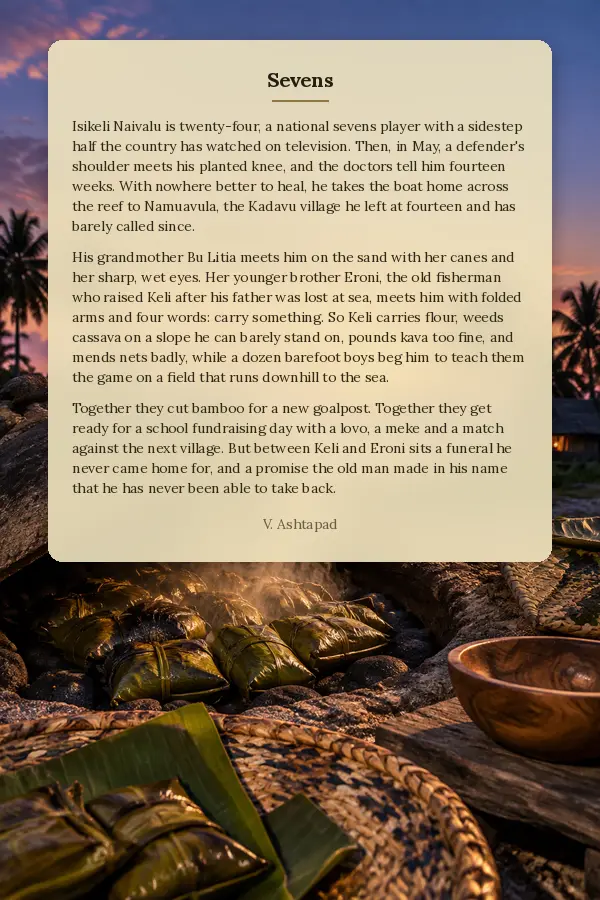
Isikeli Naivalu is twenty-four, a national sevens player with a sidestep half the country has watched on television. Then, in May, a defender's shoulder meets his planted knee, and the doctors tell him fourteen weeks. With nowhere better to heal, he takes the boat home across the reef to Namuavula, the Kadavu village he left at fourteen and has barely called since.
His grandmother Bu Litia meets him on the sand with her canes and her sharp, wet eyes. Her younger brother Eroni, the old fisherman who raised Keli after his father was lost at sea, meets him with folded arms and four words: carry something. So Keli carries flour, weeds cassava on a slope he can barely stand on, pounds kava too fine, and mends nets badly, while a dozen barefoot boys beg him to teach them the game on a field that runs downhill to the sea.
Together they cut bamboo for a new goalpost. Together they get ready for a school fundraising day with a lovo, a meke and a match against the next village. But between Keli and Eroni sits a funeral he never came home for, and a promise the old man made in his name that he has never been able to take back.
Members can react to this book and talk about it in the members' Library.
Ownership
© 2026 CRUNOD LLC. All rights reserved.
This book is owned by CRUNOD LLC. It is free to read on EternalCurrent.Online. No part of it may be copied, reprinted, sold, recorded or adapted, including as audio, film or translation, without written permission from CRUNOD LLC.
© 2026 CRUNOD LLC. All rights reserved.