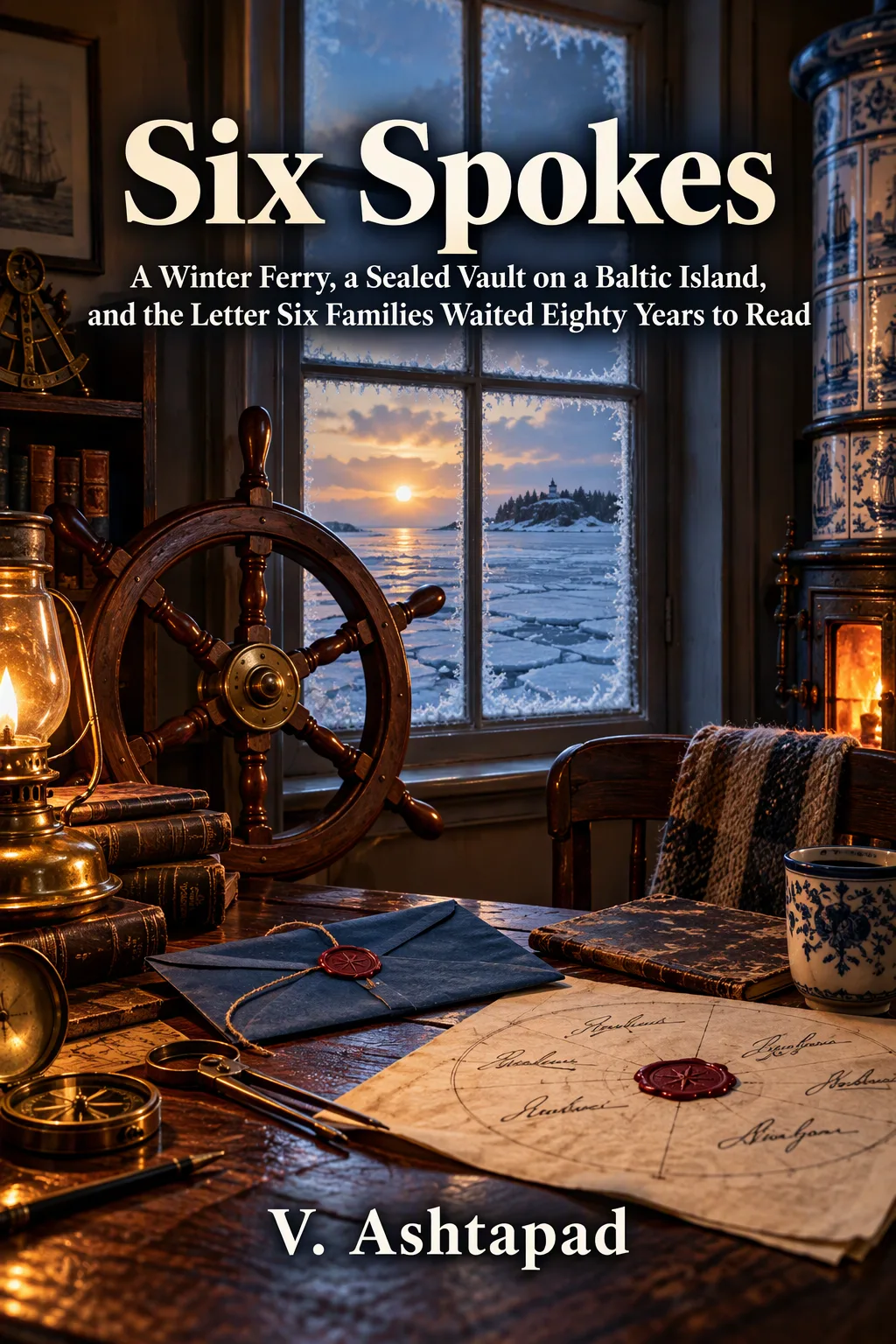
Six Spokes
A Winter Ferry, a Sealed Vault on a Baltic Island, and the Letter Six Families Waited Eighty Years to Read
by V. Ashtapad
Foreword
This is a work of fiction. The pen-friend letters that crossed the Baltic for generations, the archipelago ferries and pilot stations of the Swedish coast, Icelandic leaf bread, Estonian kama, Latvian gray peas, the Lithuanian tree cake and the Finnish sauna are all real. The island of Kallskär, its archive, the ferry Ejdern and every person in this book are invented.
For everyone who kept writing when the post was slow.
Saturday, 13:20. Norrhamn
Marta Saar counted us before she said hello.
I watched her do it. She came down the step of the airport bus at the head of the quay in a long black coat and a knitted hat the color of lingonberries, with one small wheeled case and a cloth bag over her shoulder, and she stood on the packed snow and looked at the seven of us waiting by the ticket hut, and her lips moved. One, two, three. Her eyes went from Ulla to me, from me to Captain Lindqvist, to the lawyer, to the tall woman with the enormous suitcase, to the young woman holding a gray box against her chest as if it were a sleeping baby, to the old man with the cake tin. Then she looked along the quay to where a white van with a red stripe was backing badly toward the bollards, and she added one more, and nodded, as if the number had come out right.
Only then did she walk over and put out her hand.
"Marta," she said. "You are Eero. Birgitta wrote me about you. She said you were very tall and apologized for it all the time."
"I do not apologize for it," I said.
"You just did, with your shoulders," she said, and turned to Ulla, and the two of them held each other for a long moment without speaking, in the way of women who have both been fond of the same difficult person and have both just lost her.
I should explain who we were, since I am the one telling this, and since a story of this kind depends on the reader knowing exactly who was standing where.
My name is Eero Laine. In December I was thirty-four years old and I had been the archivist at Kallskär for three years and two months. Kallskär is an island of granite and juniper and one stubborn stand of pines at the outer edge of the Roslagen archipelago, on the Swedish side of the Åland Sea, an hour and ten minutes by ferry from the mainland harbor at Norrhamn when the water is open and something closer to two hours when it is not. On Kallskär stands an old pilot station, a long red house on a stone foundation with a lookout tower at one end, from which pilots once rowed out to guide ships through the rocks. The last pilot was a man named Nils Ek. His daughter was Birgitta. She was born in the house in December 1932, she bought it back from the state in 1975, and in 1979 she opened it as the Kallskär Archive, a private collection of letters, diaries, photographs and household books from six families on six shores of the same sea.
She died on the third of October, at ninety-two, in the bedroom over the kitchen, with the window open a hand's width because she could not sleep without hearing water. The seven of us at the quay, and the van, were what she had left behind.
Ulla Berg was seventy-one. She had come to Kallskär in 1984 as the young wife of a fisherman named Bengt, and when Bengt died she stayed on as caretaker, and in all the years I knew her I never saw her sit down for longer than it took to drink coffee. She wore a padded jacket held together at the cuffs with tape and she carried a thermos the size of a fire extinguisher. Captain Rolf Lindqvist, sixty-one, master of the ferry Ejdern for nineteen years, stood beside her in a blue knitted cap with his hands in his pockets, watching the ice in the harbor mouth the way a doctor watches a cough.
The lawyer was Annika Ström, fifty-eight, from Norrtälje. She had handled Birgitta's affairs for twenty-five years and she had a leather briefcase with a combination lock and a habit of saying "for the record" before ordinary sentences, which made them sound like evidence.
The others I knew only from letters and from Birgitta's descriptions, which were affectionate and unreliable.
"You must be Hildur," I said to the tall woman with the suitcase.
"I must be," she said. "Nobody else would bring this much luggage to an island for four days." Her English had the flattened vowels of the Westfjords and a laugh underneath it. Hildur Einarsdóttir was fifty-seven, a knitting teacher from Ísafjörður in the far northwest of Iceland, and the granddaughter of Sigrún Pálsdóttir, who had written to Birgitta for sixty-seven years. She wore a thick sweater with a pattern of gray and white and black around the yoke, under an open parka, and no hat at all, in minus nine.
"Aren't you cold?" Annika asked her.
"This is not cold," Hildur said kindly. "This is weather."
The young woman with the gray box was Ilze Ozola, forty-one, a paper conservator from Riga. She had come on the overnight ferry from Latvia to Stockholm and then two buses, and she had not let go of the box at any point, as I would learn, not to sleep, not to eat, not to wash her face on the boat. In that box was the Crossing Book, the heart of Birgitta's archive, which had been in Riga since November for the repair of its spine. She was small and pale and fierce about the eyes, and when I offered to carry the box she gave me a look that took a full second to soften into politeness.
"Thank you, no," she said. "It is my responsibility until it is in the vault."
The old man with the cake tin was Tomas Kazlauskas, seventy-two, from a village outside Klaipėda on the Lithuanian coast. He had been a radio officer on cargo ships for thirty years and a beekeeper for twenty more, and his mother Ona had been the sixth and last of Birgitta's correspondents. He had a white mustache and pale blue eyes that seemed to rest slightly past you, and the cake tin, he told me gravely, contained a šakotis, which was a cake, which was also a tree, which I would understand when I saw it.
"I carried it on two boats and one bus," he said. "It is very light. It is mostly holes."
And then there was the van.
It stopped at last, a meter from the edge of the quay, and the driver's door opened and a man in a good wool coat and terrible boots stepped down into the slush with a paper bakery bag in one hand and his phone in the other. He was talking into the phone in fast Stockholm Swedish, something about a truck in Södertälje and a gearbox and the second of January. He saw us, held up one finger, finished the call, and came across with his free hand already out.
"Johan Hallgren," he said. "I'm the grandson. I'm sorry, I'm late, I'm always late, there was a truck." He opened the paper bag and held it out to the group. "Cinnamon buns. From the bakery on Hornsgatan she liked. They're squashed. Everything I carry gets squashed. That's ironic, considering what I do."
"What do you do?" Hildur asked, taking a bun.
"I move people," Johan said. "House moves. Hallgren Removals. Fourteen trucks." He paused. "Eleven of them working."
He was forty-six, with his grandmother's long jaw and none of her calm. The back of the van, which he opened to take out an overnight bag, was stacked to the roof with flattened cardboard and a few full boxes, taped and labeled in marker: BOOKS B.H., KITCHEN B.H., DESK B.H. He saw me reading them.
"Her flat in Vasastan," he said. "I cleared it in October. Somebody had to. I keep meaning to bring the boxes out here and I keep not doing it." He shut the doors. "Next time."
Eight of us, then, and the captain. Marta Saar wrote us down.
I mean that literally. While Captain Lindqvist went aboard to start the engines and Ulla poured coffee from the great thermos into paper cups, Marta took a small black notebook from her coat and a pencil from her hat, where it had been tucked into the fold, and wrote a list. I saw it later. At the top it said Ejdern, Norrhamn to Kallskär, Saturday 27 December, and beneath that, in a clear square hand, our names, our ages where she knew them, and beside each name a word or two: gray box, cake tin, suitcase (light), van (boxes), briefcase, thermos.
"Why light?" I asked, reading over her shoulder, which was rude, and which she did not seem to mind.
"Because the Icelandic woman carries that suitcase with one hand," Marta said. "And she is strong, but not that strong. A suitcase that size, with four days of clothes and a woman's books, weighs twenty kilos. That one weighs eight. Something in it is large and empty."
"You were a purser," I said. Birgitta had told me that much.
"For thirty-eight years, on the ships between Tallinn and Stockholm. Every soul on board was my responsibility. You learn to count. You learn to notice what people carry and how they carry it. Then you retire and you cannot stop." She closed the notebook. "It is a disease. Do not worry. It is not catching."
The ferry would not leave for twenty minutes, and I had been sent by Ulla to buy packing tape and a box of tea lights at the chandlery, which at Norrhamn is also the ticket office, the post agent and the only shop open between Christmas and New Year. It was a narrow wooden building that smelled of tar and coffee and wet wool, with nets and fenders hanging from the ceiling and a counter of things for summer visitors: postcards of the lighthouse at Söderarm, mugs with seals on them, and a basket of small brass stamps for sealing wax, each with a turned wooden handle, beside a rack of colored wax sticks, red and green and gold. The stamps had little designs: an anchor, a gull, a herring, a compass rose, a ship's wheel. I picked up the wheel, out of habit, because Birgitta had worn a ship's wheel on her finger for more than sixty years. This one had eight spokes, like every ship's wheel ever painted on a mug. I put it back.
Johan was at the counter when I went in, paying for something small that the woman slid into a paper bag, and he gave me a quick tired smile and went out with it into the cold.
I bought the tape and the tea lights and a packet of salty licorice for the crossing, which I already knew from experience nobody else would eat, and went back out to the quay, where the light was the color of skimmed milk and the gulls were standing on the ice in the harbor mouth, looking offended.
Ulla was waiting for me with a paper cup.
"Captain says we go now or we go Monday," she said. "There's weather coming Sunday night. A real one. And the channel's closing."
"Will we get back?"
"The icebreaker comes Wednesday for the ferry. You'll get back." She looked at the boat. "Whether you want to is another question."
We went aboard in single file, and Marta Saar stood at the foot of the gangway and counted us onto the boat, and nobody, I noticed, thought this strange, or asked her to stop.
© 2026 CRUNOD LLC. All rights reserved.
Saturday, 15:40. The Ejdern
The Ejdern is not a beautiful boat. She was built in 1971 in a yard at Lidingö for the inner archipelago, and she has the shape of a sensible shoe, broad and low and dark green, with a wheelhouse forward and a small heated saloon aft that seats twenty on benches covered in brown vinyl. In summer she carries cyclists and families with dogs and cool boxes. In winter she carries mail, gas cylinders, the occasional coffin and us.
We left Norrhamn twenty minutes late, which Captain Lindqvist blamed on Johan and Johan blamed on the gearbox in Södertälje. Once we were past the harbor mouth the ice began, gray and thin at first and then white and thick enough to sound against the hull, a long scraping groan like a cello being tuned by someone who hated it. The channel the icebreaker had cut two days before was still open, a black road through a white field, but its edges were already knitting together. Every few minutes the boat shuddered and the cups on the saloon table walked a little toward the edge.
"Is this normal?" Annika asked, holding her briefcase on her knees.
"For the record," said Hildur, who had been listening to her for an hour, "yes."
Annika gave her a look, and then, unexpectedly, laughed.
I sat by the window with my licorice. Marta sat across from me with her notebook closed on her knee. Tomas had set his cake tin on the table and opened it at last, and it was exactly what he had promised: a tree. It stood perhaps forty centimeters high, a hollow golden cone covered in branches and spikes and little brittle twigs of cake, as if someone had poured batter over a fir and the fir had gone away and left the batter standing.
"You make it on a spit," Tomas said, turning the tin so we could see. "Over an open fire. A wooden cone, turning. You pour the batter on, a ladle at a time, and it runs and drips and the drips cook into these." He touched a spike with one finger. "Then another ladle. Then another. Many eggs. My mother used forty for a tall one. You turn and turn for hours and you cannot stop or it is ruined. My father would turn it, and my mother would pour, and they would argue the whole time about who was doing it wrong."
"Who was?" Hildur asked.
"Both," Tomas said. "That is why it came out right."
He broke off a branch for each of us with great ceremony. It tasted of butter and eggs and something like a lemon peel memory, and it shattered when you bit it, and the crumbs went everywhere. Johan, who had been on his phone again in the corner, came over and ate three branches in a row standing up.
"My grandmother loved this," he said. "Every Christmas a box came from Lithuania. She'd hide it from my father."
"My mother sent one to Birgitta every year for fifty-three years," Tomas said. "In a box with straw. The post took it two weeks and it came in pieces. Birgitta said that was the best way. She said a whole one was too beautiful to eat."
Then, because Hildur was looking at the sugar cubes in a bowl on the table and tapping her fingers, Tomas picked one up, showed it to her on his flat palm, closed his hand, opened it, and the cube was gone. He reached over, quite slowly, and took it out of the collar of her sweater.
Hildur shrieked and then laughed so hard that Captain Lindqvist turned round in the wheelhouse to see what had happened.
"On the ships," Tomas said, pleased, putting the cube back in the bowl, "the night watches are long. A radio officer has a great deal of time and very little to do with his hands. I learned from a cook from Gdańsk. Cards, coins, sugar." He flexed his fingers and looked at them a little sadly. "Not so quick now. When I was forty I could take your watch."
"Please don't take my watch," said Annika.
"And what did you buy, Eero?" Tomas asked me, pushing the bowl of sugar my way as if it were a reward. "In the shop. You came out with a bag."
"Tea lights. Tape. Licorice," I said. "I nearly bought a seal stamp, out of sentiment. They have a basket of them by the till. One was a ship's wheel, like Birgitta's ring. But it had eight spokes, like every wheel ever painted on a mug, so I put it back."
"Eight is correct for a wheel," said Captain Lindqvist from the wheelhouse door, without turning round, and Tomas offered me a sugar cube, and I took it, and the talk went somewhere else.
Hildur had her knitting out by then, a half-finished sweater yoke in brown and cream on a circular needle, and she worked without looking at it while she watched the ice. Marta asked her what the pattern was.
"My own," Hildur said. "Every woman in my family invents her own. My grandmother's was a band of birds, very small, all flying the same way. I used them once in a sweater for my son and he says he cannot wear it because he feels them pulling him south." She counted stitches under her breath. "This one is for Birgitta. I started it in September. Then I heard, and I could not stop. So now it is a sweater for nobody."
"For the archive," Ilze said quietly.
Hildur looked at her. "Yes," she said. "Perhaps."
Ilze had not taken off her coat. She sat at the end of the bench with the gray box on her lap and both hands flat on its lid. Annika, in the tone of someone asking for the record, asked if she would describe the work she had done, and Ilze, who until then had said perhaps twenty words since Norrhamn, came alive.
"The book was made in 1993," she said. "Birgitta had a binder in Uppsala sew it. Six sections, one for each family, and in each section the first letter that family sent her, and then many pages of family history written by hand. Your grandmother's hand," she said to Hildur. "And yours," she said to Tomas. "Your mother's. And the families kept adding, every few years, more pages, sewn in. It became too fat for its spine. The spine split along the joint. She asked me in the summer if I would repair it. Then she died, and Mrs. Ström sent it to me anyway, in November, because it was in her wishes."
"For the record," said Annika, "it was."
"I took off the old spine. I resewed four sections that were loose. I made a new spine of linen over a hollow back." She saw our faces. "A hollow back is a paper tube. It is glued to the back of the sewn pages on one side and to the spine cover on the other side, so when you open the book the spine bends away from the pages and the book can lie flat without breaking. You can put a pencil through it." She mimed this with her finger. "In and out the other end."
"Could you hide something in it?" Hildur asked, delighted.
"A pencil," said Ilze, not delighted. "A very thin letter. Nobody hides things in a book I have repaired."
"And the letter," said Johan. He had stopped eating cake. "Grandmother's letter. You saw it?"
"Of course. It is in a pocket inside the back board. Linen, very simple. I did not touch the pocket except to clean around it. I photographed everything before and after. I sent you the photographs." She looked at him. "All of you. On the twentieth."
"I saw them," Johan said. "I couldn't tell from the photos. How big is it? The envelope?"
"Sixteen centimeters by eleven and a half. Her blue paper. The wax is red."
"She always used that blue paper," Johan said. "I found boxes of it in the flat. Hundreds of sheets. Do you know she bought it from the same shop in Gamla stan for sixty years? When they closed she bought their whole stock." He laughed, not very well. "I have a carton of it in the van. I don't know what to do with it. Who needs a thousand sheets of blue paper?"
"I'll have some," said Hildur. "I'll write to you on it."
Marta, who had said nothing, opened her notebook and wrote something, and closed it.
---
The crossing took an hour and fifty minutes that day. Somewhere in the middle of it Marta told me how she had met Birgitta, and I put it here because she told it so well, and because it matters later.
"I was twenty-five," she said. "It was 1984, my fourth year as assistant purser. We got the manifest at departure, a printed list of every passenger by name and cabin, and I read it the way I read everything, top to bottom. And there was a name I knew. Hallgren, Birgitta. Cabin 4112. I knew it because my whole childhood that name had been on envelopes. My mother had a friend in Sweden she had met at a teachers' summer course on Gotland in 1959. They wrote. They wrote every month. Blue envelopes, red wax, and the same name, Birgitta Hallgren, Kallskär. My mother read the letters at the kitchen table and sometimes she would laugh out loud and sometimes she would put her hand over her mouth, and when I asked what it said she would say it was grown-up business. I used to steal the envelopes for the stamps."
"So you knocked on 4112," I said.
"I brought tea. On a tray. As if I were room service." Marta smiled at the window. "She opened the door and looked at me and said, you are Leida's girl, you have her ears. My mother's ears are very large. So are mine. And then she made me sit down on her bunk and she poured the tea for me, which is not how service works, and we talked until Mariehamn. After that she traveled on my ship once a month for thirty-five years. She went everywhere, collecting letters and diaries and household books from families who wanted them kept. She said the ships were her filing cabinet. She would come to the purser's office and say, Marta, count me aboard, and I would."
"And when did your mother —"
"2008. She was seventy-four. Birgitta came to the funeral in Tallinn and sang. Badly. Very loudly. My mother would have loved it." She turned her teacup in its saucer. "I took the last of my mother's letters from Birgitta and put them in the archive myself, in 2009. It seemed correct. They were half Birgitta's anyway."
Through the window I could see Kallskär coming up out of the white, low and dark, with the red pilot station and its tower on the western rise and Ulla's cottage below it near the shore, and the long finger of the jetty, and smoke going straight up from Ulla's chimney into windless air.
"There," I said. "That's us."
Tomas stood up to look, holding the edge of the table, and peered at the island for a long moment with his pale eyes.
"I see the smoke," he said. "Good. Where there is smoke, there is coffee."
Hildur stood, too, and swung her great suitcase onto the bench with one hand, and I remembered Marta's word in the notebook, and when I picked it up for her on the jetty at Kallskär ten minutes later, I understood. It weighed nothing. Something inside it slid and bumped, hollow, like an empty drawer.
"Books?" I said.
"A box," Hildur said. "An empty one." And then, seeing my face: "For something. I will tell you later. Maybe."
Marta Saar counted us off the boat.
© 2026 CRUNOD LLC. All rights reserved.
Saturday, 17:30. The Pilot Station
Since everything that follows happened inside one house, I will describe it once, carefully, the way Birgitta described it to me on my first day, walking backward ahead of me through the rooms and knocking on the walls.
The pilot station at Kallskär is a single long building of red-painted timber, two stories, on a foundation of fitted granite blocks taller than a man. The front door faces east, toward the jetty and Ulla's cottage. Inside it is a hall with hooks for coats and a bench for boots. To the left of the hall is the kitchen, big and square, with a wood range and an electric stove side by side, and beyond it the old pilots' mess, which we called the dining room, with a long table that seats twelve. To the right of the hall is the library, which was once the pilots' watch room: a long room with windows on three sides, shelves to the ceiling, a reading table and, in the corner, a tall tiled stove of white and blue tiles from the 1880s that heated the room beautifully when the wind was from the west and filled it with smoke when the wind was from the east. Beyond the library, at the end of the house, a door opens onto the stair of the lookout tower.
Upstairs are six bedrooms, a bathroom, and my own two rooms at the north end, over the dining room. Birgitta's room was over the kitchen. It had been kept as it was.
Under all of this is the cellar, cut partly into the rock. You reach it by a narrow stone stair that goes down from a door in the hall, between the kitchen and the library. At the foot of the stair is a whitewashed corridor with a boiler room on one side and, at the end, the vault.
The vault had been the station's storeroom for oil and rope. In 1987 Bengt Berg and two men from Norrhamn lined it with insulation and fresh plaster and installed a dehumidifier that ran day and night, and a steel door painted gray, with two separate locks, one above the other, each with its own key. The room inside is four meters by three. It has no window. It has one ventilation duct, ten centimeters across, which runs through the stone wall to a grille outside at ground level on the north side of the house, and is fitted inside with a fine steel mesh. It has steel shelves on three walls holding gray boxes, and in the middle an oak table, and a single bulb in a cage. It is the most boring room on the island and it holds the most precious things on it.
Until October, Birgitta kept both vault keys on a ribbon round her neck. After she died, under the terms of her will, one key went to Annika Ström and one to Ulla Berg. Neither of them could open the door alone. I, the archivist, could not open it at all, which I had found mildly insulting and also, privately, a relief.
---
Ulla had the kitchen warm and the dining room lit with candles when we came up from the jetty, stamping snow, and there was a smell of onion and cream and anchovy from the range that made Johan stop in the hall with his eyes shut.
"Jansson's," he said. "Ulla. You made Jansson's."
"It's still Christmas," Ulla said. "Somebody has to eat it."
We ate at the long table. Jansson's temptation, which is potatoes in thin sticks baked with onion and sprats and cream until the top is brown and the inside is soft and salty and dangerous; pickled herring in three kinds, mustard and onion and plain; a dark rye loaf that Ilze had brought from Riga wrapped in a linen towel, heavy and slightly sweet, with caraway seeds in the crust; a wheel of crisp bread; Ulla's own cured salmon; and a round flat cheese, yellow and studded with caraway, that Ilze put on the table with a little embarrassment.
"It is a summer cheese," she said. "For midsummer. You are supposed to eat it on the shortest night, with beer, after you jump over the fire. But my aunt makes it all year now, because people ask. I thought, the shortest night, the longest night. It is the same cheese."
"It is very good," said Tomas, who had already had three slices.
Marta had brought black bread too, the Estonian kind, dense and sour and almost black, with a crust that resisted the knife, and she and Ilze compared loaves across the table with the gravity of two diplomats exchanging credentials.
"Yours is sweeter," Marta said.
"Yours is braver," Ilze said, and they both seemed satisfied.
I had brought, from my mother in Kuopio, by post, a box of Karelian pies, little open rye crusts pinched round a filling of rice porridge, which you warm in the oven and eat with egg butter, and I had warmed them and made the egg butter myself, and I am still proud to say that they were finished before the herring.
It was a good dinner. I want to say that clearly before I say anything else. There were candles and the windows were black and the stove ticked and Hildur told a story about a sheep in Ísafjörður that had climbed onto the roof of the school, and for an hour and a half we were what Birgitta had wanted us to be, which was six families at one table.
Then Annika opened her briefcase.
---
"I am sorry," she said. "It is late and you are tired. But she asked me to read this on the first evening, and to read it to all of you together, and so." She took out a folder. "For the record, this is not the full will. The full will deals with her money and her flat and some small bequests, and all of that is in order. This is the part that concerns Kallskär. She wrote it herself and I put it into proper form, and she made me read it back to her twice."
She put on her glasses and read.
The island of Kallskär, with the pilot station, the cottage, the boathouse, the sauna and the jetty, went to her grandson, Johan Hallgren.
Johan did not move. He looked at the candle in front of him.
The Kallskär Archive, being all the letters, papers, books, photographs and recordings held in the pilot station, together with the Crossing Book, did not go to Johan. It went "to the keeper whom I name in my letter in the Crossing Book." With it went the Kallskär Fund, the money Birgitta had set aside over forty years to pay for the archive's care, which Annika said, in answer to Hildur's question, was not a fortune but was not nothing.
The letter in the Crossing Book was to be opened at noon on the twenty-ninth of December, Birgitta's birthday, in the library of the pilot station, and read aloud, in the presence of the six: Johan Hallgren, Eero Laine, Hildur Einarsdóttir, Marta Saar, Ilze Ozola and Tomas Kazlauskas, "one for each spoke."
"And if it is not?" Marta said.
Annika turned the page. "If for any reason the letter is not read aloud in the presence of all six before midnight on the twenty-ninth of December, then the archive and the fund pass together with the island to my grandson, to do with as he thinks right."
Then she took off her glasses.
"I told her it was unwise," she said. "I told her, Birgitta, you cannot make the disposal of an entire archive depend on six people catching a ferry in winter. She said that was exactly what it depended on. She said if the six of them could not manage to sit in one room together for one day, the archive deserved to go to the man with the trucks." Annika looked at Johan. "I'm sorry. Her words."
"No," Johan said. "That's her." He rubbed his face with both hands. "That's exactly her."
Nobody spoke. The stove ticked. Somewhere outside, the ice moaned against the jetty.
"You may as well know," Johan said, still into his hands. Then he put them down and looked round the table. "Everybody will find out anyway. I've had an offer for the island. From a hotel group. They do small places in the archipelago, saunas and seafood and yoga on the rocks. They came out here in October and walked around with a man with a tablet. They want the station for the restaurant. They want the cellar for a wine room." He tried to smile. "They don't want an archive."
"And what do you want?" said Hildur. She asked it quite gently.
"I want to not go bankrupt on the second of January," Johan said. "I've got thirty-one people on the payroll. I lost a big contract in the summer, a firm that was moving its offices, they went to somebody cheaper. I have a loan with the bank and the bank is not sentimental. If I sell Kallskär I keep the company. If I don't —" He stopped.
"So you hope the letter names nobody," said Ilze. It was not quite an accusation.
"I hope the letter names somebody who wants to take the whole lot to Riga and put it in a nice dry building," Johan said. "Or Tallinn. Or anywhere. And then I can sell an empty house and everybody's happy." He looked at Ulla. "Almost everybody."
Ulla was standing at the range with her back to us. She did not turn round.
"She wanted the archive here," she said to the pots. "Where the letters came ashore. That's what she said to me at the end of September. The week before."
"Did she say who she'd named?" Johan asked, too quickly.
"She didn't tell me anything," Ulla said. "She sent me to Norrhamn for lemons." She turned then, with a ladle in her hand and a strange look on her face, half laughing, half something else. "In September. A bag of lemons. Six of them. Birgitta, who never ate a lemon in her life. She said lemons were for sailors and gin. I brought them, she said thank you, and I never saw them again. That's what I know about Birgitta's last month. Lemons." She put the ladle down. "Who wants coffee?"
Everybody wanted coffee.
Later, going up to bed, I passed Marta on the landing. She was standing at the window looking down at the dark shape of Ulla's cottage, with her notebook open on the sill. She had written, under Saturday, a line I could read upside down: U: lemons, 6, Sept.
"Why write that down?" I asked.
"Because it was odd," Marta said. "And because it was the only thing she said tonight that she had not planned to say." She closed the book. "Goodnight, Eero. Do not apologize for your shoulders on the stairs. The ceiling is low."
© 2026 CRUNOD LLC. All rights reserved.
Saturday, 22:30. The Sauna
There are two things a Finn will build before he has finished his house, and one of them is a sauna. I cannot remember the other. My grandfather used to say it was also a sauna.
The one at Kallskär was Birgitta's doing, but it was my grandmother's idea. Aino Laine of Kuopio had written to Birgitta in 1956, a long letter I had read perhaps forty times, complaining that she had come to Kallskär for a week that summer and found the place beautiful and the people kind and the coffee strong and not one sauna on the entire island, and that she could not in good conscience return until this was corrected. Birgitta corrected it. The sauna stands at the water's edge below the station, on the sheltered south side of the island, a small timber house blackened by sixty-nine winters, with a changing room, a bench room and a woodstove heaped with stones, and a short jetty from which, in summer, you go off the end into the sea, and in winter, if you are a Finn or a fool, you go down a ladder into a hole that Ulla cuts in the ice with a long saw.
I had fired it up after dinner. By half past ten it was at eighty degrees, and Tomas and Johan and I went down the path with flashlights and towels through the snow, under a sky so thick with stars that the snow seemed to light us from below.
Tomas went in first, took the top bench, and sat with his eyes closed and his hands on his knees and an expression of complete peace.
"In Lithuania," he said, "we have the pirtis. It is the same. We beat each other with oak branches and tell lies."
"We use birch," I said.
"Birch is for children."
Johan sat on the lowest bench with his elbows on his knees and his phone, which he had brought in a plastic bag, on the bench beside him. After five minutes he picked it up, and I took it from him, put it in the changing room, and shut the door.
"Finnish law," I said.
"Is it really?"
"It should be."
He laughed, and leaned back against the wall, and some of the tightness went out of his shoulders. I threw water on the stones and the steam came up with a sound like a slap and the heat rolled down over us, and for a while there was only that: the hiss and tick of the stove, the smell of hot wood and resin, and the ice outside talking to itself.
"I used to come out here every summer," Johan said at last. "From when I was five. My father brought me the first time and then he just sent me, every July, on the Ejdern with a label round my neck like a parcel. Ulla taught me to row when I was six, in the little blue boat. She'd sit in the stern and say, left, left, now right, now you've hit the rock, well done, now we'll see if you can swim. I could swim. Badly." He wiped his forehead. "My father hated it here. He said the island was where his mother went to be with people she preferred to him. Paper people, he called them. He wasn't completely wrong. She loved him. But she loved the letters in a way that was easier."
"Letters do not grow up and borrow money," said Tomas, from the top bench.
Johan looked up at him sharply. Tomas's eyes were still closed.
"No," Johan said after a moment. "They don't."
---
I told them about Kuopio because they asked, and because in the sauna it is easier to talk than not to. About my mother's house by the lake, which in winter is a white plain where men drive cars out to ice-fishing holes and sit on buckets all day saying nothing to each other in perfect happiness. About my grandmother Aino, who worked forty years in a post office and wrote to a girl on a Swedish island she had never seen until she was twenty-three, and then saw every summer for the rest of her life. About the box of Aino's letters from Birgitta that came to me when she died, in 2020, and how I read all of them in one winter and then wrote to Birgitta myself and asked if she needed an archivist, and she wrote back on blue paper, one line: Come when the ice goes out.
"So that's how you got the job," said Johan. "Family."
"I have a degree in archival science from Tampere," I said, "and four years at the provincial archive in Mikkeli. But yes. Family."
What I did not say, in the sauna or anywhere else that weekend until much later, was that in my room upstairs, in the drawer of the desk, was a letter from the National Archives in Helsinki offering me the post of senior archivist in their private collections section, starting in March, which I had applied for in November, four weeks after Birgitta died, on a night when I had sat alone in the library and listened to the house and thought: I cannot do this here by myself. They wanted an answer by the fifteenth of January. I had not given one. I had not told Ulla. I had certainly not told Johan, who would have been delighted, because an archive without an archivist is much easier to sell.
I put it here because this is a story of that sort, and I promised myself when I began writing it that I would not keep from the reader anything I knew.
---
Tomas went out first, slowly down the ladder into the ice hole, with a groan that seemed to come up from his boots, and back up again pink and blazing and shouting something in Lithuanian at the stars. Johan went in after him and came out swearing in Swedish. I went last, because I am the Finn, and it was the same as it always is: the black water closing over your shoulders like a fist, the moment where your body refuses, and then the strange opening afterward, the whole sky pouring into you.
We sat on the bench in the changing room wrapped in towels, steaming.
"That," said Johan, "was the stupidest thing I've done all year."
"It is not finished," said Tomas. "It is still December."
On the way up the path we met the women coming down: Hildur with a towel round her neck and a flashlight, and Marta beside her in a long robe and rubber boots.
"Is it hot?" Hildur asked.
"Eighty," I said. "There's a hole in the ice."
"A hole," Hildur said with contempt. "In Iceland we have whole pools. Hot ones. Every town. You sit in the hot pot at seven in the morning with the old men and they tell you who has died and who is selling his boat and what the fish prices are. It is our parliament." She looked at the dark sauna. "But I will try your hole. For science."
"I have been in a smoke sauna in Võrumaa," said Marta, "that had no chimney, where you sit in the dark and come out black. I am not afraid of a Swedish hole."
"It's a Finnish hole," I said. "On a Swedish island."
"Then I am even less afraid," said Marta, and went on down the path.
---
That night I could not sleep. I lay in my room at the north end of the house and listened to it settle around me, the way it did in deep cold: the timber cracking like knuckles, the stove downstairs ticking as it cooled, the dehumidifier in the vault humming faintly up through two floors of stone and wood, a sound I had stopped hearing years before and now heard again because I was listening for everything.
At midnight I went down to the kitchen for water. Marta was there, at the table, in her robe, with a cup of tea and her black notebook open in front of her. Her hair was still damp.
"How was the hole?" I asked.
"Instructive," she said. "The Icelandic woman screamed. I did not. We are both very pleased with ourselves." She turned a page. "Sit."
I sat. She looked at me in a way I would come to know well over the next three days, a level, patient, slightly amused look, as if I were a passenger who had arrived at her desk with a story about a lost cabin key and she was waiting for the real reason.
"Do you know," she said, "how many people Birgitta wrote to? Not the six. Everyone."
"In the archive register, about four hundred correspondents over seventy-nine years. But most of them only a few times."
"And the six were different."
"The six were the circle. Aino first, in 1946, when they were both thirteen, through a pen-friend scheme at school. Then your grandmother," I said, "no, sorry, Hildur's grandmother, Sigrún, in 1947. Then your mother in 1959, then Ilze's grandmother Velta in 1961, then Tomas's mother Ona in 1962. When there were six of them, counting Birgitta herself, she had a ring made, a ship's wheel with six spokes. A goldsmith in Stockholm. 1963. She never took it off."
"She took it off," Marta said. "In September. I saw her in September, on the twelfth, the last time. I came out on the Ejdern for one night. She was not wearing it."
I stared at her. "I didn't notice."
"You see her every day. I saw her once a month for thirty-five years. When you see a person every day you stop seeing what is on their hands." She wrote something. "Who has it now?"
"I don't know," I said. "I assumed it was with her things. Johan cleared the flat. Or Annika has it."
"Perhaps," said Marta. She closed the notebook and finished her tea. "Go to bed, Eero. Tomorrow there will be a great deal of ceremony, and you must carry the book."
"How do you know that?"
"Because you are the youngest," she said, "and Birgitta liked symmetry. The youngest carries it in. The eldest carries it out. It will be in her instructions. You will see."
It was in her instructions. I saw.
© 2026 CRUNOD LLC. All rights reserved.
Sunday, 09:30. First Letters
Breakfast was porridge, because Ulla believed in porridge the way some people believe in insurance, and coffee, and the rest of Tomas's tree, and a bowl of lingonberries, and then, because the morning was clear and bitterly still and nobody wanted to go out in it yet, they asked me to show them the archive.
I want to explain what that meant, because people imagine an archive as a great hall with ladders. Ours was the library, and two rooms upstairs lined with steel shelving, and the vault. Most of what Birgitta collected over seventy-nine years was not in the vault at all. The vault held the originals that mattered most and could least bear light: the Crossing Book, when it was home, and the oldest letters, and the household books, a few hundred diaries, and the wax cylinders and reel-to-reel tapes of people singing in kitchens. Everything else lived upstairs in gray boxes. And for the first letters of the six, which were sewn into the Crossing Book itself, Birgitta had made copies in the 1990s, photographic copies, and bound them into a set of six slim red binders that lived on the reading table in the library, so that visitors could read them without anyone opening the vault.
The vault was locked that morning, of course, and the book was still in Ilze's box in Ilze's room, where she had slept with it on the chair beside her bed. So I took down the six red binders.
They sat round the reading table in the library in the order they came in: Johan, Hildur, Marta, Ilze, Tomas, with Annika and Ulla at the end, Annika because she wanted to and Ulla because she had brought the coffee and then could not think of a reason to leave. The wind was from the west, the tiled stove in the corner was lit and drawing beautifully, and the light off the snow outside came in through three walls of windows and lay across the table so bright it made the blue paper of the copies look almost white.
"Read them in English," Hildur said. "So we all hear."
So I did. I had made the translations myself in my first winter, and they were not good, but they were faithful.
---
The first was Aino's, from Kuopio, in pencil on squared paper torn from a school exercise book, dated the fourteenth of March, 1946.
*Dear Birgitta Ek of the island of Kallskär,*
*The teacher gave me your name. I am to write to you in Swedish and you are to write to me in Finnish, and then we will both improve. But I do not think your Finnish will improve very much from my letters, because I am going to write mostly in Swedish, because it is faster, and I have a great deal to tell you.*
*I am thirteen. I live in Kuopio, which is a town between lakes. In winter the lakes are white and you can walk to the next village. My father works on the railway. My mother bakes bread with a hole in the middle, so it can hang on a pole near the ceiling and dry. She says this is the only sensible bread. My brother is nine and he is a criminal. Do you have brothers? Are they criminals? Please write back immediately and tell me everything about your island, especially if there are any boys on it.*
*Your friend, perhaps,*
*Aino Laine*
Johan laughed out loud. Hildur put her hand over her heart. I had read it so many times that I had stopped hearing it, and hearing it now, in front of them, in that light, I had to stop for a moment before the signature.
"Were there any boys on it?" said Tomas.
"Her father had a pilot's apprentice," I said. "Aged sixteen. Birgitta described him in four pages. Aino was very disappointed when he married a girl from Norrhamn."
---
The second binder was Aino again, because the first year of the correspondence was all Aino and I had put the best of 1947 in with it. I read a few of them. A letter about the spring ice going out on the lake, with a drawing of a boy falling through it, captioned *my brother, not drowning, unfortunately*. A letter about a dance. A letter in which Aino said she had read a story in a magazine about spies who wrote to each other in invisible ink, and she had tried it, and it worked, and Birgitta must try it too.
*Write the secret part our way,* Aino had written, *and I will warm it at the stove. Then my brother will never know. He reads all my letters. He is a criminal.*
"Lemon juice," said Hildur, delighted. "We all did that! You write with a matchstick dipped in juice and when it dries you cannot see it, and then you hold it over a candle and it comes up brown."
"We used milk," said Ilze. "My brother and I. It smells terrible after."
"We did not do it at all," said Marta. "My mother said there was nothing a child had to say that should be invisible." She did not write that down, I noticed. She was listening with her chin on her hand.
---
Sigrún's first letter came from Ísafjörður in October 1947, on lined paper, in a firm round hand and very correct English, because Sigrún had refused, she explained in the first paragraph, to write in Danish, and she did not yet know any Swedish, and she assumed Birgitta did not know any Icelandic, and English was the language of ships, and they both lived beside ships.
*My father is a fisherman,* Sigrún wrote. *In winter it is dark for many weeks because the mountains are so close around the fjord that the sun cannot climb over them. Then, at the end of January, on a day everyone knows, the sun comes over the mountain and touches the town again for the first time, and everyone makes pancakes with cream and drinks coffee in the middle of the morning. My mother says it is the best day of the year. I say it is the best day of the year because there are pancakes. We will see who is right.*
Hildur was crying, openly and without any embarrassment, and laughing too.
"Sun coffee," she said. "We still do it. The twenty-fifth of January. The whole town. My grandmother made the pancakes until she was eighty. Then I made them and she criticized. That's the tradition. Somebody makes the pancakes and somebody criticizes."
"That is also the tradition with the šakotis," said Tomas.
"That is the tradition with everything," said Ulla, from the end of the table, and everybody laughed, and she looked surprised to have spoken.
---
Leida Saar's first letter, from Tallinn, in August 1959, was written on the back of a program from the teachers' summer course on Gotland where the two of them had met. Leida had been twenty-five, a schoolteacher of music, and her letter was almost entirely about singing: about the choir she led at her school, about the great song festival grounds in Tallinn where the singers stand in a great shell on the hillside, thousands of them, and the people sit on the grass below, more thousands, and on the last evening everyone sings together, the choirs and the crowd, until you cannot tell which is which.
*I am sure you are tone deaf,* Leida wrote. *All Swedes are tone deaf. But you may come and listen. Listening is also a kind of singing.*
Marta smiled at that, a small private smile, and turned her teacup in its saucer, the way she had on the ferry, and said nothing at all.
Velta Ozola's first letter, from Riga in 1961, was short and practical and enclosed a recipe for gray peas with bacon, which Velta said was what Latvians ate at New Year, and should be eaten, she insisted, until you could not move. Ilze read the recipe aloud herself in Latvian first and then in English, very fast, as if the words might escape, and then said, "She made this every year until 2018. I make it now. It is not the same. Nothing she made is the same." And she put her hand flat on the binder and kept it there.
Ona Kazlauskienė's first letter, from Klaipėda in 1962, was about her bees. Tomas did not let me read it. He took the binder from me, very gently, and held it close to his face, and read it himself, slowly, in a low voice, in English, with his finger under each line.
*My husband says I talk to the bees more than to him. This is true. The bees listen.*
He closed the binder.
"She talked to them until she was eighty-four," he said. "When she died, I went and told them. That is what you do. You go to the hives and you knock and you tell the bees who has died, so they do not leave." He looked at the window. "They did not leave."
---
The last thing in the sixth binder was a photograph I had put there myself: a color print from 1993, the year the Crossing Book was bound, of the six women together on the jetty at Kallskär, the only time all six were ever on the island at once. They stood in a row in summer dresses and sensible shoes, squinting into the sun, laughing at something the photographer had said. Birgitta was in the middle, tall and straight, sixty years old. Her right hand was raised to shade her eyes, and on her ring finger, small and clear in the bright light, was the ship's wheel.
Marta took the photograph out of its sleeve and held it to the window.
"Six spokes," she said.
"One for each of them," I said. "She said a wheel with six spokes would steer badly. She said that was not the point."
Marta put the photograph back exactly as it had been and looked round the table at us, at the six of us, with an expression I could not read.
"Who has it now?" she said. "The ring."
There was a silence. Johan looked at Annika. Annika looked at Johan.
"It was not in the flat," Johan said. "I went through everything. I assumed it was buried with her, or —"
"It was not buried with her," said Annika. "For the record. It was not in her effects either. I assumed you had it."
Ulla stood up, quite suddenly, and began collecting the coffee cups.
"I'll heat the milk," she said, and took the tray out to the kitchen, and the swinging door went back and forth behind her, three times, four, and was still.
© 2026 CRUNOD LLC. All rights reserved.
Sunday, 13:00. Leaf Bread
Hildur had brought the leaf bread in the suitcase that was not the light one. She had a second bag, a hard cooler with a strap, which I had carried up from the jetty without thinking about it, and in it, between freezer packs, wrapped in damp cloths and then in plastic, were thirty rounds of dough rolled so thin you could read a newspaper through them.
"You cannot buy them like this," she said, unpacking them on Ulla's kitchen table one by one like letters. "Well. You can. In the supermarket in Reykjavík they sell them ready-rolled. But my grandmother would come out of the ground and slap me. These I rolled myself on the twentieth. Two days. My arms are still angry."
Leaf bread is an Icelandic Christmas thing, and like most Icelandic things it began, Hildur said, as a way of making very little go a very long way. Flour was precious in the old days in a country where almost nothing grows but grass, and so you rolled your dough as thin as it would go, thin as a leaf, and you cut patterns in it with a knife, and you fried it in fat for a few seconds until it puffed and went gold and crisp, and each family had its own patterns, and the whole family sat round the table on one day in December and cut them together, and argued.
"There it is again," said Tomas. "The arguing."
"It is essential," said Hildur. "Without the arguing it is just bread."
She showed us how. You fold the round in half, not creasing it, and with the point of a small sharp knife you cut a row of short parallel slits along the fold, like the teeth of a comb. Then you open it, and you take every other little strip with the knife point and fold it back over the next one and press it down, so that it makes a chevron, a little leaf, a little bird. Then you do the next row the other way. And so on, in bands, rings, stars, whatever your hands remember.
"There is also a brass roller," Hildur said, "with little wheels. It cuts the slits for you. My grandmother would not have one in the house. She said a roller makes a pattern; a knife makes a person."
So we cut with knives, all of us, round Ulla's kitchen table, while the light through the window went from white to pale gold and the radio on the shelf murmured the weather. Tomas cut slowly, holding his round close to his face, squinting. Johan cut fast and badly and tore two and was given a third by Hildur with the air of a teacher giving a boy one last chance. Ilze cut with terrifying precision, every slit the same length to the millimeter, and produced a pattern of tiny interlocking diamonds that made Hildur put down her knife and stare.
"That is a Latvian pattern," Ilze said, shy. "From weaving. It is the sign for — " she searched for the English. "For the morning star. My grandmother wove it into belts."
"Put it in the archive," said Hildur. "Put her in the archive."
Marta did not cut. She sat at the end of the table with a cup of coffee and watched our hands, all of our hands, and once or twice she smiled. When Hildur pushed a round toward her she shook her head.
"I am a purser," she said. "I watch other people do things. It is what I am for."
I cut a row of birds, because I had liked the birds in Hildur's grandmother's sweater, and they came out looking like a row of small surprised ducks, and Hildur held mine up to the window and said it was the most Finnish thing she had ever seen and that she would fry it first.
---
Ulla heated the fat in a deep iron pan on the wood range, and Hildur fried them, one at a time, a few seconds each side, lifting them out with two forks onto brown paper, and the kitchen filled with a smell like toasted bread and Christmas and hot iron. They puffed and blistered and the patterns opened up in them, every cut catching the light, and we stood around the paper and ate the broken ones, which is also, Hildur said, the tradition.
Johan's phone rang in the middle of it, and he went into the hall to answer, and the hall door did not quite close.
"No," he was saying. "No, I told them the second. The second. Tell them I'll have it by the second." A pause. "Because I will. Because something's happening out here on Monday that sorts it out one way or the other." A longer pause. "I know. I know. Just hold them off till Friday."
He came back in, saw us all looking at the leaf bread with great concentration, and knew exactly what we had heard.
"The bank," he said. "Don't worry. It's not your problem."
"It is a little our problem," said Marta mildly. "You said it yourself. One way or the other."
Johan looked at her for a long moment. Then he took a piece of my duck bread and ate it, and said, "Your ducks are terrible, Eero," and went out again, and I heard the front door close and saw him, through the window, walking down toward the jetty in the snow in his bad boots, with his hands in his pockets and his head down.
---
Annika came into the kitchen at three, with her folder, and asked if she could have the table.
"There are instructions," she said, "for this evening. For the sealing of the vault. Birgitta wrote them out, and she was particular, and I would like everyone to hear them now, so there is no confusion at six o'clock."
So we cleared the leaf bread into tins and sat down again, with our fingers still greasy, and Annika read.
At six o'clock on the evening of the twenty-eighth, the Crossing Book was to be brought into the library and unwrapped "by the person who has mended it." The letter was to be taken from its pocket in the back board and "shown to each of the six in turn, so that each may see with their own eyes that it is whole." It was then to be returned to its pocket by Annika, and the book closed and boxed, and carried down to the vault "by the youngest of the six," and placed on the table. The vault was to be locked with both keys and sealed "in the old way," and the seal was to be signed by all who were present.
At half past eleven the next morning the vault was to be unsealed and unlocked, and the book carried up "by the eldest of the six," and at noon the letter was to be opened "in the library, by the stove, with all six of you close," and read aloud.
"Read by whom?" Hildur asked.
"By me," said Annika. "Unless the letter itself says otherwise."
"What is the old way?" asked Ilze. "For a seal."
"A strip of paper across the door and the frame, pasted on both sides," said Annika, "so it tears if the door moves. We used to do it in court for evidence rooms. And signatures across the strip, half on the paper and half on the paint, so it cannot be replaced without the signatures failing to line up." She looked at us over her glasses. "She asked for it specifically. She said she had read too many detective stories to trust a lock."
"And the youngest is me," I said.
"Eero is thirty-four," Annika agreed. "Tomas is seventy-two. You carry it in. He carries it out."
"I will try not to fall down the stairs," said Tomas.
"For the record," said Annika, "please do."
"Please do fall?"
"Please do try."
Everybody laughed, Tomas loudest. But I saw Marta write in her notebook: *each of the six in turn: order?* And underneath: *Ring: U. avoids.*
Ulla, at the range, scraping the iron pan, said without turning round, "She gave it to somebody to keep. The ring. It's safe. It will come out when it's supposed to. That's all I'm saying." And then, because we were all looking at her back, she turned and looked at us and said, "That's all I'm saying," in a voice I had never heard her use in three years, and went out to the boathouse to check the generator, though it did not need checking, and was gone an hour.
---
The weather came on the radio again at four. A low from the southwest, deepening. Wind rising through the evening to gale force by midnight, gusting storm. Heavy snow. All small craft to remain in harbor. The icebreaker would come for the ferry on Wednesday morning, weather permitting.
Captain Lindqvist, who had spent the day aboard the Ejdern at the jetty doing what captains do to boats when nobody is looking, came up to the house at half past four, stamped his boots in the hall and announced that he would sleep in the station tonight, in the little room off the library, if nobody minded, because the boat would be cold and noisy and he was not a young man.
"There is a bed," I said. "Ulla made it up yesterday."
"Ulla always makes it up," said the captain. "Ulla knows."
So that was eight of us in the station that night, and Ulla in her cottage below: nine souls on Kallskär. I have checked this many times. I am telling you now so you can check it too.
© 2026 CRUNOD LLC. All rights reserved.
Sunday, 18:00. The Sealing
The wind had begun by six. Not the storm yet, only its front edge: a long steady pressure from the southwest that leaned on the library windows and made the candles on the reading table bow all together, like a choir, and straighten again. Outside it was full dark. The snow had started at five, small and dry and fast, and in the light from the windows it went past sideways.
We were all in the library. I will place us, because it matters.
Ilze sat at the reading table, at the end nearest the stove, with the gray box in front of her. Annika stood at her left with her folder and her briefcase. The six of us, by Annika's arrangement, sat round the table in the order of age, eldest first, going clockwise from Annika: Tomas, then Hildur, then Johan, then Ilze herself, then Marta, then me. Wait. I have that wrong. I have checked it since against Marta's notebook. The order was Tomas, Hildur, Johan, Ilze, Marta, me, if you went round the table; but the order of age, which was the order in which the letter was passed, was Tomas, seventy-two; Marta, sixty-six; Hildur, fifty-seven; Johan, forty-six; Ilze, forty-one; me, thirty-four. And Annika, to keep things simple, passed it round the table as we sat, not by age. So the letter went: Annika to Tomas, Tomas to Hildur, Hildur to Johan, Johan to Ilze, Ilze to Marta, Marta to me, and me back to Annika. Ulla stood by the door to the hall with her arms folded. Captain Lindqvist stood by the stove with his back to it, warming himself, a witness by accident.
The tiled stove had been lit since three, and the room was warm, and the tiles ticked.
At six exactly, by the clock on the shelf, Annika nodded, and Ilze opened the box.
---
I had seen the Crossing Book many times. I had not seen it the way it looked that evening, under candlelight, mended.
It was large, perhaps forty centimeters by thirty, and thick as a man's hand is wide, bound in boards covered with dark blue cloth. Ilze had kept the old boards and the old cloth, cleaned, and put on a new spine of linen dyed to match so closely that you could see the join only if you knew where to look. On the front board, stamped in faded gold, was a ship's wheel with six spokes and, under it, the single word *Överfart*. Crossing.
Ilze lifted it out of its tissue with both hands, set it on a cushion of gray foam, and opened it from the back. She did it slowly, letting the boards fall open on either side and the spine bend away, and I saw what she had meant on the ferry: the book lay flat, all eight hundred and some pages of it, like a thing relaxing.
Inside the back board was a pocket of plain linen, the width of the board and half its height. Ilze touched the edge of it with one finger, then stepped back, and Annika leaned over and drew out the envelope.
Blue paper, Birgitta's blue, a soft gray-blue like the sea on a cloudy morning. Sixteen by eleven and a half centimeters. On the front, in her hand, in black ink, the long slanting letters I knew from three years of notes on my desk: *To the six. Kallskär, 9 September. To be opened on my birthday, by the stove.* On the back, over the point of the flap, a round seal of red wax the size of a large coin, and pressed into it, crisp and clear, a ship's wheel.
Annika held it up so that we could all see it, turned it front and back, and handed it to Tomas.
Tomas held it close to his face, nearly touching his nose, and turned it slowly in the candlelight. He looked at the seal for a long time. He looked at the writing for a long time. Then he held it a little away from himself and said, in a voice that was not quite steady, "She always made her sevens with a line through the middle. Like the Europeans. Like us. My mother said Birgitta was the only Swede who did it." He passed it to Hildur.
Hildur held it in both hands, flat, as if it were warm, and then, to my surprise, raised it to her face and smelled it.
"Her drawer," she said. "The writing desk. Every letter she ever sent my grandmother smelled of that desk. Cedar and ink." She passed it to Johan.
Johan held it longest.
I noticed it at the time, and I noticed that everybody else noticed it. He took it in his right hand and looked at the front, and then at the seal, and then at the front again, and his left hand went to the pocket of his jacket and stayed there, and he did not pass it on. Ten seconds. Fifteen. The candle in front of him leaned in the draft from the window and straightened. A bead of sweat stood on his temple, though the room was not that warm. Twenty seconds. Annika said quietly, "Johan." And he started, and looked at the envelope as if he had forgotten what it was, and said, "Sorry. Sorry. It's her writing, that's all," and passed it to Ilze. His left hand came out of his pocket empty.
Ilze did not hold it for herself. She held it for the book. She tilted it under the candle to look at the wax edge-on, the way a jeweler looks at a stone, and ran the side of her thumbnail very lightly along the flap without touching the seal, and nodded, and passed it on.
Marta took it, looked at the seal, and her lips moved.
I was next to her and I saw it. Not words. A count. I assumed, at that moment, that she was counting the signatures we were about to make, or the people in the room, or the seconds Johan had held it. She was not.
Then she passed it to me.
It weighed almost nothing. One sheet, I thought, folded, perhaps two. The paper was smooth and slightly cool despite having been in four people's hands. The seal was hard and glossy and I could feel the ridges of the wheel under my fingertip without looking. I read the front once more, *by the stove*, and I looked over at the stove, which was ticking away in its corner, and I thought nothing at all, except that I missed her very much.
I gave it back to Annika.
She slid it into the pocket in the back board. Ilze closed the book, front board, back board, laid it in its tissue and then in the box, and put on the lid. And Annika looked at me.
---
The stair to the cellar is narrow and steep, and I am tall, and I carried the box against my chest with both arms the way Ilze had carried it all the way from Riga, and I went down one step at a time, feeling for each tread with my foot. Annika came behind me with the folder. Then Ulla with her key. Then the others, in no particular order, crowding the stair and the corridor below, the captain last.
At the bottom the air changed: colder, drier, the smell of whitewash and stone and the faint mineral smell of the dehumidifier. The corridor light was a single bulb. Ahead was the gray steel door.
Annika put her key in the upper lock and turned it. Ulla put her key in the lower lock and turned it. The door swung inward, heavily, on its hinges, and the vault light came on with the switch on the outside wall.
I went in alone. That was the rule, and there was barely room for two anyway between the shelves. Four steps to the oak table. I set the box down in the center, squared it to the edges of the table, as Birgitta would have done, and stepped back and looked at it, a gray box on an oak table under a bulb in a cage, and then I came out.
Everyone could see me through the open door the whole time. I have been asked about this since. I put the box down and came out. My hands were empty. Marta was standing at the front of the little crowd in the corridor, and she looked at my hands, and then at my face, and nodded.
Ulla switched off the vault light. Annika pulled the door shut. Annika turned the upper key. Ulla turned the lower key. Each tried the handle. The door did not move.
Then Annika opened her folder and took out a strip of heavy cream paper perhaps forty centimeters long and five wide, and a small pot of paste with a brush in the lid, and she pasted the strip across the gap between the door and the frame, at the height of the locks, half on the steel and half on the painted wood, and smoothed it with the side of her hand.
"Now sign," she said. "Across the edge. Half on the paper, half on the door. Your full name."
We signed, with Annika's fountain pen, in the order we happened to be standing: Tomas, Hildur, Marta, Johan, Ilze, me, then Ulla, then Annika, and then, because Annika asked him, Captain Lindqvist, as an independent witness, in big square capitals that crossed onto the steel and looked like a ship's name painted on a bow. Nine signatures. Annika wrote the date and the time beneath them, *28.12, 18.24*, and Marta, I saw, wrote the same time in her notebook, and then something else.
We stood for a moment in the corridor and looked at it, the gray door with its paper bandage, all our names across it.
"There," said Annika. "Now nobody goes in, nobody comes out, until half past eleven tomorrow. For the record."
"For the record," said Hildur, and this time she did not mean it as a joke.
On the way back up the stairs Marta stopped me with a hand on my arm and said, very quietly, so that only I could hear, "How many spokes?"
"Six," I said. "Of course."
"Of course," Marta said. "I counted too."
And she went on up the stairs into the light.
© 2026 CRUNOD LLC. All rights reserved.
Sunday, 23:10. The Dark
Ilze cooked dinner that night, because she had said on the ferry that she would and because, she told me in the kitchen, if she did not do something with her hands now that the book was out of them she would go mad.
She made her grandmother's gray peas. They are not, in fact, gray, but a deep brownish green, a big rough field pea that you soak overnight, which she had done in Ulla's biggest bowl on Saturday, and then boil until they are soft but still whole, and drain. Meanwhile you cut smoked bacon into small cubes, and an onion, and fry them slowly in a heavy pan until the fat runs and the onion goes brown and sweet, and then you tip the peas in and stir until every one of them is shining. And then you eat them with a spoon, with sour cream, with rye bread, with a glass of kefir if you are Latvian and a glass of beer if you are not.
"You must eat until you cannot move," Ilze said, quoting Velta's letter, serving. "Otherwise the new year will be poor."
"It isn't the new year," said Johan.
"It is close enough," said Ilze. "We are not taking risks."
So we ate until we could not move, and the wind got up outside, and the windows of the dining room hummed in their frames, and the candles leaned. Tomas told a story about a storm off Bornholm in 1979 when he had been alone in the radio room for nineteen hours relaying messages between six ships, and had eaten nothing but sugar cubes and coffee, and at the end of it the captain had come in and shaken his hand and said, Kazlauskas, you smell like a horse. Hildur told a story about her grandmother rowing across the fjord in a gale to deliver a baby, which turned out, when Hildur reached the end of it, to be a calf. Annika told no stories but laughed at all of them, with her hand over her mouth, as if laughing were not quite allowed.
Johan was quiet. He ate a great deal and drank two glasses of beer and laughed in the right places, and twice I saw him put his hand to the pocket of his jacket, which was hanging on the back of his chair, and take it away again.
---
At eight I went down and fired the sauna again, because Hildur and Marta had asked, and because I could not think of anything else to do. The wind on the path was strong enough now to make me lean into it, and the snow was coming sideways off the sea in long stinging ropes. I lit the stove and came back up, and at nine Hildur and Marta went down together with a flashlight, arm in arm, shouting at each other over the wind, and came back at a quarter past ten red-faced and wet-haired and very pleased with themselves.
"No hole," Hildur said. "Ulla said no hole tonight. The wind would blow you off the ladder."
"We rolled in the snow instead," said Marta. "It is the same thing. Colder."
At a quarter past nine, while they were down there, Johan put on his coat and his bad boots and went out. I saw him from the library window, his flashlight bobbing down the path toward the shore. He was back by ten, before the women. He said he had wanted some air. Hildur, when she came in, said that when she came out into the changing room to cool down she had seen, through its little window, someone with a flashlight going up the path toward the house, and she had thought it was me.
"It was me," said Johan. "I went down to look at the boat. I was worried about the boat."
"Captain Lindqvist was worried about the boat," said Hildur. "You were worried about something else."
Johan smiled at her. It was not a very good smile.
"Everybody out here is a detective," he said, and went upstairs.
---
The storm arrived at about eleven, all at once, as they do in the archipelago. One minute the wind was a pressure and the next it was a noise, a huge continuous roar like a train passing on and on without end, and the whole house began to speak: the timbers creaking and cracking, the windows booming in their frames, something on the roof rattling in long bursts like a drum roll. Snow hit the north windows so hard it sounded like sand.
At ten past eleven the lights went out.
I was in the library with Annika and the captain and Marta, who were playing cards by the tiled stove, and Ilze, who was reading. The lamps went, and the hum of the refrigerator in the kitchen went, and then, very faint, from under our feet, I heard the dehumidifier in the vault stop, and the silence it left was louder than the storm.
"The line from the mainland," said Captain Lindqvist, quite calm, in the dark. "It goes every winter. Ulla will be at the generator already."
Annika had a flashlight in her briefcase, of course. I found the candles. The captain and I put on our coats and went down to the boathouse, bent double against the wind, holding onto each other, and found Ulla there before us, as he had said, in her taped jacket with a headlamp on, crouched over the old diesel generator with the side panel off, swearing at it fluently in a Roslagen accent I had never heard her use before.
"Fuel line," she shouted over the wind. "Ice in it. Every year. Every year I tell Bengt to fix it properly and every year he — " She stopped. Bengt had been dead for nine years. She bent over the engine again.
It took us twenty-five minutes. At twenty-five to midnight the generator coughed and caught and settled into its loud, comforting hammer, and the lights in the station came on all at once on the hill above us, every window gold, and Ulla sat back on her heels and wiped her hands on her trousers and said, "Well. That's one thing."
The captain went back up to bed. I walked Ulla to her cottage, a hundred meters along the shore path, holding her arm. At her door she turned and looked up at me with the headlamp still on, so that I could not see her face, only the light.
"Is the door all right?" she said. "The vault door?"
"Nobody's been near it," I said. "Nobody could."
"No," she said. "No. Nobody could." And she went in.
---
I did not sleep well. The storm went on and on. Every gust set the house talking again, and at some point I dreamed I was on a ship and Marta was counting me and kept arriving at the wrong number.
At twenty to two I woke to a sound under the storm. A thin electronic beep, every thirty seconds, coming up through the floor. I knew it at once. When the power failed, the dehumidifier's own battery alarm would go off if the unit did not restart cleanly, and it had not restarted, because it was on a separate circuit with its own breaker in the boiler room, and the breaker had tripped. I had reset it a dozen times in three winters.
I took my flashlight and went down in my socks.
The upper hall was dark; the generator powered the house but at night we kept the hall lamps off. I went down the cellar stair, one hand on the cold stone wall. In the corridor at the bottom I turned on my flashlight and pointed it at the vault door.
The paper seal was exactly as we had left it. I put the light close and read the names along it, one after another, Tomas, Hildur, Marta, Johan, Ilze, Eero, Ulla, Annika, and the captain's big capitals, and the time in Annika's hand, *18.24*. The paste had dried smooth and cream-colored. The edges lay flat on the steel and the wood. There was no tear, no bubble, no crease. I tried the handle, very gently. The door did not move.
I went into the boiler room, found the breaker down, pushed it up, and from behind the steel door came the low familiar hum of the dehumidifier starting. The beeping stopped.
I came back up the stair and at the top, in the dark of the hall, I walked into somebody.
We both made the noise that people make. I swung the flashlight up. It was Tomas, in a long woolen dressing gown, with his hand on the wall, blinking in the light, his pale eyes very wide.
"Eero," he said. "Thank goodness. I thought you were a ghost. Or Ulla."
"What are you doing?"
"I was looking for the kitchen." He laughed, shakily. "I wanted to warm some milk. I cannot sleep in a storm, I never could, not in thirty years on ships. But it is so dark. I came down the stairs and I went the wrong way and then I heard you on the other stairs and I did not know what it was."
The kitchen door was two meters behind him, to the left of the front door, with a line of candlelight showing under it. He had been standing facing the cellar door, to the right.
"The kitchen's there," I said, and pointed the light. "There's someone in it."
There was. When we opened the door, Marta was at the table in her robe with a candle and a cup of tea and her notebook, as she had been on Saturday night. She looked up at us without surprise.
"Twenty-five to two," she said. "Tomas came down. Twenty to two, Eero went down the cellar. Quarter to two, both of you." She closed the notebook. "There is milk in the blue jug. I have been keeping it warm on the range."
Tomas sat down heavily beside her. I poured him the milk. Outside the window, on the far side of the house, I could see a light in an upstairs room of the station reflected on the snow: Hildur's window. A shadow moved across it and was gone.
"Everybody is awake," said Marta. "Of course they are. Nobody sleeps the night before a will." She looked at me over her cup. "The seal?"
"Perfect," I said.
"Good," she said, and wrote one more word in her book, and smiled at Tomas, and pushed the sugar bowl toward him. "Show me the trick again," she said. "The one with the sugar. Slowly, this time."
© 2026 CRUNOD LLC. All rights reserved.
Monday, 08:00. Birthday
The storm blew itself out at about six in the morning, the way a child stops crying, suddenly, in the middle of a breath. When I looked out of my window at eight the world had been rebuilt. The snow lay in long smooth drifts against everything, sculpted into waves and blades and overhangs, as high as the windowsills on the north side of the house. The juniper bushes were gone. The path to the jetty was gone. The Ejdern sat at the end of the jetty with a white roof on her wheelhouse and white rails, like a cake. The sky was clear and enormous and pale, and the sea beyond the island was white to the horizon, every lead and channel frozen in the night, and the wind had gone round completely and was coming now, thin and sharp, from the east.
It was the twenty-ninth of December. Birgitta would have been ninety-three.
Marta made breakfast. She had asked Ulla for the kitchen the night before and Ulla, astonishingly, had said yes, and when I came down at a quarter past eight there were bowls on the table and a jug of kefir and a jar of something fine and pale brown like sand, and Marta at the range in an apron with her sleeves rolled up, stirring a pan of cranberries with sugar.
"Kama," she said, before I could ask. "It is flour. Roasted. Barley, rye, oats, peas, all roasted together and ground very fine. My mother ate it every morning of her life. You stir it into kefir or buttermilk with a little sugar until it is thick, like a pudding, and you put berries on top. Estonians eat it when they are children because they are told to and when they are old because it reminds them of being told to."
"It looks like sand," said Johan, coming in, unshaven.
"It tastes like a field in August," said Marta. "Sit."
He sat. We all sat. And it was good, it was very good, nutty and sour and sweet and filling, and the cranberries were sharp, and Tomas had two bowls and said it was like something his grandmother made, only better, which he then begged Marta not to tell his grandmother. Marta pointed out that his grandmother had presumably been dead for some time, and Tomas said that was not the point.
Nobody talked about the letter. Everybody thought about it. You could see it on every face round the table, and in how carefully everyone passed the sugar.
---
At ten Ulla went to light the library stove for noon.
The tiled stove at Kallskär is a beautiful thing, two and a half meters tall, white tiles with a pattern of blue ships, a brass door, and a flue that goes up through the house to a chimney on the north side of the roof. When the wind is from the west, it draws so well that it roars. When the wind is from the east, the chimney sits in the lee of the tower, and the air comes back down it.
The wind was from the east.
Within five minutes the library was full of smoke. Gray, rolling, eye-stinging smoke, pouring out of the brass door every time it was opened and leaking out of the seams between the tiles even when it was shut. Ulla stood in the middle of the room coughing and flapping a newspaper. I opened all the windows. The east wind came in and pushed the smoke straight back into the hall, and from the hall into the kitchen, and Hildur came running down the stairs shouting that the house was on fire, and then stood in the hall laughing and coughing, with her eyes running.
"It does this," Ulla said, red-eyed and furious, as if the stove had done it to her on purpose. "It's done it for a hundred and forty years. She never let anyone fix it. She said it was the house's opinion."
By half past ten the fire was out, the windows had been open for twenty minutes, the library was cold as a church, and it still smelled like a kipper. Annika stood in the doorway with her folder and looked at it.
"We cannot read it in there," she said.
"The will says the library," said Ilze. "By the stove."
"The will says the library," Annika agreed. "The letter says by the stove. I am a lawyer. I cannot make the stove draw. I can make a decision about a room." She looked around at us. "The requirement, legally, is that it be read aloud before midnight in the presence of all six. The library is her wish. I have to weigh her wish against six people with streaming eyes in a room at four degrees. I am going to say the dining room, which is warm, and which is in the same house, and which she ate in every day for fifty years. For the record, if anyone objects, say so now."
Nobody objected. Marta, I saw, wrote something in her book.
---
At half past eleven exactly we went down to the cellar.
All of us. The captain too, because Annika wanted her witness. The corridor was very cold; the boiler had been working hard all night and still the stone sweated. The vault door stood at the end in the light of the single bulb, gray, shut, with its strip of cream paper across the gap.
Annika went first. She put on her glasses and examined the seal from one end to the other with a flashlight held close and slantwise, so that every wrinkle would cast a shadow. Then she stepped aside and asked each of us to find our own signature and confirm it.
I found mine. *Eero Laine*, half on the paper, half on the gray paint, the tail of the *L* crossing the edge exactly where I had made it. Nothing had moved. Tomas found his, close to his face, and said yes. Hildur said yes. Johan said yes, after a moment, quite hoarse. Ilze looked at the paste along the edges of the strip with her conservator's eye, ran her fingertip along it without touching, and said, "Nobody has lifted this. You cannot lift wheat paste once it has dried without the paper cockling. This has not been wet since last night." Marta said yes. Ulla said yes. The captain said, "That's my name. That's the way I make an R." And Annika, last, said, "For the record, the seal is intact."
She took a paper knife from her briefcase and cut the strip along the line of the door, cleanly, without tearing it, and peeled the half on the steel side carefully away and put it in a plastic sleeve, and put the sleeve in her folder.
Then the keys. Annika's in the upper lock. Ulla's in the lower. Both turned. The door swung in. Ulla reached round the frame and switched on the light.
The gray box sat on the oak table, exactly where I had left it, squared to the edges, under the bulb in its cage. The dehumidifier hummed against the wall. The shelves were in order. Nothing on the floor. Nothing disturbed. The mesh on the inside of the ventilation duct, which I looked at because by now I was looking at everything, was intact and furred with a little dust and frost.
"Tomas," said Annika.
Tomas went in. He moved slowly, one hand out to the shelves, and stood for a moment at the table looking down at the box, and then he put both hands on it, lifted it, and turned, and came out, holding it against his chest, the way I had. In the corridor light his face was quite gray.
"Heavier than it looks," he said. "I will go slowly. Somebody walk behind me."
I walked behind him. Up the narrow stone stair one tread at a time, his slippers scuffing, my hands held out behind him in case he swayed, the others ahead of us and behind. He did not sway. At the top he went through the hall and into the dining room, where Ulla had cleared the long table and set a clean white cloth on it, and he put the box down at Annika's place at the head, and stepped back, and sat down in the nearest chair with his hand over his eyes.
The clock on the dining-room wall said a quarter to twelve.
Ilze opened the box. Tissue. The book, blue and gold, the six-spoked wheel on the front board catching the window light. She lifted it onto its foam cushion and opened it from the back, and the boards fell away, and the spine bent, and there was the linen pocket, and there, in the pocket, the top edge of the blue envelope.
Annika drew it out. She held it up, as she had the night before, front and back. Her hand was quite steady. The black writing. *To the six.* The red wax. The wheel.
"Marta," she said, "you counted last night. Count again."
Marta leaned close. "Six," she said.
We waited. Nobody could sit still. Hildur had her hands clasped under her chin. Johan had his hands flat on the table, pressing down, as if it might float away. Ulla stood by the door to the kitchen with a dish towel, folding and unfolding it. The clock ticked. At noon, exactly, it struck, a small tinny bell from the 1950s, and Annika took the paper knife and slit the top edge of the envelope, cleanly, along the fold, leaving the seal whole on the back, and drew out what was inside.
One sheet of Birgitta's blue paper, folded twice.
She unfolded it, put on her glasses, and looked at it.
She turned it over and looked at the other side.
Then she laid it flat on the white tablecloth in front of her and put her hands in her lap, and for the first time since I had known her, Annika Ström did not seem to know what to say for the record.
The paper was blank.
© 2026 CRUNOD LLC. All rights reserved.
Monday, 12:01. The Blank Sheet
For perhaps ten seconds nobody understood. I watched it go round the table, face by face, the way news goes round a room: Annika's stillness, Tomas leaning forward with his eyes screwed up, saying "What? What does it say?", Hildur's hands coming down from under her chin, Ilze half rising from her chair. Then everybody understood at once, and everybody spoke.
"That's not possible."
"Turn it over."
"She turned it over —"
"Is there another one? In the envelope? Look in the envelope."
Annika looked in the envelope. She held it open toward the window and then toward us. Nothing. She shook it gently over the tablecloth. Nothing came out but a little fine blue dust from the cut edge.
"Somebody has taken it," said Ilze. She was on her feet now, white to the lips. "Somebody has taken her letter and put this in."
"Nobody could have," I said. "The seal on the door —"
"I don't mean last night," said Ilze. "I mean before. Somebody, somewhere." And then she heard herself, and I saw her hear herself, and understand exactly who had had the book longest, and she sat down again as though her knees had been cut.
"Let me see it," said Tomas. "Please. Somebody let me see."
Annika slid the sheet across to him. He held it close to his face and turned it, and turned it again, and put it down.
"Nothing," he said. "I cannot see anything. But I cannot see very much." He pushed it on to Hildur.
Hildur held it to the window. She looked at it from the front and from the back, tilted it, held it at arm's length and then very close. Then, as she had the night before with the envelope, she raised it to her face and smelled it.
"That's strange," she said.
"What?"
"It smells like Christmas." She frowned. "Not her desk. Something else. Like the kitchen at home when my mother is making the cake with the peel in it. Very faint." She sniffed again and shook her head. "Perhaps it is me. My hands still smell of leaf bread."
"Give it to Ilze," said Marta.
Everybody looked at her. Marta had not moved from her chair. Her notebook was closed in front of her, her hands folded on it.
"She is the only person here who knows what paper does," Marta said. "Let her look before we all touch it any more."
Ilze took it reluctantly, as if it might burn her. And then something happened to her face that I had seen once before, on the ferry, when she talked about the hollow back. The fear went out of it, and her eyes narrowed, and she became, for a moment, only a conservator looking at a sheet of paper.
She asked for the lamp from the sideboard and took the shade off. She laid the sheet flat on the white tablecloth and held the bare bulb low and to one side, almost level with the table, so that the light skimmed across the surface of the paper. And she bent close and moved the lamp slowly in a half circle, and watched.
"There is cockling," she said. "Here. And here. All over, in fact, in small places. The paper has been wet. Not soaked. Wet in small places, in lines, and dried. You see how the light catches?" We leaned in. I could see it, now that she showed me: the faintest rippling of the surface, as if a breath had passed over it and left a mark. "Damp, perhaps," she said. "From storage. But the vault is dry. Perhaps before." She moved the lamp again. "And there are indentations."
"Meaning?" said Annika.
"Meaning that someone pressed on this sheet with a point. A pen. Hard enough to leave a groove but not to leave ink." She frowned. "It happens when you write on a sheet that is lying on top of another sheet. The pen goes through. The page underneath carries the shadow of what was written above it."
"So the real letter was written on top of this one," said Johan slowly. "And somebody took the real one and left the one underneath."
"It is possible," said Ilze. "It is the usual explanation for indentations."
"Can you read them?" said Hildur. "The grooves?"
Ilze shook her head. "Not with a lamp. With proper equipment, in a laboratory, perhaps. In Riga I could try. Here, no." She straightened up and set the lamp down and looked round the table at all of us, and the conservator went out of her face and the frightened woman came back. "I did not do this," she said. "I want to say that now, before anyone says anything else. I had the book for five weeks. I never opened the pocket. I never touched the envelope except to photograph it in place. I swear on my grandmother."
"Nobody has said you did," said Marta.
"Everybody is thinking it."
"Everybody is thinking everything," said Marta. "That is what happens in the first ten minutes. In the first ten minutes passengers always think the steward stole the wallet. Then you find it in the lining of the coat."
---
"The hollow back," Hildur said suddenly. "You said on the ferry you could put a pencil through it. A very thin letter. Could it have been slipped in there? Could it be in the spine?"
Ilze looked at her with something between outrage and hope. Then, without a word, she took a bone folder from the pocket of her cardigan, a smooth flat blade of polished bone, and opened the book at its middle, so the spine bent away and the mouth of the hollow tube opened at the top. She slid the folder in, very gently, the whole length of the spine, top to bottom, and drew it out. She did it again from the bottom. She held the book up to the window and looked down the length of the tube like a man looking down a telescope.
"Empty," she said. "There is nothing in it. There has never been anything in it."
She closed the book.
---
It was Johan who said it. I think, afterward, he would have given anything not to have said it. But it came out of him in the silence, very quietly, almost to himself, the way a man says the time of a train he has missed.
"So that's it, then."
Every head turned.
"I mean," he said. "I mean — if there isn't a letter. If there isn't anybody named. Then it's —" He stopped. He looked at Annika. "Isn't it? That's what the will says. If it isn't read by midnight. It all comes to me."
"It all comes to you," said Annika evenly.
"I didn't mean —"
"We know what you meant," said Hildur, not unkindly, but not kindly either.
Johan put his face in his hands. "I don't want it like this," he said, through his fingers. "I swear I don't want it like this."
Ulla, by the kitchen door, threw down her dish towel on the sideboard, turned, and went out through the kitchen, and a moment later I heard the back door slam, and through the window I saw her going down through the drifts toward her cottage, without her coat, with her arms wrapped round herself, stumbling.
"I'll go after her," I said, half rising.
"No," said Marta. "Leave her. She will come back. She has nowhere else to go; it is an island." She opened her notebook for the first time since we had sat down, and uncapped her pencil, and looked at the clock on the wall. "It is six minutes past twelve. Annika, what exactly does the will require? The words."
Annika found the page. "That the letter in the Crossing Book be read aloud in the presence of all six before midnight on the twenty-ninth of December."
"The letter in the Crossing Book," said Marta. "Not the paper in the envelope. The letter."
"Yes."
"So if the letter were found, anywhere, before midnight, and brought back, and read aloud in this house with the six of us present, the will would be satisfied."
Annika thought about it. "I would have to say yes. If it could be shown to be her letter. In her hand. Yes."
"Then we have eleven hours and fifty-four minutes," said Marta. She looked round the table at us, at each of us in turn, slowly, the way she had at the quay on Saturday, counting. "Nobody can leave the island. Nobody can come. We are all here. The letter is somewhere, or it is nowhere, and if it is nowhere, someone here made it nowhere." She put her pencil to the page. "I was a purser for thirty-eight years. When something went missing on my ship, I did not search the cabins. I did not call the police in the next port. I sat down with the manifest and I asked one question, over and over, until it answered me." She looked at me. "Eero. Bring paper. A big sheet. You are going to draw."
"Draw what?"
"Every hand this letter has passed through," said Marta, "from the day she sealed it until twelve o'clock today. Every hand, every day, every door. And then we will see whose hands were alone with it, and for how long, and why." She looked round the table. "Nobody leaves this room until we have done it. Then we will talk to each of you, one at a time. Not accusing. Asking. Do you agree?"
There was a pause. Then Tomas, who had not spoken since he gave up the sheet, said, "I agree."
"I agree," said Hildur.
"I agree," said Ilze, very low.
"Yes," said Johan, into his hands.
"For the record," said Annika, "so do I."
I went to get the paper.
© 2026 CRUNOD LLC. All rights reserved.
Monday, 12:40. The Purser's Count
I brought the roll of brown wrapping paper from the archive workroom, the kind we used to line shelves, and a box of soft pencils, and Marta had me unroll two meters of it down the middle of the dining table and weigh the ends with the salt cellar and the Crossing Book's empty box.
"Down the left," she said. "Dates. Down the middle, where the letter is. On the right, whose hands. Begin at the beginning."
"Which is?"
"Ninth of September. It is written on the envelope." She looked at me. "You were here on the ninth of September. Begin with what you saw."
So I did, and as I talked, I drew, and the others watched, and slowly the story of the letter's life came out of my pencil in a long column of boxes and arrows down the brown paper, like the course of a river on a map.
On the ninth of September, a Tuesday, a warm still day, Birgitta had asked me at breakfast to bring her two things from the library desk: the old glass dip pen she had used for her Christmas letters since the 1960s, and a saucer. Not ink. A saucer. I remembered it because I had asked if she wanted the ink as well, and she had said, no, Eero, I have what I need, and then she had told me to take the afternoon off and go and look at birds.
"A saucer," said Marta. "Write it."
I wrote it, in the margin. *Glass pen. Saucer. No ink.*
"She was ninety-two," said Johan. "She probably wanted to put her teacup on it."
"Probably," said Marta. "Go on."
I went on. I had gone and looked at birds. When I came back at five, Birgitta was in the library with the tiled stove lit, in September, in a warm west wind, so the room was like an oven. She was sitting at the reading table with the Crossing Book open in front of her and the blue envelope already in its pocket, sealed. She told me to put the book back in the vault. I did. She came down with me, because she had both keys, and locked the door herself, and went up to bed early, and did not come down again for two days.
"The lemons," said Hildur slowly. "Ulla said she sent her for lemons. When?"
"The day before," I said. "The eighth. A Monday. Ulla went across on the Ejdern for the post."
"Write it," said Marta.
I wrote it. *8 Sept: U. to Norrhamn. Lemons, 6.*
"Why do the lemons matter?" said Annika. "I'm not being difficult. I'm asking for the record."
"I don't know that they matter," said Marta. "I know that they are odd. On a ship, when a passenger does something odd, I write it down. Usually it means nothing. Usually he is just odd. But when something goes missing, the odd things are where I look first." She tapped the paper. "Go on, Eero. After the ninth."
After the ninth, the book stayed in the vault. Birgitta did not open it again. I was sure of this, because I kept the vault register, a ledger on a shelf just inside the door in which every opening was written with the date and the time and the name of whoever had a key, and in September and October there were only my own entries, with Birgitta's initials beside them, for fetching other boxes. She died on the third of October. After that the vault was not opened at all until the seventeenth of November.
"What happened on the seventeenth?" asked Tomas.
"I happened," said Annika. "And Ulla. We came to open it together and take out the book to send to Ilze. It was in Birgitta's wishes that the repair should go ahead, and I thought it should go before the winter, while the boat still ran." She frowned. "We took it out at about four in the afternoon. I checked that the letter was in the pocket. I did not touch it. Ulla wrapped the book in a blanket and put it in a wooden box for the post, and then the last boat back to Norrhamn was at five, so I went on it, and Ulla said she would take the box across herself in the morning and post it from the chandlery, because she was going over anyway. She did. I have the post receipt. The eighteenth."
"So the book was in Ulla's cottage," said Marta, "on the night of the seventeenth."
There was a silence.
"Write it," said Marta.
I wrote it. My pencil did not want to. *17 Nov, night: U.'s cottage. Alone.*
"That doesn't mean anything," said Johan, sharply. "Ulla's been here forty-one years. Ulla wouldn't take a paper clip."
"I did not say it meant anything," said Marta. "I said write it. Go on."
---
From the eighteenth of November to the twentieth the box was in the post. On the twentieth it reached Ilze's studio in Riga, an attic in the old town, she said, under the roof, with a window onto a courtyard of chestnut trees. She unpacked it the same day and photographed everything before she touched it, front, back, spine, every opening, and the pocket in the back board, and the envelope in the pocket. She sent the photographs that evening to all of us and to Annika.
"Which means," said Marta, "that on the twentieth of November, the envelope looked as it looked last night. Ilze. May I see them? The photographs."
Ilze took out her tablet and found them and gave it to Marta without a word, and Marta enlarged the picture of the envelope, the back of it, the seal, until the red wax filled the screen, and studied it for a long time with her lips moving. Then she passed it round. When it came to me I looked too. The red wax. The wheel. Six spokes, clear as the ones on the back of the envelope lying on the white cloth beside us.
"Six," said Marta. "On the twentieth. Write it."
*20 Nov: Riga. Photographs. Seal: six.*
From the twentieth of November until the twenty-sixth of December, five weeks, the book was in Ilze's studio. She worked on it most days. Nobody else touched it. She locked the studio when she left. On the twenty-sixth she packed it and took the night ferry to Stockholm, and the two buses, and arrived at the quay at Norrhamn at twenty past one on the twenty-seventh, with the box on her lap.
"And never let go of it," said Hildur. "I watched you. You did not let go of it once."
"No," said Ilze. "Not once." She looked at the brown paper, at the long box I had drawn for her five weeks, which was by far the longest box on the page. "I know what it looks like," she said.
"It looks like five weeks," said Marta. "That is all it looks like yet." She turned to me. "Saturday. Sunday."
Saturday night, the book in its box in Ilze's room. Sunday, the same. Six o'clock on Sunday, the library: Ilze opened it, Annika took out the envelope and passed it round, and I drew seven little arrows for the seven pairs of hands it went through: Annika to Tomas, Tomas to Hildur, Hildur to Johan, Johan to Ilze, Ilze to Marta, Marta to me, me to Annika. Then Annika to the pocket, the book to the box, the box to me, me to the vault. Locked, sealed, signed at twenty-four minutes past six.
Then the night. I drew the vault door as a heavy black line, and across it, the seal.
"The seal was intact at twenty to two," I said. "I checked it. And at half past eleven we all checked it."
"Write it."
*01:40: E. checks seal. Intact. 11:30: all check. Intact.*
Then this morning. Tomas carried it up. Ilze opened it. Annika drew out the envelope. Marta counted six. Annika slit it at noon.
I put the pencil down. The column of boxes ran nearly the whole length of the paper, and it looked, now that it was done, both very simple and very strange: a single envelope sitting still for long weeks at a time, in a vault, in a cottage, in a studio in Riga, and twice, briefly, going quickly from hand to hand.
Marta stood up and walked slowly down the length of the table, looking at it, the way I imagined she had once walked the car deck of a ship before departure, checking the lashings.
"There are four places," she said, "where the letter was alone with one person, or a few people, long enough to be taken. One." She touched the box for the night of the seventeenth of November. "Two." The long box for Riga. "Three." The seven little arrows. "A letter can be taken from hand to hand, if the hand is quick, and the other hand has a copy." She did not look at Tomas, but Tomas looked at his own hands, on the tablecloth. "And four." She touched the black line of the vault door. "The night. Which is impossible. The door was locked with two keys and sealed with nine names, and the seal was perfect at twenty to two and perfect this morning, and Ilze, who is the one person here who would know how, says nobody lifted it."
"Unless Ilze lifted it," said Johan, very quietly.
"Unless Ilze lifted it," Marta agreed, without heat. "But then Ilze would have to come down the stair past the kitchen, where I was sitting with a candle from midnight until two, and Tomas, and Eero. So I think we can leave the night alone for now." She sat down again and folded her hands on the notebook. "That leaves three. Ulla's cottage. Riga. And the table." She looked round at us. "So now we will talk. One at a time, in the library, with the windows shut. The smoke is gone, and if we light the kitchen range and leave the hall doors open it will be warm enough. Eero will write. I will ask. And we will start with the longest box."
She looked at Ilze.
Ilze stood up, gathered her tablet, and pushed her chair in neatly under the table, the way a schoolgirl does, and went ahead of us into the library without a word.
© 2026 CRUNOD LLC. All rights reserved.
Monday, 13:30. Ilze
The library still smelled faintly of smoke, the way a coat smells after a bonfire, but the kitchen range had been lit and the hall doors propped open, and the warmth came through slowly, and the sun stood low and white in the south windows and laid long bars of light across the floor. Marta sat at the reading table with her back to the cold stove. Ilze sat across from her. I sat at the end, with a pad of paper, and wrote.
Marta did not begin with the letter.
"Tell me about your studio," she said.
Ilze blinked. "My studio?"
"In Riga. Under the roof. With the chestnut trees. Tell me what it is like to walk into it in the morning."
Ilze looked at her for a long moment, suspicious, as if this might be a trick. Then, slowly, she began to talk, and as she talked her hands came up off her lap and began to move, shaping things in the air.
It was in the old town, she said, at the top of a house that had been a merchant's house in the seventeenth century, five flights up a wooden stair that tilted to the left. Two rooms. A long table under the skylight. A board on the wall of brushes and spatulas and bone folders. A sink. Drying racks of white mesh, like the frames for keeping bees. Japanese tissue in rolls, very fine, in forty shades from white to brown. Pots of wheat starch paste that she cooked herself every Monday in a double boiler. The smell, she said, of paste and old paper and the coffee from the café on the ground floor, which came up the stairwell all morning.
"On Saturdays I go to the Central Market first," she said. "Before work. You know it? It is in the old hangars for the airships. Five great halls, like cathedrals made of iron, built for zeppelins, and now one is meat, one is fish, one is dairy, one is vegetables, one is bread and everything else. My grandmother took me every Saturday from when I was four. She would buy one smoked fish and argue about it for twenty minutes. Then she would buy a bag of sauerkraut from the same woman for forty years, and the woman would give me a pickled apple for free. When my grandmother died, I went and told the sauerkraut woman, and she gave me a pickled apple and cried." Ilze stopped. "I still go every Saturday. I buy nothing. I just walk through."
"Velta was in a choir," said Marta.
"Velta was in a choir for sixty-two years. Everyone in Latvia is in a choir. Even people who cannot sing. Especially them. My grandmother sang alto, very loud, a little flat. At the song festival she would stand on the great stage in her folk costume with the crown of oak leaves and sing until she lost her voice, and then come home and make gray peas for twenty people." She smiled, and then the smile went. "When she was dying she asked me to sing to her and I could not. I am not a singer. I fix paper. So I sat with her and I mended her old letters, the ones from Birgitta. On her bed. She watched me do it."
There was a silence. The sun moved on the floor.
"Tell me about the book," said Marta gently. "When it came. What you did. And tell me what you have not told us."
Ilze's hands came down into her lap and gripped each other.
"How do you know there is something?"
"Because since Saturday you have held that box like a woman holding something she has broken," said Marta. "Not like a woman holding something precious. I have seen both. They are different."
---
It came out slowly, and then all at once.
In the second week of December, Ilze said, she had been resewing the fifth section, Velta's section, which was the most damaged, because Velta had added pages to it more often than anyone, eleven times between 1993 and 2017, and the old sewing had been pulled and pulled. She had the section loose on the table, the pages lifted out in their folded pairs. And she had been tired. It was late, past midnight. She had been working fourteen hours a day for two weeks so that the book would be ready, and she had reached across the table for a needle without looking, and the cuff of her sleeve had caught the edge of one leaf, and the leaf had torn.
"Not much," she said. "Seven centimeters. From the fold, across, into the writing. My grandmother's writing. Her recipe for the cake she made for my first birthday. Torn across the middle of the word for honey."
She had sat in the studio until four in the morning, she said, looking at it.
Then she had mended it. It was what she knew how to do. She had chosen a tissue so thin and so close to the color of the paper that, once it was pasted in and dried and toned, you could not see it at all, not even under a lamp, not even if you knew. She had realigned every fiber of the tear by hand, under a magnifier, with a needle. It had taken her two full days.
"It is the best repair I have ever made," she said. "And I did not tell anyone. I did not put it in my report to Mrs. Ström. A conservator who damages what she is conserving —" She shook her head. "In my profession, you write down everything. Every touch. That is the whole ethic. And I did not write it down. Because I was ashamed. Because it was my grandmother's hand. And because I thought, Birgitta trusted me, and if anyone finds out, they will never trust me again."
She looked up at us.
"So yes. That is what I have not told you. I broke something and I hid it. I am a liar. But I did not touch the letter." Her voice cracked. "I would not touch her letter. I could not even forgive myself for her recipe."
Marta asked to see it. Ilze went and fetched the Crossing Book from the dining room, where Annika was sitting with it like a guard, and opened it to the fifth section, and turned to the page, and laid it under the lamp, and showed us where to look.
I looked for a long time. I could not see it. Marta could not see it. Even with the lamp held low, the way Ilze had held it over the blank sheet, I could see only Velta's careful upright hand and a recipe in Latvian that listed honey, and eggs, and a great deal of butter.
"There," said Ilze, touching the margin with the tip of the bone folder. "From here. To here."
And then, when she showed it, I could see it: a line no thicker than a hair, a faint change in the way the light lay on the paper, running from the fold into the word.
"You are very good," said Marta.
"I am very good," said Ilze miserably. "I am also a liar."
"You are a woman who made one mistake at midnight and spent two days making it right," said Marta. "There are worse things to be. I have known many liars. Most of them did not spend two days on anything." She closed the book gently. "Now. The envelope. You looked at it last night, very closely, before you passed it to me. What did you see?"
Ilze wiped her eyes with the heel of her hand and became, slowly, a conservator again.
"I looked at the wax," she said. "Because that is what you look at, if you are worried someone has opened a letter. You look to see if the wax has been lifted and laid down again. When you lift a seal you must warm it, or cut under it, and either way it leaves marks. A shine on the paper round the edge where it was heated. A second ring of wax, or a ghost of the old one, where it was put back. Little fibers pulled up. There was nothing. One seal, laid down once, warm, and pressed once, and left to cool. The paper under the edge had taken the wax into it in a single ring. That only happens the first time."
"And the rest of the envelope?"
"Her own envelopes, from the shop in Gamla stan, have the side seams gummed at the factory. I looked at both seams. The gum was old and even and had never been wet again. Nobody had opened the sides." She hesitated. "So the envelope was never opened. Not by me. Not by anyone. Last night it was exactly as she sealed it."
"Then how," I said, before I could stop myself, "did the letter get out of it?"
"I do not know," Ilze said. "I have thought about nothing else for an hour and a half. I do not know." She looked at Marta. "And you will say, of course she says the envelope was never opened. If she were the thief, she would say that."
"I will say it," said Marta. "But I will also say that if you were the thief, you would not have told us about the honey cake." She put her hand on the closed book, briefly, as if it were a shoulder. "Go and wash your face, Ilze. Then go and tell Annika about the page. For her record. She will be cross with you for four minutes and then she will make a note, and then it will be over. That is how records work."
Ilze stood. At the door she turned back.
"The indentations," she said. "On the sheet. I said they come from writing on a sheet above. That is the usual reason. But they are very even. Very regular. Line after line, as if someone wrote straight onto it with a nib. Not through another sheet. With another sheet in between, the grooves would be softer." She frowned. "I do not know what that means. I am telling you because you said to tell you what is odd."
She went out.
Marta sat looking at the door for a while. Then she opened her notebook and wrote, slowly, in her square hand, one line, and turned the book so I could read it.
*Indentations: written ON it. Not through.*
"What does that mean?" I asked.
"It means," said Marta, "that I want to talk to Tomas next. Will you find him? And bring him some coffee. He has been standing in the hall for ten minutes trying to look as if he is not listening, and he is cold."
© 2026 CRUNOD LLC. All rights reserved.
Monday, 14:30. Tomas
Tomas took the coffee in both hands and sat down across from Marta and held it under his face so that the steam went into his eyes, and for a minute he only breathed it.
"You want to know why I was at the cellar door at half past one in the morning," he said. "In the dark. Facing the wrong way."
"I want to know about Klaipėda first," said Marta. "But yes. That also."
He laughed, a short surprised sound, and put the cup down.
"Klaipėda," he said. "All right."
He had been born in 1953 in a wooden house in a village on the edge of the lagoon, he said, the long shallow sweet-water lagoon that lies behind the Curonian Spit, which is a strip of sand a hundred kilometers long and in some places only four hundred meters wide, with the open sea on one side and the lagoon on the other and between them dunes, great white dunes as high as a church tower, that walk. "They move," he said. "Every year, a few meters. When I was a boy they buried a road. My father took me to see it. Just the tops of the signposts sticking out of the sand like fingers."
His father had fished on the lagoon. His mother, Ona, kept bees: forty hives at the edge of the pine woods, painted blue and yellow and white. Linden honey, heather honey, and in a good year, from the buckwheat fields inland, a honey so dark it was nearly black, which she sold at the Kaziukas fair in Vilnius every March, when the whole of the old town fills with stalls of wooden spoons and woven palms of dried flowers and gingerbread hearts with names written on them in icing, and people come from every village in the country.
"She took the night train with sixty jars," he said. "In two suitcases. Every year until she was seventy-nine. And she came home with no honey and two hundred gingerbread hearts for the village children. She made no money. She did not care. She said Kaziukas was for seeing people."
"And at Christmas," said Marta. "Birgitta's letters say she made twelve dishes."
"On Christmas Eve, twelve. No meat. Herring, mushrooms, beet salad, little hard poppy-seed biscuits that you soak in poppy milk, cranberry pudding. A place set at the table for those who had died that year. My mother set it every year. For her mother, for my father, for her brother. In 2014 she set one for Sigrún, in Iceland, whom she had met once. She said, Sigrún will be confused, she does not know the dishes, someone must explain them to her. So my mother explained them. Out loud. To the empty chair." He smiled. "It was a long dinner."
He picked up the coffee again.
"I went to sea in 1974. Radio officer. Thirty years on cargo ships. You sit in a little room at the top of the ship with headphones on your ears all night and you listen to the whole world talking, in Morse, in voices, ships, coast stations, weather. You are never alone and you never see anyone. Then I came home and took over the bees, because my mother's hands were getting stiff, and I have done that for twenty years. And I talk to them, as she did. And they listen, as she said."
"And your eyes," said Marta.
He was quiet for a moment.
"And my eyes," he said.
---
It had started, he said, three years ago. A gray place in the middle of everything he looked at, small at first, like a thumbprint on a window. Now it was large. The doctor in Klaipėda had a long name for it. He could see round the edges; he could see light and shapes and colors; he could find his way about his own house and his own hives in the daylight. He could not read. Not print, not handwriting, not a face across a table. He could not see the seal on the envelope last night, he said, though he held it to his nose. He could only feel it, and pretend.
"I did not tell anyone," he said. "Not my sister. Not the bees." He smiled a little. "The bees know. And Birgitta knew. She guessed, on the telephone, in the summer. She asked me to read her something from my mother's letters and I made it up, and she let me finish, and then she said, Tomas, how long have you not been able to see? And I told her."
"So last night," I said.
"Last night I woke at one o'clock and could not sleep. The storm. I have heard a thousand storms and I have never slept in one. I wanted warm milk. I came downstairs in the dark. In my own house I count the steps. Here I did not know how many. I reached the bottom and turned to the right, because in my house the kitchen is to the right, and I felt along the wall, and I found a door, and I opened it, and there was cold air and the smell of stone and a stair going down. And I stood there not knowing where I was. And then I heard someone coming up toward me in the dark." He spread his hands. "And it was Eero, and I nearly died of fright, and I lied, a little, and said I had gone the wrong way, as if I could see which way was wrong."
"You said you could see the smoke," I said. "On the ferry. From Ulla's chimney."
"I could see the smoke. Smoke is big." He turned his cup. "I could not see Ulla's cottage."
Marta wrote nothing for a moment. Then she said, quite softly, "And the sugar? On the ferry? And again in the kitchen last night, when I asked you to show me?"
"You noticed that."
"I notice hands. It is my profession. On the ferry your hands were good. Last night, slowly, in the candlelight, they were very good."
"Hands do not need eyes," said Tomas. "That is the secret of every trick. The audience watches with its eyes. The hands work without them." He put out his own, palm up, on the table. They were large and weathered and spotted with age, and perfectly steady. "So yes. I could have done it, Marta. Last night, at the table, when the envelope came to me first. Annika gave it to me and everyone was watching my face, because I am old and blind and it was a sad moment. A blue envelope into the sleeve of my sweater, another blue envelope out, and pass it to Hildur. Two seconds. I could have done that with my eyes shut. I did it with my eyes nearly shut."
The room was very still.
"Did you?" said Marta.
"No," said Tomas. "For two reasons. The first is that I would not. The second is that I could not have made a copy, because I cannot see well enough to copy a seal or her writing, and I did not have one." He looked at her with his pale, unfocused eyes, somewhere just past her left ear. "But you only have my word for either. That is what it is to be old."
"Not quite," said Marta. She was looking at her notebook. "The envelope came to me after it came to you, and after Hildur, and after Johan, and after Ilze. And I counted six spokes." She closed the notebook. "If you had changed it, the one I held would have been the copy. And whoever made the copy would have had to find a stamp with six spokes, made by a goldsmith in Stockholm in 1963, to order, for one woman. I do not think that stamp is sold at the chandlery in Norrhamn."
I looked up sharply. She did not look at me.
"Tell me one more thing," Marta said. "And then you can go and sit by the range. Your mother's letters from Birgitta. You have them still? The ones she did not give to the archive?"
"Some. A few. In a box under my bed. The ones from the last years."
"Did your mother read them to you?"
"When I was a boy, some. Not all." He smiled suddenly, a real smile, and his face changed completely. "Some of them she would not let me see. Some of them came, and she would read the first page at the table, and laugh, and then she would take the second page into the kitchen and shut the door and heat the iron, as if she were going to press a tablecloth. And she would come back with the page all brown and crisp and read it standing up at the stove, and laugh again, and burn it." He shook his head. "I thought it was a woman's thing. Some secret about recipes. I asked once and she said, Tomas, a letter that you have to iron is not for little boys."
Marta did not move. Her pencil, I saw, had stopped on the page.
"Thank you, Tomas," she said, after a moment, in a voice that was entirely ordinary. "Go and sit by the range. Eero, will you find Hildur?"
Tomas stood, carefully, a hand on the edge of the table. At the door he paused.
"Marta," he said. "When the letter is found. Will someone read it to me? Slowly? I would like to hear it in her words."
"Someone will read it to you," said Marta. "I promise you that."
He nodded and went out, his hand along the wall, counting, I think, the steps.
I turned to Marta. "You said the chandlery. The stamp. How did you know about the —"
"Find Hildur," said Marta. "Please. And Eero. On the way, look at the clock in the hall and tell me the time."
I looked. "Twenty past three."
"Eight hours and forty minutes," said Marta, and turned to a new page.
© 2026 CRUNOD LLC. All rights reserved.
Monday, 15:30. Hildur
Hildur came in with her knitting and sat down and began to knit at once, very fast, the circular needle flashing, and did not look at either of us.
"I know why I am here," she said to the needle. "The box."
"Tell me about Ísafjörður first," said Marta.
Hildur's needles stopped. Then she laughed, a big surprised laugh, and shook her head.
"You did that to Ilze too. And to Tomas. I heard him through the door, talking about dunes." She started knitting again, more slowly. "All right. Ísafjörður. It is a town on a spit of gravel in a fjord in a bigger fjord, in the Westfjords, which is the part of Iceland that looks like a hand with too many fingers. Three thousand people. Mountains so steep on both sides that in winter the sun does not reach us for two months. Fish. It is all fish, or it was. My grandfather was a fisherman, my father was a fisherman, my brother is a fisherman, my son is an engineer in Denmark and we do not speak of it."
"And you teach knitting."
"I teach knitting at the school, and to tourists in the summer, and to old men in the winter, because their wives have died and they are bored and their hands do not know what to do. You would be surprised. Big fishermen, hands like shovels, sitting in a circle in my kitchen making mittens and lying about the size of fish." She held up the half-finished yoke. "This kind of sweater, the round yoke, with the pattern going round the shoulders, it is only sixty or seventy years old, you know. People think it is ancient. It is not. But it is ours. The wool is from our sheep, unspun, nearly, very light and warm and a little scratchy, and it keeps you dry in rain. My grandmother knitted one for every child in the family until her hands stopped. For Birgitta she knitted four. Birgitta wore them until they were holes."
"And at Christmas," said Marta. "In Birgitta's letters. A flood."
"The book flood." Hildur's face lit. "You know about it? Every year before Christmas, all the books in Iceland come out at once, hundreds of them, and every house gets the catalog, and everyone gives everyone books, and on Christmas Eve after dinner you open your books and get into bed with them and read all night and eat chocolate. That is the whole thing. That is our Christmas. Silence and paper and chocolate." She laughed. "My grandmother gave Birgitta a book every year for sixty-seven years. Icelandic books, in Icelandic, which Birgitta could not read. She said it did not matter. She said the important thing was the night, not the language."
She knitted on for a moment.
"I was the one she wrote to, at the end. Sigrún. When her eyes went, at eighty, she dictated to me, and I wrote, and I read Birgitta's letters to her. So for her last two years, I was Sigrún. And Birgitta knew it, and she wrote to both of us. Dear Sigrún, dear Hildur, the island is cold today." She stopped knitting. "When Sigrún died, I kept writing. Birgitta asked me to. Eleven years."
---
"The box," said Marta.
"The box." Hildur put the knitting down in her lap. "It is in my room. A gray archive box, empty, acid-free, the proper kind. I bought it from a conservation supplier in Reykjavík in November and paid too much for the postage."
"For what?"
Hildur looked at the window.
"For my grandmother," she said. "For her letters. The ones she wrote to Birgitta. They are here, in your vault, Eero, in the third box on the left shelf, I know because Birgitta told me. Sixty-seven years of Sigrún. Hundreds of letters. And they are here, in Sweden, on an island in the Baltic, in a cellar, in the dark, where nobody in Ísafjörður will ever read them." She turned back to us, and her eyes were wet, and her chin was up. "I came to ask. If the keeper is a reasonable person. If the keeper would let me take her home. Not all. Copies, if they must. But something. Her voice. In her town. Where people remember her. Where the girls I teach could read what their great-grandmothers were doing with their hands in 1950." She laughed, shakily. "So I brought an empty box to an island, like a fool, because I thought, if they say yes, I want to be ready. And then on Saturday Marta looked at my suitcase on the quay and I thought, she knows. She knows I am a thief."
"I did not think you were a thief," said Marta. "I thought your suitcase was light."
"And now the letter is gone," Hildur said, "and I have an empty box in my room, and if I were you I would think, there is a woman who came to take something."
"Did you take something?"
"No."
"Did you take her letter, Hildur?"
"No." Hildur held Marta's eyes. "I wanted to ask for my grandmother. I would not take Birgitta. They are not the same thing."
Marta nodded slowly. She wrote something, and then she put the pencil down.
"Last night," she said, "at the sauna. Tell me again about the flashlight."
Hildur frowned, thinking.
"We went down at nine, Marta and I. We sat in the heat. At half past nine, or a little after, I went out into the changing room to cool down. Marta stayed in." Marta nodded. "The changing room has a little window onto the path. I saw a flashlight going away up the path toward the house. I thought it was Eero, coming back to see if we were all right. It was Johan, he says. Going to look at the boat."
"Which way was the flashlight going?"
"Up. Away from the sauna. Toward the house."
"Not along the shore to the jetty."
"No. Up." Hildur's frown deepened. "And when I went back into the bench room the stove was very hot. Hotter than before. Roaring. And there was a smell." She shut her eyes. "I did not think about it. I thought someone had put a log in. But Marta was inside the whole time, sitting on the top bench with her eyes closed, and the stove door is in the changing room, you feed it from outside the hot room, and I was in the changing room only after the flashlight went." She opened her eyes. "Someone fed it while we were in the heat. Before I came out. And the smell was like a candle. Like when you blow out a candle and the wick smokes. A waxy smell."
I put down my pencil.
"Marta," I said. "You were in the bench room. Did you hear the stove door?"
"I heard the stove door at twenty-five past nine," said Marta. "I heard it open and close. I thought it was Hildur. Hildur thought it was the stove. Neither of us looked." She was very quiet. "I do not look, in a sauna. It is the one place I do not count."
She turned to me.
"Eero. Has anyone fired the sauna since last night?"
"No. The storm. And this morning, with all this —"
"Then the ashes are still in the stove." She stood up. "Hildur, thank you. Go and find Ilze and be kind to her; she has had a bad hour. And do not say anything to Johan." She took my coat from the back of the chair and held it out to me. "Eero. Get a flashlight and a pair of tongs and a baking tray from the kitchen. We are going to the sauna."
"Now?"
"It is a quarter past four," said Marta. "It is already dark, and it will not get any lighter. Now."
© 2026 CRUNOD LLC. All rights reserved.
Monday, 16:20. Ashes
The path to the sauna had disappeared under the storm, and we made a new one, I in front breaking the drift to my knees and Marta behind in my footprints with the flashlight, holding the baking tray in front of her like a shield. The sky had gone the deep clear blue that comes after sunset in the north in winter, the blue of a gas flame, with one star in it already over the frozen sea to the east. The cold was very still and very hard. Every breath burned.
"In Tallinn," Marta said behind me, between breaths, "in the old town, at Christmas, there is a market in the square under the town hall. A tree. Hot wine. Gingerbread. Children in hats like this one." She touched her lingonberry hat. "My mother took me every year. We would buy one gingerbread, the cheapest, and walk round the stalls for an hour looking at everything and buying nothing, and then she would take me home and we would make our own gingerbread, which was better, and she would say, now you see why we went. To know that ours was better."
"Ilze said her grandmother did that. At the market in Riga."
"Every grandmother on the Baltic did that," Marta said. "It is how we survived. Looking at everything. Buying nothing. Knowing ours was better."
The sauna stood at the bottom of the slope, half buried, with a drift up one wall to the eaves, a dark shape against the white ice. The door of the changing room faced away from the wind, and it was clear. I pushed it open and we went in out of the cold into a different cold, a damp cold, smelling of old smoke and pine and wet towels.
The stove's iron door was in the changing-room wall, as Hildur had said. You fed the fire from outside the hot room, so you did not have to let the heat out; the firebox ran through the wall into the bench room, where the stones sat over it in their cage. I knelt and opened the door. Inside was a bed of soft gray ash, a few black ends of birch log, and nothing else that I could see.
Marta handed me the tongs and held the flashlight close over my shoulder.
"Slowly," she said. "From the front. Lift, do not stir."
I lifted. Ash, and more ash, fine as flour, rising in a little cloud that made us both cough. A curl of birch bark, black and silver. A blackened nail from some old board. And then, at the back, where the fire would have been hottest, the tongs touched something that was not wood, and I brought it out and laid it on the baking tray.
It was a scrap of paper, perhaps four centimeters by six, charred black at all its edges, but in the middle, where it had been protected by something lying on it, still recognizably blue. Birgitta's blue. And on the blue, half melted into a red smear, half still holding its shape, was a piece of a wax seal.
Marta put the flashlight down close to it and we both bent over it, nearly knocking heads.
The heat had run the wax. But the half nearest the unburned paper had cooled again quickly, perhaps where a damp log had fallen on it, and in that half the impression could still be read: the curved rim of a wheel, the hub, and spokes. One, two, three spokes, and the stub of a fourth, all coming off the hub on one side, spaced evenly, a little closer together than they should have been.
"Count the angle," Marta said quietly. "Not the spokes. The angle between them."
I looked. The first spoke pointed straight up. The second came a little more than halfway to horizontal. The third was horizontal. "Forty-five degrees," I said. "Between each."
"Three hundred and sixty divided by forty-five," said Marta.
"Eight."
"Eight spokes," said Marta. "Like every ship's wheel ever painted on a mug."
I sat back on my heels on the cold boards.
"That's what I said," I said slowly. "In the chandlery. At Norrhamn. On Saturday. I picked one up, a brass stamp, in a basket by the till, and I thought, eight spokes, like every wheel on a mug. I thought it. I never said it out loud."
"You said it on the ferry," said Marta. "To Tomas. When he asked what you had bought. You said you had bought tea lights and licorice and you had nearly bought a seal stamp out of sentiment, because it looked like Birgitta's ring, except it had eight spokes, like every wheel ever painted on a mug. Then Tomas offered you a sugar cube and you forgot you had said anything. I did not forget. I was a purser. Passengers tell you everything in the first hour and forget it by the second." She looked down at the scrap. "And I walked over to the chandlery myself while you were inside, to buy a stamp for a postcard. Through the glass of the door I saw the basket on the counter, and I saw who was standing at it, buying something small enough to go in a paper bag. Then he came out, and I decided the postcard could wait."
"Johan," I said.
"Keep looking," said Marta. "There will be more."
There was more. I went back into the ash with the tongs, slowly, from the front, the way she had said, and at the very back of the firebox, lying against the iron in a little drift of gray, I found it: a small heavy thing, black with soot, the size of a thimble. I put it on the tray. Marta rubbed it gently with the corner of her scarf, and under the soot it shone dull yellow.
A brass seal stamp. The turned wooden handle had burned away entirely, leaving only the threaded socket. On its face, reversed, cut into the brass, was a ship's wheel.
Marta turned it to the flashlight and counted aloud, touching each spoke with her fingernail.
"Eight," she said.
We stayed where we were for a moment, kneeling on the floor of the cold changing room with the iron door open and the baking tray between us, and neither of us said anything. Outside the little window the blue had gone almost black and the star had been joined by others.
"I don't understand," I said finally. "If Johan made a copy, if he had this, and paper, and wax, then he must have meant to swap it. At the table. When he was holding it. That's why he held it so long. That's why his hand was in his pocket. But you counted six. After him. You counted six."
"I counted six," said Marta.
"So he didn't swap it."
"So he did not swap it."
"Then why burn it? And why is the real letter blank?"
Marta stood up, slowly, with a hand on my shoulder, and brushed the ash from the knees of her trousers.
"Those," she said, "are two different questions. And I think the second one is much more interesting than the first. But the first one is the one that is standing in the dining room with his hands in his pockets, waiting for someone to come and ask it." She picked up the tray. "Bring the tongs. And Eero. When we go in, you will not say anything about the six. Not yet. I want him to tell us what he did. Not what we already know."
"Isn't that cruel?"
"No," said Marta. "It is kind. A man who confesses before he is cleared remembers that he confessed. A man who is cleared first never has to, and carries it for the rest of his life." She looked at me in the light of the flashlight, quite gently. "I have seen both kinds. Trust me."
We went back up the path in our own footprints, and the house stood above us on its rock with every window lit by Ulla's generator, the tower dark against the stars, and through the long windows of the dining room I could see them all, round the table, under the lamp: Annika with the Crossing Book in front of her, Hildur knitting, Ilze with her hands round a cup, Tomas by the range with his eyes closed, and Johan standing at the window with his hands in his pockets, looking out into the dark, toward us, without seeing us at all.
© 2026 CRUNOD LLC. All rights reserved.
Monday, 17:00. Johan
Marta put the baking tray down on the white tablecloth in front of Johan's empty chair, with the blackened scrap of blue paper and the little brass stamp side by side on it, and sat down across from it, and waited.
Everybody looked at the tray. Then everybody looked at Johan, at the window.
He turned round. He saw the tray. And I watched his face do something I have only seen faces do at funerals, when the thing you have been waiting for is finally in the room and there is nothing left to do but look at it.
He came and sat down in front of it. He picked up the brass stamp and turned it over in his fingers, and put it down again.
"The sauna," he said.
"The sauna," said Marta.
"I thought it would melt." He laughed, a terrible small laugh. "I'm an idiot. I move pianos for a living. I know what brass does. I thought it would melt."
"Johan," said Annika. Her voice was very careful. "Before you say anything else. You are not obliged to say anything at all. For the record."
"For the record," said Johan, "I want to." He looked round the table at all of us, and then down at his hands. "I want to say it before Marta says it for me, because she's going to, and I couldn't stand that."
---
He told it simply, the way a man tells the route of a move he has done a hundred times. Where the stairs are tight. Where the van can park.
In October, after the funeral, Ulla had told him what Birgitta had said: that she wanted the archive kept on the island, where the letters came ashore. And he had gone home to Stockholm and sat in his office at the depot in Västberga with the bank's letter on his desk and the hotel group's offer beside it, and he had thought: she has named somebody, and she has made them promise to keep it here. And if the archive stays, the hotel will not buy. And if the hotel does not buy, I lose the company on the second of January. Thirty-one people. Drivers he had hired at nineteen who were now forty. Packers. The woman in the office who had been with his father.
"I didn't plan to steal it," he said. "I want you to understand that. I planned to read it. Just read it. Before everyone else. So I'd know. So I'd have one night to think, to call the bank, to call the hotel people, to have a plan before Annika stood up and read it out and it was too late." He swallowed. "And then I thought, if I'm going to read it, I have to have it. And if I have it, there has to be something in the pocket in its place. Or someone will notice."
When Ilze's photographs came on the twentieth of November, he had printed the one of the envelope at full size. He had the blue paper already, a carton of it, from the flat. And in the bottom of her desk, which he had packed himself in October, there had been a bundle of her blank envelopes from the same shop in Gamla stan. Same blue. Same size. He had sat at his kitchen table at night with the printed photograph under a sheet of tracing paper and practiced her writing for three weeks. *To the six. Kallskär, 9 September.* Over and over. Her long slanting letters. Her sevens with the line through. He had got quite good.
"My daughters thought I'd taken up calligraphy," he said. "Elsa asked if I was having a midlife crisis. I said yes."
He had not been able to find a seal. He had looked online. He had looked in two shops in Stockholm. And then, on Saturday, at Norrhamn, there it was, in a basket by the till in the chandlery. A ship's wheel. Brass. Forty kronor.
"I didn't even count the spokes," he said. "I saw the wheel and I bought it. It was only on the boat that Eero said eight. And I thought, she had six. And then I thought, nobody looks that closely. Nobody counts spokes." He looked at Marta. "I hadn't met you."
On Saturday night, after the sauna, in his room, he had made it. He folded a sheet of the blue paper twice and put it in one of her envelopes. He wrote the front in his practiced copy of her hand. He melted red wax from a stick he had bought in Stockholm and pressed the brass wheel into it. Then he put the envelope in the inside pocket of his jacket, and on Sunday at six o'clock he sat down at the reading table in the library with it against his heart.
"And it came to me," he said. "From Hildur. And I held it."
Nobody moved.
"It was warm," he said. "From her hands, from Tomas's hands. And I looked at the writing and it was so much better than mine. I'd practiced for three weeks and I'd thought I was good and it was nothing like. It was like looking at a real face after looking at a photograph. And I had my hand on the other one, in my pocket, I had my fingers on it, and I thought, if I do this, then nobody will ever read what she wrote to us. Not tonight. Not ever. Because I'll read it, and I'll put it in the stove, or I'll keep it in a drawer for twenty years and never be able to look at it. And whatever she said, to me, to any of you, she'll have said it to nobody." He shook his head. "I couldn't. I just couldn't. Annika said my name and I gave it to Ilze, and I took my hand out of my pocket, and that was all."
"And then the sauna," said Marta.
"And then the sauna. I couldn't stand having it on me. I went down while you were in there, Marta, you and Hildur. I opened the stove door and put it in, envelope and stamp and the stick of wax, and stood and watched it burn. I thought the stamp would melt. I went up to the house." He looked down at the tray. "I thought that was the end of it. I thought tomorrow at noon Annika would read the letter, and whatever it said, I'd deal with it, like a grown man. I slept for the first time in a month."
His voice went.
"And then today she opened it and it was blank. And I knew how that looked. I knew. A blank sheet folded twice in a blue envelope, which is exactly what I'd made. And I sat there and I thought, did I do it after all? Did I swap them and not know? Did I give Ilze the wrong one?" He laughed again, close to tears. "I've been sitting here for five hours wondering if I'm mad. I've been feeling in my pockets. I'm a man who moves other people's lives in boxes, and I don't know what I did with one envelope."
---
It was very quiet in the dining room. The range ticked. Out in the dark the ice made one long sound, like a bow drawn across a string.
"You did not swap them," said Marta.
Johan looked up.
"When the envelope came to me," said Marta, "it had come from you, through Ilze. Ilze held it perhaps four seconds. And I looked at the seal, and I counted the spokes, because I count everything, because a woman I loved had worn a wheel with six spokes on her finger every time she came to my desk for thirty-five years, and I wanted to see it one more time." She put her hand flat on the table, beside the tray. "Six. After you. And Eero counted six after me. And at noon today, six. The envelope you passed to Ilze was hers. Not yours. Yours burned at twenty-five past nine last night with a stick of wax and a forty-kronor stamp, and the only thing you took from that table, Johan, is the memory of almost doing it."
Johan stared at her.
"Then you knew," he said. "In the sauna, you knew. You knew all afternoon. You let me —"
"I let you tell us," said Marta. "Because you wanted to. You said so. And because now you will never have to wonder, for the rest of your life, whether you would have told the truth if no one had made you." She looked at him steadily. "You told it. That is the end of that."
Johan put his head down on his arms on the white tablecloth, beside the tray, and his shoulders shook. Hildur, beside him, put out one large hand and laid it on his back and left it there, and went on knitting with the other, which I would not have believed possible.
Annika cleared her throat.
"For the record," she said, and then stopped, and took off her glasses, and rubbed her eyes, and put them on again. "For the record, nothing has been taken. An attempt was considered and not made. I am not writing it down."
"Thank you," said Johan, into his arms.
"But then," said Ilze slowly. She was looking at the tray, and at the blue envelope beside the Crossing Book at the head of the table, with its six-spoked seal, slit along the top. "But then — if Johan did not change it, and I did not, and nobody opened the vault, and nobody opened the envelope. Then that blank sheet is the one she put in it." She looked up. "That is her letter. That is what she left us."
Nobody answered her.
And into that silence the back door opened, and cold air came through the kitchen, and Ulla Berg came in, in her taped jacket, with snow to her knees and her face raw with cold and crying, and in her closed right hand, held out in front of her as if it might burn her, something small.
"I think," she said, "it's time you had this."
She opened her hand. On her palm, gold, lay a ship's wheel ring with six spokes.
© 2026 CRUNOD LLC. All rights reserved.
Monday, 17:40. Ulla
Nobody touched the ring. It lay on the white tablecloth where Ulla had put it, beside the blue envelope, and the lamp shone on it, and it was smaller than I remembered, a plain gold band worn thin at the back and, on the front, raised and crisp, a wheel the size of a fingernail with a hub and a rim and six spokes.
Ulla sat down. I had never seen her sit down at that table, not in three years, not once, except to drink coffee standing up with one hip against the sideboard. She sat down in Birgitta's chair at the foot of the table as if her legs had decided for her, and put her raw red hands in her lap, and looked at the ring.
"She gave it to me on the ninth of September," she said. "In the evening. After she'd been in the library all afternoon with the stove going like a bakery. I came up with her supper and she was sitting in bed, and she took it off and held it out to me. I said, Birgitta, what are you doing. She said, keep this for the keeper. When the letter is read, give it to whoever it names. Not before. Whatever happens." Ulla's mouth worked. "Whatever happens, she said. Like she knew something would."
"And you kept it," said Marta.
"In a matchbox. In the drawer with Bengt's things. I didn't tell anyone, because she said not before. Not Annika. Not Johan." She looked at him. "I'm sorry, love. She said."
Johan shook his head, his face wet. "It's all right, Ulla."
"It's not all right," Ulla said. "It's not, because I know what you're all thinking now. I had the ring. And I had the book." She took a breath. "On the seventeenth of November. In my cottage. All night."
---
Marta did not say anything. She waited. It was, I was beginning to understand, the thing she did best.
"Annika and I took it out of the vault at four," Ulla said. "She checked the letter was there. I wrapped it in the blanket and put it in the wooden box for the post. She caught the five o'clock boat. And I carried the box down to my cottage, because I was going across in the morning, and I put it on the kitchen table." She stopped. "And I sat and looked at it."
"For how long?" said Marta gently.
"All night," said Ulla.
She told it to the ring, not to us. She had sat in her kitchen in the cottage with the box on the table, she said, and the wood stove going, because November on Kallskär is the worst month, the wet one, the gray one, when the light goes at three and the wind never stops. She had made coffee. She had not drunk it. And at about nine o'clock she had opened the box, and unwrapped the blanket, and taken out the book, and opened the back board, and looked at the envelope in its pocket.
"I took it out," she said. "I held it. I'd seen her write a thousand letters. I'd posted them. I'd never once read one." She was crying again, quite quietly, without seeming to notice. "And I thought, it's in there. Whatever happens to me is in there. Forty-one years I've lived on this rock, and Bengt's buried in Norrhamn, and my house is her house, and if she's named somebody who takes it all to Riga, or Tallinn, or Helsinki —" she did not look at me — "then the house is empty and Johan sells, and the hotel people want my cottage for the staff. They told him. I heard them. And I'm seventy-one. And I've nowhere."
"Did you open it?" said Marta.
"No."
"Ulla."
"No." She looked up at last, and her eyes were red and fierce. "I didn't. I wanted to. I wanted to more than anything I ever wanted. I had the ring in my drawer. I could have done it, couldn't I? Opened it and read it and sealed it again with her own wheel, and nobody the wiser. I thought of that. I sat there with my hand on the drawer." She closed her hand. "And I didn't. I put the envelope back in the pocket. I wrapped the book in the blanket. And I sat by my stove with it on my lap, all night, like you'd sit with somebody who was poorly, until it got light. And then I took it across on the boat and I posted it and I came home and slept for fourteen hours."
There was a long silence.
"Then why," said Marta, "did you run out at noon today?"
Ulla's face crumpled.
"Because I thought I'd done it," she said. "Not with the ring. With the stove."
"The stove?"
"I had it on my lap by the stove all night," Ulla said. "Right up against it. My stove's a little iron one, it gets very hot, I keep it roaring in November. And when Annika opened it today and there was nothing, I thought — I thought, heat does things to paper. Doesn't it? Old writing, faded writing. I thought I'd cooked it. I thought I'd sat there all night with my hands on her letter and burned the words off it without knowing." She put her face in her hands. "So I ran. I sat in my kitchen for five hours with Bengt's matchbox and her ring and I thought, I did that. I took her last words off the page by being too frightened to let go of them. And then I thought, they've got to have the ring. Whatever I did. They've got to have it." She looked up through her fingers. "So I came back."
---
Nobody spoke.
Then Ilze said, in a small clear voice, "Heat does not take writing off paper, Ulla."
Ulla stared at her.
"Not ink," said Ilze. "Not her ink. Iron gall, or the black ink she used, the kind from the shop — heat does nothing to it. You would have to burn the paper to take it off. And the envelope was wrapped in a wool blanket, inside a wooden box. It would have been warm. That is all. Warm." She shook her head. "You did not do anything to it. I promise you. I would have seen."
"Then what happened to it?" Ulla said. "What happened to her letter?"
Ilze opened her mouth and closed it again. She did not know. None of us did.
Except, I think, Marta.
I was watching her. I had been watching her for two days, the way you watch the one person in a room who seems to know where the exits are. And when Ilze said, *heat does not take writing off paper*, Marta's pencil, which had been moving across her notebook, stopped. Not for long. A second. But it stopped, and she raised her eyes and looked past all of us, past Ulla and the ring and the lamp, at the dark window, where the reflection of the room hung against the night, and her face was the face of someone who has just heard, very far off, a voice they know.
Then she looked down again and wrote one word, and underlined it twice.
"Ulla," she said. "Thank you. You were very brave to come back. Nobody here thinks you did anything except love her." She looked round the table. "Does anybody here think Ulla did anything except love her?"
"No," said Johan at once.
"No," said Hildur, and Ilze, and Tomas, and Annika, and I.
Ulla wiped her face on her sleeve, angrily, like a child. "Well," she said. "Well." And then, because she was Ulla, and could not bear it any longer: "Has anybody eaten? It's nearly six. Nobody's had anything since that porridge. Sand porridge."
"Kama," said Marta.
"Sand," said Ulla, and got up, and went into the kitchen, and we heard the oven door and the clatter of pans, and it was the most comforting sound I had ever heard.
---
Captain Lindqvist, who had been sitting by the range all afternoon reading a book about lighthouses and saying nothing, folded it closed on his thumb and looked out of the kitchen window into the dark.
"Wind's going round," he said, to nobody in particular.
Marta turned in her chair. "Which way?"
"West. It'll be west by nine. Southwest, then west. You can hear it on the north side of the tower. It's stopped whistling." He listened. "By nine, west, steady. Clear night."
"West," said Marta. "Thank you, Captain."
She stood up and closed her notebook and put it in the pocket of her cardigan and looked at the clock on the dining-room wall. It said twelve minutes to six.
"I am going to go and sit in the tower for a while," she said. "By myself. I need to think about my mother." She looked at me. "Eero. In an hour, bring me something to eat. And bring the red binder. The first one. Aino's."
And she went out through the library toward the tower stair, and I heard her slow steps going up and up, round and round, until the house was quiet over our heads.
© 2026 CRUNOD LLC. All rights reserved.
Monday, 19:00. The Tower
The lookout tower at Kallskär is a square timber shaft at the west end of the house, four stories, with a stair that goes round and round its inside walls and a little glassed room at the top where the pilots once sat with their telescopes and waited for ships. In summer it is the warmest room on the island. In winter it is the coldest. Birgitta used to go up there to be alone, and nobody followed her.
I followed Marta, at seven, with a tray: a bowl of Ulla's pea soup, which was Swedish and yellow and nothing like Ilze's peas, and two thick slices of Marta's own black bread, and a cup of tea, and under my arm the first red binder.
She was sitting on the pilots' bench under the glass with her coat on and her lingonberry hat pulled down and her hands in her armpits. Outside, all round us, was the night: the frozen sea under starlight, white and gray and silver to the horizon in every direction, and to the west the lights of Norrhamn, very small, like a handful of sparks thrown on the ice. The stars were enormous. The wind had already begun to go round; I could feel it in the way the tower creaked.
"Thank you," she said, and took the soup, and ate all of it without speaking, and then the bread, and then she wrapped her hands round the tea and looked out at the sea.
"My mother ironed everything," she said.
I sat down at the other end of the bench.
"Everything. Sheets, pillowcases, towels, my father's shirts, my school blouses, handkerchiefs, tablecloths, the curtains twice a year. We lived in a flat in Kalamaja, in Tallinn, an old wooden house by the sea, two rooms and a kitchen, and the ironing board was always up in the kitchen by the stove. It was a heavy iron, the old kind, and she heated it on the stove. My father would come home and the windows would be running with steam and my mother would be at the board singing. She was a music teacher. She sang everything too. Scales while she ironed. I learned to sing by standing under that board."
She drank some tea.
"I sang in the children's choir at the song festival in 1969. I was ten. You have seen pictures? The great shell on the hillside, and the singers on the stage, twenty thousand of them, and the people on the grass below, a hundred thousand. We sang for three hours in the sun and my mother was down on the grass somewhere in all those people, and at the end, when everyone sings together, the choirs and the crowd, I could not see her. And then I heard her. Out of a hundred thousand voices. I knew it was her because she was a quarter tone flat on the high note, as she always was, and she always said she did it so I could find her." Marta smiled. "It was not true. She was just flat. But I believed it until I was thirty."
I did not say anything. The tower creaked.
"I became a purser because of her," Marta said. "She said I had a gift for counting people and making them feel welcome at the same time, which is rare, she said, usually it is one or the other. I went to sea at twenty-two. I married Jaan, who drove a tram on the number one line in Tallinn for thirty-one years, and who never once came on my ship because he was afraid of water. He died in 2017. We had no children. We had a great many nieces." She turned the cup in her hands. "And for thirty-five years, Birgitta came to my desk and said, Marta, count me aboard. And now she is gone, and I keep thinking that the last thing she ever asked me to do, I have not done."
"What was it?"
"On the twelfth of September. The last time I saw her. I came out on the Ejdern for one night, and she was in bed, and she was very tired, and she was not wearing the ring. And when I was leaving in the morning she held my hand and said, Marta, when the time comes, count them home. I thought she meant all of you. Bring them to the island, make sure everyone gets here. And I did." She looked out at the ice. "But I do not think that is what she meant. I think she meant something else. And I think she thought I would understand it, because of my mother."
I handed her the binder.
She opened it on her knee and turned the pages under the light of the little lamp on the wall until she found Aino's letter of 1947. The one with the drawing of the brother falling through the ice. The one about the spies. She read it slowly, with her lips moving, and then she read one line again, aloud.
*Write the secret part our way, and I will warm it at the stove.*
She closed the binder.
"Eero," she said. "What are you not telling us?"
It took me a moment to understand that she meant me.
"I —"
"You have looked at the drawer of your desk four times since Saturday when you thought no one was looking," Marta said. "You went up to your room after Annika read the will and came down with your eyes red. When Ulla said Helsinki, this afternoon, just now, you looked at your plate. I was a purser. Passengers with a secret always look at the same place."
So I told her. The letter from the National Archives. The post in Helsinki. The fifteenth of January. The night in November when I sat alone in the library and could not hear the house anymore.
She listened without interrupting. When I had finished she said, "And do you want to go?"
"I don't know," I said. "I thought I did. I thought, without her, it's just a room full of boxes on a rock. And then this weekend —" I stopped. "I don't know."
"Good," said Marta. "That is honest. Do not decide tonight. Nobody should decide anything about their life on the night of a will." She stood, stiffly, and put the cup on the tray and the binder on top. "Now. I need three things, and I need you to get them without asking me why, and without telling the others, because if I am wrong I would rather be wrong in front of fewer people."
"All right."
"First. Ask Ulla to light the library stove at nine, when the wind is west. Properly. Hot. Not a little fire; a big one. So the tiles are too hot to touch."
"All right."
"Second. Ulla has, somewhere in that kitchen, I am certain of it, because every woman of her age on every shore of this sea has one, an old flat iron, the heavy kind that you heat on a stove. Ask her for it. Bring it to the library. Put it on the top of the stove at half past nine to heat."
I stared at her.
"Third," said Marta. "At ten o'clock, bring everyone into the library. All of them. The six of us, and Ulla, and Annika, and the captain. And tell Annika to bring the envelope and the sheet that was in it, and to have her pen ready, and her watch."
She picked up the tray and went to the head of the stair, and then she turned round, and in the light of the little wall lamp I saw that her eyes were full and that she was smiling, and both at once.
"She was always so pleased with herself," Marta said. "Always. My mother used to say, that Swedish girl, she thinks she is the cleverest person on the Baltic. And she was, Eero. She was."
And she went down the stair, round and round, counting the steps, I think, aloud.
© 2026 CRUNOD LLC. All rights reserved.
Monday, 21:40. A Word Before Ten O'Clock
I am going to stop here for a moment, because Birgitta would have wanted me to, and because she gave me the habit.
She read detective stories every Christmas. Hildur's grandmother sent her Icelandic novels she could not read, and on Christmas Eve she put them on her bedside table out of respect and then opened one of the old English mysteries she had bought in a secondhand shop in Uppsala in 1958, the kind with a map of the house on the endpapers and a list of the characters at the front. And in some of those books, near the end, the author stops the story and speaks to the reader directly and says: you now have every fact the detective has. Stop, and think, before you turn the page.
She loved those pages. She said they were the only honest pages in fiction.
So here is mine.
Everything Marta Saar knew at twenty to ten on the night of the twenty-ninth of December, you know. I have not left anything out. I have gone back over every chapter of this and checked it against my notes from that day and against Marta's black notebook, which she lent me afterward for the purpose, and I promise you that there is nothing she saw that I have not put in front of you, and nothing she heard that you have not heard.
You know what Birgitta asked me to bring her on the ninth of September, and what she did not ask for. You know what she sent Ulla to buy on the eighth. You know what was written on the front of the envelope, and what the will said, and what the stove did on the morning of her birthday, and where the letter was opened instead. You know what Aino wrote in 1947, and what Hildur and Ilze said about it at the reading table, and what Marta said her mother had told her. You know what Hildur smelled. You know what Ilze saw under the lamp, and what she said about it afterward at the library door. You know what Tomas's mother did in the kitchen with the second page of certain letters, and what she told him when he asked. You know what Ulla was afraid she had done by her stove, and what Ilze told her, and where Marta's pencil stopped.
You know, too, that nobody opened the vault in the night, that nobody lifted the seal, that nobody opened the envelope, and that the envelope Johan made burned in the sauna at twenty-five past nine on Sunday with a stamp that had two spokes too many.
So there are only two possibilities. Either a letter vanished out of a sealed envelope inside a sealed room, which is impossible, or it did not vanish at all.
If you want to stop here and think, as Birgitta would have, now is the time.
The wind was west by nine, as the captain said it would be. At nine Ulla lit the tiled stove in the library, and it drew like a chimney in a storybook, roaring, and the room filled with heat and the smell of birch, and the blue ships on the white tiles seemed almost to move. At half past nine I put Ulla's old flat iron, which she had found in the back of the pantry behind a box of canning jars and which had last been used, she said, in 1991, on the top of the stove. At ten, as Marta had asked, I brought them all in.
It was two hours to midnight.
© 2026 CRUNOD LLC. All rights reserved.
Monday, 22:00. By the Stove
They came in one by one, and Marta counted them.
Tomas first, on Hildur's arm. Then Hildur, who settled him in the chair nearest the stove and stood behind it with her hands on its back. Then Ilze, with her bone folder in her cardigan pocket out of habit. Then Johan, washed and shaved now, gray-faced, carrying a tray of coffee he had made himself because Ulla had told him to make himself useful. Then Annika with her briefcase and her folder and, in a plastic sleeve, the blue envelope and the blank sheet. Then the captain, with his book about lighthouses. Then Ulla, last, wiping her hands, who stood by the door as she always did until Marta looked at her and pointed to a chair, and she sat.
The library was hot. Ulla had done as she was asked. The tiled stove roared in its corner, and the blue ships on the white tiles shone, and the brass door glowed at its edges, and on the flat top of the stove, on a folded towel, sat Ulla's flat iron, heavy and black, ticking as it heated. The windows had steamed. Outside, beyond them, the night was clear and enormous and the wind was west.
Marta did not sit at the head of the reading table. She sat in the middle of one side, where she could see all of us, and put her black notebook in front of her, closed.
"I am not a detective," she said. "I want to say that first. I am a retired purser from Tallinn with a bad knee. But for thirty-eight years, when something went missing on my ship, I sat in my office with the manifest, and I asked one question until it answered me. And in all those years, the answer was nearly always the same. The thing was not missing. It was somewhere I had not counted."
She opened the notebook.
"Since noon today we have counted every hand that touched Birgitta's letter. We have counted the nights and the doors. And every count has come out the same. Ilze did not open it in Riga; she has told us what she hid, and it was not this, and she has told us, as the only expert in this room, that the seal and the seams were never touched. Ulla did not open it in her cottage; she was afraid to, and she has told us so, and she was afraid of something that does not happen. Johan did not change it at the table; he meant to, and he could not, and I counted the proof myself, after him. Nobody opened the vault. The seal had nine names on it and none of them moved." She looked round at us. "So the count is right. The letter went into the vault in that envelope on Sunday night, and it came out in the same envelope this morning, and nobody's hands came between."
"But it's blank," said Johan.
"It is blank," said Marta. "And so either a letter vanished out of a sealed envelope in a sealed room, which is impossible, or the letter is still exactly where it always was. On that sheet. And we have not been able to count it, because we were looking for the wrong thing."
---
She turned the pages of the notebook one at a time and read from them.
"The eighth of September. Ulla is sent to Norrhamn for six lemons. Birgitta, who never ate a lemon in her life.
"The ninth of September. Birgitta asks Eero for her old glass dip pen, and a saucer. Not ink. When he asks about ink she says, I have what I need. She sends him out for the afternoon. She sits in the library alone, in a warm west wind, with the stove lit, so the room is like a bakery. When Eero comes back the envelope is sealed. That evening she takes off the ring she has worn for sixty-two years and gives it to Ulla and says, give it to the keeper when the letter is read. Not before. Whatever happens.
"On the envelope, in ink, she writes: To be opened on my birthday, by the stove.
"Three days later she tells me, when the time comes, count them home." Marta looked up. "And I think, I am a purser, of course she means count them onto the island. She did not mean that. She meant, Marta, count the way your mother counted. Count the pages.
"In 1947, Aino writes to Birgitta: write the secret part our way, and I will warm it at the stove. On Sunday morning, at this table, Hildur says, lemon juice, we all did it, you write with a matchstick and hold it over a candle and it comes up brown. Ilze says, we used milk. And I say my mother told me there was nothing a child had to say that should be invisible. Which is a strange thing for a mother to say, unless she knew exactly how a child might do it, and from whom."
She turned a page.
"This afternoon, Tomas tells us that when he was a boy, some of Birgitta's letters came to his mother and she read the first page at the table and took the second page into the kitchen and heated the iron. And came back with the page brown and crisp. And read it at the stove, and laughed, and burned it. And told him, a letter that you have to iron is not for little boys."
Tomas, in his chair by the stove, made a small sound, and put his hand over his mouth.
"My mother ironed everything," said Marta, more quietly. "I told Eero that tonight, in the tower. I did not tell him the rest, because until Ilze said what she said to Ulla at six o'clock, I had not let myself remember it. When I was eight or nine years old I came into the kitchen in Kalamaja and my mother was at the ironing board by the stove with a blue sheet of paper under a tea towel, and the iron on top of it, and she was laughing so hard she had to hold the board. And when she saw me she took the paper away and put it in her apron and said, grown-up business. And I thought she was ironing a letter because she was mad, a little, as all mothers are. I thought it for fifty-seven years." She closed her eyes for a moment, then opened them. "The six of them wrote to each other this way all their lives. Not every letter. The secret parts. The parts their husbands and their brothers and their children were not supposed to read. In lemon juice, with a glass pen, warmed at a stove."
---
Nobody moved. The stove roared.
"And the sheet," Marta said. "Hildur smelled it this afternoon and said it smelled like Christmas. Like the kitchen when her mother makes the cake with the peel in it. Citrus peel. Ilze looked at it under a lamp and said it had been wet, in small places, in lines, and dried. And that the grooves in it were very even, line after line, as though someone had written straight onto it with a nib, not through another sheet. And when Ulla was afraid she had cooked the words off by her stove, Ilze said, heat does not take writing off paper." Marta looked at Ilze. "That is true. But there is one kind of writing that heat does not take off. Heat is the only thing that puts it on."
Ilze's hands had come up to her mouth.
"And this morning," Marta said, "the stove smoked, because the wind was east. So we did not open her letter in the library, by the stove, as she wrote on the envelope. We opened it in the dining room, under an electric lamp, at a cold table, and we looked at a blank page, and we thought someone had stolen her from us." She looked round at all of us. "She had not been stolen. She was waiting for us to warm our hands."
Annika had taken off her glasses. She was holding them in her lap, very still.
"For the record," she said, and her voice was not steady at all. "For the record, Marta. Are you telling me that the letter is in the envelope?"
"I am telling you that the letter has always been in the envelope," said Marta. "And that Ilze is the only person in this room who should touch it with a hot iron. And that it is eleven minutes past ten."
---
Ilze did it. Her hands were shaking so badly at first that she had to stand by the stove for a full minute with her palms flat on the warm tiles before they were still enough. Then she went to work.
She laid a clean white tea towel on the reading table. She took the blue sheet out of its sleeve with two fingers and laid it on the towel, flat, and smoothed it once with the side of her hand. She laid a second sheet over it, thin and white, a sheet of the tissue she carried in her case, so that the iron would not touch the blue paper directly. She wrapped the handle of the flat iron in a folded cloth and lifted it off the stove and held it close to her own cheek to judge the heat, the way she said her grandmother used to, and frowned, and set it back for another minute, and lifted it again.
Then she said, "The margin first. In case I am wrong," and set the iron down on the top right-hand corner, gently, and held it there, and counted under her breath in Latvian, and lifted it.
She peeled back the tissue.
In the corner of the blue paper, where there had been nothing, there was something now. Faint. Pale brown, like the color of weak tea, like the edge of toast. A curve. A line. The top of a long slanting letter, and next to it another, and the tail of a seven with a line through its middle.
Nobody breathed.
"Oh," said Hildur. "Oh, Birgitta."
Ilze put the tissue back down and set the iron on the next part, and counted, and lifted it, and moved it, and counted, and lifted it, and slowly, slowly, the way a photograph comes up in a tray in a darkroom, line by line, from the top of the page to the bottom, in a long slanting hand the color of honey, Birgitta Hallgren came back.
© 2026 CRUNOD LLC. All rights reserved.
Monday, 23:31. The Letter
It took Ilze an hour and fourteen minutes. She would not be hurried. Twice the iron cooled and she put it back on the stove and stood with her palms on the tiles until it was ready again, and nobody spoke, and nobody left, and Ulla, without being asked, kept the stove fed. By the end the whole sheet, both sides, was covered edge to edge in pale brown writing, closely spaced, slanting, in places fainter where the pen had run dry before she dipped it again, in places darker where she had pressed. It smelled, very faintly, of lemons and of something like burnt sugar.
At twenty-five past eleven Ilze put the iron down for the last time, took away the tissue, and stepped back from the table with her hands held away from her body, the way a surgeon does.
"It is all there," she said. "I think it is all there."
Annika looked at her watch. "Twenty-six minutes past eleven," she said. "For the record." Then she looked round the room. "Six. Johan, Eero, Hildur, Marta, Ilze, Tomas. All present." She put on her glasses and drew the sheet toward her across the white towel, and bent close, and then she sat back again. "I can't," she said. "I'm sorry. I can't see it properly. The brown is so faint, and my eyes —" She pushed it gently across the table. "Marta. You knew her hand longest of anyone here. Will you read it? I will witness."
Marta looked at the sheet for a long moment. Then she pulled it toward her, and Hildur brought the lamp, and at twenty-nine minutes to midnight, by the clock on the library shelf, Marta Saar began to read aloud.
---
*Kallskär, the ninth of September*
*My dear six,*
*If you are reading this, someone warmed it. I would like to know who. I would put money on Marta, because Leida would have known at once, and Leida's girl has her ears. But it may have been Tomas, if he remembered his mother's iron, or Hildur, if she remembered being thirteen, or Eero, if he has finally read every one of Aino's letters as closely as he claims. It will not have been Johan. Johan, my darling, you have never in your life read anything to the end.*
*If you are reading this at noon on my birthday, then the stove drew, and you sat by it, and the warmth of the room did half the work and somebody's curiosity did the rest, and you have had a quiet morning. I doubt it. The stove has never drawn on my birthday in fifty years. The wind goes east at the end of December. It is the house's opinion.*
*So more likely you have had a hard day. More likely you opened this at a cold table and found a blank page and thought somebody had robbed you. And more likely you then spent the afternoon looking at each other, which is what I wanted. I am sorry. I am not very sorry. I have spent forty-six years putting people's lives into gray boxes and I know exactly how easily a family stops talking to itself. I wanted the six of you, who are all that is left of the six of us, to have to sit in one house for one day and ask each other questions. I could not think of any other way to make you do it. You are all so polite.*
*And if one of you opened this early, by some means, in a cottage or a studio or a pocket, then you found a blank page, and I hope you sat with that for a while. I hope you blushed. And I hope you put it back.*
*Now. The archive.*
*I name as keeper of the Kallskär Archive my grandson, Johan Hallgren.*
There was a sound from Johan's side of the table. Marta did not stop.
*Not because he is my grandson. Because he is the one of you who most wants to sell it. I know about the trucks, Johan. Annika does not know that I know. Your father told me nothing his whole life and you have told me nothing for ten years, and I have read the newspaper. A keeper who has never been tempted to let go of a thing is only keeping it for himself. You will be tempted every year. That is why it must be you. And because when you were six years old, Ulla says, you rowed into the same rock four times and came home and went out again.*
*The Kallskär Fund will pay rent for the pilot station, at a fair rate that Annika will set, to whoever owns Kallskär, from the first of January. That is you. It is not charity. It is rent. You are a landlord now, Johan. Landlords are paid. Do with the money what a sensible man with thirty-one people on his payroll would do.*
*The archive stays on Kallskär as long as its keeper allows it. But the Crossing Book does not stay. It was made by six women who never once in fifty years lived on the same shore, and it should not live on one shore either. Every year at Christmas it is to go, carried by hand, never by post, to one of the six of you, and stay a year in your house, and you are to add pages to it, and read it to whoever will listen, and then carry it on. Begin with Hildur, in Ísafjörður, because Sigrún waited longest for every letter I ever sent her. Then Riga. Then Klaipėda. Then Tallinn. Then Kuopio. Then home. And then begin again.*
*And each family is to have copies of its own letters, every one, to keep in its own house in its own town, made at the Fund's expense. Hildur, I expect you have brought a box. You always bring too much luggage.*
Hildur made a sound halfway between a sob and a laugh and put both hands over her face.
*Eero. You are the archivist for as long as you want to be and not one day longer. One day Helsinki or somewhere like it will ask for you, because you are good, and you must go if you want to, with my love. And you may also stay. Either way the archive will be kept, because there will be six people keeping it now and not one old woman. Do not apologize for your shoulders.*
*Ilze. Thank you for my book. If anything happened to it while you were mending it, and I expect something did, because something always does, I forgave you in August. Velta once knocked a whole pot of coffee over a month of my letters and then wrote her reply around the stain and called it a map.*
*Tomas. I am sorry this is written in brown on blue. I know you cannot see it. Ask them to read it to you twice. And tell the bees.*
Tomas, in the chair by the stove, nodded his head slowly, his eyes closed, his lips moving.
*Marta. You counted me aboard for thirty-five years. Now count them home. You know what I mean by that, or you would not be the one reading this.*
Marta's voice did not falter. But she stopped for a second, and took a breath, and I saw her thumb move once along the edge of the paper.
*Ulla. I told you to give the ring to the keeper. I lied to you. You are the keeper of the ring. Forty-one years you have been in the next room, and you never wrote me a single letter, because you never had to. Put it on. The cottage is yours for your life, and the kitchen of this house, and the right to tell all of them what to do in it. You were always going to do that anyway.*
*That is all. I am tired, and the stove is very hot, and my lemon is nearly finished. Aino taught me this when we were thirteen. It is the last secret part.*
*I loved you. All of you. Even the ones I only met in envelopes.*
*Birgitta*
---
Marta put the sheet down on the white towel and laid her hand flat beside it, and did not take it away.
Annika looked at her watch.
"Eleven forty-four," she said, very quietly. "The twenty-ninth of December. Read aloud in the library of the pilot station at Kallskär in the presence of all six. For the record." She wrote it in her folder, and signed it, and then she put the pen down and took off her glasses and wept, without any noise at all, with her hands in her lap, the way I suppose a lawyer learns to.
Johan had not moved. He sat with his hands flat on the table, the way he had at noon, as if it might float away. Then he looked up and across the table at Ulla.
Ulla was holding the ring. She had taken it out of her pocket at some point during the reading and she was holding it in her fist against her chest.
"Put it on," said Johan. His voice cracked. "Ulla. She said. Put it on."
Ulla opened her hand and looked at it. Then she put it on the third finger of her right hand, where Birgitta had worn it, and it was too large, and it slid round so the wheel faced her palm, and she turned it back with her thumb so that the six spokes faced outward, and held up her hand and looked at it in the lamplight.
"Well," said Ulla. "Well. I'll need to get it made smaller."
"No," said Hildur, through her hands. "Leave it. Wrap thread round it. That's what my grandmother did. Then you can always feel it there."
Tomas opened his eyes.
"Marta," he said. "Will you read it again? She said twice."
Marta picked up the sheet. And this time, at thirteen minutes to midnight, in the hot library with the stove roaring and the west wind outside and the frozen sea white under the stars to the edge of the world, she read it again from the beginning, slowly, for Tomas, and for all of us, and nobody in that room was in any hurry at all.
© 2026 CRUNOD LLC. All rights reserved.
Wednesday, 13:40. The Manifest
The icebreaker came on Wednesday morning, the last day of the year, a squat red ship from Norrtälje that appeared on the eastern horizon at nine as a smudge of black smoke and arrived at ten as a wall of noise, grinding a wide black road through the white straight up to the end of our jetty, turning in a great slow circle, and settling to wait with its engines rumbling while the Ejdern made ready to follow it home.
Tuesday had been a long, quiet, ordinary day, and I will not describe all of it. People slept late. Ulla made pancakes, Swedish ones, thin, with lingonberry jam, and Hildur ate eleven and criticized every one, which Ulla received as the compliment it was. Johan sat in the library from nine until noon with Annika and a calculator and the telephone, and at a quarter past twelve he came out and stood in the kitchen doorway and said, to nobody in particular, "I told the hotel people no," and then, "I'm selling three trucks. The three that don't work. And the bank will give me till March," and then sat down at the kitchen table and put his head in his hands, and Ulla put a pancake in front of him, and he ate it.
In the afternoon Ilze and I began the copies. We started with Sigrún's letters, the third box on the left shelf, as Hildur had said, and we photographed them one by one on the reading table in the library under the good lamp, and Hildur sat beside us and read some of them aloud as they came, in Icelandic first and then in English, and laughed, and cried, and once stopped altogether and put her hand on a page and said, "This is the day I was born. She wrote to Birgitta the same day. Look. She says I am very long and very loud." We made four hundred and twelve photographs that afternoon. It was not a third of them. It would take all winter. Hildur went to her room at four and came back with the gray box, the empty one, and put it on the table beside the lamp, and said nothing, and nobody needed her to.
Tomas asked me if I could record some of his mother's letters for him, read aloud, so he could listen to them at home with the bees. I said I would read all of them, in English and in my bad Lithuanian, which I would learn. He said my Lithuanian could not possibly be worse than Birgitta's, and told me about the time she had tried to order honey at the Kaziukas fair in 1994 and had accidentally asked a woman to marry her.
And in the evening Marta and Hildur and Ilze and I went down and fired the sauna, and Johan came too, and Tomas, and Ulla, who had never once in forty-one years been in it when anyone else was there; and the captain came down with a bottle of something from his cabin and said it was medicinal and refused to say what it was. And we sat in the heat in a row on the benches in our towels, all of us, and nobody talked about the letter, and nobody had to.
---
At half past one on Wednesday we went down to the jetty.
The Crossing Book was in its gray box, and the gray box was in Hildur's arms. Ilze had handed it to her at the door of the station with a short formal speech about humidity and the angle at which a large book should be carried, and then had given up and hugged her, hard, with the box between them. Hildur held it now the way Ilze had held it on the quay at Norrhamn on Saturday: against her chest, with both arms, like a sleeping child. Her great suitcase, behind her, was not light anymore. It held four hundred and twelve photographs on paper, and a sweater with no owner, which she had decided to finish on the plane, and which she said was for whoever carried the book next.
"Riga," said Ilze. "Next year it comes to Riga. I will be the one to carry it on."
"You'll put it in a humidity-controlled box with a thermometer," said Hildur.
"I will put it in a humidity-controlled box with a thermometer," Ilze agreed, "and I will sit with it on the ferry for nineteen hours and not let go of it once."
"Good," said Hildur.
Johan's van was in Norrhamn, waiting, still full of his grandmother's boxes. He said he would bring them out at Easter, when the ice went, and this time he meant it. He shook my hand on the jetty and then pulled me into an embrace, awkwardly, the way Swedish men do when they have decided to do something and not yet decided how.
"Stay," he said, in my ear. "Please. I'll need an archivist. I don't know anything. I've never read anything to the end."
"I've written to Helsinki," I said. It was true; I had written on Tuesday night, at my desk, by hand, on a sheet of Birgitta's blue paper. "I'm staying."
"Good," said Johan, and let me go, and looked at the house on its rock above us, with smoke going straight up from both its chimneys into the windless air, and the tower, and the snow. "Good."
Tomas went down the gangway slowly, on the captain's arm, counting the slats aloud in Lithuanian, and at the bottom he turned round and raised his hand to the house, though I do not think he could see it. Annika went with her briefcase and her folder, in which, she said, there was a document unlike anything else in twenty-five years of practice, signed and witnessed and timed to the minute, and she intended to have it framed. Ulla stood beside me on the jetty in her taped jacket with the ring on her finger, wrapped round with a strand of brown wool that Hildur had given her, so it would not slip, and her eyes very bright, and she did not go aboard. Neither did I. Kallskär was ours to look after for the winter. Somebody has to stay with the house when everyone goes home.
Marta came last.
She stood at the foot of the gangway with her small wheeled case and her cloth bag and her lingonberry hat, and she took out her black notebook and her pencil, and she turned to a new page, and wrote at the top, in her clear square hand, *Ejdern, Kallskär to Norrhamn, Wednesday 31 December.* And then, as each of them went aboard, she wrote a name.
Einarsdóttir, Hildur. Ozola, Ilze. Kazlauskas, Tomas. Hallgren, Johan. Ström, Annika. And then her own. And the captain at the top, because it is his ship.
She looked at the list for a moment. Then she wrote one more line at the bottom, and closed the notebook, and put it in her pocket, and came over to me on the jetty and took both my hands.
"You will write to me," she said. "On the blue paper. Johan says there are a thousand sheets."
"Every month," I said.
"And if you have anything secret to say," said Marta, "you know how."
She let go of my hands and went up the gangway, and the Ejdern's engine changed its note, and the mooring lines came in, and the old green boat backed off the end of the jetty into the black water of the icebreaker's road and turned, slowly, and followed the red ship west toward Norrhamn, where in a few hours, at midnight, the whole harbor would go up in fireworks and the year would turn over and everyone would be home.
Ulla and I stood on the jetty and watched until the boat was small. Then Ulla said, "Coffee," and went up the path, and I stayed a little longer, in the cold, until I could not see Marta's hat at the rail anymore.
She sent me the page afterward. It came in February, on blue paper, in an envelope sealed with red wax and nothing pressed into it at all, just her thumbprint. It was the manifest, torn neatly from the black notebook, with every name on it in her square hand. And under the last name, in pencil, in the same hand, was the line she had written at the foot of the gangway:
*Hallgren, Birgitta. Counted home.*
I sent it on to Hildur in Ísafjörður, and she sewed a pocket of its own for it, inside the back board of the Crossing Book, beside Birgitta's, where it will travel to Ísafjörður and Riga and Klaipėda and Tallinn and Kuopio and Stockholm and back, one shore at a time, for as long as there is anybody left to carry it. You will not need to warm it. Some things you can say out loud.
© 2026 CRUNOD LLC. All rights reserved.
About this book
On the last ferry before the ice closes the channel, six strangers cross to Kallskär, a granite island at the edge of the Swedish archipelago. Each is the descendant of one of six women in Sweden, Finland, Iceland, Estonia, Latvia and Lithuania who wrote to each other for eighty years. The founder of the island's archive has died, and her will is plain: on her birthday, at noon, a sealed letter in the Crossing Book will be read aloud, and it will name the archive's keeper.
The book goes into the cellar vault on Sunday night. The steel door is locked with two keys and sealed with a paper strip signed by everyone present. A storm cuts the island off. On Monday morning the seal is perfect, the wax on the envelope is unbroken, and the letter inside is a blank sheet of blue paper.
If it is not found and read before midnight, the archive passes to the grandson who has a buyer for the island. Marta Saar, a retired ferry purser from Tallinn who counts everything, sits the six down with a roll of brown paper and a pencil. Every one of them has a secret. Every one of them had a chance. She has twelve hours.
Members can react to this book and talk about it in the members' Library.
Ownership
© 2026 CRUNOD LLC. All rights reserved.
This book is owned by CRUNOD LLC. It is free to read on EternalCurrent.Online. No part of it may be copied, reprinted, sold, recorded or adapted, including as audio, film or translation, without written permission from CRUNOD LLC.
© 2026 CRUNOD LLC. All rights reserved.