
Slack Tide
Grandmothers' Sea · ∞ Book Seven
by V. Ashtapad
Foreword
This is a work of fiction. Sumgol-ri, its harbor and its hill, the Seorin company and every person in these pages are invented, and any likeness to a real village, company or person is not intended. Much of the rest is real. The women divers of Jeju, the haenyeo, have worked the island's cold sea without breathing equipment for centuries, and their culture is recognized by UNESCO as part of the intangible heritage of humanity. Their whistled breath, their fire shelters of piled stone, their rowing songs and the shallow grounds some villages keep for their oldest divers are their own. So is the Jeju language, which UNESCO lists as critically endangered and which is now spoken fully by few people under seventy. The island also carries the memory of the events that began on April 3, 1948, which its elders were not permitted to speak about for decades. This story touches that history only lightly, as the elders in it would. Korean words follow the standard romanization; Jeju words are given as the characters in the story say them.
For the women who come up whistling, and for every grandchild learning to answer.
Chapter 1: Recto and Verso
*Item. One picture postcard, never mailed until this year. Card stock yellowed and gone soft at the corners. Printed, by the look of the dots, sometime in the late sixties, and tinted by hand afterward, one color at a time, by somebody with a fine brush and not quite enough paint.*
*Recto. Five women sit in a ring of black stones on a black shore. The stones are piled to the height of a seated woman's shoulder and there is a gap in the ring facing the sea. Inside it a fire is going, and its smoke has been tinted a careful gray-blue, and the faces of the women have been given pink cheeks they almost certainly did not have that morning. They wear white cotton, wet through, with dark cloth tied over their hair. Beside them on the stones lie round floats, gourds by the shape of them, and string bags, and short iron bars with flattened ends. Four of the women are looking at the fire. The fifth, the youngest, is looking straight into the lens, with a face that says she has been told to hold still and has decided not to forgive anyone for it. Behind them the sea has been painted a blue it has never been.*
*Verso. Printed caption, upper left, in Korean and in English: JEJU-DO. WOMEN DIVERS AT REST. Below it, nothing printed at all. The rest of the card has been taken over by a drawing in blue ballpoint: a coastline, from the left edge to the right, done in one continuous line without lifting the pen. Off the coast, small shapes, some round, some long, some like broken teeth, each with a word written beside it in Korean letters, very small. Sixteen shapes. Sixteen words. Near the middle of the coast, in red ballpoint that has been pressed so hard it has nearly gone through the card, an X. Under the drawing, in a second hand, black felt pen, English, upright and quick:*
*She drew this from memory at the kitchen table Sunday night. She says these are the names of the rocks under the water off her village, the ones the divers work. Nobody wrote them down. She says the X is where they want to put the pier. She says the boy with the notebook should keep it, because he writes down the weather, and nobody does that except fishermen and divers. — Y. H.*
*Postmark: Los Angeles. Addressed to me at the family house, not to my room in the city. She was firm about that, apparently. A card goes to where a person is from.*
*Weather on receipt: clear, first cool morning of autumn, wind from the northwest, the sea flattened and very bright.*
---
The card came up the lane in his grandfather's coat pocket, which was how the son knew it was important before anyone had read it.
His grandfather walked to the end of the lane every morning. He had done it the whole of the past year, at the same hour, with the cane he would not allow anyone to call a cane, which he called the lieutenant and spoke to as if it had been assigned to him, and at the end of the lane he stopped at the mailbox on its post and took out whatever was there and walked back. Usually he carried the mail in his hand, loose, letting it flap, because most of it was catalogs and he had opinions about catalogs. This morning, from the window of the room where he had slept as a boy, the son watched the old man take something out of the box and look at it for a long while, standing there in the low gold light with the dry grass bending around his ankles, and then button it into the inside pocket of his coat, carefully, the way he buttoned in his reading glasses, and leave the rest of the mail where it was.
The son went down.
The house was full of its Saturday morning. In the kitchen his grandmother stood at the stove with her back to the room, cooking something with mustard seed that cracked in the pan, and when the son came in she said, without turning, "There's something for you, your grandfather has it, he thinks I didn't see," and went on stirring.
His grandfather came in the kitchen door with the morning on his shoulders and leaned the lieutenant against the counter.
"Sit," he said to the son. "Eat something first."
"Is that mine?"
"It has your name on it." His grandfather sat down at the end of the long table, where he always sat, by the window, and unbuttoned his coat, and took the card out and laid it in front of him face down, so that the drawing was uppermost. He did not slide it across. He looked at it. "This is a map," he said.
"I think so."
"Of what?"
"Under the water. Off a village on an island in Korea. There's a woman in Los Angeles whose voice I've been recording since September. Her granddaughter's in my program." The son sat down. His grandmother put a plate in front of him without asking whether he was hungry, because the question had never once occurred to her in his lifetime. "She used to dive. When she was a girl. They go down without tanks, the women there. They hold their breath."
"I know who they are," his grandfather said.
The son looked up.
The old man was still looking at the card. His glasses were in his shirt pocket and he did not put them on. He tilted his head instead and looked at the drawing along the line of his nose, the way he looked at a crossword he had decided to finish without help, and the light from the window lay across the table and across his hands, which were spotted and very still.
"A man I served with," his grandfather said, "was there for a time. Not the island. The peninsula. Before my time in uniform, a long time before. He told me once about women who went into the winter sea for a living and came up whistling. He said they were the bravest people he had ever seen." He turned the card over, finally, and looked at the five women in their ring of stones, and at the youngest one who would not hold still. "He was not a man who said such things. So I remembered it."
"What was his name?"
"It doesn't matter now." His grandfather turned the card face down again and slid it, at last, across the table. "Sixteen rocks," he said. "Somebody's grandmother remembered sixteen rocks under the sea for fifty years and drew them in one line without lifting the pen. You should look after that."
"I'm going to."
"And the red one?"
"That's where they want to build a pier. A developer. There's a resort and some kind of marine park going in, and a road race to open it, and the women who still dive there are going to vote on whether to give up their fishing grounds, and most of them are seventy or eighty and some of them can't read the papers they're being asked to sign." It came out faster than he meant. "The granddaughter told me about it. Yerin. She's furious. Her grandmother isn't. Her grandmother just drew the map."
His grandfather nodded slowly.
"The angry ones are useful," he said. "But the ones who draw the map are the ones who win." He reached for the lieutenant and stood up, one hand on the edge of the table. "Your father is in the garage. He has been in the garage since five. Take it to him."
"Why?"
"Because it has a road race in it," said his grandfather, "and he will want to see it before he pretends he doesn't."
---
The garage at the family house had been a barn once, and still had the barn's height and the barn's smell under the oil and solvent: something old and dry and sweet in the rafters that no amount of engine work had driven out. The big door was rolled halfway up. The sun came in under it in a long slab and lay across the concrete to the foot of the workbench, and in the slab, low and pale and impossibly short, sat the car his father had been building since the end of May.
The son had helped with very little of it, and felt it every time he came in, a small pang, like a missed train. He had been in the city all summer and come home only at weekends, and every weekend the car had changed: a cage of thin tubes on stands in June, wheels and a loose-wired engine in July, and in August the body, from a panel beater in Petaluma who was eighty years old and worked aluminum by hand, with a mallet and a sandbag and a wooden form. When the son had lifted the first moving blanket off it, he had laughed out loud.
It was the shortest car he had ever seen. Two seats, a roof, a nose that started almost at the front wheels and a tail that stopped almost at the rear ones, and between them a curved shell, rounded over the top like the back of a turtle, with fenders that swelled out over the tires as if the car had taken a deep breath and was holding it. It was not built to go fast in a straight line, his father had said. There were faster cars in the world in a straight line. It was built to change direction. It was built to go up something steep and tight and broken without ever once being out of breath. It weighed less than some motorcycles the son had seen. Now it had been painted, and the paint was the plain flat white of salt dried on dark stone, and on both doors, painted directly onto the white, in black, without any circle around it, was the number 8.
His father was sitting on the floor beside the right front wheel with a torque wrench across his knees and a binder open on the concrete beside him, and he did not look up when the son's shadow came into the slab of sunlight.
"There's a postcard," the son said.
"I heard the box," said his father. "Your grandfather never shuts it gently when something's in it."
"It's from Mrs. Go. Yerin's grandmother. The one who dove." The son crouched down and held it out, map side up. "She drew the rocks under the sea where she grew up. Sixteen of them. There's a developer building a resort and a pier, and the women there are being pushed into signing away their grounds, and there's going to be a road race in November to open the whole thing. Up the side of a volcano. On the coast. She didn't ask for anything. Yerin says she just wanted me to have it, because of the notebook."
His father set the torque wrench down on the concrete with no sound at all.
He took the card. He looked at the map without hurrying, holding it near the edges with two fingers and a thumb the way he held photographs, and then he turned it over and looked at the women in the ring of stones, and then he turned it back.
"Sumgol-ri," he said.
The son stopped breathing for a second.
He had not said the name of the village. He was certain of it. He had not said it at breakfast either, or the weekend before, or ever, because Yerin had only told him on Thursday, in the hallway outside the seminar room, and he had written it down because he had not been able to spell it.
"How do you know that?"
His father did not answer straight away. He reached down to the binder on the floor beside him and turned it around, so that it faced the son, and pushed it an inch across the concrete.
It was a road.
It was printed in sections, one to a page, each page in a clear plastic sleeve: an overhead map of a narrow road, annotated in his father's small square hand in pencil, every bend numbered and measured, the gradients in the margins. *Concrete patch, 40 m, polished. Basalt wall both sides, no runoff. Crest, light at 110. Orchard on left, stone wall, gap at gate.* The road started beside a harbor shaped like a cupped hand, ran along a cliff, and then turned inland and climbed, bend over bend, up the side of what the map called SUMGOL OREUM, a round hill with a hollow in its top like a bowl. The first page had a heading in Korean and English.
*SEORIN COAST HILL CLIMB. Inaugural Event. Sumgol-ri, Jeju.*
The son turned the pages. There were eleven of them. On every one the pencil notes went on, bend after bend, the hand never hurrying.
"You've been working on this for weeks," he said.
"Since August."
"Before the card."
"Before the card." His father took the binder back and closed it, and set it on top of the torque wrench, and looked at the white car. "The car was always for that road. I built it short because the hairpins above the orchards are short. I built it light because the climb is steep and the surface changes four times. I asked the man in Petaluma for the roof because the wind on that coast comes off the sea sideways and I wanted something it couldn't get underneath." He paused. "I was going to tell you this week. I was going to tell you the race was in Korea and ask if you could get away. You've beaten me to it, which is usual."
"But how did you know about Sumgol-ri? About the women?"
"Somebody else wrote to me first."
"Who?"
His father picked up the torque wrench again, set it, fitted it to the next wheel nut, and pulled until it clicked.
"Someone who doesn't want thanks," he said. "There are a few of them. Over the years, there are more of them than you would think. They see something, and they don't know what to do about it, or they can't be seen to do anything, and they know somebody who knows somebody who knows I race. A note arrives. Or a phone call from a number that doesn't ring back. Or nothing arrives at all, but a door is open that should have been locked." He moved to the next nut. Click. "In August a note arrived about an island, and a developer, and a race. It didn't mention the divers. It said only that the race was a coat of paint over something, and that someone who could look under the paint without being noticed might be welcome. It wasn't signed."
The son sat down on the concrete, cross-legged, the way he had sat in this garage at seven years old to watch his father work.
"And then I bring you a postcard from the same village," he said.
"And then you bring me a postcard from the same village." His father finished the wheel and sat back. "Drawn by someone who has every reason to want things to stay as they were, and who doesn't ask for anything. That's a better note than the first one. The first one told me there was a problem. Yours tells me whose problem it is."
He put out his hand, and the son gave him the card again, and he looked at the red X again, longer this time.
"Sixteen rocks," his father said.
"Granddad said that too."
"Did he." His father's face did the thing it sometimes did, which was nothing, very precisely. "What else did your grandfather say?"
"That the angry ones are useful but the ones who draw the map are the ones who win. And that he knew a man once who'd been in Korea before his time in uniform, who said the divers were the bravest people he'd ever seen." The son watched his father's face. "Who was that?"
"You should ask him."
"I did. He said it doesn't matter now."
"Then it probably matters a great deal," his father said, "and he'll tell you when he's ready. He always does. It usually takes him about thirty years." He handed the card back. "Mrs. Go's sister still dives?"
"Her younger sister. She's seventy-six. She's the head of the divers in the village. Yerin says she's terrifying." The son looked down at the map. "The family's going back at the end of October. The vote's in November. Her grandmother hasn't been home in twenty-two years. Yerin asked if I'd come and record. My advisor said it was exactly what the program was for." He hesitated. "I didn't know you'd be there."
"You'd be with the family."
"Yes."
"Then be with the family." His father stood up, and his knees cracked, and he put the torque wrench away in its case. "That's where you'll be useful. I'll be in the paddock, being a retired man in a white car, smiling at a developer. You'll be in the kitchen, listening to women who've held their breath for seventy years. You'll hear more in an afternoon than I'll hear in a month. And if you hear something you think I should know, you'll tell me."
"And if you hear something you think I should know?"
His father considered this, which was itself new. A year ago he would have smiled and said nothing.
"Then I'll tell you some of it," he said. "More than I used to."
The son wrote that down later, word for word, in the notebook, beneath that day's date and weather.
---
His father went back to the car. The son sat on the stool by the bench with the postcard in front of him and his laptop open, and found the recording from Sunday, the one Yerin had made after he left, which she had sent him on Monday morning with a note that said only *She did this after you'd gone. She says she couldn't do it in front of a boy.*
In the recording there was the sound of a kitchen in Koreatown: the refrigerator, a television in another room playing a cooking show with a laugh track, a boy's voice asking something in English and being shushed. Then a chair scraping. Then a breath, a long one, drawn in through the nose, the kind of breath you take before you lift something heavy.
Then a sound the son had never heard a human being make.
It was a whistle, but not a whistle with the lips. It came out of the whole chest at once, high and thin and long, falling at the end, like air let out of something under great pressure, or like a seabird very far away. It lasted perhaps two seconds. When it stopped, the kitchen was completely silent, and then, in the silence, an old woman began to laugh, quietly, and said something in a dialect the son could not follow at all, and Yerin's voice, very near the microphone, close to tears, said in English: *She says she hasn't done that since 1979. She says her lungs remembered before she did.*
His father had stopped working. He was standing by the white car with a rag in his hands, not moving, looking at the laptop on the bench.
"Play it again," he said.
The son played it again.
When it was over, his father said, "That's what they do when they come up."
"Yes. Yerin says it's how they breathe out all at once, so they can breathe in again. So the lungs don't hurt. Everybody in the village knows every diver by her whistle. You can stand on the shore and tell who's come up." The son closed the laptop. "There's a word for it. *Sumbisori.* The sound of the breath."
His father folded the rag and set it on the roof of the white car.
"Then that's what we're going for," he said.
"For the whistle?"
"For whatever keeps it." He looked at the car, at the 8 on its door, and at the road in its binder, and out through the half-open door of the old barn at the sea beyond the field, flat and bright and northwest-blown. "The race is the paint. Find out what's under it."
That night, the son put the card into a clear sleeve of its own, and wrote on an index card in his small quick hand, *Sumgol-ri. Sixteen rocks. Names not yet known,* and slipped the index card in behind it, and set the sleeve on the shelf above his bed in the family house, where the light from the window would not fade it, and where he would see it first thing every morning until it was time to go.
Chapter 2: The Kitchen off Normandie
For anyone who asks.
*A hill climb is the loneliest race there is. You are on the road by yourself. There is no one to follow and no one to pass, no mirror worth looking in, only the clock that started when your front wheels broke a beam of light at the bottom and will stop when they break another at the top. Every other driver will run the same road, alone, before or after you, and you will never see them do it. People think that makes it gentle. It makes it honest. Whatever happens on the way up, you did.*
---
The Hyeon family lived on a short street between Normandie and Western in a two-story stucco house the color of a peach pit, which had a lemon tree in the front yard that nobody picked, a satellite dish nobody used, and a side gate that stuck in hot weather and had to be lifted on its hinges and walked open like a reluctant horse. Yerin had shown the son how to do it on his first visit. On his fifth, he did it without thinking, and felt absurdly proud of himself, and heard through the kitchen window an old woman's voice say something short and dry in a dialect he could not follow, and Yerin's voice answer, laughing, "She says you're learning the gate faster than the language."
"Tell her the gate's easier."
"She knows. She says that's why she's mentioning it."
The kitchen was at the back, down two steps from the rest of the house, with a linoleum floor in a pattern of small brown tiles and a window over the sink looking onto a yard that was mostly concrete and potted chili plants and a clothesline strung between the garage and the fence. Go Sun-deok sat at the small square table under the window, where she sat every Sunday, in a cardigan the color of wet sand and a pair of reading glasses she wore pushed up into her hair and never once lowered over her eyes in the son's presence. She was eighty-one. She was very short and very broad across the shoulders, broader than seemed possible for a woman her size, as if the shoulders had been built for some other, larger purpose and then fitted to her anyway, and her hands, folded on the oilcloth in front of her, were thick at the knuckles and covered in small white scars, dozens of them, as fine as pencil lines.
He had asked about the scars on the second Sunday. Yerin had translated. Her grandmother had looked at her own hands as if noticing them for the first time and said that the rocks under the sea had teeth, and that every girl in the village learned which rocks bit, one scar at a time, and that by the time she was fifteen she could have drawn a map of the whole coast by touch in the dark. Then she had laughed and said that she had, in fact, done exactly that, at that table, the week before, for the boy with the notebook, and did he like it.
He had said it was the most beautiful map he had ever seen. Yerin had translated that too. Her grandmother had made a small sound through her nose that could have meant anything.
"Sit," Yerin said now. "She made porridge. You have to eat it before we record. That's the rule today. She changed the rule."
"Why?"
"Because she's annoyed about the abalone." Yerin set a bowl down in front of him. "She went to the market on Western yesterday with my dad and stood in front of the tank for ten minutes and told the man behind the counter that his abalone had been raised in a bathtub. He was very nice about it. He's from Busan. He said she was right. That made it worse."
The porridge was rice cooked down until it had nearly forgotten it had ever been grains, glossy and loose, with thin slices of abalone in it, and it was green. Not the green of anything added. A deep, faint, gray-green, the color of the sea over sand on an overcast day.
"It's the guts," Yerin said, watching his face. "You cook the insides first, in sesame oil, before the rice. That's the color. On the mainland a lot of places throw the insides away and it comes out white, and on the island that's a crime. My grandmother says white abalone porridge is for people who don't trust the sea." She sat down across from him. "Eat."
He ate. It tasted of sesame and of something deeper underneath, mineral and sweet at once, like the smell of a tide pool on a warm afternoon. Go Sun-deok watched him eat the first three spoonfuls without expression, and then turned to look out the window at her chili plants, satisfied.
---
They recorded in the kitchen, as always, because the old woman would not be recorded anywhere else. The son set the small recorder on the oilcloth between the soy sauce bottle and a dish of dried anchovies, and the clip microphone on the collar of the sand-colored cardigan, and Go Sun-deok tolerated the microphone the way a cat tolerates a ribbon. Yerin sat beside her grandmother with her laptop open and a notepad, and wrote down every word she was not sure of, which was more of them every week.
That had been the surprise of the first month. Yerin had grown up in this house. She spoke Korean at home, every day, the Seoul Korean of the television and the Saturday school and her mother, who was from Daejeon and spoke as if she were reading the news. She had assumed, she told the son afterward in the car, that she understood her grandmother. She had understood her grandmother for twenty-four years. Then her grandmother had begun talking about the sea, in front of the microphone, for the first time, and her voice had gone into a different country.
"It's not an accent," Yerin had said, sitting in her car in the dark outside the son's building. "It's a different language. The verbs end wrong. She says *halmang* instead of *halmeoni*, everybody knows that one, it's on tourist mugs. But then she talks about the water and I just sit there. She has a word for the time of the month when the current is weakest. She has a word for the way your ears hurt at one particular depth." She had stopped. "My dad gets maybe two-thirds. My brother gets nothing. And the people who speak it the way she does are all eighty-one."
On this Sunday Go Sun-deok talked about her first dive.
She had been eleven. Her mother had taken her down to the shallow water on the inside of the harbor wall, where the youngest girls practiced, and given her a gourd float and a net bag and nothing else, and told her to go down and bring up anything at all, and not to come up empty. The water had been so cold that it had made her teeth sing. She had gone down eleven times and come up empty eleven times, and the twelfth time she had come up with a single small turban shell clutched in her fist so hard that its spines had gone into her palm, and she had whistled for the first time, without meaning to, because her chest had decided to, and every woman on the harbor wall had turned to look.
"Who was that, they said," Yerin translated, slowly, writing as she went. "Who is the new one. Because they knew every whistle on the coast, and they didn't know this one."
The old woman said something more.
"She says that was how she knew she was a diver. Not when she brought up the shell. When they turned around."
The son looked at the recorder's small red light.
"Would she be willing," he said carefully, "to tell me what the whistle is like? From the inside. What it feels like."
Yerin asked. Her grandmother thought about it for a long while, looking out at the clothesline.
Then she spoke, and Yerin did not translate straight away. She wrote, and crossed something out, and wrote again, and the old woman watched her granddaughter struggle and did not help.
"Okay," Yerin said at last. "I'm going to get this wrong. She says when you're down there, at the end, when you've stayed too long because there was one more abalone, there's a place in your chest where all the air you didn't use is trying to get out at once. Like a crowd at a door. And when you come up you have to let it out. But if you let it out all at once, like a cough, you hurt yourself. So you make the door small. You let it out through a small door, and the small door sings." Yerin looked at the son. "She says the song is the sound of not dying. She says every woman's door is a different shape, so every woman's song is different. She says she could still tell you, today, which of the women in her village were alive and which were dead just by standing on the wall and listening. Because the songs stop."
The kitchen was quiet.
From the living room came the sound of the television and, under it, a boy's voice, repeating something.
---
Joon was ten and in the fifth grade and had decided, some time in the summer, that he was going to learn his grandmother's words before she died.
He had not put it like that to anyone in the family. He had put it like that to the son, flatly, on the son's third Sunday, when he had appeared in the kitchen doorway in a basketball jersey that came down to his knees and watched the recording session for twenty minutes without moving, and afterward followed the son out to the gate and said, "You're writing them down because she's going to die, right?"
The son had said, carefully, that he was writing them down because they were worth keeping.
"Same thing," Joon had said. "I'm doing it too. But I'm not writing them. I'm saying them."
Now he was on the living room carpet in front of the television, with the sound off and a pair of headphones on and his mother's old tablet in his lap, and he was saying them. The son stood in the doorway and listened.
On the tablet was a list. It belonged to the divers of Sumgol-ri, all of them, in a closed group that only they could see, begun three years before by the youngest of them, a woman named Bu Ae-ri, who had come home from an office job in Seoul and found the older women dying faster than anyone was writing anything down. Ae-ri decided who came in. She had let Go Sun-deok in on the first day, because a woman who had worked that sea for eighteen years was a diver of that sea wherever she slept now; and Go Sun-deok had let her grandson look, on condition that he touched nothing, showed no one, and said every word out loud.
The list was voices. Every entry was one word, and under the word, a few seconds of sound: an old woman saying it, once, slowly, then again at speaking speed, then sometimes a sentence with the word inside it, and sometimes a laugh. There were more than four hundred of them now. Some had been recorded on the harbor wall with the wind tearing at the microphone. Some had been recorded in kitchens. One, the son had noticed, had been recorded in a hospital, and the voice saying the word had been so faint that someone had typed it out underneath in large letters so that nobody would have to guess.
Joon pressed one, and listened, and took off the headphones, and said it out loud to the empty room.
"*Multtae.*"
He put the headphones back on, pressed it again, took them off, said it again. A little different. Closer.
"What does it mean?" the son asked from the doorway.
Joon looked round, unembarrassed. "It's the times of the tide. Like, the schedule. But not by the clock. By the moon. There's a different one for every day of the month. Like, the first day has a name and the second day has a name, and on some days you can dive and on some days the water is too strong." He held up the tablet. "Halmeoni says when she was a kid nobody had a watch. Everybody just knew what day of the water it was. The way you know it's Tuesday."
"Do you know what day of the water it is?"
Joon looked at him with the scorn of the very young for the very slow.
"I live in Los Angeles," he said. "There's no water."
He pressed the next word.
---
Hyeon Jae-won came home at four, in his work clothes, smelling of primer.
He owned a collision repair shop on Western Avenue, three bays and a paint booth and a sign that said HYEON AUTO BODY in red letters he had painted himself in 1998. He was fifty-five, with a gray crew cut and forearms like bridge cables and a way of filling a doorway with his arms folded that ended arguments about estimates. Everyone called him Jay. He had not wanted his mother to go back. *Some things there are heavy,* he had told the son once, by the clothesline, with an unlit cigarette. *For her generation. You'll see old people there stop in the middle of a sentence and look at a wall. You don't ask.*
Now Jay came into the kitchen, kissed his mother on the top of the head, which she permitted, took a bowl of the green porridge from the pot on the stove without asking, which she also permitted, and sat down at the table across from the son and ate four spoonfuls before he said anything.
"So your dad races," he said.
"Yes."
"Yerin says he's going to drive the hill climb. The developer's thing."
"Yes."
Jay set down his spoon.
"I looked it up," he said. "The race. The road. I watched the video they put out, the promotion video, with the drone and the music, the guy in the silver car going up the mountain." He shook his head. "That road. You know what that road is? That's my uncle's road. My mother's sister's husband, he drove a truck on that road forty years, tangerines down, fertilizer up. Single lane in some places. Stone walls both sides, no shoulder. You go off that road, you're not going into grass. You're going into a wall that's been there five hundred years and doesn't care who you are." He looked at the son. "What kind of car?"
"Small. White. Very light. My father built it this summer."
"Built it."
"With a few people. The body's hand-formed aluminum. An old man in Petaluma made it with a mallet."
Jay's face changed. It was a small change, and the son, who had spent his life watching another man's face for small changes, saw it at once: the slight drop of the jaw, the slight lift of the eyebrows, the expression of a craftsman who has heard a word he respects.
"A mallet," Jay said.
"And a sandbag. And a wooden form."
"How thick?"
"I don't know. Thin. You can see light through the gaps where the panels meet before they're riveted."
Jay sat back. He looked at his mother, and his mother, who had followed none of the English, looked back at him with perfect understanding.
"Your father," Jay said, "is going to need somebody on that island who knows how to fix aluminum without a machine. When that road takes a piece of him. Because it will."
"He'd probably be very grateful."
"I'm not doing it for grateful." Jay picked up his spoon again. "I'm doing it because I'm going anyway, and I'm not going to sit in a meeting hall for two weeks listening to old ladies yell. I'll go crazy." He ate. "Tell him I'll bring my own hammers."
---
At six o'clock, which was ten in the morning the next day on the island, the tablet on the kitchen table rang.
Yerin answered it. On the screen, very close, too close, filling the frame and then backing away, was a face. It was Go Sun-deok's face with five fewer years on it and fifty more hours of sun: the same broad shoulders, the same jaw, the same eyes, but darker, harder, more lined around the mouth, and wet, because the woman on the screen had just come out of the sea. She was wearing a black wetsuit unzipped to the waist over a gray thermal shirt, and her hair was bound up under a cloth, and behind her, out of focus, there was a black stone wall and the bright edge of the water.
"*Eonni,*" she said.
Older sister.
Go Sun-deok leaned toward the screen. She did not say anything for a moment. Then she said a single word, in the dialect, that Yerin did not translate, and her younger sister on the screen, Go Mal-sun, seventy-six years old, head of the divers of Sumgol-ri, threw back her head and laughed so loudly that someone off-screen on the harbor wall shouted something at her, and she shouted back, and the two old women began to talk at once, fast, overlapping, in a language that was not quite Korean, while the rest of the kitchen sat in silence and understood perhaps a third of it.
Joon had come to the doorway. He stood there with the headphones around his neck.
After a while Mal-sun leaned out of the frame and called someone, and a second face came in beside hers, younger, perhaps fifty, with short hair and a pair of reading glasses pushed up on her forehead in exactly the way Go Sun-deok wore hers, and a thin, watchful mouth. She looked past the old woman on the Los Angeles end, at the rest of the kitchen, at Jay, at Yerin, and finally at the son, sitting at the far end with his notebook, and her eyes stayed on him.
"Who is that," she said in careful English.
"This is the friend I told you about," Yerin said. "From my program. He's the one recording Halmang. He's coming with us."
"The one with the notebook."
"Yes."
Bu Ae-ri studied the son through the screen, across an ocean, and took her time about it.
"You want to come into our group," she said. It was not a question.
The son had not asked. He started to say so, and then did not, because it was true.
"Yes," he said. "If you'll have me. Only to listen."
"Everybody says only to listen." Ae-ri pushed her glasses down onto her nose. "The man from the developer's office said only to listen. The man from the newspaper in Seoul said only to listen. The professor from the university said only to listen and then put my aunt's voice in a museum without asking her." She looked at him over the glasses. "When you come, Mal-sun Samchun will look at you. If she says yes, I will think about it. If she says no, you will stay on the wall with the tourists."
"That's fair."
"It's not fair," said Ae-ri. "It's how we have kept anything." And she leaned out of the frame, and the screen was full of the sea again, and the old woman's laughing face, and behind them, very faint, carried over a microphone not built for it, a sound the son now recognized: a whistle, high and thin, from somewhere out on the water, falling at the end.
Go Sun-deok, in her kitchen in Los Angeles, turned her head toward it before anyone else did.
"*Bok-nyeo,*" she said.
On the screen, her sister nodded.
Joon, in the doorway, mouthed the name silently, and then went back to the living room, and put his headphones on, and went looking for her voice in the list.
Chapter 3: Two Departures
Kept private.
*The note in August came on hotel stationery from a city I have not visited in eleven years, in a hand I knew, though it was not signed. The woman who wrote it once told me she would never ask me for anything, and she has kept her word: she did not ask. She described. A coast, a company, a road, a race. She ended with a sentence about her own grandmother, who was from somewhere else entirely, and who had once been helped by a stranger and never found out who. That was the whole letter. I have answered it the only way she would accept, which is by going.*
---
The white car went into the plane on the last Tuesday in October, at four in the afternoon, at the small airfield inland where Ruiz kept the airplane in a hangar that had once housed crop dusters and still had, painted high on the back wall, a faded sign that said NO SMOKING WITHIN 50 FT — THIS MEANS YOU, VERN.
Nobody knew who Vern had been. Ruiz said he liked to think Vern had quit.
The left bay took the white car. It went up the ramp under its own power, slowly, with Eight at the wheel and Ruiz walking backward in front of it with both hands raised and his fingers making small beckoning motions, humming something, as he always hummed, a tune nobody had ever identified; and the car was so short and so light that it seemed to hesitate at the top of the ramp, the way a dog hesitates at the door of a strange house, before it rolled in and stopped. Ruiz chocked the wheels. He ran the straps. He stood back, and looked at it, at its flat white paint and its black 8, at the swelling of its fenders, and said, "That's not a car. That's a bar of soap with ambitions."
"It's very good soap," said Eight.
"I'm sure it is." Ruiz went round to the right bay and looked at the square truck under its cover. "And why's this coming? It's an island. There's a road around it. I looked."
"There are roads on that island that aren't roads."
"That's what you said about Alaska."
"Was I wrong?"
Ruiz considered the square shape under the gray cover, the shape of a vehicle that had been rebuilt bolt by bolt in the barn by a father and a son over a whole winter, and that had since crossed the frozen interior of a state and the flooded edge of a delta, and had a chip in the 8 on its driver's door that nobody had ever painted over.
"No," he said, and ran its straps too.
---
The family ate together that night, as it did the night before anyone went anywhere, at the long table, with the leaf put in.
There were nine of them. Eight's mother sat at one end and his father at the other, by the window, with the lieutenant hooked over the back of his chair. Eight's sister and her husband had come with their two girls, the older one home from her residency and asleep on her feet, the younger one talking about a horse. The son sat beside his grandfather, where he had sat since he could climb onto a chair, and the food came out in relays: dal, and the mustard-seed potatoes, and a fish bought that morning from a boat in the harbor and cooked whole with ginger, and rice, and at the end a plate of small pale cakes that his grandmother had attempted from a recipe Yerin had sent, which had involved rice flour and sweet bean paste and a long afternoon of muttering.
"They're wrong," his grandmother announced, setting them down. "I don't know how. But I can feel it."
They were very good. Everyone said so. She did not believe a word of it.
"Is the boy going with you?" Eight's mother asked across the table, in the tone she used for questions she already knew the answer to.
"He's going with the family. The Korean family. For his program. I'm going for the race." Eight passed his father the fish. "We'll be on the same island. Not in the same place."
"Hm," said his mother.
"He'll be fine, Ma."
"I know he'll be fine. I wasn't asking about him." She looked at her son down the length of the table, a look she had been giving him for fifty-nine years, which had never once failed to find whatever it was looking for. "You'll eat?"
"There's a grandmother on this trip who feeds people for a living. I don't think I'll have a choice."
"Good," said his mother. "Then you'll be kind to her. A woman who feeds people is doing the most important work in the house. Most men never notice." She turned to the son. "You'll notice."
"I'll notice."
"You'll write it down," said his grandfather, beside him, not looking up from the fish, "which is better."
---
Eight's wife found him after dinner in the small room at the back of the house that had been his mother's sewing room once, and was now nobody's, and held a desk, a lamp, and a window onto the dark field. He was sitting at the desk with the tablet in front of him. She leaned in the doorway in her socks with a cup of tea, and did not come in, because she never did unless he looked up, and he looked up.
"Packing?" she said.
"Writing."
"For anyone who asks?"
"Not tonight." He turned the tablet face down on the desk, gently. Not to hide it. She had never once asked to read it, and he had never once needed to hide it from her, and they both knew both of those things, and the gesture was only a way of giving her his whole attention. "Come in."
She came in and sat on the arm of the old sewing chair. She had a smudge of something gray on the side of her hand, and he knew without asking that it was pencil, and that she had been at the dining table after dinner with her aunt's letters again, the airmail ones, the thin blue paper she photographed one page at a time on a sheet of black velvet under a lamp, transcribing every word into the long record she had been keeping of her own family for years, every letter anyone had ever written to anyone, with dates and names and notes in the margin about whose handwriting got shakier in which year.
"I found another one," she said. "From 1974. My aunt to her sister. She mentions a man who carried a parcel for her when the post office wouldn't. She doesn't say his name. She only says he had the kindest manners she had ever seen and would not let her pay for the stamp." She turned her cup in her hands. "I keep finding him. In different years. In different letters. A stranger who helped and wouldn't be named."
"It's a common sort of stranger."
"Is it?" She looked at him with a small, private smile that he had been trying to read for thirty years and had very nearly managed. "I'm going to tell you about the letter. The one with my name on it. When you get back."
"All right."
"You won't ask."
"No."
"Good." She stood up, and bent, and kissed the top of his head, the way his mother did, and his grandmother had, and every woman in this family had done to him since before he could remember, as if it were a place on him that had been set aside for the purpose. "Bring me something from the sea," she said. "Not a shell. Something you can hear."
When she had gone, he turned the tablet over again.
On the screen was the message he had begun before dinner and not finished. It was addressed to the son. It had been set to open on a date some years away, in a spring, on the son's thirtieth birthday, and it had no title yet, and three lines. He read them again. He deleted the third line, and wrote another in its place, and read them all once more, and set the title, and saved it.
The title was: *The ones who draw the map.*
He closed the tablet and sat for some time in the dark, with the window and the field and, very far off beyond the field, the sound of the sea coming in long and slow on the beach below the house, the way it had come in every night of his life that he had spent here, since he was a boy younger than his son.
---
The son was packing in his room when his grandfather knocked.
It was a single knock, with the bottom of the lieutenant, against the frame of the open door. The old man did not come in. He stood in the doorway in his cardigan and slippers with his free hand in his pocket and looked at the open suitcase on the bed, and at the recorders and the spare batteries and the microphones in their padded pouches, and at the clear sleeve with the postcard in it, which the son had not yet decided whether to take.
"Take it," his grandfather said. "A map should go home once."
"I was going to."
"I know." His grandfather's hand came out of his pocket with an envelope in it. It was an ordinary envelope, white, letter-sized, a little soft at the corners, as if it had been carried around in the pocket for some days before tonight, and on the front, in the old man's careful upright hand, it said nothing at all. The flap was sealed. "This is for you. It isn't for now."
The son took it. It was light. A single sheet, perhaps two.
"When is it for?"
"You remember what I told you. Last year. About your father, when he gets quiet."
"Wait. He comes back by himself. If he doesn't, go and get him."
"Good." His grandfather nodded once. "If you are on that island, and he goes quiet, and he does not come back on his own, then you open this. Not before. If he comes back by himself, you bring it home to me sealed, and I will put it in a drawer, and neither of us will mention it. Is that clear?"
"What's in it?"
"Instructions," said his grandfather. "Very short ones." He looked at the son from the doorway, taking his time, and the hall light behind him made a soft edge round his white hair. "I wrote them for my own father once, a long time ago, when it was his turn to go quiet. I never had to use them. I hope you never have to use them either. But a man should not go somewhere without the right instructions in his pocket."
"Granddad—"
"Pack the warm socks," said his grandfather. "The sea there in November will take the feeling out of your feet in ten minutes. That man I told you about said so. He said it was the coldest water he ever put his hand in. And the women went into it for six hours." He turned, and the lieutenant tapped once on the floor of the hall, and he was gone toward his own room, slowly, one hand on the wall.
The son stood holding the envelope for a while.
Then he put it inside the clear sleeve, behind the postcard, behind the index card that said *Sixteen rocks. Names not yet known*, and put the sleeve in the inside pocket of his carry-on bag, where he kept his passport, and zipped it shut.
---
They left on different days, from different airports, toward the same island.
The son flew first, on Wednesday night, from Los Angeles, with the Hyeon family, in a row of seats in the middle of an enormous airplane that smelled of hand cream and reheated rice. Jay sat on the aisle with his arms folded and did not sleep. Eun-hye, a night-shift nurse at a hospital on Vermont, slept the instant the wheels left the ground. Yerin went through her grandmother's recordings until she fell asleep against the window. Joon ate everything put in front of him and half of what was put in front of the son, and then, somewhere over the dark Pacific, took out his mother's old tablet and his headphones and began to say the words again, very quietly, one by one.
Go Sun-deok sat on the other side of him, at the end of the row, upright, with her hands folded on her handbag in her lap, and did not sleep at all.
The son woke once, deep in the night, and saw her. She was looking straight ahead at the blank back of the seat in front of her, where the little screen showed the outline of the plane creeping across the outline of the ocean, a long way from either side. Her face was absolutely still. Joon had fallen asleep against her shoulder with the headphones still on, and through them, very faint, the son could hear a woman's voice saying a single word, and then saying it again, and then the silence before the next one. Go Sun-deok did not move her shoulder.
She was listening, the son realized, to the women of her village, through her grandson's headphones, from three inches away.
He did not take out his notebook. He closed his eyes again, and slept, and dreamed of nothing.
---
Eight flew the next night, with Ruiz, from the small airfield inland, with two vehicles in the hold.
They went the long way, the way Ruiz preferred for a long trip: north up the coast and out over the ocean in the dark, to a fuel stop at a place in the Aleutians that consisted of a runway, a fuel truck, and a man in an orange coat who came out at three in the morning and filled the tanks without speaking and went back inside without asking for a signature, and then on, in the long white daylight, down over the Pacific toward Japan, and from Japan across a short stretch of gray sea.
Eight slept six hours of it in the bunk behind the cockpit. The rest he spent in the right seat beside Ruiz, reading: the binder with the road, until he could see its eleven pages with his eyes closed, and then an environmental assessment for a marine development off the southeast coast of Jeju, three hundred pages in a translation that was correct in every word and wrong in every sentence. On the second reading he stopped at page one hundred and twelve: a seabed, white and bare, a field of pale stones crusted with something pink and chalky, captioned *Survey Zone C: whitened barrens, low productivity, minimal fisheries value.* He kept his eyes on it for a long while, without turning the page.
Then he took out the postcard, which the son had photographed and sent him before leaving, front and back, and looked at the sixteen shapes in blue ballpoint off the drawn coast, and at the red X.
The X was in Survey Zone C.
"You're doing the thing," Ruiz said, without looking over.
"What thing?"
"The thing where you look at a piece of paper as if it owes you money." Ruiz adjusted something on the panel. "Jeju in two hours. They've got us on the cargo apron, north side. It's arranged." He hummed for a moment. "I didn't arrange it. I want that on record. I called to ask for a slot and a woman said it was already done, and the paperwork had already been seen, and that nobody would need to look in the bays. I said who are you. She said she was the night shift."
"That's all?"
"That's all. I said thank you. She said there was no need, and hung up." Ruiz glanced at him. "Friend of yours?"
"I've never been to this island in my life."
"That's not what I asked," said Ruiz, and went back to his humming.
---
They came in over the island a little after midnight, from the north, over a sea so black it was invisible, toward a city of lights that ran along the shore and then stopped, abruptly, against a dark mass that rose up in the middle of the island and kept rising, and rising, until it was a shape against the stars, and Eight understood that he was looking at a mountain.
The airplane touched down. It rolled for a long time, past the lit terminal with its rows of sleeping jets, to a corner of the airport where the lights were fewer and older, and stopped on a broad patch of concrete beside a row of cargo sheds.
A single figure was waiting for them on the apron in a reflective vest, with a flashlight wand in each hand. It was a woman, short and heavy-set and perhaps sixty, with gray hair cut very short, and she waved them onto their marks with two brisk sweeps of the wands and crossed them in an X when they were there, and stood back while the engines spun down.
When Eight came down the steps, she was already walking away toward the sheds. He called after her in English. She turned, still walking, backward, and lifted one wand in what might have been a greeting.
"Honjeo opseoye," she called. Then, in English, flatly, "Nobody look inside. Okay. Go to sleep."
She turned again, and was gone between the sheds.
Ruiz, coming down the steps behind him with his cap pushed back, watched her go.
"Well," he said. "She's the night shift."
Eight looked out past the sheds and the fence and the lit edge of the city to the south, where the mountain stood up in the dark against the stars, very large and very still, and somewhere beyond it, on its far side, on a black coast he had seen only in photographs and in a grandmother's ballpoint, a village was asleep, and a family from Los Angeles was asleep in it, and his son was asleep among them, with a sealed envelope in his bag that he had not been told about, and did not need to be.
Chapter 4: The Grandmothers' Sea
For anyone who asks.
*I have been asked what I look for first in a new place. Most people expect me to say the road. It is the walls. Who built them, and how long ago, and whether anyone still mends them. A wall that is mended tells you somebody intends to stay. A wall that is falling down tells you somebody has been made to leave, or is about to be. You can read a whole coast that way from a car window.*
---
Sumgol-ri was built of the dark.
That was the son's first thought, getting out of the rented van at the top of the village on Thursday afternoon with his ears still stuffed with cabin air. The walls along every lane were black stone, piled without mortar, each stone fitted to the next by eye, with gaps the wind went through whistling. The small fields were edged with it. The harbor wall below, curving out like an arm crooked around something it meant to keep, was black stone. So was the whole shore, broken and pitted and fierce, running down into a sea that was not the blue of the postcard but a deep, clear, moving green, white where it struck the rocks.
The houses were low, one story, with roofs of blue and orange and faded green tin, and in their yards grew small trees with dark glossy leaves hung all over with fruit just starting to turn: green going gold, gold going orange, hundreds of them, so many that the son thought at first they had been tied on.
"Tangerines," Yerin said beside him, stretching. "Everybody has a tree. Some people have a thousand. My dad says when he was little you could pay your school fees in tangerines."
"That's not true," said Jay from the back of the van, hauling out a suitcase.
"You said it."
"I said my mother said it." Jay set the suitcase down on the road and straightened and stood there, quite still, with his hands on his hips, looking at the lane in front of him: a narrow lane, curving, walled on both sides in black stone, with a crooked gate at its end. He did not say anything else.
At the head of the lane, set into the gap where the walls ended, stood two upright stones with holes bored through them, and laid across between them, through the holes, were three long wooden poles, gray with age. One pole was down at the bottom. The other two were up.
"What does that mean?" the son asked quietly.
Yerin did not know. Jay answered without turning around.
"It means somebody's home, but not far," he said. "All three down, come in, we're here. All three up, gone a long time, don't wait. One, gone a little." His voice was odd. "No locks on the island. Just poles. I'd forgotten." He cleared his throat. "Forty years I'm in a city where you lock your car to go into the bank. I'd forgotten."
Go Sun-deok had got out of the van last, slowly, on Eun-hye's arm. She stood in the road and looked down the lane at the poles, and then at the gate, and then she let go of her daughter-in-law's arm and walked down the lane by herself, with her handbag over her wrist, unhurried, past the poles, through the crooked gate, into the yard.
The son heard the shout from the house before he saw anything. Then the door at the end of the yard banged open, and Go Mal-sun came out of it at a speed that the son would not have believed possible in a woman of seventy-six, barefoot, in loose trousers and a man's quilted vest, wiping her hands on a cloth, and stopped dead on the step.
The two sisters looked at each other across the yard.
Then the younger one came down the step and crossed the yard and hit the older one, hard, on the upper arm, with the flat of her hand, twice, the way you might strike a horse to get its attention, and said something loud and furious in the dialect, and the older one said something back, equally loud, and then neither of them said anything at all, and the younger one put both her arms around the older one and held her so tightly that the handbag slipped off Go Sun-deok's wrist and fell on the ground, and nobody picked it up.
The son, in the lane, turned away and looked at the wall. So did Jay. So, after a moment, did Yerin, and Eun-hye, and even Joon, who did not know why he was doing it but did it anyway, because the adults were.
After a long while, Mal-sun's voice called from the yard. Jay translated it without being asked.
"She says what are you all doing standing in the road like a delegation from the county office," he said. "She says come in, the soup's getting cold, and who's the tall foreigner."
---
The soup was made with sea urchin and seaweed, in a broth as pale and cloudy as rice water, with the urchin dissolving into it in soft orange ribbons, and it tasted, the son thought, of standing in the sea at low tide with your mouth open.
They ate it on the floor of Mal-sun's front room at a low table, all of them, knees touching. Mal-sun watched every spoon. She had a way of watching that was entirely different from her sister's: Go Sun-deok looked at you and let you know she had made up her mind; Mal-sun looked at you as if she were still making it up, and might take some time, and you might not like the result. She looked at the son's spoon for a long time. He ate the whole bowl, and she filled it again without asking, and he ate that too.
"She says you eat like a diver," Yerin said.
"Is that good?"
Yerin asked. Mal-sun answered briefly.
"She says it's not bad. It's not good. It's information."
The house was small and very clean, with a floor warmed by pipes beneath it and a kitchen at the back that Mal-sun called the *jeongji*; and above the low table hung a row of photographs in plain frames. Women in wetsuits on a harbor wall, laughing. Girls in white cotton on a black shore, the faces almost lost in the paper. A man in a white shirt beside a truck full of tangerines. And one, a little apart, very small, of a man in his thirties in the plain dark jacket of the late forties, with a serious, decent face and a crease across it where the photograph had once been folded and then flattened and framed.
The son did not ask about that one. Jay had told him not to ask. He saw Go Sun-deok look at it, once, from across the table, and then look away.
---
He went down to the harbor before dawn the next day, alone, with a recorder in his pocket that he did not turn on.
The divers had told him, through Yerin, that he could watch from the wall. Only from the wall. Mal-sun had said it twice. Ae-ri, who had arrived at the end of supper in a small truck with a cooler in the back and stood in the doorway in a fleece jacket and looked at the son for some time without saying anything, had said it a third time, in English, and added that if he took a single photograph she would personally throw his phone into the harbor and him after it.
He sat on the harbor wall with his back against a bollard, in the cold, in the dark, and watched the village come down to the sea.
They came in ones and twos down the lanes in the blue half-light before the sun: women, all of them, in black wetsuits, carrying their gear. Some came on foot, some on small electric scooters with their nets and floats bungeed to the back, and one very old woman rode sideways on the back of another's scooter with her hands in her lap like a passenger on a bus. They gathered in a low concrete building at the root of the harbor wall, and through its open door the son heard a dozen voices at once, talking, laughing, arguing, in the dialect, like a market.
Then they came out, and walked down the slipway into the sea.
He had imagined, somehow, that it would be solemn. It was not. They walked in talking, and went on talking as the water rose up their legs, and only stopped talking when it reached their chests and they leaned forward onto their floats, round and bright orange, each with a net bag hanging from it, and began to kick, and spread out across the water like a scatter of seeds, each to her own place, without any discussion that the son could see about who went where.
Mal-sun went farthest. He could tell her by the float: it was older than the others, the orange faded nearly to pink, and patched on one side with a square of black tape.
The sun came up over the edge of the sea, behind them, and laid a long road of light across the water, and in the road of light the orange floats bobbed, and every so often one of them would be empty, its owner gone, and the float would sit there on its own, rocking, for a time that seemed to the son impossibly long.
Then the head would come up beside it.
And the sound would come across the water.
He had heard it in the kitchen in Los Angeles, once, from one old woman's chest. Now it came from everywhere: from the left, from the right, from far out by the end of the harbor wall, from close in among the rocks, overlapping, high and thin, each one falling at the end, each one a little different, so that the whole bay seemed to be full of birds that he could not see. He sat with his back to the bollard and listened, and did not take out the recorder, because he had promised, and found after a while that his face was wet, and could not have said why.
One of the floats was very close in, almost at the foot of the wall below him, in the shallows inside the harbor's arm, where the water was calm and clear and only perhaps three meters deep. Its diver came up, and whistled, softly, almost politely, and hung on her float for a while, breathing, and the son saw that she was very old. Older than Mal-sun. Older than Go Sun-deok. Her face under the black hood was as small and as creased as a walnut.
There were three of them in the shallows inside the wall. All very old. All working the calm water by the harbor's arm, slowly, in no hurry, coming up and going down.
"The grandmothers' sea."
He looked round. Ae-ri was standing on the wall behind him, in her wetsuit, with her float under one arm and her mask pushed up into her hair.
"That's what it's called," she said. "Inside the wall. *Halmang bada.* The shallow ground. When a diver gets too old for the deep water, she comes in here, and nobody else may take anything from it. Not even the best diver in the village. It's kept for the old ones, so they can keep earning, and keep coming down to the sea with everybody else in the morning." She looked down at the three old women in the shallows. "That one is Yang Bok-nyeo. She's eighty-eight. She's been diving for seventy-seven years. She'll dive until she dies, and everybody will say it was a good death."
"Is that the place?" the son said. "The X. On the map."
Ae-ri looked at him sharply.
"No," she said. "The X is out there." She pointed past the end of the harbor wall, along the coast to the east, where the cliffs went up black and the sea was a darker green. "That's Mal-sun Samchun's ground. The best ground on this coast. Where the pier would go. But you're right to ask. Because the pier needs a breakwater, and the breakwater needs a channel, and the channel needs dredging." She looked back down at the three old women. "And the dredging plan goes straight through there."
She put her mask down over her eyes, and walked down the slipway, and leaned onto her float, and was gone.
---
They came out at noon, with full nets.
The son had been sent for. Jay came down the lane at eleven to tell him that Mal-sun wanted him at the slipway when they came in, and that he should take his jacket off, and that he should not ask why. So he stood at the top of the slipway in his shirtsleeves in the cold wind as the women came wading back out of the sea in a long ragged line, and as Mal-sun came out of the water near the end of it, hauling her float behind her on its rope, with the net bag hanging off it so full and so heavy that it dragged on the concrete, she looked up the slipway and saw him and lifted her chin.
He went down.
She handed him the net.
It was the heaviest thing he had ever lifted that was not alive. It was full of turban shells, hundreds of them, gray-green and spiny, clacking against one another, and among them the black spiked balls of sea urchins, and a flat, rough oval that he realized was an abalone, and seawater ran out of the mesh over his shoes and down the slipway in a stream. He got it up off the concrete. He got it onto his shoulder. He felt something in his lower back make a remark. He carried it up the slipway, one step at a time, behind her, while every diver on the slipway stopped what she was doing and watched him, and at the top he set it down on the scale outside the concrete building, gently, without dropping it, and straightened up.
Mal-sun looked at the scale. Then at him. Then she said something to Ae-ri, who had come up behind them, peeling off her hood.
Ae-ri sighed.
"She says you didn't drop it," Ae-ri said. "She says the man from the developer's office dropped his. He came last month to watch. He asked to carry a net, to show respect. He dropped it on the slipway and half the shells went back in the sea, and he laughed, and said it was very heavy, and asked if there was a trolley." She wiped her face with her hand. "She says a man who doesn't drop the net is a man who knows what's in it."
"That's it?" the son said. "That's the test?"
"There isn't a test," said Ae-ri. "There's Mal-sun Samchun looking at you. You've been looked at." She took her phone out of a waterproof pouch at her waist and thumbed it on. "Give me your number. I'll let you into the group tonight. You can listen to anything. You can record anyone who says you can, but you ask each woman yourself, every time. Not me. Not Mal-sun Samchun. Each woman. And nothing you record leaves the group unless the woman whose voice it is says so, in front of me." She looked up. "If one of them says no, the answer is no. Even after she's dead. Especially after."
"I understand."
"You don't yet. You will." She put the phone away. "And your father."
The son went still.
"Yerin told me," Ae-ri said. "He's the foreigner in the white car. The famous old driver. He's racing in the developer's race." Her voice was perfectly flat. "He doesn't come in. Not into the group. Not into the meeting hall. Not into any of this. I don't care who he is. I don't care if he's a good man. He's in their race, he's on their posters, he'll be at their party. He stays outside."
The son thought about his father, in a garage, sitting on the floor beside a white car, reading pages of a road.
"That's fair," he said.
"You keep saying that."
"I keep meaning it." He hesitated. "He'd say the same thing. If you asked him. He'd say it was the right decision."
Ae-ri looked at him and went on looking. Then she turned and went into the concrete building, and the door swung shut behind her, and through it the son heard the divers start talking again, all at once, loud and laughing, and somebody begin to sing something, a few notes, low, and somebody else tell her to be quiet, and the singing stop, and the laughter go on.
Mal-sun, beside the scale, was looking at him. She pointed at his shoes, soaked through with seawater, and said something.
He did not need Yerin for that one. He looked down at his shoes, and up at her, and nodded, and she nodded back, once, and turned away to sort her shells.
---
That night, on the warm floor of the front room, with the whole family asleep around him and the wind going through the gaps in the black walls outside with a sound like someone blowing across the mouth of a bottle, his phone lit once in the dark.
A single line, in Korean and then in English, from a number he did not have saved.
*You are in. Listen first. — A.*
He opened it. There, under the line, was the list Joon had been saying aloud on the carpet in Los Angeles and on the plane over the Pacific: four hundred and some words, and under every word, a voice. And above the list, at the very top, a new entry, added that afternoon, with a date and no word at all. Only a sound.
He pressed it.
A whistle came out of the phone, very soft in the dark room. High and thin, falling at the end. Under it, typed in Korean and then in English, so that the newcomer would know: *Go Sun-deok. Last heard on this coast in 1974. Heard again in Los Angeles this year. Welcome home.*
Across the room, on her quilt by the wall, the old woman was awake. He saw the gleam of her eyes in the light of the phone. She did not say anything. After a moment she turned on her side toward the wall, under the photograph of the man in the dark jacket, and pulled the quilt up over her shoulder, and he turned off the phone and lay in the dark and listened to the wind in the stones.
Chapter 5: Seven Kilometers of Basalt
Kept private.
*The boy is twenty minutes down the coast from me and I have not seen him. That is correct. He is where he should be. I find I am listening for him anyway, the way you listen for a car you know in a street full of cars. My mother would laugh at me. My father would not. He would say: good, that means you have something to lose, and a man with something to lose drives more carefully. He has never once in his life told me to drive more slowly.*
---
The man who knew the road arrived at the guesthouse at six in the morning on Friday, unannounced, in a forty-five-seat tour bus.
Eight was on the roof. The guesthouse stood above a dive shop that had closed for the season, in the next village east of Sumgol-ri, a white concrete box with a flat roof and an iron stair up the outside, and the owner, a thin elderly man who spoke no English and did not seem to feel the lack, had shown him the stair on the first night with a gesture that meant the view was included in the price. So Eight had taken his coffee up there in the dark, and watched the sky come gray and then pink over the sea, and the black coast come up out of the night in long broken lines with the white of the surf along them; and so he had seen the bus coming a long way off, along the coast road from the west, empty and lit up inside like a ship, and had watched it slow, and stop in the narrow street below, and fold open its door with a sigh.
A man got out. He was short and solid and perhaps sixty, in a tour company's maroon blazer with a name badge on it, and he looked up at the roof as if he had known exactly where to look.
"You are the driver," he called up in English. "The white car. Number eight."
"I am."
"Oh Seong-cheol." The man touched two fingers to the badge on his blazer and bowed slightly from the neck. "I drive the bus. Before the bus I drove other things. My sister works at the airport. The night shift." He let that sit for exactly one second. "She said you will need somebody who knows the road. I know the road. I have driven it maybe ten thousand times. Up with tourists, down with tourists. Before that, I drove it faster." He looked at his watch. "I have tourists at nine. Two hours. You want to see it now, I show you now. Later, no."
Eight put down his coffee and came down the iron stair.
---
They went in Oh's own car, a small gray hatchback that he kept parked behind the bus depot and drove, Eight noticed within the first hundred meters, with his hands at nine and three and his thumbs hooked over the spokes of the wheel, never crossing his arms, feeding the wheel through his fingers on the bends: the hands of a man who had once spent a great deal of time going sideways at speed and had never managed to unlearn it.
"Nineteen ninety-one to nineteen ninety-eight," Oh said, before Eight asked. "Rally. Gravel, mostly. Some tarmac. Korea, Japan, one time Malaysia. I was not famous. I was very good." He said it without vanity, as a fact about the weather. "Then I have kids. My wife says bus. I say bus." He shrugged. "Bus is also hard. Forty-five people, all of them taking pictures, nobody holding on."
They came down the coast road into Sumgol-ri as the sun cleared the sea, and Oh slowed and turned in at the harbor, and stopped the car by the root of the harbor wall, beside a gantry of steel scaffolding that had not been there in any of the photographs Eight had seen: a tall square arch over the road, still being bolted together by men in hard hats, with a banner rolled up at its top, waiting to be let down.
"Start," Oh said. "Timing beam here. Paddock is the car park." He pointed with his chin at the broad concrete apron behind the harbor, which had been fenced off with temporary barriers and half filled with white tents. "Finish at the top. Seven point two kilometers. Two hundred eighty meters up." He put the car in gear. "Now I drive it like a bus. You watch."
The road left the harbor and ran along the top of the cliff.
It was narrow, two lanes and barely that, and on the left there was nothing. A low wall of black stone, knee-high, and beyond it, air, and below the air, perhaps thirty meters down, the sea, green and clear and heaving among black rocks, and white where it hit them. The cliff itself was strange: not a slope, not a face, but a mass of tall black columns standing shoulder to shoulder, each one six-sided, as regular as pencils in a box, as if the rock had cooled once long ago in an orderly hurry and decided to stay that way. The road ran along their tops. The sea came in between them and went out again in long sucking breaths that Eight could hear through the closed window.
"First section, fast," Oh said. "Very fast. Flat out, almost. Three kinks, left, right, left, you don't lift for any of them. Except the third, a little, because there is a dip." He showed Eight the dip, a slight sag in the asphalt over what might once have been a culvert. "In the car, at speed, the dip makes the car light. Light, on the cliff side. Okay?"
"Okay."
"Wall on the left is very low. The sea is very far down. Nobody ever went off there. Not even in the old days. Because everybody is scared of it." Oh glanced at him. "Scared is good. Scared is the best safety barrier on this road."
Out past the low wall, Eight could see the divers.
They were spread across the green water below the cliff in a loose scatter of orange floats, perhaps twenty of them, some close in among the rocks, some far out, and as he watched, one of the floats sat empty for a long time and then, beside it, a black head came up, and he heard, faint and high through the closed window over the sound of the car, a whistle. Then another, farther off. Then a third.
Oh did not slow down or remark on it. He had heard it ten thousand times.
The road turned inland.
It turned hard, a right-hander of more than ninety degrees around a stone wall at the corner of a field, and began to climb, and the sea was suddenly behind them and the island was in front: field after small field, each walled in black stone, the walls running every way, crooked, overlapping, climbing the slope like the lines on an old hand. In the fields stood low trees, hung with tangerines, so many and so close together that the slope seemed to have been sprinkled with orange, and around each orchard, tall and dark, ran a windbreak of cedars, planted close in a solid row, so that the road went between green walls on top of black walls, and the light came down into it in slabs.
"Orchard section," Oh said. "Six bends. Slow, slow, fast, slow, very slow, fast." He drove them. "The walls are the problem here. No shoulder. Nothing. Asphalt, then wall. You touch the wall, you are finished. The wall doesn't move. Five hundred years, nobody moves that wall. My grandfather tried once with a truck." He smiled briefly. "The truck moved."
On the fifth bend, the very slow one, a hairpin to the left so tight that Oh had to slow the little hatchback to walking pace to get round it, there was a gap in the wall on the outside of the corner: a gate into an orchard, two upright stones and three wooden poles laid across, all three up. Beyond the gate, among the trees, a man in a straw hat was standing on a ladder with a pair of clippers, and he turned his head and watched them go by.
"Jwa Tae-sik," said Oh. "That's his orchard. That hairpin, the people in the race will call it the gate hairpin. Everybody else calls it Jwa's corner. He hates both names." He looked in the mirror. "He has also been asked three times this year to sell. By the same people who are paying for the race."
"Will he sell?"
"Jwa?" Oh laughed, a short bark. "He will sell when the wall moves."
Above the orchards the road broke out into open country: pasture, steep and rolling, the grass gone gold and bronze with autumn, divided by more black walls into long irregular fields where a few small, shaggy, chestnut horses stood with their backs to the wind and their tails streaming. The road went up across the pasture in a series of long sweeping curves, faster again, the car lifting and settling over the crests, and the wind came at them from the sea now without anything in its way, and Eight felt it lean on the side of the little car like a hand.
"Wind section," Oh said. "Very fast. Very scary. In the afternoon the wind comes off the sea from the left. On the crests, the car is light, and the wind pushes. You feel it?"
"I feel it."
"In a bus, it's nothing. In a light car, at two hundred, on that crest—" Oh tipped his right hand slowly sideways, like a tray with a coin sliding off it. "Keep a little lock on. Against the wind. Lean on it. Like walking into a door."
The last section was the hill itself.
Sumgol Oreum rose out of the pasture in front of them, round and bald and steep, covered from its foot to its rim in tall silver grass that bowed all one way in the wind and flashed and rippled as it moved, so that the whole hill seemed to be breathing. The road went up its side in a ladder of switchbacks, seven of them, short straights between tight hairpins, steep enough that Oh dropped to first gear on the last two, and at the top it ran out onto the rim, a narrow ridge of grass and black cinders, and stopped at a small gravel car park where another steel gantry stood waiting for its banner, and beyond the gantry, the land fell away inward into a great round bowl, a hollow in the top of the hill, smooth and grassed and green at the bottom, as if someone very large had pressed a thumb into it.
Oh stopped the car and turned off the engine.
They sat for a moment in the silence and the wind.
"Seven point two kilometers," Oh said. "Sea, orchards, wind, hill. Four roads in one road. The fastest anybody has ever gone up here, in my lifetime, was me, in nineteen ninety-four, in the night, with no lights for the last kilometer because I was young and an idiot. Four minutes and forty seconds." He looked straight ahead out of the windshield. "The man in the silver car says he will do it in under four."
"Have you seen him drive?"
"Twice. Testing. They closed the road for him, which they never do. For an ambulance they don't close the road." Oh's face did not change. "He is fast. He has a very fast car. He is not as fast as he thinks, and his car is faster than he is, and that is the most dangerous kind of driver there is."
Eight got out.
From the rim of the hill he could see the whole of the road, laid out below him like a line drawn on a map: the switchbacks down the side of the oreum, the long sweeps across the gold pasture, the dark green blocks of the windbreaks with the orange glinting inside them, and beyond, at the bottom, the black thread along the cliff top and the harbor and the village of Sumgol-ri, very small, its roofs blue and orange and green.
And beyond the village, to the east, along the coast, he could see what the race was paint over.
It stood on a headland at the end of the next bay, where the cliffs came down to a low black point: a long, curving building of white concrete and glass, five stories, half finished, with two cranes standing over it, and below it, running out from the point into the sea, a line of yellow buoys, perhaps six hundred meters long, marking a route straight out across the water. At the end of the buoys a barge was anchored, with a drilling rig on it, small as a toy.
From up here, it was perfectly clear where the line of buoys went. It went across the dark-green water off the eastern cliffs. It went across the place where a red ballpoint X had been pressed so hard into a postcard that it had nearly gone through.
And at its landward end, where the buoys began beside the white point, it ran past the curve of the harbor wall of Sumgol-ri, close in, and across the calm, clear, shallow water inside the wall, where three very old women were diving.
---
"There," Oh said quietly, beside him. "You see it now."
"I see it."
"Seorin Bay. Resort, hotel, villas, marina, a pier for cruise ships, and in the sea, a marine park. An aquarium under the water, with a tunnel. Restaurants at the end of the pier. Glass floors, so the guests can look at the fish." Oh's voice was entirely without inflection. "They say it will bring three thousand jobs. They say the young people will come home from Seoul. They say the sea there is dead anyway. White. Nothing growing. They have a report."
"Is it dead?"
Oh did not answer for a while. The wind blew through the silver grass all around them with a sound like a long exhalation.
"My mother was a diver," he said. "Not here. The next village. She dove until she was seventy-one. She told me once that the sea is never dead. It is only resting, or it is being robbed." He turned and walked back to the car. "Nine o'clock. Tourists. Come."
---
On the way down, at the gate hairpin, the man in the straw hat was standing at the roadside by his three gray poles with a cardboard box at his feet.
Oh stopped without being asked. The man came to Eight's window and held out the box, which was full of tangerines, small and slightly lumpy and very bright, with a few dark leaves still on their stems.
"For the driver," Jwa Tae-sik said in Korean. Oh translated.
Eight took the box. "How much?"
Jwa considered him from under the brim of the straw hat, unhurried. He was seventy, perhaps, with a face like a walnut shell and hands crosshatched with small scratches from the branches. Over his shoulder, behind the poles, Eight could see the orchard going back in its rows, and at the end of the nearest row, set against the windbreak where it caught the morning sun, a small figure of black stone about as high as a man's knee: a round, bulging-eyed, closed-mouthed face under a flat cap, its hands folded across its belly, carved from the same pitted rock as the walls. It had been carved recently. Stone chips still lay pale around its base.
"He says nothing," Oh said. "He says they're not good enough to sell yet. Two more weeks. He says if you crash in his wall during the race he'll charge you for the stones and for the tangerines that fall off, and you'll pay, but today it's a gift." Oh listened as the old man said something more. "He says the people who want to buy his orchard have offered him a great deal of money and a new house in the city. He says he asked them who would mend his wall. They didn't understand the question."
Jwa nodded once, at Eight, and went back through his gate between the poles, and up his ladder.
Eight sat with the box of tangerines on his knees as Oh drove on down through the walls and the windbreaks toward the sea. He peeled one. It came apart in his fingers with a smell so sharp and sweet that it filled the little car, and the juice ran over his thumb, and it tasted, under the sweetness, very faintly of salt.
"That statue," he said. "In the orchard."
"A *dol hareubang.* Stone grandfather. You see them everywhere on the island. Gates, harbors, roads." Oh shrugged. "Jwa carves them. He's carved them for fifty years. He gives them away. There's one of his at the harbor in Sumgol-ri, and one at the school. He says they watch the gates." Oh turned onto the cliff road, and the sea opened out on their right, green and white and enormous. "He made that one this month. New. He says he made it for the orchard gate, because the orchard needs a new kind of watching."
Below them, among the rocks, a float sat empty on the moving water for a long time.
Then a head came up beside it, and the whistle came, high and thin, and fell away, and the car went on along the cliff.
Chapter 6: Whitened
For anyone who asks.
*Someone asked me once how I prepare for a road I have never driven. I read everything that has ever been written about it, and then I find someone who has walked it, and I believe the walker. Paper tells you what a road was supposed to be. Feet tell you what it is.*
---
The map of the sea lived on Ae-ri's tablet, and Ae-ri did not let it out of her hands.
She brought it to Mal-sun's house on Saturday afternoon, after the dive, in a waterproof case with a strap that she wore across her body like a bandolier, and sat down on the warm floor of the front room cross-legged, with the case on her knees, and did not open it until everyone in the room had stopped talking. It took some time. The Hyeon family, the son had learned, did not stop talking easily, and Mal-sun did not stop at all. But Ae-ri waited, with the patience of someone who has run a great many meetings in a great many rooms full of old women, and eventually even Mal-sun ran down, and looked at her, and said something short.
"She says get on with it," Yerin translated.
Ae-ri opened the case.
The son had expected a chart. What came up on the screen was more like a painting: the coast of Sumgol-ri from above, black and white and green, drawn from satellite photographs and softened, with the village at the center and the harbor wall curving out, and the cliffs running away east and west. And off the coast, in the green water, shapes. Dozens of them. Each one was outlined in a thin white line, and each was filled with a different soft color, and each had a name.
Ae-ri touched one. It grew, and filled the screen, and a panel slid out beside it.
The panel was in Korean. Yerin leaned over and read it out, slowly.
"*Geomeun-yeo.* Black reef. Depth, nine to fourteen meters. Rock, with a long crack running north-south, abalone in the crack, turban shell on the top. Cold current on the east side after the full moon. Worked by—" She stopped, and read on more slowly. "Worked by Go Mal-sun, since 1966. Before her, by Go Myeong-ok, her mother, from 1931. Before her, by Kim Sun-i, her grandmother, no date. Also worked by Go Sun-deok, 1956 to 1974." Yerin looked up. "Halmang. It's got Halmang on it."
On the other side of the low table, Go Sun-deok had set down her cup.
"There are more," Ae-ri said in English, to the son. "Every ground. Every rock that has a name. Who works it now. Who worked it before. As far back as anyone alive remembers, and the names of the people who remembered it, and when they said so." She swiped, and the coast came back, and she touched another shape, and another. "This one has seven names on it going back to 1902. This one only two. This one—" She touched a small shape close in to the harbor wall. "This is the grandmothers' sea. No names. Everybody's. That's the rule."
"Who made it?" the son asked.
"All of us." Ae-ri swiped again. "Me with the drawing. Them with the knowing. Three years. Every woman in the village sat with me on this floor or on the wall or in the hospital and told me her rocks. The ones who are gone, their daughters told me, or the women who dove beside them." She glanced across the table at Go Sun-deok. "And some, I had to wait for."
She turned the tablet around and held it out across the table to the old woman from Los Angeles.
"*Samchun,*" she said, in the dialect, gently. "Your map. The postcard. Would you look?"
Go Sun-deok took the tablet. She held it at arm's length, then pulled her reading glasses down out of her hair, onto her nose, for the first time the son had ever seen, and looked.
Yerin had the postcard. The son had given it to her that morning, in its clear sleeve. She took it out now and laid it on the table beside the tablet, map side up, and the whole room leaned in.
Sixteen shapes in blue ballpoint.
Go Sun-deok looked from the card to the screen and back, slowly, with one thick scarred finger moving from shape to shape on the screen, not quite touching it. Every so often she stopped and said a name aloud, and Ae-ri, leaning beside her, would nod, or would say another name, and they would argue briefly in the dialect, and one of them would win.
Fourteen of the sixteen were on Ae-ri's map, under the same names or near ones.
Two were not.
Go Sun-deok put her finger on the postcard, on a long, narrow shape drawn far out at the eastern edge, near the red X, and said a word.
Ae-ri went very still.
She took the tablet back. She zoomed out, and in, and swiped east along the coast, and there, in the dark green water off the eastern cliffs, near the line where the buoys would go, there was nothing. No outline. No color. No name.
"*Soe-ppul-yeo,*" Go Sun-deok said again, and then something longer.
"Ox-horn reef," Yerin said. "She says it's long and curved like the horn of an ox and it lies on the bottom out past Geomeun-yeo, deep, very deep, sixteen meters. She says only the best divers went there. She says she and her mother went there, and one other family, and that family is all dead now, and after she left, she supposes, nobody went there anymore because nobody alive remembered where it was." Yerin's voice slowed. "She says it's the best abalone ground on the whole coast. She says the abalone there were as big as her two hands together. She says she hasn't said its name out loud since 1974."
Mal-sun was staring at her sister.
Then she said something, low and fierce, and Go Sun-deok answered, and Mal-sun laughed, a short angry laugh, and slapped the floor.
"Mal-sun Samchun says," Ae-ri said, very quietly, "that she was never allowed to go there. She was the little sister. She was too young. And then *Eonni* left for the mainland and took the way to it with her." Ae-ri was already drawing, with her finger, on the screen: a long narrow curved shape out in the dark green, where the old woman pointed. "She says, so that's where it is. Fifty years she wondered."
"And the other one?" the son asked. "The sixteenth."
Go Sun-deok put her finger on the last shape on the postcard. It was a small one, close in, near the shore below the cliffs, round, drawn with a little dot in the middle of it.
She did not say a name. She said a sentence, and then she took her finger away and put her glasses back up into her hair and picked up her cup.
Yerin did not translate.
"What did she say?" Joon asked, from the doorway. He had been standing there the whole time, with his headphones around his neck.
"She said that one doesn't need to be on anybody's map," Yerin said. "She said the people who need to know where it is already know."
Ae-ri looked at the old woman for a moment. Then, without drawing anything, she saved what she had, and closed the case.
---
The man from the developer's office came on Sunday morning, with pears.
He came in a black car that he left at the top of the lane, and walked down between the black walls carrying a large gift box in each hand, wrapped in gold paper with a ribbon, the kind of box that people on the island gave each other at the autumn harvest festival, each one holding six pears so large and so perfect that they looked as if they had been inflated. He was perhaps forty-five, slim, in a navy suit and a pale blue tie and very good shoes that the lane was ruining, and he had a pleasant, open, intelligent face, and he bowed at the poles, all three of which Mal-sun had put up an hour before, when she saw the car arrive.
"Pyo In-seok," Jay said under his breath, at the window. "Lawyer. Community partnership office. He's in the newspaper all the time, smiling."
Pyo did not come through the poles. He stood on the far side of them, in the lane, and called out politely, and waited.
Nobody went out.
He called again. He waited again. He looked at the three gray poles, all three up, gone a long time, don't wait, and then he looked at the house, where he could certainly see faces at the window, and he smiled, as if the poles were a charming local custom he had read about and was delighted to see in person, and he set the two gift boxes down carefully on the ground just outside the stones, side by side, and took a card from his breast pocket and tucked it under the ribbon of the top one.
Then he looked up directly at the window, where Jay was standing with his arms folded, and spoke, not loudly, in excellent English with an American accent.
"Mr. Hyeon. Welcome home. I'm sorry to intrude on a family reunion. I only wanted to say that if your mother is considering resuming her membership in the village cooperative while she's here, which I understand would be her right as a former diver of this village, then our office would be very glad to help with the paperwork. And to discuss the special arrangements we've made for returning members." He paused. "Including members who live overseas. The compensation is calculated per member. Not per year of diving."
He bowed again, to the poles, and walked back up the lane in his ruined shoes, and got into the black car, and was driven away.
---
The argument began before the car had reached the coast road.
It began in Korean, between Jay and Yerin, and went on in English when it got too fast for Yerin's Korean, and back into Korean when it got too personal for English, and by the time it reached its middle the son had gone out into the yard to stand by the tangerine tree, and Eun-hye had come out after him with two cups of barley tea, and they stood there together, the son and the night-shift nurse from Vermont Avenue, sipping, and listened to it through the open window.
"You don't even know what he's offering," Jay was saying.
"I don't care what he's offering—"
"It's a lot of money, Yerin. For her. For your grandmother. Per member. You heard him. She could pay off the house. She could stop worrying about the—"
"She's not worried about anything. You're worried—"
"Somebody in this family has to worry, because your grandmother is eighty-one and she hasn't got a pension, she's got me, and I've got a shop with a lease that goes up every year, and you've got a degree in something that—"
"Say it."
"—that I'm very proud of," said Jay, more quietly, and the son heard a chair scrape. "I'm very proud of it. Okay? I just want her to have something. After everything. I want her to get something back from that sea."
There was a short silence.
"She did get something back," Yerin said. "Yesterday. On Ae-ri's tablet. She got a reef back that she hadn't said out loud in fifty years. She got her sister to laugh. That's what she got back. Did you see her face?"
Jay did not answer.
"If she signs," Yerin said, "if she joins the cooperative for one day so they can count her vote, and votes the way they want, she gets money. And then they dig a channel through the grandmothers' sea and pour concrete on Geomeun-yeo, and Mal-sun Samchun never dives there again. And the ox-horn reef that nobody's seen for fifty years goes under a pier with a glass floor so people from Seoul can look at fish in a tank. That's what she gets. That's what the money's for."
Eun-hye, beside the son in the yard, sipped her tea.
"They do this every few months," she said, in a mild, tired, Daejeon-accented English, without looking at him. "It's very healthy. Nobody ever wins. Then they eat."
Inside the house, Go Sun-deok said something.
It was not loud. It was a single sentence, in the dialect, and it cut through both of them like a knife going through a string. The son did not understand a word of it, and neither, he suspected, did either of the people it had been addressed to. But the house went quiet.
After a moment, Mal-sun laughed.
Eun-hye looked at the son. "What did she say?"
"I don't know. I think it was dialect."
Eun-hye shook her head slightly and set down her cup on the low wall beside the tree, among the fallen leaves.
"Forty years in that house," she said. "Every Sunday. She still has a whole language she saves for when she wants to end an argument." She smiled, very faintly. "I've always admired that."
---
Joon told the son what it meant that evening, on the harbor wall, as the sun went down behind the hill.
They had gone down together to look at the boats, and stayed to watch the light go, sitting with their legs over the edge above the slipway and the calm water inside the wall, the grandmothers' sea, gone gold and then pink and then a deep clear violet, so still that the son could see the black rocks on its bottom. Joon had his tablet. He had found the word in the list.
"She said, *The sea doesn't sign anything,*" Joon said. "That's what she said. I found it. One of the old ladies says it in here." He held out the headphones, and the son put one side to his ear, and heard an old woman's voice, cracked and dry and amused, say a few words, and then laugh. "It's like a saying. Like a proverb. It means you can make a deal with people but you can't make a deal with the sea. The sea does what it wants." Joon took the headphones back. "There's a second part. The lady says it in here too. *And neither do the women who go into it.*" He looked out at the darkening water. "Halmeoni only said the first part. I think she wanted my dad to figure out the second part himself."
"Did he?"
"He went outside and called his shop. In LA. On a Sunday." Joon shrugged. "I think that means yes."
They sat for a while. Down the coast to the east, on the headland, the half-built white hotel had lit up, every floor, though there was nobody in it, and below it, the line of yellow buoys ran out into the dark sea with small lights blinking on top of them now, red, one after another, all the way out to the barge, like a dotted line on a contract.
"The man with the pears," Joon said. "He talked about a report. My dad read it. On his phone. In the car. It says the sea out there is dead. White. It says there's nothing growing."
"I know. My father's read it too."
"Is it true?"
The son thought about Mal-sun hauling her net up the slipway, so heavy it dragged, clacking with shells. About the abalone as big as two hands together.
"There's a picture in it," he said. "Of the bottom. I've seen it. It's white."
"Then where's the picture from?"
The son looked at the boy.
It was, he thought, exactly the right question, and no one had yet asked it.
---
He sent his father the picture that night, from the floor of the front room, with everyone asleep: page one hundred and twelve of the assessment, *Survey Zone C*, the pale bare field of stones crusted with pink. Under it, he wrote: *Joon asked where it was taken. Nobody's asked that. Can Ae-ri show it to Mal-sun? Or would that be letting you in?*
The answer came at two in the morning, by which time the son was asleep, and he read it at dawn.
*Not me. You. Ask Mal-sun yourself. Don't tell her what you think it is. Just ask her where it is. Walkers know.*
He showed Mal-sun the picture on Monday morning, on the slipway, before the dive, while she was pulling on her hood. He held the phone up and asked, through Yerin, only one question.
Mal-sun looked at the photograph for perhaps three seconds.
Then she took the phone out of his hand and held it closer and looked again, at the bottom corner of the frame, where, just at the edge of the picture, half out of it, a dark upright shape rose from the white seabed, creased in two places like a folded screen. She enlarged it with two fingers, the way Joon had shown her.
She said a single word.
Then she turned and shouted it down the slipway, and every diver in the water and on the concrete turned around, and the shouting began, and went on, and Ae-ri came running out of the concrete building with her hood in her hand.
"*Byeongpung,*" Yerin said, breathless, beside the son. "She says *Byeongpung-dol.* The folding-screen rock. She says that rock in the corner, the one shaped like a screen with three panels, stands off Doksil Cape, twelve kilometers up the coast, where the new fishing harbor was built in the nineties and they dredged everything, and it's been white and dead ever since, everybody knows it, nothing's grown there for thirty years." Yerin's voice went up. "She says that's not Zone C. That's not even this village. They took the picture somewhere else."
On the slipway, Mal-sun was holding the phone up over her head, at the end of her arm, so that every woman could see it, and talking, loud and fast, and the women were crowding in around her in their black wetsuits with their orange floats under their arms, and the son heard one word, over and over, from all of them, that he did not need translated.
It was the sound people make on any coast in the world when they have caught someone lying about the sea.
Chapter 7: Thirty-One Names on a Wall
Kept private.
*I sent the boy one line last night and then sat on the roof for an hour wishing I had sent none. He did not need it. He would have asked the old woman himself by breakfast. But there is a stage in a son's life when his father's advice stops being help and becomes a kind of company, and I have not yet learned to tell from this distance which of the two he is getting. My own father always seemed to know. I suspect he guessed, and was simply better at hiding the guesses.*
---
The porridge for the meeting was started at five in the morning in a pot the size of a bathtub.
The son was there because Mal-sun had told him to be there, which in the four days since the slipway had become the only kind of instruction that mattered in the household. She had shaken him awake on the floor of the front room in the dark, and pointed at the door, and he had pulled on his shoes and followed her down the black lanes, under stars, with the wind still asleep, to the cooperative hall: a long, low, two-story building of gray concrete beside the harbor, with the diver's changing rooms underneath it and a meeting room above, and behind it, under a corrugated tin roof open on three sides, a kitchen. It was the kind of kitchen that existed, the son thought, only in places where a great many people had been fed together for a very long time: three gas rings as wide as cartwheels, a stone sink, shelves of steel bowls stacked in towers, and on the center ring the pot.
There were nine women in the kitchen already, all divers, all in their sixties and seventies and eighties, in aprons over their quilted vests, with their sleeves pushed up. They did not stop talking when he came in. One of them handed him a knife.
The abalone came out of a blue plastic tub, live, from the cooperative's own tank. The divers had brought them up the week before from their own grounds, and kept them back, for this. There were perhaps sixty of them, each the size of a hand, gray-brown and rough and crusted, clamped flat to the bottom of the tub, and the women pried them off with a short flat iron bar, one quick sideways jerk each, and passed them down the line. A woman of about seventy showed the son, without words, how to scrub the shell with a stiff brush until it came up dark and clean, and then how to run a spoon under the body to free it, and then—holding up the soft, dark, olive-green mass that came away from the side of it—how to set the insides aside, carefully, in a separate bowl, as if they were the most valuable part. Which, he understood from her face, they were.
"Don't throw that away," she said to him in careful English, the only English sentence he heard from her all morning. Then she went back to the dialect.
The insides went into the bathtub pot first, with sesame oil, over the low flame, and the smell that came up was unlike anything he knew: rich and green and oceanic and nutty all at once, like a rock pool roasting in the sun. The meat was sliced thin, in long ovals. The rice had been soaking since midnight. Mal-sun stirred, with a wooden paddle the length of an oar, and the color came up into the rice as it cooked, slowly, the gray-green of shallow water over sand, and the women stood around the pot and talked and laughed and argued and every so often one of them tasted and said something and another one disagreed.
At seven, they began to sing.
It was not planned. One of the oldest women, stirring, began, low, under her breath, and another picked it up, and then all of them, in a slow pulling rhythm that had nothing to do with stirring a pot and everything to do with something else: a heavy, steady beat with a lift at the end of each line, like a weight being hauled up over the side of a boat and set down, again, again, again. One voice called, and the others answered. The calling voice changed every few lines, passing around the kitchen from woman to woman without anyone deciding who was next, and each time a new woman took the call, the others laughed, or groaned, or shouted something back, as if each caller had added something to the song that had not been there before, or said something about one of the others that needed answering.
The son stood with his knife in his hand and his ears ringing.
It was a rowing song. He knew it without being told. He could hear the oars in it: the dip, the long pull, the catch, the lift. He could hear a boat full of women going out from a black shore in the gray morning across a cold sea to a far reef, rowing, all of them, together, for an hour, with nothing to keep them going but their own voices.
When it was over, the oldest woman in the kitchen wiped her eyes on her sleeve, laughing, and said something, and they all laughed.
Mal-sun turned from the pot and looked at the son, and lifted her paddle and pointed it at him, and said something too.
He did not understand a word. But he understood that it was a question, and that it was about the recorder in his pocket, and that she was asking him whether he had been recording.
He took it out and showed her the dark light. He had not.
She studied him, stirring, for what felt like a full minute. Then she turned back to the pot, and said something over her shoulder, and every woman in the kitchen burst out laughing, and the woman who had spoken English to him came and patted him on the arm, twice, hard, and went back to her bowl.
He found out later what Mal-sun had said. He found out from Ae-ri, who told him that afternoon on the wall, shaking her head.
*He didn't record it. Next time we'll let him.*
---
The meeting was at ten.
The room above the cooperative hall was long and bare, with a linoleum floor and fluorescent lights and folding chairs in rows, and a low stage at one end with a table on it and a banner over the table, in Korean, which Yerin read to the son in a whisper as they came in: *Sumgol-ri Village Fishing Cooperative. Extraordinary Information Session. The Future of Our Sea.*
"Information session," Yerin muttered. "They wanted to call it a celebration. Ae-ri made them change it."
The room was full. The divers had come in a body, carrying the porridge up the outside stair in steel tubs, and ladled it out at a long table by the door into steel bowls that every person who came in was handed, whether they wanted it or not, so that the whole room sat in rows with bowls of green porridge in their laps, eating, which the son suspected was entirely deliberate. It is very difficult to sit in front of a room full of people silently eating porridge made from the thing you are trying to take away from them, and not feel it.
There were men too: fishermen, in jackets and caps, along the back wall; farmers from the orchards, with their hands in their pockets; a few younger people, home for the weekend from the city, standing in the doorway with their phones. Jay and Eun-hye sat near the back. Go Sun-deok sat in the second row, beside her sister, in her sand-colored cardigan, with her handbag in her lap and her bowl on top of it, and she was, the son noticed, getting a great many looks.
On the stage sat three men.
On the left, Pyo In-seok, in a gray suit today, with a laptop open in front of him and a slim folder beside it, and his pleasant, intelligent face turned toward the room with an expression of patient attention, like a doctor about to explain a diagnosis. On the right, a younger man, also in a suit, whom nobody introduced, who had a camera on a strap around his neck and who, the son saw within the first five minutes, was photographing the divers one by one, every face in every row, quietly, without using the flash.
And in the center, the head of the cooperative.
Mun Gyeong-su was sixty-seven, short and heavy, with a farmer's tan and thick gray hair cut close and a cheap brown suit that looked as if it had been bought for a funeral and had not been out of the closet since. He sat very upright with his hands on the table. He had a sheet of paper in front of him, typed. He did not look at the room. He looked at the paper.
He read from it for eleven minutes.
The son could not follow it. Yerin whispered pieces: development, opportunity, the young people, compensation, the dead grounds, the report, the future. Mun's voice was flat and steady and quite expressionless, as if he were reading out a list of tide times, and when he reached the end he set the paper down and looked, for the first time, at the room, and the son, from the fourth row, saw his eyes.
They were the eyes of a man who had not slept.
Then Pyo stood up and talked, warmly and fluently, for twenty minutes, with slides, and the son did not need Yerin for the slides. There were drawings of the pier, and the hotel, and the glass floor with smiling families standing on it looking down at fish. There were charts of money. There was a photograph of a white, bare seabed, crusted with pink: *Zone C.* There was a slide with a number on it so large that a murmur went round the room, and Yerin did not translate it, and the son did not ask. And there was a final slide that was only a list.
It was thirty-one names.
Pyo explained it, gently, in the tone of a man sharing good news. Yerin whispered it.
"He says the cooperative has grown. He says thirty-one new members have joined this year. Young people. People coming home. Residents of the village, registered, with the right to fish. He says this is a sign of the village's future." Yerin's voice went thin. "He says that at the vote this month, every member, old and new, will have an equal voice."
The room had gone very quiet.
In the second row, Mal-sun stood up.
She did not ask to speak. She simply stood, in her quilted vest, with her bowl of porridge in one hand and her spoon in the other, and turned to face the room, and read the names on the screen out loud, one at a time, slowly, in her harsh, carrying voice, with a pause after each.
After each name, she waited.
Nobody in the room said anything. Nobody stood. Nobody turned to look at anybody. The fishermen at the back looked at one another and shrugged. The farmers looked at the floor. One very old woman in the front row shook her head after every single name, slowly, like a metronome.
Thirty-one names. Thirty-one silences.
When she had finished, Mal-sun said one sentence, and sat down, and went back to her porridge.
The son did not need it translated. He heard the whole room breathe out.
But Yerin translated it anyway, in a whisper, her voice shaking.
"She said: *In this village every woman knows every whistle. Whose whistle are these?*"
---
Pyo did not stop smiling. He said something smooth about the privacy of members and the regulations of the cooperative, and about the vote being a matter of law, and that any member who had questions about the membership roll could submit them in writing to the cooperative office, which was to say, to the man in the center of the table, who was looking at his typed paper again and had not moved at all.
Then Go Sun-deok stood up.
It took her a while. Her knees were bad and the chairs were low. Her sister did not help her, and nobody else dared to. She got up by herself, with one hand on the back of the chair in front of her, and stood in the second row, very short and very broad, with her handbag over her wrist, and the whole room turned to look at the woman from America whom the developer's lawyer had come to call on with pears.
She spoke for less than a minute.
The son had no idea what she said. He had stopped looking at Yerin for it; he was watching the old woman's face, and the room's. Her voice was quite different from her sister's. It was not loud. It was low and slow and it carried the way a sound carries over water, and as she spoke, the room went quieter than it had for the names, so quiet that he could hear the fluorescent tubes buzzing in the ceiling, and the sea, very faint, through the window.
When she sat down, the old woman in the front row who had been shaking her head after every name began, very quietly, to clap. Then the one beside her. Then the divers, all of them. Then, after a moment, some of the fishermen at the back. The man with the camera on the stage had lowered it.
Pyo In-seok was still smiling. His smile had not moved by a millimeter. But he had closed his laptop.
"What did she say?" the son whispered.
Yerin had her hand over her mouth. She took it away.
"She said, *I am Go Sun-deok. I was born in this village in the year of the rooster. I dove Geomeun-yeo for eighteen years. My mother dove it before me and her mother before her. I left this island for reasons everyone over seventy in this room understands, and I have lived in America for forty-seven years, and I have never once in all that time been a member of anything. The gentleman with the pears has offered to make me a member of this cooperative again so that I can vote. I thank him. I will not be voting. A woman who does not go into this sea every morning has no right to decide what happens to it.*" Yerin swallowed. "*But I can still tell you its names. All of them. I will be at my sister's house every afternoon for two weeks, if anyone would like to hear them.*"
---
After the meeting, the son stood at the bottom of the outside stair in the cold wind with Ae-ri, while the room emptied around them, and the divers carried the empty porridge tubs back down to the kitchen.
"The picture," he said. "Byeongpung-dol. Are you going to show it?"
Ae-ri looked at him sideways. "You think I should have. Up there. On their screen."
"No," the son said. "My father thinks you shouldn't. Not yet. He says if you show it before the vote, they'll fix the report. They'll go out with a boat and take a new picture of somewhere else that's white, here, and say the first was a clerical error, and you'll have used up the best thing you have to prove one photograph wrong." He hesitated. "He says to wait until it can prove the whole report wrong. Not just one page."
Ae-ri was quiet for a while.
"Your father," she said, "is not in the group."
"No."
"He is not in the meeting."
"No."
"He is giving us advice through his son, from outside."
"Yes."
Ae-ri looked up at the stage window, where, through the glass, Mun Gyeong-su was still sitting alone at the table with his typed paper in front of him and his hands on either side of it, not moving, while the young man with the camera packed his bag.
"Tell your father," she said, "it's good advice." She took out her tablet. On the screen, as the son watched, she opened the map of the sea, and then a list beside it: the thirty-one names, copied from Pyo's slide. She set the list against the map. One by one, she searched each name against every ground on the coast, every rock, every reef, every outline with its column of names going back a century.
Thirty-one searches. The tablet came back thirty-one times with the same small gray words.
*No ground.*
"Every diver on this coast has a rock," Ae-ri said. "Even the ones who only dive in the grandmothers' sea. Even the ones who've been dead for fifty years. Every single one has a place where she put her hand on the bottom and somebody remembers it." She closed the case. "These thirty-one have never touched this sea in their lives."
"That's not proof, though. In court. A map you made."
"No," said Ae-ri. "It's not proof. It's a list of where to look."
She walked away toward the kitchen, where the divers were washing the tubs and had begun, again, quietly, to sing.
The son stood alone at the foot of the stair. Above him, in the window, Mun Gyeong-su had lifted his head and was looking out through the glass, not at the room, and not at the sea, but down, at the old woman in the sand-colored cardigan walking slowly away along the harbor wall on her sister's arm. He watched her until she had gone round the corner of the hall. Then he bent forward and covered his face with both hands.
Chapter 8: The Closed Road
For anyone who asks.
*People ask me about fear. Whether I still feel it at my age, at speed. I do, every time, for about four seconds before the start. Then the light goes and it leaves, and does not come back until the car has stopped at the top and I take my hands off the wheel and find they are shaking. I have learned not to mind the shaking. It means the fear waited politely outside until I was finished. That is all you can ask of it.*
---
On the first Saturday in November the road up Sumgol Oreum was closed from seven until noon, for the entrants, and the island came out to watch anyway.
They stood along the black walls of the cliff section in coats and scarves with flasks of coffee. They sat on the orchard walls with their legs over the road until marshals in orange vests asked them to sit on the other side. They lined the switchbacks of the hill in the silver grass, whole families on blankets, with small children on shoulders and the wind blowing their hair straight up. Someone had brought a drum. Someone had brought a dog that barked at every car. On the rim, under the steel gantry with its banner unrolled and snapping, *SEORIN COAST HILL CLIMB* in white on deep blue, a man was selling tangerines by the bag from the back of a truck.
In the paddock on the harbor apron, there were thirty-four cars.
Eight walked the rows at half past six, in the half-dark, with a cap pulled down. He liked a paddock before the drivers were awake; the cars were themselves then, without anyone standing in front of them explaining. Sedans with roll cages and enormous wings, borrowed from the national touring series. Small open single-seaters, all tube and wheel, tended by mechanics on their knees like jockeys with their horses. Three very low, very neat cars from Japan. An old rally car, boxy and scarred, that a man in his seventies had brought over on the ferry from the mainland.
And at the end of the row, under its own white tent with its own carpet and its own heaters and a security guard in a black jacket who was not there for decoration, there was a car that looked as if it had been poured out of mercury and allowed to set.
It was long, and very low, and silver, and every curve on it had been put there to argue with the air and win. There was no number on its flank yet. On its nose, very small, in a font that cost money, was the logo of Seorin Development. Three mechanics in matching gray were already at work on it with laptops plugged into it by cables, like doctors at a bedside.
"It is worth more than the harbor," said Oh, appearing beside him with two cups of coffee from a van. "The whole harbor. Boats, wall, everything. I asked."
"Whom did you ask?"
"The security guard. His cousin drives my bus on Tuesdays." Oh handed him a cup. "He says the chairman drives it himself. Nobody else. He says the chairman has a driving coach from Germany who sits beside him on the test days and says nothing for seven kilometers, and at the top, gets out and is sick."
Eight drank his coffee.
At the end of the row, inside the white tent, one of the gray mechanics leaned over the silver car's engine with a light, and for a moment the light caught the curve of the rear fender and slid along it like a drop of water on glass.
---
Jay Hyeon arrived at seven with a toolbox the size of a coffin.
He carried it himself from the gate across the paddock, by its two end handles, and set it down on the concrete beside the white car with a crash that turned heads three tents away, and straightened up, and put his hands in the small of his back, and looked at the car for a long time without saying anything at all.
Eight, who had been crouched by the right rear wheel, stood up.
"You must be Mr. Hyeon."
"Jay." Jay did not offer a hand; he did not take his eyes off the car. He walked round it, slowly, all the way, the way the man in Petaluma had walked round it on the day he delivered it, and he bent at the waist and looked along each flank with one eye closed, and ran the backs of his fingers along the seam where the door panel met the rear fender, very lightly, not quite touching. Then he crouched by the nose and looked up underneath it at the riveted lip of the aluminum, and stayed there.
"Who did this," he said at last.
"A man in Petaluma. He's eighty."
"His name."
Eight told him.
Jay shut his eyes briefly. "I've seen his work. Once. In a museum in San Diego. I stood in front of a car he did in nineteen seventy for an hour and a half, and my wife went and had lunch without me." He opened his eyes and looked at the white car again. "This is his?"
"All of it. Every panel."
Jay stood up and turned to Eight for the first time.
"Your son said you'd need somebody who could fix aluminum without a machine," he said. "I'm going to be honest with you. I can fix it. But if you put this car into Jwa Tae-sik's wall, I'm going to cry first, and fix it after. You understand? I'm telling you now, so you're not surprised."
"That's fair," said Eight.
Jay looked at him oddly.
"That's what your son says," he said. "All the time. *That's fair.* The old ladies have started saying it. In English." He opened the coffin-sized toolbox. Inside, in fitted slots of old dark wood worn smooth by hands, lay hammers. Dozens of them, round-faced, square-faced, wedge-faced, steel and wood and one of dense black rubber, and beside them a row of polished curved steel blocks that Eight had seen only in the panel beater's barn. "My father's," said Jay. "Some of them his father's. Busan. Shipyard. I don't use them at the shop anymore. Machines are faster. Insurance doesn't care." He weighed a small one with a pear-shaped head in his palm, and put it back. "But I brought them."
"Thank you."
"Don't thank me," said Jay. "Don't hit the wall."
---
The chairman arrived at seven-thirty, in a black car with tinted windows, and the paddock rearranged itself around him the way iron filings rearrange themselves around a magnet.
Baek Seung-jo was fifty-two and looked forty. He was tall and slim, with a good jaw and hair swept back and touched with gray only at the temples, as if by someone who knew exactly how much gray was distinguished. He wore a pale gray driving suit unzipped to the waist with the arms tied around his hips, and a heavy steel watch, and he moved through the paddock shaking hands with every mechanic and marshal and driver, by name, with a word and a laugh for each; and every one of them, Eight saw, stood a little straighter after he had passed, and watched him go, and did not look at one another.
He came to the white car last.
"The famous number eight," he said, in English polished at good schools in two countries. He held out his hand. "Baek Seung-jo. I'm so very glad you came. When my office told me you'd accepted, I didn't believe them. I watched you at Le Mans when I was a boy. On television. In my father's study, at two in the morning, with the sound off so he wouldn't hear." He smiled. "He heard."
Eight shook the hand. It was dry and firm and held a fraction of a second longer than it needed to.
"It was a long time ago."
"Not to me." Baek turned to the white car and looked at it, and the smile stayed exactly where it was, and something behind it adjusted, very slightly, like a camera focusing. "What a beautiful little thing. Like a toy." He bent and looked at the door. "No sponsor. No logos. Just the number." He straightened. "You're a purist."
"I'm old."
"You're modest. My father would have liked you. He built this company from a single cement truck, you know. In nineteen sixty-eight. He used to say the only things worth building were the things that would still be standing when your grandchildren drove past them." Baek looked out across the paddock, past the harbor wall, toward the headland where the white hotel stood over its cranes in the morning light. "That's what I'm building. Something that will still be standing."
He looked back at Eight, and then, for a moment, past him, toward the slipway at the root of the harbor wall, where a few figures in black wetsuits with orange floats under their arms were walking down into the sea.
"This island," he said, "has been very beautiful and very poor for a very long time. It's time it was only beautiful." He clapped Eight lightly on the shoulder. "Enjoy the road. I've told them to keep a place for you at my table tonight. Please come. Everybody will want to meet you."
He walked away to his white tent and his silver car.
Jay, who had been standing behind the toolbox for the whole conversation with his arms folded, did not unfold them for some time.
"Le Mans," he said. "Is that true?"
"I drove there twice. A long time ago."
"Did you win?"
"No."
Jay grunted. "Good," he said. "I'd hate to like you for the wrong reason."
---
The first car went up at eight, and the sound of it came back down off the hill like weather.
The familiarization runs went by class, slowest first, timed only by a single beam at the top; but the drivers drove them as if the clock were the only thing in the world, because it was their first time on the road at full speed, and because the island was watching. Each car left the gantry by the harbor with a howl, and for a minute there was only its sound, coming back over the water and changing as it went: the scream along the cliff top, the drop and snarl of the orchards, a long rising wail across the pasture, and then, faint, from the hill, the staccato of the switchbacks; and then nothing, and then the next.
At eight-forty, a young woman in a red-and-black suit came and stood beside the white car while Eight was belting in.
"You're the eight," she said in English. "I'm Seol Min-a. I'm right after you."
She was twenty-seven or so, small, with short black hair and a scar through her left eyebrow and a face that did not smile easily and was not trying to. She drove one of the borrowed touring sedans, a red-and-black one with a tire maker's name down its side, and she had, Oh had told him, won the national championship two years before at twenty-five, and been told by every sponsor in the country that she was too short, too blunt, and too female to put on a poster, and had won it again.
"What do you think of the road?" she said.
"I think it's four roads."
She looked at him with something that, on a face built differently, might have been a smile.
"The man who drove the bus told you that," she said.
"Yes."
"He told me too. Last week. He told me something else." She leaned down to the window. "He said on the third orchard bend, the fast one, where the windbreak opens, there's a gust. Every day after ten. From the sea. It comes through the gap in the cedars and hits you on the left side. He says it's been there since he was a boy." She straightened. "He didn't tell the chairman."
"Why not?"
Seol Min-a looked across the paddock toward the white tent, where the silver car was being rolled out into the light by its three gray mechanics, gleaming.
"He said the chairman didn't ask," she said. She tapped the roof of the white car once with her knuckle and walked back to her own.
---
The marshal waved him forward.
He rolled the white car up under the gantry. The beam was a small black box on a post at the left side of the road, with a red eye. Beyond it was the harbor, and the sea, and the cliff road running away along the top of the black columns, empty, gray in the morning light, with people standing along its low wall looking back at him.
He put the car in first gear. He held the engine at four thousand. The car trembled under him, light as a dry leaf.
The light went green.
He went.
The car came off the line with a short sharp bark of tires and the world went backward and the road came at him, and there was the cliff. Second. Third. The low black wall on the left a single streak. The sea below it a single sheet of green and white. The first kink, left, flat, the car leaning and holding. The second, right, flat, the tires singing, a long rising note through the seat. The third, left, and the dip, and he felt it coming, felt the car go light, felt the left side lift a fraction, the cliff side, the side with nothing but a knee-high wall and thirty meters of air, and he held his breath and kept his foot down and the car came down onto all four and bit, and he breathed out.
The hard right off the cliff. Brakes. The nose dipping, the belts biting, the white car shuddering and then turning in around the black wall, tight, close enough that he heard the tires hiss on the grit at its foot, and out, and up.
The orchards were a tunnel of sound. The engine's note came back off the cedars on both sides, doubled, tripled, so that he seemed to be driving inside a drum. The light came down in slabs through the windbreaks, bright, dark, bright, dark, and the tangerines flashed orange in the edges of his vision like sparks. Slow. Slow. Fast: the third bend, where the cedars opened. He felt the gust coming before it came, the way you feel a wave lift a boat. It hit the left side of the car and he was already leaning into it, a degree of lock, a breath of throttle, and the car went through it as if it were a door someone had opened for him.
Jwa's corner. The gate hairpin. The three gray poles on the outside, all three up. The stone grandfather by the windbreak with its bulging eyes, watching. He braked so late that the tail went light and started to swing, and he let it come, a degree, two, and caught it, and the white car went round the hairpin with its tail out and its nose pointing at the top of the hill and a small cloud of blue smoke going up behind it among the orange trees, and he smelled the hot rubber through the vents, and the burned oil, and the tangerines.
The pasture. Wide open. The wind. The crests coming one after another and the car going light on each one and the gold grass flashing past and the horses at the edge of his vision, standing with their backs to it all, unimpressed.
The hill. The silver grass on both sides, rippling, breathing. The crowd on their blankets, a blur of color and raised arms. Seven hairpins, short straight, hairpin, short straight, the engine hammering against the limiter between them and dropping and rising and dropping, first gear for the last two, the tires shrieking on every one, the car pivoting on its own nose like a dancer on a toe, and the rim, and the gantry, and the beam.
He lifted.
The car rolled out onto the gravel at the top, slowing, with the engine popping and crackling behind his head and the heat coming off it in waves, and a marshal waved him to the side, and he stopped.
He took his hands off the wheel. They were shaking. He let them.
A man in an orange vest came to the window and held up a small whiteboard on which someone had written, in black marker, a time.
*4:03.4*
The marshal looked at it, and at him, and said something in Korean, and laughed, and went away.
Behind him, far below, the next car's engine came up off the harbor, and then another sound, under it, that he could not at first place: a long, slow, rolling roar, coming up the hillside in a wave, from the crowd on the cliff to the crowd in the orchards to the crowd in the silver grass. He did not understand it until he turned and looked back down the hill and saw, on the board by the finish gantry where the marshals had begun to chalk up the times as they came in, the line at the top of the list, above every other driver on the island, above the borrowed sedans and the buzzing single-seaters and the low neat cars from Japan.
The silver car had not yet run.
Chapter 9: The Ring of Stones
Kept private.
*The chairman beat me by a second and a half on Saturday and did not stop telling people about it at his dinner. I let him. A man who needs to be ahead on a practice day is a man who has not yet understood what the road is for. I had a second and a half in my pocket the whole way up and left it there. I am saving it, as my father taught me to save everything that matters, for the day it is needed and not one day before.*
---
The divers lit the old fire shelter for Go Sun-deok on Sunday afternoon, for the first time in eleven years, and the son was allowed inside the ring.
It stood on the black shore below the cliff a little west of the harbor, where the rocks came down in flat broken shelves to the water: a circle of piled basalt, roughly round, as high as a seated woman's shoulder, with a single gap in it facing the sea, exactly as the postcard showed. Moss grew on the tops of the stones on the landward side. Inside, the ground was a floor of black sand and old ash, and stones laid flat around the edge to sit on, worn smooth by a century of women's bodies.
"Nobody uses them anymore," Ae-ri said, kneeling at the center with a lighter and a bundle of dry tangerine prunings from Jwa's orchard. "We have the building now. Hot showers. Heaters. Nobody wants to sit on a wet rock in the wind. Only the tourists come here, to take pictures." She lit the bundle. It caught with a crackle and a smell of resin and citrus. "But Go Sun-deok Samchun is home. And she has never in her life been in the building with the showers."
The fire took. Smoke went up gray and then thin and then almost clear, and leaned toward the land.
Go Sun-deok sat on a stone in the ring, by the gap, wrapped in a borrowed quilted coat, with her legs stretched out in front of her and her hands held out to the flames, and watched her sister's back as Mal-sun walked down over the black shelves to the water in her wetsuit.
She was going in.
There had been no announcement. At lunch, over the low table, Mal-sun had said something to her sister in the dialect, and her sister had said something back, and Jay had put down his chopsticks and said "No" in English, very loudly, and both old women had looked at him with an identical expression of patient pity, and that had been that. Eun-hye had then gone through her nurse's bag and taken the old woman's blood pressure twice, and listened to her chest for a long time with her eyes closed, and taken the stethoscope out of her ears and said, to her husband, in a level voice: "She's fine. Her lungs are better than yours." And Jay had got up and gone out into the yard and stood under the tangerine tree with his unlit cigarette.
Now Go Sun-deok stood up from her stone. She took off the borrowed coat, under which, the son saw, she was already wearing a black wetsuit, the old-fashioned thick kind, faded gray at the seams, that Mal-sun had found in the back of a cupboard in the cooperative building and that had once belonged, the son learned later, to a diver who had died the year before. It fitted her badly. She did not seem to care. She pulled the hood up over her white hair. She took the orange float Ae-ri held out to her, with its net bag dangling. She took the short iron bar with the flattened end, the *bitchang*, and looked at it, and turned it over in her scarred hand, and weighed it, and the son saw her fingers settle around it in a particular place, the place where they had been made to settle seventy years ago, as if the iron had kept a hollow for them all this time.
Then she walked down over the black rocks to the water, slowly, with Yang Bok-nyeo, who was eighty-eight, on one side of her, and Mal-sun, who was seventy-six, on the other, and Joon ran down after them to the edge of the last shelf and stopped there, and stood with the waves washing his sneakers, and did not move.
---
She went into the grandmothers' sea.
The son watched from the gap in the ring of stones. They had told him he could. He watched her wade in to her waist, and her chest, and lean forward onto the float, and kick out into the calm clear water inside the harbor's arm, with her sister and the oldest diver in the village close beside her, one on each side, the three orange floats bobbing together on the green.
She went down.
It was so fast he nearly missed it. One moment there was an old woman's hooded head beside the float. The next there was a pair of feet, in black rubber, pointing at the sky, and then not even that: a swirl on the surface, a few bubbles, and the float alone, rocking.
He counted. He could not help it. Ten. Twenty. Thirty. At forty he realized he was holding his own breath and let it go. At fifty, Mal-sun, on the surface beside the empty float, turned and looked toward the shore, toward the ring of stones, toward Joon at the water's edge, and raised one arm clear of the water, palm out, the way you hold up a hand to tell someone to wait.
Fifty-five.
The old woman's head came up beside the float.
She hung there for a moment, holding on, with her face turned up to the sky. Then she opened her mouth.
The sound came across the water and into the ring of stones and the son felt it in his own chest, as if something in there had been pulled on by a string: the whistle, high and thin and long, falling at the end. It was the same sound he had heard come out of a laptop in a garage on the other side of the Pacific. It was not quite the same. It was stronger. It was older. It had the whole sea behind it.
Along the harbor wall, people turned to look. Fishermen on their boats. Two women hanging laundry on a roof. A man on a scooter on the coast road, who stopped. The divers who had come out to watch, standing on the rocks in their quilted vests, went quiet, and one of them put her hand over her mouth, and another said, quite loudly, a name.
*Sun-deok-i.*
She held up her fist out of the water.
In it was a turban shell. A single one, gray-green, spiny, the size of a child's fist, dripping.
At the edge of the black rock, Joon made a sound that was not a word in any language.
---
She came out after forty minutes, with eleven turban shells and a small octopus in her net that had wrapped itself around her wrist and had to be unwound by her sister, laughing, and she came up the rocks between Mal-sun and Bok-nyeo with seawater streaming off her and her face under the hood the color of a plum, and walked straight into the ring of stones and sat down on her stone by the fire, and held out her hands to it, and did not say anything for a long while.
The other divers came in too, one by one, from their own grounds, as the afternoon went on and the tide turned, and sat down round the fire in their wetsuits with their hoods pushed back, eight of them, nine, eleven, till the ring was full and the son had been pushed by degrees back to the gap with his back against the cold stones on one side and the sea at his shoulder on the other.
They roasted the turban shells. Ae-ri dropped them straight into the embers at the edge of the fire, spiny side down, and they hissed and steamed and bubbled at the mouth, and after a few minutes she pulled them out with a pair of long tongs and dropped them on a flat stone to cool, and the women picked them up with their bare hands while they were still too hot to hold, juggling them, cursing, laughing, and dug the meat out in a single spiral with a pin. Someone had brought sweet potatoes wrapped in foil, and buried them in the ash. Someone had brought a cooler of sea urchins, split open, raw, the orange tongues inside glistening, and passed them round with a spoon. Someone had brought a bottle of something clear in a green glass bottle that the son was given once, a capful, and told to swallow in one go, and did, and could not speak for a while afterward, which the women found extremely funny.
They talked the whole time. The son understood perhaps one word in thirty. It did not matter. He watched their hands, scarred like Go Sun-deok's, every one, the same fine white lines, as if they had all been signed by the same pen. He watched their faces in the firelight. He watched the old woman from Los Angeles, sitting by the gap, with a turban shell in each hand, laughing at something one of the others had said, with her head thrown back, in a way he had not seen her laugh in a single one of their six Sundays in the kitchen.
Then Yang Bok-nyeo, the oldest, began to sing.
She did not stand. She sat on her stone with her hands on her knees and her eyes closed, a tiny, creased woman with her hood still up, and her voice came out of her small chest thin and cracked and very true, and it was not the rowing song from the kitchen. It was slower, and lower, and it had no answers in it. It was one voice, going on alone, a long rising line and a long falling line, again and again, with small changes each time, like waves coming in on a beach, none of them quite the same; and the son, who had no idea what the words were, felt certain that it was about the sea, and about somebody who had gone out on it, and about waiting.
None of the others joined in. They sat very still around the fire with the shells in their hands, and the smoke went up past them, and the real sea went on breathing behind the gap in the stones.
When she stopped, nobody said anything for a while.
Then Bok-nyeo opened her eyes and looked straight across the fire at the son, and said something.
Ae-ri translated, quietly.
"She asks if you recorded that."
"No. I didn't. I wouldn't without asking."
Ae-ri told her. Bok-nyeo said something else, short, and the women around the fire murmured.
"She says that was a mistake," said Ae-ri. "She says she's eighty-eight and nobody else alive knows that one all the way through, and she won't sing it again for a boy who's too polite to ask." Ae-ri's mouth twitched. "She says she'll sing it once more. Now. And you will ask her first."
The son took out the recorder. His hands were not quite steady.
He leaned across the fire, toward the oldest woman in the village, and asked her, in the only Korean sentence he had practiced enough to say without shame, whether he might record her voice.
She looked at him through the smoke with her small dark eyes, and did not hurry.
Then she nodded, once, and closed them again, and began.
---
Joon spent the rest of the afternoon beside Yang Bok-nyeo, with his tablet on his knees and his headphones around his neck, and the son watched him do something that he would remember, he thought, for the rest of his life.
The boy had the list. The voices. Four hundred and some words. He had been through it, by now, so many times that he knew most of them, and he went to the old woman with it the way a boy might go to a coach with a stopwatch: one word at a time, in order, saying each one aloud to her, and waiting.
When he said a word right, she nodded.
When he said a word wrong, she said it back to him, the right way, once, sharply, and waited for him to try again. Sometimes it took four tries. Sometimes six. Once, for a word with a sound in the back of the throat that seemed to the son not to exist in any language he had ever heard, it took eleven, and the women around the fire began to count them aloud, laughing, and on the eleventh Joon got it, and they all cheered, and Bok-nyeo reached out and slapped him on the knee.
Then, near the end of the list, she stopped him.
She said something, and pointed at the tablet, and shook her head.
Joon looked at Yerin. Yerin, sitting just outside the ring on a rock with her notebook, leaned in and listened, and then frowned, and asked a question, and listened again, and then sat back.
"She says there's a word missing," Yerin said slowly. "She says it's not on the list. She says nobody ever put it there, because nobody ever thought to ask for it, because every diver knows it, so nobody says it out loud." She turned to Bok-nyeo, and asked something, and the old woman answered at length, looking not at Yerin but at Joon. "She says it's the word for the moment at the bottom when you know you have to go up. Not when you want to. When you have to. When your body tells you. She says it isn't a feeling, it's a place. A place in the water. Every woman's is at a different depth, on a different day, and it moves as you get older. She says the young ones go past it. The old ones die past it. She says the only way to be a diver for seventy-seven years is to know where yours is every single time and turn around."
Yerin said something to her, a question.
Bok-nyeo answered with a single word.
It was short, two syllables, with a soft sound in the middle, and the son wrote it down as best he could in his notebook in the letters he had, and knew as he wrote it that he had it wrong.
Joon did not write it down. He said it.
He said it once, and Bok-nyeo shook her head. He said it again. She shook her head. He said it a third time, slowly, the way she had said it, and the old woman looked at him for a long while across the embers with her small dark eyes, and then nodded, and turned away to the fire, and held her hands out to it, and did not say anything more for the rest of the afternoon.
Ae-ri had her tablet out. She made a new entry, at the bottom of the list, with no word typed into it yet, because Yerin could not find the word in any dictionary and Ae-ri did not know how to spell it. Under it, she pressed the small red circle, and held the tablet out toward the boy.
Joon looked at it. He looked at Bok-nyeo.
Bok-nyeo did not turn round. But she said something, low, to the fire.
"She says the boy can say it," Ae-ri said. "She says she's said enough things into that machine. She says let the next one say it. So the next one after him will hear a young voice and know somebody kept it."
Joon leaned toward the tablet and said the word once, clearly, into the small red circle, in the ring of black stones by the sea, with the smoke going up past him and eleven divers and his great-grandmother watching him, and Ae-ri saved it, and under it, in Korean and then in English, she typed his name.
---
The news from the paddock came round the fire at dusk, on somebody's phone, and was translated for the son by Ae-ri with a perfectly flat face.
The chairman had run last on Saturday, in the silver car, and had gone up the hill in four minutes, one point nine seconds. A second and a half faster than the white car. A new record for the road. He had climbed out at the top and taken off his helmet in front of the television cameras with the sea behind him and said that the road, like the island, had only been waiting for the right kind of investment.
"Your father was second," Ae-ri said. "They're saying it was very close. They're saying the old man in the white car was very good, for his age."
"He'll be pleased," said the son.
Ae-ri looked at him.
"You're not upset."
"No."
"Why not?"
The son looked into the fire, where the last of Jwa's tangerine prunings were burning down to red, and the smell of citrus and salt and smoke hung under the stones.
"Because it was practice," he said, "and my father has never once in his life driven as fast as he can in practice."
Chapter 10: Dormitory Road
For anyone who asks.
*A mail carrier knows more about a place than its mayor. He knows who gets letters and who gets only bills. He knows whose name is on a box that nobody ever empties. If I were ever made to choose between a mayor's records and a mail carrier's memory, I would take the mail carrier, and I would buy him lunch.*
---
The square truck, which had waited under its cover in the plane's right bay since they landed, came out on Monday night and went into Jwa Tae-sik's tangerine shed by two in the morning, and nobody on the island who was not supposed to know about it knew.
Ruiz drove it from the airport. He drove it slowly, at the speed limit, on the main road over the shoulder of the mountain, with the cover folded in the back and a cardboard sign in the windshield that Oh had written for him in Korean and that said, Oh claimed, *Agricultural Equipment, Do Not Disturb.* Oh followed in the gray hatchback. On the far side of the mountain they left the main road and went down through the dark on farm tracks between black walls, with the headlights off for the last two kilometers, and Jwa was waiting at a back gate of his orchard that Eight had not known existed, with all three of its poles down and a flashlight held low against his leg.
The shed was long and low and smelled of tangerines so strongly that it was almost a taste. Wooden crates were stacked to the roof along one wall, hundreds of them, gray with age, waiting for the harvest. Against the other wall stood a tractor older than Oh and a row of ladders. Jwa had cleared a space at the end. The square truck rolled into it with its engine burbling low, and stopped, and Ruiz switched off, and in the silence the four men stood and listened to the wind in the windbreak cedars outside, and somewhere far off a dog barking at nothing.
Jwa walked round the truck once with his flashlight. He stopped at the chipped 8 on the driver's door and stayed there.
He said something.
"He asks where it's been," said Oh.
Eight told him. The Himalayas. A frozen lake. Four hundred miles of frozen river in Alaska. The flooded edge of a delta in Vietnam.
Jwa listened to the translation without expression. Then he went to the stacks of crates by the wall, and pulled down four of them, and laid them in a row across the front of the truck's bay, and stacked four more on top, and four more on those, until the truck was hidden behind a wall of tangerine crates as high as a man's chest, and anyone opening the shed door would see only crates, and a tractor, and ladders.
Then he said something else, and went out, and closed the door behind him.
"He says," said Oh, "that in his father's time, during the bad years, people hid in this shed. Behind these crates. A family from the next village. Three days." He paused. "He says the truck will be quite safe. The shed has had practice."
---
The mail carrier came to the guesthouse on Tuesday at noon.
He was not supposed to. Eight learned that afterward. He was a lean, stooped, silent man of perhaps sixty-five, with a red motorbike and a red jacket and a red canvas bag, and the guesthouse was on his route, and he had delivered nothing to it all week because there was nothing to deliver. On Tuesday he stopped anyway. He stood his motorbike on its kickstand in the street, took off his helmet, and climbed the iron stair to the roof, where Eight was sitting with the binder of the road open on his knees, and he held out a single envelope, plain, unaddressed, unstamped, and when Eight took it, the mail carrier turned and went back down the stair without a word and rode away.
Inside the envelope there was a sheet of paper torn from a lined notebook.
On it, in a careful hand in black ballpoint, were thirty-one names. Beside each name, an address. Beside each address, a short line in Korean, and beside some of them a small mark: a tick, a cross, a circle.
Oh translated it that evening on the roof, slowly, by the light of a lamp.
"Twenty-two names," he said. "Same address. Building number three, Seorin Bay staff residence. That's the dormitory. Behind the hotel, on the old pasture road. He says: no letters ever. Only the electricity bill and the water bill, one per room, every month. He says he puts them in the boxes and the next month they are still there." Oh moved his finger down the page. "Six names. An address in the village. A storeroom behind the old noodle shop, the one that closed. He says the storeroom has no windows and no toilet. He says six people cannot live there unless they are very good friends." His finger moved. "Three names. A shipping container. In the yard of the contractor who is building the breakwater. He says the container has a mailbox welded to it now, new, this summer. He says nobody has ever opened it."
Eight looked at the paper for a while.
"Why would he do this?" he said.
Oh shrugged. "His mother was a diver."
"So was yours."
"So was everybody's," said Oh. "That's the thing about this coast that the chairman doesn't understand. Everybody's mother was a diver." He folded the paper and gave it back. "The mail carrier won't sign anything. He won't say anything. If anybody asks him, he'll say he delivers mail. That's all. That's all he did." He stood up. "He delivered mail."
---
Eight went to the dormitory on Wednesday night, alone, on foot, the last two kilometers through the forest.
The square truck took him most of the way. He drove it out of Jwa's shed at eleven, with its lights off, along the farm tracks between the walls under a half-moon, the engine turning over so low he could hear the tires crunching the cinders, and left it where the track ended at the edge of a forest that Oh had described to him on the roof and that he had not, until he stood at the edge of it, believed.
The forest grew on lava.
Not on soil that had once been lava. On the lava itself: a great tumbled field of black rock, broken into blocks and boulders and ridges and holes, as if the ground had been a sea of stone frozen in the middle of a storm. And out of every crack in it, trees. Small, twisted, evergreen, with dark leathery leaves, their roots coming down over the rocks like the fingers of a hand gripping the edge of a table, splitting the stone, holding on. Ferns everywhere. Moss over everything, thick, wet, soft as fur. Vines hanging in ropes between the trunks. And under it all, the holes: cracks and fissures and pits in the black rock, some no wider than a hand, some wide enough for a man to fall into, from which, as Eight stood at the edge with his small red light, there came, faint and steady, a breath of air. Warm. Damp. Smelling of stone and earth. As if the ground itself were breathing out.
Oh had told him the name for those holes. The same word as the village. The same word as the hill.
*Sumgol.* The breathing places.
He went through it slowly, with the red light held low, testing every step. It took him forty minutes to go a kilometer and a half. Twice his foot went down through moss into nothing and he caught himself on a trunk. Once something large and dark went away from him through the undergrowth with a crash, and he stood still for a full minute until his heart slowed, and decided it had been a deer, and went on. The warm breath came up out of the cracks around his ankles the whole way, and the forest was full of the smell of it, and of rot and moss and something sweet he could not name.
He came out of the trees at the back of the dormitory at half past midnight.
It was a long three-story block of white concrete, very new, with outside walkways along each floor and a row of identical doors, and a gravel car park in front with three cars in it, and a light on a pole over the entrance, and beside the entrance, on the wall, a bank of steel mailboxes, numbered.
There were forty-eight rooms. Eight counted the windows from the edge of the trees.
Nineteen of them had lights, or curtains, or laundry hanging on the walkway railings outside, or bicycles chained up, or shoes left by the door: the ordinary small mess of people living somewhere. The building's real tenants, he supposed: construction workers, hotel trainees, security staff. The other twenty-nine rooms were dark. No curtains. No shoes. On the walkway outside them the concrete was clean.
He went along the back of the building to the end where the electricity meters were: a long gray steel cabinet, unlocked, with a meter for every room behind a little glass window, each with its room number in white stencil. He photographed every one, with the flash shielded by his hand. Twenty-two of the meters belonged to rooms that the mail carrier's paper said were the homes of members of the Sumgol-ri Village Fishing Cooperative. The dials on all twenty-two of them showed, in small black numbers, the same figure, or close to it, that a new meter shows when it has been installed and switched on and never used.
He was photographing the last of them when the headlights came into the car park.
---
He went flat behind the meter cabinet in the gravel.
The car was a dark sedan, not new, not expensive. It came in slowly and stopped by the entrance under the light on the pole, and its engine ran on for a while, and then stopped, and nobody got out.
A minute later, a second car came in. This one was black, with tinted windows. It stopped beside the first, facing the other way, so that the drivers' windows were side by side, and both windows came down.
Eight could see the driver of the black car clearly in the light from the pole: a slim man in a navy coat, with a pleasant, intelligent face, tired now, unsmiling.
He could not see the driver of the dark sedan at all. Only a forearm on the sill of the open window, in the sleeve of a brown suit jacket. And a hand at the end of it, holding something small and square wrapped in a cloth.
They talked in Korean, low. Eight understood none of it. He lay in the gravel behind the cabinet and listened to the shape of it, the way he would have listened to an engine he did not know: the cadence, the pauses, who spoke longer, whose voice went up. The man in the navy coat spoke evenly, without hurry, as he had spoken from the stage, and paused often, and when he paused the man in the brown sleeve answered, and his answers got shorter and shorter, and lower, until near the end there was a long silence and then only a single syllable, and the hand in the brown sleeve held the small wrapped square out of the window.
The man in the navy coat took it, and unwrapped a corner of the cloth, and looked at it under the light.
It was a seal. A carved stamp, of the kind used in this country instead of a signature on anything that mattered: a stubby column of dark wood or stone the size of a thumb, with a red-stained face. The man in the navy coat turned it in his fingers, and looked at the face of it, and nodded, and wrapped it again, and put it in his coat pocket.
Then he said one more thing, quite gently, and the brown sleeve went back inside the window, and both windows went up.
The black car left first.
The dark sedan sat in the car park under the light for a long time after it had gone. Ten minutes. Fifteen. The engine did not start. Eight lay in the gravel and watched it, and in the end he saw, through the windshield, in the light from the pole, the shape of a heavy man in the driver's seat with his forehead resting on the top of the steering wheel, not moving.
Then the engine started, and the sedan went out of the car park, very slowly, the way a man drives when he has been drinking or when he has been crying, and turned down the old pasture road toward the sea, and toward the village.
Eight had seen the car before. On Tuesday, parked behind the cooperative hall, with a fisherman's cap on the dashboard and a child's drawing taped to the inside of the rear window: a house, and a tangerine tree, and three figures holding hands, and in the corner, in a child's crooked letters, a word he had asked Oh to read for him.
*Harabeoji.* Grandfather.
---
He did not go back through the forest. He went round it, by the road, on foot, three kilometers in the dark, with the photographs on his phone and the mail carrier's paper in his pocket and the warm breath of the breathing places coming up out of the cracks in the stone walls beside him as he passed.
It was past three when he reached Jwa's shed. Oh was asleep in the gray hatchback by the gate with his seat tipped back and his mouth open. Eight did not wake him.
He went into the shed and sat on a tangerine crate beside the square truck in the dark with the smell of fruit all round him, and took out the tablet, and wrote for a while. Not the kind of entry that anyone would ever be shown. A list. Twenty-two rooms. Six names behind a noodle shop. Three in a container. A seal in a cloth. A man with his forehead on a steering wheel. A drawing in a back window.
At the bottom, he wrote: *He handed it over himself. Nobody took it from him. That is the part he will not be able to forgive, and the part that will make him useful, if anyone ever gives him the chance.*
Then he sat for a while longer in the dark.
His phone lit once in his pocket. A message from the son, sent an hour earlier, at two, which on this island in November was a time when only divers' sons and racing drivers were awake.
*Halmang told the names of the rocks again today, all afternoon, to anyone who came. Eleven women came. Then four men. Then the head of the cooperative stood outside the poles for half an hour and didn't come in. Mal-sun says his name is Mun and his wife died two years ago and his son owes money to somebody and he has a grandson who draws. Mal-sun says he dove with them as a boy, before the boys stopped diving. She says he was good. She says he's a good man who's been made to forget it. I don't know why I'm telling you this. I thought you'd want to know.*
Eight read it twice.
Then he wrote back, one line.
*You were right. I wanted to know. Go to sleep.*
He put the phone away and sat in the dark with the truck and the crates and the smell of the tangerines, and outside, in the windbreak, the sea wind rose, and the old shed, which had had practice, creaked once around him and held still.
Chapter 11: Seaweed Soup for a Birthday
Kept private.
*The boy asked me tonight, on the walk back along the harbor, whether I was ever afraid of being found out. Not by the people I go to see. By the family. I told him the truth, which is that I have never told any of them a lie. He walked for a while and then said that was not the same as telling them everything. I said no. He said, then how do you choose. I said, the same way the old woman chose which rock to leave off the map. He thought about that until we reached the poles. I think he understood it better than I meant him to.*
---
Go Mal-sun turned seventy-seven on a Monday, by the lunar calendar, which nobody but her sister had remembered, and Go Sun-deok had been awake since four making the soup.
The son woke to the smell of it. Sesame oil, first, warm and toasted, and under it something he had begun to recognize in this house as the smell of the sea brought indoors: seaweed softening in water, a green, slippery, faintly sweet smell, like a beach at low tide after rain. He lay on the warm floor with his eyes closed and listened to the old woman moving in the *jeongji*, the clink of a ladle, the hiss of water going into a hot pot, and her voice, very low, humming something without a tune.
When he came into the kitchen she was standing at the stove in her sand-colored cardigan with her sleeves pushed up, skimming the surface of a pot with a slotted spoon, and on the board beside her lay a fish.
It was the most beautiful fish he had ever seen. Pink, a soft rosy pink, the pink of a shell's lining, with a high, square, blunt forehead like a pug's and a long body shading to silver at the belly and fins edged in yellow. Its eye was very large and very clear. It had been split down the back and opened out flat, and dried, a little, in the sea wind, so that its skin had gone faintly translucent.
"*Okdom,*" Go Sun-deok said, seeing him look. Then, in English, a word she had clearly been saving: "Birthday."
She cut it into pieces with a cleaver, three quick strokes, and slid the pieces into the pot, and the broth, which had been the milky green of a shallow sea, went slowly opaque and pale, and the smell changed and deepened and became something that made the son's mouth water before he was properly awake.
Yerin came in behind him in her pajamas, yawning, and stopped.
"She's making birthday soup," she said. "For Samchun." She watched her grandmother skim. "You know why it's seaweed? On birthdays, everybody in Korea eats seaweed soup. Because it's what mothers eat after they give birth. For the blood, for the milk. Every mother eats it for weeks. So on your birthday you eat it too. To remember her." Yerin's voice slowed. "She told me something once, in LA, when I was little. About the day Mal-sun Samchun was born. I didn't understand it then."
Go Sun-deok had stopped skimming. She was listening. She did not understand the English, the son knew, but she understood her granddaughter's tone, and she said something, without turning around.
Yerin answered her, and asked something, and her grandmother answered at length, still facing the pot.
"She says," Yerin said, "that their mother went into the sea the day before Samchun was born. Nine months pregnant. To cut seaweed. She cut a whole net full, by herself, in the cold, and came home and hung it to dry on the wall of the yard, and in the night Samchun was born, and for three weeks after, their mother ate soup made from the seaweed she cut with her own hands the day before." Yerin stopped. "She says that was 1949. She says it was a bad year. She says there was no meat, no fish, nothing. Their father was—" She stopped again, and listened, and did not finish the sentence, and the son did not ask her to. "She says their mother said that if she was going to bring a child into that year, the child was going to be born out of the sea she owned, and not out of anything anybody gave her."
At the stove, Go Sun-deok set down the slotted spoon and put her two hands on the edge of the counter and stood there.
Then she picked up the spoon again and went back to skimming.
---
The whole household ate the soup at noon, on the floor, at the low table, from steel bowls, with rice; and the son's father ate it with them.
He had come at Mal-sun's invitation. The son did not know how the invitation had been made or when; he only knew that at half past eleven his father had appeared at the top of the lane, alone, on foot, in a clean shirt and a dark jacket, carrying a wooden crate of Jwa Tae-sik's tangerines on his shoulder, and had stopped outside the poles, all three of which were down, and waited, and that Mal-sun had come out of the house and looked at him for a while across the yard, from his shoes to his hair, in exactly the same way she had looked at the son on the slipway, and then jerked her chin at the door.
He sat on the floor across from her. He ate the soup slowly and entirely, and the second bowl, and the rice, and he did not say very much, and he did not need to. Mal-sun watched every spoon he lifted. Go Sun-deok watched her sister watching him. Jay watched all three of them with the expression of a man watching a pot he is not sure is going to boil over.
Halfway through the second bowl, Mal-sun said something to him across the table.
Jay translated. "She says you were second in the practice."
"I was."
"She says she heard the chairman was first."
"He was."
Mal-sun said something else, sharply, and pointed at him with her chopsticks.
Jay hesitated. "She says, did you mean to be second."
The son, at the end of the table, kept very still.
His father set down his spoon. He looked at the old woman across the table, at her weathered face and her scarred hands and her hard dark eyes, and the son saw him decide something, and saw that it cost him nothing to decide it, because it was true.
"Yes," he said.
Jay translated.
Mal-sun weighed him across the table. Then she put down her chopsticks and laughed, a sudden, delighted, cackling laugh that made Yang Bok-nyeo, who had come for the soup too, jump; and said something to her sister; and Go Sun-deok, without looking up from her bowl, said something back, very dry; and both of the old women laughed until Mal-sun's eyes ran and she had to wipe them on her cuff.
"What did they say?" the son asked Yerin, under his breath.
"Samchun said: *He's a diver.* And Halmang said: *I told you on the first day.*"
---
The head of the cooperative came at four, to the poles.
The son saw him from the yard, where he was helping Joon pick the tangerines that were ripe enough off the tree, standing on an upturned bucket and handing them down. A heavy man in a brown suit jacket and a fisherman's cap, walking down the lane slowly between the black walls with his hands in his pockets, and stopping at the poles, which were down, and not coming through them, and standing there.
He had a parcel under his arm, wrapped in newspaper.
Mal-sun came out. She stood at the door of the house and looked at him, and he looked at her, and neither of them said anything. Then Mun Gyeong-su took the parcel from under his arm and held it out across the poles, at arm's length, without stepping through, and said something, short, in a voice that cracked in the middle.
Mal-sun did not move.
Go Sun-deok came out of the house behind her sister. She came slowly down the step and across the yard, and took the parcel from the head of the cooperative's hand, and unwrapped a corner of the newspaper and looked inside, and said something to him, gently, and he took his cap off.
Inside the newspaper, the son saw as she carried it back past him, was a dried fish. Pink. Square-headed. Opened out flat and dried in the wind.
"His wife used to dry them," Yerin whispered beside him at the foot of the tree. "Every winter. She was a diver too. She died two years ago. That's one of hers. That's one of the last ones." Yerin's voice was very small. "He says happy birthday to Samchun. He says he couldn't come in."
Mun put his cap back on. He turned to go back up the lane.
The son's father was standing at the door of the house. He had come out quietly behind the two sisters, and stood with his hands in the pockets of his dark jacket, and when Mun turned to go, he said, in English, not loudly, "Mr. Mun."
The heavy man stopped.
"Would you walk with me for a moment? Down to the harbor." The son's father glanced at Jay, who had come out too and was standing by the tangerine tree with a bowl in his hands. "Jay will come, if you don't mind. To translate. Only Jay."
Mun looked at him for a long while. At the white shirt and the dark jacket. At the face. The son wondered, watching, whether he recognized it from the paddock, from the posters on the harbor wall, from the television. Whether it would matter.
Then the head of the cooperative nodded.
---
They walked down to the harbor, the three men, and the son did not follow, and it was the hardest thing he had done on the island.
He went back to the tangerine tree and stood on the bucket and picked fruit and handed it down to Joon, and every few minutes he looked down the lane toward the sea, and could see nothing but the black walls and the corner where the lane turned.
It was an hour before his father came back, with Jay. Mun was not with them.
Jay went straight into the house without a word to anyone and the son heard him in the *jeongji* running water into a glass and drinking it, and then running another, and drinking that.
His father came and stood at the foot of the tree.
"He gave them his seal," his father said quietly. "The cooperative's seal. The one that goes on the membership approvals. He handed it to the lawyer himself, last week, in a car park. His son borrowed money two years ago, after his mother died, to keep his boat. From a lender in the city. The lender sold the debt to a company. The company is three steps away from Seorin, and Mr. Mun's house and his own boat were put up as the guarantee, by his son, without his knowing. In August the lawyer came to see him and explained it. Very kindly. Very clearly. If the vote passes, the debt disappears. If it doesn't, the house goes, and both boats, and the son goes to prison for something to do with the guarantee papers that Mr. Mun doesn't understand and I don't either." His father looked up at the tree. "He has a grandson. Seven. He draws."
"I know," said the son. "I told you."
"You did."
"What did you say to him?"
His father was quiet for a moment.
"Nothing very useful," he said. "I asked him whether anyone else knew. He said no. I asked him whether he had kept anything. Any paper, any letter, anything the lawyer gave him. He said yes. I asked him whether he could keep it a little longer, somewhere safe, somewhere not in his house. He said yes." His father looked down the lane toward the sea. "And I told him to leave the drawing in the back window of his car."
"Why?"
"Because it's a good drawing," said his father, "and because a man who can still see it every time he gets in has not been made to forget."
He looked at the son, standing on his upturned bucket with his hands full of tangerines.
"I didn't promise him anything," his father said. "I want you to know that. I don't make promises to people in his position. It's the cruelest thing you can do. A man who is drowning will hold on to a promise with both hands and stop swimming."
"Then what did you give him?"
"A reason to keep swimming a little longer," his father said. "That's all. It isn't much."
---
After supper, when the dishes had been done and the family had gone quiet on the warm floor with their phones and their books, Ae-ri came by with her tablet in its case across her body, and sat down beside Mal-sun at the low table, and opened it, and held it up in front of the old woman's face.
"*Samchun,*" she said. "It's your birthday. You said you would do it on your birthday."
Mal-sun grumbled. She said several things in the dialect that made Ae-ri laugh and Yerin cover her ears. Then she looked across the room at Joon, who was lying on his stomach on the floor by the wall with his headphones on, saying words.
She said his name.
Joon took off his headphones.
Mal-sun beckoned him over with two fingers, and he came and knelt beside her, and she put her arm round his shoulders and pulled him in close, and Ae-ri held up the tablet in front of them both, and pressed something, and nodded.
Mal-sun spoke to the tablet for about two minutes, in the dialect, with her arm round the boy.
The son did not know what she said. Neither did Joon; he knelt there looking at the screen with his mouth slightly open, catching one word in five. Neither, the son suspected from her face, did Yerin, beyond the first few sentences. Only Go Sun-deok, sitting by the wall under the photograph of the man in the dark jacket, understood every word. She listened with her eyes closed. Once she smiled. Once she put her hand to her mouth.
When it was over, Mal-sun took her arm away from Joon and slapped him on the back and said something gruff, and he went back to his place by the wall, puzzled, and put his headphones on again.
Ae-ri was doing something on the tablet. The son, beside her, could see the screen. She had saved the recording, and was setting a date on it, scrolling through months, through years. She stopped on a day in a spring ten years away.
"His twentieth birthday," Ae-ri said quietly, in English, without looking up. "It opens then. Not before. For him only. Samchun says by then he'll understand it. All of it. Every word." She set the lock. "She says if he doesn't, then he'll have to come back here and ask an old woman to translate. And that will be good for him too."
She closed the case.
The son looked across the room at Joon, ten years old, lying on the warm floor with his headphones on, saying words to himself in a language his great-aunt had just left him a message in, which he could not yet read; and at the old woman under the photograph, with her eyes still closed; and at Mal-sun, seventy-seven years old that day, who had already turned back to the television and was shouting at a game show.
He opened his notebook and set down the date, and the weather. *Clear, cold, wind from the north. Okdom in the soup.* Under it, he wrote: *Mal-sun left a message for a boy who can't understand it yet, to open when he can. My father has been doing something like that for me. I've seen the screen once. I don't know what's in it. I don't know when.* He looked at what he had written for a long time. Then he added: *I think I can wait.*
Chapter 12: The Village with No Houses
For anyone who asks.
*When I was a boy my father took me to see a place where something terrible had happened before I was born. He did not tell me what. We stood there for some time, and then he bought me an ice cream, and we drove home. I asked him years later why he had not explained. He said: because you were nine, and I wanted you to know that the place existed before you knew why. The why can come later. The place has to come first, or the why has nowhere to live.*
---
Go Sun-deok asked to go up the mountain on Tuesday, and asked that the boy with the notebook come, and asked that he leave the notebook behind.
She asked through Yerin, at breakfast, in a voice so ordinary that Yerin translated it without thinking, and then stopped, with her chopsticks in the air, and looked at her grandmother, and asked her to say it again. Go Sun-deok said it again. Across the table, Mal-sun put down her bowl.
Jay drove. He drove the rented van up out of the village and away from the sea, inland, on a road the son had not been on, past the turn for the hill climb and on up the long gradual flank of the island toward the mountain in its center, which stood that morning very clear against a pale sky, with a cap of white cloud resting on its summit like a hand on a head. The orchards gave way to pasture, and the pasture to scrub, and the scrub to low, dark woods of oak and pine with silver grass in the clearings. The walls went on. Even up here, kilometers from the sea, in the middle of nothing, the black stone walls went on, running away through the trees in every direction, mossy, half fallen, enclosing fields that were no longer fields.
Nobody in the van talked. Joon had been left at the house with Eun-hye. Yerin sat in the back with her grandmother and her great-aunt, one on each side. The son sat in front with Jay, with nothing in his hands.
After forty minutes, Mal-sun said a word, and Jay pulled off the road onto a strip of grass by a gap in a wall, and stopped.
---
There was nothing there.
That was what the son saw first, getting out of the van into the cold wind. A slope of rough pasture, gone brown, falling gently away toward a stand of trees. Walls running across it, low, black, broken. A crow on one of them. Silver grass. The mountain behind, enormous and calm. Nothing else at all.
Then he saw the bamboo.
It stood in clumps, here and there across the slope, dense and tall and pale green, rattling in the wind. Six clumps. Eight. Ten. Each one by itself, at a little distance from the next, some of them inside the angles of the old black walls, some of them standing alone in the open with nothing around them but brown grass. Bamboo did not grow wild here. Even he knew that. It had been planted, each clump, by someone, beside something, for a reason, a long time ago.
Go Sun-deok got out of the van on Yerin's arm, and stood in the wind, and looked at the slope.
"There were houses," she said in English.
It was the longest English sentence the son had ever heard her say.
Then she let go of her granddaughter's arm and walked out across the brown pasture toward the nearest clump of bamboo, slowly, alone, with her handbag over her wrist, and her sister followed her a few steps behind, and neither of them looked back.
Yerin stood by the van with her arms wrapped round herself.
"She was born here," she said. "Both of them. Not in Sumgol-ri. Up here. This was a village. Forty houses. My dad didn't know that. I didn't know. She never said. She told us this morning, in the van, in the dark, before you came out." Yerin did not look at the son. "The bamboo was round the houses. Everybody planted bamboo by their house. For the wind, and to make baskets, and fishing poles. The houses are gone. The bamboo stayed."
"What happened to the houses?"
Yerin was quiet for a while.
"There's a thing that happened here," she said. "On the island. When she was a little kid. Starting in 1948. A lot of people died. Thousands. Tens of thousands. Villages up in the hills, like this, were burned, because the people in charge said the hills were dangerous. Everybody had to move down to the coast. Some people went into the caves and the forests and stayed there all winter. Some people didn't come back down." Yerin's voice was very flat. "Nobody was allowed to talk about it. For fifty years. Not in school. Not in public. Not in families. It was illegal, or as good as. You could lose your job. People's grandparents just never said. My dad didn't know until he was in his thirties, and somebody in LA told him at a funeral. Halmang never told him. Halmang never told anybody." She stopped. "It's called by its date. The third of April. That's when it started. It's a national memorial day now. They apologized, the government, after a long time. There's a park. There's a museum." She wiped her face quickly. "And there's this."
Out on the slope, the two old women had stopped by a clump of bamboo inside the corner of a wall. They stood side by side, not touching, looking at it.
"Their father," Yerin said, "was taken from here in the spring of 1949. Halmang was three. Samchun wasn't born yet. Their mother was pregnant. He went out one morning with some other men from the village and didn't come back. Nobody knows where. Nobody's ever known. Their mother took Halmang down to the coast, to Sumgol-ri, to her own mother's house, walking, in the rain, and had the baby there in the autumn, and went into the sea, and never came up here again." Yerin looked at the son at last. "That's who's in the photograph. On the wall. Over the table. With the fold across his face."
The son did not say anything. There was nothing to say that would not have been smaller than the slope.
---
They stayed perhaps an hour.
He did not go out onto the pasture. Neither did Jay, who stood by the van with his hands in his pockets and his back to the wind and his eyes on his mother, and did not move, and did not speak, and once, when the wind blew a flurry of dry leaves across the road, put up a hand to his face as if something had got in his eye, and kept it there for a while.
The son stood by the wall at the edge of the road and watched the two sisters walk slowly from one clump of bamboo to another. At each one they stopped. At some of them, Mal-sun said something, and Go Sun-deok answered. At one, the older sister put out her hand and touched the green stems of the bamboo, the way you might touch the arm of someone you had not seen for a long time, and the stems rattled together in the wind. At another, Mal-sun bent down, with great difficulty, and picked something up out of the grass, and looked at it, and showed it to her sister, and then put it in the pocket of her quilted vest.
At the last clump, the farthest one, at the bottom of the slope by the trees, they stayed longest. Then Go Sun-deok said something, and her sister nodded, and they both turned and looked back up the slope at the van.
Go Sun-deok lifted one hand and beckoned.
Not to Jay. Not to Yerin. To the son.
He looked at Jay. Jay, without turning his head, nodded once.
He walked out across the brown pasture, through the wind, between the broken walls, to the two old women standing at the bottom of the slope by the bamboo, and stopped a little way off.
Go Sun-deok looked at him. Her face was perfectly dry. She said something in the dialect, and then, because she knew he could not understand it, she pointed at him, at his hands, which were empty, and nodded.
No notebook. No recorder.
"Good," she said in English.
Then she pointed at the bamboo, and at the ground inside the angle of the old wall where it grew, a patch of brown grass a few paces square, with a single flat black stone lying at its center, half sunk into the earth.
"House," she said.
She pointed to the right of the flat stone. "Kitchen." To the left. "Sleep." At the stone. She held her hand low, at the height of her own knee, and moved it slowly in a circle, as if she were stirring something. "Fire."
The son looked at the stone. It was the hearthstone. He understood. The flat black stone at the center of a house where, nearly eighty years ago, a fire had been lit every morning, and a family had sat around it, a man and a woman and a little girl of three, and another child coming.
Mal-sun took something out of the pocket of her vest. She held it out to him on her open palm.
It was a piece of pottery, a shard the size of a coin, dark brown, glazed on one side, with a curve to it that said it had once been part of something round. A bowl. A jar.
She held it out until he understood that she meant him to take it, and he took it.
Then she said something to her sister, and Go Sun-deok said something back, and Mal-sun looked at him and said a single sentence, slowly, word by word, so that even without understanding he could hear the shape of it, and he would remember the sounds, if not the meaning, for the rest of his life.
He did not ask what it meant. Neither of them told him.
They turned and walked back up the slope together toward the van, the two sisters side by side, very slowly, with the bamboo rattling behind them, and he followed, with the shard in his closed hand.
---
Yerin told him that night what Mal-sun had said, sitting on the harbor wall in the dark with her knees pulled up and her coat wrapped round them. He had not asked. She told him anyway.
"I asked Halmang," she said. "She told me. She said I should tell you." She was looking out at the black water of the grandmothers' sea. "Samchun said: *We have no house up there. We have no grave for him. We have no paper that says he lived. We have this sea, and the names of its rocks, and our voices. That is the whole of what they did not take. Now you are holding a piece of it too. Don't drop it.*"
The son had the shard in his pocket. He had not taken his hand off it all evening.
"Why me?" he said. "I'm nobody to them. I'm a foreigner who carries a net."
"I asked that too." Yerin pulled her coat tighter. "Halmang said: because you came without asking for anything. Because you asked each woman first. Because you don't drop things." She paused. "And because you're young. She said the people who carry things for the longest are the ones who pick them up young." She was quiet for a while. "She said the old man who gave your father his number must have known that."
The son turned his head.
"What?"
"That's what she said." Yerin looked at him in the dark. "I don't know what it means. I thought you would."
"I never told her about my grandfather."
"I didn't either." Yerin frowned. "Maybe your dad did. At lunch. He was talking to her by the wall after the soup, before Mun came. Just the two of them. In English and hand signs. I saw them. I didn't hear." She shrugged. "She says a lot of things that sound like they mean something. She's eighty-one. Half of them she's just being dramatic."
"And the other half?"
Yerin did not answer that.
---
He did not record anything that day. He kept his word.
But that night, after everyone was asleep, he lay on the warm floor in the dark with the shard in his hand and his phone on his chest, and opened the divers' group, and the list of voices, and scrolled down past the four hundred and some words, past the word Joon had said into the tablet in the ring of stones, to the very bottom.
There was a new entry. Added that evening, while he had been on the wall with Yerin.
It had no word typed into it. Only a name. A man's name, three syllables, in Korean letters, with a family name the same as the two sisters'. Under it, the small dark circle that meant a voice.
The son pressed it.
An old woman's voice came out of the phone, very low, in the dark room. It said the name once, slowly. Then it said it again, at speaking speed, the way you would say it if you were calling someone in from the yard for supper. Then a sentence, in the dialect, short. Then a breath. Then nothing.
Under the voice, Ae-ri had typed, in Korean and then in English:
*Go Sun-deok, for her father. Born in a village that is not on any map now. Taken in the spring of 1949. She asked that his name be kept with the words, because it was one of them. Do not share outside the group. Do not ask her about it. She will tell you if she wants to.*
Across the room, under the photograph with the fold across its face, the old woman was asleep, with her back to the wall and her hands folded under her cheek like a child's.
The son closed the phone, and held the shard, and did not sleep for a long time.
Chapter 13: A Parcel with No Return Address
Kept private.
*Two things arrived in the village this week that I did not send. A box of old tapes, and a woman with a briefcase. I am told the box came from a city in the north, and the woman from a city in the south, and neither will say who asked them. I have spent my life being the stranger who would not be named. It is a strange and humbling thing to sit on a roof and watch other strangers do it, better than I do, for people they will never meet. My father would say that is the point. That it was never meant to be one man.*
---
The parcel came to Mal-sun's house on Wednesday morning, by the red motorbike, and the mail carrier set it down outside the poles, all three of which were down, and rode away without knocking.
It was a cardboard box about the size of a shoebox, wrapped in brown paper and tied with string in the old way, with a knot on top. It was addressed in a clear, square, educated hand to *The Women Divers of Sumgol-ri, care of Go Mal-sun.* The stamps were from the capital. The postmark said Mapo, a district of Seoul, and a date four days earlier. There was no return address. There was no name anywhere on it except the old woman's.
Mal-sun would not open it. She stood in the yard looking down at it with her arms folded, and said something, and Yerin translated: in her experience nothing good came in a box from Seoul. Then Go Sun-deok came out, and looked at it, and said something to her sister that made Mal-sun snort, and bent down, with some difficulty, and picked it up, and carried it into the house and set it on the low table and untied the string.
Inside, packed in crumpled newspaper, there were six small flat plastic cases, each holding a silver disc, and a single sheet of paper, folded once.
The paper was typed, in Korean. Yerin read it aloud, slowly, to the whole household, kneeling at the table.
"*To the divers of Sumgol-ri. In the archive of a broadcaster in Seoul there are reels of magnetic tape recorded in your village in the summer of 1965, for a radio program about the women of the island. The program was broadcast once and never again. The tapes have been in a basement for sixty years. In that time no one has listened to them. These discs are copies, made carefully, from all six reels. The originals are safe. Nobody at the broadcaster has been told that these copies were made, and nobody needs to be. Please do not try to find out who sent them. Please only listen.*" Yerin turned the paper over. There was nothing on the back. "That's all. It's not signed."
The room was quiet.
"Nineteen sixty-five," said Jay.
Go Sun-deok was looking at the discs on the table. She did not touch them.
She said something, very low.
"She says she was twenty," Yerin said. "In the summer of 1965. She says she remembers men from Seoul with a machine. On the harbor wall. With a microphone on a stick." Yerin's voice faltered. "She says they asked the girls to sing."
---
There was no machine in the house that would play a disc. There was no machine in the village. The son's laptop had no slot for one; neither did anyone's. In the end it was Ae-ri who drove to the electronics shop in the city on the north coast, an hour each way, and came back at three with a small gray box that plugged into her tablet with a cable, and the whole household, and by then half the divers of the village, who had heard, crowded into Mal-sun's front room and sat on the warm floor in rows, shoulder to shoulder, with the doors to the yard thrown open and more of them standing outside in the lane.
Ae-ri put in the first disc.
Hiss. A long hiss, like rain on a tin roof, and under it, a man's voice, young, precise, speaking the clipped, formal Korean of a radio announcer in 1965, saying something about the island and the sea and the women.
Then, behind him, faint, a sound the son knew.
A whistle. High and thin, from somewhere far off over water. Falling at the end.
Then another. Then a third.
Mal-sun, sitting by the table, closed her eyes.
The announcer stopped talking. There was a long stretch of nothing but the hiss and the wind in the microphone and the sea, and the whistles coming and going over the water, nearer and farther, a dozen of them, two dozen, overlapping. In the front room, nobody moved. And then, among the women on the floor, the son saw something begin to happen that he did not at first understand. They were turning their heads. Each time a whistle came out of the small speaker, a few of the women turned their heads toward it, as if it had come from the yard; and then they looked at one another; and then one of them, an old woman near the door, said a name.
Then another woman said another name.
They were naming the whistles.
Sixty years later, from a disc copied from a reel in a basement in Seoul, they were standing on the harbor wall again in their minds and listening, and they knew who had come up. The son watched it go round the room: an old woman with her hand at her mouth whispering a name; another nodding; a third saying, no, no, that's not her, that's her sister, listen, the end goes down further; a fourth beginning to cry, quite quietly, and not stopping.
Then the whistle came that made Go Sun-deok press a hand to her own heart.
The whole room heard it, and the whole room turned, and looked at her.
It was a young woman's whistle. High and clear and very strong, much stronger than the rest, with a lift in the middle of it, like a bird changing its mind, before it fell. The son knew it. He had heard it in a garage in California out of a laptop speaker, from an eighty-one-year-old chest. He had heard it in the ring of stones on Sunday over the grandmothers' sea. It was the same whistle. It was sixty years younger.
Nobody said her name.
They did not need to.
---
The fourth disc had the singing on it.
The announcer had asked the girls to sing, as Go Sun-deok remembered, and they had, on the harbor wall, in the wind, a rowing song, a dozen voices together, young and loud and rough and laughing, with the caller changing every few lines exactly as it had in the cooperative kitchen two weeks before, so that the son, listening, could not tell at first whether he was hearing 1965 or that Tuesday morning by the porridge pot. Halfway through, the singing broke down into shrieks of laughter because one of the girls had said something about the announcer, and the announcer could be heard protesting, and then, after a moment, laughing too.
In the front room the old women laughed with them. They laughed so hard that Bok-nyeo had to be thumped on the back.
The fifth disc was the one that mattered.
It was the announcer, interviewing, one girl at a time, on the harbor wall. Asking each one, in his formal Seoul Korean, where she dove, and what she brought up, and how deep, and how much. And the girls answering him, in dialect so thick and fast that he could sometimes be heard asking them to repeat it.
Ae-ri had her tablet open on her knees beside the gray box, recording everything as it played, and she was writing too, very fast, in a notebook. Yerin was beside her, writing. None of the words reached the son. But he understood when Ae-ri stopped writing and sat up straight. And when Mal-sun, by the table, opened her eyes. And when every diver in the room went perfectly still at once, the way the son had once seen a whole field of birds go still when a hawk went over.
On the disc, a young woman was answering a question. Her voice was clear and strong and impatient, as if she thought the question was stupid. She said a word the son recognized, because Go Sun-deok had said it in this room nearly three weeks ago with her finger on a postcard.
*Geomeun-yeo.*
Then she said another one.
*Soe-ppul-yeo.*
Then she said a number, and the announcer said something in surprise, and asked her to repeat it, and she did, louder, laughing, and the announcer said a word that even the son could tell was disbelief.
Ae-ri stopped the disc.
She sat back. She looked at Go Sun-deok across the room. She said something, quietly, in the dialect, and the old woman nodded.
"In the summer of 1965," Ae-ri said in English, to the son, in a voice that was not quite steady, "a diver of this village named Go Sun-deok, aged twenty, told a radio station from Seoul, on tape, in front of witnesses, that on the reefs she called Geomeun-yeo and Soe-ppul-yeo she brought up, in one morning, forty-one abalone, and that most of them were bigger than her two hands. The announcer asked her to say it again because he didn't believe her." Ae-ri looked down at the tablet. "That's Zone C. Both of them. The reefs in the report that has never had anything growing on it."
"Sixty years ago," said Jay from the doorway. "They'll say it was sixty years ago."
"Yes." Ae-ri closed the notebook. "And Mal-sun Samchun brought up nine from Geomeun-yeo on Monday. And I will take a camera down there tomorrow at slack water and film every one still in the crack. And then the report has to explain how a reef that was full in 1965 and full on Monday was white and dead on the day they took their picture." She looked at the son. "That's the whole report. Not one page. The whole thing."
"That's what he said to wait for," said the son.
Ae-ri nodded slowly.
"Tell your father," she said, "he can come to the meeting."
---
The woman with the briefcase came on Thursday.
She came in a taxi from the airport, in a gray wool coat and flat shoes, carrying a leather briefcase so old it had gone soft at the corners, and she was perhaps sixty-five, small and spare, with gray hair cut in a straight line at her jaw and a pair of half-moon glasses on a cord round her neck. She paid the taxi, and walked down the lane, and stopped outside the poles, and called out to the house in a clear, carrying, educated voice with the long vowels of the southern port cities.
Her name was Choi Ga-on. She was a lawyer. She practiced maritime law in Busan and had done so for thirty-eight years. She had been told, she said, standing at the poles, that the divers of Sumgol-ri might need a lawyer before the vote. She would not say by whom. She would not take a fee. She would not, she said, allow her name to appear in any newspaper, under any circumstances, and if it did, she would deny having ever set foot on the island, and she was very good at denying things, it was most of her job.
Mal-sun weighed her from the doorstep, and took her time.
Then she said something, and Ae-ri, who had come running down the lane from the cooperative hall at the news, translated it.
"She asks if your mother was a diver."
Choi Ga-on smiled for the first time. It changed her face completely.
"My grandmother," she said. "From this island. She went to Busan in 1932 to dive the mainland coast and never came home. I have never been here before in my life." She looked round at the black walls, the tangerine tree, the low blue roof. "I always meant to come."
Mal-sun stood aside from the door.
The lawyer spent six hours at the low table in the front room with Ae-ri and Mal-sun and the tablet and the discs and the mail carrier's list, which Ae-ri had in a copy that she did not explain the origin of and the lawyer did not ask about. She read the cooperative's rules from beginning to end, twice, with her half-moon glasses on. She read the membership roll. She read Pyo's slides, which someone had photographed from the back of the hall. She asked a great many short, quiet questions. At seven she took off her glasses and folded them and put them back on their cord, and said that she would file a challenge to the thirty-one memberships with the cooperative's oversight office in the morning, which would almost certainly be ignored until after the vote; and that she would file it again with the provincial fisheries authority, which would be slower; and that neither of these mattered very much.
"What matters," she said, "is the room. On the day. Who stands up in it, and what they say, and who hears it. Paper comes afterward." She looked across the table at Mal-sun. "In my experience, *Samchun*, paper always comes afterward. It's the room that decides."
---
The son went to the guesthouse that night, to the roof, to tell his father.
His father was sitting on a plastic chair under the bare bulb at the top of the iron stair, with a small cardboard box on the low wall beside him, and a stack of plain white cards, and a black pen, and he was drawing.
The son had seen the cards before. In the delta. In Alaska. In the Himalayas, once, in the snow, on the floor of a tent. He had never seen anyone make one.
His father drew slowly. One stroke. He did not lift the pen. A loop to the left, crossing, a loop to the right, closing where it began. Then he set the card on the stack beside him, face up, and took another from the box.
The son sat down on the low wall and told him about the discs, and the whistle, and the forty-one abalone, and the lawyer from Busan. His father listened without stopping, drawing card after card, and did not look up until the son had finished.
"Ae-ri says you can come to the meeting," the son said.
His father's pen stopped.
"Does she."
"She says to tell you."
His father set down the card he had been drawing. He looked out at the dark sea for a while, past the edge of the roof, where far off along the coast to the west the lights of Sumgol-ri harbor glinted on the black water, and beyond them, on the headland, the white hotel stood lit on every empty floor.
"Then I'll come," he said. "And sit at the back. And say nothing."
He picked up the pen again. Then he stopped, and looked at it, and at the son, and held it out.
The son did not take it.
"One," said his father. "Just one. It's for a man who's going to need it. I'd like it to be in your hand instead of mine."
The son took the pen. He took a card from the box. He held the pen over it until his wrist ached, and his hand was not steady, and he did not know how to begin.
"Don't lift the pen," his father said. "Start on the left. Don't think about the middle. The middle takes care of itself."
The son drew.
A loop to the left. Down, round, up, crossing. A loop to the right. At the top of the right-hand loop his hand shook, very slightly, and the line wavered, a small shiver in the ink, and he could not help it, and went on, and brought it round, and closed it where it began.
He looked at it. It was not as good as his father's. It was not as good as the ones he had seen in the trunk last year, with the white 7 on its lid, drawn by an old man at the window end of the long table. It had the shiver at the top of the right loop.
His father took it from him and turned it to the bare bulb and studied it.
"Your grandfather's do that," he said quietly. "In the same place."
He set the card apart from the others, by itself, face down on the low wall, and put a stone on it so the wind would not take it, and said nothing more about it, and the son, after a while, gave him back the pen.
Chapter 14: The Glass House on the Point
For anyone who asks.
*I go to the parties. People are sometimes surprised by that. They think a man who keeps to himself would keep away from a room full of champagne. But a party is the one place where a powerful man shows you everything he owns at once, in good light, and asks you to admire it. All you have to do is admire it slowly.*
---
The chairman's party was on Tuesday night, in the only finished building on the headland: a villa of glass and white concrete cantilevered out over the black rocks at the very end of the point, so that from inside it, at night, the guests seemed to be standing on nothing above the sea.
Eight went in a dark suit and an old tie, and he went alone.
Oh drove him to the gate in the gray hatchback and would not come in. "I drive buses," he said. "Bus drivers don't go to parties. Bus drivers wait in the car park and listen to the radio." He handed Eight a small paper bag. "Tangerines. In case the food is bad. It's always bad at these. Very beautiful, very small, very bad."
The gate was steel, and slid aside by itself. A young woman in black with an earpiece checked his name against a tablet and smiled and called him by it, and another young woman in black walked him down a long path of white gravel lit from below by small lamps set into the stones, past the dark bulk of the unfinished hotel, five floors of empty glass with the cranes standing over it, to the villa on the point, where the noise of the party came out through the open glass doors with the light, and the sea boomed on the rocks underneath.
Inside, there were perhaps a hundred people, and the food was very beautiful, and very small.
He knew the shape of a room like this. He had been in a hundred of them on four continents. Investors from Seoul in dark suits with their wives in silk. Two men from Singapore. A table of Japanese bankers who had brought their own interpreter. A provincial official, red in the face, laughing too loudly at everything. Three racing drivers from the paddock in borrowed jackets, standing in a corner looking as if they would rather be under a car. Seol Min-a was one of them, in a black dress she clearly hated, holding a glass of orange juice like a weapon. She saw him and lifted the glass very slightly, and did not smile.
In the center of the room, under a glass case lit from within, stood a model.
It was the most beautiful thing in the villa. It filled a table three meters long: the headland, and the hotel, finished, with tiny trees around it and tiny people on its terraces, and the marina, full of tiny white yachts, and running out from the point across a sea of polished blue resin, six hundred meters long at a scale of one to five hundred, the pier. It was white, and curved, and slender, and at its end, where the real barge with its drilling rig now stood, there was a round glass building, half above the water and half below, and in the half below, through the clear resin, you could see tiny fish, painted in bright colors, swimming in a tiny tank, and tiny people standing in a tiny tunnel, looking at them.
Beside the pier, in the blue resin, there was nothing at all. No reefs. No rocks. No floats. A smooth, clean, empty blue, from the end of the pier to the harbor wall of Sumgol-ri, which had been modeled too, faithfully, in gray, with its slipway and its concrete building. Inside its arm, the model's sea was the same smooth blue as everywhere else.
Eight stood in front of it with a glass of something in his hand for a long time.
"Beautiful, isn't it?"
Baek Seung-jo had come up beside him, in a dark suit that fit him the way the silver car's body fit its frame, with a glass of champagne he was not drinking.
"It is," said Eight. "Who made it?"
"A studio in Tokyo. Four months. Every window in the hotel is a separate piece." Baek looked at it with real pleasure. "I wanted the fish to move. They said it was impossible at this scale. I said, then I'll find someone else. They found a way." He smiled. "People always find a way, if you're clear about what you want."
"And the reefs?"
Baek turned his head.
"The reefs," Eight said. He pointed at the smooth blue resin, off the eastern cliffs, where on a postcard in a clear sleeve in a village a few kilometers away a red X had been pressed so hard it had nearly gone through. "I drove along the cliff on the practice day. There were women diving out there. I assumed there was something on the bottom for them to dive for."
Baek looked at him for a moment longer, and then laughed, warmly, and put his hand on Eight's shoulder.
"You've been talking to the old women," he said. "Everybody does, the first week. They're very charming. Very photogenic. The television crews love them." He took his hand away. "I'll tell you something, since you're a man who's been around. There are three thousand women divers left on this island. Fifty years ago there were fourteen thousand. Most of them now are over seventy. In twenty years there will be none. Not because of me. Because their granddaughters are in Seoul working in offices and do not want to go into cold water for six hours to pull up shellfish for a living." He gestured at the model. "I am offering this village a future. Jobs. Real jobs. Warm jobs, indoors, with pensions. I am offering their granddaughters a reason to come home. And in return I ask for a piece of seabed that, according to the best scientific survey money can buy, has nothing on it."
"And if the survey's wrong?"
"Surveys aren't wrong." Baek drank, finally, a single sip. "People are wrong. Surveys are paid for." He smiled at his own joke. "That's a business saying, you'll forgive me. My father used to say it. What I mean is, I've done everything properly. Every permit. Every assessment. Every vote. Thursday the cooperative will vote, and they'll vote yes, because the young members want a future and the old members, whatever they say on television, want their compensation. And then we'll build." He looked out through the glass wall at the black sea below the point. "You race. You understand. The road doesn't care about the past. Only about the line you take on it now."
"The road I've seen," said Eight, "has walls on both sides that are five hundred years old."
Baek looked at him again, with that slight adjustment behind the smile, the camera focusing.
"Yes," he said. "Well. Walls can be moved." He lifted his glass. "Enjoy the evening. I'm told the abalone canapés are excellent. They're flown in from a farm in the south." He moved away into the crowd, and the crowd moved round him.
---
The sales office was on the lower floor of the villa, down a curving glass stair at the back, past a sign on a stand that said, in Korean and English, PRIVATE — STAFF ONLY.
Eight went down at ten-fifteen, during the chairman's speech, when every face in the room was turned toward the model and the man standing beside it with a microphone, and the young women in black with their earpieces were standing along the walls watching the faces.
He went down slowly, with his glass in his hand, the way a guest goes looking for a bathroom.
The lower floor was dark except for the glow of the sea through the glass and a single desk lamp left on in a room at the end of the corridor. Two of the doors along the corridor were open, onto offices with glass walls, desks, screens, models of villas. The third door, at the end, where the lamp was, was closed, and had a name on it on a small brass plate, and the name was Pyo In-seok's.
It was not locked. Nobody locks a door in a villa that has a gate, a guard and a hundred guests.
The office was very neat. A desk of pale wood. A leather chair. A shelf of law books. A window of black glass full of the sea. On the desk, squared to its edge, a laptop, closed, which Eight did not touch, and a stack of folders, and beside the folders, a thing that he had not expected and that made him stand still in the doorway for a moment, looking at it.
It was a book. An account book. The old kind, bound in dark green cloth, with a red spine, the kind that clerks had kept by hand in offices across Asia for a hundred years before anyone had heard of a spreadsheet. It lay squared beside the folders with a fountain pen across it.
Of course, Eight thought. Of course he keeps it on paper. A man who understands what can be found on a server, and who has been doing this kind of work for long enough, keeps the real record somewhere nobody can subpoena with a keyboard. Somewhere he can burn.
He opened it.
The pages were ruled in columns. Dates. Names. Amounts. A column of small neat notes in Korean. Eight could not read the notes. He could read the names, because he had them in his pocket on a sheet of paper torn from a mail carrier's notebook, and the amounts, because numbers were the same in every language, and the dates, which began in March and ran through to last week.
Thirty-one names. Each with a payment beside it, the same amount, once in the spring and once in the autumn. Each with a second, larger amount pencilled in at the end of the line, not yet paid, with a date beside it: the day after the vote.
On a separate page, near the back, a single entry, alone. A name he knew from a night in a car park, from a brown sleeve on a car windowsill. Beside it, not an amount, but a line of Korean and a number that looked like the number of a loan, and a single word, underlined twice.
He photographed every page. It took four minutes. Upstairs, through the ceiling, he could hear the chairman's voice on the microphone, warm and rising, and the laughter of the room at something he had said, and then applause.
He closed the book and squared it to the edge of the desk and laid the fountain pen across it, exactly as it had been.
On the corner of the desk, there was a printed notice, a single sheet, a stack of perhaps fifty copies, fresh from a printer, still faintly warm when he touched the top one. It was in Korean, with the cooperative's name at the top and a stamp at the bottom, red, the impression of a carved seal. He photographed that too, and then went out, and closed the door, and walked back along the dark corridor and up the curving glass stair, and arrived at the top with his glass in his hand as the applause was ending.
Seol Min-a was standing at the top of the stair.
She looked at him. She looked at the stair behind him, and the sign on its stand. She looked at his glass, which was as full as when he had gone down.
"The bathroom's the other way," she said in English, quite loudly, and took his arm, and turned him round, and walked him across the room toward the glass doors to the terrace, talking about tire pressures in a voice that carried, while one of the young women in black with an earpiece, who had begun to walk toward the stair, stopped, and watched them go, and turned back to the wall.
On the terrace, in the dark, with the sea booming on the rocks below them, Seol Min-a let go of his arm.
"I don't want to know," she said.
"No."
"I'm going to win on Sunday. If I win, I'm going to stand on the podium next to that man and he's going to hand me a trophy and I'm going to shake his hand, because I'm a professional and the tire company pays my rent." She looked out at the sea. "My mother's from Busan. Her mother was from here. She dove. I never met her." She drank her orange juice in one swallow, like medicine. "I still don't want to know."
"Then you don't," said Eight. "Thank you."
"I didn't do anything." She put the empty glass down on the terrace rail. "I went to find the bathroom and got lost."
She went back inside.
---
Oh read the notice in the car on the way back along the coast road, with the dome light on and the page held up close to his face, while the wind buffeted the little hatchback and the rain began, in big cold scattered drops, to hit the windshield.
He read it twice. Then he turned off the light.
"They've moved the vote," he said.
"When?"
"Same day. Thursday. But not ten o'clock. Seven in the morning." Oh drove. "Not in the cooperative hall. In the convention hall. At the hotel. On the headland. They say because of the weather. There's a storm coming Wednesday night. The tail of a typhoon that went into China. The radio's been saying since yesterday. High winds, high waves, the harbor closed. They say the cooperative hall is too close to the sea, it's not safe, so for the members' safety the meeting will be held at the hotel." He was quiet for a moment. "It's eleven kilometers from the village. Up the coast. On the cliff road. In a storm. At seven in the morning. And the notice goes up at dawn on Wednesday, so there's one day to know."
"How many of the divers drive?"
"Some. The young ones. Fifty, sixty years old." Oh's hands moved on the wheel. "The old ones ride scooters, or walk, or go on the back of somebody's scooter. You can't ride a scooter eleven kilometers on the cliff road in a typhoon at six in the morning. The wind would put you in the sea." He glanced at Eight. "And the thirty-one will have a bus. A nice warm bus. From the dormitory. You can be sure of that."
Eight looked out at the dark coast going by, and the rain coming in harder now off the black sea, and in his pocket, on his phone, thirty-one names in a green cloth book and a notice stamped with a seal that a heavy man had handed over in a car park because his grandson drew houses.
"How many vehicles in the village could take old women up that road in that weather?" he said.
Oh thought about it.
"Not many," he said. "Most people have small cars. Or trucks for the tangerines, open in the back." He drove for a while in silence. Then he looked at Eight sideways in the dark. "Why? You have a—"
He stopped.
He looked at Eight for a moment longer, and then back at the road, and Eight saw him begin, very slowly, to smile.
"Jwa's shed," Oh said.
"Jwa's shed."
"Agricultural equipment."
"Exactly."
Oh laughed, then, out loud, the short bark, and slapped the steering wheel with one hand, and the little gray hatchback went on along the cliff top in the rain, with the sea throwing itself white against the black columns below, and somewhere ahead in the dark, eleven kilometers back along the coast, a village of old women asleep under blue and orange roofs, not yet knowing that in two days they would need to get up the cliff in a storm, and that the storm had already been accounted for.
Chapter 15: The Tail of the Typhoon
Kept private.
*Tonight the boy read me names off a list in the dark, in the rain, with the wind trying to take the doors off, and I drove where the names told me. It was the third time he has sat in that seat and told me where to go. The first time, in the snow, his voice broke on every corner. Tonight it did not break once. Somewhere in the past two years he stopped being a passenger who reads, and became a navigator who decides. I did not see it happen. I suppose that is how it always happens.*
---
The notice went up at dawn on Wednesday, on the door of the cooperative hall and on the board outside the village office and on the pole by the bus stop, and by seven o'clock every diver in Sumgol-ri had read it, and by seven-fifteen Ae-ri had opened the group.
The son saw it happen on his phone, on the warm floor of Mal-sun's front room, with the rain beginning to drum on the tin roof overhead.
She wrote one message. It was in Korean, and then, because Ae-ri was thorough, in English underneath, for the boy with the notebook and the family from Los Angeles.
*The vote has been moved. Thursday, 7 a.m., Seorin Convention Hall on the headland. They say it is for our safety. Every member who wants to vote must be there in person. No proxies. If you cannot get there by yourself, write your name below. Just your name. Do not explain. Somebody will come.*
Then she waited.
The names began to come in at seven-twenty. The first was Yang Bok-nyeo's, typed for her, the son guessed, by a grandchild, because it came with a small picture of a smiling cat beside it. Then another. Then three at once. Then a pause. Then a run of them, one after another, as the news went round the village from kitchen to kitchen and the old women found someone to type for them, or typed it themselves, slowly, with one finger, letter by letter, so that sometimes a name arrived spelled wrong and then, a minute later, again, spelled right.
By nine o'clock there were forty-three.
Forty-three women. Some in their sixties, with bad knees. Most in their seventies. Eleven in their eighties. They lived at the top of the village and at the bottom, in the lanes behind the harbor and in farmhouses up among the orchards, and three of them, the son saw, as Ae-ri began pinning their addresses one by one onto the map of the coast on her tablet, lived far out along the farm tracks to the west, on the edge of the lava forest, where the tracks were not paved and, in a storm, would not be passable for anything with ordinary tires.
He sent the list to his father.
His father wrote back four minutes later.
*Tell Ae-ri I have something that can take six at a time, and go where a bus can't. Tell her I'll drive and not speak. Tell her it's her decision.*
The son showed Ae-ri.
She looked at the message on his screen for a long time, standing in the doorway of the front room in her rain jacket, with water running off her hood onto Mal-sun's floor, and Mal-sun shouting at her about it from the kitchen.
"What is it," she said. "This thing."
"It's a truck," said the son. "A square one. We rebuilt it. My father and me. It's been across a frozen river in Alaska. It's been through a flood. It's in Jwa Tae-sik's tangerine shed, behind the crates."
Ae-ri looked at him.
"Jwa's shed," she said.
"Yes."
"Jwa knew. Jwa never said."
"No."
Ae-ri closed her eyes for a moment. Then she opened them and typed something on her own phone, fast, and the son's phone buzzed in his hand, and he looked down and saw a new message in the group, from her, to everyone.
*Oh Seong-cheol's bus will collect everyone in the village at 5:45. Jwa Tae-sik will take the orchard houses in his truck. A third vehicle will go west to the forest tracks. Its driver is the foreigner in the white car. He will not speak to you. He has been told not to. Get in anyway.*
---
The storm came in at nightfall.
It came up from the southwest, out of a sky that had gone the color of a bruise in the afternoon and then black, and it came in waves: a gust that made the whole house shudder, and then a lull, and then rain so heavy it was not falling but driving sideways, rattling the windows like handfuls of gravel, and then a gust again. The tin roof boomed. The wind went through the gaps in the black stone walls of the lane with a sound the son had never heard wind make, a moaning, rising, many-voiced howl, as if the walls were a great instrument and the island were blowing across every hole in it at once.
Nobody slept. Mal-sun sat up by the low table with the television on with the sound off, showing a map of the island with a red swirl beside it. Go Sun-deok sat beside her, wrapped in a quilt, with her eyes closed, not asleep. Joon lay on his back on the floor with his headphones on, listening, the son knew, to the voices, all of them, over and over. Jay went out twice in his rain jacket to check that the poles had not blown away, and came back the second time soaked to the skin and laughing like a boy, and said that one of them had, and that he had found it in the neighbor's yard and put it back.
At four in the morning, the son's phone lit.
*Top of the lane. Five minutes.*
He put on everything he had. His mother had packed him a waterproof shell and he had laughed at her. He did not laugh now. He pulled the hood tight and went out into the yard, and the wind hit him like a wall and pushed him two steps sideways before he got his feet under him, and the rain went straight through the shell at the shoulders in the first ten seconds. He went up the lane between the black walls bent double, with one hand on the stones.
At the top of the lane, in the road, there were headlights.
They were high, and square, and close together, and through the sheets of rain he could make out behind them the shape he knew better than any shape in the world except the shape of his own house: the flat bonnet, the upright windshield, the boxy flanks streaming with water. And on the driver's door, as he came round it, a black 8, with a chip out of its lower loop that nobody had ever painted over.
He opened the passenger door and climbed in, and pulled it shut, and the noise of the storm dropped by half, and he sat there dripping onto the seat, in the warm dark, with the heater roaring and the dashboard lights glowing amber, and his father in the driver's seat beside him in an old canvas jacket with his hands on the wheel.
There was a tablet on the dashboard, in a clip. On its screen, Ae-ri's map of the coast, and three red dots far out to the west at the edge of a mass of dark green that was the forest.
"She sent it to me," the son said. "So I could read it to you. She said you're not allowed in the group, but the truck can be."
"That's fair," said his father, and put the truck in gear.
---
They went west along the coast road with the sea on their left, and the sea had gone mad.
It came up over the black rocks below the road in great gray-white hills, one after another, slow and enormous, and burst against the cliff, and the spray came up over the low wall and across the road in sheets, so that the windshield whited out every few seconds and the wipers fought it off and the road came back, shining, black, running with water. The truck rocked on its springs in the gusts. The son felt it lean. His father did not seem to notice. He drove at thirty kilometers an hour in the center of the road with the headlights on low, and his hands moved on the wheel very little, small, constant corrections, the way he had driven across the ice on the lake in Alaska, and the son, who had sat beside him through that, felt his own shoulders, slowly, come down.
"First one," the son said, reading. "Kang Ok-sun. Seventy-nine. Turn right in eight hundred meters, at a stone wall with a broken water tank on top. Then the track. She says the track floods in the dip. She says don't stop in the dip."
"Copy."
The track was not a track. It was a gap between two black walls, running inland, unpaved, and the rain had turned it into a stream, ankle-deep, brown, running fast toward the sea. The truck went into it. The son felt the tires lose the bottom for a moment and then find it, and the water came up over the front bumper in a brown wave and fell back, and the engine note did not change at all, and they went on. In the dip, it reached the doors. The son heard it hissing against the metal by his feet. His father did not stop.
At the end of the track there was a low house with a light in the window, and a small figure in a raincoat standing in the doorway, holding on to the frame against the wind, with a handbag.
The son got out and ran to her and took her arm, and she was so light that the wind nearly took her out of his hands, and he got her across the yard and into the back seat of the truck, and she sat there, a tiny woman of seventy-nine, soaked, with her handbag in her lap, and looked at the man in the driver's seat, and at the son, and said something.
The son did not understand it. His father did not answer. He only nodded, once, in the mirror, and turned the truck round in the yard and went back down the flooded track toward the sea.
The second one was Hyeon Mal-ja, eighty-two, who was waiting at the end of her lane with her daughter-in-law, both in rain capes, and who climbed into the back beside Kang Ok-sun and immediately began to scold her about something, loudly, as if they were on a bus to the market. The third was a woman whose name the son could not pronounce, eighty-five, who lived alone at the very end of the last track at the edge of the lava forest.
The track to her house was blocked.
A cedar had come down across it. One of the windbreak trees, enormous, thirty meters long, torn out of the ground by its roots, lying across the track between the black walls with its crown smashed into the field on the far side and its root ball standing up on the near side, higher than the truck, dripping mud. In the headlights the rain went across it in white lines.
The son looked at it. Then at the tablet. The house was two hundred meters beyond the tree. There was a light in its window.
"There's no way round," he said. "The walls."
His father put the truck in neutral and set the brake and looked at the tree for a moment through the swinging wipers.
"Then we'll go through," he said.
He got out. The son went with him. In the back, the two old women had stopped arguing.
There was a winch on the front of the truck. The son had mounted it himself, on the bumper, in the barn, the winter they rebuilt it, and drawn the bolts on graph paper. His father ran the cable out, the hook heavy and cold and streaming with water in the son's hands, and they took it to the root ball of the cedar and passed it round the thickest root twice and hooked it back on itself, and his father went back to the truck and leaned in through the open door to the switch, and the son stood well back by the wall in the howling dark and watched the cable come taut, and hum, and go on humming, higher and higher, and the root ball of the tree begin, very slowly, to move.
It moved a meter. Two. The truck dug its tires into the mud of the track and held. The cedar's trunk ground across the stones of the right-hand wall with a sound like a millstone, and the top stones of the wall went over into the field one by one, and the son thought of Jwa Tae-sik saying *five hundred years*, and then the great wet trunk swung round, slowly, slowly, on its broken crown, until it lay lengthwise along the track instead of across it, against the left-hand wall, with a gap beside it just wider than a square truck.
His father let the winch go slack. They unhooked the cable. They got back in.
In the back seat, the woman who had been scolding said something to the other, quite quietly, and the other nodded.
The truck went through the gap between the fallen tree and the wall with perhaps a hand's width on each side, and the branches scraped along its flank with a long shrieking sound, and then they were through, and the light in the window of the house at the end of the track was very close.
The old woman was standing in her doorway. She had been standing there, the son learned afterward, since half past four, because the message in the group had said *Somebody will come*, and she had believed it.
---
They reached the headland at six-fifty, in a convoy.
Oh's bus led. It came along the cliff road from the village with every light on inside it, forty-five seats, full, faces at every window, and it was rocking in the wind on the cliff top like a ship, and Oh was driving it with his hands at nine and three and his thumbs over the spokes and his face perfectly calm, the son saw as they came up behind him, and every so often, in the gusts, the bus's whole body leaned toward the sea and then, as Oh leaned it back, came upright again. Behind the bus came Jwa Tae-sik's tangerine truck, with a tarpaulin lashed over its open back, and under the tarpaulin, on the empty crates, holding on to one another, nine old women in rain capes. Behind that came three small cars, driven by the younger divers, full. Behind them came the square truck with the 8 on its door, with three of the oldest women in the village in the back seat, dry, warm, and arguing.
The steel gate of the headland was open. The gravel road to the convention hall was lit from below by small lamps in the stones, the same lamps as on Tuesday night, and the rain went across them.
In the car park in front of the hall, already parked, with its engine running and its lights on and its windows fogged, there was another bus. A new one. White. With the logo of Seorin Development down its side.
Through its fogged windows the son could see shapes. Young shapes. Thirty or so, in rows. Some of them were asleep.
Oh stopped his bus beside it, nose to nose, so close that the drivers could have shaken hands.
The doors of the old tour bus folded open with their sigh, and the divers of Sumgol-ri began to come down the steps into the storm, one at a time, slowly, the oldest first, helped down by the younger ones, in their rain capes and their quilted vests and their good shoes, with their handbags over their wrists; and they walked past the white bus, and every one of them, as she passed it, turned her head and looked up at the fogged windows, at the young faces behind the glass, the way she would have looked at a float on the water, to see whose it was.
None of them were anyone's.
The son climbed down from the square truck and helped the last old woman down from the back seat, the one who had waited in her doorway since half past four, and she held on to his arm with a grip like a vise, and looked up at him from under her rain cape, and said something.
He looked at his father, who had got out and was standing by the driver's door in the rain.
His father shook his head slightly. He did not know either.
Ae-ri was there, suddenly, at the son's shoulder, with her hood up and her tablet case across her body, soaked to the skin.
"She says," Ae-ri said, "the last time anybody sent a truck to her house in a storm, it was 1949, and it was to take her family away." Ae-ri looked at the old woman, and then at the man by the square truck with the chipped 8 on its door, who had not said a word all night. "She says this was better."
She took the old woman's other arm, and together they walked her across the wet gravel toward the bright doors of the hall, where the divers of the village were going in, out of the storm, one by one, and taking their seats.
Chapter 16: Say the Name of Your Rock
For anyone who asks.
*I have sat at the back of a great many rooms where something was decided. Boardrooms. Courtrooms. Once, a village hall in the snow. The decision is almost never made where everyone is looking. It is made in a single face, somewhere in the middle rows, at the moment that person realizes the room has already changed its mind and is only waiting for someone to say so out loud.*
---
The convention hall was built for four hundred people and it held, at seven o'clock on Thursday morning, a hundred and nine, and every one of them could hear the storm.
It was a long, high room of pale wood and glass, with a wall of windows down one side looking out over the sea, and the sea that morning filled the windows from edge to edge, gray and white and heaving, with the rain going across it in sheets, so that it seemed the hall was a boat and the boat was in trouble. The wind boomed on the glass. Every few minutes a gust struck so hard that the whole wall of windows flexed, very slightly, with a sound like a sail filling, and every head in the room turned toward it, and then back.
On a low stage at the far end, under a banner, stood a table with a white cloth and three chairs. Pyo In-seok sat on the left, in a charcoal suit, with his laptop and his folders. The young man with the camera sat on the right. In the center sat Mun Gyeong-su, in the brown funeral suit, with a typed paper in front of him and his two hands on either side of it.
The divers filled the left side of the room. Seventy-four of them, in rows, in their quilted vests and rain capes, with their handbags in their laps and their wet shoes on the pale wood floor. The fishermen and the farmers who were members sat behind them, and a few of the younger members who had driven themselves, and Choi Ga-on, the lawyer from Busan, in the front row on the aisle, in her gray wool coat, with her soft old briefcase on her knees and her half-moon glasses on their cord.
On the right side of the room, in four neat rows, sat thirty-one young people.
They had come in from the white bus in a body, a few minutes before seven, and sat down together, and they sat now very straight, not looking at the left side of the room, looking at their phones, or at the stage, or at their own hands. They were students, mostly, the son guessed. Twenty, twenty-two. Two or three a little older, in work clothes. One girl near the front had a textbook open on her knee and was pretending to read it. They looked, the son thought, from his seat at the very back, exactly like people who had been paid a small amount of money to sit in a room for an hour and had not been told why the room would be so quiet.
His father sat beside him, in the last row, in his old canvas jacket, still damp at the shoulders, with his hands folded in his lap. He had not said a word since the car park.
Go Sun-deok sat in the second row on the left, beside her sister. She was not a member. She had said so, in this village's other hall, three weeks ago. She had come anyway, on Oh's bus, at five forty-five, in her sand-colored cardigan under a borrowed rain cape, and nobody had suggested she should not.
At seven exactly, Mun Gyeong-su stood up and read from his typed paper.
He read for three minutes. Yerin, beside the son, whispered it: the extraordinary general meeting of the village fishing cooperative; the single item; a resolution to relinquish the cooperative's fishing rights in the zone marked on the attached chart, in exchange for compensation to be paid per member as set out; the vote to be by show of hands; members only.
He sat down.
Pyo stood up.
He spoke for ten minutes, warmly, without slides this time. The son did not need Yerin. He could hear the shape of it: the future, the young people, the dead sea, the report, the generosity of the offer. At the end Pyo turned and gestured with an open hand at the thirty-one young people on the right side of the room, and smiled, and said something that made the girl with the textbook look up and then quickly down again.
"He says," Yerin whispered, "that the future of the village is in this room."
Then he sat down, and Mun Gyeong-su, looking at his paper, began to say the words that would open the vote.
Choi Ga-on stood up.
---
She did not raise her voice. She did not need to. She stood in the aisle at the front with her briefcase in one hand and her half-moon glasses on her nose, and spoke, in her long-voweled Busan Korean, to the man at the center of the table, and only to him, as if there were nobody else in the room.
Yerin translated in fragments, her whisper shaking.
"She says she represents members of the cooperative. She says she has filed a challenge, yesterday, to the thirty-one memberships. She says the challenge has not been answered. She says under the cooperative's own rules, article fourteen, a member must be a resident of the village and must actually fish its waters, and that the head of the cooperative is responsible for confirming both, in person, before stamping an approval with the cooperative's seal." Yerin swallowed. "She asks the head of the cooperative whether he did that. For each of the thirty-one. In person."
Pyo was on his feet. He said something, smoothly, with a little laugh, to the room.
"He says the lady from Busan is welcome to file whatever she likes, and the proper authorities will consider it in due course, but that this is a meeting of the cooperative and not a courtroom."
Choi Ga-on turned her head and looked at him over her glasses, unhurried, the way the son's grandmother looked at a dish that had come out wrong.
Then she turned back to Mun, and said one more sentence, and sat down.
"She says," Yerin whispered, "*I am not asking the gentleman. I am asking the head of the cooperative.*"
---
Nobody moved.
The wind hit the windows. The glass flexed. A hundred and nine heads turned to it, and back.
Mun Gyeong-su sat at the center of the white table with his hands on either side of his typed paper and looked at it.
Then Ae-ri stood up, at the end of the third row, with her tablet.
"Before the head of the cooperative answers," she said, in Korean and then, deliberately, slowly, in English, so that the son and the man beside him at the back would hear it, "the divers have something to show the members. It's short. It's about the zone." She did not wait for permission. She walked to the front of the room, to the side of the stage, where a screen stood on a stand, connected to Pyo's laptop, and she unplugged Pyo's laptop and plugged in her tablet, and Pyo half rose and then, seeing a hundred faces watching him, sat down again.
On the screen, the sea.
Not the sea of the windows: gray, white, mad. The sea under the sea. Green, clear, still, with the light coming down through it in long wavering bars. A black rock wall, close, furred with weed in a dozen colors, red and brown and olive and a gold like old brass, swaying all together in a slow surge. A crack running down the face of the rock, dark, and in the crack, clamped to the stone in a row like the buttons on a coat, shells. Rough, gray-brown, oval, each one the size of a hand. The camera moved down the crack. More. More. Twenty. Thirty. A fish came past the lens, striped, curious, and looked into it, and went away.
In the corner of the screen, small white numbers: a date, yesterday. A time. A depth. Eleven meters. And a position, in degrees and minutes, which Ae-ri pointed to with one finger, and then pointed to the same numbers on the chart in Pyo's own folder, which she had borrowed from the table without asking, and held up.
*Survey Zone C.*
"*Geomeun-yeo,*" said Ae-ri. "Wednesday. Slack water, before the storm. I took this myself." She swiped. "And this is the picture in the report."
The white, bare seabed. The pale stones crusted with pink.
"And this," said Ae-ri, and swiped again, "is the same place in the report's picture, from a boat, last week." A photograph from the surface: a cape, a long way up the coast, with a breakwater, and off it, standing out of the water at low tide, a rock shaped like a folding screen. "Doksil Cape. Twelve kilometers north. Where they dredged for the harbor in 1994. Every diver on this coast knows it's been white for thirty years. That's where their picture of Zone C was taken." She swiped once more, and the screen went dark, and her voice came out of the dark, steady. "And this is Zone C in 1965."
Out of the tablet's speaker, through the hall's speakers, loud, too loud, came the hiss of old tape, and the wind of a summer sixty years gone, and a young woman's voice, clear and strong and impatient, answering a man from Seoul, saying the names of two reefs, and a number, and laughing when he asked her to say it again.
In the second row, Go Sun-deok did not move. Her sister reached over without looking and took her hand.
On the right side of the room, the girl with the textbook had closed it.
---
Then Mun Gyeong-su stood up.
He stood up slowly, with both hands on the white tablecloth, the way an old man gets up from a low chair, though he was not an old man; and when he was standing he took his hands off the table and reached inside his brown suit jacket and took out a folded envelope, and held it.
Pyo said something to him, quietly, quickly, not smiling now.
Mun did not look at him.
He spoke to the room. Not loudly. His voice was rough and flat, as it had been when he read from his typed paper, but he was not reading now, and the son, who did not understand a word, understood that this was a voice the room had not heard from him in a long time.
He spoke for perhaps two minutes. Yerin did not translate. She had both hands over her mouth. The son looked at Ae-ri, at the front, by the screen; she had turned to face the head of the cooperative and was standing absolutely still. He looked at Choi Ga-on in the front row; she had taken off her half-moon glasses and was holding them in her lap. He looked at Mal-sun, who was staring at the man on the stage with an expression the son had not seen on her face before, and could not name, until he thought of the slipway, and the net he had not dropped, and understood that it was the face of a woman watching someone pick up something very heavy.
At the end, Mun held up the envelope. He said one more sentence. Then he walked to the edge of the stage, and down the two steps, and along the front row to where Choi Ga-on sat on the aisle, and held it out to her.
She took it.
He went back up the steps and stood behind the white table, at the center, and said a single short sentence, and sat down.
Yerin took her hands away from her mouth.
"He said," she whispered, "*I gave them the seal. Nobody took it from me. I gave it to that man in a car park because my son owes money and they said they would take my house. I did not see any of those thirty-one. I did not go to any of their homes. I do not know their names. I stamped nothing. They stamped it with my seal in my name, and I let them.*" She stopped, and breathed. "Then he said the letter in the envelope is from the lawyer, about the loan, and it's in the lawyer's own handwriting, and he kept it because his wife always told him to keep every paper anyone ever gave him. And then he said—" She stopped again.
"What?"
"He said, *As head of this cooperative, I withdraw my approval of the thirty-one. I do not know who they are. Neither does the sea.*" Yerin's voice cracked. "And then he sat down, and said, *Now we can vote.*"
---
Pyo In-seok did not argue.
The son watched him, and saw the moment, and would think about it for a long time. It was not loud. Pyo stood at the left end of the table with his hand on his closed laptop and looked out at the room, at the hundred and nine faces, and the son saw his eyes go along the rows, quickly, the way a man counts, and stop, and come back, and go along them again; and then the son saw his face do something that was the opposite of what his father's face did. His father's face, when he decided something, went still. Pyo's face, which had been still and pleasant and patient for three weeks, went, for one second, entirely loose, as if every muscle in it had been let go at once.
Then it came back. He smiled. He picked up his laptop and his folders. He said something polite to the room, about the authorities, and procedures, and due course. He bent to the young man with the camera and said something in his ear, and the young man got up and went quickly out of a side door.
At the front, Choi Ga-on had put her glasses back on. She said, quite loudly, in Korean, and then, to the son's astonishment, in English, so that it would carry to the back of the room:
"I should also mention, for the record, that I was informed at six o'clock this morning that a set of photographs of an account book had been delivered, overnight, to the provincial prosecutor's office. By whom, I have no idea. I am told they are very clear photographs." She took her glasses off again. "I'm told the prosecutor's office opens at nine."
Pyo had reached the side door. He stopped with his hand on it.
He did not look back at her. He looked, for a single moment, across the whole length of the long room, over the heads of a hundred and nine people, to the last row, where a man in a damp canvas jacket sat beside his son with his hands folded in his lap, looking at nothing in particular.
Then he went out, and the door swung shut behind him.
---
The vote took four minutes.
Mal-sun stood up before it began. She did not ask. She stood up in her quilted vest and turned to face the room and said something short, and the divers laughed, and then the whole left side of the room, all seventy-four of them, began, one at a time, without anyone telling them to, to stand.
As each woman stood, she said a word.
The son did not understand any of them, and he understood all of them. They were names. Each woman, standing, said the name of her rock. Geomeun-yeo. A word he did not know. Another. Another. The names came down the rows like the whistles had come across the water on the morning he first sat on the wall: overlapping, each one different, each one a woman he could have picked out with his eyes closed. Yang Bok-nyeo, eighty-eight, standing with her daughter's hand under her elbow, said *Halmang bada*, and the whole left side of the room said it with her. The old woman who had waited in her doorway since half past four said a word in a voice so small the son did not hear it, and the women on either side of her said it again, louder, for her. Mal-sun, last, said *Geomeun-yeo*, and then, after a pause, very deliberately, looking at her sister, *Soe-ppul-yeo*.
Then she sat down. And they all sat down.
On the right side of the room, thirty-one young people sat in their four neat rows with their phones in their laps and said nothing at all, because there was nothing they could have said.
After a moment, the girl with the textbook stood up. She picked up her bag. She said something, quietly, to nobody, and walked out down the aisle, past the divers, with her face red, and out through the main doors into the storm. After a moment, two more followed her. Then six. Then all of them, in a long uneven line, not looking at anyone, out to the white bus in the rain.
Mun Gyeong-su called the vote.
Nobody raised a hand for the resolution.
Nobody.
In the last row, the son's father unfolded his hands and stood up, quietly, and went out of the back door of the hall into the wind, without a word, the way he had come in. The son did not follow him. He sat where he was, and looked down the long room at the old woman in the second row with her sister's hand in hers, and at the wall of windows beyond her, full of the furious gray sea, and saw that while the vote was being taken, without anyone noticing, the rain had stopped.
Chapter 17: Scrutineering
Kept private.
*The lawyer was taken off a morning flight to Seoul at the gate. I am told it was done very quietly, by two men in plain coats, and that he did not argue, and that the woman who checked his boarding pass was short and gray-haired and works, on other days, the night shift. The chairman has not been taken anywhere. Men like the chairman are not taken off flights. They are invited, politely, to remain available. He has been invited to remain available from Monday. He has until Monday. He knows it, and he knows I know it, and tomorrow we will both drive up a hill in front of the whole island as if neither of us knew anything at all.*
---
On Friday the storm had blown itself out to the north and left behind it a sky scrubbed so clean that the mountain in the middle of the island stood up against it with every ridge and gully sharp, as if it had been cut out of blue paper, and a sea that had not yet heard the storm was over.
The swell came in all day. Long, slow, gray-green hills of water, a hundred meters from crest to crest, rolling in out of the south under the clear sky without any wind to push them, and rising when they reached the black rocks, and standing up, and falling on them with a sound that came up into the son's feet in Mal-sun's front room, a kilometer from the shore. No one dove. The floats hung in a row on the wall of the concrete building at the root of the harbor, orange, dry, and the divers sat in the kitchen behind the cooperative hall with the radio on and drank barley tea and talked, all day, about the vote, about Mun, about the girl with the textbook who had walked out first, and every time the door opened and someone new came in, they told it all again from the beginning.
In the paddock on the harbor apron, there was scrutineering.
The son went down at noon because his father had asked him to, and because Jay had sent a message at eight that said only *Come and see this*, with a photograph of a hammer.
---
Jay had slept in the tent.
He had slept there Thursday night, after the vote, on a folding cot beside the white car, with the coffin-sized toolbox at his feet and his father's hammers in it, and a flashlight, and his phone, and a thermos of coffee that his wife had made him and that he had not touched. He had not told anyone he was going to. He had come back to Mal-sun's house after the vote, eaten an enormous lunch in silence, kissed his mother on the top of the head, and walked back down to the harbor with a blanket under his arm.
At three in the morning, he told the son, standing by the white car with his arms folded, something had woken him.
"Not a noise. A no-noise. The generator for the lights in the paddock went off. Everything went dark. You know how you wake up when the refrigerator stops?" He shrugged. "Like that."
He had lain still on the cot in the dark and listened. Footsteps on the concrete outside, soft, coming along the row of tents. Stopping. The rasp of the tent flap's zipper, very slowly.
"I didn't get up," Jay said. "I didn't turn the light on. I just lay there and let him come in. He was quiet. Very professional. He knew exactly where to go. Right rear corner. He had a little light, red, on his head. He got down on his back and slid under and I heard a tool go on." Jay unfolded his arms and pointed. "There. Right rear. The upright. Where the suspension arm bolts to it."
The son looked. He did not know what he was looking at.
"If you take that nut back two turns," said Jay, "it holds. It holds fine. On the flat, on the straight, you'd never know. Then you get to a hairpin, and you brake hard, and you turn in hard, and the load comes onto it all at once, sideways, and the arm moves. A little. Two millimeters. And the wheel steers itself. At the worst possible moment. In the worst possible place." He looked at the son. "Like in front of a stone wall that's been there five hundred years."
"What did you do?"
"I waited till he'd got it back about one turn," said Jay. "Then I sat up on the cot and turned on my flashlight and put it right in his face, and I said, in Korean, very politely, *Good evening, would you like some coffee? My wife made it.*" Jay almost smiled. "He hit his head on the bottom of the car so hard I thought he'd dented it. Then he went out of that tent on his back like a crab and was gone. I didn't chase him. I don't chase people at three in the morning. I'm fifty-five."
"Did you see him?"
"Gray overalls," said Jay. "Like the ones in the big white tent at the end. All three of them wear gray overalls." He bent and picked up a hammer from the open toolbox, a small one with a pear-shaped head, and turned it in his hand. "I put the nut back. I torqued it. I marked it with paint, every nut on the car, so if anyone touches one, I'll see. Then I sat up till six with this in my hand." He put it back in its slot. "I didn't need it. But my father would have liked that I had it."
---
The scrutineers came at one. Two men and a woman in blue jackets with clipboards, who went over every car in the paddock in order, slowly, by the book: the cage, the belts, the seat, the fuel cell, the extinguisher, the helmet, the suit. They went over the white car for twenty minutes. They looked under it with a mirror on a stick. They checked the paint marks on the nuts and asked Jay, in Korean, why he had done that, and Jay said something short, and the woman scrutineer looked at him for a moment and then looked down the paddock at the big white tent at the end, and wrote something on her clipboard, and said nothing else.
Then they put a sticker on the white car's windshield, a small green square, and moved on.
The silver car was in its tent, with its heaters and its carpet and its security guard, and its three gray mechanics, two of them. The third was not there. The scrutineers spent forty minutes on it.
The chairman came at three.
He came alone, without the black car or the young women in black, on foot, along the harbor wall from the direction of the village, in a gray sweater and dark trousers and a pair of sunglasses he took off as he came into the paddock, and he went straight to his tent and talked to his two mechanics for a few minutes, and then came out, and walked along the row of tents, not shaking hands with anyone this time, to the white car.
The son was sitting on Jay's toolbox. His father was crouched by the left front wheel with a tire gauge.
Baek Seung-jo stopped and looked down at them both.
He did not look like a man who had lost a vote. He looked rested. His skin was clear, his hair was perfect, his eyes were bright and steady and very pleasant. Only his hands, the son noticed, were not quite right. He had put them in his pockets, and they did not stay there. They came out, and went in again, and came out.
"The famous number eight," Baek said. "And this must be the son. The one with the notebook. Everybody in the village talks about you. The boy who carries the nets." He smiled at the son. "I hope you're writing everything down. It's been quite a week."
The son said nothing. His father stood up, slowly, with the tire gauge in his hand.
"I wanted to say," Baek said, to Eight, in his good-schools English, "before tomorrow. No hard feelings. Whatever you think happened this week. I'm a businessman. Votes go one way, they go another way. Prosecutors come, prosecutors go. Lawyers—" he made a small, graceful gesture with one hand, a bird let go "—lawyers are always being arrested in this country. It's practically a tradition. My father was investigated four times. He died in his own bed at ninety-one, with a hospital named after him." He looked at the white car. "Tomorrow we race. That's all. On the road, nothing else matters. You said so yourself, in an interview, in nineteen ninety. I read it last night. *When the light goes, nothing else exists.*"
"I don't remember saying it."
"You said it. I have it framed." Baek smiled. He put his hands in his pockets, and took them out. "I'll beat you tomorrow. I want you to know that. Not because of anything else. Because I'm faster. My car is faster, and I'm faster, and on Saturday I was faster, and tomorrow everyone on this island will watch me be faster again, and then they'll go home and forget about a few old women and a rock, because people always do." He turned to go, and then turned back. "And on Sunday night I'm going to Busan on my own boat, because I have a meeting on Monday that I'd prefer to attend in person rather than be invited to. The forecast says the swell will be gone by midnight. Even if it isn't. I've crossed that strait in a typhoon. I free-dive, you know. I've been to forty meters. Those women go to fifteen." He shrugged. "The sea doesn't frighten me. It never has. It's only water."
He nodded to the son, pleasantly, and walked back down the row of tents to his own, with his hands in his pockets, and then out of them.
The son's father watched him go.
He was silent a while. Then he crouched down again by the left front wheel and fitted the tire gauge to the valve and looked at it.
"Is he right?" the son said quietly. "That people will forget?"
"No," said his father, without looking up. "But he believes it. That's the dangerous part." He read the gauge, and let out a breath of air from the tire, and read it again. "A man who believes the sea is only water has never once been told the truth about anything by anyone who loved him."
---
They walked back to the village together at dusk, along the harbor wall, and then along the shore, on the black rocks, the son and his father, because his father had said he wanted to see the water.
The swell had dropped a little. It still came in, long and slow, and stood up on the rocks, and fell, but the sound of it had changed: not a boom now but a long seething roar, and then a hiss as it drew back down through the stones. The sky over the mountain was turning from blue to gold. Out to the east, along the coast, on the headland, the white hotel stood unlit for the first time since the son had come to the island. Every floor dark. The cranes stood over it against the evening like the bones of something.
They stopped near the ring of stones. The fire shelter, where the divers had lit the fire for Go Sun-deok. Its black walls were wet with spray. Inside, the ash of Jwa's tangerine prunings lay in a gray circle on the black sand, and the storm had washed some of it into the gap.
His father stood looking at it for a while.
"Can I ask you something," the son said.
"You can always ask."
"Why do you do it?"
His father did not answer straight away. The son had not expected him to. He had asked the question in some form, he realized, in every one of the places they had been together: in the snow, on the ice, in the rain on the delta. He had never once had an answer that was more than a sentence long, and most of the time he had not had an answer at all.
His father looked out at the swell.
"I learned it from your grandfather," he said.
The son waited.
"When I was younger than you," his father said, "a long time before you were born, something happened to our family that I'm not going to tell you about tonight. Someone helped us. A stranger. We never found out who. Your grandfather gave the rest of his life to being that stranger for other people. Quietly. Without his name on it. Through a war and after it. Across three countries. He never told anyone. He only told me, when I was old enough, because he thought I had the temperament for it." He paused. "He was right. I do. I'm not sure that's a compliment."
The son did not move.
"That's all I'm going to say," said his father. "It's more than I've said before. It's less than you're owed." He turned from the sea and looked at the son in the gold light. "The rest is his to tell, not mine. Ask him. When you get home. He may not answer. He may take thirty years. But it's his."
"Is that what the 7 is?" the son said. "On the trunk?"
His father looked at him and did not answer at once.
"Ask him," he said again.
They walked on along the black rocks toward the village. The son did not take out his notebook. He did not need to. He knew he would remember every word, and he knew, too, without being able to say how, that he had been given something tonight that his father had carried for a long time and had decided, somewhere on this island, to set down a little, the way a diver sets down a net at the top of the slipway; not all of it; only enough that the son could feel, for the first time, how heavy it was.
At the lane, outside the poles, all three of which were down, his father stopped.
"Tomorrow," he said, "you'll be on the rim. At the top. With the family."
"I thought I'd be in the paddock. With Jay."
"Jay's enough in the paddock. Be at the top." His father looked down the lane toward the house, where a light was on, and through the window, the son could see Go Sun-deok and Mal-sun at the low table, side by side, and Joon between them with his headphones on, saying something, and both old women laughing. "When I come over the last hairpin," his father said, "I'd like the first thing I see to be you."
Chapter 18: Run One
For anyone who asks.
*People ask whether I prefer to run early or late on a hill. Early, the road is cold and dirty and nobody has shown you where the grip is. Late, the road is warm and clean and every driver before you has told the crowd what time to beat. I prefer late. Not for the road. For the crowd. By the end of the day they have stopped cheering for names and started cheering for the hill.*
---
The son stood on the rim of Sumgol Oreum at ten in the morning on Saturday, with the wind in his face and the whole island below him, and listened to the road.
He could not see most of it from up here. He could see the switchbacks, going down the steep flank of the hill under him in a ladder of gray, with people packed along every one of them in the silver grass. He could see the long sweeps across the gold pasture below that, and the horses at the edge of it, who had been moved to a far field for the weekend and stood in a row along its wall with their heads over, watching. He could see the dark green blocks of the windbreaks, and the orange in them. He could see, far down, the sea, blue now, deep blue, the swell gone, flat and shining to the horizon under a sky without a cloud, and the harbor, and the start gantry, tiny, and the paddock, a scatter of white tents like dropped handkerchiefs.
He could not see the cars. Not until the very end. But he could hear them.
Every car began as a sound at the bottom of the world: a howl from the harbor, rising. Then a long tearing scream along the cliff, so far away it was thin as a mosquito, and steady, steady, and then a sudden drop as the driver braked for the turn off the cliff, and a bark, and a snarl, rising again, now muffled, now clear, as the car went in and out of the windbreaks in the orchards, the sound bouncing off the cedars. Then the long wail across the pasture, closer, louder, the note rising and falling over the crests. And then, under him, so close he felt it in his chest, the switchbacks: the engine hammering up to the limiter on each short straight and then the brakes and the downshifts, bang, bang, bang, and the shriek of tires, and the car itself, suddenly, appearing round the hairpin below him in a flash of color and noise, close enough to touch, gone, and appearing again round the next one, and the next, until it came over the last one onto the rim and went past him under the gantry in a blast of hot air and noise and the smell of burned fuel and rubber, and was gone onto the gravel beyond, and the crowd along the rim turned all together to the board by the gantry where a marshal with a piece of chalk was writing up the time.
Four minutes, eleven. Four minutes, nine. Four minutes, fourteen, and a groan from the crowd. Four minutes, six. Four minutes, two point eight, and a cheer, for one of the low neat cars from Japan.
The family stood beside him on the rim in a row: Jay's wife Eun-hye with a thermos and a bag of Jwa's tangerines; Yerin, with her laptop bag over her shoulder out of habit, filming nothing; Joon, on an upturned crate so he could see over the heads, with his tablet held up against the wind, recording, with permission, the sound of the cars. Go Sun-deok had been brought up the hill in Oh's bus, which had been running a shuttle since seven, free, for anyone over seventy, with a cardboard sign in the windshield that said so. She sat now on a folding stool at the very edge of the rim, wrapped in her borrowed rain cape against the wind, with her handbag in her lap, looking down at the island she had been born on.
Mal-sun had refused to come. She said she had seen cars before. She said someone had to stay with the sea.
---
A few meters along the rim, beside a pile of black cinder stones, the son saw Mun Gyeong-su.
He had not seen him since the hall. Nobody had. Mal-sun had said he had not left his house on Friday, and that his son had driven to the city in the afternoon to see a lawyer, and come back, and the two of them had been seen through the window sitting at the kitchen table, not talking, for a long time.
Now he stood on the rim of the hill in a fisherman's cap and an old quilted jacket instead of the brown suit, with a small boy beside him. The boy was perhaps seven. He had a sketchbook open on his knees, sitting cross-legged on the cinders, and a box of colored pencils, and he was drawing the cars as they came over the last hairpin, very fast, one after another, each a few lines and a splash of color, and turning the page for the next.
Mun saw the son looking. He hesitated. Then he nodded, once, briefly, and looked away down the hill.
The boy did not notice anything. He was drawing.
---
The chairman ran at eleven-fifteen, last but two, and the island went quiet when it heard him start.
The son heard it from the rim. It was a different sound from the others. Deeper, and higher at the same time, as if two engines were running inside one, and it came off the harbor not as a howl but as a single long rising tear that did not seem to stop for breath, along the cliff, faster than anything that had gone before, and the son heard the crowd along the cliff's low wall shout as it went past them, a sound like a wave breaking. Then the orchards. The snarl in the windbreaks, so fast now the gear changes ran together. Then the pasture, a long rising scream.
The silver car came round the first hairpin below the rim and the crowd on the hill went up on its feet.
It was beautiful. Even the son could see that. It did not seem to touch the road. It went round the hairpins as if it were on a rail, low and flat and gleaming, with a little flick of its tail at the exit of each one, and the sound of it came up off the hill and struck the rim like a hand, and the son felt Joon, beside him on the crate, grab his shoulder.
It came over the last hairpin and under the gantry in a blur of silver and noise, and was gone.
The marshal at the board wrote, and stepped back.
*3:58.6*
The rim roared. Under four minutes, for the first time, on that road. Along the gravel beyond the gantry the silver car had stopped, and the chairman was climbing out of it, and pulling off his helmet, and there were cameras, a dozen of them, running toward him across the cinders, and he lifted one arm toward the crowd and smiled the smile from the posters.
On her stool at the edge of the rim, Go Sun-deok did not turn her head. She was looking down at the sea.
---
Seol Min-a ran second-last, and went up the hill like a woman settling an argument, and the son heard the crowd on the cliff and in the orchards shout her name as she passed, a woman's name, over and over, and when her red-and-black sedan came round the hairpins below the rim it was sliding on every one of them, all four wheels, sideways, with smoke coming off the tires in blue rags that the wind tore away over the silver grass, and the crowd on the hill was screaming.
*3:59.9.*
Then the board was quiet, and the marshal stood with the chalk in his hand, and down at the bottom of the world, at the harbor, a different engine started.
The son knew it. He had heard it in the barn in June, the first time it ran, a hard, high, flat bark, like a shout from a narrow chest. He had heard it in his sleep in the city all summer. It came up off the harbor now and he felt his stomach drop the way it had dropped on the ice in Alaska, every time, for the first four seconds.
He closed his eyes.
---
The light went.
The white car came off the line with a bark and a short bite of smoke and the harbor went backward and the cliff came at him, and there was nothing else.
Second. Third. The low black wall on the left a single dark line. The sea beyond it no longer green but blue, a hard deep blue, glittering, and the people standing along the wall a blur of color, and the sound of them through the shell of the car like surf. The first kink. Flat. Left. The car leaning on its outside tires, holding. The second. Flat. Right. The note of the tires rising through the seat into his spine. The third, left, and the dip. He knew it now the way he knew the stair in his own house in the dark. The car went light. The cliff side lifted. Thirty meters of air. He did not breathe. The car came down and bit.
Brakes. Hard. The nose diving, the belts in his shoulders like hands. Fourth, third, second. The black wall at the corner of the field rushing at the windshield, filling it, every stone in it distinct, the pits in the stone, a tuft of grass growing out of a crack. Turn. The car rotating round its own center, light, eager, tail stepping out a degree, caught. The hiss of grit at the foot of the wall. Out. Up. Throttle.
The orchards closed over him. The engine came back off the cedars on both sides, doubled, and the light fell in slabs, bright, dark, bright, and the tangerines went by in streaks of orange at the edges of his eyes, and the smell of them came into the car through the vents, sweet and sharp, mixed with hot oil. Slow: a left, the wall close on the inside, his mirror a hand's breadth from the stones. Slow: a right. Fast. The third bend. The gap in the windbreak. The gust came off the sea exactly where the bus driver had said it would, and hit the left side of the car, and he leaned into it, a degree of lock, and the white car went through the gap in the trees as if it had been thrown.
The gate hairpin. Jwa's corner. The three gray poles, all up. The stone grandfather by the windbreak, bulging-eyed, closed-mouthed, watching. He braked at the same place as in practice and turned in at the same place and the rear of the car came round, and he let it come, and caught it, and the tires screamed, and the smoke went up blue among the orange trees, and he was out, and he did not hit the wall.
He did not take the second and a half out of his pocket.
He left it there.
The pasture. The wind. The crests. The car going light over each, the horses in their far field a row of chestnut heads over a wall, and the gold grass, and the sky. The hill. The silver grass breathing. The switchbacks, seven of them, short straight and hairpin and short straight, the engine hammering against the limiter, first gear for the last two, the car pivoting on its nose, and above him on the rim, a long dark line of people against the blue.
He came over the last hairpin. He did not look for the son. He could not. There was only the road.
Then the gantry. The beam. He lifted, and the car rolled out onto the gravel, popping and crackling, and stopped, and he took his hands off the wheel, and they were shaking, and he let them shake, and then, only then, he turned his head.
The son was there. At the edge of the rim, by the gantry, where he had been told to be. Standing very still with his hands at his sides, looking at the car.
Behind him, on the board, the marshal was writing.
*3:59.2.*
Second. Six tenths behind the chairman. The rim cheered anyway, a long warm roar, for the old man in the white car, who had gone up the hill on that road faster than anyone on the island had ever gone up it, except one.
---
The son walked across the gravel to the white car while the marshals were waving the next car through, and leaned down to the window, and his father unlatched it and pushed it open.
"You left it in your pocket," the son said.
His father looked at him through the open window. His face was wet. His hair was flat with sweat.
"Some of it," he said.
"How much?"
"Enough." His father undid his belts, slowly. "Tomorrow," he said, "he'll go faster. He has to. He's told everyone he'll beat me and he's told everyone he's faster than the sea. He's got one run left on this island, and one night, and then he's got Monday. He'll take everything out of his pocket tomorrow." He paused. "That's the thing about a man who's never been told the truth. When he finally reaches into his pocket, he finds out what's actually in it, all at once, in public."
He climbed out of the car.
Behind them, a few meters along the rim, Mun Gyeong-su's grandson had stood up from the cinders with his sketchbook. He came across the gravel, shyly, with his grandfather a few steps behind, and stopped in front of the white car, and looked up at the son and his father, and held out the sketchbook, open.
On the page, in a few fast lines of colored pencil, there was a small white car, very short, with a round roof like the back of a turtle, coming over the top of a hill, with gold grass on both sides and a blue sky above it. On its door, in black, carefully, larger than everything else, the boy had drawn the number.
He had drawn it on its side.
Not an 8. A loop and a loop, lying down, crossed at the middle, as if it had been knocked over by the wind.
The boy said something. Mun, behind him, translated, in a rough, halting English the son had not known he had.
"He says it fell down," Mun said. "Because the car was going so fast." He put his big hand on the boy's head. "He says it's for you."
The son took the page. He looked at the number lying on its side on the door of the small white car on the page, and did not say anything. Beside him, his father was looking at it too, and his face was doing the thing it did, which was nothing, very precisely.
"Tell him thank you," the son said.
Mun told him.
The boy grinned, and ran back to the cinders, and sat down, and opened the book to a fresh page, and began to draw the next car.
Chapter 19: Run Two
Kept private.
*I have done everything I came to do except one thing, and the one thing is not mine to do. It belongs to the sea, and to a man who has decided the sea is only water. I will sit on a wall tonight and watch. Afterward I will tell my father what I saw, and no one else, and he will not ask me a single question, which is how I will know that he understands.*
---
On Sunday the order was reversed, slowest first, fastest last, and the island came out for it as if the whole of Saturday had only been a rumor of something it now wanted to see with its own eyes.
The son was on the rim by eleven. The family was with him. So, this time, was Mal-sun, who had come up on Oh's bus at nine with a cooler of barley tea and a bag of steamed sweet potatoes and announced that she had looked at the sea at six and it had told her it did not need her today. She sat on a stool beside her sister at the edge of the rim with her hands on her knees, looking down the switchbacks with an expression of deep suspicion, as if the hill had done something to her personally.
Ae-ri came at noon, in a fleece, with her tablet across her body, and stood behind the two old women, and said to the son, without looking at him, "The whole group is watching. On their phones. In kitchens. The women who couldn't come." She held up the tablet. On its screen was the group, scrolling, a stream of small messages in Korean coming in faster than she could read them, and a row of small faces. "Bok-nyeo Samchun says if the white car loses, she'll never speak to you again."
"She doesn't speak to me now."
"She says that's why it's such a serious threat."
---
Seol Min-a ran at one-ten.
The son heard her start, far below, and heard the cliff crowd shout her name, and the orchards, and the pasture, and then she came round the first hairpin under the rim and the hill went up on its feet. She did not slide this time. She had slid on Saturday and lost a tenth on every hairpin doing it, and she had gone home and thought about it, the son could see, and this time the red-and-black sedan went round each hairpin flat and tight and clean, as if she had drawn the line on the road with a ruler the night before and was only following it.
*3:57.18.*
The rim screamed. A woman's name, over and over. Down on the gravel beyond the gantry, Seol Min-a climbed out of the sedan and did not take off her helmet, and stood with her back to the cameras, looking down the hill at the road, with both hands on top of her head.
---
The white car ran at one-twenty.
The son did not close his eyes this time.
He stood at the edge of the rim with the drawing of the small white car with its fallen-down number folded in the inside pocket of his jacket, and listened, and heard the flat hard bark come up off the harbor, and the long scream along the cliff, and knew, from the first second of it, that it was different.
It was not louder. It was not, to the ear, any faster. But there was something in it that had not been in it on Saturday or in practice, and it took him a moment to understand what it was, and then he did, because he had heard it once before, on the frozen river in Alaska, on the night the heater nearly failed: it had no doubt in it. None. It was the sound of something being done with nothing held back and nothing left over.
The cliff. He heard the dip, the brief rise of the engine note as the wheels went light, and the crowd along the low wall gasp, all together, a sound that came up the hill a full second after the car had passed them.
The orchards. The engine banging off the cedars. The gust gap. Then Jwa's corner. He heard the brakes, and the scream of the tires, and then he heard the crowd at the gate hairpin, whom he could not see, make a sound that was not a cheer. It was a sound people make when they have just watched something they did not think was possible and are not yet sure whether it ended well.
Then the engine came on again, hard, and the crowd at the hairpin roared.
The pasture. The wail, rising and falling over the crests. And then the hill.
The white car came round the first hairpin under the rim so fast that the son, who had seen it do it a dozen times, took a step back.
It did not go round the hairpins the way the silver car had, on a rail, flat and gleaming. It went round them the way water goes round a stone. It came into each one wide and deep and late and then simply was not there anymore, was already on the next short straight, with a flick of its tail and a puff of blue smoke and the engine already back on the limiter; and the sound of it struck the rim again and again, bang, scream, bang, scream, so that the whole crowd on the hill was not cheering anymore, only shouting, one long continuous shout that rose with every hairpin, five, six, seven—
Over the last hairpin. Under the gantry. Gone.
The marshal at the board had the chalk raised. He held it there. He was looking at a small screen on a stand beside the board, and the son saw his face change, and saw him look again, and then he wrote it, very carefully, the way you write a number you know people will photograph.
*3:57.11.*
Seven hundredths.
The rim exploded.
Joon was off his crate and jumping up and down on the cinders. Yerin was shouting something in Korean and then in English and then in Korean again. Jay, who had come up from the paddock at the last minute to watch, had both his fists in the air and was roaring like a man at a ball game. Ae-ri was looking down at her tablet, where the stream of messages from the kitchens of Sumgol-ri had become a blur, and her mouth was open.
On their stools at the edge of the rim, Go Sun-deok and Go Mal-sun had not moved. The son, beside them, looked down. The two old women were holding hands.
Mal-sun said something to her sister.
Her sister answered.
Yerin, over the noise, leaned down to hear, and straightened up, and shouted it into the son's ear.
"Samchun said, *He went past his place.* And Halmang said, *No. He found where it was, and went right up to it, and turned around.*"
---
The chairman ran last.
The son heard the silver car start, down at the harbor, the double-voiced tearing note, and the rim went quiet to listen.
It came along the cliff faster than it had on Saturday. Everyone could hear that. The scream along the black columns did not seem to have any gaps in it at all, and the crowd on the wall did not shout as it passed; they had gone silent; and the silence came up the hill after the car the way the shout had come after the white one. Then the turn off the cliff, very late, with a shriek that went on too long. Then the orchards. The snarl in the cedars. The gust gap. And then—
The son heard it. Everyone on the rim heard it.
Jwa's corner. Brakes, very hard, very late. The tires screaming. And then the scream changing. Not a shriek now but a long ragged howl, rising and falling, like an animal; and under it, for one second, a different sound, a sound like a sack of stones being emptied onto a floor; and then the engine, suddenly, very high, alone, racing, with nothing on it; and then it stopped.
Silence.
Then, from far below, from the orchards, from the gate hairpin, faint on the wind, a sound the son had not heard a crowd make all weekend.
They were not shouting. They were not screaming. They were laughing.
---
The radio on the marshal's belt crackled, and he listened, and spoke into it, and listened again, and then turned to the crowd on the rim and said something in Korean, and the whole rim began, slowly, to laugh too.
"He's all right," Yerin said, wiping her eyes. "He's not hurt. He spun. At Jwa's corner. Too fast. He went round backward, twice, and the back of the car went into the wall, and the wall—" She could not finish. She was laughing too hard. Ae-ri finished it for her, very dry, in English.
"The wall didn't move," said Ae-ri. "He's sitting in a two-million-dollar car with no back end, in Jwa Tae-sik's gateway, in front of two hundred people from the village, under a stone grandfather, with tangerines falling on his roof." She looked down at her tablet. "Somebody's already sent a photograph."
She turned the tablet round.
It was blurred, taken on a phone through a crowd. A silver car, sitting at an angle in a gateway between two black stone posts, with three gray wooden poles lying broken on the asphalt in front of it. Its rear end was crumpled into a black stone wall, which stood, behind it, exactly as it always had, with perhaps four stones knocked off the top, lying on the road. A drift of bright orange tangerines lay all over the silver roof. And at the end of the row of trees, by the windbreak, a small figure of black stone, as high as a man's knee, bulging-eyed, closed-mouthed, with its hands folded over its belly, looked straight at the car.
In the corner of the photograph, standing in the gateway with a pair of clippers in his hand, in a straw hat, was Jwa Tae-sik. He was not laughing. He was looking at the four stones on the road.
---
The son's father won the Seorin Coast Hill Climb by seven hundredths of a second over Seol Min-a, with the chairman's Saturday time standing third.
The chairman did not present the trophy. He did not come to the rim. A black car had come for him at Jwa's corner, Jay reported later, and taken him away down the hill before the marshals had finished sweeping up the tangerines. The trophy was presented instead by the provincial official from the party, who was red in the face, and laughed too loudly at everything, and kept looking at his phone.
On the podium, a stage of scaffolding under the gantry at the top of the hill, the son's father stood on the top step for exactly as long as it took the official to hand him a glass cup with the company's logo on it and shake his hand. Then he stepped down, and took Seol Min-a by the elbow, and put her on the top step, and put the cup in her hands, and went and stood on the second step himself.
She looked at him. She did not smile. She said something to him, short, in English, and he said something back, and nobody but the two of them heard it.
The crowd on the rim did not seem to mind. They cheered for both of them. Then for the driver from Japan, who had finished fourth and stood on the third step in the chairman's place. Then, for some reason the son never discovered, for the horses.
---
That night the swell came back.
It came back slowly, after dark, out of a sky that was still clear and full of stars: a long low lifting of the sea, and then another, and the sound of it on the rocks below the village changing from a hiss to a seethe to a roar, as a front that had been sitting out in the East China Sea since Friday made up its mind. At ten, the harbor master put out a warning on the radio and on the board by the cooperative hall and on the group: small craft to stay in harbor; swell building to four meters by two in the morning; the reefs off the eastern cliffs breaking at low water.
At eleven-forty, from the marina below the dark white hotel on the headland, a long white motor yacht went out to sea with all its lights on.
The son did not see it go. He was asleep on the warm floor of Mal-sun's front room. He learned it later, the way everyone in the village learned it: from the harbor master, who had watched it pass the end of the yellow buoys through his binoculars, and called it on the radio twice, and been answered once, by a man's voice, pleasantly, in good English, saying that the forecast was for the swell to ease by midnight, and that it was only water.
At two in the morning, his phone lit on his chest.
*Your father has been on the end of the harbor wall since midnight. He hasn't moved. I didn't want to wake you. Then I did. — A.*
---
He went down in the dark.
The wind was not strong. It was the sea that was loud. It came in out of the black in long heavy ridges and stood up on the outside of the harbor wall and broke, and the spray came over the top in slow white curtains and fell back, and the whole wall shook under his feet each time, faintly, the way a bridge shakes when a truck goes over. Inside its arm, the grandmothers' sea heaved and sucked at the slipway, black and white.
His father was sitting at the very end of the wall, past the last bollard, with his back against the base of the small steel light tower that blinked green every four seconds, facing east.
He was wet. The spray had been coming over him for two hours. His hair was flat with it and his old canvas jacket was dark with it and there was salt drying white on the backs of his hands, which were folded in his lap. He was looking out to the east along the coast, past the dark headland, past the dark hotel, to where, very far out on the black sea, the line of yellow buoys was blinking red, one after another, and beyond the last of them, nothing.
The son said, "Dad."
His father did not turn his head.
The son sat down on the wet concrete a little way off and waited. The green light blinked above them. The sea came over the wall and fell back. He waited half an hour by his phone. His father did not move, and did not speak, and the son understood, slowly, with a cold feeling in his stomach that had nothing to do with the wet, that he was not going to come back by himself. Not tonight. Not in time.
He took the envelope out of the inside pocket of his jacket, where it had been since the night in the family house, behind the postcard and the index card, and opened it.
There was a single sheet inside. On it, in his grandfather's careful upright hand, in pencil, there were four lines.
*Sit down beside him. Close, not touching.* *Do not ask him anything. Not what happened. Not what he did.* *Say these words, once, and then nothing else until he speaks first:* *I am here, and I will wait.*
The son read it twice by the green light. He counted the words on the last line without meaning to. Seven.
He folded the sheet into the envelope again and pocketed it. He got up and moved along the wet concrete until he was sitting beside his father, close, not touching, with his back against the cold steel of the light tower, facing the same black sea.
"I am here," he said, "and I will wait."
Then he did not say anything else.
They sat together at the end of the harbor wall in the dark, with the spray coming over them, and the green light blinking, and far out to the east the line of red lights on the yellow buoys going on and off, on and off, out to the place where they ended and there was nothing, for a long time.
It was a little after five, with the first gray in the sky over the sea, that his father unfolded his hands.
"Your grandfather said that to me once," he said. His voice was hoarse. "On a riverbank. I was nineteen."
The son did not say anything.
"Thank you," said his father.
Out to the east, along the coast, in the first light, a white coast guard boat with a blue stripe down its side and a light on its mast was going out past the headland toward the end of the yellow buoys, slowly, against the swell, the way boats go out in the morning when they are looking for something and do not expect to find it.
His father watched it go. Then he stood up, stiffly, and held out his hand, and the son took it and stood up too.
"Let's go and find some breakfast," his father said. "Mal-sun will want to feed us. I don't think we have a choice."
Chapter 20: The Float Numbered Nine
For anyone who asks.
*I won a race on an island this month by seven hundredths of a second. I am told it is the smallest margin ever recorded on that road, which is not saying much, since the road has only been raced once. I gave the cup to the young woman who came second, because she will race there again and I will not. People have asked me why. The honest answer is that seven hundredths of a second is not a margin. It is a breath. And on that island, breath belongs to other people.*
---
The coast guard searched for three days, and found a life ring with a name on it, and nothing else.
The newspapers in Seoul ran it on the second day, below the fold, and on the third day above it, when the prosecutors in the provincial capital announced that the chairman of Seorin Development had been due to appear before them on Monday morning, and that the lawyer of the company's community partnership office, who had been detained at the airport on Friday, had been answering their questions since, at length, with the help of a green cloth account book. By the fourth day there were television crews in the harbor at Sumgol-ri, with cameras on tripods pointed at the black wall, at the slipway, at the orange floats hanging dry on the side of the concrete building.
The divers did not talk to them. The divers had gone back into the sea.
They went in on the Tuesday morning, when the swell had gone down at last and the water had cleared to green, in their black wetsuits, talking, as they always did, and spread out across the bay to their own grounds, and the cameras on the wall filmed them going in and filmed the floats bobbing and filmed the whistles coming back across the water. A young reporter from the capital in a red jacket stood at the top of the slipway with a microphone and asked each woman as she came out, through an interpreter, what she thought had happened to the chairman's boat.
Most of them did not answer. One, Yang Bok-nyeo, eighty-eight, stopped, and studied the reporter, dripping, without any hurry, with her net bag of turban shells hanging from her hand.
Then she said a single sentence in the dialect and walked on up the slipway.
The interpreter, who was from the mainland, did not understand it. The son, standing at the root of the wall with Joon, understood it, because Joon had told him that word on the harbor wall at sunset in the first week, and he had written it down, and he had never forgotten it.
*The sea doesn't sign anything.*
---
That afternoon, Go Mal-sun dove the Ox Horn.
She went out in the cooperative's boat, a small blue fiberglass skiff with an outboard, with Ae-ri at the tiller, and her sister sitting in the bow in a borrowed rain cape over her cardigan, with her handbag in her lap, because Go Sun-deok said that if she was going to show the way to a reef she had not seen in fifty-two years, she was going to do it properly, from the front, the way her mother had shown her.
The son was in the boat too, at Mal-sun's insistence, in the middle, holding the recorder, which he had asked every woman in the boat if he could switch on, one by one, and which every woman had said yes to.
They went out past the end of the harbor wall and along the coast to the east under the black cliffs, past the place where the yellow buoys had been. The buoys were gone. A barge had come on Monday and taken them up, one by one, with a crane, and the divers had watched it from the wall, all morning, without saying a word, and when the last one swung up out of the water and onto the deck, somebody on the wall had started to sing the rowing song, and they had all joined in, and gone on singing until the barge had gone round the headland.
The sea out past Geomeun-yeo was dark green, and deep.
Go Sun-deok, in the bow, put up her hand.
Ae-ri cut the engine. The skiff drifted. Go Sun-deok looked at the cliffs, and then back along the coast at the village, and at the hill above it, Sumgol Oreum, round and bald and silver against the sky, and then at the cliffs again; lining things up, the son understood. A crack in the cliff with a tuft of grass. The corner of a field wall on the hilltop. The end of the harbor. She said something. Ae-ri started the engine and moved them forward ten meters, and cut it again. Go Sun-deok looked. She said something else, and shook her head, and Ae-ri moved them five meters to the left.
The old woman in the bow looked, and kept looking.
Then she said a single word, and put her hand down, and folded it with the other on her handbag.
Mal-sun was already in the water.
She went down without a word. Feet up, a swirl, the float rocking on its own on the dark green water. The son counted. He could not help it. At sixty, Ae-ri stopped looking at her watch and looked at the old woman in the bow instead. At seventy, Go Sun-deok closed her eyes. At eighty—
Mal-sun came up beside the float.
She hung there with her face turned up to the sky, and the whistle came out of her, high and long and wild, rising in the middle like a bird changing its mind before it fell, and the son, holding the recorder, realized with a jolt that it was not her own whistle. It was her sister's. The lift in the middle. She had put her sister's lift into it, on purpose, out here, over the reef her sister had never let her come to.
She held up her fist.
In it was an abalone. Rough, gray-brown, oval, crusted with a little pink weed and a small white barnacle, and so large that the old woman's scarred fingers could not close around it. She held it up over her head, dripping, turning in the sun.
In the bow of the skiff, Go Sun-deok put both her hands over her face.
---
That night, Ae-ri drew the Ox Horn onto the map of the sea.
She sat at the low table in Mal-sun's front room with the tablet, and drew it with her finger, a long curved shape in the dark green water past Geomeun-yeo, exactly where the skiff had stopped, and filled it in with a soft color of its own, a pale gold, and named it. Under the name she made the list. The son watched her type it.
*Soe-ppul-yeo. Ox Horn Reef. Sixteen meters. Worked by Kim Sun-i, no date. By Go Myeong-ok, her daughter, from 1931. By Go Sun-deok, her granddaughter, 1956 to 1974. Lost to the map from 1974. Found again this year by Go Sun-deok from memory, in Los Angeles, on a postcard. Worked again from this year by Go Mal-sun, who was not allowed to go there as a girl, and has now gone.*
Then she touched a small circle beside it, and the voice the son had recorded in the boat that afternoon played out of the tablet into the front room: the long wild whistle with the lift in the middle.
Go Sun-deok, on the floor by the wall under the photograph with the fold across it, listened with her eyes closed. When it was over, she said something.
Yerin translated, very quietly. "She says that one's for the boy. For Joon. She says when he opens his message from Samchun in ten years, he should listen to that first."
---
The cards were found on Wednesday morning, before the dive.
The son did not see them put there. Nobody did. When the divers came down to the concrete building in the blue dark before dawn and took their net bags down from the hooks on the wall where they hung to dry, each woman found, tucked into the mesh at the neck of her bag, folded once, a small white card.
On each card, in black ink, a single line, drawn without lifting the pen: two loops that crossed once in the middle and came back to where they started.
Nothing else. No name. No word.
The son heard about it from Ae-ri, at the slipway, as the divers went down into the water. She held hers up for him to see, between two fingers, the way she might have held up a turban shell.
"Seventy-four," she said. "Every member. Every bag. And one for Go Sun-deok Samchun, in the bag she borrowed, though she's not a member." She looked at him. "And one in Jwa Tae-sik's gatepost, between the stones. And one in the visor of Oh Seong-cheol's bus. And one in the mail carrier's red bag. And one, I'm told, in a locker at the airport, belonging to a woman who works the night shift." She turned the card over in her fingers. "And Mun Gyeong-su found one this morning in his car. In the back window. Tucked behind his grandson's drawing."
The son said nothing.
"His was different," said Ae-ri. "He showed me. The line shakes. At the top of the right side. Just a little. As if whoever drew it wasn't quite sure of themselves." She looked out at the sea, where the floats were spreading out across the bay in the first light. "He's going to keep it in the window. Next to the drawing. He says it's the first thing anyone's given him in two years that he didn't have to give something back for."
She put her own card into the inside pocket of her fleece, where she kept the tablet.
"The divers had a meeting last night," she said. "In the kitchen. Without me. They voted. Mun Gyeong-su tried to resign on Monday, as head of the cooperative. They didn't accept it." She almost smiled. "Mal-sun Samchun told him that a man who stands up in front of a hundred people and says what he said is exactly the kind of man who should be holding the seal. She told him if he tried to resign again, she'd drown him personally, in the grandmothers' sea, where it's shallow, so it would take a long time."
She walked down the slipway, and leaned onto her float, and was gone.
---
On the last afternoon, Mal-sun gave the son the float.
She brought it out of the concrete building and down the slipway to where he stood with the family at the water's edge, and held it out to him in both hands. It was old. Older than hers. The orange had faded nearly to white on top, and it had been patched in three places with black tape, and the net bag that should have hung from it was gone. On its side, painted by hand in black, worn almost away by years of salt and sun, there was a number.
It was a 9.
She said something to him, at length, in the dialect. Yerin translated, slowly.
"She says this was her friend's. Her friend who dove beside her for fifty years. Whose wetsuit Halmang wore in the grandmothers' sea. She died last year. Her number in the cooperative was nine. Every diver has a number, painted on her float, so if the float comes back without her, they know who to go and look for." Yerin's voice faltered. "Nobody has had the number nine since she died. Samchun says nobody will. She says she wants you to take this float home, across the sea, and hang it somewhere the water can see it. She says her friend always wanted to go to America and never went." Yerin stopped. "And she says you should keep it until you know what it's for."
The son took the float. It was light, and dry, and rough under his hands with salt.
He did not ask what she meant. He looked down at the faded number on its side and did not say anything at all, and Mal-sun nodded, once, satisfied, and turned away to sort her shells.
---
They flew home together, the son and his father, with Ruiz, from the corner of the airport where the lights were fewer and older.
The white car rolled up into the left bay with a black scuff on its right rear fender where it had kissed a stone wall at the gate hairpin on the Sunday run, very lightly, a kiss that only Jay and the old man in Petaluma would ever notice, and that Jay had refused to touch with any of his hammers. He had stood back from it in the paddock on Sunday night with his arms folded and said that some marks should be left where they were. The square truck went into the right bay under its cover. On the dashboard, in a clip where the tablet with Ae-ri's map had been, there was a child's drawing in colored pencil of a small white car coming over a hill, with its number lying on its side.
The Hyeon family had flown out that morning, by way of Seoul. Without Go Sun-deok. She was staying with her sister until the spring. She had told her son so on the slipway, in the dialect, in a single sentence, and Jay had stood there for a moment and then put his arms round his mother and held her, in front of the whole village, for a long time, and had said nothing at all, and had flown home alone with his wife and his children, and his hammers.
In the son's bag, on his laptop, there was one file that was not for the program. He had asked for it on the last morning, on the harbor wall, of every diver who came down to the sea, one by one, and every one of them had said yes, and Bok-nyeo had said yes twice, loudly, and then told him to stop asking and press the button. It was eleven minutes long. It was nothing but the bay at dawn: the floats going out, and the whistles coming back across the water, one after another, overlapping, each one different. His father had asked him for a copy for his mother. *Not a shell,* she had said. *Something you can hear.*
At the airport there was no one on the apron with lighted wands. Only a locker, Ruiz reported, near the cargo sheds, with its door slightly open, and inside it, on the shelf, a small paper bag of tangerines.
---
The son's grandfather was at the end of the lane when they drove up to the family house two days later, standing by the mailbox in the low gold evening light with the lieutenant in one hand, as if he had walked down to it at the usual hour that morning and simply stayed.
The son got out of the car before it had stopped. He walked down the lane to his grandfather. The float with the faded 9 was under his arm.
His grandfather looked at it for a while. Then at the son.
The son took the envelope out of his inside pocket. It was open. He held it out.
His grandfather did not take it.
"Did he come back by himself?" he said.
"No," said the son. "I went and got him."
His grandfather took his time, looking at him in the gold light. Then he nodded.
"Good," he said. "Keep that." He pointed with the lieutenant at the envelope. "You'll need it again one day. Not for him." He turned and began to walk back up the lane toward the house, slowly, one hand on the wall. "Come and eat. Your grandmother has been cooking for two days. She heard there was seaweed involved and took it personally."
The son walked beside him. Behind them, his father had got out of the car and was standing by it with his hands in his pockets, watching them go up the lane together, and did not follow yet.
At the kitchen door, his grandfather stopped and looked again at the float under the son's arm. At the worn black number on its side.
"Where will you hang it?" he said.
The son thought about it.
"Somewhere the water can see it," he said.
His grandfather nodded, as if that were the only possible answer, and went in.
---
That night, in his room in the family house, the son opened his notebook to a clean page and put down the date, and the weather. *Home. Clear and cold. Wind from the northwest. The sea very bright.* Under it, he wrote the day: the drive up the lane, the envelope, the seven words. He wrote the old woman in the bow of the skiff with her hands over her face. He wrote the abalone that a scarred hand could not close around.
When he reached the bottom of the page, his pencil went to the margin, the way it always did.
This time he watched it go. He drew, carefully, small, a round float. On its side, he wrote the number.
Then he closed the notebook, and turned off the lamp, and lay in the dark in the family house, and listened to the sea come in long and slow on the beach below the field, the way it always had; and somewhere under it, very faint, from the phone on the shelf above his bed, where he had left it playing without meaning to, a whistle, high and thin, from a reef on the other side of the world, rising in the middle like a bird changing its mind, before it fell.
About this book
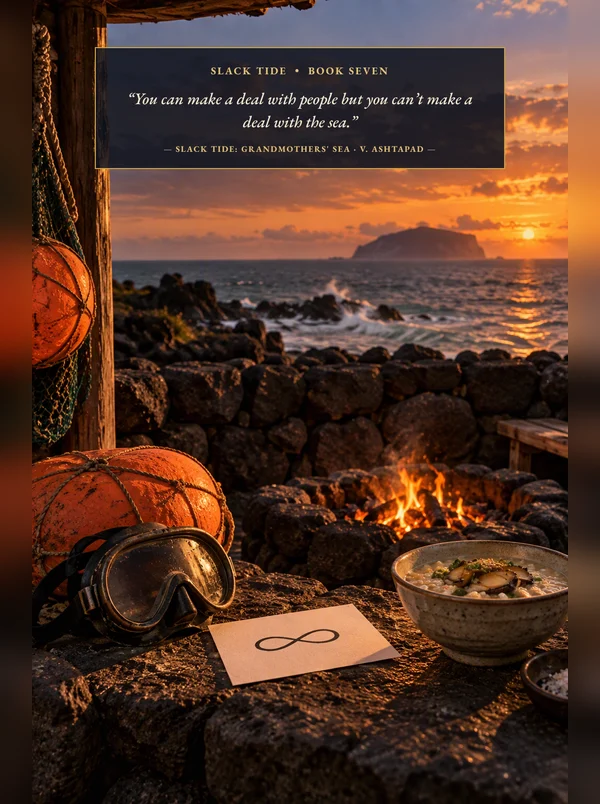
The people he helps never learn his name. They find only a card with a single mark drawn in ink: ∞.
A hand-tinted postcard from the sixties reaches the family house on the California coast, mailed from a kitchen in Los Angeles: five women divers in a ring of black stones, and on the back, drawn in one line of ballpoint, sixteen rocks under the sea and a red X where a developer wants his pier.
He lands on Jeju at midnight with two vehicles in the hold. The white one, short and pale as a bar of soap, an 8 on its doors, is entered in a new hill climb up the side of a volcanic cone. The square one waits behind a wall of tangerine crates.
Down the coast, his son is with a grandmother home after twenty-two years, her sister who still dives at seventy-six, and a boy learning words only the old women still say. Thirty-one strangers have joined the divers' cooperative. A survey says their sea is dead. And the women, who know every whistle on the water, are getting ready to stand up and say the names of their rocks.
Members can react to this book and talk about it in the members' Library.