
Slack Tide
Station Three · ∞ Book Ten
by V. Ashtapad
Foreword
This is a work of fiction. Stilt fishing is real, and so are the monsoon, the Galle fort, the rainforest at Sinharaja and the hopper stalls of the south coast. Kalukanda Bay, its hotel, its families, its hearing and its ledger are invented.
For the last honest fishing: one man, one hook, one fish.
The Pole
Sunil Weerasinghe climbed his pole the way his father had taught him, in the dark, by feel, with the sea coming up white around his ankles.
The pole was a single length of kitul palm as thick as a man's thigh, driven into a crack in the reef a hundred and thirty feet from the beach, with a short crossbar lashed to it with coir rope at the height of a man's chest. You did not climb it so much as walk up it, your bare soles on the wet wood, your hands on the crossbar, and then you swung your hip up onto the bar and sat, and there you were, five feet above the water, in the middle of the sea, alone.
He was seventy-one. He had been sitting on this pole since he was fourteen. His father had sat on it before him, and his father's father, and before that, according to the old men, a man named Weerasinghe Appu who had cut the first pole with an axe in 1931 and paid for the right to drive it with three bags of rice. Nobody knew if that was true. Everyone on Kalukanda Bay knew which pole was whose.
He hooked his feet around the post and took the rod off his back. It was a plain cane rod, longer than he was, with a line of nylon and a little hook with no bait at all, only a sliver of white cloth tied above it. The small fish came to the cloth in the surf, the shimmering little koraburuwa and the herring, thinking it was something they could eat, and you flicked them up out of the white water and into the bag tied at your waist, one after another, in one motion, without looking.
It was the third week of May. The southwest monsoon had come early, the way it did now, and the swell was running long and heavy out of the dark, every seventh wave climbing the reef with a grunt and breaking against his pole and soaking him to the chest. Behind him, on the beach, the coconut palms leaned toward the land, black against a sky going gray, and the wind went through their fronds with a sound like somebody tearing paper, endlessly, all along the coast.
There were nine poles on the reef. In 1980 there had been forty.
---
He saw the buoy when the light came.
It was orange. It was the size of a football, and it bobbed in the swell just beyond the reef edge, where the water went from green to dark blue, tethered to something below. There had been no buoy there yesterday.
Beside it, as the light grew, he saw a second buoy. Then a third. A line of them, at even spaces, curving around the outer edge of the reef from the point on the west to the rocks on the east, like a necklace someone had laid on the sea.
On the next pole, forty feet away, his cousin Ranjith had seen them too. Ranjith was sixty-eight and talked to himself when he fished and had not stopped talking in fifty years. He had stopped now.
"Survey," said Ranjith, across the water. "The hotel."
Sunil said nothing. He flicked a fish into his bag.
"They said December," said Ranjith. "The man from the hotel said December, at the earliest. He said there would be a meeting first. He promised."
"He promised my father in 1998," said Sunil, "that there would be no hotel."
There was a hotel. It sat on the point to the west, where the old Dutch customs house had been, three stories of white concrete and glass and an infinity pool that ran right to the edge of the rocks so that, from the beach, the blue of the pool and the blue of the sea seemed to be one water. At night it lit itself up gold. The guests came down to the beach in the late afternoons in white linen and paid Sunil's grandson two thousand rupees to sit on a pole for a photograph, holding a rod, at sunset, when there were no fish.
Now the hotel wanted a marina. For the yachts. Forty berths and a breakwater, a fuel dock, a restaurant on a pier. To make the water deep enough for the yachts, they would have to take away the reef.
They had a word for it in their papers. Sunil's granddaughter had read it to him. *Deepening.*
He watched the orange buoys bob in the swell, and the sun came up behind him over the palms, and the sea turned from gray to green to a hard bright blue, and the little fish came to the white cloth, one after another, all morning, as if nothing had changed at all.
---
That night his granddaughter wrote the postcard.
She did not know where to send it. She knew only what her great-aunt had told her on the phone from Toronto, at two in the morning, after Sunil had called her sister and cried, which no one in the family had ever heard him do: that there was a man. That her great-aunt's neighbor in Scarborough, a Korean woman whose own mother had dived for abalone off an island at the bottom of Korea, had told her about him at the mailboxes. That the man did not have a name, only a number. That if you wrote to him, the right way, the letter got there.
"What is the right way?" said Dilini.
"You use a picture," said her great-aunt Kamala, in Sinhala, in the voice she still had after fifty years in Canada, rough and warm, like a coconut shell. "An old one. Of the place. And you tell him what they want to do to it. And you don't ask for anything."
"Why not?"
"Because," said her great-aunt, "that's how you know the right man. He doesn't come if you ask."
So Dilini went through the tin trunk under her grandfather's bed, among the land deeds and the wedding photographs and the school certificates, and found a postcard.
It had been printed in 1958 for tourists, by a studio in Colombo, and it showed Kalukanda Bay at dawn: the curve of the beach with its leaning palms, and the reef, and on the reef, against a sky the color of a ripe mango, forty men on forty poles, sitting as still as birds, in a line that went from the point to the rocks.
Across the bottom, in white letters printed into the picture, it said: *STILT FISHERMEN, SOUTHERN PROVINCE, CEYLON.*
On the back she wrote, in English, in her careful university hand:
*They are going to blast the reef in Kalukanda Bay for a yacht marina. The survey buoys went in today. The hearing is the 14th of July. There are nine poles left. My grandfather is on the third from the west. He says the reef is not a picture.*
She did not sign it. She drew, at the bottom, because her great-aunt told her to, a small figure eight lying on its side.
© 2026 CRUNOD LLC. All rights reserved.
The Long Table
It came to him the way they all came now: the long way, by hand, through people who had once found a card with a sideways eight on it and kept it.
From Kalukanda Bay to a cousin in Colombo, who put it in an envelope to the great-aunt in Toronto. From Toronto, in a second envelope, to a Korean grandmother in Scarborough, who walked it across the parking lot to her son's car. From the son, who drove a truck, to a dispatcher in Buffalo, who knew a pilot. From the pilot, by a route nobody wrote down, to a hangar on the edge of a small airfield on the California coast, where on the fourth of June, at eleven in the morning, a mechanic named Ruiz found it on the workbench in a manila envelope addressed in pencil, in capitals, to NUMBER EIGHT.
Ruiz did not open it. He never opened them. He put it on the tray by the coffee machine, under the photograph of a red convertible on a mountain road, and went back to the engine he was rebuilding, and at two that afternoon, when Eight came in through the side door with his jacket over his shoulder and the fog still in his hair, he did not say anything at all. He only lifted his chin toward the tray.
---
Eight read it standing up.
He read it twice. Then he turned it over and looked for a long time at the picture: the curve of the beach, the leaning palms, the forty men on their forty poles against the mango sky, sitting so still it seemed impossible they were alive.
He was sixty-five that spring. His hair had gone the gray of old pewter and his back did things in the morning it had not done at sixty. He had raced at Le Mans twice and in more places since than he could count, under a number that was always the same, and he had spent the forty years between the first race and now doing, quietly, in many countries, the thing his father had done before him in one: helping where he could, and leaving before anyone thought to ask his name.
"Sri Lanka," said Ruiz, without turning around from the engine.
"How do you know?"
"I can read upside down." Ruiz tightened something. "Monsoon's on. It's a mess down there. Roads wash out. You'll want something light."
"How light?"
Ruiz put down his wrench and wiped his hands on a rag and turned around. He was a square heavy man of fifty with forearms like hams and a gray mustache, and he had worked on Eight's cars for twenty-two years and asked exactly four questions in all that time, none of them about where the cars went or why.
"There's a Moke," he said. "In the back. Under the tarp."
---
There was a Moke in the back, under the tarp.
It had been there for three years. Eight had bought it at an estate sale in Carmel from the widow of a man who had brought it home from Australia in 1972, and it had sat under its tarp since then, waiting for its reason.
A Mini Moke is hardly a car. It is a steel box with four little wheels at the corners and no doors and no roof, only a canvas top on two hoops you can put up when it rains, which does no good at all. It was designed, the story goes, for the British Army, to be dropped out of airplanes by parachute, and the army looked at its little wheels and its few inches of ground clearance and said no, and so it went to the beaches instead: to the Caribbean and the Riviera and the coast of Australia, where it carried surfers and film stars and hotel guests up and down the shore roads at thirty miles an hour with their hair blowing.
This one was green. A hard, deep, jungle green, faded at the edges to the color of a mango leaf, with a white canvas top folded in the back and a single round headlight on each side of a flat chrome grille that made the whole front look like a surprised face. The seats were white vinyl, redone. The steering wheel was thin and black and too big. It had a 1275 engine Ruiz had rebuilt the winter before for no reason he would admit to, and sometime in the year since, for the same no reason, he had raised it two inches on its springs and put on four tall, knobby off-road tires, so that it no longer looked like a beach car at all. It looked like a beach car that had been to the gym.
Eight stood looking at it for a long time.
"It'll float," said Ruiz. "Almost."
---
He drove home along the coast in the late afternoon, in his own car, the old blue one, with the top down and the fog lying offshore in its long white bank, and thought about poles in the sea.
The house stood on its rise above the highway, with the deck on the ocean side and the garden the fog kept trying to take back, and when he came up the drive his mother was on the porch in her cardigan with a bowl of peas in her lap, shelling them, as if it were still 1985 and the peas would not shell themselves. She was eighty-seven. His father was in the chair beside her, ninety-five, in a wool cap, with his hands folded on the head of his cane, looking at the sea.
They had both been asked, many times, by many people, how they had lived so long. His mother said it was because she refused to do anything else. His father said nothing.
"You have a card," said his mother, before he had his foot on the step. It was not a question. She had known about the cards for thirty years, the way she knew about everything, and had never once asked what was on one.
"Sri Lanka."
His mother's hands stopped on the peas. "The sea or the hills?"
"The sea."
"Good," said his mother. "The hills will be raining." And she went back to the peas.
His father did not turn his head. But after a while, when Eight had gone up the steps and was at the door, the old man said, in his dry soft voice, to the sea, "Poles."
Eight stopped.
"In the sea," said his father. "Men on poles. Near Galle." He was quiet for a moment. "I saw them in 1963. From a ship. We stopped two days in Colombo on the way to somewhere else. A man on the deck said they had been fishing like that for a hundred years." He lifted one hand off the cane and set it down again. "He said it the way people say that about things they are about to see the end of."
---
At dinner, at the long table, with the fog against the windows and the dal in its steel bowl and his wife at his left hand, Eight put the postcard in the middle of the table beside the salt, and his son picked it up.
His son was twenty-eight that year. In graduate school three hours north, in a program that had to do with history and languages and the recording of old people's voices, which the son explained every Thanksgiving and which nobody in the family entirely understood except his grandmother, who said it was what she had done with her granddaughter on Friday nights, with a machine she did not trust. He had come home for the weekend. He came home most weekends. He drove a small gray car and carried a recorder in a padded case and called his grandparents every Wednesday night at seven without fail.
He turned the card over. He read the back. He was quiet for a long time.
"Nine poles," he said.
"Nine left," said Eight.
His son looked at him across the table. Something went across his face, a flicker, there and gone, the look of someone who has noticed a number and decided not to say so.
"The hearing's the fourteenth of July," his son said. "Six weeks."
"Yes."
"Somebody needs to record the old men," said his son. "Before. Who owns which pole. Who had it before. All the way back. If there's a chain, they'll know it. They'll have it in their heads." He put the card down. "That's evidence. Customary use. That's the kind of thing that matters at a hearing like that. It matters everywhere."
Eight looked at his wife. His wife looked at their son. Then she reached over and took the postcard from beside the salt and looked at the forty men on the forty poles against the mango sky for a long moment.
"You'll need a hat," she said to the son. "It's very hot there, and you never wear a hat."
© 2026 CRUNOD LLC. All rights reserved.
Kalukanda Bay
The plane came in over the sea from the south, under the cloud, at dawn, with rain hammering on the windshield so hard the wipers could not keep up, and Eight put it down on the runway at Mattala in a sheet of water and taxied to the far end, where nobody was waiting, which was how he liked it.
Mattala is an airport in the southern scrub that was built, some years ago, for traffic that never came. It has a runway long enough for the largest jets in the world and a terminal like a cathedral of glass, and on most days nothing lands there at all except, now and then, a small private plane that clears customs with a single tired officer and is gone before the coffee is cold. The Moke came down the ramp out of the hold in the rain like a green beetle, and Eight drove it out through the gate at seven in the morning with his bag on the passenger seat and the canvas top up, flapping, which did no good at all.
He drove west. It was eighty miles to Kalukanda Bay along the coast road, and it took him four hours, and it was the most alive he had felt in a year.
---
The road ran between the sea and the land the whole way, so close to the sea that in places the spray of the monsoon surf came over the low wall and across the asphalt in sheets. On the right, the land: paddy fields flooded silver under the low gray sky, with white egrets standing in them, and water buffalo sunk to their shoulders in the brown ponds with only their horns and their nostrils above the water, and coconut palms, everywhere, in their hundreds, in their thousands, leaning all one way. On the left, the sea: brown near the shore with sand churned up by the swell, then green, then a deep heaving gray-blue, with the waves coming in out of the southwest in long ranks, each one standing up taller and taller until it fell on the beach with a sound like a building coming down.
The Moke took it all in. It had no doors. The rain came in sideways and soaked his left shoulder and then, when the road curved, his right. The spray came in. The smell came in: wet earth and salt and woodsmoke from the cooking fires, and frangipani from somewhere, and diesel, and the sharp green smell of rain on hot leaves, and every few miles the smell of drying fish from a beach where the catch was spread on mats in the rain-light. Buses came at him down the middle of the road, enormous painted buses, red and white and covered in pictures, blowing their horns in long musical blasts, and he pulled the Moke onto the gravel shoulder with its knobby tires spinning and let them by. Three-wheelers, the small yellow and red and green taxis that the whole country ran on, puttered past him in both directions. Children in white school uniforms with umbrellas walked along the edge of the road in twos and threes, and every one of them, without exception, stopped and stared at the green car with no doors and the gray-haired foreigner in it, and some of them waved, and he waved back.
He stopped at a roadside stall in a village outside Matara where a woman was making hoppers.
---
She had a row of little iron pans like small woks set into a clay hearth over a wood fire under a tin roof, and she poured a ladle of batter into each pan and swirled it, with a twist of her wrist, so that the batter went up the sides of the pan thin as paper and gathered in the bottom thick and soft, and then covered it with a lid. In two minutes each one came out a bowl: crisp and lacy and brown at the edges, like a doily someone had fried, and soft and spongy in the middle. For an egg hopper she cracked an egg into the bottom before the lid went on.
He ate four. One plain, with a heap of pol sambol, which is fresh coconut scraped from the shell and pounded with red chili and onion and lime and salt until it is pink and fierce. One with an egg, the yolk still soft, so that when he tore the crisp edge and dipped it, it ran. Two with a ladle of fish curry from a clay pot on the side of the hearth, made with a sour dark fruit she called goraka and so much black pepper that his eyes watered, and the woman, who had been watching him eat with her arms folded, laughed out loud and gave him a cup of hot sweet milky tea in a glass, and refused to take more than a hundred rupees for any of it.
"Where are you going?" she said, in English, when he paid.
"Kalukanda Bay."
Her face changed. "The poles."
"Yes."
"They're going to break the reef," she said. "For the hotel boats. Everybody knows." She took the empty glass. "My mother's brother sat on a pole there. Before the tsunami." She did not say anything else. She did not need to.
---
He reached Kalukanda Bay at eleven, when the rain stopped.
It stopped all at once, the way monsoon rain does, as if someone had turned off a tap, and the sun came through the cloud in long white shafts and lit the sea, and the whole bay, in the space of a minute, went from gray to blazing.
It was the postcard. It was exactly the postcard. The long curve of the beach, the leaning palms, the reef just under the surface a hundred yards out, where the waves broke white along its edge in a long line from the point to the rocks. On the point to the west, where the postcard showed only palms and an old low building with a red roof, a white concrete hotel with glass and an infinity pool that ran to the edge of the rocks.
And on the reef, sitting in the white water with the swell breaking around them, nine men on nine poles.
Beyond them, at the reef edge, curving from the point to the rocks in a long even necklace, orange buoys.
Eight parked the Moke on the sand under the palms and sat in it for a long time with the engine off, listening to the sea. Then he got out and walked down the beach to the water's edge, and stood with the wet sand sucking at his shoes, and looked at the third pole from the west.
The man on it was old and very thin and very dark, in a sarong hitched up and tied at the waist and a faded blue T-shirt soaked to his ribs, with a cane rod in his hands. He was sitting perfectly still. As Eight watched, his wrist moved, once, and a small silver fish came up out of the white water on a line and went into the bag at his waist, and the wrist went still again.
He was not looking at the beach. He was looking at the buoys.
© 2026 CRUNOD LLC. All rights reserved.
The Hopper Woman of the Fort
He took a room in Galle, inside the fort, because the fort had stood there since the Portuguese and the Dutch and the British, all of whom had been certain they would be there forever, and he liked to sleep in places that remembered that.
The fort is a whole old town on a headland, inside a great ring of stone ramparts that the Dutch built in the 1600s, thick and gray and furred with green moss in the monsoon, with the sea crashing against them on three sides. Inside the walls the streets are narrow and straight and lined with low Dutch houses with deep verandas and red tile roofs and big wooden doors, painted white and yellow and pale blue, and there are churches and mosques and a lighthouse and a clock tower and cafés with ceiling fans, and in the evenings the whole town walks the ramparts in the sea wind, families and courting couples and old men with umbrellas and boys flying kites, and boys diving forty feet off a rock below the old Flag Rock bastion into the surf for a hundred rupees from the tourists.
His room was on the top floor of a guesthouse on Leyn Baan Street, with a ceiling fan that ticked and shutters that opened on the roofs and, beyond the roofs, the rampart and the sea. The guesthouse belonged to a Muslim family who had been in the fort for nine generations and who brought him tea at six every morning on a tray without being asked.
On the first evening, he walked the ramparts at dusk. On the second evening, he found the hopper woman.
---
She had a stall at the bottom of Church Street, just inside the old gate, under a frangipani tree whose white flowers dropped onto her tin roof all night and lay there in the morning like fallen stars. Her name, painted on a board, was RAJI AMMA'S HOPPERS, in English and Sinhala and Tamil, and she was a broad strong woman of sixty with gray hair pulled back hard in a bun and a gold stud in her nose and forearms like a baker's. She had six hopper pans going at once on her clay hearth and a pot of chicken curry and a pot of dhal and a bowl of pol sambol and a bowl of seeni sambol, the sweet dark onion relish cooked down for hours with tamarind and cinnamon, and a line of twenty people waiting.
He waited. When it was his turn, she looked at him, at his gray hair and his tired face and his wet shoes, and said, "Egg?"
"Two."
She made them. She did not look at the pans while she made them. She looked at him.
"You're the one with the green car," she said, in English. "At Kalukanda."
He did not say anything.
"Sunil's granddaughter is my god-daughter," said Raji Amma. She slid the egg hoppers onto a square of banana leaf with a spoon of each sambol. "Dilini. Her great-aunt Kamala, in Toronto, was married to my husband's cousin. A Tamil boy and a Sinhala girl, in 1979. Nobody spoke to them for four years." She handed him the leaf. "Then everybody had to leave. They left together. They're still together. Fifty years in Scarborough. Kamala makes better hoppers than I do now. Don't tell anyone."
She said all of this very fast, without stopping her hands, as she poured the next six hoppers, and the line behind him shuffled.
"Sit," she said. "Eat. I close at nine. Then we'll talk."
---
They talked at nine-thirty, under the frangipani, on two plastic stools, with the stall dark and the hearth cooling and a single bulb hanging from the tin roof on a wire, swinging a little in the wind off the sea.
Her husband had been a fish auctioneer at the Galle harbor for thirty years. He had died four years ago. She had started the stall the month after, because she had to do something with her hands or go mad, and because he had always said her hoppers were the best on the coast, and she wanted to find out if he had been lying.
"Was he?"
"No," said Raji Amma. "I'm very good." She lit a cigarette, which she said she did once a day, at night, after the stall closed, as a reward. "He used to buy fish from the pole men. Every morning. From Kalukanda and from Koggala and from all of them. Not for the big market. For the small one. The little fish. Koraburuwa. Nobody else wanted them. Too small. But they're the best fish in the sea, those little ones, fried whole in a pan with salt and chili, crisp, you eat them bones and all." She blew smoke at the bulb. "He used to say, the poles are the last honest fishing in this country. One man, one hook, one fish. No nets. No boats. No engines. The sea gives you what it gives you."
"And the hotel?"
She looked at him for a long time through the smoke.
"The hotel," she said, "belongs to a man in Colombo named Lalith Jayamaha. He's a very nice man. Very polite. Went to school in England. Gives money to the cricket. He has a German partner with a lot of yachts and a son who drives a red car very fast on the hill roads on weekends and has never once been stopped by the police." She tapped the cigarette. "Mr. Jayamaha says the poles are a tourist attraction. He says he will keep three of them. In front of the restaurant. With lights. And pay the men a salary to sit on them in the evenings for the photographs."
Eight did not say anything.
"He says it's a good offer," said Raji Amma. "He says nobody can make a living from little fish anymore. He's not wrong." She stubbed out the cigarette on the leg of the stool. "But Sunil says the reef is not a picture."
---
"What does he need?" said Eight.
Raji Amma looked at him. She looked at him a long time, the way people look at a man they have heard about and are deciding whether to believe in.
"Kamala told me about you," she said. "On the phone. She said, a man is coming, with a number. She said, don't ask him for anything. He doesn't come if you ask." She folded her strong arms. "So I'm not asking. I'm telling you what Sunil's granddaughter told me. The hearing is at the Coast Conservation office in Colombo. The fourteenth of July. The hotel has a survey that says the reef is dead. Bleached. Gone. Nothing living. Only a hazard to boats. They have photographs. They have a report from an engineering firm with very good letterhead." She shrugged. "If the reef is dead, they can take it. Nobody needs a permit to dig up dead rock."
"Is it dead?"
"Ask Sunil," said Raji Amma. "He's been sitting on it for fifty-seven years."
© 2026 CRUNOD LLC. All rights reserved.
The Third Pole
Sunil Weerasinghe did not want to talk to a foreigner, and he said so, in Sinhala, at length, at six in the morning on the beach at Kalukanda Bay, while his granddaughter stood beside him and did not translate a word.
He had just come down off his pole. He stood on the wet sand with his rod over his shoulder and the bag of small fish at his waist, dripping, in his sarong and his soaked blue T-shirt, and looked at Eight with an expression that needed no translation at all.
"He says," said Dilini finally, in English, when her grandfather had stopped, "that foreigners have been coming to look at the poles for seventy years, and taking photographs, and going away, and not one of them has ever bought a fish."
Eight looked at the bag at Sunil's waist.
"How much for the bag?" he said.
Dilini looked at him. Her grandfather looked at her. She told him.
There was a silence on the beach. The waves came in and went out over the reef, white. A crow landed on a coconut husk nearby and regarded them.
Then Sunil Weerasinghe said something short and gruff and turned around and walked up the beach toward the palms.
"He says," said Dilini, and her mouth was twitching, "that it's not for sale. He says it's for breakfast. He says you can come and eat it, if you want, but you'll have to clean them yourself."
---
He cleaned them himself. He sat on an upturned bucket behind Sunil's house, a low house of whitewashed brick under the palms, with a tin roof and a veranda where a very old woman sat in a wooden chair shelling something, and he cleaned two hundred and eleven small silver fish with a short knife on a board, one after another, slitting the bellies and running his thumb down the inside the way Sunil's wife showed him once, impatiently, and then left him to it. It took an hour and a half. His back hurt. His hands smelled of fish for three days.
Sunil sat on the veranda steps and watched him the whole time and said nothing at all.
When he was done, Sunil's wife fried them. She fried them whole, in a black pan over a wood fire in the kitchen behind the house, in coconut oil, with salt and turmeric and red chili powder, a handful at a time, until they curled and crackled and went gold and crisp, and she laid them on a sheet of newspaper on the veranda, and they ate them with their fingers, bones and all, with red rice and a sour curry of green jackfruit and a bowl of pol sambol, sitting on the veranda floor, the six of them: Sunil and his wife and Dilini and the very old woman, who was Sunil's mother, ninety-four, and Ranjith from the next pole, who had come to see the foreigner and had not stopped talking since he arrived, and Eight.
They were the best fish he had ever eaten. He said so. Dilini translated. Sunil grunted.
---
After the food, when the tea had come, very sweet, in glasses, and Ranjith had finally gone home, Sunil Weerasinghe put down his glass and looked at Eight for a long time.
Then he got up and went into the house and came back with something wrapped in a plastic rice sack. He sat down on the veranda floor and unwrapped it.
It was a piece of coral.
It was the size of a man's head, pale gray and porous, branched like a little tree, and when he turned it in the light, Eight saw that in the hollows of the branches there were tiny things: the white tubes of worms, and a crab no bigger than a fingernail, dead and dried, and in one hollow, the delicate spiral of a small shell.
"His father took this off the reef in 1968," said Dilini. "To show the tourists. To sell. And then he couldn't sell it. He kept it. He said—" She listened to her grandfather. "He said it was like selling a house with the family still in it."
Sunil turned the coral in his hands.
"The hotel says the reef is dead," said Dilini. "It's not dead. It was dying, in 2024, after the hot water. It went white. Everybody thought it was finished. My grandfather thought so. But it came back. Not all of it. But it came back." She took a breath. "I'm a marine biologist. I finished my degree last year. In Matara. I've been diving it since I was twelve. I've been counting. Every month since 2026, the same twelve places, the same way. I have the numbers. The reef is alive."
"Have you shown anyone the numbers?"
"I showed the hotel's engineer," said Dilini. "He said my survey wasn't professional. He said I didn't have the equipment, or the training, or the methodology. He said I was a girl from the village with a mask and a notebook." Her voice was very calm. "He was right. That's what I am."
Eight looked at the coral in Sunil's hands. Then he looked at the girl.
"What would a professional survey need?" he said.
Dilini told him. A boat. Proper dive gear for two divers, maybe three. Underwater cameras. A transect line and quadrats. A certified dive supervisor. A lab to verify the species counts. Two weeks of diving, minimum, in the monsoon swell, which was dangerous on that reef, and which was why the hotel's engineering firm had done their survey from a boat with a drone and never put anyone in the water at all.
"And a name," she said. "On the report. A name the hearing will believe. A university. Not a girl from the village."
© 2026 CRUNOD LLC. All rights reserved.
The Reef Edge
She took him into the water the next morning at half past five, in the gray before sunrise, when the swell was at its lowest and the wind had not yet got up.
"Not outside," said Dilini, on the beach, pulling on a pair of old split fins that had been mended at the heel with bicycle inner tube. "Never outside in the monsoon. Outside the buoys, the swell will pick you up and put you on the reef like a plate on a table." She spat in her mask and rubbed it with her thumb. "Inside. The lagoon side. Between the poles and the beach. That's where my sites are anyway."
She had a slate. It was a square of white plastic the size of a school notebook with a pencil tied to it on a string, and a grid ruled on it in black marker, worn faint, and she hung it around her neck on a cord. She had a measuring tape on a reel, yellow, the numbers half rubbed off. She had a square frame made of four lengths of white plastic pipe joined at the corners, a meter on each side, which she called the quadrat and carried under her arm like a picture frame. That was all.
"Seven years," said Eight, looking at it.
"Seven years," said Dilini. "It's enough. You don't need much to count. You need to come back." She looked at his old borrowed mask, and his gray hair, and his sixty-five-year-old back. "Can you swim?"
"Yes."
"Properly?"
"Properly."
She looked at him a moment more, as if deciding whether to believe it, and then turned and walked into the sea.
---
Underwater, the noise of the monsoon stopped.
That was the first thing. On the beach the world was the roar of the surf and the tearing of the wind in the palms, and the moment he put his face in the water it was gone, all of it, and instead there was a hush, and a soft crackling, everywhere, like rain on a tin roof a long way off, or like fat in a pan, which Dilini told him afterward was the sound of shrimp, thousands of them, snapping their claws in the reef.
The water was green and full of drifting specks, churned by the swell, so that he could see perhaps fifteen feet. The bottom came up toward him out of the green as they swam, sand at first, rippled, with a gray ray lying flat on it that shook itself and flew away, and then rock, and then the reef.
It did not look alive. Not at first. At first it looked like rubble: gray and brown and broken, heaps of old white branches lying every which way like a woodpile after a storm, furred with a fine brown fuzz of algae that waved in the surge. He understood how a man in a boat with a drone would see that and call it dead. He nearly did himself.
Then Dilini, ahead of him, stopped, and hung in the water, and pointed.
Among the old white branches, on a lump of dead rock, there was a small thing the size of a coin. It was brown and gold, a tiny rounded cushion, and when he put his face close to it he saw that its whole surface was covered in minute flowers, each one smaller than a grain of rice, each one with a ring of tentacles fine as eyelashes, waving.
She pointed again. Another. And another, beside a broken branch, the size of a fist this time, branching already into little fingers with pale blue tips. And beyond it, a dome as big as a bucket, ridged like a walnut, a brain coral, that had survived whatever had happened here and sat in the middle of the rubble like an old man in a ruined house who would not leave. And all around it, now that he knew how to look, small colored things everywhere: pink, green, purple, a tiny bright yellow fan, a cluster of purple fingers. On the rubble. On the rock. Growing.
The fish had known before he did. They were everywhere. Small blue ones that hung over the young corals in clouds and vanished into the branches all at once when his shadow passed. A striped one with a long snout picking at the rock. A big green parrotfish with a beak like a bird's, grazing the dead rock, and he heard it, actually heard it, crunching, a sound like someone eating toast in the next room. And in the open water above the reef, flickering, turning all together like a flung handful of coins, the little ones, the silver ones, the koraburuwa, thousands, that came to Sunil's white cloth every morning.
---
Her first site was a stump.
He did not understand what it was at first: a short dark post standing up out of the reef, a foot high, splintered at the top, crusted over with barnacles and weed and, around its base, where it went down into the crack in the rock, a thick collar of living coral, purple and brown, that had grown up around the old wood and gripped it.
Dilini floated beside it and wrote on her slate. She held it up to him.
*POLE 17. GONE 1991.*
She laid the tape out from the stump, ten meters, along a bearing she took from a mark on the shore, and dropped the white frame along it at every meter, and hung over each square with her face an inch from the coral, counting, writing, moving on. He floated above her and watched, in the hush, with the surge rocking them both gently back and forth, and the shrimp crackling.
The second site was a stump. And the third. *POLE 22. GONE 1998. POLE 29. GONE 2005.* Every one of her twelve sites was the stump of a pole that had gone: a family that had stopped fishing, a man who had died with no one to climb after him, a son who had gone to the Gulf. She had chosen them, she told him later, on the beach, because they never moved. A metal stake could be stolen. A buoy could break loose. But the old poles had been driven into the reef with sledgehammers by men who meant them to stay forever, and they had stayed, even when the men had not. They were the best marks on the coast.
"And because," she said, "somebody should keep counting there." She was wringing out her hair. "Even if nobody's sitting on them."
---
The last thing she showed him was the third pole.
They swam out to it along the lagoon edge, the swell heavier there, lifting them and setting them down, the white water roaring and draining over the reef crest twenty yards beyond. Above them, on the crossbar, Sunil was a dark shape against the brightening sky, sitting perfectly still, with his rod. He did not look down.
Underwater, the pole went down out of the bright churning surface into the green, a single length of dark palm wood scarred and pitted and soft with age, and at the bottom, where it was wedged into its crack in the reef, it was not wedged in rock at all anymore. It was wedged in coral. Living coral, a great rounded mass of it, brown and gold and green, as big as an armchair, had grown up around the base of the pole over the years and swallowed it to a height of two feet, so that the pole and the reef had become one thing. The swell pushed against the pole and the pole leaned and the coral held it. All around the base, in the crevices of the coral, fish hung in the shelter of the wood. A small eel looked out of a hole with its mouth opening and closing.
Dilini hung beside it in the green. Then she wrote on her slate, and held it up to him, and he read it through the glass of his mask.
*THE REEF HOLDS THE POLE.*
She rubbed it out with her thumb and wrote again.
*NOT THE OTHER WAY.*
---
On the beach afterward, sitting on the sand in the first sun with the salt drying white on his arms and his back aching in three places, he asked her how many hours.
"In the water?" She thought about it. "Twelve sites. One morning each, every month. Two hours a site, sometimes three." She did the sum on her fingers, frowning. "A thousand hours. More. Two thousand." She shrugged. "I never added it up."
"Why not?"
"Because then I'd have to think about it," said Dilini. "And then I'd stop."
Out on the reef, Sunil Weerasinghe flicked a silver fish up out of the white water into his bag, without looking, and the sun came over the palms, and the orange buoys bobbed beyond the reef edge in their long necklace, very bright, very new, waiting.
© 2026 CRUNOD LLC. All rights reserved.
A Name on the Report
He did not give her money. He never gave anybody money. Money, given straight, did what water does to a reef when it runs too hot; it bleached things. It turned people into the kind of people who wait for the next envelope.
What he gave her, instead, was a telephone call.
It was to a woman in Townsville, in Queensland, in Australia, who had been, twenty years before, a graduate student in a marine laboratory there, and who had once, on a dive boat off the outer reef, in a storm, been pulled out of the water unconscious by a quiet man with gray in his hair who had chartered the same boat for reasons he never explained. She was a professor now. She ran a reef survey program that went all over the Indian Ocean on grants. She had a very good name.
He did not ask her for anything. He told her about a girl in Matara with a mask and a notebook and seven years of numbers.
The professor was quiet for a while on the phone.
"Seven years," she said. "Same sites? Every month?"
"Every month."
"Monsoon too?"
"Monsoon too."
"Hell," said the professor. "My doctoral students don't do that." She was quiet again. "Send me the numbers."
---
Dilini sent the numbers on a Tuesday. The professor called her on Thursday at five in the morning, Sri Lankan time, and they talked for three hours. On Friday the professor's program office in Townsville wrote to the Coast Conservation Department in Colombo to say that an independent survey team from the university would be conducting a two-week benthic assessment of the reef at Kalukanda Bay ahead of the July hearing, in partnership with a local scientist, Ms. D. Weerasinghe, B.Sc., whose long-term monitoring data the program considered of exceptional value.
Dilini read the letter on her phone on the veranda and put the phone down on the floor and walked out of the house and down the beach and into the sea in her clothes, and stood up to her waist in the surf for ten minutes with her back to everyone, and Sunil sat on the veranda steps and watched her and said nothing, and his mother, ninety-four, in the wooden chair, laughed and laughed.
The survey boat came from Mirissa, chartered, with a dive supervisor from Trincomalee and two of the professor's students who flew in from Townsville. Nobody asked who had paid for the charter. The charter company said it had been arranged through an agent in Singapore. The agent in Singapore said it had been arranged through an account in Zurich. The account in Zurich was in the name of a foundation for the conservation of traditional fisheries that had been registered in 2019 and had never once, until then, done anything at all.
---
That was the reef. The poles were something else.
"They'll say the reef doesn't matter even if it's alive," said Eight's son, on the phone, the first night, from the guesthouse in the fort. The son had flown in on Saturday with his recorder in its padded case and a hat his mother had bought him, and had already been sunburned on the back of his neck where the hat didn't reach. "They'll say there are other reefs. The question is whether this reef is a fishery. Whether people have a right to it. Customary use."
"How do you prove that?"
"With a chain," said his son. "Who owns which pole. Who had it before. Who had it before that. Every pole, every family, all the way back." He was quiet. "There were forty poles in 1980, Dad. Forty families. Some of them don't fish anymore. Some of them moved to Colombo or Dubai or Toronto. But they still own the poles. Nobody sold. You don't sell a pole. You inherit it." He paused. "If I can record every one of those families, every chain, the old men, the widows, the sons in Dubai on video calls—"
"Then the reef isn't empty," said Eight. "It's forty families."
"It's forty families," said his son. "With a hundred years of names."
© 2026 CRUNOD LLC. All rights reserved.
The Chain
The son had come out of the arrivals hall at the airport north of Colombo on the Saturday in a hat his mother had bought him, as promised, and a shirt already dark with sweat between the shoulders, and the first thing he said when he saw his father leaning on the green Moke by the curb was, "There are no doors."
"No."
"Mom's going to ask."
"Don't tell her."
His son threw his bag in the back, on top of the folded canvas top, and climbed in, and put the recorder case on his knees with both arms around it like a child holding a cat, and they drove south down the expressway and then the old coast road in the late afternoon, through the traffic and the horns and the rain that came and went, and the son did not say anything for an hour. He only looked. At the buses. At the sea. At a temple on a rock with its white dome shining wet. At a man on a bicycle with forty coconuts tied to it in a great green cluster, wobbling. At the women by the road with umbrellas and the boys playing cricket in a flooded field with a plank for a bat, the water to their ankles, every one of them shouting.
"I've read about this place for three years," he said finally. "In archives. In the library. Colonial reports." He shook his head. "None of it said it was loud."
They came into the Galle fort at dusk through the old gate under the clock tower and left the Moke on Leyn Baan Street and walked up onto the rampart, because the son wanted to see the sea before anything else. The whole town was up there in the wind, the families and the couples and the old men, and the kite boys, and the son stood on the gray stone with the monsoon blowing his shirt flat against him and looked south, where there was nothing at all between him and the ice of the far south but water, and the waves came in out of the dark and burst against the foot of the wall forty feet below and threw spray up into the lights.
"Nine poles," the son said, to the sea. "Out of forty."
"Yes."
"And six weeks. Less now." He was quiet. "I'll need to sleep about four hours a night."
"Your mother said you'd say that."
"What else did she say?"
"Wear the hat," said Eight.
His son laughed, and put a hand on his hat in the wind to keep it on, and they stood there on the old Dutch wall together for a long while in the dark and the spray, two men in wet shirts, neither of them speaking, while below them the boys dove off the rock into the surf for the last tourists of the day and came up shouting.
---
His son recorded for nineteen days.
He started with Sunil's mother. She was ninety-four and had been born in the village in 1939 and had married into the Weerasinghe family at sixteen, and she remembered everything. She remembered the man with the axe, Weerasinghe Appu, her husband's grandfather, who had cut the first pole in 1931 and paid three bags of rice for the right. She remembered the British fisheries officer who had come in 1946 with a ledger and a pith helmet and written down every pole and every family, because the colonial government wanted to tax the fish, and who had fallen off the third pole into the sea trying to sit on it, and had to be fished out by her father-in-law's son, a boy of sixteen then, the boy she would marry, and had never come back. She remembered the tsunami, the twenty-sixth of December, 2004, a Sunday, and the sea going out, all the way out, so that the reef stood bare and black in the morning sun with the fish flapping on it, and the children running out onto it to pick them up, and her husband shouting at them to come back, come back, come back.
She told it all to Eight's son on the veranda with her hands folded in her lap, in Sinhala, and Dilini translated, and the son held the recorder and did not interrupt once.
When she was finished, she looked at the son for a long time.
"You have a good face for listening," she said. Dilini translated. "Who taught you?"
The son thought about it.
"My grandmother," he said. "She tells stories on Friday nights. She made us put our phones in a bread box."
The old woman laughed.
---
Then the other families. All forty.
The son walked up and down Kalukanda Bay with Dilini and the recorder and the hat, in the rain and the sun and the rain again, for nineteen days, and knocked on doors. He sat on verandas and in kitchens and in the back rooms of shops. He drank, by his own count, one hundred and seventy-three glasses of sweet tea. He sat with old men who had not fished in thirty years and who recited the names of their grandfathers and their grandfathers' fathers in a single breath, like a song, and with widows who brought out the old fishing rods of their dead husbands from behind the door and held them across their knees while they talked. He sat in a phone shop in the village with a young man whose father had owned the eleventh pole and who now lived in Dubai, driving a taxi, and the young man put his father on a video call at two in the morning Dubai time, and his father, in a taxi in a parking lot under orange streetlights, recited the chain for the eleventh pole from 1934, and then began to cry, and said he had not known anyone still cared.
The son wrote it all down, every chain, every pole, every name, and the family put it on the private page the fishing families had set up that spring, on the network their children used to keep in touch with relatives in Colombo and Toronto and the Gulf. A page for each pole. A photograph of the pole, if it still stood, or the place in the reef where it had stood. The recording. The chain of names, typed out in Sinhala and Tamil and English. A pin on a map of the reef.
By the fourteenth day there were thirty-four pins. By the nineteenth, there were forty.
---
On the nineteenth day, the son sat on the beach at sunset with Dilini and looked at the reef, where the nine men sat on their nine poles in the gold light, perfectly still, as they had sat for a hundred years.
"There's one thing I can't find," the son said.
"What?"
"The fisheries ledger. From 1946. The one your great-grandmother told me about. The British officer who fell in." He looked at the sea. "If that ledger exists, it's the oldest written record of every pole and every family. It's a government document. A hearing would have to take it seriously. The hotel's lawyers can argue with a recording. They can't argue with their own government's records."
"Where would it be?"
"The National Archives in Colombo, maybe. If anyone kept it." He shook his head. "I called. They said the fisheries department records from the 1940s are uncatalogued. In boxes. In a basement in a building in Fort, in Colombo. Nobody's opened them since independence." He looked at her. "They said it would take a research permit, and three months, and a letter from a university."
Dilini was quiet for a long time.
"I know someone," she said, "with a letter from a university."
© 2026 CRUNOD LLC. All rights reserved.
The Basement in Colombo
The basement was under a red brick building on Reid Avenue that had been a government office since 1908, and it smelled, when the archivist unlocked the steel door and turned on the light, of mildew and dust and something sweet and rotten that was, she said cheerfully, paper.
There were four hundred and eleven boxes. They were stacked on steel shelves to the ceiling in rows that went back into the dark beyond the reach of the single bulb. Most of them had labels. Some of the labels were in English and some in Sinhala and a few, the oldest, in a beautiful copperplate hand that had faded to the color of weak coffee. Many had been eaten by something.
"Silverfish," said the archivist, a small round woman in a green sari and reading glasses on a chain, whose name was Mrs. Gunawardena, and who had been waiting thirty-one years, she said, for someone to ask her about this basement. "And termites. And in 1998, a pipe." She looked at the professor's letter in her hand, on the university's letterhead from Townsville, which said that Ms. D. Weerasinghe and her colleague were research associates of the program and requested access to colonial fisheries records relating to the southern coast. She looked at Dilini and the son. "You have three days," she said. "Then I lose my nerve."
They had three days.
---
They worked from eight in the morning until the building closed at four, in the basement, in masks and cotton gloves, under the bulb, with the monsoon rain drumming on the street above them through the high barred windows at the top of the wall, and a fan Mrs. Gunawardena brought down from her office that did nothing but move the smell around.
They found fishing licenses from 1924. They found a correspondence from 1937 about a dispute between two villages over a sandbar. They found tide tables, and survey maps, and a report on the pearl fisheries in the Gulf of Mannar with a pressed seahorse inside it. They found a box of nothing but receipts for typewriter ribbons. They found, on the second afternoon, a box of letters from a district officer in Galle to his superior in Colombo in 1945 and 1946 that were mostly complaints about the heat and the mosquitoes and his wife, and in one of which, in a single sentence on the third page, he mentioned that his fisheries assistant, a Mr. Pemberton, had returned from the survey of the stilt fishery at Kalukanda Bay *somewhat damp but with his ledger intact*.
The son read it out loud in the basement, and Dilini laughed so hard she had to sit down on a box.
"Somewhat damp," she said. "He fell off my great-grandfather's pole. And they called it somewhat damp."
"With his ledger intact," said the son. "It exists. It existed."
They did not find it on the second day.
They came up out of the basement at four into the hot wet street with their gloves in their pockets and their masks around their necks and dust in their eyebrows, and sat on the low wall outside the building under a bo tree dripping with the last of the afternoon rain, and did not speak.
A man was selling roasted peanuts from a cart with a little charcoal fire in a tin can, and twists of newspaper to put them in. The son bought two twists. They ate the peanuts, warm and salty, out of the newspaper, and watched the traffic go round the roundabout at the end of Reid Avenue, and the son read, without meaning to, the newspaper his peanuts were wrapped in, which was a page of cricket scores from the previous March.
"Four hundred and eleven boxes," said Dilini. "We've done two hundred and thirty."
"Two hundred and thirty-four."
"Tomorrow we won't finish."
"No," the son agreed.
She cracked a peanut. "My grandfather says when the fish don't come, you don't move the pole. You move the cloth." She looked at the shell in her fingers. "I never knew what that meant."
The son was quiet for a long time, looking at the newspaper.
Then he folded it up very small and put it in his pocket and went back up the steps of the building, and Dilini went after him, and they found Mrs. Gunawardena in her office on the second floor drinking tea from a flask with her shoes off under the desk, and the son asked her, very politely, about the pipe.
"The pipe?"
"In 1998," said the son. "You said there was a pipe. When the basement flooded. Where did the wet things go?"
Mrs. Gunawardena put down her tea. She looked at the ceiling for a while, the way people do when they are walking back through a building that exists only in their heads.
"Mr. Fernando," she said slowly. "He was the senior clerk when I came. Very old. He had been in this building since before independence. He told me about the pipe in my first week, because it had broken four years before and he was still angry. He was the one who went down. He wouldn't let anybody else touch the old things. He moved them himself. Two days. All the books that were wet, all the bound ones, he wrapped them and put them at the very back, on the bottom, behind the charts, where it was dry, because he said the bottom of the back wall was the only place in that whole building that had never once leaked." She picked up her tea again. "He died in 2003. I'd forgotten all about it."
She looked at the son over her reading glasses.
"You're not looking for a box at all," she said. "Are you."
"I don't know," said the son. "I'm moving the cloth."
---
On the third day, at three in the afternoon, with an hour left and Mrs. Gunawardena hovering at the bottom of the stairs, the son reached into the back of a bottom shelf in the farthest row, behind a box of water-damaged harbor charts, and his gloved hand found something that was not a box.
It was a book. A ledger, bound in green cloth gone black at the corners, with a leather spine that had split, the size of an atlas, wrapped in a sheet of oilcloth tied with string, the way a man would wrap a thing he had dropped in the sea once and did not intend to fall again.
He brought it out under the bulb. He untied the string. He unfolded the oilcloth.
On the cover, in faded gold letters: *SOUTHERN PROVINCE. STILT FISHERY. REGISTER OF STATIONS AND HOLDERS. 1946.*
Inside, on two hundred pages of heavy ruled paper, in a careful copperplate hand, every pole on every reef on the south coast of Ceylon from Ahangama to Weligama, numbered, located by compass bearing and paces from a fixed mark on shore, with the name of the holder and the name of the holder's father and the year the holder said the station had been first driven.
The son turned the pages. His hands were shaking.
*Kalukanda Bay.* Forty stations. *Station no. 3, bearing S.S.W. from the Dutch customs post, 112 paces. Holder: W. A. Weerasinghe. Father: Weerasinghe Appu. First driven: 1931.*
And in the margin beside it, in the same careful hand, a small note:
*Surveyor fell in. Holder's son effected rescue. Exceptionally civil.*
Dilini put her hand over her mouth.
Behind them, at the bottom of the stairs, Mrs. Gunawardena, who had been waiting thirty-one years, said very quietly, "Oh, my goodness," and sat down on the bottom step.
© 2026 CRUNOD LLC. All rights reserved.
The Monsoon Classic
That same week, the hotel's owner's son entered the Monsoon Classic, and so did a gray-haired foreigner in a green Moke.
The Monsoon Classic was a rally for old cars that had been run every July since 1987 by a club of car enthusiasts in Colombo, mostly men of a certain age and a certain income who owned old British sports cars and Morris Minors and Volkswagen Beetles and, in one famous case, a 1958 Mercedes that had once belonged to a prime minister. It ran over two days, from Galle up into the hills, on the narrow roads through the tea estates and the rainforest at Sinharaja and down again, three hundred miles in all, in the worst of the monsoon. Cars broke down. Cars slid off the road into tea bushes. Cars were towed out of rivers by elephants, once, in 1994, and the photograph hung in the clubhouse in Colombo. The trophy was a silver teapot.
Nobody entered to win the teapot. They entered because it was the most fun you could have in an old car in Asia, and because at the end, at the tea estate bungalow at the top of the hills, there was a dinner that went on until dawn.
Lalith Jayamaha's son, Kavinda, who was thirty and drove a red Alfa Romeo from 1971 on the hill roads very fast on weekends and had never once been stopped by the police, had won the teapot the last three years.
Eight entered on the Thursday, the day before the start, at the club's table in the lobby of the old hotel by the Galle Face Green in Colombo, under the name the Moke was registered in, which was the name of the foundation in Zurich.
The man at the table looked at the entry form. He looked at Eight. He looked out the window at the green Moke parked under the palms, with its single round headlight on each side and its flat chrome grille and its surprised face.
"Sir," he said, kindly. "That's a beach car."
"Yes," said Eight.
"It doesn't have doors."
"No."
The man looked at the form again. "Car number?"
"Eight," said Eight.
---
They started from the Galle fort at seven on the Friday morning, in the rain, forty-one cars, one minute apart, from the gate under the old clock tower, with the whole town out on the ramparts under umbrellas to watch them go, and Raji Amma in the front row in a yellow raincoat with a hopper in each hand, one of which she gave to Eight at the start line, without a word, wrapped in a banana leaf.
He ate it at the first junction.
The first stage ran up out of Galle into the hills on a road that climbed in hairpins through rubber plantations, the trees in long dark rows with cups tied to their trunks to catch the white latex, and then through cinnamon gardens, low and bushy and sweet-smelling in the rain, and then into the first tea. The road was a single lane of broken asphalt, wet as a riverbed, with a sheer fall on one side and a wall of red earth on the other, and the buses came down it in the middle at forty miles an hour, blowing their horns, and you got out of their way or you went over the edge.
The Moke had a little under thirteen hundred cubic centimeters and weighed almost nothing. On the straight it was slow. The red Alfa passed it on the first straight with a blast of exhaust and a flick of spray, and Kavinda Jayamaha raised one hand from the wheel without looking back.
But there were not many straights in the hills.
On the hairpins, the Moke came alive. It sat on its four fat tires at the very corners of its little box, low and square and stuck to the road, and it went around the hairpins like a cat around a chair leg. Eight did not brake. He came into the bends in second gear with the engine screaming and lifted and turned the thin black wheel and the Moke tucked its nose in and the back stepped out a few inches on the wet and he caught it with a flick and was through, and the little engine came back up, buzzing, and he went down the next short straight to the next hairpin and did it again, and again, and again, and the rain came in through the open sides of the car and soaked him to the skin and the red earth wall went by inches from his right elbow and on his left the whole world fell away into a valley full of cloud with the tea growing up its sides in long green ribbons like the contour lines on a map.
He passed the Alfa on the fourteenth hairpin.
He did not do anything special. He simply arrived at the hairpin carrying more speed than the bigger car could, and went around the inside of it while the Alfa was still braking on the outside, so close that he could see Kavinda Jayamaha's face through the rain on the Alfa's side window, the young man's mouth open in surprise, and then the Moke was ahead and buzzing on up the hill, and the Alfa was behind it in its spray.
© 2026 CRUNOD LLC. All rights reserved.
Deniyaya
The first day ended at a rest house on a ridge above the town of Deniyaya, at the edge of the rainforest, in a downpour so heavy that the cars came up the last hill out of the dark one by one with their headlights swimming like fish in a tank.
The rest house had been built for traveling British officials in 1890 and had not been changed since in any way that mattered. It was a long low building with a red roof and a veranda all the way around it on wooden posts, with planters' chairs on the veranda, the kind with long flat arms that swung out so a man could put his feet up on them, and a dining room with a ceiling fan the size of an airplane propeller, and a row of rooms along the back with iron beds and mosquito nets and a bucket in each one for the leaks.
Eight's room had two buckets. Both were busy.
He hung his clothes on the back of a chair to drip and put on dry ones from his bag and went out onto the veranda, where the rally had gathered in the planters' chairs with glasses in their hands, forty-one drivers and their navigators, steaming gently, talking all at once about stream crossings and hairpins and a Morris Minor that had gone into a tea bush and been lifted out again by eleven tea pickers and a very patient bullock. The rain came down off the edge of the roof in a solid silver curtain a foot from their chairs. Beyond it there was nothing but noise and dark and the smell of wet earth.
The two retired dentists from Kandy found him at once.
They were brothers, it turned out, twins, seventy-four, in identical cardigans, and they had driven the Monsoon Classic together in the same Morris Minor every year since 1991, and they had never once finished higher than twelfth, and they considered this a point of pride.
"Winning is for young men," said the first dentist. "And foreigners in beach cars." He raised his glass to Eight. "We saw you on the fourteenth hairpin. We were on the fifteenth. We had a very good view."
"Of the Alfa," said the second dentist, "going backward."
"Not backward."
"Not backward," the second dentist agreed. "Only very surprised." He sipped. "It is good for Kavinda to be surprised. It's good for all of us. Nobody has surprised that boy since he was born." He leaned closer. "Do you know who he is?"
"Yes."
"Then you know about the bay," said the first dentist. He was not smiling now. "Kalukanda. The poles." He shook his head. "My wife's family is from Ahangama. Her grandfather had a pole there. Gone now. All the poles at Ahangama are gone. There's a surf school." He looked out at the rain. "Very nice surf school. Very nice young people. The coffee is excellent."
---
Kavinda Jayamaha was at the far end of the veranda, alone.
He sat in a planters' chair with his feet up on its long arms and a glass in his hand he was not drinking, still in his driving gloves, looking out at the rain. Two or three of the younger drivers had gone to him at first and slapped his shoulder and said things, and he had laughed in the right places, and they had drifted off. Now there was nobody near him.
Eight went and sat in the chair beside him.
The young man turned his head. He looked at Eight for a long moment with an expression that was trying very hard to be amused.
"The beach car," he said. "You know, I've been racing these roads since I was nineteen. I know every hairpin between here and Galle. I could drive them asleep." He turned the glass in his fingers. "And an old man in a box with no doors goes past me on the inside like I'm parked."
"You weren't parked."
"No. I was braking." Kavinda smiled, a little. "My father says I brake too early. He says it about everything. He says I brake too early with women and with money and with arguments, and too late with cars." He put the glass down on the arm of the chair. "Who are you? Nobody knows. The club secretary says you're registered to a foundation in Switzerland that protects fishermen. He thinks it's a joke."
Eight looked at the rain.
"My father's very good, you know," said Kavinda Jayamaha after a while. He said it quickly, as if he had been told he was not allowed to say it and was saying it anyway. "People think he's just money. He isn't. He started with nothing. One guesthouse in Unawatuna with six rooms and a roof that leaked like this one. He built everything himself." He was looking at the dark beyond the rain. "The hotel at Kalukanda was the first thing he ever built that was beautiful. Not just good. Beautiful. He used to take me there when it was being built. He stood on the rocks and showed me where the pool would be. He said, *Look. The pool and the sea will be one water.*" He was quiet. "He was very proud of that."
"It is beautiful," said Eight.
The young man looked at him, surprised.
"From the beach," said Eight, "the pool and the sea look like one water. He did that well." He stood up. "But the sea was there first."
He went along the veranda to his room and his two buckets, and did not look back, and behind him in the planters' chair Kavinda Jayamaha sat for a long time with his gloves on, looking at the rain.
At four in the morning the rain stopped. At six the cars went down into Sinharaja.
© 2026 CRUNOD LLC. All rights reserved.
Sinharaja
The second day ran through the rainforest, and it nearly killed him.
Sinharaja is the last great stretch of lowland rainforest on the island, a hundred square miles of trees so tall and so thick that the light on the forest floor at noon is the light of dusk, and the rain, which falls there every day of the monsoon and most days of the year, comes down through the canopy not as rain but as a continual dripping, as if the whole forest were sweating. The road through it is a track. Red mud, deep ruts, roots across it like the knuckles of a fist, and every two hundred yards a stream coming down off the hillside and running straight across it, brown and fast and of a depth you could not judge until you were in it.
The Moke went through the first stream with the water at its doors, if it had had doors, and through the second with the water over the floor, and Eight's feet in it, and the engine coughing. Ruiz had been right. It almost floated. At the third stream it did float, for two seconds, its knobby tires off the bottom, turning gently in the brown current, until they found the bottom again, and he gave it everything and it climbed out the other side shaking itself like a dog.
Behind him, the Alfa did not make the third stream. He heard it, through the drip of the forest: the engine racing, then a crunch, then silence, then Kavinda Jayamaha's voice, shouting.
Eight stopped the Moke on the far side of the stream and got out and looked back.
The red Alfa was in the middle of the stream, nose down, with the brown water up to its headlights and pouring in through its open window. It had hit a submerged rock and broken something, and it was not going anywhere. The young man was out of it and standing in the water to his waist, holding onto the door, with the current pulling at him, and his face, in the green dusk of the forest, was very young and very frightened.
The stream was rising. In the monsoon, in those hills, they rose very fast.
---
Eight had a rope. He always had a rope. He tied it to the Moke's rear frame and waded back into the stream with the other end, the water to his chest, the current hard and cold and full of leaves and sticks, and got it around the Alfa's front axle, and got Kavinda Jayamaha's hand on it, and shouted at him to hold on, and waded back. Then he got in the Moke and put it in first gear, very gently, and let the clutch out, and the little engine buzzed and the big knobby tires dug into the red mud, and slowly, slowly, inch by inch, the green beach car with no doors dragged the red Italian sports car out of the river backward.
It took twenty minutes. When it was done, the young man sat on the bank in the mud in his ruined driving shoes with his head between his knees.
"Why did you stop?" he said, finally, in very good English, the English of a school in England.
Eight coiled the rope.
"Your father," he said, "is going to blast a reef at Kalukanda Bay."
The young man looked up.
"There are nine men who fish from it," said Eight. "Forty families who own it. A ledger from 1946 with all their names. A survey from a university in Australia that says it's alive." He put the rope in the back of the Moke. "The hearing is on Thursday. I'm not going to ask you for anything."
He got in the Moke.
"You'll want to wait here," he said. "The sweep car will be along in an hour. Don't try to drive it."
And he drove away up the red track into the dripping green dusk of the forest, buzzing, with his clothes soaked and his hands shaking, and did not look back.
---
He won the teapot.
He did not mean to. He finished the second day at the tea estate bungalow at the top of the hills, a long white colonial house with a red roof and a deep veranda looking down over twenty miles of tea gardens falling away in terraces into a valley full of cloud, at seven in the evening, in the rain, in the dark, alone, an hour ahead of the next car, which was a Morris Minor driven by two retired dentists from Kandy, who had stopped twice to help other people out of ditches and once to have lunch.
At the dinner, which went on until dawn, the club president, a tall old man with a magnificent white mustache who had driven every Monsoon Classic since 1987, gave him the silver teapot and asked him, in front of everyone, what he was going to do with it.
Eight looked at the teapot. It was very ugly. It had elephants on it.
"There's a woman," he said, "who makes hoppers at the bottom of Church Street in the fort. Her husband used to buy fish from the pole men."
"Yes?"
"She could use a better teapot," said Eight.
© 2026 CRUNOD LLC. All rights reserved.
The Hearing
The Coast Conservation Department held its hearings in a room on the fourth floor of a concrete building in Colombo with a picture of the president on the wall and a ceiling fan that did not work and an air conditioner that worked too well, so that everyone sat in the room in a cold wind from the left and a dead heat from the right, sweating and shivering at the same time.
Eight did not go.
He sat in the Moke under a rain tree in the parking lot across the road for four hours, with the canvas top up and a thermos of tea Raji Amma had made him and a newspaper he did not read, and watched the door.
His son went. And Dilini, in a borrowed black blazer with the sleeves too long, with seven years of numbers in a folder. And the professor from Townsville, who had flown in the night before. And Sunil Weerasinghe, in a white shirt buttoned to the neck and a white sarong, holding the piece of coral wrapped in a rice sack. And Ranjith, who had promised Dilini he would not say a single word and who had, she reported later, kept his promise for three hours and fifty-one minutes, a record. And the forty families, or as many as could come: the widows with their husbands' rods, the old men, a young man from Dubai on a phone held up by his cousin, and in the back row, very upright, in a yellow sari, with a silver teapot covered in elephants in her lap, Raji Amma, who said that she had closed her stall for the first time in four years and that if anybody asked her why, she would tell them.
---
The hotel went first. They had a lawyer from a big firm in Colombo in a gray suit, and the engineer with the very good letterhead, and the drone photographs on a screen: the reef from above, white and gray and mottled, which the engineer said was bleached and dead coral rubble with negligible ecological value, a hazard to navigation, and an obstacle to the economic development of the southern coast. They had a letter from the tourist board. They had a plan for the marina, beautifully drawn, with little yachts in it, and the three poles in front of the restaurant with lights on them, and three little men on the poles holding little rods.
Then Dilini stood up.
She did not use the screen. She opened her folder and read her numbers. Seven years. Twelve sites. Every month. Live coral cover at each site, by species, by month, in a table. The bleaching of 2024 and the collapse it left behind, which her first year of counting caught at its worst, and then, from 2027 on, the slow climb. Not back to what it had been. But back. Fish counts. Juvenile coral counts. The professor stood up after her and said that the university's two-week survey had confirmed every one of Ms. Weerasinghe's numbers within the margin of error and that, in her professional opinion, the reef at Kalukanda Bay was a recovering, living reef of significant value, and that the drone survey had mistaken the white of breaking waves for the white of dead coral, which was the kind of mistake that happened when you did not put anyone in the water.
The engineer with the good letterhead did not look at anyone.
---
Then Eight's son stood up.
He did not say very much. He said that he was a graduate student in history and that he had spent nineteen days at Kalukanda Bay recording the families who held customary rights to the forty stilt fishing stations on the reef, and that the recordings, with transcripts and family chains for every station, were available to the department on a private page the families had made, and he gave the clerk the address. He said that in addition, with the kind help of the National Archives, a document had been located that he believed the department would wish to see.
He put it on the table in front of the three commissioners.
The register of stations and holders, 1946. In green cloth gone black at the corners, unwrapped from its oilcloth.
The chief commissioner, a heavy gray man who had said nothing all afternoon, put on his glasses. He opened the ledger. He turned the pages, slowly, one after another, for a long time, while the room waited in the cold wind from the left and the dead heat from the right. He stopped at Kalukanda Bay. He read the entry for station number three. He read the note in the margin.
*Surveyor fell in. Holder's son effected rescue. Exceptionally civil.*
The chief commissioner took off his glasses.
"Who is the holder of station three?" he said.
Sunil Weerasinghe stood up in his white shirt with the coral in his hands.
"Me," he said, in English. It was the only English word anyone had ever heard him say. "Now."
---
The chief commissioner looked at him for a long moment. Then he looked at the hotel's lawyer.
"I think," he said, "that we will need more time."
And that was when the back door of the hearing room opened, and a young man came in, in a gray suit that did not fit him very well, as if he had borrowed it, with a cut on his forehead that had been stitched, and red mud still on his shoes, and walked down the aisle between the forty families and stopped beside the hotel's lawyer and bent down and said something in his ear.
The lawyer's face went very still.
Kavinda Jayamaha straightened up. He looked at the commissioners. Then he looked, for a long time, at Sunil Weerasinghe, standing in the front row in his white shirt with the coral in his hands.
"My father," said the young man, in his very good English, "has asked me to inform the commission that the company is withdrawing its application for Kalukanda Bay." He paused. "We have identified an alternative site. The old naval slipway at Talaramba, twelve miles east. It was dredged in 1972. There's no reef. There's no fishery. There's nothing there at all." He paused again. "My father would like to say that he regrets any distress the application has caused to the families of Kalukanda Bay. And that he would be grateful—" He stopped, and something went across his face. "That he would be grateful if the families would sell the hotel their fish. The small ones. For the restaurant."
There was a silence in the room so complete that you could hear the ceiling fan that did not work.
Then, in the back row, Raji Amma stood up in her yellow sari with the silver teapot in her arms and said, loudly, to the whole room, in Sinhala, something that Dilini would never translate, and everybody laughed, even the chief commissioner, even the lawyer, even Kavinda Jayamaha, who put his hand over his face.
© 2026 CRUNOD LLC. All rights reserved.
The Rain Tree
His son came out of the building across the road at a quarter to five, alone, and crossed through the traffic without looking, the way people do in Colombo, which is the only way to cross at all, and got into the passenger seat of the Moke under the rain tree and sat down.
He did not say anything. He had his folder on his knees and his recorder in its case on top of the folder, and he sat looking straight ahead through the windshield at the wet street and the buses and the three-wheelers and the crows on the wires, and his hands were not quite still.
Eight poured him tea from Raji Amma's thermos into the cap and gave it to him.
His son drank it. It was very sweet and strong and still hot. He drank all of it, and gave the cap back, and Eight filled it again, and he drank that too.
"He read the margin," said his son. "The commissioner. Out loud. *Exceptionally civil.* And then Sunil stood up." He shook his head. "I've been doing this for six years. Archives. Interviews. Old people in kitchens. I've never seen a document do that. Stand up in a room."
"It didn't stand up," said Eight. "Sunil did."
His son thought about it. "Yes," he said. "That's right. That's exactly right." He looked down at the folder on his knees. "That's what the recordings are for. So when the paper says the name, somebody can stand up."
They sat in the Moke under the rain tree with the rain starting again, lightly, ticking on the canvas top, which did no good at all.
---
Across the road, the door of the building opened again, and Kavinda Jayamaha came out in his borrowed gray suit with the stitched cut on his forehead and stood on the steps for a moment, looking at the street.
Then he came across the road to the Moke.
He came through the traffic carefully, unlike the son, waiting for gaps, and stopped beside the open side of the little car where a door would have been and stood there in the light rain, and looked at Eight, and then at the son, and then back at Eight.
He was carrying a coil of rope.
"You left this," he said. "At the stream. The sweep car crew picked it up. They gave it to me, because it was on my axle." He held it out. "It's a good rope."
Eight took it.
"I didn't tell my father about the river," said Kavinda Jayamaha. "I want you to know that. He doesn't know you pulled me out. I told him I hit a rock and walked. He'd have—" He stopped. "It wasn't the river. I didn't come here today because you pulled me out of a river. I want you to know that too."
"Why did you come?"
The young man looked back across the road at the building, at its fourth floor, where the room was, behind its windows.
"Because you told me," he said, "and then you didn't ask for anything." He put his hands in the pockets of the suit, which were too deep for him. "And I drove the rest of the way down out of Sinharaja in the sweep car, in the back, with my Alfa on a trailer behind me, and the whole way I kept thinking, that's the strangest thing a man's ever done to me. Told me the truth and then left me in the mud with it." He looked at the rope in Eight's hands. "So on Sunday I drove to Kalukanda. Myself. In my mother's car. And I parked by the hotel and walked down the beach at six in the morning to see what my father wanted to take away."
He was quiet.
"There were nine old men on nine poles," he said. "In the sea. In the rain. And one of them, the third one, caught a fish while I was watching. Just like that. Without looking. Flick." He moved his wrist. "And then he looked at me. On the beach. In my good shoes. He didn't say anything. He just looked at me and went back to fishing." Kavinda Jayamaha shook his head slowly. "I went to my father that night. I said, if you take that reef, I'm never going to be able to stand on that beach again. And neither are you. And you built that hotel so you could stand on that beach."
He took his hands out of his pockets.
"That's all," he said. "I wanted to bring the rope."
He turned to go, and then turned back, and looked at the son for the first time properly, at the folder and the recorder and the hat.
"You're the one who found the ledger," he said.
"Dilini found the ledger," said the son. "I found the shelf."
Kavinda Jayamaha nodded, as if that were exactly the right answer, and went back across the road through the traffic and the light rain, carefully, waiting for the gaps, and was gone into the city.
Eight coiled the rope again, neatly, the way he liked it, and put it in the back of the Moke behind the seat, and started the engine.
© 2026 CRUNOD LLC. All rights reserved.
Somewhat Damp
The orange buoys came out of the water on the first of August, on a gray morning with the monsoon swell running long and heavy out of the southwest, and Sunil Weerasinghe watched from his pole as the hotel's boat went along the necklace from the point to the rocks and pulled them up, one by one, dripping, and threw them in a pile in the stern like oranges at the end of market.
On the next pole, Ranjith talked to himself the whole time.
When the boat was gone, Sunil hooked his feet around the post and took the rod off his back and flicked a small silver fish up out of the white water and into the bag at his waist, without looking, and then another.
The man in the green car was gone. He had gone the day after the hearing. Nobody had seen him go. Raji Amma said he had come to her stall at six in the morning for two egg hoppers and a cup of tea from the elephant teapot and had paid a hundred rupees for it and left. Dilini said she had found, that morning, on the seat of her grandfather's bicycle, under a stone, a small white card with nothing on it but a figure eight lying on its side. Sunil's mother, ninety-four, in her wooden chair on the veranda, said she had dreamed about him and he was a very good listener, like his son.
Nobody on Kalukanda Bay ever learned his name. The fishing families had a page now, on their private network, with forty pins on the map of the reef and forty chains of names and the recordings of their old men and their widows, and at the top of the page, a photograph of a green ledger open to station number three, with the note in the margin. But nobody put the man in the green car on it. Nobody knew what to call him.
They called him, when they talked about him, which was not often, *somewhat damp*. Because he had come out of a river in Sinharaja, soaked to the skin, with a rope, and pulled out the son of the man who wanted to take their reef. And because, Raji Amma said, it was the most polite thing the British ever said about anybody.
---
In the hangar on the California coast, on the fourth of August, Ruiz hosed the red mud of Sinharaja out of the floor of a green Mini Moke for three hours, and found, wedged under the driver's seat, a small dried silver fish, crisp, curled, bones and all.
He did not throw it out. He put it on the tray by the coffee machine, under the photograph of the red convertible on the mountain road, beside a postcard of forty men on forty poles against a mango sky.
When Eight came in that afternoon to return the rally plates, he found the far bay occupied.
It was a station wagon. A boxy Swedish wagon from 1991, square as a filing cabinet, in a red that had faded in the sun to the color of a tomato left too long on the vine, with rectangular headlights and a roof rack and four tires so bald the cords showed. It sat on blocks with its hood up. Beside it, stacked against the wall, were four snow tires, which made no sense at all in August on the California coast.
"Auction," said Ruiz, from under the hood. "Estate of a man in Vermont. Nobody else bid." He did not come out. "It runs. Mostly."
"What's it for?"
"Nothing," said Ruiz. "Parts." A wrench turned. "The snow tires came with it."
Eight looked at the studded tires for a long time. Then at the roof rack. Then at the wagon, which looked like it had been built to carry a family and a Christmas tree and absolutely nothing else, and which had, he noticed, under the faded paint on the front door, the ghost of a large black number where someone had once taped one on.
He did not ask. Ruiz did not explain. Eight hung the rally plates on their nail and went home.
---
At the family house, at the long table, on the first Sunday in August, Eight's mother put a plate of small fried fish in the middle of the table beside the salt. She had fried them herself, in a black pan, in coconut oil, with salt and turmeric and red chili, following, she said, instructions that had come by video call from a woman in Galle in a yellow sari who had been very rude about her pan.
"Bones and all," said Eight's mother. "Eat."
They ate. His father, ninety-five, ate three, slowly, with his fingers, and said nothing, and then said, to the window, to the sea, "Poles," and nodded, as if something had been put right.
His son was not at the table. His son was on the deck in the fog with his recorder in his lap and his laptop open, on a call to Sri Lanka, where it was very early in the morning, and through the open door Eight could hear, very faintly, the old woman's voice in Sinhala, and Dilini's voice translating, and his son's voice saying, *And then what happened? And then?*
After dinner, his son came in from the deck and sat down at the table across from him and put his laptop in front of him and turned it around.
On the screen was a page from the fishing families' private network. The pole map. Forty pins on the reef at Kalukanda Bay. And under the map, in a list, the forty stations, with their chains of names.
His son had scrolled down to the bottom of the list. There was a forty-first entry. Someone in the village had added it, the week before, without telling anyone.
*Station no. 41. No pole. No bearing. Holder unknown. Exceptionally civil.*
Eight looked at it for a long time.
His son was watching him. He did not ask. He only reached over, after a while, and closed the laptop, and got up, and went to help his grandmother with the dishes, and on the way he put one hand on his father's shoulder, briefly, the way you would touch a post you were passing in the dark, to know it was there.
© 2026 CRUNOD LLC. All rights reserved.
About this book
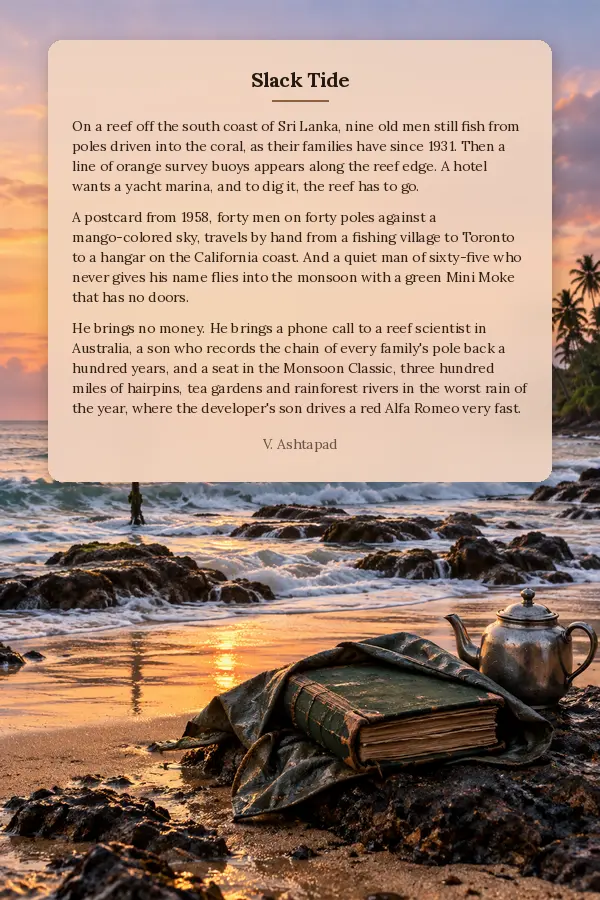
On a reef off the south coast of Sri Lanka, nine old men still fish from poles driven into the coral, as their families have since 1931. Then a line of orange survey buoys appears along the reef edge. A hotel wants a yacht marina, and to dig it, the reef has to go.
A postcard from 1958, forty men on forty poles against a mango-colored sky, travels by hand from a fishing village to Toronto to a hangar on the California coast. And a quiet man of sixty-five who never gives his name flies into the monsoon with a green Mini Moke that has no doors.
He brings no money. He brings a phone call to a reef scientist in Australia, a son who records the chain of every family's pole back a hundred years, and a seat in the Monsoon Classic, three hundred miles of hairpins, tea gardens and rainforest rivers in the worst rain of the year, where the developer's son drives a red Alfa Romeo very fast.
Members can react to this book and talk about it in the members' Library.
Ownership
© 2026 CRUNOD LLC. All rights reserved.
This book is owned by CRUNOD LLC. It is free to read on EternalCurrent.Online. No part of it may be copied, reprinted, sold, recorded or adapted, including as audio, film or translation, without written permission from CRUNOD LLC.
© 2026 CRUNOD LLC. All rights reserved.