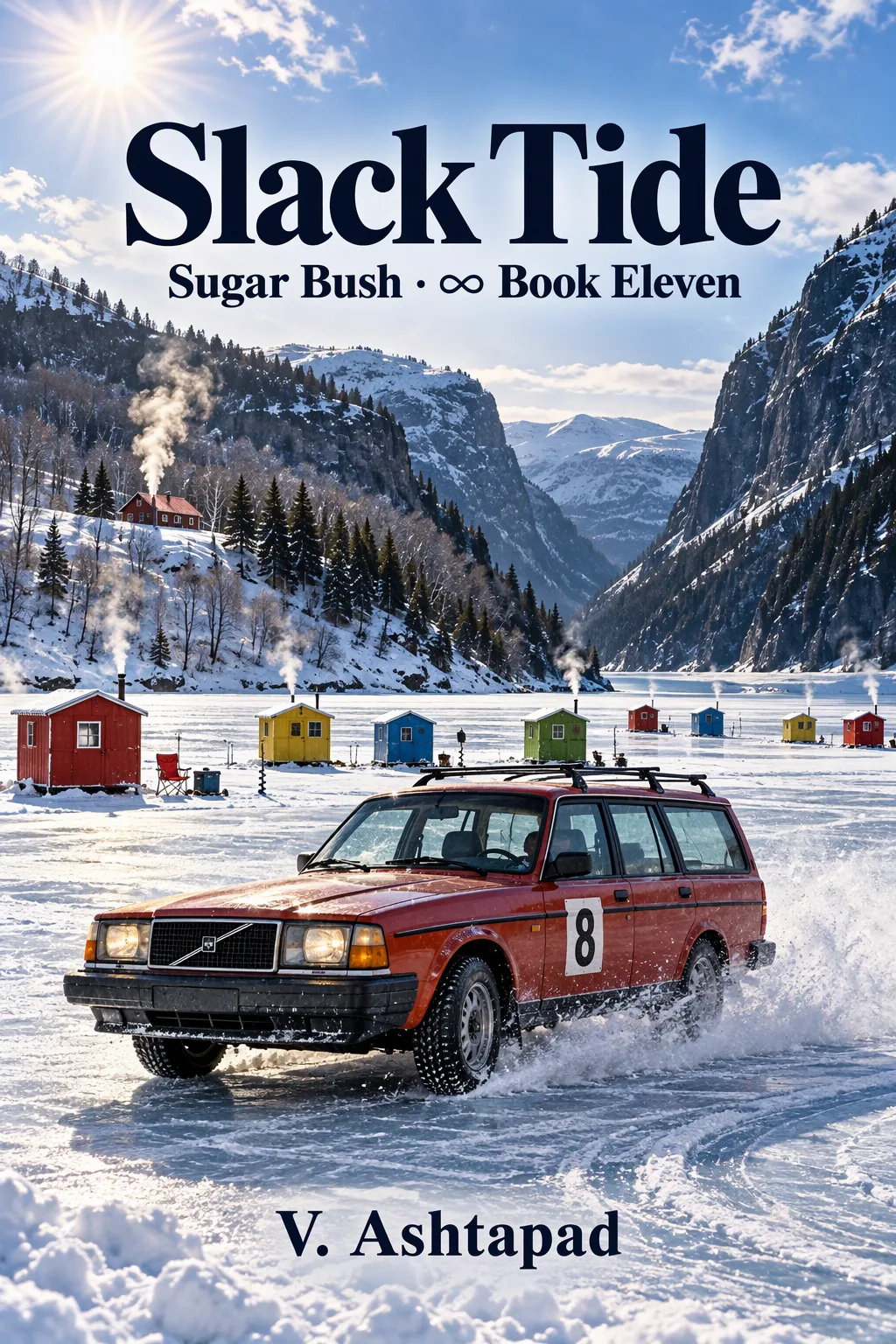
Slack Tide
Sugar Bush · ∞ Book Eleven
by V. Ashtapad
Foreword
This is a work of fiction. The Saguenay fjord is real, and so are its winter ice-fishing villages, the redfish in the old salt water under the ice, the sugar shacks, and taffy poured on the snow. Anse-aux-Érables, its cooperative, its families, the company and the Ice Cup are invented.
For everyone who ever rolled hot syrup on a stick in the snow.
Redfish Under the Ice
At the bottom of the fjord, six hundred feet under the ice, it was always the same cold, and the redfish did not know what month it was.
Above them, Mathis Tremblay knew exactly what month it was, because he was eleven and it was the last week of January and in nine days there was a math test he had not studied for. He sat on an upturned pail in his grandfather's ice cabin with his snow pants unzipped to the waist and a short stubby rod in his mittens, staring down into a hole in the floor.
The hole was eight inches across. It went through the plywood floor of the cabin and then through thirty inches of ice, gray-green and clouded with old bubbles, and then into black water. Down that black water, on two hundred yards of line, went a jig with a strip of herring on it, past the freshwater on top, past the brackish middle, and down into the old salt sea underneath, where the cod and the redfish and the turbot lived in the dark as if the Atlantic had never left.
That was the thing about the fjord, his grandfather said. It was two seas, one on top of the other. The river on top. The ocean underneath. They did not mix.
"Like us and the English," his grandfather said. Every time.
The cabin was the size of a garden shed. It had a little woodstove with a stovepipe going up through the roof, red hot, ticking, and a bench, and a shelf with a radio on it playing the afternoon show from Chicoutimi, and a calendar from a hardware store on the wall, and a window the size of a pizza box with frost ferns grown across it. Outside, in rows, on the white ice of the bay, there were two hundred cabins exactly like it, painted every color there was, red and yellow and sky blue and lime green and one that was striped like a candy cane, with smoke going up from all their stovepipes into a sky so cold and clear it hurt your eyes to look at. There were streets between the rows, plowed, with names on signs. There was a street lamp. There was a man who drove a truck up and down the streets selling coffee and doughnuts. There was a whole village out there on the ice, every winter, from January to March, and then in April it went away, all of it, towed off on sledges, and the ice broke up and went out to sea, and the fjord was a fjord again.
Mathis's line twitched.
---
He brought it up hand over hand, two hundred yards, his arms burning, the line coming up out of the hole wet and steaming in the cold air of the cabin and coiling at his feet. It took six minutes. His grandfather did not help. His grandfather sat on the bench by the stove with his coffee and watched and said only, at the end, "Don't rush it. It's been down there for a thousand years. It can wait one more minute."
It came out of the hole red. A redfish, a sébaste, as long as his forearm, bright orange-red like a fire engine, with huge black bulging eyes and spines all along its back, and it flapped once on the plywood floor of the cabin and then lay still, puffing.
"There," said his grandfather.
Mathis looked at it. Then he looked up at his grandfather, because he had heard something in the old man's voice that was not about the fish.
Gérard Tremblay was eighty-four. He had a face like a split log, and enormous hands, and he wore the same red plaid wool jacket in the ice cabin that he had worn in the ice cabin since 1971. He had made maple syrup for sixty-two springs in the sugar bush above the village, the érablière, on the steep slope where the maples grew so thick and old that in October, when the leaves turned, you could see that hillside from across the fjord like a fire. He had stopped three years ago, because of his heart. His son had not wanted the sugar shack. His son was an accountant in Quebec City.
"Grand-papa," said Mathis. "What's wrong?"
His grandfather looked out the little frosted window for a long time, at the rows of painted cabins on the ice and the smoke going up and, above the village on the shore, the white slope of the hill where the sugar bush stood, bare and gray in the winter, every tree a dark line on the snow.
"They cut forty trees this week," he said. "On the Gagnon lot. By the big rock."
"Who?"
"The company." His grandfather drank his coffee. "They bought Lucien Gagnon's share from his grandson in Calgary. One share. Out of nine. And now they say they can cut." He put the cup down. "Forty trees. Sugar maples. Two hundred years old, some of them. I tapped those trees with my father in 1955."
Mathis did not know what to say. On the floor, the redfish puffed.
"Your great-grandfather started the cooperative," said Gérard Tremblay. "In 1938. All the families on the hill. Nine lots. Everyone shared the shack and the boiling and the selling. It worked for thirty years." He shook his head. "Then the children left. For Montreal. For Toronto. For Florida. For France. The lots stayed in the families, but the families went everywhere. Now each lot has a dozen owners, and they've never met, and half of them have never seen a maple tree." He looked at his grandson. "And the company is buying them. One by one. Tree by tree."
---
That night, in the kitchen of the house on the shore, with the stove going and the redfish frying in butter in a black pan and the wind coming down the fjord and moaning in the stovepipe, Mathis's mother found an old postcard in the drawer under the telephone.
It had been printed in 1962 for a winter carnival in Chicoutimi, and it showed the ice village on the bay at Anse-aux-Érables in black and white: the rows of cabins on the white ice with smoke going up, men in fur hats and long coats standing around a hole with a line going down into it, a horse and sleigh in the background, and above them, on the hillside, the sugar bush, every tree a dark stroke against the snow, standing so close together it looked like a forest drawn in ink.
On the back, his mother wrote, in French, and then, under it, in English, because her cousin in Vermont had said that was how it should be done:
*They are selling the sugar bush above Anse-aux-Érables tree by tree. Nine lots, one hundred and four owners. The company has bought three shares. They cut forty trees last week. The cooperative my grandfather started in 1938 still exists on paper. It has no money and no members. The sugaring starts in March. We don't know if there will be one.*
She did not sign it. At the bottom, because her cousin in Vermont had told her to, she drew a small figure eight lying on its side.
© 2026 CRUNOD LLC. All rights reserved.
The Volvo
The card came to the hangar on the California coast on the ninth of February in a padded envelope from a cheese shop in Burlington, Vermont, inside a tin of maple candies shaped like leaves, with a note in a woman's handwriting that said only: *My cousin in Quebec. The one who sends the syrup. You fixed my husband's truck on Route 100 in 2029 and didn't stay for pie.*
Ruiz ate one of the maple candies. Then he put the card on the tray by the coffee machine, beside a postcard of forty men on forty poles against a mango sky, and a small dried silver fish.
Eight read it at three in the afternoon with the rain coming in off the Pacific against the hangar doors.
"Quebec," said Ruiz, without turning around. He was working on something under a tarp. "Saguenay. February. Minus thirty."
"Yes."
"You'll want something heavy," said Ruiz. "Something that doesn't care."
He pulled off the tarp.
---
It was a Volvo 240 wagon. A brick.
It was the color of a fire engine faded by thirty winters to the color of a ripe tomato, square at every corner, with a long flat roof and a rack on top and a grille like a radiator in an old schoolhouse and rectangular headlights that gave it the expression of a librarian looking over her glasses. It had been built in Sweden in 1991, when Volvo built its cars to be driven through a moose. It had three hundred and sixty thousand miles on it. It had belonged, until the previous autumn, to a retired schoolteacher in Mendocino who had driven it every day for twenty-eight years and sold it to Ruiz for eight hundred dollars on the condition that it never be crushed.
Ruiz had put in a new suspension, and a rebuilt engine, and a roll cage, and four racing seats, and a set of tires with a hundred and eighty steel studs in each one, sticking out of the tread like the spikes on a dog collar.
"Ice tires," said Ruiz. "For racing. On a lake." He kicked one. "They have ice races up there. On the bay. Every March, before the ice goes soft. I looked it up."
Eight walked around the Volvo once, slowly. He lifted the hood and studied the engine, then let the hood settle shut.
"It's very ugly," he said.
"It's beautiful," said Ruiz. "It's a tank with a station wagon on top. You could drive it off a cliff and it would land on its wheels and ask if you were okay." He wiped his hands. "Car number?"
Eight did not answer. He did not need to.
---
His wife packed for him that week the way she always did, which was without a list and without a question.
She did it on the bed in the evening with the window open a crack to the sound of the sea, folding things into the old canvas bag with the broken zipper pull that he would not let her replace. Wool socks, four pairs, the thick gray ones she knitted in the winter evenings while she watched the news. Long underwear. A sweater that had been her father's. A hat with flaps. A tin of the salve she made from beeswax and something green from the garden, for his hands, because his hands cracked in the cold and he never remembered until they bled.
He stood in the doorway and watched her.
"Minus thirty," she said, holding up a second sweater, considering it. "Ruiz told me. He was very pleased about it." She put the sweater in. "He's been reading about ice for a month. He told me how many studs are in each tire. I didn't ask."
"A hundred and eighty."
"That's what he said." She closed the bag and pressed it down with both hands and worked the stiff zipper around it without the pull, the way only she could. Then she looked at him across it, the look she had given him across a hundred bags on this bed over thirty-some years, which asked nothing at all and knew a great deal.
"Your mother wants syrup," she said.
"I know."
"Then bring her syrup," said his wife, and lifted the bag off the bed and put it in his arms.
---
At the long table that night, with the fog against the windows and the rain on the deck, his son read the card and was quiet for a long time.
"One hundred and four owners," he said.
"Nine lots."
"That's twelve per lot, average. Maybe more on some. Heirs of heirs." His son put the card down beside the salt. "They'll be everywhere. Montreal, Florida, Alberta, France. Most of them won't know they own a share of a sugar bush. Most of them won't have ever been there." He looked at his father. "The company's buying them one at a time. Calling them up. Offering cash. *You've never seen this land. You'll never use it. Here's ten thousand dollars.* Of course they say yes."
"Unless somebody else calls them first," said Eight.
His son looked at him.
"And tells them," said Eight, "what it is."
---
His mother, eighty-eight, at the end of the table, had been shelling nothing, only listening, with her hands in her lap. Now she said, "Maple?"
"Maple."
"Sugar from a tree," said his mother. She shook her head. "My father would have loved that. An engineer. He would have wanted to know how." She looked at Eight. "You will bring some back."
"Yes."
"Not the kind in the bottle shaped like a lady," said his mother. "The real kind."
His father, ninety-six, in his wool cap, at the window, said nothing for a long time. Then he said, to the glass, "Cold."
Eight waited.
"In Sikkim," said his father, "at the post, in winter, we had a sergeant from Himachal who boiled tea in the snow. In a big pot. He put in jaggery, a whole block. And ginger. And a little salt." He was quiet. "Sixty men. One pot. We would stand around it in the dark at the change of the guard. Nobody spoke. Just the steam. Just the men." He lifted one hand off his cane and set it down. "That is what you are going to. A pot in the snow. With people standing around it."
© 2026 CRUNOD LLC. All rights reserved.
Anse-aux-Érables
He drove the Volvo from Montreal, because there was no other way to get it there and because he wanted to see the country come up around him.
It was four hundred miles. North out of the city in the gray morning on the autoroute, through the flat white farmland of the St. Lawrence valley, where the barns were red and the silos were silver and the snow lay on the fields in long smooth drifts like sheets on a bed, and the steeples of the villages stood up out of the white every ten miles like the masts of ships. Then into the Laurentians, where the road began to climb and curve through spruce and pine and birch, black and green and white, and the snow got deeper, and the lakes were frozen flat and white with snowmobile tracks across them. Then the long empty road north through the Réserve faunique des Laurentides, a hundred miles of nothing but forest, spruce standing up out of the snow in their millions on both sides of the road, dark and close and silent, and the sky above them a hard blue, and not one house, not one gas station, not one light, and the cold coming through the Volvo's doors like a hand.
The Volvo did not care. The heater roared. The studs on the tires rang on the patches of bare ice on the road like a hundred tiny hammers. He passed a snowplow, and three logging trucks, and a moose, standing at the edge of the road in the snow, enormous, dark, with a beard of ice hanging from its chin, which turned its huge head and watched the red station wagon go by with the deepest indifference he had ever seen in an animal.
Then the forest ended, all at once, and the land fell away in front of him, and there was the fjord.
---
It came at him out of the trees like something out of a dream. A great crack in the earth, a mile wide, with walls of dark rock going straight up a thousand feet on either side, crowned with spruce, and between the walls, filling the whole floor of the crack from cliff to cliff and stretching away east toward the St. Lawrence and the sea for sixty miles, ice. Flat white ice, blazing in the low winter sun, so bright he had to put on his sunglasses. And on the ice, far below, in a little bay on the north shore, where a village of white and red and blue houses clustered around a silver steeple at the bottom of a steep wooded hill, a second village: two hundred small painted cabins in rows on the ice, red and yellow and sky blue and lime green and one striped like a candy cane, with smoke going up from every one of them, straight up, into the still air.
Above the village on the shore, the hill. And on the hill, the sugar bush. Thousands of maples, bare and gray, every tree a dark stroke on the snow, standing so close together it looked like a forest drawn in ink.
Except in one place. Halfway up, by a big gray rock, there was a gap. A raw patch of white snow with stumps in it, forty of them, like broken teeth.
Eight sat in the Volvo at the top of the road for a long time with the engine running and the heater roaring, looking at the gap.
---
He took a room above the dépanneur on the main street, the corner store, which sold milk and bread and lottery tickets and fishing licenses and bait and beer and, from a glass case by the cash register, warm tourtière, the meat pie the whole province ate at Christmas and the people of the Saguenay ate whenever they felt like it. The room had a bed and a chair and a radiator that clanked and a window that looked across the street at the church and, beyond the church, the ice village on the bay.
The woman who ran the dépanneur was named Josée. She was fifty and round and fast and spoke French so quickly that he understood one word in four, and then, when she saw his face, switched to English without a pause, as if she had been speaking it all along.
"You're the one with the red Volvo," she said. "On the hill road."
"Yes."
"The cousin in Vermont said a man would come." She put a slice of tourtière on a paper plate in front of him without being asked, with a spoonful of fruit ketchup, the sweet tomato and peach relish she made herself every August. "She said a man with a number. She said he would come in something ugly." She looked out the window at the Volvo. "She was right."
"Where is Gérard?"
"In his cabin," said Josée. "On the ice. Where else? Fourth row, the green one with the moose on the door. He's been out there every day since they cut the trees." She folded her arms. "He doesn't fish. He just sits. Looking at the hill."
© 2026 CRUNOD LLC. All rights reserved.
The Green Cabin
Gérard Tremblay did not want to talk to an American, and he said so, at length, in a French so thick with the accent of the Saguenay that it was nearly another language, with long flat vowels and every second word ending in a sound like a door closing, while his grandson Mathis sat on the pail by the hole and looked at the floor.
"He says," said Mathis finally, in English, when his grandfather had stopped, "that Americans come to look at the ice village every winter and take pictures and go away and not one of them has ever caught a fish."
Eight looked at the hole in the floor. He looked at the rod leaning against the wall.
"Can I try?"
Mathis translated. His grandfather looked at Eight for a long moment with his split-log face. Then he grunted and pointed at the pail.
---
It took Eight forty-one minutes to catch his first redfish, and it was the longest forty-one minutes he had spent anywhere in years.
You let the line down two hundred yards into the dark, past the river on top and the brackish middle into the old ocean underneath. You felt for the bottom. You lifted the jig a foot, and let it fall, and lifted it, and let it fall, over and over, in the warm stuffy dark of the cabin with the woodstove ticking and the radio playing a fiddle tune from Chicoutimi and the old man on the bench watching every movement of your hands. Your arms ached. Your back ached. Your mind went quiet, the way it went quiet in a car at speed, with nothing in it but the line and the dark water and the small sounds of the cabin. And then, when you had stopped expecting it, the line twitched, and your whole body went still, and you brought it up, hand over hand, two hundred yards, with the old man saying only, from the bench, "Doucement. Doucement. It's been down there a thousand years."
It came out of the hole red as a fire engine, with its huge black eyes, and flapped once on the plywood and lay still.
Gérard Tremblay looked at it. He looked at Eight.
Then he got up off the bench, and took a black pan down from a nail on the wall, and put it on the woodstove, and dropped a lump of butter in it from a tin on the shelf, and began, with a short knife, without a word, to clean the fish.
---
They ate it there, in the cabin, the three of them, off tin plates, with bread from the dépanneur and salt from a paper twist and the redfish fried in butter until its skin went crisp and its flesh went white and flaky and sweet as a lobster's. Mathis ate his with ketchup. His grandfather said this was a crime and ate his with nothing.
After, with coffee from a dented percolator on the stove, the old man wiped his fingers on his red plaid jacket and looked at Eight for a long time.
Then he reached into the jacket and took out a folded piece of paper, very old, very soft, and unfolded it on his knee.
It was a map. Hand-drawn in pencil and ink on heavy paper, the kind of paper surveyors used, gone brown at the edges. It showed the hill above the village, the sugar bush, divided by careful lines into nine long strips running from the shore road at the bottom to the ridge at the top, each strip numbered and labeled with a family name: *Tremblay. Gagnon. Bouchard. Simard. Girard. Lavoie. Côté. Harvey. Fortin.* At the top of each strip, a little drawing of a tree. At the bottom of the hill, by the shore road, in the middle of all nine strips where they met, a small rectangle labeled *La cabane*. The sugar shack.
Across the top, in faded ink, in a careful old-fashioned hand: *Coopérative des sucriers de l'Anse-aux-Érables. Fondée 1938.*
"My father drew it," said Gérard Tremblay, in English, slowly, as if every word were a stone he had to lift. It was the first English he had spoken. "1938. The year we made the cooperative. Nine families. One shack. One boiling." He put his huge finger on the map. "Every family owns their strip. But the trees—" He moved his finger over the whole hill. "The trees belong to everybody. The sap belongs to everybody. That was the rule. My father's rule."
"What happened?"
"The children left." He tapped the strips, one after another. "Gagnon. Montreal. Bouchard. Florida. Simard. France. Girard. Toronto. Every strip, a dozen children, grandchildren, great-grandchildren. Everywhere. They never come. They don't know each other. They don't know the trees." He folded the map, very carefully, along its old soft creases. "The company knows. The company finds them. On the computer. They call. They say, *you have a share of a hill in Quebec you have never seen. Here is money.* And the children say yes." He put the map back in his jacket. "Why not? I would say yes. If I was in Florida."
© 2026 CRUNOD LLC. All rights reserved.
Groupe Sommets
The company was called Groupe Sommets Boréal, and its president was a man from Quebec City named Yannick Lessard, and he was, by all accounts, a perfectly reasonable person.
He had a plan. It was in a brochure, glossy, on heavy paper, which Josée kept under the counter at the dépanneur and brought out for Eight with an expression of deep disgust. The plan was called *Les Hauts de l'Anse*. It showed the hill above the village, the whole slope, from the shore road to the ridge, with the sugar bush gone and in its place forty chalets of glass and cedar on terraces, each one with a hot tub on a deck and a view across the fjord, and a road winding up between them, and a little ski lift at the top. In the drawings, the chalets were lit gold from inside, and happy people in expensive parkas stood on the decks with glasses of wine, looking at the ice village on the bay, which was very picturesque.
"He's not a bad man," said Josée. "That's the worst part. He comes to the village. He goes to church. He gave money for the new roof on the arena. He says the village is dying, which is true. He says the young people are leaving, which is true. He says the sugar bush hasn't made money in thirty years, which is true." She put the brochure back under the counter. "He says forty chalets will bring jobs. Cleaners. Plowmen. A restaurant. He says the old men are holding on to a hill of trees out of sentiment while their grandchildren move to Montreal."
"Is he wrong?"
Josée looked at him for a long time.
"Gérard's father made syrup on that hill," she said. "And his father before him. And the Gagnons and the Bouchards and all of them. For a hundred years. The whole village came every March to the sugar shack. Every Sunday in March and April. For the boiling. For the party. The partie de sucre. You eat, you dance, you pour the hot syrup on the snow and roll it on a stick." She folded her arms. "My mother met my father at the sugar shack in 1969. My grandmother met my grandfather there. Half the village was made in that shack." She shook her head. "The last party was three years ago. Before Gérard's heart."
---
He spent the next three days learning how the company was doing it.
It was not complicated. It was the oldest trick in the world: patience, and a telephone. When a family's strip had passed down through four generations without anyone ever selling or dividing it, it belonged, undivided, to all of the heirs together: twelve owners, or twenty, or thirty, each with a small fraction. None of them could do anything with it alone. But any one of them could sell their fraction. And when the company owned enough fractions of a strip, it could go to a judge and ask for the strip to be divided, or sold, and the judge, looking at a piece of land with thirty owners who had never met and did not care, would usually say yes.
Groupe Sommets had a woman in an office in Quebec City whose whole job was finding heirs. She worked from the old property rolls and the parish registers and the obituaries and the internet, and she had found, so far, sixty-one of the one hundred and four owners, and had called all of them, and twenty-three had sold.
They needed, by Josée's reckoning, four more fractions on the Gagnon strip, and two on the Bouchard strip, and then they could ask the judge. The hearing at the courthouse in Chicoutimi was set for the second week of April.
The sugaring started in March.
---
That night, in the room above the dépanneur, with the radiator clanking and the wind moaning down the fjord, Eight called his son.
"Forty-three owners she hasn't found," said his son, on the phone, from three thousand miles away, with his voice gone soft and quick, the way it went when he had found something worth chasing. "And the twenty-three who sold, and the thirty-eight who said no or didn't answer. That's the whole hill, Dad. One hundred and four people."
"Yes."
"Somebody needs to find the forty-three before she does," said his son. "And call the thirty-eight back. And not offer them money." He was quiet for a moment. "Offer them the hill."
"How do you offer someone a hill?"
"You tell them what's on it," said his son. "Their great-grandfather's name, carved in a tree. The night their grandmother met their grandfather. What the syrup tasted like in 1955." He paused. "You tell them it's theirs. Not as a fraction. As a family. And you ask them to come to the party."
© 2026 CRUNOD LLC. All rights reserved.
Fractions
Gérard Tremblay took him up the hill the next morning on snowshoes.
The old man would not hear of the road. The road was plowed only as far as the shack, he said, and the shack was not the hill, and if a man wanted to understand what was being sold he had to walk on it. So they went up from the shore road in the blue light before the sun cleared the cliffs, on two pairs of snowshoes from the shed behind the house, the old kind, ash frames bent into teardrops and laced with rawhide gone dark as tobacco, which creaked at every step and sank a hand's width into the powder and held.
Gérard went first. He went slowly. Every fifty steps he stopped and leaned on his pole and stood with his head down, breathing, his breath going up white around his ears, and Eight stopped behind him and looked at the trees and waited and did not offer to help, because he understood that the offer would be worse than the hill.
The maples were huge. Close to, they were not a forest drawn in anything; they were columns, gray and ridged and furred with pale green lichen on their north sides, so thick that two men could not have joined hands around some of them, going straight up out of the snow for forty feet before they branched. In the still cold the whole bush made small sounds, ticks and creaks and once, far off, a crack like a rifle shot that rolled across the slope and came back off the cliffs across the fjord.
"Frost," said Gérard, without turning. "The wood freezes. It splits. In the old days my father said it was the trees complaining about the Bouchards." He went on. Fifty steps. He stopped.
On many of the trees, at the height of a man's chest, there were scars. Small round holes, healed over into puckered gray knots, dozens on each trunk, going around and around, old ones and older ones and some so old the bark had nearly swallowed them.
"Taps," said Gérard. "Every year, a new hole. Never the same place. You go around the tree, like a clock. A tree like this one—" he put his mitten flat on a trunk "—has been tapped maybe a hundred and fifty times. By my grandfather, my father, me." He looked up into the branches. "It doesn't mind. It's a gift, the sap. It has more than it needs. You take a little, it makes more. That's the whole secret. Don't take too much."
---
The gap was worse close to.
They came out of the trees by the big gray rock into the open, and the snow there was trampled and dirty with sawdust and the tracks of a machine, and the stumps stood out of it at knee height, each one cut flat and clean, the pale wood of the faces gone yellow-gray in the cold. The tops of the trees had been hauled away. The brush had been piled and left. The light came down into the clearing with nothing to stop it, too much light, and the snow glared.
Gérard Tremblay stood at the edge of it for a long time.
Then he went to one stump, a big one by the rock, and knelt in the snow beside it with a grunt, and took off his right mitten, and put his bare thumbnail on the outermost ring under the bark.
He counted. Eight could see his lips moving. He went in toward the heart of the stump, ring by ring, past the dark narrow ones of hard years and the wide pale ones of good ones, his thumbnail moving a tiny step at a time across the frozen wood, and Eight stood above him and the cold came up through the snowshoes, and the old man counted, and once he lost his place and went back to the bark and began again, and did not hurry.
He stopped, about a third of the way in.
"There," he said. "Seventy-nine."
He kept his thumb on the ring.
"That's the spring I came up with my father. I was five. He carried me on his shoulders the last part, because the snow was deep." He looked at the ring. "This tree was already a hundred and fifty years old. Then it lived seventy-nine more. And they cut it on a Tuesday, in an afternoon, for a hot tub."
He put his mitten back on. He did not get up right away. When he did, he used the stump.
---
The shack, when they came down to it, was cold inside in the way that only a closed building in winter can be cold: colder than the air outside, a dead, still, stored cold that had been sitting in the dark since the last fire three years before.
Gérard pulled the door open against the drift and they went in, and their breath filled the place.
It was a long room under the red tin roof, with a plank floor and plank walls and the light coming in gray through windows furred with frost. Down the middle, on its brick firebox, sat the evaporator, its long pan dull and filmed with old sugar, and above it the square wooden throat of the steam vent going up into the dark of the roof. There were benches along the walls, and the long tables, folded and stacked, and a row of hooks with old aprons on them, stiff with cold. A mouse had made a nest in a pail. On a shelf by the door stood a tin cup with a glass hydrometer in it, and a candy thermometer, and a felt filter folded in a bag, and a dipper with a long handle, all laid out as if someone had meant to come back the next morning.
And on the doorframe, on the inside, going up the bare wood in pencil, there were dates.
*9 mars 1938. 14 mars 1939. 2 avril 1940.* One under another, in different hands, faded, smudged, some in ink, some in carpenter's pencil, some cut in with a knife. *11 mars 1955*, in a big round child's hand that had been helped. Up and down both sides of the doorframe and onto the wall beside it. The first run of every spring since the cooperative began. The last was *8 mars 2031*, in a heavy careful hand Eight recognized from the map.
"Every year," said Gérard, "the first day the sap runs, the youngest person in the shack writes it." He touched the 1955. "Me." He touched another, *1983*, small and neat. "My son. The accountant." He touched one more, near the bottom of the newest column, *2029*, in letters that leaned like a fence in the wind. "Mathis. He was six." He took his hand away. "Then my heart. Then nothing."
He went to the evaporator and put his palm on the front of the pan where it met the firebox. He showed Eight a seam along the bottom of the front channel, where the steel had cracked in a hairline as long as a pencil.
"It leaks," he said. "The last year, it leaked into the fire. Hissing. You can't boil with a leak. It needs a welder. A good one. Stainless steel." He shrugged. "There's a woman in La Baie who could do it. But for what? For eight hundred buckets and an old man and a boy?"
Eight crouched and looked at the seam for a long time, and ran his thumb along it, and said nothing.
---
That afternoon, at half past three, when the school bus from La Baie had come along the shore road and let the children off at the church, Mathis came out to the green cabin on the ice with his backpack and his snow pants unzipped to the waist, and sat on the pail, and did not pick up the rod.
He took out a workbook instead, and put it on his knees, and looked at it with an expression of deep despair.
"Fractions," said his grandfather, from the bench, to Eight, in English, as if naming a disease.
Mathis had failed the test in January. He had nine days to study and he had not studied and he had got eleven out of thirty, and his teacher had given him a second chance, on Friday, and his mother had said that if he failed it again there would be no ice cabin until the ice went out. He explained all this to Eight in a rush, in English, while his grandfather snorted on the bench.
"I don't get it," said Mathis. "Why is a third bigger than a quarter? Four is bigger than three."
Eight looked at the workbook. Then he held out his hand.
"Give me the map," he said to Gérard.
The old man looked at him. Then he reached into his jacket and took it out and unfolded it on his knee and handed it over, carefully, the way he would have handed over a sleeping baby, and Eight laid it on the plywood floor of the cabin by the hole, in the warm light from the stove, and put the boy's pencil on it.
"How many strips?" he said.
"Nine."
"So the Tremblay strip is how much of the hill?"
Mathis looked at the map. "One," he said. "One out of nine."
"One ninth. Now. How many owners does the Gagnon strip have?"
Mathis thought. "Josée said fourteen."
"So one Gagnon owns one fourteenth of the Gagnon strip. And the Gagnon strip is one ninth of the hill. So how much of the hill does one Gagnon own?"
Mathis stared at the map. His grandfather, on the bench, had stopped drinking his coffee.
"A little bit," said Mathis.
"How little?"
The boy took the pencil. He drew, very slowly, on the margin of his workbook, nine long strips, the way they were on the map, and shaded one, and cut the shaded one across into fourteen pieces with fourteen tiny lines. Then he counted. He counted the pieces in one strip and multiplied by nine, on his fingers, twice, because the first time he got it wrong.
"One out of a hundred and twenty-six," he said.
"That's what the company is buying," said Eight. "One hundred and twenty-sixth of a hill. At a time."
Mathis looked at the drawing for a long time. Then he looked at the map. Then he looked out the frosted window toward the shore, where the white slope rose above the village with the trees on it, and the gap.
"That's not very much," he said slowly. "For one. But if you get enough of them—"
"Yes."
"—you get the whole strip." The boy's face was changing. "And then the next one. And it doesn't matter how small they are. If you have enough."
"That's a fraction," said Eight.
He handed the map back to Gérard. The old man folded it along its creases and put it into his jacket and drank his coffee and looked at his grandson with an expression Eight could not read.
They did the workbook for an hour, problem by problem, on the cabin floor. The thirds and quarters. The eighths. Adding them, which needed a common bottom, which Mathis decided to call the floor, because it was what everything stood on. Every time he got stuck, he drew strips. Every time he drew strips, he got unstuck. At five o'clock, when it was dark outside the little window and the street lamp had come on over the plowed lanes between the cabins, Gérard Tremblay got up and put the black pan on the stove.
"Fourteen out of fifteen," he said, over his shoulder, in English, to nobody. "In my day, the teacher hit your hand with a ruler." He dropped in the butter. "It worked very well. I'm still afraid of rulers."
On Friday, Mathis got twenty-seven out of thirty. He came out to the green cabin with the paper in his mitten and held it up against the frosted window so his grandfather could see it from outside, before he even opened the door.
© 2026 CRUNOD LLC. All rights reserved.
One Hundred and Four
His son came on the fifteenth of February with his recorder in its padded case and a parka his mother had bought him that was so enormous that Mathis, seeing him get out of the Volvo in front of the dépanneur, laughed until he had to sit down in the snow.
He worked for five weeks. He worked from a table in the back of the dépanneur, between the bait fridge and the lottery machine, with a laptop and a phone and the parish registers that the priest let him borrow in a cardboard box, and the property rolls from the municipal office, and Gérard Tremblay's father's map from 1938 spread out on the table under a jar of pickled eggs to keep it flat.
He found them one by one.
A retired schoolteacher in Sherbrooke, eighty-one, a Gagnon, who had spent every March of her childhood at the sugar shack and had not been back since 1967, and who cried on the phone for twenty minutes when the son told her the shack was still standing. A software developer in Montreal, a Bouchard, thirty-four, who had no idea he owned anything and asked three times if it was a scam. A nurse in Fort Lauderdale, a Simard, whose grandmother had made the best maple pie in the village and had written the recipe on an index card that the nurse still had in a drawer. A pharmacist in Lyon, a Girard, whose great-grandfather had emigrated back to France in 1951, and who had a photograph of him standing in front of a sugar shack in the snow with two buckets on a yoke across his shoulders. A plumber in Edmonton. A dentist in Paris. A priest in Rwanda, a Côté, who had been a missionary for forty years and had forgotten, he said, laughing on a crackling line, that he owned a tree.
A professional hockey player's mother in Pittsburgh. A woman in a nursing home in Moncton, a Harvey, ninety-three, who did not remember anything at all about the hill except that she had once, in 1957, poured hot syrup on the snow for a boy named Émile and he had kissed her behind the woodpile, and who sang, on the phone, in a high cracked voice, the whole of a fiddle tune that Gérard Tremblay, listening in the back of the dépanneur, said he had not heard since his father died.
---
The son did not offer any of them money. He told them about the hill. He sent them pictures: the sugar bush in the snow, the shack at the bottom with its red tin roof and its steam vent, the ice village on the bay. He sent them recordings of Gérard Tremblay talking about their great-grandfathers. He put them, every one who said yes, on a private page that Mathis's mother set up for the cooperative, on the network the village families used to keep track of each other across all the places they had gone, with a pin on a map for every owner, from Sherbrooke to Lyon to Kigali, and a pin on the hill for every strip, and lines between them.
By the end of the first week there were twenty pins. By the end of the third, there were sixty. And people began to talk to each other on the page. The Gagnon heirs, who had never met, began writing to each other. The schoolteacher in Sherbrooke posted a photograph of her mother at the sugar shack in 1952. The nurse in Fort Lauderdale posted her grandmother's maple pie recipe, and the dentist in Paris made it and posted a picture, and it was terrible, and everybody laughed. The woman in the nursing home in Moncton was recorded by her granddaughter singing the fiddle tune, and Gérard Tremblay played it on his own fiddle, in the green cabin on the ice, for the first time in three years, and the son recorded that, too, and posted it, and the next morning there were forty-one replies.
"They're not fractions anymore," said Mathis, reading over the son's shoulder at the table in the back of the dépanneur. "They're people."
"They were always people," said the son. "Nobody asked them."
---
They walked back from the ice village late that night, the two of them, after an evening of redfish and fiddle in the green cabin, down the plowed street between the rows of cabins with their windows lit yellow and their stovepipes breathing, and out past the last row onto the open bay.
It was very cold. The kind of cold that had a sound, a faint high ringing in the ears, and a smell, like metal. The stars were out over the fjord in numbers that did not seem reasonable, thick as frost on a window, and the cliffs on either side stood up black against them, and under their boots the snow squeaked at every step like something small and alive.
Halfway across, the ice spoke.
It began far off, toward the mouth of the bay, as a low note, and came toward them under their feet, rising, a long whooping hollow call like a whale or a bow drawn across a cello the size of a house, and passed beneath them and went on up the fjord and faded into the cliffs. Then another, from the other side, higher, with a twang at the end of it, like a wire let go.
The son stopped dead.
"It does that," said Eight. "Josée told me. When the temperature falls at night. The ice gets thicker and it has nowhere to go and it cracks. A long way down." He listened. "Thirty inches. It's not going anywhere."
"I know," said his son. He did not move. "I just want to hear it again."
They stood in the middle of the bay in the dark and waited, and it came again, a long falling moan that went on and on and ended in a sort of chuckle, and the son laughed out loud, a sound Eight had not heard from him since he was small, and took out his phone and held it down toward the snow to record it, and that was when the phone rang in his hand.
It was his mother.
He put her on the speaker, and her voice came out small and warm into the enormous cold.
"Is it warm enough?" she said. "The parka?"
"It's warm enough for the moon," said the son. "A boy here laughed so hard he fell over."
"Good," said his mother. "Let him laugh. You'll be warm." There was a little pause on the line, and the sound of a kettle somewhere a long way away, on the California coast, in the kitchen Eight could see with his eyes shut. "Is your father there?"
"I'm here," said Eight.
"Is he eating?"
"Fish," said the son. "Every night. And meat pie. And a thing with peaches and tomatoes I can't explain."
"Good," she said again. And then, in a different voice, the one she used only for him and had used for thirty-some years, the one that never asked where he had been or why and never would: "Bring him home with all his fingers."
"I will."
"And come home yourself."
"Yes."
When she had gone, the son put the phone in his pocket and they walked on toward the lights of the village on the shore, and behind them the ice called out once more, very far off, toward the sea.
"She never asks," said the son, after a while.
"No."
"Doesn't she want to know?"
Eight thought about it for fifty steps.
"She knows," he said.
---
But asking was not enough. Every one of them could still sell to the company. And the company was offering ten thousand dollars a fraction, and the cooperative had nothing.
"We need to buy them," said Mathis's mother, at the kitchen table, at night, with the redfish in the pan and the map spread out. "The fractions. Or some of them. Enough so the company can't get to the judge. And we have no money. The cooperative has a bank account with four hundred dollars in it from 1971."
Eight was at the table. He had been at the table, in the evenings, for three weeks. He did not say anything for a long time.
Then he said, "How much syrup can the hill make?"
They looked at him.
"In a good year," said Gérard Tremblay slowly. "All nine strips. Every tree tapped. With the old evaporator, if we fix it." He thought about it. "Maybe eight thousand liters."
"And what do you sell it for?"
"Bulk? To the federation? Not much. Three dollars a pound, maybe." The old man shook his head. "That's why nobody does it. You can't live on that."
"And if someone bought it all," said Eight, "at a fair price? For ten years? In advance?"
There was a silence in the kitchen. The wind moaned in the stovepipe.
"Who would do that?" said Mathis's mother.
Eight did not answer.
© 2026 CRUNOD LLC. All rights reserved.
La Baie
The arena in La Baie had a new roof.
It was green steel, bright against the snow, and the old arena under it was brick and tired, with a sign over the door that said the roof had been made possible by the generous support of Groupe Sommets Boréal, and inside it smelled of popcorn and frozen rubber and the cold sweet smell of ice that has been flooded many times. On a Saturday afternoon at the start of March, a peewee team from the villages along the north shore of the fjord was playing a peewee team from Chicoutimi, and Mathis Tremblay was in goal for the north shore, in pads twice as wide as he was, with a mask painted like a redfish.
Eight sat on the wooden bench in the third row behind the glass with Mathis's mother and a paper cup of coffee and watched.
At the end of the first period, with the north shore down three to one, a man came along the row and sat down beside him.
He was perhaps fifty, fit and lean, with short gray hair and a good dark parka and the face of someone who slept well. He had a coffee too. He said hello to Mathis's mother by name, in French, and she said hello back, coolly, and then turned to talk to the woman on her other side, and the man smiled a little, as if he were used to that, and turned to Eight.
"You're the American with the Volvo," he said in English. "Yannick Lessard."
"Yes."
"Everyone knows the Volvo," said Lessard. "It's very—" he searched for the word "—sincere." He drank his coffee. "And your son is in the back of Josée's store with the parish registers, calling my heirs before my office can."
"They aren't yours."
"No," said Lessard pleasantly. "Not yet. Some of them." He watched the resurfacing machine go round, the ice behind it shining like a mirror. "I'm not angry. I want you to know that. It's a free country, even in the Saguenay. If your son can persuade a dentist in Paris to keep a fraction of a maple tree, good for your son."
On the ice, the boys came back out. Mathis went to his net and scraped the crease with his skates, one side and then the other, the way goalies did everywhere.
"I grew up in a village like this," said Lessard. "In Charlevoix. Down the river. Beautiful. Mountains, the river, the old church. When I was ten, there were three hundred people. When I was twenty, there were a hundred and twenty. Then the school closed. Then the store. Then the church, except at Christmas." He turned the paper cup in his hands. "My mother cleaned houses for people from Montreal. Summer houses. Chalets. That was the only work. I used to go with her and sit in their kitchens and look at their views." He shrugged. "Now I build the chalets. And the people who clean them are paid properly, and they have a road that gets plowed, and the school stays open, because there are children. That's what I'm selling. A school that stays open."
"With the trees gone."
"With some of the trees gone," said Lessard. "Forty chalets. Not four hundred. There will still be maples on the hill. They'll look very nice from the hot tubs." He smiled. "You think I'm a villain."
"No," said Eight.
Lessard looked at him, a little surprised.
"I think you're right about the school," said Eight. "And wrong about the hill."
The puck dropped at center ice. A boy from Chicoutimi broke away down the left wing, alone, and came in on Mathis and shot high, and Mathis threw up his glove, an enormous leather mitt, and caught it, and held it up over his head for the referee to see, and his mother screamed, and so did half the bench.
Lessard clapped. He clapped properly, for the boy.
"What is it you do?" he said, when the noise had died. "Josée says you have a number."
"I drive."
"Drive what?"
"Whatever they give me," said Eight.
Lessard laughed and got up and put a hand briefly on his shoulder, the way men did in arenas, and went off along the row to sit with the parents from Chicoutimi, and Eight watched him go and thought that he was, in every way that could be seen from the outside, a perfectly reasonable person, and that this was going to make everything harder.
The north shore lost, six to four. Mathis stopped thirty-one shots. In the parking lot afterward, with his pads over his shoulder, he said it was a moral victory, which was a phrase he had learned from his grandfather and did not entirely understand.
---
The woman in La Baie who could weld stainless steel was named Thérèse Boivin, and she was seventy-three, and she had won the Saguenay Ice Cup in 1983 and 1986 in a rear-wheel-drive sedan she had built herself out of two wrecks in her father's garage.
The garage was still there, on a side street above the port, a cinderblock building with three bays and a sign that said only BOIVIN in letters that had been red once, and in the front window, on a shelf, between a dusty cash register and a cat asleep in a hubcap, two gold-painted shovels mounted on blocks of maple.
Eight brought her the front section of the evaporator pan in the back of the Volvo on a Monday morning, wrapped in a blanket, and she looked at the crack through a pair of half-glasses for perhaps three seconds and said it would be ready on Thursday and that she would not charge Gérard Tremblay for it, because Gérard Tremblay's father had pulled her own father out of the fjord in 1951 when his truck went through the ice off Saint-Fulgence, and some debts did not get paid off, they just got passed down.
Then she walked around the Volvo.
She walked around it twice, slowly, with her hands in the pockets of her coveralls. She crouched by each tire and ran her fingers over the studs. She opened the tailgate and looked into the long empty cargo area and grunted. She got down on her back on the cold concrete of the bay, seventy-three years old, and slid under the rear axle and lay there for a minute looking up, and slid out again, and stood, and brushed off her coveralls, and looked at Eight over her half-glasses.
"You're entered," she said. It was not a question. "In the Cup."
"Yes."
"In this."
"Yes."
"Rear-wheel drive," said Thérèse Boivin. "Three thousand pounds. All of it in the front." She shook her head. "On the ice the back will have nothing to hold it down. It'll come around on you every time you breathe." She looked at him for a long moment. "Have you driven on ice?"
"On snow. In the mountains. Not on a lake."
"It's not the same."
"No," Eight agreed.
She went into the back of the garage and came out with two canvas sacks, the kind the fishermen used for sand, each one as big as a sleeping child, and swung them one after the other, with a grunt each time, into the cargo area of the Volvo over the rear axle, and shoved them forward with her boot until they sat snug behind the back seat.
"A hundred kilos," she said. "Sand. Now your back has something to think about." She slammed the tailgate. "Tonight. Nine o'clock. They've plowed the track on the bay. The lights are on till ten for the practice. Bring a thermos."
---
The track at night was another world.
The oval lay out on the bay below the town, plowed into the ice and banked with snow higher than the Volvo's roof, and four poles of floodlights stood along the straights throwing long hard white light across the surface, so that the ice inside the banks glittered like a skating rink and the dark beyond them was total. Out past the lights, the fjord went away into the night, and the cliffs were only a darker black against the black sky, and the cold came off the ice and up through the floor of the car.
Thérèse Boivin sat in the passenger seat in a snowmobile suit and a fur hat with her thermos between her knees and did not say a word for the first five laps.
He drove carefully. He felt the studs bite and let go and bite. He felt the sand behind him settling the back of the car, and the back stayed, mostly, where it was told, and when it did not he caught it, and the Volvo came around the turns in long cautious arcs, a little sideways, and the old woman beside him sat with her eyes half closed as if she were listening to music she did not much like.
On the sixth lap she said, "Stop."
He stopped, in the middle of the back straight, under the lights, with the engine idling and the heater roaring at nothing.
"You're driving like a man on a sidewalk," said Thérèse Boivin. "In good shoes. Afraid to fall." She unscrewed the thermos and poured coffee into the cap and drank it. "Look at the ice."
He looked. Under the floodlights the surface of the track was not one surface but many. There was the polished groove where the practice cars had run all evening, dark and glassy as a black window, reflecting the lights. There was the band outside it, scuffed white and gray, where the studs had chewed. There was the edge by the banks, where the plows had thrown up loose snow and the snow had blown back across the ice in a fine dust.
"The black is the worst," said Thérèse. "The cars polish it. By the end of the race it's glass. The gray is better. The studs have broken it up. That's where you want your wheels." She pointed with the thermos cap. "And the snow on the outside, by the bank. Everyone's afraid of it. It's soft. It grabs. But a little of it, at the right moment, under the back wheels, is like putting your hand on a wall." She drank. "The four-wheel-drive boys never use it. They don't need to. The car does their thinking for them. They point it and it goes." She looked at him. "So they never learn to catch a slide. Their cars never slide. Until the day the car can't do it for them. And then they don't know what to do with their hands."
She screwed the cap back on.
"Again," she said. "And this time, when it comes around, let it come. All the way. Make it go sideways on purpose. You're not losing it. You're aiming it."
He drove until ten o'clock, when the floodlights went out, one pole at a time, and then for a while longer in the dark by the Volvo's own headlights, around and around, on the gray band and not the black, with the back of the car coming around into every turn and the long flat side of the wagon swinging out and the sand in the cargo area sitting him down, and every lap the arc got wider and the catch got later and the Volvo came out of the turn faster, and on the eleventh lap in the dark, coming off the last turn with the car broadside and the rear wheels just brushing the soft snow at the edge of the bank, he felt it grip, exactly as she had said, like a hand on a wall, and the car straightened and leapt down the straight, and beside him Thérèse Boivin, who had not spoken for twenty minutes, said, quietly, "Ah. Voilà."
Afterward they sat in the Volvo with the engine running and the heater going and drank the rest of the coffee. The ice boomed somewhere out in the dark toward Saint-Fulgence. The town above the port was a scatter of lights.
"Gérard says you caught a redfish," said Thérèse. "The first day."
"Forty-one minutes."
"In fifty years," she said, "I've seen a hundred Americans in that ice village. Not one of them caught a fish." She looked out at the dark. "He said you sat on the pail and didn't talk and didn't look at your phone and didn't ask when it was going to bite. He said you fished like a man from here." She turned and looked at him. "Who are you?"
Eight looked at the dark track through the windshield.
"I drive," he said.
Thérèse Boivin snorted, and got out of the car, and went off across the ice toward the lights of the port in her snowmobile suit with the empty thermos under her arm, and did not look back.
The pan was ready on Thursday. The weld along the seam was a line of tiny overlapping scales, perfectly even, like the skin of a fish.
© 2026 CRUNOD LLC. All rights reserved.
The Ice Race
The Saguenay Ice Cup had been run on the frozen bay at La Baie on the second Saturday of March every year since 1978, the last big day on the ice before it began to soften, on an oval track plowed out of the snow on the ice, a mile around, with banks of snow on either side as high as a man's head, and it was the strangest race Eight had ever entered and he had entered a great many.
There were forty cars. They were not race cars. They were whatever people had: old Subarus and Corollas and pickup trucks and a Ford Crown Victoria that had been a police car in Rimouski and a 1979 Dodge Aspen with a bear painted on the hood. Every one of them had tires with steel studs sticking out of them like the spikes on a dog collar, and every one of them was driven by someone from the Saguenay who had been driving on ice since before they could walk, and on the morning of the race, at eight o'clock, at minus nineteen degrees, with the sun coming up red over the cliffs of the fjord and the whole town of La Baie standing on the snowbanks in parkas and fur hats with thermoses, they lined up on the ice in four rows of ten, engines running, exhaust going up white into the air like the breath of horses.
Eight was in the third row, in the red Volvo, with the number 8 taped on both front doors in black electrical tape.
Two cars over, in the second row, was a black Audi with a ski rack and the logo of Groupe Sommets Boréal on the door. Behind the wheel, in a helmet with a visor, was Yannick Lessard.
---
He had not known Lessard raced. Josée had told him, the night before, with great satisfaction. Lessard had raced the Ice Cup every year for twelve years. He had won it twice. He drove an Audi with four-wheel drive and three hundred horsepower and tires that had been specially studded by a shop in Germany.
"He's very good," said Josée. "Unfortunately."
The flag went down.
---
There is no feeling in the world like a car on ice.
On asphalt, a car grips. On gravel, it slides, but it slides the way a boat slides, and you can read it. On ice it does neither. On ice the car is floating. The studs bite, a little, a hundred and eighty steel teeth on each tire chewing into the frozen surface of the fjord, and give you just enough to go and just enough to turn, and not one bit more. The car goes where it wants. Your job is to persuade it.
The Volvo was a brick. It weighed three thousand pounds, with two sacks of Thérèse Boivin's sand sitting over the back axle, and was shaped like a refrigerator and drove the back wheels, not all four, and on the first lap, on the first turn, as forty cars came off the straight in a howling pack and threw themselves into the bend, it went sideways.
Eight let it. He did not fight it. He had learned long ago, on snow, in the mountains, in another car, that you did not fight a slide; you rode it. He let the back of the Volvo come around, and around, until he was going into the turn almost broadside, the long flat side of the station wagon facing the apex like the side of a barn, and then he gave it throttle, and steered the other way, into the slide, and the studs bit, and the big red brick went around the whole long curve of the turn at forty miles an hour completely sideways, with snow spraying off its rear wheels in a white rooster tail ten feet high, and came out the other side straight and fast and already in third gear, and four cars that had braked for the turn were behind him.
The crowd on the snowbanks screamed.
---
He drove like that for twenty laps. Sideways into every turn, the Volvo's long flat side facing the apex, the snow spraying in great white fans over the banks and onto the crowd, who did not mind. The cold came in through every gap in the old car's doors and froze the sweat on his face. The studs rang on the ice like a hundred tiny bells. The engine roared and the exhaust stank and the heater did nothing at all and the world, the whole world, the fjord and the cliffs and the cabins and the hill and the hearing and the hundred and four owners and the gap in the sugar bush with its forty stumps like broken teeth, all of it went away, and there was nothing in the universe but the next turn, and the slide, and the catch, and the bite of the studs, and the long red hood of the Volvo pointing where he needed it to go.
By the twelfth lap he was in fourth. By the sixteenth, third. By the nineteenth, second, behind the black Audi, so close he could read the Groupe Sommets logo on its door through the spray.
Lessard was very good. Josée had been right. He drove the Audi neatly, cleanly, the four-wheel drive pulling it around every turn with its nose pointed exactly at the apex, no slide at all, perfectly controlled, like a man signing his name. On the straights, with three hundred horsepower, it walked away from the Volvo. On the turns, Eight caught it back. Every lap, the same. Away on the straight, back on the turn.
On the last lap, on the last turn, Eight went in sideways, and Lessard went in neatly, and for one second, on the long curve of the bend with the crowd on its feet on the snowbanks, the red Volvo and the black Audi were side by side, the long flat side of the station wagon sliding broadside a foot from the Audi's door, and through the spray and the two windows Eight saw Yannick Lessard's face turn toward him in its helmet.
Then the studs bit, and the Volvo came out of the turn straight, and Lessard's Audi, which had been perfectly controlled, touched the snowbank with its outside rear wheel for one inch, and the snow grabbed it, and it spun, neatly, like a man signing his name, all the way around, and stopped facing the wrong way in a cloud of white.
The Volvo crossed the line alone.
© 2026 CRUNOD LLC. All rights reserved.
Tire sur la Neige
He did not stop for the trophy. It was a shovel, painted gold, mounted on a block of maple. He left before they gave it to him. He drove the Volvo off the ice at La Baie with the number 8 still taped to its doors and went back along the fjord road to Anse-aux-Érables, and got there at noon, and parked at the bottom of the hill by the sugar shack.
The shack was a long low building of gray boards with a red tin roof and a tall square steam vent on top like a little cupola, and a chimney, and a woodpile against one side taller than the roof, split maple and birch stacked in neat walls, gray with age. It sat at the bottom of the sugar bush where all nine strips met, where it had sat since 1938. Its door was open. Smoke was going up from its chimney for the first time in three years.
Inside, in the steam and the smoke and the smell, Gérard Tremblay was firing the evaporator.
---
The evaporator was a long flat steel pan, twelve feet long and four wide, divided into channels, sitting on a brick firebox, and when the fire under it was going full, roaring, fed with split maple every seven minutes through an iron door, the sap in the pan boiled. It boiled in a rolling white froth from one end to the other, and the steam came up off it in a great hot white cloud that filled the whole shack and went up through the vent in the roof and out into the cold air above the hill, where you could see it from the ice village on the bay and from the road at the top of the fjord and from, Josée said, the moon. And the smell, the smell was like nothing else in the world: sweet and smoky and dark and woody, like toffee and campfire and spring, and it got into your clothes and your hair and your skin and stayed there until May.
It was the second week of March. The sap had started running on the ninth, when the days went above freezing and the nights stayed below, the way the old men said it had to. Mathis and his mother and Josée and eleven people from the village had been out in the sugar bush every day since, with Gérard Tremblay shouting at them from the shore road, drilling holes in the trees and tapping in the spouts and hanging the buckets, the old galvanized ones from the shed, eight hundred of them, because Gérard said the plastic tubing was for people who did not deserve syrup.
The buckets filled. The sap came down the hill in a horse sled, because a farmer from the next village had a horse and had always wanted an excuse. It went into the big tank. It went into the evaporator. It boiled.
It takes forty liters of sap to make one liter of syrup.
---
They boiled that first day until two in the morning.
Somebody had to keep the fire. The firebox under the pan took split maple through its iron door every seven minutes, by the clock on the wall, a big round school clock with a crack across its face, and the fire had to be even, roaring, white-hot, with no dead spots, or the sap in the pan would stop rolling and start to scorch. Gérard Tremblay could not do it. He had tried, at noon, and after the third armload his face had gone gray and Mathis's mother had sat him down on a stool by the draw-off valve at the far end of the pan and put his pills in his hand and stood over him until he took them.
So Eight kept the fire.
He kept it for fourteen hours. He was still wearing the clothes he had raced in. The heat came out of the iron door when he opened it like something solid, a wall of orange light that dried his eyes and tightened the skin on his face, and he threw in the split wood, two pieces, three, crosswise, the way the old man showed him, and slammed the door with the iron hook, and the fire roared up again under the pan, and the sap above it boiled harder, and the steam rolled up white into the vent. Then he went out the back door into the cold and loaded his arms from the woodpile, and came back in, and looked at the clock, and waited, and opened the door, and threw in the wood, and slammed it. Seven minutes. Seven minutes. Seven minutes. It was a rhythm like a lap.
At the far end, on his stool, Gérard Tremblay watched the pan.
The sap came in at the back, thin and clear as water, from the big tank, and as it boiled it moved forward through the channels of the pan, a long slow journey through the maze of steel from one end to the other, and with every foot it traveled it got a little thicker and a little darker, from water to pale straw to gold to amber. At the front, by the old man's stool, it was almost syrup. And every few minutes Gérard dipped the long-handled scoop into the front channel and lifted it up into the light from the lamp and tipped it, and watched the syrup run off the edge.
"Not yet," he said. And waited. And dipped. "Not yet."
"How do you know?"
"Look." He tipped the scoop. The syrup ran off the edge in drops, one and then another, thin. "Drops. Not yet. When it's ready, it doesn't bead. It holds together. It comes off the edge in a sheet, like a curtain. Like an apron." He dipped again. "My father called it the apron. When the apron comes, you draw off." He tipped the scoop. Drops. "Not yet."
There was a thermometer too, a long one in a brass sleeve clipped to the front of the pan, and the hydrometer in its tin cup, and Mathis's mother checked them both and wrote numbers in a notebook. But the old man did not look at either one. He watched the scoop.
At a quarter to six in the evening, with the windows of the shack black and running with water and the steam so thick that the lamps over the pan were only yellow smudges, he dipped the scoop and lifted it into the light and tipped it, and the syrup came off the edge not in drops but all together, in a thin golden sheet that hung from the rim of the scoop for a moment, shining, and then let go.
"There," said Gérard Tremblay. "The apron."
He opened the draw-off valve. The syrup came out of the spout at the front of the pan into a steel pail through the felt filter, hot, dark gold, steaming, the first syrup that had come off that hill in three years, and the shack, which was full of people from the village who had come to see the steam, went quiet, and then someone began to clap, and then everyone did.
Mathis's mother took a pencil from behind her ear and gave it to Mathis, who was the youngest person in the shack, and Mathis went to the doorframe and wrote, under *8 mars 2031*, in letters that still leaned a little but not as much: *11 mars 2034*.
---
By midnight the people had gone home. The son was asleep on a pile of empty sacks in the corner with his recorder on his chest. Mathis had been carried to the house on the shore by his mother at ten. The fire roared and the pan boiled and the steam went up, and there was nobody in the shack but the old man on his stool and the man at the firebox door.
"In La Baie," said Gérard Tremblay, to the pan, "they're saying a red Volvo came in first and didn't stay for the shovel."
Eight threw in two pieces of maple and slammed the door.
"Thérèse Boivin called Josée," said Gérard. "Josée called everybody." He dipped the scoop and watched the drops. "Thérèse says you used the snow on the last turn. Like she used to." He tipped it. "She says nobody has used the snow on that turn since 1986."
The fire roared.
"And Lessard went around," said Gérard. "Like a top. In front of the whole town." He did not smile, quite. "His mother was a Bouchard, you know. From the Charlevoix side. He has a fraction of the hill himself. One out of two hundred and something. He never told anybody." He dipped. "Josée found it. She finds everything."
Eight looked at him through the steam.
"He's not a bad man," said Gérard Tremblay. "Josée says that. She's right. He's a man whose village died, and he doesn't want this one to die. Neither do I." He watched the drops. "We just disagree about what keeps a village alive."
He was quiet for a long time. The clock ticked. Seven minutes. The door, the wood, the roar.
"This jacket," he said suddenly, and touched the red plaid wool on his chest, the jacket he had worn in the ice cabin since 1971, worn soft and gray at the cuffs, patched at both elbows. "It was my father's. He wore it in the shack. Every spring. Fifty years." He looked down at it. "In 1971, in March, the first week, he was right there where you're standing, feeding the fire. And he sat down on the woodpile and said he was tired. And he didn't get up." The old man dipped the scoop and lifted it into the light and watched it run. "We finished the boiling. My mother said he would have wanted it finished. And after, nobody had the heart to call a meeting. Nobody wanted to be president after him. And the children were already leaving." He tipped the scoop. "So the cooperative just stopped. On paper it went on. Four hundred dollars in the bank. I kept the shack. I kept boiling, me and whoever would come. But it was never the cooperative again. It was just Gérard's shack."
He looked at Eight.
"I put on his jacket that spring," he said. "I never took it off."
The syrup came off the edge of the scoop in a sheet, golden, shining.
"There," said Gérard Tremblay, and opened the valve.
---
On the twelfth of March, the first Sunday, they had the party.
Nobody had planned it. Nobody had sent invitations. Mathis's mother had only posted, on the cooperative's page, on the Friday night, a photograph of the steam going up from the sugar shack roof into the dark over the hill, with no words under it at all.
By noon on Sunday, the hill was full.
People came from the village and from La Baie and from Chicoutimi. They came from Quebec City, three hours, and from Montreal, five. The schoolteacher from Sherbrooke came, eighty-one, in a fur hat, with her son driving. The software developer came from Montreal, the Bouchard, thirty-four, who had asked three times if it was a scam, with his girlfriend and a bag of bagels, because he said you could not go to a party in Quebec empty-handed. The nurse from Fort Lauderdale came on a plane, with her grandmother's index card in a plastic sleeve. The pharmacist from Lyon was on a video call on Josée's tablet, propped against the woodpile, with half of her family in her kitchen in France, waving. Seventy-one of the hundred and four owners, in person or on a screen. And the whole village of Anse-aux-Érables, and half the ice village, who came up off the bay in their snowmobile suits.
There was food. There was always food at a sugar shack party. Long tables in the shack, end to end, covered in oilcloth, and on them pea soup, thick and yellow with salt pork, and ham baked in syrup, and baked beans baked in syrup, and pork rinds fried crisp, and tourtière, and omelettes puffed up in the oven, and potatoes, and pickled beets, and pancakes, and a pitcher of syrup on every table, and everything, every single thing, the ham and the beans and the omelettes and the pancakes and the bread and, Mathis claimed, the pickled beets, drowned in it.
And there was music. Gérard Tremblay brought his fiddle. A man from La Baie brought an accordion. A woman from the ice village brought a set of spoons and played them on her knee. And the Bouchard from Montreal, the software developer, who had asked three times if it was a scam, turned out to be a step dancer, a real one, his grandmother had taught him, and he took off his boots and danced on the plank floor of the sugar shack in his socks, his feet going like rain on a roof, faster and faster to the fiddle and the accordion and the spoons, while the whole shack clapped in time and the steam rolled off the evaporator and the windows ran with water.
---
At three o'clock they did the taffy.
Gérard Tremblay took a pot of hot syrup off the evaporator, syrup boiled down past syrup almost to sugar, golden and thick and so hot it would take the skin off your hand. He carried it out of the shack and into the snow on the slope of the hill, where the children had packed long troughs of clean white snow in rows, and he poured it.
He poured it in lines. Long golden lines of hot syrup on the white snow, steaming, hissing a little, and the snow cooled it in seconds, so that it went from liquid to something soft and stretchy and chewy, gold on white, and then the children ran at it with wooden sticks, popsicle sticks, and pressed the stick into the end of a line and rolled it up, the soft taffy winding around the stick like a ribbon, and ate it, standing in the snow, in the cold, with their faces turned up to the sun and the steam from the shack going up behind them over the hill.
*Tire sur la neige*, said Mathis, to Eight's son, who was recording it. *That's what it's called. Taffy on the snow.*
The son rolled one himself. He ate it. He closed his eyes.
The woman from the nursing home in Moncton was on the cooperative's page on a video call, propped up on a pillow, with her granddaughter holding the phone. She was ninety-three. She watched the children rolling taffy on the snow on the slope of the hill she had last seen in 1957. She did not say anything. She only lifted one hand off the pillow and moved it in the air, slowly, as if she were rolling a stick.
© 2026 CRUNOD LLC. All rights reserved.
Ten Years of Syrup
The judge in Chicoutimi never heard the case.
On the first of April, eleven days before the hearing, the lawyer for Groupe Sommets Boréal wrote to the court to say that the company was withdrawing its application to partition the Gagnon and Bouchard lots at Anse-aux-Érables, having been unable to acquire a sufficient interest in either. The company's purchase offers to the remaining heirs had been, the letter said, *uniformly declined*.
The heirs had not sold. They had done something else instead. Sixty-four of them, in the five weeks after the son found them, had signed a document that Mathis's mother had drafted at her kitchen table from a template on the internet and a lawyer in Chicoutimi had fixed for nothing: a membership agreement in the Coopérative des sucriers de l'Anse-aux-Érables, founded 1938, dormant since 1971. Each member put their fraction of their family's strip into the cooperative, to be held together, for the sugar bush, the way the founders had held it. In return, each member got a share of whatever the hill made.
And for the first time in thirty years, the hill would make something.
---
Because on the twentieth of March, the cooperative's bank account, which had held four hundred dollars since 1971, received a wire transfer from a specialty food importer in Vancouver that nobody had ever heard of, with a contract attached.
The contract was for syrup. All of the cooperative's syrup, every liter the hill could make, for ten years, beginning with the 2034 season. At a price per pound that Gérard Tremblay read three times, at the kitchen table, with his reading glasses on and his huge finger moving slowly under every word, and then took off his glasses and put them down and looked out the window at the hill and did not say anything for a long time.
It was three times what the federation paid. It was enough to pay the members a share every year. It was enough to fix the evaporator, and hire Mathis's mother to run the cooperative, and two young men from the village to tap the trees, so that they would not have to move to Montreal. It was enough to buy back, from Groupe Sommets Boréal, at the price it had paid, the twenty-three fractions the company had already purchased, which the company, having no further use for them, sold to the cooperative on the fifteenth of April with a polite letter and, Josée reported with great satisfaction, no hot tubs.
The first payment, the advance on the 2034 season, was already in the account.
---
Eight left on the twenty-sixth of March, a Sunday, before it was light.
He went out to the green cabin first. He had known Gérard would be there, and he was, on the bench by the stove with the percolator ticking and the radio turned down low and a line down the hole that he was not watching. The ice village around them was quieter now, the weekend people gone back to the cities and half the stovepipes cold, and the plowed streets going gray and soft at the edges in the afternoons. In a week the rest would follow.
Eight sat on the pail. Gérard poured him coffee in a tin cup without asking.
They drank it. The stove ticked. Outside the little window, the frost ferns had begun to thin, and through them the hill stood above the village in the first gray light, and steam was already going up from the red tin roof of the shack at the bottom, because the sap had run hard all week and Mathis's mother and the two young men from the village had been boiling since four.
"The boy passed," said Gérard, after a long time. "Did he tell you? The test. Twenty-seven out of thirty. And now he says he is going to be a surveyor. Like my father. To draw maps of who owns what." He shook his head. "Last year he was going to play hockey in Montreal."
"Surveyor is better."
"Surveyor is better," the old man agreed. "The knees last longer."
He reached down under the bench and brought out a jug. It was a plain glass jug with a cork in it and no label, and it was full to the shoulder, and when he held it up to the window the gray light came through it dark amber, almost red.
"The first run," said Gérard Tremblay. "From the eleventh. The night you kept the fire." He held it out. "You said your mother asked."
Eight took it. It was heavy, and still faintly warm from being kept by the stove.
"She did."
"Then she should have the first." The old man picked up his coffee again. "Tell her it's from the Tremblay strip. And the Gagnon strip, and the Bouchard, and all of them. It's all in the one tank. You can't tell whose tree is whose, once it's in the tank." He drank. "That was my father's rule."
Eight put the jug inside his coat.
At the door of the cabin, with his hand on the latch and the cold coming in around the frame, he stopped. Gérard Tremblay had picked up the line and was lifting the jig a foot and letting it fall, lifting it and letting it fall, the way he had shown him on the first day, and did not look up.
"Doucement," said the old man, to the hole. "It's been down there a thousand years."
Eight went out across the gray ice to the shore, where the Volvo was waiting with the frost on its windshield, and scraped it off, and drove up the hill road in the dark, and at the top of the road, where the forest began, he did not stop to look back, because he knew exactly what he would see.
---
Mathis's mother called the importer in Vancouver. A pleasant young woman answered. She said that the company specialized in rare regional foods for restaurants and gift shops and that the contract had been arranged by one of its principal investors, who preferred not to be named.
"Can I write to him?" said Mathis's mother. "To thank him?"
"I'm afraid not," said the young woman. "He did say one thing, though. He asked me to tell you." She paused, and there was the sound of paper. "He said: not the kind in the bottle shaped like a lady. The real kind."
© 2026 CRUNOD LLC. All rights reserved.
The Last Cabin
The ice village went off the bay on the second of April, all two hundred cabins, towed off one by one on sledges behind pickup trucks and snowmobiles, red and yellow and sky blue and lime green and the one striped like a candy cane, and stacked in rows on the shore for the summer, and the ice was empty and white and enormous under the spring sun, and began, at the edges, to go gray.
Gérard Tremblay's green cabin with the moose on the door was the last to come off.
He had stayed out in it until the end, every day, fishing. He caught, in the last week of March, eleven redfish and a cod and a turbot the size of a doormat, which Josée said was a record and which nobody believed. On the last day, the first of April, Mathis sat on the pail by the hole and his grandfather sat on the bench by the stove with his coffee, and the radio played the afternoon show from Chicoutimi, a fiddle tune, the one the woman from the nursing home in Moncton had sung.
Mathis's line twitched.
He brought it up hand over hand, two hundred yards, slowly, his arms burning. His grandfather did not help. When it came out of the hole, red, with its huge black eyes, and flapped once on the plywood, the old man looked at it for a long time.
"There," said Gérard Tremblay.
Mathis looked up at him. He heard something in his grandfather's voice that was not about the fish, again, but different this time.
"Grand-papa," he said. "What happened to the man with the Volvo?"
His grandfather looked out the little window, where the frost ferns had melted and run down the glass. Across the bay, on the hill above the village, the sugar bush stood gray and bare in the spring light, every tree a dark stroke on the last of the snow. Steam was going up from the red tin roof of the sugar shack at the bottom, where Mathis's mother and the two young men from the village were boiling the last run of the season. Halfway up the hill, by the big gray rock, where the forty stumps stood like broken teeth, there were small green shapes in the snow, in rows: forty young sugar maples, as tall as Mathis, each one staked and tied, planted the week before by the members of the cooperative who had come for the party and stayed for the work. Each one had a little metal tag on its stake with a name on it. The schoolteacher from Sherbrooke. The nurse from Fort Lauderdale. The Bouchard from Montreal. The woman in the nursing home in Moncton, whose granddaughter had driven twelve hours to plant hers. Seventy-one names on forty trees, two or three to a tag.
One tag, on the last tree, at the top of the row, by the rock, had no name on it at all. Just a small figure eight lying on its side, scratched into the metal with the point of a knife.
"He went home," said Gérard Tremblay. "He has a mother who wanted syrup."
---
In the hangar on the California coast, on the sixth of April, Ruiz washed the salt of the Saguenay off a red Volvo 240 wagon for two hours, and peeled the black electrical tape off its doors, and found, in the cargo area, under a wool blanket, a gold-painted shovel mounted on a block of maple with a brass plate that said *Coupe de glace du Saguenay, 2034, 1re place*, which someone in La Baie had driven down to Anse-aux-Érables and left on the Volvo's roof rack in the night, tied on with twine.
He did not say anything. He hung it on the wall of the hangar, over the tray by the coffee machine, beside a postcard of forty men on forty poles and a postcard of two hundred painted cabins on the ice.
---
At the long table on the coast, on the second Sunday in April, Eight's mother put a jug on the table beside the salt. It was a plain glass jug, with no label, and in it was syrup the color of dark amber with the light coming through it.
She poured it on a plate. On the plate, there was snow.
It was not real snow. It was ice from the freezer, crushed in the blender, which his son had done, at his grandmother's instruction, very carefully. She had heated the syrup in a pan on the stove until it was almost sugar, the way a man named Gérard had told her on a video call, in a language she did not speak and understood perfectly. She poured it on the crushed ice in long golden lines, steaming. And then she handed out the sticks.
His father, ninety-six, in his wool cap, at the head of the table, took a stick. He pressed it into the end of a line of taffy and rolled it up, slowly, with his old hands, the soft gold winding around the stick like a ribbon. He looked at it for a long time.
Then he ate it.
"Jaggery," he said, to the window. "In the snow." He nodded, slowly, as if a sum had come out right. "Like the sergeant from Himachal. A pot in the snow."
Eight looked at his son across the table. His son was not recording. His son was rolling a stick of his own, and looking at his grandfather, and his face was doing the thing it did when he had heard something he wanted to remember for the rest of his life.
Later, when the dishes were done and the fog had come in and the house was quiet, his son came and found him on the deck.
He had his laptop. He opened it and turned it around. On the screen was the cooperative's page, the map of the hill, with nine strips and seventy-one pins and lines going out from the hill to Sherbrooke and Montreal and Fort Lauderdale and Lyon and Kigali and a nursing home in Moncton. And at the top of the hill, by the big gray rock, a small green pin on the last young maple, the one with no name.
Someone had written beside it: *Planted 2034. Owner unknown. Tapped by everyone.*
His son closed the laptop.
"That's a good tree," his son said. And then, after a long moment, looking out at the fog, not at his father, "I'd like to be there. When it's ready. Thirty years. Forty. When it's big enough to tap."
Eight did not say anything.
"I'll be sixty-eight," said his son, and something went across his face, a flicker of arithmetic, there and gone. "Or so."
He went inside. Eight stayed on the deck in the fog for a long time, listening to the sea, with a little gold taffy still sweet on his tongue and the number his son had not said aloud sitting quietly beside him in the dark, like a stake beside a young tree, holding it straight.
© 2026 CRUNOD LLC. All rights reserved.
About this book
On the frozen Saguenay fjord, two hundred painted ice-fishing cabins stand in rows with smoke going up from every stovepipe, and above the village on the shore, a two-hundred-year-old sugar bush is being sold off one heir at a time. A company in Quebec City has found the grandchildren in Calgary and Florida and France who never knew they owned a share of a hill, and is buying them out, ten thousand dollars a fraction. Forty maples by the big gray rock are already stumps.
A postcard from a 1962 winter carnival reaches a hangar on the California coast in a tin of maple candies. A quiet man who never gives his name drives a faded red 1991 Volvo station wagon on studded tires four hundred miles north into the cold.
While his son tracks down all one hundred and four owners from Sherbrooke to Kigali and asks each of them to come home for the sugaring-off, the man straps into a roll cage for the Saguenay Ice Cup, forty cars sliding sideways on a frozen bay, against the company's president in a black Audi.
Members can react to this book and talk about it in the members' Library.
Ownership
© 2026 CRUNOD LLC. All rights reserved.
This book is owned by CRUNOD LLC. It is free to read on EternalCurrent.Online. No part of it may be copied, reprinted, sold, recorded or adapted, including as audio, film or translation, without written permission from CRUNOD LLC.
© 2026 CRUNOD LLC. All rights reserved.