
Sold With Contents
Junkanoo Paper in Nassau, a Mill Tower in Antigua, a Tuk Drum in Barbados, a Storyteller's Tapes in St Lucia and a Ghaut in St Kitts
by V. Ashtapad
Foreword
This is a work of fiction and Book 12 of the Ten to Twelve series. The Bahamas, Antigua, Barbados, St Lucia and St Kitts are real, and so are Junkanoo on Bay Street, the tuk band, Kwéyòl storytelling, the stone mill towers of Antigua and Sugar Mas in Basseterre. The people, organizations, museums, businesses, yachts and the network in this book are invented.
For everyone who waits until the last person has spoken.
The Voice in the Salon
The yacht was called Corvina, and from the quay she looked like a wedding cake somebody had decided to float.
Jaden Griffith had never been this close to one. Thirty-eight meters of white hull, three decks stepped back like the tiers of his grandmother's Christmas cake, tinted windows that showed nothing but the reflection of the marina lights, and a stern platform washed so clean you could have eaten flying fish off it. Behind her, in the dark, the sea off the west coast of Barbados breathed in and out against the breakwater, warm and patient, smelling of salt and diesel and somebody's barbecue three moorings down.
"Stop staring," his grandfather said. "You staring like a man who never see a boat."
"I never see a boat like that."
"Then look at it after. Now you play."
Delbert Griffith was seventy-four years old and he carried the bass drum of the Sixmen's Tuk Band on a leather strap across his chest the way other men carried a sleeping child, which was to say carefully, proudly, and without ever once admitting it was heavy. He had carried it for fifty-one years. The drum had been his father's before him, a big round thing with goatskin heads laced tight with cord and a shell painted in red and gold that had been repainted so many times the layers showed at the chipped rim like rings in a tree. He tapped the head once with the padded stick, listened, and nodded.
"Kettle," he said.
Jaden lifted his own drum, the kettle, a snare with a sharp dry voice, and rattled a roll on it that went off across the water like a flock of birds getting up.
"Whistle."
Old Mr. Bynoe, who was eighty and had the lungs of a man of thirty, put the penny whistle to his lips and let one long note climb into the night.
"Right," said Delbert Griffith. "Wunna remember. These people paying good money. We give them Barbados. We don't give them a show, we give them Barbados. Shaggy Bear."
Jaden sighed and pulled the hood down over his face.
The Shaggy Bear costume was a suit of crocus-bag strips and rags sewn in layers, fringe on fringe, from the crown of the head to the ankles, so that a man inside it became a walking haystack with eyes. Somewhere in the crown there were two small holes to see through. It was hot inside it in December. It would be hot inside it at the North Pole. Jaden was nineteen and played the kettle drum better than anyone in St Peter, and because he was the youngest and the thinnest, he also had to be the Bear, dancing and drumming at the same time, lunging at the guests while the band played, which was the whole joke of the Bear and had been for longer than anyone could remember.
Beside him, Mother Sally adjusted her enormous padded hips and her bonnet. Mother Sally was Mr. Cumberbatch, a retired bus driver with a mustache, and he did it better than any woman could have, because he did not care at all how he looked. The stilt man, a tall quiet mason named Ricky, rose up on his poles in a shirt of red and yellow ribbons until his head was level with the yacht's second deck. The Donkey Man jogged in a circle with his wooden donkey strapped around his waist.
A man with a clipboard came down the gangway. He wore a pale linen jacket and the kind of soft brown shoes that cost more than a drum.
"Mr. Griffith? We're ready for you. Guests are coming aboard in five. Play them up the gangway, give them a few numbers on the quay, and then you're done by eleven. Nobody comes aboard. Is that clear?"
"Clear," said Delbert. "We don't come aboard nobody boat."
"Good man." The clipboard smiled, the way people smile at a waiter. "Lovely costumes. Very authentic."
When he had gone back up, Mother Sally said, under her bonnet, "Very authentic. Wha' he think we is? The museum?"
"Hush," said Delbert, and lifted his stick, and brought it down.
---
The bass drum spoke first, the way it always did. Boom, and then the space after the boom, and then the kettle came in over the top of it, rattling and skipping, and the whistle went up over both of them like a bird over the cane, and the whole quay changed. Jaden had felt it a thousand times and it never stopped surprising him. One minute you were standing on concrete under strip lights with sweat running down your back inside a sack suit, and the next minute the ground was moving under you and your feet had remembered something your head never learned.
The guests came along the pontoon in twos and threes. Men in pale shirts, women in long dresses that moved like water, a few in evening jackets in spite of the heat. They had the look of people who had flown in that afternoon from somewhere cold and were still deciding whether the warm night was real. Some of them laughed when the Bear lunged at them. Some of them flinched and then laughed. A tall woman with silver hair let Mother Sally wiggle her hips at her and wiggled back, and the band cheered, and for twenty minutes it was a good gig, the kind you tell about later.
Then the guests were aboard and the gangway was empty and the band played two more numbers for the security man on the quay and the barman on the stern, and Jaden, inside the Bear, realized he was going to have to find a toilet very soon or explode.
"Grandpa," he hissed between numbers. "I have to go."
"Go where?"
"Anywhere."
"Marina toilets by the office," Delbert said, without looking at him. "Go round the back. Don't go on that boat."
Jaden went round the back. The marina office was locked and dark. He stood in the Bear suit under a palm tree and thought about it and decided that a man in a crocus-bag suit could not very well relieve himself under a palm tree in front of fifty rich foreigners and a security guard. Along the side of the Corvina, low down near the waterline, a door stood open onto a narrow lit passage where the crew came and went. There was nobody in it. He could hear dishes, and music from somewhere higher up, and a laugh.
He would be thirty seconds. Nobody would know.
He stepped over the sill.
---
The passage smelled of new carpet and floor polish. There was a crew washroom almost at once, as he had guessed, and he used it and washed his hands and felt like a human being again. When he came out he turned the wrong way. The passage bent and became wider and became paneled in some pale, honey-colored wood, and the carpet under his bare feet got thick enough to lose a coin in, and he understood he was no longer in the part of the yacht where crew belonged.
He should have turned back. Afterward he could never say why he did not, except that somewhere ahead of him, very faintly, through a half-open door, a voice was telling a story.
He knew the voice before he knew he knew it.
It was an old woman's voice, dry and quick and full of laughter held in, and it was speaking Kwéyòl, the French Creole of St Lucia, which Jaden understood only the way you understand weather, by feeling more than words. But he did not need the words. He had heard this voice on a cassette in his grandmother's kitchen in Six Men's every Sunday of his childhood until his grandmother died. It was the voice of his great-grandmother, Clotilde Liburd of Choiseul, who was ninety-one and lived in a house on a hill above the sea in St Lucia, and who had sent her stories to Barbados on tapes, one a month, for thirty years, so that her daughter would not forget the sound of home.
He pushed the door with one finger.
It was a salon, long and low, with sofas in pale leather and a table of dark glass and a long window onto the black water. Nobody was in it. The music and the laughter were above, on the upper deck. On the glass table there was a small speaker, and from it Clotilde Liburd was telling, in her quick old voice, the story about Ti-Jean and the Devil's cattle, the one where the youngest brother wins by keeping quiet when the older two boast. Jaden knew it by heart. He had fallen asleep to it a hundred times.
Beside the speaker there was an open case.
It was not a suitcase. It was a long flat case lined with gray foam, the kind photographers used, and set into the foam in neat rows were reels of tape, the old brown kind on plastic spools, and cassettes, rows and rows of them, each one in a clear box with a label. Jaden bent closer. The labels were handwritten in blue ink in square capital letters that he also knew. Uncle Maurice's writing. His grandmother's brother, who had done the recording, who had died when Jaden was small. CHOISEUL 1979 TI-JEAN. CHOISEUL 1983 COMPÈRE LAPIN AND THE WELL. CHOISEUL 1987 PAPA JOSEPH — THE LAND AT THE GHAUT.
On the lid of the case, under a clear plastic sleeve, was a printed card with a number on it, 14, and under the number a seal of red wax.
The seal was the size of a large coin. Pressed into the wax was the face of a tiny clock. Its two hands stood at ten minutes to twelve.
Jaden heard someone on the stairs.
He did not think. That was the thing he would tell later and nobody would believe: that he did not think at all. He took out his phone, held it over the case and pressed record and counted to ten while his great-grandmother's voice said that Ti-Jean held his tongue and the Devil boasted himself into a hole. He photographed the labels, the card, the seal, the speaker. Then the footsteps reached the bottom of the stairs and a man said, "Hello?" in a voice that was not friendly, and Jaden Griffith did the only thing a Shaggy Bear is built to do.
He roared, and lunged, and ran.
---
The man was the one with the clipboard. He fell back against the paneling more out of astonishment than anything, because nobody expects a haystack to come at them out of a rich man's salon at eleven at night, and by the time he had found his voice Jaden was back down the passage and over the sill and out onto the quay, and the security guard was turning with his mouth open, and Jaden ran past him with his rags flying, straight into the middle of the band.
"Play," he gasped. "Play, play, Grandpa, play."
Delbert Griffith looked at his grandson's sack-covered face for perhaps a second. Then he brought the stick down on the bass drum so hard that the barman on the stern spilled his tray.
The Sixmen's Tuk Band played the fastest number they had. Mother Sally shook her hips at the security guard. The stilt man swayed over everyone like a tree in a storm. The Donkey Man trotted in circles, and the Bear danced, and danced, and danced, and when the man with the clipboard came down the gangway with a face like thunder and looked for a boy in rags, what he saw was a boy in rags, exactly as there had been all evening, drumming his kettle in the middle of a band of old men, as if he had never stopped.
He stood at the foot of the gangway for a long time. He looked at all of them. Then he looked at his watch and said, "That'll do. You're finished. Your money's at the office tomorrow."
"Thank you, sir," said Delbert Griffith. "Merry Christmas."
They walked back to the van in silence, carrying the drums. Jaden kept the hood down until the doors were shut. When he pulled it off his face was wet and it was not all sweat.
"Grandpa," he said. "Grandpa, they got Gran-Gran on that boat."
"Got who?"
"Her voice. Her tapes. All of them. Uncle Maurice's tapes. In a box with a number on it. Like something in an auction."
Mr. Bynoe, putting away his whistle, went still.
Delbert Griffith did not say anything. He took the phone his grandson held out, and put on his reading glasses, and listened to ten seconds of his late wife's mother telling a story about a boy who kept his mouth shut, in a rich man's salon, from a box that had been in Choiseul when he had last visited the year before.
On the dashboard of the van, the green clock said 11:50.
He looked at it for a long while. Then he said, "Who we know that know anybody?"
It was Mother Sally, taking off his bonnet, who remembered the little card the American lady had left at the church hall the year the hurricane took the archive roof in Bridgetown. Nobody's name on it. Just a telephone number, and in the corner, very small, a drawing of a clock.
© 2026 CRUNOD LLC. All rights reserved.
Eleven Fifty
The lighthouse at Farol da Ponta Velha had not shown a light to ships for twenty years, but at a quarter to twelve every morning its kitchen was the brightest place on the Portuguese coast.
The wind came off the Atlantic and leaned on the windows. The kettle had been on twice. Somebody had made a pan of Rahim's cardamom coffee, thick and gold-brown, and the smell of it was fighting with the smell of Tomás's mate, which he drank from a dried gourd through a silver straw and refilled from a thermos as if the supply of hot water on earth were about to run out. On the long scrubbed table, among the cups and the laptops and a plate of Luka's terrible attempt at Christmas biscuits, lay two sheets of paper, each folded once, each with a small drawn clock in the corner, both hands pointing to ten to twelve.
"Eleven forty-nine," said Kadri Tamm, without looking up from her screen. "Sit down, everyone. If you are standing at eleven fifty I am counting you absent."
Kadri ran Control. She was thirty-one, pale as paper in winter, with her hair cut straight across at the jaw, and she ran the twelve of them the way she ran the servers in the old oil store below: exactly, and with a private tenderness she would have denied under oath. She was humming. She was always humming when she worked, old songs from Tallinn that her grandmother had sung, and nobody ever mentioned it, because the one time Valeria had, Kadri had stopped for a week.
They sat.
Dr. Miriam Adler, fifty-eight, the archivist who led them because nobody else could have, took her reading glasses from the cord around her neck and put them on. Next to her, Dr. Kagiso Molefe, forty-four, emergency physician, a broad, quiet man from Botswana who took up a great deal of room and somehow never seemed to crowd anyone, folded his hands on the table and waited. Across from them were Rahim Al-Balushi, the forensic accountant from Oman, neat as a ledger in a pressed shirt; Farida Nazarova, the linguist from Dushanbe, with a dictionary under her elbow out of pure habit; and Luka Petrović from Belgrade, sixty-two, rumpled, who had once forged paintings for a living and now caught people who did. Karma Dorji, the tracker from Bhutan, sat at the end, so still you could forget him. Valeria Ortiz, twenty-six, filmmaker, was filming, until Miriam looked at her over the glasses and she put the phone face-down on the table with a small sigh.
Captain Marie-Claire Hoareau was on the big screen above the stove, broad and laughing, in a faded blue shirt, with the morning light of Barbados behind her and the masts of Carlisle Bay over her shoulder. The Albatross had been lying in Bridgetown since November for a refit, and Tomás's twin-engine plane was parked at the airport there beside it, both of them waiting out the season.
At the far end of the table, in their own corner, sat the two youngest. Kai Benally-Ríos was seventeen, with his father's Diné cheekbones and his mother's Panamanian quickness, and he had a drone propeller in one hand and a screwdriver in the other because he was incapable of sitting at a table with nothing to fix. Tara Dorji, Karma's daughter, had turned seventeen in the autumn. She had a pencil behind her ear and a French grammar open under her elbow, and she was looking at the two folded papers as if she could read them through the paper, which, Kagiso sometimes thought, she nearly could.
The kitchen clock clicked to 11:50.
"Good," said Kadri. "Two calls. Miriam."
Miriam unfolded the first sheet. The Patron's notes were always typed, always short, never signed with anything but the little clock. Nobody at the table had ever met the Patron. Nobody had ever been asked to do anything by the Patron except to read a request for help and decide.
"Nassau, the Bahamas," Miriam read. "A Junkanoo costume designer named Winston Ferguson, seventy-nine. Fifty-two years of his sketchbooks were stolen from his workshop on a Monday night eight days ago. Every costume he ever designed, for one of the big Junkanoo groups in Fox Hill. The parade is on Boxing Day, four days from now. His daughter writes that he has stopped eating." She turned the sheet over. "There's a second paragraph. The first of the sketchbooks was an old ledger that belonged to his father, Ezekiel Ferguson, a diver from Andros. Ezekiel drew the dives on one side of the pages and Winston drew his first costumes on the other. A salvage company has claimed a wreck off Andros as its own discovery. There's a hearing about it on the first Monday of the new year. The daughter believes her grandfather's drawings would have proved the family knew the wreck for seventy years."
"Ah," said Rahim softly.
"Ah what?" said Tomás.
"Ah, a theft of art and a theft of evidence in the same box," said Rahim. "It is efficient. I don't like efficient thieves."
"Second call," said Kadri.
Miriam unfolded it. "Barbados. A tuk band leader named Delbert Griffith, seventy-four, from a village in St Peter. Last night his band played a party on a private yacht on the west coast of the island. His grandson went aboard and saw, in a case with a lot number, the recordings of his great-grandmother, a storyteller from Choiseul in St Lucia. Ninety-one years old. Forty years of tapes. They were borrowed in March by a foundation that promised to digitize them and bring them back." She paused. "He photographed the case. There was a wax seal on it."
Kadri turned her screen.
The photograph was dark and a little blurred, taken by a frightened young man in a hurry, but nobody at the table needed it to be sharp. A disc of red wax. A tiny clock. Ten to twelve.
The wind leaned on the windows. Tomás put down his gourd.
"The Quiet Auction," said Luka, unnecessarily, because everyone was thinking it.
"In the Caribbean," said Valeria. "Since when?"
"Since whenever there were rich people with boats," said Rahim.
---
They argued it out at the table, the way they always did. That was the rule: no case was taken and no unit was made until everyone had said what they thought, and the arguing was half the work. Luka wanted to go to Nassau because sketchbooks were his business; a stolen drawing was, he said, the easiest thing in the world to fake and the hardest to prove. Rahim wanted Nassau too, for the salvage company and its money. Tomás wanted to fly somewhere, which was always what Tomás wanted. Farida, who had been reading the Barbados note again, said, "Kwéyòl," and looked up. "St Lucian Creole is French at the root. I can follow it if it is spoken slowly. And Marie-Claire's Creole is a cousin of it."
On the screen, Marie-Claire laughed her big laugh. "A cousin? A sister. A sister who married a different fisherman. I will understand your storyteller, Farida. Maybe she will understand me."
"Then the boat is in Barbados and the boat should take the Barbados call," said Tomás.
"The boat is mine and the boat will decide what it takes," said Marie-Claire, and then, because she was fair, "and yes, the boat should."
Kagiso had not said anything. He was looking at the photograph of the seal.
It was his habit, and they knew it, and they waited. Kadri had once timed one of Kagiso's silences at four minutes and eleven seconds. He did not mean anything by them. His grandfather had taught him under a tree in Botswana that when you are given a hard thing to think about, you let it sit in your hands until it gets warm, and only then do you speak.
"The old woman is ninety-one," he said at last. "The man who called is seventy-four. Their tapes were taken in March and nobody has helped them since. I will go to Barbados." He looked down the table. "I would like Farida, for the language, and Karma, because if these people are moving things around the islands someone will need to follow them. And Marie-Claire is already there."
"And Tara," said Karma quietly.
Everyone looked at him. Karma Dorji did not say very much, and when he did, he generally meant it in several directions at once.
"She has never been on the Albatross for more than a day," he said. "She is learning French with Marie-Claire on a screen. She should learn it on a deck. And Kagiso can teach her something I can't." He did not say what. Kagiso, who had a suspicion, did not ask.
Tara had gone pink. She did not look at her father. She said, very calmly, "I'll bring my homework."
"You will bring all of your homework," said Kadri, "and I will check it."
Miriam took her glasses off.
"Then Nassau," she said. "Luka, Rahim, Valeria, and me. And Tomás will bring the plane up from Barbados, because the wreck is off Andros and Andros is a very large island with very few roads." She glanced at the far end of the table. "Kai, your parents have said you may fly with Tomás. If there's a reef to map, you will map it. You will not dive it."
"I know."
"You will not swim near it."
"I know."
"You will do exactly what Tomás tells you."
Kai looked at Tomás. Tomás looked at the ceiling.
"Exactly," said Miriam, "what Tomás tells you after he has asked me."
"Control," said Kadri, "will be me, and the servers, and the sauna, which nobody else ever uses properly anyway. Flights are booked. Nassau through Lisbon and Miami, tonight. Barbados through London, tomorrow at six. Marie-Claire, can you meet them?"
"I will meet them with the tender and a pot of fish," said Marie-Claire. "Bring warm clothes."
"It's Barbados," said Valeria.
"It is the Albatross," said Marie-Claire. "The air-conditioning on the Albatross is my engineer's hobby. He has never finished a hobby in his life."
---
Afterward, when the cups were washed and the arguments had all been had, Kagiso found Tara in the lamp gallery at the top of the lighthouse, where the great dead lens stood like a glass beehive and Kadri's maps covered the curved walls. The sea below was gray and white and enormous. She was looking at the Caribbean on the map, at the long chain of islands that curved from Florida down to Venezuela like a broken necklace.
"So many," she said.
"Seven hundred, the Bahamas alone. Then all of these."
"Do you know the Caribbean?"
"No," he said. "I know a cattle post near Serowe and an emergency room in Gaborone and some very bad weeks in tents in places I won't name. I know nothing about the Caribbean at all." He leaned on the rail beside her. "That's useful. When you know nothing, you have to listen to everybody."
She glanced at him sideways. "Is that what my father means? That you can teach me something he can't?"
"Your father," said Kagiso, "can track a snow leopard across a scree field by the way the stones lie. He has the best eyes I've ever seen in a man. You have the best memory I have ever seen in anyone. But eyes and memory are both about looking." He smiled. "I am a doctor. A doctor in an emergency room mostly listens. People tell you what's wrong with them, if you let them. They just don't tell you in order."
"And what do I teach you?"
"I'll let you know," he said. "But I'm fairly sure you will."
© 2026 CRUNOD LLC. All rights reserved.
The Shack at Fox Hill
The costume shacks of Nassau did not look like much from the road, which, Winston Ferguson said, was the whole point.
"If it look like something," he said, "somebody come and look in it."
His was a long low building of block and corrugated iron at the back of a yard in Fox Hill, behind a house painted the pale yellow of a guava's inside, down a lane where chickens walked about as if they paid the taxes. A tarpaulin hung over the door. Inside, in the hot dim air, under strings of bare bulbs, it was two days before Christmas and it was the end of the world.
There were costumes everywhere, or the bones of costumes. Frames of cardboard and wire and thin wood stood on trestles and hung from the rafters, shaped into wings and shields and towering headpieces and great curving forms Miriam could not have named: fish, birds, a sunburst taller than a man. Some were bare, gray cardboard and silver wire. Some were half covered in fringe, the crepe paper cut into thin strips and glued in overlapping rows, thousands and thousands of strips, so that from a distance the surfaces shimmered like feathers. Some were finished, blazing in pink and gold and turquoise and the blue of the water off the Exumas. Twenty people were working, maybe more: old women cutting fringe with scissors so fast their hands blurred, teenagers on stepladders gluing, a man in a vest bending wire with pliers and a cigarette he never lit, and everywhere the smell of glue, warm cardboard, and the conch fritters someone was frying on a gas ring by the door.
And in the middle of it, in a plastic chair, a thin old man sat with his hands on his knees and looked at nothing.
"Daddy," said Lorraine Ferguson. "These the people."
Lorraine was fifty, a customs officer at the port, solid and tired and very upright, with her father's long face and none of his stillness. She had met them at the airport in her own car and talked the whole way, about the theft and the police and the group and Boxing Day, in the voice of a woman who had been holding everything up for nine days and was beginning to feel it.
Winston Ferguson looked up. His eyes were a pale brown, almost gold, and they went across the four of them, Miriam, Luka, Rahim and Valeria, the way a man looks over a costume he did not design.
"Who send you?"
"A friend," said Miriam. "Who heard you'd lost something."
"I ain't lose nothing." He said it without heat. "Somebody come in my shack in the night and take fifty-two years. That ain't losing."
"No," said Miriam. "It isn't."
She sat down on an upturned bucket in front of him. She did it without asking and without fuss, a fifty-eight-year-old woman in linen trousers sitting on a bucket in a glue-smelling shack, and Luka, who had known her a long time, saw the old man notice it.
"Tell me about the books," she said.
---
He told them. It took a while, and he did not hurry, and the work went on around them while he spoke, the scissors and the glue and the fritters spitting in the oil.
There had been fifty-two sketchbooks. One for every Junkanoo since 1974, when he was twenty-six and first designed a costume for the group they called the Fox Hill Marauders. In each book were the drawings for that year: the theme, the lead costumes, the off-the-shoulder pieces, the dancers' pieces, the colors, the measurements, notes on the wire and the cardboard, the cost of the paper. Fifty-two years of Junkanoo, the whole history of one group in one village, every year's secret, drawn in pencil and colored with whatever he had: crayon in the early years, then felt pens, then watercolors his late wife bought him for his fortieth birthday.
"Junkanoo," he said, "is a secret till the morning. You know that? Nobody know your theme. Nobody know your colors. Every group got they shack and every shack got a tarpaulin and nobody look under nobody tarpaulin. Then Boxing Day, two in the morning, you come down Bay Street with the drums and the bells and the horns and the whole town see it one time." He opened his hands. "And then it's gone. You know what happen to the costumes after? They tear up. They rain on. People take pieces home. Two week later it's garbage. The only place a Junkanoo live after the morning is in the book. My books."
"And they were kept here?"
"In a trunk. There." He pointed with his chin. A tin trunk, old, painted green, stood against the back wall under a pinup calendar from a hardware store. Its lid was open. Inside was nothing at all.
"Locked?"
"Locked. Padlock. They cut it." He shrugged. "The shack ain't locked. Shack never locked. Who going to take a costume? You can't hide a costume."
Luka had gone to the trunk. He stood looking down into it with his hands in his pockets, his rumpled gray head tilted. Then he bent and ran one finger along the inside of the lid and looked at it.
"What do you see?" asked Valeria.
"Nothing yet." He straightened. "Mr. Ferguson. The first book. The one that was your father's."
The old man's face changed. It was a very small change, around the mouth.
"That was a ledger," he said. "My daddy was a diver. Andros. Mangrove Cay. Before the war he sponge. After the sponge die he dive for crawfish, conch, anything, and sometime he dive for the government, for wreck. He keep a book. Hard cover, green, ledger book from the store in Nassau. He draw what he see on the bottom. The reef, the ballast stones, the cannon. Where the boat lie. He mark it with the time and the tide, every dive, real neat. My daddy couldn't hardly write but he could draw like nobody else."
"When he finish with it he give it to me, 1974, because I want to draw costume and paper cost money. I draw on the backs. Every page. Costume on one side, wreck on the other. That's the first book. That's where I start." He looked at the empty trunk. "I don't care about the money it worth. They tell me it worth money, the books. Let them have the money. I want my daddy back."
Nobody said anything. Then Rahim, who had been standing a little apart, said gently, "Who told you they were worth money, Mr. Ferguson?"
Winston and Lorraine looked at each other.
"The lady," said Lorraine.
---
The lady had come in October. A soft-spoken woman in her forties, English or maybe South African, Lorraine was not sure, with short fair hair and a straw hat and a very good camera. She had said she was a researcher from a foundation that studied Caribbean design. She had a card. She had sat in this shack for two whole afternoons and photographed the sketchbooks page by page, with Winston's permission, and asked a great many questions, and paid the group five hundred dollars for the fringe fund, and said at the end that the books were a national treasure and should be in a climate-controlled archive and she could arrange it.
"Daddy say no," said Lorraine.
"I say no," said Winston. "They my books. They stay in my shack."
"Do you still have the card?"
Lorraine found it on her phone, a photograph of it. Mrs. Clare Ottley. Caribbean Design Heritage Foundation. An email, a telephone number with a London code. Valeria took the phone and photographed the photograph and sent it to Control before anyone had to ask, and in Portugal, three thousand miles away, Kadri Tamm hummed two bars of a song about a cuckoo and began to pull the foundation apart.
"Anybody else?" said Miriam. "Anyone who knew the books were here and wanted them?"
Lorraine's mouth tightened. Her father raised one hand.
"Don't," he said.
"Daddy, they have to know."
"Don't start on Desmond."
"I'm not starting. I'm saying." Lorraine turned to Miriam. "Desmond Knowles. He design for the Grand Bay Rushers. Our biggest rival. Him and Daddy used to be in the same group, back in the eighties, and they fell out over a costume and they ain't speak since. This year he been telling people the Rushers going to win with a theme from 'the old days.' And last week, my cousin saw a Rushers off-the-shoulder piece going into their shack, and she swear to God the pattern on it is Daddy's 1979. The kingfisher. Daddy's kingfisher."
Winston Ferguson stood up. It took him a while, but he did it. He was taller than he looked sitting, and thinner, and when he spoke his voice had changed.
"Desmond Knowles," he said, "is a jackass and a show-off and he can't glue a fringe straight to save his life. But Desmond Knowles ain't no thief. I know him since he was twelve. He would sooner die than wear my kingfisher." He looked at all of them. "Leave Desmond."
He walked to the back of the shack, to the open green trunk, and stood looking into it with his back to them.
Valeria had lifted her phone, without thinking, the way she always did when a moment was too good to lose: the old man, the empty trunk, the bare bulbs, the half-finished sunburst above him like a crown. Miriam put her hand on Valeria's wrist and pressed it down, quite gently, and held it there, and did not look at her.
Valeria's face went hot. But she let the phone go down.
---
Outside, in the lane, the light was thick and gold, and somewhere a radio was playing a Junkanoo rush, the goatskin drums and the cowbells and the horns, over and over, like a heartbeat with brass. Luka lit a cigarette, looked at it, and put it out again, which was a habit of his when he was thinking.
"Something on the trunk lid?" said Rahim.
"Glue." Luka held up the finger. "Ordinary white glue, the kind they use for the fringe. A smear of it. Inside the lid, on the left, where a man would put his hand to hold it open while he lifted things out with the other." He sniffed his finger and made a face. "Somebody who had been working in a shack."
"So it was someone from the group," said Valeria. "Or from another group."
"Or someone who has been in this yard every day for three weeks," said Luka, "and has glue on their hands the way I have paint on mine." He looked back at the tarpaulin over the door, at the movement and the noise inside. "Twenty people in there. Thirty. Children. Old women. Everyone in Fox Hill comes in and out of that shack in December."
"Desmond Knowles," said Rahim.
"Is a jackass and a show-off," said Luka, "and Winston Ferguson has known him since he was twelve. I would like to look at the kingfisher before I decide anything."
Miriam was looking up the lane, toward the road, where the low hills of New Providence went down toward the harbor and the blue began.
"The hearing is the first Monday of the new year," she said. "The parade is Boxing Day. The lady with the camera came in October." She put her glasses on, then took them off again. "Rahim, I want to know who this salvage company is before Tomás gets here with the plane. Valeria." She turned. "I'm sorry about your wrist."
"No," said Valeria, and found, to her own surprise, that she meant it. "You were right. He didn't need a lens on him."
"He might want one tomorrow," said Miriam. "Ask him tomorrow."
© 2026 CRUNOD LLC. All rights reserved.
Kettle, Bass and Whistle
In Barbados, Kagiso discovered within an hour, nobody walked into a room without saying good morning to everyone in it, and nobody failed to answer.
He walked into the rum shop at Six Men's at a quarter to ten on the morning before Christmas Eve with Farida, Karma and Tara behind him, and the four old men at the dominoes table looked up, and he said, "Good morning," and they said, "Morning, morning," and one of them slammed down a domino so hard the table jumped, and that, apparently, was the introductions. The shop was a narrow wooden room painted green and white, with a counter at one end and shelves of bottles and tins and a refrigerator humming in the corner, and a window that opened straight onto the sea, so bright that the old men looked like figures cut out of paper against it.
Delbert Griffith was at the counter with a cup of coffee and his grandson. He stood up.
"You the doctor."
"I'm a doctor," said Kagiso. "Kagiso Molefe. From Botswana."
"Botswana." Delbert studied him. He was a square, gray-headed man with forearms like a carpenter's and a stillness Kagiso recognized; it was the stillness of a drummer between beats. "Long way."
"It is."
"You come all this way for some old tapes."
"I came all this way," said Kagiso, "for your wife's mother."
Delbert held his eyes for a while. Then he nodded once, as if a deal had been closed, and turned to the counter and said, "Clyde, give these people breakfast," and Clyde, who owned the shop and was bigger than Kagiso, said, "What they want?" and Delbert said, "What we got," and that was flying fish.
---
They ate it at a table by the window, steamed flying fish in a gravy of onions and tomato and thyme and hot pepper, with cou-cou, a smooth yellow mound of cornmeal cooked with okra and turned out of a bowl, the way Clyde's mother had made it and her mother before her. There were fish cakes, too, small and crisp, and bakes, which were a kind of fried dough that Tara ate four of before her father looked at her. The domino men watched them eat with professional interest.
"National dish," said Clyde, standing over them with his arms folded. "Flying fish and cou-cou. Friday you eat it, Saturday you eat pudding and souse. That is the law."
"Is it Friday?" said Farida.
"It's Wednesday," said Clyde. "But you visitors. The law make an exception."
Jaden Griffith did not eat. He sat at the end of the table with his phone in front of him and his hands around it, a lanky boy with his grandfather's forearms and a careful, worried face. He had not slept, his grandfather said. He had played the recording over and over all night.
"Can I hear it?" said Farida.
He pushed the phone across to her. She put it to her ear. The others watched her face: the small attentive frown, the moving lips, and then, quite suddenly, a smile.
"She's telling the one about Ti-Jean," said Jaden. "The youngest brother."
"Yes. And the Devil's cattle. He keeps quiet, and the other two talk, and the Devil..." Farida listened again. "I lose words. Her Creole is old and fast and it is not my French. But I understand the bones of it. She laughs before the end. She knows the joke is coming and she can't wait."
"She always laugh before the end," said Jaden. His voice cracked a little. "Every story."
Kagiso said nothing. He watched the boy.
Then he said, "Jaden. When you were on the boat. Before you heard her. What did you smell?"
Everyone looked at him.
Jaden blinked. "Smell?"
"In the passage. In the salon. A ship has smells. Every room has smells."
"I... new carpet. Polish. Like wood polish, the lemon kind." The boy frowned. "In the salon there was something like a hospital. Like alcohol. And cold, the air was very cold, colder than the passage."
"Good," said Kagiso.
"Why is that good?"
"Because somebody is keeping old tapes in a cold dry room and cleaning their hands before they touch them. Which means somebody knows exactly what they have, and wants it in good condition." Kagiso turned his coffee cup slowly on the table. "Thieves who only want money don't usually look after things so well. These ones want something to last until they sell it."
Farida glanced at him. She had worked with him for years, and she knew that particular slowness. He was not thinking about the tapes. He was thinking about the boy's face.
"What else?" said Kagiso.
Jaden looked down at his phone. "There was the card. The number and the seal. And the labels. My Uncle Maurice wrote all of them." He scrolled with one thumb, and turned the screen. "This one. I don't know this one. Gran-Gran never send this one."
CHOISEUL 1987 PAPA JOSEPH — THE LAND AT THE GHAUT.
"Papa Joseph?" said Kagiso.
"Gran-Gran's husband. Joseph Liburd. He was from St Kitts. He was a seaman on the schooners between the islands and he met her in Choiseul and he stayed." The boy shrugged. "He died before I was born. I never hear him talk."
"What's a ghaut?" said Tara.
"In St Kitts," said Delbert slowly, "a ghaut is a gully. A ravine. Where the water come down off the mountain to the sea." He was looking at the photograph of the label. "Agathe used to say her daddy talked about his family land in St Kitts till the day he died. That it was stolen from him. Or near enough. Nobody ever believe him." He rubbed his face. "That was a joke in the family. Papa Joseph and his land."
Tara had taken the phone. She was looking not at the labels but at the next photograph, and the one after it, scrolling slowly, and her face had gone very still in the way Kagiso had learned to watch for.
"Jaden," she said. "Did you take photographs of the guests? When you were playing them up the gangway?"
"Some. Grandpa told me not to."
"Can I see them?"
He showed her. She went through them once, quickly, and then again, slowly, and stopped on one. A woman coming along the pontoon in a long green dress, laughing, turning her head away from a lunging Shaggy Bear. Short fair hair. Forties.
"I'll know her again," said Tara.
"How sure?"
"Sure." She frowned at the screen, fixing it. "The ears. The way her hair is cut over them. And she laughs with only one side of her mouth. If I see her anywhere, I'll know."
Kagiso looked at the woman in the photograph for a long time.
"The foundation," he said to Delbert. "The one that took the tapes. Do you remember the name?"
"Antilles Voices Trust." The old man said it the way you would say the name of a disease. "Office in Castries, up above a shop on Micoud Street. Nice letterhead. Nice young man come to Choiseul in March, Mr. Ashby, Lionel Ashby, with a van and a lady to help him. He sit on Clotilde gallery and drink her cocoa tea and tell her the nation going to hear her voice forever." He turned his cup. "In October Bernadette phone the office to ask when the tapes coming home. The number dead. She take the bus to Castries. The office empty. Nothing in it but a desk and a calendar still on March."
"Did anyone go to the police?"
"Police say what crime? The old lady lend them. Lending ain't stealing." Delbert's mouth twisted. "They say wait. We wait."
Kagiso took out his own phone and sent it to Control, and to Miriam in Nassau, with five words: Tara will know her again.
© 2026 CRUNOD LLC. All rights reserved.
The Breadfruit Yard
The Sixmen's Tuk Band practiced that afternoon in the yard behind Delbert's house, under a breadfruit tree, because there was a Christmas morning gig at the church in Speightstown and, Delbert said, a band that does not practice is a band that is already dead.
The yard was swept earth and grass, with a goat tied at the far end eating a cardboard box, and a clothesline, and a kitchen door painted bright blue. Delbert's daughter brought out a pitcher of sorrel, the deep red Christmas drink, spiced with ginger and clove, and a plate of slices of great cake, which was black and heavy and soaked with rum and tasted, Karma said solemnly, like a very happy winter. The neighbors came and leaned on the fence. Children appeared from nowhere. Mother Sally, in his ordinary shirt and trousers, brought his own chair.
Then Delbert lifted the bass drum and brought down the stick.
Kagiso had heard music all over the world, in tents and in hospitals and at weddings and funerals. He had never heard anything like the sound of the tuk band in that yard. The bass was the bottom of it, the huge round boom with the space after it, and the kettle drum came skipping over the top, Jaden's sticks so fast they blurred, and then old Mr. Bynoe's penny whistle went up over both like something escaping, a thin bright tune that was half a march and half a jig and wholly something else, something from the cane fields and the harbor and the soldiers' bands of two hundred years before, all of it taken apart and put back together by people who had needed to make joy out of whatever was left. The children on the fence began to dance. Mother Sally, in his trousers, waggled his hips. The goat looked up from its box.
Tara stood by the blue kitchen door with her hands pressed together and her eyes shining.
When the number ended Delbert held the drum still against his chest, breathing, and looked over at Kagiso.
"Wha' you think, doctor?"
"I think," said Kagiso, "that I've just heard a heart beating."
The old man laughed for the first time since they had met him, a short surprised bark. "Ha. That's it. That's the bass. The bass is the heart. The kettle, that's the mind running about. The whistle is the spirit, flying off. And the Bear and the Sally and all of them, they the body, making a fool of itself." He put his hand flat on the drumhead. "My father say that. He say the tuk band is a whole man walking down the road."
"Did your wife dance to it?"
The old man's hand went still on the drum.
Kagiso waited.
Farida, who was watching, thought she had never seen anybody wait the way Kagiso waited. It was not patience exactly. It was as if he simply made room, put his own self aside like a coat on a chair, and left the space open for as long as it was needed. Most people could not bear the space. They filled it. Kagiso never filled it.
"Agathe," said Delbert Griffith, at last. "From Choiseul. Clotilde's eldest girl. She come to Barbados in 1974 for a nursing course and she meet a bass drummer at a fair and she never go home." He looked at the drum. "She dance to it every Christmas for fifty years. She used to say Barbados was too flat and too dry and the people too proud and she would go home to St Lucia any day now, any day now, and she never go. She die two years ago. In March. And every month for thirty years her mother send a tape, one tape, to this house, and Agathe would play it Sunday after church in the kitchen and cry and laugh and cook." He swallowed. "When she die I stop playing them. I couldn't. And then this year the foundation come to Choiseul and say they will make them digital, for the nation, and Clotilde say yes, for the nation, and they take them. All of them. Her copies and ours. Maurice's master reels and the cassettes from my kitchen, because I give them ours too." His jaw worked. "I give them ours. To be with the others. I wanted them safe."
"You couldn't have known."
"I gave them my wife's mother's voice in a box," said Delbert. "And now some rich man on a white boat going to play it at a party."
He turned away and looked at the goat. Nobody spoke. The children on the fence had gone quiet, the way children do when grown men are sad.
Then Jaden lifted his sticks and played, very softly, a little roll on the kettle drum, and old Mr. Bynoe answered it on the whistle, and Delbert Griffith, after a moment, wiped his face with the back of his wrist and brought the stick down on the bass, and the band played again.
---
That evening Marie-Claire came for them in the tender, a battered gray inflatable with an outboard that coughed, and took them out across Carlisle Bay to the Albatross.
She lay at anchor in the last of the light, twenty-four meters of blue hull and white upperworks, a former research vessel with a crane on the afterdeck and a wheelhouse full of brass and screens, rust streaks at the anchor hawse that Marie-Claire painted over every season and that came back every season like a dog that knows its way home. Around her the yachts of Carlisle Bay rode at their moorings, white and expensive. The Albatross looked among them like a working woman at a garden party. Marie-Claire loved her more than she had loved either of her husbands.
"Rule one," she said, as Tara climbed the ladder. "Nobody on deck at night alone. Rule two, nobody in the galley but me and whoever I say. Rule three, shoes off below. Rule four, when I say jump, you do not ask how high, you jump and then you ask. Welcome aboard."
"How many rules are there?" said Tara.
"Eleven," said Marie-Claire. "You will learn them all in French."
Supper was fish curry, Seychellois, with green papaya and coconut milk, that Marie-Claire had made in the galley in a pot the size of a drum, and they ate it on the afterdeck under a string of lights while the sun went down behind them into the sea. Farida translated the label on the tape again for Marie-Claire, who said "Papa Joseph," and then, softly, "Papa," the way you would say it in Praslin, and was quiet.
Later, when the others had gone below, Kagiso sat on the hatch with a cup of tea and watched the lights of Bridgetown on the water. Tara came up and sat at the other end of the hatch, which was as close as she ever sat to anyone but her father.
"Why did you ask him what he smelled?" she said.
"Jaden?"
"Yes."
Kagiso thought about it.
"Because he'd told the story fifty times since Monday night," he said. "To his grandfather, to the band, to his own head. When you tell a story fifty times it gets smooth. Things fall off it. You keep the parts you think matter and forget the rest. But you can't tell a smell fifty times. Nobody bothers. So it's still there, the way it was, under all the telling." He sipped the tea. "My grandfather used to do that. When men came to the kgotla to complain about their neighbors, about a cow or a field, they would tell it and tell it and he would listen and listen, and then at the end he would ask some question nobody expected. What color was the sky. Which way was the wind blowing. And the whole thing would come apart in his hands and the truth would fall out."
Tara was looking at him.
"The kgotla?"
"The meeting place. In a Tswana village. Under a big tree, usually. Where the chief listens to people."
"Will you tell me about it?"
Kagiso looked at the lights on the water for a while.
"Yes," he said. "But not tonight. Tonight you have French."
She groaned. Marie-Claire's voice came up the companionway, as if summoned: "Tara! Verbs!" And Tara went, and Kagiso sat alone on the hatch with his tea going cold and thought about a tree in Botswana that he had not stood under in eleven years, and his grandfather's voice, and the thing he had done wrong a long time ago that had brought him, in the end, here.
© 2026 CRUNOD LLC. All rights reserved.
The Tree at the Kgotla
The cattle post was a day's walk from Serowe and half a day from anywhere else, and when Kagiso Molefe was seven years old he believed it was the center of the world.
It was not much to look at. A ring of thorn branches piled head-high for a kraal, where the cattle came in at night. Two round houses with walls of mud and dung smoothed by his grandmother's hands until they were as hard and polished as pottery, and roofs of thatch that smelled of dust and rain. A well with a windlass. A cooking fire in the yard under a morula tree, where his grandmother made bogobe, the sorghum porridge, every morning in a three-legged iron pot, and on special days seswaa, beef boiled and pounded until it fell into threads, salt and nothing else, because good meat did not need anything else. Beyond that, in every direction, the bush: gray-green thorn and grass the color of a lion, red sand, and the long low line of the Tswapong hills on the horizon, which changed color all day, blue in the morning and gold at noon and purple in the evening, as if they were thinking.
His father worked in the mines in South Africa for most of his childhood and came home twice a year with presents and a cough. His mother was a nurse in Serowe and could not keep a small boy at the hospital. So Kagiso grew up at the cattle post with his grandparents, and the cattle, and the herd boys, and the stars, and he learned the things a boy learns in such a place: how to milk, how to track a strayed cow by its hoof marks, which snake to leave alone and which to run from, how to find water in a dry riverbed by the green of a certain reed, how to sit still for an hour on a rock and see everything that moved.
And on the days when his grandfather went into the village, he went with him, walking beside the donkey cart through the thorn, to the kgotla.
---
The kgotla in his grandfather's village was a half-circle of tree trunks set upright in the ground, like a stockade with one side open, around a space of beaten earth under an enormous old camel-thorn tree. That was all. No walls, no roof, no chairs except the low wooden stools the old men brought and the one carved chair at the back for the headman. But Kagiso understood very early that the kgotla was the most important place in the world, more important than the clinic or the school or the store or the cattle, because the kgotla was where people came to say what was wrong.
They came with everything. A man whose neighbor's goats had eaten his melons. A widow whose late husband's brothers wanted her cattle. Two families arguing about where a field ended. A young man who had hit another young man at a wedding. They stood up in the open space, one at a time, and said what had happened, and the old men on their stools listened, and the headman listened, and then other people stood up and said what they knew, and on and on, sometimes all day, until everybody had said everything, and then, only then, the headman would speak.
His grandfather was not the headman. He was a cattle man with a wide flat face and a voice like a slow river and a pipe he never filled, and he sat on his stool at the edge of the half-circle and almost never said anything at all. But when he did, people listened. And when Kagiso was eight, and impatient, and bored of a long dull case about a borrowed plow, he asked why.
His grandfather took the empty pipe out of his mouth.
"Because I wait," he said.
"For what?"
"For everyone to finish."
"But that takes forever, Ntatemogolo."
"Yes." His grandfather looked at him with something like amusement. "That is what it costs. You want to know the truth? The truth is expensive. It costs time." He pointed with the pipe stem at the man who was talking, a thin farmer gesturing with both hands about the plow. "Listen to that one. What is he saying?"
"That the other man broke his plow and didn't fix it."
"Yes. That's what he is saying. Now, what is he not saying?"
Kagiso stared at the farmer. He listened. He had no idea.
"Watch his hands," said his grandfather. "Every time he says the word 'plow,' he looks at his brother. There. Sitting by the tree. You see? Not at the man he is complaining about. At his brother." He put the pipe back in his mouth. "Something about this plow is between him and his brother. The other man is only the place the trouble came out."
That afternoon, near sunset, after everyone had spoken, the farmer's brother stood up and said, in a low voice, that the plow had been their father's and had been promised to him, and that his brother had lent it out to spite him. The case about the plow became a case about a father's death and two brothers who had not spoken in a year. And it was settled, eventually, not with money but with a goat, slaughtered for a shared meal, and the two brothers eating from the same pot.
Walking home beside the cart in the dark, under more stars than there was sky for, Kagiso said, "How did you know?"
"I didn't know. I waited. You saw how many people talked today?"
"Everybody."
"Everybody. And the man who knew the truth talked last. He always talks last. The one who knows the most waits to see if he has to say it." His grandfather was quiet for a while. The donkey's hoofs clopped on the sand. "Listen to me, Kagiso. Most people listen until they have heard enough to answer. That is not listening. That is waiting for your turn. Real listening is when you keep going after you think you know. Because what you think you know is usually only the first half."
Kagiso was eight. He did not understand. But he remembered.
---
There was one more thing his grandfather taught him, and he learned it with his hands, not with his ears.
When Kagiso was ten, the rains failed. They failed for two years, and then three. The pan near the cattle post went dry and cracked into plates. The grass went white and then went to nothing. The cattle grew thin, so thin their hip bones stood out like tent poles under their hides, and every week there was another one that lay down in the kraal in the morning and did not get up. His grandfather walked the herd farther and farther to find grazing, and came back later and later, and the lines of his face went deeper.
One morning a cow went missing. A young cow, a good one, with a white blaze, the daughter of his grandfather's best cow. She had broken out of the kraal in the night, and her tracks went off into the bush toward the north, and the herd boys were out with the herd, so his grandfather said, "Come," and Kagiso went with him to find her.
They tracked her all day. Kagiso had thought he was good at tracking. He found out that day that he was a child at it. His grandfather read the ground the way the schoolteacher read a book: a scuff in the sand, a broken grass stem, a bead of dung, the angle of a hoofprint on a slope that said she had been tired there, and slowing. At noon they lost the track on a rocky ridge and his grandfather walked along the ridge for an hour, slowly, bent over, until he found it again, a single scrape on a stone.
In the late afternoon, they found her.
She was lying in the bottom of a dry riverbed, in the shade of an overhang of rock, where some faint memory of water had drawn her. She had fallen. One of her forelegs was broken, badly, and she had been lying there since morning, and she was dying of thirst and pain and fear, and when she saw them she tried to get up, and screamed, and fell again.
Kagiso started to cry. He was ten.
His grandfather did not tell him to stop. He went down into the riverbed and knelt beside the cow and put his hand on her neck, and kept it there, and talked to her, low and slow, nonsense words, a song without a tune, until she stopped trying to get up. Then he took the water bottle from his belt and poured it into his cupped hand and let her drink from it, a mouthful at a time, until the bottle was empty. And then he took out his knife.
"Turn around if you need to," he said.
Kagiso did not turn around. He did not know why. Afterward he thought it was because his grandfather had not told him he must.
It was very quick. His grandfather had done it before. When it was over he sat back on his heels in the sand with his hand still on the cow's neck and his head down, and Kagiso saw that the old man was crying too, silently, the tears running into the deep lines of his face and dripping off his chin onto the red hide.
They sat there a long time.
"Why did you give her the water?" said Kagiso at last. "If you were going to... if she was going to die anyway."
His grandfather wiped his face with the back of his hand.
"Because she was thirsty," he said.
He stood up. He looked down at his grandson.
"Listen to me. You will hear people say that when a thing is finished, there is no use in kindness. That a dying cow does not need water. That a man who is going to lose his case at the kgotla does not need to be heard. That is a lie. It is the most useful lie there is, because it saves so much trouble, and so people tell it all the time." He put his hand on Kagiso's head. "The cow was thirsty. So I gave her water. Whatever comes after, first you see what is in front of you. Then you do what is needed. Then you do the next thing. Do you understand?"
Kagiso did not understand that either. Not for years. Not until he was twenty-nine and standing in a tent in a place he would never name, with a child on a cot in front of him who was not going to live until morning, and a mother asking him for a cup of water for her daughter, and an older doctor at his shoulder telling him not to waste time, there were others who could still be saved.
He gave the child the water. Then he went to the next cot.
He had been doing the next thing ever since.
---
They butchered the cow there in the riverbed, because meat was meat in a drought, and carried what they could home on their backs, and walked the last miles in the dark under the stars. Near the cattle post his grandfather stopped and pointed up with his chin at the Milky Way, which the old people called the backbone of the night, and named the stars for him, the way his own grandfather had named them, the ones that told you when to plant and the ones that told you when to move the cattle.
Then he said something Kagiso never forgot.
"When you are a man you will go away from here. All the boys go away. To the mines, to the town, to the school. That's good. Go. But wherever you go, find the tree."
"What tree?"
"The kgotla tree. Wherever people are, there is a place where they come to say what is wrong. Sometimes it is a tree. Sometimes it is a kitchen. Sometimes it is a bar, or a church step, or the side of a road. Find it. Sit down there. And wait until everyone has finished." He began to walk again. "The whole world is a kgotla, Kagiso. Most people just never sit down."
His grandfather died when Kagiso was nineteen and in his first year of medical school in Gaborone, where the scholarship had sent him. He came home for the funeral on a bus and then a truck and then on foot, and stood with his grandmother at the edge of the kraal while the cattle came in at dusk, and she gave him his grandfather's pipe, which had never once, in all the years, been filled.
He had it still. It was in his bag on the Albatross, wrapped in a handkerchief, at the bottom, under the stethoscope.
Eleven years since he had been home to the village. Eleven years. Neo kept saying they should go, with the boys, before Tumelo was too old to want to. Tumelo was fifteen and already too old for most things. Kabelo was eleven and would go anywhere if there was a cow in it.
He would take them, he thought, sitting on the hatch of a Seychellois research ship in a bay in Barbados with the tea gone cold in his hands. After this. He would find the tree, and sit his sons down under it, and wait.
© 2026 CRUNOD LLC. All rights reserved.
Andros Water
From four thousand feet, Andros did not look like an island so much as a wet green idea of one.
Kai pressed his forehead to the window of the plane and stared. The water below was every blue he had ever seen and several he had not: a deep violet-black where the Tongue of the Ocean dropped away to the east, a mile deep, then a sudden glowing turquoise as the sea floor came up to the reef, then a pale milky green over the banks to the west that went on and on to the horizon, so shallow and so bright it looked lit from below. And in the middle of it all, the island itself, the biggest in the Bahamas and almost entirely empty: a flat sprawl of pine forest and mangrove and creeks, cut through by channels so that it was less one island than a hundred islands pretending to be one, with here and there, in the green, a perfectly round hole of dark blue like an eye looking up.
"Blue holes," said Tomás, from the pilot's seat. He was flying with one hand and drinking mate with the other, which Miriam had forbidden and which he did anyway whenever she was not on the plane. "Caves. The whole island is like a sponge. Limestone full of holes. Some of them go down three hundred feet. The old people here say there's something in them, a creature, that pulls swimmers down."
"Is there?"
"There's current," said Tomás. "Which is worse, because you can't see it."
Rahim, in the seat behind, did not look up from his laptop. "Tomás. The hand."
"It's on the yoke."
"The other hand."
"The other hand is drinking."
It was the morning of Christmas Eve. Tomás had flown the plane up from Barbados the day before, landed in Nassau in the afternoon, slept four hours, and taken off again at dawn with Kai and Rahim and a thermos of hot water, which he called fuel. Miriam, Luka and Valeria had stayed in Nassau with Winston Ferguson and the Junkanoo shack and the lady with the camera. Andros was for the wreck.
They landed at a strip near Mangrove Cay that was mostly sand and goodwill. A pickup truck was waiting at the edge of the pines, and leaning against it, with his arms folded, was a very large man in a sleeveless shirt with a face like a closed door.
"That's not our man," said Rahim.
"That's somebody's man," said Tomás.
---
The large man was named Royston Cartwright, and he was, he informed them before they had finished climbing out of the plane, the best salvage diver in the Bahamas, a Bahamian, born on this island, and the man who had found the wreck on the reef off Pigeon Cay before any foreign company had ever heard of it.
"And they rob me," he said. "You hear me? They rob me." He jabbed a finger at the plane, at Tomás, at the sky. "And now the Fergusons sending people too? Every damn body want a piece of my wreck."
"We're not here about pieces," said Rahim mildly. "We're here about a book."
"What book?"
"Ezekiel Ferguson's dive book."
Royston Cartwright stopped jabbing. He looked at Rahim for a long time. Then he laughed, short and unpleasant.
"Ezekiel Ferguson. You know how old that is? That old man dead forty years. He and my granddaddy used to dive together. Hard hat, hand pump, before any of y'all born." He spat in the sand. "Fergusons. They always talking about Ezekiel's book. Ezekiel's book. Nobody ever see it."
"Winston Ferguson saw it," said Rahim. "He drew on the back of it."
"Winston Ferguson draw on the back of everything." But something in Cartwright's face had changed. "It's gone, then? The book?"
"Stolen."
"Who steal it?"
"That," said Tomás, "is what we're trying to find out."
Cartwright looked at the three of them, a Uruguayan pilot with a gourd, an Omani accountant with a laptop, and a seventeen-year-old with a drone case. He looked at the plane. He looked at the sea.
"I was going to drive you to Ishmael," he said finally. "Ishmael Ferguson. Ezekiel's nephew. Lorraine call me last night, say carry them to Ishmael." He opened the truck door. "So get in. But I'm telling you now. That wreck is mine. I find her in 2019, free diving off my own boat. I report her to the government proper, with the paper. Then this company come, Meridian, with they big boat and they lawyer, and they say they find her in 2024 and they got the license, and they want to cut me out. That's the case after New Year. Me and Meridian. Not the Fergusons. Me."
"And if the Fergusons can prove they knew about it seventy years ago?" said Rahim. "From Ezekiel's book?"
Royston Cartwright put the truck in gear.
"Then the government say nobody find it," he said. "Then it belong to the Bahamas and nobody get paid. Not me, not Meridian." He pulled out onto the sandy road through the pines. "So you see. I got reasons to want that book gone. You can write that in your computer."
Rahim did not write it in his computer. But he looked at the back of the big man's head all the way to Ishmael's.
---
Ishmael Ferguson was eighty-one and lived at the end of a track in a wooden house on stilts beside a creek, with a dock of gray boards and a sloop pulled up on the sand beside it, and a yard full of conch shells, hundreds of them, pink-lipped and bleached white, stacked in walls and piled in heaps and set along the path like stones in a garden. He was sitting on the dock with his feet in the water when they came, mending a net, and he did not get up.
"Royston," he said.
"Mr. Ishmael."
"You bring them."
"Lorraine say."
"Then go home," said the old man, quite kindly. "Your mother looking for you. She say you ain't been to see her since Thanksgiving."
Royston Cartwright opened his mouth, shut it again, and went back to his truck. They heard him drive away. Ishmael Ferguson went on mending the net.
"Sit," he said.
They sat on the warm boards of the dock. The creek ran past, clear as glass over white sand, with the mangroves leaning in on either side and small silver fish turning in the shallows. Somewhere a bird made a sound like a rusty gate. The old man's hands moved over the net, in and out, the shuttle flicking.
"Royston ain't steal nothing," he said, after a while. "He ain't that kind. He loud. He loud since he was born. But he ain't sly. Sly people quiet."
"You know who's sly?" said Tomás.
"I know who come round here in October," said Ishmael, "asking everybody about Ezekiel's drawings. White lady, nice hat, very polite. Ask me did I ever see the book. Did I know where the boat lie. Did Ezekiel ever say what the boat was. Ask everybody in Mangrove Cay. Then she gone." He tied a knot and bit the twine. "Then come November, Meridian boat come. Big gray boat with a crane. Sit off Pigeon Cay three week. Then Royston say they claiming." He looked at them. "You think that's a coincidence?"
"No," said Rahim.
"Me neither."
"Did Ezekiel ever say what the boat was?" said Kai. It was the first thing he had said since the plane.
The old man looked at him properly for the first time. He had his cousin Winston's eyes, gold-brown, but sharper.
"You the drone boy."
"Yes, sir."
"Lorraine say you going to fly a machine over the reef and draw it from the sky."
"Map it," said Kai. "Photograph it from above, very low, a lot of pictures, and then put them together so you can see the whole thing at once. Like a map, but exact."
"Exact," said Ishmael, and smiled for the first time, a wide gap-toothed smile. "Ezekiel would have liked you. He was exact. He draw the reef every dive, every stone, the time and the tide and the way the water was running. Then he go down again and draw it again, to see what change." He set down the net. "But he couldn't see from the sky. He could only see from the bottom. And from the bottom you can't see the whole thing, only the piece you on."
"Then I'll show you the whole thing," said Kai. "From the sky. And you tell me what I'm looking at."
Ishmael looked at him a moment longer. Then he stood up, slowly, one knee and then the other, and stepped down into the sloop.
"Come," he said. "Tide turning. We going now or we going tomorrow."
© 2026 CRUNOD LLC. All rights reserved.
Brown, Bump the Ground
Ishmael's sloop smelled of tar and old rope and the ghosts of ten thousand conch.
The sloop was twenty feet long, wooden, painted white with a blue stripe, and Ishmael had built her himself in 1971, and she sailed, Tomás said afterward, like a fish that had learned to fly. They went out of the creek on the falling tide, through the mangroves, past a flat where a heron stood on one leg and a bonefish's tail flicked silver in an inch of water, and out onto the bank. The water under them was so clear and so shallow that Kai could see every ripple of sand on the bottom, every starfish, every dark shadow of turtle grass, as if they were sailing on air.
"You see that?" said Ishmael. He was at the tiller, one hand loose on it. He pointed with his chin at the water ahead, where a patch of it was a fraction darker than the rest. "What that is?"
Kai looked. "Deeper?"
"No. Grass. Turtle grass. Water same deep but the bottom dark." He pointed again, to the left, where the water was a pale shining green. "That?"
"Sand."
"Sand, and shallow. Two foot. You go there, you on the bottom." To the right, a streak of brown. "That?"
Kai frowned. "Rock?"
"Coral. Head of coral, coming up. Rip the bottom out of your boat." Ishmael grinned. "Ezekiel teach me that. Brown, bump the ground. Green, it's clean. White, take a fright. Blue, sail through." He shrugged. "Old people rhyme. Every boy on Andros learn it before he learn to walk."
Kai said it over under his breath. Brown, bump the ground. Green, it's clean.
They came out to the reef in the late morning, where the bank ended and the water went suddenly from green to a deep glowing blue, and the long line of the reef broke the surface in a ragged white seam of surf. Off to the north, a mile away, a small low cay with a few palms stood up out of the water. Pigeon Cay. And between them and the cay, at anchor, hull down against the brightness, was a gray ship with a crane on its stern.
"Meridian," said Ishmael.
Tomás had his binoculars up. "They're working. There's a dive flag. Two boats alongside."
"Christmas Eve," said Rahim. "And they're diving."
"Rich people don't have Christmas Eve," said Ishmael. "Only Christmas."
Kai had the drone out of its case. It was not much bigger than a dinner plate, gray, with four rotors and a camera slung underneath, and he had built half of it himself in the oil store at Control. He checked the batteries, the propellers, the link to the tablet in his lap, and looked at Tomás.
"Low and slow," said Tomás. "Stay over our side of the reef. Don't go near that ship. If they wave at you, you wave back and come home."
"Drones can't wave."
"Yours can learn."
Kai launched. The drone rose off the sloop's foredeck with a high whine like a mosquito and climbed into the bright air, and on the tablet the sea opened up below them: the sloop, tiny, white, with four people in it, then the reef, then the whole sweep of the bank and the deep water and the gray ship and the cay, all at once, the way Ezekiel Ferguson had never been able to see it in his life.
Ishmael Ferguson leaned over the tablet and drew in his breath.
"Lord," he said, very quietly. "Lord, look at that."
---
Kai flew grids for three hours, back and forth over the reef in long straight lines, the way Kadri had taught him, each line overlapping the last so the computer could stitch them later, landing to change batteries, launching again. Ishmael watched every pass. Halfway through the second hour he began to talk.
"There," he said. "Stop. Go back. That line of stones. Ballast stones, see? Round. River stones. Not from here. No river in the Bahamas. Them stones come from far away, in the bottom of a ship." He touched the screen with one thick finger. "Ezekiel draw them. Long line, like a fish backbone. That's where she broke."
Kai hovered. On the tablet, under eight feet of clear water, a long scattered line of rounded gray stones ran across the white sand between two heads of coral, and at one end, half buried, something long and dark and straight.
"Cannon," said Tomás.
"Cannon," said Ishmael. "Two. Ezekiel draw two. And this side..." He pointed. "Nothing. Sand. But Ezekiel draw something here. A bell. He find a bell, 1958, in the sand right there, and he dig round it with his hands and he draw it, and he put it back. He say a bell is the name of a ship. You find the bell, you know who she is."
"He put it back?" said Rahim.
"He put it back," said the old man. "Ezekiel say it ain't his. He say the people who come on that ship, they the ones it belong to." He frowned at the screen. "And now it ain't there."
They all looked at the bare white sand.
"Meridian?" said Tomás.
"Could be. Could be the sea move it. Sand move." Ishmael's frown deepened. "But Ezekiel say the bell was heavy. Too heavy for the sea."
Rahim had been very quiet. He was looking not at the tablet but at the gray ship a mile away, with its crane and its dive boats, working on Christmas Eve at the wrong end of the reef.
"Mr. Ferguson," he said. "What did Ezekiel say about who came on the ship?"
The old man did not answer at once. He took the tiller again and looked out over the water, and the sloop rocked gently on the swell, and the drone hummed overhead like a patient insect.
"He say it ain't a Spanish ship," he said at last. "Meridian telling everybody she's Spanish. Treasure ship, 1700-and-something, full of silver. That's what they claim. That's why the lawyers come." He shook his head. "Ezekiel say no. He say his grandmother tell him, and her grandmother tell her. A ship come on the reef in the old days. Not Spanish treasure. A different kind of ship. And the Andros men go out in they boats in a storm and carry every soul off her alive. Every one. And them people go to Nassau, and they free there, and they build a village." He looked at Kai. "You know which village?"
Kai shook his head.
"Fox Hill," said Ishmael Ferguson. "Where Winston live. Where all of us from, before we come to Andros. That's what Ezekiel say. That's what he draw. Not treasure." He tapped his chest. "Us."
Nobody spoke. Out on the reef, the surf broke and broke. The drone came down out of the sky to Kai's hand like a tired bird.
"And the book that proves it," said Rahim softly, "is gone."
"Unless," said Kai.
They looked at him.
"She came twice," said Kai. "The lady. You said she came in October, and asked everybody. And Winston's daughter said she came in October, and photographed all the books. Page by page." He looked at Ishmael. "So she knew what was in them before anybody stole them. She knew which pages mattered. She wouldn't need to steal all fifty-two books to get rid of one ledger. She'd just need the ledger." He looked at Rahim. "Unless the other fifty-one were worth stealing too."
"The sketchbooks are worth money," said Rahim slowly. "The ledger is worth silence."
"Two different buyers," said Tomás.
"Or one buyer," said Rahim, "who wants both."
Ishmael Ferguson looked at the seventeen-year-old in his boat for a long moment.
"Brown, bump the ground," he said.
"Green, it's clean," said Kai.
The old man nodded, satisfied, and put the sloop about for home.
© 2026 CRUNOD LLC. All rights reserved.
Christmas in Choiseul
The Albatross left Carlisle Bay at eight in the evening on Christmas Eve, under a moon two days from full, with the lights of Bridgetown falling away astern and the long black swell of the open Atlantic lifting her bow.
It was a hundred miles to St Lucia, west and a little north, across water that had no island in it at all. Marie-Claire said they would raise the Pitons at first light, and then she went up to the wheelhouse, and stayed there all night, because that was rule number seven: the master is on the bridge when the ship is at sea in the dark, and the master does not need to be told why.
Tara stood the first watch with her. Midnight to four. Marie-Claire had said she could, and Karma had said nothing, which meant yes. She sat on the high stool beside the wheel with a mug of cocoa and a French grammar she was not reading, and watched the radar sweep its slow green arm around the screen, and the compass card tremble in its bowl, and the black water slide past the wheelhouse windows with the moon laying a road of silver across it all the way to the edge of the world.
"Tell me the word for wave," said Marie-Claire.
"Vague."
"Good. In Creole, in Praslin, we say lavag. Different. You see? Same word underneath. Different coat." She adjusted the autopilot one degree. "Tell me the word for night."
"Nuit."
"Lannwit. Same again. Your storyteller in Choiseul will say almost the same. Lannwit." The captain's broad face was soft in the green light of the screens. "When I was twelve my father went out in his pirogue to fish and he did not come back. A squall came down off Curieuse. Fifteen minutes. Then sunshine again. They never found him. Not the boat, not anything." She said it plainly, the way you would say the price of rice. "My mother said, now you will hate the sea. And I said, no. Now I will learn it. Every word of it. So it cannot surprise me again."
Tara held her cocoa and did not say anything. She had learned, a little, from watching Kagiso, that sometimes not saying anything was the right thing to say.
"It still surprises me," said Marie-Claire after a while. "But less. And when it does, I know the word for it." She smiled. "Your father is the same, I think, with mountains."
"He doesn't talk about it."
"No. Mountain men and sea women. We don't talk. We learn the words and keep them in our pockets." The captain nudged Tara's grammar with one finger. "So. Learn the words. Lannwit. Lavag. Lalin, the moon. There she is."
---
They raised the Pitons at dawn, exactly as she had said: two great green spires of rock rising straight up out of the sea on the southwest coast of St Lucia, so steep and so sudden they looked like something a child would draw if you told it to draw a mountain, cloud tangled round their tops and the early sun turning their eastern flanks to gold. Below and between them, the land rolled down in dense green folds to a scatter of red roofs and a bay. Tara stood on the foredeck and stared and Farida came up beside her with her hair blowing and said, "Oh," and then nothing else for a long time.
Choiseul was south of the Pitons, a little town strung along the coast road above the sea, and Clotilde Liburd lived above it. They anchored off the beach in the morning and went ashore in the tender, Kagiso, Farida, Tara and Marie-Claire, leaving Karma aboard with the engineer, and a boy on a motorbike met them on the sand and led them up, a long way up, by a steep track between gardens of bananas and dasheen and breadfruit trees and hibiscus, with hens scattering and dogs barking and the sea dropping away below them until it was a sheet of hammered blue.
On the way they passed a house where an old man sat on the step weaving a basket of some pale reed, his fingers moving faster than Tara's eyes could follow, and a yard where a woman was firing pots. The pots were stacked in a heap on the ground and covered with burning dry grass and wood, and the smoke rose up in a thick white column, and the woman, standing in it with a stick, waved.
"Coal pots," said the boy on the motorbike, over his shoulder. "Clay. For cooking. Choiseul is the craft place. Everybody in Choiseul make something." He pointed up the hill. "Ma Clotilde used to make pots. Now she only make stories."
It was Christmas morning. From somewhere farther along the hill came music: a small group of people walking from house to house, singing, with a cuatro, a little four-stringed guitar, and a scraper and a rattle made from a gourd full of seeds, stopping at each door, where someone would come out and give them something to drink and join the song. The boy said it was the old Christmas serenade. They went all night, Christmas Eve into Christmas morning, from house to house, until there was nobody left in the village who had not been sung to.
Clotilde Liburd's house was the last one on the hill. It was small and wooden, painted blue and white, on legs of concrete block, with a gallery along the front and gingerbread fretwork under the eaves, and a view from that gallery, Kagiso thought, that a king would have killed for: the whole coast to the north, the Pitons standing up green and gold in the morning, the sea, the sky, the clouds sailing over.
She was sitting on the gallery in a rocking chair.
She was very small. That was the first thing. A tiny old woman, smaller than Tara, in a dress of yellow cotton and a head tie of madras plaid, red and yellow and green, tied in the old way with the points standing up. Her skin was very dark and very soft and folded on itself like cloth, and her hands, lying in her lap, were thin as bird claws. Her eyes were closed.
A middle-aged woman came out of the house, wiping her hands. A niece, she said. Bernadette. She looked at them warily.
"She don't talk much," she said. "Since March. Since they take the tapes. She don't eat right. She sit."
Kagiso looked at the old woman in the chair. At her hands in her lap, the skin on the backs of them. At her lips. At the cup of water on the little table at her elbow, full to the brim, untouched.
"May I?" he said to Bernadette.
He went up onto the gallery, and knelt down beside the rocking chair so that his head was lower than the old woman's, and took one of her hands, very lightly, in his.
"Good morning, Mma," he said. "Merry Christmas."
Her eyes opened.
---
Farida said afterward that she had never seen anything like it, and Farida had seen a great deal.
The old woman looked at Kagiso for a long time. He did not do anything. He knelt there with her hand in his, his broad dark face patient and still, and waited, while the serenaders' song drifted up the hill and the hens muttered in the yard and the sea breathed below. And Clotilde Liburd looked at him, and looked, and her mouth moved, and she said something in Kwéyòl, very soft.
Farida translated, quietly. "She says, where are you from, big man?"
"Botswana," said Kagiso. "In Africa. In the south. A long way."
Farida told her. The old woman's eyes went over his face.
She said something else. Farida hesitated.
"She says," said Farida, "her grandmother's grandmother came from Africa. On a ship. She says, did you come for my tapes?"
"Yes, Mma."
"She says the tapes are gone."
"I know. I've come to find them."
The old woman's thin fingers moved in his hand. She looked past him, out at the sea and the Pitons.
Kagiso said, gently, "But first, Mma, I think you are thirsty."
He did not ask her. He did not tell her. He picked up the cup of water from the table, and held it to her lips, and she drank, a little sip, and then another, and then her thin hand came up and held the cup herself and she drank it all, the whole cup, in long swallows, as if she had forgotten water existed and had just remembered.
Bernadette made a sound in the doorway.
"She won't drink for me," she said. "Three days I can't make her drink."
"You can't make anyone drink," said Kagiso, still kneeling. He did not look away from the old woman. "Can you bring another, please? And something sweet. Juice, if you have it. And some bread."
Bernadette went. Kagiso stayed where he was, holding the old woman's wrist now with two fingers, his eyes on her face, and Tara, standing at the foot of the gallery steps, understood that he was counting her pulse, and had been since the moment he touched her hand, and that the old woman did not know it.
Marie-Claire came up the steps. She crouched beside the chair, on the other side, a big woman in a faded shirt with her gray-streaked hair tied back, and said, in her own Creole, the Creole of Praslin, a greeting.
"Bonzour," she said, and then the Praslin word for grandmother, soft as a hand on a shoulder.
Clotilde Liburd turned her head. And for the first time, her face moved. The deep lines around her mouth shifted and rearranged themselves, and her eyes went wide, and then narrow, and then she laughed. It was a very small laugh, dry and rusty, but it was a laugh.
She said something quick to Marie-Claire. Marie-Claire laughed too, her big laugh, and said something back.
"What did she say?" said Tara.
"She said I talk like a woman who has her mouth full of fish," said Marie-Claire, wiping her eyes. "And I said yes, Granmanman, and you talk like a woman whose mouth is full of mountains. And she understood me." She put her big hand over the old woman's tiny one, on top of Kagiso's. "She understood me."
---
© 2026 CRUNOD LLC. All rights reserved.
Krik
They stayed all day.
Kagiso sat with Clotilde Liburd on the gallery for hours, while she ate, slowly, a little bread, a little juice, and then, as the afternoon came on, some of the Christmas food the neighbors kept bringing up the hill in covered dishes: green fig and saltfish, the green bananas boiled and the salt cod flaked with onions and peppers, and bouyon, a thick soup of red beans and dumplings and dasheen, and accra, small hot fritters of saltfish, and a slice of black cake. He did not examine her, not the way a doctor would in a clinic. He held her wrist, now and then, as if by accident. He watched her breathe. He asked Bernadette, in the kitchen, very quietly, a great many questions about what the old woman had been eating and when, and how she slept, and whether she had fallen. And in between, while the old woman dozed and woke, he let her talk, about anything, the pots she used to fire, the hurricane of 1980, the price of saltfish, the night her son Maurice was born. That was the third of March, 1971, she said, in the big rain, when the ghaut below the house came down in flood and the midwife could not cross it, and Joseph Liburd, who was home from the schooners that whole month with a bad hand, caught the baby himself in his two hands on this gallery and cried louder than the child. Kagiso laughed with her at that, and asked the date again, and she told him again, pleased, and he put it away somewhere in himself without knowing yet why. He sent Tara down to the tender for his bag, and took her blood sugar with a little prick of her finger that the old woman did not seem to notice, and looked at the number and was quiet.
"Will she be all right?" said Tara, on the steps.
"She's ninety-one," said Kagiso. "She stopped eating properly in March and stopped drinking properly this week. Her body has been running on nothing for a long time." He looked out at the sea. "She'll be better tomorrow if she keeps eating. Whether she'll be all right depends on something else."
"What?"
"On whether she has a reason to."
Farida sat with them, translating, and late in the afternoon, when the sun was going down toward the sea behind the Pitons and the whole coast was turning gold and rose, the old woman said, suddenly, clearly, something that made Farida sit up.
"She says," said Farida, slowly, "Krik?"
Bernadette, in the doorway, put her hand to her mouth.
"What does it mean?" said Kagiso.
"It's how a story starts," said Bernadette. Her eyes were wet. "The storyteller say Krik. And everybody say Krak. And then she tell. If nobody say Krak, she don't tell. She been saying Krik in her chair since March. To nobody." She swallowed. "Nobody say Krak."
Kagiso looked at the old woman. She was looking at him, her eyes bright in her small folded face, waiting.
"Krak," said Kagiso.
And Clotilde Liburd, ninety-one years old, on the gallery of her house above Choiseul, on Christmas Day, began to tell a story.
---
She told it in Kwéyòl, and Farida told it after her in English, a sentence behind, quietly, and Marie-Claire filled in words when Farida lost them, so that the story came to Kagiso and Tara in three voices, like music in a round.
It was about Compère Lapin, the rabbit, who was clever, and Compère Tigre, the tiger, who was strong. In the time of the great drought, all the animals were dying of thirst, and the king said they must dig a well, all of them together. And all the animals dug, except Compère Lapin, who said he was sick, and lay in the shade. And when the well was finished, and full of sweet water, the king said: nobody drinks from this well who did not dig it. And Compère Tigre was set to guard it.
But Compère Lapin came at night, and he had a gourd of honey, and he said to Compère Tigre, Compère, I have brought you something sweeter than water. And Compère Tigre ate the honey, and while his face was in the gourd, Compère Lapin drank from the well.
Here the old woman began to laugh, before the end, just as Jaden had said she always did.
And every night Compère Lapin came with the honey, and every night Compère Tigre ate it, and every night Compère Lapin drank. Until the king hid in the bushes and saw. And the king said to Compère Tigre: you were guarding the well? And Compère Tigre said yes. And the king said: then why is the water going down?
The old woman stopped. She looked at Kagiso.
She said one more sentence, in Kwéyòl, and her bright eyes did not leave his face.
Farida was silent a moment. Then she said, carefully: "She says, this is the story she told on the last tape. The last one Maurice made, before he died. And at the end of the tape she said: the one who guards the well is the one who lets the water go. And then she says... the young man who came for the tapes in March asked her which tape had Papa Joseph's land. He asked three times. He was very polite. He did not ask about any of the other tapes. Only that one."
Kagiso sat back on his heels.
"Papa Joseph's land," he said. "The land at the ghaut. In St Kitts."
The old woman nodded. She said something else, long, and her voice went hard.
"She says," Farida said, "Joseph Liburd's family had land in St Kitts, on the hill above the salt ponds in the south. Ten acres, with a ghaut running down it to the sea, and a tamarind tree at the top and sea grapes at the bottom. His grandfather bought it after freedom with money from cutting cane. The papers were kept by his sister's family in Basseterre. Joseph always said one day somebody would come and say the papers were wrong, because it was good land by the sea and the rich people always want land by the sea. So in 1987, before he got too old, he made Maurice record him. Telling the land. Every boundary. The tamarind, the ghaut, the big rock, the sea grapes, how many paces. Who was the neighbor on every side. His father's name and his grandfather's name. So that if the papers ever disappeared, his voice would still be there." Farida stopped. "She says: his voice was the deed. And now they have taken his voice."
On the gallery, nobody moved.
Then Tara, who had been sitting on the top step with her knees pulled up and her arms around them, listening, said in a voice that was not quite steady:
"I know where I've seen her."
They turned.
"The woman in Jaden's photograph. The one in the green dress at the yacht party." Tara's face was white. "Lorraine Ferguson sent Miriam a picture of the card that the research lady left in Nassau, and Miriam sent it to everybody on the night before Christmas Eve, and there was a photograph with it, from Lorraine's phone, of the lady sitting in the Junkanoo shack. In a straw hat." She took a breath. "It's the same woman. The same face. Clare Ottley. The researcher in Nassau in October is the woman on the yacht in Barbados on Monday night."
Kagiso looked at her for a long moment. Then he looked at the old woman in the rocking chair, who was looking at Tara with an expression of the most intense interest, as if, Farida thought, she had found a new story and wanted very badly to know how it ended.
Clotilde Liburd said something.
"She asks," said Farida, "who is the girl with the eyes."
"Tell her," said Kagiso, "that the girl with the eyes is the one who says Krak."
---
They went down the hill in the dusk, the four of them, with a torch Bernadette lent them and the serenaders' cuatro still going somewhere off to the north, fainter now, as if the song were walking away along the coast by itself. The air smelled of woodsmoke from the pot-firing yard and of night flowers. Below them, the Albatross rode at anchor in the bay with her riding light on, a single star sitting on the water.
Tara walked beside Kagiso. She had not said anything since the gallery.
"You knew she was thirsty," she said at last. "Before anyone said. You looked at her and you knew."
"Her lips," said Kagiso. "The skin on the backs of her hands, when you pinch it, stays up a moment. And the cup by her elbow was full to the top. Nobody fills a cup that full unless it's been filled again and again and nobody's drunk from it." He shrugged in the dark. "It's not magic. It's looking."
"That's what I do."
"Yes. You look and remember. I look and wait. Today you did both." He glanced down at her. "You heard the story to the end before you said what you'd seen. You didn't interrupt her with the photograph. Why not?"
Tara thought about it, walking.
"Because she was telling it," she said. "And it was hers. And the woman in the photograph would still be there in ten minutes."
Kagiso did not say anything for a few steps. Then he laughed softly, the way he did when one of his sons surprised him.
"My grandfather would have liked you," he said.
At the bottom of the hill, on the sand, Farida had her phone to her ear, talking to Control. When she put it down her face in the torchlight was grim.
"Kadri found the Trust," she said. "Registered in St Lucia in February. A charity, with a board of three people who don't seem to exist. And a sister office registered the same week. In Basseterre." She looked at Kagiso. "St Kitts."
"Of course," said Kagiso.
"There's more. Kadri says the Trust ran a campaign in St Kitts in the spring. Bring us your family papers, we'll scan them free for the national archive. Hundreds of families brought them." Farida put the phone away. "She is looking for anyone named Liburd."
Out in the bay, the riding light of the Albatross swung gently with the swell. Marie-Claire was already pushing the tender into the water.
"Basseterre is two hundred and fifty miles," she said over her shoulder. "A day and a night, if the wind is kind. Less if my engineer is."
"Is he ever?" said Farida.
"At Christmas," said Marie-Claire, "everyone is kind once."
© 2026 CRUNOD LLC. All rights reserved.
Boxing Day on Bay Street
At one in the morning on Boxing Day, Bay Street in Nassau was the loudest place Miriam Adler had ever stood, and she had once stood in a printing works in Haifa with all forty presses running.
The street had been closed since dusk. Bleachers had gone up along both sidewalks, under the shuttered shopfronts and the old pink colonial buildings with their white shutters, and the bleachers were full, every seat, and the sidewalks below them were full, and people sat on walls and stood on coolers and hung out of upstairs windows. Vendors pushed through the crowd with trays of conch fritters and paper cones of fried plantain and cold bottles of switcha, the sharp sweet lime drink that every Bahamian grandmother made and every one claimed was the only right one. The air smelled of fried batter and suntan oil and rum and the sea, and something else Miriam could not name until Luka told her: the smoke of the small fires in oil drums at the end of the street, where the drummers were warming their goatskins.
"The heat tightens the skin," said Luka, who had been reading. "Cold drum, flat sound. Hot drum, it sings."
"How hot?"
"Hot enough to sing," said Luka, and then the first group came down the street and the world ended.
It came out of the dark at the end of Bay Street like weather. First the sound: a wall of drums, hundreds of them, goatskin drums slung at the hip and beaten with bare hands, so many and so loud that Miriam felt them in her chest and her teeth before she heard them with her ears. Then over the drums the cowbells, big iron bells shaken in both fists, clanging in a rhythm that did not so much go with the drums as argue with them and win. Then the horns, a brass section of trumpets and trombones and tubas blasting a melody that was half a hymn tune and half a street song. Then the whistles. And then, in the lights, the costumes.
Miriam had seen the bones of them in Winston's shack. She had not imagined this. The lead costume came first, carried by one man on a harness and wheels, a vast thing three times his height, a sea turtle in fringed paper of green and gold and turquoise, every scale of its shell a separate panel, every panel covered in fringe so fine that when the man turned, the whole turtle rippled like real water over a real shell. Behind it came the dancers in rows, fifty, a hundred, each in a costume of the same colors, each with a headpiece and a shoulder piece and a skirt of fringe, moving in a step that was half a march and half a dance and all joy. Behind them came more lead pieces: a pelican, a flamingo, a moon, a great golden sun with a face. Behind them, the drummers and the bells and the horns, and the crowd in the bleachers on their feet screaming.
Valeria had her camera up. Miriam looked at her.
"He said yes," said Valeria, without lowering it. "Winston. This afternoon. I asked. He said film the Marauders, film all of it, so his grandchildren can see what he did before he got old." She grinned sideways. "He said to tell you."
"Then film," said Miriam. And found she was smiling.
---
The Fox Hill Marauders came down Bay Street at a quarter to three, and Winston Ferguson came with them.
He was not dancing. He was seventy-nine. He walked at the front, beside the lead piece, in a plain white shirt and a straw hat, with Lorraine at his elbow, and his face in the street lights was set and gray. Behind him came the Marauders' lead costume: a great tree, a silk cotton tree, its spreading branches made of wire and cardboard and covered in fringe of every green there was, and among the leaves, hundreds of tiny paper birds. Behind it the dancers in green and gold. Behind them, a pair of hands, huge, twelve feet high, held up as if in welcome or blessing, every finger fringed in brown and amber.
"The theme," said Lorraine, when they found her later at the barrier. "Daddy's theme this year. The Tree at Fox Hill. The village start under a big tree, the old people say. The first people come there free and sit under it and decide where they going to build." Her face was wet with sweat and something else. "He design it in January. Before anything. He didn't know."
Luka had been watching the hands go past, his eyes narrowed. He turned to Miriam.
"Where's the other one? The rival. The Rushers."
"Next," said Lorraine, and her mouth tightened. "Grand Bay Rushers next."
The Grand Bay Rushers were enormous. Five hundred people, Lorraine said, maybe more, and a brass section of forty, and their colors were red and black and silver, and their lead piece was a ship, a full-rigged sailing ship twenty feet long and fifteen high, every sail fringed in silver, every line of rigging picked out in tiny red paper flags. The crowd roared for it. And then, behind the ship, in the front line of the off-the-shoulder pieces, there it was.
A kingfisher. Blue and orange, wings half spread, its long beak open, every feather fringed separately and layered, so that when the dancer under it turned, the wings seemed to beat.
Luka walked straight out across the barrier and into Bay Street.
"Luka," said Miriam.
He did not hear, or pretended not to. He walked along beside the kingfisher dancer through the noise and the drums and the bells, a rumpled gray-haired Serbian in a crumpled linen jacket, peering at the costume from six inches away like a man examining a painting in a gallery, until a marshal in a red vest grabbed his arm and towed him back to the barrier.
He was laughing.
"It's not a copy," he said. "Miriam, it's not a copy. Lorraine, look. Look at the wing. Your father's kingfisher, in the photograph you showed us. The primary feathers, he cut the fringe in one long strip, then cut it into points. Like a comb. This one, every feather is a separate piece, glued at the top. Different hand. Different method. It's a quotation." He wiped his eyes. "A man doesn't copy that way. A man copies by being lazy. This one took five times longer to make than your father's. Somebody built this kingfisher with love."
---
They found Desmond Knowles at four in the morning in a car park off Shirley Street, where the Rushers were stripping off their costumes and stacking the lead pieces on flatbed trucks and drinking water out of gallon jugs.
He was sixty-eight, short and wide, with a shaved head and a gold tooth and a voice that had been shouting over brass bands for fifty years. He saw Lorraine coming and his face went through several things in quick succession.
"Lorraine Ferguson," he said. "If you here to cuss me, cuss me quick. I'm tired."
"You put Daddy's kingfisher on Bay Street."
"I put a kingfisher on Bay Street."
"You put Daddy's."
Desmond Knowles looked at her for a long moment. Then he looked past her, at the street, where the last group was still coming down in the gray light before dawn, and the drums were still going.
"Somebody steal Winston's books," he said. "Fifty-two years. I hear about it the day after. The whole of Nassau hear." He wiped his face. "Me and Winston ain't talk since 1986. You know why? Because I say his tree in '86 was too green. Too green! Thirty-nine years we ain't talk, over a tree that was too green." He shook his head. "When I hear about the books I think, Lord, somebody gone and take the man's whole life, and all them costumes going to be forgot. Nobody going to remember the kingfisher. And that kingfisher in 1979 was the best piece I ever see on Bay Street. Best piece. I was twenty-two. I stand on the sidewalk and I cry." He spread his hands. "So I make it. Different. My way. So Bay Street remember."
Lorraine stood very still.
Miriam stepped forward. "Mr. Knowles. Did anyone ever approach you about Winston's books? Before they were stolen?"
The gold tooth flashed, not in a smile.
"November," he said. "A man come to my shack. White man, English, nice shoes, very polite. Say he represent a collector. Say the collector want Junkanoo design history, the real thing, the old books, and he hear I know Winston from the old days. Say if I could get him even one Ferguson sketchbook, any year, he pay twenty thousand dollars." Desmond Knowles spat on the tarmac. "I tell him get out my shack before I put him in a costume and roll him down Bay Street."
"Did he leave a card?"
"He leave it. I keep it. I don't know why. Spite, maybe." He dug into the pocket of his shorts, found a wallet, and from the wallet a card, creased. He held it out to Miriam.
Windward Line Yacht Brokers. Falmouth Harbour, Antigua. Gideon Pell, Client Manager.
Miriam turned it over. On the back, in ballpoint, someone had written a telephone number and, underneath it, a time. 23:50.
"He tell me," said Desmond, "if I change my mind, call before ten to midnight any night. He say after that his phone off." He shrugged. "Who set a time like that? Who turn they phone off at ten to midnight?"
"Somebody," said Miriam quietly, "who has a lot of things closing at once."
---
They walked back through the town at dawn, the four of them and Lorraine, through streets strewn with fringe and paper and bottle caps and pieces of broken costume, the sky going from gray to pink over the harbor. At the corner of Bay Street, where the last group had passed an hour ago, they found Winston Ferguson sitting on a low wall in his white shirt with his straw hat on his knee.
Desmond Knowles was sitting beside him.
They were not talking. They were just sitting, two old men on a wall in the morning, looking at the empty street. As the others came up Desmond said, without turning his head, "Too green."
"It was not too green," said Winston Ferguson.
"Was too green."
"Desmond, you was twenty-nine and you couldn't tell green from your backside."
Desmond Knowles began to laugh, a big wheezing laugh that shook him, and after a while Winston did too, with his hat on his knee and his eyes closed, and Lorraine Ferguson stood in the middle of the pavement with her hand over her mouth, and Valeria, who had been lifting her camera, lowered it again without anyone touching her wrist.
"I didn't need that one," she said to Miriam.
"No," said Miriam. "Some of them are for keeping in your head."
© 2026 CRUNOD LLC. All rights reserved.
The Borehole
The Albatross went north up the chain of islands through the night of Boxing Day, with the wind on her starboard quarter and the long swell of the Atlantic coming in under her from the east, and Martinique and Dominica and Guadeloupe passing in the dark to port like great sleeping animals, each one marked by a smudge of town lights at the shore and a cap of black cloud on its mountain.
They were fewer now. Farida and Karma had stayed in St Lucia. Kadri had found the Trust's office in Castries empty, as Delbert had said, but she had also found a van, rented in the Trust's name in March and returned in October, and a driver's name on the rental papers, and Farida wanted to find the driver and Karma wanted to find where the van had been. So it was Kagiso and Tara and Marie-Claire and the engineer, a silent Mauritian named Ravi who lived in the engine room and came up only to eat, and the Albatross felt larger and quieter for it.
At two in the morning Tara came up to the wheelhouse to stand her watch and found Kagiso there instead of Marie-Claire.
"She's asleep," he said. "She said if anything bigger than a fishing boat comes within three miles, wake her, and if anything bigger than a ship comes within one mile, she'll already be awake."
"Can you steer?"
"No," said Kagiso cheerfully. "But the autopilot can. I'm here to watch the autopilot and look out of the window. So are you."
She climbed onto the stool. The radar swept. On the screen there were three small green blips far off to the west, and nothing at all ahead.
They watched the black water for a while.
"You said you'd tell me," said Tara. "About the tree. And the thing that brought you here."
Kagiso was quiet for so long that she thought he had decided not to.
"The tree I told your father about once," he said. "And Miriam. Nobody else." He shifted on his feet. "All right. But it isn't a good story. It's the story of the worst thing I ever did as a doctor."
---
He was twenty-seven. He had finished his training in Gaborone, two years in the emergency department, and he was good, and he knew he was good, which, he said, was the first part of the problem. The ministry sent him north, to a district hospital in a dry country of mopane trees and red sand two hundred miles from anywhere, as the only doctor for a hospital of forty beds and a dozen clinics in villages scattered across the bush. He went with a car, a medical bag, and a great deal of confidence.
"I'd been there four months," he said, "when the children started coming in."
Small children, mostly, from one village. Fever, then the stomach. They came in on the backs of their mothers and in the beds of trucks, two a day, then five, then a dozen. He had seen it before, in training. He knew the textbook. Something in the water, almost certainly; something in the food, possibly; and he did what the textbook said. He set up a ward. He sent samples to the laboratory in the capital, two days away by road. He drove to the village and inspected the old well, and the cooking places, and the school kitchen, and the latrines, and found nothing. He gave orders. Boil water. Wash hands. Keep the sick children apart. He was busy, and he was tired, and he was right about all of it, and the children kept coming.
"There was an old man in that village," said Kagiso. "He had looked after the borehole for thirty years. The village had a new borehole, with a diesel pump and a tank on a tower. The government put it in a year before I came. This old man had looked after the old well before that, and when the new one came they gave him the key to the pump house, because nobody else wanted the job." He looked at the black window. "Every time I drove to the village he was waiting for me. Every time. He wanted to tell me something about the borehole."
"And you didn't listen."
"I listened," said Kagiso. "For about a minute. He was very old, and he talked the way old men in the villages talk, slowly, from the beginning. He started with the year the borehole was dug. The name of the man who drilled it. The day the pump came. The day the man from town came to fix the pump, the month before, and how the man from town left the hatch on the tank open overnight. He started with his own father and the old well." Kagiso rubbed his face. "I had children dying in a ward forty miles away. I had laboratory samples sitting on a bus somewhere. I said, thank you, Rra, I've tested the borehole, the borehole is fine. And I got back in my car."
The radar swept. One of the green blips to the west had faded.
"I had tested the borehole. At the tap. The water at the tap was clean, that day. What I didn't know, because I didn't wait to hear it, was that the old man had found a dead goat in the tank. A kid. It had climbed the tower after the man from town left the hatch open, and fallen in, and drowned. The old man had pulled it out himself and closed the hatch. And then, because the tank was nearly empty, the water I tested that day was new water, fresh from the ground, clean. But for two weeks before that the whole village had been drinking from that tank." He was silent a moment. "He was trying to tell me where it started. He was trying to tell me which families had drawn water on which days, because he knew. He was the keeper of the key. He knew everyone. If I'd sat down with him for an hour, I'd have known in an hour which children to look for. Which houses. I'd have gone to those houses that day."
"What happened?"
"It took me three more days to work it out. Three days. By the time I sat down with him, at last, because a nurse told me I was a fool and I should, there were eleven more children in my ward. And one of them..." He stopped. "One of them was a little girl of two. And she died, in the night, and she need not have."
Tara did not say anything. The engines throbbed under them.
"The old man came to the hospital for the funeral," said Kagiso. "He didn't blame me. That was the worst thing. He sat with me on a bench outside the ward and he said, Doctor, you are young, and young men are in a hurry because they think there is not enough time. But the time you save by not listening, you always pay back later, and with interest." He smiled, very faintly. "It was nearly the same thing my grandfather said. The truth is expensive. It costs time. I had heard it when I was eight and I'd forgotten it by the time I was twenty-seven, because I had a medical degree and I thought that was worth more."
---
He stayed in the north three more years. He sat under a great many trees.
"In every village," he said, "there's a kgotla, or something like one. A tree, a shop step, a pump house. I made myself go there first. Before the clinic. Before anything. I'd sit down, and I'd say good morning, and I'd wait until somebody told me what was wrong. It made me slower. The ministry complained. But I almost never lost a week again." He shrugged his big shoulders. "And then I went back to Gaborone, and married Neo, who had waited for me with a great deal more patience than I deserved, and worked in the emergency department, and then in the field clinics during the outbreaks, in other countries. And then one day, when I was thirty-six, an old woman came into my emergency room because she'd fallen."
"And?"
"She was eighty-something. She'd broken her wrist. While I was setting it she told me, from the beginning, slowly, the way old women do, that she couldn't get her pension because she couldn't prove her age. Her birth was recorded in a book at the old mission hospital near Serowe, the hospital where I was born, too. All of us from that district. The old hospital closed years ago and the books were supposed to be in the archive in the capital. But when she went to the archive, the book wasn't there. Nobody knew where it was." He tilted his head. "I'd learned to wait by then. So I waited. And I listened. And she told me that a man had come round the villages the year before, buying old things. Old photographs, old letters. Old books. Paying cash."
"The Auction?"
"Not then. Not that we knew. Just a dealer, buying things cheap from people who didn't know what they had. But he had bought, from a clerk at the archive who needed money, three boxes of mission hospital registers. Births and deaths, fifty years of them. Thousands of people in my district who had no other proof that they had ever been born." Kagiso looked at the window. "Including me."
Tara stared at him.
"It took me a year," he said. "Weekends, evenings. I found the clerk. I found the dealer. I found the man in Johannesburg who'd bought the registers from the dealer, and the woman in London who was about to buy them from him. And in London, at a sale room, on the day of the sale, there was a woman with reading glasses on a cord who had been chasing the same registers for six months from the other end, because she'd seen them in a catalog and known at once they were stolen." He smiled. "She got there an hour before me. She had them withdrawn from sale. When I walked in, she was sitting on a bench in the corridor, waiting. She said, you must be the doctor who keeps asking questions in Serowe. I've heard about you. Sit down."
"Miriam."
"Miriam." He laughed softly. "We had coffee. She listened to the whole story, from the beginning. Slowly. She didn't interrupt once. At the end she said, I'm putting together some people. We help families who've lost things like this. We don't take money. You'd be away a great deal. Your wife would have to agree." He paused. "Neo agreed before I'd finished asking. She said, Kagiso, you have been looking for a tree to sit under your whole life. Go."
---
Out to port, very faint, a lighthouse flashed on some headland of Guadeloupe. Once, twice, dark.
"Why did you tell me?" said Tara at last.
"Because you asked."
"That's not why."
Kagiso glanced at her. She was looking at him with her chin up, the stubbornness that made her father sigh.
"No," he admitted. "I told you because you have a gift that I didn't. You see everything at once. Faces, letters, patterns. The way the woman's hair falls over her ears. I had to learn to wait, and it took me a little girl's life to learn it. You'll never need to learn to see." He looked out at the sea. "But a person who sees everything at once can be in a hurry too. You see the face and you know, and you want to say it. You want to be right." He smiled. "You weren't, yesterday. You waited until the old woman finished her story. That was the thing I wanted to see. Whether you'd wait."
"I almost didn't."
"Almost is how all of us start," said Kagiso.
The lighthouse flashed again, and was gone behind them.
"My turn," said Tara, after a while. "Something you can learn from me."
"Go on."
"You remember stories. Whole stories, with everything in them. I've watched you. But you don't remember faces. You looked at the woman in Jaden's photograph for ages, and this morning you asked me what her hair was like." She grinned. "You don't need to remember the whole face. Nobody does. Pick one thing that can't change. Not the hair, hair changes. Not the clothes. The ears. Or the way someone holds their head. One thing. And then the rest of the face hangs on it, like a coat on a hook."
Kagiso looked at her in the green light of the radar.
"Ears," he said.
"Ears. Nobody changes their ears."
"My grandfather would have liked you," said Kagiso, for the second time in two days, and Tara turned pink and looked at the radar, where, three miles off, a fishing boat's small green spark was crossing their bow.
"I'll wake her," said Tara.
"It's a fishing boat," said Kagiso. "She'll already be awake."
From the cabin below them, at once, came the creak of a bunk and Marie-Claire's voice, thick with sleep: "Fishing boat. Three miles. Starboard bow. I know."
© 2026 CRUNOD LLC. All rights reserved.
Corvina, With Contents
"It's very simple," said Rahim Al-Balushi, "and that is what makes it so ugly."
It was the morning after Boxing Day, a Sunday, and they were in the plane, four thousand feet over the turquoise sea south of the Bahamas, flying southeast toward Antigua. Tomás had the controls and a gourd of fresh mate. Miriam had the seat beside him. Valeria was behind with her laptop on her knees and her camera, for once, packed away. Rahim sat in the back with his famous ledger open on his lap, the green leather-bound notebook he carried everywhere and wrote in with a fountain pen, because, he said, a screen can be changed by anyone and ink can only be changed by a forger, and he knew a forger.
Luka and Kai had stayed in Nassau. Luka wanted to see the photographs Kadri was pulling from the Caribbean Design Heritage Foundation's servers; Kai wanted to stitch his reef map with Ishmael Ferguson watching. They would come on in two days.
"Explain it to me as if I'm a pilot," said Tomás.
"I always do," said Rahim.
He turned the ledger so Valeria could see it over the seat back.
"Corvina," he said. "Thirty-eight meters. Built in Italy eleven years ago. Registered in a small offshore registry in the Pacific, which I won't bore you with, because it's the kind of registry that exists for exactly this. Owned by a company in the British Virgin Islands, which is owned by a company in a small European principality, whose bank you have all heard me be rude about before." He tapped a line. "Listed for sale three weeks ago by Windward Line Yacht Brokers of Falmouth Harbour, Antigua. Asking price, nineteen million dollars."
"Is that a lot?" said Tomás. "For a boat that size?"
"It's about twice what she's worth," said Rahim. "Which is the point."
He turned a page.
"Here's how you sell a stolen thing that's too famous to sell. You don't sell it. You sell a yacht. A yacht can cost anything. Nobody can say what a yacht is worth, because no two are alike, and rich men overpay for them all the time, out of vanity. So you list a yacht at twice its value. You invite a few very particular buyers to view her. And in the listing, at the very end, in the small print, it says: sold with contents." He drew a neat line under the words. "Contents means furniture. Linen. Silver. The art on the walls. A library. And in the contents of Corvina, in an annex shown only to invited buyers, there are, let's guess, fifty-one Junkanoo sketchbooks, forty years of Kwéyòl recordings, and whatever else they've picked up on their way round the islands."
"So the buyer pays nineteen million for a ten-million-dollar boat," said Valeria slowly.
"And the extra nine million is the price of the contents. But on paper, it's the price of a boat. A boat that is sold, legally, through a respectable broker, in a respectable harbor, with a bill of sale and a registry transfer and all the right stamps." Rahim closed the ledger. "The boat then sails out of Antigua's waters with her new owner and her new contents. A month later, she's in some other harbor. Six months later, she's sold again, without the contents, for her real price. The buyer loses a little money on the boat. He gets the things he wanted, with a paper trail that says he bought a yacht. And the money that went into the Auction's pocket looks like a yacht broker's commission and a seller's profit." He sat back. "No customs form. No export license. No auction catalog. Nothing anybody would ever look for. You can't search a yacht for stolen heritage if you don't know it's there."
"Twice the value," said Tomás. "Wouldn't someone notice?"
"Who? The buyer doesn't complain. The seller doesn't complain. The broker gets a large commission and doesn't complain. The registry only checks that the stamps are right." Rahim smiled without any humor at all. "You should see some of the prices for yachts in this part of the world, Tomás. Nobody notices anything. That's what makes it the perfect place."
Miriam had been looking out of the window at the sea.
"When does the sale close?" she said.
"Invitation-only. Offers in writing. Kadri found the listing on a private broker site last night. Offers close on New Year's Eve." Rahim paused. "At twenty-three fifty, Atlantic time."
Ten to midnight. On the last night of the year.
"They do like their clocks," said Tomás.
"It's not a joke," said Rahim. "Every time I've seen that time on a closing, it's the same people. Ever since the business in the Gulf. The clock is their signature. They want us to see it." He capped his pen. "Or they want each other to see it. Which is worse."
---
Valeria had found the rest on her own, in the night, in a hotel room in Nassau with three empty cups of coffee beside her, the way she found everything: by looking at photographs strangers had posted of themselves on holiday.
"Corvina," she said, turning her laptop round. "Two days before the theft. A family from Ohio, on a cruise, posts a picture of themselves in front of a big white yacht at a marina in Nassau, captioned 'our next boat lol.' The day of the theft. A man on a fishing charter posts the same marina at sunrise. Corvina's in the background." She clicked. "The next day, same marina. Corvina's gone. Three days after that: a wedding photographer in Barbados posts a sunset shoot at a marina on the west coast. Corvina, in the background. Four days ago: a woman on a beach in St Kitts posts a picture of the southeast peninsula. Long white yacht at a new marina at Salt Pond Point." She sat back. "She was in Nassau the night the books were stolen. She left the next morning."
"Clever," said Miriam.
"Boring," said Valeria. "People love to stand in front of boats."
Miriam looked at her over her glasses for a moment. "You might," she said, "consider letting someone tell you you're clever without arguing."
Valeria opened her mouth. Shut it. Then, after a while, she said, "Thank you."
"You're welcome," said Miriam, and went back to looking at the sea.
---
They landed at Antigua at two in the afternoon and by six they were on top of a hill.
Shirley Heights was the old lookout above English Harbour, a ruin of a gun battery and a guardhouse on a cliff six hundred feet above the sea, and every Sunday evening, Inspector Desiree Hurst of the police in St John's told them, half the island and every visitor on it went up there for the sunset and the steel band. Inspector Hurst was a tall, deliberate woman in her fifties, in plain clothes and very sensible shoes, and she had been forwarded to them by the same people the Patron always found. She had read everything they sent her twice. She did not like yacht brokers.
"I can't board a boat because a seventeen-year-old in Barbados heard a tape," she said, at the top of the hill, with a paper plate of barbecued chicken in her hand. "I can't board it because a customs officer in Nassau says her father's books are gone. I need to see something. On paper. With my own eyes."
"You will," said Miriam.
"I'd better," said Desiree Hurst, and ate her chicken.
The view from Shirley Heights was the kind of view that made people stop talking in the middle of a sentence. Below them, far down, lay English Harbour and Falmouth Harbour side by side, two perfect blue bays cut into the green hills, with the old stone dockyard buildings along the shore, the sail lofts and the copper store and the officers' quarters, and the masts of a hundred yachts standing up like a forest of needles. Beyond, the coast went away in headland after headland, gold and green, into the haze. And the sun was going down into the sea behind them, enormous and orange, laying its light across everything.
The steel band was playing. Twenty players in a row of pans, tenor and double second and guitar and cello and bass, the big oil-drum basses booming under the bright quick melody of the tenors, and the whole of the hilltop was dancing: locals and visitors, grandmothers and sunburned teenagers, a man in a wheelchair with a child on his knee. Rum punch in plastic cups. Smoke from the barbecue pits. Laughter. The sound of steel pans at sunset on a hill above the sea was, Tomás said, the happiest noise human beings had ever invented, and he included the tango.
"There," said Rahim quietly.
At the far end of the terrace, by the wall above the cliff, a man stood with his back to the sunset, talking to three people in expensive casual clothes. He was in his fifties, tall, silver at the temples, tanned, in a white shirt open at the neck and a linen jacket the color of sand. He was laughing. When he laughed he put a hand on the arm of the person he was talking to, lightly, the way a man does who has been told all his life that he is charming and has never had reason to doubt it.
"Julian Ashcombe," said Rahim. "Owner and principal of Windward Line Yacht Brokers. British. Lived in Antigua twenty years. Sold four hundred million dollars of boats in the last five." He paused. "And, as of this morning, according to Kadri, a director of a company in Geneva that I'm sure none of us has heard of."
"Halden Sorel," said Miriam. It was not a question.
"Associates. Provenance and restitution consultancy." Rahim's voice was very dry. "The people who write the certificates that say a thing was never stolen."
Beside Ashcombe, just behind him, a younger man in a pale linen jacket was holding a tablet and listening. He had a narrow face and very soft brown shoes.
"And that," said Valeria, "is Gideon Pell. Client manager. The man who offered Desmond Knowles twenty thousand dollars."
Inspector Hurst looked at the two men across the terrace for a long time, with the steel band playing and the sun going down and her paper plate in her hand.
"Pretty jacket," she said at last, and put the plate in a bin, and went to get herself a rum punch, and did not look at Julian Ashcombe again all evening, which Miriam thought was the most professional thing she had seen in a year.
© 2026 CRUNOD LLC. All rights reserved.
Liburd's Ghaut
St Kitts rose out of the morning sea like a single green mountain someone had set down in the water and forgotten to put away.
That was Kagiso's first thought, standing on the foredeck of the Albatross as she came into the roads off Basseterre at seven on the morning after Boxing Day. The whole island seemed to be one long slope going up from the shore, cane fields once and now scrub and pasture and patches of town, rising and rising to the great dark crater at the top, wrapped in cloud. Halfway along the coast to the north, on a hill above the sea, stood the stone walls of a fortress, enormous, gray-black, as if the island had grown armor. Southward, the land ran out into a long thin peninsula of brown hills and white beaches and pale salt ponds, and across a narrow strait beyond it, Nevis, the little sister, with her own cloud-capped peak.
"Brimstone Hill," said Marie-Claire, pointing at the fortress. "The British built it with the hands of enslaved Africans. Took them a hundred years." She lowered her binoculars. "Now the Kittitians own it, and charge the British admission."
Basseterre was a small town of old stone and new concrete along the bay, with a ferry pier and a cruise pier and, in the middle of town, a little round square with a green Victorian clock tower on a pedestal, painted and gilded and looking very pleased with itself. Pauline Liburd-Hector met them on the ferry pier at eight. She was forty-five, a nurse, still in her pale blue uniform from the night shift at the hospital, with her hair pulled back and her reading glasses pushed up on her head and a face that had been worried for so long it had forgotten how to stop.
"You the doctor," she said to Kagiso. Then, before he could answer, "Lord, you tall. Come. Mummy cook. You eat first, then we talk. Nobody talk business hungry in my mother's house."
---
Enid Liburd lived in a two-story house of concrete and wood on a hillside street above the town, with a galvanized roof and a front porch full of potted ferns, and she had been cooking since five.
She was seventy-eight, round and short and fierce, with a voice like a bell, and she had cooked, she said, the national dish, because people from so far away should eat properly: stewed saltfish, the salt cod soaked overnight and stewed with onions and sweet peppers and tomato and thyme; spicy plantain, ripe and fried and dusted with pepper; coconut dumplings, little dense rounds made with grated coconut in the dough; and breadfruit, roasted and seasoned and sliced. There was also goat water, because it was Christmas week and no Kittitian kitchen was without it, a dark thick stew of goat meat with cloves and pepper and breadfruit and dumplings in a gravy so rich Tara had to sit back after the first spoonful and close her eyes.
"Don't faint," said Enid Liburd. "Eat."
Outside, in the street, a sound went past: bells. Dozens of them, little jangling bells, and a drum and a fife, and laughter. Tara ran to the window. A troupe of clowns was dancing down the hill, a dozen of them, in loose baggy suits of shining satin in two colors, red and yellow, half and half, and every suit covered from neck to ankle in small brass bells that rang with every step, so that the whole troupe jingled like a sleigh in a song. They wore wire mesh masks painted with faces. Behind them, children ran, and adults leaned out of doorways and cheered.
"Sugar Mas," said Enid Liburd, not looking up from the stove. "Carnival. Christmas to the second day of the new year. Clowns, the Masquerades, the Bull, the Moko jumbies on the stilts. Nobody sleep in St Kitts till it finish." She sniffed. "When I was a girl the clowns was proper. Now they young people. They don't know the steps."
"Mummy," said Pauline.
"I'm just saying."
---
They talked business on the porch after, with cups of bush tea, lemongrass and something minty, and the clowns' bells fading down the hill.
Pauline told it the way a nurse gives a handover: clear, in order, nothing wasted. Joseph Liburd had been her mother's uncle. His father's father, a cane cutter named Josiah Liburd, had bought ten acres on the hill above the salt ponds on the southeast peninsula in 1854, twenty years after freedom, from a planter who was selling off land he couldn't work. The papers were kept by Joseph's sister, Pauline's grandmother, and then by Enid. A deed of sale from 1854. A survey plan from 1901, when Josiah's son had the land measured. A lease from 1957, when Joseph, before he went to sea for good, leased two acres of it to a neighbor to graze goats. Letters. Receipts for land tax going back a hundred years. All of it in a wooden box with a brass catch that had been Josiah's.
"Nobody ever do nothing with that land," said Pauline. "It's dry. Scrub. Goats. The ghaut run down it to the sea when it rain, which ain't often. A tamarind at the top. Sea grape at the bottom. My grandmother used to take us there for picnics. That's all." She turned her cup. "Then the government build the road down the peninsula, and the marina come, the big one at Salt Pond Point, and the hotels. And suddenly everybody want land on the southeast peninsula."
"And the box?"
"April. The Trust come. Antilles Voices Trust. They set up in the community center. Free scanning of family documents, for the national heritage. Very nice people. A lady with short fair hair, and a young man." She looked at Tara. "Mummy took the box. She wanted the old deed scanned, because it was getting brown and falling apart. They said it would take a few weeks to do it properly and they would return everything. They give her a receipt." Pauline's mouth went thin. "In October, a letter come. From a lawyer in Basseterre. For a company called Salt Pond Point Holdings. Saying they the owners of the land at Liburd's Ghaut, by a deed of conveyance registered last month, and they will be fencing it in January, and we are trespassing if we go there."
Enid Liburd put down her cup with a crack.
"A deed," she said. "A deed from Joseph to some man named Carlton Wade, in 1971, selling him the whole ten acres for two thousand dollars. And then Wade's estate sell it to the company this year. Carlton Wade dead since 1990. I never hear his name in my life. Joseph never sell nothing. Joseph would have cut off his hand first."
"Has anyone seen the 1971 deed?" said Kagiso.
"I see it," said Pauline. "At the registry. They let me look. It's got Joseph's signature." She hesitated. "It look like his signature. That's the thing. It look exactly like his signature."
"And the box?"
"We go to the community center in October. The Trust gone. Office empty. Number dead." She spread her hands. "Same as St Lucia, Kadri tell us. Same people."
Kagiso sat back in the porch chair, which creaked. He was looking at nothing in particular, at the ferns, at the street, at the sea below.
He was waiting, and Tara, who had begun to know it, waited too.
"Mrs. Liburd," he said at last. "The 1971 deed. Do you know what date is on it?"
Enid Liburd blinked. "Date? Pauline?"
"March," said Pauline. "I wrote it down." She found her phone, scrolled. "March third, 1971. Signed in Basseterre before a notary, by Joseph Liburd, in person."
Kagiso did not move. But something in his stillness changed, and Tara, watching, felt the back of her neck go cold.
"Joseph Liburd," said Kagiso quietly, "was on a gallery in Choiseul, St Lucia, on the third of March, 1971, in a flood, catching his son Maurice in his two hands. Because the midwife couldn't cross the ghaut."
Pauline stared at him.
"Clotilde told me," said Kagiso. "On Christmas Day. She told me twice. I asked her twice." He looked at Tara. "I didn't know why I was asking."
"His voice is the deed," said Tara slowly. "That's what she said."
"His voice and his son's birthday," said Kagiso. "And a midwife's record, if there's one in Choiseul. And a baby's birth certificate in a St Lucian registry, with the father's name on it, because Joseph would have gone himself to register his son." He stood up. "Pauline, I need to see that deed. Tara needs to see it. And then I need to talk to whoever let it onto the register."
Down the hill, faint, the clowns' bells jangled again, and a fife squealed, and someone laughed.
Enid Liburd had both hands over her mouth. Over them, her eyes were wet.
"Joseph," she said. "Joseph, you old devil. Even dead you still arguing."
© 2026 CRUNOD LLC. All rights reserved.
The Mill at Lacey's
There were more than a hundred stone windmill towers on Antigua, Inspector Hurst said, and every one of them was a grave of a kind, and every Antiguan knew it, and every Antiguan drove past them every day.
She drove Miriam and Rahim and Valeria out into the eastern parishes on the morning of that Monday in a police car with no markings and a radio that crackled with nothing, out of St John's and through villages of small painted houses with fruit stalls in front, black pineapples stacked in pyramids, mangoes and soursop and sugar apple, past fields gone to scrub and acacia and cattle, and everywhere, on the low rolling hills, the towers. Round, tapering, built of gray stone and coral rubble, thirty or forty feet high, open to the sky where their sails and roofs had long ago rotted away. Some stood alone in pasture with cattle grazing round their feet. Some had trees growing out of their tops. One had been turned into a house, with windows and a door and washing hung out to dry from it.
"Sugar," said Desiree Hurst. "Every one of them was an estate. Wind turned the sails, the sails turned the rollers, the rollers crushed the cane, the juice ran down to the boiling house. Day and night in crop time." She drove with one hand. "And the hands that cut the cane and fed the rollers belonged to people who were owned. My people. Everybody's people, here."
Nobody in the car spoke.
"Antigua got full freedom in 1834," she went on. "First of August. No apprenticeship, like some of the other islands. Straight freedom. And the first thing a lot of people did with it was buy land. A little piece. Enough for a house and a garden. Villages grew up all over the island like that, made by free people buying land off the estates one acre at a time." She turned off the main road onto a lane between stone walls. "Mistress Samuel's village is one of them."
---
The village was called Lacey's, after the estate it had grown up beside, and it lay along a ridge above a long green valley that ran down to the sea on the east coast, where the Atlantic came in white against the reef. At the top of the ridge, at the end of the lane, stood the mill tower of Lacey's estate, gray and massive, with a fig tree growing out of a crack halfway up. And in the shadow of the tower, in a yard of swept earth and croton bushes and a breadfruit tree, stood a small wooden house painted turquoise, with a red roof and a front porch, and on the porch, in a chair, an old woman in a white blouse and a navy skirt, with a walking stick across her knees and her hair in a neat gray bun.
"Inspector," said Ivy Samuel. "You bring them."
"I bring them, Mistress Samuel."
"Then sit them down. Delphine, bring the food."
Ivy Samuel was eighty-four. She had taught school in the village for forty-one years, and she still spoke the way she had in front of a class: clearly, with every consonant in place, and the expectation that you were listening. Her granddaughter Delphine, a young woman in a nurse's tunic home for the holidays from Brooklyn, brought out lunch on a tray. Fungee and pepperpot: the fungee a smooth firm round of cornmeal cooked with okra and turned out of a buttered bowl, the pepperpot a thick dark stew of salt beef and pig tail and spinach and eggplant and squash and okra, cooked down for hours until everything melted into everything else. Ducana, too, a sweet dumpling of grated sweet potato and coconut and spice, boiled in a banana leaf, with saltfish. And slices of black pineapple, so sweet and so sharp at the same time that Valeria said, with her mouth full, that she would never be able to eat a pineapple anywhere else again.
"No," said Ivy Samuel, with satisfaction. "You won't. Antigua black is the best pineapple in the world. Everybody know it. Even the Barbadians know it, they just don't say."
When they had eaten, she told them about the book.
---
"My great-great-grandfather," she said, "was named Cudjoe. On the estate. They gave them one name, like you name a horse. He was born on Lacey's in 1801. He was clever with figures, so the overseer, who was a drunk and couldn't keep his own accounts, taught him to write and made him keep the day book." She laid her hand flat on the walking stick. "Every day on Lacey's, Cudjoe wrote it down. How many acres cut. How many hogsheads of sugar boiled. The weather. Which mule went lame. And the people. Every birth. Every death. Every man and woman and child on that estate, by their name and their age, and their mother's name, and who was sold, and who was sick, and who was punished, and for what. From 1828 to the last day, July thirty-first, 1834." She paused. "He write it down because he had to. Because the overseer make him. And then, on the first of August, 1834, when the estate bell rang for freedom, he walked into the overseer's office and he took that book off the desk and he put it under his arm and he walked out and nobody stopped him."
"Why?" said Rahim softly.
"Because it was his," said Ivy Samuel. "He wrote every word of it. And because every person in it was his people, and he knew that one day their grandchildren would want to know who they were." She smiled, very slightly. "He was right. People come to this porch from all over Antigua. From England. From New York. From Canada. They come and sit where you sitting and I open the book and I find their great-great-grandmother's name for them. Her age. Her mother. Sometimes, if she was lucky, the day she was free." She looked down at her hands. "Two hundred people, maybe, in my lifetime. I find them their names."
"And there was something else in it," said Miriam.
"The receipt." Ivy Samuel nodded. "In the back. Pinned with a brass pin. In 1842, Cudjoe, who call himself John Samuel by then, after the man who taught him his letters in the school at the chapel, bought two acres on this ridge from the Lacey's estate for eight pounds. Under the mill. He build a house where this house stand." She tapped the porch floor with her stick. "This land. The receipt for this land."
Valeria said, "When was it taken?"
"In October," said Ivy Samuel. "The night of my brother Ellis's wake. He was ninety. The whole village come, and half of St John's. The house was full till three in the morning. People in every room, eating and singing and telling Ellis stories. And the book was where it always is, in the glass cabinet in the front room, with the cabinet locked and the key in my pocket." She shook her head. "In the morning, the cabinet was locked. The key was in my pocket. And the book was gone."
"Picked," said Inspector Hurst. "Picked lock. Very neat. I saw it."
"Did you know everyone at the wake?" said Miriam.
"Nearly everyone. Not everyone. At a wake you don't know everyone. People come because they knew him once, forty years ago. You don't ask." She was quiet a moment. "There was a man. A white man. Young. Very polite, very sorry. He said he had met my brother on a boat once. Ellis was a fisherman. Everybody met Ellis on a boat once." Her mouth tightened. "He signed the book. The wake book. And he wrote something nice."
"Do you have it?"
Delphine brought it from inside. A cheap guest book with a padded white cover, full of signatures and messages in a hundred hands. Ivy Samuel turned the pages with one thin finger until she found it.
So sorry for your loss. Ellis was a true gentleman of the sea. G. Pell.
Valeria had her laptop open. She found the photograph from Shirley Heights, the narrow face and the soft brown shoes and the tablet, and turned the screen to the old woman.
Ivy Samuel put on her glasses. She looked for a long time.
"That's him," she said. "He ate three plates of my ducana and told me it was the best he ever had." She took off the glasses. "It was."
---
On the way back, in the car, Inspector Desiree Hurst drove for a long time without saying anything. The towers went past on the hills. The sea was white on the reef.
"A wake guest book," she said at last. "A signature. And the same man in a photograph with a yacht broker who's a director of a Geneva company that writes provenance certificates." She drummed her fingers on the wheel. "It's not enough. Not to board a thirty-eight-meter yacht owned by a company that will have lawyers in four countries by breakfast."
"No," said Miriam.
"I need to see the book on that boat. Or the bill of sale with the book on it. One or the other."
"You'll have both," said Miriam. "At ten minutes to midnight on New Year's Eve."
The inspector glanced at her sideways.
"You sound very sure for a woman who's never been on that boat."
"I've been on a lot of boats," said Miriam. "And I'm going to be invited onto this one." She took her glasses off and polished them on her shirt. "Rahim. How rich do I look?"
Rahim considered her carefully, the linen trousers, the cord around her neck, the face of a fifty-eight-year-old archivist from Haifa who had not bought a new jacket since her husband died.
"Not at all," he said. "Which is perfect. The very rich never do."
© 2026 CRUNOD LLC. All rights reserved.
The Missing Pages
Luka Petrović had looked at a great many pages of paper in his life, and he had made a great many of them, and he knew the moment he opened the first of Kadri's files that someone had been very, very careful.
He was sitting in the back of Winston Ferguson's costume shack in Fox Hill on the Monday morning after Christmas, at a trestle table among the wreckage of Boxing Day, the broken frames and the drifts of fringe, with a laptop in front of him and a magnifying glass and a cup of Lorraine's bush tea. Kai sat beside him with a tablet. Winston sat across the table in his plastic chair. The rest of the Marauders had gone home to sleep for a week before they started on New Year's.
"What we looking at?" said Winston.
"Your books," said Luka. "All of them. Every page. Photographed by the lady with the straw hat in October."
The old man leaned forward.
Kadri had found them in the night, at Control, three thousand miles away, humming a song about a girl on a swing. The Caribbean Design Heritage Foundation had a website, an email address, a telephone number in London and nothing else, but the website had been built by a company that stored its clients' files on a server in Ireland, and the server had a door that someone had forgotten to lock. Behind it were nine thousand photographs. Every page of every one of Winston Ferguson's fifty-two sketchbooks, in high resolution, color-checked, with a ruler in the corner of every frame for scale. And then, in a separate folder, the images from a catalog: twenty of the same pages, cropped and polished and laid out on a white ground with descriptions underneath.
"The catalog is the annex," said Luka. "The thing they show buyers. Kadri found it in the same place. They used the same server for both." He shook his head. "Arrogance. Always arrogance."
He clicked through the October photographs of the first book. The green ledger. On the right-hand pages, the young Winston's first costumes, drawn in crayon in 1974: a crab, a sun, a dancer with a fan of palm fronds, all bold and clumsy and full of life. On the left-hand pages, the reverse of each leaf, Ezekiel Ferguson's dives. Pencil, very fine, very exact. The reef seen from above, as if he had floated over it. The line of ballast stones like a backbone. Two cannon. Numbers: depths, distances, paces along the bottom. Times and tides written in a careful laboring hand. Dive 1, 14 June 1958. Slack water 11.50 a.m.
Winston Ferguson made a small sound and put his hand flat on the table.
"That's him," he said. "That's Daddy's writing."
Luka went on. Page after page. Then he stopped.
The page was a drawing of a bell. Ezekiel had drawn it lying on its side in the sand, half dug out, with a scale beside it in paces, and then drawn it again, larger, upright, as if he had lifted it in his mind and set it on a table. A ship's bell, bronze, green with the sea, with a hanging loop at the top and a raised band around the waist. And on the band, in letters copied with enormous care, letter by letter, by a man who could barely write his own name, an inscription.
CONSTANT. 1836.
Underneath, in Ezekiel's own hand: Put back. Not mine. Belong to the ones that came.
Nobody in the shack spoke.
"Constant," said Kai at last. "That's not Spanish."
"No," said Luka. "It isn't."
He switched to the catalog images. Lot 22. Bronze ship's bell, Spanish colonial, circa 1715, recovered from the Bahama Banks. Provenance: private collection, Lisbon, by descent; certificate of provenance, Halden Sorel Associates, Geneva. And a photograph: the same bell, upright, on a black velvet stand under studio lights. Cleaned. Polished. The band at its waist ground smooth and blank.
"They took off the name," said Winston Ferguson. His voice was very quiet.
"They took off the name," said Luka.
---
Kai had his tablet up. He had worked through the night too, stitching four hundred overlapping photographs of the reef off Pigeon Cay into one enormous image, with Ishmael on the phone from Andros telling him what he was seeing. Now he laid it on the table beside Ezekiel's drawing.
"Look," he said. "Ezekiel's bell is here. Between these two coral heads, ten paces from the end of the ballast line. In my map, that's here." He touched the screen. "There's a hole. A trench, dug into the sand, about two meters long. Fresh. You can see the edges are sharp and there's no grass grown over them. Ishmael says sand like that fills in after a storm or two. This was dug in the last couple of months."
"Meridian," said Luka.
"Meridian's ship is a mile north," said Kai. "At the other end of the reef. Working where there's nothing. Ishmael said that was strange and I didn't understand why." He looked up. "They're diving the wrong place on purpose. They're diving where the Spanish ship should be if there were a Spanish ship, so that everyone can see them working. And someone already took the bell from the right place, quietly, and nobody saw."
Winston Ferguson was looking from the tablet to the laptop and back again, the bell in his father's pencil and the bell on velvet, as if trying to make the two lie down on top of each other.
"I don't understand," he said. "Why? Why somebody want to call my daddy's bell Spanish?"
Luka took off his glasses and rubbed his eyes.
"Mr. Ferguson," he said. "I was a forger. A long time ago. In Belgrade. I made paintings that were supposed to be old, by men who were dead, and sold them to people who wanted to believe." He put the glasses back on. "The first thing you learn in that business is that a thing is worth what its story is worth. A ship's bell from a small brig from 1836 is worth some thousands of dollars to a museum. But a bell from a Spanish treasure galleon of 1715, from a wreck that a salvage company is fighting over in court? That bell is a famous object. Rich men want it on their wall. That bell is worth a million." He nodded at the screen. "So they take the name off the bell. They hire a salvage company to claim the wreck is Spanish and fight about it loudly in court, so the newspapers call it a Spanish wreck. And they make sure the one book in the world that shows the bell's real name, drawn by the man who found it seventy years ago, disappears."
"And they steal the other fifty-one books," said Kai, "so it looks like somebody wanted your art."
"Which somebody did," said Luka. "They'll sell those too. Twenty thousand dollars a book, Desmond said. They never waste anything."
"Then where is it?" said Winston. "Daddy's book?"
Luka clicked through the catalog. Lot 7: Ferguson, W., Junkanoo design sketchbooks, 1975 to the present day, fifty-one volumes. Lot 8: Ferguson, W., the earliest Junkanoo sketchbook, 1974, a remarkable survival.
He enlarged the image of Lot 8. Then again. Then he picked up the magnifying glass, though it was a screen and the glass did nothing at all, out of forty years of habit, and stared.
"Oh, you clever, wicked people," he said softly.
"What?"
"It's been rebound." He turned the laptop. "Look at the spine. October photographs: green cloth, cracked, a ledger from a stationer's in 1950. Catalog: green cloth, cracked. But look at the inside edge, here, in the gutter where the pages meet the binding. In October there are the stubs of the stitching, sewn in signatures, the way ledgers were made. In the catalog the pages are glued at the spine. Like a modern book. And they're thinner." He clicked back and forth. "They split the leaves. You can do it, with a very sharp blade and a very steady hand and some knowledge. You soak the paper and peel the two faces apart and back each one onto new paper. I've seen it done. I've..." He stopped. "I have done it. In Belgrade. There was a workshop."
Kai looked at him.
"They've split every page of the ledger in two," said Luka. "The costume side went into Lot 8, rebound, so the buyer gets Winston's first designs, which are beautiful and very valuable. The dive side..." He spread his hands. "Is not in the catalog. It's not for sale."
"Then where it gone?" said Winston. His voice cracked.
"Somewhere it can't be seen," said Luka. "Or nowhere at all." He hesitated. "I'm sorry."
The old man sat very still in his plastic chair. Then he reached across the table, slowly, and touched the screen of the laptop, where his father's drawing of the bell lay with its careful inscription. Constant. 1836. Put back. Not mine.
"She photograph it," he said. "The lady. In October. She photograph every page."
"Yes."
"So it still here." He tapped the screen. "Daddy still here. In her own camera."
Kai and Luka looked at each other.
"The thieves made the copy," said Kai slowly. "The only copy that proves the bell's name. They made it themselves. With a ruler in the frame for scale and the color checked."
Luka began to laugh. He laughed until he had to take his glasses off, and Winston stared at him, and then, slowly, the old man began to smile.
"Kadri," said Luka, still laughing, into his phone. "Kadri, my darling. Tell me you saved everything. Every file on that server. With all the dates."
There was a pause, and then Kadri's voice, flat and exact, from three thousand miles away. "Luka. I am insulted. I saved it twice."
---
The call to Antigua came twenty minutes later, on the speaker, with Miriam and Rahim and Valeria crowded round a phone in a hotel room in St John's and Inspector Hurst standing at the window with her arms folded.
Luka told it. Kai told the map. Winston, at the end, said only, "Constant," and stopped.
"Constant," said Miriam. She had her glasses off and was holding them by one arm, the way she did when she was thinking very fast. "A brig. 1836. Kadri?"
"Already looking." Kadri's keys clicked. "Shipping registers. Here. There's a Portuguese-flagged brig, the Constante, reported lost in the Bahamas in 1837. British naval records: wrecked on the Andros reef in a storm while carrying captives taken illegally from West Africa. All aboard were carried off the wreck alive by local boats." A pause. "Two hundred and nineteen people. Landed at Nassau. Declared free under British law. Settled by the colonial government on land east of the town."
"Fox Hill," said Winston Ferguson.
Nobody spoke.
"Ezekiel was right," said Kai.
"Ezekiel was right," said Miriam. She put her glasses back on. "Inspector. Is that enough?"
Desiree Hurst turned from the window.
"For a hearing in Nassau after New Year?" she said. "If the Bahamian side wants it, that's enough to stop any salvage claim in the world." She paused. "For me to board a yacht in Falmouth? No. It's photographs on a server in Ireland. I need the bell. I need the books. In my hands. On that boat."
"Then we'll put them there," said Miriam. "Luka, Kai, come to Antigua tomorrow. Bring everything." She hesitated. "And Mr. Ferguson."
"Ma'am."
"If we find your father's pages. The dive side. Wherever they are. Will you want them back as they are, split? Or..."
"I want them back," said the old man, "however they is. Daddy was in pieces many a time. Always come home."
© 2026 CRUNOD LLC. All rights reserved.
The Same Hand
The land registry in Basseterre was in a cream-painted government building on a side street off the Circus, with ceiling fans that turned too slowly to help and a long counter of dark wood worn pale by a century of elbows, and on that Monday morning after Christmas, it was closed for the holidays.
"Closed," said Pauline Liburd-Hector to the security man at the door. "Closed. You know who I am, Linval? I give your mother her injections every Tuesday for six years."
Linval looked at Pauline. He looked at Kagiso, who was very large and very calm. He looked at Tara, who was seventeen and holding a notebook. And he looked, last, at Marie-Claire, who was standing behind them all with her arms folded in a faded blue shirt and her captain's cap on, looking like a woman who had stared down hurricanes and found them wanting.
"Ten minutes," said Linval. "And I didn't see nobody."
The search room was at the back, with a single window onto a courtyard where a mango tree dropped leaves into a dry fountain. A young woman clerk on holiday duty, eating a slice of black cake at her desk, found the file for them with the air of someone who had nothing better to do and was quite pleased to have something. She laid it on the table under the window.
The conveyance was four pages long, typed on an old machine on paper gone the color of weak tea. A deed of sale, dated the third of March, 1971, whereby Joseph Augustus Liburd of Basseterre, seaman, conveyed to Carlton Ignatius Wade of Basseterre, merchant, ten acres of land on the southeast peninsula known as Liburd's Ghaut, for the sum of two thousand Eastern Caribbean dollars. A plan. The stamp of a notary. The registry's own stamp, very fresh, from September of this year. And at the foot of the last page, two signatures: Carlton I. Wade, in a firm round hand; and Joseph A. Liburd, in a careful, slanting, old-fashioned hand with a long tail on the J and a little flourish under the final d.
Pauline had brought something of her own. She laid it beside the conveyance on the table: a photocopy, faded, of the 1957 grazing lease, the one document from Josiah's box that her mother, years ago, had happened to copy at the post office for a quarrel with the neighbor about goats.
At its foot, the same signature. Joseph A. Liburd. The long tail on the J. The flourish under the d.
"It's the same," said Pauline. Her voice was hollow. "You see? That's what I said. It look exactly like him."
Tara was bending over the two documents. She did not touch them. She looked from one to the other, and back, and back, her eyes moving in short quick jumps, and Kagiso, watching her, saw her go absolutely still.
"Not like him," she said. "It is him. It's exactly him."
"That's what I said," said Pauline.
"No." Tara straightened. "You don't understand. It's exactly him. Exactly." She pointed, still not touching. "Look at the J. On the lease, the tail of the J goes down and curls left, and there's a little gap where the pen skipped, here, a third of the way down. Like the ink ran out for a moment. On the deed, there's a gap. In the same place." Her finger moved. "The flourish under the d has a little bump in it, on both, here. And the i in Liburd has the dot too far to the right, on both, by the same amount. And the whole signature leans at the same angle and it's the same length to the millimeter." She looked up at Kagiso, and her face was pale and fierce. "Nobody signs their name the same twice. Not like that. Not with the skip in the same place. Not fourteen years apart. The pen skips where the pen skips, it's different every time." She swallowed. "Somebody traced it. From the lease. From the original lease, in Josiah's box."
The young clerk had stopped eating her black cake.
Marie-Claire said something very quiet in the Creole of Praslin that nobody needed translated.
---
The clerk's name was Shanice, and she was twenty-three, and when Kagiso asked her, gently, who in the registry would have accepted and stamped a 1971 conveyance presented for registration fifty-three years late, she put down her cake entirely and looked at the door.
"Late registration happen," she said. "It happen all the time. Old people die, families find papers in a drawer, they bring them in. It need to be checked. A senior officer check the notary's seal against the old notary book, and the plan against the survey, and the signatures..." She stopped.
"Against what?" said Kagiso.
"Against anything we have on file. The 1957 lease is registered too, see? That's why the officer could compare. And they match." She looked miserable. "They match perfect."
"Which officer?"
Shanice looked at the door again.
"Mr. Mills," she said. "Deputy Registrar. Mr. Elton Mills. He check all the late ones himself. He's very careful." She lowered her voice. "He's on leave. Since the middle of December. He say his mother is sick."
Pauline Liburd-Hector made a sound.
"Gloria Mills," she said. "His mother is Gloria Mills, on Bird Rock road. She's one of mine. Diabetic. Type two. Bad legs, bad sugar." She looked at Kagiso. "She is sick. She's always sick. She never do what I tell her." She paused. "But he never take leave for her before."
Kagiso was looking out of the window at the mango tree. A green monkey had come down from somewhere and was sitting on the rim of the dry fountain, eating a fallen mango with both hands and watching them through the glass with an expression of total disdain. St Kitts had more green monkeys than people, Enid Liburd had said at breakfast; they had come with the French in the old days as pets and stayed, like the French had not.
"Pauline," said Kagiso. "When is Mrs. Mills next due at your clinic?"
"Tuesday. Tomorrow."
"Will she come?"
"She never miss. She complain the whole time, but she never miss." Pauline frowned. "Why?"
"Because I'd like to meet her," said Kagiso. "And I'd like to listen to her. For as long as she wants to talk."
---
Tara's phone buzzed as they came out of the registry into the hot white light of the street. It was Kadri.
"I've got something," said Kadri without preamble, "and you're going to like it and hate it. Salt Pond Point Holdings. The company that's claiming the land. It's a real company, registered in St Kitts, with a real manager, a Kittitian, a Mr. Hugh Archibald, who's been building villas on the peninsula for eight years and has never been in trouble in his life. He bought the land from Carlton Wade's estate in October. Paid a fair price, through a lawyer. Everything clean."
"So he's not one of them," said Tara.
"I don't think so. I think he's the one who'll get hurt. But here's the thing. Wade's estate. Carlton Wade died in 1990, no children. His estate was settled years ago. Except in August this year someone reopened it. A lawyer in Basseterre filed papers saying a 'further asset' had come to light, a piece of land, ten acres, at Liburd's Ghaut, and applied to sell it on behalf of Wade's heirs." Kadri's keys clicked. "The heirs are a cousin's grandchildren in Leeds who didn't know he existed. They got a check for eleven thousand pounds in October and a nice letter. The lawyer took a fee. And the sale money, the rest of it, went from Hugh Archibald's company to Wade's estate, to the lawyer's client account, and from there..."
"To a yacht broker in Antigua," said Kagiso.
There was a pause on the line.
"How did you know?"
"Because they never waste anything," said Kagiso. "And because it's ten acres on a hill above a marina full of yachts."
"Windward Line Yacht Brokers," said Kadri. "Falmouth Harbour. Received two hundred and eighty thousand US dollars in the middle of October as a 'consultancy fee on a land transaction.'" She sniffed. "Rahim is going to be unbearable."
Tara was looking down the street, south, toward the sea and the long brown peninsula and the salt ponds shining white in the noon light. At the very end of the peninsula, too far to see clearly, there was a glitter of white hulls and masts in a new harbor among the hills.
"Kadri," she said. "Is she still there? Corvina?"
"Still at Salt Pond Point, as of this morning's satellite pass. Valeria says there's a woman on a beach posting pictures of her every day." A pause. "Why?"
"Because if Mr. Mills took leave in the middle of December," said Tara slowly, "and Corvina arrived here two days before Christmas, and Josiah's box isn't anywhere on this island anymore..."
"Then it's on the boat," said Kagiso.
They stood in the hot street outside the registry. Across the Circus, the little green clock tower began to chime noon, a thin silvery sound that went on and on. Marie-Claire looked up at it, and then at her watch, and then at the clock again.
"Your Circus clock is ten minutes fast," she said.
"Everybody's clock in St Kitts ten minutes fast," said Pauline. "So nobody late for nothing."
Kagiso found he was smiling. He looked at the clock face, with its hands standing at noon, which was, by every other clock on the island, ten to twelve.
"Pauline," he said. "I would very much like to go and see your land."
© 2026 CRUNOD LLC. All rights reserved.
The Clerk's Mother
In Castries, on the Tuesday morning after Christmas, Farida Nazarova sat in a room the size of a wardrobe with egg-box foam on every wall and listened to a dead man say where his land ended.
The room was a recording studio above a hardware store on a back street off the market, where the vendors had been selling since dawn under umbrellas: christophene and dasheen and plantain, bunches of green fig, piles of nutmeg and cinnamon bark, bottles of hot pepper sauce in every shade of orange, and fish laid out on ice with their eyes still bright. The studio belonged to a young sound engineer named Kenroy St Rose, who was twenty-eight and wore his hair in a knot and had been, he said, the only man in Castries with a reel-to-reel machine that still worked, which was why the Antilles Voices Trust had paid him in March to transfer forty years of Clotilde Liburd's tapes to digital files.
"They pay good," he said. "Cash. Then they take the tapes and the files both, on a drive. They say keep nothing, it belong to the nation." He shrugged, embarrassed and proud at once. "I'm an engineer. I keep everything. Always two copies. You don't keep a backup, you ain't an engineer, you a fool with headphones."
Karma had found him. Karma had spent two days in Castries finding the driver of the Trust's rented van, a cheerful man called Mano who had driven the tapes from Choiseul to Castries in March and from Castries to the airport in December, and who had said, almost as an afterthought, over a plate of fried bakes and saltfish at a stall by the bus station, that the first stop in March had been "the studio boy on Brazil Street." Karma had not said anything at all for the rest of the meal. Then he had paid for it and walked to Brazil Street.
Now he stood in the doorway of the tiny studio with his arms folded, and Farida sat with the headphones on, and on the screen in front of her a long jagged line of sound crawled from left to right.
It was a man's voice, old, slow, with a Kittitian lilt in it that was nothing like the quick Kwéyòl of the other tapes, and it was speaking English.
"My name is Joseph Augustus Liburd," it said. "I born in Basseterre, St Kitts, in the year 1919. I am sixty-eight years old. This is the twelfth day of April, 1987. I am at my house in Choiseul, St Lucia, and my son Maurice is making this recording. I want to say about my land."
Farida closed her eyes.
He said it all. Slowly, the way an old man who has thought about a thing for thirty years says it, from the beginning. Josiah Liburd and the year 1854 and the eighty pounds. The ten acres. The tamarind at the top by the old stone wall. The ghaut running down from it, east of south, to the sea. The big rock in the ghaut his father called the Elephant. The sea grapes at the bottom on the beach. Forty-one paces of his own along the bottom from the sea grapes to the Mardenborough fence, sixty-three along the top. The neighbors on every side, by name. His father's name. His grandfather's name. And then, at the end, in a harder voice:
"I want to say this also. I left St Kitts in the month of June, 1958, on the schooner Mary Bell for Castries, and I never set my foot back on St Kitts from that day. Not one time. I never sell that land. I never sign no paper to sell it. If any man come after I dead with a paper that say Joseph Liburd sell, that paper is a lie. That is all I have to say. Maurice, you can stop it now."
There was a click, and a hiss, and then a young man's voice, Maurice, laughing a little: "Okay, Papa. That's good. You want to hear it back?"
And Joseph Liburd, far away, gruff: "No. I know what I say."
Farida took off the headphones. Her eyes were wet. Kenroy St Rose was looking at the floor.
"I hear that one in March," he said. "When I transfer it. I think, that old man know something was coming." He cleared his throat. "Then the lady from the Trust come and ask me, which file is the Kittitian one. Just that one. She ask me to play it for her. She sit right there and listen with her eyes shut, like you." He looked at Farida. "And then she ask me if I make any copies. And I say no." He grinned, without much humor. "First lie I tell in a year."
Karma, in the doorway, unfolded his arms.
"Can you put it on something we can carry?" he said. "Three copies. One for us. One for the police. One for the old woman in Choiseul."
"Four," said Kenroy St Rose. "One for me." He turned to the machine. "Always a backup."
---
In Basseterre, at that hour, Gloria Mills was complaining.
She was seventy-three and very large and she had come to the clinic on Bird Rock road on her own two feet, with a stick, in a hat with a silk flower on it, because it was Tuesday and she had never missed a Tuesday in six years, and she wanted everyone to know that her legs were worse, and her sugar was worse, and her son was no help at all, and the girl at the front desk had kept her waiting eleven minutes.
"Eleven minutes, Nurse Hector."
"I know, Mrs. Mills. I'm sorry."
"I'm a sick woman."
"I know. Mrs. Mills, this is Dr. Molefe. He's visiting from Botswana. He's going to see you today, with me, if that's all right."
Gloria Mills looked up at Kagiso from under the silk flower. She looked at him for a long time.
"Botswana," she said. "In Africa?"
"Yes, Mma."
"You married?"
"Yes, Mma. My wife is a teacher. We have two sons."
"Good," said Gloria Mills. "A man should be married. Sit down. You too tall to stand over a woman."
He sat. And for forty minutes, in a small hot room with a fan turning and a poster on the wall about washing your hands, while Pauline checked her feet and took her blood and wrote, Kagiso Molefe listened to Gloria Mills.
She told him about her legs. Her sugar. Her late husband, a policeman, a good man but stubborn. Her two daughters in New York who never called. The price of chicken. The noise of the Sugar Mas clowns going past her house till three in the morning, every night, the young ones who didn't know the steps. And her son, Elton. Her baby. Forty-four years old, a deputy registrar, with his own office and a government car, the cleverest boy in his class at school, who could read anything, write anything, copy anything. When he was nine he copied the signature of the headmaster on a note so perfect the headmaster himself couldn't tell. They laughed about that for years.
Kagiso did not move. Pauline, at the desk, stopped writing.
Elton had been strange since the summer. Worried. Not sleeping. He had borrowed money for a car, for a house, for his girlfriend's ring. More than a government man earns. Some people had been leaning on him. She did not know who. White people, from a boat. In November one of them came to the house, a lady, very polite, with a straw hat, and sat on Gloria's porch and admired her ferns, and talked to Elton in the yard for an hour with her back to the house.
"And on Sunday," said Gloria Mills, "two days ago, Elton take a box out of his office at the registry and put it in his car and drive out the peninsula road to that new marina where the big boats stay. Salt Pond Point. I know, because he drive me to church first and the box was on the back seat, a old wooden box with a brass catch, and I ask him, Elton, what's in the box, and he say, nothing, Mummy, papers. And when he come home he sit in the kitchen with his head in his hands and he don't eat his dinner." She looked at Kagiso with her small, sharp, unhappy eyes. "And then he take leave and say it's for me. For his sick mother. I ain't never been sicker than usual in my life."
The fan turned. Out on the road a clown troupe was going past, bells jingling.
"Mrs. Mills," said Kagiso gently. "Why are you telling me?"
The old woman's face crumpled, just for a moment, and then she pulled it straight again under the silk flower, with an effort Kagiso recognized from a hundred mothers in a hundred hospital corridors.
"Because you sat down," she said. "Nobody sit down with me. Forty minutes, you didn't look at your watch one time." She sniffed. "And because Elton's father was a policeman. And he would be ashamed. And I am his mother, and I don't want to be ashamed." She looked at Pauline. "Nurse Hector. It's your family land, ain't it? Liburd's Ghaut. I hear the talk."
Pauline could not speak. She nodded.
"I'm sorry," said Gloria Mills. "Tell Enid I'm sorry. My boy is a fool. He ain't wicked. He's a fool." She heaved herself up on her stick. "Now. My feet."
---
They found Elton Mills that evening, because Gloria telephoned him and told him to come home at once, she was having one of her turns, and he came, a thin, soft-spoken, frightened man in a pressed shirt, and found his mother sitting on her porch among her ferns in perfect health with a tall doctor from Botswana and a nurse he knew and a seventeen-year-old girl with a notebook.
He did not run. He sat down on the top step and put his face in his hands.
He did not say very much, and Kagiso did not push him. That was not what was needed, and Inspector Hurst's colleague in the St Kitts police, a quiet sergeant who arrived in a car without lights, would do the pushing, later, properly. But he said enough. That they had found out about his debts. That the lady in the straw hat had offered to pay them, all of them, if he would do one thing for her, and then one more thing, and then he could not stop. That he had traced the signature from the 1957 lease in the box onto the 1971 conveyance at his own kitchen table, with a lamp under a sheet of glass, the way he used to do as a boy for a joke. That he had registered it himself. That on Sunday morning he had carried Josiah Liburd's box, with the 1854 deed and the 1901 plan and the original lease inside it, to the yacht at Salt Pond Point, and handed it to a young man in soft brown shoes.
"Why give them the box?" said Kagiso. "Why not burn it?"
"I wanted to burn it." Elton Mills's voice was muffled by his hands. "She say no. The lady. She say a deed from 1854, from a freed man, on the island, with the plan and everything, that's worth more than the land. A collector want it. She say they never waste anything." He lifted his face. "The boat leaving tonight. For Antigua. They have a sale on New Year's Eve."
"At ten to midnight," said Tara quietly.
Elton Mills stared at her.
"How you know that?"
"Everybody knows that," said Tara. "Everybody who's been following them."
Out across the town, in the dark, the clock in the Circus struck nine, ten minutes early, and somewhere far down on the peninsula road, at the new marina among the salt ponds, a long white yacht was lit up from end to end and taking in her lines.
© 2026 CRUNOD LLC. All rights reserved.
English Harbour
Julian Ashcombe invited Miriam Adler aboard Corvina at four o'clock on the afternoon before New Year's Eve, and he was charming about it, because he could not help being charming about anything.
He met her at the foot of the gangway on the long pontoon at Falmouth Harbour, where Corvina had come in that morning from St Kitts and lay stern-to among the other great white yachts, gleaming. He wore a white shirt and the sand-colored jacket, and he shook her hand with both of his.
"Dr. Adler. What a pleasure. Your letter was so very interesting." He smiled. "I don't often get conservators. I get accountants and lawyers and, heaven help me, interior designers. A conservator is a treat."
"My client likes to know what he's buying," said Miriam.
"Then your client is a wise man. Please." He stood aside. "Mind the step."
The letter had been Rahim's work, with Kadri's help and the Patron's money behind it: a short, dull, perfect letter from a family office in Zurich that did not exist, introducing Dr. M. Adler, archive conservator, who would view the vessel and her contents on behalf of a principal who wished to remain private. It had a real bank behind it, a real account, a real reference, all of it arranged in thirty-six hours by people Miriam had never met and never would. Ashcombe had replied in twenty minutes.
Luka came up the gangway behind her, carrying her bag, in a jacket that, for once, had been pressed. He was introduced as her assistant. He said nothing, and looked at everything, and Miriam could feel him looking.
---
The annex was on the lower deck, aft, in what had been a guest cabin and was now something else.
It was cold. That was the first thing, as Jaden Griffith had said. Cold and dry, with a hum of machines somewhere in the paneling, and a smell of floor polish and of the faint chemical sweetness of archival boxes. The cabin had been stripped of its bed and fitted out with steel shelving and a long table under daylight lamps, and on the shelving, in boxes and cases and on velvet stands, every one of them with a printed card and a lot number and a disc of red wax, was the Quiet Auction's Caribbean season.
Miriam had walked into a great many rooms full of stolen things in her life. It never became easier. She walked slowly along the shelves with her glasses on and her hands behind her back, as she had been taught forty years ago, so that nobody could ever say she had touched anything.
Lot 7. Fifty-one sketchbooks, stacked in archival boxes with their spines out, labeled in a neat hand. 1975. 1976. 1977. All the way to last year's.
Lot 8. A green ledger, rebound, on a stand, open at a page of crayon: a crab, a sun, a dancer with a fan of palms.
Lot 14. A long flat case lined with gray foam, with brown reels and cassettes in neat rows, in square blue capitals. CHOISEUL 1979. CHOISEUL 1983. A gap in the third row where one cassette should have been.
Lot 19. An estate day book, in worn leather, open under the lamps at a page of close faded brown script: a list of names, ages, mothers' names. Provenance: a private collection, Shropshire, by descent; certificate, Halden Sorel Associates, Geneva. From the back cover, Miriam could just see, hung the corner of a smaller paper on a brass pin.
Lot 22. The bell, upright on black velvet, cleaned and polished and smooth at the waist where a name had been.
Lot 23. A wooden box with a brass catch, open, and in it, laid flat on acid-free tissue, a deed on stiff brown paper with a seal, and a folded plan, and a lease.
There were others. Many others. A carved wooden figure. A tray of old coins. A bundle of letters tied with faded tape. A set of photographs of men in a cane field, a hundred years old. Miriam did not know whose they were, and she would find out, and that was a promise she made silently to each one as she passed it.
"Remarkable, isn't it?" said Ashcombe, from the doorway. "The Caribbean has been very badly served by collectors. Everything ends up in London or New York and is never seen again. My principals feel very strongly that these things should be kept together and looked after properly."
"By whom?" said Miriam.
"By people who can afford to." He smiled again. "That's rather the point, isn't it? Heritage is expensive. Climate control. Insurance. Conservation. Who pays for it, in a village in Antigua? A storyteller's tapes rot in a damp house in St Lucia. A designer's sketchbooks get eaten by termites in a shed. My principals think heritage is safer with people who can look after it." He spread his hands. "I'm just a broker. But I think they have a point."
Luka, behind Miriam, had gone very still in front of Lot 8.
"You don't agree," said Ashcombe, watching her.
"I'm a conservator," said Miriam. "I don't agree or disagree. I look at condition." She turned to the ledger. "This has been rebound. Recently."
"Has it?" He looked genuinely interested. "I'm told it was in a poor state."
"Somebody split the leaves," said Miriam. "It's skilled work. The reverse sides are missing."
For the first time, the charm slipped, very slightly, around the eyes. Then it was back.
"I wouldn't know," he said. "I'm told the reverse sides were water-damaged beyond saving. Is it a problem for your client?"
"My client," said Miriam, "likes things complete."
---
Afterward, on the pontoon, walking away in the heat with the masts creaking around them and somebody's radio playing soca on the next yacht, Luka said nothing for a long time.
Then he said, "Twenty-two lots I could see. Two cabins I couldn't."
"Two?"
"The door at the end of the passage was locked. Coded lock. And the owner's suite, forward, he never took us near. If the reverse sides of Ezekiel's pages still exist..."
"They're in one of them," said Miriam. "Or in his pocket." She stopped walking. "Did you hear what he said? About heritage being safer?"
"I heard."
Miriam stood on the pontoon among the white hulls and the water slapping and the smell of salt and diesel and frangipani, and frowned at Corvina's gleaming stern.
"It's a thing people like him say," she said. "They all say it. They all believe it." She glanced back at Corvina, gleaming among the others. "That's the worst of it, Luka. He wasn't lying. He believes every word."
---
The Dockyard at English Harbour, round the headland from Falmouth, was two hundred and fifty years old and looked, in the late afternoon, as if it had been built yesterday out of honey. It was a square of old stone buildings around a green and a quay: the sail lofts where the great pillars stood alone now without their roof, the copper and lumber store, the officers' quarters with their long verandas, the bakery where a woman still baked bread in the old oven and sold it warm through a window. Yachts lay along the quay with their bowsprits over the stones. Children were fishing off the end of it with hand lines and bread.
Rahim was waiting for them on a bench under a tree with his green ledger open on his knee and a cup of coffee from the bakery, and the face of a man who has found something he did not want to find.
"The buyer," he said, as they sat. "Kadri's been watching the offers come in to Windward Line's server all day. Three so far. Two are nothing, tire-kickers, they'll go away when they see the price. The third is serious. Twenty-one million. From a company in the Cayman Islands that has bought before for two kinds of collector we have met: one who wants shipwreck finds, and one who wants documents from very small countries." He looked up. "Tonight, it seems, they are shopping together."
"The ones who buy silence," said Luka.
"The ones who buy everything." Rahim closed the ledger. "The offer is conditional. It says the buyer's representative will come aboard on New Year's Eve, at the closing reception, to sign the bill of sale in person at twenty-three fifty. With the full contents schedule attached." He paused. "Every lot. By number. With descriptions."
Miriam took off her glasses.
"That's it," she said. "That's the paper Inspector Hurst wants. A bill of sale for a yacht that lists, on the schedule of contents, a Spanish bell that isn't Spanish, a Shropshire day book that's from Lacey's, and Clotilde Liburd's voice. Signed by both sides. At ten to midnight."
"And once it's signed," said Rahim, "the yacht belongs to the buyer and she sails at midnight for international waters with everything on board. And Inspector Hurst has a very good piece of paper and an empty berth."
They sat on the bench. A man with a cart was selling coconut water, cutting the tops off green coconuts with a cutlass in three quick strokes. The children on the quay had caught a small silver fish and were shrieking about it.
"Then she doesn't sail," said Miriam. "We let them sign. We let it close. And at twenty-three fifty-one, Desiree Hurst walks up that gangway."
"With what?" said Luka. "Ashcombe has three crew who aren't crew. You saw them."
"With the police of Antigua," said Miriam. "And with us. And with a tuk band from Barbados."
Rahim looked at her.
"Delbert Griffith called Kagiso this morning," said Miriam. "Windward Line has booked the Sixmen's Tuk Band again. For the closing reception on New Year's Eve. On the quay, in front of Corvina. They liked them so much in Barbados." She put her glasses back on. "Authentic island color, apparently."
"Kagiso said yes?" said Luka.
"Kagiso said the band has to decide for itself. Delbert decided." Miriam stood up. "He said a tuk band is a whole man walking down the road, and a whole man doesn't run away from a party he's been asked to."
© 2026 CRUNOD LLC. All rights reserved.
Sixty Miles of Night
The Albatross had followed Corvina out of St Kitts at ten on the Tuesday night, without lights for the first mile, and Marie-Claire had hated every minute of it.
"Rule four," she said, at the wheel, in the dark. "We run with lights. Always. A ship without lights is a ship that wants to be hit."
"You said nobody on deck at night alone, too," said Tara. "And here we are."
"We are not alone. We are three. And you will notice I am not happy."
It was sixty miles from Basseterre to Falmouth, north and east across the open channel, with Nevis falling away to starboard and Montserrat a dark lump somewhere to the south and nothing ahead but water and stars. Corvina was eight miles in front of them, fast and bright, lit from end to end like a hotel on the move. On the radar she was a single strong green blip, sliding steadily away. The Albatross, at her best speed, with Ravi coaxing her engines in the hot dark below, could not keep up, and did not need to. Everyone knew where Corvina was going.
"Then why follow her?" said Tara.
"In case she doesn't go there," said Kagiso.
He was sitting on the chart table bench with his back to the bulkhead and a mug of tea, and Tara thought he looked tired, more tired than she had seen him. He had sat with Gloria Mills for forty minutes and with her son for two hours, and with Enid Liburd after that, on her porch, until late, while she cried and laughed and cursed the dead and the living by turns, and he had not once looked at his watch.
"Things don't go where they're supposed to," he said. "Children don't get sick in the right order. Old men don't tell you about the goat until the end." He sipped the tea. "Marie-Claire's father went out to fish on a fine morning."
Marie-Claire, at the wheel, said nothing. But she reached out and touched the brass rim of the compass, lightly, the way you would touch a friend's arm.
---
At two in the morning the radar blip changed.
Tara saw it first. She was on the stool beside the screen with a French grammar she had stopped pretending to read, and the strong green blip that was Corvina had, for the last hour, been sliding steadily northeast toward the southwest corner of Antigua. Now it slowed. And beside it, very small and faint, a second blip appeared, as if a piece had broken off.
"Marie-Claire."
The captain was there in a moment, bending to the screen.
"Tender," she said. "She's put her tender in the water." She watched. "Ten miles off the Antiguan coast. In the dark. No harbor." The faint blip moved away from the bright one, west, then north, then sat still. "And the tender's gone to meet something."
There was nothing there on the screen. Then there was: a third blip, faint, from the north, coming down fast to the place where the tender waited.
"A fishing boat?" said Tara.
"Fishing boats don't come thirty knots out of nowhere at two in the morning to meet a yacht's tender in the middle of the sea," said Marie-Claire. She reached for the radio, and then stopped, and took her hand away. "And if I call, they'll know we're here."
Kagiso was standing behind them both. He had not said anything.
"How long?"
"For the meeting? Minutes. They're swapping something." Marie-Claire watched the blips. "Something going off Corvina, or something coming on."
"Can we get closer?"
"Not in time. Not without them seeing us." She looked at him. "Kagiso, I can't. I won't put my ship in the dark next to men who meet at two in the morning."
Kagiso nodded. He did not argue. He watched the screen as the faint northern blip turned away and ran north again, fast, and was gone off the edge of the radar range, and the tender went back to Corvina, and the strong green blip began to move again toward Falmouth as if nothing had happened.
"Kadri," said Kagiso, into the satellite phone.
She answered at once. It was six in the morning in Portugal and Kadri never slept during a case, or if she did, nobody had ever caught her at it.
"I saw," she said. "I'm on the same picture. The fast boat came out of the north, from somewhere along the coast of Antigua or from Barbuda, and went back the same way. I've lost it. There was no transponder on it." Her keys clicked. "I don't know what they swapped."
"Something they didn't want on the yacht when it got to Falmouth," said Kagiso. "Or something they did."
"Or both," said Tara.
They looked at her.
"Miriam's viewing is tomorrow," said Tara. "This afternoon. Isn't it? Somebody from outside is coming aboard to look at the annex. So they're making the annex ready for visitors." She frowned, working it through. "If there's something they wouldn't want a stranger to see, even a stranger they think is a buyer, they'd take it off before she came."
"And bring it back after," said Kagiso slowly.
"Or keep it somewhere close. On that boat from the north."
Marie-Claire straightened from the radar, and her broad face in the green light was thoughtful.
"Then on the night of the sale," she said, "if something goes wrong, that's where it will run. North. Along the coast. To whoever came out tonight." She looked at the chart, at the long ragged west coast of Antigua, its bays and points and reefs. "In the dark. Without lights."
"Can you stop it?" said Kagiso.
"Not with this ship. This ship is a fat old lady. A fast boat would go round her like a dog round a cow." The captain smiled suddenly. "But a fat old lady can stand in a door."
---
They came into Falmouth Harbour at dawn the next day, slow and plain and obvious, with all their lights on, and anchored off the beach in the outer bay with the other working boats, and Corvina, already berthed at the long pontoon among the superyachts, paid them no attention at all. Nobody ever looked twice at the Albatross. That, Marie-Claire said, was why she had bought her.
Tara went up on deck as the sun came up over the hills to the east.
The harbor was waking. A man was rowing a dinghy across the flat water, his oars dripping light. On the shore, someone was raking the beach. A pelican folded its wings and fell into the sea like a dropped umbrella and came up with its pouch full. Beyond the masts, on the green hills, the ruins of the old forts stood against the sky, and away to the east, on top of the highest one, Shirley Heights, the lookout where the steel band played on Sundays.
Kagiso came and stood beside her with two cups of tea and gave her one.
"You were right," he said. "Last night. About the annex."
"I might not be."
"You might not. But you were thinking about the people, not the boats. What the people on Corvina would want. What they'd be afraid of." He leaned on the rail. "Most people, watching a radar screen, see blips. You saw a woman with a straw hat getting a room ready for guests."
Tara drank her tea. After a while she said, "I learned that from you."
"No," said Kagiso. "You learned it from your father, who reads what an animal is thinking from its tracks. And from your mother, who teaches thirty children at once and knows which one is about to cry. I just told you to wait long enough to see it." He smiled. "That's the only thing I've got. Waiting. All the rest of you have gifts."
Tara looked at him. Then she said, very seriously, "That's not true. You know what's wrong with people. Even when they don't say. Gloria Mills told you about her son because you looked at her feet like they mattered."
Kagiso was silent.
"My grandfather," he said at last, "would have told you that's the same thing as waiting."
"Then your grandfather," said Tara, "was very clever and very annoying."
He laughed so loudly that Marie-Claire put her head out of the wheelhouse to see what had happened, and a pelican on the next mooring buoy took off in disgust.
---
At eleven that morning, Farida and Karma came in on the little inter-island plane from St Lucia, with four copies of a dead man's voice in Karma's jacket pocket. At noon, Luka and Kai came in from Nassau through San Juan, with Kai's reef map and Kadri's nine thousand photographs and, in a plastic sleeve, a printed copy of Ezekiel Ferguson's drawing of a bell. At two, Tomás took off from the airport in St John's in the twin-engine utility plane and flew to Barbados, and at six he came back with the Sixmen's Tuk Band: Delbert and his bass drum, Jaden and his kettle, old Mr. Bynoe and his penny whistle, Mother Sally and the stilt man and the Donkey Man, all their costumes in bin bags in the back, and a cooler of flying fish cutters that Delbert's daughter had made for the flight because she did not trust Antiguans to feed them.
"How was it?" said Kagiso, at the airport, as the old men climbed down.
"Your pilot," said Delbert Griffith, "talk the whole way about a horse he had when he was twelve. The whole way. Three hours." He shook his head. "Good horse, though."
Mother Sally, behind him, was green.
"I'm never flying in nothing small again," he said. "Never. Next time I swim."
That evening the twelve of them, all of them, for the first time since a kitchen in Portugal eight days before, sat down together at the long table in the saloon of the Albatross, with the portholes open on the warm night and the harbor lights on the water, and the Sixmen's Tuk Band eating fish curry at the other end with Marie-Claire's engineer, and a satellite link on the bulkhead screen to the lighthouse kitchen, where Kadri sat alone with a cup of coffee in front of the stove.
Except for Miriam. Miriam came in last, from Inspector Hurst's office in St John's, a little after eight.
She sat down at the head of the table. She took off her glasses and folded them and set them in front of her. She did not speak for a moment.
"They're all there," she said. "Everything. Twenty-three lots." She looked down the table at Kagiso. "Except two. Ezekiel's pages, the dive side. And the Kittitian tape. There's a gap in the third row of the case where it should be."
"They took them off at two this morning," said Tara. "In the tender. To a fast boat from the north."
Miriam looked at her.
"Of course they did," she said quietly. "The two things that prove the rest is stolen." She put her glasses back on. "Right. Then we'll need to find a fast boat in the dark."
Karma, at the far end, set down his fork.
"I've found a few things in the dark," he said.
© 2026 CRUNOD LLC. All rights reserved.
The Long Table
At ten minutes to twelve on the morning of the last day of the year, twelve people sat around a table on a ship in Antigua and stood up, because Kadri, on the screen, said, "Stand up," and they had learned not to argue.
"Eleven fifty," said Kadri. "Stand-up. Standing. That's why it's called that. Tomás, the gourd can stand too."
Tomás set down the gourd.
It was the first stand-up of the case with all twelve together, and the last, Miriam thought, of the year, and there was a strange feeling around the table, half excitement and half something gentler, like a family before a wedding. The saloon of the Albatross was long and low, paneled in old teak scarred by forty years of scientists and their equipment, with brass portholes open on the bright harbor and a smell of coffee and mate and the fried bakes Delbert's daughter had sent, which the tuk band had insisted on leaving for the team before they went ashore to rehearse. On the bulkhead screen, three thousand miles away, Kadri stood alone by the stove in the lighthouse kitchen with the gray Atlantic light behind her, in a sweater, holding a cup.
"Twelve hours," said Kadri. "Report. Short. Rahim."
"The buyer has confirmed," said Rahim. "Twenty-one million. Representative arriving by private plane at six this evening. Bill of sale to be signed aboard at twenty-three fifty with the contents schedule attached. Windward Line has filed a notice with the offshore registry that a transfer of title is expected at midnight. The money is sitting in an escrow account at a private bank in a European principality whose name I have stopped saying out loud. When the bill is signed, the escrow releases. I will see it move. I will know where it goes."
"Miriam."
"Inspector Hurst has her warrant ready, to be executed on the bill of sale. She has eight officers. She'll board at twenty-three fifty-one. The coast guard will close the harbor mouth at the same time." Miriam paused. "If Corvina is still there to board."
"Luka."
"Twenty-three lots in the annex. Twenty-one are the ones we came for, or ones we will send home. The two that are missing are the two that matter."
"Karma."
Karma Dorji, at the end of the table, said, "Yes."
They waited. He did not add anything.
"Karma," said Kadri patiently.
"There's a bay on the west coast," said Karma. "North of here, past Jolly Harbour. Small. Mangroves at the back. A private dock, very new, in front of a house that's empty except at the weekends. No lights at night. A fast boat was tied up there yesterday afternoon. Gray. No name. Twin engines." He paused. "I walked round the bay yesterday through the mangroves. There were two men on the boat, and a cool box on the dock, and a long flat case, and a small one. They were careful with the cases. They were not careful with their cigarettes."
"How do you know it's the same boat as the one last night?"
"The salt," said Karma. "Marie-Claire's radar picked it up at two in the morning. When I got there in the afternoon, there was sea salt dried white all over the windshield and nobody had washed it off, and the men were asleep in the cabin at three o'clock." He shrugged. "Men who sleep in the afternoon have been up all night."
"So it's sitting there," said Valeria. "With the tape and the pages on it. Why don't we just go and get it?"
"Because then they'll know," said Rahim. "And Corvina will sail before the bill is signed, and we'll have a tape and some pages and no paper. And the buyer will go home and Ashcombe will say he never heard of any of it."
"Then wait for the bill and go and get the boat after."
"After," said Miriam, "the boat will be gone. Tara said it. If anything goes wrong tonight, that's where everything runs. To the fast boat in the dark."
---
They argued it out. They always did.
Tomás wanted to take the Albatross's tender, the gray inflatable with the coughing outboard, round the coast after dark and sit off the bay and wait for the fast boat to move, and follow it. "I flew crop dusters at two meters in a crosswind," he said. "I can drive a rubber boat at night."
"You will not," said Marie-Claire, "drive my rubber boat at night after a boat with twin engines and men who do not like being followed. Rule four, rule seven and rule nine."
"What's rule nine?"
"Nobody chases anything in my tender."
"You made that up."
"I make up all of them," said Marie-Claire. "That is what a captain is for."
Valeria wanted to film the signing. "If I'm aboard Corvina with a camera at twenty-three fifty, we have the bill of sale and the faces and the schedule, all in one shot. Nobody can say afterward it wasn't signed or it wasn't them."
"You will not be aboard," said Miriam. "A twenty-six-year-old with a camera at a signing? They'll take it off you at the gangway."
"Then I'll film from the quay."
"Film from the quay," said Inspector Hurst, unexpectedly, from the doorway, where she had come in silently in her sensible shoes ten minutes before and stood listening. "From the quay, with my officers, as they board. I want it. A recording of a lawful boarding is worth ten statements." She nodded at Valeria. "But you film my officers' backs. Not their faces. Some of them have children."
Valeria looked at Miriam. Miriam looked back.
"Their backs," said Valeria. "Yes."
Luka wanted to be aboard as Miriam's assistant again, so he could stand beside Lot 8 and watch the faces of the buyer's man when it was signed for. Rahim wanted to be nowhere near the boat, because he needed to be at a laptop watching the money, and a man watching money needs quiet. Farida said she would stand with the Sixmen's Tuk Band, because if anyone on the quay spoke Kwéyòl or French she wanted to hear it. Kai, very carefully, not looking at Tomás, said that his drone could fly at night, that it had a camera that could see in low light, and that from the hill above the bay north of Jolly Harbour it could watch the fast boat at its dock the whole evening without anyone ever knowing.
"From the hill," said Miriam.
"From the hill. With Karma."
Karma said, "Yes," again, which was, everyone knew by now, a great deal from Karma.
"And Kagiso?" said Kadri.
They all turned. Kagiso had not said anything for a long time. He was sitting at the middle of the table with his big hands folded in front of him, and he had been listening, Miriam knew, to every word, the way he always did, letting it all sit in his hands until it got warm.
"I'd like to go back to the beginning," he said. "If that's all right."
Nobody spoke. On the screen, Kadri set down her cup.
"Twelve hours from now," said Kagiso, "Corvina is going to be full of people. The buyer's man. Ashcombe. Pell. Three crew who aren't crew. Probably Clare Ottley, because a woman who sat in Winston Ferguson's shack for two afternoons and on Clotilde Liburd's gallery and on Gloria Mills's porch is not going to miss the night it all pays out." He looked down the table. "And on the quay in front of that boat, there are going to be seven old men and a boy from Barbados with drums. Playing for those people. Because Delbert Griffith said yes."
Miriam watched him.
"I have been thinking about those old men all night," said Kagiso. "And I've been thinking about what my grandfather would say, and I think he'd say: you have asked them to come to the kgotla. You must sit with them." He looked at Miriam. "I'd like to be on the quay. With the band. In the band. Where I can see the gangway and the people coming down it. If anyone is hurt tonight, it will be there. And if anyone runs, they'll run past me."
"In the band," said Tomás. "You can't play a drum."
"No." Kagiso smiled. "But Jaden says the Shaggy Bear suit fits anybody and nobody ever looks at the face."
There was a silence around the table, and then Farida began to laugh, and then Luka, and then Tomás, and then all of them, even Rahim, even Karma, even Kadri on her screen with her hand over her mouth. Tara laughed until she had to put her head down on the table.
Kagiso waited, quite patiently, until they had all finished.
"Well?" he said.
Miriam took off her glasses.
"You'll be hot," she said.
"I'm from Botswana."
"You'll be the biggest Shaggy Bear in the history of Barbados."
"Delbert says the Bear should be big. He says Jaden is too thin for it and always has been." Kagiso turned his hands over on the table. "Miriam. I'm the only one of us with a reason to be standing at the gangway who nobody will look at twice. Everybody looks at a man in a suit. Nobody looks at a haystack."
Miriam put her glasses back on.
"Then be a haystack," she said. "Tara?"
Tara lifted her head from the table.
"You're with Farida and the band," said Miriam. "On the quay. Behind the barrier. You don't move from there. You know Clare Ottley's face better than any of us, and her ears, apparently. If she comes down that pontoon, you tell Farida and Farida tells Inspector Hurst. You do not go near her." She paused. "And your father has to agree."
Karma looked at his daughter down the length of the table.
"Behind the barrier," he said.
"Behind the barrier," said Tara.
"Then yes," said Karma. And then, after a moment, because it was the last day of the year and they were all there together, he added something none of them had ever heard him say. "Your grandmother would be very proud. Both of them."
Tara did not say anything at all. She looked at the table. Her ears had gone red.
On the screen, in Portugal, Kadri looked at the kitchen clock behind her and then at all of them, and for a moment the exact, blunt young woman who ran Control looked very far away and very alone in the gray morning light.
"It's eleven fifty-nine," she said. "Stand-up's over. Sit down, all of you." She picked up her cup. "Ten of you and two. Be careful tonight. I want all twelve back at this table by the middle of January, and I'm not cooking for anyone who's in a hospital."
"Nobody's going to hospital," said Kagiso.
"You," said Kadri, "are a doctor. You don't get to say that."
© 2026 CRUNOD LLC. All rights reserved.
Shaggy Bear
Inside the Shaggy Bear it was dark, and hot, and smelled of crocus bag and other men's sweat, and Kagiso Molefe could see the world through two holes the size of coins.
"Don't think about it," Jaden had told him, in the van, helping him into it. "Think about it, you die. Just dance."
"I can't dance."
"Nobody can dance in the Bear. That's why it's funny." Jaden had pulled the hood down over his head and tugged the fringe straight. "Lunge. Roar. Go at the ladies, then run off. Go at the men, then run off. Never touch nobody. The Bear is a fool who thinks he's dangerous." He stepped back. "Lord. You the biggest Bear I ever see."
Now it was ten minutes past ten on the last night of the year, and the long pontoon at Falmouth Harbour was lit like a stage. Strings of white lights ran along the rails. Torches burned in iron stands. A bar had been set up at the foot of Corvina's gangway under a white awning, with a barman in a white jacket pouring champagne, and the guests were coming down the pontoon in twos and threes: men in pale suits, women in long dresses, a few faces Kagiso recognized from Jaden's photographs in Barbados and many he did not. Out beyond the masts, in the dark, the harbor was full of other yachts' parties, music and laughter coming across the water from every direction, and up on the black hill to the east, on Shirley Heights, a great crowd had gathered for the fireworks at midnight, and he could hear the steel band from there, very faint, like bells under water.
And on the pontoon, in front of Corvina, the Sixmen's Tuk Band played.
Delbert's bass boomed. Jaden's kettle skipped and rattled, unmasked tonight, because nobody looks at the drummer, he said, they look at the Bear. Old Mr. Bynoe's whistle climbed. Mother Sally waggled her padded hips at a banker from Frankfurt, who backed into the champagne. The stilt man swayed over everyone in his ribbons. The Donkey Man trotted in circles. And the Bear, the biggest in the history of Barbados, lunged and roared and reeled, and the guests shrieked and laughed and stepped aside, and not one of them looked twice at the haystack.
Through the eyeholes, Kagiso watched the gangway.
---
"Twenty-two fourteen," said Kadri's voice, very small, in the bud in his ear under the hood. "Buyer's man is aboard. Arrived ten minutes ago, gray suit, briefcase, two people with him. Miriam and Luka are in the main salon. Ashcombe is doing his rounds. Rahim's watching the server. Nothing's moved."
"The hill?" said Kagiso, under his breath, between roars.
"Karma and Kai are in place. The gray boat's still at the dock in the bay. Two men aboard. Kai has the drone up. It's very quiet there." A pause. "Kai says there are a lot of fireflies."
Behind the barrier at the land end of the pontoon, among a small crowd of marina staff and taxi drivers and curious visitors who had come to watch the rich people's party, stood Farida Nazarova in a long dark dress, and beside her, in jeans and a white shirt with her hair tied back, Tara Dorji. Tara was not watching the band. She was watching the faces coming down the pontoon. Every one. Kagiso had seen her do it all evening, her eyes moving in their short quick jumps, and he had seen her lips moving too, and he knew what she was saying under her breath: ears, ears, ears.
At twenty-two thirty-one, she stopped.
"Farida," said Tara.
Kagiso heard it through Farida's microphone. He turned the Bear, lunging at nobody, so that he could see the pontoon.
A woman was coming down it from the marina office. Alone. Tall, slim, in a black dress, a black silk wrap over her shoulders, and her hair was dark now, dark and long and smooth, and she wore glasses with thin gold rims. She walked like a woman who belonged on any pontoon in the world. She did not look at the band.
"That's her," said Tara. Her voice was perfectly steady. "Clare Ottley. Different hair. It's a wig. The ears are the same. The left one sits a little lower than the right." A breath. "And she laughs with one side of her mouth. She's not laughing now."
"Stay where you are," said Farida.
"I'm staying."
Clare Ottley went up the gangway without a pause. At the top, Julian Ashcombe came out of the salon door to greet her, and kissed her on both cheeks, and she said something into his ear, and Kagiso, through his coin-sized holes, saw the charm go out of the broker's face like a light switched off.
Ashcombe turned and looked down from the deck, along the pontoon, at the barrier. At the band. At the crowd. Then he turned and looked back into the lit salon, where, through the wide windows, a woman with reading glasses on a cord stood beside a tall Serbian in a pressed jacket, holding a glass of water she had not drunk.
"She knows Miriam," said Kadri softly, in Kagiso's ear. "Of course she does. They all know Miriam by now." A pause. "Kagiso. She's told him."
---
What happened next happened quickly, and quietly, the way Ashcombe did everything.
At twenty-two forty, he went back into the salon smiling and talked to the buyer's man for three minutes with his hand on his arm. At twenty-two forty-five, Gideon Pell came down the gangway in his soft brown shoes and walked along the pontoon past the band, not looking at the Bear, and spoke to a man at the end of the next finger pier. At twenty-two fifty, Corvina's tender, a long fast black boat with twin outboards, came round from the yacht's stern and tied up at the foot of the gangway, below the bar, and two of the three crew who were not crew began to carry cases down.
Black flight cases. Big ones. Four of them. Then three more.
"They're moving the annex," said Kadri. "Rahim, are you seeing this? They're moving it before the signing."
"I'm seeing it," said Rahim's voice, very calm, from the Albatross. "And the escrow terms say the bill is signed at twenty-three fifty and the contents are aboard at that time. The buyer won't sign for an empty boat."
"Then why..."
"Because it isn't empty," said Kagiso.
He had not meant to say it out loud. He was inside the Bear, reeling across the pontoon toward the gangway, and the two crewmen were coming down it with a black case between them, and the Bear lunged. It was the whole joke of the Bear: the fool who thinks he's dangerous. Kagiso lunged at the two crewmen with a roar and his arms up, and they flinched, and swore, and one of them stumbled, and the Bear's great sack-covered shoulder came against the black flight case, hard.
It swung like a curtain. It weighed nothing at all.
"Get away, you idiot," said the crewman, shoving him off. The guests at the bar laughed. The Bear reeled back into the band, roaring, and danced.
"Empty," said Kagiso, in the dark of the hood, breathing hard. "That case is empty. Or close to it. A case that size with a bell in it, they'd need four men."
"Decoy," said Tara's voice from the barrier, at the same moment. "The cases are new. All of them. I've seen every one of the annex cases in Jaden's photos and Miriam's description. Not one of them is black."
"They want us to watch the tender," said Kadri slowly. "They want the police to follow the tender. And while everyone's watching the tender..."
"Corvina signs at twenty-three fifty," said Miriam's voice, very quiet, from the salon, where she stood with her glass of water among the guests as if listening to a story about polo, "and sails at twenty-three fifty-one, with everything still aboard. And by the time anyone catches the tender and opens its cases and finds them empty, she's out past the harbor mouth in the dark." A pause. "Marie-Claire."
"I heard," said Marie-Claire's voice. It was very calm. "The fat old lady is ready to stand in the door."
---
At twenty-three twenty, the tender cast off.
It went fast and loud, out from the pontoon in a white roar of twin outboards, with Gideon Pell in the stern and the seven black cases stacked in the middle and two of the crewmen, and it went straight for the harbor mouth with its lights blazing, making sure everyone saw it, and from somewhere out in the dark a coast guard launch's blue light began to flash and swing after it.
"Let it go," said Inspector Hurst's voice, from the dark at the land end of the pontoon, where she stood with eight officers in plain clothes among the taxi drivers. "Coast guard, let it go. Follow it but let it go. I don't want it. I want the yacht."
And at the moment the tender pulled away, the third crewman, a boy of nineteen or twenty in a white Corvina polo shirt, who had been holding its bow line, was pulled off his feet.
Kagiso saw it from four meters away through two coin-sized holes. The tender's stern swung out as its engines bit, and the line went tight, and the boy, who should have let go and did not, because nobody had ever told him to, went with it: off the edge of the pontoon, and between the tender's hull and the pilings, and under.
The tender did not stop. It did not even slow. Gideon Pell looked back once, over the stern, at the place where the boy had gone, and then looked away.
Kagiso Molefe tore the hood of the Shaggy Bear off his head and went into the water.
© 2026 CRUNOD LLC. All rights reserved.
The Gray Boat
The water of Falmouth Harbour at night was warm as a bath and black as ink, and full of the churned white wake of the tender's engines, and for three seconds Kagiso could see nothing at all.
He had not been in the sea since he was thirty. He was a cattle-post boy from the Kalahari's edge who had learned to swim in a hotel pool in Gaborone at nineteen because the medical school required it. The Bear suit, the lower half of it, which he had not had time to get out of, filled with water at once and dragged at his legs like hands. He kicked it off. He went down. He opened his eyes in the salt and the dark and the bubbles and saw, below him, faint and white, a polo shirt.
He got his hand in it. He pulled.
When he came up, the pontoon was a wall of light and noise above him, and hands were reaching down, a great many hands, old ones, and he heard Delbert Griffith's voice, roaring, "Get him, get him," and Mother Sally, in his bonnet, lying flat on the boards with both arms over the edge, and the stilt man, without his stilts, and Jaden. They hauled the boy up, and then Kagiso, who weighed as much as two of them, and he lay on his back on the wet boards for one breath, looking up at the strings of white lights against the black sky.
Then he rolled over and went to work.
---
The boy was alive. That was the first thing, and Kagiso said it out loud, because the people around him needed to hear it. He was breathing, coughing, choking up harbor water. His name, he managed to say, was Kemar. He was nineteen. He was from Liberta, a village in the middle of the island, and he had been hired at Falmouth a week ago to scrub decks. There was a cut on his scalp where he had hit a piling, bleeding the way scalps always bleed, which looked much worse than it was, and his left shoulder was out of its socket, the arm hanging wrong, the boy white and sweating with the pain of it.
"Tara," said Kagiso, without looking up. "Behind the barrier. Tell Farida to bring my bag. It's in the van."
"She's running."
"Good." He turned the boy's head gently, looked at his eyes, at the cut. "Kemar. Look at me. You hit your head and you've pulled your shoulder out. That's all. I've done this a hundred times. I'm going to put it back. It will hurt for one second and then it will hurt much less. Do you understand?"
The boy stared up at him: a huge wet African man in the remains of a sacking suit, kneeling over him on a pontoon.
"Who are you?"
"I'm the Bear," said Kagiso. "Hold on to Mr. Griffith's hand."
Delbert Griffith knelt and took the boy's good hand. Kagiso braced his foot, took the wrist, and pulled, slowly, steadily, turning, and the boy screamed once and then stopped screaming and lay back gasping, with his arm lying straight at his side, and a look on his face of total astonishment.
"It's gone," he said. "The pain. Most of it."
"Most of it," agreed Kagiso. He pressed a folded handkerchief from someone's pocket against the scalp. "The rest will go in a few days. You'll need the cut stitched and a sling. Lie still."
Kemar lay still. His eyes went past Kagiso, to the empty water where the tender had been.
"He didn't stop," he said. "Mr. Pell. He see me go in. He didn't stop."
"No."
The boy was quiet for a moment. Then he turned his head on the wet boards and looked up at the long white flank of Corvina above them, lit from end to end, and the music still playing in her salon as if nothing had happened.
"Them cases was empty," he said. "The black ones. I carry them aboard yesterday. Mr. Pell say, nobody touch the forward hold. The real things in the forward hold, behind the crew mess, in the old wine store. And the two special boxes went to the gray boat the other night." He coughed. "I hear him say. I hear him say on the phone, if anything go wrong, the gray boat take the special boxes to sea and lose them."
Kagiso did not move. He kept the handkerchief pressed firm.
"Kadri," he said quietly.
"I heard," said Kadri, in his ear, and then, sharply, on another line: "Karma. Karma, the gray boat."
---
On the hill above the bay north of Jolly Harbour, in the dark, among the fireflies, Kai Benally-Ríos had been watching the gray boat for three hours on a tablet the size of a book, and at twenty-three thirty-two, it moved.
"Karma," he said. "Lights. They've started the engines."
Karma Dorji was lying on his stomach beside him in the long grass, with no light at all, looking down at the black bay where the gray boat lay at the end of its new dock with the mangroves behind it. He had not moved for an hour.
"Can you follow it?"
"Yes. It's got enough light on it." Kai's thumbs moved. On the tablet, from two hundred feet above, the gray boat swung away from the dock, white water at its stern, and began to run out across the bay toward the sea. "There's a man on the back deck. He's got a case. A long one. And a small one."
"The coast guard?"
"They're south. Following the tender. Ten miles." Kai's voice was very tight. "They'll never get here in time."
Karma said nothing. He was watching the bay. Kai followed the boat on the tablet as it ran for the mouth of the bay, where the reef was, a long ragged line of white surf in the starlight.
Then the boat slowed.
"What are they doing?"
"Reef," said Karma. "They're too fast for the channel in the dark. They have to slow." He was on his knees now. "Kai. Look at the water. In front of them. On your picture. What color?"
Kai stared at the tablet. In the low-light camera everything was gray and green and grainy. But he looked, and he remembered an old man in a sloop on Andros, pointing with his chin.
"Brown," he said slowly. "There's a brown patch. Right across the channel. On the right side."
"Brown, bump the ground," said Karma, who had heard the rhyme from Kai twice that afternoon on the hill and had never in his life forgotten a thing about ground.
And on the tablet, two hundred feet below the drone, at twenty-three thirty-five on the last night of the year, the gray boat, slowing for the reef in the dark, went over to the right of the channel to avoid the surf on the left, and ran up onto a head of brown coral with a sound that carried across the whole bay like a door slamming.
---
What Karma did then, Kai described afterward to Tomás and to his parents and to Ishmael Ferguson on the telephone, many times, and he never got it quite right, because he had only seen it on a tablet and from a hill.
Karma went down the hill in the dark without a light. He went through the mangroves along the shore of the bay, where there was no path and the roots were thick as a man's arm and the mud was to his knees, faster than Kai would have thought anyone could move through mangroves in daylight. On the reef, the gray boat lay heeled over on the coral with its engines screaming and then cut off, and the two men aboard were shouting at each other, and then one of them threw something over the side, a long case, and then a small one, and the cases floated, because they were made to, and the light chop of the bay began to carry them in, slowly, toward the mangroves.
"They're floating," said Kai into his headset, to Kadri, to anyone. "The cases. They're floating in. Toward the shore. The north side, by the dead tree."
"Karma," said Kadri.
"I see," said Karma's voice, breathing hard, from somewhere in the dark.
On the tablet, Kai watched a small dark figure come out of the mangroves on the north side of the bay into the water, waist-deep, chest-deep, and wade out under the stars toward two small floating shapes, and take hold of them, one in each hand, and turn, and wade back.
"Got them," said Karma.
On the reef, the two men on the gray boat had seen him. One of them jumped into the shallow water and began to wade toward the shore. Then he stopped. From the road behind the bay, quite suddenly, came the blue flashing lights of two police cars that Inspector Desiree Hurst had sent north at twenty-three thirty-three, when a boy with a dislocated shoulder had said the words "gray boat" on a pontoon in Falmouth, and the man stood in the water up to his waist on the reef and put his hands on his head.
© 2026 CRUNOD LLC. All rights reserved.
Twenty-Three Fifty
In the salon of Corvina, at twenty-three forty-nine, Miriam Adler stood beside Luka Petrović with a glass of water in her hand and watched a man in a gray suit uncap a fountain pen.
The salon was full and bright and loud. Through the wide windows, the harbor glittered, and up on the black hill the crowd at Shirley Heights was beginning to count down to something, and the music had changed to a slow old song from somewhere cold. Julian Ashcombe stood at the dark glass table with the bill of sale in front of him, eleven pages and a schedule of contents three pages long, lot by lot. He was smiling. His face was pale under the tan. Clare Ottley stood behind him, very still, in her dark wig, looking at nothing.
Miriam did not look at the pen. She looked at the schedule of contents, upside down on the glass, and read it the way she had read upside down for forty years across the desks of archive directors who did not want her to see what was on their blotters. Lot 7. Lot 14. Lot 19. A list of other people's lives typed in a neat column with prices beside them.
Avi would have liked this boat, she thought, out of nowhere. Her husband had been a ship's engineer for thirty years and had never once been aboard a yacht without going straight below to look at the engines and coming back up with an opinion. He would have said the engines were too good for the people. He would have said it loudly. Nine years, and she still caught herself turning to tell him things.
She had stood in rooms like this before, waiting for a signature, knowing what was in the boxes and unable to prove it. She had stood in one, long ago, that smelled of smoke, and had not been able to prove anything at all. That was the room she thought about at night. Tonight she had proof in a server in Ireland and in a tuk band on the pontoon and in a young man's ten seconds of his great-grandmother's voice, and she held her glass of water very steady and did not let any of it show on her face.
Beside her, Luka shifted his weight, once. She knew what it meant. Lot 8, the rebound ledger, was ten feet away on its stand in the annex below them, and he could not bear to be this close to bad work and say nothing.
"Patience," she said, without moving her lips.
"I am a very patient man," said Luka, without moving his. "I served three years. I learned patience from experts."
The buyer's man signed. Ashcombe signed. A notary from St John's, small and nervous, stamped it.
The clock on the salon wall said twenty-three fifty.
"Done," said Ashcombe, and put out his hand.
"Done," said Rahim, at the same moment, three hundred meters away on the Albatross, to Kadri, watching a line of numbers on his laptop. "Escrow released. Twenty-one million. Moving. To Geneva, a company account. Halden Sorel Associates." He sat back. "And now we know where it lives."
"Bill of sale filed with the registry at twenty-three fifty and nine seconds," said Kadri. "With the full schedule. Lot 7, Ferguson sketchbooks. Lot 14, Liburd recordings. Lot 19, estate day book. Lot 22, bell. Lot 23, Liburd deeds. All of it. Signed and stamped." Her voice was perfectly flat. "Inspector."
On the pontoon, Desiree Hurst walked up the gangway of Corvina with eight officers behind her, and Valeria Ortiz, on the quay below, filmed their backs, all eight of them, all the way up.
At the top of the gangway, Corvina's captain had already started the engines. The deck was trembling. Someone at the stern was letting go the lines. And out in the harbor mouth, square across the channel in the dark with every light she had burning, lay an old blue research vessel with rust streaks at her hawse, at anchor, and a big woman in a faded shirt standing on her wheelhouse roof with a megaphone, saying, in a voice that carried across the water to every yacht in Falmouth, that she regretted very much she had engine trouble and could not move, and wished everybody a happy New Year.
---
Ashcombe did not run. Men like him never do. He stood by the glass table with the bill of sale in front of him and listened to Inspector Hurst read him the warrant, and when she had finished he said, "There's been a very serious misunderstanding," in a voice of great charm, and Desiree Hurst said, "Yes, sir. Yours," and that was all.
Clare Ottley did not run either. She walked. Calmly, without hurry, as the officers went past her into the salon, she walked out of the side door onto the deck, and down the crew stairs, and through the crew door low in the hull that Jaden Griffith had walked through ten nights before in Barbados, and out onto the pontoon, among the guests and the confusion and the torches, in her dark wig and her gold glasses and her silk wrap, toward the land.
Tara saw her come.
She did not move from the barrier. She had promised. She said, in a perfectly level voice, into Farida's ear, "The crew door. Left of the gangway. Black dress. Coming this way," and Farida said it into the radio, and two of the inspector's officers turned on the pontoon. But the pontoon was full of shrieking guests and spilled champagne, and they were slow.
The Sixmen's Tuk Band was not slow.
Delbert Griffith had heard. He lifted his stick and brought it down on the bass drum, once, very hard, and the whole band moved. A tuk band is a whole man walking down the road, his father had said, and the whole man walked down the pontoon toward Clare Ottley: the bass drum and the kettle drum and the whistle, Mother Sally with her vast padded hips, the Donkey Man with his wooden donkey, the stilt man back on his stilts and swaying high over everything in his ribbons like a tree in a wind. They filled the pontoon from rail to rail. They played the fastest number they had. And Clare Ottley, a woman who had walked with perfect calm through the shacks and galleries and porches of five islands taking what she pleased, stopped dead in the middle of the pontoon in front of a seventy-four-year-old bass drummer and a retired bus driver in a bonnet, and could not get past.
The officers reached her.
She looked back once, past them, at the barrier, at a seventeen-year-old girl in jeans and a white shirt with her hair tied back.
Tara looked straight back at her.
Then up on the black hill to the east, on Shirley Heights, the crowd roared, and the first rocket went up into the sky over English Harbour and burst in gold, and then another in red, and another, and all the yachts in Falmouth began to sound their horns at once, and it was midnight, and it was a new year.
On the wet pontoon, Kagiso Molefe sat with his back against a piling and Kemar's head in his lap, holding the handkerchief to the boy's scalp, half in and half out of the remains of a Shaggy Bear, and watched the fireworks. Delbert Griffith came and sat down beside him with the bass drum on his knees.
"Happy New Year, doctor," he said.
"Happy New Year, Rra," said Kagiso.
Delbert lifted his stick, and brought it down, once, softly. Boom. And the space after it.
© 2026 CRUNOD LLC. All rights reserved.
Bay Street at Sunrise
Tomás Benítez took off from St John's at a quarter to two in the morning on New Year's Day with seven hundred liters of fuel, a gourd, a thermos, Luka Petrović asleep in the right-hand seat, and on the seat behind them, strapped in like a passenger, a gray archival box on a signed police receipt.
Inspector Hurst had not wanted to let it go. "It's evidence," she said, on the pontoon, at one in the morning, with officers carrying the annex off Corvina box by box under the torches. "All of it. Every lot."
"Then photograph it," said Miriam. "Photograph every page, with a ruler in the frame, the way they did. Lorraine Ferguson is a customs officer of the Bahamas and she will sign for it at the other end and keep it in her own custody and bring it to any court you like. But it goes home tonight."
"Why tonight?"
"Because it's Junkanoo," said Miriam. "And a man in Fox Hill is seventy-nine."
Desiree Hurst had looked at her for a long time. Then she had said, "Two volumes," and signed the paper.
So there were two volumes in the box: the 1979 sketchbook, with the kingfisher; and the 1974 ledger, rebound, its crayon pages only. And beside them, in a sealed plastic sleeve, dried overnight by Luka on the Albatross's chart table under every lamp the ship had, fourteen thin leaves of brown, waterstained paper, split from their other halves by someone in a workshop who knew exactly what they were doing, which had spent half an hour floating in a waterproof case in a bay in Antigua and fifteen seconds in Karma Dorji's hands. On each one, in fine pencil, a reef seen from above. A line of ballast stones. Two cannon. A bell. Constant. 1836. Put back. Not mine.
The sky was black for three hours, and then gray, and then, ahead of them, over the long low line of New Providence and the pink and white houses of Nassau, it went gold.
---
Bay Street had been going since one in the morning. It was the New Year's parade, the second rush of the season, and every group had come back with new music and old costumes mended overnight, and the bleachers were full again, and the drums were going, and the bells, and the horns, in the gray light before sunrise and then in the first long rays of it coming in flat across the harbor.
Lorraine Ferguson met them at the barrier at the corner of Bay and East Street in her customs uniform, with her hair coming down, and took the box from Luka in both arms, and signed for it on the hood of a police car, and then she ran.
The Fox Hill Marauders were halfway down Bay Street. The great tree went before them in the dawn, the silk cotton tree with its hundreds of paper birds, and the dancers in green and gold behind it, and the huge fringed hands held up in welcome. And at the front, beside the lead piece, in his white shirt and straw hat, walked Winston Ferguson, with Desmond Knowles beside him, of all people, in a Grand Bay Rushers shirt, because, Desmond said later, the Rushers had already come down and he wanted to see the Marauders lose up close.
Lorraine reached her father in the middle of Bay Street. She did not say anything. She put the box in his hands and opened it.
Valeria, at the barrier, had her camera up. She looked at Miriam, who was not there, who was asleep on a sofa in a hotel in St John's, and then she looked at Luka.
"Film it," said Luka. "He said his grandchildren."
Winston Ferguson stood in the middle of Bay Street with the drums and bells going all around him and took out the 1979 sketchbook and opened it at the kingfisher. He looked at it for a long time. Then he held it up over his head, open, in both hands, toward the bleachers, so that everybody could see. And the whole of Bay Street saw a kingfisher drawn in felt pen by a man of thirty-one, and Desmond Knowles began to cry, and the Marauders' drummers, who had seen it too, broke their rhythm and came in again twice as hard.
Then the old man took out the sleeve of brown leaves and looked at the top one, a reef seen from the bottom by a man who could barely write. He did not hold that one up. He held it against his chest, under his arm, under the white shirt, and walked on down Bay Street with the Marauders, in the sunrise, with his father.
---
The hearing at the antiquities board in Nassau on the first Monday of the new year lasted forty minutes.
Meridian Deep Recovery's lawyer arrived with three boxes of documents and left with none of them, because by the time he arrived the board had already received, from a police inspector in Antigua and a forensic accountant from Oman, an account of who owned Meridian and where its money went. Royston Cartwright arrived in a borrowed suit that was too small for him, and stood up when the chairwoman asked whether anyone wished to speak, and said, in his loud voice, that he withdrew his own claim, every word of it, and that he had been diving that reef for seven years and never once understood what he was diving on, and that he was ashamed, and that the wreck belonged to the Fergusons and to Fox Hill and to nobody else.
Then Ishmael Ferguson, eighty-one, came up from Andros in his good shoes, and sat at the front with Kai's map on a tablet in his lap, and told the board about the Constante, from the beginning, slowly, the way his cousin Ezekiel had told it to him and his grandmother to Ezekiel. Two hundred and nineteen people. Andros boats in a storm. Every soul ashore alive. A village under a tree.
The board declared the site protected. Nobody would raise anything from it ever again. The bell, when Antigua released it, would come home to Nassau. And Winston Ferguson said, outside, on the steps, that he knew where it would hang, and that it would be rung once, every Boxing Day, at two in the morning, when the Marauders came out of the shack.
"With its name," said Lorraine.
"With its name," said her father. "Luka say a man in Belgrade can put it back."
"A man in Belgrade," said Luka, on the steps, "will be honored."
© 2026 CRUNOD LLC. All rights reserved.
Going Home
Clotilde Liburd heard her husband's voice on the afternoon of New Year's Day, on the gallery of her house above Choiseul, with the Pitons standing up green and gold to the north and the sea below like hammered tin.
Kagiso brought it to her, and Farida, and Tara, on the little inter-island plane that morning and up the long track between the banana gardens on the back of the boy's motorbike and two borrowed ones. Delbert Griffith and Jaden came too, because Delbert said he had promised Agathe forty years ago that he would bring her mother something from Barbados one day, and he had never done it, and now he would. He brought great cake. And, on a small speaker that Kenroy St Rose had loaded for them with four copies of everything, he brought her forty years of her own voice, safe, and one more voice, safe too.
She sat in her rocking chair in her madras head tie and listened to Joseph Liburd say his name and his age and where his land ended, in his slow Kittitian English, from the twelfth day of April, 1987. She listened to the end, to the click and the hiss and her son Maurice laughing, Okay, Papa, and Joseph gruff and far away: No. I know what I say.
She did not cry. She laughed. A dry, rusty laugh, before the end, the way she always did when she knew the joke was coming.
Then she said something in Kwéyòl to Marie-Claire's empty chair, because Marie-Claire had stayed with the Albatross in Antigua, and then, remembering, turned and said it to Farida instead.
"She says," said Farida, "he never could let her have the last word. Not even dead."
Bernadette brought out green fig and saltfish and bouyon and a pitcher of cocoa tea, rich and spiced with nutmeg and bay leaf. The old woman ate two plates, and drank, and Kagiso, beside her on the gallery floor, held her wrist now and then as if by accident and was satisfied. Jaden played the kettle drum, very softly, on the gallery rail. And when the sun went down behind the Pitons and the whole coast turned rose and gold, Clotilde Liburd turned in her chair and looked at the tall man from Botswana.
"Krik?" she said.
"Krak," said everyone on the gallery, Kagiso and Farida and Tara and Bernadette and Delbert Griffith and his grandson, all at once.
And she told them the one about Ti-Jean, the youngest of three brothers, who kept his mouth shut while the others boasted, and won the Devil's cattle, and brought them home.
---
On the second day of the new year, Josiah Liburd's box came home to Basseterre on the last day of Sugar Mas.
The town was mad with it. The Last Lap, Enid Liburd called it: every troupe in St Kitts on the streets at once, from morning till night, the clowns in their satin and their bells, and the Masquerades in their tall headdresses of peacock feathers and mirrors, dancing the old quadrille steps to fife and kettle drum, and the Bull, a great horned figure chased up and down the street by a crowd of shrieking children, and the Moko jumbies stalking over everyone on their stilts. Pauline Liburd-Hector took the box from the quiet sergeant at the police station on the Circus at ten in the morning, under the little green clock that was ten minutes fast, and signed for it, and carried it home through the parade in both arms, with Kagiso and Tara walking on either side of her like an escort, and the clowns, when they understood what she was carrying, because everyone in Basseterre knew by then, parted for her and rang their bells.
Hugh Archibald came to Enid Liburd's porch that afternoon. He was a stout, anxious Kittitian in his sixties with a builder's hands, and he stood at the bottom of the steps with his hat in his hands and said he had paid a fair price for land he had been told was clean, and he had been made a fool of, and he would not fight. The deed was a forgery. The land was Liburd land. He would take his case against the lawyer and against whoever was behind the lawyer, and he hoped the family would let him come to the picnic.
"What picnic?" said Enid Liburd.
"Pauline say there's a picnic," said Hugh Archibald. "Up at the ghaut. Under the tamarind."
Enid looked at her daughter. Pauline looked at Kagiso.
"There is now," said Kagiso.
They went at four, in two cars and a pickup, down the long peninsula road past the salt ponds, white and still, with flamingos standing in them on one leg like pink question marks, and up a dirt track to the top of a dry brown hill. And there, at the top, by a tumbled stone wall, was a tamarind tree, very old, wide and dark and full of rattling brown pods, and below it, running down the hill east of south to the sea, the ghaut, a dry gully full of scrub and acacia and stones, with a great gray rock halfway down that might, if you squinted, look like an elephant. At the bottom, on the white beach, the sea grapes. And the sea, and Nevis across the strait, and the evening.
Enid Liburd walked forty-one paces along the bottom by the sea grapes, counting out loud, and stopped at a rusted fence post, and laughed.
They ate goat water and coconut dumplings and black cake under the tamarind. Elton Mills's mother came, in her hat with the silk flower, though her son did not, and sat with Enid Liburd and said she was sorry, and Enid said she knew, and they held hands for a while without saying anything else.
And when the sun was low, Kagiso sat down on the ground under the tamarind with his back against its trunk, and the children of the family, and Hugh Archibald, and Tara, and the old women, sat down around him in the dry grass. Nobody had asked them to. They simply came and sat, the way people do under a big tree in the evening.
Kagiso did not say anything for a while. He waited. And after a while, Enid Liburd, who was seventy-eight, began, from the beginning, slowly, to tell about her uncle Joseph, who never could let anyone have the last word.
---
In Antigua, on New Year's Day, Ivy Samuel opened her glass cabinet in the front room of the turquoise house under the mill tower at Lacey's, and Miriam Adler laid in it, on its shelf, an estate day book in worn leather with a receipt pinned inside the back cover with a brass pin.
Inspector Hurst had brought it herself, in the unmarked car, on a receipt she had written with her own hand. Rahim had come, and Valeria, and Delphine, home from Brooklyn, and half the village, who had heard.
The old schoolteacher stood in front of the cabinet with her stick for a long time. Then she opened the book, at random, and ran her finger down a page of faded brown script, and stopped.
"Phibba," she read. "Age thirty-one. Mother, Old Nanny. Field." She looked up. "That's Delphine's great-great-great-grandmother. On her father's side. I found her for Delphine's father in 1979." She closed the book. "Cudjoe wrote it down because he had to. I keep it because I want to."
She turned to Miriam.
"You can't always get them back," she said. "Can you? The things they take."
"No," said Miriam. "Not always."
"But this time."
"This time," said Miriam.
Ivy Samuel nodded slowly. Then she turned the key in the cabinet and put it in her pocket and patted the pocket, once, and said, "Delphine, bring the ducana," and that was the end of it, except that Valeria, on the porch, filmed nothing at all, and found she did not want to.
© 2026 CRUNOD LLC. All rights reserved.
The Lamp Gallery
Two weeks into the new year the wind came round to the northwest and blew straight off the Atlantic onto the cape at Farol da Ponta Velha, and rain hammered the windows of the lighthouse kitchen, and twelve people sat around a long scrubbed table eating seswaa.
Kagiso had made it. He had made it the way his grandmother had, at the cattle post near Serowe, which was to say with beef, and salt, and water, and a very great deal of time. He had boiled the beef since six in the morning in Kadri's biggest pot until it fell from the bone, and then pounded it with a wooden pestle in a bowl on the kitchen floor until it was nothing but long soft threads, and served it with bogobe, the sorghum porridge, stiff and pale, that he had cooked in the same pot afterward to catch everything left in it. Nothing else. No sauce. No spice.
"Good meat," he said, setting it down, "doesn't need anything else."
Tomás tasted it, and closed his eyes, and said something in Spanish under his breath that was probably about his grandfather. Rahim asked for the method and wrote it in his green ledger. Luka took three helpings and then played the gusle, very badly, in Kagiso's honor, until Marie-Claire took it away from him and put it on top of the dresser where he could not reach it. Valeria filmed nothing. Farida taught Tara a Kwéyòl riddle Clotilde Liburd had given her, which turned out to be very rude, and Tara laughed so hard she choked. Karma sat at the end of the table, and ate, and watched his daughter, and said nothing at all, which was a great deal.
Kai was doing his homework at the corner of the table under Kadri's eye. He had a chemistry test on Friday. He was not pleased about it.
"You mapped a reef," said Kadri. "From the sky. You can balance an equation."
"The reef didn't need balancing."
"Everything needs balancing," said Kadri, and went back to her screen, humming.
---
Afterward, when the dishes were washed, Kagiso climbed the iron stairs to the lamp gallery, where the great dead lens stood like a glass beehive in the middle of the room and the rain streamed down the windows all round, and Kadri's maps covered the curved walls. He found Tara there before him, looking at the Caribbean again, at the long broken necklace of islands curving down from Florida.
Somebody had stuck small colored pins in the map. Nassau. Mangrove Cay. English Harbour. Lacey's. Choiseul. Six Men's. Basseterre. A tamarind tree on a brown hill above the salt ponds.
"Kemar wrote to me," said Kagiso. "His shoulder is fine. He's working on a fishing boat out of Parham with his uncle. He says he'll never work on a yacht again." He leaned on the rail. "Delbert says the Sixmen's Tuk Band have been asked to play in St Lucia at the end of February, for Independence. Jaden is learning Kwéyòl from Bernadette on the telephone. Badly."
"And Clotilde?"
"Eats two plates every day. Bernadette says she tells a story every evening to whoever comes. The whole hill comes." He smiled. "She asks about the girl with the eyes."
Tara did not say anything for a while. The rain drummed on the glass.
"I didn't move," she said. "From the barrier. When she looked at me."
"No."
"I wanted to."
"I know," said Kagiso. "That's why it mattered that you didn't."
He took something out of his pocket and held it out to her. It was a pipe, very old, of dark wood, with a worn stem. It had never been filled.
"My grandfather's," he said. "I'm not giving it to you. I want you to hold it, that's all." She took it, carefully. "He carried that pipe to the kgotla for fifty years and never once put tobacco in it. My grandmother said it was because he was too mean to buy tobacco. I think it was because when you have a pipe in your mouth, nobody expects you to talk. You can just sit there and listen and everybody thinks you're thinking."
Tara turned it over in her hands.
"Were you? Thinking?"
"Never," said Kagiso. "Always listening." He took it back gently, and put it away. "Neo and the boys and I are going home in March. To the village. I'm going to sit them down under the tree. Kabelo will want to see the cows. Tumelo will pretend he doesn't want to see anything." He smiled. "And I'm going to wait till they've finished."
---
The stand-up the next morning began as it always did, at eleven forty-five, with the kettle on twice and Rahim's coffee fighting Tomás's mate and the wind leaning on the windows. On the long table, among the cups and the laptops and the last of the bogobe, which Luka had fried in butter for breakfast and declared better than the original, lay one sheet of paper, folded once, with a small drawn clock in the corner. Both hands pointed to ten to twelve.
"Eleven forty-nine," said Kadri. "Sit down."
They sat. Ten of them, and two.
The clock clicked over. Miriam took her glasses from the cord around her neck and put them on.
"Before we begin," she said, "a note from the Patron. Not a call. A note." She unfolded it. "It says: The bell has its name back. The voice is home. Thank you." She paused. "And then one more line. The young ones did well."
Nobody spoke. Kai had stopped turning his screwdriver. Tara was looking very hard at the table.
"Right," said Miriam, and folded the note and put it in her pocket. "Kadri."
"One new request," said Kadri. "Came in at six this morning. Forwarded the usual way." She turned her screen. It was a photograph, a little blurred, of a woman's hands, old and brown, holding a piece of cloth. The cloth was sewn in layers, one color cut away to show the next beneath it, red and black and orange, in a pattern of a bird among leaves so fine and so exact it seemed to move. "It's from a woman who says her pattern books are gone. And her mother's. And her grandmother's. Forty years of them." Kadri looked down the table. "The request is in Spanish."
At the far end of the table, Kai Benally-Ríos had gone very still.
Kagiso saw it. He did not say anything. He watched the boy look at the old hands on the screen, and the bird, and the leaves, and saw his face change, around the mouth, the way Winston Ferguson's had in a costume shack in Fox Hill when someone asked about his father.
Nobody else had seen it yet. They would.
Kagiso folded his hands on the table and waited, the way his grandfather had taught him under a camel-thorn tree a long time ago, for the one who knew the most to speak last.
Outside, the wind came off the Atlantic and leaned on the windows. The kettle began to sing.
© 2026 CRUNOD LLC. All rights reserved.
About this book
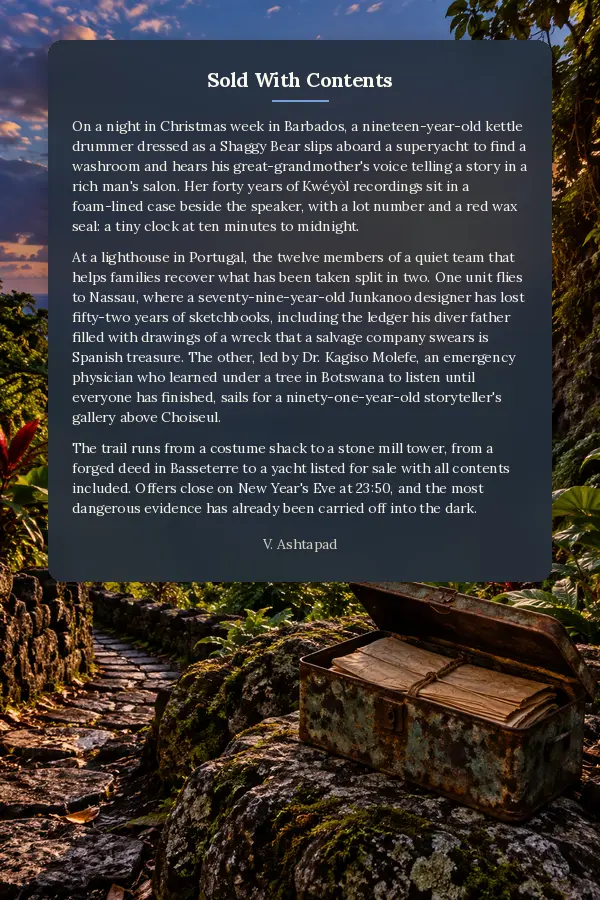
On a night in Christmas week in Barbados, a nineteen-year-old kettle drummer dressed as a Shaggy Bear slips aboard a superyacht to find a washroom and hears his great-grandmother's voice telling a story in a rich man's salon. Her forty years of Kwéyòl recordings sit in a foam-lined case beside the speaker, with a lot number and a red wax seal: a tiny clock at ten minutes to midnight.
At a lighthouse in Portugal, the twelve members of a quiet team that helps families recover what has been taken split in two. One unit flies to Nassau, where a seventy-nine-year-old Junkanoo designer has lost fifty-two years of sketchbooks, including the ledger his diver father filled with drawings of a wreck that a salvage company swears is Spanish treasure. The other, led by Dr. Kagiso Molefe, an emergency physician who learned under a tree in Botswana to listen until everyone has finished, sails for a ninety-one-year-old storyteller's gallery above Choiseul.
The trail runs from a costume shack to a stone mill tower, from a forged deed in Basseterre to a yacht listed for sale with all contents included. Offers close on New Year's Eve at 23:50, and the most dangerous evidence has already been carried off into the dark.
Members can react to this book and talk about it in the members' Library.
Ownership
© 2026 CRUNOD LLC. All rights reserved.
This book is owned by CRUNOD LLC. It is free to read on EternalCurrent.Online. No part of it may be copied, reprinted, sold, recorded or adapted, including as audio, film or translation, without written permission from CRUNOD LLC.
© 2026 CRUNOD LLC. All rights reserved.