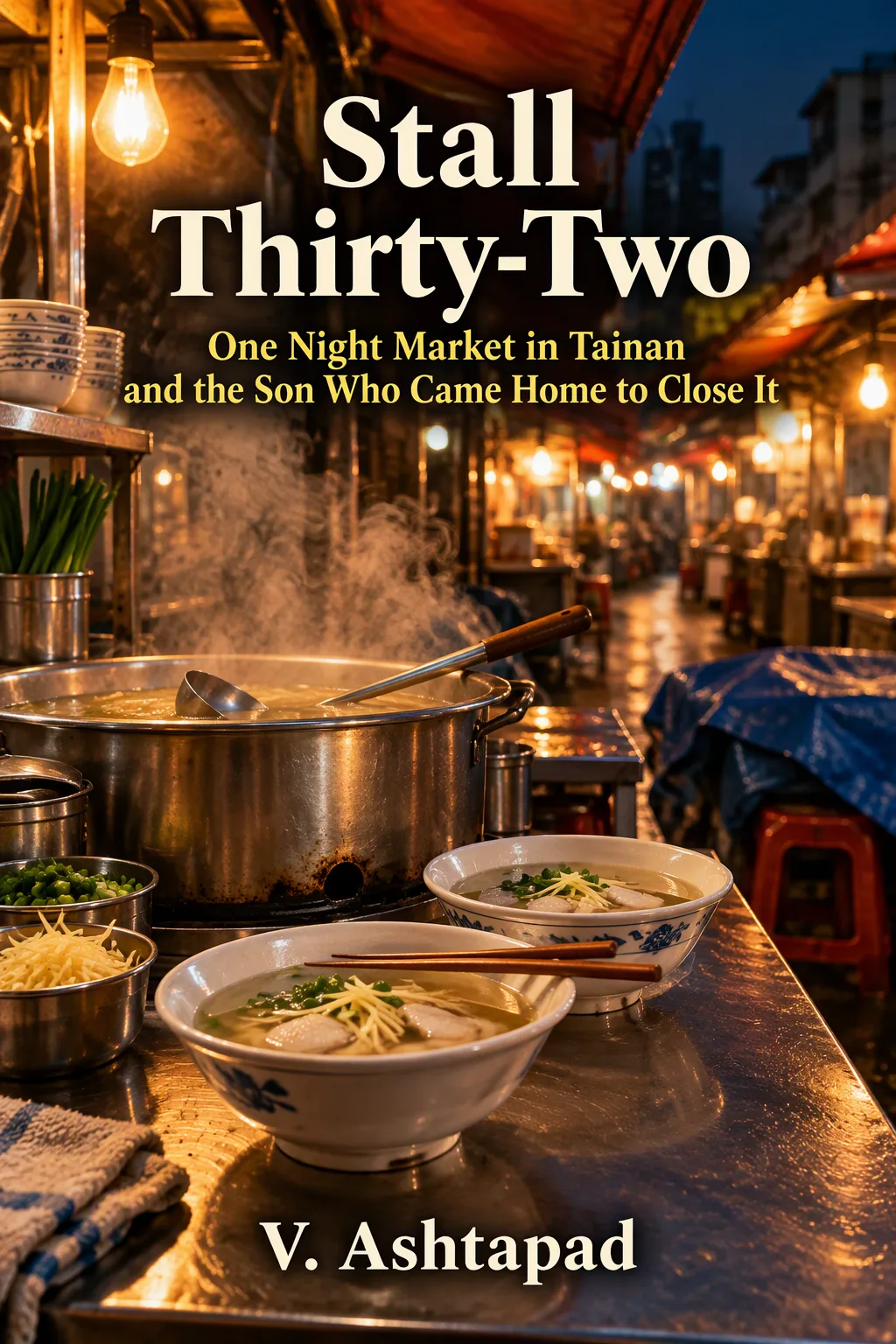
Stall Thirty-Two
One Night Market in Tainan and the Son Who Came Home to Close It
by V. Ashtapad
Foreword
This is a work of fiction. Tainan's night markets are real, and so are its milkfish soup, oyster omelets and mangoes from the hills. The Lotus Pond Night Market and every stall-keeper in it are invented.
For everyone still standing at closing time.
Stall 31: Mrs. Hsu, Oyster Omelets
I saw him before anybody, because I always see everybody before anybody. I have been frying oyster omelets at stall thirty-one of the Lotus Pond Night Market in Tainan for thirty-four years, and the griddle faces the main lane, and nobody walks into this market without walking past my egg.
He came at five thirty on a Thursday, before the lights. Before the crowds. When the market is still a parking lot with a hundred and eighty stalls half put up on it, and the generators are coughing, and the trucks are backing in with their beeping, and everybody is shouting at everybody about extension cords. He came down the main lane from the road end with a rolling suitcase and a backpack and white earbuds and the face that all of them have now, the ones who come back from America. Like a man walking into a house where he used to live and finding the furniture moved.
I knew who he was before he got to me. He had his father's walk. A little forward. Like he was leaning into wind.
"Wei-chen," I said.
He stopped. He took out an earbud.
"Auntie Hsu," he said. In Mandarin. His Taiwanese was gone. I could hear it. You can always hear when it's gone.
"You're thin," I said. In Taiwanese. "Sit. Eat."
He looked at stall thirty-two next to me, which had a blue tarp over it tied down with bungee cords, and a padlock on the steel cabinet, and his father's sign folded flat against the pole: LIN'S MILKFISH SOUP · SINCE 1987. He looked at it for a long time.
Then he sat on my plastic stool and I made him an oyster omelet.
---
It is not complicated, an oyster omelet. That is the secret. Everybody thinks it is complicated because they cannot make it at home, but that is only because they do not have my griddle, which is a flat iron plate the size of a bed, black as a crow, seasoned with thirty-four years of lard.
You put down a little lard. You put down the oysters, the small ones, from Anping, fat and gray and smelling of the harbor, a handful. You let them hiss. Then you pour over them a ladle of batter, sweet potato starch and water, thin as milk, which goes cloudy on the hot iron and then clear, like glass, around the oysters. Then you crack two eggs on top and break them with the edge of your spatula and let them run. Then a fistful of chopped greens, little Shanghai bok choy, bright. Then you wait. The edges go crisp and brown and lacy. The middle goes soft and chewy and holds together like a pillow. Then you flip it, in one piece, which is the only hard part, and it takes most people twenty years.
Then the sauce. Mine is red-orange, sweet and sour and thick, with miso and ketchup and something else I don't tell anybody. A big spoonful, poured over the top so it runs down the sides.
I put it in front of him on a paper plate with a pair of wooden chopsticks. He ate it in four minutes. He did not say anything. He ate it the way his father used to eat my omelets on his break, bent over the plate, with his elbows out.
When he was done he said, "Same."
"Of course same. Why would it change?"
I said it like that because everything else had. I could see it in his face. His father gone. The stall under a tarp. His mother in Kaohsiung in an apartment with an elevator. His Taiwanese. When everything changes, a man needs one thing that doesn't, even if it's only an egg.
I have known him since he was four. My first year at thirty-one, his mother used to bring him to the market and sit him on an upturned crate between thirty-one and thirty-two, by my gas tank, where it was warm, because thirty-two was steam and fish and his mother was busy and I was the nearest woman with a free hand. I was thirty-five. My husband was still alive then, and my own son was nine and too old to be held, and I held Wei-chen instead. Half the nights of that first year he fell asleep on a folded tarp at my feet with his mouth open, through generators and shouting and the squid smoke, through everything.
When he was nine he did his homework on this stool. When he was twelve I tried to teach him to flip the omelet. He was very serious about it. He studied my wrist. He asked me questions about the angle, about the heat, about the speed. He tried eleven times, and eleven times the omelet broke in half on the iron, and on the twelfth time he threw down the spatula and said it was a stupid food anyway and walked off down the lane, and his father, at thirty-two, laughed so hard he had to hold on to the pot.
His father did not laugh often. That was one of the times.
My son is in Taipei now. He works for a bank. He calls on Sundays. He has never once asked me how to make an omelet, and I have never once offered, and every year I think, this year I will offer, and every year I don't.
So I made the omelet the same. That was all I could do.
He looked at the blue tarp on stall thirty-two.
"I'm here to close it," he said. "Ba's stall. Ma wants it sold. The permit. The cart. Everything." He put the chopsticks down very carefully side by side on the empty plate. "I have two weeks off. Then I have to go back. To Cupertino. I have a job. Kids. A mortgage." He looked at me. "I'm just here to close it."
I took his plate. I scraped it into the bin.
"Okay," I said.
He looked surprised. I think he expected me to argue.
I didn't argue. I'm not stupid. I'm sixty-nine years old and I have watched this market for thirty-four years and I know one thing for certain, which is that you don't argue with a man who has just come home. You feed him.
The others would argue. I'd let them.
© 2026 CRUNOD LLC. All rights reserved.
Stall 44: Ah-Chuan, Grilled Squid
The boy came by my stall on the third night, which was a Saturday, at eight o'clock, which is the worst possible time to try to talk to me, because at eight o'clock on a Saturday at Lotus Pond there are eleven thousand people in this parking lot and every one of them wants squid.
I didn't recognize him. I'll be honest. I'm seventy-four and my eyes are full of smoke. Mrs. Hsu told me. She came down the lane at seven and leaned over my grill through the smoke and said, *Lin's boy is home. He wants to close thirty-two.* And I said a word I won't repeat. And she said, *Don't argue with him. Feed him.* And I said, *You feed him. I'll argue.*
So at eight o'clock, when he came by, I argued.
---
"Thirty-nine years," I said. I didn't stop grilling. You don't stop grilling at eight on a Saturday. I had twenty-two squid on the grill, whole ones, on bamboo sticks, flattened, the tentacles curling up off the fire like hands, and I was painting them with sauce with a brush the size of a broom, soy and sugar and garlic and five-spice and a little chili, and turning them, and the flames came up every time the sauce dripped and the smoke went up in a column into the lights and the whole lane smelled of it. "Thirty-nine years, your father and I. Side by side. Well. Thirty-two and forty-four aren't side by side. But I could see his pot from here. Every night. Steam coming off it. Thirty-nine years."
"I know, Uncle."
"You don't know. You were a baby." I flipped four squid. "You know what your father did? Every night? At closing? At two in the morning?"
The boy didn't say anything.
"He brought me a bowl," I said. "Of the soup. The milkfish. The last of the pot. Every night. Thirty-nine years. Even when I was angry with him. Even when he was angry with me. Even in 2006, when I said his son was going to America and would never come back, and he didn't speak to me for three months. Every night, two in the morning. A bowl. On my counter. He didn't say anything. He just put it down and walked away." I brushed the squid. "Do you know how many bowls that is?"
The boy was quiet. People were shoving past him in the lane to get to my grill.
"About fourteen thousand," he said.
I looked at him through the smoke.
"Engineer," I said.
"Software."
"Same thing." I handed him a squid on its stick, the best one, the biggest, charred black at the edges and glossy with sauce. "Eat. You're thin."
"Mrs. Hsu said that too."
"Mrs. Hsu is right about one thing a year," I said. "This is the one."
---
He ate it standing in the lane in the smoke, with eleven thousand people shoving past him.
I watched him eat it, between squid, and I thought about 2006.
I said it at closing. Two in the morning. In August. The night before the boy flew. His father had come down the lane with the bowl like always and put it on my counter and I had been drinking a little, because it was hot and because my own boy had just told me he was going to work in Shenzhen, and I said it. *Your son's going to America and he'll never come back. They never come back. You'll carry this pot alone till you die.*
I meant it about my own boy. That is the truth. But I said it about his.
Lin looked at me. He didn't say anything. He never did. He picked up his empty pot and went home, and the next night he put the bowl on my counter and walked away without looking at me, and the next night, and every night for three months. The bowl. Never one word. You think that's easy, to take a man's soup every night when he won't look at you? It's the hardest thing I ever did. I wanted him to stop bringing it. Then I could have been angry properly.
On the twelfth of November my grill caught fire. A real fire, the fat in the tray, a column of flame up to the lights, and people screaming, and I had a burn on my arm the size of a hand. And Lin came out from behind his pot, sixty-something years old, and put it out with a wet sack from under his counter, and then took me by the other arm and sat me on his stool and put my burned arm in his bucket of cold fish water. It stank. I sat there with my arm in his fish water for twenty minutes.
He said, *Your squid is burning.*
I said, *Then go and turn it, you stubborn turtle.*
He went and turned it. Badly. He didn't know anything about squid. And that was that. Speaking.
I still have the scar. The boy doesn't know about it. Nobody under fifty knows about it. He ate it the way you have to eat squid at Lotus Pond, from the top down, tearing it off the stick with your teeth, getting sauce on your chin. When he was done he held the empty stick in his hand and looked at it for a long time.
"Uncle," he said. "Who's going to bring you the soup?"
I didn't answer. I painted the squid.
© 2026 CRUNOD LLC. All rights reserved.
Stall 58: Thu, Vietnamese Sandwiches
I am not from here. Everybody knows. I came to Tainan in 2009 from a village near Cần Thơ, in the Mekong Delta in Vietnam, to marry a man I had met twice. A lot of girls did, then. Taiwanese men who couldn't find wives. Vietnamese girls who couldn't find futures. A broker in Cần Thơ with photographs in a binder. Everybody knows how it goes.
My husband is a good man. That is not true of everybody, so I say it. He fixes scooters. We have two daughters. They are Taiwanese. They speak Mandarin at school and Taiwanese with their grandmother and Vietnamese with me, a little, when they want something.
I sell bánh mì at stall fifty-eight. Since 2015. Baguettes I bake myself, at four in the afternoon, in an oven in the back of my husband's scooter shop, crisp outside and light as air inside, split with a knife and spread with pâté and mayonnaise, and stuffed with grilled pork and pickled carrot and radish and cucumber and cilantro and a slice of hot pepper. The Taiwanese think it is very exotic. It is a sandwich.
When I first came to Lotus Pond, nobody talked to me. I don't blame them. My Mandarin was terrible. My Taiwanese was worse. I was the Vietnamese bride with the strange sandwiches. People bought them and didn't look at me.
Except one man.
---
Mr. Lin. Stall thirty-two. The milkfish soup.
On my first night, in 2015, he came down the lane at two in the morning with a bowl of his soup and put it on my counter, the same as he did for Ah-Chuan, the same as he did for Mrs. Hsu, the same as he did for everybody on this lane who was still there at closing. He didn't say anything. He just put it down.
I didn't know what it was. I'd never had milkfish. In Cần Thơ we have catfish, snakehead, a hundred kinds of river fish. Not milkfish. I looked at it. A clear broth, pale gold, with pieces of white fish in it, soft as cream, and thin slices of ginger, and a scattering of chopped celery, and a little fried shallot floating on top.
I tasted it. And I cried.
Because it was my mother's soup. Not the same fish. Not the same ingredients. But the same soup. Clear and light and full of ginger, the soup you make when somebody is far from home and tired and needs to be told they're going to be all right. My mother made it in the Mekong Delta for my father when he came home from the river at night. Mr. Lin made it in Tainan for whoever was still standing at two in the morning.
The next night, I made him a bánh mì. I put it on his counter at closing. I didn't say anything.
He ate it. He came back the next night and said, in Taiwanese, very slowly, so I would understand, "More pepper."
That was eleven years ago. Every night for eleven years, at two in the morning, a bowl of soup on my counter and a bánh mì on his. With more pepper.
---
I told this to his son on Sunday night, at closing, at two in the morning, when he came down the lane alone after the crowds had gone, with his hands in his pockets, looking at the stalls being packed up.
I told him in Mandarin, because his Taiwanese is gone, and he has no Vietnamese.
I did not tell him about my cousin. Not that night. Lan had come off the bus from Anping that afternoon with one bag and her factory badge still on a string around her neck, and was asleep on the floor of my daughters' room with her shoes on, because the factory had closed and the agent had stopped answering his telephone. That was my trouble, not his. Everybody on this lane has a trouble at two in the morning. That is what the bowls were for. I told him the whole thing. The broker. The binder. The first night. The soup. The pepper.
When I was done, he didn't say anything for a long time. We were standing in the lane. Around us the market was coming down, the way it does every night: the lights going off one row at a time, the generators coughing and stopping, the tarps going over the carts, the trucks backing in, the cleaners with their brooms, the smell of the night going cold.
Then he said, "I didn't know any of this."
"No," I said. "You were in America."
He looked at stall thirty-two, under its blue tarp.
"I can't make the soup," he said. "I don't know how. I never learned. Ba tried to teach me when I was fourteen. I said I didn't want to smell like fish."
I didn't say anything. I wrapped a bánh mì in paper and put it in his hand.
"More pepper," I said.
© 2026 CRUNOD LLC. All rights reserved.
Stall 40: Mrs. Ng, Coffin Bread
Stall forty is on the corner, where the main lane meets the second lane, and from my counter I can see in three directions, which is why my husband says I never sell anything. He says I am too busy looking.
He is right. I am seventy-six years old. What else is there to do but look?
We have sold coffin bread at Lotus Pond since 1990. My husband fries and I fill. That is how it has always been. He takes a slice of white bread as thick as a brick, a whole hand thick, and fries it in oil until it is gold all over and crisp as a roof tile. Then I take my little knife and cut a lid in the top, three sides, and lift it like a door, and scoop out the soft middle with a spoon. And into the hole I put the filling. Chicken and shrimp and squid in small pieces, and carrot and peas and corn, in a white sauce made with milk and butter and flour, thick and hot and smelling of pepper. Then I close the lid. That is all. It is called coffin bread because it looks like a coffin. The young people think this is very funny. They take photographs of it and laugh. Then they eat it, and stop laughing, because it is good.
My husband is deaf in one ear and pretends to be deaf in the other. We have been married for fifty-three years. We argue every night from five until two. The customers think we hate each other. They are wrong. If we stopped arguing, one of us would be dead.
---
The Lin boy came on Monday, the fifth night, at nine o'clock, with a man from Kaohsiung.
I did not like the man from Kaohsiung. I knew what he was before he opened his mouth. A man in a pressed shirt at a night market, with a leather folder under his arm and shoes that have never stood in fish water. He stood in front of stall thirty-two with the boy, and the boy took the blue tarp off the cart, and the man walked around it twice and knocked on the steel with his knuckle, the way you knock on a melon.
"He's buying it," I said to my husband.
"What?"
"He's buying it. The cart. Lin's cart."
"Who's buying a cat?"
I hit him with the spoon.
The man from Kaohsiung opened the steel cabinet and looked inside, at the pots, and wrote something in his folder. He looked at the burner and wrote something. He looked at the sign folded on the pole, LIN'S MILKFISH SOUP · SINCE 1987, and did not write anything, because the sign was not for sale, the sign was only an old sign. Then he said a number to the boy. I could not hear it. I saw the boy's face. It was a good number.
The boy said he would think about it.
The man from Kaohsiung shook his hand and walked away down the main lane toward the road end, past Ah-Chuan's smoke, holding his folder over his nose.
---
The boy stood there for a long time with the tarp in his hand. Then he looked up and saw me looking at him, from my corner, and I did not look away. I am too old to look away.
"Auntie Ng," he said.
"Sit," I said. "Eat. You're thin."
He laughed. It was a tired laugh. "Everybody on this lane says that."
"Everybody on this lane is right."
He sat on the stool at the end of my counter, the red one, and I made him a coffin bread, chicken, extra pepper, and my husband fried it without arguing, which tells you something. The boy ate it with a plastic fork, slowly. He was polite about the lid. He ate the lid last, the way children do, the way his father did.
"Auntie," he said, when it was finished. "Were you here? The last night?"
I was.
---
I will tell it the way I told him.
It was a Thursday, in the spring, in the first week of the plum rains, when everything in the market smells of wet tarpaulin. Your father was slow that night. He had been slow for a year. His knees. Ah-Chuan carried the big pot for him from the truck at four o'clock, the way he had been doing since the winter before, and set it on the burner, and your father stood behind it on a crate so he would not have to bend, and made the soup, and sold it, and said nothing to anybody, the way he always did.
At one o'clock he sat down. He never sat down. In thirty-six years of looking at him from this corner I had never seen him sit down before closing. He sat on his stool behind the pot with his hands on his knees and looked at the lane.
At two o'clock the lights started going off. The far end first, the way they do. And he got up off the stool, slowly, and filled the bowls.
He filled eleven that night. I counted. Mrs. Hsu, Ah-Chuan, the Vietnamese girl at fifty-eight, the young couple at the tea, the fried chicken family at fifty, the man with the knives, the two sisters with the fruit, us. Others. And Mr. Tsai at the road end, last, always last, on the hood of his car.
He carried them one at a time. He always did. He would not use a tray. He said a tray makes it a delivery.
He got to the tenth bowl, which was ours, and he came around the corner with it to my counter, and he put it down, and then he did not walk away. He sat down. Here. On the red stool. Where you are sitting.
I said, *Old Lin, what's wrong with you?*
He said, *My legs are finished.*
I said, *Then go home.*
He said, *One more.* And he looked up the main lane toward the road end, toward Mr. Tsai's car, under the last light, which is a long way when your legs are finished.
So I carried it for him. The last one. I took it from his pot and carried it up the lane in both hands and put it on the hood of Mr. Tsai's car, and Mr. Tsai looked at me in his yellow vest, very surprised, and I said, *From Lin. His legs are finished.* And when I came back, your father was still sitting on my red stool, and he had his telephone out, the old one, the one with the cracked screen, and he was looking at a photograph.
He showed it to me. A little girl in a yellow dress, in a garden with a lemon tree, holding up a lemon as big as her face.
*Mei*, he said. *My son's girl. In California.* And then he said the only thing I ever heard him say about you in thirty-six years, and I will tell you what it was, because you asked.
He said, *She has my mother's eyes and my son's stubbornness. Heaven help the Americans.*
Then he put the phone in his pocket and went home. The next night the tarp was on.
---
The boy did not say anything when I had finished. He sat on the red stool with the empty paper boat in his hands and looked at the main lane, up toward the road end, where Mr. Tsai was standing by his car in the yellow vest, with his radio, very small, under the lights.
"The man from Kaohsiung," I said. "How much?"
He told me.
My husband, who is deaf in one ear and pretends to be deaf in the other, put down his frying basket.
"For Lin's cart?" he said. "That's a good number."
"I know," said the boy.
"You should take it," said my husband.
I opened my mouth to hit him with the spoon again. But my husband looked at me, and I closed it, because he was not finished.
"You should take it," he said to the boy, "if you don't want to be the one who carries the bowls." He picked up his basket. "That's what the money is for. So you don't have to carry anything." He put the bread in the oil, and it hissed. "Fifty-three years I've been frying for this woman. Do you know what I'd take, to stop?"
"What?"
"Nothing," said my husband. "There isn't a number."
And he went back to his frying, and I stood there with my spoon in my hand, an old woman of seventy-six, in a market, and could not say one word, which has not happened to me since 1973.
© 2026 CRUNOD LLC. All rights reserved.
Stall 9: Jia-hui and Ming, Brown-Sugar Milk Tea
We're the young ones. Jia-hui is twenty-seven and I'm twenty-nine and we got married last year and opened the tea stall two years before that, with money from her parents and a loan and a lot of very bad ideas.
We know the Lin family because everyone knows the Lin family. But we only knew Uncle Lin for two years. He was already old when we came. Seventy-eight. He made his soup and brought everybody bowls at two in the morning and didn't talk much. He thought our tea was ridiculous. He said so. He said, *Brown sugar and tapioca balls and milk in a plastic cup with a lid sealed by a machine? That is not a drink. That is a dessert wearing a disguise.*
Then he drank one every Thursday.
So when his son came down the lane on Tuesday, the first Tuesday, at nine o'clock, and stood in front of our stall reading the menu on the board, Jia-hui and I looked at each other.
"He's going to close it," Jia-hui whispered. "Mrs. Hsu told everybody."
"I know."
"We have to say something."
"What do we say? We knew his father for two years. Ah-Chuan knew him for thirty-nine."
"So we say something different," said Jia-hui. She is very stubborn. That's why I married her.
---
She made him a brown-sugar milk tea. The way his father liked it, which was with half sugar, which nobody orders, and extra tapioca, which everybody orders. She made the tapioca herself that afternoon, as she does every afternoon, little balls of cassava starch cooked for an hour and then soaked in hot brown-sugar syrup until they go dark and glossy and chewy and sweet as caramel. She spooned them into the bottom of the cup. She poured the brown sugar syrup down the inside of the cup in a spiral so it streaked the sides like tiger stripes. She poured in fresh milk, cold. She sealed it in the machine. She put in the fat straw.
She gave it to him and didn't take his money.
"Your father's," she said.
He looked at it. Tiger stripes. He drank. He made a face.
"Too sweet," he said.
"Half sugar," said Jia-hui. "Your father said the same thing every Thursday. *Too sweet.* Then he drank it all."
The son looked at her over the straw. Then he drank it all.
---
Then Jia-hui did what she had decided to do, which was to show him our phone.
Not ours. The market's. We're the ones who set it up, the page for Lotus Pond, two years ago, on a family network her cousin uses. Not a business page. A page for the stallholders. For the families. Because half of them are seventy and their children are in Taipei or Shanghai or Vancouver or California, and they never see what their parents do every night. So we put it up. Every stall. Every family. Who started it. When. What they sell. A photo of the old ones at their carts. A recording, if they'd let us. A map of the market with a pin on every stall, and lines going out from every pin to wherever the children are now.
Uncle Lin wouldn't let us record him. He said nobody wants to hear an old man talk about fish.
But he let us take a photo. One. At two in the morning, at closing, with a bowl of soup in his hands, walking down the lane to somebody's counter.
Jia-hui showed it to his son on her phone.
He looked at it for a long time. His father, in the lane, at night, in his white apron and his rubber boots, with the lights of the market going off behind him one row at a time, carrying a bowl of soup to somebody, steam coming up from it into the dark.
Under it, in the comments, there were a hundred and sixty-one messages. Jia-hui scrolled down slowly so he could see. From stallholders. From customers. From people who had moved away from Tainan twenty years ago and still remembered. From Thu, in Vietnamese and in Mandarin. From Ah-Chuan, one word: *Brother.*
The son didn't say anything. He handed back the phone. He went and stood in front of stall thirty-two for a while with his empty cup in his hand.
"That was a good idea," I said to Jia-hui.
"I know," she said. "I'm very good."
© 2026 CRUNOD LLC. All rights reserved.
Stall 50: Pei-pei, Salt-and-Pepper Chicken
My parents fry chicken at stall fifty and I do my homework in the back on an upturned crate under a clip light, between the freezer and the gas tank, which my mother says is dangerous and my father says is character.
I'm sixteen. I'm in my second year at the girls' high school. I want to study chemical engineering at a university in America and then work for a company that makes batteries, because batteries are the future and nobody in Taiwan believes me except my physics teacher. I have a list of eleven universities on the wall beside my bed. The first one is the one Lin Wei-chen went to.
Everybody on this lane knows about Lin Wei-chen. He is the boy from stall thirty-two who went to America. When I was small, every time I got a good mark, somebody's grandmother would say, *maybe you'll be like Lin's boy*. When I was older, every time somebody's son moved to Shanghai, somebody else's grandmother would say, *like Lin's boy, gone*. So I've been hearing his name my whole life, both ways. Good and bad. A boy and a warning.
I had never seen him.
When Mrs. Hsu told the lane he was back, I went to look. Thursday, Saturday, Sunday. I looked at him from the back of our stall, through the gap between the freezer and the wall. He looked very normal. Tall. Thin. Glasses. A gray shirt that was too nice for the market. He pushed his glasses up his nose with his middle finger, which is rude, but I don't think he knew.
On Wednesday night, the seventh night, I stopped looking. I went to ask.
---
I brought chicken. You have to bring something on this lane or people think you're selling insurance.
Our chicken is good. I'm not saying that because it's my parents'. It's the best salt-and-pepper chicken at Lotus Pond and there are four other stalls that sell it. My father marinates the thigh pieces all afternoon in soy and rice wine and garlic and white pepper and a spice he grinds himself, and then my mother dusts them in sweet potato starch, the coarse kind, so it goes on in little white lumps like gravel, and puts them in the oil.
No. She lowers them. My mother would say lowers. She says you never throw chicken in oil, you introduce it.
They fry until they're golden, then they come out and rest, then they go back in for a few seconds, very hot, to make the crust shatter. Then she throws in a handful of fresh basil leaves, which spit and crackle and go dark green and glassy in one second, and scoops it all out together into a paper bag, and shakes salt and pepper and chili powder over it, and shakes the bag. That's it. You eat it with a bamboo stick, out of the bag, walking.
I took a bag down the lane to stall thirty-two. He was standing behind the cart, under the tarp, which he had only half taken off, writing something on his phone.
"From stall fifty," I said. "My parents say welcome home."
My parents didn't say that. My parents didn't know I'd gone.
He looked at the bag. He took it. He ate a piece with the stick and closed his eyes for a second.
"Basil," he said. "I forgot about the basil."
"How can you forget basil?"
"There's a lot you forget," he said. "In America it's the first thing to go."
---
I asked him. I'd practiced it in the back of the stall for three nights, in English and in Mandarin. I asked him what it was like at the university, and whether it was hard, and whether people were kind, and whether they believed you when you said you wanted to make batteries.
He answered all of it. He was very patient. He answered like a teacher, carefully, in order. Hard, yes. The first year he didn't sleep. People were kind, mostly. Some weren't. He told me which classes to take in my last year of high school and which tests to study for and how to write the essay, and I wrote it all down on my phone, fast, with my thumbs.
Then I asked the last question. The real one. The one I'd been practicing longest.
"Is it good?" I said. "Over there. Is it good, your life?"
"Yes," he said. "It's good."
He said it right away. He didn't have to think. It came out of him like the answer to a question you've been asked a thousand times at a thousand dinners, by people who didn't really want to know.
I looked at him.
"Then why do you look like that?" I said.
He didn't answer. He looked at the cart. At his father's sign, folded flat against the pole. At the steel cabinet with the padlock on it.
"My grandmother says the ones who leave never come back," I said. "She says it like a curse." I picked at the edge of the chicken bag. "But you came back."
"To close it," he said. "I came back to close it."
I didn't know what to say to that. So I said what I was thinking, which my mother says is my great talent and my great problem.
"Then that's worse," I said. "Coming back to close it is worse than not coming back at all."
---
He laughed. Not a nice laugh, at first. A surprised one. Like I'd thrown water on him. Then it changed, and he laughed properly, and put his hand over his eyes.
"You sound like my sister," he said.
"Is she smart?"
"Much smarter than me."
"Then I'll take it."
He took his hand away. He looked at me. He has a way of looking at you as if you're a problem he's trying to work out, not in a bad way. In the way my physics teacher looks at a question nobody can answer.
"Pei-pei," he said. I'd told him my name. "Go to America. Go to Berkeley if they take you. Make batteries." He pushed his glasses up. "And learn your father's chicken first. Learn the spice he grinds. Learn when your mother puts in the basil. Write it down. Before you go."
"Why?"
"Because you'll forget," he said, "and then one day you'll be thirty-eight in a kitchen in California with a little girl who wants to know where she's from, and you'll open your mouth to tell her, and there'll be nothing there." He looked at his father's cart. "Just a smell. Basil. And you won't know what to do with it."
---
When I went back up the lane, my mother was standing in front of our stall with her arms folded.
"Where were you?"
"At thirty-two."
"With Lin's boy?" My mother's face did several things at once. "What did you want with Lin's boy?"
I didn't answer. I went into the back of the stall, past the freezer and the gas tank, and sat down on my crate under the clip light, and opened my physics book. Then I closed it.
"Ba," I said. "What's in the spice? The one you grind?"
My father turned around from the oil with the scoop in his hand and looked at me as if I'd asked him to take off his clothes.
"Why?"
"I want to write it down."
My father looked at my mother. My mother looked at my father. Then my father turned back to the oil, and said, very gruffly, with his back to me, "Star anise. White pepper. Licorice root. A little cinnamon. A little clove. Sand ginger, dried. And something else."
"What else?"
"Ask me again," said my father, "when you've been accepted."
© 2026 CRUNOD LLC. All rights reserved.
Stall 32: Mr. Lin's Notebook
His father's notebook was in the steel cabinet at stall thirty-two, under the padlock, under the pots, in a plastic bag from a pharmacy, and Wei-chen found it on the eighth night because Ah-Chuan told him where to look.
"Bottom shelf," said Ah-Chuan, at the grill, through the smoke. "Under the big pot. In a pharmacy bag. He kept it there so nobody would steal it. Nobody steals anything from under a pot of fish."
Wei-chen opened the padlock with the key his mother had given him in Kaohsiung, where she lived now with his sister, in a high-rise apartment with a view of the harbor and an elevator, and said she was happy, and was not.
He unwrapped the pharmacy bag.
It was a school notebook. The cheap kind, with a cardboard cover gone soft and a picture on the front of a cartoon cat with a balloon, from 1987, the year the stall opened. The pages were brown at the edges and stiff with grease and stained with fish broth in round gold rings where the bowl had been put down on it. And it was full. Every page. In his father's handwriting, small and neat and square, in pencil.
Recipes. No. Not recipes. His father had never in his life used a recipe. These were notes.
*1987. 3 August. First night. 40 bowls. Fish from An-ping too big. Ask Chen for smaller.*
*1988. Milkfish best in summer. Winter, use the belly only. Winter fish is sad.*
*1991. Ginger: young ginger, not old. Old ginger fights the fish.*
*1988. 14 March. Wei-chen born. Closed 3 nights. First time.*
*2006. Wei-chen to America. University. Ah-Chuan said he will never come back. Not speaking to Ah-Chuan.*
*2006. 12 November. Speaking to Ah-Chuan.*
*2004. Broth: bones in cold water, never hot. Bring up slow. Skim, skim, skim. If you rush, it goes cloudy. Cloudy soup is a lie.*
*2015. New girl at 58. Vietnamese. Sandwich. More pepper.*
*2019. Wei-chen's daughter born. Mei. In California. Photo on phone. Looks like his mother.*
*2023. Knees bad. Ah-Chuan carries the pot now. Don't tell Mei-ling.*
*2024. Young couple at 9. Tea is a dessert in disguise. Drinking it Thursdays anyway.*
*1992. Hsu at 31. Omelets. Talks too much. Good woman.*
*2001. Hsu's husband died. Closed 31 and 32 both that night. Sat with her.*
*2010. Old Kuei at 17 died. Bowl goes to his boy now. Same bowl.*
*2020. Market shut. The sickness. 9 weeks. Made the soup at home anyway. Mei-ling drove me. Every door on the lane, Hsu, Ah-Chuan, Ng, Kuei's boy, Tsai. Left it on the step.*
*2023. Back lane too far now. Kuei's boy. Can't. Ashamed.*
And on the last page, in pencil gone shaky, the last entry. Dated two months before he died.
*If W comes back: the soup is easy. Bones cold. Ginger young. Skim. Don't rush. The hard part is the bowls. At closing. Everybody gets one. Even if you're angry.*
---
Wei-chen sat on the plastic stool behind stall thirty-two with the notebook open on his knees under the market lights at eleven at night on a Thursday, with eleven thousand people going past him in the lane and the generators roaring and Mrs. Hsu frying oyster omelets on one side of him and the smoke from Ah-Chuan's squid coming down the lane on the other, and he did not move for a long time.
Mrs. Hsu saw him. She always sees everybody. She didn't come over. She just put an oyster omelet on a paper plate on the edge of the counter between thirty-one and thirty-two, where he could reach it, and went back to her griddle.
© 2026 CRUNOD LLC. All rights reserved.
Stall 9: Jia-hui, Closing Time
Ming says I'm too pushy. He says it the way other men say their wives are beautiful, so I don't mind.
At midnight on the Thursday, the eighth night, the son came up the lane to our stall with an old school notebook under his arm and Mrs. Hsu's paper plate in his other hand, empty, and stood in front of the menu board, and said, "Half sugar. Extra tapioca."
I looked at Ming. Ming looked at me.
It was Thursday. His father drank one every Thursday.
I made it the way I'd made it for him on Tuesday. The tapioca from the bottom of the afternoon's pot, still warm, soft all the way through, dark as tea. The syrup in a spiral down the inside of the cup. Fresh milk. The machine. The fat straw. I put it on the counter and he paid this time, and I let him, because the first one is a gift and the second one is a customer.
He drank half of it standing there. He didn't say *too sweet*.
Then he put the notebook on our counter.
---
"I found it," he said. "In the cabinet. Ah-Chuan told me where."
I didn't touch it. I knew what it was without being told, the way you know a photograph of somebody's grandmother is a photograph of somebody's grandmother. The cardboard cover gone soft. The cartoon cat. The round gold stains where a hot bowl had been set down, again and again, over thirty-nine years.
"Can I?" I said.
He nodded.
I opened it under our light. We have the best light on the lane, because Ming wired it himself, two long white tubes over the counter so the tea looks good in photographs. Under it the pencil came up silver on the brown pages. Small square handwriting. Dates. Numbers. *Winter fish is sad.* I turned the pages very slowly, with the tips of my fingers, at the corners, the way the woman at the archive in Taipei showed us when we did the page for the market, when we photographed the old ones' papers.
I came to the page with us on it. *Young couple at 9. Tea is a dessert in disguise. Drinking it Thursdays anyway.*
I'm not a crier. Ming is the crier. Ming cries at commercials for rice cookers. But I had to stop turning pages for a minute and look at the menu board.
"He never told us," said Ming, behind me, very quietly. "Two years. He never told us he wrote us down."
"He never told anybody anything," said the son. "That was the whole point of him."
---
Then I did the pushy thing.
"Let us photograph it," I said. "Every page. Tonight. For the market page. Not public. Just for the families. In case."
"In case of what?"
"In case of anything," I said. "Fire. Rain. Somebody's grandchild knocking over a pot. The cabinet getting sold with the cart." I watched his face when I said the last one, and I saw it land. "Paper is just paper. Your father's handwriting is in one place in the world right now, and it's a pharmacy bag under a fish pot."
He looked at the notebook for a long time. I thought he was going to say no. People do. People feel as if photographing a thing is taking it.
"Okay," he said. "But I want a copy. For Mei."
"Everybody gets a copy," I said. "That's the point."
---
It took two hours. Ming closed the stall early, which we have never done on a Thursday, and pulled the shutter halfway down, and we laid the notebook on the counter under the two white tubes on a clean dishcloth, and I photographed every page with my phone, straight down, with Ming holding a piece of white card behind it to stop the shadow, and the son turning the pages.
He turned them himself. He wouldn't let us. He turned them one at a time, slowly, and every time he turned one he read it first, to himself, with his lips moving, before he let me take the picture. Sometimes he laughed. Once he said, "Ha," and pointed, and it was an entry from 1996 that said *Hsu says my soup needs salt. Hsu's omelet needs humility.* Once he didn't say anything for a whole page, and didn't turn it, and I didn't hurry him, and Ming went and made three teas nobody had ordered and put one at his elbow.
Ninety-one pages. The last one was the shaky one.
He held it flat for me under the light. I photographed it. Then he didn't take his hand away.
"Will you record something?" I said. "Your voice. Reading that one."
"Why?"
"Because your father wouldn't let us record him," I said. "He told us nobody wanted to listen to an old man talking about fish." I held up the phone. "So read it in your voice. Then it's in a voice."
---
He read it. In Mandarin first, the way his father had written it, slowly, under our lights, with the shutter half down and the lane going quiet outside and the generators coughing to a stop one by one down the row.
*If W comes back: the soup is easy. Bones cold. Ginger young. Skim. Don't rush. The hard part is the bowls. At closing. Everybody gets one. Even if you're angry.*
Then, without my asking, he read it again. In Taiwanese.
It was terrible. I don't mean the reading. I mean his Taiwanese. It was broken and slow and full of the wrong tones, like a little boy's, and he stopped twice in the middle to find a word, and once he got the word wrong and went back and tried again. But he read it all the way to the end. *Even if you're angry.*
When he finished, Ming was crying. I told you. Ming is the crier.
I stopped the recording. I didn't put it up that night. I asked him first. He said put it up. He said put it under the photograph. The one of his father in the lane with the bowl.
---
At two in the morning, when he'd gone, with the notebook back in its pharmacy bag under his arm, I put it up. The photographs of all ninety-one pages, in order, in a folder with his father's name. And under the photograph of the old man in the lane with the bowl, the recording. Forty seconds. Mandarin, then Taiwanese.
By the time Ming and I had locked the cart and loaded the truck, there were nineteen replies. Mrs. Hsu. Thu. Teacher Kao, who doesn't sleep. The man at the knife stall. Someone in Vancouver.
And one from Kaohsiung, from an account I'd never seen before, set up that night, with no photograph and no name, only a single line in Taiwanese, which Ming had to read for me because I'm not as good as I should be.
*Your tones are wrong. Read it again. Slower.*
"Who's that?" I said.
Ming looked at it for a long time.
"His mother," he said. "I think it's his mother."
© 2026 CRUNOD LLC. All rights reserved.
Stall 71: Teacher Kao, Shaved Ice
I'm a schoolteacher, retired. I sell shaved ice at Lotus Pond on weekends because my wife died and I don't like being in the apartment at night. I've only been here six years. Everybody else has been here thirty. I'm the new boy.
I had Lin Wei-chen in my class in 2004. Tenth grade. Physics. He was the best student I ever taught. Not the cleverest. There were cleverer. The best. He was the only one who, when he got an answer wrong, wanted to know why more than he wanted to know the right one. He used to stay after class and stand at my desk with his exercise book and say, *Teacher, where did I go off the road?* and we would find it together, the exact line where he went off the road, and he would look at it for a long time, as if he were memorizing the place. I wrote him a letter of recommendation for an American university and he got in and he went and I never saw him again until Friday night, the ninth night, when he came down the lane to my stall and ordered a mango ice and didn't recognize me at all.
I recognized him. He still pushes his glasses up his nose with his middle finger.
---
I made him the mango ice. It is the only thing I make, but I make it well. A block of milk ice from my freezer, frozen milk and condensed milk and a little sugar, set in the shaving machine and spun against the blade so it comes out in ribbons, soft and fine, like snow made of cream, piling up in the bowl in a mountain. Then the mango. Aiwen mango from Yujing, in the hills above Tainan, the best in Taiwan, dark red outside and deep orange inside, so sweet and so ripe in summer it tastes like perfume. Cut in cubes, a whole one, heaped on the snow. Then a scoop of mango sorbet on top. Then condensed milk drizzled over everything.
My wife made this. Not here. At home, in our kitchen, every summer, on a hand-cranked machine her mother gave us when we married, an iron thing painted green that clamped to the edge of the table and screamed when you turned it. She made it for me every Sunday in mango season for forty-one years. I never once made it for her. I didn't know how. I didn't think I needed to.
When she died I found the green machine in the cupboard under the sink, and I sat on the kitchen floor with it in my lap for most of an afternoon. Then I went out and bought this one, the electric one, which does not scream, and a freezer, and the permit for stall seventy-one, and I have been making mango ice every weekend for six years for strangers, which is, my daughter says, a very expensive way to apologize to someone who cannot hear you.
My daughter is a doctor in Taichung. She is usually right.
He ate it at the little table by my stall with a plastic spoon. Halfway through he looked up.
"Teacher Kao," he said.
"Lin Wei-chen. You still push your glasses up with your middle finger."
He laughed. Then he stopped laughing.
"You wrote my letter," he said. "For Berkeley."
"I did."
"I never thanked you."
"No," I said. "You didn't. Students don't. That's all right." I sat down across from him. "Did it work?"
He thought about it. The way he used to think about a physics problem. Slowly. Honestly.
"I build software," he said. "For a company that makes phones. I'm good at it. I make a lot of money. I have a house in Cupertino with a yard and a lemon tree. My wife is a doctor. My kids go to a good school. They don't speak Taiwanese. Mei is seven. She calls her grandmother on video and doesn't understand a word."
"That's not what I asked."
"I know." He put down the spoon. "I don't know if it worked. That's the answer. I don't know."
---
I told him something then that I have never told any of my students. I told him that I didn't write his letter so he would go to America. I wrote it so he would have the choice. That's what education is for. Not to send you away. To give you the choice of where to stand.
"You chose America," I said. "That was a good choice. You can choose again."
"Choose what? I can't run a soup stall. I have a job. A mortgage. Kids in school. In California."
"I didn't say run it," I said. "I said choose." I got up. "Your father ran it seven nights a week for thirty-seven years. That's one choice. Closing it forever is another choice. Those aren't the only two numbers on the line." I pushed my glasses up my nose with my middle finger, which I have done my whole life, which I suspect is where he got it. "You were a physics student. There's always something between zero and one."
© 2026 CRUNOD LLC. All rights reserved.
Stall 32: The First Pot
On the tenth night, a Saturday, Wei-chen Lin took the blue tarp off stall thirty-two at four in the afternoon and lit the burner under his father's big pot for the first time in his life.
He did not tell anyone he was going to do it. Everyone knew anyway, by four fifteen, because Mrs. Hsu saw.
---
That morning, at a quarter to five, in the dark, in his father's apartment in the old part of the city, where he had been sleeping on the couch among the boxes his mother had not yet sent for, he called his wife.
It was Friday afternoon in Cupertino. She was in the car, in the parking lot of the clinic, between patients. He could hear the turn signal of somebody else's car, and a leaf blower, and the radio turned down low.
"You sound strange," said Anna. "Are you sick?"
"I'm going to make it," he said. "The soup. Tonight. From the notebook."
There was a silence on the line. He could hear her thinking. She thought the way she did everything, quickly and all the way to the end.
"Okay," she said. "What do you need?"
He had not expected that. He had expected, he realized, sitting on his father's couch in the dark with the rubber boots on the floor in front of him, to have to explain. To argue. He had been preparing the argument for two days.
"I don't know yet," he said. "Fish. I need to buy fish."
"Then buy fish," said Anna. "Wei. Listen to me. I watched you at the funeral. You stood at the back the whole time like a man waiting for a bus. You didn't cry once. You didn't say one word to anybody." She was quiet. "This is the first time in four months you've sounded like you're in the room."
He did not say anything.
"Buy the fish," said his wife. "Call me after. Tell Mei. She asked me yesterday if Grandpa's soup died with Grandpa."
---
The fish market at Anping was a long low shed by the harbor with a concrete floor running with water and the lights so bright they hurt, full of men in rubber boots and women in rubber aprons and the smell of the sea turned inside out. Ice everywhere. Shovels of it. Crushed ice in heaps on the steel tables, and fish laid out on it in rows, silver and gray and pink, with their eyes clear and their mouths open, as if they had all been surprised by the same thing.
Chen was at the far end, where he had always been. Wei-chen knew it before he saw him. He remembered it the way he remembered the ginger, with his body, not his head: being six, being carried on his father's shoulders down this aisle at five in the morning, with the cold coming up off the ice and the men shouting prices, to the last table on the left.
Chen was old now. Bald, with a gray stubble, in a rubber apron, with a knife in his hand. He was gutting a milkfish with three movements, and he did not look up.
Wei-chen stood in front of his table in his father's boots.
"Milkfish," he said, in Mandarin. "Bones and heads. And belly. For soup."
Chen looked up then. He looked at the boots first. Then at the face.
He looked at the boy for a long time. Then he put down the knife.
"Your father," he said, in Taiwanese, "bought from me for thirty-seven years. Every morning. Six fish. He never once asked the price. Do you know why?"
Wei-chen shook his head.
"Because I never once cheated him," said Chen. "And he knew it. And I knew he knew it." He looked at the boots again. "He came to the market on his last morning. Did you know that? In the spring. He couldn't walk properly. He stood right there and bought six fish, and I carried them to his truck for him, and he said, *Chen, if my boy ever comes, give him the good ones.*" He picked up the knife. "I said, *your boy's in America.* He said, *if.*"
He wrapped six fish in newspaper. The best ones. Wei-chen could tell, even after twenty years. Their eyes were the clearest on the table. Then he wrapped a bag of bones and heads and tails, and a parcel of belly, and put it all in a plastic bag, and said a price.
It was half what it should be. Wei-chen knew it, and Chen knew he knew it.
"Next time," said Chen, "full price. Today, your father pays."
He did it from the notebook. *Bones in cold water, never hot.* Milkfish bones and heads and tails, from Chen's table at Anping, still cold from the ice. *Bring up slow.* He brought it up slow. On a low flame, for an hour, watching it. *Skim, skim, skim.* He skimmed. Every scrap of gray foam that rose to the top, with his father's long-handled perforated ladle, into a bowl, again and again, for an hour. *If you rush, it goes cloudy. Cloudy soup is a lie.*
It did not go cloudy.
He strained it. He put in the young ginger, sliced thin as paper, the way his father had sliced it, the way he remembered now, suddenly, standing at the cutting board in the stall at fourteen, refusing to learn, watching anyway. He put in the fillets, the milkfish belly, soft and white and glistening with fat, and let it barely simmer. Celery. Fried shallots. A little salt. A little white pepper.
He tasted it. With his father's spoon.
It was not his father's soup. It was close. It was clear and light and full of ginger. But it was missing something, and he did not know what.
---
Ah-Chuan came down the lane from stall forty-four at six o'clock, when the lights were coming on and the first crowds were coming in from the road end, and stood in front of stall thirty-two with his arms folded and smoke in his hair.
He looked at the pot. He looked at Wei-chen. He held out his hand.
Wei-chen gave him a spoon.
The old man tasted it. He tasted it for a long time, standing in the lane, with his eyes closed, while people pushed past him.
"Rice wine," he said.
"What?"
"Your father put a little rice wine in. At the end. A spoon. Not in the notebook. He never wrote it down because he did it with his eyes closed." Ah-Chuan opened his eyes. "Bottom shelf. Behind the bag. A green bottle."
Wei-chen found it. A green bottle, half full, with a handwritten label in his father's square hand: *SOUP. DON'T DRINK. AH-CHUAN.*
He put in a spoon.
Ah-Chuan tasted it again.
He didn't say anything. He put the spoon down on the counter, very carefully, beside the pot. Then he turned around and walked back up the lane to stall forty-four, through the crowds, in his smoky apron, and did not look back. But Mrs. Hsu, who sees everybody, told Wei-chen later that when the old man got back to his grill he stood in front of it with his back to the lane for five full minutes, at six o'clock on a Saturday night at Lotus Pond, with twenty-two squid burning, and nobody dared say a word.
---
The first customer was an old man.
He came at a quarter past six, when the lights were on but the crowds were still at the road end, a small bent man in a cap and a short-sleeved shirt buttoned to the neck, with a cane hooked over one arm, and he stopped in front of thirty-two and looked at the sign on the pole as if it might be a trick.
"Lin?" he said.
"His son."
The old man looked at him. Then he sat down on the stool in front of the cart, very slowly, the way old men sit on low stools, in stages, and hooked his cane on the edge of the counter, and said, "One. Belly."
Wei-chen ladled it. His hands were not steady. He had not thought about this part: a stranger, who had eaten this soup for years, sitting in front of him, waiting to be told whether it was true.
The old man ate it in silence. All of it. He drank the last of the broth from the bowl with both hands, tipping it up, and set it down, and wiped his mouth with a folded handkerchief from his shirt pocket.
"I have eaten here every Saturday since 1989," he said. "Since my wife died. Your father never once asked my name." He put a hundred-dollar note on the counter and would not take the change. "My name is Ong. Tell your father the son is almost as good as the father."
"My father died," said Wei-chen. "In the spring."
"I know," said Mr. Ong. He picked up his cane. "I was at the funeral. I sat in the back. You never once turned around." He got up, in stages. "Tell him anyway."
---
Wei-chen sold sixty-one bowls that night. He ran out at eleven. His father, at the end, had sold a hundred and forty.
At two in the morning, at closing, when the lights were going off one row at a time and the generators were coughing and stopping and the trucks were backing in, he had four bowls left that he had saved in the bottom of the pot.
He carried them down the lane. One at a time.
One to stall thirty-one. One to stall forty-four. One to stall fifty-eight. One to stall nine.
He didn't say anything. He just put them down and walked away.
© 2026 CRUNOD LLC. All rights reserved.
Stall 58: Lan, the New Cousin
I came to Taiwan six weeks before, for a job in a factory in Anping that cleaned fish for the supermarkets, and on the fourth week the factory lost its contract with the supermarkets, and on the fifth week it closed. That is all. It is not a sad story. It is only a short one. The agent who brought me said he would find another factory. He said it on the telephone, and then he did not answer the telephone again.
So I was living with my cousin Thu, in the room above her husband's scooter shop, with her two daughters, who think I am funny because I speak Mandarin like a child of four. Which is true. I am twenty-two and I speak Mandarin like a child of four and Taiwanese like a child of one. I helped Thu bake her bread in the afternoons and helped at her stall in the nights and waited for the agent to answer the telephone.
On Sunday, the eleventh night, Thu took me by the arm at five o'clock and walked me down the lane to stall thirty-two.
"He's making it again," she said in our language. "Go and watch. You know fish."
"I don't know this fish."
"You know fish," said Thu. "Go."
---
The man at stall thirty-two was the son. I knew about him. Everybody knew. Thu had told me the story of the old man and the soup and the bowls at two in the morning so many times, on so many nights, that I felt I had known the old man myself. And I had heard about the son. The one in America. The one who came back to close it.
He was not closing it. He was standing behind the big pot in rubber boots that were too big for him, with a long ladle in his hand, skimming, and on the counter beside him was an old school notebook with a cat on the cover, open, held flat with a bottle of soy sauce.
Thu said something to him in Mandarin, fast. I understood maybe one word in five. I understood *cousin*. I understood *fish*. I understood *factory*.
He looked at me.
"You cleaned fish?" he said, in Mandarin, slowly, the way you speak to a child of four.
I held up my hands. They are my mother's hands. Short fingers, square nails, and the scars on the side of the thumb from the knife, little white lines, many of them. In Cần Thơ, at the river market, my mother cleaned fish from four in the morning until noon every day of my life, and from the time I was nine I cleaned them beside her.
He looked at my hands. Then he held out the ladle.
---
I understood the soup before I understood him.
Bones in the cold water. Yes. Of course. Every woman in the Mekong Delta knows that. My mother would have taken the pot away from me if I put fish bones in hot water. You bring it up slowly so the blood and the gray come out of the bones and float to the top, and you take it away, and take it away, and take it away, and the broth stays clear. If you are lazy it goes cloudy and tastes of mud. My mother said that. Cloudy soup is a lazy soup.
He said it differently. He read it to me from the notebook, in Mandarin, slowly, and then said it again in English, which I understand a little better, and then pointed at the pot. *Cloudy soup is a lie.*
I laughed. He looked hurt.
"My mother," I said, in English, "says *lazy*. Your father says *lie*. Same."
He thought about this. Then he laughed too.
We skimmed for an hour. He did one side of the pot and I did the other. He was slow and careful and took too much broth away with the foam, every time, so the bowl of skimmings filled up too fast. I showed him: you tip the ladle, so, and only the edge touches, and you draw it toward you across the top like a hand smoothing a sheet, and the foam comes and the broth stays. He tried it. He was bad. He tried again. He was better.
"Where did you learn that?" he said.
"Cần Thơ."
"No," he said. "I mean—" He stopped, and looked at the notebook, and then at me. "My father did it that way. Exactly that way. I saw him do it a thousand times. I never once asked him how."
---
Then the ginger. He sliced it. He sliced it too thick. I did not say anything for three slices, because he was the boss, and a man, and it was his father's stall. On the fourth slice, I could not help it. I took the knife.
In Cần Thơ we slice ginger for fish soup so thin you can see the light through it. You hold the knife almost flat. You let the knife do it. You do not push.
I did six slices and laid them on the cutting board in a row. He held one up to the market light, which had just come on. You could see the light through it.
"Thin as paper," he said, in Mandarin, very quietly. It was not for me. It was for somebody else.
---
At eleven o'clock, when the pot was nearly empty, his telephone rang. A video call. He looked at it and his whole face changed, and he answered, and held it up, and there was a little girl on the screen, in pajamas, in a kitchen full of morning light, with her hair sticking up on one side.
"Ba," she said. In English. "Is it the soup? Is that the soup?"
He turned the phone around to show her the pot. He turned it to show her the notebook. He turned it, by accident, to show her me, standing at the cutting board with the knife.
"Who's that?"
"That's Lan," he said. "She's helping."
The little girl looked at me through the screen from California with great seriousness. She had a gap in her front teeth.
"Hi, Lan," she said.
"Hi," I said.
"Ba," said the little girl. "I want to make it. Grandpa's soup. Can I make it? Mommy says I can if you tell me how."
He looked at the pot. He looked at the notebook. He looked at me. Then he sat down on the plastic stool behind the cart, with the phone in his hand, and his daughter in California, and began to read it to her. From the first page. In English. Slowly. *Bones in cold water, never hot.*
I served the last bowls.
---
He sold seventy-four bowls that night. Thirteen more than the Saturday. He ran out at a quarter past eleven.
At two in the morning, when the lights were going off, he filled four bowls from the bottom of the pot, as he had on Saturday. Then he looked at me, and filled a fifth.
He carried one to Mrs. Hsu. He carried one to the old squid man. He gave me one to carry to my cousin, at our own stall. He carried one to the tea couple. And then he walked up the main lane, all the way, past the stalls closing and the tarps going on and the cleaners with their brooms, to the road end, and put the fifth one on the hood of a car where a man in a yellow vest was standing with a radio.
I watched from our counter, with Thu.
"Did his father do that?" I said. "Every night? To the man at the road?"
"Every night," said Thu. "Twenty-two years."
I ate my soup. It was not my mother's soup. It was a long way from Cần Thơ. But it was clear and light and the ginger was thin as paper, and I knew which slices were mine.
© 2026 CRUNOD LLC. All rights reserved.
Stall 32: The Sister in Kaohsiung
His sister called on the twelfth day, Monday, at noon. From Kaohsiung. On video. With their mother in the background, in a chair by the window of the high-rise, with the harbor behind her.
"Mrs. Hsu called Ma," said his sister. Mei-ling was two years older than him, and had stayed, and had married a man who ran a shipping office, and had taken their mother in when their father died, and had said nothing about any of it, ever, to Wei-chen, except once, at the funeral, very quietly: *You were in America.* "Mrs. Hsu says you opened the stall. Mrs. Hsu says you made the soup. Mrs. Hsu says you're carrying bowls."
"Mrs. Hsu talks too much."
"Mrs. Hsu has never been wrong about anything in her life," said his sister. "Is it true?"
He didn't say anything.
In the background, their mother leaned forward in her chair.
"Wei-chen," she said. In Taiwanese. Slowly. As if she were speaking to a child, which, in that language, to her, he still was. "Did you put the rice wine?"
He looked at her on the screen. Small and gray in her chair by the window, with the harbor behind her, in a high-rise with an elevator, where she said she was happy, and was not.
He answered her. In Taiwanese. The first whole sentence he had said in Taiwanese in twenty years. It came up out of him from somewhere he had forgotten was there, slow and clumsy and full of mistakes, the way the soup had come up out of the notebook.
"Ah-Chuan told me," he said. "It was behind the bag. The green bottle."
His mother put her hand over her mouth.
Then she took it away. She leaned closer to the phone in his sister's hand, so close that her face filled the screen, gray and creased and bright-eyed.
"It was mine," she said. In Taiwanese. "The rice wine. Did Ah-Chuan tell you that? No. He doesn't know. Nobody knows." She laughed, a small cracked laugh. "The first night. 1987. Your father made the soup and I tasted it and it was good, very good, but it was a young man's soup. Too proud. So when he went to put the sign up I put a spoon of rice wine in the pot. He came back and tasted it and looked at me. He didn't say anything. He never said anything. And the next night, when he thought I wasn't looking, he put it in himself." She sat back. "Thirty-nine years. He never once admitted it."
"Ma," said Wei-chen.
"Don't put too much," said his mother. "One spoon. He always put a little too much. At the end. When I wasn't there to watch."
---
"I fly back on Thursday," he said, later, to his sister, when their mother had gone to lie down. "I have to. My job. The kids. I can't—" He stopped. "I can't run it, Mei-ling. Seven nights a week. Thirty-seven years. I can't be Ba."
"Nobody asked you to be Ba."
"Ma wants it sold."
"Ma," said his sister, "wanted it sold because she thought nobody would ever make that soup again. Because she couldn't bear to watch somebody else's soup at stall thirty-two." She looked at him on the screen. "Now she's in her room. Crying. Because you put the rice wine." She shook her head. "Don't tell me what Ma wants. You've been in America."
He started to answer, and she held up her hand to the screen.
"No. Listen. Once." She looked away from the phone, toward the window, toward the harbor. "In 2020, when the market shut, for nine weeks, he made the soup at home anyway. Every night. In the little kitchen in the old apartment, in the big pot, on the stove that didn't fit it. I came up from Kaohsiung and slept on the couch in the old apartment for all nine weeks. And every night at two in the morning I drove him in my car around the city with the pot on the back seat wrapped in towels, to every door. Mrs. Hsu's door. Ah-Chuan's. The noodle man's boy, in the back lane. Mr. Tsai's, out past the ring road. Nine weeks. He'd get out of the car with a bowl in each hand and leave it on the step and get back in and not say a word, and I'd drive to the next one. Nine weeks, Wei-chen." She looked back at the screen. "You called once in those nine weeks. To ask if we were all right. I said we were all right."
"You never told me."
"You never asked what we were doing," said his sister. "You asked if we were all right." She was quiet. "We were. That was what we were doing."
He was quiet for a long time.
"Teacher Kao said there's something between zero and one," he said.
His sister laughed. A surprised, startled laugh, the first he had heard from her since the funeral.
"Teacher Kao," she said. "Physics. He gave me a C."
© 2026 CRUNOD LLC. All rights reserved.
Stall 17: A-Kuei, Danzai Noodles
Stall seventeen is in the back lane. You have to know where it is. You come in at the road end and go down the main lane past the oyster omelets and the squid, and you turn left at the coffin bread, and left again at the man who sells knives, and then you are in the back lane, where the light is bad and the stalls are small and the drains are close, and that is where you find me. Danzai noodles. Since my father, in 1983.
I am fifty-one. I have a daughter at university in Taichung who wants to be a pharmacist, and the fees are what they are, and danzai noodles are fifty dollars a bowl. You can do the arithmetic. In the back lane I sell two hundred bowls on a good Saturday. On the main lane, where thirty-two is, I could sell six hundred.
I have been on Mr. Tsai's list for six years. I am number two. Number one is a woman who sells fruit and is moving to Tainan from Chiayi and has not even got here yet.
So you understand. When old Lin's stall went under the tarp, I was sorry. I was sorry for old Lin. I went to the funeral. I bowed. And then on Monday morning I called Mr. Tsai, because that is how it is.
---
Danzai noodles are a Tainan thing. Fishermen's noodles, from the old days, when the fishermen had no fishing in the typhoon months, the slack season, and sold noodles from a pole on their shoulders to get by. That is what *danzai* is, the pole. My grandfather carried one. I have a photograph.
A small bowl. Yellow noodles and bean sprouts, scalded in hot water in a bamboo basket, shaken, tipped into the bowl. A ladle of shrimp broth, clear and sweet and smelling of the sea, made from the shells and heads. A spoon of minced pork, braised for hours with soy and shallots and garlic until it is dark and sticky as tar. A dab of garlic paste. A sprig of cilantro. One shrimp, peeled, on top, curled like a comma. And a dash of black vinegar.
No. Not a dash. A splash. My father said a splash.
You eat it in four bites. It is supposed to be small. It is not dinner. It is the thing you eat on the way to dinner.
---
I went to thirty-two on Tuesday, the thirteenth night, at ten o'clock, when my daughter's fees were due and the back lane was empty and I was angry.
He was there. The son. With the Vietnamese girl from fifty-eight's cousin, the new one, at the cutting board. The pot was on. The sign was on the pole. There was a line, eleven people, waiting.
I waited at the end of the line. When it was my turn I did not order.
"I'm A-Kuei," I said. "Seventeen. Back lane."
"I know," he said. "Mr. Tsai told me. You're on the list."
That surprised me. I did not think Mr. Tsai told anybody anything.
"Then you know what I want," I said.
"Yes."
"Your father is dead," I said. I said it loudly, because I had been practicing it all the way down the back lane and around the knife man and past the coffin bread, and if I did not say it loudly I would not say it at all. "I'm sorry. I went to the funeral. But this is a market. It is not a museum. You live in America. You came here for two weeks to play with your father's pot, and everybody on the main lane is crying about it, and that's very nice, and on Thursday you'll get on a plane, and this stall will sit under a tarp three nights out of four with your father's name on the pole, while I sell noodles in the dark by the drains to pay my daughter's fees." I stopped. "That's what I came to say."
The line behind me had gone very quiet. The Vietnamese girl was looking at the cutting board.
He put down the ladle.
"Okay," he said.
I waited for the rest. There was no rest.
"Okay?"
"You're right," he said. "About most of it. Not the museum. But the rest." He wiped his hands on his father's apron. "I'm going to see Mr. Tsai tomorrow. I'm going to ask him for something. I don't know what he'll say. If he says no, you'll get it, and you should, and I'll help you move the cart." He looked at me. "If he says yes, I'll come and tell you myself. Before anybody else. Is that fair?"
It was fair. That was the worst part. I had come down the lane to have a fight, and he had handed me fair, on a plate, and I did not know what to do with it.
"It's fair," I said.
I walked back to the back lane without a bowl.
---
At two in the morning I was packing up. My father's cart, the same one since 1983, with the bamboo baskets hanging off the hooks and the pot of pork on the low flame, cooling. The back lane was dark. The lights go off there first. Nobody walks the back lane at two in the morning but the cleaners and the cats.
I heard someone coming. Rubber boots, too big, slapping on the wet concrete.
It was him. The son. With a bowl. Walking slowly, both hands, the steam coming off it into the dark, around the corner by the knife man, down the back lane, past the stalls with their tarps already on, to me.
He put it on my counter. He did not say anything. He turned around and walked away.
I stood there and looked at it for a long time.
---
Here is the thing I did not tell him, and did not tell Mr. Tsai, and did not tell my wife.
Old Lin brought my father a bowl every night for twenty-three years. Around the corner, down the back lane, in the dark. My father used to wait for it. He would not close the cart until it came. And when my father died, in 2010, and I took the cart, old Lin brought it to me. Every night. Thirteen years. He did not say anything. He put it down and walked away.
And then in 2023, his knees went. The main lane he could still do, slowly, one bowl at a time. The back lane was too far. Around the corner, and around the next corner, and down the long dark lane to the drains. It was too far for his knees. And Ah-Chuan carried the pot for him from the truck but Ah-Chuan did not carry bowls. So one night the bowl did not come. And the next night. And it never came again.
I did not blame him. I knew about the knees. Everybody knew.
But I closed the cart every night for three years at two in the morning, and every night, for a moment, I waited.
---
I ate it standing up, behind my father's cart, in the back lane, with the cats watching from the drain.
It was not old Lin's soup. Close. Very close. The ginger was cut thin, thinner than his. There was the rice wine at the end. I could taste it. I don't know how the boy knew about the rice wine. Nobody in this market knew about the rice wine but old Lin and Ah-Chuan and me, because I watched him put it in once, in 1999, when I was a young man helping my father, and he saw me watching and put his finger to his lips.
When I had finished, I washed the bowl in my own sink, with my own soap, and dried it with my own cloth, and walked it back up the back lane and around the knife man and past the coffin bread to the main lane, where the boy was putting the tarp over his father's cart.
I put the bowl on his counter.
"Your ginger's too thin," I said.
"Lan cut it."
"Tell her too thin."
"I'll tell her."
We stood there. The lights on the main lane were going off, one row at a time, toward the road end.
"I'm still on the list," I said. "Number two."
"I know."
"If he says yes tomorrow," I said, "I'll wait." I picked up my cloth. "My father waited twenty-seven years for a main-lane stall. He never got one. I can wait a few more." I turned to go, and then I turned back. "But the bowl. If he says yes. The back lane. Every night. You tell that girl. Around the corner and around the next corner and all the way down to the drains." I looked at him. "Your father stopped. His knees. I understand. But you have young knees. And so does she."
He looked at me in the dark for a long time. Then he did something I didn't expect. He bowed. Not much. A little. The way you bow at a funeral.
"Every night," he said. "I'll tell her."
© 2026 CRUNOD LLC. All rights reserved.
Stall 1: The Market Manager
My name is Mr. Tsai. I run the Lotus Pond Night Market. Which means I collect the rents, assign the stalls, fight with the city, fight with the electricity company, fight with the stallholders, and stand at the road end every night from five until two in a yellow vest with a radio, watching eleven thousand people come in and eleven thousand people go out.
I have been doing this for twenty-two years. In twenty-two years, stall thirty-two has never been late with the rent, never had a complaint, never had a fight, never had a health inspection it didn't pass. And it has been closed for four months.
I have a waiting list. Forty-one names. Forty-one people who want a stall at Lotus Pond, the best night market in Tainan, the one in the guidebooks, the one with the lines. And stall thirty-two, on the main lane, between the oyster omelets and the squid, with the best foot traffic in the market, has been sitting under a blue tarp for four months, and I have been getting phone calls. One of them every Monday, at ten in the morning, from a noodle man in the back lane who has been on my list for six years and wants me to know he is still alive.
So when the son came to my office on Wednesday, the fourteenth day, the day before his flight, a shipping container at the road end with an air conditioner in the window and a desk and a map of the market on the wall with a pin on every stall, I already knew what he was going to say.
He was going to give it up. The permit. They all do, the ones who come back from America.
I have seen nine of them in twenty-two years. The son of the dumpling woman at twelve, who came back from Melbourne. The daughter of the man who sold stinky tofu at eighty, who came back from Vancouver and could not stand the smell. The grandson of the turtle-jelly lady, from Los Angeles, who cried in my office for half an hour and then signed. They sit in that plastic chair and they tell me they have jobs, and children, and mortgages, and they are right, they do. They sign the paper. I give them a receipt. They shake my hand and they go back to the road end and get in a taxi to the station, and the stall goes to the next name on the list, and in a year nobody on the lane can remember what used to be sold there.
That is how a market lives. I am not sentimental about it. A market that does not change is a museum.
But I have never once watched one of them walk away down the road end without wanting a cigarette, and I gave up cigarettes in 2009.
---
He did not give it up.
He sat down in the plastic chair across my desk and put a notebook on the desk between us. A school notebook. With a cartoon cat on the cover from 1987.
"I want to keep thirty-two," he said. "Two nights a week."
I looked at him.
"Thursday and Saturday," he said. "The busiest nights. I'll fly back once a month for a long weekend, and the other weeks—" He took a breath. "Thu at stall fifty-eight has a cousin who just came from Cần Thơ. She needs work. She cooks. She's been learning the soup from Thu. From me. On video. I'll pay her. She'll do it to the notebook. And Ah-Chuan says he'll watch the pot." He pushed his glasses up his nose with his middle finger. "Mrs. Hsu says she'll watch Ah-Chuan."
"Two nights a week," I said. "Your father did seven."
"I know."
"The rule is five minimum. For a main-lane stall. You know that? Five nights. Or it goes back on the list."
He didn't say anything. He looked at the map on my wall. At the pin on stall thirty-two.
Then he took out his phone and showed me something.
It was the market's page. The one the young couple at stall nine made. The map with the pins. And from the pin at stall thirty-two, a new line, going out across the Pacific, to Cupertino, California, with a photo at the end of it of a little girl of seven in a sundress at a kitchen table with a lemon tree outside the window, holding up a bowl of clear soup with ginger and celery and fried shallots floating on top, and grinning, with a gap in her teeth.
Under it, in Mandarin and English, typed by her father: *Mei made Grandpa's soup. Bones cold. Ginger young. Skim. She says it needs more pepper.*
And under that, a hundred and twelve replies. From Mrs. Hsu. From Ah-Chuan. From Thu. From the young couple. From Teacher Kao. From people who had moved away from Tainan twenty years ago. From the fish seller at Anping. From a woman in a high-rise in Kaohsiung by the harbor, in Taiwanese, which the boy had translated in a reply underneath: *Tell her more pepper is correct. Her grandfather would agree.*
I looked at it for a long time.
Then I looked at my waiting list. Forty-one names.
Number one, a woman from Chiayi who sells fruit and has not yet moved to Tainan. Number two, a noodle man from my own back lane, who has called me every Monday morning for six years. He called me this morning too. A Wednesday. The first time in six years he has ever called me on a day that was not a Monday. He did not say good morning. He said, and I wrote it on the edge of the list so I would not forget it: *If Lin's boy asks you for something today, Tsai, give it to him. I'll wait.* And then he hung up.
I have known that man for twenty-two years. I have never once heard him say he would wait for anything.
Then I took a pen and wrote something on the permit for stall thirty-two, and initialed it, and gave it back to him.
*Two nights. Exception. Tsai.*
"The rule," I said, "is five minimum. For most people." I put the pen down. "Your father brought me a bowl of soup at two in the morning every night for twenty-two years. Every night. At the road end. In my yellow vest. He didn't say anything. He just put it down on the hood of my car." I looked at the boy. "You think I'm giving his stall to somebody on a waiting list?"
© 2026 CRUNOD LLC. All rights reserved.
Stall 31: Mrs. Hsu, Again
He came by on the Thursday afternoon, at five thirty, before the lights, on his way to the airport, with his rolling suitcase and his backpack and his white earbuds in his pocket, and stopped at my griddle.
I made him an oyster omelet. He ate it in four minutes on my plastic stool, bent over the plate, with his elbows out.
When he was done he said, "Same."
"Of course same."
He looked at stall thirty-two, next to me. No blue tarp. The pot was on the burner. Thu's cousin, a shy round girl of twenty-two from Cần Thơ named Lan, was at the cutting board with the notebook open beside her, slicing young ginger thin as paper. Ah-Chuan was standing behind her with his arms folded, watching, saying nothing, with smoke in his hair. His father's sign was unfolded on the pole again. LIN'S MILKFISH SOUP · SINCE 1987. And under it, new, on a piece of white cardboard taped to the pole in Lan's careful hand: *THURSDAY · SATURDAY.*
"I'll be back next month," he said. "For the long weekend. To check the broth."
"I know."
"Will you call me if it goes cloudy?"
"Cloudy soup is a lie," I said. "I'll call you."
He looked at my griddle. At the iron, black and shining, with the lard smoking on it, ready for the night.
"Auntie," he said. "Show me once more. The flip."
"You'll miss your plane."
"I have an hour."
So I showed him. I put down the lard, and the oysters, and the batter, and the eggs, and the greens, and I let it go crisp at the edges, and I put the spatula in his hand and my hand over his, the way I did when he was twelve, and we turned it together.
It broke. Of course it broke. It broke in half on the iron, and the two halves lay there side by side, steaming, ruined.
He laughed. I laughed. Ah-Chuan, up the lane, shouted something rude through the smoke.
"Twenty years," I said. "I told you. Next month you'll try again."
"Next month," he said.
I ate the broken one myself. It was very good. A broken omelet tastes exactly the same as a whole one. Only the customers don't know it.
He laughed. He stood up. He put his chopsticks down side by side on the empty plate, very carefully, the way his father used to. Then he did something I didn't expect. He came around the edge of my griddle, which nobody does, because it's hot, and put his arms around me, an old woman of sixty-nine in a lard-stained apron, at the Lotus Pond Night Market in Tainan, at five thirty in the afternoon on a Thursday, in front of everybody.
"Auntie," he said. In Taiwanese.
Then he picked up his suitcase and walked away down the main lane toward the road end, past the stalls going up and the generators coughing and the trucks backing in with their beeping and everybody shouting at everybody about extension cords. A little forward. Like he was leaning into wind.
---
At two in the morning, at closing, when the lights were going off one row at a time, a shy round girl of twenty-two from Cần Thơ came down the lane from stall thirty-two with five bowls of milkfish soup, one at a time.
One to me. One to Ah-Chuan. One to her cousin Thu. One to the young couple at the tea stall. And one, the last, all the way around the corner and down the back lane to stall seventeen, which is a long way to carry a bowl of soup without spilling it, to a noodle man who took it from her without a word and did not look up until she had gone.
She didn't say anything. She just put them down.
And then, because the boy had told her to, because it was in the notebook on the last page in pencil gone shaky, she went back to the pot and filled a sixth bowl, and carried it all the way up the main lane, past the dark stalls and the cleaners with their brooms, to the road end, where a man in a yellow vest was standing by his car with a radio, and put it down on the hood.
Mr. Tsai looked at it for a long time, steaming in the cold night air under the last light.
Then he took off his yellow vest and sat down on the bumper of his car and ate it, alone, at the road end of the Lotus Pond Night Market, with a plastic spoon, and the market kept him there, in the dark, until the bowl was empty.
© 2026 CRUNOD LLC. All rights reserved.
About this book
For thirty-seven years Mr. Lin made milkfish soup at stall thirty-two of the Lotus Pond Night Market in Tainan: bones in cold water, young ginger, skim and skim, never rush. And every night at two in the morning, at closing, he carried the last bowls down the lane to whoever was still there.
Now he is gone, the stall has sat under a blue tarp for four months, and his son Wei-chen, a software engineer from Cupertino whose Taiwanese has gone, has two weeks to sell the permit and fly home.
Told by the stall-keepers around him, each in their own voice, an oyster-omelet auntie, a squid griller who once stopped speaking to his father for three months, a Vietnamese bride whose sandwiches he asked for with more pepper, a young couple who sell brown-sugar milk tea, a retired physics teacher who wrote the boy's letter for university, and a market manager in a yellow vest, this is a novel about a market that will not let one of its own go without a fight, and about what lies between zero and one.
Members can react to this book and talk about it in the members' Library.
Ownership
© 2026 CRUNOD LLC. All rights reserved.
This book is owned by CRUNOD LLC. It is free to read on EternalCurrent.Online. No part of it may be copied, reprinted, sold, recorded or adapted, including as audio, film or translation, without written permission from CRUNOD LLC.
© 2026 CRUNOD LLC. All rights reserved.