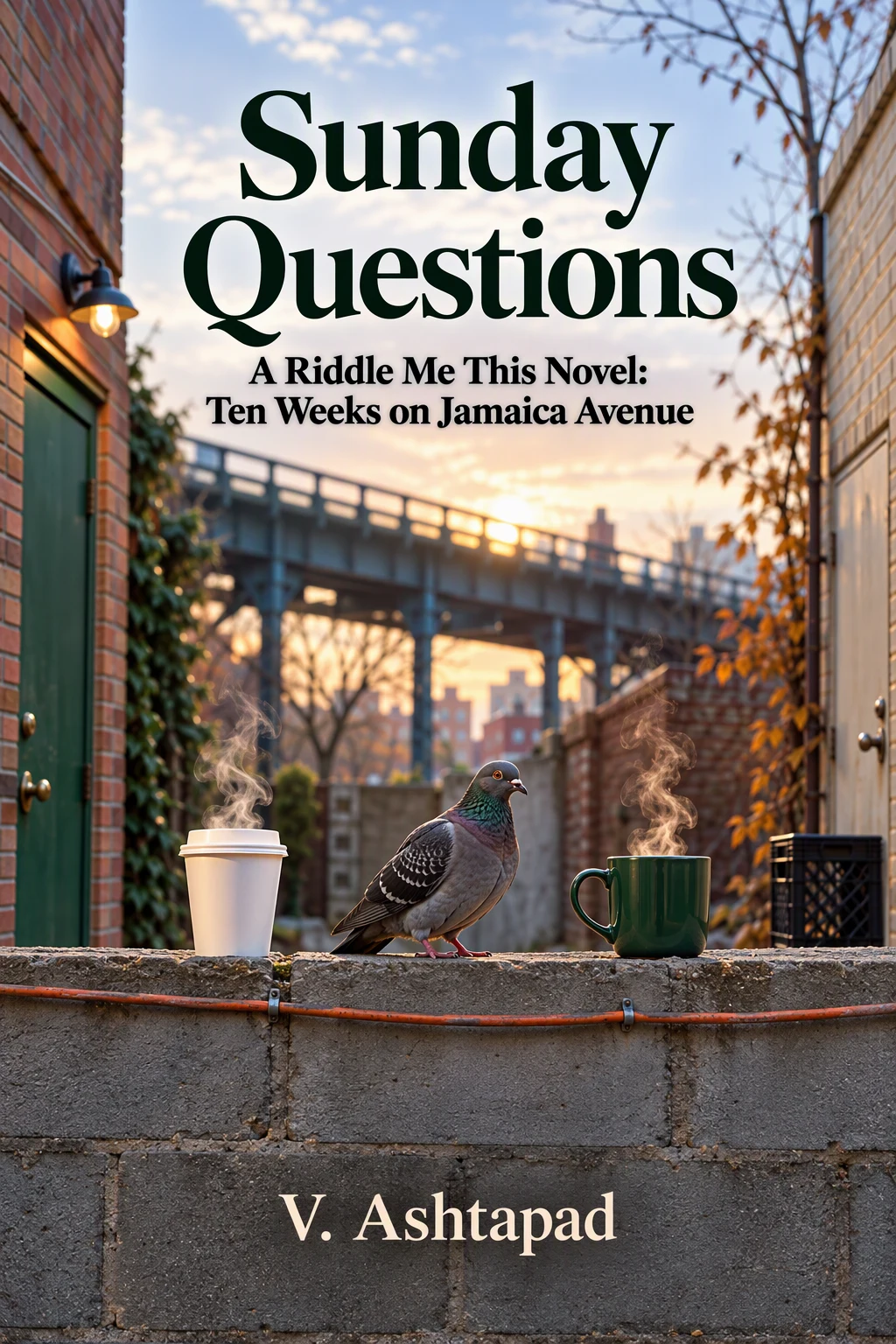
Sunday Questions
A Riddle Me This Novel: Ten Weeks on Jamaica Avenue
by V. Ashtapad
Foreword
A note before you begin: this is a Riddle Me This novel. Every chapter except the last holds one riddle, and every riddle is answered somewhere later in the book, never before it is asked. The answers are not spelled out next to the riddles; you will only recognize them by reading each chapter all the way through. Keep your guesses in the boxes at the end of the book. The answer key opens there once you have read to the last page.
The people, the two shops and the families in this book are invented. Jamaica Avenue, the J train, the blackout of August 2003 and the sideways sleet of a December nor'easter are real.
For every pair of neighbors who never once admitted they liked each other.
Ten Weeks
The engagement is announced on a Sunday, which is the wrong day for it, because Sunday belongs to the wall.
Han Sung-ho knows this. Pearline Walters knows this. Everybody on the 160 block of Jamaica Avenue who has been around longer than a cell phone knows this. On Sunday mornings, before either shop opens, Mr. Han stands in the narrow alley behind Han's Hardware & Variety with a paper cup of barley tea, and Miss Pearline stands in the same alley behind Walters' Bakery with a mug of mint tea, and the cinderblock wall between their two back doors comes up exactly to the middle of Miss Pearline's chest and exactly to the top of Mr. Han's. And one of them asks the other a question.
They have done it for thirty-one years. It began in 1995, in an argument about a delivery truck, and neither of them will tell you who won.
This Sunday is Pearline's turn to ask. But before she can, her grandson comes out the bakery's back door in his MTA work jacket, and right behind him, out of the hardware store's back door, comes Mr. Han's granddaughter, Grace, in her blue hospital scrubs, and the two of them stand side by side in the alley like children who broke a window.
Pearline looks at Andre. Sung-ho looks at Grace.
"We have something to tell you," Grace says.
"Both of you," says Andre. "Together. At the same time. We practiced."
Pearline puts her mug down on top of the wall. She has known for eight months. She has known since the night she came back to the bakery for her reading glasses at eleven o'clock and found Andre asleep on the flour sacks in the storeroom with his phone on his chest and the screen still lit with a girl's face, and the girl was Grace Han from next door, whom Pearline had last really looked at when she was nine years old and selling candy bars for a school trip.
Sung-ho has known for seven months. He has known since Grace started buying her lunch at the bakery instead of the Korean deli on 165th Street, and coming back with her coat smelling of allspice.
Neither of them has said one word to the other about it. They have exchanged thirty Sunday questions since then, and none of them was about this.
"We're getting married," says Grace.
"In ten weeks," says Andre. "Saturday the twenty-third. We have the hall. We have the deposit. We have a DJ."
"We have two DJs," says Grace. "That's a separate discussion."
There is a long silence in the alley. A pigeon walks along the top of the wall between the mugs.
Then Mr. Han says, in his careful English, the English of a man who learned it at forty from customers and the radio: "Ten weeks is very short."
"It's what the hall had," says Grace.
"Ten weeks," says Pearline, "is a lot of cake."
And then, because she is Pearline Walters, who was born in Mandeville in 1946 and came to Queens in 1971 with one suitcase and her mother's recipe for bulla cake written on the inside of a Bible cover, and who has buried a husband and raised three children and outlasted four landlords and two recessions and one fire, she picks her mug back up, and she looks at Han Sung-ho over the top of the wall, and she says:
"Well. It's my turn. Sunday question."
"Grandma," says Andre.
"Hush. Sunday question." She clears her throat. The children look at each other. "I wake up before the baker and go to sleep after the last customer. When I stand up, everybody may come in. When I lie down, nobody can. What am I?"
Sung-ho drinks his barley tea. He looks at the sky above the alley, which is the gray of a Queens November, with a jet going over toward JFK. He looks at his granddaughter, who is holding hands with the bakery woman's grandson in the alley where he has stood every Sunday for thirty-one years.
"I will tell you next week," he says.
"You always say that."
"Because it is always true."
---
That afternoon, Grace and Andre sit in the back booth of the bakery, which has only two booths and a counter, and look at each other.
"That went well," says Andre.
"Did it?"
"Nobody yelled. Nobody threw anything. Grandma asked him a riddle."
"Is that good?"
Andre thinks about it. He has grown up with the Sunday questions. When he was small he used to sit on an upturned milk crate behind the bakery and listen, and he remembers almost none of the questions and almost all of the silences after them: Mr. Han looking at the sky, his grandmother tapping one fingernail on her mug, the two of them waiting for each other without hurrying.
"My grandfather used to say," Andre says, "that the Sunday question is how the two of them say good morning without having to admit they like each other."
Grace laughs. "My grandfather says it's how he learned English."
"He learned English from a riddle?"
"He says he learned all his best words over that wall. *Stubborn.* *Nonsense.* *Bammy.* *Duppy.* He told me once a duppy was a kind of tax inspector."
"That's—" Andre stops. "Actually that's not wrong."
Grace looks out the bakery window at Jamaica Avenue, at the 4:15 traffic going by under the tracks, at the man selling phone cases on a folding table outside the Payless that is not a Payless anymore, at the sign of her grandfather's store next door: HAN'S HARDWARE & VARIETY, white letters on a green ground, the same since 1989.
"Ten weeks," she says.
"Ten weeks."
"We have to tell your mother properly. And my parents in Fort Lee. And your aunts in Montego Bay, and my aunts in Daegu, and your cousin in Brampton with the opinions."
"Desmond doesn't have opinions. Desmond has convictions."
"We have to find a dress. And a hanbok. And whatever you wear."
"A suit."
"A suit that goes with a hanbok."
"Is that a thing?"
"It's going to have to be." She turns from the window. "Andre. I want to do something for them. For the two of them. Something about the wall."
Andre looks at her. In the light from the bakery case, with the patties lined up in rows behind the glass, beef and chicken and callaloo, she looks tired from her twelve-hour shift and completely certain.
"Like what?"
"I don't know yet," Grace says. "I'll know when I see it."
Nine Weeks
Han Sung-ho opens the store at twenty minutes to six. He has done this, six days a week, for thirty-seven years, first with his brother Sung-min and then, after Sung-min retired to Daegu in 2004, alone, and then, after his knees started to object in 2018, with his grandson-in-law-to-be's cousin's friend Marlon, who comes at seven, and with Grace on her days off.
At twenty minutes to six on a Monday in November, Jamaica Avenue is blue and empty. The F train is still underground and the J train is rattling overhead on its iron legs, and the steam from the laundromat vent across the street makes a little private cloud on the sidewalk. Sung-ho fits his key into the padlock at the bottom of the shop front, the one at knee level that his knees hate, and turns it, and lifts the hasp, and then he takes hold of the cold steel handle with both hands and pulls upward.
The whole front of the store rises in front of him with a long rattling roar, like a train going over a bridge, like a drum roll, like thunder in a tin can. Ribbed steel slats fold up and roll themselves into the box above the door, and behind them the glass of the shop window appears, and behind the glass are the displays he arranged on Saturday night: snow shovels and rock salt, because it is November; window plastic and weatherstrip; a pyramid of space heaters; a basket of work gloves, three pairs for ten dollars.
Next door, Pearline's lights are already on. She is the only one on the block who beats him. Her own steel front went up at five-fifteen. He heard it from his apartment upstairs, as he hears it every morning: her roar first, then his. For thirty years, the block has woken up in that order.
He stands on the sidewalk and looks up at the rolled steel above his doorway, dented in two places—once by a delivery truck in 1997 and once by a teenager on a bicycle in 2011 who apologized so beautifully that Sung-ho gave him a job for the summer—and painted green three times, and he thinks about the riddle.
He knew the answer before Pearline had finished asking. He always knows. He says *next week* because the week is the point.
---
On Sunday, over the wall, he gives her his answer, one word.
"Mm-hm," says Pearline, which is how she says *correct* when she does not want to give you the satisfaction.
"It was too easy."
"It was a wedding week. I was distracted."
"You were never distracted in your life."
"I was distracted by the idea of feeding three hundred people in ten weeks with one oven."
"Two ovens," says Sung-ho. "You have the old one in the back."
"The old one in the back burns everything on the left side."
"So you turn the pans."
"Thank you, Mr. Han, I will write that down." She tips her mug at him. "Your turn."
He has been thinking about it all week. He drinks his barley tea and looks at the sky, which is clear today, cold and blue, with the J train shining in the low sun.
"Your people," he says, "named me for being difficult. But I am the softest thing in your window."
Pearline stops with her mug halfway up. Then she laughs, one short bark, and shakes her head.
"I'll tell you next week," she says.
"You always say that."
"Because it's always true."
Eight Weeks
It is Pearline's mother who taught her to bake, in a kitchen in Mandeville with a wood stove and a tin roof that rang like a bell in the rain, and it is Pearline's mother whose rules she still follows, and the first rule is that you do not argue with dough.
At four o'clock in the morning on a Tuesday, eight weeks before the wedding, Pearline stands at the long steel table in the back of Walters' Bakery with her sleeves pushed up past the elbow, and the dough on the table in front of her is not arguing. It is twelve pounds of white flour and water and yeast and sugar and a little butter, and it has risen once overnight in the big plastic tub, and now she turns it out onto the floured steel and cuts it with the bench scraper into pieces, and weighs each piece on the scale, two pounds exactly, and folds each one into a tight log, tucking the seam underneath with the side of her hand, the way her mother showed her, the way she has shown Andre a thousand times.
Then into the long rectangular tins, six of them, lined up. Then the cloth. Then the second rise, which you do not rush. Then the oven, the good one, not the old one in the back.
At six-thirty the loaves come out. She tips them out of the tins onto the rack and they come out square and tall, pale gold on top and almost white on the sides, and the whole back of the bakery fills with the smell, which is the smell of every Saturday morning of her childhood and of every school lunch she ever packed for three children in this country. She lets them cool. Then she takes one, and presses her thumb into the side of it, and the side gives under her thumb like a pillow and slowly comes back.
This is the loaf that Jamaicans in Queens drive forty minutes to buy. It is the loaf that goes with ackee and saltfish and with fried dumplings and with butter and nothing else. It is the loaf that Andre's grandfather Clive, God rest him, ate two slices of every morning of their forty-one-year marriage, toasted, with cheese.
And it is, Pearline thinks, standing in the warm bakery at six-thirty in the morning, still smiling, a very good Sunday question. Han Sung-ho has been eating this loaf for thirty years. Clive brought him a slice the first week the hardware store opened, over the wall, as a peace offering after the argument about the delivery truck, and Sung-ho ate it standing in the alley, and said, *What is it called?*, and Clive told him, and Sung-ho thought about it, and said: *But it is not hard at all.*
That was the first Sunday question. Neither of them knew it yet.
---
Grace comes to the bakery at seven, on her way to the hospital, and buys a gizzada and a hot chocolate, and stands at the counter talking to Pearline while Andre's mother, Marcia, works the register.
"Miss Pearline," Grace says, "can I ask you something about the wall?"
"Ask."
"Do you remember all of them? The questions?"
Pearline wraps a second gizzada in wax paper and slides it across the counter without charging for it, which Marcia notices and says nothing about.
"I remember the good ones," Pearline says. "And I remember the ones I got wrong, which is more than the good ones. He got me with one in 1999 that I still dream about."
"What was it?"
"I'm not telling you that."
"Did anybody ever write them down?"
Pearline looks at her. Grace is thirty-one, and a nurse in the cardiac unit at Jamaica Hospital, and has her grandfather's way of standing still when she wants something, so still you notice it.
"No," says Pearline. "Why would anybody write them down? They're for saying."
"Would you mind if I did? From now until the wedding? Just the new ones."
Pearline thinks about it for a moment. Then she nods, once.
"Write them down," she says. "But don't write the answers down until they're said. That's the rule. You don't write the answer before the answer comes."
---
That Sunday, over the wall, she gives Sung-ho her answer and tells him he is a very clever man, and he bows a little, a small bob from the shoulders, the bow he does not do for anybody else on the block.
Then it is her turn, and she looks at Grace, who is standing at the back door of the hardware store with her phone held up, not even pretending not to record, and Pearline smiles and says:
"I am tied on every morning and untied every night. I carry the whole day's dirt so the shirt underneath can go to dinner clean. What am I?"
Seven Weeks
Andre Walters drives the Q83 bus. He doesn't drive it actually; he fixes it. He is a mechanic at the Jamaica Bus Depot on Merrick Boulevard, and he has spent eleven years under the buses of southeast Queens with a flashlight in his teeth, and he is good at it, and he does not mind the hours, and he has known since he was twenty-two that he was never going to take over the bakery.
He told his grandmother that when he was twenty-two. She said, *I know*, and gave him a patty, and that was that.
He has never told anybody that the reason he is good with engines is the hardware store.
When he was nine, and ten, and eleven, he was the kind of boy who took things apart. Toasters. The bakery's old cash register. A clock radio belonging to his Aunt Paulette, who is still angry. And when he could not put them back together, which was often, he would go through the back door of the bakery and across the alley and through the back door of Han's Hardware & Variety, and Mr. Han would look at whatever was in his hands, and say, *Again?*, and take him to the back counter where there was a lamp and a magnifying glass and a pegboard of small tools, and they would fix it together.
He remembers the back counter better than he remembers his elementary school.
---
The Wednesday seven weeks before the wedding, Andre comes to the hardware store after his shift to pick up four boxes of string lights for the hall, and Mr. Han is not at the front, so Andre goes to the back, and finds him at the counter with the lamp on, threading a needle.
"Mr. Han?"
"Ah. Andre. Come. Sit." Mr. Han does not look up. "My eyes are not what they were. You do it."
He hands over the needle and a spool of heavy waxed thread, and Andre, who has not threaded a needle since a scout merit badge in 2003, licks the thread and squints and gets it through on the third try.
On the counter, under the lamp, is a piece of heavy canvas, the color of a paper bag that has been rained on and dried a hundred times. It has two long strings at the top, for the neck, and two more at the waist. There is a big square pocket across the front, divided by stitching into three smaller pockets, and the canvas is worn almost white along the bottom edge of the pocket where a hand has gone in and out ten thousand times. One of the ties at the waist has torn off.
"This was my wife's," says Mr. Han. "Young-ja. She wore it in the store every day. From 1989 until she got sick. I wear it now, on Saturdays, when Marlon is off and I do the stock." He takes the threaded needle back and starts, slowly, to sew the torn tie back on, through the canvas, in small, even stitches, pulling each one tight. "She sewed her name in it. Look."
On the inside of the top band, in faded red thread, three Korean letters, and under them, in English, smaller: *Y.J. HAN.*
"She put on this in the morning," says Mr. Han. "Here, at the back door. And at night she took it off and hung it on that hook, and she went upstairs, and she was clean. All the oil and the rust and the dust from the paint cans, it stayed here. On the hook. She said, *The store stays in the store.*"
Andre watches him sew. The stitches are small and very straight.
"Grace wants to put it in the wedding," says Mr. Han. "I don't know how. She says she'll know when she sees it. She is very stubborn."
"I know," says Andre.
"Good," says Mr. Han, and bites the thread off with his teeth, the way you are not supposed to, and holds the canvas up to the lamp, and nods. "Good. Then you are prepared."
---
That Sunday, over the wall, Mr. Han gives his answer. Pearline says *mm-hm*. And then it is his turn, and he says:
"I talk all day on this block in two languages, and I have never once listened to anybody."
Six Weeks
The radio is on the shelf above the back door of the hardware store, between a box of light bulbs and a coffee can of loose screws, and it has been there since 1994.
It is a silver portable with a long antenna that has been broken and taped twice, and a dial that is no longer exactly where the numbers say, so that when it says 1600 it is really somewhere near 1620, and you have to know. It runs on four D batteries, which Mr. Han replaces on the first of every month whether they need it or not, and on a cord, when the cord is working, which is about half the time.
In the morning, from twenty minutes to six until ten o'clock, it is tuned to the Korean station out of Flushing: news from Seoul, the weather, a call-in show where retired men argue about baseball, and, at nine, a program of old songs that Young-ja loved, trot songs from the 1960s with accordions and big sad voices, and which Mr. Han still listens to every morning at nine, standing very still at the counter, while customers wait.
At ten o'clock, Pearline's back door opens, and she leans across the alley, and reaches over the wall, and knocks twice on the frame of his back door.
And Mr. Han goes over to the shelf and turns the dial.
From ten until closing, it is on the station that plays reggae and dancehall and soca and lovers rock, and the news from Kingston and the sports from Sabina Park, and the talk show where a woman in Brooklyn gives advice to callers in a voice so deep and so slow that Mr. Han, who does not always understand every word, finds it very restful, and on Saturday afternoons it is the oldies show, Toots and the Maytals and Desmond Dekker and Millie Small, and Pearline turns up her own radio on the bakery side so the two of them are playing the same song through the wall, a little out of time, like an echo.
The agreement was made in 1996. Nobody remembers who proposed it. There was, before that, a year and a half of radios playing two different stations as loudly as possible, each trying to drown the other, which Pearline's husband Clive called the Cold War of Jamaica Avenue, until one morning Mr. Han came out to the alley and said, in English that was still new then: *Your music is very good. My music is very good. We cannot both be good at the same time.*
And Pearline said: *Mornings yours. Afternoons mine.*
And Mr. Han said: *Deal.*
---
Six weeks before the wedding, on a Thursday, Grace is working the register at the hardware store on her day off when, at ten o'clock exactly, she hears the knock on the back doorframe. She looks up. Her grandfather, who is on a stepladder at the back of the store putting up a box of furnace filters, starts to climb down.
"I'll get it, Harabeoji," she says.
"No," he says. "I do it."
He comes down the ladder slowly, one step and then both feet, one step and then both feet, and walks to the back of the store, and reaches up to the shelf, and turns the dial. The old Korean song that was playing slides into hiss, and then into a woman's voice saying *—good morning, good morning, New York, it is ten o'clock and you are listening to—* and then into a horn line and a bass line that Grace has heard her whole life without knowing what it was.
She watches her grandfather stand there for a moment with his hand still on the dial, as if he is checking that it has arrived. Then he goes back to his ladder.
That night, Grace sits at her kitchen table in her apartment in Kew Gardens with a pad of paper, and writes down the four Sunday questions she has so far, each with its answer beside it, the way Miss Pearline said: never the answer before the answer comes. She looks at them for a long time.
She knows now what she is going to do for the wedding. She does not know yet how she is going to get it all onto one table.
---
On Sunday, Pearline gives her answer, and Mr. Han says *correct* out loud, which surprises everyone in the alley, since he usually just nods.
Then Pearline says:
"I came through a hole in this wall the night the whole city went dark, and I never went back where I came from. What am I?"
Mr. Han does not look at the sky this time. He looks at the wall. He puts his hand flat on the top of it, and stands like that for a while.
"Next week," he says, but quietly.
Five Weeks
The lights went out at eleven minutes past four in the afternoon on Thursday, August 14, 2003. Everybody in New York who is old enough remembers where they were. Pearline was at the bakery, with seventy pounds of dough rising for the Friday orders and two hundred patties in the walk-in, and Mr. Han was at the store, with a freezer case of ice cream bars and frozen dumplings that his wife Young-ja sold from the front, and a small chest freezer in the back holding the insulin for Young-ja's sister, who was staying with them that summer.
The whole city stopped. The traffic lights went dark. The trains stopped between stations. On Jamaica Avenue people came out onto the sidewalk and looked up at the dead signs and the motionless J train and laughed, at first, because it was hot and it was strange and it felt like a holiday. Then the sun went down.
Pearline had a generator. Clive had bought it in 1999 for Y2K, which everybody laughed at, and had kept it in the storeroom ever since under a tarp, gassed up, because he was that kind of man. At five o'clock he pulled it out into the alley and started it, and it roared, and the bakery lights came back on, and the walk-in started to hum.
At five-thirty, Young-ja Han came out of the hardware store's back door with her sister's insulin in a lunch cooler, crying.
Clive looked at her. He looked at the wall. He looked at the hardware store's back window, the small one high up, near the corner where the wall met the building.
Then he went inside and came back with a drill.
---
"I didn't ask him," Mr. Han tells Grace, five weeks before the wedding, on a Tuesday night, standing in the alley in the dark with a flashlight. "I didn't know he was doing it. I came out, and he was standing on a milk crate, drilling a hole in my wall."
"In the cinderblock?"
"In the side. Here." He points the flashlight. In the side of the hardware store, just above the top of the alley wall, at the corner, there is a hole about as big around as a quarter, rough at the edges, filled in around something with gray putty that has been painted green to match the building, and then painted again, and again.
Coming out of the hole is a cord. A heavy orange cord, the outdoor kind, faded almost to pink by twenty-three summers, that runs from the hole, along the top of the alley wall for about four feet, tucked under three rusted staples, and then down the bakery side and through a second hole, smaller, into the bakery's storeroom.
"He ran the power through," says Mr. Han. "From his generator, into my store. For the freezer. For the insulin. Three days. The lights were out three days in some places. Here, for us, two. Two days and two nights, his generator ran both stores. He filled the gas himself, every four hours. He slept in a chair in the alley so nobody would steal it."
Grace looks at the orange cord. She has walked under it her whole life without seeing it.
"Why is it still here?"
Mr. Han turns off the flashlight. In the dark she can hear the J train coming, far off, rattling.
"When the power came back," he says, "I came out to take it down, to give it back. And Clive said, *Leave it.* I said, *Why?* He said, *Next time.*" He is quiet. "There was no next time. Not like that. But there were small times. In 2012, the hurricane. Some winters. When my compressor broke in 2016, three days. When the bakery's panel caught fire in 2019, the whole week, we ran her coolers from my side. Back and forth. Whoever has power, gives power."
"Through the hole."
"Through the hole," he says. "He was right. You don't take it down. You leave it."
---
On Sunday, over the wall, Mr. Han puts his hand on the orange cord where it runs along the top, and says, "This," and Pearline nods without saying *mm-hm*, and for a moment neither of them says anything at all.
Then it is his turn, and he looks at Grace, recording at the back door, and says:
"Twenty-eight of us live in one small box. We are black with white eyes, or white with black eyes. And we are the loudest when somebody loses."
Andre, who is standing beside Grace, groans out loud.
"That's too easy," he says.
"Then you answer it."
"No, I mean—" Andre stops. "Okay. Fair."
Four Weeks
The domino table lives behind the bakery on Saturday afternoons from May to October and in the bakery's storeroom from November to April, and it is not a table. It is a square of plywood, painted green, laid across two milk crates, with a folding chair at each side and a coffee can on the ground for the bets, which are never more than a dollar, except at Christmas.
It is four weeks before the wedding, a Saturday, and it is cold, so the game is in the storeroom, between the flour sacks and the walk-in, with the old oven ticking as it cools in the corner. The players are Andre; his uncle Winston; a retired corrections officer from Hollis called Mr. Bailey, who has played at this table since 1988; and, for the first time in eleven years, Han Sung-ho.
He has not played since Clive died. He played with Clive every Saturday from 1996 to 2015. He told Pearline after the funeral that he was not going to play anymore, and Pearline said *Suit yourself*, and that was eleven years.
This morning, Andre asked him.
"Grace and I want you there," he said. "Just this once. Before the wedding."
Mr. Han looked at him for a long time. Then he said, "I am not very good."
"You were partners with my grandfather for nineteen years."
"Your grandfather," said Mr. Han, "was very good."
---
They play partners: Andre and Mr. Han against Winston and Mr. Bailey. Winston shuffles, face down on the plywood, a long noisy wash of the tiles in a circle under both his hands, *clack-clack-clackety-clack*, and each man draws seven and stands them on edge in a little fence in front of himself, so nobody can see the spots.
The first few hands are quiet. Mr. Han plays slowly. He studies his tiles for a long time before each one. Winston makes a joke about the speed of the Korean postal service. Mr. Bailey tells him to hush.
Then, in the fifth hand, Mr. Han sees something. Andre sees him see it. His grandfather's partner sits up a little straighter, and looks at the open end of the line of tiles on the board, double-six at one end and a four at the other, and then he looks at the three tiles still in front of him, and then at Mr. Bailey's two, and then at Winston's one, and his mouth does a thing at the corner.
He picks up a tile, and lifts it high above his head, and brings it down on the plywood so hard that the coffee can jumps.
*SLAP.*
"Domino," says Han Sung-ho.
Winston throws up his hands and roars. Mr. Bailey pushes back his chair and says a word Andre's grandmother would not allow in the storeroom. Andre whoops. And from the front of the bakery, through the storeroom door, comes Pearline's voice:
"WHO WAS THAT?"
"MR. HAN," Andre shouts back.
There is a pause from the front. Then Pearline's voice again, quieter, so quiet that maybe only Andre hears it:
"Good. That's good."
---
That evening, Grace and Pearline sit in the bakery's front booth after closing with the lights off, except for the glow of the case, and a pad of paper between them.
"This is all of them," says Grace. "Since the engagement. Six so far. Four more to go."
Pearline puts her reading glasses on and reads the list.
"And the table," says Grace. "At the hall. At the front, where the cake would be. Instead of just the cake, I want all the answers on it. Every one. The real things. His and yours."
Pearline looks at her over the glasses.
"The real things? Off the buildings?"
"Okay, not all of them. Some of them I'll have to photograph. But as many real ones as I can carry."
"You're not cutting anything off my building."
"Nothing that's still attached," says Grace. "I promise."
Pearline reads the list again. Then she takes off her glasses and looks out the dark window at the hardware store's sign next door, lit from underneath by the streetlight.
"He's going to cry," she says.
"I know."
"In front of three hundred people."
"I know."
"Good," says Pearline. "About time."
---
On Sunday, over the wall, Pearline gives her answer, and adds that it is the most Jamaican thing in this whole country after the bread, and Mr. Han smiles and does his small bow.
Then it is her turn, and she looks over the wall at him for a moment longer than usual, and says:
"We were carved to be a pair. We have been married fifty-two years. And not one day in all that time were we ever in the water."
Mr. Han puts his tea down.
"How do you know about them?" he says.
"Clive carried your dresser up those stairs in 1989," says Pearline. "I have eyes, and I had a husband with a mouth."
Three Weeks
Sung-ho's wife, Young-ja, came from a village outside Andong, in North Gyeongsang Province, where her father made furniture, and when she married Han Sung-ho in 1974 in a wedding hall in Daegu, her father carved the ducks himself.
They are wild ducks, a pair, about eight inches long, of dark pine, a male and a female, the male with a long neck and a red-painted crest, the female smaller, her beak tucked down, her body painted with tiny blue and green and red lines that have faded now almost to brown. In a Korean wedding the ducks are a promise. Wild ducks choose one mate for life; that is what everybody's grandmother says, whether or not the ducks agree. The groom brings them to the bride's family. The pair is wrapped in red and blue silk and carried in. Afterward the ducks go home with the couple and sit somewhere in the house, on a shelf or a chest, and when the couple are getting along, the ducks face each other, beak to beak, and when they are not, somebody—everybody knows who—turns one duck around to face the wall.
Young-ja's ducks came with them to New York in 1986, wrapped in a sweater inside a suitcase. They sat on the dresser in the apartment above the store for thirty-four years. Grace grew up checking which way they faced before she asked her grandparents for anything.
Three weeks before the wedding, on a Monday night, her grandfather knocks on her apartment door in Kew Gardens, which he has done exactly twice before, and when she opens it he is standing in the hallway in his good coat holding a shoebox with both hands.
"For the wedding," he says, and gives it to her, and does not come in.
She opens it on the kitchen table after he has gone. The ducks are inside, wrapped in a red silk cloth and a blue one, and under them is a piece of lined paper with her grandmother's handwriting, in Korean, very small, which says: *For Grace. For whoever she chooses. Face them toward each other.*
Grace sits at the table for a long time.
Then she takes out her pad of paper and her list of Sunday questions, and she looks at it, and she looks at the two carved birds on her kitchen table, beak to beak, and she understands, finally, what goes in the middle of the table at the wedding.
She calls Andre at eleven o'clock at night. He is at the depot, on the late shift, and she can hear the bus engines echoing behind him.
"I know what goes in the middle," she says.
"Of what?"
"Tell your grandmother. She'll know."
---
On Sunday, over the wall, Grace stands in the back door of the hardware store with the shoebox held against her chest, and Mr. Han gives his answer to Pearline in two words, and then he says, "Thank you," which he has never said in thirty-one years of Sunday questions. Pearline looks at the shoebox, and her face does something Grace has never seen it do: it goes soft, all at once, as though somebody has unknotted a string. Then she looks away and says, "Your turn, your turn."
And he says:
"I keep your customers dry and my own head wet. And I have your name written across my forehead."
Two Weeks
There is a storm the second week of December, a real one, a nor'easter coming up the coast with wind off the bay and sideways rain that turns to sleet after dark, and on Jamaica Avenue the shoppers run from door to door with their coats over their heads, and anyone who has to wait for the Q4 bus waits under the nearest shop front with something sticking out over the sidewalk.
Pearline's has stuck out over the sidewalk since 1978. It is canvas, on a steel frame that cranks out from the wall, striped in green and gold—the gold faded almost to cream now, the green almost to gray—and along the scalloped front edge, in black letters that she had repainted in 2009 and again in 2020, it says WALTERS' BAKERY · JAMAICAN BREAD · PATTIES · CAKES. Clive picked the colors. The black, he said, was to complete the flag. The canvas has been replaced three times. The frame never has.
In a storm, the canvas fills with water. It sags in the middle between the frame bars into a long heavy belly, and the water sits in it, and when it gets too heavy it spills off the front edge in a sheet, all at once, onto whoever is standing at the curb.
So twice an hour in a storm, someone has to go out with the long pole.
---
On the Tuesday of the storm, at four-thirty in the afternoon, it is Mr. Han who goes out with the pole.
Pearline is in the back with a cake order. Marcia is on the register with a line of eight people. Andre is at the depot. And Mr. Han has been watching the sag of the green and gold canvas from his own front window for twenty minutes, watching it get lower and heavier over the heads of the people at the bus stop, a woman with a stroller and two teenagers and an old man with a cane.
He takes the long wooden pole with the rubber cap on the end from its place behind his own front door, where it has been since 1989, because his own store has never had a canvas over the sidewalk, only the rolled steel, and the pole was always for Pearline's.
He goes out into the sleet in his store apron without a coat. He says *excuse me, excuse me* to the people under the canvas, and they shuffle aside, and he puts the rubber end of the pole up under the lowest point of the sag, and pushes up, slowly, steadily, and the whole long belly of water rolls toward the front edge, and pours off, in a roaring sheet, into the gutter, missing the woman with the stroller by six inches.
Everybody at the bus stop applauds.
Mr. Han bows to them—the small bob from the shoulders—and goes back inside, soaked from the hair down, and stands dripping in front of his space heaters.
Pearline, who saw the whole thing through the bakery's side window, sends Marcia over with a hot chocolate and a beef patty and a towel.
---
That night, two weeks before the wedding, Grace finishes the list.
She has eight answers now, if she counts the one she watched her grandfather push up with a pole that afternoon. Two more Sunday questions to go: one from Miss Pearline this coming Sunday, and the last one, the tenth, Mr. Han's, on the Sunday before the wedding. Pearline does not know what it will be. Grace does not know. Grace has asked him, and he has said, *Next week*, and smiled.
She writes the eight answers in a column on the left side of the page, in order. Then she looks at them for a while.
Then she looks again, at the first letter of each, going down.
She gets up from the kitchen table and walks around her apartment twice. Then she sits back down and looks again.
It is not possible that the two of them planned it. They had no idea she was writing them down. They did not know, two months ago, that there would be a wedding, or a list, or a table. They have been making up these questions one at a time, out of whatever was in front of them, for thirty-one years.
And still.
She calls Andre at the depot.
"If the next two both start with L," she says, "I'm going to lose my mind."
"What?"
"Never mind," she says. "Never mind. I'll show you at the wedding."
---
On Sunday, over the wall, Pearline gives her answer, and Mr. Han says it needs a new canvas, and Pearline says *after the wedding*, and Mr. Han says *I will pay half*, and Pearline says *you'll pay nothing*, and they argue about it for six minutes, happily.
Then it is her turn, the ninth question, and she looks over the wall at Han Sung-ho for a long moment before she asks it.
"I am full of names who owe," she says. "And not once in all my life have I asked any of them to pay."
One Week
The last Sunday before the wedding is clear and very cold, the sky the hard pale blue of a winter morning in Queens, the J train sparkling with frost on its iron legs, and the whole family is in the alley.
Everybody. Grace in her coat with her phone. Andre in his. Marcia with a thermos. Grace's parents, down from Fort Lee, her father Daniel in a wool coat looking around the alley he grew up in as though he had never seen it before, her mother Sun-hee holding his arm. Andre's Uncle Winston. Mr. Bailey from the domino table, who heard. Marlon from the store. Two of Andre's aunts from Montego Bay who flew in on Thursday and are already, everyone agrees, a problem. A neighbor from upstairs. A pigeon.
And on either side of the wall, as always, with their mugs, Pearline and Han Sung-ho.
"Well," says Pearline. "Last one before the wedding. You first. My answer."
Mr. Han nods. He puts down his barley tea on the top of the wall and reaches into the inside pocket of his coat, and brings out a book.
It is a small, fat, black book with a red spine, the kind of account book you could buy at any stationery store in 1989, with a rubber band around it. The corners are worn round. The rubber band has been replaced so many times that it is now a knot of rubber bands, red, blue, tan.
He holds it up.
"This," he says.
The alley is quiet. Grace's father makes a small sound.
"I'll tell them," says Mr. Han, "since they are all here. This is the store's credit book. From the first week. From 1989." He takes off the rubber bands and opens it. The pages are ruled in blue, and they are full, every line, in his handwriting and in Young-ja's: names and dates and small amounts. *Mrs. Ortiz, 3/89, $4.50 (light bulbs).* *Mr. Ali, 7/91, $12 (paint).* *Bailey, 2/94, $6.25 (fuse, tape).* "When a customer cannot pay, they take it anyway, and we write it down. And they pay when they can. Most pay. Some, never. Some, they moved away. Some, they died."
He turns a page, and another. "Many of the names in here. Many of them, your family." He looks over the wall at Pearline. "Clive. Paulette. Winston, many times."
"That's slander," says Winston.
"It is written down," says Mr. Han mildly. "Page forty." He closes the book. "Thirty-seven years. Never once did I go to anybody's door. Never once did I call. My wife said, *If they can pay, they will pay. If they cannot, why do we want to make them feel small?*"
He holds the book a moment longer. Then he reaches across the wall and puts it into Pearline's hands.
"For the table," he says. "Grace's table. You take it. And then after, you burn it. I don't want to know any more who owed me money. I want to know who came to the wedding."
Pearline holds the black book with both hands against her chest.
"Mm-hm," she says, very quietly, and it is the first time in thirty-one years it has ever sounded like crying.
---
Then it is Mr. Han's turn to ask. The tenth question. The last one before the wedding.
He picks his barley tea back up. He looks up at the sky above the alley, the hard pale blue, the frost on the iron of the J train. Then he looks at the wall—up and down it, the cinderblock, its thirty-one Sundays a year for thirty-one years. Then he looks at Pearline.
"I have only ever gone up," he says. "And I have only ever come down. I have never once gone anywhere else. And I helped two stubborn people reach the same high shelf."
Nobody in the alley says anything. Pearline looks at the wall. She looks at the tops of the two back doors. She looks at the hardware store's back window, the small one, high up in the corner, the one above where Clive stood on a milk crate in August 2003. Then she starts to laugh.
"I'll tell you next week," she says.
"Next week," says Mr. Han, "is a wedding."
"Then I'll tell you at the wedding."
The Table
The wedding is on Saturday, the twenty-third of December, at a hall on Hillside Avenue with a dance floor, a balcony, red tablecloths, and two DJs set up at opposite ends of the room, who have by the end of the night become close friends.
Grace wears a white gown for the ceremony and a red-and-green hanbok for the second half of the evening, with a jacket of yellow silk, and her mother cries twice. Andre wears a dark gray suit with a pocket square cut from the same yellow silk, which was Grace's idea and which his Aunt Paulette declares, within the first five minutes, to be *very nice, very very nice, I didn't think it would work*. There is a pyebaek in a side room for the families, with jujubes and chestnuts thrown into the skirt of Grace's hanbok, and Andre manages to catch eleven in his outstretched arms, which, Grace's grandmother's sister in Daegu says over a video call held up by Grace's cousin, means eleven children, and Andre goes pale. There is a toast by Winston that goes on too long and a toast by Grace's father that is too short. There is curry goat and rice and peas, and japchae and bulgogi, and festival and fried plantain, and kimchi, and Pearline's black cake with rum that has been soaking since October, and a three-tier white cake with green and gold ribbon that she baked and iced herself, starting at four in the morning, in the good oven. There is soca, and there is K-pop, and there is a moment around eleven o'clock when one of the DJs puts on Millie Small, "My Boy Lollipop," and the other DJ, without being asked, follows it with a trot song from 1968, and both grandparents get up from their tables at the same time.
But before any of that—before the toasts, before the food—there is the table.
---
It stands at the front of the hall where the cake would usually be, and the cake is beside it, on its own. Grace and Pearline set it up at nine in the morning, the two of them, without telling anybody. It is a long table with a white cloth, and on the white cloth are ten things, each one on a small wooden stand Andre made at the depot, and in front of each one a card in Grace's handwriting.
People notice it slowly. They come in from the cold with their coats and their gifts, and they look at it, and they stop.
A photograph, framed, of the front of Han's Hardware & Variety at twenty minutes to six in the morning, the steel half rolled up, the blue light of the avenue, the green sign. Next to it, a loaf of Pearline's bread, square and pale gold, on a wooden board, with a knife. A canvas apron, the color of a paper bag left in the rain, with three pockets, folded so that the faded red thread inside the top band shows. A silver radio with a broken, taped antenna, switched on low, playing—Grace checks it every hour—something with a bass line and a horn. A coil of new orange outdoor cord, tied with a green ribbon, with a small tag that reads, in Pearline's hand: *Whoever has power, gives power.* A wooden box of dominoes, the lid open, the double-six on top. Two wooden ducks on a square of red silk, beak to beak. A strip of green-and-gold canvas, cut from an old awning that Pearline replaced in 1998 and never threw out, laid flat with its scalloped edge forward. A small, fat black account book with a red spine and a knot of rubber bands, closed. And the last one—added at six that morning, when Grace and Andre and Marlon carried it in from the van—a wooden stepladder.
It is the stepladder from the alley. It has lived there, folded and leaning against the wall on the hardware store side, chained to a drainpipe, since 1990. It is old and gray and splintered on the edges, with paint drips on every step in every color Han's Hardware has ever sold, and on the side rail, in Sharpie that has faded almost to nothing, two sets of initials: *C.W.* and *S.H.*
It is how Clive Walters, for twenty-five years, climbed up to clear the leaves out of the gutter that ran along the top of both buildings, from his side; and how Han Sung-ho, for thirty-five, climbed up to fix the same gutter from his. It is how they ran the orange cord through the hole in 2003, one on each side of the wall, Clive on the ladder and Sung-ho on a milk crate. It is how, every Christmas Eve since 1996, one of them has climbed up to put the string of colored lights along the top of the wall between their two back doors, and the other has climbed up the next day to take them down.
It has only ever gone up and come down. It has never once gone anywhere else.
---
At seven-thirty, before dinner, Grace asks for the microphone.
She does not make a speech. She is not a speech person. She tells the room, in a few sentences, about the Sunday questions. She tells them about the wall, and the two mugs, and thirty-one years, and the delivery truck in 1995. She says that ten weeks ago, on the day she and Andre told their grandparents they were getting married, Miss Pearline asked a question over the wall, and that every Sunday since then, one of them has asked another, and Grace has written them down. She says the answers are on the table. She says that there was one question left, the one her grandfather asked last Sunday, and that Miss Pearline has promised to answer it tonight.
Then she gives the microphone to Pearline.
Pearline Walters, eighty years old, in a dress of green and gold that she had made in Kingston in October, stands up from the family table with her cane, and walks to the front of the hall, slowly, and stops beside the table of ten things. She puts her hand on the side rail of the old gray stepladder, over the faded initials. The room is completely quiet.
She looks across the hall to the other family table, where Han Sung-ho is sitting in a dark suit with a red tie, very straight, with his son and his daughter-in-law and his grandson-in-law's cousin's friend Marlon.
"The answer," she says into the microphone, "is the ladder."
Mr. Han nods once.
And then—because she is Pearline Walters, and because it is her turn now—she adds, into the microphone, in front of three hundred people:
"Sunday question."
The room laughs. Mr. Han puts down his fork.
"It's not Sunday," he calls.
"It's after midnight in Daegu," says Pearline. "It's Sunday somewhere."
She waits until the room settles. Then she looks at the table again, at the ten things standing on it in a row from the photograph of the shutter to the ladder. And she looks at Grace, who is standing at the side of the hall, holding Andre's hand, and Pearline's face does that thing again, unknots like a string.
"Mr. Han," she says. "I'm standing next to a table. On it are ten things. Each one starts with a letter. Read the letters down from the first to the last, and they say what has stood between us for thirty-one years. What is it?"
Han Sung-ho looks at the table. Three hundred people look at him looking at it.
He looks at the first card. He looks at the second. His lips move a little. He looks at the third, and fourth, and the room watches him go down the row. At the sixth one he stops, and goes back to the beginning, and starts again.
At the tenth one, he takes off his glasses.
He wipes them with his red tie, which Grace's mother will speak to him about later, and puts them back on, and looks again.
Then he gets up from his chair. He walks across the whole hall, past the dance floor, past the two DJs, to the front, and he stops beside Pearline at the table, and he takes the microphone out of her hand, very gently, and holds it, and for a while says nothing.
Then he says, in the careful English he learned over a cinderblock wall:
"I will tell you next week."
And three hundred people—and two DJs, and a pigeon on the windowsill outside who cannot hear any of it—laugh, and stand up, and applaud. And Pearline Walters takes Han Sung-ho's arm, and they walk back across the hall together, slowly, to the dance floor, where somebody, without being asked, has put on Millie Small.
About this book
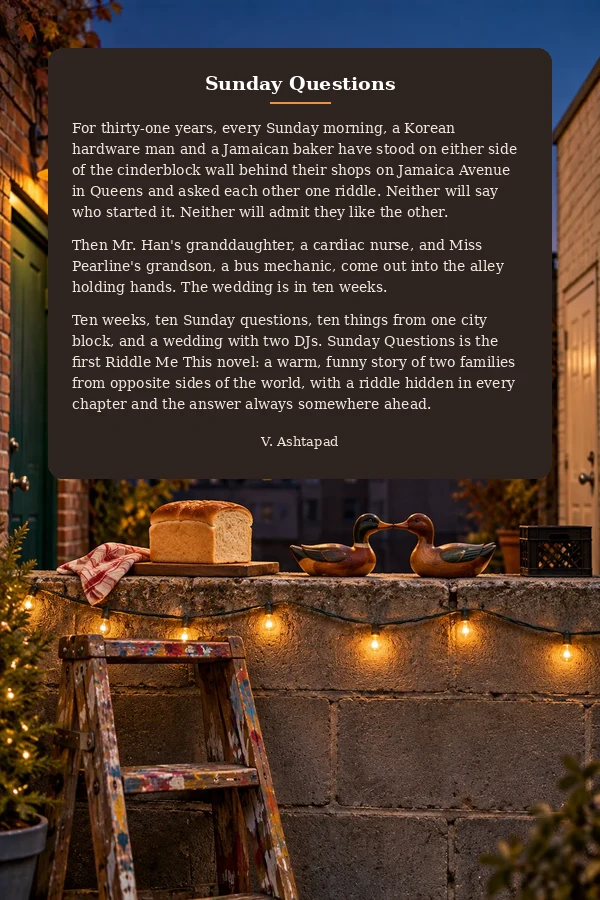
For thirty-one years, every Sunday morning, a Korean hardware man and a Jamaican baker have stood on either side of the cinderblock wall behind their shops on Jamaica Avenue in Queens and asked each other one riddle. Neither will say who started it. Neither will admit they like the other.
Then Mr. Han's granddaughter, a cardiac nurse, and Miss Pearline's grandson, a bus mechanic, come out into the alley holding hands. The wedding is in ten weeks.
Ten weeks, ten Sunday questions, ten things from one city block, and a wedding with two DJs. Sunday Questions is the first Riddle Me This novel: a warm, funny story of two families from opposite sides of the world, with a riddle hidden in every chapter and the answer always somewhere ahead.
Members can react to this book and talk about it in the members' Library.