
Sweet Water Under the Salt
A Grandmother's Twelve Nights, Six Cousins from Six Shores, and the Old Tale of the Girl Who Fetched Sweet Water from the Sea
by V. Ashtapad
Foreword
This is a work of fiction. The pearling towns, date oases, falaj channels and mountain potteries of the Arabian Gulf are real, as are its palm-frond weaving, sadu, sea songs, Omani halwa and the springs of sweet water that once rose through the sea off Bahrain. The house with the blue door, the families, the tale's masters and everyone in this book are invented.
For the ones who held the rope, and the ones who are learning to.
The First Night: The Bench by the Blue Door
My great-aunt Moza bint Hamad was eighty-five years old the winter she decided to tell the whole tale, and she could no longer see our faces. She could see the edges of things. She could see the white square of the courtyard at noon and the dark rectangle of a doorway and the shape of a man against a window, but the middle of the world had gone soft and gray for her, like a photograph left in the sun. The doctor in Ras Al Khaimah called it by a long name and said it would not get better. Mama Moza called it "the fog that came to live with me," and she talked to it the way she talked to the cat that slept on the roof, without much respect.
I am writing this down because I was the one who held the phone each night, and because I was the youngest of the six of us, and in our family the youngest is the one who carries the coffee and remembers what was said.
I drove over from Khasab on Thursday, the eighth of January, in the afternoon. The road from Musandam comes down out of the mountains like a goat in a hurry, all switchbacks and bare brown rock, with the sea on your right so blue it looks painted, and then the border post at Tibat, where the officer on the Omani side knew my father and asked after his knee, and the officer on the Emirati side did not know anyone and looked at my passport for a long time. After that the land flattens out. Date gardens. Low walls. The first roundabouts with their fountains switched off for winter. Then the old town of Ras Al Khaimah by the creek, where the houses are small and pale and close together and the lanes are just wide enough for one car and one cat.
Mama Moza's house has a blue door. My grandfather's brother-in-law, her husband Saeed, painted it that color in 1968, the year he built the house, and every time it has been repainted since, someone has gone to the paint shop with a chip of the old blue in an envelope, so that it would match. Beside the door, under the neem tree, there is a bench made of a palm-trunk plank on two stones. That is where she was sitting when I pulled up, with a basket of stripped palm fronds on one side of her and a coil of plaited strip on her lap, working by touch. Her fingers went over, under, over, under, without hurry and without a single mistake.
"Khalfan," she said before I had shut the car door.
"How did you know it was me?"
"Your car coughs. Your father's car coughed. All the cars in your family cough. Come here."
I bent and she took my face in both her hands and kissed my forehead and then, the way old women in her family do, put her nose against mine for a second, lightly, as if checking that I was real. She smelled of rosewater and woodsmoke and the faint green smell of palm leaf. Her hands were very dry and very warm.
"You are thin," she said. "Your mother does not feed you."
"My mother feeds me four times a day."
"Then you are running away from the food. Sit."
---
They came one by one through the afternoon, and I will introduce them the way they arrived, because the order mattered later.
Hamad was already there. He is the eldest of us, thirty-eight, the son of Mama Moza's son Ali, and he lives ten minutes away in a new villa with his wife Meera and their two children, Saeed, who is nine, and little Moza, who is six and is called Little Moza by everyone so as not to confuse the house. Hamad is a children's dentist. He has the gentlest hands in the family and the worst jokes. He came out of the house wiping his fingers on a cloth, because he had been cutting onions, and said, "The Omani navy has landed," and hugged me hard enough to lift me.
Dana came at four, from the airport, in a taxi with a suitcase so heavy the driver made a show of groaning. She is thirty-one, the youngest daughter of Mama Moza's daughter Noura, who married a Kuwaiti, and she is an architect in Kuwait City who restores old houses of mud and coral stone. She talks fast, writes lists on the backs of receipts, and arrives everywhere ten minutes early and annoyed that everyone else is late. Out of the suitcase, before she had even greeted anyone properly, she took two round tins of saffron cake from her mother and a long bundle wrapped in a sheet, which turned out to be a small ground loom, taken apart.
"You brought a loom," Hamad said.
"I was told to bring something made with my own hands."
"Nobody has told us anything yet."
"I was told by my mother," Dana said, "who was told by your father, who was told by Mama Moza on the phone on Sunday. I always find out first. Get used to it."
Ghanim came at five, from Doha, loudly. He is twenty-six, the youngest son of Mama Moza's daughter Mariam, and he works as a physiotherapist for a football club, which means he spends his days telling enormous young men to stop doing what they love for six weeks. He laughs with his whole body, sings in the car, and cannot walk past a ball without kicking it. He came in with a football under one arm and a cool bag over the other, and the cool bag held a pot of his mother's madrouba, the thick porridge of rice and chicken and cardamom beaten smooth with a wooden spoon, which is the food a Qatari mother sends when she thinks her son will not eat properly.
"It will not survive the night," he said, and kissed Mama Moza's head, and she slapped his wrist lightly for the noise.
Amal came at six, from Bahrain. She is twenty-nine, the daughter of Mama Moza's daughter Salma, and she is a marine biologist who studies seagrass and the dugongs that graze on it in the shallow waters around her island. She is quiet and exact and has the free diver's habit of breathing slowly when other people are excited. She brought a covered dish of muhammar, the sweet brown rice cooked with date syrup and cardamom that Bahraini families eat with fried fish, and a small hard case that she put carefully in the corner of the room she would share with Dana.
"What is that?" Ghanim asked.
"Equipment."
"For what?"
"For whatever I need it for," said Amal, and that was the end of that.
Nawaf came last, near eight, because he had driven. He is thirty-four, the son of Mama Moza's youngest daughter Latifa, who married into a family of date farmers in Hofuf, in the Al-Ahsa oasis in the east of Saudi Arabia. He teaches chemistry at a boys' secondary school and spends his weekends on his father's farm among the khalas palms. He had driven a little over a thousand kilometers in two days, across the border at Batha, with a wife and an eight-month-old daughter left at home and the trunk of his car full of dates in cardboard boxes, a box for every household he knew in the town. He is the dry one. He looks at a thing a long time before he says it is good, and he does not believe anything he has not weighed.
He kissed Mama Moza's hand and her head and sat down on the carpet beside her and said, "So. My mother says you have something to tell us, and that I had to come in person, and that if I made excuses about the school you would know."
"I would know," Mama Moza agreed.
---
We ate in the majlis on the floor, on a long plastic sheet laid over the carpet, the way the house had always eaten when it was full. Madrouba and muhammar and fried hamour that Hamad had bought at the fish market that morning, a bowl of salad nobody touched, Nawaf's dates in a heap, saffron cake, and the little fried dumplings Meera had made, luqaimat, crisp outside and soft inside and shining with date syrup. Little Moza and her brother ate on their father's knees and then fell asleep under a blanket against the cushions. The cat came down from the roof and sat in the doorway and was given a piece of fish by everyone separately.
When the coffee came, Hamad poured it. He held the brass pot high in his left hand and the little cups stacked in his right and filled each one only a third, a mouthful of pale coffee that tasted of cardamom and saffron, and served Mama Moza first and then went around the room from the right. You shake the cup when you have had enough. Ghanim never shakes it. Hamad stopped at him four times before Ghanim noticed he was being stared at.
Then Mama Moza put her cup down and folded her hands on her knees.
"I am going to tell you a story," she said. "One story. It is long. My grandmother Raya told it to me in Khasab when I was small, a piece at a time, on the roof in the summer when it was too hot to sleep inside. She never told it to me in one night. It takes twelve. I have never told it whole to anyone. I told pieces of it to your mothers and to your uncle Ali, but they were always running somewhere, and I was always working, and I said to myself, one day I will tell it all, to all of them, in one room. Then the fog came." She waved a hand in front of her face, as if to push it. "So. It is one day."
"Twelve nights," Dana said. She had a receipt out already.
"Twelve nights. You will all stay. Your mothers have agreed. Your offices have agreed." She turned her face toward Nawaf. "Your school has agreed."
"My school has not been asked," said Nawaf.
"Your headmaster's mother went to school with your aunt. It has been asked."
Ghanim laughed so hard the cat left.
"And there is one thing more," Mama Moza said. "By the twelfth night, each of you will bring me something made with your own hands. Not bought. Made. And it must be something somebody from your own side of the family taught you, or teaches you now, while you are here. Your father's people, your mother's people, your town. Kuwait, Doha, Bahrain, Hofuf, Khasab, here. And whatever you make, you will teach it to one of the others in this room before the twelfth night. Not perfectly. Enough so they could do it badly without you."
There was a silence, and in it I heard the fridge in the kitchen hum and somebody's car pass slowly in the lane.
"Why?" Nawaf said. Not rudely. He wanted to know.
"Because," Mama Moza said, "that is how the story goes."
Hamad caught my eye across the room. He had told me, while we carried the dishes, in a low voice by the kitchen sink, that his father had been talking to a man who wanted to buy the house. Not the land; the house, as it was, blue door and neem tree, for a guesthouse for visitors who come to see the old town. A good price. Mama Moza could not live here alone much longer, Uncle Ali said. She would come to Hamad's villa, where there was a room on the ground floor and a nurse could visit. Hamad had not said what he thought about that. He had only put the plates in the rack very carefully, one by one.
Now he looked at me, and I knew he was wondering the same thing I was: whether Mama Moza knew, and whether this story was her answer.
I took my phone out and set it on the carpet in front of her, screen down, recording.
"What is that?" she said, hearing the small sound it made.
"So we have it," I said. "Every night. In your voice. In a place only the family can open."
She thought about that. Then she nodded once, and arranged her shawl, and lifted her chin toward the dark doorway, toward the edge of the world she could still see.
"There was, or there was not," she began, "in the old time, when the sea was sweeter than it is now..."
© 2026 CRUNOD LLC. All rights reserved.
How Old Saad Took the Spring with Him
There was, or there was not, in the old time, when the sea was sweeter than it is now and the fish still argued with the birds about who owned the shallows, an island called Awal, which sits in the Gulf like a pearl that has rolled out of its shell and been left on the tablecloth.
On that island there was a town of divers. Every summer the men of the town went out on the pearling boats to the banks, far out where the water is the color of a green bottle held up to the sun, and they dove from morning until the light failed, and they came home thin and black from the sun with their pearls tied in red cloth. Every winter they mended nets and boats and children. And the town lived, as all towns on that coast lived then, on two things: pearls, which came from the sea, and sweet water, which was harder to find.
Because on Awal the wells were shallow, and in the late summer, when the heat sat on the island like a hen on an egg, the wells turned brackish. The water came up gray and tasted of tears. The goats would not drink it. The children cried for it and then would not drink it either.
But the people of Awal had a secret, and the secret was this. Out in the sea, not far from the shore, there were places where sweet water came up from under the seabed. The old ones said that the island floated on a great hidden lake of sweet water, and that in certain places the lake pushed up through cracks in the rock and rose through the salt sea like smoke rising through a room. A diver who knew where one of these places was could go down with a skin bag or a clay jar, hold it over the crack, and bring it up full of water as sweet as rain.
These places were called the eyes of the sea. And in the town of divers, only one man knew where the sweetest eye was. His name was Saad, and the town called him Old Saad Who Heard Water, because he said he did not find the eye with his eyes at all. He heard it.
---
Old Saad was so old that the oldest woman in the town remembered him as already old when she was a girl. He was thin as a mast and brown as a date, and he had no teeth, and he laughed at everything. Every summer, on the lowest tide of the month when the heat was worst, he would take a small boat and one boy to hold the rope, and he would go out, and he would come back with jars of sweet water, and he would give a jar to every house that had a baby or a sick person or an old person, and then to the rest, until it was all gone. And he never took anyone with him to the eye except the boy who held the rope, and he always chose a different boy, and he always blindfolded him.
"Why do you not teach someone?" the people said.
And Old Saad would laugh and say, "I am teaching someone. I am teaching all the time. You are not watching."
Now in that town there was a girl called Lulwa, which means pearl, and she was twelve years old, and she was the daughter of Yusuf the diver and Hessa who mended sails. She had a gap between her front teeth that she could whistle through, and a scar on her chin from falling off the sea wall, and she was the kind of child who asks why and then asks why about the answer. She was the only person in the town who watched Old Saad all the time. She watched him mend his net, which he did with his eyes shut. She watched him hold a shell to his ear in the market and nod as if it had told him the price of fish. She watched him lie on his stomach on the jetty with one ear against the planks.
"What are you listening to?" she asked him once.
"The sea arguing with itself," he said. "Salt says one thing. Sweet says another. When you can hear them both, you will hear where sweet is winning."
"Teach me."
"I am," he said, and laughed his toothless laugh, and went home.
---
And the moon went and the moon came, and one spring, before the boats went out to the banks, Old Saad lay down in his house and did not get up.
Lulwa's mother went to sit with him, and Lulwa went too, carrying a bowl of fish broth that he did not drink. He lay on his mat by the window, light as a bundle of palm sticks, and he looked at the ceiling and smiled as if someone up there were telling him a good joke.
All the town came to the door, one by one, and they all asked him the same thing, as politely as they could, because it is not polite to ask a dying man for his secrets, but they were frightened of the summer.
"Saad," they said. "The eye of the sea. Where is it?"
And Saad said to each of them, "I left it in six houses."
"Which houses?"
"I left it the way it was left in me," Saad said, and he closed his eyes.
Lulwa sat by his feet the whole night. Near dawn, when the lamps were low and her mother was asleep against the wall, Old Saad opened his eyes and looked straight at her as if he had known all the time where she was.
"Pearl," he said. "You watched."
"I watched."
"Good. Then you know that nothing I know was mine to begin with. I borrowed it. A piece here, a piece there, on the coast, when I was young and foolish and walked everywhere. I paid for each piece. Now it is time to give it back." He smiled. "Go and get it."
"Where?"
"Where it came from," said Old Saad, and that was the last thing he said, and he went out with the tide that morning, quietly, the way a boat slips its rope.
---
The boats went to the banks that summer without him. And the heat came, as it always came, and sat on the island. By the middle of summer the wells were gray. By the late summer the goats were lying down in the shade with their tongues out, and the babies were crying, and the men who had come back early from the banks went out in small boats and dove everywhere they could think of, and came up with jars of salt water, and threw them back in the sea in anger.
They could not find the eye. They did not know how to hear it.
Lulwa went down to the shore at night, to the place below the sea wall where the seagrass grows long and soft in the shallows and the water is warm as milk. She sat on a rock with her feet in the sea and cried, quietly, because she did not want anyone to hear her, and because she was angry with Old Saad for leaving it in six houses instead of one head.
And something big and gray came up out of the water in front of her, slow as a cloud, and breathed out through two nostrils on the top of its face with a sound like an old man sighing in a chair.
It was the Mother of the Sea Meadows. Everybody on Awal knew of her, and nobody had spoken to her for a hundred years, because she did not like to be spoken to. She was a sea cow, gray and wrinkled and as long as two men, with a face like a sad, kind dog and a mouth for pulling up grass. She grazed the meadows of seagrass under the sea all around the island, and she was older than the sea wall and older than the town.
"Stop crying in my grass," said the Mother of the Sea Meadows. "You are making it salty."
"It is already salty."
"Saltier." She chewed for a long time. "Saad came to me once. When he was young. He sat on that rock and cried too. About something else. A girl, I think." She chewed. "Do you know what I told him?"
"No."
"I told him that the sea keeps nothing in one place. Every fish I know swims away. Every grass I eat grows back somewhere else. If he wanted to know where the sweet water was, he would have to go and learn it from those who know the pieces. So he went. Up the coast and down. He was gone for a whole year, and his mother thought he was dead, and he came back thin and laughing and knowing everything." She snorted water. "He was always laughing. Very annoying."
"Six houses," said Lulwa.
"Six houses, six hands," said the Mother of the Sea Meadows. "On the mainland, across the water, start with clay. That is all I know. I am a cow. Go home."
She sank back into the sea as slowly as she had come, and the seagrass closed over the place where she had been.
And Lulwa went home, and in the morning she told her mother and father that she was going to the mainland to fetch the eye of the sea, and they said no, and she said yes, and they said no, and in the end, because the babies were crying and the wells were gray and because Lulwa was Lulwa, they said: go, then, and come back before the star Suhail rises, because when Suhail rises the summer breaks, and the lowest tide of the year comes with it, and that is the night the eye of the sea opens widest. If you miss that night, it will be a year.
And that is why, on Awal, they still say of a child who will not take no for an answer: she is crying in the grass.
© 2026 CRUNOD LLC. All rights reserved.
The Second Night: Over, Under
In the morning the house smelled of chebab, the thin, soft, yeasty pancakes with saffron and cardamom that Meera made on the flat pan in Mama Moza's kitchen, one after another, and stacked on a plate under a cloth. You eat them with date syrup and with white cheese from a jar and with a cup of sweet milky tea, and if you are Ghanim you eat eleven and then say you are not hungry.
It was Friday. The lanes outside were quiet. Somewhere a man was washing a car, and somewhere a radio was playing an old song with an oud and a slow drum, and the gulls were complaining over the creek. We sat in the courtyard in the thin winter sun with our tea, the six of us and Little Moza, who had decided I was her personal servant and wanted her pancake cut into the shape of a fish.
"So," said Dana, who had a list. "Twelve nights. Something made with our hands. From our side. Taught to one of the others. I have the loom. My father's mother taught me sadu when I was seven, in her house in Jahra, and I have kept it up, a little, badly. I will weave a band. Hamad?"
"I have no idea," said Hamad.
"Ghanim?"
"I can kick a ball and fix a knee," said Ghanim. "Neither of those is going to impress her."
"Amal?"
Amal looked at the case in the corner of the room through the doorway and said, "I have an idea. I am not telling you."
"Nawaf?"
Nawaf was eating dates one at a time, looking at each one first. "When I was a boy," he said slowly, "I used to sit in a potter's workshop under the Qarah hill outside Hofuf, every afternoon after school, because the potter was my father's friend and my father wanted me out of the house. Abu Ibrahim. He made water jars. He let me use the wheel. I made a lot of ugly things." He ate a date. "I have not touched clay for twenty years."
"Then you have twenty years of rest in your hands," said Dana. "Good. Khalfan?"
They all looked at me.
I opened my mouth to say that I had nothing. That on my side there were fishermen and boatmen and a grandfather who mended engines, and my mother's people in Bahla, in the interior, who made pots and kept the water channels of the date gardens, and that I had never learned any of it properly because I had been busy taking tourists up the khors on a dhow to look at dolphins and was not, as my mother often said, a person who finished things.
Nawaf said, without looking up, "Halwa."
"What?"
"Your mother makes the best Omani halwa I have ever eaten. She sent a bowl of it for my wedding. My wife still talks about it. Ask her to teach you."
"Halwa takes three hours of stirring," I said. "In a copper pot. Without stopping."
"Then you will have strong arms," said Nawaf, and ate another date.
---
Hamad's answer came that afternoon, and it was not his idea.
Mama Moza called him to the bench by the door. I was sitting on the step with my phone, writing down the night before while I still remembered how she had paused, and I saw it all.
She put the basket of palm strips on his knee. They were the pale, dried inner leaves of the date palm, which she had soaked in a bucket overnight to make them soft, and split into long ribbons with her thumbnail. She put the end of a half-made plait into his hands and covered his hands with hers.
"Close your eyes," she said.
"Mama Moza, I can see perfectly well..."
"I know you can. That is why you will make mistakes. Close them."
He closed them. She guided his fingers. Over, under, over, under, the new strip laid in where the old one ran out, the tail tucked under so it could not be seen, the plait turned at the edge and pulled snug. Her hands moved his hands. Twenty times. Thirty times. I saw Hamad's shoulders, which had been up near his ears, come down slowly.
"Your grandfather could not do this," she said. "He had a diver's hands. Strong, all knuckles. He tried once, to make me laugh, and made a thing like a dead snake. But his mother could weave a mat you could lie on for twenty years. All the women of this town could. Every house had mats, baskets, fans, the covers for the food, the big cone to keep the flies off the dates. You sat with the women in the afternoon and your hands worked and your mouth worked and by evening you had a basket and you knew everything that had happened in the town." She laughed. "Now people buy plastic. Plastic does not know anything."
"What am I making?" Hamad asked, eyes still closed.
"A strip. Then another strip. Then you sew the strips together, around and around, and it becomes whatever it is going to be. A mat. A basket. A rope, if you twist it. I do not know yet. Neither do you." She took her hands away. "Now you alone."
He did three stitches alone, with his eyes shut, and the fourth went wrong, and she knew at once, by the sound of it, the small dry rasp of the leaf going the wrong way.
"Again," she said.
He did it again.
---
Dana spent the afternoon at the long table in the kitchen with her tablet, building what she called the tree. She had started it the year before for her own side, her father's family in Kuwait, but now she was bringing all of us in, and it was turning into something wide and strange: a trunk that was Mama Moza and her late husband Saeed, and then five branches for the five children, Uncle Ali here in Ras Al Khaimah, Aunt Noura in Kuwait, Aunt Mariam in Doha, Aunt Salma in Bahrain, Aunt Latifa in Hofuf, and a sixth branch growing in from the side, from Mama Moza's brother Khamis in Khasab, my grandfather, down through my father Salim to me.
"You are a graft," Dana said, tapping my name.
"Thank you."
"It is a compliment. Grafts make the best dates. Ask Nawaf."
She had asked everyone to put in what they knew of their fathers' sides as well, and slowly the edges filled in. A great-grandfather in Kuwait who sailed to India. A great-grandmother in Hofuf whose name nobody remembered except that she had a gold tooth. Ghanim's father's grandfather in Al Wakrah, who had been, Ghanim said vaguely, "something on the boats, I think, a singer?" Dana typed that in with a question mark. On the screen the little boxes spread out across six towns, and when she switched to the map, six pins came up along the curve of the Gulf like beads on a broken string: Kuwait at the top, then Hofuf inland, Bahrain, Doha, Ras Al Khaimah, Khasab at the tip of the horn.
Amal leaned over her shoulder and looked for a long time.
"It is the same coast," she said. "Look. It is all the same water."
That night, before Mama Moza began, I noticed that Nawaf had moved his cushion closer to her, and that Hamad had brought the basket of palm strips into the majlis and was working on his plait under the lamp, slowly, with his lips moving.
© 2026 CRUNOD LLC. All rights reserved.
The Potter of the Hill of Caves
Now Lulwa went to the harbor of Awal with a bag on her back. In the bag were a water skin, a cloth of dried fish, a comb, her mother's second-best needle, and a little round mirror of polished brass that her father had bought in India, which she did not need but could not leave behind.
There was a date boat going across to the mainland, to the old port of Uqair, low and broad and smelling of rope and old fruit, and its captain was a fat man called Bu-Khamis who was afraid of nothing except his wife. He looked at Lulwa and said, "Children are not cargo."
"I am not a child," said Lulwa. "I am an errand."
He laughed at that, and took her, and she sat on the sacks for a day and a night while the boat crossed the shallow water, and the dolphins came and looked at her and went away again, unimpressed.
From Uqair she walked inland with a camel train carrying salt. It was two days to the oasis. The road went through sand that was first white and then gold and then pink in the evening, and the men of the camel train sang to the camels to keep them walking, and the camels groaned back, and Lulwa walked behind them and learned three songs and a great many words her mother would not have liked.
And on the third morning she came over a low rise and saw the oasis of Hajar spread out below her, and she stood still.
She had never seen so many palm trees in her life. Not hundreds; tens of thousands, a green sea of them, as far as the eye could go, with the light coming through their crowns in pieces. And under the palms there was water, running water, real water, sweet, coming up out of the ground in springs and pools and flowing away in little channels between the gardens. The springs of Hajar were famous on all that coast. Some were warm and some were cold. Some bubbled like a pot. The women washed clothes at the edges and the children swam in them and the water buffalo stood in the shallows with only their noses and their eyes showing, thinking about nothing.
"If there is so much water here," Lulwa said to herself, "why do they need clay?"
---
At the edge of the oasis there was a hill made of yellow rock, and the wind had carved the hill full of caves and passages, so that walking into it was like walking into the inside of a loaf of bread. It was cool in there even at noon. And at the foot of the hill, in a courtyard roofed with palm fronds, there was a potter.
His name was Jaber, and they called him Jaber the Slow, and the moment Lulwa saw him she understood why. He was sitting at his wheel, which was a heavy round stone turned with his foot, and on the wheel was a lump of gray clay, and he was looking at it. Not touching it. Looking. A gecko sat on the rim of a water jar beside him and looked at it too.
Lulwa waited.
She waited until the sun had moved from one side of the courtyard to the other. The gecko went to sleep. Jaber did not move.
At last she said, "Uncle, I have come from Awal."
"I know," said Jaber, without looking up. "You smell of fish."
"Old Saad Who Heard Water sent me. He said he left something here."
Jaber looked up then. He had a long gray face and very bright, small eyes, like a camel's. "Saad," he said. "Saad is dead, then."
"In the spring."
Jaber nodded for a long time. "He came here," he said, "fifty years ago. Fifty-three. He was a boy with big feet and no patience, and he wanted to learn to make a jar that would carry sweet water up from the sea without letting the salt in. He wanted to learn it in a day." Jaber laughed, a dry sound like two stones. "It took him a year."
"I do not have a year," said Lulwa. "I have until Suhail rises."
"Then you have less time than he had, and you are younger than he was, and you are a girl and you smell of fish," said Jaber. "Nothing is given for nothing. What will you pay?"
"Whatever is asked," said Lulwa, "if I can carry it."
Jaber the Slow looked at her for a long time, the way he had looked at the clay.
"Sit," he said. "Tomorrow you will tread clay."
---
Treading clay is not like it sounds. The clay of Hajar comes from the ground near the hill, gray and heavy, full of little stones and roots and the bones of tiny things, and before anyone can make anything of it, it must be soaked and stirred and left to settle and dried and soaked again, and then trodden, for hours, with bare feet, in a pit, until every lump has gone and it is as smooth and even as the inside of a cheek.
Lulwa trod clay for nine days. She trod it in the morning when it was cold and squeezed between her toes like wet bread, and she trod it in the afternoon when the flies came. Her legs ached. Her feet turned gray to the ankle and stayed that way. In the evenings Jaber's wife, a round, cheerful woman called Umm Ali who was as fast as her husband was slow, fed her rice cooked red with tomato and spices, and dates from the gardens, the little golden ones that taste of honey and toffee, and told her that her husband had once taken four years to finish a single jar for a governor.
"Was it a good jar?" asked Lulwa.
"It was a perfect jar," said Umm Ali. "The governor was dead by then. His son used it for olives."
On the tenth day, Jaber let her sit at the wheel.
"Now," he said. "Make a jar."
© 2026 CRUNOD LLC. All rights reserved.
The Third Night: The Wheel at Wadi Haqil
On Saturday morning Nawaf asked whether there were still potters anywhere in Ras Al Khaimah, and Hamad said he thought there had been, once, up in the mountains toward the Omani side, in a valley called Wadi Haqil, where the people had made pots for the whole coast for hundreds of years, but that he did not know if anyone still worked there.
"There is one," Mama Moza said from the bench. "Ahmed bin Obaid. His father made our water jars. His wife's sister married my cousin. Take the old road, not the new one, and ask at the shop with the green door. Tell them you are my grandson. Tell them the one from Hofuf. They will laugh."
"Why will they laugh?"
"Because everyone on this coast thinks they make the best pots, and Hofuf thinks it too."
So Nawaf and I went, because I had the car that coughed and Nawaf's car was full of dates. We drove out past the date gardens and the last houses and the cement works, toward the mountains, which come up out of the plain all at once there, brown and folded and sharp, like crumpled paper. The old road went into a valley with a dry stream bed and acacia trees and a few stone houses, and goats on the slopes, and a shop with a green door where an old man sold cold drinks and phone cards and, when we asked, laughed exactly as Mama Moza had said, and pointed us up the hill.
Ahmed bin Obaid was seventy-two and had three teeth and a workshop made of stone with a corrugated roof and a kiln behind it like a big clay beehive, black with smoke. He was sitting in his doorway drinking tea from a glass, and when Nawaf told him who we were he set down the glass, stood up, kissed Nawaf on both shoulders, and said, "Hofuf! So you are the ones who think you invented the water jar."
"We did," said Nawaf.
"You did not. You only made the first one that leaked."
They were friends inside two minutes. I have never seen it happen to Nawaf so fast before or since.
---
It was a kick wheel, like the one in the tale, a heavy round stone on a shaft that you turn with your foot while your hands work on the top. Nawaf sat down at it and put his foot on the stone and looked at it, and for a long time he did nothing, and Ahmed bin Obaid did not hurry him, and I sat on an upturned crate and watched a gecko on the wall that I swear was watching us both.
Then Nawaf started the wheel turning, and wet his hands in the bucket, and took up a lump of the red-brown Wadi Haqil clay, and threw it down hard in the center of the stone.
His first jar collapsed in four minutes. It went up nicely and then folded over on itself like a tired man sitting down.
"Too wet," said Ahmed bin Obaid.
His second jar went lopsided and he stopped it himself.
"Too fast," said Ahmed bin Obaid.
His third jar stood up. It was small, about the height of his forearm, round-bellied, with a narrow neck, and its walls were thick and uneven, and it leaned a little toward the sea. Nawaf looked at it for a long time.
"It is ugly," he said.
"It is a jar," said Ahmed bin Obaid. "Ugly is for later."
---
We stayed until the afternoon. Ahmed's wife brought lunch on a tray, rice and goat and a thin, sharp tomato sauce, and bread baked on the inside wall of a clay oven, and we ate sitting on mats in the shade of the workshop with Ahmed's grandsons, who had come up from the town to see the Saudi who made bad pots.
While we ate, Nawaf told us about Abu Ibrahim and the workshop under the Qarah hill. He did not usually talk this much. He said that the hill was full of caves, so that in the summer the old men used to sit inside them, where it was cool, and play dominoes, and that the potters had worked at the foot of the hill for longer than anyone could remember, making the round water jars that sweated through their sides in the heat so that the water inside stayed cold. He said Abu Ibrahim had a gecko that lived on his wheel and that he talked to it.
"What did he say to it?" asked Ahmed's oldest grandson.
"He told it to be patient," said Nawaf. "He told everybody to be patient. He told the clay. He told me. I was eleven and I wanted to make a jar in an afternoon. He made me tread clay for a week first. I cried. My father laughed at me."
"In the tale," I said, "Lulwa treads clay for nine days."
Nawaf looked at me. "I know," he said. "I heard it. That is why I am here."
Later, while the jar dried a little in the shade so it could be turned and trimmed, he called home. His wife Reem answered with the baby on her shoulder, and he turned the phone around so that Jood, eight months old and fat and very serious, could see the wheel and the clay and Ahmed bin Obaid, who made faces at her until she laughed. Then Nawaf's father came on, from the farm, standing in the shade of the khalas palms with his ghutra pushed back, and asked what on earth his son was doing in the mountains with mud on his thobe, and Nawaf said, "Learning, Father," and his father said, "At thirty-four," and Nawaf said, "Yes," and his father looked at him on the little screen for a long moment and said, "Good. Your grandfather would be pleased. He hated that I never learned anything with my hands except dates."
When we left, Ahmed bin Obaid wrapped the jar in damp cloth and a plastic bag and told Nawaf to bring it back in five days, when it was dry, to fire it in the kiln.
"If it cracks," he said, "it is because you hurried."
"I did not hurry."
"You are from Hofuf," said Ahmed bin Obaid. "You were born in a hurry. All of you."
On the way back down the mountain, in the car that coughed, Nawaf held the jar on his knees like an egg, and did not say anything for ten kilometers. Then he said, "Do you think she knew?"
"Knew what?"
"That the potter in the tale would be from Hofuf."
"It is her grandmother's tale," I said. "From a hundred years ago."
"Yes," said Nawaf. "That is what I mean."
That evening Dana added a new pin to the map, in Wadi Haqil, and a photograph of the lopsided jar, and Nawaf's mother in Hofuf wrote under it, within a minute, "He has his grandfather's thumbs," and then, a minute later, "Tell him to eat."
© 2026 CRUNOD LLC. All rights reserved.
The Jar That Remembered Haste
Now Lulwa sat at the wheel of Jaber the Slow, and she put her foot on the stone, and she turned it.
The wheel was heavy and did not want to go. Then it went, and did not want to stop. She put the clay on it and the clay flew off and hit the gecko, who said a word that geckos should not know.
"Again," said Jaber.
She put the clay on and pressed it down and it stayed. She wet her hands and pressed her thumbs into the middle and it opened like a flower, and she pulled up the wall and it rose, and she was so pleased that she pulled faster, and it went up and up and then it went sideways and fell over and lay on the wheel like a dead fish.
"Again," said Jaber.
She made jars for six days. Each one was a little better and each one was wrong. One was too thick and would weigh too much to carry. One was so thin it tore when she lifted it. One had a neck that leaned like a drunk man. One was almost good, and she was so happy with it that she lifted it off the wheel too soon, while it was still soft, and it slumped in her hands.
"Why are you hurrying?" said Jaber.
"Because the summer is going," said Lulwa. "Because the babies on Awal are crying. Because I have five more houses to go to and I do not even know where they are."
"The clay does not care about babies," said Jaber. "The clay does not know where Awal is. The clay only knows your hands. If your hands are hurrying, the clay knows. It remembers."
"How can clay remember?"
Jaber reached under his bench and brought out a jar. It was an old jar, black with age, with a crack running down one side that had been mended with a thread of something dark. He put it in her hands.
"This is the first jar Saad made that did not fall down," he said. "He was so proud of it that he would not wait for it to dry properly. He fired it while it was still wet in the heart. And in the kiln it cracked, there, from the inside out, because the wet in its heart was trying to get out faster than the fire would let it." He touched the crack. "Fifty-three years. It still remembers that he hurried."
Lulwa held the old cracked jar for a long time.
"Why did you keep it?" she asked.
"To show the next one," said Jaber. "Now. Again."
---
On the seventh day she made a jar and did not lift it.
She made it, and it stood on the wheel, round and plain, the height of her forearm, with a narrow neck that her thumb would just cover. It was not beautiful. It leaned a very little toward the west. And she cut it off the wheel with a thread and carried it on a board into the cave behind the courtyard, where the air was cool and still, and set it down in a row with Jaber's jars, and left it there.
Every morning she went to look at it. She did not touch it. On the third morning it had gone from dark gray to pale gray at the rim. On the fifth it was pale halfway down. On the eighth it was pale all over, and when she put the back of her hand against it, it was no longer cold.
"Now," said Jaber, "it is dry in the heart."
They fired it with Jaber's jars in the kiln behind the courtyard, a big round oven of mud brick fed with palm stalks and dried dung, and the fire roared all night and Lulwa sat by it and could not sleep, and at dawn they let it cool and it cooled all day, and in the evening Jaber reached in with his long arms and brought her jar out, and it was red as a pomegranate and it rang when he tapped it with his fingernail.
It had not cracked.
Lulwa laughed out loud, and the gecko, who had forgiven her, laughed too.
---
That night, under the palm roof, Jaber filled her jar with water from the spring and set it on the wall in the warm night wind, and in an hour its sides were beaded with sweat and the water inside was cold.
"This is the piece Saad left in my house," he said. "A jar that breathes. Your sweet water will come up from the sea in this, and because it breathes, the water inside will stay sweet and cold all the way home. A glass jar does not breathe. A skin bag sours. Clay remembers where it came from, which is the ground, which is where sweet water lives."
"And to bring it up," said Lulwa, "I hold my thumb over the neck."
Jaber smiled for the first time. "You see," he said. "You already know more than you were told. Close the neck with your thumb, go down, open it at the eye, let it fill, close it again, come up. The salt will push against your thumb. Do not let it in."
Then he said, "Now. The price."
Lulwa had been waiting for this. She had nothing. She had a comb and a needle and her father's brass mirror.
"Not those," said Jaber. "Saad paid me in this way: he taught my son to swim. My son was afraid of water, and Saad took him into the big spring every evening for a month, and held him under his stomach, and one day let go. Now my son is a grown man with children and he swims like a fish, and he has taught them." He looked at her. "Nothing is given for nothing. Here is your price. The next time you meet someone who needs what I have taught you, teach it to them. Not for money. Not when it is easy. When they need it."
"I will," said Lulwa.
"And you must take her," said Jaber, and pointed into the dark at the edge of the courtyard.
And out of the dark, chewing, came a camel.
She was a gray she-camel, tall and thin, with a long, disapproving face and eyelashes like a bride's. She looked at Lulwa from a great height and said, in a deep, bored voice, "One hundred and twelve."
"One hundred and twelve what?" said Lulwa.
"Steps," said the camel, "from the kiln to here. I count. Somebody has to."
"This is the Gray She-Camel Who Counts Her Steps," said Jaber the Slow. "She belonged to Saad. When he went home across the water fifty-three years ago, he could not take her on the boat, so he left her with me, and she has been waiting ever since for someone to finish the walk." He patted her neck. "She knows the way north. She knows the way to every house. She will not tell you anything, because she is a camel, but she will take you."
"Four thousand one hundred and six steps to the Kuwait road," said the camel. "If you do not dawdle."
So in the morning Lulwa wrapped her red jar in a cloth and tied it on the camel's saddle, and kissed Umm Ali, and kissed Jaber the Slow's hand, and the gecko came and sat on the jar for a moment to say goodbye, and then she climbed up, and the gray camel stood, back legs first and then front, so that Lulwa nearly fell off twice, and they went north.
And that is why, in Hajar, when a child pulls the bread out of the oven too soon, the grandmothers still say: you have made a jar for the governor's son.
© 2026 CRUNOD LLC. All rights reserved.
The Fourth Night: Stars on the Roof
Dana set up her loom on the roof on Sunday, because the roof was the only place in the house long enough.
Mama Moza's house has a flat roof with a low parapet, and in one corner a little summer room made of palm fronds on a frame of mangrove poles, where in the old days the family slept in July when the house was an oven. Nobody had slept in it for years. The cat lived there now. The rest of the roof was bare concrete with a water tank, two plastic chairs and a view over the old town to the creek, where the fishing boats lay at their moorings and the mangroves made a dark green line along the far bank.
A sadu loom is not a big thing, but it is a long one. Dana drove four stakes into two sandbags and two old tires, because she could not drive them into the concrete, and strung her warp between them, threads of dyed wool, red and black and white and a deep orange, pulled tight as a guitar. Then she sat on a cushion at one end with her legs out in front of her and a flat stick of polished wood in her hand, the size of a ruler, and began.
I had never watched sadu woven before. I had seen it, of course, on cushions and in the long tent bands that the old Bedouin houses used to hang, and in the shops for visitors, but I had never seen it made. It is done on the ground. The weaver sits, the warp runs away from her, and she lifts certain threads with her fingers and a pick of gazelle horn, and passes the weft through, and beats it down hard with the wooden stick so that the cloth is tight enough to keep out rain. The patterns come from which threads she lifts, and how many, and in what order. There are no drawings. It is all in the head and the hands.
"My grandmother Umm Bader," said Dana, beating the weft down with a sound like someone knocking politely, "learned this in a tent when she was a girl, before her family came into the town. She used to say that every pattern has a name. This is the eye. This is the tooth. This is the scorpion. This is the stars." She lifted threads, passed, beat. "She taught me when I was seven, in her house in Jahra, with a little loom like this one on the floor of her sitting room, and I was terrible, and she let me be terrible for two years before she said anything."
"What did she say?"
"She said, 'Good. Now you can be bad.'" Dana laughed. "That was the highest praise she ever gave anyone."
Ghanim, who had come up to watch with a plate of saffron cake, said, "I could never do that."
"You could," said Dana. "You fix knees. You know which muscle pulls which bone. This is the same thing. You lift this one, this one pulls. Sit down."
He sat down. She put the pick in his hand. He lifted the wrong threads at once and she slapped his wrist the way Mama Moza did, and he was so surprised that he did it right the second time.
---
All afternoon the band grew, slowly, a finger's width every twenty minutes. Red ground. A border of black and white teeth. And in the middle, a row of small white diamond shapes on the dark, each one made of four little points around an empty center, that Dana called the stars.
"Do you know which ones?" Hamad asked her.
"Which what?"
"Which stars."
Dana stopped. "It is a pattern," she said. "It is not a map."
"In the tale it is going to be a map," said Nawaf, from the parapet, where he was not watching anything and was watching everything. "The blind captain. You heard what she said last night. The camel is going north, to Kuwait. What else is there in Kuwait in an old tale? Ships and stars."
"And sadu," said Ghanim, with his mouth full.
"And sadu," Dana agreed. She looked at the row of little white diamonds for a long time, and then she picked up her phone and called her father.
Bader was at his diwaniya. It was Sunday, not Thursday, but there are always men at Bader's diwaniya, in the big carpeted room on the side of his house in Kuwait City where the door stands open in the evenings and anyone he knows can walk in and sit on the long cushions along the walls and drink tea and argue about football and the price of everything. I could hear them in the background when Dana put him on the speaker: a television, a clink of glasses, an old man laughing at something, somebody calling for more tea.
"Father," said Dana. "The star pattern. In Grandmother's sadu. Does it mean particular stars?"
Bader was quiet for a moment. Then he said, "Wait," and we heard him get up and walk out of the room, and a door, and the noise fade.
"Your grandmother's father," he said, "was a navigator before he married. On the long ships that went to India and Africa. Not a captain. The one who knew the way. When he came ashore and married her mother, he used to sit with her mother at the loom and tell her which stars to put in. Not exactly. A weave cannot be exact. But the order. Which comes first in the year, which follows. She put them in for him so he would not forget them when he was old. That is what my mother told me. I thought it was a story."
"It is a story," said Dana. "That is why I need to know it."
When she hung up she sat for a long time without weaving. Then she lifted the threads again and began a new row, slower than before.
---
That night, before the tale, I took them all up on the roof.
It was clear and cold, the way January is on that coast, cold enough for a jacket, with a wind off the sea that smelled of salt and mangrove mud. The lights of the town were orange to the north and east, but over the sea to the west and south it was dark, and the stars were out properly. On the dhow I take the tourists up the khors at night in the winter, and I tell them the stars, because the tourists like it and because my grandfather taught me and I have never forgotten. So I knew where to look.
"There," I said, and pointed low in the south, just above the dark line where the sea met the sky over the mountains of the Musandam.
A single bright star, yellow-white, flickering in the thick air near the horizon.
"Suhail," I said. "Canopus, the tourists call it. In the summer you cannot see it at all. It rises at the end of August, before dawn, and when it rises the old people say the worst of the heat is broken, and the dates are ready, and the sea starts to cool. In winter it is up in the evening, low, like this. It never gets high here. It is a southern star. It only just looks over the edge of the world at us."
"In the tale," said Amal quietly, "Lulwa has to get home before it rises."
"Before it rises at the end of summer," I said. "Yes."
We stood there, six of us in a row on the roof in our jackets, with Dana's loom pegged out behind us and the cat sitting on the water tank, looking at one star.
Then Mama Moza's voice came up the stairs from below: "Are you all dead up there? I am not telling it to the walls."
We went down. While I set the phone on the carpet and pressed the button, I saw Dana add a line to the family's timeline under the date, the way she had been doing every night: Sunday 11 January. Saw Suhail from the roof. Then she sent the night's recording to her father in Kuwait, with a note: Listen to this one. It is about your grandfather. I think.
© 2026 CRUNOD LLC. All rights reserved.
The Captain Who Could Not See the Stars
Now the Gray She-Camel Who Counts Her Steps went north along the coast, and Lulwa rode on her back with the red jar tied to the saddle, and the camel counted.
"Nine hundred," she said in the morning. "Four thousand," she said at noon, and refused to go on until she had rested in the shade of a thorn tree for exactly as long as she said she needed. "Eleven thousand three hundred," she said at evening, and knelt down, and would not get up again, and they slept beside a well with a family of herders who gave Lulwa camel's milk, still warm, and asked her where she was going.
"To Kuwait," said Lulwa, "to find a house."
"Which house?"
"I do not know. One where Old Saad Who Heard Water left something."
The herders laughed. "Kuwait is a town of houses," said the old man of the family. "Ask for the one that knows the stars. Everybody there knows ships. Only one knows stars."
So on the ninth day they came to Kuwait, on its bay, which was the biggest bay Lulwa had ever seen, curved like the inside of an arm. The town was built along the shore in mud and coral stone, with tall wooden doors studded with nails and wind towers on the rich houses, and the beach in front of it was full of ships. Not small pearling boats like the ones at home; big ships, the long-distance ships with high carved sterns, that went to India and to Africa and came back with timber and spices and cloth and stories. Men were everywhere on the beach, building ships, caulking ships, mending sails, hauling ropes, shouting, singing, eating, and the smell was of tar and fish oil and new wood.
The gray camel looked at all of it and said, "Twenty-two thousand and sixty. I am going to sleep."
---
Lulwa asked for the one who knew the stars, and everyone she asked pointed to the same house: a small one near the end of the beach, with a blue-gray door and a bench outside, and on the bench an old man with a white beard and white eyes.
He was blind. He sat with his face turned toward the sea and his hands folded on top of a stick. A boy of about ten sat on the step at his feet, shelling peanuts and eating every third one.
"Uncle," said Lulwa, "I have come from Awal."
"I know," said the old man. "You smell of camel."
This was unfair, because she had smelled of fish before, but she let it go.
"Old Saad Who Heard Water sent me," she said. "He said he left something here."
The old man turned his white eyes toward her, and his face did a strange thing; it went young for a moment, and then old again.
"Saad," he said. "We sailed together. To Calicut and back, when we were seventeen. He was seasick for the first eleven days and then he was never sick again. He used to lie on the deck at night with his head on a coil of rope and ask me the names of the stars until I threw a shoe at him." He laughed. "My name is Nasser. I was the navigator. They called me Nasser of the Long Voyages. I took ships to India forty-one times by the stars, and never lost one." He tapped his stick on the step. "Then my eyes went. First one, then the other. Now I cannot see the stars at all."
"Then how can you teach them to me?" said Lulwa, before she could stop herself.
Nasser laughed until he coughed. "You are Saad's," he said. "Only Saad's would say that. Nothing is given for nothing. What will you pay?"
"Whatever is asked," said Lulwa, "if I can carry it."
"Good. Come back tonight."
---
That night they climbed onto the roof of Nasser's house, the old man and the boy and Lulwa, and the gray camel lay down in the lane below and listened.
"Now," said Nasser. "You will be my eyes. Look south. Low. Over the water. Tell me what you see."
Lulwa looked. "Stars," she said.
"That is like telling me a ship has wood in it. Which stars? How many? What shape? Which is brightest? Which is red? Which is blue? Is there one that does not twinkle? Tell me."
So she looked properly, the way she had watched Old Saad mend his net, and she told him. A bright one there, white. Three in a line, close together, like beads on a thread. A red one above. A cloudy patch, like breath on a mirror.
And Nasser listened with his whole face, and nodded, and said, "Good. The three are the belt of the Giant. The red is his shoulder. Where are we in the year? The Giant is going down in the west by midnight; it is the start of summer. Yes. Now look east. What is coming up?"
Night after night they did this. She described the sky and he named it. He knew every star by the shape she gave him. He knew which rose when, which set when, which rose just before the sun in which month and so told you the season, which stood over the north and never moved and so told you which way was home. He knew how high a star stood over the water when you were at the mouth of the Gulf and how high it stood off the coast of India. He measured it with his fingers held out at arm's length, and he made her hold out her fingers too, and count.
"I do not need my eyes," he said one night. "I have yours. And I have this." He tapped his forehead. "Forty-one voyages. They are all in here. The stars have not moved. Only I have."
The boy on the step, whose name was Fahd, and who was Nasser's grandson, listened every night too, eating peanuts and pretending not to.
---
On the eleventh night, Nasser said, "Now. Saad's piece."
He turned his face toward the south, toward the place low over the water where nothing was yet.
"Every summer," he said, "the sea keeps a secret until a star tells it. You know the star."
"Suhail," said Lulwa.
"Suhail. In the summer it is under the world. Then one morning, near the end of the summer, just before dawn, it looks over the edge in the south, low and yellow, for a moment, and the old people say: the back of the heat is broken. On the night before the morning Suhail first shows, the moon is dark, and the tide goes out farther than it goes all year. The sea is low and still. And the sweet water under your island, which has been pushing all summer against the sea that sits on top of it, pushes hardest of all, because there is less sea to hold it down." He nodded slowly. "Saad worked that out with me, on this roof. He knew the eye opened widest on one night. He did not know which night. I knew the stars. Between us we found it."
"So I must be home and in the water on the night before Suhail first rises."
"On the darkest, lowest night of the year," said Nasser. "If you miss it, the eye will still open a little, on other nights. But not wide enough for a jar. Not wide enough for a whole town."
Lulwa counted on her fingers, the way he had taught her, how many nights were left in the summer. Then she counted again.
"It is not enough," she said. "I have four more houses."
"Then you had better stop counting," said Nasser of the Long Voyages, "and start going."
"And the price?"
"Ah," said Nasser. He turned his white eyes toward the step, where the boy Fahd had stopped eating peanuts. "Saad paid me by teaching me to swim properly, because I was a navigator and navigators think they will never go in the water, and once I did, off Calicut, in a storm, and I lived because of Saad. You will pay me in this way. My grandson wants to be a navigator. I cannot show him the sky. You can. Before you go, you will teach Fahd what I have taught you, every night, until he can tell me the sky without you."
So she did. For three nights more she sat on the roof with Fahd, and he looked and she named and Nasser corrected them both, and on the third night Fahd described the whole southern sky to his grandfather without a mistake, and the old man cried a little, and pretended it was the wind.
And the gray camel, in the lane below, said, "You are late. We are late. We are going to be very late."
And that is why, in Kuwait, when a child asks a blind man for directions, the old men on the benches still say: he is asking Nasser for the stars.
© 2026 CRUNOD LLC. All rights reserved.
The Fifth Night: The Offer
Uncle Ali came on Monday morning for coffee, which he did not usually do on a weekday, and he brought a folder.
He is Mama Moza's eldest child, sixty-five, a retired customs officer with a gray beard trimmed very short and a bad back that he blames on thirty years of sitting at a desk at the port. He is a good man and a careful one. He drives a large white car exactly at the speed limit and keeps his receipts in envelopes by month. He loves his mother, and he worries about her, and the worry has worn a groove down the middle of his forehead.
He sat with her in the majlis with the door open and the folder on his knee. The rest of us were in the courtyard and the kitchen, finding reasons to be near the majlis door. Dana was writing a list of things she did not need. Ghanim was doing stretches against the neem tree that he did not need either. Hamad stood at the kitchen window, drying the same glass for ten minutes.
I heard most of it, because I was carrying the coffee.
"It is a good offer, Mother," Uncle Ali said. "A very good offer. They will keep the house as it is. The door, the tree, the roof room. They will make it a guesthouse for visitors to the old town, with old furniture, the way people like now. Nobody will knock anything down. And you would be with Hamad and Meera and the children. A room on the ground floor. No stairs. A nurse who comes every day."
"I do not need a nurse," said Mama Moza.
"You cannot see, Mother."
"I can see enough to know you have cut your beard too short."
"Mother."
"I heard you," she said. "I am not deaf yet. They will keep the door." She was quiet for a moment. "And who will sleep in it?"
"Visitors."
"Strangers."
"Visitors, Mother. People who want to see how we lived."
"How we lived," Mama Moza repeated, and laughed a little, without much humor in it. "Ali. Come here."
He went and knelt by her, with his bad back, and she took his face in her hands the way she had taken mine on the first afternoon, and felt it all over, the cheeks and the short beard and the groove in the forehead.
"You are tired," she said.
"I am worried."
"I know. You have been worried since you were four. You worried that the sea would come into the house. You worried that your father would not come back from the boats. You worried about your sisters marrying far away. Now you worry about me." She let go of his face. "Leave the folder. I will think. Not now. On the twelfth night."
"Mother, the man wants an answer by the end of the month."
"Then he will have one by the end of the month," she said. "The twelfth night is before the end of the month. Your nephew can count. Khalfan, how many days?"
I nearly let the cups fall. "Seven more nights," I said. "After tonight."
"You see. Leave the folder. Drink your coffee. You have not shaken your cup. You want more."
He shook the cup.
---
After he had gone, the six of us sat in the courtyard in the sun and did not look at one another.
"Did you know?" Dana said to Hamad at last.
"I knew he was talking to someone," said Hamad. "I did not know it was this far."
"And what do you think?"
Hamad looked at the plait of palm strip in his hands. It was nearly two arm-lengths now, pale gold, a little uneven at the beginning and quite even toward the end. "I think my father is not wrong," he said slowly. "She cannot live here alone. The stairs. The kitchen. Last month she put the gas on and forgot it and Meera smelled it from the lane. If something happens to her here, alone, at night..." He stopped. "But I also think that if she leaves this house she will stop."
"Stop what?" said Ghanim.
"Everything," said Hamad.
Nobody said anything to that.
Then Nawaf, who had been sitting on the step with his chin on his fist, said, "Two things can be true. That is not a problem. That is chemistry."
"What does that mean?" said Ghanim.
"It means," said Nawaf, "that when two things are both true and they do not fit, you do not choose one and throw the other away. You find what they make together. You change the conditions." He shrugged. "I teach sixteen-year-olds. I say this every week. They do not listen either."
---
That afternoon Dana, who could never leave a problem alone, opened the family archive on her tablet in the kitchen and began going back through the oldest things in it, the things somebody had put in years ago and nobody had looked at since. There were scanned photographs from Uncle Ali, of the house when it was new in 1968, with the blue door already blue and the neem tree a stick tied to a pole. There were voice notes from Aunt Mariam, recorded on holiday mornings years ago, of children shouting. There was a short film from 1994, wobbly, of Mama Moza and her husband Saeed on the bench by the door, he laughing and she telling him to stop filming.
And there was a folder, put in four years before by Ghanim's uncle Khalid in Doha, labeled only "Wakrah cassettes."
"Ghanim," said Dana. "Come here."
He came, wiping his hands.
"What is this?"
"No idea," said Ghanim. "Uncle Khalid is always putting things in. He thinks if it is old it is important." He leaned over. There were six sound files. He pressed the first.
Out of the tablet came a hiss, and a crackle, and the sound of a room full of men, and a cough, and then a voice.
It was an old man's voice, high and rough and very strong, and it began alone, without any instruments, a long rising note held for longer than I thought anyone could hold anything, and then breaking into a falling line of words in the old dialect of the coast that I could only half follow, about the sea and the wind and the long months away, and then the men in the room behind him came in all at once, clapping, a deep hard rhythm, and a drum.
Ghanim stood very still.
"That is the nahham," said Mama Moza from the courtyard door. None of us had heard her come. She stood with one hand on the frame and her face turned toward the sound. "The singer of the ship. Every pearling ship had one. He sang to keep the men working, hauling the ropes, pulling the oars, lifting the anchor. He sang them out and he sang them home. A good singer was worth more than a good captain." She listened. "That one is very good."
"Who is it?" said Dana.
Ghanim looked at the label on the file. Under "Wakrah cassettes" in small letters his uncle had written: Grandfather Rashid, recorded by Abu Faisal, 1979.
"My father's grandfather," he said. "I did not know. I knew he was on the boats. Father said 'a singer, I think,' the way you say 'a fisherman, I think.' I did not know there was a voice."
The voice went up again, alone, into that long impossible note.
"Can you sing that?" said Mama Moza.
Ghanim laughed, but it came out strange. "No," he said. "Nobody can sing that."
"He could," said Mama Moza, and went back to her bench.
© 2026 CRUNOD LLC. All rights reserved.
The Weaver of the Star Road
Now Nasser of the Long Voyages had a sister. Her name was Haila, and she was older than he was, and she did not live in the town at all, because she did not like towns. She lived in a black tent at the edge of the desert beyond the last houses of Kuwait, with her goats and her loom and a dog that was mostly ears.
"Before you go south," Nasser said to Lulwa, "go and see my sister."
"Why?" said Lulwa. "I have the stars."
"You have them now," said Nasser. "You will not have them in a month. The head is a leaking bag. Go and see Haila."
So Lulwa and the Gray She-Camel Who Counts Her Steps went out of the town in the cool of the morning, past the last walls and the last wells and the last thorn trees, and the camel said, "Two thousand six hundred and four. This is the wrong way. South is that way," and Lulwa said, "I know," and they went on.
Haila's tent was long and low and black, woven from goat hair, and its front was open to the morning, and hung across the inside was a long band of patterned cloth, red and black and white and orange, as long as the tent itself. Haila was sitting on the ground in front of it with her legs stretched out before her and a loom pegged out in the sand, weaving. She was small and very brown and very wrinkled, with a blue tattoo of three dots on her chin and a voice like a crow's.
"I know who you are," she said, without looking up. "My brother sent a boy on a donkey last night to tell me. You are the girl who smells of fish and camel and wants to carry the sky to Awal in a jar."
"Not in a jar," said Lulwa. "In my head."
Haila laughed, a cracked high laugh. "In your head!" she said. "Your head! Sit down. Look at that." She pointed with her beating stick at the long band hanging across the tent. "What do you see?"
Lulwa looked. It was beautiful. Red ground. Rows of black and white teeth. Lines of little diamond shapes. A row of what might be scorpions. Then, running all the way along the middle of the band, a row of small white shapes, each different from the last, some with four points, some with six, some single, some in pairs, some in threes, close together, like beads on a thread.
"Stars," she said slowly.
"Which stars?"
Lulwa looked again. The three white shapes close together. A red one above. "The belt of the Giant," she said. "And his shoulder."
Haila put down her beating stick and looked at her properly for the first time.
"Saad said that too," she said. "Fifty-two years ago. He sat where you are sitting and said exactly that, and I hit him with the stick, because he was not supposed to be able to read it. Nobody can read it. It is only mine." She shook her head. "My brother is a fool. He sends me everyone."
---
Haila had woven the sky.
She had done it over forty years, she said, because her brother went to sea and came back and told her the stars every time, the order of them through the year, which rose first in which month, which followed, and she was afraid he would forget. Men forget. So she put them in the band, one after another, in the order they came up over the edge of the world through the year, so that if you started at one end and read along, you were reading the year in stars.
"And at the end," said Haila, and ran her finger along the band to the far end, where the white shapes stopped and there was a single larger one, yellow-white, made of one thread of gold-colored wool among the white, low down near the bottom edge of the band, "is Suhail. Last. The one that breaks the summer."
"Teach me," said Lulwa.
"Nothing is given for nothing," said Haila. "What will you pay?"
"Whatever is asked, if I can carry it."
"Good. Then you will weave. Not the sky. You do not have forty years. A small piece. One hand long. The last stars of the summer, in order, so that on the boat, when you are tired and frightened and it is dark and you cannot remember, you can put your thumb on it and count."
So Lulwa sat in the sand in front of a small loom, and Haila taught her to lift the threads with her fingers and a pick of gazelle horn, and pass the weft, and beat it down hard with the stick so the cloth was tight enough to keep out the rain. Her first rows were loose and Haila pulled them out. Her second rows were crooked and Haila pulled them out. The dog that was mostly ears lay with its head on Lulwa's knee all day and sighed every time she made a mistake.
It took her six days. On the seventh, she had a band of red wool as long as her hand, with a border of black and white teeth, and along the middle of it, seven small white stars, in the order they came up over the sea in the last weeks of summer, and at the end, low near the edge, one small star with a single thread of gold.
It was not very good. The teeth were uneven. One of the stars was more of a smudge.
Haila looked at it for a long time.
"Good," she said at last. "Now you can be bad."
---
That night Haila cooked rice with dried lime and goat in a big pot over a fire of dry thorn, and they ate it with their hands from one tray, with the dog watching, and after they had eaten, Haila told Lulwa what Saad had paid.
"He sat with me for a month," she said, "fifty-two years ago, and he did not weave anything. Not one thread. He could not. He had a diver's hands. But he talked. He told me everything his grandmother had told him about the sea, all the old tales of Awal, the sea cow and the sweet eyes and the ghosts of the deep water and the fish that sing. All of it. And I put it in the tent." She pointed with her chin at the long band. "There. And there. The fish with the open mouth. The two waters, the wavy line and the straight. That is Saad's island. He did not know I was weaving it. When he left I showed him, and he cried like a child." She laughed her crow's laugh. "He paid me with his stories, and I kept them for him."
"What must I pay?" asked Lulwa.
Haila picked up the small band Lulwa had woven, the hand-long piece with seven white stars and one gold, and turned it over in her fingers.
"Keep this," she said. "That is your piece. It is not my price. My price is that one day, when you are an old woman, you sit with a girl who wants to forget nothing, and you show her how to put it in her hands, where it cannot leak out."
"I will."
"And you will tell her about me."
"I will."
Haila nodded, satisfied, and threw a bone to the dog.
In the morning Lulwa tied the little band around her wrist, like a bracelet, with the gold star on the inside where her pulse beat, and kissed Haila's hand, and climbed onto the gray camel.
"South," said the camel. "Finally. Five thousand eight hundred and twelve steps behind where we should be."
And that is why, among the tent people north of the bay, when a girl will not stop asking questions, her grandmother still says: weave it, then, and stop telling me.
© 2026 CRUNOD LLC. All rights reserved.
The Sixth Night: Breath
Ghanim listened to the cassette all Tuesday morning.
He sat in the summer room on the roof with the cat and Dana's half-woven band pegged out beside him, with the tablet on his knees and his eyes shut, and played the first file over and over. The long note. The fall of words. The men coming in. The note again. I went up twice with tea and he did not open his eyes either time. The second time he held up one hand to me without looking, and I put the glass in it, and he drank it all without noticing what it was.
At noon he came down and stood in the kitchen and said, to no one in particular, "I cannot do it."
"Do what?" said Meera, who was frying fish for the children's lunch.
"The note. His note. He holds it for thirty seconds. Thirty-one. I timed it. Then he sings a whole line on what is left. I get to twelve seconds and I sound like a goat."
"You sing all the time in the car," said Hamad.
"I sing pop songs in the car. Badly. With the windows up." Ghanim sat down at the table and put his face in his hands. "My mother is going to hear this. Mama Moza is going to hear this. My father's going to hear it. Everybody in Wakrah who ever knew him is going to hear it. And I am going to stand in the majlis on the twelfth night and sound like a goat."
"Then do something else," said Dana.
"No," said Ghanim, through his hands. "It has to be this. That is the point. Is it not? It is the thing from my side. I did not even know it was there until yesterday."
---
It was Amal who fixed it, in the afternoon, on the beach.
There is a public beach a short drive from the old town, with soft pale sand and palm-frond umbrellas and, on a Tuesday in January, nobody on it but a man walking a dog and two boys flying a kite shaped like a fish. The water was flat and pale green and cold. Amal walked Ghanim down to the edge of it and sat him in the sand, cross-legged, facing the sea, and sat down facing him.
"I hold my breath for a living," she said. "Not for thirty-one seconds. For four minutes, when I am diving to count dugongs or measure the seagrass. You are not going to get to four minutes. But you are going to get to thirty-one."
"How?"
"You are breathing wrong. You breathe up here." She put two fingers flat on his chest, under the collarbone. "Like a man who has just run for a bus. Short. High. Every football player I have ever seen breathes like that. You fill the top of the bag and leave the bottom empty."
"I know how lungs work," said Ghanim. "I am a physiotherapist."
"Then you know you are using a third of them. Lie down."
He lay down on his back in the sand. She put one of his hands on his chest and the other on his stomach.
"Breathe so only the bottom hand moves," she said.
It took him twenty minutes to do it properly. At first the top hand kept rising. Then the bottom one moved but jerkily, like a car with a slipping clutch. Then, slowly, he got it: a long slow breath down into the belly, filling from the bottom, then the ribs widening at the sides, then, last, the top, and a pause, and the long slow letting go.
"Again," said Amal. "Slower."
The man with the dog walked past and looked at them and walked on.
"The old divers did this," Amal said, while he breathed. "Not with words. They did not explain it. They learned it on the boats as boys, from the men. Every pearling ship was a school. The boys started as servants, carrying water and coffee, and they watched, and by the time they were fourteen they could stay down two minutes and come up singing." She watched his stomach rise and fall. "The singer too. The nahham. He was not a man with a nice voice. He was a man who had learned to breathe like a diver and sing on it. That note your great-grandfather holds? It is a diver's breath. That is all. It is a diver's breath with a voice on top."
Ghanim opened his eyes and looked at the sky. "How do you know that?"
"Because my grandfather told me. Because my island is the same as your town. Same sea. Same boats. Same songs, nearly." She smiled. "When I was a girl my grandfather used to take me to a house in Muharraq where the old men still sang the sea songs on Wednesday nights, sitting in a circle on the floor, clapping, with the big drums, and the singer in the middle. I used to fall asleep in my mother's lap with the drums going through the floor into my bones. Now sit up. Breathe like that. And then let it out slowly. Not with a song. Just a hum."
He sat up. He breathed down into his belly. He hummed.
Twenty seconds.
"Again."
Twenty-four.
"Again. Do not push it out. Let it come out. Like a tap that is only a little open."
Twenty-seven.
The two boys had stopped flying their fish kite and were standing at a polite distance, watching the large man in the sand humming at the sea.
"Again," said Amal.
---
He did not get to thirty-one that day. He got to twenty-nine, and then his voice cracked at the end like a teenage boy's, and he fell over backwards in the sand and laughed until the boys with the kite laughed too, and Amal laughed, which I had not seen her do properly since she arrived.
On the way back in the car, Ghanim called his father in Doha and played him a few seconds of the cassette over the phone, and asked him what he remembered.
His father, Abdulrahman, is not a talker. He works in an office that manages the city's water pipes and spends his evenings at the Wakrah corniche walking very fast with three other men his age, arguing about football. But he was quiet on the phone for a long time after he heard his grandfather's voice, and then he said, "I was four when he died. I remember him in the courtyard in the evenings, sitting against the wall. He had a cough. My grandmother made him harees every Friday, because it was soft and he had no teeth. He used to hum while he ate. I thought it was the cough." He was quiet again. "Where did you find this?"
"Uncle Khalid put it in. Four years ago."
"Four years," said Ghanim's father. "And nobody listened."
"I am listening now," said Ghanim.
That night, before the tale, he took his cushion and put it right next to Mama Moza's, closer than anybody, and he sat with one hand on his stomach the whole time she was talking, breathing slowly, so that only the bottom hand moved.
© 2026 CRUNOD LLC. All rights reserved.
The Singer of Zubarah
Now the Gray She-Camel Who Counts Her Steps went south, and she went fast, faster than she had gone on the whole journey, because Lulwa told her how late they were, and a camel who counts does not like being late.
They went down the long coast by the sea, past the bay of Kuwait and the low islands, past the white salt flats where nothing grew and the mirage made lakes that were not there, past the fishing villages where the people dried fish on the roofs and the whole town smelled of it, past Hajar again, far inland on the right, where Lulwa thought of Jaber the Slow at his wheel and Umm Ali laughing, and the red jar tied to the saddle knocked against the camel's side with every step and rang, faintly, like a bell.
And on the twenty-first day, with the camel counting under her breath without stopping, they came out onto the long thumb of land called Qatar that sticks out into the sea, and on its western shore, facing back across the water toward Awal, which Lulwa could not see but knew was there, they came to Zubarah.
Zubarah in those days was a great pearling town. It had a wall with round towers, and a market, and a fort, and more boats on its beach than Lulwa had ever seen even at Kuwait, all of them the low pearling boats she knew from home, with their single masts and their long oars. It was the middle of the season. The boats were out on the banks. But every few days some of them came in, to land the pearls and take on water and dates and rest a night, and the town filled up with thin black men with salt in their beards and went quiet again when they left.
The camel stopped at the edge of the town and said, "Thirty-one thousand two hundred and six. If you take more than four days here, I will not take you farther. I will sit down. I will sit down forever."
"I will take three," said Lulwa.
---
She asked for the house where Old Saad had left something, and the people of Zubarah looked at her strangely, and said, "Saad? From Awal? The one who heard water? You want Mubarak."
"Who is Mubarak?"
"Mubarak the Singer," they said. "He is out on the banks. On the Shaheen. She comes in tomorrow."
So Lulwa sat on the beach all night by the camel, and in the morning she saw the boats come in over the green water from the banks, eight of them, low in the water and slow, with their sails furled and their long oars going, and over the water ahead of them came the sound of singing.
It was one voice first. High and rough and enormously strong, rising alone over the sea in a long held note, longer than Lulwa had ever heard a note held, so long that she found she had stopped breathing while she listened. And then the note broke and fell into words, and on the first word forty men on the leading boat brought their oars down into the sea together, and behind the voice came their voices, deep, answering, and the clap of hands on wood, and a drum.
And the boats came in on the song as if the song were pulling them.
Mubarak the Singer was not what she expected. He was not tall or handsome or splendid. He was a short, square man of about sixty, with a round belly and a gray beard and very thin legs, and when he stepped off the boat into the shallow water he was wheezing a little. But when he looked at her his eyes were as bright as a boy's.
"You," he said. "You are from Awal. You have Saad's face."
"I am not related to him."
"You have his face anyway," said Mubarak. "The face of somebody who is going to ask me for something. Nothing is given for nothing. What will you pay?"
"Whatever is asked," said Lulwa, "if I can carry it."
Mubarak looked at her for a long moment. Then he looked at the red jar on the camel and the band on her wrist.
"Clay," he said. "And stars. So you have been to Jaber and to Nasser and to that witch Haila. And now you need breath."
"Why do I need breath?"
"Because," said Mubarak the Singer, "the eye of your sea is not in the shallows. If it were in the shallows, any fool could find it. It is deep. Deeper than a girl can go. And when you are down there, in the dark, with your thumb on the jar and the salt pushing at your thumb, you will want to come up. Every part of you will be shouting at you to come up. And you will have to stay down long enough to hear."
---
He taught her on the beach, in the evening, when the men were asleep.
He sat her in the sand facing the sea, and sat down facing her, and put her hands on her chest and on her stomach, and taught her to breathe so that only the bottom hand moved.
"Down," he said. "Into the belly. Like filling a water skin from the bottom. Then the sides. Then the top. Then stop. Then let it go, slow, slow, like a tap only a little open."
She did it badly. She did it better. She did it all night, until the stars that Nasser had taught her had wheeled round from one side of the sky to the other.
"Now hum," said Mubarak.
She hummed. It was thin and it wobbled.
"Now sing," he said, and he sang the long note, alone, low, so as not to wake the men. "Like that."
She tried. Her voice cracked like a boy's. The camel, kneeling in the sand a little way off, made a noise that was very like a laugh.
"Again," said Mubarak.
On the second night her note lasted as long as it takes to walk from one end of a boat to the other. On the third night it lasted as long as it takes to walk there and back. And on the third night Mubarak said, "Enough. That is enough. Now listen."
He leaned close.
"This is Saad's piece," he said. "When Saad was young, he came to me as you have, and he was the worst singer I have ever heard in my life. Worse than you. He sounded like a gull with its foot caught. But he learned the breath. And when he had the breath, he made a song of his own. Not for hauling. Not for rowing. For counting." Mubarak hummed a short phrase, five notes, rising, and then five falling. "He sang it in his head on the way down. Once down, once at the bottom, once back up. The song was exactly as long as his breath. When the song finished, he had to be up. So he never had to think, down there. The song thought for him."
He sang it for her, low. Five up. Five down. Five up again, slower.
She sang it back.
"Again," said Mubarak the Singer.
---
On the morning of the fourth day, the boats were going out again to the banks, and Lulwa went down to the beach to say goodbye.
"And the price?" she said.
Mubarak smiled. He pointed at the leading boat, the Shaheen, where among the men getting ready at the oars there was a boy of thirteen, thin and frightened, holding his oar too tight.
"Saad paid me by rowing," said Mubarak. "One whole season, he sat at an oar on my boat, the worst oarsman and the worst singer on the Gulf, and every time I sang, he sang back loudest. Because when one man sings back loudly, all the others are ashamed to sing softly." He laughed. "That boy is my grandson. Hamdan. It is his first season. He is too frightened to sing. Before you go, you will get in that boat, and sit beside him, and row to the end of the bay and back, and sing back to me loudest. So he hears that a girl who sounds like a gull can do it. And then he will."
So Lulwa got into the boat and took an oar beside the frightened boy Hamdan, and Mubarak the Singer stood in the bow and lifted his face and began the long note, and on the first word forty men brought their oars down into the water, and Lulwa sang back loudest, cracked and wobbling and loud, and on the second line the boy beside her began to sing too, quietly, and on the third line not quietly at all.
They rowed to the end of the bay and back, and the whole beach of Zubarah came out to listen, and the gray camel stood at the water's edge with her neck stretched out and her eyes half shut and did not count anything at all.
And that is why, on the western shore of Qatar, when a child is afraid to try, the fishermen still tell her: sing back loudest, little gull.
© 2026 CRUNOD LLC. All rights reserved.
The Seventh Night: Muharraq
On Wednesday Amal flew home to Bahrain for two days, and she took me with her.
"Why me?" I said, at breakfast.
"Because you can handle a boat," she said, "and my colleague who usually comes is in Abu Dhabi at a conference, and because you have not decided what you are doing yet, and you need to see the water."
"I have decided. Halwa."
"You have decided to think about halwa," said Amal. "That is different. Get your bag."
Mama Moza, on the bench, said, "Go. Take her my love for Salma. And bring me back a jar of the honey from the little shop by the market, the dark one, not the light. Salma knows."
"What about the tale?" said Ghanim. "Two nights."
"I will tell it on the telephone," said Mama Moza. "The way your mothers told you to go to sleep when they were traveling. The tale does not care where you are. It only cares that you listen."
---
We took the early flight from Sharjah, an hour in the air over a sea so flat and pale it looked like a sheet of milk, with the long brown edge of Qatar going by under the left wing and then the island coming up ahead, low and green and gold in the morning sun, wrapped in its causeways and its new towers and, under them, the old towns.
Amal's family lives in Muharraq, on the north side of the island across the bridge from the capital, in the old part of the town where the lanes are narrow and twisting and the houses are built of coral stone and plaster with carved wooden balconies and wind towers. Some of the houses are restored now and very beautiful, with signs outside that explain them to visitors. Some are falling down, with cats in the windows. Amal's family's house is neither; it is a plain, square, two-story house from the 1970s with a wooden door painted green and a lemon tree in a pot, and her mother came out of it at a run.
Aunt Salma is Mama Moza's fourth child, fifty-seven, a retired school headmistress who still speaks to everyone as if they were about to be late for assembly. She looked at Amal and said, "You are thin," and looked at me and said, "You are thinner," and pulled us both inside by the wrists.
Breakfast was waiting, though it was nearly ten: balaleet, the sweet vermicelli with saffron and cardamom under a thin omelet, and bread from the bakery on the corner, round and blistered and still hot, and white cheese and dates and a big plate of fried eggs with tomato, and tea with milk. Amal's father Ebrahim, a quiet man who repairs air conditioners and has the patience of someone who spends his summers inside other people's ceilings, shook my hand and said, "So you are the Omani," and passed me the bread.
And at the head of the table, in a white thobe with a cane hooked over the back of his chair, sat Amal's grandfather.
His name was Abdulla. He was eighty-two. He had been a fisherman all his life, and his father had been a pearl diver, and he had the diver's chest and the fisherman's hands, broad and scarred and steady. When Amal kissed his forehead he put his hand on the back of her head and kept it there for a long time.
"My granddaughter counts sea cows," he said to me. "For money. Can you believe this? In my day we tried not to hit them with the boat."
"Grandfather."
"I am proud," he said. "I am only saying."
---
In the afternoon Amal showed me the Muharraq she grew up in. The fish market, loud and wet and glittering with silver, where the men in rubber boots shouted prices and the cats sat in a row waiting with perfect manners. The sweets shop where the halwa is made in great copper pans and sold warm in plastic tubs, and where she bought me a tub and watched me eat it and said, "Now you know what you are competing against." The old pearl merchant's house that is a museum now, cool and dim, where in a glass case a set of tiny brass weights and a little brass sieve for grading pearls lay on a cloth like the tools of a doll's doctor. And a long, quiet walk along the restored lanes of the pearling path, where the old houses stand one after another, the merchant's house and the boat owner's house and the diver's house, with little plaques by their doors.
"My great-grandfather dove from a boat that belonged to a man who lived there," Amal said, pointing at a tall house with a wind tower. "Twenty-two summers. He went blind in one eye from the salt. He died owing the boat owner money, because that was how it worked then. The divers borrowed in the winter for their families and paid it back in pearls in the summer, and the debt went down to the sons." She said it plainly, without anger. "When the trade ended, the debts ended too. My grandfather was eight. He says it was the best day of his father's life."
At the corner of one of the lanes there was a shop no bigger than a cupboard, with a man sitting outside it on a stool, and jars of honey on shelves behind him, gold and amber and one so dark it was nearly black.
"That one," said Amal. "For Mama Moza."
The man wrapped it in newspaper. When Amal told him whom it was for, he said he remembered Aunt Salma's mother visiting thirty years ago, an Emirati woman with a sharp tongue who had argued with his father for twenty minutes over the price, and won.
"That is her," I said.
---
That evening, because it was Wednesday, Grandfather Abdulla took us to the house where the old men sing.
It was down a lane near the sea, a long room with a high ceiling and whitewashed walls, open to a small courtyard, with carpets on the floor and cushions along the walls, and on the walls old photographs in frames of pearling boats and men in loincloths on the decks. By eight o'clock there were thirty men sitting around the room on the floor, most of them old, some young, a few boys. Tea went around in small glasses, and then coffee. Then a man brought in the drums.
There were big ones, deep, double-headed, which the men held across their laps and beat with their palms, and small clay pots with skins stretched over them that made a high hard crack, and in the middle of the circle there was a singer, an old man with a white beard and a voice like Ghanim's great-grandfather's on the cassette: high and rough and enormously strong. And the men clapped. Not in time with each other but in a pattern that wove around itself, one group on the beat and another just off it, so that the clapping became a thing with its own shape, like a wave breaking and breaking.
I have never felt anything like it. The sound came up through the floor into my legs and back and the inside of my chest. When the singer held his long note, the room held its breath with him, all thirty men, and when he broke into the words, they answered him, and the drums came down, and the old men's faces, which had been tired and ordinary when they came in, looked like the faces of young men on a deck.
Amal sat beside her grandfather with her eyes closed. When the song ended she leaned over to me and said, very quietly, "I used to fall asleep here."
At nine-thirty my phone buzzed. I went out into the courtyard, where the night was cool and smelled of the sea and somebody's jasmine, and Amal came after me, and we sat on the step, and I put the phone on speaker, and from a majlis in Ras Al Khaimah, five hundred kilometers away, with four of our cousins and Little Moza's brother breathing in the background, Mama Moza said, "Are you there? Are you both there? Good. Then listen. Now Lulwa came to Julfar..."
And behind us, through the open door of the long room, the old men began another song.
© 2026 CRUNOD LLC. All rights reserved.
The Weaver of Ropes at Julfar
Now Lulwa and the Gray She-Camel Who Counts Her Steps left Zubarah and went south and east, along the shore of the lower Gulf, where the coast turns to sand and mangrove and long shallow lagoons full of birds. It was the hottest part of the summer. The sand burned through the camel's feet, and she complained in numbers. The red jar grew so hot on the saddle that Lulwa wrapped it in her own headscarf and rode bareheaded, and her nose peeled.
At the oases they stopped to drink and the date gardens were heavy with fruit, the clusters hanging yellow and red and beginning to brown, and the people were climbing the palms with a loop of rope around their waists and around the trunk, walking up the trunk with their bare feet like men walking up a wall, to cut the clusters. At one garden a boy came down from the top of a palm and gave Lulwa a handful of dates still warm from the sun, soft and sticky as honey, and asked her where she was going.
"To Julfar," she said, "to find a house."
"Which house?"
"Where Old Saad Who Heard Water left something."
"You want the rope woman," said the boy. "Old Afra. Everybody in Julfar wants the rope woman."
---
Julfar was a town at the mouth of a creek, under mountains. The mountains came down to it brown and bare and sharp, and the creek came in from the sea between sandbanks, and along the banks the mangroves stood with their roots in the water like old women holding up their skirts. There were boats and fish traps and date gardens and houses of coral stone and palm fronds, and the women sat in the shade of the houses in the afternoon in groups of four and five with baskets of palm leaf in their laps, working and talking.
Old Afra was the oldest of them. She sat in the shade of her own house at the end of a lane near the creek, on a mat she had made, under a sunshade she had made, beside a basket she had made, and she was making a rope.
She was very small. Her face was hidden in the old style behind a mask of stiff dark cloth that shone faintly like metal, and above it her eyes were sharp and black. Her hands never stopped. She had a bundle of brown fibers in her lap, the rough hair that grows at the base of the palm fronds where they meet the trunk, and she was twisting them, rubbing them between her palms, and as she rubbed the twisted fiber went out from her hands and became a cord, and the cord went across the mat and was twisted with two others and became a rope, and the rope went on, out of the shade and along the lane, coiled in the dust, longer than a house.
"I know who you are," she said, without looking up. "Everybody knows. Nasser's boy told Mubarak's boy and Mubarak's boy told a boat that was going down the coast. You are the gull."
"I am Lulwa."
"You are the gull," said Old Afra. "You sing like one. Sit."
Lulwa sat.
"Saad," said Old Afra. "Saad is dead." It was not a question. "Saad came here when he was twenty, and I was eighteen, and he sat where you are sitting for a whole season and asked me to teach him to make the rope that would hold him." She laughed, quite softly, behind the mask. "I said no, every day for a month. Then I said yes."
"Why no?"
"Because he wanted to make the rope himself," said Old Afra. "That was his mistake. A diver should never make his own rope."
---
She explained it to Lulwa while her hands went on working.
"On the boat," she said, "the diver goes down on one rope with a stone tied to his foot, to take him down fast. On the bottom he lets go of the stone. The stone rope is pulled up. Then he is on his own, with his basket, picking shells, with only one rope left: the rope tied to his waist. And at the top of that rope, on the boat, is the hauler. When the diver is finished, or frightened, or out of breath, he pulls the rope. And the hauler pulls him up. Fast. As fast as a man can pull."
She held up the rope in her hands.
"Down there," she said, "that rope is his whole life. If the rope breaks, he dies. If the hauler is asleep, he dies. If the hauler does not feel the pull, he dies. So the diver must trust two things he cannot see. The rope, and the man at the top of it."
"So the diver should make his own rope," said Lulwa, "so he knows it is good."
"No," said Old Afra. "That is what Saad said. And that is wrong. If you make your own rope, you trust only yourself. And down there, in the dark, you are the weakest thing in the sea. A rope made by your own hands is made by a frightened person. A rope made by somebody who loves you is made by somebody calm." She went on twisting. "The diver's wife makes the rope. Or his mother. Or his sister. Or somebody who will be waiting for him at home. And the hauler is his brother, or his cousin, or his friend since childhood. That is the piece Saad left here. Not the rope. The other thing. You do not go down alone. You go down held."
Lulwa sat for a long time with that.
"But I will be alone," she said. "Nobody on Awal knows how to do any of it. Saad never taught anyone. That is why I came."
"Saad taught everyone," said Old Afra. "He taught them all to wait for him. That was his mistake too." She pushed a bundle of palm fiber across the mat toward Lulwa. "Nothing is given for nothing. What will you pay?"
"Whatever is asked, if I can carry it."
"Then you will make a rope," said Old Afra, "for somebody else."
---
So Lulwa learned to rub palm fiber between her palms until her palms were raw and then until they were hard. She learned to twist the cord one way and lay three cords together the other way, so that each held the others and none could unwind. She learned to feed in the new fiber where the old one ran out so that there was no weak place. It was hot, slow work, in the shade by the creek, and the other women of Julfar came and sat with them in the afternoons, and their hands worked and their mouths worked, and by evening there was a rope and Lulwa knew everything that had happened in the town.
She made a rope for six days. On the seventh day, Old Afra said, "Who is it for?"
Lulwa did not know.
There was a girl in the lane, about her own age, who came every day to sit at the edge of the mat and watch. She had a squint and a stammer and big feet, and the other girls of the lane teased her, and she never said anything. Her name was Wadeema. Her father had been lost on the banks the year before, and her mother made fans to sell in the market, and her little brother was going out on the boats for the first time next season, as a boy, to carry water.
"For Wadeema's brother," said Lulwa.
"Then give her the end," said Old Afra.
So Lulwa gave Wadeema the end of the rope to hold, and showed her how to rub the fiber, and twist, and lay, and feed in the new, and for three days they made the rope together, the two of them, and Wadeema's hands got raw and then hard, and she stammered less, and on the third day she laughed at something Lulwa said, and the girls of the lane stopped teasing her, because she was the one making the rope.
When it was done, it was as long as the lane and back, and Wadeema coiled it in a basket and carried it home on her head for her brother, and her mother came out of the house and looked at it and put her hand over her mouth.
"That is the price," said Old Afra. "Saad paid it too. He made the rope with me for a boy whose father had drowned. That boy was my brother. He dove for forty years on that rope." She looked at Lulwa over her mask. "Now you know what Saad left here. You cannot go down alone. Go home and find the ones who will hold you."
"There is no time."
"There is never time," said Old Afra. "That is why you must do it anyway."
And that is why, in Julfar, when a man is too proud to ask for help, the women in the lanes still say: he is making his own rope.
© 2026 CRUNOD LLC. All rights reserved.
The Eighth Night: The Eye of the Sea
Amal's research boat was a small white fiberglass boat with an outboard motor and a canvas sunshade, kept at a jetty on the north coast of the island among the fishing boats, and on Thursday morning at seven, Grandfather Abdulla insisted on coming.
"You are eighty-two, Father," said Aunt Salma.
"And the sea is older," said Grandfather Abdulla, and got into the boat on his own, without help, and sat on the front bench with his cane across his knees and his face turned to the water, and that was the end of the argument.
It was cold on the water at that hour. There was a light wind from the north, and the sea was pale green and choppy in the channel and then, as we went out over the shallows, calm and clear as glass, so that you could see the bottom going by under the hull: sand, and then dark meadows of seagrass, long and soft and waving, and fish going through them in flashes of silver, and once, far off on the left, a gray shape moving slowly under the surface, like a cloud's shadow on a field.
"There," said Amal, and cut the engine.
We drifted. The gray shape came closer. It surfaced thirty meters away, a broad gray back and a round head, and breathed out through two nostrils on top of its face with a sound like an old man sighing in a chair, and went down again.
I have seen dolphins a thousand times on the khors at home. I had never seen a dugong.
"She is grazing," said Amal softly. "There are more of them here than anywhere in the world except Australia. Thousands. Nobody knows that. They come to these meadows every winter." She watched the place where the dugong had gone down. "When I was a girl my grandfather told me that the sea cow was the grandmother of the sea, and that she knew where all the sweet water was."
"In the tale," I said, "she does."
"I know," said Amal. "I heard it too. Every summer, from my mother, a piece at a time. I did not know it was Mama Moza's. I thought it was just Bahrain's." She started the engine again. "It is both, I think."
---
The place she took us was a long way out, over a stretch of shallows with a darker patch in the middle, where the water went from pale green to deep blue in a rough circle perhaps twenty meters across.
"Here," she said.
Grandfather Abdulla had been sitting very still. Now he leaned forward and looked down into the blue.
"I know this place," he said.
"I know you do," said Amal. "You showed me. When I was eleven."
He was quiet for a long time.
"When I was a boy," he said, to me, because Amal had heard it before, "my father brought me here. Before the trade ended. In the summer, when the wells on the island were bad. There were many places in the sea like this one, where the sweet water came up from under the rock, all around the island. Every diver knew one or two. My father knew this one. He took a goatskin, and he went down, and he held it open over a crack in the rock at the bottom, and it filled with sweet water, and he closed it with his hand and came up, and we drank it. In the boat. Here." He touched his chest. "Cold. Sweet. Like nothing else. Better than any water I have tasted in my life since, in any bottle, in any country."
"Is it still here?" I said.
"Most of them are gone," said Amal. "The springs. The island has been pumping water from the aquifer under it for seventy years, for the farms and the city, and the pressure went down, and one by one the eyes of the sea closed. Ninety years ago there were dozens. Now there are almost none." She was pulling on her wetsuit as she spoke, a thick black one, because the water in January is cold. "This one is nearly gone too. But not quite. I come here every month to measure it. It is part of my work. Some months there is nothing. Some months there is a little."
She took a bottle out of her hard case, a clear glass bottle with a rubber stopper, and held it up.
"Today," she said, "I am going to bring some up."
---
She sat on the side of the boat and breathed. Not the way the rest of us breathe; the way she had taught Ghanim on the beach. Down into the belly, slow, then the ribs, then the top, and a pause, and the long slow letting go. Once. Twice. Ten times. Her face went calm and empty, the way a face goes when someone is listening to music far away. Grandfather Abdulla watched her and said nothing.
Then she rolled backwards over the side and was gone.
I held the line. She had tied one to her waist, a thin yellow rope that ran over the side and through my hands, and I paid it out as she went down, watching it vanish into the blue. My hands were sweating. I thought of Old Afra in the tale: you do not go down alone, you go down held. I held it so tight my knuckles hurt.
"Not so tight," said Grandfather Abdulla, without looking at me. "If you hold it tight, you cannot feel her. Hold it like a bird."
I loosened my hands. And then I could feel her: tiny movements coming up the rope, a tug and a pause, a slow drift sideways, a stop.
A minute. Two. I looked at Grandfather Abdulla and he was not looking at his watch; he was looking at the water, and his lips were moving. Very quietly, under his breath, he was humming. Five notes up. Five notes down.
I stared at him.
Three minutes. The rope gave two short pulls.
"Now," said Grandfather Abdulla, and I pulled, hand over hand, fast, the way the haulers did, and the blue went pale and then green and then Amal's head came out of the sea beside the boat and she gasped once and then breathed slowly, slowly, with her eyes shut, and held up the bottle.
It was full. When she pulled the stopper and poured a little into the cap and held it out to her grandfather, he took it in his broad scarred hand and drank it, and closed his eyes.
"Sweet," he said. "Not as sweet. But sweet."
He handed the cap to me. I drank. It tasted of nothing at all, which is how sweet water tastes when you are in the middle of the salt sea: of nothing, of clean, of cold, a very faint taste of stone.
Amal sat on the side of the boat with water running off her and the bottle in her lap and her face wet, and I do not know how much of the wet was the sea.
"Grandfather," I said, "what were you humming?"
He looked at me in surprise. "Was I?"
"Five up. Five down."
"Ah," said Grandfather Abdulla. "That. My father hummed it on the way down. To count his breath. He said an old man taught it to him. A man from his father's time who heard water." He shrugged. "Everybody on the north coast knew it. It is just a counting song."
Amal and I looked at each other over the bottle of sweet water and did not say anything at all.
---
That night we sat in Aunt Salma's courtyard under the lemon tree with the phone on the table between the coffee cups, and Grandfather Abdulla sat with us, and Amal's father and mother, and Mama Moza's voice came out of the little speaker telling us about the falaj and the keeper of the water in Oman, and Grandfather Abdulla listened to the whole thing with his hands folded on his cane and his eyes shut, and at the end he said to the phone, "Moza bint Hamad. This is Abdulla. Salma's husband's father. We met at the wedding in 1993. You argued with my wife about the rice."
There was a pause from Ras Al Khaimah.
"She put too much salt in it," said Mama Moza.
"She did," said Grandfather Abdulla, and laughed until he had to be given water. Then he said, "Moza. The counting song. Five up and five down. Where did your grandmother get it?"
There was a much longer pause.
"I do not know," said Mama Moza. "I thought she made it up."
© 2026 CRUNOD LLC. All rights reserved.
The Keeper of the Falaj
Now from Julfar Lulwa had to go to Oman, and Oman was over the mountains.
The Gray She-Camel Who Counts Her Steps looked at the mountains for a long time. They stood up behind Julfar brown and sharp and folded, one behind the other, with no road that she could see, only goat tracks and dry stream beds full of stones.
"No," said the camel.
"There is a pass," said Lulwa. "Old Afra told me. Up the wadi and over."
"I am a camel of the sand," said the camel. "I have counted sand all my life. I do not count rocks." She sat down.
It took Lulwa half a day to get her up again, and only because a goatherd's boy came by with his goats and told the camel that goats could do it and camels obviously could not. Then the gray camel stood up very fast, back legs and then front, and said, "Nought. I am beginning again. These steps do not count," and went up the wadi like a queen.
It took six days to cross the mountains. They climbed up stone stream beds between walls of rock so high the sun only reached the bottom at noon, and slept in villages built on ledges, of stone the same color as the mountain, so that you did not see them until you were in them. In the villages there were terraces of wheat and little gardens of pomegranates and roses, and the people gave Lulwa bread baked on a hot stone and coffee with cardamom and dates, and asked her where she was going, and she said, "To the man who divides the water."
"Which one?" they said. "Every village has one."
"The one where Old Saad Who Heard Water left something."
"Ah," they said. "Then you want the town of the great fort. On the other side. You want Zahir."
---
On the other side of the mountains the land opened out into a wide brown plain, and in the plain were oases, each one a green island of palms in the brown, with a mud-brick village at its edge and a fort with round towers, and in every oasis there was water, running, sweet, in channels.
But it did not come from springs, like the water of Hajar. Lulwa saw that at once. The channels came out of the ground at the top of each oasis, out of a hole in the hillside, and ran down between the gardens in a cut stone channel no wider than a hand, and at every garden there was a little gate in the side of the channel, a stone or a plug of palm fiber, and when it was a garden's turn the gate was opened and the water went in, and when its turn was finished the gate was closed and the water went on to the next.
"Where does it come from?" Lulwa asked a woman washing pots at the channel.
"From the mountain," said the woman. "Under the ground. Our great-great-grandfathers dug a tunnel into the hill, all the way to where the water lives, and the water comes down the tunnel to us, by itself, without anybody lifting it. That is the falaj. It has been running for longer than anybody remembers."
"And who decides whose turn it is?"
"Zahir," said the woman, and pointed with her chin to the shade of a great old fig tree at the edge of the channel, where an old man sat on a stone beside a stick stuck upright in the ground.
He was watching the stick's shadow.
---
Zahir the Water-Divider was tall and thin and very straight, with a white beard cut square and a white turban and a face as calm as still water. Beside him on the stone was a small brass bowl with a tiny hole in its bottom, floating in a larger bowl of water, slowly filling and slowly sinking. When Lulwa came up to him he did not look up from the stick.
"Now," he said, to a man waiting nearby, "your turn," and the man ran down the channel to open his gate.
Then Zahir looked up at Lulwa.
"From Awal," he said. "With Saad's camel. I have been waiting for you for three days. The villages on the mountain sent word down the falaj." He smiled faintly. "Not truly. They sent a boy. But it is more poetic that way."
"You knew Saad?"
"Saad came here when he was twenty-two and stayed for a season and drove me mad," said Zahir. "He wanted to know how to hear water. He had heard that the water-dividers of the falaj could hear it in the ground, and tell from the sound whether it was running strong or weak, sweet or going bad, and he wanted to learn it in a week." Zahir sighed. "Everybody who came from that island wanted to learn everything in a week."
"I have less than a week," said Lulwa. "Suhail will rise in nineteen days. And I am five days from the sea, and the sea is many days from Awal."
"Then you had better listen fast," said Zahir. "Nothing is given for nothing. What will you pay?"
"Whatever is asked," said Lulwa, "if I can carry it."
"Good," said Zahir. "Then for now, watch the stick."
---
He taught her the shares first, because, he said, you cannot hear water until you understand who it belongs to.
The water of the falaj belonged to everyone who had a share in it, he said, and the shares were measured not in amounts but in time. By day, by the shadow of the stick on the marks he had cut in the ground around it. By night, by the stars: when this star rose over the mountain, one turn ended and the next began, and when that one rose, the next. Lulwa looked at the night sky over the oasis, and to her astonishment she knew the stars, because Nasser had taught her, and she said their names, and Zahir looked at her with his eyebrows up for the first time.
"Saad could not do that," he said. "He had to learn the stars from me."
"I learned them from Nasser."
"Then you are already ahead of him."
And when there were no stars, because of clouds, which was rare, or dust, which was not, there was the little brass bowl with the hole in the bottom, floating in the big bowl, which took exactly so long to fill and sink, and when it sank, a turn was over.
"Nobody owns the water," said Zahir. "Not even the man with the biggest garden. The water comes to everyone, in turn, and goes on. If one man holds his gate open past his turn, the next man's palms go thirsty. If he does it every day, the gardens at the bottom die. Then the village dies. The water is only sweet because it moves."
"And that is Saad's piece?"
"No," said Zahir. "That is only the beginning. Come with me tonight. Bring your jar."
© 2026 CRUNOD LLC. All rights reserved.
The Ninth Night: Burnt Sugar
We flew back on Friday morning, Amal with the glass bottle wrapped in three towels in her carry-on bag and the honey for Mama Moza wrapped in newspaper in mine, and when we came in through the blue door at noon the whole house smelled of burning.
It was Hamad's fault, though he said it was mine.
"You said you were going to make halwa," he said. He was standing in the kitchen with the window open and a cloth over his nose. "So I thought I would get it started for you. To surprise you. Mama Moza said she had the recipe in her head. I had the ghee and the sugar and the starch. I had the saffron. I looked it up." He pointed at the stove. On it sat Mama Moza's biggest pot, an aluminum one, and in it was a black, glossy, smoking crust that had once been, I suppose, a great deal of sugar.
"How long did you stir it?" I said.
"Twenty minutes."
"It needs three hours."
"Twenty minutes alone," said Hamad, with dignity, "is like three hours in company. Nobody came. Ghanim was up the mountain with Nawaf, minding the kiln. Dana was on the roof. I stirred, and stirred, and then little Saeed called me because he had fallen off his bicycle in the lane, and I went out for one minute, one, and when I came back it was this."
From the bench outside the door came the sound of Mama Moza laughing. She laughed so long and so hard that Meera came running from the courtyard thinking she was choking.
"Twenty minutes," Mama Moza said, when she could talk. "Alone. In aluminum. Oh, my son. Oh, my poor son. Your grandfather once tried to make halwa for my birthday. He did exactly this. Exactly. I have never told anybody. I scrubbed the pot for a week."
"You could have warned me," said Hamad.
"You did not ask," said Mama Moza, and wiped her eyes with the end of her shawl. "That is the whole of the tale, Hamad. Nobody learns anything from someone they do not ask."
---
Nawaf came back from the mountains at three with his jar.
He had gone up the day before, while we were in Bahrain, with Ghanim to keep him company, and Ahmed bin Obaid had looked at the jar after its five days of drying in the shade and touched it with the back of his hand and said, "Now," and they had fired it overnight in the beehive kiln with a load of Ahmed's own pots, and Nawaf had sat by the kiln all night, Ghanim said, like a man outside a hospital room. In the morning they had let it cool until the early afternoon, and then Ahmed had reached in and brought it out.
It was red-brown, the color of the Wadi Haqil earth, the height of a man's forearm, round in the belly and narrow in the neck, and it leaned, very slightly, toward the sea. It was not beautiful. When Nawaf set it on the carpet in front of Mama Moza and she ran her hands over it, top to bottom, she found the lean at once.
"It leans," she said.
"Toward the west," said Nawaf. "Like the one in the tale. I did not do it on purpose."
"Of course you did not," said Mama Moza. "Nobody does anything in that tale on purpose." She tapped it with her fingernail and it rang. "It did not crack."
"It did not crack."
"Then you did not hurry."
Nawaf sat back on his heels. His face did something I had not seen it do all week: it went soft and young, the way old Nasser's did in the tale, and then it went back to normal.
"Ahmed bin Obaid says Abu Ibrahim's workshop in Hofuf is still there," he said. "Under the Qarah hill. His son runs it now. I am going to go there when I get home. Every Saturday. Reem says I am mad. She says I have a farm and a school and a baby." He shrugged. "Jood is going to want to put her hands in clay one day. Somebody should be able to show her."
Amal had gone to her room. Now she came back with the glass bottle unwrapped from its towels, and knelt on the carpet beside Nawaf, and held it up.
"From the eye of the sea," she said. "Off the north coast of the island. Yesterday morning. My grandfather drank from it."
Nobody said anything. Then Nawaf held out his jar with both hands, and Amal pulled the stopper and poured the water from the glass bottle into the clay one, slowly, so that none of it spilled, and Nawaf put his thumb over the neck.
"A glass jar does not breathe," he said, very quietly, to nobody.
Mama Moza reached out and found his hand and his thumb over the neck of the jar, and her hand rested there on top of his.
---
That afternoon I called my mother.
She answered from the kitchen in Khasab. I could hear the extractor fan and the sea through the window, and my little sister doing homework at the table and complaining about it.
"I need to learn the halwa," I said. "Properly. Before Monday."
There was a silence on the line.
"You," said my mother. "You want to learn the halwa."
"Yes."
"You, Khalfan. My son. Who has never finished a thing in his life. Who stopped the guitar after a month and the engineering after a year and the swimming team after three weeks because the coach shouted."
"Yes."
Another silence. Then she said, "Come tomorrow. Early. Bring whoever you want. And bring Mama Moza's big pot, the aluminum one, so I can tell her to her face that she should be ashamed to own it."
"Hamad burned it."
"Of course he did," said my mother. "In aluminum. Come at eight."
After I hung up I sat on the step for a long time, and then I went into the kitchen and helped Hamad scrub the pot. It took us an hour and a half. We did not finish. While we scrubbed, Hamad asked me, without looking up, whether I had felt Amal on the rope.
"At first I held it too tight," I said. "Her grandfather told me to hold it like a bird."
Hamad scrubbed for a while.
"My rope is finished," he said. "I twisted the palm strips last night. Three strands. Mama Moza made me redo it twice." He was quiet again. "I keep thinking about the rope woman in the tale. That the diver should not make his own rope. Somebody who loves him should."
"Who is yours for?"
"I do not know," said Hamad. "That is the problem."
That night, after we had eaten and before Mama Moza began, Dana posted a photograph to the family's page of the red jar sitting on the carpet in front of Mama Moza's knees, with Nawaf's thumb over its neck, and wrote under it: Wadi Haqil clay. Bahrain water. Hofuf hands. In half an hour there were messages under it from every one of our mothers and from Uncle Ali, who wrote only: Who is minding the gas?
© 2026 CRUNOD LLC. All rights reserved.
What Saad Left Under the Mountain
Now that night Zahir the Water-Divider took Lulwa up the oasis, past the gardens and the gates and the place where the channel came out of the hillside, and up the hill above, where there was a row of round holes in the ground going away up the slope toward the mountain, one after another, each one a man's height across, each one with a low wall of stones around it.
"The falaj runs under these," said Zahir. "Our great-great-grandfathers dug them, every forty paces, straight down, to reach the tunnel, and then dug the tunnel from hole to hole. Each one is a door. We go down them to clean the tunnel, to mend it, to listen."
He tied a rope around a stone and let it down one of the holes. Then he climbed down it, old as he was, hand over hand, like a boy. Lulwa tied the red jar to her back and climbed after him.
The tunnel was so low that Zahir had to bend double and Lulwa had to stoop. It was dark, except where the moonlight came down the shafts in pale columns, one every forty paces, so that walking along the tunnel was like walking through a house of dark rooms with a lamp in each one. And along the bottom of the tunnel ran the water, black and shining, quick and cold, about as deep as Lulwa's ankle, with a sound that filled the whole low space.
"Now," said Zahir. "Be quiet, and listen."
---
Lulwa listened.
At first it was only the sound of water: a rushing, a chattering, the sound every stream makes. Then, as she stood very still in the cold water with her head bent under the rock, she began to hear that it was not one sound but many. There was a deep sound, under everything, like a slow breath. There was a quick high sound where the water went over a stone. There was a hollow sound ahead where the tunnel widened.
"Hear it?" said Zahir. "The deep one. That is the mountain giving us water. As long as you hear that, the falaj is alive. When it gets quieter, year by year, you know the mountain is giving less, and you must share more carefully. When it changes its note, higher, thinner, you know somewhere ahead there is a fall of rock, and the water is squeezing past it, and you must go and clear it before it closes."
They walked on. Zahir stopped every few paces with his head on one side.
At the place under the fourth shaft, he stopped and put his hand on Lulwa's shoulder.
"Now," he said. "Here. Listen to this one."
In the side of the tunnel, low down, there was a crack in the rock, and from the crack a second thread of water came out and joined the falaj. It was small. It made almost no noise. But when Lulwa held still and listened as hard as she had ever listened to anything, she heard that it was different. It had a voice of its own, higher and clearer than the falaj, almost like a little bell, and under it, very faint, there was a sort of fizz, a tiny crackle, like the sound of something boiling a long way off.
"What is it?" she whispered.
"Sweeter water," said Zahir. "Water that has come from deeper. From farther. It has been under the ground longer, pushing up through the rock, and it comes out under pressure, and it sings. Every falaj keeper learns to hear the difference. Saad sat in this tunnel for nine days with his ear to that crack before he heard it. He said to me: I have heard this before. Under the sea. I always knew where it was by the shimmer. Now I know it by the sound."
Lulwa knelt in the cold water and put her ear close to the crack.
The little bell. The faint, far-off fizz.
"In the sea," Zahir said, "where the sweet water comes up through the salt, it will make that sound too. Fainter. You will hear it through the water, against your ear, if you are quiet. The salt is loud. The salt is always loud. The sweet is quiet and high and it fizzes. You must go down and be still and not be afraid, and listen for the bell under the noise. And when you hear it, it will be close, and you will see the shimmer, like heat over sand, where the sweet and the salt are mixing. That is where you open your jar."
"That is Saad's piece," said Lulwa.
"That is Saad's piece," said Zahir.
---
She filled her red jar from the crack, there in the tunnel, to remember the taste, and they climbed up the rope into the moonlight, and sat on the wall of the shaft, and drank it, and it was the coldest, sweetest water she had ever had.
"Now," said Zahir. "The price."
Lulwa waited.
"Saad paid me in this way," said Zahir. "When he was here, the falaj was failing at the bottom of the oasis. The last gardens, the ones belonging to the poorest families, were dying, because the men above were holding their gates open a little past their turns. Not very much. A little. Every man thought, it is only a little. And because I was young and new as water-divider, they did not listen to me." He shook his head. "Saad sat with the men in the evenings, under the fig tree, and told them stories. Stories about his island and the wells that went bad, and the babies crying, and the eye of the sea, and how the whole town waited for one old man to bring them water. And he said: the water does not belong to the man at the top of the channel. It belongs to the turn. And they were ashamed, and they shut their gates on time, and the gardens at the bottom lived." He smiled. "Stories. Saad paid in stories everywhere he went. It was all he had."
"I do not have any stories," said Lulwa.
"You have the best one in the world," said Zahir. "You are in it. My price: before you go, tomorrow night, under the fig tree, you will tell the children of this oasis everything that has happened to you since Saad died. Jaber. Nasser. Haila. Mubarak. Afra. The camel. All of it. So they will know the water comes from far away, and is not only theirs."
So the next night Lulwa sat under the great fig tree with the children of the oasis around her in a crowd, and the women behind them, and the men behind the women pretending to be doing something else, and the gray camel lying at the back pretending to be asleep, and she told them. She told it badly at first and then better, and when she got to the part where she sang back loudest in Mubarak's boat, she sang it, cracked and loud, and the children laughed, and then they sang too.
And when she had finished, a girl of about nine at the front put up her hand and said, "But how does it end?"
"I do not know yet," said Lulwa.
"Then how can it be a story?"
"It is a story," said Zahir the Water-Divider from behind her, "because she is telling it. Endings come later." He stood up. "In the morning she goes to the sea. Suhail rises in eighteen days. Who will give her a boat?"
And that is why, in the oases under the mountain, when a man holds his gate open a little past his turn, the old men under the fig trees still say to him: it is only a little, Saad.
© 2026 CRUNOD LLC. All rights reserved.
The Tenth Night: Khasab
On Saturday morning at six, four of us crossed the border into Musandam in the car that coughed: me driving, Nawaf beside me with the scrubbed aluminum pot on his knees, and Dana and Ghanim in the back with a bag of saffron cake and a flask of tea and a great deal of opinion about my driving.
Hamad stayed with Mama Moza. Amal stayed to put her bottle of sea water, and the clay jar that now held it, somewhere cool and safe and secret that she would not tell anyone about.
The road north from Ras Al Khaimah to Khasab is one of the most beautiful roads in the world, and I say that as someone who has driven it two hundred times. After the border at Tibat it runs along the bottom of the cliffs, where the mountains of the Musandam fall straight into the sea, a thousand meters of bare brown and gold rock with the road cut into the foot of them like a shelf, and on the other side, a few meters below, the sea. In the early morning the water is a dark blue that goes to turquoise over the sand, and the fishing boats are coming in, and the cliffs have long blue shadows in their folds. There are little villages in the bays, a school, a cluster of houses, a clinic, a few palms, a jetty, and then nothing again but cliff and sea for kilometers.
Ghanim stopped talking. Dana stopped writing. Nawaf held the pot.
"You drive this every week?" said Dana at last.
"Every week," I said.
"And you leave it to look at dolphins with tourists?"
"The dolphins are here," I said. "That is the point."
---
Khasab is a small town at the head of a bay, under mountains, with a fort by the harbor and a souq and a long waterfront where the dhows lie at anchor, and where in winter the tourist boats go out every morning up the khors, the long fjords between the cliffs, to look for dolphins. My family's house is on the hill above the harbor, a white two-story house with a terrace and a view down over the boats and the bay to the mountains on the far side, and a fig tree in the yard that my grandfather Khamis planted, and a pair of my father's broken outboard engines in the garage that he has been going to mend for seven years.
My mother was waiting at the gate.
Her name is Thuraya. She is forty-seven. She grew up in Bahla, in the interior of Oman, on the other side of the mountains, in an old town with a great mud-brick fort and a falaj and a long tradition of potters, and she came to Khasab when she married my father, and she has never quite forgiven the coast for not being Bahla. She is small and quick and fierce, with very dark eyes and a laugh that comes out sideways when she is trying not to. She looked at my cousins coming out of the car and said, "You must be hungry," and then she looked at the aluminum pot in Nawaf's arms and said, "Give me that," and took it from him and turned it upside down and looked at the bottom, which was still faintly black in the middle, and said, "Shameful," and handed it to my father, who had come out behind her, and told him to put it in the garage with the engines.
Then she kissed my forehead and held my face for a moment and said, "Halwa?"
"Halwa," I said.
"Good," said my mother. "Then first coffee."
---
Omani coffee is not like Emirati coffee, though people from outside cannot tell the difference. It is lighter, roasted less, flavored heavily with cardamom and a little rosewater, and it is served with dates and halwa, always, a plate of dates and a small bowl of halwa beside the coffee pot, and you take a date or a spoonful of halwa and then a cup of coffee, and the bitter and the sweet go together in your mouth. My mother served it on the terrace, in the morning sun, with the bay below us and the boats, and my father sat with us and told Ghanim about every boat in the harbor and who owned it and what was wrong with its engine.
My mother's halwa, in the small bowl, was dark amber, glossy, soft enough to scoop, firm enough to hold its shape on the spoon, and it tasted of caramel and saffron and cardamom and rosewater and ghee, and somewhere under them all, of time.
Nawaf put a spoonful in his mouth and closed his eyes.
"My wife," he said, "would like to know your secret."
"There is no secret," said my mother. "There is a copper pot, and the right fire, and someone to stir. That is all."
"How long?" said Dana, who already had a receipt out.
"As long as it takes," said my mother. "Write that down."
---
The pot was in the kitchen, on the big gas ring, already heated. It was not aluminum. It was a heavy copper pan, wide and deep, with a round bottom and two handles, black on the outside from years of fire and bright on the inside, and it had come from Bahla with my mother when she married, and it had come to her from her own mother.
"Copper spreads the heat," my mother said. "Aluminum keeps it in one place. That is why your cousin burned the sugar. It is not his fault. It is the pot's fault and his fault equally."
She showed me everything. The sugar first, alone, melted in the dry copper pan over a low flame, slowly, stirred all the time, until it went from white to gold to amber to the color of dark honey, and smelled like a fairground. Then the water, poured in at arm's length because it spits, and the sugar seizing and then dissolving again. Then the starch, mixed with water in a bowl beforehand to a thin white milk, poured in slowly while you stir. Then the ghee, a little at a time, a spoonful, stir until it disappears, another spoonful. Then the rosewater and the saffron soaked in it and the cardamom ground fresh, and later the nuts.
And stir.
And stir.
"Not round and round," said my mother. "Figure of eight. Like this. And all the way to the bottom. Scrape the bottom every time. The bottom is where it burns. The bottom is where everything burns."
She gave me the long wooden paddle. I stirred. After twenty minutes my right arm hurt. After forty my shoulder hurt. After an hour my whole back hurt and my mother said, "Change hands," and I changed, and stirred left-handed, badly, and she said nothing.
"This is what the women in Bahla used to do," she said, while I stirred. "For a wedding. Big copper pans, as big as a bath. Over wood fires in the yard. The women would take turns. You stir until you cannot stir, and then the next one takes the paddle from your hand without stopping, so the halwa never stands still. All night. And while they stirred they talked. Who is marrying whom. Whose son is clever. Whose son is not. Whose mother-in-law is a terror." She laughed sideways. "You learned everything about the town at a halwa pan."
"And the falaj?" said Ghanim, who was leaning in the doorway eating dates.
My mother looked at him. "What about it?"
"Mama Moza told us about the falaj last night. And the water-divider."
My mother was quiet for a moment. Then she said, "My grandfather was a water-divider. In Bahla. For forty years. He sat under a tree by the channel and watched the shadow of a stick and told everyone whose turn it was. At night he used the stars." She took the paddle from my hand without stopping it and stirred for a while herself. "Did Mama Moza know that?"
"I do not know," I said.
"She came to my wedding," said my mother. "She sat with my grandmother for a long time. They talked all evening. I thought they were talking about the food."
At ten past two, after three hours and five minutes, with my arms gone and my back gone and Dana and Ghanim and Nawaf and my father having each taken the paddle for ten minutes in turn, the halwa came away from the sides of the copper pan in a single glossy mass and rolled over on itself like a wave, and my mother said, "Now," and turned off the gas.
---
On the way back I drove with the copper pan in the back seat between Dana and Ghanim, wrapped in a blanket, because my mother had given it to me. Not lent. Given.
"It was my mother's," she had said at the gate, "and now it is yours. You will make it on Monday night for Mama Moza, in her house, and everybody will stir. And then you will bring the pan home, and the next time there is a wedding in this family you will make the halwa, and I will sit and tell you you are doing it wrong."
"Yes, Mother."
"And you will teach it to one of your cousins. Mama Moza's rule."
"Yes, Mother."
She held my face again. Then she said, quietly, so the others would not hear, "You finished it, Khalfan."
That evening Dana put a new branch on the family tree, coming in from the side of my mother's side, from Bahla: my mother's grandfather, the water-divider, with his name and his forty years, and a note, Sat under a tree and watched the shadow of a stick. Then she sat looking at it for a long time and said, to nobody, "It is all the same water."
© 2026 CRUNOD LLC. All rights reserved.
The Ship That Had No Wind
Now Zahir the Water-Divider found Lulwa a boat.
It was a trading boat from the coast, going back up the Gulf with a cargo of dried limes and Bahla pots and Omani dates, a broad old boat with a patched sail and a crew of twelve and a captain called Bu-Saif who had a wooden leg and a voice like a door. It was going to Awal and then to Kuwait. It would leave from the coast in five days. Zahir sent a boy over the mountain to hold it.
And the Gray She-Camel Who Counts Her Steps, when she heard that she was to go on a boat, lay down in the middle of the oasis and refused to move for a whole morning.
"I am a camel of the sand," she said. "I came over the mountains for you, which is not a thing camels do. I am not getting on a boat."
"Saad left you behind when he went on a boat," said Lulwa. "You waited fifty-three years. Do you want to wait fifty-three more?"
The camel looked at her for a long time with her long, disapproving face.
"No," she said at last. "But I am not counting on the water. Water does not have steps."
---
They sailed from the coast of Oman on a morning so hot the sea steamed. The camel stood in the middle of the boat among the date sacks, hobbled, with her eyes shut and her nostrils closed, and did not open either for a day. Lulwa sat in the bow with the red jar in her lap and the band of stars on her wrist and counted the nights left on her fingers. Fourteen. Thirteen.
For three days the wind was good. They went up through the strait between the mountains of Oman and the far coast, and into the Gulf, and the old boat ran before the wind with her patched sail full, and Bu-Saif sang at the tiller in his voice like a door, and the crew sang back.
On the fourth day the wind died.
It did not die gradually. It died all at once, at noon, like a lamp being blown out. The sail fell slack and hung from the yard. The sea went flat and white and shining, like a sheet of tin, from one edge of the world to the other. The heat came down on the boat like a lid on a pot. And they lay there.
One day. Two days. Three. The water in the jars on deck went warm and stale. The crew lay under the sail in the shade and did not speak. The camel opened one eye and said, "This is why I count steps," and closed it again.
On the third night Lulwa sat in the bow under the stars and did not need to count on her fingers. Haila's little band was on her wrist. She put her thumb on it and moved it along, star by star, and looked up, star by star, and found where they were in the year. There were seven nights left.
"Bu-Saif," she said. "How far is Awal?"
"Five days with a good wind," said the captain. "Forever without one."
"And with oars?"
He laughed his door-hinge laugh. "This is not a pearling boat, girl. Twelve men. Twelve oars. She is heavy with pots and dates. They would have to row for six days and six nights, and they cannot row for six hours in this heat. Nobody can."
Lulwa looked at the crew lying in the shade with their eyes shut. She looked at the camel. She looked at the red jar.
Then she went and stood in the middle of the boat, between the date sacks, where everyone could hear her, and filled her belly with breath the way Mubarak had taught her, from the bottom, then the sides, then the top, and she began the long note.
---
It was not a good note. It cracked at the end like a gull's. But it was long, as long as it takes to walk from one end of a boat to the other and back, and when it broke into the first words of Mubarak's song, Bu-Saif sat up at the tiller.
"Who taught you that?" he said.
"Mubarak the Singer of Zubarah," said Lulwa between lines.
"Mubarak," said Bu-Saif. He was quiet for a moment, and then he said, "I rowed for him. When I had two legs." And on the next line he sang back, in his voice like a door. Loudest.
And because one man sang back loudest, the others were ashamed to lie in the shade, and one by one they got up and went to the oars, and on Lulwa's next line twelve oars came down into the flat white sea together, and the old boat moved.
They rowed all that night. Lulwa sang until her voice went, and then Bu-Saif sang, and when his voice went one of the crew sang, a young man from the coast who knew a different song, and then another. They rowed in turns, the way the women of Bahla stirred halwa, each man taking the oar from the hand of the one before without letting it stop. They rowed through the day under a sail rigged flat as an awning for shade. Lulwa gave them the cold water from the red jar, a mouthful each, every hour, because clay breathes and the water in it stayed cold when every other jar on the boat was warm as blood. And she told them, while they rowed, the whole story: Jaber and the cracked jar, Nasser and the stars, Haila and the band, Mubarak and the boy Hamdan, Old Afra and the rope, Zahir and the bell in the tunnel. She told it badly, and then better, and when she got to the parts with singing, they sang.
And on the third day of rowing, in the afternoon, a little wind came up out of the north and filled the sail.
---
They came into the harbor of Awal on the evening of the last night but one, with the sail full and the crew singing and the gray camel standing up in the middle of the boat among the date sacks with her neck stretched out toward the land, smelling it. The whole town came down to the harbor. Lulwa's father Yusuf, burned black from the banks, and her mother Hessa running with her skirts in her hands, and every child in the town, and behind them all, the grandmothers, and behind the grandmothers, very slowly, the goats.
Lulwa stepped off the boat into the shallow water with the red jar in her arms, and her mother held her so tight the jar nearly cracked after all.
And then the people of the town asked her the same thing they had asked Old Saad on his last night, as politely as they could, because the wells had been gray for a month and the babies were crying.
"Lulwa. The eye of the sea. Where is it?"
And Lulwa stood in the shallow water with the jar in her arms and the band of stars on her wrist and the long note still in her throat, and she understood, all at once, standing there, what she had not understood in six houses.
Nobody had told her where it was.
Not one of them. Jaber had given her the jar and Nasser the night and Haila the stars to count it by and Mubarak the breath and the counting song and Afra the rope and Zahir the bell. Not one of them had said: it is there, off that point, by that rock. Not one of them knew.
"I do not know," she said.
The town was silent.
And from far out in the dark water beyond the harbor, slow as a cloud, something big and gray came up and breathed out through two nostrils with a sound like an old man sighing in a chair, and went down again.
And that is why, on the coast of Oman, when the wind dies and the oars come out, the old sailors still say: sing back loudest, the gull is rowing.
© 2026 CRUNOD LLC. All rights reserved.
The Eleventh Night: Many Hands on the Paddle
On Sunday the parents came.
They came all day. Uncle Ali first, at nine, with Aunt Fatma his wife and a box of pastries and the folder, which he did not take out of the car. Aunt Latifa from Hofuf at eleven, in her husband's car with Reem and the baby Jood, who was passed around the courtyard like a parcel and was perfectly calm about it. Aunt Noura from Kuwait and Aunt Mariam from Doha on the same flight at one, because they had arranged it so they could argue on the plane. Aunt Salma from Bahrain at three, with Grandfather Abdulla, who had insisted on coming because, he said, he wanted to see the woman who had argued about the rice.
By the afternoon the house was full in a way it had not been, Mama Moza said, since Saeed's funeral, and before that since Salma's wedding. There were shoes in a mountain by the door. There were children in the lanes. There were women in the kitchen and men in the majlis and the coffee went around and around until the brass pot had to be refilled four times, and Hamad, pouring, stopped at Ghanim three times before Ghanim noticed and shook his cup.
Grandfather Abdulla and Mama Moza sat together on the bench by the blue door for an hour, in the sun. I could not hear what they said. But at one point Mama Moza laughed so hard that the cat jumped off the roof.
---
At five o'clock I put the copper pan on Mama Moza's stove, on the biggest ring, and melted the sugar.
I did it exactly as my mother had shown me. Slowly, stirring all the time, figure of eight, scraping the bottom, until it went from white to gold to amber to the color of dark honey. Then the water, at arm's length. Then the starch milk, slowly. Then the ghee, a spoonful at a time. The kitchen filled with the smell, and then the courtyard, and then the lane, and the children came in from the lane to see what it was.
"Now," I said, at twenty past five, with my arm already beginning to ache, "somebody take the paddle."
It was Hamad who came first. He took it from my hand without letting it stop, the way my mother had shown me and I had shown him the night before, and he stirred, figure of eight, scraping the bottom.
"Not like the last time," he said.
"Not alone," I said.
After Hamad, Dana. After Dana, Nawaf, with Jood on Reem's hip watching him from the doorway with enormous eyes. After Nawaf, Ghanim, singing under his breath. After Ghanim, Amal. After Amal, Meera, and then little Saeed, nine years old, who could hardly move the paddle and stirred with both hands and his tongue between his teeth and was the proudest boy in the Emirates for three minutes.
And then, at about half past six, Aunt Noura came into the kitchen to see what all the noise was, and Dana held out the paddle to her mother without stopping it, and Aunt Noura took it.
---
That was how it started. I did not plan it. Nobody did.
Aunt Noura stirred for ten minutes, and while she stirred she told us about the first time she came back to this house from Kuwait after she married, in 1987, with Dana's oldest brother in her arms, and how Mama Moza had met her at the blue door and taken the baby out of her arms before she had said hello and not given him back for two days. Then Aunt Mariam took the paddle, and told about the summer the roof room was new and she and Salma slept up there for the whole of July and told each other ghost stories until they were too frightened to come down to the bathroom. Then Aunt Salma, who said that was a lie, it was Mariam who was frightened. Then Aunt Latifa, who stirred in silence for a long time and then said that the day she left this house to marry and go to Hofuf, she had walked out of the blue door and turned around and looked at it and thought, I will never live under a roof I love this much again, and that she had been right, and that she loved her own house too, but not like that.
And then, at a quarter past seven, Uncle Ali came into the kitchen.
He stood in the doorway for a while with his hands behind his back, watching his sister stir. Then Aunt Latifa held out the paddle to him, without stopping it, and he looked at it.
"I have a bad back," he said.
"Everybody has a bad back," said Aunt Latifa. "Stir."
He took it. He stirred badly at first, round and round, and I said, "Figure of eight, Uncle," and he looked at me with surprise and then did it, figure of eight, scraping the bottom. And after a few minutes, while he stirred, with his back to all of us and his face to the copper pan, he said, "Your grandfather built this kitchen himself. In 1968. That wall. He did not know how to plaster. He did it four times. You can still see the marks if you look. There. Under the window."
We looked. There were marks under the window, faint ridges in the old plaster, under the paint.
"He made me hold the bucket," said Uncle Ali. "I was eight. I thought it was the most important job in the world."
He stirred.
"When I was a boy, I used to wake up in the night and listen for the sea," he said. "To make sure it was not coming in. You can hear it from my old room, if the wind is right. I never told anyone that. I was ashamed." He stirred. "I still listen for it. In my own house. Twenty minutes from the sea. My wife thinks I am listening for burglars."
Nobody said anything. Through the kitchen window, faint, over the noise of the children in the lane and the coffee in the majlis, you could hear it, if you listened: the sea, breaking on the beach beyond the old town.
Uncle Ali stirred for twenty minutes. Then he gave the paddle to Grandfather Abdulla, who had come to the doorway on his cane, and went out to the courtyard, and sat down on the step beside the neem tree, and did not come in again for a long time.
---
At eight forty, after three hours and twenty minutes and twenty-two pairs of hands, including Little Moza's, who stirred for eleven seconds and then needed a biscuit, the halwa came away from the sides of the copper pan in a single glossy mass and rolled over on itself like a wave, and I said, "Now," and turned off the gas.
I put in the last of the saffron and the cardamom and the nuts, and poured it out into Mama Moza's big brass tray to set, and the kitchen, which had been loud for three hours, went quiet.
Mama Moza had been sitting on a stool by the kitchen door the whole time. Nobody had asked her to stir, because of her eyes. Now she held out her hand.
I gave her a spoon. She put it into the edge of the tray, where the halwa was cooler, and ate it slowly, with her eyes closed.
"Your mother's," she said. "Thuraya's. And her mother's before her. And something else." She thought. "Hamad's burnt sugar. A little. And Ali's back." She put the spoon down. "It is good, Khalfan. It is very good."
That night every chair and cushion in the house was in the majlis, and the doorway was full of children, and the phone on the carpet in front of Mama Moza was recording, and somewhere on the family's page, I found out later, my mother in Khasab was listening, and Uncle Khalid in Doha, and Dana's father Bader at his diwaniya with the men around him gone quiet, and Ahmed bin Obaid's grandson in Wadi Haqil, who had asked Nawaf for the link.
And Mama Moza lifted her chin toward the dark doorway and said, "Now. The last night but one. Lulwa was standing in the sea."
© 2026 CRUNOD LLC. All rights reserved.
The Night of the Lowest Tide
Now Lulwa stood in the shallow water of the harbor of Awal with the red jar in her arms, and the whole town looking at her, and she did not know where the eye of the sea was.
And she began to cry.
She cried the way she had cried on the rock below the sea wall on the night after Saad died, quietly, so nobody could hear, but everybody heard anyway, because the town was so silent. Her mother held her. Her father stood beside them with his hand on her head. The children stared. The gray camel, on the deck of Bu-Saif's boat, looked down at her with her long disapproving face and for once said nothing at all.
And out in the dark water of the harbor, slow as a cloud, the Mother of the Sea Meadows came up again, nearer this time, and breathed out.
"Stop crying in my harbor," she said. "You are making it salty."
Lulwa waded out to her, up to her waist, with the jar.
"Nobody told me where it is," she said. "Six houses. Six of them. And not one of them knows where it is."
"Of course not," said the Mother of the Sea Meadows. "Why would they? They are a potter and a navigator and a weaver and a singer and a rope woman and a man who sits under a fig tree. What would they know about the sea?" She chewed. "Saad did not know where it was either."
"He did! He went every summer."
"He went every summer," said the sea cow, "and he found it every summer, and every summer it was in a different place. A little this way. A little that. The sweet water does not come up through the same crack every year. The rock shifts. The sand moves. The sea is never in one place. I told him that. I told you that." She snorted water. "Saad did not know where it was. He knew how to find it. That is not the same thing."
Lulwa stood in the dark water up to her waist.
"The jar to carry it," she said slowly. "The night to go. The stars to count the night by. The breath to stay down. The song to count the breath. The rope to hold me. And the bell, to hear it."
"There," said the Mother of the Sea Meadows. "You did know."
"But I cannot do it alone," said Lulwa. "Old Afra said. You do not go down alone. You go down held. And nobody here knows how to hold me. Saad never taught anyone. He only taught them to wait."
"Then teach them," said the sea cow. "You have one day." And she sank down into the dark, and the water closed over her.
---
So Lulwa came out of the sea and stood on the beach of the harbor with the water running off her, and she looked at the town, and she chose.
She did not choose the strong men or the famous divers or the elders. She chose the children. Because they were the ones who had been watching, all along, while the grown-ups waited.
She chose a boy called Isa, who was ten and could not sit still, and she gave him the stars: she took the little band of red wool off her wrist and tied it around his, and sat with him on the roof of her father's house all that night and showed him how to put his thumb on each white star and find it in the sky, one after another, until he came to the gold one at the end, which was not up yet.
"Tomorrow night," she said, "just before dawn, it will look over the edge of the sea in the south. Low. Yellow. For a moment. You must be watching. When you see it, you tell me."
She chose a girl called Moza, who was eleven and had a loud voice and was always in trouble for it, and she gave her the breath and the song: she sat her on the beach and put her hands on her chest and her stomach, and taught her to breathe from the bottom, and taught her the long note, and the five up and five down that Saad had sung in his head.
"When I go down," she said, "you sing the counting song. Out loud. Over and over. When you have sung it three times, I must be up. If I am not up, you tell them to pull."
She chose two brothers, Ali and Hamad, who were twelve and thirteen and strong, and she gave them the rope: not a rope she had made, because Old Afra had said a diver must never make her own, but a rope her mother had made, Hessa who mended sails, a rope of palm fiber three strands thick that Hessa had made for Yusuf's first season and kept for twenty years. She tied it around her own waist and put the other end in their hands.
"Hold it like a bird," she said. "If you hold it tight, you cannot feel me. When I pull twice, pull me up fast."
And she chose a little girl called Fatima, who was only seven, and who had followed her everywhere since she stepped off the boat, and she gave her the jar.
"When I come up," she said, "I will give you this. You must carry it to the shore without letting a single mouthful spill. And then you must give the first cup to the oldest person in the town, and the next to the youngest. Can you do that?"
Fatima nodded so hard her braids flew.
---
That night was the darkest of the year. There was no moon. The tide went out farther than it had gone all summer, so far that the boats in the harbor lay over on their sides in the mud and the seagrass meadows stood up out of the sea in the starlight, shining. And the whole town came down to the shore in the dark and stood there, silent.
They went out in Yusuf's small boat: Lulwa, and Isa with the band on his wrist, and Moza with her loud voice, and Ali and Hamad with the rope, and little Fatima holding the red jar in her lap with both arms around it. Yusuf rowed. And the gray camel stood on the shore at the edge of the water with her neck stretched out after them, counting the strokes of the oars under her breath.
Out beyond the point, over the dark water where the shallows ended, Lulwa told her father to stop rowing.
"Here?" he said.
"I do not know," she said. "Somewhere here."
She put her ear to the side of the boat and listened. The sea. The salt. Loud, the way Zahir had said, always loud. Nothing else.
"Somewhere here," she said again, and she sat on the side of the boat and breathed. From the bottom. Then the sides. Then the top. Once. Twice. Ten times.
She took the red jar from little Fatima's arms and put her thumb over its neck.
"Isa," she said. "Watch the south."
And she went over the side into the dark.
---
It was cold, and black, and very quiet, and very loud. She went down along the rope, with the jar against her chest and her thumb over its neck and the salt pushing at her thumb, and above her, faint and far through the water, she could hear Moza's loud voice singing the counting song, five up, five down, and in her head she sang it with her.
She reached the bottom. Sand. Rock. Seagrass, long and soft against her legs. Nothing.
She put her ear against the rock and was still.
Salt. Salt. The roar of it, everywhere.
The counting song, above her, began its second time.
She moved along the bottom a little way, holding her breath, holding the rope like a bird, and put her ear to the rock again. Salt. Nothing. Again. Salt.
And then, under the roar, very faint, a long way off and very close at the same time, she heard it.
A little bell. And under it a tiny crackle, a fizz, like something boiling a long way off.
She turned her head toward it. There, a body's length away, at the foot of a dark rock, the water was shaking. Not moving; shaking, the way the air shakes over hot sand at noon, a shimmer, where something clear and cold was coming up out of a crack and mixing with the salt.
Above her, Moza's voice was beginning the third time.
Lulwa pushed herself to the foot of the rock and held the jar over the shimmer and took her thumb away.
The jar filled. She felt it fill, heavy and cold in her hands, colder than the sea. She put her thumb back over its neck, and the salt pushed against her thumb, and she did not let it in.
Then she pulled the rope twice.
And Ali and Hamad, who had been holding it like a bird, felt it, and pulled, hand over hand, as fast as boys can pull, and Lulwa came up through the dark water toward the sound of Moza's voice on the last note of the third time, and broke out into the air, and gasped once, and breathed slowly, and held up the jar.
And at that moment Isa, in the boat, with his thumb on the gold star at the end of the band on his wrist, shouted, "There!"
And they all turned and looked south, and there, low over the edge of the sea, yellow and flickering, just for a moment before the dawn came up and put it out, was Suhail.
© 2026 CRUNOD LLC. All rights reserved.
The Ending, as the Six Told It
Here Mama Moza stopped.
She stopped on the twelfth night, Monday the nineteenth of January, in the majlis of the house with the blue door, with the whole family on the cushions and in the doorway and on the step, and the phone on the carpet recording, and on the carpet in front of her knees the things we had brought: Nawaf's red jar with the sea water in it, Hamad's coil of three-strand palm rope, Dana's sadu band rolled up and tied with a thread, the brass tray of halwa from the night before, cut into diamonds. Ghanim had nothing in front of him, because what he had made was in him. Amal had nothing either, because hers was in the jar.
"And here," said Mama Moza, "my grandmother Raya always stopped. Every summer. On the roof in Khasab. Lulwa comes up out of the sea with the jar and Suhail rises and my grandmother would say, and there, my little one, you are asleep, and the rest is for another night. And there was never another night. She died the winter I was twelve, and I never heard the end." She lifted her chin toward the dark doorway, toward the edge of the world she could still see. "So I made you bring me things. I thought, if they bring me the pieces, maybe the end is in the pieces. You tell it. I have told enough."
Nobody moved.
Then Hamad picked up his rope.
---
"Lulwa gave the jar to little Fatima," Hamad said, "and Fatima carried it to the shore in her two arms without spilling one mouthful, and gave the first cup to the oldest woman in the town and the second to the youngest baby. And then Lulwa went out again. And again. All that night and the next, while the eye of the sea was open, with Ali and Hamad on the rope. And when the boys' hands were raw, two more children took the rope. And when they were tired, two more. And Lulwa's mother made new rope, and the other women came to help her make it, because a diver must not make her own." He held up the coil in his hands. "That is what I know. That nobody should go down alone. I made this for my father. He listens for the sea at night. Now he can hold something while he does it."
Uncle Ali, on the cushion by the wall, did not say anything. But he held out his hands, and Hamad put the rope in them.
---
Dana unrolled her sadu band across the carpet. Red ground, black and white teeth, and along the middle a row of small white stars, and at the very end, low near the edge, one small star with a single thread of gold-colored wool.
"Every year after that," she said, "Isa watched the stars, and he taught them to other children. And Lulwa sat with the girls of the town who wanted to forget nothing, the way Haila told her to, and taught them to weave the stars into bands, so that every family on the island had one, and every summer they could put their thumbs on the white stars and count the nights to the gold one. And when she was an old woman she told the girls about Haila. So Haila was not forgotten either." She touched the gold thread. "My great-great-grandfather put these stars in his wife's weaving so he would not lose them. I put them in again. I am going to teach Little Moza. She has already asked."
From the doorway, Little Moza said, "Tomorrow," very loudly, and everybody laughed.
---
Ghanim did not say anything. He sat up straight on his cushion and put one hand on his chest and one on his stomach and breathed so that only the bottom hand moved, once, twice, ten times, and then he began the long note.
It was not his great-grandfather's note. It was higher and less rough and it wavered a little in the middle. But it was long. It went on as long as it takes to walk from one end of a boat to the other and back, and at twenty-five seconds Aunt Mariam put her hand over her mouth, and at thirty Grandfather Abdulla began, very quietly, to clap, and at thirty-one Ghanim's voice broke into the falling line of words, the same line as the cassette, and on the first word every old man in the room came in, clapping, Grandfather Abdulla and Uncle Ali and Dana's father on the phone from Kuwait and Ghanim's father on the phone from Doha, and the room held its breath and let it go.
When it was over, Ghanim said, a little hoarse, "And Moza with the loud voice sang the counting song over the water every summer, and taught it to every child who would go down. Five up, five down. And they sang it on the north coast of the island for hundreds of years, and nobody knew who made it. My great-grandfather sang it in Wakrah. Amal's great-grandfather hummed it on the way down. Mama Moza's grandmother sang it in Khasab." He smiled. "It is just a counting song."
---
Amal put her hand on the red jar.
"The eye of the sea moves," she said. "The Mother of the Sea Meadows told Lulwa. It is never in the same place twice. So every summer the children of Awal had to find it again, by listening. And because they had to find it again every year, they never forgot how." She was quiet for a moment. "In the real world, the eyes of the sea are nearly all closed now. People forgot to share the water under the island, and took too much, a little at a time. It is only a little, Saad. But there is still one, a little, off the north coast. I measure it every month. I am going to keep measuring it. And I am going to take a girl from my grandfather's street with me, the one who sits on the jetty and watches me go out. She has asked me nine times." She took her hand off the jar. "Nawaf, open it."
---
Nawaf took his thumb off the neck of the jar and poured.
He poured a little into a small coffee cup and gave it to Mama Moza, the oldest. Then he poured a little into another and gave it to Jood, in Reem's lap, who was the youngest, and who tasted it and made a face and then reached for more. Then he poured for everybody, a mouthful each, until the jar was empty.
"Jaber the Slow kept the cracked jar to show the next one," Nawaf said. "So Lulwa kept her red jar, and every summer she showed it to the children who were in a hurry, and told them it did not crack because she waited. And when it finally cracked, when she was very old, she mended it with a thread and kept it anyway." He turned the empty jar in his hands. "Mine leans toward the sea. I am going to keep it on the shelf in the workshop under the Qarah hill, with Abu Ibrahim's. To show the next one."
---
And then they all looked at me.
I had thought about this all day. I had thought about it while I stirred, the night before, and while I drove back from Khasab, and while I sat on the step in Bahrain with the old men singing behind me. I had thought I would say something clever.
Instead I said, "Lulwa did not stay the only one who knew. That is the end. She did the thing Saad did not do. She did not make the town wait for her. She made sure that if she fell asleep, the way Mama Moza's grandmother fell asleep, it would not matter. Because Isa had the stars and Moza had the song and Ali and Hamad had the rope and Fatima had the jar, and they each taught someone, and those ones taught someone. So the eye of the sea was not in one old man's head any more. It was in the whole town. In everybody's hands. Which is where Saad found it in the first place." I looked at the copper pan by the kitchen door. "And the price for all of it, every house, was the same. Teach it to the next one who needs it."
I stopped. Then I said the last line the way all the other parts of the tale ended, because it seemed right.
"And that is why, on Awal, and in Hajar and Kuwait and Zubarah and Julfar and the oases under the mountain, when someone asks where the sweet water is, the old people still say: ask the children. They are holding the rope."
---
There was a long silence in the majlis.
Then Mama Moza laughed, quietly, the way Old Saad laughed in the tale, at the ceiling, as if someone up there had told her a good joke.
"Ali," she said. "Where is your folder?"
Uncle Ali, with the palm rope still in his hands, said, "In the car, Mother."
"Leave it there," said Mama Moza. "Tell the man no. Not because I will live here alone. I will not. I will come to Hamad's, to the room with no stairs, and the nurse can come and I will be rude to her. But this house stays." She turned her face toward where the six of us were sitting. "It stays for them. For winter. Every winter. One month each family, and twelve nights all together, in January. Dana will make a list. Khalfan will bring the pan. Nawaf will mend the pots. Hamad will mind the gas."
"And the tale?" said Ghanim. "Who tells it?"
"Whoever is youngest," said Mama Moza. "That is the rule now. The youngest tells it, and the others help. This year it was Khalfan. Next year," and she reached out and found Little Moza's head in the doorway and put her hand on it, "we will see."
Uncle Ali sat for a long moment with the rope in his hands. Then he nodded. Just once.
---
That was a little less than a year ago. Mama Moza lives in the room with no stairs at Hamad's villa now, and is rude to the nurse, who adores her. The fog has come further into the middle of the world for her, but not into the middle of her voice. Every Thursday evening she calls one of us and tells a piece of a story, and I record it, and it goes into the place only the family can open, where it sits with the twelve nights and Grandfather Rashid's cassette and the photograph of the red jar, under a family tree with six branches and a graft.
The house with the blue door is waiting for January. Dana has made the list. My mother's copper pan is on the shelf in my kitchen in Khasab, scrubbed. I have made halwa twice since, for two weddings, and both times my mother sat beside me and told me I was doing it wrong, and both times, at the end, she held my face.
And Little Moza, who is seven now, has been practicing.
She came to me last week at Hamad's, with her hands on her hips, and said that she knew how it began, and did I want to hear.
I said I did.
"There was, or there was not," said Little Moza, very loudly, "in the old time, when the sea was sweeter than it is now..."
© 2026 CRUNOD LLC. All rights reserved.
About this book
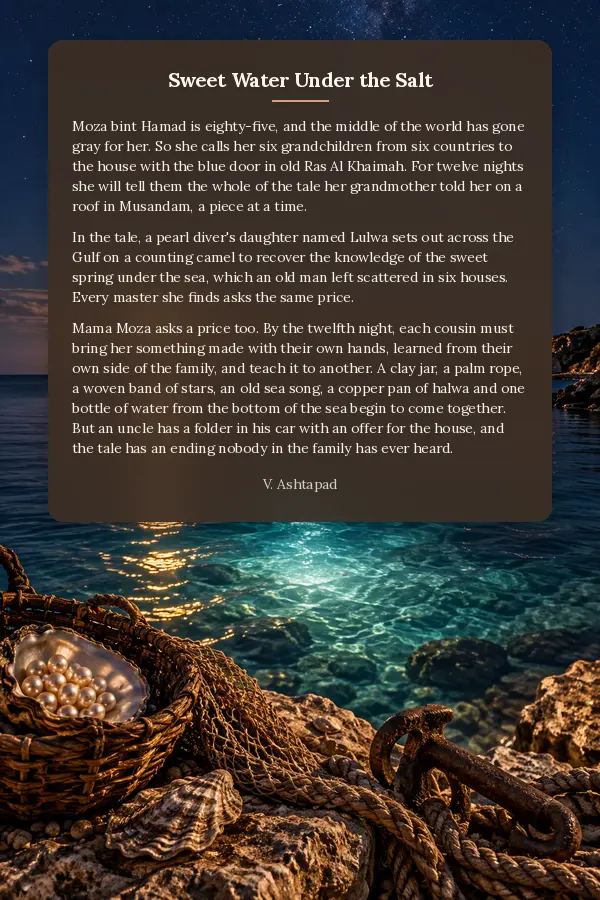
Moza bint Hamad is eighty-five, and the middle of the world has gone gray for her. So she calls her six grandchildren from six countries to the house with the blue door in old Ras Al Khaimah. For twelve nights she will tell them the whole of the tale her grandmother told her on a roof in Musandam, a piece at a time.
In the tale, a pearl diver's daughter named Lulwa sets out across the Gulf on a counting camel to recover the knowledge of the sweet spring under the sea, which an old man left scattered in six houses. Every master she finds asks the same price.
Mama Moza asks a price too. By the twelfth night, each cousin must bring her something made with their own hands, learned from their own side of the family, and teach it to another. A clay jar, a palm rope, a woven band of stars, an old sea song, a copper pan of halwa and one bottle of water from the bottom of the sea begin to come together. But an uncle has a folder in his car with an offer for the house, and the tale has an ending nobody in the family has ever heard.
Members can react to this book and talk about it in the members' Library.
Ownership
© 2026 CRUNOD LLC. All rights reserved.
This book is owned by CRUNOD LLC. It is free to read on EternalCurrent.Online. No part of it may be copied, reprinted, sold, recorded or adapted, including as audio, film or translation, without written permission from CRUNOD LLC.
© 2026 CRUNOD LLC. All rights reserved.