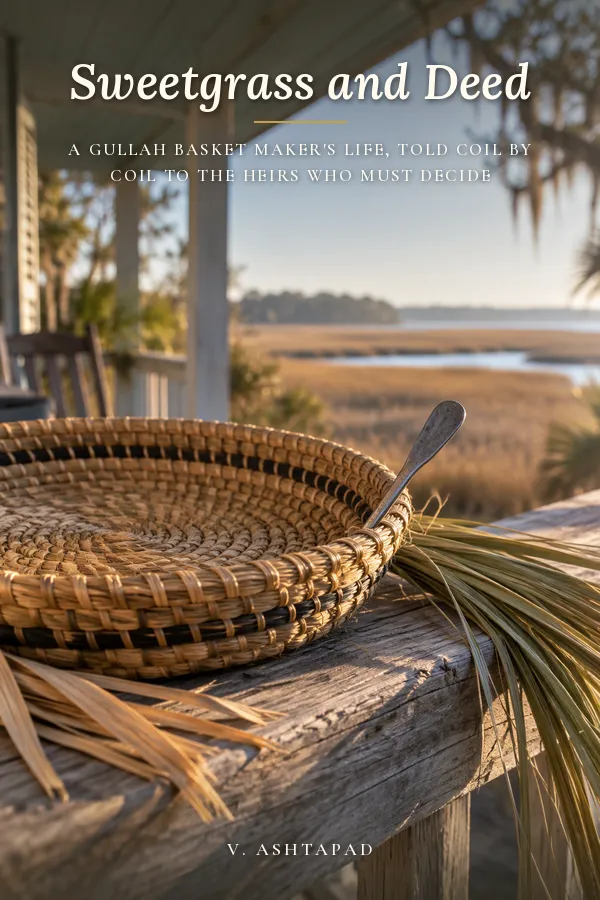
Sweetgrass and Deed
A Gullah Basket Maker's Life, Told Coil by Coil to the Heirs Who Must Decide
by V. Ashtapad
Foreword
This is a work of fiction. St. Helena Island is real, and so are many places in these pages: Beaufort and its courthouse, the Penn School and the Penn Center it became, Frogmore, Lands End, Fripp and Hunting Islands, Johns Island, the train stop at Yemassee, and the basket stands along Highway 17 in Mount Pleasant and the community of Six Mile. Hurricane Gracie in 1959 and Hurricane Hugo in 1989 were real storms. South Carolina did change its partition law in 2012, and conservation easements are a real way families protect land.
Everything else is invented. There is no Sea Island Heritage Partners, no Tolliver oyster house, no Grant land off Seaside Road, and no museum basket made by Hattie Grant Polite. The land trust, the developer, and every person in this book are imagined, and any likeness to real people is an accident. The sewing of sweetgrass, rush, pine and palmetto is described as faithfully as a novel allows.
For the sewers along the roadsides of the Lowcountry, and for everyone who ever handed them grass.
The Saucer Mat
The letter came in September, in a cream envelope thick as a slice of cornbread, and it was addressed to me as if I were a business. Mrs. Hattie G. Polite, Representative of the Heirs of Abram Grant. Nobody had ever called me representative of anything.
Sea Island Heritage Partners, it said at the top, in blue letters with a little drawing of a heron. They wished to make a respectful offer for the forty acres off Seaside Road, with frontage on the marsh of Station Creek. They named a sum. I read the sum three times and then I set the letter down on the oilcloth and went out to the yard and pulled every dandelion along the fence, because my hands needed somewhere to go.
Heritage. They put heritage in the name of the company that wants to buy mine. I will say this for them, they have a sense of humor, even if they do not know it.
That was September. Now it is October, and the marsh is turning. The cordgrass goes from green to the tawny of a deer's back, and when the tide comes in at evening it stands up in the water like a field of wheat somebody forgot to cut.
My great-grandson Malik is sitting across from me on the porch with his phone propped against the sugar bowl. He is seventeen. He is long in the arm the way my husband was, and he has my daughter Bernadine's eyebrows, which go up in the middle when he is thinking, like a little roof. He has asked me if he can record me, and I have told him yes, on three conditions.
"Say them again," he says. "So it's on there."
"One. My name goes on it. Hattie Grant Polite, and you say I said it, not some lady in a book."
"Hattie Grant Polite." He nods at the phone as if the phone were taking notes.
"Two. When I say a thing is not for keeping, you take it out. I am eighty-eight. I have earned the right to say something foolish and have it disappear."
"Okay."
"Three. You do not butter me. When it is done, nobody plays it at a funeral and cries. I have a doctor in Beaufort who says I have the heart of a woman of seventy, and I told her that was rude to the women of seventy."
He laughs, and he tries not to, because he is trying to be official.
The meeting is the Saturday after Thanksgiving. My niece Bernice in Atlanta, who was a school principal for twenty-six years and has never once in her life let a meeting start late, has set it up. Everybody who has a share is supposed to come or be on the video call. Bernice says there are thirty-one of us. She and Malik have been building the family tree in that private shared space where everybody can add a name, and every few days somebody from Detroit or Newark or Dallas puts in a grandbaby, and Bernice sends a message to the group chat that says, in capital letters, PLEASE INCLUDE BIRTH YEARS.
Thirty-one people own this porch I am sitting on. Thirty-one people own the pecan tree and the old pump and the low place by the creek where my father kept his bateau. Not one of them could tell you which corner the iron pin is in. I could. I have stepped on it barefoot.
So the boy wants my life, and I am going to give it to him the only way I know, which is basket by basket. I can remember every basket I ever sewed. A basket is different. A basket you sit with for days. It knows what you were thinking while you made it.
I have a new one started in my lap. It is only the start right now, the knot at the center that everything grows from.
"Start at the start," he says. He thinks he is being clever.
All right. I will.
---
I was six years old the first time my mother let me sew. It was the summer of 1944, and there was a war on, though on St. Helena the war mostly meant my uncle Ned was gone, and sugar came in a little paper ration, and at night you could sometimes hear the guns practicing over at Parris Island, a low thump like somebody beating a rug far away.
Our house sat where this one sits now. The old one was board, unpainted, gone silver from the weather, up on brick piers so the chickens could walk under it and the breeze could go through. My father had painted the porch ceiling and the window frames that pale blue, the color of a robin's egg left in water, because his mother had done it and her mother before. The blue was the only paint on the whole house. In the afternoons the light came in under the eaves and laid that blue on everybody's face.
My mother, Rosa Grant, sat on the porch every afternoon after the field work was done. She had her grass in a croker sack at her feet, the long sweetgrass that she had gathered in the summer behind the dunes and dried in the yard until it went from green to the soft gold of a new straw broom. She had black rush in another bundle, stiff and dark, for the strength of it. She had a bucket of water with palmetto strips soaking in it, strips she had torn off the young fronds with her thumbnail and split as thin as a shoelace. And she had her bone.
You have to understand about the bone. It is not a bone. My mother's was the handle of a teaspoon that my father had ground down on the grindstone until it was flat and pointed like a little tongue. The silver had worn off it long before I was born, so it was just the gray metal underneath, smooth as a creek pebble, and warm, always warm, because it never left her hand.
What you do with the bone is this. You have your coil of grass, a bundle as thick as your finger, going round and round. You push the bone into the coil you made before, just under it, and it opens a little door in the grass. Then you pass your palmetto strip through that door and pull it tight, and that binds the new row to the old row. Push, pass, pull. Push, pass, pull. Round and round, outward and outward, until the thing has a floor and then walls and then whatever it is going to be.
I had been watching her do this since before I could talk. I had been told to keep my hands to myself since before I could talk, too.
That summer she looked at me one afternoon, sitting on the step with my chin on my knees, and she said, "Hattie, go get the little spoon."
I knew which spoon. It was the twin of hers. My father had ground it for me at Easter and given it to her to keep, and she had kept it in a jelly jar on the shelf over the stove. I ran so fast I knocked the jar over and it rolled under the stove and I had to lie on my belly in the ash and the dust to get it out.
She made the start for me. Her fingers were long and dark and quick, with the knuckles a little bigger than the rest, and she bent a few strands of grass and tied them over on themselves so tight you could not see where they began. She handed it to me.
"Now," she said. "You go round."
I went round. I went round the wrong way first, and she turned my hand over without saying anything and I went round the right way. I pushed the bone in too far and it came out the other side and stuck me in the thumb. I put my thumb in my mouth and tasted blood and the green bitter taste of palmetto.
"Too deep," my mother said. "You are not spearing fish."
The grass would not stay together. It kept fanning out like hair in the wind. My mother showed me how to feed new grass into the bundle before the old ran out, so it overlapped and you never saw a seam. She showed me how to keep a little rush on the outside to make it stiff. She did not talk much. She hummed. She always hummed when she sewed, a low tune with no beginning and no end that went up a little at the turn, the way the coil goes up a little at the turn, and I believe now she did not know she was doing it.
My grandmother, Ma Celie, came out of the house with a pan of butter beans to shell, and she sat on the bench and watched me, and she laughed.
"That child sewing a crab," she said.
It did look like a crab. One side went out further than the other, and it was humped in the middle. I had pulled too hard on one side and too soft on the other, the way you do when you are six and your whole arm is trying to help. I worked on it for three afternoons. My mother did not take it from me, though I know she wanted to. When I got it as big as a saucer, she said, "Now you finish it," and she showed me how to taper the end of the coil so it thinned out to nothing and tucked under, so the round did not end in a step.
That was my first basket. It was not a basket. It was a mat, the size of a saucer, the color of toast, with a lump in the middle you could have hidden a pea under.
My mother took it out of my hands and held it up to the porch light. She flipped it and studied the underside, which is where you can see if somebody was careful. Then she set it on the porch rail and put her coffee cup on it.
She did that every afternoon for years. Every afternoon she came out with her coffee, which was mostly chicory in those years, and she set it on my crab. When the cup sat crooked because of the lump, she did not move the cup. She just drank her coffee leaning a little to the left.
---
"Where is it now?" Malik says.
He has stopped the phone without my noticing, the way he does when he wants to ask something he thinks is not for keeping.
"Your grandmother has it."
"Grandma Bernadine?"
"In her china cabinet, behind the glass, next to the gravy boat that was her husband's mother's that she does not like."
His eyebrows go up into the little roof. "I've seen it. I thought it was a coaster from somewhere."
"It is a coaster from somewhere. It is a coaster from this porch."
He picks up the phone and starts it again and asks me to say that part again, and I do, and then he opens that catalog he has started, where he puts every basket of mine anybody can find, with who has it and where they keep it and what I say about it. He has twelve so far. He types in Saucer mat, 1944, first piece, Hattie age six, kept by Bernadine Polite Jenkins, Beaufort. He asks me if he should write lumpy, and I tell him he should write honest, which is the same thing.
The sun is down behind the pecans now. The light on the marsh goes pink and then gray. Malik's mother, Keisha, will be here soon to pick him up. She works at the front desk of one of those resorts out past Fripp, and she comes home with her name tag still on and her feet hurting and the smell of that hotel soap on her hands, which smells like a lemon that went to college.
"Grandma Hattie," Malik says. He has turned the phone off again. "Are you going to tell them to sell?"
I look at him. He looks at the sugar bowl.
"Are you asking for you," I say, "or for your mama, or for your uncle Eugene in Philadelphia who has been calling this house every Sunday since September and talking about the weather like a man who has never seen weather?"
"I'm just asking."
"Nobody is just asking. Not about forty acres."
He does not answer, and I let him not answer. I know about the college letters. Keisha told me. Georgia Tech keeps writing to him, and some school in North Carolina, and they all cost what a shrimp boat costs, every year, for four years. I know what his grandmother Bernadine's share of forty acres on the marsh would come to, and I know who she would spend it on. I can do arithmetic. I did arithmetic at the Penn School when his teachers were not yet born.
"You keep that red light on," I tell him. "That is how you find out what I am going to say. Same way I find out."
Keisha's car comes down the dirt road with its lights bouncing through the oaks. Malik puts his phone in his pocket and stands up, and before he goes he does a thing he does not know I see. He picks up the start that I left on the porch rail, the little knot of new grass, and he flips it and studies the underside.
Ma Celie's Fanner
My son Eugene called on Sunday at four o'clock, the way he has called every Sunday since the letter came. Before the letter it was every other Sunday, and sometimes the other Sunday slipped. I do not hold that against him. A man in Philadelphia has a lot of Sundays to get through.
"Mama," he said. "How's the weather down there?"
"It is weather," I said. "It is doing what it does."
"It's forty-one degrees here. They're saying frost tonight."
"Then put a sheet over your tomatoes."
"I don't have tomatoes, Mama. I have a parking space."
He is sixty-eight years old and he still says Mama like a boy coming in from the yard with a cut on his knee. He drove a city bus for forty years and he has a pension and a bad hip and a wife named Doris who is a good woman and who has never once understood why anybody would live where there is pluff mud. I could hear the television behind him, a football game, men shouting about something that happened a second ago. I waited for him to say what he called to say. He did not say it. He asked about my blood pressure. He asked if June had fixed the screen door. He said, "Bernice sent around the thing about the meeting," and I said, "I saw it," and he said, "Well," and then he said Doris was calling him and he had to go.
He wants to sell. Everybody knows he wants to sell. He just cannot say it to his mother on a Sunday.
Malik came Monday after school. He brought a bag of boiled peanuts from the stand on the highway, soft and salty and still warm in the wet paper, and we sat on the porch and shelled them into a bowl and dropped the shells in a coffee can. The juice ran down to our wrists. When I was a girl we boiled our own in the wash pot in the yard. Now a man in a truck boils them and sells them to tourists and to me, and his are better, which I will not say to his face.
I sent Malik into the front room to bring out the fanner. He knew which one. It hangs on a nail over the door between the front room and the kitchen, where it has hung since this house was built in 1966. It is wide and shallow, nearly as wide as a bicycle wheel, with a low lip all round it like a pie plate, and it has gone dark, the color of a strong cup of coffee with a little milk, from eighty years of kitchen air. He held it in both hands like a steering wheel.
"This one is my grandmother's," I said. "Ma Celie. Not mine. But I helped."
---
In 1949 I was eleven, and I was going to the Penn School, and I thought I knew everything there was to know.
The Penn School sat in the middle of the island under the live oaks, with its brick buildings and its white wood ones, and its bell, and its fields where the older boys learned to plow straight. The teachers came from all over. Some were from the island, and some were from up North, and they wore stockings even in July, and they taught us arithmetic and penmanship and how to make soap and how to can tomatoes so the lids would not pop. I loved it there. I loved the smell of the chalk and the oiled floors and the ink that came in a bottle you were not allowed to touch. I loved that there was always a book I had not read.
The school had a basketry room. I had not known that until I was old enough to go into it. In the basketry room a teacher named Miss Albright showed the boys and girls how to make baskets the school way, which was neat and even, with every row of stitches lined up with the row before, so the stitches ran out from the center like the spokes of a wheel. The school baskets sold to visitors. They were good baskets. They looked like they had been made by a careful machine.
I came home and told my grandmother that her baskets were not as neat as the school baskets.
Ma Celie was in the yard. She had a croker sack spread on the ground in the sun, and on it was rice that my father had grown in the low place by the creek, where the ground stayed wet and black and smelled like rotten eggs when you stepped in it. Nobody on the island grew rice to sell anymore by then. It was a small patch, just for us, enough for Sunday dinner and New Year's. My father planted it because his father had planted it. Ma Celie had threshed it by beating the stalks over a log, and now it lay on the sack with the husks still clinging, and she was getting ready to fan it.
She heard what I said. She did not look up.
"School baskets," she said.
"Their stitches line up," I said. "Like spokes."
"Mm-hm." She picked up her old fanner, which was falling apart at the lip, the grass all frayed and gray, and she scooped up a heap of rice and stood up, and she began to fan.
You have to see it to understand it. She held the fanner out flat in front of her at the height of her belt. She gave it a little toss, not up so much as forward and up, and the rice flew a few inches into the air and came back down into the basket. In that little flight the wind took the chaff, the light gold husks, and carried them away across the yard like a puff of smoke, and the heavy grain fell back. Toss and catch. Toss and catch. The sound was like rain beginning on a tin roof, a soft patter and then a hush. The chickens knew the sound. They came running from under the house and stood downwind with their heads cocked, waiting for whatever fell.
She did that for a long time, and I stood and watched, and I knew I was being taught something but I did not know what.
Then she held out the fanner to me.
I tossed. Half the rice went into the air and kept going. It rained down on the chickens, and the chickens thought it was the best day of their lives. Ma Celie laughed with her two teeth.
"School tell you how to do that?" she said.
"No ma'am."
"School tell you why the lip is that high and not higher?"
I did not know. She showed me. Higher and the rice would not leave the basket. Lower and it would not come back. She showed me how the bottom was a little bit curved, not flat, so the grain rolled to the middle. She turned the old fanner over and showed me the underside, where the rows were close and tight and every stitch went a little crooked, leaning, like grass leans in a steady wind.
"Them stitches go crooked because they got work to do," she said. "Line them up like spokes and they all pull the same way. Basket split right down the spoke the first hard year. Lean them, and every one hold its neighbor."
I did not believe her. I was eleven and I had a teacher in stockings.
That fall she started a new fanner, because the old one was done. She let me sit with her and feed the grass. I did not do the stitching. My stitches were not good enough yet for a fanner, which has to be stiff enough to throw rice in the air ten thousand times. But I sat at her feet on the porch and I handed her the grass, a few strands at a time, and I learned how much to hand her by how she held out her palm. If I gave her too much she said, "I ain't feeding a mule." If I gave her too little she said, "That a basket or a bird nest?"
While she sewed she talked. That is when she told me about Abram Grant.
He was her husband's father, my father's grandfather. He was born in slavery on a plantation on the other side of the island, near where the road bends at the old store. When the war came the owners left in a hurry and did not come back, and the people who had worked the land stayed on it. After the war some of the land was sold off in pieces, and Abram worked eleven years for other men, picking long-staple cotton and digging ditches and rowing a boat to Beaufort for whoever would pay him. He saved coins in a sock. He bought these forty acres from a man named Harwood who had gone broke, and he paid for them over seven years, every fall when the cotton came in. Ma Celie said he walked to Beaufort to the courthouse the day the last payment was made and stood in front of the clerk until the clerk wrote it in the book, and then he made the clerk read it back to him out loud, because Abram could not read and he did not trust a paper he could not hear.
"Then he come home," Ma Celie said, "and walked the four corners. Barefoot. Every corner. And put a iron pin in the ground at each one, a piece of a wagon axle, and stomped it in with his heel."
"Did he make a will?" I asked. They had just taught us about wills at the Penn School.
She looked at me then, over the fanner.
"He say paper is what took it from us the first time," she said. "He say the land know who it belong to."
I thought that was a very fine thing to say. I was eleven. It took me forty years to understand that it was the most expensive sentence anybody in my family ever spoke.
The new fanner took her most of the winter. When it was done she put it out in the sun to cure for a week, and the green went out of the grass and it turned the color of honey. She fanned the next year's rice in it, and the year after that, and every year until my father stopped growing rice, which was 1961, when he got his job at the Marine base and did not have time for a wet field anymore. After that she used it to carry collards. She used it to sift sand off the shrimp when the boys came in with a bucket from the creek. She used it once to fan my brother Zeke when he fainted in the heat at a cousin's wedding, which he never lived down.
When she was gone, my mother hung it on the wall. When my mother was gone, I brought it to this house and hung it over the door.
---
Malik turned it over in his hands, the way I had turned the old one over seventy-seven years ago. He found the stitches on the back, leaning.
"They do lean," he said. "All in the same direction."
"Now you know something they did not teach at the Penn School."
"The Penn School is a museum now, Grandma."
"I know what it is. I went to the dinner when they put the new roof on."
He laid the fanner on his knees and took a picture of the front and a picture of the back. Then he typed. Rice fanner, about 1949, sewn by Celie Grant, Hattie handed grass, used for rice then collards then shrimp then Uncle Zeke. Hangs over kitchen door. He asked me if he should put in the part about Uncle Zeke and I told him if he left it out Zeke would rise up out of the ground in Newark to complain.
Then he said, "So that's why it's heirs' property. Because Abram didn't make a will."
"That is the start of it."
"And then nobody made a will after him either."
"Some did. Some did not. Some made one and lost it. Some made one and left it all to a second wife that nobody had met. It is a long story and there are a lot of people in it. That is what your Aunt Bernice is doing with all those names."
He was quiet. A marsh hen started up down by the creek, that clattering call they make, like somebody running a stick along a fence. The tide was going out, and the mud was showing, shiny and gray as a seal, and the smell of it came up the yard, that rich sulfur smell that Doris in Philadelphia says smells like a bad egg and that I say smells like supper.
"Uncle June knows where one of the pins is," Malik said. "He said he'd show me Saturday."
"He knows where two of them are. The third one is under the Maxwell boy's driveway, and the fourth one, the one by the creek, I will show you myself."
"Can you walk that far?"
I looked at him until he understood that the question had been a mistake.
"I mean," he said, "it's muddy."
"I was born in that mud," I said. "It knows me."
He put the fanner back over the door. He had to stand on a chair to reach the nail. He got the nail through the same loop of grass that Ma Celie made for it, the loop she bound with palmetto in the winter of 1949 with me sitting at her feet telling her the school way was better. It hung a little crooked. He reached up to straighten it, and I told him to leave it alone.
The Bread Basket at the Oyster House
My son June found the first pin on Saturday morning in under ten minutes, which he has been telling everybody about since, as if he had found the gold out of a Spanish ship.
June is Lucius Junior, my youngest, sixty-two years old, and he has lived on this land his whole life except for two years in the Army that he does not discuss. He has a trailer down near the creek with a porch he built himself out of old dock lumber, and a shrimp boat named the Miss Rosa after my mother, and a dog named Captain who has never once been on the boat because he gets sick. June smells of diesel and cigarette and bait, and he has hands like two catcher's mitts, and he is the gentlest one of all my children, though you would not know it from looking.
He had a steel rod about four feet long with a T handle on it, and he walked along the ditch by the road where the old fence used to be, poking the rod into the sand every two steps, and Malik walked behind him with his phone held out like it was a divining stick. I sat in June's truck with the door open and my feet on the running board. The sun was just over the trees and the dew was still on everything, every spider web in the ditch weed silver and sagging. It was cool enough that I had my blue sweater on, which made me happy. I have been waiting for sweater weather since August.
"Here," June said, and the rod went clink.
They dug with their hands. Malik got down on his knees in the wet sand in his good sneakers. Six inches down there it was, a piece of iron no bigger around than a broom handle, so rusted it was the same red-black as the dirt around it, standing straight up where Abram Grant had stomped it in with his heel in 1878.
Malik did not say anything. He reached down and touched the top of it with one finger. Then he took a picture of it with a ruler next to it, and then a picture from up high with the road and the big oak in it so anybody could find it again, and he put it on the map he is making of the land. The map has the house on it, and the pecans, and June's trailer, and the low place by the creek where the rice was, and the path that went to the praise house before they paved over the end of it. Now it had a corner.
"That's one," June said, and he grinned at me over the hood of the truck. He has a gap between his front teeth like his daddy.
"That was the easy one," I said.
---
On the way home Malik asked me about the oyster house, because June had pointed out where it used to stand, at the mouth of the creek past the Maxwell place, where now there is nothing but a cement slab with weeds growing up through the cracks and a heap of old shells gone white as chalk.
I was fifteen in the winter of 1953 when I started shucking at the Tolliver oyster house. My father said I could go to the Penn School in the mornings until noon and shuck in the afternoons, and that was how it would be, because the land taxes were due and the cotton had not paid and Ma Celie needed her medicine. I did not argue. Everybody my age was doing the same.
You never forget an oyster house. You cannot. The smell gets into your hair and your clothes and your skin, and for months you smell it on yourself in bed at night, salt and mud and something sweet underneath, almost like melon. The building was a long tin shed set up on posts at the edge of the creek, so the boats could come right up and the men could shovel the oysters off the deck in great dripping heaps. There was a steam box at one end, where they steamed the clusters open a little to make them easier, and the steam came billowing out every time they opened the door, so the whole shed was hot at one end and freezing at the other.
We stood at long wooden tables, women on both sides, thirty or forty of us, with our feet on boards so they would not stand in the water that ran across the floor. Every woman had her own knife and her own bucket, and some had gloves and most did not. You took an oyster out of the pile, you found the hinge with the point of the knife, you gave it a twist that you felt in your wrist like a key turning in an old lock, and the shell popped. You cut the muscle. You dropped the meat in your bucket and threw the shell on the floor, and the men came by with shovels and scraped the shells out the door into the creek, where they piled up into a hill.
When your bucket was full you took it to the window, and the man at the window, Mr. Tolliver's nephew, a pale fellow with ears like jug handles, measured it and gave you a little brass check with a number stamped on it. At the end of the week you turned in your checks for money. I kept mine in my apron pocket and they clinked against each other when I walked, and that sound was the best sound in the world.
The first week I cut myself eleven times. I counted. The shells are sharp as broken glass on the edges, and the knife slips, and the cold makes your fingers stupid. My mother rubbed my hands with lard at night and wrapped the worst cuts in strips of a flour sack. By the third week my hands had learned. By the second month I could shuck faster than half the grown women, and they did not like it, and they teased me about it.
The women sang. Not all the time, but when the work got slow and cold and the light outside the door went gray in the late afternoon. Somebody would start, low, and the others would come in under her, and it would grow until the whole shed was going, forty knives twisting on the same count. The best leader was a girl named Pearlie Washington, two years older than me, from down near Lands End. She had a voice that cut through the steam the way a boat horn cuts through fog. She would stop on a high note and hold it while everybody else kept going underneath, and then she would drop down onto the beat, and when she did, I swear every shell in that shed opened faster.
Pearlie became my best friend that winter. She was tall and bony with a laugh that rose at the finish like she was asking you something, and she wore a man's wool cap pulled down over her ears and called it her crown. She wanted to go to New York. She talked about it the way some people talked about the movies. Her auntie was in Harlem, and Pearlie said she was going to go up there and work in a hat factory and sing at night, and she was going to wear stockings every day and never smell an oyster again as long as she lived.
"What about you, Hattie?" she said.
I said I wanted to be a teacher at the Penn School. I said it out loud for the first time standing in an oyster house with my hands bleeding. Pearlie did not laugh. She said, "You'd be good," and then she started a song, and that was the end of it.
---
The bread basket happened because of Mrs. Elliott.
She was a white lady from Beaufort, from one of the big houses on the Point with the porches upstairs and down, and she came out to the oyster house on Fridays in a long green car to buy a gallon of select oysters straight from the window, because she said they were fresher than at the market. She wore gloves and a hat with a little net on it, and she stood well back from the steam. The men called her the Duchess when she could not hear.
One Friday in February I had brought a basket with me. It was a bread basket, round, about as wide as a dinner plate, with walls a hand high and a little flare at the top like the brim of a hat. I had been sewing it in the evenings by the kerosene lamp. It was the first real basket I had made by myself from the start to the finishing, with no grown hand on it, and I had brought it to show Pearlie. I had my oyster knife and my rag in it.
Mrs. Elliott saw it on the end of the table.
"Who made that?" she said, through the window, in a voice like a teacup.
Nobody said anything. Then Pearlie poked me in the back with her elbow, hard.
"I did, ma'am."
She asked to see it. I wiped the oyster off my hands and dumped out my knife and my rag and gave it to her. She turned it around in her gloves. She turned it over and looked at the bottom. I watched her look at it the way my mother looked at things, and I did not expect that from her.
"What would you take for it?" she said.
I did not know. I had never sold anything. I thought about how many buckets of oysters it would take to make the same money, and I tried to think of the biggest number I could say without being struck by lightning, and I said, "Three dollars, ma'am."
At that time, three dollars was about two good days at the shucking table.
She opened her pocketbook and gave me three dollars and a quarter, and she said, "The quarter is because you didn't ask for five," and she took my basket out to her long green car and drove away with it on the seat next to her oysters.
Pearlie screamed. She grabbed me by both arms and jumped up and down on the wet boards and the jug-eared nephew told us to quit carrying on, and we did not quit. That night I gave my mother the three dollars. I kept the quarter. I have it still. It is in the drawer of my sewing table under the scissors, a 1947 quarter, worn on the side where my thumb has rubbed it.
My mother held the three dollars in her lap for a long time.
"Two days," she said finally.
"About two days."
"And how many nights you sew it?"
"Nine."
She nodded slowly. She was doing the same arithmetic I had done, I could see it, with a pencil in her head. Nine nights by the lamp against two days in the cold with your hands bleeding. It did not come out even. But it came out closer than either of us had thought.
"Next one," she said, "you ask four."
---
"Does Mrs. Elliott still have it?" Malik asked. We were back on the porch by then. He had his catalog open already, a new line with nothing filled in.
"Mrs. Elliott has been dead since 1980. I do not know where the basket went. Maybe her children have it. Maybe it is in a closet on the Point with a bag of Christmas ornaments in it. Maybe somebody sold it at a yard sale for two dollars and the somebody who bought it got a bargain."
He typed it in anyway. Bread basket, 1953, first sold, Mrs. Elliott, Beaufort, three dollars and a quarter. Whereabouts unknown.
"What happened to Pearlie?"
"Pearlie went to New York in 1955. She worked in a hat factory, just like she said. She sang on the radio one time, on a Saturday night program, and her auntie wrote a letter to tell us and the whole island listened on Mr. Simmons's set at the store. She married a man who drove a taxi. She sent me a postcard every Christmas for fifty-one years. I have the postcards."
"Can I scan them?"
"If you put her name on every one."
He said he would. He said he would ask her family too, if he could find them, so they could add what they knew. He has learned that from Bernice, I think, that business of asking. Or maybe he had it already. Some people do.
I did not become a teacher at the Penn School. That is a different basket. But the quarter is under the scissors, and the hill of shells from the Tolliver oyster house is still out there at the mouth of the creek, white and quiet under the weeds, and when the tide is very low you can see where it goes down into the water and keeps going.
A Hat for Lucius Polite
Keisha came by on her day off and we had words.
She did not mean to, and I did not mean to, but we are the same kind of woman, she and I, which her grandmother Bernadine says is the whole problem. Keisha is forty-one. She has worked at the resort out past Fripp for nineteen years, starting at housekeeping and now at the front desk with a gold bar on her jacket that says Guest Services Lead. She raised Malik mostly by herself. She has a little house in Beaufort with a fig tree in the yard that she does not pick, which I try not to think about.
She brought me a sweet potato pie from the bakery on Boundary Street. I said thank you. I asked her why she did not make one. She said because she works fifty hours a week, Grandma, and she has a son, and when exactly would she make a pie, in her sleep? I said her great-grandmother made pies after twelve hours in the field. She said her great-grandmother did not have a manager who texted her at eleven at night about a towel count.
Then we were off.
"You know what they pay me out there," she said. She was standing at my kitchen counter cutting the pie with the side of a fork because she would not wait for a knife. "You know what the health insurance is. You know what Malik's tooth cost. That resort is why that boy has teeth."
"I did not say a word against the resort."
"You did not have to. You make that face."
"I do not have a face."
"Grandma, you have about nine faces, and that is the one."
The face, I suppose, is the one I make when somebody says resort. I have made it since 1964. I cannot help it. My face is older than my manners.
She sat down hard at the table with her slice. She had her hair pulled back tight and her eyes looked tired at the corners. "I'm not saying sell," she said. "I'm not saying anything. I'm just saying the people out there aren't monsters. I've met a monster. He's a guest from Ohio who wants a refund on the ocean."
That made me laugh, and when I laughed she laughed, and then it was all right.
Malik was in the front room with his earphones in, pretending he could not hear us. When his mother left, he came out and sat down with his phone and set it on the sugar bowl and said, "Can we do one that isn't about the land?"
"Every one of them is about the land," I said. "But I will try."
"How did you meet Grandpa Lucius?"
---
I met Lucius Polite on a Thursday night in January of 1956, at the praise house on our road, while he was singing bass.
You have to know what that building was. A praise house is small. Ours was board, unpainted, about the size of a one-car garage, with benches along the walls and a little stove in the middle and a lamp hanging from a hook. In those days the old people of our road went there two nights a week, and on certain nights the young people came too, mostly to see who else came.
What I want to tell you about is the sound, because that is what I remember, and that is what nobody can describe to you if you were not in a small board room on a cold night with forty people in it.
It started with feet. The floor was pine boards laid over joists with air under them, and when people stamped, the whole floor answered like the skin of a drum. Somebody would have a broomstick or a walking stick, and he would knock it on the boards, steady, not fast, and that was the bottom of everything. Then the clapping came in, but not on the same count as the stick. It came in between, so that you heard the stick and then the hands and then the stick, and the room started to rock like a boat with a long swell under it. Then a woman would raise a line, high and alone, and everybody would answer, and the answer was lower and bigger and came from all sides, and the stove ticked in the middle of it all and the lamp swung on its hook.
The singing on our road had a shape to it. It went round and round, the same few notes coming back, a little different each time, and it never really stopped, it only got quieter or louder. I have thought since that it was like sewing. You go round, and each time you go round you are a little farther out, and you are binding each row to the one before.
On that Thursday night there was a new voice in the room. It was down at the bottom, under everybody, so deep you felt it in the bench more than heard it. It was like a bullfrog in a rain barrel. It was like the engine of a big boat idling at the dock. It held the whole room up from underneath, the way the floor joists held up the floor.
I looked over and there was a young man I did not know, standing by the door, turning his cap round and round, singing with his eyes closed. He was tall and long in the arms, with a long face and a little mustache he was trying to grow and had not quite managed. His ears stuck out. His coat was too short in the sleeves. He was the best-looking thing I had ever seen in my life, and I was eighteen and had seen a few.
Pearlie had gone to New York by then, so I had to find out who he was by myself. I asked my brother Zeke, who knew everybody. Zeke said, "That's a Polite from Coffin Point. Works on his uncle's shrimp boat. Got the loudest laugh in Beaufort County."
"I don't care about his laugh."
"Then why you asking?"
I found out about the laugh the next Saturday. I was at the landing with my father when the shrimp boats came in, and the Polite boat came in last, and somebody on the dock said something, and from the deck of that boat came a laugh like a load of lumber falling off a truck. Everybody on the landing turned around. Even the pelicans on the pilings turned around. It was the bass voice. It was Lucius.
He saw me looking. He did not look away. He climbed up the ladder onto the dock with a basket of shrimp on his shoulder, and he came over to my father and said, "Mr. Grant, I believe these are for you," and gave my father two pounds of white shrimp for free. My father looked at the shrimp and looked at Lucius and looked at me, and he said, "I believe they are," and that was the start of it.
---
He courted me for a year and a half. It was a long courtship for those times, because my father wanted me to finish at the Penn School and I wanted to go to the college in Orangeburg to train to be a teacher. We had written away. The teachers at the Penn School had helped me with the letter. I had the papers. We did not have the money. We tried for a whole year to find it. My mother sewed baskets until her fingers split. My father took extra work. In the end it came out to about half of what we needed, and half of a college is no college.
I cried for one night. Then I got up the next morning and went to the oyster house.
Lucius never said a word about it. He never said there would be other chances, or that it was for the best, or any of the things people say. He came by that Saturday and sat on the porch steps and did not talk. After a while he took a little paper sack out of his coat pocket and handed it to me. In it was a pencil, a new one, yellow, sharpened to a fine point with a knife, and a little tablet of paper with lines.
"Teach me to write better," he said. "I write like a chicken."
He did write like a chicken. I taught him every Saturday for a year, on the porch, and by the end he could write a letter that a person could read.
That summer I noticed he was always squinting. On the boat there was no shade. He wore an old cloth cap that did nothing, and the sun came off the water from below and got him anyway, and his eyes were always red at the rims and the skin on his nose was always peeling. He said it did not bother him. He said a shrimper with a sunburn was like a dog with fleas, you just scratched.
So I made him a hat.
I had never made a hat. My mother had made a few, and she showed me how you start it like a mat and then, at the edge of the crown, you turn the coil downward to make the sides, and then at the bottom of the crown you turn it out again, flat, to make the brim. The hard part is the turns. If you turn too fast it buckles. If you turn too slow it is not a hat, it is a bowl. I measured his head with a piece of string while he sat on the steps, and he held still for it, smiling, and I told him if he laughed I would tie the string around his neck.
I sewed it for a month. I put extra rush into the brim so it would be stiff and not flop in the wind. I sewed a band of palmetto around the crown, plain, no fancy pattern, because he was not a fancy man. When it was done it was the color of a field of oats, and it smelled like grass and sun, and it weighed less than a biscuit.
I gave it to him at the landing on a Saturday in August. He put it on right there on the dock in front of everybody. It fit. The brim came out just far enough to shade his eyes and the back of his neck. He stood there in the sun with that hat on and he did not laugh. He touched the brim on both sides with two fingers, the way a man checks a tire. Then he said, "Well, Hattie," and nothing more, and climbed back down the ladder to the boat and wore it out into the sound.
We married the next June in my mother's front room. He wore a borrowed suit and new shoes that hurt him and he wore the hat to the door and took it off at the threshold and handed it to Zeke to hold. Zeke held it the whole time, like it was a cake.
---
"How long did he wear it?" Malik asked.
"That one, four years. Then the brim went. Salt does that. So I made him another."
"How many did you make him?"
"Eleven."
He looked at me. I counted them on my fingers for him, and I could tell him something about each one. The one with the wide brim he wore in the hurricane. The one that blew off in the sound in 1971 and that a fisherman from Edisto found floating three days later and brought back because he knew whose it was. The one he sat on. The one he wore to Eugene's graduation with a tie. The last one, which I will tell you about another day.
Malik made a new line in his catalog. Hats for Lucius Polite, eleven, 1956 to 1998. He asked me if any of them were left.
"One," I said. "Your Uncle June has it. In his trailer, on a nail over the bed. He does not think I know."
Malik grinned. It was his great-grandfather's grin, I saw it come up on his face from somewhere far back, gap and all, though he has no gap.
"Grandma," he said. "Did Grandpa Lucius ever want to leave?"
That is a smart boy. That is a boy who has been thinking about something else the whole time we were talking about hats.
"Every man on this island wanted to leave at some point," I said. "Lucius went up to Baltimore for one summer in 1962, to work at the shipyard, and he came back in September thinner, with money in his pocket and a cough, and said he would rather be poor where the water smelled right. That is what he said. I am not making it prettier."
"But he could have stayed up there."
"He could have. Plenty did."
Malik picked at the edge of the table where the oilcloth is coming loose. Outside the light was going long and orange across the yard, and the pecan leaves were coming down one at a time, slowly, turning over as they fell like somebody looking for something they dropped. I wanted to tell him that going was not a failing. I wanted to tell him his great-uncle Zeke went and was happy, and Pearlie went and was happy, and his own Uncle Eugene went and had a good life. But I have promised not to butter.
"Your grandfather made his choice," I said instead. "You will make yours. And they are not the same choice, because you are not the same man and it is not the same water."
He nodded. He did not look up. But he picked up the phone again and checked that the red light was still on.
Gracie's Cradle
Eugene said it on Sunday. Finally. I had been waiting so long for him to say it that when he did, I was almost grateful, the way you are grateful when a tooth that has been aching for a month finally comes out.
"Mama, I think we should take it."
I was in the kitchen with the phone on the counter on the speaker, cleaning collards in the sink. Malik had shown me how to do the speaker so I could use both hands. The water was cold and the leaves were gritty with sand and they squeaked against each other when I rubbed them, and I kept rubbing them while my son talked.
He had it all thought out. He had been thinking it out since September, I could tell, lying awake next to Doris with that hip aching. His share would pay off the house in Germantown. It would put something toward his granddaughter's college. Doris's sister was sick and they wanted to help. He was sixty-eight and he did not have another job in him, and the pension was fine but it was not more than fine, and what was the land doing for him? He had not lived on it in fifty years. He paid his part of the taxes when June called. He came down every two or three summers and got eaten alive by the bugs. He loved it. He did. But love did not pay the gas bill in a Philadelphia January.
"Mama, you there?"
"I am cleaning greens."
"Did you hear me?"
"I heard you. Every word. You have been practicing."
He laughed a little, sadly. "Doris made me write it down."
"Doris is a sensible woman. I have always said so." I turned off the water. I dried my hands on the dish towel. "Eugene. I am not going to fight with you on a Sunday over the phone. You have a vote and you will use it. Your vote is yours."
"I want you to understand."
"I understand arithmetic. I have been doing it since before you were born. I will tell you what I want. I want you to call your nephew's boy and tell him something you remember about this place. Anything. He is getting it all down from me, and I am only one side of it."
There was a long quiet on the line, filled with the television and a siren going by somewhere outside his window.
"What do I tell him?"
"Whatever comes. Tell him about the cradle."
"I don't remember the cradle, Mama. I was a baby."
"Then I will tell him," I said, "and you can listen."
---
Eugene was born in April of 1958, in the front room of my mother's house, with the midwife Miss Hester and my mother and Ma Celie all in there with me and Lucius out in the yard walking up and down until he wore a path in the sand. He was eight pounds and some, long, with his father's ears. He had a voice on him right away. Lucius said he was going to sing bass, and he was right.
I had sewn the cradle while I was carrying him. All that winter, sitting with my feet up on a crate because my ankles swelled, I sewed. It was the biggest thing I had ever made. It was oval, like an egg cut in half lengthwise, about as long as my arm from my shoulder to my fingertips, with walls deep enough that a baby lying in it could not roll out, and a rim that I made thick, with three rows of rush in it for strength. At each end I made a handle, a loop of coil sewn up from the rim and back down again, so you could carry it between two people or by one person with both hands.
My mother watched me sew it and did not say much. Once she reached over and pressed on the side of it with her thumb, hard, to see if it would give. It did not give. She nodded and went back to her own work.
Ma Celie said, "That baby going to sleep in a boat."
It did look like a boat. When Eugene came, I lined it with a folded quilt and put him in it, and it sat on the floor next to our bed in the little two-room house Lucius had built on the back of the land, near where June's trailer is now. In the daytime I carried it out to the porch and set him in the shade where I could watch him while I sewed or shelled or hung the wash. He liked to lie there and look up at the blue ceiling and kick. When it was hot I took a palmetto fan and fanned him, and he would close his eyes and open his mouth like a little bird.
That was how it was until the end of September of 1959, when Gracie came.
We had a radio by then. We heard about her on the Friday, a storm out in the ocean, coming toward the coast, nobody sure where. By Monday they were sure. They said Beaufort. They said it like a man saying your name in a courtroom.
Lucius took the boat up the creek. There was a place up there, a bend where the creek narrowed between high banks with big oaks on both sides, where the shrimpers took their boats in a storm, and they called it the hurricane hole. He and his uncle and his cousin Rufus tied all three boats there with every line they had, bow and stern and to the trees on both banks, so the boats sat in the middle of a web like flies. Then he came home at a run and said we were going to my mother's house, because it was on higher ground and it was older and had been through storms before, and our little house had not.
The wind had started by then. It was not the storm yet. It was the storm's breath, coming ahead of it, hot and wet and wrong, from the wrong direction. The sky was a color I had never seen before, a yellow green like a bruise healing, and the light was strange, like everything was lit from underneath. The marsh grass was all lying flat in one direction, and the water in the creek was higher than any tide I had ever seen, and it was still coming.
I put Eugene in the cradle. I put in a second quilt and his bottle and the diapers, and a jar of water, and a box of matches wrapped in oilcloth. Lucius took one handle and I took the other, and we carried our son between us up the road through the wind to my mother's house.
I remember the sand. The wind picked it up off the road and threw it at us, and it stung my legs like a swarm of something. I remember a whole branch of a live oak, as big as a man, cartwheeling across the field in front of us like it was a tumbleweed. I remember the sound of the pines, which was a roar and a groan both, like an animal in pain, and I remember thinking that I had never known a tree could make a sound like that. And I remember that the baby slept. The whole way. Rocked in that basket between his mother and his father, with the wind trying to tear it out of our hands, with the sand hissing against the sides of it, he slept with his fists up by his ears.
We got to my mother's house. Everybody was there. My father, my mother, Ma Celie, Zeke and his wife, my sister Mae and her two children, two old women from down the road who did not have anybody, a dog, and a goat that my father would not leave outside. Fifteen people and a goat in four rooms. My father had nailed boards across the windows on the side the wind was coming from. We sat in the middle room on the floor, all together, with the lamp on low, and listened.
It came in the night. I cannot tell you about the sound of it because there is no other sound like it to compare it to. It was not like a train, as people say. A train goes by. This did not go by. It stayed. It leaned on the house. The whole house shook on its piers. The boards over the windows rattled and banged. Something hit the roof, and then something else, and the tin started to lift at one corner, and we could hear it flapping like a flag. Water came in under the door on the windward side and ran across the floor in a sheet. My father and Lucius took off their shirts and stuffed them against the bottom of the door. My mother sat with her back to the wall and hummed. Not loud. You could barely hear her. But I could hear her, because I was next to her, and she was humming the sewing tune, the one with no beginning and no end.
And the baby slept in the basket on the floor in the middle of us all.
Toward morning the wind dropped. It did not stop all at once. It got tired. Then it was quiet, and the quiet was so loud that the goat started bleating at it.
When it got light we went outside.
I will leave most of it out. The pines down everywhere, snapped off ten feet up like matchsticks. The road under water. The marsh full of things that did not belong in the marsh, boards and a mattress and somebody's rowboat upside down and a whole porch, just the porch, sitting in the cordgrass like it had been set there on purpose. Dead fish everywhere, and the smell of the marsh turned over, all the deep mud brought up to the top. Our little house on the back of the land had lost its roof and one wall. Inside, everything was soaked. The bed was full of sand.
But the boats held. Lucius walked up the creek that afternoon with his uncle, and all three boats were sitting in their web in the hurricane hole, with leaves and branches piled on the decks, without a scratch. Lucius came back and said the trees had held them like a mother holding a child with both hands, and then he went behind the house where nobody could see him for a few minutes, and when he came back his eyes were red, and he blamed the sand.
---
Eugene was quiet on the phone through all of that. I could hear him breathing. Malik was there too, at the kitchen table, with his own phone on the sugar bowl recording, and he was quiet. The collards were sitting in the colander dripping.
"I don't remember any of that," Eugene said finally.
"You were asleep."
"Where is it now? The cradle?"
"Bernadine has it. Bernadine's babies slept in it, and then Keisha slept in it, and then," I said, and I looked across the table, "Malik slept in it."
Malik looked up.
"Seventeen years ago," I said. "In your grandmother's front room in Beaufort, in that same basket, with that same quilt, which is falling apart now. You were a fussy baby and the only place you would sleep was in that basket. Your mother would put you in it and set it on the dryer when the dryer was running, and you would go right off."
"Nobody told me that," Malik said.
"Nobody tells anybody anything," I said. "That is why we are doing this."
On the phone, Eugene laughed, a small surprised sound, through his nose. "On the dryer," he said. "Bernadine did that?"
"Keisha did that. Bernadine set Keisha on the porch swing and pushed it with her foot. I set you on the porch and fanned you. Every one of us had our own way."
He said he had to go. Doris needed him. He said he would call next Sunday. Before he hung up he said, "Mama. I'm still going to vote the way I'm going to vote."
"I know you are," I said. "I raised you."
Malik went to Bernadine's house that night and found the cradle under the bed in her spare room. She had it full of old quilts. He took them out and brought it to me the next afternoon, carrying it by both handles in front of him, and set it down on the porch. It is dark now, almost the color of mahogany. One handle is coming loose where the palmetto has dried and split. There is a stain on the bottom that I believe is from Keisha. The rim is as hard as the day I sewed it.
He photographed it from every side. He wrote in his catalog: Cradle basket, 1958, sewn by Hattie for Eugene. Carried through Hurricane Gracie, September 1959. Used for Bernadine's children, then Keisha, then Malik. Then he looked at it and said, "I'm going to fix that handle."
"You do not know how."
"So teach me."
I looked at him. He looked back. The light was going and the frogs were starting up down in the low place, that steady high peeping that sounds like a thousand tiny gates swinging. I thought about Eugene in Philadelphia with his hip, and his arithmetic, and Doris's sister. I thought about my mother humming against the wall in the dark.
"Go get the little spoon," I said.
Tax Money
Bernice called on the video Tuesday night with a yellow pencil stuck crosswise through the bun on top of her head, which is how I know she means business.
Bernice is my sister Mae's daughter. She is seventy-one, she lives in a brick house in Decatur with a husband who golfs, and she ran an elementary school of nine hundred children for twenty-six years without once raising her voice, because she never had to. She has a way of saying your whole name that makes you check whether your shoes are tied. When she was a little girl she spent every summer on this land and she used to follow me around the yard asking me what everything was called. Now she is the one who knows what everything is called.
Malik held his phone up so we could both see her. She had a yellow legal pad in front of her covered in writing and arrows.
"Aunt Hattie," she said. "We have a problem. Two problems. Do you want the small one or the big one?"
"I want the one that lets me sleep tonight."
"Neither one does that."
"Then give me the big one and get it over with."
The big one was Darnell. Darnell is my brother Zeke's grandson. He is fifty and lives in Detroit and worked at a plant there for twenty-two years until it closed, and since then he has been doing a little of this and a little of that. He has a share. Not a big one, because Zeke had six children and each of them had children, and every time it divides, it divides again. But a share.
The heron people had called him directly.
"They offered to buy his piece," Bernice said. "Just his. Right now. Before the meeting. For a good number, Aunt Hattie, more than it's worth on paper, and Darnell needs the money. He called me crying. He doesn't want to do it and he doesn't see how he can't."
I knew what that meant. Malik knew what it meant too, because he has been reading everything about heirs' property he can find, sitting up late at night with his face lit blue by that phone. If any one of the thirty-one sells his piece to an outsider, that outsider owns a share of all forty acres. Not a corner. A share of all of it, every pecan and every iron pin. And somebody who owns a share can go to the court and ask for the land to be divided or sold. There is a law now that slows that down and gives the family a chance to buy back the share first. It came in 2012. But a chance costs money.
"And the small one?" I said.
"The small one is that there's a line in California nobody can find. Uncle Ned's son's daughter. She'd be about fifty-five. Last anybody heard she was in Sacramento in 1998. She has a share and she doesn't know it."
"Then find her."
"I'm trying, Aunt Hattie. I've written to three people named Gwendolyn Grant in the state of California and one of them wrote back to tell me about her cats."
Malik laughed, and Bernice tapped her legal pad with the pencil and said, "Malik Jenkins, this is not humorous," and then she laughed too.
After she hung up Malik sat with the phone in his lap.
"What would happen," he said, "if Darnell sold?"
"Then we would have to buy his piece back. Or we would have a stranger in the family."
"With what money?"
"That," I said, "is a story I can tell you about."
---
In the summer of 1964 the county sent a letter to my father saying the taxes on the forty acres had not been paid for three years, and if they were not paid by the first of September the land would be sold on the courthouse steps in Beaufort to whoever bid the most.
My father did not know. That is the first thing to understand. He thought they had been paid. My father's cousin Amos, who lived in Savannah and had a good job at the paper mill, had told the family that he would pay the taxes from then on, since he had the steady money and the rest of us did not. He said it at a family dinner on the land in 1960, with everybody there, and everybody was grateful and relieved. Then Amos had a falling-out with his wife, and moved to Jacksonville, and stopped answering letters, and nobody thought to check, because who checks on a man who promised in front of his own family?
The letter said one hundred and eighty-six dollars and forty cents.
You have to understand what that was. My father was working at the Marine base by then, on the grounds crew, and he made a little over fifty dollars a week, and there were nine people in his house to feed. Lucius was shrimping, and that summer the shrimp were thin. I had Bernadine, who was three, and I was carrying June. We had saved about forty dollars between all of us, in a coffee can behind the flour.
And there was a man named Mr. Pruitt.
Everybody on the island knew about Mr. Pruitt. He was a white man from Beaufort who wore a seersucker suit and a straw hat and went to every tax sale in the county. He bought land for the taxes, sometimes for a few hundred dollars, sometimes less, forty and fifty and a hundred acres at a time, from families who had not paid because they did not know, or could not, or thought somebody else had. He had bought the Chisolm place that way, down near Lands End, and the Chisolms had been on it since before the war. Old Mr. Chisolm had stood on the courthouse steps and watched it go and then gone home and sat on his porch, which was not his porch anymore, until the sheriff came.
My father came over to our little house with the letter in his hand that evening, and he did not sit down. He stood in the doorway with his hat on.
"We have six weeks," he said.
My mother and I sewed for six weeks.
---
There was something new on the island that summer. Fripp Island. It had been just a wild island at the end of the road, with dunes and palmettos and deer and alligators and a lot of mosquitoes, where the boys went to fish. Then some men from somewhere had bought it, and built a bridge to it from Hunting Island, and started selling lots, and all that summer the cars came down Sea Island Parkway, past our road, past the Penn School, past everything, with license plates from Ohio and Pennsylvania and New York. Strangers. Comeyahs, Ma Celie called them, with her lip curled. People who come here. As opposed to us, who were binyahs, born here, whether we liked it or not.
Lucius built a stand.
He built it in one day from scrap boards and a sheet of tin, at the end of our road where it met the highway, under an oak so it would have shade. It was a table with a roof. He painted HATTIE'S BASKETS on a board and nailed it to the front, and then he painted it over, because I told him it was vulgar to put my name up there like a movie star, and then he painted it back because my mother told me I was being foolish.
My mother and I sewed everything we could. Bread baskets and sewing baskets with lids and little trays and flower baskets with tall handles. I made a market basket, a big one, with two handles that arched over the top and met in the middle, wide enough to carry two watermelons. It took me eight days and I did not sleep much. My fingers bled at the tips where the palmetto ran over them, and I wrapped them in tape and kept going. My mother sewed faster than I had ever seen her sew. She did not hum. She sewed with her mouth shut tight.
Ma Celie sat at the stand. She was too old to sew fast anymore, but she was not too old to sell. She sat in a kitchen chair under the tin roof in her headwrap and her apron with a palmetto fan, and when a car slowed down she lifted the fan, just a little, like a queen, and the car stopped.
Oh, they stopped. Women from Ohio in shorts and sunglasses. Men with cameras. Children who wanted to touch everything. They picked up the baskets and turned them over and said, "Did you make these?" And Ma Celie said, "My granddaughter and my daughter," and pointed at us with the fan, and the women from Ohio stared at us like we were a waterfall.
They wanted to know everything. What was the grass. Where did it grow. How long did it take. Was it an African thing. Ma Celie told them it was an African thing, and that her grandmother's grandmother had brought the knowing of it across the water in her hands, and that the rice fanners had been sewn on this coast since before there was a United States. She said it plainly. She did not make it a show. She said it the way you tell someone where the post office is, and they listened to her like it was the most important thing they had ever heard, and some of them paid more than we asked.
A man from Pittsburgh bought the market basket. He paid eighteen dollars for it. He said his wife would kill him. He bought it anyway.
By the end of August we had one hundred and fifty-one dollars in the coffee can.
My father borrowed the rest from Lucius's uncle, against the next shrimp season. On the last day of August he put on his good suit, the one he wore to funerals, and he took the coffee can in a paper sack and rode the bus to Beaufort. He went to the courthouse and stood in line at the treasurer's window and paid it, in cash, in small bills and coins, and the woman at the window counted it twice. He made her write him a receipt. He made her read the receipt to him out loud, even though my father could read perfectly well. He told me later that he did not know why he did that, it just came over him, standing there.
On the way out he passed Mr. Pruitt on the courthouse steps, in his seersucker suit, reading the newspaper.
"Afternoon, Josiah," Mr. Pruitt said.
"Afternoon," my father said, and kept walking, and he told us he did not look back, and he did not hurry, and his knees were shaking so bad he had to sit down at the bus stop.
---
"The resort people paid the taxes," Malik said.
He said it slowly, like he was setting down something that might break. I had known he would get there. He is his mother's son.
"Some of them did," I said. "A man from Pittsburgh who was afraid of his wife paid eighteen dollars of it."
"So Mom's right. They're not the enemy."
"Your mother is often right. I have never said otherwise. I only say it less often than she would like."
He thought about that. Down in the yard, June's dog Captain was digging at something under the pecans, throwing dirt behind him in a spray, very serious about it. The sun was down and the sky over the marsh was that deep blue it goes in October before it goes black, with one star out over the creek, and the air smelled of woodsmoke and cut grass and the marsh at low tide.
"The ones who bought the baskets did not want our land," I said. "They wanted a basket and a story. That is a fair trade. That is a good trade. I would make it again tomorrow. The heron people are not buying a basket."
"What are they buying?"
"Ask Darnell," I said. "He knows what it feels like to have them call."
Malik picked up his phone. He did not call Darnell. He opened the family tree instead and found Darnell's name and looked at it, and at Zeke above him, and at Josiah above Zeke, and Abram at the top, with no picture, just the name and the years. Then he scrolled over to the line in California with the empty box where Gwendolyn should be, and he looked at that a long time.
He told me later, much later, that he started looking for her himself that night. He did not tell Bernice. He wanted to find her first.
The market basket from Pittsburgh is not in the catalog. Nobody knows where it went. I described it for him, the two arched handles, the eight days, the tape on my fingers, and he typed it all in and wrote at the bottom: Paid for part of the land. Whereabouts unknown. I told him that was the best thing anybody ever wrote about one of my baskets.
The Gate
My daughter Bernadine drove out from Beaufort on Saturday with a pan of red rice on the seat beside her, belted in, because she had a stop short once in 1994 and lost a whole pan of macaroni and cheese to the floor mat and has never forgotten.
Bernadine is sixty-five. She was a nurse at the hospital in Beaufort for thirty-eight years, mostly on the night shift on the medical floor, and she has the nurse's way of looking at you when you walk into a room, a quick look up and down that takes your color and your breathing and how you are standing, before she even says hello. She did it to me on the porch. I let her.
"You look good, Mama."
"I know I do."
"Are you drinking water?"
"I am drinking coffee, which has water in it."
She sat down in the rocker and set the pan of rice on the rail and took the foil off so the steam came up, tomato and bacon and onion, and Malik came out of the house like a dog hearing a can opener. She gave him a spoon and the end piece, which is the crusty part and the best part, and he sat on the step and ate it out of his hand.
Bernadine has not said how she will vote. She is the only one of my children who has not. Eugene wants to sell and June would rather be buried in the creek, and Bernadine sits in the middle the way she always has, ever since she was a little girl and they fought over the tire swing and she would hold the rope so nobody could have it until they quit. She does not like a fight. She spent her whole working life walking into rooms where people were frightened and making them calm. She is very good at it, and she does not always know when to stop.
"I brought something," she said. She reached down into her canvas bag and lifted out a basket.
It was the sewing basket. I knew it before she had it all the way out. It was round, a little bigger than a cantaloupe, with a lid that sat down snug in a groove, and a little knob on the lid made of a tight coil of rush, black against the gold. The gold was not gold anymore. It had darkened to pecan-shell brown. But the knob was still black, and the lid still sat down in its groove with a little whisper when you closed it.
"Malik said he was writing them all down," Bernadine said. "I thought he should have this one. Not to keep. To write down."
"Do you remember the day?" I asked her.
"I remember the man at the gate."
"Then you tell it," I said. "You were there."
She looked surprised. Then she looked at Malik and his phone propped up against the rice pan, and she put her hands in her lap, folded, the way she used to fold them at the nurses' station at four in the morning, and she told it.
---
I will tell it as she told it, mostly, because it was hers that day. I will put in what she did not know.
It was July of 1971. Bernadine was ten. She and I and my mother drove out to the dunes in Lucius's truck early in the morning to cut grass. We went every July. The sweetgrass is best in summer, when it is long and green and soft, and you have to cut it before the seed heads come up purple in the fall and the blades go stiff. It grows in the low places behind the dunes, back from the ocean where the sand is a little damp but not wet, in clumps like a woman's hair coming up out of the sand. You pull it, not cut it, if you know what you are doing. You take hold of a bunch near the bottom and you pull up and a little sideways, and the long blades slide out of the sheath with a little squeak, and the root stays in the sand so it grows back.
My mother had gathered on the back side of Fripp since she was a girl, and so had her mother. It was the best grass on that end of the coast. There was a place behind a long dune covered in sea oats where the grass grew so thick and long that you could fill a croker sack in an hour. My mother called it the garden. She had a way into it, along an old sandy cart track that went off the road through the myrtles.
That morning the cart track had a gate across it.
It was a new gate, painted white, and a little house next to it with a window, and a man in the little house in a uniform with a patch on the shoulder. Bernadine said he had a sunburned neck and a mustache and a radio on his belt that kept talking in a voice like a mosquito. He came out of the little house and stood in front of the truck.
"Can I help you folks?"
My mother leaned across me to the window. She was sixty-two that year. She had on her gathering clothes, an old dress of my father's shirt cotton and a man's straw hat and rubber boots. She said we were going to get grass.
"This is private property, ma'am. Owners and guests only."
My mother said she had been getting grass back there for fifty years.
The man said he was sorry. He did sound sorry. Bernadine said that was what she remembered most, that he sounded sorry and did not move. He said the dunes back there were part of the new lots and the owners did not want anybody in them. He said he could lose his job. He said maybe there was grass somewhere else.
"Where?" my mother said.
He did not know. He was from Georgia. He did not know what sweetgrass was. He said, "Ma'am, I'm sorry," one more time and went back into his little house and the radio talked and he did not come back out.
We sat there in the truck with the motor running.
Bernadine said she was waiting for her grandmother to do something. Get out. Argue. Drive through the gate. She had heard so many stories about Rosa Grant that she thought she could do anything. And my mother just sat. She sat looking at the white gate for a long time with her hands on her knees. Then she said, "Turn around, Hattie," and I turned the truck around, and we drove back down the road.
What Bernadine did not know, what I did not tell her until she was grown, was what my mother said to me that night on the porch after Bernadine was asleep. She said, "That is the first gate." That was all. She did not say anything else. She did not need to.
---
We did not get sweetgrass that summer. Not enough. We found a little in the ditch along the road on Hunting Island, thin and short, and a little on a cousin's place on Lady's Island, and that was all. My mother had some left from the summer before, dried and bundled in the shed. She used it slow, like a woman with the last of the sugar.
So I learned to sew with pine.
The longleaf pine needles are long, as long as your forearm, three in a bundle, and they fall in the fall and lie in thick brown mats under the trees on the high ground. Some of the sewers had always used a little pine, for the color. It gives a brown stripe against the gold. That year I started using a lot of it. I went out under the pines on the back of the land and raked up armfuls of needles, and I sorted out the long straight ones and soaked them to soften them and sewed them in with what sweetgrass we had, half and half, and then more pine than grass.
Pine is harder to sew. It is stiffer and it has a little cap at the end of each bundle that you have to pinch off or it catches. It smells different, too. Sweetgrass smells like hay and vanilla when it dries, sweet, that is why it has the name. Pine smells like a cedar chest and turpentine, sharp, like the woods after a rain. A pine basket is darker and rougher, and it is very strong.
That was the sewing basket. It was the first basket I made more of pine than of grass. I made it for Bernadine that August, because she had been at the gate and because she was ten and old enough to have her own needles and thread. I made the lid fit very carefully. I made the knob of black rush because it was the only thing in it that came from where it always had.
Bernadine wanted it, but not for sewing. She sewed a little, enough to hem a skirt. She never wanted to sew baskets, though I showed her. Her hands were quick but she did not like to sit still. She liked to fix things. When Zeke's boy cut his foot on an oyster shell she was the one who cleaned it and bound it up, at ten years old, and did it better than his mother. She put her bandages in that sewing basket, and her iodine, and a pair of tweezers for splinters, and a roll of tape, and that was the first nursing kit she ever had.
---
Malik took the lid off the basket. Inside there was still a little roll of white tape, gone yellow, and a pair of tweezers, and a book of matches from a restaurant in Beaufort that closed in 1990, and three buttons.
"Grandma," he said to Bernadine. "You kept your first aid kit."
"Of course I kept it," Bernadine said. "I wasn't raised in a barn."
He photographed it with the lid off and the lid on, and the knob close up, black against brown. He typed it in. Sewing basket, 1971, mostly longleaf pine with sweetgrass, black rush knob. Made after the Fripp gate. Kept by Bernadine Polite Jenkins as her first nursing kit. Then he looked up at the two of us.
"Is the gate still there?"
"There are a lot of gates now," Bernadine said. "That one's still there. It's bigger. It has a card reader."
"Can you get grass anywhere?"
"Some places. The sewers have to ask permission now. Some of the new places let them in on certain days. Some of the state land. The county planted some on the roadsides a few years back. Your great-grandmother still gets hers from two or three spots she won't tell anybody about, including me."
"Including you," I agreed.
Bernadine reached over and took my hand on the arm of the rocker. Her hand is cool and dry and steady. It has always been a cool hand, even when she was a baby. She held mine and looked out at the yard, where the light was going yellow and long through the pecan branches and the shadows of the leaves were moving on the sand.
"I don't know how I'm going to vote, Mama," she said.
"I know you don't."
"I keep thinking about that gate. And then I keep thinking about Eugene's hip. And Darnell. And this one." She tipped her head at Malik, who pretended to be busy with his phone. "Thirty-one people, and every one of them has a reason. I sat with people dying for thirty-eight years and I never once told them what to decide. I'm not going to start now."
"Nobody is asking you to tell anybody," I said. "Only yourself."
"That's the hardest one."
She stayed for supper. We ate the red rice on the porch out of the pan with three spoons, which my mother would not have allowed, and we listened to the tide come in over the mud flats, that sound it makes, a crackle and a hiss like bacon frying, from all the little holes in the mud letting go of the air at once. A heron came over the marsh low and slow, gray and huge, croaking once in that rusty way they have.
Malik pointed at it with his spoon. "That's their logo," he said. "The company. That's the bird on the letter."
I watched it go. It landed on the far side of the creek in the cordgrass and stood there on one leg, perfectly still, looking down into the water for something to eat.
"That bird," I said, "has been here longer than any of us. It does not belong to them."
The Pocket Basket
Malik came on Wednesday with his eyebrows already up in their little roof before he got out of his mother's car, and I knew something had happened.
"Uncle Eugene called me," he said. "Me. On my phone. Last night."
"What did he want?"
"He said you told him to tell me something. So he told me. For an hour and twenty minutes." He held up his phone. "I asked could I record him, and he said yes, and he said to put his name on it, Eugene Abram Polite, and to say he said it. He said you would know why he said that."
I did know why. I sat down.
"Do you want to hear it?" Malik said.
I had not heard my son's voice except on the telephone in fifty years, except for those summers when he came down and sat on this porch slapping mosquitoes. A telephone voice is a thin thing. It comes through a little hole. I did not know if I wanted to hear him come out of that phone into my own porch, big, with nobody on the other end to answer.
"Play it," I said.
---
I will not put it all down. It was an hour and twenty minutes and some of it was about football, and Malik has promised to cut that part. But I will put down some of it, as near as I can, in Eugene's words, because they were his.
"I left on the eleventh of June, 1976. I was eighteen years old. I had graduated from Beaufort High School eight days before. I had a cardboard suitcase that belonged to my grandmother Rosa, with a belt around it because the latch was broken, and I had forty-two dollars, and I had a pocket basket.
"Daddy drove me to Yemassee to the train. It was night, maybe ten o'clock. You have to drive about forty minutes up through the swamp on those roads with no lights, and the frogs were so loud you could hear them over the engine, and the air coming in the window was hot and wet and smelled like green things rotting. Daddy didn't talk. Mama didn't come. She said she'd already said goodbye at the house and she wasn't going to say it twice, she wasn't made of goodbyes. That's what she said. I was mad about it for about ten years.
"The train came in with a light on the front so bright I couldn't look at it. Daddy picked up my suitcase and carried it to the step, and then he took off his hat, the one Mama made him, and I thought for a second he was going to give it to me. He didn't. He just held it. He said, 'You call your mother on Sundays.' I said yes sir. He put his hat back on and stood there by the tracks while the train pulled out, and he didn't wave, and I watched him get smaller in that light until I couldn't see him.
"I went to live with Aunt Inez, Daddy's sister, on a street in North Philadelphia with rowhouses on both sides, all stuck together, brick, every one with three steps going up to the door. I had never seen houses stuck together. I thought the people must be very close. They were not. They didn't speak to each other half the time. You could hear them through the wall, though. You could hear a man in the next house cough at three in the morning.
"It was the Bicentennial that summer. You remember. Two hundred years. All of Philadelphia was going crazy, flags everywhere, fireworks every night over the river, tall ships, people from all over the world. I stood on the bank of the river on the Fourth of July with about a million people and watched the fireworks and I was so homesick I thought I was going to throw up.
"I got a job loading trucks at a warehouse by the river. Then I got on with the city driving a bus. That was 1979. I drove a bus for forty years, a lot of different routes, but mostly the 23, which runs from the top of the city to the bottom, the longest route there is. I knew every pothole. I knew every old lady by name. They called me Carolina, because of how I talked. Some of them still call me that, the ones still living.
"I want to tell you about the pocket basket."
---
Malik stopped the recording there and looked at me. "Do you want me to keep going?"
"Keep going," I said. "But first let me tell you about it, so you know what he is talking about."
I made it in May of 1976, in the weeks after he told us he was going. He told us at the supper table on a Tuesday, and Lucius put down his fork and looked at his plate for a long time and then picked up his fork again and went on eating, and I got up and went out on the porch, and that was all anybody said that night.
I did not want to make him a big basket. A big basket you have to carry. A big basket you set on a table somewhere and forget. I wanted to make him something he would have to touch every day.
So I made it small. It was round, the size of the lid of a jelly jar, about two inches across and an inch and a half high, with a lid that fit down over the top like a cap on a bottle. I made it of the finest sweetgrass I had, the thinnest, from my secret place, and I made the coils as small as I have ever made them, barely thicker than a pencil lead. I bound them with palmetto I split so thin you could almost see through it. It took me three weeks. Most of the work on a small thing is in the starting and the finishing, and on a thing that small it is all starting and finishing. I had to use my reading glasses, which I had never needed for sewing before, and I was mad about that.
When it was done I gave it to him at the supper table. He opened it and looked inside and there was nothing in it.
"What's it for?" he said.
"Your keys," I said. "Wherever you live, you put it by the door. Every night you come in, you put your keys in it. Every morning you go out, you take them out. That way you always know where they are."
He looked at me like I was a little touched. He was eighteen. He said, "Thank you, Mama," and tucked it in his shirt pocket and went off to see his girl.
---
Malik started the recording again.
"I put it on the dresser in Aunt Inez's house, in the little back room I had. I put my keys in it. I didn't have many keys, I had Aunt Inez's front door key and that's all, so the one key sat in there by itself and rattled. I thought it was the silliest thing. A grown man with a little basket for one key.
"But I did it. Every night. I don't know why. I think because she told me to, and she wasn't there to tell me, so I had to tell myself.
"I've moved six times since then. Aunt Inez's house. An apartment in Germantown with my first wife. An apartment by myself. A house with Doris. A bigger house with Doris and the kids. This house. Every time, the first thing I unpacked was the pocket basket, and I put it by the door. Doris knows. The kids know. Nobody touches it. My grandson tried to put a battery in it one time and his mother just about took his arm off.
"It's on a little shelf by my front door right now. I'm looking at it. It's got my house key and my car key and the key to the shed and the key to the mailbox in it, and my bus pin from twenty-five years safe driving. It's gone dark brown. Darker than when she gave it to me, but it smells the same. If you put it right up to your nose, it smells like hay, like summer, like Mama's porch. I don't do that often. Once in a while, when the weather is bad.
"Fifty years. Every night. Every morning.
"I'm telling you this because your great-grandmother asked me to. I'm also telling you because I want you to know I'm still voting to sell. I've thought about it and thought about it, and I've got Doris's sister, and I've got my hip, and I've got my granddaughter's college. I don't live there. I haven't lived there since I was eighteen. My life is here, by this door, with this basket. That's the truth and I'm not ashamed of it.
"But I want you to know I didn't leave because I didn't love it. People think that, people down there think that about the ones who left. I didn't leave because I didn't love it. I left because I was eighteen and there was nothing on that island for a young man in 1976 except a shrimp boat or the Marines, and I didn't want either one, and I wanted to see something. And I saw it. And I'm glad I did.
"And I put my keys in the basket every night so I would know where they were. That's all. That's what it's for. Mama knew what she was doing."
---
The recording ended. It ended on a little noise, Eugene clearing his throat, and then the sound of the television coming up for just a second, and then nothing.
Malik did not say anything. He waited. He is good at waiting, that boy. He did not get that from me.
The afternoon was gray and soft and still. It had rained in the morning and the yard was dark and the pecans were dripping, every drop a little tick on the leaves below. The marsh had that misty look it gets after rain, the far edge of it gone pale and blurred, like a charcoal line rubbed with a thumb. A mockingbird was going through every song it knew on the fence post, one after another, showing off.
"He kept it," I said.
"Fifty years."
"I did not know he kept it. I thought he lost it the first year. He never said."
"He said he was mad at you for ten years about not coming to the train."
"He was. I knew that."
"Why didn't you go?"
I thought about how to answer him. I could have said a great many things. I said the true one.
"Because if I had gone to that train," I said, "I would have taken hold of him and not let go, and he would have missed it. And he needed to go. And I knew it, and I did not want to know it. So I stayed home and sewed. I sewed all night. I do not remember what. Something big."
Malik nodded. He looked down at his phone. Then he typed, and he turned it so I could see. Pocket basket, May 1976, the smallest Hattie ever made. Given to Eugene Abram Polite when he left for Philadelphia. Has held his keys by the door every night for fifty years. Kept by Eugene, Philadelphia. Do not put batteries in it.
"He's sending me a picture," Malik said. "Of it by his door. His daughter is going to scan the old pictures too. The ones from Aunt Inez's house. He said there's one of him on the steps in a jacket with the collar up, the first winter, looking like a, he said, a drowned cat."
"Put a name on every one."
"I know, Grandma."
"And ask him who else is in them."
"I know."
The mockingbird finished. It flew off the fence post with a flash of white on its wings. Somewhere out on the creek a boat motor started and coughed and caught, and went off toward the sound, getting smaller.
I had not changed my son's vote. I did not expect to. I was not trying. But I sat there on the porch after Malik went home, with the dark coming, and I held the start of the new basket in my lap, and I thought about a little round thing on a shelf by a door in Philadelphia, and four keys in it, and a pin for safe driving, and the smell of a summer fifty years gone that he takes out once in a while when the weather is bad.
Then I went inside and turned on the lamp and sewed until the frogs quit.
Elephant Ears on Highway 17
I called Darnell myself on Thursday. I did not tell Bernice. I had Malik set it up on the video so I could see the boy's face, because I have found that people will say a thing on the telephone they would never say looking at you.
He was in his kitchen in Detroit. It was dark there already at five o'clock, and the window behind him was black, and the light in his kitchen was that hard white light that makes everybody look like they have the flu. He had on a sweatshirt with a hood. He had gotten heavy in the face since the last time I saw him, at Zeke's funeral nine years ago, and he had gray in his beard. But he had Zeke's eyes, sleepy-looking and quick underneath, like a cat pretending to be asleep in a window.
"Aunt Hattie," he said. "I know why you're calling."
"Then you know more than I do," I said. "I called to see your face. Your grandfather used to say you were the best-looking of all his grandchildren and I wanted to check."
He laughed, surprised, and rubbed his face with his hand. "He said that?"
"He said it every Christmas. To everybody. In front of the other grandchildren."
"Oh, man. No wonder they didn't like me."
We talked about his grandfather. We talked about the cold. He said it was nineteen degrees and the wind was coming off the river like it had a grudge. I told him it was sixty-four on St. Helena and the camellias were starting, and he groaned. I did not say a word about the heron people. I did not say a word about his share. I let him come to it, the way you let a crab come to the end of the line before you lift the net.
He came to it. He said he had told them he would think about it. He said they had sent him a paper and the paper was sitting right there on his refrigerator under a magnet shaped like a pizza. He said, "Aunt Hattie, I'm fifty years old and I've got eleven hundred dollars in the bank and a car that needs a transmission. I'm not trying to hurt anybody."
"I know you are not."
"So what do I do?"
"I do not know, Darnell. I am not you."
He looked at me through the phone. I could see he did not expect that.
"Do you remember the stand?" I asked him.
---
He did remember. He was eight years old the first summer Zeke brought him down from Newark, 1984, a skinny little boy with big ears who had never seen a marsh, and who screamed the first time a fiddler crab ran over his foot. By then I had a stand of my own at the end of our road, the one Lucius built in 1964, with a new roof. I paid Darnell a nickel for every basket he sold. He sold eleven that summer and talked about it for a year.
But he did not know about the summer before, the summer of 1982, when I went to Highway 17.
Highway 17 runs up the coast north of Charleston, through Mount Pleasant, and along both sides of it, in those days, for miles, there were basket stands. Dozens of them. Little wooden stands painted white or green or not painted at all, with tin roofs or no roofs, with baskets hanging on nails all over them like fruit on a tree, and a woman sitting in each one on a folding chair, sewing. The Mount Pleasant women had been selling on that road since the 1930s, since the road was paved. It was the most famous place for baskets in the world. If you wanted to sell a basket for real money, that was the place.
That year the shrimp were very bad, and Lucius's boat needed a new engine, and June needed braces on his teeth, and Bernadine wanted to go to nursing school in Charleston in the fall. So I wrote to my cousin Viney.
Viney Coakley was my mother's sister's daughter, ten years older than me, and she had married a man from Six Mile, which is one of the old communities off Highway 17, and she had sold baskets on that road for thirty years. She wrote back and said I could stay with her and set up next to her stand, and she would not charge me rent, but I would have to cook.
So I went up. For three months, June to September. I took the bus to Charleston with two croker sacks of grass and a sack of rush and my bone, and Viney met me at the station in her husband's truck, and that was the summer I learned what selling was.
Oh, that road. I can still feel it. The heat rose off that blacktop in sheets, so the cars coming at you shimmered like they were underwater. The trucks went by so close and so fast that they sucked the air out of the stand and then blew it back in, hot and stinking of diesel, and every basket on every nail swung and knocked together like wind chimes. You learned to sew with one eye on the road. You learned which cars were going to stop by the way they slowed down a hundred yards off, a little drift toward the shoulder, a little hesitation. You learned to stand up and smile and hold up a basket at exactly the right moment, not too soon, not too late.
Viney was a genius at it. She could tell from a car what kind of basket they wanted. A station wagon with children, a bread basket or a little toy. A long white car with a man in a hat, something with a lid, something to put in his office. Two women in a convertible, a purse. She was a big woman with a laugh like a screen door slamming, and she wore a sun hat she had sewn herself so wide that it shaded her whole stand, and she talked to every customer as if they were a long-lost relative she was a little disappointed in.
"Darling," she would say, "you are going to want the bigger one. Your eyebrows already told me."
They always wanted the bigger one.
The Mount Pleasant women did not think much of me at first. They thought St. Helena was the country. They thought we were behind. My baskets were plain, strong, the old way, the way my mother sewed, with leaning stitches and not much fancy. Theirs were showier. They had patterns. They had handles that stood up like wings. They had lids that rose up in a coil like a snake getting ready to strike. One of them, a woman named Ruthie with gold in her front tooth, picked up one of my bread baskets the first week and said, "Huh. Your mama make this?" And I said no, I did, and she put it down and said, "Huh," again, in a different way, and walked off.
So I learned from them. That was the summer I learned the elephant ear.
---
The elephant ear is a handle. It is not a handle you put on. It grows out of the basket. When you are sewing up the wall, at the top, on two sides, you let the coil go out from the wall, and you sew it round and round on itself into a flat loop as wide as your palm, like an ear standing out from a head. Then you bring it back into the wall and keep going. When you are done there are two big round flat ears on either side, and you can lift the basket by them with your fingers through, and it looks like it is listening.
Viney taught me in her kitchen at night, after supper. Her kitchen stayed hot with every window propped, and moths beat at the screen, and the radio was on low playing the rhythm and blues station from Charleston, the music coming in and out with the weather. We sat at the table with our grass between us and she showed me how to turn the coil out from the wall without leaving a gap, how to keep the ear flat and not let it cup, how to bring it back in. I failed nine times. She laughed at me nine times. On the tenth she did not laugh, she just lifted it toward the bulb, squinting, and said, "Well, now."
I made a big basket with elephant ears that August. A wide low tray, a little bigger than a hubcap, with two ears on it that stood out like a mule's. I put a band of pine needles around the middle for color, brown against the gold. I sat at my stand on Highway 17 in the worst heat of the summer and sewed on it every day for two weeks, with the trucks going by and the baskets knocking together over my head, and the asphalt so hot it softened under the legs of my folding chair.
When I hung it on the front of the stand, Ruthie with the gold tooth came over. She studied it a good while. She did not pick it up. She just looked, with her hands on her hips.
"Who taught you that?" she said.
"Viney."
"Viney taught you good."
That was all. It was enough. The next morning Ruthie brought me a cold drink in a paper cup, and she stayed and talked for an hour, and after that the Mount Pleasant women called me St. Helena, like it was my name. "St. Helena, you got any change?" "St. Helena, watch my stand, I got to go to the bathroom." I liked it.
A man from New York bought the elephant-ear tray in September, on the last day I was there. He paid a hundred and twenty dollars. That was the most anybody had ever paid me for anything. He said he was going to hang it on the wall of his apartment. He said he would think of the Carolina sun every time he looked at it in the winter.
I came home with eleven hundred dollars in a coffee can. June got his braces. Lucius got his engine. Bernadine went to nursing school.
---
Darnell had his knuckles pressed against his lips, the way a man does when he is thinking hard and does not want you to see his face move. He was looking off to the side of his phone, at something in his kitchen. The refrigerator, maybe.
"Eleven hundred dollars," he said.
"Eleven hundred dollars," I said. "The same as you have in the bank. I know. I heard you."
"That's a coincidence."
"Everything is a coincidence, Darnell, until it is not."
He laughed, a little. Then he said, "Aunt Hattie, are you telling me not to sell?"
"No," I said. "I am telling you about Highway 17. You asked me what to do. I do not know what you should do. I know what I did. I went to where the money was, and I learned something new from people who thought I was behind, and I worked in the heat, and I came home."
He did not say anything. On his end something buzzed, a dryer or a furnace, a long low hum.
"I'd like to come down," he said finally. "For the meeting. In person. I haven't been since Granddaddy's funeral."
"Then come."
"I don't have the money for a plane."
"Then take the bus. I took the bus. Your granddaddy took the bus. It goes."
"Twenty-two hours on a bus, Aunt Hattie."
"You will see a lot of country," I said.
He laughed then, for real, Zeke's laugh, a little cough at the start of it like an engine catching. He said he would think about it. He said he would not do anything about the paper on his refrigerator until after the meeting. He did not promise. He said it, and I let it stand, and that was enough.
When we hung up Malik was looking at me.
"You didn't ask him not to sell," he said.
"No."
"Why?"
"Because then it would be my choice," I said. "And it is not my choice. It is his."
He made a new line in the catalog. Elephant-ear tray, 1982, first one, learned from Viney Coakley, Six Mile. Sold on Highway 17 to a man from New York for a hundred and twenty dollars. Paid for June's braces, a boat engine, and nursing school. Whereabouts unknown, possibly New York.
"I'm going to look for that one," he said.
"New York is a big place."
"Somebody might have posted it somewhere," he said, and then our eyes met, and he said, "I mean, somebody might have a picture of it," and I said that was what he meant, and he said yes, that was what he meant.
What Viney Sewed After Hugo
Malik found Gwendolyn.
He found her on a Sunday night, and he did not tell anybody until Monday afternoon, when he came up the porch steps with a look on his face like a cat with a whole fish, and set his phone on the sugar bowl, and said, "Grandma, I need to tell you something before I tell Aunt Bernice, because when I tell Aunt Bernice she's going to be mad."
"Why is she going to be mad?"
"Because I found her and she didn't."
He had done it the slow way. He had taken what Bernice knew, that Uncle Ned's son was named Raymond and had gone to California after the Korean War and worked at an Air Force base near Sacramento, and he had looked for Raymond, not for Gwendolyn. He found Raymond's name in an old newspaper notice about a retirement party in 1987. The notice said Raymond was honored by his daughter Gwendolyn Ellis of Stockton. So Malik looked for Gwendolyn Ellis in Stockton, and there were four, and he wrote to all four very politely, and one of them wrote back at eleven o'clock on Sunday night and said, Who is this, and how do you know my daddy's name?
"She's a middle school band teacher," Malik said. "She plays the clarinet. She's fifty-six. She didn't know anything about the land, Grandma. Nothing. Her daddy never talked about South Carolina. She said she always thought he was from Georgia."
"Raymond Grant was born in my grandmother's front room," I said. "I held him when he was a baby. He threw up on my good dress."
"Can I tell her that?"
"You tell her that," I said. "You tell her she has people, and her people have a story about her daddy throwing up on a dress, and that is more than most people have."
He put her into the family tree that night. He filled in the empty box in the California line with her name and her birth year and her town, and he put in Raymond's years too, and then Gwendolyn herself added a picture of Raymond in his Air Force uniform, young and serious, with Ned's chin. Then she added her two sons. Then she added her grandbaby, who was born in March. By Tuesday morning the tree had four new people in it and Bernice had sent a message to the group chat in capital letters that said WHO FOUND GWENDOLYN, and then a second message that said NEVER MIND I KNOW, and then a third one that said I AM PROUD AND ANNOYED.
That makes thirty-one heirs we can name, all thirty-one, alive and accounted for. Gwendolyn says she will be on the video call for the meeting. She says she does not know what she will say. She says she would like to see the place first, at least in pictures, and Malik is sending her pictures of everything, the pecans and the creek and the iron pin with the ruler next to it.
---
Then he told me the other thing, which was harder for him.
"I wrote my college essay," he said. "For the early application. It's due Saturday."
"Good."
"It's about you." He did not look at me. "About this. The baskets. Recording you. I wanted to ask if that was all right before I sent it."
I appreciated that. I did. Most people do not ask. They take what they want from an old woman and call it a tribute. He was asking.
"Let me read it," I said.
He handed me the phone. I put on my reading glasses and read it, all of it, slowly, while he sat on the step with his knees up and pretended to watch June's dog.
It was a good essay. It was better than good. He wrote about the saucer mat and about Ma Celie's leaning stitches and about the iron pin. He wrote about the catalog. He wrote that he had learned that a family's history was not something you found in a book but something you had to go and get from people while you could. He wrote that he had learned patience. He wrote that sweetgrass was a metaphor.
"Take out the metaphor," I said.
He looked up. "What?"
"Sweetgrass is not a metaphor. Sweetgrass is grass. It grows in the sand behind the dunes and it cuts your fingers if you pull it wrong. Take that word out. Tell them about the cut."
He took it out. Then I told him to take out "while you could," because it made me sound like I was dying, and I am not, I have a doctor in Beaufort who says I will outlive her. He took that out. Then I told him the part about patience was a lie, because he is not patient, he is stubborn, which looks the same from the outside but is very different on the inside. He laughed and said the college would not want to hear that he was stubborn. I said a college that did not want a stubborn boy did not deserve one.
He kept the part about stubborn. He sent it Friday night. He did not show me the final one. I did not ask.
---
The basket I want to tell about is not mine. It is Viney's. But it is the one I think about when I think about 1989.
Hugo came on the twenty-first of September. You have heard of it. Everybody on this coast measures time by it. Before Hugo, after Hugo. It came in at Charleston at midnight, a big one, the biggest anybody had seen, and it went right up through Mount Pleasant and the islands north of the harbor, McClellanville and Awendaw, and it tore the whole coast apart.
We were lucky on St. Helena. It passed us to the north. We had the wind and the rain and the high water, and we lost some shingles and the stand at the end of the road and three of the pecans, but the house held, and the boats held, and nobody we knew was hurt. Bernadine brought Keisha out from Beaufort, she was four, and she slept in the back room with me and woke up in the morning and asked if the hurricane was over and was disappointed that she had missed it.
Viney was not lucky.
We could not reach her for four days. The telephones were out. The roads were closed. The radio said Mount Pleasant was flattened, and they talked about the bridges, and boats on top of houses, and whole neighborhoods gone. Lucius and June and I sat in the kitchen and listened, and I could not sew. I have never before or since been unable to sew. I picked up the bone and put it down again, picked it up and put it down.
On the fifth day they opened the road and we drove up. Lucius and June and me in the truck, with two chainsaws in the back and every jug of water we owned and a cooler of food and a box of my grass, the whole year's harvest, cured and bundled, because I did not know what Viney would need and I thought she would need that.
I will not tell you what we saw on the way. Trees. You have never seen so many trees down. Pines snapped off, live oaks pulled up by the roots with the whole root ball standing up in the air taller than a man, with the dirt still in it. Power lines on the ground. Roofs in the road. A boat sitting in a school parking lot. The smell was pine sap, so much pine sap, sharp and green like the whole world had been cut open, and under it the smell of the marsh turned up and rotting in the sun.
Viney's house was standing. The roof was half gone and there was a pine tree through the kitchen, right through, where we had sat that summer of 1982 with the moths at the screen. Viney was sitting in the yard on an overturned bucket in her big sun hat. Her stand on Highway 17 was gone. Not damaged. Gone. There was nothing there but the concrete blocks it had sat on. The stands all down that road were gone, every one, all the way to Awendaw. And the grass. Her shed had come apart and her whole year's grass was soaked and full of sand and already starting to mold.
She saw me get out of the truck and she stood up off the bucket. She did not cry. Viney did not cry. She said, "Well, St. Helena. You came up to see the show."
Lucius and June went into the house with the chainsaws. I sat down next to Viney on another bucket. After a while I went to the truck and got the box of grass and set it at her feet.
She stared at it until I thought she had gone somewhere.
"That's your year," she said.
"I can get more."
"You can't. Not this year. It's all torn up from here to Georgetown."
"Then I will sew pine. I know how."
She looked at me from under that hat. Then she opened the box and took out a bundle of grass and held it to her face and smelled it, the way you smell a baby's head.
---
She sewed a basket that week. In the middle of all that. With no roof and no kitchen and no stand and no lights, she sat on her bucket in the yard and she sewed with my grass. I stayed for a week, cooking on a camp stove and hauling branches, and every evening when the light was going I saw her out there sewing, and every evening the basket was a little bigger.
It was a sewing basket with a lid. The lid had a coil that rose up in the center in a spiral, round and round and up, like the snake lids the Mount Pleasant women made, but she did not stop it at the top. She let it rise higher than any lid I had seen, a tall point, like a shell, like a little lighthouse of grass. She sewed a band of black rush around the bottom, three rows. That was all. No pattern. Just the spiral going up.
On the last morning, when we were loading the truck, she handed it to me.
"That's what I sewed after Hugo," she said. "First thing. With your grass. You keep it."
I tried to give her money for it. She swatted my hand.
---
It is on my dresser. It has been on my dresser for thirty-seven years. Malik went in and got it while I was talking. It is darker now, brown as a pecan, but the spiral is still tight, and the point of the lid is still sharp enough to prick your finger.
He photographed it and put it in the catalog. Sewing basket with spiral lid, October 1989, sewn by Viney Coakley of Six Mile in her yard after Hurricane Hugo with Hattie's grass. Given to Hattie. Kept on Hattie's dresser.
Then he said, "Did Viney rebuild the stand?"
"She rebuilt it that winter. They all did. Every woman on that road. Some of them were back out there by Thanksgiving, sewing under a blue tarp. Viney sold baskets on that road until she was eighty-one. She died in 2004. The road is wider now. They took a lane. The stands are farther back."
"And the grass?"
"The grass came back. It does. But the places it grew got built on after Hugo. Everybody rebuilt bigger. Every lot that blew clear got a house on it, and the houses got bigger, and the dunes got fences. That is when the gates really came. Not 1971. After Hugo."
Malik was quiet. He was looking at the spiral lid, turning it in his hands.
"So the hurricane didn't take the grass," he said. "The rebuilding did."
"You said that," I said. "Not me. Put down that you said it."
He put it down. Then he looked up and asked me something he had not asked before.
"Grandma Hattie. Have you thought about what you'd do with the money? If they sell?"
I had thought about it. I am old, not dead. Every night since September I have lain in bed and thought about it, the way you think about a pie in the window that you are not going to buy.
"I would buy Bernadine a new car," I said. "Hers sounds like a washing machine full of spoons. I would pay for your college so your mother could sleep. I would send June on a vacation, though he would not go. I would give some to Darnell so he could fix his transmission. And then I would sit in some nice apartment in Beaufort with a view of the river and air conditioning and an elevator, and I would sew baskets out of grass I bought from somebody else, and I would die of being bored in about a year and a half."
He laughed. Then he did not laugh.
"That's not an answer," he said.
"No," I said. "It is not. You are getting stubborn."
"I learned it from you."
"You did not learn it," I said. "You came with it. Like the ears."
The Washington Basket
The heron lady came to see me on a Thursday, in a gray car so clean it looked wet.
Her name was Caroline Ashby, and she was a lawyer from Charleston who worked for the Sea Island Heritage Partners, and she had called first, which I gave her credit for. She was younger than Keisha, maybe thirty-five, with blond hair pulled back in a clip and a navy blue dress and flat shoes, sensible, the kind you could walk in sand with. She had brought a gift. It was a basket of pears wrapped in cellophane with a green bow, and the basket was the kind they make in a factory somewhere far away, out of strips of wood stapled together.
She held it out to me on the porch steps. I looked at it. Malik, who was sitting in the rocker, looked at it. Then he looked at the ceiling.
"That is very kind," I said. "Come sit down."
She sat in the straight chair. I offered her coffee and she said yes, which I also gave her credit for. Some of them say no to everything you offer, as if your cup might have something in it. I made it the way I make it, strong, with a little chicory, and she drank it and did not make a face.
Malik had his phone in his hand. I asked her if she would mind if he recorded our conversation, for the family.
She smiled, very nicely, and said she would prefer that he did not. She said it was nothing personal, it was only that her firm had a policy.
"Of course," I said. Malik turned the phone over and laid it on his knee, screen down. I watched him put it there. I watched him understand something.
She was very polite. She told me about the plans. Forty-two homes on the forty acres, spread out, with the big trees kept. A walking trail along the marsh. A dock. She said they had heard about my baskets, and they would like to build a little pavilion near the entrance, a heritage pavilion, where local basket makers could sell and demonstrate, and they would like to name it after me, if I would allow it. And the main road through the development, they would like to call it Grant Lane, in honor of the family.
"That is very thoughtful," I said.
She said they had also increased their offer by eight percent. She told me the number. It was a large number. I am not going to say it here because Malik promised to take it out if I did.
I asked her a question.
"Ms. Ashby. What is the heritage? In the name of your company. What heritage are you buying?"
She looked at me. She did not look away, which I liked. She thought about it before she answered.
"Honestly, Mrs. Polite?" she said. "The view. People will pay a great deal for that marsh. For the light on it in the evening. For the birds." She paused. "And for the feeling of being somewhere old. That's the heritage, I suppose. I won't pretend otherwise."
"Thank you," I said. "That is the first honest thing anybody from your company has told me."
She laughed, a little, surprised. She told me her grandmother had grown up on a farm near Walterboro and the family had sold it in the seventies and she had never once seen it. She said she understood. She said she did not expect me to believe that. I said I did believe it, but understanding a thing and owning it were not the same.
When she left she shook my hand. Her hand was cool and soft. She said the offer would stand until the end of December. She said, "I hope you'll think about it," and I said I had thought of very little else since September, and she said, "I can imagine," and I believed she could.
After the gray car went down the road, Malik turned his phone back over. He did not start recording. He just held it.
"She wouldn't let me," he said.
"No."
"You let her. You let everybody. And she wouldn't."
"That is her business," I said. "Every person decides what of themselves they give away. I decided. She decided. Now you know a little more about each of us."
He chewed on that. Then he got up and took the pears in their cellophane into the kitchen, and I heard him unwrap them and put them in a bowl, and then I heard him take the factory basket out the back door and set it on the woodpile. I kept quiet. I was going to put it there myself.
---
In 1995 a woman came from a museum in Washington and asked me to make the biggest basket of my life.
Her name was Dr. Lillian Shaw. She was a curator, which she explained meant she took care of things that other people had made. She was tall and gray-haired with half-glasses on a chain and a very soft voice, and she had driven down from Washington by herself in a little car with all the windows down because she wanted to smell the coast. She said she had seen one of my baskets in a gallery in Charleston, a big sewing basket with elephant ears, and she had asked who made it, and nobody could tell her, and she had spent three weeks finding out.
She wanted a basket for the museum. For the collection. She wanted a big storage basket with a lid, the kind the old people used to keep rice and seed and clothes in, the kind there were not many left of. She wanted it made the old way, with my mother's leaning stitches. She would pay three thousand dollars.
I sat in this same kitchen and listened to her say three thousand dollars and I could not feel my feet.
Lucius did not like it. That surprised me. He sat at the far end of the kitchen while she talked, with his arms folded, and after she left he said, "They're going to put it behind glass."
"So?"
"So nobody's ever going to use it. Nobody's going to keep rice in it. It's going to sit there in a glass box in Washington with a little card next to it, and people are going to walk past it on their way to the bathroom."
"People are going to see it," I said. "People who never saw one."
"People are going to see a basket in a box."
We argued about it for two days. Then I said yes. I said yes because it was three thousand dollars, and because a woman with half-glasses on a chain had spent three weeks finding me, and because when I was eighteen I had wanted to be a teacher and had not gotten to be, and some part of me thought that a basket in Washington was a kind of teaching. I did not say that last part to Lucius. I did not have to. He knew.
It took me five months.
It stood as high as my hip when it was done. It was round, a little wider at the belly than at the top, like a big jar, and the lid fit down inside the rim and had a coiled handle in the middle shaped like a knot. I used the best grass I had, from my secret places, and rush for the strength, and a band of pine at the shoulder, and I made every stitch lean, all the same way, like Ma Celie showed me. When I got near the top it was too tall for me to sew sitting down, so I sat on a stool and had June hold it steady between his knees, and he sat there by the hour, saying nothing, smelling of diesel, holding his mother's basket while she sewed.
When it was done, Lucius came and looked at it. He walked around it twice. He took the lid off and looked inside, at the floor, at the start in the center, the little knot I made the first day. He put the lid back on.
"That's the best one," he said.
"You said they would put it behind glass."
"They will," he said. "It's still the best one."
---
Dr. Shaw came down and got it in a van with blankets in the back. Then she asked me if I would come to Washington for the opening of the exhibit, and do a demonstration, and teach a class for one afternoon to anyone who wanted to learn. The museum would pay for the plane and the hotel.
I had never been on a plane. I was fifty-seven years old.
Lucius drove me to the airport in Savannah. He did not take off his hat. He said, "You call me when you land," and I said yes sir, like a child, and we both laughed. On the plane I had the window seat, and the marsh fell away under me, all those creeks running every which way like veins on the back of an old hand, silver and brown, and the islands, and the ocean, and nothing I had ever laid eyes on was prettier, and I had seen it every day of my life from the ground.
Washington was cold. It was October and the leaves were red on the trees along the wide streets, and the buildings were white stone and very big, and everybody walked fast with their heads down. The museum was quiet inside, with polished floors that made your shoes squeak, and it smelled like floor wax and cold air and old paper. They had put my basket in a glass case in the middle of a room, by itself, with a light on it from above. There was a little card. It said my name, Hattie Grant Polite, St. Helena Island, South Carolina, and the year, and the materials, sweetgrass, black rush, longleaf pine, palmetto.
I stood in front of that case until my feet hurt. Lucius was right. It was a basket in a box. He was also wrong.
The class was the next afternoon. I thought maybe five people would come. Forty-one came. They had to bring in more chairs. There were young people and old people, and three women from Charleston who had moved to Washington and were homesick, and a man from Nigeria who said his grandmother made baskets with a coil just like that, and two little girls with their father, and a lady in a wheelchair who said she had wanted to learn this since 1962.
I gave every one of them a start. I had made forty starts the week before, sitting on the porch at home, just in case, and I had to make one more right there. I showed them how to hold the bone. I showed them push, pass, pull. I walked around the room and turned their hands over when they went the wrong way, without saying anything, the way my mother did with me.
At the end of the afternoon every one of them had a little lumpy mat, the size of a saucer, the color of toast.
---
"Is it still there?" Malik said. "In Washington?"
"It is in storage. They take it out every few years. Dr. Shaw retired. A young man writes to me sometimes. He sent a picture two years ago of it on display again, in a new case."
Malik already had his phone out. He found the museum's collection pictures. There it was, on the little screen in my kitchen, my basket, under a light, with its card. He held it up for me to see. I took my time with it, the leaning stitches, the knot on the lid.
He typed. Storage basket with lid, 1995, the largest Hattie ever made, five months. Commissioned for the museum collection in Washington. June held it. Lucius said it was the best one. Hattie taught forty-one people that week.
"Grandma," he said. "What did you do with the three thousand dollars?"
I got up and went to my sewing table and opened the drawer and took out a little blue bank book, the old kind, with a paper cover. I handed it to him. He opened it. It had one deposit in it from October 1995, and then a little interest every year, written in by hand by the bank and then stamped by a machine, and not one withdrawal in thirty-one years.
He looked at the number at the bottom and then at me.
"You never spent it."
"It was for the land," I said. "In case. I did not know what for. Just in case."
He shut the little book and kept it pressed between his palms. Through the window the evening light was coming low over the marsh, the light the heron lady said people would pay for, gold and pink on the water and the cordgrass. A flock of ibis went over, white, with their long curved bills, in a line, calling softly to each other, going home.
She was not wrong about the light. I have never said she was wrong about the light.
The Eleventh Hat
On Monday of Thanksgiving week I asked June to walk me down to the burying ground, and Malik came, and that is where June said the thing he had not told anybody.
The burying ground is at the back of the land, on the far side of the pines, where the high ground drops down to the marsh. It is not fenced. It never was. There are cedars around it, old ones, twisted by the wind off the water so they all lean the same way, inland, like people with their backs to a storm. The ground under them is soft and sandy and covered with cedar needles, brown and springy, and it smells like a cedar chest where good clothes are kept. Past the last graves, the cordgrass begins, and then the creek, and when the tide is in you can hear it from there, lapping, very quiet, like a cat drinking.
There are forty-three people in that ground that I know of. Abram Grant is there, under a cedar so big three men could not reach around it. My father and mother are there. Ma Celie. Two of my brothers who did not live past the age of two. Pearlie's mother, who had no ground of her own. And Lucius.
Some of the graves have stones. Most of the old ones do not. The old ones you know by what is on them. That was the way here when I was a girl, and it is still the way for some of us. When a person was buried, the family put on the grave the last things that person used. A cup. A plate. A lamp. A clock. A pair of spectacles. My mother told me it was so the person would not have to come looking for them. Ma Celie told me it was so everybody walking by would know who was there. I do not know all the reasons. I know it was done, so I did it.
On Abram's grave there is an iron pot so rusted it has gone to lace. On Ma Celie's there is a pitcher with the handle broken and a pair of scissors. On my mother's there is a teaspoon, ground flat and pointed, the twin of mine, the silver long gone off it.
And on Lucius's there is nothing. That is the story.
---
He died on the ninth of March, 1998, on the landing, at six in the morning. He was sixty-four.
There is not much to tell about it. He went down to the boat in the dark the way he did every morning, with his coffee in a jar and a cold biscuit in his shirt pocket. June was already aboard, warming up the engine. Lucius stepped off the dock onto the deck, the way he had stepped off ten thousand times, and he sat down on the hatch cover, and he said, "June," in a surprised voice, and that was all. June said the coffee jar did not even spill. It sat there next to him upright on the hatch cover, steaming.
His heart. The doctor said it was quick. The doctor said it like that was a gift, and I suppose it was.
We buried him on the land on a Saturday. I will not tell much of that day either. It was cold, a hard bright March day with the wind out of the northwest, the kind that makes the marsh look scrubbed. The whole island came. People stood among the cedars and out into the field and along the edge of the marsh, and there were so many that the ones in the back stood in the cordgrass in their good shoes, with the mud up to their ankles.
And they sang. Of course they sang. The old people of our road and the young ones and the ones who had come home from New York and Philadelphia and Baltimore, all standing under the cedars in the wind. A woman raised the line, and the answer came up out of all of them, and they went round and round the way they do.
And there was a hole in it.
You could hear it. Everybody could hear it. There was a place at the bottom of the singing, way down underneath, where Lucius's voice had always been, holding everybody up. For forty years on this island, when people sang, that bass was there like the floor joists under a praise house. Now there was nothing under the floor. The singing went on over the top of the hole like water going over a place where the dam has broken. It went on, but you could hear where it fell.
Then June started singing.
He had never sung in front of people in his life. He had a voice, everybody knew he had a voice, he sang on the boat when he thought nobody could hear. But he had never once sung where anybody could see him. And there he was at the foot of his father's grave, thirty-four years old, a big man in a suit that did not fit him, with his hands hanging down at his sides like two tools he had forgotten the use of, and he was singing down there at the bottom, where his father used to be. He was not as deep. He wavered. He was off a little on the turns. But he was there.
I have never told him what that did to me. I am telling him now, I suppose. He can hear it on the recording if he wants.
---
I had been sewing Lucius a hat when he died.
It was the eleventh. The tenth was worn out. The brim had gone soft and the crown had a hole in it from where he hung it on a nail on the boat that had worked its way through. I had started the new one in February. I had the crown done and I was partway down the sides, turning the coil, when June came running up from the landing in the dark.
I did not touch it for a week after the burying. It sat on my sewing table under the lamp, half a hat, with the bone still stuck in the last stitch where I had left it, and I walked past it and walked past it.
Then one night I sat down and finished it.
I do not know why. Maybe because a basket left half done is a thing I cannot stand, it is like a sentence left in the middle. Maybe because it was his and it was not finished and he would not have liked that. I sewed it all that night and the next day. I made the brim wide, the widest I ever made one, because he was always complaining that the sun found his neck. I sewed a band of black rush around the crown, the only time I ever put anything but plain palmetto on one of his hats.
When it was done I carried it down to the burying ground and set it on his grave, on the fresh sand, at the head, the way you set a hat on a hook by the door.
It was there a week. Then one morning I went down and it was gone.
I thought the wind had taken it. I looked all through the cedars and out into the cordgrass. I did not find it. I thought maybe a dog. I thought maybe some boy. I stood there at his grave with nothing on it and I was angrier than I had been about anything, angrier than I was about him dying, which I could not be angry about because there was nobody to be angry at.
Then, about a month later, I went down to June's trailer to bring him a plate, and he was not there, and the door was open, and I went in to set the plate on his table. And there it was. On a nail over his bed. The eleventh hat, with the black band around the crown.
I stood and looked at it. I set down the plate. I went out and closed the door behind me and went home, and I never said a word.
---
That was what I told on the Monday of Thanksgiving week, in the burying ground under the cedars, with Malik's phone propped on the root of Abram's tree and June standing next to me with his fists jammed in his canvas coat.
When I said the part about the nail over his bed, June made a sound. It was a laugh, sort of, but it came out wrong, through his nose, and he turned around and looked at the marsh.
"You knew," he said, with his back to us.
"Twenty-eight years."
"Why didn't you say?"
"Why didn't you?"
He did not answer that. He stood there looking out at the water. The tide was coming in and the creek was full and brown and moving fast, and the wind was coming up the marsh from the sound, cold, smelling of salt and mud and something burning far off. A kingfisher went along the creek bank, rattling.
"I couldn't stand it out here in the weather," June said finally. "Rain was coming. It was going to rot. I came down at night and took it. I was going to bring it back. I just never did."
"I know, baby."
"It's still in good shape. I keep it out of the sun."
"I know."
Then June turned around, and he looked at Malik's phone on the root of the tree with the red light on it, and he looked at me, and he took his hands out of his pockets.
"Mama," he said. "There's something I got to tell you, and I'm going to tell you in front of the boy, so I can't take it back."
---
He was four payments behind on the Miss Rosa.
He had been behind since the summer. The shrimp were thin again. Diesel was high. The new engine he put in two years ago was not paid off. The man who held the note in Beaufort had been patient, but patience runs out, and he had told June that if he was not caught up by the first of the year, he would take the boat.
"I wasn't going to say anything," June said. "I was going to vote to keep and figure it out. But Mama, if they sell, my share would pay the boat off. All of it. Clear. I could fish till I'm seventy."
I looked at my son. He looked back at me. His face was red from the wind and from the saying of it.
"So you are thinking of voting to sell," I said.
"No," he said. "I'm voting to keep. I'll lose the boat before I vote to sell. I just didn't want you to hear it from somebody else after. I didn't want you to find out like the hat."
Malik had not moved. He was standing very still, the way you stand when a deer comes into a clearing. The phone on the root of the tree was still listening.
I went over to June and took his hand. It is a big hand, rough as a pine stump, with a scar across the palm from a wire cable in 1991. I held it in both of mine.
"Lucius Polite Junior," I said. "Do not you dare lose that boat."
"Then what do I do, Mama?"
"I do not know yet," I said. "But I know we are not going to decide it standing in a burying ground in the wind. Come up to the house. I have a pot of okra soup and it will not eat itself."
We walked up through the pines, the three of us, slowly, because of the sand. Behind us the cedars leaned inland, all the same way, every one holding its neighbor. Malik walked a little behind us. When we got to the house he went on into the kitchen, and through the wall I caught him on his phone, very quiet, saying, "Aunt Bernice," and I let him.
Pearlie's Grass
Bernice called a meeting before the meeting. Of course she did.
It was Tuesday night of Thanksgiving week, on the video, and it was supposed to be only the people who were helping, which turned out to mean Bernice in Decatur and Bernadine in Beaufort and Keisha on her break at the resort, sitting in a parked car with her name tag on, and Malik and June and me at my kitchen table with the phone propped against the sugar bowl. Bernice had her legal pad. Malik had a spreadsheet. I had a cup of coffee and a bad attitude, because it was past my bedtime.
Malik had been calling people. All week. I did not know the half of it. He had called every one of the thirty-one, or written to the ones who did not pick up, and he had asked them, politely, how they were thinking of voting. Not to change their minds. Just to know. He had put it all in his spreadsheet with little colors.
"Eleven keep," he said. "Nine sell. Eleven don't know."
"Who are the eleven who don't know?" Bernice said.
"Grandma Bernadine. Gwendolyn. Most of Uncle Zeke's grandchildren. Cousin Pauline in Dallas, who said she'd vote whichever way would make the group chat stop."
June laughed. Bernice did not.
"And the nine?"
"Uncle Eugene. Darnell, probably. Some of the Newark cousins. Two of Aunt Mae's grandsons in Charlotte who said they've never been here and don't plan to come."
"Mm," said Bernice, who is Aunt Mae's daughter, which made those grandsons her nephews, and I could see her writing their names down on the legal pad with a look on her face that meant those boys were going to get a telephone call from their aunt before Saturday.
Then Malik explained the law. He had read the whole thing. He explained it the way he explains things to me, slowly, without making me feel stupid, which is a gift. If anybody sold to the heron people, the heron people could go to court and ask to have the land sold. But the law said the family had to be given a chance first to buy that share back at a fair price, set by an appraiser. If we could buy them out, we kept it.
"With what?" Bernadine said.
That was the question. Nine shares. Some of them small, some not. Malik had done the arithmetic. It came to more money than anybody on the call had, put together, including my little blue bank book from Washington, which I had told him he could count, and which he had counted, and which was about enough to buy back one and a half of Zeke's grandchildren.
Everybody was quiet.
Then Keisha, in her car in the resort parking lot with the dome light on, said, "Can I say something?"
---
But first I want to tell about Pearlie, because Pearlie is why I knew what partition meant before Malik ever read the law. I knew it from the courthouse steps.
Pearlie Washington, my friend from the oyster house, who went to New York in 1955 and sang on the radio and wore stockings every day. Her family had land at Lands End, on the south end of the island. Sixty acres, on the water, with a view across to Parris Island. Her great-grandfather had bought it after the war, the same as Abram. And like Abram, he had made no will. By 2010, there were more than eighty Washingtons who owned a piece of it, scattered all over the country, most of them never having set foot on it. Pearlie's brother Clarence lived on it, in the old house, alone.
One of the cousins in Ohio sold his share. It was a small share, a sliver. A man from Hilton Head bought it for six thousand dollars. Then that man went to court and asked for the whole sixty acres to be sold, because, he said, there was no fair way to divide it among eighty-some people. And the court agreed. That was the law then. There was nothing to slow it down.
They sold it on the courthouse steps in Beaufort in May of 2011. The same steps where my father paid the taxes in 1964 with the coffee can.
I went. I went with Clarence. Pearlie could not come; she was seventy-five and had bad knees and lived four flights up in Harlem with no elevator. She called me the night before and said, "Hattie, you go for me. You stand there for me." So I stood there.
It was hot already, in May. The steps were white and the sun came off them into your eyes. There was a man in a tie who read the description of the land from a paper, very fast, in a flat voice, the metes and bounds and the acres, and then he said what the bidding would start at. There were maybe thirty people there. Most of them were Washingtons, or neighbors, or people like me, who had come to stand. And there were four men in good shirts who had come to bid.
The Washingtons tried. Clarence had gotten together what he could from the family. He bid. He bid twice. The men in good shirts bid over him in a voice like they were ordering lunch. It was over in eleven minutes. I looked at my watch. Eleven minutes, for sixty acres and a hundred and thirty years.
Clarence stood there on the steps afterward with his hat in his hands, the way old Mr. Chisolm must have stood there, the way my father almost did. He did not say anything. I took his arm and we walked down the steps together and out to the truck, and he got in, and sat there, and said, "Well, Hattie. Tell Pearlie." And then, after a while, "They're going to put a gate on it. You watch."
---
They did put a gate on it. It went up that fall. But before it did, the week after the sale, I went out to Lands End with a croker sack.
There was grass on the Washington place. Good grass, in the low ground behind the bank where the old house sat, the same grass Pearlie's mother had sewn with, the same grass Pearlie herself had pulled as a girl before she ever went to the oyster house. I walked through the old yard past Clarence's porch, where he was sitting and did not get up, only lifted his hand, and I went down to the low ground and pulled grass all morning. I filled the sack. My hands were green and cut and my back hurt and the gnats were in my ears.
I sewed a basket for Pearlie with it.
I did not make it fancy. I made it the size of a cake plate, round, with a lid, and walls a little higher than a bread basket, so she could keep things in it. I made the coils tight, my mother's way, and I put no pine and no rush in it, nothing but the Washington grass and palmetto to bind it. Every bit of the grass in that basket came off her family's land. I sewed it in three weeks, every night, and when it was done I cured it on the porch rail in the sun until it went from green to gold.
I mailed it to New York in a box with newspaper around it and a card. The card said, This is your grass. Pulled it myself. They can have the dirt.
She called me when it came. She was crying so hard I could not understand her for a while. Then she started laughing, and told me it was going on the radiator cover in her front room where she could see it from her chair, and she was going to keep her letters in it. Then she said, "Hattie, it smells like my mama's yard," and then she could not say anything else.
Pearlie died in 2019. She was eighty-three. Her daughter Denise mailed the basket back to me the next spring, in the same box, I swear the same box, with a note that said, Mama wanted this to go home. I have it in the front room on the windowsill.
I went to the meetings at the Penn Center after that, the ones they started having about heirs' property, where the lawyers from Charleston came and explained wills and title and what could happen. I sat in the back. I took notes in a composition book. I came home and wrote down every Grant I could think of, every child and grandchild, every marriage, every death, every line that went off to Newark or Detroit or California. That was my list. That was the first family tree, before Bernice ever put it where everybody could add to it. Twenty-two names, the first night. Thirty-one now. Thirty-one and Gwendolyn's grandbaby, who does not get a vote yet, being nine months old.
In 2012 the state changed the law, the one Malik read, the one that gives a family a chance. I do not know if all those meetings had anything to do with it. People said they did. I do not care who gets the credit. I care that Clarence did not get it in time.
---
"Can I say something?" Keisha said, in her car, in the dome light.
Everybody looked at her little square on the phone.
"There's a land trust," she said. "In Beaufort. They do conservation easements. We had a guy at the resort two weeks ago, he was there for a conference, and I was checking him in, and he wanted to know where I grew up, and I told him, and I told him about the land, I don't know why, I was tired, and he gave me his card."
"What is a conservation easement?" I said.
Malik knew. Of course Malik knew. Keisha let him explain it, I saw her let him. It is a kind of promise you sell. The family keeps the land, owns it, lives on it, farms it, fishes off it, buries its people in it. But it promises that nobody will ever build forty-two houses on it. Not the family, not anybody, not ever. And a land trust pays the family for that promise. Not as much as the heron people. Not close. But real money. Enough, maybe, to buy back some shares.
"He said they have a program," Keisha said, "where they work with basket makers. Where the land has sweetgrass, or could have, they help plant it. Grow it. So the sewers have somewhere to gather that isn't behind a gate." She stopped. She looked at me through the phone, her tired face with the dome light on it. "Grandma. I'm not saying it's the answer. I'm saying I called him back. Yesterday. He can come Thursday."
"Thursday is Thanksgiving," Bernice said.
"He said he'd come Friday morning. Before he goes to his in-laws in Bluffton. He said he'd walk the land with whoever wants. He said he wants to see the creek."
June sat back in his chair. He put both his big hands flat on the oilcloth.
"Would that pay off the boat?" he said.
"I don't know, Uncle June," Malik said. "Maybe. Some of it. We'd have to see what they offer. And then everybody would have to agree."
"Thirty-one people," said Bernice, "agreeing."
"Thirty-one people," I said, "agreed to own it. All they had to do for that was be born."
For a second it did not land. Then June laughed, and then Bernadine, and then Keisha in her car put her face on the steering wheel, and her shoulders shook, and Bernice pulled the pencil out of her bun so her hair came down, and rubbed her eyes, and said, "Aunt Hattie, I do not know how you have lived this long," and I said, "Out of spite, mostly," and that was the end of the meeting before the meeting.
Malik put Pearlie's basket in the catalog that night. He had to come into the front room and get it off the windowsill and take the picture under the lamp. He typed: Lidded basket, 2011, sewn of grass pulled from the Washington land at Lands End the week after the partition sale. Mailed to Pearlie Washington in Harlem. Kept on her radiator with her letters until 2019. Sent home by her daughter Denise. On Hattie's windowsill.
Then he asked me if he could write to Denise, to ask her if there was anything she wanted to add.
"Ask her," I said. "She may say no. That is hers to say."
He wrote to her that night. She wrote back in the morning, a long message, and at the bottom of it she had put a recording. She said she had made it on her phone in her mother's kitchen in 2017, without any reason, just because her mother was humming over the dishes and Denise liked the sound. She said her mother had known she was recording and had told her to hush and keep it. She said if we used it, put her mother's whole name on it, Pearlie Washington Hayes, and say it was her.
Malik played it at my kitchen table. It was short, not even a minute. Water running. A plate set down in a rack. And under it a woman's voice, old, gone thin and rough at the edges, humming a tune I had not heard in seventy years, the one the oyster house used to go to when the light went gray. It climbed to the top note and stayed there, held, while the water ran, and then it dropped down onto the count, right where it belonged.
The Phone Stand
Darnell came on the bus. Twenty-two hours from Detroit, with a change in Cincinnati and another in Atlanta, and he got off at the station in Beaufort at nine o'clock on Thanksgiving night with a duffel bag and a sack of gas-station peanuts and his hood up, and June drove in and got him. When they came up the road the truck lights swung through the yard and across the porch, and Darnell got out and stood there in the dark with the frogs going and the marsh smell coming up, and he did not move for a while.
"I forgot," he said. "I forgot how it smells."
"Like a bad egg," said June.
"No," Darnell said. "Like the summer I was eight."
We had kept him a plate. Turkey and dressing and collards and red rice and macaroni and cheese and sweet potatoes and deviled eggs and Bernadine's pound cake, and he ate it at the kitchen table with his coat still on while I sat across from him and watched. He ate like a man who had been eating out of vending machines in bus stations for twenty-two hours, which he had. He did not talk until it was all gone. Then he sat back and wiped his mouth and looked at me.
"Aunt Hattie," he said. "I didn't sign it."
"I did not ask."
"I know you didn't. I'm telling you anyway. It's still on my refrigerator. I left it there." He picked up a crumb of cornbread off the oilcloth and ate it. "I don't know yet what I'm going to do. But I wanted to see it first. Before I did anything. I wanted to see it with my own eyes."
"Then tomorrow you will see it," I said. "Go to bed. You smell like a bus."
---
The land trust man came Friday morning at eight.
His name was Theo Brisbane, and he was not what I expected. I expected a white man in khakis. He was a Black man about forty-five, from Johns Island, with a short gray beard and a field jacket with a lot of pockets and rubber boots that had been in a lot of mud. He shook my hand on the porch and said, "Mrs. Polite, my grandmother sewed. On Johns Island. Her name was Essie Brisbane. You might have known her."
I had known her. I had sat next to her at a basket show in Charleston in 1979. She had a gold tooth and a temper.
"She told me once," I said, "that my stitches leaned like a drunk man going home."
He laughed so loud the dog barked. "That sounds like her," he said. "That sounds exactly like her."
There were eleven of us who walked the land that morning. June and Darnell. Bernadine and Keisha. Bernice, who had driven down from Decatur on Wednesday with her golfing husband, who stayed in the car with the heater on reading the newspaper. Two of the Newark cousins who had flown in. Malik with his phone. Theo Brisbane with his clipboard. And me, with my cane, which I use on sand, and only on sand, and I would thank you not to mention it.
It was a cold bright morning, the first real cold of the year. There was frost on the cordgrass at the edge of the marsh, every blade silver, and when the sun came over the trees it melted off in a smoke, so the whole marsh steamed like a pot coming to a boil. The air was so clear you could see the water tower at Frogmore three miles off. Our breath came out white. Darnell, who had lived in Detroit for twenty-five years, said it was a nice spring day.
We walked the line. June showed Theo the first pin by the road, with the ruler Malik had left stuck in the sand beside it. We walked along the back of the Maxwell place, where the third pin is under the driveway, and Theo wrote that down. We went through the pines, where the needles were thick and red-brown and slippery, and Theo stopped and looked up at the trees for a long time and said, "Longleaf. These are old." He said it quietly, the way you speak of a person you miss, and I liked him for it.
We went down through the cedars and the burying ground. Theo took his cap off. He did not ask anybody to tell him who was there. He walked very carefully around the graves, the pot and the pitcher and the spoon and the bare place, and he wrote something on his clipboard and did not show anybody.
Then we went down to the low ground by the creek, where the rice used to be, and he dug his heel into the sand on the slope above it, on the high side, where it was dry and loose and pale, and crouched and scooped a handful and let it pour out between his fingers.
"This," he said. "Right here. Sweetgrass would grow right here. It's exactly the soil. Sandy, well drained, a little salt in the air, full sun. You could put two acres in along this slope." He stood up and looked at me. "You'd never have to go through a gate again, Mrs. Polite."
I did not say anything. I could not, right then.
He talked to us all, standing there on the slope above the creek in the steam and the cold. He explained the easement again, so everybody heard it from him and not from a seventeen-year-old. He was honest about it. It would take a long time, a year at least, maybe more, with appraisers and lawyers. It would not pay what the heron people would pay. Not close. But it would pay. It would be real. And the family would still own every inch of it, the pecans and the pins and the burying ground and the low place and June's trailer, and nobody would ever build a house on the marsh.
"And the people who want to sell," Bernice said. "The ones who want their money now."
"That," said Theo Brisbane, "is a family matter. I can't help with that part. I can only tell you what the land's worth with a promise on it, and what it's worth without one. The rest is you all."
---
That afternoon, while everybody else was in the house arguing and eating leftovers, I took Malik down to the creek to find the fourth pin.
I had promised him. That was in October. He had not forgotten and neither had I.
It is at the far corner, down past the low ground, at the edge of the marsh where the high ground gives out and the mud begins. When I was a girl you could walk right to it. Now the marsh has come up some. The water is a little higher than it was. We had to go along the edge of the cordgrass, with the mud sucking at Malik's sneakers, and he held my arm, and I let him.
I knew where it was by a cedar stump, the stump of a tree that was alive when I was a girl and that Gracie broke in half. From the stump you go eleven of my steps toward the creek, which are maybe fourteen of a grown man's. I counted them. Malik counted with me, out loud, under his breath.
At eleven I stopped. There was nothing there but mud and the roots of the cordgrass and a few oyster shells.
"Here," I said.
He got down on his knees in the mud. He did not even look at his sneakers. He dug with his hands, the way June had dug in October, in the cold gray mud that smelled like the bottom of everything, and his hands went black to the wrists, and he dug about eight inches down, and his fingers hit iron.
He looked up at me. His face was very still.
"I stepped on it barefoot when I was seven," I said. "It was dry then. I cut my foot on it. My father carried me up to the house on his back and my mother put kerosene on it, which you are not supposed to do anymore."
Malik pulled his phone out of his jacket with his clean hand. He glanced at the screen, then at the pin. Then he put the phone back in his pocket without taking a picture.
"I'll remember where it is," he said.
"That is fine. That is how we did it before."
He covered it back up. He patted the mud down over it with his hand, gently, the way you pat down dirt around a seedling, and then he helped me back up along the edge of the marsh to the high ground. When we got there he turned and looked back at the place, and I saw him take a line on it, the stump and the creek bend and the big cedar behind, fixing it.
---
When we got back to the house I sent him to my sewing table to bring me the drawer. Not something in it. The whole drawer.
He brought it out on the porch and set it on my lap. It is a shallow wooden drawer, with the scissors in it and the quarter from 1953 under the scissors, and my bones, I have three now, and spools of thread, and bundles of grass for small work, and at the back, in the corner, a thing he did not recognize at first.
It was a start. A little flat coil about as big around as a half dollar, lopsided, green gone to gold, with a palmetto strip still hanging off the last stitch where somebody stopped.
"What's that?" he said.
"That is yours."
He picked it up. He flipped it to see the underside.
In the spring of 2020, when everything closed, Keisha had to keep working at the resort, because somebody had to, and Malik was eleven, and the school was shut, and so he came to stay with me for six weeks. He was bored out of his mind. He sat on this porch on his phone from morning to night until I thought his eyes would fall out. Nobody came. We could not have anybody in the house. The road was so quiet you could hear a truck coming from a mile off, and the birds got loud, louder than I had ever heard them, as if they had noticed.
I was still sewing. Baskets do not stop. But I could not go to a show or sit at a stand, so Malik took pictures of each one and sent them to people, and people sent money, and we mailed the baskets from the post office in Frogmore in boxes with newspaper. That was his idea. He was very proud of it. He sold nineteen baskets that spring. I paid him a dollar a basket, which was twenty times what I paid Darnell in 1984, and he told me that was not keeping up with inflation.
One afternoon he said he wanted to make something. I asked him what. He said a stand for his phone, so it would stand up by itself and he would not have to hold it.
I laughed. I could not help it. Then I went and got the little spoon.
He made the start himself. I showed him once, and he did it. He was better at the start than I was at six. Then he went round. He went round for about three days. Then his mother came on a Saturday and said the school was going to start on the computer, and he had to go home, and he put it down on my sewing table in the middle of a stitch and said he would finish it next time.
He did not finish it next time. Or the time after. He was eleven, and then twelve, and then he had other things. I put it in the back of the drawer.
"Six years," Malik said. He was holding it in his palm. "You kept this six years."
"It was not finished," I said. "I do not throw away what is not finished."
He held it a good while. Then his eyes went to his phone, propped up on the sugar bowl where it always sits when he is with me, leaning against the china, tilted a little to the left. He looked at the sugar bowl. He looked back at the start.
"Can I finish it?" he said.
"It is yours," I said. "You do not have to ask me."
He did not finish it then. It was getting dark, and the house was full of people, and Bernice was calling from the kitchen for somebody to come settle an argument about the Charlotte nephews. But he put it in his jacket pocket, the little start, next to the phone, and I saw him put his hand on it once while he was going in the door, the way you touch your keys to make sure they are there.
The Vote Under the Pecans
The fog came in off the sound before daylight on Saturday, and when I went out on the porch at six with my coffee, the pecans were standing in it like people waiting for a bus. You could hear the creek, and a boat motor somewhere out on it, going slow, feeling its way, and every few minutes a drop fell off the porch roof onto the step and made a sound like a clock.
I had the new basket in my lap. I have been sewing it since September. It is nearly done.
It is a fanner. Wide and shallow, with a low lip, nearly as wide as a bicycle wheel, with the bottom curved a little so whatever you put in it rolls to the middle. Every stitch leans, all the same direction.
Nobody has sewn a fanner on this land since Ma Celie, in the winter of 1949. Nobody has needed one. There has been no rice in the low place since 1961. But somebody ought to make one, I decided, and I am the only one left who knows how, so I made it.
By nine the fog was burning off. It went the way it does here, all at once, as if somebody pulled a sheet off a bed, and there was the marsh, gold and brown and steaming, and the creek full and shining, and the sky a hard clean blue. It was warm again, almost seventy.
June and Darnell set up the tables under the pecans. Two long folding tables that belong to the community center, and every chair in this house and June's trailer and Bernadine's car,. Keisha set up her computer at the end of one table, facing the rest, so the people on the video could see and be seen. Bernice put her legal pad in the middle with three pens lined up beside it, and a little brass bell she had brought from her school, which she said she would ring if anybody talked out of turn.
---
At ten o'clock there were nineteen of us at the tables and twelve faces on the computer screen, in their little squares. Gwendolyn in Stockton in her bathrobe, because it was seven in the morning there, with a cup of coffee and her clarinet case on the shelf behind her. Cousin Pauline in Dallas with her hair in rollers. The two Charlotte nephews together in one square, in what looked like a basement, looking like they had been told to be there by their aunt, which they had.
Eugene was not there.
He was supposed to be on the video. Bernice had sent him the link three times. His square was empty, just his name in white letters on a black box. Bernice looked at her watch and looked at me.
"We start at ten," I said. "We said ten."
So Bernice rang her bell and we started.
She read out the question. She had written it down so it would be the same for everybody. One: sell the forty acres to the Sea Island Heritage Partners, at their offer, and divide the money according to each person's share. Two: keep the land, work with Mr. Brisbane's trust on the easement, plant the sweetgrass on the slope, and use the money from the easement, when it came, to buy out at a fair appraised price the share of anyone who wanted out. She said it was not going to be quick, the second one. She said it was going to take lawyers and two years and a lot of patience and everybody answering their messages.
Then she said each person would say their vote out loud, and why, if they wanted to.
---
I am not going to tell every vote. There were thirty-one of them and it took two hours.
But I will tell some.
Pauline in Dallas voted to keep, and said it was because Malik had sent her a picture of the pecan tree she fell out of in 1969 and broke her arm, and she wanted it to be there to fall out of again. The Charlotte nephews voted to sell, both of them, and said very politely that they had never been there and did not feel anything about it, and that was honest, and Bernice wrote it down without making a face. I was proud of her. Two of the Newark cousins voted to sell and one voted to keep, and the one who voted to keep said it was to annoy his brothers.
Gwendolyn in Stockton took a long time. She held her coffee cup in both hands and looked at the screen, and you could see she was looking at all of us under the pecans, in the sun, with the marsh behind us.
"I didn't know any of you a month ago," she said. "I didn't know my daddy was from here. I didn't know about the land or the pins or the baskets. I didn't know he threw up on Mrs. Polite's good dress." Everybody laughed. "I feel like I don't have any right to say. I've never even been there."
"You have the same right as anybody," I said. "You were born. That is the whole requirement."
She looked down. "Keep," she said. "I want to come in the spring. I want to bring my grandson. I want to see the grass go in."
Darnell voted to keep. He stood up to do it, which nobody else had done, with his hands in the pocket of his sweatshirt, and he looked at June when he said it.
"I'll take my buyout when the easement comes," he said. "I need it. I'm not going to lie. But I'll wait. And I want to plant that grass. If June will show me." June said he would show him. Darnell sat down.
June voted to keep. He did not say why. Everybody knew why.
Bernadine voted to keep. She said she had sat in the middle her whole life and she was tired of it, and she was going to sit on one side for once and see how it felt. She said it felt fine.
That made twenty-two to keep and seven to sell, with two left. Me, and Eugene.
---
Eugene's square was still black.
Bernice looked at it. Everybody looked at it. Twenty-two to seven was already enough, everybody knew that. It did not matter which way Eugene voted or which way I voted. The land was kept. But nobody said so. We sat there under the pecans with the leaves coming down and the sun on the table, and nobody wanted to say it until Eugene had his say, because he was my oldest, and because he was the one who had left, and because he was the one who had been calling every Sunday since September talking about the weather.
"Mama," Bernadine said quietly. "You go."
I was about to. Then June stood up and looked down the road.
A car was coming. A little white rideshare car, bouncing on the ruts, going slow, with the dust coming up behind it in the sun. It came all the way to the yard and stopped, and the back door opened, and Doris got out, in a good wool coat much too warm for St. Helena, and then Eugene, slowly, because of his hip, holding onto the door.
He stood there in the yard. He looked at all of us at the tables. He looked at the pecans and the house and the porch with its blue ceiling, and past us at the marsh.
"The plane was late," he said. "Out of Philadelphia. Then the rental car people in Savannah lost the reservation. Doris wanted to call. I said no, I'm not voting from the back of a car, I'm voting in the yard."
Doris spoke first. "He's been impossible since Tuesday," she said, and the whole table laughed, and Eugene came limping across the yard, and June got up and gave him his chair.
He sat down across from me. He put his hand in his coat pocket and took something out and set it on the table between us.
It was the pocket basket. Dark as a pecan shell. The lid on it. He took the lid off, and there were his keys inside, the house and the car and the shed and the mailbox, and the little pin for safe driving.
"I brought them," he said. "I figured if I was going to come home, I ought to bring the basket." He looked at Bernice. "Where are we?"
"Twenty-two keep, seven sell," Bernice said. "You and your mother left."
Eugene sat studying the keys in the basket. Then he turned to Doris. Doris nodded, a little, the way a wife nods when the thing has already been talked about in a hotel room and does not need to be talked about again.
"Keep," Eugene said. "I'll take my buyout when it comes, like Darnell. Slow. Doris's sister is doing better, and the hip isn't going anywhere, and the house can wait a year or two. And my granddaughter can apply for scholarships like everybody else." He looked at me. "But I want it on the record that I got here twenty hours faster than Darnell and I'm twice as tired."
"It is on the record," Malik said, from the end of the table. He had his phone propped up against the sugar bowl, which he had carried out from the kitchen for the purpose. The red light was on.
---
So it came to me.
Everybody looked. I had the fanner in my lap. I had sewn the last round that morning in the fog, and tapered it off, and tucked it under. It was done. I held it up so they could see it, the people at the table and the faces on the screen.
"Keep," I said. "That is all. I am not making a speech. I said what I had to say into that boy's phone for two months and you can listen to it if you want. Bernice, write it down."
Bernice wrote it down. She rang her bell once, for no reason, and said, "Twenty-four to seven," and then she put the pen down and pulled the pencil out of her bun and let her hair fall, and Keisha, down by her computer, folded her arms on the table and laid her head on them, and the Newark cousins started clapping and did not stop even when Bernice rang the bell at them, so she gave up and clapped too.
That is how it was decided. On a Saturday, at twenty past twelve, under the pecans, in the sun.
---
Afterward there was food, of course. Leftovers from Thursday, and a pot of okra soup, and a pan of fish June fried, and a pound cake, and people went back and forth from the house to the yard with plates, and the faces on the computer said goodbye one by one and went black.
I gave June the blue bank book. I did it in the kitchen, where nobody could see. He looked at the number and looked at me and started to say no and I told him that if he said no I would tell the whole yard about the hat. He buttoned it into his shirt pocket. It will catch up the Miss Rosa and a little over. The easement will do the rest, when it comes, if it comes. Bernice says it will.
Theo Brisbane had left a flat of little plants on the porch on Friday, sweetgrass plugs, sixty of them, in black plastic cells, each one a little tuft of green no bigger than a shaving brush. He said they could go in the ground in March. He said they would take two summers to be ready to pull.
In the late afternoon, when the sun was going down long and orange through the pecans and most of the people had gone in to sit by the stove, Malik came out on the porch. He had his phone in one hand and in the other he had the little start from the back of my drawer, the one from 2020. It was not a start anymore. He had sewn on it every night since Thursday, after everybody went to bed. It was a phone stand. It was a flat round base with a lip coming up on one side to hold the phone, and it was lopsided, and it leaned, and the stitches on the back went every which way.
He set it on the porch rail. He put his phone in it. The phone stood up by itself, tilted a little to the left.
"It leans," he said.
"Everything I ever made leans."
"Is that on purpose?"
"Ask Ma Celie," I said.
He laughed. Then he put it in the catalog. I watched him type. Phone stand, 2020 to 2026, started by Malik Jenkins at age eleven during the spring everything closed, finished at seventeen the week of the vote. Leans left.
Then he looked at the flat of sweetgrass plugs by the door, and at the new fanner on my lap, and before I could say anything he picked up the plugs one at a time out of their plastic cells, very carefully, by their little root balls, and set them in the fanner, in rows, round and round from the middle out, until the bottom of it was green.
"For March," he said.
I held it in my lap. It was heavier than a fanner is supposed to be, with the dirt in it. The light was going pink on the marsh and the tide was coming in over the flats with that crackling sound, and down in the yard Eugene and June were sitting in two chairs under the pecans with their long legs out, the same legs, arguing about whether the tide was coming in or going out, which it was plainly coming in.
"Grandma," Malik said. "There's one more. Isn't there. A basket you haven't told."
"There are a hundred I have not told."
"Then tell the next one."
He checked the red light. I picked up the bone.
About this book
Hattie Grant Polite is eighty-eight, sharp as her sewing bone, and in no mood to be called a representative of anything. But that is what the letter says. A developer with a heron on its letterhead wants to buy the forty acres her great-grandfather paid for in cotton money, land now owned in common by thirty-one heirs scattered from Detroit to Stockton. The family will vote the Saturday after Thanksgiving.
Before then, her great-grandson Malik, seventeen and weighing college costs of his own, asks to record her life. Hattie agrees, on three conditions. Then she tells it the only way she knows, one basket at a time.
A lopsided saucer mat from 1944. A rice fanner whose stitches lean for a reason. A bread basket sold at an oyster house for three dollars and a quarter. Eleven hats for a shrimper who sang bass. A cradle carried through a hurricane, a market basket that paid the land taxes, a pocket basket that has held a Philadelphia bus driver's keys every night for fifty years. Around each one gather the people who sewed, sold, bought, left and came home, and the gates that went up across the dunes where the sweetgrass grows.
Funny, stubborn and rich with the smell of pluff mud, Sweetgrass and Deed is a family saga about what land holds and who gets a say.
Hattie is ready to vote. First, a few baskets.
Members can react to this book and talk about it in the members' Library.