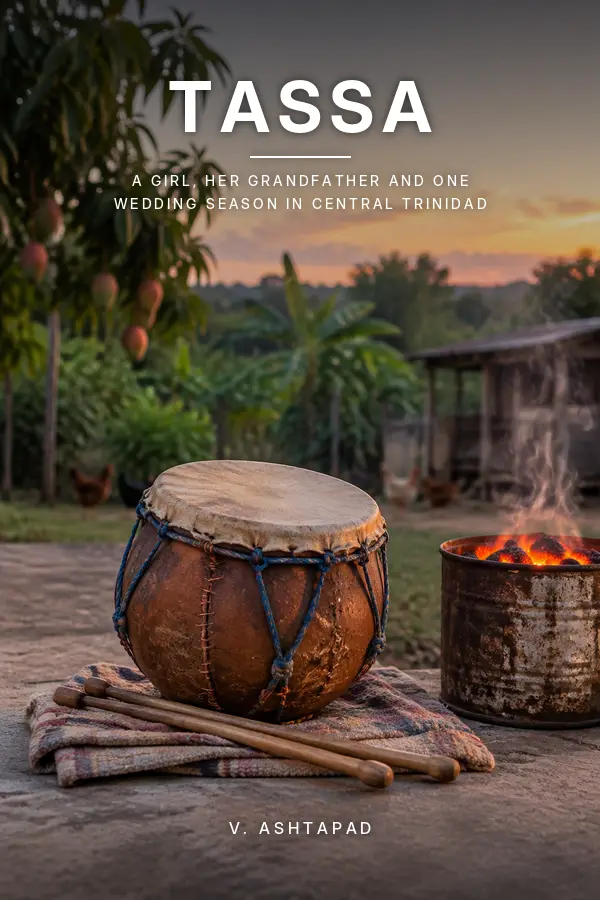
Tassa
A Girl, Her Grandfather and One Wedding Season in Central Trinidad
by V. Ashtapad
Foreword
This is a novel. Anisha Seepersad, her family, the band called Seepersad and Sons, Dino Maharaj and Maximum Sound, and every other person in these pages are invented, and any resemblance to real people is coincidence. The National Tassa Championship described here, its rounds, its judges and its scoring are invented too, as are the names of the band's rhythms, which belong to this one family and no other.
Chaguanas, Felicity, Couva, Longdenville, Cunupia, Edinburgh 500 and the Caroni plains are real places in central Trinidad, and they are used here the way fiction uses places: freely, with affection, and with a little invention on every road. The tassa tradition is real and much older and wider than any one family; this story borrows its fire, its goatskin and its noise, and hopes to give a little back.
A few words from the kitchen and the yard appear as they are spoken in Indo-Trinidadian homes, lightly and without apology. The songs in the story are sung in the old language and told here in English.
For everyone who was told to fan the fire, and kept listening.
Cook Night, Felicity
The first thing you need to know about a tassa drum is that it is lying to you until it gets hot.
Cold, it is a bowl with a goatskin pulled over the mouth, and if you hit it, it says *bup*. Not even a proper bup. A bup like a slipper on a tile floor. A bup like somebody's uncle clearing his throat in another room. You could hit a cold tassa all night and nobody at the wedding would get up from their chair.
So you heat it.
That is my job. That is my whole job in Seepersad and Sons Tassa Group, which my Aja started in 1972 when he was twenty and had more hair than sense, and which has had, in fifty-four years, exactly zero daughters, zero granddaughters, and one fifteen-year-old girl with a piece of cardboard, fanning the coals.
Me. Anisha. Hi.
The fire is in an old wheel rim behind the Ramsaran family's house in Felicity, in the yard between the breadfruit tree and the tent, where the women are cooking for tomorrow's wedding. Cook night. The night before. The whole yard smells of geera hitting hot oil and wet coconut bark and kerosene from the pitch-oil lamp someone's aunt refuses to stop using even though there are fairy lights on every branch. There are maybe sixty people here and maybe forty pots. The pots are the size of my sister.
I squat by the rim. The coals are orange underneath and gray on top, like they're wearing a coat. I wave the cardboard and the gray lifts and the orange breathes and the heat comes up into my face so hard my eyelashes feel crispy.
Above the coals, Uncle Bhola and Fig hold the drums. Not on the fire. Above it. Close enough to bake, far enough not to burn, turning them slowly by the rims like you turn bread on a tawa, like you turn a baby who has fallen asleep on the wrong arm.
And the skin starts to change.
You can hear it if you stand close, and I always stand close. It ticks. Tiny, tiny ticks, like a galvanize roof at noon when the sun is pulling the nails. That is the goatskin drying, tightening, shrinking over the rim, pulling the ropes taut. Fig taps it with one finger. *Bup.* Still a bit lazy. He turns it. Taps. *Bap.* Better. Turns. Taps.
*Tak.*
That one I feel in my back teeth.
"She ready," Fig says.
"She not ready," says Aja.
Aja does not hear the tak. I know he does not hear it, because Aja's ears have been going since I was in Standard Three, slowly, like a radio when the batteries are dying. But he has his hand flat on the side of the drum shell, the way you check a child for fever, and he shakes his head.
"Two more minutes," he says.
Fig rolls his eyes, but only to me, and only a little. Nobody rolls their eyes at Aja more than a little. He is seventy-four years old and five foot four and he once made a grown man from Penal cry by saying the man's bass player had "a heart like a parked car."
Two more minutes. Fig turns. The heat shimmers above the coals so the drum looks like it's underwater. I fan. The ticking gets higher and faster, and then it stops, which is the sound of a drum that has finished arguing.
Aja puts his palm on it.
"Now," he says.
---
My uncle Harry comes around the side of the tent carrying the bass drum on his shoulder like a sack of rice. Uncle Harry runs the band now. He is Aja's eldest son and my father's big brother, and he drives a water truck in the day and books weddings at night on a phone so cracked it looks like a spider died on it. He is not tall but he is wide, and when he puts the bass drum down beside the fire, the ground goes *hmm*.
"Anisha. Move back," he says.
"I'm fanning."
"Fan from there." He points at a spot about four feet behind me.
"From there it's just wind."
"Then make wind."
I move back two feet, which is a compromise, and he lets it go, which is also a compromise. My family is very big on compromises that nobody agrees to.
Here is the band, so you know who is who when it gets loud:
Cutter: Shelly Ramkissoon, thirty-one, long fingers, gold chain, plays lead. The cutter is the voice. The cutter talks, teases, starts the arguments and ends them. The cutter drum hangs around his neck on a strap, and he plays it with two thin sticks, and when Shelly is in a good mood the sticks blur so you can't see them, only the air moving.
Fullers: Fig and Roger. Fig is thirty-eight and has a laugh that sounds like a motorbike that won't start. Roger is twenty-nine and very serious about his hair. The fullers fill. They hold the floor down so the cutter can dance on it.
Bass: Uncle Harry, and Uncle Bhola when Uncle Harry needs to talk to the father of the bride about money, which is always.
Jhal: Clint, who is a carpenter and has hands like two planks, and my cousin Kevon, seventeen, who plays the brass cymbals with his eyes closed and earphones around his neck, not in his ears, just around his neck, as a statement.
And Aja. Aja is the founder. Aja used to be cutter, and then he was bass, and now he is something there is no word for. He plays when he wants. He stands at the back. He takes off his rubber slippers and puts his feet flat on the earth, and he closes his eyes, and he plays bass by feeling it come up through the ground into his legs and his chest. He calls it playing by the chest.
"The ears," he told me once, "was only ever a middleman."
---
Shelly hangs the cutter drum around his neck and tests it. *Ta-ka-tak.* The sound goes straight up the breadfruit tree and comes back down with leaves on it. The aunties at the pots turn around. Somebody's toddler starts bouncing on a plastic chair.
Then they start.
The first hand of a cook night is always the Slow Road. That's what Aja calls it. Every band has its own names for the hands, the rhythms, and ours are mostly Aja's, and some of them he says came from his father, and one of them he says came from before that, from a man none of us ever saw.
The Slow Road is a walking hand. It's the sound of people coming down a dirt road at dusk with pots on their heads, or a groom's family coming down a street with their good shoes in their hands so they don't get muddy. It goes *dum — ta-ka — dum — ta-ka-ta*, and the bass sits under it heavy and patient, and the jhal goes *tsss, tsss*, like oil when you drop in the onions.
I feel it first in my feet. Then the bass climbs up my shins and into my stomach and settles in my chest, right behind my breastbone, where it sits like a second heart that is a lot more confident than my first one. When the bass hits, my ribs buzz. When the cutter rolls, my teeth buzz. The jhal is in my fillings, I have two, I can feel exactly where they are.
I am not supposed to be playing. I am fanning. But my fingers are playing anyway, against my knees, against the cardboard. Ta-ka. Ta-ka-ta. My hands have been doing this since I was six. My mother says that when I was a baby I used to kick in time to the washing machine.
Shelly turns the Slow Road into Galvanize Rain. That's the fast one, the one that sounds like the first big drops on a tin roof, then more, then a downpour you have to shout over. The sticks go. The fullers go. The bass doubles. The yard lifts.
The aunties do not stop cooking. That is the thing about a cook night. Nobody stops. They dance standing still, with one hip, while stirring a pot of channa with a paddle the size of a boat oar. A great-aunt in a purple housedress does a little shoulder thing and three teenagers scream. The cook-night songs start up from the women by the pots, call and answer, old songs about in-laws and wedding nerves and husbands who snore, sung in the old language that my Aji understands and I mostly don't, except the laughing parts, which are universal.
I stand up. I don't decide to. My legs decide.
I go and stand next to Shelly. Not too close. Just in the light.
He grins at me sideways without missing a stroke.
---
The thing about Galvanize Rain is it has a break. Right in the middle, the cutter stops dead for two beats and the bass alone goes *DUM. DUM.* and then the cutter comes back in with a roll that sounds like a whole roof of rain landing at once.
Shelly gets to the break.
The bass goes *DUM.*
And from my mouth comes the cutter roll. Not on a drum. With my tongue. *Trrrrrrr-ta-ka-TAK.*
Shelly laughs so hard he nearly drops a stick, and comes in half a beat late, and Uncle Harry looks up from the bass like someone has put salt in his tea.
The song ends. Applause. One of the aunties throws a fistful of coins, which is a thing that happens, and Kevon picks them up, which is also a thing that happens.
Uncle Harry walks over to me with the mallet still in his hand.
"What was that?" he says.
"A roll."
"From you mouth."
"It's the only drum I have."
Fig laughs. Uncle Harry does not laugh. He has a way of looking at you where he doesn't look angry, he looks tired, which is worse, because then you feel like you are something heavy he has to lift.
"Anisha. Fire. Please."
"Uncle Harry, when Shelly takes a break—"
"Shelly doesn't take breaks."
"When he goes to eat—"
"The cutter," says Uncle Harry, "is not a thing you just pick up at a cook night. And this band—" He stops. He looks over at Aja, who is standing barefoot at the back with his eyes closed and his hand on his own chest, feeling something none of us can hear. "This band is a certain kind of band."
"What kind?"
"You know what kind."
I do know. It's in the name. It's painted in white on the side of the old bass drum in letters my Aja's friend Mr. Mungroo did with a sign-painting brush in 1972. SEEPERSAD AND SONS. There's no room on that drum for anything else. Somebody's thumbprint is still in the paint at the end of SONS.
"Fire," says Uncle Harry, and goes back to his drum.
---
The rest of the night I fan.
I fan for the second set and I fan for the third. In between sets the drums go slack again in the night air, the skins loosening like they're breathing out, and I put them back on the heat, and I listen to the ticks, and I tap them with one finger like Fig does, *bup*, *bap*, *tak*. I get very good at hearing when a drum is ready. I can tell the exact second. I'm better than Fig. I'm better than Roger, who gets distracted by his phone.
Aja comes and squats by the fire beside me. His knees crack like kindling. He puts his palm flat on the drum I'm heating and keeps it there.
"Ready?" I say, loud, close to his good ear, the left one.
He shakes his head. "Ten seconds."
I count. At seven the drum goes quiet.
He looks at me. I look at him. Neither of us says anything about who was right.
"You heard that," he says.
"I heard it."
"I felt it." He taps his breastbone with two fingers. "Same thing. Different door."
At eleven o'clock the aunties feed the band. Paper plates, curry channa, curried pumpkin that is sweet and soft and a little bit burnt on the bottom, which is the best part, bhaji, and sada roti that a cousin of the bride slaps out on a tawa over another wheel-rim fire. It's so hot I have to toss it hand to hand. Steam comes out when I tear it. Kevon eats four. Kevon always eats four. He says the jhal uses more calories than people think.
My mother texts me. *Home by 12. Stand opens 5. You helping.*
My mother sells doubles. Every morning except Sunday, from five until the channa runs out, at a stand on the Southern Main Road in Chaguanas with a blue umbrella and a hand-painted sign that just says DOUBLES, because, she says, if you need more information than that you are not her customer. I help on Saturdays and in the holidays. I am fast with the bara. I have good hands. Everybody says so. Everybody says so except the people who could put a drum in them.
I text back a thumbs-up and a drum emoji, and then I delete the drum emoji, because she will ask.
---
Uncle Harry drives us home in the water truck. Me in the middle, Aja by the window, Kevon in the back with the drums and the jhal, earphones in now that nobody's watching. The truck smells of diesel and wet rubber and the bass drum.
The road out of Felicity is dark and flat. You can feel the flatness. That's the thing about the Caroni plains, it's so flat the road hums under you, a long low hum, like the earth has its bass turned on. Out the window, nothing, then a light, then nothing. Somewhere out there are the old cane fields, mostly gone to bush now since the sugar company shut down. Aja worked twenty-nine years at the weighbridge, weighing cane trucks, before it shut. He can still tell you the weight of a loaded truck by the sound it makes going over a bridge. He can't hear the truck anymore. He says he feels the bridge.
Uncle Harry doesn't talk. Uncle Harry is driving the way he does everything, carefully and a little sad.
Aja leans his head on the window. The glass is vibrating from the engine. He closes his eyes and lets it buzz into his cheekbone.
"Harry," he says, after a long time.
"Yes, Pa."
"Shelly come in late after the break."
"I know."
"Why?"
Uncle Harry's eyes flick at me. I look straight ahead at the road like it's a very interesting road. "Distraction," he says.
"Hm," says Aja.
That's all. Hm. But I feel it. It sits in the cab with us like a fourth passenger.
---
Our house is in Felicity too, a few streets over, two stories, concrete downstairs where Aja and Aji live and my family upstairs, and Uncle Harry's family in the house next door, which he built in the yard in 2009, so it's all really one yard, with a mango tree in the middle and a chicken coop at the back and a lot of opinions.
I shower and get in bed. My ears are ringing. A good ringing. Like someone left a fan on in my head.
On my phone, Aunty Vashti has already commented on the family page. Kevon posted a video from cook night, twenty seconds, mostly his own face, but at the end, if you look, there's a girl in the firelight with a piece of cardboard, mouth open, doing a roll with her tongue.
Aunty Vashti lives in Brampton, Canada. She is Aja's daughter, my father's sister, and she left in 1998 and comments on everything, at all hours, because of the time difference and because she says snow makes her lonely.
*Who is the drummer at the end!!!!* she writes. *She have the hands of Pa when he was young.*
Kevon has replied: *that's Anisha she was fanning.*
Aunty Vashti has replied to that: *Fanning my foot.*
I put the phone face down on my chest. It's warm from the charger. I lie there and I can still feel the Slow Road in my ribs, going down the road, going down the road.
Then I'm asleep.
---
Something wakes me.
It's dark. The fan is going. The fowls haven't started. My phone says 4:40.
*Tap.*
On the window. The louver window by my bed, which looks down into the yard, and the mango tree, and the coop.
*Tap. Tap-tap.*
I lie still. A bird? A bat? A mango?
*Tap. Ta-ka. Tap.*
That is not a mango. That is the Slow Road.
I get up on my knees on the bed and open the louvers.
Down in the yard, in the dark, in his white vest and his old gray pants, with no slippers, standing on the cold concrete in his bare feet, is my Aja. He has a long bamboo stick from the clothesline, and he's reached up with it to the window, and he's tapping.
He sees me. He doesn't wave.
He holds up two drumsticks.
Then he points with them at the back of the yard, behind the chicken coop, where nobody goes except the fowls.
And he turns around and walks there, slowly, a little stiff, his feet flat on the ground, like a man listening to the earth.
A Wedding in Longdenville
Behind the chicken coop there is a concrete slab where a water tank used to stand, and on the slab there is a drum I have never seen before.
It's small. Smaller than Shelly's. The shell is not the newer kind the band uses now. It's clay, dark brown, round-bellied, with a crack up one side that someone has bound with copper wire, wound tight and neat, like stitches. The skin on top is old and yellow at the edges and has a dark circle in the middle where it's been hit ten thousand times. The ropes are new. Blue nylon. That is the only part that looks like this century.
Beside it, in a paint tin, a small fire. Coals, already going. Aja must have lit them at four.
"Whose is that?" I whisper.
Aja doesn't hear whispers. He hears the shape of my mouth. He answers anyway.
"Mine," he says. "Before that, my father's. Before that—" He waves a hand behind him, at the coop, at the yard, at the dark, at about a hundred and thirty years. "Sit."
I sit on an upturned bucket.
He hands me the sticks. They're thin and light, lighter than I thought, like two pieces of dry cane leaf rolled tight. They have been sanded so smooth they feel almost soft. There's a groove worn in each one where a thumb goes.
"Not like that," he says, before I've even done anything.
"I haven't done anything."
"You holding it like a pencil. A pencil is for school." He takes my right hand and folds my fingers. His hands are dry and hot and rough as a coconut husk. "Loose. Loose. Like you holding a small bird and you doh want to squeeze it, and you doh want it to fly."
I hold the bird.
He lifts the drum, holds it over the paint tin, turns it slowly. The skin starts to tick. In the quiet before the fowls, it's the loudest thing in the world.
"You hear that?" he says.
"Yes."
"I doh hear it." He puts my free hand flat on the side of the clay shell, beside his. It's warm. It's getting warmer. And under my palm, so small I'm not sure at first, a buzzing, a tiny trembling, as the skin tightens and the whole bowl starts to want to ring.
"That," he says. "Learn that. When the ears go, that stay."
---
He doesn't let me hit it the first morning.
The first morning, I just hold the sticks. I just hold the bird. He sits on an old paint drum and taps the Slow Road on his knee with two fingers, and I copy it on my knee, and he shakes his head, and I do it again. He takes my wrist and moves it. Up from the wrist. Not from the elbow. The elbow is for fighting.
"Who taught you?" I ask.
"My father."
"Where?"
"Here."
"Behind the coop?"
"There wasn't a coop. There was cane." He points out past the back fence, at the houses, the concrete, a pickup truck on blocks, the light coming up gray and pink over somebody's satellite dish. "All that was cane. Right up to the road. The trucks used to pass so close the dust settle on your roti."
At five past five my mother's voice comes down the back steps.
"Anisha! The bara!"
I jump. Aja does not jump. Aja did not hear. I put the sticks down on the slab like they're made of glass.
"Tomorrow," Aja says. "Same time. Doh tell Harry."
"What about Mummy?"
He considers this. "Your mother," he says, "will tell Harry if she wants to. That is her business. But she is very busy." His eyes have something in them I haven't seen before. Not quite mischief. Mischief's older brother.
---
My mother's doubles stand is a folding table, a gas burner, a giant pot of curried channa, a cooler full of bara, three bottles of sauce, one blue umbrella and her. She stands under the umbrella on the Southern Main Road from five in the morning, and the cars pull up, and the men in work boots and the women in office clothes and the schoolchildren with their parents' money lean out and say "two with slight" or "one, plenty pepper" or "three, no cucumber, extra tamarind," and she does it without looking.
You take two bara, the soft fried flatbread, yellow with turmeric, warm, and you lay them on a piece of paper, one overlapping the other. You ladle the channa on top, the chickpeas soft and spiced and so hot the steam comes up and fogs your sunglasses if you're wearing them. Then the sauces. Tamarind, brown and sweet. Mango, shredded, sour. Cucumber. And pepper sauce, Scotch bonnet, which my mother makes herself and keeps in an old rum bottle and which can make a grown man see his ancestors.
"Slight" means a little pepper. "Plenty" means write your will first.
I fold the paper. I hand it through. I take the money. The traffic goes past so close the umbrella shakes in the wind it pushes. Every time a big truck goes by the whole table hums and the sauce bottles chatter against each other like they're nervous. *Clink clink clink.* I can tell the trucks by their hum. The aggregate trucks from the quarry are low and grinding. The water trucks slosh. Uncle Harry's truck has a rattle in the left side panel that goes *dik-dik-dik-dik*, and when I hear it I wave without looking up.
"You're tapping," my mother says.
"What?"
"On the table. You're tapping." She doesn't look at me either. She's doing six doubles for a minibus driver who's ordering for his whole route. "You been tapping since you came down."
I stop.
"I'm not saying stop," she says. "I'm saying I see it."
---
The wedding is Saturday, in Longdenville, which is east of Chaguanas, where the roads go a little hilly and the houses get bigger and newer, with tile on the steps and those white columns people put on now that make a house look like it's applying for a job.
The band is booked for the groom's side. We gather at the groom's house at two in the afternoon. We heat the drums in the road, in a half drum on bricks, because the groom's mother doesn't want smoke in her yard. Here's a thing nobody tells you about heating drums in the road: everybody who passes slows down. Every car. Every taxi. They roll by at two miles an hour and look at the fire and the drums and the men, and some of them shout "Ay! Where the wedding?" and Fig shouts back an address, and later some of those people turn up.
I fan.
It's hot. The real heat, the afternoon kind. The road is black and soft at the edges and the air above it wobbles, so the houses at the end of the street are swimming, like they're behind a sheet of moving water. The heat from the coals hits the heat from the sun and I'm standing in the middle of two heats, sweating into my good jeans.
The goatskin heads go from slack to tight. Tick, tick, tick. I tap with one finger. *Bup. Bap. Tak.* I hand the ready drums to Shelly and to Fig and to Roger. I am a machine. I am the best drum heater in central Trinidad. One day there will be a statue.
Then the groom comes out in his cream outfit with his cousins all around him, sweating already, and the band starts the Slow Road, and we walk. The whole groom's party, maybe eighty people, walking from the house down the road, round the corner, to the wedding tent at the bride's family's house, which is two streets away but which in the custom is far, very far, a great journey, so you take your time.
We take our time.
The Slow Road, then Cane Truck, which is the heavy one. Cane Truck is Aja's name for a hand that rolls and bumps, *DUM-ba-DUM, DUM-ba-DUM*, and has these little jolts in it, like a loaded truck going over a pothole, and the cutter on top goes *ka-ta-ka-ta-ka* like the cane rattling in the back. When the band plays Cane Truck, the old men in the crowd start to grin. They know it in their knees.
I walk beside the bass. I'm carrying the spare sticks and a bottle of water for Uncle Harry and a towel for Shelly. The bass is beside my left shoulder and every stroke goes through me. *DUM.* My lungs shake. *DUM.* The water in the bottle jumps. I can see it: little rings in the water, from the middle out, every time Uncle Harry hits.
Aja walks at the back, barefoot on the hot road. He carries his slippers in one hand. I keep looking back. Every time I look, his eyes are closed and his free hand is flat on his chest and his feet are going *flat, flat, flat* on the asphalt, in time.
How is he not burning his feet? I ask Kevon.
"He say the road tell him where the beat is," Kevon says. "And he say if it's too hot, it's a fast song."
---
The reception is under a white tent with bunting the colors of mango and lime and a dance floor of plywood painted silver.
We play the arrival. We play while people eat. They serve the food on leaves, big flat leaves, curry mango, pumpkin, curry channa and aloo, bhaji, and rice, all in little hills, and you eat with your hand and the leaf goes soft under the hot curry and you have to work fast. I eat standing up beside the fire tin with my leaf on one palm. The pumpkin is sweet. The mango is so sour my cheeks go inside out.
And then, at seven o'clock, the DJ starts.
You need to understand. The DJ was always going to start. Every wedding now has a DJ. The tassa plays the procession and the arrival and some of the early part, and then the DJ comes for the dancing, chutney soca and Bollywood and soca and dancehall, and the old men complain and dance anyway.
But this DJ is not a DJ. This DJ is a weather event.
He has a truck. On the truck is a stack of speakers the size of a small house, black boxes on black boxes, with blue lights running up the sides. Across the top in silver letters it says MAXIMUM SOUND. There's a man on the truck in a white linen shirt with gold-rim sunglasses on at night, and he lifts one hand like a conductor, and he drops the first track, and the bass comes out of those speakers and hits me in the chest like a door.
Not like a drum. Like a door.
A tassa bass is goatskin and wood. When Uncle Harry hits it, there's an edge, a front, a skin to it. You feel the stroke land and you feel it go. It moves through you and keeps walking.
This is different. This comes in and stays. It fills the inside of my ribcage like a balloon and doesn't leave. My ribs aren't buzzing. They're being held. The plastic chairs are humming. The silver dance floor is humming. The curry on someone's leaf is trembling. A baby starts screaming, and you can't hear the baby, you can only see it, little red face, open mouth, silent under the wall of sound.
Our band is still playing. Shelly is still going. Uncle Harry is still hitting. But we're gone. We're a photograph of a band. I can see Fig's sticks moving and I can't hear them.
Uncle Harry stops. Then they all stop. Roger stops last, because he was looking at his phone.
The man on the truck takes off his sunglasses and looks down at Uncle Harry and puts a hand on his heart, like *sorry, sorry*, and smiles a big white smile, and doesn't turn it down.
"Who's that?" I shout in Kevon's ear.
"Dino Maharaj," Kevon shouts back. And something in the way he says it makes me look at him. Kevon is looking up at that truck the way I look at Shelly's sticks.
---
We pack up early. We get paid in an envelope by the groom's uncle, who is already sweating through his shirt from dancing and who says "Thank you, thank you, beautiful, beautiful," and doesn't look in our eyes.
Uncle Harry counts it in the water truck under the dome light. He counts it twice.
"Short," he says.
"How short?" says Fig.
"They take off for the hours we didn't play."
"We didn't play because—"
"I know why we didn't play." Uncle Harry puts the envelope in his shirt pocket and puts his hand over it like it might try to escape.
Aja is sitting in the passenger seat with his feet up on the dash, which Aunty Sharda would kill him for. The soles of his feet are black from the road. He doesn't know the money is short, I think. He couldn't hear. Then he says, without opening his eyes, "That truck."
"Yes, Pa."
"I feel it from three streets."
"Everybody feel it from three streets."
"No." Aja opens his eyes. He taps his chest. "Inside. It doesn't go nowhere. It just sit down in you." He shakes his head slowly. "Like a man who come to visit and doh know when to leave."
That's exactly it, I think. That's exactly what I felt, and I didn't have the words. I feel a little flash of something. Like we're the only two people who noticed the same thing.
Uncle Harry starts the truck. The left panel rattles. *Dik-dik-dik-dik.*
---
When I get home, Aji is still up, at the kitchen table, in her nightie and a cardigan, shelling pigeon peas into a bowl. She's seventy-four and she does not believe in sleep. She says she'll sleep when she's dead, and then she says it again in the old language for emphasis, and then she says it was a joke.
"How the wedding?" she says.
"A DJ took it over."
"Eh-eh." She doesn't look up. Pop, pop, the peas go into the bowl. "In my time the DJ was a man with one speaker and a cassette, and if the tassa was playing, he would wait. He had manners." Pop. "It have no manners again."
I sit down and start shelling with her. It's soothing, the little pop, the cool peas rolling on my fingers.
Aji is the one who sings. Not in the band, never. In the kitchen. Old wedding songs, old chutney songs, songs about sisters-in-law and lazy sons and women who outsmart everybody. She sings them in the old language, and when I ask her what they mean, she tells me in English, and they are always much ruder than I expected.
Aji's phone buzzes on the table. It's a big old phone with a big-font screen, and it buzzes like a wasp in a jar. She squints at it.
"Your aunty in Canada," she says. "Asking Pa a question again."
Aunty Vashti has started a thing on the family page where every week she posts a question for Aja and Aji, and they're supposed to answer by recording themselves. Aji does it. Aja refuses. He says he doesn't know where the voice goes.
This week's question is on the screen. *Pa, what was the first wedding you ever played tassa at?*
Aji looks at it. "He will never answer," she says. "He is too stubborn."
I take the phone. "Can I?"
She shrugs. Pop, pop.
I record myself. Quietly, because it's eleven at night. *Aunty Vashti, he's asleep. But I'll ask him tomorrow. Early.*
And then I put the phone down and I can't help it. I smile at the peas.
"What you smiling for?" says Aji.
"Nothing."
"Eh-eh," says Aji, and she looks at me over her glasses for a long moment, the way you look at a pot you think is about to boil over. Then she goes back to the peas.
But she's humming. Something with a walking beat. And when I look under the table, her bare foot is tapping on the tile.
Tap. Ta-ka. Tap.
Cricket Final, Couva
On the fourth morning behind the coop, Aja lets me hit the drum.
One stroke. That's all. He heats it over the paint tin until the skin stops ticking, puts his palm on it, nods, and sets it on my lap on an old folded towel. The clay is warm against my thighs through my pajama pants. It smells of smoke and something animal, something like a wet dog that's been in the sun.
"One," he says. "Right hand. From the wrist. Then let it come back."
"Let what come back?"
"The stick. The stick want to come back to you. Let it."
I lift my right hand. I'm holding the bird. I bring it down.
*Tak.*
It's not loud. It's not like Shelly. But it goes into the skin and the skin throws it back, and the stick jumps up off the drum into my fingers like it's alive, and the sound goes up and hits the underside of the mango leaves and the fowls in the coop all say *brrk?* at the same time.
And in my lap, the drum keeps going. After the sound has finished, the clay is still humming against my legs. A long, low buzz, fading slowly, like when you put your hand on the fridge.
I look up at Aja.
He's not looking at me. He's looking at the drum in my lap. He reaches over and puts his palm flat on the skin, right where I hit it, and feels the last of the hum go out of it.
"One more," he says.
---
At five past five my mother calls and I run up the back steps and wash my hands at the kitchen sink and there is smoke on my fingers. I scrub and scrub. It doesn't come out. I hold the bara with smoky fingers all morning and nobody says anything, except my mother, who sniffs once and says, "Somebody burning leaves early."
"Mm," I say.
"Very early."
"Mm."
She hands me the pepper sauce. "Slight for the bus driver."
I do slight for the bus driver.
---
I remember to ask Aja the question that night. Aunty Vashti's question. We're on the front porch and he's in his rocking chair with his feet up on the rail, and I lean in close to his left ear and say it slow and loud.
"Pa. Aunty Vashti wants to know. What was the first wedding you ever played?"
He rocks. He rocks for so long I think he hasn't heard. Then he says, "Nineteen sixty-eight. In Felicity. A girl called Chandani Sahadeo, marrying a boy from Cunupia who had very big ears." He holds his hands out from his own ears to show. "I was sixteen. I played fuller. My father play cutter. I was so frighten I played the whole night with my eyes shut." He rocks. "And at the end the boy with the ears came and give me a dollar, and I was so happy I bought six sugar cakes and ate them all and was sick behind the tent."
I've been holding Aji's phone out, recording. I didn't tell him. I hold my breath.
He looks at the phone.
"That going to Vashti?"
"Yes."
He leans forward to the phone like it's a microphone at a function, and says, very loud, "VASHTI. WEAR A COAT."
Then he leans back and rocks.
Aunty Vashti replies at 1:14 a.m. her time with fourteen crying-laughing faces and then, separately, one that's just crying.
---
The cricket final is Sunday, at a ground outside Couva with one green-painted pavilion, a scoreboard someone updates with numbers on hooks, and a mango tree at fine leg that has caught more balls than the fielders.
It's two village sides: Felicity Rangers and a team from Couva whose name I can't remember because Kevon calls them "the Other Ones" so often it's stuck. Uncle Bhola's nephew is the captain of the Rangers. That's why we're booked. We're not booked, really. We're paid in food and a promise. Uncle Harry says it's good for the name.
And there's a steel band. A small one. Six pans on a flatbed, from Jenelle's school. Jenelle on tenor, which is the lead, the one that sings the tune. Jenelle is my best friend since Form 1 and she is the opposite of me in every way, tall where I'm short, calm where I'm loud, and she has never once in her life been on time.
"Why are you here?" I say, delighted.
"Why are *you* here?" she says, equally delighted. "Where's your drum?"
"I fan."
"Still?"
"Still."
She looks over at the band, heating up under the tree. She looks at me. She looks at the band. "That's mad," she says.
"It's tradition."
"It's mad *and* tradition. Both things can be true." She taps her pan with one stick, testing. *Ping.* It's a completely different kind of sound from ours. Our sounds hit you in the chest. Jenelle's comes in through the ears and goes right up into the top of your head, bright and ringing, like sunlight off a car windshield.
---
Here's the heat at a cricket ground at one in the afternoon in November in central Trinidad. The grass is half brown. The pitch in the middle is pale and hard as a dinner plate. When the fast bowler runs in, you can see the heat coming off the ground in front of him in a shimmer, so his legs look like they're in a pot of water on the boil. The fielders stand with their hands on their knees. The boundary rope is a line of old tires and one blue plastic chair that somebody's grandmother refuses to move.
We play when there's a wicket. We play when there's a four. We play when there's a six and the ball goes into the mango tree and three boys go up after it and two mangoes come down instead. We play in between overs, quick little bursts, Galvanize Rain, and then the pan side plays something back, a soca tune, sweet and light, and everybody in the plastic chairs laughs and dances in their seats.
It becomes a thing. Tassa, pan. Tassa, pan. Like two old aunties in a yard throwing remarks over the fence.
Shelly does a roll. Jenelle answers on the tenor with a little run, *dee-da-dee-da-DEE*. Shelly does it faster. Jenelle does it faster. The crowd starts going "Ohhhh!" like it's a boxing match.
I'm standing by the fire, fanning, and I'm laughing so hard my stomach hurts. Every time the bass hits, my laugh gets bounced. Ha-*DUM*-ha-ha-*DUM*.
Uncle Harry is not laughing. He's watching the scoreboard and the pan side and his phone. He gets a call. He walks away behind the pavilion to take it. When he comes back, his face looks like something has been subtracted.
---
Between innings there's food. Somebody's aunty brings out a cooler full of aloo pie wrapped in brown paper, the pastry soft and oily and stuffed with potato and geera, and a pot of curry duck that some of the men cooked by the river that morning, and coconut water from a truck, where a man with a cutlass takes off the top of each green coconut with three chops, *tchk, tchk, tchk*, and punches a hole, and you drink it straight from the nut.
Aja sits on the steps of the pavilion with a coconut. I sit beside him with mine. The concrete step is so hot I can feel it through my jeans. The coconut water is cold and sweet and a little bit fizzy and tastes like it's been inside a tree, which it has.
"Pa," I say into his left ear. "Who taught your father?"
He takes a long drink. Some of it runs down his chin into his white vest. He doesn't care. "His father," he says.
"Who was his father?"
"Jhuman."
I've heard the name. It's one of those names in my family that floats around at weddings and wakes, like the smell of a particular perfume, and I never knew what it was attached to.
"Who was Jhuman?"
Aja puts the coconut down between his feet. He takes off his slippers. He puts his feet flat on the hot step.
"Jhuman," he says, "come from India. From the north. Uttar Pradesh. A village near a big river. He come here to cut cane, when he was nineteen, twenty. Long, long time. Before my father born."
"Why?"
"Because it had no work there, and somebody tell him it had work here." Aja shrugs. "Plenty people come like that. They sign a paper, they get on a ship, they come to cut cane for five years. Some go back. Most stay."
"And he played?"
"He remember." Aja taps his own chest, twice, over the heart. "In his village, when he was a boy, it had drums for every wedding. Every one. He used to sit by the fire and watch the men heat them. Same as you." He looks at me sideways. "Exactly same as you."
The cricket ground goes very quiet for me. The pan side is tuning up. Someone is laughing far off. A cane truck, one of the last few, a small private farmer's truck, is going by on the road beyond the ground, and I can feel it before I see it, the low rumble coming up through the step into my seat, and then the dust it lifts, pale and fine, drifting across the boundary in the sun like flour off a board.
"When he come here," Aja says, "it had no drums. Not the right ones. So he made one."
"How?"
"He go to a potter woman in the next estate and he trade her—" Aja thinks. "I doh know what he trade her. My father use to say a chicken, and then he use to say a shirt, and then a different time he say a whole week of cutting her husband's cane. Story change every time." He grins. "But he get a clay bowl. And he get a goat. And he make a drum."
"The one behind the coop?"
He doesn't answer. Which is an answer.
"He play it on the estate," Aja goes on, "for the weddings in the barracks. For the people who come from the same side. When they hear it, they cry, my father say. Grown men, cutting cane all day, they hear Jhuman playing, and they cry, because it sound like home."
He picks up the coconut again. He finds it's empty and he looks at it like it's betrayed him.
"Jhuman walk funny," he adds. "A cart wheel run over his foot, the first year. He limp for the rest of his life. My father say you could hear him coming, from the way he walk. *Step*, step. *Step*, step." He taps it on the step with his heel. A long one and a short one. A little hitch in it.
"Why are you telling me this?" I say.
He looks at me for a long moment with his old wet eyes.
"Because you ask," he says. "Nobody ask in a long time."
---
The Rangers lose by four runs. Uncle Bhola's nephew is out in the last over, caught by the mango tree, and then caught by a boy who was standing under the mango tree waiting for mangoes. There's a long argument about whether a catch off a tree counts. It does. It's in the rules, apparently. Felicity has been losing to this tree for years.
We pack up in the dusk. The heat comes off the ground in waves now that the sun's gone, the earth breathing out what it held all day. The drumheads go slack in the evening damp almost immediately, *bup, bup*, like they're tired too.
Kevon and I carry the jhal case to the truck. The cymbals clink inside it with every step.
"Who was Uncle Harry on the phone with?" I say.
Kevon shrugs.
"Kevon."
"Dino Maharaj."
I stop walking. The jhal clinks. "The Maximum Sound man?"
"He want to talk to Daddy about the band."
"Talk about what?"
"I doh know." Kevon is looking at his shoes. Kevon never looks at his shoes. He's very proud of his shoes. "Business."
"Kevon."
"What?"
"You know something."
He sighs. He puts the jhal case down on the tailgate. He takes the earphones from around his neck and winds them round his fingers. "He's a big man," he says. "Dino. He does sixty weddings a year. Sound, lights, tents, chairs, the whole thing. He has two trucks. He's buying a third." He winds the earphones tighter. "He asked me if I wanted to come work with him in the holidays. Learn the board."
"The board?"
"The DJ board. Mixing."
"And you said—?"
"I said I would think about it." He looks at me finally. "Anisha, it's not the same thing. Nobody's going to hire a tassa band in ten years. Look around. You saw the wedding. One truck and we were gone. It's like—" He waves his hand at the dark, at the ground, at the plains, at all of it. "It's like cane. You can like it. Doesn't mean it's going to be there."
I don't know what to say. My chest is tight, and it's not the bass.
From over by the pan side, Jenelle is packing up, and she sees us, and she plays one last little run on the tenor, just for me. *Dee-da-dee-da-DEE.* A question.
I don't have a drum. I clap it back to her. *Ta-ka-ta-ka-TAK.*
She laughs across the dark ground and waves her stick.
Kevon picks up the jhal case.
"She's right, you know," he says, quieter. "It's mad you fanning."
He walks off to the truck.
A Sixtieth Birthday, Chaguanas
By the second week of November I can play the Slow Road from start to end without Aja shaking his head more than twice.
This is not the same as playing it well. Aja is very clear about this.
"You playing the notes," he says. "Good. Now play the road."
"What does that mean?"
He doesn't explain. He never explains. He stands up from his paint drum, his knees going *crk, crk*, and comes round behind me where I'm sitting on the bucket with the clay drum on my lap. He puts his hand flat on my back. Right between my shoulder blades, on my spine.
"Once more," he says.
I play the Slow Road. *Dum, ta-ka, dum, ta-ka-ta.* And his hand on my back starts to press. Not hard. Just a weight, a pulse, landing on the big beats, a little ahead of me. *Press.* Ta-ka. *Press.* Ta-ka-ta. It's like someone walking beside you in the dark with their shoulder touching yours. You don't have to see them. You just go when they go.
And it changes. I can't tell you how. My hands are doing the same thing. But the sound in the clay is different. It leans forward. It walks. It sounds like somewhere to get to.
"That," he says, and takes his hand away.
I keep going. Without the hand I wobble, then I find it again, then I wobble.
"How do you do that?" I say.
"I doh do it. You do it. I just remind your back." He sits down again on the paint drum. "The back know before the hands. The hands is only the last people to hear the news."
---
Upstairs, my little sister Pooja has started waking up at five because of the fowls, and because of me, and she sits on the back step in her pajamas with her knees under her chin and watches. She's eight. She is the most dangerous person in our family because she tells everybody everything.
"Pooja," I say on the third morning she does it. "You can't tell Uncle Harry."
"Why?"
"Because it's a secret."
"Why is it a secret?"
"Because Uncle Harry doesn't want girls playing cutter."
She thinks about this for a long time, chewing on a piece of her own hair. "That's stupid," she says.
"Yes."
"Can I play?"
"When you're older."
"How old?"
I look at Aja, who has read my face and knows what she asked. He holds up eight fingers. Then he points at her.
Pooja screams with joy and the fowls scream with her and the dog next door joins in and a light goes on in Uncle Harry's house, and Aja and I both freeze like criminals until it goes off.
After that she comes every morning and sits on the step and taps on her knees, and says nothing to anybody, which is a miracle and possibly the beginning of the end of the world.
---
Uncle Bhola's wife, Aunty Kamini, is sixty on the last Saturday of November, and Uncle Bhola has hired the band for her party, which he cannot do, because he is in the band, so what he has actually done is ask us to play for free and promised to feed us, which Uncle Harry says is the same thing as hiring us, only with more curry.
The party is at their house in Chaguanas, in one of those streets behind the market where the houses are close together and every yard has a mango or a breadfruit or a pommecythere tree leaning over the fence. They've put up a tent in the road. The road is closed with two plastic chairs and a piece of string. There's a cake shaped like a six and a cake shaped like a zero.
I heat the drums in a coal pot by the curb.
It's a cool evening for November, which in Trinidad means it's only very hot instead of extremely hot. There's a breeze off the plains that smells of cut grass and someone burning a pile of leaves three streets away. The skins take longer to tighten. I have to be patient. I tap, tap. *Bup.* Not yet. I turn the drum. My arms ache. I find that I like the ache.
Shelly comes over and squats beside me while I'm heating his cutter.
"Ani," he says. He's the only one who calls me that. "You does practice somewhere?"
My hands keep turning the drum. "No."
"You does practice." He looks at my fingers. There's a little blister coming on the side of my right middle finger, where the stick sits. I've been putting cream on it. He touches his own finger in the same place. He has a hard yellow callus there, smooth as a seed. "That's a stick blister," he says.
I don't say anything. The drum ticks.
He laughs quietly. "Okay," he says. "Okay. I didn't see nothing." And he takes his drum, and taps it once, *tak*, and nods at me like I've passed a test, and walks off.
---
The party is good. It's a sixtieth birthday in a road in Chaguanas, so everybody is there and everybody is loud and everybody has an opinion about the cake. The band plays the arrival of the birthday girl, who comes out of her own front door, to her own party, in a gold dress, like a bride, while her grandchildren throw flower petals and Uncle Bhola plays the bass with tears running down his face. Uncle Bhola cries at everything. He cried at the cricket.
Then the music system takes over. Not Maximum Sound. Just a nephew with two speakers on stands and his phone. You can still talk over it. You can still hear people laugh. Aja says that's how it should be. "Music," he says, "should leave a space for the people."
There's food in foil trays on a folding table. Pelau, the rice dark brown from the burnt sugar, with pigeon peas and pieces of chicken and pumpkin in it, and a crust from the bottom of the pot that people fight over. Macaroni pie cut in squares. Potato salad with beets that turn it pink. Curry chicken and buss-up-shut, the paratha roti torn up into soft ragged strips like a shirt that's been in a fight, which is where the name comes from. You use it to pick up the curry. It's flaky and buttery and comes apart in your fingers in layers. There's a big tub of sorrel on ice, the red drink with cloves and ginger that comes out at Christmas, because, Aunty Kamini says, she's sixty and she'll have Christmas when she wants.
I eat with Jenelle, who has come because she's never been to an Indian birthday party and she wanted to see if it was really as long as I said. (It is.) We sit on the front wall with paper plates on our knees.
"So when is the big competition?" she says.
"What competition?"
"The national tassa thing. My cousin's band is in the pan competition at Carnival. She says there's a tassa championship too. After Carnival."
"There is." I pick at my pelau. "The band didn't enter for years."
"Why not?"
"Uncle Harry says it costs too much. Registration and uniforms and transport and time off work for everybody. And he says the judges like the flashy bands from south now. With the dancers and the matching shirts." I shrug. "Aja hasn't played in a competition since 2009."
"That's sad."
"It's not sad. It's just how it is."
"Ani." Jenelle puts her plate down. "You say 'it's just how it is' about everything that's sad."
I don't have an answer to that, so I eat a whole piece of buss-up-shut so I don't have to.
---
At ten o'clock Shelly stands on a chair.
You know a man is about to announce something when he stands on a chair. Uncle Harry, who is talking to someone's father by the gate, turns round. Aunty Kamini turns round with a piece of cake in her hand.
"I just want to say," says Shelly, "happy birthday to Aunty Kamini—" big cheer, "—and I want to say, since everybody here, this is my last month with the band."
The cheer turns into a sound like air going out of a tire.
"I get a job," Shelly says. "In Canada. Alberta. Welding, for a big company. I leave on the fourteenth of January. My wife and the children come in the summer." He looks at Uncle Harry. He looks at Aja. He looks a bit like he might cry, and Shelly doesn't cry, Shelly has a gold chain. "I wanted to say it in front of everybody. Because this band raise me up. Since I was fourteen, Mr. Seepersad teach me." He nods at Aja. "And I'm sorry. But the money—" He opens his hands. "Allyuh know."
Everybody knows. Nobody says it.
Uncle Bhola starts crying again.
Aja is sitting in a plastic chair at the edge of the tent. He hasn't heard. He can see that something has happened, from the faces. He looks at me.
I go over. I lean to his left ear.
"Shelly's going to Canada. In January. For work."
Aja looks at Shelly up on the chair for a long, long time. Then he gets up, slowly, and walks over, barefoot on the road, and holds his hand up, and Shelly gets down off the chair and they hug. Aja is about half the size of Shelly. He pats him twice on the back. Hard. *Dum. Dum.*
---
On the way home Uncle Harry drives without the radio. Aunty Sharda is in the passenger seat tonight, with Aja and me and Kevon in the back of the cab and Uncle Bhola following in his car.
Aunty Sharda keeps the band's booking book. It's a real book, an old green ledger with a red spine, and it lives in her handbag, and it's been going since 1972. The first half is in Aja's handwriting and the second half is in hers. Every wedding, every wake, every function. Date, place, family, money.
She has it open on her lap under her phone's flashlight.
"Harry," she says, "you know how many we have for January?"
"Don't start, Sharda."
"Four."
"Sharda."
"Four. In January. In 2012 we had nineteen." She turns pages back. "In 1994 we had twenty-six. In 1994 you all play two weddings in one night and Pa fall asleep in a tent in Carapichaima and you all leave him there."
"That was Bhola's fault."
"It was everybody's fault." She turns the pages forward again. Her voice is soft. She's not angry. She's an accountant at a hardware in Chaguanas and she's just telling him the numbers, the way you tell a man his shoe is untied. "Four weddings in January. And now no cutter after the fourteenth."
Uncle Harry drives.
"Dino called again," he says finally.
Aunty Sharda closes the book.
Nobody in the back says anything. Kevon has his earphones in, but I know he's not playing anything, because I can't hear the tinny little leak of music that usually comes out of them. Aja is looking out the window at the dark plains. He didn't hear. Or he did. With Aja you never know anymore. The window glass is humming against his temple, and his eyes are half shut, and his bare toes are moving on the floor of the truck, very small, in time with something.
---
That night I can't sleep. The fan goes round. The fowls shift in the coop. Somewhere a dog has an opinion.
I get my phone and open the family page.
Aunty Sharda has been scanning the green ledger. I didn't know. She's been taking photos of the pages, a few at a time, and putting them in the family photo folder, and she's started laying them out on the family timeline, so that if you scroll back, you can see the band's whole life. 1972, first booking, Aja's careful schoolboy handwriting: *Wedding, Felicity, Ramlal family, $20.* 1974, *Wake, Mr. Dass, no charge.* 1980, the year Aja's father died, the whole month blank, and then in March, in different ink, *Wedding, Couva, played for Pa.*
I scroll and scroll. The years go by under my thumb. Weddings in Felicity, Chaguanas, Couva, Cunupia, Longdenville, Carapichaima, Caroni, Freeport, Point Lisas, Penal, Siparia. In 1987, *Played for Chandani Sahadeo's daughter's wedding (Chandani from the first one!).* In 1993 a photo of the band in matching yellow shirts, my Aja in the middle, younger, with a thin moustache, holding the clay drum. In 1999, my father aged seventeen on a bass drum, looking terrified. In 2004, Uncle Harry, aged twenty-five, with the bass, and a note in Aunty Sharda's handwriting: *Harry first time leading.*
And then the numbers thin out. 2015, 2018, 2021. Fewer and fewer, the timeline getting longer gaps, like a road where the houses are spaced further apart the further you go out of town.
At the bottom, today's entry. *Kamini Baboolal 60th, Chaguanas, no charge.* And below it, somebody has typed, recently, *Shelly last month.*
Aunty Vashti has already commented. Of course she has. It's two in the morning in Brampton.
*So who will play cutter?*
Nobody's answered.
I hold my thumb over the reply box for a long time. It's warm, the phone. It hums very slightly when it gets a notification. I can feel it in my thumb.
I don't type anything.
But I put the phone flat on my chest, and I tap the Slow Road on the back of it with two fingers, very softly, so nobody hears. The way Aja's hand pressed. A little ahead of the beat.
Somewhere to get to.
A Wake on the Caroni Road
Mr. Mungroo dies on the second of December, in his sleep, in his own bed, in his house on the Caroni road with the breadfruit tree and the blue gate, at eighty-one.
Aji tells me at five in the morning on the back steps, before I can go down to the coop. She's in her nightie with a cup of tea in both hands and she doesn't drink it. Her voice is very calm.
"Basdeo gone," she says. "Go and tell your grandfather. Gentle."
I go down the steps. Aja is already behind the coop. He's lit the paint tin. He has the clay drum on his knees and he isn't heating it. He's just sitting with it.
I squat in front of him so he can see my face.
"Pa," I say.
"I know," he says. "Bhola phone at four. I couldn't hear him. I just know from how the phone ring." He looks at the drum. "Basdeo was there the first night. Nineteen seventy-two. He play fuller next to me for thirty-one years. Then his wrist go." He turns the drum on his knees. "He paint the name."
"On the bass."
"On the bass." Aja nods. "Basdeo do all the signs in Felicity those days. Every rum shop, every parlor. *Cold drinks sold here.* He had a hand." He holds up his own hand and does a little flourish in the air with one finger. "We had no money to pay him, so he say he will join the band instead." He almost smiles. "Best deal I ever make."
We sit. The fowls start. The coals in the paint tin breathe orange and gray, orange and gray.
He doesn't play. Neither do I. But after a while he puts the drum on my lap and puts my hand flat on the skin. It's cool. It hasn't been near the fire.
"Feel that," he says.
I don't feel anything.
"That's what it sound like when a drum is quiet," he says. "Learn that too."
---
The wake is three nights. That's how we do it. The family opens the house and the yard, and people come, every night, and sit, and eat, and play cards, and drink coffee, and tell stories about the person, and laugh, and sometimes cry, and stay till very late, so the family isn't alone. There are prayers too, in the mornings, for the people who want them, but the nights are for sitting.
On the third night, Mr. Mungroo's son calls Uncle Harry. His father left instructions. *Tassa on the last night. Seepersad and Sons. Make it loud. And tell Ramnarine no crying.*
"He know Pa wouldn't hear him anyway," Uncle Harry says, putting the phone down, and laughs, and then he goes outside and stands in the yard by the mango tree for ten minutes with his back to the house.
---
The Mungroo house is on the old Caroni road, the long straight one that goes out across the plains between what used to be cane and is now mostly bush and some rice and some vegetable plots and some nothing. In the daytime the road shimmers so much in the heat that a car coming toward you looks like it's floating an inch off the asphalt, rippling, and then suddenly it's solid and passing you in a slap of wind. At night it's black and straight and you can feel the flatness all around you like a held breath.
There's a tent in the yard. Plywood laid down on the grass for a floor. Plastic chairs in rows. Four card tables, with men at them already, slapping down cards hard enough to make the tables jump, playing All Fours and shouting. A table with a coffee urn, big and silver and ticking as it heats, and plates of crackers and cheese, and a tray of sweet bread, and a pot of something with potatoes in it. People are eating off paper plates on their knees. Children are asleep across three chairs.
Mr. Mungroo's photo is on a small table at the front, with flowers. In the photo he's younger, maybe sixty, in a short-sleeved shirt with a pen in the pocket. He's looking a little to the left of the camera, like somebody just told him something funny and he's deciding whether to laugh.
I heat the drums in a coal pot by the gate. The night is damp and cool and the skins take forever. I turn them and turn them. I can smell the coffee and the crackers and the wet grass and the coal. When I tap the cutter, *bup, bup*, it sounds like it doesn't want to come.
"Is a sad drum tonight," says Fig, crouching beside me.
"It'll come."
"It'll come," he agrees.
It comes. *Tak.*
---
Before the band plays, Mr. Mungroo's granddaughter stands up at the front and holds up her phone.
"Before the drums," she says. "Last year my aunty in New York started asking Grandpa questions on the family page. Every week. He hated it." Everybody laughs. "But he answered some. I want to play one."
She holds the phone to the microphone of the little speaker by the photo.
And there's Mr. Mungroo's voice. Crackly. Slow. A little out of breath. You can hear a fan going behind him and a dog barking, and a TV on low.
*The question is, how the tassa group get the name. All right. All right. So. Nineteen seventy-two. Ramnarine come to me and say, Basdeo, paint the drum. I say, paint what? He say, Seepersad and Sons, after my father. I say, Ramnarine, you have no sons. You have one daughter in the belly and she not even born yet. He say, Basdeo, paint the drum. So I paint it.*
People are laughing. A few are crying and laughing.
*And I tell him, I say, I wanted to paint "and Family." But it didn't have room. The drum too small. And he say, next drum. Next drum we will put "and Family."* The voice laughs. A long, wheezy laugh. *Fifty years. Fifty years and he never buy the next drum. Cheap man. Cheap, cheap man.*
The whole tent is laughing now. Uncle Bhola has his face in his hands.
I look at Aja. He's sitting on a chair at the back, by the bass drum. He can't hear the phone. He's watching everybody laugh. His face doesn't know what to do.
I go and lean in to his left ear.
"Mr. Mungroo said you're a cheap man."
Aja stares at me. Then he laughs. Out loud, a big crack of a laugh, the first time since four this morning, and the people in front turn around, and he holds up his hand like *sorry, sorry*, and keeps laughing, with tears running down into the creases of his face.
"And Family," I say into his ear. "He said you promised. Next drum."
He stops laughing.
He looks at the bass drum beside him. At the old white letters. SEEPERSAD AND SONS. Mr. Mungroo's thumbprint, still there at the end, in the paint.
He doesn't say anything.
---
Then they play.
Mr. Mungroo's son asked for one particular hand. The first hand the band ever played together, in 1972. It's an old one, slow and heavy, a bit like the Slow Road but heavier, with the bass doing something stubborn and lopsided underneath. Aja calls it Basdeo's Hand. I've never heard it. Nobody plays it anymore.
So Aja plays.
He gets up. He takes off his slippers. He takes the bass mallet from Uncle Harry, who steps back without a word. He stands on the plywood floor of the tent in his bare feet, with his eyes closed.
And he starts.
*DUM. — DUM-dum. — DUM.*
It's slow. It's like a man walking home late, tired, but walking. The fullers come in. Shelly comes in on the cutter, careful, following, because he doesn't know it well either. Kevon and Clint on the jhal, soft. *Tss. Tss.*
It's beautiful. The tent goes still. The card players have put their cards face down. The children asleep on the chairs don't wake up; their bodies just get heavier, deeper asleep, like the bass is pressing them into the plastic.
And then, after about a minute, it starts to go wrong.
Not much. Just a little. Aja is slowing. Just a hair. The fullers stay where they were. Shelly is between them. And the gap gets bigger. *DUM — — DUM-dum.* The bass is landing late. The cutter is landing early. It's like two people on a bridge walking toward each other who keep missing.
I can see why. He's on plywood. The plywood is raised up off the ground on blocks, and it's springy, and it's carrying the vibration of everything, the chairs, the tables, the people shifting, the card players' knees. He can't feel the ground. He can't feel *his* ground. He's standing on a drumhead made of a hundred other people.
His eyes are still closed. He doesn't know.
Uncle Harry knows. He's standing to the side with his hands open at his sides like he wants to grab the mallet back and can't. Shelly is looking at Uncle Harry. Fig is looking at Shelly. It's falling apart in slow motion, at a wake, in front of everybody.
I don't think about it. I put the cardboard down.
I walk up behind my grandfather, between him and the photo of Mr. Mungroo. And I put my hand flat on his back. Between his shoulder blades. On his spine.
And I press. On the big beat. Where it should be. A little ahead.
*Press.*
His back goes stiff under my hand for a second. Then he feels it. I feel him feel it. His shoulders drop. The next stroke lands with my hand.
*DUM.*
*Press. DUM-dum.*
*Press. DUM.*
The fullers catch it. Shelly catches it. The whole band snaps back together like a rope pulled tight, and the slow heavy hand walks on, and the tent breathes out, and nobody knows anything happened except the band.
And Uncle Harry.
I keep my hand on Aja's back for the whole rest of the hand. Three more minutes. My arm aches. I don't move it. Under my palm I can feel his heart going, and the bass going, and they are almost the same thing.
When it ends, Aja opens his eyes. He doesn't turn around. He just reaches back with his free hand and pats my hand twice, where it's still on his back. *Dum. Dum.*
---
The wake goes on till two. The band plays one more, the Slow Road, and then Galvanize Rain because Mr. Mungroo's son says his father hated slow songs and only liked the first one because he wrote it. The card players go back to their cards. Someone brings out a bottle of something and the men pass it around behind the tent. Aunty Kamini and Aji and the other old women sit in a circle by the coffee urn telling stories about Mr. Mungroo when he was young, and they are much ruder stories than I expected, and they laugh until Aji has to take off her glasses and wipe them.
I don't go back to fanning. Nobody asks me to. I sit on a chair beside the drums and drink a cup of coffee from the silver urn, too sweet, with evaporated milk, so hot it burns my tongue.
Uncle Harry comes and sits beside me.
He doesn't say anything for a long time. He takes the cracker off my plate and eats it.
"How long?" he says.
I think about lying. I'm too tired.
"Since cook night in Felicity."
"Every morning?"
"Except Sunday. Mummy doesn't open Sunday."
He nods slowly. He picks a crumb off his knee. "He never put his hand on my back," he says.
I look at him. He isn't looking at me. He's looking at Aja, who's at a card table now, losing at All Fours to Mr. Mungroo's son, slapping down a card and shouting and not hearing what anybody shouts back.
"Never," Uncle Harry says. "Not one time. He give me the bass when I was twelve and say, Harry, you are the bass, and that was that. I wanted cutter. I ask him for cutter every year until I was eighteen." He laughs, a short one with no air in it. "And you just—" He waves his hand at the yard, the night, the coop at home, all of it. "Behind the fowl coop."
"I didn't ask him," I say. "He asked me."
Uncle Harry is quiet.
"That's worse," he says, finally, and gets up, and goes to help load the truck.
---
Driving home across the plains at half past two in the morning, nobody talks. The road hums. Aja is asleep against the window, his mouth open, his bare feet on the dash. The cab smells of coal smoke and coffee and the old goatskin.
Aunty Vashti has posted on the family page. A photo of Mr. Mungroo and Aja from 1972, both thin, both laughing, both with enormous collars, sitting on the bass drum before the paint was dry. You can see the letters, fresh and white, a little wobbly at the edges. SEEPERSAD AND SONS.
Under it she's written: *He was going to paint "and Family." I just heard. Somebody owe that man a drum.*
I look at Uncle Harry driving. His jaw is tight. His hands are at ten and two on the wheel like they teach you, which nobody does.
I put the phone away.
Out the window, way out across the dark, a single light on the plains. A house, or a truck, or something else. I watch it until it's gone. The road keeps humming under us, low, steady, all the way home, like a bass that never stops, like someone's hand on your back that you can't see.
A Christmas Lime, Felicity
Christmas in our yard starts on the twentieth of December, when Aji makes the first pastelles and the whole downstairs smells of banana leaves softening over a flame.
You hold the leaf over the gas ring, just for a second, and it changes under your fingers. It goes from stiff and squeaky to soft and shiny and dark green, and it gives off a smell like cut grass and green tea and something sweet, and a little hiss, and then it's ready to fold. Aji does it with her bare fingers, which I think is a form of witchcraft. I do it with tongs and still yelp.
Inside the leaf goes a flat round of cornmeal dough, pressed thin on the leaf with the bottom of a plate, and then the filling, minced meat with olives and capers and raisins and a lot of green seasoning, and then you fold it into a parcel and tie it with string and stack it in the big pot to steam. We make a hundred and twenty. We always make a hundred and twenty. Nobody knows why it's a hundred and twenty, and nobody will make a hundred and nineteen in case something terrible happens.
"Your fingers too stiff," Aji says. "Fold like you not afraid of it."
"I am afraid of it. It's hot."
"Everything good is hot." She ties a knot with one hand, very fast. "Look at your grandfather. Hot drum, hot road, hot temper. Sixty years."
"Fifty-four."
"I been counting longer than you."
---
The band has three Christmas bookings and they're all small. A rum shop's Christmas party in Cunupia. A family lime in Freeport. And Shelly's last booking ever, on Christmas Eve, which is in our own yard, for our own family, because Uncle Harry said if Shelly is leaving, he's leaving from home.
So on Christmas Eve, the yard fills up.
Aunty Sharda's family from Chaguanas. Aunty Kamini and Uncle Bhola. Fig and his wife and their three boys, who immediately disappear up the mango tree. Roger and his girlfriend, who has exactly the same hair as Roger. Clint and his wife. Shelly and his wife and their two daughters, who keep asking if it snows every day in Canada, and Shelly keeps saying "Every single day," and his wife keeps hitting him. Jenelle and her mother and her grandmother, who brings black cake so dense you could build a house with it, soaked in so much rum that one slice makes Uncle Bhola sing. Neighbors. Neighbors' neighbors.
There's pelau in the big black pot over a wood fire in the yard. There's a whole leg of ham, glazed and studded with cloves, on Aunty Sharda's good tray, and macaroni pie, and potato salad, and the hundred and twenty pastelles, and sorrel in a cooler, and ponche-de-crème, which is like eggnog that went to the gym, and sweet bread with coconut, and Jenelle's grandmother's black cake. Somebody's radio is playing parang, the Spanish Christmas music with the guitars and the little four-string cuatro and the maracas. The maracas are shaking so fast they sound like rain on dry leaves. Pooja is dancing to it with a paper hat on and a pastelle in each hand.
It's dry-season hot. The air is thick and sweet with wood smoke and cloves. The fairy lights on the mango tree are blinking out of time with the parang, and it's driving me mad, because I can't stop trying to make them match.
I heat the drums.
I do it in the big wheel rim, the same one from every function, which lives behind the coop under a sheet of galvanize. I've gotten good. I can do all five tassa and the bass in eleven minutes. Shelly comes over and squats beside me for the last time.
"Ani," he says.
"Shelly."
"I watching you." He taps his cutter, which I've just handed him. *Tak.* Perfect. He nods. "You know what you have? You have patience. Most young people heat the drum and they rush. They take it off when it's nearly ready. They can't wait." He hangs the drum around his neck on its strap and settles it against his stomach. "You can wait."
"Is that good?"
"For a cutter? That is everything." He looks around the yard, at Uncle Harry by the gate. Then back at me. "I tell Harry," he says. "Last week. I tell him, I gone, give it to the girl."
My stomach falls into my shoes.
"What did he say?"
Shelly makes a face. "He say a lot of things," he says. "Mostly he say no."
---
They play. It's a good set. It's Shelly's goodbye and everybody knows it, and Shelly plays like a man trying to leave something behind in the air for us to keep. Galvanize Rain so fast that his sticks disappear, just a blur of air above the drum like the shimmer over a road. Cane Truck so heavy the ham on the tray shakes. The Slow Road, last, long and walking, while everybody in the yard sways, and Fig's three boys in the mango tree drop mangoes in time.
The bass goes into the concrete of the yard and up through my slippers into my legs. My chest buzzes. My ribs buzz. The jhal is in my fillings. I can feel everything. I can feel the fairy lights' little electric hum, I swear I can, I can feel the parang radio on the windowsill fighting with the drums.
Aja plays bass on the last one, barefoot on the earth by the coop, not the concrete. He found his spot. He knows where the ground is.
When it's over, Shelly takes the cutter off his neck and holds it up over his head and the whole yard roars. Then he gives it to Uncle Harry. Formally. Two hands.
Uncle Harry takes it. Two hands.
Something passes between them, that I can't hear.
---
At nine o'clock, a big silver car pulls up at the gate.
It's very clean. It's the kind of car that makes the road look dirty. A man gets out in a white linen shirt and dark pants and expensive brown shoes, carrying a cake box from a bakery in Chaguanas and a bottle with a red ribbon on it.
"Merry Christmas," says Dino Maharaj. "I hope I'm not interrupting."
He is interrupting. Everybody stops.
He's about fifty. Thick gray hair, combed back. A gold watch. He doesn't have the sunglasses tonight, and without them his eyes are small and smiley and tired, like a man who has played sixty weddings this year and been to sixty receptions and eaten sixty plates of curry mango. He shakes everybody's hand. He kisses Aji on the cheek and she lets him, which shows you how surprised she is. He gives the cake to Aunty Sharda, who says thank you in a voice like a door closing.
He shakes Aja's hand. He holds it in both of his.
"Mr. Seepersad. My father used to talk about you. He said you played his wedding. Nineteen seventy-nine. Carapichaima."
Aja looks at him. "Maharaj," he says slowly. "Carapichaima. The father of the groom take off his shoes and dance on the table."
Dino laughs. A real one, surprised out of him. "That was my grandfather."
"He break the table."
"We still have the table," says Dino. "We never fixed it. It's in my mother's garage."
---
They talk in the back porch. Uncle Harry and Dino and Aja and Aunty Sharda with the green book on her knees. I'm not invited. So I sit on the back step, three feet away, peeling a pastelle, very slowly, and pretend I'm deaf, which in this family is quite believable.
Here's the offer.
Dino Maharaj wants to buy Seepersad and Sons. Not the people. The name. The bookings. The book, and the families in it, because every family in that green book has children who'll get married, and he wants to be the one they call. He's building a new event hall in Chaguanas, he says, with air conditioning and a stage and parking for two hundred cars, and he wants a heritage corner, with the old drums in a glass case, and photographs, and the name on the wall. *Seepersad and Sons, since 1972.* And when a family wants tassa for the procession, he'll have a crew. Not this band. A crew. Young men he'll train. And for everything after the procession, Maximum Sound.
He'll pay. He says a number. Aunty Sharda's pen stops moving.
And he'll give Uncle Harry a job. Coordinator. A salary. Every month, the same. No more counting envelopes in a truck. No more four weddings in January.
"And Kevon," Dino says, "if he wants. He has ears. I seen him watching the board."
Through the porch door I can see Kevon's face, in the kitchen, at the fridge, where he's been standing for five minutes with the door open, not taking anything out.
Nobody says anything for a long time.
Then Aji, who wasn't invited either, comes out of the kitchen drying her hands on a dishcloth. "A glass case," she says.
"Mrs. Seepersad—"
"You want to put my husband's drum in a glass case. Like a dead fish in a museum."
"With respect—"
"With respect, nothing. A drum in a case is not a drum. A drum is a thing you heat." She flaps the dishcloth at him. "Go and look in your mother's garage at your grandfather's table. That is a glass case. Nobody dance on it again."
Dino Maharaj opens his mouth and closes it. To his credit, he looks a little ashamed.
Uncle Harry rubs his face with both hands. "Ma. Please."
"I'm going." Aji goes. She stops in the door. "Merry Christmas," she says to Dino, perfectly polite, and goes in.
---
Then Aja talks.
He's been sitting in his rocking chair the whole time with his eyes half-closed and his feet up on the rail. I thought he'd stopped following. He hasn't.
"The championship," he says.
They all look at him.
"The National. In March. After Carnival." He rocks. "We play in it. If we come in the top three, the band stay. Harry keep it. Nobody sell nothing." He rocks. "If we doh place, Harry sell it to this man, and I will polish the glass myself."
"Pa," says Uncle Harry. "We haven't entered for seventeen years."
"So we enter."
"We don't have a cutter."
Aja turns his head and looks straight through the porch door, at me on the step, with my pastelle.
Uncle Harry follows his look. His face shuts like a gate.
"No," he says.
"Harry—"
"No, Pa. You want to enter? We'll enter. I'll find a cutter. Ricky Rampersad from Penal, he's free since his band split. He's good. He's very good. I'll call him tomorrow." He's standing now. "But not—" He doesn't say my name. He points at the step, at the general area of me. "This is not a thing to put a child in. In front of judges. In front of the whole country. With everything on it. No."
I stand up. The pastelle falls off my lap onto the step and lies there in its leaf.
"I'm not a child," I say. "I'm fifteen."
"That's a child."
"Shelly was fourteen when he started."
"Shelly was—" He stops.
"A boy," I say.
Nobody says anything. The parang on the radio inside has gone into a long guitar part. The fairy lights blink. Out of time. Out of time.
"It's our name on the drum, Anisha," Uncle Harry says, quiet. "That's all I'm going to say."
Dino Maharaj is looking from Uncle Harry to me to Aja like a man at a cricket match who doesn't know the rules but can tell something big just happened. He clears his throat.
"Well," he says. "I accept the terms. Top three." He holds out his hand to Aja. "Mr. Seepersad."
Aja doesn't take it. He's looking at Uncle Harry.
Then, after a long moment, he does. They shake. Dino's clean soft hand and Aja's husk of a hand. It's a strange thing to watch. It's like watching a speaker shake hands with a drum.
---
Later, when everybody's gone, and the fairy lights are off, and the yard smells of wood ash and cloves and the last of the black cake, I sit on my bed with the window open.
I open the family page. I open the tree. I've never really looked at it properly before. Aunty Vashti built most of it. It goes back four generations on Aji's side and three on Aja's. Aja, Aja's father Seepersad, and then a blank. A gray box with a question mark.
I tap the gray box. *Add a name.*
I type *Jhuman*.
Born: I don't know. I put *about 1872*. Place: I put *a village near a big river, Uttar Pradesh*. Came: *about 1891*. Notes: I think for a long time. Then I type, *Cane cutter near Felicity. Limped from a cart wheel. Made a drum from a clay bowl. Still behind the coop.*
I save it.
Ten minutes later, at what must be half past one in Brampton, the little notification hum comes into my thumb.
Aunty Vashti has added a comment to Jhuman's box.
*Who told you all this??*
I type: *Pa.*
The reply comes so fast she must have been holding the phone.
*Pa told you?? He never told me anything. Forty years I asking.*
Then, a minute later:
*Did you ask him?*
I look out the window. Down in the yard, under the mango tree, a tiny orange light. The coals in the wheel rim, not quite out. Still breathing. Orange and gray, orange and gray.
*He asked me,* I type.
I don't wait for her answer. I put the phone down and lie back and listen to the fan.
Somewhere in Penal, Ricky Rampersad is about to get a phone call.
And somewhere behind our coop, in the dark, there's a clay drum with a copper-wire crack and a blue rope and no glass case, cooling down slowly, ticking a little, the skin going loose again in the night air, like a breath let out. Waiting for the fire.
Old Year's Night, Couva
Ricky Rampersad is supposed to arrive at ten o'clock.
At ten o'clock, the band is in a yard in Couva, at a house belonging to Aunty Sharda's cousin Rosemarie, who has a pool. Not a big pool. A pool shaped like a kidney bean with a blue light in it and four teenagers already in it fully clothed. There are a hundred people. There's a sound system with a man on it, not Maximum Sound, just a cousin. There's a tent and a bar and a long table of food under a string of colored bulbs, and the sea is two miles off, somewhere past the dark, and you can smell it, faintly, salt under the smoke, when the wind turns.
Old Year's Night. The band plays at half past eleven, to take the year out and bring the new one in. Uncle Harry booked it in September. It's a good booking. It pays. And it's Ricky's first night.
At ten o'clock Ricky texts Uncle Harry: *Coming. Traffic by Claxton Bay.*
At ten forty: *Still traffic. Accident.*
At eleven ten: *Car hot. Pulled over. Coming.*
At eleven fifteen Uncle Harry stops reading the texts out loud.
---
I'm heating the drums by the side of the house, between the water tank and a hibiscus hedge. I have a proper coal pot tonight, Rosemarie's, iron, heavy, with three legs, and the coals in it are perfect, hot and even, glowing like the inside of a mango.
I've done the bass and the fullers and the second bass and they're all ready and sitting on a bench, their skins tight, waiting, humming a little when someone walks past and bumps the bench. I'm holding the cutter over the coals. Shelly's old cutter, the band's cutter. I'm turning it slowly. The skin is ticking.
Nobody's going to hang it around their neck. I'm heating it anyway. That's the job. You heat all the drums.
Tick. Tick-tick. Tick.
Behind me there's an argument in a whisper.
"We play with no cutter," Uncle Harry says.
"You can't play with no cutter," Fig says.
"We play the Slow Road. The fullers hold it. I hold the bass. It's a party, nobody listening that close."
"Harry. It's midnight. You need the countdown. You need the Chase." Fig's voice gets higher. "The cutter has to take it up. Five, four, three. You can't do the Chase with no cutter. It's like a car with no steering."
"We'll do something else."
"There *is* nothing else. That's what they booked. The Chase into midnight. Your wife's cousin. Rosemarie specifically said—"
"I know what Rosemarie said."
I keep turning the drum. Tick. The skin is very close now. I can feel it in my palm through the shell, the little trembling, the drum wanting to ring.
"What about Pa?" says Roger.
"Pa can't hang a drum on his neck for twenty minutes. Not at seventy-four. His back."
"Kevon?"
"Kevon plays jhal."
"I can try," says Kevon, from somewhere.
"You can't," says Uncle Harry, and the way he says it is not unkind, it's just true, and Kevon doesn't argue.
Nobody says my name.
The drum stops ticking.
I tap it with one finger. *Tak.*
It's perfect. It's the best I've ever done.
---
Eleven forty. The man on the sound system stops the music and says, "Ladies and gentlemen, Seepersad and Sons!" and there's a cheer, and the band walks out onto the tiled area by the pool under the colored bulbs, and I carry the cutter to the edge of the light and stand there holding it, because there's no one to give it to.
They start with the Slow Road. No cutter. Uncle Harry's right, mostly. It holds. The fullers keep it going, *ta-ka, ta-ka-ta*, and the bass sits underneath, and the jhal sizzles. People dance. It's a party. It's fine.
But it's flat. It's a road with nobody walking on it. Something is missing, and the people dancing can't name it, but you can see it in their bodies. They're dancing like they're waiting for something.
Then Galvanize Rain. The rain with no thunder. Fig is working twice as hard. Roger is sweating. It's okay. It's okay.
Eleven fifty.
Aja is standing at the back of the tiles, barefoot. He has found a patch of grass beside the pool deck where he can feel the earth. He isn't playing. He's standing with his eyes closed and both hands flat on his chest. Feeling the band. Feeling what isn't there.
He opens his eyes and looks across the light at me.
I'm standing at the edge holding the cutter against my stomach. I didn't notice I was doing that. Holding it the way Shelly holds it. Like it's already on.
He walks over to me. Across the tiles, barefoot, past Uncle Harry, who doesn't see him because he's watching the fullers. Past Kevon. Through the light.
He takes the strap of the cutter from my hand. He lifts it. And he puts it over my head and settles it around my neck.
The drum sits against my stomach, warm from the coals, heavy and right, like the last piece of something.
He puts the sticks in my hands. He folds my fingers. The small bird.
Then he walks behind me, and he puts his hand flat on my back.
"The Chase," he says. "When Harry go to it. Not before."
---
Eleven fifty-seven.
Uncle Harry is counting the fullers into the Chase. The Chase is the midnight hand, the one that starts slow and gets faster, and faster, and faster, the cutter and the fullers racing each other, cutter calling and fullers answering, back and forth, tighter and tighter, until it's one blur, and then at the very top, a break, and then everything at once. You play it at the end of a wedding when the bride leaves. You play it at midnight on Old Year's Night. It's the one that makes people scream.
Uncle Harry turns his head to count the jhal in, and he sees me.
Standing by the pool with the cutter on my neck and Aja's hand on my back.
His face. I'll remember his face. It doesn't go angry. It goes blank, like a screen when the power cuts.
And he can't stop. It's eleven fifty-eight. A hundred people are counting with their phones out. Rosemarie is standing on a chair with a bottle. The fullers are already in it.
So he hits the bass.
*DUM.*
And Aja presses.
And I go.
---
I can't tell you what I played. I've watched the video since. I know what it looks like. But at the time I can't hear anything. I mean that. It's so loud, and I'm so close to the drum, that the sound isn't sound anymore. It's just a pressure, all around me, like being underwater in the pool with the blue light, and inside the pressure, a shape.
I can feel the shape. That's all. I can feel Fig and Roger's fullers coming at me from the right like waves on a wall. I can feel Uncle Harry's bass coming up from the tiles through my slippers, through my shins, into my chest. *DUM.* I can feel the jhal, fizzing in my teeth. I can feel the drum on my stomach shaking with every stroke, and the strap pulling on my neck, and the sticks jumping up off the skin back into my fingers, *let them come back*, *let them come back*, so fast I'm only catching them.
And behind all of it, Aja's hand. Pressing. A little ahead. Pulling me forward. Faster. Faster.
The fullers call. I answer. They call faster. I answer faster.
*Ta-ka-ta-ka. — TA-KA-TA-KA. — ta-ka-ta-ka-ta-ka-ta-ka—*
People are counting. I can see their mouths. *Ten. Nine. Eight.* I can't hear them.
Faster.
*Five.*
My arms are burning. The heat from the drum is coming up into my face. The colored bulbs are shimmering like the air over the coals.
*Three.*
The break. Aja's hand goes still on my back.
I stop. Everything stops. Two beats of nothing. The bass alone. *DUM. DUM.*
*One.*
And I bring the rain. The whole roof.
*TRRRRRRRRRRRRRRRRRRR-TA-KA-TAK.*
And the fireworks go up.
Over the whole of Couva, over the whole of central, every house, every yard, all at once, the sky cracks open. And the fireworks come into my chest too. Every bang lands in my ribs a half-second after the flash, *THOOM*, *THOOM*, a hundred little bass drums in the sky, out of time, beautiful, and the band is still going under it, and I'm still going, and somebody's screaming, and the teenagers in the pool are screaming, and Rosemarie has fallen off the chair into the hibiscus.
---
We play for six more minutes. I don't remember them.
When it stops, I'm standing on the tiles with the cutter on my neck and the sticks in my hands and my arms shaking so hard I can't lift them. The skin of the drum is hot. It's gone slightly loose already from all the playing, *bup*, tired.
The yard is roaring. People are coming at me. Women I've never seen are kissing my face. A man puts a twenty-dollar bill in my shirt pocket. Jenelle—who came with her mother, late, of course, she arrived at eleven fifty-five—is jumping up and down by the pool with her phone over her head shouting "THAT'S MY FRIEND! THAT'S MY FRIEND!"
Aja's hand is gone from my back. I look round.
He's standing on his patch of grass. Barefoot. He's looking at me. And he does a thing I have never seen him do. He puts both hands together in front of his chest and bows his head to me. A small bow. Like you'd do for an elder.
Then I see Uncle Harry.
He's still standing behind the bass. He hasn't moved. People are clapping him on the back. He isn't smiling.
He takes off the bass strap. He puts the drum down very carefully. And he walks across the tiles, through the people, past me, without looking at me, to Aja.
I can't hear what he says. I'm too far, and the yard's too loud, and my ears are ringing like a bell that's been hit with a hammer.
But I can see his hands. And I can see Aja's face. And Aja doesn't look sorry.
---
Ricky Rampersad arrives at twelve twenty-five in a red car with steam coming out of the hood.
He's thirty-four, slim, in a black shirt with silver threads in it and a gold earring and very white sneakers. He comes in the gate with his own cutter drum in a padded case on his back and says, "Who played? Who played? I hear it from the road. Who was on cutter?"
Fig points at me.
Ricky looks at me. He looks at the drum around my neck. He looks at my face. He laughs.
"Okay," he says. "Okay, then."
It's the second time in a month a cutter has said okay to me like that. I'm starting to think it means something.
---
The drive home is the worst drive of my life.
Uncle Harry drives Aja and Aunty Sharda in the truck. My father drives the rest of us in his car, and he doesn't drive at Uncle Harry speed, he drives at my father speed, which is very slowly with both hands, and the whole way home he doesn't say anything, and my mother doesn't say anything, and Pooja is asleep across my lap, and my arms are aching so badly I can't lift them to move her hair off her face.
At home, the yard is dark. The truck is already there. Uncle Harry's lights are on.
I go up the steps. My father goes up the steps. My mother stops at the bottom.
"Natasha," says my father.
"Go up," says my mother. "Take Pooja. I'm coming."
And she goes over to Uncle Harry's house, in her good dress, at one o'clock in the morning on the first of January, and she knocks on the door.
I stand at the top of the steps holding Pooja, who weighs about a thousand pounds.
I can't hear what they say. The fan in Uncle Harry's front room is on. The TV is on. The fireworks are still going off, far away, here and there, little thumps in my chest.
My father touches my shoulder. "Come," he says.
"What is she saying?"
My father looks at the light in Uncle Harry's window. He scratches his neck. My father has no rhythm, Aja says. He has the rhythm of a filing cabinet. But he is the kindest person I know.
"She knew," he says. "Since the beginning. The smoke on your hands."
"She knew?"
"She told me in the first week. She said, leave it. Let the girl." He shrugs. "She's been getting up at four-thirty herself, to do the bara, so you could go down to the coop." He opens the door for me. "Did you think the bara made themselves?"
I didn't think about it. I didn't think about it at all.
---
When I get into bed, my phone is buzzing so much it's warm.
Kevon posted the video. On the family page first, and then, it seems, everywhere. Forty seconds. Me by the pool with the cutter, the colored bulbs, Aja behind me with his hand on my back, the Chase, the break, the rain, the fireworks. You can't really hear the drum over the crowd and the fireworks. You can see it, though. You can see the sticks.
Aunty Vashti has commented fourteen times.
The last one says, *Pa's hand on her back. That's how his father teach him. He told me that once, when I was small. I forgot. I forgot until I saw this.*
Under it, a new comment. From Uncle Harry.
He's never commented on the family page. He doesn't know how. Aunty Sharda does it for him.
But this one says *Harry Seepersad* at the top, and it's spelled wrong, and there's no punctuation, so I know he did it himself.
*she heat drums thats all*
I read it eleven times.
Then I turn off the phone and lie in the dark with my arms on fire, feeling the last fireworks thump far away in my chest, out of time, out of time, like a heart that doesn't know what it's waiting for.
A Wedding at Edinburgh 500
What my mother said to Uncle Harry at one o'clock in the morning on New Year's Day, I never find out.
But here is what happens after.
On the second of January, at four-forty, I go down to the coop, and the paint tin is lit, and Aja is there, and so is Uncle Harry.
He's standing by the back fence in his work clothes, with his arms folded, with the gray light coming up behind him over the satellite dish. He doesn't say good morning.
Aja doesn't look up from the drum he's heating.
I stop at the bottom of the steps.
"My father," says Uncle Harry, to the fence, "can do what he want in his own yard. That's what Natasha say. And she's right." He unfolds his arms. Folds them again. "So. You can come here. In the morning. That is between you and him."
"Okay," I say.
"But the band is the band." He looks at me finally. "Ricky is the cutter. You heat the drums. You don't touch the cutter at a booking. Not one time. Not if he's late, not if he's sick, not if he dead. You understand me?"
"Yes."
"Not one time, Anisha."
"Yes, Uncle Harry."
He nods. He looks at Aja, who hasn't looked at him once. He looks like he wants to say something else. Then he goes out the back gate to his water truck, and the engine starts, and the left panel rattles, *dik-dik-dik*, all the way down the road until it's gone.
Aja puts his palm on the drum.
"Ready," he says, and hands it to me.
---
Shelly leaves on the fourteenth. We all go to the airport, which is an hour away in the north, past Port of Spain, and stand in the departure hall in a big lump of Seepersads and Ramkissoons and Baboolals, with Shelly's daughters crying and Uncle Bhola crying and Shelly's wife saying, "It's only till June, it's only till June," over and over like a song.
Before he goes through the doors, Shelly comes over to me and gives me his sticks.
His own sticks. Not the band's. The ones with the groove worn in them from seventeen years.
"I have more in the bag," he says, which I know is a lie, because Shelly doesn't have more, Shelly has had the same sticks since he was fourteen. "Practice."
"I'm not allowed."
"At a booking," he says. "Harry say at a booking." He winks. Then he goes.
---
Ricky Rampersad is very, very good.
That's the problem. He's not bad. If he was bad, it would be simpler. He is fast like a whip and loud like a car alarm, and he can do things with the sticks I've only seen in videos. He spins them between strokes. He plays with one stick behind his back. He goes up on his toes on the big rolls and leans back so far you think he'll fall over and then snaps forward on the beat like a mousetrap. Crowds love him. Children love him. Aunties love him so much they throw money directly at his face.
His first booking with us is a wedding in Edinburgh 500, which is a big neighborhood in Chaguanas, long streets of houses with satellite dishes and mango trees and cars parked half on the pavement. The bride's family lives on a corner. The tent goes across the side street. There are three hundred people and a DJ booked for later. Not Maximum Sound. A small one. Uncle Harry checked.
I heat the drums in the side street. It's mid-January now, and the dry season is coming in properly. You can feel it. The air has gone dry and dusty, the grass in the empty lot across the road has gone the color of a cardboard box, and in the afternoon, when the trucks go by on the main road, a fine pale dust comes off them and blows down the side street and settles on everything. On the cars. On the bride's family's white tent. On the coals, where it crackles. On the drums, so I have to wipe the skins with a cloth before I heat them, or the dust bakes on.
The goatskins tighten fast in the dry. Faster than in December. The heat goes into them quick, like they're thirsty for it. Tick-tick-tick-tick, so fast it's almost a buzz. I have to watch them. One minute too long and they'll go too tight, and a too-tight skin is a skin that splits.
Ricky comes and watches me heat his cutter. His own drum, from his own case. A newer shell, shiny, with a skin so white it looks bleached.
"You the girl," he says.
"I'm the girl who heats the drums."
"Uh-huh." He watches me turn it. "You know I seen the video. Forty thousand people seen the video."
I didn't know that. I turn the drum. Tick-tick-tick.
"You're good," he says. "Rough. Very rough. But you have something." He takes the drum from me before I tap it, and taps it himself. *Tak.* He nods. "But you know what, these old men, they will never let you. Not in this kind of band. Not with this kind of name." He settles the strap. "Come by me one day. In Penal. I'll show you some real tricks."
He walks off before I can say anything.
The drum was ready. He didn't need to tap it. I was going to.
---
The procession goes fine. Better than fine. The groom's party comes down the long road with the band in front, and Ricky plays the Slow Road like it's a fast road, all flourish, all spin. The fullers have to work to keep up. Uncle Harry's bass is holding the floor down with both hands. The crowd is screaming. People are filming. Two young men from the groom's side start dancing in front of Ricky, and he plays to them, leaning in, sticks blurring, so they dance harder.
Aja walks at the back, barefoot on the hot road, in the dust.
He's wearing hearing aids.
This is new. Two weeks ago, my mother made him go to the audiologist in Chaguanas, and I went with him, because he refused to go alone and he refused to go with anyone else. The audiologist, Dr. Hosein, was a young woman with a soft voice and big earrings who talked to Aja very slowly and very patiently, and did not shout, which he appreciated. She put him in a little booth with headphones on and played beeps, and he had to raise his hand when he heard one, and from outside the window I watched him sit there with his hand down for a very long time while the screen showed beeps going and going.
Afterward she showed us a chart. Two lines falling down the page like two people falling down stairs.
"Mr. Seepersad," she said, "you are hearing maybe a third of what you should be. Maybe less in the high sounds."
"I hear the bass," he said.
"Yes. The low sounds are better. But I think you might be feeling them more than hearing them."
He looked at her like she'd said something very obvious. "Of course," he said.
So now he has two small tan hearing aids that sit behind his ears with thin clear tubes. My mother paid for them. He wears them because she paid for them. He hates them.
"Everything too loud and nothing too clear," he told me, at the coop, the day after. "The fan is loud. The fowl is loud. Your mother frying is loud. But the drum—" He flicked his hand. "The drum sound like it's inside a biscuit tin. Like I listening to it on the phone."
Now, in the procession, I watch him at the back. He's got them in. His face is pinched. Ricky's playing comes up into the hearing aids and must be coming out as a smash of noise, all edges, all sparkle, because every few seconds his face flinches like someone is flicking water at him.
Halfway down the road, he stops. He takes them out. One. Two. He puts them carefully in his shirt pocket and buttons it.
His face goes calm. He closes his eyes. He puts his free hand flat on his chest. His feet go *flat, flat, flat* on the road, in the dust.
And he frowns.
---
At the tent, after the arrival, while everybody's eating, he finds me by the coal pot.
"That boy," he says.
"Ricky."
"Ricky." He sits down on an upturned crate beside me. His feet are gray with road dust up to the ankles. "He playing for the eyes."
"What?"
"For the eyes." He taps his eyelid. "Everything he do is for somebody to see. The sticks, the jumping. Very nice. Very nice." He taps his chest. "But in here, nothing. In here it's like a man shouting in a room with no furniture. No echo. Just loud." He shakes his head. "And the Slow Road. He not walking. He running. Nobody going to a wedding running. You go to a wedding slow, so everybody can see you coming. You enjoy it."
"Have you told him?"
"I told Harry."
"What did Uncle Harry say?"
Aja is quiet for a moment. "Harry say the judges like that now. The fast. The tricks. The shirts." He snorts. "Harry say the old way is not winning nothing."
I don't say anything. I'm turning the second bass over the coals. The goatskin is tight already. The dry season is doing half my work.
"Harry might be right," says Aja.
I look at him.
"About the judges," he says. "Harry might be right about the judges." He rubs his gray feet together. "But the judges is not who you play for."
"Who do you play for?"
He doesn't answer straight away. Across the tent, they're serving the food on leaves, and the leaves are being passed down the long tables hand to hand to hand. The old women in the front row have their eyes closed with the first mouthful of curry mango. A baby is asleep on a man's shoulder in the middle of all the noise, mouth open, perfectly calm, his little body rising and falling with the man's breathing.
"For him," says Aja, and points at the baby.
---
The DJ starts at eight. It's fine. He's polite. He waits until we finish. He nods to Uncle Harry and Uncle Harry nods back. It's like Aji said, a man with manners.
Ricky collects his money from Uncle Harry before we pack up. He counts it in front of everybody. Then he says, "Harry, for the competition we need to talk about the hands. We need new hands. Modern. These old ones—" He waves his hand. "Is like playing for a funeral."
"We play funerals," says Fig.
"You know what I mean." Ricky puts the money in his back pocket. "And shirts. We need matching shirts. And maybe some dancers. The bands from south all have dancers now."
Uncle Harry looks very tired. "We'll talk."
"Soon," says Ricky. "The preliminary round is end of February." He picks up his case. He sees me watching. "Penal," he says to me, with a wink, and goes.
Aja hasn't heard any of it. He's sitting on the crate with his eyes closed. His hearing aids are still buttoned in his shirt pocket.
---
That night I record the morning lesson.
Not the drumming. The talking. I ask him first, at the coop, the next day, if I can put the phone on the slab and record what he says while he teaches me. For Aunty Vashti. For later.
He looks at the phone for a long time.
"Where it go?" he says.
"The family page. Only the family."
"Vashti will hear it?"
"Yes."
"In Canada."
"Yes."
He thinks about it. Then he leans down to the phone where it's lying on the concrete, very close, and says, "Vashti. This is how you heat a drum. Listen." And then he talks for twenty minutes. About the coals. About how you turn it. About how you hold your palm on the shell and wait for the buzz. About how the skin is a goat that used to eat grass on a hill, and it remembers the sun, so when you put it near the fire it tightens up, because it thinks it's back on the hill. About how his father told him that, and how he doesn't know if it's true, but it's a good thing to think about while you wait.
I've never heard him talk so long. He's never talked so long to me.
When he finishes, he says, "Okay. Stop it now," and I stop it.
I post it that night, in the folder with the old band photos. I call it *Pa, how to heat a drum, January.*
Aunty Vashti doesn't comment for once. She just listens to it. I can see, on the page, the little number of times it's been played. One. Then two. Then, by the time I fall asleep, nine.
In the morning, there's one word under it.
*More.*
A Chutney Fete, Chaguanas
Carnival comes to central Trinidad the way the dry season does: slowly, then all at once, then everywhere.
By the end of January, every car that passes my mother's doubles stand at five in the morning is playing soca, and every taxi is playing chutney soca, and some of them are playing both from different speakers, and the bus drivers are tapping on their steering wheels while they wait for their doubles. The whole Southern Main Road vibrates. I can feel it through the folding table. Every car brings a different song, and it comes up through the table legs into my hands while I'm folding the paper over the channa, so I'm folding to soca, folding to chutney, folding to a dancehall song from a minibus with a pink stripe, folding to nothing, then folding to soca again.
"You going to wear out the table," my mother says.
"I'm not doing anything."
"Your elbows are doing the Galvanize." She ladles channa without looking. "The table can feel it."
I stop my elbows.
She hands me a doubles to wrap. "So what happen with the man from Penal?"
"Ricky."
"Ricky." She says it the way Aji says *DJ*.
"He wants new hands. And shirts. He sent Uncle Harry a picture of a shirt."
"What kind of shirt?"
"Silver. Shiny. With flames on the sleeves."
My mother is quiet for a moment. "Flames," she says.
"Like on a racing car."
She ladles. "Your grandfather will die."
"He said that already. He said it twice. Then he said it in the old language, and Aji laughed so much she had to sit down."
---
The fete is the first Saturday in February, at a big grounds on the edge of Chaguanas. A chutney fete. Fourteen chutney singers on one stage, a big stage with lights, a field with three thousand people on it, and food stalls all down one side, and a bar the length of a bus.
Seepersad and Sons is booked to open. That's a big deal. That's the biggest booking we've had all season. A promoter Uncle Bhola knows from his taxi days called and said they wanted *a proper tassa band, an old one, a family one, for the start, for the culture*. And then he called back and said they also want the steel orchestra from Jenelle's school, for a short segment, a *pan meets tassa* thing, at the start, when the gates open.
"Pan meets tassa," says Uncle Harry, when he hears. He says it like a man reading a menu in a language he doesn't know.
"It's good," says Aunty Sharda. "It's modern. The young people like it."
"What do we do? We play and they play?"
"I think you play together."
Uncle Harry looks at Fig. Fig looks at Roger. Roger looks at his phone. Kevon, who's been listening from the kitchen doorway, says, "I know a guy who does arrangements."
"No guy," says Uncle Harry.
So nothing gets arranged. And that's how it goes wrong.
---
The grounds at five in the afternoon is the hottest place I have ever been.
It's a big flat field, the grass all burnt to straw from the dry season, with a dirt car park on one side where the trucks and cars are kicking up dust, a fine brown dust that hangs in the air in the late sun and turns everything gold and blurry. It gets in your teeth. It gets in the coals. When I blow on the coal pot to get it going, the dust goes up in a little cloud and the sparks go with it.
The heat comes up off the field in waves. The stage at the far end is shimmering. The lighting rig is shimmering. The people setting up the stalls look like they're standing in a mirage.
I heat the drums in the dirt behind the stage, between a generator and a stack of speakers taller than a house. The generator is roaring. I can feel it in my back teeth, a constant dull grinding, like a truck idling in my head. The speakers aren't on yet, but when the sound man tests them, *boom, boom, check*, the bass goes through the dirt and into my feet, and my coal pot jumps an inch, and the coals jump with it.
The skins in the dry heat are tight before they're even near the fire. I barely have to heat them. I hold Ricky's cutter over the coals for two minutes and it's singing. Too fast. I pull it off and let it cool and put it back on.
Ricky comes over in his flame shirt. He's wearing it. Nobody else is wearing one, because nobody else bought one, but Ricky is wearing his, silver and red, and it catches the sun so you have to squint.
"How it looking?" he says.
"Tight. The dry is doing it."
He taps it himself. *Tak.* "Perfect." He looks at me. "You know they having a south band here tonight? Later. Golden Thunder."
I know Golden Thunder. Everybody knows Golden Thunder. They came second at the national last year. They have twelve drummers and four dancers and matching shirts in purple and gold and a truck with their name on it in lights.
"Their cutter break his hand," Ricky says, casually. "Playing cricket."
He walks off. Tak-tak-tak, on the drum, as he goes. I watch his flame shirt go round the corner of the stage, shimmering.
---
The gates open at six. People come in. Families with coolers. Groups of girls with their hair done and glitter on their cheekbones. Old men in good hats. Young men in vests. The smell of the food stalls starts rolling across the field: doubles, saheena, baiganee, corn soup with dumplings, a whole stall of nothing but different kinds of chow, mango and pineapple and pommecythere in pepper and garlic and shado beni, and a man frying aloo pies in a pot of oil so big he could bathe in it. The oil crackles and spits and the smell of hot potato and geera drifts over the whole field.
The steel orchestra comes in at quarter past six. Twenty-two kids from Jenelle's school, in their blue school polo shirts, pushing their pans on wheeled racks across the dirt. The pans flash in the low sun, silver and gold and dented. Jenelle is in front on the tenor. Late, of course. They were supposed to be here at five-thirty.
She waves at me across the field. I wave back.
And then the promoter comes up on the stage and says into the microphone, "Ladies and gentlemen, to open the night, PAN MEETS TASSA!"
And everybody looks at each other.
---
Here's what happens when you put a steel orchestra and a tassa band in a field together and nobody has arranged anything.
The pan side starts. They play the tune they've practiced, a soca, sweet and bright, the tenors singing the melody up high, the bass pans going *bom-bom-bom* underneath, round and warm, like big metal raindrops. It's gorgeous. The crowd turns round and starts to move.
Then Ricky starts.
He doesn't wait. He doesn't listen. He goes straight into a cutter roll at full volume, the one he does at weddings, and the fullers, who are following him, have to come in, and Uncle Harry has to come in, and suddenly there are two completely different songs going on in the same field, at the same time, at different speeds.
It's like two trucks on a narrow road both refusing to back up.
The pan side gets louder. Ricky gets louder. The pan side speeds up to catch him. Ricky speeds up more. The bass pans and the bass drum are fighting in my chest, one round and warm, one hard and sharp, like two people shoving each other in a doorway. The jhal is completely lost. Kevon has stopped playing and is just holding his cymbals with his mouth open.
The crowd has stopped moving. They're just staring. A man near the front has his hands over his ears.
I look across the field at Jenelle. She's still playing, but she's looking at me, over her pan, with her eyebrows all the way up, like *what is happening?*
I look at Aja.
He's at the side of the stage, barefoot in the dirt. He's got both hands on his chest. His face is a picture of pain. Not the hearing aids. He doesn't have them in. It's coming through the ground. Two songs at once, coming up through the soles of his feet, fighting in him.
And then Uncle Harry stops.
Just stops. Puts the mallet down. Fig sees him and stops. Roger stops. Ricky keeps going for four more bars, alone, spinning his sticks, before he realizes, and turns round, and stares.
The pan side finishes its song. Alone. Sweet and bright and a bit shaky.
The crowd claps, uncertainly. Somebody laughs.
Then the promoter grabs the microphone and says, "Okay! Okay! Let's hear it for our first chutney artist!" and the sound system comes on, and the first singer comes running out, and the bass from the speakers comes down on everything like a lid on a pot.
---
The chutney is good. I'll say that. It's really good. Fourteen singers, one after the other. The music is dholak and harmonium and synthesizers and a drum machine and sometimes a live tassa sample, so I can hear our sound inside theirs, borrowed and looped, and the bass is so big it lifts the dust off the field in a haze. The songs are about rum, mostly, and in-laws, and wining, and one long sad one about a man whose wife left him for a man with a better truck, which everybody sings along with in a very emotional way. The singers sing in English and in a mix of English and the old language, and Aji would understand all of it, and I understand the parts about the truck.
People wine. Everybody wines. Old women in good saris wine. Young men in vests wine. A grandmother in a wheelchair is wining in the wheelchair, which is a skill.
We're done. We played. We got paid. Uncle Harry counts the envelope behind the stage by the generator, with the generator roaring, and he doesn't count it twice, which I think means it's fine.
Ricky is gone.
I don't see him go. Nobody does. One minute his flame shirt is by the stage. Then it's not. At ten o'clock Golden Thunder comes on, twelve drummers in purple and gold, four dancers, the truck with the lights. They're tremendous. They're loud and tight and the dancers spin, and the crowd goes mad.
And there, on the cutter, in a purple and gold shirt that's slightly too small for him, with his flame shirt nowhere to be seen, is Ricky Rampersad.
Uncle Harry watches from the side of the stage with his arms folded.
He doesn't say anything. He doesn't move. He just watches Ricky play the whole set for another band, the band that came second last year, the band with the shirts. And when it's done, and the crowd is roaring, Uncle Harry turns around and walks to the truck and sits in it with the door shut and the window up.
---
At one o'clock in the morning the fete is still going, but the band's booking finished hours ago.
I know because I checked. With Aunty Sharda. *Six to seven*, it says in the green book. *Open the fete. Paid.*
I find Jenelle in the dirt car park with her pan on its rack, waiting for her school bus, which is late, of course.
"That was a disaster," she says.
"It was a disaster."
"My teacher is so angry. He said your cutter man had no ears."
"He has ears. He just doesn't use them."
She laughs. She taps her pan, quietly. *Ping.* "So do it again," she says.
"What?"
"Properly. You and me." She looks around the car park. It's dark, mostly, and dusty, and loud from the fete, and there are people sitting on their car hoods eating corn soup out of styrofoam, and a man asleep in a pickup bed with his feet sticking out. "Nobody's watching."
I look at the band's truck. Uncle Harry's in it. The window's still up.
The drums are in the back. The fullers. The cutter's not there. Ricky's cutter was Ricky's. The band's cutter, the old one, Shelly's, is at home.
But in my bag, I have Shelly's sticks.
I don't take a cutter. I'm not allowed. I take a fuller. Fig's. And I put it on the hood of a stranger's car, a white one, and I don't heat it, there's no fire, but the night is dry and the skin is still tight from the afternoon.
Jenelle plays first. Soft. A tune. Just a little one, sweet, going up and down.
I listen. I listen the way Aja listens. I don't play. I put my hand flat on the car hood and feel her pan coming through it. The metal hum. Bright. Light. Round.
And I find where the walk is.
I play the Slow Road. But not on top of her. Under her. Slow. Walking. *Dum — ta-ka — dum — ta-ka-ta.* Like the road and her tune is the person walking on it.
She looks up. She smiles. She slows down to meet me. And then she starts to walk on it. Her tune goes along my road, and I lean my road toward her, and she leans back.
It's not loud. It's not fast. It's two girls in a dirt car park at one in the morning with one drum and one pan.
The man asleep in the pickup bed sits up.
The people on the car hoods stop eating.
Somebody's phone comes up. Then two. Then a lot. I don't look. I keep my hand on the drum and I keep listening to her and I keep walking.
We do maybe four minutes. Then Jenelle's bus finally comes, honking, and her teacher leans out the window and shouts, "BAPTISTE. PAN. NOW." And we stop, and the people on the car hoods clap, and the man in the pickup bed shouts "ONE MORE" and nobody does one more.
I turn round.
Uncle Harry's window is down.
I don't know how long it's been down. He's sitting in the truck with his arm on the window frame, and his face is in the dark, and I can't see what it's doing. He doesn't say anything. He doesn't call me. He doesn't tell me to get away from the drum.
He just puts the window back up.
And then, a minute later, the headlights come on, and he leans over, and he opens the passenger door from the inside. For me. And waits.
Carnival Monday, Couva
Uncle Harry drives me home from the chutney fete and says exactly one thing.
It's past Chaguanas, on the dark flat road to Felicity, with the truck humming and the left panel going *dik-dik-dik* and my ears still ringing from fourteen chutney singers.
"What hand was that?"
"The Slow Road."
"Didn't sound like the Slow Road."
"I played it under her. Not on top."
He drives. The road goes on. A dog runs across the headlights and he doesn't even slow down, the dog is much faster than him.
"Hm," says Uncle Harry.
Exactly like Aja. Exactly the same hm.
---
So now we have no cutter, and the preliminary round of the National Tassa Championship is in two weeks and four days, and we have a Carnival booking in between.
Uncle Harry calls every cutter in central and south. Every one. He sits in the porch at night with the cracked phone and the green book and goes down a list. Aunty Sharda brings him tea and he doesn't drink it. I sit on the step and listen and pretend I'm doing homework, which I am, technically, it's just that the homework is open on the wrong page.
"Booked," he says, after each call. "Booked. Golden Thunder. Booked. Gone to Canada. Booked. He say his wife won't let him. Booked."
On the fourth night he puts the phone down and looks at the yard for a long time.
"I'll play cutter," he says.
Aunty Sharda's head comes round the door.
"For Carnival," Uncle Harry says. "Just for Carnival. Bhola can take the bass."
"Harry," says Aunty Sharda, very gently, "you haven't played cutter since you were eighteen."
"So I'll practice."
And he does. For a week. At night, in his own yard, on the other side of the mango tree from the coop. Badly. I can hear him from my window. He's good at the big strokes, his hands are strong, he's been playing bass for thirty-five years and he knows where every beat lives. But the fast parts, the rolls, the Galvanize Rain, the Chase, his sticks are too heavy. He's playing from the elbow. *The elbow is for fighting.* The rolls come out lumpy, like rain falling in clumps.
I hear him stop and swear and start again. Stop and swear and start again.
Aja hears none of it. But he feels it. On the fourth night, at eleven o'clock, he's sitting on his front porch in the dark with his feet flat on the concrete, and I come down to get water, and he says, without opening his eyes, "Harry is playing from the elbow."
"How do you know?"
He taps his foot on the floor. "Heavy," he says. "Heavy, heavy. Like a man beating a mat."
"Are you going to tell him?"
Aja doesn't answer for a long time.
"He never ask me," he says.
---
Carnival Monday in Couva is not Carnival in Port of Spain. Port of Spain has the big bands, thousands of people in feathers, the trucks, the stages, the whole country watching on TV. Couva has a small parade. Some local mas bands, a few hundred people, children in costumes, a judging point by the main road, music trucks, and a lot of people standing on the pavement eating corn soup and complaining that it's not as good as last year, which is the main event.
Seepersad and Sons is booked to play on the back of a flatbed truck, in front of a children's mas band. Sixty children dressed as butterflies. Orange and yellow and blue, with wire wings that wobble when they walk, and antennas on headbands, and glitter, so much glitter that by the end of the day the whole road sparkles.
It's the hottest day of the year so far.
I can't explain it properly. It's the kind of heat that has weight. It sits on your shoulders. The road is soft. Actually soft. When you walk on it in slippers, it gives a little under your foot, like a mattress, and it sticks, and the smell comes up, hot tar, thick and black. The sky is white, not blue. There's no breeze at all. The air over the road at the far end of the parade route is shimmering so much the butterflies look like they're melting, wings and children all running together in a wobble of color and light.
I heat the drums in a coal pot on the back of the flatbed.
I barely have to. In this heat, the skins are already tight from the sun. I hold them over the coals for thirty seconds each. Some of them I don't heat at all. I just tap them. *Tak. Tak. Tak.* They're ready. They're more than ready.
"Too tight," Aja says, coming up the flatbed steps with his hand on Uncle Bhola's shoulder. He puts his palm on the band's old cutter. Shelly's cutter. The one I played at Old Year's Night. "This one too tight."
I tap it. *Tak.* Sharp. Very sharp. Higher than usual. He's right. It's singing too high.
"Loosen the rope," he says.
But Uncle Harry is already taking it from me. "It's fine, Pa. It's fine. The sun will keep it like that."
"The sun will break it," says Aja.
Uncle Harry pretends he didn't hear. Which, in our family, is a thing you can do to Aja, but it's a cheap trick, and everybody knows it's a cheap trick.
He hangs the cutter around his neck.
---
The parade starts at noon.
The truck moves at walking speed, which is the speed of sixty butterflies, which is very slow, with a lot of stopping, because butterflies fall over, and lose their antennas, and need water, and need their mothers.
We play. Uncle Harry plays cutter. Uncle Bhola on bass. The fullers. The jhal. Aja sitting on a plastic chair at the back of the flatbed with his bare feet on the hot metal, his face screwed up against the sun.
And it's okay. Uncle Harry's big strokes are good. The butterflies like it. The children dance and their wings shake and the glitter flies off them in the sun. The mothers on the pavement are laughing and filming. A man with a cooler of coconut water is walking alongside the truck chopping coconuts and passing them up to us. *Tchk, tchk, tchk.*
The flatbed is a drum. That's the thing I didn't expect. The whole steel bed of the truck is vibrating under us. Every bass stroke goes into the steel and spreads out, and I'm sitting on it, and it comes up through my thighs into my stomach. The engine is under it too, a deep rumble that never stops. And the heat. The steel is so hot I'm sitting on a folded towel and I can still feel it, like sitting on the side of a pot. The whole truck is a pot. We're in the pot. We're being heated.
And the cutter skin is getting tighter.
I can hear it. I don't need Aja's palm. With every stroke Uncle Harry makes, the drum is singing a little higher, a little thinner, a little sharper, as the sun and the hot steel and the playing all pile heat into it. *Tak. Tak. Tik.* It's going up like a cicada in a tree at noon, higher, higher, a thin hot whine under everything.
I look at Aja. He's looking at the drum.
I look at Uncle Harry. He's sweating so hard his shirt is dark all over. He's concentrating on the rolls. He's playing from the elbow. Heavy, heavy.
We come up to the judging point. A little tent by the main road with three people at a table under an umbrella. The butterflies are going to do their dance. Uncle Harry goes into Galvanize Rain, for the butterflies, to make them run and flap.
He goes into the roll.
From the elbow.
And the skin splits.
---
It's a sound I'll remember all my life. It's not loud. That's what's strange. It's like somebody slapping a wet hand on a table. *Pap.* And then nothing. A dead, flat nothing where the drum should be.
Uncle Harry's sticks come down on a skin with a rip in it from the edge almost to the middle, and the sticks just go *thup, thup*, into it, like hitting a pillow.
The butterflies keep dancing for a few seconds. Then they stop. They look up at the truck. Sixty butterfly faces. Antennas wobbling.
The fullers keep going. Uncle Bhola keeps going on the bass. But without the cutter it's that flat road again, the road with nobody walking.
Uncle Harry stands there with the dead drum on his neck and the sticks in his hands and the sweat running into his eyes, in front of the judging tent and the whole of Couva.
Aja gets up from his plastic chair.
He walks across the flatbed in his bare feet, on the hot steel. Slowly. He comes to Uncle Harry. He doesn't say anything. He puts his palm on the split skin. He feels it.
Then he does a thing.
He takes the dead cutter off Uncle Harry's neck. He lifts the strap over his head and puts it on the floor of the flatbed. And he reaches down to the fuller next to Roger, a spare, one I heated this morning, and he hangs that around Uncle Harry's neck instead.
"Fuller," he says. "Play fuller. Just for today."
Uncle Harry looks at him.
"Slow," says Aja. "From the wrist. Let it come back."
And he goes behind his son. And puts his hand on his back.
I'm sitting on the folded towel on the hot steel and I can't breathe.
Uncle Harry's face. I can see it from where I'm sitting. It does something. It does about six things at once, and I don't have the words for any of them.
Then Uncle Harry plays.
The Slow Road. On a fuller. Under the others. Slow, walking, from the wrist, with his father's hand pressing on his back, a little ahead. And it's not perfect. But it's walking. It's going somewhere.
The butterflies start dancing again.
---
The judges give the children's band second prize in the small-band category. We get a mention. On the little paper certificate it says *Music: Seepersad and Sons*, and somebody has drawn a tiny drum next to it in blue pen.
Nobody in the band says anything about the cutter on the drive home. Uncle Harry drives. Aja sits beside him. I'm in the middle. The split drum is on my lap. The skin is hanging open like a mouth.
Halfway home, Uncle Harry says, "Pa."
"Yes, Harry."
"You put your hand on my back."
"Yes."
Uncle Harry drives for a long time. The plains go by, gold and shimmering in the late sun, the old cane land and the rice and the bush and the long straight road.
"Forty-seven years old," he says, finally. "First time."
Aja doesn't say anything. He's looking out of his window.
I look down at the drum. I put my hand on the split skin. It's still warm. It's not humming. Nothing.
---
At four-forty the next morning, Aja is behind the coop with a bucket.
In the bucket is a goatskin, soaking. A whole one, brown and white, folded over on itself, under the water. The water is cloudy and smells like a farmyard on a hot day.
"Mr. Ganness," he says. "Behind the school. He keep goats. I went last night." He prods it with a stick. "It soak all night. Now we work."
"You're going to make a new head?"
"We," he says. "We going to make a new head."
He takes the skin out of the water. It's heavy and slippery and floppy and the hair is still on it, and it hangs over the side of the bucket like a sad wet animal, which it is.
Then he shows me how to scrape it.
He lays it on a board, hair side up. He gives me a knife. Not sharp. A blunt old kitchen knife with a wooden handle, worn smooth. And you push the hair off. You push and push, against the grain, and the hair comes off in wet clumps, and underneath the skin is pale and smooth and a bit shiny.
"Even," he says. "It must be even. Thin all over the same. If one side thick and one side thin, the drum will sing one-sided. Like a man with a bad leg."
"Like Jhuman."
He looks at me sharply. "Who tell you that?"
"You did. At the cricket."
He grunts. He takes the knife from me and shows me again. Push, push, push. The muscles in his forearm move like ropes.
It takes all morning. My mother doesn't call me for the bara. I find out later she's doing them herself, at four-thirty, again, and that she's told Pooja, who's sitting on the back step watching the whole thing with her chin on her knees, that if she tells anybody anything she'll be on bara duty until she's thirty.
When the skin is scraped, we cut it. A circle, bigger than the drum rim, with a pair of old scissors. Then we wet it again, and stretch it over the rim of the band's cutter, with the old split skin cut away. Aja holds. I pull. He shows me how to loop the rope through the holes he punches along the edge with a nail, and tie it, and pull, and loop, and tie, and pull, all the way round, so the skin is stretched even on all sides, like a face pulled into a smile.
It's not tight yet. It's wet and loose and pale. When I tap it, it says nothing at all. Not even a bup.
"Now," says Aja. "We wait."
"How long?"
"Three days. In the shade. Not in the sun. If you rush it, it will split." He looks at the drum. "Like yesterday."
I photograph it on the slab. Wet skin, blue rope, the old shell. I put it in the family folder. *New head. Day 1.*
Aunty Vashti comments within a minute.
*Day 1 of what??*
I write, *Pa is teaching me to make a skin. For the cutter.*
A long pause.
Then: *Please put every day. Every day. I want to see every day.*
So I make a little timeline. Day 1, Day 2, Day 3. One photo each. The skin drying, going from pale and wet to yellow and stiff, pulling tighter on the rim by itself as it dries, like it's waking up.
On Day 3 I tap it.
*Bup.*
It's alive.
Aja puts his palm on it. He nods.
"Who's going to play it?" I ask him.
He doesn't answer. He just hands me the drum, and the sticks, and goes back up the steps to his breakfast, slow and stiff, his bare feet flat on every step.
Preliminary Round, Chaguanas
The registration form for the National Tassa Championship is two pages long and Aunty Sharda fills it in at the kitchen table on a Thursday night with her accountant's pen, the blue one she doesn't let anybody touch.
Band name. Zone. Number of members. Name and role of each member. Contact person. Signature.
She does the band name first. SEEPERSAD AND SONS TASSA GROUP. Capital letters, very neat. Then the zone: Central. Then the members.
*Harrinarine Seepersad, bass, leader.*
*Bholanath Baboolal, bass.*
*Ajit Ramlogan, fuller.*
*Roger Sookdeo, fuller.*
*Clint Gopaul, jhal.*
*Kevon Seepersad, jhal.*
*Ramnarine Seepersad, founder, bass.*
Then her pen stops.
Uncle Harry is sitting across the table from her with a cup of tea he hasn't touched. I'm on the stairs, where I've been sitting for twenty minutes pretending to look for something in my school bag.
"Harry," says Aunty Sharda.
"I know."
"The form is due tomorrow."
"I know."
"Who do I write for cutter?"
The fridge hums. The fan ticks. Outside, the fowls are shifting in the coop.
Uncle Harry looks at the stairs. He knows I'm there. Everybody always knows I'm there.
"Anisha," he says. "Come."
---
I come down. I stand by the table. I'm in my school uniform still, the white blouse and the gray skirt, and I have bara grease on one sleeve from this morning.
Uncle Harry doesn't look at me. He looks at the tea.
"Wednesday," he says, "I went to the coop."
I didn't know this.
"Five in the morning. You were at school already, early class. Pa was there." He turns the cup on the table. "I ask him."
I wait.
"I ask him who should play cutter." He laughs, short, with no air. "First time in my life I ask him anything about the band. Forty-seven years old." He shakes his head. "You know what he say?"
"No."
"He say, *Harry, you know already. Why you asking me?*" Uncle Harry looks up at me finally. His eyes are red around the edges. He's been driving a water truck since six this morning. "And then he say, *But thank you for asking.*"
The fridge hums.
"So," says Uncle Harry. He turns to Aunty Sharda. "Write Anisha."
Aunty Sharda's pen moves. *Anisha Seepersad, cutter.*
"Temporary," says Uncle Harry.
Aunty Sharda's pen stops. She looks at him.
"Write temporary," says Uncle Harry.
Aunty Sharda looks at him for a long moment. Then she writes, in very small letters, beside my name, *(temp.)*. So small you'd need glasses. So small it looks like a speck of dust.
"Thank you, Uncle Harry," I say.
"Don't thank me." He stands up. He picks up his tea. He looks at it like he's only just realized it's cold. "You have nine days. You come to practice. Every night. With the band. Not behind the coop. In the yard. Seven o'clock."
"Yes."
"And you heat your own drum."
"I always heat my own drum."
He almost smiles. "I know," he says. "That was a joke."
He goes out. The screen door bangs.
Aunty Sharda signs the form. She blows on the ink, even though it's a ballpoint and doesn't need blowing on. Then she reaches over and squeezes my hand, hard, once, and says, "Go and wash that sleeve."
---
Nine days.
The band practices in the yard every night at seven. Under the mango tree, with the fairy lights still up from Christmas because nobody ever takes them down. The neighbors come and sit on their walls. Children come and sit on our wall. Pooja sits on the back step with her knees under her chin and taps.
I play cutter. With the band. The first night, I'm terrible.
Not terrible. But wrong. Behind the coop, it was me and Aja and one drum, and I could hear everything. In the yard, it's seven drums and two jhal and a crowd of children on the wall, and the sound comes at me from every side. The fullers are loud. The bass is in my stomach. The jhal is in my teeth. I can't find myself in it. I'm drowning.
I come in late on the Chase. I rush Galvanize Rain. Fig has to keep looking at me and nodding the beat with his whole head like a chicken.
Uncle Harry stops us.
"From the top," says Uncle Harry.
We go again. Worse.
Aja is standing at the back on the grass, barefoot. He has his hands on his chest. He's frowning.
After the fourth time, he comes up behind me. He doesn't put his hand on my back.
"Close your eyes," he says.
"I can't see if I close my eyes."
"You doh need to see. You need to feel." He taps my sternum with two fingers. "Stop listening with your ears. Your ears is getting confused. Too much people in the room. Listen here." He taps again. "Find the bass. Only the bass. Put your feet on the ground."
"I'm in slippers."
"So take off the slippers."
I take off the slippers. The grass under the mango tree is cool and a bit damp and has old mango leaves in it that crunch. I close my eyes.
Uncle Harry counts us in. *DUM.*
And I feel it. Coming up from the ground through the soles of my feet. The bass. Uncle Harry's bass, solid and heavy and in the right place. Like a floor you can stand on. And on top of it, I can feel the fullers, lighter, coming in through my ribs. And on top of that, the jhal, fizzing in my face.
I don't have to hear it. It's all there, in layers, like a cake. Bass at the bottom. Me at the top.
I play.
When I open my eyes at the end, the children on the wall are clapping. Fig is grinning. Uncle Bhola is crying, obviously.
Uncle Harry is looking at my bare feet.
"Hm," he says.
---
The preliminary round is on the last Saturday of February, at a school field in Chaguanas, at nine in the morning.
Nine in the morning, because by noon it'll be too hot to stand on the field, and because the judges have nine bands to get through before lunch.
Nine bands from the central zone. Four go to the semifinal. Each band plays twelve minutes. Two hands of your choice. The judges score on timing, tone, tuning, and presentation. There's a scoring sheet. Aunty Sharda got a copy and laminated it. Tuning is twenty points. Presentation is fifteen. "Presentation," Uncle Harry says, "means shirts."
We don't have shirts. We have our own shirts. Uncle Harry said everybody wear white, so we're wearing white, all different whites, my school blouse, Uncle Bhola's good wedding shirt, Fig's vest, Kevon's very expensive white T-shirt with a tiny logo that he keeps pointing at, Aja's old white vest, which has a hole under one arm.
The other bands have shirts. Purple. Red. A green one with yellow lightning on it. A band from Cunupia has matching orange shirts and orange headbands and a banner. A band from Longdenville has a dancer, a woman in a gold costume with a headdress, who does a warm-up routine on the edge of the field that's honestly very impressive.
And in the band from Cunupia, on fuller, in an orange shirt, there's a girl.
She's maybe seventeen. Small. Hair in a tight bun. Thin arms. She's heating her own drum over a coal pot at the edge of the field, by herself, with her face very serious, turning it and turning it.
She looks up. She sees me. My white school blouse. The cutter on the bench beside me.
She doesn't smile. She nods. Once. A small nod, very serious.
I nod back. Once.
That's all. But my whole chest buzzes, and it's not a drum.
---
We're band seven of nine.
The heat comes on slowly while we wait. At nine the field is cool, the grass a bit damp, and there's a little breeze from the east. At ten the breeze stops. At half past ten the heat starts coming up off the field in that shimmer, and the bands at the far end are wobbling, and the judges' tent is wobbling, and the dancer from Longdenville looks like she's dancing underwater. The coal pots along the edge of the field are adding to it. Nine bands, nine coal pots, a whole line of little fires, and the air above each one is bending.
I heat my drum.
The new skin. The one Aja and I made. Mr. Ganness's goat. It's three weeks old now, and it's settled. It's a little warmer-sounding than Shelly's old one, a little rounder, a little less sharp. I like it. It sounds like a voice I know.
I hold it over the coals. I turn it. It ticks. Tick. Tick-tick. I've got my palm on the shell. I wait for the buzz.
Aja squats beside me.
"Not too much," he says. "The day is helping."
"I know."
"You know." He puts his palm next to mine. We wait together.
The buzz comes. We feel it at the same time. We both take our hands away at the same time.
He looks at me. I look at him. Neither of us says anything about who was first.
---
They call us. "Band seven. From Felicity. Seepersad and Sons."
We walk out onto the field. White shirts. All different whites. Twelve people. The dancer from Longdenville is standing at the edge of the field with her arms folded, watching. The girl from Cunupia is watching. Aunty Sharda and my mother and Aji and Pooja are on plastic chairs in the little crowd at the side, and Jenelle is beside them, on time for once in her life. And on Aunty Sharda's phone, held up high in the air, Aunty Vashti is watching from Brampton, live, on the family page, where it's eight-thirty in the morning and snowing.
There are three judges at a table under the tent. The head judge is a woman in her sixties with gray hair cut short and glasses on a chain. Mrs. Bisnath. She's written down every band's name on a sheet in front of her and she looks at us over her glasses. Her eyes go along the line. Uncle Harry. Uncle Bhola. The fullers. The jhal. Aja, barefoot, standing on the grass. Me.
Her eyes stop on me. They stay there for one second longer than they stayed on anybody else. Then they move on.
I take off my slippers.
Uncle Harry counts us in.
---
We play the Slow Road first, and then Cane Truck.
I don't remember it the way you remember things. I remember it the way you remember being in the sea, the feeling of it more than the pictures. The bass coming up through the soles of my feet from the dry grass, solid, in its place. The fullers on my right, working hard, Fig nodding. The jhal fizzing. The heat on my face from the sun and from the drum. The new skin under my sticks, warm and round, saying exactly what I tell it to.
I keep my eyes closed most of the time. Aja is behind me. Not touching me. Just standing on the grass with his hands on his own chest. I can feel him there anyway.
The Slow Road walks. Cane Truck rolls and bumps. At the end of Cane Truck, there's a roll I've practiced a thousand times behind the coop, the cutter going *ka-ta-ka-ta-ka* like cane rattling in the back of a truck going over a bridge, and I hit it right. I feel the crowd on the side react to it. Not hear. Feel. A little lift.
And then it's over. Twelve minutes. Like a door closing.
We walk off. My legs are shaking. My arms are shaking. My shirt is stuck to my back. Fig puts his hand on my head and leaves it there for a second.
Uncle Harry doesn't say anything. He's watching the judges.
---
They announce at one o'clock, in the heat, with everybody standing in what shade there is under the school building.
Fourth: Seepersad and Sons.
Fourth. Out of nine. Four go through.
By one point. One. The band from Longdenville with the dancer came fifth. The dancer looks like she wants to kill somebody.
Cunupia is second. The girl on fuller puts both her fists up in the air and then puts them down very quickly, like she's embarrassed. I put my fists up too. She sees. She nods again.
We get our scoring sheet in an envelope. Uncle Harry opens it in the truck. He reads it twice. Then he hands it to Aja.
Aja reads it. He hands it to me.
*Timing: 16/20. Tone: 17/20. Tuning: 19/20. Presentation: 8/15.* And at the bottom, in Mrs. Bisnath's handwriting, small and sharp and leaning forward like she's in a hurry:
*Excellent tuning. Strong young cutter. The band walks. But it does not arrive. Something is missing. — B.*
I read it three times.
"What's missing?" I say.
Uncle Harry is looking out the windshield.
Aja is looking out his window, at the field, where the girl from Cunupia is sitting on the grass by herself, letting her drum cool, with her palm on the shell.
"Jhuman," says Aja.
Nobody says anything else all the way home.
A Silver Anniversary, Felicity
Uncle Harry and Aunty Sharda have been married twenty-five years on the eighth of March, and Aunty Sharda wants a party, and Uncle Harry wants to sleep, and Aunty Sharda wins.
"Twenty-five years," she says, at the kitchen table, writing a list. "Twenty-five years I keeping that green book. Twenty-five years I washing goatskin smell out of your shirts. I'm having a party."
"The semifinal is in two weeks," says Uncle Harry.
"So the band will practice at the party. Two birds."
"Sharda—"
"Harry." She puts the pen down. "Who are you going to hire? To play your own anniversary? You are the band." She picks the pen up. "And the band is not getting paid."
So that's settled.
---
The party is in the yard, on a Saturday night, and it's the biggest thing our yard has seen since Christmas.
There's a tent from Uncle Bhola's nephew, who has a tent business, which is not Maximum Sound but is, Kevon points out, the same idea, only smaller and with more holes. There are white plastic chairs in rows and a long table for food. Aji has been cooking since Thursday. Everyone has been cooking since Thursday. The whole yard smells of it, curry and geera and roasting garlic and the sweet, burnt smell of sugar going brown in the bottom of a pot for pelau.
There's curry duck, because Aunty Sharda's brothers went to the river at five in the morning and came back at noon with the pot and the duck already cooked and their shirts off and their eyes red from the woodsmoke. There's curry crab and dumplings, which you eat with your hands and gets everywhere, up your arms, in your hair, on your good clothes, and which everybody agrees is worth it. There's dhal, thin and yellow and smoky with roasted garlic, and rice, and the leaf-plate curries, pumpkin and channa and aloo and mango. There's sada roti that Aji slaps out on the tawa on a coal pot in the yard, one after the other, and every one puffs up in the middle like a pillow and then sighs down again when she pokes it. There's kurma, the hard crunchy sweet sticks, and barfi, and sugar cake in pink and white, and a three-tier cake from a bakery in Chaguanas with a little plastic bride and groom on top. The groom is holding a tiny plastic drum. Aunty Sharda had it made.
"That's not even a tassa," says Uncle Harry. "That's a snare."
"It's the thought," says Aunty Sharda.
---
Everyone comes.
The whole band and their families. Aunty Sharda's people from Chaguanas, who are loud. Uncle Harry's friends from the water trucks, who are louder. Mr. Mungroo's son and granddaughter. Neighbors. Neighbors' neighbors. Jenelle and her mother and grandmother, who brings another black cake, so dense it bends the table. Shelly, on the phone from Alberta, propped up against the sugar cake on Aunty Sharda's phone, in a big fur-lined hat, waving, shouting "HAPPY ANNIVERSARY! IT'S MINUS THIRTY!" until somebody turns him toward the wall so he can't see the food and suffer.
And Dino Maharaj.
He comes at eight. In the white linen shirt. With a bottle and a card. Uncle Harry invited him. Nobody knows why Uncle Harry invited him. Aunty Sharda looks at Uncle Harry like he has invited a mongoose to a fowl party. Aji looks at Dino like he is the mongoose.
"Mr. Maharaj," says Aji.
"Mrs. Seepersad." He bows a little. "I came to listen."
"Listen to what?"
"The band." He looks at me. "I hear they have a new cutter."
---
I heat the drums in the wheel rim behind the coop.
March is the heart of the dry season now. The air is so dry it crackles. The mango tree has started to drop its leaves, big dry brown ones that skate across the concrete in the evening breeze. The ground is cracked. Every truck that passes on the main road sends up a cloud of dust that you can see from the yard, a pale brown haze rising in the streetlights, and then you feel it a second later, a fine grit on your arms, in your eyelashes, in your teeth.
The skins tighten almost before they touch the heat. I've learned to be careful now. Since Carnival. Since the split. I hold each one over the coals for a few seconds, then lift it, let it rest, tap it, hold it again. Slow. Patient. *You can wait*, Shelly said. I can wait.
Uncle Harry comes behind the coop while I'm doing the bass.
He squats beside me. It's the first time he's ever squatted by the fire with me. His knees crack. Not as bad as Aja's.
"You know why he give me the bass?" he says.
I don't answer. I turn the drum.
"I always think it was because I wasn't good enough. For cutter. That's what I thought. Thirty-five years." He picks up a small stick and pokes the coals with it. Sparks come up. "Twelve years old, he put the mallet in my hand and say, *Harry, you are the bass*. And I cried that night. I cry in the bathroom so nobody hear."
The coals tick. The bass skin is tightening. I can feel it under my palm. The big slow buzz of it.
"And then Thursday," he says, "Vashti's thing. The question thing. On the phone."
I know what he means. Aunty Vashti's questions. Every week. This week's question, which she posted on Monday, which I've been watching on Aji's phone all week, waiting to see if Aja would answer it. *Pa, it's Harry and Sharda's anniversary. What do you want to tell Harry?*
"He answer it," says Uncle Harry. "Thursday night. He record it. On Ma's phone."
"I didn't see it."
"He put it private. For Sharda. She play it for me in the truck." He pokes the coals. He doesn't say anything else. His jaw is working.
"What did he say?" I ask.
Uncle Harry shakes his head. "She going to play it. Tonight. In front of everybody." He laughs, short. "My father. Can't hear. Can't talk on a phone. Can't say two words to my face in forty-seven years. And he go and record a speech for the whole of Felicity."
He stands up. His knees crack again.
"Heat the drums good," he says. "Tonight I want them good."
---
At nine o'clock, Aunty Sharda stands up at the front of the tent with her phone and the little speaker from Mr. Mungroo's wake, which she borrowed.
"Harry's father," she says, "has something to say."
Everyone looks at Aja. He's in his rocking chair, which somebody has carried out from the porch to the front of the tent, like a throne. He's in his good white shirt, buttoned all the way up. He has his hearing aids in, for once. He looks very uncomfortable.
He can't hear Aunty Sharda. But he can see everybody looking at him. He nods at her. *Play it.*
She presses play.
And Aja's voice comes out of the little speaker. Too loud. Way too loud. Because he recorded it with the phone right up against his mouth and shouted, because he can't hear himself, so he doesn't know how loud he is. It's distorted, crackly, booming. Like a man shouting from the bottom of a well.
*HARRY.*
The whole tent jumps.
*HARRY. VASHTI ASK ME WHAT I WANT TO TELL YOU. SO I WILL TELL YOU.*
A pause. You can hear the fan behind him. And a fowl.
*WHEN YOU WAS TWELVE I GIVE YOU THE BASS. YOU THINK I DO THAT BECAUSE YOU WAS NOT GOOD ENOUGH FOR CUTTER. I KNOW YOU THINK THAT. YOUR MOTHER TELL ME YOU CRY IN THE BATHROOM.*
Uncle Harry is standing at the side of the tent by the bass drum. He doesn't move. Aunty Sharda's people from Chaguanas have gone very quiet.
*I GIVE YOU THE BASS BECAUSE THE BASS IS THE FLOOR. EVERYBODY STAND ON THE BASS. THE CUTTER CAN DO WHAT HE WANT, JUMP, SHOW OFF, MAKE A MISTAKE, IT DOESN'T MATTER, BECAUSE THE BASS IS THERE. THE BASS IS THE ONE YOU TRUST. I NEED SOMEBODY I COULD TRUST.*
A pause. The fan. The fowl.
*MY FATHER WAS A HARD MAN. HE NEVER TELL ME NOTHING. HE JUST PUT HIS HAND ON MY BACK AND SAY PLAY. AND I THINK THAT IS ENOUGH. I THINK A MAN DOH NEED TO SAY NOTHING. BUT I WAS WRONG. YOU NEED TO SAY. SO I SAYING.*
A long pause. So long that people look at Aunty Sharda's phone to see if it's finished.
*HARRY, YOU ARE THE FLOOR. FIFTY YEARS. EVERYTHING I EVER DO IN THIS BAND I DO STANDING ON YOU. I SORRY I NEVER TELL YOU. I SORRY I NEVER PUT MY HAND ON YOUR BACK. YOU WAS ALWAYS GOOD ENOUGH. YOU WAS TOO GOOD. THAT IS WHY.*
And then, in the same booming voice, without a pause:
*OKAY. HAPPY ANNIVERSARY. SHARDA, THANK YOU FOR THE BOOK. HOW YOU STOP THIS THING—*
And it cuts off.
---
Nobody says anything for a while.
Then Uncle Bhola starts crying. Obviously. Loud, sobbing, into a paper napkin. And that sets off Aunty Kamini. And then half of Aunty Sharda's family. And then Fig. And then the man from the water trucks with the tattoo of a shark on his arm. And then Jenelle's grandmother, who doesn't even know us that well.
Uncle Harry doesn't cry. He's standing by the bass drum with his hand flat on the top of it, like Aja does, like he's checking it for fever.
He walks across the tent to the rocking chair.
Aja watches him come. He can see Uncle Harry's face. He looks a bit afraid.
Uncle Harry stops in front of the chair. He looks down at his father for a long time. Then he puts his hand on his father's shoulder. On the back of his shoulder. Flat.
And presses. Once.
*Dum.*
Aja reaches up and puts his own hand over Uncle Harry's. And they stay like that.
I'm standing behind the drums with the cutter around my neck, and I'm not crying, because I'm the cutter tonight, and the cutter doesn't cry. That's a new rule. I just made it up.
I'm crying a bit.
---
Then we play.
All of us. Uncle Harry on bass, Uncle Bhola on second bass, the fullers, the jhal, me on cutter. Aja in his rocking chair at the front, barefoot, his feet flat on the concrete, his eyes closed, playing nothing, feeling everything.
We play the Slow Road. We play Cane Truck. We play Galvanize Rain, and people get up and dance, and Aunty Sharda's brothers lift her up on a chair, and she screams and holds onto the cake knife, which is dangerous, and Uncle Harry is laughing on the bass, really laughing, with his whole face, which I've never seen.
And then, after Galvanize Rain, Uncle Harry looks at me across the drums.
"Jhuman's Walk," he says.
I've never played it. Not with the band. I've heard Aja play pieces of it, behind the coop, on the clay drum, but he never taught it to me. Not properly. He always stopped halfway and said *not yet*.
"I don't know it," I say.
"I know the bass," says Uncle Harry. "You follow me."
So he starts.
It's slow. Slower than the Slow Road. Heavier than Cane Truck. A long, walking hand, like someone walking a great distance in the heat. *DUM — ta — DUM — ta — DUM — ta.* Steady. Even. Every step the same.
I follow. I find the cutter part. It's not hard. It goes on top, the way the cutter always goes on top. The fullers come in. It sounds good. It sounds old. It sounds like a road a long way from anywhere.
But it doesn't sound right.
I don't know why. I can't put my finger on it. It's like a picture hanging a tiny bit crooked on a wall. Everything's there. Nothing is wrong. And it's wrong.
I look at Aja.
He's sitting in the rocking chair. His eyes are open. He's frowning. Not angry. Puzzled. Like a man trying to remember where he left his glasses. His bare foot is tapping on the concrete. But not with the bass. Not quite. Every second step, his foot is landing a little late. Just a little.
*Step*, step. *Step*, step.
I've seen that before. On the pavilion step, at the cricket ground in Couva. *Jhuman walk funny*, he said. *You could hear him coming.*
We finish the hand. People clap. It was fine. It was good.
Uncle Harry is wiping his face with a towel.
"Uncle Harry," I say, quiet, across the drums. "Pa's foot."
"What about it?"
"He was tapping it different. From the bass. Every second step he was late."
Uncle Harry stops wiping. He looks at Aja, who's already been pulled out of his chair by Aunty Kamini to dance.
"He always do that," says Uncle Harry slowly. "On that hand. Since I small. He play it with a—" He makes a little hitch with his hand. "A limp. And I always think it's his timing. That he getting old. That his ears going." He looks at me. "So I play it straight. To fix it. I always fix it."
We look at each other.
Across the yard, Dino Maharaj is standing at the back of the tent with a plate of curry duck in one hand and the bottle he brought, still unopened, in the other. He's watching us. He's been watching all night. When he sees me look at him, he lifts the bottle a little, like a toast.
He hasn't eaten a single bite of the duck.
---
After everybody's gone, after midnight, I go back behind the coop to put out the coals.
Aja is there. Sitting on his paint drum with the clay drum on his lap. Not heating it. Just holding it.
I squat in front of him so he can see my face.
"Pa. Jhuman's Walk. Uncle Harry plays it straight."
"I know."
"You play it with a limp."
"I know."
"Which is right?"
He looks at me for a long time. In the dark his face is just shapes, wrinkles and shadows, and the orange of the last coals.
"Semifinal is when?" he says.
"Two weeks."
He nods. He puts the clay drum in my lap.
"Tomorrow," he says. "Four-forty. Bring your slippers." He stands up, slowly, with his hand on my shoulder. "We going for a walk."
A Wedding With Two Bands
At four-forty Aja is waiting at the back gate, not behind the coop. He has the clay drum hanging around his neck on its old strap, and his slippers in one hand, and a flashlight in the other, and he looks like a very small, very old man about to go on a very long journey.
"Where are we going?" I whisper.
He doesn't hear whispers. He hands me the flashlight and points down the back lane.
The back lane behind our yard is dirt. It runs between the backs of the houses and an empty field that used to be cane, and then it turns into a farm track that goes out onto the plains. When I was small, Aja used to take me out here on his shoulders to watch the last cane trucks. I don't think I've walked it since.
We walk.
It's dark, but it's the soft kind of dark that's about to stop. The sky over the east is gray, not black. The air is cool, the coolest it'll be all day. The dust on the track is cool too. I can feel it through my slippers, soft and powdery, like walking on flour. Aja is barefoot. He's carrying his slippers.
The field on our left is bush now, mostly. Tall grass. Some young trees. But here and there, in clumps, there's still cane. Old cane, gone wild, nobody's. The stalks are thick and tall and leaning, and the long leaves rattle in the breeze. A dry, papery rattle, like someone shuffling a deck of cards very slowly.
After a while, Aja stops.
He takes the clay drum off his neck and hangs it around mine.
"Play the Walk," he says. "Like Harry play it. Straight."
I play it. On the move. Walking. It's hard, walking and playing. The drum bumps against my stomach. *DUM — ta — DUM — ta.* Even. Steady. Every step the same.
"Okay," he says. "Now watch me."
And he starts to walk.
But not the way he walks. He walks with a limp. A real one. Right foot down heavy, left foot coming after quick and light, dragging a little in the dust. *Step*, step. *Step*, step. A long one and a short one. Like a man with a bad foot. Like a man whose foot was crushed by a cart wheel when he was twenty, a long, long way from home.
"My father walk like this," he says, over his shoulder. "When he play this hand. He walk like this, to show me. And he say his father walk like this every day, and play this hand every night, and when the people hear it they know it was Jhuman coming." He keeps walking. *Step*, step. "Is not a mistake. Is not old man timing." He taps his chest. "Is a man. Walking home with a bad foot. Still walking."
I stand in the dust with the drum on my neck.
"Play it," he says. "Play what you see."
---
So I play what I see.
I follow him down the track, and I watch his feet, and I play them.
*DUM* — the heavy foot.
*ta* — the light one. Quick. A little late.
*DUM* — heavy.
*ta* — late.
It feels wrong at first. My hands want to make it even. My hands have been told their whole life that even is good, that the beat goes *one, two, one, two*, that every step is the same size. My hands keep trying to fix it. Like Uncle Harry.
Aja keeps walking. *Step*, step. *Step*, step.
And then my hands stop arguing.
And it opens up.
I can't explain it any other way. It's like a door. The hand stops being a rhythm and turns into a person. A person you can see, walking down a dusty track in the half-light between old cane, with a bad foot, tired, a long way from where he was born, still going. Every heavy step is the foot that works. Every late light step is the foot that hurts. And it doesn't stop. It never stops. That's the whole hand. It never, ever stops.
I can feel it in my chest. Not the bass. The other thing.
Aja turns round. He's grinning. In the gray light his whole face is creases.
"There," he says. "*There* he is."
The sun comes up over the plains. Red, then orange, a long flat line of fire along the edge of the world. And the heat starts, straight away, the first warmth on the side of my face, and the dust on the track starts to glow, and far off, across the bush and the old cane, the air at the horizon begins to shimmer, like the whole flat world is a drum skin over the coals, starting to tighten.
And then, from behind us, a sound.
A rumble. Low. Coming up through the ground before I hear it. I feel it in my feet first, then my shins.
A cane truck.
An actual one. A small farmer's truck, old and blue, with wooden sides, loaded high with cut cane, coming down the farm track from somewhere out on the plains, lurching in the ruts. We step into the grass to let it pass. It goes by so close I can smell the cut cane, sweet and green and sharp, and the diesel, and the hot dust it lifts. The cane rattles in the back. The whole truck bumps and rolls over a pothole.
*DUM-ba-DUM.*
Cane Truck. The hand. That's where it came from. That's exactly it.
The dust settles on us. On my arms. In my hair. On the clay drum. Aja doesn't wipe it off. He's laughing. He's standing in the grass with dust all over him, laughing at the cane truck going away down the track.
"Thirty years I weigh them," he says. "Thirty years. And now I hear it." He shakes his head. "Is a good song."
---
We walk home with the limp. Both of us. Me on the drum, Aja beside me, *step*-step, *step*-step, all the way back down the farm track, past the old cane, into the back lane, while the sun comes up properly behind us and turns the dust gold.
At our back gate, Pooja is sitting on the step in her pajamas.
"Why are you walking funny?" she says.
"It's Jhuman," I tell her.
"Who's Jhuman?"
Aja holds his hand out flat at about the height of the mango tree. Then he lowers it. Down, down, down, past his own head, past mine, down to about Pooja's height.
"Your great-great-grandfather," he says. "He walk funny too."
Pooja thinks about this. Then she gets up off the step and walks across the yard, with a limp, *step*-step, *step*-step, very seriously, all the way to the coop and back.
"Like that?" she says.
Aja looks at her. Then at me.
"Exactly like that," he says.
That afternoon, after the bara, I open Jhuman's box on the family tree. Under *Notes*, after *Still behind the coop*, I add one line. *Walked step-step, a long one and a short one. His hand is played the same way. Pa showed me on the farm track.* Then I record ten seconds of the clay drum playing it, on the back step, with Pooja limping across the yard in the background, and I attach it to his box, so that when you tap his name, you hear him coming.
Aunty Vashti listens to it four times before she says anything. Then she writes, *I can see him.*
---
On Saturday, there's a wedding in Chaguanas with two bands.
That's what it says in Aunty Sharda's green book. *Wedding, Chaguanas, Ragoonanan family. Procession and reception. NB: Maximum Sound also.*
"How did we get this?" says Uncle Harry.
Aunty Sharda doesn't look up from her book. "Dino recommend us."
"Dino?"
"He phone me. Tuesday. He say the family want tassa for the procession and he don't have a crew." She turns a page. "He say he don't have a crew because the crew he was going to train don't exist yet. He say he think about it at the anniversary." She looks up. "He say, *Mrs. Seepersad, I think I was going to buy a thing I didn't understand*."
Uncle Harry stares at her.
"He's still in the deal," Aunty Sharda says. "If we don't place, he still buying. He say so. He just say, until then, he will send what he can." She shrugs. "Business is business."
---
The wedding is on a long street in Chaguanas near the market, with a big tent and three hundred people and the Maximum Sound truck parked at the end of the road like a ship in harbor, the speakers stacked up black and the blue lights running up the sides.
We play the procession. I'm on cutter. The whole road, three streets, the Slow Road and Cane Truck, and I play Cane Truck the way I saw it on the farm track, the lurch and the rattle, and the old men in the procession grin at me like I've told them a joke only they understand.
We play the arrival. We play while they eat. Then at seven, the Maximum Sound man takes over.
Not Dino. Dino is at another wedding, in Couva. It's one of his crew, a young man with headphones round his neck like Kevon's. He nods to Uncle Harry, very polite. Then he drops the bass, and the whole tent fills up like a balloon, and the plastic chairs start to hum, and we pack up and sit at the back and eat.
I'm halfway through a leaf plate of curry mango when the lights go out.
All of them. The fairy lights in the tent. The streetlights. Every house in the street, every house in the next street, every house as far as I can see. Gone. Like someone has put a pot over Chaguanas.
And the Maximum Sound speakers die.
The silence is so sudden that it hurts. It's like jumping off a moving truck. My chest has been full of that bass for an hour, and now it's empty, and I can feel my heart rattling around in there, alone, looking for something to hold on to.
Three hundred people stand in the dark.
Then everybody starts talking at once.
---
It's the dry season. It's hot. Somebody says a transformer blew on the main road. Somebody else says the whole of central is out. Phones come on, flashlights, little white lights all over the tent, bobbing around.
The young man from Maximum Sound is standing on his truck in the dark, shouting into his phone. "Where's the generator? WHERE is the generator? He took it to COUVA? Why would he take it to—"
The bride's father is standing in the middle of the dance floor with his hands up.
The bride is sitting at the head table in her red and gold, looking like she's about to cry.
And the coal pot is still burning.
It's at the side of the tent, the one the aunties used for the sada roti. Still lit. Coals glowing orange in the dark, the only real light in the whole street, a little round patch of fire.
I look at Uncle Harry. Uncle Harry is already looking at me.
"Get the drums," he says.
---
We heat them in the dark.
All of them. Kevon brings them from the truck, stumbling, and I hold them over the roti coal pot one after the other, and Fig holds a phone flashlight over me, and in the little circle of orange and white light I turn the drums and listen to the skins tick, tick, tick in the hot dry dark. It goes fast. The night is so dry they're halfway ready already.
I tap. *Tak.* I hand it off. *Tak.* I hand it off.
Aja is at the edge of the light, barefoot. He's taken the hearing aids out. He's got both hands on his chest. He's smiling.
Uncle Harry takes the bass. Uncle Bhola takes the second bass. Fig and Roger on fuller. Kevon and Clint on jhal. Me on cutter.
We don't need power. We never needed power. We are goatskin and wood and clay and brass and fire.
Uncle Harry hits the bass.
*DUM.*
In the dark, after that dead silence, it lands in three hundred chests at once. I feel it go out across the tent like a wave across water. A kind of gasp. People turning round. Phone lights swinging toward us.
I go into Galvanize Rain.
---
What happens next, I'll tell my grandchildren.
The tent goes mad. In the dark. With the phone lights waving like fireflies. The bride stands up on her chair in her red and gold and starts to dance, and the groom gets up on the chair next to her, and the aunties come out from the kitchen with their hands still covered in flour, and the old men take off their shoes. The children run in and out of the legs of the grown-ups, screaming. Somebody's grandmother starts singing, an old wedding song, and the other old women join in, call and answer, the way they do at cook night, and it's the first time all night anybody's heard them, because the speakers had been eating every voice.
You can hear everybody now. That's the thing. You can hear the people. Laughing. Singing. Shouting. The baby on somebody's shoulder, laughing at the lights.
*Music should leave a space for the people*, Aja said, at Aunty Kamini's birthday.
There's space now. There's all the space in the world.
We play the Chase. We play Galvanize Rain again. We play Cane Truck, and I play it the farm-track way, and the old men stomp it with their bare feet on the plywood. We play for an hour and a half in the dark. My arms are dead. My shirt is soaked. The heat from the bodies and the coals and the drums is so thick you could slice it.
And at the end of the street, on the dead Maximum Sound truck, the young man in the headphones has stopped shouting into his phone.
He's filming us. And he's dancing.
---
At half past ten, a big silver car comes down the street in the dark with its headlights on, very fast, and stops at the end of the tent.
Dino Maharaj gets out. In his white linen shirt. Sweating. He's come from Couva. He's driven the generator back himself, it's in the trunk, I can see it.
He stops at the edge of the tent.
He watches.
The bride is dancing on a chair. The groom is dancing on a table. The old women are singing. Three hundred people are dancing in the dark to seven drums and two pairs of cymbals and a coal pot.
Dino Maharaj puts his hands in his pockets.
And then he laughs. A big laugh, the same surprised laugh from Christmas Eve, when Aja told him about his grandfather dancing on the table. He throws his head back and laughs so hard he has to lean on the car.
Then he walks to the coal pot, and he picks up an empty steel pot from the roti table, and a big spoon, and he comes and stands next to Kevon at the jhal.
And he plays the pot.
Badly. Very badly. He has no rhythm at all. Worse than my father. He has the rhythm of a filing cabinet falling down the stairs.
But he's laughing. And Kevon is laughing. And Kevon, who has wanted to be on that DJ truck since the wedding in Longdenville, looks at Dino Maharaj banging a pot with a spoon in the dark at the edge of the tent, and the look on his face is something I don't have a word for.
---
The power comes back at quarter to midnight.
All at once, like it went. The fairy lights. The streetlights. Every house. Everybody cheers.
Dino doesn't plug in the generator. He doesn't start the truck. He goes over to the young man in the headphones and says something, and the young man nods, and the speakers stay off.
We play until one.
Afterward, in the street, while we're loading the drums onto the truck, Dino comes over to Uncle Harry with the pot still in his hand.
"Mr. Seepersad," he says. "Harry."
"Dino."
"The deal is still the deal. Top three." He hands Uncle Harry the pot, like it's something important. Then he looks at me, and at Aja, who's sitting on the tailgate with his bare feet hanging down, gray with dust. "But I want you to know. Whatever happen. My grandfather's table." He laughs again, shorter. "I'm going to fix it."
He walks back to his car.
Uncle Harry stands in the street holding a roti pot, looking after him.
"Hm," says Uncle Harry.
Semifinal, Caroni
Uncle Harry cannot limp.
I don't mean with his feet. With his feet he limps fine. He limps beautifully. He does it in the yard every night that week, walking up and down beside the mango tree with Aja, *step*-step, *step*-step, while the neighbors watch from their walls and Pooja walks behind him doing it too, like a duckling, and the neighbors' children walk behind Pooja.
But the moment he picks up the mallet, his hands fix it.
*DUM — ta — DUM — ta.* Straight. Even. Like a ruler.
"One more," he says to himself, and does it again. Straight.
"Harry," says Aja, from the rocking chair. "You walking with a limp and playing with two good legs."
"I know, Pa."
"So stop."
"I can't stop. My hands won't." Uncle Harry looks at his own hands like they belong to someone else. "Thirty-five years I fixing this hand. Every time. My hands don't know how not to fix it."
He tries again. The bass goes down even. Steady. The heavy step and the light step exactly the same size.
On top of it, on the cutter, I play the limp. The way I learned it on the farm track. Heavy, then light and a little late. And the two things rub against each other, the bass walking straight and the cutter limping, like two people trying to walk arm in arm when one of them has a bad foot and the other one won't slow down.
It sounds awful.
Fig stops playing and puts his hands over his face.
---
The semifinal is on the third Saturday in March, at a big recreation ground on the Caroni plains, out past Chaguanas, out where the land is so flat you can see the weather coming from twenty miles.
Eight bands. Four go to the final. The other semifinal is in the south, in Penal, and Golden Thunder is in that one, with Ricky Rampersad on cutter in his purple and gold. In ours, there's the Cunupia band with the girl on fuller, and a band from Couva with silver shirts, and a band from Freeport that came third last year, and four others I don't know, and us.
We still don't have shirts.
Aunty Sharda tried. She went to a printer in Chaguanas and priced it. Then she came home and opened the green book and closed it again. So we're in white. All different whites. Again.
"It's a look," says Kevon. "It's a statement. We're the white band."
"We're the poor band," says Fig.
"Same thing, if you say it right," says Kevon.
---
It's two in the afternoon and it's the hottest day of the year.
Hotter than Carnival Monday. Hotter than anything. The ground is cracked all over in a pattern like the skin on the back of Aja's hands. The grass is gone, just pale stubble and dust. There's a big tent for the judges and a few small tents for the families, and everywhere else, sun. No shade. One tamarind tree at the far end with about fifty people crammed under it.
The heat comes up off the ground so strongly that the whole field is moving. Everything at the far side is a wobbling, melting smear. The tents. The tamarind tree. The line of cars. When a band walks out onto the field, they go wavy at the edges, like a reflection in a puddle someone's just stepped in.
And under it, the bass of the plains. That low hum I always feel out here. The flatness. Like the whole earth has the bass turned on, very low, and you only notice when everything else goes quiet.
I heat my drum.
I barely have to. The skin is singing before I even get it to the coals. I hold it over for five seconds. Lift. Tap. Hold. Five seconds. Lift. Tap. Careful. Careful. I keep thinking about Carnival Monday, the wet-hand slap, the dead drum.
Aja is sitting on a plastic chair in the band's little family tent beside me, with his feet on the bare ground. He's not sweating. That's what I notice first. Everybody is sweating. Aji is sweating through her blouse, fanning herself with the laminated scoring sheet. My mother is sweating. Pooja is sweating and complaining about it. Aja is sitting very still, very gray, with his eyes closed, and he's not sweating at all.
"Pa," I say. "Pa. You okay?"
He doesn't hear.
I put my hand on his arm. His skin is hot and dry, like paper left in the sun.
"Mummy," I say.
---
My mother is a woman who sells doubles on the Southern Main Road at five in the morning in a country where everybody has an opinion about channa. Nothing frightens her. She looks at Aja for one second and then she's moving.
She gets him lying down in the shade on two chairs pushed together. She gets ice from the cooler and wraps it in a dishcloth and puts it on his neck. She sends Kevon running for coconut water and he comes back with three, the man with the cutlass running behind him to see what's wrong. She holds the coconut to Aja's mouth and makes him drink. She talks to him the whole time, low, close to his left ear, the way I do. I don't know what she's saying.
Aja opens his eyes after a while.
"Too hot," he says.
"Yes, Pa," says my mother.
"I can feel the ground," he says. "It's very hot. It's going too fast."
"Drink."
He drinks.
A man from the organizers comes over with a first-aid bag. A nurse, a big calm woman, kneels by Aja and takes his pulse and holds his wrist for a long time. "Heat," she says. "He needs to stay in the shade. No standing in the sun." She looks at his bare feet. "And put on some shoes, Uncle. The ground is too hot for you today."
"The ground," says Aja, very dignified, from flat on his back, "is how I play."
"Then today you are not playing," says the nurse.
Aja looks at her for a long time.
Then he looks at me.
"Play the Walk," he says. "Play it how I show you."
"Uncle Harry—"
"Harry will play how Harry play." He closes his eyes. "You play how Jhuman walk."
---
We're band five of eight.
We walk out onto the field without Aja. It's the first time I've ever played in public without him behind me. The first time any of us has. I can feel the space where he should be. Like a tooth that's gone.
The ground is so hot it burns. I take off my slippers anyway. I have to feel it. The heat comes into the soles of my feet like stepping onto the floor of a car that's been parked in the sun all day. I stand on it. I make myself stand on it.
Mrs. Bisnath is at the judges' table with her glasses on her chain. She looks along the line. She sees there's one fewer. She looks over at the family tent, where Aja is lying on two chairs with ice on his neck. She looks back at me.
She writes something down.
Uncle Harry counts us in.
---
We play Galvanize Rain first. That's the plan. Fast. Get them early.
And it's good. It's really good. In the heat the skins are tight and bright and everything rings. The fullers are sharp. The jhal is a sheet of sizzle. Uncle Harry's bass is in the right place, every stroke, like a floor. I take the rain up and bring it down and do the break and bring the whole roof, and I can feel the crowd under the tamarind tree go *oh*.
Then Jhuman's Walk.
Uncle Harry starts it. Straight. *DUM — ta — DUM — ta.* Steady.
I come in on top. With the limp.
And it rubs. Of course it rubs. The bass walking straight, the cutter walking with a bad foot. It's not as bad as in the yard, because in the yard we were stopping and starting, and now we're committed, and we have to keep going. But it's there. Two walks. Not quite matching.
I don't fix it. I keep limping. *Play how Jhuman walk.*
Uncle Harry hears it. I can see him hearing it. His face is screwed up with concentration. His hands are trying. Every few steps, he gets close. The light stroke comes a hair late. Almost. And then his hands remember, and fix it, and it's straight again.
Almost. Fixed. Almost. Fixed.
We get to the end. It sounds old. It sounds strange. It sounds like something that isn't finished.
We walk off.
---
They announce at five, when the heat has started to come down a little and the long shadows are going out across the field.
Fourth: Seepersad and Sons.
Fourth again. Four go through. We're in the final.
By two points this time. Cunupia is third. The girl on fuller finds me in the crowd afterward. She comes right up to me, for the first time, and stands in front of me, very serious.
"My name is Trisha," she says.
"Anisha."
"I know. I watch the video." She looks at the ground. "My grandfather say you play the old hands like an old man."
I don't know if that's a compliment.
"He mean it good," she says, seeing my face. "He say nobody play them like that again."
Then she nods, once, very serious, and goes back to her band.
---
The scoring sheet is in an envelope. Uncle Harry opens it in the shade of the family tent, beside Aja, who's sitting up now, with his feet on the ground again and his shoes on, under protest.
*Timing: 15/20. Tone: 18/20. Tuning: 20/20. Presentation: 8/15.*
And at the bottom, in Mrs. Bisnath's sharp, leaning handwriting:
*Perfect tuning in impossible heat. Cutter has found something. The cutter is limping and the bass is not. Choose. — B.*
Uncle Harry reads it out loud. Everybody in the tent goes quiet.
"She hear it," says Fig.
"She hear it," says Uncle Harry.
He hands the sheet to Aja. Aja reads it. His mouth moves a little on the word *limping*. He reads it again.
Then he gives it back to Uncle Harry and looks at him.
"Choose," says Aja.
---
On the drive home, Aunty Vashti messages the family page.
She's been watching. The whole thing, live, on Aunty Sharda's phone, from her kitchen in Brampton, where it was snowing again, she says, again, in March, which she says is a crime.
*I booked a ticket,* she writes. *For the final. And Ma's birthday. I'm coming home.*
Aji reads it on her big-font phone in the back of the truck. She reads it twice. She doesn't say anything. She just puts the phone face-down on her knee and holds it there with both hands, and looks out the window at the plains going gold in the evening, and her mouth goes very small.
Aunty Vashti hasn't been home in eleven years.
Under the message, somebody has made a countdown. A little line on the family timeline: *Vashti home*, with a date. Nine days. And under that: *Ma 75.* Ten days. And under that: *Final.* Eleven days.
Then, after a minute, a new comment appears. From Shelly, in Alberta.
*I'm watching the final live. Tell Ani to heat it slow.*
---
That night, at eleven, I hear the bass.
Not in my head. In the yard. Soft. On the other side of the mango tree.
I go to the window.
Uncle Harry is in his own yard, by himself, in the dark, in his vest. He's got the bass on its stand. He's not playing it loud. He's playing it so soft it's barely a sound. More like a feeling. A low pulse coming through the ground, up the wall of our house, into the louver window, into my hands on the sill.
*DUM — ta — DUM — ta.*
Straight.
He stops. He stands there. He puts the mallet down.
And he walks. Up and down his yard. In the dark. With a limp. *Step*-step. *Step*-step. Up to the fence. Back to the drum. Up to the fence. Back to the drum.
Then he picks up the mallet again.
*DUM — ta — DUM — ta.*
Still straight.
He puts it down. He rubs his face with both hands. He stands there in the dark for a long time.
I want to go down. I want to go and put my hand on his back. But it's not my hand that he needs. I know that.
I look down at the yard below my window, at our side of the mango tree.
Aja is on the porch. In his rocking chair. In the dark. His feet are flat on the concrete. His eyes are open.
He's watching Uncle Harry through the leaves.
He doesn't get up.
Not yet.
Aji's Seventy-Fifth
Aunty Vashti comes out of the arrivals door at the airport wearing a winter coat.
A big one. Puffy. Dark green, down to her knees, with a hood with fur around it. It's thirty-three degrees outside. The whole of the arrivals hall is staring at her.
"Pa told me to wear a coat," she says, to all of us, standing there in a lump at the barrier. "So I'm wearing a coat."
Then she sees Aja.
He's at the front. In his good white shirt, buttoned up. Hearing aids in. Shoes on, because my mother made him, because of the nurse. He looks very small next to her. She's tall, Aunty Vashti, taller than Uncle Harry, and she's fifty-four, and her hair has gone gray at the front in a stripe that she's dyed purple at the ends, which nobody warned us about.
She drops her bag.
She doesn't hug him. Not at first. She stands in front of him and puts both her hands on his face, one on each cheek, the way you'd hold a bowl of something hot. And she looks at him for a long time.
"You got old," she says.
"You got purple," he says.
And then they hug, and she's crying, and he's patting her on the back, *dum, dum*, and Aji is standing behind them with her handbag in both hands and her mouth very small, and then Aunty Vashti lets go of Aja and turns round and sees Aji and makes a sound I've never heard a grown-up make, like a child who's fallen and is about to cry but is waiting to see if it really hurts.
Aji opens her arms.
Uncle Bhola, who's come for no reason except that he goes to everything, cries so loudly that a security guard comes over to check.
---
The coat comes off in the car park. It takes three people to fold it. It goes in the back of the truck with the drums, which Aunty Vashti says is the most Trinidad thing that has ever happened to a coat.
In the car, on the long drive down from the north to Felicity, she sits in the back with me and Pooja and talks the whole way. She points at everything. Everything has changed, she says. That highway wasn't there. That mall wasn't there. That roundabout used to be a field with a cow in it. That cow, she says, was famous. Everybody knew that cow.
Then we come down onto the plains, and she stops talking.
The land opens out flat on both sides of the road, gold and brown and dusty in the dry season, the old cane land gone to bush, and the rice, and the far line of trees wobbling in the heat. The sky is enormous. The road hums.
Aunty Vashti puts her hand flat on the window.
She doesn't say anything for a long time.
"I forgot," she says, finally. "How flat it is. You can feel it. Through the car." She looks at me. "Can you feel it?"
"Yes," I say.
"I forgot you could feel it."
---
At home she wants to see the coop.
Not the house. Not her old room downstairs, which Aji has made up with the good sheets. Not the kitchen, where Aji has been cooking for her for three days. The coop.
"Behind the coop," she says. "Where you go with Pa. I want to see."
So I take her. It's the middle of the afternoon. Hot. The fowls are lying in the dust in the shade of the coop with their wings out, panting, like little feathered dogs. The concrete slab is white in the sun. The paint tin is there, cold, full of ash. The clay drum is on its folded towel on the slab, where I left it this morning.
Aunty Vashti looks at it for a long time.
"I remember it," she says. "When I was small. On the shelf in the front room, in a plastic bag. Ma used to dust it." She crouches down. She puts her hand out. Then she stops. "Can I touch it?"
"It's yours too."
She puts her palm on the clay shell. Flat. The way Aja does.
"It's warm," she says.
"It's always a bit warm. The sun."
"Not that kind of warm." She keeps her hand on it. She looks up at me. "He never showed me. You know that? Never. I asked him to teach me. When I was nine, ten, eleven. Every year." She laughs a little. "He said, *Vashti, this is not for girls*. Just like that. *Not for girls*."
I don't know what to say. I squat down beside her on the hot slab.
"I wasn't angry," she says. "I mean I was. But I wasn't surprised. That was how it was. That was everybody." She takes her hand off the drum. "And then I see you on the family page. On that video. With his hand on your back." She shakes her head. "And I think, he changed his mind. Seventy-four years old, and he changed his mind."
"He didn't say why."
"He never says why." She stands up. Her knees crack. They crack exactly like Aja's. "But I think I know."
"Why?"
She looks at the coop. The fowls panting. The slab. The ash.
"Because he can't hear anymore," she says. "And when you can't hear, I think you start to notice who's listening."
---
Aji's seventy-fifth is the Saturday. The day before the final.
"Bad planning," says Uncle Harry.
"It's my birthday," says Aji. "I was born on it. You think I planned it?"
The yard fills up again. The tent from Uncle Bhola's nephew, with the holes. The plastic chairs. The fairy lights on the mango tree, still up from Christmas, still out of time with everything. Everybody comes. Everybody always comes. The whole band and their families and the neighbors and Aji's sisters from Chaguanas and Cunupia, three old women in their seventies and eighties who all look exactly like Aji and who all talk at once, and Mr. Mungroo's family, and Jenelle and her grandmother and her black cake, and Trisha, the girl from Cunupia, who comes with her grandfather, because Aja invited him, because it turns out they played together in 1981 in Carapichaima and both remember the night it rained so hard the tent fell down.
Dino Maharaj doesn't come. He sends a card, and a cake shaped like a tassa drum, a real tassa, not a snare, and on the card it says *For Mrs. Seepersad, who was right about the glass case.*
Aji reads it twice and puts it on the fridge.
---
The food. I can't do the food justice. Aji has been cooking for a week, and her sisters have been cooking for a week, and Aunty Vashti has been in the kitchen since she landed, in shorts and one of Aja's old vests, with her purple hair tied up, slapping out roti on the tawa like she never left, burning her fingers and laughing about it.
There's curry goat, dark and rich and slow-cooked till it falls apart. There's curry duck again, from the river. There's pelau, two pots. There's dhal and rice and the leaf-plate curries, all of them, and buss-up-shut piled high on a tray under a damp cloth to keep it soft. There's a whole table just for sweets. Kurma and barfi and gulab jamun shining in syrup, and sweet rice with raisins, and a cake with a seven and a five on it, and Dino's tassa cake, and the black cake, which Uncle Bhola eats three slices of and then sings, as is traditional.
And there's doubles. My mother has brought her stand into the yard. The blue umbrella and the folding table and the big pot of channa. She's making them to order. People are lining up. Aunty Vashti stands in the line like a customer and orders "two, slight," and my mother makes them, and hands them over, and Aunty Vashti takes a bite and closes her eyes and says, "Eleven years," with her mouth full, and my mother says, "Eleven years and you still eat like a goat."
---
At nine o'clock, Aji sings.
Nobody asks her. That's not how it works with Aji. She just stands up from her chair at the front of the tent in her new sari, which is green and gold and which Aunty Vashti brought her from a shop in Brampton, and she clears her throat, and everybody goes quiet, because they know.
It's an old song. A chutney song. Not the fete kind, with the drum machine. The old kind, from the kitchens and the cook nights and the backyards, the kind women sang to each other when there was no one else listening. She sings it in the old language. Her voice is thin and high and cracked at the edges, like an old cup, but it goes right through the tent and out into the yard and up into the mango leaves.
I don't understand the words. But Aunty Vashti is sitting next to me, and she leans over, and she tells me in English, low, while Aji sings. It's about a young bride whose mother-in-law gives her a mountain of rice to clean, every grain, and expects her to fail. And the bride calls all the birds of the village to help her, the kiskadees and the parrots and the corn birds, and they clean every grain by the afternoon, and when the mother-in-law comes to check, the bride is sitting under a tree eating a mango with her feet up.
Everyone laughs at the mango part. They know it's coming. They laugh anyway.
Aji's sisters sing the answering lines. Three old women's voices coming in under hers, call and answer, like the fullers under the cutter.
And Aja, in his rocking chair, barefoot on the concrete, puts his hand flat on his chest.
He can't hear her. Not really. Not the high thin voice.
But he's crying. Very quietly. His face isn't moving. The tears are just there.
Aunty Vashti has her phone out. She's recording. She asked Aji first. Aji said, *Only for the family. And only if you put it next to the drum.*
So later, Aunty Vashti will put it in Jhuman's box, on the family tree, next to the ten seconds of the clay drum and Pooja's limp. Aji singing about the bride and the birds. So that when you tap his name, you hear the drum coming, and then you hear the song.
---
Then the band plays.
And this is the night.
Uncle Harry has been playing the Walk straight for a week. Every night. In his yard. Straight, straight, straight. He's tried everything. He's walked it. He's tapped it on the dashboard of the water truck. He's tried it with his eyes closed and his eyes open and with his slippers on and off. Last night, at one in the morning, I heard him through my window, playing it with one hand, and then stopping, and then just standing there.
We play the Slow Road. We play Cane Truck. We play Galvanize Rain and Aunty Vashti dances with Aji's three sisters in a circle, and the sisters do a thing with their shoulders that makes Jenelle's grandmother scream.
Then it's time for the Walk.
Uncle Harry looks at me across the drums.
He looks scared. Uncle Harry. Who drives a water truck and counts envelopes and has been the floor for thirty-five years.
And I know what to do. I don't know how I know. I just know.
I take the cutter off my neck. I put it on the bench.
I walk across the concrete to Aja's rocking chair.
He's watching me. He knows something's happening.
I kneel in front of him so he can see my face.
"Pa," I say. Close to his left ear. Slow. "Uncle Harry needs your hand. On his back."
He looks at me.
"But not like you do with me," I say. "Not standing still." I point at Uncle Harry, standing behind the bass in the lights. "Walk. While you press. Walk with the limp, behind him. Like on the farm track. And press with every step."
Aja looks at me for a long time.
Then he gets up. His knees crack. He takes my arm, and I walk him across the concrete to the bass.
Uncle Harry watches us come.
Aja goes behind him. He puts his hand flat on his son's back. Between the shoulder blades.
"Play," says Aja.
---
Uncle Harry plays.
*DUM — ta — DUM — ta.*
Straight.
And Aja starts to walk. On the spot. Behind his son. In his bare feet on the concrete. *Step*-step. *Step*-step. The heavy foot and the light one, a little late. And with every step, his hand presses. On the heavy foot, a heavy press. On the light foot, a light one. A little late.
His hand is limping on Uncle Harry's back.
I go back to the cutter. I put it on. I come in on top. With the limp.
And the fullers come in. And the jhal.
And Uncle Harry's face. His eyes are closed. His whole body is listening. Not with his ears. With his back. With the place between his shoulder blades where his father is walking, step-step, step-step, pressing the walk into him.
*DUM — ta — DUM — ta.*
*DUM — ta — DUM —*
*— ta.*
Late.
The light stroke. Late. A hair. Like a foot that hurts.
*DUM — — ta.*
*DUM — — ta.*
He's got it.
His hands have stopped fixing it.
And the whole thing opens up. Like on the farm track. The bass and the cutter limping together now, the same bad foot, the same good foot, the fullers walking alongside like friends, the jhal like dust lifting off the road. It's not a rhythm anymore. It's a man. Walking down a dirt track between the cane in the half dark, a long way from home, with a foot that was crushed by a cart wheel, and he doesn't stop. He never, ever stops. And everybody who hears him knows it's him.
I look up from the cutter.
The whole tent is still.
Aji's three sisters are holding hands. Jenelle's grandmother has her hand on her heart. Trisha's grandfather, the old man from Cunupia who played with Aja in 1981, is sitting forward in his chair with his mouth open, and his foot is tapping, step-step, step-step, on the concrete.
And Aunty Vashti is standing at the edge of the light with her phone forgotten in her hand, and she's not recording, she's just standing there with her other hand flat on her own chest, the way her father does.
Uncle Harry plays the last stroke.
*DUM.*
And holds it. And lets it go.
The tent doesn't clap. Not at first. It's too quiet. It's like after a door closes in an empty house.
Then Uncle Bhola starts crying, and that breaks it, and everybody claps and shouts at once.
Aja takes his hand off Uncle Harry's back.
Uncle Harry turns round. He looks at his father.
"Hm," says Aja.
And Uncle Harry laughs. With his whole face. And takes his father's head in both his big hands and kisses him on the forehead, which I have never, ever seen anybody do to Aja in my life.
---
Late, after midnight, when everybody's gone, Aunty Vashti and Uncle Harry and my father and Aja are sitting on the back porch with their feet up on the rail, in a line, four Seepersads, like birds on a wire.
I'm on the step with Pooja asleep against my side.
"Tomorrow," says Aunty Vashti. "What happens if you don't place?"
Uncle Harry is quiet.
"Dino buys it," he says. "That was the deal. I shook on it." He rubs his face. "Pa shook on it."
"And if you do?"
"Then nothing changes."
Aunty Vashti looks at the bass drum, standing at the bottom of the steps under the porch light, where they left it. The old letters. SEEPERSAD AND SONS. Mr. Mungroo's thumbprint at the end, white, fifty-four years old.
"Something should change," she says.
Nobody says anything.
Then Uncle Harry gets up. He goes down the steps. He crouches by the bass drum and puts his hand flat on the letters. Feels them. Like checking for fever.
"Win or lose," he says. "After tomorrow. This drum getting new paint."
Aja can't hear him. But he can see his son's hand on the drum. On the word SONS.
He doesn't say anything.
But under the rail, very slowly, his bare foot begins to tap on the concrete. Step-step. Step-step.
And I fall asleep on the step, with Pooja against me, feeling it come through the floor.
The National Final
On the morning of the final, I wake up at four-forty without anybody tapping on my window.
The fan is going. The fowls are still asleep. The yard is dark. I lie there and listen, and for a long time there's nothing, and then I feel it. Not hear. Feel. Coming up through the bed frame, very faint. A slow tap on concrete.
*Step*-step. *Step*-step.
I go to the window.
Aja is in the yard. In his vest and his gray pants and bare feet. He isn't holding the bamboo pole. He isn't holding the sticks. He's just walking, slowly, up and down beside the mango tree, with the limp. Up to the coop. Back to the steps. Up to the coop. Back.
He isn't practicing. I don't think he's practicing. I think he's just walking with his grandfather. Or his grandfather's grandfather. Or whoever it is you walk with at four-forty in the morning on a day like this.
I don't go down. I watch him from the window until the sky goes gray over the satellite dish.
Then he stops by the coop, and looks up at my window, and raises one hand.
Not waving. Just holding it up. Flat. Like a palm on a drum.
---
The final is at four o'clock in the afternoon at the big grounds in Couva, near the sea, where they have the Carnival judging and the cricket and the agricultural show. There's a stage with lights and a covered stand for the families and a big flat field of dry grass, and the sea is behind it, so you can smell salt in the heat. There are going to be maybe five thousand people. It's on the radio. Kevon says it's going to be streamed, which he says like it's a disease.
Eight bands.
Golden Thunder, from Penal, last year's second place. Purple and gold. Twelve drummers and four dancers. Ricky Rampersad on cutter.
Cunupia, orange, with Trisha on fuller.
The silver band from Couva. The band from Freeport. Two bands from the south I've never heard play. A band from Siparia with a dancer in green who is, Jenelle says, the best dancer she has ever seen in her life, and Jenelle has seen Carnival.
And us. In white. All different whites. For the last time, Uncle Harry says, though he doesn't say why.
---
We load the truck at noon.
All the drums. The bass, the second bass, the fullers, the jhal. The band's cutter, Shelly's old shell with the head Aja and I made from Mr. Ganness's goat.
And the clay drum.
I didn't ask. Aja put it in the truck himself, wrapped in its folded towel, in a cardboard box from the hardware where Aunty Sharda works. He put it in the back between the bass and the cooler, and wedged it with a coil of rope, and then stood there with his hand on the box for a long time.
"Pa," says Uncle Harry. "That drum is a hundred and thirty years old."
"Thirty-five," says Aja.
"What?"
"The shell is a hundred and thirty-five. The crack is from nineteen fifty-six, when your uncle drop it." He taps the box. "The wire is from nineteen fifty-six. The skin is from two thousand and nineteen. The rope is from last year." He looks at Uncle Harry. "It's not a hundred and thirty years old. It's a lot of different years. Like you."
Uncle Harry opens his mouth. Closes it.
"It's going," says Aja.
It goes.
---
We're band six of eight.
At four o'clock the heat is still enormous, but it's turning. You can feel it turning. The sun is low enough now to come in sideways under the roof of the family stand, and the shadows of the drummers on the field are long and thin, stretching away across the grass toward the sea. The heat shimmer on the field is still there, but it's softer. The far side of the field isn't melting anymore. It's just trembling a little. Like a drum skin just after it's been hit.
The ground is still hot. I feel it when I take off my slippers. But not burning. The kind of hot that's been holding the sun all day and is getting ready to let it go.
We have a spot by the fence for our coal pot, between the Freeport band and Cunupia. All along the fence, the coal pots. Eight little fires. Eight shimmers of heat. Eight bands all bent over their drums, turning, tapping, listening. The whole fence ticks. Hundreds of goatskins drying and tightening at once, a dry crackling tick, like the whole field is a galvanize roof in the noon sun.
I heat the band's drums first. All of them. Slow. Careful. Lift, tap, hold. *You can wait.* Uncle Harry's bass. Uncle Bhola's. Fig's. Roger's. I can feel each one wake up under my palm.
Then I unwrap the clay drum.
I hold it over the coals. Higher than the others. Much higher. Slower. The clay is old and the crack is old and I'm terrified.
Aja is beside me in a plastic chair, in the shade of the fence, with ice on his neck in a dishcloth and his shoes on, under the orders of my mother and the nurse, who is here, the same nurse from the semifinal, because she's on duty again and she recognized him and has been watching him like a hawk since we arrived.
He has his palm on the clay beside mine.
Tick. Tick. Tick.
"Slow," he says.
"I know."
Tick. Tick.
The buzz comes. Very faint. Through the clay. Into my palm.
Into his.
We take our hands away at the same moment.
Trisha, at the next coal pot, has been watching. She looks at the clay drum with the copper wire round its crack. Then she looks at me.
She nods. Once. Very serious. Then she holds up two fingers, crossed.
---
Golden Thunder plays fifth, just before us.
They're incredible. I have to say it. They're like a storm coming across the field. Twelve drummers in purple and gold and the dancers spinning and the bass so big and tight it hits you in the stomach like a fist. Ricky is everywhere, sticks spinning, up on his toes, leaning back, snapping forward, and the crowd in the stand is on its feet. They play two fast hands, new ones, hands I don't know, all speed and power and tricks. They're perfect. They're perfect like a new car is perfect.
When they finish, the stand roars for a full minute.
Ricky walks past our coal pot on his way off. Sweating. Grinning.
He stops. He looks at the clay drum on my lap.
"What's that?" he says.
"Jhuman," I say.
He doesn't know what that means. But he looks at it for a long time, at the crack and the wire and the dark worn circle in the middle of the skin.
"Okay," he says. Quietly. Not the way he said it before. Then he goes.
---
"Band six. From Felicity. Seepersad and Sons."
We walk out.
White shirts. Twelve of us. Uncle Harry and Uncle Bhola on bass. Fig and Roger on fuller. Clint and Kevon on jhal. Me, with the band's cutter around my neck.
And behind us, the nurse is shouting.
Because Aja has taken off his shoes.
He's walking out onto the field behind the band, barefoot, in his old white vest with the hole under the arm, with the clay drum in both hands, held against his chest. The nurse is coming after him. My mother is holding her arm. My mother is saying something to her, I can see her mouth. Whatever she says, the nurse stops.
Aja walks to the back of the band and stands on the grass.
He puts the clay drum down on the ground at his feet, on its towel. He stands beside it. He closes his eyes. He puts his feet flat on the earth.
Up at the judges' table, Mrs. Bisnath takes off her glasses and lets them hang on their chain.
---
We play Galvanize Rain first.
And it's the best we've ever played it. I can feel it. The fullers sharp and quick. The jhal a sheet of brass. Uncle Harry's bass right in the middle of the floor where it should be, every stroke, so solid I could stand on it. In the late sun the drumheads are bright and warm and ringing. I take the rain up. I do the break. Two beats of nothing. *DUM. DUM.*
And I bring down the whole roof.
The stand roars. I feel it come across the field at me. Not hear it. Feel it. A wall of sound like heat off a road, pushing on my face.
Then there's a pause. A breath.
And I take the band's cutter off my neck. And I give it to Kevon.
Kevon, who has played jhal for six years with his eyes closed and his earphones around his neck. Kevon, who wants to be on a DJ truck. He takes it. Two hands. He puts it on the ground.
I walk to the back of the band. To Aja. To the clay drum on its towel.
I pick it up. I put the old strap over my head. The clay sits against my stomach, warm, heavy, with the copper-wire crack against my ribs, and I can feel it humming very faintly, still, from the heat and from the ground and from everything.
Aja opens his eyes. He looks at me. Then he walks round to Uncle Harry, behind the bass, and puts his hand flat on his son's back.
Uncle Harry closes his eyes.
And Aja starts to walk.
On the spot. Step-step. Step-step.
*Press — press.*
---
Jhuman's Walk.
*DUM — — ta.*
*DUM — — ta.*
The bass. Limping. Uncle Harry's hands limping on the skin, with his father's limping hand on his back. A heavy foot. A light foot, a little late. I can see it in Aja's shoulders as he walks behind his son. Step-step. I can see it in Uncle Harry's back. I can feel it coming up through the grass.
And I come in on the clay drum.
The sound is different. It's not bright like the band's cutter. It's older. Darker. Rounder. Warmer. It sounds like a voice that's been singing for a hundred and thirty-five years and has got a little hoarse. It sounds like the inside of a kitchen at night. It sounds like a man coming down a dirt road between the cane in the dusk.
*Ta-ka — — ta.*
*Ta-ka — — ta.*
I play what I see. I play a man with a bad foot. A long way from where he was born. Tired. Walking home from a field where he's been cutting cane all day. And he doesn't stop. He never stops. And everybody who hears him knows it's him coming.
The fullers walk beside us. Fig and Roger, like two friends walking either side of him, holding him up. The jhal comes in, Clint alone, very soft, *tss — — tss*, like dust lifting off the road.
And the stand has gone quiet.
Five thousand people, and it's so quiet I can hear the sea.
---
I don't know how long we play it. Seven minutes. Eight. Long. Walking.
The sun is going down behind the stand. The light is gold, then orange, then red. Our shadows are running out across the grass toward the sea, twelve long thin shadows, and Aja's with them, walking on the spot. Step-step.
And the heat is letting go. I can feel it. The ground under my bare feet is cooling, slowly, breathing out the whole day's sun. The air is softening. The shimmer over the field is gone. The far side is perfectly still and clear for the first time all day, the fence and the tents and the line of coal pots, each one still breathing its little wobble of heat into the dusk.
The clay drum is warm against me. Warmer than when I started. It's coming up from inside. From the playing. I can feel it humming against my ribs after every stroke, a long low buzz going out of it, slower each time, like a heart after running.
We come to the end.
There's a last stroke. On the bass. One. The heavy foot. The last step home.
Uncle Harry lifts the mallet.
And stops.
He opens his eyes. He turns his head. He looks back at his father.
And he holds out the mallet.
---
Aja takes it.
He steps round in front of the bass. Barefoot on the cooling ground. He's seventy-four years old and five foot four and he can't hear anything, not the band, not the crowd, not the sea. He doesn't need to. The ground is telling him.
He closes his eyes.
He puts his free hand flat on his chest.
He waits.
I wait. We all wait. The fullers holding their sticks above the skins. Kevon holding the jhal. The whole stand. Five thousand people. Waiting.
Step.
*Step.*
*DUM.*
It goes into the ground. It goes through the grass and the earth and up through my bare feet and my shins and into my stomach and my chest and my ribs and my teeth, and into the clay drum on my stomach, which hums with it, which rings, all by itself, without me touching it, a long low ring, like it recognizes him.
And it keeps walking. Out across the field. Out across the plains. Out toward the sea.
Nobody moves.
Then Uncle Bhola starts crying.
And then the stand stands up.
---
They announce at seven, in the dark, under the lights.
Third place: Cunupia.
Trisha puts both fists in the air and doesn't put them down this time.
Second place: Seepersad and Sons.
I don't hear the rest. I don't hear first place. I find out later it's Golden Thunder, and that Ricky Rampersad cried on the stage, which nobody expected, and that he came looking for me afterward to tell me something and couldn't find me in the crowd.
I can't hear anything because the whole band is on me at once. Fig and Roger and Uncle Bhola and Clint and Kevon, all of them, in a pile, on the grass, with me under it holding the clay drum up over my head so nobody crushes it. And then my mother. And Pooja. And Jenelle, screaming. And Aunty Vashti and Aunty Sharda and Aji, who has climbed over the fence of the family stand at the age of seventy-five and one day, in her good shoes.
When they let me up, I look for Aja.
He's standing at the edge of the field, by the coal pot. Barefoot. Uncle Harry is beside him. Their shoulders are touching.
Aja has his palm flat on the bass drum. On the old white letters.
---
The scoring sheet comes in an envelope. Uncle Harry opens it in the truck, under the dome light. He reads it out loud to all of us, packed in the cab and the back, drums and people and the cooler.
*Timing: 19/20. Tone: 20/20. Tuning: 20/20. Presentation: 6/15.*
"Six," says Fig. "Six! For presentation! We present!"
"Shirts," says Kevon.
And at the bottom, Mrs. Bisnath's sharp leaning hand:
*It arrived. — B.*
---
Dino Maharaj is waiting in the car park, leaning on his silver car with his arms folded.
He shakes Uncle Harry's hand. He shakes Aja's. He bows a little to Aji, who lets him.
"Top three," he says. "Fair is fair. The deal is off."
"Thank you, Dino," says Uncle Harry.
"Don't thank me yet." He smiles his small tired smile. "I have a new deal. My hall opens in June. A hundred and twenty weddings already booked. Every family wants tassa for the procession." He spreads his hands. "I don't have a crew. I'll never have a crew. You can't train what you just saw." He looks at me. "So I want a band. Your band. For every procession. You play. Then I play. You set the price. And no glass case."
Uncle Harry looks at Aunty Sharda. Aunty Sharda takes out the green book. She opens it to the back, to a blank page. She takes out her blue pen.
"We'll talk Monday," she says.
"Monday," says Dino. Then he turns to Kevon. "And you. Holidays, on the board. If your father says yes."
Kevon looks at Uncle Harry. Uncle Harry looks at Kevon. Something passes between them.
"Holidays," says Uncle Harry. "And jhal on weekends."
"Both?" says Kevon.
"Both," says Uncle Harry. "Two things can be true."
Jenelle, behind me, makes a small satisfied noise.
Dino gets in his car. He winds down the window.
"Mr. Seepersad," he says to Aja. "The table. I fixed it. My mother cried." He laughs. "Then she danced on it."
And he drives away.
---
On the Sunday after, Mr. Mungroo's granddaughter comes to the yard with a sign-painter's brush in a jam jar and a small tin of white paint.
It turns out she paints signs. Her grandfather taught her, when she was small. She does the shop fronts in Chaguanas now. *Cold drinks sold here. Doubles. Roti and curry.* She has the hand.
We lay the old bass drum on its side on a sheet in the shade of the mango tree. The whole family is there, on the porch, on the steps, on the wall. Aja sits in his rocking chair with his feet on the concrete.
She doesn't paint over the old letters. Aja wouldn't let her. She paints underneath, in the space below, where there's just enough room if you keep it small.
SEEPERSAD AND SONS stays.
And under it, in fresh white letters, a little wobbly at the edges, exactly the way her grandfather would have done it:
AND FAMILY.
When she's finished, she takes Aja's hand, and presses his thumb into the wet paint at the end of FAMILY, next to Mr. Mungroo's old print.
Two thumbprints. Fifty-four years apart.
Aunty Vashti photographs it and puts it on the family timeline, at the end, after *Final*. She doesn't write anything under it. She doesn't need to.
---
And on Monday, at four-forty, I go down to the coop.
The paint tin is lit. I lit it at four. The clay drum is on its towel. The fowls are shifting. The sky over the satellite dish is just going gray.
I take the long bamboo pole off the clothesline.
I reach up to Pooja's window. The louver window over the yard.
*Tap. Ta-ka. Tap.*
A minute. Then the louvers open, and a small face, all hair, squints down at me.
I hold up two sticks. Shelly's sticks, with the groove worn in from seventeen years.
Then I point with them at the back of the yard.
She's down the steps in her pajamas before I've even turned around.
Aja is on the back step. He's in his vest. Barefoot. He doesn't come down. He just sits, with his feet flat on the concrete, and watches.
Pooja sits on the bucket. I put the clay drum on her lap, on the towel. It's warm from the fire. She feels it. Her eyes go wide.
I give her the sticks. I fold her fingers.
"Not like a pencil," I say. "A pencil is for school. Loose. Like you're holding a small bird."
"What kind of bird?"
"Any bird. One you don't want to squeeze. And don't want to fly."
She holds the bird.
I go behind her. I put my hand flat on her back. Between her shoulder blades. She's so small my hand covers her whole back.
"One," I say. "Right hand. From the wrist. Then let it come back."
She lifts her hand.
And behind me, on the step, I feel it before I hear it, coming through the concrete into my feet. Slow. Patient. A little ahead.
*Step*-step.
She brings it down.
About this book
In Anisha Seepersad's family, the drums are heated over coals before every wedding, and her job, at fifteen, is to fan the fire. Her grandfather founded Seepersad and Sons Tassa Group in 1972, the name is painted on the bass drum, and in fifty-four years the band has never had a daughter on the cutter, the lead drum that talks, teases and starts every argument.
But Aja is seventy-four and going deaf. He plays now "by the chest," barefoot, feeling the bass come up through the ground. And one morning at 4:40 he taps on Anisha's window with a clothesline pole and points behind the chicken coop, where an old clay drum with a copper-wired crack is waiting over a paint tin of coals.
Her uncle Harry runs the band, drives a water truck and says no. Wedding bookings are vanishing to a DJ truck so loud it sits in your ribs and won't leave. Its owner wants to buy the band's name and put the old drums in a glass case. And Harry has made a deal: unless Seepersad and Sons places in the top three at the National Tassa Championship, the band is sold.
Across one wedding season on the Caroni plains, through cook nights and wakes, a chutney fete, a blackout and a split drumhead on Carnival Monday, Anisha learns to hold the sticks like a small bird, to make a goatskin head, and to play the oldest hand in the family the way its first drummer walked: with a limp, and without ever stopping.
Funny, loud and full of heat, Tassa is a novel about the rhythms a family keeps in its body, and who gets to carry them next.
Members can react to this book and talk about it in the members' Library.