
Tension
A Karen Weaving Circle in South Omaha
by V. Ashtapad
Foreword
This is a work of fiction. Omaha is home to one of the largest Karen communities in the United States, and back-strap weaving is real, carried by Karen women from the hills of Myanmar through the border camps of Thailand. The weaving circle, the family, the school and the market in this book are invented.
For every oldest daughter who had to be the paper.
August: No Vendors Without a Permit
The woman at the farmers' market folding table had a clipboard and a sun visor and a lanyard with a laminated badge on it that said MARKET COORDINATOR, and she was very nice, and she was telling Hser Nay's mother no.
"I'm so sorry," she said, for the third time, in the slow loud English that people used on Hser Nay's mother. "It's a rule. All vendors have to have a vendor permit from the city. And a state sales tax number. And liability insurance. And an approved application with us. And it's a farmers' market, so it's really meant for food and plants." She looked at the bundle of cloth in Hser Nay's mother's arms, the red and white woven tunics folded on top of each other, bright as flags in the August sun. "Crafts are allowed, but only if they're juried. The jury met in March."
Hser Nay's mother did not understand most of this. She understood *no*. She stood at the folding table in the parking lot of the Benson Saturday Market, under the big cottonwood tree where the bluegrass band was setting up, in her long dark wrap skirt and her flip-flops and her white blouse, holding the tunics against her chest, and nodded, and smiled, and said "Okay, okay, thank you," which was what she said to everyone in America who told her no.
Hser Nay stood beside her and translated nothing. She did not need to. Her mother understood the face.
---
Hser Nay was fourteen. She would be fifteen in October. She had been born in a refugee camp on the border of Thailand and Myanmar, in a bamboo house on a hillside among nine thousand other bamboo houses, and had come to Omaha, Nebraska, at four, with her mother and father and grandmother and two little brothers, on an airplane, in January, into a cold so bright and so total that she still remembered the moment the airport doors opened and the air went into her lungs like a knife.
She remembered nothing of the camp except the smell of woodsmoke and the sound of her grandmother's loom.
That was the thing she remembered best. The loom. Before she remembered faces, before she remembered words, she remembered the sound: a soft rhythmic knock, knock, wood on wood, and the creak of a strap, and under it, her grandmother humming.
Her grandmother still wove. So did her mother. So did six other women from the Karen community in South Omaha, in their living rooms and their kitchens and on their back porches, in the evenings, after work at the meatpacking plant and the hotel laundry and the hospital cafeteria, sitting on the floor with their legs straight out in front of them and the loom tied around their waists. They wove the tunics and the skirts and the bags and the shawls that every Karen family wore at weddings and at New Year and at church and at funerals, and they gave them to each other and sold them, sometimes, for not very much, to Karen families in Omaha and Lincoln and Saint Paul and Fort Wayne who had no one left who could weave.
And in July, Hser Nay's mother had had an idea. A big idea. The biggest idea Hser Nay had ever heard her mother have.
*We sell them at the market.*
---
They drove home in her father's minivan in silence. Her mother sat in the passenger seat with the tunics in her lap. Her father drove. Her grandmother sat in the back between Hser Nay and her brothers and looked out the window at the long straight Omaha streets going by, the brick bungalows with their porches and their flags and their tall dry August lawns, the churches, the gas stations, the endless blue sky.
At a red light on Dodge Street, her mother said something in Karen, very quietly, to the window.
Hser Nay heard it. She did not want to have heard it.
*In America, everything needs paper.*
Her grandmother, in the back seat, said nothing. But she reached across Hser Nay's little brother and took the top tunic from her daughter's lap and held it in her own hands, and ran her thumb along the woven stripes, red and white and red, slowly, the way she did when she was thinking.
Hser Nay looked at her grandmother's thumb on the stripes. Then she took out her phone and opened the browser and typed, with her thumbs, under the red light on Dodge Street: *how to get a vendor permit omaha*.
---
The house on South 24th Street was a brick bungalow with a porch that sagged on one side and a chain-link fence and a front yard her father kept mowed so short it looked like carpet. Seven people lived in it. Her parents in the front bedroom. Her grandmother in the little room off the kitchen that had been a pantry, with her mat and her loom and a calendar from a Karen church in Saint Paul on the wall. Hser Nay in the back bedroom with her brothers, Eh Doh, who was nine, and Lah Say, who was six, on the other side of a curtain her mother had hung from a wire.
Her father worked nights at the meatpacking plant. He left at two in the afternoon and came home at one in the morning and slept until ten, and the house had organized itself around his sleep for ten years: no television in the morning, no music, the boys shushed in the hallway, the vacuum only after he left. Her mother worked days in the laundry of a big hotel downtown, folding sheets and towels that came out of the machines so hot she said they burned through her gloves. Her grandmother kept the house and the boys and the rice and the garden in the backyard, where she grew chilies and lemongrass and long beans and a kind of bitter leafy green that no store in Omaha sold, from seeds a cousin had mailed from Thailand in an envelope.
And Hser Nay kept the paper.
That was how she thought of it, privately. She had never said it aloud. The mail came, and she opened it. The bills, the notices from the school, the letters from the insurance, the forms from the clinic, the jury duty summons her father had received by mistake and which had taken her three phone calls to fix. She read them, and she translated them, and she made a list, and she filled them in, and she signed her father's name when she had to, which she was not supposed to do, which everyone in the family knew about and nobody discussed.
She had been doing it since she was six.
---
On the Sunday after the market, she sat at the kitchen table with her phone and the city's website and a notebook, and her grandmother sat on the floor in the next room with her legs straight out in front of her and the loom tied to the leg of the couch, weaving.
Knock. Knock.
Hser Nay read for an hour. Permits, licenses, numbers, rules. It went on and on, links inside links, each page sending her to three more pages, each with its own form at the bottom. Her mother came in from the garden, looked over her shoulder at the screen, and went out again without saying anything.
Knock.
At the end of the hour Hser Nay put down her pen and put her face in her hands.
From the next room, without stopping, her grandmother said, in Karen, "Is it a lot?"
"It's so much."
"More than the forest?"
Hser Nay lifted her head. Her grandmother did not look up from the loom.
"Eleven days," her grandmother said. "We walked. Your mother was fourteen. Her little sister was five. I carried her the last four days because her feet were bleeding. I carried my loom on my back the whole way, in a basket, because I would not leave it." Knock. "Is your paper more than that?"
"No," said Hser Nay.
"Then it's not so much," said her grandmother. "Make your list."
© 2026 CRUNOD LLC. All rights reserved.
September: Paper
It was a lot of paper.
Hser Nay made a list. She was good at lists. Her ESL teacher in fifth grade, Mrs. Novak, had taught her to make lists when everything in English was too much, and she had been making them ever since: lists of vocabulary words, lists of things to translate for her parents, lists of bills and appointments and forms and deadlines, because she was the oldest, and the oldest translates, and the oldest makes lists.
The list for the market had eleven things on it.
*1. City vendor permit (online, $40).*
*2. Nebraska sales tax permit (online, free, need SSN or EIN).*
*3. EIN?? (business number from IRS, free, online, what is this)*
*4. Business name.*
*5. Liability insurance (??? how much ???).*
*6. Market application (opens January, due March).*
*7. Jury (bring samples in March).*
*8. Booth fee ($35 per Saturday).*
*9. Table, tent, tablecloth.*
*10. Card reader (Mr. Okafor said they're free?).*
*11. Price tags.*
She showed it to her friend Amira at lunch, in the cafeteria at Beveridge Magnet Middle School, at the table by the windows where they always sat. Amira's family was from South Sudan. They had come to Omaha the same year as Hser Nay's family, and the girls had been in the same ESL class in first grade and the same seat on the bus every day since, and Amira was the only person outside her family who had ever been inside Hser Nay's house.
Amira read the list. She ate a chicken nugget.
"What's an EIN?" she said.
"I don't know."
"What's liability insurance?"
"I don't know."
Amira ate another nugget. She read the list again.
"Okay," she said. "We need Mr. Okafor."
---
Mr. Okafor taught business and marketing at the high school next door and ran an after-school program at the middle school on Wednesdays called Young Entrepreneurs, where eleven students in grades seven and eight met in his classroom and learned to make business plans for companies they would never start. He was Nigerian, from Enugu, tall and thin and very serious, with a bow tie every day and a laugh like a car alarm that went off maybe once a semester.
Hser Nay had never been to Young Entrepreneurs. She was not an entrepreneur. She was a translator.
But on the third Wednesday in September she went, with Amira, and stood in front of Mr. Okafor's desk with her list and a red and white tunic folded in a plastic grocery bag and her heart going so hard she thought he would hear it.
He read the list. He looked at the tunic. He took it out of the bag and unfolded it on his desk and looked at it for a long time.
Then he looked at her over his glasses.
"Who made this?"
"My mother. My grandmother. And six other women."
"By hand?"
"On a loom. A back-strap loom. You tie it around your waist and you—" She stopped. She did not know the words in English. "You use your body. To pull it tight."
Mr. Okafor looked at the tunic for a long time. At the stripes, red and white and red, and the narrow bands of pattern woven into them, tiny diamonds and zigzags in black and yellow and green, so fine and so even that you could not see where the threads changed.
"How long does one take?"
Hser Nay thought about it. "Two weeks? Three? If you work every night."
"And what do they sell it for?"
"Forty dollars. Sometimes fifty."
Mr. Okafor did not say anything for a long moment.
Then he laughed. The car alarm. The first time that semester. The whole classroom jumped.
"Forty dollars," he said. "Three weeks of handwork. A garment like this." He shook his head. He folded the tunic very carefully and put it back in the bag. "Miss Hser Nay. Sit down. We are going to make a business plan. And the first thing on it is going to be: *your mother is charging too little*."
---
There were eleven students in Young Entrepreneurs, and on the first Wednesday that Hser Nay and Amira came, all eleven of them stopped talking and looked at the two girls in the doorway.
Hser Nay knew most of them by sight. Seventh and eighth graders. Mostly boys. A girl named Destiny who was going to have a nail salon. Twin brothers named Marcus and Malik who were going to sell sneakers. A boy named Tyler, very tall, very pink, with a buzz cut and a farm-supply cap, who had come to Beveridge in seventh grade from a town in the western part of the state and was going to sell beef jerky made from his uncle's cattle, and who had already, Amira whispered, made two hundred dollars.
"Ladies," said Mr. Okafor. "Please. Sit. What are you selling?"
Hser Nay opened her mouth and nothing came out.
"Cloth," said Amira. "Her family makes cloth. By hand. It's really beautiful."
Tyler laughed. Not meanly; he just laughed, the way boys laughed at anything unexpected. "Like, clothes?" he said. "Who's going to buy homemade clothes?"
Mr. Okafor did not look at Tyler. He looked at Hser Nay.
"Show them," he said.
So she took the tunic out of the grocery bag and unfolded it on the front desk, and the eleven students came up out of their chairs, slowly, one by one, and gathered around it the way people gather around something that has fallen out of the sky.
Destiny touched the stripes. Marcus and Malik leaned close to look at the little diamonds. And Tyler, who had laughed, stood at the back for a long time with his hands in his pockets, and then came forward and picked up the edge of the cloth and looked at it very carefully, the way a person looks at a thing they understand.
"My grandma quilts," he said finally. To nobody in particular. "This is like that. But harder." He put the edge down. "How much?"
"Forty dollars," said Hser Nay.
"That's crazy," said Tyler. "My grandma sells a quilt for six hundred. And they line up."
Mr. Okafor laughed. Not the car alarm. A smaller laugh, a pleased one.
"You see?" he said to the room. "Market research. Free. From the beef jerky man."
---
After that, Tyler sat next to them every Wednesday. He did not say much. He was not a talker. But when Hser Nay could not figure out the sales tax form, Tyler had already done his, and showed her. When she did not know what liability insurance was, Tyler explained it in one sentence: "It's if somebody trips on your tent and sues you." And when Destiny said, one afternoon, loudly, that she didn't see why people from other countries got to sell stuff at the market when real Americans had to wait for spots, it was Tyler who looked up from his jerky labels and said, "My great-grandpa was from Denmark. Pretty sure that's another country," and went back to his labels.
Destiny didn't say anything else about it.
Hser Nay didn't say anything either. But the next Wednesday she brought Tyler a bag of her grandmother's fried dough with palm sugar, and he ate all of it in one sitting and said it was the best thing he had ever eaten and asked if they could sell it too.
---
There was one more problem, and it was words.
Mr. Okafor wanted a description of the products. Three pages, he said. For the market application, and for the cards, and for anybody who asked. But Hser Nay did not have the words. She had Karen words for everything on the loom, every stick and thread and motion, words she had heard from the floor of the bamboo house before she could walk. She did not have English ones. In English, she had *the long threads* and *the stick you hit with* and *the thing that goes across*.
So on the last Friday in September, after school, she took the bus to the elementary school on the other side of the neighborhood and went to find Mrs. Novak.
Mrs. Novak was still in the same classroom. The same posters on the walls, the alphabet with pictures, the colors, the days of the week, the map of the world with a pin in every country her students had come from, so many pins now that Asia and Africa looked like pincushions. She was older. Her hair had gone completely white. She was at her desk grading spelling tests with a purple pen, and when she looked up and saw Hser Nay in the doorway she put the pen down and stood up and said, "Oh my goodness. Oh my goodness. Look how tall."
Hser Nay explained. Mrs. Novak listened. Then she went to her bookshelf and came back with a big book with a cracked spine, a picture dictionary for adults, and they sat down together at one of the little tables, on the little chairs, their knees up near their chins, and looked up weaving.
*Warp*: the long threads, stretched tight.
*Weft*: the thread that goes across, over and under.
*Shuttle*: the stick that carries the weft.
*Heddle*: the thing that lifts some threads so the shuttle can pass.
*Beater*, or *sword*: the flat stick you knock it tight with.
*Selvage*: the edge, where the weft turns back.
*Tension*.
Mrs. Novak wrote them on an index card in her big round teacher's printing, one under another, the way she used to write vocabulary lists in fifth grade, and handed it across the little table.
"There," she said. "Now you have the words."
Hser Nay looked at the card. Seven words. She had known all of them, in Karen, since she was two years old. She had never known them in English. It had never occurred to her that they existed.
"You always made lists," said Mrs. Novak. "You were the best list maker I ever had." She smiled. "I'm glad you're making one for this."
Hser Nay put the card in her phone case, behind the phone, where she kept the things she needed. It stayed there all year.
© 2026 CRUNOD LLC. All rights reserved.
October: The Circle
The weaving circle met on Sunday afternoons in Hser Nay's grandmother's living room, after church, on the floor.
There were eight of them. Hser Nay's grandmother, who was seventy-one and had learned to weave from her own mother in a village in the Karen hills in the 1960s, before the fighting came, before the forest, before the camp. Hser Nay's mother, forty. Six others, from thirty to sixty-eight: Naw Ree, who worked at the hotel laundry downtown; Paw Wah, who cleaned the hospital; Mu Mu, who worked on the line at the meatpacking plant and had hands so strong she could break a walnut between her fingers; two sisters who did nails at a salon in a strip mall on 72nd Street; and old Daw Htoo, sixty-eight, who did not work anywhere anymore and wove faster than any of them.
They sat on the carpet in a loose circle, with their legs stretched straight out in front of them and their backs very straight, and the looms between them.
A back-strap loom is not really a machine. Hser Nay had tried to explain it to Mr. Okafor and failed, and finally brought him a photograph. It is a set of sticks. The warp threads, the long ones that run the length of the cloth, are stretched between two bars, and one end is tied to something solid, a doorknob, a table leg, a hook in the wall, and the other end is tied to a strap that goes around the weaver's back, at the waist. The weaver leans back. The threads go tight. And then she weaves, passing the weft thread through the warp with a shuttle, pulling it tight with a flat wooden sword, knock, knock, wood on wood, changing the sheds with a stick, leaning forward to loosen, leaning back to tighten, her whole body part of the loom, so that the tension of the cloth is the tension of her own back.
You can tell who wove a piece of cloth, the old women said, by its tension. Every woman's back is different.
---
Hser Nay brought Mr. Okafor's business plan to the circle on the second Sunday in October. It was eleven pages. Mr. Okafor had helped her with every word. She had printed it at the library.
She stood in the middle of the circle on the carpet, among the looms, and translated it into Karen, page by page, while the women wove.
They did not stop weaving. That was what she would remember. Eight women on the floor, leaning back into their straps, knock, knock, the sword pulling the weft tight, the shuttles going through, the red and white stripes growing on eight looms, while a fourteen-year-old girl in a school hoodie stood in the middle of them and read aloud, in their language, from a document about *unit economics* and *target customers* and *pricing strategy*.
When she got to page six, the price, she stopped.
"Mr. Okafor says," she said, in Karen, "a tunic should be a hundred and twenty dollars."
The weaving stopped.
All eight looms. All at once. The room went silent except for the clock on the wall over the television and, outside, a car going by with its music up.
Old Daw Htoo said something in Karen that Hser Nay would not have translated for Mr. Okafor.
"A hundred and twenty dollars," said Mu Mu, slowly. "Nobody will pay a hundred and twenty dollars. Karen people can't pay a hundred and twenty dollars."
"Not Karen people," said Hser Nay. "Americans. At the market. Mr. Okafor says Americans pay a hundred and twenty dollars for a scarf made in a factory. He says they'll pay more for something made by hand. If they know the story." She looked down at page seven. "He says the story is the most important thing. He says people don't buy cloth. They buy the woman who made it."
The women looked at each other.
Then Hser Nay's grandmother, at the head of the circle, by the window, leaned back into her strap, and the threads went tight, and she picked up her shuttle.
"Then tell them the story," she said in Karen. "Somebody has to." Knock. "It might as well be you."
---
On the last Sunday in October, Mr. Okafor came to the circle himself.
He had asked Hser Nay on Wednesday whether he might. He said a business plan written about people you had never met was a work of fiction, and he did not write fiction. So on Sunday afternoon he walked up the steps of the house on South 24th Street in his bow tie and a long gray overcoat, carrying a bag of oranges, and stood in the doorway of the living room and looked at the eight women on the floor.
The women looked back at him. Nobody had told them he was tall.
Hser Nay's grandmother pointed at the couch. He sat on it. It sank under him, and his knees came up almost to his chin, and Lah Say, watching from the kitchen doorway, laughed out loud and was hushed.
He watched for two hours. He did not speak, except once, to ask Hser Nay, in a low voice, how long a single stripe took. She asked Mu Mu. Mu Mu said an evening, if nobody talked to her. Mr. Okafor wrote that down in a small notebook, and then sat looking at the number for a long time.
At the end, when the women were rolling up their looms, he stood, and thanked them, and then he did something nobody expected. He asked Hser Nay's grandmother, through Hser Nay, if he might try.
The circle went silent.
Her grandmother looked at him. At his long legs, his bow tie, his polished shoes. Then she untied her loom from the doorknob and held out the strap.
It took three of them to get it around his waist. He sat on the carpet with his long legs stretched out in front of him, very straight, very solemn, and leaned back, and the threads went tight, and he passed the shuttle through and pulled the sword back, and the weft went in crooked, and Daw Htoo laughed so hard she had to lie down.
Mr. Okafor did not laugh. He looked at the crooked thread for a long moment. Then he looked up at Hser Nay's grandmother.
"Please tell her," he said, "that the price is still too low."
---
Her father did not come to the circle. He never did. Sunday afternoon was the only time in the week he could sleep in the light, and he slept.
But that night, when he came home from the plant at one in the morning, Hser Nay was still awake at the kitchen table, and he sat down across from her with a bowl of cold rice and fish paste and ate it in silence while she finished her homework.
"Your mother says a hundred and twenty dollars," he said in Karen, finally.
"Mr. Okafor says."
"Who is Mr. Okafor?"
"My teacher. Business. He's from Nigeria."
Her father ate. He was a small man, very strong, with a burn scar along one forearm from a steam pipe at the plant and the stooped shoulders of a man who has lifted heavy things for a long time. He had been a teacher in the camp. Mathematics, to the older children, in a bamboo schoolhouse with no walls. Hser Nay did not remember this. She only knew it because her mother had told her, once, when he was asleep.
"In the camp," her father said, "a woman sold a tunic for one hundred baht. That was a lot. That was food for a week." He put down his spoon. "Here, a hundred and twenty dollars is a lot. It's more than I make in a shift." He looked at her. "You think somebody will pay that? For something your grandmother makes on the floor?"
"I think they'll pay for what it is," said Hser Nay. "Not what it looks like. What it is."
Her father looked at her for a long time across the table, in the kitchen, at one-fifteen in the morning, with the furnace ticking and the boys asleep behind their curtain.
"You sound like a teacher," he said.
He did not say whether that was good or bad. He rinsed his bowl and put it in the rack and went to bed. But in the morning, when she came into the kitchen for breakfast, her list was on the table where she had left it, and next to item 1, *City vendor permit (online, $40)*, in pencil, in her father's small neat mathematician's handwriting, someone had written a check mark, and folded inside the notebook were two twenty-dollar bills.
© 2026 CRUNOD LLC. All rights reserved.
November: Who Made It
The story was harder than the paper.
Mr. Okafor said every product needed a tag. A small card, tied to the garment with a string, with the price on one side and the story on the other. Who made it. Where. How. Why. *Make them see her*, he said. *Make them see her hands.*
So in November Hser Nay sat on the carpet in her grandmother's living room on Sunday afternoons with her phone and a notebook and asked each of the eight women the same questions.
*Where did you learn?*
*Who taught you?*
*What does this pattern mean?*
*What do you think about when you weave?*
She asked in Karen. They answered in Karen. She wrote it down in English. It took all of November. Every Sunday, one or two women. It took so long because the women did not want to talk at first, and then, when they started, they did not want to stop.
---
Naw Ree, who worked at the hotel laundry, learned from her aunt in the camp, on a loom tied to a bamboo post, when she was nine, because there was no school that year. She thinks about her aunt when she weaves. Her aunt is still in the camp. She is eighty. They talk on the phone on Sundays.
Paw Wah, who cleaned the hospital, learned from her mother in a village in the hills that is not there anymore. She does not know where it went. Nobody does. She thinks about the river that ran past it, very clear, with flat stones she used to jump across. She weaves the river into her stripes, she says, in the blue threads, though nobody can see it.
Mu Mu, who worked on the line at the meatpacking plant, learned from nobody. She taught herself, in Omaha, at thirty, from watching Daw Htoo and from videos on her phone, because her mother died before she could teach her. She is the youngest weaver in the circle and the angriest, and her cloth is the tightest. You can bounce a coin on it.
The two sisters from the nail salon learned from their grandmother, who wove for the whole village, and who walked through the forest for eleven days with her loom on her back when the village had to leave. The loom is in their apartment now, on the wall, too old to use. They touch it when they leave for work.
Old Daw Htoo learned when she was six, sixty-two years ago, from her mother, and her mother learned from hers, and so on back, she said, to the beginning of the Karen people, to the time before time, when the first woman wove the first cloth and the pattern in it was the pattern of the stars. She said you could see it in the diamonds. The stars. She said every diamond was a star that a woman had seen and woven down so that her daughters would know where they were.
Hser Nay's mother learned from Hser Nay's grandmother, in the camp. On the hillside. When she was twelve. She thinks about Hser Nay when she weaves. She did not say why.
And Hser Nay's grandmother.
---
Her grandmother would not answer.
Hser Nay asked her every Sunday in November. *Where did you learn? Who taught you? What does the pattern mean? What do you think about?* And every Sunday her grandmother leaned back into her strap and wove and said, in Karen, "Later."
On the last Sunday of November, when the others had gone home and it was getting dark at four thirty the way it did in Omaha in November, with the sky going purple and then black over the bungalows and the first snow coming down thin and dry past the window under the streetlight, Hser Nay sat on the carpet beside her grandmother and did not ask anything.
She just sat. And watched her grandmother weave.
After a long time, her grandmother said, in Karen, without stopping: "You want to know what I think about."
Hser Nay waited.
"I think about you," said her grandmother. Knock. "Not you now. You in the camp. When you were two. You used to sit here." She patted the carpet beside her, where Hser Nay was sitting. "Right here. Next to the loom. In the bamboo house. And watch. Every night. You didn't talk. You watched. You put your hand on the warp threads to feel them go tight when I leaned back." Knock. "I used to think: this one will weave. This one has it in her hands." She leaned forward, and the threads loosened. "Then we came to America. And you went to school. And you learned English. And you learned to make lists, and translate, and talk to doctors and landlords and the electric company, for your mother, because she couldn't. And you never sat by the loom again." She leaned back. Knock. "I'm not angry. You had to. Somebody had to be the paper."
Hser Nay could not say anything.
"So that's what I think about," said her grandmother. "Write it on your tag."
---
She wrote the tags herself. Every one. At the kitchen table, late at night, in pencil first and then in pen, on small cream-colored cards she cut from a stack of cardstock Mr. Okafor gave her, with a hole punched in the corner for the red string.
She wrote forty-one of them. Each woman's story was the same on every one of her pieces, but Hser Nay could not bring herself to photocopy them. It felt wrong. A woman had woven the cloth by hand. The card should be written by hand too. So she wrote Paw Wah's river eleven times and Mu Mu's coin six times and Daw Htoo's stars nine times, until she knew every word of every story the way she knew the Pledge of Allegiance, the way she knew the vocabulary lists Mrs. Novak used to give her in fifth grade, by heart, in her fingers.
Her mother found her at the table at midnight on a school night in the second week of November with her head down on the cards, asleep, the pen still in her hand.
Her mother did not wake her. She sat down in the chair beside her. And when Hser Nay woke at one, when her father's key went in the door, her mother was still there, and in front of her mother on the table were ten more cards, finished, in her mother's slow, careful, copied block capitals. Not the stories. Her mother could not write the stories in English. But the prices. One side of every card. A hundred and twenty. A hundred and ten. Sixty-five for the bags. Eighty-five for the skirts. Ten cards, ten prices, in pen, in capitals.
"I can do the numbers," said her mother in Karen, when she saw Hser Nay looking. "You do the words."
They did the rest together, every night, for a week, side by side at the kitchen table. Hser Nay did the words. Her mother did the numbers. Her father, coming in at one, looked at them and said nothing, and made them both tea before he went to bed.
---
Mu Mu was the hardest one to write.
She had told her story, but not easily. She had sat on the carpet with her loom tied to the radiator and her face turned away and answered every question in as few words as possible, as if each word cost money. Taught myself. In Omaha. At thirty. My mother died. Before she could teach me.
Then, at the end, when Hser Nay was closing her notebook, Mu Mu had said something else. Very fast. Very angry.
"Write this too. Write that I watched videos on my phone at two in the morning after a shift on the line with my hands so swollen I couldn't hold the shuttle. Write that I cried every night for a year because the cloth came out wrong. Write that Daw Htoo laughed at my first piece. Write that she was right to laugh. Write that I kept going." She had leaned back into her strap, hard, so the radiator rattled. "Write that my mother would have been proud. No. Don't write that. I don't know that. Write that I hope she would."
Hser Nay had written it all down in her notebook. Then, at the kitchen table, she tried to fit it on a card the size of a playing card, and couldn't.
So she wrote: *You can bounce a coin on this cloth.*
And on the back, very small, at the bottom, under the price, where Mu Mu would see it if she looked: *She kept going.*
Mu Mu saw it at the New Year. Hser Nay watched her read it. Mu Mu stood at the table for a long time with the card between her strong fingers. Then she put it down, and turned it over so the price was showing, and walked away to the food tables without saying anything.
But the next Sunday, at the circle, she brought Hser Nay a bag of tangerines.
---
The week after her grandmother told her what she thought about, Hser Nay asked Daw Htoo where the stars were.
It was the only question she could think of to ask. She had written Daw Htoo's story on nine cards. Every diamond was a star a woman had seen and woven down. But Hser Nay had lived in Omaha for ten years and could not remember the last time she had seen a star. The sky over South Omaha at night was orange. The streetlights and the plant and the highway and the city filled it up from the ground, so that even on a clear night you could see only the moon and two or three bright points that her brother Eh Doh said were airplanes.
Daw Htoo looked at her as if she had asked where the floor was.
"Up," said Daw Htoo.
"I can't see them."
Daw Htoo considered this for a long moment. Then she said something to Hser Nay's grandmother in Karen, too fast for Hser Nay to follow, and the two old women laughed, and Hser Nay's grandmother said, "Ask your father."
---
So on a Monday night, his one night off, her father drove them out of the city.
Hser Nay, her grandmother, Daw Htoo, and her two brothers in pajamas under their coats. West on Dodge Street, past the malls and the car dealerships and the new houses, then onto a smaller road, then a gravel one, until the city was a dome of orange light behind them and in front of them there was only black, and fields, and a barbed wire fence, and the wind.
Her father stopped the van at the edge of a cornfield where the corn had already been cut and turned off the engine and the headlights.
They got out. It was very cold. The boys complained and then stopped complaining.
Hser Nay looked up.
She had not known. She simply had not known. The sky was full. It was so full of stars that it did not look like a sky at all; it looked like a cloth, black, shot through with light, thick in some places and thin in others, a long pale band of it running straight across the top of the world from one edge of the field to the other.
Daw Htoo took her hand. She pointed with Hser Nay's own finger, the way you would show a child.
"There," she said in Karen. "Four together. A diamond." She moved the finger. "There. Another one. And there." She moved it again and again across the sky, from one group of stars to another, and every time she stopped, Hser Nay saw it: four stars, a diamond. She had woven them down. Her mother had, and her mother's mother, back to the beginning. The patterns on the tunic in Mr. Okafor's classroom, the tiny diamonds in black and yellow and green so fine you could not see where the threads changed. They were up there. They had always been up there. She had just been standing under an orange sky.
Her grandmother stood a little apart, with her hands folded, looking up. Her father stood by the van with his hands in his jacket pockets, looking up. Eh Doh said, very quietly, "Whoa." Lah Say, who was six, fell asleep standing up against his grandmother's leg.
"In the camp," Daw Htoo said, still holding Hser Nay's hand, "there were no lights at night. Nine thousand houses and no lights. Every night, the stars. We wove under them on the porches until it was too dark. Then we lay down and looked at them." She let go of Hser Nay's hand. "In America I have not seen them for fifteen years."
Nobody said anything for a long time. The wind came across the cut cornfield, very cold. Somewhere far away a dog was barking.
Then her father said, quietly, in Karen, from beside the van: "We'll come again."
They came back every month that winter. The circle came too, in three cars, with blankets and thermoses of tea and the fried dough with palm sugar, and lay on the hoods of the cars at the edge of the cornfield and looked up. Mu Mu, who had never in Hser Nay's hearing said anything that was not angry, lay on the hood of her car on her back for an hour without speaking, and when they left, her face was wet.
© 2026 CRUNOD LLC. All rights reserved.
December: Karen New Year
The Karen New Year falls in December or January, on the first day of the month of Pyathoe in the Karen calendar, and in Omaha it was held every year in the gym of a church in South Omaha, and that year the weaving circle had a table.
It was Mr. Okafor's idea. A test market, he called it. Before the farmers' market in the spring. A chance to try the prices and the tags on people who already knew what the cloth was. If it didn't sell to Karen people at a Karen New Year, he said, it wouldn't sell to anyone.
So on the last Saturday in December, in the gym of the church in South Omaha, under the basketball hoops, with paper streamers in red and white and blue strung from the rafters and a stage at one end where the dancers would perform and long tables along the walls covered in food, the weaving circle had a table. A folding table, with a white cloth Hser Nay's mother had ironed, and on it, folded in stacks, forty-one pieces of cloth. Tunics and skirts and shawls and bags. Each one with a small card tied to it with a red string. On one side, the price. On the other side, in English and in Karen, in Hser Nay's careful handwriting, the story of the woman who made it.
---
The gym filled by noon. Eight hundred people. More. Karen families from all over Omaha and from Lincoln and Des Moines and Sioux City and Kansas City, in their New Year clothes, the women in their long woven wrap skirts and their tunics, the men in their red striped shirts and their sarongs, the unmarried girls in long white dresses, the children in everything. There was food on every table. Rice, mountains of it. Fish paste with chili and garlic. Pork curry, dark and sour with tamarind and bamboo shoots. A soup of green leaves and fish, sharp and fresh. Sticky rice cooked in bamboo tubes and split open. Fried dough with palm sugar. Everyone's grandmother had cooked for three days.
There was music. A band on the stage with a keyboard and guitars and drums, playing Karen pop songs from the radio stations in Thailand, and between songs, the old instruments: a harp shaped like a boat, a bamboo flute, a drum. There were speeches, too many, by men from the community association in suits. There were dances. The don dance, Hser Nay's favorite, which the young people did in long lines, men and women facing each other, stamping and turning, with the drums going and the whole gym clapping in time.
And at the weaving circle's table, in the corner under the basketball hoop, there was a line.
---
It started slowly. A few women stopping to look, the way women stop at a table of cloth, touching it, turning it over, checking the edges, the tension. Then reading the tags. Then stopping.
Hser Nay watched them read. She stood behind the table with Amira, who had come because she said she would not miss Hser Nay's first market for anything, and watched the women's faces as they read the cards tied to the cloth with red string.
*Woven by Paw Wah. Learned from her mother in a village in the hills that is not there anymore. She weaves the river that ran past it into the blue threads, though nobody can see it.*
*Woven by Mu Mu. Taught herself, in Omaha, at thirty, because her mother died before she could teach her. You can bounce a coin on this cloth.*
*Woven by Daw Htoo, 68. She learned at six. She says every diamond is a star a woman saw and wove down so her daughters would know where they were.*
A woman of fifty in a woven wrap skirt read that one and put her hand over her mouth and stood at the table for a long time and then bought the shawl for a hundred and ten dollars without saying a word.
By three o'clock they had sold thirty-one pieces. By four, thirty-eight. By the end of the day, all forty-one.
Four thousand two hundred and twenty dollars.
Mr. Okafor, who had come, in his bow tie, and stood at the back of the gym all afternoon eating pork curry and watching, came to the table at five o'clock when the last shawl was gone and looked at the empty white cloth.
Then he laughed. The car alarm. The second time that year. Eight hundred Karen people turned around.
---
Not everyone was happy.
At two o'clock, in the middle of the afternoon, a man from the community association came to the table. He was one of the men in suits who had given speeches. He was perhaps sixty, with gray hair combed very flat and a pin on his lapel, and he had been a person of importance in the camp, Hser Nay's mother said later, a committee man, a man who signed things. He picked up a shawl and looked at the card and then put it down again as if it were hot.
"A hundred and ten dollars," he said, in Karen, loudly enough that the women nearby turned around. "For a shawl. At New Year. From our own people." He looked at Hser Nay's grandmother, who was sitting behind the table on a folding chair, weaving a narrow belt on a small loom tied to the table leg. "Grandmother. In the camp, the weavers gave to the families who had nothing. Now in America you sell to them for a hundred and ten dollars? Is this what America has done to us?"
The table went quiet. Hser Nay felt her face go hot.
Her grandmother did not stop weaving. She leaned back. The threads went tight.
"In the camp," she said, in Karen, without looking up, "I wove for your wife's wedding. Do you remember? Six weeks. Every night. By a candle. She was married in my cloth." Knock. "You gave me a bag of rice."
The man's face changed.
"It was all you had," said her grandmother. "I took it. I was glad." She leaned forward. The threads loosened. "Now you have a car and a house and a pin on your coat. And I am seventy-one and my back hurts and my granddaughter has to sit up until one in the morning writing cards. So now the shawl is a hundred and ten dollars." She leaned back. Knock. "If a family has nothing, tell them to come to my house on Sunday. I will give them a shawl. Like in the camp. But not at this table. This table is for people who have a hundred and ten dollars."
The man stood there for a long moment. The women around the table were looking at him. Some of them were trying not to smile.
Then, slowly, he took out his wallet.
He bought the shawl. He paid in cash, in twenties, counting them out on the white cloth, and took the shawl, and folded it over his arm, and said, stiffly, "For my wife," and walked away.
Daw Htoo, on the other folding chair, made a sound like a cough that was not a cough.
Hser Nay looked at her grandmother. Her grandmother was weaving as if nothing had happened.
"He was always like that," her grandmother said to the belt in front of her. "In the camp too. Always a speech." Knock. "His wife is a good woman. She'll like the shawl."
---
On Sunday afternoon there was a knock at the door of the house on South 24th Street. A woman Hser Nay didn't know, young, with a baby on her hip and another child holding her skirt, who had arrived from Thailand in October and was living with cousins in a basement apartment near the river.
She had heard, she said, in Karen, very shyly, from a man at the New Year. A man with a pin on his coat. That there was a grandmother on 24th Street who would give a shawl to a family that had nothing.
Hser Nay's grandmother untied her loom from the couch leg. She got up off the floor, slowly, one hand on the arm of the couch. She went into her little room off the kitchen and came out with a shawl, red and white, one she had woven in the spring and kept, and put it around the young woman's shoulders, over the baby, and tucked it in.
Then she made them all sit down and eat rice.
---
At six o'clock, when the table was empty and the white cloth folded and the money counted twice and locked in a cash box in Hser Nay's father's minivan, the drums started for the don dance.
Hser Nay did not dance. She had not danced at New Year since she was eleven. She stood at the edge of the gym with Amira and watched the two long lines forming in the middle of the floor, the young men on one side in their red striped shirts and the young women on the other in their white dresses and their woven skirts, facing each other, waiting for the drum.
Then somebody took her by the wrist.
It was her grandmother. Seventy-one years old, in her own best tunic, with her hair pinned up and her face very serious. She did not say anything. She pulled Hser Nay out onto the gym floor, past the edge of the crowd, into the women's line, and let go, and stepped back.
The drum began.
Hser Nay stood in the line in her jeans and her school hoodie between two girls in white dresses and did not know what to do with her hands. Then the line moved, and she moved with it, because there was nowhere else to go. Step, and turn, and stamp, and clap. She remembered it. She had not known she remembered. Her feet knew. Step, turn, stamp, the drum going, the whole gym clapping in time, eight hundred people, the line of young men stamping toward them and away, and the line of women stamping toward the men and away.
Across the gym, at the edge of the crowd, she saw her grandmother standing with Daw Htoo, both of them clapping, not smiling, watching her feet.
When the dance was over, Hser Nay came off the floor out of breath, her face burning. Her grandmother said nothing about it. She just reached out and straightened Hser Nay's hoodie at the shoulders, the way you straighten cloth on a table before you fold it.
In the van on the way home, Amira, in the back seat, said, "You're actually good at that."
Hser Nay said nothing. But she watched the dark streets go by the window and kept her feet moving slightly on the floor of the van, step, turn, stamp, the rhythm still going in her, all the way home.
© 2026 CRUNOD LLC. All rights reserved.
January: The Jury
The farmers' market application opened on the second of January and closed on the first of March, and Hser Nay filled it out at the kitchen table at eleven o'clock at night with the furnace roaring and the snow piling up against the window in drifts the shape of sleeping animals.
She had everything now. The city vendor permit, forty dollars, which her father had paid with money from his paycheck and said nothing about. The state sales tax number. The EIN, which turned out to be a number the government gave to businesses, and which turned out to be free, and which turned out to require her mother to sit at a computer at the library for two hours with Hser Nay translating every question while the librarian, a very kind woman named Mrs. Petersen, brought them both coffee. The insurance, which Mr. Okafor had found through a program for small businesses run by a nonprofit downtown, for a hundred and ninety dollars a year, paid from the New Year sales.
And a name.
They had argued about the name for three Sundays. The women wanted something in Karen. Mr. Okafor said the Americans needed to be able to say it. Amira said it needed to be on a T-shirt. Hser Nay's little brother suggested Loom Gang and was sent out of the room.
In the end it was Hser Nay's grandmother who named it, on the third Sunday, without looking up from her loom.
"Tension," she said. In English. The only English word Hser Nay had ever heard her use voluntarily.
Everyone looked at her.
"That's what the cloth is," said her grandmother, in Karen. "The tension. From your back. Every woman's back is different. You can tell who made the cloth by the tension." She leaned back. Knock. "Tell the Americans that."
---
So the application said: *Tension: Karen Handwoven Textiles, Omaha, Nebraska. A cooperative of eight weavers.* And under *Description of Products*, three pages, in Hser Nay's best English, edited by Mr. Okafor in red pen. And under *Why Should Your Business Be Part of Our Market?*, one paragraph, which Hser Nay rewrote eleven times, and which in the end said only:
*Because the women who make this cloth carried the way to make it across a forest, a border, a camp, an ocean and the whole of Nebraska, in their hands and their backs, and they have been weaving in their living rooms in South Omaha for fifteen years where no one could see them. We would like people to see them.*
She submitted it at 11:47 p.m. on the first of March.
The jury was on the twenty-second.
---
The library sessions with Mrs. Petersen went on all of January. Every Tuesday and Thursday after school, Hser Nay and her mother took the bus to the branch library on Military Avenue and sat at the same computer by the window, the one that worked best, and filled in forms.
Mrs. Petersen was in her sixties and had worked at the branch for twenty-two years, and she had a way of sitting down next to people at the computers without seeming to sit down, of being there when you needed her and gone when you didn't, that Hser Nay thought was a kind of genius. She did not speak Karen. She learned three words of it that January: hello, thank you, and coffee. She used all three every Tuesday and Thursday.
On the last Thursday in January, when the insurance form was finally done and submitted and the confirmation number was written in Hser Nay's notebook, Mrs. Petersen brought them coffee and sat down and said, "Can I ask you something, Mrs. Paw?"
Hser Nay translated.
"Would your circle come here? To the library? In the spring? We have a community room. We do programs. Quilting, knitting, that sort of thing." She hesitated. "I've been watching your daughter fill out these forms for a month, and I've been thinking: I have never seen this kind of weaving in my life. I'd like other people to see it. I'd like the children to see it." She laughed a little. "I'd like to see it."
Hser Nay's mother listened to the translation. She looked at Mrs. Petersen for a long moment. Then she said, in English, carefully, one of the dozen sentences she knew by heart: "Thank you. I will ask."
On the bus home, in the dark, with the snow coming down past the windows in the orange light of the streetlamps, Hser Nay's mother said, in Karen, looking out of the window, "In America everything needs paper."
Hser Nay waited. She had heard this before. In August. On Dodge Street.
"But the paper is also how they find you," her mother said. She turned from the window and looked at her daughter. "I didn't know that. The woman at the library found us because of the paper." She was quiet. "Maybe the paper is not only a wall. Maybe it is also a door."
Hser Nay thought about that the rest of the way home.
© 2026 CRUNOD LLC. All rights reserved.
February: Grades
In February, Hser Nay got a C in algebra.
It was not the end of the world. She knew that. Amira had gotten a C in algebra in seventh grade and nothing had happened. Marcus and Malik got Cs in everything and seemed to be doing fine. But Hser Nay had never gotten a C in anything. Not since the third grade, when she still couldn't read the word problems. She had been on the honor roll every quarter for four years. She had a certificate from the principal on the wall of the back bedroom, above her bed, on her side of the curtain.
The C came home on paper, in an envelope, addressed to her parents, as everything did. She opened it at the kitchen table, as she opened everything. She read it. She folded it back into the envelope.
And for the first time in her life, she did not translate it.
She put it in her backpack and carried it to school and back for four days. She did not know what she was going to do with it. Every time her mother asked if there was mail from the school, she said no. Every time she said it, it was a little easier, and she felt a little sicker.
On the fifth day, her father found it.
He had not been looking. He was hunting for a pen in the front pocket of her backpack, at one in the morning, to sign a form for the plant, and he found the envelope instead, with the school's name on the corner and his own name typed in the window.
He opened it. He could read numbers. He could read a C.
---
He was sitting at the kitchen table with the report card in front of him when she came in for breakfast.
He should have been asleep. He was never awake at seven. He was still in his work clothes from the night before, the smell of the plant on him, cold and metallic. Her mother was at the stove with her back turned, very straight. Her grandmother was in the doorway of her little room, not weaving.
"Sit," said her father in Karen.
She sat.
He put his finger on the C. He did not say anything for a long time.
"I was a teacher," he said finally. "Did you know that?"
"Mother told me."
"Mathematics. In the camp. For six years. Children your age." He touched the paper. "I had a boy once. Very smart. The smartest in the class. His family was very poor, even for the camp. His mother sold vegetables. He started helping her. At the market, every morning, before school. Then every afternoon, after school. Then he stopped coming to school. He said he would come back when they had enough money." Her father looked at her. "He never came back. He's in Mae Sot now. He drives a truck. He is a good man. He could have been an engineer."
Hser Nay looked at the table.
"I am not angry about the C," her father said. "A C is a letter. I am angry that you hid it." He folded the report card and put it back in the envelope. "In this house you read everything. Every letter. For ten years. Every bill. Every form. For me. For your mother. You never hid anything." His voice did not get louder. It got quieter. "And the first time you hide something, it's this. Your own paper. Because you were afraid we would stop the market."
She was crying now. She didn't try to hide that.
"Were you afraid of that?" he said.
"Yes."
He nodded slowly.
"Then you should have told me," he said, "so I could tell you we would not." He stood up. He put the envelope on the table in front of her. "Your grandmother walked eleven days with her loom on her back. Your mother has worked in a laundry for ten years. I have stood on a line in the cold for ten years. Not so you could sell cloth. So you could go to school. The cloth is good. The cloth is very good." He looked at her mother's back at the stove. "But you will do your algebra. Every night. At this table. Before the cards, before the forms, before the market. And I will check it."
"You work nights."
"I'll check it in the morning," he said. "I was a teacher."
---
He did. Every morning for the rest of February, and all of March, and into April. He came home from the plant at one and slept until seven, three hours less than he had slept for ten years, and got up and sat at the kitchen table in his undershirt with a cup of tea and her algebra homework, and checked every problem. With a pencil. In his small neat handwriting. Where she had made a mistake, he did not mark it wrong. He drew a little circle around it and wrote, in the margin, in Karen: *Look again.*
It was hard to look again. It was harder than getting it wrong.
In the middle of March, she understood quadratic equations. Not memorized them. Understood them. She was sitting at the table at seven in the morning, with her father's circle around a problem she had gotten wrong and his *Look again* in the margin, and she looked again, and suddenly she saw it, the way you see the second picture in one of those drawings that is a vase and two faces at the same time. She made a sound out loud.
Her father, across the table, looked up from his tea.
She explained it to him. In Karen, which did not have the words, so she used the English words inside the Karen sentences, *coefficient* and *factor* and *root*, and drew on the back of an envelope, and he watched her draw, and when she finished he did something she had never seen him do.
He smiled. With his whole face. The way, her mother told her later, he used to smile in the camp, in the bamboo schoolhouse with no walls, when a child understood.
She got a B-plus in algebra in the third quarter. In the fourth, an A.
He never said anything about it. But the report card went up on the wall of the kitchen, above the table, held by a magnet from a pizza place, where it stayed for a year.
© 2026 CRUNOD LLC. All rights reserved.
March: Hands
The jury met in a meeting room at the public library on Saturday the twenty-second of March, three people at a long table: the market coordinator with the sun visor, who was not wearing the sun visor, and a man who made pottery, and a woman who owned a gallery in the Old Market downtown. Every craft vendor who had applied had fifteen minutes to show their work.
Hser Nay brought the circle.
Not all of it. Four of them. Her grandmother, and Daw Htoo, and Mu Mu, and her mother. In their long woven wrap skirts and their best tunics, with their looms, rolled up in cloth, under their arms.
The jury had expected samples. A tunic, a bag, a price list. That was what everyone brought.
Hser Nay brought the samples. She laid them on the long table in front of the jury, a tunic and a skirt and a shawl and a bag, each with its card on its red string.
And then the four women sat down on the carpet of the library meeting room, in a row, with their legs stretched straight out in front of them, and tied their looms to the legs of the long table where the jury sat, and leaned back into their straps.
And wove.
---
The jury did not say anything. The market coordinator opened her mouth and closed it. The potter put down his pen. The gallery owner leaned forward over the table and looked down at the four women on the floor, at their hands, at the shuttles going through, at the swords pulling the weft tight, knock, knock, wood on wood, at the red and white stripes growing on four looms tied to the legs of the table she was sitting at, so that every time the women leaned back the table moved, very slightly, toward them.
Nobody spoke for fifteen minutes. Hser Nay had planned to give a presentation. She had slides. She did not give it.
At the end of fifteen minutes, the market coordinator looked at her watch. Then she looked at the gallery owner. The gallery owner was crying.
"I've been on this jury for nine years," said the gallery owner. "I have never once seen how anything was made." She wiped her eyes. "What's the pattern? In the stripes? The little diamonds?"
Hser Nay looked at Daw Htoo, on the floor, weaving. Daw Htoo did not look up.
"Stars," said Hser Nay. "Every diamond is a star a woman saw and wove down, so her daughters would know where they were."
---
The letter came on the eleventh of April. Not a letter. An email. Hser Nay read it on her phone in the hallway at school, between second and third period, and had to sit down on the floor by her locker.
*Dear Tension: Karen Handwoven Textiles. We are delighted to offer you a seasonal stall at the Benson Saturday Market.*
She read it four times. Then she called her mother at the hotel laundry, which she was never supposed to do, and her mother came to the phone in the break room, frightened, thinking something had happened to one of the boys.
"We're in," said Hser Nay in Karen, on the floor by her locker, with seventh graders stepping over her legs. "Mother. We're in."
There was a silence on the line. Then, in the background, in the break room of a hotel laundry in downtown Omaha, Hser Nay heard her mother say something to the other women, in English, and the women cheer.
Her mother came back on the line. Her voice was strange.
"I have to go back to work," she said. "The sheets are coming out." A pause. "Tell your grandmother. Go home right after school and tell her first. Before anyone."
---
Her grandmother was in the backyard, kneeling in the garden, planting the long beans. It was the first warm day. The ground had just thawed. She had a trowel in one hand and a tin can of seeds in the other and a scarf tied over her hair against the wind.
Hser Nay ran the whole way from the bus stop. She came through the side gate in the chain-link fence with her backpack banging and stopped in front of her grandmother, out of breath, and couldn't say it.
Her grandmother looked up. She looked at her granddaughter's face for a moment. Then she nodded, and looked back down at the soil, and put a bean seed in the hole she had made, and covered it with her fingers, and pressed it down.
"Good," she said.
That was all. Hser Nay stood there, waiting for more. There was no more. Her grandmother made another hole with her finger, and put another seed in it, and covered it, and pressed.
Then she held out the tin can of seeds.
Hser Nay put down her backpack and knelt beside her grandmother in the cold, damp earth of the backyard on South 24th Street, and took a seed, and made a hole, and put it in, and covered it.
"Press," said her grandmother. "Firm. Not too hard."
She pressed.
They planted the whole row together without saying anything else. When it was done, her grandmother sat back on her heels and looked at the row of small pressed places in the dark earth, and wiped her hands on her skirt, and said, in Karen, to the beans, or to the garden, or to the warm wind coming across the backyard from the west, "In the hills, we planted after the first rain. Here we plant after the paper."
She laughed. Hser Nay had not heard her laugh in a long time. It was a young laugh, surprisingly, high and quick, like a girl's.
---
On the Sunday after the jury, the gallery owner came to the circle.
She had asked. She had called Hser Nay's phone on Wednesday and said, very politely, that she knew it was a strange request, and that she would completely understand if the answer was no, but she had not been able to stop thinking about the women on the floor of the library meeting room, and would it be at all possible to come and watch them weave, just watch, in their own home, if they would have her.
Her name was Ruth Kessler. She was in her late fifties, with short gray hair and big silver earrings and reading glasses on a chain around her neck. She came to the house on South 24th Street with a box of pastries from a bakery in the Old Market and took off her shoes at the door without being asked, which made Hser Nay's grandmother look at her twice.
She sat on the floor. Not on a chair. On the carpet, in the corner, with her legs folded under her, for three hours, while the eight women wove. She did not take a single photograph. She did not take notes. When Hser Nay's grandmother offered her rice, she ate it.
At the end of the afternoon, when the light was going, she stood up stiffly, one hand on the wall, and thanked each woman by name. She had learned all eight names. She said them correctly. Then she said, to Hser Nay, at the door, putting her shoes back on:
"I have sold a great many beautiful things in thirty years. Paintings. Sculpture. Pottery. Glass." She looked back into the living room, where the women were rolling up their looms. "I have never once sold anything where I knew the hands. Where I had sat on the floor next to the person who made it, and eaten her rice." She was quiet. "I don't think I understood what I was selling. Before today."
She did not say anything about carrying the tunics in her shop. That came in July, through Mr. Okafor, in a proper meeting with a contract.
But when Hser Nay translated what Ruth had said for her grandmother, after the door closed, her grandmother nodded slowly, and went into her little room off the kitchen, and came back with a narrow woven belt, red and white, the one she had been weaving at the New Year under the basketball hoop. She gave it to Hser Nay.
"Take it to that woman," she said. "Not to sell. For her."
© 2026 CRUNOD LLC. All rights reserved.
April: The Tent
The tent cost a hundred and sixty dollars, and Amira's mother bought it.
That was not the plan. The plan was that the circle would buy it from the New Year money, which was in an envelope in a shoebox in Hser Nay's grandmother's room. But Amira's mother, Mrs. Deng, who braided hair in her living room on weekends for half the girls in South Omaha, came to the house on a Saturday in April with Amira and a long cardboard box under her arm and put it down on the porch and said, in English, "For the market. From us."
Hser Nay's mother didn't understand at first. Then she understood, and tried to give it back, and Mrs. Deng would not take it, and the two women stood on the sagging porch for ten minutes pushing the box back and forth between them and talking at each other in two languages neither of them spoke, Karen and Dinka, with English in between, while Hser Nay and Amira sat on the steps and tried not to laugh.
In the end Hser Nay's grandmother came out onto the porch, and looked at Mrs. Deng, and looked at the box, and took Mrs. Deng's hand in both of hers, and held it. She didn't say anything. Mrs. Deng didn't either. After a while Mrs. Deng nodded, and the box stayed.
---
They put the tent up in the backyard that afternoon to practice. It took the two girls and Hser Nay's brothers and Amira's little sister an hour and a half and most of the instructions, which were in English and Chinese and very small. The frame folded out like a giant metal spider. The legs clicked into place at three heights. The white top went over it and tied at the corners with hook-and-loop strips that Eh Doh kept pulling apart to hear the sound.
When it was up, they stood back and looked at it, a white square on the dead brown April grass among her grandmother's new bean rows, and Amira said, "It looks like a real business," and Hser Nay felt something strange in her chest that she couldn't name.
Then Amira said, very casually, looking at the tent and not at Hser Nay: "My mom wants to sell too."
"Sell what?"
"Braiding. At the market. She could do hair. Under a tent. Kids, mostly. While their parents shop." Amira picked at the Velcro. "She saw what you did. She asked me if you would help her. With the paper."
Hser Nay looked at her friend.
She understood something then, standing in her backyard in April with the tent between them. She had been so busy since August. The list, the forms, the cards, the circle, the jury, the algebra. She had not sat with Amira at lunch, really sat, talked, the way they used to, in months. She had been talking at Amira. About the market. Every day. And Amira had listened, and helped, and painted the banner, and come to the New Year, and never once said anything about herself.
"Why didn't you ask me before?" she said.
Amira shrugged. "You were busy."
"I'm always busy."
"Yeah," said Amira. "That's why."
Hser Nay sat down on the grass under the tent. After a moment Amira sat down beside her.
"I'm sorry," said Hser Nay.
"For what?"
"For being the paper. All year. For only talking about the paper." She pulled up a piece of dead grass. "You did everything. You painted the banner. You came to everything. And I never asked about your mom. Or you. Or anything."
Amira didn't say anything for a while. Then she bumped Hser Nay's shoulder with her own, the way she had on the bus every morning since first grade.
"You can ask now," she said.
So Hser Nay asked. And for an hour, under the white tent in the backyard on South 24th Street, while the boys chased each other around the bean rows and her grandmother watched from the kitchen window, Amira talked. About her mother's braiding and her father's job driving a forklift at the warehouse and her aunt in Juba who sent the gold dress and the little sister who never stopped asking questions and the brother in high school who was going to try out for the basketball team. About a boy in her science class she maybe liked and maybe didn't. About how she wanted to be a nurse, or maybe a pharmacist, or maybe a lawyer, she couldn't decide. About how sometimes, at night, she couldn't remember what Juba looked like, and it scared her, because she had been six when they left, and she was afraid one day she wouldn't remember at all.
Hser Nay listened. She didn't make a list. She didn't write anything down.
At the end, she said, "Tell your mom yes. I'll help her with the paper."
"It's a lot of paper," said Amira.
"I know," said Hser Nay. "It's not so much."
---
In the last week of April the weaving circle came to the library.
Mrs. Petersen had put up a sign. WEAVING DEMONSTRATION · KAREN BACK-STRAP LOOM · SATURDAY 2 PM · ALL AGES. She had expected maybe ten people. Thirty-four came. Mothers with small children. Retired women from the knitting group. A boy from Hser Nay's school who looked embarrassed to be there and stayed the whole time. Two retired schoolteachers from the north side. An old man with a cane who said his mother had woven rugs on a big floor loom in Bohemia before the war, and who knelt down on the carpet, slowly, painfully, next to Daw Htoo, and watched her hands for forty minutes with tears running down his face.
The women let the children try. One by one. A strap around a small waist, the warp tied to the leg of a library table, a small hand on the shuttle. *Lean back.* Most of them pulled too hard or not hard enough and the cloth went crooked and they laughed. One little girl, maybe six, with red hair and a missing front tooth, leaned back exactly right on the first try, and the threads went tight, and she looked up at Hser Nay's grandmother in astonishment.
Her grandmother nodded at her. Slowly. The same nod she had given the beans.
"This one has it in her hands," she said in Karen.
Hser Nay translated it for the girl's mother. The mother laughed and said they'd better get her a loom, then.
Hser Nay did not laugh. She was looking at her grandmother, who was looking at the little girl the way, Hser Nay suddenly understood, she must once have looked at a two-year-old sitting beside her loom in a bamboo house on a hillside in a camp, a long time ago.
---
That night, after the library, after the boys were asleep and her mother had gone to bed and her father had gone to the plant, Hser Nay came out of the back bedroom and found her grandmother still weaving on the living room floor in the light of one lamp.
She did not ask anything. She sat down on the carpet beside the loom, on the left side, close, where her grandmother had patted the carpet in November.
Her grandmother did not look at her. She went on weaving. Lean back, the threads go tight. Shuttle through. Knock. Lean forward. Change the shed.
After a while, without thinking about it, Hser Nay reached out and put her hand flat on the warp threads, between the loom bar and her grandmother's waist.
Her grandmother leaned back.
Under Hser Nay's palm the threads went tight, all at once, every one of them, humming very faintly, like something alive drawing a breath. Then her grandmother leaned forward, and they went slack. Then back. Tight. She could feel her grandmother's back through them. Every movement. The tiredness in it at the end of a long day. The strength under the tiredness.
Neither of them said anything. Her grandmother went on weaving, and Hser Nay sat with her hand on the threads, feeling them go tight and loose and tight, until the lamp clicked and buzzed and her grandmother finally tied off the shuttle and said, in Karen, very softly, "Bed."
Hser Nay went to bed. She lay behind the curtain in the dark, with her brothers breathing on the other side, and held her hand up in front of her face, and could still feel it in her palm. The pull. The tension.
Not yet her own. But close.
© 2026 CRUNOD LLC. All rights reserved.
May: The Stall
The Benson Saturday Market opened for the season on the first Saturday in May, in the parking lot under the big cottonwood tree, with the bluegrass band and the honey seller and the man with the heirloom tomatoes and the woman with the goat cheese and the kettle corn and the flower farmer, and stall number twenty-three, between a bakery and a man who sold hot sauce, under a white pop-up tent with a red and white striped banner across the front that said TENSION · KAREN HANDWOVEN · OMAHA, in letters Amira had painted.
On the table, folded in stacks, cloth. On every piece, a card on a red string. On the side of the tent, a square plastic card reader that Mr. Okafor had set up on Hser Nay's phone and tested eleven times.
And in front of the table, on a blue tarp spread on the asphalt, two women on the ground with their legs stretched out in front of them, their looms tied to the tent pole, weaving.
That was the rule they had made. Every Saturday, two women would weave at the stall. Taking turns. So everyone could see.
---
The first Saturday, they got there at five-thirty in the morning, in the dark.
It took two cars. Her father's minivan, with the tent and the table and the folding chairs and the blue tarp and the boxes of cloth, and Mrs. Deng's old sedan, with Amira and her mother and her mother's braiding stool and a bag of combs and hair ties, because Mrs. Deng had gotten her permit too, in the end, three weeks after Hser Nay helped her fill in the forms, and had stall number twenty-four, right next door.
They set up in the gray light under the cottonwood, with the other vendors setting up all around them, the bakery van backing in, the honey man unloading his jars, the tomato man stacking crates. Nobody talked much. Her father, who had worked until one in the morning and should have been asleep, put up the tent with Hser Nay's brothers in eleven minutes flat, because he had read the instructions at the kitchen table the night before, twice, and drawn a diagram. Her mother laid the white cloth on the table and smoothed it with her hands until there was not a single wrinkle. Her grandmother and Daw Htoo spread the blue tarp on the asphalt and sat down on it with their legs straight out and tied their looms to the tent pole and waited.
At six-fifty the market coordinator came by with her clipboard and her sun visor and her lanyard. She stopped in front of stall twenty-three. She looked at the tent, the banner, the stacks of cloth, the cards on their red strings, the card reader, the two old women on the tarp.
She looked at Hser Nay.
"I remember you," she said. "From August. With your mom."
"Yes," said Hser Nay.
The market coordinator looked at her for a moment longer. Then she smiled, a real smile, a little embarrassed, and checked something on her clipboard, and said, "Welcome to the market," and moved on to the hot sauce man.
At seven o'clock the bell rang for opening. The first customers came in across the parking lot, slowly, with their coffee and their canvas bags. Hser Nay's grandmother leaned back into her strap. The threads went tight.
Knock.
---
It rained in the afternoon. A spring storm, the kind that comes across the prairie from the west in the middle of a hot day, with the sky going green and then black and the wind coming first, flattening the grass along the edges of the parking lot and snapping every tent, and then the rain, hard and cold and sideways. The market scattered. Customers ran for their cars. The bluegrass band packed up. The honey seller's tent went over. The man with the hot sauce held his tent pole with both arms and swore.
Hser Nay's grandmother and Daw Htoo, on the blue tarp in front of stall twenty-three, did not stop weaving.
They pulled the tarp over their legs and the looms and kept going, under the edge of the tent, with the rain coming in sideways and the wind snapping the striped banner and the thunder going over the parking lot like a train. Knock, knock, wood on wood. Leaning back into their straps. The threads going tight.
A woman ran past with a bag over her head. She stopped. She came back. She stood under the edge of the tent, dripping, and looked down at the two old women weaving in a thunderstorm in a parking lot in Omaha.
"Why don't you stop?" she said.
Hser Nay translated.
Her grandmother leaned back into her strap. The threads went tight. She answered in Karen without looking up.
"She says," said Hser Nay, "that she wove in the rain in the camp for eleven years. Under a tin roof that leaked. She says Nebraska rain is very polite."
The woman laughed. Then she bought a shawl for a hundred and ten dollars and wrapped it around her shoulders and ran to her car in it, through the storm, laughing, the red and white stripes going away across the parking lot in the rain.
---
They sold every Saturday that summer. Twenty-two Saturdays. In June they took on two more weavers, young women from Lincoln who drove up on the bus. In July the gallery owner from the jury asked if she could carry six tunics in her shop in the Old Market, and Mr. Okafor negotiated the price, in his bow tie, and laughed the car alarm three times in one meeting. In August a woman from a museum in Minneapolis came to the stall and stood watching the weaving for an hour and asked for Hser Nay's phone number.
She called a week later. She was a curator of textiles. She had a collection of cloth from all over Southeast Asia, she said, hundreds of pieces, some of them a hundred years old, and almost no Karen pieces at all, and none whose maker she knew. She wanted to acquire something. She asked, carefully, whether any of the women owned an old loom. A loom that had come from Burma. From before the camps.
Hser Nay knew which loom she meant. Everyone did. The loom on the wall of the two sisters' apartment, the one their grandmother had carried through the forest for eleven days.
She asked the sisters. She did not want to. She knew what they would say.
They said no.
They said it gently, sitting on the couch in their apartment with the loom on the wall above them, still in their work clothes from the salon, smelling of acetone. They said the loom was not a thing. It was their grandmother. You did not sell your grandmother to a museum. You touched her on the way out to work.
The curator, when Hser Nay called her back, was quiet for a moment. Then she said she understood. Completely. She said she was sorry she had asked.
Then she said: "What if instead of the loom, we had the hands?"
She wanted to film them. The whole circle. Weaving, one by one, from the first thread to the last, a whole tunic, with the women telling their stories in Karen while they wove, and Hser Nay's English underneath. Not for sale. For the museum's archive, and for a room in the museum where people could sit on the floor and watch, the way Ruth Kessler had sat on the floor in the living room on South 24th Street.
"So that in a hundred years," the curator said, "when somebody wants to know how it was done, they won't have to guess."
Hser Nay translated it for the circle on Sunday. The women stopped weaving to listen. When she finished, the room stayed quiet except for the clock over the television.
Then Mu Mu, of all people, said, "Yes."
They all looked at her.
"I learned from videos on my phone," Mu Mu said in Karen. "At two in the morning. Because nobody was left to teach me." She leaned back into her strap. The threads went tight. "Somebody's daughter will need a video. Let it be us."
By September, Tension had sold three hundred and twelve pieces and paid each of its ten weavers more than any of them had ever been paid for anything they made with their own hands.
---
In August, a year after the woman with the clipboard said no, Hser Nay started high school.
She wore jeans and a T-shirt and her own backpack and nobody looked at her twice. She had Mr. Okafor for business and marketing in the second period, and he looked at her over his glasses on the first day and said, "Miss Hser Nay. You will be giving a presentation in October. Thirty minutes. On unit economics. With slides," and the car alarm went off, and the whole class jumped.
In the evenings, after her algebra, which her father still checked in the mornings, though less often now, she sat on the floor of the living room beside her grandmother with her own narrow loom tied to the leg of the couch, and wove. Badly. Her cloth came out crooked. Her edges wandered like the Missouri River. Daw Htoo, on Sundays, laughed at it, the way she had laughed at Mu Mu's first piece, and Mu Mu, hearing her, told Hser Nay she should be very proud, that was how you knew you'd started.
She kept going.
She still did the paper. She still read the mail, and the bills, and the notices from the school, and made the lists. Somebody had to. But in September, for the first time, she taught her mother to read the electric bill herself: the amount, the date, the place to pay. It took four evenings at the kitchen table. On the fifth evening her mother opened the bill alone, and read the amount out loud, in English, and the date, and put it on the refrigerator under the pizza magnet next to the report card, and looked at Hser Nay with an expression Hser Nay had never seen on her face before.
It was the face of a woman who has just leaned back into a strap, and felt the threads go tight, and known that the tension was her own.
© 2026 CRUNOD LLC. All rights reserved.
June: The Graduation
But that was the summer. Before the summer there was June, and the eighth-grade graduation at Beveridge Magnet Middle School, on the third of June, in the gym, at six in the evening, and the question of what Hser Nay would wear.
Everyone else was wearing what everyone else wore. Dresses from the mall. Sundresses. Jeans and nice shirts. Amira was wearing a long gold dress her aunt had sent from Juba.
Hser Nay's mother said nothing about it for weeks. Then, on the last Sunday in May, at the circle, she put a bundle of cloth in her daughter's lap.
It was a tunic. Red and white stripes, the family's stripes, the pattern Hser Nay's grandmother had learned from her mother in the hills in the 1960s, with the narrow bands of tiny diamonds woven into the red in black and yellow and green. It was the finest piece Hser Nay had ever seen her mother make. So tight you could bounce a coin on it. So even you could not see where the threads changed.
"When?" said Hser Nay. "When did you make this?"
"Every night," said her mother in Karen. "Since the jury. After everyone went to bed."
Hser Nay turned it over in her hands. There was a card tied to it on a red string. In her mother's handwriting, in Karen, in the old script, which Hser Nay could barely read anymore, and under it, in English, in careful block capitals her mother must have copied letter by letter from somewhere:
*WOVEN BY HER MOTHER. FOR THE ONE WHO TOLD THE STORY.*
---
She wore it on the third of June. Over a long dark wrap skirt her grandmother had woven, with her hair pinned up the way the Karen girls wore it at New Year, in the gym at Beveridge Magnet Middle School, in a line of two hundred and eleven eighth graders in sundresses and jeans and mall dresses and one long gold dress from Juba.
When they called her name, Hser Nay Paw, she walked across the stage of the gym in the red and white stripes, and three hundred people in the bleachers looked up.
Her family was in the fourth row. Her mother and her father and her two little brothers and her grandmother, in their own woven clothes, and beside them, in a row, all eight women from the weaving circle, and the two new weavers from Lincoln, who had taken the bus, in their tunics and their wrap skirts, red and white and blue and black, sitting very straight. Mr. Okafor sat at the end of the row in his bow tie.
The principal shook Hser Nay's hand and gave her the certificate. Then she stopped. She looked at the tunic.
"That's beautiful," she said, quietly, off the microphone. "Did your mother make it?"
"Yes," said Hser Nay. "And her mother taught her. And her mother. Back to the beginning."
---
In the crush in the lobby afterward, everyone found her.
Amira found her first, in the gold dress, and hugged her so hard her hair came down. Tyler found her, enormous in a borrowed suit that was too short in the arms, with a bag of jerky for her grandmother that he said was a graduation present, which made no sense, and which her grandmother accepted with great dignity and later ate all of. Destiny found her and said, a little stiffly, that the tunic was really pretty, and then, more quietly, looking at the floor, that she was sorry about what she'd said that day in Young Entrepreneurs, and that her own grandma had come from Mexico, actually, and she didn't know why she'd said it. Hser Nay said it was okay. It mostly was.
Mrs. Novak found her. She had come from the elementary school, in a cardigan, without telling anyone, and stood in the back of the bleachers, and when Hser Nay saw her she pushed through the crowd so fast she stepped on Marcus's foot.
Mrs. Novak didn't say anything. She just held out an index card.
On it, in big round teacher's printing, was one word. *Graduate.* And under it, smaller: *Someone who has finished one thing and is about to begin another.*
"For your list," said Mrs. Novak.
And Mr. Okafor found her last, at the edge of the crowd, in his bow tie. He shook her hand very formally. Then he looked at the tunic for a long time over his glasses.
"Unit economics," he said. "Three weeks of handwork. How much would you charge for this one?"
Hser Nay thought about it.
"It's not for sale," she said.
Mr. Okafor nodded slowly, as if she had given exactly the right answer on a very difficult test.
"Correct," he said. "Some things are not inventory." Then he laughed, the car alarm, right there in the lobby of Beveridge Magnet Middle School, and three hundred people turned around, and Hser Nay laughed too, and could not stop.
---
After the ceremony, in the parking lot, in the long gold June evening with the prairie wind coming warm across the city and the sky going pink over the bungalows, Hser Nay's grandmother found her.
She did not say anything. She took her granddaughter's hand and pulled her down to sit on the curb at the edge of the parking lot, the way she had pulled her down to sit beside the loom in the bamboo house when she was two. And from the bag over her shoulder she took out a small loom. A new one. Narrow. The size for a beginner. Warped already, with red and white threads.
She tied one end of it to the post of a NO PARKING sign. She put the strap around Hser Nay's waist, over the tunic, and buckled it.
"Lean back," she said in Karen.
Hser Nay leaned back. The threads went tight.
"Now you feel it," said her grandmother. "Your back. Your tension. Nobody else's." She put the shuttle in her granddaughter's hand. "You've been the paper long enough. Weave."
Hser Nay looked at the shuttle. At the threads. At her grandmother, seventy-one, on the curb beside her in the gold light, with her hands folded, waiting.
She passed the shuttle through. She pulled the sword back, and the weft went tight against the warp.
Knock.
© 2026 CRUNOD LLC. All rights reserved.
About this book
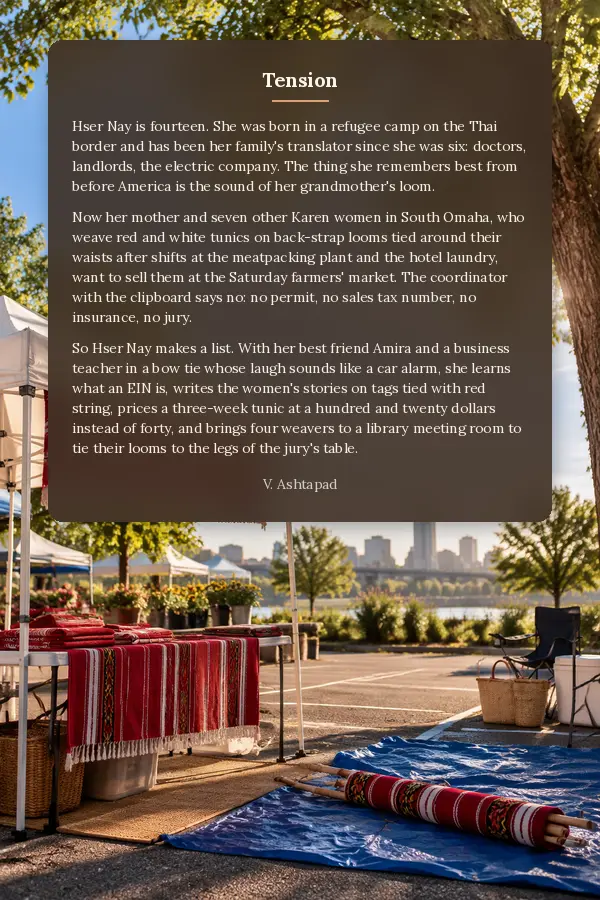
Hser Nay is fourteen. She was born in a refugee camp on the Thai border and has been her family's translator since she was six: doctors, landlords, the electric company. The thing she remembers best from before America is the sound of her grandmother's loom.
Now her mother and seven other Karen women in South Omaha, who weave red and white tunics on back-strap looms tied around their waists after shifts at the meatpacking plant and the hotel laundry, want to sell them at the Saturday farmers' market. The coordinator with the clipboard says no: no permit, no sales tax number, no insurance, no jury.
So Hser Nay makes a list. With her best friend Amira and a business teacher in a bow tie whose laugh sounds like a car alarm, she learns what an EIN is, writes the women's stories on tags tied with red string, prices a three-week tunic at a hundred and twenty dollars instead of forty, and brings four weavers to a library meeting room to tie their looms to the legs of the jury's table.
Members can react to this book and talk about it in the members' Library.
Ownership
© 2026 CRUNOD LLC. All rights reserved.
This book is owned by CRUNOD LLC. It is free to read on EternalCurrent.Online. No part of it may be copied, reprinted, sold, recorded or adapted, including as audio, film or translation, without written permission from CRUNOD LLC.
© 2026 CRUNOD LLC. All rights reserved.