
The Andes Club
Eight Students, Two Teachers, a Stone Refuge in the Cajón del Maipo and the Storm That Came a Day Early
by V. Ashtapad
Foreword
This is a work of fiction. The Cajón del Maipo above Santiago, its arrieros and mountain refuges, its winter storms, and the Chilean tables of empanadas, sopaipillas and mote con huesillo are real, as are the many families from around the world who have made their homes in Chile. Quillay International School, the Andes Club, the Piedra Larga refuge, the Maipo Valley Mountain Volunteers and everyone in this book are invented.
For everyone who came over a mountain, and for the ones who were already here.
Saturday, 6:10 a.m.
Mateo Quispe counted them again.
Ten. Eight students and two teachers, standing in the dark beside the white minibus in the lower parking lot of Quillay International School, with the lights of Santiago spread out below the hill like a pan of coals somebody had stirred and left. Behind the school, where the sky was beginning to go from black to the blue of a bruise, the Andes stood up out of the night. You could not see the snow on them yet. You could only see where the stars stopped.
He had counted ten at six o'clock, and ten at six-five, and now ten again, and it was the same ten, and he knew it would be the same ten, but he counted anyway. His grandfather had counted alpacas every morning and every evening of his life above Ocongate, at four thousand five hundred meters, where a missing animal at dusk meant a missing animal forever. You count what you love, his grandfather said. You count it twice when the weather is changing.
The weather was not changing. The forecast on everyone's phones said clear Saturday, clouds Sunday afternoon, snow Sunday night. Ms. Salas had read it out at the club meeting on Thursday, and again in the group message on Friday, and she was going to read it out again in a minute, because she was the kind of teacher who said the important things three times.
"Okay, Andes Club," Ms. Salas said. "Circle."
They made a circle on the asphalt. It was cold enough that their breath showed in the headlights of the minibus. Don Hernán, the driver, sat behind the wheel with the engine running and a flask of coffee and the radio playing a morning show at a whisper.
Ingrid Salas was thirty-six and had been climbing in the Cajón del Maipo since she was sixteen, when she had taken a bus from Puente Alto with a borrowed backpack and a bag of bread and never really come home. She taught physical education at Quillay. She had started the Andes Club four years ago with three students and a whistle. Now it had twenty-two members and a waiting list, and the eight of them standing in the circle had been chosen for the first overnight of the season because they had come to every Thursday practice since March, done the three day hikes on Cerro Manquehue and Cerro La Cruz and the long one up to the waterfall, and handed in their permission forms on time.
Mateo had handed in his form the first day. His mother had signed it at the kitchen table in their apartment in Estación Central, slowly, reading every line, with her finger under each word. Then she had folded it in half and in half again and given it to him and said, in Quechua, "Come back with all your fingers."
"Ten up," Ms. Salas said. "Ten down. That's the only rule that matters this weekend. Everything else is a footnote. Say it."
"Ten up, ten down," they said, not quite together.
"Again, with feeling. It's six in the morning, I know. Again."
"Ten up, ten down."
"Better." She held up her phone and read the forecast for the third time. "Clear today. Wind from the north picking up overnight. Clouds Sunday afternoon. Snow Sunday from about six in the evening. We'll be at the corral by one on Sunday and in San José de Maipo eating sopaipillas by three. If anything changes, we change. Mr. Whitlock is sweep. I'm lead. Nobody walks in front of me and nobody walks behind him. Questions?"
Ethan Brooks raised his hand.
"Is it true there's no signal at the refuge?"
"It's true."
"Like, none?"
"Like none. We have a radio. It talks to the mountain volunteers' base in San José. I check in at eight tonight and eight tomorrow morning. If you need to tell your followers about your sunset, you'll do it on Sunday like a person from the last century."
People laughed. Ethan laughed too, which was one of the things about Ethan. He was fifteen, from Denver, tall, with a red jacket so new it still had the fold lines from the package, and a backpack that was bigger than anyone else's, and he talked about the ski runs at Farellones the way some boys talked about football. He had been in Chile two years. His father was a geologist for a mining company and was away in the north half of every month.
Mr. Whitlock raised his hand too, which made people laugh again.
"Sweep has a question," he said. "Has everyone got a hat? A real one. Not a cap."
They held up their hats. Ben Whitlock was forty-one, from Nelson, in New Zealand, and taught biology, and had come to Chile two years ago because, he said, he had read a book about the Andes when he was twelve and decided he should see them before he died. He was a good walker. He had done long tramps in the mountains at home. He had never spent a night in snow, and he had said so at the Thursday meeting, plainly, the way he said everything. "I'll be learning with you," he had said, and Lena Hoffmann had written something in her notebook that Mateo was fairly sure was not kind.
Mateo looked around the circle at the hats.
Javiera Painemal, fourteen, in a striped wool hat her grandmother had knitted, gray and white and black, standing next to Ms. Salas because Javiera's mother taught Spanish at Quillay and Javiera had known Ms. Salas since she was small. Daniela Rondón, fifteen, the oldest, in a pink fleece hat with a pompom that did not match her serious face, holding a clipboard because nobody had asked her to hold a clipboard. Seo-yeon Park, whom everyone called Sunny, fourteen, in a black knit hat pulled low, earbuds in, not playing anything, Mateo suspected; she wore them so people would leave her alone. Lena Hoffmann, fourteen, tall and pale and very straight, in a green hat with a reflective strip, already looking at the sky. Priya Nair, thirteen, small, in a purple hat with a first-aid kit clipped to her hip belt that was nicer than the school's. Oluwatobi Adeyemi, Tobi, fourteen, in a yellow hat, humming. Tobi was always humming. And Ethan, in a red hat that matched his red jacket.
And Mateo himself, thirteen, the youngest, in a brown hat with ear flaps and a braided cord under the chin, made by his grandmother out of alpaca wool, which was the warmest thing anyone in the circle was wearing, and which Ethan had called "the llama helmet" in March, once, and then not again, after Ms. Salas looked at him.
"Packs in the back," Ms. Salas said. "Bodies in the seats. Mateo, you can stop counting. I've got it."
He had not known she had seen him doing it. He felt his face go hot under the hat.
"Never stop counting," Ms. Salas said to him, more quietly, as the others pushed past to the minibus. "I just meant you can rest for an hour. I'll count in San José."
---
The minibus went down the hill through Lo Barnechea while the city was still asleep, past the dark malls and the closed bakeries and a man hosing the sidewalk in front of a pharmacy, and then along the river on the highway that runs east to west, with the water low and gray in its stone channel, and then south through the long streets of the city's edge, La Florida and Puente Alto, where the bakeries were open, because in Puente Alto people go to work early. The windows fogged. Tobi drew a mountain on his window with his finger and then a stick figure on top of it and then a second stick figure falling off.
"Not funny," Daniela said, without looking.
"It's a little funny."
"It's bad luck."
"Venezuelans believe in bad luck?"
"Everybody believes in bad luck at six in the morning."
Ethan was in the back seat with his feet on his pack, showing Lena something on his phone. Lena was nodding the way she nodded at teachers. Priya was reading a laminated card she had pulled out of her first-aid kit. Sunny had her head against the window. Javiera sat in the front row behind Ms. Salas with her phone in her lap, looking at a message.
Mateo sat in the second row by himself. He liked sitting by himself. He could see everything.
He saw Javiera turn and lean forward and say something to Ms. Salas. He saw Ms. Salas listen with her head tilted, and smile, and say something back. He saw Javiera sit back and look at her phone again and then put it away in her jacket and look out the windshield at the mountains coming up gray and enormous in front of them as the city ran out.
He did not hear what they said. The radio was on and the engine was loud. But he saw Javiera's face after, and it was the face of someone who has said a true thing and been told, kindly, that it was a nice thing.
© 2026 CRUNOD LLC. All rights reserved.
Saturday, 8:05 a.m.
The message from her grandmother had come at nine thirty the night before, which was late for Rosa Painemal, who went to bed when the chickens did.
Javiera had been packing on her bedroom floor in Ñuñoa, rolling her socks the way Ms. Salas had shown them, tight, like little sausages, so they took no space. Her mother was in the kitchen marking essays with a red pen and a cup of tea. The phone buzzed, and it was a voice message, and Javiera had held it to her ear and heard the wind first, then the chickens, then her grandmother.
Her grandmother lived outside Cholchol, west of Temuco, on the land where Javiera's father had grown up and where, in the summers, Javiera slept in the room with the wood stove and woke to the smell of smoke and wet grass. Rosa Painemal was seventy-four. She had never been to the Cajón del Maipo. She had been to Santiago four times in her life and had not liked it any of the four times. She did not use the phone except to send voice messages, which she sent the way other people sent letters, long and slow and full of instructions.
"Javiera," her grandmother said, in the voice message. "Your mother says you're going up the mountain tomorrow. Listen to me. Here it's warm. It's too warm for May. The wind came around from the north this afternoon and it's warm on the back of your neck, like a dog breathing. You know what I always tell you. When the north wind is warm, the rain is already walking. Here it will be rain. Up there it won't be rain. Take the extra socks. Tell your teacher. And look at the mountain when you get there. If the mountain is wearing a hat, don't stay long. Kisses. The hens send kisses."
Javiera had played it twice and then gone into the kitchen and played it for her mother.
Her mother had smiled the smile she used for Grandmother Rosa, which was fond and tired at the same time. "Your grandmother has been predicting weather for seventy years," she said. "She's right about half the time."
"That's better than the forecast."
"The forecast is right about ninety percent of the time."
"Not about mountains."
"Mamá. Don't be fome," Javiera said. Fome was the word for anything dull, and her mother was being very dull and probably right.
Her mother had put down the red pen. "Tell Ingrid, if it makes you feel better. She won't laugh at you. She knows more about weather up there than your grandmother and the forecast put together."
So Javiera had told her, on the minibus, leaning forward between the seats. She had said it fast and in English, because the club spoke English on outings, and in English it sounded even sillier than in Spanish. The north wind is warm. The rain is walking. Ms. Salas had listened, and nodded, and said, "Your grandmother's right that the wind's turning north. That's in the forecast too. It's what brings the front. We'll be down before it gets here." And then, kindly: "Tell her thank you."
---
They stopped in San José de Maipo at eight, at the bakery across from the old square with the church and the long low adobe houses with their wooden porches, where Ms. Salas always stopped. The town sat in the bottom of the valley with the river loud below it and the mountains so close on both sides that the sun would not reach the square for another hour. It was very cold. Frost on the windshields of the parked cars. Dogs asleep in the doorways in balls.
The bakery smelled of hot fat and onion. They each got one empanada for the road, the baked kind, pino, with ground beef and onion and a slice of hard-boiled egg and a single black olive that Tobi said was a test of character, and they ate them standing on the sidewalk in the shadow, burning their mouths, holding them in paper napkins that went translucent with grease. Ms. Salas bought a big paper bag of sopaipillas, the round fried pumpkin breads, two dozen, warm, for later.
"For the refuge," she said. "Sopaipillas are what you eat when the weather turns. It's the law."
"I thought you said the weather wasn't turning," Ethan said.
"It's not. These are preventative sopaipillas."
Javiera ate her empanada and walked to the corner where the street opened toward the east and looked up the valley.
The mountains at the head of the Cajón were already in sun. The light had come over the border ridges and lit the snow on the high peaks, white and gold and very sharp against a sky that was clear blue. Clear everywhere. Except over one peak, the big one at the end of the valley, the one with the long shoulder, where a cloud sat. Not a cloud like the others. A cloud like a lid. Smooth on top, smooth underneath, flat as a plate laid over the summit, pinkish on the edge where the sun caught it.
The mountain was wearing a hat.
She looked at it for a long time. Then she went back to the group.
"Ms. Salas."
"Javi."
"Look." She pointed.
Ms. Salas looked. She looked for longer than Javiera expected. Mr. Whitlock came over and looked too.
"Lenticular," Mr. Whitlock said. "That's a lens cloud. Wind going over the top fast."
"It means wind," Ms. Salas said. "Strong wind up high. It's what the forecast says. Wind tonight from the north."
"My grandmother says—"
"I know." Ms. Salas put a hand on her shoulder. "I know. I've seen that hat before, and sometimes it means the front comes early and sometimes it means nothing. Here's what we'll do. We go up. At the refuge I check in with the base at eight tonight and get the newest forecast. If the front's early, we come down at first light instead of at ten. Deal?"
"Deal," Javiera said.
Behind her, Ethan said, not loudly, but not quietly either, "Her grandmother can see a thousand kilometers?"
Javiera did not turn around. She had learned at nine years old, the year she moved from the public school in Ñuñoa to Quillay because her mother got the job, that there were some people who would always hear the word grandmother and the word Mapuche in the same sentence and smile a certain way. Ethan was not the worst. He was not even mean. He just said what came into his head, the way some dogs bark.
But she saw Mateo, who never said anything, look at Ethan. It was a short look. It was the look her grandmother gave a man who had walked into her kitchen without wiping his boots.
---
The road up the Cajón went from asphalt to gravel past the last village, climbing beside the river in long switchbacks, and the valley narrowed and the walls went up, brown and red and gray, with snow in the gullies higher up and the river pale green with silt. They passed a small herd of goats in the road with a boy on a horse behind them. They passed a carabineros post, a small square building with a flag and a white truck parked in front. They passed a sign for the hot springs. At nine twenty Don Hernán pulled off at a wide place beside a stone corral with a tin-roofed shed and a smoking stovepipe and three horses and a mule standing in the sun.
"Don Eliseo's," Ms. Salas said. "Everybody out. Say good morning to the gentleman like human beings."
Eliseo Cárcamo came out of the shed in a wool poncho the color of dry earth and a flat black hat, with two dogs at his heels. He was seventy, or near it. He had been an arriero all his life, driving cattle up to the high summer pastures in December and down again in April, and now that he was old he kept a few animals at the winter place by the road and rented the mule to hikers who did not want to carry their own stove. He had known Ms. Salas since she was the sixteen-year-old from Puente Alto with the borrowed backpack.
"Ingrid," he said.
"Don Eliseo."
They shook hands. He looked at the eight of them lined up in the gravel in their bright jackets the way he probably looked at a herd of young heifers that had been sent up by somebody from the city. Then he looked up the valley.
"The wind turned to the north at four this morning," he said in Spanish. "I heard it on the roof."
"The forecast says tomorrow night."
"The forecast lives in Santiago."
Javiera, who understood every word, felt Mateo, beside her, understand too. Mateo's Spanish was better than people thought. Everything about Mateo was better than people thought.
Ms. Salas and Don Eliseo talked for a few minutes with their heads together. Javiera heard the words wind and refuge and morning and the name of the big peak. Then Ms. Salas turned around.
"Change of plan, small one. We go up, we sleep, we come down at first light tomorrow instead of after breakfast. Don Hernán, come back for us at eleven, not one. If you hear on the radio that the road's bad, wait at the carabineros post. Don Eliseo will keep an eye on the weather." She clapped her hands. "Ten up. Let's go."
They shouldered their packs. Ethan's was so heavy he had to sit down to get into the straps and then get pulled up by Tobi.
As they started up the trail behind the corral, between the dry thorny bushes and the gray rocks, Javiera looked back once. Don Eliseo was standing at the gate with his hat in his hand, looking not at them but at the cloud on the peak, which had grown, she thought, a little thicker at the edges.
© 2026 CRUNOD LLC. All rights reserved.
Saturday, 12:40 p.m.
Daniela Rondón had not seen snow until she was nine years old.
In Barquisimeto, where she was born, the coldest it ever got was a night in January when her grandmother wore a cardigan and everybody made fun of her. The first winter in Santiago, the first morning she woke to see the mountains white all the way down the lower slopes behind the apartment buildings in Maipú, she had stood at the window in her pajamas with her little brother Samuel, who was four then, and they had both been too surprised to talk. Her mother came and stood behind them with her coffee. "That's snow," her mother said. "Don't touch it. It's cold." And they had all laughed, because there was no way to touch it; it was thirty kilometers away and two thousand meters up.
Now she was walking in it.
Not real snow. Old snow, patches of it, gray and hard and grainy as sugar, in the shadows of rocks on the north-facing side of the trail where the sun did not reach. They had been climbing for three hours, up the side valley Ms. Salas called the Quebrada del Tordo, along a path that climbed across the slope in long zigzags and then straight up in places where the rock made steps. The thorny bushes had given way to low cushions of tough green plants and then to bare scree, broken rock that slid a little under your boots, and the air had gotten thinner. You could feel it. You took a breath and it seemed to stop halfway.
Daniela was third from the back, in front of Mateo and Mr. Whitlock. She had asked to be near the back because from the back you could see everyone. That was what she told Ms. Salas. The real reason was that she was slow on hills and did not want anyone walking behind her watching her be slow.
She was keeping a count. Not like Mateo. Mateo counted people. Daniela counted food.
She had seen everyone's lunches when they stopped at eleven by the stream. Ms. Salas had told them to bring two lunches, one dinner contribution, one breakfast, and snacks, and to bring "a bit extra, always a bit extra, the mountain is a hungry place." Daniela had brought exactly twice what was asked. She had brought it because she always did. Her mother packed every lunch in their family as if a war might start between breakfast and noon, and Daniela had learned it the way you learn the shape of your own house in the dark.
She had seen that Sunny brought rolls of rice and vegetables wrapped in seaweed, cut in rounds, two boxes of them. That Mateo had a cloth bag of toasted corn, big fat kernels, and a bag of dried potatoes that looked like stones. That Lena had a whole loaf of heavy dark bread so dense it could stop a door. That Tobi had a bag of small fried crunchy cubes he called chin chin that he was sharing with everyone, which meant they would be gone by tonight. That Priya had little foil packets of something and a bag of dates. That Javiera had a container of her mother's lentils for the dinner pot.
And that Ethan had brought eight sandwiches from the shop on the corner near his house, the expensive kind, in plastic boxes, and four chocolate bars, and that at the lunch stop he had eaten one sandwich, taken two bites of a second, decided he did not like the cheese, and thrown the rest of it in the stream for the fish.
"There are no fish," Mr. Whitlock had said, mildly. "Not at this altitude. You've fed it to the condors."
"Condors eat cheese?"
"Condors eat anything. Fish it out, please. We carry out what we carry in."
Ethan had fished it out with a stick and put it in his garbage bag, and made a joke about it, and Tobi had laughed. Daniela had not laughed. She had thought about the two bites of bread and cheese in the garbage bag the whole way up the next hill.
---
At twelve forty they stopped at a flat place where the trail turned the corner of the ridge and you could see, suddenly, the whole upper basin opening out ahead: a long white bowl of snow with black rocks sticking out of it, and the ridge going up on the left in a sharp line, and on the right a steep slope of new-looking snow running down into a narrow gully. And at the top of the bowl, small, a dot of gray stone with a dark roof: the refuge.
"There she is," Ms. Salas said. "Piedra Larga. An hour and a half. Water, snacks, sunscreen. Five minutes."
They sat on rocks. Daniela took out the clipboard she had carried up the whole way in a plastic sleeve, which Ethan had made fun of at the minibus and again at the lunch stop, and made a note.
"What are you writing?" Sunny said. It was the first thing Sunny had said to her all day.
"Nothing."
"You're always writing."
"Lists."
"Of what?"
Daniela looked at her. Sunny was one of those people at school who was hard to know. She was very good at math and did not raise her hand. Her parents had a clothing shop in Patronato, the old neighborhood near the market where the Korean families had their wholesale shops and their restaurants, and Daniela had been there once with her mother to buy school uniforms in bulk and had seen Sunny behind the counter on a Saturday, folding sweaters, very fast, without looking at her hands.
"What we've got," Daniela said finally. "In case."
"In case what?"
"Just in case."
Sunny looked at the clipboard and then at her. Then she nodded, slowly, and put one earbud back in, and Daniela could not tell if the nod meant I understand or I think you are strange.
Tobi was singing again. He sang on the trail the way other people breathed, under his breath, something with a lot of short repeated lines, his voice going up and then answering itself lower down. Lena, who was sitting near him, turned around.
"Can you stop? Just for five minutes?"
"I'm keeping the pace," Tobi said. "It's a walking song."
"We're not walking. We're sitting."
"It's a sitting song now."
"Tobi."
He stopped. He looked hurt for about one second and then made a face like a clown, and Priya laughed. Lena turned back to the view and Daniela saw her take out the notebook.
Ms. Salas was standing a little apart, looking north. Daniela followed her eyes. Over the big peak behind them, the one with the long shoulder, the cloud like a lid was gone. In its place there was a long gray band of cloud lying along the whole line of mountains to the north, low, like a wall that had been built while they were walking.
Mr. Whitlock went and stood next to her. They talked quietly. Daniela could not hear them. She saw Ms. Salas shake her head a little, and then nod, and then look at the refuge and then back at the gray wall.
"Packs on," Ms. Salas said. Her voice was the same as always. "Let's not waste the sun."
---
Above the corner the snow was continuous, not patches anymore, crusted on top, and they walked in Ms. Salas's footprints, which she kicked into the slope one by one. Daniela concentrated on the footprints. She did not look up. The light got very bright, white from all sides, and she put her sunglasses on and the world went brown.
Twice she slipped and caught herself with her poles. The second time Mateo, behind her, put his hand out flat against her pack, not pushing, just there, so she would not slide back into him. When she had her balance he took his hand away. He did not say anything. He did not need to.
"Thanks," she said.
He nodded.
She thought about Mateo as she walked. She had been in classes with him for two years and could not remember the sound of his voice. She knew he lived in Estación Central, near the train station, because she had seen his mother waiting for him at the metro once, a short woman in a dark skirt with a cloth bundle on her back. She knew his father cooked at a Peruvian restaurant downtown, because Mateo had brought in a pot of something for the international food day, potatoes in a yellow sauce with cheese and peppers, and it had been gone in four minutes, and Mateo had stood behind the table with his hands in his pockets while people asked him what it was and Javiera had answered for him. She knew he was on a scholarship, like she was. She knew he walked on a mountain slope as if his feet had eyes.
He was not out of breath. Everyone else was out of breath. Ethan, ahead of her, was breathing like a dog in summer. Mateo walked at the same speed on the steep places as on the flat places, slow, and his breathing did not change.
"How are you not dying?" Daniela said, at the next switchback, when they had stopped for Ms. Salas to kick a step.
He looked at her as if he had not expected to be asked anything.
"I was born at four thousand," he said. "This is low."
It was the longest sentence she had ever heard him say.
---
They reached the refuge at a quarter to three.
It was a stone house built against a long flat-sided boulder, the long stone that gave it its name, which leaned over the back of it like a shoulder. The walls were gray stones fitted together without much mortar, with small square windows, and the roof was dark green corrugated iron held down with more stones. A metal chimney pipe stuck out of the roof. Beside the door there was a wooden sign that said in carved letters PIEDRA LARGA 2380 M and a date, 1964, and the name of the mountaineering club that had built it, which no longer existed. Fifteen meters away, behind a rock, was a small stone shed for firewood and beside it a smaller wooden box that was the toilet.
Inside it was dark and cold and smelled of old smoke and wet wool and candle wax. There was one room. Along the back wall were two levels of wooden bunks with thin foam mattresses, room for twelve if they were friendly. In the middle was a black iron stove with a flat top, the kind you could cook on. A long wooden table with benches. Shelves with a few tins, a kettle, a stack of pots, candles, a box of matches in a jar, and a thick logbook with a pen tied to it on a string. A wooden sled leaned in the corner, the old kind for hauling firewood up from where the trees were, below, with wooden runners worn pale.
"Home," Ms. Salas said. "Packs on bunks. Water team, Priya and Tobi, take the pots to the stream. Wood team, Ethan and Lena. Mateo, Sunny, help me with the stove. Daniela, you're on the kitchen. Javi, the windows, please; we want some light in here. Mr. Whitlock is going to stand outside and look at the sky with a worried expression."
"I'm not worried," said Mr. Whitlock from the doorway. "I'm pensive."
Daniela put her pack on a lower bunk in the corner and took out her clipboard.
The kitchen. She looked at the shelves, the tins, the pots. She thought about what she had seen in all the packs on the trail. She thought about the gray wall over the mountains behind them, and the way Ms. Salas had looked at it and then looked away.
She turned to a new page and wrote at the top, Everything, and underlined it twice.
© 2026 CRUNOD LLC. All rights reserved.
Saturday, 7:50 p.m.
The stove made the refuge warm in the way that only a small room with a fire can be warm: hot in the middle, warm in a ring, cold at the walls. Tobi had worked out, by six o'clock, the precise bench position that was warm on the front and the back at the same time, and he was defending it.
"I found it," he said. "It's mine. I'll give you the coordinates for a fee."
"You'll give me the coordinates or I'll sit on you," said Daniela, who was stirring the pot.
"Venezuelan hospitality."
"Nigerian manners."
The pot was the dinner: Javiera's mother's lentils, with rice from Ms. Salas's bag, and onions Daniela had fried first in the oil from Ms. Salas's bottle, and a sausage that Lena had produced from her pack and cut into coins. It had been Daniela's idea to put everything in together. Tobi had told her it was a war crime against lentils. Then he had tasted it and asked for a second bowl and been told no, there were no second bowls, that was the point of a pot.
Outside it was dark. The sun had gone behind the ridge at five and the sky had turned a deep electric blue over the basin, and then gray. Not dark gray. A low, flat, thick gray that came down over the ridge from the north like a lid going onto a pot, and swallowed the first stars before anyone had properly seen them.
At six thirty, when Tobi went out with Ethan to the toilet, the moon had been up, low over the eastern ridge, and around it there was a ring, a perfect circle of pale light with the moon in the center, like a coin in a bowl of milk.
"Look," Tobi had said. "It's got a halo."
"Ice crystals," Ethan said. "High clouds. It's physics."
"It's beautiful physics."
When they came back in, Javiera asked them what the sky was doing, and Tobi told her about the ring. Javiera did not say anything. She looked at Ms. Salas, who was sitting at the end of the table writing in the logbook. Ms. Salas looked at the window.
Tobi saw the look. He thought about it while he ate.
---
He had been in Chile three years. He had come at eleven, from Lagos, from a flat in Surulere with a generator in the yard and a hawker in the street outside who sold roasted corn and ube at dusk, and the noise of the city all night, horns and music and people. His father worked for a shipping line and had been sent to their office in Santiago, which handled the containers going in and out of San Antonio. Tobi had cried the first month. He had not told anyone this. He had cried at night in the new apartment in Las Condes, which was so quiet he could hear the fridge.
The thing that helped was singing.
His grandmother in Abeokuta sang everything. She sang when she cooked and when she swept and when she walked to the market and when she scolded you, she sang the scolding. Most of her songs were call-and-answer: one voice said a line and everyone else said the line back, or said the answer to it, and the song went on like that, forward and back, like two people pulling a rope. When Tobi was small and they visited her in the dry season, she taught him dozens. Songs for pounding yam. Songs for counting. Songs for walking a long way. When they moved to Chile his mother had joined a community choir in Providencia that sang everything from Chilean folk songs to old American soul, and Tobi had joined too, and found that nearly every song in the world had a place where somebody called and everybody answered.
He had stopped crying when he started singing on the walk to school. Not loud. Just enough to fill the quiet.
Lena did not like the singing. That was fine. Lena did not like most things that were loud. Tobi had decided, somewhere on the long climb, that he would sing more quietly near Lena and not at all near her notebook.
---
At eight o'clock Ms. Salas took the radio out of its case.
It was a black handheld radio, the size of a big phone, with a stubby black antenna and a dial on the top and a battery pack on the back, and she held it close to her mouth and pressed the side button and said, in Spanish, "Base Maipo, Base Maipo, this is Piedra Larga, Piedra Larga, over."
Nothing. A hiss.
She said it again. Hiss.
"It's the stone," she said in English. "The walls are a meter thick. I'll go out."
She went out with her headlamp and the radio and Mr. Whitlock went with her. Through the window Tobi watched the two lights go up the slope behind the refuge, to a big rock, and stop. The lights stood on top of the rock. He could see Ms. Salas holding the radio up.
Everyone in the room was quiet. Even Ethan. Daniela had stopped scrubbing the pot. Sunny had taken both earbuds out.
After five minutes the lights came back down and the door opened and the cold came in with them, and something else with them. Tobi saw it on Ms. Salas's shoulders before he understood what it was. White. Small white points on her dark jacket, and in her hair where it came out under her hat, melting already in the warm.
"Okay," Ms. Salas said. She shut the door and leaned on it. "News. Good news first. Base Maipo says hello and Rodrigo says Javi's grandmother should work for the weather service."
Javiera sat up very straight.
"Bad news. The front's early. It's coming in now instead of tomorrow evening. Heavy snow tonight, all night, maybe through tomorrow. Wind from the north, then switching around. The new forecast says it might clear tomorrow night or Monday morning."
"Might," said Lena.
"Might. Weather's a might business." Ms. Salas took her hat off and shook the snow out of it into the stove, where it hissed. "Here's what that means. We are in a stone house with a stove and wood and food and water and two adults and eight very smart people. This is exactly where you want to be in a snowstorm. If we were halfway down the trail right now, that would be a problem. We're not. We're here. We stay here until it's safe to walk. If that's tomorrow, great. If it's Monday, then your parents get a call from the school saying you're having an extra day of excellent education."
"My mom's going to freak out," Ethan said.
"Your mom's going to get a call from the base tonight. They're phoning the school's emergency line. Everybody's parents will know you're warm and fed and stuck. Next check-in is eight tomorrow morning."
"What if it doesn't stop?" Priya said. Her voice was small. "Like, at all?"
"It always stops," Ms. Salas said. "That's the one thing every storm in history has in common."
---
It snowed.
At first Tobi could see it in the light from the window: flakes going past sideways, fast, small. Then bigger flakes, heavier, slower, falling straight, so many that the light from the window made a cone in the dark full of moving white. Then the wind came up and the cone went crazy, flakes flying up as well as down, and the wind made a noise in the stovepipe like somebody blowing across the top of a bottle, low and steady, and then rising.
They played cards. They played a game Sunny taught them with a deck of Korean flower cards she had in her pack, small and stiff and red-backed, with pictures of plum blossoms and moons and wild boar, and she explained the rules so fast and so quietly that nobody understood them, and she won four games in a row, and then explained them again more slowly, and then won four more. Ethan was furious and delighted. "You're a shark," he said. "You're a card shark." Sunny looked at him for a long second and said, "My grandmother is a shark. I'm a small fish." It was the first joke Tobi had ever heard her make.
At ten Ms. Salas said lights out. They brushed their teeth with water from the pot and spat into the snow outside the door, which was already over their boot tops on the step, and lay in their bunks in their sleeping bags in two rows, girls on the top, boys on the bottom, Ms. Salas by the door and Mr. Whitlock by the stove because he had volunteered to feed it in the night.
The wind got louder. The roof made a sound like someone tapping on it with their fingertips, all over, very fast. Then a sound like someone pushing on it with their palms.
"Tobi," said a voice in the dark. Priya, above him. "Are you awake?"
"No."
"Can you sing something? Quiet."
He thought about Lena, two bunks over. Lena did not say anything.
"Okay," he said. "It's one my grandmother sings. Somebody asks, where are you going, and somebody answers, I am going home. It goes on like that. Where are you going? I am going home. Who is waiting? My mother is waiting. Like that."
"Can we answer?"
"That's the whole point."
He sang it low. The first line, then waited. Priya answered, quietly, I am going home. He sang the next. This time two voices answered, Priya and Javiera. The next time it was four. He did not look to see who. Under the sound of the wind on the roof, in the dark, the room said, I am going home, I am going home, and on the sixth line Tobi heard a voice he did not expect from the bunk at the far end, low and careful, half a breath behind everyone else.
Lena.
He kept singing until the room was asleep.
© 2026 CRUNOD LLC. All rights reserved.
Sunday, 6:50 a.m.
Lena Hoffmann woke because the light was wrong.
It was gray, a dim, even, underwater gray, coming from the small square window above her bunk, and for a moment she thought it was still night and the moon was out. Then she saw that the window was white. Not white with frost. White with snow, packed against the glass on the outside, all the way up to the top, so that the light came through it the way light comes through paper.
She sat up and hit her head on the roof beam. The iron roof was right above the top bunks. It was very quiet. That was the other wrong thing. The wind had stopped making the bottle noise in the stovepipe. Instead there was a hush, deep and padded, the sound of a room inside a pillow.
Below her, Mr. Whitlock was kneeling at the stove with the door open, feeding in sticks. The fire made a small orange square in the gray room. Ms. Salas was at the door, dressed, boots on, pulling on her gloves.
"Is it still snowing?" Lena whispered.
"Like it's being paid to," Mr. Whitlock whispered back.
Ms. Salas opened the door.
It opened inward, thank goodness, Lena would think later; the people who built the refuge in 1964 had known what they were doing. Behind it there was a wall of snow. Not all the way to the top of the doorway. About to Ms. Salas's waist, with a sloping top where the wind had carved it, and above that a gap of gray daylight full of falling snow, thick, slow, enormous flakes, falling straight down now that the wind had eased.
"Well," said Ms. Salas. "Good morning, Cajón."
She took the small aluminum shovel from beside the door and began to dig.
---
Lena had come to Chile three years ago, from Hamburg, where it snowed perhaps four times a winter and the snow turned to brown slush in the gutters by lunchtime. Her mother was in charge of logistics at a company that moved cargo through the port at San Antonio. Her father taught German at a language institute and did the cooking. They lived in Vitacura, in a building with a doorman, and every Sunday her father made a pot of something with potatoes in it and complained that Chilean potatoes were too sweet.
The thing Lena missed most was her grandfather.
Opa Klaus was eighty-one and lived in a narrow brick house near the harbor in Hamburg, and he had been a merchant sailor for thirty years, on cargo ships that went everywhere. He had been to Valparaíso eleven times in the 1970s and '80s, on ships carrying machines in and copper out, and when Lena's mother told him they were moving to Chile, he had gone up to his attic and come down with a round cardboard star wheel, a planisphere, the kind you turn to the date and time to see what stars are up. It was for the Southern Hemisphere. It was older than Lena's mother. The cardboard had gone soft and brown at the edges.
"In the south the sky is upside down," he told her. "Orion is standing on his head. And there is no star at the pole. You have to find the south with your hands." And he had shown her how, on the kitchen table, with salt cellars for stars.
Every Sunday evening she called him and told him what she had seen. She had seen the Southern Cross from the roof of their building, faint through the city light. She had seen it brilliant from a beach at Zapallar in January. She had found south with her hands nineteen times. She kept a list. It was in the notebook.
The notebook was also where she wrote what she thought about people, which was a habit she knew she should stop. On Thursday she had written: Mr. W. has never camped in snow. Why is he the second leader?? It was not kind. It was true. Lena preferred things that were true.
---
Ms. Salas dug a trench out from the door, about a meter wide, cutting the snow into blocks and throwing them to the side, and Mr. Whitlock went out after her to help, and Lena got dressed fast in her bunk under her sleeping bag and climbed down and went to the door to watch.
The world was gone. That was how it looked. Everything she had seen yesterday afternoon, the white bowl and the black rocks and the ridge on the left and the steep slope on the right, was gone, replaced by a gray-white blur that started about ten meters away and went on forever. The firewood shed, fifteen meters off behind its rock, was a darker shape in the blur. Then the snow thickened and it disappeared too.
"Seventy centimeters," Ms. Salas called back. "More in the drifts. I'm going to the rock for the radio. The signal's better up there. Mr. Whitlock, keep digging toward the shed. Lena, go back inside, you'll get soaked."
"I'm already soaked."
"Then you'll get more soaked."
Lena did not go back inside. She stood in the doorway in the trench and watched Ms. Salas wade up the slope behind the refuge toward the radio rock. It was only twenty meters. On Saturday night it had taken two minutes. This morning Ms. Salas was in snow to her thighs, pushing, lifting each leg high and planting it, with the radio zipped into the front of her jacket. The slope was steeper than it had looked. Near the rock there was a step in the ground, Lena remembered, a little ledge of stone where the path turned, which yesterday you could see.
Today you could not see it.
Ms. Salas reached the place where the step was. Lena saw her lift her right leg and plant it and lean forward. And then the snow under the right leg gave way, all at once, the way a sandcastle gives way when the tide gets under it, and Ms. Salas went down sideways with a shout, the right leg going down into the hole where the ledge was and the rest of her twisting the other way. The radio came out of her jacket. Lena saw it go: a black shape, spinning, hitting the rock, bouncing, landing in the snow below.
"Mr. Whitlock!"
He was already running. Running is the wrong word. He was already plunging up the slope with his arms going like someone swimming. Lena went after him.
---
Ms. Salas was sitting in the snow with her right leg out in front of her at a strange angle and her face very white. She was not crying. She was saying a word in Spanish over and over through her teeth, a word Lena knew was not allowed at school.
"Don't move it," Mr. Whitlock said. "Don't move. Where is it?"
"Ankle. I heard it."
"Heard what?"
"A pop."
Lena found the radio. It was half buried a meter below the rock. She dug it out with her gloves. The stubby antenna was bent over at the base, almost folded. The plastic of the back, where the battery pack clipped in, had a crack running across it, and there was snow in the crack.
She held it up. Ms. Salas looked at it and shut her eyes.
"Okay," Ms. Salas said, after a while. "Okay. Ben. We get me inside. Then we try the radio. Then we think. In that order."
"Can you stand on the other one?"
"Watch me."
They got her up between them, Mr. Whitlock on the right with her arm over his shoulders, Lena on the left, much shorter, so that Ms. Salas had to lean down to her. The right foot did not touch the snow. It hung. They went down the slope in their own trench, slowly, one step and stop, one step and stop. Lena could feel Ms. Salas shaking, not from cold.
At the door, all seven of the others were standing in the trench in their sleeping clothes and hats with their mouths open.
"Inside," Mr. Whitlock said. "Clear a lower bunk. Now, please."
Lena looked back once up the slope. She could not see the rock anymore. She could see the trench they had made, already softening at the edges as the snow filled it in, and then nothing. She thought: Mr. W. has never camped in snow.
And then she thought: well, he is now. And so am I. And so is everyone. And the only one of us who had was sitting on a bunk with her face the color of paper and her teeth together.
She went in and shut the door.
© 2026 CRUNOD LLC. All rights reserved.
Sunday, 7:30 a.m.
Priya Nair's mother had a rule, and the rule was four words long, and she had said it so many times at the dinner table that Priya could hear it now in her mother's voice, with her mother's Kerala English, quick and flat.
Look, ask, touch, decide.
Lakshmi Nair had been a nurse for twenty-two years: eleven in a hospital emergency room in Kochi, three in a hospital in Dubai, and the rest, since they came to Santiago, in the emergency department of a big clinic in Providencia, where she had to take the Chilean exams all over again in Spanish and passed them on the second try. She worked nights twice a week. On the nights she was home she told stories at the dinner table about what had come through the doors, without names, and Priya's father would say, "Lakshmi, we are eating," and her mother would say, "Then eat," and go on. Priya had learned the bones of the foot from her mother over a plate of rice and fish curry. She had learned how to tell a sprain from a fracture over sambar. She had learned, at nine, how to splint a finger with an ice-cream stick, and practiced on her father, who did not need it.
She had brought her first-aid kit because her mother packed it. It was nicer than the school's. It had things in it the school's did not, like a roll of wide elastic bandage, a roll of strong cloth tape, a triangular sling, and a folded foil blanket, and a laminated card in her mother's handwriting that said, at the top, FOR PRIYA, and then a list.
Now Ms. Salas was lying on the lower bunk nearest the stove, still in her boots, with her face gray and her eyes shut, and Mr. Whitlock was standing over her with his hands open as if he did not know what to do with them, and Daniela was boiling water for no reason anyone had said, and Ethan was saying, "Is it broken? Is it broken?" in a voice going higher each time.
Priya went to the bunk and knelt down.
Look.
"Ms. Salas," she said. "Can I look?"
Ms. Salas opened her eyes. "Priya. Yes. Your mother's the nurse."
"She'd want me to look before we take the boot off."
She looked. The right foot was turned out a little, more than the left. The boot was laced tight. She could not see the ankle, but she could see Ms. Salas's face when Mr. Whitlock shifted the bunk with his knee, and it was a face that made the decision for her about whether to be gentle.
Ask.
"Did you hear anything? When it happened?"
"A pop. Like a stick."
"Where does it hurt most? Can you point?"
Ms. Salas pointed with one finger, without sitting up, to the outer side of the right ankle, the bone that sticks out.
"Can you wiggle your toes?"
A pause. "Yes."
"Can you feel me touching your foot?" Priya put her hand on the top of the boot and pressed, very lightly.
"Yes."
Touch.
"Mr. Whitlock, we have to take the boot off. My mother says take the boot off before the swelling, because after, you can't, and then you have to cut it, and these are good boots."
"These are very good boots," Ms. Salas said through her teeth.
"Hold her knee," Priya said to Mr. Whitlock. "Here. Still. And when I pull, don't let her leg move."
She unlaced the boot all the way to the bottom, every eyelet, so the tongue fell open flat. Then she held the heel in one hand and the toe in the other and drew it off slowly, not pulling up but out, along the line of the foot. Ms. Salas made a sound. Then the boot was off and Priya was holding it, and she set it on the floor and looked at the ankle in its thick gray wool sock.
She rolled the sock down. The outer ankle was already swollen, puffed and tight, the skin starting to go a dull red, and under the swollen place, just above the bone, Priya pressed very gently with two fingers, and Ms. Salas said the word again that was not allowed at school.
"Sorry."
"Don't be sorry. What does your mother say?"
Decide.
Priya sat back on her heels. She was thirteen. She had never touched a hurt grown-up except her father's finger, which had been fine. But the card in her kit said it, and her mother had said it a hundred times, and it was not complicated.
"If it hurts right on the bone, right here, and you can't put any weight on it, she says treat it like it's broken until somebody with an x-ray says it isn't. So we splint it. We keep it still. We keep it up. We keep it cold but not frozen. And we check your toes every hour, to make sure they're pink and warm and you can feel them. If they go white or blue or numb, that's bad. That's the one that's bad."
The room was very quiet. The stove ticked.
"Okay," Ms. Salas said. "Do it."
---
They made the splint out of what they had, and it took forty minutes, and Priya did all of it and told everyone what to do, and later she would not quite remember how she had done it.
She had Sunny cut one of the closed-cell foam sleeping mats into a long piece with Mr. Whitlock's knife, and fold it into a U around the ankle and lower leg, from under the heel up both sides almost to the knee. She padded the hollows with Ethan's spare fleece, rolled. She had Javiera hold the foam in place while she wrapped it, firm but not tight, with the wide elastic bandage, starting at the toes and going up. She left the toes out so she could see them. She taped it with the strong cloth tape. Then she had Mateo and Tobi pile three packs at the foot of the bunk to raise the leg, and she put snow in a plastic bag, wrapped the bag in a T-shirt, and laid it along the outside of the splint.
"Twenty minutes on," she said, "then twenty off. Never straight on the skin."
"Who told you that?" Ethan said.
"My mother," Priya said, "and the whole of medicine."
Tobi laughed. Ms. Salas laughed too, a little, and then stopped, because it hurt to laugh.
Priya checked the toes. Pink. Warm. "Can you feel this?" Yes. She wrote the time on a piece of tape on the foam: 8:10.
---
At eight o'clock, while Priya was taping, Mr. Whitlock had taken the radio outside, to the trench by the door, and held it up as high as he could and tried.
He came back in with it at eight twenty and put it on the table and everyone looked at it.
"I straightened the antenna," he said. "It cracked when I did. I taped it. I taped the battery case. It came on. I called the base. I got something back. Rodrigo, I think. I heard Piedra Larga, and I heard copy, and then it went to noise. I said it four times. Ingrid hurt, ankle, everyone else fine, we are staying in the refuge. I don't know what they heard. Then the battery light went red. Then it went off."
"The cold," Ms. Salas said, from the bunk. "And the crack. The battery hates the cold. Put it inside your shirt, Ben. Against your skin. Sometimes they come back."
He put it inside his shirt. He winced.
"Okay," he said. "Okay." He looked at all of them. Lena, by the window. Ethan, by the door. Daniela at the stove. Priya on her knees by the bunk. Javiera and Sunny and Tobi on the bench. Mateo, standing in the corner by the wooden sled, where he had been the whole time, watching.
"Meeting," said Mr. Whitlock. "Sit down, everyone. Ingrid, you're the chair. I'm going to talk and you're going to tell me when I'm wrong."
"You'll know," Ms. Salas said.
© 2026 CRUNOD LLC. All rights reserved.
Sunday, 10:20 a.m.
Ethan had lost the argument.
He had made it well, he thought. He had made it the way his father made arguments at dinner, calm and with numbers. It was seven kilometers to the corral. Seven hundred meters down. On Saturday it had taken them five hours up, which meant maybe three hours down. There were two adults and eight of them; they could carry Ms. Salas on the wooden sled; they could take turns. If they left at nine they could be at the corral by noon and Don Eliseo would have a truck, or the carabineros would, and she could be at a hospital in Puente Alto by three. Every hour they waited, the snow got deeper. Every hour they waited, her ankle got worse. Wasn't that true? Wasn't that just true?
"Some of it's true," Ms. Salas had said from her bunk, with her eyes shut. "Here's the rest of it. You can't see ten meters. The trail's under seventy centimeters of snow and there's no line in it. Below the corner there's a slope on the right that runs into a gully, and the snow on that slope is new and heavy and it's sitting on old snow like a book on a shelf. If you walk across it in a whiteout and you're twenty meters off the trail, you're on it. Ten up, ten down. Not nine down and one in the gully."
"But—"
"And three hours down is three hours in good weather. In this, with a sled and a woman with one leg, it's eight. In the dark. No."
Mr. Whitlock had agreed. Lena had agreed. Javiera had said that her grandmother said you don't walk into a storm, you wait for it to walk past you. Daniela had said they had food for three days if they were careful. Priya had said that a splinted ankle could wait a day, her mother said so, and that cold and falling were worse than waiting. Tobi had said he voted for whatever didn't involve dying. Sunny had said nothing. Mateo had said nothing.
So he had lost.
He sat at the end of the bench and looked at the white window and felt something hot and miserable in his chest that he did not have a name for. It was not just losing. It was the way they had all looked at him. Like he was the one who did not get it.
"I'm going to get wood," he said, and got up.
"Rope," said Mr. Whitlock, without looking up from the stove.
"It's fifteen meters. You dug a trench."
"The trench is filling in. Take the—"
But Ethan already had his jacket on and was out the door.
---
The trench went about halfway to the shed and then just stopped, where Mr. Whitlock had gone back to help with Ms. Salas. Beyond it the snow was over his knees, soft on top. He waded. The snow was falling so thick that when he looked up it came at his face like static on an old television, all the little white points rushing at him out of a gray that had no depth to it at all. He could not tell how far away anything was. He could not tell up from down, nearly. The ground was white and the air was white and they were the same white.
He waded toward where the shed was.
He waded some more.
The shed should have been there by now. Fifteen meters. He had taken maybe twenty steps. He stopped and turned around to look back at the refuge, and the refuge was not there.
It was not there. There was gray-white in every direction. There was his own trail behind him, a broken line of holes in the snow, already going soft at the edges, and it went back about five meters and faded into the gray.
His heart started going very fast.
He turned around again. Which way had he been facing? He did not know. He had turned around twice. He put his hands up in front of his face and could see them, red gloves, and could not see anything past them that was not white.
"Hey," he said. Not loud. It came out small. The snow ate it.
"Hey!" Louder. Nothing came back.
He stood very still. He thought about the gully. He thought about Ms. Salas saying, like a book on a shelf. He thought he could feel the ground sloping under him and could not tell which way.
Then, from somewhere to his left, high and clear and not far, he heard someone singing.
"Who is on the mountain?"
He stood, frozen.
"Who is on the mountain?" Tobi's voice. Then other voices, a lot of them, all together: "Somebody is on the mountain!"
He turned toward it. It was to his left and a little behind. He took a step.
"Who is on the mountain?"
"Ethan," he shouted. "Ethan's on the mountain!" And he heard them, all of them, shout his name back to him, and he went toward the sound, and in six steps the dark shape of the refuge came out of the white like a ship, and there was Tobi standing in the doorway with his hands cupped around his mouth and Sunny beside him with a coil of rope, and Ethan walked into the trench and sat down in the snow and could not stand up for a minute.
---
He had been four meters from the shed, they told him later. He had walked past it on the left side, the side away from the refuge, and if he had kept walking he would have been on the slope that ran down to the right of the basin. He had been gone three minutes. It had felt like an hour.
He sat on the bench by the stove with a mug of hot water in his hands and his teeth knocking together and nobody said I told you so. Mr. Whitlock did not even look at him. Ms. Salas, from her bunk, said only, "Welcome back, Ethan," in an ordinary voice, as if he had gone to the toilet.
Then he said something he had not planned to.
"My great-grandma had a rope."
They looked at him.
"In Montana. On a ranch. My grandpa's mom. There was this huge blizzard, in 1949, it went on for weeks, and the snow was over the fences. And she was alone with the kids because my great-grandpa was stuck in town. And the cows were in the barn and the barn was like, from the house to the barn was a hundred feet, and you couldn't see. People got lost between their house and their barn and froze. That's a real thing. My grandpa told me. So she tied a rope from the back door to the barn door. And every morning and every night she went out holding the rope and milked the cows and fed them and came back holding the rope. For six weeks. She never let go of it once. And she had four kids and they all lived and so did all the cows."
He looked down into the mug.
"I forgot about it," he said. "I was, like, it's fifteen meters. But she probably thought it's a hundred feet."
It was quiet. Then Daniela said, in her bossy voice, "How much rope do we have?"
They had the club rope, thirty meters, which Ms. Salas had carried up for teaching knots on Sunday morning. They had a coil of thin cord. They had the long strap from the wooden sled.
By noon there was a rope from the refuge door to the firewood shed, tied off at both ends around rocks, waist high, on stakes made of tent poles, and a second one, of cord, from the shed to the toilet box. Mateo tied all the knots. He tied them fast, without looking, the way Sunny folded sweaters. Ms. Salas, who had taught them six knots since March, watched him from the window and said, "Where did you learn that one?" and he said, "My grandfather," and that was all.
Ethan went out first along the rope, holding it, to test it. He went to the shed and came back with an armful of wood and did not let go once.
"Great-grandma rules," Tobi said when he came in.
"Great-grandma rules," Ethan said, and found that he was smiling, and that his teeth had stopped.
© 2026 CRUNOD LLC. All rights reserved.
Sunday, 1:15 p.m.
The fight about the food started because Tobi went looking for his chin chin.
It was not a big fight at first. Tobi had put the bag on his bunk the night before, he was sure, and now it was not on his bunk, and he said so, loudly, and then Ethan said that his chocolate bars were gone too, all four, and he had put them in the top pocket of his pack, and then Lena said, slowly, that she had not seen her bread since last night either.
They all turned to look at the corner where Daniela's pack was. Because Daniela's pack was much bigger than it had been yesterday.
"Did you take our food?" Ethan said.
Daniela was at the stove, as she had been nearly all day. She turned around with the spoon in her hand.
"Yes," she said.
The room went very still.
"You took it? Out of our packs?"
"Last night. After lights out. All of it."
"That's stealing," Ethan said. "That's literally stealing."
"Ethan," said Mr. Whitlock.
"No, it is! She went through our stuff in the dark!"
Daniela put the spoon down. Her face was red but her voice was even. "I took it because Tobi had already eaten half his chin chin by nine o'clock and was going to finish it. And you threw a sandwich in a river yesterday. And Lena was going to cut that whole loaf for breakfast because she likes it thick. And I knew the storm was early because I saw Ms. Salas's face at the corner, and I saw yours"—to Mr. Whitlock—"and I knew we might be here longer than one night. So I took everything and I wrote it all down." She pulled the clipboard out of her jacket and slapped it on the table. "Everything. Who brought what. How much. It's all there. I didn't eat any of it. Count it."
Nobody moved.
Then Sunny got up from the bench and went over to the table and picked up the clipboard and read it. She read it for a long time. She turned the page and read the next one.
"She's got my kimbap," she said. "Two boxes. Twenty-four pieces. And it says next to it, eat first, rice goes bad." She looked up at Daniela. "That's right. It does."
"I know," Daniela said. "That's why it's first."
---
They sat around the table, and Daniela unpacked it all and laid it out in rows, and they looked at it.
It looked like a lot until you divided it.
Twenty-four rounds of Sunny's kimbap. Eighteen sopaipillas left from the bag of twenty-four. Lena's dark bread, nearly a whole loaf. Half a bag of chin chin. Four chocolate bars and five of Ethan's sandwiches, the expensive kind. Mateo's toasted corn, about a kilo, and his bag of dried potatoes, the ones that looked like stones, which he said were called chuño and lasted for years. Priya's dates and her foil packets, which turned out to be her mother's spiced rice flakes with peanuts, poha, for breakfast. A kilo of rice. Half a bag of oats. A jar of honey. Four packets of instant soup. A tin of peaches from the shelf, and two tins of sardines, and a box of tea, and sugar. The rest of the dinner lentils, cold, about four bowls.
"Ten people," Daniela said. "If we're here tonight and tomorrow morning and we walk down tomorrow, it's plenty. If we're here till Tuesday, it's enough. If it's Wednesday, it's thin."
"It won't be Wednesday," Ms. Salas said.
"I know. I'm just saying."
"How do you know all this?" Ethan said. He did not sound angry anymore. He sounded curious, in a sulky way.
Daniela was quiet for a while. She looked at the food.
"The year before we left Barquisimeto," she said, "there were a lot of weeks when the shelves in the shops were empty. Not every week. But you never knew which week. So my mom made a system. Every Sunday she put everything we had on the kitchen table, like this. And she divided it into seven. And that was the week. If something extra came, a bag of flour from my aunt, or my grandma's neighbor had eggs, it went into next week, not this week. We never ate next week's food. Not once. Even when Samuel cried."
She picked up a sopaipilla and turned it over in her hand.
"Samuel was three. He didn't understand. He thought it was a game. My mom made it into a game. She called it the soup that grows. Every day she put a little more water in the soup and said, look, it grew, and Samuel clapped." She smiled a little, not at anyone. "It was mostly water by Saturday. But it was hot."
Nobody said anything.
"So I count," Daniela said. "I know it's annoying."
"It's not annoying," said Lena. Lena, who had written in her notebook on the climb, D.R. bossy with clipboard. "It's correct."
Ethan pushed his four chocolate bars across the table toward the middle with one finger.
"Put those in tomorrow," he said. "For the walk down. My dad says chocolate's for when you're tired, not when you're bored."
"Your dad is right," said Daniela, and made a note.
---
Lunch was the first half of Sunny's kimbap, two rounds each and two for Ms. Salas, with hot tea with honey, and a sopaipilla each toasted on the top of the stove until it was crisp and smelled like a street corner in the rain. Ms. Salas said that in Santiago, when it rained, people made sopaipillas and soaked them in a hot dark syrup of chancaca, the brown cane sugar that came in hard cones, with orange peel and cinnamon. "Pasadas," she said. "Passed through. My mother made them every time it rained. I'd stand at the window hoping for rain."
"We have honey," Daniela said. "And tea. And I have an orange."
"You have an orange?"
"I always have an orange."
She made it in the small pot: honey and hot water and a little sugar and the peel of the orange, and the inside of the orange cut into ten pieces, one each. They dipped the hot sopaipillas in it and ate them with their fingers and the honey ran down their wrists. Outside, the snow kept falling. Inside it smelled of orange and fried dough and wood smoke and wet socks hung on a cord over the stove.
"This is the best thing I've ever eaten," Tobi said.
"You said that about the lentils."
"I was wrong about the lentils. I'm right about this."
Priya checked Ms. Salas's toes. Pink. Warm. She wrote the time on the tape: 2:10.
© 2026 CRUNOD LLC. All rights reserved.
Sunday, 4:40 p.m.
The cold came in through the walls in the afternoon. Sunny felt it before anyone said anything. She felt it in the backs of her hands first, and then in the bench under her, and then in the corners of the room where the frost was growing on the inside of the stones in white feathers.
The wood was the problem. Daniela had counted that too. There was a stack in the shed, which the mountaineering club that looked after the refuge kept filled, but it was not a big stack, because they had to haul every stick up from the trees on mules in summer. Mr. Whitlock had been feeding the stove all night and all day. At this rate, Daniela said, the wood would last until tomorrow afternoon. If they slowed down, it would last until Tuesday.
So they slowed down. The stove burned lower. The ring of warm around it got smaller. They moved closer.
Ms. Salas was cold. Sunny could see it. She was lying very still on her bunk in her sleeping bag with Priya's foil blanket around it and Mr. Whitlock's down jacket on top, and she was shivering, a small fast shivering that came and went. Priya said that was from the pain and the lying still. Priya said shivering was good, it meant the body was working, and that the bad sign was when someone stopped shivering and was still cold. Priya had said a lot of things today. Sunny had decided to believe all of them.
---
Sunny's grandmother lived in a village in the mountains of Gangwon Province, east of Seoul, near Pyeongchang, where the winters were long and gray and the snow came early and stayed. She was eighty-three. She had raised five children in a house with a stone floor that was heated from underneath by a fire in a firebox at one end of the house, the old way, so that the warm smoke ran in channels under the floor stones before it went up the chimney at the other end. You slept on the floor on thick quilts, and the floor was warm all night. The warmest place was nearest the firebox. That was where the grandmother slept, or the baby, or whoever was sick.
When Sunny was seven, the winter before they moved to Chile, she had stayed with her grandmother for three weeks in January because her parents were in Seoul arranging everything. It had snowed the whole time. Her grandmother had a firewood problem too. The old firebox ate wood fast and the old woman was alone and could not split as much as she used to. So every evening she did something Sunny had never forgotten.
She took stones from the stream, smooth, round, the size of a fist or a little bigger, that she kept in a basket by the door. She put them in the firebox at the edge of the coals and left them while she cooked dinner. Then she pulled them out with tongs and wrapped each one in a cloth, twice, and put them in the quilts: one at Sunny's feet, one at her own, one at her back. The stones stayed warm almost all night. When the fire went out at midnight the stones were still warm at four. In the morning they were cool and hard and you put them back in the basket.
"Fire goes out," her grandmother said. "Stone keeps the fire."
Sunny had not thought about it in years. She thought about it now, sitting on the bench in the gray afternoon, looking at the stove and at the wall of the refuge, which was made of stones, and at the rocks outside the window, buried under the snow, and at Ms. Salas shivering.
She did not want to say it. She did not like to say things. When she said things at school in front of people, sometimes they laughed at her accent, the way she said some English words, and once, in eighth grade, Ethan had called her Sunny Side Up in front of the whole class because she had said "egg" in a way he thought was funny, and for a week people had said it in the hallway, and she had stopped talking in class for the rest of the year.
She looked at Ethan now. He was sitting at the table with Tobi, carving a stick with Mr. Whitlock's knife, very carefully, not looking at anyone. He had been quiet since the morning. Since the rope.
She stood up.
"Mr. Whitlock," she said. "We need stones."
---
There were stones in the walls, but you could not take those. There were stones under the snow by the door, the ones that had been thrown out when they dug the trench and the ones that edged the path. Sunny went out along the rope with Ethan, because he volunteered before anyone else could, and they dug along the line of the path with their gloves until they found them: flat, gray, heavy, some as big as a book, some as big as a loaf of bread.
"These?" Ethan said.
"Smaller. Round is better. Round holds heat."
"How do you know?"
"My grandmother."
He looked at her. Snow was collecting on his red hat. He looked like he was going to say something and then decided not to. Then he did.
"Hey. That thing. In eighth grade. The egg thing."
She waited.
"That was really dumb. I'm sorry. I didn't think it would go on like that. I think about it sometimes. I should have said."
She put a stone in the bag. It was the right size. Round, gray, cold as anything.
"Okay," she said.
"Okay like, okay you forgive me, or okay like, okay shut up?"
"Okay like, carry the bag. It's heavy."
He carried the bag.
They brought in twelve stones. Sunny washed them in the snow and dried them and laid them on top of the stove and along the edges of the stove, not inside, because the fire was too small, but against the hot iron sides, and turned them every half hour like her grandmother turned rice cakes. While they heated she cut up one of Ethan's old T-shirts and one of Tobi's into squares, with Ethan's permission and Tobi's, and Tobi said it was the noblest thing his shirt had ever done.
At seven, when it was full dark and the stove was low, she took the stones off with a pot cloth and wrapped each one twice, the way her grandmother did, and Priya took the first two and put them in Ms. Salas's sleeping bag, one at her good foot and one against her stomach, and Ms. Salas made a sound in her throat and stopped shivering within ten minutes. Sunny watched it happen. She watched the shivering slow and then stop and Ms. Salas's face go soft.
"Sunny," Ms. Salas said, with her eyes shut. "Where did you get this?"
"Gangwon."
"Tell Gangwon thank you."
There were ten more stones. One for each of them, and Mr. Whitlock said he would sit by the stove anyway, so there was one for the extra place at Ms. Salas's back. Sunny gave them out. She gave the first one to Mateo, because he was the youngest. She gave one to Ethan.
"Thanks," he said. He held it in both hands, wrapped in its square of Tobi's shirt, like something alive.
"Don't let it touch your skin directly," Priya said. "Burns."
"Yes, Doctor."
"Nurse."
"Yes, Nurse."
Sunny climbed into her bunk with her stone at her feet and felt the warm spread up through the bag, slow, from the soles of her feet into her legs, the way it used to spread from the floor in her grandmother's house, and she thought: Fire goes out. Stone keeps the fire. And for the first time since the morning she was not afraid.
© 2026 CRUNOD LLC. All rights reserved.
Sunday, 9:15 p.m.
The wind came back after dark, and it came back angry.
Javiera lay in her bunk with her stone at her feet and listened to it. It came from the north, the way it had all along, and it hit the long boulder behind the refuge and went over and came down on the iron roof like a hand slapping a table. Then it pulled. You could hear the roof try to lift against the stones that held it down, a creak, a groan, and then the bang as it settled. The stovepipe hooted. Snow hissed against the window like sand thrown by the handful.
Nobody was asleep. You could tell from the breathing.
"Javi," Ms. Salas said quietly, from the bunk by the stove. "You awake?"
"Yes."
"Come here a minute."
Javiera climbed down in her sleeping bag, half hopping, and sat on the floor by Ms. Salas's bunk with her back against the wooden frame. The stove was a dull red eye. Mr. Whitlock was asleep sitting up on the bench with his head against the wall and the radio still inside his shirt.
"I want to say something," Ms. Salas said. Her voice was low and slow. Priya had given her two of the pain pills from the kit at eight and they had made her soft around the edges. "Your grandmother was right. And you were right to tell me. Twice. At the minibus and at the bakery. I want you to know I heard you."
"You did listen."
"I listened and then I did what I'd already decided to do." She was quiet a while. "Don Eliseo told me the wind turned at four. You told me about the hat. I saw the wall at the corner. Three warnings. And I went up anyway because the forecast said Sunday night and I've done this hike thirty times. That's on me. Not on you. Not on Ben. I need you to know that, because you've been sitting on that bench all day looking at the window like you made it snow."
Javiera felt her eyes get hot. She had. She had been thinking since the morning: if I'd said it louder. If I'd said it in Spanish. If I'd made her play the voice message.
"We're okay, though," she said.
"We're very okay. We're in the best place we could be. I still should have turned around at the corral." Ms. Salas shifted and made a small noise. "When we get down, I'm going to tell the head of school exactly that. And then I'm going to drive to Cholchol and buy your grandmother a chicken."
Javiera laughed, wet. "She has forty chickens."
"Then a rooster. A big one. With a hat."
---
Later, when the wind was at its loudest, somebody started talking in the dark, and then somebody else did, and it turned into a thing where everybody told a story. Not on purpose. It just happened, the way things do in the dark when you can't sleep.
Tobi started it. He told about the night his family landed in Santiago, at the airport, in winter, and how he had walked out of the terminal at six in the morning in a T-shirt because nobody had told him that July was cold in Chile, and how his father had taken off his own jacket and put it on him and then shivered all the way to the apartment and pretended he was fine. "He said Nigerians don't get cold," Tobi said. "His lips were purple."
Lena told about Opa Klaus coming down from the attic with the star wheel. Priya told about her mother studying for the Chilean nursing exams at the kitchen table every night for a year with a Spanish dictionary and a highlighter, and failing the first time, and crying in the bathroom, and then passing the second time and coming home with a cake. Daniela told about the bus from Barquisimeto, seven days, through Colombia and Ecuador and Peru, with Samuel asleep on her lap the whole way and her mother counting the money in her sock every night. Ethan told about the day his dad said "Chile" at dinner and Ethan thought he meant the food and said, "We're having chili?"
Sunny told about the shop in Patronato, and how her mother learned Spanish from the customers, one word at a time, and how the first word she learned was more expensive, because people kept saying it, and the second was cheaper, because she kept saying it.
Everyone laughed at that. Even Ms. Salas.
Then they waited for Mateo. He was in the bunk below Javiera, in his alpaca hat. He did not say anything.
"Mateo?" Tobi said. "Your turn, man."
There was a silence long enough that Javiera thought he was asleep.
"Not now," Mateo said. "Another time."
"Okay," Tobi said easily. "Another time."
Javiera thought: that's two sentences more than he said all of March.
She told hers last. Her family had not come to Chile from anywhere. They had always been here, in the south, in Araucanía, on the same land by the river near Cholchol for as long as anyone could count back. But her father had come to Santiago, at nineteen, on a night bus with a cardboard suitcase, to study engineering, and he had been the first in his family to live in the city. Grandmother Rosa had stood at the bus station in Temuco and handed him a bag with bread and boiled eggs and a jar of merkén, the smoked chili, and told him three things: wear a hat, call on Sundays, and watch the sky, because the city people never do.
"He still calls on Sundays," Javiera said. "He still has the jar. It's empty. It's been empty for twenty years. It's on the shelf over the stove."
"Does he watch the sky?" Lena asked.
"No," said Javiera. "That's my job."
---
Near midnight she noticed it.
She was half asleep. The wind had been banging on the north side of the roof for three hours, steady as a drum. And then it was not. It hesitated. It gusted from somewhere else, a cold breath through the gap under the door that she had not felt before, from the other side. The banging stopped. There was a long rushing sound, from the south and west, smooth and high and cold, and the hiss on the window changed: not wet anymore, but dry and light, like flour.
She lay very still and listened.
Her grandmother had a saying for this too. She had said it every winter, standing in the yard in her apron with her face turned up. When the wind goes around to the south, the sky will wash its face. It meant the rain was finished. It meant cold, and clear, and morning.
"Ms. Salas," she whispered.
"I hear it," Ms. Salas whispered back. "Go to sleep, weather girl."
© 2026 CRUNOD LLC. All rights reserved.
Monday, 2:40 a.m.
Lena woke because she had to pee, which was the least romantic reason in the world to see the most beautiful thing she had ever seen.
The room was dark and very cold. The stove was down to coals. Mr. Whitlock was asleep on the bench with his chin on his chest. She got her boots on and her jacket and her hat and her headlamp, and opened the door as quietly as she could, and found the rope in the dark with her glove.
Then she looked up and forgot why she had come out.
The storm was gone. Completely. Every scrap of cloud had gone from the sky, all at once, the way a sheet comes off a bed, and what was left was black, and it was full. She had never seen so many stars. Not on the beach at Zapallar. Not in her grandfather's books. They were not points. They were a dust, a pour, a spill across the whole sky from ridge to ridge, so thick in the middle that the band of the Milky Way looked like a cloud itself, white and lit from inside, with dark lanes running through it like rivers on a map. The snow lay under it blue and silver and absolutely still, and the cold was so sharp that the air seemed to ring.
She switched off her headlamp.
For a while she just stood holding the rope. Then she did what Opa Klaus had taught her, because she could not help it.
The Scorpion was overhead, enormous, its tail curling down toward the east, the red star in its chest. She turned to the west. There, low over the western ridge, lying almost on its side, was the Southern Cross. Four bright stars and a faint fifth. Next to it, two very bright stars, the Pointers, one white and one a little yellow, pointing at it.
Take the long arm of the Cross, Opa Klaus had said, with the salt cellars on the kitchen table. Make it four and a half times longer, toward the foot. Mark the place. Then draw a line from the middle of the Pointers to meet it. Where they meet is the south pole of the sky. And from there, straight down to the horizon. That is south. That is south as true as any compass.
She did it with her arm held out, her glove on, her fingers measuring. The long arm. Four and a half. The Pointers' line. Down.
South was a little to the left of the low notch where the basin opened, the notch they had climbed up through on Saturday. Which meant that the long ridge on the left side of the basin ran away from the refuge to the southwest, falling, and that the steep slope and the gully on the right ran more to the west.
She looked at the ridge.
Against the stars, the top of the ridge was a sharp black line where the stars stopped. And along it, every fifty meters or so, there was a small bump in the line. A knob. A little black thumb sticking up out of the snow. Seven, eight, nine of them, going away down the ridge toward the notch, getting smaller.
She looked at them for a long time before she understood what they were.
---
The door opened behind her. She turned, expecting Mr. Whitlock. It was Mateo, in his hat with the ear flaps, with his hands in his armpits.
"You're up," she said, stupidly.
He nodded. He came and stood beside her on the rope, and looked up, and she heard him take a long breath and let it go.
"Look," she said, and pointed at the ridge. "Those bumps. On the top. What are they?"
"Apachetas," he said. He thought about it. "Piles of stones. For the trail. The arrieros make them. Every time you pass, you put one more stone."
"They mark the trail."
"Yes. The ridge trail. Don Eliseo's trail. For when there is snow."
"How do you know?"
"I saw them Saturday. When we came up. I counted them." He paused. "Sixteen."
Lena stared at him. She thought about the notebook, and what she had written about everyone, and that she had never once written anything about Mateo, because he had never said anything she could write down.
She showed him the Cross and the Pointers and the trick. He did it with his own arm, slowly, and found south, and nodded.
Then he pointed, too. Not at the Cross. At the Milky Way, at the dark lanes in the bright band, near the Pointers.
"My grandfather says that is a llama," he said. "The dark one. There is her neck. Her body. The two bright ones are her eyes." He touched the Pointers with his glove, in the air. "She comes up in the night to drink from the river. The river is that." The whole white band. "And if you see her eyes clear, the morning will be cold and clear. Good for walking."
Lena looked at the dark shape. Once he had said it, she could see it. A long neck. A head. Two bright eyes, the same two stars her grandfather had called the Pointers on a kitchen table in Hamburg with a salt cellar, looking down at her.
"My grandfather calls them the Pointers," she said. "They point at the Cross."
"Maybe they are both," said Mateo. "Eyes and pointers."
They stood there in the cold until her feet hurt.
"Mateo," she said. "Can I ask you something?"
He waited.
"Why don't you talk? At school, I mean."
He thought about it for so long she was sure he would not answer.
"At home I speak Quechua," he said. "On the street, Spanish. At school, English. Every language I have to find the words first. By the time I find them, everybody has already said something else." He shrugged inside his jacket. "So I listen. Listening is the same in all of them."
---
When they came in, Mr. Whitlock was awake, putting a stick on the coals. Lena told him about the stars, and the south, and the stone piles on the ridge, sixteen of them, Mateo had counted, all the way down to the notch.
Mr. Whitlock listened. He went to the door and looked out for a long time. Then he came back and sat down by Ms. Salas's bunk, and she was awake too, and they talked in low voices, and Lena, climbing back up into her bunk, heard pieces.
"...if it's clear like this at dawn..."
"...can't wait another day, Ben, the wood..."
"...the sled..."
"...the gully's faster. Straight down to the road. I looked at the map. It's half the distance."
"...the gully..." That was Ms. Salas. Then something Lena could not hear.
Before she fell asleep she took out her notebook and her headlamp, under the sleeping bag, and found the page from Thursday where she had written Mr. W. has never camped in snow. Why is he the second leader?? and under it she wrote: He has now. He kept the stove going for two nights. Then she turned to a new page and wrote at the top, Mateo Quispe, and under it: Sixteen. And then: Listening is the same in all of them.
© 2026 CRUNOD LLC. All rights reserved.
Monday, 8:10 a.m.
The sun came over the eastern ridge at a quarter to eight and set the whole basin on fire.
Mateo stood outside the refuge door with the sled rope over his shoulder and squinted. Everything was white and gold and blue. The snow was so bright it hurt, even through his sunglasses, and so clean that it looked like it had never been walked on by anything, ever. The sky was the deep high blue you only get after a storm, at altitude, in winter. It was very cold. His breath made clouds that hung in the air.
Inside, the refuge was empty and swept. Daniela had made them sweep. The stove was out and cold. Mr. Whitlock had written in the logbook with the pen on the string, a long entry, and then everyone had signed it, and then Ms. Salas had taken the pen and written one more line underneath and would not show anyone what it said. They had left the last two soup packets and the tin of peaches on the shelf, and a note, because Daniela said you always leave something for the next people.
Ms. Salas was on the sled.
It was the old firewood sled from the corner, with its wooden runners rubbed pale by years of hauling. They had padded it with two foam mats and a sleeping bag and laid her on it with her splinted leg out straight and raised on a rolled jacket, and tied her on, gently, with the cord from the toilet line, and covered her with the foil blanket and Mr. Whitlock's down jacket. She had complained about every knot. Mateo had retied every knot she complained about. She had stopped complaining.
"Ten down," Ms. Salas said from the sled. "Count off."
They counted. One, two, three. Mateo was ten. He always was.
"Ben's lead. Lena's with him, for the stars, I mean the directions. I'm the luggage. Two on the sled rope at a time, two behind on the brake rope in case it runs, switch every fifteen minutes. Nobody walks off the line. Ten down. Go."
---
For the first hour, it was hard and slow and fine.
The new snow was deep but dry after the cold night, and it did not stick, and the sled ran well on it when they went downhill and not at all when they went across. They went across a lot. Mr. Whitlock broke trail in front, sinking to his knees, sometimes to his waist, with Lena behind him carrying the map in a plastic bag and the compass. Then the sled with two pulling in front on the long rope, leaning forward like horses, and two behind on the short rope, holding back. Then the rest. Priya walked beside the sled and every half hour made them stop so she could open the sleeping bag and look at Ms. Salas's toes, which she called checking the weather.
Mateo pulled with Tobi first, then with Daniela, then with Ethan. Ethan pulled like he was angry at the snow. Tobi sang. Not loud. A pulling song, he said: one line pull, one line breathe. They pulled on the line and breathed on the answer.
They came down out of the upper basin and around to the place where they had stopped on Saturday, the flat place at the corner, where you could see the bowl opening out and the ridge on the left and the steep slope on the right. Except that on Saturday the steep slope had been patches of old snow and rock. Now it was one smooth white face, very steep, very full, curving down into the gully, and at its top edge, along the crest above, there was a lip of snow sticking out over the slope like the brim of a hat, like a wave that had frozen just before it broke.
Mr. Whitlock stopped. He took the map from Lena and looked at it. Mateo could see him working it out. He had seen him working it out last night by the stove, in the low voices.
"Okay," Mr. Whitlock said. "Here's what I'm thinking. The trail goes along the ridge on the left. Look at it, it's all up and down, and it's buried, and it's long. Five kilometers maybe, to the corral, round by the notch. Down the gully it's two. It goes straight to the road. It's downhill all the way. With the sled, we'd be at the road by noon." He looked at Ms. Salas. "I think it's the gully. I think we get you down fast."
Ms. Salas was quiet on the sled. She had her sunglasses on. Mateo could not see her eyes. She looked at the slope a long time.
"It's your call, Ben," she said finally. "You're lead. I'm the luggage. I can't see it from down here."
Mateo looked at the slope.
He looked at the lip at the top, the frozen wave. He knew that shape. On the high slopes above his grandfather's pastures, at four thousand five hundred meters, in the rainy season when the snow came, the wind made those lips on the ridges. You did not walk under them. When the sun came on them, they broke. His grandfather had a rule for it, which he had said one morning when Mateo was six and had wanted to take the short way down to the stream with the alpacas: never walk under the belly of new snow. Not in the morning. Not when the sun is coming. And never, ever where the snow has been carried by the wind and laid down on the other side of the hill. That snow is not sitting. It is waiting.
The wind had come from the north for a night and a day. It had carried the snow over the ridge and laid it down here, on this slope, on this side. Fat and new and on top of the old snow, like a book on a shelf, Ms. Salas had said.
And the sun had just come over the eastern ridge. In an hour it would be on this slope. Full on it.
He felt his mouth go dry.
Everyone was looking at Mr. Whitlock. Ethan was nodding. Ethan wanted to be at the road. Everyone wanted to be at the road.
Mateo thought: I have to find the words. In English. Now. Before everyone has already said something else.
He let go of the sled rope.
"No," he said.
---
It came out louder than he meant. It came out loud enough that the snow seemed to stop and listen. Nine faces turned.
"Mateo?" said Mr. Whitlock.
"Not the gully." His voice was shaking. He made it stop. He pointed. "Look at the top. The lip. The wind made it last night. All the snow from the other side, the wind brought it here and put it on this slope. It's new snow on old snow. It's heavy. It's not stuck. In one hour the sun comes on it." He pointed at the eastern ridge, where the light was moving down the face of the mountain opposite, a bright line coming lower every minute. "When the sun comes on it, it goes. My grandfather says. Never walk under the belly of new snow. That is the belly."
Nobody moved.
"The ridge is long," he said. "But the ridge is where the wind took the snow away. Not where it put it. It's the arrieros' trail. Don Eliseo's. There are sixteen piles of stones to the notch. I counted them Saturday. Lena saw them last night with the stars. We follow the stones. It's longer. It's safe."
He stopped. He had never said so many words in English in a row in his life. His heart was banging. He could feel Ethan looking at him.
Mr. Whitlock looked at the slope. At the lip. At the line of sun on the opposite ridge, coming down.
Then he looked at Ms. Salas.
Ms. Salas had taken her sunglasses off. She was looking at Mateo. She did not look at the slope at all.
"He's right," she said. "Ben, he's right. I should have said it. I'm sorry. I've been lying on this sled thinking you'd see it and I'd let you lead." She shut her eyes. "That slope's loaded. We stay off it. We take the ridge."
Mr. Whitlock folded the map. "Ridge," he said. "Okay. Ridge it is." And then, to Mateo, plainly, the way he said everything: "Thank you. I didn't see it. I'd never have seen it."
Ethan was still looking at Mateo. He looked for a long moment. Then he picked up the end of the sled rope that Mateo had let go of, and held it out to him.
"Your turn to pull," he said. "Llama helmet."
But he said it differently from March. He said it like a name you call someone on your team.
---
They took the ridge.
It was long. It was harder than the basin, up and down, and the sled had to be lifted over rocks twice, all eight of them and Mr. Whitlock, while Ms. Salas held on and said things in Spanish. But the snow on the ridge was thin, blown away by the wind, and under it there was rock and old hard snow and, every fifty meters or so, a pile of stones sticking up, gray and lichened, as high as Mateo's waist.
At every one, he took a small stone from the ground and put it on the top. Lena saw him do it the second time. At the third, she did it too. By the sixth, all of them were doing it, even Ethan, without anyone saying why.
They were at the ninth stone pile, high on the ridge, with the notch in sight below them, at twenty to ten, when Sunny, at the back, said, "Look."
They turned.
Across the basin, on the other side, the sun had been on the steep slope for half an hour. They watched as the lip of snow at the top, the frozen wave, cracked along a line. They heard it a second later: a sound like a door slamming far away. Then the lip broke off, and fell onto the slope below it, and the whole white face of the slope began to move. Slowly at first. A wrinkle running across it. Then all at once, the slope sliding down into the gully in a long smooth rush, with a white cloud boiling up off the front of it like smoke, and a low roar that came to them across the snow and went on, and on, filling the bottom of the gully from wall to wall, all the way down to where it turned out of sight toward the road.
Then it was quiet again.
The white cloud hung in the gully, glittering, and slowly settled.
Nobody spoke.
Mateo counted. He did it without thinking. Ms. Salas on the sled. Mr. Whitlock. Lena, Ethan, Tobi, Daniela, Priya, Sunny, Javiera. Himself.
Ten.
Javiera reached out and took his gloved hand and held it. She was crying a little. So was Priya. Tobi had his hands on top of his head. Ethan sat down in the snow.
"Okay," said Ms. Salas from the sled, after a long time. Her voice was not steady. "Okay. That's. Okay." She breathed. "Ben. Note for the logbook. Next time, we bring Mateo's grandfather."
© 2026 CRUNOD LLC. All rights reserved.
Monday, 1:30 p.m.
Priya saw them first, from the notch.
She had been walking beside the sled, as she had all morning, and they had come down off the end of the ridge through the low gap where the basin opened out, and the trail went down from there toward the valley in the zigzags they had climbed on Saturday, buried now, but marked by more of the stone piles. And far below, on the first zigzag, there was a line of dots. Dark dots, moving up. Some were people. Two were bigger. Four legs.
"Mules," Tobi said. "Those are mules. Tell me those are mules."
"Those are mules," said Mr. Whitlock, and Priya heard his voice break a little on the last word.
It took them forty more minutes to meet. The dots got bigger and became a man in a dark poncho and a flat black hat on a brown horse, leading a gray mule, and behind him five people in orange jackets with packs and poles and a folded stretcher, and two black-and-white dogs running ahead and back, ahead and back, barking.
Don Eliseo rode up the last switchback and stopped his horse beside the sled and looked down at Ms. Salas for a while without saying anything.
"Ingrid," he said.
"Don Eliseo."
"The forecast lives in Santiago," he said.
"I know," she said. "I know."
He reached down from the horse and put his hand on her head, briefly, the way you would with a child. Then he swung down and went to see to the mule.
---
The people in orange jackets were the Maipo Valley Mountain Volunteers, five of them, led by a tall bearded man named Rodrigo Fuentes, whose voice Priya had never heard and Mr. Whitlock knew at once.
"You heard us," Mr. Whitlock said. "Yesterday. You heard."
"We heard injured," said Rodrigo. "We heard ankle. We heard staying. Then nothing. It was enough." He turned and looked at all of them, one by one, counting. Priya watched his lips move. Ten. He whistled, long and low. "All of you. Look at you. You're all here."
He told them the rest while the volunteers' medic, a short woman with gray braids named Carmen, knelt by the sled and unwrapped Ms. Salas. The storm had come in so fast on Saturday night that the base had to close the road above the last village before dawn on Sunday. At noon on Sunday a slope above the road just below the carabineros post had come down in the rain, lower in the valley where it had fallen as rain and not snow, a slide of mud and rock that covered the road for eighty meters. Nobody hurt; the road had been empty. But nothing could go up or down. The volunteers had walked across the slide at five this morning in the dark with headlamps, on a path the carabineros had marked with tape, and met Don Eliseo at the corral, where he had been waiting since Sunday with the mule saddled. "He wouldn't let us go up without him," Rodrigo said. "He said we'd go up the gully and he'd have to come and dig us out."
"The gully went," said Ethan. "We saw it. The whole thing."
Rodrigo looked at him sharply. "You saw it? From where?"
"From the ridge. We were on the ridge."
"Who chose the ridge?"
Nine people looked at Mateo. Mateo looked at his boots.
Rodrigo looked at him for a long time. Then he nodded once, the way grown men nod at each other at a bus stop, and said nothing at all, which Priya thought later was exactly the right thing to say to Mateo.
---
Carmen the medic looked at the splint. She looked at the toes. She looked at the piece of tape on the foam with the times written on it, every hour since 8:10 Sunday morning, in Priya's small careful handwriting, with a little P beside each one for pink, W for warm and F for feeling.
"Who did this?" she said in Spanish.
Ms. Salas pointed at Priya. "Our nurse."
Carmen looked at Priya. She was about Priya's grandmother's age. She had a face like a walnut and hands that were very warm.
"Who taught you?"
"My mother," Priya said, in her careful Spanish. "She's a nurse. In emergency. In Providencia."
"Tell your mother," said Carmen, "that this is the best splint I've seen on this mountain in ten years, and I have seen a lot of splints, and I made most of them." She checked the toes one more time. Pink. Warm. "We'll leave it. It's better than mine. We're just going to put her on the mule."
They put Ms. Salas on the mule. Two volunteers lifted her and Don Eliseo held the mule's head and talked to it in a low voice the whole time, and they sat her sideways in a padded saddle with her leg resting out along a rolled blanket tied to the saddle horn, and tied her on, and she held on to the horn and swore once, quietly, and then laughed.
"I'm a sack of potatoes," she said. "Don Eliseo, I'm a sack of potatoes."
"A sack of potatoes is smarter," Don Eliseo said. "A sack of potatoes stays in the corral when the wind turns north."
---
They walked down the zigzags behind the mule, ten of them and five volunteers and Don Eliseo and the dogs, and the snow got thinner as they went down, and then patchy, and then it was gone, and there was mud and brown grass and the thorny bushes with the snow melting off them in the sun, dripping, and then the corral with its tin roof and its smoking stovepipe, and the road.
The road, below the corral, ran down the valley for a kilometer and then simply stopped. A brown tongue of mud and boulders lay across it, as high as a house in the middle, and on the far side there were lights flashing, blue and red, and trucks, and a crowd of people.
They walked down to the edge of the slide. There was a path across it, a narrow line trodden flat in the mud and marked with stakes and orange tape, and at the far end, in green uniforms, two carabineros were waving them on, and behind the carabineros, behind a line of tape, there were people. A lot of people. People in coats and scarves standing in the road in the cold with their hands at their mouths.
Priya saw her mother.
She saw her before anything else. Her mother in her dark blue nurse's fleece, still, she must have come straight from a shift, standing at the very front of the crowd beside the tape, not with her hands at her mouth, but with her arms folded, very straight, watching the path the way she watched the doors of the emergency room.
Priya started to run. Carmen caught her arm. "Walk," Carmen said. "Walk on the path. You've done everything right for two days. Do it for two hundred meters more."
So she walked. They all walked. One behind another along the taped path across the mud, slowly, the mule picking its way with Ms. Salas on its back and Don Eliseo at its head, and the carabineros at the end, a woman sergeant with a clipboard of her own who counted them out loud as they stepped off the mud onto the road, one, two, three, and when she said ten she looked up and smiled, and the crowd behind the tape made a sound Priya had never heard a crowd make before, a sort of sob, all together.
And then the tape was gone and her mother had her.
Her mother held her so hard she could not breathe. Then her mother held her out at arm's length and looked at her, look, ask, touch, and said, "Are you hurt?"
"No."
"Are you cold?"
"Not anymore."
"Who made that splint?"
Priya did not answer. She did not have to. Carmen was standing behind her, and Carmen said, in Spanish, "Your daughter," and Priya's mother looked at Carmen, and then at Ms. Salas on the mule, and then at the splint, for a long, professional moment.
Then Lakshmi Nair, who had not cried when she failed her nursing exams in Spanish, or not in front of anyone, put her hand over her face and cried in the middle of the road in the Cajón del Maipo, and Priya held her.
---
All around them it was happening. Daniela's mother had her and Samuel had her leg. Ethan's mother was holding his face in both her hands and saying "Look at me, look at me," and his father, who had flown down from the north that morning, was standing behind them with his hand on Ethan's shoulder not saying anything at all. Mr. and Mrs. Park had Sunny between them like a sandwich. Tobi's father had his arms around Tobi and was saying something in Yoruba and Tobi was laughing and crying at the same time. Javiera's mother and father were both there, and her father had brought the empty jar of merkén in his coat pocket, for luck, and showed it to her. Lena's mother had her by the hood of her jacket as if she might float away.
Mateo's father was at the end of the line, alone, in his white cook's jacket under his coat, because he had come straight from the restaurant on Sunday night and slept in his car at the carabineros post. He did not run. He walked up to Mateo and stopped in front of him and looked at him from his hat to his boots, every part, the way you would count something.
Then he took Mateo's hands in his, gloves and all, and looked at the fingers.
All of them.
Priya saw Mateo say something to him in a language she did not know. It was short. His father nodded and pulled him in.
The ambulance took Ms. Salas from the carabineros post to the hospital in Puente Alto, with Mr. Whitlock riding along beside her, still with the dead radio inside his shirt, because nobody had told him he could take it out. Before they shut the doors, Ms. Salas propped herself up on her elbow on the stretcher and called for them, and they all came and stood at the back of the ambulance, the eight of them.
"Andes Club," she said. "Count off."
"One," said Daniela.
They went all the way to ten. Mr. Whitlock said nine from inside the ambulance. Ms. Salas said ten herself.
"Ten up," she said. "Ten down. Go home. Eat something hot. I'll see you Thursday."
© 2026 CRUNOD LLC. All rights reserved.
Saturday in December, 11:30 a.m.
The stand was a table under a blue tarp at the side of the road below San José de Maipo, with a hand-lettered sign and a cooler the size of a bathtub, and a woman in a straw hat filling tall cups with a ladle as fast as she could. It was thirty-one degrees. The river below the road was loud and brown with snowmelt. The mountains at the head of the valley still had snow on the very tops, white against a sky so blue it looked painted, and on the big peak with the long shoulder there was no hat at all.
Mateo stood in the line with his cup and counted.
Not people this time. He had stopped counting people every hour some time in July. Ms. Salas said it was a sign of mental health. He counted the cups instead, because Daniela had put him in charge of the order: eight students, two teachers, and the families who had come, which was most of them, and Don Eliseo, who did not know yet that he was getting one. Thirty-four cups. The woman in the straw hat said thirty-four was the biggest order she had had since a wedding in February.
Mote con huesillo is the summer in Chile in a plastic cup. Ms. Salas had told them that in March, on the first club walk, and Mateo had not understood it until now. At the bottom of the cup there is mote, husked wheat, boiled soft and chewy. On top of it there is a huesillo, a whole dried peach stewed until it is fat and brown and soft, with the pit still in it, and over all of it, to the brim, a cold thin syrup the color of amber, sweet and a little burnt, tasting of peach and cinnamon and something like caramel. You drink the syrup. You eat the wheat with the spoon. Then you have to decide what to do about the peach, which is too big to eat in one bite and too slippery to hold, and which every Chilean seems to have a different philosophy about.
"Bite around the pit," said Javiera.
"Suck it like a mango," said Ms. Salas.
"Don't eat it at all," said Ethan, "and give it to me."
Ms. Salas had a cane. A plain wooden one with a rubber foot. She did not need it anymore, she said, but she liked waving it. The ankle had been broken after all, a clean crack across the outer bone just above the joint, exactly where Priya had pressed. Six weeks in a cast. Six more in a boot. She had come back to school on crutches on the first Thursday in June and walked into the club meeting in the gym and stood in front of the twenty-two members, and the waiting list, and the head of school, who had come specially, and said the whole thing out loud: that she had been warned three times and gone up anyway, and that eight students and a biology teacher had brought her down. Then she had sat down, because the crutches hurt her armpits.
That was the meeting where the recordings started.
---
It was Tobi's idea, though he said it was everyone's. He said it at the end of that first meeting, when Ms. Salas asked if anyone had anything to add.
"That night," he said. "In the refuge. When the wind was bad. Everybody told how they came. And I thought, I didn't know any of that. I've been in classes with all of you for three years and I didn't know any of it. Daniela's bus. Priya's mom's cake. The jar. Sunny's mom learning more expensive." He looked around the gym. "And Mateo said another time. So I think we should have another time. With everyone's family. And record it. So it's not just in the dark in a refuge where you can't remember it."
Ms. Salas had looked at him over her crutches for a long time.
"The Andes Club," she said, "is a mountain club."
"Everybody in this room came over a mountain," Tobi said. "Or an ocean. Or both. Or they were already here and somebody else came over a mountain to them."
So they did it. On Thursdays, after the walks, in the small room behind the school library with the window that looked at the cordillera, with a borrowed recorder from the media department and a microphone on a stand that Lena set up very precisely and Ethan kept bumping. One family a week. Whoever could come.
Daniela's mother came first, with Samuel, who was ten now and sat on the floor and drew buses. She told about the seven days on the bus with the money in her sock, and at the end she said that the worst part was not the bus but the first Sunday in the apartment in Maipú, when she put all the food on the table to divide it into seven and realized there was enough, and did not know what to do with her hands.
Mr. and Mrs. Park came, and Sunny translated, and her grandmother sent a voice message from Gangwon that they played into the microphone, eighty-three years old and laughing, telling them about the stones.
Lakshmi Nair came in her nurse's fleece and told about the exams and the cake, and about Kochi, and about a hospital in Dubai, and she spoke for an hour and twenty minutes without stopping and at the end said, "Is that too long?" and everyone said no.
Ethan's grandfather called from Denver on the speaker and told them about his mother and the rope in the winter of 1949, the hundred feet from the house to the barn, and he had never told it into a microphone before and his voice shook at the end. Lena's Opa Klaus sent a letter, typed, four pages, about Valparaíso in 1976, the ships at anchor in the bay and the hills full of colored houses and the funiculars, and Lena read it aloud in English and then in German, which was allowed, she said, because it was a document. Tobi's grandmother in Abeokuta sang a song down a bad phone line that cut in and out and everyone in the room answered the lines, in English, the way they had in the dark.
Javiera's grandmother came to Santiago for the fifth time in her life, in October, and did not like it the fifth time either, and sat in the library room in her best skirt and told how her son had gone off on the night bus at nineteen with bread and eggs and the jar, and how she had stood at the station in Temuco and watched the bus until it was gone. Then she told them, slowly, so Javiera could put it in English, all her weather sayings. Every one. There were forty-one. Lena wrote them down. Ms. Salas asked for a copy for the club.
Ms. Salas had been to Cholchol in September, on a long weekend, with a rooster in a box in the back of her car. Rosa Painemal said it was a very ugly rooster and kept it.
Mr. Whitlock recorded his own, about a twelve-year-old in Nelson with a library book about the Andes, and how he had kept the book for thirty years and brought it with him. Ms. Salas recorded hers last of the teachers: her grandparents coming up from Chiloé to Puente Alto in the sixties to work, and a borrowed backpack, and a bag of bread, and a bus up the Cajón at sixteen.
By November there were nine. Nine families on the recorder in the small room behind the library.
Mateo's was the tenth.
---
They did it at the corral.
That was his father's idea. His father did not want to do it in a library. He said a story about a journey should be told outdoors, with the mountains in it, the way his own father told things. So the club came up the Cajón on the first Saturday after school ended, on the new road, past the place where the slide had been, which was a smooth gray scar in the slope now with a new concrete wall at the bottom. And they drank their mote con huesillo at the stand under the tarp, and then they drove up to Don Eliseo's.
Don Eliseo was there, in a straw hat for summer instead of the black one, and he had the mule and three horses in the corral and a pot of something on the stove in the shed and a long table made of planks on trestles under the willow tree by the stream. He took the cup of mote con huesillo Mateo brought him, looked at it, and drank it in one long pull, peach and all, which settled the philosophy question forever.
"Bacán," said Tobi, who had learned the word in his first week in Chile and had used it for everything since.
Then he sat down at the end of the table with his hat on his knee, because he wanted to hear it too.
Mateo's father sat in the middle of the bench with Mateo's mother beside him. His father wore a clean ironed shirt. His mother wore her dark skirt and her best shawl, red and black, and had brought a cloth bundle that she untied on the table. In it were a bag of chuño, a bag of toasted corn, and a hank of gray-brown alpaca wool, spun, with a pair of knitting needles stuck through it. Lena set up the microphone on its stand in the grass. Ethan did not bump it.
"Mateo will translate," his father said in Spanish. "For his mother. And for the English ones."
Everyone looked at Mateo.
He felt it. The old thing. The searching for the words, in three languages, while everyone waited.
Then he thought about the corner above the basin, and the lip of snow, and the sun coming down the opposite ridge, and the moment when he had let go of the rope. He had found the words then. He had found them because he had to. He thought: this is the same. This is also something I have to.
"Okay," he said.
His father told it. The village above Ocongate, at four thousand five hundred meters, where there were more alpacas than people and the glacier of the big mountain shone all night. How the herds got smaller, and the work got less, and his cousin in Santiago sent word that there was a kitchen that needed a cook. How they sold forty alpacas and kept nine. How Mateo's grandfather Teodoro walked them down to the road on the last morning, and counted them, the three of them, his son and his son's wife and the small boy in the hat, the way he counted the animals, twice, because the weather was changing. How they took the bus from Cusco to Tacna, and walked across the border at Arica with their bags, and took another bus for thirty hours down the whole length of the desert, the boy asleep against the window with his forehead on the glass. How the first thing they saw of Santiago in the morning was the mountains. Not the city. The mountains, behind it, white.
"And my father said," Mateo's father said, and stopped, and looked at Mateo.
Mateo translated it. He did it into English, slowly, and then into Spanish for Don Eliseo, who was nodding. His mother added something in Quechua, quietly, with her hand on the wool. He translated that too. It was easier than he thought. Not easy. But each time the words came, and each time he waited for them, the people at the table waited too. Nobody said something else. Nobody filled in for him. Ethan sat with his arms folded and his chin down, listening. Javiera did not answer for him once.
"My mother says," Mateo said, "that when we came down off the bus at the station, she looked at the mountains behind the city and she said to my father, they have mountains here. It will be all right. We can live where there are mountains."
He stopped. That was the end of it.
The stream ran. Don Eliseo's horses shifted in the corral. Up the valley, somewhere on the ridge above the Quebrada del Tordo where nobody could see it from here, there was a line of sixteen piles of stones, each with a few more stones on top than it had in May.
---
Lena switched off the recorder.
"Wait," said Ms. Salas. "One more thing."
She took out her phone. In October, she said, when the trail was clear, Rodrigo and two of the volunteers had gone up to Piedra Larga to restock the wood and check the roof, and Rodrigo had taken a photograph of the page in the logbook and sent it to her. She had not shown anyone. She had been saving it.
She passed the phone down the table.
It was the page from the Monday morning, in Mr. Whitlock's handwriting: the date, the weather, the wood used, the food left on the shelf, a long account of the storm in small careful letters. Then the ten signatures, in a crooked column, Ms. Salas's at the top, shaky, then all of theirs. And at the bottom, in Ms. Salas's hand, the line she had written alone and not shown anyone:
Ten up. Ten down. The youngest one is the one to listen to.
The phone came to Mateo last. He looked at it for a long time. Then he passed it to his father, who could not read the English, and his father looked at it anyway, at the column of names, and touched one of them with his finger.
---
They walked up the trail behind the corral after lunch, all of them, the families too, as far as the first switchbacks, where the thorny bushes were in flower, yellow, and smelled of honey in the heat, and you could look back down the valley at the road and the river and the whole bright Cajón going away toward the city. Don Eliseo's dogs ran ahead and back. Ms. Salas walked slowly with her cane and Mr. Whitlock walked beside her, carrying her pack and complaining about it. Tobi sang. Lena did not ask him to stop.
At the third switchback Mateo stopped and turned around and looked at them coming up the trail behind him. His mother and father. Javiera with her grandmother's sayings in a notebook in her pocket. Daniela with her clipboard. Sunny with Ethan, arguing about the peach. Priya with her kit on her hip, and her mother. Tobi. Lena. The teachers. Don Eliseo at the very back, on the brown horse, sweep.
He did not count them.
He did not have to. He knew. And he found, standing in the sun on the side of the mountain with the dust warm under his boots and the whole valley below him, that this was what his grandfather had meant all along, about counting what you love. You count it until you know it. And then you know it, and you can stop, and just look.
"Mateo," Tobi called up from below. "Who is on the mountain?"
And he answered.
© 2026 CRUNOD LLC. All rights reserved.
About this book
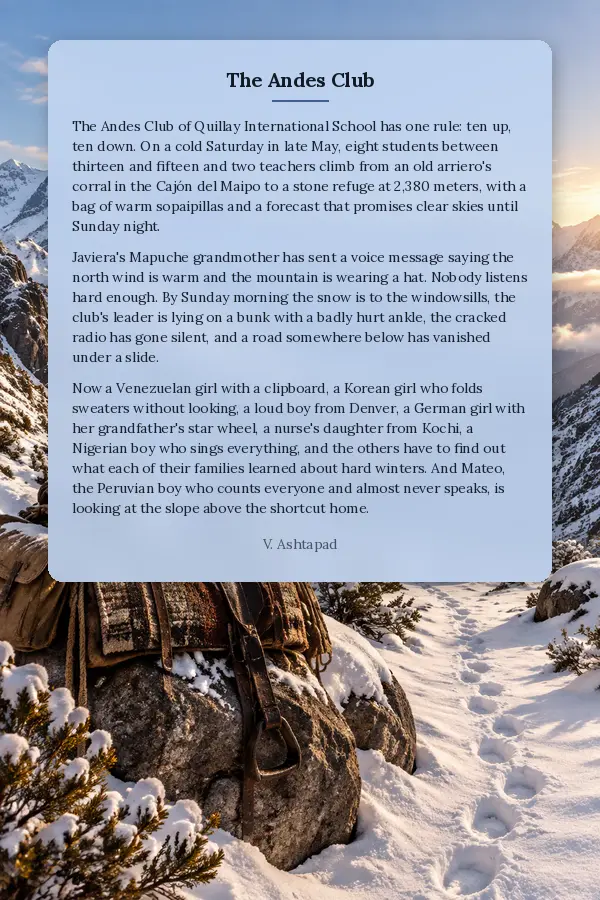
The Andes Club of Quillay International School has one rule: ten up, ten down. On a cold Saturday in late May, eight students between thirteen and fifteen and two teachers climb from an old arriero's corral in the Cajón del Maipo to a stone refuge at 2,380 meters, with a bag of warm sopaipillas and a forecast that promises clear skies until Sunday night.
Javiera's Mapuche grandmother has sent a voice message saying the north wind is warm and the mountain is wearing a hat. Nobody listens hard enough. By Sunday morning the snow is to the windowsills, the club's leader is lying on a bunk with a badly hurt ankle, the cracked radio has gone silent, and a road somewhere below has vanished under a slide.
Now a Venezuelan girl with a clipboard, a Korean girl who folds sweaters without looking, a loud boy from Denver, a German girl with her grandfather's star wheel, a nurse's daughter from Kochi, a Nigerian boy who sings everything, and the others have to find out what each of their families learned about hard winters. And Mateo, the Peruvian boy who counts everyone and almost never speaks, is looking at the slope above the shortcut home.
Members can react to this book and talk about it in the members' Library.
Ownership
© 2026 CRUNOD LLC. All rights reserved.
This book is owned by CRUNOD LLC. It is free to read on EternalCurrent.Online. No part of it may be copied, reprinted, sold, recorded or adapted, including as audio, film or translation, without written permission from CRUNOD LLC.
© 2026 CRUNOD LLC. All rights reserved.