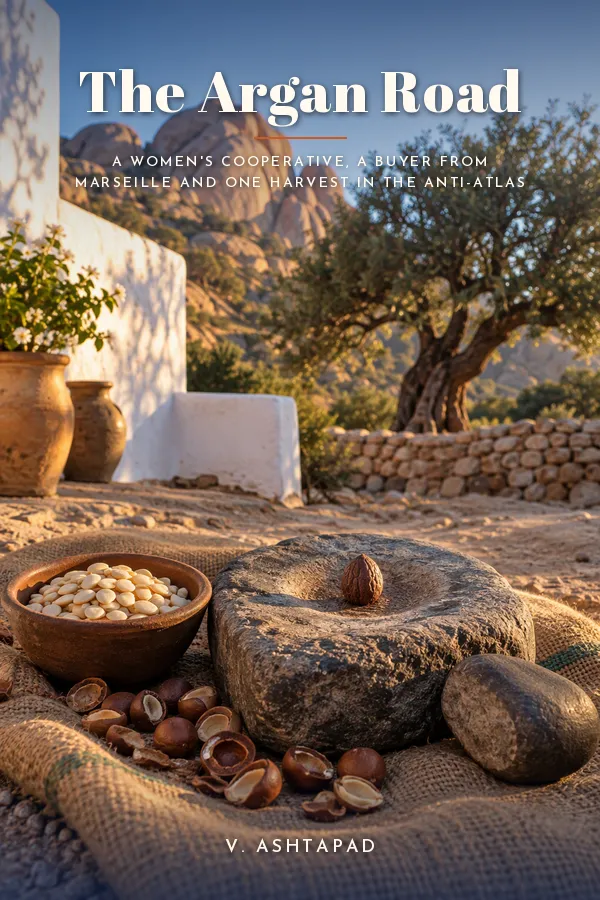
The Argan Road
A Women's Cooperative, a Buyer from Marseille and One Harvest in the Anti-Atlas
by V. Ashtapad
Foreword
This is a work of fiction. The people in it are invented, and so are the Tafoukt Women's Argan Cooperative, its courtyard and its forty members, the villages of Tasgount and Tasselmt, the Ouhadou family, the Amandier hotel, the silversmith's notebook in Tiznit, the cracking plant on the Souss plain, and the French company that buys the oil. Every price, contract, yield and vote in these pages was made up for the story.
The places around them are real. Tafraoute sits among pink granite boulders in the Anti-Atlas mountains of Morocco, under the wall of Jbel Lekst and the rock face people call the Lion's Head. The Ameln valley, Oumesnat, the painted rocks, the hairpin road down to Tiznit, the silver souk inside its walls and the long beach at Aglou can all be visited. The goats really do climb the argan trees. The harvest and the weather follow no particular year.
For the women who sit against the wall in the morning shade and open the hardest nut in the world without looking down.
Forty Stones
The first stone started before the sun cleared the ridge.
Itto Aït Brahim heard it from the roof, where she had slept under two blankets because the Ameln valley in late June still did not believe in warm nights. One clack, then a pause long enough to set another nut in the hollow, then a second clack. Lalla Tuda. Nobody else came in at half past five, and nobody else struck with that small hard flick of the wrist, as if the nut had said something rude.
Itto lay a minute longer and watched the light come down the face of Jbel Lekst. It always arrived at the top first, a line of rose across the granite, and then it slid, slow as poured honey, over the great rounded boulders that lay piled above the town like loaves somebody had forgotten to take out of the oven. By the time it reached the almond terraces the color had warmed to apricot. By the time it touched the courtyard wall below her, the cold had gone out of the air and the flies had woken up.
She dressed, wound her scarf, and went down the outside stairs with her sandals in her hand.
Lalla Tuda was sitting where she always sat, against the east wall, on a folded sack, with her legs straight out in front of her and her stone between her knees. The stone was a flat slab of gray granite the size of a bread tray with a hollow worn into its center, a smooth dimple that had taken sixty years of nuts to make. In her right hand she held the striker, a fist-sized river stone with one flat face. Beside her was a basin of dried argan nuts, brown and wrinkled and hard as knuckles, and a smaller bowl for the kernels, which were pale, flat and teardrop-shaped, and already covered the bottom.
"You're late," Lalla Tuda said without looking up.
"It's half past five."
"That's what I said." Clack. The nut split cleanly into two halves and a kernel lay in the hollow like a seed in a palm. She picked it out with two fingers and dropped it in the bowl. "Your mother was always late too. It runs in your family. The Aït Brahim women come into the world a week overdue and they never catch up."
"I was born early."
"And you have been resting ever since."
Itto put the kettle on the gas ring in the corner of the courtyard and set out the tray. Green tea from the tin, a fistful of mint from the bucket by the tap, sugar knocked off the cone with the back of a spoon. While the water came up she took the chalkboard down from its nail by the gate and wiped yesterday's numbers with her sleeve.
Yesterday the cooperative had paid its members a set price per kilo of clean kernels, and sold a liter of cosmetic oil at the shop counter for a price she did not like and the tourists did not argue with. She wrote the same numbers as yesterday. Prices did not change because of a feeling. They changed because of a reason, and she did not yet have one, only a feeling.
The feeling had arrived three days ago in an email from Marseille.
---
By seven the courtyard was full.
The Tafoukt Women's Argan Cooperative had forty members, and on a weekday in June about twenty-five of them came in to crack, because the rest had almonds to see to, or children with fevers, or a mother-in-law. They sat along three walls on sacks and cushions, with their stones before them, and they talked. Itto had once tried to estimate how many words were spoken in the courtyard in a morning and given up somewhere around the point where Khadija started describing her brother-in-law's new teeth.
Under the talk ran the clack. Twenty-five stones, never in time with one another, a dry, quick rattle like hail on a tin roof heard from a little distance. Visitors came in through the blue gate with their wide hats and stopped dead, because the sound was so much larger than they had expected from women sitting still. After a year of it Itto could tell from the far end of the courtyard which of the women was tired.
From the roasting room came the smell of the kernels for the kitchen oil, the ones Rkia toasted in a wide clay dish over charcoal, stirring with a flat wooden paddle. It was a deep brown smell, between toasted sesame and the crust of a loaf, with something sharper underneath it, almost like coffee. It got into the walls. It got into your hair. Itto's ex-husband had said once, in the last year, that she smelled like a bakery that had caught fire, and she had decided then that the marriage was over, although it took the court another fourteen months to agree.
Mina came in at quarter past seven with her reading glasses on a beaded cord and her cardigan buttoned to the throat, though it would be thirty-four degrees by eleven. She had been treasurer since the cooperative was founded, and she could tell you without looking what any member had been paid in any month of any year, and whether she had spent it wisely.
"Is he coming?" Mina said.
"He's coming."
"In person?"
"In a rented car, from Agadir."
Mina sat down on the bench by the office door and took the glass of tea Itto handed her. "Nobody comes in person to give you more money," she said.
"I know."
"They send an email for more money. They come in person for less."
"I'm only saying it so that later, when you are angry, you will remember I said it first."
---
The email had been polite, in the way that French business emails were polite, which was to say it was very long and had the important sentence in the fourth paragraph. Itto had read it on her phone on the roof and then gone down and read it again on the office computer, because some things deserved a bigger screen.
The company in Marseille had bought the cooperative's cosmetic oil for six years. They paid on time, which in Itto's experience put them in a small and precious category alongside rain and honest mechanics. The oil went north in sealed drums and came back, in a sense, as little amber bottles with dropper tops, with a photograph on the box of a wrinkled brown hand holding a nut.
The fourth paragraph said that its buyer, Mr. Karim Benali, would visit in person on the twenty-sixth to discuss "a new framework for pricing and processing."
"Processing," Itto had said aloud to the empty office, the way one might pick up a dead scorpion by the tail to see if it was really dead.
Everyone in the valley knew what processing meant. Down on the plain, past Aït Melloul, a factory had opened two years ago that cracked argan nuts by machine. It could do in an hour what the courtyard did in a month. The kernels came out a little bruised and a few of them scorched, but the oil was oil, and it was cheap, and there was a great deal of it.
What there was not a great deal of, this year, was fruit.
---
At ten she went up to the groves with Fadma in the cooperative's pickup.
Fadma was nineteen, small, quick, and the only person who understood the records better than Mina, which Mina had accepted with grace because it meant she no longer had to do them. Fadma's mother Aicha was a member, and Fadma had grown up asleep in a basket under the east wall while the stones went.
Four years ago, when she was fifteen and bored, she had taken the cooperative's old paper notebooks home and spent a whole winter copying them into a shared record that the members could open on their own phones. Now every woman could see her own kilos, her own hours, her own payments, going back years, and anyone who doubted her pay could look and see where the number had come from. It had ended about half the arguments in the courtyard, and started a new and livelier kind, about who had cracked more in the winter of a particular year.
They drove up the track toward Tasgount with the windows down. On either side the land was all pink and orange granite, worn into domes and saddles and great split eggs, with argan trees growing between them, low and thorny and twisted, as though someone had grabbed each one by the top and wrung it out. Their fruit hung in clusters, green going yellow, like olives that had lost their nerve.
Not much fruit. That was the trouble. Itto had seen it coming since February, when the rains had not come and the almond blossom had been thin and brief, and the old women had looked at the sky and said nothing in a way that said a great deal.
"Look," Fadma said, and pointed.
In a tree at the side of the track, eight feet off the ground, stood a goat. It was a black one with a white face, balanced on two branches no thicker than a wrist, and it was eating with the calm attention of a man reading a newspaper. Beyond it, in the same tree, were three more, and on a branch lower down a kid was trying to work out how the adults had got up there.
"Brahim's," said Itto. "He's early. If his goats strip the Tasgount groves before we collect, we will have a conversation, Brahim and I."
"He says you always have that conversation and he always wins."
The arrangement with the herders was older than Lalla Tuda, a matter of which slopes the goats could have and when. In a good year it was a joke people told. In a year like this it was a treaty.
Fadma had the grove map open on her phone. She had built that too, last winter, walking every slope with Itto and an old handheld GPS that belonged to the agricultural extension office, marking each grove the cooperative harvested and which family held the rights and how many trees were in it. Now the map showed this year's estimate grove by grove, and almost every grove was colored the pale yellow that meant less than half.
"Forty percent," Fadma said. "Maybe thirty-five, overall. Mina will say thirty."
"Mina always says ten less than the truth so she can be pleasantly surprised."
"Then it's twenty-five."
Itto stopped the truck in the shade of a boulder as big as a house and they sat a moment, the engine ticking. Below them the valley spread out, the villages clinging to the foot of the mountain in their reds and ochres, the flat-roofed houses stacked one above another, and above them the gray-pink wall of the Jbel Lekst running away to the east. The almond terraces were the color of dust. Somewhere a pump was running.
"He's coming to ask us to take less," Fadma said, "in a year when we have less."
"Yes."
"That's not even clever."
"He doesn't need to be clever. He has the factory." Itto drummed her fingers on the wheel. "But he thinks he's buying oil. He's buying the photograph on the box."
Fadma gave her the long level stare her mother had, as though she were reading the small print on your face. "You told me never to go into a meeting with a feeling."
"I know what I told you. Hand me the water."
---
That evening, when the women had gone home and the last of the light was going purple over the ridge, Itto sat in the office with the fan turning slowly overhead and worked out what a liter of their oil cost.
She had been doing it since the day she came home from Casablanca with a degree in chemistry and eight years in a pharmaceutical lab, and the cooperative, which had then had nineteen members and a leaking roof, had elected her president mostly because she owned a calculator. But she worked it out again tonight, slowly, as if she were going to have to explain it to a child, or to a man from Marseille.
So many kilos of dried fruit to the liter. So many hours of hulling, so many of cracking, at the courtyard's pace, which was not slow but was human. The rights to the groves. The charcoal for Rkia. The electricity for the press, which ate power like a camel ate thorns. Khadija's wage for running it. The lab test for each batch, which Itto did herself in a back room with glass burettes and a secondhand centrifuge that had cost more than her wedding. The drums. The truck. The teacher who came every Saturday to give the members' daughters lessons in Tamazight, in reading and writing it, which the cooperative paid for out of its margin and which Itto would sell the press before she gave up.
She came to a number. It was a little higher than last year's, because the fruit was short and the charcoal had gone up.
She wrote it on a scrap of paper and studied it until the fan had gone round a hundred times.
Then she got up and climbed the stairs to the roof with the chalkboard under her arm and a stub of chalk in her pocket. The cold was coming down off the mountain, sudden, as if somebody had opened a window at the top of the valley. In the villages the lights were coming on one by one, stacked up the hillside.
She propped the board against the parapet, and under tomorrow's price for kernels she wrote, in small figures in the corner, the number from the scrap of paper, so that she would see it every time she looked at the board and would not forget it, and would not let anybody talk her out of it.
Down in the courtyard, in the dark, somebody had left a stone in its place against the east wall, its hollow full of moonlight.
Hairpins
Karim Benali had been told the road from Tiznit took two hours, and after the first forty minutes he understood that the person who told him had been describing a different road, or a different car, or a different kind of man.
The rental was a small white hatchback with a gearbox that sighed whenever he went into third. It had been fine on the coast road out of Agadir, flat and straight between the greenhouses and the cactus hedges, and fine through Tiznit, where the old pink walls ran beside the traffic and the sun bounced off the windshields of the vans parked outside the silver shops. Then the land had begun to lift, and then to fold, and then to stand up on its hind legs, and now he was climbing a series of hairpin bends that the road engineers seemed to have laid out by dropping a length of string on the mountain and paving wherever it fell.
Each bend turned him almost completely around. One minute the sea was behind him, a hazy silver line under a white sky; the next it was in front of him, lower and farther; the next it was gone and there was only rock. He kept the car in second. A truck loaded with gas bottles came down toward him on a curve, swinging wide, and he pulled so close to the outside edge that he could see, past his elbow, the tops of trees far below, and a dry riverbed of white stones, and a single donkey standing in it with its head down.
The rocks changed as he climbed. Near the coast they had been brown and crumbled, like stale cake. Up here they were granite, and they were pink. Not a polite pink. A raw, flushed, sunburned pink, with orange in it and sometimes violet in the shadows, heaped into boulders the size of buses and churches and apartment blocks, round as if they had been rolled in a giant's palm and then set down very carefully, one on top of another, in arrangements that should not have stayed up. Between them grew trees. Short, dense, knotted trees with dark leaves, standing apart from one another like guests at a party who had not been introduced.
Argan. He had bought their oil for six years and had never seen one growing.
---
His phone buzzed on the passenger seat at the top of the pass. He pulled into a gravel bay beside a stall that sold honey in recycled plastic bottles and, for reasons he could not guess, a single rug, and answered.
"Are you there?" said Hélène Vasseur.
"I'm on top of a mountain."
"Is it the right mountain?"
"I'm told there are several."
Hélène laughed, which she did rarely and briefly, like someone opening a window for a moment in winter. She was the head of sourcing, in Paris, and his manager, and he liked her, which made things harder. "I just wanted to say again, before you go in. We're not asking you to be cruel."
"You're asking me to take a third off their price."
"I'm asking you to bring back a contract the board will sign. If they can come down, wonderful. If not, the plant at Aït Melloul can supply the whole line. You've seen the numbers."
He had seen the numbers. The plant could deliver cracked kernels at a price that made the cooperative's look like a jeweler's. The oil from those kernels was tested and certified and perfectly acceptable. The difference, if you put the two oils side by side in identical bottles, was something that perhaps one customer in a thousand could detect, and that one customer probably had a cold.
"The boxes say hand-cracked," he said.
"Legal will look at the wording."
"Hélène."
"Karim. I know. Go and be charming. You're good at charming."
He was not good at charming. He was good at listening to people until they said what they actually wanted, which looked like charm from a distance. He hung up and sat a while with the door open. The air outside was hot and thin and smelled of dust and something resinous, a sharp clean smell, like a cupboard of new pencils. Somewhere below him, out of sight, goats were complaining.
He took the photograph out of his wallet.
It was small and square, with a white border, and the colors had gone the way old prints went, the blues fading out and leaving everything a little orange, as though the whole world had been photographed at sunset. A girl of about fourteen stood in front of a pink boulder. She wore a dark dress and a scarf pushed back off her forehead, and in her ears were two big silver earrings, triangular, with small hanging pieces at the bottom that had caught the light and blurred. She was squinting. She was not quite smiling. She looked as if the person with the camera had said something she thought was stupid, and she was being patient about it.
His mother, before she was his mother. Before she was anybody's anything. His father had given him the photograph on his eighteenth birthday, without a word, the way his father gave most things, and Karim had carried it for twenty-two years and had never once come to see the boulder.
He did not know which boulder. That was the excuse. There were, it turned out, a great many.
---
Tafraoute lay in a bowl among the rocks, and the town looked as if it had been grown there rather than built: low houses in pink and red and ochre, the same colors as the granite, so that it was hard at first to see where the stone stopped and the walls began. Behind it, to the north, the mountain went up in a single wall, gray and rose and banded, enormous, and closer, on the town's edge, a great rounded outcrop had been weathered by wind into a shape that was very obviously the head of a lion, with its jaw and its brow and a dark eye, gazing out across the valley with the bored contempt of something that had been there forever.
He found the cooperative a kilometer past the town, down a short dirt track lined with prickly pear, its paddles thick and green and beaded with fruit that was only just beginning to turn. A whitewashed wall, a sign in three scripts, one of which he could not read at all: a row of letters made of circles and crosses and lines and dots, like a code a child might invent for passing notes, or like the marks on a very old coin. Tifinagh. He knew the name. He did not know a single letter.
He parked, got out, and the heat hit him on the back of the neck like a slap from someone who loved him.
Then he heard the sound.
He had read about it. He had seen a video once, on a supplier's promotional loop at a trade fair in Paris. It had not prepared him. It came over the wall in a dense, dry, endless rattle, hundreds of small hard knocks overlapping, never quite in rhythm, like a hailstorm on a roof, like a printing press, like many people very quickly typing. It did not rise or fall. It simply went on, as if it had been going on before he was born and would still be going on after he left, and nobody in particular was in charge of it.
He went through the blue gate.
---
There were perhaps twenty women in the courtyard, sitting against three walls in the long afternoon shade, their legs out in front of them and stones between their knees. Their dresses were bright, purples and greens and a red the color of chili, and most of them wore over their heads and shoulders a length of dark cloth, black with a band of colored embroidery at the edge, that made them look, sitting in a row, like a line of birds of the same species. Their hands moved. Nut on the stone, strike, pick out the kernel, brush the shell aside, next nut. The shells lay in drifts around them, brown and broken, and the kernels went into bowls in little pale heaps.
As he came in, the talk did not stop. But it changed key. Twenty pairs of eyes came up and went over him from head to foot, and he felt them land, one by one, on his shoes.
They were good shoes. Brown leather loafers from a shop near the Old Port in Marseille. They were covered now in pale pink dust to the ankle.
"Azul," he said, to the room in general.
It was the one word of Tamazight he had prepared. He had practiced it in the car. He had looked it up, and listened to it, and said it aloud on the hairpins.
There was a pause. Then a woman near the gate, a big woman with heavy forearms and a gap in her teeth, put down her striker, pressed a palm flat to her breastbone and said something long and rapid and warm, and the woman next to her snorted, and the woman next to her covered her mouth, and then the whole east wall was laughing, not unkindly, the way people laugh at a dog that has walked into a glass door.
"What did I say?" he asked, in French, of nobody.
"You said hello," said a voice behind him, in French. "Very nicely. Like a radio announcer."
He turned. A woman was standing in the office doorway with a clipboard against her hip. She was perhaps thirty-five, tall, with a narrow face and very dark eyebrows and a green scarf tied back from her forehead, and she was looking at him with an expression he recognized from a great many meetings, which was the expression of someone deciding whether you were going to be a problem.
"Khadija says you have a good voice for it," the woman went on. "She asks if you are married. Lalla Tuda says that is a stupid question, look at his shoes, of course he is not married, no woman would let him out of the house like that."
"Which one is Lalla Tuda?"
The woman nodded toward the east wall. A very small, very old woman sat there apart from the rest, with a stone between her knees that was darker and smoother than the others, and silver at her ears and throat, and a face as creased as the shells around her. She was not laughing. She was looking at him with clear, black, unimpressed eyes, and her right hand was still moving, nut, strike, kernel, without her looking at it at all.
"I'm Itto Aït Brahim," said the woman with the clipboard. "I'm the president. You're early."
"I was told the road was two hours."
"Who told you that?"
"The man at the rental desk."
"Then he has never driven it." She tucked the clipboard under her arm and held out her hand. It was dry and strong and smelled faintly of something toasted. "Come into the office. We'll have tea, and then you can tell me what you want, and then I will tell you why you can't have it."
---
She made the tea herself, at a low table in the office, while a ceiling fan stirred the hot air without cooling it. He watched. He had drunk mint tea in a hundred offices from Agadir to Essaouira, and he had never watched anyone make it like this, as if it were a procedure with a correct result.
She rinsed the green leaves with a little boiling water and threw the water away. She packed the pot with mint, stems and all, a great bright fistful of it, and broke sugar off a white cone with the heel of a brass hammer. She let it stand. Then she poured a glass and tipped it back into the pot, and poured again and tipped it back, twice more, tasting nothing, simply watching the color. And then she lifted the pot high, higher than her own shoulder, and poured from there in a long thin amber thread that fell nearly half a meter into the little glass without a drop going astray, and raised a cap of pale foam on top.
"Why so high?" he asked.
"For the foam."
"Why does it need foam?"
She set the glass in front of him and looked at him as if he had asked why a car needed wheels. "So you know it was made by somebody who cared whether you drank it."
He drank. It was scalding and sweet as syrup and tasted of mint so fresh it was almost cold, with the green tea underneath it, dry and slightly bitter, like the smell on top of the pass.
Through the window behind her he could see a chalkboard hanging by the gate, with figures on it in a neat hand. A price per kilo. A price per liter. And in the bottom corner, small, almost hidden, another number, by itself, with nothing written next to it.
He found he could not stop looking at it.
"So," said Itto Aït Brahim, and sat back, and folded her hands on her clipboard. "Tell me about your new framework."
Cost Price
The new framework had two halves, and Karim Benali laid them out the way a man lays out two cards he already knows are bad, with a slight apology in the wrist.
Option one: the company would continue to buy the cooperative's hand-cracked oil, at twenty-one euros a liter, down from thirty-one.
Option two: the company would buy its kernels from the plant at Aït Melloul, already cracked, and send them up the mountain, and the cooperative would press them and drum them and test them, for a pressing fee, and the boxes would go on saying whatever the lawyers in Paris decided they could get away with.
Itto listened to all of it without interrupting. She had learned that in Casablanca, from a lab director who used to let the sales managers talk until they ran out of air and then ask them one question in a soft voice. It was a technique that worked best if your face did nothing. Hers did nothing. She drank her tea.
When he had finished, she said, "Have you ever cracked an argan nut?"
"No."
"Come."
---
She took him out into the courtyard, where the afternoon had reached its worst. The heat lay in the enclosed square like water in a cistern, heavy, still, with a bright skin of light on top. The women had moved into the last strip of shade along the west wall and the clack had slowed, as it always did after three, to something more like a conversation than an argument. Rkia had stopped roasting for the day but the smell hung on, dark and sweet, in the plaster.
Itto spread a sack on the ground beside Lalla Tuda, who did not look up, and set down a spare stone and a striker and a bowl of dried nuts. "Sit."
He looked at his trousers. They were pale linen. He sat.
"The fruit falls in summer," she said, crouching beside him. "We collect it from the ground. It dries in the sun on the roofs for weeks, until the skin goes black and hard. Then we take the skin off, by hand, and underneath is this." She held up a nut. It was the size of a large olive, pointed at one end, brown, heavy for its size, with a faint seam running around it like the line where two halves of a mold had met. "This is the hardest nut in the world. Harder than a walnut. Harder than a hazelnut. Harder than your head. Inside it, there are one, two, sometimes three kernels. You need the kernels whole. If you smash them, they go rancid in the drum and the oil is spoiled. So." She set the nut in the hollow of the stone, point up, and held it there with her fingertips. "You hold it so. You strike here, on the seam. Not hard. Exactly."
She struck. The nut opened like a hinge. Inside lay two pale kernels, flat, smooth, perfect.
"Now you."
He took the striker. He set a nut on its point. It fell over. He set it up again. He held it with his fingertips the way she had shown him, and with the stone raised he looked, for once since his arrival, genuinely afraid.
"It's my fingers or the nut," he said.
"Yes."
He struck. The nut shot out of the hollow, bounced off Lalla Tuda's knee, and rolled away under a sack. Khadija, at the gate, said something to the woman beside her that Itto chose not to translate.
He struck again. This time he hit it, hard, with his whole forearm, and it burst. Shell went everywhere. In the hollow lay a small heap of brown fragments and pale crumbs, like a cracker that had been stepped on.
"That," said Itto, "is twenty-one euros a liter."
Lalla Tuda, beside him, put out one hand without looking and took the striker away from him. She did it the way one might take a pair of scissors from a toddler. She said a word.
"What's that?" he asked.
"The word for the striker." Itto said it again, slower. It was a short word, with a catch in the throat at the start of it. "It's what she uses. The big stone is another word."
He repeated it. He got the catch wrong, so that it came out soft, like a sigh. Lalla Tuda corrected him, once, flatly, the way a teacher corrects a sum. He tried again. Better. She grunted, gave him back the striker, and went back to her own work, and her own nuts opened in front of her one after another with that small hard flick, cleanly, never once looking down, like a woman knitting in the dark.
---
They were back in the office an hour later, and the light through the window had gone from white to copper. He had cracked eleven nuts, ruined seven, and had, in a saucer at his elbow, four whole kernels and some fragments that Itto had told him to keep as a souvenir of his first and last day's wages.
"So," she said. "Let me tell you what a liter costs."
She had the figures on paper in front of her, but she did not need them. She went through it the way she had gone through it on the roof three nights ago, in plain numbers. How many kilos of dried fruit made a liter of cosmetic oil. How many hours of skinning. How many hours of cracking, for a skilled woman at the courtyard's pace, which he had now had the privilege of seeing. The hours added up to most of three working days for a single liter. She gave him the cost of the grove rights, the press, the power, the lab, the drums, the truck. She gave him the teacher.
"What teacher?"
"Saturdays. For the members' girls. Reading and writing Tamazight." She pointed through the window at the sign over the gate. "That. Most of the women here speak it all day and can't read a word of it. Their daughters will."
"That's a cost of production?"
"It is in this building."
He didn't argue. He wrote it down. She liked that more than she wanted to.
"The fruit this year is short," she went on. "Maybe forty percent of a normal year. You can see it on the trees on your way up, if you look. So the cost per liter goes up, not down, because we're paying the same women to look harder for less. My price for the coming year is thirty-four."
He put down his pen.
"You understand that's the wrong direction," he said.
"It's the direction the trees went."
"Madame Aït Brahim—"
"Itto."
"Itto. My company has a plant forty minutes from the airport that will sell me kernels at a fraction of what you pay your members. I'm not saying that to threaten you. I'm saying it because it's on my desk in Paris, and my manager looks at it every morning."
"Then your manager should come and crack some nuts."
"She'd be worse than me."
"Nobody could be worse than you." She said it without heat, as a statement of fact, and something at the corner of his mouth moved, and she was annoyed to find that she had been trying to make it move. "Look. The plant is real. I know. My cousin's husband drives a truck for them. The oil from the plant is real oil. I've tested it. It's not bad. But what's on your boxes isn't oil. It's a hand. It's a woman sitting against a wall with a stone. That's what your customers pay for. You can buy the oil anywhere. You can only buy the hand here."
"Or from the next cooperative down the valley."
"Who will tell you the same number, because I'll have called them by tonight."
He studied her across the saucer of kernels. Then he laughed, a short surprised sound, as if she had pulled something out from behind his ear.
"I have ten days," he said.
"Then you'll be very good at cracking nuts by the end of them."
He picked up the saucer with his four kernels in it and tilted it toward the window, so that the copper light lay along their flat faces. They were the color of old ivory, with a faint sheen, as though they had been oiled already from the inside.
"The number in the corner of your board," he said. "Out by the gate. Small, on its own."
"What about it?"
"Is that thirty-four?"
She had not expected him to have noticed it, still less to have kept it in his head through an hour of nuts and figures. Most buyers looked at the board the way tourists did, as decoration, part of the view with the goats and the pink rocks. She considered lying, and decided it was beneath both of them.
"Yes."
"You wrote it before I came."
"Three nights ago."
"So nothing I said today was going to change it."
"You could have said thirty-six," said Itto. "I'd have rubbed it out."
---
Fadma found her on the roof that evening.
The sun had gone behind the ridge but the sky was still lit, a clear deep blue at the top shading down to a smoky rose over the boulders, and the rocks themselves seemed to be giving back the day's heat, glowing faintly, like coals with the flames gone out. Along the edge of the roof the season's first argan fruit lay drying on old sacks, a thin brown carpet that smelled sharp and fruity, like apricots left too long in a bowl. Itto was turning it with her hand.
Fadma sat down on the parapet with her phone in both hands.
"I got the letter," she said.
Itto knew which letter. Every girl in the valley who had passed the baccalaureate in sciences had been waiting for the same letter since June, and Fadma had passed it with marks that the headmaster in Tafraoute had read aloud at the prize-giving, twice, because he thought nobody had heard him the first time.
"And?"
"Biology. In Agadir. First year starts in October."
"Fadma." Itto got to her feet, brushing the fruit dust from her palms onto her skirt. "That's wonderful."
"Is it?"
"Of course it is. You'll be the first one from this courtyard. Your mother must be—"
"My mother cried and then went to bed."
"That's how she shows she's pleased."
"No, it isn't." Fadma turned the phone over in her hands. "She says who will crack her kernels on the days her back is bad. She says who will look after my grandmother. She says Agadir is a city and girls get ideas in cities." A pause. "She says ask Itto, Itto went to a city and came back."
"I came back because I wanted to."
"I know."
Itto sat on the parapet beside her. Below them the courtyard was dark and the stones were in their places along the walls, gray shapes in the dusk, like a row of shoes left outside a door. In the office window the computer screen glowed blue where she had left it on. On the screen was the members' record, the one Fadma had built in a winter, with every woman's name and her kilos and her payments in neat rows, and Itto thought, before she could stop herself, of who would keep it.
She did not say it. She was sure, afterward, that she had not said it. But she must have let something cross her face, because Fadma looked at her and the girl's own face closed like a door in the wind.
"You were going to say the records," Fadma said.
"I wasn't."
"You were."
"Fadma, I'm happy for you. Truly. It's only that it's sudden, with the contract, and this man here, and a bad year. Agadir is not going anywhere. In a year—"
"In a year it will be another bad year," said Fadma, "and another contract, and another man." She stood up and put the phone in her pocket. "I thought you of all people would say go."
She went down the stairs. Itto heard her sandals on the steps, quick and hard, then the gate, then the scrape of her bicycle in the gravel, and then only the night insects starting up, a dry steady whirring in the prickly pear, like a machine that had been left running.
Itto sat on the roof until the cold came down. She looked at the board propped against the parapet, at the small number in the corner. Thirty-four. It had seemed like the hardest thing on her list that morning.
The Earrings
The hotel was called the Amandier, after the almond trees, and it had nine rooms around a tiled courtyard with a dry fountain in the middle, and a roof terrace where the owner's son served breakfast at seven and dinner at eight and in between lay on a mattress in the shade and watched football on his phone with the sound off.
Karim's room faced the mountain. On his first night he opened the shutters at eleven to let in the cool and by two in the morning he was awake and shivering under a single sheet, his teeth very nearly chattering, unable to believe it. At six in the evening the thermometer by reception had read thirty-seven. He got up in the dark and found the spare blanket in the wardrobe, a heavy striped thing that smelled of cedar and other people's soap, and lay under it listening to a dog that barked somewhere up the valley at intervals of exactly one minute, as though it were keeping time for something.
By the third night he slept in a sweater.
---
He woke early on the fourth day and, because he could not face the hatchback, walked.
The road out of Tafraoute toward the south ran between boulders, and at that hour the boulders were the color of the inside of a peach. The sky above them was pale, almost white, and very high, with a single bird turning in it. The air was cool and dry and smelled of dust and rosemary and, when he passed a house, of bread, the flat round loaves he had eaten at breakfast that were scorched in patches on the bottom and soft inside. Somebody was sweeping a step. A boy on a bicycle went past him carrying a crate of empty bottles that rang against each other at every bump, and stared at him all the way to the next bend.
A kilometer out of town, he stopped.
An argan tree stood beside the road, a low wide one with a crooked trunk and branches that spread out almost flat, like a hand held palm down. In it were seven goats. They stood on the branches at every level, a brown one near the top, two white ones in the middle, a black kid on a branch so thin it bent under him like a fishing rod. They were eating. They were completely calm about it. Under the tree the herder, an old man in a brown djellaba with the hood up against the cool, sat on a rock with a stick across his knees and regarded Karim like someone who has posed for a thousand tourist cameras and expects a coin for it.
Karim did not have his camera out. He was simply staring.
"How do they get up?" he asked, in Arabic.
The old man considered the question. Then he raised one hand and made a small, precise climbing motion with two fingers, as if the answer were obvious, and went back to watching the goats.
Karim walked on. He passed a field of boulders that somebody, years ago, had painted blue, great smooth domes and rounded heaps of a bright chalky blue, some of them pink and violet too, faded and flaking now after decades of sun, so that the rock showed through the paint in patches like skin through a worn shirt. He had read about them in the hotel. A foreign artist had done it, in the eighties. The guidebook called it striking. Karim thought it looked like a sky that had fallen down and broken.
He took out the photograph and held it up against the rocks, one after another. None of them was the right rock. None of them was wrong, either. They were all pink, all round, all patient. The girl in the picture squinted at him out of every one.
---
At the cooperative he cracked nuts.
He had decided on the second day that it was the only way to be in the courtyard without being a buyer, and that being a buyer in that courtyard was like being a wasp at a picnic: tolerated, watched, and nobody wanting to sit next to you. So he took a sack beside Lalla Tuda each morning and worked until his fingers ached and his back locked, and by the fourth day he could open one nut in three cleanly, which Khadija announced to the whole courtyard as though he had won something.
He had begun to hear the clack differently. On the first day it had been noise. Now it was made of people. Khadija's strike was heavy and slow, with a little grunt in it. Aicha, Fadma's mother, struck in pairs, two quick knocks and a pause. A young woman called Hnia, who was pregnant and sat with her stone on a cushion, tapped so lightly he could hardly hear her, and talked the entire time. Lalla Tuda's was the sharpest. A clean dry crack, like a twig breaking underfoot in a quiet room.
He was learning words. Not many. The two stones. The word for the shell, and the word for the kernel, which Hnia swore, with a straight face, was also a word for a man who talks too much at meetings, and which Itto refused either to confirm or deny. The women taught him with delight and no mercy. They said a word, he said it back, they laughed, they said it again. Hnia made him say the word for kernel until he got it right and then made him say it nine more times to be sure, and when he finally did it the whole west wall applauded, and he felt, absurdly, the way he had felt at seven years old in Marseille when he had won a footrace at school.
At eleven, Rkia brought out the bread.
She brought it on a tin tray, torn into pieces, still warm from the clay oven behind the roasting room, and with it a bowl of something thick and brown and glossy that she set down in the middle of the courtyard like an offering. The women put down their strikers. Karim, following them, tore off a piece of bread and dragged it through the bowl.
He stopped chewing.
"Amlou," said Hnia, watching his face. She held up one finger at a time. "Argan. Almond. Honey."
It was like no food he had eaten. It tasted of toasted nuts, deep and smoky, from the roasted kernels and the almonds ground together, and of honey that was dark and slightly bitter, mountain honey, thyme honey, and under all of it the oil itself, which in this form, roasted, was nothing like the pale cosmetic oil he bought by the drum. It was golden-brown and heavy and tasted of something like sesame and something like the inside of a warm loaf. It coated his mouth. He took another piece of bread and went back to the bowl and was aware that twenty women were watching him do it and that none of them was surprised.
"Rkia's," said Itto, crouching beside him with her own bread. "She roasts the almonds the morning she makes it, never the day before. She grinds by hand. There's a woman down in Tiznit who does it in a blender and Rkia won't say her name."
"I'll buy all of it."
"It isn't for sale."
"Everything's for sale."
"Then you've been buying in the wrong places," Itto said, and stood up, and went back to her clipboard.
---
He waited until the bread was gone and the women were drifting back to their stones. Then he took the photograph out of his wallet and sat down again on the sack beside Lalla Tuda.
She did not look at him. She had her stone between her knees and a fresh basin of nuts at her side and she was picking out the first of them, turning it, finding the seam with her thumb.
"Lalla," he said.
She waited.
He held out the photograph. "My mother," he said in Arabic, and then, because he did not know if she understood Arabic, in French, and then, because neither language seemed adequate, he simply held it out further, so that it was close to her face.
Lalla Tuda looked at it.
For a while she did not move at all. Her hand rested on the nut in the hollow of the stone. Around them the clack had started up again along the walls, and behind them the press thudded in the press room and Khadija was shouting something to Rkia about charcoal. A fly landed on the edge of the basin and walked along it and flew away.
Then Lalla Tuda lifted her free hand and, with one dry brown fingertip, touched the photograph. Not the face. The ear. One of the big triangular silver earrings, blurred where its hanging pieces had moved in the light.
She said something short.
"What did she say?" Karim asked. He had not noticed Itto come back. She was standing over them, her shadow lying across the photograph.
"She says she doesn't know her."
Lalla Tuda took her hand away, picked up her striker, and opened the nut in front of her with that clean dry crack, and on through the basin, and did not look at him again.
"She touched the earring," he said.
"I saw."
"Why would she touch the earring if she didn't know her?"
"Perhaps she liked it." But Itto's face was doing the thing it did when she was hearing a number she didn't believe. "Come into the office. Bring the picture."
---
In the office, with the fan turning, he told her what there was to tell. It took less time than he had expected. That was the trouble with it.
His mother's name had been Hadda. She had come from somewhere in this valley. She had gone to Marseille at twenty, in the middle of the eighties, to work at a relative's shop, and there she had met his father, who drove a tram and was from a Marseille family that had come from the north of Morocco two generations back and spoke no Tamazight at all. They had married. She had never gone home. When Karim was very small, she had spoken to him in her own language, and sung, low, in the kitchen, songs with a falling tune that went round and round like water in a basin, and then at some point she had stopped, and he did not know why. She had died when he was eleven, in a single bad winter. His father did not talk about her. His father did not talk about very much.
"And her family?"
"I don't know a single name."
"Not one?"
He shook his head. Itto held the photograph by its edges and turned it toward the window, studying it the way she studied a burette.
"Those earrings," she said finally, "aren't from a shop. They're old work. Somebody made them for somebody. Down in Tiznit the silversmiths can sometimes tell you whose hand a piece is from, the way you'd know a voice." She handed it back. "And Lalla Tuda has never in her life touched a photograph of a stranger."
---
That night, on the hotel roof, wrapped in the striped blanket, he called his father.
It was ten in Marseille and Mourad Benali answered on the sixth ring, as he always did, as if he had to find the phone each time in a new place.
"You're in the mountains," his father said.
"Tafraoute."
A pause. On the line Karim could hear the television, very faint, a game show, and the kettle starting. He imagined the kitchen in the apartment on the hill above the port, the yellow table, the calendar from the garage.
"Why there?"
"Work. Dad. Her family. Do you know anything? A name. A village. Anything."
The kettle came to the boil and clicked off. His father said nothing for so long that Karim looked at the screen to see if the call had dropped.
"She had a brother," his father said at last. "Lahcen. Older. They didn't speak. That's all I know." Another pause. "She didn't want to go back, Karim."
"How do you know?"
"Because she didn't go."
Above the hotel the stars were out, thick and close and very white, more stars than he had seen in his life, and the mountain was a black shape cut out of them. Up the valley the dog was still barking, once a minute, keeping time.
The Groves
On his ninth day she took him up to Tasgount in the pickup, because he had asked to see the trees and because, she told Mina, a man who has seen the trees argues differently from a man who has seen a spreadsheet.
"He's seen the trees," Mina said. "He drove past ten thousand of them."
"He drove past them. He didn't count them."
"You're going to make him count trees?"
"I'm going to make him count fruit."
They left at six, before the heat. The sky over the eastern ridge was a hard pale green, the green of an unripe almond hull, and the boulders along the track were still cold-colored, gray and mauve, waiting for the sun to tell them what they were. Karim sat with his arm out of the window and a cup of coffee from the hotel balanced on his knee and did not speak for the first ten minutes, which she counted in his favor. Most buyers she had driven talked the whole way. They talked about other cooperatives they had visited and the hotels in Marrakech and the price of property in the south of France. This one watched the rocks.
At the first grove she stopped and got out, and he got out after her, and they stood under a tree.
The argan grew here on a slope of broken granite and red earth, forty or fifty trees spread across the hill at wide intervals, each one squat and thorny with its own small circle of shade beneath it. Under the nearest tree two women were already at work, Aicha and her sister, bent double, filling sacks with fallen fruit. The fruit lay on the ground in a scatter, some still yellow-green and plump, most of it brown and shriveled, half dried already by the sun. The women picked it up one piece at a time. They did not hurry and they did not stop.
"Every one of those," said Itto, "by hand."
"Can't you shake the trees?"
"You can. Then you get unripe fruit and you hurt the tree. We wait. It falls when it's ready. We pick it up."
He crouched and picked up a fruit and turned it over in his fingers. It was wrinkled, leathery, the size of a big olive, with a faint sour smell like a raisin that has been left in a pocket.
"Now look up," she said.
He looked up. In a normal year, she told him, the branches would be crowded with fruit at this point in the summer, so thick you could hear it dropping all morning, a soft patter on the earth like the start of rain. This year he could count it. She made him. He stood under the tree and counted the fruit he could see on the lowest branches, and when he got to thirty-one he stopped, and then she handed him her phone with the map already open.
---
It was Fadma's map, though Fadma was not speaking to her and so had not been asked whether she minded.
On the screen the valley lay in outline, with the villages marked and the track they had come up, and over the slopes, in small irregular shapes like spilled water, every grove the cooperative harvested. Each one had a name, and the name of the family that held the rights, and the number of trees, and this year's estimate. Itto zoomed in with two fingers. The Tasgount groves were pale yellow. The groves above Oumesnat were pale yellow. The big grove below the pass that Brahim's goats had been nibbling at since June was a yellow so pale it was almost white.
"She walked every one of these," Itto said. "Last winter. With me and a borrowed GPS unit that only worked if you held it over your head."
"Fadma?"
"Fadma."
He took the phone from her and moved the map with his fingertip, slowly, from grove to grove. She watched him read it. He read it the way she read a lab result, not skimming, looking for the place where the number didn't fit.
"This one's green," he said.
"The one by the dam. The family has a well."
"So it's only the well that's different."
"It's always only the water that's different."
He gave her back the phone. Up the slope, Aicha straightened with a hand in the small of her back and called something down to them, and Itto called something back.
"What did she say?"
"She asked if you'd come to carry the sacks."
"Tell her yes."
She looked at him. He was already walking up the slope, in those ridiculous shoes, and the sun had just come over the ridge and caught the side of his face and his shirt and the pink dust on his trouser legs, and the whole hillside had gone, in the space of a minute, from gray to the color of a flame.
---
Brahim was waiting for them at the third grove, as she had known he would be, sitting on a rock in the shade with his goats arranged through a tree behind him like ornaments.
He was perhaps seventy and he had herded on these slopes all his life, and he spoke to her the way he had spoken to her when she was nine and stealing his figs, with tremendous patience and complete disrespect. The conversation took twenty minutes. Karim, who understood none of it, sat on a rock with his coffee and watched, and Itto was aware of him watching, and of the fact that she was performing a little, the way you do when someone is in the audience, and was irritated with herself for it.
At one point Brahim pointed his stick at Karim and asked a question, and Itto answered it, and the old man laughed until he was coughing into the end of his hood.
"What was that?" Karim asked.
"He asked if you were the man from the factory."
"And you said?"
"I said worse. I said you were the man from the factory's customer." She did not add the rest, which was that Brahim had then asked whether the man from the factory's customer was married, and that she had said she had no idea and no interest, and that Brahim had laughed at that part, not the first.
The goats, overhead, went on eating. One of them dropped a stripped nut onto the rock beside Karim's coffee cup with a small hard tick.
The argument was simple. The goats needed to eat. The ground was bare. The trees were all there was. If Brahim kept the goats out of the Tasgount groves until the end of the month, the women could finish collecting. In return he wanted the shells from the courtyard, which the women burned or sold for the fires, to bulk out the feed. And the nuts his goats passed whole, which some women still collected and cracked, would count to him.
"He wants a cut of the goats' work," Karim said, when she told him on the way back to the truck.
"He's always wanted that. Every year he asks, every year I say no."
"And this year?"
"This year I said yes. In a bad year you don't fight with the man who has the goats." She opened the door of the pickup and let the heat roll out of it like steam from an oven. "Write that down. It goes on the cost."
---
The courtyard, when they got back at ten, smelled of roasting and was louder than usual. A school group from Agadir had come through, thirty teenagers in matching caps, and the women had cracked at them for an hour with the special ferocity they reserved for an audience, and now the teenagers had gone and everyone was talking at once about what the teacher had been wearing.
Mina was in the office with the members' records open on the big screen and her glasses low on her nose.
"Show him," Itto said.
Mina looked at Karim over the glasses. Then she turned the screen toward him.
It was a long list of names, forty of them, and under each name the season, month by month, back years, the kilos of fruit brought in, the kilos of kernels cracked, the hours, the payment. You could pick any woman and follow her. Here was Khadija's back injury two winters ago, a gap of six weeks, and then her return, slowly, half a kilo a day, a kilo, two. Here was Hnia's first season, when she had been seventeen and cracked like a hen pecking. Here was Lalla Tuda, at the top of every column in every year since there had been columns, and before that, Mina said, at the top of the paper notebooks too, which were in the cupboard behind him and which Fadma had copied, line by line, into this.
"Every woman can see her own row," Mina said. "On her phone. She can see everyone's, if she wants. If she thinks she was paid wrong, she comes in here and points."
"Do they?"
"Every week," said Mina, with deep satisfaction.
Karim scrolled. He went back two years, five, eight. He stopped at a year and asked a question about a price and Mina answered it without looking, and he went on. Itto stood in the doorway and watched his face in the blue light of the screen. He was not bored. He was not being polite. He looked like someone who has gone down into a cellar expecting junk and found the wine.
"This is the cost of a liter," he said quietly. "All of it. Not your estimate. The actual hours, for years."
"Yes."
"Nobody has this. The plant doesn't have this. The big cooperatives near Essaouira don't have this. They have invoices."
"I know."
"Does Paris know you have this?"
"Paris has never asked."
He sat back. He went on scrolling, slower and slower, and then he turned in the chair and looked at her, and she found that, for once, she could not tell what he was thinking, which she found she did not like at all, and also did.
---
At five, when the heat had begun to slacken, she found Fadma sitting with Lalla Tuda against the east wall, with Fadma's phone on an upturned basin between them, propped on a little folding stand.
"What are you doing?"
Fadma did not look at her. "Lalla Tuda wants to talk about the valley."
"I don't want to," said Lalla Tuda. "She wants me to. I'm being kind."
"She's agreed," Fadma said, to the phone more than to Itto, "to be recorded. With her name on it. She listens back to every part, and anything she doesn't like comes out. And it's kept with the cooperative's things, for the members, and for the girls on Saturdays. Nobody else."
"And I'm paid," said Lalla Tuda.
"Paid?" said Itto.
"Same as cracking. By the hour. My talking is worth as much as my hands." She looked up at Itto with her clear black eyes. "More. My hands are old. My talking is older."
"Mina will have a fit."
"Mina's mother," said Lalla Tuda, "once tried to sell me a goat that had died the day before. I'll be paid."
Itto looked at Fadma, who still would not look at her, and at the small red light glowing on the phone, and at the old woman with her stone between her knees and the low sun on the silver at her ears.
"Fine," she said. "By the hour. I'll tell Mina myself."
Fadma looked up, then, quickly, and down again. But it was something.
Lalla Tuda settled her shoulders against the wall, put one hand flat on her stone as though it were a table she was about to address, and began, in Tamazight, in a low dry voice that carried perfectly, to talk about the year the almond trees had frozen. Itto went back across the courtyard to the office. At the door she turned. At the far end, in the last of the light, Karim was sitting on a sack by the gate with a nut on his stone, not cracking it, listening to a language he did not speak, tilting toward the voice, like someone trying to catch a tune through a wall.
Machine Kernels
The plant stood on the Souss plain twenty minutes past Aït Melloul, in a zone of new warehouses and wide empty roads with streetlights already installed for buildings that did not yet exist. It was a long white shed with a blue roof, a fence, a guard in a booth, and a parking lot so hot that the air above it trembled like the surface of a pond.
Karim had come down the hairpins at seven that morning with the sun behind him, and watched the land change in reverse: the pink granite giving way to brown, the brown flattening out, the argan trees getting farther apart and then turning into orchards of oranges in straight green rows, and greenhouses, acres of them, white plastic stretched over hoops, glaring in the light like a frozen lake. By the time he reached the plain it was thirty-nine degrees and the sky had gone from blue to a kind of hot white, as if it had been bleached.
The manager met him at the door. His name was Youssef, he was perhaps forty-five, with a pressed shirt and a lanyard and the cheerful, slightly worn manner of a man who had shown a great many buyers around and enjoyed it more than he expected to.
"You've come from Tafraoute," Youssef said, shaking his hand. "I can see it. You have the dust in your shoes. Everyone who comes from up there has the dust in their shoes for a week. Come in, it's cooler. Not much. A little."
It was not cooler. But it was loud.
---
The hall was the length of a football pitch and filled with steel. Conveyors ran down the middle of it in long gray belts, rising and falling, and along them stood the machines: tall hoppers, rotating drums, a row of squat boxes with rollers inside them that took the nuts in at the top and dropped them out at the bottom, cracked. The sound was not a clack. It was a roar, steady and even, a grinding chewing noise underlaid with the hum of motors and the hiss of air, and over it, every few seconds, a sharp clatter as a batch of shells went down a chute into a bin. The air smelled of hot metal and dust and, faintly, of the nuts themselves, but without the toasting, flat, like a sack in a storeroom.
"Sixty tons a month," Youssef shouted over it. "Ninety in a good year. Not this year. Nobody's having a good year." He pointed. "The nuts come in sorted by size. Different rollers for different sizes. You set the gap right, the shell breaks and the kernel doesn't."
"And if you set it wrong?"
"Then you have soup." Youssef laughed. "We don't set it wrong. Well. Not often."
They walked the length of the line. At the end of it, where the cracked kernels came out of the machines, a second belt ran slowly past a long table, and at the table sat women.
There were twelve of them, in blue overalls and white hairnets, on stools, side by side, and the belt carried the kernels past them in a thin, pale, continuous stream, mixed with fragments of shell and pieces of kernel that had broken. Their hands moved over the belt. They picked out the shell. They picked out the broken pieces. They let the whole kernels go by. They did not talk. It was too loud to talk.
Karim stopped.
"Quality control," said Youssef, following his look. "Machines can't do that part. Not yet. They're working on a camera that can. Germans. Maybe two years."
One of the women glanced up, saw him watching, and looked down again. She was perhaps fifty. She had a gold tooth and a scar across the back of one hand, and her fingers went over the belt the way Lalla Tuda's went over a nut, without looking, as if the eyes were in the fingertips.
"Where are they from?" Karim asked.
"Around. Aït Melloul. Some from the mountains." Youssef shrugged. "Their families used to crack, some of them. Now they work here. Better money, regular hours. Better for the back." He meant it. Karim could see that he meant it. "You want to see the lab?"
A bell rang somewhere and the belt stopped, and the women got up from their stools and stretched and pulled down their masks, and for a moment the hall was only the hum of the motors idling. Karim found himself beside the woman with the gold tooth at the water cooler.
"Did you crack, before?" he asked her in Arabic. "At home?"
She looked at him with frank amusement, as if he had asked whether she had ever eaten bread. "Since I was six."
"Do you miss it?"
She drank her water and thought about it honestly, which he had not expected. "I miss the talking," she said. "Here you can't hear yourself. At home you could hear everybody." She crushed the paper cup and dropped it in the bin. "I don't miss my knees."
The bell rang again. She went back to her stool.
---
The lab was clean and cold and white and had more equipment in it than Itto's whole back room. A young woman in a coat showed him the test results for the last six months. Acidity, peroxide, the profile of the fats. All within the standard. All good. Some of it, frankly, slightly better than the cooperative's, because the plant's kernels were dried in a hot-air tunnel and not on a roof.
He took the samples Youssef pressed on him, and the price sheet, and the brochure, and a cold bottle of water from a refrigerator in the corridor, and thanked everyone, and meant it, and walked out into the parking lot, where the heat closed over him like a lid.
In the car, with the engine running and the air conditioner roaring, he looked at the price sheet. It was the number Hélène had been looking at every morning. It was, if he was honest, a reasonable number, for what it was. The plant was not a villain. Youssef was not a villain. The woman with the gold tooth had a regular wage and a better back.
He put the sheet on the passenger seat and drove into Agadir.
---
At the hotel he had booked for the night, a tall pale building near the beach where the curtains were the color of oatmeal and the air conditioning smelled faintly of swimming pools, he opened his laptop and found an email from the marketing team in Paris.
The subject was "New box: final proof, for info." He almost didn't open it.
He opened it.
The box was the same shape as the old one, a slim rectangle in a creamy off-white, with the brand's name along the top in thin gold capitals. Below that, filling most of the front, was the photograph. A close shot, warm, slightly blurred at the edges. A stone, gray, with a worn hollow. A brown hand, old, very creased, with a silver ring on one finger, holding a nut in the hollow between its fingertips. Behind the hand, out of focus, a fold of dark cloth with a band of colored embroidery at its edge.
Under the photograph, in small italic type, a line of copy. Hand-cracked by the women of the Anti-Atlas.
He knew the stone. He had sat beside it for two weeks. He knew the ring. He had watched it go up and down, up and down, ten thousand times, opening nuts with that clean dry crack like a twig snapping in a quiet room.
He sat looking at the screen while outside the window the light went off the sea and the beach went gray and the café below started up its music, something with a drum machine and a woman's voice doing long sliding notes. Then he went into the company's photo archive and searched until he found the shoot. Six years ago. A photographer from Lyon, a stylist, two days at "a women's cooperative near Tafraoute." Three hundred images. The release forms were in a separate folder. The cooperative had signed. The president at the time had signed. There was no form with any other name on it.
Lalla Tuda's hand had been on every box his company sold for six years, and nobody in Paris knew her name.
---
He called Hélène at seven. She was still in the office. She was always still in the office.
"Well?" she said. "How was the plant?"
"Very clean."
"And?"
"And their price is what you think it is. And the oil is good. And the kernels are sorted by hand at the end of the line by twelve women in hairnets, because the machines can't do it yet."
A silence. "Is that a problem?"
"I don't know yet." He looked at the box on the screen. "Hélène. Do you know whose hand that is? On the new box?"
"It's from the archive. It tested well. Why?"
"It's a woman called Tuda. She's seventy-nine. She's cracked nuts at that cooperative since before they called it a cooperative, and she does it faster than anyone in the valley, and if we buy from the plant, her hand stays on the box and she gets nothing, and the box is a lie."
Another silence, longer. When she spoke again her voice had changed, not softer, but more careful, the way a person walks across a floor they suspect is wet.
"The board meets on the first of November," she said. "I need a contract by the end of October. I don't mind which contract. I mind that it's one they'll sign."
"I'm taking leave," Karim said. He had not known he was going to say it until he did. "August and September. I have six weeks owed, I've never taken them. I'll stay up there. I'll keep the negotiation open. You'll have something by the end of October."
"You're taking leave in Tafraoute?"
"Yes."
"Is there a reason I should know about?"
He thought of the photograph in his wallet. "Yes," he said. "But it's not about the oil."
---
He drove back up that night, because he could not bear the oatmeal curtains.
He left Agadir at nine with the windows down and the city's warmth pouring in, and by Tiznit the air had begun to thin and by the foot of the hairpins it was cool and by the top of the pass it was cold, a clean sharp cold that smelled of stone and thyme and something burning, far off, a charcoal fire in a village he could not see. The headlights swung across rock at every bend, pink rock gone gray and white in the glare, then sky, then rock again. Twice, argan trees leaped out of the dark at the edge of the road, and in one of them, high up, two pairs of eyes caught the light and shone green, steady, curious, and then were gone behind him.
He reached Tafraoute after midnight. The town was dark except for the streetlamps and a single café where three old men sat over glasses of tea in silence. He drove past it, and on, a kilometer, and stopped at the end of the cooperative's track with the engine off.
There was a light on the roof. A small one, a lamp, and in its circle a figure sitting against the parapet with a blanket around her shoulders, bent over something on her knees.
He did not get out. He sat in the car with the cold coming in through the open window and the night insects whirring in the prickly pear and watched the light until it went out. Then he drove back to the Amandier, and in his room, before he slept, he laid his mother's photograph on the desk under the lamp and photographed it with his phone, front and back, carefully, at the right angle so the white border came out straight. He put the image in a private folder that he shared with his father, the only other person who would know what it was. Under it he typed what he knew. Hadda. About fourteen. The valley. The rest he left blank, for now, the way you leave a space at a table.
Saturday School
On Saturday mornings the back room smelled of chalk and orange peel, because the girls were allowed to bring a snack and the snack was always oranges.
It had been a storeroom once. Itto had whitewashed it herself in her first year back, standing on a crate with a roller on a broom handle, and bought a secondhand blackboard from a school in Tiznit that was getting rid of its old ones, and fourteen plastic chairs in four different colors from the souk, because no one stall had fourteen of the same. The window looked onto the prickly pear hedge, and in August the paddles were heavy with fruit, red and orange and yellow, each one studded with fine spines that caught the light like frost.
There were eleven girls this year, aged eight to fourteen, daughters and granddaughters and nieces of members, in school skirts or jeans or long dresses, with their hair in braids or scarves or both. They sat in their plastic chairs with their notebooks open and their oranges on their knees and talked in Tamazight at a volume that could be heard in the press room, and at nine o'clock exactly Naima came in and shut the door and they stopped.
Naima Ouhadou was thirty-one and taught French at the middle school in Tafraoute during the week, and on Saturdays, for a fee the cooperative paid and Mina complained about, she taught the girls to read and write the language their mothers spoke. She was tall and brisk and kept her glasses tucked into the neck of her blouse, where she always forgot them, and she had a way of saying a girl's name that made the girl sit up straight before she knew she had done it.
This Saturday, there was a man in the back row.
---
"He asked," Itto said, before Naima could open her mouth. "He's on holiday. He wants to learn the letters. He'll sit at the back and not speak."
"He's a buyer," said Naima.
"This week he's a student."
Naima looked at Karim. Karim, sitting on a green plastic chair with his knees almost at his chin, looked back at her with an expression of tremendous humility that Itto suspected he had practiced in the car.
"Fine," said Naima. "But he does the exercises."
The girls turned around in their chairs to look at him. One of them, the smallest, a girl of eight called Tiziri with a gap where her front teeth had been, looked him up and down and said something to her neighbor, and the whole front row went into silent convulsions.
"What did she say?" Karim whispered to Itto, who was standing by the door.
"She said you're very old to be in school."
"Tell her I was held back."
Itto told her. Tiziri considered this gravely and then nodded, as if it explained a great deal.
Naima turned to the board.
---
Itto had watched the lessons many times and they still did something to the back of her neck.
Naima wrote the letters in chalk, large, one at a time, and said each one aloud, and the girls said it back. The letters were made of the simplest shapes there are. A circle. A circle with a dot in the middle, like an eye, or the sun in an old drawing. A cross, like a plus sign. Two short lines side by side. A shape like a square bracket, open on one side. A long vertical stroke. A triangle with no base, like a roof. Dots in a row, two or three, like footprints. They were the kind of marks you could make with a stick in sand or scratch on a rock with another rock, and in fact, Naima told the girls, people had done exactly that: there were rocks in the desert to the south, and in these mountains too, that had letters like these scratched into them so long ago nobody could say exactly when.
"Your great-great-great-grandmothers' grandmothers," said Naima, "could have read these. Then for a long time almost nobody wrote them. And now you're going to."
She said it every year, Itto knew, at the start of every lesson in the first month, and every year the girls rolled their eyes, and every year, when she said it, they also sat a little straighter.
Today they were writing their own names. Each girl came up to the board and wrote hers in chalk, and the others corrected her, loudly, and Naima corrected the corrections. Tiziri's name came out in five marks, a cross and a ring and a pair of lines, and she stepped back from it with her hands on her hips like a builder who has just put up a wall.
Then Naima turned around and held out the chalk to the back row.
"Your name," she said.
Karim got up. The girls watched him walk to the front with an attention they had never once given to the board. He took the chalk. He looked at the letters on the board, the circles and dots and crosses, and Itto saw him trying to find himself in them, and not knowing where to start.
Out of habit he began to shape the Arabic, the first curve of it, before he caught himself.
"Not Arabic," said Naima.
"I know. I don't know the letters."
"Then ask."
He turned to the girls. "How do I write the first sound of my name?"
Eleven voices told him at once. He chose Tiziri's, because she was loudest, and Tiziri came up to the board in her school shoes and took his hand, the one with the chalk in it, and guided it, firmly, as if he were three, and made him draw the shape. Then the next. Then the next. Then she let go and stepped away to judge it, chin tilted, like a woman pricing a melon.
"Wrong," she said, in French, which she had learned from Naima, and the room fell apart.
---
At the break the girls went out into the courtyard with their oranges and Naima stayed behind to wipe the board. Itto stood in the doorway. Karim was still at the front, looking at what was left of his name in chalk, half rubbed away.
"Your mother spoke it," Naima said to him, not looking up from the board. "Itto said."
"When I was small. Then she stopped."
"They often stopped. In France. In Casablanca. People told them it would hold their children back." She put the cloth down. "What was her family?"
"I don't know."
"You don't know her family name?"
"Benali is my father's. Hers I never knew. She was Hadda. That's all I've got. Hadda, from the valley, and an older brother called Lahcen."
Naima picked up the cloth again. "Half the valley has a brother called Lahcen," she said, and went on wiping, and Itto, in the doorway, thought nothing of it, then.
---
After the break, Naima played the girls a piece of Lalla Tuda.
Fadma had brought her phone and a small speaker, and set it on Naima's desk, and the girls gathered round it on their chairs, and Naima told them what they were about to hear: Lalla Tuda Aït Ouaziz of this cooperative, recorded here in the courtyard in July, telling about the winter the almond trees froze. Lalla Tuda had listened to it herself, Naima said, and agreed to every word, and had asked that the girls hear it, and they were to say her name when they spoke of it, as people say the name of an author on a book.
Then Fadma pressed play, and Lalla Tuda's voice came into the room, low and dry, with the clack of stones behind it and once a goat, quite near, and the girls went utterly still. Tiziri, who could not sit still for anything, sat with her chin on her fists and her mouth open. When it finished, a girl of thirteen said, in a small voice, that her grandmother had told her about that winter too, but different, and Naima said good, tell us how, and the girl did, and it took the rest of the lesson.
Itto watched Fadma, at the desk, working the phone. The girl did not look up once. She did not need to. Her fingers knew it.
---
Aicha caught Itto by the press room at noon.
Aicha was Fadma's mother, forty-four, broad, tired, one of the fastest crackers on the west wall and the most silent, and she had not said more than ten words in a row to Itto in a year. Now she took Itto's elbow and walked her into the press room, where the machine was idle and the air was thick with the smell of oil, sweet and nutty and faintly bitter, and the floor was slick with it.
"You told her," Aicha said.
"Told her what?"
"Agadir. University. You told her she could."
"She passed the exam, Aicha. With the best marks in the district. She didn't need me to tell her."
"You went to Casablanca. She looks at you." Aicha's voice was low and hard. "My mother is seventy. My back is bad. Her brother's eleven. Who cracks on the days I can't? Who sits with my mother? You'll pay her? You'll pay someone to do the records?"
Itto opened her mouth, and closed it. She had been going to say yes. She had been going to say the cooperative would manage. But the cooperative was facing a contract that might cut its income by a third, in a year with a third of the fruit, and Aicha knew it as well as she did, because Aicha could read her own row in the record as well as anyone.
"I don't know," Itto said. It was the truth.
Aicha looked at her a long moment. Then she let go of her elbow.
"She's stopped teaching anyone else the records," she said. "Did you notice? Mina's niece Samira asked to learn and Fadma said no. She thinks if nobody else can do it, she'll have a reason to stay, and nobody will be able to say she was afraid." Aicha almost laughed. "She thinks like you. That's the trouble."
---
At five Itto found Karim behind the hedge with a plastic bag and a look of pain.
He had decided to pick prickly pears. Nobody had stopped him. He had gone at the hedge with his bare hands, the way a man from a city picks a fruit off a tree, and now he was sitting on a rock with his right palm held out in front of him like something he had found and did not want, and it was furred all over, in the light, with a fine golden shimmer of spines.
"You use tongs," Itto said. "Or a fork. Or a bag over your hand. Or you ask a child."
"Nobody mentioned this."
"Nobody thought you'd be stupid enough."
She went and got the tweezers from the lab, and sat on the rock beside him, and took his hand in her lap, and began.
It took a long time. The spines were finer than eyelashes and they had gone in at every angle. She worked in the low sun with her head bent, pulling them one by one, and he sat very still and did not complain, and neither of them said anything except, now and then, "There," or "Hold still," or once, from him, a sharp breath through the teeth. The hedge ticked in the heat. The clack from the courtyard had stopped for the day. His hand was warm and heavier than she expected and there were calluses beginning on the fingertips from the stone.
When she had done, she took a fork and a fruit from his bag, and held the fruit down on the rock with the fork and cut the ends off with the little lab scalpel, and slit the skin along its length, and peeled it back in one piece, and the fruit came out naked and glowing, deep magenta, wet, full of tiny black seeds.
She held it out to him on the fork.
He ate it. It was cold from the shade of the bag and tasted of melon and pear and something sharper, like the smell of rain on hot stone, and the juice ran down his wrist, the color of a bruise.
"Aicha's right," Itto said, watching the hedge. "I don't know who will do the records."
"Then don't decide that yet," he said. "Decide the price first."
What Lalla Tuda Charges
The message came through Fadma, on a Tuesday, and it was not phrased as an invitation.
"Lalla Tuda says you will harvest her grandson's almonds tomorrow," Fadma said, standing at the gate of the Amandier at seven in the evening with her bicycle. "The terrace below Tasgount. Bring water. Bring a hat. Not that hat."
"What's wrong with this hat?"
"She says it's a hat for a man who is going to sit on a boat."
Karim looked at his hat, which was straw, with a narrow band, and which he had bought in Marseille precisely for this trip. "Why does she want me to harvest her grandson's almonds?"
"She says that is her price." Fadma kept her face very straight. "She says you know what for."
---
He was on the terrace by six. Lalla Tuda was already there, sitting on a folded blanket at the top of the slope under the one tree that had kept some leaves, with a thermos of tea and a striker in her lap that she was not using, as if she had simply brought it with her the way another woman might bring her handbag.
The almond terraces climbed the hillside in long narrow steps, each one held up by a dry-stone wall of pink granite blocks fitted together without mortar, and on each step stood a row of almond trees, gray-barked and wide, with their leaves already going yellow and thin in the drought. The nuts hung in the branches in their green-gray hulls, and many of the hulls had split, showing the pale shell inside, like a mouth beginning to open. Below the terrace the valley lay in morning shadow. Above it, the sun had touched the top of the ridge and was coming down the rock in a line of fire.
Lalla Tuda's grandson was a quiet man of about thirty called Ali, who shook Karim's hand without comment and handed him a pole.
It was a length of cane taller than a man, light, slightly bent, with the bark worn off at the grip from years of hands. Ali and his wife spread plastic tarpaulins under the first tree, blue and orange, weighed down at the corners with stones. Then Ali reached up with his pole and struck a branch, hard, with a sharp crack, and the almonds came down.
They came down like hail. They bounced on the tarps with a sound like gravel thrown on a tin roof, and rolled, and some of them split their hulls as they landed and showed their shells, and a smell came off them, green and bitter and fresh, like crushed leaves, like the inside of a stem.
"Now you," said Ali.
Karim struck. He struck wrong, too low, and hit a branch so thick it did nothing but jar his arm to the shoulder. He struck again, higher, and a shower of almonds and dead leaves and twigs and a startled lizard came down on his head and shoulders. From the top of the slope came a dry sound that might have been Lalla Tuda clearing her throat or might have been laughter.
By nine he had the rhythm, more or less. Reach. Strike. Step. Reach. By ten the sun was on the terrace and the heat came down like a weight on the back of his neck through his boating hat, and the dust from the tarps was in his nose and in the creases of his elbows and on his tongue, and the sweat ran into his eyes and stung. By eleven his shoulders had become something that belonged to someone else, someone he did not like. They stopped for tea under Lalla Tuda's tree. She poured it from high, from the thermos lid, in a thin bright stream, without looking at the glass, and handed him one, and looked at his face.
"Good," she said in Arabic. It was the first word of Arabic he had heard her use.
---
At noon Ali's wife brought out a tagine.
It had been cooking since early morning on a small charcoal brazier in the shade of the terrace wall, the cone-shaped clay lid sitting over it and a thin thread of steam coming out of the hole at the top. When she lifted the lid, the smell came out all at once: onions cooked down to sweetness, and tomato, and cumin and pepper and something warm, cinnamon or ginger, and the vegetables, potatoes and carrots and pumpkin and a few green beans, all arranged in a pyramid like spokes on a wheel, glistening with oil, the bottom of the pot caramelized and dark at the edge. They ate with their hands and the bread, tearing it and pinching up the vegetables, and Ali's wife pushed the best pieces toward Karim with two fingers without a word, the way you'd feed a child who'd been out in the rain.
He ate more than he meant to. Then he lay on his back on a tarp in the shade and slept for twenty minutes without intending to, and woke to see Lalla Tuda looking down at him from her blanket with an expression of complete satisfaction, as though he were a pot of something she had made and it had come out right.
They worked until four. At four Ali said they were finished, which was not true, there were three trees left, but Karim understood that he was being let off, and was too tired to argue. He sat on the terrace wall with his hands hanging between his knees. The palms were raw. There was a blister rising at the base of each thumb.
Lalla Tuda beckoned.
---
Fadma had come up on her bicycle. She sat beside Lalla Tuda on the blanket with her phone in her lap, and Karim sat in front of them both, cross-legged, the way the girls sat at Naima's feet, and the old woman studied him with her clear black eyes until he wanted to look away, and then she put out her hand, flat, toward Fadma's phone.
"No," she said, and something more.
"She says put that away," Fadma said. "She says this one is not for the girls. This one is just for you."
Fadma slid the phone into the pocket of her dress. Lalla Tuda nodded. Then she began to talk, and Fadma, sitting very straight, began to put it into French, a sentence behind, in a low voice.
"Her name was Hadda Ouhadou. She was from Tasselmt. That's the village up past Oumesnat, under the cliff, where the spring is. Her mother was Kaltoum, and Kaltoum and I were girls together. We were married the same year. We cracked together, before there was a cooperative, before there was anything, under the big rock at the bottom of Tasselmt, all the women of three villages, in the shade, in the mornings. Kaltoum's children came, and mine came. Hadda was her third. A thin girl. Very quick hands. She sang all the time. Not well. All the time." Lalla Tuda paused, and said something, and Fadma smiled despite herself. "She says your mother sang like a goat with a cold, but she knew every song in the valley and she never stopped, and we all told her to stop and secretly we were glad she didn't."
Karim's throat had closed. He nodded, because nodding was all that was left.
"The earrings," Lalla Tuda went on, through Fadma. "Kaltoum's. Made in Tiznit for her wedding, by an old man who's dead now; he put a little mark of his on the back of everything, a small cross with a dot. Kaltoum gave them to Hadda when Hadda was fourteen. I was there. That picture, the one you carry. Her cousin took it, a cousin back from France for the summer with a camera. I remember the day. Hadda thought the cousin was a fool. You can see it in her face."
"I saw it," Karim said. His voice did something strange. "I always saw it."
"Then her father died. Lahcen was the oldest son. Twenty-five, and suddenly the head of the house, and frightened, the way young men are when they have to be in charge of something, so he was very strict about everything. Hadda went to France at twenty, to work in a cousin's shop. It was meant to be two years. She wrote to Kaltoum every month. Then she wrote to say she had met a man. A good man, she said. Not from the valley. Not one of us. Didn't speak the language. Lahcen wrote back." Lalla Tuda stopped. Her hand was on the striker in her lap, and her fingers closed around it, and opened. "I don't know what he wrote. Kaltoum never told me. But Hadda stopped writing to her brother, and then, after a while, she stopped writing home at all. And Kaltoum grieved for that every day for eleven years. And then a letter came from France to say Hadda was dead. And Lahcen did not go."
Below them, on the terrace, Ali was gathering the tarps, folding them corner to corner, and the almonds rolled together in the middle with a dry rattling sound, like dice in a cup.
"Why did you tell me you didn't know her?" Karim asked.
Fadma translated. Lalla Tuda answered at once, as if she had been waiting.
"Because it was not mine to give. It is Lahcen's house. He is still alive, and still stubborn, and still sorry, and still too proud to say it. I thought, if the boy is meant to find them, he will find them. I was angry with your mother, also. For leaving Kaltoum. For making her wait. I was angry for a long time." She looked at him. "Now I'm seventy-nine and I have decided I am too old to wait for Lahcen to be sensible. So. You harvested my grandson's almonds. Badly. That's the price. Now you know."
---
Fadma walked her bicycle down the track beside him in the long gold light, toward the place where he had left the hatchback. The almond trees threw long shadows across the terraces, and from somewhere up the valley came the sound of somebody else's poles, crack, crack, and the patter of nuts falling, far off, like a light rain on leaves.
"Are you going to Tasselmt?" Fadma asked.
"I don't know."
"It's twenty minutes in the car."
"I know where it is." He stopped. He put his hand on the warm stone of a terrace wall. "I've known for an hour where it is, and I don't know if I can drive there."
Fadma looked at him with her mother's long level stare.
"Was she happy?" she asked. "In Marseille. Your mother."
"I was eleven when she died."
"But was she?"
He thought about it, properly, for the first time in years: the kitchen on the hill above the port, the yellow table, his mother at the window with the radio on low, cooking something that smelled of cumin and singing under her breath in a language he had forgotten, badly, with a falling tune, round and round.
"Some of the time," he said. "She was happy some of the time. And some of the time she was looking out of the window."
Fadma nodded slowly, as if he had told her a price she had expected.
"Everybody says if I go to Agadir, I'll be like her," she said. "Like your mother. Gone, and never come back."
"Agadir is two hours," said Karim. "Marseille is a sea."
"Itto came back."
"Itto had something to come back to." He took his hand off the wall. "You'd have something too. That's the difference. My mother's brother wrote her a letter. Nobody here is going to write you that letter."
She didn't answer. She swung her leg over the bicycle and went off down the track, fast, standing on the pedals, her scarf flying out behind her like a flag. He stood there until she was out of sight, with his raw hands and his boating hat and a pocket full of almonds that Ali had pushed on him at the end, still in their split green hulls, warm from the sun.
Ahwash
Khadija's daughter married on the last Saturday in August, and the whole of Tasgount went to bed the night before knowing that nobody would go to bed the night after.
The wedding had been arriving for a week. Itto had watched it come up the track in pieces: a truck with plastic chairs, a truck with sacks of flour and onions, two men carrying a long folding table on their shoulders like a coffin in reverse, women with trays on their heads, children with nothing at all, running. Khadija had cracked every morning anyway, because Khadija believed that if she stopped she would never start again, but her strike had gone erratic, fast and then slow, and twice she had put the striker down in the middle of a sentence and walked out of the gate to shout at someone about the tent.
The tent went up in the open ground below the village, where the threshing floor had been, a long rectangle of patterned cloth in red and green and gold, open on one side to the valley. Under it, on the night, were carpets, and cushions, and low round tables, and more people than lived in Tasgount, because people had come from Tasselmt and Oumesnat and Tafraoute and two cousins from Agadir and one from somewhere near Lyon who kept apologizing for her shoes.
Itto wore her good dress, deep blue with silver thread at the neck, and her mother's silver: the heavy necklace with its hanging coins and the amber beads between them, the two triangular brooches pinned at the shoulders with a chain between, the bracelets. It all weighed, she had once calculated in a bad mood, just under a kilo. It rang faintly when she walked. Last winter her mother had laid every piece out on a white sheet and had Itto photograph them one by one, and beside each picture, in the family's private album, they had put down who had made it, in which town, and which bride had worn it first. She liked it all more than she was willing to admit.
---
Karim arrived at nine, in a white shirt and the same ruined loafers, and hovered at the mouth of the tent, plainly a man invited to something who was not sure he had been invited to all of it.
Khadija saw him first. She seized him by both arms and turned to the tent and announced something at enormous volume, and fifty women looked up, and Itto, from across the carpets, understood that Khadija had told the whole wedding that this was the Frenchman who had been cracking nuts in the courtyard all summer, and that he was terrible at it, and that he had been forced to harvest Lalla Tuda's grandson's almonds as a punishment, and that his hands were still bleeding. A great warm roar of laughter went up. Somebody pushed a glass of tea into his hand. Somebody else pushed a plate of almond pastries, little crescents dusted with sugar. A man Itto did not know put an arm around his shoulders and began to explain something about football.
"You've been talked about," Itto said, when he finally reached her.
"I gathered."
"Khadija says your hands are bleeding."
"They stopped on Thursday." He held them up. The blisters had dried into hard yellow patches at the base of each thumb. He looked at her, and at the silver, and for a moment did not say anything. Then he said, "You look like a treasury."
"It's my mother's. It's worth about as much as your car."
"My car's a rental."
"So is this, technically. She wants it back by midnight."
---
They ate at eleven. Tagines came out by the dozen, on trays, the clay lids lifted at each table to a burst of steam and a smell of saffron and preserved lemon and onion, and bread in baskets, and bowls of almonds fried in oil and salted, and dates, and plates of melon cut into crescents. The tea went round and round. Itto sat with the women of the west wall and listened to them take Khadija's new son-in-law apart, kindly, piece by piece, like a car being checked over at a garage, and found she had laughed more in an hour than she had in a month.
Then the drums started.
They began somewhere outside the tent, in the dark: one drum, then three, then more, flat frame drums of goatskin stretched on wooden hoops, which the men had been warming by a small fire to tighten the skins until they rang. The sound was a hard, dry, ringing beat, many drums struck together with the flat of the hand, deep at the center and bright at the edge. The whole tent turned toward it as if somebody had called its name.
Outside, under a sky so crowded with stars it looked dusty, the dancers were forming two lines.
Itto had seen ahwash all her life and had never once stopped watching it. On one side of the open ground, the women stood shoulder to shoulder in a long curved row, close as the fingers of a hand, in their bright dresses and dark shawls and silver, their arms pressed against one another's arms. Facing them, across the beaten earth and the fire, stood the men, in white, with the drums. A single voice rose from among the men, high and strained and long, a man singing a line alone, and it went out over the valley, and then the women's row answered it, all together, a low close sound, not loud, almost a hum, the same line turned and given back. Then the men again. Then the women. The drums came in under it, slow at first, a steady heavy beat like walking. The women's row began to move. Not to step: to sway, all together, a ripple running along the line from one end to the other, shoulders and hips, and their feet stamping lightly on the earth, so that the silver on fifty women rang at once like a single shaken chain.
It went on. It got faster. The singer's voice climbed and the women's answer climbed to meet it and the drums tightened and quickened until they were no longer separate strokes but a roll, and the line of women was moving now as one thing, swaying, stamping, the ripple running through it so fast it blurred, and the dust came up around their feet gold in the firelight, and somewhere in the middle of it Itto realized she was no longer watching it, she was in it, in the row, with Hnia's arm on one side of her and Aicha's on the other and her mother's silver ringing at her throat, and her feet knew what to do, and she did not have to think about anything at all.
When it broke, at last, with one huge final beat of all the drums together and a shout from the men and a long high trilling cry from the women, she found she was breathing hard and laughing and that her scarf had come loose. She stepped out of the line to fix it.
Karim stood just beyond the reach of the fire, quite still, with his tea glass forgotten in his hand.
---
It was nearly one when she found the wall.
It was the old terrace wall at the end of the threshing ground, waist high, built of granite blocks that still held a little of the day's heat inside them, though the air had gone cold, the sharp mountain cold of the small hours that came down off the ridge like water poured from a jug. She sat on it with her back to the tent. The noise was behind her, the drums starting again, slower now, the second round. In front of her the valley was dark, dotted with the lights of villages, and above them the mountain was a black shape against stars.
He sat down beside her without asking.
"You were inside it," he said.
"Everybody's inside it. That's the point."
"I wasn't."
"You're a man. You'd be on the other side. Banging a drum. Badly."
"Probably." He was silent a while. "My mother did that. Didn't she? In a row like that."
"Every woman in this valley did that. Lalla Tuda still does it, at weddings, for one round, at the end, and then she sits down and tells everyone they were doing it wrong."
He laughed, quietly. She was cold. She was aware of being cold and aware of him beside her, the warmth coming off his shoulder through the thin cotton of his shirt, a few inches away.
"Why did you come back?" he asked. "From Casablanca."
She had been asked it before, many times, mostly by women in the courtyard who wanted to know what had gone wrong. She usually said her mother needed her, which was partly true, or that she missed the mountains, which was partly true. She found that she did not want to give him a partly true thing.
"I was married," she said. "To a pharmacist. A nice man, everyone said. He was very proud of me in the lab, the first two years, and then less proud, and then he wanted me to stop. He said a woman with a chemistry degree in the house was like keeping a racehorse in a flat. He meant it as a compliment." She pulled her shawl tighter. "And I was good at my job. I was very good. And nobody there needed me to be good at it. Up here, they needed someone who could read a lab result and do a cost price and argue with a buyer from Marseille. So I came home and they made me president because I had a calculator."
"And the pharmacist?"
"Has a new wife. She doesn't work. They have twins." She shrugged. "He sends me a card every year on the date of our divorce. I don't know if it's an apology or a celebration."
He laughed again. The drums, behind them, picked up a little.
"Naima talked to me," she said, before she could stop herself. "Tonight. In the tent."
He went still.
She had not meant to tell him. She had been sitting with the women when Naima came and sat beside her, in her good dress, with her glasses tucked into her neckline, and said very quietly that she needed to ask something. Ouhadou, Naima had said. She had heard the name. My father had a sister called Hadda. Itto had looked at her and seen it, then, in the cheekbones and the line of the jaw, the face of the girl in the photograph, squinting at a fool with a camera. Please, Naima had said. Don't tell him tonight. Let me speak to my father first.
"She asked me not to say," Itto said now. "So I haven't said. But I'm telling you that she talked to me. And that you should go to Tasselmt. And that you should not go without telling her first, because she's asked for that, and she's a better woman than either of us."
He did not answer for a long time. When he did, his voice was rough.
"Naima," he said. "Who made me write my name wrong."
"Tiziri made you write it wrong. Naima only let her."
He put his face in his hands, briefly, and then took it out again and looked at the valley, and she saw that he was not crying, quite, but that he was close to something, and that he was not a man who often was. She did not touch him. She thought about it. She sat on the cold wall with her mother's silver going cold against her collarbone and did not touch him, and found that the not touching was itself a kind of conversation, and that he understood it.
His phone buzzed in his pocket. He took it out, looked, and turned the screen toward her without a word.
It was from Hélène Vasseur, in Paris, sent at one in the morning because Hélène was the kind of woman who sent things at one in the morning. The plant's offer stood until the fifteenth of October. The board met on the first of November. She needed final terms from the cooperative by the twentieth, signed, or the plant would get the line.
"Fifty-one days," said Itto.
"You counted that fast."
"I have a calculator." She stood up off the wall and shook out her skirt, and the silver rang. Behind them, the drums came together and broke into the fast round, and the women's voices rose. "Go to Tasselmt," she said. "I'll do the arithmetic."
Tasselmt
Naima's message came on the Wednesday, eleven days after the wedding, and it was four lines long.
My father says come on Friday. Come at one. We eat couscous on Fridays. Don't bring anything, my mother will be offended, and then bring something anyway, she'll be more offended if you don't.
Karim read it on the hotel roof at breakfast and then set the phone down beside his bread and his little dish of amlou, which the owner's son had started bringing him without being asked, and sat with his coffee going cold, watching the mountain.
He bought dates in the end, in Tafraoute, on Thursday, a whole box of the good ones from the stall by the post office, fat and dark and sticky, packed in rows. He bought a cone of sugar too, because Itto said you always brought sugar, and then, at the last moment, because he could not help it, a jar of Rkia's amlou, which Rkia had sold him for an outrageous price after a long negotiation in which Itto refused to translate anything but the numbers.
---
The road to Tasselmt went up past Oumesnat, through the narrowest part of the valley, where the mountain wall came down so close on the left that the car drove in its shadow even at one o'clock, and the air there was suddenly ten degrees cooler and smelled of wet rock.
Tasselmt lay at the foot of the cliff. The houses climbed it in tiers, red and ochre, flat-roofed, some new and painted, some old and made of stone and earth and going back slowly into the hillside, with their roofs fallen in and fig trees growing out of their doorways. Below the village there was a spring. He saw it before he saw anything else: a small square of green in all that pink, palms and a few olives and a patch of garden in tiny walled beds, and a channel running out of the rock, bright, the water loud in the quiet, and around it, the boulders.
One of them stopped him.
He parked the car at the edge of the track and walked down to it. It was not the biggest. It sat a little apart, near the spring, a great rounded mass of pink granite split down one side by a single dark crack, like a loaf scored before baking. At its base the ground was flat and smooth, swept almost, and when he crouched he saw, in the dust, broken argan shells, old, gray, and a stone half buried with a hollow worn into it.
He took out the photograph and held it up.
It was the rock. The crack ran down the left side of the girl's head exactly as it ran down the boulder in front of him. The light was wrong, it was a different hour and nearly fifty years later, and there was a small almond tree now where there had been nothing, but it was the rock. He stood there holding up a small orange square of paper against a mountain and felt foolish and could not put it down.
"That's where they all cracked," said a voice behind him, in French. "Before the cooperative. My grandmother, and Lalla Tuda, and all of them. In the shade in the mornings."
Naima stood on the path above him, in a blue dress, her glasses tucked into her neckline.
"I found it," he said, stupidly.
"You did." She came down the path to his side and studied the photograph, then the rock, then the photograph again. "She looks like my sister," she said finally. "My sister is in Casablanca. She looks exactly like that when somebody's being an idiot." Then she put her hand briefly on his arm. "Come on. My mother's been cooking since six and if the couscous waits she'll blame you for the rest of your life."
---
The house was on the second tier, behind a green metal door set in a high wall. Inside was a small courtyard with a fig tree and a tiled bench and a line of washing, and beyond it the rooms, cool and dim, with carpets on the floor and long cushions against the walls and a television in a corner covered with an embroidered cloth.
His aunt Zahra met him at the door, a short round woman of sixty-five with her sleeves pushed up and flour on her forearms, and before he could speak she took his face between her palms and examined it, tilting it slightly to the left and right as though checking a melon, and said something in Tamazight, and burst into tears, and let go of his face, and took the dates and the sugar and the amlou out of his hands and scolded him for bringing them, and went into the kitchen still crying and scolding, and he heard her through the wall, banging pots.
"She says you have Hadda's ears," said Naima. "And that you're too thin. And that it's shameful you brought sugar, as if we had none."
"Itto said—"
"Itto was right. She's delighted." Naima turned. "Father."
Lahcen Ouhadou stood in the doorway of the main room.
He was sixty-eight, tall, straight-backed, with a close gray beard and a knitted white cap and a brown djellaba, and he had spent thirty years, Naima had told Karim, running a grocery shop in a neighborhood of Casablanca, open from six in the morning until midnight, seven days a week, before he came home to the almonds. He had the hands of it, broad and square, and the stillness of a man who had stood behind a counter for half his life watching people decide whether to buy something.
He looked at Karim. Karim looked back.
"Welcome," said Lahcen, in Arabic. Formally. The way you would say it to the man who had come about the water meter.
"Thank you," said Karim, in the same language, and then, because it was the only other word he had in the right tongue, "Azul."
Something moved in Lahcen's face. It was there and gone so quickly Karim could not have said what it was. Then his uncle stood aside from the door and gestured him in.
---
The couscous came in on a platter so wide that Naima and her brother had to carry it between them.
It was a mountain. A great pale mound of grain, fine and fluffy, steamed three times over the broth in the top of the pot, so that each grain was separate and soft and glistened with butter. On top of the mound, arranged in a pyramid, the vegetables: wedges of pumpkin gone orange and soft, carrots split lengthwise, turnips, zucchini, cabbage, chickpeas scattered over everything, and on the very top, crowning it, a handful of raisins cooked in honey and cinnamon until they were dark and swollen and sticky. Steam rose from it in the cool room. The smell was of saffron and onion and pepper and the sweetness of the pumpkin, and something under it, a warm spice he could not name, and Karim, who had eaten couscous all his life in Marseille, in restaurants and at friends' houses and once, memorably, out of a tin, understood that he had never in his life eaten couscous.
They sat around it on the cushions, the whole family: Lahcen, Zahra, Naima, her brother Hassan and Hassan's wife, their three children, an elderly cousin of Zahra's who did not stop talking, and Karim. Zahra ladled broth over the grain from a bowl. Everyone ate from the common platter, each from the part in front of them, with spoons, or with the right hand, rolling the grain into a ball against the palm with a quick practiced jiggle that the children could do and Karim could not.
The talk went over him like weather.
They spoke Tamazight, fast, all at once, with laughter, and he understood perhaps one word in ten. He caught the word for almond, and the word for kernel, and once his own name, and once, he was almost sure, the word for the striker, which made him look up, and Hassan's youngest son, a boy of six, saw him look up and pointed at him and said something, and the table laughed. Naima translated sometimes. Not always. Sometimes she forgot, caught up in an argument with her brother, and Karim sat with a ball of couscous in his fingers and watched their faces and did not know what anyone was saying, and was more aware than he had ever been in his life of being a guest.
They were kind to him. They were extraordinarily kind. Zahra pushed the best pieces of pumpkin toward his side of the platter with two fingers, and Hassan's wife refilled his glass, and the elderly cousin told him a very long story in Arabic about a man from Marseille she had met once on a bus in 1979. But kindness, he understood, was also a way of marking a line. You were kind to guests. You did not need to be kind to family. Family you simply told to pass the bread.
Lahcen said almost nothing through the whole meal. He ate slowly, from his own part of the platter, and watched Karim from under his gray brows, the way he had probably watched a thousand customers in Casablanca, and when their eyes met he did not look away, and neither did Karim.
---
After the meal, while Zahra made tea, Naima brought out her tablet and sat beside him on the cushions.
"I've been doing this since I was at university," she said. "Every name. Every village. Every marriage. My grandmother told me most of it. Lalla Tuda told me the rest." She turned the screen toward him. "This is just for us. The family. My sister adds to it from Casablanca. My brother adds the children's photos."
It was a tree. A real one, he thought, as far as these things went: branches spreading out across the screen in thin lines, names at every join, some with small round photographs. Here was his grandfather, whom he had never heard of, and his grandmother Kaltoum, in a photograph that looked like it had been taken at a passport office, stern, in a dark scarf, with the earrings. Here were their children: Lahcen. Two sisters he had not known existed. And Hadda.
Hadda Ouhadou. Born in Tasselmt, in the spring of 1965. And then nothing. A name, a date and a single line running down from it into the white space of the screen, stopping, going nowhere.
"My grandmother made me put her in," said Naima quietly. "She said even if nobody spoke of her. Even if nobody knew. She said leave the line."
She looked at him. He nodded.
She touched the end of the line, and a box came up, and she began to type. Karim Benali. Born in Marseille, 1986. And beside Hadda's name, a second name: Mourad Benali. And the year they married. And then, after a small pause, her thumb hovering, the year Hadda died.
Across the room, Lahcen had stopped drinking his tea. He sat with the glass in his hand, not raised, looking at the tablet in Naima's lap, at the line that went down now from his sister's name and ended in a name that was not empty.
He said something, in Arabic, to Karim. His voice was low and quite flat.
"Did she sing?"
Karim looked at him. His uncle's face was a shop counter, closed, unreadable, and behind it, he thought, a man who had been standing in the same place for forty years waiting for someone to come in.
"All the time," Karim said. "Badly."
Lahcen put his tea glass down on the tray, carefully, so that it did not make a sound. Then he got up and walked out of the room, and they heard the green door in the courtyard open and close, and his footsteps going away down the path toward the spring.
Nobody went after him. Zahra poured the tea, from high, in a long thin stream, and the foam rose in the glasses, and the children went back to their game, and the elderly cousin started on another story. Karim sat with his glass in his blistered hands and the tree glowing on the tablet beside him, and thought: I am in it now. I am on the screen. I am a name at the end of a line. And he did not know, sitting in that room full of his own blood and their language that he could not speak, whether that made him one of them, or only made it official that he was not.
Numbers on the Wall
Itto tested the plant's oil on a Monday in the middle of September, at night, because the back room was too hot to think in during the day and because she did not want anyone watching her face when the numbers came out.
The lab had one window, high up, and a ceiling fan that turned with a slight tick on every revolution, like a clock that had lost interest. On the bench stood her glassware in rows, rinsed and dried and upside down on a rack: the burettes, the flasks, the little stoppered bottles of reagents with their labels in her own handwriting. The centrifuge sat in the corner under a cloth like a parrot put to bed. The room smelled of solvent and oil and the dust that got into everything, however often she swept.
Karim's samples from Aït Melloul stood in a row of three brown bottles. Beside them, three of her own, from the last three batches of the summer.
She worked through them carefully, the way she had been taught in Casablanca by a woman who used to say that the only thing worse than a wrong number was a right number you'd got by luck. Acidity. Peroxide. Water content. The color, against a white card under the lamp. The smell, which was not on any certificate and which she trusted more than all of them.
When she had finished she sat on the stool with the results in front of her and the fan ticking overhead and looked at them for a long time.
The plant's oil was good. It was, by two of the measures, very slightly better than hers. The hot-air tunnels dried the kernels more evenly than a roof did, and there was less water in it, and less of the sharpness that came from a kernel that had sat a day too long in the sun. By the third measure hers was better. By the smell, hers was better, though she would not have bet her life on being able to tell them apart blind, and she was not sure anyone in Paris could tell them apart at all.
She uncapped one of her own bottles and one of the plant's and held them under her nose in turn, with her eyes shut, the way her mother tested honey at the souk. Hers smelled faintly of hay and of the hillside after rain, with a thin green edge. The plant's smelled of almost nothing, clean and polite, like a hotel room.
So it was not going to be about the oil.
She had known that, really, since June. But she had wanted, a little, for the numbers to be on her side, and they were not on anyone's side. They were just numbers. She wrote them down neatly on a fresh sheet and put the sheet in the folder, and turned off the lamp.
---
Karim brought her the box on Wednesday.
He had not been at the cooperative much since the Friday in Tasselmt. Naima had told her, on Saturday, after the lesson, wiping the board, that he had gone up every morning since then and harvested his uncle's almonds without being asked, and that Lahcen let him, and handed him a pole each morning, and took it back from him each evening, and had still not said a single word to him that was not about almonds.
"Every day?" Itto had said.
"Six days. My mother is beside herself. She's made him lunch six times. My father eats it in the other room."
So he was thinner when he came into the office on Wednesday, and darker from the sun, and there were new calluses on his palms over the old ones. He put his laptop on her desk and opened it and turned it toward her without a word.
She looked at the box.
She knew the hand before she knew what she was looking at. She had watched it for thirty years. She had watched it open nuts at weddings and funerals and on ordinary Tuesdays, she had been slapped by it at nine for stealing kernels from a bowl, she had held it once, at her father's funeral, when Lalla Tuda had sat beside her mother all night without saying anything at all. The silver ring on the third finger had a small chip at its edge. She could see the chip in the photograph.
"Six years," Karim said. "On every box. The photographer came here. The president before you signed for the cooperative. Nobody asked her."
"Hand-cracked by the women of the Anti-Atlas," Itto read aloud.
"If we buy from the plant, that line stays. And that hand stays."
She sat back. The fan ticked. Out in the courtyard, the afternoon clack had settled into its slow conversational rhythm, and above it she could hear Lalla Tuda's voice, at the east wall, telling Khadija something that was making Khadija wheeze.
"Why are you showing me this?" Itto asked.
He took his time over the question, as though it were genuinely difficult.
"Because if I don't, you'll find it anyway, in a shop in Agadir, on a shelf, some day," he said. "And you'll think I knew and said nothing. And because I'm on leave. I don't work for them till October." He closed the laptop. "And because I think it's your strongest card, and I'd rather you played it against me than not at all."
---
That night Fadma came back to the office.
Itto did not ask her to. She had not asked Fadma for anything since July. But at nine o'clock, when Itto was sitting at the big screen with the members' record open and a pad of paper beside her full of crossed-out numbers, she heard a bicycle in the gravel, and the gate, and then Fadma was in the doorway with her helmet in her hand.
"Mina said you were doing it by yourself," Fadma said.
"Doing what?"
"The case. For the contract. Mina said you'd be here all night doing it by yourself and you'd do the price history wrong because you don't understand how I set up the years before 2015." She put the helmet on a chair. "Move."
Itto moved.
They worked until two. It was, Itto thought afterward, the best night she had spent in that office in eight years. Fadma took the record apart and put it back together in a new shape: every woman, every kilo, every hour, every season since the cooperative began, set out against the price they had been paid per liter, year by year, and against the drought years and the good years, and against what the charcoal had cost, and the power, and the teacher. She built it into a single long table and then into a chart, a line that went up slowly for twenty years, with dips in it where the dry winters had been, and a sharp jagged fall in this year's column where the fruit had failed.
Then Itto went looking for the retail price.
It took her twenty minutes. A shop in Paris, a pharmacy, with a page that showed the box, Lalla Tuda's hand on the front, and the price of a thirty-milliliter bottle beside it. She did the arithmetic on the pad, and then again, and then Fadma took the pad out of her hands and did it a third time, because she didn't trust Itto's arithmetic after midnight.
They looked at the number. Then they looked at the number the cooperative was paid. Then Fadma put the pad down on the desk, very gently, as though it were hot.
"Write that one big," Fadma said.
Itto wrote it on a sheet of paper in marker, the two numbers side by side, and stuck it to the wall above the screen with tape, and they both sat back and looked at it, and outside the window the cold had come down and the stars were out over the courtyard and the stones sat in their places along the walls like a row of sleeping animals.
"I'm not going," Fadma said.
Itto turned.
"To Agadir. Not this year. I've decided." Fadma said it to the wall, to the two numbers, not to Itto. "I'll go next year. After this is signed, after the harvest is in. I'll teach Samira the records properly, slowly, so she won't break anything. My mother needs me this winter, with her back. You need me for this." She waved at the screen. "One year. They'll hold the place. I asked."
"Did they say they'd hold it?"
"They said they might."
Itto looked at her. The girl was sitting very straight in the office chair, fingers knotted together, and her face was perfectly composed, and her eyes were wet, and she would have died rather than admit it.
Itto had been waiting for this since July. She had known it was coming, and she had known, somewhere, that when it came, a part of her would be glad. Who would not be glad? The best records-keeper in the valley, staying. The contract fight not lost for want of a girl at a keyboard. Aicha's back. Samira, seventeen, slow and careful, and two years too young for any of it.
The part of her that was glad was very quiet. She listened to it. Then she found she was furious with it.
"No," she said.
Fadma's head came round.
"No," Itto said again. "You're going in October. You're going on the bus or in my truck, I don't care which. You'll teach Samira this month. Badly, if you have to. Mina can do the old years, she did them for fifteen years before you were born. I can do the new ones. If we make mistakes, the women will come in and point at the screen, which is what you built it for."
"You said—"
"I know what I said in July. I was wrong in July. I'm saying it now so you'll remember I said it before I was angry."
"You're not angry."
"I'm extremely angry." She was. She could feel it in her hands. "If this cooperative can't survive one girl going two hours down the road to study biology, then it's not a cooperative. It's a girl at a keyboard with forty women depending on her, and that's not a thing I built and it's not a thing I'll run. You're not staying for your mother and you're not staying for me. You're staying because you're frightened of the city, and that's allowed, everybody's frightened of the city, I was frightened of Casablanca for a year. But you don't get to use us for it."
The fan ticked. Somewhere out in the prickly pear a cricket started up, very loud, as if it had something to add.
"That's a horrible thing to say," said Fadma, in a small voice.
"I know."
"It's true, though."
"I know."
Fadma put her face in her arms on the desk and Itto sat beside her and did not touch her, the way she had not touched Karim on the cold wall, and found that the girl's shoulders were shaking, and then that they were not crying but laughing, a tired, wrecked, exasperated laughter, the laughter of someone who has been carrying a heavy sack up a hill and been told, at the top, that it was full of straw.
"Mina will kill you," Fadma said into her arms. "Doing the old years. She'll actually kill you."
"Mina's wanted to do them again since you took them off her. She'll pretend to be furious and she'll be happier than she's been in years."
Fadma lifted her head. Her face was a mess. She looked at the paper on the wall with the two numbers on it, and then at Itto, with her mother's long level stare.
"Then how do I pay for Agadir?" she said. "My mother can't. Not this year. Not with this harvest. That's the other half of it. That was always the other half."
Itto looked at the two numbers on the wall for a long moment. The big one. The small one. The distance between them, which was very large, and which belonged, in a sense, to somebody.
"Leave that with me," she said.
Aglou
His leave ended on the first of October, and on the second, at nine in the morning, Karim sat on the roof of the Amandier with his laptop on a plastic table and his tie in his pocket and made the case to Paris.
The owner's son had brought him coffee and bread and the little dish of amlou, and then, sensing something, had gone downstairs and turned off his football. The morning was clear and still. The cold of the night was still in the tiles, coming up through the soles of his shoes, but the sun was already hot across his shoulders, and the mountain behind the screen was the color of a ripe apricot with the bloom still on it. A hoopoe landed on the parapet, put up its crest like a fan, looked at him with deep suspicion, and flew away.
On the screen, in a glass meeting room in Paris, sat Hélène Vasseur and a man from finance called Bertrand, who had a very clean shirt and the alert, slightly wounded expression of a man who has been asked to attend a meeting about nuts.
"Go ahead," said Hélène.
He went ahead.
---
He had practiced it for three days, walking the track from the hotel to the painted rocks and back, saying it aloud to the goats. He had it in three parts, and he gave it in three parts, and he did not hurry.
The first part was the records. He shared his screen and showed them Fadma's chart, the line going up slowly for twenty years with its dips for the dry winters and its sharp fall in this year's column. He showed them a single woman's row, Khadija's, with the gap for her back and the slow climb after it. He told them that every liter the company had ever bought from Tafoukt could be traced, kilo by kilo and hour by hour, to the names of the women who had cracked it. He told them that nobody else in the region had this. Not the plant. Not the big cooperatives on the coast.
"Traceability," said Bertrand, writing it down, with the relief of a man who had heard a word he recognized.
The second part was the box. He showed them the proof. He told them whose hand it was. He told them that she was seventy-nine and had not been asked, and that the line under her hand said hand-cracked, and that if the company bought its kernels from Aït Melloul the line would become, at best, a matter for the lawyers, and at worst, a story somebody would write one day, because these things were always found out by somebody eventually, and usually by the person you least wanted to find them.
Hélène did not write anything down. She watched him.
The third part was the offer.
He gave it plainly. Three years, not one. Thirty-three euros a liter, not thirty-four, because the cooperative would accept the length of the contract in exchange for the euro, and because he had told Itto he would try for thirty-three and she had told him that if he came back with thirty-two she would put him on a stone for the winter. A premium of a further two euros a liter on a new line, small, numbered, for the shops that wanted it: every bottle with the season and the grove and the names of the women who cracked it on a card inside the box, and the money from the premium going to the cooperative's own fund, to be spent as its members voted. And for the hand: a license fee, back-paid for six years and paid every year the photograph was used, to the woman whose hand it was, with her name in the small print on the side of the box if she agreed to it.
"And if she doesn't agree?"
"Then we change the photograph."
There was a silence in the glass room. Bertrand had stopped writing. Hélène had her chin on her fist and was looking past the camera at something, possibly the wall.
"You're on their side," she said finally.
"I'm on the side of the box being true." He had practiced that too. It came out less smoothly than it had with the goats. "Hélène. If the board wants the plant, I'll write the plant's contract myself. I'll do it properly. But then I'll need you to find someone else for this region next year, because I can't sell that box with that hand on it and come back up this road."
Bertrand looked at Hélène. Hélène did not look at Bertrand.
"Send me the numbers," she said. "All of them. The records, the premium, the license. I'll take it to the board as a proposal. Not a recommendation. A proposal." She paused. "And Karim. Your thirty-three won't survive Bertrand. Bring me thirty-one."
The screen went dark. The hoopoe came back to the parapet and looked at him again.
---
He called his father at eleven, because he had told himself he would do it after the meeting and he did not want to be the kind of man who told himself things.
Mourad answered on the sixth ring. Karim told him about Tasselmt. He told him about the rock with the crack in it, and his aunt holding his face like a melon, and the couscous, and his grandmother's photograph with the earrings, and Naima's tree with Hadda's line running down it and stopping and then, now, not stopping. He told him about Lahcen walking out of the room. He told him about the poles. He told him about six mornings of almonds and not one word.
His father listened to all of it without a sound. When Karim had finished, there was a long silence.
"I have her earrings," his father said.
Karim sat very still.
"In the drawer. In the bedroom. With her scarf." Another silence. "I didn't think you'd want them. A boy. What would you do with earrings." The sound of his father's breathing, slow, a little rough. "I'll send them. If you want. To the hotel."
"Dad."
"I'll send them," said Mourad Benali, and hung up, because that was as far as he could go, and Karim sat on the roof facing the mountain, the phone still warm against his palm, and for a while could not do anything at all.
---
He drove down to the sea at two, because he had to drive somewhere, and because Itto had sent him a message at noon that said only: In Tiznit. Silver souk. If you're coming down.
The hairpins took him down out of the cool into the heat. He did them faster than he had in June, knowing the shapes now, the bend with the honey stall, the bend with the dry riverbed and the donkey, which was still there, or another donkey just like it, standing in the white stones with its head down as though it had not moved since summer. The pink granite gave way to brown, the brown to the flat dusty plain, and then Tiznit came up out of the haze with its long walls the color of a clay pot.
The silver souk was a covered street inside the walls, narrow and dim and cool, with shops on both sides barely wider than their doors, and in every one of them, behind glass and on velvet and hanging from hooks, silver. Bracelets as thick as a wrist. Necklaces of coins and amber. Brooches in the shape of triangles with chains between them, like the ones Itto had worn at the wedding. Boxes too, in the tourist shops, and keyrings for the foreigners. The air smelled of metal polish and dust and mint tea, and from the back of the shops came the small sounds of men working: a tap, a scrape, a tiny hammer on a tiny anvil, a sound like a clock being repaired.
She was in the fourth shop on the left, sitting on a stool at the counter, with a pot of tea beside her and an old man's grandson leaning over a large worn notebook.
"Come here," she said, without looking round. "Look at this."
The grandson was perhaps twenty-five, with a silver ring on every finger and a phone in his shirt pocket, and the notebook was his grandfather's, who had kept a shop in this street for fifty years. Every piece the old man had made was in it, drawn in pencil, with a note of the weight and the price and who it was for. The grandson had been photographing the pages, one by one, all summer, and putting them in order with the pieces themselves, wherever they could be found, so that a family coming in with an old bracelet could see who had made it and when, and for whom.
"The cross and the dot," Itto said. "Lalla Tuda said."
The grandson turned the notebook toward Karim. On the left-hand page, in faded pencil, was a drawing of a triangular earring with five small pieces hanging from the bottom edge, and beside it, very small, a cross with a dot. Beneath it, in a crabbed hand, a few lines in Arabic. A pair. The weight in grams. A wedding. The bride's name, Kaltoum, and her father's village, Tasselmt.
Karim put his finger on the page, very lightly, beside the drawing, not touching it.
"My father has them," he said. "In a drawer. He's sending them."
Itto held his eyes, and then poured him a glass of tea from high, without a word, and the foam rose.
---
They drove to Aglou in her truck and left his car in Tiznit, and neither of them discussed it.
The beach lay fifteen kilometers out, past fields of prickly pear and a scatter of new houses half built, their iron rods bristling from the roofs like a field of cut cane. Then the land simply ended. A low cliff of yellow rock, and below it a long wide beach of hard pale sand, and the Atlantic, enormous, gray-green and white, coming in in long ranks of surf that broke one after another with a sound like a train passing in the distance, over and over, without end. The wind came straight off the water. It was cold. It smelled of salt and weed and, faintly, of somebody grilling sardines on a fire at the far end of the beach.
They walked along the hard sand at the edge of the water. In the cliff above the beach there were caves, small dark doorways cut into the yellow rock, some with wooden doors fitted to them and washing hanging outside, where fishermen had lived once and some still kept their nets. The light was going. The sun hung low over the sea, a flat orange disk, and laid a road of beaten copper across the water straight toward them.
"Thirty-one," she said.
"I'll get thirty-two."
"You'll get thirty-one and the premium, and I'll take it, and we'll both pretend I fought harder than I did." She walked a while. "And Lalla Tuda's hand?"
"A license. Back-paid. Her name on the box if she wants it."
"She won't want her name on the box."
"Then what will she want?"
"I'll ask her. She'll say money. And then she'll tell me what to do with it."
The wind pulled at her scarf. A wave came in further than the others and ran up the sand around their feet, freezing, and she gasped and swore and jumped back, and he caught her elbow to steady her, and then did not let go of it, and then, after a few steps, his hand found her hand instead, and she let it.
They walked like that for perhaps a hundred meters. It went unremarked by both of them.
"I'll go back to Marseille," he said, eventually. "After the twentieth. I have to."
"I know."
"I'd come back in the spring. For the next season. To check the records. That's the job."
"That's the job," she agreed.
The sun went down into the sea. The copper road on the water went out all at once, like a light switched off, and the surf went from orange to gray, and the wind got colder. They turned around. She let go of his hand to pull her shawl tighter, and did not take it again, and he did not ask her to, and they walked back toward the truck in the near dark with the long roar of the water behind them, not touching, a little apart, the way two people walk who know exactly how far apart they are.
The Vote
The general meeting was called for the tenth of October at four in the afternoon, and by half past three thirty-six of the forty members were in the courtyard, which Mina said was a record, and which Itto said was because Rkia had let it be known she was making amlou.
They sat where they always sat, along the three walls, but without their stones. It made them look different, Itto thought, standing by the office door with her clipboard. Without the stones between their knees and the strikers in their hands, they looked like what they were, which was forty women who owned a business, sitting in its courtyard to decide its future, with their arms folded.
The October light was different too. The worst of the heat had gone out of the year in the last fortnight, and the afternoon sun came in low over the west wall and lay along the courtyard floor in a long gold slab, and the shadows of the women lay across it, and the air smelled of roasting and charcoal and the last of the drying fruit on the roof. Up the valley someone was burning almond hulls, and the smoke came down sweet and thin. The nights were cold now in earnest. Itto had moved her blankets in from the roof a week ago and then, three nights later, moved them back out again, because she could not sleep under a ceiling in the season of stars.
Karim sat on a plastic chair by the gate. He had asked if he could come, and she had put it to the board, and the board had said he could sit by the gate and not speak, and Khadija had said he could also be asked questions and not be allowed to answer them, which the board had found very funny and adopted unanimously.
---
Mina did the numbers first, because Mina always did the numbers first.
She stood up with her glasses low on her nose and the members' record open on the laptop, set on a low stool before her, turned so that the front row could see it, and she went through the season. Fruit in. Kernels out. Liters pressed. Payments made. Brahim's goats, and what the arrangement had cost. The charcoal. The power. She went through it slowly, line by line, and nobody interrupted, because every woman in the courtyard had read her own row on her own phone already, and many of them had read everyone else's, and they were checking.
"So," said Mina, when she had finished. "A bad year. We knew. Now we know how bad." She sat down.
Then Itto stood up and told them the contract.
Three years. Thirty-one euros a liter, which was the same as last year and less than she had asked, and she said so plainly, and said why: because three years was worth more than one euro in a year when the fruit had failed, and because she had been told that thirty-three would not survive a man called Bertrand. Some of the women laughed at the name. A premium of two euros a liter on a new numbered line, every bottle carrying a card with the season and the grove and the names of the women who had cracked it. The premium paid into the cooperative's own fund.
"Whose names?" said Hnia, who had had her baby in September and was sitting on a cushion with the baby asleep against her shoulder. "Everyone's?"
"Everyone who cracked for that batch. It's in the record. Fadma can pull it out."
"So my name would be in a shop in Paris?"
"On a little card. Inside a box."
Hnia considered this. "My mother-in-law will die," she said, with great satisfaction, and the west wall applauded.
---
Then the fund.
Itto had thought for a long time about how to say it, and in the end she said it badly, which was perhaps the right way.
She said that the premium, at the volumes they were likely to sell, would come to a certain sum a year. She said the sum. She said that the cooperative paid for the Saturday lessons out of its margin and always had, and that she wanted the lessons paid out of the fund from now on, so that they were safe in a bad year, so that nobody ever had to choose between Naima and the charcoal. And she said that she wanted the rest, every year, to go to one thing: a scholarship. For any member's daughter, or granddaughter, or niece, who got a place at a university and could not otherwise go. To pay for the room and the bus and the books. One girl a year, or two in a good year.
She did not say Fadma's name. She did not need to. Fadma was sitting beside her mother against the east wall, looking at the floor.
There was a silence. Then Khadija spoke.
"Why girls?" she said. "My son wants to be a mechanic. He can't go to Agadir either."
"Because the women cracked it," said Mina, before Itto could answer.
"My son's mother cracked it."
"Then your son can apply," said Itto, "when he's a girl."
The courtyard roared. Khadija threw up her hands. But she was laughing too, and Itto saw that she had made her point and that she knew the answer and had wanted it said aloud.
"And why one girl?" said a woman from the west wall, Rabha, who had been a member since the beginning and had never in eighteen years voted for anything on the first ask. "Why not split it, give everyone a little more per kilo?"
Mina answered that one too, with the numbers, and it was not very much more per kilo, split forty ways, and Rabha looked at the number on the screen and said it would buy one extra sack of flour a year, and Mina said yes, and Rabha thought about it and said she had enough flour.
---
Then Aicha stood up.
Itto had not expected it. Aicha did not speak at meetings. Aicha did not speak at all, if she could help it. She stood up from the east wall her hands folded at her waist, broad and tired, in her brown dress, and the whole courtyard turned to look at her, and the baby on Hnia's shoulder woke up and said something and went back to sleep.
"My back is bad," Aicha said. "Everybody knows. My mother is seventy. My son is eleven. My daughter is the cleverest person in this valley and she's frightened, and I'm frightened, and I told her not to go. I told her girls who go to the city don't come back." She looked at the floor. "Lalla Tuda told me about Hadda Ouhadou last week. I didn't know. Hadda's son is sitting over there by the gate. He came back. Forty years, and he came back, and he didn't even know the way."
She sat down. Nobody in the courtyard moved. By the gate Karim was sitting very still on his plastic chair, with his hands on his knees, looking at Aicha.
"I'll vote yes," said Aicha, to her hands. "That's all."
Fadma had not lifted her head. But her hand had found her mother's on the sack between them, and Itto, across the courtyard, saw Aicha's fingers close over it, broad and cracked and strong, the hand of a woman who had opened perhaps a million nuts in her life and never once dropped a kernel. Khadija blew her nose loudly into the end of her scarf and told everybody it was the smoke from the almond hulls.
---
They voted at five. Thirty-six hands for the contract. Thirty-four for the fund, with Rabha and one other abstaining, on principle, because they always abstained on the first ask. Mina wrote the numbers into the record while everyone watched, so that every woman could see it on her own phone that night if she chose, the vote and the date and the count, under the season's numbers, where it would stay.
"One more thing," said Lalla Tuda.
She had not spoken all afternoon. She sat at the east wall, apart, in her place, with her hands empty in her lap, and when she spoke the whole courtyard went quiet in a way it had not gone quiet for Itto or Mina or even Aicha.
"The hand," said Lalla Tuda. "On the box."
Itto had explained it to her a week ago, in the office, alone. The photograph. The six years. The license. The back payment, which was not a small sum. The name on the box, if she wanted it.
"I don't want my name on the box," said Lalla Tuda. "Tourists will come and want to look at my fingers. Put the cooperative's name." She paused. "The money. Half to me. I'm not dead. I'll have a new roof on my grandson's house. The other half into the fund, for the lessons. For Naima." She looked across the courtyard at Karim, sitting by the gate. "Hadda couldn't write her own name in our letters. Kaltoum couldn't. I can't. Those girls can. My hand paid for it. Write that down, Mina."
Mina wrote it down.
---
The draft came from Paris on the fourteenth, at eleven at night, while Itto was on the roof under her blankets, and she read it on her phone in its blue glow with the cold on her face and the valley dark below her.
It was nearly right. Three years. Thirty-one. The premium. The license fee, the back payment, the cooperative's name. She read it through twice, slowly, looking for the place where the number didn't fit, and found it on the ninth page, in a clause about the fund.
The premium, the draft said, would be paid into a community fund "for programs agreed in advance with the buyer."
Agreed in advance with the buyer.
She sat up. The blanket fell off her shoulders and the cold went straight through her shirt. She read the clause again. Then she called Karim, at eleven fifteen at night, and he answered on the first ring, which told her that he had read it too.
"No," she said.
"I know."
"The members voted. You were there. You saw them vote. The fund is spent as the members decide. The lessons and the scholarship. Named. In the contract. Not agreed in advance with a man in Paris who thinks we should spend it on a well with a plaque on it."
"It's standard wording."
"Then it's a standard mistake." She was standing now, on the roof, in her socks, with the blanket around her like a cape. "Karim. I'll take thirty-one. I'll take three years. I'll let Bertrand have his euro. I won't let anyone in Paris decide whether Tiziri learns to write her name."
A silence on the line. She could hear him breathing. She could hear, far off down the valley, a dog.
"The twentieth is in six days," he said.
"I know what day it is."
"If I send it back, Bertrand will take it to the board as a refusal."
"Then send it back with a better sentence. You're good with sentences. You practiced one on the goats for three days."
He laughed, very quietly, despite himself.
"Write it," she said. "The members decide. The lessons and the scholarship, by name. If they won't sign that, then they don't want what's on their own box. And if they don't want that, they can have the plant, and I'll go back to cracking nuts and arguing with Brahim, and you can write the plant's contract yourself, properly, like you said."
"And come back up this road?"
"That," said Itto, "is your problem."
She hung up. She stood on the roof for a long time in the cold, the phone gripped against her blanket, the stars thick and white overhead and her heart going hard, and below her, in the dark courtyard, the forty stones sat in their places along the walls, waiting for the morning.
Signatures
He rewrote the clause at a quarter to midnight, on the roof of the Amandier, in a sweater and the striped blanket, with the cold so sharp it made his knuckles ache on the keys.
It took him an hour to write one sentence. He wrote it in French, and then in English, because the board's lawyers liked English, and then in French again, shorter. The fund is spent as the members of the cooperative vote, and for the life of this agreement includes the Saturday lessons in reading and writing Tamazight and a university scholarship for members' daughters, as recorded in the cooperative's minutes of the tenth of October. He read it aloud to the dark valley. A dog answered, far off, in Tasselmt or Tasgount, once.
He sent it to Hélène at one, with a note of four lines. The last line said: This is what the box says. If we don't sign this, we should change the box.
Then he lay awake until dawn, listening to the dog.
---
Hélène called on the eighteenth, at seven in the evening, from a train.
He could hear it rushing behind her voice, the long steady roar, and somewhere a child complaining, and an announcement in a pleasant recorded voice that he could not make out.
"They signed off," she said.
He was standing in the hotel courtyard by the dry fountain. He put his hand on the rim of it. The tiles were cold.
"All of it?"
"All of it. The clause. The license. Thirty-one. Bertrand fought the clause for an hour and then legal said the wording was cleaner than ours and that was the end of Bertrand." A pause, the train roaring. "I showed them the hand, Karim. In the board meeting. I put the box up on the screen and I told them her name and her age and how long she'd been doing it. You could hear the air conditioning. Then the chairman asked if we could get a card with her name on it into the premium box and I said she didn't want one, and he said, what kind of woman doesn't want her name on a box in Paris, and I said, the kind whose hand we've been using for six years without asking."
"You said that?"
"I've wanted to say something like that in a board meeting for fifteen years." She laughed, the brief window-opening laugh. "Go and get it signed. And Karim. When you come back, we need to talk about the region. Not the plant. You."
---
They signed it on the nineteenth, in the courtyard, at ten in the morning, on a Monday, because Itto said that was when contracts got signed, on a working day, with work going on.
So work went on. Twenty-eight women were cracking along the three walls in the clear October sun, which was warm now rather than hot, and lay on the courtyard like a cat. The clack filled the air, dry and quick and endless. Rkia was roasting, and the smell came out of the roasting room in slow brown waves. Khadija was running the press, and every few minutes the thud of it came through the wall like a heartbeat heard through a pillow.
Itto put the low table from the office in the middle of the courtyard. On it she laid the contract, two copies, and a pen, and the stamp of the cooperative, and a glass of tea for each signatory, which she made herself and poured from high, and the foam rose.
Karim signed for the company. His hand was steady, which surprised him.
Itto signed as president. Mina signed as treasurer, with her glasses on, slowly, every letter separate, and then stamped both copies with the cooperative's stamp so hard the table jumped. Then Mina let her glasses drop to her chest on their cord, picked up her tea and said, to nobody, "I said in June he'd come to ask for less. I didn't say he'd leave with less," and drank it.
Nobody stopped cracking. That was the thing Karim would remember, afterward, in the office in Marseille, in the winter rain: that while the contract was being signed, nobody along the walls looked up for more than a moment. They had looked up, a few of them, when Itto laid the papers on the table, and a few of them, Hnia and Khadija at the press room door, had called something across the courtyard that made the women nearest laugh. But mostly the stones went on. Nut on the stone, strike, kernel, shell aside, next nut. It was a Monday. There was work.
Lalla Tuda, at the east wall, in her place, did not look up at all. Her stone went crack, crack, crack, clean and dry. When Karim went to her after, and crouched beside her, and told her in Arabic that it was done, she nodded once, and held out her hand, the right one, with the chipped silver ring, and he understood after a moment that she wanted him to give her the pen.
He gave her the pen. She put it in the pocket of her dress, with great care, and went on cracking.
---
Fadma left on the twenty-second, on the six o'clock bus from Tafraoute.
It was still dark when they got to the bus stand, a concrete shelter by the road with a single light and a man selling coffee from a flask, and the cold was ferocious, the deep blue cold of the hour before dawn, coming down off the mountain so hard it made the eyes water. The bus stood idling with its headlamps lit, belching gray, and men were heaving bags onto the roof rack and roping them down. The mountain behind the town was a black wall. Above it, the sky had just begun, at the very top, to go the color of a bruise.
Aicha was there, and Fadma's grandmother, wrapped in three shawls, and her brother of eleven, half asleep. Itto was there. Samira, Mina's niece, was there, holding Fadma's phone charger, which Fadma had left on the counter in the office the night before and which Samira had found when she went in to check the record, as she had done every night that week, twice. Karim was there because Fadma had asked him, which had surprised everyone but Fadma.
She had one suitcase and a sack of almonds and a jar of Rkia's amlou wrapped in a towel. She was wearing new jeans and an old shawl and her face was very composed.
"Two hours," she said to Karim, while her grandmother told the driver for the fourth time to be careful with the suitcase. "Not a sea. You said."
"I said."
"I'll be back for the almond blossom. In February. Itto says the scholarship includes the bus." She looked at him with the long level stare. "Will you?"
"I'll be back in spring to check the records."
"That's not what I asked."
"I know," said Karim.
Her mother took her face in both hands then, the way Zahra had taken his in Tasselmt, and said something very low that was not for anybody else. Then Fadma got on the bus, and the bus pulled out, slowly, its headlights swinging across the road and the shelter and the faces, and turned south toward the hairpins and Tiznit and the coast, and they stood in the cold and watched its taillights go down the road between the boulders until the road bent and they were gone.
Aicha did not cry. She stood with her arms folded, looking at the bend, for a long time. Then she turned to Itto and said, "I have a lot of nuts to crack," and walked off up the road toward the cooperative in the first gray light.
---
The package from Marseille arrived at the Amandier that afternoon.
It was small, a padded envelope with his father's handwriting on the front, large careful capitals, and too many stamps. Inside was a square of dark cloth, folded small. When he unfolded it, it was a scarf, black, with a narrow band of colored embroidery at one edge, red and green and yellow, worn thin in places. It smelled of the drawer it had been kept in, of cedar and old paper and, very faintly, of something else that he could not name and that went into him like a nail.
Inside the scarf, wrapped in a twist of tissue, were the earrings.
They were heavier than he had expected. Triangular, worked silver, with a pattern of tiny raised dots around the edges and five small pieces hanging from the bottom on short chains, which moved against each other when he lifted them and made a sound, very small and bright, like a tap running in another room. On the back of each, scratched into the silver, a cross and a dot.
---
He drove to Tasselmt at four.
Lahcen was at the spring rock. Karim had known he would be. Naima had told him that her father went down there most evenings, now the almonds were in, and sat in the dust under the split boulder, where the women had cracked nuts sixty years before, and did nothing at all, for an hour, until the light went.
Karim walked down to him. His uncle looked up and saw him and did not get up and did not look away.
Karim sat down on the ground beside him, in the swept dust, among the old gray shells. The spring ran loud in its channel. The light was going gold on the cliff above the village and the palms by the water were black against it and the cold was just beginning to come down.
He held out the scarf, folded, with the earrings on top of it.
Lahcen did not move for so long that the light on the cliff changed. Then he put out one broad square hand, the hand of a man who had weighed out rice and sugar and lentils for thirty years behind a counter in Casablanca, and touched one of the earrings with the tip of one finger, the way Lalla Tuda had touched the photograph in July. The small pieces at the bottom moved, and rang.
"I was twenty-six," his uncle said, in Arabic, very low. "I wrote that she was not my sister any more. I was twenty-six and frightened and I was the man of the house and I wanted to be right. And then I was right for forty years." He took his hand back. "It's a long time, to be right."
Karim did not say anything. There was nothing in any language to say.
"They're yours," said Lahcen. "Your mother's."
"They belong here."
His uncle looked at him sideways, under the gray brows.
"Then they stay here," Lahcen said, "until you come back for them." He took the scarf and the earrings and folded the cloth over them, carefully, corner to corner, the way Ali had folded the tarps on the terrace, and held the small bundle on his knee. "Naima will photograph them. For her book. Who made them, who wore them. Kaltoum. Hadda. She'll want to put the date." He was silent a while. "Come in February. The blossom. The whole valley is white. Hadda used to climb the trees."
"I don't know if I can."
"Then don't know. Come anyway."
They sat at the foot of the rock until the gold went off the cliff and the cold came down hard and the first lights came on in the village above them, one by one, small and yellow. Lahcen said one word, at the end, as they got up, and pointed at the boulder, and Karim did not know what it meant. He asked. His uncle told him: it was the name the women had always called this rock, a name for a thing that is split but still stands. Karim said it back. He got the catch in the throat wrong, the way he always did. His uncle did not correct him. He put a hand on Karim's shoulder, briefly, heavily, and then took it away, and went up the path ahead of him toward the green door, slowly, an old man in a brown djellaba in the dusk, and Karim followed, not sure whether he was going home or only going in.
Tomorrow's Price
He came to say goodbye on the twenty-fourth, at seven in the morning, in the white hatchback with his suitcase on the back seat and a new pair of shoes on his feet.
Itto saw the shoes first. She was at the gas ring in the corner of the courtyard with the kettle and the tray, and she looked up when the gate opened, and there he was, and there they were: brown boots, heavy, laced to the ankle, with thick ridged soles, the kind the men wore on the almond terraces, already dusted pink.
"From the souk," he said, seeing her look. "Saturday. Rkia's cousin sold them to me."
"How much?"
He told her.
"He robbed you."
"I know. I bargained for twenty minutes. He told me it was a fair price for a man from Marseille."
"It was," said Itto, and poured him a glass of tea, from high, and the foam rose.
---
The courtyard was half full. Twenty women along the walls, the stones going, the morning clack rising and settling in the cool air like a flock of birds that could not decide where to land. The sun had not cleared the ridge yet and the light was the blue-gray of early morning, flat and soft, with no shadows in it. From the roasting room came the first smell of the day, the kernels just starting to color in Rkia's clay dish, a thin sweet smoke.
He went round the walls. It had not been announced, and Itto watched him do it with her tea in her hand. He crouched by Khadija, and Khadija gripped him by both arms and told him at length, in Tamazight, that he was too thin and that his boots were a disgrace to his mother and that he should get married, and he understood perhaps three words of it and said thank you to all of it, and Khadija wiped her eyes on her scarf and told everyone it was the smoke. He crouched by Hnia and touched the baby's foot. He crouched by Aicha, who looked at him a long moment and then nodded once, which from Aicha was a speech.
Then he went to the east wall.
Lalla Tuda had been there since half past five. Her bowl of kernels was a quarter full. She did not stop when he crouched beside her, and she did not look up, and her stone went crack, crack, crack, in its clean dry way.
Then she reached behind her, without looking, and brought out from under the folded sack she sat on a second stone. Smaller than hers. Gray granite, flat, half the size of her own, with a shallow hollow worn into its center. And a striker, a river stone, smooth, with one flat face.
She put them in his hands.
He looked at her.
She said something short. Itto, from across the courtyard, heard it, and laughed out loud before she could stop herself.
"What?" said Karim. "What did she say?"
"She says it was her mother's," Itto said. "She says you crack like a goat with a cold and you need to practice in Marseille all winter, and if you come back in the spring and still ruin seven nuts in eleven, she'll take it back."
Karim held the stone in both hands, heavy, cold from the night, the hollow in it smooth as the inside of a cup.
He said the word for it. The right word, the one she had taught him in July, with the catch in the throat at the start. He got the catch right.
Lalla Tuda's hand stopped. For a moment, perhaps two, the nut sat in the hollow of her stone unstruck. Then she said a word of her own, under her breath, that Itto did not catch, and struck, and the nut opened, and she picked out the kernel and dropped it in the bowl and did not look at him again, and he understood that he had been dismissed and that it was the warmest thing she had ever said to him.
---
Itto walked him to the car.
The track was lined with prickly pear, the paddles dull now, the fruit gone, picked or fallen or eaten by the goats. The sun had just come over the ridge and touched the top of the boulders on the far side of the valley, a line of rose, and it was sliding down toward them, warming as it came. The air smelled of dust and thyme and the charcoal from Rkia's fire. The car sat at the end of the track with its windows fogged from the night.
He put the stone and the striker on the passenger seat, carefully, on top of his jacket, like a passenger who might be carsick.
"Spring," he said.
"To check the records."
"That's the job."
"That's the job," she agreed.
They stood by the car. Neither of them said anything else for a little while. Down the valley a motorbike started up and whined away toward the town. A hoopoe went over, low, with its loose looping flight, and landed on the wall and put up its crest.
"Bring better shoes," she said.
"These are better shoes."
"Better than those."
He laughed, and then stopped, and looked at her, and she saw him decide something and then decide against it, and then decide, after all, on something smaller. He held out his hand. She took it. It was warm, and heavier than she remembered, and the calluses on the fingertips from the stone had hardened since September into something almost like hers. He held her hand for perhaps a second longer than a man shakes a hand, and then a second longer than that, and then he let it go.
"Itto," he said.
"Go. You'll hit the hairpins with the trucks."
He went. She stood at the end of the track with her arms folded and watched the white hatchback go down toward the road, slowly, rocking on the ruts, the dust lifting behind it pink in the new sun, and turn south at the junction, and go away between the boulders, getting smaller, until the road bent around the shoulder of the hill and it was gone. She did not wave. She thought he might look in the mirror, at the bend, and she did not want him to see her waving.
Then she went back in through the blue gate to the courtyard, where the stones were going, and the tea was getting cold.
---
The rain came at noon.
It was the first rain since February. Itto smelled it before anyone else did, at eleven, in the office: a change in the air through the window, a heaviness, a sharp mineral smell like a struck match or the inside of a stone jar. She went to the door. The sky over the ridge had gone the color of slate. The boulders had gone dark, the pink drained out of them, a dull bruised red. Along the walls the women had stopped cracking, one by one, and were looking up.
Then it came, all at once, in big separate drops that hit the courtyard floor with a smack and left marks the size of coins in the dust, and then more, and then a roar, a gray curtain of it sweeping across the valley so thick she could not see Tasgount. The women did not run inside. They pulled their shawls over their heads and sat under them along the walls with their faces turned up, and the rain beat on the stones and on the drifts of shells and on the tin roof of the roasting room like hail, and Khadija planted herself at the center of the courtyard, arms out and her face up and shouted something to the sky that made Hnia scream with laughter, and the smell came up off the ground, the great wild smell of rain on hot granite and dust and argan leaves, so strong you could almost taste it.
It lasted twenty minutes. Then it stopped, all at once, and the sun came out, and the whole valley steamed.
Samira, at the computer, opened the grove map that afternoon and began, slowly, with her tongue between her teeth, to mark the rain on it, grove by grove, the way Fadma had shown her: where it had fallen hard, where it had barely reached. She got the Tasgount groves wrong and Mina leaned over her shoulder and pointed at the screen, and Samira fixed it, and Mina said nothing, which from Mina was praise. Then Mina went to the cupboard, took out the oldest of the paper notebooks, the green one with the cracked spine, and sat down beside the girl to begin, as she put it, explaining the years before computers to a child who had never had to add anything up in her head.
Fadma's message came at four. A photograph of a lecture hall, enormous, with tiered seats and a whiteboard and two hundred students, taken from the very back row. Under it, one line. Two hours and ten minutes. The driver stopped for sardines.
Itto showed it to Aicha. Aicha held it close to her face, then gave the phone back and went on cracking, two quick knocks and a pause, two quick knocks and a pause, a little faster than before.
---
That night Itto took the board up to the roof.
The cold had come down early after the rain, clean and sharp and smelling of wet stone. The sky had been washed. There was no dust in it anywhere, and the stars were so thick and close and white over the valley that the black between them looked thin. The mountain was a shape cut out of them. Down below, the villages had lit up one by one along the foot of the cliff, Tasgount and Oumesnat and, farther up, under the dark wall where the spring was, the small scattered lights of Tasselmt.
She sat against the parapet with her blankets around her and the board on her knees and a lamp beside her and a stub of chalk.
Tomorrow the cooperative would pay its members a new price per kilo of clean kernels. It was not much higher than today's. Mina had worked it out to the last fraction, from the contract and the premium and the rain and the cost of charcoal, which was going up again, and had written it on a scrap of paper and handed it to Itto at five with the air of a woman handing over a small, dangerous animal. Itto had checked it twice. It was right.
She did not write it yet. She sat a while first with her knees drawn up, looking at the lights of the valley, at the small yellow points along the cliff under Tasselmt, where an old man would be sitting up late in a room with a television under an embroidered cloth and a folded scarf on a shelf. Somewhere down in the dark a dog barked, once, in Tasgount. Down in the courtyard the forty stones sat in their places along the walls, wet still from the rain, each hollow holding a little water and a few stars. The cold came through the blankets. Her fingers stiffened on the chalk.
Then she wiped yesterday's numbers with her sleeve. In the bottom corner the small figure from June was still there, faint, almost rubbed away, thirty-four. She looked at it, and wiped that too, and left the corner clean.
She wrote the date. She wrote tomorrow's price in neat figures, pressing hard so the chalk would not smudge in the damp, and under it the price of a liter at the counter, which she did not like and which the tourists would not argue with, and she blew the dust off the board and held it up to the lamp to check that every number was the one she meant.
About this book
In the Ameln valley the day starts at half past five with one stone striking one nut. By seven there are twenty-five, and the clack carries to the road.
Itto Aït Brahim, chemist, president and the toughest negotiator in the Anti-Atlas, runs the Tafoukt Women's Argan Cooperative with a calculator, a chalkboard and forty members who read their own pay records and point when something looks wrong. This year the rains failed, the fruit is thin, and the buyer from Marseille is driving up the hairpins to ask for less, or to send the work to a machine on the plain.
Karim Benali has bought this oil for six years without ever seeing an argan tree. He speaks perfect French, schoolbook Arabic and none of the language his late mother sang in. He carries her photograph: a girl of fourteen in silver earrings, squinting at a pink boulder somewhere in this valley.
Through one harvest season of blazing days and freezing nights, almond poles and wedding drums, Saturday lessons and mint tea poured from height, a contract is fought clause by clause. A girl of nineteen must decide whether to leave for the university in Agadir. And Lalla Tuda, seventy-nine, who knew Karim's mother, has her price for what she remembers.
The Argan Road is a story about work, about the women who own it, and about a man looking for the one rock that matters among ten thousand.
Members can react to this book and talk about it in the members' Library.