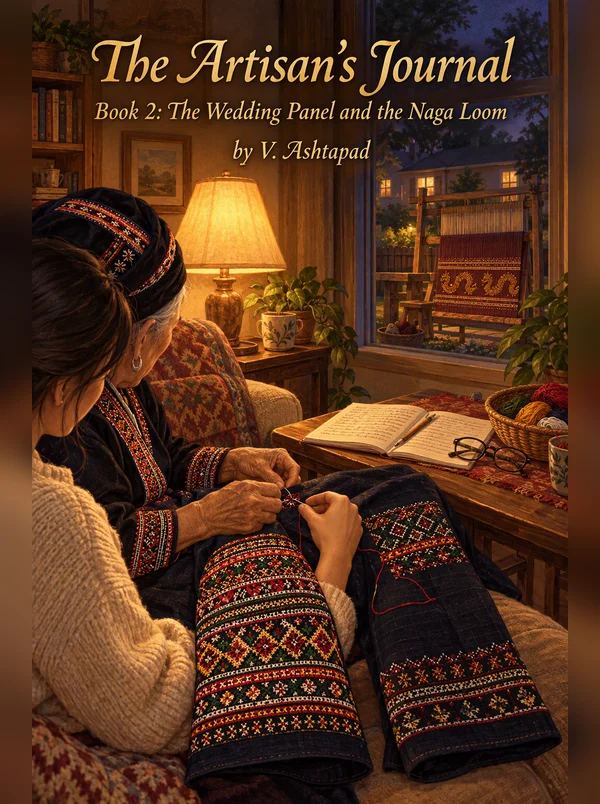
The Artisan's Journal
Book 2: The Wedding Panel and the Naga Loom
by V. Ashtapad
Foreword
This is a fictional story. Mey, her family, the Phommavongs and Cassia Court are imagined, and the names some of the characters give to their patterns are their own. The crafts are real: Iu Mien women in Sacramento and elsewhere still embroider wedding and New Year clothes from the back of the cloth, counting threads by eye, and Lao weavers still keep their patterns in strings and sticks above the loom. Families differ, villages differ, and the words differ with them, so no one book can speak for any of it. This story is told to carry the values this site is built on: respect for elders, the patience it takes to learn by hand, neighbors who hold each other up, and the care it takes to keep a language and a craft alive long enough to hand them on.
For the grandmothers who kept the patterns in their hands, and for the grandchildren learning to count the threads.
Chapter 1: Upside Down and Backward
Grandma Kae did her embroidery upside down and backward, and for most of her twenty-six years Mey Saechao had assumed this was a joke the old woman played on the rest of the family.
It was not a joke. Mey understood that one Sunday night late in September, when the heat had finally let go of Sacramento and the Delta breeze came up Cassia Court smelling of river mud and cut lawns. She was sitting on the floor of her grandmother's bedroom with her back against the bed frame, and Grandma Kae was in her chair by the window with a gooseneck lamp bent low over her lap, and on her lap was the left leg of a pair of pants that did not yet exist.
"Look at the front," Grandma Kae said in Mien, and turned the cloth over.
Mey looked. The front was a field of black cotton so dark it swallowed the lamp, and across it ran bands of pattern in red and gold and green and white: rows of tiny squares that became stars, stars that became branching trees, trees that became a line of small hooked shapes like birds walking single file. The stitches were so even that the colors seemed to have been printed there. Mey worked at a screen-printing shop on Stockton Boulevard. She knew what printed color looked like. This was tighter than that.
"Now the back," her grandmother said, and turned it again.
The back was where Grandma Kae's needle had always been. Mey had seen it ten thousand times without seeing it: the same patterns, but rough, crossed, knotted, a map drawn in the dark. Her grandmother had been stitching from the wrong side her entire life, counting the threads of the cloth by feel and by eye, and never once checking the front until a band was done.
"Why?" Mey asked. "Why not just work where you can see it?"
Grandma Kae lifted one shoulder. "Because the front has to be clean. If you work on the front, your hands get it dirty. If you work on the back, you keep the front for the people who look at you." She ran her thumb along a finished border. "My mother said that. Her mother said that. Probably somebody said it first because her hands were dirty."
Mey laughed, and her grandmother let herself smile, which she did with her eyes more than her mouth.
---
Cassia Court was a short street off Florin Road, eleven houses around a turnaround, built in the years when developers planted the same three models and the same two trees in every yard. The trees had grown up since. The ash in front of the Saechao house had lifted the sidewalk into a small hill that every child on the street had crashed a bicycle on at least once. Across the turnaround, the Phommavong house had a carport that someone had walled in with plywood and windows years ago and turned into a room nobody called a room. Everyone called it Mae Thao's garage. Inside it stood a loom.
Mey and her older sister Kouei had grown up running between the two houses so often that the neighbors had stopped trying to keep track of whose children were whose. Anou Phommavong, who was four years older than Mey and one year older than Kouei, had taught them both to ride bicycles on the hill under the ash tree, mostly by pushing them down it. He had also, at nine, informed Kouei that girls could not be electricians. Kouei had told him he could not be anything because he was a baby. Twenty years later, Anou was an electrician, Kouei was a hospital pharmacist, and at the end of August they had stood together in the Saechao living room in front of both families and said that they wanted to marry.
The wedding was set for the third Saturday in April, a week after Lao New Year. Both grandmothers had agreed on the date in a conversation that took place entirely in Lao, across the turnaround, on two lawn chairs, while the rest of the family stood at a polite distance pretending not to listen. Grandma Kae had learned her Lao trading in lowland markets as a girl. Mae Thao Khamsy had learned no Mien at all. So the two old women spoke the language of the river towns to each other, and their grandchildren, who spoke English to each other and only pieces of anything else, understood about a third of it.
What Mey understood, that night in late September, was this: Kouei would be married in Mien clothes, the full set, the way her grandmother had been married on a mountain in northern Laos. And the full set required pants with embroidered panels down the front of both legs. And one leg was finished. And one leg was not.
"How much is left?" Mey asked.
Grandma Kae unfolded the second panel from a cloth bundle tied at the corners. Perhaps a third of it was worked. The rest was bare black cotton, the threads of the weave visible as a faint grid in the lamplight.
"I started these when Kouei was fifteen," her grandmother said. "I thought, plenty of time. A girl does not marry at fifteen anymore. Then she went to school, and school, and school." She folded her hands on the cloth. "And my eyes."
Mey knew about the eyes. Her father drove Grandma Kae to the ophthalmologist on Fruitridge Road every few months, and every few months the doctor said the word cataract and the word surgery, and every few months her grandmother said not yet. The lamp was bent so low over her lap that its shade nearly touched her hair.
"I can still do it," Grandma Kae said. "Slow. Too slow for April." She looked at Mey. "You have good eyes."
"I have never done this in my life."
"You have watched me do it since you were born."
"Watching is not doing, Grandma."
"No," her grandmother agreed. "Watching is the first half."
---
Mey did not say yes that night. She said she would think about it, and went back to her own room down the hall, the one she had moved back into after her lease in Midtown ended and the rent on the next one had climbed past anything a screen printer could pay. Her room still had the glow-in-the-dark stars she and Kouei had stuck to the ceiling as children. Half of them had lost their glow.
She lay on her bed and thought about the shop. She spent her days pulling squeegees across mesh screens, laying down one color at a time on T-shirts for softball leagues and taquerias and family reunions, lining up each layer with the one before so that the edges met exactly. Registration, it was called. A screen out of registration by the width of a hair made a design look cheap. She was good at registration. She was known at the shop for it. Her boss, Yolanda, had once watched her line up a six-color print by eye and said, "Okay, that's a little scary."
Six colors on cotton, laid down in a day. Her grandmother's panel was four colors, by hand, on cotton, laid down in years.
Around midnight she got up and went back down the hall. Grandma Kae's light was still on. The old woman was asleep in her chair with the panel in her lap and the needle parked in the cloth, a long tail of red thread hanging off the edge like a fuse.
Mey eased the panel out from under her grandmother's hands. She did not touch the needle. She carried the finished left leg to the kitchen table, laid it face up under the light over the stove, and photographed it, one band at a time, then the whole length, then the back. Then she photographed the unfinished panel, front and back, so that whatever happened next, there would be a record of exactly where the work had stopped.
The family had a shared collection of photographs that her mother had started two years earlier, mostly pictures of birthday cakes and graduations and Grandpa Fou's old garden. Mey made a new album in it. She thought for a while about what to call it and finally typed: Kouei's wedding pants. Under the first photograph, there was a space for notes. She left it empty. She did not know what any of the patterns were called, or whether they were called anything.
She went back and woke her grandmother gently, and helped her from the chair to the bed, and turned off the lamp.
"I will do it," Mey said in the dark. "But you have to tell me everything. Not just how. What it all means."
Grandma Kae was quiet long enough that Mey thought she had fallen asleep again.
"It does not mean anything," her grandmother said finally. "It is just what we put there."
Then, after another pause: "Come early. Before your work. The light is better."
---
*From Mey's journal. Last Sunday of September.*
*Starting this notebook because I am going to forget things, and Grandma will not repeat them, and I have a feeling I am going to need to look back and see where I went wrong.*
*Facts so far: Grandma embroiders from the back. The front is for the people who look at you. Kouei's pants have two legs and one of them is done. The wedding is in April. I said yes.*
*Grandma says the patterns do not mean anything. I do not believe her. Nobody counts that many threads for nothing.*
Chapter 2: The Room That Was a Carport
The loom announced itself before Mey reached the end of her driveway. A wooden thump, a pause, a dry sliding hiss, another thump. It was six-forty on a Tuesday morning, the sky over the turnaround still the gray of an unwashed pan, and Mae Thao Khamsy had already been at work long enough for the rhythm to have settled.
Mey had promised Grandma Kae an hour before her shift. But Viengkham Phommavong had caught her in the driveway the night before, holding a bag of Lao sausages wrapped in newspaper, and said, "My mother wants to see you. About the skirt. She says early." So Mey crossed the turnaround first, stepping around the hump of sidewalk under the ash tree, and knocked on the side door of the garage that was not a garage.
"Khao ma," a voice said. Come in.
Inside, the room was long and narrow, lit by two fluorescent tubes and a row of windows that faced east, so that the first real light of the day was just beginning to slide across the floor. Shelves on the back wall held cones of thread in plastic bags, sorted by color into a gradient that went from the pale yellow of new straw through every shade of red to a purple so deep it looked wet. A rice cooker sat on a folding table beside an electric kettle and a jar of instant coffee. A box fan stood ready in the corner for the summer that was over.
And in the center of the room was the loom. Mey had seen it all her life, the way she had seen her grandmother's embroidery all her life, without seeing it. It was a frame of dark wood as long as a car, built by Anou's grandfather, Pho Thao Thongdy, from lumber he had bought at a yard in West Sacramento in 1991. Overhead, from a beam, hung the harnesses and their strings. And above the harnesses, tied in a thick, careful bundle, hung something Mey had never noticed: a curtain of hundreds of cotton strings looped over thin sticks, like a beaded doorway made only of thread.
Mae Thao sat on the bench at the front of the loom. She was smaller than Grandma Kae, and rounder, with short gray hair and a pair of reading glasses parked on top of her head, where they did no good to anyone. She did not stop weaving. Her feet pressed a treadle; the threads stretched across the loom split into two layers; her right hand threw a narrow wooden shuttle through the gap; her left hand pulled the heavy beater toward her, thump; her feet changed; the threads crossed. The hiss was the shuttle. The thump was the beater. The whole thing took less than two seconds, and she did it again.
"Sit," she said in English, nodding at a plastic stool.
Mey sat. On the loom, under Mae Thao's hands, a strip of cloth perhaps a foot long had grown from the front beam. It was silk, a deep wine red, and woven into it were small yellow diamonds set in rows.
"This is not the wedding sinh," Mae Thao said, catching her look. "This is practice. Warm up the hands." She switched to Lao for a sentence, then back. "For Kouei, I weave the real one. The body, the waistband, the bottom border. And a shoulder cloth." She held up her fingers. "Four pieces. April."
"That sounds like a lot."
"It is a lot." Mae Thao took her feet off the treadles at last and turned on the bench. "Your grandmother says you will finish her pants."
"I'm going to try."
"She also says you are slow."
Mey laughed. "She said that?"
"She said it in a nice way." Mae Thao tapped the glasses on her head as if she had just found them, and lowered them onto her nose. "So I have an idea. You learn from her in the morning. You come here some evenings, after work. You help me with the heavy parts. Winding, tying, the warp. My knees are old, my back is old. My granddaughter Dala does not want to do it, she wants to do homework and be on her phone. And you learn a little from me, too." She shrugged. "A Mien girl in Lao skirt business. Why not. Your grandmother did Lao business her whole life."
"I can try," Mey said again. It seemed to be the only thing she could say this week.
---
For the next half hour, Mae Thao talked and Mey listened, and the morning brightened in the east windows until the fluorescent tubes were almost unnecessary.
A sinh, Mae Thao explained, was not one cloth but several, sewn together. The waistband was hua sinh, the head of the skirt. The body was the middle, often patterned all over, sometimes plain. The bottom border, the teen sinh, the foot of the skirt, was where a weaver showed what she could do. The patterns were lai. Silk was mai. Cotton was fai. The loom itself was huk, a word Mae Thao said quickly, as if it were a cough.
"Say it," she said.
Mey said it.
"No. Huk." The vowel was shorter, the ending clipped.
"Huk."
"Close." Mae Thao waved a hand. "Lao has tones. Like Mien. You know tones."
Mey did know tones, in the sense that she had grown up surrounded by them. Mien had more tones than she could count, and she heard them when her grandmother spoke, and she could not produce half of them on purpose. She answered her grandmother in English and a few dozen Mien words, and her grandmother answered her in Mien and a few dozen English words, and they had worked it out between them for twenty-six years. Lao was a third set of sounds she had absorbed from across the street without learning any of it.
At ten past seven, a girl in a hooded sweatshirt came through the inside door holding a cup of noodles. She was seventeen, with a thick braid down her back and the expression of someone who had been woken against her will.
"Dala," Mae Thao said. "Say good morning to Mey."
"Morning," Dala said. "Grandma, you're doing the thing where you rope people in."
"I am asking for help."
"That's what roping in is." Dala looked at Mey with something close to pity. "She got me for, like, a whole summer once. I wound bobbins until I saw them when I closed my eyes."
"You did a good job," Mae Thao said.
"I did an okay job."
Mey had an idea. She took out her phone. "Dala. Will you do me a favor? Say the words for me. The weaving ones. I'll write them down, but I'm going to spell them wrong."
Dala gave her a long, suspicious look. Then she shrugged, set down her noodles, and leaned against the loom while Mey opened the family's word list. It was a page her mother had begun, like the photo album, for Mien words mostly, with a little button beside each word for a recording of how to say it. There were maybe forty words on it, most of them food and kinship terms, half of them recorded by Mey's aunt in a voice that sounded like it was reading a parking ticket out loud.
Mey typed: sinh. Dala said it. Hua sinh. Dala said it. Teen sinh. Mai. Fai. Lai. Huk.
"You're saying huk wrong," Dala told her grandmother, and Mae Thao swatted at her, and Dala ducked, grinning, and for a second she looked about nine.
"Write: nak," Mae Thao said. "The naga. On the teen sinh, I weave nak. The water serpent. Very important, for a wedding."
Dala said nak into the phone. Mey typed it. Then she looked up at the bundle of strings hanging above the harnesses. "What is that?"
"That," Mae Thao said, "is where the nak lives."
She stood up, slowly, one hand on the frame, and reached up to touch the bundle. Up close, Mey could see that the strings were not random. They hung in a sequence, each loop gathered over a slender stick, the sticks stacked in order, dozens of them, like the pages of a book that had been turned into string.
"Every row of the pattern," Mae Thao said, "is one stick. I pull the stick down, it lifts the right threads, I put in the colors, I move the stick up, I take the next one. When I come to the end, the nak is finished." She let the bundle swing gently. "My mother did not have paper. I do not have paper. The pattern is here."
"So if something happened to those strings—"
Mae Thao looked at her over the reading glasses. "Then I would be very sad," she said, "and I would have to pick it again, thread by thread, from an old skirt. Which takes a long time." She sat back down on the bench. "So nothing happens to those strings."
---
When Mey left, Mae Thao handed her a woven bamboo basket the size of a large grapefruit, with a lid and a strap of braided cord. It was warm. Inside, packed tight, was sticky rice from the morning's steaming, still giving off the smell that Mey associated with every Saturday of her childhood, a smell like toasted grass and clean laundry.
"For your grandmother," Mae Thao said. "And for you. You will be hungry at work."
Mey ate it with her fingers in the shop's back room at eleven, pinching off small pieces and rolling them into balls the way Anou had taught her when she was five, squeezing them hard enough to hold together. She dipped them in nothing. She just ate them, standing beside the drying rack, while the conveyor dryer rattled and a stack of shirts for a city volleyball league cooled on the table. Yolanda came in, saw the basket, and asked where she could get one.
"You can't," Mey said. "You have to know someone."
---
*From Mey's journal. First week of October.*
*Mae Thao keeps her pattern in string. Hundreds of loops on sticks hung above the loom, one stick for every row. If you lose a stick you lose a row. If you lose the bundle you lose the naga.*
*Grandma keeps hers nowhere. In her hands, I guess. In her head.*
*I keep mine in a phone that died at 3 p.m. today.*
*Words on the list, recorded by Dala, who says I should not trust Mae Thao's pronunciation of huk: sinh, hua sinh, teen sinh, mai, fai, lai, huk, nak.*
Chapter 3: The Wrong Side of the Cloth
The first lesson lasted forty minutes and produced eleven stitches, four of which Grandma Kae pulled out.
They sat at the kitchen table because the light there was best in the morning, coming in low through the window over the sink and falling across the table's scarred laminate. Grandma Kae had brought out a practice square of black cotton about the size of a paperback book, and a hank of red thread, and a needle so fine that Mey had trouble finding its eye even with her good eyes.
"Not that thread," her grandmother said, when Mey reached for the full hank. "Split it."
The red thread was made of several fine strands twisted loosely together. Grandma Kae separated two strands from the rest with her thumbnail, drew them out in one long smooth pull, and handed them over. "Too thick, the stitch sits up like a worm. Too thin, it disappears. Two."
Mey threaded the needle on the third try. Her grandmother watched without comment, which was its own kind of comment.
"Now turn it over."
"I know. The back."
"You know," Grandma Kae said, "but your hands do not know. Your hands want to look at the front. Every time they want to look, you tell them no."
The cotton was woven in a plain, square grid. The threads ran over and under each other in such regular rows that if Mey held the cloth up to the window she could see the tiny squares of light between them. A cross-stitch, her grandmother explained, went over two threads and up two threads, then crossed back the other way, making an X that covered a small square of cloth. The skill was not in the X. Anyone could make an X. The skill was in the counting: knowing, without a line drawn anywhere, exactly where the next X belonged, and the next, and the one after that, so that four hundred of them made a tree and not a smear.
"How do you count?" Mey asked. "Out loud?"
Grandma Kae looked at her the way she looked at people who asked whether the rice was done. "With your eyes."
"But how do you not lose your place?"
"You lose your place," her grandmother said. "Then you find it again."
Mey made her first X. Her grandmother leaned in, squinting through the low light, and turned the cloth over to see the front. The X was there, small and red and slightly lopsided, like a child's drawing of a kiss.
"Again," Grandma Kae said.
---
By the end of the first week, Mey could make an X that her grandmother did not pull out. By the end of the second, she could make a row of them that went straight. She could not yet make a pattern. Every time she tried to follow one of the borders on the finished panel, she lost count somewhere around the eighth or ninth stitch and ended up with a star that had one arm too long, or a branch that grew out of nowhere.
On the second Saturday, frustrated, she did what she would have done at the shop. She brought a pad of graph paper to the kitchen table and a set of colored pencils, and she sat beside the finished left leg and began to copy the first border onto the grid, square by square, one X per square.
Grandma Kae came in from the backyard with a bowl of Thai chilies she had picked from the plants along the fence and stood watching her, bowl on her hip.
"What is that?"
"A chart. So I can see the whole pattern before I stitch it. Then I just count the squares."
Her grandmother set the chilies down. She picked up the graph paper and held it at arm's length, then close, then at arm's length again. She did not seem angry. She seemed to be trying to understand a menu in a language she did not read.
"My mother would not let anybody draw it," she said at last.
"Why not?"
Grandma Kae put the paper back down and took her time answering. "Because then the paper knows it, and you do not," she said. "When the paper is lost, the pattern is lost. When it is in you, it goes where you go." She tapped the side of her own head. "I walked out of the mountains with nothing. No paper. I still had everything."
Mey looked at the graph paper, at the little colored squares marching across it. She thought of saying that the paper was just to get started, that it was training wheels, that once she knew the pattern she could throw it away. She thought of saying that her grandmother's mother had not had a hospital pharmacist granddaughter getting married in seven months.
What she said was: "Okay. What if I draw it once, and then I don't look at it?"
Grandma Kae made a sound in her throat that was not yes and not no. She sat down across the table. "Draw it," she said. "Then put it in a drawer. If you open the drawer, I will know."
"How will you know?"
"Your stitches will be stiff," her grandmother said. "Like you are copying homework."
---
That afternoon, something else happened that Mey would think about for a long time.
She had been trying to learn the names of the stitches. There were not many kinds, Grandma Kae said, but each had its own Mien name, and the names were not the names in English pattern books. The X was not just an X. A straight running stitch that went over a set number of threads and under the same number was something else. A stitch that filled a space solid, laid side by side like grains of rice in a row, was something else again. There was one, used along the very edges, that looked like a tiny ladder, and one that made a braid.
Mey tried to write the names down in her journal. She spelled them the way they sounded to her, in English letters, and her grandmother leaned over to look at what she had written, and frowned, and said a name again, slower. Mey wrote it again. It came out differently the second time.
"There is a way to write Mien," Grandma Kae said. "With letters. Your cousin Kenny knows it. He teaches the children on Saturdays at the community center."
"I'll ask him."
"Ask him." Her grandmother hesitated, which she rarely did. "But first, do the other thing. The thing your mother does with the words on the phone. Where it keeps the voice."
Mey looked up. "You want to record them?"
"I want my voice to say them," Grandma Kae said. "Not your spelling. Your spelling, nobody will understand in fifty years. My voice, they can understand." She folded her arms. "And I want to say them right the first time. So nobody makes a mistake later and says, Grandma Kae said it like this."
So Mey opened the family word list and set the phone on the table between them, and her grandmother sat up straight in her chair as if she were about to be photographed for an identity card. She cleared her throat. She looked at the phone.
"Now?"
"Now. Whenever you're ready."
Grandma Kae said the name of the cross-stitch. Then she stopped and said, "No, wait," and Mey deleted it, and she said it again. She said the name of the running stitch. She said the name of the solid fill, and then, without being asked, added a sentence in Mien that Mey only half followed, something about how that stitch was the one you used when you wanted a color to be strong, like a fire seen from far away.
"Should I keep that part?" Mey asked.
"Keep it."
She said the ladder stitch and the braid. She said the word for needle and the word for thread and the word, which Mey had never known existed, for the length of thread you could stitch with before it began to fray and had to be cut off and replaced. It was roughly the distance from the fingertips to the elbow.
When they were done, there were nine new words on the list, each with a small round button beside it. Mey pressed the first one. Out of the phone came her grandmother's voice, thin and slightly too loud, naming the cross-stitch.
Grandma Kae listened with her head tilted.
"I sound old," she said.
"You sound like you."
"That is what I said." But she reached over and pressed the button again, and then the next one, and listened to all nine words in her own voice, one after the other, with an expression Mey could not quite read. It was not pride. It was more like someone checking that a gate had been properly latched.
---
*From Mey's journal. Middle of October.*
*Nine stitch names recorded. In Grandma's voice, not my spelling. She made me delete the first try of the cross-stitch because she said it "too fast, like a teenager."*
*I drew the first border on graph paper. Then I put the paper in the drawer under the microwave. She knows it is there. I know she knows. We are both pretending.*
*Note to myself: the length of thread from fingertips to elbow has its own word. Somebody, a long time ago, measured that, and decided it mattered enough to name. I want to know who.*
Chapter 4: What the Borders Are Called
The question that finally opened her grandmother up was not about meaning. It was about a mistake.
Mey had been working for three weeks on a single border on her practice square, a row of small eight-pointed stars linked corner to corner by short diagonal lines. On the finished left leg of Kouei's pants, the same border ran the full width of the panel, perhaps forty stars in a row. Mey had studied it until she could see it with her eyes closed. And on a Thursday morning in late October, with frost on the windshields up and down Cassia Court for the first time that season, she noticed that the fourteenth star from the left was different from the others. One of its points was a single stitch short.
She showed her grandmother. "Is that on purpose?"
Grandma Kae bent over the panel. She found the star without needing to count. She touched the short point with the tip of her needle, and something moved in her face.
"That," she said, "is when your grandfather fell off the fence."
Mey waited.
"Kouei was fifteen. I was doing this border. He went up to clean the gutters, the old way, no ladder, standing on the fence. I heard the noise in the backyard. I stood up and the needle went in the wrong place." She shrugged. "He broke his wrist. He was fine. I came back later and I saw the star, and I thought, I will fix it. Then I thought, no. Leave it. That is the day."
"So it does mean something."
"It means I was not paying attention," Grandma Kae said. But she was smiling now, the eye kind of smile, and after a moment she pulled the panel closer and began, slowly, to tell Mey what the borders were called.
---
They were not called stars. Or rather, the eight-pointed figure had a name, but the name was not star; it was closer to flower, or to a word that meant the small white blossoms on a particular vine that grew at the edge of upland rice fields in the mountains where Grandma Kae was born. The linking lines between the flowers had their own name, which meant something like the path between houses.
The branching shape that rose in rows from the bottom of the panel was the pine. Not just any tree, Grandma Kae said firmly. The pine. In the mountains above her village there had been pines on the ridges, tall ones, and when the clouds came down over the ridge you could see the pines standing in the clouds like people waiting.
The hooked shapes that walked single file across the middle band, the ones Mey had thought looked like birds, were in fact the claws of a tiger. The tiger itself was never stitched; only its marks. "You do not need to show the tiger," her grandmother said. "Everybody knows if they see the claws, the tiger was there."
There was a small, tight diamond, filled solid in gold, that she called the seed of the pumpkin. There was a zigzag border in green that she called the stairs on the mountain path, because the trails up to her village had steps cut into them by generations of feet, and the steps went back and forth across the slope the way the green line went back and forth across the cloth.
And there was a band of interlocking squares, white on black, that she called Fou's fence.
"Grandpa's fence? He has his own pattern?"
"Not his own. Before, it had another name, my mother's name for it. Something about the fence around the pigs. But when I married him, he built a fence around our garden in the camp, bamboo, very straight, very good, and all the other women came to look at it. So I started calling the pattern his fence." Grandma Kae ran her thumb along the white squares. "My mother would be mad."
"Does anyone else call it that?"
"Only me," her grandmother said. "And now you."
Mey had her journal open on the table and was writing as fast as she could, but she kept stopping, because she could feel how much was slipping past her. Each name came with a story, or half a story, or the edge of one, and her grandmother told them out of order and without warning, the way she might point out a bird from a moving car.
"Wait," Mey said, and took out her phone, and opened the album she had made weeks ago, Kouei's wedding pants. The photographs were all there, band by band, with their empty note spaces. "Tell me again. One at a time. I'm going to put it with the picture."
So they went through the photographs together, slowly. Under the picture of the first border, Mey wrote: *The vine flower (white blossoms at the edge of the rice fields above Grandma's village) linked by the path between houses. Fourteenth flower from the left has a short point: the day Grandpa fell off the fence cleaning the gutters. Left on purpose.*
Under the pines: *The pine on the ridge. Grandma says, "standing in the clouds like people waiting."*
Under the hooked shapes: *Tiger claws. You do not stitch the tiger. The claws are enough.*
Under the white squares: *Fou's fence. Grandma's name, after the bamboo fence Grandpa built around their garden in the camp. Before that, her mother called it something about the pig fence. Only Grandma calls it this.*
It took most of an hour. When they were done, every photograph had a few lines under it, and some had a paragraph. Grandma Kae made Mey read each note aloud before saving it, and corrected two of them. The pumpkin seed was not a seed of a pumpkin but of a particular round squash, she said, and then could not think of the English name, and then said pumpkin was fine.
"Leave pumpkin," she decided. "Nobody here knows the other one anyway."
---
Kouei came over that evening, still in her hospital badge, with a container of soup from the Vietnamese place on Stockton that she knew Grandma Kae liked. She found Mey at the kitchen table with the practice square and sat down across from her and watched for a minute without saying anything.
"You're actually doing it," Kouei said.
"I'm actually trying to do it."
"I thought you'd quit in a week."
"Thanks."
"No, I mean." Kouei picked up the finished panel and looked at the back of it, the way Mey had learned to look at it. "I thought it would be like when Mom tried to get us to take Mien class at the center. Remember? Two Saturdays and then we had soccer."
"I remember."
Kouei set the panel down. She was the oldest grandchild, and the one who had always been good at everything in the measurable way: grades, scholarships, the pharmacy license, the job at the hospital in the Pocket with its parking garage and its badge. Mey had grown up in the shadow of those measurements and mostly did not mind them. But she noticed now that her sister was not quite looking at her.
"I should be the one doing this," Kouei said.
"You work sixty hours a week."
"So do you, sort of."
"I work forty-two hours a week pulling ink across screens. It's different."
"It's not that different." Kouei turned the soup container in her hands. "They're my pants. It's my wedding. And I can't even thread the needle. Grandma asked me when I was fifteen if I wanted to learn and I said I was busy. I was busy with, like, a chemistry test." She laughed without much in it. "She started making them anyway."
Mey did not know what to say. So she opened the album on her phone and handed it across the table. Kouei scrolled through the photographs, reading the notes, slowly at first and then more slowly. When she got to the fourteenth flower she stopped.
"Grandpa fell off the fence?"
"Off the fence, onto the lawn. Broke his wrist."
"I remember the cast," Kouei said. "I signed it. I didn't know she was sewing when it happened." She kept reading. When she reached Fou's fence she put the phone down and pressed the heels of her hands against her eyes for a second.
"I'm fine," she said. "I'm tired."
"I know."
"Can you put more in there? Whatever she tells you. Even the small stuff."
"That's the plan."
Kouei nodded. Then she picked up the practice square, and the needle, and turned the cloth over to the back without being told, and held it out to Mey.
"Show me one," she said. "Just one. So I know what it feels like."
---
*From Mey's journal. End of October.*
*The patterns have names. Grandma said they didn't mean anything and then talked for an hour.*
*Vine flower. Path between houses. The pine. Tiger claws. Pumpkin seed (not really pumpkin). Stairs on the mountain path. Fou's fence.*
*I think "it doesn't mean anything" means "I don't want to make a big deal of it." Which is a different thing.*
*Kouei made one cross-stitch tonight. It is the worst cross-stitch I have ever seen. Grandma did not pull it out. She said, "Leave it. That is the day."*
Chapter 5: Two Kinds of Rice
Grandma Kae's birthday was the first of January, and it was not her birthday.
Mey had known this as a fact for years without ever asking what it meant. On the first Sunday of November, sitting with her father at the dining table with a stack of old documents in a shoebox between them, she finally asked.
"A lot of people from the camps have January first," Chiem Saechao said. He was fifty-four, a maintenance supervisor for the county, with reading glasses he refused to buy in a strength that actually worked. "When they did the paperwork, if you didn't know your date, they put January first. If you didn't know the year, they guessed by looking at you."
"So how old is Grandma?"
"On paper, seventy-eight." Her father squinted at an immigration form so old its edges had gone soft as cloth. "In real life, ask her. She'll say a different number every time."
The shoebox had come out because of the timeline. Mey's mother had started one months ago, in the same family pages where the photograph albums and the word list lived: a long line running across the screen with Grandma Kae's life marked along it in dots. So far there were only six dots, and four of them were in Sacramento. Arrived. Bought the house on Cassia Court. Chiem married. Grandpa Fou passed.
"It's like her life started at the airport," Mey said.
"Your mom ran out of things she knew for sure," her father said. "Go ask. Grandma likes you this month."
---
Grandma Kae was in the backyard, in a jacket over her housedress, pulling the last of the summer's long beans off the trellis along the fence. Across the fence, in the Phommavongs' yard, Mae Thao was doing something with a big plastic tub of water and a bundle of skeins. The two of them were talking over the fence boards in Lao.
When Mey came out with her phone and explained, Grandma Kae made a face. "Why does it need dots?"
"So the family can see where you've been. Before the airport."
"The family knows where I have been."
"Kouei doesn't. I don't, really. Not in order."
Her grandmother dropped a handful of beans into her bucket and looked over the fence at Mae Thao, and said something in Lao. Mae Thao laughed and said something back, and Grandma Kae snorted.
"What did she say?"
"She says her granddaughter did the same thing to her last year for school. She says it is like going to the doctor. You tell them everything, they write down two words." Grandma Kae set down the bucket. "Fine. Sit. We do it out here, I am not going inside, the sun is good."
So they sat on the back step with the phone between them and the bucket of beans at their feet, and Mae Thao, uninvited and entirely welcome, pulled a lawn chair up to her side of the fence and sat too, listening through the gaps between the boards.
---
Grandma Kae was born in the mountains of northern Laos, in a village of perhaps thirty houses on a ridge so high that in the cold season the clouds came through the doorways in the morning. She did not know the year. She knew it was the year a particular tree by the spring was struck by lightning, and that she had been a baby on her mother's back when the men cut it down for firewood.
"Put it before," she told Mey. "Before everything. Just a dot. No number."
Mey made a dot and labeled it: *Born. The year the lightning tree by the spring was cut down.*
The village grew upland rice on the slopes, in fields cleared from the forest, and corn, and squash, and the small round gourd whose seed was the pattern on Kouei's pants. Rice in the mountains was not the rice of the lowlands. It grew in dry soil, watered only by rain, and when it was cooked it was its own kind of thing. Grandma Kae described its taste in a way that made Mae Thao, on the other side of the fence, say a long sentence in Lao that ended in a sigh.
"She says the lowland people think mountain rice is poor-people rice," Grandma Kae translated. "And she says they are wrong, and she is sorry."
"Is she?"
"No. She is lowland. Lowland people always think that." Grandma Kae said this in English, loudly, and Mae Thao laughed so hard she had to put her hand on the fence.
When Grandma Kae was eleven or twelve, she began to walk down the mountain with her mother and aunts to the market in the valley, two days down and three days back up, carrying cloth and silver and dried things to trade. The valley town was on a river, and the river people were Lao, and they grew rice in flooded fields that shone like broken mirrors. Their rice was sticky. They ate it from baskets with their fingers. The girl from the mountain watched the market women eating it and decided she would learn their language so that she could argue with them about prices.
"And did you?"
"I argued for sixty years," Grandma Kae said. "I am still arguing." She tipped her head toward the fence.
Mey made a dot: *Learns Lao at the valley market. Age about twelve. "So I could argue about prices."*
---
She married at eighteen, more or less, to a young man from a village on the next ridge whose family had good pigs and better manners. That was Fou. The wedding lasted three days. Grandma Kae described her own wedding clothes in such detail that Mey stopped typing and just listened: the black tunic, the red yarn around the collar thick as a fox's tail, the embroidered pants her mother had worked on for years, the silver at her neck so heavy it made her shoulders ache by the second night.
"Same as Kouei," Mey said.
"Almost the same. Kouei's are better." Her grandmother considered. "My mother's stitches were better than mine. But my thread is better than her thread. Hers was from the market, it faded. Mine is from the store on Stockton, it does not fade." She shrugged. "So Kouei's are better."
There was a son who did not live past his first year, which Grandma Kae said in one short sentence and Mey did not ask about. There was Chiem, born the year the rains came early. Then there was the war, which had been going on in the valleys for as long as Grandma Kae could remember and which, around the time Chiem learned to walk, came up the mountain.
Here her grandmother slowed down. Mey had wondered how she would tell this part, and whether she would tell it at all. She told it the way she told the pattern names, plainly, with long pauses in which she seemed to be choosing what to set down and what to leave folded.
When the war ended, it became dangerous for families like theirs to stay. They left the village. Grandma Kae did not say much about the leaving. She said that they walked for many days and that Chiem was carried most of the way, first by her and then by Fou and then by a cousin, passed between them like a basket. She said that they came over the last ridge into Thailand on a smugglers' path, and that she remembered the sound of Chiem breathing against her neck and nothing else. She said that the people who reached the camp were not all of the people who had started.
Then she stopped, and looked at the long beans in the bucket, and said: "That is enough for that one. Put a dot."
Mey put a dot. She wrote: *Left the mountains with Grandpa and Dad. Crossed into Thailand.* She did not write anything else. Over the fence, Mae Thao had gone quiet.
---
The camp was in northern Thailand, in a place called Chiang Kham, and the family lived there for close to ten years. This part Grandma Kae told more easily, almost with fondness, because it was where so many of the ordinary things of her life had happened. There was Fou's bamboo fence around their little garden, admired by all the women. There was the school where Chiem learned to read in Thai. There was the embroidery: in the camp, the Mien women stitched constantly, for their families and for sale, and buyers came from Bangkok and farther to purchase their work. Grandma Kae had stitched hundreds of squares and borders and bags for strangers. She did not know where any of them had gone.
"Somewhere in the world," she said, "there is a bag with my tiger claws on it, and somebody keeps their keys in it."
Then there was the airplane, and a winter in Portland, Oregon, that Grandma Kae described as the coldest place a person was ever sent, and then, a year later, the move south to Sacramento, where cousins had already settled and where, she had been told, the summers were hot enough to dry chilies on the roof.
"Were they?"
"Hotter," she said.
On the other side of the fence, Mae Thao had begun to talk in Lao again, quietly. Grandma Kae listened, then answered, and for a while the two old women spoke to each other through the boards and Mey did not try to follow. When they stopped, Grandma Kae turned to her.
"She was in a camp too," she said. "Different one. On the river, by Nong Khai. She wove skirts there and sold them. She came here three years after me." She paused. "She says when you are finished with my dots, she will tell you hers. She says Dala's dots for school were not very good."
"I heard that," Dala called from somewhere inside the Phommavong house.
---
By the end of the afternoon, the timeline had nineteen dots on it, and only five of them were in Sacramento. Mey showed her grandmother the whole line, scrolling slowly from the lightning tree to the house on Cassia Court.
Grandma Kae studied it, scrolling back and forth with one finger.
"It looks short," she said.
"It's seventy-eight years. Or whatever."
"It looks short," her grandmother repeated. Then she reached over and touched the empty space at the right end of the line, past the last dot. "Put one there. For April."
"The wedding?"
"Kouei in the pants," Grandma Kae said, and stood, and picked up her bucket of beans, and went inside to start the rice.
---
*From Mey's journal. First week of November.*
*Nineteen dots. Grandma's real birthday is the year a tree was cut down. Grandpa built a fence in the camp. Somewhere a stranger keeps keys in a bag with Grandma's tiger claws on it.*
*Two kinds of rice: one that grows in the rain on a mountain, one that grows standing in water by a river. Grandma married the mountain one and argued with the river one for sixty years.*
*She asked me to put a dot in April, for the pants. So now it is on the timeline, and I cannot pretend it is optional.*
Chapter 6: Breath Going In, Breath Going Out
Pho Thao Thongdy practiced the khaen in the backyard because his wife would not let him practice it in the house, and so for twenty-six years the sound had come over the fence into Mey's bedroom window on summer evenings and become part of the weather.
She had never seen the instrument up close until the night of the planning dinner.
It was the third Saturday in November, cold and clear, and the Phommavongs had invited the whole Saechao household across the turnaround to eat and to talk about April. Anou had strung lights along the eaves of the carport-room. Folding tables had been pushed together in the living room and covered with plastic cloths, and the food came out of the kitchen in a procession that seemed to have no end: bowls of larb, pork and herbs and toasted rice powder; a platter of grilled sausages fat with lemongrass; plates of raw cabbage and long beans and mint for eating alongside; a pot of soup; bamboo baskets of sticky rice, one for every three people, set down along the table like lanterns. Mey's mother had brought a big pot of Mien chicken boiled with ginger and a dish of pickled mustard greens that Grandma Kae had been fermenting in a jar on the back porch since September.
And in the kitchen, the sound that Mey would remember longest from that evening: Viengkham at the counter with a clay mortar and a wooden pestle, making papaya salad to order. Thock, thock, thock. A twist of the wrist, a scrape of the big spoon around the bowl, the clatter of a lime half being thrown into the sink. Thock, thock. Each guest got their own, made to their own heat. Viengkham asked how many chilies, and then she ignored the answer and used the number she thought the person could handle, and she was never wrong.
"Two," Mey told her.
Viengkham looked at her. "Four," she said, and reached into the bowl.
---
The talking happened first, because the elders wanted it done before anyone got full and sleepy. Anou's father, a quiet man named Bounmy who drove a forklift at a distribution center near the airport, sat at one end of the table, and Mey's father sat at the other, and the grandparents sat in the middle where everyone could hear them. Kouei and Anou sat side by side and tried to look like adults whose wedding was being discussed by other adults.
There were a great many things to decide. Both families wanted the day to be both Mien and Lao, and nobody had ever quite done that on Cassia Court before. The Mien part would come first, in the morning and early afternoon, with the bride in Mien clothes and the feast that went with them. The Lao part would come in the evening, at a hall the families had rented off Franklin Boulevard, with music and dancing and the bride in a sinh from Mae Thao's loom. There would be khao poon, the rice noodle soup that Lao families served at weddings, made in pots so big Viengkham needed her brother's truck to move them. There would be a Mien elder who sang. There would be a Lao band with a singer and a khaen player.
"Not me," said Pho Thao Thongdy, from his chair. "I am too old to play all night."
"You played all night at Dala's birthday," Viengkham said.
"I was younger then. That was three months ago."
The dates went into the families' shared calendar as they talked. Viengkham kept it, the same way she kept the calendar for the Lao association's events, and she typed with her thumbs while the conversation went on around her, reading each entry aloud as she saved it so that nobody could later claim they had not been told. Mien New Year at the community hall in February: saved. Lao New Year in April, the street gathering on Cassia Court the Sunday before: saved. Fitting for the Mien clothes, two weeks before: saved, with a note that said *Grandma Kae decides the date*. Fitting for the sinh: saved, with a note that said *Mae Thao decides the date*. The wedding itself, the third Saturday: saved in red.
"Now everybody has it on their phone," Viengkham announced. "No excuses."
"I don't have it," Grandma Kae said.
"You don't have a phone, Mama Kae."
"That is my excuse."
---
After the food, Pho Thao Thongdy went to get the khaen.
It was longer than Mey expected, taller than a child, two rows of slender bamboo pipes bound side by side and set into a carved hardwood chamber at the place where he put his mouth. The pipes were the color of old piano keys, darkened where hands had held them. He sat on a kitchen chair in the middle of the living room, with the tables pushed back, and held the instrument upright in front of him, his palms cupped around the chamber, his fingers resting over small holes in the pipes.
Then he breathed.
The sound that came out was not one note but several at once, a chord with a low hum underneath it, like a harmonica crossed with a pipe organ small enough to hold in two hands. When he breathed out, it sang; when he breathed in, it kept singing. He never had to stop for air. The music simply went on, rising and falling with his chest, the low drone underneath steady as a road, the melody above it skipping and bending. Mey had heard it through her window a thousand times. She had never understood that the breath went both ways.
Viengkham's cousin, a woman in her forties with a strong, nasal voice, began to sing over it. This was lam, Dala whispered to Mey from the next chair. The singer was making it up, or partly. She sang a verse, quick and teasing, and the older people laughed. Dala laughed too, and then whispered a translation: the singer was asking whether the Mien family knew what they were getting into, marrying into a family whose grandfather snored like a truck engine. Then she sang a verse about Anou falling off his bicycle under the ash tree at nine. Then one about Kouei, who was so smart she had probably already calculated the exact cost of the wedding to the penny.
"She did," Anou called out, and everyone laughed again.
The singing went on, verse after verse, the khaen breathing underneath it. Several of the Lao aunts got up and began to dance in a slow circle around the middle of the room, their hands turning gracefully at the wrists, and pulled Mey's mother in with them, and Mey's mother, who did not know the steps, did them anyway, badly and happily.
---
Then it was the Saechaos' turn, and a hush came over the room, because everyone knew what was supposed to happen next and nobody was sure it would.
The Saechaos had brought Auntie Finh Saephan.
She was not exactly an aunt. She was a cousin of Grandma Kae's from the next ridge in the old country, a few years younger, and she lived across town in Rancho Cordova with her daughter's family. She was known throughout the Sacramento Mien community for one thing: she could sing in the old way. Mien sung poetry was not ordinary speech set to a tune. It used its own language, an old song language that drew from words most people no longer spoke, and it followed strict rules of line and rhyme, and it was sung with a particular slow, rising and falling melody that Mey had heard only at funerals and New Year gatherings and the weddings of people much older than she was. Very few people her age could understand it. Very few people her parents' age could sing it.
Auntie Finh stood up from her chair. She was tiny, in a black jacket and a turban wrapped with bands of the same red and gold patterns that ran across Kouei's pants. She waited until the room was entirely quiet. Then she closed her eyes and began.
Mey did not understand the words. She understood almost nothing. But she understood the shape of it: a long line that climbed slowly and then fell, a pause, another line that answered the first. The voice was thin and steady and carried to the back of the room without seeming to try. Grandma Kae, at the table, had her eyes closed too. Her lips were moving.
When Auntie Finh finished the first verse, she opened her eyes and looked straight at Pho Thao Thongdy, and nodded once.
"She is answering him," Grandma Kae said quietly to Mey in Mien. "He played for us. She sings for them. She says thank you for the food, and she says the bride's family is giving their best rice to the groom's family, and they should take good care of it."
"The rice is Kouei?"
"The rice is Kouei."
Auntie Finh sang a second verse and a third. Pho Thao Thongdy listened with his khaen across his knees, his head bowed, and when she finished he lifted the instrument and played a short phrase back, a few bars only, a reply without words. Auntie Finh smiled for the first time all evening.
Afterward, while the dishes were being carried back to the kitchen, Mey found the old singer sitting alone by the window with a cup of tea.
"Auntie," she said in her careful Mien. "Can you teach me? Even a little?"
Auntie Finh looked her over, from her sneakers to her uncovered hair. "Do you understand it?"
"No. Not yet."
"Then first you understand it," the old woman said. "Then you sing. Many young people want to sing first." She sipped her tea. "Come in January. Bring your grandmother. I will tell you what the words mean. Maybe, one day, the singing."
---
*From Mey's journal. Third weekend of November.*
*The khaen breathes in and out. The sound never stops. Pho Thao says that is because you are always either taking or giving and the instrument does not care which.*
*Auntie Finh sang to the Phommavongs, and Pho Thao answered her without words. Nobody planned that.*
*Calendar has: Mien New Year, Pi Mai on the court, two fittings (Grandma decides one, Mae Thao decides the other), wedding in red. Grandma still has no phone.*
*Viengkham gave me four chilies. She was right. I hate that she was right.*
Chapter 7: Tying the Weft
The frame for the mat mee took up the whole back half of the garage-room, and Mae Thao called it, in English, "the bed."
It was two long wooden rails held apart by crossbars, with pegs along each end, and across it, stretched tight from peg to peg, ran hundreds of strands of white silk in a flat bundle as wide as a hand. Mey had come over straight from the shop on the Monday after the planning dinner, still smelling of plastisol ink, and found Mae Thao and Dala already sitting on either side of the bed on low stools, each with a roll of pink plastic tape and a pair of scissors.
"Wash your hands," Mae Thao said. "Ink on silk, I will kill you."
Mey washed her hands at the utility sink and sat down on a third stool. In front of her, the white silk lay waiting. Mae Thao had already drawn on it: tiny marks in pencil at intervals along the bundle, so faint Mey had to lean close to see them.
"This is for the body of the sinh," Mae Thao said. "Not the naga. The naga is in the bottom, the teen sinh, that is a different way, with the sticks. This is the middle. Mat mee." She lifted a strand of the plastic tape. "Mat means tie. Mee means the thread. You tie the thread, then you dye it. Where it is tied, the dye cannot go. Where it is not tied, the dye goes. Then you untie, and you have colors on the thread before you weave it."
"Before you weave it," Mey repeated slowly.
"Before." Mae Thao nodded. "The pattern is in the thread already. When I weave, it comes out."
Mey looked at the bundle of white silk. Somewhere in its hundreds of strands, invisible, was a pattern of diamonds and hooks that would not exist until it was dyed and untied and wound onto bobbins in exactly the right order and thrown across the loom one pass at a time, each pass laying down a sliver of color that had to land precisely beside the sliver before it.
"That's registration," she said. "That's what I do all day. Lining up the layers."
"I don't know what you do all day," Mae Thao said. "But if you can line up, good. Tie."
---
The tying was harder than it looked and easier than embroidery, and Mey liked it from the first hour. You pulled a short length of plastic tape around a section of the bundle exactly where a pencil mark said to, wrapped it tightly three or four times so that no dye could seep under, and knotted it with a quick flick that Mae Thao demonstrated about thirty times before Mey got it. Then you moved to the next mark. The marks made a pattern you could almost see if you squinted: rows of little pink bands across the white, stepping diagonally, forming the outline of a diamond, then a second diamond nested inside it.
Dala tied fast and talked the whole time. She was applying to colleges, all of them in California, and she wanted to study civil engineering, and she wanted to go somewhere far enough away that her grandmother could not rope her into anything, and close enough to come home for New Year.
"Davis," Mae Thao said, without looking up.
"Davis is twenty minutes away, Grandma."
"Davis is good school."
"Davis is twenty minutes away."
"That is why it is good."
Mey tied and listened. The rhythm of it reminded her of the shop on a long run, the way your hands took over and your mind wandered and then came back. At some point she noticed that Mae Thao was humming under her breath, the same few rising and falling notes over and over, and that Dala, without seeming to notice, had started humming them too.
"What's that song?"
Mae Thao stopped humming. She thought about it. "My mother's song. For tying. I don't know the words anymore." She shrugged. "Only the part that goes with the hands."
---
Twice that week Mey went over after work and tied until her fingers ached. On Wednesday, Mae Thao judged the bundle ready and moved it into a big steel pot of dye on a camping burner she had set up in the driveway, because her daughter would not let her dye indoors. The first dye was a deep red. When the bundle came out, dripping, steaming in the cold air, it was a wet dark rope; but where the pink tape had been, the silk was still white.
Then came the part Mey had not expected. Mae Thao, with Dala's help, cut away some of the ties and left others, retied a few new sections, and dyed the bundle a second time, in yellow. Where red met yellow, the silk turned orange. Where the old ties had stayed on, it stayed white. Where the new ties had gone on over red, it stayed red.
"Like layers," Mey said. "You're printing in layers. One color at a time."
"I am dyeing in layers," said Mae Thao, who had apparently decided that screen printing was a thing she would hear about only on her own terms. "Three colors. Red, yellow, and later a little black. Then we untie everything, and we see."
On Saturday, they untied everything. They sat at the bed all morning snipping the pink tape off with nail scissors and dropping it into a plastic bag, and as each tie came off, the pattern appeared on the silk, not sharp-edged like a print but softly feathered, the colors bleeding slightly into one another where the dye had crept. When the last tie came off, the whole bundle lay stretched on the frame in front of them, striped and stepped and blurred with color, and Mey, looking at it, could see the diamonds. Not finished, not woven, but there, waiting in the thread.
"Now the hard part," Mae Thao said. "Wind it on the bobbins. In order. If you mix up the order, the diamonds walk away."
---
That evening Dala sat with Mey on the Phommavongs' front step while the turnaround filled with cold blue dusk, and they added words to the list. Dala had warmed to the job in the weeks since the morning of the loom; she said the words into Mey's phone with a kind of grudging care, and then made Mey say them back.
Mat mee. Dala recorded it twice, once fast and once slow. Then a word for the plastic ties, which turned out to be just the English word *tape* said with a Lao accent, and which they argued about including and finally did, because it was what Mae Thao actually said. A word for the dye pot. A word for the bobbins. A word for the shuttle.
Then Dala said, "Put in khao niao. Sticky rice. You don't have it."
"I know what sticky rice is called."
"Yeah, but you say it wrong. You say it like the guy at the grocery store."
Mey laughed and typed it, and Dala recorded it.
"Put in nung khao," Dala said. "That's steaming the rice. And huat. That's the basket you steam it in, the cone thing. Grandma always says huat like it's a person who disappointed her."
They kept going. The list was growing in two directions now, Mien words in one part and Lao words in another, with Grandma Kae's voice beside some and Dala's beside others and Mae Thao's beside a few, because now and then she would come out onto the step and insist on correcting her granddaughter.
"What's the word for when the pattern comes out?" Mey asked. "When you untie the threads and you see it?"
Dala thought. She called inside to her grandmother in Lao. Mae Thao called back, and there was a short exchange, and Dala turned back to Mey with a puzzled look.
"She says there isn't a word. She says you just say *it came out*. Like rice comes out of the pot."
Mey typed: *No word. "It came out," like rice comes out of the pot.* There was no recording to go with it. She left the button empty.
---
On Thursday, the two families had Thanksgiving together, the way they had for as long as Mey could remember, alternating houses every year. This year was the Saechao house. There was a turkey because Mey's mother insisted on a turkey, and there was larb because the Phommavongs could not imagine a holiday without it, and there were Grandma Kae's boiled chicken and pumpkin shoots from the vine she grew on the side fence, and there was sticky rice in its baskets, and there was a store-bought pecan pie that Anou brought and that nobody under forty ate.
But the thing Mey watched most closely that afternoon was the rice.
She had volunteered to help Mae Thao with it, early, in the Saechao kitchen. The rice had been soaking since the night before, the grains swollen and chalky white. Mae Thao poured it into the cone-shaped bamboo basket and set the basket into the mouth of a tall aluminum pot of boiling water, and put a lid over it, and then she did not look at a clock. She listened. She listened to the water, and after a while she lifted the lid and pressed a few grains between her thumb and finger, and then she did the thing Mey had seen a thousand times without knowing why: she grabbed the basket, gave it a sharp toss, and flipped the whole cone of rice over in one piece, so that the top became the bottom. Then she put the lid back on.
"How do you know when?"
Mae Thao shrugged. "The rice tells you."
"How does it tell you?"
"It gets quiet," Mae Thao said. And then, when the rice was done, she turned it out onto a wide tray and fanned it with the lid to let the steam off, and pushed it with a wooden paddle into a mound, and showed Mey how to fold it, lift it, fold it again, so that it did not go soggy, and then packed it into the small lidded baskets that would go on the table.
Mey did not write any of it down. She did not want to. Some things, she was beginning to think, went into the hands only.
---
*From Mey's journal. Thanksgiving.*
*Mat mee: the pattern is in the thread before the thread is woven. You tie it in, you dye around it, you untie, and the pattern is just sitting there on the white silk, blurry, like a photo before it focuses.*
*There is no Lao word for that moment. Mae Thao says "it came out." Like rice.*
*Words added: mat mee, tape (yes, really), the dye pot, bobbin, shuttle, khao niao (Dala says I say it like the grocery store guy), nung khao, huat.*
*Mae Thao knows the rice is done because it gets quiet. I am not writing down how to make it. I tried once in my head and it came out wrong.*
Chapter 8: The Weight at the Neck
On the first day of December, Grandma Kae let Mey put a needle into the real cloth.
There was no ceremony. Her grandmother simply unfolded the unfinished right-leg panel on the kitchen table one morning instead of the practice square, turned it to the back, found the place where her own work had stopped, a pine branch half grown, and pointed at it with her needle.
"Here," she said. "Finish the pine."
Mey sat looking at the half branch and did not pick up the needle. The stitches her grandmother had already made were so even they seemed to have been placed with tweezers. Hers would sit beside them forever.
"What if I mess it up?"
"Then I take it out," Grandma Kae said. "Like always."
So Mey threaded two strands of green and found her count by touching the threads of the weave with the tip of the needle, the way her grandmother did, one, two, over, up, and made the first stitch on Kouei's wedding pants. Then the second. By the time she had to leave for the shop, the pine branch had three more needles on it. Grandma Kae turned the cloth over, looked at the front for a long minute, and turned it back without a word. Nothing came out.
Mey drove to work with her hands shaking slightly on the wheel, and did not tell anyone at the shop why.
---
The silver came out the following Sunday.
It lived in a locked metal box at the back of Grandma Kae's closet, behind the winter blankets and a rice cooker still in its carton from a sale in 2009. Mey had seen it only at New Year, when her grandmother wore some of it, and at funerals, when she wore more. Her father carried the box to the dining table, and Grandma Kae unlocked it with a key she kept on a loop of red thread around her neck, and lifted the pieces out one at a time onto a towel.
There was a neck ring, a thick torque of silver as wide as Mey's thumb, open at the back, with a pattern of small raised diamonds chased along its outer face. There was a long chain of linked silver plates, each plate the size of a stamp and pierced with a tiny design, joined by rings to the next, the whole chain heavy enough when Mey lifted it to feel like a bag of groceries. There was a pendant shaped like a padlock. There were dozens of silver buttons, round, with a raised knob in the center, strung on a piece of cord. There were a pair of earrings like small crescent moons.
"This is not all of it," Grandma Kae said. "Before, there was more."
Mey waited.
"In the camp, sometimes, you needed rice. Or medicine. Or shoes for Chiem." Her grandmother touched the chain. "So a piece goes. Then another piece. My mother's big ring went for a doctor when Chiem had fever." She said it plainly, the way she had said everything on the back step. "What is here is what we did not need to sell."
Her father, beside Mey, said nothing. He was looking at the padlock pendant with an expression Mey had not seen on him before.
"I remember that one," he said finally. "You wore it on the plane."
"I wore everything on the plane," Grandma Kae said. "I was afraid they would lose the bag."
---
The trouble was the chain. Three of the links near one end had worn through, and a plate had come loose, and the clasp that held the whole chain to the neck ring had cracked. For Kouei, the chain would need to hang properly from her neck to below her collarbones, over the red yarn ruff of the tunic. Grandma Kae could not fix silver. Grandpa Fou could not have fixed it either; he had been a farmer and later a fence builder and later a warehouse worker, not a smith. His uncle had been the smith, a man who died in the mountains long before Mey was born.
"There is a man in Oakland," her father said. "Old Mien man. He still does it. Your mother's cousin used him for her daughter."
So on the second Saturday of December, Mey and her father drove the box of silver down Interstate 80 in the rain, past the long flat fields of the causeway where the bypass had flooded silver-gray and white egrets stood in the water like folded paper, through Vallejo and over the Carquinez Bridge with the strait below them dark and wind-whipped, and into the flats of East Oakland. The smith's name was Uncle Kao Lin Saelee, and he worked out of a converted garage behind a small yellow house, with a workbench made from an old solid-core door, a gas torch, a vise, and dozens of small hammers hung on nails along the wall, each with a different shape of face.
He was very old, older than Grandma Kae, with thick glasses and fingers stained gray at the tips. He turned the chain over in his stained fingers, link by link, without speaking. Then he picked up the neck ring and turned it in the light from the window.
"Who made this?"
"My grandfather's uncle," Chiem said in Mien. "In Laos."
Uncle Kao Lin ran his thumb along the chased diamonds. "Good work. Old style. The diamonds are a little bit uneven. You see?" He held it out to Mey. "Here, and here. He was doing it by eye. No machine."
"My grandmother does that too," Mey said. "With embroidery. By eye."
The old man looked at her more closely. "You do embroidery?"
"I'm learning. For my sister's wedding pants."
He set the ring down and pulled a battered photo album from a shelf over the bench. Inside, page after page, were photographs of silver he had made or repaired over fifty years, and beside many of them, in a careful hand, notes about who had brought the piece and when. He found a page and turned the album around.
It was a photograph of a silver plate from a neck chain, much like the ones on the towel at home, and beside it a photograph of an embroidered border. The design was the same. Diamonds linked at the corners. A row of small hooks.
"The silversmith and the embroidery woman look at each other's work," Uncle Kao Lin said. "Always. She sees a design on the silver, she puts it on the cloth. He sees a design on the cloth, he puts it on the silver. So the family wears the same pattern in two places." He tapped the page. "Your tiger claws, I make them in silver. Your pine tree, I make them. Same thing."
Mey thought of the bundle of strings over Mae Thao's loom, the pattern kept in thread. Of Grandma Kae's patterns kept nowhere but her hands. And here was a third place: metal, held up to the light in an Oakland garage.
"Can you fix it by April?"
"I can fix it by January," Uncle Kao Lin said, and put on his apron.
---
He did not fix it that day. But he let them watch him begin. He clamped the chain in the vise, wrapped in a soft cloth so it would not scratch, and with a tiny pair of pliers opened the worn rings and removed them. He cut fresh rings from a coil of silver wire, wrapping the wire around a steel rod and sawing through the coil with a jeweler's saw so fine it looked like a strand of hair. He laid out the loose plate beside its neighbors and studied the gap. And he talked, as he worked, about the old smiths in the mountains, who had worked with a charcoal fire and a bellows made from a hollow log, and who had melted down old coins to get their silver, French coins mostly, from the time when the French ran the colonial government in Laos.
"So some of this," he said, holding up the neck ring again, "was money once. Somebody paid taxes with it, maybe. Then it became a necklace. Then it went over the mountains with your grandmother. Now it goes to the wedding." He set it down gently. "Silver does not care where it goes. It only remembers what you hammer into it."
On the drive home, the rain had stopped and the sky over the causeway had broken into long bars of light, and the flooded fields shone. Her father drove in silence until they passed Davis.
"I didn't know about the doctor," he said. "My grandmother's ring. That it went for me."
"She didn't tell you?"
"She told me I was sick. She didn't say what it cost." He kept his eyes on the road. "Put that in. In the notes. With the picture. Whatever you're doing on your phone."
---
That night Mey photographed every piece of the silver on the white towel, under the light over the stove, the same way she had photographed the pants. She added them to the family collection in a new album and, under each photograph, she wrote what she had learned.
Under the neck ring: *Made by Grandpa Fou's uncle, a smith, in the mountains of Laos, from melted coins. Diamonds chased by eye, a little uneven. Grandma wore it at her wedding and on the plane to America. Kouei will wear it in April.*
Under the chain: *Worn through at three links. Taken to Uncle Kao Lin Saelee in Oakland to repair, December. He says silversmiths and embroiderers copy each other's patterns, so a family wears the same design on the cloth and on the metal.*
And under the empty space on the towel, where there was nothing to photograph, she wrote a note by itself: *Great-grandmother's big neck ring. Not here. Traded in the camp at Chiang Kham for a doctor when Dad had a fever as a little boy.*
She read that note three times. Then she opened the timeline, scrolled back to the dots for the camp years, and added one more.
---
*From Mey's journal. Second week of December.*
*First stitches on the real panel. Three needles on the pine. Grandma did not take any out. I did not tell anybody at work but I think Yolanda noticed I was weird.*
*Uncle Kao Lin says silver remembers only what you hammer into it. He says the smith and the embroidery woman copy each other. Grandma's tiger claws are probably on someone's necklace in Oakland right now.*
*Dad asked me to write down the ring that's not there. I did. It's the only note with no picture.*
Chapter 9: Nine Days Without Her Eyes
The surgery was scheduled for the Tuesday before Christmas, and Grandma Kae fought it until the Monday night.
"After the wedding," she said at dinner, for the fifth time that week.
"Mom," Chiem said. "The doctor says now. Before it gets worse. One eye now, one eye in March. Then by April, you can see Kouei."
"I can see Kouei now."
"You can see a Kouei-shaped shadow."
Grandma Kae put down her spoon. Mey's mother, Muang, who usually stayed out of these arguments, said quietly in Mien that if Grandma Kae could see properly she could check Mey's stitches properly, and that if she could not, she would have to trust them.
There was a pause in which everyone at the table understood that this was the real argument.
"Fine," Grandma Kae said. "Tuesday."
---
The surgery itself took less than half an hour. Mey's father drove her to the eye center on Fruitridge in the dark of early morning, with a thin tule fog lying in the low places along the road so that the streetlights floated in it like buoys, and brought her home before lunch in wraparound sunglasses that made her look like a very small, very irritated movie star. She had a plastic shield taped over her right eye and a page of instructions: no bending, no lifting, no rubbing, eye drops four times a day, and no close work. No reading. No sewing.
"How long?" Grandma Kae asked Mey, who was reading the instructions aloud.
"It says at least a week. Then the doctor checks."
Her grandmother sat in her chair by the window with the shield over her eye and her hands in her lap, with nothing in them. Mey had never seen her hands empty. They looked wrong, like a tool laid down in the middle of a job.
"Then you sew," Grandma Kae said. "Every morning, like always. You bring it here and you tell me what you are doing."
---
For the first three days, it went well.
Mey worked at the kitchen table in the mornings before her shift, with the panel turned to the back, and talked her way through each section. She was on the tiger claws now, the middle band, the hooks walking single file across the width of the leg. Grandma Kae sat at the other end of the table, her good eye half closed against the light, and listened to Mey count.
"Over two, up two. Next one. Over two—"
"Slower," her grandmother would say. Or: "You are rushing. I can hear it."
On the fourth morning, Grandma Kae had a headache from the drops and stayed in bed, and Mey worked alone. On the fifth morning, the same. On the sixth, it was Saturday, and Mey worked for five hours straight because she had the time, and because the tiger claws had begun to move under her hands in a way that felt, for the first time, almost easy. She did not check the front. The front was for the people who looked at you.
On Saturday evening, she turned the panel over to see what she had done, and her stomach dropped.
The claws were walking uphill.
It was slight. A person glancing at the panel from across a room would not have seen it. But the band of tiger claws, which on the finished left leg ran perfectly level from edge to edge, was rising on the right leg at a faint angle, so that by the eleventh claw it was a full stitch higher than it should have been. Somewhere back near the fourth or fifth claw, Mey had lost one thread in her count, and every claw since had been built on the mistake. There were seven of them. Seven claws, four hours of work.
She sat at the table and stared at it. Outside, someone across the turnaround had turned on their holiday lights, a long string of blue that blinked in a slow wave along the gutter. She could hear the television in the living room. Her mother laughing at something on the phone.
She did not tell anyone. She folded the panel, back side out, so nobody would see the front, and took it to her room, and put it on her desk, and lay down on her bed under the dead glow-in-the-dark stars.
---
She could not sleep. Around one in the morning, she gave up and opened the family word list on her phone and put in her earbuds, and pressed the first of her grandmother's buttons.
The name of the cross-stitch, in Grandma Kae's voice, too loud, slightly crackling.
She pressed the next one. The running stitch. The next. The solid fill, and then the sentence her grandmother had added about using it when you wanted a color to be strong, like a fire seen from far away. Mey had listened to that sentence a dozen times since October without fully understanding it. Now, lying in the dark, she understood it a little better: a fire seen from far away was small, but nobody could mistake it for anything else.
She pressed the ladder stitch. The braid. The word for needle. The word for thread. The word for the length of thread from fingertip to elbow.
Then she started again at the top and listened to all of them a second time, and a third. Her grandmother's voice, saying the plain names of things, over and over, in the dark. It did not tell her what to do about the seven claws. It did not tell her anything new. But somewhere around the fourth time through, she realized that she was no longer lying stiff with her jaw clenched. She was just listening, the way she had listened to the khaen through her window as a child, without needing it to mean anything.
She fell asleep with one earbud still in.
---
In the morning she took the panel to her grandmother's room and showed her.
Grandma Kae was sitting up in bed, the shield still over her eye. She took the panel and held it very close to her good eye, then farther away, then close again. She found the rising band. She followed it with her finger to the place where it began.
"Here," she said. "The fifth one. You lost a thread."
"I know. I'm sorry."
"Why sorry? I am not wearing them." Her grandmother lowered the panel. "Seven?"
"Seven."
"Then you take out seven."
"It took me four hours."
"It will take you one hour to take out," Grandma Kae said. "And four hours to put back. And then you will never do it again, because you will remember the five hours." She handed the panel back to Mey, and then, unexpectedly, held up one finger. "Wait. Get me the brown bag. In the closet. Top shelf. Behind the blankets."
Mey found it: a small, flat shoulder bag of black cotton, faded nearly gray, with a strap of braided cord and a single band of embroidery across the flap. Tiger claws. She brought it back, and her grandmother took it and held it out with the flap toward her.
"Look."
Mey looked. The claws were beautiful, small and sharp and hooked. And they were walking uphill. Not as steeply as hers, but unmistakably. By the far edge of the flap, the last claw stood a full stitch above the first.
"I made this in the camp," Grandma Kae said. "To sell. I was very tired. Chiem was sick that month. I lost a thread and I did not see. When I saw, I had already finished, and I thought, nobody will buy it now. So I kept it." She turned the bag over in her hands. "I use it for my medicine at the doctor. Forty years. Every time I look at it, I see the mistake. Every time, I think, slow down, Kae." She gave the bag to Mey. "So now you have the five hours. And I have the forty years. We are even."
---
Mey took out the seven claws that afternoon. It took a little less than an hour. The needle holes stayed in the cloth, tiny and empty, like the marks a picture leaves on a wall. She would stitch over them and nobody would ever see them, and she would know they were there.
That evening she photographed the brown bag on the kitchen table and added it to the family collection, in the album of Grandma's things, and under it she wrote: *Made in the camp at Chiang Kham, to sell. The tiger claws walk uphill because Grandma lost a thread the month Dad was sick. She kept it because nobody would buy it. She has used it for her medicine at the doctor for forty years. "Slow down, Kae."*
Then she went to the kitchen table and began to put the claws back, counting out loud.
---
*From Mey's journal. Five days before Christmas.*
*Lost a thread on the fifth claw. Seven claws uphill. Took them out. The holes are still there.*
*Listened to Grandma's stitch names three times through at 1 a.m. It did not fix anything. It fixed something.*
*Grandma has a bag with the same mistake. Forty years. She says we are even. I don't think we are even. I think she has been carrying that bag around so that one day somebody would make the same mistake and she could show them.*
Chapter 10: The Night the Sticks Came Down
The storm came in off the Pacific on the second Thursday of January, and by nightfall the weather people on television had stopped calling it rain and started calling it a river in the sky.
Mey had lived in Sacramento all her life and knew what that meant. It meant the gutters on Cassia Court would run like creeks and the storm drain at the bottom of the turnaround would back up into a pond that the neighborhood kids would ride their bikes through until someone's mother yelled. It meant the levees along the American River would fill to their shoulders and the news helicopters would fly over the bypass to film the water. It meant the power would go out somewhere, and it would probably be here, because the lines on Florin Road ran through a row of old eucalyptus trees that dropped limbs at the first strong gust.
The power went out at 9:20 p.m.
Mey was in her room, working on the tiger claws by the light of her desk lamp, and then she was in the dark with a needle in her hand and no idea where she had stopped counting. She sat still. The rain on the roof was so loud it sounded like gravel being poured onto the house from a truck. Down the hall, she heard her father swear mildly and start opening drawers in search of a flashlight.
Then her phone buzzed. It was Dala.
*garage roof is leaking ON THE LOOM. grandma is freaking out. dad is at work. can you come*
---
She ran across the turnaround in her father's rain jacket with a flashlight, through water that came over the tops of her sneakers at the low point by the storm drain. The Phommavong house was dark except for the jumping beams of flashlights in the garage-room windows. When she pushed open the side door, the first thing she heard was dripping, fast and heavy, like a tap left running. The second thing she heard was Mae Thao, speaking very fast in Lao.
The leak was directly above the loom. Water was coming through a seam in the ceiling panel and falling in a steady stream onto the heavy beam that held the harnesses, splashing from there onto the warp. Mae Thao had put a mixing bowl on the bench to catch some of it, and a dish towel over the cloth she had already woven, and she was standing on a step stool, much too high for a woman with her knees, trying to hold a plastic garbage bag over the bundle of pattern sticks with both arms raised.
"Grandma, get down," Dala was saying. "Grandma, please get down, I'll do it—"
"Mey," Mae Thao said, without turning. "Help me move it."
"Move the loom?"
"Move it away from the water."
The loom was the size of a car. But it was not bolted down. It stood on four heavy wooden feet on the concrete floor, and if they could slide it three or four feet toward the back wall, the leak would fall on bare concrete instead of on the warp.
"Dala, take her place," Mey said. "Hold the bag. Mae Thao, come down. Please. You tell us where."
Mae Thao came down, slowly, and took the flashlight from Mey and held it steady while Dala climbed up on the stool and held the garbage bag over the pattern bundle. Mey braced her shoulder against the back frame of the loom and pushed. It did not move. She pushed harder, her sneakers slipping on the wet floor. It moved an inch, with a long groan of wood on concrete.
"Slow," Mae Thao said. "Slow. The warp is tight. If you pull too fast, it breaks."
Mey pushed again. Another inch. She shifted her grip to the corner post and leaned into it with her whole body weight, and the loom slid, an inch, two inches, a foot, the harnesses swinging on their cords, the beater knocking gently against the front beam. Dala, on the stool, swayed with it, holding the bag over the pattern bundle like an umbrella over a sleeping child.
Then the beam above the harnesses, the one the pattern bundle hung from, tilted as the loom shifted under it. Not much. A few degrees. Enough.
The bundle slid along the beam. Mey saw it happen in the flashlight beam, slowly, as if underwater: the thick hank of strings and sticks slipping sideways, catching for a moment on a knot, then dropping. Dala grabbed for it. She caught the top of the bundle in one hand. But the sticks at the bottom, a dozen of them, two dozen, slipped out of their loops and clattered to the wet concrete floor, rolling in every direction, and the loops they had held, which had been gathered in perfect order, slid down the strings into a soft, tangled heap.
Nobody spoke. The rain hammered the roof. Water dripped from the ceiling onto the concrete where the loom had been.
"Grandma," Dala said finally, in a very small voice. "I'm sorry. I'm so sorry."
Mae Thao did not answer. She bent down, with one hand on the loom frame, and picked up a single stick from the floor. She looked at it in the flashlight beam. Then she set it carefully on the bench, and picked up another one.
"Hold the bag," she said to Dala. "The water is still coming."
---
They worked until after midnight. They got the loom far enough from the leak. They found a blue tarp in the shed and rigged it under the ceiling seam with clothesline and bungee cords, so that the water ran down it into a mop bucket. They gathered every stick off the floor, thirty-one of them, and laid them out on a towel in a row. They dried the warp with hair dryers when the power came back on at 11:40. The silk, Mae Thao said, after inspecting it with the flashlight inch by inch, was all right. The water had hit the beam, not the threads. The cloth she had woven, under its towel, was all right.
The pattern was not all right.
Of the hundred and some sticks that had held the naga, thirty-one had fallen, and their loops had slid together into a mass that could not be separated without knowing which loop had belonged to which stick in which order. The top of the bundle, the part Dala had caught, was still intact. The bottom third was gone.
"Can you remember it?" Mey asked. "The rows that fell?"
Mae Thao sat on the bench with her hands in her lap. She looked very tired.
"I remember the naga," she said. "I don't remember every thread. Nobody remembers every thread. That is why we keep the sticks."
"So what do we do?"
"We find the old one," Mae Thao said. "And we pick it again. From the cloth."
---
The old one was a sinh Mae Thao had woven in the camp at Nong Khai, the year before she came to America. She had woven the naga border on it from a pattern her own mother had kept in sticks, and she had picked her current pattern sticks from that skirt when she first set up the loom in Sacramento in 1991. The skirt was somewhere in the house. Probably in one of the trunks. Probably.
"Which trunk?"
Mae Thao shook her head. "There are five trunks."
It was Dala who remembered. She ducked into the house and returned with her phone, already scrolling. "My school thing," she said. "Last year. The family history project. I took pictures of all of Grandma's skirts and she told me about each one and I typed it in." She found it and held out the screen.
It was the Phommavong family's collection, an album titled in Dala's careless capitals: GRANDMA SKIRTS (FOR MRS. HUYNH). There were twenty-two photographs, each of a sinh laid flat on a bedspread, and under each one, a few lines in Dala's spelling, with her grandmother's words. Dala scrolled until she found it: a skirt in deep red silk, faded unevenly, with a border of linked serpent shapes in gold and green along the bottom.
The note under it said: *Woven in the camp at Nong Khai. Grandma made it to wear when she came to America but she didn't wear it, she wore pants because it was cold on the plane. The naga at the bottom is from her mom's pattern. She picked the loom pattern from this skirt in 1991. It's in the green trunk in the hall closet with the mothballs.*
Mae Thao read the note twice. Then she looked at her granddaughter.
"You wrote down the trunk."
"You told me which trunk."
"I don't remember telling you."
"You told me," Dala said. "You said put it in so when you're dead I know where it is." She went red. "Sorry. That's what you said."
Mae Thao laughed, suddenly and loudly, the first time she had laughed all night. "That is what I said," she agreed. "Go get the green trunk."
---
The skirt was in the green trunk, under two blankets and a layer of mothballs that made all three of them cough. Mae Thao lifted it out and unfolded it across the bench under the fluorescent lights. The silk was softer than the silk on the loom, and the red had faded to a deep rose in some places and stayed dark in others. But the border was perfect. The naga ran along the hem, head to tail, head to tail, each serpent curving up and back on itself with its crest raised and its mouth open, gold against green.
Mae Thao touched the head of the first one.
"My mother kept this in sticks," she said. "In our village. Then she kept it in sticks in the camp. Then she gave me the sticks and I wove this skirt. Then the sticks broke in the camp, the rats got them. So I had only the skirt." She smoothed the silk. "And in Sacramento, I picked it again. And now I pick it again."
"I'll help," Mey said. "I count threads all day now. Ask Grandma."
Mae Thao looked at her over her reading glasses, which had been on top of her head all night and had somehow survived.
"Your grandmother counts from the back," she said. "This, you count from the front. And from the top. And sideways." She folded the skirt carefully. "Sunday. Bring coffee. It will be long."
---
*From Mey's journal. The night of the storm.*
*Thirty-one sticks on the floor. The bottom third of the naga, gone. Mae Thao picked them up one at a time and put them on the bench like she was laying out silverware.*
*Dala's school project had the trunk. "Put it in so when you're dead I know where it is." Mae Thao laughed. I almost cried. I don't know why one and not the other.*
*The old skirt from the camp is the only place the full naga still exists. Sunday we start picking it again. I have never done anything like this. Neither has Dala. Mae Thao has done it twice.*
Chapter 11: Picking the Serpent
The picking took six Sundays and most of the evenings in between, and in all that time the naga came back one row at a time, the way it had left.
The method was simple to describe and very hard to do. Mae Thao laid the old camp skirt flat on a board beside the loom, border up, under a magnifying lamp she had borrowed from Viengkham's nail-salon cousin. She studied the first row of the pattern that had been lost: the place where the naga's tail began to rise from the base line. In that row, certain threads of the warp, the long threads that ran the length of the cloth, had been lifted to let the colored pattern thread pass beneath them, and others had been left down. The pattern was nothing more than a list of which ones were up and which ones were down. Up, up, down, down, down, up, and so on across the whole width of the border.
Then she turned to the loom, to the new silk warp that would become Kouei's teen sinh, and with a long, thin, pointed stick of polished bamboo she picked up those same warp threads in the same sequence, counting under her breath, sliding the stick under the ones that needed lifting and over the ones that did not. When the row was picked, she checked it against the skirt. Then she tied that row into the bundle above the loom with a new set of string loops on a new stick, so that it would be stored there, ready, for the next time and the time after that.
Then she did the next row.
There were thirty-one rows to pick. Each one took between forty minutes and two hours.
"Why so long?" Dala asked, on the first Sunday, after the first row had taken an hour and a quarter.
"Because the old skirt is not flat," Mae Thao said. "It is forty years old. It has been folded in a trunk. The threads have moved. So you look, and you think, this one is up. Then you look again, and it is down, it was just bent." She rubbed her eyes under her glasses. "And because I am old."
---
Mey's job, it turned out, was the counting.
On the second Sunday, she noticed that Mae Thao was counting the warp threads on the old skirt by touching them, one at a time, with the point of the stick, and losing her place whenever she looked up at the loom and back. So Mey took a piece of white card from the shop, the kind they used for test prints, and cut a narrow slot in it with a craft knife, exactly as wide as the border and exactly one weft row high. She laid it over the old skirt so that only a single row of the pattern showed through the slot. Everything above and below was hidden.
"Now you can't lose the row," she said. "Just count across."
Mae Thao looked at the card. She looked through the slot. She counted across, quickly, without losing her place, and turned to the loom and picked the row in thirty-five minutes.
"Where did you learn that?"
"At work. When I check a print against the proof, I cover the parts I'm not checking. Otherwise your eyes jump around."
Mae Thao turned the card in her fingers. "Mey," she said. "Make me five more of these."
From then on they had a rhythm. Mey slid the card down the old skirt one row at a time and read the pattern out loud, the way she had counted the tiger claws out loud for Grandma Kae: "Six down. Two up. Four down. Two up. One down." Mae Thao, on the bench, picked the warp to match, repeating each number as she went. Dala tied the finished rows into the bundle with new string, her fingers getting faster every week, her complaints getting quieter. Somewhere around the third Sunday, she stopped complaining altogether, and started humming the tying song her grandmother had hummed over the mat mee bed.
---
On the fourth Sunday, in the middle of February, Grandma Kae crossed the turnaround.
Her right eye had been done in December and was clear now; her left was scheduled for March. She wore the wraparound sunglasses outdoors and refused to wear them inside. She came in through the side door of the garage-room without knocking, the way she had come into Mae Thao's house for thirty-five years, and sat down on the plastic stool that Mey usually used, and watched.
Mey read a row. Mae Thao picked it. Dala tied it.
Grandma Kae leaned forward to look through the slot in the card at the old skirt. She looked until Mey had to shift the card to let her see the next row.
"It is counting," she said in Mien, to Mey. "Same as us."
"Same as us," Mey agreed. "But from the front."
"From the front," her grandmother repeated, as if this were a regrettable weakness in an otherwise good person.
Then she said something in Lao to Mae Thao. Mae Thao answered. They went back and forth a few times, and Mey caught a few words: market, mother, river. Then Grandma Kae laughed and pointed at the old skirt, and said a sentence that made Mae Thao stop picking and look at her.
"What did she say?" Mey asked Dala.
Dala listened for a moment. "She says she saw this naga before. Not this skirt. This pattern. She says when she was a girl, at the market in the valley, there was a Lao woman who sold skirts, and she had this exact naga on them. The crest like that, and the tail curling back. And your grandma wanted one so badly and she didn't have enough money. And she stood there every market day looking at it."
"Is it the same one?"
Mae Thao answered that herself, in English. "Maybe not the same. Maybe the same family. Patterns go from mother to daughter, and from village to village. Women see each other's skirts at the market." She shrugged. "Many women weave this naga. Maybe one of them was my auntie. Who knows."
"So you looked at Mae Thao's family's pattern," Mey said to her grandmother, "sixty years ago, in a market in Laos, and now you're sitting next to it in a garage in Sacramento."
Grandma Kae considered this. "Maybe," she said. "Or maybe a different family. It does not matter." She turned back to the slot in the card. "Read the next one. I want to see."
---
The argument happened on the fifth Sunday.
They were close to the end. Twenty-five rows had been picked and tied. Mae Thao, rubbing her neck, said something that made Mey look up from the card.
"I want you to write it down," Mae Thao said. "On paper. The numbers. All the rows."
Mey stared at her. "I thought you didn't use paper."
"My mother didn't use paper. I didn't use paper. And twice I lost the naga. Once the rats. Once the rain." Mae Thao spread her hands. "Third time, I am too old to pick it again. So this time, paper. And you take a picture of the paper and put it in the phone. Then if the rats come, and the rain comes, and I am dead, Dala has it."
"Grandma," Dala said.
"I am just saying."
Grandma Kae, on her stool, said something sharp in Lao.
Mae Thao answered just as sharply. Grandma Kae said something longer. Mae Thao threw up her hands. For several minutes, the two old women argued across the loom in Lao while their granddaughters looked at each other and at the floor and at the ceiling where the blue tarp still hung. Dala translated in a whisper, only a few words at a time. Mey's grandmother was saying that if the pattern was on paper, nobody would bother to learn it. Mae Thao was saying that if the pattern was not on paper, nobody would have the chance to learn it. Mey's grandmother was saying that the pattern was not numbers, it was the hands. Mae Thao was saying that hands die.
Then they both stopped. Grandma Kae folded her arms. Mae Thao picked up her stick.
"So?" Mey said. "Paper or no paper?"
"Both," said Mae Thao.
"Both," said Grandma Kae, at the same moment, with great reluctance.
Mey wrote it down that night. She sat at her desk and made a chart of every row they had picked, from the card readings in her journal, the up and down numbers laid out in neat columns on graph paper, thirty-one rows plus the eighty-some that had survived in the bundle, which Mae Thao let her count from the sticks. It took her until two in the morning. When it was done, she photographed each page and added them to the Phommavong family collection, under the photograph of the camp skirt, with a note: *Pattern for the naga border, picked again from this skirt in January and February after the storm. Up and down counts for every row, read through a slotted card. Paper copy in the green trunk with the skirt. Mae Thao says, "Both."*
She did not put the chart in the drawer under the microwave. She put it in the trunk, with the skirt, in the mothballs.
---
On the sixth Sunday, the last row was picked. Mae Thao tied it into the bundle herself, slowly, with Dala holding the stick. Then she sat back on the bench and looked up at the whole curtain of strings, complete again, hanging over the loom in its hundreds of loops.
"Now," she said. "Now I can weave Kouei's naga."
Dala pressed a word into the list on Mey's phone that evening, the Lao word for this kind of pattern weaving, khit, and recorded it. Then chok, for the other kind, where the colored thread was laid in with the fingers only in certain places instead of all the way across. Then she typed a third entry and held the phone out to Mey.
It said: *Pick the pattern (no Lao word on the list yet—ask Grandma).* Under it, Dala had recorded her grandmother saying something in Lao. It was not a word. It was a whole sentence, slightly exasperated, with Dala's laugh at the end.
"What does it say?"
"It says, 'Why do you need a word for it, just do it,'" Dala said. "I'm leaving it in."
---
*From Mey's journal. End of February.*
*Thirty-one rows picked. The naga is back in the strings.*
*Grandma saw this naga, or one like it, at a market in Laos when she was a girl and couldn't afford it. Now she can't afford to admit she wants Mae Thao to weave her one.*
*Paper or hands. They argued in Lao for ten minutes and then both said "both" at the same time. I made the chart. It's in the green trunk with the mothballs. It's also in the pictures. It's also in Mae Thao's hands. It's also, a little, in mine.*
*Khit and chok on the list. Plus a sentence instead of a word.*
Chapter 12: Red Yarn at the Community Hall
The Mien New Year gathering in Sacramento was held each winter in a rented hall off Mack Road, a long beige building with a linoleum floor, a low stage under a curtain of tinsel, and a kitchen that smelled of boiled ginger by nine in the morning, and on the last Saturday of February it filled, from the parking lot to the stage, with red.
Red yarn, mostly. Mey stood at the door at ten in the morning holding a tray of rice cakes and watched the families come in from the cold: grandmothers in black tunics with thick ruffs of red yarn around their collars and down the fronts of their jackets, fluffy as feather boas; turbans wound tight and high, their embroidered ends tucked in so that a band of pattern showed at the brow; girls of eight and nine in miniature versions of the same outfit, silver chains clinking against their chests as they ran; young men in black jackets with embroidered cuffs; and here and there a teenager in a hoodie whose grandmother had clearly lost the argument this year but would win it next.
Mey was wearing her mother's outfit from twenty years ago. It fit badly in the shoulders and well everywhere else, and the pants, embroidered by her mother's mother in a village Mey had never seen, were a little short. Her own outfit, from when she was fourteen, had been given to a cousin's daughter long ago. Grandma Kae had looked at her in the hallway that morning, tugged the tunic straight, re-tucked the end of Mey's turban twice, and said, "Next year, we make you new pants."
"After Kouei's."
"After Kouei's," her grandmother agreed. "If you still have eyes."
---
The Phommavongs came at eleven. Viengkham had put the gathering on the families' shared calendar back in November, the same night as the wedding dates, and had added a reminder the week before, and then a second reminder the day before that said *DRESS NICE*. So they came dressed nice: Bounmy in a pressed shirt, Viengkham in a silk sinh of her own mother's weaving, Pho Thao Thongdy in a jacket that had last been worn at Dala's sixteenth birthday party, and Mae Thao in a deep green sinh with a naga border, which she wore, Mey suspected, entirely on purpose.
Anou came in last, holding Dala's elbow, and looked around the hall full of red yarn and silver with an expression of quiet terror.
"Is everyone going to look at me?" he asked Mey.
"Yes."
"Okay." He straightened his collar. "Okay. Kouei said they would."
They did look at him. Word had gone around the Sacramento Mien community months ago that Chiem Saechao's oldest daughter was marrying a Lao boy from across the street, and the elders had opinions, and the opinions had been discussed at length at several dinners Mey had not attended. But the Mien elders were also, in Mey's experience, practical people who had spent a decade in a refugee camp alongside Lao families and another forty years in Sacramento alongside them, and most of the opinions, by February, had settled into a kind of watchful approval. An old man Mey did not know came up to Anou, shook his hand, said something in Mien that Anou did not understand, and walked away.
"What did he say?" Anou asked.
"He said your grandfather plays the khaen too loud."
"That's fair," Anou said.
---
The day unfolded the way New Year always unfolded in that hall, which was to say slowly, loudly, and with more food than seemed possible. Families sat at long tables and visited from table to table. Children ran in circles around the edge of the room. Somebody's uncle gave a speech from the stage about the importance of passing on the Mien language to the young, in Mien, which most of the young could not follow, and everybody clapped. Auntie Finh sang. Another elder sang an answer. The two of them went back and forth for nearly half an hour, verse for verse, while the room grew quieter and quieter and the children stopped running to listen.
Mey followed more of it this time. She had gone to Auntie Finh's apartment in Rancho Cordova on three Sunday afternoons in January, with Grandma Kae beside her in the passenger seat, and sat at the old woman's kitchen table while Auntie Finh explained, line by line, what the old songs meant. She had learned that the song language used words that ordinary Mien no longer used, some of them borrowed long ago from other languages, and that a single line could hold two meanings at once, a plain meaning and a hidden one, the way a pattern on cloth could be a flower and also the path between houses. She had learned that a good singer could answer another singer's verse on the spot, matching its rhyme and turning its meaning. She had not learned to sing. Auntie Finh had not offered, and Mey had not asked.
But now, listening, she caught a line here and there. A line about rice. A line about a bridge over a river. A line about guests who had come a long way. She saw Grandma Kae, at the next table, mouthing the words along with the singers, and for once she knew, roughly, what the words were.
---
In the afternoon, Grandma Kae made her bring out the panel.
Mey had not wanted to bring it. It was not finished. It was not even close: the tiger claws were done, and the vine flowers were half done, and the stairs on the mountain path had not been started. But her grandmother had insisted. "Finh needs to see," she said, in a tone that left no room.
So Mey unwrapped the right-leg panel from its cloth bundle on the corner of a table near the kitchen, and Auntie Finh came over with her tea, and so did three other old women Mey half knew, and then a fourth, and they stood around it and looked at the front and the back and passed it between them and talked about it in Mien, rapidly, as though Mey were not standing there.
"Who did the claws?" one of them asked.
"My granddaughter," Grandma Kae said.
The old woman looked at Mey, then back at the claws, and said nothing, which Mey decided to take as a compliment.
Then Auntie Finh pointed at the white squares near the top of the panel, the border Grandma Kae called Fou's fence. She said a name for it. It was not *Fou's fence*. It was a word Mey had never heard.
"That's the pig fence," Mey said, before she could stop herself. "Right? Grandma said her mother had a name like that."
Auntie Finh shook her head. "Not pig fence. In my village, this is—" She said the word again, and then explained in slower Mien: in her village, on the next ridge from Grandma Kae's, the pattern was named for the way the rice terraces looked from above, the little walls dividing the fields into squares.
"In our village it was the pig fence," Grandma Kae said firmly.
"In our village it was the terraces."
"In my house it is Fou's fence."
"In your house, everything is Fou," Auntie Finh said, and the other old women laughed, and Grandma Kae laughed too, and swatted at her cousin's arm.
Mey had her phone out. She opened the family word list and, in the section for the pattern names, under *Fou's fence*, she added a line: *Auntie Finh's village: named for the rice terrace walls seen from above.* Then she held out the phone to Auntie Finh and asked her to say the name of it, and Auntie Finh, after a short, dignified pause, said it into the phone.
Then one of the other old women said that in her village it was called something else again, something to do with the windows of a house, and Mey added that too, and recorded it. Then someone else. By the time the women had drifted back to their tables, the white squares had five names on the list, each with a different voice beside it, and only one of them was Fou's.
---
Her cousin Kenny Saeteurn found her near the stage at the end of the afternoon. He was thirty, a substitute teacher in the Elk Grove district, and he ran the Saturday Mien class for children at the community center with the steady patience of someone who had been mocked for it by his friends in high school and had kept doing it anyway.
"Grandma Kae says you've been spelling things," he said. "She says your spelling is a disaster."
"My spelling is a disaster."
"Show me."
She showed him her journal: the stitch names written the way they sounded to her, with question marks and crossings-out. Kenny read them and winced in a friendly way. Then he took a pen out of his shirt pocket and, beside each of her spellings, wrote the word again in the Mien alphabet that had been agreed on by Mien scholars and community leaders in the 1980s, the one he taught to children on Saturdays. It used ordinary Roman letters, put together in ways she would never have guessed, and some of them were not there to be sounded at all but to carry the tone.
"So some of these letters are just directions," she said. "Like the marks on a screen that tell you where the next color lands."
"It's the tone. It tells you how the word moves." He tapped one of the words. "This one, for the cross-stitch. You wrote it like it goes flat. It doesn't go flat. It goes up. Listen to Grandma's recording, you'll hear it."
Mey thought of the nights she had lain in the dark listening to her grandmother say the words, the voice going up at the end of the cross-stitch every time. She had heard it. She had not known it meant anything.
"Can you put these in?" she asked. "The real spellings. On the family list. Next to Grandma's voice."
"Sure." Kenny handed back the journal. "But come to class sometime. Saturdays. There's a whole row of eight-year-olds who will spell better than you."
"That's a terrible sales pitch."
"It's not a pitch," Kenny said. "It's a warning."
---
*From Mey's journal. Mien New Year.*
*Fou's fence has five names now. The pig fence. The rice terraces from above. The windows of a house. Two others I couldn't catch the meaning of and will ask about. All on the list, all in different grandmothers' voices.*
*Grandma says Fou's fence is still the right one. Auntie Finh says everything in our house is Fou. They are both correct.*
*Kenny fixed my spelling. Some letters are not sounds, they are directions. The cross-stitch goes up at the end. I have been listening to it go up for four months without knowing.*
*Anou survived. An old man told him Pho Thao plays too loud. He said that was fair.*
Chapter 13: Six Weeks and Four Hands
In the second week of March, Mey counted what was left and did not like the number.
She did it on a Sunday night at the kitchen table with the panel spread out under the stove light and her journal open beside it. The tiger claws were done. The pines were done. The vine flowers were done up to the eighteenth, which left twenty-two. The stairs on the mountain path had not been started, and they ran the full width of the panel twice, once above the claws and once below. Fou's fence, at the top, was a third finished. At her current pace, working mornings before the shop and evenings after, she would finish the panel around the second week of May.
The wedding was on the seventeenth of April.
And the panel was only the panel. It still had to be sewn onto the pants, which Grandma Kae would cut and assemble herself from heavy black cotton; and the pants were only one piece of the outfit. There was the long black tunic, which her mother was sewing on the machine in the evenings. There was the red yarn ruff, hundreds of strands of bright red acrylic yarn that had to be cut to length and stitched in thick overlapping layers around the collar and down the front edges, which nobody had started. There was the sash with its embroidered ends. There was the turban, a long strip of black cloth with bands of pattern at each end, which Grandma Kae had finished years ago and which only needed pressing. There was the silver, which Uncle Kao Lin had repaired and mailed back in January in a box so wrapped in tape that her father had needed a box cutter and twenty minutes to open it.
Mey wrote all of it down in a list in the journal, and next to each item, a name, and next to most of the names, a question mark.
Then she turned the page and wrote: *Not possible*.
---
Grandma Kae had her second eye surgery on the Tuesday after. She came home in the wraparound sunglasses with a new shield and the same page of instructions, and for a week, again, her hands were empty.
This time Mey did not try to hide the numbers from her. On the second evening, she sat at the foot of her grandmother's bed and read out the list, item by item, and the dates, and the place where she had written *Not possible*.
Grandma Kae listened with her good eye closed. When Mey finished, she said nothing until the drops had been counted out and the cap was back on the bottle.
"Your mother does the tunic," she said. "Good. I do the pants when my eye is better, cutting and sewing, that is fast. The yarn—" She waved a hand. "The yarn, anybody can do. Even Anou. Give him scissors. The turban is done. The silver is done." She opened her eye. "So it is only the panel."
"It's only the panel, but the panel is the problem."
"Then you need more hands."
"Whose? You can't sew for a week. Mom is on the tunic."
Her grandmother looked at her in a way that made it clear she thought Mey was being slow.
"Kouei," she said.
---
Kouei had been working twelve-hour shifts at the hospital through most of February to bank time off for the wedding and a week away afterward. She came over that Friday night still in her scrubs, took the chair across the kitchen table from Mey, and listened to the numbers without interrupting. When Mey was done, Kouei looked at the panel and did not reach for it.
"I can't do the claws," she said. "I've seen your claws. I can't do that."
"Nobody's asking you to do the claws. The claws are done."
"What's left?"
"Twenty-two vine flowers. Two rows of the stairs. Two-thirds of the fence."
Kouei reached across and touched the edge of the last finished vine flower, the eighteenth, very lightly with one finger, as though it might be hot.
"Which is easiest?"
"The stairs," Mey said. "It's a zigzag. Same count every time. Over four, up four. Once you have it, you just follow it."
"Show me."
So they turned the panel over to the back, and Mey showed her, the way Grandma Kae had shown her in October, the way she was beginning to understand had been shown to every Mien girl who had ever learned: not with paper, not with a chart, but with a needle held up close and a finger pointing at the threads and the count said out loud, slowly, then again, then again. Kouei's first stitch on the practice square was crooked. Her second was better. By the end of the evening, she had made a short row of zigzag on the practice square that Mey, peering at the front, thought was good enough to go on the real cloth.
"Not yet," Kouei said. "Tomorrow. I want to do one more practice row tomorrow."
"Kouei, we don't have time for you to be a perfectionist."
"I've been a perfectionist my whole life," Kouei said. "I'm not going to stop for my own wedding pants."
---
From then on, the panel lived on the kitchen table, and whoever was home and awake worked on it.
Mey worked mornings before the shop: the vine flowers, one after another, each one a small careful star with its corners linked to the next by the path between houses. Yolanda, without being asked, had moved her schedule to start at ten instead of eight through the middle of April. "Don't thank me," Yolanda had said. "Just bring me a picture of the finished thing. And one of those rice baskets."
Kouei worked evenings after her shifts: the stairs on the mountain path, going back and forth across the cloth in green, over four, up four, her tongue between her teeth. She was slow, slower than Mey had been in December, but she did not lose count. She never lost count. She counted the way she counted pills at the hospital, Mey realized: with a kind of total attention that made the rest of the room disappear.
And on the second Sunday after her surgery, when the doctor had cleared her for close work, Grandma Kae sat down at the end of the table with her own needle and took up Fou's fence.
The three of them worked together, that Sunday afternoon, for the first time. Mey on the flowers at the center of the panel, Kouei on the stairs at the bottom, Grandma Kae on the fence at the top, three needles going in and out of the same black cotton from the back, three counts going under three breaths. Nobody talked much. The kitchen was warm, and somebody had left the radio on in the living room playing a spring training ballgame at low volume, and the late-afternoon light came in low over the sink. At some point Mey's mother came in from the sewing machine in the hallway and stood in the doorway for a minute watching them, then went to the stove and started water for tea without saying anything.
At five o'clock Grandma Kae put her needle down, turned the panel over, and examined the front. Her eyes were clear now behind her new glasses. She could see, Mey realized, every stitch on the cloth, sharply, for the first time in years.
She studied the stairs, band by band. Then at the flowers. Then at her own fence.
"Three hands," she said. "You can tell." She pointed. "Kouei pulls tight. Mey pulls medium. Me, I pull loose, I am old." She traced the three bands with her finger. "My mother's pants for me, it was only her hands. Kouei's pants, it is three. Four, with my mother, because I learned from her."
"Is that bad?" Kouei asked.
Grandma Kae shook her head. "No. That is just what it is."
---
That night, Kouei asked Mey to show her the timeline.
They sat on Mey's bed under the faded stars, and Mey scrolled through it on her phone, slowly: the lightning tree, the valley market, the mountain wedding, the son who did not live, Chiem, the border, the camp, Fou's bamboo fence, the coin-silver ring traded for a doctor, the plane, the cold winter in Portland, Sacramento, the house on Cassia Court, Grandpa falling off the fence, Grandpa passing. Then, at the far right end, the dot their grandmother had asked for back in November: *April. Kouei in the pants.*
Kouei held the phone close and read the dot twice.
"Can I add one?" she asked.
"It's your family too."
Kouei took the phone and typed. Mey watched over her shoulder. Kouei placed a new dot at the right end, just before April, and labeled it: *March. Kouei learns the stairs on the mountain path, fourteen years late. Grandma, Mey and Kouei work on the right leg together. Three hands.*
She looked at it, then added, after a pause, a second line: *Grandma can see again.*
She handed the phone back.
"Grandma will say it's too long," Mey said.
"Grandma can fix it herself if she wants," Kouei said. "She has eyes now."
---
Across the turnaround, the loom had not stopped all month.
Mey went over twice that week after the kitchen-table shifts, late, and found Mae Thao at the bench under the fluorescent tubes with the naga coming out of the warp. The body of the sinh, the mat mee with its blurred diamonds of red and gold, was done: four feet of it rolled on the front beam. The waistband was done, a plain band of deep wine red. Now the border was growing, an inch at a time, the pattern sticks coming down from the bundle one after another as Mae Thao pulled each one into place, laid in the gold and green threads by hand, slid the stick back up, and beat the row tight. The serpents rose out of the silk one scale at a time, head to tail, head to tail, crests raised, mouths open.
"Kouei's naga," Mae Thao said, not looking up. "Your rows. You see?"
Mey saw. The rows they had picked in January and February, the thirty-one lost rows, read out through the slotted card, were in the bottom third of every serpent: the base of the tail, where it curled up from the line of the hem. She could not tell them from the rest. That was the point.
"Will you finish?"
Mae Thao beat a row tight.
"I always finish," she said. "Go home. Sleep. Your grandmother says you have twenty flowers left."
"Seventeen."
"Then go sleep, and tomorrow you have sixteen."
---
*From Mey's journal. End of March.*
*Three hands on one panel. Kouei pulls tight, I pull medium, Grandma pulls loose. She says you can tell. She says that is just what it is.*
*Kouei added a dot. "Fourteen years late." I did not tell her to take that out.*
*Mae Thao's naga has our rows in its tails. I can't find them. That means we did it right.*
*Seventeen flowers. Sixteen tomorrow. Yolanda wants a rice basket.*
Chapter 14: Water on the Turnaround
The last vine flower went into the cloth at 6:52 on the morning of the Sunday before Lao New Year, and Mey knew the exact minute because she looked at the clock on the stove, out of habit, the way she looked at the timer on the conveyor dryer at the shop when a run came out.
She tied off the thread on the back. She did not turn the panel over. She pushed her chair away from the table and sat with her hands folded and looked at the back of the panel, at the rough crossing map of four months of work, and found that she did not want to look at the front yet. She wanted a few minutes in which it was finished and she had not checked it.
Down the hall, a door opened. Grandma Kae came into the kitchen in her housedress and her new glasses, filled the kettle, set it on the stove, and turned on the burner. Then she came and stood beside Mey's chair and looked at the back of the panel with her.
"Done?" she said.
"The flowers are done."
"Fou's fence?"
"You have two squares left. You said you wanted to do them."
"I do," Grandma Kae said. She sat down in her chair at the end of the table, pulled the panel toward her, found the place at the top where the white squares stopped, threaded a needle with two strands of white on the first try, and began.
It took her twenty minutes. Mey watched. The kettle boiled and Mey got up and made the tea and set a cup by her grandmother's elbow and sat down again. Grandma Kae did not touch the tea. Her needle went in and out of the black cotton from the back, the count moving silently on her lips, over two, up two, the white thread following, the last two squares of the fence filling in one cross at a time. Her hands, Mey noticed, were steady. They had been less steady in September.
When she tied off the last thread, she cut it with her small scissors, and laid the scissors down, and turned the panel over.
They looked at it together.
The vine flowers ran across it in a long white line, each one linked to the next by the path between houses. The pines rose from the bottom in their rows. The tiger claws walked across the middle, level, every one of them, from the first to the last. Above and below them, the stairs on the mountain path went back and forth in green, a little tighter than everything else. And across the top, Fou's fence, white squares on black, finished.
It matched the left leg. Not perfectly. Mey could see her own stitches, medium, and Kouei's, tight, and her grandmother's, loose. But from a step away, from across a room, from where a guest would see it on the day, it matched.
Grandma Kae did not say anything at first. Then she reached out and touched one of the tiger claws in the middle band, one of the seven that Mey had taken out in December and put back.
"This one," she said. "I can see the holes from before."
"You can't. Nobody can."
"I can," her grandmother said, "because I know they are there." And then, after a moment: "Good. Leave it."
---
By noon, the street was full of water.
Lao New Year, Pi Mai, fell in the middle of April, and the Phommavongs and the two other Lao families on Cassia Court had celebrated it in the turnaround every year for as long as Mey could remember, on the Sunday before the real days, when everyone could come. It had been on the families' calendar since the planning dinner in November, under a note that said *Bring towels*. Viengkham had sent a reminder on Friday that said *BRING TOWELS*. Mey had not brought towels. Within five minutes of crossing the turnaround, she understood her mistake.
Pi Mai was the water festival. The idea, Dala had explained to her when they were both small, was that the old year was washed away so the new one could start clean. In practice, on Cassia Court, it meant that every child on the street was armed with a water pistol or a bucket or a garden hose, and every adult was a target, and the elders, by long tradition, were exempt from the hoses but not from the gentle part.
The gentle part happened first. In the shade of the Phommavongs' carport, Pho Thao Thongdy and Mae Thao sat side by side on kitchen chairs, and beside them, on a third chair that Viengkham had carried across the street, sat Grandma Kae. The younger people came up one at a time with small bowls of water scented with jasmine and flower petals, knelt or crouched, and poured a little of it over the old people's hands, gently, and said a few words of good wishes for the new year. It was, Viengkham said, a way of showing respect. The elders, in return, said a few words back.
Mey had done this every year since she was a child, pouring water over Mae Thao's hands and Pho Thao's hands and saying the Lao words for good health and a long life, which she had memorized phonetically at seven. She had never done it for her own grandmother at a Lao New Year, because her own grandmother had never sat in the third chair before.
When Mey's turn came, she poured water over Pho Thao's hands and said the words. She poured water over Mae Thao's hands and said them again, and Mae Thao, as she always did, said something back in Lao that Mey only half understood, but this time she caught the word for *loom* and the word for *daughter*.
Then she crouched in front of Grandma Kae. She tipped the bowl and let the jasmine water run over her grandmother's hands, over the knuckles and the fingertips that had held a needle every day for seventy years, and she did not say the Lao words. She said, in Mien, the only thing she could think of, which was *thank you for teaching me*.
Grandma Kae looked down at her wet hands. She said nothing at all. She turned them over, palms up, and let the last of the water run off, and then she took Mey's wet fingers between both of hers, briefly, and let them go.
"Go," she said. "The children are waiting to shoot you."
---
They were. Mey was soaked within a minute and stayed soaked for the rest of the afternoon. Anou was soaked. Kouei, who had come over from the hospital in clean clothes against all advice, was soaked in a coordinated ambush by three eight-year-olds and her own fiancé. Even Yolanda, who had driven over from Land Park with a covered dish because Mey had told her about the food, was soaked within thirty seconds of getting out of her car, and stood in the street laughing with her potato salad held over her head.
Viengkham and Bounmy had set up a grill on the driveway and the smell of sai oua, coiled lemongrass sausages, drifted up and down the turnaround. There were baskets of sticky rice on a folding table. There was a big bowl of jeow bong, a sweet-hot chili paste with strips of buffalo skin in it that Dala swore was the best part of the year. There was a cooler of drinks and a second cooler of ice that the children kept raiding to drop down people's backs.
Late in the afternoon, Pho Thao Thongdy got his khaen and sat at the edge of the carport and played. A few of the Lao neighbors began to dance in the street, the slow circle dance with turning wrists, the lam vong, and pulled the soaked Saechao family into it. Kouei danced with Anou. Mey danced with Dala. Mey's father danced, stiffly, with Viengkham. Grandma Kae did not dance, but she sat in her chair beside Mae Thao and clapped, slightly off the beat, and Mae Thao clapped beside her, on it.
---
At dusk, when the water fights had ended and the children had been toweled off and the grill had cooled, Mae Thao stood up and said something in Lao to Grandma Kae and went into the house. She came back with something folded in white tissue paper.
She put it in Grandma Kae's lap.
Grandma Kae unfolded the tissue. Inside was a narrow length of silk, as long as a forearm and as wide as a hand, deep red, the kind of small cloth that might be tucked into a sash or worn over a shoulder or simply kept. Across the bottom of it ran a single border of naga, gold and green, head to tail, crests raised, mouths open. The same naga as the camp skirt. The same naga as Kouei's border.
Grandma Kae held it up to the porch light and did not speak.
"From the market," Mae Thao said in English, for the benefit of everyone listening, which was by now everyone. "When you were a girl. You wanted the naga and you had no money." She shrugged. "I wove a little extra at the end of Kouei's border. The pattern was already on the loom. It was easy."
Grandma Kae said something in Lao. Her voice was not quite even. Mae Thao answered, and they went back and forth, quietly, and nobody asked Dala to translate.
Later, when everyone had gone inside, Mey photographed the small red silk on her grandmother's bed and added it to the family collection, in the album of Grandma's things, next to the brown medicine bag with the uphill claws. Under it she wrote: *Woven by Mae Thao Khamsy Phommavong in April, at the end of Kouei's wedding sinh, from the naga pattern picked again after the January storm. A gift to Grandma, who saw a naga like this at the valley market as a girl and could not afford it. Grandma did not say what she said to Mae Thao. Nobody asked.*
---
*From Mey's journal. The Sunday before Pi Mai.*
*Panel finished. 6:52 a.m. for the flowers, 7:15 for Grandma's last two squares of fence. She can see the holes under the claws I put back. I can't. She says that's because she knows they're there.*
*Poured water over Grandma's hands. Said thank you in Mien. She didn't say anything. She said something.*
*Mae Thao gave her the naga from the market. Sixty-some years late.*
*I have no towels and I am still wet.*
Chapter 15: Across the Turnaround
The bride was dressed in layers, from the ground up, and it took four women and an hour and a half.
They did it in Grandma Kae's bedroom, because it had the best light and because Grandma Kae said so. It was seven in the morning on the third Saturday in April, and outside the window Cassia Court was already filling with cars, cousins arriving from Oakland and Redding and Portland and one carload all the way from Seattle, the drivers double-parking along the curb with the cheerful lawlessness of people who knew every neighbor on the street would forgive them.
First the pants. Grandma Kae had cut and sewn them in the four days after the panel was finished, working at the old sewing machine in the hallway with her new eyes, joining the heavy black cotton with the two embroidered panels down the fronts of the legs. Kouei stepped into them, and Grandma Kae knelt, slowly, with a hand on the bed frame, and adjusted the waist and the fold and the fall of the panels until the patterns hung straight down the front of each leg, left and right, from hip to ankle. Then she stood back.
The vine flowers. The path between houses. The pines on the ridge. The tiger claws, level. The stairs on the mountain path. The pumpkin seed. Fou's fence. Two legs, two panels, many years and three hands apart, matching.
Kouei looked down at them. She had not seen them on her own body before. She put out a hand and touched the right leg, the stairs on the mountain path, the green zigzag that she herself had stitched, a little tight, at the kitchen table in March.
"Okay," she said, in a voice that did not sound okay. "Okay. Keep going."
Then the long black tunic, which their mother had sewn on the machine, with its side slits and its embroidered cuffs. Then the red yarn ruff: hundreds of strands of bright red yarn, stitched in thick layers around the collar and down the front opening of the tunic, so full and soft that it framed Kouei's face like the mane of some cheerful animal. Anou had cut the yarn, in the end. He had sat at the Saechao kitchen table for three evenings with a pair of scissors and a ruler and a bag of red yarn, cutting each strand to the length Grandma Kae showed him, while the women stitched them on, and he had not complained once, which Grandma Kae had reported to everyone she met for a week.
Then the sash, wound tight around the waist, its embroidered ends hanging down in front over the panels. Then the turban, which Grandma Kae wound herself, around and around, high and tight, tucking in the end with its band of tiger claws so that the claws showed at Kouei's brow.
Then the silver. Their father brought in the metal box from the closet, and Grandma Kae unlocked it with the key on its red thread, and lifted out the neck ring that Grandpa Fou's uncle had made from melted coins in the mountains, and set it around Kouei's neck. Then the chain of linked plates, newly mended in Oakland, hooked to the ring with Uncle Kao Lin's new clasp so that it hung down over the red yarn in a long silver curve. Then the padlock pendant. Then the earrings. Then the buttons, rows of them, down the front of the tunic.
Kouei stood on the bedroom carpet without moving, because she could not quite move. The silver weighed, Mey guessed, about as much as a newborn baby. It made a sound when Kouei breathed, a faint, sweet chiming.
Grandma Kae looked at her granddaughter from her shoes to her turban. Then she sat down on the edge of the bed, heavily, and put her hands over her face for a moment, and took them away.
"It is heavy," she said. "I remember. By tonight, your shoulders will hurt."
"I don't care," Kouei said.
"I didn't care either," Grandma Kae said.
---
The Mien part of the day was held at the Saechao house and in the backyard and spilling out onto the driveway and the lawn, because there were too many people for any one of them. The rules for it had been discussed for months, in Mien and Lao and English, and in the end they had settled into a shape that both families could live with: a morning for the bride's family, a procession at noon, a feast in the afternoon.
The procession was the part Mey would remember for the rest of her life.
At noon, the Phommavong family came out of their house across the turnaround, all of them, Pho Thao and Mae Thao in front, Bounmy and Viengkham behind them, Anou in a dark suit with an embroidered Mien sash that Grandma Kae had given him that morning across his shoulder, and Dala and twenty cousins behind. They crossed the turnaround to the Saechao driveway. Pho Thao played the khaen as they walked, a slow, breathing tune that rose and fell. At the edge of the driveway, they stopped.
Then the Saechao family came out of the house with the bride.
There was no road to cross, only the turnaround. Kouei walked down the driveway in her silver and red yarn and embroidered pants, slowly, because the silver was heavy and the turban was high and because nobody in the history of the world had ever hurried in that outfit. Grandma Kae walked on one side of her. Their mother walked on the other. Mey walked behind, carrying the small red silk with the naga border that Mae Thao had given Grandma Kae, folded in her grandmother's brown medicine bag, because Grandma Kae had asked her to bring it and had not said why.
At the edge of the driveway, Auntie Finh stood up from a lawn chair and sang.
She sang to the Phommavongs, the way she had in November. Mey understood more of it this time: a verse about a bride being led from one house to another, a verse about two families who had come from the same country by different roads and ended on the same street, a verse, she was almost sure, about rice. When Auntie Finh finished, Pho Thao lifted the khaen and played a phrase back, wordless, and Auntie Finh nodded once, and that was all.
Then Kouei crossed. Not far. The Phommavong house was, as everyone had pointed out at least once that week, about forty yards from the Saechao house. But she crossed it. She walked across the turnaround on her own two feet, in the pants her grandmother had started when she was fifteen, past the ash tree and over the hump of sidewalk where Anou had once pushed her down on a bicycle, to where Anou was waiting.
Mey, walking behind her, looked down at the backs of her sister's legs and could see the panels from behind, a little, where they wrapped around. And she thought: the path between houses. That is what the pattern is called. That is what it is.
---
The feast went on all afternoon, and then, at five, everybody went home to change.
The evening party was at the hall off Franklin Boulevard, and Kouei came in at seven in a sinh.
Mey had seen it on the loom, an inch at a time, for seven months. She had tied the weft for the body and dyed it and wound it on bobbins and read out thirty-one rows of the border through a slotted card. She had not seen it finished, on a person, moving. Mae Thao had cut it from the loom on Thursday and sewn the three parts together on Friday and kept it in tissue paper in her bedroom until that evening, and nobody but Mae Thao and Viengkham and Kouei had seen it whole.
The waistband was a band of deep wine red. The body was the mat mee, red and gold diamonds with blurred and feathered edges, stepping down the skirt in rows, the pattern that had been in the white silk before the silk was ever dyed. And the border, the teen sinh, at the hem, was the naga: gold and green serpents, head to tail, crests raised, mouths open, running all the way around the bottom of the skirt so that as Kouei walked across the hall the serpents seemed to swim. Over one shoulder she wore a woven sash, the pha biang, in gold. From the morning's silver she had kept one piece: the crescent-moon earrings, Grandma Kae's, which Mae Thao had said would go fine with the silk.
The room stood up. Mae Thao, at the head table, did not stand up. She was looking at the hem of the skirt as Kouei walked, looking at the bottom third of every serpent, the curl of the tail where it rose from the base line. Mey knew what she was looking for. She was looking for the rows they had picked. She could not find them either. Mey saw her stop looking, and sit back, and pick up her glass.
---
There was khao poon in pots so big it had taken Viengkham's brother's truck to move them, the rice noodles in their red curry broth handed out in bowls all night. There was a band with a singer and a young khaen player who was, Pho Thao announced loudly, not as good as he was. There was lam, the singer improvising verses about the bride and the groom and the two grandmothers and the leaking garage roof, which someone had clearly told her about. There was lam vong, the slow circle dance, for hours, the Mien relatives learning it badly and happily the way Mey's mother had in November.
Late in the evening, when the music had slowed, Grandma Kae came and found Mey at the edge of the dance floor.
"Give me the bag," she said.
Mey gave her the brown medicine bag. Grandma Kae opened it and took out the small red silk with the naga border, and then she walked across the hall to where Mae Thao was sitting with Pho Thao and a bowl of khao poon, and put the silk around Mae Thao's shoulders, the naga border hanging down in front.
Mae Thao looked up at her, startled.
Grandma Kae said something in Lao. Then she said it again in English, loudly enough that the whole table could hear.
"You wove it. Now you wear it. Tonight. Then you give it back to me tomorrow."
Mae Thao laughed until her spoon rattled in the bowl and she had to set it down. And then she stood up, with the naga across her shoulders, and took Grandma Kae by the hand, and pulled her, protesting in two languages, onto the dance floor.
---
*From Mey's journal. The night of the wedding. Very late.*
*Kouei crossed the turnaround in the pants. Forty yards. The path between houses.*
*Kouei walked into the hall in the naga sinh. Mae Thao looked for our rows in the tails and couldn't find them.*
*Grandma Kae danced the lam vong. Badly. Off the beat. With Mae Thao holding her hand and wearing the naga from the market. I have a picture. I am not putting it in the collection yet. I want to keep it to myself for one night.*
*Kouei's shoulders hurt. Grandma was right.*
Chapter 16: Next Year's Pants
Two weeks after the wedding, the pants came home to be photographed, and Kouei brought them herself, folded in a pillowcase, as if they might try to escape.
She and Anou had come back from a week in Monterey, sunburned and quiet in the way of people who had slept for the first time in months. They had moved into a rented duplex in Elk Grove, twenty minutes south, which Grandma Kae described to every relative as being "very far away" and which Mae Thao described as "good, close." Kouei came by on a Sunday in early May and laid the pants on the kitchen table, under the stove light, front side up, the two panels side by side.
"You said you wanted pictures," she told Mey. "Finished ones. For the album."
"I wanted them before you spilled khao poon on them."
"I did not spill khao poon on them. I spilled it on the sinh." Kouei made a face. "Mae Thao got it out with dish soap and said a lot of things in Lao that Dala refused to translate."
Mey photographed the pants the way she had photographed the left leg in September: band by band, then each panel whole, then both together, then the backs. She went slowly. In September she had been photographing something she did not understand. Now she knew every border by name, and most of them by count, and she knew where her own hands were in the cloth, and Kouei's, and Grandma Kae's, and that she could not tell the hands apart from a step away and could tell them apart from close up, and that both of those facts were true and both were the point.
Then she opened the album she had made the first night, *Kouei's wedding pants*, and added the new photographs beside the old ones. The note spaces were already full under the September pictures; she had filled them in October, one border at a time, with her grandmother correcting her. Under the new pictures she wrote the things that had happened since.
Under the right leg: *Started by Grandma Kae when Kouei was fifteen. Finished in April by Grandma, Mey and Kouei together. Tiger claws by Mey (seven of them taken out in December and put back; Grandma can see the holes, nobody else can). Stairs on the mountain path by Kouei, who pulls tight. Fou's fence by Grandma, who pulls loose. Last vine flower 6:52 a.m., the Sunday before Pi Mai. Last two squares of the fence 7:15 a.m., same day.*
Under both legs together: *Worn by Kouei for her wedding to Anou Phommavong, the third Saturday in April. She walked across the turnaround in them. Forty yards. The path between houses.*
Kouei read the notes over her shoulder.
"You left out the part where I cried at the fitting."
"Do you want it in?"
Kouei thought about it. "Yes," she said. "Put it in."
---
Dala did the same for the sinh, across the street, in the Phommavong collection. She photographed it on her grandmother's bed the way she had photographed the twenty-two skirts for her school project the year before: waistband, body, border, the whole skirt laid flat, then a close shot of a single naga, crest and mouth and coiling tail. Then she sat with Mae Thao on the front step, in the evening, and asked her what to write.
Mey was there. She had brought Mae Thao a basket of the first strawberries from the stand on Florin Road, the way Mae Thao had once brought her sticky rice, and stayed to listen.
Mae Thao spoke, and Dala typed, and every so often Dala stopped and asked her grandmother to say a word again so she could record it. The note under the sinh, when it was done, was long. It said where the silk had come from, a shop in Oakland that imported it from Laos. It said what the mat mee pattern was called, which turned out to have a name Mey had never heard Mae Thao use, a name for a particular kind of stepped diamond that her own grandmother had woven. It said that the naga border was from Mae Thao's mother's pattern, picked in 1991 from the skirt she wove in the camp at Nong Khai and picked again after the January storm by Mae Thao, Dala and Mey Saechao, thirty-one rows, through a slotted card. It said that the waistband was plain because Kouei wanted it plain. It said that a little extra naga had been woven at the end of the border for Grandma Kae.
At the bottom, after a pause, Mae Thao added one more line, and Dala typed it and then looked up at Mey with an expression of complete disbelief.
"She says to put: *Mey Saechao is a good weaver for a Mien girl.*"
"I didn't weave anything," Mey said. "I tied and I counted."
"That is weaving," Mae Thao said, in English. "Most of weaving is tying and counting. The pretty part is at the end." She took a strawberry from the basket. "Leave it in."
---
On the second Sunday in May, Grandma Kae asked Mey to bring the phone to the kitchen table.
"The names," she said. "The patterns. I said them to you in October and you wrote them down. Now I want to say them."
"You recorded the stitches already."
"The stitches, yes. Not the patterns. The patterns you only wrote." Grandma Kae folded her arms. "You wrote *pumpkin*. It is not pumpkin. I want my voice to say what it is."
So Mey opened the word list to the section for pattern names, the one that now had five names for Fou's fence in five grandmothers' voices, and set the phone on the table, and her grandmother sat up straight in her chair the way she had in October.
She said the name of the vine flower, and then, without being asked, the name of the vine it grew on, and where it grew, at the edge of the upland rice fields above her village where the forest began. She said the name of the path between houses. She said the name of the pine, and then a short sentence about the clouds on the ridge. She said the tiger claws. She said the stairs on the mountain path. She said the name of the small round gourd whose seed was the gold diamond, the one Mey had written as pumpkin; she said it slowly, twice, and then, in English, "Not pumpkin. Write that." And she said Fou's fence, and then, after a pause, she said the pig fence, her mother's name for it, which nobody had recorded yet, so that it would be there too.
Kenny had come by the week before and added the proper spellings beside each word, with their tone letters. Mey checked them as her grandmother spoke. She could hear the tones now, a little. The cross-stitch went up at the end. The vine flower went down, and then up. Fou's fence was flat, steady, like a fence.
When they were done, Grandma Kae listened to all of it, start to finish, with her head tilted. She did not say she sounded old this time.
"Good," she said. "Now it is in my voice." She paused. "And the paper. And your hands. Both." She looked at Mey sideways. "Mae Thao said that. *Both.* I am still angry about it."
"I know."
"She was right," her grandmother said, "and I am still angry." And she got up to start the rice.
---
The practice square came out again in the third week of May. Mey had thought it was finished with; it lay in the drawer under the microwave with the graph paper she had promised not to look at, which she had not looked at since October. But one Saturday morning, Grandma Kae took it out of the drawer along with a new one, a fresh square of black cotton, and set them both on the table.
"Next year," she said, "we make you new pants."
"You said that at New Year. I thought you were joking."
"I don't joke about pants." Grandma Kae pushed the new square toward her. "Start a border. Any border. Your choice."
Mey looked at the black cloth for a long while. Then she threaded a needle with two strands of white, turned the square to the back, found her count, and began a row of small white squares linked at their corners.
Her grandmother watched for a minute. "Fou's fence."
"I'm going to call it something else," Mey said. "In my pants."
"What?"
Mey stitched another square before she answered. "Cassia Court," she said. "Because of the houses. All around the turnaround. Every one of them a square."
Grandma Kae let three more squares go by in silence. Then she made the sound in her throat that was not yes and not no.
"My mother will be angry," she said. "And Finh. And Fou." And then, the eye smile: "Good. Call it that."
---
On Saturdays now, Mey drove to the community center in the mornings and sat in the back of Kenny's class with the row of eight-year-olds who spelled better than she did. On Sunday afternoons, two of her younger cousins came over, girls of ten and twelve, and sat at the kitchen table with practice squares while Grandma Kae said the count and Mey showed them where to put the needle on the back, and both girls complained that it was impossible, and neither of them stopped coming.
Across the street, Mae Thao had warped a small table loom in the garage-room for Dala, who had been admitted to Davis to study civil engineering and had decided, after a long argument with herself that took place mostly out loud, that twenty minutes away was close enough to come home on weekends and weave. Mae Thao pretended this had been her idea. It had been her idea.
And in the evenings, when the Delta breeze came up Cassia Court smelling of river mud and cut lawns, Pho Thao Thongdy practiced the khaen in his backyard because his wife still would not let him practice in the house, breath going in, breath going out, the sound never stopping, and it came over the fence into Mey's window the way it always had. Only now she knew it was breathing both ways.
---
*From Mey's journal. The end of May.*
*This notebook is almost full. I am going to start another one. Kenny says I should write it in Mien. Kenny is optimistic.*
*Things I know now that I did not know in September:*
*The front is for the people who look at you. The back is where the work is.*
*Lose a thread, find it again. Take out seven claws, put back seven claws. The holes stay. You only see them if you know.*
*A pattern can live in string, or in paper, or in silver, or in a voice, or in hands. The safest place is all of them. Both, Mae Thao says. Grandma is still angry.*
*Every pattern has a name, and every name has a village, and every village has a different name for the same thing. You do not pick one. You write them all down, in all the voices, and you let the girl doing the stitching decide what to call it in her own pants.*
*Mine is called Cassia Court.*
*Next year's pants. First border: started.*
About this book
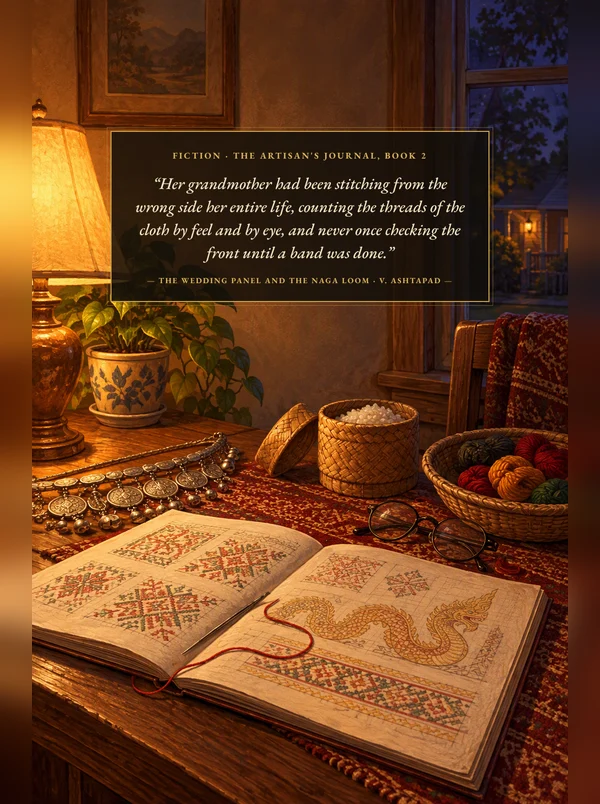
Mey Saechao is twenty-six, a screen printer on Stockton Boulevard, and has watched her Iu Mien grandmother embroider every day of her life without once seeing how it was done. Now her sister Kouei is marrying Anou, the Lao boy from across the turnaround, and the wedding pants Grandma Kae began fourteen years ago have one leg finished and one leg not. Grandma's eyes are failing. The wedding is in April.
So Mey learns to stitch from the back of the cloth, counting threads by eye, and across the street Mae Thao Khamsy draws her into the slow work of a silk sinh with a naga border. Through a winter storm, a lost pattern, two cataract surgeries, New Year in red yarn and a water festival on a quiet Sacramento street, Mey fills a journal with stitch names, pattern names, and the history two grandmothers carried out of Laos. It is a story about two crafts, two families and one street.
Members can react to this book and talk about it in the members' Library.