
The Artisan's Journal
Book 4: The Toquilla Hat and the Tailor's Edge
by V. Ashtapad
Foreword
This is a work of fiction. The toquilla straw hats of Montecristi and Pile in Manabí, Ecuador, are real, and so is the patience they take. The weavers, the families, the tailor shop and the hat in this book are invented.
For every hat that has a mistake in it somewhere, so you know a person made it.
The Order
*Journal. Tuesday, January 13. Corona, Queens. 11:40 p.m.*
*Tía Rosa says a journal is for people who don't trust their hands. I said I don't. She said good, then write.*
---
The order came in on a Monday, on a piece of paper folded into quarters, in an old man's handwriting, and it was the first time in eleven years of running a tailor shop on Roosevelt Avenue that I had been asked to make something I could not make.
The old man brought it in himself. He came in at four in the afternoon, when the 7 train was thundering on the elevated tracks over the avenue every three minutes and shaking the dust down off the top of my steam press, and the light through the front window was going orange and gray, and the sidewalk outside was full of people coming home from work with their shopping bags and their phones and their children. He stood in the doorway in a long camel-hair coat that I had altered for him in 2019, and a gray felt hat with a narrow brim, and a cane, and waited until I looked up from the sleeve I was setting.
"Señor Mendoza," he said.
"Don Aurelio."
He was ninety-one. He had been a doorman on Park Avenue for forty-four years, at a building between Seventieth and Seventy-first with a green awning, and he had come to me to have his uniforms taken in and let out, his whole working life, first to my father and then to me. He had been born in Manta, on the coast of Ecuador, in 1935, and had come to New York on a freighter in 1955 with a cardboard suitcase and a straw hat, and he had never once, in the seventy years since, let anyone see him with a single button undone.
He did not sit. He took the folded paper out of the inside pocket of his camel-hair coat and laid it on my cutting table, beside the pattern pieces, and smoothed it flat with his long thin fingers.
"I want a hat," he said.
---
I am a tailor. My father was a tailor. His father was a tailor in Cuenca, in the mountains of Ecuador, who made suits for bankers and priests and once, the family says, a president. I can make you a jacket that fits like your own skin. I can turn a collar, rebuild a lapel, re-cut a pair of trousers so well that you will forget you ever gained the weight. I can make a hat, if you want one: a felt one, blocked on a wooden form and steamed and brushed. I have done it maybe twenty times.
That was not the hat he wanted.
I read the paper. It was a list, in his careful old-fashioned Spanish, in blue ink.
*Sombrero de paja toquilla. Montecristi. Superfino. Natural color. Brim 3 inches. Crown 4½ inches, center dent. Band: black grosgrain. For the 22nd of August. Our seventieth anniversary. I will pay whatever it costs.*
Under it, a number. A dollar amount. It was more than I make in two months.
I looked up at him.
"Don Aurelio," I said. "I don't make straw."
"I know," said Don Aurelio. "Your aunt does."
---
My aunt Rosa is seventy-six. She is my father's older sister. She lives in a two-bedroom apartment on the fourth floor of a brick building on Forty-Second Avenue in Corona, four blocks from my shop, with a window that looks out over a parking lot and a laundromat and a dentist's office with a sign in Spanish and Chinese and Bengali, and in the second bedroom, which is the size of a closet, there is a wooden post.
It is a stump of wood, round, about the height of a kitchen chair, with a smooth wooden form on top of it shaped like the crown of a hat, and in front of it there is a low stool with a cushion that has been sat on so long it is flat as a tortilla. In the window above it there is a humidifier that hums all day and all night, because the straw, Tía Rosa says, is a creature of the coast, and it hates New York.
She came to Queens in 1988 from Montecristi, a small hot town on a hill in the province of Manabí, on the coast of Ecuador, where the women have woven hats of toquilla straw for three hundred years. The finest hats in the world. The ones the whole world calls Panama hats, because they were shipped through Panama in the gold rush and worn by the men who dug the canal, which is a lie, my aunt says, that the people of Montecristi have been forced to live with for a hundred and fifty years, like a bad husband.
She wove for thirty years in that closet in Queens. For a hat shop in Manhattan, and then for a man in Miami who sold them to collectors, and then for nobody, for herself, a hat a year, which she gave away. I grew up watching her. At night, when my parents worked late, I sat on the floor of that closet with my homework and watched her bent over the post with her chest pressed against it, her fingers moving in the straw so fast I could not see them, under a lamp, with the humidifier humming, and the 7 train going by outside, and a pasillo playing on the little radio on the windowsill, very quietly, a man's voice singing about love and the sea and coming home.
She stopped weaving four years ago. Her hands.
---
"She says she can't," I said.
I had gone to her apartment that night, after I closed the shop, with the folded paper in my pocket. She was in the kitchen in her housecoat making a pot of chicken soup with corn on the cob and yuca and a handful of cilantro, which is what she has made every Monday of my life. She read the paper standing at the stove, with her glasses on the end of her nose, and her face did not change at all.
Then she held up her hands.
They are small hands, brown, very strong, and the knuckles of every finger are swollen into knots, like the knots on a branch. The thumbs turn out. The little fingers bend in. She can hold a spoon. She can stir soup. She cannot close her fist all the way.
"Superfino," she said. "Twenty rows to the inch. Thirty. Eight months, if you work every day. Every morning before the sun. Every night after it goes down. In Montecristi, the best weaver in the town works eight months on a superfino and makes two in a year." She put the paper down on the counter by the stove. "With these, I would make one row a week. He would be dead before I reached the brim."
"So we tell him no."
My aunt did not answer for a long time. She stirred the soup.
"His wife," she said finally, "is Carmen Delgado. From Montecristi. From Pile. The village on the hill. Her mother was a weaver. Her grandmother. She was a weaver herself, before she came here, before she married him, when she was sixteen." She put down the spoon. "He bought her a hat from Montecristi on their wedding day. In 1956. A superfino. The only thing he could afford was the hat. He wore it to the church on Fourteenth Street. She kept it seventy years. It fell apart last summer. In the heat. Like a leaf."
She looked at me over her glasses.
"He wants to give her a new one," said Tía Rosa. "On the seventieth. Before."
"Before what?"
My aunt did not answer that.
"So no," she said. "We don't tell him no. You go."
"Go where?"
"To Montecristi," said my aunt. "To the women. To learn."
---
*Journal. January 13, continued. Midnight.*
*I said I'm a tailor. I said I have a shop. I said I'm thirty-four years old and I've never woven anything in my life. I said I don't speak the coastal Spanish, I speak Queens Spanish and my father's mountain Spanish. I said it would take years.*
*She said: You have hands. You have a needle. You've been sewing since you were seven. You know what a stitch is. A weave is just a stitch with no needle.*
*She said: The women in Pile will teach you if you shut up and sit still.*
*She said: Carmen Delgado's cousin's daughter runs the workshop. I called her already.*
*I said: When did you call her?*
*She said: Before you came. I knew you'd say yes.*
© 2026 CRUNOD LLC. All rights reserved.
Montecristi
*Journal. Saturday, February 7. Montecristi, Manabí. 5:10 a.m.*
*It's still dark. The roosters started at 3:30. There is a rooster on the roof of the house next door, I'm sure of it. He has opinions.*
---
I flew into Manta on the first of February with one suitcase, a sewing kit, my aunt's old stool cushion flat as a tortilla in a plastic bag, and a letter from my aunt in her slanting hand, sealed, addressed to *Doña Mariela Pincay, Pile*, which I was not to open.
Manta is a port city on the Pacific, big and hot and loud, full of tuna. The smell of it comes into the airplane before the doors open: fish and diesel and salt and the sea. My aunt's cousin's son, a man named Kléber who drove a taxi, met me at the airport in a white sedan with a cracked windshield and a pasillo on the radio, and drove me east into the hills, forty minutes, on a road that climbed out of the flat coastal scrub of cactus and ceibo trees, fat and gray and bottle-shaped, with their branches like the arms of old men, into a dry brown country of steep small hills.
Montecristi is on one of them. A small town, white and yellow and blue, on the slope of a hill called Cerro de Hojas, with a church at the top and a square with palm trees and a statue of a general and a long street going down from the square that is lined, on both sides, every door, with hat shops.
Hats. Hundreds of them. Thousands. Hanging in the doorways in stacks like pancakes, on hooks on the walls, on wooden heads in the windows, on racks on the sidewalk. Pale gold and white and cream and the color of honey, wide-brimmed and narrow-brimmed, with black bands and brown bands and no bands, every style there is: the fedora, the optimo with the long ridge down the crown, the planter, the gambler, the boater, the little round ones for women with a flower pinned at the side. Old men sat in the doorways in plastic chairs, fanning themselves with the hats. Women stood in the shops with hats in their arms. Tourists walked down the street, mostly Americans, mostly old, trying them on in front of mirrors propped against the walls, laughing.
Most of them were not superfino. Most of them, Kléber said, were woven in a week, by girls in villages who are paid by the hat, very little, and sold here for forty dollars, eighty, a hundred. Good hats. Honest hats. You could wear one for ten years.
"But not the ones you want," said Kléber. "The ones you want, nobody puts in a doorway."
---
The workshop was not in Montecristi. It was in Pile.
Pile is a village twenty minutes from Montecristi, on a dirt road through the hills, up and down, through dry forest and cornfields and small farms with pigs under the trees. It is one long street of wooden houses on stilts, painted blue and green and pink and peeling, with tin roofs and porches, and under every house, in the shade between the stilts, there is a hammock and a woman and a post.
That was the first thing I saw when Kléber's taxi came over the last hill. A woman under a house, in the shade, bent over a wooden post exactly like my aunt's, with her chest pressed against it, weaving. And then another. And another, under the next house. And the next. All down the street. A village of women bent over posts in the shade, their hands moving in the pale straw so fast you could not see their fingers, in total silence, in the heat.
Kléber stopped the car. I sat in the back seat and did not get out.
"Ya," said Kléber, gently. "This is it."
---
Doña Mariela Pincay was fifty-eight. She was short and broad and very dark from the sun, with gray hair pulled back so tight it looked painted on, and gold teeth, two of them, at the front, and she read my aunt's letter standing on the porch of the house at the end of the street, the green one, in total silence, for a long time.
Then she folded it and put it in the pocket of her apron and looked at me.
She looked at my shoes, which were city shoes. She looked at my hands. She took my right hand in hers without asking, and turned it over, and looked at the calluses on the side of my middle finger and the pad of my thumb, where a needle and a thimble have rubbed for twenty-seven years. She ran her thumb across them. Her hand was rough and dry as bark.
"Tailor," she said.
"Yes."
"Rosa says you're good."
"I'm good at suits."
"This isn't a suit." She let go of my hand. "Rosa says you talk too much and you're impatient and you think you know things."
"That's probably true."
"She says you'll learn anyway," said Doña Mariela, "because you're stubborn, like your grandfather." She turned around. "Come. You start with the straw."
© 2026 CRUNOD LLC. All rights reserved.
The Straw
*Journal. Tuesday, February 10. Pile. 9:00 p.m.*
*Three days. I haven't touched a post. I haven't touched a strand. I've spent three days boiling plants.*
*My hands smell like a swamp. My clothes smell like a swamp. Doña Mariela's grandson told me I smell like a swamp. He's six.*
---
Before you can weave a hat, you have to make the straw. And before you can make the straw, you have to find the plant.
It grows in the hills to the north, in the damp forest where the coast fog comes in, on farms where it has been grown for three hundred years. It is not a palm, though everyone calls it one. It is a plant called *Carludovica palmata* by the botanists and *paja toquilla* by everyone else, with long stems like a palm's and leaves that fan out at the top like the fingers of a hand. You do not use the leaves. You use the shoots. The young ones, the ones that have not yet opened, still folded tight on themselves in a long pale spike as long as your arm.
A man named Don Lucho brought them down from the hills in the back of a pickup on Monday morning, a great tied bundle of them, pale green and fresh, and threw them down under Doña Mariela's house in a heap.
"Split them," said Doña Mariela.
---
You split them with your thumbnail. Every shoot. You pull the folded leaf open, and inside it, the leaf is made of long ribs, like the ribs of a fan, and between the ribs, fine as thread, the fibers. You split the ribs away from the fibers with your thumbnail, down the whole length of the shoot, three feet, and throw the ribs away, and keep the fibers, which are pale green and silky and come away in long ribbons. Then you split those again, finer. And finer. Until each one is the width of the strand you need.
For a superfino, the strand you need is finer than a hair.
Doña Mariela did it with her thumbnail without looking, while she talked to her neighbor on the next porch about the neighbor's daughter's boyfriend, who was apparently worthless. Her thumbnail went down the shoot like a knife through butter. The fibers came away in long perfect ribbons.
Mine shredded. Mine tore halfway down. Mine came away in clumps, or in ribbons so thick they looked like noodles, or broke off in my fingers. By the end of the first day my thumbnail was split down the middle and bleeding and I had a pile of straw so bad that Doña Mariela's six-year-old grandson, Jandry, who had been sitting on the steps watching me all day eating a mango, laughed until he fell off the step.
---
Then you boil it. In a big black pot over a wood fire in the yard behind the house, in water, for an hour, until the green goes out of it and it turns pale and soft. Then you hang it on lines in the shade to dry, like laundry, long pale strands hanging in hanks from wires strung between the stilts under the house, moving in the hot wind, and the whole yard smells of wet straw and woodsmoke. Then, for the finest straw, the whitest, you sulfur it: you put it in a wooden box with a dish of burning sulfur at the bottom and close the lid and let the yellow smoke bleach it for a night. The smell of that is something I will not describe.
Then you split it again. Finer.
"Why so many steps?" I asked Doña Mariela on the third day. My thumb was wrapped in tape. I had given up trying not to smell like a swamp.
She was splitting straw on the porch beside me, her thumbnail going down each strand without looking.
"Because," she said, "the straw has to forget it was a plant." She held up a strand. It was so fine and so pale it was almost invisible, a line of light. "When it's green, it wants to be a leaf. It fights you. It breaks. You have to boil it, and dry it, and bleach it, and split it, and split it, until it forgets. Then it will become what you want." She looked at me. "It's the same with people."
"Which people?"
"Tailors from Queens," said Doña Mariela, "who think they know things."
---
*Journal. February 10, continued.*
*Jandry asked me tonight why I'm here. I told him an old man in New York wants a hat for his wife. He asked why the old man doesn't just buy one in Montecristi. I said because it has to be a superfino and it has to be made by someone who knows him.*
*He thought about that. Then he said: But you don't know how to make it.*
*I said: That's why I'm here.*
*He said: You're going to be here a long time.*
*He's six. He's right.*
© 2026 CRUNOD LLC. All rights reserved.
The Post
*Journal. Monday, February 16. Pile. 4:30 a.m.*
*Today I touch the post.*
---
You weave in the dark. That is the first rule.
Toquilla straw is a creature of the coast. It loves wet air. In the heat of the day, when the sun is up and the wind is dry, it becomes brittle and breaks in your fingers like a dead leaf. So the weavers of Montecristi and Pile weave at night and in the hour before dawn, when the dew is on everything and the air is soft and wet, and at midday they sleep, or cook, or sit in their hammocks, and when the heat goes out of the afternoon they begin again.
So at four thirty in the morning on the sixteenth of February, in the dark, under Doña Mariela's house, with a kerosene lamp hanging from a nail on a stilt and the roosters going and a dog barking somewhere down the street and the hills all around us black against a sky full of stars, I sat down on a stool in front of a post for the first time in my life.
It was not my aunt's stool. It was a new one, low, of rough wood, and I put my aunt's old cushion on it, flat as a tortilla, from the plastic bag. Doña Mariela saw it and said nothing.
The post was a stump of hard wood, the height of a kitchen chair, sunk in the dirt. On top of it, the form: a smooth round block of wood shaped like the crown of a hat, worn dark and shiny by hands. You sit in front of it on the low stool, and you lean forward, and you press your chest against the form, against the top of the post, so that the weight of your body holds the straw in place while your hands work. You stay like that. Bent over. For hours.
"Like this," said Doña Mariela, and leaned over her own post beside mine, and pressed her chest to it, and her hands began to move.
---
It starts at the center. The very top of the crown. It is called the *inicio*, the beginning, or sometimes the *plantilla*, and it is the hardest part of the whole hat, the part that most weavers are not allowed to do, the part that is done, in most families, only by the grandmother or the best weaver in the house.
You take sixteen strands. Or twenty-four. Or, for a superfino, more. You lay them crossed in the center, like the spokes of a wheel, and you begin to weave them together, over and under, over and under, in a tiny star, a rosette, no bigger than a coin, and as you weave you add more strands, splicing them in, and the rosette grows, slowly, in a spiral, round and round, outward from the center, every row a little bigger than the last, the strands crossing and recrossing so tight and so fine that you cannot see the gaps between them.
That was what Doña Mariela did, in the dark, under the lamp, in front of me. Her fingers moved so fast I could not follow them. Over, under, over, under. Splice in a new strand. Pull it tight. Over, under. The rosette grew under her hands like a flower opening. In twenty minutes it was the size of a cookie.
Then she stopped and gave me sixteen strands.
"Now you," she said.
---
I could not do it. Of course I could not do it.
The strands slipped out from under my fingers. They crossed in the wrong places. They broke. When I tried to splice in a new one, the old one pulled loose. When I tried to pull them tight, the whole rosette collapsed into a tangle of straw like a bird's nest that a cat had sat on. My back hurt from leaning over the post. My chest hurt from pressing against the form. My eyes hurt from staring at strands finer than a hair in the light of a kerosene lamp.
I tried for two hours. When the sun came up over the hills and the light went gray and then gold and the straw began to dry in the warming air and crackle under my fingers, I had a tangle the size of a coin, lopsided, with three broken strands sticking out of it like whiskers.
Doña Mariela looked at it.
She did not laugh. That was the worst part. She looked at it for a long time, very seriously, holding it on her palm in the dawn light.
"You're pulling," she said.
"I'm trying to make it tight."
"You don't make it tight. It becomes tight." She put the tangle down. "You're a tailor. When you sew, you pull the thread. Through the cloth. You pull. You make the stitch." She shook her head. "Straw is not thread. You don't pull it. You lay it down. You let it go where it wants to go. You guide it. And then the next one holds it there. And the next one holds that one." She picked up a strand. "Every strand holds every other strand. That's what makes it tight. Not your hands. The hat holds itself together."
I looked at the tangle.
"How long did it take you?" I said. "To learn the inicio?"
Doña Mariela thought about it.
"My grandmother started me when I was five," she said. "I made my first good inicio when I was twelve."
"Seven years."
"Seven years." She stood up and stretched her back, in the gold light, under the house. "You have six months."
© 2026 CRUNOD LLC. All rights reserved.
Carmen's Village
*Journal. Sunday, March 1. Pile. 7:00 p.m.*
*Two weeks of mornings at the post. Fourteen inicios. Every one a bird's nest. Jandry has started keeping them in a shoebox. He says he's going to sell them to tourists as "nests of the toquilla bird." He's six. He has a business plan.*
---
On Sundays nobody weaves. On Sundays in Pile the women sit on their porches in clean dresses and the men play volleyball on a dirt court at the end of the street with a net made of fishing line, very seriously, for money, and everybody eats.
I ate, that first Sunday in March, at the house of Doña Mariela's mother, Doña Fátima, who was eighty-one, and who was, it turned out, the cousin of Carmen Delgado.
"Carmen," said Doña Fátima, and her old face lit up. "Carmen Delgado. *La flaca*. The skinny one." She laughed. "She was the best weaver in Pile. Better than me. Better than anyone. At fifteen she did an inicio so fine you couldn't see the rows without a glass." She shook her head. "Then she met that boy from Manta. The doorman."
"Don Aurelio."
"He wasn't a doorman then. He was a fisherman's son with a straw hat and a cardboard suitcase." She laughed again. "He came to Pile to buy a hat, in 1955. To take to New York. He was going to New York on a ship. And he walked up this street, looking at the women under the houses, and he stopped at Carmen's house, and he looked at her, bent over the post, and he didn't buy a hat. He stood there for three hours watching her weave."
I put down my spoon.
"Then he went to New York," said Doña Fátima. "And he wrote to her. Every week. For a year. And she wrote back. Every week. And in 1956 he sent her the money for the ship." She looked at me. "And she went. At sixteen. To New York. To marry a doorman. And she never wove again."
"Why not?"
The old woman was quiet for a long time.
"I don't know," she said. "She never said. In her letters. Every Christmas, for seventy years, she writes. She never says." Doña Fátima shook her head. "But I think maybe she couldn't. I think maybe in New York, in the cold, in the dry air, the straw broke in her hands. And she thought: this belongs to Pile. Not to me anymore." She picked up her own spoon. "And she didn't want to remember. So she stopped."
---
We ate viche. It is the soup of Manabí, the soup of every Sunday on the coast, and I had never had it, because my aunt in Queens could never get the ingredients right: a thick golden soup of ground peanuts and green plantain and corn and yuca and squash and, floating in it, pieces of fish and shrimp and crab, all of it cooked together for hours in a clay pot over a wood fire until the peanut makes everything creamy and the plantain makes everything thick. You eat it with lime squeezed over it and a spoonful of chopped onion and cilantro and hot pepper. It is like being hugged by a grandmother you have never met.
After the soup, Doña Fátima brought out a box.
It was a cardboard box from a shoe store, very old, held together with tape. Inside, wrapped in a white cloth, was a hat.
It was not finished. It was only the crown. A round dome of pale gold straw, perfect, so fine and so tight that it looked like a single piece of cloth, like silk, with a sheen on it like the inside of a shell. At the top, at the center, the inicio, a tiny rosette, so fine that I had to bend close and squint to see the rows.
The weaving stopped halfway down the crown. The strands hung loose there in a long pale fringe, like hair.
"Carmen's," said Doña Fátima. "The last one. She was weaving it when the letter came with the money for the ship. She left it on the post. Her mother kept it. Then I kept it." She held it out to me. "Seventy years."
I took it in my hands. It weighed nothing. It weighed nothing at all.
"Rosa's letter said you'd come," said Doña Fátima. "For Carmen's hat. So I thought you should see." She looked at me with her old bright eyes. "That's what you're making. Not a hat. That one. The one she didn't finish."
© 2026 CRUNOD LLC. All rights reserved.
The Buyer
*Journal. Wednesday, March 11. Montecristi. 2:00 p.m.*
*Writing this on the steps of the church at the top of the town, in the only shade on the square. Doña Mariela is inside the buyer's shop, still arguing. She told me to go away. She said I have a face that costs money.*
---
Once a week, on Wednesdays, the hats of Pile go to market.
They went that week in the back of Kléber's taxi, nineteen of them, in a stack inside a feed sack, and Doña Mariela sat in the front seat with the sack on her lap and both arms around it, and I sat in the back with Jandry, who had been promised an ice cream if he did not speak, and who spoke the whole way.
They were not finished hats. That surprised me. I had thought that the women of Pile wove a hat and sold a hat, the way I make a suit and sell a suit. But what they sold on Wednesdays was what they called a *hat body*: the crown and the brim, woven, with the loose ends of the straw still hanging all around the edge of the brim in a long pale fringe, like a skirt that has not been hemmed. Unwashed. Unbleached. Unshaped. Floppy as a dish towel. The rest, the edge and the washing and the beating and the blocking and the band, was done in Montecristi, in workshops behind the shops on the long street, by other hands. Mostly men's.
"So the women do the work," I said, "and the men finish it."
"The women do the work," said Doña Mariela, from the front seat, without turning around, "and the men do the selling. The finishing is only the excuse."
---
The buyer's name was Don Wilson Anchundia, and his shop was the biggest on the long street, with hats stacked in the doorway to the ceiling and a hand-painted sign that said EXPORTACIÓN in red letters, and behind it a long room with a concrete floor and a ceiling fan, where he sat at a wooden table under a fluorescent tube with a brass glass exactly like Doña Mariela's, and a ledger, and a cash box.
He was a big soft man of sixty with a mustache and gold rings on three fingers, and he greeted Doña Mariela with great warmth, as if she were his favorite sister, and she greeted him as if he were a dog that had once bitten her.
She put the sack on the table. She took out the hat bodies one at a time and laid them in front of him.
He graded them. He picked up each one, and held it up to the fluorescent light to look through the weave, and put his brass glass to it, and counted the rows, his lips moving, and ran his thumb across it, and turned it over, and said a number, and Doña Mariela said a different number, and they looked at each other.
I stood against the wall with Jandry and watched for an hour.
I understand prices. I have run a shop on Roosevelt Avenue for eleven years. I know what a yard of good wool costs and what a man will pay for a hem and what the landlord will do if the rent is late. And I stood there and did the arithmetic in my head and felt sick.
The hat bodies from Pile, good ones, eleven and twelve rows to the inch, were bought by Don Wilson for twenty dollars. Twenty-five. One of them, finer, a fino, from Doña Mariela's neighbor, for sixty. Each one had taken a woman ten days, two weeks, three, at the post every morning in the dark and every night under the lamp. In the doorways out on the long street, finished and blocked and banded, the same hats were forty, eighty, a hundred and twenty. In the shop in Manhattan where my aunt used to sell, I knew, they would be three hundred, four hundred.
Don Wilson saw my face. He was not a fool.
"The finishing costs money, señor," he said, in a soft voice, in English, to me, while Doña Mariela was counting the bills. "The washing, the bleaching, the blocking. The bands. The shipping. The taxes. The shop in Manhattan has rent on Madison Avenue." He spread his ringed hands. "I'm not the one getting rich."
"Who is?"
He thought about it, honestly, I will give him that.
"Nobody here," he said.
---
When the money was counted, Doña Mariela put it in her apron pocket and did something I did not expect. She took a twentieth hat out of the bottom of the sack, wrapped in a cloth.
It was a crown only. Half a crown. Superfine, the straw like light, the rows so tight that when Don Wilson put his brass glass to it, he did not say a number for a long time.
"Twenty-six," he said at last, very quietly.
"Twenty-eight," said Doña Mariela. "At the center."
He looked again. He did not argue. He put the glass down and looked at her with an expression I had not seen on him all morning, an expression of something like respect, or fear.
"How much?" he said.
"It's not for sale," said Doña Mariela. "I wanted you to see it. So you'll know what I can do when I'm not making your twenty-dollar hats." She wrapped it back in its cloth. "When it's done, a collector in Quito will buy it. Not you. I'll sell it myself. Yadira is learning the computer."
She put it in the sack, and put the sack over her shoulder, and walked out of his shop into the white heat of the long street, and I followed her, and Jandry followed me, and behind us Don Wilson Anchundia sat at his table under the fluorescent light with his brass glass in his hand and did not get up.
---
*Journal. March 11, continued. 9:30 p.m. Pile.*
*In the taxi going home I asked her why she sells to him at all.*
*She said: Because I have four grandchildren and a roof that leaks and Don Wilson pays on Wednesdays, in cash, every week, rain or sun, even when the hats are bad. Because the collector in Quito buys one hat a year. You can't eat one hat a year.*
*She said: In my mother's time there were three hundred women weaving in Pile. Now there are ninety. The girls go to Manta, to the tuna canneries. They pay by the hour there. You can count it. You don't go blind.*
*She said: I don't blame them.*
*Then she was quiet for a long time, with the sack on her lap, and then she said: But somebody has to make the twenty-eight. Or one day nobody will remember how.*
*Jandry got his ice cream. Coconut. He talked the whole way home about how he's going to be a buyer when he grows up. Doña Mariela said if he does, she'll sell her hats to someone else.*
© 2026 CRUNOD LLC. All rights reserved.
The Hours
*Journal. Thursday, March 19. Pile. 4:15 a.m.*
*Inicio number thirty-one. Jandry says it doesn't look like a nest anymore. He says it looks like a nest a bird made on purpose.*
---
I learned in the hours.
Four in the morning until seven, when the sun came over the hills and the straw began to crackle. Then breakfast, which was coffee so sweet it was almost syrup, and bolón, a ball of green plantain mashed with cheese and fried until it was crisp outside and soft inside, the size of a baseball, which you eat with your fingers on the porch. Then sleep, or try to, in a hammock under the house, in the heat, with the flies and the roosters and Jandry. Then lunch: rice and beans and fried fish and patacones, green plantain smashed flat and fried twice, salted, with lime. Then the long hot afternoon, when nobody moved, when the whole village lay in its hammocks under its houses in the shade and the only sound was the hot wind in the dry trees and somebody's radio playing a pasillo, very quietly, a man's voice singing about love and the sea and coming home.
Then at five, when the heat went out of the day, back to the post. Until ten. Eleven. Midnight. Under the kerosene lamp. With the moths circling it and the bats coming out from under the tin roofs and the frogs starting up in the ditches all down the street like a thousand tiny bells.
Eight hours a day. Bent over the post with my chest pressed against the form and my back on fire and my eyes going.
My hands learned before I did. That was the strange thing. One morning in the third week of March, at five o'clock, in the dark, my fingers did something they had not done before. They stopped pulling. They laid the strand down, over and under, and let it go, and the next strand came across and held it, and the next held that, and I looked down at the rosette in the lamplight and it was not a nest at all. It was small and round and flat and tight, and when I turned it, the rows went around in a spiral from the center, even, every one.
I did not say anything. I sat and looked at it.
Beside me, at her own post, Doña Mariela had stopped weaving. She leaned over and looked at my inicio for a long time, in the lamplight.
Then she went back to her own work without a word.
But at breakfast, on the porch, with the coffee and the bolón, she put a second bolón on my plate. And Jandry, on the step, put the inicio in his shoebox, at the top, by itself, and wrote on the lid in pencil: NOT A NEST.
---
That afternoon, in the hot hour when nobody moves, Jandry came home from school with the sleeve of his white school shirt torn from the cuff to the elbow.
He had caught it on a nail, he said, climbing a fence he was not supposed to climb to get a mango he was not supposed to take, and he stood at the bottom of the steps holding the sleeve together with his other hand and looking at his grandmother with the face of a boy who knows exactly how much a school shirt costs.
Doña Mariela looked at the sleeve. She looked at the boy. She opened her mouth.
"Give it to me," I said.
I had my kit. I always have my kit. I sat in the hammock with Jandry's shirt across my knees, and threaded a needle with white cotton, and closed the tear the way my father taught me to close a tear in a sleeve when the customer cannot afford a new one: small, flat, close stitches, from the inside, along the line of the weave of the cloth, so that the thread lies down with the threads that are already there and does not fight them. It took twenty minutes. Jandry sat on the step below me the whole time eating the stolen mango and watching my hands with the same face he used for watching his grandmother weave.
When I gave it back to him, he held the sleeve up to the light and turned it, looking for the tear.
"Where is it?" he said.
"Inside. You have to look from the inside."
He turned it inside out and found the seam and ran his thumb along it, the way he had seen the women run their thumbs across a brim.
"It's like a remate," he said.
"It's a darn."
"It's like a remate," he said again, firmly, and put the shirt on, and went off down the street to show someone.
---
By the next evening there were nine pieces of clothing on the porch of Doña Mariela's house.
They had been brought quietly, through the afternoon, while I slept in the hammock, and left on the bench by the door, each one folded, each one with a scrap of paper pinned to it with a name. A man's work trousers with the knee gone. A girl's party dress with the zipper broken. A volleyball jersey. A baby's gown, very old, worn by four generations, yellowed lace, with a split at the shoulder, wrapped in tissue paper as if it might break. A pair of school trousers that needed to come down two inches for a boy who had grown. A shirt that had belonged to someone's husband who had died, with a note that said only, *Can you make it fit my son?*
Doña Mariela stood in the doorway with her arms folded and looked at the pile.
"Word gets around," she said.
"I'm here to learn," I said. "Not to work."
"You're here to learn," said Doña Mariela, "because the whole village is teaching you. For nothing. Every morning. Every night. Fátima feeds you. Lucho brings you straw. Kléber drives you. Pichón lets you lose his money at volleyball." She looked at me. "In Pile, when someone gives you their hands, you give them yours."
So in the hot hours, for the rest of my time in Pile, while the straw was too dry to weave, I sewed.
I sewed in the hammock under the house, and on the porch, and at Doña Fátima's table after the viche, and once, memorably, in the back of Kléber's taxi on the road to Montecristi, which I do not recommend. Knees and zippers and hems. The baby gown, which took me three afternoons, with a needle so fine I had to borrow Doña Mariela's brass glass to see the lace, and which the girl's grandmother cried over and paid me for with two chickens, which I did not know what to do with and gave to Doña Fátima. The dead man's shirt, which I took apart at the seams and cut down and put back together for his son, a quiet boy of fifteen who stood very still on the porch while I pinned it on him, and who wore it to the volleyball the next Sunday, and stood up straighter in it.
They were the only hours of the day when I knew what I was doing.
Doña Mariela said that was good for me too. She said it was good for a man to remember that he is good at something, so that he does not mind so much being bad at everything else.
---
*Journal. March 19, continued. 9:00 p.m.*
*Called Tía Rosa tonight on Doña Mariela's phone. Told her about the inicio. She didn't say anything for a long time. Then she said: Now the hard part.*
*I said: That was the hard part. Everybody says the inicio is the hardest part.*
*She said: The inicio is the hardest part to learn. The rest is the hardest part to do. Every row, for eight months. Every row the same. If one row is wrong, the whole hat is wrong, and you can't take it out, because every strand is holding every other strand.*
*She said: Now you find out if you're a weaver or just a tailor who learned a trick.*
*Then she asked about Doña Fátima, and the viche, and if I was wearing a hat in the sun, which I am not, and said I was an idiot, and hung up.*
© 2026 CRUNOD LLC. All rights reserved.
Don Lucho's Hills
*Journal. Thursday, April 2. Somewhere north of Pile, in a cloud. 6:00 a.m.*
*Doña Mariela says a superfino has to be made from straw you have cut yourself. She says otherwise you don't know where it's been. She said this as if straw were a teenager.*
*Don Lucho picked me up at 3:00 in the pickup. We've been driving for three hours. Everything is wet. I can't see the road. I'm not sure Don Lucho can either.*
---
The plant grows where the coast forgets it is a desert.
All the way up from Pile in the dark, in the cab of Don Lucho's pickup, with its one working headlight and its windshield wiper that went across once every ten seconds whether you needed it or not, the country had been dry: thorn and cactus and the fat gray bottle-trees standing in the headlight like old men caught out of bed. Then the road began to climb, and the air came in through the window cooler, and then wet, and then, as the sky went gray, we drove up into the cloud.
It was not rain. It was the garúa, the coast fog, which comes in off the cold sea every night and climbs the hills and lies on them until noon, so thick and so fine that it does not fall so much as stand in the air, and everything it touches drips. The trees were different here. Tall and green and hung with moss and with ferns growing out of the crooks of their branches, and vines, and orchids, small and white and purple, on the trunks. The road was red mud. The pickup slid. Don Lucho, who was seventy and had one tooth and wore a shirt that had once been yellow, steered with one hand and smoked with the other and did not slow down.
"In the dry country, it dies," he said. "Here, it's happy." He pointed with his cigarette. "Look."
---
The toquilla grew in a hollow below the road, on a farm that had belonged to his family since, he said, the Spanish, which might have been true. It grew in clumps, like enormous ferns, each clump taller than a man, a fountain of long smooth stems coming up out of the wet ground and opening at the top into the great pleated fans of the leaves, green and glossy and dripping, rattling softly against each other in the fog. Hundreds of clumps, in rows that had once been rows and were now only a crowd, going down the hollow into the cloud until they disappeared.
And among the open fans, here and there, rising straight up out of the heart of each clump, the shoots. The *cogollos*. The young leaves not yet opened, folded tight on themselves into long pale spears.
"You want the ones that are ready," said Don Lucho. "Not too young. Not too old." He waded into the first clump up to his chest, in his rubber boots, and took hold of a spear, and looked at it, and let it go. Took hold of another. Let it go. "Too young, the straw is weak. Too old, it's started to open, it's tough, it's green inside, it won't bleach." He took hold of a third. He ran his hand up it from the bottom to the tip, slowly, the way you would run your hand down the neck of a horse, feeling. "This one."
He cut it with a single stroke of his machete, low, at the base, and handed it to me.
It was as long as I was tall, and cool and heavy and wet, and when I held it to my face it smelled green, like cut grass and cucumber and something sweet underneath, like the inside of a melon.
"Now you," said Don Lucho.
---
It took me an hour to understand what he was feeling for.
I waded into the clumps behind him with a borrowed machete, in borrowed boots, soaked to the waist in five minutes, with the fog in my hair and the leaves slapping my face, and took hold of the shoots one after another and ran my hand up them the way he did and felt nothing. A shoot was a shoot. Smooth, pale, cool. I cut one. He looked at it and shook his head. Too young. I cut another. He looked at it and laughed. Too old: when he split the end with his thumbnail it was green inside, and tough, and he threw it away into the hollow without a word.
Then, in the second hour, my hand found it.
I had a shoot in my hand and I was running my palm up it, from the base toward the tip, and halfway up I felt it: a change. A place where the spear under my palm was not quite smooth anymore, where the folds inside it were beginning, just barely, to loosen and want to open, a faint give, like the give in good wool when the nap is right. Below that place the shoot was tight. Above it, at the tip, it was already a leaf.
I stopped. I went back down and ran my hand up again. It was there.
"There," said Don Lucho, beside me, very quietly. He had been watching. "That one. The ones where you feel the leaf waking up, but it isn't awake yet." He nodded. "Cut it."
I cut it. He split the end with his thumbnail. It was white inside. White as paper.
He grunted, and lit another cigarette, and handed me the next one.
---
We cut until noon, when the fog began to burn off the hills and the hollow filled with a hot green light and the leaves began to steam. Two hundred shoots. Don Lucho cut a hundred and sixty. I cut forty, of which he threw away eleven.
"Twenty-nine," he said, counting mine, with satisfaction, as if he had made them himself. "For a beginner from New York, twenty-nine is very good." He tied them in a bundle with a strip of bark, separately from his, and put my bundle on top in the back of the pickup. "These go in the crown. Mariela said. Your straw, your crown."
We ate on the tailgate. He had brought a bag of corn cakes wrapped in leaves, sweet and soft and still faintly warm from his wife's oven, and a thermos of coffee, and two hard-boiled eggs, which he peeled with his thumbnail in one long spiral each, without looking, the way Doña Mariela split straw.
"My grandmother used to say," said Don Lucho, chewing, looking down at the hollow full of toquilla and steam, "that this plant was the only thing on the coast that knew how to give without being cut to death. You take the shoot, it sends up another. Every year. Forever. If you're careful. If you take the right ones." He drank his coffee. "The cattle men came up here in the seventies and burned the hills for grass. The cows ate everything. Now it's dry where it was wet. Now the fog doesn't stay." He pointed with his chin across the valley, where the next hill stood brown and bare in the sun above the cloud line. "My father's brother had toquilla there. All that hill. Now there are eleven cows."
He finished the corn cake and wiped his hands on his shirt that had once been yellow.
"Every hat," he said, "starts here. Tell them that in New York. They think it starts in Panama."
---
*Journal. April 2, continued. 10:00 p.m. Pile.*
*My hands are cut in nine places from the leaf edges. Doña Mariela put something on them from a jar that smelled of camphor and was not sympathetic.*
*My twenty-nine shoots are under her house in a separate pile, tied with bark. Jandry has put a sign on them, on a piece of cardboard, in pencil: DO NOT TOUCH. THE TAILOR'S.*
*Tomorrow I split them. My own straw. Then boil, then dry, then sulfur, then split, then split.*
*Doña Mariela said tonight, while she was putting the camphor on: Now you know what you're holding. When you sit at the post, you won't be holding straw. You'll be holding a morning in Lucho's hills, and his grandmother, and the cows.*
*She said: Everything you make with your hands, you're holding where it came from. Tailors too. Your wool was a sheep somewhere.*
*I said I'd never thought of that.*
*She said: I know. That's why your suits are only good.*
© 2026 CRUNOD LLC. All rights reserved.
Rows
*Journal. Sunday, April 12. Pile.*
*Weaving the crown. A real one. For Don Aurelio. Doña Mariela says I can start. She says I can't finish it. She says nobody finishes a superfino in their first year. She says I'll weave the crown and she and two of the women will do the rest. She says it's normal. The best hats in Pile are woven by more than one woman. The inicio by the grandmother, the crown by the mother, the brim by the daughter.*
*She says: A hat is a family.*
---
I wove the crown.
It took eleven weeks. Eleven weeks of mornings and nights at the post, under the kerosene lamp, with the roosters and the frogs and the pasillos on the radio, bent over with my chest pressed against the form, laying down the strands, over and under, round and round, spiraling out from the inicio at the center, every row a little bigger than the last, splicing in new strands as the circle grew, keeping them all the same tension, the same fineness, the same perfect evenness. Every row. For eleven weeks.
Doña Mariela checked them every morning. She had a small round magnifying glass on a cord around her neck, brass, scratched, which had been her grandmother's, and every morning at seven when the light came she leaned over my post and put the glass to the crown and counted.
You count the rows to the inch. That's how you grade a hat. A cheap hat, a good honest hat from a doorway on the main street of Montecristi, has eight rows to the inch, or ten. A fino, twelve to fifteen. A superfino, eighteen. Twenty. Twenty-five. The finest hats in the world, the ones that go to the collectors and the museums, the ones that take a woman nine months and sell for twenty thousand dollars, can have thirty rows to the inch, or more, so fine that it looks like cloth, like silk, so fine that you can roll it up, the old story goes, and pull it through a wedding ring.
Doña Mariela counted my rows every morning.
"Sixteen," she said, in April. "Too loose."
"Eighteen," in May. "Better. Uneven here. See?" With her thumbnail. "Here you were tired."
"Twenty," in June. And then she said nothing at all, and put the brass glass back on its cord around her neck, and went to make the coffee.
---
*Journal. Sunday, May 17. Pile. 8:00 p.m.*
*Volleyball today. They let me play. I was on the team with Kléber and two of Doña Mariela's nephews and a man called Pichón who weighs at least three hundred pounds and can jump higher than any of us. We lost eleven dollars. Kléber says it was my fault. It was my fault.*
*After, on the porch, Yadira asked me about New York.*
*She's nineteen. She weaves faster than anyone in the village except her great-aunt, and she's going to the university in Portoviejo in September to study business, which Doña Mariela pretends to disapprove of and boasts about to everyone on the street. She wanted to know how much a hat sells for on Madison Avenue. I told her. She went very quiet.*
*Then she asked if the people who buy them know who made them.*
*I said no. I said there's a label inside that says Montecristi, and sometimes Genuine Panama, and that's all.*
*She said: So the hat goes to New York and the name stays here.*
*She's going to make a label. She showed me on her phone. A small square of cotton, to go under the sweatband, with the weaver's name on it and the village and the number of rows and the months it took. Embroidered. She asked me if I could make them. On my machine. In Queens. If she sends me the names.*
*I said yes before she finished asking.*
*Doña Mariela, at her post, without looking up: Now he'll never leave.*
---
There is a thing that happens when you do one thing for eight hours a day for weeks. Your mind goes quiet.
I had not known that. I had been a tailor for twenty-seven years and I had never known that. A tailor's mind is always busy: measuring, calculating, planning the next seam, worrying about the customer, the deadline, the rent on Roosevelt Avenue, the price of wool. But at the post, in the dark, with the straw in my fingers and nothing else, over and under, over and under, round and round, for hours, my mind went quiet, the way a pond goes quiet when the wind stops.
And into the quiet came things.
My father, at his steam press on Roosevelt Avenue, in 1999, in a cloud of steam, showing me how to fold a lapel. My mother's hands, measuring a hem with a strip of paper because she couldn't afford a tape. My grandfather, whom I never met, in Cuenca, in the mountains, cutting a suit for a president. My aunt, in the closet in Corona, under the lamp, bent over the post with her chest pressed against it, her fingers moving so fast I could not see them, with the humidifier humming and the 7 train going by.
And Carmen Delgado. Whom I had never met. At fifteen. Under a house in Pile in 1955. Bent over a post. With a boy from Manta standing in the street for three hours, watching her hands.
---
*Journal. Wednesday, June 24. Pile. 2:00 a.m.*
*Can't sleep. The crown is done. Twenty rows to the inch at the center, nineteen at the edge, which Doña Mariela says is normal, which Doña Mariela says is good, which Doña Mariela says is—she didn't say. She put the glass back on the cord and went to make coffee.*
*Tomorrow she and Doña Fátima's granddaughter Yadira start the brim. They're faster than me. Much faster. They'll finish in seven weeks. Then the remate, the edge, and the washing, and the beating, and the blocking. Done by the fifteenth of August, if nothing goes wrong.*
*The anniversary is the twenty-second.*
*Something will go wrong.*
© 2026 CRUNOD LLC. All rights reserved.
What Went Wrong
What went wrong was that Don Aurelio fell.
He fell on the twenty-ninth of June, on the steps of the church on Fourteenth Street in Manhattan, the same church where he had married Carmen in 1956, at seven in the morning, where he went every Monday to sit for a while in the quiet. He broke his hip. He was ninety-one.
My aunt called me at four in the morning, Pile time. I was at the post. Doña Mariela's phone rang in her pocket and she looked at it and handed it to me without a word.
"He's in the hospital," said Tía Rosa. "Lenox Hill. They did the surgery yesterday. He's awake." She was quiet. "The doctors say he'll be there for weeks. Then rehabilitation. Then maybe he walks again. Maybe."
I sat at the post in the dark with the phone against my ear. Under my hands, on the form, there was nothing; the crown had gone to Doña Mariela's post for the brim. I had started, the night before, without telling anyone, an inicio of my own. A second one. Small. For practice.
"And Carmen?" I said.
My aunt did not answer for a long time.
"Carmen," she said, "is the reason he wants the hat by the twenty-second."
I waited.
"She doesn't remember, Esteban," said my aunt. "Since last year. Since before the old hat fell apart. She doesn't remember him most days. She doesn't remember New York. She doesn't remember her children. She lives in a place in Jackson Heights now, a good place, with nurses, on the second floor, by a window. Don Aurelio goes every afternoon. He sits with her. Most days she thinks he's a man from the church. Some days she thinks he's her father." My aunt's voice was very steady. "But some days, the doctors say, when the light is a certain way, she talks about the hills. About Pile. About the post. She moves her hands. On the blanket." A pause. "Like this."
I could not see her. I knew exactly what she was doing with her hands.
"He thinks," said Tía Rosa, "that if he puts a Montecristi on her lap, on the twenty-second, on their seventieth, she'll know. Not him. The hat. He thinks her hands will know it." My aunt was quiet. "And then maybe for one minute she'll know him too."
---
I did not sleep that day. I sat at the post until the sun was high and the straw crackled and broke in my fingers and Doña Mariela came and took it away from me and made me lie down in the hammock, where I stared at the bottom of the house for six hours.
That evening, at five, when the heat went out of the day, I went to Doña Mariela on her porch, where she was working on the brim with Yadira, both of them bent over the post together, one on each side, their fingers moving so fast they blurred.
"I need to go home," I said. "Early. Now. I need to be there."
Doña Mariela did not stop weaving. "The hat isn't finished."
"I know."
"The brim will take five more weeks. Then the edge. Then washing, beating, blocking. You can't take it like this. Half a hat."
"I know."
She stopped weaving then. She looked up at me, with her painted-on hair and her two gold teeth and her brass glass on its cord, in the going light, under the house.
"So what do you want?"
I did not know until I said it.
"I want to take the crown home now," I said. "With the brim started. As far as you have it. And I want to finish the brim myself. In Queens. In my aunt's closet. On her post. With the humidifier going. By the twenty-second." I looked at her. "And I want you to teach me the remate. The edge. Before I go. Tonight."
Doña Mariela looked at me for a long time.
"In Queens," she said. "In the dry air. In the cold."
"In August. It's not cold in August. It's a swamp in August."
She almost smiled.
"The remate takes a weaver two years to learn," she said.
"I have two weeks."
"You have six days," said Doña Mariela. "Kléber's going to Manta on Monday."
© 2026 CRUNOD LLC. All rights reserved.
The Edge
*Journal. Thursday, July 2. Pile. 3:00 a.m.*
*The remate. The edge. Where the brim ends and the hat has to stop. You can't just cut it. If you cut it, it unravels. Every strand holding every other strand: you cut one, they all let go.*
*So you weave the ends back into themselves. Every strand, turned back, woven in, over and under, into the rows it came from. Locked. Like a seam. Like a hem. Like—*
*Doña Mariela says: Like a tailor's edge. She says: You'll be good at this.*
*She's lying. She's trying to make me feel better. I'm terrible at it.*
---
I was terrible at it for four days and four nights. On the fifth night, at two in the morning, under the kerosene lamp, with the frogs going in the ditches like a thousand tiny bells and a pasillo on somebody's radio down the street, very quietly, my hands did it.
Not well. Not like Doña Mariela. Not like Yadira, who was nineteen and had been doing it since she was ten and could turn back a whole brim's edge in an afternoon while talking on the phone to her boyfriend. But they did it. They took the loose strands at the end of a practice brim and turned them back and laid them in, over and under, into the rows they came from, and locked them, and the edge held.
Doña Mariela put her brass glass to it.
"Ugly," she said. "But it holds."
That was the best thing anyone has ever said about my work.
---
On the sixth day, the last day, Doña Fátima came to Doña Mariela's house in the afternoon, slowly, with a cane, through the heat, carrying the shoebox from the shoe store held together with tape.
She opened it on the porch. She took out Carmen's hat. The crown with no brim, from 1955, with its long pale fringe of loose strands hanging down like hair.
"Take it," she said.
I stared at her.
"Take it to Carmen," said Doña Fátima. "With the other one. The new one." She put it in my hands. It weighed nothing. "She left it on the post when she went. Unfinished. Her mother couldn't finish it. I couldn't. It's hers." She looked at me. "Maybe she can't finish it either. Maybe her hands don't remember. But she should have it back. It's been waiting seventy years."
---
That night, the last night, was a Sunday, and nobody in Pile wove, which was usual, and nobody stayed on their own porch either, which was not.
I did not know it was for me until it had already started. At six, when the heat went out of the day and I went down the steps to the post the way I had every evening for five months, the post was gone. Somebody had pulled it out of the dirt under Doña Mariela's house and leaned it against a stilt, and in the place where it had stood there was a long table, three tables pushed end to end, with a sheet over them, and on the sheet, pots.
Viche, in Doña Fátima's clay pot, with crab. A tray of fried fish, whole, with their tails crisp. Bolón. Patacones in a mountain. A bowl of rice the size of a tire. A cake that Yadira had made from a recipe on her phone, three layers, pink, leaning slightly to the left like the brim of an old hat. Bottles of orange soda and bottles of something clear that Kléber said was water and was not.
And the women of Pile, coming up the long street in the dusk in their clean Sunday dresses, one family after another, with their husbands and their children and their old people on canes, and each of them carrying something, a plate, a bowl, a bag of mangoes, until the table could not hold it.
Pichón brought a speaker and put it on the porch rail and played pasillos, loud, which was new; I had only ever heard them quietly, on radios, at night. The men played volleyball in the dark by the light of a truck's headlights, very seriously, for money. The children ran under the houses between the stilts and the hammocks shrieking. Jandry ate four pieces of the pink cake and was sick behind the pickup and came back and ate a fifth.
At ten o'clock, Doña Mariela stood up at the end of the table and banged a spoon on a pot until everyone was quiet.
She did not make a speech. She was not a woman for speeches. She only reached into the pocket of her apron and took out something small and put it on the sheet in front of me, beside my plate, and sat down again.
It was a thumbnail.
Not a real one. A false one, of the kind the women of Pile make for the girls when they are learning, so that their own nails will not split down the middle and bleed: a little curved sliver of cow horn, filed thin as paper and sharp along one edge, polished from use until it shone like amber, with a loop of thread through a hole at the end so it would hang from your neck when you were not using it.
"My grandmother's," said Doña Mariela, to the table, not to me. "I learned with it. Yadira learned with it. Now the tailor." She picked up her fork. "He'll need it in Queens. His own nails are terrible."
Everyone laughed. I put the thread over my head. I have not taken it off.
---
*Journal. Sunday, July 5. Pile. 2:00 a.m.*
*Can't sleep. The frogs. The pasillos still going somewhere down the street. Kléber asleep in a hammock with a bottle of water that is not water.*
*Doña Fátima sat with me at the end, when the others had gone. She said Carmen's last Christmas letter, the one before she stopped writing, was only four lines. She said the last line was: Tell me who is weaving now.*
*She said: When you see her, tell her. All of us. Me, Mariela, Yadira. The ninety. And you.*
*I said I'm not a weaver.*
*She said: The tailor is weaving now. Tell her that too.*
---
*Journal. Monday, July 6. Manta airport. 11:00 a.m.*
*In my carry-on, in a hatbox Doña Mariela made out of a cardboard box from the tuna cannery, wrapped in a wet cloth inside a plastic bag so the straw doesn't dry out on the airplane: Don Aurelio's hat. The crown, mine. The first eight rows of the brim, Doña Mariela's and Yadira's. The rest of the brim, still loose, a long fringe of straw, waiting.*
*In my suitcase, in the shoebox held together with tape: Carmen's.*
*Jandry gave me his shoebox at the gate. The thirty-one inicios. All of them. The nests and the not-nests. He said I should keep them so I remember I was bad at first. He said everybody should remember that.*
*He's six.*
© 2026 CRUNOD LLC. All rights reserved.
Lenox Hill
*Journal. Tuesday, July 7. Lenox Hill Hospital, Manhattan. 3:15 p.m.*
*Landed at Kennedy at 11:40 last night. Didn't go to my apartment. Went to Tía Rosa's and put the hatbox in her closet with the humidifier on and slept on her couch with my shoes on.*
*Came here at noon. He's asleep. I'm in the chair by the window, writing. The nurse says he sleeps a lot. She says it's the medicine. She says he asked for me by name this morning and she didn't know who I was.*
---
He woke at four.
He woke the way very old men wake, all at once, with his eyes open before the rest of him knew it, and for a moment he looked at the ceiling of the hospital room and did not know where he was, and I saw that, and was frightened. Then his eyes came down and found me in the chair by the window, and he knew me, and something in his long thin face let go.
"Señor Mendoza," he said.
"Don Aurelio."
He was very small in the bed. That was the first thing. I had known him my whole life as a tall man, a straight man, a man in a camel-hair coat with every button closed, and in the bed, in the hospital gown, with the tubes in his arm and the rail up and the blanket over his knees, he was a pile of sticks. His hair, which he wore combed back with a little oil every day of his life, stood up white on one side. Someone had shaved him badly. There was a nick on his jaw.
He saw me looking.
"The night nurse," he said. "From Haiti. A very nice woman. She shaves like a butcher." He lifted one hand off the blanket, slowly, and touched the nick. "Carmen used to shave me. When I broke my wrist. In 1974. She was very good. Steady hands." He put the hand down. "Weaver's hands."
I took the little kit from my jacket pocket. I carry it everywhere: scissors, a comb, a needle and thread, a tape. A tailor's pocket. I stood up and wet the comb at the sink in the corner, and came back, and combed his hair back, slowly, the way he wore it, from the forehead over the crown. He closed his eyes while I did it. When I had finished he opened them again and looked, with great dignity, at the ceiling.
"Thank you," he said. "Now I am a person."
---
He did not ask about the hat.
I had thought he would. I had come straight from the airport to my aunt's and straight from my aunt's to the hospital with the whole of it ready in my mouth, the crown and the brim and the eight rows and the remate, ugly, that holds, and the twenty-second and how I would do it in time. He did not ask. He asked about the flight. He asked if I had eaten. He asked whether Kléber, the taxi driver, was the son of Fausto Pincay who used to have a boat in Manta with a blue eye painted on the bow. I said I didn't know. He said it didn't matter, he was probably dead, everybody was.
Then he looked at the window for a long time. It looked out over the rooftops of the Upper East Side, the water towers on their stilts and the air conditioners and the hot white July sky, and you could not see the street.
"I did buy a hat," he said. "That year. In 1955."
I waited.
"Doña Fátima will have told you that I didn't," he said. "She tells it that way. Everybody does. *He stood in the road for three hours and didn't buy a hat.*" A ghost of a smile. "It's a better story. But it isn't true. I bought a hat. I had to. I was going to New York. You couldn't go to New York without a hat. My mother would have died." He was quiet. "But not in Pile. I had money for a good hat in Pile, a fino, I had been saving for a year. And I stood in the road and watched a girl weave, and the bus to Manta went at two, and I missed it. I walked to Montecristi. Four hours. In the sun. By the time I got there the good shops were closed. I slept on the steps of the church. And in the morning I bought the cheapest hat in the market, from a boy with a basket, for almost nothing, because the ship was going that afternoon and I had no time. A terrible hat. Eight rows to the inch. Like a basket." He shook his head slowly on the pillow. "I wore it on the ship. All the way to New York. Eleven days. It blew off in the Caribbean, off the stern, and I watched it go. I was glad. I was ashamed of it."
"And the money? For the good one?"
"I sent it back to Pile," said Don Aurelio, "with my first letter. To her. I said, *This was for a hat. I would rather you kept it.*" He looked at me. "She didn't spend it. She kept it in a tin under the post. And a year later, when I sent her the money for the ship, it wasn't enough. I was a doorman's helper. I earned nothing. So she put my hat money with it." He closed his eyes. "She came on the money that was supposed to be my hat."
---
The physical therapist came at five, the young woman from Guyana, and stood at the end of the bed with her hands on her hips and told him that tomorrow he would stand up, whether he liked it or not, and he said he did not like it, and she said she had not asked.
When she had gone he lay with his eyes closed for a while.
"Is it good?" he said, without opening them. "The hat."
So he had been asking after all, the whole time, underneath.
"The crown is mine," I said. "The first part of the brim is Doña Mariela's and Yadira's. Yadira is Fátima's granddaughter. The rest of the brim will be mine. In my aunt's closet. Starting tomorrow." I made myself say the rest. "It won't be a superfino, Don Aurelio. I'm sorry. Doña Mariela says a fino. A good one."
He opened his eyes.
"Señor Mendoza," he said. "I have been a doorman on Park Avenue for forty-four years. I have opened the door for men in hats that cost more than my apartment. I know what a superfino is." He looked at me with his old dark eyes, very steady. "I didn't ask for a superfino because I wanted a superfino. I asked for a superfino because I was afraid that if I asked for less, nobody would go."
He lifted his hand off the blanket and held it out, and I took it. It was light as a bundle of straw and very cold.
"You went," said Don Aurelio. "Make it however it comes out."
---
*Journal. July 7, continued. 11:30 p.m. Corona.*
*Told Tía Rosa about the hat that blew off in the Caribbean. She laughed until she cried and then she cried until she laughed. Then she said she'd known about the money for the ship for forty years and never told me, because it wasn't hers to tell.*
*She has wet towels hanging over the closet door. Four of them. And a bowl of water on the floor under the post. And the humidifier. And the window open. She says the closet is now the wettest room in Queens and the straw will think it's in Pile.*
*The hatbox is open on the stool. The brim fringe is soft. It hasn't dried. She checked it every hour today, she says, with her thumb.*
*4:00 a.m. tomorrow. The first train.*
© 2026 CRUNOD LLC. All rights reserved.
Corona
*Journal. Wednesday, July 8. Corona, Queens. 4:00 a.m.*
*Tía Rosa's closet. Her post. Her stool. My cushion, which is her cushion, flat as a tortilla. The humidifier going. The window open to the swamp of a New York July. The 7 train starting up on the tracks over Roosevelt Avenue, the first one, the 4:00 a.m., like a long breath.*
*I can see the parking lot. The laundromat. The dentist's sign in Spanish and Chinese and Bengali.*
*I started the brim.*
---
I wove the brim of Don Aurelio's hat for five weeks in my aunt's closet in Corona.
I closed the shop. I put a sign in the window on Roosevelt Avenue in English and Spanish: CLOSED UNTIL AUGUST. FAMILY. My customers were furious. Two of them came to my aunt's apartment to complain. My aunt fed them chicken soup with corn on the cob and yuca and told them that if they wanted their trousers hemmed they could do it themselves, it was not brain surgery, and they left, astonished, with full stomachs.
I wove at four in the morning, and at night, after ten, when the city air was as wet as Pile's. In the middle of the day, when it was too dry even with the humidifier, I sat with Don Aurelio at Lenox Hill, and later at the rehabilitation place on the Upper East Side, in the afternoons, while he did his exercises with a young physical therapist from Guyana who called him *Sir* and made him walk between parallel bars with a belt around his waist.
He did not ask about the hat. Not once. He asked about Pile. About the street of houses on stilts. About the women under them. About Doña Fátima. About viche. He closed his eyes when I told him about the viche.
"The peanut," he said. "And the plantain. And the shrimp."
"Doña Fátima's has crab."
"Crab," said Don Aurelio, and opened his eyes, and they were wet. "Carmen's mother made it with crab."
---
My aunt sat with me in the closet some nights. Not weaving. Watching. On the floor, the way I had sat when I was a boy, with my homework, while she wove. She sat on a cushion on the floor with her back against the wall and her swollen hands folded in her lap, and watched me lean over her post with my chest pressed against the form, laying down the strands, over and under, round and round, in the lamplight, with the humidifier humming and the 7 train going by.
She did not say anything for a long time. Then one night, at eleven, she said:
"You hold your shoulders like your grandfather."
I did not know what to say.
"In the photographs," said Tía Rosa. "At his cutting table in Cuenca. He held his shoulders like that. Up. Tight. Like a man carrying something." She was quiet. "Put them down. Breathe. The hat holds itself together."
I put them down.
---
There was one night, in the fourth week, when I could not go on.
It was the brim. It had grown wide by then, a great flat circle of straw spiraling out from the crown across the post and down over my knees, and every row was longer than the last, a little longer, every single time, so that the end kept going away from me like the far side of a field when you are plowing it. I had been at the post since ten. At one in the morning I looked at the edge of the weave and at the long fringe of loose strands still hanging beyond it, and did the arithmetic, and knew I would not reach the edge by the twenty-second. Not at that speed. Not with my eyes going the way they were.
I put my hands in my lap.
My aunt was on the floor against the wall, where she always was. I thought she was asleep.
"Move," she said.
I looked at her.
"Move," said Tía Rosa. "Off the stool."
She got up off the floor. It took her a long time. She put one hand on the wall and one on the doorframe and came up slowly, in stages, with a small sound at each one that she pretended was not a sound, and then she stood over me in her housecoat in the lamplight until I got off the stool, and she sat down on it, on her own old cushion, flat as a tortilla, in front of her own post, for the first time in four years.
She leaned forward. She pressed her chest to the form.
She put her hands on the straw.
They could not close. I knew that. They could not grip a strand between the thumb and the finger the way you have to, tight enough to lay it down and guide it. I watched her try. Her thumb came against the side of her knotted finger and the strand slipped between them, and she tried again, and it slipped, and she made a sound in her throat that I had never heard her make, not at my father's funeral, not ever.
Then she stopped trying to hold it.
She laid her hand flat on the weave instead, palm down, her swollen fingers spread across the rows I had made, the way you lay your hand on a horse to calm it, and she moved it, slowly, across the brim, feeling.
"Here," she said. Her fingertip stopped on a strand. "This one's tired. You're tired here. See? It's thicker. You split it in a hurry." She moved her hand. "And here. You're pulling again. Feel." She took my hand and put it under hers, flat, on the weave, and moved it, and I felt it, a tightness, a place where the straw was fighting. "Don't fight. Lay it down." She moved our hands on. "And here." She stopped. "Here is good. Here you were breathing."
She took her hand away.
"You're going too fast and too slow at the same time," she said. "Too fast with your hands. Too slow with your head. You're thinking about the twenty-second. You're thinking about Carmen. You're thinking about the edge." She shook her head. "The edge is not here yet. The twenty-second is not here yet. Only this row is here." She touched the strand under my fingers. "This one. Only this one. Then the next one."
She got up off the stool, slowly, in her stages, with her small sounds, and went back to her place on the floor against the wall and folded her hands in her lap.
"Now sit," said my aunt. "And weave one row. Not the brim. One row."
I sat. I wove one row.
Then I wove the next.
At four in the morning, when the first train came, I had done more rows than in any night since I came home. I did not count them. She told me not to. She said counting was for buyers.
---
The brim grew. Round and round. Spiraling out from the crown. Every row a little bigger. Every row the same. I did not count them with a glass. I did not have a glass. I counted them with my thumb, the way my aunt showed me, running the pad of it across the weave and feeling the ridges, one, two, three, and they were even. Not as even as Doña Mariela's. Not as fine as Carmen's. But even.
On the twelfth of August, at three in the morning, I reached the edge.
I did the remate in my aunt's closet, turning back every strand, laying it in, over and under, into the rows it came from, locking it. It took two nights. My aunt sat on the floor and watched the whole time and did not say a word. When it was done, she held out her hands, her swollen knotted hands that could not close, and I put the hat in them.
She turned it in the lamplight. She ran the pad of her thumb across the weave, slowly, from the center to the edge, feeling every row.
"Ugly," said Tía Rosa.
I waited.
"But it holds," she said, and her face did something I had not seen it do since my father's funeral.
© 2026 CRUNOD LLC. All rights reserved.
The Twenty-Second
*Journal. Saturday, August 22. Jackson Heights, Queens. 6:00 p.m.*
*I'm writing this on a bench on Thirty-Seventh Avenue outside the place where Carmen lives. I can't go home yet. I don't want to be inside anything.*
---
We washed it on the fourteenth, my aunt and I, in her kitchen sink, in cool water with a little soap, gently, the way the women in Pile wash their hats. We beat it on the fifteenth, with a wooden mallet on a smooth stone on her kitchen table, the *maceteado*, very lightly, all over, to soften the straw and close the weave, while her neighbor downstairs banged on the ceiling with a broom. We blocked it on the sixteenth on a wooden form I borrowed from a hat shop on Thirty-Seventh Avenue, a fedora with a center dent and a three-inch brim, steaming it into shape over a pot of boiling water on the stove, the way my father had taught me to block felt, which, it turned out, my aunt said, is not so different.
I sewed in the band on the seventeenth. Black grosgrain ribbon, an inch and a quarter, with a flat bow on the left side. And a sweatband inside, of soft leather, which I cut and stitched myself, on my own machine, at the shop on Roosevelt Avenue, which I opened for one hour, for that, and closed again.
Under the sweatband, at the back, where a hatmaker puts his label, I stitched a small square of white cotton. Yadira had sent the words from Pile in a message three days before, and I had embroidered them on my machine in blue thread, very small, in the hour the shop was open:
*Crown: E. Mendoza, Pile. Brim: M. Pincay and Yadira, Pile; E. Mendoza, Corona. Edge: E. Mendoza, Corona. Straw: Don Lucho's hills. Four months.*
And under that, at Doña Fátima's instruction, which had come in the same message, one more line:
*For Carmen. From Pile.*
It was not a superfino. Doña Mariela had been honest about that on the phone. Twenty rows at the crown and seventeen at the edge of the brim, where I got tired, where you could see, if you knew, if you ran your thumb across it, where the tailor from Queens had taken over from the weavers of Pile. A fino, she said. A good fino. A hat you could wear for forty years.
She also said, on the phone, before she hung up: *Every hat in Pile has a mistake in it somewhere. That's how you know a person made it.*
---
Don Aurelio walked into the place on Thirty-Seventh Avenue at three o'clock on the twenty-second of August on two canes, slowly, in his camel-hair coat, in August, because he said he would not visit his wife on their seventieth anniversary looking like a bum. The young physical therapist from Guyana walked beside him with her hand on the belt at his waist. My aunt and I walked behind, carrying two boxes.
Carmen was in a chair by the window on the second floor.
She was very small and very thin, *la flaca*, the skinny one, in a pink cardigan with a blanket over her knees, and her hair was white and cut short, and her face was turned to the window, where the afternoon sun was coming in across the rooftops of Jackson Heights and the elevated tracks of the 7 train, gold and slanting and thick with dust.
She did not look at us when we came in. She did not look at Don Aurelio. She was looking at the light.
Don Aurelio stood beside her chair on his two canes for a long time.
Then he said, very quietly, "Carmen."
She did not turn.
He looked at me.
I opened the first box. I took out the hat. Don Aurelio's hat, the new one, with my crown and the women's first eight rows and my brim and my ugly edge that held. I gave it to him, and he held it in his long thin hands, and his hands shook, and he bent down, very slowly, on his two canes, with the physical therapist holding the belt at his waist, and laid it in his wife's lap, on the blanket.
Carmen looked down.
---
She looked at the hat for a long time. She did not touch it. Her face did not change.
Then her hands came up off the arms of the chair.
They were small hands, brown, very thin, the skin like paper, and they came up and hovered over the hat, not touching it, the way you hold your hands over a fire. Then one of them came down, the right one, and the pad of the thumb touched the crown, at the center, at the inicio, and moved, slowly, outward, across the weave, from the center to the edge of the brim, feeling every row.
At the edge of the brim, where I got tired, where the rows went from twenty to seventeen, her thumb stopped.
She looked up. Not at her husband. At me.
"Who did this part?" she said. In the coastal Spanish of Manabí, soft, quick, with the ends of the words swallowed. Her voice was clear.
I could not speak.
"Him," said my aunt, behind me. "Rosa Mendoza's nephew. A tailor. From Queens."
Carmen Delgado looked at me for a long moment with her old dark eyes.
"You pulled," she said.
"Yes," I said. "At the end. I was tired."
"Mm," said Carmen. And she looked down at the hat again, and ran her thumb across the brim one more time, from the center to the edge, and something in her face opened, a little, the way a rosette opens under a weaver's hands.
"It holds," she said.
---
Then I opened the second box.
The shoebox from the shoe store, held together with tape. I took out the white cloth. I unwrapped it. And I laid the other hat, the old one, the crown from 1955, with no brim, with its long pale fringe of loose strands hanging down like hair, in her lap beside the new one.
Carmen looked at it.
Her hands stopped moving.
The room was very quiet. Outside, on the elevated tracks, a 7 train came through toward Manhattan, slowly, and the light through the window flickered across her face as the cars went by, light and shadow and light.
She picked it up. The old crown. In both hands. She turned it over. She looked inside it, at the loose ends of the strands, at the place where the weaving stopped, at the long fringe of straw that had been waiting since a letter came with the money for a ship.
Then she turned her head and looked up at her husband, standing beside her chair on two canes in his camel-hair coat in August.
She looked at him for a long time.
"Aurelio," she said.
Don Aurelio Cevallos, ninety-one, who had been a doorman on Park Avenue for forty-four years and had never once let anyone see him with a button undone, made a sound I will not describe, and the young physical therapist from Guyana held the belt at his waist with both hands, and my aunt put her face in her own.
"You stood in the road," said Carmen. "For three hours. In the sun. You didn't buy a hat."
"No," said Don Aurelio.
"You didn't wear a hat. You got burned. Your neck." She almost smiled. "Like a shrimp."
"Yes."
Carmen looked down at the old crown in her hands, at the loose strands. She touched them. She took one, between her thumb and her finger, very gently.
Her hands moved.
---
*Journal. August 22, continued. 7:30 p.m. The bench on Thirty-Seventh Avenue.*
*She wove four rows. On the old one. On her lap. In the light by the window. Her hands knew. They didn't know him, most of the time, after the first ten minutes. They didn't know me. They didn't know New York. But they knew the straw.*
*Four rows, over and under, round and round, in the gold light, with her chest bent forward over the crown on her knees, the way you press your chest against the post. The physical therapist brought a cup of water and set it on the windowsill so the air would be wet. Nobody spoke. Don Aurelio sat in a chair beside her and held the new hat in his lap and watched her hands for an hour, the way a boy from Manta once stood in a road in Pile for three hours in the sun.*
*Four rows. Then she stopped. Then she looked out the window at the light and didn't remember anything. But they're there. Four rows on a hat from 1955. In Carmen Delgado's hands. Seventy years later.*
*Tía Rosa says she'll send it back to Pile. To Doña Fátima. With the four rows. So it can wait there. On the post. For whoever comes next.*
---
*Journal. August 22, continued. 11:00 p.m. Tía Rosa's kitchen.*
*Called Pile. Doña Mariela's phone. It was nine o'clock there. They were under the house, all of them, waiting. They had been waiting since three, Yadira said. Nobody had woven all afternoon.*
*I put Tía Rosa on the speaker and told them.*
*The hat on the blanket. The thumb at the inicio. The place where it stopped, where I got tired. Who did this part. You pulled. It holds. Then the old crown, and Aurelio, and the shrimp. And the four rows.*
*Nobody said anything on the other end. I could hear the frogs. I could hear somebody's radio. I could hear a rooster who has never once in his life understood what time it is.*
*Then Doña Fátima said, very close to the phone, so that her voice filled Tía Rosa's kitchen: Did you tell her who's weaving now?*
*I said yes. I said I told her all of them. Fátima, Mariela, Yadira, the ninety. I said she listened. I don't know if she heard. Her hands were moving.*
*Doña Fátima said: Then she heard.*
*Then Jandry got the phone away from somebody and asked if Carmen liked my edge.*
*I said she said it was ugly but it holds.*
*He said: That's what Doña Mariela says about everything.*
*Doña Mariela, in the background: Only about the good things.*
---
*Journal. Sunday, August 23. Corona. 4:00 a.m.*
*Couldn't sleep. Came to Tía Rosa's at 3:30 with the key she gave me. She was already up. Of course she was. In the kitchen, in her housecoat, making coffee. She didn't ask why I came.*
*I'm in the closet. At the post. With the humidifier going and the 7 train starting up on the tracks, the first one, like a long breath.*
*On the form, there is an inicio. Small. Sixteen strands. Crossed in the center like the spokes of a wheel. The one I started in Pile the night before Don Aurelio fell. I brought it home in my pocket.*
*I don't know who it's for. Tía Rosa says it doesn't matter. She says you start a hat and you find out.*
*She's sitting on the floor with her back against the wall and her hands in her lap, watching.*
*Over, under. Lay it down. Let it go. The next one holds it there.*
© 2026 CRUNOD LLC. All rights reserved.
About this book
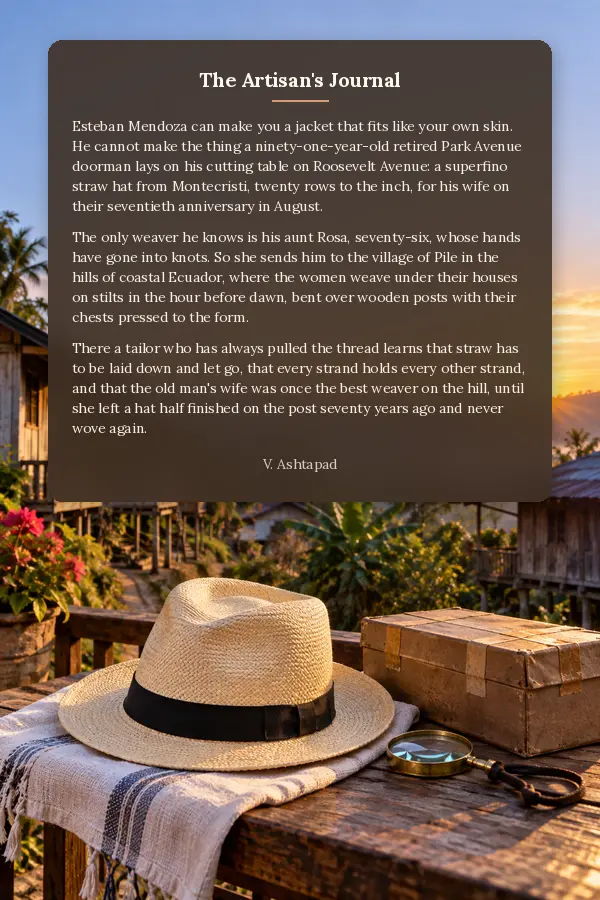
Esteban Mendoza can make you a jacket that fits like your own skin. He cannot make the thing a ninety-one-year-old retired Park Avenue doorman lays on his cutting table on Roosevelt Avenue: a superfino straw hat from Montecristi, twenty rows to the inch, for his wife on their seventieth anniversary in August.
The only weaver he knows is his aunt Rosa, seventy-six, whose hands have gone into knots. So she sends him to the village of Pile in the hills of coastal Ecuador, where the women weave under their houses on stilts in the hour before dawn, bent over wooden posts with their chests pressed to the form.
There a tailor who has always pulled the thread learns that straw has to be laid down and let go, that every strand holds every other strand, and that the old man's wife was once the best weaver on the hill, until she left a hat half finished on the post seventy years ago and never wove again.
Finished the book? Listen to or watch a review of it
A Queens Tailor Learns Ecuadorian Straw Weaving · Discussion
Listen · 52 min
Members can react to this book and talk about it in the members' Library.
Ownership
© 2026 CRUNOD LLC. All rights reserved.
This book is owned by CRUNOD LLC. It is free to read on EternalCurrent.Online. No part of it may be copied, reprinted, sold, recorded or adapted, including as audio, film or translation, without written permission from CRUNOD LLC.
© 2026 CRUNOD LLC. All rights reserved.