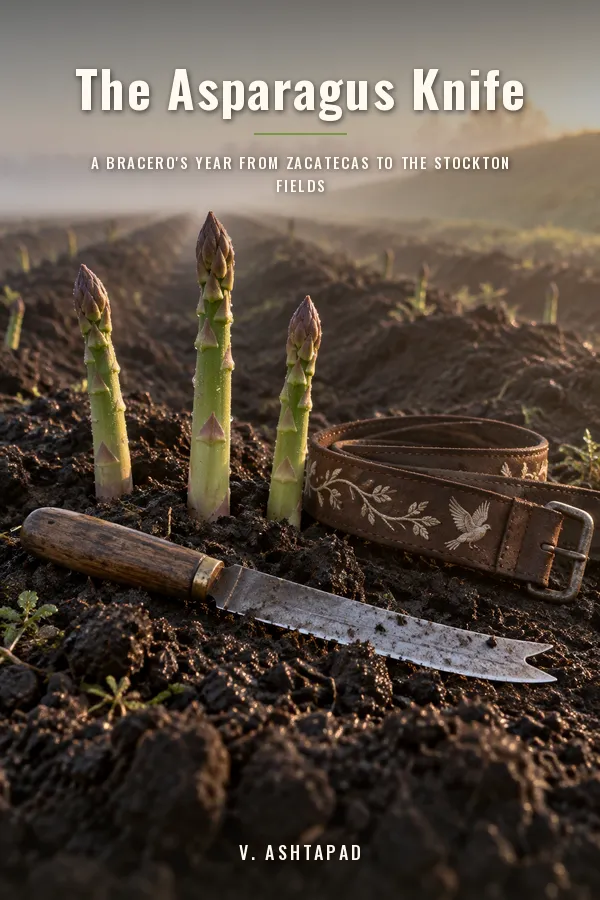
The Asparagus Knife
A Bracero's Year from Zacatecas to the Stockton Fields
by V. Ashtapad
Foreword
This is a work of fiction. Rafael Ortega, his family, his friends, the crew leader Ted Galicinao, the Navarro family and their studio, and every grower, clerk and official in these pages are invented, and none of them stands for a real person.
The places are real. Jerez and the hill country of Zacatecas, the railway north through Guadalajara, Tepic, Mazatlán and the Sonoran desert, the processing center at Empalme, the reception center at El Centro, Roberts Island and the other islands of the Sacramento and San Joaquin delta, French Camp, and the streets of Stockton all existed in 1956, though I have changed small details to suit the story. The village of San Isidro de las Huertas, the land called El Mezquite, the Lindqvist ranch, the packing shed and the library exhibit are invented.
The guest-worker program brought hundreds of thousands of men north each year. This is one invented season of it.
For the men who cut the asparagus before dawn, and for whoever wrote their names on the back of the photograph.
The Name on the Wall
The frost had not burned off El Mezquite when Rafael Ortega walked the furrows at six in the morning, and the clods broke under his huaraches with a sound like stale bread. February in the hills above Jerez came in two halves. Before nine it was a cold that got into the knuckles and made a man stuff his hands under his arms. After eleven the sun sat on the back of his neck like a flat iron. Between the two halves he worked.
The plot was six hectares of red-brown earth tipped toward the arroyo, with a stone wall on the uphill side that his grandfather had stacked without mortar and that still stood, mostly, because nobody had ever been in a hurry to knock it down. At the bottom corner grew the old mesquite that gave the land its name, a black, twisted tree with bark like a cracked boot, its thorns holding the frost and dripping when the sun found them.
His father had sold the land to don Teódulo Ávila in the dry year of 1950, when the beans died in the ground and the cow died in the corral and his father went quiet in a way that frightened everyone. Six years later Rafael still planted it, still weeded it, still took the beans off it in October. Half of everything went to don Teódulo, who owned it, and who had agreed, in front of two witnesses and a notary in Jerez, that the Ortegas could buy it back by the last day of December 1956 for five thousand pesos.
They had paid two thousand. That left three. Rafael could beat the notary's pencil with sums done in his head, and he had done this sum every morning for a year. Three thousand pesos was more money than the bean harvest would make in four years, even if the rain came, even if the rain came on time.
He bent and pulled a stalk of last year's corn out of the furrow, the root ball still holding a fist of dirt, and knocked it against his shin. Across the arroyo a dog was barking at nothing. Smoke rose from the chimneys of San Isidro de las Huertas, twenty-two houses and a school with one room, and he could smell the mesquite wood his mother would be burning under the comal, sweet and a little bitter, like a cigar.
His sister Chela came down the path with her rebozo crossed over her chest and her hair still wet from the basin.
"Mamá says you have to go to Jerez today," she called, before she was close enough to talk at a normal volume. Chela was sixteen and believed that most messages were improved by being shouted.
"I went to Jerez on Tuesday."
"That was for the seed. This is for the list. Don Melquiades came by on his mule and said the list is up at the presidencia and your name is on it." She stopped at the wall and leaned on it with both elbows. "He said it the way people say somebody's cow got into the road. Very serious. He took off his hat."
Rafael dropped the cornstalk. "On it where?"
"On the wall, I suppose. Where else would a list be?"
---
He went on the back of Arnulfo Pinedo's truck, standing with three other men and a crate of hens, because Arnulfo was taking the hens to the market anyway and had room. The road to Jerez wound down through cracked hills furred with huizache and the tall gray organ cactus that the boys used for target practice. The truck had no muffler. By the time they reached the paved stretch past the river, Rafael's ears rang and his trousers were covered in a fine red flour of dust and hen feathers.
Jerez in the morning smelled of wet stone and bread. The shopkeepers were throwing buckets of water on the sidewalks to settle the dust, and the water ran pink along the gutters toward the river. On the plaza the iron kiosk stood in its ring of trimmed laurels, and the old men were already on the benches, coats buttoned to the throat, hats tipped down. Beyond the plaza the pale front of the theater caught the sun.
The list hung in the arcade of the presidencia, behind a pane of glass with a crack running corner to corner. Forty men stood in front of it, close as cattle at a gate. Most were pretending to read while the one man who could read well said the names aloud.
"Esparza, Juan. Esparza, Rogelio. Félix, Anselmo," the reader said. He was a tall man in a clean white shirt with a pencil behind his ear, and he read with the pride of someone who knew he was being useful. "Gallegos, nobody. Hernández, Pablo. Hernández, Rito. Jáuregui, Domingo."
"Faster, maestro," somebody called. "We'll be old by the time you get to the R."
"You are already old, Cleto. I'm going at the speed my mother gave me."
Rafael worked his way to the glass with his shoulders. He did not need the reader. His mother had sent him to school until the fifth year, and then the teacher had sent him home with a note saying that the boy had a head for numbers and should be kept at it, and his father had read the note twice and put it in the drawer with the land papers, and Rafael had gone to the fields the next day. He found the O column with one finger on the cracked glass.
ORTEGA ESCOBAR, RAFAEL. SAN ISIDRO DE LAS HUERTAS.
It was typed on a machine whose letter E was worn, so every E was a little lighter than the other letters, as if each one had been said under the breath.
"Ortega," the reader announced, reaching it at last. "Rafael. Is there a Rafael Ortega?"
"Here," Rafael said, and the men around him turned and looked at him the way men look at someone who has just been dealt a good card. A man with no teeth said he hoped Rafael had hard hands, because the gringos looked at your hands, and another man said no, they looked at your teeth like a horse's, and the first man said then he would never get a contract in his life.
Inside, at a long table under a portrait of somebody in a sash, a clerk with a pencil mustache took Rafael's name, looked at a ledger, made a mark and handed him a card. The card was buff colored and stiff. On it were his name, his town, a number, and a date: the twenty-seventh of February, Empalme, Sonora.
"You have the money for the train?" the clerk asked without looking up.
"How much is the train?"
The clerk told him. Rafael did not let his face move.
"Bring a blanket," the clerk went on, in the tone of a man who said this sixty times a day. "And do not pay anybody for anything. If a man in Empalme says he can move you up the line for twenty pesos, he is a thief. If a man says he can get you a better ranch for fifty pesos, he is a bigger thief. Next."
---
The sun was full on the plaza when he came out. Rafael bought a glass of tepache from a woman with a barrel on a cart, sour and cold and tasting of pineapple rind and brown sugar, and drank it standing up. He kept turning the card over in his pocket with his thumb.
Somebody whistled at him from the kiosk. Ignacio Badillo, whom everyone had called Nacho since before he could walk, sat on the kiosk steps with his legs stretched out and his hat over his eyes. He was thirty-eight, eleven years older than Rafael, the son of San Isidro's blacksmith, and he had gone north on contract three times already. He came back from each one with a new watch and a new way of combing his hair, and within a year the watch was sold and the hair had gone back.
"You're on," Nacho said, without moving the hat.
"How do you know?"
"I'm on too. Fourth time. I saw your name under mine, more or less. A few letters down." He sat up. His face was brown and creased at the eyes from squinting at rows. "Your mother will cry."
"My mother doesn't cry."
"Then she'll do the other thing. The look." Nacho squinted at him. "You've never been farther than Zacatecas."
"I've been to Fresnillo."
"Fresnillo." Nacho put the hat back over his eyes. "Fresnillo is a dog that lives next to Zacatecas. You'll see. The train alone will teach you more geography than that teacher of yours ever did. Three days of it. Bring an orange for every day, and one extra for the man next to you, because there's always a man next to you who didn't bring anything."
---
At home that night his mother did not cry. She heated the beans, set out the tortillas in their cloth, poured him coffee boiled with cinnamon and piloncillo, and sat across from him at the plank table with her hands folded, and she did the other thing.
Refugio Ortega was small and wide and had a gray braid that reached her waist. Everyone in San Isidro called her Cuca, except her children, who called her Mamá, and don Teódulo, who called her Señora Ortega with a precision that sounded like a bill being presented. She had been a widow for four years and had spent all four of them deciding things.
"How much is the train?" she asked.
He told her.
She nodded. "And Nacho says you'll be paid how much?"
"Maybe eighty cents an hour. Maybe more for some crops. The asparagus pays by the box, he says. You can make more if you're fast."
"Eighty cents is how many pesos?"
"Ten. Ten pesos an hour, more or less. The peso is twelve-fifty to the dollar."
His mother looked at the ceiling, where the roof beams were dark with forty years of smoke, and he could see her doing the sum, which was the same sum he had been doing since noon. Ten pesos an hour. Nine hours a day. Six days a week. Minus food, minus the train, minus whatever the gringos took. He had done it so many times the numbers had stopped meaning anything and become a kind of song.
"Don Teódulo said the last day of December," she said.
"I'll be back before then."
"You don't know when you'll be back. Nobody knows. Nacho went one time for six weeks and one time for eight months." She unfolded her hands and folded them the other way. "Your father would not have liked this."
"My father sold the land."
She did not answer that. Chela, who had been sitting on the bench by the hearth pretending to mend a stocking, stopped pretending.
"I'm sorry," Rafael said.
"You don't need to be sorry. It's true. He sold it, and he carried the shame until he died, and he would still not have liked this." His mother stood and went to the painted trunk under the window, and came back with something rolled in a flour sack.
He knew what it was before she unrolled it. His father's belt. Brown leather gone almost black with handling, and down its whole length a pattern worked in pale thread made from the maguey: a running vine, leaves, and at the center over the buckle, a small bird with its wings half open. His father had learned piteado from an uncle in Colotlán, over the border in Jalisco, and had done it in the evenings by the lamp for twenty years, belts and holsters and saddle trim for the ranchers, and his fingers had been scarred white across the tips from pulling the thread through. The bird took him a month. Rafael remembered him at this table, the awl, the little hammer, the thread waxed and twisted, his father's breathing slow and even while he worked.
"Wear it," his mother said. "Not to sell. To wear. So that when the gringos look at your hands they also see what your family's hands do."
"They won't look at my belt, Mamá."
"Then you'll know it's there."
Chela went and got her notebook, the green school notebook she kept for things that were not school, in which she wrote the names of every goat they had ever owned and the dates the rains started each year and the names of the families who had lived in each house of San Isidro since her grandmother's time, which she got from old women by sitting with them in the afternoon and asking until they got tired of her. She opened it to a fresh page and wrote at the top, in her careful rounded hand, the date and the words Rafael goes north.
"What are you doing?" he asked.
"Keeping track. Somebody has to." She licked the pencil. "Tell me every town the train goes through. When you come back. Every single one, in order."
"I don't know them yet."
"That's why I said when you come back." She tapped the page. "And write. If you don't write I'll know you're dead or you've married a gringa, and I'll tell Mamá it's the first one, so she doesn't suffer."
His mother laughed, a short laugh like a door banging in the wind, and it was the first time he had heard it in a month.
Outside, the dogs of San Isidro had started up their night conversation, one at the top of the hill and one at the bottom, and the wind came down from the sierra smelling of cold stone and juniper. Rafael sat with his father's belt across his knees and ran his thumb along the little bird, feeling each stitch, each tiny ridge, the way his father had once shown him to feel for a mistake. There was none. There had never been one. His father had been a man who could not keep land, and who never in his life made a crooked stitch.
Coal Smoke
The band came out for them at four in the morning, which was the only proper hour to leave San Isidro, because the bus from Jerez to Guadalajara left at seven and the road down the hill took a man on foot two hours if he did not stop to say goodbye to anyone.
They stopped to say goodbye to everyone.
There were six men going from San Isidro that season, and the band played for all six at the crossroads by the school, under a sky still full of hard white stars. It was a tamborazo, the way every band in that part of Zacatecas was a tamborazo: two trumpets, a trombone, a saxophone that belonged to the schoolteacher's brother, a snare, and the big tambora with its goatskin heads and its cymbal bolted on top. Until three days before, the tambora had belonged to Rafael. Now it hung from the shoulders of Toño Saucedo, who was seventeen and had big forearms and not enough sense of time, and who kept glancing at Rafael after every phrase to see if he was rushing.
He was rushing. Rafael nodded at him anyway.
They played the song every band played for men going north, a slow one that started like a walk and picked up toward the end as if the walker had decided to run for it, and then they played a fast one so nobody would have to stand around being sad in the cold. The trumpets were sharp in the dark air. The sound went off the stone walls and down into the arroyo and came back changed. Somebody's grandmother had brought a clay pot of coffee and was pouring it into tin cups, steam rising off each one like smoke off a fuse, and the dogs of San Isidro, who had never in their lives allowed a band to play without comment, ran in circles around the musicians and barked on the off beats.
His mother had given him a bundle: the blanket, a jacket of his father's let out at the shoulders, two shirts, a tin cup, a razor, a comb, a bar of yellow soap wrapped in newspaper, and tortillas and dried beef rolled in a cloth for the road, enough for three days if he was careful and two if he was generous. The belt with the bird was on him, under the jacket. He kept touching it.
Chela did not cry either. She stood apart from the others with her notebook against her chest and wrote down the names of everyone who had come, in order, by the light of somebody's lantern.
"You're writing in the dark," he said.
"I'm writing in the lantern. And I want to remember who came. Don Melquiades came. He's never come to anyone's."
"He came because his nephew is going."
"He came," she said firmly, and underlined it.
His mother put her two hands on his face, one on each side, and held it there, and looked at him, and said only, "The last day of December," and then she let go and turned to talk to the woman with the coffee as if he had already left. That was how she did things. He understood it. He walked down the hill behind Nacho with the band still playing behind him, the tambora thudding a little ahead of everybody, and he did not turn around until the road bent at the big rock, and when he did the lantern was a small yellow point and the music had become a pulse he felt more than heard.
---
The bus to Guadalajara had a roof rack piled with trunks and crates and a bicycle and, at one point, two live turkeys in a basket, and inside it had wooden seats and windows that either would not open or would not close. It went south through the canyon country, down from the cold, past orchards of peach trees bare as brooms, past villages where women were already at the wells, past a long valley green with winter wheat. By ten in the morning Rafael had taken off his father's jacket. By noon he had taken off his second shirt. The air coming through the window smelled of hot road and cattle and, once, unexpectedly, oranges.
Nacho slept the whole way, cheek on the glass, mouth open, and woke exactly as the bus came into the outskirts of Guadalajara, as if he had a clock inside him set to the city.
"Look," he said. "Your first big town."
Rafael looked. He had heard about Guadalajara his whole life, and in his head it had been something like Jerez but taller. It was not like Jerez. It went on and on. Streets crossed streets. There were trolley wires, and buildings of four and five floors with iron balconies, and a smell of exhaust and frying and jacaranda trees not yet in bloom, and so many people on the sidewalks that he could not understand how they all had somewhere to be.
The railway station was worse. They walked to it with their bundles over their shoulders through a crowd of men who were all, it turned out, going to the same place they were. Rafael had not known there were so many men in Mexico. They came from Jalisco and Michoacán and Guanajuato and Aguascalientes, from places he had heard of and places he had not, and they all carried the same bundle and the same buff card and the same expression, half hope and half suspicion, like a man who hears he has won a prize and is waiting to find out what it costs.
The second-class car was wooden inside, with benches in pairs facing each other and a floor that had been swept, at some point in the past, by someone. Rafael and Nacho got a bench by a window. Across from them sat two brothers from Teocaltiche who were so alike Rafael could not tell them apart until one of them took off his hat and showed a bald spot like a coin.
The engine was steam. He heard it before he saw it, a deep panting from the head of the train like an animal that had run a long way, and then the whistle, which went into his teeth. The car jerked. Bundles fell off the racks. One of the Teocaltiche brothers said a word that made a woman two benches over cover her daughter's ears, and then the station slid backward and the city with it, and they were going.
---
Coal smoke got into everything. It came in through the windows in gray scarves when the wind turned, and it settled on his shirt and in the creases of his hands and behind his ears, and when he licked his lips he could taste it, sulfur and tar and something burnt and sweet underneath. The first afternoon he kept trying to wipe it off. By evening he had stopped. Every man in the car had a gray rim on his collar and gray at the corners of his eyes, and the brothers from Teocaltiche had started calling each other Chimney One and Chimney Two.
West of Guadalajara the land dropped. They came down out of the high country through deep cuts in red rock and over iron bridges where Rafael looked out the window and down and saw nothing at all beneath him for a long time, just air and then far below a thread of river shining. The train slowed on the grades and men jumped off to walk beside it and pee in the brush and jumped back on, laughing, while the conductor shouted at them. At the stations women came to the windows with baskets on their heads and sold through the bars: tamales wrapped in husks still steaming, slices of jícama with chile and lime, oranges, hard-boiled eggs, cones of peanuts, bottles of soda warm as soup. The whole car leaned out to buy. The women's voices called out prices in a rhythm, one after another, like birds.
He did not buy anything the first day. He ate his mother's tortillas and dried beef and counted.
In Nayarit there was sugarcane on both sides of the track, taller than a man on a horse, so thick and green after the dry hills that it hurt to look at. The air turned wet. His shirt stuck to his back. There were banana trees whose leaves the wind had shredded, and once a field of tobacco being cut, the leaves hanging in long sheds to cure, and the smell of it came through the window rich and dark as a saddle.
Rafael took out the pencil stub he had brought and a folded sheet of paper and began to write down the names of the towns. Chela had asked. He wrote in small letters to fit them all. Guadalajara. Tequila, where the train went through blue fields of agave planted in rows like soldiers. Magdalena. Ixtlán. Tepic, where it rained for ten minutes, warm, from a clear sky, and stopped, and the station boards steamed. Ruiz. Acaponeta. He wrote what he saw beside each one in a word or two. Blue agave. Rain. Sleeping dog by the tracks. A man selling birds in wooden cages.
"What's that?" Nacho asked.
"For Chela."
"She wants a list of stations?"
"She wants to know where I went."
Nacho thought about this. "My wife never asked where I went," he said. "She asked how much I brought back." He laughed, but then he took the paper and read the list, moving his lips, and handed it back. "You forgot Santa María del Oro. We passed it before Tepic."
"Did we?"
"Little station. Painted green. A woman selling pitahayas." Nacho closed his eyes. "Put it in. If she wants it right, it should be right."
---
The night was long. The benches were too short to lie down on and too hard to sit up on, and the car was full of the sounds of sixty men sleeping badly: snoring, coughing, a man talking in his sleep about a mule, the wheels knocking at the rail joints in a rhythm that Rafael's body kept trying to turn into music. Ta-tum, ta-tum. Ta-tum, ta-tum. In his head the trumpets came in on top of it. He did not sleep. He watched the dark go by outside the window, an occasional light from a hut, a fire in a field, the shape of a mountain against the stars, and the coal sparks blowing past like orange insects.
At some point after midnight a young man got on at a dark station and stood in the aisle with his bundle, looking for a place. He was thin and had a mustache that was trying hard and a guitar case held together with wire.
"There's no room," said one of the Teocaltiche brothers.
"There's always room," the young man said, and sat down on the floor at their feet, opened the case, and took out not a guitar but a long loaf of sweet bread, which he broke into four and handed around. "Eduardo Sarabia," he said, with his mouth full. "Pánfilo. From Los Mochis, which you haven't been to yet, but you will, it's on the way. I got on early so I could get a seat. Clearly I failed. Where's the guitar? My uncle has it. He said I'd lose it in California. He's right. I lose everything. I lost a girlfriend in Culiacán last week, I don't know where she went, I looked everywhere."
The Teocaltiche brothers looked at each other. Nacho laughed so hard the bench shook.
By morning they were in Sinaloa, flat country, irrigated fields of tomatoes and beans in long green lines to the edge of the sky, and the smell of the sea somewhere off to the west, salt and rot and something clean. Pánfilo had talked all night. He knew every crop in every field they passed and what it paid to pick, which he said was the same as nothing. He had been a bracero once already, in Arizona cotton, and said that California was better because the foremen had hats.
"The foremen in Arizona didn't have hats?" Rafael asked.
"They had hats. But in California they wear them better."
At Mazatlán the train stopped long enough for the men to get down and stretch their legs. Rafael stood with his face to the west and saw, over the roofs of warehouses, a line of blue so bright and so flat that for a moment he did not understand what it was.
"The sea," Pánfilo said beside him, unnecessarily.
"I know."
"You never saw it."
"I know."
Pánfilo, for once, said nothing more. They stood together and looked at it until the whistle went. Then Rafael got back on and took out his paper and wrote Mazatlán, and beside it, after some thought, only the word blue.
The Junction
Empalme meant junction, and the town had never pretended to be anything else. It was a place where two railways met in the Sonoran scrub a few miles from the sea, and around the meeting point somebody had built roundhouses and repair shops and water towers and rows of brick houses for the railway men, and then, the year before, the government had put the processing center there, and the town had filled up with men like water fills a footprint.
They arrived in the afternoon of the third day. The heat hit Rafael when he stepped down from the car, not like the high sun of Jerez but wet and heavy, carrying salt from the bay and grease from the shops and the smell of ten thousand men who had been on trains. The wind blew grit along the tracks. Over the roofs he could see a hill like a broken tooth, and the white stacks of the railway shops, and a sky so pale it was almost no color at all.
"Now," said Nacho, shouldering his bundle, "we wait."
"For what?"
"For them to call your number." Nacho looked around with the expression of a man arriving at a relative's house he has visited many times and never liked. "Could be two days. Could be ten. The last time I was here eleven days. I made friends with a dog."
They found a place to sleep on the second night in the back patio of a widow named Señora Leyva, who rented the dirt of her patio at two pesos a night to as many men as could lie down in it without touching. There were twenty-three of them the first night. Rafael lay on his mother's blanket between Nacho and the wall, with his bundle under his head and his father's belt still on, and looked up through the branches of a dusty tamarind tree at more stars than he had seen even in San Isidro. Somebody across the patio was playing a harmonica very quietly, the same six notes over and over, and somebody else was telling him to stop, and he kept on.
---
The center itself was a big yard behind a chain fence, with long sheds roofed in corrugated tin and a gate guarded by soldiers who looked bored and young. Every morning at six the men gathered outside the fence by the thousands. It was the biggest crowd Rafael had ever stood in. You could not see the end of it. Men from Durango in sheepskin jackets they refused to take off even in the heat. Men from Guerrero who spoke a Spanish so fast and dropped so many endings that Rafael understood one word in three. Men from Yucatán, a few, small and neat, with white shirts and a way of talking that sounded like singing. Men from the cities who wore city shoes and whose hands were going to give them trouble.
Every hour or so a man with a megaphone came out on a wooden stand inside the fence and read numbers, and the men whose numbers were called pushed forward, and everyone else groaned and settled back on their heels in the dust. The vendors moved through the crowd in a slow tide. They sold tacos from baskets, raw sugarcane in sticks, cigarettes one at a time, sombreros, combs, little mirrors, pocket knives and bottles of a brown tonic said to cure the cough that every man got from the dust by the second day. Boys sold water from clay jars at ten centavos a dipper. Men sold places in line that did not exist.
By noon the dust had a taste, chalky and faintly of iron, and the tin roofs of the sheds ticked as they swelled in the heat. In the late afternoon a wind came off the bay that smelled of shrimp boats and diesel, and the whole crowd turned its faces toward it at once, the way a field of sunflowers turns, and for ten minutes every man in Empalme was briefly happy.
On the second morning a man wearing a red-banded straw hat came up to Rafael and spoke very low.
"Ortega? From Zacatecas?"
"Who's asking?"
"A friend. I can see from your card you're a long way down." The man smiled with a gold tooth. "I know a gentleman inside who can move a number. Small cost. Thirty pesos, and tomorrow you're through. Otherwise maybe next week. Maybe never. They close the quota for Zacatecas and you go home."
Rafael thought of the clerk in Jerez. "A bigger thief," he said.
"Excuse me?"
"Nothing. No, thank you."
The man in the straw hat shrugged and moved on to the next card. Nacho, who had watched the whole thing, nodded approval. "That one gets about one in four," he said. "Every year a different hat."
---
It was in the crowd, on the third day, that he met Fortino Cruz.
Rafael had been standing near the fence for six hours and his shadow had gone all the way around him and come back. Next to him a short square man with a broad face and very black straight hair was sitting on an upturned crate, writing on a sheet of paper braced on his knee, while a man from Michoacán stood over him dictating a letter to his wife. The writer did not hurry. He would listen, and then write, and then read it back, and then the man from Michoacán would say no, not like that, say it more sweetly, and the writer would cross something out and write it again.
When the man from Michoacán had gone off, folding his letter into his shirt as if it were money, Rafael said, "Do you charge?"
"Fifty centavos if they can pay." The writer capped his pen. It was a real fountain pen, black, with a gold clip. "Nothing if they can't. I'm not a lawyer." He held out his hand. "Fortino Cruz. From near Tlaxiaco, in Oaxaca. You've never heard of it."
"I've never heard of it."
"That's all right. Nobody has. Its own people hardly have." Fortino smiled. His smile was slow and took over his face gradually, like water filling a basin. He was thirty, he said, and had been a schoolteacher in his own town for six years, teaching children to read in Spanish, which was not the language they spoke at home. At home they spoke Mixtec. He had not spoken Spanish himself until he was fourteen and an uncle took him to the city. Now he spoke it like a radio announcer, carefully, every letter in its place, and he said Spanish words sometimes as if he were picking them up one by one to look at them.
"Then why are you here?" Rafael asked. "If you're a teacher."
"Because a teacher in my town is paid a little more than a donkey and a little less than a good donkey. And my mother's roof fell in last rainy season." Fortino looked at the fence. "And the rain is how it is. In my language, the word for our people is the same as the word for rain. Savi. We are the people of the rain. And we're always waiting for it, and it never comes when we want, and when it does it knocks the roof in." He laughed. "So here I am, waiting for a man with a megaphone instead."
Rafael found that he liked him very much and could not have said why.
"Can you write a list for me?" he asked. "Not a letter. Just to send. I have the names of the towns, but my pencil is short, and my sister reads my writing and says it looks like a chicken walked through ink."
"Show me."
Rafael took out the folded paper from the train. Fortino read it slowly, moving his finger. Guadalajara. Blue agave. Tepic. Rain. Mazatlán. Blue. He stopped there and looked at Rafael with something that was almost respect.
"This isn't a list," he said. "This is a song with the music missing."
He copied it out fair on a clean sheet in his teacher's hand, with all the accents right, and at the bottom he added, without asking, Empalme, Sonora. Waiting. Then he handed the pen to Rafael. "You write the last word."
Rafael thought. Then he wrote: dust.
---
On the fifth day Pánfilo Sarabia, who had found them again in the crowd as easily as a dog finds a kitchen, came back from somewhere with his hands raw and bleeding.
"What happened to you?"
"They check your hands." Pánfilo held them up. The palms were scraped red, the skin roughed up and furred like the back of a carpet. "Inside, at the table. A gringo with glasses takes your hands and turns them over and feels for calluses. If you don't have calluses, you're not a farmer, you're a barber from Guadalajara pretending, and they send you home." He looked at his palms with pride. "So I've been rubbing them on the brick wall behind the cantina."
"For how long?"
"Two hours."
Nacho took one of Pánfilo's hands and turned it over in his own, which was a hand like a piece of mesquite root, ridged and yellow and hard as a hoof. He felt the scraped palm with his thumb.
"Pánfilo," he said kindly. "That's not a callus. That's a wound. They'll think a cat attacked you."
"Then I'll say I'm a farmer who has a cat."
On the sixth day Rafael's number was called. On the same day, by luck or whatever passed for luck in Empalme, so were Nacho's and Fortino's, and Pánfilo's came in the afternoon. They went through the gate one at a time into the long sheds. It was hotter inside than out. There were tables in rows, each with a man behind it in a short-sleeved shirt and a stack of forms, and fans turning slowly overhead without doing anything except moving the flies around.
At the first table a Mexican official checked his card against a list and stamped it. At the second a doctor listened to his chest with a cold metal disk and looked in his ears and his mouth. At the third table a pink-faced American in steel glasses took Rafael's hands and turned them over.
The man's own hands were soft and dry and smelled of tobacco. He ran his thumb across the ridge of hard skin at the base of each of Rafael's fingers, where the hoe handle sat, and the thick pad on the heel of his right hand from the machete, and paused at a white seam across the side of his left thumb from a cut when he was twelve. He said something in English to the man beside him. The other man laughed and wrote on a form.
"Bueno," said the man in glasses, which was the one word of Spanish he seemed to have, and stamped.
Rafael walked out of the shed into the white glare of the yard with his card in his hand and his heart going fast and a strange, hot feeling across his shoulders, as if the man's soft hands were still holding his. It was not shame exactly. It was nearer to the feeling of being weighed at a market. He had been looked at all his life by people who wanted to know whether he would work. He had never before been looked at by somebody who wanted to know whether he was lying.
Pánfilo came out last, two hours later, grinning, waving his card over his head.
"Did they believe the cat?" Fortino asked.
"I didn't need the cat. The man was looking at the clock. He wanted his lunch." Pánfilo blew on his palms. "I could have had hands like a banker. Sooner or later in this life, my friends, the clock is on your side."
That night they lay in Señora Leyva's patio for the last time under the dusty tamarind, the four of them in a row, and the harmonica player across the yard played his six notes, and nobody told him to stop. A freight train went through the junction at midnight, a hundred cars, the ground shaking under their backs, the whistle long and low and going on forever into the north, which was where they were going next.
White Powder
North of Empalme the country gave up on being anything but sand. The train went up through Hermosillo, where the orange groves stood in perfect squares of dark green with irrigation ditches shining between them, and then past Benjamín Hill, where it turned west, and after that for a whole day there was nothing out the window that Rafael had words for.
He tried. He had the pencil and Fortino's fair copy of the list, and he wanted to put something beside each station for Chela, but the stations were only water tanks and sheds with a name painted on a board, and between them was the desert of Altar. Dunes the color of a lion's back rolled away to the south, long and smooth and combed by the wind into ridges like the roof of a mouth. Black volcanic hills stood up out of the sand with nothing growing on them. Once, far off, there was a lake that was not a lake, silver and trembling, and when the train came closer it was gone, and the Teocaltiche brothers, who had found their way into the same car again, argued about whether it had been there at all.
The heat came in through the floorboards. Men sat in their undershirts with wet handkerchiefs on their heads. The water in the car's tank ran out by noon, and at the next stop forty men got off with their cups and fought over a single tap at a tank house while the engineer leaned out of his cab and smoked.
Beside the word Altar on his list Rafael finally wrote: nothing, and then, because that was not quite true, he wrote: nothing, and wind.
---
They came into Mexicali after dark. It was a town of low buildings and bright signs and a smell of onions and gasoline, and on the other side of a fence, close enough to throw a stone, was another town that looked exactly the same except that the signs were in English. Calexico. Rafael stood beside the train and stared at it. He had been imagining the border for weeks, and in his imagination it had been something like a river or a mountain, something you could see from far off. It was a fence. A street ran up to it on one side and another street ran away from it on the other, and people walked along both streets in the evening as if nothing were strange.
"That's it?" he said.
"That's it," said Nacho. "You were expecting a wall of gold?"
They crossed in the morning, in buses, under guard, without walking at all. The buses took them through a gate and along a straight road between fields so flat and green and enormous that Rafael did not believe them. Lettuce. Mile after mile of lettuce, pale green heads in rows so straight they might have been drawn with a rule, and irrigation canals running full and brown alongside the road, more water in one of them than San Isidro saw in a year. Sprinklers turned in the fields and threw rainbows. Men were already working, bent over in the rows, and Rafael pressed his face to the window and tried to see if they were Mexican. They were. Of course they were.
"The Imperial Valley," said Pánfilo. "The desert, but they put a river on it."
The reception center at El Centro was a compound of long white buildings inside a high fence, with a water tower and a flagpole and an air of having been designed by somebody who had once built a prison and enjoyed it. The men were unloaded and put into lines. There seemed to be no end to lines. Rafael would learn, that season, that lines were the main crop of the whole business. You stood in line to be counted, then to be counted again by a different man, then to be given a paper, then to have the paper stamped, and every line moved at the speed of the slowest man in charge of it.
---
The powder was in the third building.
They were told to take off their shirts, and then, in a second room, to take off everything. Rafael stood in a long concrete hall with two hundred naked men, holding his bundle against his chest because there was nowhere to put it down, his father's belt folded inside it. The floor was cold and gritty. The air smelled of disinfectant and sweat. At the far end, men in coveralls and cloth masks stood with long-nosed metal sprayers attached to tanks, and as each man passed they pumped a cloud of white powder at him, over his hair, under his arms, between his legs, into the bundle he carried. The powder hung in the air in a fog. It got into Rafael's nose and mouth and tasted bitter and chalky, like crushed pills, and made his eyes run.
What he would remember afterward, more than the cold or the taste, was the quiet: two hundred men from all over Mexico, who had not stopped talking for a week, and in this room not one of them said a word. Even Pánfilo was quiet. Rafael looked straight ahead at the back of the man in front of him, a narrow brown back with a long scar across the shoulder blade, and walked through the cloud with his eyes half shut and came out the other side white from head to foot, like a man made of flour.
In the next room they dressed again. The powder came off on their clothes. For two days afterward, every time Rafael moved, a little white puff rose out of his shirt.
Pánfilo shook his head over and over like a wet dog and said, at last, in a low voice, "Well. Now we're clean. Now my grandmother would be proud of me for the first time in my life."
Fortino did not laugh. He was buttoning his shirt very slowly, every button, all the way to the throat. When he got to the top he stood looking at the floor.
"Fortino."
"It's all right." He looked up. "In my town, when I was a boy, the government men came once with that same powder. For the lice. They did the children in the school yard. My mother was so angry she wouldn't speak Spanish for a month. Not even to the shopkeeper. She made me buy the salt." He smiled his slow smile, but it did not reach all the way. "I was thinking I should tell her I've been done twice now. She'll say the first time didn't take."
---
After the powder there was a doctor with an X-ray machine that hummed like a hive, and a nurse with a needle who took blood from the inside of his elbow, and a man who looked at his eyes with a light. After that there was a room with long benches where they sat and waited for the contract.
The contract came in two languages, English on one side of the page and Spanish on the other, typed close, eight pages stapled at the corner. Most men looked at the last page, where they were to sign, and nowhere else. Rafael read it. He did not understand all of it, but he read every line, his lips moving, because his father had signed a paper once without reading it and had lost a cow over the fine print, and because his mother had said, when he left, that a paper was only as honest as the man who read it.
The contract said that he would be paid not less than the prevailing wage, and not less than a certain number of cents an hour. It said that he would be guaranteed work for three-quarters of the days of the contract, or be paid for them. It said that his meals would be provided at a cost not to exceed one dollar and seventy-five cents a day. It said that his housing would be clean, and sanitary, and free. It said that he could not be made to work in any job but agriculture. It said that the contract would run for a period of so many weeks, and could be extended by agreement.
Fortino, beside him, read it too, and halfway through began reading it aloud in a low steady teacher's voice for the men on the bench who could not read, and by the end he had twenty men leaning toward him and a sergeant in the doorway frowning at the noise and deciding not to stop it.
"Three-quarters," said one of the listeners, an old man from Durango. "What does that mean? Three-quarters of what?"
"It means if they bring you here and there's no work for a whole month, they still have to pay you for most of it," Fortino said.
"And do they?"
Fortino looked at Nacho, who had been on contract three times.
Nacho considered. "Sometimes," he said. "If you ask. If you ask in the right voice. If the right man hears it." He shrugged. "It's a good paper. It's a very good paper. I like it very much. I've read it four times now and it gets better every time."
Rafael signed. He wrote his name the way the teacher had taught him, with the R big and the rest small, and then he sat back on the bench and looked at it, his name next to the English words, and felt the same thing he had felt at the presidencia in Jerez, the slightly lighter E, the sense of being said under somebody's breath.
---
The growers' men came after lunch. They stood at the front of a big yard with clipboards, Americans in pressed khaki and wide hats, with Mexican interpreters beside them, and the newly contracted men were brought out in groups and made to stand in rows. The growers' men walked up and down the rows. Some of them looked at faces. Some of them only counted.
"San Joaquin," said one of the interpreters, a fat man with a Sonoran accent and a toothpick. "Stockton. Asparagus. Who's been in asparagus?"
Nacho raised his hand, and because Nacho raised his hand, Rafael raised his, and because Rafael raised his, Fortino did, and Pánfilo raised both of his, scraped palms out.
The man in khaki studied Pánfilo's palms. Then he turned to Nacho's hands, and at Nacho's face, which was the face of a man who had cut asparagus in three seasons and did not want to talk about it, and he nodded and made four marks on his clipboard.
Before they left, a clerk gave each of them a little card with a photograph glued in the corner, taken that afternoon against a white wall, and Rafael looked at himself for a long time. He had seen his face in mirrors and in the water of the stock tank, but never fixed like this, flat and gray, with powder still in his eyebrows. He looked older than he felt. He looked like his father in the week of the sale. He put the card in his shirt pocket and buttoned the flap.
That night they went north in a bus with the windows open and a hundred miles of dark desert going by, groves of date palms black against the stars and smelling of honey and dust, and then mountains, and then, coming over a pass after midnight, something that made every man on the bus stand up and lean to the left side at once until the driver shouted at them to sit down before they tipped it over.
It was light. Below them, filling the whole floor of the world from the mountains to the edge of sight, was a sea of lights. White, yellow, a few red, laid out in lines and grids and curves, and moving, some of them, in rivers. It went on and on. Rafael could not see where it ended. It was brighter than the stars over Empalme and there were more of them.
"Los Angeles," the driver said in English, and then, because nobody reacted, he said it again in Spanish, badly.
Rafael got out his paper. There was hardly any room left at the bottom. Beside the name of a city he would never set foot in, he wrote, very small: someone forgot to turn off the sky.
Black Ground
They came onto Roberts Island in the first gray of the morning, over a narrow bridge with the river sliding beneath it slow and brown, and Rafael's first thought was that the land was wrong.
It was lower than the water. He saw it at once from the bus window and could not stop seeing it. On either side of the road ran a high earthen bank grown over with blackberry and willow, and on the far side of the bank was the river, and the river was higher than the road. He could see the tops of reeds along the water's edge above the level of the bus roof. Below and inside the banks the fields spread flat and black to a horizon of more banks, and the fields were lower still. It was like driving along the bottom of an empty swimming tank, except that the tank was not empty, it had only been told to stay outside.
"The levees," said Nacho, who had woken up as the bus slowed, the way he always did. "They built the walls and pumped the water out. Chinese men built most of them, a long time ago, with shovels and baskets. Ted told me."
"Who is Ted?"
Nacho grinned for the first time since El Centro. "You'll see."
The fog was lying in the low places, white and still, and through it the fields showed in long dark stripes. Rafael had seen black earth before, in the bottoms by the river in Jerez, but not like this. This was black like a stove, and when the bus stopped and he climbed down into the yard of the camp and put his foot on it, it gave under his boot, soft and springy, like stepping on a folded blanket. He crouched and picked up a handful. It was light, almost no weight to it, damp and crumbling, full of tiny threads of old root, and it smelled of rotting leaves and river and something like the inside of a cigar box. He squeezed it and water ran out between his fingers, and when he opened his hand the earth stayed in the shape of his fist.
"Peat," said a voice above him in English, and then in Spanish, with an accent Rafael had never heard: "This is all old plants, boy. Ten thousand years of dead grass. You're standing on a haystack."
---
Teodoro Galicinao was fifty-two years old, five feet and two inches tall, and the best-dressed man Rafael had ever seen in a field. He wore pressed gray trousers tucked into high rubber boots, a white shirt buttoned at the wrists, a striped tie, a gray felt hat with a narrow brim, and over it all a canvas coat with a pencil in the pocket and a little notebook with a rubber band around it. His face was brown and fine boned and lined, and his hair under the hat was slicked straight back and going silver at the sides. He was from Ilocos Norte, in the Philippines, which he said was a long narrow piece of the island of Luzon facing the sea, very dry, with garlic and tobacco and good fish. He had come to California in 1929, when he was twenty-five, on a ship to San Francisco, and had cut asparagus on these islands every spring since.
"Twenty-seven seasons," he said, walking the new men through the camp yard. "I am the oldest asparagus in the delta. Every year the grower says, Ted, you are too old, and every year I say, Mister Lindqvist, who taught your foremen? And every year he gives me another crew."
The men called him Ted. A few of the older ones, who had worked with him before, called him manong, which he said was what younger Filipinos called an older brother, and which he liked. His Spanish was strange and wonderful. It was full of words Rafael knew, but bent at odd angles, and words he did not know at all, and it came out in quick bursts as if Ted were throwing it at you to see what you would catch.
"In my language we have many Spanish words," Ted said. "Three hundred years the Spanish were in my country. So we say mesa, we say silya, we say kutsara. But we put our own clothes on them." He pointed at a wooden bench by the barracks door. "Bangko. You say banco. Same thing, different hat."
The barracks were long plank buildings painted a white that had gone gray, set on blocks above the soft ground, with tar-paper roofs and screened windows. Inside each one were double bunks with thin cotton mattresses and gray army blankets, forty men to a building, a woodstove at one end, a single bulb hanging from a cord. The floor had been swept and was already black again with peat dust walked in. There was a washhouse with cold showers and a long tin trough, and a row of outhouses downwind, and a mess hall with long tables and benches where a cook from Jalisco named Chavelo ruled with a ladle and a temper, and beyond all of it, on every side, the fields.
Rafael took a lower bunk by a window. Nacho took the one above him, because he said he liked to be closer to the roof and further from the mice. Fortino took the bunk across the aisle and immediately unpacked a small stack of paper, a bottle of ink and two books and arranged them on the shelf as if he were setting up a classroom. Pánfilo took the bunk above Fortino and fell asleep in his clothes before anybody had told him what time it was.
---
They worked the next morning.
Ted gave out the knives in the yard at five, in the dark, under the truck's headlamps. The asparagus knife was a tool Rafael had never seen: a wooden handle as long as his forearm, then a steel shaft as long again, and at the end a flat blade, a little curved, with a notch cut into its tip like a fishtail. It was light and well balanced, and when he held it out in front of him it seemed to want to point at things.
"This is your wife now," Ted said in his strange Spanish to the new men. "You sleep with it, you wake up with it, you sharpen it every night. If you lose it, you buy another one, and the second wife is always more expensive."
The fields lay in long raised beds, row after row of black ridges as far as the eye could follow, and out of the tops of the ridges, here and there, poked the spears. Rafael had never seen asparagus growing. He had eaten it once, at a wedding in Jerez, out of a can. The spears came up out of the dark soil singly, pale green with purple-tinged tips tight as a closed fist, each one standing alone a hand's width from the next, some barely breaking the surface, some already as tall as his hand.
Ted showed them. He walked down the bed bent at the waist, the knife held low in his right hand, a wooden box on a small sled dragging behind him on a rope tied to his belt. He found a spear, put the knife's tip into the soil beside it at an angle, pushed down and turned his wrist, and the spear came free with its white base still on it, cut below the surface, and his left hand had caught it before it fell. He dropped it into the box. He was already at the next one. Another. Another. He moved down the row like a man walking quickly to catch a bus, never straightening, his hands doing something Rafael could not follow with his eyes, and in a minute he was twenty yards away and the box was filling.
"Not too deep," Ted said, coming back. He was not breathing hard. "If you cut too deep, you kill the crown underneath, and next year no spear, and the grower comes and looks for whoever did it, and he finds you. Not too shallow, because the buyer wants white on the bottom. Don't touch the little ones. Tomorrow they are big ones. The tip must be tight. If it opens like a flower, it's too old, cut it and throw it away. And never, never step on the bed."
"How do you know where the next one is?" Pánfilo asked. "In the dark?"
Ted looked at him. "You look," he said. "This is a job for the eyes. The back only suffers."
---
By seven the fog had burned off and the sky over the delta was a high clean blue, and the wind came across the fields and lifted the dry top of the peat in little black ghosts that ran along the beds and blew into Rafael's eyes. By eight his lower back was a single hot coal. By nine the coal had spread to his shoulders and the backs of his thighs, and his right wrist ached from the turning, and his left hand had a blister at the base of the thumb from catching spears. He had cut maybe a third of what Nacho had cut, and Nacho had cut half of what Ted had cut, and Ted was not cutting at all now, only walking up and down the rows with his notebook, writing down numbers.
There was no way to work but bent. If you knelt, you went too slowly. If you squatted, your thighs gave out. If you straightened, you lost your place and your eyes had to find the rhythm again, the next spear and the next. The men moved down the beds in a long uneven line like birds feeding on a beach, all bent at the same angle, and the only sounds were the soft crunch of the knives going into the earth and the hiss of the sleds dragging behind them and somebody, two rows over, singing under his breath very badly.
At nine-thirty a truck came along the dirt road on top of the levee to collect the boxes, and Rafael straightened up for the first time in two hours, slowly, one vertebra at a time, and looked up at the levee, and stopped breathing.
A ship was going past.
It was a real ship, an ocean ship, black hull and white superstructure and a single red funnel, as big as the presidencia in Jerez and the theater put together, and it was sliding along on the other side of the levee, above the level of the field, so that from where he stood among the asparagus he could see only its upper half moving smoothly across the sky over the blackberry bushes, as if it were sailing on the grass. Its engine thudded faintly in the ground under his boots. A man in a white undershirt stood at its rail smoking and looking down at the fields, at the men in them, and lifted a hand.
Rafael lifted the asparagus knife back.
"Going to Stockton," Nacho said beside him, sweating, his hat pushed back. "They dug a channel for them all the way from the bay. They come from Japan, from everywhere. Every time I see one I think, that's where I'm going. And then Ted shouts at me."
"Ortega!" Ted shouted from the end of the row. "You have twenty spears looking at you and you're looking at a boat!"
He bent back down. The coal in his back flared and then settled into a steady glow he would carry for a month. The black ground was soft and cold under his boots, and he could feel the river behind the levee, higher than his head, all that patient water pressing on the other side of the earth. He found the next spear, and the next, and another. He kept his eyes down again until the sun was overhead and Ted blew a whistle for lunch, and when he straightened that time, the ship was gone and there was only the levee and the sky and the black ghosts of peat running along the beds in the wind.
The Word for Turkey
It rained the second week, and the third.
It was not rain like Zacatecas rain, which came in July all at once out of a black sky with thunder that rattled the roof tiles and then was gone in an hour, leaving the arroyo running red and the whole world smelling of wet dust and creosote. California rain was gray and patient and came sideways off the river, fine as flour, for days. It soaked through the tar paper and dripped on the bunk of a man from Guanajuato named Bonifacio until he moved his mattress under the table. It turned the peat into black pudding that sucked the boots off men's feet. It ran in the furrows and lay in the low corners of the fields in sheets the color of slate, and the spears stopped coming, because the ground was too cold.
When there were no spears, there was no work. When there was no work, there was no pay. But Chavelo the cook still rang his triangle at five-thirty, and the men still came to the mess hall and sat at the long tables and ate his eggs and beans and coffee, and at the end of the week, a dollar and seventy-five cents for each of those days still came off the check.
Rafael held his first check stub in the lamplight of the barracks on the second Saturday and read it four times.
There was the number of hours. There was the rate, eighty-five cents. There was the number of boxes, because some days they paid by the box. There was the gross, which was a number he had already worked out in his head and was right about. And then, below it, a column. Board. Insurance. Blanket rental, which nobody had told him about. Knife, two dollars, because he had not brought one, and how could he have brought one, he had never seen one. Then, at the bottom, the net, which was the number that would go home.
It was eighteen dollars and forty cents.
He did it in pesos, because dollars still did not feel like real money to him, only like a story about money. Two hundred and thirty pesos. He did it again in case he had made a mistake. He had not. He took his pencil and the back of the stub and did the other sum, the morning sum, the one he had done every day in El Mezquite. Three thousand pesos, the last day of December. Thirty-some weeks, if they kept him for tomatoes. Minus what his mother needed to eat. Minus what Chela needed for school. Minus the train back.
He sat on his bunk with the stub on his knee and the rain ticking on the roof and felt the numbers go cold in his hands.
"It's always worse at the start," Nacho said from the bunk above, upside down, his head hanging over the edge like a bat's. "The rain. The knife. They take it all in the first weeks and then it gets better. By June you'll have a hundred dollars."
"I need three hundred by December."
"You'll have it."
"You don't know that."
"No," Nacho agreed. "But I've been saying it to myself for four contracts and it hasn't killed me yet."
---
Across the aisle, Fortino had nailed a flour sack to the plank wall above his bunk, split open and flattened so that it made a sheet of rough white cotton about the size of a window. On it, over two evenings, he had drawn a map of Mexico in ink. It was not a good map. He admitted this. Baja California came out too thin, like a dog's leg, and Yucatán too fat, and he had lost his nerve with the coast of Guerrero and drawn it straight.
"But the important part," he said, "is not the shape. The important part is this."
He gave Rafael the pen. "Put your town."
Rafael looked at the flour sack for a while. Then he found Zacatecas, which Fortino had marked with a small circle, and went a little south and west of it, toward where Jalisco began, and made a dot, and beside it wrote in tiny letters San Isidro de las Huertas, and under that, after some thought, Ortega.
Within a week there were forty dots. Men came from the other barracks to put theirs on. A man from Chiapas walked a mile in the rain from Camp Six because he had heard that nobody had marked Chiapas yet and he did not want it left empty. The old man from Durango, whose name was Severiano and who could not write at all, stood at the sack for a long time, and then put his finger on the place, and Fortino made the dot for him and asked him how to spell his town, and Severiano said he did not know, nobody had ever spelled it, and the argument went on for twenty minutes, half the barracks giving opinions until it was decided that it had at least one H in it and possibly two.
Bonifacio from Guanajuato put his dot in the wrong state and refused to move it. He said he knew where his town was.
"It's in Querétaro on that map," Fortino said patiently.
"Then the map is wrong."
"The map is certainly wrong. I drew it. But your town is still in Guanajuato."
"Then draw Guanajuato bigger."
The map grew crowded around the middle, where the most men came from, Jalisco and Michoacán and Guanajuato and Zacatecas, all pressed together like a crowd at a gate, and empty at the edges. In the evenings men would stand in front of it in their undershirts with their tin cups of coffee and look for their own dot and then look for the dots around it, and say, you're from there? My cousin married a girl from there. You know the Medinas? The ones with the mill? And then they would talk.
---
What they talked about, mostly, in the rainy weeks, was words.
It started with the turkey. A man from Puebla said that the best thing his mother made was turkey in mole, and he said it with the word for turkey that Rafael had always used, which was cócono, and half the barracks looked at him blankly.
"Cócono?" said Pánfilo. "What is that, a coconut?"
"A turkey."
"That's a guajolote."
"That's a pavo," said a man from Sonora.
"Pavo is what rich people say," said Bonifacio, "who buy their turkeys already dead."
"In Michoacán it's a cócono too," said someone else, and then a man from Veracruz said that where he came from they called it something else again, a word nobody could repeat after him, and then Fortino said that in his town it had a Mixtec name that he would not attempt to teach them because they would hurt themselves, and before the lamps went out the turkey had eleven names and the whole barracks was shouting.
After the turkey there was no stopping it. They went through animals and tools and parts of the body and things you call your mother when you're angry with her. A man from Tabasco called a kite a papalote and a man from Chihuahua called it something else. In Zacatecas you said a boy was chamaco and in Sinaloa he was a plebe and in Yucatán, said one of the two small neat Yucatecos, he was something that sounded to Rafael like a sneeze. Everyone in the barracks spoke Spanish, and nobody spoke quite the same Spanish, and Rafael lay on his bunk in the evenings and listened to it the way he had once listened to the band tuning before a dance, all those different notes slowly coming nearer to each other and never quite agreeing.
"This is a country," Fortino said one night, very quietly, from his bunk. "In here. For ten minutes, while they argue about turkeys. In my own country I never saw it. I saw my town and the city and that was all."
---
Ted came to the barracks on the third Sunday, when the rain had stopped and the sun had come out thin and bright and the whole delta steamed. He brought a carton of cigarettes, which he gave away one at a time, and stood in front of Fortino's map with his hat in his hand.
"Very good," he said. "Very good map. Mexico is a little crooked."
"I'm not an artist," Fortino said.
"No, no. It's good crooked. My country is crooked too." Ted took the pen without asking and, out in the white space of the flour sack to the left of Baja California, where the sea would have been, he drew a small long island with a ragged edge, and on its upper left corner he made a dot. "Ilocos Norte," he said. "Badoc. My town." He wrote it. Then he stood back and looked at it, a tiny island floating alone in all that empty cotton far out past the edge of Mexico, and for a moment his fine-boned face had an expression Rafael did not know what to do with.
"How long since you went back?" Rafael asked.
"Twenty-seven years."
"Never?"
"Never." Ted put the pen down. "The first years, no money. Then the war. Then after the war, my mother was old and my brothers had the land and I was here. And I thought, next year. Every year I think, next year." He shrugged, and the expression was put away somewhere, folded small. "My mother wrote me letters every month, until she couldn't. My cousin read them to her and wrote her answers. You know what she asked about every time? Not about money. She asked if I was eating rice. Every letter. Teodoro, are you eating rice? Twenty years." He laughed. "I told her yes. Sometimes I was lying."
Rafael thought of his mother at the plank table saying only, the last day of December.
"I have a question," he said. "About the paper. The contract."
Ted's eyes went sharp. "Yes?"
"It says three-quarters. That if there is no work they still pay for three-quarters of the days." Rafael took out the check stub. "We had nine days of rain."
The barracks had gone quieter. Men were listening while pretending not to listen, the way they had listened to the reader at the presidencia. Ted took the stub and held it at arm's length and read it.
"The guarantee," he said, "is counted over the whole contract. Not every week. At the end. If at the end you worked less than three-quarters, they owe you." He handed it back. "So you write down every day. Every day of rain, every day of no work, every day they send you home at noon. You keep it yourself. Don't trust the office, don't trust me. And at the end, you go to the office with your paper, and you put it on the desk, and you ask in a clear voice."
"Nacho said ask in the right voice."
"Nacho is right. The right voice is the clear one." Ted put his hat back on. "Most men never ask. They're afraid. Or they're tired. Or they forget. That's why the paper is so good. It knows most men will never ask."
After Ted left, the men went back to their evening business. A row of them sat on the barracks step sharpening knives on flat gray stones wetted from a coffee can, the blades going back and forth with a sound like someone hushing a baby, and the smell of wet steel mixed with tobacco and the river. Pánfilo was trying to teach the Yucatecos to play a card game from Los Mochis whose rules changed every time he lost.
That night Rafael took a clean page from Fortino and ruled it into columns with the edge of his knife handle, and wrote at the top the date he had arrived on Roberts Island, and then a row for every day since, and beside each one: worked, or rain, or half. When he had filled in the rainy weeks he sat and studied the page. It was the first ledger he had ever kept that belonged to him and not to don Teódulo.
Outside, the frogs had started up in the ditches, thousands of them, a sound like a field of rattles shaken slowly, and somewhere out on the channel beyond the levee a ship's horn blew once, long and low, going toward the sea.
The Garden on the Canvas
The market came on Sundays at ten, when the work was stopped and the men had slept late and washed at the trough and put on the one shirt that was not stiff with peat. It came in trucks and old sedans along the levee road, raising a long tail of pale dust behind it, and pulled into the bare ground between the barracks and the mess hall, and opened like a flower.
By the fourth Sunday in April Rafael knew most of the vendors. There was the man with the clothes, a bald, sad man from Lodi with a flatbed truck hung with racks of work shirts and khaki trousers and denim jackets, who said every price as if it were bad news. There was a pair of brothers who sold wristwatches out of a velvet-lined suitcase and swore each one was Swiss, and whom Nacho said had never been closer to Switzerland than Modesto. There was a woman with a cart of sweet bread, conchas with their crackled sugar tops and little pigs of molasses dough and horns dusted white, whose smell reached the barracks before she did. There was a barber who set up a kitchen chair in the shade of the washhouse and cut hair for thirty-five cents while telling every customer the same story about a famous boxer he had once shaved. There were radios, and boots, and cheap guitars, and a man who sold nothing at all but would take your dollars to the post office in Stockton on Monday and send them home by money order for a quarter, and whom everyone trusted because he had been doing it for ten years and had never once disappeared.
And there was the camera.
It belonged to the Navarro Studio, of Stockton, whose name was painted in an arch of gold letters on the side of a green panel truck. The truck parked every Sunday at the end of the row, near the big walnut tree that grew by the camp gate and was the only real shade for half a mile. From the truck's back doors came, in this order, a folding table, two folding chairs, a tripod, a wooden box with brass corners, and a rolled-up canvas as tall as a man, which was hung between two poles and unrolled to make a wall.
On the canvas someone had painted a garden. There was a stone balustrade with fat urns on it, and behind the balustrade a lawn, and behind the lawn a row of tall dark cypress trees and a fountain throwing up a plume of white water, and above it all a sky full of fat pink clouds. It was not any garden in California, and certainly not any garden in Mexico that Rafael had seen. It was a garden from nowhere, the kind a rich family in a movie might have behind their house, and in front of it, for fifty cents, a man from the asparagus could stand with his hand on the painted balustrade and be photographed in his clean shirt and send the picture home to his mother.
The photographer was a woman.
---
He had noticed her the first Sunday and not gone near her. She was small and quick and wore a blue cotton dress with a white collar and flat shoes, and she had her hair pinned up off her neck with two black combs, and she moved around the camera and the men and the canvas with the impatience of someone who has ninety things to do and is doing all of them. She spoke Spanish with the men, fast and warm, and English to an older man who sat at the folding table taking money and writing tickets, and sometimes a mixture of the two in the same sentence, which Rafael had never heard anyone do, and which made the men laugh.
"Chin up," she was saying to a man from Michoacán with a pompadour, in Spanish. "No, not that up, you look like a turkey. Down a little. There. Hand on the stone. Don't lean on it, it's painted, it'll fall over. Think of your girlfriend. Not that girlfriend, the nice one. Good."
Click.
"Next."
Pánfilo went first among them, the fourth Sunday, because Pánfilo always went first. He had bought a new shirt from the sad man, white with green stripes, and had borrowed Bonifacio's comb and Nacho's hair oil and Fortino's good pen to put in his pocket, so that he would look literate. He stood in front of the painted garden with one foot up on an invisible step and his chest out.
"You can't stand like that," the photographer said.
"Why not?"
"You look like you're about to buy the fountain."
"Maybe I am."
"Then you'll need more than fifty cents." She came around the tripod and moved his foot down with the toe of her flat shoe, and turned his shoulders a little with her two hands, briskly, as if he were a chair she was arranging. "Now. Look at me. Don't smile. Everyone smiles and it looks like they're lying. Just look like you."
Pánfilo looked like Pánfilo. The shutter clicked. He walked away glowing.
Then Fortino, very straight, in his buttoned collar, with his own pen, holding a book. Then Nacho, who had been photographed by the Navarro Studio three seasons before and wanted, he said, to see if he had gotten handsomer, and who stood in front of the canvas with his hat in both hands like a man waiting for a bus. Then Rafael.
He had not meant to. But Nacho pushed him, and the older man at the table had already written his ticket and was holding out his hand for the fifty cents, and then there he stood before the painted cypresses with a strange feeling in his stomach, like being in the El Centro line again but warmer, with sun warming his neck and the walnut leaves moving overhead and the smell of sweet bread and somebody's cigar.
The photographer looked at him over the camera. Up close her face was round, brown, with a small mole beside her mouth and a pencil line of eyebrow that went up when she was considering something. It went up now.
"Take off the jacket," she said.
"It's my father's."
"I can see that. It's too big for you and it's hiding your belt." She came around the tripod. "That's piteado. Is that piteado? Is that real?"
"My father made it."
"In Jalisco?"
"In Zacatecas. He learned it in Colotlán."
"My grandmother is from Los Altos. She has a pair of her father's spurs with the straps done like that. Nobody can fix them." She was bending, looking at the belt, close, not touching it. "Is that a bird?"
"A cardinal. He said. It's hard to tell without the red."
She straightened and looked at him differently, the way his teacher had once looked at him when he did a long division in his head.
"Jacket off," she said again. "Hands at your sides. No. One thumb in the belt, next to the bird. Like you don't care. Like you wear it every day."
"I do wear it every day."
"Then that's easy."
The shutter made a sound like a small dry cough. He stepped out of the garden into the dust, holding his father's jacket, and had no idea what his face was doing.
"Next Sunday," the woman said, already looking past him. "Postcard size, two copies, one to send and one to keep. What's your name, for the back?"
"Rafael Ortega."
"From?"
"San Isidro de las Huertas. Near Jerez."
She wrote it on a ticket in pencil, in English letters, carefully, the accent mark on Isidro included. Then, under it, she wrote a little drawing, a curved line with a stroke through it.
"What's that?"
"A bird," she said. "So I remember which one you are."
---
Ted came at noon, in his tie and gray hat, with his Sunday shoes shined so bright they reflected the sky, and walked straight to the green truck, and the older man at the table stood up and embraced him.
"Arturo," said Ted.
"Teodoro."
They pounded each other's backs. They had known each other, it emerged, since 1931, when Arturo Navarro was a young photographer with one camera and a borrowed tripod, and Ted was a young asparagus cutter with no money, and Arturo had photographed him against a canvas painted with a ship, because in those days he had only one canvas and it was a ship.
"Every year since," said Arturo Navarro, to nobody in particular, and to Rafael, who was standing near. "Every spring. Twenty-five years. Ted in front of the canvas."
The woman, the daughter, whose name, it turned out, was Guadalupe, called Lupe, came over wiping her hands on a rag. "Your turn, Mister Ted."
"I am too old for your garden."
"You say that every year."
"And every year I am more right."
But he stood in front of the cypresses, with his hat in his hand and his tie straight, and did not smile, and Lupe took his photograph the way she had taken the others, quickly, without fuss. Afterward Arturo Navarro brought from the truck a flat black album bound with cord and sat at the folding table and turned the pages for Rafael and the others to see.
It was all Ted. Ted in 1931, thin, with black hair and enormous ears, in front of a painted ship with a painted sea. Ted in 1932, same suit. Ted in 1934, a new hat. Ted in 1938 with two other Filipino men, all three in white shirts, laughing at something outside the frame. A gap for some of the war years, and then Ted in 1946 heavier, in a different suit, with a seriousness in his face that had not been there before. Ted in front of the garden for the first time in 1950. Every photograph had a date on the back in white ink, and the name, and the place where Ted had worked that season. Roberts Island. Bacon Island. Terminous. Roberts Island again.
"He sends one to his family every year," Lupe said, beside Rafael. "His brothers. So they can see him get old." She tapped a page. "My father keeps the second ones. He says it's the only real history of the asparagus anybody has. Everyone else just counts boxes."
Rafael turned the pages back to the beginning and went through them again more slowly. He found that he could read the seasons in Ted's face the way he read the seasons in a bean field: the dry years in the hollows of the cheeks, a good year in the set of the shoulders, the war in the mouth. He thought of his mother opening an envelope at the plank table and finding him in front of a fountain he had never seen. He thought she would study it for a long time, the way she studied the sky over El Mezquite in June, and then put it in the drawer with the land papers, which was where the Ortegas kept anything that mattered.
Ted, at the end of the table, was looking down at the young man with enormous ears in front of the painted sea.
"I had good hair," he said.
"You still have good hair," said Arturo.
"I had more of it."
---
The market packed up at four, as the shadows of the barracks stretched out long across the dust and the wind picked up off the river, cool and smelling of wet willow. The trucks went one by one up the levee road, the dust tails turning gold behind them in the low sun. Rafael stood by the walnut tree and watched the green truck go, the painted canvas rolled up and lashed to the roof like a carpet.
"She asked me what the bird was," he said.
"She asks everyone something," said Nacho, beside him. "That's how she sells pictures."
"She didn't sell me anything. I already paid."
Nacho looked at him sideways for a while, chewing a stem of grass.
"Ay, Rafael," he said at last, with great pity, and walked off toward the barracks.
Chela Writes Back
The first letter from home reached Roberts Island on the twelfth of May, eleven weeks after he left, in an envelope gone soft as cloth from being handled by every post office between Jerez and Stockton. The camp clerk read the names off the envelopes in the mess hall at supper, mangling every one, and when he got to Rafael's he said it as if it were a kind of cheese.
Rafael did not open it in the mess hall. He took it out to the levee and climbed the bank through the blackberry brambles, which tore at his trousers, and sat at the top in the long evening light with the river on one side of him and the fields on the other. The river was high and green-brown and moving fast with snowmelt from the mountains, carrying branches and foam and once a whole small tree, roots and all, turning slowly. The fields on the other side were striped with long shadows. Swallows were going over the water in low curves, and the air smelled of river mud and blackberry flowers and diesel from a tractor somewhere he could not see.
The letter was in Chela's round careful hand on three sheets of lined school paper, both sides.
She began by saying that it had not rained. Then she said that don Melquiades's mule had died, and that don Melquiades had cried, and that everyone in San Isidro had been very surprised, since don Melquiades had never in his life been seen to cry, even when his wife ran off to Fresnillo with the man who sold sewing machines. She said that Toño Saucedo was still rushing on the tambora, and that at the spring fair in Jerez the band had played for the parade of horses and Toño had gotten so far ahead of the trumpets that one of the horses had tried to follow him instead.
Then there was a paragraph in a different voice. He knew it at once. It was his mother's, coming through Chela's pencil.
Mamá says to tell you that she has the money order you sent and it is in the drawer. She says she is not spending it. She says don Teódulo came by on Sunday to look at the land and walked along the wall and said, Señora Ortega, the beans will not grow by themselves while your son is in California, and Mamá said, Don Teódulo, the beans did not grow by themselves when my husband was here either. She says to tell you that she planted the beans with the Pinedo boys and paid them in eggs. She says to wear your jacket at night.
Chela came back after that, in her own voice. She said she had copied the list of towns into her green notebook in order, and had drawn a line down the side of the page to show the railway, and had made a small mark at every town, and she wanted to know, please, what the town before Empalme was called, because Fortino's handwriting was very beautiful but he had made one word too small to read. She said she had also asked the old women in San Isidro which of their people had gone north before, and when, and to where, and had written it all down, and it turned out that their great-uncle Faustino had worked on a railway in Kansas in 1919, which nobody had ever told her, and that he had come back with a hat that was still in the Pinedos' house because he had lost it to old Pinedo at cards. She said that Rafael should find out the names of every man on his crew and where they came from and write them down so she could add them.
At the end she wrote: Mamá says you are not to send a picture of yourself looking thin.
Rafael read it three times sitting on the levee, until the light went orange and then red behind the Coast Range far off to the west, a long low line of blue hills he had never seen up close. Then he folded it very small and put it in his shirt pocket with the El Centro card and went down to the barracks to find Fortino.
---
"Ah," said Fortino, studying his own copy of the list by the light of the hanging bulb. "Vícam. It's a station in the Yaqui country. I made the letters too small because I wasn't sure of the spelling." He looked up. "Your sister is going to be a terrible problem for somebody."
"She already is."
"Good. Tell her I said so." Fortino took out a clean sheet and his fountain pen and wrote, in large and very legible letters, VÍCAM, SONORA, with the accent, and folded it to go in Rafael's next letter. Then he said, "Do you want the crew list in Spanish or in her style?"
"What's her style?"
"With the turkeys."
So Rafael's answer, which went home on the twentieth of May, included a page in Fortino's hand listing thirty-one men of Barracks Four, each with his town and state, and beside each one, in Rafael's own uneven pencil, one thing. Severiano, Durango: spells his town with two H's or maybe one. Bonifacio, Guanajuato: says his town is in Guanajuato. Pánfilo Sarabia, Sinaloa: lost his girlfriend in Culiacán. Ted Galicinao, Badoc, Ilocos Norte, Philippines: twenty-seven seasons, the oldest asparagus in the delta.
In his own letter he told his mother he wore the jacket every night, which was true, and that he was not thin, which was nearly true. He told Chela about the ship sailing over the blackberries and the frogs in the ditches and the eleven names for a turkey. He did not tell either of them about the check stub or the ledger with its columns of rain. He wrote the sum at the bottom of a separate page, looked at it, and tore that page into strips and fed them to the barracks stove, where they went up quick and yellow and smelled of nothing at all.
And in the envelope, between the sheets, one of the two photographs.
---
Lupe had brought them the Sunday before, in a cardboard box lined with tissue, each pair of postcards in its own paper sleeve with a name written on the outside. The men crowded the folding table at the green truck. There was laughing and a great deal of shoving, and Bonifacio held his photograph up next to his own face and asked everyone which one was better looking, and Pánfilo said the photograph, because at least it kept its mouth closed.
Rafael's sleeve was near the bottom. He took it to the walnut tree to look at it alone.
The man in the photograph stood among the painted cypresses with his jacket off and one thumb hooked in his belt beside a small pale bird. He was not smiling. He was looking straight out, a little wary, his hair pushed back by hand because he had not thought to borrow a comb, and the sun had found one cheek and one shoulder. He looked like somebody. He looked, Rafael thought slowly, like somebody who knew where he was from. He turned it over.
On the back, in neat pencil, it said: Rafael Ortega Escobar. San Isidro de las Huertas, Jerez, Zacatecas. Roberts Island, California. April 1956. Belt: piteado, made by his father.
And then, underneath, very small, a curved line with a stroke through it.
"I didn't know your father's name," Lupe said. She had come over to the tree with her rag in her hand. "Or I would have put it. I can still put it, on the other one. If you tell me."
"Abundio," he said. "Abundio Ortega."
She took the second postcard from him and wrote it, leaning on the walnut trunk, her tongue showing a little at the corner of her mouth. Belt made by Abundio Ortega, Zacatecas. Then she handed it back.
"My father says a picture with nothing on the back is a picture of a stranger," she said. "Twenty years from now somebody finds it in a drawer and says, who is this? Some man in a garden. And they throw it away." She shrugged. "So we write on the back. Names, places, whatever they tell us. Some of them tell us their whole life. One man told me the names of all eleven of his brothers and sisters and I ran out of room."
"What did you do?"
"I wrote on the front. Very small, at the bottom, on the fountain. He didn't mind."
---
She came to the fields on a Wednesday, which was not allowed.
She came at five in the morning in the green truck with her father driving and Ted's permission, which Ted had given on the condition that she stay off the beds, and that she not let Mister Lindqvist see, and that she photograph him from his left side, which he said was his good one. She was wearing trousers, men's khaki trousers rolled at the ankle, and rubber boots, and an old canvas coat of her father's with the pockets bulging with film. She had a different camera, a small one that hung around her neck on a strap, and when she raised it to her eye it seemed to Rafael that she changed shape completely, went still and narrow and intent, like a heron in a ditch.
"Why?" he asked her, beside the ditch, in the gray light, with the fog still lying white in the furrows and the first larks starting up somewhere invisible overhead. "Why come out here? You have the garden."
"The garden is for their mothers," she said, winding the film. "This is for me."
"What's here?"
She glanced at him above the camera as if he had said something very stupid. Then she looked down the long line of men already bent in the rows, forty of them, dark shapes in the fog, the knives going into the black earth, the sleds hissing behind them. Ted at the end of the row in his tie. The levee black against a sky going from gray to pearl. The smell of cut asparagus, green and raw and a little like grass after rain, rising off the boxes.
"Everything," she said. "Everything's here. In twenty years nobody will know what this looked like. They'll eat asparagus out of a can and think it came from a factory. My father has a thousand pictures of men in a garden that doesn't exist. Somebody has to take a picture of the place where they actually were."
She walked away from him down the edge of the field, stepping carefully along the ditch, and he went back to his row.
He tried to cut as he always cut. He was fast now; he had been fast for a month. He could clear a row almost at Nacho's speed, the knife going in and turning and his left hand taking the spear before it fell, again, again, the sled filling behind him. His back no longer burned all day, only in the first hour and the last. But he could not stop knowing she was there, somewhere in the fog at the edge of his vision, and once he cut too deep and felt the knife bite into the crown under the soil and swore, and then was ashamed of swearing, and then heard a small dry cough of a shutter close behind him and straightened up so fast his back cracked.
She was standing in the ditch six feet away, lowering the camera.
"What was that for?"
"Your face," she said. "When you swore."
"You can't send that to anyone's mother."
"No," she agreed. "That one's for me."
The sun came up over the levee then, suddenly, as it always did in the delta, red and swollen and then suddenly white, and the fog went gold and then went away in front of his eyes, and the whole field was there, black and green and endless, with the men bent in it and their long shadows stretched out across the beds toward the west. Lupe raised the camera again, turning away from him toward the light, and he heard the shutter go, and go again, and again, quick and dry as seeds in a gourd.
El Dorado Street
The truck to town left the camp at six on Saturday evenings, and in the last week of May Rafael was on it for the first time, standing in the back with twenty men in their Sunday shirts, holding on to the rail and to his hat while the levee road went by in a cloud of dust and the river shone on one side of them like a plate of hammered copper.
Stockton came up out of the flat country all at once. First a water tower and a line of eucalyptus trees, then warehouses and rail yards and grain elevators standing tall and white over the channel, then streets of two-story brick buildings with iron fire escapes zigzagging down their fronts and the sun going down orange behind them. The truck let them off at the corner of El Dorado and Lafayette, beside a pool hall, and Rafael stood on the sidewalk with the city moving around him and his ears full of it.
Ted was waiting for them under the awning of a barbershop. He had changed his tie.
"Now," he said, "I show you my town."
It was a town inside the town, a few blocks of it, and it was nothing like anything Rafael had imagined. It was full of Filipino men. They stood in the doorways of barbershops and pool halls and cafés, dozens of them, in sharp suits with wide lapels and two-tone shoes and hats tipped just so, and they called out to Ted as he passed, and Ted called back to every one by name. Manong Ted. Ted, you old goat. They spoke a language Rafael did not know at all, quick and full of sounds like clicks and little stops, and then they would drop a Spanish word into the middle of it, or an English one, and go on. There were cafés with steam on the windows and the smell of garlic and vinegar and frying pork coming out of their doors. There was a grocery with dried fish hanging in bundles in its window like strange gray leaves. There was a hotel with a long name painted on its glass, and a dance hall up a flight of narrow stairs from which came the sound of a band playing something brassy and sweet, and men going up the stairs two at a time.
"The taxi dance," Ted said. "Ten cents a dance. The girls dance with you for one song, then you buy another ticket." He shook his head at the stairs with great dignity. "When I was young I spent half my money on those stairs. Now my knees are too old and my money is too smart."
"Where are the Filipino women?" Pánfilo asked.
Ted did not answer for a moment. They were passing a barbershop where three men in white jackets were shaving three customers under hot towels, the room full of the smell of witch hazel and talc, and an old man at the window was playing a guitar with his eyes shut.
"Not many came," Ted said. "Mostly men. Mostly young men, a long time ago, like you. And we got old here." He tipped his hat to the old man with the guitar, who did not open his eyes. "So we made a town out of each other. It's a good town. Ten thousand brothers and no sisters."
He took them to a café with a long counter and fed them all at his own cost, which he would not discuss: chicken stewed in vinegar and soy and black pepper with bay leaves floating in it, rice in a white mountain, a bowl of something bitter and green that Pánfilo pretended to like. Rafael ate the rice and thought of Ted's mother's letters. Teodoro, are you eating rice?
"Yes," Ted said, seeing him look, and laughed. "Tonight I am telling the truth."
---
The Mexican dance was four blocks south, in a hall on the second floor above a furniture store, with a hand-lettered banner across the front of the building announcing an orquesta from Fresno and a price of seventy-five cents for gentlemen, ladies free. Ted left them at the door. He said he had seen enough Mexicans for one week and would go to his own café and win back at cards what he had spent on their supper.
Inside it was hot and loud and full. A long room with a wooden floor waxed to a shine and already scuffed, a balcony at one end with streamers of colored crepe paper hanging from it, and on a little stage at the other end the orquesta: two trumpets, a saxophone, an accordion, a bass, a drummer with a full kit, and a singer in a white suit with a guitar. Rafael's whole body went toward the sound before his feet did. It was the first band he had heard since the crossroads at San Isidro. The trumpets were brighter than Toño's and played in tune and the drummer kept time like a clock, never once rushing, never once dragging, and for the first song Rafael just stood by the wall and listened to him with his mouth half open.
The room was a mixture he could not have imagined at home. Men from the camps, braceros, in their one good shirt, standing in clumps along the walls with their hats in their hands. Young men from Stockton, Mexican boys born here, in pleated trousers and long jackets with their hair combed high and shining, who looked at the braceros the way a cat looks at a dog in its yard. And women, girls in full skirts and tight waists and high heels, and older women in dark dresses on folding chairs along the walls, watching everything, missing nothing, fanning themselves with paper fans and passing judgment on every couple in a low continuous murmur like bees.
The singer sang a corrido, a long one, about a man and a horse and a river crossing and a betrayal, and the room went quiet to listen, because that is what a corrido was for. The accordion carried the tune and the singer told it, verse after verse, steady as a man walking. The braceros along the wall knew it. Rafael could see them mouthing the words. When the man in the song was shot at the river some of them took off their hats, and when the horse came home alone a woman on the folding chairs said something sharp and wiped her eyes, and the young men in long jackets looked uncomfortable and then, slowly, interested.
Then the drummer kicked into something fast, and the floor filled up all at once like a ditch when the gate is opened.
---
"Your father's jacket," said a voice beside him. "Still."
Lupe was in a yellow dress with a full skirt and a black belt, her hair down on her shoulders instead of pinned, and she was wearing lipstick, and without the camera around her neck she looked so different that for a full second he did not know her.
"It's the only one I have."
"I know. I'm teasing you. It looks good." She looked at the floor, at the crowd of couples spinning. "Do you dance?"
"In San Isidro."
"This isn't San Isidro."
"I can see that."
"Then come and find out," she said, and took his wrist, and pulled him out into it.
He danced badly for the first song. The steps were the same steps, mostly, but the floor was smooth instead of packed earth and the music was faster and all the other couples moved in a way that was a little too polished, a little American. He stepped on her foot. She laughed at him and put his hand where it belonged on her back and said count, and he counted, and on the second song his feet remembered, and on the third they stopped needing him at all, and he was simply dancing. The room spun. The trumpets went up and up. The air was thick with hair oil and perfume and sweat and the dry dusty smell of the crepe paper streamers going soft in the heat. Through the open windows at the end of the hall came the cooler air of the night and the sound of a train somewhere, and he could feel her back through the thin cotton of the yellow dress, warm and quick, moving with him.
"My grandmother is watching you," she said in his ear.
"Which one?"
"The one who is watching you."
He looked. On a folding chair by the stage, beside the stack of instrument cases, sat a very small, very upright old woman in a black dress buttoned to the chin, with white hair in a tight knot and a face as brown and finely wrinkled as a walnut. She had a cane across her knees and was looking at him with an expression that said she had been watching young men dance with her granddaughter for years and had not yet been impressed by one.
---
Her name was Amparo Navarro and she was seventy-six, and when the band took a rest Lupe brought him to her chair and she looked him up and down for a long time and said, "Zacatecas."
"Yes, señora."
"I can tell from the way you stand. Like a man on a hillside." She tapped her cane on his shoe. "Sit."
He sat on the edge of the stage.
"I am from Los Altos," she said. "Near Jalostotitlán. Do you know it?"
"I know where it is."
"Good. Nobody here knows where anything is." She pointed her cane at Lupe, who was fanning herself with a paper fan and rolling her eyes. "This one was born on Sutter Street. She thinks Jalisco is a kind of sauce."
"Abuela."
"She speaks Spanish like a pocha. Half and half. Like a cup of coffee with too much milk."
"I speak Spanish perfectly well."
"You speak it fine. You don't speak it perfectly." The old woman turned back to Rafael. "We came in 1917. My husband and I and three children and a goat. We walked to the train at Encarnación, and from there to Ciudad Juárez, four days, and we crossed at El Paso on a footbridge and a man in a uniform made my husband take off all his clothes in a shed and washed him in gasoline." Her eyes on him were very black and very sharp. "Do they still do that?"
Rafael thought of the white powder at El Centro, and the quiet in that hall, and Fortino buttoning his collar to the throat.
"Something like it," he said.
Amparo Navarro nodded once, slowly, as if he had confirmed something she had expected to hear.
"The goat we had to leave in Juárez," she said. "My husband sold it. He was sorry about the goat for forty years. Every time someone in this family is sad I tell them about the goat, and they stop being sad, because they see that it is not as bad as the goat." She tapped his shoe again with her cane. "What is your father's name?"
"Abundio Ortega. He died four years ago."
"And what did he do?"
"Piteado. Leather. And farming."
"Ah." Something in her face unlocked a little. "My father did piteado. In Los Altos. Saddles. I still have his spurs." She glanced at Lupe and back. "You can dance with her one more time," she said. "Then I want to go home. Then you will come on Sunday to the studio and you will look at my father's spurs and tell me if they can be fixed, because nobody in California can fix them and I am tired of looking at them broken."
"I don't know how to fix them, señora. I only watched."
"Watching is half," said Amparo Navarro. "Go. Dance. Don't step on her. I saw that."
The band came back. The drummer counted them in with his sticks over his head, four clicks, and the trumpets came in on the fifth like the sun coming up over the levee, and Rafael went out onto the floor with Lupe and did not step on her once.
A Clear Voice
The asparagus quit in the middle of June, the way Ted had said it would, not all at once but in a slow surrender. The spears came up thinner each morning, and more of them had loose tips opening like small green brooms, and the beds that had been black and bare in March were now feathering out into a waist-high forest of fern, soft and pale green and moving in the wind like water. The grower stopped the cutting so the crowns could feed themselves for next year. The boxes stopped. Ted walked the fields with his notebook one last time and closed it with the rubber band and put it in his coat.
"Finished," he said. "Twenty-eighth season. Now I go to Terminous and argue with the pears."
The camp emptied in a week. Half the men's contracts ended with the asparagus, and they went south on the buses to El Centro and the border, and the barracks echoed. Men who were staying for tomatoes were being sent across the river to a camp near French Camp. Fortino's flour sack map came down from the wall and was folded into his bundle with the dots on it, all forty-three of them, and the nail holes left in the planks where it had hung looked like a constellation nobody had named.
On the last Friday, after supper, Rafael took his ledger to the office.
---
The office was a small whitewashed shed beside the mess hall with a screen door that banged and a single desk inside under a hanging bulb, and behind the desk on Fridays sat Mister Haskell from the growers' association. He was a large slow man with a sunburned scalp and reading glasses on a chain around his neck, and an interpreter beside him, a young Mexican American from Lodi named Rudy who wore a bow tie and seemed to be in constant pain about it.
There was a line, of course. Rafael stood in it with the ledger folded in his shirt for forty minutes, behind men who wanted their checks, men who wanted to argue about their checks, a man who wanted to know if his brother in Texas could be sent to the same camp, and a man who only wanted to borrow a pencil. The light outside went from yellow to blue. Moths batted at the screen. Inside the shed it was hot and smelled of ink and cigarettes and the oil Mister Haskell used on his hair.
When it was his turn he unfolded the ledger and put it on the desk the way Ted had told him, flat, facing Mister Haskell, and smoothed it with both hands.
"Ortega," he said. "Barracks Four. I want to ask about the guarantee."
Rudy translated. His English was quick and flat. Mister Haskell looked at the ledger over his glasses without picking it up. Ruled columns, every day since the second of March in Rafael's square pencil numbers, worked or rain or half, and at the bottom, added up, the days.
"Says here," Mister Haskell said, through Rudy, "you got eighty-one days. Contract was ninety-eight."
"Eighty-one days of work," Rafael said. "Seventeen days of rain or no work. The paper says three-quarters. Three-quarters of ninety-eight is seventy-three and a half. So I worked more than three-quarters." He took a breath. "But there were also nine half days. When they sent us in at noon. If the half days count as half, then I worked seventy-six and a half full days, which is more than three-quarters. But Bonifacio from my barracks only worked sixty-eight, because he was sick for a week, and if sick days don't count against him, which the paper says, then he worked less than three-quarters, and he is owed for five and a half days. And so is Severiano. And so are six other men I wrote down on the back."
He turned the ledger over. On the back, in Fortino's handwriting, were eight names and eight sums.
Rudy translated it all. It took him a long time. Partway through, he stopped looking pained and started looking at Rafael instead.
Mister Haskell took off his glasses and let them drop to his chest. He looked at the ledger for a while. Then he looked at Rafael for a while. Rafael kept his face exactly as his mother kept hers when she talked to don Teódulo, and his voice exactly as clear as he could make it, and his palms pressed down beside the paper so they would not shake.
"Who taught you to do that?" Mister Haskell asked. Rudy did not translate it at first; then he did.
"My teacher. In the fifth year."
"Uh-huh." Mister Haskell put his glasses back on. He pulled the ledger toward him with one thick finger and ran his finger down the columns. He took a fat ledger of his own from a drawer and opened it and ran his finger down that. He made a sound in his nose. Outside, a frog started up in the ditch and another one answered it.
"Your numbers are off on Severiano," he said at last. "He had a day you didn't count. But otherwise." He wrote something on a pad. "Tell them to come Monday before the buses."
It came, in the end, to twenty-two dollars and fifty cents among the eight men, which was not very much and was also almost two weeks of food for a family in Durango. Bonifacio, when he got his share on the Monday, held the four dollars in his fist and looked at Rafael and did not say anything, and then crossed to the empty wall where Fortino's map had been and touched the place where his dot had been, in Querétaro, in the wrong state.
---
On the Sunday before the move, he went into Stockton to the studio.
The Navarro Studio was on a side street off Center Street, a narrow storefront with the name in gold on the glass and, in the window, a display of portraits in oval frames: brides, soldiers, babies on velvet cushions, an old couple standing very stiff in front of the painted ship. Inside was a small front room with a counter and a curtain, and behind the curtain a long high room with a skylight and the canvases rolled on poles along one wall, the garden and the ship and a mountain lake and a dark plain backdrop for serious people, and behind that, a darkroom that smelled sharp and sour, of vinegar and something chemical that got into the back of his throat.
Amparo Navarro was sitting in the front room on a velvet chair with the spurs in her lap.
They were heavy old Jalisco spurs, iron, with big star-shaped rowels gone black and rusty at the points, and leather straps to buckle them over the boot. The straps had been worked in piteado once, a pattern of small leaves running in a line. The leather had dried and cracked in two places, and the pale thread had come out along one side and hung in loose curls, like the hair of an old doll.
"My father made these the year I was married," the old woman said. "I was sixteen. He wore them to the wedding and then he gave them to my husband. My husband never wore them because he said a man who walked to Juárez does not need spurs." She held them out to Rafael. "There. Fix them."
He held them for a long time without doing anything. The iron was cold and heavier than it looked. The leather was so dry it felt like paper. He turned the strap toward the window and studied the pattern the way his father had shown him to look at a pattern, not at the leaves but at the spaces between them, where the stitch began and ended and turned. It was very fine work. Finer than his father's. The thread was so thin and so tightly laid in the grooves that you could not see where one pass ended and the next began.
"I can't make it like this," he said. "I don't have the thread. It's from the maguey. They make it in Colotlán. I don't have the awl, either, or the little hammer."
"Then what can you do?"
He thought. "I can oil the leather so it stops cracking. Slowly, over a week. And I can lay the loose thread back into the groove where it came out, and hold it down with a little glue, the way my father did when he couldn't get new thread. It won't be new. But it won't come out any further."
Amparo Navarro gave him the long sharp look from the dance.
"That is the first honest thing a man has said to me about these spurs in thirty years," she said. "Everyone else says, Señora, I can make them like new. And then they take them for a month and bring them back worse." She sat back in the velvet chair. "Do it. Do what you said. And Lupe will take a picture of them now, the way they are, and a picture when you finish, and we will put both in the book, and we will write on the back who made them and who fixed them. So in fifty years someone will know it was not the same man."
"I'm not fixing them. I'm only stopping them."
"Then write that."
He worked on the spurs for two hours that afternoon at the counter with a little tin of neat's-foot oil Arturo found on a shelf and a pot of glue and one of Lupe's sharp pencils to press the thread down into its grooves. It was slow. The thread was brittle and he was afraid of breaking it. The old woman did not watch him; she dozed in the velvet chair with her chin on her chest and woke now and then to tell Lupe something sharp about the way she was arranging the negatives on the shelves behind the counter. The shop smelled of the oil, warm and animal. Rafael's fingers learned the grooves of the leaves, one leaf, and the next, until he could close his eyes and feel the pattern, and for a while, with his eyes closed, it was his father's table and his father's lamp and his father's slow even breathing, and he did not want to open them.
When he finally did, Lupe was watching him across the counter with her chin on her hand.
"What?" he said.
"Nothing." She did not look away. "You do that the way my father prints a negative. Like nobody else is in the room."
He had no answer for that, so he went back to the spurs.
---
Nacho left on the Tuesday from the bus depot in Stockton, with his bundle, a new watch, a new hat, and a cardboard suitcase tied with rope in which, under his shirts, were a pair of good steel scissors for Rafael's mother, a fountain pen for Chela that Fortino had chosen, two photographs of men in a garden, and an envelope, very thick, with ninety-five dollars in it in tens and fives, counted three times in the barracks and once more in the depot.
"I'll put it in her hand," Nacho said. "Not in the drawer. In her hand. I'll watch her count it."
"She'll count it twice."
"Then I'll watch her twice." He hefted the suitcase. "And I'll tell her you're not thin. I'll tell her you're fat as a mayor and you've been to a dance with a gringa."
"She's not a gringa. She was born on Sutter Street."
"Then I'll tell her that. She'll want to know where Sutter Street is." Nacho grinned. Then he put down the suitcase and embraced Rafael, hard, the way men did at the crossroads in San Isidro, three blows on the back.
"The last day of December," Nacho said in his ear.
"I know."
"I'll tell don Teódulo you're coming. I'll tell him in a clear voice."
The bus pulled out in a cloud of blue exhaust and went south down the long straight road between the walnut orchards, and Rafael stood on the curb in the June heat with his hands in his pockets until it was gone, and then he went to find the truck back to the camp, and the tomatoes.
Lug Boxes
The tomato camp at French Camp was four long barracks and a mess hall in the middle of a field of dry yellow grass, with a single big valley oak at one corner and a row of tall eucalyptus along the road that rattled their leaves all night like paper. It was six miles south of Stockton and ten degrees hotter than the island. The peat was gone. Here the ground was a pale gray-brown loam that baked to a crust in the sun and broke under the boot into fine powder, and the powder got into everything, the blankets, the coffee, the creases of a man's neck, so that at the end of each day the men came in from the fields looking like statues of themselves.
The heat was something new. In Jerez, even in May, the high air stayed thin and dry and the nights went cold. Here the heat sat down on the valley in July and did not get up. By ten in the morning it was over ninety. By two it was over a hundred, and the sky went white with it, and the far line of the hills disappeared into a haze the color of dishwater, and the air over the tomato rows wobbled like water over a fire. At night it barely cooled. The barracks held the day's heat in its planks and gave it back to the men lying in their undershirts on top of their blankets, sweating, listening to the eucalyptus and the crickets and someone's transistor radio playing a station from Sacramento, a man talking fast in English about cars.
The work was simple and it was murder.
The tomatoes grew on low sprawling vines in long rows, not staked, so that the fruit lay along the ground in heaps under the leaves. You walked the row bent nearly double, dragging a wooden lug box, and you reached under the leaves and took the red ones, only the red ones, firm and heavy and hot from the sun, and filled the box. A full lug weighed fifty pounds. You carried it on your shoulder out of the row to the truck, where a checker in a straw hat punched a card, fifteen cents a box, and then you took an empty box and went back. The vines left a yellow-green stain on the hands that no soap would take off, and a smell, sharp and bitter and green, that Rafael would carry in his skin for the rest of the season and smell, years afterward, every time he walked past a tomato plant in somebody's garden.
Pánfilo turned out to be a genius at tomatoes.
Nobody had expected it. In the asparagus he had been slow and careless and Ted had shouted at him daily. But in the tomatoes something happened to Pánfilo. He went down the rows like a dog after a rabbit. His hands found the red fruit by touch alone. He carried two lugs at once, one on each shoulder, and trotted with them. By the end of the first week he was picking a hundred and ten boxes a day, which was more than anyone in the camp, and the checker had started calling him El Tren.
"Arizona," Pánfilo explained, modestly, at supper. "Cotton is worse. After cotton, this is a vacation."
"You said California was better because the foremen wore their hats better," Fortino said.
"Also that."
Rafael worked as fast as he could, which was eighty boxes on a good day, seventy on most. He did the sum each night. Fifteen cents a box. Seventy boxes. Ten dollars and fifty cents a day, before board. Better than the asparagus, much better. He began to let himself think that he could reach the number, the December number, if nothing happened.
Then Fortino fell down in the row.
---
It was the last week of July, a day when the radio in the barracks said a hundred and six, and Fortino had been slower all morning, stopping often, standing with his hand on his back. At two in the afternoon Rafael, two rows over, looked up and saw that Fortino's lug box was standing alone in the row with no one behind it. He found him lying face up between the vines with his hat beside him and his eyes half open and his face gray, not sweating at all, which was the frightening part. His skin was dry and hot as a stone in the sun.
Rafael shouted. Pánfilo came running across four rows of vines, crushing tomatoes, which the checker would shout about later. They carried Fortino between them to the end of the field, to the irrigation ditch, where the water ran in from the head gate brown and fast and so cold it made the bones of Rafael's ankles ache when he stepped down into it. They laid Fortino in the shallow water at the edge with his head on the bank and poured it over him with their hats, over his chest and his face and his neck, again and again, while the checker went for the truck.
Fortino's eyes came back into focus after a long time. He looked up at the two of them, soaked, kneeling in the ditch with their hats dripping.
"In my town," he said thickly, "this would be a very good year for rain."
They took him to the county hospital in the back of the truck, and he stayed two days, and came back thinner, and the doctor said he was not to work in the afternoons for a week. The association said that if he did not work in the afternoons he would not be paid for them, and that a man who could not work could be sent home. Fortino said nothing. He went back into the rows on the third day at six in the morning, and at noon Rafael and Pánfilo, without discussing it, began putting every tenth box they picked on Fortino's card instead of their own, and the checker in the straw hat saw them do it and punched the cards without a word.
---
In the second week of August a man from Barracks Two named Cirilo did not come to breakfast. His bunk was stripped to the mattress. His bundle was gone, and his knife, and the good boots he had bought from the sad man in Lodi, and on the shelf above the bunk he had left his blanket folded square and his tin cup turned upside down on top of it, like a period at the end of a sentence.
"Sacramento," said somebody at the mess table, low. "His cousin has a job for him in a cannery. Year round."
"Year round," somebody else repeated, as if it were the name of a town.
Nobody in the barracks said Cirilo's name out loud after that, the way nobody in San Isidro said the name of a girl who had run off. But the men talked about it in other ways, at night on their bunks with the radio going. What a cannery paid. What a man could save if he never had to buy a train ticket again. Whether a man could send for his wife. Whether, if they caught him, they put him on a bus or in a cell. Pánfilo said he had a cousin in Fresno who had stayed six years and had a car now and a television and had forgotten how to dance. Fortino said nothing at all. He lay with his fingers laced behind his head and looked at the planks of the ceiling as though he were reading them.
Rafael did the December sum and then, for the first time, a different sum, the one that had no December in it, and found that he did not know how to finish it.
---
On Sundays now Lupe drove out alone in the green truck, without the canvas garden, without her father. There was no market at French Camp. She came anyway.
They walked the levee of the San Joaquin in the evenings when the heat broke a little, a high dirt path along the top of the bank with the river slow and wide on one side and the tomato fields stretching away on the other, and the sun going down huge and red over the Coast Range. Doves crowded the cottonwoods by the water, calling in their soft repeating way, and the air smelled of river and hot dust and the bitter tomato vines, and sometimes of smoke from somebody's fire on the far bank, where families from town came to fish for catfish at dusk.
She told him about her photographs. She had a hundred and forty of them now, of the asparagus fields and the camps and the men, taken over three seasons on her own small camera with her own film, printed in her father's darkroom at night after the portrait customers had gone home. The men in the rows. The sleds. The boxes on the levee truck. Ted with his notebook. Chavelo in the mess hall with his ladle. The flour sack map with its forty-three dots, which she had photographed one Sunday in May without telling Fortino.
"I want to show them," she said. "At the library downtown. They have a room upstairs for exhibits. Last year it was a man's collection of butterflies." She kicked a clod off the levee and watched it roll down into the water. "My father thinks nobody will come. He says people in Stockton don't want to see pictures of the asparagus. They see it every day."
"Then why show them?"
"Because they don't see it. They drive past it." She kicked another clod. "And because in twenty years it'll be gone. They're already talking about a machine for the tomatoes. My father says it'll never work. My father said the same thing about color film."
"What will I be in twenty years?" Rafael said. He meant it as a joke, and it came out not quite one.
Lupe looked at him in the red light. "In a drawer in Zacatecas," she said. "In front of a fountain. With your father's name on the back."
---
The next Sunday she brought a roll of shelf paper and a box of colored pencils, and they sat under the valley oak at the corner of the camp in the shade with the paper unrolled across both their laps like a long white road.
"My grandmother made me do this when I was twelve," she said. "For school. No. Not for school. Because she was angry I didn't know where anybody came from." She uncapped a pencil. "So. You draw a line. That's time. And you put every time somebody in your family went somewhere. Where from, where to, what year. And then you can see it. All at once."
She did hers first, in blue. Jalostotitlán, 1880, Amparo born. Encarnación to Juárez, 1917, on the train, three children and a goat. El Paso, the footbridge. Stockton, 1918. Arturo's studio, 1931, the painted ship. Lupe, Sutter Street, 1932.
Then she handed him a brown pencil.
He sat with it for a while. Then, slowly, he started. San Isidro de las Huertas, his grandfather's wall, he did not know the year, before the revolution. His great-uncle Faustino to Kansas, 1919, the railway, the hat lost at cards. His father Abundio to Colotlán, 1925, to learn piteado from his uncle. His father back, 1927, married Refugio Escobar. The land sold, 1950. His father died, 1952. And then, in a long brown line across the paper, the stations. Jerez, Guadalajara, Tepic, Mazatlán, Vícam, Empalme, Mexicali, El Centro, Roberts Island, French Camp.
When he had finished they looked at it, the two lines, the blue one and the brown, running side by side across the shelf paper, crossing each other nowhere, and both of them stopping, at the right-hand end, in the same place, under a valley oak at French Camp in August 1956.
"Look," Lupe said, and touched the place with her pencil, where they ended.
"Yes."
"That's here."
"I know where it is," he said, and she laughed, and then she put down the blue pencil and put her hand on the side of his face, the way his mother had done at the crossroads in San Isidro, except that it was not like that at all, and kissed him, under the oak, with the paper sliding off both their laps into the dry yellow grass and the doves calling from the river in the heat.
Hail
The second letter came at the end of August, and Rafael knew from the envelope that something was wrong, because it was addressed in pencil, and Chela always used ink for addresses. She said that ink showed respect for the post office.
He read it standing up in the mess hall doorway with the evening light behind him and the dust of the tomato rows still on his hands, so that his fingers left gray prints on the paper.
The first page was all right. Nacho had come home on the second of July with his new hat and his new watch and a suitcase that had lost its rope somewhere in Sinaloa and was held together with a belt. He had walked straight up the hill to the Ortega house before he even went to his own wife, which his wife had not forgiven him for, and had put the envelope in their mother's hand in the doorway, and watched her count it. She had counted it twice. Nacho had then told the whole of San Isidro, at the crossroads, that Rafael had been to a dance in Stockton with a photographer, and that she was very pretty and very bossy and born on a street named after a Swiss man, and that her grandmother had a cane and had threatened Rafael with it. Chela said that their mother had listened to this with no expression and then gone inside and sat down on the hearth bench and laughed till she wheezed.
The scissors were the best scissors in San Isidro. Women came from three houses away to borrow them. The fountain pen Chela was using only for important things, and so she was writing this letter in pencil, which brought her to the second page.
On the twentieth of August, she wrote, there was hail.
It had come in the afternoon out of a green-black sky, stones the size of chickpeas and then the size of walnuts, for twenty minutes, so loud on the roof tiles that Mamá and Chela could not hear each other shout. It broke two tiles on the house and killed three of the hens and stripped the corn on El Mezquite down to bare stalks, and beat the bean plants into the mud. The Pinedo boys had gone down afterward and said maybe a third of the beans could still come. Maybe less.
And then don Teódulo.
Chela wrote this part carefully, with no crossings out, and he could tell that she had written it on another sheet first and copied it.
Don Teódulo came on the twenty-third. He was very polite. He said that his son-in-law in Guadalajara had asked about El Mezquite. He said that his son-in-law would pay seven thousand pesos for it, which is two thousand more than our price. He said that he was a man of his word and that the agreement with Papá was the agreement and that he would wait until the last day of December, as was signed. He said that he wanted Mamá to know only that he would not wait one day more, not one, because a man must also be fair to his own family. He said he was very sorry about the hail. Mamá thanked him for coming. When he was gone she went down to the land and walked along the wall the whole way, and back, and then she came up and did not speak at supper. Rafael, she said to tell you nothing. She said, Don't tell him about the hail, he has enough. So I am telling you. I'm sorry. I think you would want to know.
He put the letter away in his pocket and stood in the doorway of the mess hall for a long time, watching the sun go down over the tomato fields, the heat still coming up off the ground in waves, the long rows of vines dark and sprawling and the lug boxes stacked at the field's edge in towers.
Then he went inside and got a pencil and did the sum.
---
The sum was this. Without the beans, his mother would need to buy corn for the winter, and the hens to replace, and the roof tiles. The money he had sent in July was in the drawer, untouched, but it was not enough. He had saved, besides, what he had saved. If the tomato season went to the first week of November, as the association said, and if he picked seventy boxes a day, and if nothing else happened, he would come home with the December number exactly, or very close to it, and nothing at all for the winter.
He needed more boxes. Ten more a day, or fifteen. Or he needed Sundays.
On the camp's bulletin board by the office there was a card, written in English and Spanish, from a grower on the other side of the river who needed men on Sundays to load trucks at a packing shed. A dollar an hour. Off the contract, but the association allowed it, Rudy said, because it was agriculture, and because the grower was somebody's cousin.
Rafael put his name on the card. He did it before he could think about it, the way his mother had once told him to pull a bad tooth.
---
"Every Sunday?" Lupe said.
They were on the levee. It was the first Sunday in September, the last one before the packing shed, and the air was a little cooler, the light gone a deeper gold in the late afternoon, the doves in the cottonwoods. Down the bank on the river a boy was fishing with a cane pole and a bobber made from a cork and not catching anything.
"Until the end of the season."
"That's nine Sundays."
"Eight. The last one I'll be packing."
She walked ahead of him for a while along the path, her sandals kicking up little puffs of dust, her arms crossed. He followed. He did not know what he had expected her to say. He had thought she would understand, because she understood everything else, the belt and the spurs and the stations, without being told.
"You know the exhibit is in October," she said without turning.
"I know."
"The library said yes. They said yes on Thursday. It's the twenty-first. A Sunday." She stopped and turned around. "I wanted you to be there."
"I'll ask the grower for that one day."
"You'll ask." She looked at him with an expression he had not seen on her before, hurt and angry and trying to hide both behind a kind of brisk impatience, the face she used on men who would not hold still in front of the garden. "You know what my grandmother says? She says men from Zacatecas are made of the same stuff as their walls. You can lean on them for a hundred years. But you can't move them one inch."
"Your grandmother is very wise."
"My grandmother is a terror. Don't change the subject." Lupe uncrossed her arms and crossed them again the other way. "What is it? What happened?"
He took Chela's letter out of his pocket and gave it to her. She read it standing on the levee with the river behind her, slowly, because Chela's Spanish was a village girl's Spanish and full of words Lupe did not use, and he watched her read the part about the hail and the part about don Teódulo, and saw her face change.
When she had finished she folded the letter and gave it back to him, carefully, with both hands, the way Fortino handled paper.
"Your sister," she said, "writes like a lawyer."
"She'd be pleased you said that."
"I'm not saying it to be nice." Lupe looked out over the fields. "Rafael. If you stayed. After the season. My father knows people. You could work in the studio. Or my uncle in Lodi has the vineyard, he needs men all year. You could send money every month. More than this. More than all of this."
He did not answer.
"Cirilo stayed," she said. "I heard. From your barracks."
"Cirilo has no land."
"You don't have land either. Don Teódulo has land."
That was true and it hit him in the chest, and he stood there on the levee and could not breathe for a moment, and she saw it and put out her hand and then took it back.
"I'm sorry," she said. "That was unkind."
"It's true."
"It was still unkind." She turned and started walking back toward the truck. After a few steps she stopped without turning around. "I'll save you a place on the twenty-first," she said, and then she went on, and he stood alone on the levee in the gold light and watched the boy with the cane pole down on the river cast his line, and cast it again, and catch nothing.
---
The packing shed was a long open barn of corrugated iron on the far side of the river, with a concrete floor hosed down every hour and a rumbling belt that ran its whole length, carrying tomatoes past a row of women in white aprons and hairnets who sorted them with quick red hands into bins by size and color. The women were Portuguese, from the dairies around Manteca, and they talked to each other over the noise of the belt in a language that sounded to Rafael like Spanish being sung by somebody with a cold. They called him the tall one, he found out later, and gave him a slice of sweet bread with a hard egg baked into the top of it at the noon break, without asking whether he wanted it.
His job was the lugs. Full ones off the field trucks, onto the dollies, to the head of the belt; empty ones from the foot of the belt, stacked, back onto the trucks. Ten hours. The shed was hotter than the field because the iron roof cooked the air under it, and the smell of tomatoes was so thick it was almost a taste, sweet and rank and acid, with an edge of wet concrete and engine oil from the forklifts. By the end of the first Sunday his shoulders were raw from the edges of the boxes. He had ten dollars in his hand. He put them in the envelope with the others.
---
Ted came out to French Camp the following Saturday evening, in a borrowed car, from the pear orchards at Terminous, with a sack of Bartlett pears on the seat beside him that he handed out in the barracks yard, sweet and grainy and dripping, the juice running down everybody's wrists. He had heard about Fortino and the ditch. He had heard about the packing shed. He had heard, it seemed, about everything.
He sat with Rafael on the step of Barracks Three after the others had gone in, eating a pear with a pocketknife, cutting off slices and eating them off the blade, neatly, so as not to drip on his tie.
"I was offered a ticket once," he said, without looking at Rafael. "In 1948. My brother sent the money. He said our mother was asking for me. I had the ticket in my pocket. A boat from San Francisco. And I thought, I'll go after the asparagus. The asparagus pays well that year, and I'll bring more money, and she'll be glad." He cut another slice. "And the asparagus was very good that year. And I brought more money. And I went to San Francisco with the ticket, and there was a letter waiting for me at the boarding house."
He ate the slice.
"It's not a lesson," Ted said. "Don't make it a lesson. I'm telling you because I'm old and it's Saturday and I have a pear. You have a mother with a wall and a lawyer for a sister. And you have a girl with a camera who is angry with you. Those are all different things." He wiped the knife on his handkerchief and folded it. "I only say, when you choose, choose with your eyes open. Not with your back. The back only suffers."
He stood and put on his hat and went to the borrowed car, and drove away up the road between the eucalyptus with his headlights on, the dust hanging behind him a long time in the still air, and Rafael sat on the step with the pear core in his hand and the crickets going in the dry grass and the smell of tomato vines on his skin, and did not go in for a long while.
The Room Upstairs
The checker in the straw hat punched the cards with a little steel tool that bit a round hole for every box, and at the end of each day the holes ran across the card in a line, like footprints in wet sand. By the second week of October Rafael had stopped looking at his. He took it from the checker at the truck, creased it once, and buttoned it into his shirt without unfolding it again.
Pánfilo did not have that kind of manners.
"Fifty-four," he said, at supper, holding Rafael's card up to the hanging bulb. He had taken it out of Rafael's shirt pocket while Rafael was getting coffee, the way he took everything, without malice and without asking. "Monday, fifty-six. Tuesday, fifty-four. Wednesday, I can't count this, there's tomato on it. Fifty-something."
"Give it back."
"In August you were seventy. Seventy-five on a good day. I remember because I was laughing at you." Pánfilo turned the card over, as if the back might have better news. "You know what you're doing? You're selling Monday to buy Sunday. The shed gives you ten dollars. Then your shoulders are so raw from the lugs that all week you pick slow, like a man carrying his own coffin. Fifteen boxes a day gone. Six days. Fifteen cents a box." He moved his lips. "Thirteen dollars and fifty. For ten. That's not a sum, Rafael, that's a robbery, and you're the man with the gun and the man with the wallet."
Fortino, across the table, had stopped eating.
"He's right," Fortino said. "I'm sorry. He's right."
Rafael took the card out of Pánfilo's fingers. He knew it already. He had known it for two weeks, since the morning he lifted the first lug of the day and felt his left shoulder catch and grind like a gate on a bad hinge. He had known it the way a man knows a crack in a roof tile before the rain shows him where it is, and he had done what his father did in the dry year, which was to keep walking past it.
"The shed is cash," he said. "In my hand. The boxes are the association's numbers."
"The boxes are your numbers," said Fortino quietly. "You count them yourself. I've watched you."
Rafael said nothing to that. He finished his beans, which had gone cold, and went out to the step of the barracks and sat with the card in his lap in the last of the light. The eucalyptus along the road rattled. Somewhere a man was playing the transistor radio low, a ball game in English, the crowd rising and falling like surf. He unfolded the card and looked at the holes, and then he took out his ledger and looked at the columns he had kept since March, worked and rain and half, every day of them, true to the hour. There was no column for his shoulders. There was no column for what the Sundays took out of the Mondays. He had built the whole plan on numbers he trusted because they were his, and the most important number in it he had simply not written down.
He thought about quitting the shed. He did the sum both ways, on the back of the card, with the pencil going soft. Without the shed and with his shoulders healed, maybe seventy boxes again by the end of the month. With the shed, ten dollars on Sunday and a slow week. It came out nearly even, which was the worst answer a sum could give, because it meant he had to choose with something other than numbers.
He kept the shed. He told himself it was because the cash was certain and the boxes were not. That was partly true.
---
He asked the grower for the twenty-first of October in a clear voice, on the Sunday before, at the door of the packing shed, with Rudy from the association beside him translating and looking pained about his bow tie. Mister Pruett chewed a matchstick and had never, as far as Rafael could tell, looked any of his Sunday men in the face. He looked at Rafael now.
"Library?" he said.
"Pictures," said Rudy. "Of the asparagus. Of the camps. He's in one."
Mister Pruett moved the matchstick to the other side of his mouth. "Huh. Go on, then. You don't get paid for it."
"He knows," said Rudy, before Rafael could ask what had been said.
---
The public library stood downtown on a corner across from a small park with palm trees and a bandstand, a gray stone building with tall columns and wide steps going up to a pair of bronze doors. Inside it was dim and cool and smelled of floor wax and old paper and the dust that collects on radiators in summer and burns off in the first cold week. Rafael came up the steps at two in the afternoon in his washed shirt and his father's jacket, which Amparo Navarro had taken in at the shoulders in July without being asked, and stood inside the bronze doors with his hat in his hands.
A gray-haired woman at a high desk, with glasses on a ribbon, looked at him and his hat and the tomato stain on his hands that no soap took out, and he braced himself.
"Upstairs," she said in English, and then, in a careful schoolroom Spanish she had plainly practiced, "Up. The pictures. Up," and pointed to a wide marble staircase, smiling.
The room upstairs was long and high, with tall windows facing the palms, the sun coming through them in slanting bars full of floating dust. Wooden boards covered in rough brown burlap stood along the walls and down the middle, and pinned to the burlap were sixty photographs, printed as big as a newspaper page, the blacks so deep they seemed to go back into the cloth like holes. Under each was a small typed card.
There was the field at dawn on Roberts Island, fog lying white in the beds and forty men bent in a long line, and above the levee, small and perfectly clear, the upper half of a ship. There was Chavelo in the mess hall, ladle raised, mouth wide. There were the knives on the barracks step in a row, wet from the stone. There were a man's hands, palms up, split at the fingertips, and Rafael knew they were Nacho's before he read the card. There was Ted at the end of a row from his left side with his notebook open, and the card said: Teodoro Galicinao, Badoc, Ilocos Norte. Crew leader. Twenty-eighth season.
And in the middle of the long wall, where nobody could miss it, a young man in a canvas coat stood up out of an asparagus row with a knife in one hand and his face twisted into complete and furious disgust.
Rafael Ortega, San Isidro de las Huertas, Zacatecas. Has just cut too deep.
He stood in front of it longer than he meant to. In April he had laughed about that photograph. Now he looked at the face and thought that it was the face of a man who has just learned he has done himself damage under the soil, where it will not show until next year.
---
The men came, because Lupe had sent word for three weeks through every Sunday vendor who drove to every camp, and the vendors had told everyone. They came in the camp trucks and on foot and in the backs of other men's cars, in washed shirts, holding their hats, and stood in the doorway the way Rafael had stood, and then came in slowly, the way a man goes into a cold river.
Pánfilo found himself in the background of the lug-box photograph, a blur trotting with two boxes on his shoulders, and stood in front of it for twenty minutes telling anyone who passed that this was what speed looked like. Severiano from Durango, who could not read, asked Rafael to read him every card, all sixty, and nodded at each name as if he were confirming a debt. Chavelo came in a suit and told the room that the photograph made him look fat, that he was not fat, he was big boned, and everyone who had eaten his eggs for a season laughed at him without mercy.
A schoolteacher brought a dozen children from the south side in their Sunday clothes, and they ran from picture to picture saying in English that this one looked like their uncle, until a small girl in a white dress stopped at Nacho's hands and said in Spanish, very quietly, that those were her grandfather's, and the teacher let her keep them.
Fortino came last, having walked six miles from French Camp on his own feet. He went around the room reading every card twice and stopped at the photograph of his flour-sack map, lit from behind by the barracks bulb like a window, every crooked coast and every one of the forty-three dots. Map of Barracks Four, drawn by Fortino Cruz of Tlaxiaco, Oaxaca, schoolteacher. Each man marked his own town.
"My school has no map," Fortino said, without turning. "The roof leaked on it. I teach them Mexico with a stick on the floor." He rocked once on his heels. "I'll ask her for a copy. I'll tell them, this is where everybody is from. All at once."
---
By the green guest book at the door, Mister Haskell from the association stood with his large slow wife, writing his name in a heavy square hand. He saw Rafael and nodded, and said something to Rudy, who had come in his bow tie and seemed for once almost comfortable in it.
"He says the weather bureau is calling rain by the end of the month," Rudy said. "Early this year. He says tell the boys at French Camp to pick while they can."
"And if it rains?"
Rudy asked. Mister Haskell answered at some length, looking at the photograph of the office shed with its screen door.
"He says if it rains, the season's over when the growers say it's over, and the buses go when the buses go. In between, board is board." Rudy shrugged, apologizing for the English language. "He says he's sorry. He says it's in the paper."
Rafael knew it was in the paper. He had read the paper. He had read every line of it in a shed at El Centro with powder in his eyebrows, and had nodded at that line along with all the others, because in February the end of October had been as far away as the moon.
Ted came at three in a new tie and wrote his name in the book, and under it something in a language nobody else in the room could read. His mother's name, he said, and his town. Amparo Navarro came at half past three on Arturo's arm and went straight to a small glass case at the end of the room, where her father's spurs lay on blue velvet with two photographs above them, before and after, and a card: Spurs with piteado straps made by Crescencio Ruvalcaba, Jalostotitlán, Jalisco, 1896. Not repaired. Stopped, in 1956, by Rafael Ortega, son of Abundio Ortega, of Zacatecas. She read it twice, found Rafael across the room, and lifted her cane at him once.
---
At five the librarian began switching off the lamps at the far end, apologetically, one by one. The sun came red through the tall windows and lit the photographs on the west wall as if from inside.
Lupe stood by the door with the green book in her arms, her hair half out of its combs, ink on her fingers from the pen on the chain.
"Two hundred and twelve names," she said. "My father said nobody would come."
"Your father was wrong about color film too."
She laughed, then looked at him more carefully, the way she looked at a man in front of the canvas just before she told him to stop pretending.
"You're doing a sum," she said. "Right now. I can see it."
"Haskell says rain by the end of the month."
"So?"
"So I'm short." It was the first time he had said it aloud, and the word sat on the marble floor between them like something dropped. "Not a little. If the rain comes early I'm very short. I took the Sundays and they cost me the weekdays. I didn't count it. I count everything and I didn't count that."
Lupe did not tell him it would be all right. He was grateful to her for that. She shifted the book to one arm and wiped her inky fingers on her skirt, which would ruin the skirt, and she did not seem to care.
"I said I wouldn't ask you again," she said. "About staying."
"I know."
"I'm still not asking." The last lamp went off behind her. "But now you have a different sum. Find out what it is before you tell me anything."
She handed him the green book to carry down the stairs.
Year Round
The rain came on the twenty-sixth of October in the night, a week before anyone but Mister Haskell had believed it would, a long soft drumming on the tar paper that woke the whole barracks at three in the morning. Men lay in the dark and listened. The smell came in through the screens, wet dust and eucalyptus and the bitter green of the tomato vines, and under it the smell of the ground itself drinking, which Rafael knew from home and had not smelled in eight months. In any other year of his life he would have lain there breathing it like water. He lay flat with his eyes open and did the sum instead.
In the morning the fields were dark and steaming. The last tomatoes lay split open on the vines, their seeds spilling out pale into the mud. The checker in the straw hat walked to the end of the first row, looked at it, came back, and said the season was over.
The buses for the border would not come until the ninth of November. That was in the paper too.
---
For thirteen days there was nothing to do. It rained, and stopped, and rained. The men played cards on the bunks and slept and wrote letters and sharpened knives that had nothing left to cut. Chavelo rang his triangle at five-thirty every morning as if the fields were waiting, and the men came and ate his eggs and beans and coffee, three times a day, and every one of those meals was written down in the office at a dollar and seventy-five cents a day.
Rafael added a column to his ledger. He ruled it with the edge of his knife handle, the way he had ruled the first one in March, and wrote at the top of it Board, and filled it in for every idle day back to the start, the nine days of rain in the spring, the half days, all the days he had counted as only rain. Then he added the other column, the one he should have kept from the beginning, and called it Taken: the blanket rental, the insurance, the two dollars for the first knife, the hospital fee the association had charged Fortino and that Rafael had paid half of without writing it down. When he had finished he sat with the two pages open next to each other. The first ledger was a record of what he was owed. The second was a record of what he had paid to be there. He had kept the first one so carefully that he had never once looked at the second.
On the fourth idle day he walked to the bulletin board by the office and stood in front of the cannery cards with the rain running off his hat.
---
The final pay came on the Friday, in the office shed, with the screen door banging and the line out the door and around the building in the drizzle. When he got to the desk, Mister Haskell looked up over his reading glasses and pushed a sheet of paper across toward him before Rudy could open his mouth.
It was a copy of Rafael's own ledger, typed. Every day since the second of March, and at the bottom the guarantee, done in a heavy square hand.
"Checked it against yours," he said, through Rudy. "Saved us both the time."
Rafael read it twice. It was right.
"You're over the guarantee," Mister Haskell said. "Day and a half over. Nothing owed." He took off his glasses and let them drop on their chain. "Bonifacio's owed. The old fellow from Durango. Couple of others. I've got them down. Monday."
So the clear voice had got four men their back pay, and had got him nothing at all, because he had worked a day and a half too hard for the paper to owe him anything. He stood at the desk and let himself feel that, all the way, the way a man lets a cut sting so that it can stop.
Mister Haskell said something else, and Rudy hesitated.
"He says the association would sign you again. Next year, for the asparagus. Put his name on your card and he'll ask for you." Rudy cleared his throat. "He says a man who can keep a ledger like that could be a checker."
"Tell him thank you," Rafael said. He did not say that the ledger had not been as good as all that.
He counted it that night on his bunk with the rain on the roof. The envelope. The final check. The Sundays at the shed, seven of them, ten dollars each, because the last one had been rained out with everything else. The money in the drawer at home that Nacho had watched his mother count twice. He counted it in dollars, then in pesos, slowly, the way she would, and then he counted it again, because he was a man who could beat a notary's pencil with sums done in his head and he did not believe this one.
One thousand five hundred and eighty pesos.
Half. Very nearly half. Enough to buy corn for the winter and three new hens and the roof tiles, and a good deal over. Not enough for don Teódulo by fourteen hundred pesos, which was more than the bean harvest made in two years when the rain came on time.
---
There were offers. There were always offers at the end of a season, Ted had said. The men with offers came out like frogs after rain.
A man in a white sedan with whitewall tires drove into the yard on Saturday and sat with his door open and his arm along the back of the seat. Cannery work in Sacramento, all winter, cash, no papers. He would drive them up himself tonight for a little money for the gas. Four men from Barracks One got into the car with their bundles before dark, and the tail lights went away red up the road between the eucalyptus.
Lupe's uncle in Lodi sent word through Lupe that he could use a man pruning vines all winter, with a bunk and steady work. Arturo Navarro said, through Lupe, that the newspaper had written about the exhibit and the studio was busy and he could use someone patient with the tripod who did not mind the smell of vinegar.
Rafael walked. For three days he walked the levee of the San Joaquin in his father's jacket, in the gray soft weather, with the river high and brown beside him and the egrets standing white in the flooded edges of the fields. He did the sum every way it could be done. If he went to Lodi, by the last day of December he could send perhaps sixty dollars more, which was not fourteen hundred pesos, and don Teódulo had said not one day more, not one, and had said it in front of his mother. If he went to Lodi, the land would go anyway, and he would be in a vineyard in California when it went, and his mother would walk into the notary's office on the last day of the year with Chela and a drawer full of money that did not reach, and sign it away without him.
That was the sum that had no December in it. He had thought in August that it was about Lupe, or about the land. He saw now that it was simpler and worse. The land was going. The only thing left to choose was where he would be standing when it went.
---
Pánfilo left on the Monday night. He came to Rafael's bunk at eleven, the rain stopped and a big white moon in the screens, and sat on the edge of the mattress in his good striped shirt with his bundle on his knees.
"Fresno," he said, very low. "My cousin. The one with the television."
"Pánfilo."
"I know. I have nobody at home, Rafael. My mother's gone, my uncle has my guitar and will die holding it. In Los Mochis I sell sweet bread on trains." He grinned in the moonlight, the old grin, not quite steady. "Here I'm El Tren."
Rafael did not tell him not to go. He took Pánfilo's hard hand and held it.
"Write to my sister," he said. "She'll put you in the notebook."
"Pánfilo Sarabia, Sinaloa. Lost his girlfriend in Culiacán. Lost his guitar in Los Mochis." Pánfilo stood. "Found himself in Fresno. Tell her I said it that way."
He went out through the screen door very quietly, and Rafael lay listening to his footsteps cross the wet yard and go out onto the road, and then there was only the crickets.
---
He found Lupe in the back room of the studio on the Tuesday, under the skylight, rolling the painted garden onto its pole for the winter. She tied the cord in a double knot before she turned around.
"I'm going home," he said. "On the bus on Thursday. I'm short fourteen hundred pesos and the land is going to go on the last day of December, and I'm going to be in the room when it does. With my mother. So she doesn't have to count it alone."
Lupe stood very straight, the way her grandmother stood.
"My father has a little," she said. "From the exhibit. The newspaper."
"Your father has forty dollars and a darkroom that needs a new roof. I asked Arturo. He told me." He shook his head before she could argue. "And I'm not going to carry your family's money up the hill to don Teódulo. Then the land would be yours and his and nobody's."
"That's a very Zacatecas thing to say."
"I know."
"It's still stupid."
"Maybe." He looked at the rolled garden on its pole. "Come in the spring. There's a fair in Jerez in April. Come and see what's left. I don't know what it will be. I want you to see it anyway, before you decide anything about me."
She looked at him for a long time with the gray skylight coming down on her hair. Then she laughed once, short, like a shutter.
"My grandmother has been telling me for twenty-four years I don't know where anything is."
"Then come and find out."
---
He gave her the folded list of stations before he left, Fortino's fair copy with his own small words beside each name in pencil. Blue agave. Rain. Blue. Dust. Nothing, and wind. Someone forgot to turn off the sky.
"Bring it back in the spring," he said. "I'll need it for Chela."
Ted came to the bus depot on Thursday in his gray hat and his Sunday shoes, pear dust from Terminous on his cuffs, and stood with Rafael and Fortino under the dripping awning while the bus breathed blue smoke into the wet air. Rafael held out his asparagus knife wrapped in newspaper.
"For next year's crew. Somebody always comes without one."
Ted unwrapped it, tested the fishtail notch with his thumb, and wrapped it again.
"You're giving away your wife."
"You said the second one is more expensive. I'm saving the boy the money."
"You're short," Ted said. It was not a question. He had heard, it seemed, about everything.
"Fourteen hundred pesos."
Ted nodded slowly. He did not say he was sorry and he did not say that it would come right. He took off his hat, which Rafael had never seen him do outdoors, and held it against his chest.
"In 1948 I had the ticket in my pocket and I chose the asparagus," he said. "You have no ticket and you're choosing the bus. That's the better mistake. If it is one." He put the hat back on. "Eyes open."
"Eyes open."
Lupe had given him a flat envelope that he was not to open until he was on the bus. South of Bakersfield, with the sun going down over the Grapevine and Fortino asleep against the window, he opened it. It was a print of the photograph from the library, the young man standing up out of the asparagus with his face screwed into fury. On the back, in pencil: Rafael Ortega, San Isidro de las Huertas. Roberts Island, April 1956. Has just cut too deep. And under it, in a different pencil, newer: For your mother. So she knows you weren't thin.
El Mezquite
Going south, the stations came in the other order, and they were not the same stations.
El Centro in November was cold at night and dusty by day, and the lettuce had been planted again in its ruled green rows as if the spring had never happened. The fence at Mexicali was still only a fence, but now he was on the other side of it looking south, and the signs in Spanish looked smaller and closer together and more like home. The desert of Altar was not nothing and wind. It was blue at dawn, with frost in the shadows of the dunes, which he would not have believed, and a coyote trotted beside the train for half a mile with its tongue out before it lost interest. At Empalme there was nobody at all but railway men, and the dusty tamarind in Señora Leyva's patio, the dirt under it swept smooth.
He began a second list, going the other way. El Centro: lettuce again. Altar: frost. Empalme: swept. Mazatlán, where he walked past the last car to look at the sea and found it gray and rough under clouds: still there.
Fortino left the train at Guadalajara with a print of his flour-sack map wrapped in oilcloth, as big as a newspaper page, that Lupe had made for him and refused his money for. He embraced Rafael three blows on the back, the San Isidro way, slightly wrong.
"I'll write in very large letters," he said. "For your sister."
"She'll correct your accents."
"She'll be right to." He shouldered his bundle. "When the children ask me where Zacatecas is, I'll put my finger on the dot and say, there is a man who read the whole contract." He paused. "And then I'll tell them what it cost him. They should know both."
He walked into the crowd and the coal smoke and did not look back.
---
He came up the hill to San Isidro at the end of November on foot, late in the day, with the wind off the sierra smelling of cold stone and juniper. The dog at the bottom of the hill knew him first and came out of the brush with its whole back end wagging, and the one at the top took up the news. Toño Saucedo came down the path at a trot with the tambora on his shoulders and nobody else, because there had been no time to find the trumpets, and stood at the big rock and played the walking song alone, the slow one, on the drum only. Every stroke was dead on the beat.
"You're not rushing," Rafael said.
"Eight months with nobody to look at," said Toño. "I had to listen."
His mother was waiting at the door, not on the path. She looked at him from his hat to his boots and back, slowly, the way she looked at the sky over El Mezquite in June.
"You're thin," she said.
"I'm short," he said. "Fourteen hundred."
She did not change her face. He had known she would not. She held out her hand, and he thought she wanted the money, and then understood she wanted the envelope he was holding, Lupe's envelope, which he had been carrying in his fist up the last part of the hill without knowing it. She took out the photograph and looked at her son standing up out of a black field in California with his face screwed into rage, and turned it over and read the back, her lips moving. Has just cut too deep. For your mother.
She did not laugh. She put her thumb on the word deep and held it there.
"Come in," she said. "It's cold. Chela has a list of questions as long as the railway."
---
They went to the notary's office in Jerez on the thirty-first of December at ten in the morning anyway, because his mother said that a person who signs a paper goes to the end of the paper, whatever is at the end of it. It was a narrow room over a hardware store with a single high window and a kerosene stove ticking in the corner. His mother wore her good black rebozo. Chela brought the green notebook and the fountain pen from Stockton. Nacho came in his new hat, and don Melquiades in no hat, because a man with no mule should not pretend.
Don Teódulo sat very upright on a wooden chair with his hat on his knee, turning a heavy gold ring on his finger.
Rafael counted the money onto the desk in a clear voice, every note, one thousand five hundred and eighty. Then he asked, because Ted had told him most men never ask, for one more year. All of this now, and the rest next December, and half the beans as before.
Don Teódulo listened to all of it. He did not hurry him. When it was finished he turned the ring twice more.
"I told your mother not one day," he said. "I said it in your house. If I say it in your house and then I don't mean it, what is the next thing I say worth?" He looked at the money on the desk, and not at Rafael. "Pick it up, son. It's yours. It isn't mine."
The notary read the old paper aloud, all of it, to the end, including the line that said that money paid toward the price stayed with the seller if the price was not completed by the date. Rafael had read that line in 1950, at twenty-one, standing behind his father's chair. He had nodded at it then. Everybody always nodded at the end of a paper.
His mother signed that she had heard it read. The big careful R of Refugio, which she had learned from Chela for the day she would sign the land back, went onto the paper that said the land was gone. Chela wrote the date in her notebook and nothing else, and Rafael saw that her hand was shaking and that she would not let it.
Don Teódulo stood, and put on his hat, and stopped at the top of the stairs.
"Your husband made me a holster in 1938," he said, to Rafael's mother. "It has never needed a stitch."
"I know," said Refugio Ortega. "I held the lamp."
He went down. They heard his boots on the street and the door of the hardware store, and then the stove ticking.
They rode home on the back of Nacho's cousin's truck with the money in Rafael's shirt, all of it, every note, heavier than it had been that morning. His mother sat on a sack of feed with her rebozo pulled up against the dust and kept her hand flat on her own knee, where in another year she would have kept it over a folded paper. Nacho, for once, did not say anything clever. Chela looked at the hills.
---
Don Teódulo did not sell to his son-in-law. The son-in-law's seven thousand turned out, in January, to be four thousand and a promise, and Arnulfo Pinedo, whose own land lay across the arroyo and who had carried Rafael to Jerez with the hens in February, paid six thousand in cash, counted out of a flour sack on don Teódulo's table. Nobody in San Isidro had known he had six thousand anything.
He came to the Ortega door on a Sunday afternoon with his hat in his hands and his two sons behind him, big boys who had planted the Ortega beans for eggs, and looked at the doorframe instead of at anybody.
"I won't sell it," he said, first, so it would be said. "Not to you, not to anybody. My boys need ground. That's why I bought it." He turned the hat. "But they can't work six hectares and ours too. Not with one mule. So. The west third. From the wall down to the arroyo, with the mesquite. Halves, same as you gave don Teódulo. You work it, you give us half the beans."
Rafael's mother looked at him for a long time.
"Your boys plant too close," she said. "I've watched them. They'll lose the middle rows every dry year."
"Then you'll have the better third," said Arnulfo, "and I'll learn something."
She said yes. Rafael's money went where money goes. Corn for the winter. Three hens. The roof tiles. And a young mule from Colotlán, gray, with one white ear, because don Melquiades had no mule and the Pinedos had one and the Ortegas, his mother said, were not going to borrow a mule from the people they paid half their beans to.
---
Lupe came in April for the fair, on the bus from Guadalajara with a canvas bag and her small camera on its strap, and stepped down into the plaza at Jerez into a wall of brass, every tamborazo in that part of Zacatecas playing its own song at once. Under the arcade of the presidencia, behind the cracked glass, a new list was posted, and his name was on it, and he had not decided anything about it, and he did not show her.
She gave him back the list of stations, worn soft from her pocketbook.
"You didn't write anything about this," she said, looking at the plaza.
"I wrote it going the other way."
He took her up the hill the next morning. Chela asked her eleven questions before the school, including her grandmother's maiden name and whether she was the one with the cane. His mother looked at her from her flat shoes to her pinned hair and said, "So. You're the bossy one," and Lupe said yes, señora, and his mother stood aside to let her in.
In the afternoon they went down to the land. It had been planted in March, and the two halves of it showed plainly from the top of the wall. On the Pinedo side the corn stood in rows a hand too close together, already crowding. On the west third the rows were spaced the Ortega way, the way his grandfather had spaced them, beans and corn short and green in the red-brown earth down to the black mesquite at the bottom corner, its new leaves feathery against the tawny hills. Between the two there was no wall and no stone. Arnulfo's older boy had run a single string along a line of sticks, and it sagged between them, and the wind plucked at it.
Lupe stood his mother and Chela under the mesquite, moved Chela's shoulders a little with both hands, and told them not to smile.
"I wasn't going to," said Refugio Ortega.
The shutter made its small dry cough.
Afterward Lupe sat on the wall with a ticket on her knee and wrote in pencil what she would put on the back of the print. Refugio Escobar de Ortega and Graciela Ortega Escobar. El Mezquite, San Isidro de las Huertas, Jerez, Zacatecas. April 1957. She stopped, the pencil above the ticket.
"The land is theirs," she said, half to herself, and began to write it.
"No," said Rafael's mother, from under the tree. "It isn't. Write what it is."
Lupe looked at Rafael. He thought of a glass case in a library in Stockton and a card that said not repaired, stopped, and of the old woman who had told him, then write that.
Lupe rubbed out the word with the end of her thumb and wrote: The land is worked by them.
His mother came and read it over her shoulder, and nodded once, and went back down the row to look at the beans.
Rafael sat on the wall beside Lupe. Below them the string between the two thirds shivered in the wind. The arroyo was dry and white with stones, and over the sierra to the west the sky was hard and blue without a cloud.
"When does it rain?" Lupe asked.
"July. If it comes."
"And half of it is yours."
"Half of what grows on a third." He did the sum without meaning to, and it was a small number, and it was his. "Yes."
She looked at the sky over the sierra the way she looked at things before she photographed them.
"Then I'll stay till July," she said, "and see how much."
About this book
In February 1956 Rafael Ortega finds his name typed on a list behind cracked glass in Jerez, Zacatecas. He is twenty-seven and quick with numbers. His father sold the family's land in a dry year and never forgave himself. His mother has until the last day of December to buy it back, and they are three thousand pesos short.
So Rafael goes north on contract. Three days of coal smoke to the junction town of Empalme, where men wait by the thousands for a megaphone to call their number. A cloud of white powder at the border, eight pages of contract he insists on reading. Then the black peat of Roberts Island, below the river, where ocean ships glide past above the asparagus and a Filipino crew leader in a necktie hands him a knife and calls it his wife.
There are rain days that cost money and a ledger he keeps himself. There are men from every corner of Mexico arguing about the word for turkey. And there is Lupe Navarro, who photographs braceros on Sundays in front of a painted garden and wants, more than anything, to photograph the place where they actually were.
When the tomatoes are in, his ledger tells him what he has not wanted to read, and he must choose between two sums that share no numbers.
The Asparagus Knife begins with a name on a wall and a man who reads every line.
Members can react to this book and talk about it in the members' Library.