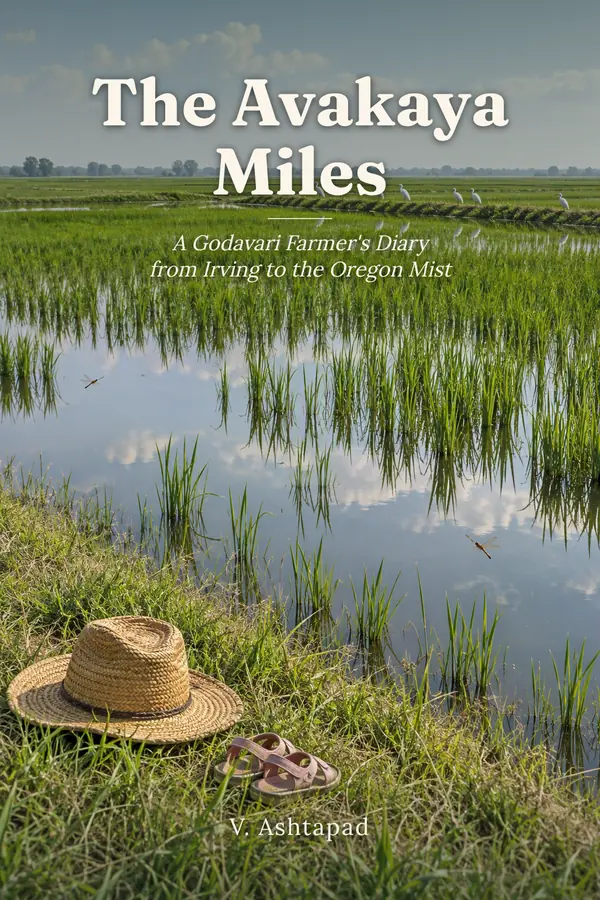
The Avakaya Miles
A Godavari Farmer's Diary from Irving to the Oregon Mist
by V. Ashtapad
Foreword
This is a novel. Veerabhadra Rao, his family, his walking group, the village of Chinnalanka and every person met along the way are invented. Real places named here, from the Godavari delta to the towns and parks of the American West, are used fictionally, and the motels, diners and cafes in them are imagined.
Telugu words appear as an Andhra family would say them at home, spelled simply in English letters. The old verse in the tenth chapter is given only as a loose paraphrase of a well-known saying in the Vemana tradition, and every other verse in the book was written by its characters. Ugadi pachadi, the six-taste chutney eaten at the Telugu new year, is made here out of season, as families sometimes do for any new beginning.
For the people who stand at the canal head so the tail-end fields get water.
Amarillo, 365 Miles
Day One. Irving, Texas, to Amarillo, Texas. Three hundred sixty-five miles by the dashboard, which counts in miles and not in kilometers, so you must multiply by one point six and feel more tired.
My dear friends of the six o'clock walk, Gangaraju garu, Subhadra madam, Koteswara Rao and young Pullaiah, I am writing this in a motel room with a brown carpet and a painting of a horse above the bed. The horse is looking at me as if I owe him money. I have promised to read you every page of this diary on the canal bund in August, so I will tell you only what is true, and where I exaggerate I will confess it in brackets. (The horse is not really looking at me. But he is a very judgmental horse.)
We left Srikanth's house at a quarter past five in the morning. You know I have not slept past five since 1981, so this was no hardship for me. For the others it was a military operation. Srikanth carried the suitcases out to the rented SUV in the dark with his phone light held in his teeth. It is a white vehicle with three rows of seats and it smells of a lemon that has never grown on any tree. Liisa, my daughter-in-law, packed the back like a person who has done a jigsaw puzzle of the whole world. She is from a small iron-mining town in the north of Michigan, where she says the snow comes up to the windowsills in January, and she has the patience of such people. Every bag had a place. Every place had a bag. Then I came out with my own suitcase, and she asked me, very kindly, why it was heavier than when I arrived.
I must now make a confession to the group. Subhadra madam, you were correct. I did bring it.
The jar of avakaya that Sattibabu's wife and I made in the last week of May, from the hard green mangoes of the tree beside the pump shed, cut with the big cutter while the mango was still sour enough to make your jaw ache, mixed with mustard powder and red chili powder and salt and the good groundnut oil, sealed with a cloth and a string, rested twenty-one days in the dark storeroom, and then wrapped by me in three plastic bags and one old veshti, rolled inside my woolen sweater, and placed in the middle of the suitcase like a sleeping child. The airport officer in Dallas opened the suitcase and looked at the sweater and asked if I was cold. I said that in India we are always prepared. He closed it. I am not proud of this. I am only a little proud.
Liisa unwrapped the jar on the kitchen counter at five in the morning and smelled it and closed her eyes. She said, "Oh, that's dangerous." I believe this was praise.
Srikanth laughed. Then he became practical, as he always becomes, and said we must decide how to ration it, because the drive is two weeks and the jar is one. So I took a strip of masking tape from Liisa's drawer and stuck it vertically down the side of the glass, and with a ballpoint pen I made fourteen marks on the tape, one for each day, from the top of the pickle to the bottom. You will recognize this. It is the water gauge at the head of the Bank Canal lock, the one painted in red and white stripes, which I have read every morning of my working life. Now I will read the pickle in the same way. When the pickle is below the line of the day, there will be trouble.
My granddaughter Himabindu, whom everybody calls Bindu, is eight years old. She watched me draw the lines and asked, "Is that a ruler for pickle?" I said yes. She said, "That is the weirdest ruler I have ever seen." I have decided this is the beginning of our friendship.
I must explain Bindu to you properly, because you have only seen her in photographs, where she is always holding a cat that does not belong to her. She has her grandmother's forehead and her mother's light brown hair, which in the morning sun is the color of paddy straw after threshing. She speaks English very fast, like a radio with the knob turned too far. She speaks Telugu not at all, apart from "thatha", which is me, and "chaalu", which means enough, and which she learned from her father saying it to her at dinner. She has said "chaalu" to me four times today. Each time I was telling her about soil.
The highway out of Dallas goes northwest, and for the first two hours it is all shops, then all fields. Gangaraju garu, you asked me to report on the agriculture, so here is my report. The soil is red. Not the red of our laterite near the hills, which is a dark brick red, but a pale rusty red, like turmeric that has been mixed with ash. It is dry on top and cracked. The cotton is planted in rows so long that I could not see where they ended, and between the rows there is no water standing at all. Nowhere. I looked for two hundred miles for a single canal, a single channel with the sky in it, and I found three small ponds the color of tea with milk, and one was holding a cow.
You must understand what this does to the eye of a delta man. At home, when you stand on the bund of any field in July, you see water everywhere, in the field, in the channel, in the sky reflected in the field, in the clouds coming up from the Bay. You see green in so many grades that a painter would weep. Here the green is a thin rumor. There are mesquite trees, small and gray-green and thorny, scattered as if somebody threw them from a passing lorry. The grass at the roadside is yellow. The sky is enormous and white at the edges with heat. I felt, for the first hour, a kind of thirst that was not in my throat.
At a small town whose name I did not catch, a road sign said YIELD. Bindu asked me what it means in Telugu. I thought for a long while. In our language, to yield is many things. To give way is "daari ivvu", give the road. But a crop also yields. The field gives. I explained to her that the same English word is used for a car stopping politely and for a field producing rice, and she looked at me with great suspicion, as if I was inventing it. So we made a rule. Whenever she reads a sign aloud in English, I will give her the Telugu, and she will write it in her small notebook with a purple cover, spelled however it sounds to her. By Amarillo she had five words. STOP is "aagu". WATER, which was on a tower, is "neellu". COW, which was a picture on a sign, is "aavu". When she asked for SPEED LIMIT, I told her there is no speed limit on the road from Ravulapalem to Amalapuram, only buffaloes, so now she also has "gede", which is how we say buffalo at home.
Lunch was at a gas station, which in this country is also a restaurant and a shop and a temple to ice. Koteswara, you say your rice mill is the busiest place in our mandal. You have not seen a Texas gas station at noon. The light inside is so white that it hums. There are refrigerators along one entire wall with glass doors, and in them are perhaps two hundred kinds of drink, in every color that does not occur in nature. Men in large hats were eating long sausages turning slowly on hot metal rollers. I bought a banana. It was eleven inches long, very yellow, and it tasted of nothing. I thought of our small chakkerakeli bananas from the grove behind the school, which are sweet like jaggery and a little sour at the end, and whose skin goes black with spots the day after you buy them. This American banana could survive a war.
Liisa had made sandwiches. Srikanth had made curd rice in a steel box, without telling me, because he remembered that his father cannot travel without curd rice at noon. I was moved by this more than I let them see. I opened the jar of avakaya for the first time on American soil, at a concrete picnic table under a metal roof, with the hot wind coming across the cotton. I took one piece of mango, with the skin and the hard white stone inside, and the red oil running down to my wrist, and I put it beside the curd rice. Liisa took one small piece and ate it very bravely and drank half a liter of water. Srikanth took two. Bindu watched all of us.
"Is it spicy?" she asked.
I said it is kaaram, which is a word for that fire. And then I said that it is also pulupu, sour, and uppu, salty, and that a good avakaya is like a good village, it has every kind of person in it and they all shout at once. She put the tip of her finger in the oil and touched it to her tongue. Her eyes became very wide. She did not cry, though her face considered it. She said, in a small voice, "Kaaram." That was word number six.
The afternoon drive was long and straight. Srikanth drove and Liisa slept, and Bindu and I in the second row played a game of counting the red trucks. She counted in English and I counted in Telugu. Okati, rendu, moodu. By the tenth red truck she was saying "padi" with me. Ten. She liked the sound. She said "padi" is like a pat on a drum.
Near the end of the day the land became flatter and flatter, until it was a table. I have seen flat land before. Our delta is flat. But our flatness is wet and full and divided into a thousand small pieces by bunds and channels and palm trees, so the eye always has somewhere to rest. This flatness is one single piece. You could drop a coin in Amarillo and see it roll for three days. There were enormous round fields of green, made by long irrigation rigs that walk in a circle on wheels, and from the highway they look like coins themselves, green coins on a brown cloth. I asked Srikanth where the water comes from, and he said from underground, very deep, an old water that is being used faster than it returns. I said nothing, but I worried about it for the next forty miles.
The motel is beside the highway. Its sign is red and yellow and shines all night. In the parking lot there are trucks with their engines running, purring like large animals that cannot sleep. My room is next to Srikanth's. Before dinner I changed into my lungi, the blue-checked one, because after a day in trousers a man must let his legs breathe. Bindu knocked on my door to bring me a towel from her mother and saw me in it, and she said, "Thatha, why are you wearing a skirt?" I explained that it is a lungi and that her great-grandfather wore one every evening of his life on the veranda in Chinnalanka, and that it is the most sensible garment ever invented for heat. She asked if she could try it. I said when she is older. She said she is older than yesterday. The child argues like a lawyer.
Then she pulled me by the hand down the outdoor corridor to show me the ice box. It stands in a small alcove under a buzzing light, a steel cabinet taller than Bindu. You lift a lid and inside is a heap of ice, small curved pieces like the cut ends of a cucumber, and more falls from a hole whenever it pleases. It is free. All night it makes ice for nobody, and every so often it drops a load with a crash that made me jump. I thought of the ice factory near the fish market in Rajahmundry, where the blocks come out in long gray bars and the boys slide them down a wooden chute onto the carts, and the fish women pay by the piece. Here the ice is like that old water under the cotton: it is given away all night and nobody looks at it.
Before sleeping I typed this diary on Srikanth's old laptop, which he has given me for the trip, and he showed me how to put it into the family's private page, the one where he has added me and Kanthamma and Sailaja and nobody else. He also showed me the map in that page, where he has already pinned our house in Chinnalanka with a photograph of the front gate with the hibiscus. Tonight he pinned Amarillo. On the screen, the two pins are on opposite sides of the world, and the line between them goes over the whole of the ocean. Bindu leaned over and looked at our gate and asked whether the flowers are real.
I said they are real. I said that Sattibabu is watering them while I am gone. She said she wants to see them. I said then she must learn to ask for them in Telugu, and she wrote in her purple notebook the word "poolu", flowers. That was number seven.
Now it is a quarter past ten. The trucks are still breathing outside. The pickle has gone down exactly to the first line on the tape, not below. Tomorrow, New Mexico.
Albuquerque, 290 Miles
Day Two. Amarillo to Albuquerque, New Mexico. Two hundred ninety miles, and one hour given back to us free of charge at the state border, because New Mexico keeps a different clock.
Pullaiah, you will appreciate this, as a man who is always late for the walk. Somewhere in the empty land west of Amarillo there is an invisible line, and when you cross it, the clock in the car jumps backward by one hour, and you have arrived before you left. Srikanth explained this to me as a matter of time zones. I understood the explanation. I did not understand the feeling. I sat for some minutes holding this extra hour in my hands like a coconut somebody had dropped into my lap from a tree, and wondering what to do with it. In the end I used it to eat a second piece of avakaya, which was not in the plan. The tape on the jar now shows I am a quarter of a line ahead of myself. Liisa saw. She said nothing, but she raised one eyebrow, which in Michigan, I am learning, is a full speech.
The land changed at once after the border. In Texas it was flat like a table. In New Mexico the table broke. First there were low red cliffs at the edge of the highway, flat on top, with their sides falling away in steps, like the cut face of a field bund after the canal water has eaten into it for a season. Srikanth says these are called mesas, which is Spanish for tables, so I was right about the table, only wrong about which state owned it. Then the cliffs grew taller and stood farther apart, and between them the ground was covered with small dark bushes, round and evenly spaced, as if a very patient gardener had planted the entire country and then gone away for a thousand years. These are juniper, and some piñon pine. The smell when we stopped was sharp and clean, like crushed tulasi leaves mixed with turpentine.
And the soil. Gangaraju garu, the soil here is many colors on the same hill. Red at the bottom, then a band of pale yellow, then a gray like cement, then red again, laid one on top of the other like the layers of a pesarattu folded over its upma. I have never in my career seen soil arranged like this for display. In our delta the soil is all one family, black and heavy and sticky in the wet season, the black cotton soil that holds water like a miser holds money. You dig one foot, two feet, and it is still the same black. It was brought down by the river over a hundred thousand monsoons and laid down flat and even. Here the soil has been laid down and then stood up on end and cut open by weather, so you can read it. Bindu asked me why the hills are striped. I told her each stripe is a different time, and the river and the wind wrote them, and nobody has ever read the whole book. She said, "Like a cake." I said yes, like a layered cake, but nobody may eat it. She looked out at the hills for a long while after that.
At a town called Tucumcari we stopped for petrol. Everything in that town is old and painted in strong colors, and many signs are broken, and the motels have names like stars and moons and sunsets, as if the town decided long ago to live inside a postcard and then forgot to post itself. A dog slept under a bench in the shade. The heat at eleven in the morning was the heat of the Rohini days at home, the end of May, when, as the old people say, even the stone mortars crack. But it is a dry heat. It does not sit on your chest. At home in May the air is so wet you sweat standing still and the sweat stays on you like a second shirt. Here the sweat disappears before it is born. My lips are already cracked. Liisa gave me a stick of something waxy to rub on them and it tastes of a fruit I cannot name.
The purple notebook now has eleven words. In Tucumcari she added "endalu", the hot sun, and "dhooli", dust, and "kukka", dog, for the one under the bench. Then on the highway she saw a sign with a picture of a deer jumping and I told her "jinka", and she asked if there are deer in Chinnalanka. I said no, but there are mongooses that run across the road behind the school, and white egrets that follow the plow, and she added "konga", the egret, though there is not a single one in New Mexico. The notebook, I see, will not be a dictionary of the road only. It will also be a dictionary of the places the road reminds me of.
This afternoon the clouds came. I must report this carefully to all of you, because it was the first familiar sky I have seen in this country. Toward three o'clock, great white clouds began to stand up over the mountains to the west, tall and boiling at the top and flat and dark at the bottom, exactly as the monsoon clouds stand up over the Bay in late June when they come to us from the southwest. My heart lifted. I said to Srikanth, "It will rain." He said maybe, in the mountains. I said it will rain here. He said it does not usually rain here. We argued about it the way we have argued since he was fourteen, without anger and without either one changing his mind. Then, for ten minutes near a place called Clines Corners, it rained. Very heavy, very short, with drops the size of chickpeas hitting the windshield so loud that Bindu put her hands over her ears. Then it stopped. The road steamed. And the smell came in through the air vents.
Friends, it was the matti vaasana. The smell of earth after the first rain. The same as at home, but thinner, sharper, with the juniper inside it. I made Srikanth stop the car on the shoulder. I got out and stood in the wet sand and breathed. A lorry passed and blew my hair flat. Liisa and Bindu got out and stood beside me, not knowing why, and I told them that in our village when the first monsoon rain falls on the hot fields, everybody comes out of the houses and smells the air, even the old women, even the children, and the farmers say it is the soil thanking the sky. Liisa breathed in and said, "Petrichor." I asked what that is. She said it is the English word for that smell. A word made only for this! I was astonished that English has bothered. Bindu said, "Matti vaasana is better." She wrote both in the notebook, one on each side of the page.
We arrived in Albuquerque in the late afternoon. It is a big city lying in a wide valley with a long mountain to the east, and the mountain is a dark pinkish brown, and Liisa says at sunset it turns the color of watermelon flesh. I did not believe her. At seven thirty I watched it, and she was right, though I would say it was closer to the inside of a guava. The city is low and spread out, with houses the color of mud plaster and flat roofs, and many of them have strings of dried red chilies hanging by the door, very long, like the strings of drying chilies on the terrace of every house in Guntur district in March. I felt immediately at home with these people.
This was confirmed at dinner. We went to a restaurant serving the food of New Mexico, and here I must give you a full report. The cuisine is built on chilies, green and red. They ask you, "Red or green?" as seriously as Koteswara's wife asks a guest whether they want the second helping of pulusu. I chose green. It was roasted, smoky, with a slow, honest kaaram that comes up from behind, not the bright shout of our dried red chili but a deeper voice. It was served in a sauce over a flat folded thing with cheese and beans, and I ate all of it and asked for more green on the side. The waiter looked at me with new respect. Srikanth had red and called it mild. Liisa had something with a fried egg on it. Bindu had cheese, only cheese, with a little tortilla.
And then, friends, the sopapilla. This is a small square of dough, fried until it puffs up like a pillow, hollow inside, hot enough to burn your fingers. On the table there is a plastic bottle of honey shaped like a bear. You tear the corner of the sopapilla and pour honey inside it until it is half full and then you eat it while it drips down your wrist, as the avakaya oil did yesterday, but sweet. It reminded me so strongly of our poornalu that I almost cried into the honey. The poornalu Annapurna made for Sankranti, the jaggery and chana filling inside a fried shell. I have not eaten one in three years.
It was Liisa who asked the question that started the business of the tastes. She had the honey on her fingers, and the green chili was still in her mouth, and she said, "So in Telugu food, you always want everything at once? Hot and sweet and sour?" And I said, not always, but there is one dish where we want all of it on purpose, and that is the pachadi we eat at Ugadi, the new year, in March or April. I explained. You take the flowers of the neem tree, which are bitter. Raw green mango, which is sharp and astringent and makes the mouth pucker. Tamarind, sour. Jaggery, sweet. Salt. And a little pepper or chili for the heat. All six, mixed in one bowl with water. Everybody eats a spoon in the morning before anything else. The old people say the year will bring you all six, so you had better learn the taste of each one early.
Bindu had stopped eating her cheese. She asked what the six are called. I told her. Theepi, sweet. Pulupu, sour. Uppu, salt. Kaaram, hot. Chedu, bitter. Vagaru, the one that dries your mouth, like a green banana skin. She asked me to say them again, slowly, and wrote each one at the top of a fresh page in the purple notebook, six pages, one taste per page. Then she announced, in the voice of a district collector reading out a government order, that on this trip we must find all six. One at a time. In real places. And when we reach Oregon, I must make the pachadi for the new house.
I said the neem flower will be a problem. Neem does not grow in Oregon.
She said, "Thatha, you'll figure it out," exactly the way her father says it at his work on the telephone.
So we have found the first. Under the page that says theepi, she has written, "sopapilla with bear honey, Albuquerque." She drew the bear.
After dinner Srikanth pinned Albuquerque to the family map, next to Amarillo, and I added a note under the pin, about the matti vaasana in the rain at Clines Corners. Kanthamma had already written underneath yesterday's entry. She says the hibiscus at our gate has two new flowers and that Sattibabu says the nursery beds for the paddy seedlings are ready, and the canal water was released last Thursday. She asks whether the Rio Grande is bigger than our Godari.
I will answer her tomorrow, after my walk. I have found that there is a path along the river here, under the cottonwood trees, and I intend to be on it at a quarter to six, in my walking shoes, in honor of all of you, so that our group may say it has walked on two continents in the same week. I will report on the river's width, depth, color and character. I already suspect that I will not be kind.
The jar is now exactly on the second line. I have been forgiven by the tape.
Holbrook, 235 Miles
Day Three. Albuquerque to Holbrook, Arizona. Two hundred thirty-five miles, one river walk, one forest made of stone, and one plate of food that I am obliged by honesty to describe in full.
First, the river, as promised to Kanthamma and to the group.
I was on the path at a quarter to six. The path runs along the east bank under very old cottonwood trees, which are tall, with rough gray bark split into deep ridges like the dry bed of a tank in April, and leaves that shiver in the smallest breeze and make a sound like a crowd whispering in the next room. The air was cool. A woman passed me running with a dog on a long lead and said good morning, and two men on bicycles, and one old gentleman walking with two sticks who nodded to me as one walker to another. I nodded back for all of you.
Then I came to the water. Friends, I have to be fair, and I will try. The Rio Grande is a respected river. It has a big name. People have written songs about it. But this morning it was perhaps sixty or seventy feet across, brown like milky coffee, moving slowly around sandbars that had small willows growing on them, and divided into two and three channels that wandered apart and came together again as if they could not agree on the route. I stood on a sandy bank and I could have thrown a stone to the far side. Pullaiah could have thrown it, and he cannot throw.
Our Godari at Rajahmundry, from the old railway bridge, is nearly three kilometers wide in August flood, and you cannot see the far bank in the morning haze, only the line of coconut palms floating on nothing. You know this. I am writing it for Bindu and Liisa, who will read this too. When the flood comes the water is red-brown and thick and carries whole trees, and the fishermen in their small boats look like seeds on a sheet. Here the river is a careful, thin, old man. It has been asked to irrigate too many fields, Srikanth says. There are dams upstream, and canals taking water away in every direction, so by the time it comes through the city it is tired. I felt a sympathy for it. A river that has given too much is a thing I understand. Our own canals do the same to our river, all the way down to the sea.
So, Kanthamma, the answer is no. It is not bigger. But it is kinder to walk beside. Nobody drowns in it in a hurry.
We left Albuquerque at eight and drove west into country even drier than yesterday. Black rock appeared, old lava, broken into blocks and covered with an orange crust of lichen. The mesas came back, now pale yellow and white, and the sky was clean blue with no cloud until afternoon. Somewhere past Gallup we crossed into Arizona and the clock did something again, or did not do something, because Arizona does not change its clocks in summer, and my son explained this at length and I have decided not to think about time again until Oregon.
The purple notebook has acquired a section at the back for numbers. Bindu has decided that counting red trucks is too easy now. We count white horses, which are rare, and the windmills of the old type, the small metal ones with many blades that pump water for cattle tanks. Those I approve of. One windmill, one tank, one patch of green around it where the cattle stand. It is the same arithmetic as a village well. By lunchtime we had counted "aidu", five, windmills and "rendu", two, white horses, and she said the numbers in Telugu with no help. She has trouble with "aaru", six, which she says like the English word "are". I have told her that is close enough for Arizona.
In the afternoon we went to the national park they call the Petrified Forest. I had imagined trees. There are no trees. There are logs lying on the ground, hundreds of them, broken into pieces as if somebody had sliced them with a giant knife, and every log is stone. Real stone, heavy and cold, but with the rings of the tree still inside it and the bark still on the outside. The inside of the stone is colored like nothing I have seen. Red and purple and yellow and orange and a deep shining black, in bands and swirls, like the borders on the Uppada silk sarees that the weavers near Kakinada make, which Annapurna kept in the steel trunk with the camphor balls. The ranger told us these were trees growing beside rivers more than two hundred million years ago, and the rivers buried them in mud, and water full of minerals soaked into the wood over a long time and turned it into crystal.
So, Gangaraju garu, here is the lesson. Even this desert was once a delta. There were rivers here, and swamps, and trees standing in wet ground. And then the water left. I stood among those stone logs in the heat with the wind blowing hot sand against my ankles and I put my hand on one and it was warm, and I thought that this is what happens to a delta when the river goes away. It becomes beautiful in a different way and nobody can farm it.
Bindu did not think this. She thought the logs were cool, and she wanted to take a piece home, and the ranger said no, very kindly, and told her about a curse on the people who take the stones. She was frightened for twenty minutes. I told her that in our village there is also a saying that whoever steals mangoes from the headmaster's tree will grow a mango on his nose. She asked if it happened to anybody. I said it happened to her father. She looked at Srikanth's nose for the rest of the afternoon.
Now I must come to dinner, and I ask the group's permission to be severe.
We arrived in Holbrook at six. It is a small town on the old highway, with wide streets, low buildings, and big dinosaurs made of cement standing outside the rock shops, painted green and smiling. The wind was blowing paper bags down the main road. We were hungry, and Srikanth, who has been very good to me in the matter of food, said, "There's a place here that has curry on the menu, Nanna. Do you want to try?" I should have known. One does not order fish in a desert. But I was curious, and curiosity is the vice of every extension officer. We go to see the demonstration plot even when we know the farmer has used the wrong fertilizer.
The diner was very clean and very cold, with red seats and a long counter and a pie case lit from inside like a jewel shop. Our waitress was a lady named Tammy with silver hair pinned up and reading glasses on a chain, and she called me "hon" six times, and I was charmed by her entirely. She said the cook made the curry special on Thursdays. It was Thursday. Everything was against me.
I will now give the review. I will award marks out of five paddy sheaves, which is how I used to grade the farmers' demonstration plots in Alamuru mandal, as you will remember.
The dish arrived on an oval plate. The rice was white, soft, and grainless, as if it had been ground, then reassembled. Over the rice was a sauce of a bright yellow color, exactly the yellow of a school bus, smooth like custard. In the sauce were pieces of chicken breast cut into cubes, pieces of celery, a handful of raisins, and, friends, I must be truthful, rings of tinned pineapple. On the top was a sprinkle of dried coconut, the sweet kind they use for cakes, and a single leaf of parsley, placed in the center like a flag on a captured hill.
I tasted it. It tasted of flour, and sugar, and of a curry powder that has been kept in a tin since before Bindu was born. There was no salt worth mentioning. There was no kaaram at all. Not a single seed of chili. The raisins were the strongest flavor on the plate, and the pineapple was the second, and I could not find the third. I looked for ginger. I looked for garlic. I looked for an onion that had been fried even for one minute in a pan. Nothing. It was a sauce that had never been near a fire. It had been introduced to the chicken at the last moment and they had not been friends.
Marks. Rice, half a sheaf, for being hot. Chicken, one sheaf, because the chicken is not to blame. Sauce, zero. Pineapple, I am not able to award marks to pineapple in a curry; the regulations do not permit it. Overall, one and a half sheaves out of five, and the half is for Tammy.
I did not say any of this to Tammy. When she came to ask how it was, I said, "It is very interesting, madam, thank you." Srikanth choked on his water. Liisa looked at her plate. Tammy said the cook, who is from Ohio, read about curry in a magazine years ago and has been making it ever since, and that a man from England once ate it twice in a week. I said England is a country that has suffered a great deal, and Tammy laughed, and she brought me a slice of cherry pie without being asked, and it was excellent. Four and a half sheaves. Hot, with the crust breaking into layers and the cherries sour enough to bite you back.
But I am grateful to the yellow curry, and I will tell you why. Bindu was watching my face while I ate it. She had been watching for three days, since the first spoon of avakaya, as if to learn which faces in her grandfather mean which things. When I took the second spoon of that curry, she laughed so suddenly that milk came out of her nose. Then she asked, "Is it bad?" And I said, "Bangaram, it is the worst food I have eaten since the hostel mess in 1977." And she laughed again, and asked me to explain why. So I explained what a curry needs. Oil, heated. Mustard seeds that jump. Curry leaves that hiss. Onion, garlic, ginger, cooked until they surrender. Chili for the kaaram, turmeric for the color, salt so the other tastes can stand up. Then the vegetable or meat. Then patience. She listened as if it were a story. Then she said the curry in this restaurant has only one of the six tastes, theepi, sweet, and it is the wrong one.
She is correct. I have nothing to add.
After dinner, walking back to the motel past the cement dinosaurs, with a big orange moon coming up behind the railroad tracks, I taught her a verse. Not one of Vemana's own, because I would get it wrong in English, but I told her how those old verses work. A short poem of four lines. The first lines show you something ordinary, a pot, a dog, salt, a stone. The last line turns it, so the ordinary thing teaches you about people. And at the very end the poet speaks to himself by name, telling himself to listen. Every Telugu child grows up hearing such verses from grandfathers on verandas, whether they want to or not. I told her my father taught me one every night, and if I could not repeat it back in the morning, I did not get my coffee.
She thought for the whole length of the motel parking lot. Then she made her own, which I copy here exactly:
The curry was yellow like a bus,
it had pineapple and raisins and no fuss,
but Thatha's face was the best part of dinner.
Listen, Bindu: a bad cook can still make a winner.
I told her the meter is irregular and the meaning is excellent. She has decided that every verse she makes will end with "Listen, Bindu." I think the old poet would approve.
Later, in my room, after the shower, I sat in my lungi and Liisa came to the door with her laptop. She said she had found something in the family page, on the shelf of recipes, and wanted to ask me. It was a photograph that Sailaja had put there last year of a page from Annapurna's notebook, the one with the green cloth cover. In Annapurna's round Telugu letters, with a ballpoint that was running out, it is the avakaya. Measurements by the handful and the glass. Liisa cannot read it. She asked me to read it to her. So I read it aloud and she typed my English underneath. Annapurna writes, at the end, a note to herself: Do not let Bhadram put in extra chili because he is showing off. I read this aloud too. Liisa laughed so hard she had to put the laptop down on the bed.
Outside, under the canopy of the gas station across the road, the lights burn all night, a white so flat and complete that the moths come from miles. I can see it from my window. The jar beside me is on the third line. Across the road a pickup truck is filling up in that light like a buffalo at a trough.
Phoenix, 190 Miles
Day Four. Holbrook to Phoenix, by the mountain road through Payson. One hundred ninety miles, one change of climate so violent I am still recovering, and one evening in a Telugu house, which I will describe last because it deserves the most paper.
We left Holbrook early, heading south, and climbed. Within an hour the dry grass and junipers gave way to a forest of tall pines, very straight, with bark in plates of orange and black like the scales of a big fish. There was no undergrowth, only pine needles on the ground and sunlight coming down between the trunks in long bars. The air at that height was cool enough that I put on my sweater, the same sweater that smuggled the pickle. Liisa made Srikanth stop at a turnout and she took me to one of the pines and told me to put my nose into a crack in the bark. I did this. I am a retired government officer and I put my nose into a tree in a foreign country because a woman from Michigan told me to. It smelled of vanilla. Exactly the vanilla of the ice cream at the Rajahmundry railway canteen, warm and sweet. Liisa says some people say butterscotch. I say vanilla. We have agreed to put both in the notebook.
Then the road came to an edge. The forest stopped at a cliff, a great long wall of rock running east and west for as far as I could see, and below us, a thousand feet down, the land fell away into a blue haze. They call this the Rim. The road went down the face of it in curves, and the temperature came up through the vents one degree per minute, and the pines became oaks and then bushes and then nothing but rock and cactus, and by the time we reached the bottom we were in a different country altogether.
Friends, I must tell you about the saguaro. It is a cactus as tall as a two-story house, green, ribbed like a pumpkin, with arms that bend upward from the trunk as if somebody has asked it a question and it is raising its hand. They stand alone on the hillsides, far apart, one here, one there, all over the slopes, for miles. From a distance, in the haze, they look exactly like the toddy palms standing in the fields between Ravulapalem and Kothapeta, those tall single thati trees with nothing around them, where the toddy tappers climb with a rope at their ankles. When I saw the first hill full of saguaros I said "thati chettu" out loud before I could stop myself. Bindu asked what that means. I told her. She now believes Arizona is full of palm trees, and I have not corrected her because, in a certain light, she is right.
The heat in the valley of Phoenix is not heat. It is a judgment. At two o'clock the car said one hundred and twelve degrees outside, which Srikanth calculates as forty-four and a half Celsius. You know this number, Koteswara. You have felt this in Rajahmundry in the worst week of May, when the government closes the schools and the crows sit with their beaks open. But there is a difference. At home, the heat comes with the smell of jasmine and neem and drains and frying, and the shade of a big tree is ten degrees cooler and full of men sleeping. Here the heat smells of hot asphalt and nothing, and the trees are small, and the shade of a small tree is only a darker place to be hot in.
And then they told me about the monsoon.
Prabhakar, our host, telephoned Srikanth as we came into the city, to give directions, and Srikanth repeated what he said, and what he said was: Be careful, the monsoon is active today. I asked Srikanth to repeat it. He repeated it. Arizona, friends, has a monsoon. They call it that. It is in the newspaper and on the television. I said to my son that this is an insult to the word, that a monsoon is four months of rain from the sea, that it is the rice and the river and the whole year, and that a few showers in a desert cannot borrow that name like a man borrowing a coat. I was in full flow. Liisa said, "Look." And I looked.
From the south, across the whole width of the valley, a wall was coming. A brown wall, perhaps a thousand feet high, with a rolling top like the edge of a breaking wave. It was dust. The entire air was standing up and walking toward us. The light turned orange, then the color of strong tea. Srikanth pulled off the road as the sign told him to, and switched off the headlights so other cars would not follow us, which the sign also told him to do, and put his foot off the brake, and then the wall reached us. The car rocked. Everything outside disappeared. Sand hissed on the windshield like oil in a pan. Bindu climbed into my lap, eight years old and too big for laps, and I held her and told her the Telugu word for wind, "gaali", over and over, as if it were a charm. It went on for perhaps fifteen minutes. Then the brown became yellow, and the yellow became gray, and it began to rain big drops that came down muddy and left round brown spots on the hood like a leopard.
When it was over, I said to Srikanth that I take back some of what I said about the monsoon. He did not gloat. He is a good boy.
The house is in a place called Chandler, on a street where all the houses are the color of sand and have roofs of curved orange tile and gravel yards with small trees in them. Prabhakar and Vasantha found us through Srikanth's old roommate, who is in the Telugu association of the valley. Prabhakar is the treasurer, and he greeted me at the door with both hands, and he called me "babai garu", uncle, and I felt my shoulders come down from my ears for the first time since Irving.
The house smelled of tamarind and roasting chana dal and the dust that had blown in when they opened the door for us. Vasantha was in the kitchen with three pressure cookers going at once, and the whistles went off one after the other like a train station. She is from Karimnagar, in Telangana, and she speaks fast and with a different music than ours, so that some words she says are the same as mine and some are cousins and one or two are strangers. There are two Telugu states now, and in this kitchen in Arizona they share one stove. Prabhakar's mother, Ratnamma garu, is visiting from Vijayawada, and she sat at the dining table in a cotton saree peeling garlic with her thumbnail, and she looked at me the way one elder looks at another when deciding who has seniority. I believe she is seventy-eight. I conceded at once.
Then the food. I will write it in order.
There was pulihora, the tamarind rice. Vasantha made it with tamarind soaked and squeezed by hand, cooked down with green chilies until it was thick, and then the tempering, mustard and chana dal and urad dal and fried peanuts and dried red chilies and a great handful of curry leaves, all crackling in oil and poured over the rice, and the turmeric turning it gold. Bindu ate three spoons and said it was "pulupu", and wrote it on the second page of the six-taste section of her notebook, under the heading pulupu, with these words: "Aunty Vasantha's tamarind rice, after the dust wall." She asked how many tamarinds are inside it. I said in our village we have a tamarind tree so old that the whole street has eaten from it for three generations, and it is still producing.
There was gongura pachadi, and here I bow to Vasantha forever. You will not believe me, Subhadra madam, but in her backyard, in that judgment of a heat, she grows gongura. Six plants, in a raised bed, with a drip line running to each one like a hospital patient, under a cloth shade, and the leaves are dark green with red veins, and sour enough to make your eyes water. She picked a fresh handful for me to see. Then she gave me the pachadi made from them with roasted red chilies and garlic, and I ate it with hot rice and ghee, and I forgot I was in America. For eleven minutes I was at Annapurna's mother's house in Tanuku on a Sunday in 1983. I did not tell anybody this. I am telling you.
There was also a tomato pappu, and okra fried until crisp, and curd. Then the avakaya. I brought out the jar. I explained the tape. Prabhakar laughed until he coughed. Ratnamma garu tasted one piece, slowly, chewing with great concentration. Then she said it had too much salt and not enough mustard, and that in Krishna district they would put more garlic. I said in Godavari district we let the mango speak. She said the mango was speaking too loudly. We went on in this way for twenty minutes, very happily, while Vasantha served rice and the young people looked at us as if we were a television program in a language they half understood.
Which, I must tell you, is the sad part of the evening, and I want you to hear it.
Prabhakar and Vasantha's son is Abhiram, fifteen, tall, polite, with headphones around his neck at all times. He was born in Phoenix. He understands Telugu when his mother shouts it, he says, but he answers in English. Bindu, who speaks nothing, and Abhiram, who speaks a little, sat side by side at the table and spoke English, and the grown-ups spoke Telugu, and there was a wall between the two ends of the table thinner than the dust wall but just as hard to see through. Ratnamma garu tried to ask Bindu her name in Telugu. "Nee peru enti?" Bindu looked at me. I whispered the answer. She said, "Naa peru Bindu." Ratnamma garu clapped her hands as if the child had recited a whole poem. Abhiram said, a little ashamed, that he used to know more. Vasantha said there is a Telugu class on Sundays at the community center but he stopped going when he started high school. Prabhakar said, "It's hard." Nobody argued with him.
After dinner the children went out to the pool. Abhiram and Bindu threw a ball back and forth and argued about the rules of a game they invented, in English, with great happiness, and the lights under the water made their legs look green.
Before she went to the pool, there was the photograph. I must tell you about this, and Kanthamma, you will see it before anybody.
In my suitcase, under the pickle, wrapped in tissue paper, I brought a pattu langa for Bindu. I bought it at the shop on Main Road in Rajahmundry where Annapurna bought all of Sailaja's, the small shop up the stairs, with the old man who measures with his arms. It is green silk, the green of young paddy just after transplanting, with a border of magenta and gold as wide as my hand, and a matching blouse with puffed sleeves. I had guessed her size well. Vasantha took her into the bedroom and dressed her and combed her hair and pinned a string of jasmine into it from the bush beside their front door, which grows even in this heat, and put a small black dot on her chin for the evil eye, as all mothers do, and brought her out.
Friends, she stood in the living room in front of the brown-gold curtains in green silk with jasmine in her hair, and she did not know where to put her hands. She held the skirt out on both sides the way girls do without being taught. The silk made a small rustling sound, like dry paddy leaves in the wind. Liisa put her hand over her mouth. Srikanth went very quiet. I took the photograph with Prabhakar's camera, and then Prabhakar took one of me and Bindu together, me in my white shirt and her in green, and I am told it is already in our family page for Kanthamma and Sailaja and the others to see.
Bindu asked me, with the jasmine smell all around her, whether her nanamma ever saw her. I said yes, once, when she was four months old, in a video call at night, and that her nanamma sang to her through the screen. Bindu said she does not remember. I said that is all right. I remember. Then she asked if she could keep the pattu langa on for the pool. Liisa said absolutely not.
Now it is late, and I am writing this in Abhiram's room, under a poster of a basketball player. Outside, the air is still ninety-five degrees at eleven at night, and the cicadas are going like a power saw. The jar is on the fourth line, but I must report that the level dropped sharply this evening, because of Ratnamma garu, who said the pickle was too salty and then ate four pieces. I count this as a victory for the Godavari.
Flagstaff, 145 Miles
Day Five. Chandler to Flagstaff, by way of the red rocks at Sedona and the creek canyon above it. One hundred forty-five miles, and more than one mile straight up, because Flagstaff sits seven thousand feet above the sea, and I can feel it in my knees and in the way the pen moves.
Breakfast first, as it deserves.
Vasantha was up before me, which nobody has managed since my mother. At half past five I came out of Abhiram's room and the kitchen was already full of the green smell of soaked moong dal being ground, and the hiss of the batter going onto the hot tava. Pesarattu. She made them thin as a cloth at the edges, with chopped onion and green chili and ginger pressed into the top while they cooked, and the underside turning crisp and spotted brown, and then, because she is a woman of ambition, she spooned upma into the center of each one before folding it, the way they serve it in the hotels near the railway station in Vijayawada and in every Telugu place in Hyderabad. With it, ginger chutney, dark and sweet and hot, made with tamarind and jaggery. I ate three. Ratnamma garu watched me eat the third and said nothing, which I understood to mean respect.
Bindu ate half of one and then all of the upma out of the center of a second, leaving the pesarattu like an empty envelope. Vasantha laughed and said Abhiram did the same thing at that age. Abhiram, who was asleep on the sofa with his headphones on, did not deny it.
When we left, Prabhakar gave me a box of pootharekulu that a cousin had brought from Atreyapuram, those thin sheets of rice starch folded around sugar and ghee, which are made in the village twenty kilometers from ours by women who spread the starch on hot clay pots and lift it off in sheets so fine you can read the newspaper through them. I had brought Prabhakar a box of the same as a gift. He had given me back the same thing. We looked at the two boxes and laughed like boys. In the end we exchanged them anyway, so each would have a box from a different hand. Vasantha gave Liisa a plastic bag of gongura cuttings wrapped in a wet towel and told her to root them in water in Oregon. Ratnamma garu held Bindu's face in both her hands and kissed her forehead and said something in Telugu very quietly that I did not hear, and Bindu, who did not understand it, said "thank you" in English and then, after looking at me, "dhanyavaadaalu", which I had taught her in the car the day before and which is long and difficult. Ratnamma garu said "aha" and looked at me. I did not try to look modest.
The highway north climbed out of the heat in steps. At every step the air changed, and the cactus thinned, and grass came. Then we turned off toward Sedona, and the rocks came.
I have spent forty-one years looking at soil, and I have never seen soil standing up as tall as a temple tower, red from the bottom to the top. Not the pale rusty red of Texas. A deep, burning, true red, the red of fresh brick from the kiln outside Kadiyam, the red of a mango skin where the sun hits it. The rocks stand in towers and cathedrals and ridges, layered with paler bands, and against them the junipers are dark green, and the sky above is so blue it looks wet. I made Srikanth stop at four different places. I could not get enough of the color.
It is iron that does this. I explained it to Bindu. The same iron that makes our laterite red near the Eastern Ghats, and makes the soil there poor for paddy and good for cashews. The iron has rusted, I told her, exactly like the old bicycle behind our cowshed. All this red is rust. She looked at the great rocks and said, "That's a lot of bicycle."
Then Liisa told us something I had not known. Her grandfather, her mother's father, worked in the iron mines in Ishpeming, in the north of Michigan, deep underground, for thirty-four years. She said that when she was small and he was old, his fingernails were still red at the edges from the ore, and the lines in his palms were red, and he could never get it all out, no matter how he scrubbed with the gritty soap. The houses in that town, she said, used to have red dust on the windowsills, and her grandmother wiped it every morning with a cloth and swore at it in Finnish. Liisa stood at the edge of the parking area looking at the red rocks with her arms crossed, and I saw that they were not the same rocks to her as they were to me. To me they were soil. To her they were her grandfather's hands.
I said to her that in our village the old farmers have black under their nails from the delta mud that never washes out either, and that my father's feet had cracks in the heels so deep that he packed them with castor oil every night. Liisa said, "So we're both from dirt." I said that is the best place to be from. She translated this for Bindu, unnecessarily, and Bindu asked if she is from dirt too, and we both said yes, two kinds, red and black, and she looked pleased.
North of Sedona the road goes up a narrow canyon beside a creek. Friends, at last, running water. Clear, cold, fast water, coming down over stones the color of copper, under tall trees with white trunks and broad leaves that Liisa said are sycamores, though they are not the sycamores I know from books. There were families sitting on the rocks with their feet in the water, and children shouting, and a man fishing. I took off my shoes and socks and rolled up my trousers and stepped in. The cold went straight up from my ankles to my teeth. The stones under my feet were slippery with green moss, and small fish ran away from my toes. Bindu came in after me in her sandals and screamed at the cold and then refused to get out. We stood there in the creek together for some time, holding hands for balance. I told her the word for this, "selayeru", a stream, and that in our village every channel, every small canal, every ditch running between the fields, has its own name, and that I could teach her forty names of water on the way to Oregon if she wanted. She said she would like four.
So I gave her four. "Neellu", water, the plain word. "Kaluva", a canal. "Cheruvu", a tank or lake. "Godari", which is our river, the way the village says it. She repeated them standing in the creek with her teeth chattering, and the words came out shivering.
It was on this part of the drive, climbing the switchbacks out of the canyon toward Flagstaff, that I asked my son about his work.
I have asked before, on the telephone, many times. He always says it is fine, it is busy, there is a project. This time I asked in the car, where he could not walk out of the room. I asked why they are moving. Why Oregon, why now, why leave Irving where the house is paid half and Bindu has her school and her friend with the cat. He said the job is a good opportunity. I said that is what the man from the fertilizer company said to me in 1994. He laughed. Then he did not say anything for a while, and the road kept turning, and the pines came back, tall and orange-barked, and Liisa looked out of her window with great attention at nothing.
He said, "Let me tell you at the canyon, Nanna. Okay? Tomorrow."
I said okay. I have learned, after forty-one years of farmers, when a man is not ready to tell you about the debt. You do not push. You wait by the pump shed until he brings it himself.
Flagstaff is a town in a pine forest at the foot of a big mountain that has snow in its gullies even now, in the last week of July. The air is cool, almost cold at night. It smells of pine and woodsmoke and rain coming. The railroad goes straight through the middle of town, and the freight trains are so long that I counted one hundred and nine cars on one of them before I gave up, and each one blows its horn at every crossing, two long, one short, one long, a sound like a great sad animal calling to another in the next valley. They come all night. Bindu says she likes them. I find I do too.
In the motel, after dinner, which was soup and bread at a place full of young people with large backpacks, Bindu and I sat on the bed with the laptop, and Srikanth showed her the family tree in our family page. It has been there for some time, he said. Sailaja started it. There are branches on it already, my side and Annapurna's side, four generations back on mine as far as my grandfather's grandfather in Chinnalanka, and Annapurna's going back to Tanuku. Liisa's side has only her parents, with nobody filled in before them.
Bindu wanted to know who everybody was. So I began to tell her, and she began to type, and very soon she discovered the trouble with Telugu.
In English, she said, there is one grandmother word and one grandfather word. In Telugu, there are words for which side. Her father's mother is "nanamma". Her mother's mother is "ammamma". And her father's sister, Sailaja, is "atta", but her mother's sister, if she had one, would be "pinni" if younger or "pedamma" if older. And Sailaja's husband is "mavayya", which is also what she would call her mother's brother, if she had one, which she does not. She asked why Telugu has to be so complicated. I said because in a village everybody is somebody's somebody and you have to know exactly whose. In a village, if you call a man by the wrong word, you have married your daughter to the wrong family.
She thought this was hilarious. Then she did a thing I did not expect. Under Liisa's mother, Carol, in Ishpeming, she typed "Ammamma Carol". Under Liisa's father, Dennis, she typed "Thatha Dennis". She gave the Michigan side Telugu names. Liisa saw it over her shoulder and her eyes became wet, and she said her mother would love it. Bindu asked what she should call me, then, so that I am not mixed up with Thatha Dennis. I said there is a word for the father's father, it is the same, "thatha", but she can call me "Godari Thatha" if she likes, river grandfather, and Thatha Dennis can be "Ishpeming Thatha". She typed it.
Now it is eleven o'clock. The trains are calling. The pickle is on the fifth line. I have put the jar on the windowsill tonight because the room is cold enough to be a refrigerator, and the oil inside has gone thick and cloudy, which is what happens to good groundnut oil in December at home. I took it as a sign. Tomorrow the canyon, and whatever my son needs to tell me there.
Grand Canyon, 80 Miles
Day Six. Flagstaff to the South Rim of the Grand Canyon. Only eighty miles, the shortest leg, and the longest day.
I will tell you first what I expected, so you can measure my surprise. You will all remember the boat trip to Papikondalu that the extension staff took in 1990, when we hired the big wooden launch from Polavaram and went up the river into the hills, and Annapurna brought Srikanth and Sailaja, who were six and three, and Sailaja was sick over the side, and Gangaraju garu sang old film songs on the upper deck until the boatman begged him to stop. You will remember how the river, which is three kilometers wide at Rajahmundry, suddenly becomes narrow and deep between the hills, perhaps three hundred meters, dark green and quiet, and the hills come down on both sides steep and covered with forest, bamboo and teak and creepers, and the mist lies in the folds in the early morning like cotton wool tucked into a box. Two hills, the papi hills, standing close on either side of the water, so close that the old people said the river had to squeeze its shoulders to pass. That is the most famous gorge in my life. I was prepared to say that the American one is bigger. I was not prepared for anything else.
We arrived at the rim at nine. You walk from the parking area through pine trees, along a path, with many people speaking many languages, and the ground is flat, and there is no sign that anything is about to happen. Then the trees stop. And the ground stops. And there is nothing.
Friends, I do not have the English for this, and I do not have the Telugu either. The earth simply opens. It goes down and down, a mile down, Srikanth says, and it goes across, ten miles to the other side, and it goes left and right as far as you can see, and all of it is rock. Rock in layers, red and cream and purple and gray and orange, each layer the thickness of a whole hill, laid one on top of another and then cut through, so you see the edges of them all, like the cut side of a stack of a thousand of Annapurna's sarees in the steel trunk. There are towers and temples of stone standing inside the canyon, each one bigger than any hill in our district, and they look small. The shadows of the clouds move across them slowly, and where a shadow passes the red goes purple and then comes back red.
And I looked for the river.
I looked for a long time. In Papikondalu the river is everything. The hills are only the walls of the river's house. Here I could not find it. Srikanth pointed, and at last, very far down, at the very bottom, between two dark walls, I saw a small line of brown-green, the width of a thread, catching the light for a moment and then disappearing behind rock. That, he said, is the Colorado River. That thread made all of this.
I sat down on the stone wall at the edge, because my legs asked me to. I am a man of water and soil. I know what a river can do. I have seen the Godari take a whole lanka island in one night in the 1986 flood, fields and houses and coconut trees, and leave only sand. I have seen a canal bank washed out in one hour. I know that water carries the soil away and lays it down somewhere else; that is the whole story of our delta. Our delta is made of soil that the river brought from the hills, from the Deccan, a thousand kilometers of hills worn down and carried and laid down for us, so we could plant paddy. And here, I thought, here is the other side of the story. Here is the place the soil comes from. This is what a river looks like when it is taking, and not giving. Somewhere, very far away, at the mouth of this river, there must be people who live on what this canyon has lost.
I said this to Bindu. She said, "So this is where deltas come from?" I said yes, roughly. She looked down into the canyon for a long time. Then she said, "It's a really big hole, Thatha." Which is also true, and more concise.
We walked along the rim path for most of the morning. There are no railings in many places, and the edge is right there, beside your shoe, and Liisa held Bindu's hand so tightly that the child complained. The air smelled of hot pine and dry stone. Ravens, very large and black, floated at the edge on the wind coming up from below, without moving their wings, and one landed on the wall near me and looked at my sandwich with an expression exactly like the crows on our terrace when Annapurna put out the rice balls in the afternoon. In the shade the air was cool. In the sun it bit. Far down below, on a ledge, there was a green patch of trees where Srikanth said there is a spring and a camp, and a trail going down to it in a zigzag, with mules on it. I watched those mules for twenty minutes. They walked as if they had nothing to prove.
The afternoon brought the storm, as the ranger at the visitor center had said it would. The clouds that had been white and small in the morning grew tall and gray over the north rim and came across the canyon, and you could see the rain falling from them in gray curtains, a long way off, falling into the canyon and not reaching the bottom, drying up in the air halfway down. Then lightning, in white cracks, striking the far rim, and the thunder came across the open space late and enormous, rolling from one wall to the other like a cart full of stones going down a hill. We went into the lodge to wait. I bought a cup of black coffee from the counter, because the queue for anything else was very long.
It was bitter. Strong and black and burnt, the way they make it here in big urns, nothing like our filter coffee with boiled milk and sugar that Subhadra madam serves after the walk. I made a face. Bindu, who misses nothing, opened the purple notebook to the page headed chedu, bitter, and wrote, "Thatha's coffee at the big hole." I said that is not a proper choice, that in the pachadi the bitterness comes from the neem flower, which is a bitterness that is good for you, cleaning the blood. She said this coffee also counts. I said why. She said, "Because you made the same face." I could not argue.
But it was not the coffee that was the bitter taste of today, and I think she knew that, and I think she was waiting for it to come, as children do.
When the storm had gone and the sun came out low in the west, the whole canyon turned colors I cannot write. Everything that was red became a red with fire inside it, and the shadows went deep blue and violet, and steam rose off the wet rock. Liisa took Bindu down the path to see a squirrel. Srikanth and I sat on a bench at the edge, and he told me.
He lost his job in March. Four hundred people in one morning, by email, and the security guard walking them to their cars with a box. He did not tell me. He did not tell Kanthamma or Sailaja. He looked for work for three months, and Liisa took extra hours at the clinic, and they used their savings, and in June he found the job in Oregon. It pays less. It is a smaller company. He was ashamed, he said, because I sold the acre near the canal head to pay his fees for the master's degree in America, and because I told everybody in the village my son was a big man in a big company in Texas, and because he did not want me to know the big man had been carried out with a cardboard box.
I asked him what the new company does.
He laughed, not happily. He said it makes the controls that open and close the water valves on farms. Irrigation. The software that decides, from the weather and the soil moisture, when to send the water to which field. Big farms, in Oregon and Washington and California. He said, "I swore I'd never touch agriculture, Nanna. I watched you in the fields for eighteen years. I swore."
Friends, I did not say anything for a long time. A raven went past at eye level, very close, and turned its head to look at us.
Then I told him about the acre. I told him that when I sold it, to Venkatarao's son, I signed the paper in the registrar's office at eleven in the morning and walked out and stood under the neem tree and I did not regret it, and I have not regretted it one day since. I said a field is for growing whatever you most need to grow, and that year I needed to grow him. I said there is no shame in a man losing his work in a year of bad weather. Every farmer in Konaseema has lost a crop. I lost one in 1996 to the cyclone and another in 2006 to the flood. You do not hide it from your father. You come home and he gives you rice and you plant again.
He said, "You'd have just told me to come home." I said yes, and you would have come, and I would have been very happy, and you would have been very unhappy. So it is better you found the valves. He laughed again then, properly, and wiped his face with the back of his wrist the way he did as a boy after cricket, and said he was sorry. I said he must tell Kanthamma himself, because she will be hurt to hear it from my diary. He said he will. I said I will not put the box in the diary. Then I changed my mind and put it here, because this diary is for you, my friends, and you are men and women who have all lost something and carried it out of somewhere. (He has read this paragraph, and given permission.)
When Liisa and Bindu came back, Bindu looked at both of our faces and said, "Was it the bitter one?"
I said yes. I said in the Ugadi pachadi the bitter is there on purpose, mixed in with the sweet and the sour, so that you do not choke on it alone. You take it with the others. She thought about this. Then she crossed out "Thatha's coffee at the big hole" and wrote instead, "Nanna's news at the big hole." Then she asked her father, very seriously, if he was okay now. He said he was. She said, "Good," and asked if we could get ice cream.
This evening, in the lodge room, Srikanth put the pin for the Grand Canyon on our family map. Then, beside it, he made a second pin, in India, on the river above Rajahmundry, at Papikondalu. And into that pin he put a photograph that Sailaja scanned last year: the boat trip, 1990. A faded color print, the corners curled. Annapurna in a yellow cotton saree on the upper deck with her hair blowing, holding Sailaja, who is green in the face. Me with a mustache, which I had then, laughing at something. Srikanth, six years old, in red shorts, leaning so far over the rail that somebody's hand is reaching into the photograph to pull him back. That hand, I believe, is Gangaraju garu's. So you are in it, sir.
On the screen the two pins are side by side, one hole in the earth with a thread of river at the bottom, and one green gorge with the river filling it from wall to wall. Bindu looked at the photo for a long time and asked which one is her father. I pointed. She said, "He's leaning over." I said he always was.
The jar is on the sixth line. Tonight I ate my portion with Srikanth, sharing one piece of mango between us on the motel bed with two spoons, the way we used to share the last piece at home.
Page, 135 Miles
Day Seven. Grand Canyon to Page, Arizona, along the eastern rim and then north across the high desert. One hundred thirty-five miles. One dam. One theft from the pickle jar, now solved.
I will begin with the theft, because it was the first thing I discovered this morning and it colored my mood until Cameron.
When I opened the jar at breakfast, at the picnic table outside the lodge, with the ravens watching, the level of the pickle was below the sixth line. Not by much. By perhaps the thickness of one finger. But you know me, and you know I have read the canal gauge at the Bank Canal lock every morning for thirty years, and I know the difference between evaporation and a man opening the sluice at night without permission. Somebody had opened my sluice.
I did not make an accusation. I looked at everybody at the table. Srikanth was eating cereal and reading his phone. Liisa was putting cream on her face against the sun. Bindu was eating a muffin with very great concentration and not looking at me at all, and there was a small orange stain at the corner of her mouth that was not from a muffin.
I said, to nobody in particular, that in our village when the water level in a field drops in the night, the farmer goes out in the morning and finds which neighbor has cut the bund. Bindu put down the muffin. Then she confessed. She had woken at midnight when the thunder came back, and she could not sleep, and she remembered the jar on the windowsill, and she got up and took one small piece with her fingers. She said she wanted to see if it was still as hot as the first day. I asked her if it was. She said yes. I asked if she liked it. She looked at her mother, then at me, and she said, "I really, really like it, Thatha."
Friends, I was so pleased I could not be angry for a single second. Six days ago she put her fingertip in the oil and nearly wept. Now she is a thief of avakaya at midnight. This is the whole process of Telugu childhood compressed into a week.
So I have made a new arrangement. I took another strip of the masking tape and stuck it to the other side of the jar, and on it I made marks too, smaller, for the days remaining. This is Bindu's tape. Her share. She may take from it whenever she likes, without asking, but only down to her own line. She asked if she can save hers up and eat it all on one day. I said that is what Koteswara Rao does with his pension and look at him. She did not understand, but she laughed because Srikanth laughed.
We drove east along the rim road, stopping at three more viewpoints, each one more beautiful than the last, until it became almost tiring, the way the fourth sweet at a wedding becomes tiring. At the last one there is an old stone tower built at the very edge, round, made of rough stones fitted together, with small windows, and from the top you can see the canyon opening out toward the east, and the river, more clearly now, a green snake coiled at the bottom. Then the road went down off the plateau, and the pines stopped, and we came out onto a flat land of red and gray, empty, with low cliffs in the distance like a long wall painted by a child with only two crayons.
On the way, Bindu wanted to count again, and she has outgrown ten. So we counted the layers in the cliffs beside the road, each band of color one number. She knew up to "padi". Then I taught her the next ones. "Padakondu", eleven. "Pannendu", twelve. She liked "pannendu" very much and said it about forty times, louder each time, until Liisa asked whether there was a Telugu word for "please stop". There is. It is "aapu". Bindu now knows it and says it to her mother.
We reached twenty layers on a single cliff near a place called Bitter Springs, and I taught her "iravai", twenty, and she said it slowly, testing it like a new tooth. Then she asked why the place was called Bitter Springs, and whether the water was chedu like the coffee, and if so, whether it counts for the pachadi. I said we already have the bitter. She said, "We could have two." I said a pachadi with two bitters would be a very bad year.
The land around Page is the most strange of all. Red sand, soft and fine, blowing in ripples across the road, and rocks shaped like domes and mushrooms and the backs of sleeping elephants, smooth, pale orange and cream, with darker streaks running down them where water once ran. And in the middle of it, a lake. A huge lake, blue and green, the color of a peacock's neck, lying in the red rock where no lake has any right to be. Long fingers of it go into the canyons, and white houseboats sit on it, and small fast boats go across it leaving white lines, and the sound of their engines comes up off the water like mosquitoes in a large room.
It is not a natural lake. It is a reservoir behind a dam, and Srikanth took us to see the dam.
Gangaraju garu, I wish you had been there. You have told the boys in your school for forty years about Sir Arthur Cotton and the Dowleswaram anicut, and how in the years before it the delta knew famine, the river running past full in the monsoon and the fields dry in the summer, and people dying of hunger beside the greatest river in the south. And how this Englishman with his engineers and thousands of workers built a long stone weir right across the river at Dowleswaram, from bank to island to bank, to hold the water up and turn it into the canals, the eastern and the central and the western, and how within a few years the delta was green, and has been green since, and we eat because of it. You remember how the old farmers still say his name with something like love.
This dam at Page is called Glen Canyon. It is a curved wall of concrete, smooth and pale, plugging a red canyon from side to side, very high, seven hundred feet, Srikanth says. You stand on the bridge beside it and look down at the river coming out at the bottom, green and cold and fast, and up at the face of the dam, and then out at the lake behind it. It is a much taller thing than our anicut, and a much younger one. Our old anicut was low and long, made of stone, and in the monsoon the river poured over the top of it in a white roar you could hear in the town. This is tall and silent and modern. The water never goes over the top.
But I noticed something, and I must tell you, because I am a canal man and I cannot stop noticing.
All around the edge of the lake, on the red rock, there is a white band. It runs along every shore, perfectly level, many feet high above the water, like the ring left in a bucket of lime wash when the bucket has been half emptied. It is the mark of where the water used to be. Srikanth says it is more than a hundred feet in some years. The lake has gone down, and down, because there is less snow in the mountains and more people downstream taking the water, and the white ring shows exactly how much has been lost. The bathtub ring, people here call it. I stood and read it like a gauge.
I told Bindu about the "chivari" farmers, the ones at the tail end of the canal. In our delta, the water comes out of the anicut into the main canal, and then into the branch canals, and then into the small channels, and then into the fields, and the farmers at the head of the canal take what they want first, and the farmers at the tail end, the last ones, get what is left. When there is plenty, everybody is fine. When there is a shortage, the tail-end farmer stands in his field with dry cracks under his feet, looking up the channel, waiting. For thirty years my work was to stand between the head and the tail and make them talk to each other. That is what an extension officer is, Bindu. Half of my job was soil. The other half was keeping two men from hitting each other with spades.
She asked, "Who is the tail of this river?" I said I don't know. Srikanth said Mexico, mostly, where the river used to reach the sea and now often does not. Bindu was quiet. Then she said, "That's not fair." I said no.
She was quiet for some miles after that, in the car. Then she asked me if our river reaches the sea. I said yes, ours reaches the sea, in seven mouths, the old people say, and one of them meets the sea near Antarvedi, where the river and the Bay of Bengal meet and the water changes from brown to blue in a line you can see from a boat. She said, "Good." Then she said she wants to see that. I said then she must come. She said she will come when she's nine. I said nine is very soon. She said yes, that's the point.
In the evening we went to a place called Horseshoe Bend, which is a short walk across hot sand to a cliff edge, and there below you the river makes a perfect loop around a tower of red rock, curving almost in a full circle, green water between orange walls, a thousand feet down. A hundred people were standing at the edge with their cameras, in silence, watching the light go. A young couple near us were holding hands and speaking Korean, and a family behind us was speaking Gujarati, and some young men were speaking German, and I said quietly to Bindu, "Ivaala chaala bhashalu," many languages today, and she said, "Chaala," which she knows means many, because I say it about everything.
As the sun went down, the shadow came across the river in the bottom of the bend and filled it slowly from one side, like water filling a field from the channel. Everybody watched the shadow rise up the red wall. When the last light went off the top of the rock tower, somebody in the crowd started clapping, and then everyone clapped. I did not know what we were clapping for. I clapped too. Then everyone walked back across the sand in the blue dusk, and the heat came up from the ground into our sandals, though the air was cooling, and the first stars came out over the dome-shaped rocks, and Bindu walked between Liisa and me holding one hand of each.
At the motel I added to the family tree. Not a person, but a place. Srikanth showed me there is a space beside each name where you can write a note, and so beside my own father's name, Suryanarayana, I wrote that he was a tail-end farmer for the first half of his life, on the last channel of the Gannavaram branch, and that he fought the head-end men every summer, and that when I joined the extension service he said the government had finally sent somebody to stand at the canal for him. I typed this slowly. Bindu read it over my shoulder, with her lips moving. She asked if she can call him "mutthatha", great-grandfather. I said yes, that is exactly the word. She typed it.
Bryce, 150 Miles
Day Eight. Page, Arizona, to Bryce Canyon, Utah. One hundred fifty miles, one state line, a climb of three thousand feet, and a night so cold that I must write this wearing almost everything I own.
Subhadra madam, you once told me that I am the only man in East Godavari district who complains about the cold in January when the temperature goes down to eighteen degrees. I accept the charge. Tonight, at the motel near the canyon, the thermometer outside the office says forty-four degrees Fahrenheit, which is six or seven Celsius, and it is still July. I am sitting on the bed in my white veshti, the good one with the thin gold border, and over it my trousers, which I have put on underneath like a fool after first putting on the veshti, and then my sweater, and over the sweater the maroon wool shawl that Kanthamma pressed on me at the airport in Hyderabad, saying, "America is cold, take it," and I laughed at her. Kanthamma, I apologize.
The morning was hot, though. We left Page at eight, going west and north. The road climbed up a long slope of red sand and juniper, and at the top we crossed into Utah, and nothing changed at the border except that the road signs became a different shape. Then we came to a line of cliffs, great tall cliffs stretching east to west, pink and red, which the map calls the Vermilion Cliffs. Vermilion is the exact word. It is the color of the powder Annapurna kept in the small silver box on her dressing table, a red that has orange in it. The cliffs stand above the town of Kanab, which is a small town of wide clean streets, with trees and green lawns watered from somewhere, and a feeling of a place where old men sit outside the hardware shop in the evening and discuss the price of hay.
We had lunch in Kanab at a place that makes sandwiches on thick bread, and I was introduced to a thing called sarsaparilla, which I cannot pronounce and which tastes of the cough syrup the compounder in the Ravulapalem dispensary gave us in the 1960s. Bindu loves it. I gave her mine.
From Kanab the road goes north beside a river called the Virgin, or a branch of it, which runs green and narrow through a valley of hay fields, and here I saw the first proper agriculture since Texas. Hay, cut and lying in rows, and big bales stacked in a yard, and cattle standing in a field with green grass up to their knees, and an irrigation ditch running beside the road, full of brown water, with a small wooden gate in it that a man in a straw hat was adjusting with a spanner. I made Srikanth slow down so I could watch the man at the gate. It is the same gesture as our lascar at the channel head. Exactly the same movement of the arm. A hundred years and fifteen thousand kilometers between them, and the arm is the same. I raised my hand to the man as we passed. He raised his. He did not know why. I knew.
Then we climbed. The valley narrowed, and the hay fields stopped, and there were pines again and aspens with white trunks and small round leaves that tremble even in still air, and then, rather suddenly, we went through a canyon where the rock was bright orange, the orange of a ripe papaya cut open, and stood in pillars and fins along the road, and there were two holes cut through the rock for the road to pass through like doorways. Bindu shouted as we went through each one.
Bryce Canyon is not a canyon, Srikanth says. It is the edge of a plateau, and the rain and frost have carved the edge into thousands of pillars, standing close together in great bowls, orange and pink and cream and white. They call them hoodoos. When I first saw them from the rim I laughed out loud, because I knew immediately what they were. Friends, they are anthills. They are the puttalu that stand in the corners of our fields, the termite mounds, tall and pointed, made of soil, with the knobby tops. They are exactly that, only made of stone, and ten times taller than a man, and there are ten thousand of them standing together in one place like a crowd outside a cinema hall waiting for the first show. The color is the color of the anthills too, when they are made from red soil. I told Bindu that in our village the children are told never to put their hands into a putta, because a cobra may live inside. She looked down at the ten thousand stone puttalu with great respect and moved a little farther from the edge.
We walked down into one of the bowls, on a trail that zigzags between the pillars. Close up they are made of layers, soft and hard, and the soft parts are worn into waists and the hard parts stick out as heads and shelves, and the surface is crumbly and rough, and when you touch it, pink dust comes off on your fingers. The trail was the same pink. At the bottom there were pine trees growing, very old ones, twisted, with roots holding the soil like fingers holding a ball. Liisa said the trees fight the canyon, holding the ground, and the canyon wins in the end, slowly. I said that is every farmer's life on a riverbank. Liisa said, "That's dark." I said it is not dark, it is agriculture.
Coming back up, at that height, I was out of breath. Not tired, but the air was thin and my lungs could not find enough of it. I stopped every fifty steps. Bindu stopped with me each time and pretended to be out of breath too, so I would not feel alone in it. I noticed this. I said nothing. I am telling you.
Now the night. After dinner the temperature went down as if somebody had opened a door to a cold room. The sky went from blue to dark blue to black, and then, friends, the stars.
I am a village man. I have seen the stars from the bund of a field at four in the morning before the electricity came to Chinnalanka in 1974. I thought I knew what a dark sky is. But in our delta the air is always thick with water, and even on the clearest night the stars are a little soft, like lights seen through a mosquito net. Here, at eight thousand feet, in air so dry it crackles, the stars are sharp. Thousands of them, so many that the familiar shapes are lost among the strangers. And across the middle of the whole sky, from one horizon to the other, the Milky Way, which we call "aakaasa ganga", the river of the sky. I had heard this name all my life and never once seen why. Tonight I saw why. It is a river. It is a wide white river with dark islands and sandbars in it, flowing across the black, with branches going off it like the mouths of a delta.
Bindu came out with a blanket and stood with me in the motel parking lot, away from the lights, and showed me the Big Dipper. She learned it in school. Seven stars in the shape of a pot with a handle. She asked me what we call it in Telugu. I said there is a name but it is an old story-name, and that for a farmer the stars are not stories but a calendar. The old farmers in our village, my father's generation, did not use the government calendar for planting. They used the rain-stars, the old star-seasons of about two weeks each, every one with its own name and its own weather. When a certain star rises at dawn, the first rains are due, and you prepare the nursery beds. When another one comes, the heat breaks. The old men would sit on the veranda and say, "This star is weak, the rain will be late," and very often they were right. Bindu asked if I was right. I said I had a degree in agriculture and a government jeep and I was right about as often as my father.
She leaned against me in the blanket. She asked me to say the numbers again, from one to twenty, slowly, to the stars. So I did, standing in the parking lot of the motel with the maroon shawl over my head like an old woman, saying the numbers to the Milky Way: okati, rendu, moodu, naalugu, aidu. Somebody's door opened and shut. Around the corner the motel ice box crashed a load of ice into its bin, and Bindu asked me the Telugu for ice. I told her that in our village everybody simply says "ice", the English word, which walked into Telugu long ago and never went home, and she laughed and said that was cheating. Then we went inside because I could not feel my feet.
And here is a thing I want to record, because it surprised me.
Inside, Bindu asked her mother if there is a way to keep my voice saying the words. She said she has forty-one words in the purple notebook now, and she reads them, but she does not know if she is saying them right, and when I go home in August she will not have anybody to ask. Liisa showed her that in our family page there is a list where you can type a word and its meaning, and press a small button, and record somebody saying it, and then anybody in the family can press the button and hear it.
So we did it. Bindu sat on the bed with the purple notebook and read me each word in her own spelling, and I said it properly into the laptop, and she typed the English. "Neellu." Water. "Aavu." Cow. "Gede." Buffalo. "Matti vaasana." The smell of earth after rain. "Kaaram." "Theepi." "Pulupu." "Chedu." "Gaali." "Selayeru." "Pannendu." "Iravai." "Putta." She made me say "pannendu" twice because she likes it. When we came to "nanamma", she paused, and asked whether I could say it in the voice I used to call Annapurna, and I said I never called her nanamma, she was my wife, I called her by her name. Bindu said, then say her name. So I did. I said "Annapurna" aloud, and it was strange to hear myself say it into a small black dot on a laptop in a motel in Utah, and it went into the list between "nanamma" and "neellu" and I did not take it out.
Srikanth, who had come in for the end of it, said nothing at all, and sat on the other bed with his elbows on his knees for a while, and then said good night, and kissed his daughter's head, and on the way out touched the end of my shawl, just the fringe, with two fingers, as he used to touch the end of his mother's saree when he was small and wanted to make sure she was still there.
Tomorrow Nevada, and Srikanth says the longest empty roads in the country. The jar is on the eighth line. Bindu's side is still untouched. She says she is waiting for the right day.
Ely, 260 Miles
Day Nine. Bryce Canyon to Ely, Nevada, by the back roads across the western desert of Utah. Two hundred sixty miles, and in the middle of them, for long stretches, nothing that a man from the delta would recognize as the world.
I woke at a quarter past five, as always, and went to the rim to watch the sunrise, because the motel lady said everyone must. It was so cold that my breath came out in white clouds, and I wore the shawl over my head and walked with my hands inside my sleeves like a monk. There were already thirty or forty people standing at the edge in the dark in jackets, holding cups, whispering. Then the sun came up behind me, over the flat country to the east, and the first light went across the bowl of stone anthills, and, friends, they lit up one by one from the top, like lamps. Orange, then pink, then a gold that I can only call the color of fresh ghee in a brass pan. The shadows between them stayed blue. Somebody beside me said, "Oh my God," in a soft voice, again and again, as though he could not think of any other words. I could not either, and I have two languages.
Bindu slept through it. She said afterward that she saw it in her dream, and it was purple. I have written it down as her version.
Today Liisa drove, and I sat in the back with Bindu, and Srikanth sat in the front and slept with his mouth open for the first hour, which he has not done in front of me since the train to Chennai for his visa interview. From the back seat the country looks different. You do not see the road ahead, only the sides, going past. And the sides, today, were the emptiest land I have ever seen.
After the town of Milford, which is a few streets and a railway yard and a grain elevator standing alone like a tall man at a bus stop, we turned onto a smaller road heading northwest, and for nearly a hundred miles there was nothing. I must describe nothing to you, because I did not know before today that nothing has a shape.
The land is a wide flat valley, perhaps twenty miles across, covered with low gray-green bushes, all the same height, knee high, from one side to the other. At the far side of the valley there is a range of mountains, bare, brown and blue, running north and south. The road goes straight across the valley toward the mountains for a long time, and then it climbs over a low pass, and on the other side there is another valley, exactly the same, and another range of mountains. And then another. And another. Liisa says this is called the Basin and Range, and that it goes on like this across the whole of Nevada, like the waves of the sea frozen in stone. It is exactly like that. It is like being in a small boat on a sea of sage in a long, slow swell.
There are no villages. Once in an hour, a ranch: a house, a few cottonwood trees, a green field irrigated in a circle, cattle, and then nothing again. Once we passed a lake that was not a lake, a great white flat of dried mud with a shining crust on it where water had been and evaporated, and the heat over it made the far mountains float in the air with silver under them. Bindu said it was water. I said it is a mirage, which in Telugu we call "endamavi", and that in the old stories a thirsty deer runs after it thinking it is water and never reaches it. She said that is sad for the deer. I said it is sad for the farmer also.
Every few miles the car went over a grate in the road, a row of steel bars laid across a ditch, which makes a loud hollow rattle under the wheels, brrrrr, like a stick dragged along the railings of the school gate. Liisa says these are cattle guards. The cows will not cross them. Bindu waited for each one and shouted with it. By noon she was imitating the sound perfectly. By one o'clock Srikanth had woken up and asked her to imitate something else.
At a stop by the road, where there was nothing but a sign and a fence and the sky, Liisa took me into the sage and broke off a small piece and crushed it between her palms and held her hands under my nose. Friends, it was davanam. I could not believe it. The same sharp, sweet, bitter, green smell as the davanam leaves that the flower sellers on Main Road tuck into the strings of jasmine and kanakambaram so the garland smells for two days. I told Liisa. She did not know davanam. I told her it is a small gray plant, silvery, that we grow in pots, and that the smell is in the leaves. She said the sagebrush is an artemisia. I said I believe davanam may be an artemisia also. We stood in the middle of the Nevada desert with sage on our hands, two people from the opposite ends of the world, discovering we are both related to the same weed.
It was after this stop that Liisa told me about her mummo.
Mummo is the Finnish word for grandmother. Liisa's mummo was named Helmi, and she came from Finland to Michigan as a girl of nineteen, after the war, to marry a man from her village who was already in the mines. She lived in Ishpeming all her life after that, in a wooden house with a sauna in the back yard, and she never learned English well. She spoke Finnish to her children, and her children spoke English back to her. Liisa's mother, Carol, understood Finnish but would not speak it, because in school in the 1960s the teachers told the children of the mining families to speak English only and be American, and they made fun of the accents. So by the time Liisa was born, the Finnish in the family had become a thing only Mummo Helmi said, and only in the kitchen, and only when she was angry or very happy.
Liisa knows perhaps thirty words. She said them for me, in the car, driving, with her eyes on the road. "Kiitos", thank you. "Rakas", dear. "Hyvää yötä", good night, which Mummo said to her every night when she slept over. "Voi voi", which Mummo said when anything went wrong, and which means something like "oh dear, oh dear". She said that when Mummo died, when Liisa was twenty-two, she stood in the kitchen of the wooden house after the funeral and realized that there was nobody alive anymore who would say "hyvää yötä" to her, and that the words would just stop with her, like a road ending at a fence.
Then she looked at me in the mirror, and said, "That's why I wanted Bindu on this trip with you. I didn't tell Sri. I just wanted her in the back seat with you for two weeks."
I did not know what to say. Bindu was asleep against my arm. I looked out at the sage going by and the far blue mountains. Then I said, in Telugu, quietly, so as not to wake the child, the sentence that means "your mother-in-law would have loved you", and Liisa asked what I said, and I told her in English, and she said, "Voi voi," and laughed and cried at the same time and nearly drove into a cattle guard.
At Baker, near the border of Nevada, we stopped at a café, and Liisa took out of her bag the last of the pulla. I have not described the pulla to you. It is the Finnish bread she baked in Irving before we left, two braided loaves, golden and soft, with sugar crystals on top, and the inside full of the smell of cardamom. Real cardamom, ground fresh, a whole tablespoon of it. She learned it from Mummo Helmi, who brought the cardamom habit from Finland, where they put it in everything sweet. I told her that we call it "yalakulu", and that Annapurna put it in the payasam and the sweet pongal and crushed it into the coffee for guests, and that I had not imagined that in a cold country at the top of the world, people were doing the same with the same green pods from Kerala. Liisa said Mummo bought hers from a shop in Marquette that got it from India. So it may be from our own side of the country. It may have passed through Kakinada port. I did not say this to Liisa because I am not sure. But I thought it.
We ate the pulla with coffee, bitter coffee again, at a wooden table under a cottonwood tree with the wind blowing. Bindu dipped hers in the coffee and was forbidden to drink it and did anyway.
Then, in the car, Bindu woke up and asked her mother what Mummo Helmi is in the family tree, and Liisa said she is not there yet. Bindu said she must be. So Liisa handed her phone back over the seat, and Bindu opened the family page, and added a new branch under Ammamma Carol, a little box, and typed "Helmi". Then Liisa told her Helmi's husband's name, Arvo, and his mother's name, which Liisa had to remember with her eyes closed, and the name of the village in Finland, which Bindu could not spell and Liisa spelled for her letter by letter, driving at seventy miles an hour. One more branch on the Michigan side. It looks small beside the long list of my side. Bindu says it will grow.
Then Bindu asked what she should call Helmi, in Telugu. I thought about this. Helmi is Liisa's mother's mother. We have words for great-grandmothers, but none of them was ever said to Helmi in her life, and she would not have turned her head for one. I said she can call her "Mummo". It is already the right word. Bindu typed "Mummo Helmi". Then, after a moment, she asked me how to say "good night" in Telugu, and I told her, and she typed under Helmi, "hyvää yötä" and then, beside it, our Telugu. Two good nights, one from each grandmother's side.
We crossed into Nevada through a pass in the mountains near Great Basin, where there is a peak with snow on it and old twisted pine trees, the oldest living trees in the world, Liisa says, some of them nearly five thousand years old. We did not have time to go up. I said that it does not matter, I am happy to know they are there, as I am happy to know the old tamarind is still in our street even when I am not looking at it.
Ely is a small town in a valley, old and tired and stubborn, with a railroad depot painted yellow, and an old hotel with a tall neon sign that buzzes and flickers, red and green, and many of the shops on the main street closed. Srikanth says it was a copper town. Near it is an enormous open pit where they dug out a whole mountain for copper. At the gas station, an old man named Orville, in a cap and a vest with many pockets, was filling a pickup truck with a dog in the back. He saw my shawl, which I was still wearing because I had forgotten to take it off, and asked where I am from. I said India, the Godavari delta, rice country. He said he had never seen a rice field in his life. I said I had never seen a copper mine in mine. So he told me about the pit, a mile wide, terraced in steps all around the inside, and I told him about our fields, flat and green, terraced not at all, and he laughed, and we agreed that between us we had seen one hole and one flat place, which is half of the world.
He asked me what the soil is like here, for farming. I said I would not farm it. Too much salt, too little water, too much wind. He nodded and said his granddad tried and quit. I said his granddad was a wise man. He said no, his granddad was a stubborn fool who quit too late. We shook hands. His hand was dry as the valley.
The jar is on the ninth line. Bindu took her first portion from her own side tonight, at dinner, one piece, and ate it with plain rice at a Chinese restaurant on the main street, and the owner's wife came out of the kitchen to see what smelled so good, and Bindu offered her a piece from her own side without asking me, and the woman ate it and said something in Cantonese to her husband that made him come out too. I am told the pickle has now been eaten by three nations in one night.
Fallon, 250 Miles
Day Ten. Ely to Fallon, Nevada, on the road they call the loneliest in America. Two hundred fifty miles. Salt, at last, and the story I have been carrying since Irving and did not know how to put down.
The highway is number fifty. A sign at the edge of Ely says, quite proudly, that it is the loneliest road, and there are souvenir shops that sell stickers saying you survived it. Koteswara Rao, I thought of you, because you once told the walking group that the Amalapuram bus at four in the afternoon is the loneliest place in Andhra, and Pullaiah said it is only lonely because you are on it. Friends, I have now seen loneliness measured properly. In one stretch of eighty miles we passed four cars. Four. Each time a car came, from very far away, a small shining dot on the straight road wobbling in the heat, Srikanth lifted two fingers from the steering wheel, and the other driver lifted two fingers back. It is a rule of the road here. When there are only four of you in eighty miles, you greet one another like villagers on a bund.
The road runs exactly like yesterday, over a range, down into a valley, straight across the valley, up into another range. But today the valleys were whiter. Their floors were dry lakes, flat as a cricket pitch and white as rice flour, with the mountains standing around them brown and bare and the sky over them very pale blue, almost white, so that in some places I could not see where the ground ended and the sky began. There was a small town called Austin on the side of a mountain, built of old stone and wood, with three churches and a closed hotel, and a café where we had pancakes, and a woman in the café told us the town had ten thousand people once, in the silver days, and now has under two hundred. I said our village has three thousand and we complain it is too quiet.
In the afternoon, near the end of the empty part, the road went past an enormous dune of sand. One single dune, standing alone in the desert, very tall, pale gold, with a sharp edge along the top like a knife, and the wind blowing a thin smoke of sand off the top of it. They call it Sand Mountain. We stopped. There were some young men riding up and down it on loud motorcycles, which I will not describe further. But Liisa had read that the dune sings. That in certain conditions, when the sand slides down the face, it makes a sound, a low booming hum, like an aircraft very far away.
So Bindu and Srikanth and I climbed partway up the soft side, which was very hard work, sinking to the ankle at every step, the sand hot as a tava on top and cool underneath when you dug your toes in. Then we sat on the slope and pushed the sand down with our hands and feet, sliding it, and we listened. For a long time nothing. Then Bindu pushed a big wave of sand with both legs, and it began to slide down the slope in a sheet, and it hummed. Friends, I heard it. A deep, low note, coming out of the ground under us, very steady, like the big diesel pump at the lift station on the riverbank heard from across the fields on a still night, a sound you feel in your chest before you hear it in your ears. It went on as long as the sand was moving. Then it stopped.
Bindu screamed with joy. She made it sing six more times. Each time she said the number in Telugu after. "Okati." Hum. "Rendu." Hum. Srikanth recorded it on his phone and played it back, and it sounded like nothing, like wind, and we agreed that some things do not go into phones.
And then the salt.
Near Fallon, the road crosses a flat place where the ground is white and crusted, a dry marsh, with a few gray bushes, and on the surface a crust that cracks into plates, and under the crust, when you break it, a gray mud. We stopped because I asked. I walked out onto it. My shoes broke the crust with a sound like stepping on the burnt bottom of a pot of rice. I bent down and touched the white powder with my finger and put it to my tongue.
Uppu. Pure salt. Bitter at the end, as raw salt is, the salt of the salt pans near Kakinada.
Bindu came out after me. She wanted to taste it too. Liisa said absolutely not, it is dirty, there could be anything. I said one finger. Liisa looked at me and then at the white desert and then threw up her hands, and Bindu touched the crust and licked her finger and made a face of great disgust and said "Uppu!" so loud that Srikanth, standing by the car, laughed. She ran back to the car and wrote it in the notebook. Under the heading uppu: "Real salt, from the ground, near Fallon. Thatha licked it first."
I stayed out on the salt for a few minutes longer. Liisa called me. I did not come. Srikanth came out instead, and stood beside me, and I could see he knew that something was wrong, because he did not speak.
I said to him, "Have I told you why I went to Bapatla?"
He said I told him it was because I wanted to study agriculture. I said yes, but have I told you why.
He said no.
So, friends, now I will tell you too, because I do not think I have ever told any of you either, except perhaps Gangaraju garu, who knew my father.
When I was a small boy, before we came upriver to Chinnalanka, my father farmed four acres of paddy near the coast, in a village south of Amalapuram, very near the sea, on land so low that at high tide in the evening you could smell the salt in the wind. It was good land. Black soil, deep water, three crops some years. Then there was a cyclone. I was nine or ten. It came at night, late in the year, when the paddy was standing ready for harvest, golden and heavy. I remember the wind and the sound of the coconut trees cracking, and my mother holding my sister and me under the cot, and the roof going, and nothing else, because the rest I have put away and will not take out. The sea came in over the land. Not very deep where we were. Only up to my father's knee. But it came in, and it sat on the fields for three days, and then it went away.
When it went away, the paddy was dead. Not flattened, dead. Brown and stinking. And when the soil dried, there was a white crust on it. Exactly like this. I remember my father walking out onto our field in the morning after the water had gone and bending down and touching the white crust, as I just did, and tasting it, as I just did, and then sitting down in the mud, in his good white veshti, and crying like a child. I had never seen a man cry before. I was a small boy and I stood on the bund and watched my father cry on salt.
The land was ruined. People said it would be ruined forever. Many families sold for nothing and went away. And then, in the second month, a young officer came from the agriculture department, from the district office, on a bicycle, a woman with her saree tucked up and an umbrella. Her name was Rajeswari. She was perhaps twenty-five. My father laughed at her, I remember, because she was a girl. She did not care. She tested the soil with a little kit in a box and she told the farmers what to do. Bring fresh water from the canal and flood the fields and drain them, again and again, to wash the salt down. Put in gypsum, which she arranged to come in bags from the government store. Plant the first year with a paddy that tolerates the salt, a coarse variety nobody wanted to eat. Plow in green manure. Wait. She came every two weeks on that bicycle for two years. She knew every field by the owner's name.
By the third year our field was green again. Not as good as before. But green. My father never laughed at her again. When she came, he sent me running for coconut water.
So when I finished school and the family wanted me to sit for engineering, which everybody wanted then, and my marks were good enough, I went instead to the agricultural college at Bapatla. I wanted to be the person on the bicycle. That is all. Not a farmer exactly, but the person who comes after the sea goes away and tells you it is not forever. I wanted to be the one who knows what to do with the salt.
My son stood beside me on the white crust for a long time. A truck went past on the highway behind us, very loud, the only one in an hour. He said, "Why didn't you ever tell me that?" I said a father does not tell his son about the morning he saw his own father crying. It is not done. He said, "You just told me." I said, well, we are in Nevada.
Then he said, "So that's why the valves." And I did not understand. He explained. He said all through the drive he has been ashamed that he ended up in agriculture after all, after swearing all his life he would not, and now he understands that he was always going to. That it is the same job. Somebody has to know when the water should come. I said I did not think of it like that. He said, "I know. I just did."
We walked back to the car. Bindu was writing in her notebook on the hood. She had heard none of it. Liisa had. Liisa kissed my cheek, which is a thing Michigan people do and Godavari people do not, and I let her.
So, friends, now I give you the verse, because the salt brought it back to me. My father taught it to me on the veranda in Chinnalanka, years after the cyclone, and I give it here only in my own rough English, as an old verse that every Telugu child knows, of the kind Vemana made famous. It says something like: salt and camphor look exactly the same, white and the same shape, but put them on the tongue and the difference is clear at once; and good people and common people look the same too, until you taste their actions. My father, when he said it to me, always looked out toward the canal, and I knew he was thinking of Rajeswari on her bicycle, who looked like a girl and was a great officer.
I said it to Bindu tonight in the motel, in English, and she said, "What's camphor?" I said a white thing that burns with a clean smell. She said she wants to taste it. I said absolutely not, which made Liisa laugh, because it is her line.
Fallon, I must report, is green. After two hundred miles of white and gray, the road came down into a valley full of fields: alfalfa, bright green, and melons, and big shade trees, and canals. Real canals, with concrete sides and water flowing in them, brown and steady, and small wooden gates at the field corners exactly like ours. Srikanth says it is an old government irrigation project, more than a hundred years old, with a dam on a river in the mountains and a long canal bringing the water here. A desert made green by an engineer's ditch. Gangaraju garu, it is our delta in miniature, cut out of the desert. I stood by one of the canals at sunset, and the water had the sky in it, and a white egret, a konga, stood in the field beside it on one leg. Bindu shouted the word before I did. She remembered it from New Mexico, where there were no egrets.
Tonight, before bed, I asked Srikanth to help me put one more pin on the family map. Not where we are. In India. On the coast south of Amalapuram, on the village where my father's four acres were, and where nobody in our family has lived for more than fifty years. I typed the note under it myself. I wrote what I wrote above, but shorter. And I wrote the name Rajeswari.
The jar is on the tenth line. Bindu's side is lower too. She ate a piece with her rice tonight, and then she put a pinch of the Fallon salt that she secretly brought back in a napkin on the rim of her plate, and dipped the mango in it, and said it made it better. It did not. I told her it did.
Williams, 210 Miles
Day Eleven. Fallon, Nevada, over the high mountains and down into the Sacramento Valley, to a town called Williams, California. Two hundred ten miles. The day I found rice.
You will laugh at me, all of you, and Pullaiah will laugh the loudest, and I give you full permission in advance.
The morning was ordinary desert until Reno, which is a city of casinos sitting at the foot of the mountains, with tall hotels flashing lights even at nine in the morning for nobody, and a river running fast and clear through the middle of it, the Truckee, which comes down out of the mountains and then goes out into the desert and simply stops, in a lake with no outlet. A river that does not reach the sea. Bindu asked me about it. I said some rivers are like some people, they give everything to the place they are born and never travel. She said she would rather be our river. I said she can be whatever river she wants.
Then the road climbed into the Sierra Nevada. These are real mountains, friends, not the bare brown ranges of the last two days but gray granite, huge smooth slabs of it shining in the sun like the backs of elephants after a bath, and dark pine forests, and lakes, small blue lakes in the hollows with rocks standing up out of them, and snow, a few patches of old snow still lying in the shaded gullies at the top, dirty and gray, at the end of July. The air at the pass smelled of pine resin and cold stone. We stopped at a viewpoint and I put my hand on the granite. It was warm on top and cold underneath. I thought: all of this rock, broken down over a long time and carried by water, makes soil for somebody. I have become tiresome on this subject. Liisa has started saying "Somebody's delta" whenever we see a mountain, before I can.
Then we went down. And down, and down, through forest, then through oak trees and dry golden grass, into heat, and the land opened out into a great wide flat valley. Hot, hazy, with the mountains blue and faint behind us. Orchards, first. Rows of trees, very neat, planted in perfect lines, almonds and walnuts and peaches, Srikanth said, mile after mile. And then Srikanth, who had planned this without telling me, took us off the main highway onto a small road going north, and said, "Watch, Nanna."
And I watched. And there it was.
Paddy.
Friends, I cannot tell you. Green. A green I have not seen in eleven days, a green I have not seen since the day I left Chinnalanka. The bright, soft, wet green of young rice standing in water, in fields so flat that the water lies in them like glass, with the sky in it, and the white clouds, and the green blades coming up through the reflection. Field after field after field, on both sides of the road, to the horizon. Little levees between them, curving, with grass on top. Canals with water in them. Big pumps. And the smell. The smell came in through the window before I had even understood what I was seeing: the warm smell of paddy water in summer, a little muddy, a little sweet, a little rotten, the smell of every July of my life.
I asked Srikanth to stop. He stopped. I got out and walked to the edge of the nearest field and stood on the levee. The water was warm. I crouched down and put my hand in it. The mud under the water was soft and fine and gray-black. The rice plants were perhaps a foot and a half tall, healthy, close together, a good dark green with no yellowing. I pulled one leaf between my fingers. It had the slight roughness, the edge that cuts if you pull it the wrong way. A frog jumped. Dragonflies hung over the water, blue ones and red ones. A white egret stood at the far side, and then another, and then I saw a dozen of them along the levee, the same konga, the same, following the same food in the same water.
I am not ashamed to tell you that I sat down on the levee in my trousers and cried. Not the way my father cried on the salt. A different way. Bindu came and sat beside me. She did not ask anything. She put her feet in the water with her sandals on and looked at the egrets. After a while she said, "Is this like home?" I said yes. She said, "Then I like it." I said, "Pacchaga undi," it is green. She repeated it.
Liisa took a photograph of us from behind, which I have seen, the old man and the girl on the levee with the green rice in front of them going on forever. Srikanth put it on our family map tonight, at this field, and beside it, he put the photograph Sattibabu sent last week of our own field in Chinnalanka, the same week, the seedlings just transplanted into the mud in rows, the water shining between them. Two green fields, the same month, on two sides of the world. Kanthamma has already written underneath: "So they eat rice there also?"
Yes, Kanthamma. They grow a great deal of it. We went to a café in the town of Williams for lunch, a small place with a counter and a ceiling fan and a calendar from a tractor dealer on the wall, and there I met a rice farmer.
His name is Dale Brennan. He was eating eggs at the counter in a cap and a faded blue shirt, and his forearms were brown to the elbow and white above it, exactly like mine. I knew at once. Srikanth, who knows me, introduced us before I could do it myself, and said his father was an agricultural extension officer for thirty-five years in the rice country of India. Dale put down his fork and turned on his stool. He said, "No kidding." And then, friends, for an hour and a half, while the others ate and then waited and then went to look at the shops and then came back, Dale and I talked about rice.
I will not give you all of it, because Gangaraju garu will fall asleep. But I must give you some of it. Here they do not transplant. Nobody bends in the mud. They level the fields with a tractor guided by a laser beam, so flat that the water lies at the same depth everywhere to within an inch. Then they flood the fields and the seed is soaked and sown from an airplane. An airplane, flying low over the water, scattering seed like rain. Dale has nine hundred acres. Nine hundred! The whole of Chinnalanka village lands is perhaps eleven hundred. He grows a medium-grain variety, a little sticky, which goes to sushi restaurants all over this country and some across the Pacific. He uses perhaps four men in the whole year. In our village, for one acre at transplanting time, we need twenty women for a day.
He asked how we do it. So I told him. The nursery beds, the seedlings pulled at twenty-five days, tied in bundles, carried on the head out to the field. The lines of women in the water with their saree ends tucked up and their backs bent, moving backward in a row, pushing three seedlings at a time into the mud with their thumbs, so fast you cannot see the hands. And the singing. They sing as they plant, the old transplanting songs. One woman sings a line and the others answer, and the rhythm of the song is the rhythm of the hands, and the songs are about husbands and mothers-in-law and the price of rice and whatever happened in the village that week. Some are old. Most are made up on the spot.
Dale asked me to sing one. In the café. I said no. He said, come on. Bindu, who had returned, said, "Thatha, come on." So, friends, I did, in a small voice, at the counter, an old line I made up myself thirty years ago with the women of the Rajulapeta fields, when I was inspecting their transplanting and they teased me for standing dry on the bund in my government trousers. It goes something like this in English:
The officer stands on the bund in his shoes,
his trousers are clean and his umbrella is new,
come down in the mud, sir, and plant just one row,
then tell us in the office how fast the rice grows.
I sang it in Telugu, of course, with the tune going up at the end of each line, and the women's answer, which I also sang, which is just a long call, "Oho, oho." The waitress stopped pouring coffee. A man at the end of the counter clapped. Dale laughed so hard he had to wipe his eyes, and said that is the best agricultural extension report he has ever heard. He shook my hand. He wrote his telephone number on a napkin and said if I ever come back, I must come out in his truck and see the drying plant. I have kept the napkin in this diary.
As we left, Dale said, "You know, my granddad came from Ireland. Never saw a rice field till he got here. Now we're the rice people." I said our family was always rice people. He said, "Lucky." I thought about this all afternoon.
I must report, also, on dinner, because it settles a debt with Holbrook.
On the edge of Williams, by the big interstate highway, there is a truck stop where the long trucks rest at night, and Srikanth said there is a restaurant inside run by a Punjabi family, because many of the truck drivers in California are Punjabi Sikhs, and they need their food. We went at seven. It was a big room with plastic chairs and a television showing a cricket match from somewhere, and men in turbans and work shirts sitting at long tables eating with their hands, and a smell coming out of the kitchen of ghee and cumin and onion frying properly, that is to say until it surrenders.
I ordered dal and roti and, because Bindu asked for it, pakoras. The owner, a large lady named Harjeet, brought them herself. The pakoras were whole green chilies, long ones, split and stuffed with spiced potato and dipped in chickpea batter and fried. I bit one. Friends, it was kaaram at last. Real kaaram, the bright shout of it, the green fire going up the back of the nose and making the eyes water and the scalp prickle. I wept for the second time in one day, for an entirely different reason. Harjeet watched me and laughed and said in Hindi that the uncle can take it. I said in my bad Hindi that I am from Andhra and this is a warm-up. She brought me another one, hotter, as a challenge. I ate it. I am now in debt to the Punjabi people forever.
Bindu, who has a side of the pickle jar and therefore believes she is a professional, took one bite of the pakora and then drank an entire glass of lassi in one breath. Then she opened the notebook to the page headed kaaram and wrote, "Aunty Harjeet's green chili pakora at the truck stop. Thatha cried. Twice today." I asked her to cross out the second part. She refused.
So we have five of the six. Theepi in Albuquerque, pulupu in Phoenix, chedu at the canyon, uppu in Nevada, kaaram in California. Only vagaru remains, the dry taste of raw mango and green banana, the one that makes the mouth pucker and go tight. Bindu is worried we will not find it before Oregon. I am worried about the neem flower. I have not told her that I may have a solution in my suitcase.
The jar is on the eleventh line. Tonight in the motel room I can hear, through the open window, frogs in the rice fields across the road. Thousands of them, the same chorus that comes every night of the monsoon from the fields behind our house. The same sound. I am going to sleep with the window open and pretend.
Klamath Falls, 230 Miles
Day Twelve. Williams, California, north past the great white mountain, into Oregon, to Klamath Falls. Two hundred thirty miles. The sixth taste, a bush of it. A photograph from home that I did not expect. And a question from Bindu that I answered badly and then, I hope, better.
The morning began in the rice. I walked along the levee at a quarter to six with the light coming up pink over the flooded fields and the mist lying flat on the water a foot deep, so that the egrets looked as if they were standing in milk. I walked for forty minutes, the full length of our walk from the school gate to the Pedda Kaluva lock and back. I imagined each of you beside me. Gangaraju garu ahead with his stick, talking about Sir Arthur Cotton. Subhadra madam in her white canvas shoes telling us which family's daughter is marrying whom. Koteswara Rao behind, complaining about his knee. Pullaiah last, as always, with his radio playing old Ghantasala songs in his shirt pocket. A heron rose up from the ditch beside me and flew off low over the paddy with a croak like a rusty gate, and I said aloud, to nobody, "Chudandi, konga kaadu, idi vere pakshi," look, not an egret, a different bird. Then I was embarrassed and stopped talking to people who were twelve thousand kilometers away.
We drove north on the big highway. The rice ended near a town called Corning, where there were olive orchards and stands selling olives in jars by the road, and then the land became hills, golden-dry grass and oak trees, and then the valley narrowed, and we came to a lake, a long reservoir in the hills with red earth around its edges where the water had gone down. I will not describe the ring again. You know the ring. I only report that it is there too.
Then, after the lake, the mountain.
Friends, you must imagine a single mountain, standing alone, not part of any range, a perfect cone rising from the forest up into the sky, so tall that its top was white with snow in the last days of July, and the snow shining in the sun. Mount Shasta. It is a volcano, Liisa says, sleeping. It stood ahead of us for an hour, getting bigger and bigger, and the road curved around its foot. At the base of it there were fields of black rock, broken, sharp, like the cinders left in a blacksmith's yard, and in some places the soil was black too, a dark loose crumbly black, and I made Srikanth stop at a gravel pullout so I could pick it up.
Volcanic soil. Black like ours, but a different black. Ours is heavy, sticky, it clings to the plow and pulls off your sandal and cracks in great polygons when it dries. This was light and loose, it ran through my fingers like coarse tea dust, and it was full of tiny bubbles of rock, very light. Liisa held a piece of it on her palm and it weighed almost nothing. I said to Bindu that the mountain made this soil out of fire, and the river made ours out of water, and both are good for growing things, which proves that there is more than one way to make a field. She asked which is better. I said ours, naturally. She said I always say ours. I said yes, that is what grandfathers are for.
The vagaru we found by accident, as one finds most important things.
We stopped at a rest area just after we crossed into Oregon, at a high place among pine trees and dry meadow, and Bindu went running off to the edge of the parking area where there were some bushes with small dark berries hanging in clusters, purple-black, shining, the size of peppercorns. An older woman sitting at a picnic table with a thermos called out to her, very friendly, "Those are chokecherries, honey, you can eat them, but you won't like it." Bindu, of course, put one in her mouth at once.
Friends, you should have seen her face. It was the face of every child in our village who has ever bitten into a raw green mango before it is ready, before salt and chili. Her mouth went small and tight. Her eyes squeezed shut. She held her tongue out and made a sound like a goat. The woman at the picnic table laughed and laughed. Then Bindu opened her eyes, and her face changed completely, and she said to me, with her tongue still out, "Thatha. Is this it? Is this vagaru?"
I tasted one. Sour, and a little sweet underneath, and then, after, the dryness. The tightness. The way the inside of the cheeks feel as if they have been wiped with a cloth. The same as raw mango flesh close to the skin, or the inner peel of a raw banana, or the betel nut that the old men chew. Yes. It was vagaru. The puckering taste. I said so. Bindu jumped up and down in the pine needles and the woman at the table applauded. Bindu then explained the six tastes to the woman, in some detail, and the woman, whose name was Joanne and who was driving to see her grandson in Medford, listened as if it were the most interesting thing she had heard all year, and then wrote "vagaru" on the back of her hand with a pen so she would remember it.
So now all six pages in the purple notebook have something written under them. Theepi, pulupu, chedu, uppu, kaaram, vagaru. Sopapilla with bear honey, Aunty Vasantha's tamarind rice, Nanna's news at the big hole, real salt near Fallon, Aunty Harjeet's pakora, and now: "Chokecherry. Oregon. Made a goat noise." She read me the whole list in the car, slowly, saying each Telugu word properly. Then she closed the notebook and held it on her lap with both hands for a long time, looking out of the window at the pines, and I saw that she had understood something, though I am not sure what. I asked her. She said, "It's like the trip is the pachadi." I said I could not have put it better if I had written it myself. I am now putting it in my diary and claiming it for both of us.
Southern Oregon, I must report, is pine forest and high meadow and then, coming down toward Klamath Falls, open country again, but greener than Nevada, with cattle and hay fields and big irrigation canals, and then a huge lake. Upper Klamath Lake. It lies long and shallow and blue-gray under the mountains, with reeds along the edges, tall and green and brown, thick as the reed beds at the river mouths at home where the fishermen go in their small boats. And on the water, friends: pelicans. Great white pelicans, dozens of them, floating together in a group like a fleet of white boats, with their orange beaks and black wing edges, and then lifting off the water all at once and flying in a long low line just above the surface, slowly, heavily, wings beating together. I have seen pelicans at the Kolleru lake, the gray ones, when I went with the department to inspect the fish tanks there. These were larger and whiter. But they moved the same. Big birds that look clumsy on the water and become something else in the air.
Water, friends. After twelve days, everywhere water. Bindu said, "Thatha, we're getting closer to your kind of place." I said yes. And then she asked me the question.
She asked if I would come and live with them in Oregon.
I said no. I said it too quickly, I think, and too plainly, as a man says no to the fertilizer salesman, and I saw her face fall, and I was ashamed. Liisa, in the front, turned her head a little to the side to hear. Srikanth did not turn. But I saw his hands on the wheel.
So I tried again. I said that I have a field. That Sattibabu is looking after it, but it is mine, and in August there is the first weeding and in September the top dressing, and in November the harvest, and I must be there to see it. I said I have the walking group, who are expecting me to read them this whole diary from beginning to end, which will take many mornings, and who will be very angry if I do not come. I said that our house has a mango tree beside the pump shed, and the avakaya she has been eating for twelve days came from it, and somebody must be there next May when the mangoes are hard and green to cut them. She listened. Then she said, "But who will say the words?"
And I said that I will say them every Sunday, on the telephone, and that she can press the button in the family page and hear me say every word any time she likes, even when I am asleep in India. And I said that she must say them back to me, so I can hear that she has not forgotten, and that next summer, when she is nine, she must come to Chinnalanka and say them to the mango tree herself.
She thought about this. Then she said, "Okay. But you have to say 'pannendu' every time." I said I would.
And then, as if the day had decided to finish what it started, Kanthamma posted a new photograph in our family page, and Srikanth showed it to me on his phone at the motel.
It was taken by Sattibabu, this morning, India time, on our veranda in Chinnalanka. On the veranda, on the bench, sitting in a row, were four people. Gangaraju garu, with his stick across his knees. Subhadra madam, in a pale blue cotton saree. Koteswara Rao, in a white shirt that is too tight. Pullaiah, holding his radio. All four of you. On my veranda, on a weekday, at seven in the morning, the light coming sideways through the hibiscus. And in Subhadra madam's hands, a piece of white cardboard on which somebody, I suspect Pullaiah, had written in big uneven Telugu letters: "Bhadram, the walk is too short without you. Come and finish it."
I looked at that photograph for a long time. Bindu leaned over my shoulder and asked who they were. I told her their names, each one, and she asked me to write them in the purple notebook so she can say them when she comes. So now, in the back of her notebook, after the numbers and the tastes and the kinds of water, are your four names, spelled by me in English letters so she can read them. You are in a book in Oregon, my friends. I hope you are pleased.
She asked what the sign says. I translated. She asked, "Is it true? Is the walk too short?" I said no, the walk is exactly the same length, it is only that there is nobody at the back complaining about his knee. She laughed. Then she said, "Tell them I said hi." So: Bindu says hi. She says it in English. I have told her she must learn to say it properly by next summer. She says she will.
The jar is on the twelfth line. Tomorrow is the last leg. There is one line left on my side of the tape, and on Bindu's side, she says, she has exactly one piece, the best piece, which she has been guarding since Bryce, and which she will not eat until we are inside the new house. I have one also. I am not telling her which.
My suitcase is open on the motel floor, and at the bottom of it, in a small square of folded newspaper, there is something I have been carrying since Chinnalanka without knowing exactly why. Tomorrow I think I will know.
Hillsboro, 290 Miles
Day Thirteen, and the last day of driving, though the fourteenth day, Srikanth informs me, will be spent carrying boxes. Klamath Falls to Hillsboro, Oregon, by way of Crater Lake and the river valleys. Two hundred ninety miles. The total, by the dashboard, from Irving: two thousand nine hundred and sixty-one. Multiply by one point six and feel proud.
We left Klamath Falls in the dark, at five, because Srikanth wanted me to see the lake at the top of the mountain in the morning light, and because, after thirteen days, he has finally accepted his father's hours. Bindu slept in the back wrapped in the maroon shawl. Liisa held a flask of coffee between her knees and fed us sips at the traffic lights, of which there were two.
The road went up through dark pine forest, colder and colder, and at the top there were patches of old snow beside the road, and the sky in the east turned from black to gray to the pale yellow of rice water, and then we parked, and walked a few steps to a low stone wall, and looked down.
Friends, I have now seen the deepest blue in the world. I have seen the sea at Antarvedi on a clear day in February and the sky over the Papikondalu after rain. This was bluer. A great round lake filling the crater of a dead volcano, perhaps five or six miles across, with steep cliffs going down to it on every side, gray and brown and touched with snow, and the water itself a blue so dark and so pure that it seemed to have light in it from underneath. Ink, but alive. In the middle, a small island of black rock with pine trees on it, shaped like a hat. The cliffs lay upside down in the still surface, and there was no sound except a bird somewhere and Liisa breathing beside me.
The sign at the wall says that no river flows into this lake. No river flows out. It is filled only by snow and rain falling on it, for thousands of years, and it loses water only to the air and a little seeping through the rock. A lake made only of the sky.
I stood at that wall for a long time. All this trip I have been looking for rivers. Measuring them, comparing them, grieving for the thin ones and the ones that do not reach the sea. And here, at the end, is a lake that needs no river at all. It simply waits, in its stone bowl, and receives what falls. Bindu woke up and came to the wall in the shawl and looked down and said, "Whoa," in a small voice. Then she said, "It's like a giant bowl of pachadi water before you put anything in." I said yes, a bowl ready for the year.
From the mountain the road went down along a river, the North Umpqua, through a forest of such green that I began to laugh, and could not stop, and Srikanth asked if I was all right. I was more than all right. Friends, it was the green. After the red rocks and the white salt and the gray sage, this was a green that dripped. Tall dark firs, and under them ferns as high as my waist, and moss on every trunk, thick and soft as a velvet blouse, and the river itself clear green over stones, rushing white in the falls, and the air wet and cool and smelling of rotten leaves and cedar and water. It smelled of the grove behind the school after the first week of heavy rain, when the banana leaves are torn into ribbons by the wind and the ground is soft enough to take your footprint and keep it. I opened my window and put my whole head out like a dog. Bindu did the same on her side. Liisa took a photograph of the two of us from the front seat, two heads out of two windows, eyes closed.
Then the valley. The Willamette, Srikanth says, which I am learning to pronounce correctly with the stress in the middle. It is a broad green valley running north between forested hills, and it is farmland. Real, close, varied farmland, the kind I understand, small fields of many different crops side by side. Grass grown for seed, cut and lying golden in the sun. Rows of hazelnut trees, short and bushy. Tall poles with strings and green vines climbing them, which are hops. Nurseries with rows of young trees in black pots, which made me think at once of the nurseries of Kadiyam. And water everywhere, in ditches, in ponds, in the slow brown river. Gangaraju garu, I believe my son has, without intending to, brought himself to the nearest thing to the delta that exists on this continent. He denies it. I have written it down anyway.
We stopped at an Indian grocery store in Beaverton, at my request, a square shop in a parking lot, and inside it was a small piece of Rajahmundry, the shelves smelling of hing and cumin and old cardboard, rice in twenty-pound sacks, and a crate of green raw mangoes, imported, hard, very sour. I bought two, and green chilies. The man at the counter was from Guntur. He heard my Telugu and gave me a free packet of curry leaves. This is how one knows one has arrived somewhere.
The new house is in a street of wooden houses painted gray and blue and pale green, under tall trees, in a fine wet mist that hangs in the air and settles on the hairs of your arms like dew, with moss on the roofs, and a cat sitting on the steps of the house next door, who looked at Bindu exactly the way the horse looked at me in Amarillo. The house is empty except for the boxes that the moving lorry delivered yesterday, stacked in every room. It smells of fresh paint and new carpet. The kitchen has a bare counter, a big window onto a back yard full of long grass and a plum tree, and a stove with nothing on it.
And now I must tell you what was in the newspaper in my suitcase.
Three springs ago, the last spring of Annapurna's life, she picked the flowers of the old neem tree in our front yard at Ugadi time, as she did every year, and dried more than she needed, as she did every year, and kept them in a tin on the kitchen shelf. After she was gone, I could not use them. Nor could I throw them away. They sat in that tin for three years. When I was packing for America, I opened the tin, and the small dried flowers were still there, brown and curled, smelling faintly of bitterness, and without thinking I folded one spoonful into a square of Telugu newspaper and put it in my suitcase, under the pickle. I did not know why. I told myself it was for medicine. Now I know.
So, friends, this evening, in a bare kitchen in Oregon, with the mist outside and the boxes all around us, I made the Ugadi pachadi in July.
Into a cereal bowl, because the steel ones are still in a box somewhere, I put water. Then the six.
The theepi: jaggery, a small block that Vasantha had slipped, without telling anybody, into the plastic bag with the gongura cuttings, wrapped in foil, along with a ball of tamarind. Liisa found them only this afternoon when she took out the cuttings to put them in water.
The pulupu: Vasantha's tamarind, soaked and squeezed through my fingers into the water until it went brown.
The vagaru: one of the hard green mangoes from Beaverton, chopped very small with Liisa's travel knife, the white flesh and a little of the green skin.
The kaaram: one green chili, chopped fine, in honor of Harjeet.
The uppu: a pinch of the salt from the dry marsh near Fallon, which Bindu produced from a napkin in her pocket, gray and gritty, and which her mother allowed only after I promised that the boiling water would make it safe. (The water was not boiled. Liisa, I confess this here.)
And the chedu: Annapurna's neem flowers, from the newspaper. I crumbled them in. They floated for a moment on the brown water, and then sank.
I stirred it with a spoon. I made everybody sit on the floor of the empty living room in a circle on the new carpet, because there are no chairs yet. Srikanth sat cross-legged and complained about his knees, and I said he sounds like Koteswara Rao. Liisa sat with her legs folded to one side the way the women sit at home. Bindu sat in her pattu langa, the green silk creased from the suitcase, and she did not care.
I explained, one more time, what the six tastes are for. That a new year, a new house, a new job, a new country, each will bring all six, and you cannot choose only the sweet. The old people say you eat them together at the beginning so that nothing later is a shock. Then I gave each of them one spoonful, in order of age, which meant Bindu last, and she complained about that, too.
Srikanth ate his and closed his eyes. He said it tastes exactly like being seven years old in Chinnalanka. Liisa ate hers and her face went through every one of the six tastes in four seconds, and then she laughed and said, "Okay, I get it." Bindu ate hers very slowly, and then she said her six pages aloud, in the order she found them: "Theepi. Pulupu. Chedu. Uppu. Kaaram. Vagaru." She said the bitter was the strongest. I said that it was her nanamma's tree. She looked at the bowl for a long time. Then she asked for a second spoon. Nobody asks for a second spoon of Ugadi pachadi. I gave it to her.
Then the jar.
I brought it out from my bag. The tape on my side was at the last line, with one piece of mango left above it, a good piece, a whole quarter with the skin, red with chili, the oil gone dark. Bindu went to her own bag and came back with her own small plastic box, in which she had kept, since Bryce, the best piece from her side of the tape. She had wrapped the box in a sock. We put both pieces on a paper plate on the floor in the middle of the circle, with a little plain rice that Liisa had cooked in the one pot she could find, and we ate them, the four of us, taking turns, until there was nothing on the plate but red oil. Srikanth wiped it up with his last fingerful of rice, which is what I always did and what his mother always scolded me for.
And the jar is empty. The two strips of tape are still on it, mine with fourteen lines and hers with her small marks, both reaching the bottom. Bindu asked me if she could keep it. I said it is hers. She said she will wash it and bring it to Chinnalanka next May, when she is nine, and we will fill it from the tree beside the pump shed, together, and she will put the new tape on it herself. I said she must learn to cut the mango with the big cutter. Liisa said absolutely not. We will see.
Before bed, Srikanth set up the laptop on a box in the living room and showed me the map in our family page. All the pins in a long line from Irving to here, the last one a gray street under tall trees. And far across the ocean, on the other side of the screen, the pins in India: our gate in Chinnalanka with the hibiscus, the boat at Papikondalu, my father's lost field near the coast with Rajeswari's name. Bindu put her finger on our gate and drew it slowly all the way across to Oregon and said, "That's how far you came." I said yes. She said, "That's how far I'm coming next summer." I said yes.
Then Srikanth said one more thing. He said he has already asked a printing shop in Portland to make this diary into a small book, with the photographs, and he will send five copies to Chinnalanka, one for each of you and one for Kanthamma, so that I do not have to read it to you after all. I said I will read it to you anyway. He said he knew I would.
So, friends of the six o'clock walk, this is the last page from America. Next week I fly home. In August I will be at the school gate at a quarter to six, and we will walk to the Pedda Kaluva lock and back, and on the way, if you are patient, I will begin to read you this from the first day. You may laugh at the curry. You may laugh at the rice. You may not laugh at the stars.
And Bindu has asked me to write, at the very end, a message for you, and she has dictated it to me, and I write it exactly as she said it, in her own Telugu, which she has practiced all evening under her breath in the pattu langa among the boxes: "Naa peru Bindu. Naaku konchem Telugu vacchu. Thatha ni jaagrattaga choosukondi." My name is Bindu. I know a little Telugu. Please take good care of my grandfather.
She made only one mistake. I will not tell you where it is. When you meet her next summer, she will tell you herself.
About this book
Veerabhadra Rao has read the water gauge at the same canal lock on the Godavari delta every morning for thirty years. At sixty-seven, retired and widowed, he flies to Texas for the first time, a jar of homemade mango pickle hidden in his sweater, and sets out with his son's family on a two-week drive to Oregon. He writes each night for the friends of his six o'clock walk back home, measuring deserts against paddy, canyons against the gorge above Rajahmundry, and a motel ice box against the ice carts of the fish market. In the back seat sits his granddaughter Bindu, eight, who speaks no Telugu. Between them they build a language out of road signs, counting games, old verses and a taped ration line on the pickle jar, and they hunt the six tastes of the new year chutney across seven states. Along the way a son admits what he lost, a father explains why he chose the land, and a family learns what it is carrying west.
Members can react to this book and talk about it in the members' Library.