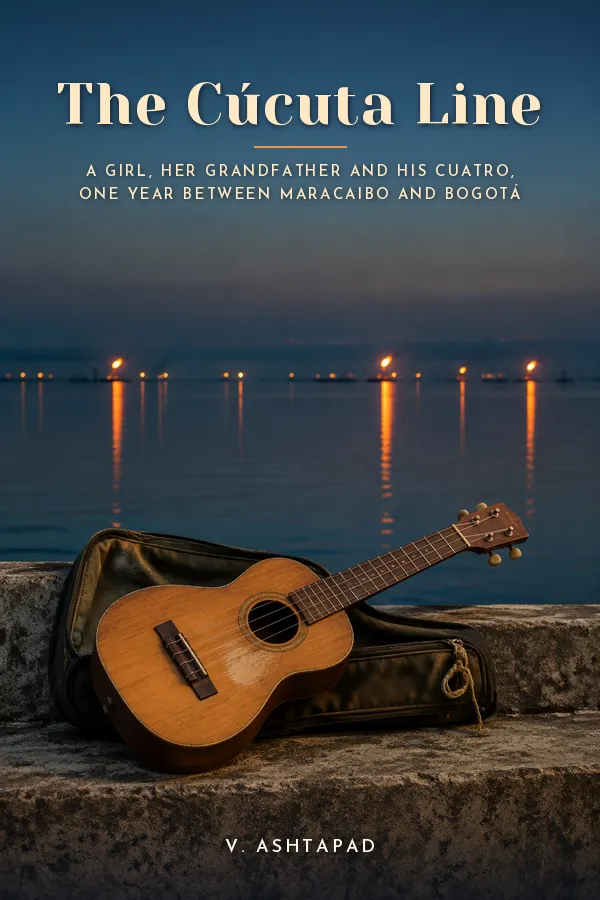
The Cúcuta Line
A Girl, Her Grandfather and His Cuatro, One Year Between Maracaibo and Bogotá
by V. Ashtapad
Foreword
This is a work of fiction. Daniela, her grandfather Abelardo, their family, Wilson the coach driver, Valentina and everyone else here are made up, along with their rooms, their jobs and their money.
The places are real. Maracaibo and its Santa Lucía quarter, the lake, its long bridge and the gas flares on the water can be found in Venezuela; the Simón Bolívar bridge, San Antonio del Táchira, Villa del Rosario, Cúcuta, Pamplona, the high moor at Berlín, Bucaramanga, the Chicamocha canyon, Tunja and the Kennedy neighborhood of Bogotá, with its great Corabastos market, can be found along the road in Colombia.
Invented outright are the gaita band Saladillo Viejo and every song credited to it, the Lagunillas Kings, Don Ramiro's workshop, the bakery on the corner, the culture house class, the landslide outside Pamplona and every price, which I have set to sound right rather than to be right.
For everyone who has carried a song across a border because there was no room for it in the bag.
Flare Light
February 14. Maracaibo. Tequeños, four for a dollar.
The woman at the corner stall on Calle Carabobo fries them in oil so old it has opinions. I buy four at a quarter to six because Abuelo says a man cannot think about anything important before a cheese stick, and today my mother is calling at seven.
It is already hot. In Maracaibo the heat does not arrive in the morning; it waits for you overnight on the other side of the door. By six the air off the lake is thick and wet and smells of diesel and green water and somebody's coffee, and the painted houses of Santa Lucía are coming out of the dark one color at a time. Lime. Salmon. A blue so bright it hums. Ours is the yellow one with the white bars on the window and the crack in the step that Abuelo has been going to fix since 2019.
He is on the step when I come back, in his undershirt, with the cuatro across his knees. He is not playing it. He is tuning it, which with him can take an hour and has nothing to do with whether it is out of tune.
"Four?" he says.
"Four for a dollar. Last month it was five."
"Last month she was in a better mood."
"Last month the flour was cheaper."
He takes two, which is the deal, and gives me back the one with the burnt end, because I like the burnt end and he pretends not to know.
My running total this morning, before the call: 31 dollars in the tin under the bed, 140 bolívares in my pocket that are worth about as much as the receipt they came with, and whatever Mom says on the phone.
February 14. Same step. 7:04.
Mom calls from Bogotá, where it is the same hour and a completely different planet. Behind her I can hear rain. She is in the bathroom of the office building she cleans, because it is the only room with a lock and good signal.
"It's cold," she says first. She always says it first, like a greeting.
"It's thirty-one degrees here," I say. "Abuelo is in his undershirt."
"Tell him to put a shirt on, the whole street can see him."
"The whole street has seen him for seventy-one years."
Then she says it. She has the room. Doña Esperanza, the landlady, will let us have the second room off the patio from October, if we can pay. She has been saving since she left a year ago, every peso she didn't eat. It is enough for half of what we need to get there. The other half we earn on the way. Cúcuta first. Work there. Then the road.
"Both of you," she says. "I'm not doing another year of this."
I look at Abuelo. He is listening without looking like he is listening, which is his whole style. His thumb is on the second string, pressing, letting go.
"Ask him," Mom says.
"You ask him."
"Daniela."
I hold the phone out. He takes it and says, "Yelitza, my girl, how is the cold," in his voice for women and customers, the warm one with the little laugh in the back of it, and then he listens for four minutes without saying anything and gives the phone back to me.
"He says gaita doesn't travel," I tell her.
"Tell him gaita isn't going. He is."
February 15. The kitchen. Patacón, 4 dollars, split two ways.
Patacón is a Maracaibo thing and I will fight anyone who says otherwise. You take a green plantain, split it, fry it, flatten it, fry it again until it's a gold plank that cracks, and then you use two of those planks instead of bread and put everything between them: shredded beef, white cheese, cabbage, the pink sauce and the green sauce and the sauce made of garlic that you will taste until Wednesday. One patacón can feed two people if one of them is me and the other one is an old man pretending he isn't hungry.
We eat it with the fan pointed at us on loud with a ticking.
"I'm not leaving it," Abuelo says. He means the cuatro, which is leaning in the corner like a person who came to visit and decided to stay.
"Nobody asked you to leave it."
"Your mother said bring one bag each."
"It's a small guitar. It isn't a bag."
"It's not a guitar."
Here we go.
The cuatro, according to my grandfather, is not a small guitar any more than a hummingbird is a small chicken. Four strings, nylon, tuned so the highest one sits in the middle where you'd least expect it, and when you strum it the sound jumps out of the hole bright and fast like oil hitting a hot pan. He has had this one since 1977. Cedar top, the varnish worn pale in a moon where his right hand has struck it for forty-eight Christmases.
"The cuatro comes," I say. "The furro stays."
"The furro is my lungs."
"The furro is a barrel."
He looks at me over the patacón with his eyebrows, which are gray and enormous and could be used to sweep a floor. "A barrel," he says to the ceiling. "She calls it a barrel."
It is a barrel. A short wooden one with a goatskin stretched over the top and a stick of cane fixed in the middle of the skin, and to play it you wet your hand and rub the stick up and down until the drum makes a sound like a big animal clearing its throat in the next room. It is the bottom of every gaita. Without the furro, he says, the gaita is a party with no floor. It also weighs eleven kilos.
"Yorman will keep it," I say. "He'll play it at Christmas."
"Yorman plays like he's sanding a door."
"Then he'll learn."
February 16. The lakefront, after dark. Bus fare, 25 bolívares.
Abuelo wants to see the bridge. We have seen the bridge every day of my life. You can't not see the bridge in Maracaibo; it runs out over the water for almost nine kilometers on its tall concrete legs, and at night the lights along it are a necklace somebody dropped across the mouth of the lake. It has our name on it, more or less, since it is the General Rafael Urdaneta bridge and we are Urdanetas, though no general in our family has ever been more important than the man who fixed the pumps at Lagunillas.
Which was Abuelo. For thirty-two years he crossed that bridge before dawn to the eastern shore, to Cabimas and Tía Juana and Lagunillas, and fixed engines that pulled oil up out of the lake bed. He can still hear a bad bearing from across a yard.
We sit on the low wall of the lakefront walk. The water is black and warm and moves without making waves, just a slow lifting, like a sleeper breathing. It smells of salt and fuel and the green slime that comes in at the edges in summer. Across the water, far out, the gas flares burn on the platforms. Little orange flags of fire, a dozen, two dozen, flickering on the black. They have burned my whole life. When I was small I thought they were people out on the lake with candles waiting for someone.
"You see that one," Abuelo says, pointing to a flare that is brighter than the others and bends left in the wind. "That's the one I used to set my watch by."
"You can't set a watch by a fire."
"You can if you've looked at it long enough."
Then, very quietly, he starts to sing.
It is one of his. Not one of the famous ones everybody's uncle sings on the radio in November, but one he wrote in 1983 for his band, about the boats that crossed the lake before the bridge, when you had to wait on the pier at four in the morning and the ferrymen sang to keep awake. He sings the verse alone, low, and then he stops and looks at me, and I know what he wants. In gaita, somebody calls and everybody answers. One voice tells the story, the chorus comes back with the same short line, again and again, like the lake coming in against the wall. That's the shape of it. That's how you know it's gaita and not just a man singing.
I don't answer. I am sixteen and there are people on the walk.
He sings the next verse anyway. And at the chorus a woman two benches down, maybe fifty, with a grocery bag at her feet, sings the answer back without even turning her head. Like breathing. Then she picks up her bag and leaves.
"You see," he says. "It doesn't travel. It lives here. It's like the bridge."
"The bridge is concrete. You're a person."
"I'm a person made of concrete."
February 18. The tin under the bed. 31 dollars, unchanged, because I checked twice.
What we need, according to Mom, according to me, according to the math I do in my head all day, even when I'm asleep:
Bus from Maracaibo to San Antonio, on the border. Two seats. Walk across the bridge. That part is free, which is the first free thing I have heard of in a year.
A room in Cúcuta for some months while we earn. She knows a lady. Everybody's mother knows a lady.
Bus from Cúcuta to Bogotá. Two seats. The price is in pesos and it is a number with so many zeroes it looks like a joke, but pesos are a different joke from bolívares, and the punchline is better.
Coats. Mom says it in capital letters.
I have done the household money since Mom left, because Abuelo thinks money is something that happens to other people. So I am the one who knows that a kilo of rice at the shop on the corner went from one dollar and ten cents to one dollar and thirty in a month. That the gas for the stove costs what it costs. That Abuelo's pension, in bolívares, buys roughly one patacón and a phone card, so that the real money in this house is what Mom sends from Bogotá on the first of the month, and what I make on weekends selling cocadas from a cooler on the lakefront walk.
A Maracaibo cocada, if you are not from here, is not candy. It is a coconut drink, blended thick with ice and sugar and milk until it's almost snow, poured into a plastic cup with cinnamon on top, and on a February afternoon by the lake it is the only reason to keep living. I sell them for a dollar. I make sixty cents on each. On a good Sunday I sell forty.
That is the arithmetic of my life. I can feel the numbers sitting behind my eyes like birds on a wire.
February 19. Santa Lucía. The street at noon.
The houses in Santa Lucía are old, low, one story, joined wall to wall down the length of the street like a row of people holding hands for a photograph. Every one is a different color and nobody planned it. Mrs. Nereida across the way painted hers violet the year her husband left, and the man next door painted his orange to fight back.
At noon nobody goes out. The heat comes down out of a white sky and sits on the tin roofs and you can hear them tick. The dogs are flat under parked cars.
I go house by house and tell people. Not because I want to. Because if I don't tell them, Abuelo will tell them, and he will tell them as a story with three digressions and a song, and it will take until Christmas.
Mrs. Nereida says, "Bogotá. You'll grow mushrooms."
Tía Nelly, who is Mom's older sister and Yorman's mother and lives at the end of the block in the house with the mango tree, says nothing for one whole second, which for Tía Nelly is a speech, and then she says, "Who's going to play at my door on the twenty-fourth?"
"Yorman."
"Then we are finished," says Tía Nelly. Then she hugs me so hard my sunglasses go crooked, and she smells like fried onion and the powder she puts on her neck, and she says into my hair, "You'll keep him alive. Yes? You'll keep him from doing something stupid."
"He's not sick," I say. "He's healthier than you."
"I don't mean his body. I mean his mouth."
February 20. The step. 6:10 p.m. Electric bill, which I will not discuss.
The light at this hour comes slanting across the lake and hits the yellow house sideways so the whole front glows like the inside of a mango. The swallows go crazy over the rooftops. Abuelo is on the step again, and this time he is playing.
Fast. Gaita fast, the cuatro going like a sewing machine, chuka-chuka-chuka, his right hand a blur and his left hand barely moving. The sound bounces off Mrs. Nereida's violet wall and comes back. Children come out of doorways.
I sit beside him and do not sing. But I tap the step with my heel in the place where the furro would be. He notices. He does not say anything. He plays the call, and at the place for the answer he leaves a hole, and he looks straight ahead, and the hole is the exact size of me.
I let it go by. And the next one. And on the third time, so quietly the children don't hear, I sing the line back.
He doesn't look at me. He just plays faster.
When it's dark I go inside and write in my head: Bus, two seats. Room, some months. Bus, two seats. Coats. And then, at the bottom, in a different place, where I keep the numbers that are not money: Songs, how many. I don't know how many. He has played gaita every Christmas since 1971. That's a lot of songs to fit in one bag.
What Fits in a Bag
February 24. Santa Lucía. The fan, sold, 18 dollars.
The fan goes first, because it is the loudest thing we own and I want the house to feel the loss.
A man from two streets over comes for it with his son. He switches it on in our kitchen and listens to the ticking with his head on one side like a doctor. "Bearing," he says.
"It's been ticking since 2016," Abuelo says from the doorway. "It's not the bearing. It's the cage. The cage is bent near the screw. You tighten the screw, it stops."
The man tightens the screw. It stops. He looks at Abuelo with new respect and pays me eighteen dollars instead of fifteen, and I would like it noted that the three extra dollars came from a mechanic's ear and not from charity.
Running total: 49 dollars.
February 25. The bedroom. My bicycle, 30 dollars, to a girl named Oriana who cried when she rode it.
I did not cry. I would like that noted too.
February 26. The kitchen. Mom's sewing machine, not sold.
I was going to sell it. Tía Nelly came over and stood in front of it like a guard at a gate and said, "That machine made your first-birthday dress and half the costumes your grandfather's band ever wore, and you want to give it to a stranger for twenty dollars."
"Forty," I said.
"It stays with me," Tía Nelly said, and carried it down the street herself, all fourteen kilos of it, with her elbows out and her sandals slapping. Nobody in Santa Lucía offered to help, because they knew better.
So the running total is still 79 dollars, and Tía Nelly now owns a sewing machine, and I don't know how I lost that argument but I did.
February 27. The patio. The band, last practice.
The band is called Saladillo Viejo, after the old quarter near the center where the first members grew up, before the bulldozers came and most of it became a plaza. There have been nineteen members since 1971 and only Abuelo has been there the whole time. Now there are five of them left who still play: Abuelo on cuatro and furro, depending; Chuíto on the small two-headed drum you play with sticks on the rim and the skin; Nené, who is a man of sixty-eight called Nené for reasons nobody will explain, on maracas; Gustavo on the scraper, a long notched piece of metal you rub with a stick so it rasps like a cricket the size of a dog; and Gustavo's wife, Mirna, who sings the lead when Abuelo's voice wants to rest.
It is February. Nobody plays gaita in February. Gaita is November and December, the whole city vibrating with it from the moment the first cool wind comes off the lake until the last firecracker of the year. Playing in February is like eating Christmas food in July. But they come anyway, at dusk, with their instruments in plastic bags, and sit in a circle on the patio among Abuelo's pots of aloe and the clothesline with my shirts on it.
They do not play right away. First they drink beer and insult each other. This is apparently part of the music.
"You've gotten fat, Nené."
"I am storing energy for the cold."
"You're not going to the cold. He's going to the cold."
"I'm getting fat in solidarity."
Then Chuíto taps the rim of the little drum twice, tak tak, and the whole patio changes.
I have heard them play my whole life and I still can't explain what happens in the first ten seconds. The furro comes in first, under everything, that wet growl like a cat as big as a truck purring in its sleep. Then the little drum on top of it, rattling, and the scraper, and the maracas going like rain on a tin roof, and then the cuatro, bright, cutting through the whole thing like a knife of light through a blind. And all of it goes at a pace that feels like walking fast downhill: your feet want to go faster than you meant them to.
Mirna sings. She has a voice like a car horn that went to university. She sings about the lake at dawn and the women selling fish at the old market, and at every chorus the four men throw the answer back at her, all together, rough and certain.
I sit on the back step with my knees up. I'm supposed to be doing the list. I don't do the list.
February 27. Same patio, later. Beer, 11 cans, not my money.
Between songs Mirna leans over to me and says, "You know he wrote half of what we play?"
"I know he says so."
"No, mija. He did. 'The Boat at Four in the Morning.' 'My Mother's Window.' 'Flare Light.' 'The Wind from the Cabimas Side.' A lot of those, the radio stations played other people's versions and never said his name."
I look at him. He's arguing with Gustavo about whether the scraper came in late. He has his reading glasses pushed up on his head, which he thinks makes him look like a professor and actually makes him look like a man who has lost his reading glasses.
"Does he have them written down?" I say.
Mirna laughs so hard she has to put her beer on the ground. "Written down. Your grandfather. Written down." She wipes her eyes. "They're written down in us. That's where they are."
February 28. The furro.
Yorman comes for it in the afternoon. He is nineteen and very thin and works at the tire shop on the avenue, and his hands are permanently gray with rubber. He has played the furro since he was eight and he plays it, as Abuelo says, like a man sanding a door.
Abuelo shows him anyway. One more time. He sits Yorman on the plastic chair with the barrel between his knees and pours a little water from a glass into Yorman's palm.
"Not your fingers. Your palm. The heel of it. Like this." He takes Yorman's hand and closes it around the cane stick and pulls it slowly down. The drum groans. "Slower. Slower. It's not a machine. It's a cow."
"A cow."
"A cow that likes you. You're not milking her. You're talking to her."
Yorman pulls. The furro makes a sound like a door in a horror movie.
"That's a cow that hates you," Abuelo says.
They do this for an hour. I sit on the bed and listen through the wall. Slowly the sound gets lower and rounder. By the end it isn't Abuelo's sound, but it is a sound. Yorman's sound. Like a cow that tolerates him.
When Yorman carries it down the street on his shoulder, Abuelo stands in the doorway and watches the barrel go, bobbing, all the way to Tía Nelly's mango tree, and then he goes inside and sits on his bed in the dark for a while, and I let him.
March 1. Tía Nelly's house. Photographs, free.
Tía Nelly has a shoebox of band photos and she wants them done before we go, which means she wants me to do them. So I sit at her table under the mango tree with a borrowed scanner the size of a pizza box, and one by one we put them on the glass.
Saladillo Viejo in 1974 at somebody's wedding, in white pleated shirts, all of them skinny as fence posts. In 1981 on the back of a truck, in straw hats, with Christmas lights wound around the cab. In 1990, on a stage at a school, Abuelo with a mustache he has denied ever having.
Then I call the band, one at a time, and hold the phone up to the screen and they tell me who everybody is.
"That's me," Nené says. "That's Lino, he moved to Valencia. That's Eudomar, may he rest. That's a girl Abelardo was in love with."
"Which one?"
"I'm not telling you that."
We type the names under each picture, and the year, and the place, and where it was they were playing, and we put them in the private family space Tía Nelly set up when Mom left, where only the family can see. My cousin in Lima, Tía Maribel's daughter Karla, posts a heart under the 1981 one inside a minute. Over there it's an hour earlier and she should be at work.
Abuelo, when I show him, looks at the mustache picture for a long time and says, "Who is that handsome man," and then, "Give that to me," and he takes the phone and asks Nené who the girl was in the second row, as if he doesn't know.
March 3. The bedroom. The bag.
One bag each. Mom said it like a law and I am obeying it like a law, because the bus charges for extra, and because of the bridge. You carry everything you own across the bridge on your own two legs, or you pay a man with a wheelbarrow to do it for you.
My bag: four shirts, two pairs of jeans, one sweater that I bought in a used-clothes market on the avenue for three dollars and that smells faintly of somebody's grandmother. Underwear. My school certificates in a plastic folder. My birth certificate. The phone charger. A hairbrush. A towel. The photograph of Mom at the beach at Caimare Chico, laughing with her mouth open, taken by my father the summer before he left, which is the only good thing he ever did.
Abuelo's bag: four shirts, two pairs of trousers, a sweater Tía Nelly knitted in 1999 that is the color of a ripe avocado and that he has never worn because in Maracaibo you'd die in it. His papers. His glasses. His good shoes. A tin of shoe polish.
And then the cuatro, in a canvas case with a broken zip that he has mended with a shoelace.
"Bags," I say, "not three things."
"The cuatro isn't a thing."
"The bus man is going to say it's a thing."
"The bus man," says Abuelo, with dignity, "will have to take it from my hands."
March 5. The lakefront walk. Two cocadas, my treat, 2 dollars.
On our last night we go down to the lake again. I bring two cocadas from my own cooler, the last two I'll ever make for money in this city, cold and white and dusty with cinnamon, sweating in the plastic cups.
The flares are burning. The water slides up the wall and drops away. Somewhere behind us a radio is playing the year's first gaita out of season, because somebody can't wait, and the furro on the recording is very good, better than Yorman, and Abuelo hums the answer without seeming to notice he's doing it.
"In Bogotá," I say, "Mom says they have hot chocolate with cheese in it."
He stops with the straw in his mouth. "Inside."
"Inside. You drop it in and it melts."
"Who does that?"
"Colombians."
He thinks about this for a long time. "That's a disgrace to cheese," he says finally, "and also to chocolate."
"You're going to love it."
"I'm going to hate it every morning for the rest of my life."
He drinks the whole cocada. I drink mine. The lake breathes. One of the flares far out goes dark for a second, then comes back.
March 6. The bus terminal. Two tickets to San Antonio del Táchira, 80 dollars. Running total, after: 1 dollar and some bolívares I can't count anymore.
Tía Nelly does not come to the terminal, because she says if she comes she'll make a scene, and she has already made three scenes this week and her blood pressure won't take a fourth. Yorman comes. He stands by the bus with his rubber-gray hands in his pockets and doesn't know what to do with his face.
Abuelo shakes his hand like a man. Then he pulls him in and says something in his ear. Yorman laughs and wipes his nose on his wrist.
The bus is cold inside. Brutally cold. Venezuelan buses run the air-conditioning at one temperature, which is the temperature of the inside of a fish freezer. Everyone on board is wearing a jacket. Abuelo is wearing his short-sleeved pleated shirt and holding the cuatro on his lap like a baby, and nobody, not the driver, not the ticket man, not the woman across the aisle with the three children, tries to take it from his hands.
As we pull out, Yorman lifts one hand. I lift mine. The bus turns onto the avenue and the terminal goes, and the mango tree, and the color of our street, all of it shrinking down to something I can hold.
The Bridge
March 7. Somewhere south of the lake. 2:40 a.m. Price of sleep: impossible.
The bus goes around the bottom of the lake in the dark, and I can feel the water leaving us even though I can't see it. You get used to the lake being there the way you get used to your own tongue. Then it's gone and the air through the gap in the window changes: drier, dustier, a smell of cattle and cut grass and something burning far away in a field.
Abuelo is asleep with his mouth open and the cuatro case standing up between his knees like a child who refuses to lie down. The woman across the aisle has two of her three children on her lap and the third asleep on the floor on a folded towel. The air-conditioning is still at fish-freezer. My feet have stopped existing.
I do sums to stay awake. Eighty dollars for the bus. What's left in my pocket: one dollar and a fistful of bolívares that I'll try to change at the border and probably get a candy for. What Mom sent this morning to the transfer office in Cúcuta: three hundred thousand pesos, which will be waiting with my name on it, if the office is open, if I have the right paper, if the man is in a good mood.
I have learned, this year, that half of all money is the man being in a good mood.
March 7. The hills of Táchira. 6:15 a.m.
When the sun comes up we are not in Zulia anymore. Everything is green and folded, hills on top of hills, with mist lying in the low places like milk spilled in the creases of a sheet. Banana plants with leaves torn into ribbons by the wind. Small houses painted the colors of medicine: pink, mint, that blue they use for clinics. A boy on a mule. A field of something tall I don't know.
Abuelo wakes up and looks out the window and says, "Hm," which is what he says about everything he didn't expect to like.
"You've been here before," I say. "You told me. In 1979. You played at a wedding in San Cristóbal and the bride's father wouldn't pay you."
"He paid us. In cheese." He rubs his face. "A whole wheel. We ate it for two weeks. Nené got sick."
"Is that a song?"
He thinks. "It should be."
March 7. San Antonio del Táchira. The bus terminal. Breakfast, one arepa, shared.
The arepa from the stand by the terminal is thicker than the ones at home and the cheese is a different cheese, saltier, crumbly, the kind that squeaks on your teeth. Abuelo examines it with suspicion and then eats more than half. We sit on our bags against a wall painted with an advertisement for a mattress so faded you can only see the mattress.
Everybody around us is going where we're going. You can tell by the bags. Big bags. Bags tied with rope. Bags with wheels that have lost a wheel. A man with a gas stove strapped to his back. A girl about my age with a parrot in a cage covered with a shirt so it doesn't scream. Old women. Babies. A young couple holding hands so hard their knuckles are white.
Nobody talks very much. It's too early, and too hot already, and there's nothing to say that everybody doesn't already know.
March 7. The Simón Bolívar International Bridge. 8:30 a.m. Porter, 10,000 pesos, negotiated down from 20,000.
I had imagined the bridge as something enormous, like our bridge across the lake. It isn't. It's short. You could throw a stone across the river from one side to the other if you had an arm. What makes it enormous is the people.
They come at it from every street, a river of people pouring onto the concrete and squeezing into one long pushing line that moves at the speed of the slowest grandmother. People pulling suitcases with wheels that scream on the concrete. People with sacks on their heads. A man carrying a mattress rolled and tied like a giant cigar. And through all of them, shouting, threading, hitting your ankles, the porters with their wheelbarrows and their homemade carts of plywood and bicycle wheels, piled with other people's whole lives, calling "Make way, make way, careful, there," and somehow never tipping over.
The heat is a different heat from Maracaibo. Maracaibo heat is wet; it gets inside you and lives there. This heat is dry and comes up off the concrete into your face like you've opened an oven to check the bread. The sky is white. The river underneath us is low and brown and slow, with plastic bags caught on the rocks and a white heron balanced on one leg in the shallows, not caring at all.
A porter takes our bags. He is young and very dark from the sun and has a red cloth tied on his head, and when I say twenty thousand is robbery he laughs and says, "Ten then, princess, for your grandfather's sake." He reaches for the cuatro case.
"No," says Abuelo.
"I'll take it, old man, it's no trouble."
"I said no."
The porter looks at me. I look at the porter. "He'll carry it," I say.
"It's a guitar?"
"It's not a guitar," Abuelo and I say at the same time, and the porter shrugs and pushes off into the crowd with our two bags bouncing on his barrow, and I have to run to keep him in sight, holding Abuelo's wrist with one hand and my folder of papers to my chest with the other.
March 7. The middle of the bridge.
There is a moment, halfway across, when the line stops completely because something is happening at the far end that nobody can see. We stand. The sun hits the tops of our heads. Somebody's child starts crying and somebody else's child joins in, out of sympathy. A woman near us opens an umbrella against the sun and three people move under it without asking. She lets them.
Abuelo is breathing fine. He's seventy-one and he walks four kilometers every morning around Santa Lucía just to look at things, and he's carrying a cuatro, not a refrigerator. But he's very quiet. He's looking down at the river.
"What," I say.
"It's small," he says. "I thought it would be a big river."
"It's a border, not a river."
"It's both." He looks at the water. "You cross the lake on a bridge nine kilometers long and it means nothing, it's just going to work. You cross this little ditch and it's everything."
I want to say something clever back. I can't think of anything. The line moves. We move.
March 7. The far side. Villa del Rosario. 11:20 a.m. Stamps, hours, sweat.
The papers take three hours. I won't tell all of it because nobody wants to read about lines, but there are lines inside lines, and men at windows who look at your folder for a long time and then hand it back to you and point to a different window. Abuelo's passport is old. My birth certificate has a stamp that someone doesn't like. A woman behind glass sends me to make two photocopies at a shop across the street, where the photocopies cost five hundred pesos each, and the shop is out of paper, and the next shop isn't.
Abuelo sits on a low wall the whole time with the cuatro on his knees. He does not play. He knows better than to play here. But I see him, while I'm at the second window, tapping the case with two fingers, and I know he's doing the scraper part of something under his breath.
When it's done, I'm holding a folder with new stamps in it and my hands are shaking, not from fear, from not having eaten. The porter is still there. He's waited with our bags in the shade of a tree. I didn't think he would. I give him the ten thousand pesos and then, because I have the transfer to collect and I'm already doing sums about how much is left of it, I want to give him nothing more, and I give him two thousand more anyway, and he says, "May it go well for you, princess," and goes back across into the crowd for somebody else's life.
March 7. The transfer office, central Cúcuta. 2:00 p.m. Collected: 300,000 pesos. Running total: 286,000 pesos, after the shared taxi and two bottles of water.
The man was in a good mood. I would like to send him a cake.
March 7. La Libertad, Cúcuta. 4:30 p.m. Room, 450,000 pesos a month, first two weeks paid. Running total: 61,000 pesos.
Doña Gladys is the lady Mom's friend's cousin knows. She is about sixty, short, square, in a housedress printed with pineapples, her gray hair dragged back so tight it lifts her eyebrows. Her house is low and long and painted the green of an unripe mango, with a metal gate and a front patio where she has a plastic table and a big tin pot and a sign she has painted herself on cardboard, with a picture of a pastry on it.
The room is at the back. It has one window that looks at a wall, one bed, one thin mattress on the floor, one ceiling fan, and one nail in the wall for hanging things. It smells of floor cleaner and of the frying from the patio.
"Bathroom is shared," says Doña Gladys. "Water comes in the morning and at night. In between, it thinks about it. You want to use the kitchen, you tell me first. You want to cook fish, you don't."
"We don't want to cook fish," I say.
"Everybody from Maracaibo wants to cook fish." She looks at Abuelo, at his short sleeves and his straw hat and the cuatro case. "And that?"
"It's a cuatro, ma'am."
"I know what it is. Does he play it at night?"
Abuelo takes off his hat. He gives her the warm voice, the one with the little laugh in the back of it. "Only when I'm asked, ma'am. And only very beautifully."
Doña Gladys looks at him for a long time with her lifted eyebrows. "Hm," she says, which I am beginning to realize is how everybody over a certain age expresses surprise, in two countries. Then she goes back to her pot.
March 7. The back room. 9:00 p.m.
The heat doesn't go down after dark. That's the thing nobody told me. In Maracaibo at least the lake breathes on you at night. Here the fan just shoves the hot air across the room and back again, like somebody moving furniture they can't decide where to put.
Through the wall I can hear Doña Gladys's television and, farther away, somebody's radio playing an accordion, fast, bright, with a man singing about a woman who left him by a river. Vallenato. Every radio in Colombia, apparently, plays vallenato, and every vallenato is about a woman who left by a river.
Abuelo lies on the bed in his undershirt, I lie on the mattress on the floor in mine. The cuatro is on the nail. He hung it there himself, very carefully, by its strap, and it hangs against the white wall like a picture of itself.
"You know what I was thinking on the bridge," he says to the ceiling.
"That it was small."
"That too." The fan goes around. "I was thinking, all those people. All those bags. You could hear the wheels on the concrete. And not one person was singing."
"It was eight in the morning, Abuelo. And it was thirty-six degrees."
"I know." He's quiet. "In 1983, when we used to wait for the ferry at four in the morning, it was dark, it was hot, everybody was going to work, nobody wanted to be there. And the ferrymen sang. Every single morning. That's the song. That's what it's about."
"I know what it's about. You've told me nine hundred times."
"Then you know why I was thinking it."
I lie there. The accordion on the far radio stops. A motorcycle goes by. A dog answers it. Somewhere a gate slams.
And I don't know why I do it, I'm so tired my bones feel like they're made of wet sand, but I hum the first line of "The Boat at Four in the Morning." Not well. Off key, probably. He doesn't answer. I think he's asleep.
Then, very softly, from the bed, comes the chorus. Just the one line. Then he really is asleep, and I'm the one lying awake in Colombia, doing sums in the dark: 61,000 pesos. Two weeks. One cuatro on one nail.
Valley Prices
March 21. La Libertad. Rice, 3,200 pesos a pound. Eggs, 600 each. Running total: 418,000 pesos, after Mom's second transfer.
No. Wait. I counted wrong. I forgot the eggs. It's 414,800. I will not have that other number in my head; it looks like a bus route.
Here is what I know after two weeks in Cúcuta. A pound of rice is a pound of rice in any country, but here they sell it by the pound and at home they sold it by the kilo, so for the first week I kept thinking things were cheap and then doing the math at night and lying on the mattress feeling robbed by my own brain. A bus ride across town costs 2,800 pesos. A bag of water costs 500. A mango off the street costs nothing at all, because it is the start of mango season and they fall off the trees onto the sidewalks and burst, and the whole city smells like a sweet that's been left in a car.
Cúcuta is a city of trees. Nobody told me that either. Every street has them, huge and dark and old, with roots that crack the pavement and lift it up in slabs. At noon, when the sun comes straight down from a sky the color of an aluminum pot, everybody walks on the shady side, and you can tell how hot the day is by how close people press against the walls.
March 22. Doña Gladys's patio. 5:00 a.m. Chickpea pastries, 1,500 each.
Doña Gladys gets up at four. I know because the wall between our room and the kitchen is the thickness of a cracker, and at four I hear the gas ring click and the oil start to whisper. By five she has a tray of small golden pastries on the plastic table by the gate, filled with chickpeas mashed with rice and something red, fried until the dough blisters, and the workers going past to the buses stop and buy two each and eat them standing up, wiping their fingers on their trousers.
"You," she says to me on the second morning, because I'm in the doorway watching. "You know how to count?"
"Better than anyone you've met."
"Sit there, take the money, give the change. If I find you ate one, I'll know."
I sit there. I take the money. I give the change. At seven she gives me two pastries and four thousand pesos and says, "Tomorrow, same," and goes in to sleep.
They're good. The dough is thin and crisp and the filling is soft and peppery and there's a tiny sour bite in it from something I can't name. I don't tell her I like them. I can already tell she is a woman who would use that against me.
March 24. La Parada, by the bridge. 6:30 a.m. Cocadas, wholesale, 800 each. Sold for 1,500.
There's a woman named Doña Rubiela at the big market near the bridge who sells cocadas by the box. On my first morning there I asked her for one and waited for her to get out the blender.
She looked at me. I looked at her. She handed me a small, flat, brown thing in a twist of plastic, chewy, studded with shreds of toasted coconut, sweet enough to make your back teeth sing.
"This is a cocada?" I said.
"What else would it be?"
"A drink. With ice. Blended. You know. In a cup."
"Mija," said Doña Rubiela, very kindly, as if I'd told her I thought the moon was a cheese, "that's a milkshake."
So it turns out a cocada in Colombia is a candy, and a cocada in Maracaibo is a drink, and both countries are absolutely certain they're right, and I have been on the losing side of an argument I didn't know existed. I bought thirty of them anyway. I sell them by the bridge to people coming across, who are hungry and haven't had sugar since San Cristóbal, and to the porters, who eat four a day and pay me on Fridays.
I also sell coffee. Black coffee, very sweet, from two thermoses Doña Gladys lent me in exchange for, as she put it, "my soul." In little plastic cups that are the size of a medicine dose. A thousand pesos a cup. On a good morning I sell sixty.
March 25. The bridge. 7:15 a.m.
The bridge looks different from the Colombian side. You stand on the bank where the street ends and you watch the people coming toward you instead of going away from you, and their faces are the faces we had two weeks ago: stiff, hot, tired, trying to look like they know where they're going.
I recognize the porter with the red cloth on his head. He's pushing a cart with a refrigerator on it, an actual refrigerator, and a little girl sitting on top of the refrigerator like a queen on a float.
"Princess!" he shouts when he sees me. "You made it. Coffee, two, for me and the queen."
The little girl doesn't drink coffee. She takes a cocada and looks at it the way I did.
"It's a candy," I tell her. "Don't ask."
March 28. The back room. The phone call. 9:00 p.m.
"How much," says Mom.
"Running total, after this week, 512,000 pesos. That's after rent's paid to the end of the month."
"What did you eat?"
"Rice. Eggs. Doña Gladys's leftovers. Mangoes off the sidewalk."
"Mangoes off the sidewalk," says Mom, in the voice of a woman closing her eyes in a bathroom in Bogotá. Behind her the rain is going. It's always going. Sometimes I think it's a recording she plays to make me feel sorry for her.
We do the plan again. Two bus tickets from Cúcuta to Bogotá: about a hundred and fifty thousand each, if we're lucky. The first month in Bogotá in Doña Esperanza's back room: six hundred thousand, half of which Mom has. Coats: Mom says second-hand ones on the street near her are fifty thousand, sixty, for a good one. Shoes that close, because the rain. Food on the road. Things we haven't thought of. Things that will break.
"Two million," I say. "By September. Then we go."
"Two million is a lot."
"I'm a lot."
She laughs. It's short and surprised and I haven't heard it for months, and it does something to my chest I don't like, so I say, "Put Abuelo on the list for coats. He'll fight you."
"Where is he?"
Which is a very good question. He went out at two this afternoon to "look at things" and he hasn't come back.
March 28. Same room. 10:40 p.m.
He comes in at twenty to eleven with grease to the elbows and a smell of diesel on him that I know better than my own name. He is very pleased with himself. He sits down on the bed and takes off his shoes like a man who has done a day's work.
"Where were you?"
"On the Seventh Avenue. There's a workshop. Buses. Trucks. A man called Ramiro, from Ocaña, big belly, very loud. I'm walking past and one of his buses is idling in the yard and the bearing on the water pump is going. You could hear it from the corner. So I go in and I tell him."
"You walked into a stranger's workshop and told him his bus was broken."
"I told him his bus was going to break. It's different." He wipes his hands on a rag that is somehow cleaner than his hands. "He said who are you, old man. I said I'm the old man who fixed the pumps at Lagunillas for thirty-two years. He said prove it. So I proved it."
"How."
"I took the pump off."
"Abuelo."
"And it was the bearing." He lies back on the bed with his hands behind his head, enormously satisfied. "He's going to pay me fifty thousand a day. Not every day. When he has work. He says the young ones can't hear anything. They plug a box into the engine and the box tells them what's wrong. I said what does the box know about anything. He laughed until he had to sit down."
I lie on my mattress doing math. Fifty thousand a day. Three days a week, maybe. A hundred and fifty thousand a week. Six hundred thousand a month.
Two million by September is not a lot anymore. It's July.
"You're seventy-one," I say.
"I'm seventy-one with ears." He shuts his eyes. "And you're sixteen and you should be in school."
There it is.
March 29. The bridge. 6:45 a.m. A girl in a school uniform, 0 pesos.
Every morning at a quarter to seven a girl walks past my stand in a school uniform: a gray skirt, a white blouse, white socks pulled to the knees, a dark blue sweater tied by the arms around her waist even though it's twenty-eight degrees already, because that's what you do. Her hair is in a long braid. She's maybe fifteen. She has a backpack with a rabbit keychain on it.
She doesn't look at me. Why would she? I'm a Venezuelan girl with two thermoses and a box of candy at the end of a bridge.
At home I was in fourth year. My grades were fine. Better than fine, in math, which is a surprise to nobody. The last day I went was the eleventh of February, and I didn't know it was the last day, so I didn't do anything special. I think I had a test in chemistry. I think I left my good pen in the desk.
In Bogotá, Mom says, I can go back. The schools take Venezuelan kids. You have to have the papers. You have to have the certificate. You have to wait for the right month. Everything, she says, is the right month or the wrong month.
The girl with the braid walks past. The rabbit bounces. I pour a coffee for a porter and make change, and the coins in my palm are hot from the sun.
April 4. Doña Gladys's patio. 8:30 p.m.
Tonight Doña Gladys asks.
She's sitting at the plastic table with her feet in a basin of water and a glass of something fizzy and pink. The patio smells of the day's frying and of the lime tree in the neighbor's yard, which is in flower and gives off a scent so sharp and green you can almost hear it.
"So," she says. "You play at night only when you're asked."
Abuelo, in the doorway, puts his hand on his heart.
"So I'm asking," says Doña Gladys. "But not vallenato. My husband played vallenato. If I hear one more accordion I'll go out and set fire to the nearest one."
He brings the cuatro out. He sits on an upturned crate. He tunes for exactly as long as it takes Doña Gladys to start tapping her foot in the basin with impatience, which I think is his plan.
Then he plays "My Mother's Window." It's a slow one, for a gaita, though slow for gaita is still faster than most music. It's about Santa Lucía in the evening, the shutters open, the radios on, the lake wind coming down the street and moving all the curtains at once, and a woman leaning on a windowsill watching her son go out to play. The cuatro sparkles. His voice has gone a little hoarse from the diesel and the dust but it's still his, high and round at the top of every line.
There's no chorus here. No one to answer. So I answer.
I don't decide to. I'm sitting on the step with a cocada and I just do it, at the place where the chorus goes, low, so only the patio can hear. And he doesn't stop and he doesn't look at me, he just plays a little harder, and Doña Gladys takes her feet out of the basin and sits forward with her elbows on her knees, very still, the lime flowers dropping on the table in front of her one at a time.
When it's over she says, "Who wrote that?"
"I did," says Abuelo. "In 1986. For my mother."
Doña Gladys nods slowly. Then she gets up, dripping, and goes into the kitchen, and comes back with two pastries on a plate, the good ones from the middle of the tray, and sets them in front of him, says nothing, and that is how I know we are going to be all right in Cúcuta, at least until July.
The Workshop Radio
May 6. Seventh Avenue. Lunch for Abuelo, rice and lentils and one fried egg, 4,500 pesos to make. Running total: 1,064,000.
Over a million. I said it out loud on the bus this morning and a man in a construction helmet looked at me like I was planning a robbery.
Don Ramiro's workshop is a yard of packed black earth behind a high wall of corrugated metal painted blue a long time ago. Inside it there are always three or four buses in different states of being alive, with their hoods up like mouths at the dentist, and a truck with no wheels standing on blocks, and an old gray dog called Turbo who sleeps under whichever vehicle is not being worked on. The air smells of diesel, hot rubber, burnt coffee and the fried pork rinds the boys eat at ten. Everything is black: the ground, the rags, the boys' fingernails, the hands of the clock over the office door, which stopped at twenty past three in some year nobody remembers.
And over everything, all day, from a radio wired to a post with a coat hanger, comes vallenato.
May 6. Same yard. 12:15.
Abuelo is under a bus. I can see his legs sticking out, his good brown shoes that he will not stop wearing to work, and one hand reaching out blind for a wrench, which Brayan, who is twenty and has a haircut like a lawn that's been mown in stripes, puts into it.
"Your lunch," I say.
"Two minutes."
"You said two minutes yesterday and it was forty."
"Yesterday was a gearbox."
I sit on an upturned tire next to Turbo. The radio is playing a song about a man who walks all night to a town by a river where a woman has forgotten him. The accordion goes up and down like someone climbing stairs and falling down them in rhythm. There's a drum and a scraper, a long ridged stick of cane scraped with a fork, rasping on every beat.
"You hear that?" says Abuelo's voice from under the bus. "That scraper."
"I hear it."
"That's the same as Gustavo's. Same job. Same sound. Different metal."
Brayan, who is listening, says, "That's not the same as anything, old man, that's vallenato."
"It's the same," says Abuelo. "Your scraper is our scraper wearing a hat."
May 6. Lunch. The bench by the office.
The argument is one they have every day. I know because Abuelo tells me about it at night, and because Brayan tells me about it when I bring the lunch, so I get both sides, like a judge.
Brayan says vallenato is the most beautiful music in the world, because it's about love and walking and rivers and the accordion is an instrument that can cry. Abuelo says gaita is the most beautiful music in the world because it's about a place, and the furro is an instrument that can laugh, and anyone can cry, crying is cheap.
"Gaita's only for Christmas," says Brayan.
"Vallenato's only for being sad in a truck."
"What's wrong with being sad in a truck?"
"Nothing," says Abuelo, eating the egg. "I've been sad in a truck. I've been sad in many trucks. But I don't want a whole country's music to be about it."
Don Ramiro comes out of the office with his enormous belly going first, like the front of a bus, and says, "If you two are going to fight about music, fight about it with the radiator off that old lady in front of you," meaning the bus. Don Ramiro calls every bus an old lady. It's what his father did, and his father drove them for forty years.
When Brayan goes back to work, Abuelo sits with his lunch on his knees and listens to the radio for a while. Really listens. The accordion is going up, up, up, and then a long slide down.
"That boy," he says, meaning the accordion player, not Brayan. "He's good."
"Tell Brayan."
"Never," says Abuelo, and finishes the rice.
May 11. The bridge, then the back room. Afternoon storm, free.
It rains in May in Cúcuta. Not like Maracaibo rain, which comes all at once out of nowhere like somebody throwing a bucket off a roof and then stops and steams. This rain builds. All afternoon the sky over the mountains to the east goes darker, purple, the color of a bruise on the second day, and the wind picks up and turns the leaves of the big trees over so they show their silver undersides, and the whole city smells of wet dust before a drop has fallen.
Then it comes. Hard. Warm. Bouncing knee-high off the street.
I run from the bridge with the thermoses banging against my legs and the cocada box under my shirt. By the time I'm in Doña Gladys's gate I'm wet to the skin and laughing, I don't know why, and Doña Gladys, on the patio under the tin roof with her basin, says, "Venezuelans. They see rain and lose their minds."
The water on the tin roof is so loud you have to shout. Abuelo comes in at four, soaked, with his good shoes in his hand. He's been walking barefoot through the flood on the street like a boy. We hang his shirt and my shirt on the nail and the cuatro has to share.
May 11. Same room. 7:00 p.m.
I ask him.
I've been meaning to ask since the patio in February, since Mirna laughed at me and said the songs were written down in people. I don't have people. I have a phone with a cracked corner and eleven percent battery.
"Can I record you," I say.
He's sitting on the bed rubbing his feet with a towel. He stops. "Record me doing what."
"The songs. Yours. One a night. So they're somewhere."
"They are somewhere. They're here." He taps his chest, then his head.
"And when you're in Bogotá and you can't remember the third verse of 'The Wind from the Cabimas Side'?"
"I'll always remember the third verse."
"You forgot it at Chuíto's birthday. Nené sang it for you."
"Nené sang it wrong." But he's thinking. He folds the towel on his knee, very neatly, which is what he does when he's thinking. "On one condition."
"What."
"Before every song, I tell where I first played it. And who was there. And what we ate. Otherwise it's just noise in a telephone."
"That will make every recording twenty minutes long."
"Then they'll be twenty minutes long."
May 11. Same room. 7:30 p.m. Battery, 9 percent.
So I sit on the mattress with my phone propped against my knee and the little red circle going, and I say, "Abuelo, can I record you, can I keep it and share it with the family," because I want it on there that he said yes, and he looks right into the phone like it's a person and says, "Yes, you can. This is Abelardo Urdaneta, of Santa Lucía."
And then he tells it.
The first time he played "The Boat at Four in the Morning" was on the twelfth of December 1983, at the house of a man called Pocho Fuenmayor in the Saladillo, on a patio with a Spanish-lime tree, and there were fourteen people and a pig on a spit and a pot of boiled corn, and Pocho's wife hated it and said it was too slow, and Pocho made them play it four times in a row.
He wrote it about a real ferryman, a man with no front teeth they called the Captain, who ran the boat from the pier near the market to the eastern shore before the bridge was built. Every morning at four, in the dark, the Captain sang to the people sleeping on the benches, not loud, just enough to keep the boat company. And the people half-asleep on the benches would hum the answer. All of them. Without opening their eyes.
"And that's the chorus," says Abuelo. "That hum. That's what the chorus is. It's people who are too tired to do anything else, answering."
Then he picks up the cuatro and plays it.
It doesn't sound like Saladillo Viejo. It's one old man in a room in La Libertad with rain on the roof and a fan, and his voice is a little rough. But it's his. Bright cuatro, the gaita running-downhill pace. At the chorus I hum. I can't help it, and anyway he's told me that's what the chorus is.
The battery dies at the last line. I'll find out later the recording got all of it except the final strum, so it ends a hair too early, like someone getting off a bus before it's fully stopped.
May 12. The family space. Morning, the bridge, coffee in one hand.
We have a place, the family, that Tía Nelly set up when Mom left: private, just us, where everybody puts where they are. It started as a joke, almost. Mom put "Bogotá, the bathroom on the fourth floor" as her location once and Tía Nelly didn't speak to her for a day.
Now it's real. Every few weeks someone updates. Tía Maribel, in Lima: still at the laundry in Surquillo, moved to a room with a window. Karla, her daughter: started at a bakery in Miraflores, the early shift, sends a picture of bread. Mom: Bogotá, Kennedy, the room off the patio. Tía Nelly and Yorman: Maracaibo, Santa Lucía, mango tree, furro. My great-uncle Néstor, Abuelo's brother, who doesn't know how to do anything with a phone and has Yorman post for him: Maracaibo, still alive, still right about everything.
And us: Cúcuta, La Libertad, Doña Gladys's back room, the pastries.
I put the recording in with a note: Abuelo, "The Boat at Four in the Morning," first played December 12, 1983, Pocho Fuenmayor's patio, the Saladillo. Recorded May 11, 2025, Cúcuta, in the rain, with his permission.
By the time I've sold my first ten coffees, Tía Nelly has answered with a row of crying faces. Nené, who isn't in the family but whom Tía Nelly let in anyway because she says the band is family, has written: The pig was not on a spit. It was in a hole. Tell him.
Karla from Lima has written: I didn't know he wrote that. My mom used to sing it at the laundry.
I read that twice standing at the end of the bridge with the people coming across.
May 18. The workshop. 4:40 p.m.
I bring Abuelo a cocada, the candy kind, and find Brayan sitting on a tire by the radio with his own phone held up to it, very serious, pressing pause and rewind.
"What are you doing?"
"Learning the scraper part." He holds up a ridged stick of cane that he has made, I swear, from a piece of old curtain rod. "For my uncle's band. They play on Sundays in Atalaya."
"Abuelo," I say across the yard. "Brayan plays the scraper."
Abuelo's legs come out from under the bus. Then the rest of him. He wipes his hands on the rag. He looks at the stick. He looks at Brayan.
"Show me," he says.
Brayan plays along with the radio, rasp rasp rasp, a little nervous. Abuelo listens head tilted, the way he listens to engines.
"You're late on the third one," he says. "Every time. You're thinking. Don't think. It's the same as ours. It's the bottom. Everybody stands on you."
He takes the stick out of Brayan's hand, holds it against his own chest, and scrapes it with a screwdriver, along with the vallenato coming out of the radio. Perfectly. Every third beat right where it lives.
Brayan stares. "You said you hated vallenato."
"I never said I hated it," says Abuelo. "I said it was sad in a truck." He hands the stick back. "Now you. Don't think."
May 31. The back room. Running total: 1,388,000 pesos. Recordings: 6.
Six songs. Six stories. Pocho Fuenmayor's patio. The wedding in San Cristóbal with the cheese. A school in Cabimas in 1990, where the children threw flowers and one of the flowers was a rock. A bus going to Lagunillas at night where the whole band sat in the back and played to keep the driver awake. The night his mother died in 1986, when he didn't play, and the next night, when he did. A Christmas Eve in 1997 at Tía Nelly's door when Mom was pregnant with me and sang the lead so loud the neighbors came out in their towels.
I didn't know that one. He told it like it was nothing. Like it was a thing everyone knew.
I put each one in the family space, dated, with the place. My phone is almost full. I stop buying data for a week to pay for space. Running total minus that: 1,371,000. Worth it.
Wilson's Old Lady
July 3. Seventh Avenue. A coach that overheats only on Tuesdays.
That's how Wilson explains it. He stands in Don Ramiro's yard in a pressed blue shirt with the coach company's name sewn over the pocket and his sunglasses pushed up on his forehead, and he says, "She overheats on the climb to Pamplona. Not every time. Tuesdays. And sometimes Fridays. Never on the way down. Three workshops have looked at her. One changed the thermostat, one changed the water pump, one changed the radiator. She still does it. I'm going to lose my mind, and then I'm going to lose my job."
He is about fifty, compact, with a round brown face and a mustache cut so neatly it looks drawn on with a ruler. He smells of aftershave and diesel in equal parts. He talks with his hands, both of them, all the time, like a man conducting traffic.
The coach is big and white with a stripe of red and orange down its side, and its windows are tinted the color of a bottle. It fills half the yard. Turbo the dog walks around it once, sniffs a tire, and lies down underneath it as if he has been waiting his whole life for something this shady.
Don Ramiro says, "Abelardo."
Abuelo comes out of the office reading glasses pushed up on his head, a cup of coffee in his hand, and walks once around the coach exactly the way Turbo did. Then he says to Wilson, "Start her."
July 3. Same yard. Forty minutes later.
Abuelo stands by the open engine compartment at the back of the coach with his eyes closed and one hand flat on the metal, the way a man calms a horse. Wilson keeps the engine running. Brayan has turned the radio off, which has never happened, and the whole yard is quiet except for the coach rumbling and Turbo's tail thumping the dirt.
"There," says Abuelo.
"What?" says Wilson, from the driver's seat.
"Rev her. Slowly. More. Hold it."
Something under the engine makes a sound I can barely hear: a tiny sigh, like a person breathing out through their teeth.
"Fan clutch," says Abuelo. "When she's heavy and climbing and it's hot, it slips. It doesn't fail. It slips. Then on the way down the air cools it and it grabs again. Nobody finds it because it's fine in the yard. You'd only hear it on a mountain, with a full load." He opens his eyes. "Tuesdays and Fridays, she's full."
Wilson gets down from the cab and stands in front of my grandfather with his hands on his hips.
"Who are you," he says. Not rude. Amazed.
"Abelardo Urdaneta. Santa Lucía. Lagunillas, thirty-two years."
"Lagunillas," says Wilson, slowly, as if it's the name of a football club that once won everything. Then he takes Abuelo's greasy hand in both of his clean ones and shakes it for a long time.
July 3. The bench by the office. Iced cane juice, 3,000, Wilson's treat.
Wilson drives Cúcuta to Bogotá and back, twice a week. Sixteen hours one way if the road is kind, nineteen if it isn't, through Pamplona and over the high cold moor and down to Bucaramanga and through the canyon and up again to Tunja and on into the plateau. He has done it for twenty-two years. He says he knows every curve by its first name.
"Two hundred and eighty curves between here and Pamplona alone," he says. "I counted once. Then I stopped counting because it made me sick."
"We're going to Bogotá," I say. "In September."
"Who's we?"
"Me and him."
Wilson looks at Abuelo, who is drinking the cane juice with his eyes closed in bliss, the ice clinking. "In September," he repeats. "On which coach?"
"Whichever is cheapest."
"Mine," says Wilson. "Mine is cheapest. For you, the company price. My cousin is in the office." He wags a finger at me. "Don't ask me what the company price is. It's a secret. It's lower than the price."
I do the math anyway. I can't help it. If the company price is even a third less, that's a hundred thousand back in the tin.
"And he sits up front," Wilson says, pointing at Abuelo. "Where I can hear if she starts sighing."
July 9. The migration office. 7:00 a.m. to 1:40 p.m. Photocopies, 2,000. Photos, 12,000. Running total: 1,602,000.
I'm not going to write about this. Lines. Windows. A fan that doesn't reach. A woman who calls my name wrong three times, "Daniela Urdanela," and I correct her three times, and the third time she looks at me like I've insulted her family.
I'll write one thing. Abuelo sits in the plastic chair the whole morning with his hat on his knees, very straight, very patient, saying "Good morning, ma'am" to every single woman who walks past, and I'm the one at the window with the folder. I'm the one who knows which paper is which. I'm the one who says "Yes, he is my grandfather, yes, my mother is in Bogotá, here is her letter, here is the copy of her letter, here is the copy of the copy."
I'm sixteen. I'm the adult in every room. In Doña Gladys's kitchen and at the bridge and at the transfer office and here. Nobody asked me if I wanted to be.
We come out with stamps and a date to come back. Abuelo puts on his hat and says, "That went very well."
"You didn't do anything."
"I was charming."
"You were sitting."
"I was sitting charmingly." He holds the door for a woman with a baby. "You think that's easy? At my age?"
That night I add a line to the family's list of moves, the long one Mom started that begins with Great-grandmother Ana walking from a village near Sinamaica to Maracaibo in 1931 with a hen under each arm. It goes down through every house and city since. Mine says: July 9, 2025. Cúcuta. Papers stamped. Next: Bogotá. Under it, within the hour, Tía Nelly has written: And the hens?
July 14. Doña Gladys's patio. 9:00 p.m. Strings, a set of four, 18,000.
I buy the strings myself. He's been using the same ones since Maracaibo and they've gone dull, like a spoon left in water.
He restrings the cuatro on the patio under the bulb, with moths banging against it and Doña Gladys's television on through the window, a show where people shout about who is the father of a baby. He works slowly, winding each string around his finger before he threads it, pulling it tight, listening, turning the peg.
When he's done he holds the cuatro out to me.
"No."
"You said in February you'd learn."
"I said in February I wouldn't."
"Same thing." He puts it in my hands. It's light. So light. All that sound comes out of something that weighs less than a bag of rice. The wood is warm from his knees.
The tuning is wrong. That's the first thing. I mean it's wrong on purpose. On a guitar the strings go from low to high in a line. On a cuatro the highest string isn't on the edge, it's tucked in second from the bottom, so the chord comes out jumbled, bright in the middle, which is why it sounds like that. Like birds on a wire that keep changing places.
He shows me a chord. Then another. My fingertips hurt within a minute, a thin burning line across each one.
"Good," he says. "That's the beginning. The hurt is how it gets into your hand."
"That's horrible."
"That's music."
He shows me the strum. Not the strum for slow songs: the gaita strum, the fast one, the right hand going down and up and catching the strings with the side of the nail and then slapping them flat to choke them, chuka, chuka, chuka. I try it. It sounds like a chicken falling down a staircase.
Doña Gladys shouts through the window, "Is someone killing something?"
"She's learning," Abuelo shouts back.
"Learning what?"
"Patience," he says, and laughs so hard the moths scatter.
August 2. The bridge. 7:30 a.m. Sales: 22 coffees. Running total: 1,744,000.
August is hot in a way I didn't think was possible. No rain. A dry wind blows down the valley all day like air from a hair dryer, and it lifts the dust from the street and puts it in your eyes and your teeth and the cocada box. By ten the concrete at the end of the bridge burns through the soles of my sandals.
Fewer people want coffee in August. Everybody wants cold. I start buying bags of ice at five in the morning and filling the second thermos with cold cane juice instead, and I make a little more, but the ice melts by eleven and I go home with sticky hands and a headache from the light.
August 5. The back room. 10:00 p.m. A fight, no charge.
He gave twenty thousand pesos to a man at the bridge.
I found out because the man came to my stand and said, "Your grandfather, the musician, he's a great man," and when I asked why, he told me. He'd been playing maracas by the bridge, a man from Barquisimeto with a sign asking for money for a bus, and Abuelo stopped and listened, and told him he was rushing the second beat, and showed him, and then gave him twenty thousand.
Twenty thousand pesos. Four days of rice. Seven cups of coffee I'd have to sell. A third of a coat.
"He was good," Abuelo says when I ask. He's lying on the bed. The fan is pushing the heat around. "After I showed him, he was good."
"We need that money."
"He needed it more."
"You don't know that!" I'm shouting. I don't shout. Doña Gladys's television goes quiet on the other side of the wall. "You don't know that, because you never know how much anything is. You never know. I know. I know every peso. I know the rice and the eggs and the rent and the bus and the coats and the shoes and the stamps and the photocopies. I know how much it costs to eat a mango off the ground, which is nothing, and I know how much it costs to buy one because the ground is empty, which is 1,500. I'm the one who knows. You just play."
He doesn't say anything. He looks at the ceiling.
"Somebody has to be the grown-up," I say, quieter.
"I'm the grown-up," he says.
"You're the grandfather. It's different."
He thinks about that for a long time. Then he sits up, and reaches under his mattress, and takes out an envelope I've never seen. Inside there's money. Pesos. Folded small. He holds it out.
"From Ramiro," he says. "Not the day rate. The extra. He gives me extra when I find something nobody else can find. I've been keeping it." He shrugs. "For the coats. I know what a coat costs. Your mother told me. Sixty thousand. I've got four of them."
I count it. I can't help it. Two hundred and forty thousand pesos.
"You never know how much anything is," I say, but it comes out wrong, like a laugh with water in it.
"I know how much you are," he says, and lies back down. "And that's enough for one old man."
August 28. The workshop. Wilson's coach, returning from Bogotá, no sighing. Running total, with the envelope: 2,056,000 pesos.
Wilson comes in grinning, his mustache stretched so wide it's almost two mustaches. "Fourteen trips," he says. "Not one sigh. Not on a Tuesday, not on a Friday, not on a Sunday when I had a full load of grandmothers going to a wedding in Tunja with forty kilos of cheese."
"Cheese again," says Abuelo. "Always cheese."
"Sixth of September," Wilson says. "Saturday. Front seats. Company price." He looks at me. "One more thing. The cold. You're from the lake. You've never been cold in your lives. In Pamplona at night it's eight degrees, and up on the moor, if it's raining, it's three. You understand?"
"We'll buy coats in Bogotá."
"In Bogotá is too late. You'll freeze before Bogotá." He turns to Abuelo. "Old man. Tell me you own something with sleeves that reach your wrists."
Abuelo thinks about it. Then, with enormous dignity, he says, "I have a sweater. It's green."
I think of it at the bottom of his bag in Doña Gladys's room, folded the way Tía Nelly folded it in 1999, the color of a ripe avocado, never worn. "Oh no," I say.
"Oh yes," says Abuelo.
Pamplona Cold
September 6. La Libertad. 5:00 a.m. Pastries, a dozen, free, wrapped in newspaper.
Doña Gladys does not say goodbye. She says, "Don't eat them all before the mountain," and pushes the warm bundle into my hands, and turns back to her pot. The oil whispers. The gate squeaks. A boy is already waiting at the plastic table with two thousand pesos in his fist.
Then she turns around again and grabs Abuelo by both ears, which she has to reach up to do, and kisses him once on the forehead, hard, the way you'd stamp a document.
"If you come back," she says, "the room is four hundred."
"It was four hundred and fifty."
"For you, four hundred. For her, four fifty."
"That's not fair," I say.
"Nothing is fair, mija. Go."
September 6. Seventh Avenue. 5:40 a.m.
Don Ramiro is at the gate of the yard in his undershirt with his belly going first, and Brayan behind him, half asleep, and Turbo, who doesn't wake up for anyone, standing in the road wagging his entire back half.
Brayan gives Abuelo the scraper, the one made from a curtain rod. "I made another," he says. "Better. My uncle says I'm not late on the third one anymore."
Abuelo turns the stick over in his hands. Then he hands it back. "Keep it. Your uncle needs you more than I do."
"Old man. Take it."
"I'm not carrying a curtain rod to Bogotá."
They stand there holding it between them like two men who both want to pay the bill. In the end I take it and put it in my bag, and it pokes out of the top like an antenna, and Brayan looks so pleased that I don't tell him it's already digging into my spine.
Don Ramiro gives Abuelo an envelope. Abuelo gives Don Ramiro a hug. Neither of them looks inside anything.
September 6. The coach terminal. 6:50 a.m. Two tickets, company price: 190,000 pesos for both. Running total: 1,866,000 pesos.
Wilson is standing by his coach with the door open and his sunglasses on top of his head and his blue shirt so pressed it could cut bread. The engine is warm and ticking. The red and orange stripe catches the low sun.
"Front seats," he says, "as promised."
The front seats are the two right behind the driver, by the big curved windshield, so you see the whole road come at you like a film. Abuelo sits by the window with the cuatro across his knees. I sit beside him with the curtain rod against my leg and the pastries in my lap and the folder of papers under my shirt against my stomach, where I've kept it every day since February, so it's soft now at the corners, like an old dog's ears.
At seven Wilson closes the door. The air brakes hiss. Somebody's baby at the back starts crying and then stops, as if it has thought about it.
We go.
September 6. Leaving the valley. 7:30 a.m. 31 degrees.
At first it's the Cúcuta I know: the big trees, the cracked pavement, the motorbikes with three people on them, the stands of cane juice and fruit, the dust. Then the city thins out. Brick houses with half-finished second floors and iron bars sticking up from the roofs like hair that needs cutting. Then fields, burnt yellow from August. Goats. A river in a wide bed of white stones, mostly dry.
And then the road starts to climb.
I knew it would. Wilson told us. I didn't understand what climbing meant. It means the coach leans into a curve and the whole valley swings past the windshield, and then it leans the other way and the valley swings back, and every time it swings back it's farther down. The road folds itself back and forth up the side of the mountain. Wilson turns the wheel hand over hand, slow and smooth, not talking now. His mustache is concentrating.
Two hundred and eighty curves. I don't count. I try not to count. I count anyway. I get to sixty-one and lose track because the view takes it out of my head.
September 6. Climbing. 8:45 a.m. 22 degrees.
The air coming through the vent changes. It stops smelling of dust and starts smelling of something green and sharp and wet, like the inside of a cut stem. The fields on the slopes are a green I didn't know existed, a green that's almost blue, stitched with dark lines of trees. There are tall skinny trees with peeling bark that let off a smell like medicine through the window: eucalyptus, Wilson says. Cows the color of coffee with milk stand on slopes so steep they look like they've been glued on.
Mist comes down the valley to meet us. Not like the mist in Táchira lying in the creases. This mist moves. It comes over the ridge like smoke, white and quick, and the coach drives right into it and for a minute there's nothing in the windshield but white, and Wilson slows down and switches on his lights and hums something under his breath, an old slow love song.
I look at Abuelo.
He's cold.
He won't say it. He's sitting very straight in his short-sleeved shirt with his arms crossed over the cuatro and his jaw tight, and there are bumps all up his arms like the skin of a plucked chicken.
"Abuelo."
"I'm fine."
"You're blue."
"I'm Venezuelan. We don't turn blue. We turn gray."
"You're gray."
September 6. A roadside stop above the river. 9:30 a.m. 14 degrees. Blackberries, a bag, 3,000. Hot cane-sugar water with a slice of cheese in it, two cups, 4,000.
Wilson pulls over at a shack on the side of the road with a tin roof and a wood fire going inside and a woman in a wool hat selling things from a table: blackberries in clear plastic bags, dark as ink, fresh white cheese wrapped in banana leaf, bread rolls, and hot sweet water made from blocks of brown cane sugar boiled in a big black pot, with a square of cheese dropped in the bottom of each cup.
I get out of the coach and the cold hits me like a door slammed in my face.
I've never felt anything like it. It goes through my shirt like the shirt isn't there. It gets into my ears and my nose and the roots of my teeth. When I breathe out, my breath comes out of my mouth as smoke. I stand on the side of the road with my mouth open, puffing, watching it, like a child.
"Abuelo," I say. "Look. Look. I'm a dragon."
He gets out behind me, very slowly, and the cold hits him too, and his jaw goes tight, and he breathes out and there it is, his own breath, a little gray cloud in the air in front of his face, and he stares at it.
"Seventy-one years," he says, "and I've never seen that."
Then he goes back into the coach, and comes out again two minutes later wearing Tía Nelly's sweater.
It's enormous. It's the color of a ripe avocado. It has a pattern of brown diamonds across the chest, and the sleeves come down past his hands, and it smells of the bottom of a drawer in Santa Lucía, of mothballs and dried soap and twenty-six years.
The woman in the wool hat looks at him and says, very seriously, "That's a good sweater, sir."
"My daughter made it," says Abuelo, with such pride you'd think he had sheared the sheep himself, though he has never once put it on until today.
The cheese in the bottom of the hot cup goes soft and stringy. You fish it out with your fingers and eat it. It's salty and squeaky and warm and the sugar water is like drinking a hot cake. Abuelo drinks his and says nothing about the disgrace to cheese.
September 6. Pamplona. 11:15 a.m. 11 degrees, rain.
Pamplona is a small town in a bowl of green mountains, old, with streets of stone and houses painted white with dark wooden balconies and red tile roofs gone black with damp. Students everywhere, in jackets and scarves, with backpacks, walking fast with their heads down. The rain isn't rain. It's a fine cold spray that hangs in the air and gets on everything, like being sneezed on by a cloud.
Wilson stops at the coach terminal and goes into the office and comes back out with his face changed.
"The road's closed," he says. "Past the town. A slide. The rain last night took half the mountain down onto the road. They're clearing it. Tomorrow morning, maybe. Maybe tomorrow afternoon."
"Tomorrow," I say.
"The company pays for the guesthouse. Not the food." He rubs his mustache. "This happens. This mountain doesn't like us. It's nothing personal."
I do sums. One night. Food for two. Pamplona prices, which I don't know. My stomach does the thing where it drops.
September 6. The guesthouse. 4:00 p.m. Room: paid by the company. Soup, two bowls, 16,000. Running total: 1,850,000.
The guesthouse is two floors around a little courtyard with a stone floor and a dead fountain full of potted geraniums. Our room has two narrow beds with three blankets on each, thick wool, scratchy, smelling of sheep and woodsmoke. There's no fan. Why would there be a fan? There's a window that looks over the red-black roofs to a hill where the mist goes up and down like a curtain on a string.
I have never been in a room without a fan. I keep looking at the ceiling for one.
We eat downstairs in a little dining room with a television bolted to the wall high in the corner. The soup is a broth with potatoes and corn and a piece of chicken and fresh coriander on top and a bowl of rice on the side and an avocado cut in half, and it's so hot it burns my tongue, and I don't care. My fingers come back to life one at a time around the bowl.
Abuelo eats in Tía Nelly's sweater with the sleeves pushed up. Other passengers from the coach are there too: the woman with the crying baby, two university boys, an old couple going to their daughter in Tunja. Everybody looks the same. Everybody is cold and stuck and a little cheerful about it, the way people get when something goes wrong for everyone at once.
September 6. The guesthouse room. 9:00 p.m. 8 degrees, inside.
I can't sleep. I'm under three blankets and I'm still cold. My feet are two bricks. The rain ticks on the tile roof. Somewhere a dog barks and the bark sounds different here, sharper, thinner, like the air is too cold to carry it.
From the other bed Abuelo says, "You're awake."
"How do you know?"
"You breathe like a person doing arithmetic."
I laugh. My laugh comes out as smoke in the dark. I can just see it against the gray of the window.
"Abuelo. Can I record one."
"Now?"
"Now. Here. In the cold. So it's from here."
He thinks. Then I hear him sit up, and the bed creak, and the zip of the cuatro case, the broken one mended with the shoelace. "Which one."
"'Flare Light.'"
He's quiet for a moment. "That's a lake song."
"I know."
So I set the phone against the blankets, and I say, "Abuelo, can I record you, can I keep it and share it with the family," and he says, "Yes. This is Abelardo Urdaneta, of Santa Lucía, in a very cold room in Pamplona," and he tells it.
He first played "Flare Light" in 1979 on the deck of a work barge off Lagunillas, at the end of a night shift, for nine men in overalls who were too tired to go home yet. They sat on coils of rope and drank coffee from a thermos, and the flares on the platforms all around them were burning in the dark, and the lake was flat and black and every flare had a twin in the water underneath it. One of the men, Tito, said, "It looks like a party nobody invited us to." And Abuelo wrote the first verse right there in his head.
His fingers are stiff. He says so. He plays it anyway.
It's slower than it should be, because of the cold. His voice comes out with smoke on every note. I can see it. Little gray clouds go up from his mouth into the dark at every line, as if the song is going up out of him and hanging in the air of this room before it fades.
At the chorus I answer. Under three blankets. My breath goes up too.
The High Moor
September 7. Pamplona. 6:30 a.m. Bread rolls, four, 2,400. Coffee with milk, two, 3,000. Running total: 1,844,600.
In the morning the town is washed. The rain has stopped and the air is so clean it hurts to breathe, like drinking water straight from a cold tap. The stone streets shine. Somebody is sweeping a doorway with a broom made of twigs, and the sound is the only sound, scratch, scratch, and then a bell on a bicycle, and then a woman calling a child's name from a balcony.
There's a bakery on the corner with its door open and a smell coming out of it so warm it's almost a color. Bread rolls, soft, slightly sweet, with a shiny top, still hot enough to burn your palm through the paper. We eat them standing in the street. Abuelo is in the green sweater. He hasn't taken it off since yesterday. I think he's going to wear it until Christmas.
He walks three times around the little square with the trees while I sit on a bench and do sums, and comes back pink in the face, saying, "This air. You could bottle this and sell it in Maracaibo. You'd be rich in a week."
"In Maracaibo they'd say it was too cold."
"In Maracaibo they'd put it in the cocadas."
September 7. The terminal. 1:15 p.m. The road open.
Wilson comes out of the office clapping his hands. "One lane," he says. "They've cut one lane through the slide. We go slow. Everybody on."
Everybody gets on. The woman with the baby. The two university boys. The old couple going to Tunja, who spent yesterday afternoon playing cards in the guesthouse dining room and cheating each other with great tenderness. We all smell a little of woodsmoke and wool.
The slide, when we get to it, is a whole mountainside of red mud and broken trees lying across the road, with a yellow digger perched on top of it and men in orange vests waving the traffic through one vehicle at a time. Water runs out of the mud in little brown streams. The coach creeps past, its wheels on the edge of the cut, and I look out the window and see the valley straight down, far below, a river like a piece of string, and I stop looking.
Abuelo looks the whole way. He likes it. He says it's like being on the barge in a storm.
September 7. The moor at Berlín. 4:30 p.m. 5 degrees. Fog.
Above Pamplona the road keeps climbing and the trees give up. First the big ones go, then the small ones, then the bushes, and then there's nothing but grass. Wet yellow-green grass, low, thick, and rocks, and pools of black water lying in hollows, and fog moving across all of it in long gray sheets so that one minute you can see a whole hillside and the next minute you can't see the edge of the road.
And the plants.
I don't know what to call them. Wilson tells me their name and I let it go out of my head immediately because I'm too busy looking. They're the strangest things I've ever seen grow. Each one is a short shaggy trunk, about as tall as me, sometimes taller, covered all the way down in old dead leaves hanging like a beard, and on top a big rosette of new leaves, thick and pale gray-green and furry, soft as the ears of a rabbit. There are hundreds of them. Thousands. Standing all over the hillsides in the fog, scattered, facing every way, like a crowd of old men in fur hats who have come out to watch the coach go by and haven't decided yet what they think of us.
"They grow one centimeter a year," says Wilson. "One. That one there, by the rock, that's older than your grandfather."
"Nothing is older than my grandfather," I say.
"I heard that," says Abuelo.
It's colder than Pamplona. The windows mist from the inside. Wilson has the heater on and it's not enough. The baby at the back is wrapped in so many blankets it's only a voice. I put on the sweater from the used-clothes market on the avenue in Maracaibo, the one that smells of somebody's grandmother, for the first time since I bought it, and over it Abuelo puts his arm.
We're at three thousand two hundred meters. I know because Wilson says so, and because my head feels light and full of soft noise, like after you've been swimming.
September 7. The moor. 5:10 p.m.
He starts teaching me. Not the choruses. The verses.
"You know the answers already," he says. "Everybody knows the answers. A street full of drunk people knows the answers. The verse is the part nobody knows. The verse is what you keep."
So he sings one line of the first verse of "The Wind from the Cabimas Side," low, close to my ear, under the noise of the engine and the heater. And I sing it back. And he sings it again, with a little thing at the end, a turn in the voice like a corner in a road, and I sing it back with the turn. And again. And then the second line.
It's slow. It's like learning a road by walking it. The first verse takes until the plants have gone and we're coming down off the moor in the dark, and the fog has turned to rain, and there's a red light on the dashboard that Wilson taps twice with his finger and it goes out.
"From the top," says Abuelo.
"I know it."
"Then sing it to me."
I sing it to him. All four lines. With the turns. He doesn't say good. He just nods once and says, "Second verse."
From the driver's seat, without looking around, Wilson says, "What's it about?"
"A wind," I say.
"I can hear that it's about a wind."
"It's about a wind that comes across the lake from the oil towns at night," Abuelo says, "in the dry months, and it smells of gas and salt and the kitchens on the other side, and the women in Santa Lucía open the shutters for it because it's the only cool thing all day. And a man is standing in the street, and the wind comes, and he can smell his wife's cooking from nine kilometers away, from across the water, from the house where she's waiting for him. And he can't get there because the last ferry's gone."
Wilson drives for a while.
"That's sad," he says.
"It's not sad. He's happy. He can smell it."
"In vallenato," says Wilson, "he'd walk around the lake."
September 7. Bucaramanga. 9:40 p.m. 24 degrees.
Down, down, down out of the cold, and the air turns warm again around us like we've been dipped back in a bath. Bucaramanga is lights spread across a plateau on the edge of a drop, with palm trees and wide avenues and motorbikes and the smell of fried things and hot asphalt. People in shorts. People in sandals. It's ten o'clock at night and it's warmer than a morning in Pamplona.
I put us in the family space: Bucaramanga, 24 degrees, the road open, Abuelo in the sweater. Tía Nelly answers inside a minute with a photo of her own hands on the sewing machine and the words: Told you. Karla in Lima asks for a picture of the sweater. I send one. Abuelo poses in it like a man in a catalog.
He takes it off. Then, at the terminal, when the doors open and the night air comes in, he puts it back on.
"Make up your mind," I say.
"I've made it up," he says. "I'm keeping it on in case."
We buy two meat pies from a cart and eat them in our seats. Wilson changes places with a second driver, a young man with a shaved head called Óscar who says three words in the next eight hours, and Wilson sits in the seat across the aisle from us with his shoes off and his socks steaming gently, and falls asleep at once with his mouth open, exactly like Abuelo.
September 8. The canyon. 5:50 a.m. 19 degrees.
I wake up and the world has fallen away.
There's no other way to say it. On my side of the coach, out the window, the ground ends. It just drops, down and down, into a canyon so huge my eyes can't decide how far it is to the bottom. The walls are bare rock and dry earth in stripes of brown and orange and pink, folded like heavy cloth, and the light of the sunrise is coming down into it slowly from the top, lighting the folds one at a time. Far, far down, a river glints. There are cactuses on the slopes, and dry bushes, and a goat standing on a rock ledge that no goat should be able to reach, looking at the coach with its yellow eyes.
"Chicamocha," says Wilson, awake now, from across the aisle. "Look at it while you can. Next week you'll be in Bogotá in the rain and you won't believe this exists."
Abuelo is awake too. He's been awake, I think, for a while. He has the cuatro on his knees.
"Third verse," he says.
September 8. Climbing out of the canyon. 9:00 a.m.
The third verse is the hard one. It's the one he forgot at Chuíto's birthday. The man in the street is still standing there with the wind, and he starts to sing, to the lake, to his wife across the water, and his voice goes out over the water with the wind going the other way, so she'll never hear it, and he knows it, and he sings anyway.
"Why does he sing if she can't hear?"
Abuelo looks out the window at the dry hills going by. "Because then it's been sung," he says.
I want to say that's not an answer. I don't. I sing the first line back to him.
September 8. Tunja. 3:30 p.m. 13 degrees. Rain again.
The old couple get off at Tunja, a town on a high plain in gray rain with brick buildings and wide streets and people in heavy wool walking with their shoulders up. At the door the old woman turns around and says to Abuelo, "The wind song. My husband liked it. He doesn't like anything."
"I like things," says her husband.
"Name one."
He thinks. "The wind song," he says, and they get off together into the rain, holding each other up on the wet step.
September 8. The plateau. 7:30 p.m. 10 degrees.
The last part is fields in the dark and then towns and then more towns, closer and closer together, with lit bakeries and shops with metal shutters half pulled down and people at bus stops under umbrellas. Then the towns don't stop. They just become the city. Bogotá doesn't begin. It's just suddenly all around you, lights going on forever across a huge flat plain to the edge of black mountains, and the rain making every light a little smear.
I've stopped doing sums. I don't know when I stopped. I think it was in the canyon.
I sing the whole song to Abuelo, all three verses and every chorus, in the front seat, while the city comes at us through the windshield in the rain. Quietly. He doesn't sing the chorus back. He lets me do it. I do the call and I do the answer. When I get to the end Wilson, at the wheel again, taps the rim of it twice with two fingers, tak tak, like Chuíto on the little drum, and I don't think he knows he's done it.
September 8. The coach terminal, Bogotá. 11:05 p.m. 9 degrees.
Mom is standing under the arrivals board in a coat I've never seen, a long gray one, and a wool hat, and she's thinner, and she's crying already. She's been crying, I can tell, since before the coach came in. Her nose is red from it or from the cold.
I get off first. The cold comes at me and I don't even notice it.
She doesn't say anything. She grabs me and holds on and she smells of floor cleaner and wet wool and the shampoo she's used since I was born, and her coat is cold and damp on the outside and warm on the inside, and I find out I'm taller than her now. When did that happen? It wasn't true a year and a half ago.
Behind me Abuelo gets off the coach very slowly in Tía Nelly's green sweater with the cuatro case in his arms.
Mom looks at him over my shoulder. She looks at the sweater.
"Dad," she says. "You're wearing it."
"I'm wearing it," says Abuelo, and then Mom is laughing and crying together, and Wilson is getting our bags down from the hold, and the rain is falling on all of us, Bogotá rain, fine and steady and gray, and nobody minds.
Twenty-Six Hundred Meters
September 9. Kennedy, Bogotá. 5:20 a.m. 7 degrees. Running total: 1,812,000 pesos, after the taxi from the terminal, which I will not discuss either.
I wake up because I can't breathe.
Not badly. Just: I'm lying on a mattress on a floor in a room I don't know, under two blankets and Mom's long gray coat, and my chest is pulling at the air like someone sucking a milkshake through a straw that's too thin, and there isn't enough in it. My heart is going fast for no reason. My head has a soft ache right in the middle of the forehead, like someone has put a thumb there and is pressing.
Mom is already gone. Her side of the bed is cold. She left at four. I heard the door, I think, in my sleep, and her shoes on the patio, and the gate.
Abuelo is in the other room, through the wall. Doña Esperanza let us have the second room a month early, when Mom told her we were coming on the coach. Through the wall I can hear him breathing. It's loud. Then he coughs, once, and laughs at himself in the dark, and says out loud to nobody, "Twenty-six hundred meters. Twenty-six hundred meters, Abelardo. You're a fish on a roof."
September 9. Doña Esperanza's patio. 7:00 a.m.
The house is tall and thin and made of orange brick, four floors, the top floor not finished, with iron rods sticking out of the roof waiting for a fifth floor that may come in ten years. All the houses on the street are like it. Orange brick, gray metal doors, windows with bars painted white. Some have their bricks bare and some have them painted, cream or pale green, and on almost every corner there's a shop with its metal shutter rolled up, selling bread and eggs and phone cards and single cigarettes.
The patio is in the middle of the ground floor, with a roof of corrugated clear plastic that the rain drums on, and pots of geraniums and a washing sink and a line of clothes that never dries. Our two rooms open off it. Doña Esperanza lives at the front. She's about seventy, tall and thin like her house, with short white hair and a cardigan buttoned up to the chin and a little gold locket on a chain she keeps tucking inside it. She speaks so softly and so politely that at first I don't understand she's telling me the rules.
"The water heater is electric, mija, so if you could be quick in the shower, it's only that the bill, you understand. And the gate, if you could close it with the key, both turns, it's only that this neighborhood, you understand. And the music, the gentleman's music, I'm sure it's very lovely, perhaps not after nine, it's only that the walls, you understand."
I understand. I understand everything. I've understood all year.
September 9. The street. 8:30 a.m. Bread, 6 rolls, 3,000. Milk, a bag, 4,200.
It's gray. Not dark. Gray, like the inside of a shell. The sky sits low over the roofs, a flat lid of cloud, and the mountains to the east, which Mom says are huge and green and beautiful, aren't there. They've been erased. The air is cold and wet and smells of bus exhaust and wet cement and the bread from the corner and, under everything, something sweet and rotten that I can't place.
"Corabastos," says the man in the bread shop, when I ask. "The big market. Three blocks. Every vegetable in Colombia goes through there. Every one. At three in the morning there are a thousand trucks. You'll hear them."
I did hear them. I thought it was rain.
I walk three blocks to look. It's enormous. It's like a city. Warehouses as long as football fields with their doors open, mountains of potatoes, red and yellow and purple and little round golden ones, sacks of onions stacked higher than the trucks, crates of tomatoes and tree tomatoes and guavas and blackberries and green oranges, and men running past with hand trucks shouting, and the ground slippery with crushed cabbage leaves and squashed fruit, which is the sweet rotten smell, and puddles everywhere reflecting the gray sky.
I stand there with my bag of bread and my bag of milk and my breath short, and I start doing sums without meaning to. The price of a pound of potatoes. The price of eggs on a tray, thirty. The price of a crate of oranges if you could split it with somebody. My brain is a machine that won't switch off.
September 12. The back room. Coats, a debate.
Mom takes us to buy coats. There are men on the avenue who sell them off racks on the sidewalk, used, from big bales, and you can try them on standing in the drizzle while the red buses go past in their own lane in the middle of the road with their doors hissing.
I get a blue padded one, shiny, with a hood lined in fake fur, too big in the shoulders. Forty-five thousand. I'd have paid seventy. I don't tell the man.
Abuelo will not get a coat.
"I have the sweater."
"The sweater is not a coat, Dad."
"It's warmer than a coat."
"It's knitted. The rain goes through it like it's a fishing net."
"Then I'll be a wet fish." He stands on the sidewalk in Tía Nelly's green sweater with his straw hat on, looking extremely Venezuelan, while Bogotá goes by around him in black and gray and navy, every single person in a dark coat and a scarf with their shoulders up. Two schoolgirls look at the hat and then at each other and laugh behind their hands.
In the end Mom finds a brown jacket in thick ridged cotton, lined with something like a blanket, with wooden buttons. She holds it up. Abuelo looks at it a long time.
"It looks like a professor," he says.
"It looks warm."
"A professor of what?"
"Of being stubborn," I say, and Mom laughs, and he puts it on over the sweater, and he looks enormous and padded and soft, like a bear in a book, and very pleased.
Sixty thousand. Running total: 1,707,000.
That night Mom changes her line in the family space for the first time since she came. It used to say Bogotá, Kennedy, the room off the patio. Now it says: Bogotá, Kennedy, the rooms off the patio, three of us. Tía Nelly answers with a picture of the furro under the mango tree, Yorman's gray hand on the stick, and no words at all.
September 14. A restaurant two blocks over. Sunday. Ajiaco, three bowls, 48,000. Mom's treat. Mom does not allow me to discuss it.
Ajiaco is the soup of Bogotá, Mom says, and she says it with a little pride, like it's hers. She's been here a year and a half. Maybe it is.
It comes in a heavy brown clay bowl, so hot the steam goes up into your face. It's thick and pale yellow, made from three kinds of potato cooked down until the little golden ones melt and turn the broth to velvet and the big ones stay in chunks. There's shredded chicken in it, and a whole short piece of corn on the cob standing up in the middle like a log in a river, and a green herb in it with a taste I've never tasted, a little bitter, a little like grass after rain. On the side, little bowls: thick cream, and capers, and half an avocado, and rice. You put the cream in and the capers in and stir.
I take one spoon. Then another.
"Well?" says Mom.
I don't answer. I'm eating.
Abuelo eats his whole bowl in silence, slowly, holding the corn in his fingers, and at the end he puts the spoon down and wipes his mustache, which he no longer has, with the back of his hand, out of habit.
"It's a soup for cold people," he says.
"Is that good?"
"I'm a cold person now." He looks at the window, at the drizzle on the glass, at the people going past under umbrellas. "So it's good."
September 16. The kitchen at Doña Esperanza's. 6:00 a.m. Chocolate, a bar, 5,500. Cheese, fresh, a small block, 6,000.
Doña Esperanza shows us. She's up early too, with her cardigan buttoned to the chin. She melts the chocolate in water in a tall thin pot with a wooden whisk that she spins between her two palms like someone trying to start a fire with a stick, so it froths. Then she pours it into cups, big ones, brown and foamy, and puts a slice of white cheese on a plate beside each cup, and a soft roll.
"You drop it in," she says softly. "And then you wait. It's only that it needs a minute, you understand."
I drop it in. It sinks. I wait. When I fish it out with my spoon it's gone soft and stringy and hot, and it tastes of salt and milk and chocolate all together, and it's strange, and then it isn't.
Abuelo watches me eat mine. He looks at his cup. He looks at the cheese.
He drops it in.
He waits.
He eats it.
He drinks the chocolate. He sits back. Doña Esperanza, Mom and I are all looking at him.
"It's a disgrace," he says, "to cheese, and to chocolate." He pushes the cup across the table toward Doña Esperanza. "Could I have another, ma'am."
September 20. Doña Esperanza's patio. 3:00 p.m. Rain, of course.
It rains every afternoon. Not hard. Steady. A thin, patient, endless rain that doesn't fall so much as come down, like fog that has got tired of floating. It drums on the plastic roof of the patio and runs off the edge in a little curtain. Everything is damp. The towels don't dry. My shoes don't dry. My hair is never quite dry.
Mom gets back at one, after her shift and two red buses, with her face gray and her hands red from the cleaning water. She sleeps until four. Then she gets up and cooks and asks me about my day, and I tell her: I walked to Corabastos and back. I bought eggs. I did the sums.
"You don't have to do the sums anymore," she says. "I'm here. I'll do them."
"You don't know the sums."
"I've been doing the sums in Bogotá for a year and a half, Daniela."
"Not ours."
She looks at me. I look at her. We're in the kitchen with the rain going, and the pot is boiling, and Abuelo is in the other room tuning the cuatro very softly so Doña Esperanza won't hear, and I can feel the thing between Mom and me like a third person standing there. A year and a half. I've been her, all that time. She's been somebody else. Now we're both in the same kitchen being the same person, and there's only room for one.
"Fine," she says. "You do the sums."
"Fine."
She turns back to the pot. Then she says, without turning around, "You got tall."
"You got short."
She laughs. Just once. Then she stirs.
September 25. The street. 10:00 a.m. Running total: 1,604,000 pesos. Work: none.
The money is going down. In Cúcuta it went up. That's the difference between Cúcuta and Bogotá, so far. Up and down.
I walk around the neighborhood looking for signs in windows. A bakery wants someone at the counter, mornings, but they want someone eighteen. A shop wants someone, but they want someone with experience on a cash register, and I say I have the best experience in the world on a cash register, I am the cash register, and the man laughs and says come back with a paper.
Everybody wants a paper.
At the corner the bread shop has a radio on, and it's playing vallenato. A man walking to a town by a river where a woman forgot him. I stand outside under the awning with the rain going, out of breath from walking up the slight hill of the street at twenty-six hundred meters, and I listen to the whole song. The accordion goes up and up. The scraper goes rasp, rasp, every third beat right where it lives, and I think of Brayan and the curtain rod in my bag, and Turbo under the coach, and Doña Gladys at five in the morning with the oil whispering, and I find out I miss Cúcuta, which I didn't know you could do, miss a place you were only ever passing through.
Accent
October 1. The bakery on the corner. 5:30 a.m. Wage, 35,000 pesos a day, 5:30 to 1:00, six days. Running total: 1,511,000, going up again starting now.
Mom signed the paper. That's all it took in the end: Mom at the counter at seven in the evening in her long gray coat, signing a page that said she was my mother and responsible, and Don Hernán, who owns the bakery, a small round bald man with flour in his eyebrows, folding it into a drawer under the till and saying, "Five thirty. Hair tied. If you're late, the bread's late, and if the bread's late, the whole street is late, and then I'm the one they shout at."
Five thirty is dark. Dark and cold, five degrees, six, and the street is wet and shining under the orange lamps, and the trucks are grinding past toward Corabastos with their headlights on and their loads under green tarps. I walk the half block in my blue coat with the hood up and my hands in my sleeves.
Inside the bakery it's a different country. It's hot. The ovens have been on since three and the air is thick and yellow and smells so much of butter and cheese and sugar and yeast that the first breath is like being hugged by someone who's been cooking all night. Don Hernán's son Felipe, who is twenty-five and never speaks, is pulling trays out of the big oven with a long wooden paddle. The glass counter is filling up row by row.
I learn the breads. I learn them like a song. Little round cheese breads, golden, chewy inside, made with cassava starch so they stretch when you tear them. Cheese rings, a little crisp on the outside, sold by the half dozen in paper bags. Rolls with a sweet glaze. Long soft loaves. Puff pastries filled with guava paste, which shatter and leave flakes on everybody's coat. A dense round cornbread that the old men buy one of each morning and eat at the counter with black coffee, slowly, looking at nothing.
By seven there's a line out the door. Workers. Mothers. Schoolchildren in uniform, gray and navy and maroon, with their breath steaming. Everybody wants bread at the same time and everybody wants it now, and I take money and give change and put bread in bags faster than I have ever done anything, and it's the best I've felt since Cúcuta.
October 3. Same counter. 7:10 a.m. Six cheese breads, 6,000.
A girl comes in with a younger boy. She's tall, taller than me, in a navy school uniform with the sweater on, not tied around her waist, it's too cold for that here. She has very straight black hair to her shoulders and a nose ring she's not supposed to have at school, a tiny silver hoop, and she's chewing gum.
"Six cheese breads," she says.
I bag them. "Six thousand."
She looks at me. "Where are you from?"
"Maracaibo."
"I knew it." She turns to the boy. "Did you hear? She sings when she talks."
The boy, who's about ten and has a cowlick, looks embarrassed for her.
"I don't sing," I say.
"You do. Listen." And she does me. She actually does me, right there at the counter, with a whole line of people behind her: "Six thousand," but up and down, the end of it jumping like a fish, and a whole Maracaibo face to go with it, eyebrows up, chin out. Somebody in the line laughs.
I put the bag on the counter between us. "Six thousand," I say, flat as a Bogotá sky. "In any accent."
She pays. She grins. She leaves. The boy looks back at me from the door and gives a little wave, sorry.
October 3. The bakery. 1:00 p.m. Day-old bread, a bag, free.
At one Don Hernán gives me whatever didn't sell, in a paper bag gone soft with grease, and counts my thirty-five thousand into my palm in two notes and some coins, slowly, as if he's paying me in his own blood. I walk home with the bag against my chest under the coat to keep it warm. The cheese breads that were chewy at seven are hard by one, but if you put them on the lid of the pot while the rice cooks they come back to life. Abuelo calls it second-chance bread and eats three before Mom is home.
Six days of thirty-five thousand. Two hundred and ten thousand a week. I say it in my head all the way up the street, and the hill doesn't feel like a hill.
October 3. Doña Esperanza's patio. 2:00 p.m.
"Valentina," says Doña Esperanza, when I describe the nose ring. "My niece's girl. They live next door, on the third floor. She's not a bad girl. It's only that she has, you understand, a mouth."
"So do I."
"Yes," says Doña Esperanza, very politely. "I had noticed."
October 8. The bakery. 7:05 a.m. Six cheese breads.
She comes in every morning. Every morning she does me.
On Monday it's the way I say the word for you. At home we use the old one, the one from old books and the sixteenth century, the one with the strange verb endings, and in Bogotá they think it's hilarious, or they think it's what the Argentines do, which it isn't, or both. On Tuesday it's "chamo." I said it to Felipe, about a boy outside, without thinking, "that chamo's going to slip," and Valentina was in the door and heard and spent the rest of the line saying "chamo, chamo, chamo" under her breath like a parrot.
On Wednesday I'm ready for her.
"Six cheese breads?" I say, before she opens her mouth. And I say it in her voice. Bogotá voice. Very soft, very proper, every word with its shoes polished, a little sing at the very end like a doorbell. The polite old Bogotá grandmother word for you, the one Doña Esperanza uses on everybody, even the bus driver, even the dog.
Valentina stares at me. The boy with the cowlick laughs so hard he has to hold onto the glass.
"That's not how I talk," says Valentina.
"That's exactly how you talk."
"I don't talk like my grandmother."
"You talk like everybody's grandmother. All of Bogotá talks like a grandmother. It's a city of eight million grandmothers."
She pays. She doesn't grin this time. She looks at me a different way. At the door she turns around and says, in my voice, the fish-jump, "See you tomorrow, chamo," and then she's gone, and Felipe, who never speaks, says from the oven, "She likes you," and goes back to his trays.
October 14. The district school. 10:00 a.m. Photocopies, 1,600.
Mom takes the morning off, which costs her a morning, which I don't let myself think about. We walk to the school, which is ten blocks away: a long low building of the same orange brick as everything else, with a big painted wall of children holding hands around a globe, and a basketball court with puddles, and a guard at the gate in a rain cape.
The woman at the office has a cardigan and reading glasses on a chain and a stack of folders as high as her chin. She is kind. She's tired, but kind. She looks at my certificates from Maracaibo for a long time.
"Fourth year," she says. "Good grades. Very good in math."
"Very," I say.
Mom kicks my ankle under the desk.
"Registration for next year opens in November," the woman says. "You'll need these validated. There's an office. It takes time. Then a placement test, in January, so we know where to put you. Classes start in February."
"February," I say.
"February." She looks at me over the glasses. "I know it's a long time. Every week I have three of you sitting in that chair, and every one of you says February like that."
"Like what?"
"Like it's a country very far away." She stamps something. "It's not. It's just a month. You'll get there."
On the way back Mom holds my hand. I let her. It's raining. We walk under one umbrella that's too small for both of us and my left shoulder gets soaked through the blue coat and I don't say anything about it.
October 20. The patio. 3:30 p.m. Rain.
I'm sitting on the step by the washing sink with my phone, working on the family list of moves, the long one that goes back to Great-grandmother Ana and the hens. I'm putting in this year properly. The dates and the places. March 6: Maracaibo to San Antonio. March 7: the bridge, Cúcuta. September 6: Cúcuta to Pamplona, the slide. September 8: Bogotá. I add the photos where I have them. Doña Gladys's gate. Wilson's coach in the yard. Abuelo in the sweater at the roadside stand with his breath in front of his face.
Somebody sits down beside me on the wet step. Valentina. No school uniform. Jeans and a black jacket with a hood. Gum.
"My aunt let me in," she says. "What's that?"
"Nothing."
She looks anyway. I let her. She scrolls up, slowly, past all of it, back through Maracaibo and the 1990s and the 1950s to 1931, to Ana walking from Sinamaica with the hens.
"You have all this?" she says.
"Some of it. My aunt started it. Everybody puts in what they know."
Valentina is quiet. The rain drips off the plastic roof in a line in front of us like a bead curtain.
"My grandmother came from Boyacá," she says. "From a village near Sogamoso. In 1988. On a truck with potatoes. She was nineteen. She cleaned houses in the north for thirty years." She chews her gum. "Nobody's written that down. Nobody ever said it was a move. It was just, you know. She came."
"It's a move," I say.
"It's not the same as yours."
"It's a truck with potatoes. Mine was a coach with a slide. It's a move."
She looks at the screen a long time. Then she says, "You talk like you're singing because you are, you know. Not in a bad way. It goes up at the end. Like you're asking something."
"Maybe I am."
"What?"
I don't know. I don't say anything. She doesn't push. We sit on the step and watch the rain, and after a while I show her the photo of the lake at night, the flares, which I took the last night with the cocadas, and she studies it a long while and says, "They're fires? On the water?"
"Gas. From the oil. They burn all the time."
"That's crazy."
"It's normal."
"It's the craziest thing I've ever seen," says Valentina, and she means it as a good thing, I can tell, and I look at it on the screen, the little orange flags on the black, and for the first time in months I feel proud of something that isn't a number.
October 28. Doña Esperanza's patio. 8:30 p.m. The boy with the cowlick.
His name is Samuel. He is Valentina's brother. He is ten. He has been listening.
I know he has been listening because, for three weeks, every evening at about eight, when Abuelo takes the cuatro out of the case and plays very, very softly in his room so as not to upset Doña Esperanza, there's been a shadow on the other side of the wall, at the window that looks across from the next house onto our patio. A small shadow. With a cowlick.
Tonight the shadow comes to the gate.
Doña Esperanza lets him in. He stands in the patio in a big puffy jacket with his hands in the pockets and says, to the floor, "Is that a guitar."
Abuelo comes to the door of his room in the professor jacket. He looks at the boy. Then he looks at me. Then he looks at the boy again.
"It's not a guitar," he says. "Come here. I'll tell you what it is."
And I sit on the step and watch my grandfather show a ten-year-old Bogotá boy with a cowlick where the highest string is hidden, second from the bottom, like a secret, and Samuel's face goes still in the light from the doorway, the way mine did, on the patio in Cúcuta, with the moths banging the bulb.
The Culture House
November 2. Doña Esperanza's patio. 9:00 p.m. A video from Maracaibo, 41 seconds.
In Maracaibo it's gaita season.
I know without being there. I know the way you know your own birthday is coming. Sometime in late October the wind changes on the lake, it comes from the north a little cooler, a little drier, and the first radio station plays the first new gaita of the year, and that's it, the whole city goes off like a pot coming to the boil. Every bar, every patio, every bus. Kids banging on paint tins in the street. Old men with maracas on the steps of the houses in Santa Lucía. The big bands on the stages by the lake with their matching shirts and their horns.
Yorman posts a video in the family space. Tía Nelly's patio under the mango tree, at night, under a string of colored bulbs. Some of the band are there, Chuíto and Nené and Gustavo with the scraper and Mirna, and a few young ones I don't know. It's forty-one seconds long. The camera shakes because whoever's holding it is dancing.
And under everything, the furro. Low. Round. Wet. A growl like a big friendly animal turning over in its sleep.
Abuelo watches it on my phone, sitting on his bed's edge in the professor jacket. He watches it four times. On the fourth time he holds the phone closer to his ear than his eyes.
"That's Yorman," he says.
"That's Yorman."
He listens to the furro go round. "It's a cow that likes him," he says, and gives me the phone back, and goes out to the patio, where it's raining, and stands under the edge of the plastic roof in the cold with his hands in his jacket pockets for a long time, looking at nothing, at the wall, at the rain.
November 4. The bakery. 1:00 p.m.
He's started coming to meet me when my shift ends. He says it's for the walk. It's not. It's because the bakery is warm, and the old men are there with their cornbread and black coffee, and he can sit on the bench under the awning outside, out of the rain, with the cuatro on his knees, and talk to whoever goes past.
Everybody goes past. It's the corner. Workers coming back from Corabastos with dirt on their boots. Mothers with strollers with plastic covers on them against the rain, like little greenhouses. Schoolchildren. Dogs. The man who sells avocados from a wheelbarrow, shouting, "Avocado, ripe avocado, for today, for tomorrow," which is the most honest advertising I've ever heard.
Abuelo talks to all of them. In Cúcuta he talked to engines; here he talks to people. He's learned the polite Bogotá word for you, the grandmother one, and he uses it on everyone with his Maracaibo music on top, so it comes out sounding like a man trying to be very formal while also dancing. People love it. Women smile at him. Old men argue with him about football. The avocado man gives him a free one every Friday.
And when nobody's going past, he plays. Softly. Not gaita. Not in November, he says. He can't play gaita in November in a place like this; it would be like lighting a candle in a fridge. He plays other things. Slow songs from the radio when he was young. Waltzes. Things with no chorus. Things that don't need an answer.
November 4. Same bench. 1:20 p.m.
The woman stops right in front of him with her umbrella dripping on his shoes.
She's about forty-five, small, very upright, in a black raincoat and a wool scarf the color of tomatoes, with gray streaks in her hair pulled back in a clip. She's holding a bag of cheese rings I sold her five minutes ago. She's been listening. I watched her through the glass, standing at the bus stop for two buses she didn't take.
"Excuse me," she says. "That's a cuatro."
Abuelo stops playing. He looks up at her with great suspicion. "It is."
"Venezuelan."
"There's no other kind."
"There is," she says. "In the eastern plains. In Arauca, Casanare, all of that, they play the cuatro. For the plains music. The harp and the cuatro and the maracas."
"That's plains music," says Abuelo. "That's cows and horses and men shouting about rivers. That's not this."
"I didn't say it was this. I said there's another kind." She shifts her umbrella. "What was that you were playing?"
"A waltz from 1962. A man called Hernández wrote it. Nobody remembers it."
"I do now," she says.
Abuelo looks at her properly for the first time. I come out of the bakery with my coat on and my day-old bread under my arm and stand behind her and nobody notices me.
"My name's Amparo Vélez," she says. "I teach music at the culture house. Six blocks, by the park. Children, mostly. Some old people on Wednesdays. Colombian music, mostly: the bandola, the twelve-string from the mountains, the guitar, some singing. I'd like my students to hear that."
"Hear what."
"You. The cuatro. Whatever you play when you're not playing waltzes from 1962."
Abuelo puts his hand flat on the strings so they stop ringing. "What I play when I'm not playing waltzes," he says, "is gaita. And gaita doesn't travel."
"Why not?"
He's quiet. It's raining. The avocado man goes past shouting for today, for tomorrow.
"Because it's about one place," he says. "Every song. The lake. The bridge. The streets. The wind from the eastern shore. A woman at a window in Santa Lucía. If you don't know those things, it's just noise. It's like reading somebody else's letters. You understand the words. You don't understand anything."
Amparo Vélez looks at him for a while. Then she takes a card out of her raincoat pocket, a little damp, and puts it on his knee, on top of the cuatro.
"I don't know your lake," she says. "I've never been to Venezuela. But I grew up in a village in Santander with a grandfather who played the twelve-string, and every song he played was about one river and one mountain and one woman at one window, and I never saw any of them, and I've been playing those songs for thirty years." She opens her umbrella wider. "Wednesday. Four o'clock. If you want."
She walks away. Abuelo doesn't pick up the card. It sits on the cuatro getting damp.
I pick it up and put it in my pocket.
November 5. The back room. 10:00 p.m. 6 degrees.
He's not asleep. I can tell through the wall.
"Abuelo."
"What."
"Are you going to go."
"No."
"Why not?"
"I told her why not."
"You told her something that sounded good. That's different."
The bed creaks. I hear him turn over. Mom is asleep next to me; she sleeps like someone dropped off a building, the minute she lies down, because she gets up at four.
"You know what Mirna said," I say, quieter. "In February. On the patio. She said the songs are written down in people. That's where they are. In the band. In Tía Nelly. In the people who heard them."
"So?"
"So the people are here now. Some of them. Me. Karla in Lima, who sings 'The Boat' at a laundry. The old woman in Tunja. If they're written in people, and the people move, the songs move."
There's a long quiet. Then he says, "When did you get so clever?"
"In Cúcuta. Around April."
He laughs. It's a real one, through the wall. Then he says, "Go to sleep, mija," and I do, almost, and right before I go I hear him get up very quietly in the next room and unzip the cuatro case, and play, with the strings muted under the side of his hand so they make almost no sound at all, the first line of "My Mother's Window." Just the first line. Like a man trying a key in a door to see if it still turns.
November 12. The culture house. Wednesday. 4:00 p.m.
He goes.
He doesn't say he's going. He says he's going for a walk. He puts on the green sweater and the professor jacket over it and the straw hat, which is completely ridiculous in Bogotá in November, and he takes the cuatro case, and he says he's going for a walk, and I say, "With the cuatro," and he says, "It also likes walks."
I follow him. Of course I follow him. I've finished at the bakery and it's my afternoon and I'm not going to sit in the room with Doña Esperanza's radio talking softly about the weather.
The culture house is an old two-story building on a corner by a park with wet grass and a jungle gym and some tall dark pines with drops hanging off every needle. It's painted white and blue, with tall windows, and inside there are posters on the walls for dance classes and painting and a reading club. It smells of floor wax and wet coats and, from one of the rooms, oranges, because someone has been peeling them.
Amparo Vélez's room is at the back. There are about fifteen chairs. Ten of them have children in them, eight, nine, ten years old, in school uniforms with their sweaters on, and one of them has a cowlick.
"Samuel," I say.
He waves. Sorry. Not sorry.
"You told her," I say.
"I told her where he lived," says Samuel. "She asked. She said she'd heard him from the bus stop."
Abuelo stands in the door of the room in his straw hat. Ten children look at him. He looks at them. Amparo Vélez, at the front, by a whiteboard with notes drawn on it, doesn't say anything. She just points to a chair at the front.
He sits. He opens the case. He takes out the cuatro. He tunes it for a very long time.
Then he says, to the children, "This is not a guitar."
And they laugh, and that's the beginning.
November 12. Same room. 5:30 p.m.
He doesn't play gaita.
He tells them about it. He tells them about the lake, which is so big you can't see across it, and so warm in the afternoon you can swim in it like soup, and about the bridge on its tall concrete legs going out over the water for nine kilometers. He tells them about the fires on the water at night. They don't believe him. He tells them about the furro, and he does the sound of the furro with his mouth, and they fall about laughing, and then three of them try it and it's terrible.
He shows them the cuatro. The hidden string. The fast strum, chuka chuka chuka. He puts it in the hands of a girl with braids and she plays the open strings, and her face, when the sound comes out, is the face Samuel had on the patio, the face I had in Cúcuta.
But he doesn't play a gaita.
On the way home, in the rain, under my umbrella, I say, "You didn't play one."
"No."
"Why?"
"Because it's November," he says. "And a gaita in November is a promise. You play one, you have to play the rest. All of them. Until the end of the year." He walks for a while. The pine drops fall on the umbrella. "I'm not ready to promise."
"Who would you be promising?"
He doesn't answer. We walk past the bakery, closed now, its shutter down, and the avocado man's wheelbarrow chained to a post, and the windows of the orange brick houses going yellow one by one up the street as people come home. In one of them, on a second floor, a radio is playing. I stop. He stops.
It's a gaita.
Faint. Through glass. Somebody in that house, in Bogotá, in the rain, has found a Maracaibo station on their phone or their radio and turned it up, and the furro is going round under everything, and a chorus is answering a call, and a cuatro bright on top.
Abuelo stands in the rain under my umbrella and looks up at the lit window.
"Somebody's homesick," I say.
"Somebody's from the lake," he says.
Paint Bucket Furro
November 22. Corabastos. 6:00 a.m. One white plastic paint bucket, 20 liters, used, 8,000 pesos.
He promises on a Saturday. He doesn't say it. He just walks into the bakery at the end of my shift on Friday and says, "Tomorrow, early, you're coming to the market with me," and on Saturday morning at six, in the dark, in the cold, with the trucks grinding past and our breath going up in front of us, we're standing at a stall at the back of the market where a man sells used buckets and tubs and plastic barrels, stacked in towers, all colors, washed out with a hose.
Abuelo walks along the towers of buckets hands clasped at his back, like a man choosing a melon. He taps each one with a knuckle. He listens. He taps another.
"That one," he says.
It's white. It used to hold paint, a pale green; there's a dried drip of it inside near the rim. It's the most ordinary bucket in Colombia.
"Eight thousand," says the man.
"Six," I say.
"Seven," says the man.
"Six and a half and we'll come back for another one next year."
"Why would you need another bucket next year?"
"Because this one's going to be famous," says Abuelo, and the man laughs and takes six and a half.
November 22. The leather stalls. 7:30 a.m. A goatskin, scraped, 35,000. A length of bamboo from the plant seller, 4,000. Running total: 2,187,000.
The skin is from a man who sells leather for drums and saddles and belts at a long table under a tarp, with everything smelling of animal and salt and smoke. He's from the plains, from Arauca, and when Abuelo tells him what it's for, he says, "A furro? You're from the lake?" and Abuelo nods, and the man says, "We have a cousin of it. A drum you rub. Not the same. But a cousin." And they talk for twenty minutes about drums while I stand in the cold doing sums.
At the plant seller's, Abuelo picks through a bundle of bamboo canes and chooses one, tapping each with his fingernail. "Cane would be better," he says. "From the lake. But this is Bogotá. In Bogotá you make a furro from what Bogotá has."
November 23. Doña Esperanza's patio. All day. Free, except the string.
He builds it on the patio, on an old sheet, with Samuel helping and Valentina watching from the step with her gum and her phone and a mug of Doña Esperanza's chocolate.
He soaks the skin in the washing sink all morning until it goes soft and pale and heavy, like wet cloth. He cuts the bottom out of the bucket with a hacksaw borrowed from Valentina's father. He stretches the wet skin over the open top, pulling it tight with both hands, and ties it down hard around the outside with string, around and around and around, Samuel holding the knots with his finger. Then he makes a small hole in the very center of the skin and pushes the bamboo cane through, upright, and ties it from underneath with a knot he won't show me.
"Now we wait," he says.
"For what?"
"For it to dry. The skin has to tighten. If you play it wet it just moans."
"How long?"
"Until it's ready."
Valentina says, "That's not a time."
"It's a gaita time," says Abuelo.
They put it by the electric heater in Doña Esperanza's front room, because she offered, very softly, though it's only that the electricity, you understand. It sits there all night like a strange guest, a white paint bucket with a skin on top and a stick coming out of it, and in the morning, when I go through to the kitchen at five, I tap the skin with my finger, and it's tight as a drum. Of course it is. It is a drum.
November 28. Valentina's school. Graduation. Evening. Free, but I had to wear Mom's good shoes, which are a size small.
Valentina graduates. Eleventh year, done. She crosses a stage in a school hall in a gown and a square hat, and her grandmother from Boyacá, the one who came on the potato truck, sits in the third row in a wool shawl and claps with her hands over her head. Samuel whistles through his fingers. I clap. I didn't know I'd be invited. She just said, on the step, "You're coming Friday," the way Abuelo says things.
Afterward, outside, in the cold, she takes off the square hat and says, "Now I have to decide everything."
"You have a course in January."
"I have a course in January in accounting." She makes a face. "I don't want to be an accountant. You'd be a good accountant."
"I'd be the best accountant in Colombia."
"Then do it for me."
"I'm not a citizen. I can't even do it for me."
She looks at me and then laughs, and I do too, and we stand on the wet sidewalk in our good shoes laughing at nothing, at everything, at February, which is a country very far away.
December 1. The street in front of Doña Esperanza's. 7:00 p.m. 5 degrees, clear.
December is different in Bogotá. The rain stops. Mostly. The nights are cold and dry and the sky clears off over the mountains to the east and you can actually see them now, huge and black against a sky that's dark blue instead of gray, with a few stars. People on the street have started putting up lights: strings of colored bulbs along balconies, blinking, and a whole house down the block lit up in white like a cake.
At seven, Abuelo carries the paint bucket out onto the front step.
He sits on Doña Esperanza's plastic chair by the gate with the bucket between his knees. He's wearing everything: the sweater, the jacket, the hat. Samuel sits on the step beside him with the cuatro on his lap, because Abuelo can't play both. Samuel can play two chords now, the open strings and one other. That's enough, Abuelo says. The cuatro on the bottom, the furro on top, the chords going round and round.
I sit on the other side with the curtain rod from Cúcuta and a spoon.
"We don't have a little drum," I say. "Or maracas."
"We have what we have."
Valentina comes out of her gate next door in her black jacket with a pot lid and a wooden spoon. "For the drum," she says. "I don't know what I'm doing."
"Nobody does," says Abuelo. "That's the gaita."
He wets his palm from a glass of water on the step. He closes his hand around the bamboo cane. He pulls it down, slowly, and the paint bucket from Corabastos opens its mouth on a street in Kennedy at twenty-six hundred meters and makes the sound of the lake.
That's the only way I can put it. It's the furro. Lower than the one at home. Rougher, because of the plastic. But it's the growl, the round wet animal sound, and it goes down the street between the orange brick houses and around the corner past the bakery and the avocado man's chained wheelbarrow and I swear I hear it come back off the walls.
Samuel strums. I scrape the curtain rod with the spoon. Valentina hits the pot lid, off the beat, then on it.
Abuelo starts "Flare Light."
December 1. Same step. 7:20 p.m.
The window opens first.
The one across the street, second floor, where we heard the radio in November. A woman's head comes out, and a man's next to it, and they look down at us.
Then the window closes, and a minute later the gray metal door at the bottom of the house opens, and the woman comes out in a pink robe over her clothes, with a scarf around her head, and the man behind her in a tracksuit, and two children, and they come across the street and stand on the sidewalk in front of us and the woman's mouth is open.
At the chorus, she sings it. The answer. Loud. Without even thinking, like the woman on the bench by the lake in February with the grocery bag.
Abuelo doesn't stop. He looks at her and nods, once, and plays the next verse, and at the next chorus the man sings it too, and the children, who don't know it, sing whatever they think it is.
When it ends the woman says, "Cabimas," and puts her hand on her chest.
"Santa Lucía," says Abuelo, and puts his hand on his.
That's all. That's the whole conversation. Then she starts crying, and the man in the tracksuit says, "That's 'Flare Light.' That's by the Lagunillas Kings. From the radio. 1985."
"The radio version's from 1985," I say. "He wrote it in 1979. On a barge."
The man looks at Abuelo. Abuelo shrugs. "They did it well," he says. "The Kings. Too many trumpets."
"You wrote that?"
Abuelo doesn't answer. He just plays the third verse. The one about the flare that bends left in the wind, that a man can set his watch by. The one the Lagunillas Kings never recorded, because they never knew it.
The man in the tracksuit stands on the sidewalk with his mouth open, listening to it, and when it's done he says, very quietly, "I never heard that part," and sits down on the curb with his arms around his knees.
December 3. The step. 7:00 p.m. Present: 14.
Word goes around. I don't know how. There's no sign. Nobody posted anything. Someone in the house from Cabimas told someone at work and someone heard the furro from two streets over on the first night and came looking the second.
Fourteen people on the third night. A nurse from Barquisimeto who works nights and comes before her shift in her uniform under her coat. A family from Valencia with a baby. A man from the Lake neighborhood in Maracaibo, about thirty, a bricklayer, who brings his own maracas, real ones, gourds with dried seeds, that he packed in his bag and carried across the bridge and hasn't played in two years. A girl my age from Mérida who doesn't know any gaitas but says it's the sound of her mother's kitchen at Christmas. An old man from San Francisco, the town just south of Maracaibo on the lake shore, who knew Pocho Fuenmayor, who knew the pig was in a hole.
Every one of them, when the furro starts, comes around the corner like they've been called by name.
December 8. The step. 7:00 p.m. Present: 31. Rule: not after nine. Doña Esperanza, at the gate, says it's only that the neighbors, you understand. The neighbors are all here.
Colombians come too. That's the thing nobody expected. Valentina's parents. The bread-shop man. Don Hernán with flour still in his eyebrows. Felipe, who never speaks, who stands at the back and nods his head on the beat with his eyes closed. The avocado man, without his wheelbarrow. They don't know the words. They watch. They stamp their feet against the cold. By the third song some of them are clapping on the gaita rhythm, which is not where you'd think it is, and getting it wrong, and then right.
Valentina knows the chorus to "Flare Light" now. She sings it in my accent, the fish-jump at the end, and doesn't notice.
At the end of the night I ask if I can record. Everybody. The whole street. I say it loud, so they all hear, and I ask the man in the tracksuit and the nurse and the bricklayer, and they all say yes, and I put it in the family space under Abuelo's name with the date and the place: "Flare Light," first played 1979 on a barge off Lagunillas, for nine men on a night shift. Played again December 8, 2025, a street in Kennedy, Bogotá, on a paint bucket, with thirty-one people answering.
Tía Nelly writes back one word, at two in the morning her time, which is also two in the morning mine: Finally.
Buñuelos
December 16. Doña Esperanza's kitchen. 5:00 p.m. Corn flour, 3 kilos. Plantain leaves, two bundles, 14,000. Pork, chicken, beef, onions, peppers, olives, raisins, capers: I stopped counting at 140,000 and Mom took the list away from me.
We make the Christmas parcels. Of course we make them. There is no Venezuelan Christmas without them, Mom says, and for the last year and a half there hasn't been, she says, not really, because she was here alone and you can't make them alone. It's not physically possible. It takes a family. That's what they're for.
If you don't know: they are parcels, and every family calls them by the same old name, and every family thinks theirs are the only correct ones. You take a square of plantain leaf, wiped clean and passed over a flame until it goes glossy and soft and smells green. You spread a thin layer of corn dough on it, yellow from the oil and the annatto. In the middle you put a spoonful of stew, pork and chicken and beef cooked for hours with onion and peppers and wine, and on top of that, in a careful pattern, one strip of red pepper, two rings of onion, an olive, three raisins, a few capers. Then you fold the leaf over, and over, into a neat flat rectangle, and tie it with string like a present, and boil it.
It takes hours. It takes an assembly line. One person wipes leaves. One spreads dough. One spoons the stew. One does the decorations. One folds. One ties. Usually that's a whole Venezuelan family at a long table on the twentieth of December arguing about whose mother did it better.
Here, it's Mom on the dough, and me on the decorations, and Abuelo on the tying, because nobody ties a knot like a mechanic. Then the woman from Cabimas comes across the street, whose name is Yusmary, and she takes over the stew because she says Mom is too stingy with it. Then the nurse from Barquisimeto, on her night off. Then Valentina, who has never seen one and wipes plantain leaves with her mouth open, saying, "You put raisins? With meat? With olives? On purpose?"
"On purpose," says Yusmary, "for three hundred years."
December 16. Same kitchen. 10:30 p.m. Parcels made: 64.
Doña Esperanza's kitchen has never had this many people in it. She sits in the corner on a stool with her cardigan buttoned to the chin and watches with a face I can't read. Every so often she gets up and wipes a counter that's already clean. At ten she makes chocolate for everyone without being asked, in the tall pot with the wooden whisk, and sets out cheese.
The kitchen smells of wet leaves and stew and corn and the gas ring and twenty people's damp coats on the backs of the chairs. The windows are steamed over from the boiling pot so you can't see the street. Somebody's phone is playing gaitas, the big famous ones from the radio, and every few minutes everybody sings a chorus without looking up from their hands.
Valentina's first one comes apart in the pot. Her second one is shaped like a shoe. Her third one is perfect, and she holds it up over her head like a trophy, and Yusmary claps, and Valentina takes a picture of it and sends it to her grandmother from Boyacá, who sends back a picture of her own tamales, wrapped in the same green leaves, tied with the same string, from a recipe that came down off a potato truck in 1988. Same idea, different country. Yusmary studies the picture a long while and says the Boyacá ones have too much pork and she would like the recipe.
Abuelo ties the last one. He holds it up. It's a perfect rectangle of green leaf tied with white string in a cross.
"Sixty-four," I say.
"We should have made a hundred."
"We don't know a hundred people."
"We do now," he says.
December 18. The step. 7:00 p.m. Present: 40-something. I've stopped counting this too. It is not natural for me.
Every night now. Seven to nine. The paint bucket and the cuatro and the curtain rod and the bricklayer's real maracas and Valentina's pot lid, and lately the nurse has brought a tambourine, which isn't a gaita instrument, and Abuelo hasn't said anything about it, which is how I know he's happy.
People bring things. A flask of coffee with something in it. Cookies. A bag of oranges. The man in the tracksuit brings a folding chair for Abuelo, a good one with arms, and then sits on the curb himself. The avocado man brings, on Friday, avocados.
And the songs keep coming out of Abuelo. Ones I've never heard. Ones from the 1970s that he says nobody has sung since the band broke up the first time in 1982. A funny one about a goat that ate a bride's dress. A slow one about a fisherman's daughter in Santa Rosa de Agua, the village on stilts at the edge of the lake. He tells where he first played each one. Who was there. What they ate. People listen to the stories as hard as they listen to the songs.
I record every one, with his say-so, every time. I've stopped asking out loud. He just looks at the phone, and nods, and says his name and the place.
December 20. The step. 8:15 p.m.
He puts the cuatro in my hands.
"No," I say.
"You know it."
"Not in front of people."
"They're not people," he says. "They're the lake."
Forty-something faces. The nurse. The bricklayer. Yusmary in her robe. Valentina on the step with her pot lid. Samuel holding his breath. The black mountains behind the roofs and the house down the block lit up like a cake.
I play the opening of "The Wind from the Cabimas Side." My fingers are stiff from the cold and the strum is wrong at first, the chicken on the staircase, and then it finds itself. Chuka chuka chuka. My hand remembers it before I do. Abuelo pulls the furro.
And I sing the first verse.
Alone. The call. The part nobody knows. The man in the street with the lake wind coming across from the oil towns, smelling of gas and salt and his wife's cooking from nine kilometers away. I sing it the way he taught it to me on the moor at Berlín in the fog with the woolly plants watching, with the turn at each line's end like a corner in a road.
At the chorus, forty people answer.
I almost stop. I don't. It's so loud. It's like the lake coming in against the wall. It's like the chorus has been waiting under the street all along for somebody to call it up.
I sing the second verse. The third. The one he forgot at Chuíto's birthday. The man sings to his wife across the water with the wind going the other way so she'll never hear him, and he knows it, and he sings anyway. I know now why. I'm not going to say it. I just sing.
At the last chorus, Valentina's voice is right beside me, loudest of everyone, in my accent, jumping at the end like a fish.
When it's done, nobody makes a fuss. That's the best part. The bricklayer shakes his maracas once like a man shaking water off his hands, and Yusmary shouts, "One more," like someone at a party, and Abuelo takes the cuatro back without a word, and plays the next one.
December 22. The back room. Midnight. A map.
I can't sleep. I'm too full of everything. I sit on the mattress with Mom asleep beside me and the phone light under the blanket, and I make a map.
Tía Nelly started the family space with names and places. But there's never been a map, all of us at once, the way we are now. So I make one. Just dots, one for each relative, where they live tonight.
Maracaibo, Santa Lucía: Tía Nelly. Yorman. Great-uncle Néstor, still right about everything. Two dots on the eastern shore, at Cabimas, for Abuelo's other cousins I've only met at funerals.
Lima, Surquillo: Tía Maribel. Lima, Miraflores, the bakery: Karla.
Bogotá, Kennedy, the rooms off the patio: Mom. Abuelo. Me.
Then, because Tía Nelly said the band is family, I put them in too. Nené, Chuíto, Gustavo and Mirna, all in Maracaibo. Lino, who moved to Valencia in the 1990s. And then, because nobody's going to stop me, I put Doña Gladys in Cúcuta, La Libertad, in the green house with the pastries. And Wilson, wherever his coach is tonight. I don't know where his coach is. I put him on the moor at Berlín, among the plants, which is probably wrong. He'll tell me.
I look at it. Dots across three countries. Some of them with lines between, where people have moved: Maracaibo to Lima. Maracaibo to Bogotá, through Cúcuta, with a little bend at Pamplona where the slide was.
From inside it doesn't feel like a family. It feels like many people in many rooms. From up here, from the map, it looks like the lake: a big shape with a lot of lights around the edge.
December 24. Doña Esperanza's patio. 9:00 p.m. Buñuelos, made at home, 40, for nothing except flour and cheese and oil and Doña Esperanza's dignity.
It's Doña Esperanza's turn.
She's been watching for a week. She's eaten a parcel with a knife and fork at the end of the table, very slowly, every bite, and said only, "It's very complicated," which from her is either an insult or the highest praise, nobody can tell. Tonight she ties on an apron over the cardigan and takes over the kitchen and won't let anybody help.
Buñuelos. Little round balls of dough made with salty white cheese and cornstarch, rolled between her palms, dropped one by one into deep oil that's not too hot, she says, it's only that if it's too hot they crack, you understand. They go down and sit at the bottom. Then, after a while, they rise up on their own, and turn themselves over in the oil, all by themselves, like little sleepers turning in bed, and swell into perfect golden spheres.
I watch them turn over. I can't stop. It's the most satisfying thing I've ever seen food do.
She serves them hot on a plate with squares of a sweet, firm corn-and-milk pudding dusted with cinnamon, which she made this afternoon in a big pot and poured into a dish to set. You eat a buñuelo, crisp outside, soft and cheesy and almost hollow inside, and then a bite of the pudding, cool and sweet, and then you take another buñuelo before anyone else can.
Abuelo eats five.
"Well?" says Doña Esperanza. Very softly.
He wipes his fingers. He looks at her. "Ma'am," he says, "this is not a disgrace to cheese."
She turns pink to the edges of her white hair, and takes off her apron, and sits down, and eats one herself.
December 31. The front step. 11:55 p.m. Grapes, a bunch, 7,000. Twelve each.
In both countries you eat twelve grapes at midnight, one for each month, and make a wish on each. That part is the same.
In both countries some people also take a suitcase and walk it around the block at midnight, so that next year they'll travel.
"No," I say, when Yusmary comes out of her door across the street dragging a little wheeled case behind her, laughing.
"Everybody does it."
"We walked a suitcase across a whole bridge," I say. "We walked it up a mountain. I'm not walking it around the block."
Abuelo laughs so loud the people at the corner turn around. Then the car horns and fireworks go off all over the city, all at once, across the whole dark plateau to the black mountains, and I eat my grapes, twelve of them, too fast, and I make twelve wishes, and every one of them is a number, and every one of them is a place.
The Pull of the Lake
January 5. Kennedy. 6:40 a.m. 3 degrees. Frost on the park grass, free to look at.
January in Bogotá is not what I expected. Nobody warned me there was a dry season. The rain stops completely, and the mornings come up clear and freezing, the sky a hard pale blue with nothing in it, and the mountains to the east stand up sharp and green and close enough to touch, with every ridge and gully showing, like someone has finally cleaned the windshield.
On the way to the bakery I cut through the park by the culture house and the grass is white. Actual white, every blade stiff and furred with ice, crunching under my shoes. The jungle gym is white. The pines have frost on their needles. My breath goes up and hangs. By ten the sun is so strong you can feel it burning the back of your neck through the cold, and by noon people are walking around in shirtsleeves on the sunny side of the street and in coats on the shady side, in the same block, at the same time.
"It's the altitude," says Don Hernán. "The sun's closer up here."
"The sun's not closer. That's not how the sun works."
"Then you explain it," says Don Hernán, and I can't, so I sell bread.
January 7. The bakery. 1:00 p.m. Wage, 35,000. Sales slow. Don Hernán says everybody spent everything in December and now they're eating air.
January 9. Doña Esperanza's patio. 2:30 p.m. Mom's shifts: cut from six days to three.
She doesn't cry when she tells me. She's past that. She sits on the step by the washing sink in the sun with her hands in her lap, red from the cleaning water, and says the company that does the cleaning in her building has lost part of the contract, and the early shift is cut, and the women who've been there least get fewer days, and she's been there least.
"Three days," I say.
"Three days."
I do the sums. I can't help it. I never can. Three days of her pay instead of six. My thirty-five thousand a day, which is now some days twenty-five, because Don Hernán is cutting my hours too, kindly, with apologies, with flour in his eyebrows. Abuelo's little bit from the culture house, which is nothing, which is a bag of bread rolls and a thank you. The rent: six hundred thousand for the two rooms. The electricity, which Doña Esperanza mentions very softly. My placement test fee. My uniform in February, if I pass. Shoes. Notebooks.
Running total: 1,940,000. Going down.
"We'll be fine," Mom says.
"We'll be fine until April."
"Then we'll be fine until April," she says, "and in April we'll see," and she gets up and goes inside to sleep, because she has a shift tomorrow, and I sit on the step in the sun and the cold with the numbers going round and round in my head like a dog chasing its own tail.
January 12. The family space. A message from Mirna.
Mirna writes. To Abuelo, but in the family space, so everybody sees.
Chuíto's daughter is getting married in Maracaibo in March, on the fourteenth. Saladillo Viejo is playing. Chuíto wants Abuelo there. He wants "The Boat at Four in the Morning" played for the first dance, because that was the song playing on the ferry pier, Chuíto says, the morning he met his wife.
Then she writes: And the season was not the same, Abelardo. Yorman did well. Everybody says so. But it was not the same. Come home for a while.
Under it, a row of hearts from Tía Nelly. Then Nené: Come home, my knees can't carry the maracas alone. Then Gustavo, who never writes anything: Come.
January 12. Abuelo's room. 9:00 p.m.
He's sitting on the bed with the phone in his hand, reading it again. He's been reading it all evening. He's still in the professor jacket.
"You're going," I say from the door.
"I didn't say that."
"You're thinking it."
"I'm thinking it's a wedding. I'm thinking Chuíto asked. I'm thinking it's March and there's the bus and the bridge and the bus, and two weeks, and come back." He puts the phone down on his knee. "I'm thinking."
"With what money?"
He looks at me.
"With what money, Abuelo? Mom's on three days. I'm on less. You heard her. We're fine until April. Your bus there is eighty dollars on the other side and a hundred and fifty thousand to the border on this side and the papers to go out and the papers to come back in, and you know what the papers are like, you sat in the chair, I stood at the window. And then what? Two weeks? You'll be in Santa Lucía, on the step, with the flares, with Tía Nelly and the mango tree, and you'll stay. I know you. You'll stay till Christmas. And then you'll stay till the next Christmas."
"Daniela."
"And I'll be here." I'm not shouting. I'm doing worse than shouting; my voice has gone very quiet and very fast, the way Mom's goes. "I'll be here doing the sums. Mom will be here on three days. You'll be on the step at home playing at a wedding. And I'll have carried that cuatro, I'll have carried you, I'll have carried everything, from Santa Lucía to the bridge to Doña Gladys's to the mountain to here, and you'll just go back."
He doesn't say anything.
"I'm sixteen," I say. "I'm the adult in every room. I've been the adult in every room for a year. I didn't ask to be. Nobody asked me. And now you want to be the one who goes home."
I turn around and walk out. Through the patio, past the washing sink, past Doña Esperanza's door, where the radio is murmuring about the weather, out the gate. I don't lock it both turns. I don't care.
January 12. The park by the culture house. 9:40 p.m. 4 degrees. Free.
It's dark and clear. The stars are out over the mountains, more than I've ever seen in Bogotá, sharp and small. The frost is coming back onto the grass already. I sit on the top of the jungle gym in my blue coat with my hands in the sleeves and my knees up and the metal bar freezing through my jeans.
The thing is, I want to go too.
That's what I can't say to him. That's what makes me so angry I can't breathe right, even after four months at twenty-six hundred meters. I want the lake. I want the heat at six in the morning waiting on the other side of the door. I want the tequeños with the burnt end and Tía Nelly's mango tree and the wet green smell of the water against the wall and the flares going on and on all night out there on the black. I want to sell cocadas, the right kind, the drink, with cinnamon on top. I want to hear somebody say chamo and not think about it.
And I want to stay.
I want the bakery at five thirty when the ovens are going and it's hot inside and cold outside and the glass fogs up. I want Valentina doing my accent at the counter. I want Doña Esperanza's chocolate with the cheese dropped in. I want the frost on the park. I want to take the placement test and pass it, I'm going to pass it, I'm going to pass it so hard they'll have to invent a new grade. I want the street on the step at seven o'clock in December with the paint bucket growling and forty people answering. I want school. I want February.
I want both. At the same time. And there isn't a sum for that. I've tried. I've been trying since Cúcuta. It doesn't add up and it doesn't subtract.
January 12. The jungle gym. 10:15 p.m.
Somebody climbs up the other side. Black jacket, hood, gum.
"Samuel saw you go," says Valentina. "He saw you from the window. He's a spy. He's going to be a detective."
She sits on the bar beside me. It creaks. We look at the mountains.
"I heard you," she says after a while. "The whole street heard you. Through the wall."
"Great."
"No, it's fine. My mother shouts at my father like that every Sunday. It's normal." She chews her gum. "Is he going?"
"I don't know."
"Are you going?"
I don't answer.
"I asked my grandmother once," says Valentina, "if she wanted to go back. To the village near Sogamoso. She came on a potato truck at nineteen, she's lived here thirty-seven years. She said, every day. I said, then why don't you? She said, because every day I also want to stay." Valentina shrugs. "She said both things are true at the same time and you just have to carry them. Like two bags. One in each hand. She said it's easier to walk that way, actually. You don't fall over to one side."
"That's a grandmother thing to say."
"I know. I hated it too." She hands me a piece of gum. "Come on. It's freezing. My feet are dying."
January 13. Abuelo's room. 6:00 a.m. Before the bakery.
He's awake. He's sitting on the bed's edge in the green sweater with the cuatro on his knees, not playing it, tuning it, the way he does when it's not out of tune.
"I'm not going in March," he says.
I stop in the door.
"I'll write to Chuíto. He'll be angry for a week. Then he'll get a recording. You'll record it, here, 'The Boat,' all of it, the story, the morning on the pier when he met his wife, everything. And they'll play it at the wedding through a speaker. Mirna will hate it. She hates speakers." He turns a peg. "And then, one day, I'll go back. Not March. Not when there's no money. One day. For a season. And then I'll come back here. Because there's a bakery and a paint bucket and a girl who needs somebody to tell her when she's wrong."
"I'm never wrong."
"You were wrong about the cocada."
"I was not wrong about the cocada. Colombia is wrong about the cocada."
He laughs. Then he holds out his hand, and I go and sit on the bed next to him, and he puts his arm around me, the green sweater scratchy against my face, smelling of drawer and soap and twenty-six years and now, a little, of Bogotá: bread and frost and bus exhaust.
"You were the adult," he says. "In every room. I know. I let you. It was easier. I'm sorry." He tunes the string once more. "I'll be the adult in some rooms now. Not all. I'm still seventy-one. But some."
"Which rooms?"
"The ones with music in them," he says.
January 17. The culture house. Saturday. 10:00 a.m.
Amparo Vélez has asked him for Saturdays, and he's said yes.
Four children. Not the whole Wednesday class; just the four who kept coming back to the step in December, who stood at the front and sang whatever they thought the chorus was. Samuel with his cowlick. Sara, the girl with the braids, who played the open strings in November and hasn't stopped talking about it. Mateo, who's nine and very serious and holds the maracas like they might go off. Juan Pablo, eleven, whose mother is from Cúcuta and who already knows what a cocada is, the wrong kind.
The paint bucket is there. Amparo found a real cuatro for Sara, a cheap one, from a shop in the center that sells instruments from the plains. The bricklayer from the Lake neighborhood has given Mateo a spare pair of maracas, real gourds, from his own bag.
I sit at the back on a plastic chair with my placement test study book open on my knee and don't read it.
"This," says Abuelo, holding up the cuatro, to the four of them, "is not a guitar."
"We know," says Samuel.
"Good," says Abuelo. "Then today we start the verse. Anybody can do the answer. A street full of drunk people can do the answer. The verse is the part you keep."
And he sings the first line of "The Boat at Four in the Morning," and four Colombian children in wool sweaters in a culture house in Kennedy sing it back to him, badly, out of tune, every one in a different key, with the frost melting off the pines outside the window in the bright cold sun.
February
January 26. The district school. 8:00 a.m. Placement test, 25,000. Pencils, two, 1,200.
The test is in a classroom with a cracked window taped over with a piece of cardboard, and the cold comes in around the edges of the cardboard in a thin steady stream that I can feel on the side of my neck the whole time. There are eleven of us. Six are Venezuelan. I can tell by the way they say "present" when the woman with the reading glasses on a chain calls their names. One boy is from Ecuador. Two girls are from somewhere on the coast of Colombia and are wearing three sweaters each and keep looking at the window like it's personally attacking them.
Math is first. I finish it in thirty-one minutes out of ninety. I check it twice. I check it a third time out of spite. Then I sit with my hands in my sleeves, looking at the cardboard on the window, and doing the sums I always do, except for once they're not mine. Rice at 3,200 a pound in Cúcuta and 3,600 here. Bread rolls at 500. Bus fare. The difference between fifty thousand a day at Don Ramiro's and thirty-five thousand at Don Hernán's, and what an old man with ears is worth compared to a girl who can count.
Spanish is second. There's a reading about a river. I don't know which river. I decide it's the Táchira and write the whole answer like I've stood on the bridge over it, which I have.
January 30. The school office. 11:00 a.m. Result.
Tenth grade.
The woman takes off her reading glasses and lets them hang on the chain. "Very good in math," she says.
"Very," I say.
Mom doesn't kick me. She's crying. She's crying in the school office in her long gray coat with her knuckles pressed against her lips, like she's trying to keep something in. I hold her other hand. The woman gives her a tissue from a box on the desk without looking up, as if she does this nine times a day, which she probably does.
"Monday the second," the woman says. "Seven o'clock. Uniform: gray trousers or skirt, white shirt, maroon sweater. The sweater you can get at the shop on the avenue, by the bakery. Don't let them charge you more than sixty."
"They won't," says Mom, and blows her nose. "She'll be there."
January 31. The shop on the avenue. A maroon sweater, 55,000. A white shirt, 28,000. Gray trousers, used, from the sidewalk racks, 20,000. Black shoes that close, 70,000. Running total: 1,605,000.
The shop wanted sixty-five for the sweater. I said I'd been told sixty. The man said who told you. I said the school. He said the school doesn't set my prices. I said then I'll go to the shop by the culture house, and there isn't a shop by the culture house, and he knew it, and I knew he knew it, and he studied me a long while and then he said, "You're Venezuelan."
"Maracaibo."
"Fifty-five," he said, "and don't tell anyone."
I have told everyone.
February 2. The district school. 6:40 a.m. 4 degrees. Clear.
I walk the ten blocks with Valentina, who doesn't have to be anywhere until her accounting course at nine and comes anyway, in her black jacket, chewing gum at six forty-five in the morning, which should be illegal. The frost is on the parked cars. The mountains are sharp against a sky like the inside of a shell. The trucks are going past toward Corabastos with their green tarps. The bakery is lit, and through the fogged glass I can see Felipe pulling a tray out of the oven, and a girl I don't know at the counter in my old place, with her hair tied.
"You look like a tomato," says Valentina, meaning the maroon sweater.
"You look like an accountant."
"I'm going to be the worst accountant in Colombia."
"You'll be the second worst. I've met Abuelo."
At the gate of the school there are a thousand children, all in maroon and gray and white, their breath going up, their mothers kissing them, their younger brothers crying, their backpacks with keychains on them. A girl my age walks past me with a long braid and a rabbit on her backpack, bouncing. Not the same girl. A different one. In a different country.
At the gate Valentina takes the gum out of her mouth and says, "Go on, chamo," in my voice, the fish-jump at the end, and turns around and walks back the way we came with her hands in her pockets.
I go in.
February 2. The classroom. 7:30 a.m.
Thirty-four desks. A window that isn't cracked. A teacher who calls my name right the first time, Daniela Urdaneta, and looks up and says, "Like the bridge," and I say, "Like the bridge," and she says, "I've seen pictures. It's very long," and I like her immediately.
There's a pen in my desk. Someone left it. A blue one, chewed at the end.
I don't know why that's the thing that does it. A chewed pen in a desk in Bogotá. I sit with it in my hand for a minute, looking at it, while the teacher does the register, and I think of the good pen I left in my desk in Maracaibo on the eleventh of February last year, on the last day, when I didn't know it was the last day, and I wonder if someone is using it. I hope they are. I hope they chewed it.
February 7. The family space. Night.
I change my line for the first time since September. Under Bogotá, Kennedy, the rooms off the patio, I add: Tenth grade. Maroon sweater.
Karla writes from Lima: Send a picture. I send one. She writes: You look like a tomato. I write: That's the second time this week. She writes: Then it must be true.
Tía Nelly writes: Your grandfather's mother would have been proud. She left school at nine to sell fish in the old market.
I didn't know that. I go to the list of moves and find Great-grandmother Ana, Abuelo's mother, the girl with a hen under each arm, and her line says Sinamaica to Maracaibo, 1931, the Saladillo, and nothing else. So I add it. Left school at nine. Sold fish at the old market. Tía Nelly says so. Then I sit with the phone under the blanket for a while, looking at it, the line I added, the dates going up and down the screen from 1931 to now.
February 14. The culture house. Saturday. 10:00 a.m.
The Saturday class has its own sound now. I don't know how to describe it except that it's not Saladillo Viejo and it's not a radio in Maracaibo and it's not the street in December. It's four children and an old man and a paint bucket.
Sara has learned the fast strum. All of it. The down, the up, the choke with the flat of the hand. She does it with her tongue between her teeth and her braids swinging, chuka chuka chuka, and the cheap cuatro from the plains shop sings out bright as a bird over the paint bucket. Mateo shakes the bricklayer's maracas like he's sifting flour, very carefully, very seriously, and Abuelo says he's the best maraca player in Kennedy, which is true, because he's the only one. Juan Pablo has taken my curtain rod from Cúcuta and Brayan's scraping, and he's not late on the third one. Samuel sits at the paint bucket with his palm wet and pulls the bamboo, slow, slow, and sometimes it's a cow that hates him and sometimes, more and more, it's a cow that likes him.
Abuelo sings the call. They sing the answer. Then, for the first time, he stops at the verse and points at Sara.
She sings the first line of "My Mother's Window." Alone. In a Bogotá accent, soft and polite, every word with its shoes polished. A song about a woman leaning on a windowsill in Santa Lucía in the evening with the lake wind moving the curtains, sung by a girl from Kennedy who has never seen the lake, in the culture house, in the cold.
Abuelo closes his eyes.
Then he sings the answer.
I record it. I asked them all last week, and their mothers, and Amparo Vélez, and everybody said yes. I put it in the family space, under his name, with the place and the date. "My Mother's Window," first played 1986, Santa Lucía, the night after she died. Sung February 14, 2026, the culture house, Kennedy, Bogotá, by Sara, age nine, with the old man answering.
February 14. Doña Esperanza's patio. 3:00 p.m. A visitor.
Wilson comes. He's got the afternoon between runs and his coach is parked at the terminal and he's come across the city on two red buses in his pressed blue shirt with his sunglasses on his head, carrying a box tied with string.
"From Cúcuta," he says. "From a lady in La Libertad with a house the color of a green mango. She found me at the terminal. She said she knew I'd be coming. She said she knows everything." He holds out the box. "She said four hundred for him and four fifty for you."
Inside are pastries. Chickpea pastries, golden, the dough blistered, two dozen, a little squashed from the buses. Still faintly warm from somewhere. They smell like five in the morning by the gate, the oil whispering, the gas ring clicking, a boy with two thousand pesos in his fist.
Abuelo eats three, standing up, and wipes his fingers on his trousers.
"She also said," says Wilson, "and I'm only the messenger, that if you come back to the valley you'd better bring the cuatro and play her that window song again, and none of your vallenato."
"I've never played her vallenato."
"She says you'll learn it here. She says Bogotá ruins everybody."
"Tell her," says Abuelo, "it's sad in a truck," and Wilson laughs until he has to sit down on the step.
February 21. Doña Esperanza's front step. 8:10 p.m. 6 degrees. Running total: 1,512,000 pesos. Rent paid through March. Mom back on five days from the first of the month, a different building, farther, two red buses and a walk. Me: school and Saturdays at the bakery.
My phone rings. Yorman.
Not a video call. A plain call, which nobody in our family makes. I answer on the step, in the cold, with the coat on over the maroon sweater.
"Listen," says Yorman.
"Hello to you too."
"Shut up and listen."
So I listen.
He's on the lakefront walk. I know it before he says anything. I can hear it. The water coming up against the wall, slow, lifting, falling back, the warm black water that moves without making waves, like a sleeper breathing. A boat motor, far out, coughing. A bicycle bell. Somebody laughing on a bench. A radio somewhere, faint, playing a gaita out of season, because somebody can't wait, the furro going round under it. The wind. I can hear the wind in the phone, that hot wet wind off the water that smells of salt and fuel and green slime and somebody's coffee, I can't smell it but I can hear it and that's almost the same thing.
"Are the flares on?" I say.
"Of course they're on. They're always on." A pause. "The bright one's bending left."
I sit on the step in Bogotá with the phone against my ear and the lake in it. The street is dark and quiet. The house down the block that was lit like a cake in December is dark now, just a normal house. Through the window behind me I can hear Mom in the kitchen, and the pot lid, and Doña Esperanza's radio murmuring about tomorrow's frost. In the other room, very softly, so as not to upset anyone after nine, Abuelo is tuning the cuatro, which is not out of tune.
Yorman doesn't say anything else. He just holds the phone out over the water.
I count it. I can't help it. One wave, coming in against the wall. Two. Three. Four. I stop counting somewhere after forty. I just listen, and the water comes up in my ear and goes back, comes up and goes back, two thousand kilometers away and right here on the step, and I don't hang up, and neither does he.
About this book
Daniela Urdaneta is sixteen, lives in a yellow house in Maracaibo with her grandfather, and keeps a running count of money in her head that never switches off. Her mother has been cleaning offices in Bogotá for a year. Now she has found them a room. All they have to do is get there.
That means one bag each, a bus around the lake, a walk across a crowded border bridge, months of selling coffee and coconut sweets in the heat of Cúcuta, and a coach climbing into cold so sharp that Daniela sees her own breath for the first time. It also means bringing Don Abelardo, seventy-one, retired oil-field mechanic, lifelong gaita musician, charming to every stranger and stubborn to his granddaughter, who will not leave his cuatro behind and who insists that gaita, the Christmas music of the lake, does not travel.
So, on the road, he teaches her the songs he wrote, verse by verse, and she records each one with the story of where he first played it. In a rented room in Bogotá, in the gray drizzle, a paint bucket becomes a drum, and in December a whole street remembers where it came from.
The Cúcuta Line is a year in small dated steps, counted in pesos, kilometers and degrees, by a girl who wants to stay and wants to go back, both at once.
Start at the bridge. Bring a sweater.
Members can react to this book and talk about it in the members' Library.