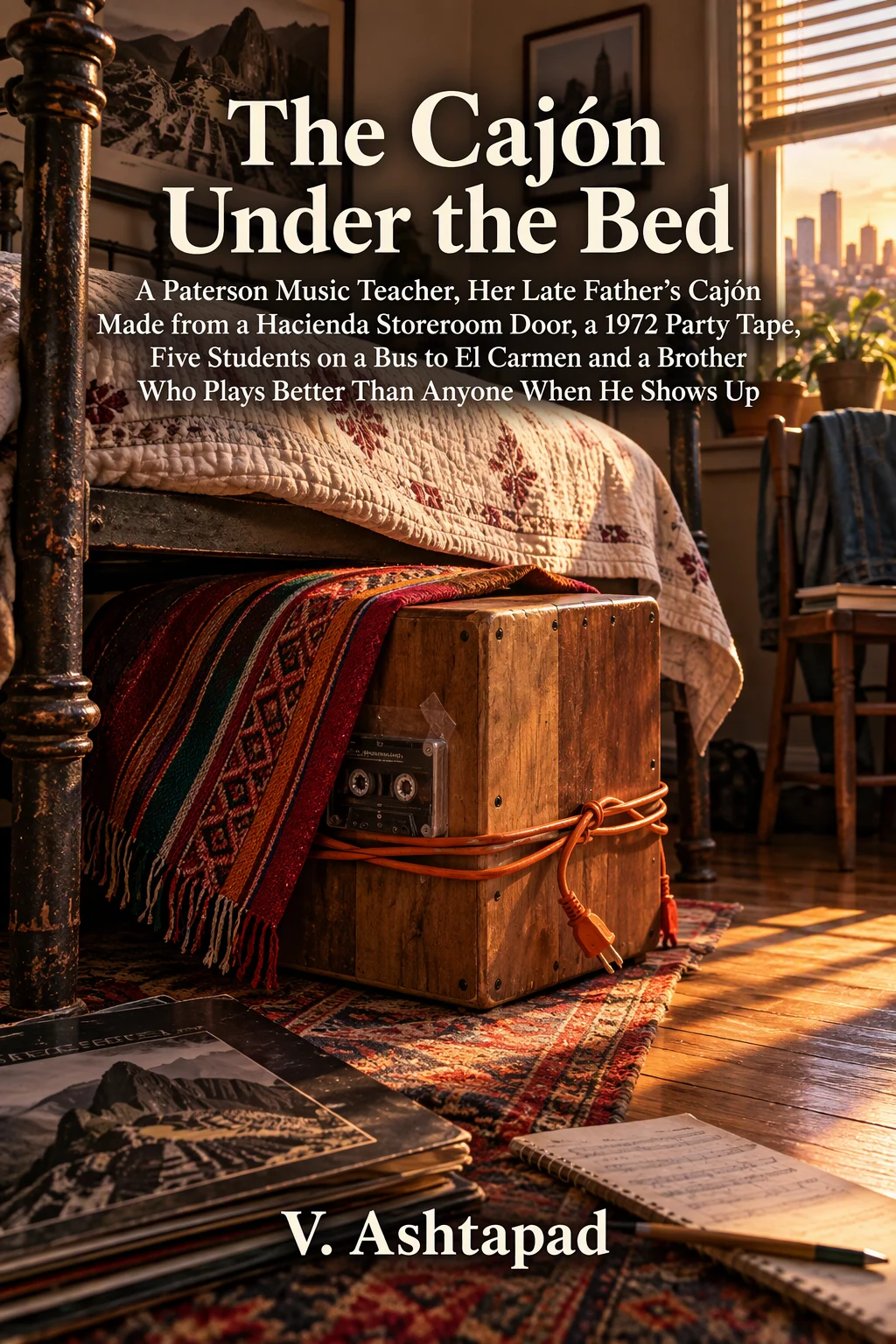
The Cajón Under the Bed
A Paterson Music Teacher, Her Late Father's Cajón Made from a Hacienda Storeroom Door, a 1972 Party Tape, Five Students on a Bus to El Carmen and a Brother Who Plays Better Than Anyone When He Shows Up
by V. Ashtapad
Foreword
This is a work of fiction. El Carmen in the province of Chincha, its Afro-Peruvian music and dance, the cajón and its 2001 recognition as part of Peru's national cultural heritage, the cajita and the quijada, the Hacienda San José and its tunnels, the Fiestas Patrias of July 28, the land reform of 1969, the Museo Afroperuano in Lima, the Peruvian community of Paterson, New Jersey, and the Great Falls of the Passaic are real. Great Falls Academy of the Arts, the Lescano family, the 1972 tape and every named person in the story are invented.
For the cousins who stayed, and kept the box warm for the ones who left.
The Room at the Back
The landlord wanted the back room empty by the first of May, which gave Maritza Lescano eleven days to take apart eighty-four years of a man who had owned, by her count, almost nothing.
She started on a Saturday because Saturday was the only day the district did not own. She put on the gray sweatshirt from the 2009 All-State Festival, the one with the bleach spot shaped like Florida, tied her hair back with a pencil because she could not find a band, and carried three contractor bags and a roll of masking tape down the hall of the second floor on Twenty-First Avenue, past the bathroom with the pink tiles nobody had chosen, past the radiator that clanked like a drummer who had lost the count, and stood in the doorway of the room where her father had slept for the last nine years of his life.
It smelled of him still. Mentholatum and Old Spice and the cheap cigarillos he swore he had quit in 2015, and under all that something sweetish, like pecan wood, that she had never been able to place. The bed was made. She had made it herself the morning after the funeral home took him, pulling the corners tight the way he liked, the way he said the nuns at the hospital in Chincha had done it when he was a boy with a broken arm, and then she had shut the door and not opened it again for six weeks.
"You want help?"
Dayana stood behind her in the hall in flannel pajama pants with penguins on them and a Paterson Eastside sweatshirt that was not hers, holding her phone in front of her like a shield. Fifteen years old, all elbows and eyeliner, with her father's long Lima face and her mother's way of asking a question as if she had already decided she did not care about the answer.
"I want you to finish the chemistry," Maritza said.
"I finished the chemistry."
"You finished half the chemistry."
"I finished the half that makes sense." Dayana looked past her into the room and something went soft at the edge of her mouth. "Can I have the radio?"
The radio was a Sony with a silver antenna that her father had kept tuned, for nine years, to a station out of Newark that played salsa until midnight and then switched to a preacher who shouted. He had turned it off at midnight on the dot. Every night. Maritza used to hear the click through the wall.
"Take the radio," she said, and Dayana took it, and went back to her room, and did not shut the door, which in the language of Dayana was close to a speech.
Maritza began with the closet because the closet was easy. Two suits, one brown and one navy, both from the Sears that had closed on Route 46 the year Obama was elected, both too big for the man he had become in his last winter. Four guayaberas, three white and one a pale blue that her mother had bought him for their thirtieth anniversary and that he had worn, in the photographs, to every christening and graduation and quinceañera from then on, so that when you laid the family pictures side by side you could watch the blue shirt age like a person. Six pairs of trousers with the same crease. A plastic bag from the Peruvian bakery on Market Street with nine years of folded plastic bags inside it. A shoebox of receipts from the Western Union on Main, every one of them for a hundred dollars, every one of them sent to a woman named Zenobia Lescano in El Carmen, Chincha, every month, until the March he died.
She sat down on the floor with the shoebox.
She had known about the money in the way you know about weather in another state. Her father had a cousin back home. Her father sent things. That was all. In fifty-two years she had been to El Carmen exactly once, at the age of seven, and what she remembered was heat and a donkey and a woman with enormous arms who had lifted her off the ground and laughed at her for being so skinny, and a night of music so loud it had made her cry, and her father's face in the yellow light of the bulb strung over the patio, wet and shining, with his hands on a wooden box.
She put the shoebox in the bag marked KEEP.
The dresser took longer. Socks rolled in pairs. Undershirts. A watch that had stopped at twenty past four on some afternoon she would never know about. Prescription bottles, which she counted and bagged for the pharmacy on Broadway that took them back. A folder from the Social Security office with every letter they had ever sent him, flattened and filed in order, because Benigno Lescano had worked twenty-two years at a dye house in Paterson and then fourteen years mopping floors at St. Joseph's on Main Street and he had never in his life been late with a form. In the bottom drawer, wrapped in a dish towel, his cédula from Peru, so old the photograph looked like it had been taken through water.
At one in the afternoon she stopped and ate a cold tamal standing up in the kitchen and looked out over the backyards of Twenty-First Avenue, at the clotheslines and the blue tarps and the plastic chairs, at the Ecuadorian neighbor's grill already smoking, at the brick of the old silk mills down toward the river and the gray hump of Garret Mountain behind everything, and she thought, not for the first time, that the only thing in Paterson that ever stayed still was the waterfall, and even that was moving.
Then she went back and got down on her knees to look under the bed.
There was a suitcase she recognized. There were two pairs of house slippers, the old and the older. There was a great deal of dust, which shamed her, because she had cleaned this room every Saturday for nine years and she had never once looked under the bed, because it had been his, and because a grown woman does not look under her father's bed.
And there was a box.
It was pushed all the way back against the wall, wrapped in a poncho of brown and red wool that had gone gray at the folds, and tied with a length of electrical cord. She reached in and pulled and it came toward her heavier than she expected, sliding over the floorboards with a hiss, and when it was out in the light she sat back on her heels and did not untie it for a long time.
She knew what it was by its shape. Any musician would have. Any Peruvian would have.
She untied the cord. She lifted the poncho away.
The cajón was older than she was. That was the first thing. The wood was dark, almost black at the edges where hands and knees had rubbed it for decades, and the front panel, the tapa, was a lighter wood, thin as a cookie sheet, with a pale crescent worn into it at the upper corners where the heels of a man's palms had come down ten thousand times. The sound hole in the back was round and a little crooked, as if someone had cut it with a knife instead of a saw. The screws in the tapa were not screws. They were small square nails, hand-hammered, gone brown with rust.
On the left side, low, someone had carved two letters: B. L.
She did not sit on it. She did not even think of sitting on it, which surprised her later. She had been playing cajón since she was eleven, first in the basement of the old Peruvian social club on Union Avenue, then in the jazz band at Kennedy High School, then at Montclair State where she was the only percussion major who could play a festejo and the only one who had to explain what a festejo was. She owned four cajones. She had taught several hundred children to play one, in classrooms that leaked, with cajones she had built out of plywood from Home Depot with a jigsaw borrowed from the shop teacher. She had a cajón in the trunk of her car at that moment.
But she had never once in her life seen her father play one in America. Not at parties. Not at the parade on Market Street in July when the trucks went by blasting Eva Ayllón and every Peruvian in North Jersey stood on the curb in a red-and-white scarf and the men got drunk on Cusqueña and played on the sides of coolers. Not when she was in college and brought her own cajón home and set it in the living room and begged him. Never.
"Cajón is for home," he used to say, and when she said this is home, Papi, he would smile in the way that meant the conversation was over, and turn up the radio.
So she had believed, all her life, that he did not own one. That whatever he had played in El Carmen in the yellow light had stayed in El Carmen.
And it had been under his bed. All nine years. Under the room she cleaned. Wrapped in a poncho, tied with an extension cord.
She put her hand flat on the tapa. It was cold. She tapped once, with two fingers, near the center, and the box gave back a low tone that went into her knees.
Then her phone buzzed on the dresser, and it was her brother, and she knew before she answered that he would be outside.
---
Celedonio Lescano, whom no one in their family had called anything but Chelo since the Carter administration, was sitting on the front steps when she came down, with a Dunkin' cup in one hand and a cigarette in the other and the face of a man who has been sitting on a step longer than he meant to.
"I texted," he said.
"You texted at one-forty. It's one-forty-two."
"So I'm early." He grinned. At fifty-six he still had the grin, which had been, in 1984, the most expensive thing in the Lescano household. It had gotten him out of a suspension at Eastside, out of a fight with a cop on Straight Street, into the beds of more women than she wished to know about and into a band in Lima that had played for six months at a peña in Barranco before the owner caught him in the storeroom with a bottle of the good pisco. His teeth had yellowed. His eyes had not. "I came to help."
"You came because I told you on the phone I was doing the room today."
"That's what I said. I came to help."
She looked at the cup. He held it up so she could see inside, and it was coffee, actual coffee, and she hated herself for checking and hated him for knowing she would.
"Six days," he said.
"Okay."
"I'm not asking for a medal."
"Okay, Chelo."
"I'm just saying. Six days." He stood up. He was taller than her by a head and thinner than he should have been, and his jacket was a good jacket, a Carhartt, which meant someone had given it to him. "So what's left? The bed?"
"The bed," she said, and then, because there was no way around it, "and something else."
---
When he saw it he did not say anything at all. He went down on his knees beside it the way you go down beside a dog that has been hit in the road, slowly, with his hands out, and he put his palms on either side of the box and his forehead almost to the tapa and he stayed like that.
Maritza stood in the doorway with her arms crossed.
"You knew," she said.
He shook his head without lifting it.
"Chelo. You knew it was here."
"I didn't know it was here." His voice was thick. "I knew he had it. I didn't know where."
"How did you know he had it?"
He sat back. He wiped his eyes with his wrist, once on each side, like a boy. "Because he brought it in 1990. In the suitcase. The big blue one. He took the clothes out and put them in a garbage bag and put the cajón in the suitcase, and Mami screamed at him at the airport because the bag split open on the conveyor at Jorge Chávez and all his underwear went around on the belt." He laughed and it broke in the middle. "You were already here. You don't remember."
"I was here. I was at Montclair. I was twenty years old, Chelo, I was not in Lima watching Papi's underwear."
"Right. So." He turned the cajón on its side and looked at the carved letters, then turned it again and put his eye to the sound hole. "He played it, you know. Here. Not in front of people. When I lived here, after Mami died, I'd come home at three, four in the morning, and I'd hear it through the door. Very soft. With his fingers only. Like this."
He put his hand on the tapa and played, so softly she barely heard it, a landó, the slow rolling six that sounds like a boat, and the old wood answered in a voice that was deeper than any cajón she owned, with a buzz at the top of each stroke where the tapa slapped the frame, a dry rattle like a seed pod, and it was the sound of the patio in El Carmen when she was seven years old and she put her hand on the doorframe to keep from sitting down.
"Stop," she said.
He stopped.
"I'm sorry," she said. "Just. Not yet."
"It's okay." He looked into the hole again. "There's something in there."
"What?"
"Paper. Taped up inside. And something else." He slid two long fingers in, the way you would fish for a key in a storm drain, and came out with a folded paper gone brown and soft as cloth, and then, after more fishing and a word their mother would have slapped him for, a cassette tape in a cracked case, the label written in ballpoint in their father's square hand.
EL CARMEN. AGOSTO 1972. LOS DE LA PAMPA.
They looked at each other over the box.
"You have a tape player?" he said.
"Nobody has a tape player, Chelo. It's not 1972."
"Mami's car had one."
"Mami's car was a 1994 Corolla and it was towed off Twenty-First Avenue in 2011 after you parked it in front of a hydrant."
"Right," he said. "Right." He put the cassette carefully on top of the cajón and unfolded the paper, and she came and knelt beside him so she could see.
It was a list, in pencil, faded almost to nothing. Names. Some she knew from stories: Benigno, of course, and Zenobia, and a Lescano uncle who had died young. Others she had never heard. Twelve names, and next to each one, an instrument. Cajón. Cajita. Quijada. Guitarra. Voz. Zapateo. And at the bottom, under a line, in a different pencil and a different, shakier hand, something added much later:
Para que no se pierda. Que alguien lo lleve.
So it isn't lost. Let someone take it.
"Take it where?" Chelo said.
She folded the paper again along its old lines and did not answer, because her father was dead and he had left her a list of twelve names and a box he had hidden from her for thirty-five years, and an instruction with no address, and she was a public-school teacher in Paterson, New Jersey, with a mortgage and a stepdaughter and a brother on day six, and she had no idea.
© 2026 CRUNOD LLC. All rights reserved.
Line 4120
The music room at Great Falls Academy of the Arts was on the third floor of a building that had been, in 1911, a factory for silk ribbon, then a warehouse for a company that made venetian blinds, then nothing for twenty years, and then, after a bond issue and a ribbon-cutting at which three state senators had stood in front of a banner that said INVESTING IN PATERSON'S FUTURE, a public high school with a curriculum focus in visual and performing arts and four hundred and twelve students and a heating system that ran either at eighty-six degrees or not at all.
Maritza had taught there for eleven years. Before that she had taught general music at an elementary school on Twelfth Avenue for fourteen years, and before that she had played in wedding bands and a Latin jazz group that recorded one album nobody bought, and before that she had been a girl in a basement on Union Avenue with a box between her knees, being told by an old man from Callao that she hit too hard.
On Monday morning, at seven-ten, she climbed the three flights because the elevator was for students with medical passes and staff with keys and she was not trusted with a key, and she unlocked the music room with the key she was trusted with, and turned on the lights, three of which came on, and put down her father's cajón in the middle of the floor where the morning sun from the big factory windows hit it, and sat on a plastic chair and looked at it.
She had not slept much. She had listened to the tape. She had found a tape player, after all, on Sunday, at the pawnshop on Main Street next to the Bangladeshi grocery, a black Panasonic boom box with one dead speaker for twelve dollars, and she had brought it home and put the tape in at the kitchen table at eleven at night with Juvenal reading the paper across from her and Dayana pretending not to listen from the couch, and pressed play.
The tape had hissed for a long time. Then a man's voice, young and very close to the microphone, said the date and the place. Then a rooster. Then a guitar tuning, badly. Then laughter, a lot of it, men and women. Then a count in, a voice saying uno, dos, and then the room was full.
She had heard Afro-Peruvian music all her life. She had heard it on vinyl and on cassette and on CD and on YouTube, Perú Negro and Susana Baca and Nicomedes Santa Cruz reciting décimas with a voice like a lawyer reading a will, the polished stuff and the old stuff, the field recordings the folklorists made in the fifties and sixties with machines the size of suitcases. She had built entire units of curriculum around it. She thought she knew what it sounded like.
She did not know what it sounded like.
The tape was a party. Not a show. You could hear dishes. You could hear a child crying and somebody shushing it and the child going on crying, all through the second song. You could hear the cajón, her father's cajón, the buzz on top of every stroke, and under it another cajón, and a cajita, the little box with the lid that snapped like a mouth, and the clack of a donkey's jawbone, and feet on a wooden floor, two people dancing zapateo, trading phrases, getting faster, the crowd hooting at every break. A woman sang, high and hard and a little flat, and every time she finished a verse the whole room shouted back the line. Somebody dropped a glass. Somebody shouted at somebody named Nolasco to get off the table.
Forty-one minutes. When it ended Juvenal had put down his paper. Dayana had come to stand in the kitchen doorway with the silver radio in her arms like a baby.
"Who's that?" Dayana said. "The one singing."
Maritza looked at the list. "I think it's Zenobia."
"Who's Zenobia?"
"My father's cousin," Maritza said. "We send her money."
---
By seven-forty-five the first students were coming up the stairs. She could hear them before she saw them, the slam of the third-floor fire door and a boy's voice cracking on a curse word and a girl laughing at him. Her first period was Percussion Ensemble, which was eleven students on the roster and usually eight in the room, and which played, mostly, on things she had found: five-gallon buckets from a paint store on River Street that had gone out of business, brake drums from a junkyard in Haledon, two real congas donated by a retired salsa player, an old drum set with a kick pedal held on by a zip tie, and the plywood cajones, nine of them, that she had built with the shop teacher's jigsaw and her own sanded thumbs.
Tanisha Greene came in first, as always, with her headphones still on and her backpack hanging from one strap and a bag of hot Cheetos she was not supposed to have in the building. She was a junior who had arrived in ninth grade unable to read music and was now the best snare player in Passaic County, and she said so herself, and so did the judge at Region II auditions. Then Piero Huaylinos, five foot two, a sophomore, whose family had come from Huancayo four years ago and who played everything as if it had wronged him personally. Then Nusrat Akter and her cousin Sumaiya, in matching navy hijabs, who had joined the ensemble in September because their own music class had been canceled and who had turned out, Nusrat especially, to have the steadiest hands Maritza had seen in a decade. Then Jeancarlos Peña, late, with a breakfast sandwich and an apology he had been reciting since the fall.
And then, unexpectedly, Dayana, who did not take percussion, who took Visual Arts II and AP Psychology and who had said, in December, that she would rather be eaten by wolves than take a class from her stepmother.
"I have a free," Dayana said, to nobody, and sat in the back on a stack of gym mats.
The others looked at the cajón in the middle of the floor.
"Ms. L, that's not one of ours," Piero said.
"No."
"It looks old."
"It's older than me."
"Nothing's older than you," said Jeancarlos, and Tanisha hit him with the Cheetos bag.
Maritza did not laugh. She sat down on the box. It was lower than her plywood ones and the seat was hard and narrow and her thighs had to splay to fit around it, which meant her father had been a smaller man when he made it, or when someone made it for him. She put her palms flat on the tapa to feel it. Then she played.
Not a festejo, which is what she usually played on Mondays to wake them up. She played what Chelo had played on Saturday, the landó, slow, with the fingers, the way her father had played it alone at three in the morning on the other side of a door. And then she let it open up, the heel of the hand coming in on the low tones, the slap at the top edge, the buzz of the old tapa coming alive at the corners where the nails had loosened, and she played for maybe four minutes without looking at anyone, and when she stopped there was a silence in the room of the kind she had been trying for eleven years to produce with a whistle.
"Damn," said Tanisha.
"Language," said Maritza.
"Damn, Ms. L. Respectfully."
---
That was when she told them. Not all of it. Not about the list or the Western Union receipts or her brother on the step with his coffee held up like a passport. But about the box and the tape and the place: a town called El Carmen, three hours south of Lima on the Pan-American Highway, in the province of Chincha, where people whose ancestors had been brought from Africa in chains to work the cotton and the cane had, over three hundred years, built the music they were sitting in the middle of. She told them that the cajón itself had been invented, most likely, by those people, enslaved and then free, on the coast of Peru, out of shipping crates and drawers and whatever the masters left lying around, when drums were forbidden or too costly or both. That a whole national music had grown up out of a box. That the government of Peru had declared the cajón part of the cultural heritage of the nation in 2001, which was nice, she said, and also a little late.
"So it's like the bucket," said Piero, tapping the paint bucket between his knees.
"It's exactly like the bucket."
"So we invented something," Nusrat said. "When you made us play buckets."
"You did not invent anything. You played buckets. But yes. Same idea."
"How do you get there?" Dayana said from the mats.
Everyone turned around.
"To the town," Dayana said. She had her phone out. She had, Maritza saw, already found it on a map. "El Carmen. How do you get there."
"You fly to Lima," Maritza said slowly. "And you take a bus."
"Can we go?"
It was Jeancarlos who said it, with his mouth full, as a joke, the way a kid says can we go to Disney. And Tanisha laughed and Piero laughed and Sumaiya said her mother would never let her go to the bathroom by herself let alone to Peru, and the bell rang, and everybody picked up their backpacks.
But Nusrat, at the door, stopped and turned and said, "Ms. L. Seriously, though. Can we?"
---
Applying to take five students from a Paterson public school to the country of Peru required, Maritza learned over the next three weeks, the completion of District Form 4120-B (Out-of-State and International Student Travel, Initial Request), which required the signature of the principal, which required a meeting with the principal, which required an appointment with the principal's secretary, Mrs. Marroquín, who had been the principal's secretary under four principals and had outlasted two state takeovers and one return to local control and who regarded all teachers as weather.
"International," said Mrs. Marroquín, reading the form at arm's length.
"Peru."
"I know where Peru is, Ms. Lescano. My brother-in-law is from Trujillo. International requires ninety days' lead time and Board approval."
"I know. It's in the form."
"And a risk assessment from the district's insurance carrier."
"It's in the form."
"And a letter from the Superintendent's office. Which," Mrs. Marroquín said, lowering the paper and looking at her over the top of it, "has not, in my memory, ever been issued for a trip that was not a band competition in Orlando."
"Then this will be the first one," Maritza said.
Mrs. Marroquín looked at her for a moment more. Then she wrote an appointment on a yellow sticky note in handwriting so beautiful it made Maritza ashamed of her own, and handed it across the desk, and said, "Thursday at two-fifteen. He'll give you seven minutes. Don't bring the drum."
---
The principal of Great Falls Academy of the Arts was a man named Dr. Percival Fitzhugh, who had been an assistant superintendent in Newark and a vice principal in Irvington and who had arrived at Great Falls two years ago with a strategic plan bound in blue plastic and a habit of saying "Walk me through it" in a voice that made everyone feel they were about to be found out.
She did not bring the drum. She brought the tape, on her phone, which Dayana had spent a Saturday afternoon recording off the dead-speaker Panasonic into a laptop and cleaning, with a program a boy in her art class had shown her, until the hiss was gone and you could hear, at minute nineteen, a woman laughing at the back of the room so clearly you could almost see her teeth.
"Walk me through it," said Dr. Fitzhugh.
She walked him through it. She had seven minutes and she used six, and she did it in the voice she had learned to use in district meetings, which was not her real voice but a smooth, flat one with no Spanish in it, a voice that said curriculum alignment and cultural responsiveness and student-centered experiential learning, and she hated it, and it worked. She told him about the unit she had already written for the spring, three weeks on Afro-Peruvian music within the state standards for music history and performance. She told him about the box and the tape and the names. She told him five students, two chaperones, ten days in late July, after summer school. Lima, three nights. El Carmen, five. She told him she would raise every dollar herself.
He listened with his fingertips pressed together. When she finished he did not say anything for a while.
"It's a beautiful story, Ms. Lescano," he said.
She waited.
"I want to say that first. It's beautiful. And it's the kind of thing I came into this work for." He leaned forward. "Here's my concern. My concern is I have forty-one seniors who are not going to graduate in June unless something changes, and I have a building with mold on the fourth floor, and I have a music program, which is you, that the district has flagged twice for low enrollment. And I have to stand in front of the Board in June and explain why my art school has an art teacher and a dance teacher and you, and why we need all three. So when you come to me with a trip to Peru for five kids, what I hear, and I'm being honest, is the Board hearing it. And what the Board hears is five kids. Not four hundred."
"It's a pilot," Maritza said.
"Everything's a pilot."
"If it works, it's a program. Exchange. Their students come here. We build cajones in the shop. We record the elders, we put it in the curriculum, it becomes a Paterson thing. There are eleven thousand Peruvians in this city, Dr. Fitzhugh. There are more Peruvians in Paterson than in any city in America outside of Miami. There's a square on Market Street with a Peruvian flag on the sign. And not one of our kids, not one, could tell you that Black people in Peru made the music those people dance to at the parade every July."
"That's the pitch I'd lead with."
"That is the pitch I'm leading with."
He smiled a little. "Is it." He looked at the clock over his door, which said she had thirty seconds. "Who are the five?"
She told him. Tanisha Greene. Piero Huaylinos. Nusrat Akter. Jeancarlos Peña. And, because the girl had come back to the music room every morning that week during her free period and sat on the mats with her phone and her arms around her knees and finally, on Thursday, picked up a cajita, the small box with the hinged lid that you hold against your belly and snap open and shut with one hand while you strike the side with a stick in the other, and played it, badly and then less badly, for forty minutes without being asked, and said, at the end, without looking up, "This is kind of hard"—
"And my stepdaughter," Maritza said. "Dayana Ortega. She's not in the ensemble yet. She will be."
Dr. Fitzhugh's eyebrows went up.
"I'm aware of how it looks," she said.
"I'm aware you're aware." He picked up the form. He read it again. He signed the bottom of the first page, where it said Principal's Preliminary Approval (Does Not Constitute Final Authorization), in a quick blue scrawl, and handed it back to her.
"Raise the money," he said. "All of it. Not one district dollar, not one Title I dollar, not one dollar from my discretionary, because I'll need it for the mold. Get me the parent consents and the passports by May fifteenth and the insurance thing from downtown. And Ms. Lescano." He held up a finger. "When the Board asks me why, I'm going to play them that tape. So it better be the best forty-one minutes of my life."
"It's not," she said. "It's a party. Somebody drops a glass."
"Even better," said Dr. Fitzhugh, and Mrs. Marroquín opened the door.
---
That night, at the kitchen table, Juvenal did the math on the back of a ConEd envelope even though they were on PSE&G and had been for nineteen years.
Juvenal Ortega had come from Lima at twenty-six, from a family in Breña who ran a shoe repair stand, and he fixed commercial refrigeration for a company in Totowa, which meant he spent his days in the back rooms of supermarkets and bodegas and halal butchers and the walk-ins of every Peruvian restaurant from Paterson to Passaic, lying on his back on wet tile with a flashlight in his teeth. He knew the price of everything. He knew, without looking it up, the price of a round trip from Newark to Lima in July on United, because his mother was eighty-one and still in Breña and he went every other summer and complained the whole time.
"Seven hundred, if you're lucky. Nine if you're not. Times seven, because you're two chaperones, you and who?"
"I don't know yet."
"Times seven. Call it six thousand. Hotel in Lima, three nights, you'll put them in a hostal in Miraflores, the kids will want Miraflores, two rooms, maybe four hundred dollars all in. Bus to Chincha, cheap, thirty soles a person on Soyuz. In El Carmen you'll stay where?"
"There are guesthouses. Families."
"Families. Call it nothing, then call it five hundred dollars because you'll feel guilty. Food, they're teenagers, they'll eat a hundred dollars a day between them. Insurance, the district will want something, I don't know, a thousand. Passports for any of them who don't have one, a hundred and something each. Shirts. You'll want shirts. Everyone always wants shirts." He drew a line. "Ten thousand dollars, Maritza."
She looked at the number.
"Ten," he said again, gently. He had a way of being gentle with numbers, as if they were animals that might bolt. "In three months."
"I know how many months it is."
"I'm just saying it so it's in the room."
From the couch, without looking up from her phone, Dayana said: "Pollo a la brasa."
They both looked at her.
"Pollo a la brasa," Dayana said. "Every Peruvian restaurant on Market Street. You go in, you say, can we do a night, you get ten percent, twenty percent. The kids work the counter. You sell the tape. You put it online, you put a QR on a flyer, you put the flyer in every pollería, every bakery, every hair place, the Western Union. Peruvians will pay twenty dollars to hear somebody's grandpa play a box in 1972, it's like their whole thing." She looked up. "And you get Tío Chelo to play."
The kitchen was very quiet. The fridge hummed in the key of B flat, the way it had for eleven years, because Juvenal fixed everybody's refrigerator except their own.
"Chelo," Maritza said.
"He's good," said Dayana. "I've heard him. At Abuelo's thing. In the backyard. He's better than you."
"He is better than me," Maritza said. "That's not the question."
"So what's the question?"
She did not answer. Juvenal put down the pen and folded the envelope and did not answer either, and after a moment Dayana made a small sound through her nose, the sound teenagers make when they have caught adults in a lie they are too polite to name, and went back to her phone.
© 2026 CRUNOD LLC. All rights reserved.
Day Nineteen
The Lima Grill on Market Street had pollo a la brasa that turned on spits in a glass case in the front window, gold and black and shining, and a television permanently tuned to a Peruvian soccer channel, and a counter where you could buy Inca Kola in glass bottles and alfajores in plastic clamshells and phone cards for calling Arequipa. The owner was a woman from Ica named Doña Lucrecia Yupanqui who had known Benigno Lescano for twenty years, because he came in every Sunday after the parade-practice in the park and ate a quarter chicken with fries and salad and aji and never, in twenty years, finished the fries.
"He gave them to the dog," Doña Lucrecia said. "The dog outside the Western Union. Brown dog, one ear. Every Sunday. The dog knew him better than his own family, I'm sorry, but it's true."
"It's true," Maritza said.
"So you want a night." Doña Lucrecia put her elbows on the counter. She was in her sixties and wore her glasses on a beaded chain that clicked. "Friday. Not this one, the next. I give you twenty percent of the chicken, not the drinks. You bring your kids. They wear something nice. They play out front where people can see, on the sidewalk, not inside, inside the customers want the soccer. If the police come, you deal with the police."
"Why would the police come?"
"Because it's Market Street, mamita," said Doña Lucrecia, "and somebody always calls."
Nobody called. Or if they did, nobody came. On the second Friday of April, at six in the evening, the sun dropping gold behind the old mill buildings and the traffic on Market Street backed up from Main to Madison, five teenagers in black pants and white shirts set up on the sidewalk outside the Lima Grill with two plywood cajones, three buckets, one cajita, one quijada, which was a real donkey's jawbone with all its teeth that Maritza had bought from a man in Union City for eighty dollars and which Jeancarlos had refused to touch for a week, and a folding table with a cash box and a laminated sign that said in Dayana's handwriting: SUPPORT PATERSON KIDS GOING TO EL CARMEN, PERU! LISTEN TO THE 1972 TAPE! $20!!
They played a festejo and a landó and a festejo again, because there were only two songs they could play without falling apart, and they played them badly and then well. People stopped. The old Peruvian men in caps who stood every evening in front of the bakery with their hands in their jacket pockets came over and stood closer, and one of them, a thin man with a white mustache, began to tap a rhythm on the side of the cash box table without being asked, and when Maritza looked at him he winked. A woman came out of the hair salon next door with foils in her hair and danced in the street for one whole song while her friends filmed her and screamed. A Bangladeshi father with two little boys on his shoulders, coming home from the halal market with plastic bags hanging off his elbows, stood and watched until the bags got too heavy. Two Paterson cops in a cruiser idled at the light, and one of them, a Dominican kid who could not have been more than twenty-five, rolled down the window and nodded along, and when the light changed he drove off and honked twice, on the beat.
They made eleven hundred and forty dollars. Doña Lucrecia's twenty percent of the chicken was three hundred and twelve more. A man nobody knew put a hundred-dollar bill in the cash box folded into a square and walked away without his tape.
At nine-thirty, when the kids were gone, picked up by parents and cousins and an older brother on a motorcycle, Maritza sat on the curb in front of the Lima Grill with the cash box between her feet and counted it a second time, and the man with the white mustache came and stood beside her and lit a cigarette.
"You're Benigno's girl," he said.
"Yes."
"You play like him. Too hard."
She laughed despite herself. "That's what Don Amadeo used to say. At the club on Union."
"Amadeo was right about some things. He was wrong about your father." The man blew smoke up into the streetlight. "Your father didn't play too hard. Your father played like he was trying to get out of somewhere."
She looked up at him. He was looking down Market Street toward the station, toward the trains that went to Hoboken and New York and the rest of the world.
"Where's the brother?" he said. "The tall one. Chelo."
"I don't know."
"He should have been here. He plays better than you too."
"Everybody keeps telling me that."
"Then somebody should tell him," the man said, and dropped the cigarette, and stepped on it, and went home.
---
She had texted Chelo on Wednesday. She had texted him Thursday morning, and Thursday night, and Friday at noon. She had said, in order: We're playing Friday at the Lima Grill, come. Kids would love it if you came. Chelo it's at 6. Chelo.
He had answered Thursday night with a thumbs-up.
On Saturday morning she drove out to the car wash on Route 46 in Clifton where he had been working since February, a long low building with blue brushes like the hair of a cartoon monster and a line of SUVs waiting in the sun. A Guatemalan kid in a wet T-shirt told her Chelo had not been in since Wednesday. The manager, a Lebanese man in a polo shirt, came out of the office and told her the same thing in a voice that meant he had been told before by other sisters about other brothers.
"He's a good worker," the manager said. "When he's here."
"I know."
"I like him. Everybody likes him. The customers like him. He sings." The manager shrugged. "But I have a business."
"I know," she said again, and got back in her car, and sat in the parking lot with the engine running and the air conditioning on even though it was April, and watched the brushes spin.
He answered the phone on the ninth try, at two in the afternoon. She could hear a television. She could hear, in the way he said her name, the whole night.
"Day nineteen," she said.
"Mari."
"You told me six. You told me six on the step. You held up the cup."
"It was six. That day it was six." His voice was slow and very careful, the way he had talked to their mother on the phone from Lima in 1989 to tell her he was fine. "Then it was eighteen. Then Thursday."
"What happened Thursday?"
"Nothing happened Thursday. That's what happened."
She closed her eyes. On the other side of the windshield a red Tacoma came out of the wash dripping and gleaming and a kid ran at it with a chamois.
"There was a man there last night," she said. "At the grill. Old man with a white mustache. He knew Papi. He said you play better than me."
Chelo was quiet.
"He said somebody should tell you," she said. "So I'm telling you."
"Mari."
"We made fifteen hundred dollars in one night. Five kids who can barely play. Fifteen hundred. If you'd been there, it would have been three thousand."
"Don't."
"I'm just saying it so it's in the room."
"What room? There's no room. You're in your car. I can hear the car."
She almost laughed. She held the phone away from her face and looked at it and then put it back. "Where are you?"
"At a friend's."
"What friend?"
"A friend, Maritza." The edge came into his voice, finally, the edge that had always been under the grin. "I'm fifty-six years old. I have a friend. I'm on his couch. He has a television. He has a cat. Do you want to know the cat's name?"
"Is the cat sober?"
He hung up.
She sat for a while. Then she put the car in gear and drove home the long way, down McBride Avenue past the Great Falls, because she always did when she could not think, and pulled over at the overlook and got out and stood at the rail with the tourists from Ohio and the couples from the Dominican wedding taking photographs, and watched the Passaic go over the edge of the old basalt, brown and white and roaring, seventy-seven feet, the way it had gone over long before Alexander Hamilton stood on that same rock and saw a city in it. The spray came up and wet her face. A little girl in a pink dress screamed with joy and her father held her up so she could see.
In her purse her phone buzzed. She looked. It was Chelo.
The cat's name is Pisco, it said.
And then, a minute later: Tell the kids sorry. Next one I'm there.
And then nothing.
© 2026 CRUNOD LLC. All rights reserved.
Forms
By the middle of May she had a folder three inches thick with a rubber band around it that she carried everywhere, to school and to the supermarket and to bed, and that Juvenal called la Biblioteca Nacional, and that she would have run into a burning building to save before she ran in for the cat, if they had a cat, which they did not, because Dayana was allergic and also, in her own words, a dog person trapped in an apartment.
In the folder were five parent consent forms in two languages, three of them signed in the right place. Five copies of five birth certificates. Two passports, Tanisha's and Piero's, the first new and stiff and still smelling of the post office on Ward Street, the second Peruvian and a year from expiring. A receipt from the passport office for Dayana's, expedited, two hundred and eleven dollars, paid by Juvenal on his card while he muttered about the federal government. A letter from Nusrat's father. An appointment printout from the Dominican consulate on Fifth Avenue in New York for Jeancarlos, who had been born in Santiago de los Caballeros and whose Dominican passport had expired in 2023 and who could not, it turned out, simply get a new one in Paterson, because nothing was simple in Paterson and nothing at all was simple at a consulate.
In the folder were also: a risk assessment from the district's insurance carrier, forty-one pages, which asked among other things whether the destination country had an active volcano within a hundred miles (no), whether students would be traveling by small aircraft (no), whether students would be engaging in water sports (she had written no and then thought about the ocean at Tambo de Mora and changed it to not as an organized activity). A letter from the Superintendent's office that said, in two paragraphs, that the district did not object to the trip proceeding as a privately funded activity and did not, by this letter, assume responsibility for it, which Dr. Fitzhugh had read aloud in his office and then said, "That's a yes," and Mrs. Marroquín had said, from the doorway, "That's the closest thing to a yes I've seen in nineteen years."
And a bank statement for an account at the credit union on Broadway called PAT ARTS EL CARMEN FUND, which on the fifteenth of May held eight thousand two hundred and six dollars and nineteen cents.
The nineteen cents was from a girl in Nusrat's homeroom who had emptied her pockets into the jar at the school talent show, where the ensemble had played between a boy who did card tricks and a senior who sang Adele so loud the microphone gave up. The rest was from three Fridays outside three pollerías on Market Street, a Saturday at the Peruvian bakery, a Sunday afternoon in the parking lot of the Dominican parish hall on Ellison Street where the ladies of the parish council had sold pastelitos alongside, and two hundred and eighty-one people who had paid twenty dollars, online, to hear somebody's grandfather play a box in 1972. Dayana had put the tape up on a page with a photograph of the cajón and a paragraph Maritza had written and Dayana had cut in half. Somebody in Lima had shared it. Somebody in Madrid had shared that. A woman in Chincha Alta had written in the comments, in capitals, THAT IS MY UNCLE NOLASCO ON THE TABLE, and four hundred people had liked it.
Eight thousand two hundred and six dollars.
It was not ten.
---
"It doesn't have to be ten," Juvenal said. "It has to be enough."
They were in bed. It was after midnight. The window was open and the sound came in of the neighborhood not sleeping, a car with its bass up somewhere over on Twentieth Avenue and somebody laughing on a porch and the long freight train that came through at twelve-forty every night going toward the river.
"How much is enough?"
"Depends on who the second chaperone is."
She had been trying for a month. The art teacher had a wedding in July. The dance teacher had a summer contract in the Poconos. The guidance counselor, who loved her, had said yes and then, a week later, apologized and said her husband had looked at a map. Two parents had offered and then backed out. Piero's mother would have gone but could not leave the other three children. The district rule said one adult for every five students and two adults minimum on international travel, with no exceptions, and she had asked Mrs. Marroquín, and Mrs. Marroquín had looked at her with something like pity and said, "Ms. Lescano, I have been here nineteen years and the one thing I have never seen is an exception."
"I need someone with a clean background check by June twentieth," she said into the dark.
"I have a clean background check."
She turned her head. Juvenal was lying flat, hands folded on his chest the way he slept, like a man in a museum.
"You," she said.
"I get it every year. For the supermarkets. They fingerprint me. I'm the cleanest man in Passaic County."
"You hate going to Peru."
"I hate going to Lima. Lima is my mother asking why I haven't fixed her fridge." He was quiet for a moment. "I've never been to Chincha. Forty-nine years old, I've never been south of Pachacamac. My father used to say Chincha was for the morenos, why would we go. I didn't think about it until the other night. With the tape. Nolasco on the table." He turned his head on the pillow to look at her. "My father was wrong about a lot of things, you know. He was wrong about that too."
She did not say anything. She reached over and took one of his folded hands.
"I'll take two weeks," he said. "I'll see my mother the first two days, she'll cook, she'll cry, I'll fix the fridge. Then I'm yours. Two adults. Clean as a whistle. That's eight thousand and change, it's enough, if the kids don't eat like Jeancarlos."
"Nobody eats like Jeancarlos."
"That's what I'm saying," Juvenal said, and went to sleep holding her hand, in about four seconds, which was a talent she had envied for nineteen years.
---
She did not sleep. After a while she got up and went down the hall to the back room, which was not her father's room anymore. The landlord had taken it back and then decided, after looking at what it would cost to bring it up to code, to let them keep it for the same rent, which was the closest thing to kindness she had ever had from a landlord. The bed was gone. There was a sewing machine of Juvenal's mother's, and a box of Christmas things, and the cajón, sitting in the middle of the floor where the bed had been, with the poncho folded on top of it.
She sat down against the wall and took out her phone.
In January, when he had stopped being able to get up without help, she had begun to record him. Not for any reason she could have named. Not for a project. A cousin's daughter in Lima, a pharmacist named Yuliana who was the family's keeper of birthdays and death dates, had set up a place online for the Lescanos, a private one, with a family tree that went back on one side to a woman named Mercedes born in El Carmen around 1880 who had been, Yuliana believed, the daughter of a man who had been born enslaved, and on the other side to nothing, a blank, a line that stopped. Yuliana had asked everyone to put in what they had. Photos. Dates. Voices. Maritza had uploaded a few pictures at Christmas and forgotten about it.
Then in January her father had started to talk at night. In the dark, from the bed, the radio off. About El Carmen. About the cotton fields at the hacienda where his grandfather had picked for a few centavos a day, and the grapes later, and the dry river, and the fiesta in December when the boys went house to house in the hatajo, the line of dancers with their bells and their ribbons and their little whips, playing and stamping until dawn. About his cousin Zenobia, who could outsing any man in the province and beat most of them in the zapateo. About a dog named Pelé. And she had started, after the second night, to hold up the phone.
She had eleven recordings. Most of them were him breathing, and then the radio, because he would forget and turn it on. Four were good. She had put them in the family place, where Yuliana and the Lima cousins and a nephew in Turin and an aunt in Jersey City had listened to them and left small hearts.
She played the fourth one now, with the volume very low.
"... and then the music would stop," her father's voice said, thin and slurred with the medicine, "and you'd hear the frogs. All night. In the irrigation ditches. Croak, croak. My father said they were keeping time for us. He said when the frogs stopped, the cajón had to stop too. That's how you know it's morning." A long pause. The sound of him shifting on the bed. "Zenobia's still there, you know. She's the only one left of the twelve."
Maritza sat up.
On the recording she heard her own voice, much closer and louder, saying, "The twelve what, Papi?"
"The twelve," he said. "The Pampa. We had a name. Los de la Pampa. Like a band. We weren't a band. We were a family. Her and me and Nolasco, all the cousins. She's the only one." Another pause. "I should have sent more money."
"You sent money every month, Papi. You never missed."
"I should have sent more," he said, and then the radio came on, loud, salsa from Newark, and she heard herself laughing on the recording and reaching over to turn it down, and the recording ended.
She sat in the dark with the phone on her knee.
Then she opened the family place and found the tree, and found Zenobia, who had a birth year of 1934 and a question mark where a photograph should be, and under her a son, and under him a grandson named Wálter, with a phone number, and she looked at the time in Peru, which was the same as the time in Paterson in May, one in the morning, and put the phone down, and picked it up, and wrote Wálter a message anyway.
© 2026 CRUNOD LLC. All rights reserved.
Garúa
They landed at Jorge Chávez at eleven-forty at night on the twenty-third of July, after a flight on which Jeancarlos had eaten his own dinner and Sumaiya's, who was not on the trip but had sent along a bag of homemade nimki for the plane, and Piero had slept with his mouth open against the window, and Tanisha had watched three movies with her headphones on and her hand gripping the armrest every time there was a bump, and Nusrat had read a paperback about the Partition of India from cover to cover and cried twice without making a sound, and Dayana had sat beside Maritza for seven hours and twelve minutes and said, by Maritza's count, eleven words, five of them about the bathroom.
Jeancarlos had his passport. It had come in the mail on the eleventh of July, after two trips to the consulate in New York, the second of which Maritza had driven herself, leaving Paterson at five in the morning and sitting with him on a plastic chair in a hallway on Fifth Avenue for six hours while a man in a booth called numbers that never seemed to get closer. Jeancarlos's mother worked nights at a warehouse in Secaucus and could not take the day. Jeancarlos had spent the six hours doing algebra and then teaching a six-year-old Dominican girl in the next chair to play a festejo on her knees. When his number was finally called, the girl had cried. When the passport came, Jeancarlos had sent Maritza a photo of it held up next to his face, both of them grinning, with fourteen exclamation points.
The cajón was in the hold.
She had argued with herself for weeks. It was eighty years old, maybe more. It had come north in a suitcase in 1990 with an old man's underwear going round on the belt, and here it was going south again in a hard case she had bought for two hundred and sixty dollars at a music store in Wayne, with foam she had cut by hand to fit its odd dimensions, and a TSA lock, and a tag that said FRAGILE — MUSICAL INSTRUMENT — HISTORIC in three colors of marker in Dayana's writing. She did not know why she was bringing it. She did not know what she would do with it there. She knew only that the list said let someone take it, and that she could not stand the idea of it in the empty back room on Twenty-First Avenue for ten days while she was in the place it came from.
When it came down the chute at baggage claim in Lima, she watched it the whole way around the carousel like a mother watching a child cross the street.
---
Lima in July was gray. She had forgotten. She had forgotten the garúa, the fine wet mist that was not rain and never became rain and settled on everything from June to October and made the whole city look like a photograph somebody had left in a damp drawer. She had forgotten the smell, which was sea and diesel and frying oil and wet cement and something sweet underneath, like caramel left too long on the stove. She had forgotten the noise, which was not the noise of Paterson, but bigger and flatter and more continuous, a city of eleven million people all honking at once.
Juvenal's brother met them in a borrowed van with a cracked windshield and drove them to Miraflores along the Costa Verde, the highway at the bottom of the cliffs, with the Pacific on their right invisible in the dark and the gray cliff on their left lit orange by the streetlights, and Tanisha pressed her face to the glass and said, "Where's the ocean?" and Juvenal's brother said, "There," pointing at the black, and she said, "I can't see it," and he said, "In Lima nobody can see it, but it's there."
The hostal was on a side street off Avenida Larco and had two rooms with four bunk beds each and a breakfast of bread rolls and butter and jam and instant coffee and a papaya juice so thick you could stand a spoon in it. The girls took one room, the boys the other. Juvenal went to his mother's in Breña. Maritza slept on a cot in the girls' room with her shoes on and the cajón case under the cot and one hand hanging down to touch it.
At three in the morning she woke and heard Dayana crying, very softly, in the bunk across from her, and lay still, and did not know what to do, and after a while heard Nusrat climb down from the top bunk and get in beside her, and heard the two of them whispering, and then nothing, and then both of them asleep.
---
They had three days in Lima. Maritza had planned them the way she planned a unit: objectives, activities, assessment. Day one, the Museo Afroperuano in the old center, near the train station, a house on Jirón Ancash with a courtyard and a balcony carved like lace, where a guide named Lizandro with a shaved head and a voice that filled the room told them about the ships and the slave market by the river and the cofradías, the brotherhoods the enslaved had formed to buy one another's freedom one person at a time, and showed them a set of iron shackles in a glass case that made the whole group go quiet. Day two, Barranco in the afternoon, a peña in the evening, the kids home by eleven or the deal was off. Day three, the market, a workshop with a cajón maker in Callao, the bus south on the morning of the fourth day.
What happened instead was that on day one at the museum, Tanisha asked the guide where the Black people in Lima lived now, and the guide said, carefully, everywhere, and also not everywhere, and Tanisha said what do you mean, and the guide told them about the old Black neighborhoods, Malambo by the river that had been knocked down, La Victoria, the districts on the edges. And he told them that when he was a boy in school, in his history textbook, there had been one page on Afro-Peruvians, and it was about slavery, and then the book went on, as if they had all disappeared in 1854 when slavery ended, and he had raised his hand and asked the teacher where his grandmother was in the book.
"What did she say?" said Tanisha.
"She said, sit down, Lizandro," said Lizandro.
Tanisha did not say anything for a long time. Then, on the bus back to Miraflores, she said, to the window, "That was my textbook too. Literally that exact page," and Piero, beside her, who was Peruvian and had gone to school in Huancayo until he was twelve, said, "Mine had a drawing of a Black man selling sweets. That was it. That was the whole page," and they looked at each other in a way that Maritza wished she had been able to plan.
At the peña in Barranco that night, a big room in an old house with a stage and long tables and a smell of beer and anticuchos, a group called Sabor de Zaña played until two, and the kids were not home by eleven, and Maritza did not care. A woman of seventy in a white dress came up on stage and danced the alcatraz with a man half her age, the dance where the man carries a lit candle and tries to set fire to a paper tail tucked into the back of the woman's skirt and the woman swings her hips to keep it away from him, and the whole room shouted, and the old woman danced for six minutes and never let him near her, and when the song ended she took the candle from him and blew it out and handed it back and walked off the stage to the loudest applause of the night. Jeancarlos laughed so hard he fell off the bench.
At the end of the night, a man at the bar who said he was a drummer with the group came over to their table, because he had seen Maritza watching the cajón player all night with her hands moving on her knees, and asked where they were from, and when she said Paterson, New Jersey, he said, "Ah, Paterson. Half my family's in Paterson," and named three people she knew, including Doña Lucrecia at the Lima Grill.
When she told him where they were going he whistled.
"El Carmen," he said. "Real music. Not this." He waved at the stage. "This is beautiful. That is the root."
"Do you know a Zenobia Lescano?"
He looked at her. "The singer? Of course I know her. Everybody knows her." He paused. "She's old now."
"Ninety-one."
"She's in the hospital, I heard. In Chincha. A month ago." He saw her face. "But she got out. I think. Somebody said she got out." He put his hand flat on the table, a drummer's hand, wide and callused at the base of the fingers. "You go see her. Go see her this week. Don't wait."
© 2026 CRUNOD LLC. All rights reserved.
The Road South
The bus to Chincha left from a terminal on Javier Prado at nine in the morning, a double-decker with seats that leaned back almost flat and a television showing an American action movie dubbed in Mexican Spanish with the sound too loud, and a steward in a vest who handed out a ham sandwich in plastic and a little carton of peach juice and asked every passenger to keep their seat belt fastened, which no one did.
They took the front seats on the top deck, because Piero had heard from his cousin that they were the best, and they were. For the first hour there was only Lima, going on and on: the gray districts on the hills to the south, houses of brick and cinder block climbing the bare dirt slopes, painted and unpainted, with rebar sticking out of the roofs for the next floor that would be built when there was money, and enormous painted signs for candidates in an election that had been over for a year, and political slogans on every wall, and women selling quail eggs and chicha morada from carts at every light.
Then the city stopped and the desert began.
Maritza had forgotten this too. Or she had not been old enough to know it was strange. The coast of Peru is one of the driest places on earth, and the Pan-American Highway runs down it like a gray string laid across sand, with the Pacific on the right, sometimes close enough to see the surf and sometimes gone behind dunes, and on the left the brown foothills of the Andes rising out of the sand with not a single green thing on them. Every forty or fifty kilometers a river came down out of the mountains, and wherever it came, for a few miles on each side, everything was suddenly green, fields of cotton and asparagus and grapes and corn, rows of fig trees, chicken farms with long white sheds, and towns built of adobe and brick, and then the river was behind you and it was desert again, as if somebody had turned off a light.
"How do people live here," said Tanisha.
"The rivers," said Piero. "In the sierra it rains. It comes down."
"But it's like. Nothing. It's like the moon."
"It's like the moon with chickens," said Jeancarlos, pointing at a chicken farm, and Dayana laughed, the first time she had laughed since Newark, a short helpless sound she tried to swallow, and Maritza, across the aisle, pretended not to hear it, and kept it.
---
She had heard from Wálter. Not in May, not for weeks. Then in late June, at two in the morning, a voice message, nineteen seconds, a young man's voice, polite and a little nervous, saying that he was Wálter Lescano Quispe, grandson of Doña Zenobia, that his grandmother had been in the hospital in Chincha with her lungs but was home now, that she remembered Benigno, of course she remembered Benigno, and that she said, he quoted exactly, that she did not want any more money from the Americans but she wanted to see the box.
Then, ten seconds of silence, and the voice again, much lower: "She knows he died. I told her in March. She didn't say anything for two days."
Maritza had listened to it eleven times.
She had written back and asked him what his grandmother meant by the box, how she knew about it. He had answered three days later with a photograph. It was an old photograph, black and white, curled, taken of another photograph on a table with a phone. It showed a patio with a dirt floor and a bulb hanging from a wire, and a dozen people, some sitting and some standing, all of them looking at the camera in the stiff way people looked at cameras in 1972, and in the middle, on a box, a young man with a thin mustache and a white shirt open at the neck, his two hands flat on the tapa, not smiling. On the side of the box, if you made the photo bigger with your fingers, you could just see two carved letters.
The young man was her father. He was twenty-nine. She had never seen this photograph in her life.
Standing behind him with one hand on his shoulder was a tall woman with enormous arms and a laugh she could hear through the screen.
---
The bus came into Chincha Alta at noon. The terminal was a lot by the highway with a roof and a row of offices and a crowd of drivers calling out, Carmen, Carmen, Sunampe, Tambo, Grocio Prado, with their arms out like men directing traffic. Juvenal, who had come down with them after two days in Breña in which, he reported, he had fixed his mother's refrigerator, her neighbor's refrigerator, and the refrigerator of a cevichería on Avenida Arica in exchange for lunch, negotiated with a driver for a combi, an old white Toyota van with a crack across the back window held together with tape, to take seven people and their bags and a hard black case to El Carmen for twenty-five soles.
"How much is that?" Tanisha said.
"Seven dollars," said Juvenal.
"For all of us?"
"For all of us."
"That's insane."
"That's Chincha," said the driver, a fat man with a toothpick who had understood the English, and put the cajón case on the front seat beside him with exaggerated care and patted it. "Música," he said. "Para el Carmen. Bien."
The road ran out of Chincha Alta past a stadium and a market and a row of mechanic shops with tires piled in front, and into fields. The fields were vineyards, mostly, low vines trained on wires, bare and brown at this time of year, and fields of cotton stubble, and here and there a brick chimney standing alone in the middle of nothing, left from some old hacienda. The road was paved and then not paved and then paved again. Mototaxis passed them, three-wheeled motorcycles with a bench behind and a canvas roof, painted red and blue and yellow, with names stenciled on the back in big letters, EL BRAVO, LA REINA DEL SUR, DIOS ES AMOR (which Maritza saw Nusrat read, and look away from, and smile). A boy on a bicycle with a cooler on the back, a woman with a baby on her back in a striped cloth, a dog asleep in the exact middle of the road that the driver steered around without slowing.
Then a sign, white letters on blue, painted by hand: BIENVENIDOS A EL CARMEN. CUNA DEL ARTE NEGRO.
Welcome to El Carmen. Cradle of Black art.
"Ms. L," said Jeancarlos quietly. "We're here."
She did not answer. The cajón case was on the front seat. She could see it over the driver's shoulder. In the window beside her the town came up, small and low and sunlit, the cloud of Lima gone, the afternoon bright and blue and dusty, houses of adobe and brick painted pink and green and pale yellow, a plaza with palm trees, a few dogs, an old man in a straw hat sitting on a bench who lifted one hand as the van went by, as if he had been waiting for them.
© 2026 CRUNOD LLC. All rights reserved.
The Workshop on Calle Grau
The guesthouse belonged to a widow named Doña Felícita, who had three rooms off a back patio with a fig tree and a concrete washbasin and a clothesline, and who fed them, for forty soles a day per person, the food of the coast as if they were her own children home from the army. In the mornings there was bread from the bakery on the plaza, still warm, and coffee boiled with sugar, and tamales wrapped in banana leaf, dense and yellow and full of pork and a single black olive and a slice of egg. At noon there was carapulcra, dried potato stewed for hours with pork and peanuts and aji panca until it was dark red and thick as mud, served with sopa seca, which was not soup at all but noodles cooked down in a green sauce of basil and cilantro, the two together on one plate, the way they had been served at every wedding and baptism and funeral in Chincha for two hundred years. In the evenings there was something light, she said, and then brought chicharrón with sweet potato and a red onion salad sharp enough to clear your sinuses.
"I'm going to die here," said Jeancarlos on the first night, with his hand on his stomach. "Tell my mom I died happy."
"You're not dying," said Doña Felícita, who understood more English than she let on. "You're eating. In Chincha it's the same thing."
On the second morning, Wálter came.
He was twenty-four, slim, in a pressed shirt and jeans, with his grandmother's long arms and a phone in a rubber case with a crack across it. He worked at a winery on the road to Sunampe, giving tours to visitors from Lima and pouring tastings of pisco and the sweet red wine of the valley, and he had taken a day off without pay to show them the town, which Maritza did not find out until much later and which made her ashamed. He shook everyone's hand. He looked for a long time at the case when Maritza brought it out to the patio.
"Not yet," he said, before she could open it. "My grandmother wants to be first. She was very clear."
"When can we see her?"
"Tomorrow. Today she's tired. Today I take you to Cachito."
---
Don Cachito's real name was Hermógenes, but nobody had called him that since he was nine years old and small enough to sit on a cajón with his feet off the ground, and so for sixty-three years he had been Cachito, the little piece, and now he was seventy-two and built like a refrigerator and the name had become, as names do, a joke nobody remembered was a joke.
His workshop was a room on Calle Grau open to the street, with a corrugated roof and a concrete floor so deep in sawdust it gave under your feet like carpet. There were cajones everywhere. Cajones finished and unfinished, cajones in stacks, cajones hanging from the rafters by wires, cajón fronts leaning against the wall like a line of thin men waiting for a bus. A band saw that sounded like it was in pain. A radio playing a soccer match from Lima. A smell of cut wood and glue and the shellac he brushed on the finished boxes, a sweetish smell, a little like pecan.
Maritza stopped in the doorway. She had smelled it before. In the back room. Under the menthol and the cigarillos. All nine years.
"Tornillo," said Don Cachito, seeing her face, and pointed with his chin at a stack of reddish boards. "For the body. From the jungle, from Pucallpa. Cedar if you have money. For the tapa, plywood now, everyone uses plywood, you get a nice even sound. Before, we used anything. A drawer. The side of a crate of codfish." He grinned. He had two gold teeth. "My grandfather made one from a packing crate for a piano. A German piano, for the hacienda. The piano was out of tune for fifty years. The cajón was perfect."
He let the students try everything. He showed them how to cut the sound hole with a hole saw on a drill press so ancient it had a brand name nobody had heard of in thirty years. He showed them how the tapa was nailed to the frame along the bottom and both sides but left loose at the top corners, so that when you hit high the wood slapped against the edge and made that dry buzz, and how you could tighten it or loosen it with the screws to change the sound. He showed them the snare wires some makers glued inside now, for the flamenco players from Spain who had fallen in love with the cajón in the 1970s and taken it home with them and made it sound like a snare drum, and he made a face like a man eating a bad lemon.
"That's for Spain," he said. "In Peru we don't need wires. The wood talks by itself."
Tanisha sat on one of his cajones and played, without being asked, the groove she always played on the snare, the one from the go-go records her uncle played in his truck in Washington, D.C., where her family was from, and Don Cachito listened with his head tilted and then sat down on another cajón facing her and answered it, in festejo, and she answered back in go-go, and for three minutes the two of them traded across the sawdust, a seventy-two-year-old man from El Carmen and a seventeen-year-old girl from Paterson by way of Southeast D.C., while the band saw sat silent and the soccer game went on unnoticed in Lima and Wálter filmed it on his cracked phone.
When they stopped, Don Cachito said something fast in Spanish that made Wálter laugh.
"What?" said Tanisha.
"He says you play like you're mad at somebody."
"I am mad at somebody."
"He says that's correct. He says that's the only way to play."
---
They went that afternoon to the Hacienda San José, because it was on Maritza's plan and because it was the one thing in El Carmen every visitor from Lima was told to see.
It was a big pink colonial house a few kilometers outside town, with a courtyard and a bell tower and a chapel with a carved wooden altar and enormous rooms with high ceilings and painted beams, and it was a hotel now. There was a swimming pool. There were families from Lima in sunhats eating lunch on the terrace, and a buffet with three kinds of ceviche, and a man in a uniform at the gate who charged them each twenty soles for the tour.
The tour went down. Under the house, through a door in the floor, there were tunnels, low and narrow and cold, cut into the earth, running off into the dark. The guide, a cheerful young woman with a ponytail and a laser pointer, said that the tunnels had been used to bring enslaved people up secretly from the coast, after the trade was banned, to avoid paying the taxes, and to hide them. She said that the hacienda had once held more than a thousand enslaved workers on its cotton and cane fields. She said there was a cell down here where they had been punished. She shone her laser pointer on a set of iron rings in the wall.
Then she said that the tunnels were said by some to be haunted, and that the hotel offered a special night tour on Fridays, with candles, very popular with young couples, and two girls from Lima in the group giggled and one of them took a selfie in front of the iron rings.
Maritza watched Tanisha's face. Tanisha was not looking at the girls from Lima. She was looking at the rings.
Upstairs, in the sunlight, on the terrace by the pool, Piero said loudly in Spanish to no one in particular that it was very nice that people could swim here now, and the guide pretended she had not heard, and Juvenal put his hand on the back of Piero's neck and steered him toward the van.
In the van, nobody spoke for the first ten minutes. Then Nusrat said, "In Dhaka there's an old palace like that. Ahsan Manzil. It's a museum. They don't let you swim in it."
"They should put a pool in the tunnels," said Jeancarlos. "Then it'd be honest."
"Jeancarlos," said Maritza.
"What? I'm serious, Ms. L."
She did not answer him. She was thinking that he was right, and that she had brought them there, and that it was on her plan because it was on everyone's plan, the way it had been on the plan of every school group from Lima for thirty years, and that she would have to write a reflection for Dr. Fitzhugh at the end of all this, and she did not know how to write down what she had seen on Tanisha's face in the tunnel in any language the district would accept.
© 2026 CRUNOD LLC. All rights reserved.
Zenobia
Doña Zenobia Lescano lived in a house at the end of a dirt street near the edge of town, where the last houses gave way to vineyards and then to the dry riverbed and then to the brown hills. The house was adobe, plastered and painted blue once, faded now to the shade of a vein. There was a patio in front behind a cane fence, with a dirt floor, swept, and a bulb hanging from a wire, and three plastic chairs, and a cot under a straw roof where an old woman was lying with a blanket over her legs and an oxygen tube in her nose, and a boy of about eight sitting on the ground beside her doing his homework on a plank across his knees.
Maritza knew the patio. She had been seven. She had cried.
"Abuela," said Wálter. "Están aquí."
The old woman opened her eyes. She did not sit up. She looked at them, one at a time, all seven of them crowded in the gate of the cane fence with their hands at their sides like children at a funeral, and when she got to Maritza she stopped.
"Flaca," she said.
Skinny. Her voice was rough and very low and every word cost her breath. But it was the voice on the tape. The high hard voice that sang a little flat. It had gone down an octave and into gravel, but it was the same voice, and Maritza heard it and could not move.
"You're still skinny," said Zenobia. "Fifty years. Nobody fed you in America."
"I eat," Maritza said. "I'm just like this."
"You're like your father. He ate like a horse and never got fat." Zenobia lifted one hand off the blanket. It was enormous still, the knuckles swollen, the skin dark and fine and loose as tissue. "Come here."
Maritza came. She knelt in the dirt by the cot, and Zenobia put the big hand on her face, on her cheek and jaw and ear, the way you would hold a cajón, and looked at her.
"He's gone," said Zenobia.
"Yes."
"In the winter."
"In March."
"Here it was still hot in March." The old woman closed her eyes. "The money came the first of March. Then the first of April, nothing. I knew. Before Wálter told me. I knew." She opened her eyes. "Where is it?"
Wálter brought the case. Juvenal helped him open it on the ground. The foam had held. Maritza lifted the cajón out and set it on the swept dirt of the patio, under the bulb, in the place where, if she had measured, she would have found it had sat in a photograph in 1972, with a young man on it with his hands flat on the tapa, not smiling.
Zenobia looked at it for a long time.
"Help me up," she said.
"Abuela, no," said Wálter.
"Help me up or I'll get up by myself and fall and break my hip and then you'll be sorry."
They helped her up. It took Wálter and Juvenal both, and the little boy with the plank, who was named Santino and who was Wálter's sister's son, holding the oxygen tank on its wheels. She stood. She was taller than any of them. She looked down at the box, and then she did something nobody expected. She lifted her right foot, in its plastic sandal, and set the sole of it against the side of the cajón, and pushed, very gently, so that it rocked.
"He was nineteen," she said. "He made it himself. From the door of the old storeroom at the Pampa, at the hacienda, where they kept the cotton. They tore the storeroom down and he took the door. Everybody laughed at him. A door. A cajón from a door." She pushed it again with her foot. "It was the best one in El Carmen for twenty years. Everybody wanted to play it. He let nobody. Only him and me."
"You played?"
Zenobia looked at her as if she had asked whether the sun came up.
"Flaca," she said, "who do you think taught him?"
---
They stayed until dark. The students sat in the plastic chairs and on the ground and on the edge of the cot, and Wálter's mother came out with glasses of chicha morada, purple and sweet and cold, smelling of cinnamon and clove and pineapple skin, and then a pot of something she called frejol colado, a dark sweet paste of black beans and sugar and sesame and cloves, which the old women of Chincha made for celebrations and which she served in little clay cups with spoons. Neighbors came. A man came with a guitar. Two women came who said they were Zenobia's goddaughters and were, it turned out, in their seventies. Don Cachito came with two cajones on a handcart and his grandson pushing it.
And Zenobia talked. Sitting up in the cot with pillows behind her and the oxygen hissing, she talked for three hours. Maritza held up her phone. Wálter held up his. Dayana, without being asked, held up hers from the other side, so that later there would be three angles, three versions of the same night.
She talked about the Pampa, which was not a band but a place, the field workers' houses on the old hacienda land where the Lescanos and the Quispes and the Ballón and the Zavala families had lived for a hundred years in rooms of adobe around shared patios, and where on Saturday nights in the 1950s and 1960s the music went until the frogs stopped. She talked about the land reform of 1969, when the haciendas were broken up and the workers got the land, and how it was a fiesta for a month and then turned out to be hard in a different way, with no money for seed and no one to sell to, and how one by one the young men went to Lima. She talked about Benigno leaving in 1974, at thirty-one, with a cardboard suitcase and the cajón from the storeroom door, and how he had come back once, in 1981, with a wife from the Rímac and two children, a tall boy who would not stop drumming on everything and a skinny little girl who cried.
"That was me," said Maritza.
"I know it was you," said Zenobia. "Who else would it be? You cried all night. Your brother played all night. Your father looked at the two of you like a man who's been given two horses and doesn't know which one to ride." She coughed, a long time, into a cloth. Wálter's mother held her shoulders. When it passed she lay back and closed her eyes.
"Where's the boy?" she said.
Maritza did not answer.
"The tall one. The drummer. Celedonio."
"In New Jersey."
"Why isn't he here?"
There was no way to say it. Maritza looked at the dirt. Juvenal looked at the bulb. The students looked at each other. Somewhere beyond the cane fence a dog barked and another answered it.
"Ah," said Zenobia. She did not open her eyes. "Like Nolasco."
"Nolasco?"
"Nolasco. On the table. On your tape." The corner of the old woman's mouth went up. "Best quijada player in the province of Chincha. Drank himself into the ditch in 1979. Literally, Flaca. Into the irrigation ditch. On the road to Sunampe. With the frogs." She was quiet a moment. "Your father pulled him out three times. The fourth time he didn't."
The man with the guitar had stopped playing. Nobody said anything.
"Is that what happened to your brother?" said Zenobia.
"Not yet," said Maritza.
Zenobia opened her eyes and kept her eyes on her a long while. Then she said, "Then he's not finished. Bring me the box."
© 2026 CRUNOD LLC. All rights reserved.
Fiestas Patrias
They brought her the box. They set it by the cot, and Zenobia put one hand on the tapa without sitting up, the way you would rest a hand on a sleeping animal, and with two fingers and the heel of that one hand she played. It was very little. A pulse. The low tone and the slap, the low tone and the slap, slow, with a little catch at the end of every second bar, a hesitation like somebody stepping over a stone. It was the landó. It was the thing Chelo had played on the floor of the back room, and their father had played behind a door at three in the morning, and it had come from this hand.
Don Cachito sat down on one of his own cajones and came in under her, very soft. The man with the guitar found the key. One of the goddaughters began to sing, and the other answered her, and Wálter's mother clapped the off-beat with her palms cupped so it made a hollow sound like water dripping in a well, and the students sat absolutely still, the way Maritza had been trying for eleven years to teach them to sit, until Nusrat, without a word, picked up the cajita from Don Cachito's handcart and came in on the lid, snap, snap, exactly where it belonged.
Zenobia opened her eyes and looked at the girl in the navy headscarf snapping the cajita, and smiled, and closed them again, and kept playing.
---
The twenty-eighth of July was Independence Day, the first day of the Fiestas Patrias, and El Carmen did it the way every town in Peru did it: a flag on every house, by law, with a fine from the municipality if you forgot; a parade of schoolchildren around the plaza in the morning, marching in step in their gray-and-white uniforms behind a brass band that could almost play the national anthem; speeches from a balcony by a mayor in a sash; and in the evening, on a stage of planks and oil drums in the corner of the plaza, music until the police got tired.
Don Cachito had arranged it. He had a grandson in the municipal culture office and a niece who ran a children's dance school out of the community hall, and between them they had put the Paterson students on the program at eight-fifteen, after the children from the dance school and before a band from Chincha Alta that played cumbia with a keyboard and a smoke machine.
The students had practiced for two days in Don Cachito's workshop and on Doña Felícita's patio. They had learned two things properly. A festejo, the fast one, with a call-and-response that the dance-school children would sing with them. And a landó that Zenobia had taught them from her cot, line by line, that was on the 1972 tape, that had no name anyone remembered, and that she called only la de la Pampa.
At seven that evening Maritza's phone rang. It was a little after eight in Paterson.
She almost did not answer. She was standing at the edge of the plaza in the blue light with a churro in one hand and the case at her feet and five children in white shirts stretching their wrists on the curb, and the dance-school children were already on the stage, twenty of them in red and white with ruffled skirts and straw hats, stamping, and the plaza was full, full the way it was full only on the twenty-eighth, families and grandmothers in folding chairs and young men on motorcycles and vendors with carts of anticuchos and picarones, the sweet-potato doughnuts in molasses, and boys running through all of it with sparklers.
"It's Tío Chelo," Dayana said, looking at the screen over her shoulder.
She answered.
He was outside somewhere. She could hear traffic, and a bus braking, and a man shouting in Spanish about the Mets. He was not slurring. That was the first thing she listened for, and he was not.
"You're there," he said.
"I'm in the plaza."
"I know. I saw. Wálter put it on the thing. The family thing. The video from her house. With Zenobia." A long pause. A truck went by on his end. "Mari, she looks bad."
"She's ninety-one."
"She looks good. I mean she looks bad and she looks good. She looks like her." Another pause. "She played the landó."
"She taught him. She taught Papi. Did you know that?"
"No."
"Neither did I."
There was a silence on the line so long she thought she had lost him. On the stage the dance-school children finished, and the plaza erupted, and a boy with a microphone said something in a voice so loud and distorted she could not understand it except for the word Paterson, and everyone around her turned to look.
"I have to go," she said. "We're on."
"Wait."
"Chelo, we're on."
"Put me on the—hold the phone. Don't hang up. Hold it up. I want to hear."
She did not argue. She gave the phone to Juvenal, who understood, and held it up over his head on speaker, facing the stage, like a man at a concert who wants to prove he was there.
---
They were not good. They were nervous and they rushed the first festejo and Jeancarlos dropped a stick, and then Tanisha caught his eye and slowed them down by playing so loud and so deliberately on the low tone of the plywood cajón that nobody could rush, and they settled. The dance-school children sang the call and the Paterson students sang the answer in accents that made the grandmothers in the folding chairs laugh and clap at the same time. Piero, from Huancayo, who had been embarrassed his whole life to be from the sierra, who had told Maritza in October that he joined the ensemble only because he had failed the audition for orchestra, played the quijada, the donkey's jawbone, striking it with his fist so that the loose teeth rattled in their sockets like dice, and grinned so hard at the crowd that he forgot to be embarrassed of anything. Dayana played the cajita. She played it carefully and correctly and without once looking up, and when it was over she looked up, and her face was wet.
Then they played the landó.
Maritza had not planned to play. She had planned to stand at the side of the stage with her arms crossed and her clipboard and watch. But at the end of the festejo Don Cachito came up the steps carrying her father's cajón, which she had left in the case at the curb, and set it at the front of the stage in the middle of the planks, and pointed at it and then at her, and five hundred people were watching, so she sat.
She played la de la Pampa the way Zenobia had taught it from her cot, with the catch at the end of the second bar, the hesitation like stepping over a stone. The students came in under her. One of the goddaughters, who had come in a folding chair pushed by a grandson, sang. And on the old box from the storeroom door at the hacienda, the wood that had spent nine years under a bed in Paterson talked in the dry high voice of the loose corners, the buzz like a seed pod, and three old men in straw hats near the front of the crowd put their hands on their chests.
When it was over, Juvenal lowered the phone and looked at it.
The call had ended. She did not know when. Three minutes in, it said. Right at the start of the landó.
---
He called back at two in the morning. She was awake. She was sitting on the edge of the concrete washbasin in Doña Felícita's patio under the fig tree, because she could not sleep and did not want to wake the girls, and the whole town was quiet except the frogs, which she could hear, now that she knew to listen, in the irrigation ditches at the edge of the vineyards, keeping time.
"It dropped," he said. His voice was thick. "The phone. My battery."
"Where are you?"
"Pisco's house."
"The cat."
"Ainsley's house. The cat's name is Pisco. The man's name is Ainsley. He's from Trinidad. He doesn't drink. He's good." A long breath. "Mari, I didn't drink."
She waited.
"I didn't drink tonight. I wanted to. After it dropped I wanted to so bad. Ainsley's got nothing in the house. I went down to the Seven-Eleven on Broadway and stood in the aisle and the guy asked me was I okay." He laughed, a terrible sound. "Then I came back here and I listened to the video. Wálter's video. Zenobia. I listened to it nine times."
"Okay."
"That's day one," he said. "I'm telling you because you'll ask."
"Okay, Chelo."
"Don't okay me."
"What do you want me to say?"
Silence. The frogs.
"She asked for you," Maritza said. "Zenobia. She asked why you weren't here."
"What did you tell her?"
"I didn't tell her anything. She told me. About Nolasco."
He was quiet for a long time. When he spoke again his voice was very far away, though the line was clear.
"Papi used to tell that story," he said. "When I was nineteen. In Lima. Every time I came home late. Nolasco in the ditch. I thought it was just a story. Like the devil at the crossroads. Like the thing they tell you to scare you."
"It wasn't a story."
"I know it wasn't a story, Maritza. I know." A sound like he had put his hand over the phone. Then: "What's she say? About the box?"
"She says it's not finished. She says bring it to her tomorrow. She has something to tell me."
"Tell you what?"
"I don't know yet."
"Call me," he said. "After. Whatever it is. Call me."
"Are you going to answer?"
He did not say yes. He said, "Day one," and hung up.
© 2026 CRUNOD LLC. All rights reserved.
Who Takes It
Zenobia did not tell her anything the next day. The next day Zenobia was asleep, and Wálter's mother met them at the cane fence and said she had had a bad night, her breathing, the doctor from the health post had come at five in the morning on a mototaxi and given her something, and she was sleeping now and must not be woken.
"Tomorrow," said Wálter's mother. "Come tomorrow."
The next day she was awake but could not talk. She lay on the cot under the straw roof with the oxygen hissing and her eyes open, and when Maritza knelt by her she lifted the big hand and put it on Maritza's face, the way she had the first day, and held it there, and then let it fall. That was all.
They were leaving on the first of August. The van to Chincha Alta at seven, the bus to Lima at nine, the flight at eleven-fifty at night.
On the last night, Maritza went to the house alone.
Wálter was sitting on the step outside the cane fence in the dark with his phone. He stood up when he saw her. He looked tired. He had gone back to the winery for two days and then taken two more days off and she knew now that they were unpaid and she had tried to give him money and he had refused it so firmly and with such offense that she had not tried again.
"She's sleeping," he said. "But she said if you came to give you this."
It was a paper, folded small. On it, in a large wavering hand, in pencil, someone had written—had been helped to write, Maritza thought, by the way the letters climbed and fell—four words.
Que lo lleve el chico.
Let the boy take it.
She read it under the bulb. She read it again.
"Which boy?" she said.
Wálter looked at the paper and then at her. "She didn't say. I asked. She just said, she'll know."
"I don't know."
"She said you'd say that," said Wálter, almost smiling. "She said, tell her that's the point."
---
The boy could be Chelo. The boy could be Santino, Wálter's eight-year-old nephew, who had sat by the cot doing his homework on a plank every day and who, on the last afternoon, had sat down on the old cajón when nobody was looking and played the pulse Zenobia had played, the low tone and the slap and the catch, with his feet not touching the ground. The boy could be Piero, from the sierra, who had told her on the plaza on the twenty-eighth, with his face shining, that he was going to come back here, that he was going to apprentice with Don Cachito, that he was going to be the first cajón maker from Huancayo in history. The boy could be Jeancarlos, who had no father that anyone had ever mentioned and who had spent six hours in a hallway on Fifth Avenue teaching a stranger's child to drum on her knees.
The boy could be someone she had not met. The boy could be someone not yet born. The boy could be a kind of person, the kind who takes it, and Zenobia was ninety-one and had sung for seventy years in front of men who wanted her to be simple, and she had not once, Maritza thought, been simple.
She sat on the step beside Wálter for a long time. The frogs were going. Up the dirt street a radio played a cumbia and then stopped.
"Do you want to keep it here?" she said finally. "For her. For the family here."
Wálter shook his head. "She said no. She said it went north with him. She said its work is there."
"What work?"
"I don't know. I'm just telling you." He looked out at the dark where the vineyards were. "Sometimes I think she says things like that so we have to think about them after she's gone. So she doesn't have to finish them."
Maritza laughed, and it came out wrong, and she put her face in her hands.
---
The cajón went north in its case in the hold of a United 767, through the night over the Andes and Panama and the Gulf, with seven people above it trying to sleep. Jeancarlos slept. Piero slept with his face on Tanisha's shoulder and she let him. Nusrat wrote in a notebook with a green pen for six hours straight. Juvenal watched a movie about a bank robbery with no sound.
Dayana sat beside Maritza in the dark. Somewhere over Colombia she said, without turning her head, "Can I ask you something?"
"Yes."
"Why'd you bring me?"
Maritza looked at her. In the light from the screen in the seatback the girl's face was very young.
"I'm not in the ensemble," Dayana said. "I'm not Black. I'm not even really from anywhere. Papi's from Breña, my mom's from Orlando by way of San Juan, I'm from like, Twenty-First Avenue. You could have brought Sumaiya. Sumaiya practiced more."
"Sumaiya's mother wouldn't sign."
"You know what I mean."
Maritza thought about it. She thought about the girl on the gym mats with her arms around her knees in April, and the cajita at the end of the week, and the eleven words on the flight down, and the plaza, the wet face after the festejo.
"You found it on the map," she said. "Before anyone asked you to. You were the first one who wanted to know how to get there."
Dayana was quiet.
"And because," Maritza said, and stopped, and tried again in the dark, "you're mine. That's the main reason. You're mine, so where I'm from, you're from. That's how it works. Nobody asked you. That's how it works anyway."
Dayana did not answer. After a while she put her head on Maritza's shoulder, for the first time in four years, and pretended to be asleep, and Maritza pretended to believe her, and neither of them moved until the seat belt light came on over Newark.
© 2026 CRUNOD LLC. All rights reserved.
September
Zenobia Lescano died on the nineteenth of August, at home, under the straw roof, in the afternoon, while Santino was doing his homework beside her on the plank.
Wálter called at six in the morning Paterson time, and Maritza stood in the kitchen in her robe, the coffee cooling and listened to him say it, and said the things you say, and when she hung up she went down the hall to the back room and sat on the floor beside the cajón and did not play it. In the family place online, Wálter put up the video from the patio, the three hours, all three angles, with a caption that said only the date and the words la última de los de la Pampa. Yuliana in Lima added Zenobia's photograph to the tree, finally, where the question mark had been. Ninety-one people left hearts. The nephew in Turin wrote a paragraph in Italian and Spanish mixed together that nobody fully understood. Somebody in Chincha Alta wrote THAT IS MY AUNT ZENOBIA, and then, under it, THE BEST.
Chelo did not leave a heart. Chelo did not leave anything. Chelo was on day twenty-three when Zenobia died, and on day twenty-four he did not answer his phone, and on day twenty-six Ainsley from Trinidad called Maritza from a number she did not know to say, very politely, that her brother had not come home for two nights and had left his jacket and his phone charger and that the cat was asking.
---
School began on the eighth of September, a Tuesday, with the heat at ninety-one degrees on the third floor of the old silk ribbon factory and the heating system, for reasons nobody could explain, running.
The music department had been preserved. That was the word in the letter from downtown that Dr. Fitzhugh read aloud to her in his office in the last week of August, with Mrs. Marroquín in the doorway. Preserved for the coming academic year at its current staffing level, pending enrollment review in January. He had played the Board the tape in June. He reported that at minute nineteen, when the woman laughed at the back of the room, a Board member from the Third Ward had laughed too, and then pretended to cough. He reported that the vote on the music line had been five to four. He reported that pending enrollment review in January meant exactly what it sounded like.
"So they could cut it in January," she said.
"They could cut anything in January," said Dr. Fitzhugh. "They could cut me in January."
"That's not reassuring."
"It wasn't meant to be." He folded his hands. "Your enrollment for Percussion Ensemble this fall is twenty-three. Up from eleven. There's a waitlist. Two of them are from the Peruvian parade committee's families and one of them is the Superintendent's nephew. I'm telling you this because when the review comes I want twenty-three to be thirty. And I want the exchange. The thing you said in April. Their kids here. You said it was a pilot. Show me a program."
She did not tell him that there was no money for their kids to come here. She did not tell him that Don Cachito did not have a passport and had said, when she raised the idea on the plaza, that he had been to Lima three times in his life and that was two times too many. She did not tell him that Piero's mother had called her in August, crying, because Piero said he wanted to drop out at sixteen and go live in El Carmen and make boxes, and she had had to drive to their apartment on Getty Avenue and sit at the kitchen table for two hours explaining that apprenticeships did not work like that, while not being sure that she was right.
She said, "I'll show you a program."
"When?"
"January," she said, and Mrs. Marroquín, in the doorway, made a sound that could have been a laugh.
---
On the second Friday of September, they played again outside the Lima Grill on Market Street. Not for money this time, though the cash box was out, because Doña Lucrecia insisted. For the kids. Twenty-three of them now, on buckets and plywood and two real cajones Don Cachito had sent north with Juvenal's brother's suitcase, and the quijada, and a cajita that Dayana carried to school every day in her backpack wrapped in a dish towel.
The old man with the white mustache came and stood in front of the bakery with his hands in his jacket pockets. A woman came out of the hair salon. A Bangladeshi father with a little boy on his shoulders, who might have been the same one from April and might not, stood and watched. A cop in a cruiser at the light rolled down his window.
She had texted Chelo. She had texted him Wednesday and Thursday and Friday at noon. Day thirty-something, she did not know anymore. He had answered once, on Wednesday night, not with a thumbs-up but with a photograph of a cat, a gray tabby on a windowsill, looking out at a street she did not recognize.
At six-forty, in the middle of the second festejo, she looked up from the cajón and saw him.
He was across Market Street, on the far corner, in front of the shuttered jewelry store. He was standing very still with his hands at his sides. He was wearing the Carhartt jacket even though it was eighty degrees. She could not tell, from across four lanes of Friday traffic, whether he was steady on his feet. She could not tell anything.
She did not stop playing. She did not wave. If she waved, he would leave. She knew that the way she knew where the low tone was on a cajón, without thinking.
So she played. She played la de la Pampa, the landó, with the catch at the end of the second bar. The kids knew it now. They came in under her. Dayana on the cajita, snap, snap, exactly where it belonged.
Across the street, her brother put one hand flat on the side of a newspaper box, the old metal kind, the kind nobody bought newspapers from anymore. She saw his hand move. She could not hear it over the traffic and the buses and twenty-three kids and the soccer on the television inside. But she saw the heel of his palm come down, and the fingers, and the little catch, the hesitation like stepping over a stone.
Then a bus pulled up between them, the 74 to Main Street, and stood there for a long time, breathing, while people got off with their shopping and people got on with their tired faces, and when it pulled away the corner was empty.
© 2026 CRUNOD LLC. All rights reserved.
The Back Room
She did not go after him. Juvenal asked her, later, on the porch, why she did not go after him, and she said she did not know, and that was true and it was not true.
It was true that by the time she had stood up from the cajón and handed off the landó to Tanisha and got to the curb, the light had changed and four lanes of Market Street were moving, and that by the time she got across, dodging a livery cab whose driver called her a name in Arabic, he was nowhere: not in the bakery, not in the Western Union, not on the side street by the lot where the old Peruvian men parked their Camrys. It was true that she walked up and down for twenty minutes and asked the old man with the white mustache, who said he had not seen him, and the woman from the hair salon, who said she had seen a tall man going toward the train station, or maybe toward the river, or maybe that was someone else.
It was not true that she did not know. She knew that if she found him she would have to decide what to say. That she would stand in front of him on the sidewalk and he would hold up a coffee cup or not hold up a coffee cup, and she would have to look, and he would see her look, and they would be thirteen and nine again on the floor of the apartment in La Victoria with their father's belt on the bed. She knew that she was tired. That was the true thing. She was fifty-two and she was tired, and she had a school year starting, and twenty-three children, and a stepdaughter who had put her head on her shoulder over Colombia and had not done it since, and a principal who wanted a program by January, and a box in the back room with no instructions but four words in a dying woman's pencil, and she did not have it in her, that night, to cross one more street.
---
On the first of October, a Thursday, she came home from school at five and the back room door was open.
She stood in the hall. She could hear nothing. She thought of the landlord and of thieves and of Juvenal home early from a job in Clifton, and she knew it was none of those.
The cajón was not in the middle of the floor where she had left it.
It was against the wall by the window. The poncho had been folded and laid on top of it, the way she folded it, but not exactly, the corners crooked. And on top of the poncho, on a page torn out of a pocket notebook, in her brother's handwriting, which she had not seen since he wrote her a birthday card in 1996:
Practiced. Didn't take it. Not yet. Kitchen window was open, sorry. Tell Dayana she rushes.
She sat down on the floor.
She did not call him. She did not text. She sat for a while with the note in her hand, and then she got up and went to the kitchen and closed the window, which had a broken latch that Juvenal had been meaning to fix for four years, and saw that there was a mug in the sink, rinsed, one of the brown ones from the set her mother had bought at the Kmart in Totowa in 1991, and she picked it up and smelled it.
Coffee.
She stood for a long time with the mug in her hand. Then she put it in the drying rack.
Then she took it out again and smelled it again, because she did not trust herself, because she had been doing this for thirty-five years and she knew how it went, the coffee on Tuesday and the couch on Friday, and the cat, and the newspaper box, and the corner empty when the bus pulled away. Coffee meant nothing. Coffee meant he had been in her kitchen for an hour on a Thursday afternoon with the window open, sitting on their father's box, playing a landó for nobody, and then had washed his cup.
---
Dayana came home at six. She found her stepmother in the back room on the floor with the cajón between her knees and the note on the poncho and the brown mug beside her on the floorboards.
"Was he here?"
"He was here."
Dayana read the note. Her mouth went tight at the last line. "I don't rush."
"You rush a little."
"I rush a little at the end of the festejo. Everyone rushes at the end of the festejo." She looked at the note again. "Is he okay?"
"I don't know."
"Is he going to come back?"
Maritza looked at the box. The two carved letters. The pale crescents in the upper corners of the tapa where her father's palms had come down ten thousand times on the door of a storeroom at a hacienda in Chincha, and before that some other palms, and before that Zenobia's. The buzz at the top edge. The rusted square nails.
"I don't know," she said.
Dayana stood in the doorway a moment longer. Then she took off her backpack and unwrapped the cajita from its dish towel, and sat down on the floor across from her, cross-legged, with the little box against her stomach and the stick in her right hand.
"Again," Dayana said. "From the top. The Pampa one. I want to not rush."
So they played. Not well. The light went orange and then gray in the window. Down on Twenty-First Avenue a car went by with its bass up, and then the long freight train came through toward the river, and somewhere in the city, on a couch or a corner or in front of an aisle at the Seven-Eleven on Broadway, a tall man with their father's hands was doing whatever he was doing, and she did not know what it was, and she played anyway, with the catch at the end of the second bar, while the girl across from her snapped the lid, and they did not stop until it was dark, and then they did not turn on the light.
© 2026 CRUNOD LLC. All rights reserved.
If this book stayed with you
The Empty Groove
Six Harbors, One Unfinished Song and a Band on the Road from Dakar to Monrovia
Another story that starts with an old recording and follows African diaspora music back toward the people who made it.
About this book
Six weeks after her father dies, Maritza Lescano, fifty-two, a public-school music teacher in Paterson, New Jersey, gets down on her knees to clear his room and finds a cajón under the bed. He told her all her life he never played in America. The box is wrapped in a poncho, tied with an extension cord, and taped inside it is a cassette: El Carmen, August 1972.
On the tape is a party. Dishes, a crying baby, a man named Nolasco on a table, and a woman singing hard and a little flat.
Five teenagers who learned to drum on paint buckets. A principal who gives her seven minutes and no money. Pollo a la brasa on the sidewalks of Market Street. A ninety-one-year-old cousin on a cot under a straw roof in Chincha who wants to see the box before she dies. And Maritza's older brother Chelo, the best cajón player in the family, counting days and losing count.
The old cousin leaves four words in pencil: Let the boy take it. Which boy, and will he?
Members can react to this book and talk about it in the members' Library.
Ownership
© 2026 CRUNOD LLC. All rights reserved.
This book is owned by CRUNOD LLC. It is free to read on EternalCurrent.Online. No part of it may be copied, reprinted, sold, recorded or adapted, including as audio, film or translation, without written permission from CRUNOD LLC.
© 2026 CRUNOD LLC. All rights reserved.