
The Canoe in Springdale
One Build Season, a Driveway Between Two Trucks and an Uncle Who Remembers Every Plank
by V. Ashtapad
Foreword
This is a work of fiction. Springdale, Arkansas, is home to one of the largest Marshallese communities outside the islands, and the outrigger canoes of the Marshall Islands, with their two-way hulls, lashed floats and coconut-fiber sennit, are real. The boatyards, the poultry plant, the hardware store and everyone in this book are invented.
For the ones who build for the next one.
The Chalk Line
The canoe began as a line of blue chalk on the driveway, eighteen feet long, drawn by a sick man on his knees at nine o'clock on a February night.
Ezra Lomae saw it first from the end of the street, walking home from the bus stop with his work smock rolled under his arm and his hands deep in his hoodie pocket. The porch light was on. His father's delivery truck was parked on the left side of the driveway and his uncle's old blue pickup on the right, the way they always were, and between them, in the stripe of concrete where his little sister usually drew hopscotch squares, there was a shape. Long and thin and pointed at both ends, like a leaf, or a fish, or the eye of something enormous looking up at the sky.
And beside it, on his hands and knees, in a winter coat over his pajamas, with a box of sidewalk chalk open next to him, was Uncle Jorkan.
"Uncle," said Ezra. "It's thirty-four degrees."
His uncle did not look up. He was drawing a second line inside the first one, slowly, his tongue at the corner of his mouth, the chalk squeaking on the concrete. "Thirty-four is nothing," he said. "Thirty-four is a refrigerator. Come hold this."
He held up the end of a tape measure.
Ezra came and held it. He did not know what else to do. His uncle took the other end of the tape and shuffled backward on his knees along the concrete, eighteen feet, and squinted at the number, and nodded, and made a mark.
"What is it?" said Ezra, though he knew. Everybody in the family would have known.
"It's a canoe," said Uncle Jorkan. He sat back on his heels and looked at the shape between the two trucks, glowing faintly blue in the porch light, and his face did something Ezra had not seen it do in a long time. "It's a canoe I'm going to build."
---
Jorkan was sixty-one. He was Ezra's mother's older brother, and he had come to Springdale from Majuro in 2008, two years before Ezra was born, and had worked fifteen years on the line at the chicken plants, deboning and trimming and later running a forklift on the loading dock, before his kidneys began to give out. It was the diabetes, the doctors said. It was very common. It was very common in their family and very common in the community, and they said it in the same tone they used to say it might rain. For two years now he had gone three mornings a week, Monday, Wednesday and Friday, to the dialysis clinic out on the highway, where he sat for four hours in a reclining chair with tubes in his arm while a machine did the work his kidneys could not, and came home gray and tired and slept until supper.
He could not fly home. That was the thing that had happened, in January, though nobody in the house said it out loud in so many words. His sister in Majuro had wanted him for the family gathering in the summer, and his doctor in Springdale had sat with him in a little room and gone through the flights one by one, Springdale to Dallas to Honolulu to Majuro, two days of airports and recycled air and missed treatments, and had said, gently, that she could not recommend it. That it might be possible to arrange dialysis in Honolulu, but the next leg was the problem. That she was sorry.
He had come home from that appointment and sat in his chair by the back window for a whole afternoon without turning on the television, which in Uncle Jorkan was the same as screaming.
And now there was a canoe on the driveway in chalk.
---
"From memory," said Ezra's mother, the next morning at five, in the kitchen, with her hairnet already in her coat pocket. Rina Lomae worked first shift on the deboning line at the same plant where Ezra worked his after-school hours, though they never saw each other there; she was on the floor and he was not allowed to be. "He says he's going to build it from memory."
"Can he?" said Ezra.
His mother poured rice into the cooker. She was forty-four, and small, and moved very fast in the mornings, and her face, under the kitchen light, was the face of someone who had been awake half the night worrying about something and had decided at about three o'clock to stop. "When he was thirteen," she said, "our father sent him to Arno to work for a builder. An old man called Kejo. The best on the atoll. He was there seven years. Every day. He built eleven canoes with that old man before he came to Majuro. He used to tell me about them when I was little. Every piece of every one." She closed the lid of the rice cooker. "If anybody can build a canoe from memory, it's your uncle."
"In the driveway."
"Where else? We don't have a beach." She kissed the top of his head on her way to the door. "Help him."
"With what? I don't know how to build a canoe."
"Neither did he, at thirteen," said his mother, and went out to her car in the dark.
---
Ezra was sixteen, a junior at the high school, and he worked three evenings a week and Saturday mornings at the supply window of the poultry plant on the east side of town. It was a good job, as jobs went for a sixteen-year-old. The supply window, which everybody called the crib, was a long room with a counter and a steel grille, near the locker rooms, and his work was to hand out what people needed for the line: white smocks, rubber aprons, cotton gloves and the rubber gloves that went over them, hairnets and beard nets, earplugs in little yellow pairs, boots in every size. He sorted laundry carts. He counted stock. He kept the log. He was not allowed on the production floor, where the machines were, because he was under eighteen and the law said so, and his supervisor, a big, slow, careful man named Carl Whitlow who had been a Navy machinist for twenty years, made very sure he never went through the door.
From four-thirty to eight-thirty on Mondays, Tuesdays and Thursdays, and from six until noon on Saturdays, Ezra stood behind the grille and handed things to people. He knew the second-shift line by their glove sizes. He knew who wanted extra hairnets because theirs always tore and who would ask for new boots every week and be told no. He had a phrase in Spanish, a phrase in Lao, a phrase in Somali, and with the Marshallese workers, who were maybe a third of the shift, he spoke Marshallese, and the older women called him *the boy at the window* and asked after his mother.
He liked it. He liked the order of it. Everything in its bin. Everything counted.
That Thursday, at eight-forty, he walked out of the plant into the parking lot and there was his uncle's blue pickup idling at the curb, with his uncle in the driver's seat, which he was not supposed to be, not after dark, not since the doctor had said so, and a sheet of paper on the dashboard.
"Get in," said Uncle Jorkan. "The hardware store closes at nine."
© 2026 CRUNOD LLC. All rights reserved.
The Keel Board
The hardware store was the big one out on the highway, a warehouse the size of an aircraft hangar, lit like an operating room, smelling of cut pine and fertilizer and rubber. At ten minutes to nine on a Thursday it was nearly empty. A man was buying a toilet. A woman was looking at paint chips with the expression of someone who had been looking at paint chips for an hour.
Uncle Jorkan walked straight to the lumber aisle as if he had been there a thousand times, which, Ezra realized, he probably had. He had built the shelves in their garage, and the deck on the back of the house, and a fence for a man from work, and a crib for Ezra's sister when she was born. He walked slowly, these days, with one hand on the shelving now and then. But he did not stop.
The lumber aisle went on for a quarter of a mile. Boards stacked to the ceiling in steel racks. Two-by-fours, two-by-sixes, plywood in great flat slabs. Uncle Jorkan went past all of it to the end, where the good wood was, in a smaller rack with a hand-lettered sign: CEDAR. He put his hand on a board, a long one, pale red and straight, and ran his palm down it the way Ezra's mother ran her palm down a fish at the market to see if it was fresh.
"This," he said.
"For what?"
"For the bottom. The keel piece. The spine." He was reading the tag on the end of the board. "Sixteen feet. Too short. We need eighteen."
"They don't have eighteen?"
"Nobody has eighteen." His uncle pulled out another board and sighted down it, one eye closed. "We make eighteen. We join two. Old Kejo joined pieces all the time. Breadfruit trees don't grow eighteen feet straight either."
"Can I help you gentlemen?"
He was an old man in the store's orange apron, white-haired, with a pencil behind each ear and reading glasses pushed up on his head and a third pencil, Ezra noticed, in his shirt pocket. His name tag said RAY. He looked at Uncle Jorkan with his hand on the cedar and Ezra holding the paper, and at the paper itself, which was a list in his uncle's square handwriting, half English and half Marshallese, with sketches in the margins.
"We're closing in eight minutes," said Ray. "But I've got eight minutes. What are you building?"
"A canoe," said Uncle Jorkan.
Ray's eyebrows went up. He was quiet for a second. Then he said, "What kind?"
---
It turned out that Ray Dunaway was seventy and had worked in the lumber aisle for nine years since he retired from teaching high-school shop in Rogers, and that he had built two cedar-strip canoes himself, in his garage, in the eighties, and had paddled them on every river in the Ozarks. It turned out he had never seen an outrigger canoe in his life except in a book. It turned out that he did not care in the slightest that the store was closing.
He stood in the cedar aisle with Uncle Jorkan for twenty-five minutes after the lights in the front of the store went off, looking at the sketches on the list and asking questions, while a young manager came by twice and said, "Ray," and went away again.
"So it's one hull," said Ray, "and then this thing off to the side."
"The float," said Uncle Jorkan. "On the side of the wind. Always the same side. The hull is heavy, the float is light. They keep each other up."
"And you don't turn it around? To tack?"
"Never. You move the sail from one end to the other. The front becomes the back. The back becomes the front." Uncle Jorkan held up his two hands, flat, and turned them so the fingers pointed the other way. "Both ends are the bow. Depends which way you're going."
Ray looked at him for a long time over his reading glasses. "That," he said slowly, "is the smartest thing I have ever heard of."
"It's very old," said Uncle Jorkan.
"Most smart things are," said Ray.
---
They bought four cedar boards that night, two for the keel piece and two to start, and Ray put them on the big saw at the back of the store and ripped two of them to the width Uncle Jorkan wanted, though the saw was supposed to be shut down at nine, and helped carry them out to the pickup in the dark parking lot and tie them down with yellow rope, with the ends sticking out over the tailgate by four feet and a red rag tied on the end.
"You come back," said Ray. "Whatever you need. I'll find it."
Uncle Jorkan shook his hand.
"Kommool," he said, which meant thank you, and Ray said it back, badly, and Uncle Jorkan laughed for the first time in what Ezra realized had been weeks.
---
They drove home slowly, with the boards bouncing behind them. It was raining a little, a cold, fine rain, and the wipers squeaked. Uncle Jorkan drove with both hands on the wheel at ten and two, the way he had been taught at the driving school on Majuro forty years ago, and peered through the windshield as if the road might trick him.
"Uncle," said Ezra. "You're not supposed to drive at night."
"I'm not driving. I'm going home."
"Mom's going to kill you."
"Your mother," said Uncle Jorkan, "has been trying to kill me since she was four years old. She's not very good at it." He was quiet for a mile. Then he said, without looking over, "I can't do it alone. You know that."
"I know."
"I can draw it. I can tell you. I can do some days. Not all days." He kept his eyes on the road. "I need your hands."
Ezra looked out the window. They were coming down the long hill into town, past the dark shapes of the poultry houses on the ridge, long and low, and the lights of the plant beyond them, and beyond that the black humps of the Ozark hills against a sky that was faintly orange from the town. He thought about the crib, everything in its bin. He thought about his chemistry test on Monday. He thought about the shape on the driveway, eighteen feet long, pointed at both ends.
"Okay," he said.
His uncle nodded once, as if they had agreed on the price of something, and turned into their street.
The chalk line was still there on the driveway, in the porch light, a little smeared at one end by the rain. Ezra carried the cedar boards in from the truck one at a time and laid them down on the concrete beside it, and they were the color of a sunset, and they smelled like the inside of a closet in a house he had never been in. He stood there in the rain with his hands on his knees, out of breath, and looked at them.
Behind him, in the kitchen window, his mother was standing with her arms folded, watching. She did not say anything about the driving. She just watched. And then she turned the porch light up to the brighter setting, the one they only used for parties, and went back to the stove.
© 2026 CRUNOD LLC. All rights reserved.
The Forms
Saturday morning Ezra worked the crib from six to noon, and when he got home his uncle had built a shop.
It was not a shop, exactly. It was a blue plastic tarp strung between the side mirrors of the two trucks and tied off to the gutter of the garage and the trunk of the dogwood tree by the mailbox, so that it made a long, sagging roof over the chalk canoe. Under it were two pairs of sawhorses, the cedar boards, a folding table borrowed from the community center with Uncle Jorkan's hand tools laid out on a towel, a radio, an orange extension cord running from the garage, and a lawn chair. Uncle Jorkan was in the lawn chair, wrapped in a blanket, with a pencil, drawing on the back of a calendar.
"We need forms," he said, without looking up. "Molds. Ribs. Inside shapes. To bend the planks around."
"Old Kejo used forms?"
"Old Kejo used his eyes. He had seventy years of canoes in his eyes. I have seven." Uncle Jorkan held up the calendar. On the back of February, he had drawn a cross-section, a U with one side steeper than the other. "So I cheat. I make forms. Six of them. Each one a different size. Fat in the middle, thin at the ends."
Ezra looked at the drawing. Something about it was wrong.
"It's crooked," he said. "One side's flatter."
His uncle looked at him with an expression of enormous satisfaction.
"Yes," he said. "Good. It is. That's the secret. I'll tell you later. Now. Get the plywood."
---
They cut the forms that afternoon from a sheet of plywood Ray had found in the cull pile at the store and sold them for four dollars. Uncle Jorkan drew each shape with a pencil and a length of thin batten bent between two nails, and Ezra cut them out with the jigsaw, slowly, with his uncle watching every inch, saying "Outside the line. Outside. Leave the line. Always leave the line," until Ezra could hear it in his sleep.
By five o'clock there were six plywood shapes standing on the concrete in a row, the largest in the middle, the smallest at each end, like the ribs of a fish, and Uncle Jorkan was gray in the face and had stopped talking in sentences.
"Go in," said Ezra.
"One more."
"You've done one more four times."
His uncle looked at the row of forms. He looked for a long time. Then he let Ezra help him up out of the lawn chair and walk him inside, slowly, his hand on Ezra's shoulder, and lay down on top of his bed with his shoes still on and was asleep before Ezra had closed the door.
---
The first call to Majuro was on Monday night, at seven, which was one o'clock on Tuesday afternoon there. Ezra had worked it out on his phone. Majuro was eighteen hours ahead. They were living, his uncle liked to say, in yesterday.
The builder's name was Alson. He was the grandson of old Kejo, and he had a boatyard on the lagoon side of Majuro under a row of breadfruit trees, where he built canoes and taught boys from the high school to build them, and Uncle Jorkan's sister had found his number through a cousin of a cousin, which was how everything on Majuro was found. Ezra propped his phone against the rice cooker on the kitchen table and pressed the button and it rang and rang and then a face appeared, very close, a broad brown face with a gray mustache and a straw hat, squinting into the sun.
"Iakwe," said the face.
"Iakwe," said Uncle Jorkan, and leaned in, and then the two of them were off, in Marshallese, very fast, and laughing, and Ezra understood about two-thirds of it, which was more than he had expected. They were talking about Arno. About who was still alive. About old Kejo, who had been dead twenty-two years, and who, Alson said, had talked about Jorkan until the end: *the boy who never got tired*.
Then Alson turned his phone around.
And there it was, on the little screen in their kitchen in Springdale, Arkansas, on a Monday night in March: the lagoon. Flat and green-blue and glittering in the afternoon sun, so bright it made Ezra squint. The sand white. The breadfruit trees throwing their big, deep-cut leaves over the yard. Three boys of fourteen or fifteen in shorts sanding a hull on two trestles, who waved at the camera. And beyond them, pulled up on the sand with its float resting on the beach and its mast leaning, a canoe, finished, white with a red stripe, perfectly still.
Uncle Jorkan did not say anything. He just looked.
Ezra looked at his uncle looking. Then he looked away, at the window over the sink, where it was dark and raining, and where the reflection showed the three of them, his uncle and his mother and himself, crowded around the rice cooker, around a tiny bright rectangle of yesterday's sun.
"Show him the forms," said Alson, in English, turning the camera back. "Show me what you have."
---
Ezra took the phone outside, under the tarp, in the rain, and walked slowly down the row of six plywood forms with the camera, while Alson, from the other side of the world, said, "Hm," and "Hm," and once, "Too much there. Shave that side," and once, at the fourth form, the one with the flatter side, "Ah. He remembers."
"Remembers what?" said Ezra.
Alson's face came back on the screen. He was grinning under the mustache.
"The lee side," he said. "Your uncle didn't tell you? The side away from the float. Flatter. Always. The other side round. So the canoe pushes against the water, like this." He put his hand flat on his chest and leaned. "Like a man leaning on a wall. It keeps her straight when the wind comes. My grandfather said, a canoe is not a fish. A fish is the same both sides. A canoe knows which way the wind comes from."
Ezra looked back at the house, through the kitchen window, where his uncle was sitting very still at the table with his hands around a cup of tea, not watching.
"He said he'd tell me later," said Ezra.
"He wanted you to see it first," said Alson. "That's how my grandfather taught too. You see it first. Then you learn the word." He looked past the phone, at the tarp, the trucks, the rain. "That's a strange boatyard you have."
"It's a driveway."
"A driveway," said Alson, trying the word. Then he laughed, a big, warm, open laugh, and the boys behind him laughed too, without knowing why. "Okay," he said. "Okay, driveway. We build a canoe in a driveway."
© 2026 CRUNOD LLC. All rights reserved.
The Planks
The planks were where it got hard.
The keel piece went together in a weekend: two cedar boards joined end to end with a long, slanting cut called a scarf that Ray showed them how to lay out with a pencil on a scrap of paper in the store, glued and clamped and left for two days under bricks. Ezra was proud of the scarf. He kept going out to the driveway to look at it. You could hardly see the join.
But the planks had to bend. They had to go from the keel up and out over the forms, curving, twisting a little at each end where the hull narrowed, and cedar did not want to bend. It wanted to stay a board. The first plank they tried, on a cold Tuesday evening after Ezra's shift, they clamped at the middle form and began to pull toward the ends, and at the third form, with a sound like a gunshot, it split along the grain from end to end.
Ezra stood holding one half of it. His uncle sat in the lawn chair under the tarp with the other half across his knees.
"Okay," said Uncle Jorkan, very calm. "Okay. Now we know."
"Know what?"
"That it needs steam." He turned the broken plank over in his hands. "Kejo used fire. Hot stones and seawater. Steam the plank until it's soft as a banana leaf, then bend it quick, before it cools. We don't have hot stones."
They had a wallpaper steamer. Ezra's mother had bought it at a yard sale four years before to strip the old flowered paper off the back bedroom and had never used it. Ezra found it in the garage behind the Christmas boxes. And Ray, when Ezra described the problem to him at the store on Wednesday night, went quiet, and then took out the pencil from behind his left ear and drew on a scrap of paper a long box made of plywood, closed at both ends, with a hole for a hose.
"A steam box," he said. "Run the steamer into it. Put the plank inside. An hour for every inch of thickness. Then you've got about a minute and a half to bend it, so have your clamps ready." He handed Ezra the scrap of paper. "That's how I did the strip canoes. My father did it for barn doors."
---
The trouble was the time. Steaming meant hours, and bending meant two people, fast, and Uncle Jorkan could manage it only on his good days, which were Tuesdays, Thursdays and weekends, the days between treatments. And Ezra worked Tuesdays and Thursdays.
He went to Dee.
Deandra Pruitt was nineteen and worked the crib on the nights Ezra did not, and she was saving for nursing school and needed every hour she could get, and she had a laugh that carried through the grille all the way to the locker room. Ezra found her on Saturday at the end of his morning shift, coming in as he was going out.
"Trade me Tuesdays," he said. "Through May. I'll take your Wednesdays. Mondays I keep."
Dee looked at him. "Why?"
He told her. He told her about his uncle and the clinic and the canoe on the driveway. He had not told anyone at work. He did not know why he was telling her now except that she had asked, plainly, and he was tired.
Dee listened, leaning on the counter with her arms crossed. When he finished, she was quiet for a minute.
"My grandpa had dialysis," she said. "Eight years. Down in Fort Smith." She uncrossed her arms. "He made birdhouses. Hundreds of them. Every bird in Sebastian County had a house from my grandpa." She held out her hand, and Ezra shook it, over the counter, under the steel grille. "Tuesdays are yours," she said. "But you owe me a ride in it."
---
Carl Whitlow had to sign the schedule change. He looked at it a long time, at his desk in the little office behind the crib, with his reading glasses on and his big hands flat on either side of the paper.
"Dee says you're building a boat," he said.
"A canoe. An outrigger."
"Huh." Carl picked up a pen. He did not sign yet. "I was on a carrier out in the Pacific for six years. We put in at Majuro once, for a day." He looked up. "There were canoes out on that lagoon, I remember. Little sails. They went faster than our launch. We didn't believe it till we saw it."
He signed the paper.
"What are you using for fasteners?" he said.
"Bronze screws on the keel. Ray at the hardware store says. And glue." Ezra hesitated. "My uncle says the old way was lashing. With coconut rope. No screws. He wants to lash the float on."
"Your uncle's right," said Carl. "Rope gives. Screws don't. In a sea, you want things that give." He handed the paper back. "You need anything machined, a fitting, a pin, you bring me a drawing. I've got a lathe in my garage nobody's touched since my wife passed."
---
On the second Tuesday in March, at six in the evening, with the steamer roaring and hissing and a cloud of white pouring out the end of Ray's plywood box into the cold, Ezra and his uncle bent the first plank.
Ezra pulled the cedar out of the box with gloves on, hot and limp and smelling like wet pencils, and ran with it to the forms, and laid one end on the keel at the middle form, and his uncle, standing now, out of the lawn chair, one hand on the sawhorse, said, "Now. Now. Bend it to me. Slow. Slow. Now clamp."
Ezra bent it. It came. It came around the third form and the second and the first, smoothly, like a ribbon, and he clamped and clamped and clamped, nine clamps, his hands shaking, and then he stood back.
The plank lay along the forms in a long, rising curve, from the middle up to the tip of the bow, steaming faintly in the porch light.
Uncle Jorkan put his hand on it. He held it there.
And then, very softly, under his breath, he began to sing. It was a song Ezra had never heard, low and a little rough, in Marshallese, with a pattern to it, a call and an answer, the same short phrase over and over, rising at the end. Later, when Ezra asked him, he said it into English for him, slowly, at the kitchen table, and Ezra wrote it in the back of his chemistry notebook:
*Bend now, bend now, the tree is listening.*
*Bend now, bend now, the water is waiting.*
*Who is pulling? We are pulling.*
*Where is she going? Out past the reef.*
"Kejo sang it every plank," said Uncle Jorkan. "Every one. So the wood knows we're asking, not telling."
That night Ezra lay in bed with his hands still smelling of cedar and steam and heard, through the wall, his uncle in the back room singing it again, very quietly, to nobody, the same four lines, until he fell asleep.
© 2026 CRUNOD LLC. All rights reserved.
The Two Sides
By the end of March the hull had a shape, and the street had started to notice.
It sat on its six forms between the two trucks under the blue tarp, the planks climbing up from the keel on both sides, three on the left, two on the right, so that from the end of the driveway it looked like a long, half-open seed pod, pale red, ribbed with clamps. People slowed down in their cars to look. Mr. Benny Ruiz from next door, who drove a landscaping truck with a trailer full of mowers and had lived beside them for nine years without saying more than good morning, came over one Sunday afternoon with two cans of soda and stood at the end of the hull for a long time with his hands in his back pockets.
"A boat," he said.
"A canoe," said Ezra.
"In the driveway."
"Yes, sir."
Mr. Ruiz thought about this. Then he handed Ezra one of the sodas and set the other on the folding table beside Uncle Jorkan, who was asleep in the lawn chair under a blanket with his mouth open, and went back across the grass to his own house, and the next morning there was a second tarp tied off from his gutter to theirs, over the gap between the houses, so the rain would not blow in from the side.
---
The two sides were the argument.
Ezra had understood, after Alson's call, that one side was flatter and one was rounder. He had not understood how much. When he put the fourth plank on the round side, the side the float would go on, the side that would face the wind, he bent it the way he had bent the others, to the forms, and clamped it, and stood back pleased, and his uncle looked at it from the lawn chair and said, "No."
"It's on the form."
"The form is wrong. I was wrong. It needs more." Uncle Jorkan got up, slowly, with his hand on the sawhorse. "Look. Look down her. From the end."
Ezra went to the end of the hull and crouched and looked along it. The left side swelled out, round as a cheek. The right side ran almost straight, a long gentle line from end to end, like the edge of a knife.
"I see it," he said.
"You see it a little. Not enough. Kejo would have taken that plank off and thrown it in the lagoon." His uncle came and crouched beside him, which took a long time, his knees cracking. "When the wind comes from that side," he pointed at the float side, "she wants to slide away. Sideways. Like a leaf on water. The flat side is what stops her. It leans on the water like a hand on a wall. If the two sides are the same, she doesn't know which way she's going. She's confused."
"She's a canoe," said Ezra. "She's not confused. She's a canoe."
"Everything is confused if you build it wrong," said his uncle. "Take it off."
Ezra took it off. He did not want to. It had taken an hour to steam. He unclamped it, nine clamps, and lifted it off the forms, and it held its curve in his hands like a long red bow, and he set it on the sawhorses and went to the house without a word and got the jigsaw and recut the fourth form a little fuller on the round side, outside the line, leaving the line, and came back and fired up the steamer again.
His uncle watched all of this from the lawn chair without comment.
When the new plank was on, two hours later, in the dark, under the porch light at its brightest setting, Uncle Jorkan came and crouched at the end again and looked down her, and stayed there so long that Ezra thought something was wrong.
"Uncle?"
"Good," said his uncle. "That's good. That's a canoe." He did not get up. "Help me," he said, and Ezra realized he could not.
---
He had a bad week after that. The first one.
It was nothing dramatic. The doctors at the clinic had said there would be weeks like this, and there were. His blood pressure was low. He was dizzy when he stood up. He did not want to eat. He went to the clinic on Monday and came home and slept, and on Tuesday, his good day, when Ezra had traded with Dee specially, he did not get out of bed.
Ezra stood in the doorway of the back room at four o'clock with his work boots still on.
"We can do it Saturday," he said.
"Do it now," said his uncle from the bed, without opening his eyes. "You know how. Steam it. Bend it. Sing."
"I don't know the words."
"You wrote them in your notebook."
Ezra stood there.
"Go," said his uncle. "I'll listen."
So Ezra went out to the driveway alone and filled the steamer and lit the box and waited an hour, doing his chemistry homework on the folding table under the tarp, and when the plank was ready he pulled it out with the gloves on and ran with it to the forms, and laid it on the keel at the middle, and bent it to the bow, alone, slow, slow, clamp, and he sang the four lines. Badly. Under his breath. His voice was not low like his uncle's. It cracked on *reef*.
*Bend now, bend now, the tree is listening.*
He looked up, halfway through the clamping, and saw the light on in the back room window, and the curtain pulled aside a few inches, and his uncle's face there, very still, watching him.
---
That night, at eleven, he called Majuro by himself.
He had never done it alone. He sat on the floor of his room with his back against the bed and the door shut and the phone on his knees, and worked it out again: the clocks had changed in March, so Majuro was seventeen hours ahead now, not eighteen, and eleven at night on Tuesday in Springdale was four in the afternoon on Wednesday on the lagoon. He pressed the button before he could think better of it.
Alson answered on the second ring, in a sleeveless shirt, sitting on an upturned bucket in the shade of the breadfruit trees with a plane in his hand and shavings all over his knees.
"Driveway," he said. "Where's your uncle?"
"Asleep. He had a bad day." Ezra stopped. He did not know how to ask what he wanted to ask. "What was he like? Before. When he was my age."
Alson put the plane down. He looked at the screen for a while, and behind him a boy walked past carrying a coconut, and a dog followed the boy, and the lagoon glittered.
"I was little," he said. "Seven, eight. He was a young man already, working for my grandfather. I remember he was always the first one in the yard. Before light. Sweeping. My grandfather would come out with his tea and the yard would be swept and the fire would be lit and your uncle would be sitting on the sand with his chisels laid out on a cloth, waiting. Every day. Seven years." Alson smiled under the mustache. "My grandfather called him the boy who never got tired. But I think he was tired. I think he just didn't want anybody to see."
Ezra thought about the lawn chair. One more. One more.
"My grandfather said a strange thing about him once," said Alson. "When your uncle went to Majuro. I was there, on the beach, when the boat came to take him. My grandfather watched the boat go, and he said, that one will build canoes where nobody has ever seen one. I didn't know what he meant. I thought he meant another island." Alson laughed softly and picked up the plane again. "Now I know. He meant a driveway."
"He can't do the planks anymore," said Ezra. "Not every day. I did today by myself."
"I know," said Alson. "I saw the picture you sent. It's good." He ran the plane down the edge of a board, once, and a long curl came off it and fell on his foot. "Listen. When the old man can't, the young one does. That's not sad. That's the canoe. That's how it gets built at all. Every canoe in this yard, somebody's hands got too old in the middle of it, and somebody else's finished it." He looked at the screen. "Send me a picture every day. My boys want to watch. They think you're crazy, building on concrete. They're jealous."
"Of a driveway?"
"Of an uncle who draws a canoe in chalk," said Alson. "Go to sleep, driveway. It's late in yesterday."
---
On Thursday his mother made breadfruit.
She did not do this often. Breadfruit was hard to get in Arkansas. There was a store in Springdale that brought it in sometimes from Hawaii, frozen, at nine dollars a pound, and his mother had bought two and kept them at the back of the freezer for an occasion. On Thursday she took them out without a word and thawed them and roasted them in the oven until the green skin went black and split, and cut them open, steaming, pale yellow inside, and put them on the table with a bowl of coconut cream and salt.
Uncle Jorkan came to the table for the first time in four days.
He ate slowly. He ate with his fingers, the way they had eaten on Arno, tearing the soft flesh off in pieces and dipping it, and he closed his eyes on the first bite and kept them closed for a long time.
"On Arno," he said, finally, "we roasted them on the coals. On the beach. Right on the fire. Kejo would put three in at sunset and we'd work until they were done, and you knew they were done by the smell. Like bread, but sweeter. Like bread that had been to the beach." He tore off another piece. "And in the season, when there were too many, the women would put them in the ground, wrapped in leaves, for months. Bwiro. For the dry times. For voyages. It smells terrible. It tastes like home."
"It does smell terrible," said Ezra's mother, and they both laughed, brother and sister, the same laugh, and Ezra's little sister, Tina, who was eleven and had never been to the islands at all, looked from one to the other as if they were speaking a language she did not have.
"When I was your age," Uncle Jorkan said to Ezra, "I thought Arno was the whole world. The lagoon. The reef. The canoes. I thought there was nothing past the reef but more water." He looked at the window, where the rain was coming down on the blue tarp in the dark. "Now I've been past the reef. It's chicken plants. And a driveway." He smiled. "It's not so bad. But I'd like to see the reef once more."
Nobody said anything to that. Ezra's mother got up and cleared the plates.
© 2026 CRUNOD LLC. All rights reserved.
The Ends
The ends of the canoe were both the front.
Ezra had heard this enough times now to say it, but he still did not quite believe it in his body. Every boat he had ever seen had a front and a back. The bass boats on the trailers in the hardware store parking lot. The pontoon boats on Beaver Lake, where his church went every summer for a picnic. Even the canoes Ray had built, which were pointed at both ends, had a front seat and a back seat and a person in the back who steered.
"Not this one," said Uncle Jorkan, carving. "This one goes both ways. You come about, you don't turn her around. You walk the sail from one end to the other. The front becomes the back. You steer from whichever end is behind you."
"So the float's always on the same side."
"Always. Windward. Always the wind on the float. The float is a little bit lifting out of the water, all the time, and the wind pushes down on the sail, and they balance." He held up his two hands again, the way he had for Ray, one high and one low. "Like two people pulling on the same rope."
He was carving the end pieces. It was April now, and he was having a better week, and he sat in the lawn chair with a block of cedar between his knees and his oldest chisel, a narrow one with a handle worn smooth and dark that he had carried from Arno to Majuro to Springdale wrapped in a T-shirt, and he took off curls of wood so thin you could see light through them. The end pieces were the hardest part, he said, the part people looked at, the part that cut the water. Each one had to be the same as the other one, because each one would be the front. Each one rose at its tip in a gentle point that leaned forward, like the head of a bird reaching for something.
"How do you get them the same?" said Ezra.
"You don't," said his uncle. "You get them close. Then you look for a long time. Then you get them closer."
---
It was Tina who measured them.
She had decided, at some point in March, that the canoe was partly hers, and nobody had told her otherwise, and so she came out to the driveway every day after school with her backpack still on and stood at the end of the hull with her hands on her hips and asked questions until somebody gave her something to do. She was eleven, small for her age, with her mother's fast hands and her uncle's frown of concentration, and she was very good at math, which Ezra was not.
So she measured. With the tape measure and a little notebook. Every curve of the end pieces, at every inch, at every half inch, left and right, and wrote the numbers in two columns, and compared them, and said, sternly, "This one's a sixteenth fatter here," and Uncle Jorkan would look at the place she was pointing at and say, "Hm," and take off another curl.
"She's a better builder than you," he told Ezra.
"She's not even building. She's measuring."
"Measuring is building. You measure first. Then you build." He blew the shavings off the end piece. "Kejo didn't measure. Kejo didn't need to. Tina is a Kejo who needs to."
Tina looked extremely pleased.
---
The end pieces had to be pinned to the keel. Pegs, Uncle Jorkan wanted, hardwood, through the joint, and when Ezra described them to Ray, Ray said that the drill bit to make holes that long did not exist in the store, and that the dowels he had would split.
So Ezra brought a drawing to Carl.
Carl looked at it on the desk in his office behind the crib, under the fluorescent light, with the clatter of laundry carts outside. It was a careful drawing. Tina had done the dimensions.
"Bronze," said Carl. "Not wood. In a pin that size, in salt water, wood would rot in two seasons."
"It won't be in salt water. It'll be on Beaver Lake."
Carl looked up at him over his glasses. "Is that where it's going?"
Ezra had not thought about it until he said it. But yes. Of course it was. There was no ocean in Arkansas. There was the lake. Twenty minutes from the house, up through the hills, a long, twisting reservoir among wooded ridges where people fished for bass and pulled children on tubes behind speedboats on summer weekends. He had been there a hundred times. He had never thought about it as anything but a place to have a picnic.
"I guess so," he said.
"Then bronze anyway," said Carl. "You build a boat for the water she's meant for. Not the water she's going to get." He folded the drawing and put it in his shirt pocket. "Give me two weeks."
---
He gave them in nine days. Ezra came into the office on a Thursday evening at the start of his shift and there on the desk on a folded rag were four bronze pins, each six inches long, smooth and gleaming and golden-brown, with a head on one end and a hole for a cotter on the other, and they were more beautiful than anything Ezra had ever seen anybody make by hand except his uncle's end pieces.
"Carl," he said.
"Lathe needed using," said Carl. He did not look up from the schedule. "Stock's off by three cases of medium gloves. Go find them."
---
They pinned the ends on the third Saturday in April. It was warm for the first time, sixty-five degrees, and the dogwood by the mailbox had come out in white overnight as if someone had thrown a sheet over it, and the hills beyond the end of the street had gone a hazy, tender green. Uncle Jorkan sat in the lawn chair in a T-shirt for the first time since October. Tina stood on a stepladder at the far end with the tape measure. Mr. Ruiz came over to hold one end of the keel steady while Ezra drove the pins with a mallet, and then stayed, and then went home and came back with his son, Mateo, who was nine and immediately started handing Tina things she did not need.
When the second end piece was on, Ezra stepped back to the bottom of the driveway, to the curb, and looked.
The hull sat on its forms between the two trucks, eighteen feet of pale red cedar, open to the sky, with the two ends rising at each tip like birds' heads, reaching in opposite directions. One side swelled round. One side ran straight. In the April sun, with the dogwood beside it, it did not look like a seed pod anymore.
It looked like it wanted to go somewhere.
Uncle Jorkan, in the lawn chair, did not say anything. He just raised one hand off the arm of the chair, palm flat, and turned it over. Front becomes back. Back becomes front.
© 2026 CRUNOD LLC. All rights reserved.
The Float
The float had to be a log.
Not boards. Not plywood. Uncle Jorkan was clear about this from the beginning: a single piece of light wood, solid, carved, about twelve feet long, shaped like a long thin fish or the tip of a spear. On Arno it had been breadfruit wood, sometimes, or a light wood from a tree that grew along the shore. In Arkansas, Ray said, the lightest wood you could get in a log was probably cedar too, or a white pine, or a poplar, and he did not have a twelve-foot log of any of them in the store.
"Nobody has a log," said Ray. "That's not what a hardware store is for. A hardware store is for taking logs and making them not logs."
It was Mr. Ruiz who had the log. Or rather, it was Mr. Ruiz's brother-in-law, Armando, who had forty acres up past Huntsville in the hills to the east, and who had lost a dozen trees in the ice storm in January, and who had, Mr. Ruiz said, a cedar down across his creek that he would be glad to see gone.
"Saturday," said Mr. Ruiz. "We'll take my trailer."
---
They left at seven, in Mr. Ruiz's truck with the landscaping trailer rattling behind it, empty, the mowers left in the yard. Mr. Ruiz drove. Ezra sat in the middle. Uncle Jorkan had the window, with a pillow behind his back and a thermos of tea, and Ezra's mother had made him promise three times to stay in the truck, and he had promised three times, and nobody believed him.
The road went east out of Springdale and up into the hills almost at once. Ezra had lived in Springdale since he was born and had hardly ever been up here. The road wound and climbed and dipped through hollows and over ridges, and on both sides the woods came down close, oak and hickory and pine, still mostly bare but with a mist of new green in the tops, and the redbuds were out along the edges, pink-purple, everywhere, as if someone had walked through the woods with a brush. The creeks ran fast and brown with spring rain. There were old farmhouses with tin roofs and a chicken house now and then, long and low and silver in the morning sun, and cattle in steep pastures, and once a deer standing in the road, which looked at the truck as if the truck were the surprising thing.
Uncle Jorkan watched all of it. He did not say anything for a long time.
"On Arno," he said finally, "the highest place is maybe three meters. Ten feet. Up on a sand bank. When I first came to Arkansas, I couldn't sleep. All these hills. I felt like they were leaning over me." He looked out at the ridges, folding away blue and gray into the distance under the early haze. "Now I like them. They're like waves that stopped."
Mr. Ruiz glanced over. "Waves that stopped," he said. "I like that."
"You can have it," said Uncle Jorkan. "Free."
---
Armando's place was at the end of a gravel road along a creek, with a blue house and a barn and a pair of mules who came to the fence to look at them. Armando was older than Mr. Ruiz and thinner and wore a straw hat, and he walked them down to the creek through wet grass, past the broken tops of oaks that had come down in the storm, to where a cedar lay across the water, its roots torn up out of the bank in a great dark fan.
It was perfect. Ezra knew it before his uncle said anything. Straight, almost, for fifteen feet, and thick as a man's waist, with the bark peeling in long red-gray strips.
Uncle Jorkan, who had promised three times to stay in the truck, had come down the hill on Mr. Ruiz's arm and was standing at the edge of the creek with his hand on the trunk.
"This," he said.
They cut it with Armando's chainsaw, a twelve-foot length from the straightest part, and it took the four of them and both mules and a long chain and most of the morning to get it up out of the creek and onto the trailer, and by the end of it Ezra was soaked to the waist and had mud in his hair and Mr. Ruiz was laughing at him and Armando's mules were looking at all of them as though they were fools.
Uncle Jorkan sat on an upturned bucket by the barn the whole time with his thermos, giving directions.
---
They stopped on the way home at a gas station at a crossroads with a single pump and a porch with two rocking chairs, and Mr. Ruiz bought them all sandwiches, and they sat in the rocking chairs in the sun, eating, with the cedar log strapped to the trailer in front of them, and the hills going on all around.
"How long since you've been in a canoe?" said Mr. Ruiz.
Uncle Jorkan thought about it. "Sailing? Thirty years. A little more. Majuro, the last time. A race in the lagoon. We came second." He chewed. "We would have won, but my friend fell off."
Mr. Ruiz laughed. Ezra laughed. Uncle Jorkan did not laugh, but his eyes did.
"And you'll sail this one," said Mr. Ruiz. "On the lake."
There was a short silence.
"Maybe," said Uncle Jorkan. "Once. If I'm strong enough. If it's a good day." He looked at Ezra. "But it's not mine. A canoe belongs to the one who sails her next. Kejo said that. Every canoe I built for him, he gave away. Never kept one. He said, you build for the next one."
"Who's the next one?" said Mr. Ruiz, though he was looking at Ezra too.
Uncle Jorkan finished his sandwich. He folded the paper very carefully into a small square and put it in his shirt pocket.
"We'll see," he said.
---
That night the float lay on two sawhorses at the end of the driveway, still in its bark, smelling of creek water and resin, and Ezra stood beside it in the dark after everyone had gone to bed and put his hand on it, the way his uncle had, by the creek.
It was cold and rough and heavier than anything he had ever lifted.
He thought about what his uncle had said. *You build for the next one.* He had thought, all this time, all spring, that he was building his uncle's canoe. Helping. Being the hands. He had not thought about after. About what happened to a canoe on a driveway in Springdale, Arkansas, once the man who had drawn it in chalk had sailed it once, if he did.
He stood there for a long time. Then he went in and set his alarm for five, so he could get the bark off before school.
© 2026 CRUNOD LLC. All rights reserved.
The Booms
Ray found the ash.
He called the house on a Wednesday night at the start of May, which he had never done, and Ezra's mother answered, and handed Ezra the phone with an expression of deep suspicion, and Ray said, "Got something for you. Come by before close."
It was two long boards of white ash, eight feet each, pale and dense and heavy, with a straight, tight grain that ran from end to end without a knot. They were not from the store. Ray had them in the back of his own truck in the parking lot, under a blanket.
"Had them in my garage since nineteen eighty-seven," he said. "Bought them for a set of canoe paddles I never made. Figure it's time somebody used them."
"Ray, I can't..."
"You can," said Ray. "You will. They're booms, right? The arms that go out to the float? Ash bends and doesn't break. That's why they make baseball bats out of it. And tool handles. And, in the old days, the shafts of wagons." He put the blanket back over them. "Tell your uncle they're from a man who never finished anything. He'll understand."
---
The booms were two arms, reaching out from the hull to the float, one near each end, holding the float out at a fixed distance on the windward side. Uncle Jorkan drew them on the back of April: slightly curved, rising from the hull and then coming down toward the float, so that the float rode lower than the hull, in the water, and the arms made a long, shallow bridge.
"Like two arms holding something," said Tina, measuring.
"Like two arms holding something," agreed her uncle. "Not too tight. Not too loose."
Ezra shaped them over three evenings, with a drawknife Ray lent him and a spokeshave, sitting on the sawhorse with the ash between his knees, taking off long pale curls. He was getting better at it. His uncle said so. He said it only once, in passing, without looking up from the steering paddle he had started carving in the lawn chair, and Ezra pretended he had not heard and thought about it for the rest of the week.
---
It was on the third evening, late, after Tina had gone in and the street was quiet, that his uncle told him about the crabs.
It started because of the flashlight. Ezra had brought out the big yellow one from the garage to see the grain of the ash in the dark, and his uncle saw it and laughed.
"On Arno," he said, "that was a crab light."
"For what?"
"Coconut crabs." Uncle Jorkan put down the chisel. "You don't know about coconut crabs? Your mother never told you?"
"I've seen pictures."
"Pictures." His uncle snorted. "The biggest crab in the world. Bigger than a cat. Blue and orange and purple. They live on land, in holes, under the trees, and they come out at night and climb the coconut palms and cut the coconuts off with their claws, and then they come down and open them. Open a coconut! With their hands. A coconut, that I need a machete for." He held up his own hand and made a claw with it. "So when I was a boy, we hunted them. At night. With a light like that one. Old Kejo's youngest son, Alson's uncle, and me and two other boys. We'd go out on the far side of the island, where nobody lived, in the dark, and walk under the palms, very slow, very quiet, and shine the light into the holes at the bottom of the trees."
"And then what?"
"And then you grab them."
"With your hands?"
"From the back. Behind the claws. Very fast. If they get you with the claw..." He shook his head slowly. "Kejo's son lost a fingernail. Just the nail. It took him a whole month to grow it back and he complained every day of that month." He laughed, softly, at something Ezra could not see. "And then we'd tie the claws with a strip of pandanus leaf and carry them back in a sack, and the women would cook them, and the meat was sweet, so sweet, and full of fat, and tasted a little of coconut. Because that's all they eat."
He was quiet.
"I haven't thought about that in a long time," he said. "The four of us under the trees. The light going into the holes. The sound of the reef on the other side, all night. You can always hear the reef on Arno. Always. Even inside your house. Like someone breathing in the next room."
Ezra sat on the sawhorse with the ash across his knees and the flashlight in his hand and listened to the street. A car somewhere. A dog. The hum of the poultry plant's fans on the ridge, very faint, the sound that was always there in Springdale if you listened, all night, every night. Like someone breathing in the next room.
"I can hear the plant," he said.
His uncle listened. Then he smiled.
"Yes," he said. "That's your reef."
---
On Saturday, Alson called them. It was noon in Springdale, and five in the morning on Sunday in Majuro, and Alson was on the beach in the dark with a lamp, early, and the boys from the school were with him, sleepy, in sweatshirts.
"Show me the booms," he said.
Ezra showed him. He held the phone up to the two arms of pale ash, finished now, oiled, lying on the sawhorses side by side.
Alson looked for a long time. The boys behind him leaned in.
"Who made these?" he said.
"Ezra," said Uncle Jorkan, from the lawn chair, before Ezra could answer.
"Ezra," said Alson. He nodded slowly. Then he said something to the boys behind him, in Marshallese, too fast for Ezra to catch all of it, and the boys looked at the screen and one of them, the tallest, gave a thumbs-up.
"What did you say?" said Ezra.
"I said," said Alson, "that in Arkansas there is a boy who made his first booms from wood he got from an old man who never finished anything, and they are better than yours." He grinned under the mustache. "So now they have to work harder. Thank you, Ezra. You've ruined their Sunday."
© 2026 CRUNOD LLC. All rights reserved.
The Lashings
The box from Majuro came on the second Monday in May, five weeks after Alson had mailed it, with eleven stamps on it and a customs form taped to the top and one corner crushed in, as if it had been sat on somewhere over the Pacific.
Ezra found it on the porch when he got home from school. It was addressed to Uncle Jorkan in big careful capitals, and it smelled, even through the cardboard, of something Ezra did not have a name for. Dry, sweet, a little dusty. Like the inside of a basket.
His uncle was asleep, a clinic day. Ezra put the box on the kitchen table and looked at it for an hour, doing his homework, and did not open it.
When his uncle came out at five, gray and slow, with his hair flat on one side from the pillow, he saw the box and stopped in the doorway. Then he came to the table and sat down and put both hands on it.
"Get me a knife," he said.
Inside, packed in shredded newspaper in Marshallese and English, were six coils of rope. Brown and rough and hairy, thinner than a pencil, wound tight into neat flat rounds like the shells of snails. Sennit. Coconut fiber, twisted by hand into cord, the way it had been made on the islands since before anyone kept count. There was a note in Alson's handwriting: *From the women at the handicraft center. They say make it tight.*
Uncle Jorkan lifted the first coil out and held it to his face and breathed in, with his eyes closed.
"Arno," he said, very quietly.
Ezra's mother came in from the porch with her work bag and saw the coils and saw her brother's face and put the bag down on the floor and came and sat beside him and took one of the coils in her own hands and smelled it too, and the two of them sat at the kitchen table in Springdale in their work clothes with their faces in the coconut rope and did not say anything at all.
Tina, at the counter, said, "What does it smell like?"
"Like our grandmother's house," said her mother, without lifting her head.
---
The lashings were what held it all together. That was the whole idea, his uncle said. No screws in the float. No bolts in the booms. Rope. Every joint tied, wrapped, pulled tight, wrapped again, so that the whole canoe could flex a little in the waves, give and come back, like a person walking on a moving deck with soft knees.
There were patterns. That was the part that surprised Ezra. He had thought it would just be tying knots. But each joint had its own way of being wrapped, a way you could see from across a beach and know who had built the canoe and what island he came from, and his uncle knew old Kejo's way, every turn of it, and could not do it anymore. His fingers were too stiff. His hands shook a little now, on the bad days.
So he taught Ezra, at the kitchen table, with a broom handle and a length of sennit.
"Over. Under. Around twice. Now pull. Pull. No, pull. Like you mean it. Pull until it hurts your hand." He watched Ezra pull. "Now the next. Over. Under. Around. You see the shape it makes? Like a fish's spine. That's Kejo. That's Arno. If you go to Majuro and Alson sees that, he'll know who taught you."
They did it on the broom handle until Ezra could do it with his eyes shut. Then they did it on a scrap of ash. Then, on Saturday, on a call with Alson at noon Springdale time, with the phone propped on the sawhorse and Alson's face squinting into his own Sunday dawn, Ezra did it for real, on the first boom, where it crossed the hull.
Alson watched every turn. He didn't say anything until the end.
"Tighter on the third," he said. "But that's Kejo. That's my grandfather's lashing. I haven't seen anyone outside my yard do it in fifteen years." He was quiet. "Jorkan. You taught him well."
"He taught himself," said Uncle Jorkan, from the lawn chair. "I just talked."
---
There was a song for lashing too.
It was faster than the plank song, his uncle said, because lashing was quick work, with the hands, and the song kept the rhythm of the pull. He sang it on Saturday afternoon, slowly, from the lawn chair, while Ezra wrapped the second boom and Tina handed him the sennit a length at a time, and then he said it into English for them, line by line, so they could sing it back:
*Pull it close, pull it close, the arm and the body.*
*Hold it fast, hold it fast, the storm is coming.*
*Who will hold her? The rope will hold her.*
*Who will hold the rope? Our hands.*
Tina learned it in about four minutes and then sang it over and over, louder and louder, until Mr. Ruiz came out on his porch to see what was happening and stayed to listen, and then went in and came back with Mateo, who learned it too, and sang it wrong, at the top of his lungs.
Ezra, pulling the sennit tight against the ash until his palms burned, sang under his breath and did not mind that his voice cracked.
---
That night his uncle went to the hospital.
It was not an emergency, the doctors said afterward. It was his blood pressure, which went too low after a long day, and a dizzy spell in the bathroom, and his knees giving out, and Ezra's mother finding him sitting on the floor against the bathtub, awake and annoyed and unable to stand up. She called the ambulance because the clinic had told her to call the ambulance if anything like this ever happened, and Uncle Jorkan was angry about the ambulance the whole way down the driveway on the stretcher, past the canoe.
"It's nothing," he kept saying. "I just sat down. A man can sit down."
They kept him two nights for observation. They changed one of his medicines. They told him he needed to rest more and do less, and he said he was resting, he was resting in a lawn chair, and the young doctor looked at Ezra's mother and Ezra's mother looked at the ceiling.
Ezra went to see him on Sunday, with Tina. He was in a room on the fourth floor with a window that looked out over the parking lot at the green hills beyond it, and he was sitting up in bed in a hospital gown with the remote for the television in his hand, not watching it.
"Did you finish the second boom?" he said, before they were through the door.
"Uncle."
"Did you?"
"Yes."
"Tight on the third turn?"
"Yes."
His uncle nodded and looked out the window. "Good," he said. "Now the float."
"You're in the hospital."
"The float is not in the hospital. The float is in the driveway." He turned and looked at Ezra, and his face was tired and gray and very clear. "You know how. You don't need me there for the float. You need me there for the end. For the water. I'm saving it for the water. Do you understand?"
Ezra understood. He did not want to, but he did.
"Okay," he said.
Tina, who had been standing at the end of the bed, climbed up onto it without asking and sat beside her uncle with her knees up and began, very quietly, to sing the lashing song.
*Pull it close, pull it close.*
Uncle Jorkan closed his eyes.
On the way out, in the elevator, Ezra found that he could not see the buttons properly, and Tina, without saying anything, reached over and pressed the one for the lobby.
© 2026 CRUNOD LLC. All rights reserved.
The Platform
The platform was the part where everybody came.
Ezra had not planned it. He had planned to lash the float on by himself, with Tina handing him the sennit, on the Tuesday after the hospital, while his uncle rested at home with strict orders not to come outside. He had planned to build the platform, the little deck of slats laid across the booms between the hull and the float, where a person could sit or stand or stow things, on the Thursday after. He had planned it all on the back of his chemistry notebook, in order.
But on Tuesday, when he came home from school at three-fifteen, Mr. Ruiz was already in the driveway with Mateo, and Armando, from the hills, with his straw hat, had driven down with a bucket of tools, and Dee from the crib was sitting on the hood of his uncle's pickup with her nursing textbook open on her knees, because she had traded her own Tuesday away for once, to a girl on the cleaning crew, and she wanted, she said, to see the famous boat.
"Your sister told us," said Mr. Ruiz.
Ezra looked at Tina. Tina looked at the sky.
---
So they lashed the float on with six people.
It took the whole afternoon and into the evening. The float lay on its sawhorses on the windward side, finished now, carved down from the creek log into a long, slim, pointed shape, smooth and pale, like a fish that had been asleep for a long time. The booms reached out from the hull to meet it. And where they met, at each end, there were connecting pieces, short sticks driven into the float and lashed to the booms, that Uncle Jorkan had drawn on the back of May, very carefully, before the hospital.
Ezra did the lashings. Nobody else knew how. But everybody else did everything else. Mr. Ruiz and Armando held the float steady at exactly the right distance while Tina measured, twice, three times. Dee held the flashlight when it got dark. Mateo handed out sodas. And at a little after six, Ezra's mother came home from her shift and stood at the end of the driveway in her work clothes, with her hairnet still in her hand, and looked at all of them under the tarp, and went inside without a word and came back out twenty minutes later with a pot of rice and a pan of fried chicken and paper plates, and set it all on the folding table beside the tools.
Then other people started coming.
Ezra did not know how they knew. Somebody's cousin, probably. That was how everything was known. Two of the older Marshallese women from the second shift, the ones who called him *the boy at the window*, came in a minivan with a cooler of coconut water and a tray of doughnuts and stood by the hull and touched it, one hand each, very lightly, and talked to each other in low voices. A man Ezra knew from the community center brought his three kids and a guitar. A couple from down the street brought a cake from the grocery store with a canoe on it in blue frosting that looked more like a banana. By eight o'clock there were maybe thirty people in the driveway and on the lawn and on Mr. Ruiz's lawn next door, in the dusk, under the two tarps, eating chicken off paper plates and drinking coconut water and talking in Marshallese and English and Spanish, and the kids were chasing each other around the trucks, and the man with the guitar was playing something slow, and in the middle of it all, between the two trucks, in the porch light at its brightest setting, sat the canoe with her float lashed on at last, whole, eighteen feet of red cedar and white ash and pale pine-colored float, and the brown coconut rope binding it all together in the patterns of a dead man on an atoll nobody in the driveway but two people had ever seen.
---
Uncle Jorkan came out at eight-thirty.
He was not supposed to. Ezra's mother had told him. The doctor had told him. He came anyway, in his slippers and his good shirt, buttoned to the neck, slowly, down the front steps with one hand on the rail and the other on Dee's arm, because Dee had seen him in the doorway first and had gone straight up and taken his elbow without asking, the way, Ezra supposed, nurses did.
The driveway went quiet.
His uncle came down off the last step and stood on the concrete and looked at the canoe. At the hull and the ends and the booms and the float. He looked for a long time. Then he walked over to it, Dee holding his arm, and bent down, slowly, slowly, and looked at the lashing where the forward boom met the float. The third turn.
He put his thumb on it.
"Tight," he said.
Then he straightened up and looked around at all of them, at the thirty people on the lawn in the dusk with their paper plates, at the two women from the second shift, at Mr. Ruiz and Armando, at Tina, at his sister standing by the folding table with her hand pressed flat against her mouth, and at Ezra, last, standing beside the float with sennit burns on both palms.
"Iakwe," he said, to everybody.
And thirty people said it back.
---
They built the platform on Thursday, the two of them, without the crowd. Slats of cedar from the offcuts, laid across the booms side by side and lashed down, so that between the hull and the float there was a small, flat deck, about four feet by three, slightly springy underfoot.
Uncle Jorkan sat in the lawn chair and watched. He did not give any directions. Not one. Ezra kept waiting for them, kept looking up, and his uncle just sat there with his hands folded on his stomach, watching, and once, when Ezra caught his eye, he raised his eyebrows a little, as if to say: well? Go on.
When it was finished, Ezra climbed up onto it. Onto the platform, out over the gap between the hull and the float, on the sawhorses, in the driveway. It flexed a little under his weight and held.
"Sit," said his uncle.
Ezra sat. Cross-legged, on the cedar slats, between the hull and the float, with the canoe all around him.
"That's where I sat," said Uncle Jorkan. "When I was a boy. The first time Kejo took me out. Right there. On the platform. He said, sit, and don't touch anything, and watch the sail, and if you fall in, swim." He smiled. "I fell in."
"What happened?"
"I swam," said his uncle.
© 2026 CRUNOD LLC. All rights reserved.
The Mast and the Sail
The mast was a Douglas fir pole, fourteen feet, that Ray found in the back of the store behind a pallet of fence posts, where it had been, he said, since before he started working there.
"Nobody knows where it came from," he said, helping Ezra tie it onto the top of the pickup. "It's not in the system. It's not on any list. I think it's been waiting for you."
Ezra laughed. Ray did not.
"I mean it," said Ray. "Some things just wait."
---
The sail was his mother's.
That was not how anyone had planned it either. The plan had been to buy a sail. Ray had looked up sailmakers in Little Rock and Tulsa, and the prices had made Ezra's stomach hurt. Then the plan had been to make one out of a plastic tarp, which Alson, on a call, had said was fine, plenty of boys in Majuro had sailed on plastic tarps, but which Uncle Jorkan had looked at the way he would look at a shoe left on the dinner table.
Then, on a Sunday night early in May, Ezra came out of his room at eleven and found his mother at the kitchen table with her old sewing machine, the black one with the gold letters she had brought from Majuro in a suitcase and almost never used, and a huge piece of heavy cream-colored canvas from the hardware store spread across the table and the chairs and half the floor, and a pencil behind her ear, and pins in her mouth.
"Go to bed," she said around the pins.
"What are you doing?"
"What does it look like?" She took the pins out. "It's a sail. Your uncle drew it. He drew it on the back of the calendar, for May, the triangle, and I measured it, and Tina checked my measuring, and now I'm sewing it. Go to bed."
"You don't sew."
His mother looked at him for a long moment, over the sewing machine.
"When I was nine," she said, "on Majuro, before your grandmother passed, she taught me to weave mats. Pandanus. You strip the leaves, you dry them, you soften them, you weave. The women made sails that way, in the old days, before canvas. Long strips of mat, sewn together. My grandmother made sails. Her mother made sails." She pressed the pedal and the machine went *chuk-chuk-chuk* along a seam. "I came to Arkansas and I deboned chickens for twenty years. That doesn't mean I forgot how to make a sail. Go to bed."
Ezra did not go to bed. He sat at the other end of the table and held the canvas flat for her while she sewed. Seam after seam, the machine chattering, his mother's fast hands feeding the heavy cloth through, folding the edges over twice, sewing them down, while the clock on the stove went past midnight and one and the rain came and went on the window.
At some point his uncle appeared in the doorway of the back room, in his robe, and stood there watching his sister sew.
"You're doing the edge wrong," he said.
"I'm doing the edge the way Grandmother did it."
He came closer. Looked at the seam. Was quiet.
"Yes," he said. "You are." And he pulled out a chair, slowly, and sat down at the table, and took the other end of the canvas from Ezra, and held it flat for her himself, and the three of them sat at the kitchen table until almost two, not talking, with the machine going *chuk-chuk-chuk* and the canvas spread over all of them like snow.
---
They raised the sail on the last Saturday before the launch.
Carl came. He had never been to the house. He drove up in an old green pickup, with a box of bronze fittings he had made on the lathe, a ring for the foot of the mast and two rings to hold it to the hull at whichever end was the front and a pin for the yard, and he stood in the driveway in his work boots and looked at the canoe on the sawhorses between the trucks for a long time without saying anything. Then he shook Uncle Jorkan's hand.
"Majuro," he said. "Nineteen eighty-six. Lagoon side. Little canoes with sails going faster than our launch."
"Nineteen eighty-six," said Uncle Jorkan. "I was twenty-one. I was in one of those canoes."
Carl looked at him.
"Huh," said Carl, finally, and that was all he said, but he stayed for three hours.
They stepped the mast in Carl's ring at the forward end, leaning a little forward, the way Uncle Jorkan said, and lashed the yard to it, and the sail to the yard, and the boom along the bottom, and hauled it up. It was a triangle, cream canvas, taller than the house's gutter, with its point down at the foot of the mast and its two long sides reaching up and out, like a hand held up flat against the sky. Ezra's mother had sewn a strip of blue cloth along the top edge, without telling anybody. It was the blue of the tarp, Ezra realized. It was a piece of the tarp.
And then, at about two in the afternoon, the wind came.
It came down the street from the west, the way spring wind came in the Ozarks, all at once, out of a clear sky, in a gust that rattled the tarps and bent the dogwood and sent paper plates skittering across Mr. Ruiz's lawn. And it found the sail.
The sail filled. With a sound like a sheet snapping on a clothesline. And the whole canoe, eighteen feet of it, on its sawhorses in the driveway, heeled. Leaned. Lifted the float an inch off its own sawhorse on the windward side, and pressed the flat lee side of the hull into the air as if into water, and strained against the ropes that held it to the trucks, as if it were alive, and wanted to go.
Tina screamed. Mateo screamed. Mr. Ruiz said a word in Spanish that Ezra was glad Tina did not know.
And Uncle Jorkan, in the lawn chair, with the wind in his face, laughed. Out loud. A big, loud, open laugh, like Alson's, like a young man's, a laugh Ezra had never heard come out of him in his life, and he put both his hands up in the air, palms flat, as if holding something, as if holding the wind himself.
"She knows!" he shouted. "You see? She knows which side the wind is on!"
© 2026 CRUNOD LLC. All rights reserved.
The Steering Paddle
His uncle finished the steering paddle by himself.
He had been carving it since April, in the lawn chair, a little at a time, on the good days. It was the one part of the canoe he had kept for his own hands. A long paddle, nearly six feet, with a wide flat blade, made from the last of Ray's ash, and he worked on it the way he had worked the end pieces, curl by curl, with old Kejo's narrow chisel, until the shaft fit his grip exactly and the blade was thin enough at the edge to see light through.
On the Wednesday before the launch, a clinic day, Ezra came home from his shift at eight-forty and found it lying across the folding table under the tarp, finished, oiled, glowing in the porch light. His uncle was not there. He was asleep inside. He had finished it that afternoon, after the clinic, Ezra's mother said. Gray and shaking. He had refused to come in until it was done.
On the blade, carved shallow into the wood, so you could feel it with your fingers more than see it, there was a small mark. A line, curved, like a wave, and above it a smaller curve, like a sail. Ezra did not know what it meant. He traced it with his thumb.
---
He asked at breakfast the next morning.
His uncle was at the table early, which was unusual, with a cup of tea, looking out the back window at the yard.
"It's Kejo's mark," he said. "He put it on every steering paddle he made. On every canoe. So people would know whose hands." He turned the cup in his fingers. "I asked Alson if I could use it. He said his grandfather would want it on this one."
"It's beautiful."
"It's old," said his uncle. "Old things look beautiful because they've been looked at so much." He drank his tea. Then he said, without looking at Ezra, in the same tone, as though it were the same subject, "On Saturday. At the lake. I'm going to sail her once."
"I know."
"Once. Around the cove. With you on the platform, like I was." He set the cup down. "Then I'm coming back to shore, and I'm going to sit in a chair, and you're going to sail her. And then you're going to bring her home and keep her."
Ezra looked at his plate.
"Uncle."
"She's yours," said his uncle. "She's been yours since the hardware store. Since Ray. You just didn't know it." He reached across the table and put his hand on Ezra's wrist, very lightly. His hand was thin and dry and warm. "Kejo never kept a canoe. Not one. In seventy years. You build for the next one. That's the whole thing. That's the only thing I know about canoes that matters."
Ezra did not say anything. He could not. He put his own hand on top of his uncle's and held it there.
From the doorway, where she had been standing in her coat with her car keys for a while, his mother said, "You're going to be late, both of you," in a voice that did not sound like her voice at all, and went out to her car.
---
On Thursday evening, at the crib, the second-shift women came to the window one after another for their gloves and their hairnets, as they always did, and every one of them asked him about Saturday.
He did not know how they knew. He had stopped wondering. They leaned in at the grille in their white smocks with their hair already tucked up and said, in Marshallese, "Saturday? At the lake?" and "Is your uncle strong enough?" and "What time? Six? Who goes to the lake at six?" and he answered each one, and handed each one her gloves, and wrote her name in the log.
At the end of the line came the oldest of them, a tiny woman of nearly seventy everybody called Auntie Bita, who had worked the line for nineteen years and had told Carl to his face, on Ezra's first day, that if he let anything happen to the boy at the window she would come to his house. She did not ask for gloves. She reached into her smock pocket and took out a flat bundle wrapped in a plastic grocery bag and pushed it through the gap under the grille.
"For the platform," she said.
Ezra unwrapped it. It was a mat. A small one, about the size of a placemat, woven from strips of pandanus leaf, pale gold and brown, in a pattern of little diamonds inside diamonds, with a border along the edge of a darker strip, tight and smooth and flat. It smelled, faintly, of the same dry sweetness as the box from Majuro.
"I made it in the evenings," said Auntie Bita. "Two weeks. My eyes are bad now, so it's not very good."
It was the most perfect thing Ezra had ever held.
"Auntie," he said. "I can't."
"You can," she said. "Whoever sits on the platform, on the lake, should sit on something from home. Not on wood from the hardware store." She looked at him through the grille, very stern. "When I was a girl on Ailinglaplap, my father had a canoe. Every morning he went out to fish. My mother made the mat for the platform. Every year, a new one. When the old one wore out, she burned it on the beach and made another." She shrugged. "So when this one wears out, you find another auntie."
"Kommool," said Ezra.
"Hairnets," said Auntie Bita. "Two. The big ones. Mine always tear."
He gave her three. She took two and pushed the third back through the grille, and went off down the corridor to the floor in her white boots, and Carl, in the office doorway, who had watched all of it, said nothing at all and went back to his schedule.
---
The rest of the week was getting ready.
Ezra traded his Saturday with Dee. "You still owe me a ride," she said. "I'll be there. Six a.m.? Who launches a boat at six a.m.?"
"My uncle," said Ezra. "He says the wind's best in the morning. And the lake's empty."
"Your uncle," said Dee, "is a very strange man, and I'll be there at five-forty-five."
Carl said he would bring coffee. Ray said he would bring nothing, but come. Mr. Ruiz said they would load her onto his trailer Friday night and he would drive, slowly, the back roads, and Armando would follow behind with his hazards on. Tina made a sign for the back of the trailer on a piece of poster board, in careful marker, that said WIDE LOAD — CANOE — PLEASE BE PATIENT, and then, underneath, smaller: *Built in Springdale*.
On Friday night they took her off the sawhorses.
It took six of them. Lifting the hull with the float and booms and platform all lashed on, all of it moving together, flexing in the lashings the way it was supposed to, and walking it, slowly, sideways, down the driveway between the two trucks, out from under the tarp for the first time in three months, and onto the trailer, which Mr. Ruiz had padded with old carpet. Uncle Jorkan stood on the front step with one hand on the rail and watched the whole thing and did not say a single word.
When it was strapped down, Ezra went back up the driveway and stood where it had been.
The stripe of concrete between the trucks was empty. It was just a driveway again. There were sawdust and cedar shavings everywhere, and a few short ends of sennit, and a lot of clamp marks on the concrete, and drips of oil from the steamer, and, at one end, very faint, rained on for three months and walked over and almost gone, a curved line of blue chalk.
Ezra crouched down and put his finger on it.
Behind him, his uncle said, "Leave it."
Ezra looked up.
"Leave it," said Uncle Jorkan, from the step. "Let the rain take it. It's done its job."
© 2026 CRUNOD LLC. All rights reserved.
The Water
Beaver Lake at five-thirty in the morning was gray and silver and perfectly still, with a mist lying on the water in long, low, curling sheets like the steam that had come off the planks, and the hills around it dark green and black against a sky going slowly pale in the east.
They came down the access road to the launch ramp in a line: Mr. Ruiz's truck with the canoe on the trailer and Tina's sign on the back, Armando behind it with his hazards blinking, then Ezra's father's delivery truck with his mother and Tina and Uncle Jorkan in the front, then Carl in his green pickup, then Ray in an old station wagon, then Dee, in her mother's car, at five-forty-four exactly, honking once.
There was nobody else there. A single bass fisherman far out on the water, a dark shape in a small boat, who looked up and then looked again.
---
Getting her in was easy, in the end. That was the strange thing. After three months on the driveway, after the steam and the clamps and the lashings and the hospital and the sail, it took about four minutes. Mr. Ruiz backed the trailer down the ramp into the water. Ezra and Carl and Armando waded in up to their knees, the water cold as a refrigerator, and unstrapped her, and lifted, and slid her off the carpet.
And she floated.
She floated. The hull settled into the water, lower than Ezra had imagined, the flat lee side pressing against it, the round side lifting a little, and the float out on its two ash arms resting on the surface, just touching, a long pale fish lying on the silver water, and the whole canoe sat there in the mist, rocking very gently, as if it had always been there. As if this was where it had been going all along and the driveway had only been a place it stopped on the way.
Nobody on the ramp said anything. Ezra stood in the water up to his knees with one hand on the gunwale, and he could feel her moving under his hand. Alive. Lighter than she had ever been on the sawhorses. Waiting.
He looked up the ramp at his uncle.
---
Uncle Jorkan came down to the water on Dee's arm and Ezra's mother's arm, one on each side, in his good shirt and his slippers, which he took off at the edge of the ramp and handed to Tina. He walked into the lake barefoot, slowly, the cold water coming up over his ankles, his shins, and his face did not change at all. He reached the canoe and put his hand on the end piece, the one with the bird's head, the one that was the front this morning.
He stood there with his hand on it.
Then he said something in Marshallese, very quietly, that Ezra did not catch. To the canoe. Not to anyone else.
Then, with Ezra on one side and Carl on the other, he climbed in.
It took a long time. Nobody hurried him. He sat down on the after end of the hull, by the steering position, and Ezra put the steering paddle in his hands, the ash one, with Kejo's mark on the blade. He held it across his knees and looked at it.
"Platform," he said to Ezra.
Ezra climbed up onto the platform, between the hull and the float, and sat cross-legged on Auntie Bita's mat, the way his uncle had sat at thirteen on a lagoon on the other side of the world, and the canoe dipped and steadied under him.
"Don't touch anything," said his uncle. "Watch the sail. If you fall in..."
"Swim," said Ezra.
His uncle smiled.
Mr. Ruiz and Armando pushed them off.
---
The wind was very light. The mist was lifting off the water now in pieces, rising and thinning, and the sun was just coming over the ridge in the east, red and then gold, and as it came the whole lake lit up at once, the water turning from silver to copper, and the hills going from black to green, and the mist on the water catching fire for a moment and then burning off into nothing.
The sail filled. Softly, with a sound like a breath. The canoe began to move.
She moved silently. That was what Ezra would remember most, later, for years. The silence. No engine. No splash. Just the faint chuckle of the water along the lee side and the creak of the lashings, flexing, holding, and the soft press of the wind on the cream canvas with its strip of blue along the top. The float skimmed along on its arms on the windward side, just touching the surface, leaving a thin silver line behind it. The flat side leaned on the water like a hand on a wall. And she went straight. Perfectly straight. Out across the cove toward the far shore, where the woods came down to the water's edge and a heron stood on a dead branch, watching them come.
Ezra looked back.
His uncle was sitting at the stern with the steering paddle in the water, holding it the way you would hold the hand of someone you had not seen in a long time. His eyes were half closed. His face, in the low gold sun, was not gray. It was not tired. It was not anything Ezra had a word for, in English or in Marshallese.
He was singing. Under his breath. Not the plank song or the lashing song. Something else, something Ezra had never heard, slow and low and very old, and he did not stop to say it into English, and Ezra did not ask him to. Some things you did not need to know the words of.
---
At the far side of the cove, under the heron's branch, his uncle said, "Now. We come about."
"How?"
"You know how."
Ezra did know. He had heard it fifty times. He climbed off the platform onto the hull, carefully, and unlashed the foot of the yard from Carl's bronze ring at what had been the front, and walked it, the whole sail, the yard and the boom and the canvas, along the length of the hull to the other end, to the other ring, while his uncle held the paddle and the canoe drifted, turning nowhere, waiting. And he set it in the ring at what was now the bow, and the sail swung and filled again from the same side, the wind on the float, always, and the canoe, without turning around, began to move back the way it had come.
The front became the back. The back became the front.
His uncle moved to the new stern, slowly, with Ezra's hand under his arm, and took the paddle again, and they sailed back across the cove toward the ramp, where everybody was standing in a line at the edge of the water in the full sun now. His mother. His father. Tina, with the slippers. Mr. Ruiz and Mateo and Armando. Ray with his hands in his pockets. Dee, jumping up and down. Carl, with a thermos, very still.
---
At the ramp, his uncle let Carl and Armando help him out. He walked up out of the water barefoot and sat down in the lawn chair, which Ezra's father had brought from the driveway and set up at the top of the ramp in the sun, and he put his slippers back on, and he took the cup of coffee Carl handed him, and he looked out at the canoe rocking at the edge of the lake.
"Go on," he said to Ezra.
Ezra stood in the water beside her.
"Alone?"
"Not alone," said his uncle. "Take Dee. You owe her."
Dee was already wading in, shrieking at the cold.
Ezra looked at his uncle in the lawn chair at the top of the ramp, with his coffee, with the sun on his face, with Tina on one side of him and his sister on the other, each with a hand on his shoulder. His uncle raised his own hand off the arm of the chair, palm flat, and turned it over.
Ezra climbed in at the stern. He took the steering paddle with Kejo's mark on the blade. Dee scrambled onto the platform and sat, gripping the slats, laughing. Mr. Ruiz pushed them off.
The sail filled. The canoe moved out across Beaver Lake in the early sun, among the green hills, silent, leaning on the water with her flat side, her float skimming on the wind, going straight, and the boy at the stern steering her, a little badly, and then a little better, out across the cove toward the heron and the far shore.
He did not look back for a long time. When he did, his uncle was still there, at the top of the ramp, in the lawn chair, with his hand up.
She was his. She had been his since the hardware store. He just had not known it.
He knew it now.
© 2026 CRUNOD LLC. All rights reserved.
About this book
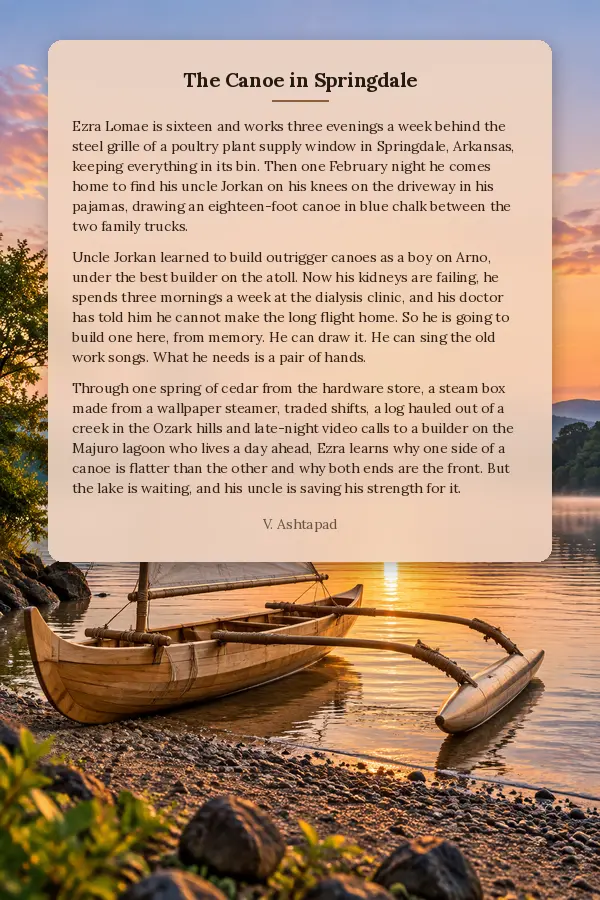
Ezra Lomae is sixteen and works three evenings a week behind the steel grille of a poultry plant supply window in Springdale, Arkansas, keeping everything in its bin. Then one February night he comes home to find his uncle Jorkan on his knees on the driveway in his pajamas, drawing an eighteen-foot canoe in blue chalk between the two family trucks.
Uncle Jorkan learned to build outrigger canoes as a boy on Arno, under the best builder on the atoll. Now his kidneys are failing, he spends three mornings a week at the dialysis clinic, and his doctor has told him he cannot make the long flight home. So he is going to build one here, from memory. He can draw it. He can sing the old work songs. What he needs is a pair of hands.
Through one spring of cedar from the hardware store, a steam box made from a wallpaper steamer, traded shifts, a log hauled out of a creek in the Ozark hills and late-night video calls to a builder on the Majuro lagoon who lives a day ahead, Ezra learns why one side of a canoe is flatter than the other and why both ends are the front. But the lake is waiting, and his uncle is saving his strength for it.
Finished the book? Listen to or watch a review of it
Building a Marshallese Canoe in Arkansas · Discussion
Listen · 29 min
Members can react to this book and talk about it in the members' Library.
Ownership
© 2026 CRUNOD LLC. All rights reserved.
This book is owned by CRUNOD LLC. It is free to read on EternalCurrent.Online. No part of it may be copied, reprinted, sold, recorded or adapted, including as audio, film or translation, without written permission from CRUNOD LLC.
© 2026 CRUNOD LLC. All rights reserved.