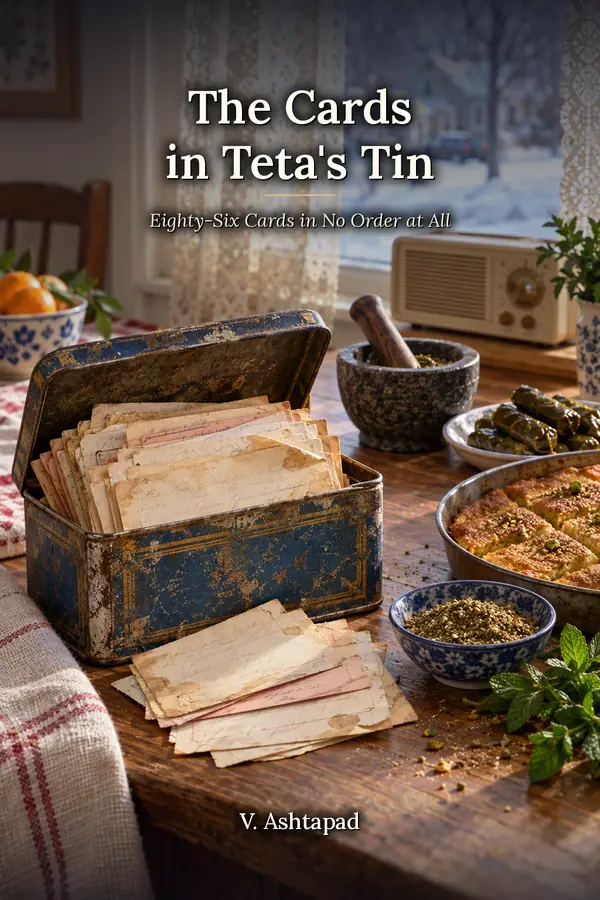
The Cards in Teta's Tin
Eighty-Six Cards in No Order at All
by V. Ashtapad
Foreword
This is a novel. Rania, Teta Nawal, their family, Mrs. Odette, the cousins in São Paulo and Zahlé, the students of Room 114 and every recipe card in the tin are invented. Real places such as Zahlé and the Berdawni river, the Brás neighborhood and Rua 25 de Março in São Paulo, and Warren Avenue and the Rouge plant in Dearborn are named, but they are used fictionally, and the people, shops, cafés and events placed in them come from imagination.
The recipe cards are written the way an elder cook writes for herself, in her own measures, so they are not meant to be followed as tested recipes. The Arabic and Portuguese words are kept few and common, in the forms a Lebanese family in Michigan and a Lebanese Brazilian family might use at home; spellings of Arabic food words vary from family to family. The song verses are original to this book.
For everyone who cooks from memory, and for whoever is watching when they think no one is.
The Tin
> **MUJADDARA**
> *Dearborn, February 1987. A brown half-moon in the lower corner where a pot sat on it.*
>
> 2 coffee cups brown lentils, the small ones
> 1 coffee cup burghul, the coarse, not the fine
> 3 onions, big. ~~2 onions~~ No. Three. Always three.
> oil, enough to make the onions swim
> salt with the fingers, cumin with the fingers
> water to the second knuckle over the lentils
>
> Cook the lentils until they open their mouths. Then the burghul. Then leave it alone, it knows.
> The onions are the whole thing. Brown, not black. If you are talking on the telephone you will burn them.
>
> *In the margin, up the side:* For snow days. Fouad says this is poor people food. Fouad eats three plates.
Teta Nawal wrote in Arabic until about 1990 and in English after that, with the Arabic words left standing wherever English had nothing as good. I give her cards here the way she would have read them aloud to me, which is to say in English with her measurements intact. A coffee cup is the small white cup with the chipped gold rim that still hangs on the third hook under her cabinet. A knuckle is her knuckle. I have measured it. It is a little under an inch.
The tin came down off the top of her refrigerator on the second Saturday of October, because I was looking for the good scissors and she had put them up there so that nobody would take them.
"Not the scissors," she said, when I lifted the tin instead. "Those are the cards."
It was a flat rectangular tin, blue going to gray at the edges, with a painted picture on the lid of a woman in a white dress holding up a basket of guavas against a hot orange sky. Portuguese words curled across the top. Goiabada, it said, and a city, and a year that had worn down to a single readable nine. It had held guava paste in São Paulo a long time before it held anything else. When I pried the lid it let go with a sigh of old sugar and cardamom and something sharp underneath, maybe pepper, maybe just time.
Inside, standing on their long edges like files, were index cards. White ones gone the color of weak coffee. A few lined in blue. Some pink, which I later learned came from a drugstore pack she bought in 1994 because the store was out of white. Perhaps eighty cards. Perhaps more. They were not in alphabetical order. They were not in any order I could see. Mujaddara stood between a card for stuffed zucchini and a card that said only *Odette's birthday* and a list of four sweets.
"Teta, how long have you had these?"
She was at the stove with her back to me, a short woman in a gray cardigan and house slippers with the backs folded down, stirring a pot of lentils. She had started the lentils without a card and without a measurement, and she was getting them right, because the kitchen smelled the way it has smelled every winter of my life, cumin and onion and the faint dusty sweetness of burghul. She could not smell any of it. I knew that by then. Every few minutes she leaned over the pot and breathed in, out of a habit older than my father, and straightened, and looked at me.
"Since always," she said. "Since before your father had a mustache."
My father is sixty. He has had a mustache since 1984.
Her house is on a short street off Warren Avenue on the east side of Dearborn, a narrow brick bungalow with a concrete porch and a black iron railing my grandfather painted every second spring until he could not climb down to the bottom step without help. The front window looks across the street at a row of houses the same as hers, and past them, if you stand in the right spot by the radiator, you can see the top of the water tower and a slice of the sky over the Rouge. In October the maples on the block go a dull red, not the bright red of postcards, more the color of a brick that has been rained on. The leaves pile in the gutters and the city trucks come with their vacuum hoses and roar for half a day. The street smells of wet leaves and, from the bakery two blocks over, of bread and burnt sesame from four in the morning on.
I am thirty-four. I teach seventh-grade science at Maple Ridge Middle School, eleven minutes' drive away, and on Saturdays I come to Teta's, because my mother comes on Wednesdays and my father on Sundays and Teta is eighty-nine years old and lives alone with a radiator that knocks like a man who wants to be let in.
She was humming. She always hums when she cooks. It was one of the old tunes from the mountains, a dabke rhythm, the kind of song where you can hear the feet stamp on the third beat even when there are no feet. She tapped the wooden spoon on the rim of the pot on the stamp. Tap. Then the stirring again.
"Teta," I said, "what are you making?"
She stopped humming. She looked into the pot. The lentils were rolling in their water, brown and opening, the burghul not yet in. She looked at them the way you look at a radio that has gone quiet in the middle of a song you love.
"Tell me," she said. "The cumin. Is it there?"
"It's there."
"Too much?"
"Just right, Teta."
"Just right," she said, and nodded, as though I had read her a number off a gauge. "Good. Then I trust you. Today." She lifted her chin at me, to say the matter was closed. She reached without looking for the burghul, which lives in a glass jar to the left of the stove, and poured it from the jar into her cupped hand and from her hand into the pot, and the amount was exactly the coffee cup the card would ask for, I know now, because I went home that night and tried it with a measuring cup and the coffee cup and my own hand, and my hand was wrong and hers was right.
This had been happening since spring. In March she caught a virus that went through half the street, three weeks in bed with a fever and a cough that rattled the radiator pipes, and when she got up again her sense of smell had stayed behind in the bed. The doctor in the medical building on Michigan Avenue had a phrase for it that my mother repeated on the telephone to my brother Karim in Chicago in the low careful voice she uses for news: post-viral smell loss. Sometimes it comes back, he said. Sometimes partly. At her age he would not promise. Teta could not smell the gas when a burner failed to catch, so Karim drove in from Chicago and screwed a detector to the kitchen ceiling that shrieked if anyone so much as boiled water too hard. She could not smell the bread from the bakery two blocks over, which she had woken to at four in the morning for forty years. And because most of what a tongue calls taste is really the nose, the food had gone flat for her. Salt and sour and sweet still reached her, she said, but the rest was like a song with the tune taken out. Then, in a single clear sentence, she would tell me what the lane behind her childhood house in Zahlé smelled like in September, grape must and hot dust and her mother's olive-oil soap, and the color of the neighbors' shutters, which was green.
She had not forgotten how to cook. That was the strange thing, the thing none of us could get used to. Her hands knew the lentils. Her hands knew the onions had to be cut in half moons and not in dice, and how dark they should go. What her hands had lost was the judge. All her life she had lifted the onions out of the oil with the slotted spoon at the exact moment the sweetness in the air turned toward bitter, and now there was no air to tell her, so she lifted them by the clock on the stove, and some days the clock was wrong. Her hands still knew when the rice was done by the sound of the steam. That much the virus had left her.
The onions went into a second pan, a black iron one with a crack in the handle. She cut them on a board so worn in the middle it rocked. I sat at her kitchen table with the tin open in front of me and read cards while the kitchen filled with that smell, which is the smell of every snow day of my childhood: the windows white with steam, the radiator knocking, my brother and I with our boots dripping by the back door and Teta saying yalla, yalla, sit, eat, as though we might escape.
The card for mujaddara was not in Teta's best handwriting. It was quick, slanted, the Arabic letters running together in the middle words and slowing down at the end of each line. The crossed-out *2 onions* had been struck through twice, hard, with a ballpoint that had dug a groove into the card. The stain at the bottom corner was a near-perfect semicircle. A pot had sat on it, hot, a long time ago, in a kitchen that was this kitchen.
"Who were you arguing with," I asked, "about the onions?"
She looked over her shoulder at the card in my hand. She squinted. "Show me."
I held it up. She came over with the slotted spoon still in her hand, a drop of oil hanging from it, and leaned to look. Up close she smelled of onion and the rosewater cream she rubs into her hands at night.
"Fouad," she said. "Your grandfather. He said two is enough, three makes it sweet. I said, that is the point, that it is sweet. He said, write it two. So I wrote it two. And then I crossed it out." She laughed, a quick dry laugh with her shoulders. "He ate three plates."
"It says that. In the margin."
"Then it is true."
She went back to the stove. I kept looking at the card. My grandfather died in 2011, and I had loved him in the plain way a child loves a grandfather, for his hands and his smell of cigarettes and engine grease, for his coin tricks, for the way he called me *ya albi* in a voice like gravel being poured. I had not thought of him as a man who argued about onions, or a man who could be argued with and lose. There he was, on an index card, losing.
I took out my phone and photographed the card. Then I photographed it again, closer, so the groove in the crossed-out line showed. Then I turned it over. The back was blank except for a faint blue grid, ghost lines from another card it had been pressed against for years.
"What are you doing," Teta said. "Taking pictures of my cards like a policeman."
"Saving them."
"They are saved. They are in the tin."
"What if the tin gets lost?"
"Who is going to lose my tin?" She pointed the spoon at the top of the refrigerator. "Nobody goes up there. That is where I put things so nobody takes them."
"The scissors."
"The scissors," she agreed, satisfied, and turned off the heat under the lentils.
She did not ask what I meant to do with the pictures. I did not entirely know yet. There was a family page that my cousin's husband had set up two years before for sharing photographs, a private place on the internet where only people who were invited could get in, and where relatives came in one family at a time as somebody vouched for them. My mother used it to post pictures of her tomato plants. Karim used it to post pictures of his daughter, who is two and has my grandfather's eyebrows. There was a section for recipes that nobody had put anything in except my aunt, who had posted a lasagna. I thought that night, driving home along Warren with the bakeries lit up and the hookah lounges just opening their doors, that the lasagna should have some company.
Before I left I photographed eleven more cards. Tabbouleh, on pink. Something called *Sami's soup* that turned out to be lentil soup with lemon. A card in Portuguese that I could not read at all except the word *quibe*. A card with a tiny pencil tick in the margin beside three of the ingredients, which I did not understand and did not ask about, because she was tired by then and sitting in the brown chair by the radiator with her eyes half closed and the television on low, a game show with the sound turned to a murmur.
At the door she held my face in both her hands, which she has done since I was a baby and does still, though she has to reach up now. Her palms were warm and smelled of onion.
"You took my cards," she said.
"I took pictures of your cards. The cards are in the tin."
"Good," she said. "Good girl. Next week I will make you the kibbeh."
"What kind?"
She opened her mouth and closed it. Her eyes went to the top of the refrigerator, where the tin was, and came back to me, and I understood that she was not going to pick a kibbeh she could no longer taste her way through.
"Whichever kind the card says," she said. "The card has a better nose than me now."
I drove home with the twelve photographs on my phone and the mujaddara in a plastic container on the passenger seat, warm through the lid, the smell of browned onion filling my small car. At home, in my apartment over a tailor's shop in west Dearborn, I ate it standing at the counter out of the container, and then I opened my laptop and made a folder and called it *The Tin*. I put the twelve photographs in it in the order I had taken them, which was no order at all. That seemed right. It was the order she had kept them in.
Then I sat with the picture of the mujaddara card on the screen, enlarged, the half-moon of the pot stain filling the corner, and I read the margin again. *Fouad says this is poor people food. Fouad eats three plates.*
I wrote underneath it, in the space the family page gave for a caption: *Teta's, 1987. Three onions. Not two.* I hit save, and from the far side of the lake my brother wrote back within a minute, before I had even closed the screen. *Is that the snow one?* he wrote. *I can smell it from here.*
The Tick
> **TABBOULEH**
> *Pink card. June 1994. A green fingerprint, parsley, on the upper edge.*
>
> parsley, 4 bunches, the flat. The curly is for restaurants that do not love you.
> burghul, the fine, 1 soup spoon. ONE. This is parsley salad, not burghul salad.
> 3 tomatoes, small dice, let them weep in the bowl
> mint, a handful from Odette's fence
> 4 green onions
> lemons, 2 ✓
> oil, the green kind, a coffee cup
> salt
> ~~black pepper~~ allspice, a pinch ✓
>
> Cut, do not chop. Chopping is bruising. A sharp knife and patience.
> Wash the parsley the night before and wrap in a towel. Wet parsley makes soup.
My mother has been making tabbouleh for thirty-seven years, which is how long she has been married to my father, and she has been making it wrong for thirty-seven years, according to my grandmother, though the word Teta uses is not wrong. The word Teta uses is *interesting*.
"Lina, habibti," she says, tasting from the end of a lettuce leaf. "It is very interesting."
My mother was born at Henry Ford Hospital and grew up on the south end of Dearborn, near the plant, the daughter of a man from a village in the south who came over before the war and ran a grocery on Dix Avenue. She speaks Arabic like a Michigander, which is to say clearly and with no patience for the subjunctive. She has a laugh you can hear across a parking lot. She came with me on the third Saturday of October because I had told her on the phone about the tin, and she had said, "She showed you the tin?" in a voice I could not read, and then, "I'm coming."
It was cold that morning, the first real cold. The sky over Warren Avenue had the hard washed blue that Michigan gets after a front goes through, and the wind came down the street from the north and pushed the leaves along the sidewalk in front of us in little rushing crowds. My mother wore her red wool coat and carried a paper bag from the produce market on Schaefer with eight bunches of flat parsley sticking out of the top like a bouquet.
"Eight," I said.
"She'll say four. She means eight. She makes a double and tells you it's single, so you think you can't eat that much, and then you eat it all."
Teta was at the front window when we came up the walk, the curtain held back in one hand. She opened the door before we knocked. She looked at my mother and said, "Lina," with no hesitation at all, and looked at me and said, "Habibti," which is what she calls me when the name is not there. I have learned to hear the difference. Habibti said fast, with a smile, means she is happy to see me. Habibti said slowly, with a small breath in through the nose first, means she has just tried to smell me, the cold on my coat and the soap and whatever I ate for breakfast, the way she has smelled every grandchild coming through that door since 1985, and found nothing there, and does not want me to know.
That morning it was the slow one. Then she saw the parsley and her face cleared, because parsley is green, and green she could still see.
"Tabbouleh," she said. "Good. Come. Who washed this?"
"Nobody," said my mother. "It's from the store."
"Then we wait." She took the bag and carried it to the sink, and ran the cold water, and began to separate the bunches with her fingers, swishing the parsley in the full sink so the grit fell to the bottom. My mother and I stood behind her in our coats. "Sit," Teta said, without turning. "It takes as long as it takes."
The kitchen is small, painted a yellow that has gone ivory with cooking, with a linoleum floor in a pattern of tan squares worn pale in a path from the stove to the sink to the table. The table is Formica, red, with chrome legs, from a used furniture place on Michigan Avenue in 1985. The calendar on the wall is from the Lebanese bakery on Warren and it is still on August, because nobody turns it but Teta and Teta has stopped noticing it. A wooden spoon rack my grandfather carved hangs by the stove. On the windowsill over the sink there is a row of small things: a jar of dried mint, a plastic hula dancer my mother brought back from Honolulu as a joke when they were both younger, a pebble, a tiny copper coffeepot no bigger than a thimble. Behind them the backyard, a square of brown grass and a chain-link fence, and on the other side of the fence Mrs. Odette's yard, which in summer is a jungle of mint and tomatoes and in October is stalks.
I had the tin. I opened it on the table and found the tabbouleh card, which I had photographed the week before, and set it in front of my mother.
She read it. She put her finger on the line about the curly parsley and laughed out loud.
"Thirty-seven years," she said. "She never said that to my face."
"She said interesting."
"Interesting." She shook her head. "I've used flat since 1990, Teta."
"I know," said Teta from the sink. "That is why I stopped saying interesting about the parsley. I say it now about the lemon."
My mother looked at me. I looked at the card. Beside *lemons, 2* there was a small pencil mark, a tick, a little checkmark like a teacher puts on a right answer. There was another beside the allspice. I had seen the same marks on other cards the week before and had thought, the way you think about a thing you do not have time for, that they were how she kept track of what she had in the cupboard.
"Teta," I said. "What's the tick?"
She turned off the water. She came over drying her hands on the towel that hangs from the oven door, and leaned on the back of my mother's chair and looked at the card. She was quiet long enough that my mother started to say something and I put my foot on hers under the table.
"That is Fouad," said Teta.
"Jiddo?"
"His way." She tapped the tick by the lemon. "I make it with one and a half. Your grandfather liked two. More sour. He said the tabbouleh should make your eyes close." She tapped the allspice. "And this. At my mother's we used black pepper. His mother used allspice. When he was alive I made it his way. When he was gone I made it my way." She shrugged. "Now my nose is gone and I cannot tell the allspice from the pepper in the bowl, so I look."
"So the tick means," I said slowly, "Jiddo's way."
"Yes. What else would it mean."
My mother had her hand over her mouth.
"Lina," said Teta. "Why are you crying? It is only lemon."
"I'm not crying." My mother wiped her eye with the heel of her hand. "I've been making it with two lemons since I was twenty-three. Sami told me to. He said that's how his mother made it."
"Sami," said Teta, with enormous fondness and no surprise, "is his father's son."
We cut parsley for an hour. That is not an exaggeration. Teta has a way of cutting parsley that I have never seen anyone else do. She gathers a bunch, the stems trimmed, the leaves dried in the towel, and she presses it into a tight bundle with the flat of her left hand, and she slices across the top of the bundle with a small knife, thin thin thin, so that what falls on the board is not chopped but shaved, a heap of green threads. She does not rock the knife. She slices, and moves the hand back by a hair, and slices. Her left hand creeps backward along the bundle like a slow animal.
My mother tried. She had tried before, for thirty-seven years, and she cut it the way most people do, rocking the big knife over a pile. Teta watched her and said nothing, and then took the knife out of her hand and gave her the small one.
"Like this," Teta said, and stood behind her, and put her own hand over my mother's hand on the bundle, and guided it. "Slow. You are not in a hurry. The parsley is not going anywhere."
I watched the two of them, my mother taller and broader in her red sweater, my grandmother small behind her with her chin at my mother's shoulder, their hands stacked on the parsley. My mother's face had gone very still. I don't think anyone had stood behind her like that, in a kitchen, since her own mother died.
I took a picture of their hands. I did not ask. Teta saw me and said, "Policeman," but she did not move away.
While the parsley sat in its green heap and the tomatoes wept in the bowl, I went through the tin. The week before I had photographed twelve cards. That morning, while my mother and Teta talked about whether the burghul should be soaked or not soaked (soaked, said my mother; not soaked, it drinks the tomato, said Teta), I photographed the rest. I laid each card on the red tabletop in the same patch of light from the window, so the colors would match, and stood on a chair to get them flat. There were eighty-six. I counted twice. Twenty-one were in Arabic, in the careful early hand. Nineteen had Portuguese words on them, some all in Portuguese, one in Portuguese with Arabic in the margins. The rest were the English of the Dearborn years, some Arabic left standing in them.
Thirty-one had ticks.
I did not understand yet that there were other marks. I was too pleased with the one I had found.
At home that evening I sat at my laptop with my tabbouleh in a bowl beside me, and it was good, it made my eyes close, and I uploaded all eighty-six photographs to the recipe shelf of the family page. I typed under each one what the card said, translated where I could, with a question mark wherever I could not. Under the tabbouleh I typed the ingredients in clean measurable English, *1/2 cup olive oil*, and then I deleted it and typed what she had written, *a coffee cup*, and added a note at the bottom: *Teta's coffee cup holds about a third of a cup. Ticks mean Jiddo's way.*
My aunt's lasagna sat at the top of the shelf, alone, with a photograph of a printed recipe torn from a magazine. Under it now there were eighty-six photographs of index cards, brown and pink and blue-lined, stained and crossed out and sideways, and it looked like somebody had emptied a drawer onto a table. It looked like a mess. It looked like ours.
On Monday I taught the seventh grade about the scientific method. I teach in Room 114 at the end of the science hall, a room with lab tables in rows and a long counter of sinks under the windows and a poster of the periodic table that a student in 2021 decorated, very slightly, with a mustache on hydrogen. My students are eleven and twelve. About half of them have grandparents who were born somewhere else, Yemen and Iraq and the south of Lebanon and Bangladesh and Poland and Alabama. They are loud, and smart, and capable of being wrong about anything with complete confidence, which is the beginning of science.
"Observation," I said, writing it on the board. "Before you have a theory, before you have a question. You notice something. You notice that something is the same every time, or that something is different. And then you ask why."
Hassan in the second row raised his hand. "Like if my mom's food always tastes better than mine?"
"Exactly like that."
"Because she's my mom," said Hassan, with finality, and the class laughed.
"That's a hypothesis," I said. "How would you test it?"
They argued about it for ten minutes. Somebody suggested a blind taste test. Somebody suggested that the mom's food tasted better because of a secret ingredient, and somebody else said the secret ingredient was love, and somebody made a gagging noise. Zainab, who sits by the window and almost never talks, said, quietly, that her grandmother put a pinch of something in the rice that she would not say, and when she tried to make the rice without it, it was wrong.
"So you observed a difference," I said. "And you have a variable. What would you do next?"
"Watch her," Zainab said. "When she doesn't know I'm watching."
I wrote it on the board. *Watch when she doesn't know you're watching.* The class thought it was a joke. I left it up all week.
That night my father called. He calls rarely. He works at an auto parts distributor in Taylor, a warehouse the size of an airport hangar where he has worked for twenty-six years, and when he gets home he eats and reads the Arabic paper on his tablet and goes to bed at nine-thirty. He is a quiet man. He says what he needs to say and stops.
"Your mother told me about the lemons," he said.
"Two lemons. Jiddo's way."
"I didn't know she wrote it down." I heard him breathe. "Can I see the card?"
"It's on the family page. With all of them. I put all of them up."
A long pause. I could hear the television in the background, the evening news, my mother saying something in the kitchen.
"All of them," my father said. "Okay." And then, after another pause, in a voice I did not hear from him often: "Is there one for the soup? The lentil one. With lemon. I used to have it after school."
"*Sami's soup*," I said. "It's on a white card. It has a tick by the lemon."
"Of course it does," said my father, and he laughed, a low surprised sound, and then he said good night and hung up before I could say anything else.
Quibe
> **QUIBE DA SALMA**
> *White card, Portuguese in pencil, the Arabic notes in blue ink added later. São Paulo, 1981. A circle of grease that has made the paper clear as a window.*
>
> 1 kg patinho moído duas vezes (*margin, Arabic:* beef, because lamb here costs like gold)
> 2 xícaras de trigo para quibe, soaked
> 1 cebola, grated
> hortelã, a lot
> sal, pimenta síria
> ~~pinoli~~ (*Arabic:* no pine nuts at Salma's, she says too expensive, she is right)
>
> Mix with wet hands. Make the footballs. Fry in the big pan.
> Brazilians eat it with lemon squeezed on, standing up, at the bar. Salma's husband eats eight.
> *Arabic, at the bottom, smaller:* It is not kibbeh. It is not not kibbeh.
Fernanda Kassab answered the video call from her kitchen in São Paulo at seven in the evening my time, eight hers, with a glass of red wine in one hand and her hair piled on top of her head with a pencil through it. Behind her a window showed a tower block lit up floor by floor, and a pink sky going purple, and the edge of a balcony crammed with potted plants.
"Prima!" she said. "Finally. I saw the cards. All of them. I was up until two o'clock. My husband thought I was having an affair with the computer."
We had met in person exactly once, at a wedding in Toronto when I was fourteen and she was sixteen, and we had spent the reception under a table in the hotel ballroom sharing a plate of baklava and comparing how many words we knew in each other's languages. She knew more English than I knew Portuguese. I knew more Arabic than she did. Since then we had spoken perhaps a dozen times, mostly at holidays, mostly by text. Her grandmother Salma and my grandmother Nawal were first cousins, two girls from neighboring houses in Zahlé. When Teta left Lebanon in the spring of 1976 with my grandfather and my father, who was ten, it was Salma's family who took them in. Salma had married a man from Zahlé who had gone to Brazil in the sixties, like so many from the Bekaa had gone for a hundred years before, and they had a fabric shop on Rua 25 de Março and an apartment in Brás with three bedrooms, and for nine years there were eleven people living in it.
I knew this the way you know the plot of a movie you saw when you were young. I knew the outline and none of the rooms.
"Which one did you stay up on?" I asked.
"The quibe. Number forty-one on your list." She tipped her laptop so I could see the screen beside her where she had the photograph of the card enlarged. "This is my vovó's recipe. Exactly. Exactly. Even the beef. Even the no pine nuts. I have the same one in her writing, I will show you." She disappeared and came back with a small spiral notebook, its cover printed with yellow flowers, and held a page up to the camera. The handwriting was rounder than Teta's, a schoolgirl's hand, all in Portuguese. *Quibe frito.* The same ingredients. The same instruction: *mãos molhadas.* Wet hands.
"They wrote it together," Fernanda said. "I think. Or one copied from the other. They were always copying. My vovó said your Tia Nawal was the better cook and she was the better business. She said Nawal could make kibbeh from a shoe."
Salma died in 2019. Fernanda had been with her. She told me this without drama, holding the wineglass, looking slightly to the side of the camera the way people do when they are seeing something you can't.
"It says here," I said, "*It is not kibbeh. It is not not kibbeh.* What does that mean?"
Fernanda laughed. "It means it is quibe. Look, in Brazil quibe is everywhere. At the padaria, at the bar, at the lanchonete by the bus stop. Little footballs, fried, with lemon. Everybody eats it. Brazilians who have never met a Lebanese person in their life eat quibe. There's a chain that sells it frozen. My kids' school had it at the festa junina." She made a face. "It is not the same. The meat is beef, the wheat is different, they put in less spice, sometimes they put in, I don't know, cheese. But it is from us. We brought it. And now it belongs to them also. So. It is not not kibbeh."
I thought about that for a long time afterward. I teach a unit in the spring on adaptation, on how a species changes when it moves to a new environment: the finches on their islands, the moths on their sooty trees. My students like the moths best. I had never once thought of a recipe as a thing that adapts.
"Tell me about Brás," I said.
She turned the camera to the window, as if Brás were out there, which in a way it was, somewhere below the towers in the dark. "Brás is noise," she said. "Brás is buses and trucks and men with carts of fabric and the train going over. The Arabs had the fabric shops. My vovó's shop was not in Brás, it was on 25 de Março, by the market, it is still there, a different family has it, they sell party supplies now. Balloons. Plastic tiaras. Everything." She turned the camera back to herself. "On a Saturday, 25 de Março is a river of people. You cannot walk. You can only be carried. Vovó said in 1980 it was the same. Your Tia Nawal worked in the shop with her. Cutting cloth. Every day. And every night, eleven people, and they cooked."
"Teta worked in a shop?"
"You didn't know?" Fernanda's eyebrows went up. "She had the best scissors in the family. Vovó said she cut a straight line through silk without a pin. She was famous on the street. The Armenian ladies came to her. The Syrian ladies. The Brazilian ladies who wanted to look Syrian." She laughed. "She did not tell you this?"
"She doesn't tell things. She cooks things."
"Ah," said Fernanda, and nodded as though that explained a great deal, and maybe it did. "Vovó was the same. You had to eat to hear anything."
The scissors on top of the refrigerator. I thought of them, and of the way Teta had said *nobody takes them*, and I wanted to drive over right then, at seven-thirty on a Tuesday, and get them down and look at them.
Fernanda and I talked for an hour and a half. Her children came through the kitchen, a boy of nine and a girl of six, and she introduced me as *a prima de Michigan*, and the girl asked whether I lived in the snow, and I said yes, sometimes, and she looked at me with deep pity. Fernanda's husband waved from the door with a dish towel on his shoulder. Fernanda showed me her own kitchen, the counters of pale green stone, a refrigerator covered with children's drawings, a window box of herbs. She showed me, holding the laptop with both hands and walking it to the stove, a pan she still used that had been Salma's, a big black iron pan with a crack in the handle.
"Teta has one exactly like that," I said.
"Of course," said Fernanda. "They bought two. Same day, same shop, on Rua Oriente. Vovó told me. Nawal took hers to America in a suitcase, wrapped in a blanket. She said, Salma, this pan knows how to fry quibe, I am not starting again with a pan that doesn't know."
When I said good night, Fernanda said, "Rania. Ask her about the train."
"What train?"
"Just ask her. Vovó said there was a story about the train, the first week. She would never tell me all of it. Maybe your Tia Nawal will."
On Saturday I went to Teta's early. It had snowed overnight, a little, the first snow, an inch of wet white on the porch rail and the parked cars, already going gray where the tires had been. The sky was low and the color of dishwater. Warren Avenue smelled of exhaust and baking bread. I bought a box of meat pies from the bakery because Teta likes the lady who works the counter there, and came up the walk with the box in one hand and the tin in the other.
Teta was in her chair by the radiator with the morning radio on. It was the Arabic program she has listened to every morning for as long as I can remember, an hour of the old singers, Fairuz most of all, and she listens to it with her eyes closed and her hands folded, and does not want to be spoken to until the hour is over. I sat on the couch and waited. The radiator knocked. Out the window a man in an orange vest was shoveling the walk across the street, slowly, stopping to lean on the shovel.
When the hour ended she opened her eyes and said, "You brought the meat pies from the girl."
"I brought the cards, too."
"I know you brought the cards. You always bring the cards now. You are like a girl with a doll."
I sat on the floor at her feet, which I had not done since I was perhaps ten, and opened the tin on my knees and found the quibe card. I held it up to her.
"Fernanda showed me Salma's. They're the same."
Teta took it. She brought it up to her nose and then out to arm's length, the way she does now because her glasses are never on the right chain. Her mouth moved. She read the Portuguese first, in a low sing-song voice, and then the Arabic at the bottom, and when she got to *it is not kibbeh, it is not not kibbeh* she laughed out loud, a real laugh, her head going back.
"Salma said that," she said. "Not me. She said it to a Brazilian lady in the shop who said she knew all about Arab food. Salma said, *Senhora*, what you eat is not kibbeh, and it is not not kibbeh. The lady didn't understand. She bought four meters of yellow crepe. I wrote it down at night so I wouldn't forget."
"Fernanda says you cut the cloth."
Teta held out her right hand and opened and closed the first two fingers, slowly, a scissor. "Nine years," she said. "Silk, linen, cotton, the polyester. The polyester was terrible. It slides." The scissor fingers stopped. "I had good scissors. German. I paid one month of my wages."
"Are they the ones on the refrigerator?"
She looked at me with a sudden sharpness that I have learned to treasure, because it is her, entirely, with nothing missing. "Where else would they be?"
Then I asked about the train.
She did not answer right away. She looked at the card in her hand and turned it over and looked at the back, where there was nothing, and then she gave it back to me.
"Which train," she said. Not a question.
"Fernanda said there was a story. The first week in São Paulo."
The radiator knocked twice. Across the street the man in the orange vest had finished and was standing at the end of the walk with the shovel over his shoulder, looking at what he'd done.
"Your father was ten," Teta said. "He did not speak one word of Portuguese. Your grandfather did not speak one word. I did not speak one word. Salma had been there five years, she spoke like a parrot. The first week, Salma said, Nawal, I will take you to the market, the big one, the Mercadão, so you can see what there is to cook with. So we went. On the train. Salma, and me, and your father, and Salma's boy. And at the Mercadão your father let go of my hand."
She stopped. She looked at the window.
"An hour," she said. "One hour. I did not have a word. I could not say *my son*. I could not say *help me*. I could not say *boy*. I stood in the middle of the market with all the fruit, mountains of fruit I had never seen, the papaya, the jackfruit, the oranges like a wall, and I could not say one word to anyone. Salma was running everywhere shouting. And I stood. I could not move. If I moved he would not find me."
"Where was he?"
"At the fish." She almost smiled. "Looking at a fish with a face like an old man. A man who sold fish was giving him a piece of orange and talking to him in Portuguese, and your father was nodding like he understood." The almost-smile went away. "After that I learned the words. Every night after the shop. Salma's boy taught me. I wrote them on the cards with the recipes, so I would see them every day. *Filho*, my son. *Perdido*, lost. *Socorro*, help. *Peixe*, fish." She shook her head. "I never needed them again. But I learned them."
I went through the Portuguese cards that afternoon with the tin on the kitchen table while Teta napped in her chair. I had read them for ingredients before. Now I read the margins. On a card for black-eyed peas, in tiny letters up the side, *filho, filha, neto*. On a card for something called *pastel*, along the bottom, *onde fica, quanto custa, obrigada*. Where is it, how much does it cost, thank you. On the back of the card for rice with vermicelli, a whole list, numbered one to twenty, Portuguese on the left and Arabic on the right, written very small and very neat, the way you write when you are trying not to run out of card.
Number one was *socorro*.
I photographed the backs of all of them. I had not photographed the backs before. That night I went into the recipe shelf on the family page and added the back of every Portuguese card beside its front, and under the black-eyed peas I wrote: *The margin says son, daughter, grandchild. She was learning the words in case.* Fernanda saw it within the hour, it was nearly midnight in São Paulo, and she wrote a single line under it in Portuguese that I had to look up, and then I sat for a while in my apartment with the snow coming down past the streetlight outside and the tailor's sign below me buzzing faintly, and read it again.
Names
> **KIBBEH BIL SANIYEH (the tray one)**
> *Arabic, early hand. No date. The bottom third water-stained in a wavy line, as if the card once stood in a puddle.*
>
> lamb from the shoulder, a good piece, no fat, no nerves ✓
> burghul fine, 2 coffee cups, rinsed and squeezed
> 1 onion, white, into the meat
> kammouneh (*cumin, marjoram, rose, pepper, dried mint, the spice for kibbeh, I make it myself, see the other card*)
> for the inside: lamb in pieces, onion, snobar, a little sumac ✓
> samneh for the top
>
> Pound the meat in the stone until it is like silk. My mother pounded with the wooden one and sang so the neighbors would know we had meat.
> Score it in diamonds. Your knife goes all the way to the tray or it will not cook.
My father came on the first Sunday in November with a tripod.
He had bought it at the electronics store in Fairlane the night before, a small black tripod with bendy legs, and he set it up on the Formica table in the kitchen and clamped his phone to the top of it and stood back and looked at it with his arms folded the way he looks at a car engine before he decides where to begin. He had not told me he was going to do this. He had called me Saturday night at nine-twenty, ten minutes before his bedtime, and said, "Tomorrow. You'll be at your Teta's?" and when I said yes, he said, "Good," and hung up.
"Baba," I said. "What is that?"
"For the words," said my father.
It was a gray morning. November in Dearborn is a long gray hallway. The snow of the week before had melted into a brown slush and refrozen into ridges along the curbs, and the sky sat so low on the roofs that the water tower had disappeared into it. Teta had the kitchen lights on at ten in the morning. The radiator was going like a drum section. On the stove a pot of chickpeas was simmering for no reason that anyone had explained, and the window over the sink had fogged to a soft white blank.
"What words?" said Teta.
She was standing at the counter with an apron on over her cardigan, and in front of her on the board was a pile of lamb from the halal butcher on Warren that my father had brought, wrapped in white paper, and a bowl of fine burghul soaking, and two onions. She had seen the lamb and decided, the moment the paper came off, that she was making kibbeh. Nobody had asked her to. The lamb had asked her to.
"Your words, Mama," said my father. He came and stood beside her. He is not a tall man, but he looks tall next to her, and he bent his head to talk to her the way you'd bend under a low doorframe. "Rania put the cards on the computer. All the cards. But the cards have the words written. Nobody has the words said. When you say *kammouneh*, the way you say it. Nobody has that."
Teta looked at the phone on its tripod.
"You want to take a picture of my mouth."
"I want to record you saying the names. Of the things. While you cook. Just the names."
Teta looked at me. I said nothing. This was between them. My father had not said so many sentences in a row to me since I graduated from college.
"Why," said Teta. "I am here. You want to know what something is called, you come and ask me."
My father was quiet for a moment. Then he said, very simply, "Because you can't smell them anymore, Mama. You told me on Sunday the food has gone quiet. But you still know what everything smelled like. Say the name, and say the smell, and then it's somewhere. So Karim's girl has it. So you have it, when you want it."
The kitchen was very still. The chickpeas ticked in their pot. I watched my grandmother's face and I could not tell, for a long moment, whether she was going to be angry. She has a temper. It does not come often, but when it comes it comes all at once, like a cupboard door flying open.
She picked up an onion and looked at it.
"This," she said, holding it up to my father's phone, which was not recording yet. "This is *basal*." She put it down. "Start your camera."
My father started his camera.
That morning, while she made a tray of kibbeh, my grandmother named everything, and after each name, with her eyes shut, she said what it had smelled like when she could still smell it. She named the lamb, *lahmeh*, and then the cut, which had a word I had never heard. She named the burghul, and which burghul, the fine, and when she squeezed the water out of it in her fist she named that too, a verb, and my father said, "What was that?" and she said it again slower, for the camera, and rolled her eyes. She named the spice mix, *kammouneh*, a blend she makes once a year and keeps in an old coffee tin, and she opened the coffee tin and held it in front of the phone so it could smell, she said, and named what was in it one by one, holding up a leaf of dried marjoram, a dried rosebud the size of a peppercorn, a curl of mint. She named the pine nuts, *snobar*. She named the sumac. She named the clarified butter, *samneh*, and when she said it she closed her eyes for a second, and my father, behind the phone, closed his eyes too.
Not every jar answered her. When she reached for the allspice, she unscrewed the lid and held it under her nose out of habit, and waited, and turned it in her fingers, and said, "This is the one from his mother. Or it is the pepper. They used to be as different as night and day. Now they are the same nothing." And then, quite calm: "Sami. Tell me."
"*Bhar*," said my father softly. "The allspice."
"*Bhar*," she said, and nodded. "It smelled like the inside of his mother's cupboard. Cloves and old wood and a little bit of her coat." Then she went on, as though he had passed her a spoon.
She did not pound the meat in a stone. She has not had a stone mortar since São Paulo, where Salma's family had one that nobody could carry to Michigan. She uses a meat grinder that clamps to the table, an old cast-iron one painted green, and she put the lamb through it three times, and each time it came out a finer pinker ribbon, and the third time it came out like a paste. My father turned the crank. She fed the lamb in. They had done this before, I realized. Many times. Before I was born.
"Your mother pounded it," my father said. "In Zahlé. Your mother had the stone."
"My mother had the stone and the wooden pestle," said Teta. "The stone is the *jorn*. It was in the courtyard by the fig. She pounded and she sang. All the women sang when they pounded. So the street knew."
"Knew what?"
"That we had meat that day." She smiled at the grinder. "When you hear pounding and singing from a house, you know they are eating well. It was a little bit, you know." She made a small proud gesture with her chin. "Showing off."
"What did she sing?" I asked.
Teta stopped feeding lamb into the grinder. Her hands rested on the cast iron. Then she began, under her breath, a tune I knew from a hundred Saturdays, the one with the stamp on the third beat. And then words, which I had never heard her sing with it before, only hum. They were not famous words. They were the words of the women of her street, a verse about a girl going down to the river for water and a boy on the bridge, and the third beat was the pestle.
I am writing down here what she sang, in my own clumsy English, because she has said I may:
*Down to the Berdawni with my jar on my head,
the water is cold and the boy on the bridge is red;
pound, pound, the lamb is fine,
nobody on this lane goes hungry but the vine.*
My father had stopped turning the crank. He stood with his hand on it. On the phone the little red dot kept glowing.
"The vine," said Teta, "because the grapes are not ready. It is a joke. A village joke." She shrugged. "Turn, Sami. We are not finished."
She spread half the paste in the bottom of a round tray, pressing it out to the edges with wet fingers, then the filling of browned lamb and onion and pine nuts, then the rest of the paste over the top, smoothed with a wet palm. She cut it with a knife into diamonds, the blade going all the way down until it ticked against the metal of the tray, row by row, and then across, and in the center of each diamond she pressed a fingertip, and in each dent she dropped a nugget of samneh. My father filmed the whole thing. She named the knife. She named the tray, *saniyeh*. She named the dent her finger made, which has a word, which she found, and laughed about finding.
While it baked we sat at the table, the three of us, and my father played some of the recording back. He held the phone flat on the Formica and we bent over it. There was her voice, thin and clear out of the little speaker. *Basal.* Then the knock of the radiator. *Lahmeh.* My own voice, asking something, sounding younger than I am. *Kammouneh*, and the rattle of the tin.
Teta listened with her head on one side.
"I sound like an old woman," she said.
"You sound like you," said my father.
"Same thing."
That week, I cut the recording into pieces. It took three evenings. I sat at my laptop with headphones on, in my apartment over the tailor's shop, while the tailor's radio played downstairs through the floor, old Motown he likes, and I found each word in the long recording and cut it out and saved it with a name. *Basal (onion).* *Lahmeh (meat).* *Bhar (allspice, Jiddo's mother's).* I typed what each one meant and which card it went with, and under each, in her own words, what it had smelled like. On the family page there was a place for word lists, which my cousin's husband had put there for Karim's daughter to learn colors in Arabic, and which had six colors in it. I made a new list and called it *Teta's kitchen*, and put in forty-three words, and beside each one was a small button with a speaker on it, so that anyone in the family, in Chicago or Toronto or São Paulo, could press the button and hear my grandmother say *kammouneh*.
I gave Teta her own login. My father insisted on that, and so did I, but we set it so that she could look at anything and change nothing, because she had once, with great confidence, reorganized my mother's contacts on her phone into an order that nobody has ever been able to explain. She could press the buttons. She could hear herself. That was all.
The following Saturday I showed her. I set my laptop on the kitchen table and found the list and turned the volume up and pressed *samneh*.
Her voice came out of the laptop. *Samneh.* And then a soft sound of her breath and the knock of the radiator.
Teta looked at the screen for a long moment. She reached out with her forefinger and pressed the button herself, carefully, as though it might be hot.
*Samneh.*
"Again," she said, and pressed it again. Then she pressed *snobar*. Then *bhar*, and when her own voice said *bhar* she nodded, slowly, as if somebody she trusted had confirmed it.
"So when I cannot remember what a thing smelled like," she said, "I can come here."
"Yes."
"And it is me. Telling me."
"Yes, Teta."
She sat back in her chair. She looked at the laptop with an expression I have seen on my students' faces when they finally see the cells under the microscope after ten minutes of seeing only their own eyelashes. Not wonder exactly. Recognition. Oh. There you are.
"Show me how," she said. "Show me the button again. Slowly. I am not a child, I am old, it is different."
I showed her. Twice. She did it herself, three times, and the third time she pressed *kammouneh* and said it along with herself, in a low voice, a quarter beat behind, like a woman singing with the radio.
Then she pointed at the stove. "Now," she said. "Today, chickpeas. You are going to learn *hummus*, and you are going to say it in the telephone like I did, and then everybody can hear you say it wrong."
Odette
> **ODETTE'S BIRTHDAY**
> *English, blue lined card. "1996" at the top, then "1997," "1998," and on down the side in different pens to "2019." A thumbprint in powdered sugar.*
>
> maamoul with dates (she likes dates the best, never walnut, walnut gets in her teeth)
> ~~ghraybeh~~ she says too sweet. ghraybeh for me.
> sfouf, the yellow cake, turmeric, a tray
> knefeh if there is time. There is never time.
>
> Semolina soaks overnight with the butter. Rose water AND orange blossom, a little of each.
> Press into the mold. Bang it out on the board. Bang hard.
> Do not tell her how many I made. She counts.
Mrs. Odette Saliba is eighty-four and lives on the other side of the chain-link fence, in a brick bungalow identical to Teta's except that it is painted a pale green trim instead of white and has, in its front window, a dressmaker's dummy wearing a wedding gown that has been there, as far as I know, since 1999.
"It was a commission," she told me, the first time I asked. "The bride ran off with the photographer. Nobody ever came for it. I don't have the heart."
She was a seamstress for forty years. She did alterations from her front room, and before that she worked in the upholstery shop at a car seat supplier, and before that, in Beirut, at a dressmaker's off Hamra Street, where, she says, she sewed a hem for a famous singer whose name she will tell you only after a second cup of coffee. She came to Dearborn in 1983. Her husband died in 2002. She has three daughters, all in California, who call on Sunday evenings at six, one after another, like a relay.
I went to see her on the second Saturday of November, because the card said *Odette's birthday*, and because the dates down its side stopped in 2019.
It was a bright cold day, the sun so low by three in the afternoon that it came straight down the street and lit up the bare maples from the side, every branch edged in gold. Frost stayed all day in the shade of the porches. My breath went up in front of me. I took the card in a plastic sleeve and knocked on Mrs. Odette's side door, the one by the fence, which is the door Teta has used for forty years.
"Rania," said Mrs. Odette, with no surprise at all, as if I came every week. "Come in, it's freezing, shut the door. What's that? Is that one of Nawal's?"
Her kitchen smelled of cardamom coffee and a pot of something with cinnamon. Every flat surface had fabric on it. Folded squares on the table, a bolt of navy wool on top of the refrigerator, a sewing table by the window with a half-finished something in pale blue pinned across it. She had me sit at the table and moved a stack of patterned cotton to make room, and made coffee in a tiny brass pot, and stood over it as it rose and fell, three times, the way it is done.
I gave her the card. She held it at arm's length and then pulled her glasses down off the top of her head.
"Oh," she said. "Oh, look at this. She wrote down every year."
"Every year from 1996."
"Every year since 1985," said Mrs. Odette. "She started writing them down in 1996. Before that she kept it in her head." She ran her finger down the column of years. "And then 2019. That was the last time." She put the card down. "In 2020 nobody went anywhere. And in 2021 she slipped on the ice in November and broke her wrist, and she was in the hospital on the nineteenth."
She said it without blame. She poured the coffee into two small cups and sat down across from me and pushed the sugar bowl to my side.
"She came over the day they let her home, with the cast on, and said Odette, I missed your birthday, I am so ashamed. And I said, Nawal, you have made my birthday thirty-six years, you can miss one. And she cried. In this kitchen. She never cries." Mrs. Odette drank her coffee. "After that it was me who went to her. I make the maamoul now. Not as good. Don't tell her I said so."
I asked her about 1985. About the year Teta came.
Mrs. Odette looked out the window over the sewing table, past the fence, at Teta's back door.
"February," she said. "The worst winter. Snow up to here." She held her hand at her hip. "They came in a car from Toronto, a cousin drove them, and I came out because I saw the car and I thought, Arabs, who are these Arabs, I don't know them. And there was a woman getting out with a frying pan wrapped in a blanket. A frying pan. In February. She came across the snow holding it like a baby, and she had on a coat from Brazil, a thin coat, a coat for Brazil, and she was blue. Blue." Mrs. Odette laughed. "I took her in my house and gave her my coat. My good coat. The camel. She wore it for three years."
"Teta never told me that."
"She never tells anything. You have to eat it out of her." It was the same thing Fernanda had said, almost to the word, and I laughed, and Mrs. Odette looked pleased without knowing why.
Fouad had a job waiting at the Ford plant on the river, the Rouge, through a cousin. He worked in the stamping building for twenty-four years. Mrs. Odette's husband worked there too, in a different building, and the two men drove together in Mr. Saliba's brown Mercury, leaving at five-fifteen in the dark, and Teta and Mrs. Odette would stand at their two side doors in their housecoats and watch the taillights go up the street.
"Every morning," said Mrs. Odette. "Then we'd look at each other over the fence. And we'd go in. And we'd make coffee. Then at eight, the Fairuz program, and at nine one of us would go to the other's kitchen." She gestured at the fence. "Thirty years. Through that gate."
There is a gate in the fence. I had never noticed it. It is a small chain-link gate, the same as the fence, with a latch that has rusted so that it no longer closes, and there is a path worn in the grass on both sides of it, faint, in a curve.
"You taught her English," I said, guessing.
"I taught her the English for clothes," said Mrs. Odette. "Hem. Seam. Dart. Zipper. Because we sewed together, for a while, before she stopped. She taught me the Portuguese for clothes." She smiled. "I still know them. *Bainha*. *Costura*. I never once needed them." She tapped the card. "And she taught me maamoul. I came from Beirut, I could buy maamoul on every corner, I never made it. She said, Odette, you are in America now, there is no corner. So she taught me."
Then, without my asking, she stood up and went to the cupboard and took out a wooden mold. It was old, dark with butter, carved on its face with a deep round pattern of radiating lines like a sunflower, and on the handle someone had burned a tiny initial.
"N," said Mrs. Odette. "She gave me this. The year she stopped making it. She said, I don't need it, my hands know the shape. Every Christmas since, she asks me whether I am oiling it." She held it out to me. "You take it. It's hers."
I said I couldn't.
"It isn't mine to keep," said Mrs. Odette, and pressed it into my hands, and that was the end of it.
Before I went, she showed me something else. She had a big atlas on a shelf in the front room, the old kind, a huge flat book with a cracked spine, and she opened it on the table to a map of Lebanon and turned it toward me. The country was green and tan, small, squeezed between the blue of the sea and the brown of the mountains. In pencil, faint, someone had drawn tiny circles. A circle on Beirut. A circle on Zahlé. A circle on a town in the south.
"Nawal and I did this," said Mrs. Odette. "One winter. Where we were from. Where our mothers were from. Where our husbands' mothers were from." She turned to the next page, South America, and there was a circle on São Paulo. And the next, North America, a circle on Dearborn and a circle on Toronto and a little line between them, the drive. "We had nothing to do. It was so cold. We sat here all one afternoon with the atlas and a pencil."
I photographed the pages. That night I opened the map on the family page, which until then had held exactly one pin, on the hospital in Chicago where Karim's daughter was born, and I added the circles. Zahlé, with a note: *Teta's house, the lane with the green shutters, near the river.* São Paulo, Brás, with a note about eleven people in three bedrooms, and Rua 25 de Março, *the fabric shop, now balloons*. Toronto. The Rouge plant, where Jiddo worked twenty-four years. And Mrs. Odette's house, the house next to Teta's, with a note about the gate. I put a photograph on each pin. For Zahlé I had nothing, so I left it empty, and that night I could not sleep for wanting to fill it.
On Sunday I brought the mold to Teta.
She was in the kitchen, standing at the counter with her hands flat on it, looking at nothing. The radio was off. The kitchen was clean and cold, the burners dark. She looked up when I came in and her face went through two expressions, very fast, the first a flatness I had learned to see since the spring, the face of a woman who has walked into her own kitchen and found it has no smell, and then a warm opening like a door.
"Habibti," she said, fast, with the smile. "You came."
"I brought you something."
I held out the mold. She took it in both hands and turned it over and looked at the burned initial and ran her thumb across the carved face.
"Where did you find this?"
"Mrs. Odette had it."
"Odette." Teta's eyebrows went up and stayed up. "That thief."
"Teta. You gave it to her."
"I know I gave it to her," said Teta with great dignity. "She is still a thief." She laughed. Then she turned and opened the cupboard where the semolina is, and took out the bag and weighed it in her hand, and looked at the calendar on the wall, still on August, and frowned at it.
"What day is today?"
"November fifteenth."
"Odette's birthday is the nineteenth." Teta put the semolina on the counter. "Today we soak the semolina. Tomorrow we make the dates. Thursday we bang them."
We soaked the semolina. She melted butter in a saucepan, a great deal of butter, and poured it hot over the semolina in her big steel bowl, and rubbed it in with her fingertips, lifting and dropping, lifting and dropping, until the semolina was like wet sand. Then a little rose water and a little orange blossom water from two small blue bottles. The kitchen filled with that smell, which is the smell of every holiday morning of my life, and I had to sit down. Teta stood over the bowl with her eyes closed. "Tell me," she said. "The orange blossom. Too much?" I said no. She said, "Then that is how much," and wrote the number of capfuls on the back of her hand in ballpoint so that next year she would not have to guess.
She covered the bowl with a dish towel and left it overnight. On Monday after school I came back and we pitted dates and mashed them with butter and a pinch of cinnamon into a dark sticky paste and rolled it into little balls between our palms. On Thursday, the nineteenth, I took a personal day, the first personal day I had taken in three years, and we made the maamoul.
You take a ball of the semolina dough and hollow it with your thumb into a cup and put a date ball inside and close it over. Then you press it into the mold, hard, so it takes the pattern. Then you turn the mold over and bang it on the board. One good bang and the cookie drops out, perfect, the sunflower pattern standing up in the dough. Teta's bang was one sharp knock, wrist only. Mine was three soft ones and a fourth, harder, and still the cookie stuck, and she watched me pick it out with a fingernail and said, "Again."
She sang. The same tune, the stamp on the third beat. The bang of the mold came on the stamp. I did not realize until we were halfway through the tray that I was banging on the beat too, and that the cookies were coming out clean.
At four o'clock, with two trays cooling and dusted with powdered sugar, Teta put on her coat and her boots and took a plate and walked out her back door, across the brown grass, through the gate that does not latch, along the faint curved path, to Mrs. Odette's side door. I watched from the kitchen window. She knocked. The door opened. Mrs. Odette, in a lavender sweater, put both hands to her face.
They stood in the doorway, the two of them, in the cold, the plate between them, talking. I could not hear. I could see their breath going up. After a while Mrs. Odette stepped back and Teta went in, and the door closed.
I took the card out of my bag and found a pen in the drawer by the stove, the drawer where she has kept the spare batteries for the gas detector since the spring, and under *2019*, in my own handwriting, which is nothing like hers, I wrote *2026*.
The River
> **MEZZE FOR THE RIVER**
> *Arabic, the oldest hand in the tin, letters upright and careful as a schoolgirl's. The card is cut from the back of a cigarette carton. On the reverse, upside down, part of the printed carton. Dated in the corner: Zahlé, 1959.*
>
> hummus, mutabbal, the little cheese with thyme
> radishes, cucumbers in their skins, green almonds if April
> lamb liver with garlic, raw kibbeh if the butcher brings meat early
> olives, the black from my uncle
> arak, the bottle from the press at the top of the lane, and the water in a jug, and ice from the café
>
> The water goes in first and then the arak. No, the arak first and then the water, then it goes white like a cloud. Fouad says I always get it backward.
> Three glasses and stop. The fourth is the one that makes you sing badly.
A woman named Hala Maalouf sent me eleven photographs of Zahlé on the last Tuesday of November, and I opened them on my phone in the faculty lounge at Maple Ridge with a cup of the lounge coffee and a half-eaten granola bar, and I had to put down the coffee and leave the room.
Hala is my father's second cousin. I had never met her. She lives in Zahlé, a fifteen-minute walk from the street where my grandmother was born, and she teaches piano to children in a room above a pharmacy. My father found her. I had told him about the empty pin on the map, the one with no photograph, and he had said nothing, which with my father means he is doing something, and a week later he forwarded me a message in Arabic with a sentence of his own at the top: *She will go and look.*
The first photograph was a lane. It was narrow and climbed steeply away from the camera, paved with old stones worn smooth and gray, with a gutter down the middle where water would run when it rained. On each side, houses of pale yellow stone, two stories, with red tile roofs and iron balconies, some freshly painted, some with the paint coming off in curls. A grapevine had been trained over the lane on wires from one balcony to the other, so that the whole lane was roofed in leaves, gone yellow and red with autumn, the light coming through them in patches on the stones.
The second photograph was a door. Old wood, painted a green that had gone to the color of sage. Beside it, a window with the same green shutters.
The third photograph was the river. The Berdawni comes down out of the mountains through a narrow valley at the top of the town, and along its banks, under the trees, there are cafés. Outdoor tables under awnings and plane trees, white plastic chairs and long tables covered in paper, and the water running loud and green and white over the stones right beside them. In Hala's photograph the cafés were mostly empty, because it was November, and the chairs were stacked, and the trees were bare, and a man in a heavy jacket was hosing down the terrace. But you could see it. You could see what it would be in June.
I went back into the faculty lounge and sat down and looked at the photographs again. Mr. Kowalski from the math department asked whether I was all right, and I said yes, these are pictures of my grandmother's house, and he looked over my shoulder and said, "Beautiful. Is that a vineyard?" and I said I didn't know, and realized I didn't know anything.
That Saturday I brought my laptop to Teta's.
It was the Saturday after Thanksgiving. We had had Thanksgiving at my parents' house in Dearborn Heights, a turkey my mother roasted with a stuffing of rice and spiced lamb and pine nuts, the way half the Lebanese families in Michigan do it, and Karim had driven in from Chicago with his wife and his daughter, and my grandmother had sat at the head of the table and salted her plate three times before the first bite, because she could not find the first two. She had salted Karim's too, while he was carving. He ate every bite. He said afterward, in the driveway, with his breath going up in the cold, "My blood pressure was too low anyway. She's looking after me."
Now it was snowing for real, the first heavy snow, fat flakes coming straight down out of a white sky with no wind at all, and the street had gone quiet in that way snow makes a street go quiet, the cars muffled, a dog somewhere barking and then thinking better of it. Teta's kitchen was warm and smelled of the coffee she had made for me and the cinnamon she had put in it, which she does only when it snows.
I opened the laptop on the table and turned it toward her and opened the first photograph. The lane under its roof of vine leaves.
She looked at it.
She did not say anything. She leaned closer. She put her glasses on, the right glasses, and leaned closer again, until her nose was almost on the screen.
"The *arish*," she said.
"The what?"
"The vine. Over the street. That is our *arish*. My father put up the wires." She lifted a finger and touched the screen, gently, where the wires met a balcony. "There. That hook. He put that hook in. With a hammer. I held the ladder."
I opened the second photograph. The green door.
She put her hand flat on the table. She studied the door.
"Who took this?" she said.
"Hala. Hala Maalouf. Baba's cousin. She went to look, for us."
"Hala," said my grandmother. "Little Hala. Of the piano." She shook her head slowly. "She was born the year we left. I held her. She had no hair." She looked at the door again. "They painted it. It was a different green. A darker green. Like the bottle of the olive oil."
"Do you want to see the river?"
She nodded without taking her eyes off the door.
I opened the river.
It was the cafés that did it. The stacked chairs and the bare trees and the man with the hose and the water running green and white over the stones. Teta looked at it and put both hands over her mouth and sat back in her chair, and her eyes filled up, and she did not wipe them, and I sat beside her with my hand on the table near hers and did not touch her and did not say anything, because I did not know whether this was the kind of crying that wanted to be touched.
After a while she took her hands down.
"Every Sunday," she said. "In summer. Every Sunday. We walked down to the river from the lane, all of us, my father, my mother, my brothers, my uncle with the olives. To one of the cafés on the water. I forget the name now. We sat by the water and they brought the mezze, thirty plates, forty plates, little plates, all over the table. And the arak. And the men argued about politics and the women argued about the men. And somebody always sang." She looked at the river on the screen. "You could not hear yourself think for the water. You had to shout to talk. Everyone shouting and laughing and the water so loud. That is why Zahlé people are loud. You know this? Because we grew up beside the river and we had to shout."
"Is that where you met Jiddo?"
"At the river?" She laughed through her wet face. "No. He was from Zahlé but from the other side, by the vineyards. His family made arak. I met him at a wedding. But the first time he took me anywhere, yes, it was the river. He took me to the river and he made the arak for me. The water in the glass first. And I said, no, the arak first, then the water. And he said, Nawal, you have it backward. And we argued about it for fifty years."
She reached across me and pulled the tin toward her. She did not need to look. Her fingers went down through the cards and stopped at one and drew it out, and it was the oldest card, the one on the back of a cigarette carton, the printing upside down on the reverse.
"I wrote this the week after," she said. "When he took me. So I would remember what we ate."
She held it out. I took it.
*Three glasses and stop. The fourth is the one that makes you sing badly.*
"Did you sing badly?"
"Every time," said Teta, and laughed again, and wiped her face at last on the sleeve of her cardigan.
I asked her, then, about 1976. I asked carefully. I had never asked before, not directly, because nobody in our family asks, because my father, who was ten, does not talk about it, and my grandfather never talked about it, and the subject sat in our family the way the tin sat on the refrigerator, up high where nobody would take it.
She did not say much. I will not pretend she did. She said it had gotten bad, and then it had gotten worse, and the road to Beirut was closed for a while and then open for a while, and in the spring Fouad came home from the vineyard and said, Nawal, we are going. And she packed in one night. One suitcase each. And the frying pan was not in it, because the frying pan was from São Paulo, later; what was in it was her mother's stone mortar, which was too heavy, and which my grandfather took out of the suitcase in the morning and set on the step by the green door.
"I said, Fouad, my mother's *jorn*. And he said, Nawal, we can buy a *jorn*. We can't buy another suitcase." She folded her hands. "He was right. We left it on the step. My mother kissed it. Like a person."
That was all she said about the leaving, that day or any other day. I did not ask for more. Outside, the snow had filled the steps of the porch and drifted against the railing my grandfather painted every second spring. A plow went by on Warren, a block away, scraping and roaring and then gone.
That night I put Hala's photographs on the map, on the empty pin over Zahlé. The lane under its vine. The green door, with a note: *Teta says it was darker, the color of an olive oil bottle.* The river, with a note: *Every Sunday in summer. One of the cafés on the water. You had to shout.*
Hala saw it the next morning, Zahlé time, which was the middle of the night in Michigan, and wrote under the photograph of the door, in Arabic, that she would go back in the spring when the vine was green and take another one. And then, a day later, she sent one more photograph, which she had not been asked for. It was the step in front of the green door. A wide flat stone step, worn in the middle. Beside it, against the wall, half in the earth, overgrown at the base with a little moss, there was a round gray stone, hollowed in the top like a bowl.
*They never moved it,* Hala wrote. *The family who lives there now say it was always there. They put geraniums in it in summer.*
I did not show Teta that one right away. I sat with it for three days. Then on Wednesday, when my mother went over, she took the laptop and showed her, and called me afterward from her car in Teta's driveway with the engine running and said, "Rania, she laughed. She said, geraniums. She said, my mother would have made them take them out and pound something. And then she sang."
"What did she sing?"
"The one about the river. With the boy on the bridge." My mother was quiet a moment. "She remembered every word. All four lines. And there was a fifth line, Rania. She never sang me a fifth line before."
"What was it?"
My mother said it to me in Arabic over the phone, and then in English, slowly, and I wrote it on the back of an envelope on my kitchen counter, and later on the family page, under the four lines that were already there: *and when the girl goes far, the stone stays on the stair.*
The Wave
> **SFEEHA / ESFIHA**
> *Two cards stapled together at the corner, rusted. The top one Arabic, the bottom one Portuguese. A wavy line, drawn carefully in red ink, in the margin of the bottom card.*
>
> (top) dough: flour, water, a spoon of the khamireh, oil, salt. The meat raw on top, lamb with onion, tomato, pomegranate molasses, a little yogurt. Pinch the four corners up like a little box. Like in Baalbek.
>
> (bottom) massa: same. Carne: beef, onion, tomato, LEMON not molasses (no molasses on Rua Oriente, I asked in nine shops). Open, round, flat, no corners. The Brazilians want it flat to put more on top.
> Salma's boy eats it folded in half like a sandwich. ∿
> I make it this way still, sometimes, when I miss the noise.
I found the second mark by accident, on the first Saturday of December, while trying to put the cards in order.
I had decided that week that they needed an order. I could not have said why, exactly, except that eighty-six cards in a tin in no order had begun to bother me the way an unlabeled specimen drawer bothers a scientist, and that Teta, when I asked her where a card was, now took longer to find it. She used to find them by smell, she told me once: the cumin cards, the rosewater cards, the one for the fish that never stopped smelling of fish. Now she had to read every title. Not much longer. A few seconds. But I had watched her fingers move down through the tin and stop and move and stop, and I had seen her face while they did it, and I wanted her not to have to make that face.
So I sat at her kitchen table with all the cards spread out, eighty-six of them, covering the red Formica from end to end and spilling onto two chairs, and tried to decide what order meant.
Alphabetical was useless. Half the titles were in Arabic, a third were in Portuguese, and Teta does not call any dish by its card title anyway. By type of dish was better but not much: where would *Odette's birthday* go? By date was impossible, because only about a third of them had dates.
"What are you doing to my cards," said Teta, from her chair by the radiator.
"Organizing them."
"They are organized."
"How?"
She thought about it. "I know where they are."
"Teta, where's the mujaddara?"
She got up. She came to the table. She looked over the spread of eighty-six cards for a long moment and then reached out and put her finger, without hesitation, on the mujaddara card, which I had put at the far end, between a card for stuffed eggplant and a card that just said *for Sami's cold*.
"There," she said.
"That's because I put it there just now."
"So it's organized," said Teta, and went back to her chair.
It was while I was holding the two stapled sfeeha cards to the light, trying to decide whether they went under Zahlé or São Paulo, that I saw the red wave. A small careful line in the margin of the bottom card, drawn with a red pen, a little sine curve with three crests. I had seen red ink in the tin before and thought nothing of it. I went back through the cards now looking for red. I found the wave on nine of them. All nine had Brazil on them somewhere, in Portuguese words or a note about São Paulo. Only one had a tick. And all nine were for dishes that, as far as I could tell, were not quite the dish they were named for. The quibe made with beef. Black-eyed peas cooked with a sausage that had Portuguese written beside it. A tabbouleh made with a wheat she had found on Rua Oriente that was not burghul, and a note in Arabic that said *don't tell my mother*.
"Teta," I said. "What's the red wave?"
She was dozing. She opened her eyes. "What?"
I brought her the sfeeha cards and showed her the wave.
She looked at it and her face did something soft.
"That's the sea," she said.
"The sea?"
"The one we crossed. You know. To there." She waved her hand in a direction that was probably south. "I drew the sea on the cards that crossed it. The ones that were different on the other side." She traced the wave with her fingernail. "Like your father. He crossed it. He came out different on the other side. He spoke Portuguese with the boys on the street and Arabic with me and when he came here he spoke English like a cowboy. Three times different. And still Sami." She tapped the card. "This, the same. Still sfeeha. But it crossed."
I sat down on the floor next to her chair.
"So a tick is Jiddo's way."
"Yes."
"And a wave is the way it changed when it went to Brazil."
"Yes." She looked pleased, as though I had recited a hard lesson. "You are smart. You are a teacher."
"Are there other marks?"
She looked at me with her head on one side. Something passed over her face, a small private amusement.
"Find them," she said.
That afternoon we made sfeeha, both kinds, because Teta said you cannot understand the wave unless you eat both sides of it. She made the dough from a jar in the back of the refrigerator that I had never opened, a squat glass jar with a metal clip lid and a rubber seal, and inside it a grayish beige paste that smelled, when she lifted the lid, sour and alive, like beer and yogurt and something like apples. She took a spoonful and put it into the flour and water and worked it with her hands, and then fed the jar, a spoonful of flour, a splash of water, a stir with the handle of a spoon, and clipped it shut and put it back.
"What is that?"
"The *khamireh*," she said. "The mother. For the dough."
"Since when?"
She thought. "Since Zahlé. From my mother. It went to São Paulo in the suitcase, and then it came here. With the pan."
"You've kept it alive since 1976?"
"I feed it," she said, as if explaining that she fed the cat. "Every week. Sometimes I forget, it gets angry, it goes a little black on the top. I take off the black. It forgives me."
I stared at the jar in the refrigerator door. I teach the seventh grade about microorganisms in the third quarter. I teach them that yeast and bacteria are living things that eat and breathe and reproduce, and that there is a colony of them on every surface of the room, on their hands, in their mouths, in the air. I had never once thought that my grandmother had been keeping one alive, in her refrigerator, beside the mustard, for longer than my father has been alive.
We made the Baalbek kind first, small squares of dough topped with raw lamb mixed with onion and tomato and dark sticky pomegranate molasses and a spoon of yogurt, the four corners pinched up so each one was a little open box. Then the São Paulo kind: round, flat, beef and onion and tomato and a lot of lemon, the topping spread all the way to the edges. They went into the oven on two trays side by side. The kitchen smelled of bread and meat and sour lemon and the sweet dark molasses, and Teta stood in front of the oven door with her hands on her hips the way a coach watches a game.
While they baked, Fernanda called. We had started doing that, the two of us: a call on Saturdays when I was at Teta's, at lunchtime in Dearborn and early afternoon in São Paulo. I propped my phone against the sugar canister so Teta could see her.
"Tia Nawal!" Fernanda said. "*Tudo bem?*"
"*Tudo bem*," said Teta, and then a run of Portuguese I had never heard come out of her mouth, fast and easy, with Arabic words dropped into it like stones into a stream, and Fernanda laughed and answered the same way, half and half, and I sat there understanding perhaps one word in five. I heard *esfiha*. I heard *Salma*. I heard *Rania*, once, and both of them looked at me.
"She says you are slow," said Fernanda in English. "With the maamoul."
"I'm getting better."
"She says that too."
Fernanda had something to show us. She held up a photograph to the camera, an old color print with the white border going yellow, of a long table crowded with people in a small room with a window behind them and a calendar on the wall. Everybody was squeezed in shoulder to shoulder, leaning toward the camera, some of them laughing, some caught with their mouths open. In the center of the table was a huge round tray of open-faced esfihas.
"Vovó's apartment," said Fernanda. "In Brás. 1982."
Teta leaned in. She leaned so close that her nose almost touched my phone and Fernanda's face blurred in the corner of the screen.
"That's Salma," Teta said. "And her husband. And their boys." She moved her finger along the people. "That's Fouad. With a mustache! Look at him." She laughed. "And that's Sami. Look at his hair. And that's—"
Her finger stopped. It rested on a young woman at the end of the table in a sleeveless blue dress, with her hair tied back in a scarf and her arm around the gangly sixteen-year-old who was my father, laughing at something off to the side, her mouth open in mid-word.
"And that is me," said Teta. "Look how thin. That was the polyester year. I never had time to eat." She leaned closer to the tray in the middle of the photograph. "I can smell those from here," she said, and stopped.
Fernanda's face, on the small screen, went careful. I felt my own face do the same thing.
My grandmother sat back. The oven ticked. The radiator knocked twice and was quiet.
"No," she said at last. "I remember them. That is a different thing." She did not sound frightened, or sad. She sounded like someone working out which of two keys fits a lock. "Also good," she said. "Not as good. Also good."
The sfeeha came out. We ate both kinds standing at the counter, hot, with lemon squeezed on, and Fernanda watched us eat with her chin on her hand in São Paulo and said she was starving and was going to go downstairs to the padaria on the corner and buy six. Teta folded the São Paulo one in half like a sandwich, the way the card said Salma's boy did, squeezed on more lemon than any of us would have dared, because sour was one of the few things that still reached her, and ate it in four bites.
"Which side is better?" I asked.
"Both," said Teta. "That's the point of the wave."
That night, when I got home, I made two new things on the family page. In the recipe shelf I made sections, and named them by the places on the map: *Zahlé. Brás. Dearborn.* I moved each card into the place it had been written, as best I could tell, and the ones with the red wave I put in Brás with a note: *the ones that crossed the sea.* I did not put them in any order inside each place yet. That would come.
And Fernanda sent me the photograph from 1982, scanned, and I pinned it on the map in São Paulo, on Brás, and under the young woman in the blue dress I typed a caption. I wrote her name. I wrote *Nawal, age 45, the polyester year.* I added: *She said she could smell the esfiha from here. Then she said no, she remembers them.*
I sat for a long time over the next part. I am a science teacher, and we deal in records. I did not want to write anything on that page that was not true. But I also knew that my grandmother had her own login now, and could see anything there, and I did not want her to read a sentence about herself that made her feel looked at.
In the end I deleted the second line. I left her name and her age and *the polyester year*, and below it I added, from her own mouth: *That was the polyester year. I never had time to eat.*
The next morning, at eight, I called her during her Fairuz hour, which I never do, and she picked up on the fourth ring and said, "Who is dying?"
"Nobody, Teta. I wanted to ask you. Are there other marks? Besides the tick and the wave?"
The radio was on behind her, low. I could hear the singer's voice, the strings, the long held note.
"Did you look," said my grandmother.
"I looked at all of them."
"Did you look at the backs?"
I had looked at the backs of the Portuguese cards, for the vocabulary. I had not looked at the backs of all of them. "Find them," said Teta. Then there was only the radio, the strings climbing under the singer, and I understood that she had set the receiver down beside it on the table and gone back to listening, and that I was the one who would have to hang up.
The Backs
> **MLOUKHIEH**
> *Arabic, white card, the ink faded brown. A grease spot shaped like a thumb. On the back, very small, in pencil: a star, and "S. 1985" and "K. 2003."*
>
> mloukhieh leaves, dried, from the Syrian store, 2 big handfuls. Fresh if you are lucky and it is August.
> 1 chicken, whole, boiled with cinnamon stick, cardamom, bay
> garlic, 1 whole head, crushed with salt
> cilantro, a bunch, chopped
> lemon
> rice on the side, vinegar with onion on the side
>
> Fry the garlic and cilantro in the samneh until the kitchen smells like it, then into the broth. Do not boil the leaves hard after or they go slimy and Sami will not eat it.
> Serve over the rice with the chicken and the onion vinegar on top. Toasted pita broken in, if you like it crunchy.
The backs were where she had kept the people.
I went through all eighty-six cards on a Sunday in early December, at my own kitchen table, with the tin borrowed for the day under strict conditions and a box of meat pies left in exchange as collateral. My apartment over the tailor's shop has one good window, facing south over the parking lot behind the stores on Michigan Avenue, and in December the light comes through it low and white for about four hours and then goes. I laid the cards face down in that light in rows of ten and photographed every back, and then I sat with a magnifying glass from my classroom, the big one with the brass rim that the students fight over, and read them.
Thirty-eight of the backs had something on them. Most of it was small and faint. A pencil star, five-pointed, no bigger than a grain of rice. Beside each star, an initial and a year. Sometimes two initials and two years. Sometimes four.
*S. 1985.* That was on the mloukhieh. My father. 1985, the first winter in Dearborn.
*K. 2003.* My brother. 2003, the year he was eight and broke his arm falling off the garage roof at my parents' house, and stayed at Teta's for a week because my mother was working doubles at the hospital, and ate, according to family legend, nothing but mloukhieh for seven days.
On the back of the tabbouleh: *L. 1989.* My mother, the year she married my father. On the back of *Sami's soup*: *S. 1976, S. 1977, S. 1978.* Three stars in a column. The years after the leaving. On the back of the maamoul for Odette: *O. 1985.* On the back of a card for a semolina pudding called *mafroukeh*, which I had never eaten in my life: *F. 1960.*
F. 1960. Fouad. The year they married. She would have been twenty-three.
I had begun to understand it before I reached the end, but I made myself go through all thirty-eight before I let myself be sure. Then I telephoned my mother.
"A star means she made it for someone," I said. "On a day that mattered. A day they came, or a day they were sick, or a day they were leaving. And she wrote down who and when."
My mother was quiet for a while. Behind her I could hear my father watching the football game, the crowd in the television roaring and falling.
"Is there one for you?" she said.
There was. I had found it and set it aside. On the back of a white card for *knefeh*, the hot cheese pastry with orange-blossom syrup that Teta makes in a big round tray and turns out upside down like a cake, there was a star, and beside it, in pencil: *R. 1992.*
I was born in March 1992. My mother told me, then, on the telephone, something I had never heard, though I had certainly been told it as a baby and forgotten. That on the day they brought me home from the hospital Teta came to the house in Dearborn Heights with a tray of knefeh wrapped in towels in the back of Jiddo's car, and that she stood over the bassinet with a forkful of it, hot, and touched the syrup very lightly to my lip, and said, *Sahtein, ya albi, this is the first sweet thing.*
"Your father almost had a heart attack," said my mother. "Sugar on a newborn. He said, Mama! And she said, Sami, I did it for you too, and you lived."
Karim came for Christmas.
He drove in from Chicago on the twenty-third with his wife Dina and their daughter, Lulu, who is two and a half and has the family eyebrows and the family volume. They stayed with my parents. On Christmas Eve we all went to Teta's, as we have every year since Jiddo died, because Teta said she was too old to sit in a car and also too old to let anyone else cook. My mother brought a turkey anyway. Teta looked at it and said, "Interesting."
The house was full. It is a small house, and there were eight of us in it, counting Mrs. Odette, who came through the gate that does not latch with a plate of ghraybeh and a bottle of wine, and stayed. The front room was hot and loud. Somebody had put a small artificial tree on the table by the window, with blinking colored lights, and Lulu stood in front of it with her mouth open and both fists clenched, overwhelmed. The kitchen windows steamed white. Outside it was clear and terribly cold, eight degrees, the snow on the lawns gone hard and blue under the streetlights, and every car that passed squeaked on the frozen street.
We ate mloukhieh, because I asked for it, and because I had shown Karim the back of the card.
He had read it standing in the kitchen doorway, with Lulu on his hip trying to eat the card. "K. 2003," he said. "Oh no. The arm."
"You ate it for seven days."
"I ate it for seven days," said my brother, "because she would not make anything else. She said it was for the bones." He looked at Teta, who was at the stove, stirring the green broth. "Teta. Is mloukhieh for the bones?"
"Mloukhieh is for everything," said Teta. "It is green."
After dinner, with the plates cleared and the coffee made and Lulu asleep at last on a pile of coats on Teta's bed, my father set up the tripod again on the kitchen table.
This had been my idea, but it was my father who had made it happen. All December, on Sundays, he had been recording her. Not the names of things this time. Stories. He sat at the Formica table across from her with the phone on its tripod and asked her one question, and let her talk. He did not interrupt. He did not ask a second question until she had stopped for a long time. My father is very good at being quiet. He had recorded nine of these by Christmas, each fifteen or twenty minutes, and I had sat up nights typing what she said, word for word, Arabic and English and the odd Portuguese, into transcripts that I saved under each recording on the family page, so that you could read along while you listened.
The transcripts were not easy. She ran Arabic and English together. She stopped in the middles of sentences when she reached for a smell, the courtyard after rain or Salma's stairwell on a Friday, and sat with her eyes closed as if it might come up the stairs to her, and sometimes it came and sometimes it did not and she went around it instead. I typed the silences. I wrote *[pause]* the first few times and then I stopped, because it made the pauses look like mistakes, and they were not mistakes. They were her thinking. In the end I wrote nothing for them at all, just a line break, and let the reader feel the gap.
That night, Christmas Eve, my father asked her about the stars.
Karim had the cards in his hand. He held them up one by one so the camera could see the backs, and my father asked about each, and Teta, in her chair at the head of the kitchen table with a cup of coffee and a piece of Mrs. Odette's ghraybeh, answered.
*S. 1976.* "The soup. Your first week in Salma's. You were not eating. You missed your friends. You missed the lane. You would not eat anything Brazilian, you said it tasted wrong. So I made you the soup. And you ate it. Three bowls."
*O. 1985.* "Odette." Teta looked across the table at Mrs. Odette, who had her chin in her hand. "The first week. You gave me your coat. The camel. I did not have anything to give you back, so I made the maamoul. The mold was in the suitcase."
"I remember," said Mrs. Odette, softly. "They were the best I ever ate. I told everyone on the street. Nobody believed me that a Brazilian made them."
"I was not Brazilian."
"You had on a Brazilian coat."
*L. 1989.* Teta looked at my mother and smiled. "You came to the house for the first time. Sami brought you. You were so nervous you ate nothing. So the next week I made the tabbouleh and I sent it with him for you. To your mother's house. So you would know."
"Know what?" said my mother.
"That you were welcome."
My mother put her coffee cup down very carefully on the Formica.
*F. 1960.* The mafroukeh. Teta held the card in her lap and turned it over once, then back. "This one," she said. "The night he came to ask my father. I made it so my father would say yes with his mouth full."
Nobody said anything. My father did not stop recording.
"I made it every year after, on that night, until this spring," she said. "And now I could make it a hundred times and not know if it is right." She looked up at my father, at the phone, at all of us. She did not look upset. She looked thoughtful, the way a person looks who has been handed a letter in a language she used to read. "The semolina, the butter, the sugar, I can feel in my mouth. The rest was in the nose. Orange blossom. The pistachio when it toasts." She put the card face down on the table. "Well. It was good. It has a star."
My father turned off the camera. Then he got up and went to the stove, without a word, and put a pot of water on, and found semolina in the cupboard and butter and sugar, and began, with his back to us, to make the mafroukeh. He had eaten it as a boy; he had not, as far as I knew, ever made it. He made it from the card, holding it in his left hand, squinting at it. It came out lumpy. Teta tasted it and said, "Interesting," and then, "Is it right? Tell me what it smells like," and my father, who is not a man for describing things, bent over the pot with his eyes shut and said, "Butter. Orange blossom. Your kitchen on a Sunday," and she ate the whole bowl.
At midnight, when Karim was carrying Lulu out to the car in her snowsuit, still asleep, her face squashed against his shoulder, Teta stopped him at the door. She looked at the child for a long moment and then at my brother.
She bent and put her nose to the child's hair, out of a habit older than either of them, and straightened. "Karim," she said. "Bring her in the summer. I will make her a card."
On the drive home I sat in my parents' back seat and watched the dark houses of Dearborn go by, the colored lights on the porches, the snow piled at the curbs in gray walls, and I thought about the stars. About how my grandmother had kept, for sixty-six years, on the backs of index cards where nobody would look, a record of every time she had fed someone because they needed it. Not the birthdays. Not the holidays. The other days. The days someone arrived with nothing, or was hurt, or was frightened, or was new.
I had thought the tin was a recipe box.
It was a ledger.
Two Tables
> **WARAK ENAB**
> *Arabic and English both, a card that has been rewritten over itself: blue ink, then black, then pencil. A small burn at one corner, round, the size of a cigarette end. "For many people" underlined three times.*
>
> vine leaves, a jar from the store, or from Odette's vine in June, blanched
> rice, short, 2 coffee cups, raw
> parsley, mint, tomato, onion, all very fine
> lemon, lemon, lemon ✓
> oil, allspice, salt, a little dried mint
> lamb chops or bones on the bottom of the pot, so it doesn't burn and so it tastes
> potato slices on the bottom if no lamb
>
> Roll tight like a cigarette, not fat like a cigar. Fat ones break.
> Pack them in a circle, close, like people at a wedding. Put a plate on top upside down to hold them.
> Many hands. You cannot roll a hundred alone. ∿ (in Brazil we rolled with Salma, two of us, 200, the radio on)
The idea for the dinner came from Lulu, though she was two and a half and did not know it.
She had gone home to Chicago after Christmas with a habit of pressing the speaker buttons on the word list. Karim sent me a video in the first week of January: Lulu on the floor of their apartment in Rogers Park with Dina's tablet, jabbing at it with one fat finger. Out of the tablet came Teta's voice, thin and clear. *Basal.* Lulu shrieked with delight and jabbed again. *Basal.* And again. She had found the onion and she was not going to let it go. In the background, Dina was laughing helplessly, and Karim's voice, off camera, said, "Baby, there are other words," and Lulu said, perfectly, "*Basal*," and fell over backward.
I showed it to Teta the following Saturday. She watched it four times and then took my phone in both hands and held it close and said, to the frozen image of Lulu on her back, "Good girl. That is the most important one."
"The onion?"
"Everything starts with the onion." She gave me back the phone. "When is she coming?"
"Summer, Teta."
"Summer is far." She looked out the window at the snow, which had been on the ground since December and was now two feet deep along the walk, crusted on top, gray where the plow had thrown the street slush onto it. A cardinal sat on the porch rail, very red against all that white, fluffed to twice its size. "I want to roll the grape leaves with everybody. Before summer. Before the—" she stopped, and found the words, and said them plainly, "before I forget what it is supposed to taste like."
So we made a plan. Karim would drive in from Chicago for the weekend. Fernanda would roll in São Paulo, at Salma's old pan, with her own family and whoever else she could find. We would put the two kitchens on a screen, each one on the other's wall, and roll warak enab together, two hundred of them, on the third Saturday in January, at noon in Dearborn and two in the afternoon in São Paulo.
Fernanda was thrilled. Then she was alarmed.
"Two hundred," she said. "In Brazil it is summer. It is thirty-four degrees. My kitchen is an oven."
"Here it's nine below."
"Then we are even," said Fernanda. "You freeze, I melt. Like the old days."
On the morning of the dinner, I drove to Teta's at nine with a borrowed projector from the media center at school and a white bedsheet. My father had already been there for an hour. He had brought the vine leaves, four jars from the Arab market on Warren, and lamb chops from the halal butcher, and he had moved the Formica table into the middle of the kitchen so that we could all sit around it, and he had taken down the bakery calendar that had been on August for five months and put up a new one, January, and Teta had not yet noticed.
We hung the bedsheet over the doorway to the hall, pinned at the corners with clothespins, and I set up the projector on top of the refrigerator next to the tin and the scissors, which made Teta nervous.
"Don't touch my scissors."
"I'm not touching your scissors."
"That is what everybody says."
At eleven my mother came with tomatoes and mint. At eleven-fifteen Karim came, alone, Dina and Lulu staying in Chicago because Lulu had a cold, and stamped the snow off his boots in the back hall and kissed Teta on both cheeks and on the forehead, and she said, "You smell of the road," from long habit, and then laughed at herself. "I don't know what you smell of. You look like the road. Sit." At eleven-thirty Mrs. Odette came through the gate, in her lavender sweater and a coat over it and fur-lined boots that came to her knees, carrying a cutting board and her own knife.
"I do the parsley," she announced. "Nawal does the rolling. Nobody else touches the parsley."
At noon I turned on the projector, and the bedsheet lit up, and there was São Paulo.
It was a hot bright kitchen in the middle of summer, the window behind Fernanda thrown wide open, the light white and hard, a fan turning on top of the refrigerator. Through the window you could hear traffic, horns, a radio somewhere playing samba, a bird I did not know making a noise like a squeaky door. Fernanda's kitchen was full. Fernanda, in a sleeveless shirt with her hair up, sweat on her forehead. Her husband, Rodrigo, at the stove. Her two children, kneeling on chairs at the table. An older woman I didn't know, with short white hair and gold earrings. A young man with a beard.
"Tia Nawal!" shouted Fernanda. "*Olha!* Look who came!"
The older woman leaned toward the camera. "Nawal," she said in Arabic, and then a run of Portuguese, and then Arabic again. "Do you know me? I am Leila. Salma's sister-in-law. From the shop. I made you coffee every morning for nine years."
Teta stood up from her chair. She went to the bedsheet. She stood in front of it with her face a foot from Leila's huge projected face, the light of São Paulo falling across her cardigan and her white hair.
"Leila," she said. "Of the coffee."
"Of the coffee!"
"You put too much cardamom."
"I put exactly enough cardamom," said Leila, delighted, "and you said that every morning for nine years."
Then both of them were talking at once, and laughing, in that Arabic that has Portuguese stirred into it, and in my grandmother's kitchen in Dearborn with nine degrees below zero outside the window, the samba radio from somebody's open window in São Paulo was playing, faintly, and the fan was turning, and the hot white light of a Brazilian January was falling on the linoleum.
We rolled.
There is a way to roll warak enab, and Teta showed it on both sides of the sheet at once, holding one leaf up to the camera, shiny side down, veins up, the stem pinched off. A teaspoon of the rice mixture at the base of the leaf, near where the stem was. Fold the bottom up over the rice. Fold the two sides in. Roll it up, tight, toward the tip. Not fat. Tight. The finished one in her fingers was as thin as a pencil and perfectly even and took her about four seconds.
Mine took a minute and looked like a cigar that had been in a fight.
"Too fat," said Teta, looking at it, and then at the sheet. "Fernanda! Show me yours."
Fernanda held one up. It was also too fat.
"*Ai*," said Leila, and took it out of Fernanda's hand and unrolled it and rolled it again, and it came out right, and she held it up next to her face and Teta laughed out loud and clapped her hands.
"Leila, you remember!"
"How could I forget? We did two hundred every month. You and me and Salma. With the radio."
"Which radio?"
"The radio in the shop," said Leila. "The Arabic program, Sunday mornings. They played the Lebanese songs. We sat at the cutting table and rolled."
Teta had sat back down at our table, with the leaves in front of her and the bowl of rice and her hands moving, and when Leila said this she began to hum. The dabke tune. The stamp on the third beat. And from São Paulo, a second later, Leila began to hum the same tune, a little behind, and then they were together, and then Leila sang the words and Teta sang the words and they were not the same words.
They stopped.
"That is not the words," said Teta.
"Those are the words," said Leila. "That's how we sang it in the shop."
"It's about the river."
"It's about the sea."
They looked at each other across five thousand miles and a bedsheet, and I understood something. I said, "Teta, sing yours. Then Leila sing hers." And they did. Teta's four lines about the Berdawni and the jar and the boy on the bridge, with the fifth line about the stone on the stair. And then Leila's, which had the same tune and the same stamp, and the same first line about going down with the jar, and then the jar went down not to the river but to the sea, at Santos, the port, and the boy was not on a bridge but on a ship, and the fifth line, which she sang slowly, was:
*and when the girl goes far, she sings the song in two.*
"We changed it," said Leila, a little shyly. "In the shop. Salma and Nawal and me. In 1979, maybe. Because we were not at the river anymore. We were at the sea. So we changed it."
Teta stood facing the bedsheet without a word. Then she said, "Yes," very quietly. "Yes. I remember. Salma made the last line. I said it was too sad. She said, Nawal, you are making grape leaves on a cutting table in Brazil. It is already too sad. Might as well sing it."
Karim was recording, on his phone, from his chair. I did not need to ask him to. He kept the camera on the two of them, Teta in our kitchen and Leila on the sheet, and later, that night, he and I sat together at the laptop in Teta's front room after she went to bed and saved both versions of the song, side by side, with transcripts, in Arabic and English and Portuguese, on the family page. I gave the first one the title *The river version* and the second *The sea version*. Under them both I put the card for warak enab with the red wave in its margin and the note about two hundred with Salma and the radio on.
The leaves went into the pot at two-thirty. The lamb chops on the bottom, browned first. Then the rolls packed in tight circles on top, from the outside in, so close they held each other up. Lemon juice. Water. A plate turned upside down on top to hold them. Teta lowered the plate on with both hands as if she were tucking someone in. In São Paulo, at the same moment, Fernanda lowered a plate onto Salma's pan, and Leila said something to her, and she laughed and took it off and put it back on again, the other way up.
While the pots simmered, we ate. My mother had made fattoush. Mrs. Odette had brought a plate of her own pickled turnips, the pink ones colored with beet. Karim had brought a bag of pastries from a bakery in Chicago, which Teta inspected and said were interesting. And on the sheet, in São Paulo, they ate too: a bowl of little fried quibes, a plate of esfihas, the flat ones, from the padaria on Fernanda's corner, and a pitcher of something yellow and cold with ice in it, which Fernanda said was passion fruit juice and Teta said was not real juice.
At four-thirty the warak enab were done. We turned them out. You put a big round tray over the pot and flip the whole thing, quick, and lift the pot away, and there they are, a dome of dark green rolls with the lamb on top, steaming. Teta did ours. Fernanda did theirs. Both came out whole. Both kitchens cheered. Lulu, watching on a tablet in Chicago, where Dina had joined us on the screen in a little box in the corner of the bedsheet, cheered too, and said *basal*.
We ate them hot, all of us, in two cities, at two tables, with lemon.
At six, when the light had gone outside Teta's kitchen window, and in São Paulo the sky behind Fernanda had turned orange and then violet and the fan was still turning, Leila said she had to go home. She leaned in close to her camera.
"Nawal," she said. "I am eighty-one. You are eighty-nine. We are not going to see each other again in this life with our eyes."
"We are seeing each other now."
"You know what I mean."
"I know what you mean," said Teta. "That is why I am looking."
They looked at each other for a long time. Nobody in either kitchen said anything. Then Leila put two fingers to her lips and touched them to the screen, and in Dearborn my grandmother did the same, to the bedsheet, which moved a little under her hand, the light of São Paulo rippling across it, and then the call ended, and the sheet went white.
Teta stood looking at the white sheet a while longer. Then she turned around and saw the calendar on the wall, the new one, January, that my father had hung that morning, and frowned at it.
"Who changed my calendar?"
"I did, Mama," said my father.
She looked at it for another moment. Then she nodded once, as though conceding a point in an argument that had been going on for years. "Good," she said. "It was August for too long."
Ninety
> **FATTOUSH**
> *English, white card, a lemon seed stuck to it under a strip of yellowed tape, as though she meant to keep it. Dated "Feb. 20, 1997, my 60."*
>
> pita, yesterday's, torn and toasted in the oven or fried in oil if it is a party
> lettuce, the long one, cut wide
> cucumbers, the small Arab ones, in moons
> tomatoes, radishes, green onions, purslane if the Polish lady at the market has it
> mint, dried AND fresh
> dressing: lemon, oil, garlic smashed, sumac a lot, pomegranate molasses a little ✓
>
> Put the bread on at the LAST minute or it is wet bread.
> Fouad made this for me on my 60. He cut the cucumbers too thick. I said nothing. It was the best one.
> Make it for your birthday yourself. Nobody will make it right but it is nice when they try.
My grandmother was born on the twentieth of February, 1937, in the house with the green door, during a snow that her mother told her afterward closed the road down to the river for a week. She would be ninety on a Saturday.
The family decided, in a long group conversation on the family page that went on for most of January and that Teta was not shown, that there would be a party. Then the family decided that there would not be a party, because she would hate it. Then my mother decided, without consulting the family, that there would be a party, but a small one, at the house, and that the rest of the family, everyone who could not come, would leave something on a page.
So in the first week of February I made a page.
It was a simple thing. A photograph at the top, the one Fernanda had sent from 1982, Teta in the blue dress at the end of the table in Brás with her arm around my father. Beneath it, her name in Arabic and English and her dates, the first one only, *Zahlé, 1937*, with nothing after it. And beneath that an empty space, and a box that said *Leave a wish for Teta's ninetieth*, and a button.
I sent the link to everyone on the family page. I did not know how many people that was. When I checked, it was a hundred and four. Branches I had never heard of. The Maaloufs in Zahlé. The Kassabs in São Paulo. A great-aunt in Montreal, my grandfather's sister's daughter, and her children, and their children. A whole family in Sydney whose connection I had to trace back four generations through a cousin of Jiddo's mother. A man in Toronto who turned out to be the cousin who had driven them down from Canada in February 1985 with the frying pan in a blanket.
The wishes started coming the same night.
I did not read them all as they came. I wanted to read them with her. But I could not help seeing them arrive, one after another, on my phone, in my apartment over the tailor's, during the last week of a winter that seemed like it would never end. February in Dearborn is the hardest month. The snow from December has been on the ground so long that it is not white anymore but a crust of gray and brown, pocked with salt, piled in mountains at the ends of parking lots. The sky is the color of an old pot. The sun comes up late and goes down early and in between it does not really try. On Warren Avenue the bakeries open at five in the dark and the windows steam and the men stand outside with their coffee in their hands and their collars up, stamping, and the smell of bread goes up into the cold like a promise somebody is trying to keep.
I watched the wishes arrive through all of that. From Montreal. From Sydney, in the middle of my night, which was the middle of their summer. From Zahlé.
The party was the afternoon of the twentieth. My mother cooked for three days. My father moved the furniture. Karim and Dina drove in with Lulu, whose cold had gone, and who came through the back door in a pink snowsuit and shouted *basal* at the top of her lungs, and Teta, at the stove, turned around and laughed so hard she had to hold the counter.
Mrs. Odette came through the gate at two, carrying, with great care, a dress on a hanger in a plastic bag.
"For you," she said to Teta. "I made it."
It was blue. A deep blue, sleeveless, in a light cotton, with a high neck and buttons down the back and a narrow belt. It was not the same dress from the photograph from 1982; Mrs. Odette had only the photograph to go on, and the photograph was small and the blue in it had gone a little green with age. But it was near enough that when Teta held it up against herself in front of the mirror in the hall, my mother made a small sound and left the room.
"It's sleeveless, Odette," said Teta. "It's February."
"Wear a cardigan," said Mrs. Odette. "I measured you. I know it fits. I measured you while you were making the maamoul in November and you didn't notice."
"Thief," said Teta.
She wore it. Over it she wore her gray cardigan, and on her feet her house slippers with the backs folded down, and she sat at the head of the Formica table, which my father had pulled out to its full length with both leaves in, and there were fourteen of us around it. My mother had made everything. Kibbeh in the tray, cut in diamonds. Tabbouleh with flat parsley, cut, not chopped. Hummus and mutabbal and the little cheese with thyme. Warak enab, a hundred of them, rolled thin, because my mother had spent three evenings practicing. Sfeeha, both kinds. A bottle of arak from the Arab market, and a jug of water, and a bowl of ice. And in the middle of the table, in the place of honor, a big glass bowl of fattoush.
Teta looked at the fattoush. She looked at my father.
"Who made this?"
"I did, Mama."
She took a forkful and ate it, slowly. She looked down into the bowl.
"You cut the cucumbers too thick," she said.
My father, who had found the card in the tin and read it and made the salad that morning with the card propped against the sugar canister, said nothing at all. He just sat down next to her and poured her a glass of arak, the arak first and then the water, and the arak went white like a cloud.
"Backward," said Teta, very softly, in Jiddo's words, looking at the glass.
"I know," said my father.
After the meal, with the coffee made and the plates pushed back, I brought out my laptop and put it in front of her and opened the page.
I had not counted them. I scrolled down to see. There were a hundred and thirty-one wishes. Some were long and some were a single line. Some had photographs. Some had recordings, the little speaker button beside them, someone's voice saved. Some were in Arabic, some in English, some in Portuguese, and one, from the family in Sydney, was in all three, painstakingly, with a note at the end that said *sorry about the Portuguese, we used a dictionary*.
I read them to her. All of them. It took nearly two hours. The room filled up and emptied and filled up again around us, the children running in and out, Lulu falling asleep on my mother's lap and waking up and falling asleep again. I read them in whatever language they were written in, and when they were in Portuguese I passed the laptop to Mrs. Odette, who read them out loud in a Beirut accent that made Teta laugh every time.
From Montreal: *Tante Nawal, my mother always said you were the one who could make anything out of nothing. She said it about kibbeh but I think she meant it about everything.*
From São Paulo, from Leila: a recording. Her voice, singing the sea version, all five lines. When the fifth line came, *and when the girl goes far, she sings the song in two*, Teta sang it along with her, under her breath, the way she had sung *kammouneh* along with herself in November.
From the man in Toronto who had driven them: *I still have the blanket. The pan made a burn mark in it. I never threw it out.*
From Fernanda's daughter, who is six: a drawing, photographed, of an old woman and a girl standing in a kitchen holding hands, with a giant esfiha floating over them like a sun.
From a man named Nabil in Dearborn, who turned out to have been one of my grandfather's friends at the Rouge plant, and who was ninety-three: *Fouad talked about you every day on the line. Every day. Twenty-four years. We used to tell him to shut up.*
From Hala in Zahlé: a photograph of the lane, taken that week. There had been snow there too. The vine over the lane was bare, the wires showing, each wire edged in white, and the stones were white and the green door was shut, and in front of it on the step, in the round gray stone hollowed like a bowl, somebody had stuck a single red carnation in the snow. Underneath Hala had written: *From the house. Happy birthday. The stone says hello.*
My grandmother would not let me scroll past that photograph.
"Who put the flower," she said.
"Hala, I think."
"She is a good girl. Of the piano." Teta touched the screen. "Leave it here. On the screen. A little while."
I left it.
The last wish was from Karim, though I did not know he had written it. He had written it on the drive in from Chicago, he told me later, at a rest stop in Indiana, while Dina and Lulu were inside buying snacks. It was in English and it was short.
*Teta. Mloukhieh is for the bones. You were right. I have never broken anything since. Thank you for the seven days. Love, K. 2027.*
Teta read that one herself. She took the laptop from me and pulled it close and read it with her finger moving under the words, slowly, in English, her lips moving. When she got to the end she looked up across the table at my brother, who was holding his sleeping daughter and pretending to look at something on the ceiling.
"K. 2027," she said. "You put a star?"
"There's no star on the computer, Teta."
"Then I will put one," she said, and went to the drawer by the stove where the can opener is, and found a pencil, and came back to the table. She looked around for a card. There was none. She took a paper napkin instead, a white one with a printed border of blue flowers from the box my mother had bought, and drew on it, carefully, a small five-pointed star, and beside it she wrote *K. 2027*, and folded it in half, and gave it to my brother.
He put it in his shirt pocket. He did not say anything. Dina, beside him, put her hand on his arm.
At nine o'clock, when everyone had gone except my parents and me, and the dishes were washed and the leaves were out of the table, my grandmother sat in her chair by the radiator in her blue dress and her gray cardigan with her slippers off and her feet up on a footstool, and closed her eyes.
"Rania," she said, with her eyes closed.
"Yes, Teta."
"Did you read me every one?"
"Every one."
"Good." She was quiet a while. The radiator knocked. Outside, a car went by slowly on the frozen street, its tires squeaking. "When the food is quiet and I am sad about it," she said, "you will read them again."
"I'll read them again."
"Not all at once. One at a time. On Saturdays."
"One at a time."
She nodded with her eyes closed. My mother, in the kitchen doorway, had her arms folded tight across her chest, and my father stood behind her, and none of us moved. Then Teta opened her eyes and said, perfectly clearly, "Your father cut the cucumbers too thick," and went to sleep.
The Mother
> **KHAMIREH (THE MOTHER)**
> *Three cards held together with a rubber band that has gone hard and snapped and been tied in a knot. Arabic on the first, Portuguese on the second, English on the third. The third is the newest: pink, 1994. A ring of dried flour paste on all three, the size of the jar's bottom.*
>
> (1, Zahlé) from my mother's jar. Flour and water and the air of the house. Feed on Friday. Keep it by the oven in winter, by the window in summer. Never lend it to your sister-in-law.
>
> (2, São Paulo) from my mother's jar, carried in an empty coffee jar in the suitcase, wrapped in Fouad's undershirt. It got hot on the plane and nearly died. Salma's kitchen saved it. Feed it on Friday. ∿ It is faster here. The heat.
>
> (3, Dearborn) Feed it on Friday. In the refrigerator in winter, it sleeps. Take it out the night before and it wakes up. If it goes black on top, take the black off and say sorry.
> Once a year give some away. A jar for a bride, a jar for a new house. It is not yours. You are only keeping it.
The third mark was a dot.
I found it in March, by not looking for it, the way I had found the wave. I was sitting at Teta's table with the cards in their three places, *Zahlé, Brás, Dearborn*, trying at last to put each place in order, when I noticed that eleven of the cards had, in the bottom right corner on the front, a small round dot in black ink, pressed so hard the pen had gone through. I had seen these dots for five months and taken them for the pen skipping. Eleven skips, all in the same corner.
Mujaddara. Tabbouleh. Kibbeh in the tray. Sfeeha, the Baalbek kind. Warak enab. Man'oushe. Knefeh. Lentil soup. Fattoush. Maamoul. And the card for the khamireh, the bundle of three cards held together with a knotted band.
"Teta," I said. "What's the dot?"
She was at the counter, measuring flour into a bowl by the handful. It was a Friday; I had come after school because Friday was the day she fed the jar. It was the middle of March and the snow had begun, at last, to go. It went the way snow goes in Michigan, without grace, in a long gray rot, the piles at the ends of parking lots slumping and blackening and running into the gutters in streams. The yards were brown and soaked. The air outside smelled for the first time in four months of earth, a cold muddy wet smell, and the light at four in the afternoon was suddenly long and yellow, coming down Warren Avenue sideways and lighting the bakery windows gold.
Teta looked over her shoulder at the card in my hand. She did not answer right away. She finished the handful she was measuring, and dusted her hands off, and came and sat across from me, which she does not usually do while she cooks.
"Those are the ones," she said, "for you to learn."
"For me?"
"For whoever." She waved a floury hand. "Whoever wants. When I wrote the dot, I thought, this one, if they only learn ten, they learn this one. Eleven." She counted them on the table with her finger. "I could not choose ten. So eleven."
"When did you write them?"
She thought about it. "After Fouad. When I was alone in the house. I thought, who will make these when I am gone. Your mother makes some. Your father makes nothing." She shrugged. "So I made a dot. In case somebody looked."
"Nobody looked for fifteen years."
"Somebody looked," said my grandmother, and got up, and went back to her flour.
She fed the jar. I watched her do it, the way I had watched her all winter, but this time she gave me the spoon. She took the squat glass jar out of the refrigerator door, where it had been sitting all week in the cold beside the mustard, and set it on the counter, and unclipped the lid. The smell came up, sour and sweet and yeasty, and she watched my face to find out what it was doing. On the top the paste was gray and had a thin layer of liquid on it, brownish, like weak tea.
"That is the hunger," said Teta. "When it is hungry it cries a little on top. Pour it off."
I poured it off into the sink.
"Now take out half. Half. Not more. Put it in the bowl. That is for the dough." I spooned it into the bowl on top of the flour. "Now give it the flour. A soup spoon, heaped. Now the water, from the tap, not cold, the same as your wrist."
I tested the water on my wrist, the way you test a baby's bottle, and poured it in.
"Now stir. Stir until it is like the thick yogurt. And put the lid. And leave it on the counter until tomorrow, so it can eat. And then the refrigerator."
I stirred. The paste in the jar came up gray-beige and smooth and smelled of apples. Little bubbles rose in it as I stirred, slowly, and popped.
"Teta," I said. "This is from your mother's jar? In Zahlé?"
"From her jar. From her mother's jar before. I don't know before that."
I stood there holding the spoon. I did the arithmetic, as I always do. My great-grandmother. Her mother. A colony of yeast and bacteria, living, eating, dividing, kept going for perhaps a hundred and twenty years in three countries, in a kitchen in Zahlé beside an oven, in a jar of instant coffee wrapped in my grandfather's undershirt in a suitcase, in Salma's hot kitchen in Brás, in a refrigerator door on a street off Warren Avenue beside a jar of mustard. Fed every Friday. Apologized to when it went black.
"It's not the same yeast," I said. "Not exactly. It changes. The yeast that lives in the air in São Paulo is different from Zahlé. And Dearborn's different again. Every time you open it, a little of the air gets in. So it's—"
I stopped, because I had heard myself.
"It crossed," said Teta. She was smiling at me. "You see? It has the wave. You put a wave on it." She pointed with her chin at the middle card of the bundle, the Portuguese one, and there it was in the margin, in red, the little three-crested line. "Still from my mother. Not exactly my mother. Like you."
I had planned to ask her something that Friday, and I had been afraid to. I asked it then, with the spoon still in my hand.
"Teta. Could I take some? Of the khamireh. For school."
"For school?"
"I teach the children about microorganisms. Next month. Yeast, bacteria. Fermentation. How bread rises. I usually use a packet from the store." I put the spoon down. "I want to use this. I want to show them a living thing that's a hundred years old. That came from Zahlé. And let them make bread with it."
Teta looked at me for a long moment. Her face did something I did not recognize, not the flatness, not the warm opening, but something in between, a kind of grave consideration, the way you might look at a stranger who has asked to marry your daughter.
"Read the card," she said.
I read it. The third one, the pink one, the Dearborn one. *Once a year give some away. A jar for a bride, a jar for a new house. It is not yours. You are only keeping it.*
"Are you a bride?" said Teta.
"No."
"A new house?"
"No."
She sighed, a long theatrical sigh, and went to the cupboard under the sink and took out, from the back, from behind the dish soap and the steel wool, a clean empty glass jar, a squat one with a clip lid and an orange rubber seal, identical to her own.
"I have been keeping this for your wedding," she said. "But I am ninety. I am not waiting for that boy you like who does not call."
"Teta, there is no boy."
"There is always a boy," said Teta, "who does not call." She handed me the jar. "Thirty children is a bigger thing than a wedding anyway. Fill it."
So I filled it. Half of what was in her jar went into mine, and we fed them both, side by side, the two jars on the counter with their lids clipped, and the next morning I took mine home in a paper bag on the passenger seat of my car with the seatbelt across it, which Teta insisted on.
That night, in my apartment, with the jar on the counter beside my stove, I finally put the cards in order.
I had been trying all winter. I had tried by place, and that had worked, but inside each place I could not decide. By date was impossible. By type made no sense of *Odette's birthday*. By the stars on the back made more sense, but only thirty-eight cards had stars.
I sat with the photographs of all eighty-six on my laptop, and the bundle of the khamireh on the screen, three cards held with a knotted band, Zahlé, São Paulo, Dearborn. And I thought: she already put them in order. On that one. She just put the order on the inside.
So I began with the khamireh, because the khamireh came from before her. Then the mezze for the river, on the back of the cigarette carton, 1959, because that was her and my grandfather at the start. Then the mafroukeh, *F. 1960*, with no reason she could remember. Then the Zahlé cards, the Arabic ones, the kibbeh pounded in the stone and the songs for the street. Then the crossing. Then *Sami's soup* with its three stars from 1976 to 1978, the first bowls in a strange city. The quibe, *it is not not kibbeh.* The vocabulary on the backs, *socorro*, *filho*, *perdido*. Esfiha with the red wave. Warak enab, two hundred with Salma, the radio on. The polyester year. Then Odette's coat, and the maamoul, *O. 1985.* Then the long middle of the Dearborn cards, my mother's tabbouleh, *L. 1989*, my knefeh, *R. 1992*, my brother's arm, *K. 2003*, the fattoush for her sixtieth, and the dots, the eleven she wanted somebody to learn.
It was not the order she had kept them in. It was the order of her life, the way she had cooked it.
When I was done, I sent the whole thing, in that order, to a small print shop on Michigan Avenue that does wedding invitations and graduation programs and the menus for half the restaurants on Warren. I had them print the cards as a book, with the front of each card on the left-hand page and the back on the right, and under each a few lines I typed from the recordings: what she had said about it, in her own words, on whichever Sunday my father had asked. It took two weeks. They printed twelve copies. I paid for them with the money I usually spend on a trip somewhere in the spring break.
The man at the print shop, an Iraqi man in his sixties with reading glasses on a cord and flour-white hair, came out from the back when I picked them up and turned one of the copies over in his hands.
"I looked at this while it was printing," he said. "I hope you don't mind. I couldn't stop. My mother had cards like this. In Basra. In a biscuit tin. When we left, nobody took the tin." He set the book down on the counter very gently. "Nobody thought."
"I'm sorry."
"No. No. I'm glad somebody thought." He tapped the cover. "Twelve is not enough. You'll see. Somebody always wants another." He was right. By the end of the month we had ordered thirty more.
Room 114
> **MAN'OUSHE**
> *English, white card, the edges soft as cloth from handling. Dots: one, in the corner, pressed through. A circle of olive oil. Under the title, smaller: "for school mornings."*
>
> dough: 3 coffee cups flour, a soup spoon of the khamireh (or the packet if it died, never let it), warm water, salt, oil. Knead until it is like an earlobe. Cover. Sleep overnight on the counter.
> za'atar: the wild thyme, dried, crushed with the hand. Sumac. Sesame, toasted. Salt. Mix with oil until it is like mud.
> ~~cheese~~ cheese on half, for Karim, he does not like za'atar (he likes it now)
>
> Press the dough out with the fingertips. Dimples all over so the oil sits.
> Hot oven, the hottest. Five minutes, maybe six. Watch it. You cannot answer the door.
> Wrap in paper for the bus. Eat on the way. Do not let the za'atar fall on your coat.
The jar sat on the counter by the sinks in Room 114 for nine days before the first class touched it, and in those nine days it became the most popular object in Maple Ridge Middle School.
I had told the seventh grade very little. I had brought the jar in on a Monday in early April and set it on the long counter under the windows, between the eyewash station and the fish tank, with a laminated label taped to the lid that said *DO NOT OPEN* in large letters and *Khamireh — sourdough starter — approx. 120 years old* in smaller ones. Then I had gone on teaching the unit on cell structure as if nothing were there.
By Wednesday every student in all five sections had read the label. By Thursday there was a rumor, which I traced to Hassan in the second row, that the jar was cursed. By the next Monday there was a counter-rumor, which I traced to Zainab by the window, that it was the oldest living thing in Michigan, and three students from other teachers' classes had come by Room 114 at lunch to look at it through the glass.
On the second Wednesday I fed it in front of them.
It was a gray spring morning, cool, drizzling, the parking lot outside the windows glossy and black. The trees along the edge of the school field had come into that first faint green that is barely a color, more a haze, as though somebody had breathed on them. The room smelled of the floor wax the custodians use on Tuesdays and of thirty seventh graders' wet sneakers. I put the jar on the front lab table and took off the lid and the smell came up and filled the room.
"Ewww," said the second row.
"Smells like bread," said somebody in the back.
"Smells like my uncle's beer."
"Smells like feet."
"You're all correct," I said. "Who wants to pour off the hunger?"
Every hand in the room went up.
I told them. Not everything. I told them that the jar had belonged to my great-grandmother in a city called Zahlé, in a valley in Lebanon, with a river and vineyards. That it had gone to São Paulo, in Brazil, in a suitcase, wrapped in my grandfather's undershirt, and nearly died on the plane from the heat. That it had come to Dearborn in 1985 in a car from Toronto in a February snowstorm, and had lived in my grandmother's refrigerator door beside the mustard for forty-two years. That every Friday for all those years somebody had fed it flour and water, and that it was alive.
"Like a pet," said Hassan.
"More like a city," I said. "There are billions of them in there. Yeast cells and bacteria. They eat the sugar in the flour. They make gas, carbon dioxide, which makes the bubbles, which makes bread rise. And they make acid, which is why it smells sour. And they divide. Every few hours the whole population doubles."
"So it's not the same ones," said Zainab. "From the grandmother."
I looked at her. She was sitting very straight, with both hands flat on the lab table, and her face had the expression I wait for all year. The expression of a student who has just noticed something true and wants to know if she is allowed to say it.
"No," I said. "It's not the same ones. Those died a long time ago. These are their great-great-great, I don't know, their millionth-great-grandchildren. And every time you open the jar, a little of the air gets in, and the yeast that lives in the air gets in, and some of them stay. So there's some Zahlé in there, and some São Paulo, and some Dearborn. And now some of Room 114."
"Gross," said Hassan, delighted.
"So is it still hers?" said Zainab.
The room went quiet. I had not planned for anyone to ask that. It was not on the worksheet.
"What do you think?" I said.
Zainab considered the jar. Then she said, "Yes. Because she kept feeding it. It's hers because of the feeding."
I wrote it on the board. *It's hers because of the feeding.* Under *Watch when she doesn't know you're watching*, which had been there since October, and which nobody had erased.
That week we did the experiment. I divided each section into groups of four and gave each group two bowls, flour, water, salt, and oil. One bowl got a spoonful of commercial yeast from a packet. One bowl got a spoonful of the khamireh. They kneaded, which involved more flour on the floor than in the bowls and one boy in third period who discovered that dough could be thrown. They covered the bowls with plastic wrap and labeled them with masking tape and markers, and we lined them up along the counter under the windows, forty bowls, in a long row, and left them.
They had to observe. That was the assignment. Every day at the start of class they went to the bowls with rulers and measured how far the dough had risen and wrote it on a chart. They had to describe the smell. They had to draw the bubbles.
The packet yeast rose fast. By the end of the first day those bowls were puffed up under their plastic like pillows. The khamireh bowls barely moved. By the end of the first day Hassan's group had declared the khamireh dead, and written *RIP* on the tape.
"Wait," I said.
On the second day the khamireh bowls had begun, slowly, to swell. On the third they had caught up. On the fourth the packet bowls had started to fall, collapsing on themselves, and smelled flat and boozy, and the khamireh bowls were still rising, round and domed and tight, and when you pressed a finger into them they sprang back. And they smelled, said Zainab, writing in her notebook, *like apples and like a bakery and a little like the ocean*.
"Why?" I said. "Why is the old one slower but stronger?"
They argued. They argued for twenty minutes. Somebody said it was because the packet yeast was only one kind and the khamireh was lots of kinds, so they worked together. Somebody said the acid in the old one protected it. Somebody said it was because it was used to being hungry, so it went slower. Somebody said it was a hundred and twenty years old and had seen worse.
I did not tell them who was right. I told them that people who study this for a living argue about it too, and that they had made four hypotheses, and that this was how science starts.
On Friday of that week my mother drove Teta to the school.
This took paperwork. I had filled out a visitor form and signed it and the principal, Mrs. Abdallah, had signed it, and the woman in the front office who runs the visitor sign-in on a tablet had checked Teta's driver's license, which expired in 2016, and decided it would do. Teta wore the blue dress Mrs. Odette had made, and her gray cardigan, and a coat over both, and real shoes instead of her slippers, which she complained about loudly all the way down the science hall.
The class had been told a visitor was coming. They had not been told who.
When my grandmother came through the door of Room 114 on my mother's arm, small and white-haired and frowning at the fluorescent lights, the room went completely silent. Then Zainab said, from the window, very quietly, "Is that her?"
"This is my grandmother," I said. "Nawal Haddad. The jar is hers."
Teta looked around the room. She looked at the lab tables, the sinks, the periodic table with the mustache on hydrogen, the fish tank, the forty bowls of dough along the counter under the windows. She let go of my mother's arm and walked over to the bowls. She bent and looked at them through the plastic, one after another, down the whole long row, with her hands clasped behind her back, like a general inspecting troops.
She stopped at Hassan's group's bowl, the one that said *RIP*.
"Who made this one?"
Hassan put up his hand, slowly.
"You did not knead it enough," said Teta. "But it is alive. It forgives you." She looked at the tape. "What is RIP?"
"It means, um," said Hassan. "Rest in peace. We thought it died."
My grandmother laughed out loud, the laugh with her head going back, and the whole seventh grade laughed with her, because it is impossible not to. "It has been dying since 1976," she said. "It never does."
We made man'oushe.
I had brought, in a cooler, the za'atar mixture she had made that morning, thyme and sumac and sesame and salt in olive oil, dark green and glistening, smelling like a hillside. The school has a home economics room down the hall with two ovens, and the home economics teacher, Mr. Delgado, had said we could have them for an hour. Teta stood at the end of a long steel table in the home economics room with thirty seventh graders crowded around her, and she showed them.
She took a ball of the khamireh dough from Zainab's group's bowl and put it on the floured table and pressed it out with her fingertips, not a rolling pin, just her ten fingers, pushing and spreading it out into a flat round, and as she pressed she left dimples all over it, deep ones, close together.
"So the oil sits," she said. "Otherwise it runs off. You want it to sit in the little holes. Like water in the street after the rain."
She spooned on the za'atar and spread it with the back of the spoon, right to the edges. Then she looked up at the thirty faces around her.
"Now you."
They did it. All of them. Badly and well. Thirty man'oushe, some round, some shaped like states, one shaped like a dog on purpose. Teta went down the table and pressed her fingers into each one, here and there, adding dimples where they were too few. When she got to Zainab's she stopped, studied it, and then looked up at Zainab.
"Who taught you?"
"Nobody," said Zainab. "I watched my grandmother. When she didn't know I was watching."
Teta nodded, as if that were the only reasonable answer.
They baked in batches, five minutes each, in the hottest ovens Mr. Delgado's room had. The smell went down the hall. Students from other classes appeared in the doorway. The assistant principal appeared in the doorway. When the first batch came out, golden at the edges, the za'atar dark and bubbling, the oil pooled in the dimples, the seventh grade fell on them.
While they were eating, Teta sang. Nobody asked her to. She sat on a stool by the ovens with a piece of man'oushe in a paper towel and she began to hum, and then to sing, the dabke tune, the stamp on the third beat. And on the stamp she tapped her foot, and Hassan, beside her, without being told, tapped the steel table with his palm. And then the table across from him tapped. And by the end of the second verse the whole home economics room was tapping the third beat on the steel tables, thirty seventh graders with za'atar on their chins, and my grandmother was singing about a river in a valley six thousand miles away, and the windows were fogged white from the ovens, and outside it had stopped raining.
When it was over, Zainab came up to me with her notebook. She had written the song down. Not the Arabic, which she did not speak well; she had written the sounds of it, the way you would write a song in a language you were learning, with the stamps marked in as little lines.
"Can I keep this," she said. "Or is it hers?"
"Ask her."
She asked her. Teta held the notebook close, with her glasses on the right chain for once. She tapped the little lines Zainab had drawn for the stamps.
"You have the feet," she said. "Good. The feet are the most important." She gave the notebook back. "Keep it. Feed it."
"Feed it?"
"Sing it," said my grandmother. "Same thing."
In the car going home, my mother told me later, Teta said nothing for six blocks. Then, at the light at Warren and Greenfield, she asked my mother to find the river version of the song on her phone, the one saved on the family page with Leila's beside it, and to play it, and then the sea version, and then the river version again, and she sat with her eyes closed and her coat buttoned to the chin and tapped the third beat on the car door with two fingers all the way to her street.
The Last Card
> **KNEFEH**
> *White card, 1992. A star on the back: "R. 1992." On the front, a drip of orange syrup gone hard and amber, like a bead of glass.*
>
> kataifi, the shredded dough, or semolina if you are in a hurry
> butter, melted, a lot, do not look at how much
> akkawi cheese, soaked overnight to take out the salt, change the water twice
> syrup: sugar, water, lemon, orange blossom water at the end
>
> Butter the tray. Dough, cheese, dough. Bake until the bottom is gold.
> Turn it out upside down onto the big plate, fast, like you are not afraid.
> Pour the syrup hot over it. Eat it hot. Cold knefeh is a sadness.
> For the new baby. Sahtein, ya albi. This is the first sweet thing.
In May the vine over the lane in Zahlé came into leaf, and Hala went back, as she had promised, and took another photograph of the green door.
It came on a Sunday morning. I was at Teta's. It had become the custom, by then, that I came on Sundays as well as Saturdays, and my father came on Sundays too, and we three sat at the Formica table in the morning after Teta's radio hour and he recorded and I typed. We were up to forty-one recordings. Lulu, in Chicago, could say nineteen of Teta's kitchen words on purpose, and said them at every meal.
My phone lit up on the table and there was the lane.
It was green. The whole lane, roofed over in new vine leaves, bright and soft and translucent, the morning sun coming through them so that the stones underneath were dappled in green-gold light. Somebody's laundry hung from a balcony. A cat sat on a step. And the door, the sage-green door, stood open, and in the doorway stood a woman about my age with a toddler on her hip, both of them squinting into the sun and smiling, and on the step in front of them was the round gray stone, hollowed like a bowl, full to the brim with red geraniums.
*The family who lives here,* Hala had written. *I told them about Nawal. They said, tell her the stone is well. They said come any time.*
I turned the phone to Teta. She looked. She looked at the geraniums first, and then at the young woman, and at the child.
"That is my house," she said.
"Yes."
"Who is that?"
"The family who lives there now."
She nodded slowly. "Good," she said. "Somebody should." She touched the screen with one fingertip, on the geraniums, and then took her finger away. "My mother would make them take those out."
"And pound something."
"And pound something," said Teta, and laughed, and gave me back the phone, and asked my father for more coffee.
I pinned the photograph on the map, over Zahlé, beside the one from November with the stacked chairs at the river and the one from February with the carnation in the snow. Three seasons on one pin. Under it I typed what she had said. *That is my house. Somebody should.*
The weekend before school let out, the town held its spring heritage festival on the lawn behind the community heritage center a few blocks off Warren, the way it does every year, with tents and music and a stage and the smell of grilled meat and burning charcoal over the whole block. The center keeps an archive of family papers, letters and photographs and oral histories that families in Dearborn have given over the years, and a committee of volunteers and elders decides what goes on public display and what stays in the folders for the families alone. That spring they had asked, through a friend of my mother's who sits on the committee, whether we would let them have one of the printed books of Teta's cards for their collection.
We said yes. And then we sat down, the family, my father and mother and Karim on the speaker from Chicago and Fernanda from São Paulo, and decided together which pages they could show at the festival and which stayed in the book for the family. The recipes, yes. The songs, yes, both versions, the river and the sea. The stars on the backs, no. Those were ours.
The committee did not argue. The woman who runs the archive, a retired librarian with silver bracelets up both arms, said they had a whole cabinet of things that were *family only*, and that the cabinet was the most important thing in the building, and she would put the stars in it.
Teta came to the festival on my father's arm. It was the first warm day, seventy-six degrees, a high blue sky with a few white clouds going over fast, and the lawn was crowded with people, children running, old men in folding chairs under the trees arguing about something. A band on the stage was playing dabke, a real band, with a tabla and a mijwiz, the double pipe that sounds like a goose with a broken heart, and on the grass in front of the stage a line of young people had their arms linked at the shoulders and were stamping.
Teta watched them from her folding chair through two songs. Then she stood up.
"Mama," said my father. "Sit."
"Sami," said Teta, "I am ninety. I will sit when I am dead."
She walked to the end of the line. A boy of about sixteen, at the end, saw her coming and his eyes went wide, and then he grinned and held out his hand, and she took it, and he took her arm over his shoulder, and she stamped. Not high, not fast. Small and precise, on the third beat, every time, the way she taps the spoon on the pot. The line slowed for her. It did not stop. The band, seeing her, slowed too, a little, and the whole festival lawn seemed to slow down to the speed of my grandmother's feet.
She did one full turn of the line. Then she let go of the boy's hand and patted his cheek and came back to her chair and sat down, a little out of breath, very pleased.
"He was holding me like an egg," she said.
On the last Friday of May, with the windows of my apartment open for the first time since September and the tailor's radio coming up through the floor and the smell of lilacs from the alley behind Michigan Avenue, I fed my jar. I had fed it every Friday since March. It had gone black on top once, in April, the week of the experiment, when I forgot it in the back of the refrigerator. I took the black off. I said sorry, out loud, to a jar, in my kitchen, and felt foolish, and fed it, and it forgave me.
Then I sat down at my kitchen table with a clean white index card and a ballpoint pen.
I had been putting this off for weeks. I had told no one I was going to do it. The cards were in order now. Eighty-six of them, in the order of her life, in the tin, which was back on top of Teta's refrigerator with the scissors where nobody would take it. The printed book was on forty-two bookshelves in five countries. And there was a space at the end, after the last card, that I had noticed while I was putting them in order and had not been able to stop noticing.
She had written every card for somebody. The backs said so. She had written them for my father and my mother and my brother and Odette and Fouad and me. And nobody, in almost seventy years, had written one for her.
So I wrote it.
I wrote it in English, with the Arabic words left standing. I am going to put it here as I wrote it, crossings-out and all, because it is the last card, and I have reproduced all the others, and it would be wrong to make this one look neater than it is.
> **MAN'OUSHE FOR TETA**
> *White card. May 2027. Flour on it already.*
>
> 3 coffee cups flour (her coffee cup, the one with the gold rim on the third hook)
> a soup spoon of the khamireh, from my jar, which is from her jar, which is from her mother's jar, which is from before
> water the same as your wrist
> salt with the fingers
> oil, the green kind
> za'atar, hers, from the tin by the stove, until I learn to make it
> ~~Knead 10 minutes~~ Knead until it is like an earlobe. She was right, it's the only measure that works.
>
> Press it out with ten fingers. Dimples so the oil sits, like water in the street after rain.
> Hottest oven. Five minutes. Do not answer the door.
> Take it to her on a Saturday, wrapped in paper. Sit at the red table. Let her say it's interesting.
> If she can't smell it, tell her what it smells like. Thyme, sumac, hot bread, the street after rain. Then she'll tell you if you're lying.
> Sing on the third beat.
>
> *In the margin, up the side:* Feed the jar on Friday. It isn't mine. I'm only keeping it.
I looked at it a long time when it was done. Then I turned it over, and in the bottom corner on the back, very small, in pencil, I drew a five-pointed star.
Beside it I wrote: *N. 2027.*
I made the man'oushe that night, from my own card, so I would know the card was true. The dough rose overnight on my counter under a dish towel, slow and steady and sour, the way it did in Room 114. In the morning it was domed and springy and smelled of apples and bakery and, Zainab would say, a little of the ocean. I pressed it out with my fingertips. I put on her za'atar. I baked it five minutes in the hottest oven I have, and did not answer the door, though the tailor knocked to tell me something about the mail. I wrapped it in brown paper.
On Saturday morning I drove to Teta's. Warren Avenue was bright and busy, the bakery doors propped open to the warm air, the hookah lounges still dark, men in short sleeves outside the cafés with their little cups. The maples on her street had come into full leaf, a deep fresh green, and threw a moving shade over the sidewalk, and her porch railing, which my grandfather used to paint every second spring, had been painted, I saw, coming up the walk, that week. Black and shining. My father, without a word to anyone.
She was at the front window with the curtain held back in one hand. She opened the door before I knocked.
"Rania," she said. Then she bent to the paper and breathed in, from habit, and straightened, and made a face at herself. "What did you bring?"
"I made you something."
We sat at the red table. I unwrapped the paper. The man'oushe was still a little warm in the middle, the za'atar dark and glistening in the dimples, the edges blistered gold. She looked at it. She did not bother to bend and smell it. She tore off a piece with her fingers and ate it, slowly, with her eyes closed.
"This is," she said, and stopped, chewing, her eyes still closed.
I waited. The radio was off. The radiator was off, for the first time since October, silent at last. Through the window over the sink I could see Mrs. Odette in her yard, in a sun hat, on her knees in the mint.
"Tell me," said Teta. "What does it smell like?"
So I told her. The thyme first, dry and green, like a hillside in the sun. The sumac under it, sharp. The sesame gone brown in the oven. The sour from the jar, a little, like apples. Hot bread. The oil.
She chewed while I talked, slowly, and nodded at each thing as I named it, and I watched it arrive in her face one piece at a time, the way guests come in from the hall at a party, until the room was full. She ate another piece. "Whose khamireh?"
"Yours. From my jar."
"Then it is mine." She chewed. "Too much salt."
"Interesting?"
"No," said my grandmother. "Good." She brushed the za'atar off her fingers onto the paper. "Who taught you?"
I took the card out of my bag and put it on the table in front of her.
She read it. She read the front and her mouth moved over the English and smiled at *earlobe* and stopped at *If she can't smell it, tell her what it smells like.* She was quiet for a while. Then she turned it over and saw the star.
She looked at the star for a long time. *N. 2027.*
She did not say anything. She got up from the table, slowly, with one hand on the back of the chair, and went to the refrigerator, and reached up on her toes for the top of it, and could not quite reach, and said, "Rania," and I got up and took down the tin.
She opened it. She ran her fingers down through the cards, all eighty-six, in their order now, Zahlé and the crossing and Brás and Dearborn, the ticks and the waves and the dots, until she came to the very back of the tin, after the last one.
Then she put my card in. Standing on its long edge, like the others.
She shut the lid. It closed with a small sound of old tin and sugar. She held it out to me, in both hands, the woman in the white dress with her basket of guavas and the orange sky.
"Up," she said. "Where nobody takes it."
I put it up. Next to the scissors.
About this book
Rania Haddad teaches seventh-grade science in Dearborn, Michigan. Her grandmother Nawal, eighty-nine, lost her sense of smell to a spring virus and can no longer cook by nose. One October Saturday Rania takes down a guava-paste tin from the top of Teta's refrigerator and finds eighty-six handwritten recipe cards in no order at all, in Arabic, Portuguese and English. As Rania photographs them, the cards begin to talk: a tick for her grandfather's way, a red wave for the dishes that crossed the sea, stars on the backs for the days someone needed feeding. Through kibbeh and quibe, tabbouleh and esfiha, the family follows Nawal from the river cafés of Zahlé to nine crowded years in São Paulo and forty Michigan winters. They record her saying each ingredient. They roll grape leaves with cousins over a video call. And Rania learns what it means to keep something you were only ever meant to pass on.
Members can react to this book and talk about it in the members' Library.