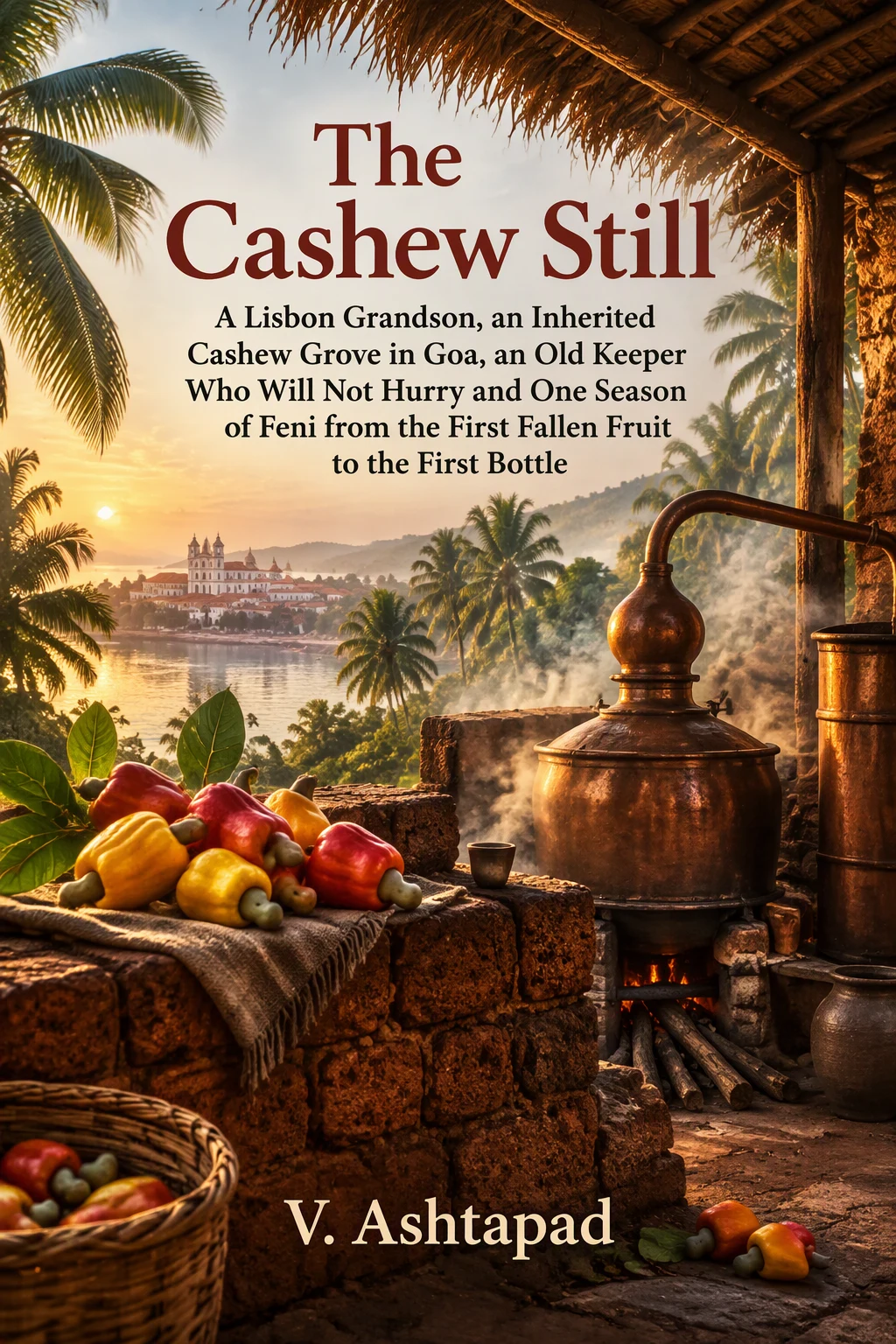
The Cashew Still
A Lisbon Grandson, an Inherited Cashew Grove in Goa, an Old Keeper Who Will Not Hurry and One Season of Feni from the First Fallen Fruit to the First Bottle
by V. Ashtapad
Foreword
This is a work of fiction. The cashew harvest of Goa, the treading, pressing, fermenting and twice-run copper distilling of cashew feni and urrak, the Goan dishes in these pages and the Portuguese craft of medronho are real public traditions, described here as faithfully as a story allows. The village of Cotarli, the Coutinho family, Agostinho Rebelo and every other named person, house and business in the story are invented.
For the keepers who show instead of tell, and for whoever comes back to ask.
The Grove Comes by Post
The envelope from Goa had been forwarded twice before it reached the apartment in Graça, and by then it looked as though it had walked the whole way. One corner was soft with damp. Someone at a sorting office had written a new street number over the old one in green ink, and the stamps showed a kingfisher and a lighthouse, both a little smudged, both bright in a way that nothing in a Lisbon February was bright.
Leandro Coutinho found it on the mat at half past seven in the evening, after a day spent trying to make a bank's loan screens fail. That was his job, and he was good at it. He was paid to be the most patient and most suspicious person in the room, to type a date of birth in the wrong order forty times and see which version the program swallowed. He wrote up what broke, in numbered steps, so that someone else could break it again on purpose. His manager liked to say that Leandro could find the crack in a marble floor. Leandro had never been sure that was a compliment.
He made coffee in the small aluminum pot that had belonged to his mother's father, sat on the radiator because the chairs were covered in laundry, and opened the envelope with a butter knife.
Inside were two documents and a short covering note from a lawyer in Margão. The note was written in an English so formal it seemed to bow. It regretted to inform him, it had the honor to inform him, it begged to draw his attention. His grandfather, Anselmo Coutinho, of the village of Cotarli in the district of South Goa, had passed away in November. Leandro already knew that. His father had taken the call at the kitchen table in Benfica and gone very quiet and then gone out to walk, and come back after dark with a bag of oranges nobody had asked for.
What Leandro had not known was the rest. By the terms of a will signed four years earlier, the cashew grove known as the Upper Plot, together with the stone distilling shed standing upon it and the copper vessels and implements therein, was left to his grandson Leandro Caetano Coutinho of Lisbon, Portugal. Upon one condition. The legatee was to make, or cause to be made under his own eyes, one full season of feni from the said grove before he might sell, lease or otherwise dispose of it.
He read it three times. Then he read the second document, which was a sketch map on thin blue paper, the boundary marked by little drawn trees and a dotted line that wandered along something labeled *nullah* and stopped at a mark labeled *still*. In the margin, in soft pencil, the strokes nothing like the lawyer's, someone had written: *The good trees are on the east side. Tell him to ask Tinu.*
His coffee went cold on the radiator.
He telephoned his father, because there was no one else to telephone. Caetano Coutinho picked up on the sixth ring with the television loud behind him and the particular cough he gave when he did not want to talk about something.
"I know, I know," his father said, before Leandro had finished. "Olha, the lawyer wrote to me too. A copy. As a courtesy." He said courtesy the way some men say parking fine.
"You knew he was going to do this, Pai?"
"How would I know what that man was going to do? Twenty-two years I don't speak to him."
"Pai."
"Twenty-one, twenty-two, pá. Your mother keeps the count. Ask her."
Leandro could hear his mother in the background asking who it was, and then the sound of the phone being taken, and then Isabel's voice, warm and quick and from the south, the way it had always been.
"So, you got the letter," she said. "Pronto. Come to dinner Sunday. I'm making caldo verde, your father is going to sulk, and you're going to let him sulk. Then we talk."
"Mãe, I can't just go to Goa."
"Did I say you could? Sunday, filho."
That Sunday the kitchen in Benfica smelled of kale and smoked sausage and the bay leaves his mother crushed between her palms before she let them into any pot. Caetano held the end of the table, spectacles shoved up into his hair, the lawyer's letter flattened under the salt cellar as though it might try to leave.
"A season, he says," Caetano said, finally, when the soup was gone and the bread was gone and the olives had been reduced to a little dish of stones. "You know what a season is? February to May. The trees don't care you have a job. The apples come when they come. You'd be there the whole time, the whole time."
"I have leave saved. Three years of it. They keep telling me to take it."
"To go and stand in the heat, and get stung by wasps, and come back smelling like a tasca."
"You did it."
"I was a boy. Boys don't get a choice." His father looked at the salt cellar. "Then I had a choice. And I made it."
Isabel got up and brought a bottle from the high cupboard. It had no label. The glass was green and thick, and the liquid inside was clear as water. She poured three very small glasses.
"Medronho," she said, unnecessarily. Leandro knew it. Her father had made it in the hills above Monchique, from the red, rough-skinned berries of the strawberry tree, fermented in barrels through the autumn and run through a copper alambique in a shed that leaned against a cork oak. Leandro had spent childhood summers there, watching his avô Joaquim feed the fire and taste the run from a teaspoon and say nothing, ever, about how he knew when to stop. "The last of Papa's. Your father has been saving it, for what I don't know, he won't tell me."
Caetano made a noise.
"When we got married," Isabel said, to Leandro, "your two grandfathers met exactly once. Anselmo flew all the way from Goa for the wedding. He didn't like Lisbon, he didn't like the food, he didn't like the cold, he didn't like that his son was marrying a girl from the Algarve who couldn't cook rice. And then at the reception my father put a glass of this in his hand. And the two of them went outside and sat on the steps of the hall and talked until three in the morning. About fire. About copper. About how you know when the heart of the run is finished. My father didn't speak English and yours, Caetano, didn't speak Portuguese that well."
"He spoke enough," Caetano said. "Enough for that."
"I never saw either of them so happy." She lifted her glass. "Pronto. That's all I'll say."
They drank. The medronho was fierce, then soft, with that faint honey and forest-floor taste under the fire. Leandro felt it go down to his knees.
"But why me?" he asked. "Why not Tia Filomena? She's the one who stayed. She looked after him."
Caetano studied the oilcloth. On the wall above the stove hung a photograph in a cheap frame: a laterite house with a red tile roof and a wide front porch with built-in seats, a woman in a printed dress on the steps, a boy on a bicycle too big for him. The boy was Caetano. The house was the one in Cotarli. The woman was the grandmother Leandro had never met, who had died before he was born.
"Because he knew I wouldn't go," his father said at last. "And he knew you, you'd ask and ask until somebody answered."
Leandro spent the next two weeks being reasonable. He priced flights. He read about the cashew harvest and learned that the tree was not even from India, that it had come from Brazil on Portuguese ships four centuries ago and been planted along the Goan coast to hold the soil, and had stayed and become, somehow, the most Goan thing there was. He learned that the fruit was called an apple though it was not one, and that the nut hung beneath it like a bell clapper, and that feni was distilled from the juice of the apple and from nothing else, and that it was strong enough to clean a wound.
He read the lawyer's letter until the creases went white.
His cousin Savio, whom he had met twice in his life, at a christening when they were both small and once on a video call during the first winter of the pandemic, sent him a message with a link to the family's private pages. Savio had been building them for years, he said. Photographs, mostly. Some recordings. There was a family tree that went back to 1840, with gaps. *Avô sat for some of the recordings,* Savio wrote. *He said I could keep them for whoever wanted to listen. I think he meant you.*
Leandro opened the pages on his laptop at midnight. There was the same laterite house, in color this time, its porch seats freshly limewashed. There was a picture of a stone shed half hidden in green, a curl of smoke above it, labeled *the bhatti, March 2019*. There was a recording of a man's voice, slow and gravelly, saying in English, *Testing. Is it taking? Savio, is it taking?* and a younger voice answering, laughing, *It's taking, Avô, just talk.*
He did not press play on the rest. Not yet.
In the morning he went into the office in Parque das Nações and asked for twelve weeks of leave, and his manager, who had been asking him to take a holiday since 2023, looked at him over her monitor as if he had found a crack in the marble floor of the building itself.
"And where are you going, may I ask?"
"To make feni," Leandro said, and heard how it sounded, and did not take it back.
© 2026 CRUNOD LLC. All rights reserved.
Only What Falls
The heat met him on the aircraft steps at Mopa like a hand laid flat on his chest. It was the last week of February and already the air had weight, a damp, sweet, smoky weight, and the light was so white that the airport buildings looked unfinished. Savio was waiting outside arrivals with a cardboard sign that said COUTINHO (LISBON) in marker, as if there might be another Coutinho from somewhere else.
His cousin was a year younger than Leandro and half a head shorter, round-faced, with a mustache he was plainly proud of and a shirt printed with green parrots. He hugged Leandro hard and then held him at arm's length and laughed.
"Arre, you look exactly like him, men," he said. "Not your father. Avô. The ears, no?"
"Everybody tells me about the ears."
"Come, come. The car is a disaster, but it goes."
It was a small white hatchback with one blue door, and it went. They drove south for two hours, down the highway and then off it, through towns where the shop signs were in three alphabets and the roadside stalls sold green coconuts stacked like cannonballs, then off that road too, onto a lane that narrowed between paddy fields gone dry and gold after the harvest. Water buffalo lay in a muddy tank with only their noses and horns showing. A man on a bicycle with a basket of bread on the back squeezed a rubber horn as they passed, two short honks, and Savio honked back.
"Poder," he said. "Our baker. Six in the morning he comes, and again at four. You'll hear him. Two days, you'll be waking up for him only."
Cotarli sat in a fold between two low red hills. Leandro saw the church tower first, white over the palms, and then the houses: some of them new and square and painted mint or lilac, and some of them old, with deep porches and steep red tile roofs and windows made of small panes that caught the light strangely, a milky, pearly shine.
"Oyster shell," Savio said, catching him looking. "They used to flatten the shells and put them in wooden frames, instead of glass. Light comes, heat doesn't. Avô's house still has them, upstairs."
The Coutinho house stood at the end of the village where the tarmac quit and the lane turned to red dust and roots. It was larger than the photograph had made it seem, two stories of laterite blocks plastered and limewashed a pale ochre that had gone patchy with damp, the bottom meter of the walls stained darker where rain had splashed up from the ground for a hundred and thirty monsoons. The porch, the balcão, ran across the whole front, with built-in seats on either side of the steps, curved like the arms of a chair. A bougainvillea had climbed one pillar and thrown itself across the roof in a purple riot. Under the eaves a row of glazed blue tiles carried a date. *1894*.
A woman was sitting on the left-hand seat shelling peas into a steel bowl. She did not get up.
"Mãe," Savio said. "He's come."
Filomena Coutinho Dias was sixty-one. She had her brother's long jaw and none of his habit of looking away. She wore a cotton housedress in a print of small yellow flowers, and her gray hair was scraped back into a knot so severe it lifted her eyebrows. She looked at Leandro for a long moment, from his sneakers to his ears.
"So thin," she said. "Your mother doesn't feed you or what?"
"She tries."
"Hm." She went back to the peas. "Fish curry for lunch. Wash first. You're smelling of the airplane."
That was all. Savio carried the bag inside and Leandro followed him through a front door so tall it seemed meant for someone on horseback, into a sala with a floor of red and cream tiles laid in a checker pattern, cool as water underfoot. There were heavy dark wooden chairs with cane seats, a glass cabinet full of plates nobody had eaten off in fifty years, a ceiling fan that turned with the slow dignity of a ship's wheel. On the wall hung photographs in oval frames: men with waxed mustaches, women in lace, a wedding party arranged on these same front steps.
"Your room is upstairs," Savio said. "Avô's room, actually. Mãe aired it. She won't tell you, but she did. Whole of yesterday she was up there with a broom."
At lunch there was fish curry the color of a sunset, sour with kokum and thick with coconut, and red rice, and a fried mackerel each, crisp at the edges, and a little pile of pickled lime. Filomena ate standing at the kitchen counter, though there was a chair for her. She asked Leandro about his flight, and about his mother's health, and not one word about his father.
In the afternoon, when the heat lay over the village so heavy that even the dogs had given up and gone flat under the cars, Savio walked him up the hill.
The path climbed through a thicket of scrub and wild jasmine, then out onto open red ground, laterite broken up and baked like the crust of a loaf, and then they were among the cashew trees.
He had expected an orchard, rows. It was nothing like that. The trees grew wherever they had decided to grow, low and sprawling, their branches bending down to the earth and rooting there again so that one tree became a sort of room. The leaves were big and leathery, glossy on top, and the shade beneath them was close and greenish. And everywhere, hanging from the branch tips like Christmas ornaments, were the apples.
They were not apples. They were the size and shape of small bell peppers, smooth-skinned and waxy, some a hard yellow, some red as a fire engine, some shading from one to the other. And beneath each one, attached at its bottom end like an afterthought, hung a gray-green, kidney-shaped nut.
The smell was extraordinary. Sweet and rank at once, fruity and slightly rotten and with something underneath that made the inside of his nose prickle. The ground beneath the trees was littered with fallen fruit, and the fallen fruit had started, here and there, to ferment where it lay, and the air buzzed with wasps and small black flies.
"This is the lower grove," Savio said. "Ours is higher up. Avô's. Come, baba."
They climbed further. The Upper Plot was over the crest of the hill, on a slope that faced east, and at the bottom of it, where a gully ran, sat a squat building of black stone with a corrugated iron roof weighted down at the corners with rocks. A thin curl of smoke rose from a chimney pipe. A man was sitting in the doorway on an upturned crate, peeling a green mango with a small curved knife.
He was very old and very thin, the color of a walnut, in a pair of faded shorts and a vest with holes in it. His legs were all tendon. When he saw them he did not get up either. Leandro was beginning to understand that in Cotarli people did not get up.
"Tinu," Savio said. "This is Leandro. Anselmo's grandson. From Lisbon, no?"
Agostinho Rebelo, who had been called Tinu since before anyone now living could remember, finished peeling the mango. He cut a slice, salted it from a twist of paper at his feet, and ate it. Then he looked at Leandro.
"You came," he said, in English.
"I came."
"Your grandfather said you will come. Your aunt said you will not come. Me, I said nothing." He cut another slice of mango and held it out on the blade of the knife. Leandro took it. It was so sour his jaw ached, and the salt made it worse and then better.
"He told me to ask you," Leandro said. "There was a note on the map. *Tell him to ask Tinu.*"
"Ask me what, baba?"
"How to do it. The feni. All of it, everything."
Tinu considered this. Above them the leaves moved in a breeze that did not reach the ground, and an apple came loose somewhere in the canopy and fell with a soft thud into the leaf litter.
"That," Tinu said, pointing with his knife toward the sound. "That is the first thing. We take only what falls."
"Only what falls? Nothing else?"
"Only. From the tree you don't pick. Never. A cashew on the tree is not ready, it is green inside, bitter, it has not decided yet. When it falls, it has decided. Ripe. It is giving itself. You understand or not?"
Leandro said that he did. He wasn't sure that he did.
"Tomorrow," Tinu said. "Six o'clock. Before the heat. Bring a basket. Your aunt has baskets. The one with the broken handle, don't let her give you, she will try."
On the way back down Savio was laughing quietly to himself.
"What?"
"Nothing, men. He likes you."
"How can you possibly tell?"
"He gave you the mango. Me he has never given the mango. Never."
That night Leandro lay in his grandfather's bed under a camphor-scented mosquito net and listened to the house. It ticked as it cooled. Geckos chirped on the walls, a sound like someone kissing the back of their hand. Far off, a dog was making a long argument with another dog. He thought about only what falls, about the apples deciding, and about the bell clapper of the nut, and he thought about the recordings on Savio's pages that he still had not played.
He took out his phone and found the first one. *Testing. Is it taking?* He put it to his ear and lay still, and this time he let it run.
*My name is Anselmo Coutinho,* the old voice said. *I was born in this house in the year nineteen forty, upstairs, first door on the left. If you are listening to this, you are probably in that room. So. Good night.*
Leandro laughed aloud, by himself, under the net. Then he lay there with his eyes stinging, listening to his grandfather breathe on the recording, the creak of a cane chair, the far-off honk of a bread seller's horn from some other year.
© 2026 CRUNOD LLC. All rights reserved.
Twisting the Nut
The poder came at six, as promised, two honks at the bottom of the lane, and Leandro was already awake for it. He had been awake since four, listening to roosters compete. He went down in the half-dark and found Filomena in the kitchen with the stove lit and a pan of milky tea simmering, cardamom and ginger rising off it in a cloud.
She handed him a steel tumbler without a word. Then she went to the back door and came back with two baskets of woven bamboo, broad and shallow, with handles of twisted cane. One of the handles had been mended with wire and had come unmended again.
She held out that one.
"Tinu said don't take the broken one," Leandro said.
Filomena studied him. Then, at last, one corner of her mouth twitched. She put the broken basket back behind the door and handed him the other.
"Too much he talks, that man," she said.
Outside, the bread seller had stopped at the gate. He had a basket on the back of his bicycle covered with a cloth, and when he lifted the cloth the smell came out warm and yeasty: small square loaves of pao dusted with flour, pulled apart in a block of six, and round hard poi with pockets in them. Filomena bought a dozen of each and paid in coins and asked after somebody's knee. Leandro took a pao and ate it walking, still hot, and it tore like cotton.
The hill at dawn was another place. The sky was a soft rinsed blue, the laterite almost purple, and the air was cool enough that his arms came up in gooseflesh. The cashew trees stood dark and dripping with dew. The smell was gentler at this hour, more fruit than rot. Somewhere up in the grove a bird was saying three notes over and over, rising each time, as if it were asking the same question with increasing alarm.
Tinu was already among the trees, bent at the waist, moving slowly from one fallen fruit to the next. He did not look up.
"Here," he said. "Watch."
He showed Leandro how to look. That was most of it, it turned out. The ripe fallen apples lay in the leaf litter, yellow and red, and the trick was to see which ones had fallen in the night and which had lain since yesterday, or the day before. The fresh ones were firm and glossy and cool. The older ones had begun to wrinkle and soften and go brown where they touched the ground, and wasps were already in them.
"Yesterday's also we take," Tinu said. "Two days, maybe, if it is not rotten. Three days, leave it for the pigs."
"There are pigs?"
"Pigs are always there."
Leandro bent and picked up an apple. It was heavier than he expected and slightly warm on the side that had faced up, cold on the side that had lain in the dew. The nut came with it, hanging at the bottom like a tiny fist.
"Now this, see," Tinu said, and took the fruit from him. He held the apple in his palm and pinched the nut between his thumb and forefinger and gave it one short twist, as though he were turning a key, and it came away clean. He tossed the nut into a cloth bag at his hip and the apple into Leandro's basket. "Like that. One twist. Don't pull, you'll tear the apple, the juice will run away. And don't put your fingers in your mouth after, ha."
"Why not?"
"You'll see, you'll see."
He saw. Within an hour his fingertips were tingling, and within two they had begun to burn. Not the apple. The nut. Where its stem had torn away a little clear oil had beaded and gotten on his skin, and it stung like nettles and then went on stinging.
"The shell has a poison inside," Tinu said, quite cheerfully, when Leandro held up his hands. "Inside, the nut is sweet. In your restaurant in Lisbon you eat it with salt, very nice. But the shell protects the nut. It burns, no? In the factory they roast them and the oil comes out. People who shell cashews all day, their hands are black. My mother's hands were like that. Here." He tore a fistful of leaves from a small bush by the path, crushed them, and rubbed them on Leandro's fingers. They smelled green and sharp. The stinging eased, a little.
They worked through the morning. Leandro learned the rhythm: stoop, look, pick, twist, toss, toss, step, stoop. His back began to complain by eight. By nine the sun had cleared the hill behind them and come down into the grove in shafts, and the dew steamed off the leaves, and the wasps woke up properly and came to see what was happening.
He found that he was counting. He couldn't help it; it was how his mind worked. Apples per tree, trees per row, rows per slope. He estimated aloud, and Tinu snorted.
"Arre, you are counting the apples."
"I'm just trying to get a sense of the yield."
"The yield." Tinu said it as if he were holding it up between two fingers to examine it. "Your grandfather also, same thing. When he was young. Counting, counting, always counting."
He sat down on a root, suddenly, the way old men in Cotarli sat down, as if the ground had come up to meet him. He pulled the cloth bag off his hip and poured the nuts out onto a flat stone and began to sort them with one finger: big, small, damaged.
"Nineteen fifty-two," he said. "Fifty-three maybe. I was very small. My father worked for his father, old Bostiao Coutinho. Anselmo was, what, twelve? Thirteen? Big boy. He went to the school in Margão, he could read, he could do sums. And every evening he sat on the balcão with a notebook and wrote down how many baskets came from the hill. How many nuts. How many pots of juice. His father laughed at him. 'You think the trees are reading your book?'"
"And what did he say?"
"He said, 'No, Papa, but the man who buys the nuts is reading his book. So I am reading mine.'" Tinu grinned, and his teeth were stained brown and there were not many of them. "He was right also. The man who bought the nuts came on a bullock cart from Quepem every Saturday with a scale, and the scale was a liar. Anselmo caught him. Twelve years old. After that old Bostiao let him do all the selling."
Leandro sat down on the root beside him. His legs were grateful.
"I didn't know any of this."
"How will you know? You were in Lisbon." There was no accusation in it. It was a fact, like the pigs. "Your father didn't tell you anything?"
"My father doesn't talk about this place."
Tinu nodded slowly, as if this too were a fact he had long ago weighed and put on the shelf. He went on sorting nuts. Big, small, damaged.
They carried the nuts down to the yard behind the stone shed, where a woven mat had been spread on a flat patch of swept ground, and poured them out to dry in the sun. There were already nuts there from the days before, a gray-green carpet of them, and Tinu raked them over with his fingers, turning the bottom ones to the light.
"Two days, three days in the sun," he said. "Then they rattle. You shake one, it rattles, it is dry. Then we sell. The money from the nuts pays for the wood for the fire. Always like that. The nut pays for the fire, the apple pays for everything else."
The apples went the other way: into a broad shallow pit of stone beside the shed, already half full, glowing yellow and red and humming with flies.
When they finally walked down to the house it was nearly noon, and the heat had settled back over the village like a lid. Leandro's shirt was soaked through. His hands smelled of cashew, a smell that did not wash off, a smell that seemed to have gotten under his nails and into the grain of his palms. Filomena took one look at him on the balcão and pointed at the side of the house, where a tap stood over a stone trough.
He washed with his shirt off, the water from the tap coming out warm as tea at first and then cold, and while he was washing his cousin came round the corner with his phone held up.
"Hold one up, hold one up," Savio said. "An apple. For the pages. Every year Avô had one picture of the first basket. Somebody has to hold it, no?"
Leandro held one up, dripping, shirtless, squinting. The apple was half scarlet, half butter yellow. Savio took the picture and showed it to him: there he was, ears and all, in the shade of the old house, holding the first fruit of the first morning.
"I'll put it with the others," Savio said, already typing. "Two thousand twenty-six. First basket. Leandro. Done."
That afternoon, while everyone in the village slept, Leandro sat on his grandfather's bed and scrolled back through the pictures on the family pages. Savio had labeled every one. *First basket, 2025, Avô (with Tinu).* *First basket, 2019, Avô.* *First basket, 1998, Avô and Tia Filomena.* *First basket, 1977(?), Caetano.*
He stopped there.
It was a scanned print, its colors gone orange with age. A teenage boy with his father's ears and his father's way of standing with one hip cocked, holding a cashew apple out toward the camera as if he were annoyed to be asked. Behind him, small and blurry on the balcão, a younger version of his aunt was laughing.
Leandro looked at it until the screen dimmed. Then he turned it off and lay back and let himself sleep through the heat, the way Tinu had told him everyone here did, the way his body had suddenly decided it wanted to.
© 2026 CRUNOD LLC. All rights reserved.
The Basin in the Rock
For a week they gathered. Every morning at six, the honk of the poder, tea, the hill; every noon, the tap behind the house and the heavy lunch and the long blank sleep. Leandro's back stopped complaining and started simply reporting. His fingertips peeled and grew new skin, tougher and faintly stained. He began to recognize individual trees: the one with the split trunk that gave the reddest apples, the old giant at the top of the slope whose branches had walked so far across the ground that it covered the area of a tennis court, the young one near the gully that let go of its fruit, Tinu said, too early every year and should have been taught better.
The stone pit beside the shed filled up.
On the eighth morning Tinu was not among the trees when Leandro arrived. He was at the pit, standing on its rim with his shorts rolled higher and his feet bare and gray with dust, and with him was a young woman Leandro had not seen before, in a faded orange kurta and jeans cut off at the knee, tying her hair up with a rubber band she held in her teeth.
"Rosy," Tinu said. "My granddaughter. Studying in Panjim, chemistry, very clever, much cleverer than me. For the treading she comes home."
"For the treading I am *made* to come home," Rosy said, around the rubber band, and then took it out of her mouth and finished her knot and held out a hand. "So you're the Lisbon one."
"I'm the Lisbon one."
"Ever trodden anything?"
"Grapes. Once. At a festival when I was nine. In a plastic tub."
Rosy looked at her grandfather, and the two of them laughed in exactly the same way, a short exhalation through the nose.
The pit was not a pit, Leandro saw now that he looked at it properly. It was a basin cut into a single slab of laterite where the hill came out of the ground: about the size of a large bathtub, a little deeper, with walls that sloped inward and a floor that tilted toward one corner. At that corner a channel had been carved through the stone, polished smooth by use, and it ended in a lip like a spout. Under the spout, half sunk in the earth, stood a broad clay pot.
"How old is this thing?"
Tinu shrugged. "Older than the house. Older than the Coutinhos. Somebody cut it. Who, nobody knows. My grandfather said a giant. My grandmother said the Portuguese. My father said, *Who cares, it holds juice, no?*"
The apples lay heaped in the basin, a slope of yellow and red that came nearly to the rim. The smell coming off them in the cool morning was thick and sweet, a smell like jam on the point of burning.
"Feet," Tinu said. "Wash first." He pointed at a bucket.
Leandro washed his feet. The water was cold. He rolled his trousers up as far as they would go, which was not far enough, and Rosy, without a word, handed him a pair of old shorts from a nail inside the shed door, which he suspected had once been his grandfather's.
Then he climbed in.
The apples gave under him at once, with a series of soft wet pops, like stepping onto a bed of overripe tomatoes. Juice welled up between his toes, cold from the night and sticky. He sank to his ankles, then to his shins, and the smell came up off the crushed fruit in a wave so strong that his eyes watered and he laughed, helplessly, because it was absurd, because here he was, a man who spent his days in a glass building writing up the ways a program could fail, standing up to his shins in fruit at the top of a hill in Goa.
"Don't laugh, baba," Tinu said, "march," and he climbed in too, and Rosy after him, and the three of them began to tread.
There was a way to it. There was a way to everything here, Leandro was learning, and the way was never explained, only shown. You did not stamp. You did not dance. You stepped down and pressed and twisted your heel a little, the way Tinu had twisted the nut from the apple, and then you lifted the foot and moved it and stepped again, and you kept moving in a slow circle around the basin so that every part of it was worked. The apples split and burst and slid against one another and against your skin. Their fibers wound round your ankles. Stones of hard unripe fruit rolled under your arches and made you wince. The juice began to run toward the low corner and down the polished channel, and from the spout came first a trickle, then a thin steady stream, pale yellow and cloudy, foaming a little as it hit the clay pot beneath.
Tinu sang while he trod. It was a song in Konkani, Leandro supposed, tuneless and repetitive and rising at the end of every line. Rosy rolled her eyes and then, after a minute, sang along.
"What's the song?" Leandro asked.
"A work song," Rosy said. "Very old and very stupid. It's about a man who goes to sell his cashew nuts in the market and the buyer cheats him and he goes home and his wife hits him with a ladle."
"That's it? That's the whole song?"
"Then next year he goes back, the buyer cheats him again, his wife hits him again. Like that it goes. Forty years. Very long song, men."
Tinu sang another verse with tremendous dignity.
"In the end," Rosy said, "he sends his son to sell the nuts. The son catches the buyer cheating. And the wife puts the ladle away. Finished."
Leandro stopped treading.
"Wait. Is that about my grandfather?"
Tinu kept singing. Rosy grinned.
"My great-grandfather made it up," she said. "Supposedly. Who knows. Every village has some version. But Grandpa says in ours the son has big ears."
They trod for nearly two hours. The sun came over the hill and found them, and the basin became a trough of hot pulp and sweat and wasps, and Leandro's calves burned. When the pot under the spout was full, Rosy lifted it out with her arms around it like a child and set another in its place, and carried the first into the shade of the shed.
Tinu climbed out of the basin, slowly, one leg and then the other. His feet and shins were coated in yellow pulp, and he washed them in the bucket and then took a small clay cup from a shelf inside the door and dipped it into the full pot and held it out to Leandro.
"Neero," he said. "First juice. Drink, drink."
It was cool. It was sweet, sweeter than any apple juice, almost like honey thinned with water, and then, just after, it caught the back of his throat with a rasp so sudden and so dry that he coughed. His whole mouth puckered. The tongue felt furred, as if he had licked a woolen sweater.
Tinu and Rosy were watching him with the frank enjoyment of people waiting for a joke to land.
"It bites," Leandro said, when he could speak. "Caramba."
"The fruit is hard. Inside. It doesn't want to be drunk," Tinu said. "First time, everybody gets a surprise. Then they want more. Now you know the cashew, a little. It gives, but while it gives it bites you."
Leandro drank the rest. The bite was still there, but now he was ready for it, and the sweetness underneath seemed bigger for it.
That afternoon, instead of sleeping, he sat on the balcão with a notebook he had bought at the airport. It was the kind of notebook he used at work, squared paper, with a line at the top of every page for a heading. He had not intended to use it for this, but now that he was here his hands seemed to want to.
He wrote *Step 3: Treading* at the top. Then he wrote, in numbered lines, what they had done. Wash feet. Climb in. Step, press, twist heel. Move in a circle. Two hours. Swap pots when full. He wrote *Juice: pale yellow, cloudy, foams at the spout.* He wrote *Neero: sweet first, then astringent. Bites.* He wrote down the work song, as much as Rosy had translated.
Filomena came out and set a cup of tea beside him, without being asked, and looked over his shoulder.
"What's this? Homework?"
"Notes. It's how I remember things. At work I write the steps down so somebody else can repeat them."
She read for a while, upside down.
"Wrong you've written," she said.
"Where?"
"Here." She tapped the page. "You wrote *move in a circle*. In a circle you don't move. You move with the slope. Up the high side, down to the low side, the way the juice wants to go. My father used to say. You go with the juice." She paused. "Also it's not two hours. Until the fruit is finished. Some days one hour, some days four. A number you can't write."
Leandro crossed out *in a circle* and wrote *with the slope, toward the spout*. He crossed out *two hours* and wrote *until finished*. Then he looked up at her.
"You used to do it, Tia?"
"Every year. Till forty. Then my knees, what to do." She sat down on the other seat of the balcão, across the steps from him, and picked up the bowl of peas that seemed always to be there and always to need shelling. "Your father also. When he was a boy. Hated it. Said the juice made his feet itch for one whole week." She split a pod with her thumbnail. "Fastest treader on the hill, he was."
Savio had been building a map on the family pages. Leandro found it that evening, a satellite picture of the village and the hills around it, with little colored pins stuck in it, each one labeled. *House (1894).* *Lower grove.* *Upper Plot.* *The bhatti.* There was one pin at the top of the hill that just said *Basin* and when he touched it a photograph came up of a small boy, three or four years old, sitting in the empty laterite trough with a cashew apple in each fist. The label underneath, in Savio's careful style, read *Caetano, 1966 (approx). Photo: Avó Lourdes's box.*
He added a pin himself, after some hesitation. He put it in the shade of the shed, where they had stood drinking the neero. He labeled it *First neero, March 2026* and then, after a moment, added *Tinu, Rosy, Leandro.*
© 2026 CRUNOD LLC. All rights reserved.
The Rope and the Stone
When the treading was finished the basin held a flattened mass of pulp, pale and fibrous, like wet sawdust that had been dyed with saffron. There was still juice in it. Leandro could see it shining when he pressed his thumb into the mash.
"Now we tie it," Tinu said. "Come."
From the dark of the shed he brought out a coil of rope as thick as Leandro's wrist, brown and bristly, made of coconut fiber. It smelled of tar and old rain. He found one end of it and handed it to Rosy, and the two of them, without any discussion, began to build.
They scooped the pulp with their hands into a heap at the center of the basin, patting and pushing it into a rough round cake about the size of a cartwheel and as high as Leandro's knee. Then Rosy held the end of the rope against the bottom of the heap and Tinu walked around it, round and round, winding the rope about the cake in a tight spiral, climbing as he went, so that the pulp was bound inside a kind of coiled basket of coir. Every few turns he stopped and pushed the bulging pulp back in with the flat of his hand. When he reached the top he tucked the end of the rope under the last coil and pressed it down.
"Now the stone."
The stone sat by the basin wall. Leandro had walked past it a dozen times without noticing it: a block of dark granite, roughly flat on two sides, with an iron ring set into one edge that had rusted to the color of dried blood. It must have weighed as much as a man.
It took all three of them and a length of bamboo through the ring to lever it up onto the rim and then slide it, grunting, onto the top of the bound cake. The cake groaned. That was the only word for it: a deep wet complaint, and then a gurgle, and a fresh trickle of juice began to run from beneath the coils toward the spout.
"Whole night," Tinu said, wiping his hands on his shorts. "It sits. It gives. Morning, more juice. Second juice. Not so sweet as neero. Stronger. More bite. That also goes in the pots."
"Someone has to stay with it?"
"Somebody always stays. Animals come. Civets. Porcupine. Also boys from the next village who think nobody is watching." He looked at Leandro. "Tonight, you."
So Leandro spent his first night on the hill.
He brought up a rolled mat and a sheet and a flask of tea Filomena had pressed on him, and a torch, and a plastic box with three chapatis and some potato bhaji wrapped in newspaper. He sat in the doorway of the stone shed, on the same upturned crate where he had first seen Tinu peeling his mango, and watched the light go.
It went quickly here, without much dawdling. The sky over the western hill turned orange and then a bruised violet, and the cashew trees went black against it, and the first stars came out sharp and many. The heat leaked slowly out of the ground. The air filled with the high sawing of insects and the croak of frogs from the gully below, and every so often the whole hillside seemed to hold its breath and go silent for a few seconds, and then start up again all at once, louder.
The pressed cake ticked and dripped in the dark. When he shone the torch on the spout he saw the thin stream still running, a ribbon of gold in the beam, and moths came at once to the light.
Tinu came back up a little after nine. Leandro heard him before he saw him, the scuff of his rubber sandals on the path and a tuneless humming, and then the old man came into the circle of torchlight with a blanket over his shoulder and a small bottle in his hand.
"You said tonight it was me," Leandro said.
"Yes, yes. I'm not staying. I'm visiting only." He lowered himself to the earth, shoulders to the black stone, knees up, and uncapped the bottle and offered it. "Last year's. Your grandfather's last season."
Leandro took it and sniffed. It was so strong it seemed to climb into his nose and stand up. Under the fire was the cashew: the same sweet, rank, fruity smell that hung over the whole hill, concentrated and transformed, like the ghost of the fruit.
He took a sip. It was like swallowing a lit match that turned, on the way down, into warm honey and green leaves and something faintly smoky. He coughed.
"It bites," he said.
"Everything here bites, baba," Tinu said comfortably, and took the bottle back, and had a sip himself without coughing at all.
They sat for a while. A nightjar called from somewhere in the trees, a churring like a small engine.
"Can I ask you something?"
"Ask. Asking is free."
"My father and my grandfather. What happened? Why did he leave, and never come back?"
Tinu turned the bottle in his hands. The stream from the spout pattered softly into the pot.
"That is not my story," he said at last. "That is your father's story. And your grandfather's. And your aunt's. Mine is a small piece only." He looked at Leandro sideways. "I tell you my small piece, you'll think it is the whole thing. Then you'll go to your father with my small piece and say, *Tinu told me.* And he will say, *What does Tinu know?* And he will be right, no?"
Leandro started to argue and then didn't. It was exactly the kind of thing he said at work, when a manager wanted a single cause for a failure that had five. You don't fix the thing you've been told. You fix the thing you can reproduce.
"All right," he said.
Tinu looked faintly surprised, as if he had been preparing for a longer fight.
"Then can I ask something else?"
"So many things you ask."
"Can I record you? Not about my father. About the work. How you do each part. Savio has recordings of my grandfather on the family pages. Only for us. I'd like to have you there too. Your voice, explaining. If you say no, that's fine."
Tinu thought about it. He took another small sip of the feni and held it in his mouth and swallowed.
"Only the work," he said. "Only."
"Only the work."
"Not my singing. Rosy will put my singing everywhere, that girl."
"Not the singing."
"And when I say stop, you stop. Even in the middle, ha."
"Even in the middle."
Tinu nodded. "Then okay. Yes."
Leandro set his phone on the earth between them in the torchlight, his fingers a little unsteady, the little red light glowing. And Agostinho Rebelo, seventy-four, of Cotarli, leaned back against the black stone shed and began to explain, in his slow formal English with its Konkani rhythms, how you bind the pulp with coir rope after the treading, and why you wind from the bottom, and why the stone must be granite and not laterite, because laterite crumbles under the wet, and how his own father had shown him this when he was six years old, in the year nineteen fifty-eight, on this same hill, under this same tree.
"Which tree?" Leandro asked, quietly.
Tinu pointed with his chin into the darkness, toward the giant at the top of the slope whose branches walked along the ground.
"That one," he said. "Old already, even then."
Then he said, "Stop," and Leandro stopped, and the old man got up with a grunt and a crack of his knees and put the bottle in his pocket and went off down the path, humming, into the dark.
Leandro lay awake a long time on the mat in the doorway. The cake dripped. The insects sawed. Once, near midnight, he heard a rustle and a thin squeal and shone the torch and saw a pair of green eyes in the leaf litter, and then a long low shape with a ringed tail that turned and slipped away.
In the morning the pot under the spout was full to its lip with a deeper, darker gold, and the coils of the coir rope had sunk a hand's width under the stone.
© 2026 CRUNOD LLC. All rights reserved.
Three Days in Clay
The juice went into the pots, and the pots went into the ground.
They lived in a row at the back of the shed, in a trench dug in the floor where the earth stayed cool: six big clay jars, each one as tall as Leandro's hip and twice as wide, round-bellied, narrow-necked, their surfaces rough and red and stained dark around the shoulders by years of overflow. They were sunk to the neck in packed earth, so that only their mouths showed, like a family of buried giants with their heads out.
Rosy and Leandro poured the neero in first, then the second juice from the stone press, through a cloth stretched over each mouth to catch the bits of fiber and the wasps. When the jars were nearly full they covered each one with a square of cotton and a round wooden lid, not tight, laid loosely on top.
"Not tight, not tight," Rosy said. "It has to breathe."
"You add yeast? Sugar?"
She laughed. "Who're you asking, the chemistry student or the cashew girl?"
"Either one. Both."
"The chemistry student says there's wild yeast on the skin of the apples and in the air of the shed and in the clay of the jars themselves, from every year before. You don't add anything. It's already there. It's been there for a hundred years. The jars are seeded." She rapped one with her knuckle, and it gave a dull, full note. "The cashew girl says the same thing but with fewer words. Leave it alone and it knows what to do."
"How long?"
"Three days. Sometimes two, if it's hot. Sometimes four. Grandpa listens and tells."
"Listens?"
"Wait and see."
By that evening the jars had begun to talk.
It started as a faint fizz when he put his ear close to a lid, like a glass of soda left standing. By the next morning it was a steady hiss, and a sweet-sour smell was coming out from under the cloths, yeasty and fruity, like bread dough and wine at once. When he lifted a lid the surface of the juice was alive, crusted with pale foam that heaved and broke and heaved again, and tiny bubbles rose through the cloudy liquid in endless threads.
Tinu came by twice a day. He didn't lift the lids. He knelt and put his ear to the shoulder of each jar, one after another, the way a doctor listens to a chest, and stayed there with his eyes closed for half a minute before moving to the next.
"Good," he said, or "Hm," or "Borem," or nothing at all.
"What are you listening for?" Leandro asked him.
"When it's talking, it's working. When it goes quiet, it's finished. Not before. Not after. That's all."
Leandro had brought a thermometer from Lisbon. It was a cheap one, a glass tube of red spirit in a plastic sleeve, bought in a hardware shop in the Baixa on the last afternoon before his flight. He had not shown it to anyone yet. Now he took it out of his bag and held it, turning it in his fingers.
"Could I put this in? Just to know the temperature. If I know the temperature, and how long it takes, then next year I could—"
Tinu looked at the thermometer. He didn't say no. He didn't say anything. He looked at it the way he had once inspected the word yield: like a strange insect that might or might not sting.
"Your grandfather also had one of those," he said finally. "Nineteen seventy-something. Somebody gave it to him in Margão. One whole season he put it in the jars. All the numbers he wrote in his book."
"And then?"
"And the next year, no." Tinu stood up, with his usual crack of the knees. "Ask him why. He's there, in your telephone."
That afternoon Leandro scrolled through the recordings on the family pages until he found one labeled *Avô on fermenting (2021)*. He pressed play.
*The thermometer told me it was hot,* his grandfather's voice said. *I knew it was hot. I was sweating. The thermometer told me when it was cool. I knew when it was cool, I had a sweater on. Savio, you are laughing. What the thermometer could not tell me was whether the juice was happy. For that you need an ear.* A creak of the chair. *Also, one year it broke in the jar. Glass everywhere. We had to throw out the whole jar. Forty liters. Tinu's father never let me forget it.*
Leandro put the thermometer back in his bag and zipped it shut.
On the second day of the fermentation, Filomena made bebinca.
He came down from the hill at noon and found the kitchen transformed. Every surface was covered with bowls. There was a basket of coconuts by the door and a heap of grated white coconut meat on a steel platter, and Filomena was sitting on a low stool with a long-handled wooden scraper fixed to a board, holding a split coconut half against its serrated blade and turning it in quick, short strokes so that snowy flakes fell into the bowl beneath. The air was full of the smell of nutmeg and hot ghee and the sweet green scent of fresh coconut.
"Sit," she said. "Squeeze. Like this."
She gave him the grated coconut in a square of muslin and showed him how to twist it over a bowl until thick white milk ran out between the threads. His wrists ached within minutes. She separated eggs, two dozen of them, sliding the yolks from shell half to shell half with a flick that was almost careless, and the whites went into a jar for something else and the yolks into a great glowing bowl, orange as marigolds.
"How many layers, Tia?" he asked.
"Sixteen. My mother did sixteen. Her mother did twenty-one, for weddings. Your grandmother Lourdes, she used to say seven is enough for anybody, and she was right, but I do sixteen."
"Why?"
"Because my mother did sixteen. Why else?"
The batter was coconut milk and yolks and sugar and a little flour and a lot of nutmeg, whisked until it was smooth and pale yellow and thick as cream. Filomena ladled a thin layer into a heavy, high-sided brass pan she had already slicked with ghee and set it in the oven. But it was not really an oven: it was a clay box with a metal lid, and on top of the lid lay a bed of glowing coconut-husk coals. The heat came down from above.
"From the top," she said. "Not from the bottom. That's the secret. The only secret. Bottom stays soft, top goes brown. Then another layer. Then ghee. Then another. Then ghee. Like that."
It took the whole afternoon. Every twelve or fifteen minutes she lifted the lid with a cloth around her hand, checked the color of the layer underneath, which went from yellow to a deep caramel brown at the edges, brushed it with melted ghee from a little steel cup, ladled another thin layer on top, and closed it up again, and fed more husks to the coals. Between layers she sat on the stool and fanned herself with a folded newspaper and shelled peas, of course, and Leandro sat on the step and they talked. Or rather she talked, and he listened, and that turned out to be the important thing.
"Three years he was sick," she said. She didn't say who. She didn't need to. "Not so sick at first. Only the heart, a little. Then the legs. Last year he couldn't climb the hill at all. Tinu ran the bhatti, and once a week Savio carried him up on his back to sit in the shed and tell everybody they were doing it wrong."
"I didn't know, Tia."
"How would you know?" The same words Tinu had used. In her mouth they came out different. "Your father knew. I wrote to him. Every few months. He sent money. Never wrote back. Money and no words. You know what that is like? Like getting a parcel with nothing inside, only the string."
She lifted the lid. The coals hissed. She brushed the ghee across the browned layer, and the kitchen went rich and nutty with it, and she poured the next layer, the ninth.
"I bathed him. I fed him. At the end I had to turn him in the night so he wouldn't get sores. Savio helped, when he could. And I'm not complaining, ha. He was my father. I'd do it again. But then the lawyer reads the will, and the grove goes to the boy in Lisbon who has never been here, who doesn't know which end of a cashew to twist." She closed the lid hard. "Sorry. It's not your fault. I know that."
Leandro didn't say anything for a while. He wanted very much to say something; at work he would have said something, would have explained, or offered a fix. He looked at the brass pan and the coals and the browning edges and thought about how his aunt knew, without a thermometer, exactly when each layer was ready. He thought about how she had swept his grandfather's room for him, and given him the basket without the broken handle.
"You were here," he said finally. "Every season. You know all of it. You trod the fruit until your knees went. You should have had it."
She looked at him, startled.
"I'm not going to pretend I understand why he did it," Leandro said. "I don't. Maybe it was to make me come. Maybe it was to make my father come. I don't know. But it doesn't feel like mine. If you want it, I'll—"
"Stop." She held up her hand, with the ghee brush still in it. "Don't. Don't give it to me like a man giving a coin to a beggar. That's worse, baba."
He shut his mouth.
Her eyes stayed on the oven lid.
"He did it so you'd come," she said quietly. "He told me, at the end. He said, 'If I give it to Filomena, she'll keep it, she'll run it, she'll do it well, and the boy in Lisbon will never know it exists. And Caetano will never have a reason.' He said, 'You don't need it. You have it already. It's in your hands.'" She held up her hands, ghee-shiny, nutmeg-dusted, the knuckles thick. "I was furious. Two days I gave him silence. Then he couldn't speak at all, and I was sorry I'd wasted them."
Leandro turned that over through the tenth layer and the eleventh.
"Then teach me," he said. "Not the bebinca. I mean yes, the bebinca, but also everything. What Tinu doesn't think to say because he thinks it's obvious. What you'd do different. I'll write it down. And if, at the end, there's a choice to make, I'll make it with you. Not for you. With you."
Filomena didn't say yes. She brushed ghee on the twelfth layer and poured the thirteenth. But she reached over, without looking at him, and pushed the bowl of unshelled peas along the step until it sat beside his knee.
The bebinca came out at dusk. She ran a knife around the edge of the pan and turned it out onto a platter, and it stood there, glossy and dense and brown-gold, and when she cut into it the slice showed sixteen fine stripes from dark to pale, like the rings in a cut tree.
He ate it on the balcão with Savio and Filomena while the bats came out over the paddy fields. It was rich beyond reason, heavy with egg and coconut, and sweet, and the nutmeg came up through it warm, and the browned top of each layer had a faint bitter caramel edge that kept the sweetness honest.
Savio photographed a slice on a white plate and labeled it for the family's recipe pages. Under it there was already a scan of a handwritten card, the ink faded brown, in a looping hand Leandro had never seen: *Bebinca. Lourdes. 16 if you have time, 7 if you have sense.*
"That's Avó's writing," Savio said. "Mãe found it in a tin, last year only."
Filomena said, "Write mine underneath. And put that I do sixteen, ha."
On the third day, at dawn, Tinu knelt beside each jar in turn and put his ear to the clay and listened. The hissing had slowed to a whisper. In two of the jars it had stopped altogether. The foam had subsided, and the juice beneath the lids smelled sharp and sour and winey now, with that cashew ghost still underneath.
"Today," Tinu said, standing up. "Tonight we light the fire. Bas."
© 2026 CRUNOD LLC. All rights reserved.
Firing the Bhatti
The still had been under a tarpaulin all this time, in the dim back half of the shed, and Leandro had not quite understood that it was there. When Tinu pulled the tarpaulin away in the late afternoon, the light through the doorway fell on copper, and the whole shed seemed to warm by a degree.
It was a pot. That was all, really, at first sight: a big round-bellied pot of hammered copper, as broad across as a cartwheel, with a narrow neck and a domed lid that sealed onto it with a collar of clay. It sat in a hearth built up around it of black stone and red mud, so that only its upper half showed, the lower half and the space for the fire hidden in the masonry. From the top of the lid a pipe ran out sideways and down, also copper, long and tapering, green with verdigris at the joints, and the end of it disappeared into the mouth of a second, smaller clay pot that stood in a stone trough a few feet away.
The copper was not bright. It was dark and mottled, brown and rose and black and in places almost purple, with a dense pattern of tiny hammer dents all over it like the skin of an orange. Someone had stamped a mark near the rim, worn almost smooth: a little circle and a few letters.
"Nineteen fifty-five," Tinu said, laying a hand on it with the gentleness of a man touching a horse. "Before this one, the old pot was clay. A big clay pot. It cracked. The night of the cracking, juice everywhere, fire everywhere, old Bostiao standing in it shouting. Very bad night. Your grandfather was fifteen. The next week old Bostiao took him to Margão on the bus, to the coppersmith in the bazaar, and they ordered this. Six weeks the coppersmith worked on it. Hammer, hammer, hammer. Then they brought it back on a bullock cart and carried it up the hill on a bamboo pole. Your grandfather on one end, my father on the other. I walked behind, carrying the lid. I was three. I thought it was a crown."
He tapped the pot. It rang, low and long.
"Seventy-one years. Still good. Copper is better than clay, men. It talks to you through your hand."
They spent the afternoon making ready. The fermented juice was ladled from the clay jars and carried in buckets to the copper pot and poured in through the open neck until the pot was about two-thirds full. The smell in the shed was enormous now: sour and sweet and yeasty, like a bakery and a vineyard and a compost heap all at once. Tinu would not let them fill it higher.
"It needs space to boil," he said. "Fill it to the top, it boils over into the pipe. Then you get juice, not urrak. Then you wash everything and start again, and the whole village laughs at you."
Then the lid was set on, and the collar between lid and pot was sealed with a paste Rosy made from red mud and cow dung and a handful of chopped straw, which she mixed in a basin with her bare hands, pulling a face the whole time.
"Every year I say I'll bring silicone from the lab," she said. "Every year he says no. Every single year."
"Why not?" Leandro asked Tinu.
"Because the mud tells you," Tinu said. "Pressure is too much, the mud cracks a little, a little steam comes, you see it, you lower the fire. Silicone tells you nothing. Silicone holds, holds, holds, and then, bang." He clapped his hands. "Remember the clay pot, no?"
The receiving pot in its stone trough was made of clay, with a cloth tied over its mouth around the end of the copper pipe. The trough itself was filled with water carried up from the gully below in a pair of steel buckets on a bamboo yoke. That was Leandro's job, it turned out. He would be the water.
"The vapor comes from the big pot, through the pipe, into the small pot," Tinu explained, drawing the path in the air with a finger. "In the small pot it must become liquid again. For that the small pot must be cold. But the vapor is hot, so the pot gets hot, so the water in the trough gets hot. So whole night, somebody takes the hot water out and puts cold water in. Small pot gets hot, the urrak goes off into the air, like a ghost. Gone."
"The whole night?"
"Whole night. By May you'll be a very strong man." Tinu looked at his thin arms. "Maybe."
Savio came up the hill at sunset with a sack of food and a sheet of paper.
"The roster," he said, handing Leandro a printout that he had plainly made at the photocopy shop in the village. "Avô used to keep it on the back of an envelope. Now everyone can see it on the pages and swap if they have to. See."
It was a grid, the nights of March down one side and names across the top. *Tinu. Rosy. Savio. Leandro. Bernardo D'Souza (water). Sebastião's boys (wood, Tues/Thurs only). Mrs. Fernandes (food, Sundays).* Leandro's name was against every night for the next two weeks.
"Who made this?"
"Mãe," Savio said. "She said you want to learn. She said on alternate Tuesdays you can't learn anything."
The fire was laid as the sky went orange: dry cashew branches cut from the dead wood of the grove, crooked gray sticks that burned hot and fast, and split logs of something heavier for the long burn. Tinu built it in the firebox under the copper pot with care, a small crackling teepee of twigs at the front and the big logs behind, and lit it with a single match and a twist of newspaper.
The smoke went up the pipe in the masonry and out through the roof. The fire caught, and roared, and settled. Tinu fed it a stick at a time, crouching in front of the firebox with his face lit orange and his eyes narrowed against the heat.
It took a long time. Nearly two hours, while the light went and the stars came out and the insects started their sawing, before anything happened. Leandro sat by the trough with his hands in the water. Rosy sat on the crate with a notebook of her own, chemistry homework, frowning at it by the light of a lantern. Tinu fed the fire. The copper pot ticked and creaked as it heated, and then began to make a deep, slow, bubbling sound inside, like someone breathing in their sleep.
"Now," Tinu said.
He laid his palm flat on the copper pipe, near where it entered the cloth over the receiving pot. Then he moved his hand back along the pipe, a few inches at a time, toward the big pot, feeling it the way someone feels a child's forehead for fever. He nodded.
"It's coming."
Leandro got up and looked. Under the cloth, from the mouth of the pipe into the dim clay throat of the small pot, a thin clear thread was falling. It was so fine he could hardly see it in the lantern light. It made a tiny ticking sound. Tick. Tick. Tick-tick.
Rosy came and stood beside him. "First run," she said. "Always a little dirty at the very start. Grandpa throws the first cup."
Tinu did. He moved the cloth aside and let the first cupful collect in a tin mug, and smelled it, and pulled a face, and flung it out the door into the dark, where it hissed on a hot stone. Then he let the thread run into the pot.
The water in the trough was already warm under Leandro's hands.
He carried water all night. Down the path to the gully in the dark with a torch strapped to his forehead, to the pool where the stream collected behind a little dam of stones, the frogs going silent as he came and starting again as he left. Dip, dip, the steel buckets heavy and sloshing. Up the path, bent under the yoke, sweating. Bail the warm water out of the trough with a coconut shell ladle, onto the ground where it steamed. Pour the cold in. Down again.
By midnight his shoulders were on fire. By two he had stopped thinking. By three he was moving the way Tinu moved, the way the whole hill moved, slowly and steadily and without wasted effort, because there was no other way to keep going.
Between runs he sat by the fire with Tinu, who never seemed to sleep, and ate what Savio had brought: a tiffin box of pork vindalho from Mrs. Fernandes next door, deep red and fierce with vinegar and garlic and dried chilies, so tender it fell apart on the fork, and a stack of poi to mop it up, and a bunch of tiny sweet bananas. The vindalho was better the second time he went back to it, and better again the third. The vinegar cut through the fat, and the chilies burned, and the heat of the fire on his face and the chili heat in his mouth seemed to meet somewhere in the middle and agree.
"Tomorrow it's better," Tinu said, watching him eat. "Vindalho. Always. Like everything."
"Why's it called that? Vindalho?"
"Portuguese," said Rosy, without looking up from her homework. "Vinho and alho. Wine and garlic. The Portuguese brought a way of pickling pork in wine and garlic. There was no wine here, so we used palm vinegar. And then we added chili, because the Portuguese also brought chili, from the Americas. So it's a Portuguese dish made Goan with an American plant. Same as the cashew. Brazilian tree, Portuguese ships, Goan hill."
"Same as you, baba," Tinu said to Leandro.
Leandro thought about that for the length of a whole trip down to the gully and back.
At four in the morning, Tinu laid his palm on the copper pipe again and held it there a long time, and then took the tin mug and caught a little of the thread and smelled it and tasted it with the tip of his tongue.
"Finished," he said. "Now only water is coming."
He pulled the fire apart with an iron rod, spreading the logs so they would burn down, and the roar in the firebox fell to a mutter. The bubbling in the copper pot slowed. The thread from the pipe thinned and broke into separate beads, tick, tick, and stopped.
In the receiving pot, when Tinu lifted the cloth and held the lantern over it, there was a clear liquid, almost to the shoulder, that caught the light.
"Urrak," Tinu said.
He dipped the tin mug and gave it to Leandro first.
It smelled of cashew, fresh and green and lighter than the feni Tinu had brought up in the bottle on the night of the press. Softer. It was strong, but not fierce. It tasted of the fruit, and of the smoke, faintly, and of something like cut grass. It warmed him going down and then sat in his chest like a coal.
"First distillation," Rosy said. "Fifteen percent, maybe, around there. In summer people drink it with lime and soda and a green chili. Everybody. The whole of Goa drinks urrak in April. Then some of it, the best of it, goes back in the pot. With new juice. And we run it again. That makes feni."
"Again?"
"Again," said Tinu. "What else?" He patted Leandro's aching shoulder with a hand like a piece of driftwood. "Tomorrow night. Tonight, sleep."
Leandro slept on the mat in the doorway of the shed, in the gray light before dawn, with the fire ticking down beside him, and did not hear the poder honk at the bottom of the hill for the first time since he had come.
© 2026 CRUNOD LLC. All rights reserved.
Urrak Weather
April came in like an oven door opening.
The mornings were still bearable, just, if you were on the hill by six. By ten the light had gone white and flat and the laterite threw the heat back up at you from below, so that you were cooked from both sides. By noon nobody in Cotarli moved who did not have to. The dogs lay in the dust under the cars. The water buffalo stood in the tank with only their nostrils above the surface. The paddy fields, long since harvested, cracked into hexagons. The cashew apples fell faster now, two or three times as many each night, and they were sweeter, and they fermented quicker, and the whole hill reeked of them.
The village slowed to the pace of the heat. Leandro had heard the word susegad before, of course. His father used it in Lisbon as a kind of insult, the way some people used *mañana* about Spain: a word for Goans who didn't hurry, who sat on their porches in the afternoon while the world went past. *Very susegad,* Caetano would say about a slow waiter or a late train, with an expression Leandro now realized was not entirely contempt.
Here it was not an insult. It was simply how things were done, because the alternative was to fall down. He learned it in his body before he understood it with his mind. You worked hard and fast in the early morning and again in the evening and through the night at the still. In the middle of the day, you stopped. You ate. You lay on the cool tiles of the sala floor under the slow fan, or in a string hammock on the back verandah, and you let the hours go by, and you did not feel guilty about it, because the trees did not feel guilty about it either. They had stopped too. Even the wasps had stopped.
His manager in Lisbon sent him a message one afternoon in the middle of this. *Sorry to bother you on leave!! Quick question about the loan screen test plan, where did you save the version from January?* He read it twice, lying on the tiles. He typed an answer. He looked at the answer. He added, *Back on 2 June. I'll be hard to reach until then. The apples are falling.* He sent it before he could take it out.
In the evenings, after the heat broke, the village came out onto its porches.
The ritual was the same everywhere. Every balcão had its pair of curved seats, and on every pair of seats there were two or three people, and on the steps between them a tray. And on the tray, in April, there was urrak. Leandro had never seen anything like it. Every household seemed to have its own bottle, or its own source, a cousin or a neighbor up some hill with a still. People poured it into glasses over ice, with a squeeze of lime and a splash of soda and a slit green chili floating in it like a small fish, and sat and sipped it and watched the swallows over the fields.
He tried it, the first evening on the Coutinho balcão, from the batch they had run themselves.
It was perfect. There was no other word. The cold and the fizz and the sharp lime and the faint green fire of the chili, and under it all the cashew, softer now, as if the soda had opened a window in it. It was the most refreshing thing he had ever put in his mouth.
"Don't drink it like water," Filomena said, watching him. "It's not water. It sneaks up on you."
"How much does it sneak, Tia?"
"Last year," Savio said, "one fellow from Bangalore at my guesthouse drank five on the beach at Colva and tried to swim to Africa. Africa, men."
On the second Saturday of April, Filomena announced that the house would have people.
"What people, Tia?"
"People. The street. Tinu and his family. Mrs. Fernandes, who is feeding you vindalho at two in the morning for three weeks and who you have not once properly thanked. Sebastião and his boys who cut your wood. The D'Souzas. Everyone. Your grandfather did it every April. He called it the urrak evening. We haven't done it since he got sick." She was already writing a list on the back of an electricity bill. "Xacuti. Thirty chickens' worth. And you'll grind."
He ground. For two days he ground. Filomena's xacuti began with coconut, grated and then toasted dry in a heavy iron pan over a low flame, worked constantly with a wooden paddle while it turned from white through gold to walnut brown and the kitchen smelled like the inside of a toasted macaroon. Then came the spices, each roasted separately because each had its own time: dried red chilies, which made them all cough, then coriander seed, cumin, black peppercorns, fennel, a few cloves, a stick of cinnamon, a star anise, a scrape of nutmeg, a few blades of mace, white poppy seeds that popped and jumped in the pan like tiny fleas. Each went into a tin plate to cool when its smell changed. Filomena knew the moment for each one by her nose, and twice she snatched the pan off the heat and Leandro, sniffing, had to admit he could not tell why.
Then everything went onto a flat grinding stone, a long slab of black granite with a hollow worn in its middle by four generations of arms, with a heavy round stone roller. That was the part she gave him.
"You have a machine at home," she said, "I know, I know. Your mother has a machine. Everybody has a machine. For xacuti, the stone. Machine makes it hot. Stone keeps it cool and the oil stays in the spice."
He knelt in front of the stone on the back verandah and rolled, and rolled, adding water by the spoonful, and the spices and the coconut slowly became a thick dark paste, brown-red and glistening, that smelled so complicated he could not separate it into its parts anymore. His forearms burned. Sweat ran into his eyes. Every time he thought he was finished Filomena came out, rubbed a pinch between her thumb and finger, and said "More."
"How do you know?"
"When it's ready, it doesn't feel like sand. Like silk it feels. Your fingers will know."
He kept going until it felt like silk. The clock said a hundred minutes. He checked his watch, out of habit, and then wished he hadn't, and then wrote it in his notebook anyway, and then wrote underneath it, *But really: until it feels like silk.*
The evening came. The house filled. People arrived on foot and on scooters and in one case on a bullock cart, which was Sebastião, who was nearly eighty and refused to have anything to do with engines. They brought things: a bowl of sorpotel, a tin of coconut sweets, a bag of mangoes, the first of the season, small and yellow and so fragrant that they perfumed the whole porch. Mrs. Fernandes, who turned out to be a tiny fierce woman in a pink dress with gold earrings, came with her vindalho in a great clay pot carried by two grandsons. Leandro thanked her properly. She patted his face and told him he was too thin and had his grandfather's ears.
They ate on the balcão and in the sala and on the steps and out in the yard under strings of colored lights Savio had hung from the jackfruit tree. The xacuti was dark and fragrant and complicated, with chunks of chicken falling from the bone in a gravy that tasted of toasted coconut and fire and something almost medicinal, the star anise maybe, the poppy seeds. People ate it with poi torn in half and with rice and with their fingers. Leandro watched Filomena watching them eat it. She stood at the edge of the porch, not eating, with her arms folded, and every time someone went back for more her shoulders came down a little.
The urrak went round in a big glass jug full of ice and lime and chilies, and the evening grew loud.
Somewhere around nine, Savio stood up on the steps and clapped his hands.
"Every year," he said, in Konkani and then in English for Leandro, "Avô used to make a speech. Very long speech. Very boring, no?"
Laughter. Someone shouted something and there was more laughter.
"This year also," Savio said, "he's making it."
He took out his phone and set it on a little speaker on the porch rail. He touched the screen.
*So,* said Anselmo Coutinho's voice, slow and gravelly and much too loud, out over the yard, and every head turned. *So. Another year. The trees have done their work. Tinu has done his work. I have done nothing. I am sitting on my balcão with my urrak. That is my work.*
People laughed, and some of them, Leandro saw, were crying, or near it.
*When I was a boy,* the recording went on, *in nineteen fifty, fifty-one, the urrak evening was in this same yard. My father put a board across two barrels and we put the food on the board. There were no lights. We had lanterns, kerosene, and the moths came to them. There was a man named Pedro Miranda who played the violin, very badly, and everybody danced anyway. My mother made xacuti on the fire outside. That is the best xacuti I ever ate. Filomena, if you are listening, that is the best xacuti I ever ate. Yours is the second best. I'm sorry. It's the truth.*
At the edge of the porch, Filomena pressed her knuckles to her lips.
*The thing about the urrak evening,* Anselmo said, *is it is the middle. It is not the end. The apples are still falling. The fire still needs feeding. But one night you stop, and you look at who is here. That's all. Look at who is here. Then tomorrow you go back up the hill.*
There was a click and a rustle and a younger Savio's voice saying *Is that it, Avô?* and the old man answering, *That's it. Enough. I want my urrak.*
The yard was quiet except for the insects and the hiss of the kerosene lamp someone had lit in his honor. Then Sebastião, the old man with the bullock cart, raised his glass, and everybody raised theirs, and drank.
Later, much later, when most of the guests had gone and the lights in the jackfruit tree were still swaying, Leandro sat on the steps with his phone and called Lisbon. It was early evening there. His mother answered, and he turned the camera round and showed her the porch, the lights, the last of the people, the empty xacuti pot. She was delighted. She called his father over.
Caetano's face came into the screen, glasses on his forehead. His eyes moved over the porch. The curved seats. The blue tiles with the date. His sister, standing at the edge of the steps, with her back to the camera, stacking plates.
"You had the urrak evening," he said. "So."
"Tia Filomena did. Savio played Avô's speech, Pai."
Something went across his father's face, fast, and was gone.
"Tell her," Caetano began, and stopped. "Tell her the xacuti looks good."
"Tell her yourself, Pai, she's right here. Tia—"
But the screen had already gone dark. His father had ended the call.
Leandro sat on the step with the phone in his hand. After a while Filomena settled onto her own curved seat across the steps, and picked up the bowl of peas, and didn't shell any.
"He said the xacuti looks good, Tia," Leandro said.
She let the night go on a little.
"Second best," she said. "Everybody heard, no?"
© 2026 CRUNOD LLC. All rights reserved.
The Second Running
For the second running, Tinu gave him the fire.
He did not announce it. On the evening after the urrak feast, when they had loaded the copper pot again, this time with a mixture of the best of the urrak and fresh fermented juice from the jars in the trench, and Rosy had sealed the lid with her mud and dung and straw and her usual expression of disgust, Tinu sat down on the upturned crate by the door instead of crouching at the firebox. He crossed his arms. He nodded at the woodpile.
"You."
"Me?"
"Three weeks you've watched. You know how."
Leandro did not know how. He knew what it looked like when Tinu did it. That was not the same thing at all, and he had spent his whole working life explaining to people that seeing something done was not the same as being able to do it. But he crouched in front of the firebox, and his knees cracked in exactly the way Tinu's did, and Rosy laughed.
He built the fire the way he had seen it built. A small teepee of dry cashew twigs at the front. The heavier split logs behind. A twist of newspaper. One match. It caught on the second try.
"Slow," Tinu said from the crate. "This time is different. First time, you want everything out of the juice. This time, only the good part out of the urrak. Fire is fast, everything comes together, the good and the bad. Headache. Fire is slow, they come one by one. Then you can choose."
"How slow?"
Tinu looked at him with something like pity.
"Slow like a man walking to his mother-in-law's house, baba."
Rosy explained it better, or at least differently. She sat on the ground with her chemistry notebook open on her knee and drew him a diagram by the light of the lantern: the pot, the pipe, the receiver, and little arrows.
"There's lots of things in the fermented juice that evaporate," she said. "Not just ethanol. Some of them boil at a lower temperature than ethanol, some higher. The ones that boil lower come out first. That's the heads. They smell sharp, like nail polish. Some of them aren't good for you. Then the ethanol comes, with all the nice flavors of the cashew. That's the heart. Then the heavier stuff comes at the end, oily, flat, a bit like wet cardboard. The tails. A good distiller cuts the heads off, keeps the heart, and stops before too much of the tails gets in. A slow fire makes the separation cleaner. A fast fire smears it all together."
Tinu, who had been listening with his eyes half closed, opened them.
"She's saying what I'm saying," he said, "with more words and a pencil."
"I am saying what you are saying," Rosy agreed, "with the reasons."
"I know the reasons."
"You know the reasons with your nose."
"Where else will I keep them?"
The fire burned. Leandro fed it, a stick at a time, the way he had seen, watching the color of the flame and listening to the copper. Too much wood and the fire roared and the pot began to tick fast and loud. Too little and the flame sank and the ticking slowed and stopped. He tried to find the place in between. It was like trying to hold a note.
An hour went. Another. He was sweating heavily in the heat of the firebox, and his eyes stung with smoke. Tinu said almost nothing. Once he said, "Less." Once he said, "There." Once he got up from the crate and came and squatted next to Leandro and put his hand flat on the copper pot, just above the masonry, for a long moment, and then took Leandro's hand by the wrist and laid it in the same place.
The copper was hot, very hot, but not unbearable. And it was moving. That was what astonished him. It was humming under his palm, a tiny constant shiver, the bubbling inside transmitted through the metal like the purr of an animal.
"Feel it," Tinu said. "Now remember it. That's the speed."
Leandro took his hand away. Then he put it back. Then he pulled the notebook halfway from his back pocket, and pushed it home again unopened. He didn't know how to write that down.
"Can I record this?"
"Record, record. Only talk quietly."
Leandro held up his phone and spoke, very low, as though he might frighten the still. *Second running. Tinu says the fire should be slow. You can feel the speed with your hand on the copper above the hearth. It should hum. Not knock. Hum.* He filmed his own hand on the copper and then, because it seemed right, he filmed Tinu's beside it, the old brown knuckles and the young pale ones on the dark mottled metal side by side.
Tinu watched him do it.
"Your grandfather did this also," he said. "Not with a telephone. With me. Nineteen sixty-two, sixty-three, when I was ten, eleven. He was the one who taught me the fire. My father was sick that year. Anselmo was twenty-two, he was supposed to be studying in Bombay to be an accountant. He came home for the season and stayed. He put my hand on the copper like that. He said, 'Tinu, feel it, it's singing.'" He was smiling at the firebox. "He never went back to Bombay. He kept the books of the whole village instead. Every shop. Every grove. For forty years. He was the only accountant in Goa who smelled of feni."
Near midnight the first thread came from the pipe into the receiver.
Tinu was there at once. He took the tin mug and caught the first few spoonfuls, smelled them, and held the mug under Leandro's nose. It was sharp and chemical, like Rosy had said, a smell that went straight up behind the eyes like a pin.
"Heads," Tinu said. "Out." He threw it out the door. He caught another mugful, and another, smelled each one, threw it away. Leandro counted three mugs. The fourth Tinu smelled for a long time, and then he held it out.
"You."
Leandro smelled it. It was still sharp, but under the sharpness there was something else now, something rounded and sweet, the cashew coming through like the sun through cloud.
"It's changing," he said. "Isn't it?"
"Finished changing, or not?"
He smelled again. "No."
Tinu threw it out the door. He caught one more and gave it to Leandro.
The sharpness was nearly gone. The smell was cashew, bright and full, the fruit and the hill and the smoke, as if someone had taken the whole grove in March and pressed it into a teaspoon.
"Now," Leandro said.
Tinu smiled and let the thread run into the clay receiving pot.
That was when Leandro, pleased with himself, put too much wood on the fire.
He did not decide to do it. His hand did it. Past midnight, tired, and the run was going well, and he wanted, without quite knowing he wanted it, to hurry it a little, to see it through, to have something done. He pushed two thick logs into the firebox and the flames came up yellow and loud around them.
Tinu didn't say anything. He didn't move from where he was sitting by the receiver.
Within ten minutes the copper pot was knocking. Within fifteen, Leandro saw a thin wisp of white curling up from the collar between the lid and the pot, where Rosy's mud seal met the metal. A hairline crack had opened in the dried mud. Steam was hissing out of it in a fine jet.
His stomach turned to water.
"The mud," he said.
"Yes," said Tinu, very calmly. "See? The mud is telling you."
Leandro grabbed the iron rod and pulled the two new logs out of the firebox, burning, onto the stone floor of the shed, and Rosy was there at once with the bucket, dousing them so they hissed and smoked. He raked the rest of the fire back, thinning it. Gradually, so slowly he thought it would never happen, the knocking in the pot eased to a ticking, and the ticking to a hum. The wisp of steam from the seal thinned, and wavered, and stopped.
Rosy took a lump of fresh mud from her basin and pressed it over the crack with her thumb, smoothing it.
Leandro sat down hard on the floor of the shed with his back against the wall.
"Sorry," he said. "I was trying to make it go faster."
"I know," said Tinu.
"You saw me do it."
"I saw, I saw."
"Then why didn't you stop me?"
The old man's eyes held his across the firelight.
"Because now you know why the mud," he said. "Before, I told you. Now you know." He shrugged. "Also it was a small crack only. Big crack, I would have shouted."
Leandro laughed, a little shakily. Then he returned to the firebox and laid his hand on the copper above the hearth until he found the hum again.
The heart of the run came all through the small hours, a thin clear unbroken thread into the clay pot. Tinu tasted it every quarter hour or so, and every quarter hour he gave the mug to Leandro to taste too, without a word. It changed so slowly that at first Leandro couldn't tell it was changing at all. Then, around four, he noticed that the bright top of the cashew smell was a little flatter, a little rounder, a little less like the morning and more like the afternoon.
He didn't say anything. He wanted to see if he was right. Tinu tasted the next mug and his eyebrows went up, very slightly. He handed the mug over. Leandro tasted.
There it was. A faint dullness at the end of the flavor. A whiff of wet cardboard, as Rosy had said, so slight he might have imagined it.
"It's turning," Leandro said.
"It's turning," Tinu agreed. "So? What do you do?"
He thought about it.
"Change the pot. Keep the rest separate. It's not bad yet. But it's not the heart."
"Good," said Tinu. "Good. Your grandfather would say the same thing. My father would say keep it in, it's still feni, don't waste. Your grandfather would say, 'Bostiao's son should not drink what Bostiao's grandson wouldn't sell.'" He grinned his brown grin. "Every year they argued."
Rosy moved the receiver, and set a smaller pot under the pipe for the tails, and the thread ran into that, and they banked the fire, and by the time the sky over the eastern hill was going gray and the first bird started asking its same anxious question in the cashew trees, the second running was done.
The heart sat in the clay receiving pot, clear as rainwater, almost to the shoulder.
"Feni," Tinu said.
Leandro gazed at it. Then he lifted his phone and photographed it, carefully, from above, the lantern light caught in the surface, and labeled it for the pages before he could think too hard about it. *Second running. First heart. Upper Plot. April 2026. Fire: Leandro (with Tinu, and the mud).*
© 2026 CRUNOD LLC. All rights reserved.
Reading the Beads
The parcel came on the bus from Margão in the second week of April, in a carton bound with so much brown tape that Savio had to cut it open with the bread knife. Inside, in a nest of shredded paper, lay a long slim glass tube, weighted at one end with tiny shot, a paper scale inside it marked in fine black lines, and a tall glass cylinder to float it in.
Leandro had ordered it from Lisbon in his second week in Cotarli, at two in the morning, after a night at the still, without telling anyone. Now that it was here, lying on the dining table in the sala among Filomena's spice tins, it looked like something that had come from another planet.
"What's this now?" said Filomena.
"An alcohol meter. You float it in the spirit and it tells you the strength. In percent."
"Tinu knows the strength, men."
"I know he does."
"Then why did you buy it?"
He didn't have a good answer. Because his hands needed a number. Because at work nobody accepted a result without a number. Because the night of the cracked seal was still in his stomach and he wanted something that would not crack.
He carried it up the hill wrapped in a towel.
Tinu was sitting in the doorway of the shed in the late afternoon shade with a row of small bottles in front of him on the ground. They were old medicine bottles, ten or a dozen of them, brown and green and clear, in different sizes, with cork stoppers. Each one was half full of the feni from the second running.
"Sit, sit," he said. "Today we read the beads."
He picked up one of the bottles, a clear one, and held it up to the light so Leandro could see. The feni inside was perfectly clear, with a faint, faint gold shimmer when it caught the sun. Tinu put his thumb over the cork, turned the bottle upside down, and gave it one hard shake, a flick of the wrist. Then he turned it upright and held it still, at eye level, and Leandro leaned in.
The shake had made bubbles. A ring of them sat at the top of the liquid, against the glass. They were big, some of them, and they were vanishing fast, popping and gone, one after another, until within two or three seconds the surface was clear.
"Strong," Tinu said. "Too strong to drink like this. This one is from the middle of the heart, see."
He picked up another bottle and did the same. This time the bubbles were smaller and they lasted longer, a fine lacework of them clinging to the glass, popping slowly, lingering, and it was a good ten seconds before they were all gone.
"Weaker. From near the end, this one. Near the turning."
He did a third. The bubbles were somewhere in between. Medium size. They sat for a moment, a perfect little necklace around the top of the liquid, and then went, gradually, a steady unraveling, a few seconds.
Tinu watched that one until it cleared, and his face eased.
"That," he said. "That is feni. That one."
"How do you know?"
"How do you know your own sister's cough from the next room?" Tinu put the bottle down. "My father taught me. His father taught him. Your grandfather also knew. Big beads, gone fast, too strong. Small beads, they stay, too weak. Middle, they sit a little, then they go. That's the one. When we put the pots together, we mix the strong heart and the weaker heart till the beads sit right."
Leandro unwrapped the towel.
He did it slowly and a little self-consciously, setting the glass cylinder upright on a flat stone and the slim weighted float beside it. Tinu watched him the way he had watched the thermometer: no expression, head a little on one side.
"And what is this?"
Leandro explained. It took a while. He explained how the float sank deeper in a liquid that was lighter, and how alcohol was lighter than water, so the more alcohol there was, the deeper the float sank, and how the scale inside the tube was marked so you could read off the strength where the surface of the liquid met it.
Tinu listened. He actually listened, Leandro realized; not the polite waiting of someone holding his own opinion in reserve, but real attention, his eyes going from Leandro's face to the float and back. He asked questions. Did the heat of the liquid matter? It did; there was a little chart for that. Did it break? It did, if you let it fall. Was it expensive? It was not. Who had invented it? Leandro had no idea.
"Show me, then," Tinu said.
Leandro poured the third bottle, the one with the necklace of beads, into the glass cylinder. He lowered the float in. It bobbed, settled, swayed, and came to rest. He knelt and put his eye level with the surface of the spirit and read the line.
"Forty-three," he said. "Forty-three percent."
Tinu nodded slowly.
"Good," he said. "That's right. Feni is forty, forty-two, forty-five. Like that. Not more, not less." He picked up the first bottle, the one with big bubbles. "Now do this one."
Leandro emptied the cylinder back into a clean bottle and poured the first. Fifty-one.
"And this one." The weak one. Thirty-six.
Tinu sat back on his heels.
"So," he said. "Your glass and my beads, they're saying the same thing."
"They say the same thing."
The old man was quiet for a while. A cashew apple fell somewhere up the slope, thud, into the leaves.
"When I'm gone," Tinu said, "who'll read the beads?"
Leandro looked up.
"Rosy can read them. A little. Too clever, she is, she thinks too much, she shakes the bottle and then starts explaining the bubbles to herself." He said it with enormous affection. "Savio can't read them at all. No patience, that boy. Your aunt can, but her eyes are not so good now. And you're in Lisbon." He tapped the glass cylinder with one fingernail. "So. Your glass. It's good. The beads are better, faster, and in the dark also you can do them. But your glass you can write in a book. Somebody who has never seen the beads can read your book."
"You're saying I should use it?"
"I'm saying use both. My nose and your book. Then the book remembers what the nose knows." He shrugged. "Your grandfather would have liked that. The accountant who smelled of feni."
They spent the rest of the afternoon reading every bottle twice, once with the beads and once with the glass. Tinu shook and squinted and called it. Leandro floated and knelt and read the number and wrote both down in his notebook in two columns. By the end of the afternoon he could read the beads himself, not well, but roughly: too strong, too weak, about right. Tinu could read the float, with his nose almost touching the glass. They were laughing by the end, like boys doing a trick.
That night Leandro called his father.
It took three rings this time, not six. The television was off. His father sounded tired.
"It's late there, no?" Caetano said.
"It's late everywhere. Pai, we did the second running. We have feni. Real feni. Tinu let me do the fire, imagine."
"He let you do the fire." His father's voice was very careful.
"I cracked the seal. I put too much wood on. Rosy fixed it with mud."
A long silence on the line. And then, impossibly, a sound that might have been a laugh.
"Everybody cracks the seal, pá," Caetano said. "I cracked it when I was fourteen. My father didn't speak to me one whole day."
"Tinu didn't say anything. He just let me see it."
"Tinu was always better at that than my father. Always."
Leandro took a breath.
"We're bottling at the end of May. Before the rain. I want you to come, Pai."
The silence this time went on so long he thought the call had gone.
"I can't," his father said finally.
"But why not?"
"Leandro."
"I'm not asking about the past. I'm not asking what happened. I'm asking you to come and see the bottles. Only that. Mãe would come."
"Your mother already booked her ticket," Caetano said, and there was something odd in his voice. "A month ago. She didn't ask me. She told me."
"Then come with her, pá."
Another silence.
"Did Tinu do the beads?" his father asked suddenly. "With the little bottles? The medicine bottles? He still has the medicine bottles?"
"He still has them, Pai."
"There was a green one. Small, square. With a chip on the neck."
Leandro had seen it that afternoon. It had been the third bottle. The one with the necklace of beads.
"It's still there," he said. "He used it today, even."
His father didn't answer. Leandro heard him breathing, the same way he had heard his grandfather breathing on the recording on his first night, in that upstairs room.
"Good night, Leandro," Caetano said, and hung up, gently this time.
© 2026 CRUNOD LLC. All rights reserved.
Rest Before the Rain
The feni went into glass to rest.
There were six of them in the storeroom off the back of the sala, where the walls were thickest and the single window was shuttered against the sun: big round glass jars, each as large as a child, with narrow necks and woven cane jackets around their bellies to keep them from knocking against the floor. Leandro had seen jars like them in Lisbon, in the windows of old wine cellars in Alfama, and in the back of his grandfather Joaquim's shed in Monchique, full of medronho.
"Garrafão," he said, when he saw them.
"Garrafão," Filomena agreed, surprised. "So you know the word."
"Same in Lisbon. Same jars. My mother's father kept his medronho in them."
She looked at the jars, and then at him, and seemed about to say something, and didn't.
They decanted the hearts from the second runnings into the garrafões through a funnel lined with clean muslin, blending the strong pots with the weaker ones until the beads sat right in the little green medicine bottle with the chip on its neck, and the float in Leandro's glass read forty-two, forty-three. Tinu read the beads. Leandro read the float. Rosy wrote both numbers on a strip of masking tape and stuck it on each jar, with the date.
Then they put the corks in and left them.
"How long?" Leandro asked.
"Till the rain," Tinu said. "Few weeks. It's angry now. Hot from the fire. It needs to sit and think. When it has thought enough, it gets soft."
May was hotter than April. Leandro had not believed that was possible. The sky turned a hard, glaring white-blue by eight in the morning, and stayed that way. The ground cracked. The cashew trees on the hill were nearly bare of fruit now, only a few late apples hanging here and there on the tips of the branches, and the ones that fell rotted almost before they hit the ground. The mangoes came instead, in a flood. Every house in Cotarli had baskets of them, yellow and green and blushing red, and people ate them all day, standing over sinks with juice running to their elbows.
Then, in the second week of May, clouds started to build over the sea in the afternoons.
They came in from the west, high and white and towering, and stood over the coast like great sculptures, and by evening they had gone dark at the bottom and lightning moved inside them, silent, flickering. Nothing came of them, the first few days. Then one evening a sudden squall came over the hill and slapped down on the village for ten minutes, huge warm beads of rain the size of coins that steamed on the hot laterite, and then stopped, and the whole world smelled of wet earth so strongly that Leandro stood in the yard with his face up and breathed it in until he was dizzy.
"Mango showers," Savio said. "Real rain comes in June. When it comes, it comes like a wall, men."
With the season winding down, the afternoons grew longer and emptier. Leandro spent them in his grandfather's study, a small room off the upstairs landing with a desk under the oyster-shell window and shelves of ledgers going back to the nineteen-fifties.
He had not intended to read them. Savio had said, offhandedly, that Avô had kept a book for everything, and that one day someone should go through them, and Leandro, who could not resist a record, had opened one and then another, and now he could not stop.
The earliest was a child's copybook, its board covers worn soft as cloth, and in it, in pencil, in the round careful hand of a twelve-year-old, were the numbers of the 1952 cashew season. *Baskets from the hill: Monday 14. Tuesday 16. Wednesday 11 (rain).* Nuts by weight. Price per measure. And in the margin, underlined twice: *Scale of Mr. Bhonsle light by 1/8. Told Papa.*
Leandro laughed out loud alone in the little room.
There were dozens of books after that. The handwriting grew and changed, became an adult's, became a professional's, the columns ruled with a straight edge, the figures neat and small. There were the accounts of the grove and the still, and there were the accounts of half the village: shops, other groves, a tailor, the bakery. Anselmo Coutinho, the accountant who smelled of feni.
And then, in the books from the last twenty years, Leandro found his father.
It was a separate column, on the right-hand side of each month's household page. It had no heading. It just said, every month, *C.* and an amount, in rupees, converted from euros, and the date it arrived.
Caetano had sent money every month for twenty-two years. Leandro had not known that either.
And beside each entry, in the old man's increasingly shaky hand, there was a note. Not of thanks. Of what the money had done.
"C. — new tiles, north roof." "C. — Filomena knee doctor, Margão." "C. — rope for the press (coir, 30m)." "C. — Savio school fees." "C. — Tinu's eye operation, Panjim." "C. — limewash, balcão." "C. — firewood, whole season." "C. — Rosy's books, first year." "C. — Sebastião's bullock (half)."
Hundreds of them. Page after page. The house in good repair. The still in good repair. The village, in small ways, patched and mended and kept going. And the last entry, in a hand so wobbling it was nearly illegible, in October of last year, a month before the end: "C. — everything. All of it. Tell him."
Leandro sat at the desk until it got dark and the geckos started up on the walls.
His parents arrived on the twentieth of May.
They came in a taxi from the airport, because Caetano would not be collected, and Leandro was on the balcão when he heard it at the bottom of the lane. He stood up. Filomena, on her seat across the steps, did not.
His mother got out first. She was in a straw hat and a linen dress and she looked at the house, at the purple bougainvillea thrown over the roof and the blue tiles with the date, and put a hand to her chest, and then came up the path laughing and crying and holding out her arms. She hugged Leandro and then, without hesitating for a second, she went across the steps and bent and hugged Filomena, who sat rigid for a moment and then put up one hand and held on to Isabel's arm.
Caetano was paying the driver. He took a long time about it. Then he picked up the two suitcases, one in each hand, and walked up the path to the bottom of the steps, and stopped.
He was looking at his sister.
She was looking at him.
He was sixty-four. She was sixty-one. They had the same jaw, the same long face, the same way of standing, now that Leandro saw them together, a little forward on the balls of their feet as though about to argue.
"Filu," his father said. "Olá."
His aunt did not get up. Her gaze traveled from his shoes up to his ears.
"So fat," she said. "Your wife feeds you too much or what?"
And then she got up after all, and came down the steps, and the two of them stood below the porch, the suitcases between them, in the white heat, and neither of them moved, and then his father put the suitcases down.
Leandro went inside. In the kitchen he leaned on the stone counter and watched the jackfruit tree, and after a while his mother came in and stood beside him and put her arm around his waist.
"Give them a minute, filho," she said.
"I am, Mãe."
"Give them an hour, then."
That night they ate on the balcão: fish curry and rice and a plate of fried prawns, and the end of a bebinca Filomena had made, in a hurry, sixteen layers anyway. Caetano ate very little and said less. He kept looking at things: the porch seats, the tiles in the sala, the oval photographs on the wall, the curl of the staircase. When Savio, nervous, brought out his phone to show him the family pages, the map with its pins, the photograph of the boy sitting in the empty basin with a cashew apple in each fist, Caetano studied it in silence, then returned the phone and went out into the yard.
In the morning, at six, when the poder honked at the bottom of the lane, Leandro found his father already in the kitchen, in an old shirt and shorts, with a steel tumbler of tea.
"Tinu is still on the hill at six?"
"Every day, Pai."
"Then show me the trees."
They walked up together in the cool. There were almost no apples left. Here and there under the big trees a few late fallen ones lay in the leaf litter, and his father, without being told, stooped and picked one up and twisted the nut off with a single short turn of the wrist, and tossed the apple to Leandro, and the nut into his own shirt pocket.
He had not forgotten. Leandro watched him and saw that his body had not forgotten any of it. The stoop and the look and the twist and the toss, as smooth as Tinu's.
At the top of the slope, under the old giant tree whose branches walked along the ground, Caetano sat down on a root. Leandro sat down beside him.
"I came here in two thousand four," his father said. "You were nine. You won't remember. I said I had a conference in Bombay. I came to take him back to Lisbon with me."
Leandro said nothing. He kept very still, the way he had kept still beside the clay jars when Tinu was listening.
"Your grandmother had been gone ten years. He was alone in this big house. Filomena was married then, she lived in Margão, she came on weekends. I thought he was lonely. I thought he was getting old. I'd seen what happens. Your mother's father, in Monchique, he'd had a fall, he lay in the shed for a day and a night before anyone found him. I couldn't stand it. I thought, I'll bring him to Lisbon, he'll live with us, we'll take care of him. I had it all planned. A room. A doctor. I'd sell this." He gestured at the trees. "I'd found a buyer. A man from Mumbai, wanted to build holiday houses. Good money. Enough to keep him comfortable for the rest of his life."
"And he said?"
"He laughed at me." Caetano's voice was flat. "He sat on the balcão and laughed. And I lost my temper. I said it was a hill of rotting fruit and a pot of moonshine and he was going to die up here alone in a shed like Joaquim nearly did and I wasn't going to fly halfway round the world to find him. And he said—" He stopped.
The bird in the cashew trees asked its question, rising.
"He said, 'Then don't come back to my hill.'" His father picked up a fallen leaf and turned it in his fingers. "And I didn't."
Leandro waited. It was the hardest thing he had ever done. Every part of him wanted to say something: to tell his father about the ledgers, the column marked *C.*, the tiles and the rope and the knee doctor and the bullock. To fix it.
He didn't. He waited.
"I was right," Caetano said at last. "That's the thing. I was right that he was getting old. I was right that he'd need looking after. I was just wrong about who should do it. And how. And where." He looked down the slope, toward the black stone shed and the thin curl of smoke coming from its chimney, where Tinu was already at work. "He had them. Filu. Tinu. The whole village. He didn't need rescuing. He needed his son to come and sit on the balcão. And I couldn't do that, because then I'd have had to say I was wrong. So I sent money instead."
"I know about the money, Pai," Leandro said quietly.
Caetano's head came round.
"He wrote it down. Every month. And what it did." Leandro took a breath. "Can I show you, Pai?"
That afternoon, while the house slept, Leandro took his father up to the study with the oyster-shell window and opened the ledgers on the desk, one after another, and left him there with them. He went and lay on the cool tiles of the sala under the fan and did not sleep.
At four o'clock, when the poder honked for the second time, his father came down the stairs. His eyes were red. He had the last ledger under his arm, the one with the wobbling hand.
He went out onto the balcão, where Filomena was sitting with her peas, and sat down on the seat across the steps from her. He did not say anything. He opened the ledger on his knee at the last page, and turned it, and held it out to her across the steps.
She took it. She read it. "C. — everything. All of it. Tell him."
"I was going to tell you," she said. "At the funeral. If you came." She handed it back. "You didn't come, no?"
"I know."
"So I told the boy instead. I told the lawyer to put the note on the map. *Ask Tinu.* That was me, not Papa. I wrote it, myself." She looked at Leandro, standing in the doorway. "I thought, if the boy comes, maybe the father comes after."
Caetano put his face in his hands.
Leandro went back inside. This time he did not need his mother to tell him to give them an hour.
© 2026 CRUNOD LLC. All rights reserved.
The First Bottle
They bottled on the last day of May, with the sky over the sea gone the color of slate.
It had been building for three days. The heat had become something you wore, a wet wool blanket that clung to the skin and would not come off. The clouds no longer went away in the evenings. They stayed, piled up over the coast in a long dark wall, and the wind had started to come in off them in gusts that smelled of salt and something metallic, and the palms along the lane thrashed and settled and thrashed again. Every dog in Cotarli was restless. The geckos had gone quiet.
"Tomorrow," Tinu said, sniffing the air from the balcão steps, where he had come down at dawn with Rosy to help. "Tomorrow, or day after. Then four months it doesn't stop."
The bottles had been gathered over the previous two weeks from all over the village. They were not new. They were every kind of bottle that had ever held anything: old wine bottles, green and brown, with the labels soaked off; square gin bottles; tall thin bottles that had held vinegar or soy sauce or rose syrup; one short, fat, beautiful bottle of thick bubbled glass that Sebastião swore had come from Portugal with his grandfather. Filomena had boiled every one of them in a great aluminum pot on bricks over a yard fire, and they stood now in rows on a sheet spread on the floor of the sala, upside down, drying, catching the gray light through the windows.
The garrafões came out of the storeroom one at a time, carried between two people with their cane jackets creaking.
Tinu uncorked the first and poured a little into the green medicine bottle with the chip on its neck, and capped it with his thumb, and gave it one hard shake, and held it up to the window.
Everyone leaned in. Leandro, his father, his mother, Filomena, Savio, Rosy.
The beads came up and sat. A perfect ring of them, medium-sized, clinging to the glass at the top of the clear liquid, and then slowly, steadily, they began to go, one by one, and in four or five seconds they were gone.
"Good," Tinu said.
He handed the little bottle to Caetano.
Leandro's father weighed it in his palm, the green glass, the chip on the neck. Then he took a sip, a very small one, and held it in his mouth with his eyes closed.
It had changed in the garrafão. Leandro had tasted it the day before, when Tinu had decided it was ready. The anger of the fire had gone out of it, as Tinu had said it would. It was still strong, still with that first burn on the tongue like a struck match. But behind the burn it had opened into something round and full and almost floral, the fruit and the smoke and the green leaves and the red earth of the hill all at once, and it went on, and on, long after you had swallowed it, a warmth at the back of the throat that turned slowly into the smell of the grove in March.
His father swallowed. He opened his eyes.
"It's his," he said, to Tinu. "Exactly his. Exactly."
"It's yours," said Tinu. "Your son made the fire, no?"
"With the mud, don't forget," said Rosy.
"With the mud," Leandro agreed.
They bottled all morning. It was slow work and they did not hurry it. Leandro and Savio held the funnels. Rosy decanted from the garrafões into a big enamel jug, through muslin, and passed the jug to Filomena, who poured. Caetano corked: he had found, in a drawer in the kitchen, a little wooden tool that pressed the corks home, a lever with a worn brass cup at its end, and his hands had known what to do with it the moment he picked it up. Isabel sat at the dining table and wrote the labels.
The labels had been Filomena's idea, and then a small argument, and then a compromise. They were plain white sticky rectangles from the stationery shop in the village. Isabel wrote on each one in black ink in her careful southern hand, which still made all its sevens with a little crossbar. *Upper Plot. Cotarli. 2026.* And underneath, smaller, because Filomena had insisted and then Caetano had insisted too: *Anselmo's still.*
"Not *Coutinho*?" Savio had asked.
"Everybody knows it's Coutinho," Filomena had said. "Not everybody knows it was his, Papa's."
Tinu watched it all from a cane chair by the window, with a glass of water on the sill beside him, saying almost nothing. Once he got up and moved a bottle that Leandro had filled a little too full, and poured a sip off it into the medicine bottle, and drank it, and sat back down. Once he said, to nobody in particular, "Seventy-one years, that copper." That was all.
By noon there were a hundred and sixty-two bottles, standing on the floor of the sala in rows, catching the dim stormy light, every one of them clear as water.
Leandro walked slowly along the rows. He had his notebook in his back pocket. He took it out and opened it to the February page that said *Step 1: Gathering*, and leafed forward. The numbered steps, the crossings-out. *With the slope, toward the spout. Until finished. Until it feels like silk. Hum, not knock. Beads sit, then go.* The two columns of numbers, beads on the left, glass on the right. Tinu's voice was on his phone, hours of it, explaining. Filomena's corrections were in the margins in her own hand, because after the bebinca afternoon she had started taking the notebook from him in the evenings and reading it through spectacles perched low, pencil ready.
"You'll put that on the pages?" Savio asked, at his elbow. "All of it? Your notes and Tinu's voice also?"
"If Tinu says yes."
They both looked at Tinu. The old man was asleep in his chair, his mouth open, his hands folded on his stomach.
"He'll say yes," Rosy said. "Already he asked me if you'd put his voice next to Anselmo's. He wanted to know who'd be first."
"Who would be first?"
"He thinks Anselmo, because he's older. But he wants to be close, ha."
The family came that evening, as Filomena had said they would. Not the whole village this time: only the family. But the family in Cotarli turned out to mean a great many people, cousins and second cousins and the D'Souzas next door who were somehow related through a great-aunt and Mrs. Fernandes who was not related at all but who came anyway, with a pot of vindalho made two days earlier so that it would be at its best. Tinu came, and Rosy, and Rosy's mother and father, and her two little brothers who ran in circles round the jackfruit tree until Filomena threatened them with a ladle and everybody laughed, because of the song.
They sat on the balcão and on the steps and on chairs carried out from the sala, under Savio's strings of colored lights, with the wind getting up in the palms and the sky over the sea gone black and lit from inside every few seconds by silent lightning.
Caetano rose on the top step, a bottle in his hand. One of the new ones, an old wine bottle with Isabel's label on it.
He was not a man for speeches. Leandro had never heard him give one in his life, not at a birthday, not at a retirement party, not at his own wedding, according to Isabel, who said he had stood up and said "Thank you for coming, the food is over there" and sat down again.
"My father made speeches," Caetano said. "Every year. Savio played one in April. I heard it in Lisbon, on the telephone. I'm not going to make one." He turned the bottle in his hands. "I'm only going to say that I was wrong. About the hill, and the fruit, and him. I was wrong for twenty-two years. My sister was right. She kept it. Tinu kept it. My son came and asked questions until they answered him, which is what his grandfather said he would do." He looked at Filomena. "Filu. I'm sorry."
His aunt sat on her seat on the balcão and looked up at her brother. She had no peas. Her hands were empty in her lap. She held them out toward him.
He came down two steps and gave her the bottle. She held it. And then she stood up and opened it, with a twist of the cork, and poured the first of it into a glass for her brother, and a glass for Tinu, before anyone else.
"Papa would have said," she said, "look at who is here."
Then Isabel stood up too. She had a bag on her arm. Out of it she took a green, thick-glassed bottle with no label, which Leandro recognized at once. The last of the medronho. Avô Joaquim's. The one from the high cupboard in Benfica that his father had been saving for a reason he would not explain.
"When we got married," Isabel said, "my father and Anselmo sat on the steps of the hall in Lisbon all night and talked about this." She held up the bottle. "About fire and copper. About how you know when the heart is finished. I was saving the last of it." She looked at her husband. "He was saving it, actually. He wouldn't tell me what for. So I'm telling him. It's for this."
She poured the medronho into little glasses, one for each of the grown-ups on the porch, and Filomena poured the feni, and the glasses went round, one in each hand, the Algarve and the Goan hill. The strawberry tree and the cashew. Two fruits nobody had planted on purpose for this, two spirits from copper pots on two hills on opposite sides of the world, carried in two families until the families met.
Leandro drank the medronho first. It tasted of his childhood summers in Monchique, of honey and the forest floor and his avô Joaquim saying nothing, ever, about how he knew when to stop. Then the feni. It tasted of his hands. Of February mornings bent among the fallen fruit, and the treading, and the pressed cake groaning under its stone, and the nights carrying water, and the hum of the copper under his palm.
Tinu, beside him, drank the medronho and considered it seriously with his head on one side.
"Good," he said. "Strong. Different fruit, no?" He held up the empty glass and looked at it against the lightning. "Same fire."
The first of the rain came at nine.
It came the way Savio had said it would. Not as a patter on a roof but as a wall. You could hear it coming across the paddy fields from the sea, a long rising roar like a train, and then it hit the house and the whole world went white. Water poured off the red tiles in solid sheets. The yard became a pond. The colored lights in the jackfruit tree swung and sparked and went out. Rosy's little brothers ran out into it, shrieking, and were followed after a moment by Savio, and then by Rosy, and then by Isabel, laughing, with her linen dress plastered to her in seconds. The air was suddenly cool. It smelled of wet laterite and wet leaves and the sea and, faintly, still, of cashew.
The rest of them stayed on the balcão, under the deep roof, dry, with the curtain of water a foot from their faces.
"So," said Filomena, after a while, to Leandro, raising her voice over the rain. "Season is done. The lawyer's condition is done. Now you can sell it if you want. Papa said you can."
Everyone on the porch went still.
Leandro had been thinking about this for weeks. He had lain awake thinking about it in his grandfather's bed under the camphor-smelling net, with the geckos chirping. He had thought about his job in the glass building in Parque das Nações, and the loan screens, and his manager, and the apartment in Graça with the laundry on the chairs. He had thought about the column in the ledger marked *C.* He had thought about what Filomena had said at the brass pan with the coals on the lid. *Don't give it to me like a man giving a coin to a beggar.*
"I'm not going to sell it, Tia," he said. "And I'm not going to give it to you either. I'm going to ask you something."
She waited.
"The lawyer in Margão says two people can hold it. Two names on the paper. I want them to be yours and mine." He took a breath. "You run it in the year. I'll come every February, for the season. I've already asked at work. They don't like it, but they'll let me, if I take my leave all at once. And in between, I'll do the books." He glanced at his father. "From Lisbon. Every month. I'm good at numbers."
Filomena considered him across the steps, in the light from the sala windows, with the rain roaring behind her.
"With me," she said. "Not for me, ha."
"With you."
"And Tinu? What about Tinu?"
"Tinu teaches. Rosy and me, every season. Till we can read the beads in the dark."
"I can already read the beads in the dark, okay," said Rosy, dripping, from the bottom of the steps.
"You explain the bubbles to yourself, that's the problem," said Tinu.
Filomena laughed. It was the first time Leandro had heard her laugh, really laugh, since he came: a loud, surprised, startling sound, exactly like his father's.
"Two names," she said. "Okay. Two names, then."
His father, beside him on the step, put his hand on the back of Leandro's neck, the way he used to when Leandro was small, and left it there.
Much later, when the family had gone home through the rain under umbrellas and plastic sheets and banana leaves, and his parents had gone up to bed in the room across the landing from his grandfather's, and the rain had settled from a roar to a steady, endless, comfortable drumming on the tiles, Leandro sat alone on the balcão with his phone.
He opened the family pages. He found the map with its pins. The house. The lower grove. The Upper Plot. The bhatti. The basin, with the photograph of the small boy with a cashew apple in each fist.
He added one more pin, on the balcão itself, at the top of the steps between the two curved seats. He weighed what to write. Then he wrote: *First bottle. 31 May 2026. Everyone here.*
And then, because Tinu had said yes, and because it was the right place for it, he uploaded the first of the old man's recordings and set it next to his grandfather's. The two voices, side by side. *My name is Anselmo Coutinho,* the first one began. And the second: *This is how you bind the pulp.*
Out in the dark, over the rain, he heard a sound he did not recognize at first. Then he did. It was the hill. Millions of leaves of the cashew trees taking the water, all the way up the slope to the old giant whose branches walked along the ground. The trees had done their work. Now they would rest, and green, and grow, and in December they would flower, and in February the first apples would decide, and fall.
He would be here.
© 2026 CRUNOD LLC. All rights reserved.
If this book stayed with you
Extras Until Morning
A Goan Family's Dance Card from Aldona to Nairobi to Mississauga
Another ECO Library story with Goan roots.
About this book
Leandro Coutinho spends his days in a glass office in Lisbon finding the cracks in other people's work. Then a damp envelope arrives from Goa. His grandfather, whom he barely knew, has left him a cashew grove, a stone shed and a seventy-year-old copper still, on one condition: before he can sell, he must make one full season of feni with his own hands.
In the village of Cotarli, in a Portuguese-era house with oyster-shell windows and a deep front porch, nobody gets up when he arrives. His aunt Filomena, who nursed her father to the end, has every reason to resent him. And the grove's old keeper, Tinu, will teach him only one way: by letting him watch, and try, and get it wrong.
From February to the edge of the monsoon, Leandro gathers only what falls, treads fruit in a basin cut into the rock, carries water through the night beside the fire, and learns to read a spirit by the beads in a chipped green bottle. Between the xacuti, the bebinca layered sixteen times and the pork vindalho at two in the morning, the family's old silences begin to speak.
But the reason his father left this hill twenty-two years ago is still waiting at the top of it, and the season is almost over.
Members can react to this book and talk about it in the members' Library.
Ownership
© 2026 CRUNOD LLC. All rights reserved.
This book is owned by CRUNOD LLC. It is free to read on EternalCurrent.Online. No part of it may be copied, reprinted, sold, recorded or adapted, including as audio, film or translation, without written permission from CRUNOD LLC.
© 2026 CRUNOD LLC. All rights reserved.