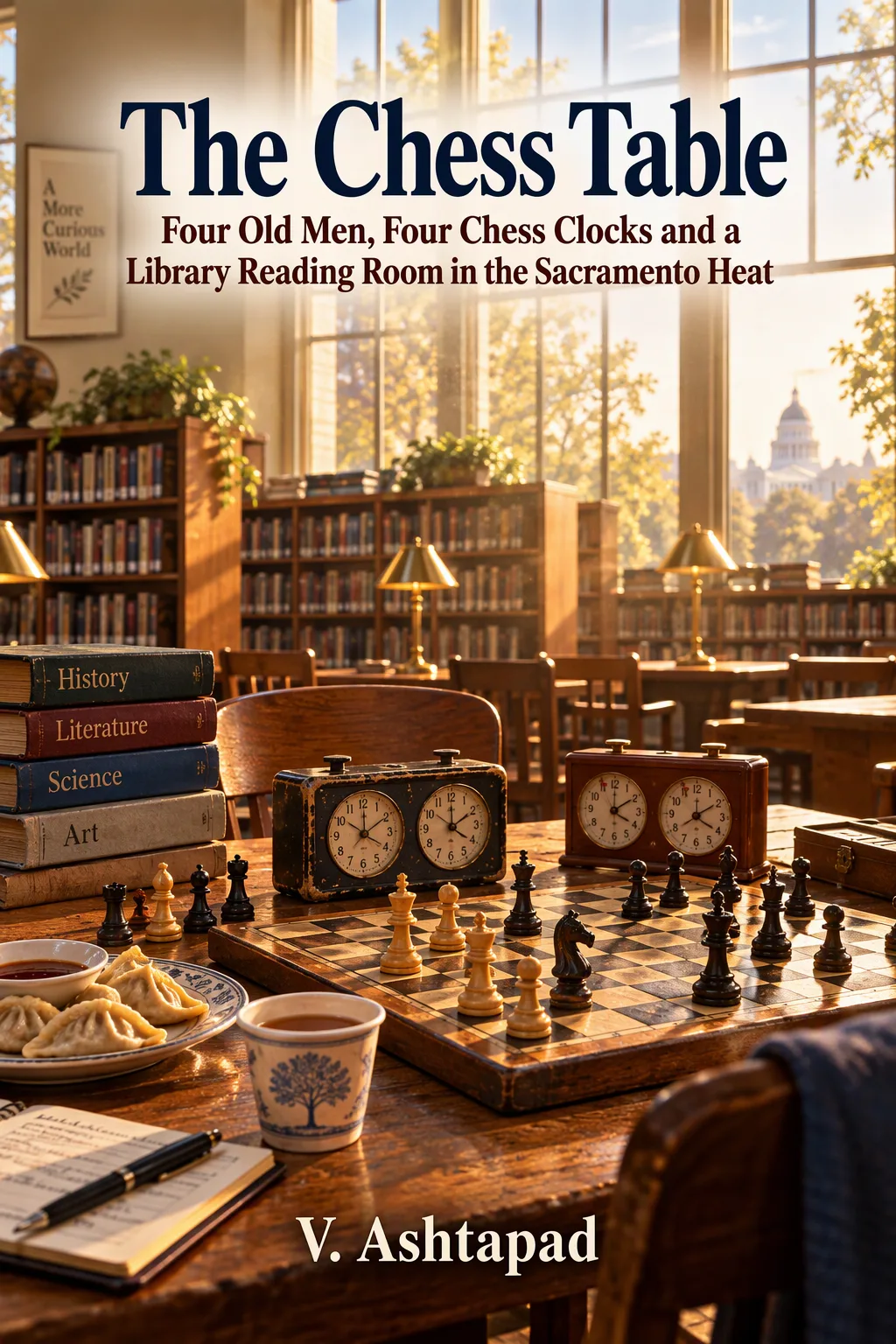
The Chess Table
Four Old Men, Four Chess Clocks and a Library Reading Room in the Sacramento Heat
by V. Ashtapad
Foreword
This is a work of fiction. Sacramento is home to one of the largest Russian- and Ukrainian-speaking communities in the United States, and the afternoon chess game, the pelmeni and varenyky made by the hundred, and the scholastic chess tournament are all real parts of its life. The Willow Slough Branch Library, the Reading Room Rooks, the schools, the tournament and everyone in this book are invented.
For everyone who keeps a chair warm at somebody else's table.
The Opening
There were four chess clocks in the Willow Slough Branch Library, and none of them belonged to the library.
Vera Lysenko knew each one by its sound. Arkady Belov's was a wooden box with two brass plungers, older than the building, and it ticked like a cheap kitchen timer, loud and a little fast. Mykola Hrytsenko's was gray plastic with a cracked face held together by clear tape, and its tick was so soft you had to lean over the board to hear it. Grisha Tkachuk had a digital one that beeped when a flag fell, which the others considered vulgar. Pavel Orlov's clock did not tick at all. It had stopped in 2019, and he set it on the table every afternoon anyway, at four minutes to noon, because, he said, a table without a clock was only a table.
At two in the afternoon on the third Tuesday of August, with the thermometer outside the book return reading a hundred and six, all four clocks were going at once in the reading room, and Vera was standing in the doorway with a printed email in her hand, trying to decide how to tell them.
The reading room was the best room in the branch. Everyone agreed on that, even the people who wanted to take it away. It faced north, so the windows never cooked, and the windows were tall, eight of them, with deep sills where children sat in the winter and where, in the summer, Ray Delgado kept a row of rescued spider plants. Through the glass you could see the parking lot shimmer and the line of valley oaks along the slough and, past them, the flat yellow fields that ran toward the river. Inside, the air conditioning hummed and the long oak tables held their cool, and at the two tables nearest the windows, every afternoon from one until closing, four old men played chess.
They had been doing it for eleven years. Vera had been branch manager for four of them. She had inherited the men along with the leaky skylight and the book sale volunteers, and she had never once considered them a problem.
The email said otherwise. The city's facilities office was reviewing every branch building against what it called "measured community use," and Room B at Willow Slough, which was what the email called the reading room, had the lowest measured use in the system, because nobody in Room B checked anything out. The proposal was to convert it to leased meeting space and a satellite counter for the city's utility billing office. A staff report would go to the facilities review committee on the twelfth of May. The planner assigned to the review would visit in September.
Vera folded the paper in half and then in half again, until it was small enough to fit in her cardigan pocket.
---
"You are standing like a person with bad news," Arkady said without looking up. He was seventy-nine, broad as a door, with white eyebrows that moved on their own, and he played chess the way some men drove, fast and with one hand. "Kolya. Look at her. She is standing like a bishop with no diagonals."
"I am trying to think," said Mykola, who was eighty-one and had been a mathematics teacher in Poltava for thirty-four years and did not like to be called Kolya by anyone but Arkady, which was how everyone knew they were friends. He was thin and neat, and he wore a pressed shirt every day, even in August, with a pen clipped to the pocket. His hand hovered over his knight. It had been hovering for some time.
"Think faster. You are at four minutes."
"I have been at four minutes since 1987."
At the next table Grisha laughed, a big rough laugh, and his digital clock beeped in sympathy. Grisha was the youngest of them at seventy-two, a retired truck mechanic from Uzhhorod who still had grease in the creases of his knuckles twenty years after his last oil change. He played blitz against anyone who would sit down, and since the only person who would sit down was Pavel, he played blitz against Pavel, who was eighty-six and played at the speed of a glacier and beat him two games out of three.
"Vera Olegovna," Pavel said. He was the only one who used her patronymic, the old formal way, her father's name tucked into her own. His voice was thin and hoarse. He had been a chess coach for children in Yaroslavl, on the Volga, for thirty years before he came to California to live with a daughter who had since moved to Oregon without him. "Sit. Whatever it is, it will keep for one game."
"It's not a game kind of thing."
"Everything is a game kind of thing," said Grisha. "Sit."
So she sat, because it was a hundred and six outside, and because these tables were where she thought best. She put the folded paper on the table between the boards, and they all looked at it as if it might move.
She explained, in English, because her Russian was the Russian of a girl who had left Tula at five and her Ukrainian was her mother's kitchen Ukrainian, good for dumplings and scolding. Room B. Measured use. Utility billing. May.
When she finished, Mykola moved his knight.
"Check," he said quietly.
Arkady stared at the board. Then he stared at Vera. "They want our room," he said, "for people to pay their water bill."
"Nobody counts you, because you don't check out books," Vera said.
"Then the system is a fool," Arkady said, and moved his king, and lost a pawn, and swore in a way that made Grisha cover his ears in mock horror.
---
She drove home at six-fifteen with the steering wheel too hot to hold. Her mother's house was in the old part of Rancho Cordova, a low stucco place with a mulberry tree in front and a vegetable garden in back that her mother defended against the heat with shade cloth and stubbornness.
Lyudmila Lysenko was sixty-three and had been widowed for nineteen years, and in that time she had not once made pelmeni for fewer than sixty. When Vera came in through the kitchen door, the counter was white with flour, and her mother was standing over a sheet of dough with a juice glass, cutting circles.
"You look like your father when the car broke," her mother said.
"The city wants the reading room."
"Which city?"
"Our city, Mama. Sacramento."
Her mother put the glass down. Her father had been from Tula and her mother from a village outside Vinnytsia, and in the kitchen where Vera grew up, that had never been anything but a long argument about whether dumplings should be made with pork and beef or with potato and dill. Her father, Oleg, had won the argument for meat and her mother had won it for potato, and so on Sundays there had always been both, pelmeni in one pot and varenyky in the other, and her father had sat at the table with a chessboard set up beside his plate and made Vera find the move before she was allowed dessert.
"The old men," her mother said. "Arkady and the teacher."
"And Grisha and Pavel."
"Pavel with the stopped clock." Her mother knew them all. She had been bringing them food in foil once a month for four years, ever since Vera had told her about the stopped clock. "What will they do?"
"I don't know. Sit at the mall, probably. Sit at home."
"Pavel cannot sit at home. His apartment has no air. He told me. The unit is broken and the landlord says next month, every month." Her mother picked up a spoon and began to set balls of filling on the circles of dough, one, two, three, without looking. "You must fix it."
"I'm a librarian, Mama. I don't fix city budgets."
"Your father," her mother said, "would say, you are not losing. You are only in a bad position."
Vera sat down at the kitchen table, which still had the scorch mark from the night her father had set a pot on it to show her a rook endgame with the salt and pepper shakers. She pressed her thumbs into her eyes. Outside, the swamp cooler on the roof of the neighbor's house rattled and coughed.
"Pinch," her mother said, and slid a sheet of filled circles across the table to her. "While you think. Your hands remember better than your head."
So Vera pinched. Half moon, then the two horns brought around and pressed together, the little ear shape her father used to say was the most Russian thing in the world and her mother used to say was stolen from Siberia anyway. Her hands did remember. By the twentieth dumpling she had stopped thinking about the email. By the fortieth she was thinking about the afternoon in June when a girl had stood at the end of Arkady's table for an hour, silent, watching.
© 2026 CRUNOD LLC. All rights reserved.
The Ledger
The girl's name, it turned out, was Sofia Reyes, she was eleven, and she had been coming to the library every afternoon since June because her family's apartment on Lindale Avenue had one window unit and three brothers.
Vera found her the next day in the children's room, lying on the carpet under the picture-book shelves with a chess book from the 794s open on her chest, reading it upside down.
"You're holding that wrong," Vera said.
"I'm not reading it. I'm looking at the diagrams. They make more sense this way because then I'm Black." Sofia sat up. She had a gap in her front teeth and a ponytail so tight it seemed to lift her eyebrows. "Black always loses in the book. I'm trying to figure out why."
"Do you play?"
"My cousin taught me how the horse moves. That's it. Then he moved to Stockton."
"It's called a knight."
"It looks like a horse."
"It's still called a knight." Vera crouched down. "The men in the reading room. You watch them."
Sofia's face closed like a cupboard. "Am I not allowed?"
"You're allowed. I wanted to ask what you think of them."
Sofia considered this with great seriousness. "The big one cheats," she said finally.
"Arkady? He doesn't cheat."
"He talks while the other one is thinking. That's cheating. And the little one with the broken clock never moves. He just sits there. And then the loud one loses."
Vera laughed out loud in the children's room, and a mother at the puzzle table gave her a look.
---
That afternoon she asked Arkady about the notebook.
She had seen it for four years without asking. It was a green clothbound ledger, the kind bookkeepers used to use, and it lived in Mykola's briefcase and came out at the end of every afternoon. Mykola wrote in it with the pen from his shirt pocket, a single line, and Arkady leaned over to check it, and then the ledger went back into the briefcase.
"The score," Arkady said, as if she had asked what the sun was.
"The score of what?"
"Of everything." He nodded at Mykola, who was setting up the pieces again with small, precise fingers, each one dead center on its square. "Since the first day. November 2014. He was sitting here alone with a book of Botvinnik's games and I said, you are reading about chess in a library like a man reading about swimming in a desert. Play me. So he played me."
"And?"
"And he beat me," Arkady said sourly. "In thirty-one moves. So I said, again. So we have been playing again for eleven years."
Mykola opened the ledger and turned it around so she could see. Columns of dates in his neat teacher's hand. Each line a day, each day a tally: games won by A.B., games won by M.H., games drawn. On the inside back cover he kept the running total, rewritten in pencil and erased so many times the paper had gone soft and fuzzy as felt.
Arkady Belov: 1,402. Mykola Hrytsenko: 1,398. Draws: 611.
"Four games," Vera said. "After eleven years."
"Four games," Mykola agreed. "He had a good spring in 2022. I had cataract surgery."
"That is not my fault," Arkady said. "I offered to wait."
"You offered to wait one week. The eye took six."
"A man cannot stop his life for an eye."
They looked at each other across the board with an expression Vera had seen before on married couples at the reference desk, the ones who came in together to settle bets.
"And when you win four more," she said to Mykola, "it's even."
"When I win five more," Mykola said, "it is mine."
---
Pavel did not keep a ledger. Pavel kept children.
That was how he put it, later, when she asked. Thirty years at a chess club in Yaroslavl, in a building with a cracked marble staircase and radiators that banged all winter, and he could still name every child who had come through his door, or nearly. He named some of them for her, a soft list in his hoarse voice: Tolya with the stutter who saw combinations like a hawk sees mice, Marina who cried at every loss and became a surgeon, the twins whose names he had mixed up for six years until they told him on purpose to stop.
"What I taught them," he said, "was not chess. Chess you can learn from a book. I taught them to sit."
"To sit."
"To sit at a table for three hours with a person they did not like and not leave. To lose and come back Tuesday. To shake hands." He held out his own, spotted and light as paper, and she shook it. "That is the whole thing. The rest is just where the horse goes."
"Knight," Vera said, before she could help it.
Pavel smiled for the first time she could remember. He had two gold teeth on the left side, and they caught the light from the north windows.
"Who told you horse?"
"An eleven-year-old who thinks Arkady cheats."
"He does cheat," Pavel said. "With his mouth. It is the only way he has ever beaten Mykola. Bring me the child."
---
She brought him the child. It took some doing. Sofia did not want to go into the reading room; the reading room was for old people; the old people would yell at her in Russian. Vera said nobody would yell. Sofia said Arkady yelled at Grisha all the time. Vera said that was not yelling, that was friendship, and Sofia looked at her as if she had admitted to something shameful.
But at three-thirty she came and stood at the end of Pavel's table, as she had stood at the end of Arkady's in June, and Pavel did not look up from the board. He set up a position with six pieces. White king, white rook, white pawn; black king, black rook. He turned the board so the white pieces faced the girl.
"White to move," he said. "Win."
Sofia stared. Grisha, at the next table, began to say something, and Pavel lifted one finger without looking, and Grisha closed his mouth.
The clocks ticked. Arkady's loud and fast, Mykola's soft, Pavel's stopped clock with its hands at four minutes to noon. Outside the tall windows the parking lot shimmered, and a man walked to his car with a newspaper held over his head against the sun.
After four minutes Sofia pushed the pawn.
Pavel shook his head, gently, and moved the black rook. "Again," he said, and put the pawn back.
After nine minutes she moved the king.
"Again."
At four-fifteen, Sofia Reyes found the move, which was the rook to the fourth rank, a quiet move that does nothing much except build a wall the black rook cannot get through, the thing chess players call building a bridge. She did not know it had a name. She only knew she had found it, and she looked up at Pavel with her tight ponytail and her gap teeth and her whole face lit.
"Good," Pavel said. "Tuesday."
"What's Tuesday?"
"You come back Tuesday," Pavel said, "and I will show you why it works."
Vera, standing by the spider plants on the windowsill, felt the idea arrive the way the delta breeze arrives in Sacramento on a summer evening, all at once and from the southwest, and so welcome you forget for a minute how hot it was.
© 2026 CRUNOD LLC. All rights reserved.
Development
"No," said Arkady.
"You haven't heard the idea."
"I heard it with my face. You have a face like a person about to ask me to babysit."
"It's a club. Not babysitting."
"A club of children."
"A youth chess club. Tuesdays and Thursdays after school. Here. In this room." Vera spread her hands on the table, carefully, between the boards. It was the first Tuesday of September and the heat had broken to a hundred and one, which in Sacramento felt nearly like mercy. "If the room is full of children learning chess, the city can't call it unused. I can count children. Children sign in. Children have parents who write letters. Children have principals."
"And who will teach these children?"
She looked at him.
"No," Arkady said again.
Grisha was grinning. Mykola had taken off his reading glasses and was polishing them on his shirt, which was what he did when he did not want anyone to see his face. Pavel sat with his hands folded on his cane, looking out the window at the oaks.
"I am seventy-nine years old," Arkady said. "I came to this country to rest. I worked thirty-eight years in a factory on the Volga making parts for tractors. I worked eleven years here driving a forklift in a warehouse in West Sacramento for a man who called me Archie. I have paid for this chair."
"Nobody's taking your chair."
"You are taking my afternoon."
"I'm trying to save it."
That stopped him. He looked down at the board, where he and Mykola were twelve moves into a Sicilian that had turned strange.
"Children talk," he said at last. "They cannot sit."
"Neither can you," said Mykola mildly, and put his glasses back on. "I will do it."
Arkady turned to him as if he had moved a piece illegally.
"I taught for thirty-four years," Mykola said. "I can teach for one more. On Tuesdays and Thursdays." He glanced at Vera. "But not on Mondays. Mondays and Wednesdays and Fridays, I am still playing him."
"Fine," Vera said. "Absolutely."
"And Pavel will teach," Mykola said. It was not a question.
Pavel nodded without turning from the window.
"And I will teach the fast games," said Grisha, "because none of you know how."
They all looked at Arkady.
"I will sit at my table," Arkady said. "And if a child comes to my table, I will play the child. And I will beat the child. That is all I promise."
---
She made a flyer, plain, with a photograph of Pavel's hands setting up the pieces, and under it: WILLOW SLOUGH YOUTH CHESS CLUB. TUESDAYS AND THURSDAYS, 3:30 TO 5:30. FREE. ALL LEVELS. TAUGHT BY MASTERS.
"Masters," said Ray Delgado at the circulation desk. He was sixty, a retired bus driver with opinions on everything printed. He looked at the flyer for a while. "Masters of something," he decided, and pinned it to the community board himself, over a lost-cat notice from April.
She took the rest to the schools: Bell Hollow Middle School, eight blocks east, and Sunflower Park Elementary, where the principal, a tall tired man named Mr. Okafor, found her a box in a closet marked ART — DO NOT USE, with thirty-two roll-up vinyl boards and a sack of plastic pieces missing eleven white kings.
---
On the first Thursday, three children came.
Sofia, who had told everyone at Sunflower Park that she was already in the club and had been there since summer, which was technically true. A boy from Sunflower Park named Theo Tran, ten, small for ten, who wore a shirt with a dinosaur on it and asked, before he was all the way through the door, whether chess had been invented before or after the dinosaurs died, because his brother said before. And a girl named Anya Petrenko, twelve, whose grandmother brought her in by the hand and handed her to Pavel the way you would hand a package to a postman, said something rapid in Russian, and left.
"What did she say?" Vera asked.
"She said the child is very serious," said Pavel, "and does not like to lose, and if she cries I am to give her a candy." He held up a hard candy in a twist of gold paper. "She left me four."
Anya was very serious. She had two long braids and a notebook with a hard cover, and she wrote down every move of every game she played in tiny careful letters. She lost her first game to Sofia, who had learned exactly one trap from Grisha in the hallway and used it, and Anya's chin began to shake and she held it very still and did not cry, and Pavel set the candy on the table beside her hand without a word, and she did not take it.
"I'll take it," said Theo.
"You did not lose," said Pavel.
"I can lose," Theo offered. "Watch."
Mykola taught them how to set up the board, which way it faced, white on the right. He did it the way he must have done it in Poltava for thirty-four years, standing, with his hands behind his back, asking questions and waiting for the answers. Why does the queen go on her own color? Why does the board face this way and not that? What happens if there is no rule? The children answered, wrong and then less wrong, and Vera, sitting at the end of the table with a sign-in sheet on a clipboard, wrote down three names and the time and the date, and drew a box around them, and felt foolish and happy at once.
Arkady sat at his table by the window with his loud wooden clock and read the newspaper and did not once look over.
At five-fifteen, Theo Tran walked up to Arkady's table with a white pawn in his hand.
"Excuse me," he said. "Are you the one who cheats?"
Arkady lowered the newspaper.
The whole room went silent. Even Grisha's clock seemed to hold its beep.
"Who," Arkady said, "told you that?"
Theo pointed at Sofia. Sofia pointed at the ceiling.
Arkady folded the newspaper in quarters and set it down. He moved his king's pawn two squares forward and pressed his clock.
"Sit," he said. "I will show you how it is done."
© 2026 CRUNOD LLC. All rights reserved.
Castling
The heat came back the second week of September, the way it does in the valley, like a houseguest who said goodbye and then stood on the porch for another hour. A hundred and nine on Tuesday. A hundred and eleven on Wednesday, a record for the date. The radio said the delta breeze had stalled somewhere near Suisun Bay and would not be coming.
The branch had extended its hours as a cooling center, and the community room filled with people who had nowhere else: a man with an oxygen tank, two young mothers with babies in carriers, a woman who brought her parakeet in a cage covered with a pillowcase so it would not panic. The reading room filled too. Pavel came at ten in the morning now, when the doors opened, and stayed until they closed at eight, because his apartment's air conditioner was still broken and the landlord still said next month.
"You can't sit here twelve hours a day," Vera told him.
"I am not sitting. I am working." He nodded at the table, where he had set up six positions on six roll-up boards, each with a slip of paper under it. "For Tuesday."
She read one of the slips. In shaky Cyrillic and then, under it, in English printed so carefully it must have taken him an hour: WHITE MOVES. WHERE IS THE KING SAFE?
"Castling," she said.
"Castling. The only move where two pieces move at once. The king goes into his house, and the rook stands at the door." He tapped the board. "Children do not castle. They think the king is strong because he is important. So the king walks around in the middle of the board like a fat man in a market, and he is killed. You must teach them that the most important piece is the one who must be protected."
"Pavel. Have you eaten today?"
He looked at her as if she had asked a question in a language he did not speak.
---
She started bringing two lunches, and her mother started sending three. On the Wednesday of the record heat Grisha came in with a bag of gas-station ice on his shoulder and filled the staff freezer with it. He had been to Pavel's apartment that morning. Ninety-four degrees at seven o'clock, he said, and an eighty-six-year-old man sleeping in the bathtub because the tile was cool. The landlord had threatened to call the police if an unlicensed mechanic touched the unit. Vera called the city housing code office, and then a woman she had once helped find a book on Victorian wallpaper who now worked for a tenants' rights clinic, and then her mother.
---
The club grew in the heat. That was the strange thing. Children came for the air conditioning and stayed for the chess, or came for the chess and stayed because it was a hundred and nine outside and the reading room was seventy-two. By the third Thursday there were eleven names on Vera's clipboard.
Two of them mattered more than the others, though she did not know that yet.
The first was Danylo Melnyk, thirteen, an eighth grader at Bell Hollow, who did not come to the club at all, at first. He had been coming to the library since spring, every afternoon, to the public computers by the magazine racks, where he played chess online against strangers for two hours without moving anything but his right hand.
She stood behind him one afternoon in the third week, and watched, and saw that he was playing three games at once in three windows, one-minute games, and winning all of them.
"There's a club," she said. "In the reading room. Real boards."
He did not turn around. "I know. I saw the flyer."
"You could come."
"I don't really like people," Danylo said, with a perfect lack of rudeness, as if he were telling her his shoe size.
"These are old people. That's different."
He did turn around then. He had a thin face and a lot of dark hair that fell into his eyes, and he looked tired, the kind of tired children shouldn't be. "My grandfather played," he said. "In Chernivtsi. My dad says. I never met him."
"Mykola is from Poltava," Vera said. "He taught math."
"I hate math."
"He'll love that."
---
The second was Marcus Holloway, fourteen, also an eighth grader at Bell Hollow, who came to the library because his mother worked double shifts at a nursing home in Carmichael and had told him that if he went anywhere after school but the library, she would know, and he would find out how she knew.
Marcus did not want to be in a chess club. He wanted to sit in the beanbag chair in the teen corner with his headphones on and watch videos of people repairing old bicycles, and he told Vera so, politely.
"Fine," Vera said. "Can you do me a favor, though? Pavel needs someone to carry the boards."
"He can't carry them?"
"He's eighty-six."
Marcus looked through the reading room door, where Pavel was sitting with his cane between his knees, waiting for the club to begin, his hands on the head of it. Marcus took off his headphones and went in and picked up the box of roll-up boards from beside Pavel's chair.
"Where do you want them?"
"Unroll them," said Pavel. "Eleven tables. White on the right."
Marcus unrolled them. Then, because Pavel asked, he set up the pieces on all eleven. He did it fast and without mistakes, queens on their colors, kings beside them, and Pavel watched him over the top of his glasses.
"You know how the pieces go."
"My uncle had a board. In Oak Park. Before he moved."
"Everyone in this city has a cousin or an uncle with a board who moved," said Pavel. "Sit. One game."
"I'm not in the club."
"One game is not a club. One game is one game."
Marcus sat. He played badly and fast, the way boys play who learned from an uncle and never had a teacher, all attack and no house for the king. Pavel let him attack. He castled early and waited. When Marcus's queen had wandered all the way across the board looking for something to eat, Pavel brought one quiet rook to the open file and trapped her.
Marcus stared at the board for a long time.
"How did you know I'd do that?"
"Because everyone does that," Pavel said. "For thirty years in Yaroslavl, every boy who ever sat at my table did that. The queen is strong, so the boy thinks she must go and do something. But she is like a mother. She is the most powerful one in the house, so she is the one everyone is trying to catch."
Marcus thought of something then, Vera could see it, and his face changed, and he looked down at the board and did not say what it was.
"Again," he said.
"Tuesday," said Pavel. "Now carry the boards."
---
On the last Tuesday of September, the delta breeze came back. Vera felt it at six o'clock in the evening in the parking lot, a cool hand on the back of her neck. The oaks along the slough began to move. Somewhere toward the river a sprinkler ticked.
Pavel's air conditioner had been fixed that morning by a licensed technician sent by the code office, after a letter from the tenants' clinic and four calls from Vera and, she suspected, one call from Grisha that nobody would describe to her. Pavel did not mention it. He arrived at one o'clock instead of ten, which was how she knew.
She stood in the reading room door at five-twenty and counted. Fourteen children at eleven tables. Mykola standing with his hands behind his back. Grisha teaching three boys the fastest checkmate in chess and then, when they got it, the second fastest. Pavel with Marcus, castling. Danylo at the far end with Anya, the two of them playing in absolute silence, Anya writing every move in her notebook, Danylo watching her write as if it were the strangest thing he had ever seen.
And at the window table, Arkady Belov, playing Sofia Reyes and Theo Tran at once, one board on each side of him, talking the entire time.
"You see this? You see what I am doing? This is called development. In my factory we called it getting your tools out of the box. A man who works with his tools still in the box is a man who will go home with nothing made. You. Dinosaur. Your bishop has been in his box for nine moves. Is he sleeping? Is he sick?"
"He's thinking," said Theo.
"He is hiding," said Arkady. "Bring him out. Bring him out and give him a job."
Sofia, at the other board, quietly took his rook.
Arkady stopped talking.
Vera wrote the number fourteen on her clipboard and drew a box around it and then, after a moment, drew a second box around the first one.
© 2026 CRUNOD LLC. All rights reserved.
Touch-Move
The planner's name was Dana Whitcomb, and she came on the first Thursday of October with a laser measure clipped to her belt and a tablet in a rubber case, and she was, to Vera's private disappointment, perfectly nice.
She was in her forties, with reading glasses pushed up into short gray hair and the slightly harried look of someone who had eleven branch buildings on her list and a dentist appointment at five. She measured Room B from wall to wall, twice. She photographed the windows. She asked how old the air handler was, and Ray told her, and she winced.
Then she stood in the doorway at four o'clock and looked at the club.
There were nineteen children that Thursday. Vera had counted twice. The roll-up boards covered every table, and the sound in the room was the sound of a school cafeteria crossed with a train station, children arguing in whispers, clocks ticking and beeping, Grisha's laugh, Arkady's voice rising over all of it like a man selling melons.
"Touch-move!" Arkady was saying to Theo Tran. "You touched him. Now you must move him. This is the law."
"I didn't mean to touch him. I was fixing him. He was crooked."
"Then you say 'I adjust.' Before you touch. You say it like a gentleman. You do not grab the knight and then say oh, I was fixing him. Every crook in history was fixing something."
Dana Whitcomb laughed, a short surprised laugh, and covered her mouth.
Afterward, in Vera's office, which was a former supply closet with a window the size of a paperback, she was frank.
"It's lovely," she said. "It really is. My son played in middle school. But I have to be straight with you about how the review works. Measured use is calculated across open hours. You're open fifty-five hours a week. The club meets four. Even if every chair is full for those four, the room's still sitting at a fraction of its capacity the rest of the week. The men count, I know, but there are four of them."
"They're here every day."
"And I believe you. But there are four of them in a room rated for sixty." Dana looked at her tablet, then put it face down on the desk, which Vera thought was a kind thing to do. "I'm not your enemy here. The utility office needs a counter north of the river; people out here drive forty minutes to dispute a bill. That's a real need too. What I can do is write what I see. If what I see in April is different from what I see now, I'll write that."
"What would different look like?"
Dana thought. "Use that isn't just Tuesday and Thursday. Use that comes from the neighborhood and serves it. Use that somebody outside this building would notice if it went away." She stood and unclipped the laser measure and turned it over in her hand. "Honestly? If those kids did something people heard about, it wouldn't hurt."
---
The club entered its first tournament on the eighteenth of October, a Saturday, a scholastic open in the cafeteria of a high school in Elk Grove. It was Mykola's idea. "They must learn to lose to strangers," he said. "Losing to us is not losing. It is homework."
They took nine children in three cars, Vera's and Grisha's and Anya Petrenko's grandmother's, who drove a long brown sedan with lace doilies on the headrests and did not exceed fifty miles an hour on the freeway under any circumstances. Arkady rode with Vera and complained about the air conditioning. Pavel stayed home; the drive, he said, was longer than his patience.
The cafeteria smelled of floor wax and burnt coffee. There were two hundred children and two hundred parents and long folding tables marked with numbered tents, and real tournament clocks, and adults in matching polo shirts carrying clipboards. A team from a private school in the foothills, Larkspur Hills Academy, had a banner, and a coach with a lanyard, and identical navy hoodies with a gold rook on the back.
Vera's children looked at the hoodies and then at each other. They were wearing whatever they had worn to school on Friday. Theo had the dinosaur shirt. Marcus had come in a sweatshirt with the hood up and would not take it down.
They lost. They lost nearly everything. Sofia won one game out of five and drew another. Theo won one, against a kindergartner who cried. Danylo won three, playing too fast, slamming his clock as if it had insulted him, and lost two to Larkspur Hills players who sat back and waited for him to overreach, the way Pavel had waited for Marcus. Marcus won one and lost four and spent the lunch break sitting alone on the bleachers in the gym next door with his headphones in.
Anya lost all five.
Vera found her after the fourth round in the girls' bathroom, sitting on the closed lid of a toilet in the far stall, her notebook in her lap. She could hear her breathing through the door.
"Anya."
"Go away, please."
"Okay." Vera sat down on the cool tile floor with her back against the stall, which was not, she thought, something a branch manager of a public library did. Under the door she could see Anya's sneakers, one lace untied. "I'm not going away. But I'll be quiet."
They sat. A toilet ran somewhere. Over the speakers in the cafeteria someone announced the pairings for round five.
"I wrote down every move," Anya said finally. "I know exactly where I lost. Every time. I can see it. Move nineteen. Move twenty-three. Move fourteen. It's in the notebook. I can see it, and I still did it."
"That's the worst part," Vera said. "Seeing it afterward."
"Did you play?"
Vera looked at the ceiling. A water stain shaped like a bird. "My dad taught me. I played until I was fifteen. I was pretty good. I was going to play in the state championship the year I was fifteen."
"What happened?"
"My dad got sick," Vera said. "And then he died. And I didn't want to look at a board after that. It was his thing, you know? I didn't want it to be just mine."
Anya was quiet. Then the stall door unlatched and swung open a few inches, and Anya looked down at her through it, red-eyed and solemn, her two braids over her shoulders.
"That's sadder than losing five games," she said.
"It's a different kind of sad."
"You could play again."
"Maybe," Vera said. "Come on. Round five. If you lose, you lose to a stranger. That's homework."
Anya lost round five. But she lost it at move forty-one, not move fourteen, and she shook hands with the boy who beat her, a Larkspur Hills boy two years older, and said "good game" in a clear voice, and wrote it all down.
© 2026 CRUNOD LLC. All rights reserved.
Zugzwang
On the twenty-first of October, a Tuesday, in the middle of the club, Pavel Orlov stood up to show Marcus a rook ending on the big demonstration board on the wall, and lifted his hand to move the white king, and put his other hand flat on the table, and sat down again very slowly, and did not get up.
Vera was across the room. What she heard, later, when she thought about it, was the room going quiet, nineteen children and three old men going quiet from the far end first, the way water goes still in a pond when a stone has sunk.
Then Grisha's chair went over backward.
Then Marcus was standing beside Pavel holding his shoulders, saying, "Mr. Pavel, Mr. Pavel," and Arkady was on his knees on the carpet with his big hands around Pavel's wrist, feeling for the pulse, and Mykola was shepherding the children toward the door with his arms out like a man herding geese, saying calmly, "Out, out, into the hall, it is fine, everyone into the hall," and Vera was on the phone to the emergency line with the cord of the desk phone stretched all the way across the circulation counter, giving the address and spelling Pavel's name.
The paramedics came in seven minutes. Ray timed it. He timed everything; it was the bus driver in him. Seven minutes and twenty seconds, and in that time Pavel opened his eyes and looked at Marcus and said, quite clearly, "The king goes to the side. Not in front. Remember." And then he closed them again.
---
It was his heart. A blockage, the cardiologist said, at the medical center on Stockton Boulevard, past midnight, in a hallway with buzzing lights. They would put in a stent in the morning. He was stable. He was eighty-six. Was Vera family?
"No," she said. "Yes. He doesn't have anyone here."
"There's a daughter in the chart. In Medford, Oregon."
"I called her. She's coming Thursday. She can't get off work before."
The cardiologist nodded and wrote something. He was young and very tired. "Then for now," he said, "you're who he has."
She went out to the waiting room. Arkady was there, asleep sitting up in a molded plastic chair with his chin on his chest, his coat over his knees. Grisha had gone home at ten to feed Pavel's cat, a gray tom with one ear named Botvinnik, whom none of them had known existed until Grisha found the key on Pavel's ring and drove to the apartment. Mykola had gone home at eleven because his wife, Halyna, did not drive at night, but he had left a thermos of tea on the chair beside Arkady and a paper bag with two hard-boiled eggs and a heel of black bread.
Vera sat down next to Arkady. He woke up.
"Well?"
"A stent tomorrow. He's stable."
Arkady let his head fall back against the wall. He closed his eyes. His eyebrows, for once, were still.
"In 1971," he said, "my brother had a heart attack at forty. On the factory floor. They carried him out on a door, because there was no stretcher. A door. He lived to sixty-eight." He opened his eyes. "Pavel will be fine. He is too stubborn to die in a hospital. He will die at a chess table like a gentleman, at a hundred and four, in the middle of a game he is winning."
"Is that how you want to go?"
"I want to go at a hundred and five," said Arkady, "in the middle of a game against Kolya, and I want to win it, so that he must write it in the ledger himself."
---
The stent went in on Wednesday. Pavel's daughter, Irina, came on Thursday, a small anxious woman in her fifties with her father's gold-toothed smile and none of his patience, and stayed four days, and spoke to doctors and social workers, and cried in the parking lot, and went back to Medford because her husband had his own surgery the following week.
What was decided, in those four days, was that Pavel could not go home alone. Not yet. He would go to a skilled nursing and rehabilitation center in Carmichael for three weeks, maybe four, and learn to walk again with a walker, and then the social worker would see.
The rehabilitation center in Carmichael was the one where Marcus Holloway's mother worked double shifts.
Marcus told Vera this on the Thursday club, the first one without Pavel, standing at the circulation desk with his hood up and his hands in his sweatshirt pocket. He told it to the counter, not to her.
"My mom says he's on her wing. Second floor. She does nights, mostly."
"That's good. That's really good, Marcus."
"She says he asked for a chessboard and they gave him checkers." Marcus looked up at last. His eyes were furious. "Checkers."
"We'll take him one."
"I already took him one," said Marcus. "Yesterday. I got a ride with my mom." He hesitated. "He made me play the rook ending. The one from the wall. He said I still have the king in front."
---
On the following Monday, Vera found Arkady and Mykola at their table at one o'clock, not playing. The pieces were set up. The ledger was open. Neither man had moved.
"What's wrong?"
"Zugzwang," said Mykola.
She knew the word. Her father had taught it to her with the salt and pepper shakers. A German word that chess had borrowed and kept: a position where you would give anything not to move, because every move makes it worse, and still you must move, because it is your turn and those are the rules.
"Whose?"
"Ours," said Arkady. He gestured at the empty chair at the next table, Pavel's chair, with his stopped clock still sitting at four minutes to noon in front of it. Grisha had refused to put it away. "If we play, it is as though nothing happened. If we do not play, it is as though something happened."
"Something did happen."
"Yes," said Mykola. "That is the zugzwang."
Vera sat down in Pavel's chair. She had never sat in it. It was harder than it looked; the seat had been worn into a shape that was not hers.
"He told Marcus to keep the king to the side," she said. "In the rook ending. Before the paramedics came. It was the last thing he said for an hour."
Arkady stared at her.
"So I think," Vera said, "he'd want you to move."
Mykola looked at the board for a long moment. Then he picked up his king's pawn and moved it two squares and pressed his clock, the soft gray one with the tape, and it began its small tick.
"In the ledger," he said to Arkady, without looking up, "today counts double."
"It does not."
"For him it counts double."
Arkady glared, and his eyebrows came alive again, and he brought out his knight with a bang that made a woman in the periodicals look up.
© 2026 CRUNOD LLC. All rights reserved.
Forks and Pins
By November the club had twenty-two children on the clipboard, and Mykola had divided them, the way he must once have divided a classroom, into what he called pairs and what Grisha called marriages.
The pairs were Mykola's genius, though he would never have called it that. He gave each child a grown-up, not for every game but for every week: the person who would look over their notebooks and tell them the truth. Sofia got Arkady, because, Mykola said, two people who talk too much must be put in the same box so they can wear each other down. Theo got Grisha, who taught him blitz and engine repair simultaneously and with roughly equal care. Danylo got Mykola himself.
Marcus got Pavel, on Mondays and Wednesdays, at the rehabilitation center in Carmichael, by arrangement with Marcus's mother and the nursing staff and a social worker who said she had never seen anything like it and wanted to put it in the newsletter.
And Anya Petrenko got Vera.
"I don't coach," Vera said.
"You played until fifteen," said Mykola. "Anya told me. And she wants you."
"I haven't played in nineteen years."
"Then you will be very bad," said Mykola, "and she will beat you, and it will be good for both of you."
---
It was very bad. The first Tuesday, Anya won in twenty-two moves with a bishop sacrifice Vera should have seen from across the room. The second Tuesday, in thirty. The third Tuesday, Vera found herself in the middle of the game with her hand over her queen, unable to move, and she realized she was not thinking about the queen at all. She was smelling cigarette smoke and pepper. She was nine years old at the kitchen table in Rancho Cordova with her father across from her in his undershirt, a glass of tea at his elbow, the pepper shaker standing in for a rook he had lost under the stove. Find the move, Verochka. You can have dessert when you find it.
"Ms. Lysenko?"
She looked up. Anya was watching her, notebook open, pencil still.
"Sorry," Vera said. "I was somewhere else."
"Where?"
"My dad's kitchen."
Anya looked at the board, then back up at her. "Was he good?"
"He was terrible," Vera said, and found she was laughing. "He was so bad. He used to lose to me on purpose and then pretend he didn't, and I always knew, and I always pretended I didn't know. And then one day when I was twelve I beat him for real and he didn't speak to me for the rest of the evening. He was so proud he couldn't talk."
Anya smiled, which was rare. She had a small, crooked, private smile.
"Move your queen," she said. "I'm going to fork it anyway."
---
Danylo's marriage was harder.
He came every Tuesday and Thursday now, and he sat across from Mykola, and they played what Mykola called slow chess, an hour on each clock, and Danylo hated it. He fidgeted. He bounced his knee so hard the table shook. He moved his hand toward a piece and pulled it back and moved it toward another. After fifteen minutes of a game in which he had made six moves he said, "This is so boring I think I'm going to die."
"Good," said Mykola.
"How is that good?"
"Because you are thinking. Thinking is boring. That is how you know you are doing it." Mykola sat with his hands folded on the table, perfectly still, as if he could do this all night. "On the computer you play one minute. In one minute you do not think. You see. Seeing is fast and it is wonderful and you are better at it than me. But at the end of the game, the boy who thinks beats the boy who sees."
"You sound like my dad."
"What does your father do?"
"He drives a truck. Long haul. He's gone, like, three weeks at a time. Then he's home four days and he sleeps for two of them." Danylo looked down at the board. "My mom works at the hospital in the kitchen. My grandma lives with us, but she's sick. She doesn't really get out of bed. So I come here."
Mykola said nothing for a while. Then he reached across and moved Danylo's bishop back to where it had been three moves earlier.
"Hey—"
"You moved it there too fast. Take it back. Think. Take your time. I am not going anywhere."
"Isn't that against the rules?"
"In a tournament, yes. Here, at this table, it is the rule." Mykola leaned back. "I taught mathematics to children for thirty-four years. Do you know what I learned? Every child who said he hated mathematics was a child who had been rushed once and never forgiven it."
Danylo stared at him. Then, slowly, as if testing the ice, he put his elbows on the table and his chin in his hands and looked at the board. His knee stopped bouncing.
He took eleven minutes over the next move. It was a good move.
---
Grisha, it turned out, knew Danylo's father. Or knew of him. The Slavic community north of the river was large but not that large, and the truck mechanics and the truck drivers drank coffee at the same gas stations at four in the morning.
"Taras Melnyk," Grisha said. "Drives for a produce company out of West Sacramento. Good driver. Bad back. His truck has a bad fuel injector. I told him in the spring. He has not fixed it."
"Can you?"
"I can fix anything with an engine," said Grisha.
The following Saturday, Grisha drove to the Melnyks' apartment complex in North Highlands with his toolbox and spent four hours under the hood of Taras Melnyk's truck while Taras, home on his four days, held the work light. Theo announced it to the whole Thursday club, standing on a chair: Mr. Grisha had fixed Danny's dad's truck and afterward they ate soup and Danny's dad cried.
"He did not cry," said Danylo, red to the ears. "He had something in his eye. It was from the engine."
"Engines," said Grisha solemnly, "are very dusty."
---
Dana Whitcomb came back on the third Tuesday of November, unannounced. She stood in the doorway at four-fifteen and counted twenty-two children, and looked at the sign-in sheet for the new Saturday family session, and then watched Theo Tran lose to Grisha's blitz in nineteen moves and laugh so hard he slid off his chair.
"My son quit when he was twelve," Dana said. "He said it was too lonely. Everybody just sitting there."
"This isn't lonely."
"No," said Dana. "It really isn't."
© 2026 CRUNOD LLC. All rights reserved.
Pelmeni
The pelmeni party was Lyudmila's idea, and like all her ideas it arrived fully formed and could not be argued with.
"The Saturday before Christmas," she announced on the phone. "My house. Everyone. The children, the parents, the old men. We make pelmeni and varenyky, and everyone takes home a bag for the freezer, and the club is a family. This is how it is done."
"Mama, that's sixty people."
"I have made pelmeni for sixty people since you were in diapers. Bring folding chairs."
So on the twentieth of December, a Saturday, under a low white sky with the tule fog sitting on the fields east of town like milk in a saucer, sixty-one people came to the low stucco house with the mulberry tree, and the kitchen table and the dining table and two folding tables borrowed from the library were covered edge to edge with flour.
---
Lyudmila ran it like a factory floor. Arkady said so, approvingly. Dough rested under damp towels in three bowls. The meat filling, pork and beef with onion and black pepper, sat in her largest steel pot, and the potato filling, with fried onion and dill and farmer's cheese, in the next. Her one wooden rolling pin, worn pale in the middle by forty years of hands, nobody touched but her.
"Children," she said, clapping flour from her palms, "on this table you pinch. Like so." She held up a circle of dough, set a ball of meat in the middle, folded it into a half moon, sealed the edge with three quick presses of her thumb, then brought the two corners around and pressed them together. A small round ear sat in her palm. "Pelmen. One. You make a hundred, you can sit down."
"A hundred?" said Theo.
"Each."
There was an outcry. Lyudmila ignored it.
"And on this table," she said, moving down the line, "the varenyky. Bigger. Potato. You fold, you seal, you crimp the edge like this, like a little rope. No ears. A varenyk does not need ears. It is a dignified dumpling."
"It is a lazy dumpling," said Arkady from the meat table.
"Says the man from Samara," said Mykola from the potato table, without looking up, "where they put ears on everything because they cannot think what else to do with their hands."
"In Samara we invented the dumpling."
"In Samara you invented sitting down while other people work."
"Gentlemen," said Lyudmila, "a hundred each."
---
They made eleven hundred and forty dumplings in four hours; Ray Delgado counted. His wife, Lupe, who had made tamales with her sisters every Christmas Eve for fifty years, could fold a varenyk faster than Lyudmila on her first try, which caused Lyudmila to go quiet with respect and then to ask, very seriously, about masa.
Pavel came. That was the thing everyone talked about, afterward. He had been released from the rehabilitation center on the ninth of December with a walker and a home aide who came four hours a day, and he had not left his apartment since, and at two o'clock that Saturday Marcus Holloway's mother pulled up to the curb in her old minivan, on her one day off in eleven, with Pavel in the passenger seat and Marcus in the back holding the walker.
He came up the front path very slowly between Marcus and Grisha, with the whole party crowded at the windows, and when he got to the door Lyudmila met him there with flour to her elbows and kissed him on both cheeks, and he said, in his hoarse voice, "Lyudmila Ivanovna, you have saved my life with your cabbage pies four times this year. I am here to repay with labor."
"Sit," said Lyudmila. "You pinch."
He sat at the head of the potato table and pinched varenyky for two hours, slowly and perfectly, his old spotted hands as sure with the dough as they were with a rook. Danylo sat on his right and Anya on his left, and neither of them, Vera noticed, spoke to him much. They just pinched beside him, close, as if he were a stove.
---
Lyudmila boiled the first batch at five, in two pots, a hundred at a time, and when they floated she lifted them out with a slotted spoon into deep bowls with melted butter and sour cream and black pepper, and dill for the varenyky, and fried onions for anyone who wanted them, which was everyone.
"Who has the lucky one?" she called out. "I put one peppercorn whole in one pelmen in this batch. Whoever finds it has luck all year."
There was a pause while sixty-one people chewed with sudden great care.
Then Sofia Reyes said, "Ow," and spat into her palm, and held up one black peppercorn between finger and thumb, and the room shouted.
"Luck all year!" said Lyudmila.
"I bit it," said Sofia, eyes watering. "It's so spicy."
"Luck," said Arkady, "is always spicy. This is the first thing you learn."
---
After the bowls and the second batch and the third, after the dumplings were bagged in sixty freezer bags with names in marker, after the children had run out into the dark backyard to see the vegetable garden in its winter rows, Vera found her mother sitting alone at the scorched kitchen table with a cup of tea.
"You're tired," Vera said.
"I am happy," said Lyudmila. "It looks the same at my age." She turned the cup in her hands. "Your father would have liked this. All these people. All this noise."
"He'd have made the kids find the move before dessert."
"He made you find the move because he could not find it himself," her mother said. "Did you know that? He looked it up in a book the night before. He kept a book in the bathroom. Every Saturday night he would sit in there with the book and the next day he would set up the position for you like he had invented it."
Vera stared at her.
"He was a terrible chess player," her mother said. "He was a wonderful father. Sometimes it is the same thing."
Through the window over the sink, Vera could see the backyard in the porch light, children running between the rows of winter cabbage, and Pavel sitting on the back step in his coat with Marcus beside him, a roll-up board on the concrete between them. Pavel pointed at something on the board. Marcus moved a piece. Pavel shook his head and moved it back, and Marcus laughed, and his laugh carried through the glass.
"The children named it," Vera said. "The club. They voted on the drive over. The Reading Room Rooks."
"Rooks," said her mother. "Like the birds?"
"Like the castles. The pieces at the corners. The ones that guard the house."
Her mother considered this, drinking her tea.
"Good," she said. "A house needs guards."
© 2026 CRUNOD LLC. All rights reserved.
En Passant
The Sacramento Valley regional qualifier for the California Golden Poppy Scholastic Chess Championship was held on the twenty-fourth of January, a Saturday, in the gymnasium of a high school in Roseville, and it was cold. Not cold the way the old men remembered cold, Arkady said, not cold that froze the spit before it reached the ground. But the valley in January had its own cold, damp and gray and seeping, and the gym's heating system was older than Grisha, and the children played in their coats.
The format was printed in a packet Mykola had studied for two weeks as if it were a contract. Each team entered five players. Each player played five rounds. The team's score was the total of its top four players. The top three teams in each section went to the state championship in Fresno, in April.
The Reading Room Rooks entered the club section for kindergarten through eighth grade. So did eleven other teams, including, at the far end of the gym under a new banner, Larkspur Hills Academy.
"Ignore the hoodies," Mykola said, in the car. "A hoodie does not move a piece."
The children wore T-shirts. Lupe Delgado had made them at her niece's print shop, with the rooks painted by Sofia on poster board and photographed by Ray: a black castle with a crooked tower and, because Theo had insisted, a very small dinosaur peeking over the top. The shirts were gray. They were the only gray shirts in the gym. They were, in Vera's opinion, the most beautiful shirts she had ever seen.
They wore them over their coats.
---
Mykola had set the board order the night before, at his kitchen table, with his wife Halyna holding the lamp. Danylo on board one. Marcus on board two. Anya on board three. Sofia on board four. Theo on board five, as the alternate whose score would count only if it was better than someone else's.
"I'll be the one that doesn't count," Theo had said, philosophically.
"Everyone counts," said Mykola. "Some count later."
Round one they won three games and lost two. Round two, four and one. Danylo was playing slow, the way Mykola had taught him, sitting with his chin in his hands and his knee still, and the boys he played kept looking at him across the board with growing alarm, because they had all played the fast boy at the October open and this was not that boy.
At lunch, Vera did the math on the back of an envelope and then did it again. After two rounds the Rooks were in fourth place, a half point behind a team from Davis, three points behind Larkspur Hills.
"Fourth goes home," said Grisha.
"Fourth goes home," Vera agreed.
---
Round four was where it happened, and it happened to Theo.
He was playing a girl from Davis, a fourth grader with glasses held on by an elastic band, and he was losing. Vera could see it from the spectator rope, which was as close as coaches were allowed to come. He was down a knight. His king was still in the middle of the board, out in the open with no house, exactly as Pavel had warned.
Then the Davis girl pushed her pawn two squares, past Theo's pawn on the fifth rank, to stand beside it.
Theo stared at it. He looked up at the ceiling, which was what he did when he was remembering something. Then he reached out and took the Davis girl's pawn with his own, diagonally, moving his pawn to the empty square behind where hers had landed, and lifted her pawn off the board.
The Davis girl's mouth fell open. She raised her hand for the arbiter.
The arbiter, a large patient man with a whistle around his neck that he had clearly never used, came and looked at the board and listened to the Davis girl and then to Theo.
"En passant," Theo said. "In passing. It's a real rule. When a pawn goes two squares to get past you, you can take it like it only went one. But only right away. Mr. Grisha said it's the weirdest rule in chess and nobody believes it, so you have to know it."
The arbiter nodded slowly. "It's legal," he told the Davis girl kindly. "He's right."
En passant opened the file. Through the open file came Theo's rook. Eleven moves later the Davis girl, fair and stunned, tipped her king over and shook his hand, and Theo walked back to the spectator rope in his gray shirt over his coat with the small dinosaur on it, and when he reached Grisha he threw his arms around the old mechanic's waist and held on.
"Weirdest rule," Grisha said, his voice thick. "The weirdest. Nobody believes it."
---
After round five the Rooks finished second, a point and a half behind Larkspur Hills and a half point ahead of Davis. Marcus won his last game in a rook ending, keeping his king to the side, building his bridge on the fourth rank, his hood down for the first time anyone could remember. Danylo drew with the Larkspur Hills board one, a tall calm boy named Elliot Shah who was rated three hundred points above him and who, at the end, shook his hand and said, "That was the best game I've played this year," and meant it.
In the parking lot, in the early dark, with the cold coming up off the asphalt and the children screaming in the cars, Vera called Pavel.
He answered on the first ring.
"Well?"
"Second," she said. "We're going to Fresno."
There was a long silence on the line. She heard his breathing, thin and hoarse, and behind it the small sound of a television and a cat complaining.
"Tell Marcus," Pavel said at last. "Tell him I said the king went to the side."
"He kept it there the whole game."
"I know," said Pavel. "I could feel it."
© 2026 CRUNOD LLC. All rights reserved.
Sacrifice
In February Danylo stopped coming.
He missed a Tuesday, then a Thursday, then another Tuesday. He did not come to the computers by the magazine racks either. Vera called the number on his sign-in form and got a voice mailbox that was full.
"His grandmother," Grisha said, on the second Thursday. He had heard it at the gas station at four in the morning. "Olena. Pneumonia. The father is on a run to Idaho until Saturday. The boy is sitting in the hospital after school."
Before anyone could go to him, the old men had their quarrel.
It began, as their quarrels always did, over a chessboard, and it began as a joke. Arkady had been looking over Danylo's notebook from the regional, the games Mykola had made him write down, and he had come to the opening Danylo played as White in every game, the quiet one, the one Mykola had taught him, where the pawns move up a square at a time and the pieces come out to safe squares and nothing happens for twenty moves.
"This," Arkady said, holding the notebook up between two fingers as if it smelled, "is an opening for a tax accountant."
"It is an opening for a boy who plays too fast," said Mykola.
"It is an opening for a boy who is afraid. He is not afraid. He is thirteen. When I was thirteen I played the King's Gambit against my own grandfather. I gave him a pawn on move two. Free. Here, Grandfather, take it. And then I came for his king like a train."
"And did you win?"
"I lost," said Arkady. "But I lost like a man."
"You lost like a boy who did not know that the pawn was the whole game," said Mykola. His voice was quiet, but it had an edge on it Vera had never heard, a thin hard edge like a ruler laid on its side. "Danylo has spent his whole life giving things away fast. His father gives him three weeks and takes them back. His grandmother is dying in a hospital bed. He does not need you to teach him to give away a pawn on move two and pray. He needs somebody to teach him what to keep."
The room went still. Even the children at the far tables looked up.
Arkady put the notebook down very carefully, as if it had become heavy.
"You think I do not know about his grandmother," he said.
"I think," said Mykola, "you would turn a funeral into a gambit if somebody let you."
Arkady stood up. He was a big man still, and when he stood, his chair scraped back across the floor with a sound like a saw.
He picked up his wooden clock. He put on his coat. He walked out of the reading room past the spider plants and past the circulation desk, where Ray Delgado watched him go with his mouth open, and out through the front doors into the gray February afternoon.
Mykola sat for a long moment. Then he closed the ledger and put it in his briefcase without writing anything in it.
It was, Vera realized, the first day in eleven years with no line.
---
Arkady did not come on Friday, or Monday. On Tuesday Mykola sat across from an empty chair for an hour and then taught the club, perfectly, in a voice as flat as a sheet of paper.
On Wednesday Vera drove to Arkady's apartment, a second-floor place in Citrus Heights with a balcony full of tomato cages and a view of a parking lot. He opened the door in a cardigan with a hole in the elbow.
"I know why you are here."
"I brought pelmeni from the Christmas batch," she said, and held up the freezer bag. "My mother insists."
He let her in. The apartment was small and very clean. On the wall over the couch hung a framed photograph of a young man in work overalls in front of a tractor the size of a house, squinting into the sun, and next to it, a framed photograph of a woman with a long braid laughing at whoever held the camera.
"Galina," Arkady said, seeing her look. "Twenty-two years gone. She would have liked you. She liked anyone who argued with me."
He boiled the pelmeni in a small dented pot and they ate them at his kitchen table with butter and black pepper. He did not speak until his plate was empty.
"He is right," Arkady said then. "Kolya. About the boy."
"He said something cruel to you."
"He said something true to me in a cruel way. It is a skill teachers have." Arkady pushed his plate away. "I was not thinking about the boy when I said the thing about the gambit. I was thinking about Pavel. In the hospital in October. And Galina, before. And my brother on the door." He spread his big hands flat on the table. "When you are old, everything is going away from you one piece at a time. You think, at least let me go out attacking. At least let me give away the pawn myself, before somebody takes it. That is the King's Gambit. That is what it is for. It is an opening for old men who are afraid."
"And Mykola's opening?"
"Also for old men who are afraid," said Arkady. "Just a different fear. He is afraid of losing anything ever again. He lost a son, you know. In 1988. A car accident outside Poltava. Nineteen years old. He does not speak of it." He was quiet. "We have played eleven years and he has said it to me once."
Vera looked at the table. Somewhere outside a dog barked, and a car door slammed.
"Danylo's grandmother is in the hospital," she said. "Mercy General. His father can't get back until Saturday."
Arkady looked up.
"I'm going tomorrow after work," Vera said. "If anyone wanted a ride."
---
There were three people in the car on Thursday. Mykola had been waiting on the library bench when she came out at six, his coat buttoned to the throat, his briefcase on his knees. He looked at Arkady in the passenger seat and Arkady looked at him, and neither of them said anything, and Mykola got in the back.
Danylo was sitting in a chair beside his grandmother's bed on the fourth floor with his headphones on and his phone dark in his lap. Olena Melnyk was asleep, small in the white sheets, with oxygen tubing over her ears. On the tray table beside her lay a wooden chess set, old, the black squares worn to brown in the middle of the board.
Danylo took off his headphones when he saw them. His face did something complicated.
"It was my grandpa's," he said, nodding at the board. "From Chernivtsi. She asked me to bring it from home. She said she wanted to see it."
Arkady pulled a chair up to the tray table. Mykola pulled up another. They sat down across from each other with the old board between them.
"Do you mind?" said Mykola to Danylo.
Danylo shook his head.
Arkady set up the pieces. He moved his king's pawn two squares. Mykola moved his. Arkady moved his king's bishop's pawn two squares, offering it, the King's Gambit, the old man's opening, the boy's opening.
Mykola looked at the pawn for a long time. Then he took it.
They played for an hour, quietly, in the low light of the hospital room, with the oxygen machine sighing and the boy watching and the grandmother sleeping. Arkady attacked. Mykola defended. Neither of them spoke except to say "check" twice, and then, near the end, Arkady said softly, "You see what he is doing, Danylo? He took my pawn. Now he must hold it. Holding it is the hard part. Taking is easy."
And Mykola said, without looking up, "You see what he is doing, Danylo? He gave me a pawn, and now everything he has is pointed at my king. He is not afraid. That is also a thing you can be."
Olena Melnyk woke at the end of the game. She looked at the three of them, and at the board, and said something in Ukrainian in a thin, cracked voice, and Mykola answered her, and she smiled.
"What did she say?" said Vera in the hall, later.
"She asked who was winning," said Mykola. "I told her the boy."
The game was a draw. Mykola wrote it in the ledger that night, the first line in a week, and under it, in his neat teacher's hand, a note: Hospital. Gambit accepted.
Olena came home from the hospital two weeks later. Danylo came back to club the following Tuesday with his grandfather's board under his arm, and he played Mykola's quiet opening that day, and the next day he asked Arkady to show him the gambit, and Arkady, to everyone's astonishment, said, "No. Not yet. First learn to hold. Then I will teach you to give."
© 2026 CRUNOD LLC. All rights reserved.
The Middle Game
They needed four thousand two hundred dollars to go to Fresno.
Vera did the arithmetic at her mother's kitchen table with a pencil and a calculator from the junk drawer. Entry fees for the team section. Two nights at a hotel near the convention hall for five children, five chaperones, three coaches who were very old and one who was very old and in a wheelchair now on bad days. Gas for four cars. Food. The library's program budget for the year was nine hundred dollars and she had already spent six hundred of it on chess clocks.
"Pelmeni," said her mother.
"Mama—"
"We sell pelmeni. Frozen. By the bag. Fifty to a bag, twelve dollars. You know how many people in this city will drive forty minutes for real pelmeni? Everyone's grandmother is dead or in Ukraine or too tired." Lyudmila tapped the table with one floury finger. "We make four thousand. We sell eighty bags. And the varenyky. And Lupe's tamales, she said she would."
"That's a thousand dollars."
"Then we sell two hundred bags," her mother said, as if it were obvious.
---
They sold two hundred and sixty.
It took three Saturdays of making, at Lyudmila's house and Halyna Hrytsenko's and a community hall kitchen in North Highlands. It took coolers, dry ice and Ray Delgado's pickup truck. It took a permit for a sale on the library's front patio, which Dana Whitcomb, without being asked, walked through the system in four days instead of four weeks.
And it took a newspaper story, which was the thing Vera had not expected.
The reporter came on the morning of the sale, the fourteenth of March, a Saturday, a young man from the Sacramento paper's community section who had heard about it from his aunt, who had heard about it from Lupe. He talked to everyone in the line, which went around the building and past the book return into the parking lot. Lyudmila told him pelmeni were Siberian. Mykola told him they were not. Theo Tran told him about en passant for nine minutes.
He talked to Pavel last. Pavel was sitting in a wheelchair at the end of the line under the eaves, in his coat, at a card table with a board set up, playing anyone who bought a bag. A dollar a game. He had won thirty-one and lost none.
"Why chess?" the reporter asked. "For these kids, I mean. Why not soccer or coding or something?"
Pavel considered him for a while, with his gold-toothed half smile.
"In soccer," he said, "a child runs. In coding, I do not know what a child does. In chess, a child sits across from another person for two hours and must think about what that person is thinking. That is the whole of it. To sit with someone and wonder what they are thinking. It is not about chess. It is the oldest thing in the world." He moved a pawn. "Also it is free. The pieces are plastic. And it is cool in the library when it is hot outside. Write that."
The story ran on the following Thursday with a photograph of Pavel's hand over a rook and Theo's face across the board, open-mouthed, in the act of explaining something. The headline said THE ROOKS OF WILLOW SLOUGH. Under the photograph was the line about the library being cool.
On Friday, the library got thirty-four phone calls. Eleven of them were from parents asking about the club. Six were from retired people asking if they could come play in the afternoons. Two were from schools in Natomas asking if the men would visit. One was from a woman in Elk Grove whose husband had died in January and who had played chess with him every night for forty-one years and could not bear the empty board at home, and who asked, crying a little, whether there was a table where a person could just come and sit.
"Yes," said Vera. "There's a table."
---
Pavel came back to the reading room on the twenty-fourth of March, a Tuesday, for the first time since October.
He came with his walker, with Marcus on one side and the home aide on the other, slowly, in through the front doors and past the circulation desk, where Ray stood up as if for a judge. He came down the hall and into the reading room, where twenty-six children and five old men, one of them the new man from Natomas who had called on Friday, and the woman from Elk Grove, whose name was Bernadette, stopped what they were doing.
He sat down in his own chair, the one worn into his shape. He reached into his coat pocket and took out the stopped clock and set it on the table in front of him, at four minutes to noon.
"Well," he said. "Who is first?"
There was a stampede.
---
Spring came fast that year, all at once in a week. The oaks along the slough went green, and by the first of April it was eighty-eight degrees, and the north windows of the reading room stood open in the mornings to let in the smell of cut grass and river.
Vera played Anya every Tuesday now, a full game, an hour on each clock. She had stopped losing in twenty moves. She lost in forty, and in fifty, and once, on the last Tuesday in March, she drew, and Anya looked at her across the board with her crooked private smile and said, "You're getting better," and wrote it down.
"Anya, why do you write everything down?"
Anya closed the notebook. She ran her thumb along its hard edge.
"My grandmother says when she came here she didn't bring anything. No pictures. Nothing. She says she can't remember what her mother's kitchen looked like anymore. She tries and it's gone." Anya looked at the board. "So I write everything down. Every game. Then nothing goes."
Vera thought of her father in the bathroom with the chess book, setting up positions he had looked up the night before.
"That's a good reason," she said.
"Is it? Danny says it's weird."
"Danny," said Vera, "is going to want to borrow that notebook before Fresno. Watch."
He did. On the Thursday before they left, Danylo Melnyk stood at Anya's table with his hands in his pockets, red to the ears, and asked to see her notes on the Larkspur Hills players from the regional, and Anya looked at him for a very long time, and then handed it over without a word.
© 2026 CRUNOD LLC. All rights reserved.
Time Trouble
They drove to Fresno on the seventeenth of April, a Friday, down Highway 99 in a convoy of four cars, in a heat that had come early and settled on the valley like a lid on a pot.
Ninety-four in Sacramento when they left at noon. A hundred and one in Merced, where they stopped for gas and Grisha bought ice cream for everyone and Theo got it on his gray shirt. Orchards and vineyards went by in rows so straight they flickered. Arkady slept from Lodi to Turlock with his mouth open and woke up insisting he had not been asleep.
Pavel rode with Marcus's mother, Denise Holloway, in her minivan, with the wheelchair in the back and Marcus beside him playing blindfold chess, calling out moves in the old notation Pavel had taught him, e-four, e-five, knight f-three, and Pavel answering from memory with his eyes shut.
"He's been doing that since Stockton," Denise said at the gas station, leaning on the van, fanning herself with a road map. She was a tall woman with tired, amused eyes. "Two hours. Neither one of them can see a board. I can't keep the pieces in my head long enough to play checkers."
"Pavel can see it," said Vera.
"Marcus can too," said Denise. "That's what gets me. He's never stuck with anything. Not one thing. And now I come home from a double and he's asleep on the couch with that board on his chest." She looked at Vera. "Pavel's going to be okay? Really okay?"
"The doctor says he's okay for now."
"For now's what anybody gets," said Denise. "I work in a nursing home. That's the whole job, getting people to for now." She folded the map. "Tell him thank you. From me. He won't let me say it."
---
The convention hall was enormous and cold, the air conditioning winning against the heat outside by too much. There were six hundred children in eleven sections under high white lights. Then the chief arbiter said "Begin," into a microphone, and six hundred chess clocks were pressed within a single minute, and the hall filled with a sound Vera would remember for the rest of her life: a ticking, everywhere, soft and enormous, like rain starting on a roof.
The format was six rounds over two days, two hours a game. Each match was played on five boards, and a team's score was the total of its points across all six rounds. In the club section for kindergarten through eighth grade there were twenty-two teams from all over California. Larkspur Hills had come with a bus.
They tied round one with a team from San Jose, two and a half to two and a half, which was not a loss at all but felt like one. Sofia blundered a rook on move twenty and recovered and drew, shaking.
They won round two, four to one.
Round three was against Larkspur Hills.
---
It was Sofia's game that Vera watched, in the end, though she had meant to watch Danylo's. Sofia was on board four against a Larkspur Hills girl a year older, a precise, quiet player with a navy hoodie and a water bottle she drank from after every move. And Sofia, who had found the peppercorn in December and had luck all year, who talked too much and played too fast and had been paired with Arkady for six months so that the two of them could wear each other down, had done something nobody expected.
She had slowed down.
She was sitting the way Danylo sat now, chin in her hands, her tight ponytail very still. She had used an hour and forty minutes of her two hours. The Larkspur Hills girl had used fifty. On the board the position was even, a tangled, crowded middle game with all the rooks still on and nowhere for anyone to go.
Then Sofia's clock showed nine minutes. Then six.
Arkady, beside Vera at the spectator rope, had gone gray. "Time trouble," he said under his breath. "She is in time trouble. She is going to lose it on the clock. I have taught her nothing. I have taught her to talk."
"You taught her to sit."
"Pavel taught her to sit. I taught her to talk."
Four minutes. Three. The Larkspur Hills girl began to move fast, to push her, the way you push someone in time trouble, a move every few seconds, so the clock would swing back to Sofia and keep ticking. Sofia's hands were flying now. Her face was white. One minute. Forty seconds. Thirty.
And then, with twenty-two seconds on her clock, Sofia Reyes looked up from the board, across the hall, and found Arkady at the rope, and did the thing he did at every game he played against Mykola. She said something. Vera could not hear it. She saw her lips move. And the Larkspur Hills girl, startled, looked up from the board, just for a second, to see what she had said.
In that second, Sofia moved her knight.
It was a fork. King and queen. It had been there for three moves. The Larkspur Hills girl had not seen it because she had been moving too fast. Sofia had not seen it because she had been thinking too long. And then she had seen it, all at once, with twenty-two seconds left, the way you see a word you have been trying to remember.
The Larkspur Hills girl looked at the board for a full minute, her own clock running now. Then she tipped her king.
Arkady sat down on the floor of the convention hall, right there by the rope, with his back against a pillar and his face in his hands.
"What did she say?" Vera asked Sofia afterward, in the hallway, while the girl hopped from foot to foot, still white, still shaking. "To the other girl. Right before the fork."
"I said 'nice shoes,'" said Sofia. "She had really nice shoes. I'd been wanting to say it all game." She thought about it. "Was that cheating?"
"Ask Arkady," said Vera.
But Arkady, when asked, only put his hand on top of Sofia's head and held it there, and said nothing, and his eyebrows were still.
---
The Rooks lost round three anyway. Three to two. Danylo lost to Elliot Shah in a long, beautiful game that went to move sixty-four and that Elliot, afterward, said he had been lucky to win. Marcus drew. Anya lost, and did not cry, and wrote it down, and went to sit with Pavel.
At the end of the first day, the standings went up on a screen at the front of the hall. Larkspur Hills was first, with eleven points. A team from San Diego was second with ten. The Reading Room Rooks were third, with eight and a half.
That night, in the hotel lobby, with the heat still pressing at the glass doors at ten o'clock and the parking lot lights buzzing with moths, the old men set up boards on the low tables by the front desk and played. Arkady and Mykola. Grisha and the new man from Natomas, whose name was Leonid. Pavel in his wheelchair against the night clerk, who had played in high school and lost in thirty-eight moves and asked to play again.
The children were supposed to be asleep. They were sitting on the carpeted stairs above the lobby in their pajamas, five of them in a row, watching.
Vera sat with them.
"We're going to lose," Theo said.
"Maybe."
"Larkspur Hills has a bus."
"A bus doesn't move a piece," said Danylo. He was sitting with his grandfather's board in his lap, the old wooden one with the worn squares. He had brought it to every round, though he could not play on it. He just held it. "That's what Mr. Mykola says."
Below them, in the lobby, Mykola said "Check," quietly, and Arkady swore, and Pavel laughed his hoarse laugh, and the night clerk said "Oh no," and the clocks ticked.
"Ms. Lysenko," said Marcus. "Can I ask you something?"
"Sure."
"Why do they come? Every day. To the library. They could play at home. Pavel could. They could play on the phone."
Vera looked down at the four old men in the lobby of a chain hotel in Fresno at ten-thirty at night, playing chess under the buzzing lights.
"Because a table with no one across from you," she said, "is only a table."
Marcus thought about it. Then he nodded, and leaned his head against the banister, and was asleep within three minutes, his hood up, the way he used to wear it.
© 2026 CRUNOD LLC. All rights reserved.
The Endgame
Round four, Sunday morning, against Eureka. The Rooks won four and a half to a half. Theo, on the fifth board, won with en passant again, and the arbiter, the same patient man with the whistle from Roseville, came over and looked at the board and said, "You again," and Theo said, "It's the weirdest rule," and the arbiter laughed out loud in the silent hall.
Round five, against San Diego. Four to one. Anya won a game she had prepared for in her notebook for three months, against a boy she had lost to at the regional, and she shook his hand and said "good game" and then walked very calmly to the bathroom, and Vera found her there, not crying, just sitting on the closed lid of the far stall with the door open, smiling her crooked smile at the wall.
"I had it written down," Anya said. "The whole thing. Move fourteen. I had it."
"I know you did."
"Do you think my grandma would like to see it? The notebook?"
"I think," said Vera, "she would like that more than anything."
---
The standings went up before the last round. Larkspur Hills had seventeen points. The Reading Room Rooks had seventeen. San Diego had thirteen and a half.
The last round was Larkspur Hills against the Rooks.
"If we tie the match," said Mykola, who had done the tiebreak arithmetic three times on the back of the packet, "they win, on the tiebreaks. They played harder teams on Saturday. We must win. Not tie. Win."
The children sat at the end of the long table under the white lights. Five gray shirts, five navy hoodies. Board one, Danylo Melnyk and Elliot Shah. Board two, Marcus Holloway and a Larkspur Hills boy named Ryan Castellanos, very tall, who played the piano, someone said. Board three, Anya Petrenko. Board four, Sofia Reyes, against the same girl in the nice shoes. Board five, Theo Tran.
The chief arbiter said "Begin."
The ticking started.
---
It went the way last rounds go. Slowly and then all at once.
Theo lost on board five, quickly, against an older boy who knew all the weird rules and a few more. He came out to the rope in tears, and Grisha held him and told him a long story about a carburetor in 1983 until he stopped crying and watched.
Anya won on board three. It took her three hours. She wrote down every move.
Sofia and the girl in the nice shoes drew. They agreed to it at move forty, in a dead even rook ending neither could win, and they shook hands, and Sofia said "nice shoes" again and the girl said, "Thanks, I know," and they both laughed, and the arbiter made them be quiet.
That left two boards. Danylo and Marcus. The Rooks needed a point and a half from them. A win and a draw.
---
Danylo and Elliot Shah drew at move fifty-one. Vera watched it happen. Danylo had a small, quiet advantage for thirty moves and could not make it grow, and Elliot defended like a wall, and at the end, with his grandfather's board in his lap under the table where nobody could see it, Danylo looked up at Mykola at the rope, and Mykola gave the smallest nod, and Danylo offered the draw. Elliot accepted. They shook hands. Elliot said, "Again sometime?" and Danylo said, to Vera's astonishment, "Yeah. I'd like that."
So it came down to Marcus.
He was in a rook ending. Of course he was. White king, white rook, white pawn on the seventh rank, one square from becoming a queen. Black king, black rook. Ryan Castellanos, the tall boy who played the piano, had defended for two hours and forty minutes and had nearly done it, had kept checking Marcus's king from behind with his rook, again and again, so that the white king could not come out from in front of the pawn to let it through.
It was the position Pavel had set up for Sofia in August. The one on the wall of the reading room the day he fell. The one he had made Marcus play on a roll-up board in the rehabilitation center in Carmichael on Mondays and Wednesdays for a month.
Marcus had four minutes on his clock.
Pavel was in his wheelchair at the rope, between Arkady and Denise Holloway. His hands were folded on the head of his cane. His eyes were closed.
"He cannot look," Arkady whispered to Vera. "He says if he looks, he will make a face, and the boy will see."
Marcus looked at the board. He looked for a long time. Two minutes. One minute and forty seconds.
Then he moved his rook to the fourth rank.
A quiet move. It did not check anything. It did not take anything. It only stood there, on the fourth rank, a wall, a bridge, so that when the black rook came to check his king from the side, the white rook could step in front of it and block, and the white king would be safe, and the pawn would be free.
Ryan Castellanos stared at it. Then he checked. Marcus moved his king out, to the side, not in front. Ryan checked again. Marcus moved his king again, closer to his rook. Ryan checked a third time. Marcus brought his rook across, and blocked.
There were no more checks.
Ryan Castellanos sat with his hands in his lap for a minute and a half, his clock running. Then he reached out and laid his king on its side, gently, the way you would lay down a sleeping child, and stood up, and shook Marcus's hand across the board.
Pavel opened his eyes.
---
Vera did not remember much of what happened next. She remembered the sound, mostly, the gray shirts all shouting at once, which they were not supposed to do in a tournament hall, and the arbiter blowing his whistle for the first time in his career and then, when it did no good, laughing again. She remembered Arkady and Mykola holding each other by the shoulders at the rope like two men who had just pulled each other out of a river. She remembered Grisha lifting Theo straight up off the floor. She remembered Denise Holloway pressing both hands over her mouth.
And she remembered Marcus walking straight past all of them, past his own mother, past Vera, to the wheelchair, and kneeling down beside it on the convention hall carpet, and Pavel putting one spotted hand on top of the boy's head.
"The king went to the side," Pavel said.
"The king went to the side," said Marcus.
The trophy was two feet tall and gold and very ugly, with a plastic knight on top that was not a horse, and Theo carried it to the car.
© 2026 CRUNOD LLC. All rights reserved.
Building a Bridge
The facilities review committee met on the twelfth of May, a Tuesday, at nine in the morning, in a beige room on the third floor of a city building downtown, and Room B at the Willow Slough Branch Library was the fourth item on an agenda of nineteen.
Vera had not been asked to speak. Neither had anyone else. The staff report was the staff report, and the committee would read it and vote, and that was how it worked. But the public comment period was open to anyone, three minutes each, and at eight forty-five, when Vera came up the elevator with her printed copy of Dana Whitcomb's report in a folder, she found the hallway outside the beige room full.
Twenty-six children in gray shirts and their parents. Ray and Lupe Delgado. Bernadette from Elk Grove and Leonid from Natomas. Mr. Okafor from Sunflower Park. Denise Holloway in her scrubs, on her way to a shift. Taras Melnyk, home on his four days, in a clean shirt, with his mother Olena on his arm.
And four old men on a bench by the water fountain. Arkady, Mykola, Grisha, and Pavel in his wheelchair, with the gold trophy on his knees.
"You are late," said Arkady.
"I'm fifteen minutes early."
"For a librarian," said Mykola, "that is late."
---
Dana Whitcomb's report was nine pages long. Vera had read it six times. She read the last page again on the bench while they waited.
Room B, the report said, had the highest growth in measured use of any room in the branch system, from an average of four users a day in August to forty-one in April, across all open hours. It hosted a youth chess club, a family session on Saturdays, a daily open table for adults, most over sixty-five, and visits from three schools, and it had been the coolest space in a branch that served as a cooling center for fifty-two days of the year. The report recommended that Room B remain a public reading room, and that the utility billing office place a service counter in the branch lobby two days a week instead, which the utility office had agreed to after Dana walked them through the building herself.
At the bottom of the last page, under the recommendation, Dana had written one sentence that was not in the usual style of staff reports, and that Vera suspected someone had tried to make her take out.
Some uses of public space are not visible in circulation data, and are visible immediately when they are gone.
---
The committee voted four to one to accept the staff report. It took eleven minutes. Nobody from the public spoke at all, in the end; the chair looked out at the room full of gray shirts and old men and a two-foot gold trophy and said, "I take it you're all here for item four," and Theo Tran said "Yes" so loudly that the whole room laughed, and the chair said, "Then I don't think we need to hear from you," and they voted.
In the hallway afterward, Dana found Vera by the elevator.
"I said if they did something people heard about," Dana said. "I didn't mean win the state."
"Neither did I."
"My son wants to come play," said Dana. "He's twenty-four. He saw the article. He hasn't touched a board in twelve years." She hesitated. "Is there a table?"
"There's a table," Vera said.
---
That afternoon, at one o'clock, Vera stood in the doorway of the reading room with no paper in her hand.
It was ninety-one degrees outside. The first real heat. Through the eight tall north windows she could see the parking lot beginning to shimmer, and the oaks along the slough dark green and still, and past them the fields going from green to gold. Ray's spider plants had sent their runners all the way down the sills to the floor. Inside, the air conditioning hummed, and the long oak tables held their cool.
Arkady and Mykola were at the window table, playing. The ledger lay open beside the board. Vera had looked at it that morning, on the bench, while they waited, and she had seen the running total on the inside back cover, written in pencil on paper soft as felt.
Arkady Belov: 1,463. Mykola Hrytsenko: 1,463. Draws: 672.
"It's even," she had said.
"It is even," Mykola had agreed. "For the first time in eleven years."
"So who's winning?"
"Today," said Arkady, "I am."
Grisha was at the next table, playing blitz against Leonid from Natomas and losing and laughing. Bernadette was at the third table, alone, setting up the pieces with slow care, waiting for whoever came. And at the fourth table, by the window, Pavel sat in his own chair, worn into his shape, with a board in front of him and a clock beside it.
The clock was ticking.
Marcus and Grisha had fixed it. That was the thing nobody had told her until that morning. In the week after Fresno, Marcus had taken Pavel's stopped clock home in his backpack without asking, and spent four nights on it with Grisha's smallest screwdrivers and a video about watch repair he had found on the library computers, and he had found the trouble, a spring worn thin as a hair, and Grisha had found a spring to fit it from a drawer of parts in his garage he had been saving since Uzhhorod. They had set it at four minutes to noon and wound it and given it back to Pavel on the bench outside the beige room that morning, in a paper bag.
Pavel had held it in his lap and listened to it tick for a long time.
"Now it is a clock again," he had said.
"You said a table without a clock was only a table," said Marcus.
"Yes," said Pavel. "And a clock that does not tick is only a promise." He had looked up at the boy. "Thank you."
---
At three-thirty the children came. Twenty-six of them, then twenty-eight, through the front doors in the heat, past the circulation desk and down the hall, into the cool. Sofia and Theo, arguing about the dinosaurs. Anya with her notebook. Danylo with his grandfather's board under his arm. Marcus, his hood down, carrying the box of roll-up boards for Pavel, unrolling them on every table, white on the right.
Vera sat down across from Mykola, who had just finished his game with Arkady and written it down.
"One game?" she said.
He looked at her over his reading glasses. "You have not asked me in four years."
"I hadn't played in nineteen."
Mykola set up the pieces. Dead center on every square, each one. Her father would never have done that. Her father set up the pieces crooked and then spent the whole game adjusting them, saying "I adjust, I adjust," like a man apologizing to a dog he had stepped on.
She moved her king's pawn two squares. Mykola moved his. She moved her king's bishop's pawn, two squares, offering it.
Mykola raised his eyebrows. "The gambit."
"My father's opening. He looked it up in a book."
Mykola smiled. He reached out and took the pawn. Then he pressed his clock, the soft gray one with the tape on its cracked face, and the clock on Vera's side began to tick.
Outside, the heat stood on the parking lot. Inside, at four tables by the tall north windows, four clocks were going at once, and twenty-eight children were finding their seats, and an old man's stopped clock had started again, and Vera Lysenko, thirty-four years old, branch manager, daughter of a terrible chess player and a wonderful father, looked down at the board and began, with no hurry at all, to think.
© 2026 CRUNOD LLC. All rights reserved.
About this book
Vera Lysenko is thirty-four, the branch manager of a small public library on the north side of Sacramento, and every afternoon for four years she has shared her best room with four retired men and their chess clocks. Arkady talks while his opponent thinks. Mykola keeps an eleven-year ledger of their games in a green clothbound book. Grisha plays blitz and loses loudly. Pavel, eighty-six, sets out a clock that stopped in 2019, because a table without a clock is only a table.
Then the city decides the reading room is unused. Nobody in it checks out books, so on paper nobody is there, and by May the room will become a counter for paying utility bills.
Vera's answer is a youth chess club, four old men teaching whoever walks in out of the valley heat: a girl who reads chess diagrams upside down, a boy who plays three online games at once, a boy who keeps his hood up, a girl who writes down every move so nothing is ever lost. Through a long tournament season of losses, hospital waiting rooms and sixty-one people pinching dumplings at her mother's table, Vera starts to wonder whether she can save the room, and whether she can bring herself to sit down at a board again.
Members can react to this book and talk about it in the members' Library.
Ownership
© 2026 CRUNOD LLC. All rights reserved.
This book is owned by CRUNOD LLC. It is free to read on EternalCurrent.Online. No part of it may be copied, reprinted, sold, recorded or adapted, including as audio, film or translation, without written permission from CRUNOD LLC.
© 2026 CRUNOD LLC. All rights reserved.