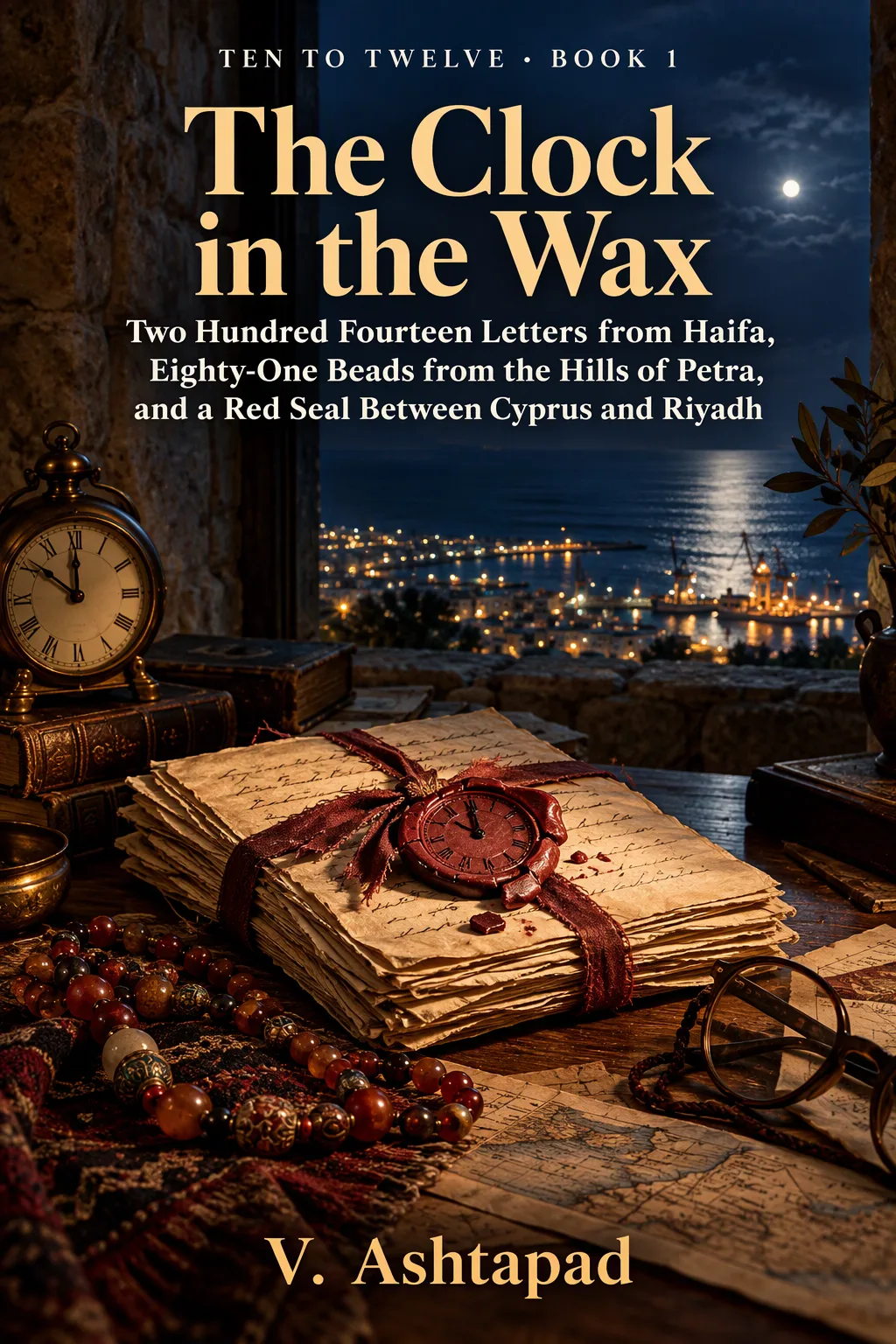
The Clock in the Wax
Two Hundred Fourteen Letters from Haifa, Eighty-One Beads from the Hills of Petra, and a Red Seal Between Cyprus and Riyadh
by V. Ashtapad
Foreword
This is a work of fiction, and the first book of the Ten to Twelve series. Haifa, Limassol, Lefkara, Larnaca, Wadi Musa, Riyadh and the Atlantic coast of Portugal are real places, and the olive harvests, lace, coffee and weaving in these pages are real traditions. The village of Ain al-Rummana, the people, the studios, museums, businesses, ships and the network that ties them together are invented.
For the ones who read the old letters aloud.
Hadar: Red Wax
The radio clock on the shelf above the light table said 23:46, and the woman who had spent three weeks answering to the name Clara Weiss decided she had four minutes left of being anybody at all.
The studio was on the third floor of an old building in Hadar, the neighborhood that climbs the shoulder of Mount Carmel above the port of Haifa, and at night it smelled of what it smelled of by day: wheat-starch paste, blotting paper, the faint vinegar of old ink, and the lemon soap Dr. Kerem made everybody use at the sink. Through the tall windows the bay lay black and still, and beyond it the cranes of the port stood in their sodium light like a row of herons who had been told to wait.
She worked by the small lamp only. The overhead lights were on a sensor, and the sensor reported to a panel downstairs, and the panel was watched, in theory, by Yusuf Haddad, who was sixty-six and had guarded this building for nineteen years and who was at this moment asleep in his chair in the lobby with his chin on his chest, because at ten o'clock the kind young intern from Vienna had brought him a glass of sweet sage tea in a paper cup and stayed to hear about his grandson's football. She had liked the story. She had liked Yusuf. That was beside the point and she put it where she put things that were beside the point.
The letters lay on the table in their sleeves. Two hundred and fourteen of them, in eleven gray boxes, written between 1921 and 1929 by a seamstress named Hannah Shalev to her sister in Thessaloniki, and the sister's answers, which had come back to Haifa in a biscuit tin in 1956. Clara had handled every one of them. That had been her job, officially: humidify, flatten, mend the tears with tissue thinner than a moth's wing, sleeve, box, record. She knew Hannah's hand better than her own. Hannah wrote fast and slanted, and when she was happy her lines climbed toward the top right corner of the page as if they wanted to get out the window. In the margins her husband, Yaakov, a sign painter, had drawn things: a donkey cart on the slope of a street, a barber's pole, the striped awning of a cloth shop, a ship coming in past the breakwater with every porthole counted. Somebody would pay a great deal for those margins. That was also beside the point. She was not paid to want anything.
She slid the boxes into two archival cartons, the kind the studio used every day, and taped them with the studio's own tape. Then she took out the folder.
It was a plain folder of acid-free board, the color of milky coffee, holding the index she had typed of all two hundred and fourteen letters, with dates and first lines. It would travel on top. Whoever opened the carton at the other end would find the index first and know what they had, and they would know, too, that it had come from her hands, because she would close it the way she had been taught to close things.
From her bag she took a short red stick of wax and a lighter and a brass seal no longer than her little finger. She warmed the wax until it bent and let a coin of it fall on the folder's flap, where it spread and shone. She counted three, and pressed.
When she lifted the seal, the wax held a clock face the size of a fingernail. No numbers. Twelve tiny ticks around the rim, and two hands: the long one a little short of the top, the short one just shy of twelve. Ten minutes to midnight.
On the shelf the radio clock turned to 23:50.
She did not smile. She had stopped finding the coincidence funny after the first year; the lots always closed at that hour, and so everything she did seemed to land there, as if the hour were a magnet and she was filings. She blew on the wax, which was vanity, because it was already hard, and put the folder on top of the first carton and closed the lid.
Something small and red skittered off the edge of the table.
She froze. A crumb of the wax, a flake that had squeezed out from under the seal. It had hit the floor, which was old terrazzo in a pattern of black and cream and rust, the worst floor in the world for finding a red crumb by the light of one lamp. She crouched, swept her palm across the tiles, felt grit, felt a paper clip, felt nothing.
23:52.
A crumb of wax. A conservation studio was full of wax: they used it on seals, on bookbindings, on the edges of old documents. Nobody would look twice. She stood, lifted both cartons onto the steel trolley, and switched off the lamp.
In the corridor she passed the framed photograph of the staff that Dr. Kerem had taken in the first week, eight people in white coats squinting into the sun on the roof with the bay behind them. Clara was at the end of the back row. She had worn her hair loose and her heavy glasses, and she had tilted her head toward Gil Marom as if he had just said something amusing, so that the camera caught mostly her cheek. She thought about taking the photograph off the wall. A missing photograph would be noticed by morning. A face in a photograph would be noticed by nobody, because nobody in a hurry looks at a face, they look at hair and glasses, and she would have neither tomorrow.
The service lift groaned down three floors. In the lobby Yusuf breathed slowly and evenly, the paper cup on the floor by his shoe. She bent and put the cup in her bag, which she had not meant to do, because she had been told to leave the scene as it was, and stood looking at him for a moment in the green glow of the panel. He would wake at two with a thick head and a sour mouth and think he was getting old. He would be ashamed. She found that she minded that, and she put it with the other things.
The van was in the lane behind the building where the bakery's delivery truck parked in the mornings. She loaded the cartons, locked the doors, and drove down through the switchbacks of Hadar toward the lights of the lower city. A cat sat on a wall and watched her pass with its ears flat. At the bottom of the hill, waiting for a light that was red for nobody, she took out a phone she would use once more and then never again, and typed four words.
*Forty-one in hand.*
The answer came before the light changed.
*Good. Ferry is booked. Do not be clever.*
She put the phone face down on the seat. In the mirror the mountain rose behind her in its terraces of lit windows, and somewhere up there, behind one of them, an old woman she had never met was asleep with no idea that her grandmother's laughter was riding down the hill in the back of a hired van. The woman who had been Clara Weiss looked at that thought for exactly as long as the light took to change, and then she put it away with the others. Above her, on the dark mountain, the window of the third floor stayed dark, and on its floor a red crumb of wax no bigger than a lentil lay in a rust-colored tile, keeping very still, holding a clock that would be ten to twelve forever.
© 2026 CRUNOD LLC. All rights reserved.
Ponta Velha: Two Requests
The lighthouse at Ponta Velha had not shown a light to ships in thirty-one years, and the wind did not seem to have heard.
It came in off the Atlantic at all hours, smelling of salt and kelp and, on certain mornings, of the eucalyptus groves inland, and it leaned on the white tower and the keeper's cottage beside it as if testing the doors. The cape was a long tongue of gray rock and gorse and sea thrift on the coast of Portugal, with a fishing village tucked into the cove on its south side and nothing to the north but cliffs and gulls. The keeper's cottage had a red tile roof and blue-painted shutters that Kadri Tamm had spent most of the summer repainting, because she said you could not run a serious operation from a building that looked sad.
On Monday at half past seven she was in the oil store at the base of the tower, where the old keepers had kept the paraffin for the lamp, and where she now kept six humming racks of servers on a raised floor, with a dehumidifier the size of a refrigerator rattling in the corner. She was thirty-one, small and fair, in two sweaters and fingerless gloves, and she was humming, low and without knowing it, a song her grandmother had sung on a stage in Tallinn with thirty thousand other people when Kadri was four years old and riding on her father's shoulders in the crowd. She hummed it when she was concentrating. She would have denied it under oath.
At seven forty the printer in the corner woke, cleared its throat, and pushed out two sheets of paper.
Kadri stopped humming. The printer was not connected to anything she had built. It was connected, by a line she had traced and failed to trace three times since the start of the year, to the Patron, whoever the Patron was, and it printed perhaps twice a month: a note about money, a note about a new member arriving, once a note that said only *Thank you for the shutters,* which had unsettled her for a week.
Each sheet was typed, short, and signed with the same small drawing in black ink: a clock face with no numbers, its hands at ten minutes to twelve.
She read both standing up. Then she went up the spiral stair, all one hundred and twelve steps, to the lamp gallery at the top of the tower, where the great lens had been taken out years ago and the round glass room now held a map table, a wall of charts, and Dr. Miriam Adler, fifty-eight, reading glasses on a cord around her neck, drinking coffee and looking at the sea.
"Two," Kadri said, and held them out.
Miriam put on her glasses. The first note said: *A family in Haifa. A letter archive, 214 items, 1921 to 1929, stolen last night from a conservation studio. The granddaughter asks for help. The police are courteous and busy.* There was a name and a telephone number. The second said: *A village in the south of Jordan. The family ledgers that record who owns which land have vanished, with an old necklace kept beside them, and the man who kept them is missing since Sunday dawn. The headmistress of the school asks for help.* Another name, another number.
Kadri watched Miriam's face, because she had learned since spring that Miriam's face did very little and you had to watch the corners. At the word Haifa, the corner of her mouth went still.
"Which studio?" Miriam said.
"It doesn't say. I'll find out in four minutes."
"You'll find out in one. There are only three in the city that would take an archive like that, and one of them is Dalia Kerem's." Miriam took off her glasses and let them fall on their cord. "Two at once."
"The others aren't all here yet."
"They will be by noon." Miriam looked at her watch, then at the sea again, where a fishing boat was rounding the point with gulls behind it like a torn sheet. "Tomás lands at Lisbon at eleven fifty with the boy. Karma and his daughter are on the train from Lisbon now. Everybody else is in the kitchen arguing about breakfast."
"So we stand up at eleven fifty and Tomás is on a runway."
"Tomás has a telephone," said Miriam. "And a daughter of his own, and he will want to be there for the boy's first one. Move it to one. No." She stopped herself. "Keep it. Eleven fifty. If we start moving the one fixed thing, we'll move everything."
---
The kitchen of the keeper's cottage was the largest room in it, because a previous owner had knocked down the wall to the old storeroom, and it held a table of scrubbed pine long enough to seat fourteen. Kadri had bought it from a monastery sale in the Alentejo in the spring and two fishermen from the village had carried it in through the double doors, cursing beautifully. Every member who had arrived since then had added something to the room. A brass Omani coffee pot with a long curved spout stood on the windowsill. A string of cloth flags from Bhutan, faded nearly white, crossed one corner near the ceiling; Karma had put them up and said they were for the wind, which needed something to do. A shelf of dictionaries in nine languages leaned against the dresser. A heavy medical bag sat on the floor by the door to the garden as if it might need to leave at any moment.
By half past eleven the table was nearly full.
Rahim Al-Balushi, forty-nine, from Sur on the coast of Oman, sat at the far end with an open laptop and a small paper ledger beside it, which he trusted more. He wore a pressed white shirt and a soft gray cardigan and smelled faintly of cardamom, because he had insisted on making his own coffee since the day he arrived, and he made it the way his uncle had made it in the boatyard at Sur, with the pods crushed under a glass and the water never quite allowed to boil.
Beside him Farida Nazarova, thirty-nine, from Dushanbe, sat very straight, with one dictionary open and two closed, writing in a notebook in a small, upright, beautiful hand. She had been an interpreter for aid groups for twelve years in places she did not discuss. She was elegant even in a borrowed fisherman's sweater, and wary of everyone at the table except Kagiso, who was impossible to be wary of.
Dr. Kagiso Molefe, forty-four, from Gaborone by way of a cattle post near Serowe, was at the stove frying eggs for anyone who wanted them, which was everyone, and listening to Luka Petrović explain why the eggs were wrong.
"In Belgrade we put the paprika in the oil first," Luka said. He was sixty-two, rumpled in a corduroy jacket that had been good in 1988, with white stubble and wonderful hands. "The oil must turn red. Then the egg goes in the red oil and becomes a sunset."
"In Gaborone we let the man at the stove decide," said Kagiso, and slid two eggs onto Luka's plate, entirely unsunset, and Luka ate them with joy.
Valeria Ortiz, twenty-six, from Asunción, sat cross-legged on the bench with her phone held up, filming the eggs, the brass pot, the light on the table. She filmed everything. She had made two documentaries about land seizures in the Chaco that had been shown at small festivals and had got her a reputation, a lawsuit she won and a rule from Miriam, on her first day, that she was to ask before she pointed the phone at anybody's grief.
At the window, holding a cup of tea with both hands, Captain Marie-Claire Hoareau, fifty-two, of Praslin in the Seychelles, said, "Valeria, if you film my breakfast I will throw your phone to the gulls."
"It's for the archive."
"There is no archive."
"There will be." Valeria grinned and swung the phone toward the door just as it opened, and Karma Dorji came in out of the wind with a long canvas bow case over one shoulder, followed by a girl.
Karma was thirty-five, from Bumthang in the mountains of central Bhutan, a compact man with a quiet face and very steady eyes, and he had arrived at Control at the start of the summer and spent his first week walking every meter of the cape before he would sit down in the kitchen. He said good morning to the room in the way he did, as if each person were the only one. Then he put his hand on the girl's shoulder.
"This is Tara," he said. "My daughter."
Tara Dorji was sixteen and tall for it, in jeans and a dark red fleece, with a long black braid and a backpack she did not take off. She looked at the table, and Kadri, who was watching her from the stair door, saw her do a thing that Kadri would think about later: she did not look at the people as a crowd. She looked at them one at a time, left to right, quickly, the way you might read a line of print, and when she had finished her face changed very slightly, as if she had filed something.
"Kuzuzangpo," Tara said, and then, in English with a Darjeeling lilt, "Good morning. Sorry. Hello."
"Good morning, Tara," said Miriam from the head of the table. "You're welcome here. Sit down, eat something. In nineteen minutes you'll be in your first meeting, and it will be very boring and then very interesting."
Tara sat at the end of the bench beside Valeria, who immediately swung the phone toward her, and Tara put up one hand flat in front of her face without looking, as if she had been doing it all her life.
Valeria lowered the phone. "Okay," she said. "Fair."
At eleven forty-eight, Miriam's phone rang on the table, set to speaker, and Tomás Benítez's voice came out of it over the sound of jet engines and wind.
"I am standing on the runway in Lisbon with a seventeen-year-old who has already asked me four times if he can fly the plane to the cape," Tomás said. "I have told him no three times and maybe once. We will be with you by two. Is it a call? Kadri said a call."
"It's two calls," Miriam said. "Put the boy on."
There was a scuffle, and a younger voice, American, with something in its vowels from the south that was not quite Spanish and not quite anything else. "Hi. This is Kai. Kai Benally-Ríos. Hi, everybody."
"Hello, Kai," said several people, and Rahim inclined his head to the phone as if it could see him.
At eleven fifty, by the old ship's clock above the stove, which Marie-Claire had brought from a scrapped trawler and which she wound every Sunday, Miriam stood up.
"All right," she said. "Ten to twelve. Let's begin."
© 2026 CRUNOD LLC. All rights reserved.
Ponta Velha: Units
The stand-up at Control was a stand-up because Kadri had made it one in the spring, on the grounds that people who sat down talked for an hour. Everyone stood around the long table. Miriam read the two notes aloud. Kadri, with a tablet, filled in what she had found in the minutes since: the studio was Dalia Kerem's, in Hadar; the Haifa police had a report; the archive belonged to a Ruth Shalev-Amar, eighty-one, retired piano teacher, of a street on Carmel; the granddaughter who had written was Noa Shalev-Amar, twenty-nine, an architect. The Jordanian village was called Ain al-Rummana, a few hundred people in the sandstone hills north of Wadi Musa and the ancient city of Petra; the headmistress who had written was Salma Odeh, forty-one; the man missing was Suleiman Hamdan, eighty-three, called Abu Nasser, who had kept the village ledgers since his father died in 1979.
"Ledgers of what?" Rahim said.
"Land," said Kadri. "Who owns which terrace, which olive trees, which share of which well. Sales, inheritances, divisions. Kept by hand by the same family since the 1920s, she says. The district registry has its own records, but in these villages the families trust the book more. And there's a hotel company that wants to buy most of the eastern slope. The headmistress says the sale needs every family to show title. Without the ledgers, some of them can't."
"And the necklace?" said Luka.
"Beads," said Kadri, reading. "Red stone and blue-green glaze and shell. Found in 1931 when Abu Nasser's father rebuilt a terrace wall. She says it's Nabataean. Kept in a tin box in the same chest as the ledgers. The family showed it at weddings."
"Then someone knew where both things were," said Rahim. "A thief who wants land papers does not usually want beads. A thief who wants beads does not usually want land papers."
"Unless the papers are about the beads," said Farida quietly.
Everyone looked at her. She shrugged, one elegant shoulder. "In my work, when two things are taken together, they are together for a reason."
Kagiso turned off the stove. "An eighty-three-year-old man has been missing since Sunday dawn. Today is Monday. The hills there at this time of year are warm by day and cold at night." He did not raise his voice, but nobody else spoke over it. "Whatever else we do, that comes first."
"Agreed," said Miriam.
Then they argued, because they always argued, at that table, it was how they thought. Valeria wanted to go to Jordan because the hotel company was a story and she knew how to find out who owned a hotel company. Marie-Claire said the Albatross was in Limassol, in Cyprus, finishing a refit, and if anything from Haifa was going to move by sea, it would go through Cyprus first, because everything in that corner of the sea went through Cyprus first. Rahim said if the archive was for sale, it would be sold to someone with money, and he wanted to see the money. Luka said that if anybody was going to put a forgery in place of the real letters, he wanted to be the one to see it. Farida said she would go where the Arabic was. Karma said, simply, "If a man is lost in hills, I go."
Over the speaker, Tomás said, "I will fly whoever needs flying. I can have the twin at Aqaba by midnight with a fuel stop in Crete."
"And me?" said a voice from the phone. Kai. "I can map. I have three drones. I can map a whole valley in an afternoon."
There was a short silence that was not quite awkward.
"Kai," said Miriam, "your parents trusted us with you. Tara's father is standing next to her. Both of you are here to learn, and both of you are going to be useful, and neither of you is going anywhere dangerous. Those are three different sentences and they are all true."
"So I'm going to Jordan," said Kai.
"You're going where Tomás goes, until Tomás hands you to Karma. You'll fly your drones where Karma says and nowhere else. If you can do that, you're very useful. If you can't, you'll fly home."
"Deal," said Kai, too fast.
Tara said nothing. Kadri, watching her, saw her look at her father.
Miriam saw it too. "Tara," she said, "you stay here at Control with Kadri."
"Here?" It came out higher than Tara meant, and she flushed.
"Here. Someone has to see everything at once. That's what this room is for." Miriam held the girl's eyes. "It isn't a punishment, and it isn't because you're a girl, before anyone says so. It's because I need someone at this table who can look."
Tara did not answer. Karma's hand was still on her shoulder, and he did not move it.
Miriam put the two notes side by side on the table. "Unit A. Haifa, and Cyprus if it goes there. Me, Luka, Valeria. Marie-Claire meets us with the ship. Unit B. Jordan. Rahim, Farida, Karma, Kagiso. Tomás flies you and stays with the plane. Kai goes with Tomás. Kadri and Tara at Control." She looked around. "Anyone with an objection, now."
"I object to the paprika in Belgrade," said Kagiso.
"Noted," said Miriam. "Anyone else?"
Valeria said, "I'd rather be on the hotel company."
"I know. You'll be on it from Haifa. There's nothing a hotel company has that you can't find on a laptop on a balcony." Miriam softened, which she did seldom. "And in Haifa I need someone who can find a woman who doesn't exist."
Valeria's eyes lit. "What woman?"
"I don't know yet," Miriam said. "But someone was inside Dalia's studio, and Dalia doesn't leave doors open."
---
They left in two waves that afternoon. Rahim, Farida, Kagiso and Karma drove to Lisbon to meet Tomás and the plane. Miriam, Luka and Valeria drove to the same airport for the evening flight east, which Kadri had booked in the time it took to say it. Marie-Claire had left before lunch for her own flight to Cyprus, to finish the refit and have the Albatross ready, and her last words in the kitchen had been a list of ship's rules addressed to nobody in particular, which included no shoes on the bridge and no filming in the galley.
Tomás and Kai had never come to the cape at all. They had turned the twin around at Lisbon, taken on fuel and passengers, and gone. Kai's first sight of Control would have to wait.
At five o'clock the cape was very quiet. The wind had dropped to a steady push, the gulls had gone to the cliffs, and the sea was the color of pewter. Kadri came into the kitchen and found Tara sitting alone at the long table with her backpack still on, looking at the place where the two notes had been.
"You can take the bag off," Kadri said. "Nobody here will steal it. Your room is the one at the top of the cottage with the round window. It's the best room. I was going to take it myself."
Tara took off the backpack and set it beside her. She did not look up.
"He didn't argue," she said. "My father. He just agreed."
"He agreed with Miriam."
"He always agrees with whoever's right." She said it as if it were a complaint, and Kadri almost laughed and did not. "At home in Bumthang, when I was small, there was an archery match every spring, and the men sang insults at the other team while they shot. Everyone sings. My father never sings. He just hits the target. Then they sing about him." She was quiet. "I thought I would go with him."
Kadri sat down across from her. She was not good at this. She had learned most of what she knew about people from logs and error messages, and the rest, late, from a judge in a Tallinn courtroom fourteen years ago who had looked at a seventeen-year-old who had just broken into a ministry server to prove its security was a joke and said, *You can spend the next two years proving you're clever, or the next twenty proving you're useful. Choose by Friday.*
"When I was your age," Kadri said, "I was in a great deal of trouble."
Tara looked up for the first time.
"I'll tell you sometime," Kadri said. "Not today. Today I'll tell you this. In the next three days, everybody out there is going to be looking at one thing. The man in the hills. The empty chest. The studio floor. They'll be very good at their one thing. Somebody has to be looking at all of it at once. In there." She tipped her head toward the tower. "It's not glamorous. You'll eat a lot of bread from the village and do a lot of homework."
"Homework," Tara said, as if it were a word in a language she was learning.
"Nine o'clock tomorrow. Miriam and I agreed. Your school sends it, you do it, I check it. Physics first." Kadri stood. "And after that you'll look at photographs with me until your eyes hurt."
"Photographs of what?"
"Of everybody who has been inside that studio in Haifa in the last month. Faces." Kadri paused at the door. "Your father says you never forget one."
Tara considered this, and something in her straightened.
"I don't," she said. "I forget where I left my shoes. I don't forget faces."
"Good," said Kadri. "Then put your shoes somewhere I can find them."
© 2026 CRUNOD LLC. All rights reserved.
Hadar: No Broken Glass
The flight landed after midnight, and the train north along the coast ran through the dark with the sea on the left, a long smear of lights from towns Miriam knew by the shapes of their water towers. By the time they came out of the station at the bottom of Haifa, the city was asleep except for the port, which never was, and the air was soft and warm and smelled of diesel and jasmine and, from somewhere, bread already baking for the morning.
Miriam stood on the pavement with her bag and looked up at the mountain. The city went up it in terraces and switchbacks, apartment blocks on stilts and old stone houses with tiled roofs, and at the top the long dark ridge of Carmel against a sky the color of a plum. She had been born on that slope. Her husband had come home across that bay a hundred times from the engine rooms of cargo ships, and from the balcony of their flat she had watched for his ship the way her grandmother had watched for letters.
"Beautiful," said Luka, beside her.
"Yes."
"You don't sound happy."
"I'm not happy," Miriam said. "Somebody robbed my city while I was away."
---
Dr. Dalia Kerem met them at the studio at eight, and she looked as if she had not slept since Sunday. She was sixty, a head shorter than Miriam, with short iron hair and a habit of pushing her sleeves up her forearms as if about to wash something. She and Miriam had trained together thirty years ago, had shared a terrible apartment in a city where it rained, had not seen each other in four years and had spoken twice since the fire. They held each other for a moment in the stairwell without saying anything.
"I let her in," Dalia said, finally. "That's the worst of it. I interviewed her. I liked her. I gave her the Shalev letters because her hands were the best I've seen in a student in ten years."
"Tell me from the start," said Miriam.
Dalia told it in the studio while the morning sun came in through the tall windows and lay across the light tables. The intern had written in the summer, with a recommendation from a professor at a conservation program in Vienna, a real program, a real professor's name, on letterhead. She had arrived a few weeks earlier for a three-week placement. She was perhaps thirty, quiet, quick, competent, careful, with heavy glasses and a lot of hair. She had worked on the Shalev letters from her fourth day. She had left on Monday morning, as planned, the end of her three weeks. Nobody had found the letters missing until Monday at noon, because nobody had needed them till then.
"And the boxes were gone," said Luka.
"Boxes, letters, the index she'd made, everything. The sleeves. The tissue. It was very tidy." Dalia's mouth twisted. "She tidied."
"Doors?"
"Locked. Alarms set. Yusuf, the night man, didn't see anything. He fell asleep. He's sixty-six and he's never fallen asleep in nineteen years. He came to me on Monday and offered to resign. I told him not to be a fool." Dalia pushed her sleeves up again. "No broken glass. No forced lock. Nothing. As if the letters walked out holding hands."
Valeria had been filming from the doorway, quietly, the windows and the tables and the cleared steel cart, and Miriam turned and looked at her.
"Not the people," Miriam said. "The room only."
"I'm only doing the room."
"Do it from the door. Don't walk on anything." Miriam took off her jacket, put on her reading glasses, and went to the light table where Dalia said the Shalev letters had been worked. "Which of these was hers?"
"The one under the window."
Miriam stood beside it for a long time. She did not touch anything. Luka, who knew her habits, wandered to the other side of the room and began looking at the framed photographs on the wall, the certificates, the shelves of paste jars and bone folders and Japanese brushes. Dalia watched Miriam with the expression of a woman who had already looked at everything and found nothing, and expected the same again.
There was a hum in the studio from the dehumidifiers and the refrigerators where the pastes were kept. Through the open window came the sounds of Hadar waking: shutters going up, a man calling the price of figs, a radio in a car, a woman scolding a child in Arabic and the child answering in Hebrew, which in Haifa was not a sentence anyone remarked on.
Miriam lowered herself, slowly, because her knees were fifty-eight, until she was kneeling on the old terrazzo floor.
"Miriam," said Dalia, "the police have been over the floor."
"With what?"
"With their eyes, I suppose."
"Yes." Miriam took a small flashlight out of her bag and laid it flat against the tiles so that its beam ran along the floor instead of down on it, the way she had been taught to look at the surface of an old page, where every crease and fiber stands up in shadow if you bring the light in low. Black and cream and rust. A paper clip. A fiber of blue thread. A grain of sand from somebody's shoe. She moved the light an inch at a time.
"Luka," she said. "Come here and kneel. Your eyes are better than mine."
"My eyes are sixty-two."
"They're better than mine for small red things."
Luka came, complaining in Serbian under his breath, and knelt beside her, and his knees cracked like a fire. He looked where her light was pointing. In the middle of a rust-colored tile, almost invisible against it, a crumb of something darker and shinier than stone sat in the beam and cast a tiny shadow.
"Wax," said Luka.
"Do you have tweezers?"
"I'm a restorer. I was born with tweezers." He took a pair from the inside pocket of his jacket and lifted the crumb with the delicacy of a man taking an eyelash out of a child's eye, and laid it on a sheet of white blotter Dalia brought him. Miriam took a folding loupe from the cord around her neck where it hung beside her glasses, and bent close.
It was a flake of red sealing wax, perhaps six millimeters across, with one smooth face and one rough. On the smooth face, pressed into it, was the edge of an impression: a raised rim, and inside the rim a ring of tiny ticks, and two short lines meeting near the center.
"A clock," Miriam said.
"A what?" said Dalia.
"Look." Miriam gave her the loupe. "Ticks for the hours. Hands. It's the edge of a seal. Someone sealed something here with wax and a little piece of it got away."
Dalia looked, and looked again, and gave the loupe back with her hands not quite steady. "We don't use seals with clocks. We don't use red wax at all, not on anything modern. Brown, for repairs, to match. Never red."
Luka took the loupe from Miriam without asking and looked for a long time, with one eye shut, his mouth slightly open. When he straightened up he was not joking.
"Brass seal," he said. "Hand-cut, not cast. Look at the ticks, they're not quite even, the one at nine is fatter. Somebody cut that with a graver. Somebody who knows how. It's old work, or it's new work done in the old way, which is worse." He handed the loupe back. "What time does it say?"
Miriam bent again. The long hand pointed almost to the top. The short hand was a little to the left of it.
"Ten to twelve," she said.
There was a pause in the studio. Valeria, in the doorway, had lowered her phone.
"Ten to twelve," said Luka. "Like a certain someone's signature."
"Not like it," said Miriam. "The Patron's clock is drawn in ink. This is cut in brass."
"Same hour."
"Same hour on every clock in the world twice a day." But she kept looking at the little flake on the white blotter for longer than she needed to, and when she finally slid it into a glassine envelope and wrote the date and the place on the outside in her small square hand, she wrote the time too: *found 08:41, Tuesday. Seal shows 11:50 or 23:50.*
"The night she took them," Valeria said slowly. "What time did Yusuf fall asleep?"
Dalia shook her head. "He says he looked at the panel at ten thirty and woke at two."
"So at ten to midnight on Sunday," said Valeria, "she was standing here closing something up with red wax." She looked at the window, at the bright bay, at the cranes. "And when she was finished, she took two hundred and fourteen letters and went for a walk."
"Not a walk," said Miriam. "A drive. And not far. Nobody carries eleven boxes of paper far." She stood up, slowly, one hand on the edge of the table. "Dalia. I need the dates she was here, her letter from Vienna, any form she filled in, any photograph with her face in it, and the names of everyone who ever had a coffee with her."
"There's the staff picture in the corridor," said Dalia. "We took it the first week."
Luka was already in the corridor, standing in front of it with his hands in his jacket pockets. Eight people in white coats on the roof with the bay behind them. At the end of the back row, a young woman with a great deal of hair and heavy glasses, tilting her head toward the man beside her, so that the camera caught mostly her cheek.
"She knew where the camera was," Luka said. "Look at that. Not one of the others knew where the camera was. She did."
"How can you tell?" said Valeria.
Luka gave her a smile with very little humor in it. "Because there was a time in my life," he said, "when I knew where every camera was."
© 2026 CRUNOD LLC. All rights reserved.
Ain al-Rummana: The Empty Chest
The road north from Aqaba climbed out of the heat in the dark, past the long pale shoulders of the desert and the black teeth of mountains, and when the sun came up over the plateau on Tuesday it came up all at once, as if somebody had lifted a lid. Farida, in the front seat of the hired car beside Rahim, who drove the way he did accounts, smoothly and with no surprises, watched the color arrive in the rock: first gray, then lilac, then a rose so warm it looked lit from inside.
"Now I understand why they carved it," she said.
"Carved what?" said Kai from the back, where he had been asleep against Kagiso's shoulder for an hour and was pretending he had not.
"Petra. All of it." Farida waved at the hills. "If I lived inside stone like this, I would want to make doors in it too."
The village of Ain al-Rummana sat on a high fold of the hills north of Wadi Musa, above a valley that ran down in steps toward the great broken sandstone country around the ancient city. It had perhaps sixty houses, most of them square and pale and flat-roofed, with blue-painted metal doors and water tanks on top, and an older quarter of stone houses with arched rooms that the families now used for storing feed and olive oil. Below the houses the terraces began: dry-stone walls holding up long narrow shelves of red earth, one under the next, every shelf planted with olive trees, gray-green and twisted and very old, and between the trees, on this bright morning, there were people. Whole families on ladders, children under the trees, tarps spread on the ground, the sound of sticks combing the branches and olives falling on canvas like a light rain.
"Harvest," said Karma, who had not slept at all and did not look it. He was watching the terraces the way he watched any slope, reading the paths between them. "They've kept harvesting."
"What else would they do?" said Farida. "The olives don't know a man is missing."
The headmistress met them at the school, which was the newest building in the village, two stories of cinder block painted a cheerful yellow, with a courtyard and a eucalyptus tree and a mural of the Treasury at Petra done by the children, in which the pillars were wildly different heights. Salma Odeh was forty-one, broad and brisk, in a long dark coat and a white headscarf, with a voice made for a playground. She shook Farida's hand, then Rahim's, then looked at Kagiso and Karma and Kai, three very different faces arriving in her schoolyard at half past seven in the morning, and decided, visibly, not to ask.
"Marhaba," she said. "Welcome. You came fast."
"We came as fast as we could," said Farida in Arabic, and Salma's shoulders came down a little at the sound of it.
"Come," Salma said. "Coffee first. Then the house. Then you will understand everything, and you will also understand nothing, like me."
---
The house of the Hamdan family was in the old quarter, at the top of a lane so steep it had steps cut into it, and it was built around a courtyard with a fig tree in the middle and a grapevine on wires overhead, the leaves going yellow. A woman of nearly eighty sat on a cushion against the wall with her hands in her lap. A man of perhaps fifty-five, heavy, unshaven, in a leather jacket, stood up when they came in and did not sit down again.
"My mother, Umm Nasser," said the man. "I am Nasser Hamdan. You have come about my father."
"We have come to help," said Farida.
"Help." He said the word in English, as if testing it for cracks. "The police have come to help. The district office has come to help. The hotel company has sent a very nice man in a very clean car to help." He switched back to Arabic and spoke fast, and Farida listened with her head slightly bowed, and Rahim, who understood most of it, watched Nasser's hands. They shook.
The coffee came while he spoke, brought by a young man with a narrow face who set the tray down and stepped back against the doorframe as if he hoped to become part of it. It was the old coffee of the hills, pale gold, bitter with cardamom, poured from a brass pot with a long beak into small handleless cups only a third full. Rahim drank his and held out the cup for more, and drank again, and on the third cup shook it gently from side to side to show he had finished. Nasser saw it, and something in his face, despite everything, approved.
"You know how to drink coffee," he said.
"My uncle would beat me if I did not," said Rahim. "In Oman we put more cardamom. And sometimes rosewater."
"Rosewater," said Nasser, as one might say *sawdust.* But he sat down.
Then he showed them the chest.
It stood in a stone room off the courtyard, a room with an arched ceiling and one small window, and it was a big chest of dark wood bound with brass, the kind brides once brought to a house, with a lock that had been forced so cleanly that the hasp hung by one screw. It was empty. Kagiso, who had seen many empty things in his life, stood at the doorway and felt, as he always did, that emptiness had a smell. This one smelled of cedar and dust and something sharper, like cheap cologne.
"Nine books," said Nasser. "Nine. Big books, like this." He held his hands apart. "From 1926. My grandfather started the first. My father kept them after him, since 1979. Every sale of a terrace, every share of a well, every division when a man died and his sons took their portions. Every boundary stone, which way it faces. If you want to know who owns the third tree from the wall on the Hijazi terrace, you open the book and there is my grandfather's hand." His voice went up. "Nine. And the box with the beads. All gone, Saturday night, while we slept. And Sunday morning my father is gone also."
"Eight," said a voice from the cushion.
Everyone turned. Umm Nasser had not moved. She sat with her hands folded and her eyes on the courtyard, where a hen was walking carefully across the shadows.
"Eight books in the chest," she said, in Arabic, and Farida translated softly as she went. "Not nine. The first book was not in the chest. He took it out on Friday."
"Mother," said Nasser.
"On Friday," she repeated. "He took it out and wrapped it in the blue cloth and put it under our bed. He thought I was asleep. I am never asleep. I have not slept since 1971."
Nasser stared at her. "You didn't tell the police."
"The police did not ask me. They asked you. You told them everything you know, which is not everything." She turned her head for the first time and looked straight at Farida, and her eyes were clear and black and amused and very tired. "You are a woman. Sit with me. The men can look at the box."
Farida sat. Kagiso, without being asked, lowered himself onto the next cushion, because in his grandfather's village near Serowe the old women had always told the truth to whoever was sitting nearest when they decided to tell it.
---
Outside, in the lane, Karma stood with Kai and looked at the ground.
"The police walked here," Karma said. "And the family. And the neighbors. And a car came up as far as that corner." He pointed with his chin. "Big tires. Heavy at the back."
Kai looked. He saw a lane of packed earth and stone, swept by the wind, with footprints all over it.
"How do you know which one is the car?"
"Look at the corner. Where it turned."
Kai crouched. After a while he saw it: a double arc in the dust at the edge of the steps where something wide had turned and its rear had swung out, leaving a smear of tread and a crushed thistle.
"Okay," he said. "Yeah. Okay. I can map this. I can put a drone up and do the whole village in twenty minutes, and the terraces in an hour, and we'll see where the car went, and where he went, and—"
"Where who went?"
"The old man. Abu Nasser."
"Did he go in the car?"
Kai opened his mouth and shut it.
"Wait," said Karma.
"For what?"
Karma did not answer. He was looking down the lane at the young man with the narrow face, who had come out of the Hamdan courtyard and was standing at the top of the steps smoking a cigarette with his back to them, his shoulders up around his ears.
"That is the grandson," Karma said quietly. "Rami. He brought the coffee and did not drink it. He has not looked at the chest once. And he has looked at us eleven times."
"You counted?"
"No. But it was about eleven." Karma turned back to Kai. "Your drone will see the terraces. It will not see that."
Kai looked at Rami. Then at Karma. Then, despite himself, he grinned.
"My grandpa would like you," he said.
"Would he?"
"He says the land always tells you, but you have to let it finish its sentence." Kai shoved his hands in the pockets of his jacket. "I'm bad at that."
"Yes," said Karma. "I noticed." He began to walk, slowly, down the steps toward the terraces, and Kai, after a moment, followed him. "Tell me about your grandfather. Where does he live?"
"Near Gallup. New Mexico. The rez. He has sheep, and a truck that's older than my dad." Kai's voice changed when he talked about it, and he did not know that it did. "He used to take me out at night and show me the stars and make me say where I was without looking at anything on the ground. Just the sky. And then in the morning he'd make me do it again with just the ground. No sky."
"Could you?"
"Not then. Now I can do the ground." He hesitated. "I'm still not great with the sky."
"Hm," said Karma. At the bottom of the steps he stopped at the edge of the first terrace and looked out across the whole falling valley, terrace below terrace, the olive pickers in the trees, the gray-green and the rose-red and the long blue distance of the desert beyond. "Then today we will do the ground."
© 2026 CRUNOD LLC. All rights reserved.
Haifa: The Letters of Hannah Shalev
Ruth Shalev-Amar lived on the fourth floor of a building from the fifties on a quiet street on the Carmel, where the pines leaned over the pavement and the gardens behind the low walls were full of bougainvillea and lemon trees and cats. Her flat had a balcony that looked straight down the mountain over a tumble of red roofs to the bay, and she sat on it in the afternoon with a crocheted blanket across her knees, though it was warm, and held out her hand to Miriam without getting up.
"Forgive me," she said. "My knees have retired. I have not."
She was eighty-one, very thin, with white hair cut short and bright eyes behind large spectacles, and fingers that had been a pianist's fingers and were now twisted at the knuckles so that her rings would not come off. The flat behind her was full of books and sheet music and photographs and an upright piano with its lid closed and a vase of anemones on top of it. Her granddaughter Noa, twenty-nine, an architect with paint on her jeans and her grandmother's eyes, brought out a tray with glasses of lemonade with mint, a plate of small almond biscuits and a dish of dates.
"I wrote to the people who write to the people," Noa said. "I didn't know who you'd be. My friend in Tel Aviv said there was somebody who helps families when things go missing and it doesn't cost anything, and she gave me an address, and I wrote. I didn't think anyone would come."
"We came," said Miriam.
"You came very fast." Noa looked at her with frank curiosity. "Who pays you?"
"Someone who doesn't want to be thanked," said Miriam, and Ruth laughed, a sudden bark of a laugh.
"I like her," Ruth said to her granddaughter. "She doesn't explain. Sit, sit. Your friend, the man with the hair, he sits too."
Luka, whose hair was the least of his remarkable qualities, sat, and took a biscuit, and complimented it in three languages until Ruth told him to stop flirting with her because she had been a widow for twenty years and was not about to start again with a Serb.
---
Then Ruth told them about the letters, and as she told them, Miriam understood that they had never really been on paper at all.
"My grandmother Hannah came to Haifa in 1920," Ruth said. "She was twenty-two. She came with Yaakov, my grandfather, who was a sign painter, and her sister Dora stayed in Thessaloniki because she was engaged to a man who sold tobacco. And for nine years they wrote to each other every week. Every week. Hannah wrote on Thursdays because on Thursdays the shop was quiet." She closed her eyes. "Dear Dora, the rain has come and the street is a river and Yaakov has painted the word *umbrellas* on the window of the Greek's shop in letters a meter high, so now everyone who is wet knows where to go."
Noa smiled. She had obviously heard it many times.
"Dear Dora," Ruth went on, "today I sewed a wedding dress for a girl from the bakery, she is fifteen and he is forty and I sewed the hem crooked on purpose so that she could tell everyone it was the dressmaker's fault if she cried." She opened her eyes. "That one I read to Noa when she was eight, and she cried."
"I was nine," said Noa.
"You were eight." Ruth took off her spectacles and rubbed her eyes. "I read them on Friday nights. When my children were small, and then my grandchildren, and now my great-grandchildren, when Noa's cousins bring them. Not every week. Whenever. We sit on this balcony and I read three letters from Hannah and three from Dora, and the children ask what a gramophone is, and why the tobacco man wore spats, and what are spats. And then they look at the drawings."
"Yaakov's," said Miriam.
"In the margins." Ruth's hands moved in the air, drawing. "A horse with a hat. The port when they were building the new breakwater, with every crane. The man who sold ice. My grandmother at her sewing machine with her mouth full of pins. He drew her with her mouth full of pins in eleven different letters. Eleven. Noa counted." She put her spectacles back on. "Those letters are the only pictures of my grandmother as a young woman in the world. There is a photograph of her wedding, but she is so frightened in it she looks like a stranger. In Yaakov's drawings she is laughing."
There was a silence on the balcony. Down below, on the mountain, a bus ground its way up a hairpin bend and a dog barked at it.
"Why did you send them to Dalia's studio?" said Miriam.
"Because they were dying." Ruth said it plainly. "The paper. It was going brown at the edges and the ink was eating through in places, little holes. Yaakov used cheap ink. Iron. You know this better than I do. My son took them to Dr. Kerem at the end of the summer. I can't manage the stairs in Hadar. He signed the papers for me." She looked through the open balcony door into the flat, and her face changed. "My son, Yoav."
Miriam waited.
"He is in the kitchen," said Ruth, more quietly. "He is listening. He thinks I don't know when he is listening. He has been listening since he was four."
---
Yoav Shalev-Amar was fifty-four, a big soft man with a good-natured face and the gray look of someone who had been tired for two years. He came out onto the balcony when his mother called him, holding a dish towel, and shook hands with Miriam and Luka, and sat on the low wall with his back to the long fall of the mountain, which made his mother tell him sharply to get off the wall, and he got off.
He had owned a restaurant in the lower city, he told them, near the old market. Fish, mostly. Twelve tables. He had run it for nineteen years, and it had closed eighteen months ago, and he was now cooking in the kitchen of a hotel near the beach and paying off what he owed at a rate he expected to finish in about the year he died. He said this with a smile that did not get to his eyes.
"Yes, I took the letters to the studio," he said. "Yes, I signed the form. Dr. Kerem's form. Name, address, inventory, insurance. I signed four places. I have a copy somewhere." He spread his hands. "And now everyone looks at me."
"Nobody looks at you," said his mother.
"Noa looks at me."
"I don't," said Noa, too quickly.
"The police looked at me. The policewoman asked me about the restaurant." He shook his head. "I understand. I owe money. The letters are worth money. I would look at me." He looked at Miriam. "I didn't take them. I could have taken them any day for fifty years. They were in the bottom of my mother's wardrobe in a biscuit tin under her winter coat."
"They were in a tin until 1990," said Ruth. "Then my husband bought proper boxes."
"Then under her winter coat in proper boxes," said Yoav, and his mother almost smiled.
Miriam watched him. She had spent a great part of her life watching people tell the truth about things that had happened to paper, and she had learned that guilty people often told the story too well and innocent people told it badly, with digressions about winter coats, and that this rule failed about a third of the time.
"Did you meet the intern?" she said. "When you took the letters in."
"No. She wasn't there yet. Just Dr. Kerem and a young man with a beard."
"Gil Marom."
"Maybe." Yoav twisted the dish towel. "Then last month Dr. Kerem called and said a student from Vienna was working on them and she was very good. And I said, wonderful, and I didn't think about it again, because I had eleven hundred sea bream to fillet that week."
Luka spoke for the first time in some minutes. "The form you signed," he said. "Four places. Was it one sheet or several?"
Yoav looked surprised. "Two sheets. Why?"
"No reason," said Luka. "I like forms. They remember things."
---
When they left, Ruth held Miriam's hand for a long moment at the door, her twisted fingers surprisingly strong.
"I am eighty-one," she said. "I have perhaps a few more Friday nights. I would like to read the letter about the umbrellas to my great-grandson before I die. He is three. He will not understand a word, and he will remember it anyway."
"I know," said Miriam.
"You know?"
"My grandmother read letters," Miriam said. "On Friday nights. Her mother's, from a city on a river in the north. I was three, too."
Ruth looked at her for a long time through the big spectacles. Then she nodded once, as if a contract had been signed, and let go of her hand.
© 2026 CRUNOD LLC. All rights reserved.
Ain al-Rummana: Good Shoes and a Cane
Umm Nasser talked for two hours, and in those two hours Farida learned more about the village of Ain al-Rummana than the district office could have told her in a year.
She learned that the old woman's name was Fatima, and that she had married Suleiman Hamdan in 1962 when she was fifteen and he was nineteen, and that he had been a shepherd then, with goats in the hills above the village, and had known every cave and cistern and gully between here and the old city. She learned that he had become the keeper of the ledgers when his father died, and that he had not wanted to, because he could barely write and his father's hand had been beautiful; and that he had taught himself to write well enough by copying his father's entries, at night, at the kitchen table, for a whole winter, until his hand looked almost like the old man's. She learned that people came to the house when they wanted to sell a terrace or settle a quarrel about a well, and that they sat in this courtyard under this vine and drank coffee and argued, and that Suleiman listened to both sides and then opened the book and read them what their grandfathers had agreed. And usually that was the end of it, because nobody wants to argue with his grandfather.
And she learned about the beads.
"His father found them in 1931," Fatima said, "rebuilding the wall of the terrace below the spring, the old terrace with the three big trees. The stones had fallen in the winter rain. In the wall, in a hole between two stones, there was a little clay pot, broken, and inside, the beads. Red, and blue-green, and white shell. Very small. His father wrote it in the book. The date, the place, which stone. He wrote that it belonged to the land and the land belonged to the family. Then he put them on a string and his wife wore them at her wedding, and I wore them at mine, and our son's wife wore them at hers. And every girl in the family since then. Ten weddings. The beads are in all the photographs." She looked at her hands. "Last summer a man from the university in Amman came and looked at them and said they were Nabataean. Two thousand years. He said they should be in a museum. Suleiman said, they are in a museum. This house is the museum."
"And the man from the university?" said Farida.
"He laughed. He was a good man. He said, then keep them safe, uncle."
---
Kagiso, sitting on the next cushion, had been listening the way his grandfather had taught him to listen at the kgotla, the village meeting place near Serowe, where as a boy he had sat at the back among the men's knees while the elders talked, and where his grandfather had told him that the man who speaks first knows least, and the man who speaks last knows most, and the man who never speaks at all is either a fool or the chief.
"Mma," he said at last, using the word his own grandmother had been called, and Fatima did not need it translated, "on Sunday morning, when your husband went out. What did he take?"
Farida translated. The old woman looked at Kagiso for a moment, a long, measuring look.
"His good shoes," she said. "The brown ones. Not the ones for the house. His cane, the one from the olive wood. The green water bottle from the car, the big one, two liters. Bread, I think. Dates, the bag from the kitchen is lighter. His jacket with the sheepskin inside." She paused. "And the blue cloth from under the bed."
"With the book in it," said Farida.
"With the book in it."
"Then he didn't go with anyone," said Kagiso gently. "A man who is taken does not stop to choose his shoes."
Fatima's chin lifted. "I told my son that. My son does not listen. He thinks his father has been taken by the hotel people, or killed, heaven forbid, or that he went to sell the book himself, in shame, because he is old and confused." Her mouth tightened. "My husband is not confused. He is the least confused man in these hills. He is angry. And when he is angry he goes up." She lifted one hand, palm up, toward the hills beyond the courtyard wall. "He has always gone up. When our first daughter died, he went up for three days. When his father died he went up for a week. He comes down when he has decided."
"Decided what?" said Farida.
"Whatever he went up to decide."
Kagiso nodded slowly. "Mma. Your husband is eighty-three. Has he been ill this year? Heart, sugar, his chest?"
"His heart is old, like him. He takes a pill in the morning, a small white one, for the pressure." She glanced toward the kitchen. "The pills are still on the shelf. He didn't take the pills."
Kagiso's face did not change, but Farida, who had begun in the last two hours to learn his face, saw something in it go very still.
"How many mornings now?" he said, though he knew.
"Sunday, Monday, today." Fatima looked at him. "Three mornings without the pill. Is that bad?"
"It's not good," said Kagiso, honestly, because she would know if he lied. "But he has water, and bread, and good shoes, and he knows every cave. Those are good things too." He stood up, a big man unfolding, and bowed his head to her. "We will find him."
"Will you?" She regarded him with something that was almost amusement. "He has been hiding in these hills since he was six years old. The police have been looking for three days with a car. A car." She laughed softly. "Go and find him, doctor. If you find him, tell him his wife says he is a stubborn old goat and the soup is getting cold."
---
Karma and Kai spent the whole of Tuesday on the terraces.
They started at the spring, a stone basin below the old quarter where water came out of the rock in a thin clear thread and filled a long trough where the women had once washed clothes and where now the children filled plastic bottles. Below it was the old terrace with the three big trees, so old their trunks were split and hollowed and twisted around themselves, and Karma stood at the bottom of the wall Fatima had described, the one that had held a clay pot for two thousand years, and looked up at it for a long time without saying anything.
Kai put up a drone. He could not stand it any longer, and Karma, who had been expecting it for an hour, nodded. The little machine climbed with its high mosquito whine above the olive trees, and the pickers on the next terrace looked up and pointed, and a small boy shrieked and waved. On Kai's tablet the whole village unfolded below: the flat roofs with their water tanks, the courtyard of the Hamdan house with its fig tree, the lane, the terraces stepping down the valley in long curved lines like the rings of a cut tree.
"This is what I do," Kai said, and his voice had changed again, gone quiet and absorbed. "Watch. I can fly the grid and stitch it, and we'll have a map at five centimeters. Every wall. Every path." He touched the screen and the drone began to move in a slow back-and-forth pattern above the valley, like a farmer plowing. "We'll see every path he could have taken out of here."
"How many paths will you see?" said Karma.
Kai squinted. "Like... dozens. Goat paths. They're everywhere."
"Which one did he take?"
"I don't know yet."
"Neither do I," said Karma. "Fly your map. It is a good map. We will need it." He sat down on the terrace wall in the shade of the oldest tree and opened a bottle of water. "Then we will wait."
"For what?"
Karma drank. "In Bumthang," he said, "when I was a boy, a cow went missing in the forest above our village every summer. Every summer. My father sent me to find it. The first summer I ran all over the mountain for two days and came home with torn trousers and no cow, and the cow came home by herself the next morning." He smiled slightly. "The second summer my father said, do not look for the cow. Look for what the cow wants. Water, salt, shade, and other cows. Then sit where those things are and wait."
"Abu Nasser isn't a cow."
"No. He is a man who wants a book to be safe, and who needs water, and who is eighty-three and has not taken his pills. So." He capped the bottle. "Where is water? Where would a book be safe? And who, in this village, knows where he is and is too frightened to say?"
Kai looked at him. Then he looked at the screen, where the map was building itself tile by tile. He looked back up toward the village, toward the steep lane and the Hamdan house.
"You think Rami knows?"
"I think Rami knows something. It may not be where his grandfather is." Karma pointed with his chin, down, below them, to the next terrace. "But look there."
Kai looked. On the narrow path that ran along the foot of the terrace wall, in a patch of fine red dust between two stones, there was a print. Small. Much smaller than a man's. The flat sole of a cheap plastic sandal, a child's, with a star pattern on the heel, pointing up the valley toward the hills.
"Kids are everywhere," Kai said. "There are like fifty kids picking olives."
"Yes," said Karma. "But that print was made this morning, early, before the dew went, see how the edge is sharp and dark. And it is going up, not down. And nobody is picking olives up there." He nodded toward the high empty slope above the last terrace, where the trees ended and the bare rock began, rose and gray and scored with gullies. "Why would a child walk up there alone at dawn, before the harvest starts?"
Kai stared at the print.
"To take somebody breakfast," he said slowly.
Karma said nothing. He did not need to. He leaned back against the old split trunk of the tree, closed his eyes against the sun, and settled in to wait for morning.
© 2026 CRUNOD LLC. All rights reserved.
Haifa: Grandmother's Table
Miriam did not sleep on Tuesday night. She had not expected to.
Luka and Valeria were in a small hotel in the German Colony, at the foot of the long boulevard that ran straight down from the terraced gardens on the mountain to the sea, and she had taken a room there too, but at eleven she put on her shoes and went out, and walked.
The boulevard was lit and warm and full of people even at this hour, couples and families and young men in groups, eating at the tables outside the restaurants under the old stone houses with their red roofs and their steep German gables and old German lettering carved over a few of the doors, which visitors photographed and nobody in Haifa read. A man was selling roasted corn from a cart. Somewhere a guitar. Somewhere an argument about football in two languages at once. She walked down toward the sea, past the place where a bakery used to be that sold the best cheese bourekas in the north, and was now a shop that sold telephones. She bought corn from the man with the cart and ate it walking, and it was too hot and too salty and exactly right.
At the bottom of the boulevard she turned right along the old road by the port and walked until she could see the place.
It was not there anymore. That was the strange thing. There was a parking lot there now, and a building of glass that belonged to a shipping company, and a row of palms in big concrete tubs. Fourteen years ago it had been a long two-story building of yellow stone with tall windows and green shutters, built by the British in the twenties as a customs house and later given to the district as an archive, and Miriam had been its head conservator for eleven years, and one night in March it had burned.
---
Her grandmother's name had been Esther, and she had had a kitchen table with an oilcloth on it printed with lemons.
Miriam could still see the lemons. Yellow, with green leaves, on a white ground gone cream with age and wiping. On Friday nights after dinner, when the plates were cleared and her grandfather had gone out to the balcony with his newspaper and his glass of tea, Esther would take a shoebox from the top of the wardrobe and set it on the lemons and lift out, one at a time, letters from her own mother, who had stayed behind in a city on a river far to the north and who had written to her every month for eleven years until the letters stopped.
Esther read them aloud. She translated as she went, out of the old language into Hebrew, because Miriam could not read the old language, and she did it so smoothly that for years Miriam thought the letters were written in Hebrew and that her great-grandmother had simply had a very strange way of putting things. *The pears are ripe and they are asking about you. Your cousin is fat and happy and does not deserve it.* Esther read with her finger moving under the lines. She read the same letters over and over, a few each Friday, until Miriam knew them by heart before she could read at all, and when Miriam was six she asked why they always read the same ones, and her grandmother said, because there aren't any more.
And then, because Miriam was six and wanted to know everything, she asked why the letters were going brown at the edges, and Esther said, because paper is like people, it gets tired, and one day it will be tired enough to fall apart and then we will only have what we remember.
Miriam had cried, which surprised them both. And the next week her grandmother took her to see an old man named Zelig who had a bookbinding shop in a basement in Hadar, three streets from where Dalia's studio was now, a dark shop that smelled of glue and leather and pipe smoke, and Zelig showed the six-year-old how a torn page could be mended with tissue so thin you could read through it and paste made from wheat flour and water, cooked on a little stove in the back. *Paper remembers,* Zelig said. *Every fold. Every fingerprint. Every time it got wet. You only have to learn to ask it.*
She had gone back every Friday afternoon for eleven years.
---
At the archive, she had loved the paper and endured the people. The district archive held the records of a whole coastal region: maps, deeds, births, ship manifests, the minutes of village councils, a hundred years of what people had owned and lost and promised each other. She had fought for climate control and fought for a fire system and been given a promise of both. In the last spring, there had been a visitor with a clipboard and a letter, who spent a whole day walking every room with her and asked a great many questions about how the stacks were arranged and where the fire doors were, and she had liked him, and later she could not forgive herself for that.
On a Wednesday night in March, at ten minutes to midnight, a fire started in the catalog room, where the cards that listed everything the archive held were kept. The fire service said wiring. The insurer said wiring. The district said wiring and built a parking lot. Miriam said, at every meeting she could get into for a year, that the sprinkler valve in that wing had been closed by hand when she had checked it open herself; that the fire had started in the one room that held the list of everything; that some of the boxes pulled from the stacks were too light for what they should have held; and that three weeks after the fire a company had filed claims on a stretch of coast whose deeds had burned in the first stack, and that four families had lost land because they could not prove it was theirs.
She had been right. She was almost sure. She had not been able to prove one word of it.
They had moved her sideways, then forward, then out, politely, into a consulting post that sent her to other people's archives to tell them how not to burn. Avi, her husband, had come home from a long voyage that autumn and found her sitting at their kitchen table at three in the morning with a stack of photocopies, and had made her tea and sat with her and said, *Miri, you can be right forever, or you can be useful again. I'll stand by you whichever. But you have to pick one.* And she had picked useful, because he was there, and then five years later he was not, and she had sat at the same table at three in the morning again and wondered which she had really picked.
Then, nineteen months ago, an envelope had come to her flat with no stamp and a typed note inside, signed with a small clock drawn in ink, its hands at ten minutes to twelve, and the note had said: *There are families who lose their past because no one can prove it was theirs. I would like to give you a place to work, and people to work with. Nobody will be paid for anything but their time. Nobody will take money from the people they help. Come and see the lighthouse.*
She had thrown it away. She had taken it out of the trash in the morning, read it again, and gone to see the lighthouse.
---
Now she stood by the palms in their concrete tubs in front of the glass building and the parking lot, with the corn cob in her hand and the port humming behind her, and thought about a red crumb of wax with a clock on it.
She did not believe in the kind of coincidence Kadri liked to worry about at three in the morning. The Patron's clock and the brass seal both said ten to twelve because ten to twelve was a good hour for a mark: almost midnight, almost noon, almost too late. Anybody might choose it. She believed that.
But she also believed, because Zelig had taught her and the fire had proved it, that paper remembers, and that a person who handles paper for a living leaves something of themselves on it whether they mean to or not. A fingerprint. A habit. A pressed seal. The woman who had worked at Dalia's light table had handled two hundred and fourteen letters for three weeks with the best hands Dalia had seen in ten years, and then she had closed something with red wax and a seal cut by hand in brass, the way a person closes a thing she is proud of.
Proud people sign their work. That was what Miriam had been looking for in the ashes fourteen years ago, and never found: a signature.
This time there was one.
She dropped the corn cob in a bin, took out her phone, and called Control. It was ten past midnight in Haifa; two hours earlier on the cape.
Kadri answered on the first ring. "You should be asleep."
"So should you. Is Tara?"
"Tara is at the kitchen table," said Kadri, "doing physics with one hand and looking at photographs with the other, and she has asked me twice why we don't just print the staff picture from the studio bigger. I told her we would in the morning. She said, I don't need it bigger, I need it closer."
"What does that mean?"
"I have no idea," said Kadri. "But she's sixteen, and she's been staring at a woman's ear for an hour."
Miriam stood still by the palms. Out in the dark bay, a ship's horn sounded, long and low, the way Avi's ships had sounded when they came in.
"Let her stare," she said. "I'll be on the first video at eleven fifty. Tell her I said she was right."
"About what?"
"About closer," said Miriam, and walked back up the boulevard under the old German gables, toward the mountain, faster than she had come down.
© 2026 CRUNOD LLC. All rights reserved.
Ponta Velha: Kadri Hums
At nine o'clock on Wednesday morning, Tara Dorji sat at the long table in the kitchen at Control with a physics worksheet, a mug of milky tea, a plate of the village bread with butter and fig jam, and her eyes on the window, and Kadri stood behind her and said, "Question four."
"I'm on question four."
"You're on the window."
"The window is on question four." Tara turned the worksheet around. "A ball is thrown horizontally from the top of a cliff thirty meters high. That cliff." She pointed. Through the window the cape fell away to the north in a long wall of dark rock, white at the foot where the Atlantic broke on it. "I was working out whether thirty is right. It looks more like forty."
"It's thirty-four," said Kadri. "I measured it in May. Do the question with thirty."
Tara did the question with thirty, quickly and correctly, and then five and six, and Kadri, who had expected a fight, found herself with nothing to do but make more tea.
Outside, a fine rain hung in the air without falling, and the gulls sat on the roof of the oil store looking offended. Senhora Graça from the village had come up the hill at seven with the bread, as she did every morning, and with a pot of caldo verde for lunch, the green soup of potatoes and kale and slices of smoked sausage, because she had heard there was a child at the lighthouse and had decided the child was underfed.
"I'm not a child," Tara had said in the doorway, politely, in English.
Senhora Graça, who spoke no English, had patted her cheek and said several things in Portuguese of which Kadri caught the words *thin* and *mountains* and *poor thing,* and gone away down the hill satisfied.
"She thinks I'm an orphan," Tara said now, without looking up from question seven.
"She thinks everybody's an orphan," said Kadri. "She thought Rahim was an orphan. He's forty-nine."
Tara laughed, the first real laugh Kadri had heard from her, a sudden snort that she tried to swallow and could not, and for a moment she looked about eleven.
---
At ten, when the physics was finished and checked and the history essay on the causes of the industrial revolution had been started and argued about and put away for the afternoon, they went up the stairs to the lamp gallery.
Kadri had spent most of Tuesday night on the letter from Vienna. Dalia Kerem had sent a scan. It was on the letterhead of a real conservation program at a real university, signed by a real professor whose name Kadri found in eleven minutes on the program's own pages: a woman of about seventy who specialized in medieval parchment, had written two textbooks, and was, according to a notice posted in the summer, on sabbatical in Kyoto until the spring.
Kadri brought up the scan on the big screen beside the map table. "But look at the letterhead. Here, top left. The university's crest. See the little laurel around it? The program changed that crest two years ago. Took the laurel off. Every letter they've sent since then has the new crest." She brought up another image beside it: the program's current letterhead, from a public document on the same site. No laurel. "Whoever made this one copied it from an old letter. A real one, probably. Very good copy. Just old."
"And the email address the intern wrote from. Vienna domain, looks right, one letter different from the real program's. Registered in the summer. Paid for with a prepaid card. Used for six emails, all to Dalia, and then nothing."
Tara studied the screens. "So she's not real."
"Clara Weiss is not real," said Kadri. "The woman who was Clara Weiss is very real. She had hands Dalia Kerem would hire tomorrow. She knew the right professor to borrow. She knew to copy the letterhead from an old letter because that's what you'd have if you'd once been a student there, or known someone who was." She leaned back. "That's not a thief who saw a window open. That's a person who was sent."
"By who?"
"By whom."
Tara gave her a look of withering disgust, and Kadri, who had once been given exactly that look by her own grandmother for exactly that reason, felt a sudden ache under her ribs that she had not expected.
---
The staff photograph from the corridor of Dalia's studio was on the second screen. Dalia had sent it at full resolution, and Kadri had sent it on to Tara's tablet, and Tara had looked at it, by Kadri's estimate, for about four of the last fourteen hours.
"Tell me what you see," said Kadri. "Not what you think. What you see."
Tara pulled the tablet onto her knees. "Eight people. The woman in the middle is Dalia. She's the only one not squinting, because she's used to the roof. The man with the beard is Gil. He's standing too close to the woman beside him; he likes her and she doesn't know." She said it absently, as a fact of geometry. "Clara is at the end. She's turned her head. All you can see is her hair, her glasses, and the side of her face. And her left ear."
"And?"
"And her ear is good." Tara zoomed. Kadri leaned in. On the tablet, the image of a woman's ear filled the screen, slightly soft with magnification, half hidden by a wave of dark hair. "Everybody looks at eyes and hair and glasses. People change those. They can't change their ears. My mother told me that. She teaches in Darjeeling, eleven-year-olds, and every year there are twins, and every year everybody mixes them up except her. She looks at their ears. She says ears are like handwriting."
"Huh," said Kadri.
"This one has a little fold at the top. Here. Where the rim turns over. Like somebody pinched it when it was soft." Tara pointed with one finger without touching the glass. "And the lobe is attached, not loose. And there's a mark, here, at the front. A small hole. Not for an earring. Higher. Like an old piercing that closed."
Kadri looked at the ear for a long time. She had stared at that photograph herself for an hour last night and seen only a woman hiding her face.
"Okay," she said. "So we know her ear. That's not nothing. If we ever see her again—"
"We'll know," said Tara. "Even if she's bald."
"Even if she's bald," said Kadri, and laughed, and then, without noticing, began to hum.
Tara listened for a moment. "What's that?"
"What's what?"
"That song. You hummed it all morning. You hum it when you're thinking."
"I don't hum."
"You hum all the time," said Tara. "In the stairwell. In front of the computers. Everywhere."
Kadri sat still. Then she said, stiffly, "It's an old song. From home. My grandmother sang it at the song festival in Tallinn. There's a great stage, a sort of shell, on a hill near the sea, and every five years everyone in the country who can sing goes there and sings together. Thirty thousand on the stage. Ten times that on the hill listening." She cleared her throat. "When I was four my father put me on his shoulders so I could see her. I couldn't see her. There were thirty thousand of them. But I could hear her."
"How could you hear her, if there were thirty thousand?"
"I don't know," said Kadri. "I just could."
"In Bumthang," Tara said, "in the archery, there's singing too. But it's insults."
"Your father said."
"He never sings."
"No," said Kadri, "but he told me about it. His first week here, he told me about the archery and the singing and he told me about you. He said you would be bored here and you would pretend not to be and you would be the best one of us at seeing." She shrugged. "Then he went and walked the whole cape and didn't talk again for three days."
Tara looked down at her tablet, at the stranger's ear, and did not say anything, and her face went slowly and deeply red.
---
At eleven fifty, Control time, the big screen in the lamp gallery split into three.
On the left, a hotel room in Haifa, Luka eating something flaky from a paper bag. In the center, a courtyard under a yellowing vine in Ain al-Rummana, the time in the corner two fifty in the afternoon. On the right, the bridge of a ship and Captain Marie-Claire Hoareau with a pencil behind one ear, the time in her corner one fifty.
"Where are Karma and Kai?" said Miriam.
"Sitting on a terrace wall," said Kagiso. "They've been sitting on it since yesterday morning. They came in to sleep and went back before dawn."
"Doing what?"
"Waiting," said Kagiso, "for a child with a star on his sandal."
Miriam did not ask. "Marie-Claire."
"There is a freight ferry from Haifa to Limassol on Mondays," said Marie-Claire. "It left on Monday at four in the afternoon and came in on Tuesday at six in the morning. On it, a white van, hired in Haifa on Sunday under a name I have, driven by a woman with a Swiss passport under another name I have, carrying two cartons declared as personal effects, books." She took the pencil from behind her ear and tapped it on the chart table. "The van went from the port to an industrial estate east of the new port, where there are four bonded warehouses. My friend at the port, who is a cousin of my bosun's wife, says the van went to one of the four and came out empty. He does not know which. He will know by tomorrow."
"Bonded," said Rahim. "In transit. As far as customs are concerned, they are nowhere."
"They are nowhere," agreed Marie-Claire. "In a box with a number."
Miriam took off her glasses. "Kadri. The letter."
Kadri told them about the letter, the laurel, the domain, the prepaid card. When she had finished, Luka swallowed his pastry and said, "Professional. Very."
"And Tara has her ear," said Kadri.
There was a pause on all three screens.
"Her what?" said Valeria.
"Her ear," said Tara, from the edge of the frame where she had been trying not to be seen. She came forward, scarlet, and explained, while the team listened with the particular expressions of adults learning something from a child and trying to look as if they knew it already.
"Don't be sorry," said Miriam, when Tara apologized for the third time. "Be right again. All right. We have a woman who doesn't exist with a real ear, two cartons in a box with a number in Cyprus, a seal with a clock, an old man in the hills, and a village with eight books missing. Rahim, the hotel company?"
"This afternoon, in Wadi Musa," said Rahim. "He offered to send a car. I said we have a car."
"And the Patron's clock?" said Kadri, before she could stop herself.
Everyone looked at her.
"It's ten to twelve," Kadri said. "The seal. The Patron's drawing. I'm not saying anything. I'm saying I noticed. I don't like coincidences, I don't like printers I can't trace, and I don't like that the one person who knows everything about us signs his notes with the same time as a thief."
There was a silence. Then Rahim said, mildly, "Every clock in my uncle's boatyard stopped at a different time, and none of them was a thief."
"That's not an argument."
"No," Rahim agreed. "It is a feeling. You also have a feeling. We should write both down and wait for a fact."
Miriam said, "Write it down, Kadri. In the book. With the date." She paused. "I noticed too."
© 2026 CRUNOD LLC. All rights reserved.
Wadi Musa: The Hotel Man
The hotel company's man in Wadi Musa was called Samer Nimri, and he was everything Nasser Hamdan had said he was: polite, very clean, with a beautiful car. He was fifty, slim, silver at the temples, in a blue linen suit and good shoes, and he met them on the terrace of a hotel on the ridge above the town, where the tourists who had spent the day walking through the gorge to the ancient city came back in the late afternoon sunburned and exhausted to sit with cold drinks and look at the view of the mountains going red.
"Mr. Al-Balushi. Ms. Nazarova." He shook hands warmly. "Please. Sit. Will you have tea? Coffee? They make a very good lemon and mint here. I am so sorry about Abu Nasser. I have known him for two years. He has thrown me out of his courtyard four times."
"Only four?" said Farida.
"He is a patient man." Samer Nimri smiled. He had very white teeth and very tired eyes, Farida noticed, and he had not touched his own glass. "I know what the village says. That my company stole the ledgers to make the families desperate and sell cheap. I want you to know two things. The first is that it is not true. The second is that if it were true, it would be very stupid, and I am many things, but I am not stupid."
"Tell us why it would be stupid," said Rahim.
Samer Nimri looked at him with something like relief, as a man looks at a fellow professional in a room of amateurs. "Because I need clean title," he said. "My investors are a pension fund in Amman and two families from the Gulf, and their lawyers are very expensive and very careful. If I buy the eastern slope, I must show that every terrace was bought from the people who own it. Every one. The district registry is good for the newer plots, but for the old terraces, the registry and the village do not agree, and when they disagree, the judges have always looked at the Hamdan books." He spread his hands. "Without the books, I cannot prove anything. Without the books, my project is dead for five years, maybe ten, while the courts argue. The day those books went missing, my company lost money. A great deal of money. Ask your colleague with the spreadsheet."
Rahim, in fact, had his spreadsheet open on his knee. He had spent most of the night on it. He turned the laptop a little so that Farida could see it, and she saw columns of figures that meant nothing to her and a few names highlighted in yellow.
"Your company is in good health," Rahim said. "Your investors are real. Your accounts are filed. You have borrowed sensibly. You have paid your contractors on time, which in my experience is rarer than honesty." He looked up. "You have also, since the end of the summer, made four small payments to four families in Ain al-Rummana. Not purchases. Options. The right to buy, later, at an agreed price, when title is clear. Options are noted at the district office. It is public, if you know which window to stand at."
Samer Nimri's smile did not move, but his hand did, a small movement toward his glass that stopped short.
"That is normal," he said. "That is how land is bought."
"Yes. It is very normal." Rahim's voice was courtly and gentle. "One of the four families is the family of Nasser Hamdan."
Farida, who had been watching Samer's face, turned her head and looked at Rahim instead.
"Nasser Hamdan," Rahim went on, "signed an option on the terrace below the spring, the terrace with the three old trees, eight weeks ago, for a payment of two thousand dinars, and a price, when title is clear, that is very good for him. I do not think his father knows. I do not think his mother knows. I think that is why, when we came to the house yesterday, he was so very loud about the hotel man."
"He asked me not to tell anyone," said Samer Nimri after a moment.
"And you did not."
"I did not." He sat back. The tiredness in his eyes had spread to the rest of his face. "He came to me. Not the other way. He has debts. His shop in the village is failing because everyone buys in Wadi Musa now. He said his father would never sell, but his father is old, and when his father is gone the terrace will be his, and he wanted the money now." He looked at Farida, as if to an ally. "I am not a thief. I am a man who builds hotels. People come to me with things to sell."
"And the beads?" said Farida. "In the wall of that same terrace. Did he offer you those too?"
"The beads?" Samer Nimri looked honestly blank. "The wedding beads? No. Why would I want beads? I build hotels." He hesitated. "But I'll tell you something strange, since we are being honest. At the end of the summer, a man came to my office in Amman. A consultant, he said. He said he represented people who specialize in what he called title irregularities in heritage areas. He said that if there were ever a problem with the old village books, his people could help me get clean title, quickly, through the courts, with experts. For a fee."
"What did you say?" said Rahim.
"I said there was no problem with the books. And he smiled and gave me his card and said, not yet." Samer Nimri took out his wallet, found a card, and laid it on the table between them. It was thick and cream-colored and printed with a name, a telephone number in Amman, and nothing else. "I called that number on Monday, after I heard. It has been disconnected."
Rahim looked at the card without touching it. Then he took a clean envelope from his jacket and slid the card into it with a pen.
"Mr. Nimri," he said, "I believe you. I would like you to know, also, that if I find I am wrong, I will spend the rest of my life explaining it to your investors, very slowly, with charts."
Samer Nimri laughed, startled, and for the first time looked his age. "I believe you," he said.
---
They drove back to the village in the last of the light. The road ran along the ridge and then dipped, and the whole broken sandstone country below them turned from red to violet to the color of plums, and the first lights came on in Wadi Musa behind them, and a shepherd on a hillside was bringing a flock down in a cloud of gold dust.
"So he's not our thief," said Farida.
"No. He is a man who builds hotels." Rahim drove with both hands on the wheel. "But somebody visited him at the end of the summer and told him that there would be a problem with the books. Before there was a problem."
"Someone who knew."
"Someone who planned it. Months ahead. The intern in Haifa wrote her letter to Dr. Kerem in the summer." He glanced at her. "This is a business, Farida. Not a burglary. A business with a calendar."
Farida was quiet for a long time, watching the shepherd and his gold dust fall away behind them.
"In my work," she said finally, "the most dangerous people were never the ones with guns. They were the ones with calendars." She folded her hands in her lap. "We should talk to Nasser."
"Not yet," said Rahim. "He will be loud again. Talk to his son first."
"Rami?"
"He brought the coffee and he did not drink it," said Rahim, "and Karma counted how many times he looked at us. I think he is the one who will tell us the thing nobody wants to say."
© 2026 CRUNOD LLC. All rights reserved.
Ain al-Rummana: What Rami Sold
The village olive press was a long shed of corrugated iron at the bottom of the lane, beside the road, and in the harvest season it ran from morning until midnight. Farida found Rami there on Wednesday evening, as Salma Odeh had told her she would, helping his cousin feed sacks of olives into the hopper.
The noise inside was tremendous: the grinding of the crusher, the slap of the belts, the thump of the centrifuge, men shouting over it in Arabic about whose sacks were whose. The air was green and thick and warm with the smell of crushed olives, bitter and fresh as cut grass, and from a steel spout at the end of the line came the new oil, cloudy and green-gold, running in a thick twisting rope into the plastic drums. A family from the village stood beside their drum, watching the level rise, the father with his arms folded, the grandmother with a round flat loaf of bread in her hands, waiting.
When the drum was full, the grandmother tore the bread and held a piece under the spout, and it came away shining, and she gave it first to the youngest child, and then to Farida, who was standing nearest, a stranger.
"Eat," the grandmother said. "It is the first oil. It's good luck."
Farida ate. The oil was peppery and green and so alive it caught at the back of her throat and made her cough, and the grandmother laughed and gave her more bread, with a pinch of thyme and sesame from a twist of paper in her pocket. Farida thought of her own mother in Dushanbe, in the courtyard behind the apartment block, pressing walnuts, giving the first of everything to whoever was standing nearest.
Rami had seen her. He finished the sack he was holding, wiped his hands on a rag, said something to his cousin, and came outside into the dark.
---
They sat on the low wall across the road from the press, with the noise behind them and the lights of the village above, and below them the valley full of night. Rami lit a cigarette and did not smoke it. He was twenty-three, slight, with his grandmother's black eyes and his father's heavy hands, and he spoke English well, with a guide's vocabulary, because for three years he had worked the trail down into the ancient city, telling tourists about the Nabataeans and their water channels and their tombs, in English, French, a little German, and what he called restaurant Italian.
"You already know," he said. "Or you wouldn't be here."
"I know a little," said Farida. "I would rather hear it from you."
He turned the cigarette in his fingers. "At the end of the summer," he said, "a woman came to Wadi Musa. A researcher. From Sweden, she said. Dr. Anna Lind. She was writing about how villages keep records. The old way. Handwritten. She'd read about the Hamdan books in some paper from the university in Amman. She came to the trail and asked for a guide who was from Ain al-Rummana. They sent her to me."
"What was she like?"
"Nice. Quiet. Very smart. Very good Arabic, for a European. Short hair, almost gray, like silver, and those round glasses, gold ones." He made circles with his fingers. "She stayed ten days. She paid me every day to take her around the village and introduce her to people and translate. She paid well." He looked at the cigarette. "Three hundred dinars, the whole time. That's a lot of money for me."
"I know."
"She wanted to see the books. Of course. Everybody does. My grandfather said no. He always says no." A faint smile. "But my grandfather goes to his sister's house in Wadi Musa every Thursday afternoon. So one Thursday I took her into the storeroom, and I opened the chest. I know where he keeps the key. I've always known. And she photographed the books. Not all of them. She was very careful, gloves, everything. She said she'd send copies to the university so they'd be safe forever." He laughed, a short, ugly sound. "Safe forever."
"Did she see the beads?"
"I showed her." His voice was very low. "She asked. She'd heard about them. I opened the tin box and she looked at them and she didn't touch them. She just looked, for a long time. And she asked me if my great-grandfather wrote down when he found them. And I said yes, of course, in the first book, everything is in the first book, the date, the terrace, the stone, he wrote that they belong to the land. And I showed her the page." He looked up at Farida at last. "Then she asked if the first book was always kept in the chest with the others."
Farida waited.
"I said yes," said Rami. "Then. It was then."
"And afterward?"
"Afterward she left. She said thank you and she went back to Sweden. And I didn't think about it, except I bought a new phone with the money." He shoved the cigarette, unsmoked, into a crack in the wall. "And then my grandfather found out. Not about her. About the money. I said I'd been guiding, extra, and he looked at me the way he looks at a terrace wall that's going to fall, and that was Thursday. Thursday last week. And on Friday he took the first book out of the chest. I saw him. I didn't say anything. And on Saturday night I was at a wedding in Wadi Musa, my friend's wedding, I was there until three, everyone saw me, and when I came home the chest was open and the books were gone and the beads were gone." His voice cracked. "And on Sunday morning he was gone too. And my father is shouting at the hotel man, and the police are looking at me, and my grandmother isn't looking at me at all, and I can't—"
He stopped. Behind them the press thumped and ground, and a man laughed, and someone shouted for more sacks.
"Rami," said Farida.
"I didn't steal them."
"I know you didn't."
"How do you know?"
"Because a thief does not sit on a wall and tell a stranger," said Farida. "A thief buys a car. You bought a telephone." She paused. "I need to see the telephone."
He stared at her. Then, slowly, he took it out of his jacket and unlocked it and held it out.
"Did you ever take her photograph?" said Farida.
"She didn't like photographs. She said, no, no, it's not about me, it's about the village." He was scrolling. "But on the last day we went to the high place over the ancient city where you can see the Treasury from above, the tourists all go there for the view, and she was standing at the edge looking down, and I took one, a selfie, me and the view, and she was behind me. She didn't know." He turned the screen toward her.
In the photograph Rami was grinning into the camera, his hair blown sideways, and behind him the great carved front of the ancient Treasury lay far below in its cleft of rose-colored rock, tiny and perfect, like a toy. And to the right, at the edge of the cliff, in profile, a woman with short silver hair and round gold-rimmed glasses stood looking down into the gorge with her hands in the pockets of a khaki jacket. The wind had pushed her hair back from her face. Her left ear was quite clear.
"Send me that," said Farida. "Now. Please."
He sent it. She forwarded it, with three words, to a number at a lighthouse in Portugal.
Then she put away her own phone and looked at him, at the boy who had told tourists about Nabataean water channels in four and a half languages, and who had once thought three hundred dinars was a lot of money.
"Rami," she said, "on Monday, after your grandfather went. Did anyone come to the village asking for him? Anyone you didn't know?"
He was silent for so long she thought he had not heard.
"A man," he said at last. "Monday afternoon. In a gray pickup, old, with a dent in the tailgate. He said he was from a charity for old people. He asked where my grandfather liked to walk. If he had a favorite place in the hills." Rami's hands closed on his knees. "I said I didn't know."
"Do you know?"
"Yes," said Rami. He did not look at her. "Yes. I know. When I was small he took me there every spring. A cave above the old cistern on the far side of the ridge, where he kept his goats when he was a boy." He swallowed. "I didn't tell the man. I didn't tell my father. I didn't tell the police. I didn't tell anyone, because if I tell, and they go up there with a car and a lot of noise, my grandfather will see them coming and go somewhere else, somewhere worse, and he hasn't got his pills, my grandmother said he hasn't got his pills—" He stopped.
"So you sent your little cousin," said Farida quietly, "with bread. Every morning. Before dawn."
He turned and looked at her, his mouth open.
"There is a man in your village," Farida said, "who has been sitting on a terrace wall for two days looking at the footprint of a child." She stood up and brushed the dust off her coat. "Come. We should go and talk to him. He has a very patient face. You will like it."
© 2026 CRUNOD LLC. All rights reserved.
Haifa: Gil's Night
Gil Marom had lied about Sunday night, and Luka knew it by Wednesday lunchtime, and it gave him no pleasure at all.
He had liked Gil from the first morning: thirty-eight, bearded, anxious, an excellent paper conservator with a slight stammer that vanished when he talked about fibers. He had told the police, and told Dalia, and told Luka on Tuesday, that on Sunday evening he had gone home to his flat in the lower city at seven and stayed in all night watching a film. But on Wednesday morning Valeria, who had asked nobody's permission, found that Gil's phone had been photographed with Gil attached to it at nine thirty on Sunday night on the platform of the train station in Tel Aviv, in a photograph that a young woman had put up on her own public page to show her friends a busker with an accordion.
"He's in the background," Valeria said, turning her laptop. "Look. Blue jacket. Reading his phone. Nine thirty-two, Tel Aviv. He couldn't have got back here before eleven, and the trains after midnight are slow."
"Which proves he wasn't in the studio at ten to midnight," said Luka.
"It proves he lied about where he was."
"Those are different things."
"I know they're different," said Valeria, a little stung. "I'm just saying."
Luka sighed. They were sitting on a bench in the little park at the top of the Wadi Nisnas neighborhood, below the studio, where the old stone houses of the Arab quarter crowded together along steep lanes, and the walls were painted with murals and hung with jasmine, and every second doorway seemed to be a bakery. Luka had bought a ring of sesame bread from one of them, the long oval kind with a hole in the middle, and a twist of za'atar to dip it in, and was eating it with his fingers. Valeria had bought nothing and was eating half of his.
"Valeria," he said. "When I was young, I painted icons for a man in Belgrade who sold them as old. Very old. Seventeenth century. I aged the wood with smoke and the varnish with a hair dryer and tea. I was very good." He tore the bread. "When the police came, the first thing they found out was that I had lied about where I was on certain evenings. They were so pleased. They thought it meant I was guilty of everything." He chewed. "I was guilty of plenty. But not of the things they found with that."
Valeria looked at him.
"You served three years," she said.
"Three years." He brushed sesame off his knees. "In a building with a view of a wall. I learned to play the gusle there, from an old man who was in for robbing a post office. He was a terrible teacher. I am a terrible student. It was perfect." He smiled at her. "Don't film that."
"I wasn't going to."
"Your hand was moving toward your pocket."
She put her hand in her lap.
"Let's go and ask Gil," said Luka, "why he went to Tel Aviv. Nicely."
---
Gil went white, then red, then sat down on the steps of the studio building with his head in his hands, and told them.
He had gone to Tel Aviv for an interview. A private laboratory there had offered him a job, with twice the money and a proper apartment and a lab with equipment Dalia would never be able to afford. He had met the director at six, had dinner with him at eight, and missed the last good train home because he had been too nervous to look at his watch, and had slept on the sofa of a friend in the south of the city.
"I didn't tell Dalia," he said, "because she hired me when nobody else would, eight years ago, when my hands shook so badly I couldn't hold a brush. She taught me. She waited. And I was going to leave her for money." He looked up at them, miserable. "I didn't tell the police because I thought if I said Tel Aviv they'd tell Dalia. So I said I watched a film. It was stupid. I'm sorry."
"Did you take the job?" said Luka.
"I said I'd think about it." Gil laughed. "Then I came back and the letters were gone, and Dalia looked like someone had died, and I haven't thought about it since."
Luka sat down on the step beside him. Valeria stood a little apart.
"Gil," Luka said. "You worked beside Clara for three weeks."
"Two and a half. She had the window table."
"You liked her."
Gil's eyes flicked to Valeria and away. "Everybody liked her. She was quiet. She didn't talk about herself. She asked about everybody else."
"What did she do when she wasn't working?"
Gil frowned. "Lunch at the table. She brought fruit. Figs. And she wrote. She had a notebook, black, with an elastic band around it, and a fountain pen, an old one, with a gold nib. She did calligraphy, I think. At lunch, at the table, she'd practice. Pages and pages."
"Practice what?"
"Letters. Just letters. Shapes. I asked once, and she showed me. She said she was learning Hebrew script and the Latin hand both, for her work, to read documents." Gil shrugged. "There was one page, I remember, because it was so beautiful, it was just the same letter over and over, a capital Y. A hundred times. All slightly different. Like she was trying to find the right one." He stopped, because Luka's face had changed. "What?"
"Nothing," said Luka. "Go on."
"That's all. Then she closed the notebook and went back to the letters." Gil looked from one to the other. "Why? Is that strange?"
Luka was silent for a moment, looking down the steep lane toward the sea, where a cargo ship was turning slowly in the bay with a tug at each end.
"When I was learning to do signatures," he said, "a long time ago, for reasons I'm not proud of, my teacher made me do exactly that. The capital letter first. Always the capital. Over and over, until I could do it with my eyes closed, because the capital is where people put their personality. The rest of a name is just writing. The capital is the face." He turned to Gil. "Do you remember anything about the Y?"
"It had a loop at the bottom. A big one. Going left, under the line, and coming back up through the stem." Gil traced it in the air with one finger, slowly, his stammer gone. "I thought it was showing off."
"It was," said Luka. He stood up, knees cracking. "Thank you, Gil. Tell Dalia about Tel Aviv. Today. She'll forgive you. She's been waiting eight years to forgive you for something."
---
In the lane, out of earshot, Valeria said, "Yoav. Yoav Shalev-Amar. The son. Capital Y."
"Yes."
"She was practicing his signature."
"She was practicing someone's," said Luka. "A capital Y with a loop. There are a lot of people in the world whose names start with Y." He walked a few steps in silence. "But I would very much like to see the form he signed. Four places, he said. Two sheets."
"Dalia has it."
"Dalia has the original," said Luka. "Which means Clara had it too, for three weeks, in the same building, with a camera and a gold nib and a great deal of time at lunch." He stopped at the corner, where a man was selling knafeh from a vast round copper tray, orange and syrupy and steaming, and bought two squares without asking Valeria if she wanted one, and gave her one. "Eat. Then call Miriam."
"Why does someone forge a signature," said Valeria, with her mouth full, "on letters she's already stolen?"
Luka ate his knafeh slowly, looking at the bay.
"To sell them," he said. "You can't sell a stolen thing to a good buyer. But you can sell a family's thing, if the family signs." He licked syrup off his thumb. "The theft gets the letters out of the building. The signature gets them into the world."
© 2026 CRUNOD LLC. All rights reserved.
Ponta Velha: The Same Face
Farida's message reached Control at twenty past six on Wednesday evening, Portugal time, and it said, *Look at her ear.*
Tara was at the kitchen table with her history essay. She opened the photograph on her tablet, looked at it for about four seconds, and stood up so fast that her chair went over backward onto the stone floor with a bang that brought Kadri running down from the gallery.
"It's her," Tara said.
"Who?"
"Clara. It's Clara." She thrust the tablet at Kadri. "Look. The woman at the edge. Her hair's short and gray and her glasses are different, round, and she's thinner in the face, but look at the ear, look, it's the fold, the same fold at the top, and the lobe, and there, the little closed hole, it's in exactly the same place—"
Kadri took the tablet and put it on the table, and put the staff photograph from Haifa up beside it on her own laptop, and for a long minute neither of them said anything at all. The woman in the white coat on the roof in Haifa, with her loose dark hair and heavy glasses, tilting her head away. The woman in the khaki jacket on the cliff above the ancient city, with short silver hair and round gold glasses, looking down. Kadri enlarged both ears. She put them side by side. She overlaid one on the other, at forty percent, and turned it slightly, and scaled it, and the two ears slid together on the screen and became one ear.
"Huh," she said, very quietly.
"It's her."
"Wait." Kadri did it again with the eyes. The distance between them. The distance from the inner corner of each eye to the top of the nose. The angle of the jaw, what she could see of it. A small dark mole at the outer end of the left eyebrow that in the Haifa photograph was half hidden by the heavy glasses and in the Jordan photograph was clear. Kadri had once spent six months in a basement in Tallinn learning to compare faces for a bank that had been robbed by a man with eleven passports. She knew what a match looked like, and she knew what wanting a match looked like, and this was the first.
"It's her," she said.
Tara sat down on the bench, because her chair was still on the floor, and put her hands over her face, and Kadri saw that they were shaking.
"Hey," said Kadri. "Hey. That was good. That was very, very good."
"I know," said Tara through her fingers. "That's why I'm shaking."
---
Kadri called Miriam first, then Rahim, and then, because it was suddenly very clear that this was no longer two problems, she called them all at once, and the big screen in the lamp gallery split again into three: the Haifa hotel room, the courtyard in Ain al-Rummana now lit by a single bulb under the vine, and the bridge of the Albatross in Limassol with the harbor lights behind Marie-Claire like a necklace.
Tara explained, because Kadri made her. She was clearer the second time.
When she had finished, nobody spoke on any of the three screens. Then Kagiso said, softly, "One woman."
"In Jordan at the end of the summer as Anna Lind," said Miriam. "In Haifa last month as Clara Weiss. Photographing the Hamdan books with the boy. Handling Ruth's letters with Dalia." She took off her glasses. "Practicing a capital Y at lunch."
"A what?" said Rahim, and Luka told them about the notebook and the fountain pen and the Y with the loop, and Rahim closed his eyes briefly, as if in pain.
"And at the end of the summer," Rahim said when Luka had finished, "a man with a cream-colored card visited the hotel man in Amman and told him there would soon be a problem with the village books. Before there was a problem." He opened his eyes. "Not two thefts. One business. With a calendar."
"With a seal," said Marie-Claire.
"With a seal," Miriam agreed.
Kadri said, "So she's been on both sides. But she wasn't in Jordan on Saturday night. She was in Haifa. She left the studio on Monday morning."
"She didn't need to be," said Farida. "She did the looking. Someone else did the lifting. A man in a gray pickup came to the village on Monday asking where an old man liked to walk." She glanced to one side, off screen. "Rami is here. He has told us everything. He knows where his grandfather is. Karma knows how to get there without a car. They will go up before dawn."
"Not alone," said Kagiso.
"With you," said Farida. "And Kai."
Miriam looked at the screen for a long time. "Is it safe?"
"It is a goat path to a cave," said Karma's voice, unexpectedly, from somewhere in the courtyard in Jordan. "The man in the pickup has a car and no patience. We have no car and a great deal of patience. Kai will fly his machine above us and watch the road. If there is danger, he will see it first."
"All right," said Miriam. "Go. Kagiso—"
"I have the pills," said Kagiso. "And sugar. And water. And blood-pressure cuff. And a blanket. And my grandfather's stories, which have never failed to bore an old man into cooperating."
---
They were still talking, the plans going back and forth, when Valeria said, "Wait. Wait. Stop. Everybody stop."
She was bent over her laptop on the hotel bed in Haifa, and her face, lit blue from below, had gone very still.
"I've been looking," she said. "Since yesterday. For anywhere the letters might be offered. I've been searching with the drawings. Noa sent me photos of four of the letters, months ago, before they went to the studio, for her own records. Yaakov's drawings. The horse with the hat. Hannah with the pins. I've been running them through every image search I know. Nothing. Nothing. Nothing." She typed. "Then I tried the port drawing, the one with the cranes and the breakwater. And I got this."
She shared her screen. It came up in the center of all three: a small, sharp photograph of an open archival box with letters in clear sleeves, and on top of them a folder the color of milky coffee, and on the folder's flap, unmistakable even at this size, a round red disc of sealing wax.
"Where is that?" said Rahim.
"It's a thumbnail. It's on a file server. The kind people use to host images for a website. No page, just the picture, sitting there with hundreds of others. Somebody uploaded a catalog's worth of images last Friday and didn't make the folder private, because nobody thinks anyone will look." Valeria scrolled. "The file names are numbers. Forty-one. Forty-one-b. Forty-one-c. And this." She opened another.
It was a necklace, laid on black velvet: a single strand of small beads, deep red carnelian, blue-green glazed faience the color of a duck's egg, and creamy shell, a few of them chipped, all of them worn smooth, with a small worn pendant of red stone in the middle shaped like a teardrop. Beside it, on the velvet, a small pouch of dark blue silk, its mouth closed with a red wax seal.
"Forty-two," said Valeria.
In the Jordanian courtyard, someone made a sound. Not a word. Kadri realized it was Rami.
"There's more," said Valeria. She opened a third file, a flat image of text, a single page designed to look like a printed invitation, cream-colored, in an elegant serif. "This was in the same folder. I think it's the invitation that goes out with the catalog. It says, *An Evening of the Levant. Private viewing by invitation, Thursday, nine o'clock, at a residence in Riyadh. Bidding by invitation only. All lots close Thursday at eleven fifty in the evening, Riyadh time.*" She looked up. "Then a list. Forty-one: *Illustrated family correspondence, Haifa, 1921 to 1929, two hundred fourteen letters with marginal drawings, consigned by the family with full title.* Forty-two: *Necklace of carnelian, faience and shell, Nabataean period, from an old European private collection.*"
"Old European private collection," said Rahim, very softly. "And the first book, with the date and the terrace and the stone, and the words *it belongs to the land*, is in a cave with an old man who has not taken his pills."
"Consigned by the family," said Luka, "with full title."
"Tomorrow night," said Miriam. "Eleven fifty. Riyadh."
On the wall of the lamp gallery at Ponta Velha, the old station clock that Kadri had found in a junk shop in Lisbon and hung there in the spring said ten minutes to midnight. Tara, who was looking at it because she could not look at the screen any longer, felt the skin on her arms prickle before she remembered that the gallery clock had stopped in the spring at exactly that hour and that Kadri had never fixed it, because she liked it that way.
She looked at her own phone. It was eight forty in the evening in Portugal. Eleven forty in Riyadh.
In twenty-four hours and ten minutes, two hundred and fourteen letters and a string of beads that ten brides had worn would belong to somebody else.
"All right," said Miriam on the screen. Her voice was perfectly calm. Kadri had learned to watch the corners. The corners were white. "This is no longer two cases. It is one. We have one day. Rahim, Farida: can you be in Riyadh tomorrow night inside that room?"
Rahim took off his reading glasses, folded them, and put them in his shirt pocket.
"I have an old friend in Riyadh," he said, "who owes me a very large favor and a very good dinner. I think tomorrow I will collect both."
© 2026 CRUNOD LLC. All rights reserved.
Riyadh: The Buyer from Muscat
Tomás Benítez flew Rahim and Farida out of Aqaba at seven on Thursday morning in the twin, with the sun coming up behind them over the mountains of the Hijaz and the Gulf of Aqaba below like a long blue blade, and for the first hour he talked about nothing but his daughter.
"Sofía has a test today," he said into the headset. He was forty-six, lean and brown and creased around the eyes from twenty-five years of squinting into skies, with a thick black mustache going gray at the corners and an old leather jacket that had been to more countries than most diplomats. Between his knees, wedged against the seat, was a dried gourd with a silver rim and a silver straw, and every twenty minutes he poured hot water into it from a steel flask and drank the bitter green mate through the straw and offered it to nobody, because nobody on the team would touch it except Kagiso, who had tried it once and said it tasted like a lawn. "Mathematics. Fractions. She hates fractions. She says, Papá, why would anyone want only part of something? And I say, my love, that is the whole story of my marriage."
Farida, in the right seat because Rahim preferred the back, where he could spread his papers, laughed despite herself.
"Fourteen," said Tomás, and banked the plane gently, so that the desert tilted below them, red and endless, scored with dry riverbeds like the veins in a leaf. "She is fourteen and she thinks I am a fool. Correctly."
"And Kai?" said Farida. "You left him with Karma."
"I left him with Karma because Karma is the only man I know who is more patient than my grandfather," said Tomás, and his voice changed. "His parents are my oldest friends in the north. I met them twenty years ago fighting fires in New Mexico. I was flying a tanker, an old thing held together with wire, dropping water on the hills, and Daniel was on the ground crew, and Itzel was the nurse at the camp who stitched my hand when I cut it on a fuel cap. I was the one who drove them to the hospital the night Kai was born, because their truck would not start. I have known that boy since he was the size of a loaf of bread." He drank from the gourd. "He is braver than me and not as stupid, which is a terrible combination at seventeen. If anything happens to him in the hills I will have to throw myself out of this airplane."
"Karma will not let anything happen to him," said Farida.
"I know," said Tomás. "That is the only reason I am flying you instead of sitting on that terrace wall myself, getting sunburned and being told to wait."
---
Riyadh came up out of the desert at the end of the morning, a vast flat grid of pale stone and glass running to the horizon, with towers in the middle that caught the sun and a haze over everything the color of milky tea. Tomás put the twin down at a small airfield on the northern edge, where a man in a white thobe and red-checked headcloth waved them into a space beside a row of private jets and looked at the little propeller plane with polite astonishment.
Rahim's friend Majed Al-Shammari was waiting for them in the terminal. He was a heavy, cheerful man of about sixty, with a beard trimmed short and white, in a thobe so white and well pressed it seemed to give off its own light, and he embraced Rahim and kissed him on both cheeks and on the nose, and held him at arm's length, and said in Arabic, "You've gotten fat."
"I have three daughters," said Rahim. "They feed me."
Majed shook Farida's hand, briefly and correctly, and turned to examine Tomás. "And this is the pilot. You flew that?" He pointed through the window at the twin. "From Jordan? In that?"
"It is a very good plane," said Tomás with dignity.
"It is a lawnmower with wings," said Majed, and laughed, and took them out to his car.
---
He had been, Rahim explained in the car, the head of financial compliance at a large bank in Riyadh for fifteen years, and eleven years ago, when Rahim was still at the bank in Muscat, the two of them had together spent nine months unpicking a fraud that had passed through four countries and seven companies and two hundred accounts. Majed had since retired to a large house in the north of the city, where he raised Arabian horses and read detective novels in English. "I owe him a favor," said Rahim, "and a dinner I promised eleven years ago."
The house was behind a high pale wall in a quiet street, and inside it was cool and shaded and smelled of sandalwood and cardamom. Majed's wife, Umm Faisal, a small, sharp, smiling woman, met Farida at the door of the family rooms and took her away for a tour of the garden, and the men sat in the majlis, a long room with low cushioned seats along every wall and a carpet the color of pomegranates, and a young man brought coffee.
It was the coffee of the Najd, pale gold, almost green, so strong with cardamom and saffron that the steam made Tomás blink, poured into cups only a sip deep, with dates so soft and golden they looked made of honey.
Rahim drank, and looked pained.
"Too much saffron," Majed said, watching him. "Say it."
"I said nothing."
"Your face said it. Your face has been saying it for eleven years." Majed turned to Tomás. "In Oman, they make coffee like medicine. Strong, dark, bitter. They put rosewater in it. Rosewater! Like a wedding cake. And then they sit by the sea and tell you it is the only real coffee in Arabia."
"It is the only real coffee in Arabia," said Rahim.
"You see?" said Majed to Tomás, delighted. "Eleven years and nothing has changed."
---
Lunch was kabsa: a vast round tray of long-grained rice cooked with lamb and tomatoes and black lime and spices, the rice orange-gold and studded with almonds and raisins, the meat falling off the bone, with yogurt and a hot red sauce that Tomás ate too much of. Farida came back with Umm Faisal and two of Majed's daughters, both doctors, and they all ate together, and Umm Faisal scolded her husband for talking business at the table, and he talked business at the table.
"The viewing tonight," Majed said, "is at a villa in the Hittin district. It is owned by a man who rents it out for these things. Weddings, parties, exhibitions. He doesn't ask questions. The dealer is a Frenchman named Anton Leclerc. He lives in Paris. He comes to Riyadh three or four times a year with a suitcase of beautiful things and sells them to people with more money than knowledge." "He is very charming. Everybody likes him. Nobody I know has ever bought anything from him that turned out to be what he said."
"Can you get us in?"
"I have already got you in." Majed smiled. "You are Mr. Rahim Al-Balushi, representing a collector in Muscat who wishes to remain unnamed. Your assistant, Madame Nazarova, will handle the French, because Monsieur Leclerc's Arabic is very bad and his English is worse. Your pilot will wait in the car and try not to eat anything." He wiped his fingers. "And there is one more person I would like you to meet. She is coming at four. I think she will be very useful to you, and I think you will be very useful to her."
"Who?"
"Dr. Lulwa Al-Harbi," said Majed. "She teaches archaeology at the university. She has spent twenty years studying the beads of ancient Arabia. She is the best in the country. Possibly the world." He paused. "Two weeks ago she received a letter from Monsieur Leclerc asking her to attend tonight's viewing as an independent expert, to give her opinion of a certain necklace for the benefit of his buyers. For a fee. A large fee."
"And?" said Farida.
"And she telephoned me on Monday," said Majed, "because she is my wife's cousin's daughter and she has known me since she was four, and she said, Uncle Majed, I think this Frenchman wants to buy my name, and I would like to know how much it is worth."
---
Dr. Lulwa Al-Harbi arrived at four, a tall woman of forty-seven in a black abaya over a gray suit, with reading glasses pushed up into her hair under her headscarf, a canvas bag over one shoulder bulging with papers, and the manner of someone who had been interrupted in the middle of something more interesting. She shook hands with all of them, briskly, sat down, refused coffee, accepted coffee, and pulled a folder out of her bag.
"Show me," she said to Rahim, in English, "what you have."
Rahim showed her the photograph of lot forty-two from the file server. Then Farida showed her the photographs Salma Odeh had sent that morning: ten brides from Ain al-Rummana, in photographs from 1934 to last spring, black and white turning to color, in white dresses and embroidered dresses and one, in 1958, in a borrowed Western suit, every one of them wearing the same string of small red and blue-green and white beads with a red stone in the middle like a teardrop.
Lulwa looked at them for a long time. She put her glasses on. She took a magnifying glass out of her bag, an old one with a horn handle, and went through them again. She laid the photograph of lot forty-two beside the 1958 bride and the bride from last spring.
"The same," she said at last. "The same beads. The same order. Look, here, the third faience bead from the pendant on the left side, it has a chip on the upper edge. In 1958. And last spring. And on the velvet." She tapped the screen. "Necklaces are restrung all the time, beads get lost, beads get added. But nobody restrings a necklace and puts the chipped bead back in exactly the same place unless they are restringing it the way it was always strung. By people who know it."
"So it's theirs," said Farida.
"It is theirs." Lulwa took off her glasses. "And the Frenchman wants me to stand in a villa in Hittin tonight and tell twenty very rich people that it belonged to an old European collection." She sat back, and her face, which had been all business, showed for a moment something fiercer. "My grandmother wore beads like these. Not these, not so old, but red stone and shell, from the coast, that her grandmother had worn. They were taken from our house when I was nine by a man who said he would clean them. I watched him walk away with them in his pocket. I never saw them again." She folded the glasses and put them away. "So. What would you like me to do?"
"Go to the viewing," said Rahim. "Exactly as he asked. Hold the necklace. And then, Dr. Al-Harbi, tell the truth, as loudly as you like."
Lulwa considered this.
"I can do that," she said. "But it won't be enough. He'll smile and apologize and say I'm mistaken, and the sale will close at eleven fifty, and someone will buy it anyway, because some people would rather own a thing than know what it is." She looked at Rahim. "You need something more than my opinion. You need a fact he can't smile at."
"I know," said Rahim. He looked at his phone, which lay face down on the carpet beside his cup. "I am hoping one is coming down a mountain in Jordan."
© 2026 CRUNOD LLC. All rights reserved.
Ain al-Rummana: The Old Man's Road
The child came up the terraces at twenty to five, in the dark, a small shadow moving fast from tree to tree with something pale clutched against his chest, and Karma, who had been lying on his stomach on the top of the last terrace wall for an hour beside Kai and Rami, put one hand flat on the boy's back to tell him not to move.
"Yazan," Rami breathed. "My cousin. He's nine."
The little boy went past them twenty meters away without seeing them, in a sweatshirt too big for him and his plastic sandals with stars on the heels, and climbed onto the bare rock above the last of the olives and began, without hesitating, to go up a gully that Kai had looked at for two days and not seen at all.
"Now," said Karma, and stood, and went after him, and the others followed: Rami, Kai, and behind them Kagiso, carrying his medical bag on his back like a schoolboy, breathing hard and saying nothing.
---
It was not a path. It was barely a direction. The gully went up between two shoulders of sandstone, in the dark, over loose rock and ledges of smooth stone worn into steps by two thousand years of goats, and the boy ahead went up it like water going down. Karma followed the sound of him, not the sight. Twice he stopped them all with one raised hand, and they stood and listened, and heard the small sounds of sandals on stone ahead and above, and went on.
Kai had a drone in his backpack and a tablet in his jacket, and he did not touch either. Before they left the village, at four, Karma had looked at him and said, "Not until I say," and Kai had said, "Why?" and Karma had said, "Because in the dark it is the loudest thing on the mountain," and Kai had not argued, which surprised them both.
The sky was going from black to deep blue in the east when they came over the top of the ridge, and the land on the other side fell away into a wide shallow bowl of rock and scrub, silver-gray in the half-light, with the dark mouth of a gorge at the bottom, and halfway down, cut into the face of a low cliff, the square black opening of a cistern.
"Nabataean," said Rami softly. "They cut channels in the rock to catch the rain and bring it here. Two thousand years and it still holds water in the spring." He pointed with his chin above it, to a dark slot in the cliff face a few meters higher, half hidden by a fig tree that had somehow grown out of the rock. "The cave."
Yazan was already scrambling down toward it, bread against his chest.
Karma stopped. He crouched behind a boulder and looked, not at the cave, but at the far rim of the bowl, where a track ran along the ridge on the other side, a dirt road for shepherds' trucks. He looked for a long time.
"Kai," he said. "Now. Fly it high. Over the road. Not over the cave."
Kai had the drone out and in the air in forty seconds. It went up with its high whine, and Kai put it at a hundred meters and sent it toward the far rim, and on his tablet the gray dawn land rolled out below, the track along the ridge, a cairn, a dead tree, a goat pen of stacked stones.
And at the end of the track, pulled in behind the goat pen where it could not be seen from the bowl, a gray pickup with a dent in the tailgate.
"Karma," said Kai.
"I see it."
"There's someone in it." Kai zoomed. The image went grainy and then sharpened. A man in the driver's seat, his head back, a cap over his eyes. On the dashboard in front of him, a pair of binoculars. "He's asleep. I think he's asleep."
"He has been waiting there for the boy," said Karma. "Every morning, I think. Watching which way the boy goes. He doesn't know these hills, so he waits for someone who does." He was quite still. "But this morning he fell asleep."
"So we have time?"
"We have a little time." Karma turned to Rami. "Go to your grandfather. Quietly. Tell him who we are. Tell him a doctor is coming. Tell him his wife says the soup is getting cold."
Rami stared at him. Then something in his face broke, and he laughed, a small wet sound, and went down the slope toward the cave.
---
Abu Nasser was sitting on a goatskin at the back of the cave, against the wall, with his olive-wood cane across his knees and a blue cloth bundle under one hand, and when Rami came in out of the dawn light he did not get up. He was a small man, very thin, with a white stubble and a face like a walnut, in a sheepskin-lined jacket and a red-checked headcloth and his good brown shoes. Yazan sat beside him, cross-legged, tearing bread into small pieces and handing them to him one at a time, as if feeding a bird.
The old man looked at his grandson for a long moment. Then he said something in Arabic, low and rough.
"He says, you took your time," said Rami, from the doorway, over his shoulder, his voice shaking.
Kagiso came in behind him, ducking under the low rock, and knelt in front of the old man without asking permission, and took his wrist in two fingers, and looked at his watch. The old man allowed this with the expression of a man indulging a foreigner's eccentricity. Kagiso felt the pulse, thin and fast and uneven, and looked at the old man's lips, which were cracked and gray, and at the skin on the back of his hand, which when he pinched it gently stayed up in a small tent for a long second before it sank back.
"Mr. Hamdan," he said in English, and Rami translated, "I'm a doctor. You've been up here four nights, and your heart is tired and you are very dry. I'm going to give you water, slowly, and some salts in it, and your pill, and then I'm going to take your blood pressure and probably shout at you. Is that all right?"
Abu Nasser listened to the translation. Then he said something short.
"He says," said Rami, "he has been shouted at by better doctors than you."
"I doubt it," said Kagiso, and smiled his wide slow smile, and the old man, after a moment, despite himself, smiled back with three teeth.
---
Outside, Kai lay on his stomach behind the boulder beside Karma with the tablet propped on a rock, watching the man in the gray pickup sleep.
"Can I tell you something?" Kai said.
"Yes."
"I wanted to put the drone up the first day. Over everything. I thought I'd find him in an hour. I thought you were wasting time sitting on that wall."
"I know."
"If I'd done it, he'd have heard. The old man. Or the guy in the truck would've seen it, and known we were looking in the hills, and followed it."
"Maybe." Karma did not take his eyes off the far rim. "Or maybe not. Maybe you would have found him in an hour and everything would have been fine. We don't know. That's the trouble with patience. You never get to see what would have happened if you hadn't had it." He glanced sideways at Kai, briefly. "Your grandfather. When he made you find your place by the ground with no sky. What did you have to do?"
Kai thought. "Wait till the light was good," he said slowly. "Wait till you could see the shadows on things. You can't read land at noon. Everything's flat. You have to wait for the shadows."
"Yes," said Karma. "That."
On the tablet the man in the pickup stirred, pushed up his cap, rubbed his face, and reached for the binoculars.
"He's awake," said Kai sharply.
"Yes." Karma was already moving, low, down the slope toward the cave. "Bring the machine back low, behind the ridge. Then come."
---
They came out of the cave at six fifteen, in full light, and went back up the gully on the village side of the ridge where the man on the far rim could not see them: Karma first, then Rami with the blue cloth bundle held against his chest in both arms, then Kagiso and Kai with the old man between them, half carried, half walking, swearing at them both under his breath in a steady stream that Rami declined to translate, and Yazan bringing up the rear with the cane.
Halfway down, Rami's phone began to buzz in his pocket, over and over. He did not answer it. At the top of the last terrace, where the olives began, the village came up to meet them: Nasser first, running up the terraces in his leather jacket with his face wet, and behind him Salma Odeh with her coat flying, and behind her men from the press, a dozen of them, and boys, and the grandmother from the press with a loaf of bread still in her hand, and Umm Nasser, Fatima, walking slowly and upright at the back with her hands folded in front of her as if she were going to a wedding.
When she reached them, she stopped in front of her husband, who was sitting on the terrace wall with Kagiso's blanket around his shoulders and a cup of rehydration salts in his hand, and looked down at him.
"You stubborn old goat," she said. "The soup is cold."
The old man looked up at her.
"I was deciding," he said.
"I know." She sat down on the wall beside him, carefully, and put her hand on his knee. "Have you decided?"
"Yes," said Abu Nasser, and put his other hand flat on the blue cloth bundle in his grandson's arms. "I decided not to burn it."
Kai, standing a little apart with his drone in his backpack, saw Rami's face when he heard that, and looked away, because some things were not for watching. Then he remembered the gray pickup, and took out his tablet and checked the last frame he had recorded before he brought the drone down.
The pickup was moving. It was going away, along the far ridge track, fast, in a cloud of pale dust, toward the main road and Wadi Musa and wherever it had come from.
He showed Karma. Karma looked at it, and nodded, and then looked at the old man and his wife on the wall with the village around them.
"Let it go," said Karma. "The police can look for a gray truck. We came for him."
Kai put the tablet away. On the next terrace down, a family who had stopped to watch went back to their trees, and in a moment Kai heard it again, the sound he had been hearing for three days without noticing it: sticks in the branches, and olives falling on the canvas, soft and steady, like the beginning of rain.
© 2026 CRUNOD LLC. All rights reserved.
Haifa: The Consignment Letter
At ten o'clock on Thursday morning, Valeria found the consignment letter, and for about two hours, everything got worse.
It was on the same file server as the catalog images, in the same carelessly open folder, under the name *41-d*. It was a single page, scanned, on plain white paper: a short letter in English, dated the Tuesday before, addressed to nobody in particular, stating that the undersigned, as the son and legal representative of Mrs. Ruth Shalev-Amar, owner of the Shalev family correspondence, consented to its sale through private auction, transferred full title to the buyer upon payment, and authorized the auctioneer to act on the family's behalf. It was signed, in blue ink, *Y. Shalev-Amar.* The capital Y had a large loop at the bottom, going left under the line and coming back up through the stem.
Valeria sent it to Miriam, who sent it to Luka, who looked at it for a long time and said nothing. And then, because there was no way not to, Miriam took it to the flat on Carmel.
---
She had meant to show it to Ruth gently. That was not how it went. Noa was there, and Noa saw it on Miriam's phone before Miriam had finished saying hello, and Noa read it standing in the hall, and turned, and went straight through the flat to the kitchen, where her uncle Yoav was making coffee in a small brass pot on the stove, and held it up in front of his face.
"Is this you?" she said.
Yoav looked at it. The color went out of his face.
"No."
"It's your signature."
"It looks like my signature."
"It's your signature, Uncle Yoav, it's your Y, nobody makes a Y like that, you've been making it on my birthday cards since I was born—"
"Noa." Ruth's voice, from the balcony, sharp as a slammed door. "Bring it here."
They brought it. Ruth looked at it through her big spectacles for a long time with the crocheted blanket on her knees and the bay blue and glittering below her, and her twisted fingers holding the phone very still.
"Consigned by the family," she said at last. "With full title."
"Ima," said Yoav. "I didn't."
"I know you didn't." She did not look up. "I am not a fool. You are many things. You are a terrible businessman and you married a woman who was too good for you and let her go, and you have not visited your sister in Haifa for three years though she lives eleven minutes away by bus. But you have never stolen anything in your life. You would not know how. You couldn't steal a biscuit as a boy without confessing before you'd swallowed it." Her voice shook very slightly. "But somebody has made the whole world think you did. And the whole world will believe it. Because you owe money. Because your Y has a loop."
Noa stood in the doorway with her arms wrapped around herself.
"I'm sorry," she said to her uncle. "I'm sorry. I saw it and I—"
"I know," said Yoav. He sat down, heavily, on the low balcony wall, and this time his mother did not tell him to get off it. "I'd have thought it too."
Miriam stood at the end of the balcony and let them have it for a minute. Then she said, "Yoav. The form you signed for Dalia. Four places, two sheets. Do you remember which order?"
He stared at her. "Name on the first page. Then inventory, bottom of the first page. Then on the second page, insurance, then the consent at the bottom. Why?"
"Because I'm going to find out which one she used," said Miriam. "Noa, may I borrow your table? And your internet. And a sixteen-year-old in Portugal."
---
Dalia sent the scan of the intake form in four minutes. Miriam laid it out on Noa's laptop on the dining table in Ruth's flat, among the sheet music and the anemones, and opened a video window to Control, and Tara's face appeared in it, very close to the camera, frowning.
"I'm here," said Tara.
"I'm going to teach you something," said Miriam, "and then you're going to do it faster than me."
She put the four signatures from the intake form side by side on the screen, cropped tight, and beside them the signature from the consignment letter.
"No one signs the same way twice," Miriam said. "Not ever. Not you, not me, not Yoav. Our hands are tired one day and fresh another. The pen is full or nearly empty. We're standing or sitting. The paper is on a table or on a knee. A signature is like a face: you know it at once, but it's never exactly the same face twice. A real signature always varies. Slightly. In the length of a stroke, the angle, the size of a loop, where the pen lifts." She tapped the screen. "So if you ever find two signatures that are exactly, perfectly the same—"
"Then one of them is a copy," said Tara.
"Then one of them is a copy." Miriam sat back. "So. Look at the four from the form, and look at the letter. Tell me if any of them match too well."
Tara was silent. On the screen, Kadri's hand appeared at the edge of the frame, and Tara said, without looking round, "No, let me," and Kadri's hand withdrew.
Miriam watched the girl's eyes move. Left to right. One signature, then the next, then the letter, then back. Not fast. Not slow. Steadily, like someone reading.
"Not the first one," Tara said. "The loop's smaller. Not the second, he was in a hurry, it slopes. The fourth's too long, the end goes off the line." She stopped on the third. She looked at it for a long moment. "Can you put the third one and the letter on top of each other? Like Kadri did with the ears?"
Miriam did it. She was slower at it than Kadri would have been, but she did it, and set the top layer at half strength, and moved it with the mouse until the two Ys lay over each other.
They fit. Not almost. Not closely. Exactly. The loop, the stem, the little hook at the top of the right arm of the Y, the slight wobble in the S, the gap before *Amar* where Yoav's pen had lifted. Every curve lay over every curve like a single line drawn twice.
"Oh," said Noa, behind Miriam.
"Too good," said Tara. "That's too good. He couldn't do that again if he tried."
"No," said Miriam. "He couldn't. Nobody could." She was looking hard at the screen. "But that alone isn't proof. A lawyer would say, maybe he's very consistent. Maybe on that one day his hand was the same twice. I need something a lawyer can't argue with."
Tara leaned so close to the camera that her face filled the window, one dark eye very large.
"There," she said.
"Where?"
"In the A. The first A in Amar. In the third one on the form. There's a little dot. A blot, where the pen caught. Right at the bottom of the curve. See it?"
Miriam bent close. It was tiny, a speck where the ink had pooled for an instant, the kind of mark a fountain pen makes when its nib catches on a raised fiber in the paper.
"And in the letter," said Tara. "The same dot. In the same place. In the same A."
Miriam looked. It was there. A tiny speck at the bottom of the curve of the first A.
"A blot is an accident," Tara said. Her voice was very fast now. "Isn't it? The pen hits something in the paper. That's what you said yesterday, about the paper remembering. So the blot's because of that paper, at that one place, on that one day. It can't happen again in the same place on a different piece of paper. Unless—"
"Unless someone traced it," said Miriam slowly, "so carefully that she traced the accident too."
There was a long silence in Ruth's dining room.
Then Miriam took off her reading glasses and let them fall on their cord, and turned to Ruth, who had wheeled herself to the doorway in the old office chair Noa used to move her around the flat, and was watching with her spectacles shining.
"The woman who stole your letters," Miriam said, "spent three weeks in the room next to this form. She photographed it, I imagine, and at lunch, with a fountain pen and a black notebook, she practiced Yoav's capital Y a hundred times. And when she had it, she didn't trust it, because she is very good, and very good people don't trust their own hands. So she traced the third signature instead. And she traced it so faithfully that she copied a little blot of ink that was never part of his signature at all. It was part of the paper." She turned back to the screen. "Tara. Thank you. That's the fact."
Tara's face, in the window, did something complicated, and then the screen went abruptly blue as if she had knocked the laptop, and Kadri's voice said, off camera, "She's fine. She's just gone out to the garden for a minute. She's fine."
Ruth wheeled herself to the table. She looked at the two signatures, one on top of the other. She looked at her son.
"Yoav," she said. "Come here."
He came. She held out her twisted hand. He took it, and she pulled him down, a big soft man of fifty-four, until his head was against her shoulder, and held it there, and looked over it at Miriam with eyes that were perfectly dry.
"Bring them home," she said.
---
That afternoon Miriam took everything to Sergeant Orly Ben-David at the police station in the lower city: the wax crumb in its glassine envelope, the laurel on the forged letterhead, the photographs of the two ears, the two signatures and the blot. The sergeant was thirty-five, courteous and busy, as the Patron's note had said, with three phones on her desk, and she listened without interrupting for twenty minutes and then said, "Who are you people?"
"Friends of the family," said Miriam.
"Your friends of the family have done in three days what I would have done in three months if I had nothing else to do, which I do." The sergeant looked at the overlay of the signatures for a long moment. "I'll send this to Cyprus. Today. To their police, and to their customs. Officially." She looked up. "Officially takes a while."
"How long?"
"Days. Maybe a week. Bonded goods are complicated. Different laws. Different paperwork." She spread her hands. "What will you do?"
Miriam stood up and put on her jacket.
"I'll go to Cyprus," she said. "Unofficially. On a boat."
© 2026 CRUNOD LLC. All rights reserved.
Ain al-Rummana: The Ledger of 1931
Abu Nasser slept until two in the afternoon in his own bed, with his pill in him and his wife in a chair beside him and Kagiso checking his pulse every hour and saying nothing about it, and when he woke he demanded coffee, and was given tea, and complained, and drank it, and sent for the foreigners.
They came to the courtyard: Karma, Kai, Kagiso, and, on the screen of Farida's tablet propped against the trunk of the fig tree, Farida and Rahim from a garden in Riyadh, where it was the same hour and the same sun. Salma Odeh came. Rami sat on the step at his grandfather's feet. Nasser stood by the wall in his leather jacket, his face swollen and gray, looking at nobody.
Abu Nasser unwrapped the blue cloth himself, slowly, with hands that shook only a little.
The book inside was larger than Kai had expected, as big as an atlas, bound in boards covered with cloth that had once been dark red and was now the brown of dried blood, with leather at the corners, worn through to the board. The spine had been mended at some point with a strip of green canvas. When the old man opened it, the pages were a heavy cream paper gone gold at the edges, ruled in faded blue, covered in close, slanting, beautiful Arabic script in brown-black ink, page after page, with here and there a small sketch: a terrace wall, the outline of a well, an arrow pointing to a stone.
"My father's hand," the old man said, and Salma translated for Kai. "From 1926, when he was twenty-one, until 1979, when he died. Then mine." He turned the pages, many at once, toward the back, until the hand changed: rounder, more careful, less sure, the hand of a man who had taught himself to write by copying his dead father's entries at the kitchen table for a winter. "That is me. You see? I write like a schoolboy."
"You write like a man who learned it," said Salma.
He grunted and turned the pages back, toward the front, slowly now, one at a time, until he found what he was looking for.
"There," he said.
It was a half page. A date at the top. A small careful drawing of a terrace wall with a line of stones, and one stone marked with a cross, and an arrow. And below, three lines of the old brown-black script.
Abu Nasser read them aloud, in a voice that was suddenly strong, and Salma's voice came after his, in English, a little behind, like an echo in a valley.
"On the fourth day of the month of March, in the year 1931, in the rebuilding of the lower wall of the terrace below the spring, which is the terrace of the three trees, belonging to Hamdan son of Suleiman, I found in the wall, between the seventh and eighth stones from the eastern end, a small pot of clay, broken, and in it beads of red stone, of green glaze and of white shell, eighty-one in number and one larger red stone. They are of the old people who cut the cisterns. They belong to the land. The land belongs to the family of Hamdan. Let no one sell them."
Nobody said anything. The fig leaves moved overhead. A hen walked across the courtyard.
"Let no one sell them," Abu Nasser repeated, and looked at his son.
Nasser, by the wall, flinched as if he had been struck.
---
The old man told it, then. Not all at once. He told it slowly, with long pauses, and Salma translated, and Farida, on the screen from Riyadh, sometimes added a word.
He had known about the researcher. Not at first. At first he had thought she was a nice European woman with a grant, and he had refused to show her the books, as he refused everyone. But on the Thursday afternoon when he came back from his sister's in Wadi Musa, a neighbor told him the foreign woman had been at his house with his grandson, and he went into the storeroom, and the key was not quite where he had left it, and on the floor beside the chest there was a small piece of red wax.
"Red wax," said Karma.
"Like this." The old man held up his thumb and forefinger, nearly closed. "Like a lentil. With a mark on it. I did not know what mark. My eyes are old. I kept it." He fumbled in the breast pocket of his jacket and produced a twist of newspaper, and unfolded it on his palm, and there it was: a flake of red sealing wax, smaller even than the one in Haifa, with a fragment of a raised rim and three tiny ticks.
Kagiso took a photograph of it with his phone, close up, and sent it to Control without a word.
"I said nothing," Abu Nasser went on. "I watched. I watched my grandson buy a telephone. I watched my son go to Wadi Musa three times in a week to see the hotel man and come back and tell me he had been to the bank." He did not look at Nasser. "I am old, but I am not blind. On Friday I took the first book out of the chest and put it under my bed, because the first book is the one that says, let no one sell them. Without the first book the beads are only beads. With the first book they are ours."
"And Sunday morning," said Kagiso gently. "When you found the chest empty."
"On Sunday morning I found the chest empty and I knew they would come back for the first book. I knew it. And I thought, my son has sold the terrace. My grandson has sold the key. Who in this house will they not buy?" His voice cracked for the first time. "So I took the book and I went up. To decide."
"To decide what, grandfather?" said Rami, very low, from the step.
The old man put his hand on his grandson's head.
"Whether to burn it," he said, "so that no one could ever sell what it says. Or to bring it down, and trust you." He was silent a while. "Four nights I sat with the matches. Yazan brought me bread and I sent him away and he came back. On the fourth night I thought, my father wrote, let no one sell them. He did not write, let no one have them. He wrote it so that someone would read it. If I burn it, no one reads it." He shrugged, a small bony movement under the sheepskin. "Then the doctor came, and the foreigner who does not talk, and the boy with the flying machine, and my grandson, and I thought, good. Someone is here to read it."
Nasser came off the wall. He crossed the courtyard in three steps and knelt in front of his father, on the stones, a heavy man in a leather jacket, and said something in Arabic in a voice nobody had heard him use.
Salma did not translate. Nobody asked her to.
The old man listened. Then he put his other hand on his son's head, so that he had one hand on each of them, and said something short.
"He says," said Salma, after a moment, very quietly, "the terrace was never yours to sell. But the debt is the family's. We'll pay it together."
---
Later, when the courtyard had emptied and the sun was going down gold behind the fig tree and the old man was sitting up on his cushion with a bowl of lentil soup, which had been heated, he beckoned to Kai.
"The flying machine," he said, through Rami. "Show me."
Kai hesitated, then sat down on the cushion beside him and took out his tablet and opened the map he had made on Tuesday: the whole valley, stitched from six hundred photographs, sharp enough to count the olives. He turned it toward the old man.
Abu Nasser looked at it. For a long time he did not say anything. Then he put out one finger, hesitantly, and touched the screen, and the map moved, and he jerked his hand back as if burned. Kai showed him how to move it, how to spread two fingers to bring it closer. The old man tried. The map swam and grew. A terrace wall, a tree, a path.
"That is the Hijazi terrace," he said suddenly. "Third from the top. Eleven trees. The well at the end is shared, one third to the Odeh family, two thirds to Abu Khaled's sons." He moved the map. "That is the terrace of the widows. That one, below, my uncle sold it in 1967 for a camel and a radio. The radio was broken." He moved it again, faster now, his finger getting surer. "That is the wall my father rebuilt, the terrace of the three trees. You see? Seventh and eighth stones from the eastern end." He looked up at Kai, and his eyes were wet and astonished. "I have walked this valley every day for seventy-seven years. I have never seen it all at once. Never. Like a bird sees it."
"My grandfather says the land tells you, if you let it finish its sentence," said Kai, and Rami translated. "I was always too impatient to listen. I just wanted to see it from up high."
The old man thought about this.
"From up high you see where everything is," he said. "From down here you know why." He tapped the tablet. "You need both. Your grandfather is wise. So are you, a little." He grinned with his three teeth. "Not much. A little."
And then he began to name every terrace on the screen, one after another, who owned it and who had owned it before and what they had quarreled about, and Rami sat beside him with a notebook writing it all down, and Kai held the tablet and moved the map wherever the old man's finger pointed, and the light went from gold to red to blue, and nobody turned on the lamp.
© 2026 CRUNOD LLC. All rights reserved.
Riyadh: The Viewing
The villa in the Hittin district was white, low, and very large, with a long pool in front lit from below so that the water glowed an impossible blue, and date palms in rows wrapped in tiny white lights, and a valet who took the keys of Majed's car with the gravity of a man receiving a sword.
Farida had spent the afternoon with Umm Faisal and her daughters being made, as Umm Faisal put it, into a person who could stand in that room. She wore a long black abaya of heavy silk with a line of embroidery in deep red and silver at the cuffs, borrowed from Umm Faisal's eldest daughter, over a dark dress, and a black silk headscarf, and a little gold. When she came out of the family rooms, Rahim had looked at her and said, "Very good," as if checking a column of figures, and then, after a moment, "Very good," again, in a different voice.
The room was a long hall with a marble floor and pale walls hung with old maps, and around it in glass cases on pedestals, lit like jewels, were the lots: a bronze incense burner, a set of carved wooden doors from somewhere in the south, a sword with a silver hilt, coins, a manuscript page of blue paper with gold writing, a small stone head of a woman with a broken nose and enormous eyes. There were perhaps twenty guests, men in white thobes and fine dark cloaks edged with gold, a few women, a few foreigners, and waiters going around with small cups of coffee and trays of sweets. Soft music played from somewhere, an oud and a slow drum. In the middle of the room, alone in its case on black velvet, was the necklace.
Rahim walked straight past it without looking, as a buyer does who does not want the seller to see what he wants.
Anton Leclerc found them within two minutes. He was fifty-five, silver-haired, tanned, in a beautifully cut navy suit with no tie and an open white collar, with a slight stoop as if he had spent his life bending to listen to shorter people, and he was, Farida thought, the most charming man she had ever disliked.
"Monsieur Al-Balushi," he said, in English with a soft Paris accent. "From Muscat. Majed told me. I'm so delighted. And Madame—"
"Nazarova," said Farida, and then, in French, "My employer prefers I speak for him in French, if you don't mind. His English is very good, but his French is non-existent, and I am told yours is excellent."
Leclerc's face lit up like a child given a present, and he said of course, of course, in French, and then they were speaking French, fast and fluent and full of little jokes, about Paris and Muscat and the terrible coffee in the hotels in Riyadh and the impossibility of finding good bread anywhere east of Marseille. Farida laughed in the right places. Leclerc complimented her accent and asked where she had learned. She said Lyon, at the university, which was true. He said he adored Lyon, and the food in Lyon, and a particular bouchon near the river whose name he could never remember.
Rahim smiled and nodded and watched the room.
---
At ten o'clock Dr. Lulwa Al-Harbi arrived, alone, in a plain black abaya with her canvas bag over her shoulder, and Leclerc broke off from Farida in mid-sentence and went to greet her with both hands out.
"Dr. Al-Harbi. The great expert. Thank you so much for coming. Everyone has been asking for you." He turned to the room and raised his voice slightly. "Ladies and gentlemen, Dr. Lulwa Al-Harbi of the university, who has very kindly agreed to give us her view of lot forty-two."
People turned. A small crowd gathered around the necklace's case. A young woman in a gray suit, Leclerc's assistant, slim, with sleek dark hair in a low knot and large tortoiseshell glasses, came forward with a key and opened the glass and lifted the black velvet tray out onto a small table under a lamp, and stepped back, and stood a little behind Leclerc with her hands folded.
Farida looked at her for a moment. Something about the way she stood. Then the moment passed, because Lulwa was speaking.
Lulwa took her horn-handled magnifying glass from her bag and a pair of white cotton gloves. She did not touch the necklace at first. She bent over it with the glass and looked, bead by bead, from one end to the other. The room grew quiet.
Beside the velvet tray lay the little blue silk pouch, its mouth tied with red cord, and on the cord, a round red seal of wax. Lulwa looked at the pouch. Then she looked at Farida, across the crowd, for perhaps half a second, and back at the seal.
On it, pressed into the red wax, was a tiny clock with no numbers, its hands at ten minutes to twelve.
"Monsieur Leclerc," Lulwa said at last, in English, in a clear, carrying lecturer's voice, "would you tell us the provenance of this piece?"
"Of course." Leclerc smiled. He had a typed sheet ready in a leather folder. "It comes from the collection of a Swiss family, assembled in the 1920s by a mining engineer who worked in the region, and passed down by descent. It has been in Switzerland for a century. We have letters." He held up the folder. "Here."
"May I see?"
He gave her the folder. She read the sheet, slowly. She turned it over. She handed it back.
"Thank you," she said. "It's a very good letter." She bent over the necklace again, and with one gloved finger, lifted the end of the string where it met the clasp, and turned it under the lamp. "Do you know what this knot is, Monsieur Leclerc?"
"A knot?" He was still smiling. "I'm afraid I'm not an expert in knots."
"No. I am." Lulwa held it up so that the people nearest could see: a small, tight, complicated knot of dark thread, finished with a twist and a doubled loop. "This is goat hair. Spun by hand. Black goat hair, the kind used for the tents of the hill shepherds of southern Jordan and northern Arabia. And this knot is the knot the women of those villages use to finish a necklace, so that it will hold through a wedding when the bride dances. My grandmother tied this knot." She laid the string down very gently. "A Swiss mining engineer in the 1920s did not restring his necklace with Jordanian goat hair and tie it with a bride's knot. The women of a village did. And they did it within the last few years, because the thread is still black." She took off her gloves. "And this bead—" she pointed, without touching, at the third faience bead on the left of the pendant, with its small chip at the upper edge—"is in a photograph of a bride in a village called Ain al-Rummana in 1958. And in another photograph taken last spring. In the same place on the string. With the same chip."
The room had gone completely silent. Even the oud had stopped, or perhaps Farida had stopped hearing it.
Leclerc laughed, lightly. "Dr. Al-Harbi. With great respect. Photographs can be—"
"Can be what?" Lulwa looked at him with mild curiosity. "Faked? By whom, Monsieur? By the bride's grandmother in 1958?"
Somebody in the crowd laughed, a short uncomfortable sound, and stopped.
"I'm afraid," said Lulwa, "that I cannot give the opinion you asked me for. This necklace did not come from Switzerland. It came from a terrace wall in Jordan, and it belongs to a family, and if any of you here buy it tonight, you will be buying a family's wedding beads from a man who took them out of their house while they slept." She picked up her canvas bag. "Good evening."
---
She did not leave at once, because Leclerc, recovering beautifully, took her by the elbow and walked her to the side of the room and spoke to her in a low, warm, reasonable voice, and the crowd, released, broke into murmurs, and the oud began again. Farida, at Rahim's side, watched the assistant in the gray suit quietly lift the velvet tray and slide it back into the glass case and lock it, and take out a phone.
Rahim's own phone buzzed in his pocket. He looked at it. It was twenty past eleven.
It was a photograph from Kagiso: a page of an old ledger, cream gone gold, ruled in faded blue, with a careful drawing of a terrace wall and a stone marked with a cross and three lines of brown-black script. Beneath it, Salma Odeh's English: *4 March 1931. Found in the wall of the terrace of the three trees, between the 7th and 8th stones, beads of red stone, green glaze and white shell, 81 and one larger red stone. They belong to the land. Let no one sell them.*
Rahim walked across the marble floor to where Leclerc stood with Lulwa, and waited politely until the dealer turned, and held up the phone so that Leclerc could see the screen.
"Monsieur Leclerc," he said, in Arabic, and Farida, at his elbow, translated into French in a low, perfectly pleasant voice. "My collector in Muscat wanted me to say that he is very interested in lot forty-two. He wanted me also to say that the family who own it have their own provenance. It was written in March 1931, by the man who found it, in a book that is now safely in the house of his son. The book counts the beads. Eighty-one, and one red stone." He paused. "Would you like to count them?"
Leclerc looked at the phone. For a long moment his face did nothing at all. Then he smiled, quite naturally, as if Rahim had told him a pleasant story about the weather.
"How extraordinary," he said in English. "Thank you. I'll certainly look into it."
He turned and walked away across the room, unhurried, and said something to the assistant in the gray suit, and she nodded and was gone through a door at the back.
At eleven thirty-eight, on the tablet Majed had brought in his bag and was holding open on his knees in a corner, the private sale page on which the lots of *An Evening of the Levant* had been ticking down all evening changed. Lot forty-one: *Withdrawn.* Lot forty-two: *Withdrawn.*
At eleven fifty, nothing closed.
Rahim stood by the glowing pool outside in the warm night with Farida and Lulwa and Majed, and watched the guests begin to leave, in their white thobes and gold-edged cloaks, getting into their long cars, and saw, at the far end of the drive, a dark van pull out of a service gate behind the villa and turn onto the road and go north, toward the airport, without hurrying.
"They've pulled the lots," said Farida. "We won."
"No," said Rahim. He was watching the van's taillights. "We stopped a sale. That is a different thing." He took off his reading glasses and rubbed his eyes. "They still have the necklace. They still have the letters. And now they know we are coming."
"So what do we do?"
Rahim put his glasses back on. "We do what I have done all my life," he said. "We follow the money. Tonight it was going to arrive. Now it isn't. Someone, somewhere, is very angry about that, and very angry people make mistakes with their accounts." He turned to Majed. "Old friend. Do you still have your contact at the airport?"
"I have three," said Majed, and smiled in the blue light of the pool. "But that, Rahim, is going to cost you a third dinner."
© 2026 CRUNOD LLC. All rights reserved.
Riyadh: Following the Money
Majed's contact at the airport called at seven on Friday morning, while the city was still quiet with its weekend and the streets around the house were empty except for a man walking a white horse down the middle of the road with a rope halter, as calmly as if it were a dog.
The dark van had gone to the private terminal at the airfield in the north, where Tomás had parked the twin among the jets. A small charter jet had been waiting. It had left at one fifty in the morning for Larnaca, in Cyprus, with one passenger, a woman with a Swiss passport in the name of Claire Weber, and one item of hand luggage declared as personal jewelry for an exhibition, sealed.
"Claire Weber," said Farida. "Clara Weiss. Anna Lind."
"She likes her initials," said Rahim. "Or she has no imagination about names. One or the other."
They were sitting in Majed's garden under the date palms with coffee, Rahim's laptop open on a low brass table, the morning already warm and smelling of jasmine and the damp earth under the irrigation pipes. Farida had not slept. At three in the morning she had sat up in the guest room with her phone and looked at the one photograph she had taken at the villa, quickly, from the hip, while Lulwa was speaking: Leclerc's assistant in the gray suit, standing behind him with her hands folded and her sleek dark hair in a low knot. The photograph was blurred at one edge. The ear was not. She had sent it to Control without a message, and at four Tara had answered, in capitals: *SAME EAR.*
"She stood beside us for two hours," said Farida. "She was close enough to touch. I knew something was wrong. I didn't know what."
"You knew," said Rahim. "That is why you took the photograph."
"I took the photograph because Valeria takes photographs of everything and I thought, for once, I will be like Valeria." She almost smiled. "Don't tell her."
---
Rahim did not follow the money the way people imagined, by breaking into banks. He had never broken into anything in his life. He followed it the way his uncle in Sur had built a dhow: one plank at a time, each one fitted to the last, using only what was lying in the yard.
What was lying in the yard, this morning, was a document Valeria had found at midnight in the same open folder on the file server: the bidder's terms for *An Evening of the Levant*, eleven pages of small print that nobody but a lawyer or Rahim would ever read. He had read it twice in the night. On page nine, under *Settlement*, it said that successful bidders would pay the full price, plus premium, by wire, within three business days, to the auction's settlement agent, which would hold the funds until the lots were delivered. The settlement agent was a company called Pelagos Settlement Services, with a registered office in Limassol.
"Cyprus," said Majed, peering over Rahim's shoulder with a cup in his hand.
"Cyprus. Companies there are registered publicly. Anyone may look. It costs a few euros." Rahim turned the laptop. On the screen was the public company register, and a short record: Pelagos Settlement Services Ltd, formed three years ago, one director, a registered office at an address in an industrial estate east of the new port of Limassol. He opened a second window, a second record: Pelagos Bonded Logistics Ltd, formed four years ago, same director, same address. "The company that holds the buyers' money and the company that holds the goods," he said, "share a director, an office and a fax number. They are the same company wearing two hats."
"And the warehouse," said Farida, "is one of the four where Marie-Claire's van went."
"Yes." Rahim sat back. "So now we know where the letters are. I would bet my youngest daughter's school fees that the necklace is going to the same place this morning, in the hand luggage of a woman with a Swiss passport."
"You would bet your daughter's school fees?" said Majed, scandalized.
"She is at a very expensive school," said Rahim, "and I am very sure."
---
At eight, Valeria called from the Albatross, which was just then coming into Haifa, and said that there was a new folder on the file server, made at two in the morning, called *Room 2*, with the same images of lot forty-one and lot forty-two, renumbered seven and eight, and a new invitation. A smaller sale. Fewer guests. No viewing. *All lots close Saturday at eleven fifty in the evening.*
"Cyprus time," said Valeria. "Not Riyadh. Cyprus."
"They are moving everything to one place," said Rahim. "The goods, the money, the clock."
"Is that good or bad?"
"It is both," said Rahim. "It is good, because now we know where. It is bad, because they will be very careful there. It is their own house."
---
At ten o'clock Lulwa came to take them to her mother.
"You can't leave Riyadh without seeing something that is not a villa in Hittin," she said, standing in Majed's doorway in her black abaya with her car keys in her hand. "My mother would never forgive me. Also, she wants to look at the people who made Monsieur Leclerc's face do that."
They drove south through the empty Friday streets, past the towers of the business district gleaming in the sun, past the low old fort of mud brick with its round towers in the middle of the old city, past the great market where the carpet sellers and the dealers in old daggers and incense burners were just beginning to put out their wares on the pavement, and out to the edge of the city, to a wadi lined with tamarisk and palms, where the old capital of the first Saudi state stood on its bluff above the dry riverbed: a whole town of mud brick, the color of the earth it was made from, with walls that leaned inward as they rose and crenellated towers and rows of small triangular openings near the tops of the walls, for air and light, that made the buildings look as if they were decorated with lace.
"Triangles," said Farida, looking up. "Like the stitches at the edge of a carpet."
"Everything here is a stitch at the edge of something," said Lulwa. "My mother will tell you."
Her mother lived in a house in a newer district near the old town, behind a wall painted the color of sand, and she was sitting on the floor of the front room at a loom when they came in: a long, low ground loom with the warp stretched out across the carpet toward the window, and on it, half woven, a narrow band of heavy wool in black and red and white, in bold patterns of triangles and diamonds and small combs.
"Sadu," said Lulwa. "The weaving of the desert tents. My mother learned it from her grandmother, who learned it from hers. Every pattern has a name. The combs, the eyes, the stars, the teeth of the camel. A woman who knows the old patterns can look at a piece of sadu and tell you which family wove it, and sometimes which woman."
Her mother, a small, upright woman of perhaps seventy-five, with henna on her fingertips and a face as lined and firm as the bark of a palm, looked up at them over her loom and spoke in Arabic.
"She says sit," said Lulwa. "She says, are these the ones who stopped the Frenchman? And she says, why is the man so thin?"
"I am not thin," said Rahim, wounded. "I am Omani."
Lulwa's mother laughed, and patted the carpet beside her, and Farida sat, and the old woman put the beater into her hands, a heavy curved piece of gazelle horn, and showed her how to beat the weft down tight against the last row, hard, so that nothing could come between the threads. Farida did it badly, then less badly. The old woman nodded.
"She says your hands have done this before," said Lulwa.
"My mother's mother wove," said Farida. "In the Pamir. Carpets. I used to sit on the floor beside her and beat the rows." She did it again, harder. "I haven't done it in thirty years."
"She says the hands remember even when the head forgets," said Lulwa, and her mother said something else, and Lulwa hesitated. "She says, the beads you are going to bring home. Tell the family they should never be sold. Tell them a necklace that has been at ten weddings has ten women's luck on it, and you cannot buy luck, you can only steal it, and stolen luck goes bad."
Farida looked up from the loom. "Tell your mother," she said, "the man who found them wrote that, in 1931. Almost exactly that."
Lulwa translated. Her mother listened, and nodded slowly, and went back to her weaving, and after a while she began to sing under her breath, a low song with a rocking rhythm, and Lulwa said quietly that it was an old song the women sang at the loom, about a girl waiting for the caravan to come back across the sand, and that it went on for a very long time and nobody knew the end.
---
Tomás flew them out of Riyadh at five that afternoon. Lulwa and Majed came to the airfield. Majed embraced Rahim three times and told him that the third dinner was now due, with interest, in Muscat, in the spring, with Huda and the daughters, or he would come to Sur himself and drink rosewater coffee out of spite. Lulwa shook Farida's hand, and then, after a moment, held it in both of hers.
"When they get the beads back," she said. "I want to be there. I want to see it on a bride."
"I'll tell them," said Farida.
"Tell them I'll bring my mother," said Lulwa. "She'll want to check the knot."
The twin went up into a sky going gold and rose over the endless flat of the Najd, and turned west, toward the sea and Cyprus, and Rahim sat in the back with his laptop on his knees and the bidder's terms open on the screen, reading page nine for the fourth time.
"There's something else," he said, an hour out, over the headset.
"What?" said Farida.
"Delivery." He scrolled. "It says lots will be delivered to successful bidders by the auction's logistics partner, from secure storage, within seven days of payment, by sea or air. For Room 2 there's an addition. *Owing to the private nature of the sale, lots in Room 2 will be released from storage at the close of bidding and delivered at once.*" He looked up. "At once. At eleven fifty on Saturday night, the warehouse will open and the lots will walk out of the door. Wherever they're going, they'll be gone before the sun comes up."
"So we have until then," said Tomás, into the headset, from the left seat, "to be standing in front of that door."
"No," said Rahim. "We have until then to make sure that whoever is standing in front of that door, it is not only us."
© 2026 CRUNOD LLC. All rights reserved.
Albatross: Ship Rules
The Albatross came into Haifa on Friday morning at eight, with the sun behind the mountain and the bay full of light, and Miriam, standing on the quay with Luka and Valeria and three bags, watched her come in and felt, as she always did when a ship came in to this harbor, nine years fall away and then come back.
She was a twenty-four-meter ex-research vessel, built in Norway forty years ago to count fish in the North Sea, and she had a high blunt bow and a white hull with a blue stripe and a squat wheelhouse with wide windows, and a long working deck aft with a crane and a winch and a steel A-frame for lowering instruments into the sea. Marie-Claire had bought her at auction from a bankrupt university, renamed her, registered her in Victoria on Mahé, and spent two years and, as she said, most of her soul putting her right. She had a crew of three: a bosun from Mahé called Joseph, sixty, built like a cask; an engineer from the Philippines called Benjie, who never came up from the engine room if he could help it; and a cook from Praslin called Auntie Rose, who was not anybody's aunt and was the most feared person aboard.
Marie-Claire stood at the top of the gangway in her faded blue shirt and her pencil behind her ear, watching them come up.
"Shoes," she said.
They looked down. Marie-Claire pointed to a wooden rack beside the door of the deckhouse with a row of canvas deck shoes on it, in several sizes, all the same dark blue.
"Ship's shoes on the ship. Your shoes in the rack. No shoes at all on the bridge, socks only, because the floor is teak and I sanded it myself." She held up one finger at a time. "No filming in the galley; Auntie Rose will put you overboard and I will not stop her. No food on the bridge. Nobody on the working deck at night without a life jacket and without telling the watch. Nobody touches anything with a red label. Breakfast is at seven, lunch at twelve, dinner at six, and if you are late Auntie Rose gives your food to Joseph, who will eat it." She lowered her hand. "Welcome aboard."
"Is that all?" said Luka.
"There are thirty-one more," said Marie-Claire. "They are on the inside of the door of your cabin. You will learn them by Sunday."
---
They sailed at ten, as soon as the port officials had come and gone. The Albatross went out past the long breakwater with Haifa rising behind her up the mountain, the gold dome and the terraced gardens and the white blocks of the city climbing to the dark ridge of the Carmel, and Miriam stood at the stern rail and watched it go smaller.
Valeria came and stood beside her. She had her phone in her hand. She did not lift it.
"I want to film this," Valeria said. "You. Watching the city go. The light's perfect. It's the shot. I want it for— I don't even know what for. For later. For when this is over. I want it." She held the phone against her chest. "I'm asking. You said ask."
Miriam did not answer for a long moment. The wake spread out behind them, white on blue, and the gulls followed it.
"Fourteen years ago," Miriam said, "the archive where I worked burned. I've told some of the others. I haven't told you."
"Luka told me a little."
"Did he tell you about the families?"
Valeria shook her head.
"Four families lost land because the deeds that proved it were in the stacks that burned. Old families, from villages on the coast. They came to the archive the morning after. They stood in the street in front of the ashes and they cried." Miriam's hands were on the rail. "And a television crew filmed them. Close. A woman of seventy on her knees on the pavement, holding her son's arm. It was on the news that night. It was on the news for a week. It was the picture everybody remembered, of the fire. Not the building. Her." She was quiet. "She never forgave it. She told me so, years later. She said, they took my house, and then they took my face on the worst day of my life, and they gave it to the whole country to look at over dinner."
Valeria said nothing.
"I'm not against cameras," Miriam said. "Your footage of Dalia's studio, the first morning, the room as it was, before we touched anything, I've watched it six times. It's better than my notes. It'll be in the police file. It's evidence. It's memory. It's good." She turned and looked at the younger woman. "But there's a kind of filming that takes something from the person and doesn't give it back. And you're young and fast and brave, and you haven't learned yet to feel the difference in your hand before you lift the phone."
Valeria looked down at the phone against her chest.
"My grandmother," she said, after a while, "taught me ñandutí. The lace. In Asunción. It's like a spiderweb, on a frame, in circles, every circle a different pattern. Each pattern has a name. There's one called the footprint of the ox, and one called the guava flower, and one for the stars." She turned the phone over in her hands. "She said when you make ñandutí, you are choosing what to remember. You can't put everything in. The circle's only so big. So you choose. And you choose with care, because what you put in, people will look at for a hundred years." She was quiet. "I think I forgot that. I think I thought if I filmed everything I wouldn't have to choose."
Miriam said nothing. The city was a pale shape now on the mountain, going blue with distance.
Valeria put the phone in her pocket.
"No shot?" said Miriam.
"No shot," said Valeria. "I'll remember it."
---
Lunch was at twelve, in the mess, a narrow room with a long table bolted to the floor and benches on either side and portholes full of blue. Auntie Rose served fish curry, the Seychelles way, with octopus and coconut milk and curry leaves and green papaya, and lentils, and a hot chutney of grated green mango and chili that made Luka weep with happiness, and rice, and she stood at the head of the table with her arms folded and watched them eat until she was satisfied that they were eating enough.
"Every ship," said Marie-Claire, "has one person who really runs it. On this one it isn't me."
"I heard that," said Auntie Rose, from the galley.
"You were meant to."
In the afternoon the sea was calm, a long low swell from the west, and Miriam slept for the first time in three days, in a narrow bunk in a cabin that smelled of varnish and salt, with the engine humming through the hull like a large patient animal. When she woke it was dark, and the ship was moving gently, and she went up to the bridge in her socks.
Marie-Claire was alone on watch, in a high chair before the wide dark windows, with the radar sweeping green and the compass glowing and a mug of tea in her hand.
"Can't sleep?" said Marie-Claire.
"I slept. Now I can't." Miriam sat on the bench at the back of the bridge. Through the windows there was nothing but the dark, and the stars, more stars than she had seen in years, and far off to port the tiny lights of another ship. "Tell me something, captain. Why the sea?"
Marie-Claire did not answer for a while.
"My father fished," she said. "Out of Grand Anse, on Praslin. A small boat, wooden, painted red and white, with an engine that was older than him. He went out before dawn and came back in the afternoon with tuna and jobfish and sometimes a little shark, and my mother sold it at the market. When I was twelve he went out one morning in May and the weather came up in the afternoon, very fast, the way it does there at the change of the monsoon, and he didn't come back." She drank her tea. "They found the boat three days later, upside down, forty miles north. They never found him."
Miriam said nothing.
"For a year I wouldn't go near the water. I was so angry with it. And then one day I thought, if I don't understand it, it will always win. So I learned. Everything. Weather, tides, currents, engines, charts. I went to sea at eighteen on a supply ship for the outer islands. I got my master's ticket at thirty-one. I've been at sea for thirty-four years." She put the mug down. "And I'm still angry with it. I think that's why I'm good. I never forget what it can do."
"Your rules," said Miriam.
"My rules." Marie-Claire smiled, a small one, in the green glow of the radar. "Every rule on this ship is something that could have saved my father. The life jackets. Telling the watch. The red labels. People think I'm strict. I'm not strict. I just know what happens on the day you didn't bother."
Miriam was quiet. Through the window the other ship's lights slid slowly astern.
"Today is Friday," she said.
"It is."
"There's a woman in Haifa who reads her grandmother's letters to her family on Friday nights. Tonight she can't. They're in a box in Cyprus." Miriam took out her phone, then hesitated. "Would you mind—"
"Call," said Marie-Claire. "The satellite is good tonight."
---
Ruth answered on the third ring. There were voices behind her, and a child shrieking with laughter.
"Miriam," Ruth said. "Where are you?"
"On a ship. Halfway to Cyprus."
"On a ship," said Ruth, delighted, and then, to someone else, "she's on a ship, going to fetch them." To Miriam again: "Noa is here, and my grandson's wife, and the little one. The three-year-old. Eitan. He is eating my biscuits. Yoav is in the kitchen making fish, because he is a fool and he thinks if he makes fish I'll forgive him for something he didn't do."
"Will you?"
"I already have. I'm letting him make the fish anyway." Ruth's voice changed. "We have no letters tonight."
"I know. I'm sorry."
"Don't be sorry. I have them here." There was a pause, and Miriam heard a rustle, and the creak of a chair, and the child's voice, very close to the phone, asking something. "Eitan. Come here. Sit on my knee. No, the other knee, that one is retired. Listen. This is a letter from your great-great-great-grandmother Hannah to her sister Dora, and I'm going to read it to you without the paper, because the paper is on a boat."
And Ruth Shalev-Amar, eighty-one, on her balcony on the Carmel, with a three-year-old on her one good knee and her family around her, recited from memory, in a clear, slow, teacher's voice, a letter written on a Thursday in 1924 by a seamstress in Haifa about the rain, and the street becoming a river, and a sign painter painting the word *umbrellas* a meter high on a Greek shop window so that everyone who was wet would know where to go.
Miriam sat on the bench at the back of the dark bridge with the phone against her ear and listened to all of it. Marie-Claire, in the high chair, did not turn round. When it was over the child said something, loud, and everyone on the balcony in Haifa laughed.
"What did he say?" said Miriam.
"He said, again," said Ruth. "Bring them home, Miriam. He wants it again."
© 2026 CRUNOD LLC. All rights reserved.
Limassol: Lace and Carob
They came into Limassol at six on Saturday morning, with the sun coming up out of the sea behind them and the city spread along the shore in front, a long white line of hotels and apartment towers with the brown hills behind it rising to the dark pine shoulders of the Troodos, and in the middle of the waterfront, small and stubborn among the glass, the old port with its stone quay and its low stone warehouses with arched doors.
"Carob," said Marie-Claire, pointing, as the Albatross slid past the breakwater. "Those were carob warehouses, a hundred years ago. This whole coast grew carob, the black pods, and they brought it down from the hills in carts and stored it there and shipped it all over the world. For sugar, for cattle, for medicine, for chocolate when there wasn't chocolate. They called it black gold. Now they are restaurants." She sniffed. "The carob mill is a museum. You can still smell it on a hot day. Like burnt honey."
Stavros Kyriakou was waiting on the quay of the new port when they tied up, sitting on a bollard in a gray cardigan with a newspaper folded under his arm and a string of amber worry beads clicking through his fingers. He was seventy, retired from thirty-eight years in the customs service, the second cousin of the wife of Marie-Claire's bosun, and he had the comfortable, all-seeing look of a man who had spent his life watching people pretend that the box they were carrying was lighter than it was.
"Kalimera," he said, and embraced Marie-Claire, and then Joseph, and shook hands gravely with everyone else, and led them all, before anything else, to a kafeneio at the edge of the port, a small dim room with marble-topped tables and a television in the corner showing a football match from somewhere and four old men playing tavli by the door, slamming the pieces down with a crack like gunshots.
"Coffee," Stavros said. "Then crime."
The coffee came in tiny cups, thick and dark and frothy on top, boiled in a long-handled copper pot over hot sand in the back, and Stavros ordered it for each according to his own idea of them: medium sweet for Marie-Claire, sweet for Luka, without sugar for Miriam, because, he said, she looked like a woman who did not need sugar in her life. With the coffee came a plate of halloumi grilled until it squeaked, and slices of tomato, and bread with sesame, and a dish of small round fried dough balls soaked in honey syrup that Luka ate four of before anyone else had one.
"Loukoumades," said Stavros, approving. "Good. A man who eats loukoumades for breakfast is a man you can do business with."
---
Then he told them what he knew, and it was a great deal.
Pelagos Bonded Logistics had a warehouse in the industrial estate east of the new port, behind a chain-link fence, a long gray shed with eight loading doors and a small office in a portable cabin, and Stavros had known its manager for eleven years and disliked him for ten. The two cartons from the white van were there. So was a small parcel brought in yesterday morning from Larnaca airport by a woman, sealed, declared as jewelry for exhibition. Both were on a single release order, signed late last night, for a container that would be packed today and taken this evening to the container terminal to load on a small feeder ship, the *Thalassa Grace*, sailing at eleven fifty tonight for a port farther east.
"Eleven fifty," said Miriam.
"Eleven fifty." Stavros clicked his worry beads. "It's not so unusual. Ships sail at all hours. But that one, the *Thalassa Grace*, usually sails Sundays. This week someone paid for a Saturday night." He looked around the table. "I asked my friend in the terminal why. He said the agent told him a customer was in a hurry."
"Can the police stop it?" said Luka.
"With what?" Stavros spread his hands. "A paper from the police in Haifa, which will come on Tuesday, or Wednesday, or the week after, and then must go to a judge, and then the judge must ask what is bonded and what is not, and who owns a box that is in Cyprus but not in Cyprus." He sighed. "My goddaughter Christina is an inspector of police in this city. A very good one. I have already told her a story this morning over the telephone. She said, Uncle Stavros, bring me something I can hold in my hand and I will come. Not a photograph. Not a theory. A thing."
"So we have to see the cartons," said Miriam, "and the parcel, with our own eyes, at the moment they come out of the warehouse. And then she can act."
"That," said Stavros, "is exactly what she said, only shorter."
---
There was one more thing, he said. One more person they should talk to. His sister's son, Christos, drove a forklift at Pelagos four days a week, and this weekend he was home in the village of Lefkara, in the hills, for his mother's name day, and he would not talk on the telephone, because he was afraid for his job. But he would talk in his mother's kitchen.
So at ten, while Marie-Claire stayed with the ship and Luka went with Stavros to look at the industrial estate from the outside, Miriam and Valeria drove up into the hills in Stavros's dusty little car, borrowed, with a map drawn on the back of a betting slip.
The road climbed out of the coastal plain through groves of olive and carob, the carob trees dark and glossy and round as umbrellas, and then up into dry hills of white limestone and pine and wild thyme, and the air through the open windows changed from salt to resin. Lefkara was a village of honey-colored stone houses with red tile roofs stacked along a hillside, with narrow lanes paved in stone and wooden balconies and blue doors, and along every lane, in every second doorway, women sat on chairs in the sun with white cloth in their laps, sewing.
"Lace," said Valeria, and slowed the car to a crawl.
It hung in the doorways of the shops, on lines across the lanes, in the windows: white linen tablecloths and runners and small round mats, each one worked with an openwork pattern of tiny geometric shapes, squares and triangles and zigzags and little rosettes, so fine and white that in the sun they seemed made of light. Old women in black sat outside the shops working on new pieces, their needles going in and out without pause, while they talked across the lane to each other and to the tourists and to the cats.
Christos's mother, Despina, was seventy-four, small and round, in a black dress and a flowered apron, with silver hair in a bun and a needle stuck through the front of her apron, and she sat them down in her kitchen and fed them before she would let her son say a word: bread, olives, a salad of tomatoes and cucumber with oregano, a plate of cold lamb roasted with potatoes the day before in a clay oven in the yard, and small cakes of sesame and honey, and a glass each of a sweet dark wine she said came from her brother's vines on the other side of the mountain.
"Commandaria," said Christos, a big young man of thirty with a sunburned neck. "Sorry. She does this to everyone. You can't stop her."
"Why would I stop her?" said Valeria, and Despina, who understood the tone if not the words, beamed at her and gave her another cake.
---
Christos told them, haltingly, in good English. The woman had come to the warehouse on Tuesday morning, the first time, with the white van. Swiss, he thought, or German, very polite, very calm, with short fair hair. She had watched them unload the two cartons and put them in the secure cage at the back. And she had given one instruction, which the manager had passed on to everyone: the cartons must not go in the container until the very last. They must stay in the cage until she came herself, on Saturday night, and she would supervise the loading in person.
"Is that normal?" said Miriam.
"Some customers are fussy." Christos shrugged. "But there was another thing. Yesterday, Friday, the manager told me to make up two more cartons. Same size, same kind, archive boxes. Fill them with paper. Old paper, magazines, anything, so they weigh the same. And put them in the cage beside the others." He looked uncomfortable. "He said they were for packing. I didn't ask."
Miriam and Valeria looked at each other.
"Two cartons in the cage," said Valeria slowly, "and two more cartons the same size, full of magazines, beside them."
"And the woman coming herself," said Miriam, "to supervise the loading."
Christos looked from one to the other. "Is that bad?"
"It means," said Miriam, "that tonight, when the container is sealed and taken to the ship, two cartons will go into it. And I very much doubt they'll be the ones with the letters in them."
---
While Miriam talked to Christos about the layout of the warehouse, the doors and the cage and the side gate onto the back lane where the trucks waited, Valeria went out into the yard with Despina, who had taken her by the hand without asking and led her there, to a chair in the sun by the clay oven, beside another chair with a basket of white linen and colored threads.
Despina sat down and took up a piece of work, a small square of linen with a pattern half done, and held it out for Valeria to see. Then she took Valeria's hand and turned it over and looked at her fingertips, and nodded, and said something in Greek.
Valeria shook her head, helplessly, and then took out her phone, not to film, but to show a photograph: her grandmother's ñandutí, a round white lace like a spider's web, circles within circles, on a frame in a small yard in Asunción with a mango tree behind it.
Despina looked at it for a long time. She touched the screen with one finger, gently, as if it might tear. Then she pointed to the circles one by one, and then to her own work, to the small squares and triangles, and said a word for each, and Valeria understood that they were names, the names of the patterns, the way her grandmother had named hers. Despina pointed to one, a little zigzag border like a row of teeth, and said a name, and then pointed to herself, and then up the lane, toward a house, and said another name.
"Her mother's?" said Valeria, guessing, and pointed to Despina and then upward, to the sky.
Despina nodded, hard, and patted her hand.
They sat together in the sun in the yard for a quarter of an hour, not able to say a single sentence to each other, while Despina sewed and Valeria watched, and from the open kitchen door came the voices of Miriam and Christos going over the warehouse doors and gates and cages, and in the lane beyond the wall, the women called to each other from doorway to doorway, needles flashing. When Miriam came out at last, Despina had threaded a needle and put it into Valeria's hand and was showing her, very patiently, how to make the first stitch of the row of teeth.
Valeria did not have her phone in her hand at all. Miriam noticed it, and did not say anything, and stood at the kitchen door and watched for a minute longer than she needed to before she said they had to go.
© 2026 CRUNOD LLC. All rights reserved.
Larnaca: All Hands
The twin came down out of a clear blue sky onto the runway at Larnaca at one in the afternoon, past the long flat shine of the salt lake beside the airport, where a few late flamingos stood in the shallows like pink matches, and taxied to a far corner of the apron, and Kai Benally-Ríos climbed down out of it before the propellers had stopped and stood on the tarmac in the heat, looking at everything.
He had flown from Aqaba that morning with Karma and Tomás, who had flown down from Larnaca at dawn to fetch them after bringing Rahim and Farida in from Riyadh the night before, and who had slept, by his own account, three hours in two days, and looked it, and was cheerful. Kagiso had stayed behind in Ain al-Rummana with Abu Nasser, whose blood pressure, he said, was behaving like a teenager, and who had told Kagiso through Rami that if he left before the old man was strong enough to shout properly, he would put a curse on his cattle.
"I don't have any cattle," Kagiso had said.
"He says, then he will put it on your grandfather's cattle," Rami had said, "and they will all go and live in Botswana with your grandfather and give no milk."
Kagiso had stayed.
---
Kai had news, and he had been carrying it since six that morning like a hot coal, and he gave it to Miriam on the quay at Limassol an hour later almost before she had finished saying hello. It was the first time they had met. He was taller than she had expected, and thinner, with his father's broad face and his mother's quick dark eyes, a black cap pushed back on his head and a drone case in each hand.
"Hi. Dr. Adler. Kai. Hi." He put down one case and shook her hand, fast. "The pickup. The gray one. The guy who was waiting for the old man. I got his plate. On Thursday, when he drove off, I had the drone still up, I didn't even know I had it, I was looking at Abu Nasser, and when I checked the footage last night there's this one frame where the light was right and you can read it. The plate. All of it." He was talking very fast. "So Salma gave it to the police in Wadi Musa, and they found the pickup this morning. Abandoned. Near Aqaba, at a gas station, nobody in it. And behind the seat, in a feed sack—"
"The books," said Miriam.
"Eight books." Kai grinned so widely it looked painful. "All eight. Wrapped in plastic. A little wet at one corner. Salma says Abu Nasser cried. She says he says he didn't cry, and then he cried again."
Miriam looked at him for a moment. Then she did something nobody on the team had ever seen her do: she reached out and took the boy's face in both hands, briefly, the way a grandmother does, and let go.
"Well done," she said. "Now go and give your drones to Captain Hoareau and listen to her rules. All of them. There are thirty-six."
"Thirty-six?"
"She'll tell you thirty-one more after the first five."
---
They met at four in the mess of the Albatross, at the long bolted table with the portholes full of the harbor, all of them who were in Cyprus: Miriam, Luka, Valeria, Marie-Claire, Rahim, Farida, Karma, Tomás, Kai, and Stavros, who had been invited because Marie-Claire said a man who knew the customs service that well was worth any three detectives, and Inspector Christina Nikolaou, Stavros's goddaughter, thirty-nine, in plain clothes, with a notebook and a cup of Auntie Rose's tea and an expression of controlled skepticism. On a laptop at the end of the table, propped on a sugar tin, was a window to the lamp gallery at Ponta Velha, with Kadri and Tara side by side in it, very close to the camera, Tara in her red fleece with a pencil in her teeth.
It was, Miriam realized, looking down the table, the first time since Monday morning that most of them had been in one room, and the first time ever that all twelve had been in one conversation, counting Kagiso, who had sent a message to say he was listening on Rahim's phone from a courtyard under a vine with an old man asleep beside him.
They argued. Of course they argued.
Luka said they should go into the warehouse that evening, all of them, and simply stand there while the container was packed, and dare anyone to put the wrong cartons in. Christina said if they did that she would have to arrest them for trespass, and she would rather not, because she was beginning to like them. Valeria said she could get a camera on the warehouse from across the lane, from the roof of a tile wholesaler's that was closed on Saturdays, and Christina said she had not heard that. Tomás said he could put the twin in the air and watch from above, and Marie-Claire said nobody was flying anything over the container terminal of a major port at night unless they wanted to spend the rest of their lives explaining it to the aviation authority, and Tomás said, fine, fine, it was only an idea, and drank his mate.
Rahim said nothing at all, for a long time, and then said, "May I?"
They let him.
"We know four things," Rahim said. "We know the real cartons and the parcel are in the cage at Pelagos. We know there are two false cartons beside them. We know the woman will come herself to supervise the loading. And we know the lots are to be delivered *at once*, at eleven fifty, according to the terms that she or her employers wrote." He turned his small paper ledger around on the table so that they could see a column of times he had written in his neat hand. "If I were her, I would put the false cartons in the container, with the parcel's empty pouch perhaps, and let everyone watch the container go to the ship. Customs papers, seals, everything correct. If anyone is watching, they watch the container. And I would put the real cartons and the real parcel in a different vehicle, small, ordinary, and take them somewhere else, at the same moment, by a different road."
"Where?" said Christina.
"I don't know," said Rahim. "But it is a port city at night, on an island, and the buyers are in Room 2, and the terms say *by sea or air.*" He looked at Marie-Claire. "Captain. If you wanted to move two cartons of paper off this island at midnight, quietly, without a customs officer, where would you go?"
Marie-Claire did not hesitate.
"A small boat," she said. "From one of the fishing shelters along the coast. There's one just east of the industrial estate, a little harbor for the fishermen, a breakwater and a slipway and a few sheds, two kilometers from that warehouse. At night there's nobody there but cats. A fast boat could be out of it and ten miles offshore in twenty minutes, to meet a bigger ship waiting outside the limit." She put her finger on the chart she had brought down from the bridge and laid across the table among the tea cups. "Here."
Christina Nikolaou looked at the chart for a long time.
"If that's what she does," she said slowly, "and if I see the cartons go into a small boat at a fishing shelter with no papers at midnight, then I don't need a judge. That's smuggling. I can call the marine police. I can stop the boat." She looked up. "But I have to see it. I can't put six officers at a fishing shelter on a guess. If I do, and she goes to the ship like an honest woman, I've lost my career and she's gone."
"Then we watch both," said Miriam. "Valeria watches the warehouse from the roof she's not on. Luka goes with her; he'll know the right cartons from the wrong ones at fifty meters, he knows Dalia's tape. Stavros watches the container terminal; he knows every gate. Rahim and Farida in a car on the road between the warehouse and the shelter. Karma—"
"At the shelter," said Karma. "Before dark. In the rocks by the breakwater. Nobody will see me."
"And the Albatross?" said Marie-Claire.
"Offshore," said Miriam. "Lights on, legal, a research vessel doing whatever research vessels do at night. If a fast boat comes out of that shelter, you'll see it on your radar before anyone sees it with their eyes."
"And me?" said Kai.
There was a pause.
"You're on the Albatross," said Miriam, "with the captain and Tomás. You'll put a drone up from the deck, once, legally, over the water and nowhere near the port, when the captain tells you and only then, and you'll come down when she says. You'll be our eyes on the shelter from the sea." She looked at him. "And you'll be inside the wheelhouse the whole time, when the drone's not up. Not on the deck. Not at the rail. Inside."
Kai opened his mouth.
"That's rule number twelve anyway," said Marie-Claire. "Everyone inside when the ship is working. You'll like rule twelve. It has a window."
Kai shut his mouth.
On the laptop at the end of the table, Tara took the pencil out of her teeth.
"What about us?" she said.
Miriam looked at the screen.
"You're watching everything," she said. "Valeria's camera from the roof. Kai's drone from the sea. Every feed comes to you and Kadri. Somewhere tonight, in the dark, in a cap and a work vest, among twenty men loading trucks, there's going to be a woman we've seen with long dark hair and with short silver hair and with a sleek knot in a gray suit. She'll look like none of them." She held the girl's eyes through the screen. "You're the only one of us who'll know her."
Tara looked back at her. She did not blush this time.
"I'll know her," she said.
Christina Nikolaou, at the far end of the table, put down her tea and looked at the screen, and at the sixteen-year-old in the red fleece in a lighthouse in Portugal, and then at Stavros.
"Uncle," she said, in English, quite quietly, "who are these people?"
Stavros clicked his worry beads.
"I asked the captain the same thing this morning," he said. "She told me they're friends of the families." He shrugged. "I've been in customs thirty-eight years. I know when someone's lying about how heavy a box is. She isn't lying." He drank the last of his tea. "It's just a very heavy box."
© 2026 CRUNOD LLC. All rights reserved.
Limassol: The Courier
The roof of the tile wholesaler's was flat, gritty, and still warm from the day, and it looked straight across a back lane and a chain-link fence into the yard of Pelagos Bonded Logistics, and Luka Petrović lay on it on his stomach beside Valeria with a pair of binoculars and thought, not for the first time that week, that he was too old for this.
"My knees," he said.
"Shh."
"My knees are making a formal complaint to the management."
"Luka," said Valeria, "shh."
Below them the warehouse stood under hard white floodlights, long and gray, its eight loading doors in a row, three of them open, and in front of the middle door a forty-foot container sat on its trailer with its own doors wide, like a mouth. A forklift went in and out of the warehouse with pallets of boxed tiles and crates of machine parts and shrink-wrapped bundles of something that might have been carpet, and men in orange vests walked up and down with clipboards, shouting in Greek and Arabic and something Luka thought was Bulgarian. A radio played from the office cabin. It was ten fifteen on Saturday night, and the air smelled of diesel and dust and, faintly, from somewhere beyond the estate, the sea.
Valeria had her camera on a small tripod at the edge of the roof, behind the low parapet, pointing at the container, and her phone beside it pointing at the side gate, which opened onto the lane directly below them, and both were sending, by a link Kadri had set up that afternoon, to a lighthouse in Portugal.
"Tara," Valeria said quietly into her earpiece. "Are you getting both?"
"Both." Tara's voice, very small and clear. "The container's really bright. The side gate's dark. There's a man smoking by it."
"That's the gate guard. He's been there since nine."
"He's on his fourth cigarette," said Tara. "He's bored. He keeps looking at his phone."
Luka, despite his knees, smiled.
---
At ten past ten a small gray car had come in through the main gate, and a woman had got out. She was in jeans and boots and an orange vest like everyone else, with a dark baseball cap pulled low and her hair, whatever color it was tonight, tucked up under it, and she had gone straight into the office cabin and come out with the manager, a heavy man with a shaved head, and the two of them had walked into the warehouse together and come out a few minutes later behind the forklift.
On the forklift's forks, on a pallet, were two archive cartons and a small parcel wrapped in brown paper.
"That's her," said Valeria. "That has to be her."
"Can't see her face," said Tara. "The cap. And she's got her back to the light. I can't see her ear at all."
"Luka?"
Luka had the binoculars on the pallet. He watched the forklift trundle across the bright yard to the container and stop at its open doors, and the woman step forward and lift the two cartons down herself, one at a time, carefully, as a person carries something that matters, and carry them into the container, and come out, and take the parcel, and carry that in too. He watched the manager hand her a clipboard. He watched her sign it.
"Wrong," he said.
"What's wrong?"
"The tape." He did not lower the binoculars. "Dalia's studio uses a paper tape for archive cartons. Gummed. Pale brown, with a thin green line printed down the middle, so nobody ever mistakes it for ordinary tape. It's on every carton in her studio. I looked at it every day for three days." He adjusted the focus. "Those cartons have plain brown plastic tape. Shiny. Under the floodlights you can see it shine." He lowered the glasses at last and looked at Valeria. "Those aren't Ruth's letters. That's two boxes of magazines."
"Then where—"
"Inside," said Luka. "Still in the cage."
On the far side of the yard the men began to close the container's doors. Each door swung shut with a long iron groan and a boom that rolled across the estate. A customs officer, a young woman with a torch and a tablet, came out of the cabin and clamped a numbered plastic seal through the door handles and photographed it and wrote something down. The trailer's engine started.
"Stavros," Valeria said into her earpiece, "container's sealed. It's leaving for the terminal. It's the decoy. Luka's sure."
"I hear you," came Stavros's voice, unhurried, with tavli pieces cracking somewhere behind it. "I will be at the terminal gate to say good evening to it. My old friends there will be very interested in two boxes of magazines going east at midnight on a ship that usually sails Sunday."
The trailer pulled out of the main gate with its lights on and its engine laboring and turned toward the port.
The woman in the cap did not watch it go. She walked back into the warehouse, alone.
---
Ten forty. Ten fifty. The yard emptied. The forklift was parked. The men drifted to the cabin, where the radio was playing, and someone laughed, and a bottle was opened. The floodlights stayed on. The side gate stayed dark, and the bored guard lit his fifth cigarette.
"She's still in there," said Valeria.
"Patience," said Luka, and then, because he heard himself say it, "Karma would be proud of me."
At eleven seven, a small white van came down the back lane with its headlights off and stopped at the side gate below them, so close that Luka could hear the tick of its engine as it cooled. The guard flicked away his cigarette and opened the gate. A man got out of the van and opened its back doors.
And out of the dark at the side of the warehouse, where there was a small door Luka had not noticed, came the woman in the cap, carrying an archive carton against her chest in both arms.
Luka put the binoculars on it. Pale brown tape. A thin green line down the middle, under the faint light from the lane.
"That's it," he said, very low. "That's Dalia's tape. That's Ruth."
The woman put the carton in the van and went back. She came out with the second. Then a third trip, with something small in her hand, wrapped in dark cloth, that she did not put in the back of the van but in the pocket of her vest.
"The necklace," said Valeria.
At the gate, as she turned toward the van's passenger door, the woman paused under the single bulb over the side door, and took off her cap with one hand, and pushed her hair back from her forehead with the other, as people do at the end of a long day's work. Her hair was short and dark and damp. She put the cap back on at once.
It had taken perhaps two seconds.
"That's her," said Tara in their ears. Her voice was perfectly steady. "Left ear, the fold at the top, and the little closed hole. That's her. Side gate. It's her."
Valeria was already speaking to the others. "Rahim, Farida, white van, side gate, leaving now, headlights off, she's in the passenger seat, the cartons and the parcel are in it. It's the real ones. Inspector, did you hear that? Tara says it's her."
"I heard," said Christina Nikolaou's voice, crisp. "Going where?"
The van's headlights came on at the end of the lane. It turned left. East. Away from the container terminal, away from the city, toward the dark coast road and the fishing shelter two kilometers beyond the estate.
"East," said Rahim's voice from a car somewhere on that road. "Toward the sea. Toward Karma."
Luka rolled onto his back on the warm roof and looked at the sky, where there were a few stars over the floodlights and a jet blinking its slow way toward Larnaca.
"Eleven twelve," he said. "Thirty-eight minutes."
"To what?" said Valeria.
"To ten to twelve," said Luka. "Everything in this business happens at ten to twelve. Haven't you noticed?"
© 2026 CRUNOD LLC. All rights reserved.
Limassol: The Searchlight
Karma had been lying among the rocks at the root of the breakwater of the fishing shelter since seven, and in that time he had seen three cats, a man walking a dog, two boys fishing for nothing with a hand line, and the moon come up out of the sea, orange and enormous, and go small and white.
The shelter was a little harbor of black water inside a curved arm of concrete blocks, with a slipway, a row of tin sheds where the fishermen kept their nets and engines, and a dozen small boats sitting on their moorings: wooden boats painted blue and white, with their names lettered on their bows. At eleven, a boat that did not belong had come in from the sea with no lights, very quietly, and tied up at the end of the slipway: a long gray inflatable with a hard hull and two big engines at the back, and two men in it who did not get out.
Karma had told the others in a voice not much louder than breathing, and then he had lain still, and waited.
At eleven twenty-four the white van came down the track to the shelter with its lights off, bumped over the rough ground past the sheds, and stopped at the top of the slipway.
---
On the bridge of the Albatross, a mile offshore, with her lights on and her flag up and her radar sweeping, Marie-Claire stood in her socks before the wide dark windows with a pair of night glasses, and behind her Tomás stood at the chart table with his mate gourd forgotten in his hand, and Kai sat on the bench at the back with his tablet on his knees and the drone controller beside him, and Miriam, who had come out with the ship because Christina had told her flatly that civilians would not be anywhere near the shelter, stood by the door with her arms folded.
"Van's there," said Karma's voice from the speaker on the bulkhead. "Three people out. The woman, the driver, a man from the boat. Carrying the cartons down the slipway."
"Inspector," said Miriam.
"I hear," said Christina. "Wait."
"Wait for what?" said Kai, before he could stop himself.
"For the boxes to be in the boat," said Marie-Claire, without lowering her glasses. "If they're still on land, it's a van parked by the sea. If they're in a boat with no lights and no papers, it's smuggling. Rule one of the law: the thing has to happen before it has happened." She adjusted the focus. "Kai. Now. Drone up. Over the water only, three hundred meters out from the breakwater, eighty meters high, and stay there. Camera on the mouth of the shelter."
Kai's hands were already moving. Out on the dark working deck the drone lifted off the hatch cover where Joseph had set it for him, and climbed away with its small hum into the night, and on the tablet the sea came up black and silver under the moon, and the curved white arm of the breakwater, and inside it, small and clear, the slipway and the van and three figures carrying boxes down to a long gray boat.
On a second screen, through the link, Kadri and Tara were watching the same picture in a lamp gallery at the far end of the sea.
"Cartons in the boat," said Karma. "Both. The woman is getting in. The driver is going back to the van."
"Now," said Christina Nikolaou, and her voice changed, and somewhere on the shore a radio crackled and a great many people began moving at once.
---
The gray boat left the shelter at eleven forty-one.
It went out through the narrow mouth of the breakwater with its engines low and its lights off, almost invisible, a long shadow on the black water, and then, clear of the arm, its engines opened up with a sound like tearing cloth, and it lifted its bow and ran, south and east, toward the open sea, toward a ship that Marie-Claire had been watching on her radar for an hour: a medium freighter anchored five miles out, just beyond the edge of the territorial limit, with only her riding lights showing, waiting for nothing in particular.
"Got her," said Marie-Claire, and she put down the glasses and put her hands on the controls. "Kai, bring the drone home. Now. Then inside. Rule twelve."
"But—"
"Now, Kai."
He brought it home. It came back low over the sea and down onto the hatch cover in the floodlight, and Joseph caught it and switched it off, and Kai stood up from the bench and looked at the door to the deck, and at the dark beyond it, and at Marie-Claire's back.
Then he sat down again, inside, by the window, with the tablet in his lap.
Tomás, at the chart table, saw it, and said nothing, and his mustache moved slightly.
The Albatross was already turning. She was not fast, a forty-year-old fish-counter with a blunt bow, and she could not have caught the gray boat in a hundred years, and Marie-Claire did not try to. She brought the ship around in a long slow curve onto a heading that would put her squarely in the line between the gray boat and the anchored freighter, and kept her lights blazing and her horn ready, and called the freighter on the radio, calmly, in English, to inform her that a research vessel was operating in the area and would be crossing her bow.
"She'll go round us," said Tomás.
"She'll have to slow down to go round us," said Marie-Claire. "In the dark. With two cartons of paper in her lap and a ship she can't see the size of coming at her with every light on. And while she's slowing down—" She nodded toward the starboard window, toward the shore.
Out of the dark of the coast, from the direction of the port, a blue light was coming, flashing, very fast. Then a second one.
On the bridge of the Albatross, nobody spoke. The gray boat on the radar slowed, swerved, swung north to get round the big bright ship in its path, and in the moment that it turned, broadside to the shore, the first of the two blue lights reached it, and a searchlight came on, white and sudden and huge, and pinned it to the sea.
At eleven fifty, by the ship's clock on the bulkhead of the bridge of the Albatross, the gray boat's engines went silent.
---
Miriam stood on the deck of the marine police launch twenty minutes later, after it had come alongside the Albatross to take her across, in a borrowed life jacket two sizes too big, while the gray boat rocked alongside under the searchlight with its two men sitting on the floor with their hands on their heads, and two officers in dark uniforms carefully lifting two archive cartons sealed with pale brown paper tape with a thin green line out of the bottom of it and passing them across to Christina.
The woman sat on the gray boat's middle bench, very straight, with her cap off. She was perhaps thirty-five. Her hair was short and dark. Her face, under the searchlight, was a perfectly ordinary face, pleasant, intelligent, tired, the kind of face that slides out of a photograph and out of a memory, and Miriam understood, looking at it, why it had worked so many times. Nobody looks at a face like that. They look at the hair.
An officer took a small object wrapped in dark cloth from the pocket of her vest, and unwrapped it on the bench under the light: a little blue silk pouch, its mouth tied with red cord, and a red wax seal with a tiny clock. He took something else from the same pocket and held it up: a brass seal no longer than a little finger, with a carved handle.
The woman looked across the black water at Miriam on the launch.
"You're the one who looked at the floor," she said. Her English was soft, from nowhere in particular.
"Yes," said Miriam.
"It was a crumb. One crumb. I looked for it for two minutes."
"I looked for twenty."
The woman almost smiled. "You'll never find out who I work for," she said. "I don't know myself. Not really. Nobody does."
"I wasn't looking for them tonight," said Miriam. "I was looking for two hundred and fourteen letters and eighty-one beads and one red stone." She watched Christina open the lid of the first carton under the searchlight, carefully, and lift out the top folder, the color of milky coffee, with its round red seal unbroken on the flap; and beneath it, in its clear sleeve, a page of fast, slanting handwriting climbing toward the top right corner, and in the margin, in faded ink, a small drawing of a woman at a sewing machine laughing with her mouth full of pins. "And now I've found them."
The woman looked at the letters in the light for a long moment.
"She was happy, wasn't she?" she said, almost to herself. "Hannah. When she wrote those. You can see it in the lines."
Miriam did not answer. The officers took the woman across to the launch, and she went without a word, and sat where they put her, and did not look back at the sea.
---
At the container terminal, Stavros Kyriakou and his old friends in the customs service had said good evening to a forty-foot container bound for the *Thalassa Grace*, and asked politely, in view of certain information received, if they might look inside, and found two archive cartons sealed with shiny plastic tape full of old magazines about football and cooking, and nothing else at all. The *Thalassa Grace* sailed on Sunday, as she usually did.
At a hotel bar on the seafront at Limassol, at twenty past midnight, two officers found Monsieur Anton Leclerc of Paris drinking a small brandy and reading a book about Venetian glass, and asked him to come and answer some questions, and he did, charmingly, for four hours, and explained that he had been deceived by a consignor who had presented him with documents of every appearance of authenticity, that he was devastated, that he would cooperate in every possible way, and that he would like to call his lawyer, who was in Paris. They let him go at dawn for want of anything to hold him with. He paid his hotel bill, tipped generously, and took the first flight to Paris.
"He will be back," said Rahim, when he heard, standing on the quay beside the Albatross with Farida in the gray first light, both of them gray with tiredness. "That kind always comes back."
"So will we," said Farida.
Rahim looked at her. Then he smiled, the small courtly smile of his uncle's boatyard in Sur, and took out his little paper ledger, and wrote something in it, and closed it.
"What did you write?" said Farida.
"The date," said Rahim. "And *Leclerc, Paris.* And under it, *unpaid.*"
© 2026 CRUNOD LLC. All rights reserved.
Haifa and Ain al-Rummana: Home
The letters went home on a Friday, two weeks later, after the police in Cyprus and the police in Haifa had exchanged a great many papers and photographed every page and agreed, at last, that a family's letters belonged to the family.
Miriam carried the cartons up the four flights to the flat on the Carmel herself, one at a time, because she would not let anyone else do it, with Dalia Kerem behind her carrying nothing and crying a little, and Yoav behind Dalia carrying a tray of fish he had cooked that morning and saying it was nothing, it was only bream.
Ruth was on the balcony. She had dressed for it, in a dark blue dress with a brooch, and her white hair was combed, and her spectacles were polished. Noa was there, and Noa's cousins, and their wives and husbands, and a great many children, and the three-year-old, Eitan, on a cushion at his great-grandmother's feet with a biscuit in each hand.
Miriam put the carton on the table beside her and opened it. Dalia had re-sleeved the letters that week, every one, in new clear folders, and checked every repair, and found that the woman who called herself Clara Weiss had mended them, every tear and every hole, beautifully, better than Dalia herself could have done, with tissue so thin you could read through it. Dalia had told Miriam this in a flat voice and then gone into the studio washroom for ten minutes.
Ruth lifted the first sleeve. She held it up to the light. Hannah's fast, slanting hand, climbing toward the corner. In the margin, the sign painter's tiny ink drawing of a Greek shop window with a single word painted on it a meter high.
"Umbrellas," said Ruth.
She read it. The whole letter, slowly, her finger moving under the lines, in her clear teacher's voice, while the children sat still and the adults stood around the balcony and the bay lay blue and gold below them in the late afternoon light, and the port cranes stood in their row, and a ship was coming in past the breakwater.
Valeria stood at the back, by the balcony door. Her phone was in her pocket. Her hand did not move toward it once. She had decided that on the ship, and she had decided it again on the stairs, and she found, standing there, that she did not need to decide it a third time. The circle was only so big. She was choosing what went in. This went in her own memory and nowhere else.
When Ruth finished, Eitan said, loudly, "Again."
Ruth laughed, and looked up over her spectacles across the balcony to where Miriam stood by the rail, and for a moment Miriam was six years old, at a kitchen table with an oilcloth printed with lemons, and her grandmother's finger was moving under the lines of a letter from a city on a river, and the pears were ripe and asking about her.
"Again," Ruth agreed, and began.
---
In Ain al-Rummana the beads went home on a Thursday, to a wedding.
It was Rami's cousin Leen's wedding, which had been planned since spring and which nobody had been sure, three weeks ago, would have the beads at all. It was held in the schoolyard because no house in the village was big enough, under strings of colored bulbs looped through the eucalyptus tree, with long tables covered in white paper and the children's mural of the Treasury with its wildly uneven pillars on the wall behind the bride's chair.
Kagiso had stayed for it. He had extended his stay twice, and then a third time, and then Neo had called from Gaborone and said that their sons wished to know if their father had moved to Jordan and whether they could have his room. He had said, one more week, and she had laughed and said, you always say one more week, and he had said, this time it's a wedding, and she had said, then dance, Kagiso, for once in your life, dance.
So he danced. When the drums began and the men of the village made their long line, arms over each other's shoulders, stamping and swaying and kicking in the old step of the hill weddings, with the leader at the end twirling a white handkerchief over his head, Rami pulled him into the line, and he went, a big man from a cattle post near Serowe, stamping with the men of the hills of Petra, laughing so hard he could barely keep the step, and the women ululated from the tables, and Abu Nasser, in a chair by the wall with his olive-wood cane between his knees and his wife beside him, shouted something that made the whole line roar.
"What did he say?" Kagiso gasped to Rami.
"He says you dance like a camel with one leg shorter," said Rami. "It's a compliment. Sort of."
Dr. Lulwa Al-Harbi had come from Riyadh, as she had promised, and her mother with her, the small upright woman with henna on her fingertips, who before the ceremony had asked to see the necklace and had sat with it in her lap in Fatima's courtyard for a quarter of an hour, turning the knot under her thumb, and then said something to Fatima that made the old woman laugh and take her hand, and the two of them had sat together under the vine for the rest of the afternoon talking about knots and weddings and husbands, without ever needing Lulwa to translate a word.
At the wedding, Leen wore the beads. Eighty-one beads of red stone and blue-green glaze and white shell, and one red stone like a teardrop, on a new string of black goat hair, tied by Fatima that morning with the bride's knot. The third faience bead on the left of the pendant had a small chip on its upper edge.
Abu Nasser stood up, when the dancing paused, leaning on his cane and on his grandson, and read from the first book. Not the whole page. Just the last line, in his schoolboy hand's voice, the line his father had written in March of 1931.
"They belong to the land. Let no one sell them."
And the village, which had heard it read at every wedding for ninety-five years without paying very much attention, was silent for once, and listened.
---
On the wall of the school office, the next morning, Salma Odeh hung a large printed photograph of the whole valley of Ain al-Rummana from above, every terrace and wall and well and olive tree, sharp enough to count the fruit, made from six hundred pictures by a drone on a Tuesday afternoon, with each terrace labeled in Rami's careful hand with its name and its owners, as the old man had dictated them. Underneath, on a small card, she wrote the names of the people who had made it: Suleiman Hamdan, Rami Hamdan, Kai Benally-Ríos.
Samer Nimri came to the school that same week to look at it. He stood in front of it for a long time in his blue linen suit. Then he went to the Hamdan courtyard and drank three cups of coffee and shook his cup, and asked Abu Nasser, very respectfully, whether the families of the eastern slope might consider leasing some of the upper terraces, the bare ones above the olives, for fifty years, for small guest houses built of local stone in the old style, with the families as partners, rather than selling anything at all.
Abu Nasser threw him out of the courtyard, which was the fifth time, and told him to come back when he had learned to drink coffee without looking at his watch.
Then he invited him back the following Thursday, which was the first.
© 2026 CRUNOD LLC. All rights reserved.
Ponta Velha: Ten to Twelve
Kai Benally-Ríos saw the lighthouse at Ponta Velha for the first time three weeks after he was supposed to, on a cold bright Sunday afternoon at the end of autumn, from the right-hand seat of the twin as Tomás brought it in low along the coast, and he said nothing at all for so long that Tomás looked at him to see if he was ill.
The tower stood white on its long gray cape above the Atlantic, and the sea broke white at its foot, and the keeper's cottage beside it had a red roof and blue shutters, and smoke was going sideways from its chimney in the wind, and on the cliffs below, a thousand gulls lifted and turned at the sound of the engines like a handful of salt thrown into the air.
"Well?" said Tomás.
"It's like a place in a story," said Kai.
"It is a place in a story," said Tomás. "Ours." He banked the plane, and the tower swung past under the wing. "Your parents called again this morning. Your mother wanted to know if you were eating. Your father wanted to know if you were listening."
"What did you tell them?"
Tomás grinned under his mustache.
"I told your mother yes," he said, "and your father that you sat inside a wheelhouse with a window for nine minutes while the most exciting thing in your life happened on the other side of it, because a ship captain told you to." He let that sit. "Your father was quiet for a while. Then he said, so he's learning to wait for the shadows. And I said, yes. A little. Not much. A little."
---
They were all there that night, all twelve, for the first time in the same room: Kagiso back from Jordan at last, with a sack of dried jameed from Fatima and a bag of sukkari dates from Lulwa's mother for the kitchen; Marie-Claire up from the Albatross, which was in Lisbon taking on stores; Rahim and Farida from a week of meetings with lawyers in three countries; Karma, who had walked the cape twice already that afternoon; Luka, who had brought his gusle down from his room and been told to put it away, and had not.
Miriam cooked. Nobody had expected it. She took over Kadri's kitchen at five with a bag of tomatoes and peppers and onions from the village and two dozen eggs from Senhora Graça and a tin of cumin and sweet paprika she had carried from Haifa, and she made shakshuka the way her grandmother had made it on winter Friday nights, in three great black iron pans: the onions and peppers cooked down slowly until they were soft and sweet, then the tomatoes, then the spices, and garlic, and a little chili, until the sauce was thick and red and fragrant, and then the eggs broken in one by one into little hollows she made with the back of a spoon, and the lids put on, and nobody allowed to look.
"Paprika," said Luka, reverently, leaning over the stove. "In the oil. First. You see? Belgrade was right."
"Belgrade was right by accident," said Miriam.
They ate it at the long pine table straight from the pans with torn bread from the village, all twelve of them crowded along the benches, with the wind at the windows and the old ship's clock ticking above the stove. Tara sat between Marie-Claire and Kadri. Kai sat between Tomás and Karma. They had met for the first time on the runway that afternoon and looked at each other for a long moment the way two cats look at each other across a garden.
"You're the one with the ears," Kai had said.
"You're the one who took three days to find a footprint," Tara had said.
"It was two days."
"It was a child's footprint. With stars on it."
Now, across the table, he was explaining to Farida how he had read the license plate in the drone footage, and Tara was explaining to Rahim, at the same moment, at the same volume, how she had known the woman's ear under one bulb in two seconds, and each of them was pretending not to hear the other, and Karma and Tomás looked at each other over the shakshuka with the expressions of men who had seen this before in other forms and knew exactly how long it would last, which was forever.
"Bonsoir," Marie-Claire said to Tara, when the pans were empty, testing her.
"Bonsoir," said Tara, carefully, and then, because she could not help it, "Kadri says I'm only allowed one new word a day."
"Then tomorrow," said Marie-Claire, "we'll find a better one."
Luka played the gusle. Badly, with great joy, a long rambling song about a hero and a horse and a river, sawing at the one string with his bow while everyone begged him to stop and nobody meant it. Kadri announced that the sauna in the shed behind the oil store was hot and that anyone who did not come and sit in it for at least ten minutes was not a serious person, and Kagiso said in Botswana they were already serious enough without being boiled, and went anyway, and came back pink and astonished and said nothing for half an hour.
---
At eleven fifty on Monday morning, by the ship's clock above the stove, they stood around the long table for the stand-up, and the printer in the oil store woke and cleared its throat and pushed out a single sheet of paper, and Kadri went down and brought it up, and read it, and gave it to Miriam without a word.
It was typed, and short.
*Thank you, all of you, for Haifa and for Ain al-Rummana. I have seen their seal. It is not mine. Their clock says it is almost too late. Mine says there is still time. You were ten. Now there are two more. Teach them well. They will teach you too.*
Below it was the small drawing in black ink: a clock face with no numbers, and its hands at ten minutes to twelve.
Miriam read it twice and passed it to Kadri, who read it a third time and then took a pen and wrote the date on the back, and put it in the book where she had written, three weeks ago, *I noticed,* and under that, now, *noted.*
On the wall of the lamp gallery above them, beside the big map, there was a new photograph pinned that morning: a close-up of a small round red disc of wax with a tiny clock pressed into it, from the police file in Cyprus. Under it, in Miriam's small square hand, a card. *Haifa. Ain al-Rummana. Riyadh. Limassol. One.*
"One?" Tara had said, reading it.
"One," said Miriam. "So far."
---
The printer woke again at eleven fifty-four, while they were still standing, and pushed out two more sheets.
Kadri went down. She came back up the stair slowly, reading as she came, and stopped at the top, in the doorway of the kitchen, with the wind behind her and the gulls going over, and looked at them all around the long table: the ten, and the two.
"Two," she said.
"Where?" said Tomás.
Kadri held up the sheets. "A hot coast," she said. "A family's books. A famous stone. A boatbuilder's drawings." She looked at Rahim, who had gone very still at the far end of the table with his small ledger in his hand. "And somebody who knows where the money went."
Rahim closed the ledger and put it in his shirt pocket. On the windowsill, the brass coffee pot from Sur caught the low winter sun.
"Then," said Miriam, and took off her reading glasses, and let them fall on their cord, "let's begin."
© 2026 CRUNOD LLC. All rights reserved.
About this book
On a windy cape in Portugal, in a lighthouse that has not shown a light in thirty-one years, ten people from ten countries have just finished moving in when the first two calls arrive at once. In Haifa, a family's letters from the 1920s, the only pictures of a laughing young seamstress, have vanished from a conservation studio without a broken lock. In the sandstone hills near Petra, a village's land ledgers and a string of ancient wedding beads are gone, and the old man who kept them has walked into the hills and not come back.
The team splits. Archivist Miriam Adler goes home to Haifa and kneels on a studio floor until she finds a crumb of red wax pressed with a tiny clock. A tracker, a doctor, an accountant and a negotiator follow goat paths, olive presses and money in Jordan. And at the lighthouse, two newcomers, a sixteen-year-old with a memory for faces and a seventeen-year-old who maps land from the air, are told to stay out of danger and be useful.
Then the two cases turn out to be one, and a private sale in Riyadh is set to close at ten minutes to midnight.
Members can react to this book and talk about it in the members' Library.
Ownership
© 2026 CRUNOD LLC. All rights reserved.
This book is owned by CRUNOD LLC. It is free to read on EternalCurrent.Online. No part of it may be copied, reprinted, sold, recorded or adapted, including as audio, film or translation, without written permission from CRUNOD LLC.
© 2026 CRUNOD LLC. All rights reserved.