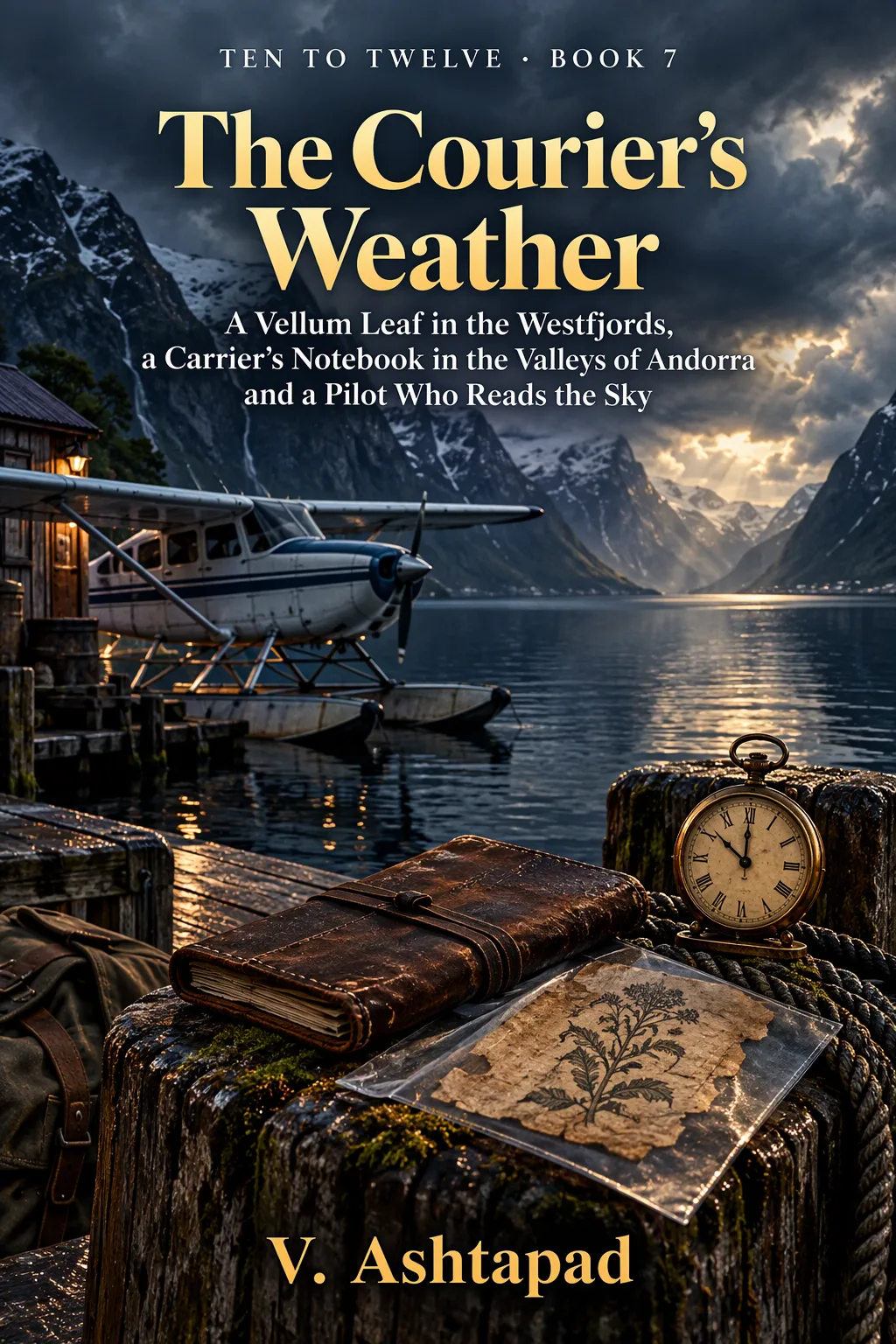
The Courier's Weather
A Vellum Leaf in the Westfjords, a Carrier's Notebook in the Valleys of Andorra and a Pilot Who Reads the Sky
by V. Ashtapad
Foreword
This is a work of fiction and Book 7 of the Ten to Twelve series. The Westfjords of Iceland and the high valleys of Andorra are real, and so are Iceland's love of family genealogy and the old mountain carriers who once took tobacco over the Pyrenees at night. The people, organizations, museums, businesses and the network in this book are invented.
For everyone who ever waited out the weather so somebody else could come home.
Selvík, Saturday Night
The boat was older than the man steering it, and the man steering it was seventy-nine.
Ásta Kristjánsdóttir sat on an upturned fish crate in the lee of the wheelhouse with a bundle in her lap and both arms around it. The bundle was a sheepskin, folded twice and tied with a red wool cord she had taken from her own sweater an hour before, and inside the sheepskin was a single leaf of calfskin about the size of a dinner plate, written on both sides in brown ink by a man who had been dead for nearly seven hundred years.
"You could still change your mind," Hjalti called back to her over the engine.
"I could," she said. "I won't."
He grunted. He had known her since she was nine and he was seven and she had pushed him off the end of the Thingeyri pier for saying girls could not gut a cod. He had not argued with her since, not seriously, and he was not going to start now, in the dark, in the mouth of the Jökulfirðir with the wind going around to the northeast and the swell coming up under the hull like a dog getting up off a rug.
The lights of Ísafjörður were behind them, a smear of yellow at the foot of the mountains. Ahead there was nothing at all. That was the point of the place. The fjords on the north side of the great bay had emptied seventy years ago, family by family, as the young went south to the towns and the old went into the ground, and now in summer a few hikers came over by ferry with their poles and their bright jackets to photograph arctic foxes and the ruins of houses, and in winter nobody came. There was no road. There had never been a road.
Ásta's grandmother had been born at Selvík in 1879, in a turf-and-timber house with a stone floor, the eighth of eleven children. Ásta had been there twice in her life, once at fourteen with her father and once at sixty with her son, and both times she had stood in the doorway of the ruined house and felt that she had been there every day.
"There," Hjalti said.
She stood up. Her knees told her about it. In the glow of the boat's one working lamp she could see the pale curve of the beach and, above it, the dark shape of the house that the last family had rebuilt in timber in the 1920s and abandoned in 1952. Somebody from a walking club kept the roof on now. They left a stove and a box of candles and a logbook for hikers to sign.
Hjalti put the bow gently onto the gravel and held the boat there with the engine, which was the kind of thing you could do only if you had been doing it for sixty years. Ásta climbed over the side with his hand under her elbow and stood in water to her shins. It was so cold it felt like a burn.
He handed down her bag. Food for four days, a flask, matches, her pills, a book of crosswords, a lamp. Her knitting.
"Monday," he said. "If the weather holds."
"It won't hold."
"Then Tuesday."
"Hjalti."
"What?"
"You didn't bring me."
He looked at her for a long time. He had a face like a split piece of driftwood and eyes that had watched the weather turn on him ten thousand times.
"I was mending nets all day," he said. "Ask anybody."
She waded ashore. Behind her the engine note rose and the boat backed off the beach, turned, and went out into the dark. She listened to it until the wind took the sound away, and then she listened to the wind.
---
The door of the house was not locked. Nothing out here was locked. She found the candles by touch on the shelf where the walking club always left them, and lit one, and then the lamp, and then she knelt in front of the stove and built a fire the way her father had taught her, with the fat pieces of driftwood underneath and the thin ones on top. When it caught she sat back on her heels and was so tired that for a minute she could not stand.
The room was bare. A table, two benches, a cupboard. Somebody had pinned a map of the hiking routes to the wall. Through the window there was nothing but black glass and her own face in it, an old woman with white hair pulled back and a man's waterproof jacket over a gray sweater with a brown-and-white yoke, the kind of sweater every grandmother in Iceland had knitted at least a hundred of.
She did not look frightened. That pleased her.
She ate a piece of dried fish with butter and a slice of rye bread and drank coffee from the flask, sitting close to the stove. Then she untied the red cord and opened the sheepskin and looked at the leaf in the lamplight.
She did not need to read it. She knew it by heart, and had since she was a girl. It began with the boundaries of the farm, from the stone at the river mouth to the cairn on the ridge to the spring where the ewes drank, and then it named the man who had first set up a house in the valley and the men and women who had followed him there, generation after generation, down to the hand that wrote it. Some long-ago woman of the family had sewn it into a sheepskin when the learned men of the south were buying up old vellum to ship abroad, and the family had kept it hidden ever since, in a sea chest, in a wall, under a bed. Ásta's grandmother had carried it out of Selvík in 1952 at the age of seventy-three, on her back, in this same skin.
Now it had come back. The thought made her want to laugh, and then it made her want to cry, so she did neither and folded the sheepskin closed.
There was a loose board at the back of the cupboard. Her grandmother had shown it to her father, and her father had shown it to her. She put the bundle there, and the board back, and the box of candles in front of the board.
Then she wrote in the hikers' logbook, in a firm hand, *Ásta K., Thingeyri. Visiting family.* She looked at it, decided it said too much, and turned the page back so that it lay under the fold.
The wind got up in earnest around midnight. She lay on the bench with her jacket over her and her boots on and listened to it working at the corners of the house. At some point she slept.
She woke in gray light with the stove gone out and a sound in the bay that was not the wind.
It was an engine. Not Hjalti's. Hjalti's boat had a cough in it, a tick, like an old clock. This was smooth and steady and coming closer.
Ásta got up very slowly, because she was eighty-one, and went to the window. The swell was white across the whole mouth of the fjord. There was a boat out there, a gray one, low and fast, holding off the beach in water where nobody with any sense would try to land.
She stepped back from the glass. In her hurry her heel caught the leg of the bench and her ankle turned under her with a sound she felt more than heard.
She sat down on the stone floor and said, aloud, one of the words her father had used about the weather.
When she got herself back to the window, the gray boat was gone.
© 2026 CRUNOD LLC. All rights reserved.
Eleven Fifty
The kitchen at Control had been built for a lighthouse keeper with eleven children, and it still had the table to prove it: twenty feet of pine scrubbed so pale it was almost white, scored with knife marks and ring stains and, at the far end, the initials of somebody called J.M. who had carved them in 1931 and been, Kadri suspected, thoroughly punished.
At eleven forty-eight on a Monday in autumn the table had a laptop on it, two coffee pots, a loaf of corn bread, a ledger, a stack of Farida's dictionaries, and most of the team.
Kadri Tamm stood at the head of it with her arms crossed and watched the old ship's clock above the stove. She was thirty-one and had been running this place for a year and a half, and in that time she had learned that if you let a stand-up start early, people treated it as optional, and if you let it start late, Tomás treated it as a breakfast.
"Two minutes," she said.
"The clock is fast," said Tomás Benítez, from the window seat. He had a gourd of mate in one hand and a thermos tucked under his arm, and he was looking out at the cape, where the Atlantic was throwing itself at the rocks in long gray rows.
"The clock is correct. I set it against the satellite."
"Then the satellite is fast."
Tomás was forty-six, a little gray at the temples, built like a man who had spent his childhood on horseback and his adulthood in seats too small for him. He had flown fighters, then transports, then crop-dusters over Uruguayan rice, and now he flew whatever the Patron bought for him. He refilled the gourd from the thermos and sipped through the metal straw with an expression of deep contentment.
At eleven fifty exactly, the ship's clock struck once, a little brass ping. Kadri uncrossed her arms.
"Two calls," she said. "Both forwarded by the Patron at six this morning."
She turned the laptop so the room could see, and there on the screen was the familiar note: four lines of typing, no greeting, and in the lower corner, hand-drawn in fountain pen and scanned, the small clock with its hands at ten to twelve.
*A family in the Westfjords of Iceland. Their eldest, a genealogist of eighty-one, has been missing since Saturday. A family document is missing with her. The granddaughter asks for help.*
*A family in Ordino, Andorra. A notebook of the old mountain routes, kept by a man who carried loads over the passes for fifty years, was taken from their barn on Saturday night. The daughter asks for help.*
Dr. Miriam Adler put on her reading glasses, which hung from a cord around her neck, and read it twice. She was fifty-eight, the team's leader by everyone's agreement but her own, an archivist from Haifa who could tell you the century of a sheet of paper by holding it up to a window.
"An eighty-one-year-old woman," she said, "at this time of year, in the Westfjords."
"Two days," said Dr. Kagiso Molefe quietly. He was a big, calm man with a doctor's habit of looking at you as if you might be about to tell him where it hurt. "If she is outside, two days is long. If she is inside somewhere, with heat, it is not so long."
"The granddaughter is a nurse in Ísafjörður," Kadri said. "Sólveig Einarsdóttir. She says her grandmother left a note. She says the note makes no sense. She says the police have searched the roads and the shore near the town, and the coast guard has flown twice, and nobody has found anything, and she does not think her grandmother is lost. She thinks she has gone somewhere on purpose."
"With the document," Miriam said.
"With the document."
"And the other?" asked Rahim Al-Balushi. He had his ledger open in front of him, the leather one with the cracked spine that he had carried since his bank years, and had already written the date at the top of a fresh page in his small square hand. Rahim was forty-nine, courtly, mustached, and he could find a missing riyal in a year of accounts the way other men found their keys.
"The daughter is Montserrat Areny. Sixty-seven, retired teacher. Her father was Josep Areny, who died in 2014. In his youth he was a smuggler."
Luka Petrović looked up from his corn bread with sudden delight. "A smuggler."
"Tobacco, mostly," Kadri said. "Coffee, sewing needles, spare parts. On his back, at night, over the mountains into Spain and France. It was a profession there for a long time. He kept a notebook of the routes. Passes, springs, shelters, weather. Fifty years of it. The family was about to lend it to a small museum in Ordino for an exhibit about the old trade. On Saturday night somebody took it out of a locked stone barn above the village, and took nothing else."
"Nothing else," Luka repeated. He was sixty-two, rumpled, with a white stubble that never quite became a beard, and he had once been the best forger of old paper in the Balkans. He had served three years for it and been trying to make up for it ever since, mostly by catching people who did what he used to do. "Not even the tools? The ham hanging from the rafter?"
"Not even the ham."
"Then it was somebody who knew what the notebook was."
"Or somebody who was paid by somebody who knew," said Rahim.
Valeria Ortiz had been filming the table on her phone, as she always did, slowly, from the end. She was twenty-six, the youngest of the adults, from Asunción, with her black hair pinned up with a pencil. She lowered the phone. "Saturday night for both."
"Saturday night for both," Kadri agreed.
"That," said Miriam, "is what I don't like."
---
They argued it out the way they always did, around the table, with the coffee going cold and the corn bread disappearing. The kitchen at Control was where every case got its shape. You put the facts in the middle of the pine and walked around them until you could see their backs.
There were two places, a long way apart. One was a fjord coast at sixty-six degrees north with a missing old woman and a storm sitting on top of it. The other was a mountain country the size of a small city, wedged between France and Spain, with a stolen notebook and a valley full of people who all knew each other.
"Westfjords first," Miriam said. "A life is a life. Tomás, can you get us there?"
Tomás had already pulled the weather up on his tablet. He turned it so she could see: a deep low sitting south of Iceland, its isobars packed like the rings of a tree. "Today to the Faroes, if we leave by two. Tomorrow into Ísafjörður, if the wind lets us. Ísafjörður is a hard airport on a good day. It is a long fjord with mountains on both sides, and you fly up the middle of it and turn at the end and land toward the mountain. With a crosswind it is very interesting."
"Interesting," said Kagiso.
"Interesting for me. For you it is just loud."
"Then Unit A," Kadri said, and typed as she spoke. "Miriam, Tomás, Kagiso, Karma. Karma for the search; if she's out there, he'll find the line she took. Marie-Claire, where's the Albatross?"
Captain Marie-Claire Hoareau had been listening from the stove, where she was frying eggs for anybody who wanted one, which was everybody. She was fifty-two, broad and brown and very calm, from Praslin in the Seychelles, and she had a laugh that could be heard from the lamp gallery. She flipped an egg. "In Tórshavn. Forty hours to Ísafjörður in this weather, if I go north of the low. Maybe less if the low behaves. It won't."
"Then go now," said Miriam. "We'll need a deck and a warm saloon if she's somewhere on that coast without a road."
Marie-Claire slid the egg onto a plate and handed it to Karma Dorji, who had said nothing so far and would probably say nothing for some time yet. Karma was thirty-five, slight and very still, a mountain guide and rescuer from Bumthang, in Bhutan. He had once found a lost trekker in a whiteout by following the places where her boots had broken the crust of the snow differently from the wind. He nodded to Marie-Claire and began to eat.
"Unit B," Kadri said. "Luka, Rahim, Farida, Valeria. Barcelona this afternoon, then the road up. You'll be in Ordino by ten tonight. Farida, the language there is Catalan."
Farida Nazarova, thirty-nine, elegant even in a fisherman's sweater, already had a dictionary open. She spoke seven languages. Catalan was not one of them. "Everyone speaks Spanish and French as well," she said. "I have French. I will have Catalan by Thursday."
"By Thursday," said Luka admiringly.
"Enough to be polite. Politeness opens more doors than grammar."
"And us?" said a voice from the end of the table.
Kai Benally-Ríos was seventeen and had been waiting for this question to become askable for the entire meeting. He had his father's long Diné face and his Panamanian mother's quick hands, and he had grown three centimeters since summer, so that his wrists stuck out of his sleeves. Next to him Tara Dorji, sixteen, sat with her chin on her fist and a pencil behind her ear. She was Karma's daughter. She remembered every face she had ever seen and most of the pages she had ever turned.
"You," said Kadri, "have a mathematics test on Wednesday and a history essay due Friday."
"I can write a history essay in Iceland," Kai said. "Iceland is basically made of history."
Kadri looked at Miriam. Miriam looked at Tomás. Tomás, who had known Kai since he was a baby on his father's knee in Gallup, and who had promised both his parents things about this boy that he took more seriously than he let on, rubbed his jaw.
"He's good with the drone," Tomás said. "In wind, a drone is useless. But not always wind. And he can carry fuel cans. He stays with me or with Kagiso. Not on any boat in any weather. Not on any mountain."
"Not on any boat in any weather," Marie-Claire repeated from the stove, firmly, as if entering it into a log.
"Agreed," said Miriam. "Tara?"
Tara shrugged. "I'll stay. Somebody has to read all the pictures you send." She glanced at her father, who glanced back, and something passed between them that did not need words. "And Kadri needs someone to tell her when to eat."
"I eat," said Kadri.
"You eat crackers over a keyboard," said Tara. "That's not eating. That's crumbs."
The ship's clock said twelve twenty. Kadri closed the laptop.
"Go," she said.
---
At ten past two the twin-engine utility plane that Tomás called la Tordilla, the dappled mare, because of the gray-and-white patches where her paint had been touched up in three different hangars, lifted off the strip behind the cape and turned north over the sea.
Kai sat in the right seat with a headset on, a chart on his knees, and a look on his face that Tomás remembered from his own first flight, at nineteen, in a trainer older than he was.
"Rule one," Tomás said over the intercom. "You don't touch anything I haven't told you to touch."
"Okay."
"Rule two. When I tell you to touch something, you touch it right away."
"Okay."
"Rule three. If you get sick, use the bag, not my boots."
"I'm not going to get sick."
Tomás grinned and banked the plane gently toward the horizon, where a long bar of cloud lay along the edge of the world like a coastline. Behind them Miriam had her glasses on and a folder of printouts open on her lap. Kagiso was asleep. Karma was looking out of the window at the sea with an expression of great patience, as if the sea were a mountain he had decided to wait out.
"The weather is going to get worse," Kai said, studying the chart.
"The weather," said Tomás, "is going to do what it does. Our job is to be somewhere else when it does it."
© 2026 CRUNOD LLC. All rights reserved.
Ordino
The first thing Farida noticed about Ordino was the sound of water.
It was everywhere. It ran in stone channels beside the lanes and under little bridges and down the faces of walls, it came off the slate roofs in thin silver strings from the night's rain, and under all of it, from the bottom of the valley, there was the steady bass note of the river, full and cold and fast, coming down from the high country toward the Valira.
The second thing she noticed was the cows. There were three of them in the lane outside the guesthouse at eight on Tuesday morning, brown, enormous, with bells, walking slowly downhill in single file as if they had an appointment. Nobody was with them.
"They know the way," said the woman who ran the guesthouse, when Farida asked. "In summer they go up. In autumn they come down. Every year somebody from Barcelona calls the police because he has found loose cows on the road, and every year the police tell him the cows are not loose. They are going home."
Farida thanked her in Catalan. She had learned the word on the plane. The woman beamed and corrected her pronunciation, which Farida had expected, and then gave her a second croissant, which she had not.
---
Montserrat Areny lived in a stone house at the top of the village, three stories, with wooden balconies and geraniums still red on every rail, and a view down the valley that would have been worth a fortune in any other country. In Andorra, Farida suspected, it was merely worth a lot.
Montse herself opened the door. She was sixty-seven, small, square, with short white hair and a teacher's eyes, the kind that had seen thirty years of excuses and believed perhaps four of them. She shook each hand in turn: Farida, Luka, Rahim, Valeria. She looked hard at Valeria's phone.
"You're filming."
"Only if you say yes," said Valeria.
"I say no. Not yet." Montse stepped back to let them in. "Maybe later. When I know you."
Valeria put the phone in her pocket. Farida, who had watched Valeria argue with Miriam about exactly this for the better part of a year, made a small private note to herself that Montse had achieved in four seconds what Miriam had not managed in eleven months.
The kitchen was warm and smelled of woodsmoke and garlic. There was a long table, smaller than the one at Control but scrubbed just as pale, and on it a coffee pot, a basket of bread, and a board with dark dry sausage sliced on it. A man of about forty was leaning against the counter with his arms folded. He was tall and lean, with a weathered face and very pale eyes and a fleece jacket with a guide's badge on the chest.
"This is Bernat," Montse said. "Bernat Solé. My father's boy."
Bernat laughed and came forward to shake hands. "Not his boy. His mule. I carried his bags up the mountain from the age of fourteen. He paid me in chocolate and stories." He had a quick easy voice and good English with an accent that sat somewhere between Spain and France. "Montse says you've come to help find the notebook. I know every path the old man ever walked. If you need a guide, I'm yours. No charge."
"That's very kind," said Farida.
"It's nothing. Josep was like a grandfather to me." He looked at Montse. "Whoever did this, I'd like to meet him on a narrow trail."
Montse patted his arm and sat down at the head of the table. "Sit. Eat. Then I will show you the barn, and then you will tell me who you are and why a stranger I have never met is paying for all this."
"Nobody is paying," said Rahim, sitting. "That is the rule. We take no money from the people we help, and we do not ask questions of the person who asks us to help them."
"Everybody pays for everything," said Montse. "That is my rule." She poured coffee into small cups. "But I will let you keep yours for now."
---
The barn, the borda, was twenty minutes' walk above the village on a stony track between dry-stone walls, through a meadow where the grass had gone gold and a pair of horses grazed with their tails to the wind. It was built of gray stone with a roof of thick slate slabs, long and low, with a hayloft above and an animal stall below, and a heavy wooden door that had been painted green at some point in the last century.
"My father built the upper part with his brother in 1953," Montse said, as they climbed. "With the money from the tobacco."
"From smuggling it?" asked Valeria.
"From carrying it. That's the word he used. Carrying." Montse did not slow down. She walked uphill like someone who had done it every day of her life. "Everybody in these valleys grew tobacco then, on the terraces, or carried it, or both. The leaves went into the factories down in the town and the finished packets went over the mountains on men's backs. Thirty kilos. Forty. At night. In every weather. My father started at sixteen. He stopped when his knees stopped. Fifty years."
"And he wrote it down," said Farida.
"Every trip." Montse unlocked the green door with a long iron key. "Every pass. Every spring where you could drink. Every place you could sleep under a rock if the snow came. And the weather, every night, like a clerk keeping a register. He said the mountains kill you if you forget what they did last time."
Inside, the barn was dim and cool and smelled of old hay and older wood. There were tools on pegs, a workbench, a ham in a cloth bag hanging from a beam, a pair of ancient skis, and against the back wall a wooden chest with its lid up and nothing in it.
"It was there," Montse said. "In a tin box, in the chest, under the old blankets. I came up on Sunday morning to bring it down for the museum. The door was locked. The chest was open. The box was gone."
Luka crouched at the door and looked at the lock for a long time without touching it. He looked at the hinges. He looked at the floor inside the door, which was beaten earth, and at the flagstone in front of it.
"Who has keys?" he said.
"Me. My son Pol. And there is one under the stone by the water trough, for anybody in the family who comes up and needs a tool."
"Who knows about the stone?"
Montse thought. "The family. The neighbors, probably. The postman, probably. In Andorra, everybody knows everything except what you want them to know."
"The lock wasn't forced," Luka said, standing. His knees cracked. "The key was used. And whoever used it put it back, I'd guess, under the stone, or you'd have said."
"It was under the stone."
"Then whoever took the box knew three things," Luka said, counting on his fingers. "The key was there. The box was in the chest. And it was worth taking." He looked around the barn, at the ham, the tools, the skis. "And they knew nothing else here was."
Bernat had come in behind them and was standing in the doorway, a tall shape against the light. "Could have been anybody who drank in the bar," he said. "Montse's been talking about the exhibit for months. It was in the parish newsletter."
"Was the box in the newsletter?" asked Rahim mildly.
"No," said Montse.
"Then not anybody," said Rahim.
---
Back in the kitchen, Montse put a second pot of coffee on and told them the rest.
The museum was the Ordino Valley House, a three-room museum in a seventeenth-century family house at the bottom of the village, run by a curator named Núria Pujol with a grant from the parish and a great deal of stubbornness. Núria had been planning an exhibit called *The Carriers* for two years. She had borrowed packs and bales and old photographs from half the families in the valley. Josep's notebook was to have been the center of it.
"She photographed every page," Montse said. "In the spring. For the catalog. So if the book is gone forever, at least we have the pictures." Her mouth tightened. "It is not the same."
"No," said Farida. "It is not the same."
There was a sound at the door, and a man came in without knocking, as family does: late thirties, broad, with Montse's jaw and a ski-shop fleece and the look of someone who had not slept enough for some time. He stopped when he saw the strangers.
"My son," said Montse. "Pol."
Pol nodded to them all, but his eyes went to Bernat, and something in his face closed. "You're here early."
"I'm here when I'm needed," said Bernat easily.
"Sure." Pol took a piece of sausage from the board and ate it standing up. "Mama, I can't stay. The bank wants me at eleven." He kissed her cheek and was gone again, and the door banged behind him, and the room was very quiet.
"He has a shop in Canillo," Montse said, to nobody in particular. "Bicycles in summer. Skis in winter. Last winter there was no snow until February." She spread her hands on the table. "He is a good boy."
Rahim, who had been writing in his ledger, wrote one more short line and closed it.
Valeria caught Farida's eye across the table. Farida gave the smallest shake of her head. *Not yet.*
© 2026 CRUNOD LLC. All rights reserved.
The Approach
Tomás had flown into Ísafjörður once before, nine years ago, in July, in a borrowed single-engine plane with a fisheries scientist in the back seat who had spent the whole approach muttering in Portuguese. It had been calm that day. He had still thought, as the walls of the fjord rose up on either side of the wings, that it was one of the most beautiful and least forgiving pieces of air he had ever been in.
On Tuesday, at eleven thirty-one in the morning, it was not calm.
They had come up from the Faroes in the dark, three hours over a sea the color of slate, with the sun coming up late and sullen behind them and the cloud base sinking as they went north. Now the Westfjords were under them, a ragged hand of land laid on the ocean, every finger a mountain and every gap between the fingers a fjord. The mountains were flat-topped, as if somebody had sliced them with a knife, and dusted with the first snow. Their sides fell to the water in long gray scree slopes striped with old avalanche tracks. Here and there at the bottom of a fjord a little town clung to a gravel spit: a church, a harbor, a fish factory, a few dozen houses in red and white and yellow.
Kai had not spoken for ten minutes. He had his forehead almost against the side window.
"Ísafjörður tower," Tomás said, and gave their call sign and position. The controller answered in calm, accented English and gave him the wind.
Tomás repeated it back and then sat for a moment, looking at the numbers on his kneeboard where he had written them.
"Is that bad?" Kai asked.
"That is gusty," Tomás said. "Twenty-five knots, gusting thirty-eight, from the side. The fjord makes the wind go strange. It comes down off the mountains and around the corners and it is never quite where they tell you it is."
From the back, Miriam said, "Tomás."
"I know."
"You don't know what I'm going to say."
"You are going to say that we can go to Thingeyri, which is fifty kilometers by road and has a gravel strip, and land into the wind there, and drive. And you are right. And I am thinking about it."
He was thinking about it. He was also thinking that Ásta Kristjánsdóttir had been somewhere out on this coast for three nights, and that Thingeyri was on the wrong side of a mountain from the town where her granddaughter worked, where the police were, where the boats were.
He keyed the radio and asked the tower how the wind had been for the last hour.
"Variable," the controller said. "Gusts come in groups. Then there is a gap of a few minutes. The local pilots wait for the gap."
"Thank you," said Tomás.
He looked down at the mouth of Skutulsfjörður, the little fjord inside the big one where the town and the runway sat. He looked at the water, which was ruffled dark in long streaks and then, in patches, smooth. He looked at the snow being blown off the top of the mountain to the west in a long white plume, like smoke from a chimney, and watched the plume bend and straighten and bend.
His grandfather had sat on a horse on a ridge in Tacuarembó on a hot afternoon in 1989 and pointed at the line of the eucalyptus trees along a creek and said, *Look at the tops, not the bottoms. The tops know first.*
"Kai," Tomás said. "Watch the snow on that ridge for me. When it stops blowing straight off the top and starts curling, tell me."
"Curling how?"
"You'll see."
He took the plane down the middle of the big fjord at a careful speed with the flaps half out, and the wind took hold of them. La Tordilla bucked and slewed. Something in the back slid across the floor with a thump. Kagiso, who had been awake since the Faroes, said something in Setswana that sounded calm and was probably not.
Tomás held her. He was not fighting the plane; you did not fight a horse either, his grandfather had said, you told it what you wanted and you kept telling it. His hands were light on the yoke and his feet were busy on the pedals and his whole attention had gone out through the windshield into the air ahead of him, as if he could see it, the long invisible rivers of it pouring down the mountainsides.
"It's curling," Kai said suddenly. "The snow. It's going in a circle now, at the top."
"Good," Tomás said. "That's the gap coming. Now watch the water."
They came around the bend into the inner fjord, and there was the town, a tight cluster of colorful roofs on its spit, and the runway along the far shore under the mountain, short and dark and wet. The water below them went from dark to smooth in a patch that spread as they watched.
"Ísafjörður tower, we'll take the gap," Tomás said.
He turned at the head of the fjord, a steep tight turn with the mountain filling the left windows so close that Kai could see individual rocks, and the runway swung into the windshield, and the wings rocked once, twice, and then went quiet, and Tomás put her down on the numbers so gently that Miriam, who had her eyes shut, did not open them until they were slowing.
The ship's clock at Control would have said eleven fifty. So did the clock on Tomás's panel.
He saw it as he turned off the runway, and laughed out loud.
"What?" said Kai.
"Nothing. An old joke." Tomás taxied toward the little terminal. Behind them the wind came back in a white rush across the water, as if somebody had opened a door. "Remember what you saw on that ridge."
"The tops know first," Kai said.
Tomás turned and looked at him.
"You said it," Kai said, a little embarrassed. "On the intercom. You were talking to yourself."
---
Sólveig Einarsdóttir was waiting for them in the arrivals hall, which was a single room with a coffee machine, a rack of tourist leaflets and a stuffed arctic fox in a glass case. She was thirty-four, tall, with fair hair pulled back hard and the scrubbed, exhausted face of someone who had worked a night shift and then not gone to bed. She wore a puffy jacket over her hospital clothes.
"You are the ones," she said. It was not a question.
"We are," said Miriam, and took both her hands. "Sólveig."
"Sóla. Everybody says Sóla." Her eyes went over all of them quickly, the way nurses' eyes do, checking for injuries. They rested on Kai a moment longer. "You brought a child."
"He's seventeen," said Tomás. "He's my copilot."
"I'm a navigator," said Kai.
Sóla almost smiled. It was there and then it wasn't. "My grandmother would like you," she said to him. "She likes young people who argue." Her voice caught on *would*, and she heard it, and set her jaw. "I have a car. My cousin Gunnar has another one outside. We'll go to Thingeyri, to her house. You'll want to see the note."
"Has anyone heard anything?" Kagiso asked gently.
"The coast guard flew again this morning, along the outer coast. Nothing." She turned toward the door. "The police think she wandered onto the shore road in the dark and fell into the sea. Old women do that, they say. Old women get confused."
"Was she confused?" said Miriam.
Sóla stopped with her hand on the door.
"My grandmother has drawn the family trees of eleven hundred families in the Westfjords," she said, "from memory, back to the eighteenth century. Last month she corrected the minister's dates for his own great-grandfather. She is the least confused person I have ever met."
She pushed the door open, and the wind came in and took the leaflets off the rack, and they went out into it.
© 2026 CRUNOD LLC. All rights reserved.
Thingeyri
The road from Ísafjörður to Thingeyri went into a mountain and came out of it into another fjord, which was the way of most roads in the Westfjords. Karma sat in the back of Gunnar Pálsson's truck and watched the tunnel lights flick past and thought about the shape of the land.
Gunnar drove fast and without speaking. He was fifty-two, Ásta's nephew, the son of her younger sister, a heavy man with a red beard going gray and hands that had hauled a great deal of rope. The cab smelled of diesel and wet wool and, faintly, of sheep. There was a dog's blanket on the seat and dog hair on Karma's knees, though no dog.
"She went to the dog," Gunnar said suddenly, when they had come out of the second tunnel into the gray light over Dýrafjörður. "That's what I thought. Saturday. My dog got out on Friday night and I thought, she has gone looking for him. She loved that dog. Then the dog came home on Sunday and she didn't."
"Where did the dog go?" Karma asked.
Gunnar glanced at him in the mirror. It was perhaps the first time he had properly looked at him. "To the farm. Hraunsnes. Where I keep the sheep. He always goes there. It's where he was born."
Karma nodded and said nothing more, and Gunnar, after a minute, seemed to relax, as if the question had been the right kind.
Dýrafjörður opened out below them as they came down the hill: a long arm of steel-gray water between steep mountains, very straight, and on its southern shore, on a flat point of land, the village. Thingeyri had a harbor with a few fishing boats, a fish plant, a white church, a gas station, a swimming pool steaming gently into the cold air, and perhaps a hundred and fifty houses. On the far side of the fjord the mountains came straight down into the sea.
---
Ásta's house was on the street above the harbor, a small square house clad in corrugated iron painted a deep, cheerful red, with white window frames and a garden of stones and dead flowers. Inside it was warm and very orderly. There were books on every wall, floor to ceiling, and between the books there were family trees.
Miriam stopped in the doorway of the front room and put her glasses on.
They were drawn by hand, in ink, on long sheets of paper, some pinned flat, some rolled and stacked in an umbrella stand. Names and dates and farm names in a small upright hand, and lines connecting them, branching and rejoining and branching again, five, six, seven, ten generations deep. Some of the sheets were new. Some were yellow with age and had been mended with tape that had itself gone yellow. On one wall a single tree covered the whole space from the ceiling to the wainscot, so dense that it looked from a distance like the drawing of a river delta.
"Hers," said Sóla. "Our family. She started it when she was twelve."
Miriam crossed the room and stood in front of it for a long time, reading. Kagiso and Tomás waited by the door. Kai had his phone out and was photographing everything, one wall at a time, slowly, the way Valeria had taught him. Nobody told him to stop.
"She does them for anybody who asks," Sóla said. "Tourists, sometimes, in summer. Americans and Canadians whose great-great-grandparents emigrated. They come to Thingeyri to see where they're from. She gives them coffee and kleinur and draws their trees from memory, and they cry. She never takes money. She says the dead did the work. She only writes it down."
"Where is the note?" said Miriam gently.
---
It was on the kitchen table, under the sugar bowl, where Sóla had found it on Sunday morning when she came for coffee as she did every Sunday. Sóla had put it back exactly where it had been, which Miriam thought very sensible and told her so.
It was a sheet of lined paper from a notebook, written in pencil in the same small upright hand as the trees.
Sóla translated it aloud, her finger on each line.
*Sóla. Don't worry, I am well and I have food. I have gone to Sigríður's mother's mother's farm, to put something back where it belongs. Bring my brown sweater when you come, and tell no one in the hot pot. Hjalti knows nothing. Your Amma.*
"Amma is grandmother," said Sóla. "And the hot pot is the hot tub at the swimming pool. Everybody sits in it after their swim and talks. You can't tell anybody anything in Thingeyri without the whole hot pot knowing by evening."
"And Sigríður?" asked Miriam.
Sóla laughed, without any humor at all. "There are three. In our family alone there are three Sigríðurs she might mean. My great-great-grandmother. My great-aunt, who died in 1998. And my cousin's daughter, who is nine. And every one of them had a mother's mother at a different farm." She pressed her hands against her eyes. "I have been staring at that tree for two days."
"Hjalti," said Karma, who had been reading over Sóla's shoulder. "Who is Hjalti?"
"An old fisherman. Her friend. Since they were children."
"She says he knows nothing."
"Yes."
"Why say it," said Karma, "unless he does?"
Sóla lowered her hands slowly and looked at him.
"I asked him on Sunday," she said. "He said he had been mending nets all Saturday. He looked me in the face."
"Where is his boat?" said Karma.
---
It was in the harbor, tied up at the end of the pier, a small open-decked wooden boat painted blue and white, very old and very well kept, with a little wheelhouse and a winch and the name *Lóa* on the bow. The harbor was empty except for a man in orange overalls hosing down the deck of a bigger boat at the other end, and a pair of eider ducks bobbing in the corner where the seaweed gathered.
Karma walked the length of the *Lóa* slowly, on the pier, without stepping aboard. He crouched and looked at the waterline, where a thin green line of fresh weed clung to the paint. He looked at the coils of rope on the deck and the nets, which were piled neatly by the winch and were perfectly dry. He looked at the fuel can by the wheelhouse door. He put his hand flat on the hull near the stern and held it there.
"He's mending nets?" said Tomás, behind him.
"Those nets have not been touched in a week," said Karma. "There is dust in the folds. And the weed on the hull is new. The boat has been out, a long way, in big water, and not for fishing." He pointed at a scuff of pale gravel ground into the tread of the deck by the bow. "And it has been on a beach."
Kagiso had come up the pier with Sóla. "He was protecting her," he said quietly. "She asked him to say nothing, and he is a man of his word."
"Then we ask him in a way that lets him keep it," said Miriam.
They found Hjalti Jónsson at home, in a white house with a green roof three doors down from Ásta's, sitting in a kitchen chair by the window with a pair of binoculars on the sill and a cold cup of coffee in his hands. He was seventy-nine and had a face like weathered wood and he did not get up.
Sóla spoke to him in Icelandic, quietly. He answered in one word and looked out of the window. She spoke again. He did not answer at all.
Kagiso pulled a chair out from the table without asking and sat on it, a little distance from the old man, looking out of the same window at the same gray fjord. He did not say anything for a long time. Tomás, standing by the door, had seen him do this in a field clinic once, with a young man who would not say where he had been hurt, and it had worked then too.
After a while Hjalti said something, gruffly, without turning his head.
"He asks if you are the doctor," Sóla translated.
"Tell him yes," said Kagiso. "Tell him I have been worried about his friend for two days, because she is eighty-one and it is autumn. Tell him he does not have to tell me anything. Tell him I only want to know whether she was walking well on Saturday, and whether she had her pills."
Sóla told him. The old man's hands tightened on the cup.
Then, still looking out of the window, he said a few words.
"She had her pills," Sóla said, very quietly. "She had food for four days. She was walking well when he last saw her."
"When was that?" said Kagiso, as if it hardly mattered.
Hjalti turned from the window at last and looked at the doctor, and then at the rest of them, and then at Sóla. He said one more sentence, and then he put the cup down and covered his face with his hand.
"Saturday night," Sóla said. Her voice shook. "On a beach. He won't say where. He says she made him promise. He says he tried to go back on Monday and the sea wouldn't let him. He says he tried again this morning and it was worse." She took a breath. "He says it's been four days and he's an old fool."
Kagiso reached out and put his big hand on the old man's shoulder, and left it there.
---
On the way out, on the doorstep, Sóla stopped so suddenly that Tomás nearly walked into her.
There was an envelope in Ásta's mailbox, on the gatepost of the red house. Not posted. Delivered by hand. Thick cream paper, no stamp, Ásta's name typed on the front.
Miriam took it from her before she could open it, and turned it over.
On the back, in dark red wax, was a seal no bigger than a thumbnail, and pressed into the wax was a tiny clock face with its hands at ten to midnight.
Miriam stood very still on the gravel path in the wind. Tomás saw her face and did not need to be told. Everyone at Control had seen that seal before, on a folder, in the spring, at the beginning of all this.
"Do you know what this is?" Sóla asked.
"Yes," said Miriam. "Unfortunately." She slipped the envelope into the inside pocket of her coat without opening it. "Sóla, who else has been asking about your grandmother this week? Not police. Not neighbors. Someone polite, from away."
Sóla thought. Then her eyes widened a little.
"There was a woman in the hot pot on Friday," she said. "My friend works at the pool. A foreign woman, very well dressed, who sat with my grandmother and talked for a long time. My friend said Amma got out of the water early and went home without drying her hair."
© 2026 CRUNOD LLC. All rights reserved.
Tacuarembó
At eleven on Tuesday night Tomás gave up on sleep and walked down to the harbor.
The guesthouse was a converted fishermen's bunkhouse on the shore road, all pale pine and woolen blankets, and Kagiso and Karma were asleep in the room next to his with the deep, unworried breathing of men who could sleep anywhere. Miriam's light was still on under her door. He could hear her turning pages. Kai had fallen asleep in an armchair in the lounge with his laptop open on his chest and a half-written essay on it about the settlement of Iceland. Tomás had closed the laptop and put a blanket over him and thought, briefly, about the boy's mother in Panama City, who would have done the same thing and then probably kissed his forehead. Tomás did not kiss his forehead. He was not his mother.
The wind had eased. The sky over the fjord had torn open in places and there were stars in the gaps, very sharp, and to the north, low over the mountains on the far side, a thin pale-green ribbon of light that came and went like breath on a cold window. He stood on the end of the pier beside Hjalti's blue-and-white boat and watched it.
His phone said 23:04. In Montevideo it was just after eight in the evening. He called.
Sofía answered on the fourth ring, which meant she had seen it was him and made him wait on purpose.
"You missed Sunday," she said.
"I know. I'm sorry. I was in a meeting."
"You're always in a meeting. You're a pilot. Pilots don't have meetings."
"This pilot has meetings. Big ones. With coffee." He leaned on the bollard. "Where are you?"
"In my room. Mamá's making milanesas." She was fourteen and every sentence she spoke to him lately came with a small edge on it, like a knife she was learning to carry. He did not blame her. He had been gone a great deal of her life. "Where are you?"
"Iceland."
A pause. "Seriously?"
"Seriously. There's a light in the sky. Green. Like somebody's waving a scarf. Wait." He held the phone up toward the north for a few seconds, though he knew the camera would see nothing. "Did you see it?"
"I saw black."
"It's there. Trust me."
She sighed, the long-suffering sigh of a teenager who has been asked to trust a parent. Then, in a different voice, younger, she said, "Papá, I have a project. For history. We have to do our family. Four generations. With a story from each."
"That's good."
"I did Mamá's side already. Abuela gave me everything. Photos. Letters. A recipe for alfajores from her grandmother." He could hear her shifting on the bed. "Your side, I only know Abuelo, and he only talks about football. And there's your grandfather. The one with the horses."
"Don Aurelio."
"Him. I don't know anything about him. Only that he was a gaucho and he had a big mustache. There's a photo in Abuelo's hall."
Tomás looked at the green light over the mountains. It had thickened into a curtain and was sliding slowly west.
"It's due Monday," Sofía said. "Can you tell me something? Something real. Not 'he was a good man.' Teachers hate that."
"Tonight?"
"You're always saying you'll do things later."
That was fair. That was, he thought, entirely fair.
"Okay," he said. He sat down on the bollard with the cold coming up through his jeans. "Get a pen."
---
Don Aurelio Benítez had been born in 1921 on a cattle estancia in the hills north of Tacuarembó, in the middle of Uruguay, where the land rolls away in long green ridges the locals call knives, and the streams are lined with dark trees, and the sky is so big that a man on a horse feels like a stitch on a blanket.
He had worked cattle on other men's land for forty years and then on a little piece of his own for twenty. He was not tall, but he sat a horse as if he had been born on one, which, according to family legend, he nearly had. He had a mustache like a broom and hands like old leather and he spoke perhaps two hundred words a day, of which a hundred and fifty were to horses.
Tomás's father, who did not like horses and had gone to the capital at eighteen to sell insurance, sent him to the estancia every summer from the age of seven to the age of sixteen. *To get the city out of him*, his father said. It had not worked. Or rather, it had worked so well that Tomás had spent his whole adult life trying to get back to the feeling of those summers, and had only ever found it in a cockpit.
The first thing his grandfather taught him was how to wait.
"You want the colt to come to you," Don Aurelio said, the first morning, at the rail of the corral, with the dew still on the grass and the mate gourd passing back and forth between them. Tomás was seven and the mate was too bitter and he drank it anyway because his grandfather was drinking it. "You don't go to the colt. You stand here. You look at the ground. You think about something else. You let him get curious."
"How long?"
"As long as it takes."
"But how long is that?"
His grandfather looked at him for a while. "Longer than you want," he said. "Every time."
Tomás stood at the rail for an hour that morning, while the young horse snorted and circled at the far side of the corral and the sun came up over the hills and got hot, and nothing happened. He stood there the next morning, and the morning after. On the fifth morning the colt came across the corral in a sideways, suspicious way and put its nose against his shoulder, and Tomás was so excited that he turned and flung his arms around its neck and it bolted and did not come near him again for a week.
"Now you know," said Don Aurelio.
"Know what?"
"That waiting is not the hard part. The hard part is what you do when the waiting ends."
---
The second thing his grandfather taught him was the weather.
In the hills of Tacuarembó the weather came from the southwest, across the whole flat breadth of the continent, from the Andes and the pampas. On summer afternoons the heat would build until the air felt like warm milk and the cattle stood in the shade of the trees not moving, and then far off on the horizon a dark line would appear, and the old men would look at it and say *pampero*, and within an hour the wind would arrive like a slap, cold and violent, and the temperature would fall ten degrees in ten minutes, and the rain would come sideways across the hills in gray curtains.
Don Aurelio could see a pampero coming long before the line appeared.
"Look at the cattle," he would say. "They're bunching. Tails to the southwest. They know." Or, "Smell that. That's rain on the dust a long way off." Or, "Look at the horneros." The hornero was a little brown bird that built a nest of mud on fence posts, round as a bread oven, with a curved doorway. "Everybody says the hornero builds his door facing away from the rain. It isn't true every time. But when a whole row of them have built their doors the same way, you can pay attention."
And, always: "Look at the tops of the trees. Not the bottoms. The tops know first."
"Why do I need to know?" Tomás asked once, at eleven, sulking because a storm had stopped him riding out to the creek.
"Because one day you'll be out there," said his grandfather, nodding at the hills, "and you'll be alone, and it'll be you and the weather. And the weather won't care that you're a good boy."
When it rained, his grandmother Doña Rosa made tortas fritas. Every family in Uruguay did; it was what you did on a wet day, as surely as you closed the shutters. She mixed the dough with fat and salt in a big tin bowl, and rolled it thin and cut it in rounds and poked a hole in the middle of each with her finger, and fried them in a black pan until they puffed up golden, and sprinkled them with sugar. Tomás and his grandfather would sit on the veranda with the tortas fritas and the mate while the rain hammered the iron roof, and his grandfather would say nothing at all for an hour, and it was the happiest Tomás had ever been.
"I always thought," he said to Sofía, sitting on the bollard in the Icelandic night, "that he loved the rain because it meant tortas fritas. He used to wink at me. But it wasn't that. It was that he had seen it coming. He'd brought the horses in and closed the gates and moved the cattle up off the low field. He'd done everything right. So when it came, he could sit and enjoy it. A storm's only a disaster for the person who didn't see it."
He could hear the scratch of her pen.
"That's good," Sofía said. "Is that real?"
"It's real."
"What was the bad thing? Teachers like a bad thing. A conflict."
He laughed. "You want a conflict."
"Everybody's story has a bad thing."
---
The bad thing had happened when he was twelve.
There had been a heifer in the low field by the creek, due to calve, and the pampero had been coming all afternoon, and his grandfather had gone to the neighbor's estancia to help with a sick horse and said he'd be back by four. At half past three the line was on the horizon. At a quarter to four the cattle were bunching. At four his grandfather was not back.
Tomás had saddled the old bay mare himself and ridden down to the creek to bring the heifer up.
He knew the rules. You did not ride toward a pampero; you rode away from it. You did not go into the low ground by the creek, where the water came up fast. You did not go alone. He went anyway, because he was twelve and he loved his grandfather and he wanted, more than he had ever wanted anything, to have done the right thing when the old man came home.
He found the heifer. He got a rope on her. He was turning the mare for home when the wind hit.
It knocked the mare sideways. The rain came in a solid wall. In a minute he could not see the far bank of the creek, or the hill, or anything except gray. The heifer panicked and pulled and the rope burned through his hands and he let go. The mare, who was old and wise, put her head down and stood with her tail to the storm and refused to move, and Tomás sat on her with the water pouring off him and cried, and was so frightened he could not remember which way the house was.
His grandfather found him an hour later. He had come down the hill on foot with a lantern, because he would not risk a horse in that wind. He did not shout. He took the mare's bridle and led her up the hill in the rain, slowly, and Tomás on her back, and did not say a single word the whole way.
At the house Doña Rosa wrapped him in a blanket and put him by the stove and gave him a torta frita, which he could not eat. His grandfather sat across from him and drank mate and looked at him.
"The heifer," Tomás said finally.
"The heifer came home by herself twenty minutes ago," said Don Aurelio. "She was smarter than both of us." He passed the gourd. "Why did you go?"
"Because you weren't here. Because somebody had to."
"Somebody had to wait," said his grandfather. "That was the job. The job was to wait at the house with your grandmother, and when I came home to tell me where the heifer was. And I would have gone down with the lantern and found her, and you would have been dry." He was quiet a moment. "You weren't brave, Tomás. You were in a hurry. It looks the same from the outside. It isn't the same."
Tomás had been angry at him for three days. Then, on the fourth day, he had not been angry anymore. It had taken him the rest of his life to understand why.
---
"That's the bad thing?" said Sofía. "He told you off?"
"He didn't tell me off. That's the thing. He told me the truth and then he passed me the mate." Tomás found that his eyes were stinging, and decided it was the cold. "Write that down. *He told me the truth and then he passed me the mate.*"
"I'm writing it." A long pause. Pen scratching. Then, slyly, "Did you learn your lesson?"
"No," said Tomás. "Not for a long time."
"What does that mean?"
"That's another story."
"Papá."
"Another time. I promise. A real promise. I'll tell you before Monday." He looked up. The green light had faded to almost nothing, a faint smudge over the black shoulder of the mountain. "Go eat your milanesa."
"Love you," said Sofía quickly, the way she said it now, like a coin pushed into a slot, and hung up before he could answer.
He sat on the bollard a while longer.
When he got back to the guesthouse, Kai was awake in the armchair, the blanket around his shoulders, looking at him.
"Was that your daughter?" Kai said.
"That was my daughter."
"You were talking a long time."
"She has a project." Tomás hung up his jacket. "Your grandfather. The one in New Mexico. He taught you the stars."
Kai nodded slowly. "And the land. How to tell where water is by the plants. How to tell how old a track is." He hesitated. "He said the stars are just a map that somebody else drew a long time ago. You don't have to believe the story to use the map. But it's rude not to know the story."
Tomás thought about that.
"Mine taught me the weather," he said. "Go to bed. Tomorrow nobody flies. Tomorrow we think."
© 2026 CRUNOD LLC. All rights reserved.
The Smugglers' Notebook
The Ordino Valley House had been built in 1624 by a family who had made their money in iron and sheep, and it still had the iron and the sheep, more or less: a forge in the cellar with a set of bellows taller than Luka, and on the top floor, under the roof beams, a room full of old wool carders and spinning wheels and the smell of lanolin that three centuries of airing had not got out of the wood.
Núria Pujol had put her office in the old kitchen. She was forty-five, quick, small, in black jeans and a striped sweater, with gray streaks in her dark hair and a pair of reading glasses pushed up on her head that she forgot were there and kept looking for. She shook Luka's hand, then Farida's, and then, when Luka mentioned that he had once restored paper for a living, shook his hand again, more warmly.
"Then you'll know," she said, "that a photograph is a corpse."
"A portrait," Luka said. "But yes. Not the thing."
"Not the thing." She pulled a chair round for each of them and woke her computer. "The paper had a smell, did Montse tell you? Tobacco. Seventy years of it. You opened the cover and it came up at you. And the pages were soft from being carried in a pocket against a body for fifty years, soft like cloth. And there were stains. Sweat. Snow. Wine, once, a big red ring, and a note beside it in his hand: *Coll del Llop. Celebrating. Do not tell Maria.*" She smiled. "Maria was his wife."
On the screen she opened a folder of photographs. There were two hundred and twelve of them, she said, every page front and back, shot in the spring on a copy stand in this very room with a good camera and two lamps.
Luka leaned in.
The notebook had been a cheap school exercise book once, with a cardboard cover gone the color of tea. Josep Areny had written in it in pencil and, later, in ballpoint, in a small cramped Catalan hand that leaned hard to the right as if hurrying uphill. Farida had her new Catalan dictionary on her knee and read aloud where she could; Núria filled in the rest.
There were dates. There were routes, written as lists of names: a bridge, a spring, a rock, a pass, a shepherd's hut, a ridge, another pass. There were loads: *30 kg leaf*, *25 kg packets*, *coffee 20 kg + needles*. And beside almost every entry there was the weather, in a sort of shorthand Josep had invented for himself: a little drawing of a cloud with lines under it for rain, dots for snow, a curl for wind. Numbers that Núria thought were the temperature by his reckoning. Arrows for the wind direction. Sometimes a sentence. *North wind after snow. Clear by midnight. Good stars.* Or, once, heavily underlined: *Fog at the Seven Turns. Waited four hours under the rock. Ramon would not wait. Ramon went on.* And below that, in different ink, years later by the look of it: *Ramon, rest well.*
Luka sat back. "He was a careful man."
"He was alive at eighty-six," said Núria. "In that trade, that's the same thing."
There were maps, too. Not real maps, but sketches: a valley drawn as a long V with the river in it, the passes marked with little crosses, the springs as circles, the shelters as triangles. The paths wandered over the pages in dotted lines. Some had names that Núria knew, old names of the high country that hikers still used. Some she had never heard of.
"He made them up," she said. "Or the carriers did, among themselves. So they could talk in the bar without the customs men knowing what they meant. *The Seven Turns. The Cat's Shelter. The Widow's Bridge.* I have asked every old man in the parish. Half of them won't tell me and the other half don't know."
"The Cat's Shelter," said Farida.
"A balma. A rock shelter. An overhang you can sleep under. There are hundreds in the mountains. The carriers used them for caches. If the customs men were waiting on the far side, you left the load in a balma and came back for it a week later." Núria clicked through the pages. "Josep mentions the Cat's Shelter four times. Always for the worst nights. *Only the Cat's Shelter tonight.* Like a man saying he slept in his car."
Luka had stopped listening. He was looking at the page numbers.
Josep had numbered his pages, by hand, in the top outside corner of each. Núria's photographs were numbered too, in their file names. Luka ran down the list on the screen with his finger.
"Forty," he said. "Forty-two."
Núria looked at him.
"You have page forty," Luka said, "and page forty-two. Front and back of each. You don't have forty-one."
She frowned and pulled the folder up and sorted it and looked. She looked for a long time. Then she sat back slowly and pushed her hand up into her hair and found her glasses there and took them down and put them on and looked again.
"I don't remember," she said. "I was sure I had all of them. Maybe the camera—" She stopped. "No. Wait. I remember now. Bernat helped me."
"Bernat Solé," said Farida, very neutrally.
"He turned the pages for me. It's quicker with two. I shot, he turned." Núria's face cleared. "And there was a page he said to leave. He said Josep had asked him once never to let anybody copy one page, because it showed a place the old carriers still used. Not for smuggling, for shelter, for hunting. He said Josep would be angry. I thought it was sweet. I thought it was a young man being loyal to an old one." She looked from Farida to Luka. "Was that stupid?"
"No," said Luka, who had in his life been on both sides of exactly this kind of kindness. "No. It was polite."
---
There was one more page that Luka asked her to enlarge, and when she did he sat and looked at it for so long that Farida went and made them all coffee in the museum's little kitchenette and came back and he was still looking.
It was a drawing of a pack.
Not a modern backpack, but a carrier's frame, the kind the men had built for themselves out of chestnut wood and leather straps: a ladder-shaped frame that sat on the back, with a board at the bottom like a shelf. Josep had drawn it carefully, from the front and the side, with measurements. And then he had drawn the shelf again, opened up, and inside the shelf there was a second shelf, thin as a book, under the first.
*For the needles*, he had written beside it. *And the papers.*
"Sewing needles," Núria said. "They were worth more than gold by weight, in the old days, and easy to hide. A thousand needles in a flat tin. You'd put them under the false bottom and the tobacco on top, and if the customs men stopped you, they took the tobacco and missed the needles."
"And the papers?" said Farida.
Núria shrugged. "Letters, I suppose. People paid the carriers to take letters too. The post was slow and the borders were closed sometimes. Or documents somebody didn't want a customs man to read."
Luka put his fingertip on the screen, on the thin hidden shelf.
"Somebody," he said, "has been reading this book."
---
They walked back up through the village at dusk. The lamps had come on along the lanes, yellow and old-fashioned, and the smell of woodsmoke hung low in the cold, and from an open window somewhere came the sound of a radio playing a slow brass band, the kind of music that went with the circle dances in the square in summer, the sardanas. Two old men were sitting on a bench outside the bar under a heater, each with a small glass of something dark, arguing about football with the comfortable fury of men who had been having the same argument for fifty years.
"You think it's Bernat," Farida said.
"I think it's possible. I think it's also possible that a nice young man asked a nice curator to respect an old man's wishes." Luka put his hands in his coat pockets. "I have been wrong about nice young men before. In both directions."
"He wore an Icelandic sweater this morning."
Luka stopped walking. "Did he."
"With the yoke. The round pattern, here." Farida drew a circle around her own collarbones. "I said it was beautiful. He said a client gave it to him."
"Many people have Icelandic sweaters. I nearly bought one once in an airport."
"I know." She walked on. "I only notice things. I don't decide them."
At the guesthouse Rahim was waiting for them in the little front room with his ledger open on the table and a pot of cardamom coffee he had made himself, in the guesthouse kitchen, with a small brass pot and a bag of pods he carried everywhere, to the bewilderment of the owner, who had stood watching him with her arms folded and then asked for a cup. Valeria was on the floor with her back against the radiator, editing footage on her laptop.
"Pol Areny," said Rahim, without looking up, "owes two hundred and eighty thousand euros to a bank in Escaldes. The shop has lost money for three winters. He is four months behind. The bank has given him until the end of this month."
"How do you know this?" said Farida. "We've been here a day."
"A man who owes money," said Rahim serenely, "always tells somebody. He told the woman who runs the bakery in Canillo, who told her cousin, who cleans the bank. I bought a great many pastries this afternoon." He pushed a paper bag across the table. "Please. There are too many."
"So he has a motive," said Valeria from the floor.
"Every man with debts has a motive. Most of them don't steal from their mothers." Rahim turned a page. "And the meeting this morning at eleven was not with the bank. I watched the bank. He did not go in. He went to a hotel bar in Escaldes and sat with a man in a gray suit for forty minutes, and the man gave him an envelope."
There was a silence.
Luka sat down, took a pastry out of the bag, and looked at it.
"Well," he said. "Now I have two nice young men."
© 2026 CRUNOD LLC. All rights reserved.
Three Sigríðurs
On Wednesday the weather closed the Westfjords.
It came in overnight on a northeast wind with snow in it, and by morning the mountains across Dýrafjörður had vanished entirely and the fjord was a field of white-capped gray, and the boats in the harbor were straining at their lines, and the coast guard had announced that it would not be flying. Hjalti sat at his window with his binoculars and watched the water and said nothing to anybody.
Tomás stood at the guesthouse window for ten minutes looking at the sky, and then went into the kitchen and made a large pot of mate in a saucepan, because he had not brought enough thermoses, and announced that nobody was going anywhere until Thursday.
"You're sure," said Miriam.
"I'm sure. The low is stalling. Tonight it moves east. Tomorrow morning there'll be a gap." He looked out at the snow. "Maybe four hours. Maybe two. We'll be ready for it."
"And until then?"
"Until then," said Tomás, "we work out where she is, so that when the gap comes we don't waste it looking."
---
They took over Ásta's front room. Sóla brought rye bread, the dark, sweet, dense kind that the old people still baked by burying a pot of it in the hot ground near the springs, and a tub of butter, and a bag of kleinur, twisted doughnuts that tasted of cardamom, and set them on Ásta's desk among her pens. Gunnar came in with snow on his shoulders and stood in the doorway with his arms folded, as if guarding something.
Kai had sent his photographs of the walls to Control the night before. At nine in the morning Tara's face appeared on the laptop, propped against a pile of genealogies on the desk, with Kadri visible behind her in the lamp gallery, typing.
"I've been looking at the trees," said Tara, "all night."
"You were supposed to be asleep," said Karma.
"I was asleep. Then I woke up. Then I looked at the trees." She did not even blink. "Dr. Adler, I need you to teach me how to read her writing. I can see the shapes. I can't read the letters. Some of them are old letters. They're not in English."
Miriam put her glasses on and pulled her chair close to the screen.
"Icelandic has two letters we lost from English a long time ago," she said. "This one, which looks like a *p* with a tall stem, is *thorn*, and it makes the *th* in *thin*. And this, a *d* with a little bar through its neck, is *eth*, and it makes the *th* in *this*. Ásta writes them both very quickly. Look, she makes the thorn in a single stroke without lifting the pen. You'll see it at the start of *Thingeyri* everywhere. And the eth she sometimes forgets to cross when she's hurrying."
"Okay," said Tara. She was writing on a pad. "What's the *f* with a dot after it, before the farm names?"
"*Fædd*. Born. *F.* and then a farm and a year. Born at such a place, in such a year. And a cross before a year means died."
"And the little tick?"
Miriam paused. "What little tick?"
"After some of the names. Like a check mark. A very small one, up high, like an apostrophe but slanted." Tara held a photograph up to her camera and pointed. "There. After *Kristín*. And there, after *Halldóra*. And there, after *Sigríður*, the one born in 1938. And there—" she moved her finger "—after *Ásta*."
Sóla had come up behind Miriam's chair. She bent and looked at the enlargement on the screen, and then went to the great tree on the wall and stood on tiptoe to find the names.
"I never saw those," she said slowly. "I've looked at this tree my whole life."
"You looked at the names," said Tara. "I looked at everything."
Miriam was very still. "Are there any others? Anyone else with the tick?"
Tara shook her head. "Just four. In the whole tree. Out of—" she checked her pad "—six hundred and twelve people."
"Four people," said Miriam, "in a straight line. A woman, her daughter, her daughter's daughter. And then Ásta, who is the first woman's granddaughter through a son. Not quite a straight line." She turned to Sóla. "Your grandmother's grandmother was Kristín."
"Yes. Kristín Sigurðardóttir. The one who was born at Selvík." Sóla's voice had gone tight. "She carried the—she was the one who carried our family's old things out of Selvík when the last people left. In 1952."
"And when Kristín died?"
"In 1968. I don't—I wasn't born." Sóla pressed her fingers to her temples. "Amma said once that the old things went to her aunt Halldóra. Kristín's daughter. And then—"
"And then to Halldóra's daughter, Sigríður," said Miriam, "born 1938, died 1998. And then to Ásta. The ticks aren't decoration. They're the keepers. Your grandmother has marked, in her own tree, the line of the women who held the leaf."
Gunnar, in the doorway, said something sharp in Icelandic.
Sóla answered him without turning around. Then, in English, for the others: "He asks what leaf."
"There's a leaf," Miriam said gently. "A page of vellum, very old. I think your grandmother has it with her. I think that's what she means by *something*. And I think Gunnar knows more about it than he's said."
Every face in the room turned to the door.
Gunnar went red to the roots of his beard. He did not unfold his arms. He said, in heavy English, "I know it exists. I never saw it. Ásta would never show me. She thought I would sell it." His jaw worked. "Maybe she was right. A woman telephoned me last month. Very polite. Very rich, I think. She said she represented a firm that helps families return things to their proper homes. She said there were buyers for old farm records, and old vellum, and she would pay well even to see them. I told her to go to hell." He paused. "Then I told her my aunt had the important things, not me. That's all I said. I told her to ask Ásta."
"Did she give a name?" said Miriam.
"Lund. Annika Lund."
On the laptop, behind Tara, Kadri stopped typing.
---
"Sigríður's mother's mother," said Tara, "is Kristín. And Kristín was born at—" she squinted at the photograph "—*f. Selvík 1879*."
"Selvík," said Sóla. "No. That's—Selvík is across the Djúp. In the Jökulfirðir. Nobody has lived there for seventy years. There's no road. At this time of year there's no boat. She's eighty-one. She can't—" Her voice broke completely.
Karma had already gone to the wall where Kai had pinned a borrowed map of the Westfjords. He found it with one finger: a tiny bay on the south side of a narrow fjord on the far side of the great bay, a long way from anything.
"Two hours by Hjalti's boat," he said. "Maybe less."
"There's a house," said Sóla. "A walking club looks after it. There's a stove. My father took her there when she was sixty. She stood in the door and cried and wouldn't say why."
Miriam stood up. "Sóla," she said, "will you come with me to see Hjalti?"
---
The old man was at his window with his binoculars, exactly as before. He did not turn around when they came in.
Sóla knelt beside his chair and spoke to him in Icelandic, softly, for a long time. Then she said a single word, and the word was *Selvík*.
Hjalti lowered the binoculars.
He looked at Sóla. He looked at Miriam, who had sat down on the arm of the sofa with her glasses swinging on their cord. He looked for a long time out at the fjord, where the snow was coming down in slanting lines over the gray water, and then he said something short and gruff and handed the binoculars to Sóla, as if he had finished with them.
"He says she's at the house," Sóla said. Tears were running down her face and she did not wipe them. "He says he put her on the beach on Saturday at ten at night. He says she told him she'd hide what she was carrying where her great-grandmother hid it. He says—" she listened again "—he says to bring the brown sweater, because she'll have complained about the cold by now and she'll blame him."
Miriam laughed. She could not help it. After a moment, so did Sóla, and then the old man, gruffly, once, like a cough.
---
Kagiso went swimming that afternoon.
It was not as strange as it sounded. Every town in Iceland, however small, had a swimming pool heated by the hot water that came up out of the ground, and in the late afternoon half the town went there, not so much to swim as to sit in the hot pots, the round hot tubs on the deck, and talk. Sóla said that if you wanted to know anything in the Westfjords, you went to the pool. Kagiso, who had grown up in a village in Botswana where the place to learn things was under the big tree by the chief's meeting ground, understood perfectly.
He drove to Ísafjörður with Sóla, because the bigger pool was there and Sóla had a shift at the hospital, and he showered as the rules required, thoroughly, under the stern eye of a notice and an attendant, and went out into the snow in his swimming trunks. The cold took his breath. He lowered himself into the hottest pot with steam rising around him and snowflakes melting on his shoulders, and two old men and a young mother nodded to him, and he nodded back.
And on the far side of the pot, with her hair pinned up and her eyes closed and the steam rising around her face, sat a woman of about fifty, pale, fine-boned, very composed, with a single gold chain at her throat.
Kagiso knew at once. He could not have said how. She did not belong to the town in a way that had nothing to do with clothes, because none of them were wearing any to speak of.
He waited. He was good at waiting.
After ten minutes she opened her eyes and looked straight at him, and smiled.
"You're not from here either," she said in English. Her accent was Dutch, or Flemish, softened by years of somewhere else.
"Gaborone," said Kagiso. "Botswana."
"Ah. A long way to come for a hot bath."
"I'm a doctor," he said, which was true. "There's an old woman missing. The family asked me to help."
Her face did not change at all, which was itself interesting. "Yes, I heard. The genealogist. I met her, you know. I'm in provenance. I advise families on their heritage. Old documents, mostly. She showed me some remarkable things in the spring." She sighed. "I came back to see her again and now this. I hope they find her."
"So do I," said Kagiso.
"Annika," she said, and put out a wet hand across the water.
He shook it. "Kagiso."
"If you find her, doctor," said Annika Lund, rising out of the pot in a cloud of steam, "do tell her I asked after her. She has something that ought to be properly looked after. I'd hate for it to come to harm."
She walked away across the snowy deck toward the changing rooms, upright, unhurried, as if the cold were a minor inconvenience arranged for somebody else.
Kagiso sat in the hot water with the snow falling on his head and thought about the way her hand had tightened, very slightly, on the word *find*.
© 2026 CRUNOD LLC. All rights reserved.
Pas de la Casa
To get from Ordino to Pas de la Casa you went down to the bottom of the country and then all the way up the other side, and the other side went up a very long way.
Farida drove. Luka sat beside her with the map open on his knees, though there was only one road and it was impossible to leave it without going over a cliff. The road climbed out of Encamp through Canillo, past ski lifts standing idle in the brown autumn slopes, and then went up in a long series of hairpins toward the Port d'Envalira, the highest pass in the Pyrenees that you could drive over. At the bottom the trees had been gold. Halfway up they were bare. At the top there were no trees at all, only rock and dead grass and, since the night before, snow, a thin white skin over everything, with the wind combing it off the ridges in long low streamers.
"Now I see why they carried things at night," said Luka.
"Why?"
"Because in the day you would see it and turn around."
On the far side of the pass the road fell away into a bowl of mountains, and at the bottom of the bowl there was a town that looked as though it had been delivered there by mistake. Pas de la Casa was the border. It was six streets of hotels and shops built against the mountainside, with France starting at the bottom of the main street, and every second window was full of perfume or liquor or cigarettes or watches or cameras, all of it lit, all of it cheaper than anywhere else, and in autumn, before the ski season, nearly all of it empty of customers.
"The tobacco still comes over," said Luka, as they walked. "Only now it comes in the trunk of a car, legally, two cartons at a time."
"Josep would be disgusted."
"Josep would be relieved. Forty kilos up that mountain in the snow."
---
Monsieur Garric had a shop at the top of a side street, where the town petered out into a parking lot and then into mountain. It was not perfume or liquor. It was the kind of shop that every border town has, crammed floor to ceiling with things that had been carried across borders by other people: copper pans, old skis, carved walking sticks, sheep bells, rusted lanterns, a stuffed marmot with one glass eye, framed photographs of men in berets with enormous packs on their backs.
Garric himself was seventy, French, from the Ariège valley on the other side, with a magnificent white mustache and a cardigan with holes in both elbows. He had sold antiques to tourists for forty years and smuggling memorabilia for twenty, since it had become, as he put it, picturesque.
He was delighted to meet Farida. He was much less delighted to meet Luka, until Luka picked up a small framed engraving from a pile by the door and said, "This is a very good copy. Nineteen-seventies. On old paper. You can see where the paper was trimmed from a bigger book." And Garric looked at him, and looked at the engraving, and then threw back his head and laughed.
"You're in the trade," he said in French.
"I was," said Luka in French that was worse than Farida's but adequate. "Now I am retired. I help old families find things."
Garric's laugh went out like a lamp. He looked at them both again, more carefully.
"The Areny notebook," he said.
Farida did not show surprise. She had spent ten years interpreting for aid convoys at mountain checkpoints, where showing surprise could be expensive. "Yes."
"Everyone knows about it. The whole valley. Núria Pujol has been talking about her exhibition for two years." He went behind his counter and sat down on a high stool with a sigh. "I didn't take it, if that's what you're asking. I'm an old man. I buy and I sell. I don't climb up to barns at night."
"We didn't think you did," said Farida. "We wondered if anyone had asked you about it. Or about anything like it."
Garric was quiet. Then he reached under the counter and brought out a business card and laid it in front of them.
It was heavy, cream-colored, with nothing on it but a telephone number and a name embossed in small gray capitals: *Halden Sorel Associates*. And under that, smaller: *Provenance. Restitution. Discretion.*
"A woman came in the spring," Garric said. "Dutch, I think. Very elegant. She wanted to know if I ever saw old route books. Carriers' notebooks, maps, letters. She said she had a client who collected only documents from small countries. Andorra, Monaco, San Marino, Liechtenstein, Malta, Iceland." He touched the card with one finger. "She said the client would pay whatever was asked. Whatever. I've been in this business forty years. Nobody says *whatever*." He pushed the card toward Farida. "Take it. I don't want it in my shop."
"Did you sell her anything?"
"A carrier's letter. Nineteen-fifty, from Canillo to a girl in Ax. Love letter. Very bad spelling." He shrugged. "Two hundred euros. She paid two thousand. Then I knew something was wrong."
Luka was looking past the counter toward a curtain at the back of the shop, behind which there was presumably a back room. Farida saw him looking. She also saw Garric see him looking, and the old man's hand moving toward the edge of the counter, not toward anything in particular, just toward the edge.
"Thank you, monsieur," Farida said, standing. "You've been very kind."
Outside in the cold, Luka said, "I would like ten minutes in that back room."
"No."
"Five minutes."
"Luka." Farida walked faster. "If we go into a man's back room without his permission, we are the people we are trying to catch. Rahim will say it. Miriam will say it. I'm saying it first, so you can be annoyed with me instead of them."
"I am not annoyed with you." He was silent for twenty paces. "I am annoyed that you are right. It's different."
Her phone buzzed. It was Rahim.
"Pol Areny," he said without preamble, "is back at the hotel in Escaldes. With the same man. Valeria is outside with her camera. I am inside, drinking an extremely expensive orange juice. The man has just given Pol a folder of papers and Pol has signed them."
"What are they?"
"I cannot see from here. But I can tell you that Pol has the face of a man signing away something he loves." A pause. "I've seen it before. In banks. It is not the face of a thief."
---
That evening, at the guesthouse, Valeria showed them the footage.
She had filmed through the hotel's glass front from across the street with a long lens, steadily, for twenty minutes. Pol in profile at a low table. The man in the gray suit, heavy, balding, with his back to the window. The folder. The pen. Pol's shoulders.
"I don't like it," Valeria said, when it was over.
"Because he's guilty?" said Rahim.
"Because I filmed it." She closed the laptop. "He didn't know. Nobody knew. And it's his worst day, you can see it's his worst day, and I've got it, in high definition, forever." She pulled at a thread in her sleeve. Her grandmother had taught her lace in Asunción, the fine spiderweb lace called ñandutí, and she had told Farida once that every pattern meant something, a flower, a footprint, a spider's web, and that you never made a pattern you did not understand. "Miriam would say I shouldn't have."
"Miriam would say ask first," said Farida.
"You can't ask first when you're watching someone."
"No," Farida said. "That's the trouble with watching."
Rahim, who had said nothing, turned his ledger around on the table so they could all see a page.
"The man in the gray suit," he said, "owns three hotels and a ski-rental chain. He has been trying to buy the shops in Canillo for two years. I found him in the parish business register in an hour." He tapped a figure. "I would guess Pol has just sold him the shop, the stock, and the lease, for about enough to pay the bank. And he has not told his mother."
"So he's not our thief," said Valeria.
"He's not our thief," Rahim agreed. "He's our son."
Luka got up and went to his room and came back with a long, narrow, battered case, and opened it, and took out a gusle, the one-stringed bowed instrument of the Balkan highlands, with a carved horse's head at the top of the neck. He sat down in the armchair by the stove, set the instrument between his knees, drew the bow across the single string, and produced a sound like a goat trying to tell a sad story.
The owner's dog, asleep under the table, lifted its head and began, softly, to howl along.
"Thank you," said Luka to the dog, and played on.
© 2026 CRUNOD LLC. All rights reserved.
Wednesday Night in Ordino
At ten minutes to two on Thursday morning Valeria woke up because she had forgotten to plug in her camera, and she lay for a while in the narrow pine bed in the guesthouse listening to the river and hating herself, and then got up to do it.
Her window looked uphill, across the lane and a garden, toward the top of the village. She stood in the dark with the charger in her hand and looked out without thinking, the way you do, and saw a light on Montse's balcony.
Not a lamp. A small moving light, very white, the kind on a headband, sweeping once across the wooden rail and the geraniums and then going out.
She did not decide to do anything. She was already pulling her jeans on and her boots and the big jacket over her pajamas, and the phone was already in her hand and recording, and she was halfway down the stairs before she thought, *Wake Farida*, and then thought, *No time*, and then thought, *That's what Miriam would call the wrong answer*, and stopped on the landing and hammered on Farida's door with the side of her fist and kept going.
The lane was icy. The lamps were off at this hour. She ran uphill with her breath smoking and the phone held out in front of her, filming nothing but dark and the uneven gleam of wet cobbles, and as she reached the corner below Montse's house a figure came down the steps from the garden toward her, fast, and she shouted something, she never remembered what, and the figure turned and ran.
Not toward her. Uphill. Up the lane and through a gap in the wall and onto the stony track that went up between the meadows toward the borda and the mountains. And there was a second figure, behind the first, bigger, slower, with no light at all, crashing through the gap after it and shouting in Catalan.
Valeria ran after both of them for about forty meters before her lungs and her good sense caught up with her, both at once, and she stopped, bent double, with her hands on her knees.
Above her on the dark hillside the first figure's headlamp came on once, briefly, a long way up, impossibly far, and went out. The second figure's shouting stopped. After a while she heard it coming back down: heavy, stumbling footsteps on the stones and ragged breathing.
It was Pol Areny. He had a bleeding cut over one eye and mud to his knees, and when he saw Valeria standing in the lane with her phone he stopped and stared at her as if she were a ghost.
"You," he said in English.
"You," said Valeria.
Behind her, running, came Farida, in a coat over a long nightdress, and behind Farida came Luka in a dressing gown and boots with no socks, and behind Luka, at a dignified walk, fully dressed, his ledger under his arm, came Rahim.
---
Montse was in her kitchen with every light on. She was wearing a thick wool robe and holding a kitchen knife in one hand and the telephone in the other, and her face was white.
"Somebody was in my house," she said. "Somebody was in my house while I slept."
"I know, Mama." Pol sat down heavily at the table. Farida found a clean cloth and a bowl of water and began to clean the cut over his eye. He let her. "I saw him come up the back steps onto the balcony. I was in the van. I chased him. He went up the mountain like a goat. In the dark. No light after the first bend. I lost him at the second wall."
"In the van?" said Montse.
He did not look at her.
"You've been sleeping in your van," said Montse, slowly. "Outside my house."
"Since Sunday." He winced as Farida touched the cut. "Since the barn. I thought—whoever took Grandfather's book knew where the key was. Knew where the box was. It's somebody who knows us. So I thought, they'll come back. For something else. And you're up here alone."
Montse put the knife down on the table very carefully, as if it had become heavy.
"You could have told me."
"You'd have said I was being stupid."
"You were being stupid," said Montse. She sat down across from him. Her hands were trembling and she put them flat on the table to stop them. "You were being very stupid." She looked at him for a long time. "Thank you."
Valeria was standing by the door with her phone in her hand. It was still recording. She looked at it. She looked at the mother and son at the table under the hard kitchen light, the blood on Pol's face, the old woman's trembling hands.
She stopped the recording.
Farida saw her do it, and said nothing, and went on cleaning the cut.
---
Nothing appeared to be missing. Montse went through the house room by room with Luka and Rahim, turning on every light, while Pol sat at the table with a cloth pressed to his eye and Valeria made coffee. The balcony door had been opened, not forced; it had an old lock that could be lifted with a knife blade, Luka showed them, and anybody who had visited the house often would know it. The drawers in the sitting room had been opened and closed again. The glass-fronted cabinet where Montse kept the family photograph albums was unlocked and its door was a centimeter ajar.
"I never leave that open," Montse said. "Never. The cat gets in."
She took out the albums one by one and laid them on the dining table. There were six, bound in old leather and cloth, the photographs held in by little paper corners. She turned the pages of each one slowly, her lips moving.
In the fourth album she stopped.
There was a space on the page. Four little paper corners, holding nothing.
"Papa," she said. "Papa and—" She put her finger in the empty space. "It was a picture of my father in the mountains. He was old, seventy, seventy-one. Up at the high pass. With a boy." She looked up. "With Bernat. Bernat was fifteen, I think. It was the first time Papa took him over the Seven Turns. They were standing in front of a rock. Papa was laughing."
There was a silence in the room.
"Why," said Rahim softly, "would anybody steal that?"
Montse closed the album. "I don't know," she said, but her face said that she was beginning to.
---
Bernat Solé arrived at eight in the morning with croissants from the bakery in a paper bag and a face full of concern. He had heard, he said; the whole village had heard; Pol's van had been seen and the shouting heard, and the baker's wife had told him. He embraced Montse and shook Pol's hand and looked at the cut and whistled.
"You chased him? Up there? In the dark? You're lucky you've still got a neck."
"He was fast," said Pol shortly.
"They always are, these thieves." Bernat put the croissants on the table and pulled off his gloves. There was a long fresh scratch across the back of his right hand, raw and red, from the knuckles to the wrist.
Farida saw it. So did Luka. Neither of them looked at the other.
"What did you do to your hand?" said Montse.
Bernat glanced at it. "Rose bush," he said, and smiled. "My sister's garden. They should all be pulled up." He reached for the coffee pot. "Now. Tell me everything. Who do we think it was?"
© 2026 CRUNOD LLC. All rights reserved.
The Floatplane
The Albatross had come into Ísafjörður at eleven on Wednesday night with ice on her rails and her captain in a very good mood.
"North of the low," Marie-Claire said, at six thirty on Thursday morning, on her own bridge, pouring coffee for Tomás from a pot that had been specially built not to tip in a gale. "Like I said. Twenty-six hours. Not forty. The sea was enormous. The ship loved it." She handed him the cup. "Now tell me why you want to fly into a fjord in a plane made of tin."
"Because it's twenty minutes," said Tomás. "And by sea it's three hours, and then you have to land a boat on a beach with a swell running."
"I have landed boats on beaches with swells running since I was twelve."
"I know."
"In the Seychelles the swell is warm."
"I know that too."
Outside the bridge windows the harbor of Ísafjörður lay in blue darkness, with the town's lights reflected in long yellow wands on the water and the mountain behind it invisible except for a faint pale line where the snow began. The Albatross was moored against the long fish-plant quay, twenty-four meters of white steel that had once counted fish for a university, with her name in blue letters on her bow and the red, green, white, yellow and blue rays of the Seychelles flag on her stern. A few slips away, tied to a floating pontoon, sat a small single-engine floatplane, red and white, with frost on its wings.
It belonged to Dagný Hauksdóttir, who was sixty-three and had flown tourists over the Westfjords on floats every summer for thirty years and was due to haul the plane out of the water for winter next Tuesday. She had heard about the missing genealogist in the hot pot, naturally, and had walked down to the Albatross on Wednesday evening in her snow boots and said to Tomás, in the slow careful English of someone who had learned it from aviation manuals, *I think you are a pilot. I think you will need my plane. I think I will come with it.*
"I've already said yes to Dagný," Tomás said.
"I know. She told me. She told everybody in the bakery." Marie-Claire sipped her coffee. "Tomás. I'm not telling you not to go."
"Then what are you telling me?"
She set the cup down on the chart table, carefully, on the round mat she kept there for the purpose. Rule four of the Albatross, posted by the door in her large firm handwriting in three languages: *No cups on charts.*
"I'm telling you that the mouth of that fjord faces northeast," she said, "and the wind has been northeast for three days, and even with the wind going down, the swell will still be coming in like a train. I'm telling you that if you try to land a floatplane in a breaking swell, you will put it on its back, and then I will have to come and pull four of you out of water that will stop your heart in five minutes. Ten if you're fat."
"Kagiso's not fat."
"Kagiso is a big man. He'd last ten." She did not smile. "I'm asking you to promise me something."
Tomás looked at her. She was a woman whose father had gone out to his fishing grounds off Praslin one morning when she was twelve years old and never come home, and who had spent the forty years since learning everything about the sea that her father had not known, so that it would never take anyone from her again. He knew this. He had heard her say it exactly once, late, at the long table at Control, and she had never said it again.
"Ask," he said.
"If the mouth is breaking," said Marie-Claire, "you don't land at Selvík. There's a little bay inside the point to the west. The chart shows it sheltered from the northeast. You land there, in flat water, and Karma walks over the headland. Three kilometers. He walks that before breakfast."
"And then he carries an eighty-one-year-old woman back over the headland? In snow?"
"If he has to. He's done worse. Or the swell eases by noon, which you yourself told me it would, and you taxi round and pick them up off the beach. And I will be standing off the mouth with the ship by then in case you're wrong."
Tomás drank his coffee.
He thought about a creek in Tacuarembó and a rope burning through his hands. He thought, too, about another day, a long time later, which he had not yet told Sofía about.
"All right," he said.
Marie-Claire's eyebrows went up. She had clearly been prepared for a longer fight. "All right?"
"All right. If the mouth is breaking, I land in the bay. I promise." He put the cup down on its mat. "You're right. And I'm in a hurry. It looks the same from the outside."
"What does?"
"Nothing. Something my grandfather said." He zipped his jacket. "Go and warm up your saloon, Captain. We'll bring you a guest."
---
Kai was not coming. This had been settled the night before, without much argument, because Kai had seen Marie-Claire's face when the subject of the floatplane came up and had wisely decided to argue about something else. Instead, at seven fifteen, as the sky began to gray, he stood at the end of the pontoon with Miriam beside him in her heaviest coat, and flew his drone.
It went up off his gloved palm with a high whine, a small gray four-armed thing with a camera underneath and a blinking light, and climbed straight up into the twilight until it was a spark. Kai watched the screen of the controller in his hands.
"Wind at the surface, eleven knots," he said. "At fifty meters, eighteen. At a hundred, twenty-four. At a hundred and fifty—" he waited "—twenty-two. It's backing. It was northeast at the surface but it's more north up there."
Tomás, in the floatplane's left seat with the door open and a headset round his neck, looked at him. "How does it know?"
"It doesn't, exactly. It works out how hard it's pushing to stay in one place. And which way. Then it does the math." Kai looked up. "It's not as good as a real instrument. But it's better than guessing."
"I don't guess," said Tomás. "I look at the tops of the trees."
"There aren't any trees in Iceland."
"That," said Dagný from the right seat, unexpectedly, "is the oldest joke in Iceland. If you are lost in an Icelandic forest, you stand up." She leaned across Tomás and looked at Kai's screen with great interest. "Can it go to three hundred meters?"
Kai sent it up. They all waited. Dagný read the numbers off the screen, then nodded slowly. "Yes. Up there it is already turning north. In two hours it will be north at the surface too. Then the swell in the Jökulfirðir starts to lie down." She sat back. "Your boy is useful."
"He's not my boy," said Tomás. "He's my navigator." He took the controller from Kai for a moment and looked at the numbers himself. Then he gave it back. "Send it up again every half hour. Radio me the numbers. Up to three hundred. If it turns north early, I want to know."
"Okay." Kai tried and failed not to look pleased.
"And Kai."
"What?"
"Thank you. I didn't know it could do that."
---
They took off at eight-oh-five into a sky the color of dishwater.
Karma and Kagiso sat in the back with their knees against the seat in front, a medical bag and a rescue pack and a bag of Sóla's warm clothes on the floor between them, including the brown sweater. The floatplane ran down the inner harbor throwing spray, bouncing, the floats slapping, and then the slapping stopped and they were up, climbing over the town and the fish plant and the Albatross, which was already casting off, her crew coiling lines on the foredeck.
Outside the shelter of the fjord the great bay of Ísafjarðardjúp opened under them, thirty kilometers of gray water streaked with white, and on the far side the mountains of the empty north came out of the cloud in pieces: a black shoulder, a snowfield, a cliff with a waterfall blown backward up its own face by the wind. Snow showers hung between them in soft gray columns, like curtains in an empty house. Tomás flew between them. He flew low, under the cloud, at a careful speed, with Dagný beside him calling out the names of headlands and bays as they came up, the old farm names, most of them belonging now to nothing but ruins and foxes.
"There," said Dagný.
The fjord opened to the south. And there on its eastern shore, at the head of a small curved bay with a gravel beach, was a house: timber, gray, two stories, with a steep roof and a single chimney.
There was smoke coming out of the chimney.
Kagiso said something in Setswana that sounded like thanks, and then said, in English, "She's alive. She's keeping a fire. She's alive."
Tomás banked the plane gently so that they could all see. Below them, the mouth of the bay was a wide white line where the swell broke on a reef and then ran in across the gravel in long foaming rows, one after another, and the floats would have hit the first of them at sixty knots.
"Breaking," said Karma quietly, from the back.
"Breaking," Tomás agreed. He held the bank and looked at it for a long moment. He thought he could probably do it. He thought there was a gap between the rows if you timed it, and he had always been good at timing. Then he straightened the wings and turned west. "We'll go in at the little bay. Dagný?"
"Inside the point. Behind the rock with the birds on it." She was looking at him with a new expression. "Most pilots would try the beach."
"Most pilots haven't met my captain."
The little bay was flat and dark and quiet as a pond. He put the floatplane down on it with barely a splash and taxied in to within a few meters of the stones, and Karma was out on the float with a rope before the engine had stopped, and then waist-deep in the black water, gasping, wading ashore with the rope over his shoulder, and Kagiso behind him with the medical bag held over his head.
"Three kilometers," said Tomás, on the radio. "Go easy. Tell her we're coming."
"Copy," said Karma.
They went up the stony slope above the bay at a steady pace, two small dark figures against the snow, and over the shoulder of the headland, and out of sight.
---
Ásta Kristjánsdóttir was sitting by the stove with her right foot up on a bench, wrapped in a blanket, a man's waterproof jacket over her shoulders, knitting.
She looked up when the door opened. She looked at Karma, small and wet and steaming in the doorway, and at Kagiso behind him, very large and very wet, and her face did several things very fast and then settled on indignation.
"You're not Hjalti," she said in English.
"No," said Kagiso, coming in and kneeling beside her. "Hjalti sends his apologies. He says you'll blame him for the weather."
"I do blame him for the weather. Who are you?"
"Kagiso. I'm a doctor. This is Karma. Sóla sent us. May I see your foot?"
She looked at him for a long moment with her sharp gray eyes. Then she put the knitting down in her lap. It was a sock, nearly finished, gray, with a brown band at the top.
"Sóla sent you," she said, and suddenly her chin was trembling. "Of course she did. That girl. I told her not to worry."
"She worried," said Kagiso. "So did half of Thingeyri. So did a man called Tomás who flew all the way from Portugal." He was easing the blanket back as he spoke, gently, and looking at the ankle, which was swollen and black-and-purple from the toes to halfway up the shin. He touched it once, lightly, and she hissed. "When?"
"Sunday morning. I tripped on the bench like an old fool."
"You've been keeping the fire going on one leg since Sunday?"
"I hopped." She lifted her chin. "I'm Icelandic."
Karma had been standing in the doorway, looking at the room. He looked at the stove, and the stack of driftwood beside it, small, carefully rationed. He looked at the empty flask and the wrappers of dried fish and the half-loaf of rye bread wrapped in a cloth. He looked at the cupboard against the far wall, where a box of candles had been pushed hard against the back.
"There was a boat," Ásta said to him, as if he had asked. "On Sunday. A gray one. Fast. It came into the bay and stayed off the beach in the swell, and then it went away again. I didn't like it." She watched his face. "You know about the boat."
"No," said Karma. "But I'd like to."
---
They had her warm and dry and in Sóla's brown sweater and a pair of thick socks within half an hour, with Kagiso's splint on her ankle and a hot sweet drink inside her, and the swell had not yet gone down, and Kagiso and Karma were discussing, in low voices, the business of carrying her over the headland, when Tomás's voice came on the radio.
"Karma. Boat coming into your fjord. Gray inflatable, fast, two people. I see a company name on the side. Something Treks."
Karma went to the window. Ásta had already struggled up onto one foot and was holding the edge of the table.
"That's it," she said. "That's the boat."
It came in round the point in a burst of spray, a big rigid inflatable with a cabin at the front and two outboard engines, and slowed, and turned, and sat rocking off the line of breakers, the way it had on Sunday. There were two figures aboard in orange survival suits. One was steering. The other was standing, holding the rail, looking at the house through binoculars.
"Can they land?" said Kagiso.
"Not there," said Karma. "Not yet."
Then a second voice came on the radio, deep and calm and very loud, on the open channel that every boat in the fjords would be listening to.
"Gray inflatable in the fjord, this is the motor vessel Albatross, Seychelles registry, standing off your north. We are conducting a medical evacuation from the house on the beach in coordination with the floatplane in the western bay. Please stand clear of the beach. I repeat, please stand clear of the beach."
There was a long pause.
Then a third voice, a man's, Icelandic, answered in English. "Albatross, copy. We are a tour operator. We have a passenger who is a concerned friend of the lady. We will stand by."
"Thank you, sir. Please stand by outside the bay."
Out at the mouth of the fjord, a long white shape had appeared beyond the gray inflatable: the Albatross, rolling gently, her bow to the swell, with every deck light blazing in the gray morning like a ship in a story.
"Who's that?" said Ásta, at the window.
"That's our captain," said Karma.
"She sounds like a woman who doesn't repeat herself."
"She just did," said Kagiso. "She did it on purpose."
---
At eleven twenty, Kai's voice came over the radio from Ísafjörður, thin and clear across thirty kilometers. "It's gone north. At the surface. Ten knots. Dagný says to tell you it's lying down."
At eleven forty, Tomás taxied the floatplane round the point into the bay at Selvík. The breakers had become long low rolls, with flat water between them. He waited at the edge of them with the engine idling for six minutes, watching, until he had the rhythm, and then he took the plane in on the back of a roll, gently, and nosed the floats onto the gravel.
Karma carried Ásta down to the water on his back. She held a bundle against her chest with both arms, wrapped in a sheepskin and tied with a red wool cord, and would not let Kagiso take it from her, not even for a moment, not even to climb onto the float.
On the outside of the bay the gray inflatable sat rocking, waiting. As the floatplane turned for its takeoff run, the standing figure in the orange suit lowered the binoculars.
Ásta looked down at it through the window as they lifted off the water and went over it low, with the engine roaring. Her face, which had been soft for a moment with relief, went very hard indeed.
"That woman," she said.
© 2026 CRUNOD LLC. All rights reserved.
What Ásta Kept
The hospital in Ísafjörður was small and clean and smelled of floor polish and coffee. Sóla met them at the door in her scrubs, and did not say anything at all, and knelt down by the wheelchair in the corridor and put her arms around her grandmother and her face into the brown sweater, and stayed like that.
Ásta put one hand on the back of her granddaughter's head and looked over it at the rest of them with an expression of great dignity.
"She was always a crier," she said. "Even as a baby."
"You're crying too, Amma."
"I am an old woman. I'm allowed."
The ankle was broken, a small clean fracture of one of the bones at the side, which the young doctor who looked at the X-ray said was not serious in a woman of forty and was serious, but not very, in a woman of eighty-one. They put a cast on it to the knee. Ásta permitted this on condition that the sheepskin bundle remain on her lap throughout, and the young doctor, who had grown up in Thingeyri and been taught to read by Ásta's sister-in-law, said that this was entirely in accordance with hospital procedure.
By three in the afternoon she was sitting up in a bed by a window with a view of the harbor and the mountain, with the cast on a pillow and a tray of fish soup and rye bread in front of her, receiving visitors. She had had three. One was the minister, whose great-grandfather's dates she had corrected. One was a woman from the pool. One was Hjalti, who had come over the mountain road in his old car, very slowly, and had stood at the foot of the bed for five minutes turning his cap in his hands while she told him, in Icelandic, at length, exactly what she thought of the weather, and then had sat down beside her and held her hand and said nothing at all, and she had let him.
Now Hjalti was gone and Miriam was here, in the chair by the window, with her glasses on their cord, and Kai on the end of the bed with his tablet, and Sóla leaning in the doorway.
"Tell me," said Miriam. "From the beginning. Whatever you want to tell."
Ásta looked at her for a while.
"You are an archivist," she said. "Sóla says."
"I am."
"Then you know what it is to be the one who keeps something." She put her hand flat on the sheepskin bundle on the blanket beside her. "You don't own it. You hold it. For a while. Until it is somebody else's turn."
"Yes," said Miriam. "I know that."
Ásta nodded, as if this had settled something. "Good. Then I'll tell you."
---
In April, she said, a woman had come to Thingeyri. She said she was from a firm in Geneva that advised families on old documents. She had been told about the leaf, she said, by a scholar in Reykjavík who had heard of it as a boy from his grandfather. Ásta had never heard of the scholar. But the woman knew the old names, all of them: the bishops and the collectors who had gone round the farms of Iceland three hundred years ago buying up vellum for the great libraries abroad, and which manuscripts had come back home in her own lifetime and which had not. She knew the names of the scribes. She knew things about the old hands that Ásta, who had read nothing but family trees for seventy years, had never known.
"She was very respectful," Ásta said. "She asked to see it. Not to touch it. Just to see it. She said there might come a time when my family would need to prove it was ours, and it would be good to have proper records. Photographs, measurements. In case. She had a camera and a little lamp on a stand, and she took pictures of it on my kitchen table for an hour. I never left the room. I watched every minute."
"Did she offer to buy it?"
"No. Never. If she had, I'd have put her out in the snow." Ásta's mouth twitched. "She was cleverer than that."
Then, in July, the summer people came. Ásta did her genealogy evenings every Thursday in July and August for whoever turned up: hikers and cruise passengers and grandchildren of emigrants from Winnipeg and Utah and Minnesota. Twelve people around her table, coffee, kleinur, pancakes rolled with sugar, and she would ask each of them their great-grandparents' names and the names of the farms, if they knew them, and then go to her shelves and her memory and draw them a tree.
One Thursday in July a group came from a trekking company in Ísafjörður that took walkers over to the empty north in summer. Eight walkers and two guides. One of the guides was a young Icelander. The other was a foreigner.
"From Andorra," said Ásta. "He told me Andorra, and I said, *But that's a country smaller than Dýrafjörður*, and he laughed and said, *Yes, but it's taller.*" She smiled a little in spite of herself. "He was charming. Tall, thin, very fit, with pale eyes. He spoke good English and a little Icelandic, which nobody does. He said he guided every summer here and every winter in his mountains. He said his family had been carriers. Smugglers. Over the passes, at night. He said he liked old things that had been carried a long way. And I said—" She stopped.
"You said you had one," said Miriam gently.
"I said I had one." Ásta looked down at the bundle. "Not that night. Two nights later, he came back on his own, with a bottle of wine for me, to ask more about it. And I showed it to him. On the kitchen table, where the woman had photographed it. He looked at it as if—" She searched for the words. "As if it was a person. He asked if he could sit with it a while. I said yes. I went to make coffee and put out the kleinur and fetch my sister's old photographs of Selvík to show him. I was gone perhaps ten minutes. When I came back he was sitting just as I'd left him, with his hands in his lap, looking at it."
Nobody in the room said anything.
"He wrote in my guestbook," Ásta said. "Everybody does. He drew a little picture of mountains."
---
Kai was holding the tablet on his knee. Sóla had set it up for Ásta two years ago, she had explained, so that her grandmother could record herself telling the family stories into the private family collection that Sóla and her cousins kept, the one with the old photographs and the trees and the voices. Ásta had recorded perhaps four of them before declaring that the thing was impertinent.
"Would you like to record this?" Kai asked. "For your family. Not for us."
Ásta looked at him. "Why?"
"Because you'll tell it differently tomorrow. Everybody does. My grandfather told me the same story about a horse twenty times and it was different every time and the first time was the best one."
Ásta considered him with interest.
"What's your name, young man? Your whole name."
"Kai Benally-Ríos."
"Benally-Ríos. Two names." She held out her hand for the tablet. "In Iceland, you know, we don't have family names. I am Ásta Kristjánsdóttir, Ásta Kristján's daughter. My son was Einar Ástuson, because I insisted, though his father was furious. Sóla is Sólveig Einarsdóttir, Einar's daughter. The phone book goes by first names. It's very confusing for Americans." She took the tablet and looked at it suspiciously. "Your father is Benally."
"Daniel Benally. He's Navajo. Diné. From near Gallup, in New Mexico."
"And your mother is Ríos."
"Itzel Ríos. From Panama City."
"And your grandparents?"
He told her. She listened, and asked questions, sharp ones, about towns and dates and who had married whom, and after a few minutes she took a pencil from Sóla and the back of the hospital menu and began to draw, quickly, in her small upright hand, lines and names branching out on both sides, his father's people on the left and his mother's on the right, like two rivers meeting.
"There," she said, and handed it to him. "That is three generations. Find me the rest and I'll draw you seven."
Kai looked at it for a long time. "Nobody's ever drawn it before," he said. "It's always been in my head. Two separate things."
"It's one thing," said Ásta. "It always was. You just hadn't seen it on paper."
She tapped the screen of the tablet with one finger, firmly, the way old people do, and it began to record, and she told it, in Icelandic, the whole story from April to Sunday, slowly, with her eyes closed, while the light went gold and then gray over the harbor and the mountain went pink at the top for a few minutes and then blue.
When she finished she opened her eyes and handed the tablet back to Kai.
"Now," she said to Miriam. "You want to look at it. I can see in your face you want to look at it. I'll let you. Here, where I can see you. Not tonight. I'm tired. Tomorrow."
"Tonight would be better," said Miriam, very gently. "If you can bear it."
Ásta's eyes narrowed. "Why?"
Miriam took off her glasses and let them hang.
"Because a woman photographed it in April," she said, "with a good camera and a lamp, for an hour. And a man sat alone with it in July for ten minutes. And this month somebody sent you a sealed letter with an offer, and then the woman came back and asked to see it again, and when you ran, she followed you across the Djúp in a boat." She paused. "If I were a thief, and I had the photographs, and I had ten minutes alone with the thing, I wouldn't need to come back now. Unless I was worried about what I'd left behind."
The room was very quiet.
Ásta looked down at the sheepskin bundle on her blanket for a long time.
Then she began, slowly, with her old fingers, to untie the red cord.
© 2026 CRUNOD LLC. All rights reserved.
The Wrong Hair
Miriam had examined documents in some strange places. A bank vault in Zurich. A fishing boat off Acre. A tent after a flood, by flashlight, with a family standing around her holding their breath, and a cellar in Tiberias where the deeds had been kept in an old olive-oil tin for ninety years. She had never examined one in a hospital bed with the owner propped up on pillows watching her like a hawk, and a nurse in the doorway, and a seventeen-year-old boy holding the lamp.
She had brought her kit from the guesthouse: the folding magnifier, the small ultraviolet torch, the raking-light lamp with its long flexible neck, a pair of soft cotton gloves, a ruler, a notebook. She laid a clean white pillowcase on the bed tray and Ásta, with great ceremony, opened the sheepskin and lifted out the leaf and laid it there.
It was beautiful. That was the first thing.
It was about thirty centimeters by twenty, the color of milky tea, darker at the edges where centuries of hands had held it. The text was in two columns on each side, in a small, square, brown hand, the lines ruled with a dry point that had left faint furrows in the skin. There were capitals in red, faded almost to pink. There was a hole near the bottom margin the size of a pea, a flaw in the original calfskin, and the scribe had written around it, lifting his line neatly over and down again like a man stepping across a puddle. In the lower outside corner the skin was worn soft and thin and slightly gray from seven hundred years of thumbs.
Miriam looked at it for a long time without touching it.
Then she put on the gloves.
"Tell me about it," she said, "while I look. Everything you know."
Ásta told her. The farm boundaries on the front, first column. The settler and his wife and their sons in the second column. The descents on the back, generation by generation, down to the scribe's own grandmother. The red capital at the start of the lineage, which was an *S*, for the farm. The places where the ink had faded and Ásta's father had once tried to read it with a magnifying glass and a bottle of lemon juice, and Ásta's mother had taken the lemon juice away from him.
Miriam listened and looked, with the magnifier, line by line.
She looked at the ruling. She looked at the prickings in the margins, the tiny holes that a scribe made with an awl to guide his lines. She looked at the hair side of the skin, where you could still see the faint pattern of follicles in groups, and the flesh side, smoother and paler. She held the raking light low across the surface so that every ridge and furrow threw a shadow.
Then she turned off the room lights and switched on the ultraviolet torch.
Under it the leaf went a dull glowing blue-white, and the text stood out dark. That was what iron-gall ink did; that was right. The capitals showed as darker patches. And beneath the text, very faint, so faint that you could only see it if you knew to look, there was something else: a ghost of other lines, at a slight angle to the visible ones, in a different, rounder hand.
Miriam held the torch very still.
"What is it?" said Ásta sharply, in the blue dark.
"Kai, turn the lights on. Please."
He did. Miriam sat back. She took off her gloves, slowly, finger by finger, and laid them on the tray.
"Ásta," she said. "Do you have a photograph of this leaf? An old one. From before April."
"My sister's photographs. The ones I fetched for—" Ásta stopped. "For him. Yes. There's one from 1938. A man from the university in Reykjavík came and photographed it at Selvík for a book he never finished. It's in the brown envelope on my shelf in Thingeyri. Sóla knows."
"Sóla, could someone bring it tonight?"
Sóla was already pulling her phone out of her pocket. "Gunnar's in town. He can go now. It's an hour each way."
"Thank you." Miriam turned to Ásta. "I want to be certain before I say anything. I'm sorry. I know that's hard."
Ásta looked at her. Then at the leaf on the pillowcase. Then, slowly, she leaned over, as far as the cast would let her, and put her face down close to the vellum, and breathed in.
She stayed like that for a long moment.
When she sat up, her face had gone gray.
"It doesn't smell of the chest," she said.
"The chest?"
"The sea chest. My grandmother's. It lived in the sea chest for a hundred years before it came to me. Tar and wool and salt, and the smell of the old house at Selvík. All my life, when I opened the skin, I smelled the chest." Her voice was quite steady. "I haven't put my nose to it since the summer. I never needed to. I knew it." She looked at the leaf. "This smells of nothing. Only of the skin."
Nobody spoke.
"He sat with it," Ásta said. "He sat with it for ten minutes with his hands in his lap. And I thought he was looking at it the way you'd look at a person."
---
Gunnar came back at nine with the brown envelope, and with snow on his beard, and stood in the doorway of the hospital room breathing hard, and Ásta looked at him, and he looked at her, and then he came in and sat on the other side of the bed from Hjalti's empty chair and took her hand, and she let him do that too.
The photograph from 1938 was small and sharp and gray, mounted on card, with a note on the back in faded pencil. It showed the leaf flat on a wooden table, lit hard from one side, the way photographers had lit documents before anybody thought of a better way. Every ridge in the skin threw a shadow. Every furrow of the ruling showed.
Miriam laid it beside the leaf on the pillowcase and switched on the raking light again.
"Look," she said. "Ásta, look. Here, the fourth line of the lineage, on the back. There is a word here, a name. In the photograph the surface of the skin around the name is rough. You see? It's been scraped. The scribe wrote the wrong name first and scraped it off with his knife and wrote the right one over it. It happens all the time in old manuscripts. In raking light, it shows. You can see the roughness. You could feel it with your fingertip."
Ásta looked from the photograph to the leaf.
"In this," Miriam said, "the name is there. The same name, in the same hand. But the skin is smooth. There's no scraping. Whoever made this copied the letters from a photograph taken in flat light, from straight above, with a lamp on a stand. In that kind of photograph you can't see a scraped surface. So they didn't know it was there."
"And the blue light?" said Kai, from the foot of the bed. "When you turned it on, you stopped."
Miriam glanced at him. He had seen it. Of course he had.
"Under the text," she said, "there's other writing. Faint. In another hand, at an angle. Latin, I think. This is old vellum. Genuinely old, perhaps as old as the leaf itself. But somebody took a leaf from another manuscript, something less precious, a page of a sermon book or an accounts roll, and scraped it, and wrote this on it. Then aged the ink. Then wore the corner soft. It's very, very good work." She was quiet a moment. "I've seen work like it once before. Not long ago."
She took out her phone and made a call, on speaker, and after three rings Luka Petrović's face appeared on it, eighteen hundred miles away in a guesthouse in Ordino with a gusle visible in the background on the bed.
"Show me," he said, without hello.
She showed him. The leaf in raking light. The edges. The worn corner. The faint ghost under the ultraviolet. She held the camera close and moved it slowly and Luka said nothing at all for three minutes, and his face did a number of things that Miriam had not seen it do before.
"Yes," he said finally. "Yes. I know those hands. I know how they age an edge, with a warm iron and a cloth. Fine sandpaper on the corner, then a bone burnisher, then a thumb with a little oil on it, for a week. I taught a boy to do it like that, once. A long time ago." He rubbed his face. "The workshop. The one in the Balkans. The one that made the replacements this summer."
"You're sure."
"Miriam, I'm sorry. I'm sure." He looked out of the screen, past her, toward the bed. "Madam. I am very sorry."
Ásta lifted her chin.
"Don't be sorry," she said. "Find it."
---
Later, in the corridor outside, under the hum of the strip lights, with Sóla gone back to sit with her grandmother and Gunnar gone to find coffee, Miriam leaned against the wall with her eyes closed and her glasses in her hand.
Kagiso stood beside her. He did not say anything. He was good at not saying anything.
"The letter," Miriam said at last. "The sealed letter in her mailbox. With the clock. I opened it last night. They offered her forty million krónur for the leaf she holds. *With the deepest respect for its history.*" She opened her eyes. "Forty million for a forgery."
"For their own forgery," said Kagiso.
"Yes. They wanted it back. They wanted to buy back their own fake so that nobody would ever put it under a lamp. And when she wouldn't answer, the woman came to the pool to ask her, and when she ran, they went after her across the Djúp in a boat, not for the leaf but for the evidence. As long as this thing was sitting on a kitchen table in Thingeyri, somebody someday might look at it and know." She put her glasses back on. "The real leaf left Iceland in July. In a guide's pack. Three months ago."
"Then it's somewhere," said Kagiso. "Things are always somewhere."
Kai came out of the room with the tablet under his arm. He looked at Miriam, and at Kagiso, and then held the tablet out.
"Ásta asked me to go back to Thingeyri with Gunnar tomorrow and photograph her guestbook," he said. "The whole thing. She says the guide's name is in it, and a picture of the group. But I asked Gunnar, and he said there's a photograph on her kitchen wall too, the whole July group, that one of the walkers sent her afterward. And I had the photos of her kitchen already. From Tuesday. Everything on the walls." He swiped. "This one."
It was a printed photograph, pinned to the wall beside Ásta's refrigerator with a red magnet shaped like a puffin. Eleven people at a long table, laughing, coffee cups and plates of kleinur in front of them, Ásta at the head with her pencil raised like a conductor. At the back of the group, standing, a tall thin man in a fleece with very pale eyes, his arm round the shoulders of a young Icelander, grinning at the camera.
"I sent it to Tara," Kai said. "An hour ago. With everything else."
© 2026 CRUNOD LLC. All rights reserved.
Montevideo, by Telephone
At half past nine on Thursday night Tomás walked out to the end of the fish-plant quay in Ísafjörður, where the Albatross lay with her deck lights glowing against the black water, and sat down on a bollard in exactly the way he had sat down on one in Thingeyri two nights before, and called his daughter.
"It's not Monday," Sofía said.
"I said before Monday."
"You did say before Monday." She sounded surprised. He could hear a television in the background, and then a door closing, and then quiet. "Okay. I'm in my room. I have a pen."
"This one's about me," Tomás said. "Is that allowed?"
"You're my father. You're a generation."
"Then I'm a generation."
---
He had joined the air force at nineteen because it was the only way a boy from a family with no money could learn to fly. He had been good at it. He had been, his instructors said, unusually good at it; he had hands, they said, and they didn't mean his fingers. He had flown trainers and then jets and then, because the air force of a small country does not have many jets and has a great deal of territory and a base in Antarctica that needs supplying, he had flown transports: big gray four-engined planes that carried cargo and soldiers and scientists and, once, a pregnant cow.
At twenty-nine he was a captain and the youngest aircraft commander in his squadron and engaged to a schoolteacher named Lucía from the old part of Montevideo, and he thought he was very nearly as good as everybody said.
In March of that year he had been sent south with a cargo of fuel drums and food and medical supplies for a weather station on the Patagonian coast, in Argentina, under an agreement between the two countries, with a stop on the way back to collect two scientists who had finished their season. His loadmaster on the flight was a sergeant named Néstor Olivera, a cheerful square man from Rivera with a laugh like a dog barking, who had been flying with him for four years and who brought homemade dulce de leche on every trip in a jar and ate it with a spoon in the cargo hold.
The weather on the way down had been fine. On the ground at the station the meteorologist, an old Argentine with a beard down to his chest, had taken Tomás outside and pointed to the west, where the sky over the far mountains had gone a strange color, yellow and bruised, and the clouds were stacking up like plates.
"Stay the night," the old man had said. "That's coming here. Leave in the morning."
Tomás had looked at the sky. He had looked at his watch. He had thought about the schedule, which said they were due home tomorrow, and the commander who would ask why they were late, and Lucía, who had a fitting for her wedding dress on Saturday and wanted him there for the dinner afterward with her parents. He had thought that the storm was a long way off yet. He had thought that if they left now, at once, they would be up and away and above it before it arrived.
He had thought, though he did not know he was thinking it, *Somebody has to*.
They had taken off with the wind already picking up. Thirty minutes later the storm caught them.
---
"What happened?" said Sofía. Her voice was very quiet.
Tomás looked out at the dark water. A long way off, across the fjord, a single light moved along the shore road, a car heading for the tunnel.
"We lost an engine to icing," he said. "Then a second one. We came down on a beach. A long empty beach on the coast, in the dark, in the rain, in the wind. I put her down as well as I could. It wasn't good enough."
Everyone had lived. That was the first thing the board of inquiry had said, and the last. The scientists had broken nothing. His copilot had cracked two ribs. Tomás had a cut on his head that needed eleven stitches. And Néstor Olivera, who had been in the cargo hold strapping down a fuel drum that had come loose, when Tomás had told everybody to get to their seats, had been there when they hit, and the drum had come loose again.
"His legs," said Tomás. "And his back. He was in the hospital for five months. He walks with a cane. He's walked with a cane for seventeen years."
There was a long silence on the line.
"The board said it was pilot error," he said. "They said I'd been warned and I'd ignored it. They were very polite about it. They said I was a fine pilot with a lapse of judgment. They didn't take my wings. But everybody knew. I knew." He breathed out. "I resigned six months later. Before they could decide what to do with me."
"And Mamá?"
"We got married anyway. The next spring. She was very brave about it. I wasn't very easy to live with, those years." He rubbed his eyes. "That isn't your fault. Write that down. None of that is your fault."
"I know that," said Sofía, with fourteen-year-old impatience, and then, more softly, "I know, Papá."
---
After the air force, nobody wanted him. A pilot with a crash in his file and a board's finding against him was a pilot nobody would hire for anything that carried passengers. He had flown for a man who sprayed rice fields in the east of the country, near Treinta y Tres, in an old yellow crop-duster with an open cockpit and a hopper full of fertilizer, because there was nobody else who would let him fly at all.
And there, in the rice country, in the flat green paddies with the egrets standing in them and the long straight dikes running to the horizon, he had finally learned what his grandfather had tried to teach him at twelve.
You could only spray in still air. In wind the spray drifted onto the neighbor's crop, or the river, or the house, and you were finished. So you got up at four in the morning and drove out to the strip in the dark, and you sat on the wing of the plane with a thermos of mate, and you watched the trees along the dike and waited for first light, and you looked at the tops. If they were still, you flew. If they moved, you waited. Sometimes you waited all morning. Sometimes you waited three days. The farmer would come out in his truck and shout at you, and you would pass him the gourd and say, *Wait*, and he would shout some more, and then he would sit on the other wing and drink the mate and wait with you.
"Two years," said Tomás. "Two years of sitting on a wing at dawn. And one day I realized I wasn't in a hurry anymore. I don't know when it happened. It just did. Your grandfather—your abuelo, my father—came out to the strip once to see me and he said I'd gotten old. I was thirty-three."
"And then?"
"And then you were born. And I was a better pilot, and a worse husband, because the only work for a good patient pilot with a crash in his file is far away, in the bush, in other countries, for months at a time. And your mother had been brave long enough." He paused. "That's the whole story. That's the generation."
Sofía was quiet for so long he thought the line had gone.
"Do you still talk to him?" she said. "Néstor?"
"Every year. On the day. I call him. He tells me he forgave me a long time ago and to stop calling. Then he asks after you. He has a picture of you on his refrigerator. From when you were six, in a dress with ducks on it."
"Oh, no."
"It's a very good picture."
She laughed, a real laugh, surprised out of her. Then she said, "Papá. Did you learn your lesson? Now? Today?"
He thought about it, honestly. He thought about the mouth of the bay at Selvík with the swell breaking white across the reef, and the gap he had seen between the rows, and how much he had wanted to try it.
"Today," he said, "I waited. Somebody asked me to wait and I listened. Ask me again tomorrow."
"That's not an answer."
"It's the only answer there is. You have to learn it every day. Your great-grandfather knew that. He learned it every day for seventy years." He stood up from the bollard. His knees had gone stiff from the cold. "I love you, Sofía. I'll call Sunday. A real Sunday."
"Love you too," said Sofía, and did not hang up first, and for a moment neither of them did, and then the line went quiet on its own.
---
Marie-Claire was on the deck of the Albatross, leaning on the rail above him with a mug in her hands, in a parka with the hood down. He had no idea how long she had been there.
"You heard," he said.
"The wind carries." She came down the gangway and stood beside him on the quay. "Your daughter is lucky."
"My daughter has a father who's never home."
"My father was never home either. He was always on the sea. And then one day he was always on the sea." She looked at the dark water. "I would give a great deal for a phone call about a school project."
He did not know what to say to that, so he did not say anything.
"You waited today," Marie-Claire said. "At the mouth of the bay. Dagný told me. She said she thought you'd try it, and you looked at it for a long time, and then you turned away."
"You made me promise."
"No." She shook her head. "I asked. You could have said no. You listened." She handed him the mug, which turned out to be full of hot sweet tea with a great deal of ginger in it, the way they drank it on Praslin when the weather turned. "Rule seven of my ship, Tomás. You've never read rule seven."
"What's rule seven?"
"*Everyone aboard is allowed to be afraid once a day. Out loud. Without being laughed at.*" She smiled. "It's a good rule. You should try it."
He drank the tea. It burned all the way down.
His phone rang. It was Kadri.
The clock on its screen said 21:50. In Ordino and the Pyrenees, two hours ahead, it was ten to midnight. At Control, on its windy cape, it was ten to eleven, and Kadri should have been asleep, and was very obviously not.
"They've gone up," she said, without greeting. "Two minutes ago. On the Auction. I've had a way into their listing pages since the business in the spring, through the mirror they never closed in the Baltic. Two new lots, in a private sale, invitation only. *Lot seven. Vellum leaf, Icelandic, fourteenth century. Farm boundaries and lineage. Private family provenance, documented.* And *Lot eight. Pyrenean carrier's route book, 1944 to 1994. With route sketches and cache locations.*" She took a breath. "Closing Saturday. Twenty-three fifty, by their clock. Which is Andorra's clock."
"Two days," said Tomás.
"Two days. And Tomás, there's a line at the bottom of both lots that I haven't seen before. *Physical delivery confirmed at closing. Courier en route.*"
Marie-Claire was watching his face.
"En route from where?" said Tomás.
"That," said Kadri, "is what Tara is working on. She hasn't been to bed. She says she's nearly got him."
© 2026 CRUNOD LLC. All rights reserved.
Faces
At five in the morning on Friday, the lamp gallery at the top of the lighthouse at Control was the only lit place for twenty kilometers in any direction.
The great lens had been taken out decades ago and replaced with a ring of windows, and the gallery was round, with a table that went all the way around it under the glass, so that whoever sat there had the whole sky over their heads and the whole black Atlantic on one side and the whole black hill country of Portugal on the other. Kadri had put the map table on the landward side and her screens on the seaward side, and at five in the morning both were covered with photographs.
Tara sat cross-legged on a tall stool in a sweater three sizes too big for her that had once belonged to her father, with a mug of cold cocoa at her elbow and her pencil behind her ear, looking at two faces.
On the left screen, the photograph from Ásta's kitchen wall in Thingeyri, enlarged: the tall man at the back of the July group, grinning, his arm around the young Icelandic guide. On the right screen, a still from Valeria's footage from Montse's kitchen in Ordino on Tuesday morning: the same man, or a man, leaning on a counter with his arms folded, a guide's badge on his fleece.
"It's him," said Tara.
"Faces are not evidence," said Kadri. She had been saying this, gently, for half an hour. She was sitting on the other stool with her knees up and a blanket around her shoulders and her hair in a knot on top of her head with a pen through it, and she had been humming, under her breath, all night, the way she did when she was working, an old song her grandmother had sung at the great song festival in Tallinn with thirty thousand other voices, about a night that was nearly over. "A court will want more than a face. Police will want more than a face. You know that."
"I know." Tara did not look away from the screens. "But it's him. I'm not guessing."
"How do you know?"
Tara thought about it. It was the first time anybody had ever asked her, seriously, how she knew. Her teachers in Darjeeling had asked her how she remembered the dates for exams, and she had said she just did, and they had stopped asking. Her mother had once spent an afternoon testing her with a deck of cards and then gone and lain down.
"Everybody looks at eyes," she said slowly. "When they see a face. Eyes and mouth. But eyes change. People squint in the sun, they smile, they get tired. And mouths change all the time. So I don't look at those first. I look at the ears." She touched the left screen. "Ears never change. Look. His left ear has a little fold at the top, the edge turns over and then flattens, like a page somebody dog-eared and then smoothed out. And the lobe is attached, not hanging. Here." She touched the right screen. "Same fold. Same lobe."
Kadri leaned closer.
"And then how he holds his head," Tara said. "He tips it to the right when he's listening. A little. Like this." She did it. "In the Iceland picture he's laughing, but his head's tipped. In Valeria's video he's listening to Montse, and his head's tipped. And there's a scar. Through his left eyebrow, a tiny one, where no hair grows. You can see it in both."
"The Iceland picture is a phone photo of a print on a kitchen wall."
"I know. That's why I went and found the others." Tara pulled up a third window. "Kai sent everything from Ásta's house. And the guestbook pages came at three. Gunnar couldn't sleep, so he drove Kai over to Thingeyri in the night. Look."
It was a page of a cloth-bound book, ruled, filled with signatures in a dozen hands and a dozen languages, with dates. *Winnipeg. Salt Lake City. Hamburg. Lyon.* And halfway down, in a quick, confident hand, *B. — Andorra. Thank you for the history and the kleinur!* Beside it, a small drawing in black ink: a row of mountain peaks, and below them, zigzagging down from a notch between two peaks, a line that bent back on itself one, two, three, four, five, six, seven times.
Kadri looked at it for a long moment.
"Seven turns," she said.
"Farida told us yesterday what the old carriers called that pass. The Seven Turns. It's in Josep's notebook." Tara's voice had gone a little high. "He drew it. In Iceland. In July. He drew his own mountain in her guestbook."
Kadri pulled her keyboard toward her and began to type.
---
It took her twenty minutes. The trekking company in Ísafjörður had a website, as every company did, with a page of guides, each with a photograph and a line about themselves. The page had been changed in September, at the end of the season; the current version had four guides, all Icelandic. But nothing ever really disappeared, and the earlier version of the page, from June, had been saved in one of those great public archives that copied the web every few weeks. In the earlier version there were five guides.
*Bernat S. From the Pyrenees, where his grandfather carried tobacco over the mountains at night. Bernat has guided in Hornstrandir for six summers and in the Pyrenees every winter. He speaks Catalan, Spanish, French, English and a little Icelandic, and he will carry your pack if you ask nicely.*
The photograph beside it was a man on a ridge in the sun, with very pale eyes, his head a little tipped to the right.
Kadri sat back.
"Six summers," she said. "He's been going to the Westfjords for six summers."
"And winters in the Pyrenees," said Tara.
"And between them," said Kadri, thinking aloud, "there's the whole North Atlantic. And the ferry from the east of Iceland to the Faroes and Denmark, which takes cars. And the whole of Europe. And at the bottom of Europe, a country with mountains full of paths that nobody but old carriers ever knew about, where you can walk across a border at night with a pack on your back and never see a customs officer." She looked up at the black glass, at her own reflection over the dark sea. "He's not a thief. He's a courier. He carries."
Tara had gone very quiet.
"Kadri," she said. "Can I ask something?"
"Ask."
"How sure do I have to be? Before you tell them? Because if I'm wrong, Farida and Luka and Valeria are sitting with him. Every day. And they'll treat him differently, and he'll see. And if I'm right and you don't tell them—" She stopped.
Kadri turned her stool around to face her.
"When I was seventeen," she said, "I got into a ministry's computers because I was sure they were doing something stupid with people's data. I was right. They were. And I was so sure I was right that I didn't think about anything else: who'd be hurt, what would happen, whether there was a better way. I broke the law to be right. And I was caught, and a judge looked at me across a table and said, *You're clever and you're sure. That's the most dangerous combination there is.*" She smiled a little. "Then she gave me a choice. I'll tell you about it some time."
"So I shouldn't be sure?"
"You should be exactly as sure as you are. And you should write down how sure that is, and why, and give it to the people who have to decide." Kadri pulled a pad toward her. "Here. Write it. *I think the man in these pictures is the same man, because.* And then the ear, and the head, and the scar, and the drawing, and the website. And then a number. Out of ten. How sure."
Tara took the pencil from behind her ear and wrote, steadily, for five minutes, in her small neat hand. At the bottom she wrote *9*, and looked at it, and crossed it out, and wrote *9.5*, and underlined it.
"Why not ten?" said Kadri.
"Because the Iceland picture is a phone photo of a print on a kitchen wall," said Tara, and grinned for the first time all night.
Kadri laughed out loud.
---
She called Farida at five thirty, which was six thirty in Ordino, and Farida answered on the first ring, wide awake, and listened without interrupting while Kadri read her Tara's page word for word, including the nine and a half.
"Yes," said Farida, when she had finished. "Yes. I think so too."
"You knew?"
"I noticed. The sweater. The page that wasn't photographed. The scratch on his hand on Thursday morning. The way he walked into the barn on Tuesday and didn't look at the chest. Everybody else looked at the chest." A pause. "Noticing is not knowing. You've given me the knowing. Thank Tara for me."
"She's listening."
"Then thank you, Tara. That's very good work."
At Kadri's elbow, Tara turned pink to the tips of her ears and became very interested in her cold cocoa.
"Farida," said Kadri. "He mustn't know you know."
"No."
"And he mustn't leave the country before Saturday night, or we lose both lots."
"No. Although he might want to." Farida's voice was very calm, the voice she had used for ten years at checkpoints with men holding rifles. "He's coming to the guesthouse at nine. He's offered to take us up to the Cat's Shelter today. The old cache in Josep's notebook. He says it's the first place a thief who knew the old paths would hide something, and he wants to show us he's on our side." A small, dry pause. "I said yes."
"Farida."
"I know. But I'd rather walk up a mountain with him where I can see him than sit in a guesthouse and wonder where he is." Farida's voice softened. "Luka will be with me. And Rahim. And Valeria with her camera, which I have told her to point at the scenery."
"And the police?"
"Montse's cousin's husband is a police inspector. Montse is calling him now." A pause. "Kadri. Tell Miriam to come. All of them. As soon as Tomás can fly. Whatever is happening, it's going to finish here."
Kadri looked out of the window. In the east, over the hills, the black had just begun, very faintly, to go gray.
"They're already planning it," she said. "Tomás says there's a front between you. He says that's what makes it interesting."
When she hung up, Tara had fallen asleep on the stool, upright, with her head against the cold glass of the lamp gallery and the pencil still in her hand. Kadri took it out of her fingers and put the blanket around her, and sat for a while beside her as the gray spread, humming the old song very softly, the one about the night that was nearly over.
Then, because it was six in the morning and she had not slept, she went down the hundred and twelve spiral steps of the lighthouse and out across the wet grass to the old boathouse, where she had built a sauna out of salvaged pine the winter before, and lit the stove, and waited for it to heat, and thought about a man with a pack on his back walking across Europe from one end to the other, carrying other people's histories, and never once opening them to look.
© 2026 CRUNOD LLC. All rights reserved.
The Cat's Shelter
Bernat arrived at nine with four coffees in a cardboard tray and a bag of pastries, as if it were any morning, and stood in the guesthouse doorway in his guide's fleece with the sun behind him, and Farida, who had been awake since half past five, gave him her warmest smile.
"You look tired," he said to her.
"I didn't sleep. Thinking about the notebook."
"Today we'll find it. Or at least we'll find where it isn't." He handed round the coffees. Valeria took hers with both hands and did not look at him. Luka took his and looked at him a great deal, in the friendly, absent way of an old man who has forgotten his glasses. Rahim thanked him with exquisite courtesy and put the cup down on the table without drinking from it, which nobody but Farida noticed.
They drove up the valley in Bernat's old green pickup, past the last houses of Ordino and the last of the gold birches, to where the road ended at a parking area by a stream. From there a path went up into the Sorteny valley between dark slopes of pine and juniper, with the stream loud beside it, and above the pines bare high pastures, brown and gold, and above the pastures the peaks, white since Wednesday, sharp against a hard blue sky.
Bernat walked in front. He walked the way Karma walked, Farida thought, the way all mountain people walked: without hurry, without stopping, with short steps on the steep parts and his weight always over his feet. Every few hundred meters he turned and pointed at something. A spring under a stone lintel where the carriers had filled their bottles. A ruined shepherd's hut. A gap in a ridge where, he said, Josep had once waited for six hours in the snow while two customs men smoked cigarettes on the far side, close enough that he could smell the smoke.
"He told me that story when I was fifteen," Bernat said. "He said, *The smoke saved my life, because if they hadn't been smoking, I'd have walked right into them.* And then he said, *That's why you never smoke on the mountain. The mountain is always listening.*" He laughed. "He was full of things like that."
"You loved him," said Farida.
Bernat walked on a few steps before he answered.
"My own grandfather died before I was born," he said. "My father worked in a hotel in Escaldes, nights. Josep took me up the mountain on Saturdays from when I was fourteen. He taught me every path. He taught me how to read the snow and the clouds and the way water sounds under ice." He did not turn around. "Yes. I loved him."
Luka, behind Farida, said nothing. She could hear his breath laboring on the climb.
---
The Cat's Shelter was two hours up, on the east side of the valley, where a great slab of gray granite leaned out from the hillside over a hollow full of juniper. Underneath the slab there was a dry flat floor of dust and old sheep dung and the black ring of a very old fire, and at the back, where the overhang met the hill, a dark crack about the width of a man's shoulders, which went back into the rock and turned.
"There," said Bernat. "If anybody who knew the old ways wanted to hide a thing, this is the first place." He unhooked a headlamp from his pack and held it out to Farida. "You look. I'll stay here. So you know I didn't put anything in or take anything out."
Farida took the headlamp.
It was very well done, she thought. It was exactly what an innocent man would do, and exactly what a clever guilty one would do, and there was no way to tell the difference from the outside. She ducked under the slab and knelt in the dust and shone the light into the crack.
It went back three meters and stopped. The floor was dry. There was a rusted tin can, very old. There was a nest of dry grass that something had slept in. There was nothing else.
"Empty," she said, coming out.
Luka went and looked too. He was in the crack for a long time. He came out with dust on his knees and his face perfectly neutral. "Empty," he agreed.
"I'm sorry," said Bernat. He looked genuinely sorry. "I was hoping. If the thief knew the notebook, he'd know this place. It's in the notebook four times." He looked at the crack and shook his head. "Maybe he's not a local. Maybe he took it to sell and it's already in Barcelona."
"Maybe," said Farida.
Valeria had been standing a little way off by a juniper bush, with her camera held low, pointed, as Farida had asked, at the view. She had a strange expression. Farida went to stand beside her and looked out at the valley.
"The floor," said Valeria, very quietly, without moving her lips much. "It's dust. Old dust. Sheep. Nobody's been in there for years. Not even him. There aren't any footprints except ours."
"I know."
"Then why bring us here?"
"Because it's the Cat's Shelter in the notebook," said Farida, "and it's empty, and now we've seen it with our own eyes, and he's the man who showed it to us." She looked at the peaks. "It's the kind of thing I used to watch men do at checkpoints. Show you the empty truck. So you don't ask about the second truck."
---
On the way down Rahim's phone buzzed, and he fell back to the rear of the line to answer it, walking slowly, and Farida fell back with him.
"Control," he said, when he had listened for a minute and hung up. "Kadri and I have been working since four. The trekking company in Ísafjörður pays its foreign guides through their own companies, not as employees. Bernat has a company here, registered in Encamp. *Solé Mountain Services.* A guiding business. It made a loss for four years." He put the phone in his pocket. "For the last three years it has made a profit. A very good profit. Most of it from a single client. A logistics firm."
"Which logistics firm?"
Rahim's face did not change, but his voice went soft and courtly, which meant he was very angry.
"A shipping agent in a free zone on the Gulf," he said. "The same agent that moved the money in the business there last spring. The same account. I would know it in my sleep. I have dreamed of it." He walked on a few steps. "He is being paid to carry, Farida. Not to guide. And he has been paid four times in the last three years, each time a few weeks after the end of the Iceland season, and each time a few weeks after he would have driven home."
"Four times."
"Four things, perhaps. From the north. Through his mountains." Rahim looked ahead, to where Bernat was pointing out a pair of chamois on a ridge to Luka, who was nodding with every appearance of interest. "We are walking behind a postman."
---
At the parking area, by the green pickup, Bernat looked at his watch and made a face.
"I have to go," he said. "I have clients tomorrow. A French family, over the border, a walk to a lake. I'll be in France tonight and all day tomorrow. Back on Sunday." He shook hands all round, warmly. With Farida he held on a moment longer. "Call me if you find anything. Anything. I mean it. I'd walk up there in the dark for Josep's book."
"I know you would," said Farida.
He drove them back to the village and left them in the square. They watched the green pickup go down the valley road toward Ordino's bridge and the main road.
"Inspector Mas has a car on the road at the bottom," said Luka. "Montse's cousin's husband. He'll follow."
But at five o'clock, the inspector, who was a tired, dry man of fifty-eight with a gray mustache and a fondness for very small cigars, which he did not smoke on the mountain, telephoned Montse to say that the green pickup had been found parked outside a bar in Canillo, with the keys in it and a bag of groceries on the seat, and that nobody in the bar had seen its owner since half past one.
"He walked out the back," said Inspector Mas, on speakerphone, in Montse's kitchen, in heavily accented English, for the visitors. "Into the hills. Up behind the church, there is a path. My men looked. The path splits four times in the first kilometer." He sighed. "He was born here. He will be anywhere by now. The borders I can watch. The roads I can watch. The mountains, nobody can watch."
Montse was sitting at the head of her table with her hands folded on it. Her face was very still.
"Sergi," she said. "Thank you."
When the call ended she sat for a while without speaking. Pol, beside her, a bandage still over his eye, put his hand on her shoulder.
"He took the photograph," Montse said at last. "Didn't he. Of Papa and him at the high pass. On Wednesday night. He took it so that nobody would see where they were standing."
"I think so," said Farida.
"He was fifteen in that picture." Montse looked at the empty space in the album, which was still open on the table in front of her, the four little paper corners holding nothing. "Papa was so proud of him. He said Bernat had the best legs and the best eyes of any boy he'd ever taken up. He said, *That boy could carry the moon over the Seven Turns and never spill any of it.*"
She put her hand over the empty corners.
"I'll remember," she said. "The rock in the picture. I'll remember where it was. Give me tonight. I have to remember."
© 2026 CRUNOD LLC. All rights reserved.
The North Route
Annika Lund left Ísafjörður on the eight o'clock flight to Reykjavík on Friday morning. Kagiso watched her go.
He had gone out to the little airport at seven thirty, on Miriam's instruction, with a cup of coffee and a paperback, and sat in the corner under the stuffed arctic fox and read the same page eleven times. Annika had come in at seven forty with one small elegant suitcase, wearing a long camel coat, and checked in, and seen him, and smiled, and come over.
"Doctor," she said. "I heard they found her. I'm so glad."
"So am I."
"Is she well?"
"She has a broken ankle," said Kagiso. "And a broken heart. But she's eighty-one and Icelandic, so I expect the ankle will mend first."
Annika's smile did not flicker. "A broken heart? Why?"
"I think you know why," said Kagiso, gently.
For a moment, a very short moment, something went across her face that was not composure: a flicker, a calculation, like a figure in a doorway seen and gone. Then she was smiling again.
"I'm afraid I don't," she said. "I advise families. I record their heritage. I took some photographs, in the spring, at her invitation, for her own records. If something has happened to her document since, I'm very sorry to hear it. It would be a great loss." She held out her hand. "Goodbye, Doctor. I don't suppose we'll meet again."
He shook it. He did not say anything.
She walked out across the tarmac to the little plane in the wind with her coat blowing and did not look back.
"Nothing," said Kagiso to Miriam, on the phone, ten minutes later. "There is nothing we can do. She took photographs, with permission. She sent a letter, offering to buy something, which is not a crime. She rode in a boat. She asked after an old woman. She has a firm in Geneva with lawyers, and a business card that says *Discretion*."
"I know," said Miriam. "I've met people like her before. They never carry anything themselves."
---
Kadri found the ferry at half past eight.
There was only one car ferry from Iceland to the European mainland, and it sailed once a week in summer from Seyðisfjörður, on the far eastern coast, a small town at the head of a fjord with a blue church and a road that came down to it over a mountain pass in long hairpins. It went to the Faroe Islands, and then to the northern tip of Denmark, two days at sea, and it took cars and trucks and campers and people who did not like to fly, and people with things in their cars they did not want to fly with.
"I can't see the manifest," Kadri said, on the video call to the guesthouse in Ísafjörður, where Miriam and Tomás and Karma and Kai sat around a table covered in maps. "I'm not going to break into a shipping company. But the trekking company posts photographs on their page at the end of every season. Their guides, their last trip, their goodbye dinner. Last year and the year before and the year before that." She shared her screen. "Look at the dates."
Three photographs. Three Augusts. In each one, the same tall pale-eyed man in the same group of guides, laughing, at a long table in a restaurant in Ísafjörður with a sign on the wall behind him. And under each, a caption: *Season's end! Safe travels home to Bernat, who drives to the Pyrenees by ferry tomorrow, the long way, as always.*
"The long way," said Tomás.
"As always," said Kadri. "He drives. Ferry to Denmark, two days. Then two days down through Germany and France. Then up into Andorra. No airport. No baggage scanner. Nobody looks inside a guide's car full of muddy boots and tents and a pack frame. And at the end of it, a country whose borders were made for walking across at night."
"And the money comes in a few weeks after," said Rahim, from the other half of her screen, in Ordino. "Every time. Four times in three years. I have the dates."
Kai was looking at the map of the North Atlantic on the table. He had a pencil, and without asking anyone he drew a line on it, from Ísafjörður east across Iceland to Seyðisfjörður, then out across the sea to the Faroes, then south to Denmark, then down the long length of Europe to a small dot in the mountains between France and Spain.
"North route," he said, and wrote it beside the line.
Miriam looked at it. "Yes," she said. "And a south route, I'd guess. From Andorra out into France or Spain, over the mountains, the old way, into somebody else's hands." She took off her glasses. "Four things in three years. Ásta's leaf is one of them. The notebook makes five. And if the notebook was going to be published, with Josep's maps in it, every path he ever used would be in a museum catalog, and every hiker and every customs officer in Andorra could read it."
"So he took it to protect his route," said Kai. "And to sell it."
"Two birds," said Tomás.
"One stone," said Karma, unexpectedly. Everyone looked at him. He shrugged. "My wife says it. She teaches English."
---
The decision took twenty minutes, around the table, the way decisions did.
Ásta was safe. Ásta was in a hospital bed in Ísafjörður with her granddaughter on shift down the corridor and Hjalti in the chair by her bed and Gunnar bringing soup, and half of Thingeyri was planning to visit. Nobody was going to come for her now; the thing they had wanted from her, the forgery, was locked in the hospital safe with a note on it in Miriam's handwriting. The real leaf was somewhere in the Pyrenees, and the man who had carried it there was somewhere in the Pyrenees too, and the lots closed at ten to midnight on Saturday.
"Everyone who can go, goes," said Miriam. "Tomás, can you get us there?"
Tomás had his tablet out. On it a weather chart showed a long curved band of cloud and rain lying across the sea between Iceland and the Faroes, like a scarf thrown over a chair.
"There's a front," he said. "Between us and the Faroes. It's moving east, slowly. If we leave within the hour, we go through the back of it. If we wait until tomorrow, we go behind it, in clear air, and arrive in the Pyrenees tomorrow night, too late to do anything." He looked up. "If we go now, it's going to be ugly. Ice in the cloud. Turbulence. Nothing la Tordilla can't handle. But not comfortable."
"Is it safe?" said Miriam.
He thought about it, honestly, the way he had promised Sofía he would think about everything.
"Yes," he said. "If I don't hurry. If I go round the worst of it and not through it, which adds an hour. And if I'm allowed to turn back if it's worse than I think."
"You're allowed," said Miriam.
"Then it's safe."
Marie-Claire, who had come in from the ship halfway through, folded her arms. "I'll stay," she said. "The Albatross can't get there in time anyway, and somebody should be here for Ásta. And somebody has to sail the ship home." She looked at Tomás. "You'll go round the worst of it."
"I promised."
"You promised me yesterday. Promise me again today."
He put his hand on his heart, in the old gaucho way, which made Kai laugh. "I promise, Captain. Round the worst of it."
"Kagiso?"
Kagiso had been sitting quietly by the window. "I'll come," he said. "If they're going up a mountain in the snow at night, somebody should be at the bottom with a bag. And a man who has carried things all his life over mountains may decide he does not want to be caught. People do foolish things on mountains."
Miriam nodded. "Karma?"
"Yes."
"Kai."
Kai went still.
"With Tomás," said Miriam. "In the plane. And in Andorra, with me, or with Kagiso, or with Montse Areny. Not on the mountain. Not at night. Not in snow." She looked at him over the top of her glasses. "Agreed?"
"Agreed," said Kai, who would have agreed to anything.
---
Before they left, Miriam went to the hospital.
Ásta was sitting up in bed with her knitting. The gray sock was finished. She had started its pair.
"You're going to find it," she said. It was not a question.
"We're going to try."
"Don't try. Find it." Ásta put the knitting down. "My grandmother carried it out of Selvík on her back at seventy-three. The skin is the one her grandmother sewed. It has been hidden in a wall and a sea chest and under a bed and in a cupboard in a house at the end of the world. It has never left Iceland in seven hundred years." Her voice did not shake. "It doesn't belong to me. It belongs to the farm and the people who were born there and the people who'll be born there. Bring it home."
"I'll bring it home," said Miriam.
Ásta held out a small parcel wrapped in brown paper. "For the pilot," she said. "He'll need them."
In the plane, an hour later, over a sea the color of iron, Tomás opened it. It was a pair of thick gray socks with a brown band at the top, and a note in small upright handwriting. *Your feet will be cold. Á.K.*
© 2026 CRUNOD LLC. All rights reserved.
Through the Front
The front lay across the sea between Iceland and the Faroes the way a mountain range lies across a continent: a wall, high and dark, its top lost in a gray roof of cloud, its bottom trailing veils of rain on the water.
Tomás had been watching it come up for forty minutes. He had been watching it on the weather radar, too, the green and yellow and red blobs swimming on the little screen, and on the satellite picture on his tablet, which Kadri was refreshing for him from Control every ten minutes and sending up over the satellite link, and on the reports from two cargo planes and a fishing boat that had been through it that morning. But mostly he had been watching it with his eyes.
"It's lower on the left," said Kai, in the right seat.
"Yes."
"And there's a gap. See? Where the top dips down. Like a saddle."
"I see it."
"Is that where we're going?"
"That's where we're going." Tomás banked gently left, toward the north end of the wall. "The worst of it is in the middle, there, where it's darkest and tallest. That's where the rain is heaviest and the air is moving up and down hardest. We go round it, to the north, where it's thinner. It adds an hour. We go through the thin part and come out the back."
"How do you know it's thinner?"
"The radar says so. The satellite says so. The cargo pilot said so." He pointed. "And look at the base. Under the dark part, the rain's coming straight down, heavy, like a curtain. Under the left part it's slanting, light, broken up. You can see light through it. Where there's light, there's less water."
Kai looked for a long time.
"The tops know first," he said.
"Here, the bottoms know first," said Tomás. "Every sky's different. You have to learn each one."
---
They went into the cloud at seven thousand feet and it was like flying into milk.
The windshield went white. The wings went white. The world outside the plane vanished, and there was nothing but the instruments and the noise and the steady drumming of rain on the fuselage, and then the bumps began. Not big ones at first. Small sharp jolts, like a car on a gravel road. Then bigger ones, long swooping falls in the pit of the stomach and long heavy lifts. Something in the cabin slid and banged. Miriam made a small sound in the back and then was quiet.
Tomás flew the instruments. He held the wings level and the nose steady and let the plane ride up and down on the air like a boat on a swell, not fighting it, telling it, telling it, the way his grandfather had told horses. His eyes went from dial to dial in a steady circle that he had learned at twenty and never forgotten: attitude, airspeed, altitude, heading, attitude, airspeed.
"Ice," said Kai suddenly, pointing.
On the leading edge of the right wing, where it met the rain, a thin rough line of white had appeared, like frost on a windowsill.
"I see it."
Tomás reached up and flicked a switch, and along the front edge of the wing a black rubber strip swelled and shrank, and the white line cracked and blew away. A minute later it began to form again. He flicked the switch again.
"Is that bad?" said Kai.
"It's normal. In this cloud, at this temperature, it's normal. The boots break it off. If it builds faster than they can break it, then it's bad, and we go down to where it's warmer." He watched the wing. "It's not building fast. Keep watching it for me. Tell me every time it comes back."
"Okay."
They flew on, in the white. The bumps went on. After twenty minutes Kagiso, who had been sitting with his eyes closed and his big hands folded in his lap, opened them and said, in a calm voice, "Tomás. Is everything all right?"
Tomás thought about rule seven.
"I'm afraid," he said.
Behind him the cabin went silent.
"Not very afraid," he said. "A normal amount. The plane is fine. The ice is fine. We're on the thin side of the front and in fifteen minutes we'll be out the back. But I'm afraid, a little, because it's loud and white and bumpy and I can't see. I've been afraid in clouds like this since I was twenty-two. It never goes away completely. It just gets smaller." He flicked the deicing switch. "Marie-Claire says everyone's allowed to be afraid once a day out loud. That was mine."
There was a pause.
"Me too," said Kai. "Out loud. Just now."
"Me too," said Miriam, from the back.
"I have been afraid since we left Ísafjörður," said Kagiso placidly, "but I am a doctor, so I am not allowed to say so."
Karma said nothing. Then, after a moment, he laughed: a short surprised sound, like a bird taking off.
---
They came out the back of the front at noon, all at once, as if somebody had pulled a sheet off the windshield.
Below them the sea was dark and wrinkled and glittering and enormous, and ahead of them the sky was clear, a hard cold blue, and to the right, far off, low on the horizon, there was a gray-green line of land with white cliffs at its edge and the sun on it: the Faroes. Behind them the front stood up like a wall, taller and darker than ever from this side, with its top shining white in the sun.
Kai turned in his seat and looked back at it for a long time.
"We went through that," he said.
"Round the edge of it," said Tomás. "And then through the thin part. Never through the middle."
"Never through the middle," Kai repeated, as if writing it down.
They refueled in the Faroes, on a runway on a green island cut into the side of a hill above a lake that sat right at the edge of a cliff above the sea, while sheep watched from the slope. Then they went south, for hours, through the long bright afternoon, over the sea and then past the ragged western edge of the British Isles off to the left, green and gray under drifting cloud, and then over the Bay of Biscay, wide and empty and wrinkled like foil, and at a small airfield on the French coast near the Spanish border they refueled again, at six, from a truck driven by a sleepy young man who asked them for a photograph with the plane and was refused, politely, by everyone.
Then, at sunset, the Pyrenees.
---
Kai saw them first. He had been asleep against the window for an hour and woke when the light changed, and he sat up and said, "Oh," and nobody needed to ask why.
They stood across the whole southern horizon, from the sea to the edge of sight, a wall of peaks, white on top, blue-gray below, with the low sun on the right lighting their western faces pink and gold one after another. Between the peaks the valleys lay in shadow already, and in the valleys, here and there, cloud lay in long white pools.
"That's where we're going," said Tomás. "There. In the middle. See the deep valley, running north to south? At the bottom of it, on the Spanish side, there's a little airport at a town called La Seu d'Urgell. Fifteen minutes' drive from the Andorran border. The runway is in the bottom of a valley with mountains on every side, and in the evening the wind comes down the valley from the north, off the snow, cold, like water poured down a stair."
"Is it interesting?" said Kagiso.
"It's interesting," said Tomás. "But not as interesting as Ísafjörður. Nothing is as interesting as Ísafjörður."
He brought la Tordilla down the long valley of the Segre in the last of the light, with the river glinting below and the terraced hills climbing on either side, the old stone villages on their spurs with their square bell towers catching the final sun, and lined up on the little runway in the bottom of the valley and put her down, at twenty to eight on Friday evening, into a gentle north wind that smelled of snow and pine.
On the apron by the little terminal there was a battered white car with Andorran plates and three people standing beside it: a small square woman with short white hair, a broad man with a bandage over one eye, and a slight dark woman in a fisherman's sweater with a dictionary in her coat pocket, who lifted one hand and waved.
© 2026 CRUNOD LLC. All rights reserved.
The Long Table in Ordino
Montse Areny's kitchen table was not as long as the one at Control, and that night it held more people than it had been built for, and nobody minded.
There were twelve of them, counting Montse and Pol and Inspector Sergi Mas, who had come at nine in a sports jacket with his mustache freshly trimmed and accepted a glass of red wine with the air of a man who had been off duty for exactly as long as it took to pour it. Kai and Pol had carried in the bench from the porch. Farida had brought chairs down from the bedrooms. Valeria sat on an upturned crate at the corner with her knees by her chin, and Luka, who had not been able to find any other seat, sat on the stairs with his plate on his knees, like an old man at a wedding.
Montse had cooked. She had cooked, Farida suspected, because she needed to do something with her hands, and because she was Andorran, and in Andorra you did not let twelve people into your kitchen and give them nothing.
There was escudella, the big winter stew of the mountains: a pot the size of a bucket in which beef and pork and chicken and a fat white sausage and a black one and chickpeas and cabbage and potatoes had simmered all afternoon, so that the broth came first, with pasta shells in it, in bowls, and then the meat and vegetables on a great platter after. There was trinxat, which Montse said was what the carriers ate before they went up the mountain: cabbage and potatoes boiled and mashed together and fried in a flat cake in pork fat with crisp strips of bacon on top, so that it came out of the pan brown and crackling on the outside and soft and green-gold inside. There was bread rubbed with tomato and oil and salt. There was a cheese from the next valley. There was a bottle of something homemade and colorless that Pol poured into very small glasses at the end and told them not to smell first.
"My father ate trinxat before every trip," said Montse, serving it. "He said it was the only thing that would stay in your stomach for eight hours going uphill. My mother made it at four in the afternoon and he'd eat it at five and leave at six, when it was getting dark. And then she'd sit up all night at this table with the lamp on." She put a slab of it on Tomás's plate. "Here. You're going up the mountain tomorrow night too, I hear."
"Not on my feet," said Tomás.
"No?"
"I hear you have a cousin with horses."
Montse looked at him for a long moment. Then she smiled, for the first time since they had met her.
"I have a cousin with horses," she said.
---
They argued it out over the escudella, the way they argued everything out, with the plates going round and the bread going round and the voices getting louder, and Inspector Mas listening with his glass in his hand and his eyebrows rising slowly toward his hairline.
Bernat was in the mountains. That was certain. He had walked out of a bar in Canillo at half past one on Friday afternoon and vanished, and the inspector's men had watched the two roads out of the country ever since, the one up over the Envalira to France and the one down the Valira to Spain, and every car had been looked into, and he was not in any of them.
The Auction lots closed at ten to midnight on Saturday. *Physical delivery confirmed at closing. Courier en route.* Somebody, somewhere on the other side of the mountains, was waiting for him.
"France," said Farida. "He told us France. A French family, a lake. He lies by telling the truth with one piece missing."
"There are a dozen refuges on the French side," said the inspector. "Huts. For walkers. Most are closed now, for the winter, but they leave a room open always, for emergencies. Any of them. And a dozen passes to reach them."
"Not a dozen," said Montse.
Everyone looked at her.
She had not eaten much. She had been sitting at the head of her table with her hands folded, listening, and now she unfolded them and laid them flat on the wood.
"I have been sitting at this table since Sergi called," she said. "Remembering the picture. Papa and Bernat, the first time over the Seven Turns. Papa was laughing. Bernat was standing very straight, the way boys do, like a soldier. And behind them there was a rock. A big rock, leaning, gray, with a black stripe down it, like a cat's back. And under the rock, a dark place." She looked down the table. "I was twelve when Papa took me up there. The only time. He showed me the rock with the black stripe and said, *This is the real one. The one in the notebook is only what we tell people. If anybody ever asks you about the Cat's Shelter, you show them the one in Sorteny. This one, you never show anybody.*" Her voice shook a little. "I had forgotten. Fifty-five years. I had forgotten until tonight."
Luka, on the stairs, put his plate down very carefully.
"The page," he said. "Page forty-one. The page he asked Núria not to photograph."
"Yes," said Montse.
"And the photograph from the album. He took it because it showed the rock."
"Yes."
"And the shelter he showed us yesterday," said Farida, "was the one the carriers told people about. The decoy. He took us to the decoy."
"He took you," said Montse, "where my father taught him to take people." She looked at the table, at the escudella going cold in its pot. "Papa would have been proud of him. Isn't that terrible? He did exactly what he was taught."
---
The Seven Turns was a high pass on the northern border, above the head of a valley northeast of Ordino, where Andorra stopped and France began. A path came up from the Andorran side through the last pines and over the high pastures and then climbed a long steep slope of scree and snow in seven tight zigzags to a notch in the ridge at nearly two thousand six hundred meters. On the far side it went down into France, to a lake, and at the lake there was a hut. And just below the zigzags on the Andorran side, if Montse was right, if her memory of a rock seen once at the age of twelve was right, there was a leaning gray slab with a black stripe down it like a cat's back.
"He's there," said Karma. He had said nothing all evening. He said it quietly, without emphasis, as he said everything. "Since last night. A man who knows the mountains goes to his shelter and waits. He doesn't walk around in the daylight where people can see him."
"And tomorrow night he walks over the pass to the hut," said Rahim, "and hands over his pack, and somebody presses a button, and at ten to midnight two lots close."
"The weather," said Tomás.
He had Josep's notebook open on the table in front of him: not the notebook, which was in Bernat's pack under a rock, but Núria's photographs of it, printed out on the museum's printer that afternoon in a thick stack. He had been going through them all through dinner, page by page, between mouthfuls, with Farida translating the Catalan where he could not guess it. He turned the stack round now and pushed it into the middle of the table.
"Fifty years," he said. "Fifty years of weather, every trip, every night, written down by a man who was alive at eighty-six. I've been reading it like a book. He's better than any forecast. Look. Here. And here. And here." He put his finger on page after page. "Every time the snow comes in from the north, and then the wind goes round to the northwest after it, he writes the same thing. *Clear by midnight.* Or *clear before midnight.* Or *waited at the shelter; clear at half past eleven; good stars.*" He looked up. "Nineteen times. I counted."
"And tomorrow?" said the inspector.
Tomás turned his tablet round. "Snow tomorrow from about five in the afternoon. Heavy for a few hours. Wind from the north, going northwest by late evening. The forecast says clearing after midnight." He tapped the stack of paper. "Josep says before. Half past eleven, maybe. Josep was there."
"So the courier waits under his rock for the clearing," said Miriam slowly. "Because his teacher taught him to wait. *Ramon would not wait. Ramon went on.*" She looked at Montse. "And when it clears, at half past eleven, he goes up the seven turns to the pass in the moonlight, and he's at the hut by—"
"Twenty minutes down," said Montse. "In snow. For a man with Bernat's legs."
"Ten to midnight," said Kai.
There was a short silence around the table.
"Of course it is," said Valeria.
---
Later, when the plates were cleared and the inspector had gone to telephone the French gendarmes on the other side, and Pol was washing up with his sleeves rolled to the elbow and his bandage coming loose, Valeria found Miriam on the back balcony, looking at the dark mountains with her coat around her shoulders.
"I want to film it," Valeria said. "Tomorrow night. On the mountain."
Miriam did not turn around. "I know you do."
"You're going to say no."
"I was going to say no." Miriam was quiet for a while. "Fourteen years ago, Valeria, there was a fire in a regional archive where I worked. In the north, near the border. Two rooms of land records, two hundred years of them. Nobody was hurt. Everything was lost. They said it was the wiring. I didn't believe it. I'd seen a man in the reading room the week before, asking about one particular family's deeds, and I'd seen him again, outside, the night before. I told the police. They asked if I had any evidence. I said I'd seen him. They asked if anyone else had. Nobody had. They thanked me." She pulled the coat tighter. "There was a camera on the building that night. It wasn't working. I've thought about that camera every week for fourteen years."
Valeria said nothing.
"So I don't think you should never film," Miriam said. "I think you should never film without asking. And there are people tomorrow night who can't be asked. A man who'll be frightened and cornered. Policemen doing their work." She turned at last. "Ask Inspector Mas. If he says yes, you go with his team and film what he asks you to film, for the record, for the court, and nothing else. And if he says no, you stay at the barn with Kai."
Valeria looked at her for a long time.
"And Montse?" she said. "When she gets the book back. If she gets it back."
"Ask Montse."
"I did," said Valeria. "This afternoon. I asked her if, when the time came, I could film her holding it." She swallowed. "She said yes. She said, *Now I know you.*"
Miriam smiled, very slightly, in the dark.
"Then you've learned it already," she said. "I've only been trying to teach you for a year."
© 2026 CRUNOD LLC. All rights reserved.
The Carrier's Daughter
At nine on Saturday morning Montse's cousin Ramon, who was seventy-four and named, Montse said, after the Ramon in her father's notebook, his godfather, the one who would not wait, led a brown mare out of a stone stable at the top of a hamlet above Ordino and handed the reins to Tomás without a word.
She was small, as the mountain horses were, thickset, with a heavy dark mane and short strong legs and a long winter coat already coming in, rough as a doormat. She looked at Tomás with a mild, unimpressed eye.
"She has walked up to the high pastures every summer of her life," said Ramon, through Montse. "Twelve summers. She knows every path. In the dark she sees better than you. In the snow she puts her feet where the rock is. If you fight her, she'll stand still until you stop. If you listen to her, she'll take you anywhere."
Tomás ran a hand down the mare's neck. She shifted her weight and blew out through her nose, a long rough sound, and let him.
"What's her name?"
"Boira," said Montse. "It means fog."
Tomás laughed. "Of course it does."
He put his foot in the stirrup and swung up into the saddle, an old Spanish one with a high back, and settled into it, and the mare stood still under him and swiveled one ear back to listen, and he did nothing at all. He sat. He looked at the mountains. He thought about something else.
After a minute, Boira lowered her head and began, peaceably, to crop the grass by the stable door.
Ramon said something, short and approving.
"He says you've done this before," said Montse.
"My grandfather," said Tomás, "would say I haven't done it enough."
---
He rode her up the valley that morning for three hours with Ramon on a second horse beside him, up past the last pines and onto the high pastures, where the grass was brown and gold and the streams ran clear over the stones and the first patches of Wednesday's snow lay in the hollows, and the cloud was beginning, already, to gather on the peaks in the north. They did not go to the Seven Turns. They went up the valley to the east of it, by the cattle track that the herds used every June and every October, which climbed by long easy switchbacks to a broad saddle on the ridge a kilometer east of the pass, and came along the ridge to the pass from the side.
"So," said Ramon, at the top, through Tomás's few words of Spanish and much pointing. "The path from below comes up the seven turns. There. The rock is there, below the turns." He did not point at it, Tomás noticed. He jerked his chin at a gray shape in a jumble of boulders at the foot of the scree, a long way below, and turned his horse's head away at once. "The cattle track comes along the ridge. Here. To here. Nobody walks this way. It's longer. Only the herds." He looked at the sky. "Tonight, snow. You'll be cold."
"I have socks," said Tomás.
Ramon nodded, as if this were a perfectly serious answer.
---
Kai spent the morning with Montse.
He had been told he was not going up the mountain, and he had accepted it, mostly, and Montse, who had taught twelve-year-olds for thirty-four years and could recognize a boy who had accepted something mostly, put him to work. She sat him at her kitchen table with Núria's printouts of the notebook and a large-scale map of the northern valleys and a pencil and told him to draw her father's routes on it, all of them, from the notebook, where he could make them out.
"You read the land," she said. "Tomás says. Your grandfather taught you."
"He taught me how to look at it," said Kai. "Not how to read Catalan."
"I'll read the Catalan. You look at the land."
So they did that, for three hours. She read him the lists of names, the bridges and springs and rocks and passes, slowly, explaining each one, *the Widow's Bridge, that's the old stone one below Llorts, it's still there; the Bitter Spring, that one's dry now, it dried in the eighties*, and Kai found them on the map from the shape of the contours and the streams and the way a path would want to go if you were carrying forty kilos uphill at night. Where the names were invented, carriers' names, he worked out from the times Josep gave and the turns he described where they had to be. Montse checked him against her memory. Sometimes he was wrong and she said so, like a teacher, crisply. More often he was right, and she looked at him over her glasses with an expression he could not read.
"How do you know that one?" she asked at one point, when he had put his pencil on a spot high in a side valley where Josep's notebook said only *the long rest, one hour, water*.
"It's the only flat place for two kilometers," Kai said. "And there's a spring marked on the map. And he says the path went round a cliff right before it, and there's a cliff here, see, on the contours. And after a cliff you'd want to rest."
Montse took off her glasses.
"When I was twelve," she said, "my father took me up the mountain once, the only time, to the Seven Turns. I complained the whole way. My feet hurt. I was cold. I was bored. And at the top he showed me the real shelter, the cat rock, and then he sat me down on a stone and gave me a piece of chocolate and said, *Montse, look. Look at the land. Look at it the way the water looks at it.* And I didn't understand. I thought he was being an old man." She put the glasses back on. "You understand. A boy from America. You understand what he meant."
Kai looked at the map. He was quiet for a while.
"My grandfather says land is a story it takes all day to read," he said. "Your father wrote his down. Mine never wrote anything down. I have to remember."
"Then remember," said Montse. "And write it down too. Both. That's what I've learned this week." She tapped the printouts. "If my father had only written it, a thief could steal it. If he had only remembered it, it would have died with him. You need both."
"You remembered the rock."
"I did," said Montse. "After fifty-five years." She smiled. "It's a good thing I'm a teacher. We never forget a thing we were told to remember. Only things we wanted to."
---
At two, Inspector Mas came back with news, and with a captain of the French gendarmerie on a video call on his phone, a lean, brisk woman of forty named Hélène Cazals, from the Ariège valley on the other side, who had been a mountain guide herself before she became a police officer and who spoke English with a strong southern accent and no patience at all.
"The hut by the lake under your pass," said Captain Cazals. "It's closed for the season. One room open for emergencies. Last night, a man walked in there at nine o'clock from the French side, from the road head. Alone. With a small backpack and a large case. A hunter saw his light and told the warden in the village, because nobody goes up there at this season without telling the warden. The man has not come out."
"Waiting," said Miriam.
"Waiting. I have four officers. We'll go up from the French side tonight, after dark, and sit below the hut where he can't see us. If your courier comes over the pass and hands him anything, I will arrest them both." She paused. "If your courier does not come over the pass, I will have sat in the snow all night for nothing, and I will be very angry with the Andorran police."
"Hélène," said Inspector Mas, mildly, "you are always very angry with the Andorran police."
"Because you always give me reason, Sergi."
At Control, on the laptop that Kadri had propped against the bread basket on Montse's table so that she could be part of every conversation, there was a small green dot beside each of two lines of text. Kadri had told them what it meant. *Lot seven. Bids: three. Lot eight. Bids: two.* And under both, still: *Physical delivery confirmed at closing. Courier en route.*
"Someone wants these things very badly," said Rahim.
"Someone collects documents from small countries," said Farida. "Andorra and Iceland. Two of the smallest."
Tara's face appeared beside Kadri's on the screen, solemn. "Bids four," she said. "Lot seven. Just now."
Tomás was looking out of Montse's window at the north. The sky over the peaks had gone the color of pewter and was coming lower, and the first few flakes of snow were drifting past the glass, very slowly, one at a time, like ash.
"Five o'clock," he said. "Josep was never wrong."
© 2026 CRUNOD LLC. All rights reserved.
The Seven Turns
The snow came at ten past five, as Josep had always said it would, and by six the mountains had gone.
Tomás sat on Boira on the broad saddle of the ridge a kilometer east of the pass, with his back to the wind and his collar up and Ásta's gray socks on his feet inside two pairs of boots, and watched the world go white. There was no sky. There was no valley. There was the mare's dark mane in front of him with snow collecting in it, and Karma's small shape beside her stirrup, crouched in the lee of a boulder with his hood up, and a gray roaring nothing in every direction.
Ramon had led them up the cattle track at three, in the last of the gray daylight, and turned back at the saddle at half past four with a nod and a few words to the mare and none at all to Tomás, which Tomás took as a compliment. Since then they had waited.
"Radio check," said Karma, into the small handset clipped to his chest.
"Borda hears you," said Miriam's voice, faint and crackling. "Loud and clear. It's snowing here too. Kai says to tell Tomás the drone says nothing, because the drone is in its box, where it's going to stay."
"Tell Kai that's good drone," said Tomás.
"Mas, radio check."
A pause, and then the inspector's dry voice, very low, from somewhere far below them on the Andorran side, in the last of the pines at the foot of the scree, where he and two officers and Valeria had been sitting since four in the snow behind a fallen tree, three hundred meters below the leaning gray rock with the black stripe down its back.
"Mas hears you. Nothing moves. The rock is quiet. If he is under it, he is a patient man."
"He's under it," said Karma.
"How do you know, my friend?"
Karma did not answer at once. Tomás could just see his face in the gloom, turned toward the pass he could not see, his eyes half closed.
"Because I would be," Karma said.
---
At Control, at a little after seven, Tara reported that the bids on Lot seven had reached six and the bids on Lot eight had reached four, and that the line at the bottom of both still said *Courier en route*, and that she had finished her history essay.
"On what?" said Kadri, not looking up from her screens.
"The settlement of Iceland. Kai started it and gave up. I finished it for him."
"That's cheating."
"I put his name on the first half and mine on the second." Tara pulled her father's sweater tighter round her knees on the stool. "And I put in Ásta's grandmother carrying the leaf out of Selvík in 1952. Is that history?"
Kadri looked at her.
"Yes," she said. "That's exactly what history is."
---
Down in Ordino, in the stone borda above the village, Montse had lit the old iron stove and set a pot of coffee on it and was sitting by the window with a blanket round her shoulders looking out at the snow, as her mother had sat at her kitchen table with the lamp on, all those nights, waiting for a man to come down off a mountain. Kagiso was beside her, his medical bag at his feet, saying nothing in his way. Luka was at the workbench, turning an old chestnut-wood carrier's frame over and over in his hands, one of the dozen Montse had found in the hayloft. Rahim sat with his ledger. Farida had her dictionary. Pol paced.
Kai sat on an upturned crate by the door with the drone in its box on his knees and the controller beside him and his eyes on Miriam.
"No," said Miriam, before he could ask.
"I wasn't going to ask."
"You were going to ask in eleven minutes."
"Ten," said Kai, and then, despite everything, laughed.
At a quarter to nine the snow was still coming down. At ten it was coming down. At a quarter to eleven, Tomás's voice came over the radio, very quiet.
"Borda. The wind's going round."
Everybody in the stone barn looked up.
"Northwest," said Tomás. "I can feel it on my left cheek now. It was on my right. And the snow's changing. It was big and wet, now it's small and dry. Like salt." A pause. "That's the back of it. Kai, what does Josep say?"
Kai already had the printouts on his knees. He found the page without looking for it; he had read them all afternoon with Montse until he knew where each one was. "*North wind after snow, then the wind goes round. Waited at the shelter. Clear at half past eleven. Good stars.*"
"Then he's waiting for half past eleven," said Tomás. "And so are we."
---
At eleven twenty-two the snow stopped.
It did not taper. It stopped, as if a hand had closed a tap. One moment the air in front of Tomás's face was full of fine dry flakes whirling in the dark, and the next it was empty, and he could see his own breath, and the mare's breath, and the faint pale ghost of the ground in front of her hooves.
At eleven twenty-six the cloud above him tore. Through the tear he saw a single star, very bright.
At eleven twenty-nine the whole sky opened.
It went from the northwest, the way Josep had always written it, a great black curtain of cloud being drawn back off the stars from one side of the sky to the other, and behind it the night was black and clear and so full of stars that it looked like a field of frost, and low in the southwest, over the far peaks, there was a half moon, sinking but still bright, yellow-white. Its light came across the snow like water poured onto a floor. Every rock stood out. Every ridge. Every hollow lay full of blue shadow. And a kilometer to the west along the ridge, there it was, the notch in the skyline, and below it, coming up toward it out of the darkness in seven tight pale zigzags across the new snow, the path.
"Good stars," said Karma softly.
Tomás touched the mare with his heels, very lightly, and she lifted her head and began to walk.
"Borda," he said into the radio. "It's clear. Moon's up. We're moving to the pass."
"Mas," said the inspector's voice. "We see the moon. We see the rock." A short silence. "We see a light at the rock. Very small. Now it is gone."
"He's checking his pack," said Karma, walking beside the mare with long, easy steps across the snow. "Then he'll come."
In the borda, Miriam looked at Kai. He was already looking at her.
"The wind's eight knots," Kai said. "I can hear it. Not twenty. Eight. And there's nothing to hit. It's open snow and sky. It's got the heat camera." He swallowed. "I'll stay right here. In the door. Behind you. I won't move."
Miriam looked at Montse. Montse looked out of the window at the moon on the mountains and said nothing.
"Send it up," said Miriam.
---
The drone went off Kai's palm with its high thin whine and climbed straight up into the moonlight until it was a single blinking star among the others, and then turned north, toward the pass, six kilometers off, a spark sliding across the sky.
Kai held the controller in both gloved hands and watched the screen. Miriam stood behind him. Pol and Luka and Farida and Rahim crowded at his shoulders. Kagiso stayed by Montse at the window.
The picture on the screen was gray and white and strange. The heat camera saw the world not in light but in warmth, so the snow was dark and flat and the rocks that had soaked up the afternoon's last sun were faintly paler, and every living thing glowed. Kai flew it high, very high, so that its sound would not carry, and the mountains came up on the screen like a map.
"There's Tomás," he said. A small bright shape and a bigger one beside it, moving west along the ridge: a horse and a rider, and a man walking. "And there's Inspector Mas." Three pale smudges, and a fourth, close together, in a fold of the ground below the scree. "And there's—"
He stopped.
A single small bright figure had come out from under the gray rock at the foot of the zigzags. It was bent forward a little, the way a man is bent when he carries something heavy on his back. It started up the first turn of the path.
"Twenty-three thirty-one," said Kai, reading the clock in the corner of the screen. His voice was very steady. "He's on the turns. He's going fast."
© 2026 CRUNOD LLC. All rights reserved.
Twenty-Three Fifty
Bernat Solé came up the Seven Turns in the moonlight the way his teacher had taught him, with short steps on the steep parts and his weight always over his feet, and never once stopped.
From the notch at the top of the pass Tomás watched him come. He could see him now without the drone, a dark upright mark on the white zigzags far below, growing slowly. First turn. Second. Third. At each corner the figure swung round without slowing, like a man who had made the turn a thousand times in the dark and had no need to look. Behind him, far behind, at the foot of the scree, three smaller dark marks had come out of the pines and begun to follow.
Boira stood quiet in the notch with her head low and her breath smoking. Tomás sat on her and did not move. Karma stood a little in front of the horse and to one side, between the path and the steep white fall of the slope toward France, with his hands empty at his sides.
He had left his bow at Control. Tomás had asked him why, that morning, and he had looked surprised. *A bow is for targets,* he had said. *Not for men.*
Fourth turn. Fifth.
"Twenty-three forty-one," said Kai's voice in Tomás's ear, very softly. "Captain Cazals says they've got the man at the hut. He came out with a light to meet the courier and walked right into them. He had a case. And a satellite thing in his hand, a little box with a button. She says he was very surprised."
"Thank her," Tomás said.
Sixth turn.
On the seventh, the long one that went up across the face of the slope just under the notch, Bernat looked up for the first time.
He stopped.
He stood there on the path in the snow under the moon with his pack on his back and looked up at the notch fifty meters above him, at the horse standing in it, black against the stars, and the rider on the horse, and the small still man in front of them. For a long moment he did not move at all.
Then he looked back down the way he had come. At the three dark marks on the zigzags below, closing, and the fourth behind them.
Then he looked up again.
"Who's that?" he called. His voice came up the slope thin and clear in the cold.
"Tomás Benítez," said Tomás. "We haven't met. I'm a friend of Montse Areny's."
A pause.
"You came on a horse."
"It seemed polite. It's a carriers' road."
Bernat laughed. It was a real laugh, startled out of him, and it rang off the rocks. Then it stopped.
"Is that Boira?" he said. "Ramon's mare?"
"It is."
"I rode her when she was three. She threw me in a stream." He was quiet. "Josep laughed so hard he had to sit down."
He came on up the last of the seventh turn, slowly now, and stopped again ten meters below the notch, where the path flattened for a few steps before the final pitch to the ridge. In the moonlight Tomás could see his face for the first time: lean, weathered, the pale eyes, a small scar through one eyebrow where no hair grew. He was breathing hard. Behind him, below him, the police were still coming up the turns, but slowly, carefully, as they had been told.
Bernat glanced to his left, at the steep white slope that ran away down into France, toward the dark lake and the hut, where a cluster of small lights had begun to move up the far side from the water.
"Those are gendarmes," said Tomás. "Captain Cazals. I'm told she's very angry with the Andorran police, so I wouldn't go down to her in a bad mood."
Bernat looked at the lights for a while. Then he looked at Karma.
"You're the tracker," he said. "The one from the Himalayas. Montse said."
"Bhutan," said Karma.
"You'd catch me on that slope."
"Yes," said Karma. It was not a boast. It was a description.
Bernat stood there a while longer in the snow.
Then he unbuckled the hip belt of his pack and let it slide off his shoulders and set it down on the path in front of him, very carefully, upright, the way you set down something that matters. And then he sat down beside it in the snow, with his knees up and his arms around them, and looked out across the moonlit mountains of the country where he had been born.
Tomás swung down from the saddle. He handed the reins to Karma. He unscrewed the thermos from the saddlebag and filled the gourd, which he had brought up the mountain inside his jacket against his chest so it would not freeze, and settled the metal straw in it, and walked down the last few meters of the path in the snow and sat down beside the courier and held it out.
Bernat looked at it.
"What is it?"
"Mate. From Uruguay. It's bitter. You drink it through the straw. Then you give it back."
Bernat took it. He drank. He made a face. He drank again. He gave it back.
"Josep would have liked you," he said.
---
At Control, at that moment, in the lamp gallery at the top of the lighthouse on the cape, Kadri and Tara sat side by side in front of the screen and watched the numbers on the clock in its corner roll over.
23:49.
*Lot seven. Bids: seven. Physical delivery confirmed at closing. Courier en route.*
*Lot eight. Bids: five. Physical delivery confirmed at closing. Courier en route.*
23:50.
The screen flickered. The line at the bottom of each lot changed.
*Delivery not confirmed. Lot withdrawn.*
And then, a moment later, the whole page went gray, and in the center of it there appeared, small and dark red, an image of a wax seal with a tiny clock face pressed into it, its hands at ten to twelve, and beneath it a single word in gray capitals. *Closed.*
Tara stared at it.
"It's ten to twelve," she said.
"It's always ten to twelve somewhere," said Kadri, and found that she was holding Tara's hand very tightly, and did not let go.
---
In the pack there was a tin box. It was an old tin box, rusted at the corners, that had once held biscuits, and in it, wrapped in a plastic bag and a wool scarf, was a school exercise book with a cardboard cover gone the color of tea, and when Inspector Mas, kneeling in the snow under the moon, opened the box and lifted the scarf back, the smell came up out of it into the frozen air, very faint, unmistakable. Tobacco. Seventy years of it.
Valeria, who was kneeling beside him with her camera, filmed the inspector's gloved hands and the box and the scarf and the cover, as he had asked her to, for the record, and then turned the camera off.
There was nothing else in the box. There were a tent and a stove and a sleeping bag in the pack, and clothes, and food, and a headlamp. There was nothing else at all.
"Where is it?" Tomás said. "The leaf. The vellum. From Iceland."
Bernat was sitting in the snow with his hands in his lap, exactly as Ásta had found him sitting in her kitchen in July. He did not look up.
"I carry," he said. "I don't open. That's the rule. Josep's rule. A carrier never opens the bale. He doesn't want to know." He looked at the moon. "You only have the notebook. That's all there is."
---
But Luka, when they came down at last off the mountain at two in the morning into the warm borda with the stove roaring and Montse standing in the door, did not even let him take the pack off.
He took it himself, gently, from Bernat's guard, a young officer who looked at the inspector and got a nod, and set it on the workbench under the lamp, and emptied it, and laid every item out in a row. Then he turned the empty pack over and looked at the bottom of it.
It was a good modern pack, gray, light, with an aluminum frame. But at the bottom, under the place where the tin box had sat, there was a stiff board, sewn into the fabric, the kind that many packs have to give them a flat base.
Luka ran his thumb along its edge. He pressed it. He looked across the room at the carrier's frame of chestnut wood that he had been turning over all evening, with its shelf at the bottom and, under the shelf, a second shelf, thin as a book.
"*For the needles,*" he said. "*And the papers.*"
He took out his penknife and opened the smallest blade and slit the stitching along one side of the board, very slowly, and slid two fingers into the gap and drew out a flat package the size of a dinner plate and the thickness of a magazine, wrapped in waxed cloth and taped at the edges.
Nobody in the borda breathed.
Miriam came forward. She put on her cotton gloves. She cut the tape and unfolded the cloth, and inside it there was a folder of gray archival board, and inside the folder, laid flat between two sheets of soft white tissue, there was a leaf of calfskin the color of milky tea, written on both sides in two columns in a small, square, brown hand, with a red capital *S* faded nearly to pink and a hole the size of a pea near the bottom margin that the scribe had written around, like a man stepping across a puddle.
Miriam took the little torch from her pocket and held it low, raking, across the back of the leaf, across the fourth line of the lineage.
Under the light, around one name, the surface of the skin was rough. Somebody, seven hundred years ago, had written the wrong name, and scraped it off with his knife, and written the right one over it.
She bent her head close to the vellum, and breathed in, and stayed like that for a long moment.
When she straightened up her eyes were wet, and she was smiling.
"Tar," she said. "And wool. And salt."
Across the room, by the stove, Bernat Solé put his face in his hands.
© 2026 CRUNOD LLC. All rights reserved.
Sunday in Andorra la Vella
The police station in Andorra la Vella was a modern building of glass and stone on a street of banks and jewelers and shops that sold watches and perfume and cameras, and on a Sunday morning in autumn the street was nearly empty, and the shops were shut, and the church bells from up the hill rang across the roofs, and the river ran loud and gray under the bridges.
Montse went in at ten. She had asked to see him and Inspector Mas, after a long look at her, had said yes.
Farida went with her, because Montse asked her to, and sat in the corner of the small bright room with her hands in her lap, and did not need to interpret, because they spoke Catalan, and because some things do not need interpreting.
Bernat had not slept. He was sitting at a table in the clothes he had come down the mountain in, and his face was gray, and when Montse came in he stood up, as he had been taught to stand up when an older woman came into a room, and then did not know what to do with his hands.
"Sit," said Montse.
He sat.
She sat across from him. For a long time she did not say anything at all. She looked at him, the way she must have looked at a thousand twelve-year-olds across a desk, waiting for them to tell her what she already knew.
"Why?" she said finally.
He told her. Farida, who had learned more Catalan that week than she would have believed possible, followed most of it, and Montse told her the rest afterward, walking down the hill in the cold sun.
The guiding had stopped paying. Four winters with no snow, or late snow, or snow that came and went. Debts. A woman in Geneva, polite, very polite, who had met him through a client in Iceland and asked whether a man who knew the old paths might carry a few things for her firm, privately, carefully, from the north, every autumn, on his way home. Documents, she had said. Old ones. For safekeeping. Family papers that needed to be moved somewhere safe before the families lost them. She had paid him very well. She had never told him what was in the packages and he had never asked.
"That's the rule," Bernat said. "Josep's rule. You never open the bale. You don't want to know."
"My father," said Montse, "knew exactly what he carried. Every time. Every gram. He wrote it down." She leaned forward. "Tobacco. Coffee. Needles. Letters from boys to girls. He knew. He said, *If a man doesn't know what he's carrying, he doesn't know who he's carrying it for.* He said, *That's how good men end up doing bad men's work.*" She sat back. "He never told you that?"
Bernat said nothing.
"And the leaf? From Iceland. You opened that one, didn't you. You sat with it in her kitchen and you put the false one in its place."
He was quiet for so long that Farida thought he would not answer.
"She told me to," he said at last. "The woman from Geneva. She gave me the false one in an envelope in Ísafjörður. She said the old lady was going to sell the real one to some university, and the family would lose it, and this way the family would always have a copy they couldn't tell from the original, and the original would be safe." He looked at his hands. "I didn't believe her. Not really. But I did it. And then I sat there, in that old lady's kitchen, with the thing in my hands, waiting for her to come back with the coffee, and I thought, *Josep would kill me.*"
"Josep is dead," said Montse.
"I know."
"And the notebook?"
"It was going to be in a catalog. All his routes. Every path. My paths." His voice cracked. "And she said a collector would pay for it. A man who only collects papers from little countries. She said, *Bring it with the leaf, Bernat. One trip.*" He looked up at Montse with his pale eyes full. "I was going to buy it back. Someday. I swear. I'd have bought it back from him and given it to you."
Montse looked at him for a long time.
Then she reached across the table and took his hand, the scratched one, and held it in both of hers.
"You were the best boy he ever took up the mountain," she said. "He said so. I'm going to remember that. And I'm going to remember this. Both." She let go and stood up. "Tell Sergi everything. Everything. Every name. Every trip. Every package. Every other old woman's kitchen. That's how you carry this one, Bernat. All the way down."
---
Outside, in the cold sun, at the top of the hill, Montse stopped and leaned on the parapet over the river and was quiet for a long time.
"He was fifteen in the picture," she said. "Standing so straight."
"I know," said Farida.
"Pol has sold his shop," said Montse, without turning. "He told me this morning. At six o'clock, in my kitchen, with the coffee. He said he'd been trying to tell me for a month and couldn't. He said he was ashamed." She shook her head. "Ashamed. My father sold his mule in 1959 to pay the doctor when my mother had me. He never had another one. He carried everything on his own back after that for thirty years. And he was never ashamed of it for a day." She straightened up. "I told Pol that. I told him he could come and work with Núria at the museum on *The Carriers*, because nobody in this valley knows the old packs and the old paths better than a boy who rented bicycles to tourists on them for fifteen years. And she needs somebody who can carry things."
Farida laughed.
"Did he say yes?"
"He cried," said Montse. "Then he said yes. He's my son. He does things in that order."
---
That afternoon, in Montse's kitchen, at the long scrubbed table with the light coming in low and gold over the valley, Valeria filmed her holding the notebook.
She asked first. She asked again when the camera was ready. Montse said yes both times, a little impatiently the second time, the way a teacher says yes to a pupil who has asked whether she may leave the room.
Montse sat at the head of her table with her father's tin box in front of her, and opened it, and lifted out the wool scarf, and the smell of tobacco came up into the room, and she lifted out the exercise book with its cover the color of tea and held it in both hands and opened it, at random, and read a line aloud in Catalan, in her clear teacher's voice, and then translated it for the camera.
"*North wind after snow,*" she read. "*Clear by midnight. Good stars.*"
She closed the book and looked into the lens.
"My father carried this over the mountains for fifty years," she said. "He kept every path in it, and every spring, and every rock where a man could sleep if the snow came. It goes to the museum in the spring, for the exhibit, with my son. All of it." She paused. "Except one page. Page forty-one stays with me. Some things you keep in the family. Some things you show everyone. You have to know which is which. That's what my father knew."
Valeria stopped the camera.
"Thank you," she said.
"Thank you," said Montse. "Now you can put that thing away and eat something. You're too thin. All of you are too thin. It's the mountains. They take it out of you."
© 2026 CRUNOD LLC. All rights reserved.
Home to Selvík
On the following Tuesday, at eleven forty-nine in the morning, Tomás flew la Tordilla up the long fjord toward Ísafjörður for the third time in his life, and the air was perfectly still.
There was no wind at all. The water of the fjord below them lay smooth as glass and reflected every mountain on both sides upside down, snow and scree and cliff, so that they seemed to be flying down a long narrow corridor between two identical worlds. Kai, in the right seat, had stopped talking.
"I don't believe it," said Tomás.
"What?"
"Nothing. Look at it. It's like a lake. It's like a mirror. Nine years ago I came here in July and it was like this, and I thought, *What a beautiful place, I'll come back one day.* And then I came back and it tried to kill me." He banked gently at the head of the fjord, with the mountain filling the left window, and the runway swung into view, and he put her down on it so softly that Miriam, in the back with a gray archival folder on her knees inside a padded case inside a canvas bag that she had not let go of for two days, did not even notice they had landed. "Twenty-three fifty," said Tomás. "Eleven fifty. It's always one or the other. Somebody's laughing at me."
"The Patron," said Kai.
"The Patron doesn't laugh. The Patron draws clocks."
---
Sóla drove them to Thingeyri. Ásta was at home, in the red house above the harbor, in her own chair by the window with the cast propped on a stool and a cushion, receiving visitors. There were, at that moment, eleven of them, in a room built for perhaps five. Gunnar was there, in a clean shirt. Hjalti was there, by the window, with his binoculars. The minister was there, and the woman from the pool, and the young doctor from the hospital in Ísafjörður who had been taught to read by Ásta's sister-in-law, and two neighbors, and a large dog lying across the doorway, which turned out to be Gunnar's, and which was the cause of everything, according to Gunnar, though nobody else agreed.
Marie-Claire was there too. The Albatross was due to sail for Portugal on Wednesday, and she had come over the mountain road in the back of Gunnar's truck with a cake.
When Miriam came in with the canvas bag, everyone stopped talking.
She went across the room and knelt beside Ásta's chair. She took the padded case out of the canvas bag and the folder out of the case, and laid it on Ásta's knees, and opened it. And then she took her hands away.
Ásta did not touch it for a long time.
She looked at it. She looked at the red capital and the hole near the margin and the worn gray corner. Then she lifted it out of the tissue, slowly, with both hands, the way you would lift a sleeping baby, and brought it up close to her face, and breathed in.
She closed her eyes.
Across the room, by the window, old Hjalti put down his binoculars.
"Tar," said Ásta. "Wool. Salt." She opened her eyes. They were full. "And the house at Selvík."
Sóla, on the arm of her chair, began to cry, and so, after a moment, did several other people, including the minister and Gunnar's dog, which began to whine, and Gunnar, which nobody mentioned afterward. Marie-Claire laughed her enormous laugh through her own tears, and the whole room laughed with her, and Ásta said, crossly, "You're all ridiculous," and held the leaf against her chest and would not put it down.
---
Later, when the room had emptied a little and the cake had been eaten and the coffee had gone round three times, Sóla brought out the sheepskin. It was the one that the false leaf had come home in; the false leaf itself was in a sealed bag in a police office in Reykjavík now, labeled and photographed, waiting for a court somewhere to want it. Ásta laid the real leaf in the skin, and folded it over twice, and tied it with the red wool cord from her own sweater.
"Gunnar," she said.
Her nephew looked up, startled.
"The woman from Geneva telephoned you last month," Ásta said. "To buy the farm records. The old daybooks, from Hraunsnes. Two hundred years of lambs and hay and weather."
Gunnar went red. "I told her to go to hell."
"I know. Sóla told me." Ásta looked at him for a long time. "Do you still want to sell the farm?"
He looked at his hands. "I want to keep the sheep," he said, finally. "I don't know how. The quota's gone. The prices are bad. But I want to keep them."
"Then keep them," said Ásta. "And keep the daybooks. And next summer, when the boys from the trekking company bring their walkers to Thingeyri, you bring them to Hraunsnes instead, and show them the sheep, and the daybooks, and the hay, and charge them for it. They'll pay. Americans pay for anything with a sheep in it." She held out the bundle in the sheepskin. "And take this to the farm for me. Put it in the wall by the old door, where my father kept it, in the tin box. Not in my house. Everybody in Thingeyri knows where my house is."
Gunnar stared at her.
"You'd trust me?"
"You told a rich woman to go to hell," said Ásta. "That's the only reference I need."
---
There was one more thing, before Tomás flew south again.
At four, when the light was going, Sóla set the tablet up on the kitchen table, propped against the sugar bowl where she had once found a note, and Ásta sat in front of it with her cast on a chair and her reading glasses on, and on the screen there appeared, after a little crackle and delay, a kitchen in Ordino, with a long scrubbed table and geraniums on a balcony and the evening light, and a small square woman with short white hair.
The two of them looked at each other through the screen for a while.
"You are Montserrat," said Ásta, in English. "The carrier's daughter."
"And you are Ásta," said Montse, in careful English, the English of someone who had taught it to twelve-year-olds for thirty-four years and had never much liked it. "The keeper's granddaughter."
"I'm the keeper," said Ásta. "For now. Until it's Sóla's turn."
"Ah," said Montse. "Yes. I understand. For now."
They talked for an hour. Kai and Sóla and Farida, in Ordino, filled in the words when the words ran out, but they did not run out often. They talked about fathers and grandmothers, about mountains and fjords, about the old ways of carrying things, on backs and in sheepskins and in sea chests, about what you showed everyone and what you kept in the family. Montse showed Ásta the notebook, and read her a line about the weather. Ásta showed Montse the great tree on her front-room wall, and the four little ticks.
At the end, when it was dark outside and both women were tired, Ásta asked Sóla to fetch her a pen. And then, as everyone in both kitchens watched, she leaned forward on her good foot and found a name on the bottom branch of the tree, written in her own small upright hand twelve years before, *Sólveig Einarsdóttir, f. Ísafjörður 1992*, and after it, very small, up high, slanted, like an apostrophe, she made a tiny mark.
Sóla looked at it and put both hands over her mouth.
"Not yet," said Ásta. "But it's written down now. So nobody forgets."
© 2026 CRUNOD LLC. All rights reserved.
Ten to Twelve
On the Monday after that it was raining at Control.
It came in off the Atlantic in long gray sheets and drummed on the roof of the keeper's cottage and streamed down the windows of the lamp gallery and turned the grass of the cape the color of wet felt. At half past ten, Tomás Benítez stood at the stove in the long kitchen with his sleeves rolled up and a tin bowl in front of him and his hands white with flour.
"What is that?" said Luka, at the table.
"Tortas fritas."
"What is tortas fritas?"
"What you make in Uruguay when it rains." Tomás rolled the dough thin with an empty wine bottle and cut it into rounds with the rim of a glass and poked a hole in the middle of each with his finger, as his grandmother had, and laid them one by one in the black pan, where they hissed and puffed and turned gold. "My grandmother made them every time. She said a storm was only a disaster for somebody who hadn't seen it coming. My grandfather said that, actually. She said that it was a good excuse for frying something."
"Both true," said Kagiso, from the window.
"Both true."
He lifted the first batch out onto a plate and sprinkled them with sugar, and they vanished before he had turned back to the pan. Rahim ate his with great delicacy, with a fork, and pronounced it exceptional. Luka ate three. Karma ate one slowly and asked, in his quiet way, how much fat went in the dough, and wrote it down for Anjali. Valeria filmed the pan, and then asked Tomás if she could film him, and he said yes and then made such a face at the camera that she laughed and stopped. Marie-Claire, who had brought the Albatross in to the little harbor below the cape the evening before after five days at sea, sat at the end of the table with her feet up on a second chair and declared that if anybody needed her for anything in the next forty-eight hours they would have to come and find her in her bunk.
At the far end, Kai and Tara sat side by side with their schoolbooks open and their heads down, doing algebra under Miriam's eye, because the mathematics test that had been due on the Wednesday had been postponed, not canceled, as Kadri had reminded them several times.
"Seven point five," said Tara, without looking up. "For the history essay. Out of ten."
"Mine or yours?"
"Ours."
"That's not bad."
"The half I wrote was a nine," said Tara. "The half you wrote was a six."
"Mine had more feeling in it."
"Yours had three spelling mistakes in the word *Jökulfirðir*."
"Nobody can spell *Jökulfirðir*."
"Ásta can," said Tara. "Ásta wrote to me. On paper. In the post. She sent me your family tree." She slid an envelope across the table to him. "Seven generations. She says it's yours and she trusts me to give it to you, because I'm the one who'll remember where you put it."
Kai looked at the envelope for a long time without opening it.
---
At eleven forty-eight Kadri came down the spiral stairs from the lamp gallery with her laptop under her arm and stood at the head of the table and crossed her arms and looked at the ship's clock above the stove.
"Two minutes," she said.
"The clock is fast," said Tomás, from the stove.
"The clock is correct."
At eleven fifty exactly, it struck once, the little brass ping. Kadri uncrossed her arms and opened the laptop.
"Loose ends," she said. "First. The man at the hut by the lake. Captain Cazals says his name is on four passports and his telephone has numbers for Geneva and Singapore and nowhere else. He hasn't said a word. He's not going to. But his satellite box sent its last message to the same server family I've been watching since the Baltic, which is useful." She clicked. "Second. Annika Lund. She is back in Geneva. Nobody can charge her with anything. Her firm says she was advising a family at their invitation and is deeply shocked by any suggestion otherwise. Halden Sorel Associates have sent a letter to the trekking company in Ísafjörður expressing their regret at the unfortunate conduct of a former subcontractor."
"A former subcontractor," said Rahim. "They had already written him off before he came down the mountain."
"Third." Kadri looked at Rahim. "Rahim?"
Rahim opened his ledger. "The account at the shipping agent in the Gulf has been frozen, at last, on the evidence we sent from Andorra. Not emptied. Frozen. It's a beginning." He turned a page. "And Bernat has told Inspector Mas about the other four packages. One of them was a seventeenth-century map of a parish in the Faroes, from a family in Tórshavn, which is already on its way home. Two others are traced. One is not, yet." He closed the ledger. "We will find it."
"Fourth." Kadri pulled up a picture. It was a photograph, slightly blurred, of a girl of fourteen in a school uniform in a bright classroom in Montevideo, holding up a sheaf of paper with a large red number at the top, grinning. "Sofía Benítez sends this to her father, who has not shown it to anybody, which is why I'm showing it to everybody."
Everyone at the table cheered. Tomás turned bright red and became very busy with his pan.
"What did she get?" said Kagiso.
"Ten," said Tomás, gruffly. "She got ten. The teacher wrote on the bottom, *Your great-grandfather sounds like a wise man.*" He flipped a torta frita. "He was. He told the truth and then he passed the mate."
---
Upstairs, later, in the lamp gallery, with the rain on the glass all round and the Atlantic gray to the horizon, Kai stood at the big map table with a pencil.
The map was of the whole of Europe and the North Atlantic, a vast sheet that Kadri had pinned flat under glass years ago, and on it, over the past year, in different colors, the team had drawn the shapes of things: routes and ports and red circles and question marks. Kai bent over it, and drew, carefully, in dark blue, a line from a small town at the foot of a fjord in the Westfjords, east across Iceland to a town at the head of a fjord on the far side, and from there across the sea to the Faroes, and from the Faroes to the northern tip of Denmark, and down the long length of Europe to the mountains between France and Spain. He wrote beside it, in small capitals, *NORTH ROUTE*.
Then, from a small dot in the mountains, he drew a short line north, over a pass, to a lake, and wrote *SOUTH ROUTE*, and beside the pass, very small, *Seven Turns*.
Tara watched him from the other side of the table.
"You're getting better at that," she said.
"At what?"
"Drawing land."
"Montse taught me," said Kai. "She said look at it the way the water looks at it." He put the pencil down. "Tomás says every sky's different and you have to learn each one. Ásta says it's all one tree. Montse says you have to write it down and remember it, both." He looked at the map. "I don't know what I think yet."
"That's okay," said Tara. "You're seventeen."
"You're sixteen."
"I know," said Tara. "That's why I'm allowed to say it."
Tomás had come up the stairs behind them with a gourd of mate and a plate with the last two tortas fritas on it. He stood at the top for a moment and looked at the two of them bent over the map in the gray light, the tall restless boy and the small stubborn girl, and at the blue line running down the length of the sea.
He thought about a colt in a corral in Tacuarembó coming across the grass, sideways, suspicious, on the fifth morning. *The hard part is what you do when the waiting ends.*
"Ten of us," he said, to nobody, "and you two." He put the plate down between them. "Eat. You're too thin. It's the mountains."
---
At ten to midnight that night, by the old ship's clock in the kitchen, the printer in the oil store, where the server racks hummed among the old brass fittings of the lighthouse, woke up and printed a single sheet.
Kadri heard it from the sauna, where she was sitting with her eyes closed in the dark heat, humming. She wrapped herself in a towel and walked across the wet grass in the rain in her bare feet to the oil store and took the sheet out of the tray and read it by the light of the server racks.
Four lines of typing. No greeting. In the lower corner, a small clock drawn by hand in ink, with its hands at ten to twelve.
The request was from a long way east, from a place of high pastures and felt and wool, where the roads ran over passes even higher than the Seven Turns. It had come in a language that Kadri could not read.
But she knew who could. And she knew that by eleven fifty in the morning, at the long table, with the coffee going cold, Farida Nazarova would have read it twice, and gone very still, and then very quietly asked for her mother's telephone number.
Kadri folded the sheet and put it under her arm and went back out into the rain, humming the old song from the great song festival in Tallinn, the one about the night that was nearly over.
© 2026 CRUNOD LLC. All rights reserved.
About this book
An eighty-one-year-old genealogist vanishes from a fishing village in the Westfjords of Iceland on a stormy autumn night, taking with her a single leaf of medieval vellum that her family has hidden for seven hundred years. The same night, in the mountains of Andorra, a dead smuggler's notebook of secret routes disappears from a locked stone barn, and nothing else is touched.
The twelve members of a quiet team that recovers stolen heritage split in two. Pilot Tomás Benítez flies a battered twin-engine plane into one of the hardest airports in the North Atlantic with a seventeen-year-old navigator in the right seat, while four of his colleagues climb into the Pyrenees beside a charming mountain guide who knows every path the old carrier ever walked. There are coded family trees, a sealed letter marked with a tiny clock, an elegant consultant in a hot spring pool, and a son sleeping in his van outside his mother's house.
Then the leaf comes home, and an archivist puts it under her lamp. Now two old women are waiting at opposite ends of Europe, a private auction is counting down to ten to midnight, and the only man who can carry the truth over the last high pass was taught by the very smuggler whose notebook he stole.
Members can react to this book and talk about it in the members' Library.
Ownership
© 2026 CRUNOD LLC. All rights reserved.
This book is owned by CRUNOD LLC. It is free to read on EternalCurrent.Online. No part of it may be copied, reprinted, sold, recorded or adapted, including as audio, film or translation, without written permission from CRUNOD LLC.
© 2026 CRUNOD LLC. All rights reserved.