
The Culebra Cut
Mola Pattern Books in Panama City, Ñandutí Lace in Itauguá and a Drum That Speaks in Montevideo
by V. Ashtapad
Foreword
This is a work of fiction and Book 13 of the Ten to Twelve series. Panama City, the canal and its locks, Guna Yala, Itauguá, Asunción and Montevideo's Barrio Sur are real, as are the mola, ñandutí and candombe traditions this book draws on; the people, the families, the archive, the workshop, the ship, the firms, the offices and the network in it are all invented.
For the ones who keep the back of the cloth.
Calidonia: The Tin Trunk
Yaneth Morris came up the stairs at ten to midnight with her shoes in her hand.
She had learned that trick in nursing school, when she lived in a room above a bakery and the baker's mother slept with one ear open. You took your shoes off at the street door, and you went up on the outside edge of each step, where the boards did not complain. Twelve years later she did it without thinking, even in a concrete building where nothing creaked, even on a Wednesday night when there was nobody at home to wake.
Her grandmother had been in the hospital since Monday. A fall in the kitchen, a wrist broken in two places, a bruise down one hip the color of a ripe plantain. Seventy-nine years old and furious about it. That evening, when Yaneth had come off her own shift and walked across to the women's ward to sit with her, Dilia Morris had been sitting up in bed with her good hand in her lap, giving instructions.
"Water the basil. Not the window ones. The ones by the door."
"I watered them yesterday."
"Water them again. And look in the trunk."
"Why would I look in the trunk?"
Her grandmother had only looked at her, the way she looked at a piece of red cloth before she decided where to cut. "Because I am lying here and cannot look in it myself."
So Yaneth climbed the stairs at ten to twelve with her shoes in one hand and her keys in the other, and she unlocked the door, and the door was locked, which was right. The chain was off, which was also right, because the chain could only be put on from inside. The kitchen smelled of the basil and of the coconut oil her grandmother used on her hands. The radio on the shelf was where it lived. The bowl of limes on the table had one soft lime in it that Yaneth had been meaning to throw out for three days.
She put her shoes by the door and went down the short hall to her grandmother's room.
The trunk sat at the foot of the bed, where it had sat for as long as Yaneth could remember. It was a tin trunk, painted green once and now mostly the color of old pennies, with brass corners and a hasp that had never had a padlock in it. Her great-grandmother had brought it from the islands on a cargo boat in a year nobody could remember exactly. Inside, on top, there should have been a folded bedsheet. Under the bedsheet there should have been two old molas wrapped in a pillowcase, the blouse panels her great-grandmother had cut and sewn before anyone in the family owned a pair of reading glasses. And under those, standing upright like books on a shelf, there should have been nine school exercise books with soft covers, the kind sold at every corner stationer's in the city, filled from the first page to the last with her grandmother's pencil drawings.
The bedsheet was there. It was folded.
It was folded the wrong way. Her grandmother folded in thirds and then in half. This one was folded in half and then in half again, neatly, by someone who had seen a folded sheet and tried to make it look the same.
Yaneth knelt. She lifted the sheet. The pillowcase was gone. The exercise books were gone. In the bottom of the trunk lay a few things that had always been under them and that no one had bothered to take: a bag of buttons, a pair of rusted scissors, a spool of black thread, a child's drawing of a turtle in green crayon with the name KAI written in big uneven letters across the bottom.
On the inside of the lid, near the hasp, there was a crumb of something red. She touched it with a fingernail. It was hard and slightly glossy and it flaked. Wax. Not candle wax. Something harder.
She sat back on her heels on the tiled floor and looked at the open trunk for a long time. Then she looked at the window, which was latched. Then at the door, which she had unlocked with her own key.
Whoever had come into this room had not broken anything. They had let themselves in, and they had let themselves out, and they had locked the door behind them.
Her phone said 23:52. She thought about who to call. The police would come, eventually, and write things down. Her grandmother would have to be told, and her grandmother's heart was not as good as her temper.
She scrolled past the police and past her cousins and stopped on a name she had not called in two years. Itzel Ríos, who had grown up two streets over, whose mother sold beside Yaneth's grandmother at the market for twenty years, and who had married an American and gone north to the desert. Itzel, whose son had drawn the turtle.
It would be an hour earlier in New Mexico. Itzel answered on the second ring.
---
On the Pacific side of the city, across the water from the lights of the causeway, a container ship lay at anchor with her deck lights burning and her crew asleep. Nobody aboard her had ever heard of Dilia Morris. Nine days to the south and closing, another ship was working her way up the coast of Brazil, and in her deck stacks, among two thousand steel boxes that all looked the same, was one box that was carrying more than its papers said.
Neither ship knew about the other. The people who had loaded them knew about both.
© 2026 CRUNOD LLC. All rights reserved.
Control: Two Notes
The lighthouse at Ponta Velha had not shown a light to a ship in thirty years, but it still kept time.
Kadri Tamm kept it. She had decided, in the first month, that a team scattered across a dozen time zones needed one fixed hour to argue in, and she had chosen 11:50 because the old keeper's clock in the lamp gallery had stopped there, sometime in the last century, and nobody had ever wound it again. Ten to twelve. The stand-up ran ten minutes and ended at noon, and anyone who was late made the coffee for a week.
On a Thursday, at 11:48, Kai Benally-Ríos was not late. He had been up since five. He was sitting at the long kitchen table in the keeper's cottage with his laptop shut in front of him and his phone face down on top of it, and he was not eating the bread that Rahim had put by his elbow.
"Eat," Rahim Al-Balushi said, without looking up from his ledger.
"I'm not hungry."
"I did not ask if you were hungry. I have three daughters. I know the face of someone who did not sleep. Eat the bread."
Kai ate the bread.
The kitchen filled in the order it always filled. Miriam Adler came down from the map room with her reading glasses swinging on their cord and two typed notes in her hand. Karma Dorji came in from the yard with wet hair and the smell of cut grass, because he had been out on the headland with his bow at dawn as he was most mornings. Luka Petrović shuffled in wearing yesterday's sweater and carrying the gusle he could not play, which he set on the windowsill like a cat. Farida Nazarova arrived with a Spanish dictionary and a Guaraní grammar under one arm. Kagiso Molefe ducked under the low beam, as he always did, a second before he would have hit it. Tomás Benítez came last, at 11:49 and a half, with his mate gourd in one hand and a thermos under his arm, and took the chair next to Kai.
"They told you," Tomás said quietly.
"My mother called at one in the morning."
"She called me at two." Tomás put a hand on the back of Kai's neck, the way he had done when Kai was nine and fell off a horse in Tacuarembó. "Itzel does not call me at two in the morning unless the house is on fire."
Valeria Ortiz was already filming from the doorway. Miriam looked at the camera over her glasses and Valeria lowered it without a word, which was progress, and which nobody remarked on.
Tara Dorji came in last of all, sliding into her chair as the old clock in the gallery above them did not move and the one on the kitchen wall reached 11:50.
"Two notes," Miriam said, and laid them on the table.
The Patron's notes were always the same. A plain white card, a few lines in a typewriter face, and at the bottom, instead of a name, a small drawn clock with its hands at ten to twelve. The Patron never told them what to do. The Patron only passed along who had asked.
Miriam read the first one aloud.
"A Guna mola-maker in Panama City, Mrs. Dilia Morris, seventy-nine, has lost nine notebooks of pattern drawings kept since 1966 and two molas made by her mother. Taken from her home on Wednesday night while she was in hospital. No forced entry. Her granddaughter asks for help. A friend of the family, Mrs. Itzel Ríos, has vouched for this team."
Every head at the table turned to Kai, and then turned politely away.
"The second," Miriam said. "Two losses in the same week, and the people who reported them do not know each other. In Itauguá, Paraguay, last Saturday, a community lace archive lost sixty of its oldest ñandutí samplers and its register of makers. In Montevideo, on Monday, a drum-maker in Barrio Sur lost eleven workshop ledgers going back to 1921, and the first drum his grandfather ever built." She set the card down. "The Patron adds one line. Both of the South American losses were reported to the same small customs office in Montevideo by people trying to stop things leaving the country. The officer who took both reports thinks they are connected and has no budget to say so."
"Ñandutí," Valeria said. She had gone a little pale under her tan. "Itauguá. Which archive?"
"The Aquino family's."
"Ña Celsa." Valeria put the camera down on the table, which was a thing she almost never did. "My grandmother learned her first wheel from Celsa's mother."
"And Barrio Sur," Tomás said, "is twenty minutes from my daughter's school."
Kadri, at the head of the table, had already turned her screen around. "Three thefts in five days," she said. "Two countries that share a river and a third one that is a canal. Nobody broke anything in any of them. Somebody knew when to come." She looked at Miriam. "I would like to say that is a coincidence."
"You never like to say that."
"No," Kadri agreed. "I never do."
---
The argument started at 11:54, which was early even for them.
It was not a loud argument. Arguments at that table rarely were. Miriam had grown up in a house where her grandmother read old family letters aloud on Friday nights, and she ran a meeting the way her grandmother had read: slowly, with pauses, waiting for the person who had not yet spoken.
"The Panama unit," she said. "Karma leads on the ground. Luka for the objects. Kagiso, because Mrs. Morris is in a hospital bed and will be frightened, and because you listen better than the rest of us put together. Marie-Claire is already in Antigua with the Albatross and can be in Colón in six days." She paused. "Kai stays here."
Kai had known it was coming. It still landed like a slap.
"She was my babysitter," he said.
"That is why."
"I know her. I know my grandmother's street. I know which bus goes where and which cousin owes money to which uncle. I speak the Spanish they speak, not the Spanish you get from a book." He did not look at Farida, who had the book. "Nobody at this table can walk into that building without everybody on the block knowing in ten minutes."
"Also true," Miriam said. "Also why."
"That isn't fair."
"No." She slipped the glasses off and let the cord catch them against her chest. "It is not about fair. When it is your own family, you see what you love and you miss what is in front of you. I have done it. I did it fourteen years ago with my own archive and I am still paying for it." She said it plainly, without self-pity, the way she said everything about the fire. "I would rather you be angry at me here than wrong over there."
Nobody spoke. Outside, the wind off the Atlantic leaned on the windows.
Kai felt the heat in his face and made himself do the thing his grandfather had taught him on the mesa outside Gallup when he was eight and wanted to run after a deer he had startled. Stand still. Let the land move first. Count.
He counted to ten.
"Then let me go as the one who's watched," he said. "Not the one who decides. Karma decides. If Karma says I'm too close, I'm on a plane back the same day. I'll do the maps and the drone and the translating and I'll keep my mouth shut in the hospital and I'll do my homework every night and send it to you before midnight." He swallowed. "Ten to midnight. I'll send it at ten to."
Tara made a small noise that might have been a laugh.
Miriam looked at Karma. Karma had not said a word. He rarely did until the end.
"In my valley," Karma said slowly, "when a boy wants to track the animal that killed his family's sheep, the old men do not tell him no. They tell him to walk behind." He turned his tea glass a quarter turn on the table. "I will take him. He walks behind. If I say come home, he comes home."
"Agreed," Kai said, too fast.
"Not yet," Karma said. "Say it slower."
Kai said it slower.
Miriam put her glasses back on. "Then the South American unit is mine. Valeria and Tomás, because it is your home and because you will both be impossible to stop. Farida, because nobody in Itauguá will tell me anything in Spanish and they may tell you a great deal in Guaraní if you are patient. Tomás, your twin is still in Tacuarembó?"
"The left engine is in pieces on a bench in Ramiro's hangar. He swore to me on his mother it would be together by Saturday."
"Is his mother alive?"
"She is ninety-one and she would kill him."
"Then Saturday." Miriam turned to the head of the table. "Kadri, Rahim, Tara. Control. Follow the money and follow the boxes. If someone is moving lace and drums and notebooks out of three countries in one week, they are not putting them in a suitcase."
Rahim closed his ledger with a soft clap. "Money is always late to the party," he said. "But it never misses one."
Tara wrote that down. She wrote down most things Rahim said, in a small notebook with a blue cover, in four scripts, so that nobody but her could read the page. Kai had stopped teasing her about it after she had quoted back to him, word for word, a promise he had made in the spring and forgotten.
At 11:59 Kadri said, "Coffee," and looked at Luka, who had come in at 11:50 exactly but had been the last to sit down, and Luka put up both hands and went to make it.
At noon the clock on the wall clicked over. Upstairs the keeper's clock still said ten to twelve, as it always had.
---
Kai packed in fourteen minutes. Then he unpacked and packed again, slower, the way Marie-Claire had taught him on the Albatross: heavy at the bottom, what you need first on top, nothing loose that can fall into the bilge. Drone and spare batteries in the hard case. The rugged tablet with the shared family map his mother kept, the one with every cousin's house pinned on it like a constellation. A rain jacket. A sweater for the airplane, because airplanes were always cold, and a single long-sleeved shirt his grandmother Esperanza would approve of.
Tara stood in his doorway with her arms crossed.
"You're going to be impossible," she said.
"I'm going to walk behind."
"You don't know how to walk behind. You walk in front and look back to see if anyone's following."
"That's tracking."
"That's showing off." She held out a folded piece of paper. "The Guna words for hello and thank you and grandmother, the ones Farida could find. Farida says she isn't sure of the spelling and you should ask before you use them. And the numbers of three hospitals in Panama City, in case Kagiso needs them."
He took it. "You memorized all three numbers."
"I memorized them when I wrote them down. That's how it works." She didn't move from the doorway. "Kai. Mrs. Morris. Is she nice?"
He thought about it. He thought about a small dark woman in a red-and-gold head cloth, with gold rings in her nose and bright beaded wraps from wrist to elbow, sitting on a plastic chair in his grandmother's kitchen and cutting a turtle out of three layers of cloth while he watched with his chin on the table. He had been six. She had not let him hold the scissors. She had let him choose the colors.
"No," he said. "She's not nice. She's better than nice. She's right."
Tara nodded as if that settled something. "Then go make her right again," she said, and went back down the hall to do her French with Marie-Claire over a bad video line from Antigua.
© 2026 CRUNOD LLC. All rights reserved.
Calidonia: Sancocho on a Saturday
Panama City came at them in layers: first the heat, then the noise, then the smell.
The heat was waiting at the bottom of the jet bridge on Friday night, wet and total, so that Luka's glasses fogged and he stood in the corridor blind and cheerful, saying, "Ah. Yes. This I remember from Thessaloniki in August. Only more." The noise was the taxi line, the horns, a man selling coconut water from the back of a truck with a machete and a radio playing salsa loud enough to rattle the hubcaps. The smell, when they finally got out into the night with the city's towers stacked up ahead of them like a stack of lit dominoes, was salt and diesel and rain on hot concrete and, from somewhere, frying dough.
"Hojaldras," Kai said. "Somebody's grandmother is making breakfast for tomorrow."
Karma, who had never been in a city with more than a hundred thousand people until he was twenty-five, looked at the towers for a long time and said, "Where does the water go?"
"What?"
"When it rains. All this concrete. Where does the water go?"
Kai opened his mouth and found he didn't know. He had been coming here every summer of his life. "The sea," he said, and then, "Mostly into the street first."
"Then we will see," Karma said. "Water shows you everything."
---
Uncle Héctor collected them in a borrowed minivan because his own taxi was still in the shop, a fact he explained four times on the drive in, each time with more detail about the other driver. He was fifty-two and round and shouted when he was happy, and he was happy now, banging the steering wheel with the heel of his hand at every light and turning around to talk to Kagiso in an English he had learned from American movies and Panamanian baseball broadcasts.
"Doctor! From Africa! My mother is going to make you eat until you die!"
"I will be honored," Kagiso said gravely.
"No, you will be dead. But happy."
The apartment was on the third floor of a block in Calidonia, two streets back from the pedestrian stretch of Avenida Central where Kai had been taken as a boy to look at shoes he wasn't allowed to have. His grandmother had lived there since before Kai's mother was born. The stairwell had been painted turquoise sometime in the nineties. On every landing, somebody had a plant.
Doña Esperanza Ríos was seventy-six and five feet tall and she opened the door before Héctor knocked, because she had been standing behind it listening for the van. She took Kai's face in both hands and looked at it, turning it side to side as if checking for damage.
"You are too thin," she said, in Spanish.
"I eat all the time."
"You eat that Portuguese bread. Bread is not food. Come in. Who are these men? Why are they so tall? Héctor, why didn't you tell me they were so tall? I made the chairs for short people."
It was after ten at night. She fed them anyway: a pot of sancocho she had made in the afternoon in case, chicken and ñame and yuca and corn on the cob in chunks, with the bright green bite of culantro over the top, and white rice to put in it, and a bottle of hot sauce from Bocas del Toro that Héctor swore had once made a priest cry. Luka ate three bowls and declared it the best soup in the hemisphere. Kagiso ate slowly, and asked how the culantro was different from the coriander his wife grew in Gaborone, and Esperanza, who did not speak English, understood exactly what he was asking and took him to the window box to show him the long serrated leaves.
Karma ate in silence, watching everybody.
"He doesn't like it?" Esperanza whispered to Kai.
"He likes it. He's from the mountains. They don't talk while they eat."
"Then he is the only sensible one."
---
On Saturday the family came for lunch, which in the Ríos family meant everybody.
They arrived in waves. Aunts and their husbands, cousins and their children, a neighbor from the fourth floor who brought a plate of carimañolas, yuca fritters stuffed with ground beef, and stayed to eat everyone else's food. The kitchen got too hot and the living room got too loud and someone put on típico, accordion and drum, and an old uncle danced with a toddler on his feet. Héctor told the story of the other driver again. A girl of about ten asked Luka if he was a wizard because of the beard and Luka said yes, but only a small one, and pulled a coin out of her ear with such clumsy enthusiasm that it fell on the floor and rolled under the refrigerator, and she laughed so hard she had to sit down.
Kai stood in the doorway between the two rooms and felt it again, the thing he felt every summer: that he was home, and that this was not the only home, and that he could never be entirely in either at once. In Gallup they called him Kai and asked about Panama. In Calidonia they called him el gringuito and asked about horses.
"Primo!"
Rodrigo came in last, out of breath, with a box of pastries from the good bakery and a new phone in his shirt pocket. He was twenty-four, two inches taller than Kai and twice as wide in the shoulders, with his mother's grin and his father's habit of talking with both hands. He worked on the Atlantic side, at one of the container terminals outside Colón, as a tally clerk. He had explained what that was to Kai the previous summer at length, with diagrams on a napkin, and Kai had only half listened. Something about checking box numbers and seal numbers as they came off and on the ships. Rodrigo had been proud of it. He had a lanyard with a card on it that let him through the gate.
He hugged Kai hard enough to lift him off the floor.
"You came with your spies!"
"They're not spies."
"Old men, a doctor, a monk." He nodded cheerfully at Karma, who was not a monk. "What are they, then?"
"People who help find things."
"For money?"
"No."
Rodrigo laughed. "Nobody does anything for no money, primo. You've been in the desert too long." But he said it fondly, and pulled Kai into the kitchen to show him a video on the new phone of a ship so enormous it barely fit in the new locks. "Neopanamax. Three hundred and sixty meters. Fourteen thousand boxes. And I count them. Not all of them. Some of them."
"It's a nice phone," Kai said.
"It's a great phone." Rodrigo put it back in his pocket. "I got a raise."
Their grandmother, at the stove, did not turn around.
---
Later, while the aunts were packing leftovers into plastic tubs and the cousins were arguing about baseball, Kai went to hang his grandmother's keys on the board by the door. She had given them to him that morning to fetch something from the corner shop. The board was a square of varnished wood her late husband, Ernesto, had made, with brass hooks and a painted name above each one: the apartment, the mailbox, the storage cage in the basement, Héctor's place, and a key on a little ring with a green plastic turtle tag that said, in his grandmother's handwriting on a strip of tape, DILIA.
He held it up. The turtle tag was the one he remembered; he had given it to his grandmother when he was seven, from a machine at the airport. The key was an ordinary brass key. In the teeth, near the tip, there was a crumb of something soft and greenish, like modeling clay, pressed into the grooves.
He scratched at it with a thumbnail. It came away in a little curl.
"What are you doing with Dilia's key?" his grandmother said from the kitchen doorway.
"Hanging it up."
"It goes on the last hook. Héctor put it on the wrong hook again." She took it out of his hand and hung it where it belonged. "Thirty years she has had a key to my place and I have had a key to hers. For the plants. For if one of us dies. Now we are both too old to climb the stairs to use them."
"Abuela. Did anyone borrow it this week?"
She looked at him. She had his mother's eyes, quick and dark, and they did not miss much.
"Why?"
"No reason."
"You have a reason. You have your mother's face when she has a reason." She waited. He said nothing. In the other room someone let a tub of rice slip, and there was a shout and laughter. His grandmother wiped her hands on her apron. "Nobody borrowed it," she said. "Nobody needs to borrow it. Yaneth has her own. Everybody has their own. Go and say goodbye to your aunts."
He went. When he came back the key was on its hook, and Rodrigo was by the door putting on his shoes to catch the late bus back to Colón, and the curl of green stuff that Kai had put on the shelf below the board was gone.
He told himself it had fallen on the floor. He told himself that twice. Then, because Karma was standing in the kitchen doorway with a dish towel over his shoulder and was looking at him, he went and stood next to him and said, quietly, in English, "Did you see that?"
"I saw you look at a key," Karma said. "And then I saw you decide not to see something."
"It's nothing. It's probably nothing."
"Probably," Karma agreed, and went on drying a bowl. "In my valley, when a herder tells me his yak is probably fine, I go and look at the yak."
© 2026 CRUNOD LLC. All rights reserved.
Panama City: The Ward
The women's ward was on the fourth floor of a public hospital near the old part of the city, a long room with high ceilings and tall windows that opened onto the noise of the street. Ceiling fans turned slowly. Every bed had a family. Some families had brought folding chairs. One had brought a portable radio playing a baseball game, low, and three men stood around it with their arms crossed, groaning in unison at the same moments.
Dilia Morris had the bed by the window at the far end. Somebody had hung a mola over the iron rail at the foot of it, a panel of orange and black and red with a pattern of interlocking hooks that pulled the eye around and around. Kai knew without asking that she had made it, and that she had made Yaneth bring it so that the nurses would know whose bed it was.
She was smaller than he remembered. She had been small then, but he had been smaller. Now she sat against the pillows in a hospital gown with her own patterned head cloth over her gray hair and her right wrist in a cast to the elbow, and she was smaller than Tara. The beaded wraps were still on her left arm, bright bands of yellow and red and blue in tiny geometric steps. Her face was brown and creased and absolutely still. Her eyes followed them all the way down the ward.
"That is Itzel's boy," she said to Yaneth, in Spanish, when they were still three beds away. "He has her walk. Like he is late for something."
Yaneth, who had met them at the elevator, gave Kai a look that said, I warned you.
Kai stopped at the foot of the bed. He had Tara's piece of paper in his pocket and he had practiced the greeting on the plane, quietly, until Luka asked if he was praying. Now he didn't take the paper out. He just said it, carefully, and waited.
Dilia's face did not move for a long moment. Then one corner of her mouth went up.
"Wrong," she said. "But close. Who taught you?"
"A friend. She looked it up. She said to ask you if it was right before I used it."
"Then she is smarter than you." Dilia turned her head and looked at the others. At Luka, rumpled and kind. At Karma, who had stopped two paces back and folded his hands. At Kagiso last, and she held on him longer. "You are the doctor."
"I am a doctor," Kagiso said, through Kai. "But not yours. I am only here to visit."
"Good. I have enough doctors. They all want to know how I fell. I fell because I was standing on a chair to reach the high shelf, because nobody in this family will put the rice on a low shelf." She looked at Yaneth, who looked at the ceiling. "Sit. All of you. Not on the bed."
They sat on the chairs Yaneth found, and on the windowsill. Kagiso sat on the edge of a radiator that did not work and folded his long hands between his knees and did not say anything at all. Kai had seen him do this in clinics, in villages, at the kitchen table at Control when Tomás was in one of his moods. Kagiso could make silence feel like a chair you were invited to sit in.
Dilia looked at him for a while. Then she began to talk.
---
She told it in Spanish, slowly, with Guna words dropped in like stones in a stream when the Spanish would not do, and Kai translated in a low voice for the others, and after the first few minutes he stopped noticing that he was translating at all.
"My mother cut her first mola when she was eight. On the island. There was no electricity then. There was the sea and the coconuts and the canoes and the women sewing on the steps in the afternoon when the men were out fishing. You sew in the afternoon because the light is good and the heat is too much for anything else." She lifted her good hand and moved the fingers as if they held a needle. "A mola is two panels, one for the front of the blouse and one for the back. Three layers of cloth, four, five. You cut down through the top layer to show the one below. Then you turn the edge under and sew it with stitches so small no one can see them. Then you cut again. Down and down. It is not paint. You cannot fix it with more paint. Every cut is forever."
"My mother kept her patterns in her head. All of them. Her mother's patterns, her aunts' patterns. Hundreds. When I came to the city, at nineteen, to work and to sell, I was afraid I would forget. The city is loud. It fills your head." She tapped her temple. "So I bought a notebook. The cheapest one. And I drew my mother's patterns in it, one on each page, and wrote who cut it first, and which island, and what it was called. Then I drew my aunts' patterns. Then my own. Then my daughter's, before she died. Then Yaneth's, when she was small and still sewed, before she decided to be a nurse and stick needles in people instead."
Yaneth, by the window, smiled at the floor.
"Nine books," Dilia said. "Fifty-five years. On some pages I taped a little piece of the cloth, so you could see the color. On some pages there is a story. Where the pattern came from. Who was married to whom when they cut it. Who was angry with her sister and cut a pattern so complicated her sister could not copy it." The corner of her mouth went up again. "That one is my great-aunt. Book two. Page forty."
"Who else knew where you kept them?" Karma asked, through Kai.
"Everybody. Nobody." She shrugged with her good shoulder. "The family. Esperanza. The women I sold with at the market, but most of them are dead now, or in the islands. The professor who photographed them, six years ago. A woman last year who came and asked to buy them and I told her no."
"Which woman?"
Dilia looked at Yaneth. Yaneth reached into her bag and took out a small white business card, and held it out on the flat of her palm the way you would hold out something that might sting.
Kai took it. Heavy card, cream colored, very plain. A name, Solène Varga, and below it: Senior Conservation Adviser. And below that, in small gray capitals, a name he had seen before at the kitchen table at Control, on screens, on bank papers Rahim had spread out with his careful fingers.
HALDEN SOREL ASSOCIATES. GENEVA. SINGAPORE.
He did not say anything. He passed the card to Karma, and Karma passed it to Luka, and Luka looked at it for a long time and then took off his glasses and cleaned them on his sweater, which was what he did when he wanted to swear and was in the presence of somebody's grandmother.
"She was very polite," Dilia said. "Very clean shoes. She said the books were in danger in the city. The humidity. The insects. The thieves." She snorted. "She said there was a climate-controlled archive in Switzerland where they would be safe for five hundred years, and my family could visit them, and she would pay me for the privilege of keeping them safe. She said a number. I have never heard a number like that in my life."
"What did you say?"
"I said the books are not for keeping safe. They are for keeping." She looked straight at Kai. "You understand the difference?"
"I think so."
"No. You are seventeen. You think you understand." But she didn't say it unkindly. "When the books are in my trunk, my granddaughter can take one out on a Sunday and draw a pattern and get it wrong and I can tell her. When the books are in Switzerland they are a thing in a box. A dead thing. You can visit a dead thing. You cannot argue with it."
---
When they left, Kagiso stayed behind for a moment and spoke to the ward nurse at her desk in his slow careful English, and the nurse, who had been brisk with them on the way in, put down her pen and talked to him for five minutes, pointing at Dilia's chart. In the elevator he said, "Her heart is not strong. They are watching it. They do not want her upset."
"Too late," Luka said.
"Yes. But there is upset and upset." Kagiso watched the floor numbers go down. "She is not afraid. She is angry. Angry is better for the heart than afraid. Afraid sits still and waits. Angry stands up."
On the street, the afternoon rain had come in from the Pacific as it did every afternoon at this time of year, sudden and solid, a gray wall moving up the avenue. They stood under the hospital's concrete overhang with a crowd of visitors and watched it come. In thirty seconds the gutters were full. In a minute the street was a shallow brown river, rushing toward the bay, carrying plastic bags and a sandal and a flattened cardboard box.
"There," Karma said. "That's where the water goes."
Kai watched the flow. It wasn't random. It ran down the street to a drain on the corner that couldn't take it all, backed up, spilled sideways along the curb to the next block, found a lower place, poured. It went where the land told it to go, even when the land was asphalt.
"Who knew she was in the hospital?" he said. "Not who knew about the books. Everybody knew about the books. Who knew this week that the apartment would be empty on Wednesday night?"
Karma nodded slowly, approving, as if Kai had finally turned his head and looked at the yak.
"That," he said, "is a much shorter list."
© 2026 CRUNOD LLC. All rights reserved.
Itauguá: The Mother Patterns
The road east out of Asunción was the kind of road Valeria had been driving her whole life without seeing it: tire shops and furniture shops, a gas station with a parrot in a cage, a man selling chipa from a basket on his head at the traffic light, the rings of cheese bread warm and stacked high and smelling of anise and corn. She bought six through the window without stopping the car. Miriam, in the passenger seat, ate one in four small bites and said, "Oh," quietly, with real feeling, the way she sometimes said it over an old document.
"You can't get these in Portugal," Valeria said.
"I can't get anything in Portugal. I can get bread and fish and more bread."
In the back, Farida had a Guaraní grammar open on her knee and was murmuring verbs to herself. "It is extraordinary," she said. "Everyone in this country speaks two languages and moves between them in the middle of a sentence. In Dushanbe we have three or four, but we keep them in separate rooms."
"Here we keep them in one room and they fight," Valeria said. "Like my family."
By eleven the sun was white and the temperature was past thirty-five. The lapacho trees along the road had finished blooming weeks ago, but a few late ones still held a rag of pink at the tops of their branches, startling against the hard blue sky. Then the road narrowed and the shops changed, and every second one had lace hanging in the doorway: tablecloths and table runners and collars, round motifs as big as dinner plates and as small as coins, white and cream and every bright color, stretched and starched and shining in the sun like spiders' webs after rain.
"Ñandutí," Valeria said, and found she had to clear her throat. "It means spiderweb. In Guaraní."
---
The Aquino archive was not in a shop. It was in the back of a low pink house on a side street, past a yard with a mango tree and a sleeping dog and a row of potted aloes, in a room that had been built onto the house in the 1970s as a sewing room and had slowly become something else. Liz Aquino met them at the gate. She was forty, a primary schoolteacher, with a bun and a whistle around her neck that she had forgotten to take off after the morning's class. She shook hands with Miriam and Farida and then saw Valeria and stopped.
"You are Ña Rosalía's granddaughter," she said.
"Yes."
"You came here when you were six and cried because you could not make the wheel close."
"I still can't make the wheel close."
Liz laughed, and hugged her, and then led them through the house to the back room where her great-aunt was waiting.
Celsa Aquino was eighty-one and sat very straight in a wooden chair beside a frame on which a half-finished piece of lace was stretched. The frame was a square of wood with a piece of white cloth tacked tight across it, and on the cloth, in pencil, the circles of a pattern had been drawn, and over those circles the fine white threads ran out from a center point like the spokes of a wheel. She did not get up. She held out a hand, and Valeria bent and kissed her cheek, and the old woman held her face for a moment in her dry fingers and said something in Guaraní that Farida, standing back, did not try to translate.
Then she pointed at Valeria's camera.
"Not that," she said in Spanish.
Valeria's hand went to it automatically. "I won't film you, Ña Celsa. Only the room. For the record, so that the police—"
"The police came. They wrote on a paper. They took a picture with a phone. They went away." Celsa's voice was thin and very clear. "This room has been photographed enough. A woman came last year with a big camera and lights and photographed every card on every wall, and I let her, because she said it was to protect them. And then this." She lifted a hand toward the walls.
Valeria lowered the camera. It was not easy. It never was. Her fingers wanted to keep it up the way other people's hands wanted to keep a cigarette. But Miriam was watching her, not with disapproval exactly, only watching, and Valeria let the strap take its weight and turned to look at the walls with her own eyes.
---
The walls were covered, floor to ceiling, in cards.
Each card was a piece of stiff gray cardboard about the size of a hand, and on each card a single ñandutí motif had been sewn down: a round wheel of white thread, some no bigger than a coin, some the size of a saucer, every one different. Under each card, on a slip of paper in faded ink, was a name. The name of the pattern. Ñandutí patterns had names the way roses had names: guava flower, cow's hoof, little fish bone, the eye of the partridge, the star, the orange flower, the rain. And next to each name, the name of the woman who had first made it, as best anyone remembered.
There were hundreds. They went around three walls in tidy rows.
On the fourth wall, behind Celsa's chair, there were rows of empty nails.
"Sixty," Liz said quietly. "The oldest sixty. The mother patterns. My great-great-grandmother, Juana, started collecting them in the 1890s from the old women in town, so that the patterns would not be lost. Each one is the first one. Every pattern you see in every shop on the main road, every tablecloth, every collar, comes from one of these. And the register." She pointed to a wooden lectern by the window, empty now. "A big book. Every maker in Itauguá since 1893. Who learned from whom. Who invented which pattern. Juana started it and her daughter kept it and then her granddaughter, my great-aunt."
"They took the book," Celsa said, "and they took the mothers. And left the children." She lifted her chin toward the three walls of cards that remained. "The children are worth nothing to them. The children are only the patterns everybody makes. But you cannot make a child without a mother."
Farida, who had said nothing so far, spoke then. She spoke in Guaraní, slowly and carefully, three or four sentences, with mistakes she did not try to hide. Celsa turned her head to look at her for the first time.
"Where did you learn that?" she asked in Spanish.
"From a book, on the airplane," Farida said. "Badly. I am sorry. I wanted to say that my mother is from the mountains in a country very far from here, and her mother wove carpets, and when the carpet patterns were taken from my mother's village, the women said exactly what you said. That the children were left and the mothers were taken." She paused. "I wanted to say that in your language and not mine."
Celsa looked at her for a long time.
"Your verbs are terrible," she said.
"I know."
"Sit," said Celsa, and pointed at the chair beside her own. "I will tell you about Saturday."
---
Saturday had been the town's market day, and Celsa had gone with Liz to the main square because a cousin was selling lace and wanted her to see a new design. They had left at ten in the morning. They had come back at two in the afternoon. The front door was locked. The back room's door, which had no lock because it had never needed one, was closed. The dog had not barked, or if he had, nobody had heard it over the music from the market.
"Who knew you would be out?" Miriam asked.
Liz spread her hands. "Everyone. Everyone goes to the market on Saturday."
"Who came to the archive in the last year who was not from the town?"
"Students. A few tourists. The woman with the camera." Liz looked at Celsa, and Celsa nodded. "From an office in Switzerland. She said she was a conservation adviser. She had a card. She spent two days here photographing every piece, front and back, with a ruler next to it. She was very kind to my aunt. She brought her chocolate."
"Do you still have the card?"
Liz went to a shelf, opened a tin that had once held cookies, and sorted through receipts and buttons and a child's drawing until she found it. She handed it to Miriam.
Miriam read it, turned it over, read the back, which was blank, and put it very carefully in the inside pocket of her jacket. Valeria saw her hand tremble, once, and steady.
"Did she say why?" Miriam asked.
"She said there were people who steal heritage. She said the photographs would help if anything were ever taken." Liz's mouth twisted. "She said it was a kind of insurance."
---
Before they left, Miriam asked if she could see one of the remaining cards up close. Celsa nodded, and Liz took one down from the third wall, a small white wheel with a pattern like a six-pointed star inside a ring of tiny loops, and laid it on a clean cloth on the table by the window. Miriam put on a pair of white cotton gloves from her bag and her reading glasses, and bent over it, and did not move for nearly a minute.
Then she asked for another, from the end of the row nearest the empty nails. Then another.
"What is it?" Valeria asked.
"Probably nothing." Miriam took off the gloves and folded them. "The cardboard. On these two it is old. Acid has turned the edges brown. On this one, from next to the empty nails, it is browned too. But only at the edges. Look." She tilted it to the window. "In the middle, where the lace covers it, it is white. As if someone painted the edges to look old and did not bother with the part no one would see."
Liz stared at it. "That card has been on that wall since before I was born."
"Perhaps." Miriam handed it back to her very gently. "Or perhaps someone took that one too, and left you a child that looks like a child, so that you would count the empty nails and stop."
Celsa, in her chair by the frame, said nothing. But she reached out and took the card from her grandniece's hand and held it close to her face, close enough to smell, and Valeria saw her lips go thin and white.
On the drive back to Asunción nobody spoke for the first twenty minutes. The sun had begun its long slide toward the river and the light went gold and then orange across the fields. A boy rode a horse along the shoulder with a bundle of sugarcane across the saddle. At a crossroads a woman sat under a tree with a thermos and a horn cup, drinking tereré, and raised the cup to them as they passed.
"Two days," Valeria said finally. "She spent two days photographing every card. Front and back. With a ruler."
"Yes."
"So somebody could copy them."
"So somebody could copy them well enough that an old woman with bad eyes would not notice for a while." Miriam looked out at the fields. "And so that, when the originals are offered for sale, there is a beautiful set of photographs proving where they came from. Provenance." She said the word as though it tasted of something.
"That's sick."
"It's careful," Miriam said. "Careful is worse."
© 2026 CRUNOD LLC. All rights reserved.
Casco Viejo: The Window
On Sunday morning the old city was washed clean from the night's rain and smelled of wet stone and coffee. Kai walked Karma and Luka down from Calidonia through Santa Ana, past the market stalls setting up under blue tarps, past a church with its doors open and an old woman sweeping its steps, and into the narrow streets of Casco Viejo, where the houses were three stories tall and painted the colors of fruit and every balcony had flowers.
"I know this," Luka said, delighted. "This is Spain that went on holiday and forgot to come back."
"Don't say that to anybody here."
"I would never." He stopped in front of a ruined building whose front wall was standing and whose roof and floors were gone, so that you could look through the empty windows straight up at the sky. A tree grew out of the second story. "Fire?"
"A long time ago. They're fixing them one by one. My grandmother says when she was a girl this whole neighborhood was falling down and nobody wanted to live here. Now a coffee costs as much as lunch." Kai pointed down the street at a café with a line out the door, all tourists in sunhats. "That used to be a shoe repair."
They came out onto the sea wall at the tip of the old city, where the Plaza de Francia ran out to the water under its arcades. Across the bay, the towers of the modern city stood in the morning haze. To the south, the long low shapes of ships lay at anchor, waiting their turn for the canal, a dozen of them, two dozen, spaced across the gray water as far as Kai could see.
"All of those," Karma said. "Waiting?"
"Waiting to go through. Or they just came through and they're waiting for a berth. Or waiting for fuel. Or for orders." Kai shaded his eyes. "Rodrigo says sometimes they wait a week."
"What do they carry?"
"Everything."
Karma looked at the ships for a while. "In my valley, when a trader comes over the pass, everybody knows him. Everybody knows what is on the yaks. Here, you could put anything in one of those boxes and nobody would ever know."
"That's the idea," Luka said. "Not the canal's idea. Everybody else's."
---
The shop was on a corner two streets back from the plaza, in a restored house with tall green shutters and a polished brass plate by the door that said QUINTERO in elegant letters and nothing else. In the window, against a background of cream linen, three molas hung in heavy wooden frames, lit from above with small careful lights.
Kai stopped so suddenly that Luka walked into him.
The middle one was a maze. Not a picture of an animal, or a bird, or a fish, but a pattern of red and black and orange lines that turned and doubled back on themselves, interlocking hooks that led the eye in toward a center and then out again before it got there. He had seen it before. He had seen it yesterday at the foot of a hospital bed.
"That's hers," he said. "That's the same pattern. The one on her bed."
"Kai," Karma said.
"It's the same. Look at it. Look at the corners. Those little hooks in the corners."
"Kai."
He was already at the door. It was locked. A sign in Spanish and English said the gallery opened at eleven, and it was ten forty, and there was a woman inside at a desk at the back, a young woman with her hair pulled back tight, looking up at him through the glass. He rattled the door. He rattled it again. She stood up.
Karma's hand closed on his shoulder. Not hard. It didn't need to be hard. It simply stayed there, and it was heavier than it looked.
"Walk behind," Karma said quietly.
Kai stood very still with his hand on the door handle and his heart going. The woman at the desk had picked up a phone and was holding it, not dialing, watching him.
He let go of the handle.
"Sorry," he said through the glass, in Spanish, and lifted both hands. "Sorry. I thought you were open."
She did not put the phone down.
They walked to the end of the block and around the corner and Karma did not say anything, and Luka did not say anything, and the silence went on until Kai couldn't stand it.
"I know," he said. "Okay? I know."
"What do you know?"
"I walked in front."
"You ran in front," Karma said. "You ran in front, and now the woman at the desk knows your face, and if this man Quintero is the man we are looking for, he knows by lunch that a boy came to his door who knew the pattern. And if he is not the man we are looking for, then he knows that a boy came to his door and rattled it like a thief. Either way, we cannot go in now the way we would have gone in."
Kai looked at his shoes.
"I am not angry," Karma said. "When I was your age I shot an arrow at a target in front of the whole valley before the judge called the end, and it hit the center, and I was disqualified, and my father did not speak to me for a day. I was right about the arrow. I was wrong about when." He took his hand away. "Now. What did you see? Not what did you feel. What did you see?"
Kai made himself think. The window. The frames. The lights.
"It's new," he said slowly. "The mola in the window. The colors are bright. The stitching is tight. It's not old. Somebody made it this year."
"Good," said Luka. "Very good. I would say last six months. And the cloth is a cotton blend, not pure cotton. A good maker, very good, very small stitches. But not an old one."
"So it's not stolen. It's not one of the two from the trunk."
"No. It is somebody's copy of a pattern that is in the trunk. Or in the books."
"Or," Karma said, "it is somebody's own pattern, that the old woman also knows. Patterns move. Families share them. Sisters argue over them." He looked back toward the shop. "We do not know yet. We know that it is a reason to go back. Slowly. In the right way."
---
They went back at noon, all three of them, through the front door, and Luka did the talking.
It was a wonderful thing to watch. Kai had seen Luka in a lot of moods, rumpled and guilty and silly and sad, but he had never seen him go to work on a dealer before. Luka became, in the space of crossing the threshold, a slightly vague and very wealthy European with a great deal of time. He admired the floor. He admired the light. He asked about the restoration of the house and listened to the answer as if it were the most interesting story he had heard in years. He told the young woman at the desk, whose name was Mariela, that he was sorry about his nephew, who had been overexcited, who was just back from university in America where they did not teach manners.
Kai, standing at the back with his hands clasped in front of him, did his best to look like a nephew without manners. It was not difficult.
Bernardo Quintero came down the stairs from an office on the second floor after ten minutes. He was in his sixties, silver-haired, beautifully dressed in a pale linen shirt and very good shoes, and he had the slightly weary courtesy of a man who had spent forty years selling expensive things to people who did not deserve them. He shook Luka's hand. He looked at Kai and his eyebrows went up a quarter of an inch.
"The nephew," he said in English.
"Forgive him," said Luka.
"Of course." Quintero turned to the window. "You were admiring the maze."
"Very much."
"It is by Elisa Morris. A young maker. Thirty-one. She works in the city, in San Miguelito, and she is, I think, one of the finest of her generation. She learned from her great-aunt." He smiled, faintly. "Who is a very great maker, and a very difficult woman, and who will not sell to me."
Kai felt the floor tilt slightly under him. Morris.
"Her great-aunt," Luka said, with only polite interest.
"Dilia Morris. You will not have heard of her. She does not exhibit. She does not sell anymore, except sometimes a small piece to someone she likes, and she does not like me." Quintero said it without rancor. "Elisa brings me her work and I sell it for a fair price and take a fair commission, and I send her the money the same week, which, I can tell you, is not how it is done everywhere in this city."
"Has anyone asked you," Luka said, "about older work? Pattern books, perhaps. Archives."
The gallery owner's face changed very slightly. It was not guilt, Kai thought. It was something more like distaste.
"Twice," Quintero said. "This year. Once in March by telephone, a man with a European accent who said he represented a private collector of textile archives. And once in person, in July, a woman. She had a very nice card. She asked if I knew of any old makers' notebooks in the city and whether the families might be persuaded to sell." He looked at Luka directly. "I told her the families who keep such things do not sell them, and the people who would sell them are not the families. She did not like that answer."
"Do you remember her name?"
"She left her card. I threw it away." He paused. "But I remember the name of the firm, because I have seen it before, in Miami, at an auction preview. Halden something. Swiss."
Nobody spoke. Mariela, at her desk, had stopped pretending to type.
Quintero turned and looked at Kai again, longer this time.
"You are not anyone's nephew," he said in Spanish.
"No, señor."
"You are Esperanza Ríos's grandson. The one from the desert. Elisa told me Dilia's books were taken. She told me on Thursday, crying, in that chair." He nodded at a chair by the desk. "And then on Sunday a boy who looks exactly like Esperanza in a temper rattles my door before I am open." For the first time he smiled properly. "I am an old dealer, young man. I am not an idiot. Next time, knock."
© 2026 CRUNOD LLC. All rights reserved.
Gallup: The Line on the Bank
The first thing Kai Benally-Ríos ever learned to read was not a book. It was a ridge.
He was five, and his grandfather had driven him out past the edge of town on a gravel road that went red and then white and then red again, to a place where the land lifted into a long mesa and the sky came down to meet it. His grandfather was a tall man with a bad knee and a hat with a band of silver conchos, and he walked very slowly and stopped often, and every time he stopped he looked at something. Kai, who could not see what he was looking at, got bored and threw rocks.
"Come here," his grandfather said, and crouched down with a grunt, and pointed. "What do you see?"
"Dirt."
"Look again."
Kai looked again. Dirt. Some little stones. A crack where the ground had dried.
"Water came through here," his grandfather said. "Last month. In the storm. See how the little stones are all lying the same way, like fish in a river? See how there is a line of sticks over there, all in a row, higher than the rest? That is where the water stopped. If you are out here and a storm comes, you do not stand below that line." He stood up, slowly. "The land tells you what happened. It tells you what will happen. Most people don't ask."
He taught Kai the ridges and the washes, the red clay and the white, where the junipers grew and why, which slopes held the snow and which ones shed it. At night, when they stayed late at his uncle's place out toward the mesa, he taught him the stars, lying on their backs on the hood of the truck in the cold with their breath going up in clouds. The stories that went with the stars he told only in winter, as they were meant to be told, and Kai kept them where his grandfather said to keep them, which was not in any notebook.
"Patience," his grandfather said, over and over, when Kai wanted to run ahead up a slope or get to the top of a hill before the others. "The land is not in a hurry. It was here before you. It will be here after. If you rush it, it will not tell you anything."
Kai never really learned that part. He learned everything else.
---
Every June his mother took him south.
It was a long way: the drive to Albuquerque, the plane to Houston, the plane to Panama. Then the heat, and the noise, and his grandmother Esperanza's turquoise stairwell, and three months of a life so different from the one in the desert that for the first week every summer he felt as if he'd been unplugged and plugged into a different wall.
In Gallup, his father's people were slow and wry and spoke in long pauses. In Calidonia, his mother's people talked over each other, laughed at their own jokes before they finished them, and touched constantly, pinching cheeks and grabbing elbows and kissing everyone who came through the door. In Gallup the land was enormous and empty and you could see weather coming for a hundred miles. In Panama City there was no horizon at all, only the next building and the next, and the rain came out of nowhere at three every afternoon and was gone by four.
He loved both. It took him a long time to understand that you were allowed to love both.
His mother, Itzel, had grown up in that turquoise stairwell. She had gone to the university in the city to study biology, and had worked one summer on a research station on Gatún Lake, counting frogs, and there she had met a young man from New Mexico who was studying where the rain went in the forests above the canal. Daniel Benally was quiet, and tall, and terrible at Spanish, and had asked her to dinner by drawing a map on a napkin with an arrow to a restaurant and a question mark. She said she married him because anyone who could make a map that clear would never get her lost.
That was the story. Kai knew the real story was longer and had parts in it about her mother's tears and his father's mother's silences, about two families who each thought their child was marrying too far away. But the napkin was real. His mother kept it in a frame in the hallway in Gallup, under glass, next to a mola.
The mola was a turtle. Dilia had cut it.
---
He had been six, that summer, and bored, and his grandmother had sat him at the kitchen table while she and Dilia sorted through a bag of cloth scraps that Dilia had brought from the market.
Dilia was the most frightening person he had ever met. She wore a red head cloth with gold threads in it, and a gold ring in her nose, and on her arms and legs, from wrist to elbow and ankle to knee, she wore tight beaded wraps in patterns that made his eyes go funny if he looked at them too long. She did not smile at children. She did not talk to them in the special voice that grown-ups used. She talked to him exactly the way she talked to his grandmother, which was briskly and as if he might be about to do something stupid.
"What animal do you like?" she asked him.
"Turtles."
"Why?"
He thought about it. "They carry their house."
She looked at him for a long time. Then she took a piece of red cloth and a piece of black and a piece of orange and laid them one on top of the other, and took out a pair of small sharp scissors, and began to cut.
He was not allowed to touch the scissors. He was allowed to choose the colors. He chose the green for the shell, and yellow for the eye, and she cut and turned and sewed, her fingers moving so fast he couldn't follow the needle, and for an hour he did not say a word, which his grandmother said afterward was the longest he had ever been quiet in his life.
When it was done she held it up. A turtle, swimming, with a pattern on its shell like a maze, and around it a border of tiny hooks.
"For you," she said. "So you remember to carry your house."
He did not understand what she meant. He drew a picture of it that night in green crayon, and wrote his name on it in big letters, and gave it to her the next day, and she put it in her trunk.
---
The fight happened the year he turned fifteen.
It was not a big fight, as fights in his family went. It was a fight about school. His father wanted him to finish in Gallup, where he was doing well enough, where his grandfather was getting older and needed someone to drive him out to the land. His mother wanted him to spend a year in Panama City, at a school near his grandmother's, to be fluent, to be part of that side of himself before it was too late. They had both been right, and they had both been loud, and Kai had stood in the kitchen between them and felt like a rope.
So he did what he always did. He left.
He took the drone he had built over the winter from a kit and a lot of spare parts, and he drove his father's truck out to his uncle's place, where a neighbor's sheep had got through a fence and scattered into the washes below the mesa. He told himself he was going to help. He told himself he was going to find the sheep from the air in an hour and bring them in and everyone would see that he could do something, that he was not a rope.
The sky to the west was going dark purple. He saw it. He decided it was far away.
He flew the drone down the first wash and found four sheep. He flew it down the second and found three more. He was walking down into the third, watching the screen, following the picture instead of the ground, when the rain started. Then the hail. Then a sound he had never heard before, a deep rushing roar from somewhere up the wash, like a train in a tunnel.
He looked up from the screen. He saw the line of sticks his grandfather had shown him ten years before, high on the bank above his head, and understood that he was standing below it.
He ran. He got up the side of the wash with his hands bleeding and his knees torn through his jeans, and turned in time to see a brown wall of water, two feet high and full of branches, go through the place where he had been standing. It took the drone with it. He never found the drone.
He sat on the rim of the wash in the hail with his arms around his knees and shook.
His grandfather found him an hour later. He had come out in his brother's truck, with his bad knee, in the storm, and had walked the last half mile from the road with a flashlight. He did not shout. He did not say anything at all for a long time. He sat down next to Kai on the wet rock, slowly, with a grunt, and they watched the water go down.
"You saw the sky," his grandfather said at last.
"Yes."
"You saw the line on the bank."
"Not until it was too late."
"No." His grandfather took off his hat, shook the water out of it, and put it back on. "You were looking at the little screen. The little screen shows you the sheep. It doesn't show you where you're standing." He was quiet for a while. "The land told you. You just didn't ask."
Kai cried then. He was fifteen and he cried like a child, and his grandfather let him.
The next summer he went to Panama for the year. His father drove him to the airport and hugged him for a long time at the gate. In September, Tomás Benítez came through the city with a twin-engine plane and a gourd of mate and a job offer from a lighthouse in Portugal that sounded made up, and asked his parents, as an old friend, whether their son might be interested in learning to look for things that had been lost.
His mother cried. His father asked Tomás six questions, slowly, and listened to every answer.
"He is restless," his father said finally.
"I was restless," Tomás said. "Somebody taught me to fly. That gave the restlessness a direction."
"And patience?"
Tomás laughed. "Nobody ever taught me that. I am hoping somebody at the lighthouse will teach him."
They looked at each other, his mother and his father, the way they did when they had decided something without talking. And Kai, sitting at the end of his grandmother's table in Calidonia with his heart going, understood that they had both been right, and that he was going to get to keep both.
© 2026 CRUNOD LLC. All rights reserved.
Montevideo: Fire on Isla de Flores
Ramiro had kept his word to his mother. The left engine was back on the wing by eleven on Saturday night, and at six on Sunday morning Tomás Benítez stood on the grass strip outside Tacuarembó in a cold wind with a thermos under his arm and listened to it run.
He listened for a long time. Ramiro, who was sixty-eight and had fixed airplanes for the air force when Tomás was a cadet, stood beside him with his hands in the pockets of his overalls and said nothing. The engine sounded like an engine. It sounded like the other engine. There was no knock and no flutter and no catch at the top of the throttle where there had been a catch for three months.
"Well?" Ramiro said finally.
"Your mother would be proud."
"My mother would say it took too long." Ramiro spat into the grass. "Go on. Go find your lace."
Tomás flew north with the sun coming up over the low green hills on his right and the cattle standing in the fields with their shadows stretched out long beside them. He had learned this country from the air when he was twenty, dusting crops, and before that from the back of a horse, riding behind his grandfather along the fence lines with a gourd of mate hanging from the saddle. His grandfather had taught him to look at the sky before he looked at anything else. Clouds over the river meant one thing. Clouds over the ridge meant another. A hawk sitting low on a fence post in the afternoon meant the wind would turn.
The sky that morning was clean all the way to the horizon. He picked up the others at Asunción before ten, with Valeria waving from the apron like a lunatic and Farida and Miriam standing behind her in sunhats, and had them in Montevideo by early afternoon. They came in over the Río de la Plata, brown and enormous and wider than some seas, and over the long curve of the Rambla with its joggers and its fishermen and its old men drinking mate on the benches, and Tomás felt, as he always did, the thing in his chest come loose.
"You're smiling," Miriam said from the right seat.
"I am home."
"You said that in Asunción."
"That was Valeria's home. I was being polite."
---
His daughter met them at the drum workshop.
Sofía was fourteen, and in the four months since he had seen her she had grown two inches and cut her hair short and acquired an expression of mild contempt for everything he said that he had been warned about and was still not ready for. She was standing on the sidewalk outside a narrow door in Barrio Sur with her arms crossed and a drum strap over one shoulder. When she saw him get out of the taxi she uncrossed her arms, and ran, and hit him in the chest so hard he took a step back, and for about five seconds she was nine again.
Then she let go and was fourteen.
"You're late," she said.
"I was flying."
"You're always flying." But she took his hand on the way to the door, which she would never have done if any of her friends had been watching, and he held it carefully, like a bird.
She had joined a youth drum group in the spring, at a community center around the corner, and played the chico, the smallest of the three candombe drums, the high one that kept the time steady while the others talked. That was how she knew Ramón Pereyra. Everybody in Barrio Sur knew Ramón Pereyra. He had made the drums for half the comparsas in the city, and his father had made them before him, and his grandfather before that.
The workshop was one long room that ran back from the street, with a concrete floor and a skylight that let in a slant of gray afternoon. Barrel staves were stacked against one wall, curved wooden slats of different lengths, some new and pale, some dark and old. Cowhides hung from hooks on the other wall, stiff and pale and smelling faintly of the tannery. On a bench in the middle sat a drum half built, its staves held together with steel hoops and wire while the glue set, like a barrel being born.
Ramón was seventy-four, tall and stooped, with a white mustache and enormous hands covered in small old scars. He wore a cap and a thick cardigan with leather elbow patches, and when he shook Tomás's hand his grip was dry and careful, as if he did not want to break anything.
"So," he said. "You are Sofía's father."
"I am."
"She is good. Very steady. Her hands don't hurry." He looked at Tomás sideways. "She says that is not from you."
---
He showed them where the ledgers had been. A wooden cupboard at the back, its doors standing open, its shelves bare except for dust in the shape of eleven tall books.
"My grandfather started them in 1921," he said. "Washington Pereyra. He worked on the docks, unloading wine barrels from Spain and France, and he took the broken ones home and made drums from the staves. Every drum he made, he wrote down. The date. The wood. The skin. Who it was for. Which comparsa. And then my father did the same. And then me." He touched the empty shelf. "Every drummer in Barrio Sur and Palermo for a hundred years is in those books. If you want to know who your great-grandfather played with, you came here. Families came here. A man came last year from Buenos Aires whose grandfather had played the piano drum in 1934, and I found him, in my father's handwriting, on a Tuesday in February. He cried in that chair."
"And the drum?" Miriam asked.
Ramón turned and pointed. On the wall above the cupboard, on two iron hooks, hung a drum. It was dark and old, the staves almost black, the hoops worn smooth, the skin yellowed. A beautiful thing.
"That is not my grandfather's drum," Ramón said.
Valeria, who had promised Miriam in the taxi that she would ask before she filmed anything, had her camera halfway up. She stopped. "It isn't?"
"It looks like my grandfather's drum. It is the right size. The right color. The right wear on the hoops. Somebody made it very carefully." He reached up and, with the flat of his enormous hand, struck the skin once.
It made a sound. It was a perfectly good sound, Tomás thought. A drum sound.
Ramón shook his head. "It doesn't speak. My grandfather's drum speaks. You hit it and it answers you. This one only makes a noise." He lowered his hand. "They took the ledgers and the drum and they hung up this, so I would come in on Tuesday morning and look at the cupboard first, and see the books were gone, and call the police, and be so upset I would not look up. And I didn't look up. Not until Wednesday. On Wednesday I came in and I hit it, the way I do every morning, for luck, and it didn't answer."
Miriam was looking at the drum with an expression Tomás had seen before. In Itauguá, Valeria had told him on the plane. With the card from the empty row.
"The lace archive in Paraguay," Miriam said, "found the same thing. Copies left for originals. Very good copies."
Ramón looked at her for a long moment.
"Then it is the same people," he said.
"We think so."
"Then they have my grandfather's drum and somebody's grandmother's lace in the same place." He sat down heavily on a stool. "And they will sell them to the same kind of man."
---
At six, as the light went, the street outside began to fill.
It happened every Sunday in Barrio Sur, Sofía explained, pulling Tomás out to the curb by his sleeve. Not the big parade, which was in February, when the comparsas came down Isla de Flores in their thousands with flags and dancers and costumes, and the whole city came to watch. This was the ordinary Sunday. The drummers from the neighborhood just came out, and played, and walked.
First came the fires. Small ones, made from newspaper and scraps of wood, right there on the cobbles at the edge of the street. The drummers crouched beside them and held their drums with the skins toward the flame, turning them slowly, and the heat tightened the hides until they rang. Sofía crouched with her chico at a fire beside a man of about sixty who was warming a piano drum the size of a small barrel, and they talked about nothing, the weather, a football match, while the skins drew tight.
Then the first drum spoke. A single chico, high and dry, a steady knock-knock-knock that was less a rhythm than a heartbeat. Then a second. Then the big piano drums came in underneath, deep and round, and the repiques, the middle drums, started to answer each other over the top, quick and argumentative, and the street filled with sound until you could feel it in your teeth.
They walked. Thirty drummers, then forty, in a loose cluster down the middle of the street, at the pace of an old man going to the shop, with the fires smoking behind them and people on the balconies leaning out to watch and children running alongside. Sofía walked in the middle of the youth line with her chin up and her stick hand moving and her face completely serious, and Tomás walked on the sidewalk beside her and did not take his eyes off her for a single block.
Valeria had her camera up. Miriam, walking beside her, did not tell her to put it down.
"You asked him?" Miriam said, close to her ear, over the drums.
"I asked Ramón. He said the street is the street. People have been filming it for a hundred years. He said film all you want, but don't film the inside of the workshop and don't film him crying."
"Has he cried?"
"Not yet," Valeria said. "I think he's waiting till we leave."
Farida walked with Ramón at the back, because he did not play anymore, his heart would not let him, but he walked every Sunday. They were talking in Spanish, slowly. Farida's Spanish was correct and careful and came out of a book; Ramón's came out of a hundred years of the port. Somehow they met in the middle.
"He told me something," Farida said to Tomás later, when the drums had gone on down toward the Rambla and they were standing by a burnt-out fire on the curb. "He said his grandson has not come to the Sunday drums for two weeks. Nicolás. Nineteen. A repique player. He said the boy has been strange since the theft. Not sleeping at home. Not answering his phone." She paused. "He did not say he suspects him. He said it the way you say something you are trying very hard not to think."
Tomás looked down the street at the last of the drummers, the sound already fading into the noise of the city.
"I have a fourteen-year-old," he said. "If she stopped coming to the drums, I would not think she was a thief. I would think something was frightening her."
"That is also what he is trying not to think," said Farida.
© 2026 CRUNOD LLC. All rights reserved.
Control: Ledgers and Seals
The oil store at the foot of the lighthouse had been built to hold three hundred barrels of paraffin. Now it held four server racks, a dehumidifier the size of a refrigerator, and, on Monday morning, Tara Dorji sitting cross-legged on a folding chair with a laptop on her knees and a printout spread across the floor around her like a game of solitaire.
Rahim found her there at nine, when he came down with two cups of cardamom coffee.
"You were here at seven," he said.
"Six."
"Your father is on the headland with his bow. Your mother would be angry with me if she knew you were in the cellar at six."
"My mother is in Darjeeling teaching thirty eight-year-olds to spell. She's not angry with anybody." Tara took the cup and held it in both hands. "Kadri gave me the shipping data. Everything that left the port of Montevideo between Sunday and Thursday. Every box. I'm looking for something."
"What?"
"I don't know yet. That's how looking works."
Rahim smiled, and lowered himself, with a small grunt, onto the edge of an upturned crate. He was forty-nine and courtly and wore a pressed shirt even in the oil store, and he had spent twenty years following money through banks in Muscat and Dubai and London before anyone had asked him to follow it through lace and drums. He had a ledger of his own, a long narrow book bound in green cloth that he wrote in with a fountain pen, by hand, every night. Kadri found this unbearable. Rahim found it calming.
"Then let me tell you how I look," he said. "And you tell me how you look. And perhaps we find it faster."
---
His way was the money.
"Everything costs something," he said. "Even theft. Especially theft. If you steal sixty pieces of lace in Paraguay on Saturday and a cupboard of ledgers in Montevideo on Monday, someone has to pay for a truck, and a driver, and a van, and two men to carry, and a place to keep it overnight, and a box on a ship. Someone has to pay for the very good copies they left behind. Every one of those payments goes through a bank, or through a man with a bag of cash who then goes to a bank. Money is always late to the party. But it never misses one."
"You said that at the stand-up."
"I say it at every stand-up. Eventually it will be true for someone else." He took out his green ledger and opened it on his knee. "Kadri found the van. The one the neighbor saw in Barrio Sur. A moving company in Montevideo, very small, three vans. The van was booked late on the Sunday night, for the Monday, for one night only. Paid by card. The card belongs to a company in Panama."
Tara looked up.
"Isthmus Bonded Logistics," Rahim said. "A freight forwarder in Colón. Very small, very respectable, a warehouse near the free zone, an office with two desks. It has existed for nine years. It files its accounts on time. It has never been in trouble with anybody." He turned a page. "And six weeks ago it received a payment from a consultancy in Singapore for 'cultural logistics services.' I will let you guess which consultancy."
"Halden Sorel."
"Halden Sorel." Rahim's mouth went thin. "Which never pays anyone for anything it could be blamed for. And yet here it is. So either somebody was careless, or somebody wanted it to look like an ordinary invoice for an ordinary service." He closed the ledger. "That is my way. Now yours."
---
Tara's way was harder to explain. She had tried to explain it to Kai once and he had looked at her as if she were describing a color he couldn't see.
"I don't read it," she said. "Not at first. I look at it. All of it. And then I look away, and I see what's still there."
"Still there?"
"Like when you look at a window and then close your eyes and the shape of the window is still there." She pointed at the printout on the floor. "This is every container that left Montevideo that week. Fourteen hundred lines. Box number, ship, destination, weight, shipper, consignee, time it came through the terminal gate. I looked at it for an hour last night and then I went to bed. When I woke up, two things were still there."
Rahim waited.
"First thing." She leaned down and touched a line with her finger. "Isthmus Bonded Logistics shipped a twenty-foot container on a ship called the Calloway Star. It left Montevideo on Wednesday. Declared contents: handicraft samples for exhibition. Consignee: a cultural foundation in Singapore. Routing: Montevideo, Santos, Colón, through the canal, then Busan, then Singapore." She looked up. "It's a funny way to go to Singapore from Montevideo. You could go around Africa. Or around the bottom. But they go through the canal."
"There may be reasons. Freight rates. Other cargo."
"Maybe. That's the first thing." She moved her finger. "Second thing. Look at the gate times."
Rahim looked. A column of times, one per container, the moment each one had come through the terminal gate on a truck. Thousands of times, scattered across every hour of the day and night.
"Isthmus Bonded's container came through the gate at 23:50 on the Tuesday," Tara said. "And the van in Barrio Sur was hired, Kadri says, at 23:50 on the Sunday. Online. The booking has a timestamp." She sat back. "And Kai's note from Panama said the granddaughter came home at ten to midnight and found the trunk empty. That one's probably just a coincidence. But two isn't. Not with these people."
Rahim was quiet for a long moment. Then he took out his fountain pen and wrote, very carefully, in the margin of his green ledger, three times in a column: 23:50, 23:50, 23:50.
"Ten to twelve," he said softly.
"Kadri says the auction lots always close at 23:50. Everyone knows that. Since the very first case. It's like a signature." Tara bit her lip. "I think they can't help it. I think they do everything at ten to midnight because that's how they've always done it, and they don't even notice anymore."
"Habits," Rahim said. "In twenty years of bank fraud, I never caught a clever man by being cleverer. I caught him because he always ate lunch at the same restaurant." He looked at her with real admiration. "I would never have seen that. I see numbers. I do not see the times as shapes."
"I don't see the money," Tara said. "I didn't even look at who paid for the van. I just saw the time."
"Then we will make a deal," said Rahim. "You teach me to look away. I will teach you to look at who pays."
---
Kadri came down at ten, barefoot, with her hair wet from the sauna and a towel around her neck. She ran the sauna every morning at five, alone, in the little wooden hut on the cliff that the team had built behind the cottage in their first winter. She said it cleared her head. Luka said it made her look like a boiled shrimp. She had once not spoken to him for three days.
"The Calloway Star," she said, without preamble. "Arrives Colón a week on Monday. Calls at the container terminal on the Atlantic side to discharge some boxes and load others. Goes out to the anchorage to wait for her turn through the canal. She has a transit booked for the Tuesday after. Night transit. She enters the Gatún Locks at—"
"Don't tell me," Tara said.
Kadri looked at her.
"23:50," said Tara and Rahim together.
Kadri stood there with her towel round her neck and, for the first time in Tara's memory, laughed out loud. Then she stopped, and her face went back to its usual stillness.
"Twenty-three fifty," she agreed. "The canal schedules transits. They don't schedule the minute. Somebody asked for that slot." She sat on the floor beside Tara's printout, crossing her long legs. "So now we know the ship. We know the box. We know the day it reaches Panama. What we do not know is where the old woman's notebooks are."
"They're in Panama," Tara said. "They have to be. The books were stolen on the Wednesday. The ship left Montevideo on the Wednesday. The books couldn't get on that ship."
"Unless they meet it."
"In Colón," Rahim said. "On the Monday the ship comes in."
They sat in the oil store with the servers humming around them and the dehumidifier ticking, three people from three corners of the world, looking at a sheet of paper.
"Tell Kai," Kadri said finally. "Tell him the ship has a name. Tell him he has eight days."
© 2026 CRUNOD LLC. All rights reserved.
Panama City: The Folklorist
Dr. Joaquín Ledesma kept his office on the third floor of an old university building near the Canal Zone's former edge, in a corridor that smelled of floor wax and wet paper. He was fifty-five, small and neat, with a gray goatee and a striped tie, and the walls of his office were covered from floor to ceiling with framed photographs of molas.
Not molas on display. Molas being made. Women on steps, on benches, in doorways, sewing in the long afternoon light with their heads bent and their beaded arms moving. Molas on blouses at a market. A mola on a clothesline, drying in the wind, with the sea behind it.
"Thirty years," he said, when he saw Kai looking. "I have been photographing them for thirty years. Every island. Every family who would let me." He smiled thinly. "Not every family would."
Kagiso had come with Kai. Luka and Karma had gone back to the hospital to sit with Dilia, who had asked, very abruptly that morning, for the tall quiet one and the one with the beard. She had not given a reason. Yaneth said this meant she liked them.
"You photographed Mrs. Morris's books," Kai said.
"In 2020. In her kitchen. She let me photograph all nine. Every page." Ledesma folded his hands on the desk. "It took four days. She sat beside me the whole time and told me what every pattern was and who had cut it first. I recorded her. Hours of her. It is the most important work I have ever done."
"Where are the photographs?"
"Here." He touched a small silver drive on a key ring. "And on a server at the university. And in a safe-deposit box at a bank, because I am not a fool."
"Who else has seen them?"
Something passed across Ledesma's face, very fast. Kai saw it. He thought Kagiso saw it too, though the doctor did not move at all, only sat on the hard wooden chair by the door with his long hands between his knees, looking at the photographs on the wall.
"Nobody," Ledesma said.
"Nobody at all?"
"Nobody who should not have."
Kai felt the heat start in his chest. He had been patient at the gallery. He had been patient at the hospital. He had been patient on the train of his own thoughts all weekend, about a crumb of green wax and a cousin with a new phone, and he was tired of being patient.
"Somebody took nine books out of a trunk in an apartment that wasn't broken into," he said, too loudly. "And the only person outside her family who's ever seen every page is sitting in front of me telling me nobody. So either you're lying or—"
Kagiso said, very quietly, "Kai."
Kai stopped.
Kagiso still hadn't moved. He was still looking at the photographs. After a moment he said, in his slow English, which Kai did not translate because Ledesma spoke English perfectly well, "Doctor Ledesma. That photograph. The woman in the doorway with the little girl. Where was it taken?"
Ledesma blinked. He turned in his chair to look. "Ustupu. 1998. That is her granddaughter. The girl is a schoolteacher now."
"She is sewing and the girl is watching."
"Yes. The girl was not allowed to touch the scissors."
"In my country," Kagiso said, "my grandfather told stories under a tree at the village meeting place. Every evening. The children sat at the front. We were not allowed to speak. Only listen. If you spoke, you had to go to the back." He smiled. "I went to the back many times. Like this young man." He nodded at Kai, mildly. "But my grandfather said something to me once, when I was at the back, crying about it. He said: a man who has done something he is ashamed of will tell you about it, if you wait. But if you push him, he will tell you only the thing he is not ashamed of. And you will believe him, because it will be true."
The office was very quiet. Down the corridor someone was laughing on the telephone.
Ledesma looked at his desk for a long time.
"In 2023," he said finally, "a publisher in Madrid asked me for photographs for a book. A large book. A beautiful book. Textiles of the Americas. They wanted forty of my mola photographs, and they paid me well. Some of the forty were pages from Mrs. Morris's notebooks." He did not look up. "I did not ask her. I told myself it was only forty pages out of hundreds. I told myself it would honor her. I told myself she would never see the book, because she does not go to bookshops in Madrid."
Kai felt the anger go out of him so fast it left him dizzy.
"And then?" Kagiso asked gently.
"And then, last year, a woman came to see me. From a firm in Geneva. Very elegant. She had seen the book. She had a list of the pages. She wanted to know where the rest of the notebooks were. She offered me a great deal of money for the full set of photographs, to 'authenticate' a collection, she said." He looked up at last. His eyes were wet. "I said no. I said it very loudly and I asked her to leave. But she had already found what she came for. She knew the books existed, and she knew whose they were, because I had put Mrs. Morris's name in the caption. In small letters. With pride."
---
He gave them a copy of everything. Every page of all nine books, in high resolution, on a second silver drive he took out of his desk drawer. Thousands of images, in folders by book and page, with his recordings of Dilia's voice beside them.
"If you find them," he said at the door, "you will need to prove they are hers. These will prove it. Every stain, every taped scrap of cloth." He held the drive out to Kai, and then didn't let go of it for a moment. "Tell her I am sorry. Not now. When it is over. I will tell her myself, but tell her first, so that she has time to decide whether to let me in."
Kai took the drive. "I'll tell her."
On the stairs going down, Kagiso said nothing for two whole flights. Then he said, "You were angry."
"I know."
"You were right to be angry. He did a wrong thing." Kagiso held the door at the bottom for a woman with a stack of folders. "But you were angry at him for a thing he did not do, because you are angry about something else. I do not know what. I do not need to know. But you should know."
Kai thought about a crumb of green wax, curling under his thumbnail.
"Yeah," he said. "I know."
---
That afternoon, because he could not sit still and because Karma had texted from the hospital to say Dilia had fallen asleep holding Luka's hand and would not let go, Kai took a bus out to the Miraflores Locks.
He had been a hundred times as a child. Every visiting relative from Gallup had to be taken. But he had never really looked. He stood on the viewing terrace in the heat with tourists on both sides and watched a ship come in from the Pacific: a car carrier, a vast windowless block of blue steel twelve stories high, sliding into the lock chamber with barely a meter to spare on either side. Small electric locomotives on rails ran beside it along the top of the walls, four on each side, holding it steady with steel cables. Mules, his grandfather Ernesto had called them, back when he worked the lock walls. The old canal still used them.
Behind the ship, the great steel gates swung shut. The water began to rise. You could not see it rise at first. Then you could. The ship came up, and up, slowly, the blue wall climbing against the concrete, the mules on their rails adjusting their cables, until it was nine meters higher than it had been, level with the next chamber.
Kai watched it all the way up. Then he watched the next gates open, and the mules walk it forward, and the whole slow enormous business start again.
When Karma found him an hour later, he was still standing at the rail.
"The old woman woke up," Karma said. "She asked where you were. She said you should be resting instead of running around." He leaned on the rail beside Kai and looked down at the ship. "So this is the canal."
"This is the Pacific end. There are three sets of locks. These, then Pedro Miguel, then a lake, then Gatún on the other side. Each lock lifts the ship up or puts it down. Twenty-six meters, total, up to the lake and back down." He pointed. "Once it's in, it's in. The gates are shut in front and behind. It can't go forward, it can't go back. It can't turn. It just sits there while the water moves."
Karma watched for a while.
"In my valley," he said, "there is a gorge where the trail goes between two cliffs. If you want to catch a thief with a stolen yak, you do not chase him across the open hillside. You wait at the gorge."
Kai turned to look at him.
"A ship in a lock," Karma said, "cannot go anywhere."
© 2026 CRUNOD LLC. All rights reserved.
Montevideo: The Grandson
They found Nicolás Pereyra on Tuesday morning because Sofía knew where to look.
"He's at the rehearsal hall," she said over breakfast at the hotel, around a mouthful of medialuna, a sweet curved pastry dripping with sugar glaze. "In Palermo. The old one, by the railway. He goes there to practice alone when he doesn't want to see anybody. Everyone knows."
"Everyone knows," Tomás repeated, "except his grandfather."
Sofía shrugged with the profound indifference of fourteen. "Old people never know where anyone goes."
"I'm old."
"Yes," said Sofía, and finished her pastry.
---
The hall was a brick shed behind a sports club, with a corrugated roof and a door that didn't close properly. Valeria heard him before they reached it: a repique, alone, not keeping time with anything, just talking. Quick, sharp, angry phrases, then a long pause, then another. It sounded like a man arguing with somebody who wasn't there.
She did not raise her camera. She had thought about it on the walk over. She had thought about what Ramón had said, that the street was the street but the inside of the workshop was not, and she had thought about the old woman in Itauguá pointing at her camera and saying, not that. She was twenty-six and she had made her name filming things people did not want filmed. She had filmed a land fraud in the Chaco from a ditch with mosquitoes in her ears. She had filmed a factory owner lying to a judge. She had never once thought that she should not.
But this was a boy, and his grandfather's heart was bad, and whatever he had done it was not a thing for the evening news.
She left the camera in its bag. Miriam, beside her, noticed, and said nothing, and touched her elbow once as they went in.
Nicolás was sitting on a folding chair in the middle of the empty hall with the drum between his knees. He was nineteen, thin, with a wispy attempt at a beard and his grandfather's long hands. When he saw Sofía he stopped playing. When he saw the three adults behind her he stood up so fast the chair went over.
"I didn't do anything," he said.
"Nobody said you did," said Farida.
"Abuelo sent you."
"Your grandfather doesn't know we're here." Tomás picked up the chair and set it right side up again and sat down on it, backward, with his arms on the backrest. "Your grandfather is worried sick about you. He thinks you've been in trouble. He doesn't want to think it, but he thinks it."
The boy looked at Sofía. Sofía looked back at him, steady, the way she played the chico.
"Tell them, Nico," she said. "They're okay. My dad's an idiot but he's okay."
---
It took a while. It came out sideways, the way true things do. Valeria had learned that much, at least, from all the interviews: that people told the truth in pieces, and the pieces came out of order, and if you tried to put them in order too soon they stopped coming.
He had sold his drum. That was the first piece. His own repique, the one his grandfather had made for him when he was twelve, with his name burned into the inside of the shell. He had sold it a month ago to a man with a tourist shop in the Ciudad Vieja who bought old instruments and sold them to cruise ship passengers. He had sold it because his grandfather's heart pills had gone up in price again, and his mother was working two jobs already, and Ramón would not let anyone help him, and the pharmacy had stopped giving them credit.
"He doesn't know," Nico said. "He thinks the drum is at my friend's house. If he knew I'd sold it—" He stopped. "This one's borrowed. I've been coming here to practice on a borrowed drum so nobody sees."
"And the night of the theft?" Miriam asked.
That was the second piece, and it came harder. He had been coming home late on the Monday from a night shift at a bakery near the port, a job he had taken in September to make up the money. It was nearly midnight. He had turned the corner into his grandfather's street and seen a white van outside the workshop with its back doors open and two men loading boxes into it.
"I thought they were movers," he said. "For the neighbor upstairs. She was moving that week. I didn't even look properly. I was so tired. I went past on the other side and went home to bed." He put his face in his hands. "And then on Tuesday morning Abuelo called my mother screaming and I realized. And I couldn't tell him. Because if I told him I was out at midnight he'd ask why, and then he'd find out about the bakery, and about the drum, and about the pills, and he'd know I'd seen them and walked right past."
Tomás was quiet for a long moment.
"Did you see anything?" he said. "Anything at all? A face. A number."
Nico lifted his head. "The van had a sticker on the windshield," he said slowly. "A port pass. The kind the trucks have, for the terminal gate. Orange, with a number." He frowned. "And one of the men had a clipboard. He was checking the boxes off. Like a delivery. And he looked at his watch and said something, and the other one laughed."
"What did he say?"
"I don't know. Something about time. 'We're early' or 'we're late,' something like that." Nico rubbed his eyes. "And then I heard the church clock on the next street. The one that's always fast. It was striking, so I thought it was midnight. But it's always ten minutes fast. So it was ten to."
---
Farida went to the port that afternoon.
The customs officer who had taken both reports, the Paraguayan lace and the drum ledgers, was a man named Gustavo Ferreira, fifty-eight, with a gray mustache, a cardigan, and an office the size of a closet in a building near the container terminal where the windows looked out on stacks of boxes four high in every direction. He had worked at the port for thirty-one years. He had a framed photograph on his desk of a younger version of himself standing proudly beside a seized crate of something. He did not explain what.
"I knew," he said, when Farida had told him what they had found. "I knew they were the same. Two reports in three days from people who had never heard of each other, both saying the same things. No break-in. Something left behind to fool them. I told my supervisor. My supervisor told me it was a police matter and the police said it was a customs matter and there you are." He spread his hands. "Nobody owns a thing that falls between two desks."
"The container," Farida said. "On the Calloway Star. Isthmus Bonded Logistics."
He nodded. "I looked at it. On paper. On the Tuesday, when it came through the gate. The papers were perfect. Handicraft samples for an exhibition in Singapore. A list of contents as long as my arm. Drums, textiles, ceramics, basketry. Valued at a figure that would not make anyone look twice." He tapped his desk. "I had no grounds to open it. If I open every box with perfect papers, the port stops. And the ship sailed on the Wednesday."
"You remember it, though."
"I remember it because it came through the gate at ten to midnight. Nobody brings a box through the gate at ten to midnight unless they want it to be the last thing loaded. And the truck that brought it had an orange pass on the windshield." He paused. "Orange is for the small operators. The ones with one or two vans."
Farida wrote that down. Then she looked up.
"Señor Ferreira," she said. "Why did you write to anyone about this at all? You had no grounds. Your supervisor told you to leave it."
He looked at her for a long time. Then he turned the framed photograph on his desk around so she could see it more closely. The young customs officer, grinning. The crate. And beside the crate, half in the frame, an elderly man in a cap with a white mustache, holding a drum.
"That is Ramón Pereyra's father," Ferreira said. "1992. Somebody tried to ship forty of his drums to Europe with false papers. Stolen from a comparsa's storeroom. I caught them. My first big seizure." He turned the photograph back. "My grandmother danced in the Llamadas for fifty years. I played the piano drum myself until my back went. You think I would let them take that family's books out of my port and not shout?"
© 2026 CRUNOD LLC. All rights reserved.
Control: Lot Forty-One
The Quiet Auction never advertised.
Kadri had found her way into its catalog the way you find a draft in an old house: not by looking for it, but by noticing that something was always cold. Since the spring she had kept a single quiet window open onto the place where the lots appeared. She never bid. She never touched. She only watched, the way her grandmother used to watch the sea from the wall at Tallinn harbor, as if staring long enough would make it give something up.
On the Tuesday, at 16:12 Portugal time, three new lots appeared.
She called Rahim and Tara down to the oil store without saying why. When they arrived she turned the screen around and stepped back and folded her arms.
The catalog was beautiful. That was the worst of it. Clean white pages, elegant gray type, photographs lit like a museum. No prices showing. No names. Just lot numbers and descriptions in the dry, careful language of a high-end auction house.
Lot 41. An important private archive of Guna textile pattern drawings, Panama, 1966 to 2021. Nine volumes, pencil on paper, with fabric samples. With two early mola panels. Fully documented. Delivery Pacific.
Lot 42. The mother patterns of Itauguá. Sixty ñandutí samplers on card, Paraguay, circa 1890 to 1950, with the original makers' register. Fully documented. Delivery Pacific.
Lot 43. Ledgers of a River Plate drum-maker's workshop, Montevideo, 1921 to 2010. Eleven volumes. With the founding drum. Fully documented. Delivery Pacific.
Closing: Wednesday next week. 23:50.
Tara read it three times. Then she put her hand over her mouth.
"'Fully documented,'" Rahim said quietly. "They will have the photographs from the Swiss woman's survey in Paraguay. They will have the photographs from the Madrid book in Panama. They will offer them as proof of what they are selling."
"They used the families' own records to prove they're real," Tara said through her fingers.
"Yes."
"That's—" She couldn't find the word in any of her languages. "That's like stealing someone's name and then using their birth certificate to sell it."
Kadri said nothing. She was looking at the closing time. "Twenty-three fifty on Wednesday next week. Whose twenty-three fifty? The catalog never says. It is always just the time, like there is only one clock in the world."
"Panama," said Rahim. "The ship enters the locks at 23:50 on Tuesday. The transit takes perhaps ten hours. She is out in the Pacific by Wednesday morning. Then a day of steaming, out past the territorial waters, and at ten to midnight on Wednesday, Panama time, the lots close. And whoever has won them collects them from a ship in international water, with nobody to ask any questions."
"Delivery Pacific," Kadri said.
"Delivery Pacific."
---
That evening, after the stand-up had come and gone and the others had gone up to eat, Tara stayed in the oil store with the printout.
She had been staring at it for two days. The first thing she'd seen was the box from Isthmus Bonded and its gate time. But there had been a second shape, a fainter one, still there when she closed her eyes, and she hadn't been able to say what it was. It had bothered her all day like a word on the tip of her tongue.
Rahim came down at nine with tea.
"You should be doing your history," he said. "Miriam will ask."
"I finished my history." She didn't look up. "I'm doing the thing where you look at who pays."
He sat on his crate. "And?"
"And I can't find it. I've looked at every line. Every shipper. Every consignee. Only one box from Isthmus Bonded."
"Then perhaps there is only one."
"But there are three lots. Sixty samplers, eleven big ledgers, a drum, and they want to put nine notebooks in there too. In Panama." She chewed her pencil. "Kadri says Isthmus Bonded's box was full. The papers list drums and textiles and ceramics and basketry. Why would you send ceramics and basketry? Nobody stole any ceramics."
Rahim's eyebrows went up.
"Unless," Tara said slowly, "the box with the papers isn't the box with the things."
She turned back to the printout. Not the shippers this time. Not the names at all. She let her eyes go loose, the way she did when she looked at a page of script she didn't know yet, so that the letters became shapes, and the shapes became a texture, and anything that broke the texture stood out like a stone in a field of grass.
The weight column. Fourteen hundred numbers. Most of them big. Full boxes weighed eight, twelve, twenty tonnes. But there were empties, too, dozens of them: boxes being sent back to where they were needed, repositioned, the shipping lines called it. An empty twenty-foot box weighed a little over two tonnes. The numbers for the empties were all the same, 2,200, 2,230, 2,180, a flat calm line in the column.
Except one.
"There," she said, and put her finger on it. "Empty. Repositioning. Twenty-foot. On the Calloway Star. Came through the gate at 23:52 on the Tuesday. Two minutes after the Isthmus Bonded box. Weight three thousand four hundred kilograms."
Rahim leaned in. He looked at it for a long time.
"An empty box," he said, "that weighs twelve hundred kilograms more than an empty box."
"Who paid for it?"
He was already opening his laptop. It took him twenty minutes, while Tara sat on her hands and tried not to talk. Then he turned the screen to her. "The shipping line booked it themselves. Repositioning. Normal. But the trucking from the warehouse to the gate, that was paid separately. By the same card." He smiled, slowly. "Isthmus Bonded Logistics."
"So the full box is the decoy."
"The full box has perfect papers, and if anyone opens it they will find drums and textiles and ceramics and basketry. Probably made last month in a workshop somewhere. All very handsome and very cheap." He sat back. "And the empty box, that nobody would ever think to open because it is empty, is carrying lace and ledgers and a drum."
Tara stared at the line. Then she picked up her blue notebook and wrote it down in Dzongkha, which nobody else at Control could read, as though writing it in her own language would keep it from getting away.
"How do they put the notebooks in?" she said. "In Colón. The box is sealed. There's a number on the seal. If you break it the number changes."
"Then someone at the terminal writes down the old number instead of the new one," Rahim said. "Someone who checks the seals. Someone who is paid not to look."
Tara went very still.
"Kai's cousin," she said. "The one with the new phone. Kai told us at dinner in the summer. His cousin checks the seal numbers on the boxes in Colón."
Rahim's face did not change. But he took his fountain pen out of his pocket, and uncapped it, and then capped it again without writing anything.
"Let us not say that yet," he said. "Let us look first. Kadri can find the seal records. If there is a name, there is a name. If there is not, we have said a cruel thing about a boy we have never met."
"And if there is?"
Rahim looked at her for a long time over the printout, and she saw him decide something.
"Then you and I do not tell Kai," he said. "Kadri tells Karma. And Karma decides how Kai hears it."
© 2026 CRUNOD LLC. All rights reserved.
Colón: Seal Numbers
The train left Panama City at seven-fifteen in the morning from a small station near the old Canal Zone's edge, and for the first ten minutes it ran through the outskirts of the city, past backyards and car lots and a baseball field where boys in white were already practicing in the early heat. Then the city fell away behind it all at once, and the forest closed in on both sides.
Kai had taken the train once before, when he was eleven, with his grandfather Ernesto, who had worked for the canal for thirty years and liked to point out everything. He had been bored then. He was not bored now. He sat by the window with Karma beside him and watched the green go by, so thick and close that the leaves almost brushed the glass: palms and kapoks and enormous trees with buttress roots like the walls of a house, vines hanging from them in ropes, bromeliads clustered on the branches. A troop of howler monkeys roared at the train from somewhere in the canopy, a sound so deep and huge that the tourists in the next seats jumped.
Then the trees opened, and there was the lake.
Gatún Lake lay on the left of the train for the next half hour, flat and brown-green in the morning light, studded with small islands that had once been the tops of hills before the valley was flooded to make the canal. Ships moved across it in a slow procession, a car carrier, a tanker, a container ship stacked high with boxes, sliding along the dredged channel between the islands as though they were on rails. Egrets stood in the shallows. A man in a dugout canoe was fishing near a dead tree.
Karma watched it all without speaking. After a long time he said, "They flooded the valley."
"A hundred years ago. More. So the ships could get across."
"The people who lived there?"
"Moved. Some of them." Kai looked at the islands. "Abuelo Ernesto said you can still see the tops of the church towers when the water's low. From the old towns. I don't know if that's true."
"Water keeps everything," Karma said. "It only hides it."
---
Kai's phone buzzed at seven-fifty-two, as they came off the long causeway across the lake and back into the trees.
It was Karma's phone, actually. Kai saw the name on the screen as it buzzed in the tracker's hand: Kadri. Karma read the message. Then he read it again. Then he put the phone face down on his knee and looked out of the window for nearly a minute without saying anything.
"What?" Kai said.
Karma turned to look at him. He had a face that did not give much away, a broad still face with lines at the eyes from too much sun at altitude, and Kai had learned to read it the way he had learned to read his grandfather's: not by what it showed, but by what it stopped showing. Now it had stopped showing everything.
"I will tell you," Karma said. "I want you to listen until the end before you do anything. Can you do that?"
"Yes."
"Say it slower."
"Yes," Kai said, slower, and felt his stomach go cold.
Karma told him. The empty box that wasn't empty, on the same ship. The terminal in Colón where the Calloway Star would come alongside on Monday. The seal on the box, and how you would need someone at the terminal who logged the seal numbers to write down the wrong one. And then: Kadri had found the seal records for the two times the Calloway Star had called at Colón before, in July and August. Both times a container had come in from the south with one seal and gone out through the canal with another, and both times the tally clerk who logged the seal had written the first number, not the second. The same tally clerk. The same ID.
"Kadri says the ID is registered to Rodrigo Ríos," Karma said. "Twenty-four. Tally clerk at the terminal for two years."
The train went into a curve and the wheels squealed and somebody's coffee slid off a tray table across the aisle.
Kai didn't feel anything at first. That surprised him. He had thought he would feel something, anger or sickness, but there was only a strange flat calm, as if he had already known. And then he understood that he had already known. He had known since Saturday, since a crumb of green wax in the teeth of a key with a turtle tag. He had known when Rodrigo laughed at the idea of anybody doing anything for no money. He had known when his grandmother, at the stove, had not turned around.
He just hadn't asked.
"The key," he said. His voice sounded far away. "Dilia's key at my grandmother's. There was wax in it. Green wax, like clay. You press a key into it and you have a mold. You can make a copy from the mold." He swallowed. "I scraped it off and put it on the shelf. And then Rodrigo was standing by the door and when I came back it was gone."
Karma said nothing.
"I told myself it fell on the floor."
"Yes."
"He took Abuela's key. He took it off the hook and pressed it into the wax and gave the wax to somebody and then he put the key back on the wrong hook. And somebody made a copy and walked into Dilia's apartment while she was lying in the hospital with her wrist broken and took her mother's molas out of the trunk." He was breathing too fast. "And then he came to lunch with pastries."
"Kai."
"He hugged me. He lifted me off the floor."
"Kai. Listen until the end."
Kai stopped. The train ran on through the green. Somewhere ahead was Colón and the sea.
"I am not going to tell you what to feel," Karma said. "I do not know your cousin. I know that when I was nineteen, my best friend in the valley stole a bow from the archery club, a very good bow, and sold it to a trader from the south, because his mother was sick and the clinic was far and the trader had money. Everybody knew it was him. Nobody said it. It took me two years to speak to him again." He was quiet for a moment. "He is the godfather of my daughter now. Tara doesn't know that story. Don't tell her."
Kai stared at him.
"I am telling you," Karma said, "so that you know I am not going to tell you to forgive him. And I am not going to tell you to hate him. I am going to tell you that today you have a choice, and that if you make it now, on this train, angry, you will make it badly. Because you will make it about how you feel, and not about what happens next."
"What happens next?"
"I don't know. You know this city. You know this family. You know this cousin. I only know a gorge in my valley." Karma turned his phone over and looked at it and turned it face down again. "Miriam says this is your decision. She says she will hear your plan. She says if she does not like it she will say so. But she says it is yours."
The train began to slow. Outside the window the forest thinned and the first buildings of the Atlantic side appeared, low warehouses and rail yards and a long gray wall topped with wire.
"Why mine?" Kai said.
"Because you are the only one of us he will tell the truth to," Karma said simply. "And because Miriam says she was wrong. At the table. When she said you would see what you love and miss what is in front of you." He stood as the train stopped, and picked up his bag. "You did not miss it. You saw it on the first day. You only needed someone to make you look."
---
Colón came at him the way it always had, all at once and too much.
He had been here three times in his life, always passing through, always with his grandmother clutching her handbag to her chest. It was a city that had been grand once, a hundred years ago, when the railroad and then the canal had made it rich, and you could still see the grandness everywhere: wooden buildings three and four stories tall with long balconies on every floor, carved railings, tall shuttered windows, all of it painted once in blues and yellows and greens and now peeling, sagging, patched with sheet metal, hung with laundry, crowded with people. Children played in the streets. Old men sat in doorways. Music came out of every second window. And over all of it, at the end of every street, was the sea, blue and wide and dotted with ships.
On the edge of the city, behind high walls, the free zone sprawled for blocks: warehouse after warehouse full of things on their way from one country to another, televisions and shoes and perfume and car parts, none of it ever quite belonging to Panama. And beyond that, the container terminals, with their towering cranes standing against the sky like a row of giant red and blue herons, lifting boxes off ships and putting other boxes on.
Rodrigo worked under those cranes. His shift ended at six.
Kai stood on the sidewalk outside the station with his bag on his shoulder and the heat coming up off the concrete and looked at the cranes for a long time.
"I want to talk to him alone," he said.
"No," said Karma.
"With you, then. But I talk. You walk behind."
Karma considered this. Then, for the first time since Kai had known him, he smiled with his whole face.
"Yes," he said. "That, I can do."
© 2026 CRUNOD LLC. All rights reserved.
Colón: The Sea Wall
The sea wall in Colón ran along the northern edge of the old city, a long concrete promenade with a low balustrade and the Caribbean slapping against the rocks below it. Once it had been elegant, lined with palms and lamps and the big houses of the men who ran the railroad. Now the palms were ragged and half the lamps didn't work, but in the evening, when the heat let go a little, people still came out. Couples walked. Old men fished with hand lines. A woman sold raspao from a cart with a block of ice and a row of bright syrup bottles, shaving the ice into paper cups and drenching it in red and green and pouring condensed milk over the top.
Kai bought two. He did not know why. He held them both and stood at the balustrade and watched the lights of the ships at anchor come on across the bay, one after another, as the sun went down behind the city.
Rodrigo came at seven. Kai had texted him at five, a short message, nothing in it: I'm in Colón, I'm on the sea wall, come find me. Rodrigo had answered with three exclamation points and a picture of a crane.
He came along the promenade in his work clothes, orange vest still on, lanyard round his neck, grinning. He saw Kai and waved. He saw Karma, sitting on a bench thirty feet away with his hands folded, looking at the sea, and the grin went uncertain for half a second and then came back.
"Primo! You brought the monk!"
"He's not a monk." Kai held out one of the raspaos. "Here."
Rodrigo took it, puzzled. "Strawberry? You remember?"
"You always got strawberry."
"I always got strawberry." He took a spoonful. Then he looked at Kai properly, and the spoon stopped halfway to his mouth. "What's wrong?"
Kai had planned what to say. He had planned it all afternoon, sitting in a café near the station with Karma not talking beside him, and he had planned it on the walk to the sea wall, and every version had been different, angry or cold or sad. Now that Rodrigo was standing in front of him with a strawberry raspao in his hand and condensed milk on his lip, he found he had none of them.
"Dilia's key," he said. "The green wax."
Rodrigo stood very still.
For a moment Kai thought he would run. He saw it go across his cousin's face, the wild look of an animal that has heard a twig snap. Rodrigo's eyes went to the end of the promenade. They went to Karma, on the bench. They came back to Kai.
Then the paper cup slipped out of his fingers and hit the concrete, and red ice spread across the stones, and Rodrigo sat down on the low wall with his back to the sea and put both hands over his face.
---
It came out the same way Nico's had, though Kai did not know that then. In pieces, out of order, with long gaps where Rodrigo stared at the ground and Kai made himself wait.
Héctor's taxi. That was where it started. The accident in June that the family told as a joke now, four times on a drive from the airport. It was not a joke. The other car had been a big new one, driven by a lawyer, and the lawyer had decided it was Héctor's fault, and Héctor's insurance had lapsed two months before because the premium had gone up and he had thought he could pay it later. The lawyer's car cost more than Héctor earned in three years. The lawyer had friends. There were letters. There was a court date.
"He didn't tell Abuela," Rodrigo said. "He told me. He told me because I'm the one with the job at the port. With the lanyard." He laughed, a horrible small laugh. "He thought I was rich."
So Rodrigo had gone to a lender. A man in Colón who lent to people who could not go to banks. The interest was the kind of interest that grew while you slept.
And then, in July, a man had come to talk to him at the terminal canteen. A marine surveyor, someone who inspected cargo for shipping lines and insurers, a man Rodrigo had seen around the terminal for a year and nodded to. Ezequiel Tapia. Very friendly. Very calm. He had heard Rodrigo was having money trouble. He had a small job. Nothing dangerous. A container coming through from the south, a seal that would need to be replaced after an inspection, a seal number that would need to be logged as the original so the paperwork matched. It happened all the time, Tapia said. Seals got broken. It was only a clerical thing.
"He paid off the lender," Rodrigo said. "All of it. In one day. I went to the lender's office and the man just gave me back my paper and said I had good friends."
"And August?"
"Another box. Same thing. He paid for the lawyer. Héctor's lawyer, not the other one. Héctor thinks the union paid." He wiped his face with the back of his hand. "I didn't ask what was in the boxes, Kai. I swear on Abuela. I didn't want to know."
"And Dilia?"
Rodrigo closed his eyes.
"In September," he said. "Tapia asked me if I knew any old people with collections. Crafts. Old things. For a museum, he said, a foundation, that wanted to buy them and look after them. He said they'd pay a finder's fee. And I thought of Dilia, because Abuela was always talking about the books, and I thought, she's old, she has nobody to leave them to except Yaneth, and they'd pay her a lot of money. I thought I was helping her." He opened his eyes. "I told him. Her name. That she lived in Calidonia. That she'd said no to people before."
"And then she fell."
"And then she fell." His voice cracked. "Abuela told us at lunch on the Monday. Sunday? Monday. She was crying. She was going to visit her every day. And I went back to Colón that night and Tapia called me and asked how the old lady was, the one with the books, and I told him. I told him she was in the hospital. I told him she'd be there all week." He was shaking now. "And he asked me if Abuela had a key."
The sea slapped on the rocks below them. Out on the bay a ship's horn sounded, long and low.
"I knew," Rodrigo said. "That's the thing, Kai. I want to tell you I didn't know and I can't. I knew when he asked about the key. I pressed it into the wax on the Tuesday morning, before my shift, while Abuela was at the market, and I left the wax in an envelope at the canteen like he told me, and I put the key back. On the wrong hook. And I went to work and counted boxes and I told myself he was going to take photographs. For the museum. To show them how good the books were." He looked at Kai. "I told myself that for three whole days."
---
Kai sat down on the wall next to him. The concrete was still warm from the day. He set the other raspao down between them, untouched, the ice already melting into the syrup.
He thought about his grandfather on the wet rock, not shouting. He thought about Karma and the stolen bow. He thought about Kagiso in Ledesma's office, saying that a man who had done something he was ashamed of would tell you, if you waited, and that if you pushed him he would tell you only the part he wasn't ashamed of. Rodrigo had told him the part he was ashamed of. Kai had not had to push at all.
He thought about Dilia saying the books were not for keeping safe. They were for keeping.
"Where are they?" he said.
Rodrigo looked at him.
"The books. Do you know where they are?"
"Isthmus Bonded's warehouse," Rodrigo said slowly. "By the free zone. Tapia's office uses it. There's a crate in the back. He showed me on Saturday, he said he wanted me to see there was nothing wrong. A wooden crate with textile samples stenciled on the side." He swallowed. "On Monday the Calloway Star comes in. There's a box on it, an empty box, that's not empty. It comes off the ship for inspection. Tapia opens it in the inspection yard. He puts the crate in. He puts a new seal on. I log the old number. It goes back on the ship. On Tuesday night she goes through the locks." He stopped. "That's all I know. I swear."
"How much is he paying you?"
"Nothing. He says I owe him. For the lender. For the lawyer." Rodrigo laughed again, the horrible laugh. "He says if I don't, he'll tell the terminal I've been taking money, and they'll fire me, and he'll tell the police about the key."
Kai looked out at the ships. He counted them. Eleven at anchor, their lights on now, waiting. On Monday there would be twelve.
He had a phone in his pocket. He could call the police now. He could call his mother. He could call Miriam and say, I found him, it's my cousin, here is his name. And Rodrigo would go to jail, and Tapia would hear about it within the hour, and the crate in the warehouse would move somewhere else in the night, and the empty box that was not empty would go through the locks on Tuesday with lace and ledgers in it and nothing in the crate where Dilia's books should have been, and at ten to midnight on Wednesday somebody would buy them.
Or.
"Rodrigo," he said. "Look at me."
His cousin looked.
"I'm not going to call the police tonight," Kai said. "I'm not going to tell Abuela tonight. I'm not going to tell anybody in the family tonight. I'm going to tell you what I need you to do, and you're going to do it, and on Monday you're going to go to work and log whatever Tapia tells you to log." He felt his voice steady as he said it. "And when it's over, you're going to tell Abuela yourself. With me there. And you're going to tell Dilia. And whatever happens after that, happens."
Rodrigo stared at him. "Why?"
"Because if they arrest you tonight, the books are gone. And because you're my cousin." Kai stood up. "And because a man I know once told me the land tells you everything if you ask. I'm asking."
On the bench, thirty feet away, Karma had not moved. He was still looking at the sea, with his hands folded in his lap. But when Kai turned to look at him, the tracker nodded once, very slowly, the way he nodded at the end of a good shot.
© 2026 CRUNOD LLC. All rights reserved.
Limon Bay: The Kitchen Table, Far Away
The Albatross came into Limon Bay on Thursday morning out of a squall, white hull streaked with rain, and Marie-Claire Hoareau brought her alongside the fuel dock at the marina across the water from Colón as gently as if she were setting down a cup of tea.
Kai was waiting on the dock. He had not slept much. He caught the bow line she threw him and made it fast, and she came down the side in her yellow oilskin with her braids tied up and her face wet and looked at him for a long moment.
"You look like a man who has been told something," she said.
"I was."
"Come aboard. Shoes off. Coffee first. Then you tell me."
That was the first rule of the Albatross: shoes off at the rail. The second rule was that nobody spoke of trouble before coffee. There were nineteen rules in all, written by hand on a laminated card screwed to the wall of the wheelhouse, and Marie-Claire had added the last one after the business in the islands last spring: no one, including the captain, goes on deck alone at night. Kai had laughed at the card the first time he saw it. He did not laugh at it now. He had come to understand that the rules were not about the boat. They were about a girl of twelve on Praslin standing on a beach, waiting for a fishing boat that never came back.
The galley smelled of coffee and of the octopus curry she had made somewhere off the coast of Colombia, cooked down with coconut milk and green papaya, which she ladled into a bowl for him without asking. He ate it standing up. Then he told her.
She listened without interrupting. When he finished she poured more coffee and sat down across from him at the little galley table and wrapped both her big hands around her mug.
"Your cousin," she said.
"Yes."
"And you have not told your family."
"Not yet."
"And you want to let a stolen crate go aboard a ship, and let the ship go into the locks, and catch them in the locks."
"Yes."
Marie-Claire looked at him for a long time over the mug.
"My father would have liked you," she said. "He was also a man who thought he could outwait the sea." She put the mug down. "It killed him. So now you will tell me exactly how you plan to outwait it, and I will tell you every way it can go wrong, and then we will see."
---
The call was at 11:50, Portugal time, which was 5:50 in the morning in Panama and in the afternoon nowhere useful at all. Kadri held it to the minute anyway. Some things you did not change because the world was inconvenient.
They gathered in the Albatross's wheelhouse around a tablet propped against the chart table: Kai, Karma, Marie-Claire, Luka, Kagiso, still damp from the launch across the bay. On the screen, in four boxes, were Control's kitchen table with Kadri and Rahim and Tara, and a hotel room in Montevideo with Miriam and Farida on the bed and Valeria on the floor and Tomás standing at the window with his gourd.
Kai had written his plan on four pages of the Albatross's logbook paper. He had written it three times. He laid it on the chart table and did not look at it.
"Rodrigo goes to work on Monday," he said. "He does what Tapia tells him. The empty box comes off the ship, it goes to the inspection yard, Tapia opens it, puts in the crate with Dilia's books, seals it. Rodrigo logs the old seal. The box goes back on the ship. Nobody stops anything."
"Nobody stops anything," Miriam repeated.
"Not at the terminal. If they stop Tapia at the terminal, they get Tapia. And the box, maybe. But Rodrigo says Tapia's boss rides the transit himself. A foreigner. Rodrigo's heard him called Mr. Pell. He's on the ship from Colón to Balboa, to make sure the box clears the canal. If they arrest Tapia on Monday, Pell never gets on the ship." Kai put one finger on the map of the canal Marie-Claire had pinned beside the chart table. "On Tuesday night the Calloway Star goes into the Gatún Locks. Twenty-three fifty. Once she's in the lowest chamber and the gates close behind her, she can't go anywhere. That's when they board."
"Who boards?" said Rahim.
"That's the part I need help with." Kai looked at the screen. "We need someone in Panama who can. Customs. A prosecutor. Someone who'll listen."
Farida, on the bed in Montevideo, put her hand up like a schoolgirl. "Señor Ferreira," she said. "The customs officer here. He trained with a Panamanian prosecutor at a regional course on cultural property trafficking six years ago. He says she is the only person he has ever met who reads the footnotes. Fiscal Marisol Caballero. Customs crimes. Panama City. He called her last night." Farida smiled very slightly. "She wants to meet Kai."
"Why me?"
"Because Ferreira told her the plan was yours. She said she would like to see what kind of seventeen-year-old makes a plan like that."
Tara, at the kitchen table at Control, made a face at the screen that Kai knew meant: good luck.
---
Then the questions came. Kai had asked for them. He had not known how many there would be.
Marie-Claire went first, because she had already gone through it once in the galley. What if the ship was late? Then the transit moved, and the lot closing didn't. Pell would have to take the box out by some other route, and they'd follow. What if the Calloway Star was assigned to the new locks instead of the old ones, where there were no mules but tugs, and the chambers were bigger? Kadri had checked; she was a Panamax ship, built before the new locks existed, and she was booked through Gatún. What if the crate never went into the box at all?
"Then the books are still in the warehouse," Kai said. "And we go and get them with the Fiscal on Wednesday morning, and we've lost the drums and the lace."
"That is a bad trade," said Valeria from the floor.
"I know."
Kagiso asked about Dilia. Was she to be told? Kai said yes. Today, if he could. By him. "She has a right," he said. "They're her books. And if she hears it from someone else, from Abuela or from the police, she'll never forgive any of us." Kagiso nodded and said he would come with him, and would speak to the nurse first about her heart.
Luka asked about Rodrigo. Not whether he could be trusted; whether anyone had asked him what he wanted. Kai said Rodrigo wanted it to not have happened. Luka nodded slowly, with his hand in his beard, and said that this was the only thing any of them ever wanted, and that it was the one thing nobody could give, and that the next best thing was a road back. "I had a road back," he said. "Someone gave it to me. A judge and an old schoolteacher and a woman who ran a museum in Novi Sad and should have known better. It was the most important thing anyone ever did for me." He said it lightly. It did not sound light.
Rahim asked about the money. If Tapia had paid off Héctor's lender and Héctor's lawyer, that money would be evidence. Rodrigo should not touch his bank account. Kai said he would tell him.
And then there was a pause, and everyone in all four boxes on the screen turned to look at Miriam.
She had been quiet the whole time. She sat on the edge of the hotel bed in Montevideo with her glasses on their cord and her hands in her lap, and she looked at Kai through the screen for so long that he started to feel the heat come up in his face again.
"What if Rodrigo warns Tapia?" she said.
There it was.
"Then I was wrong about him," Kai said. "And Tapia moves the crate. And we lose."
"You understand that this is the most likely thing to go wrong? Not the ship. Not the locks. Him."
"Yes."
"Why do you trust him?"
Kai thought about the sea wall. The strawberry raspao, melting on the concrete. His cousin's face in his hands.
"I don't," he said. "Not all the way. But he told me the part he was ashamed of without me pushing. He told me about the key before I asked. If he was going to lie to me, that was when." He took a breath. "And if we arrest him tonight, we lose for certain. If we trust him, we might lose. I'd rather might."
Miriam looked at him for a moment longer. Then she took her glasses off.
"At the table," she said, "I told you that when it is your own family you see what you love and miss what is in front of you. I said I had done it myself, fourteen years ago, and I am still paying for it." She folded the glasses. "What I did not tell you is what I missed. There was a man at the archive. A night guard. Thirty years at the door. I loved him like an uncle. I saw him three times that last month talking to a man in a gray car, and I did not ask him once what they talked about, because I did not want the answer." She paused. "I never asked. Not before the fire. Not after. He died two years later and I never asked."
Nobody spoke. On the bed beside her, Farida put a hand flat on Miriam's back, between the shoulder blades, and left it there.
"You asked," Miriam said. "On the first day. You looked at a key and you went and stood next to Karma and you asked. And then you went to your cousin and asked him to his face." She put her glasses back on. "It is your plan. I have two conditions. The Fiscal knows everything, including Rodrigo, before Monday. And you are not on the lock wall when they board. You are on the Albatross, with Marie-Claire, and you do not leave the wheelhouse unless she says so."
"Agreed."
"Say it slower," said Karma, from behind him, and the whole screen laughed, all four boxes at once, and Kai laughed too, and said it slower.
---
His mother landed at Tocumen that evening on the late flight from Houston.
He met her at arrivals with Uncle Héctor, who had borrowed the minivan again and talked about the other driver all the way from Calidonia while Kai sat in the passenger seat and looked out at the dark and did not say, I know about the lawyer. I know about the lender. I know who paid.
Itzel Ríos came through the sliding doors with one small bag and her hair tied up and her reading glasses pushed up on her head, looking exactly like a woman who had flown from Albuquerque to Houston to Panama on four hours' notice. She saw him and stopped. Then she let the bag fall where she stood and came across the arrivals hall in four long strides and held him so hard his ribs hurt.
"You're too thin," she said into his shoulder.
"That's what Abuela said."
"Your abuela is right about everything." She held him at arm's length and looked at him, the way Esperanza had looked at him a week ago, the way Dilia looked at cloth. "You look older."
"It's been a week."
"Yes," said his mother. "It has."
In the van, with Héctor shouting at a bus in front of them, she reached back between the seats in the dark and found his hand and held it, and didn't say anything else all the way home.
© 2026 CRUNOD LLC. All rights reserved.
Asunción: The Closed Wheel
Valeria had not meant to go home.
They had flown back up from Montevideo on Thursday in the twin, with Tomás singing old milonga songs to himself in the left seat and Farida asleep against the window, because the Fiscal in Panama wanted signed statements from the people who owned what had been stolen, statements that could be laid on a judge's desk beside the photographs. Celsa Aquino would not sign anything she had not read with her own eyes in her own house. Ramón Pereyra had already signed his, in Ferreira's closet of an office, in a large slow hand, and then had sat for a long time with the pen still in his fingers.
So on Friday morning they drove out to Itauguá again, and Celsa read every line of the statement with a magnifying glass, and corrected two words, and signed. And then Liz Aquino walked them out to the gate under the mango tree and said, almost as an afterthought, that there was a woman in town who wanted to speak to them.
"Graciela Rolón," Liz said. "She has the big shop on the main road. The one with the tour buses." Her mouth went flat. "My aunt thinks she did it."
"Why?"
"Because she wanted to buy the mother patterns for years. She offered twice. She makes lace by the meter for the tourists, very fast, very cheap, and my aunt says it is not ñandutí, it is a tablecloth." Liz shrugged. "They have not spoken since 1998. Over a pattern. Ask my aunt about it, and she will tell you for an hour."
---
Graciela Rolón was seventy and wore gold earrings and a lot of perfume, and her shop was everything Celsa's back room was not: bright, loud, air-conditioned, every surface hung with lace in every color under fluorescent lights, a girl at the counter wrapping tablecloths in tissue paper for a woman in a sunhat. Graciela took them into a small office behind the counter and shut the door and sat down behind a desk covered in invoices.
"Celsa thinks I did it," she said at once.
"Did you?" said Farida.
"No." Graciela folded her hands. "I wanted those cards for twenty-five years. I would have paid anything. I would have hung them in a glass case at the front of my shop with a little sign. And Celsa knew that, and she would rather have burned them, and so would I in her place." She paused. "But I did not take them. I would not know how to sell them if I had. Who would I sell them to? The tourists? They want something to put on the table under the soup."
"Then why did you want to see us?"
Graciela looked down at her hands.
"The Swiss woman," she said. "Last year. With the camera. Before she went to Celsa's, she came to me. She bought four tablecloths and she asked me questions. Very friendly. About Celsa. About the archive. About whether the old woman had anyone to help her, whether she went to the market on Saturdays, whether she locked the back room." Graciela's mouth twisted. "I answered. I thought she was a tourist with good manners. I told her Celsa goes to the market every Saturday at ten and never locks anything because she thinks the whole town is afraid of her." She looked up. "Which it is. But not the people who came."
Valeria felt Miriam go still beside her.
"I have been sick about it for two weeks," Graciela said. "I cannot tell Celsa. She would never speak to me again."
"She does not speak to you now," said Farida gently.
"No." The old woman laughed, a short surprised sound. "No, she does not. Then perhaps it does not matter." She opened a drawer, took out a business card, and slid it across the desk. Cream colored. Very plain. Solène Varga. "She left this. In case I heard of anything for sale."
---
Valeria dropped them at the hotel in Asunción in the afternoon and did not go in.
"I'll be back for dinner," she said.
Miriam leaned down to the car window. "Where are you going?"
"My grandmother's."
Miriam looked at her for a moment. Then she nodded, and stepped back, and Valeria pulled out into the traffic with her heart going for no reason she could name.
Ña Rosalía lived in a small house in a neighborhood near the river, with a tin roof and a cement patio and a frangipani tree that let its white flowers fall on the step every morning so that the whole house smelled of them. She was eighty-eight. She had made lace for seventy years, and then four years ago her eyes had begun to cloud, first one and then the other, and the doctors had said there was nothing to be done at her age, and she had put away her frame.
She was sitting on the patio in a plastic chair with a radio playing Paraguayan harp music, the bright cascading runs of it rolling out over the yard, and a thermos of tereré on the ground beside her. When she heard the car door she turned her head.
"Valeria," she said, before Valeria had said a word.
"How did you know?"
"You walk like your grandfather. Like you are angry at the ground." She held out her hands. "Come here. Let me see you."
Valeria knelt by the chair. Her grandmother's hands found her face and moved over it, slowly, the forehead and the eyes and the nose and the chin, the way she used to move her fingers over a finished wheel to check that every thread was tight.
"You're tired," Ña Rosalía said.
"A little."
"You're sad."
"A little."
"Celsa's mothers." Her grandmother's hands came away. "Liz called me. I know." She reached down by feel for the thermos and the horn cup with its metal straw, poured cold water over the herbs packed into the cup, and handed it to Valeria. The water was so cold it hurt her teeth. It tasted of mint and lemongrass and the bitter green of the yerba under them, and of every summer afternoon of her childhood.
"Abuela," she said. "Do you still have your frame?"
---
It was in the back room, in a cupboard, wrapped in a pillowcase. Valeria brought it out to the patio and laid it on her grandmother's lap. A square of wood the size of a book, with a piece of cloth still tacked across it, and on the cloth, the beginnings of a wheel that had never been finished: the spokes laid in, thin white threads running out from the center like light from a lamp, and the first rings of knotting begun, and then nothing.
Ña Rosalía's fingers found it and stopped.
"I was making it for you," she said. "For your wedding."
"I'm not getting married, Abuela."
"I know. I was making it anyway. In case." She ran her fingers along the spokes. "It is the rain. You remember the rain?"
Valeria remembered the rain. It was the first pattern her grandmother had taught her, at six, on the floor of this patio, and she had not been able to make the wheel close. The rain was a circle of fine radiating threads with tiny knots worked into them in rings, like drops on a spiderweb after a storm, and at the end you had to bring the last ring around to meet the first, and pull it tight, and if your tension had been wrong anywhere the whole wheel puckered and you had to start again. She had started again eleven times. She had cried. She had thrown the needle across the patio and her grandmother had made her go and find it in the grass.
"Close it," said Ña Rosalía.
"I can't. I never could."
"You never could because you were looking." Her grandmother took Valeria's hand and put it on the frame. "Close your eyes."
"Abuela—"
"Close them."
Valeria closed them.
Her grandmother's hand lay over hers, dry and light. Guided it to the needle. Guided the needle to the last ring. "Now feel it," she said. "Don't look. Feel where it is tight and where it is not. The thread will tell you. Your eyes are always in a hurry. Your fingers are not."
It took an hour. The harp music on the radio went to the news and back to the harp. A neighbor's rooster crowed in the wrong part of the afternoon. Twice Valeria's fingers found a place where the tension was wrong, a thread too slack, and her grandmother's hand stopped her and made her go back. Her eyes stayed closed. She did not know why it mattered, but she knew that it did, and that if she opened them she would lose something she would not get back.
At last she brought the last ring around to meet the first and drew it tight.
"Open," said Ña Rosalía.
Valeria opened her eyes. The wheel lay flat on the cloth, closed, every thread taut and even, a small white circle of rain.
She looked at it. Her hand went, from habit, to the camera on her hip.
And stopped.
She sat on the patio with her hand on the camera and looked at the wheel, and at her grandmother's clouded eyes, and at the frangipani flowers on the step, and she understood all at once what the old woman in Itauguá had been saying to her with her finger raised, and what Miriam had been trying to say to her for two years at the kitchen table, and what she herself had not been able to hear. That some things were not made to be seen by everyone. That they were made to be held, by the hands they were made for, and that a picture of them was a different thing, a lesser thing, and that sometimes taking the picture was a way of not holding them at all.
She took her hand off the camera.
"It's beautiful, Abuela," she said, and her voice broke on it.
"I can't see it," said Ña Rosalía. "Tell me."
So Valeria told her. Every ring. Every knot. Where it was tight and where it had nearly not been. She told it the way you would tell a story, slowly, and her grandmother sat with her face turned toward the sound of it and listened with her whole body, and neither of them noticed when the harp music ended and the radio went to static.
© 2026 CRUNOD LLC. All rights reserved.
Panama City: The Second Layer
Kagiso spoke to the ward nurse first. Then he spoke to the duty doctor, a tired young man with a stethoscope around his neck and a sandwich in his other hand, who listened, frowned, checked a chart, and said that the old lady's heart was steadier than it had been on Monday and that if she was going to be told something upsetting, Saturday morning was as good a time as any, because her granddaughter would be there, and because, the doctor added, she had been asking all week what everybody was hiding from her and it was raising her blood pressure more than any news could.
So on Saturday morning Kai went up to the fourth floor with his mother on one side and Kagiso on the other and Yaneth waiting at the bedside, and told Dilia Morris that his cousin had helped steal her books.
He told it straight. He had thought about softening it and decided against it, because she would know, and because she had said on the first day that the books were for keeping, not for keeping safe, and he thought the truth was probably the same. He told her about the key and the wax. He told her about Tapia and Héctor's taxi and the lender. He told her about the sea wall. He told her that the books were in a crate in a warehouse in Colón, and that on Monday they would go into a box on a ship, and that on Tuesday night, if everything went right, the ship would go into the locks and they would take them back.
He did not tell her what would happen if it went wrong.
Dilia listened to all of it without moving. Her face did not change once. When he finished, she lay back on her pillows and looked at the ceiling fan going round for a long time.
"Rodrigo," she said at last. "Héctor's boy."
"Yes."
"I knew him when he was this big." She held up her good hand, palm down, a foot above the blanket. "He used to steal the sugar from Esperanza's bowl and eat it with a spoon when he thought nobody was looking. He was a terrible thief even then. He always left the spoon in the bowl."
Itzel made a sound that was almost a laugh.
"Does Esperanza know?" Dilia asked.
"Not yet," Kai said. "He's going to tell her. After. With me."
"Hm." The old woman turned her head on the pillow and looked at him. "And you decided this. Not the tall one. Not the doctor. You."
"Yes."
"Why?"
He had been asked this by Marie-Claire and by Miriam and by a screen full of people. It was harder to answer here, in a hospital ward with a baseball game on someone's radio three beds down and the woman whose books they were looking at him with her eyes like black stones.
"Because if they arrested him the books would be gone," he said. "And because he's family. And because you said they were for keeping." He swallowed. "I thought maybe he was too."
Dilia did not say anything for a long time.
Then she said, to Yaneth, "Bring me the bag."
---
The bag was a cloth bag with a drawstring that lived in the locker beside the bed. Yaneth brought it, and Dilia upended it on the blanket with her good hand: a pair of small sharp scissors, a packet of needles, three spools of thread, black and red and orange, and a sandwich of cloth pieces basted together at the edges with long loose stitches, five layers, red on top, then black, then orange, then green, then yellow.
"I cannot cut," she said, holding up the cast. "Six weeks, the doctor says. Six weeks I cannot cut. I have not gone six weeks without cutting since I was eight years old." She looked at Kai. "You will cut."
"I don't know how."
"I know you don't know how. I will tell you. Sit."
He sat on the edge of the bed. She put the cloth sandwich on his knee and the scissors in his hand. They were small and very sharp and the handles were worn smooth by fifty years of her fingers.
"I let you choose the colors," she said. "When you were six. You remember?"
"Green for the shell."
"Green for the shell. Now you cut." She took a pencil from Yaneth and, with her good hand, very slowly, drew a line on the red top layer. It was a curve. It went round and doubled back on itself, a hook, the beginning of a maze. "Here. Only the red. Not the black underneath. Only the top. If you cut the black it is forever. You understand? There is no paint. There is no glue. Every cut is forever."
Kai held the scissors over the red cloth. His hands were steady. He had flown drones in high wind over ridges in New Mexico and over the tops of ships in the Caribbean, and his hands were always steady. He made the first snip.
"Too fast," said Dilia.
He stopped. He had cut a quarter of an inch. It looked fine.
"Too fast," she said again. "Your mother's hurry. Slower. Feel the black under the red. The scissors must know where the red stops. They don't know yet. You have to teach them."
He went slower. It was harder than anything he had ever done. The red cloth was thin and the black under it was thin and the point of the scissors kept wanting to go through both, and he had to hold them almost flat and lift the red layer with the tip and snip, snip, a sixteenth of an inch at a time, while the old woman watched every movement and said nothing unless he went wrong, and then said only, "Slower."
His mother sat on the chair by the window, watching. After a while she began to talk.
---
"She taught me too," Itzel said. "Did you know that? When I was eight. Your abuela used to bring me to the market on Saturdays and I sat under the table with Dilia's scraps and she let me cut them up. Just cut them. Into pieces. I made a terrible mess." She smiled. "One day I made a fish. A very bad fish. All crooked. And Dilia looked at it for a long time and then took it and sewed it onto the corner of a mola she was selling, a big one, very fine, for a tourist. And the tourist bought it, and asked about the fish, and Dilia said a little girl made it." She shook her head. "I was so proud I couldn't speak for a week."
"You never told me that."
"You never asked." His mother looked at Dilia. "She told me something that day. I was going to tell you when you were older. I think you're older." She paused. "She said, a mola is cut, not torn. When you make a mistake, you don't throw it away. You turn the edge under and you sew it down and you keep going. And from the front, nobody sees. But if you turn it over, it's all there. Every mistake. Every place you went wrong and fixed it. The back of a mola is the true story of how it was made."
Kai's scissors stopped.
He had made a mistake. Just now, while she was talking. The point had gone through the black, a tiny nick, no bigger than a grain of rice, a pinprick of orange showing where only black should be.
He looked at Dilia. She was looking at the nick.
"Well," she said. "Now you know."
"I'm sorry."
"Don't be sorry. Be slow." She reached over with her good hand and took the needle Yaneth had threaded with black and gave it to him. "Turn the red under. There. Over the hole. Now sew it down. Small stitches. Smaller. You cannot see them from the front. That is the point."
He sewed it down. It took fifteen minutes. When he was done, from the front, the curve of red over black looked clean, the nick hidden under the turned edge. From the back, when he lifted it, he could see the place where he had gone wrong: a little knot of stitches, tight and dense, holding a mistake in place.
"Good," said Dilia. It was the first time she had said it. "Now keep going."
---
At noon, when the nurses brought lunch on plastic trays and Yaneth went to find coffee, Kai took the tablet out of his bag.
He did not know why he had brought it. He had thought maybe Dilia would want to see the photographs from Ledesma, to know they were safe. But when he opened it, it opened on the family map his mother kept, the one he had been carrying all week, with every cousin and aunt and uncle pinned on it, from Calidonia to Gallup.
Dilia saw it over his shoulder and said, "What is that?"
"A map. My mother keeps it. Everybody in the family's on it. Where they live, where they were born." He turned it so she could see. "You can zoom in. See, this is Abuela's building. This is the market where you used to sell."
The old woman leaned closer. She watched him spread his fingers on the glass and the city swell up under them, the streets and the roofs and the bay.
"Can it go to the islands?" she said.
He looked at her. Then he slid the map east along the coast, past the canal, past Colón, out along the Caribbean shore to where the green of the mainland broke apart into a scatter of tiny islands in a turquoise sea, hundreds of them, some no bigger than a house, fringed with white and crowded with palms.
Dilia went very still.
"There," she said, and put her good finger on the glass. "No. There. That one. Closer."
He zoomed. An island the shape of a teardrop, low and green, crowded from edge to edge with thatched roofs, and a long wooden dock running out into the shallows, and a line of dugout canoes pulled up on the sand.
"I was born there," Dilia said. "In that house. That one, at the end, by the water. My mother sewed on those steps." She touched the screen again, very lightly, as if it might break. "I have not been home in eight years. My heart. The boat is too long. The doctor won't let me."
Kai did not say anything. He pinned the house. He pinned the dock. He held the tablet while she pointed, one by one, at places on the island and on the islands around it, the house where her aunt had lived, the beach where she had learned to swim, the place where the old women used to sit in the afternoons and sew, and named them for him in her own language and then in Spanish, and he wrote each name beside its pin, in both. It took an hour. Her lunch went cold on the tray.
When they were done the island was full of small bright marks, like a mola itself.
"You keep that," she said. "For Yaneth. For her children. So they know where to go."
"I will."
She lay back on her pillows, tired, and closed her eyes. He thought she had gone to sleep. Then, without opening them, she said, "When this is done. When my wrist is better and the doctor says. You fly your machine over that house. So I can see the roof."
"I'll take you there," Kai said. "On the boat. With a doctor. I'll take you there myself."
Dilia opened one eye and looked at him.
"Hm," she said. "Slower."
© 2026 CRUNOD LLC. All rights reserved.
Over the Chaco: The Long Way North
Tomás loved the twin the way some men loved a dog: loudly, sentimentally, and with complete disregard for its faults.
It was a high-wing utility airplane, old enough to have been flown by people who had since retired, painted white with a faded blue stripe, with two big piston engines and a cabin that could seat nine if they were small and friends. The right door rattled at cruise. The heater worked only on the left side. There was a dent in the cowling of the right engine where a vulture had hit it over the Chaco three years before, and Tomás had refused to have it fixed because, he said, it gave the airplane character.
"It gives the airplane drag," Miriam said, strapping herself into the right seat on Saturday morning in the half-light at Asunción.
"Character is drag. Ask anyone at our table."
They went up at six with the sun not yet over the horizon and the city lights still on below them, the river a dark curve, and turned northwest. Panama was more than five thousand kilometers away. The twin could do perhaps fifteen hundred on full tanks with the reserve Tomás insisted on. Three legs, he had said on Friday night, spreading the charts across a hotel bed: north over the Chaco and the Bolivian lowlands to a fuel stop at Santa Cruz, then north again across the edge of the Amazon to a field in southern Colombia where a man he had once dusted crops with ran a flying school, then up the length of Colombia and across the gulf to Panama. Two days. One night on the ground.
"Why not commercial?" Farida had asked, very reasonably.
"Because commercial cannot land at Colón," Tomás had said. "And because I am a pilot, not a passenger." He folded the chart. "And because if this goes badly on Tuesday night, I want my airplane on the ground in Panama."
Nobody had argued with that.
---
The Chaco went by under them for three hours, flat and gray-green and endless, scrub and thorn forest and dry riverbeds, with here and there a cattle ranch scratched into it, a square of cleared land and a tin roof and a windmill glinting in the sun. Farida slept. Valeria sat behind the pilots with her camera in its bag on her lap, closed, and looked out of the window. She had been very quiet since Friday night. Miriam had noticed and had not asked.
"My grandfather," Tomás said, about an hour out of Asunción, apropos of nothing, "used to say you could tell the weather three days off by the way the cattle stood. If they stood with their tails to the north, the wind would come from the south. If they lay down in the morning, rain by night."
"Is it true?"
"Half the time." He grinned. "The other half he was drunk. But he was right about the important things." He drank from his gourd, which he had wedged between his knees, and passed it to Miriam without asking, as he always did, and she drank, as she always did, and passed it back. The mate was bitter and hot and tasted of smoke. In two years she had gone from hating it to needing it.
"Sofía," Miriam said.
"Sofía." His face changed. "She came to the airport on Thursday. To the field at Melilla. On the bus, by herself, without telling her mother. She stood by the fence and watched me take off." He was quiet for a moment. "I saw her from the runway. A little figure by the fence with her drum on her back. She didn't wave. She just stood there."
"And you?"
"I rocked the wings." He shrugged. "It's a thing pilots do. It means, I see you." He looked straight ahead out of the windscreen at the empty sky. "She'll be fifteen in March. Then sixteen. Then she'll be gone, the way they go. And I'll have spent half of it in this seat, flying to places she's never heard of to find things that belong to other people's grandfathers."
Miriam said nothing for a while. Below them, a river wound across the Chaco in loops so tight they almost touched.
"Avi was at sea eight months of the year," she said finally. "Twenty-six years. Engine rooms. Tankers, mostly. The night my mother died, he was off the coast of Angola. Avi heard on a radio telephone and cried so hard, the captain told me later, that the chief officer had to take his watch." She smiled slightly. "When he was home, he was home. All of him. He learned every one of my grandmother's letters by heart, just to read them to me on Friday nights when I was too tired to read them myself. He wasn't there for most of it. He was there for the parts that mattered."
Tomás looked at her sideways.
"You never talk about him."
"I'm talking about him now."
"Why now?"
"Because you're about to tell yourself you're a bad father," Miriam said, "and I'm too old to listen to it in a small airplane." She handed him back the gourd, which she had somehow ended up holding again. "She came to the fence, Tomás. On a bus. By herself. A fourteen-year-old does not do that for a bad father."
He didn't answer. But a few minutes later, very quietly, almost under the noise of the engines, he started singing again.
---
They saw the storm forty minutes out of Santa Cruz.
It sat across their path to the northwest like a range of mountains, a wall of cloud going up and up into the afternoon, flat-topped and bruise-colored at the base, lit from inside by flickers of lightning that came and went without sound. Tomás looked at it for a long time. He looked at the fuel gauges. He looked at the chart on his knee and out of the side window at the ground.
"We can go around," he said. "To the east. Forty minutes. Or we can go back."
"Or through?" said Valeria from behind them.
"Nobody goes through that." He did not take his eyes off it. "My grandfather would have stood on the porch and looked at that and gone inside and made a fire. That's a storm that has been building since noon. It's going to sit there and rain until dark."
"East, then," said Miriam.
"East." He banked the twin gently to the right. Farida woke up, looked out of the window at the wall of cloud, said something in Tajik that nobody needed translated, and went back to sleep.
They went around it. It took fifty minutes, not forty, and for twenty of them the air was rough enough that the twin bucked and dropped and Valeria held onto the back of Tomás's seat with both hands, and the rain came across them in sheets off the storm's eastern edge, drumming on the wings. Tomás flew it with his jaw set and his hands light on the yoke and his eyes going from the instruments to the cloud and back. He did not sing. He did not talk. Miriam watched him and thought that the man who drank mate and told stories about his drunk grandfather at the kitchen table was not the same man as this one, and that the second one was the reason they all got into this airplane.
They landed at Santa Cruz with the storm still standing to the west, enormous, and the sun going down behind it in a blaze of orange.
On the apron, while the fuel truck came, Valeria walked to the edge of the tarmac and stood looking at the storm. Then she did something Miriam had never seen her do. She took the camera out of its bag, looked at it, and put it back, without raising it.
"It's beautiful," Miriam said, coming to stand beside her.
"Yes."
"You don't want it?"
Valeria was quiet for a moment.
"My grandmother can't see anymore," she said. "I spent an afternoon telling her what a piece of lace looked like. Every thread. It was the best afternoon I've had in a year." She watched the lightning flicker in the cloud. "I think I want to remember this one the way I'd tell it to her. Not the way I'd show it to strangers."
Miriam did not say anything. She took Valeria's arm, and they stood there together until the fuel truck was done.
---
Sunday was long and clean. Up over the edge of the Amazon, a green so dark and endless it looked like the sea, with brown rivers coiling through it and the morning mist lying in the valleys like milk. A stop at a red-dirt field in southern Colombia where a man with a white mustache and a straw hat embraced Tomás, called him a criminal, and fed them all fried plantains and fresh cheese and coffee so strong it made Farida's hands shake. Then north for four hours along the great spine of the Andes, peaks on the left with snow on them, valleys on the right full of farms, and then the land falling away to the coast and the Gulf of Urabá blue below them, and beyond it, low and green and folded, the long shape of the isthmus.
"Panama," said Tomás.
Farida, awake now, leaned forward between the seats. "It is so narrow."
"Eighty kilometers at the canal. You could walk it in two days." He began his descent. "People did. Before the railroad. Before the canal. Gold from Peru, on mules, across the mountains, to the ships on the other side." He glanced at Miriam. "Everything has always gone through here. Gold, silver, rubber, bananas, oil. Now boxes."
"And now lace," said Miriam. "And drums. And an old woman's notebooks."
They came in over Limon Bay in the late afternoon with the sun behind them and the anchorage spread out below: thirty ships, forty, lying at anchor in neat rows across the gray-green water, waiting for the canal. At the far end of the bay, past the breakwater, the container terminal's cranes stood in a line against the sky. Among the ships, small and white, a single vessel lay at a mooring by the old fort across the water, with a familiar blue stripe on her hull.
"The Albatross," said Valeria.
Tomás rocked the wings.
© 2026 CRUNOD LLC. All rights reserved.
Gatún: The Lake
"The canal is a staircase," Marie-Claire said. "And we are going to climb it in a rowboat."
She had laid out the lines on the Albatross's foredeck on Sunday afternoon in four long coils, each one a hundred and twenty-five feet of heavy braided rope, the length the canal required for every small vessel that transited. Beside them she had arranged her fenders, eight of them, fat and white, and four old car tires wrapped in plastic sheeting to hang over the side as extra padding against the lock walls.
"Not a rowboat," Kai said.
"To the canal, we are a rowboat." She coiled a line over her elbow and hand in neat even loops, the way she did everything. "The ship goes into the lock first. Then the small boats come in behind. Sometimes we raft up together, three or four boats tied side by side. Sometimes against a tug. Sometimes we go center-chamber, alone in the middle, with four lines going up to the walls, two at the bow, two at the stern, and line handlers on the walls holding the other end. When the water comes in, it comes from underneath, from big tunnels in the floor of the lock. It boils up. You feel the boat lift and swing. The line handlers on the boat must take in the slack as we rise. If they are slow, the boat swings into the wall. If they are fast, they pull us sideways. You must feel it." She handed him the coil. "You are a line handler on Tuesday."
"I'm supposed to stay in the wheelhouse."
"You are supposed to stay where I say. I say you will be in the wheelhouse until the boarding, and then you will be on the stern line, because I am short of hands, and because you have good hands and you can read water." She looked at him. "Can you read water?"
"I can read land."
"Same thing. Slower." She took the coil back from him and handed him another. "Again. Even loops. If it tangles on Tuesday, somebody gets hurt."
He coiled it. She made him do it again. Then again. On the fourth time she nodded and moved on to the fenders.
---
That was the deal. Marie-Claire taught him lines and locks and the slow, fussy, absolutely necessary business of keeping a twenty-four-meter boat off a concrete wall in a chamber full of boiling water. And in return, in the late afternoon, when the rain came in over the bay and drummed on the wheelhouse roof, Kai taught her his maps.
He had been mapping the bay since Thursday. Every evening, when the rain bands passed and the light was clean, he had flown the drone off the Albatross's stern and run it in long slow lines along the shore of Limon Bay, east and west of Colón, the camera pointed straight down, taking a picture every two seconds. At night, in the galley, he stitched the pictures together on his laptop, one to the next, until the whole shoreline came up on the screen as a single image you could zoom into until you could see a man's hat.
Marie-Claire sat beside him at the galley table and watched it build.
"I have spent thirty years on the sea," she said, "and I have never seen it from above like this."
"It's just pictures."
"No. It is the shape of the water." She pointed. "Look, there, where the color changes. That is a sandbar. I would have found it with the depth sounder, slowly, and maybe hit it. Here you can see it from a kilometer away." She moved her finger. "And there. And that line. That is a channel. Someone has been dredging."
Kai looked. She was right. He had seen the colors but not what they meant.
"Show me how you make it," she said.
He showed her. How to set the flight lines. How much overlap between pictures so the stitching would work. How to tell, from the shadows, what time of day a picture had been taken. She learned faster than anyone he had ever taught, faster than Tara, and asked questions he couldn't answer, about tide heights and the angle of the sun on wet sand, and twice she corrected him on something to do with water that he had gotten wrong.
"My father," she said, at one point, without looking up from the screen, "used to go out every morning before dawn. In a pirogue, with a sail and an outboard. He read the water by the color and the way the waves broke on the reef. He said the sea told you everything if you knew how to listen." She was quiet. "He went out one morning in March, when I was twelve, and a squall came up from the southeast. Nobody saw it coming. Not even the old men. They found the pirogue three days later off La Digue, upside down."
Kai didn't say anything.
"For a year I hated the sea," Marie-Claire said. "Then I decided that hating it was stupid. The sea does not hate anybody. It does not know we are here. So I decided to learn it, all of it, so that I would understand what happened. I went to the marine school on Mahé. I went to sea at seventeen. I have been at sea for thirty-five years." She touched the screen, the blue of the bay. "I still do not understand what happened. But I understand the sea a little better. And I made rules. Nineteen rules. So that nobody on my boat ever goes out one morning and does not come back."
"Rule nineteen," Kai said. "No one goes on deck alone at night."
"Rule nineteen." She looked at him. "You will remember that on Tuesday."
"I'll remember."
---
On Sunday evening, after Unit B's twin had come in over the bay and rocked its wings, Kai took Karma and the drone up the eastern shore.
They went in the Albatross's tender, a small inflatable with an outboard, with Karma at the tiller because he had learned to drive one somewhere in the Pacific and refused to let Kai do it. The rain had stopped. The light was going gold. They ran east along the shore past the breakwater, past the long low walls of the free zone and the cranes of the terminal and the anchored ships, to where the city ran out and the mangroves began.
"Here," Kai said. "This is the part I haven't mapped yet."
The mangroves came right down to the water, dense and dark, their roots arching out into the shallows like the legs of enormous insects. Creeks wound back into them, narrow and brown. Egrets stood on the roots. A heron lifted off as they passed, slow and gray, and flapped away over the trees.
"The French dug here," Kai said. "Before the Americans. Before the canal we have now. They started a canal at this end in the 1880s and gave up. My grandfather Ernesto said you can still see the old channel in the mangroves if you know where to look. Overgrown. Silted up. But still there."
Karma cut the engine and let them drift. He looked at the creeks for a long time.
"Fly it," he said.
Kai sent the drone up. He ran it along the line of the mangroves, high and slow, the camera pointing down. On the screen the forest went by in a carpet of green, broken by the brown thread of creeks. He ran three lines. On the third line, a kilometer east of where they sat, he saw it.
"Karma."
A creek, wider than the others, straighter, running back into the mangroves in a line too regular to be natural. The old French cut. And at the inland end of it, where it widened into a pool under the trees, a small wooden dock, new, the planks still pale. And moored to the dock, half under the overhanging branches where you would never see it from the water, a launch: a fast open boat, eight meters, with a center console and two big outboard engines on the stern, so new that the plastic film was still on one of the cowlings.
Kai zoomed in. No name on the hull. No registration number that he could see. A blue tarp over something in the bow.
"Who keeps a boat like that in a place like this?" he said.
Karma looked at the screen for a long time.
"Somebody who does not want to be seen leaving," he said. "Or arriving." He looked up at the sky, which was going from gold to violet, and at the anchorage beyond the breakwater, where the lights of the waiting ships were coming on one by one. "How far is it from that dock to the ships?"
Kai checked. "Four kilometers. Maybe five. Ten minutes in a boat like that."
"And to the terminal?"
"By road? Twenty minutes. By water you'd have to go round the breakwater. Longer."
Karma nodded slowly. "Then that boat is not for going to the terminal."
They sat in the drifting tender in the gathering dark and looked at each other.
"Rodrigo said the box comes off the ship on Monday at the terminal," Kai said. "Tapia opens it there. That's the plan. That's what everyone's planning for."
"That is what Rodrigo was told," said Karma. "It is not the same thing."
Kai brought the drone back. He did it carefully, slowly, the way his grandfather would have wanted. He pinned the dock on the map with a small red mark. Then he sat with the tablet on his knees in the bottom of the tender, with the mangroves dark around them and the frogs starting up in the trees, and looked at the red mark for a long time.
"I need to tell Miriam," he said.
"Yes."
"And the Fiscal."
"Yes." Karma pulled the starter cord and the outboard coughed and caught. "And then you need to think about what you would do, if you were a careful man who did not trust a nervous boy with a lanyard."
© 2026 CRUNOD LLC. All rights reserved.
Control: Money Lands
The Calloway Star came into Limon Bay on the Monday at 06:40 Panama time, which was 12:40 at Control, which meant that Kadri, who had been up since four, watched her arrive on a screen in the oil store forty minutes after the stand-up had ended, and was annoyed about it for reasons she could not have explained.
"She is early," she said.
"Ships are early," said Rahim. "It is the only thing about them that is ever early."
The ship was a small dot on a map, a little arrow-shaped icon moving across a blue background with a name beside it and a string of numbers: speed, heading, position. Every ship at sea broadcast its position, all the time, so that other ships would not hit it, and anyone in the world with a screen could watch them all go. Tara found this both wonderful and frightening. She sat on the floor beside Kadri and watched the little arrow slow, and turn, and come to rest beside the container terminal.
"There," she said. "She's alongside."
"Now we wait," said Kadri.
---
They waited. In Panama, Kai and the Fiscal were waiting too, in an unmarked car in a parking lot outside the terminal with a view of the inspection yard through a chain-link fence. Rodrigo was at work under the cranes with his lanyard and his clipboard. The Fiscal's people, four of them in plain clothes, were in two more cars. Miriam and Farida were at the Fiscal's office in the city with Luka, going through Ledesma's photographs page by page, matching them against the lot description in the Auction's catalog.
At Control, Rahim was following the money.
"The Auction takes deposits," he told Tara, spreading his green ledger open on an upturned crate. "Not the full price. A guarantee. Before you can bid, you must show that you can pay. The money goes into an account that the Auction controls, and it waits there until the lot closes. If you win, it becomes part of the price. If you lose, it comes back." He tapped a column of figures. "Kadri found the account in the spring. A bank in Panama City. It is in the name of a trust that is owned by a company that is owned by another company in the Caribbean. Very boring. Very clean." He smiled thinly. "Since Tuesday, when the three lots appeared, five deposits have arrived."
"Five buyers?"
"Five bidders. Three for the Panama lot. One for the lace. One for the drums." He ran his finger down the column. "Look at the sizes. The ones for the Panama notebooks are the largest. Much larger than the others."
"Why?"
"Because the notebooks are the only lot that does not exist yet." Rahim looked at her. "The lace and the drums are already on the ship. The notebooks are still in a warehouse in Colón. Whoever is bidding on them is bidding on a promise. They want to be sure."
Tara thought about that. "So if the notebooks don't get on the ship—"
"Then three very rich people with a great deal of money waiting in a bank in Panama City are very disappointed. And the Auction looks, for the first time, like a place that cannot deliver." Rahim closed the ledger. "That, I think, would make someone very angry. Somewhere."
"Who?"
"I don't know." He was quiet for a moment. "Nobody knows. Kadri says there is a name people use. The Archivist. Nobody has ever seen him. Perhaps it is a her. Perhaps it is nobody, only a name, like a ghost in an old house." He shrugged. "But somebody decides which lots go up and when they close. And somebody is going to be told on Wednesday that one of them did not arrive."
---
At 09:15 Panama time, the empty box that was not empty came off the Calloway Star.
Kai saw it from the car. A red twenty-foot container, swinging up off the ship's deck at the end of a crane's cables, high over the quay, then down, slowly, onto a waiting truck. The truck drove it across the yard to the inspection area, a fenced square of concrete with a canopy, and set it down.
Then nothing happened.
Nobody came. No surveyor with a clipboard. No crate. The box sat in the inspection yard in the sun with its doors shut and its seal intact, and the truck drove away, and the minutes went by.
Beside Kai, Fiscal Marisol Caballero sat with her hands folded on a closed laptop and did not move. She was forty-one and small and composed, with short hair and a gray suit and a way of looking at people that made them stand up straighter. She had met Kai on Thursday afternoon in her office on the ninth floor of a building near the bay, listened to his entire plan without interrupting once, asked him nineteen questions in a row, written the answers in a notebook in very small handwriting, and then said, "You are seventeen?"
"Yes, ma'am."
"My son is seventeen. He cannot find his shoes." She had closed the notebook. "I will help you. On one condition. If anything goes wrong, you do exactly what I say, and you do not argue. My office has spent eleven years trying to stop people moving stolen things through this canal. We have caught the small ones. We have never caught a ship." She had looked at him over the desk. "I would like very much to catch a ship."
Now she watched the box in the inspection yard for forty minutes without speaking.
At 10:02 a truck came back and picked it up, and drove it back to the quay, and the crane lifted it back onto the Calloway Star.
Unopened.
Kai's phone buzzed. Rodrigo. Three words.
He didn't come.
---
"He knows," said Kai. In the car, his voice sounded too loud. "He knows something. He didn't come."
"Perhaps," said the Fiscal. "Or perhaps he never meant to come."
Kai looked at her.
"You found a boat," she said. "On Sunday. In the French cut. A fast boat that nobody would keep in a place like that unless they wanted to go from the shore to the anchorage without anyone at the terminal seeing." She opened her laptop. On the screen was Kai's map of the mangroves, with the small red mark. "You told me about it on Sunday night. You told me you thought the plan had changed. I believed you. This" — she nodded at the ship, the crane, the box settling back onto the deck — "is a careful man doing what careful men do. He tells the nervous boy one plan. He uses another."
"Then why put the box in the inspection yard at all?"
"So the boy logs it. So the terminal's records show an inspection. So that if anyone ever asks, there was an inspection, and nothing was found, and the seal was original." She closed the laptop. "He is protecting the box, not filling it. He will fill it somewhere else."
"At anchorage," Kai said. "From the launch."
"At anchorage. Tomorrow night. Before she goes into the locks." The Fiscal looked at him sideways. "You thought of this on Sunday. You told your Miriam and you told me. You did not tell your cousin."
"No."
"Why not?"
Kai looked out of the window at the cranes.
"Because if he's nervous, they'll see it," he said. "And if he knows more than they've told him, they'll see that too. The less he knows, the safer he is."
Fiscal Caballero was quiet for a moment.
"My son," she said, "would have told him. Because he would have wanted his cousin to feel better." She started the car. "You are not my son."
---
At Control, at 23:50 Portugal time, which was 17:50 in Panama, Kadri sat alone in the sauna on the cliff in the dark, with the heat coming off the stones and the sea booming on the rocks below.
She had not meant to be alone. She had come out here to think, the way she always did, and then the door had opened and Tara had come in, in a towel, and sat on the lower bench without saying anything, and Kadri had not told her to leave.
They sat in the heat for a long time.
"In Estonia," Kadri said, finally, "we have a song festival. Every five years. Thirty thousand singers on one stage. My grandmother sang in it eleven times. She sang in it when she was eighty." She ladled water on the stones and the steam hissed up and filled the little room. "When I was seventeen I broke into a ministry server. To prove that I could. To prove that they were stupid. I was caught in four days. I was sitting in a police station at two in the morning and my grandmother came. She did not shout. She sat down next to me and she sang. Very quietly. An old song. In the police station." Kadri was quiet. "The judge gave me a choice the next week. I chose. That is why I am here."
Tara didn't say anything.
"I am telling you this," Kadri said, "because tomorrow night Kai will be in a lock in Panama with the water boiling up under a boat and a man with a crate of stolen books thirty meters away, and you will be here with me watching a little arrow on a screen. And you will be angry that it is him and not you." She looked at Tara through the steam. "That is all right. Be angry. And then watch the screen. Because someone has to watch the screen, and it is better if it is someone who sees things."
Tara wiped the sweat out of her eyes.
"Did your grandmother know?" she said. "That you'd end up here?"
"She knew I would end up somewhere." Kadri smiled in the dark, a rare thing. "She said I had too much noise in me for an ordinary life. She said I should find a place where the noise was useful." She ladled more water onto the stones. "Like a song festival. Thirty thousand people making noise, and it comes out as one song."
"Ten," said Tara.
"What?"
"There's ten of you. And us. Two." Tara pulled her knees up. "Twelve. That's not thirty thousand."
"No," Kadri agreed. "It is a very small choir."
The steam rose. Outside the sea went on and on, and far away in the lamp gallery above them, the old keeper's clock said ten to twelve, the way it always had, and for once it was right.
© 2026 CRUNOD LLC. All rights reserved.
Colón: Change of Plan
The message came to Rodrigo's phone at 15:10 on Tuesday, while he was standing under a crane with a clipboard in the rain.
You are not needed tonight. Go home. Say nothing to anyone. We are square.
He forwarded it to Kai without a word, and then, a minute later, sent another of his own: Square??? He's never said square. Then a third: Primo I think he knows.
Kai read them in the Albatross's galley with the rain hammering on the deck above and Marie-Claire across the table checking her charts.
"He doesn't know," Kai said, when he had read them twice. "If he knew, he wouldn't tell Rodrigo to go home. He'd tell him to come in, so he could see him. He's cutting him out. That's all."
"That is all," Marie-Claire repeated, without looking up.
"It's good. It means Rodrigo's safe. He's out of it."
"And it means," she said, "that the careful man has made his last change." She put her pencil down. "Tonight he does it with people he trusts. Not a boy with a lanyard. Men with a fast boat and no lights."
Kai called his cousin. Rodrigo answered on the first ring, breathing as if he had been running.
"Go home," Kai said. "Do exactly what he says. Go to your apartment, turn the lights on, cook something, call your dad and talk about baseball. Don't call me again tonight. Don't call anybody."
"Kai, what if—"
"There's no what if. You did your part. Now you go home." Kai paused. "Rodrigo. Thank you."
There was a long silence on the line.
"Nobody ever thanked me for anything at that port," his cousin said, and hung up.
---
At four, the Fiscal came out to the Albatross in a canal security launch, in a rain jacket over her gray suit, and sat in the wheelhouse with a chart of the Gatún Locks spread on the table and drew on it with a red pen.
The plan had changed, so the plan changed. She did it calmly, the way Kai imagined she did everything, in very small writing. The two cars at the terminal went home. One canal security launch would lie inside the breakwater with its lights off, near the mouth of the French cut, and would not move until Kai told it to. A second would wait at the anchorage. The boarding team, eight officers from customs and canal security, would be on the east wall of the lowest Gatún chamber by 23:30, with the lock supervisor, who had been told only that there would be an inspection and had asked no questions because he had been in the job for twenty-six years and knew when not to.
"And your people," she said, looking up at Kai.
"Miriam and Luka and Farida go with your team on the wall. Miriam because she'll know how to handle the books and the lace without hurting them. Luka because he'll know in a minute if anything they find is a copy. Farida because Kadri says the Calloway Star's officers are from three different countries and she speaks all three languages." Kai pointed. "Valeria films. For you. Only for you. Only what you tell her to."
"She agreed to that?"
"She offered."
The Fiscal raised an eyebrow, and wrote it down.
"And the Albatross?" she said.
"Behind the ship. In the same chamber. Marie-Claire booked the transit on Thursday. Small vessel, center-chamber, four line handlers and a canal adviser. Tomás, Karma, Kagiso and me on the lines. Marie-Claire at the helm." He looked at Marie-Claire. She nodded. "If anything goes off the back of that ship, we're the only ones close enough to see it."
"You think something will go off the back of the ship."
Kai thought about a careful man, cornered in a box of concrete with water rising under him and no way forward and no way back.
"I think if I were him," he said, "and I couldn't keep it, I'd want nobody to have it."
The Fiscal looked at him for a long time across the chart.
"You are a very unpleasant young man to have on my side," she said finally, and it was the warmest thing she had said to him all week.
---
His mother called at six. She was at his grandmother's, in the turquoise stairwell; he could hear the radio in the kitchen and the street through the window and his grandmother asking who it was.
"Your father is on the other line," Itzel said. "From Gallup. He wants to say something. I'm going to put you both on."
There was a click. A hum. Then his father's voice, slow and dry and a long way off.
"Hey."
"Hey, Dad."
"Your mother says you're going on a boat tonight."
"Yeah."
A pause. His father had always been good at pauses. Kai could see him, at the kitchen table in Gallup, with his coffee and the napkin map on the wall behind him.
"Your grandfather called," his father said. "He said to tell you something. I don't know what it means. He said you'd know."
"What?"
"He said, watch the line on the bank."
Kai stood very still in the Albatross's galley with the phone against his ear and the rain on the deck.
"Tell him I will," he said.
"I'll tell him." Another pause. "Kai. Come home after. Both homes. We'll split you down the middle."
His mother laughed, on the other line, a sound like something breaking and mending at the same time. Then they were both gone, and he was standing in the galley alone, and Marie-Claire was in the doorway in her yellow oilskin with two cups of coffee.
"Shoes," she said, looking at his feet.
He looked down. He had put his deck shoes on to go up. He took them off again.
"Rule one," she said, and handed him the coffee. "Now drink. Rule two. Then we go."
© 2026 CRUNOD LLC. All rights reserved.
Limon Bay: The Rain Band
By nine the Albatross was lying at the edge of the anchorage with her engines idling and her deck lights low, four hundred meters off the Calloway Star's starboard quarter, waiting for the canal to call her in. The canal adviser had come aboard at eight-thirty: a quiet gray-haired man named Batista who had ridden small boats through the locks for twenty years and who sat on a stool in the corner of the wheelhouse with a radio in his lap and said only, when the Fiscal's message reached him, "I see nothing. I am the adviser. I advise." Then he went back to his radio.
The rain came at 21:40.
It came off the sea from the northeast the way it had come every night that week, but harder, a black wall marching across the anchorage swallowing the lights of the ships one by one. When it reached the Albatross it was like being under a waterfall. The wipers on the wheelhouse windows could not keep up. The Calloway Star, four hundred meters away, vanished.
Kai stood at the chart table with the drone case open in front of him and his hands flat on either side of it.
"Now," he said. "If he goes, he'll go now. In this. Nobody can see anything in this."
"Neither can you," said Marie-Claire, at the helm.
"I can fly in rain."
"You can fly in rain. You cannot see in rain. Your little camera will see water and more water. And in this wind you may lose the machine." She did not turn around. "And then you have nothing at all."
Kai stood with his hands on the case.
His whole body wanted to go. It was the same feeling he'd had at the gallery door in Casco Viejo, the same feeling as the wash below the mesa with the sky going purple to the west: the feeling that if he did not move now, right now, the thing he wanted would get away. Every part of him was leaning toward the door.
He made himself look at the sky instead.
Lightning lit the cloud from inside, a flicker in the northeast. He counted. One. Two. Three. Four. Five. Six. Seven. The thunder came, long and rolling. Seven seconds. Two kilometers, a little more. He waited. Another flash, further east this time. He counted to nine. The storm was moving. The leading edge had come over them and the heavy rain was in the middle of it, and the trailing edge would be behind, and behind the trailing edge there would be a gap, there was always a gap, before the next band came in off the sea.
"Twelve minutes," he said. "Maybe fifteen. It's moving east. There'll be a gap after."
Karma, sitting on the bench behind him with his arms folded, said nothing. But Kai felt him listening.
"And if he goes in the twelve minutes?" said Tomás from the doorway.
"Then the security launch at the French cut sees him go past. It's sitting right at the mouth." Kai did not look away from the sky. "He can go. He can't go anywhere we can't follow. We don't need to see him leave. We need to see him arrive."
Nobody said anything. The rain roared on the wheelhouse roof. Batista, in his corner, turned a page of a paperback novel he had brought.
At 21:53, the lightning was eleven seconds away.
At 21:58, it was fifteen.
At 22:04, the rain began to ease. Not stop; ease. Kai could see the Calloway Star's deck lights again, blurred, a smear of white across the dark.
At 22:09 the security launch at the French cut called on the radio, one word, the word the Fiscal had chosen. Moving.
At 22:11 the rain thinned to a drizzle, and the clouds broke overhead, and through the gap Kai saw a single star.
"Now," he said.
---
He went out on deck with Karma behind him. He did not go alone. He had thought about it, for one second, his hand on the wheelhouse door, and then he had turned and looked at Karma, and Karma had stood up without being asked.
Rule nineteen.
The drone went up off the afterdeck into the wet black air and climbed, a little hum fading into the drizzle, and Kai stood at the rail with the controller in his hands and the screen glowing green in the dark. He ran it east and high, toward the breakwater, toward the mouth of the cut. The camera saw in the dark the way a cat did, by heat, everything warm glowing white and everything cold going gray.
There.
A white shape moving fast across the gray of the bay. A boat, eight meters, no lights, its two engines blazing white-hot at the stern, two figures at the console, a third crouched in the bow beside something long and pale under a tarp. It was coming round the end of the breakwater and turning west, toward the anchorage, toward the ships.
"Got him," Kai said.
He held the drone high and let the launch pass under it and followed. Two hundred meters up, the boat was a small bright splinter on the dark water, weaving between the anchored ships, slowing, turning. It came up under the Calloway Star's port side, out of sight of the Albatross, in the shadow of the hull.
On the screen Kai watched a rope ladder come down the side of the ship. Two figures from the launch went up it. A line came down. Something was tied to it, a long shape and a square shape, and they went up the black wall of the hull slowly, swinging, and disappeared over the rail.
He brought the drone round and higher, over the deck.
The Calloway Star's deck stacks were a city of boxes, long rows of them, five and six high. But at the after end, on the lowest tier, on the outboard edge where the doors faced a narrow walkway, there was one red box that Kadri had found for them on the ship's bay plan two days before. Three figures stood in front of it now. One was tall, in a long pale raincoat, standing back a little with his hands in his pockets. The other two had the doors open.
Kai watched them put the square shape in. Then the long one. Then close the doors.
One of them bent to the latch. Kai could not see, at that height, what he was doing. He did not need to. A new seal. A new number. Tomorrow, on the Pacific side, the paperwork would say the box had been sealed in Montevideo and never opened.
"The tall one," said Karma, quietly, at his shoulder. "In the long coat. He does not work. He watches."
"Pell."
"Pell." Karma watched the screen. "He is staying. The other two are going back to the boat."
They were. Down the rope ladder, into the launch, and the engines flared white again, and the launch pulled away from the ship's side and swung east toward the breakwater, fast, the way it had come.
It passed the Albatross a hundred meters off. Kai heard it before he saw it, the howl of the outboards in the dark, and then its wake hit them, a hard steep wave out of nowhere that slammed the Albatross's hull and threw her over on her side. Kai's feet went out from under him on the wet deck. The rail came up at him. A hand closed on the back of his jacket like a vise and held him there, half over, the controller still clutched against his chest, while the boat rolled back and steadied.
"Rule nineteen," Karma said in his ear, and set him back on his feet.
Kai was shaking. He looked at the screen. The drone was still up, still steady, still watching.
He keyed the radio with a hand that did not feel like his own.
"Now," he said.
At the mouth of the French cut, the second security launch turned its lights on.
---
They didn't see it happen. The Fiscal told them about it later: how the launch had come round the end of the breakwater at full speed and found a canal security boat sitting across the mouth of the cut with every light it had blazing, and had tried to turn, too fast, in the chop the storm had left behind, and had run up onto the rocks at the foot of the breakwater with a sound you could hear across the bay. Nobody was badly hurt. Ezequiel Tapia was taken off the rocks with a broken ankle and a great deal to say, none of it helpful, and the second man said nothing at all.
On the Albatross, Kai brought the drone home. He did it slowly. He did it the way he should have done the drone in the wash, five years and a whole life ago, watching where he stood as well as what the little screen showed him.
At 23:02, the Calloway Star's anchor came up, and her pilots came aboard from a launch, and she began to move.
At 23:10, Batista's radio spoke, and Batista put down his novel and stood up.
"Albatross," he said. "We go."
© 2026 CRUNOD LLC. All rights reserved.
Gatún Locks: Ten to Midnight
The Gatún Locks at night were the brightest place Kai had ever seen.
They came up out of the dark at the end of the approach channel like a city: three great chambers stepping up one after the other toward the lake, twenty-six meters in all, lit from end to end by rows of tall lamps so that the concrete walls glowed white and the black water inside them shone like oil. The mules waited on their rails along the tops of the walls, squat and silver, with their cables coiled. The gates stood open at the bottom of the lowest chamber, two vast steel leaves swung back into recesses in the walls, each one taller than a house.
The Calloway Star went in first. She went slowly, a pilot on each bridge wing, the mules taking her cables two by two and walking her in along the walls with barely a meter to spare on either side. She was enormous in the lock. A wall of black steel stacked with boxes, filling the chamber from side to side, her deck lights shining down on the walls.
The Albatross went in behind her. Small and white and absurd, a toy boat in a bathtub, center-chambered in the open water behind the ship's stern with her four lines going up to the walls, two from the bow and two from the stern, to the canal line handlers on the walls above who caught the monkey's fists Tomás and Karma threw and drew the lines up and made them fast.
Kai was on the port stern line. He stood with his feet braced and the heavy wet rope in his hands, coiled at his feet in even loops the way Marie-Claire had made him do it four times on Sunday. Kagiso had the starboard stern. Tomás and Karma had the bow. Marie-Claire stood at the helm in the open wheelhouse door with Batista at her elbow and her face absolutely still.
On the east wall above them, under the lamps, a group of figures stood together behind the mule rails. Kai could see Miriam's white hair. Luka's beard. Farida, small and very straight. Valeria, with her camera up, and beside her the Fiscal in her rain jacket, and behind them a line of officers in dark uniforms.
Behind the Albatross, the gates began to close.
They closed slowly, two great leaves of steel swinging across the black water toward each other, the motors that drove them groaning somewhere deep in the concrete. Kai looked at his watch. He did not mean to. His wrist turned and there it was, glowing green.
23:50.
The gates met with a long low boom that he felt through the soles of his bare feet.
"Ten to twelve," said Tomás, from the bow, very softly, and laughed, once, the way you laugh at something that isn't funny.
---
The water began to come in.
He felt it before he saw it. A tremor in the hull, then a lift. The Albatross rose under his feet, gently at first, then faster, and the water in the chamber began to boil. It came up from below, from the great tunnels in the floor of the lock, millions of liters of lake water pouring down through the culverts and up through the floor, and the surface heaved and domed and swirled in slow brown eddies, and the boat swung on her lines.
"Take in," Marie-Claire called. "Steady. Slow."
He took in. Hand over hand, the wet line coming down off the wall and coiling at his feet, keeping it tight, not too tight, feeling the boat lift and swing and lift. Across the deck Kagiso was doing the same, his long arms moving in a steady rhythm. On the wall above, the canal handlers walked the lines along the top as the water rose.
On the east wall, the boarding team went across.
They went up a gangway that the lock crew had swung out from the wall onto the Calloway Star's deck, eight officers and the Fiscal, quick and orderly, and spread out along the deck between the stacks. Kai saw flashlights moving. He saw the Fiscal stop at the ship's bridge ladder and speak to someone. He saw Farida go across behind them, then Miriam, then Luka, then Valeria with the camera.
And at the after end of the deck, on the lowest tier, in front of the red box, he saw a tall figure in a long pale raincoat step out from between the stacks and look down at the flashlights coming toward him along the deck.
He did not run. Kai would remember that afterward. He did not run, or shout, or put up his hands. He turned to the red box, quite calmly, and took something out of the pocket of his raincoat that flashed in the deck lights, and bent to the latch.
"Karma," Kai said.
Karma was already looking.
The tall man had the doors open. He reached inside. He came out with the long pale shape Kai had seen go up the side of the ship an hour before: a plastic drum, blue, sealed at both ends, the kind that held chemicals or rice or rainwater, a meter long. He held it a moment in both arms. Then he walked three steps to the ship's rail, and leaned over, and let it fall.
It went down the black wall of the stern into the boiling water between the ship and the Albatross and vanished.
---
There was a moment when nothing happened at all.
Kai stood with the wet line in his hands and the boat lifting under him and the water churning brown and white below, and the world went very quiet and very slow, and he heard his grandfather, as clearly as if the old man were standing beside him on the deck. The land tells you what happened. It tells you what will happen. Most people don't ask.
He asked.
The water was coming up from the floor. Not evenly; he could see that now. It came up in domes, in slow boiling mounds where the culverts opened beneath, and between the domes it ran sideways, outward, toward the walls, in long brown streaks of foam. A sealed drum full of air and paper would not sink. It would go down with the fall and then come up. And when it came up, the water would carry it. Not toward the ship, where the hull pressed the water back. Not toward the middle, where the domes were pushing out. Toward the low place. Toward the wall, where the streaks of foam were running, in the corner behind the Albatross's port quarter, where the water from two domes met and spun.
He did not let go of the line.
"Karma!" His voice came out louder than he had ever heard it. "Port quarter. By the wall. Four meters off the stern. Ten seconds. It'll come up in the foam."
Karma did not ask. He was already moving, along the rail, past Kai, to the port quarter, snatching the long boat hook from its clips on the way, and he was there, leaning out over the churning water with the hook held low, when the blue drum broke the surface exactly where Kai had said it would, rolling, spinning in the eddy, a meter from the wall.
Karma reached. The hook went out, and caught the rope handle at one end of the drum, and held.
"Tomás!" Marie-Claire called. "Help him. Kai, hold your line. Hold it. Don't look."
Kai held his line. He held it with his whole body, taking in, steady, slow, feeling the boat swing toward the wall as the water rose and the drum dragged at Karma's arms and its heft pulled the stern over. He didn't look. He looked at the wall and at the line and at the handler on the wall above him and he took in, hand over hand, and kept the Albatross off the concrete by an arm's length. Behind him he heard Tomás's feet on the deck and a grunt and Karma's voice saying something in Dzongkha that was probably not polite, and a heavy wet thump.
"Got it," said Tomás.
On the Calloway Star's deck, two officers had the tall man by the arms. He had not resisted. He stood between them in his long pale raincoat under the deck lights and looked down over the rail at the small white boat in the chamber below him, and at the blue drum lying on her afterdeck in a puddle of lock water, and at the boy on the stern line.
He looked at Kai for a long moment.
Then the water rose another meter, and the Albatross came up level with the ship's deck, and the Fiscal's people led Mr. Pell away along the walkway between the boxes.
---
They opened the red box under the lamps at the top of the chamber, with the lock full and the gates ahead still closed and the Calloway Star going nowhere.
Valeria filmed it, because the Fiscal asked her to. She filmed only what she was asked to film. She filmed the seal, and its number, and the doors swinging open. She filmed the inside of the box, which was not empty. She filmed eleven tall ledgers bound in canvas, stacked in a wooden crate packed with straw. She filmed three flat archival boxes, and inside them, laid between sheets of tissue, sixty small gray cards, each with a white wheel of lace sewn to its face. She filmed a long book with a cracked leather spine, open to a page of faded names in a careful hand: Itauguá, 1893.
And she filmed a drum, dark and old, its staves almost black, its hoops worn smooth.
Luka looked at it for a long time with his flashlight. He looked at the staves and the hoops and the nails and the place where the skin met the shell. Then he turned to Miriam, who was holding her phone.
"Is he there?" Luka said.
Miriam held the phone out. On the screen was a kitchen in Montevideo, at two in the morning, and an old man in a cap and a cardigan sitting very close to the camera with his face lit by the light of the phone, and beside him a thin boy with a wispy beard and his grandfather's long hands.
"Señor Pereyra," Luka said, in his terrible Spanish. "Listen."
He lifted the flat of his hand and struck the skin of the drum, once.
It was not a loud sound. It was deep and round and it rang, and went on ringing, and seemed to come back from the walls of the lock and the steel of the ship and the black water below, as if the whole chamber had been waiting for it.
On the screen, Ramón Pereyra closed his eyes.
"It speaks," he said.
---
On the Albatross's afterdeck, in a puddle of lock water, Kai knelt beside the blue drum with Kagiso holding a flashlight and cut the seal on one end with Marie-Claire's knife.
Inside, wrapped in two plastic bags and then a pillowcase, were nine soft-covered school exercise books, the kind sold at every corner stationer's in the city, and under them two old molas, folded, their colors dark and deep in the flashlight's beam.
He did not take them out. He did not want to touch them with wet hands. He only opened the pillowcase far enough to see, and to be sure, and then he sat back on his heels on the wet deck with the chamber walls rising white around him and the lamps overhead and the water, at last, gone still.
The top book had fallen open as it lay. He could see, in the flashlight beam, a page of pencil drawing, a curved shape with a maze on its back and a border of tiny hooks, and in the corner a small piece of green cloth taped down, and beneath it a line of writing in a careful old hand.
Turtle. For Itzel's boy, who chose the green. 2015.
Kagiso put a hand on his shoulder and kept it there and didn't say anything at all.
© 2026 CRUNOD LLC. All rights reserved.
Balboa: Morning on the Pacific
The Calloway Star never reached the Pacific.
She went up the three chambers of Gatún with the Fiscal's officers on her bridge and her master, a tired Ukrainian with a gray beard, answering Farida's questions in Russian with the slow careful honesty of a man who has just understood that his ship has been used and that he would very much like to be the one who says so first. At the top of the locks she did not go out into the lake channel. She was turned aside into the anchorage north of the locks and held there, with a canal security boat on either side, while the red box and the decoy box beside it were lifted off and taken ashore under seal.
The decoy box held exactly what its papers said: drums, textiles, ceramics, basketry. Luka opened one of the drums with a pocketknife on the dock at dawn and showed the Fiscal the inside of the staves, where the wood was pale and new under a coat of brown stain and smoke. "Made last month," he said. "Very handsome. Very cheap. For anyone who opened the wrong box."
The Albatross went on through the canal without them, because she was booked and because Batista said that a transit, once begun, was a transit, and Marie-Claire said that a boat that turned back in the middle of the canal for no reason would attract more questions than one that kept going. So Kai saw the rest of it from the deck in the early light: the long run across Gatún Lake with the islands drifting by, green and steep, and the mist lifting off the water, and a crocodile on a mudbank that Tomás swore was looking at him. The Culebra Cut, where the canal went through the spine of the continent between walls of terraced rock and red earth, narrow and deep, with ships passing in the other direction so close you could have thrown a ball to their crews. Pedro Miguel. Miraflores, where he had stood on the terrace ten days before and watched a car carrier come up. Now he was the one being lowered, and there were tourists on the terrace above him with their phones, and a small boy waved at him, and he waved back.
They came out under the Bridge of the Americas at eleven in the morning into the wide bright Pacific, with the city's towers on the left and the islands of the causeway ahead, and Kai stood at the bow and looked at the open water and thought: we went through. We actually went through.
---
Mr. Pell said very little.
He was British, or said he was. He had a passport in that name and two others in other names. He told the Fiscal's officers, politely, that he was a freelance cargo superintendent who had been engaged to accompany a consignment on behalf of a client whose name was confidential, and that he had no knowledge of what the consignment contained, and that the blue drum had been a container of personal effects which he had been foolish to throw overboard in a moment of panic. He said this four times, in the same words. Then he asked for a lawyer and said nothing else at all.
On his phone, which he had not had time to clear, the Fiscal's people found a photograph of a small round seal of red wax, pressed with the face of a clock whose hands stood at ten to twelve. And a message, sent at 23:51 the night before, to a number nobody could trace. It said only: Canal compromised.
There was no reply.
In Geneva, by the afternoon, Halden Sorel Associates had issued a short statement through a law firm. It expressed the firm's shock and dismay. It confirmed that a Ms. Solène Varga had been engaged by the firm on a contract basis as a conservation adviser for two seasons, and that her contract had not been renewed. It stated that the firm had never employed anyone named Pell. It reaffirmed the firm's commitment to the ethical stewardship of cultural heritage.
Rahim read it aloud at the kitchen table at Control, in a flat even voice, and then folded the paper in half and in half again.
"They have cut her loose," he said. "And him. Like the edge of a cloth."
"And turned it under," said Tara.
Rahim looked at her.
"Kai told me," she said. "On the phone. About the back of a mola. He said you turn the mistake under and sew it down and from the front nobody sees." She looked at the folded statement. "But it's still there. On the back."
Rahim was quiet for a moment. Then he unfolded the paper, smoothed it flat, and put it in his green ledger, between two pages, and closed the ledger on it.
"Then we will keep the back," he said.
---
At 23:50 on Wednesday night, Panama time, Kadri sat alone in the oil store at Control at ten to six in the morning and watched the catalog.
Lots 41, 42 and 43 were still there. The clean white pages, the elegant gray type, the photographs lit like a museum. The little clock in the corner of each page counted down.
At 23:50 exactly the clock reached zero.
The pages did not change for a long minute. Then, all three at once, a single word appeared across each one in small gray capitals.
WITHDRAWN.
Kadri looked at it for a long time. Then she opened Rahim's spreadsheet of the deposits in the Panama bank, the five bidders' guarantees, and watched as, one by one, over the next hour, each of them began to go back to wherever it had come from.
She did not feel triumphant. She had thought she would. Instead she felt something she did not have a word for, in Estonian or in English, a kind of tired quiet, the feeling of the morning after the song festival when the stage is empty and the grass is trampled and everyone has gone home.
She hummed one of her grandmother's songs, very softly, alone in the oil store, and went to make coffee before the others woke.
---
Rodrigo told them on Wednesday evening, in the kitchen in Calidonia.
Kai was there, as he had promised. So was his mother. So was Héctor, who had been told by his son on the phone only that he needed to come to his mother's for something important and who had arrived in the borrowed minivan with a box of pastries from the good bakery, expecting news of a wedding.
Rodrigo stood by the board of keys by the door. He did not sit down. He told it the way he had told Kai on the sea wall, in pieces, out of order, and this time he did not stop when it got hard. He told them about the lender. About Tapia and the two boxes in the summer. About the lawyer. He told his father, to his face, that the union had not paid. He told his grandmother about the key, and the wax, and the wrong hook.
Héctor sat at the table with his hands flat on the oilcloth and his face going from red to gray to red again. When Rodrigo got to the lawyer he made a sound like a man who has been punched, and put his face in his hands, and said through his fingers, "It was me. It was my taxi. It was my insurance." And then, louder, to the room, "It was me, not him."
"It was both of us, Papá," Rodrigo said. "It's always both of us."
Esperanza had said nothing at all. She stood at the stove where she always stood, with her back to the room, and did not turn around once. When Rodrigo finished, the kitchen was so quiet that Kai could hear the radio in the apartment upstairs.
Then his grandmother turned off the gas under the pot. She wiped her hands on her apron. She walked across the kitchen, past her son at the table, past her daughter and her grandson in the doorway, to the board of keys by the door, where her other grandson stood with his head down.
She reached up and took the key with the green turtle tag off its hook.
She held it out to Rodrigo.
"Tomorrow they let her go home," she said. "You will carry her trunk up the stairs. And then you will give her this. With your own hand. And you will stand there while she decides what to say to you." She put the key in his palm and closed his fingers over it. "However long it takes."
© 2026 CRUNOD LLC. All rights reserved.
Calidonia: The Back of the Mola
They let Dilia Morris go home on Thursday morning with her wrist in a lighter cast and a list of instructions from the duty doctor that she folded in half without reading and put in her bag.
Rodrigo carried the trunk.
The Fiscal had released the books and the molas into Dilia's keeping on Wednesday afternoon, after her officers had photographed every page against Ledesma's photographs and found them to match down to the last stain, and signed a paper that said so, and given the paper to Yaneth in an envelope. On Thursday morning Kai and Rodrigo brought the trunk from the Fiscal's office to the hospital in Héctor's minivan, the nine books back inside it in their pillowcase, upright, the way they belonged, and the two molas folded on top, and the bedsheet over everything, folded in thirds and then in half.
Yaneth had done the folding. Nobody else was allowed.
Rodrigo carried the trunk up three flights of stairs in the concrete building, alone, while Dilia came up behind him one step at a time on Yaneth's arm and Kai's, stopping on every landing to breathe. He set it down at the foot of her bed. Then he stood there in the doorway of her room with his hands at his sides and the key with the turtle tag in one of them.
Dilia sat down on the edge of the bed. She looked at the trunk. She looked at him.
"Open it," she said.
He knelt and opened it. He lifted the bedsheet. He took out the pillowcase and laid it on the bed beside her and stepped back.
She took the books out one by one with her good hand. She did not open them. She only held each one for a moment, close to her face, as if she were smelling it. Then she set each one back in the trunk, upright, in its place.
When the last one was back, she looked at Rodrigo.
"Come here."
He came. He knelt by the bed, because she was sitting and he was very tall and that seemed to be what she wanted. He held out his hand with the key in it. She did not take it.
"When you were small," she said, "you stole the sugar from your grandmother's bowl. With a spoon. Every Sunday. Do you remember?"
Rodrigo stared at her. "Yes."
"And you always left the spoon in the bowl. So everybody knew." She looked at him for a long time. "You were a bad thief then. You are a bad thief now. That is the best thing I can say about you."
He made a sound. He did not cry. Kai thought it was closer than crying.
"Turn it over," Dilia said.
"What?"
She pointed at the mola that hung on the wall above her bed, the orange and black maze she had hung on the rail in the hospital. "Take it down. Turn it over."
He took it down and turned it over. The back of the mola was a different thing entirely from the front: a rough dense web of stitches and knots and turned edges, layer under layer, every seam showing, every place where a cut had gone wrong and been folded under and sewn down, hundreds of them, small and tight and crowded together like scars.
"That," said Dilia, "is how it was made. The front is for the people in the street. The back is for the family." She took the key out of his hand at last, and looked at it, and gave it back to him. "You keep it. You come on Sundays. You carry the rice to the high shelf. You read me the names in the books when my eyes are tired. And when you make a mistake, you tell me, and we turn it under together."
Rodrigo looked at the key in his hand.
"Every Sunday?" he said.
"Until I die," said Dilia Morris. "And then you give it to Yaneth's children. And you tell them why."
---
Joaquín Ledesma came at four.
Kai had told Dilia about him that morning, on the stairs, between the second landing and the third, because he had promised. She had said nothing. Now, when Yaneth came to the bedroom door and said the professor was on the landing, Dilia said, "Let him wait."
He waited an hour. He stood on the landing in his striped tie in the heat, with his hands folded in front of him and a copy of a large heavy book from Madrid under his arm, and did not sit down once, though Yaneth brought him a chair.
At five, Dilia said, "Now."
Kai did not go in with him. He sat in the kitchen with Yaneth and drank cold chicheme, the sweet thick corn drink she made with milk and cinnamon, and listened to the murmur of voices from the bedroom, the professor's low and halting, the old woman's sharp, going on for a long time. Once he heard Dilia laugh, short and surprised, and Yaneth looked up at him across the table with her eyebrows raised.
When Ledesma came out his eyes were red and he was not carrying the book.
"She is keeping it," he said, a little dazed. "She says the photographs are very good. She says the captions are wrong in three places and I am to come back on Tuesday and she will tell me which." He looked at Kai. "She says I am to record her again. All of it. Every pattern. And this time the recordings belong to her, and I may listen to them only in her kitchen."
"That sounds fair," said Kai.
"It is more than fair," said Ledesma. "It is more than I deserve." He paused at the door. "She says you are to come back too. She says you have three more layers to cut on that turtle and she is not finishing it for you."
---
That night, at ten to twelve, sitting at his grandmother's kitchen table in Calidonia with his laptop open and the radio playing típico low and the city humming through the open window, Kai sent Miriam his homework.
History: an essay on the building of the canal, two thousand words, with footnotes. He had written most of it on the Albatross on the way across Gatún Lake, with the islands going by. Mathematics: a set of problems on volumes and rates of flow, which had seemed abstract a week ago and now did not. English: a short response to a poem. He had chosen one about a man mending a wall.
Her reply came at 23:52.
Received. On time, for once. The footnotes are acceptable. M.
And then, a minute later, a second message.
You led. Do not let it go to your head. But you led.
© 2026 CRUNOD LLC. All rights reserved.
Isla de Flores: The Drum Speaks
The sixty mother patterns went home to Itauguá on the Saturday after the sale.
Tomás flew them down in the twin, with Miriam and Valeria and Farida, the three archival boxes strapped into the seats as carefully as passengers, the long register in a padded case on Miriam's lap for the whole of the flight. Fiscal Caballero had released them into Celsa Aquino's keeping on Thursday after a judge looked at the photographs and the statements and signed an order in under ten minutes, which, the Fiscal said, was a record in that court and possibly in the country.
Liz met them at the gate under the mango tree with her whistle round her neck and half the street behind her.
They hung them back on the nails one by one. Celsa sat in her wooden chair by the frame and directed, a card at a time, by its name, and Liz and Valeria climbed on chairs and hung each card where she said it went. The guava flower. The cow's hoof. The little fish bone. The eye of the partridge. The star. The orange flower. The rain. It took two hours. Nobody hurried. Every time a card went up, someone in the doorway behind them, a neighbor, a cousin, a girl from Liz's class, said its name aloud, softly, like a person being welcomed home at the door.
The copies that had hung on the nails, the cards with the painted edges, Celsa had put in a cardboard box on the floor beside her chair.
"What will you do with them?" Farida asked.
"Keep them," said Celsa. "In the box. Under my bed." She looked at the box with distaste. "When the children come and ask what happened, I will take them out and show them. This is what they left us. A picture of a mother. So you know the difference."
Valeria did not film the hanging. She had asked herself, on the drive out, whether she wanted to, and the answer had come back so quickly it surprised her. She stood on a chair with a card in her hand and a nail in front of her and she looked, with her own eyes, and she remembered.
---
At three, when the last card was up and the room was full of people and someone had brought a plate of chipa and a thermos of tereré and the radio was playing harp music, Graciela Rolón came to the gate.
She stood outside it in her gold earrings, holding a white paper parcel, and did not come in. Liz saw her first. Then Celsa, through the window, and the old woman's face went hard as a stone.
"What does she want?"
"She told us about the Swiss woman," Valeria said. "About the questions. She was sick about it. She said she couldn't tell you."
Celsa looked at the gate for a long time.
"Twenty-eight years," she said. "Over a pattern. The orange flower. She said her grandmother made it first. My grandmother made it first. I have the register." She tapped the long book on her knee. "It says so. In my grandmother's hand."
"Does it?" said Miriam.
Celsa opened the register. She turned the pages slowly, past the 1890s, into the first years of the century, running her finger down the columns. She stopped. She read. Her face changed.
"Well," she said.
"Well?"
"It says two names." Celsa closed the register. "It says the orange flower was made by Juana Aquino and Petrona Rolón. Together. In 1904. Sitting on the same step." She was quiet. "I never read it. I never needed to. I knew."
Nobody in the room said anything. The harp music went on.
Celsa Aquino put the register down on the table, and got up out of her chair, slowly, with Liz's arm, and walked out across the yard under the mango tree to the gate, where the woman she had not spoken to since 1998 stood holding a white paper parcel.
Valeria watched from the window. She did not raise her camera. She would tell her grandmother about it on Sunday, every thread.
---
On the Sunday, in Montevideo, they lit the fires on Isla de Flores at six.
The Pereyra family had a place at the head of the street that night, by the workshop door, and Ramón sat on a chair on the sidewalk with his cap on and his grandfather's drum across his knees, warming its skin at a small fire of newspaper and kindling while the drummers gathered around him. He was not supposed to play. His heart. His daughter had made him promise. He had promised.
Nico stood beside him with his own repique on its strap, the one with his name burned inside the shell. Tomás had found it on Friday in the Ciudad Vieja, in the tourist shop window between a broken guitar and a set of gaucho spurs, and had stood in front of it for a long time before he went in. He had paid for it himself, out of his own pocket, and told Nico that it was a loan with no interest and no date, and that if Nico ever said a word about it to his grandfather he would take it back and play it himself, badly, in public, every Sunday.
Ferreira, the customs officer, was there in his cardigan. He had brought his old piano drum out of a cupboard for the first time in eleven years. His back was going to make him pay for it. He did not care.
Sofía was in the youth line with her chico. When the fire had done its work she looked over at Tomás on the sidewalk and nodded at him, once, very seriously, the way a drummer nods at another drummer, and he nodded back, and then had to look somewhere else for a minute.
Ramón tested the skin with the flat of his hand. It answered.
The first chico spoke. Then another. Then the piano drums came in underneath, and the repiques over the top, and Nico's drum went quick and sharp and joyful through the middle of all of it, no longer arguing with anybody, and the cuerda began to move down Isla de Flores at the pace of an old man going to the shop. The fires smoked behind them. People leaned from the balconies. Children ran alongside.
Ramón Pereyra did not play. He had promised. He walked, with Farida on one side and his daughter on the other and his grandfather's drum carried before him in Nico's arms, two blocks down the street to the corner where the old Medio Mundo tenement had stood before it was torn down, the place where his grandfather had made his first drum from the staves of a broken wine barrel in 1919. There he stopped, and took the drum from his grandson, and held it against his chest.
And then, because nobody was watching, because his daughter was looking at the drummers and Farida was looking at the sky, he lifted the flat of his enormous scarred hand and struck it once.
It spoke.
© 2026 CRUNOD LLC. All rights reserved.
Control: Ten to Twelve
Three weeks after that first Thursday, at 11:48, Kai Benally-Ríos was in the kitchen at Control with flour on his hands.
He had been up since six. He had brought a bag of ñame and a bunch of culantro from Panama in his luggage, wrapped in a damp towel, and had spent the flight terrified that a customs officer in Lisbon would ask him what they were. Nobody had. Now the sancocho was in Control's biggest pot on the back of the stove, with a chicken from the farm up the road and the ñame and yuca and corn and the culantro torn over the top at the end, the way his grandmother had shown him on Sunday, standing over his shoulder at the stove in Calidonia and slapping his hand when he reached for the salt too soon. The rice was done. The patacones were not. He was flattening the second fry of green plantain slices with the bottom of a glass, the way you were supposed to, and getting it wrong.
"Too hard," said Valeria from the doorway. "You're breaking them."
"Do you want to do it?"
"No. I want to watch you do it wrong." She came in and leaned on the counter. She had made sopa paraguaya the night before, the dense golden corn bread with cheese and onion that she said was a soup because of a mistake by a cook three hundred years ago, and it sat on the table under a cloth, already half eaten, because Luka had found it at midnight. "Ña Rosalía says hello. She says you're to bring the old woman from the islands to Asunción one day so they can argue about lace."
"Dilia would win."
"My grandmother has never lost an argument in eighty-eight years. It would be the end of the world."
The kitchen filled in the order it always filled. Miriam came down from the map room with her glasses on their cord and a single typed card in her hand. Karma came in from the headland with his bow and wet hair and stood it in the corner by the door. Luka came in carrying the gusle and played three notes on it so badly that Kadri, at the head of the table, put her hands over her ears without looking up. Farida came in with her dictionaries and a small bag of chipa from Asunción that she had been rationing for four days. Kagiso ducked under the beam. Rahim sat down with his green ledger and opened it to a page that had a folded statement from a law firm in Geneva tucked between its leaves. Marie-Claire, back from Colón on Tuesday after leaving the Albatross with her mate in a marina on the Pacific side, sat beside Kadri and stole a corner of the sopa paraguaya. Tomás came last, at 11:49 and a half, with his gourd and his thermos, and took the chair by the stove and looked at the sancocho with naked longing.
Tara slid into her chair as the clock on the kitchen wall reached 11:50.
"You're late," Kai said.
"I'm exactly on time. You're the one who's still cooking."
"I'm making lunch."
"You're making a mess." She leaned over to look at the patacones. "Those are broken."
"They're rustic."
"They're broken," said Valeria and Tara together, and then looked at each other with mild surprise, and Kai threw a slice of plantain at both of them and missed.
---
Miriam read the card at 11:51.
The Patron's cards never said much. This one said less than most. Thanks, in a single line. Then a second line, which made the whole table go quiet.
Mrs. Dilia Morris has asked that this team be told she has begun a new pattern with her left hand. She says it is a turtle and it is very bad.
Miriam put the card down. She looked over her glasses at Kai.
"That," she said, "is the first message from a client the Patron has ever passed on word for word."
Kai found he could not say anything at all. He turned back to the stove and flattened a patacón very carefully with the bottom of the glass, and it came out perfect, and Tara, beside him, did not say a word about it, which he would remember later as the kindest thing she had ever done.
---
There was a second card. There always was.
Miriam held it a moment before she read it. Then she read it aloud in her even, unhurried voice, the voice of a woman who had grown up hearing letters read aloud on Friday nights and had never lost the habit of giving each word its time.
A family on a coast very far south of here has a deed to their land that is ninety years old and stamped by a record office that no longer exists. Last month the office's successor issued them a new deed, correcting an error. The new deed is perfect. Every stamp is perfect. Every signature is perfect. And it gives their land to someone else.
She put the card face down on the table.
Nobody spoke for a moment. Outside, the wind off the Atlantic leaned on the windows, as it always did.
"Perfect," said Luka softly, with his hand in his beard. "Nobody makes a perfect forgery. Only a man who has never made a mistake makes a perfect forgery, and there is no such man."
"Then it is a man who has made a great many," said Rahim, "and learned from every one."
Kadri had already turned her screen around. Rahim had already opened his ledger. Farida was reaching for a dictionary without looking at which one. Kagiso had gone very still in a way Kai had come to recognize, the stillness of a man remembering something he would rather not. Karma, by the door, turned his tea glass a quarter turn on the table.
Kai stood at the stove with the glass in one hand and the pot steaming behind him and looked at all of them, ten adults around a long table in a lighthouse on a cape, and Tara beside him, and himself. Twelve. A very small choir.
"After lunch," he said.
Every head turned to look at him.
"The sancocho is ready," he said. "My grandmother says nobody plans anything on an empty stomach. My grandfather says the land isn't in a hurry." He put the glass down. "So we eat first. And then we argue."
There was a moment of silence. Then Miriam took off her glasses and let them fall on their cord, and smiled, the slow dry smile she kept for very few things.
"You heard him," she said. "We eat first."
At noon the clock on the kitchen wall clicked over. Upstairs, in the lamp gallery, the old keeper's clock still said ten to twelve, as it always had, as if it were waiting for something, and had all the time in the world.
© 2026 CRUNOD LLC. All rights reserved.
About this book
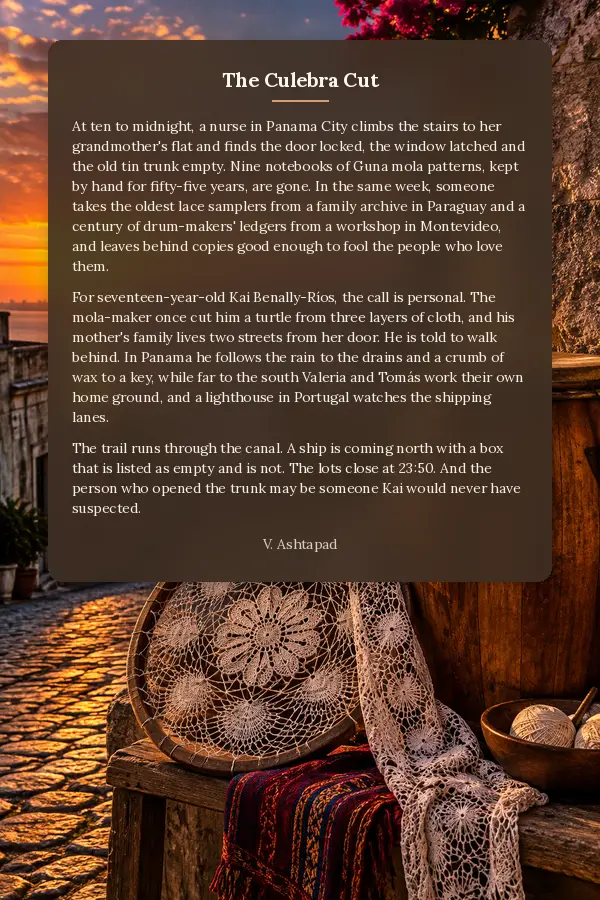
At ten to midnight, a nurse in Panama City climbs the stairs to her grandmother's flat and finds the door locked, the window latched and the old tin trunk empty. Nine notebooks of Guna mola patterns, kept by hand for fifty-five years, are gone. In the same week, someone takes the oldest lace samplers from a family archive in Paraguay and a century of drum-makers' ledgers from a workshop in Montevideo, and leaves behind copies good enough to fool the people who love them.
For seventeen-year-old Kai Benally-Ríos, the call is personal. The mola-maker once cut him a turtle from three layers of cloth, and his mother's family lives two streets from her door. He is told to walk behind. In Panama he follows the rain to the drains and a crumb of wax to a key, while far to the south Valeria and Tomás work their own home ground, and a lighthouse in Portugal watches the shipping lanes.
The trail runs through the canal. A ship is coming north with a box that is listed as empty and is not. The lots close at 23:50. And the person who opened the trunk may be someone Kai would never have suspected.
Members can react to this book and talk about it in the members' Library.
Ownership
© 2026 CRUNOD LLC. All rights reserved.
This book is owned by CRUNOD LLC. It is free to read on EternalCurrent.Online. No part of it may be copied, reprinted, sold, recorded or adapted, including as audio, film or translation, without written permission from CRUNOD LLC.
© 2026 CRUNOD LLC. All rights reserved.