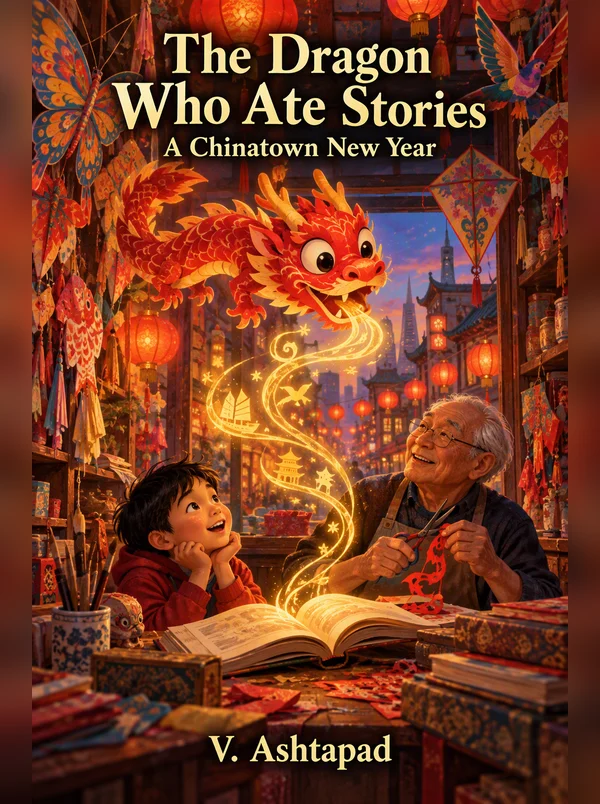
The Dragon Who Ate Stories
A Chinatown New Year
by V. Ashtapad
Foreword
Every family has words that are only one generation away from being lost. Sometimes it is a whole language. Sometimes it is a single word for the sound snow makes underfoot, or the name of a village on a windy hill. This book is about a boy who finds out, with some help from a very small and very particular dragon, that the way to keep those words is to use them out loud, badly at first, with someone who loves you listening. It is set in San Francisco Chinatown, a neighborhood rebuilt from ashes in 1906 by families who refused to be moved, and it borrows gently from that history and from the history of Angel Island. The family, the dragon, and the shop off Grant Avenue are invented. The alleys, the drums, the egg tarts, and the habit of making a pun out of nearly everything at New Year are real. Read it aloud if you can. Some of the words are meant to be heard.
For every grandparent who hummed the tune after the words were gone, and every grandchild who hummed it back.
The Last Thing You Do
Yeh Yeh's shop was so small that Felix Hom could touch both walls at once if he stood in the middle and stretched. He had tested this many times. He was nine, and his arms were getting longer every month, and he liked to keep track.
The shop sat at the bottom of a narrow alley off Grant Avenue, between a laundry that smelled of hot cotton and a door with no sign that led to somebody's stairs. It had one window, one counter, one stool for Yeh Yeh and one upside-down bucket for Felix. Above their heads hung the kites. There were swallow kites with forked tails and butterfly kites with eyes painted on the wings, a long centipede kite made of twenty round sections, and a hawk so real-looking that the pigeons in the alley refused to land on the windowsill. The kites turned a little whenever the door opened, the way sleeping birds shift on a branch.
Everything else in the shop was paper. Red paper in tall stacks, gold paper in thin folders, white tissue paper soft as a moth. Rolls of it leaned in the corners. Scraps of it drifted along the floor like the leaves of a tree that only grew indoors.
"Retired," Mom liked to say, whenever anyone asked about Yeh Yeh. Then she would do the quote marks with her fingers.
Yeh Yeh had cut paper for sixty years. He had cut lanterns for restaurants and a whole zoo of animals for a library in Oakland. Now he said he was finished with all that. He said it while cutting paper, every single day.
On the Saturday two weeks before New Year, he was cutting a dragon.
Felix sat on his bucket and watched. Yeh Yeh did not draw first. He folded the red sheet once, then once again, held it close to his good eye, and began. His scissors were old and black, with handles wrapped in tape that had once been blue. They made a sound like a small animal eating celery.
*Snip. Snip-snip. Sssnip.*
A curl of red fell to the counter. Then another. Then a whole chain of tiny triangles, and Felix understood they were the spaces between the dragon's teeth.
"How do you know where to cut?" Felix asked.
"The paper tells me."
"Paper can't talk."
Yeh Yeh made the face he made when Felix was wrong and he did not want to say so, which was the face of a man smelling soup. "Paper talks very quietly," he said. "You have to stop talking first."
Felix stopped talking. He lasted almost a minute.
"What's it for?"
"The window. For New Year. People walk by, they see a dragon, they feel lucky." Yeh Yeh unfolded the paper. "Also because I want one."
The dragon opened across the counter like a fan. It was as long as Felix's arm, with a body made of loops and scales, four short legs with curled claws, a beard of thin swirls, and a tail that ended in a flame. Its whiskers were so fine that when Felix breathed out, they trembled. It had a nose, a mouth full of teeth, two horns like branches, and two round places where the eyes should be.
The round places were empty.
"You forgot the eyes," said Felix.
"I did not forget." Yeh Yeh set down his scissors and took out his phone. He held it very far from his face, the way he held everything that had writing on it, and took a picture of the dragon. Then he tapped the screen with one finger, slowly, like he was ringing a doorbell he wasn't sure about.
Felix leaned in to see. It was the family's collection of Yeh Yeh's paper cuts, the one Felix's dad had started two summers ago, hundreds of them now. Under each one, Yeh Yeh wrote a note in a mix of English and Chinese characters, and the notes were the best part. *Fish for Winnie's wedding. Too many scales, but she liked it.* And: *Rooster. Felix was born on a Tuesday. Rain all day. Very loud baby.*
Under the dragon, Yeh Yeh typed: *For the window. Not finished.*
"Why is it not finished?" Felix asked.
"Eyes are last." Yeh Yeh put the phone face-down on the counter. "You dot the eyes when everything else is ready. The very last thing you do. Before that, it is only paper."
"And after that?"
Yeh Yeh's mouth twitched. "After that, it is still paper. Mostly."
There was a knock at the window. It was Mr. Kwok from Portsmouth Square, holding up a newspaper and pointing at the front page with great outrage. Yeh Yeh sighed, stood, and pulled on his jacket.
"Don't touch the scissors," he said to Felix. "Don't touch the glue. Don't touch my dragon." He stepped out into the alley and the door jingled behind him, and the kites turned on their strings.
Felix did not touch the scissors.
He did not touch the glue.
He looked at the dragon for a long time. Outside, Mr. Kwok was talking very fast in Cantonese, and Yeh Yeh was answering in short, low words, the way you'd answer a goose. Felix knew maybe eleven Cantonese words. *Mh-goi*, which meant please and also thank you and also excuse me, depending. *Sik faan*, which meant dinner was ready. A few numbers. Not enough to know what Mr. Kwok was mad about.
The ink stone sat at the end of the counter. Yeh Yeh had been writing New Year banners that morning, and there was still black ink pooled in the little well, glossy as a beetle's back. A brush lay beside it. The thinnest brush, the one for the tiniest marks.
The dragon looked so unfinished. It looked like a sentence without a period.
Felix thought: *I'll just do one. Just a dot. He can do the other one.*
He picked up the brush. He dipped the very tip. His hand was shaking a little, so he held his breath, and he touched the brush to the left eye. A perfect black dot, round as a peppercorn.
It looked so good that he did the right one too.
For a second, nothing happened. Then a draft came in under the door and every whisker on the dragon quivered at once.
Then the dragon blinked.
Felix dropped the brush. It rolled off the counter and left a little black dotted line on the floor, *tik, tik, tik.*
The dragon's paper body rippled from nose to tail, the way a flag ripples when the wind first finds it. Its legs bent. Its claws curled into the counter's wood, not hard enough to scratch, just enough to hold on. It lifted its head, looked left, looked right, looked up at the hawk kite, and flinched. Then it looked straight at Felix.
It sneezed. A puff of red paper dust floated into the air.
Then it said something.
It was not English. It was a quick, crackly little voice, like someone crumpling tissue paper in a cupboard, and the words went up and down the way Yeh Yeh's words did when he talked on the phone to his cousin in Vancouver.
"I don't," said Felix. "Um. I don't speak. I'm sorry. I only know *mh-goi*."
The dragon tilted its head. It said the same thing again, slower, the way grown-ups do when you don't understand, as if slower would help.
Felix tried. "*Mh-goi*?"
The dragon brightened. Its red went a shade redder. It said, "*Mh-goi!*" back at him, very pleased, and then a whole new sentence that ended in a question.
"I don't know what you're asking," said Felix. "I really don't."
The bell over the door jingled. Yeh Yeh was coming back in, stamping his shoes on the step and saying something over his shoulder to Mr. Kwok.
The dragon froze. Then it moved faster than any paper ever should, rippling across the counter, up the side of a paper roll, along a string, and into the folds of the butterfly kite, where it pressed itself flat between the painted wings and went perfectly, completely still.
Yeh Yeh closed the door. He took off his jacket. He looked at the counter, where the dragon was not. He looked at the floor, where the dotted line of ink led straight from the counter to Felix's left sneaker.
He looked at Felix.
"Yeh Yeh," Felix said, "I need to tell you something, and you're going to want to sit down."
Little Red
Yeh Yeh listened to the whole thing without saying a word: the ink, the blinking, the sneeze. When Felix got to the part about the butterfly kite, Yeh Yeh turned his head slowly and looked up at it.
The butterfly kite hung from the ceiling, turning a little. Its painted eyes stared back. Between its wings, if you knew where to look, there was a long red shape lying perfectly flat and trying very hard to be a decoration.
Yeh Yeh said something in Cantonese. It was quiet and short.
The red shape did not move.
Yeh Yeh said something else, a little longer, in the voice he used to talk to the alley cat that lived behind the laundry. Felix heard the word *lung* in it, which he was pretty sure meant dragon.
One whisker lifted. Then the other.
The dragon peeled itself off the kite like a sticker coming loose and drifted down along the string to the counter, where it landed with a sound no louder than a page turning. It looked at Yeh Yeh. Yeh Yeh looked at it. They studied each other across the counter, an old man with a crooked back and a paper dragon with two fresh black eyes.
Then the dragon bowed its head and said a whole long sentence, very politely.
And Yeh Yeh laughed.
It was not a small laugh. It burst up from somewhere under his sweater like a kettle boiling over, and he had to take off his glasses and wipe them on his sweater. Felix had heard Yeh Yeh laugh before, but not like this. Not like a kid.
"What?" said Felix. "What did it say?"
"It said thank you for making it," said Yeh Yeh, "and could I please make the hawk kite go somewhere else, because the hawk is looking at it."
Felix looked up at the hawk. The hawk was, in fact, looking.
Yeh Yeh got up, unhooked the hawk kite from its string, and leaned it in the corner with its face to the wall. The dragon let out a long, crinkly breath.
"Aren't you surprised?" Felix asked. "It's paper and it's *alive*."
Yeh Yeh sat back down. He folded his hands on his belly. "My grandfather," he said, "used to say a cut is never just a cut. He said the hand puts something in it that the eye cannot see. I thought he was teasing. He liked to tease." He looked at the dragon with something like respect. "Maybe he was not teasing so much."
"So what is it? What does it want?"
Yeh Yeh asked the dragon. The dragon answered. Felix caught nothing, except that the dragon's tail swished back and forth while it talked, like a cat's.
"It doesn't eat food," Yeh Yeh said. "It says it is hungry, but not for rice or noodles. It is hungry for *gu-jai*."
"What's *gu-jai*?"
"Stories." Yeh Yeh tapped the counter. "*Gu-jai*. Little old stories. The kind you tell a child at night. The kind an uncle tells at dinner when nobody asked."
The dragon nodded hard enough that its beard swirls bounced.
"Can't it just have, like, a cookie?" Felix dug in his jacket pocket and found half an almond cookie from the bakery, wrapped in a napkin. He held it out.
The dragon leaned forward, sniffed it, and recoiled as if Felix had offered it a sock.
"Okay," said Felix. "No cookie."
"It needs a name," said Yeh Yeh, considering the dragon. "It is small and it is red. In Cantonese we would say *Hung Jai*. *Hung* is red. *Jai* is little, like a little boy. Little Red."
The dragon repeated it. "*Hung Jai*." It said it a second time, trying it on, and then a third time with its chin up, and its red went bright as a stop sign.
"I guess it likes it," said Felix.
"*Hung Jai*," said Yeh Yeh. Then he pointed at Felix and said, "*Lok Jai*."
That was Felix's name in the family, the short form of his Chinese name, which was long and which he could not write yet. Only Yeh Yeh and Tai Ma called him that. The dragon looked at Felix, and something in its paper face shifted, like it had found a matching sock.
"We're both *jai*," said Felix slowly.
"Two little ones," said Yeh Yeh. "Very good. Now. It is hungry, so I will tell it something."
He thought for a minute. Then he started to talk, and Felix understood that this was a story because of the way Yeh Yeh's voice changed. It went lower and slower. It rose and fell in a pattern. His hands came up off his belly and began to shape things in the air: a wall, a tree, something long that swooped.
Felix did not understand the words. But he understood a few. He heard *fung-jang*, which was kite; he knew that one because it was the only word Yeh Yeh ever said about his job. He heard *Yeh Yeh*, which in the story must have meant someone else's grandfather, because Yeh Yeh pointed far away when he said it.
And while Yeh Yeh talked, the dragon changed.
It was slow at first. Its color deepened, the way a strawberry does on the windowsill. Then, along its back, where there had been a plain stretch of red between two loops, a new scale appeared. Felix saw it happen. It was as if an invisible pair of scissors had made one cut, then another, and folded the paper up into a tiny new shape.
By the time Yeh Yeh's hands came to rest, Hung Jai had three new scales and its whiskers had grown a little longer. It closed its eyes and sighed through its nose.
"What was the story?" Felix whispered.
"About the kites in my grandfather's village," Yeh Yeh said. "How the boys would fly them from the hill above the rice fields, and the wind there was so strong it could lift a kite out of your hands before you even let the string out."
"I want to try," said Felix. "Can I tell it one?"
Yeh Yeh spread his hands. Go ahead.
Felix sat up straight on his bucket. He picked his best story, the one about the time Lulu, his little sister, had tried to give the neighbor's dog a bath in the kitchen sink. He did the voices. He did the part where the dog shook.
Halfway through, Hung Jai hiccuped.
It was a very small hiccup, but when it came out, so did a puff of red confetti, which drifted down onto the counter. Hung Jai looked embarrassed. Felix kept going. Hung Jai hiccuped twice more, *hic*, *hic*, and a little scrap of paper fell off the end of its tail.
"Stop, stop," said Yeh Yeh. "It's getting thinner."
Felix stopped. Hung Jai shook itself, sneezed again, and looked at Felix with an expression that was clearly kind but also clearly said: *I'm sorry, I can't eat that.*
"It only understands Cantonese," said Yeh Yeh. "It was cut by a man who thinks in Cantonese. A story in English is like the cookie. It looks fine. It just doesn't go down."
Felix felt his face go hot. "That's not fair. I don't *know* Cantonese. Nobody ever taught me."
He said it louder than he meant to. Yeh Yeh did not get angry. He looked at Felix with his head on one side, just like the dragon had, and for a moment the two of them looked so alike that Felix almost laughed despite himself.
"That," said Yeh Yeh, "is true. That is my fault and your father's fault and a little bit the fault of being busy." He picked up his phone, turned it over, and held it out at arm's length. "So we start."
He opened the family's word list. Felix's mom had set it up last year, after Tai Ma's eighty-something cousin had visited from Taishan and nobody could talk to her except Yeh Yeh. Each word had the English, the Chinese characters, a spelling Felix could read, and a little speaker button. When you pressed the speaker, Yeh Yeh's voice said the word. Sometimes Tai Ma's did instead, and hers sounded different, flatter and sharper at the same time, because she spoke Toisanese, the language of the villages down south.
There were forty-one words on the list. Most of them were food.
Yeh Yeh scrolled to the bottom and tapped *Add*. He typed *story* in English, and the characters 古仔, and *gu-jai*. Then he held the phone near his mouth like it was a microphone at a wedding and said, clearly, "*Gu-jai*."
He handed it to Felix. "Now you."
Felix pressed the button and listened to Yeh Yeh's voice say it. He said it back. Then he said it to the dragon.
"*Gu-jai*?"
Hung Jai's eyes went wide and shiny. It nodded so hard it nearly fell off the counter.
"Okay," said Felix. "Okay. I'll learn. But you have to help me."
He wasn't sure if he was talking to Yeh Yeh or to the dragon. Judging from their faces, both of them thought he meant them.
Mrs. Leung's Window
Felix's family lived out in the Sunset District, where the streets ran in long straight lines to the ocean and the fog came in every afternoon like a cat that knew where the warm spots were. But Felix's school was on the other side of the city, close to Chinatown, and every day after the bell he walked four blocks with his friend Calvin's family to Yeh Yeh's alley and waited there until Dad finished work.
On Monday, Yeh Yeh met him at the shop door with a list.
"Errands," he said. "New Year is coming. The shop must be ready, the house must be ready, the family must be ready. You and I are the family's legs."
"What about Hung Jai?"
At the sound of its name, a red head poked out from behind the stack of gold paper. Hung Jai had spent the weekend in the shop, and from the look of things it had spent the weekend exploring. There were tiny claw prints in the dust on the top shelf, the alley cat had a new and permanent look of suspicion, and the hawk kite had been turned to face the wall a second time by someone who was not Yeh Yeh.
"Hung Jai comes too," said Yeh Yeh. "A dragon should see its city."
"What if somebody sees it?"
Yeh Yeh shrugged. "This is Chinatown. In two weeks there will be a dragon on every window, every door, every red envelope. One more, nobody looks twice."
Felix wore his blue hoodie with the big front pocket. Hung Jai rode in the hood, curled around the back of his neck like a scarf, its chin resting on his shoulder so it could see. It weighed nothing at all. Every now and then its whiskers tickled his ear, and he had to try very hard not to giggle on Grant Avenue.
Grant Avenue in the last weeks before New Year was a river of red. Lanterns hung across the street on wires, so many that they made a ceiling. Stores had pushed tables onto the sidewalk: tangerines with the leaves still on, plastic firecrackers, bags of candied lotus seeds and coconut strips, potted kumquat trees, and pussy willow branches standing in buckets.
You could smell the bakery a block before you could see it. Steam fogged up the inside of the front window. Behind the steam, there were trays and trays of things: egg tarts in fluted crusts with yellow centers that wobbled when the trays moved, soft white buns with a pink dot on top, golden buns glazed until they shone, sticky-rice bundles wrapped in leaves, sesame balls the size of tennis balls.
The line went out the door. Felix and Yeh Yeh got in it.
They shuffled forward. Inside, the bakery was even warmer and louder. The women behind the counter moved like dancers in a very small space, reaching, folding, boxing, tying string, calling out numbers. Mrs. Leung herself stood at the register. She was tiny and round with her hair in a net, and she was answering two customers and a phone at the same time.
Felix felt Hung Jai go stiff against his neck.
At first he didn't know why. Then he heard it: a soft drumming against the glass. Then louder. Outside, the gray sky had opened, and the rain was coming down on Grant Avenue in long silver strings. People on the sidewalk scattered for awnings. Lanterns swung.
Hung Jai let out a sound Felix had never heard before. It was a thin, papery whimper. Then the dragon slid down off his shoulder and burrowed into the front pocket of his hoodie, and pressed itself against his stomach, and shook.
"Hey," said Felix. "Hey, it's okay. We're inside."
Through the cloth, he could feel the dragon trembling. And he understood suddenly, the way you understand that a stove is hot by looking at it: rain would ruin Hung Jai. One drop would make a gray spot. Ten drops would make it soft. A real rain, a Grant Avenue rain, would turn a paper dragon into a lump of pink mush in the gutter.
"Yeh Yeh," Felix whispered. "It's scared."
Yeh Yeh looked out at the rain. He looked at Felix's pocket. "Of course it's scared," he said. "I'm only made of old man, and I don't like rain much either."
"What do I say? To make it feel better?"
Yeh Yeh thought. "Tell it, *mh-sai pa*. It means, no need to be afraid."
"*Mh-sai pa*," said Felix to his pocket. He said it twice. He tried to make his voice the way Mom's voice went when Lulu had a nightmare. "*Mh-sai pa*, Hung Jai."
The trembling slowed. A whisker poked out of the pocket.
They reached the front. Mrs. Leung looked up and saw Yeh Yeh, and her whole face changed, from busy to bright. She called him something that made the woman next to her laugh. Yeh Yeh answered, and then pointed at Felix and said something with *Lok Jai* in it.
Mrs. Leung leaned over the counter and pinched Felix's cheek, which he had expected, and which he endured.
"So big!" she said in English. "Last time, this big." She held her hand at the height of the cash register. "Now you learn to make kites?"
"Kind of," said Felix. "I'm learning Cantonese."
"Ah!" Mrs. Leung looked pleased and then a little sad. "Good. Good. My grandsons, they don't. They say, Grandma, English, English." She shook her head. "Say something."
Felix's mind went blank. Every word he had learned went running out the back door. Then he felt a nudge against his stomach, the smallest push from inside his pocket, and he heard himself say, "*Mh-goi.* Um. *Gu-jai?*"
Mrs. Leung blinked. "You want a story?"
"Kind of a lot," said Felix. "If you have one. It's, um, for a school project."
Mrs. Leung glanced at the long line behind them. She glanced at the rain. Then she said something to the woman beside her, who rolled her eyes and took over the register, and Mrs. Leung came around the end of the counter, wiping her hands on her apron.
She told the story in Cantonese, because, she said, "In English I sound like the cash register." She told it fast and then slowly. Yeh Yeh stood beside Felix and murmured the English into his ear, a few words behind, like a radio with a delay.
It was about her mother, who had opened a bakery in Hong Kong when she was nineteen, in a space so narrow she had to turn sideways to get to the oven. During typhoon season, her mother would stand at the front with a broom and sweep the water back out the door, sweeping and sweeping all night, while the custard set and the dough rose behind her. "Water comes in," Mrs. Leung said, and made the sweeping motion. "You push it out. Water comes in. You push it out. In the morning, the tarts are ready."
In Felix's pocket, something stirred and warmed. When Felix peeked down, he saw that Hung Jai had stopped shaking. It was listening with its whole body, eyes half closed, and along the edge of its tail a new curl had appeared, fine as an eyelash.
"Thank you," Felix said, when Mrs. Leung finished. Then, because Yeh Yeh poked him: "*Do-jeh*."
"*Mh-sai*," said Mrs. Leung, and went back to her register, and charged Yeh Yeh for a dozen egg tarts but put fourteen in the box.
They waited out the rain under the bakery awning, eating *char siu bao* from a paper bag. The buns were soft and sweet outside and salty-sweet inside, the pork the color of a fire truck.
While they waited, Yeh Yeh took out his phone and opened the word list. He added three new words. Then he handed it to Felix to check.
*Rain. 落雨. lok yu.*
*No need to be afraid. 唔使怕. mh-sai pa.*
*Thank you (for a gift or a kindness). 多謝. do-jeh.*
Felix pressed the speaker on each one and listened to his grandfather's voice say them, there under the dripping awning, with the bakery steam drifting out over their heads. He said them back, one after another, and he did not care who on Grant Avenue heard.
"Why are there two different thank yous?" he asked.
"Because there are two different kinds of thanks," said Yeh Yeh. "When somebody holds the door, *mh-goi*. When somebody gives you a story? That is *do-jeh*."
The River on the Board
Portsmouth Square sat on top of a parking garage, which Felix thought was the funniest thing about it. Down below, cars circled in the dark. Up above, there were trees and benches and a playground, a pagoda-shaped shelter, and old men. Mostly old men.
They played cards and Chinese chess on folding tables, and sat in rows on the low walls watching other old men play, offering advice nobody had asked for.
Mr. Kwok and Mr. Mak played at the same table every day except Sunday. They had been playing for twenty-two years, Yeh Yeh said, and neither of them had ever admitted losing.
Hung Jai was riding on Felix's shoulder today, not in his hood. It had not rained since the bakery, and the dragon had gotten brave. It sat up like a parrot, whiskers forward.
Mr. Kwok and Mr. Mak were in the middle of a game. The board was a paper grid, and the pieces were round wooden discs like big checkers, with characters painted on them in red or black. Across the middle of the board, between the two armies, there was an empty band.
"That's the river," said Mr. Mak, when Felix asked. He was the thin one with a cardigan buttoned wrong. Mr. Kwok was the round one with the hat. "Some pieces can cross. Some pieces can't. Like life."
"Don't listen to him," said Mr. Kwok. "He thinks everything is like life. Your move."
"I know it's my move."
"Then move."
Mr. Mak moved a piece with the character for *horse* on it. Then they both looked up and noticed the dragon.
There was a short silence.
"Nice decoration," said Mr. Mak, carefully.
"Yeh Yeh made it," said Felix.
Mr. Kwok squinted. "It's moving."
"Wind," said Yeh Yeh, smoothly.
Hung Jai, who had been staring at the chessboard with enormous interest, chose this moment to slither down Felix's arm, cross the table, and climb onto the board. It walked carefully between the pieces, sniffing each one. It stopped at the river and peered over the edge, as if it might be deep.
Mr. Mak took off his glasses, cleaned them on his cardigan, put them back on, and took them off again.
Yeh Yeh said something in Cantonese. It was long. It had the rhythm of an explanation, and Felix heard *Lok Jai* in it, and *dim jing*, and a word that sounded like *ink*. At the end of it, both old men turned and looked at Felix.
"You dotted the eyes," said Mr. Kwok in English. "Before the master said?"
Felix nodded. His ears went hot.
Mr. Kwok slapped the table and roared with laughter. The pieces jumped. Hung Jai jumped. "This boy," said Mr. Kwok. "This boy! Wing, he's exactly like you!"
Felix looked at Yeh Yeh. Yeh Yeh was examining the tops of the trees very closely.
"Your grandfather," said Mr. Mak, leaning in, "when he was fifteen, he worked for old Master Fung on Jackson Street. The paper master. Master Fung was cutting a phoenix for a wedding, the most beautiful thing, and he left the shop to buy cigarettes, and your grandfather—"
"That is not a story for today," said Yeh Yeh.
"—your grandfather finished the phoenix himself. Cut the last feathers. Master Fung came back, he almost fell over."
"Was he mad?" asked Felix.
"Mad?" Mr. Mak grinned with all his teeth, which was not many. "He made him an apprentice the next morning. Said anybody with nerves like that should at least have training."
On the board, Hung Jai had stopped sniffing. It was sitting very still, eyes half-closed, its tail curled around a red cannon. Felix saw a new scale appear on its flank, small and sharp as a fingernail clipping.
"It liked that," Felix said. "It eats stories. In Cantonese. Can you tell another one?"
Mr. Kwok glanced at Mr. Mak. Then, as if they had rehearsed it, they both pulled their folding chairs a little closer.
It turned out that old men in Portsmouth Square had more stories than they had chess pieces. Mr. Mak told how he arrived in San Francisco in 1968, when he was fourteen, with one suitcase and no English, and how his uncle brought him to this square the very first afternoon and sat him down at a table and said: watch. "For a month I watched," said Mr. Mak. "I did not say one word. Nobody asked me anything. They just let me sit. I learned the game. I learned who cheated." He pointed at Mr. Kwok without looking at him. "And when I finally said something, I said it in Cantonese, and they all said, ah, finally, the boy talks."
Yeh Yeh translated, a little behind, under his breath. Felix caught words on his own. *Hok*, which was learn. *Sai lou*, which seemed to mean kid. Numbers, when Mr. Kwok counted on his fingers how many years.
Hung Jai ate it all. By the end, it had six new scales and its horns had grown a tiny extra branch.
Then the wind came.
It came the way wind comes in San Francisco, out of nowhere, around the corner of a tall building and straight across the square. The pigeons rose in a gray cloud. Newspapers flapped on the benches.
And Hung Jai, who weighed nothing at all, lifted right off the chessboard.
Felix saw it happen as if in slow motion. The dragon's legs scrabbled at the air. Its mouth opened in a soundless crackle. The wind took it up, over the table, over Mr. Kwok's hat, tumbling, its long red body twisting like a ribbon.
Felix didn't think. He launched himself off the bench. His sneaker hit the edge of the table and red and black pieces went flying, and his hand closed on something thin and papery and alive, and he hugged it to his chest as he landed on his knees on the concrete.
When he opened his hands, Hung Jai was crumpled, trembling, but whole. One of its whiskers was bent. It looked up at him with its black ink eyes, and then it pressed its whole face into the gap between his thumb and finger, and stayed there.
"*Mh-sai pa*," Felix whispered. "*Mh-sai pa*. I got you."
Behind him there was a long silence. Felix turned. Mr. Kwok and Mr. Mak were staring at the ground, where all thirty-two chess pieces were scattered across the concrete in no order at all.
"Sorry," said Felix. "I'm really, really sorry."
Mr. Mak bent and picked up a black horse. He looked at it. Then he looked at Mr. Kwok. "I was winning," he said.
"You were *not* winning."
"I was going to win in three moves."
"You were going to *lose* in two."
Yeh Yeh crouched down beside Felix and gently smoothed the bent whisker with the side of his thumb. "Paper doesn't like wind," he said quietly. "Wind is the thing that wants to carry it away."
"Is that why it's scared of the hawk kite too?" asked Felix.
Yeh Yeh looked at him with a strange expression. "Maybe," he said. "A kite is paper that belongs to the wind."
While they picked up the pieces, Mr. Mak asked a question in Cantonese, and Felix heard the word *heung ha*, which he did not know.
"He wants to know which village our family comes from," said Yeh Yeh. "*Heung ha*. Home village."
Felix opened his mouth and closed it. He did not know. He realized, with an uncomfortable feeling in his stomach, that he had never asked.
Yeh Yeh fished his phone from his jacket and found the family tree. Felix had seen it before, but only from the top: his own name in a box, Lulu's box, Mom and Dad's boxes, Yeh Yeh's. Now Yeh Yeh scrolled up and up, past Tai Ma, past names Felix had never heard, past boxes with no photos, only characters, until he reached a box near the very top with a little pin beside it.
*Fung Hau village, Taishan, Guangdong.*
Mr. Mak leaned in and read it and made a delighted noise. "My mother's sister married into a family two villages from there!" he said. "The one with the big banyan tree!" And the two old men started talking about banyan trees, and Felix sat on the bench with a dragon cradled in his hands, looking at the name of a place he came from and had never heard of.
*Fung*, he thought. He knew that one now. It was the first half of *fung-jang*.
Wind.
Sweeping Out the Old Year
"You have to sweep *before*," said Dad, handing Felix a broom. "Never on New Year's Day. On the first day you sweep, you sweep away the luck."
"Is that true?" asked Felix.
Dad thought about it. "It's true that your Tai Ma will check," he said.
It was Saturday, one week before New Year, and the Hom house in the Sunset District was being turned inside out. Every window was open, even though the fog was coming in off the ocean and the whole house smelled of salt and wet sidewalk. Mom was on a ladder wiping the tops of the kitchen cabinets. Dad was in the closet, filling a box marked GIVE AWAY and then emptying it again. Lulu, who was five, had been given a feather duster and had dusted the cat.
Yeh Yeh arrived at ten o'clock with a canvas bag over his shoulder and a long flat package under his arm, wrapped in newspaper. He stopped in the front hall, sniffed the air, and nodded. "Good," he said. "It smells like work."
Felix ran to meet him. "Did you bring—"
Yeh Yeh patted the bag. A red head poked out of the top, looked up at the ceiling light with alarm, and ducked back down.
"*Lai*," said Felix to the bag, which meant come. He had practiced it all week, along with *jau*, which meant run or go, and *ting*, which meant stop. Hung Jai poked its head out again, saw Felix, and flowed up his arm to his shoulder in one long red ripple.
"KITTY!" shrieked Lulu from the living room. "FELIX HAS A RED KITTY!"
"It's a decoration," said Felix, very quickly.
Lulu appeared in the doorway with her feather duster and stared. Hung Jai stared back. Then it bowed. Its whole paper body dipped, from the nose down, and its whiskers swept the air.
Lulu's eyes went enormous. She bowed back, very low, so low she tipped over.
"Okay," said Felix, helping her up. "It's a secret. Can you keep a secret?"
"No," said Lulu honestly.
"Can you try?"
Lulu considered this. "I can try for today."
In the kitchen, Yeh Yeh unwrapped the newspaper package on the table. Inside were sheets of red paper, the shiny kind, sprinkled with gold flecks like a sky full of stars. Then he lined up his brushes, his ink stone, a stick of black ink, and a little dish of water.
"*Fai chun*," he said. "New Year words. For the doors."
Every year, Yeh Yeh wrote the banners for the house. Felix knew them by sight: long red strips that went on each side of the front door, square ones turned on their corners like diamonds, and one with a single big character that went on the inside of the door. Every year Felix watched him write. This year, Yeh Yeh pulled out a chair and pointed to it.
"You hold the paper."
Felix sat. He held the paper flat with two fingers at the top corners, the way Yeh Yeh showed him. Yeh Yeh ground the ink stick in a slow circle in the water on the stone. The black came up like smoke rising in reverse. Hung Jai crept down Felix's arm to watch, and sat right at the edge of the paper, and Yeh Yeh gave it a warning look.
"No ink," he said to the dragon. "No more eyes. You have enough."
Hung Jai looked insulted.
Yeh Yeh dipped the big brush, held it straight up and down, took one breath, and moved his whole arm from the shoulder, in a sweep that looked slow but was over before Felix could follow it. When the brush lifted, there was a character on the paper. It was thick and then thin, wet and then dry at the edges where the brush had run out of ink, and it looked like it was in the middle of running somewhere.
"*Fuk*," said Yeh Yeh. "Good fortune. Luck. Everything good."
"Can I do one?"
"You can try one."
Felix tried one. It took him nine tries. The first one looked like a spider that had been stepped on. The ninth one looked, Yeh Yeh said, "like a *fuk* that has been to the dentist," but it was recognizably a *fuk*, and Yeh Yeh let him keep it.
Then Yeh Yeh did something odd. He took Felix's dentist *fuk* and turned it upside down.
"Hey," said Felix.
"On purpose," said Yeh Yeh. "You hang this one upside down. Upside down is *dou*. And *dou* sounds the same as another *dou*, the one that means *arrive*. So when people see the upside-down *fuk*, they say: *fuk dou*. Luck has arrived." He tapped the paper. "It's a joke. A very old joke. A pun."
Felix stared at it. "The whole thing is a pun?"
"Half of New Year is puns," said Yeh Yeh happily. "We eat fish because *fish* sounds like *extra*. We eat lettuce because *lettuce* sounds like *growing money*. We give tangerines because *tangerine* sounds like *lucky*. Your great-great-grandfather used to say Cantonese is a language for people who can't stop making jokes."
Hung Jai, still at the edge of the paper, made a sound Felix had not heard before. It was a dry, rustling *hih-hih-hih*.
"It's laughing," said Felix, delighted. "Yeh Yeh, it's *laughing*."
"Of course it's laughing. It understands the pun." Yeh Yeh looked at Felix over his glasses. "Soon you will too."
Mom came down from the ladder to see what was so funny. She saw the dragon at the edge of the paper, which had stopped laughing and gone extremely still.
"Oh, Dad, that's beautiful," she said to Yeh Yeh. She called him Dad, even though he was Felix's dad's dad. She had called him that since her wedding day. "Is that new? Did you put it in the album yet?"
"Not finished," said Yeh Yeh.
Mom leaned closer to the dragon. She frowned a little. Felix held his breath. Then she said, "Hm," and went to get coffee.
While the ink dried, Yeh Yeh took out his phone and photographed each banner, one by one, and added them to the collection of his paper work. Felix read the notes over his shoulder as he typed. *Door, left side. Spring comes with the river.* *Door, right side. Luck arrives with the mountain.* And under Felix's upside-down banner: *Fuk. First one by Lok Jai. Nine tries. The last was best. Hang upside down.*
Felix felt something warm in his chest and had nowhere to put it, so he poked Hung Jai, who poked him back.
Mom came back with her coffee and took the chair opposite them. She was looking at her own phone. "Dad, can you check something for me?" she said. "I put some words in the list this week. I want to make sure I didn't mess them up."
She turned the phone around. It was the family words list, and Felix saw with surprise that there were seven new words at the bottom that he hadn't added. *Fish. Tangerine. Red envelope. Happy New Year.* Each one had Mom's own voice on the speaker button, and when Yeh Yeh pressed them, Mom's voice said the Cantonese very carefully, with a Minnesota accent wrapped around it like a scarf.
Yeh Yeh listened to each one. He corrected two. He recorded his own voice saying them right underneath hers. He did not laugh once, not even at *lai see*, which Mom had said in a way that made it sound like a brand of sneaker.
"Why are you learning Cantonese?" Felix asked her. "I mean. You're from Duluth."
Mom wrapped her hands around her coffee mug. Outside, the fog was sliding past the window like a slow gray train.
"When I was a kid," she said, "my grandmother lived with us. My mummo. She came from Finland when she was a teenager, and she spoke Finnish to me every day until I was about six. She sang me songs in Finnish. She had a word for the sound snow makes when it's really cold and you step on it. I loved that word." Mom was quiet for a second. "Then I went to school and I wanted to only speak English, and she let me. She didn't want me to feel different. And then she died when I was twelve, and the Finnish went with her. I don't remember the snow word. I've tried. I've looked it up, I've asked people. I can't find it."
Felix didn't say anything. Neither did Yeh Yeh.
"So," said Mom. "I'm not letting that happen twice." She stood up and kissed the top of Felix's head and then, to Felix's astonishment, kissed the top of Yeh Yeh's head too. "Fourteen words left on my list for this week. Tell me if I say any of them like a sneaker."
She went back up the ladder.
Felix looked down. Hung Jai was sitting very still at the edge of the drying banner, looking up at the ladder.
Yeh Yeh cleared his throat. He bent close to the dragon and began to talk, low and steady, in Cantonese. Felix did not follow most of it. But in the middle of all the Cantonese he heard a word that was not Cantonese at all. *Mummo.* Then *Duluth*, and a sound Yeh Yeh made with his mouth, a soft crunching *krrsh*, like a boot on very cold snow.
He was telling it Mom's story. In the only language it could eat.
When he finished, Hung Jai had grown a new scale, right over where its heart would be if it had one. It was a slightly different red from the others. Paler, almost pink. The color of a winter sky just before the snow.
The Alley of Warm Cookies
Tai Ma's birthday fell on the seventh day of the New Year, which in the old calendar was called *yan yat*, Everybody's Birthday. Yeh Yeh said this was why Tai Ma had always believed the whole world was celebrating her. This year she would be ninety-seven.
"There's a page for her," Mom said on Monday morning, while she packed Felix's lunch. "For her birthday. Everybody's putting wishes on it. Auntie Winnie put a poem. The cousins in Vancouver put a video of their dog doing a trick. You need to write something."
"What do I write?"
"Whatever you want to tell her." Mom zipped his lunchbox. "Bonus points if part of it isn't in English."
Felix thought about it all through math and all through spelling. After school, walking down Grant Avenue with Yeh Yeh and Hung Jai, he was still thinking about it.
"What do people say?" he asked. "On birthdays. In Cantonese."
"For old people, we wish long life," said Yeh Yeh. "*Sau*. Longevity. Like the peach buns at the banquet, the pink ones. Long life as long as the mountains."
"She's ninety-seven," said Felix. "How much longer does she need?"
Yeh Yeh laughed so hard he had to stop walking.
They turned off Grant and walked uphill, and then Yeh Yeh led him into Ross Alley.
Ross Alley was so narrow that if two people with umbrellas tried to pass each other, one of them would have to go home. The buildings on both sides were old brick, three and four stories, with fire escapes zigzagging up them and laundry hanging from some of the windows. And halfway down, a smell so sweet and warm and vanilla-buttery that Felix's stomach growled out loud.
"Fortune cookies," said Yeh Yeh. "Still made by hand."
The factory was one room, and it was hot. Along one wall stood a machine like a small round merry-go-round, with little iron griddles going around and around. Batter dropped onto each griddle in a perfect circle. The circles went around and came out golden, flat, and soft. And at the end of the line, two women sat on low stools. As each warm circle came off, one of them picked it up, laid a tiny slip of paper on it, folded it in half, then bent it over the edge of a metal bar so the ends tucked in. One second. Then the next. Then the next. Their fingers moved so fast Felix couldn't see the steps.
One of the women looked up. "Wing!" she called. "You bring a helper?"
This was Ms. Chan, who had known Yeh Yeh for forty years and who, it turned out, had bought her first kite from him for her son in 1985. She waved Felix over. "Wash your hands. Sit."
Felix washed his hands and sat on a stool. The first warm circle was too hot, and he dropped it. The second one he folded too late, and it cracked like a potato chip. The third one came out lumpy and lopsided and with the fortune hanging out like a tongue.
"Very good," said Ms. Chan. "We sell that one to tourists."
Hung Jai, meanwhile, had crept out onto the edge of the table. It watched the merry-go-round of griddles going around and around. Its head went around with them. Around and around and around until it got dizzy and sat down hard on a stack of fortunes.
Ms. Chan saw him looking at the fortunes and shrugged. "You know fortune cookies are not from China? Nobody in China eats these. My cousin from Guangzhou came to visit, I gave her one, she said, *what is this, a cracker with homework?*"
"Then where are they from?"
"California," said Ms. Chan. "Japanese families made something like them first, a long time ago. Little tea cakes. Then Chinese restaurants made them famous. Then everybody thinks they're Chinese." She folded another one, *snap*. "That's how America works. You mix it in a bowl, and nobody remembers whose bowl."
Felix looked at the cookie in his hand. He thought about Mom and her mummo's snow word. He thought about Calvin at school, who spoke Mandarin at home, and who had told him that *dragon* in Mandarin was *lóng*, almost the same as *lung*, but with a different tune, so that when Calvin said it and Felix said it, it sounded like two cousins who looked alike but walked differently.
"Can you tell a story?" he asked Ms. Chan. "In Cantonese? Please? *Mh-goi*?"
Ms. Chan gave him a long look over her glasses. Then she told one while she worked, without slowing down at all, *fold, snap, fold, snap*. It was about her first day in this factory, when she was sixteen, and how she burned all ten fingers and cried in the alley, and how the old woman who ran the place came out and sat with her on an overturned crate and didn't say anything at all, just held her hands in a bowl of cool water until they stopped hurting. "The next day," said Ms. Chan, "I came back. You know why? Because she didn't say anything. If she said, *don't cry*, I would never come back."
Hung Jai was asleep by the end, curled on the fortunes. Two new scales had grown along its back, and both of them were a warm golden-brown at the edges, like cookies.
They walked home the long way, through Waverly Place, where the buildings had painted balconies in red and green and gold, and lanterns swung from the railings, and the windows on the top floors were the windows of family associations and old societies, with their names written in big gold characters. Then down Spofford Alley, which was even narrower than Ross. From an open window on the second floor came a sound that made Yeh Yeh stop walking.
It was music. A high, bright, bending voice, a woman's or a man's singing like a woman's, Felix couldn't tell, sliding up and down the notes as if the notes were a hill and the voice was a kid on a sled. Behind it, a two-stringed fiddle sawed and whined, and wooden clappers knocked out a beat, *tok, tok, tok-tok-tok*, and a little gong went *chang*.
"Cantonese opera," said Yeh Yeh. "A club. They practice up there every week. They've been doing it longer than I've been alive."
He stood in the alley with his eyes closed. And then, very softly, he began to hum along.
Felix had heard Yeh Yeh hum before, under his breath while he cut. He'd never thought about what it was. Now he heard that it was this: the same sliding melody, the same sudden stops, the same little catch in the voice like a hiccup on purpose. Yeh Yeh's humming climbed up and wavered at the top, and dropped, and climbed again. It was not a pretty sound exactly. It was more like a sound that had been carried a very long way.
"My mother sang this," Yeh Yeh said, when the music stopped. "Tai Ma. While she cooked. All the time. I don't know all the words anymore. Just the tune."
Hung Jai was awake now. It was sitting up on Felix's shoulder, and it was swaying, very slightly, to the place where the music had been.
That night, at home, Felix opened the celebration page for Tai Ma. It was a long, bright page with her photo at the top, from the day she'd turned ninety, wearing a red jacket and a look of great suspicion. Under it, all the wishes. Auntie Winnie's poem. The Vancouver dog. A cousin in Sydney had posted a photo of a cake shaped like a peach.
Felix typed slowly. Then he went and found Dad to help him with the characters.
His wish said: *Happy birthday Tai Ma. 長命百歲. Cheung meng baak seui. That means live to a hundred. I know it's only three more years. I want you to do more than that. Also I want to learn the song you sang when Yeh Yeh was little. Love, Lok Jai.*
A Hundred Little Drawers
On Wednesday, Yeh Yeh lost his voice.
By the time Felix came down the alley after school, Yeh Yeh could only whisper. He sat on his stool in two sweaters and a scarf, and when Felix said hello, he answered with a croak like a frog at the bottom of a well.
"You sound terrible," said Felix.
Yeh Yeh pointed his scissors at him. It was a very expressive point.
"Where's Hung Jai?"
Yeh Yeh pointed up. Felix looked. On the top shelf, between the rolls of gold paper, the dragon lay curled with its nose tucked into its tail. Felix climbed up on his bucket to see it better, and his stomach dropped.
Hung Jai was pale. Not red anymore, but the color of a red shirt that had been washed too many times. Its whiskers drooped. Its new scales, the golden-edged ones from the cookie factory, had gone limp and flat. When Felix touched its side, it opened one eye, looked at him, and closed it again.
"Yeh Yeh, something's wrong with it."
Yeh Yeh came and looked. His face changed. He whispered, and Felix had to lean close to hear. "Hungry. No stories since yesterday. I can't talk."
"Can't you whisper one?"
Yeh Yeh tried. He bent over the shelf and started, very softly, in Cantonese. Two sentences in, his whisper cracked and he coughed so hard he had to sit down. Hung Jai didn't even open its eye.
Felix felt panic rise in his chest. There were sixty-three words on the list now. He had practiced them every night. But sixty-three words was barely a grocery list.
"Okay," he said. "Okay. Medicine first. Where do we get you medicine?"
Yeh Yeh pointed out the door and down the alley, and held up a finger: *one block.*
---
Mr. Yip's shop was on Stockton Street, and from the outside it looked like any shop. But inside, it looked like the inside of an enormous wooden honeycomb. One whole wall, from the floor to the ceiling, was made of tiny drawers. Hundreds of them. Each one had a little brass handle and a label written in black characters.
On the counter sat glass jars full of things Felix had never seen: curly dried roots like old men's beards, thin slices of something that looked like wood, red berries, gray pods, shriveled mushrooms with caps like little umbrellas. The whole place smelled of bark and dust and something sweet and something bitter all at once, like a forest that had been folded up and stored in a closet.
Mr. Yip was older than Yeh Yeh. He had long white eyebrows that curled at the ends and a voice like a radio announcer. He listened to Yeh Yeh's whisper, looked down Yeh Yeh's throat with a little flashlight, tutted, and climbed his ladder.
He opened one drawer, then another, then another. From each he took a pinch of something and dropped it on a square of white paper on the counter. Dried chrysanthemum flowers. Little red dates. A curl of orange peel.
"For tea," he said to Felix in English. "Your grandfather drinks it hot. It's soothing for the throat. If he's not better by Friday, he goes to see his doctor." He wagged a finger at Yeh Yeh. "His real doctor. Not me."
Felix, who had been watching the shelves, noticed something. On the back of Felix's shoulder, inside his hood, Hung Jai had lifted its head. Just slightly.
"*Gu-jai*," Felix said to Mr. Yip, a little desperately. "Do you know a story? Please. *Mh-goi*."
Mr. Yip raised his long eyebrows at Yeh Yeh. Yeh Yeh croaked something. Mr. Yip shook his head. "I'm sorry, young man. A delivery comes in five minutes and I have to count every box." He tapped his chest. "Come back Saturday. I have plenty."
On the walk back, Hung Jai went limp again. Felix carried it in both hands, cupped against the wind. It felt like carrying a leaf.
Back in the shop, Yeh Yeh put the kettle on the hot plate and sat down heavily on his stool. Felix set Hung Jai on the counter. Its red was even paler now, almost orange, almost pink. One of its claws had come loose and was curling at the tip.
"What do I do?" Felix said. "I don't know enough. I can't tell it anything."
Yeh Yeh studied him for a while without blinking. Then he reached for his phone and held it out.
Felix didn't understand at first. Then he did.
Last year, after Tai Ma's cousin had visited from Taishan, Dad had started asking Yeh Yeh to record the family stories. Every few weeks, Yeh Yeh would sit at the kitchen table on a Sunday night and talk, in Cantonese, while Dad's phone listened. Stories about the village. About his own grandfather. About Master Fung. They lived in a folder in the family's account, one after another, each one with a title Dad had typed: *How Yeh Yeh got his first scissors. The flood year. Sun Fook and the ship.* Felix had never listened to them. Someday, he'd always thought, when he understood.
He opened the folder now. He scrolled. He picked the one at the very top, the oldest one, the one called *Sun Fook and the ship*, and he held the phone close to the dragon, in his hand, and pressed play.
Yeh Yeh's voice came out of the speaker. His real voice, his good voice, deep and slow and a little bit rough, the story voice. It filled the tiny shop.
On the counter, Hung Jai's eye opened.
Felix held his breath. He did not understand most of what the voice was saying. But he heard *Sun Fook*. He heard *Fung Hau*, the name of the village. He heard a number that he thought was *thirteen*. He heard a word he had added to the list just last week, *syun*, which meant *boat*. He heard *Gam Saan*, which he knew was the old name for San Francisco: *Gold Mountain*.
And as Yeh Yeh's recorded voice went on, Hung Jai's color came back. Slowly. From the nose first, as if somebody were pouring red paint down the dragon from the front. The loose claw curled tight again. The cookie-gold scales stood up along its back. Its whiskers lifted and trembled in the warm air from the kettle.
Beside him, the real Yeh Yeh sat with his eyes closed, listening to himself. He was holding his cup of chrysanthemum tea in both hands, and he looked, Felix thought, like a man listening to an old friend.
The story went on for nine minutes. Felix caught *island*. He caught *wait*. He caught a word he didn't know that Yeh Yeh said many times, *poon mun*, and every time he said it his recorded voice went flat and careful.
Then, in the middle of a sentence, the recording stopped. There was a rustle, a clink of a dish, Dad's voice saying something in English about Lulu needing a bath. And the real Yeh Yeh's voice, on the recording, saying in English, *We stop here. Next time I tell the rest.*
Then nothing.
Felix scrolled through the folder. He looked at every title. There was no next time. There was no *Sun Fook and the ship, part two*. There were stories about scissors and floods and Master Fung, but the story about Sun Fook stopped right in the middle of something, on the word *wait*.
Hung Jai was fully red again, and wide awake, and looking at Felix with an expression he was beginning to know very well.
It wanted the rest.
Felix looked at Yeh Yeh. Yeh Yeh looked back over the rim of his tea, his throat wrapped in his scarf, his voice locked up tight.
Yeh Yeh set down his cup. He took a pencil from behind his ear, tore a strip off the edge of a sheet of red paper, and wrote on it in English, in his careful square letters.
*Tomorrow. Clay Street. I can't talk, but the walls can.*
What the Walls Remember
The museum on Clay Street was a red brick building with a green tile roof that curved up at the corners, as if the roof were smiling. It had been built a long time ago as a place for young women to live and learn, and a famous architect named Julia Morgan had drawn it, and now it held the history of Chinese people in America. Felix had walked past it a hundred times. He had never once gone in.
Yeh Yeh's voice was still gone. He had a pad of paper in his pocket and a pencil behind his ear, and he wrote Felix notes as they climbed the hill. *Walk slower. Old man.* And: *Zip your hood. Wind.*
Inside it was quiet and warm. The floors creaked. A woman with short gray hair and reading glasses on a beaded chain came out from behind the front desk, saw Yeh Yeh, and threw up her hands.
"Wing Hom! You never come here!"
Yeh Yeh pointed at his throat and made a sad face.
"Oh, poor thing." This was Ms. Owyang, who volunteered on Thursdays and who, it turned out, had grown up three doors down from Tai Ma. She looked at Felix. "And this is the grandson? The one who dots eyes?"
Felix's mouth fell open. Yeh Yeh looked at the ceiling.
"Chinatown is a very small town," said Ms. Owyang kindly. "Mr. Kwok tells everyone everything. Come. I'll show you around."
She showed them picks and pans from the gold rush. She showed them photographs of men building the railroad through the mountains, and a laundry iron as heavy as a bowling ball. Felix tried to pay attention, but the whole time he could feel Hung Jai shifting restlessly in his hood, and he knew what it was waiting for.
Then they turned a corner, and Felix stopped.
The whole wall in front of him was a photograph of another wall. A wooden wall, old and gray and painted over, and on it, everywhere, cut into the wood, there were Chinese characters. Rows and rows of them, up and down. Some deep, some faint, some half-hidden under the paint, crowded together like words on a page that had run out of room.
"Angel Island," said Ms. Owyang. Her voice had changed. It had gone quieter, the way a voice does in a library. "Do you know about it?"
Felix shook his head.
"Out in the bay, there's an island. From 1910 to 1940, when people came here from China on a ship, they didn't get to walk off into the city. They were taken to the island first, to a building on the hill. And they had to wait there while the inspectors decided if they could come in."
"How long did they wait?"
"Some for days. Some for weeks. Some for many months." She looked at the wall. "Some of them were children your age."
"Why?"
"Because there was a law," said Ms. Owyang, "that said most Chinese people were not allowed to come to America anymore. Only certain people. Merchants, students. The sons of men who were already citizens. So everyone had to prove who they were. The inspectors asked them questions. Hundreds of questions. How many rooms in your house. Which way does the front door face. How many steps from your house to the well. Who lives in the house next to yours. And then they asked the father, here in San Francisco, the same questions. If the answers didn't match, they could be sent back across the ocean."
Felix thought about how he did not know which way the front door of his own house faced. He was not totally sure how many rooms it had, if you counted the laundry room.
"And the walls?"
"The people waiting had nothing to do," said Ms. Owyang. "They were far from home. They were bored, and frightened, and sad. So some of them wrote poems. They carved them into the wooden walls with whatever they had. About the ocean. About missing their mothers. About how beautiful the island was and how it felt like a cage anyway. About being angry. About hoping." She touched the edge of the photo. "Then, years later, someone painted over the walls. Everybody forgot. Until 1970, when a park ranger walked through the empty building with a flashlight and saw the writing coming through the paint. Hundreds of poems. Everybody had forgotten they were there, and they'd been there the whole time."
Felix stood very still. In his hood, Hung Jai had gone very still too.
He looked at the characters on the wall. He couldn't read any of them. But he could see that some were cut neatly and some were cut in a hurry, some were big and bold and some were tiny and careful, squeezed into corners. Each one was somebody's hand. Each one was somebody deciding, *I was here, and this is what I felt.*
"It's like paper cutting," he said slowly. "Except it's wood."
Yeh Yeh made a small sound beside him. When Felix looked up, Yeh Yeh's eyes were wet behind his glasses.
Yeh Yeh took out his phone. He opened the family tree, and scrolled up and up, past Tai Ma, past the great-grandfather Felix had never met, to the box with the little pin beside it. He tapped it, and it opened. There was an old photograph inside, small and brown: a skinny boy in a jacket too big for him, standing very straight, not smiling. Under the photo, someone had typed a few lines. *Hom Sun Fook. Born Fung Hau village, Taishan. Arrived San Francisco 1923, age 13. Held at Angel Island 41 days.*
"That's him," said Felix. "From the recording. That's Sun Fook."
Yeh Yeh nodded. Then he took the pad of paper out of his pocket and began to write. Not in English this time. In Chinese characters, small and quick, line after line, filling the page and turning it over and filling the other side. He wrote for a long time.
When he finished, Yeh Yeh tore off the pages and handed them to Ms. Owyang, and pointed to her, and then to Felix's hood, and then to his own mouth, and made a motion like words coming out.
Ms. Owyang looked puzzled. Then she understood. "You want me to read it to him?"
Yeh Yeh nodded. He pointed at the hood again, firmly. *In Cantonese.*
So Ms. Owyang put on her reading glasses and read the rest of Sun Fook's story aloud, in Cantonese, in the museum on Clay Street, in front of the photograph of the wall. And Yeh Yeh stood beside Felix and murmured the English very softly, in the bits of whisper he had left, so that Felix heard it twice, once in each language, like an echo coming back from a cliff.
Sun Fook was thirteen. He had memorized a whole book of answers about his village before he got on the ship: every house, every path, the number of ducks his mother kept. On the island, he waited forty-one days. He shared a room with a hundred men in bunks stacked three high. The fog covered the windows every morning so he couldn't see the city.
In the bunk below him there was an old man from a village near his, who had been waiting for half a year. The old man had no scissors, but he had a little folding knife, and every day he took the newspaper that the food came wrapped in, and he cut it into birds. Swallows, mostly. He taught Sun Fook how. Fold, and fold again, and cut along the wing. To pass the time. To have something in your hands that wasn't worry.
On the thirtieth day, the inspectors asked Sun Fook a question nobody had warned him about. *On the hill above your village, there is a tree. What do the boys do there?*
And Sun Fook said: *They fly kites. The wind comes up from the river, right into the mouth of the valley. That's why the village is called Fung Hau. The mouth of the wind.*
His father, across the bay, had given the same answer. On the forty-first day, they let Sun Fook come in.
"And he kept cutting the birds," said Ms. Owyang, lowering the pages, translating the last line herself. "All his life. He taught his son. And his son taught his son." She looked at Yeh Yeh over her glasses. "And that's you."
Yeh Yeh nodded. He tapped Felix's chest, very gently. *And now you.*
When Felix looked down into his hood, Hung Jai was lying with its eyes closed and its tail wrapped around its nose. Along its whole back, from horns to flame, there was a new row of scales. They were not scales exactly. When Felix looked closer, he saw they were shaped like tiny birds, wings folded, flying all in one direction.
The Lion with the Torn Ear
By Friday, Yeh Yeh had about half a voice back. It came and went like a radio station in a tunnel. He used it sparingly, for important things, such as telling Felix to stop running.
"Where are we going?"
"Association," said Yeh Yeh, and saved the rest.
The family association was on Waverly Place, up three flights of narrow wooden stairs that creaked a different note on every step, so that climbing them sounded like somebody slowly playing a xylophone. At the top was a big room with tall windows onto a painted balcony, and a wall of framed photographs: men in dark suits, older men in long gowns, a few women in the newer ones, everyone very serious, everyone named Hom.
"Every family name has a place like this," Yeh Yeh croaked. "When Sun Fook came off the island, this is where he came first. They found him a bed. Found him a job. Read him letters from home, because he couldn't read yet. Wrote his letters back."
An old man with a cane rose from a chair by the window. This was Mr. Hom Sai-Hong, the association secretary, who was ninety-one and who, Yeh Yeh whispered, remembered everything, including things that had happened before he was born.
Mr. Hom shook Felix's hand with a grip like a door hinge. He led Felix to the wall of photos and pointed his cane at one, in the corner, so old and brown it was almost orange. It showed a street full of smoke and broken brick.
"Nineteen-oh-six," he said, in English that sounded like it had been ironed. "The great earthquake. Then the fire. Three days. Chinatown burned to the ground. Everything." He swept his cane across the whole wall. "This building. Every building. All gone."
"What did people do?"
"Some of the city leaders said, good. Move Chinatown far away, where nobody has to see it." Mr. Hom's thin gray eyebrows drew together. "But the families said no. And they rebuilt, fast, before anybody could stop them. Pagoda roofs, curling corners, painted balconies. Make it look like a postcard. Then visitors will come, and nobody will dare to move us." He thumped the cane on the floor. "And it worked. That's why Chinatown looks the way it looks. Not because it looks like China. Because it looks like how San Francisco imagined China. We built that on purpose, to keep our home."
Felix thought about the curling corners on Grant Avenue. He had always thought they were just decorations. Now they looked to him like something else, like a crowd of people standing with their arms crossed.
Inside his hood, Felix felt Hung Jai shift and settle. He spoke up. "Do you know any stories about after? In Cantonese? Please?"
Mr. Hom Sai-Hong did. He knew a story about a building on Washington Street, put up a few years after the fire, with a roof stacked in three layers like a pagoda. It was the telephone exchange. Inside it, he said, a dozen operators sat at a big switchboard, plugging in cords to connect people's calls. And they never used numbers. It was rude, people said, to call a person a number. So the operators memorized everybody. Thousands of names. Who lived where, who worked where, who was whose uncle. And they spoke English and five different Chinese dialects, so whoever picked up the phone, they could answer in the right one.
"My mother was one of them," Mr. Hom said, switching back to English at the end. "She knew two thousand names. When she was old and forgot where she put her shoes, she still knew all two thousand names."
Hung Jai, in Felix's hood, sighed a long, satisfied sigh. Felix felt it like a breath on the back of his neck.
They were interrupted by a crash of drums.
At the far end of the room a door had banged open, and a gang of teenagers came pouring through it in sweatpants and sneakers, carrying a big drum on a wooden cart, two pairs of cymbals, a gong, and something under a sheet that was the size and shape of an armchair. Leading them was Felix's cousin Darren, who was fifteen and who had grown so much since summer he seemed to be made entirely of elbows.
"Little cousin!" Darren shouted. "Yeh Yeh! Good, you're here. We have a disaster."
He pulled off the sheet. Underneath was a lion head.
It was enormous: a great round face with fluttering eyelashes, a mirror on its forehead, a hinged mouth, and a fringe of white fur like an old man's beard, all papier-mâché on a bamboo frame, painted red and gold and black.
One ear was torn half off. It hung by a thread of paper, flapping sadly.
"Practice last night," said Darren. "Wilson swung around too fast and hit the door frame. We dance for New Year next week, and the parade's after that. Uncle Hing who fixes them is in Hong Kong till March." He looked at Yeh Yeh with desperate hope. "Can you…?"
Yeh Yeh was already rolling up his sleeves.
They sent Felix running down the three flights of stairs and down the alley to the shop for supplies. Paper, glue, the thin brush, the jar of red paint. When he came back up, panting, Yeh Yeh had the lion's head turned over on a table and was studying the frame inside like a doctor reading an X-ray.
Felix held things. He held the bamboo splint while Yeh Yeh tied it. He held the lion's ear at exactly the right angle, for a very long time, while the glue grabbed. Hung Jai crept out of his hood and sat on the lion's nose, watching every move, its own tiny paper face reflected in the mirror on the lion's forehead.
While they worked, the teenagers practiced the drums.
Felix had heard lion dance drums before, but never from three feet away, in a room with wooden floors. The big drum didn't just make a sound. It made a feeling, a *boom* that came up through his shoes and his knees and settled in his stomach. The cymbals crashed over it, *chang-chang*, bright and shivering. The gong came in underneath, low and round. And the drummer, a girl with her hair in a bun and a look of total concentration, played it like she was having an argument with it and winning.
*Boom. Boom. Boom-ba-da-boom. Chang. Chang-chang.*
Then it went soft, tapping on the rim, like a lion sniffing something, and then exploded loud again, like a lion pouncing.
"The drum tells the lion what to do," Darren said, coming to stand beside Felix. "The lion doesn't make up the dance. It listens. The drum says, *wake up*, the lion wakes up. The drum says, *you're curious*, the lion's curious. The drum says, *now be brave*." He grinned. "You want to try?"
The drummer handed Felix the sticks. They were heavier than he expected. He hit the drum once, not hard enough. It went *bup*. He hit it again, harder, and it went *BOOM*, and he felt it all the way down in his teeth, and he laughed out loud.
On the lion's nose, Hung Jai stood up on its hind legs. Its tail lashed. Its whiskers stood straight out. And as Felix found the beat, clumsy and slow, *boom, boom, boom-ba-da-boom*, the paper dragon began to dance. It wove back and forth across the lion's face, ducking and rearing, curling and uncurling, following the drum exactly the way Darren said a lion should.
Darren's eyes went wide. The drummer's mouth fell open.
Yeh Yeh just smiled and kept gluing.
When the ear was done, it looked like it had never been torn. Yeh Yeh painted the seam to match, gold swirl into gold swirl. Then he took out his phone and photographed the lion head, front and side, and added it to the collection of his work, between the fai chun banners and the dragon. Felix read the note over his shoulder.
*Lion, Hom Association troupe. Left ear. Lok Jai held it for 20 minutes and did not complain. Then he played the drum. Very loud. Very bad. Everyone danced anyway.*
Folding the Year
On New Year's Eve, the Hom kitchen held nine people, two pots of boiling oil, one cat under the table, and one dragon on top of the refrigerator.
Tai Ma had the chair at the top end of the table, in her red padded jacket. She was very small and very straight, with her white hair pinned back and gold earrings shaped like knots. She had arrived at noon, run one finger along the top of the kitchen cabinets, and nodded at Mom. Mom looked as if she'd won an award.
In front of Tai Ma was a mountain of dough.
"*Yau gok*," said Yeh Yeh, whose voice was nearly back. "New Year dumplings. Everybody folds. Nobody escapes."
The dough was rolled thin and cut into circles with the rim of a teacup. In the middle of each circle went a spoonful of filling: crushed peanuts, toasted sesame, shredded coconut, and sugar, all mixed together so that the bowl smelled like a candy store that had caught a little bit on fire. Then you folded the circle in half to make a half-moon. Then came the hard part.
The edge.
Tai Ma showed them. Her fingers were knobby and spotted and moved like they had done this ten thousand times, which, Felix figured, they had. She pinched the edge of the half-moon, then folded a tiny bit over, then pinched again, then folded, all the way along the curve, so the edge turned into a braid, a twisted rope, as neat as the edge of a seashell.
Felix tried. His edge looked like a caterpillar that had given up.
Lulu tried. Hers looked like a pancake. She was thrilled with it.
Mom tried, and something interesting happened. Her fingers went a different way: pinch, push with the thumb, pinch. Her edge came out in neat little waves.
"That's how my mummo did pie crust," she said, looking at it in surprise. "I haven't done that in thirty years. My hands just remembered."
Tai Ma leaned over and examined Mom's dumpling. She turned it around. She said something sharp and quick in Toisanese, which sounded to Felix like Cantonese that had been through a rock tumbler.
Everybody waited.
"She says," Dad translated, "that's not how you do it." Mom's face fell a little. "But it's very pretty," Dad added, "and she wants you to make all the ones for the neighbors."
Yeh Yeh did his dumplings like paper. Fold, crease, fold, crease, each pleat the same width. When Felix looked closely, he saw that every one of Yeh Yeh's dumplings had exactly nine pleats. Darren did his very fast and very badly and ate one raw when he thought no one was looking.
Then they went into the hot oil and came out golden and puffed and crackling, and the whole house smelled of sesame and sugar and New Year.
Meanwhile, at the stove, Dad was making two other things.
One was the *nin gou*, the New Year cake, from Mrs. Leung's bakery. It was dark brown and heavy as a brick, made of sticky rice flour and brown sugar. Dad sliced it into thick pieces, dipped each one in beaten egg, and fried it until the outside was crisp and the inside went soft and stretchy, like warm caramel that had forgotten to be sticky. *Nin* meant year and *gou* meant cake, Yeh Yeh said, but *gou* also sounded like *high*. A cake to eat so that every year goes higher than the last.
"Another pun," said Felix.
"*Always* another pun," said Yeh Yeh.
The other thing at the stove was not for tonight. It was for tomorrow morning: the *jai*, the dish of only vegetables that families ate on the first day of the new year. Dad had been soaking things in bowls all afternoon. Dried black mushrooms, swelling up fat. Golden lily buds. Little wrinkled black ears of fungus that unfolded in the water like sleeping bats waking up. And a tangle of very thin black threads, like a wig for a doll.
"*Fat choy*," said Dad, holding up the black threads. "It's a kind of moss. And it sounds like—"
"Like *gung hei fat choy*!" said Felix. "Like getting rich!"
Dad looked enormously proud, as if Felix had just won a spelling bee.
Felix glanced up at the top of the refrigerator. Hung Jai had been sitting up there all evening, watching. It had grown so much this week that its tail now hung down over the edge, the paper birds along its back rising and falling as it breathed. Every time someone laughed, its whiskers twitched. But it hadn't eaten anything all night. Everybody was talking in English, or in fast family Cantonese about whose turn it was to drain the oil.
Then Tai Ma looked up at the refrigerator, too.
She looked, and went on looking. Her eyes, which were very black and very sharp, narrowed. She said something in Toisanese. Not loud. Just in the dragon's direction.
Hung Jai tilted its head. It said something back in Cantonese, slowly, the way you'd talk to someone across a fence.
Tai Ma tried again, in a different way. The dragon tilted its head the other way. It looked over at Yeh Yeh, and then at Felix, and its face was so clearly the face of somebody who almost understood but not quite that Felix had to put his hand over his mouth.
"It speaks Cantonese," Felix said to Tai Ma. "Only Cantonese. Not, um. Not Toisanese."
Tai Ma looked at him. Then she looked at Yeh Yeh. Then, to everyone's astonishment, Tai Ma began to laugh. It was a cackle, high and crackly and delighted, and she slapped the table so hard that the dumplings jumped.
"What?" said Mom. "What's funny? What's on the fridge?"
"Decoration," said Yeh Yeh, Dad, Felix, and Darren all at once.
Tai Ma told a story then. She told it in Toisanese, and Yeh Yeh told it again in Cantonese for the dragon, and Felix whispered the parts he understood into Lulu's ear in English, and Dad filled in the parts Felix didn't, so the story went around the table in three languages like a dish being passed.
It was about her own first New Year in San Francisco, in 1949, when she was twenty and had just come from Taishan as a bride. She did not know anybody. She did not speak English. Her new husband's family spoke Cantonese with a city accent that made her feel like a farm girl. And so on New Year's Eve she shut herself in the kitchen and folded *yau gok* the village way, the rope-edge way, two hundred of them, all night long. And in the morning her mother-in-law came in and looked at the trays and picked one up and turned it over, just like Tai Ma had done with Mom's.
"And she said," said Yeh Yeh, "*this is the right way. Teach me.*"
Hung Jai, on the refrigerator, closed its eyes. Felix watched a new scale grow at the very tip of its tail, just above the paper flame. It was rope-edged, twisted like a dumpling.
Later, when the dishes were done, Tai Ma took Felix's phone from his hand without asking. She looked at the family words list, scrolling, peering, her glasses still in her pocket. Then she handed it back to him and pointed at the *Add* button.
Felix understood. He held the phone near her, carefully, and she said a word in Toisanese, and then another, and another. The Toisanese word for dumpling. The Toisanese word for *grandson*. The Toisanese word for *rope*. When Felix asked her, with Dad's help, what the last one was, Tai Ma said it again, and it was the word for *home*.
There had never been any Toisanese words on the list before. Now there were four. Each one in Tai Ma's own voice, sharp and flat and sure, like a stone dropped into a pond.
Everybody's Birthday
The banquet was upstairs at a restaurant on Jackson Street, in a long room with red carpet and so many lanterns the ceiling looked like the inside of a pomegranate. There were eight round tables with white tablecloths, and in the middle of each table a glass turntable, so you could spin the food to whoever wanted it. Lulu discovered this within four seconds and was only stopped from spinning it like a carousel by Auntie Winnie's hand on her collar.
It was the seventh day of the New Year. *Yan yat*. Everybody's Birthday. Tai Ma was ninety-seven.
Sixty-three people came. Felix counted. Cousins from Sacramento and Fresno and San Jose. Two great-aunts from Oakland who arrived arguing and seemed to enjoy it. Mr. Kwok and Mr. Mak, who sat at the same table and refused to look at each other. Ms. Chan from the fortune cookie factory. Mrs. Leung, who had made the longevity buns herself and would not let anybody else carry them in.
Felix wore a new red sweater that itched. In its left sleeve, curled around his wrist like a bracelet, rode Hung Jai.
The dragon did not like crowds, or doors that made drafts. But it had heard there would be a great many stories, and that had settled it. Every few minutes Felix felt its whiskers tickle his palm, testing the air.
The food came in waves, one dish at a time, each one set down on the turntable and spun to Tai Ma first. A whole steamed fish with ginger and green onion and its tail curled up. A platter of roast pig with skin so crisp it crackled like a campfire when you bit it. Lobster with noodles. Then the long noodles, the birthday noodles, which you were absolutely not supposed to cut, because long noodles meant long life. Felix slurped one at least three feet long.
Then, while the waiters were clearing plates, Mom stood up.
She had her phone in her hand, open to the celebration page for Tai Ma, the one everyone had been adding to for weeks. She cleared her throat. The room went mostly quiet, except for the great-aunts, who were still arguing, but more softly.
"We have some wishes," Mom said, "from people who couldn't be here."
She read them out. The poem from Auntie Winnie, which made Tai Ma snort. The Vancouver dog's trick, which Mom described. A wish from a cousin in Sydney, and one from a second cousin in Toronto that was written all in Chinese characters, which Yeh Yeh stood up to read aloud. Then one from a woman in Taishan whose name nobody at Felix's table recognized, until Tai Ma said sharply in Toisanese that it was the granddaughter of her best friend from the village, and that the girl had been a terrible crybaby, and that she was very happy to hear from her.
Mom read the last one. "*Happy birthday Tai Ma*," she said, and then she paused, and said the Cantonese slowly, carefully, Felix's words in her Minnesota voice. "*Cheung meng baak seui.* That means live to a hundred. I know it's only three more years. I want you to do more than that. Also I want to learn the song you sang when Yeh Yeh was little. Love, *Lok Jai*."
Everyone looked at Felix. His ears went the color of the roast pig.
Tai Ma looked at him too. She did not smile. She lifted one knobby finger and crooked it. *Come here.*
Felix went. He stood beside her chair. She put her hand on his arm, right over the sleeve where Hung Jai was hiding, and he felt the dragon go very still under her fingers.
She said something in Toisanese. Yeh Yeh, from the next seat, said, "She says, you want the song, you have to pay for it."
"With what?"
"With a story," said Yeh Yeh. "In Cantonese. In front of everybody."
Felix's stomach turned over. Sixty-three faces. He knew one hundred and four words now. He had counted them that morning. One hundred and four words was more than sixty-three, but it was not, he was fairly sure, a story.
He looked at Yeh Yeh. Yeh Yeh looked back at him calmly. He did not offer to help.
Then Felix felt it: the smallest nudge against his wrist. The tip of a paper nose.
He took a breath. And he began.
"*Ngo Yeh Yeh*…" *My grandfather.* He pointed at Yeh Yeh, and people laughed a little. "*Ngo Yeh Yeh ge Yeh Yeh.*" *My grandfather's grandfather.* He wasn't sure that was how you said it. Yeh Yeh nodded slightly, so he kept going. "*Sun Fook. Sap saam seui.*" *Thirteen years old.* "*Hai Fung Hau.*" *From Fung Hau.* "*Daap syun. Lai Gam Saan.*" *He took a boat. He came to Gold Mountain.*
Some of it came out in the wrong order. Some of it he had to say in English, and Yeh Yeh said it back in Cantonese, quietly, and Felix repeated it. He said *island*. He said *forty-one days*, and he had to count it on his fingers, *sei sap yat*, and the old men at Mr. Kwok's table counted along with him under their breath. He said *birds*, and then didn't know the word for *cut*, so he made scissors with his fingers, and the whole room laughed, kindly. He said *fung-jang*, kites. He said *fung hau*, the mouth of the wind.
And at the end he said, in English because he didn't have the Cantonese yet, "And he taught his son, and his son taught Yeh Yeh, and Yeh Yeh is teaching me." And then, because he did have this one: "*Do-jeh*."
The room was quiet. Then Mr. Kwok began to clap, and then everyone did, and Mrs. Leung was crying into her napkin, and the great-aunts had stopped arguing.
Under the sleeve of Felix's sweater, something was growing. He could feel it, warm and rustling. When he looked, a new scale had appeared right on the back of Hung Jai's head, between its horns. It was small and a little crooked, the edges not quite even. It looked, Felix thought, exactly like something cut by a nine-year-old.
Tai Ma took her hand off his arm. She nodded once, satisfied, like a judge.
Then she sang.
Her voice was thin and cracked and higher than Felix expected, and it wavered at the top of every phrase. It was the song from Spofford Alley. Felix knew it immediately: the sliding melody, the sudden stops, the little catch like a hiccup on purpose. The great-aunts went still. Mr. Mak closed his eyes. And after a few lines, at the next table, Yeh Yeh began to hum along underneath her, low and steady, holding up the parts where her voice ran out, the way you'd hold a ladder for somebody climbing.
Felix did not know the words. He listened to the tune. On the second time through, he hummed it too.
Afterward, when the longevity buns had come out, pink-tipped and shaped like peaches, with sweet lotus paste inside, Felix found Yeh Yeh by the window, looking down at Jackson Street.
"Yeh Yeh," he said. "Can we finish the recording? The Sun Fook one? So it's not stopped in the middle anymore."
Yeh Yeh looked at him. Then he found the folder of his stories on his phone. He pressed record. He told the end of Sun Fook's story, the part about the island and the kite tree and the forty-one days, in Cantonese, there by the window with the banquet roaring behind them. And when he finished, he held the phone toward Felix.
"Now you," he said. "The part you told tonight. Your way."
So Felix said it again, his clumsy Cantonese, his wrong word order, his scissors that he couldn't show on a recording so he said *snip-snip* instead. Yeh Yeh stopped the recording and typed a title.
*Sun Fook and the ship, part two. Told by Yeh Yeh and Lok Jai.*
The Mouth of the Wind
The forecast for parade night said *showers*, which in San Francisco can mean anything from a light mist to a bathtub dumped off a roof.
"No," said Yeh Yeh, when Felix asked. "Absolutely not. It stays in the shop."
On the counter, Hung Jai drew itself up to its full length, which was now nearly twice what it had been on the day its eyes were dotted. It said something in Cantonese. It was not a long sentence, but it had a great deal of feeling in it.
"What did it say?"
Yeh Yeh rubbed his forehead. "It says it has heard about the big dragon in the parade for weeks, from every person who told it a story, and if it doesn't see the big dragon it will never forgive either of us. Then it said something rude about the hawk kite."
In the end, they compromised. Hung Jai would ride inside Felix's raincoat, zipped all the way up, under the deep awning of a jewelry store on Kearny Street.
The street was packed hours before it started. Families on folding chairs, kids on shoulders, tourists with cameras the size of loaves of bread. Firecrackers went off down side streets, *pop-pop-pop-pop*, and drifted smoke that smelled like burnt matches. Felix felt Hung Jai flinch at every bang, and he kept one arm wrapped across the front of his coat.
Then the drums came, and the parade began.
There were marching bands and floats lit up like birthday cakes, acrobats and stilt walkers and a troupe of little kids dressed as the twelve animals of the zodiac, mooing and crowing and barking with enormous enthusiasm. There were lions. Dozens of lions, gold and red and black and green, prancing and shaking their heads and blinking their great fluttering eyes.
Felix saw Darren's troupe coming a block away. He knew the lion by its left ear. The drummer girl was walking beside the cart, beating out the rhythm, and the lion was dancing, rearing up, crouching low, sniffing at the crowd.
That was when the rain started.
It came all at once, a cold slap of water driven sideways by a gust off the bay. People shrieked and laughed and pulled jackets over their heads. Umbrellas popped open all down the block. And one of them, a big striped golf umbrella, popped open right beside Felix and jabbed him in the side, and he twisted, and the zipper on his raincoat caught and slid down six inches.
The wind found the gap instantly.
Felix felt Hung Jai go. One moment there, a warm rustle against his chest. The next, gone, a streak of red lifting up past his chin, past the awning, out into the rain.
"*HUNG JAI!*"
The dragon tumbled above the crowd. Raindrops struck it, and Felix saw dark spots bloom on its paper skin. It was going to fall in the gutter and dissolve.
"*Lai!*" Felix screamed. "*Lai, Hung Jai! Ting!*" But it couldn't stop. It was paper. The wind had it.
And then Felix heard the drum.
Darren's lion was right in front of them now, and the drummer girl was looking up at the red shape tumbling through the rain, and her mouth was open. Felix shoved through the crowd to the curb. He didn't know the Cantonese. He shouted in English.
"The brave part! Play the brave part!"
She stared at him for half a second. Then she understood. Her sticks came down on the drum like thunder. *BOOM. BOOM. BOOM-BA-DA-BOOM.* Faster, harder, the beat Felix had learned on the third floor of the association, the beat that said: *now be brave.*
Up in the rain, Hung Jai heard it.
Felix saw the dragon stop fighting the wind. Instead, it spread itself out, long and flat, its paper birds lifting along its back, and it let the wind take it. It rode the next gust up instead of down. It swooped, wide and smooth, the way a kite swoops when the string goes tight. And then it came sailing down out of the rain and landed right on the head of Darren's lion, and dove underneath the shaggy white fringe of its brow, where the papier-mâché made a little roof.
The lion, which had no idea what had just happened, reared up, shook its great head, and danced on.
Felix ran along the curb beside the lion for three whole blocks in the rain, shouting Darren's name, while Yeh Yeh followed surprisingly fast. At the end of the route, under the arches of a parking garage, Darren pulled off the lion head, gasping, and Felix reached up under the fringe and found Hung Jai. Damp at the edges. Shaking. Whole.
And just then, over everybody's heads, came the great dragon.
It was gold and enormous, longer than a city block, held up on poles by a hundred people, glittering with mirrors and lights. It came down Kearny Street in a river of smoke and firecracker sparks, its huge head swinging side to side, its eyes the size of trash can lids.
Hung Jai lifted its damp head out of Felix's hands and looked up at it, and kept looking.
It didn't say anything at all.
---
That night, Yeh Yeh dried Hung Jai with Auntie Winnie's hair dryer on its coolest setting, then laid it flat between two sheets of clean paper and pressed it under four of the heaviest books in the shop. In the morning, it was a little wrinkled and very hungry and perfectly fine.
It said something to Yeh Yeh, quietly.
Yeh Yeh was silent for a while. Then he translated. "It says the wind isn't so bad. It says it wants to fly. Properly. On a string. Like Sun Fook's kites."
They built the frame together at the counter, Felix and Yeh Yeh, out of split bamboo as thin as chopsticks, bent and tied with silk thread. Hung Jai lay patiently on the frame while they fitted it, and when they were done it looked down at itself with great interest, as if it had been given a new coat.
Then they took the bus to Crissy Field.
The sky had been washed clean by the rain. The bay was bright blue and full of white wrinkles. The Golden Gate Bridge stood off to the left, red as the dragon, and straight ahead, across the water, sat a green island with a hill on it.
"Angel Island," said Yeh Yeh.
The wind came off the ocean steady and strong, and it pushed at Felix's back, and it tugged at the kite in his arms. Hung Jai's whiskers streamed backward. Felix felt it tremble, just once.
"*Mh-sai pa*," Felix said. "I'm holding the string."
He let go.
Hung Jai went up. Not tumbling this time. Climbing. The string ran out through Felix's fingers, burning a little, and Yeh Yeh's hands came over his to steady the spool, and the red dragon rose against the blue, higher than the trees, higher than the gulls, its paper birds all flying one way along its back. It hung above them in the wind, swooping and turning, a little red mark on the sky.
Felix told it a story then. All in Cantonese, all one hundred and twelve words he had. It was not a good story. It was about a boy who dotted a dragon's eyes too early. It had no ending, because he didn't know the ending yet. He shouted it up the string, and the wind took the words, and he didn't know if they got there.
When they finally reeled it in, the sun was low and orange. Hung Jai came down soft onto the grass.
It did not move.
Its eyes were still dotted. Its scales were all there, the cookie-gold ones and the birds and the crooked one between its horns. It was the reddest thing Felix had ever seen. But it lay perfectly flat on its frame, and it did not blink, and when Felix whispered its name, its whiskers didn't stir.
Felix's throat closed up. "Yeh Yeh."
Yeh Yeh crouched beside him, knees cracking. He looked at the dragon without hurrying.
"It's full," he said finally. "That's all. It ate every story it needed. Now it's sleeping inside them." He touched the crooked scale, gently. "My grandfather said a cut is never just a cut. Now you know what he meant."
---
They hung Hung Jai in the shop window, frame and all, where everybody walking down the alley could see it. Yeh Yeh took its picture and added it to the collection of his work. Then he handed the phone to Felix.
"You write the note," he said.
Felix chewed the end of his thumb and thought. Then he typed:
*Hung Jai. Little Red. Cut by Yeh Yeh. Eyes dotted by Lok Jai, too early. Ate 41 stories. Flew once.*
He thought some more. Then he added:
*Not finished.*
That afternoon, Yeh Yeh gave Felix a pair of scissors of his own, old black ones with tape on the handles, and a stack of red paper, and showed him how to fold it once and once again. Felix cut a swallow. It took nine tries. The ninth one was the best.
He left the eye for last. He decided he wasn't in a hurry.
Up in the window, behind him, while Felix and Yeh Yeh bent over the counter talking in a mix of English and Cantonese about wings, nobody noticed one red paper whisker, very slightly, begin to tremble.
About this book
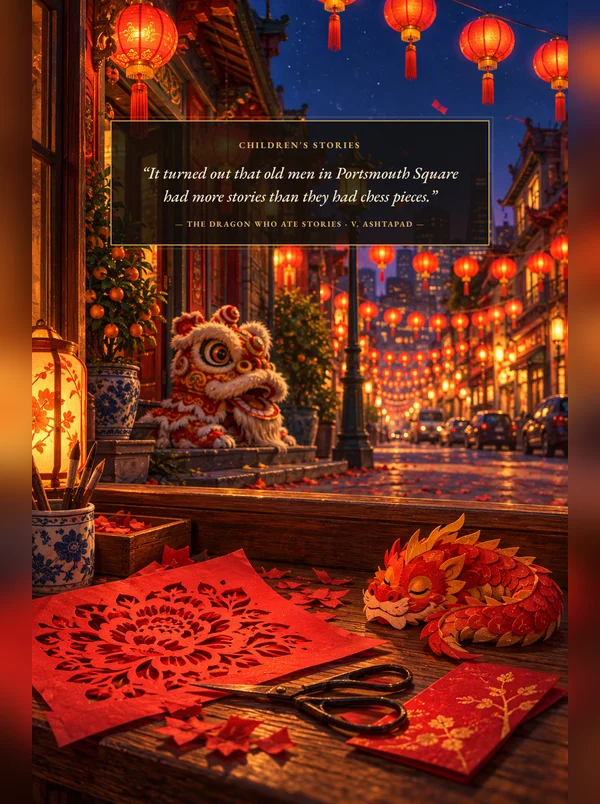
Two weeks before Lunar New Year, in a kite shop the width of a doorway off Grant Avenue, Felix Hom does the one thing his grandfather told him not to do. He dots the eyes on a red paper dragon before it is finished. The dragon blinks. Hung Jai is small, curious, terrified of rain and wind, and hungry, but not for food. It eats stories, and only stories told in Cantonese. Felix knows about eleven words. So begins a race through San Francisco Chinatown: the bakery line, the chess tables of Portsmouth Square, a fortune cookie factory in a narrow alley, an herbal shop with a hundred drawers, a museum where old walls still carry the words of people who waited on Angel Island. Along the way Felix and his grandfather, a retired paper-cutter who never stops cutting, gather the stories the dragon needs, and the family's own story begins to come back to them, one word at a time.
Members can react to this book and talk about it in the members' Library.