
The Drum of Gitega
One Summer, Thirteen Performances, a Red Barn on Lake Champlain and the Children Who Learned to Carry the Drums
by V. Ashtapad
Foreword
This is a work of fiction. The drumming of Burundi, with its great drums carried on the head, its thunderous half circle and its leaping dancers, is real and is cherished as the heritage of the whole country and of Burundian families far from it. The Umurage Drum Troupe, the Lake Lights Festival, the Pelletier farm and everyone in this book are invented.
For everyone who carried the water before they carried the drum.
The Graduation Party
The drum on Didier's head weighs about as much as his little sister, and the sweat is running into his eyes, and the backyard on North Street is so full of people that he has to turn sideways to get through the gate.
He keeps his neck straight. That is the whole trick. Not the arms, though his arms are up, both hands spread on the rim to steady it. Not the legs. The neck. Gaspard has told him a thousand times: the drum does not sit on your head, it sits on your spine, and your spine is a stack of stones, and if one stone tips, the whole wall comes down in the street.
So he keeps the stones straight and walks. Behind him, Fabrice, carrying the second drum, is already singing the call, loud and cheerful and a little flat, and the four others behind Fabrice are answering, and the crowd in the yard turns around from the grill and the folding tables and the balloons tied to the fence, and somebody's grandmother shrieks with joy, and somebody's uncle starts to clap on the wrong side of the rhythm, which is how you know it's a party.
They come round the side of the house in a line. Six of them. Six drums on six heads, painted in bands of red and white and black, the skins pale and tight and pegged around the rim, the drums nearly as tall as a ten-year-old. At the end of the line, without a drum, walking slowly with his two sticks held crossed against his chest like a man holding a secret, is Gaspard.
He is seventy-one. He is small and lean and very upright, with a short white beard and a white cloth wrapped over one shoulder and tied at the hip, over his good brown trousers, and when he walks into a yard the yard rearranges itself around him without being asked.
They set the drums down in a half circle on the grass, all at once, in one movement, the way a flock of birds lands. Didier swings his down from his head to his hip to the ground without letting the base touch first, which took him three years to learn. Gaspard walks to the center of the half circle, where the big drum waits. The old drum. The drum of Gitega.
It is bigger than the others, and darker, the wood almost black with age, the skin on top the color of weak tea and marked in the middle with a pale circle where a hundred thousand blows have landed. It has no paint. It never had paint. Gaspard says paint is for drums that need to be noticed.
He raises his sticks.
Everybody in the yard stops talking.
---
The graduate is Thierry's cousin, Josiane, who has just finished nursing school and is standing on the back steps in her cap and gown with her mother crying on one side of her and her grandmother crying on the other. They play for her for forty minutes. The full sequence. The slow opening, the drums speaking one by one around the circle. The rolling middle, all of them together, the sound so big in the little yard that it comes back off the neighbor's garage like a second troupe answering. The chants, call and response, Gaspard calling in his high hard voice and the rest of them answering, in Kirundi, which is the only language Didier has ever sung in and the one he speaks worst.
Then the leaps.
One at a time, they come forward. You leave your drum, you go to the center, you beat the big drum for a few strokes, then you turn and dance in front of the line, and the line keeps the rhythm going behind you so hard you can feel it in your teeth. You leap. Your knees come up to your chest. Your sticks go up over your head and cross and uncross. You kick. You land, and turn, and leap again, and the crowd shouts, and you go back to your drum before your lungs give out.
Fabrice goes first, because he always does, because he cannot stand to wait. Thierry next. Then Bosco, who is forty-five and has bad knees and still leaps higher than anyone, his face perfectly calm, as if he is simply checking the gutters. Then Patrick. Then Olivier, the youngest after Didier, who is nineteen and on his phone between songs.
Then Didier.
He comes out of the line. He strikes the big drum. Three strokes, four. The old skin under his sticks is different from the others, deeper, with a kind of growl in the bottom of it, and every time he plays it he feels the drum speak back up through the sticks into his wrists. He turns. He leaps.
He is twenty-two. He has been doing this since he was nine. He has the legs for it, long ones, and his body knows the shape of the leap better than it knows how to sit in a chair. He goes up, and for a moment, at the top, with his knees tucked and his sticks crossed and the whole yard below him, there is nothing in the world but the rhythm, the drums behind him holding him up in the air like water holding a swimmer.
He comes down. The crowd roars. He goes back to his drum, his chest heaving.
Gaspard, at the center, does not look at him. Gaspard never looks at him after a leap. That's fine. That's how it's always been.
---
Afterward, there is food.
Josiane's mother has made enough to feed the whole Old North End and most of Winooski. There are beans, the small brown ones, cooked soft with onions and palm oil until they shine. There are plantains, green ones boiled and yellow ones fried in rounds, sweet and blackened at the edges. There is rice, and a goat stew, and a tray of grilled chicken from the Somali place on the corner, and a cake from a supermarket with GOOD LUCK JOSIANE in blue icing and a stethoscope piped on top that looks like a snake.
Didier eats standing up by the fence, the way he always eats after playing, because if he sits down he will not get up.
---
At seven o'clock they load the drums into Fabrice's minivan and Bosco's pickup and drive them back across the river to the mill.
The mill is the old brick woolen mill on the Winooski River, five stories tall, with tall arched windows and a smokestack, and for twenty-three years the Umurage Drum Troupe has practiced in its basement, in a long low room with a stone floor and iron pillars and pipes along the ceiling. The owner, an old man named Mr. Lavoie who loved the noise, charged them forty dollars a month and a bag of fried plantains at Christmas.
Mr. Lavoie died in January. His children sold the mill in March.
There is a paper taped to the basement door. Didier has seen it before. They all have. It has been there for six weeks. It says that the building will be closed to all tenants for renovation as of June 1, and that any items not removed by May 31 will be disposed of. Somebody, probably Fabrice, has drawn a small drum on it in pen, with a sad face.
Tonight, for the first time, nobody pretends not to see it.
They carry the drums down the stone steps one by one and line them up against the wall, as always. Then they stand around in the long low room, under the pipes, in their sweaty cloths, not leaving.
"We could ask the city," Thierry says. "For a room. At the community center."
"We asked the city," says Bosco. "In April. They have yoga."
"Every night?"
"Every night," says Bosco, with deep sorrow. "Different kinds."
"My cousin has a garage," says Olivier, looking up from his phone.
"In an apartment building. With neighbors. On both sides." Patrick shakes his head. "They'll call the police in five minutes. They'll think the building is falling down."
Gaspard has said nothing.
He is sitting on an upturned crate by the old drum, the drum of Gitega, with his hand flat on its skin. He sits there while they talk. Then he stands up, slowly, the way he does everything now, and they all turn to look at him.
"It is finished," he says.
"What's finished?" says Fabrice.
"This." Gaspard lifts his hand from the drum. "Us. The troupe. Patrick is going to Ohio in July. Olivier goes back to college in August and will not come back here, I know it, I have seen it before. Bosco's knees. Thierry's restaurant wants him on Saturdays. Fabrice—" He looks at Fabrice. "Fabrice will go on forever, Fabrice is a cockroach."
"Thank you," says Fabrice.
"But one cockroach is not a troupe. We are six. We need nine for the line. We have been six for three years and pretending." Gaspard looks around the room, at the stone floor, at the iron pillars, at the drums along the wall in their red and white and black. "When I was a boy, my uncle had thirty drummers. Thirty. Now I have six and a basement, and soon I will not have a basement."
"So we find a new basement," says Didier.
Gaspard looks at him. It's the first time today. His eyes are dark and tired and not unkind.
"There is a museum in Boston," he says. "They have written to me twice. They want the old drum. For a case, behind glass, with a card. They will pay for it. They will take care of it. I am going to say yes." He turns back to the drum and puts his hand on it again. "It ends with me, Didier. I am sorry. I was the last one who learned it there, in Gitega, from somebody who learned it there. When I go, it goes into a glass case in Boston. That is better than a basement. That is better than nothing."
Nobody says anything. Upstairs, in the empty mill, somewhere, a pipe knocks.
Didier looks at the drum of Gitega, at the pale circle in the middle of its skin, worn there by a hundred thousand blows from people he will never know. He thinks about it standing in a glass case, under lights, with a card. With nobody's hands on it.
His wrists still hum from the leap.
© 2026 CRUNOD LLC. All rights reserved.
The Farmers Market
They are bad at the farmers market, and everyone can tell.
Not bad in a way the shoppers would notice. The shoppers love it. They stand in a wide ring on the hot asphalt between the maple syrup stand and the man who sells goat cheese, holding their paper bags of early lettuce and radishes, and they clap and film and lift their children onto their shoulders to see. A woman in a straw hat cries a little. A dog howls along, sincerely.
But Didier can tell. The opening is ragged; Olivier comes in late, and Thierry rushes the second section to catch up, and for four whole cycles the six drums are not one sound but six sounds standing near each other. Fabrice forgets a chant he has sung two hundred times. Bosco, leaping, lands wrong on his bad knee and keeps his face perfectly calm and limps back to his drum, and only Didier, beside him, hears him say something under his breath that you would not say in front of your mother.
They have not practiced in a week. That is the reason. On Sunday they carried every drum up the stone steps of the mill for the last time and loaded them into Bosco's pickup, and now the drums are scattered across Burlington like a family after a funeral. Two in Gaspard's living room. One in Fabrice's minivan. One in the storeroom of Thierry's restaurant, between the onions and the rice. One in Didier's parents' hallway, where his father walks into it every morning and apologizes to it.
And the drum of Gitega in Gaspard's bedroom, by the window, with a sheet over it, as if it were already gone.
---
Afterward, Patrick buys everybody maple creemees from the stand by the gate, which is his way of saying goodbye a month early. They sit on the curb in their cloths with the drums standing beside them, eating soft-serve that tastes like the inside of a sugar shack, and nobody talks about the music.
"Columbus has a lot of Burundian families," Patrick says. "Maybe I'll find a troupe there."
"Maybe you'll start one," says Thierry.
"Maybe." He doesn't sound like he believes it. "I'm going to be working sixty hours a week. It's a good job. It's a really good job." He looks at his cone. "My mother says it's time I grew up."
"Your mother is right," says Gaspard, who has not eaten his creemee and is holding it in his hand like a microphone while it melts down his wrist. "It is time. It is time for everybody."
Didier watches a drip of maple ice cream run down the old man's knuckles and land on the asphalt.
"You don't have to say yes to Boston," he says. "Not yet."
"Not yet," Gaspard agrees. "In September. They are coming in September, with a truck."
---
Monday, Didier is on the dock at the warehouse at six in the morning, as always.
The warehouse is a long white box off the highway in Williston, full of things people order and want tomorrow. Didier drives a reach truck, bringing pallets down from racks forty feet high to the dock. He's good at it. He has a steady hand and a straight neck and what his supervisor calls "freaky depth perception." He has never told his supervisor that the depth perception comes from thirteen years of putting a drum the size of a small refrigerator on his head and walking through gates with it.
At break, he sits on an upturned bucket by the dock door with Dale.
Dale is fifty-three and runs the loading crew. He is large and pink and has a gray mustache like a push broom and a laugh you can hear over the conveyor. He grew up on a farm in Charlotte, on the lake, and left it at eighteen to get away from cows and has spent the rest of his life missing them. He eats the same lunch every day: two hard-boiled eggs, crackers, and a pickle wrapped in foil.
"You look like somebody shot your dog," Dale says.
Didier tells him. The mill. The six. Patrick and Ohio. Boston, the truck in September, the glass case.
Dale listens with an egg in his hand, not eating it.
"How much room do you need?" he says, when Didier is done.
"For practice? Big. We're loud. Really loud. We need somewhere nobody's going to call the police."
"How loud?"
"You know the sound when the trailer comes off the jack?"
Dale winces.
"Like that," says Didier. "For two hours. Twice a week."
Dale peels the rest of his egg very slowly. He looks out the dock door at the trucks lined up in the lot, and past them, at the green line of the Adirondacks across the lake, hazy in the heat.
"My mother's got a barn," he says.
---
It isn't simple, Dale says. His mother is sixty-eight. She has opinions. She has run that farm alone since Dale's father died, seven years ago, and they sold the dairy herd five years before that, and now she keeps a few beef cattle and cuts hay and rents the back fields to a man who grows sweet corn. The barn is big and red and mostly empty. The hayloft is half full. The lower floor, where the milking parlor used to be, is just concrete and old stanchions and swallows.
"Nearest neighbor's a quarter mile," Dale says. "Across the road. And they've got a kid who plays the drums. Real drums. In a band. So they can't complain."
"Would she let us?"
"I have no idea," Dale says. "She might say yes. She might shoot you." He grins under the mustache. "Fifty-fifty. Want me to ask?"
---
On Thursday Dale reports back.
"She said she'd think about it," he says. "Which with my mother means maybe. She said come to the farm and play something, and she'll decide if she can stand it."
"When?"
"She said a Sunday. When it's cool. Evening." Dale crumples his foil. "And she said bring the old man. The leader. She wants to meet whoever's in charge."
Didier's stomach goes cold.
"He's not going to come," he says.
"Why not?"
"Because he's already decided it's over."
Dale thinks about this. He chews his pickle.
"My dad was like that," he says. "With the dairy. When he sold the herd, he said it was over. Said nobody'd ever farm that land again. Wouldn't let anybody in the barn. Sat on the porch for a year." He folds the foil into a small neat square, and then smaller. "Then my son was born, and when Owen was about two, we brought him out to the farm, and he walked straight into the barn and stood there in the middle of it in his little boots and yelled. Just yelled. To hear the echo. And my dad came in after him and I thought he was going to be mad. And he just stood there and laughed till he cried."
He puts the foil square in his lunch box.
"Bring the old man," he says. "Tell him there's an echo."
© 2026 CRUNOD LLC. All rights reserved.
The Wedding
The bride is late, which means the drummers wait in the parking lot of the function hall in Winooski for an hour and a quarter in their cloths, in the June sun, with the drums standing on the warm asphalt beside them like patient cattle.
Didier uses the time.
"There's a barn," he says to Gaspard.
Gaspard is sitting in the open side door of Fabrice's minivan with his sticks across his knees and his eyes closed. He doesn't open them.
"In Charlotte," Didier says. "On a farm. On the lake. A big red barn with nobody in it. Dale from work, it's his mother's. She said we can come and play for her, and if she can stand it, we can practice there."
"Can stand it," Gaspard repeats, eyes still shut.
"She wants to meet you. Tomorrow evening."
"I am busy tomorrow evening."
"Doing what?"
Gaspard opens one eye. "Being seventy-one," he says, and closes it again.
Fabrice, who is lying on the grass verge with a cloth over his face, laughs from under the cloth.
---
The bride arrives at last in a white car with ribbons on the mirrors, and everyone in the parking lot starts shouting at once, and the drummers lift their drums to their heads and form the line.
This is one of the oldest jobs a troupe has, Gaspard says, older than any stage: to bring people in. To walk in front of somebody important through a door, so that everyone inside knows that somebody important is coming. They bring the bride in. They walk ahead of her, six drums on six heads, in a slow procession through the double doors of the function hall and down the middle of the room between the round tables, and the guests stand and ululate and throw their hands up, and the bride, Claudine's friend's daughter, a dental hygienist named Divine, walks behind them in her white dress with her chin up and her eyes shining, and her new husband, a tall shy accountant from Montreal, walks behind her looking as if he has been hit very gently on the head.
At the front of the hall they set the drums down and play. The low ceiling and carpet cannot hold the sound; the glasses on the tables shiver, and a small boy in a bow tie puts his hands over his ears, then takes them away, delighted, then puts them back.
Didier, in the line, beating his drum, watches Gaspard at the center.
Something is wrong with Gaspard's arms.
It is very small. Nobody else would see it. But the old man's strokes on the drum of Gitega are not quite as high as they were a month ago, and on the hard accents, the big ones, the ones that come down with the whole body, he is using his shoulders less and his wrists more. His face is the same as always: stern, calm, faraway. But at the end of the long rolling section, when they all stop together, Didier sees him close his eyes for a moment, just a moment, and breathe.
---
Afterward, at the edge of the dance floor, while a DJ plays something with a lot of bass and the aunties dance in a line with their handbags, Didier finds Gaspard's wife.
Beatrice is sixty-eight, and as wide and soft as Gaspard is narrow and hard. She has worked in the kitchen of an elementary school in Burlington for twenty-four years, and every child who has passed through it calls her Mama B. She is eating cake. She is eating it very slowly, with great attention, as if it might be the last cake.
"His arms hurt," Didier says, sitting beside her.
"His arms hurt. His back hurts. His heart hurts." She points her fork at him. "But not that heart. The doctor says that heart is a horse. The other one."
"The museum."
"The museum. The basement. Patrick." She sighs and eats some cake. "He has been sleeping in the living room. Did you know that? On the couch. Because the drum is in the bedroom, and he says he cannot sleep next to it. He says it looks at him."
Didier doesn't know what to say.
"There's a barn," he says, finally.
"I know. Fabrice told me. Fabrice tells me everything. Fabrice is a radio." She licks the fork. "Tomorrow evening?"
"Yes."
"He'll come," she says.
"He said he's busy being seventy-one."
"He will come," Beatrice says, "because I am going to tell him that if he does not come, I am going to take that drum out of my bedroom and put it in the garage." She smiles a terrible sweet smile. "And he knows I will do it."
---
He comes.
He sits in the passenger seat of Bosco's pickup the whole way down Route 7 with his arms folded and his mouth shut. Didier rides in the back with the drums, three of them roped upright, and his hair whipping around his face, and the green Vermont June going by on both sides. Fields. Fences. A white church with a tall steeple at a crossroads. A long gravel road down toward the water. Cows looking up.
Then the farm.
The house is white and square and a little crooked, with a big porch. The barn behind it is enormous. Red, the paint faded and peeling in long strips on the side that faces the weather, with a white trim around the big doors and a gray slate roof with a cupola on top. And beyond it, past the hayfield, past a line of old maples, down a long slope of green, the lake.
Didier has lived in Burlington his whole life. He has seen Lake Champlain ten thousand times. From the waterfront, from the bike path, from the top of the hill by the university. He has never seen it like this, from the Vermont side, in the low evening light, with the whole wide sheet of it lying still and silver and pink below him and the mountains of New York standing up blue and sharp on the far side, as if someone had cut them out of paper and set them against the sky.
He forgets, for a moment, why he came.
"It's not bad," says a voice behind him. "On a clear day."
---
Ruth Pelletier is small and brown and wrinkled like a walnut, in jeans and a man's flannel shirt with the sleeves rolled up, and rubber boots. She has white hair in a short practical cut and very sharp blue eyes. She looks at Didier. Then at the drums in the back of the truck. Then at Gaspard, getting slowly down from the passenger seat.
"You're the boss," she says to him.
"I am the old man," Gaspard says.
"Same thing. I'm the old woman. That makes me the boss here." She holds out a hand, and he takes it, and they shake once, two small hard people sizing each other up like a pair of roosters.
There is a boy on the porch. Ten, maybe, with a mop of red hair and freckles and a baseball cap on backward and a look on his face like he has been told to behave and is considering his options.
"That's Owen," says Ruth. "My grandson. Dale's boy. He's here for the summer while his parents work. He wanted to see the drummers. I told him drummers are just people and he should sit still." She jerks her head at the barn. "Go on, then. Let's hear it."
---
The barn inside is huge and dim and smells of old hay and old cows and dust, and swallows go in and out of the open doors overhead in long swooping curves. The floor is concrete, cracked, swept. The light comes in through the high windows in long gold slabs with dust turning in them.
They set the drums down in the middle of the floor. Didier, Bosco, Fabrice, and the three more that came in Fabrice's van. Not the drum of Gitega. Gaspard would not bring it. There is no center drum. Thierry's drum stands in the middle and has to pretend.
Gaspard stands back, by the door, arms folded.
Didier raises his sticks. He looks at Gaspard. Gaspard does not move.
So Didier starts, alone. One stroke. Then another.
The sound goes up into the empty barn, into the dark of the roof beams, into the hayloft, and comes back down. Not as an echo, exactly. As a kind of bloom. The whole building takes the sound and holds it and gives it back bigger, so that a single stroke on a single drum fills the barn the way six drums filled the function hall. The swallows burst out of the rafters all at once in a cloud and circle and come back.
Owen, in the doorway, says, "Whoa."
Didier strikes again. And Bosco comes in, and Fabrice, and the others, and they play, six drums with no center in a dairy barn in Charlotte at sunset, and the sound of it is so big that Didier feels it in the soles of his feet through the concrete and in his back teeth. Outside, the cows in the pasture all lift their heads and stare.
When they finish, Ruth Pelletier is standing with her arms crossed and her lips pressed together.
"Well," she says. "I can stand it."
She looks at Gaspard, in the doorway, who has not moved, who has not said one word, whose face in the gold light is wet.
"Tuesdays and Thursdays," she says to him. "Seven to nine. Don't scare the cows any worse than that." She turns to go back to the house, and stops. "And bring the big one next time. The one that's missing. I could hear the hole where it should be."
© 2026 CRUNOD LLC. All rights reserved.
The Open Barn
Ruth Pelletier invites the neighbors, because, she says, if they're going to hear it twice a week all summer, they might as well see what it looks like first and get their complaining done in one evening.
So on the second Saturday in June there are forty people in her barn. Farmers from up and down the road in clean shirts. The family from across the way, the Lindqvists, with their daughter who plays drums in a band. Two women from the historical society who want to know if the barn is on the register. A man with a beard who keeps bees. A great many children, who went straight up the ladder into the hayloft and had to be got down again. Folding chairs in rows on the concrete, a coffee urn, a plate of lemon bars.
And in the middle of the floor, for the first time, the drum of Gitega.
Gaspard brought it himself, in Bosco's truck, sitting in the bed beside it with one hand on its rim the whole way down Route 7, the way you would ride beside a sick relative in an ambulance. When they carried it into the barn, he walked ahead of it, backward, watching it come through the door. He chose the spot himself. He moved it twice. Then he stood in front of it with his hands flat on its skin for a long time while the others set up around him in the half circle.
Ruth, by the coffee urn, watched him do this and said nothing, and Didier liked her for that.
---
They play the whole sequence. Forty minutes.
And the barn, with the center drum in it, is a different instrument. Didier hears it from the first stroke. The old drum's deep growl goes down into the concrete and up into the beams and the whole building seems to settle around it, the way a house settles when the person who owns it walks in. The six drums around it suddenly make sense again. The hole is filled. The neighbors on their folding chairs sit very still, and then less still, and by the rolling middle section the man who keeps bees is nodding his whole upper body like a pump.
Gaspard plays like he did a year ago. Better. His arms come up high. On the big accents, he uses his shoulders.
Then the leaps. Fabrice, Thierry, Bosco, his face calm as a pond. Patrick, who has three weeks left. Olivier, who puts his phone away for once. Didier, who goes up into the gold dusty light from the high windows with his knees at his chest and for a moment can see the whole barn from above, the faces turned up, the swallows on the beams, the lake through the open door, and comes down to a noise like a wave breaking.
The Lindqvist girl is on her feet, shouting.
---
Afterward, the children come down out of the hayloft and stand around the drums.
There are maybe a dozen of them. The adults have gone to the lemon bars. Didier, wiping his face with his cloth, watches them. They do what children do around drums everywhere: they look at them, and they look at the drummers, and they look at the drums again, and their hands creep out, and back, and out.
Owen Pelletier goes first. Of course he does. He has been circling the drums since the troupe arrived, like a dog circling a picnic. He puts both hands on the rim of Didier's drum and tries to lift it.
It does not move.
He tries again, with his whole body, his face going red under the freckles. The drum tips a little toward him.
"Whoa, whoa," says Didier, and catches it. "Easy. That's heavier than you."
"How much does it weigh?"
"About as much as my sister. She's sixteen."
"How do you get it on your head?"
"Practice."
Behind Owen there are others now. The Lindqvist girl, Maya, who is twelve and tall and has drumsticks sticking out of the back pocket of her jeans. Fabrice's daughter, Ange, eleven, who has heard the troupe play her whole life and never once been allowed to touch a drum. Thierry's nephew, Kevin, twelve, who is quiet and serious and wears glasses with thick black frames, and who has been watching Didier's leaps all evening with his mouth slightly open.
"Can you show us?" Maya says.
Didier looks over at Gaspard.
Gaspard is sitting on a hay bale by the drum of Gitega with a cup of coffee in his hand. He has heard. He shakes his head, once, slowly.
"Their necks are made of grass," he says. "You will break them. Their mothers will come for you with knives."
"I'm not going to put a drum on them."
"Then what are you going to put on them?"
Didier looks around the barn. In the corner, by the old milking parlor, stacked on a shelf, are a row of galvanized steel pails. The old kind, from when the barn was a dairy, with a wire handle.
---
He fills one with a little sand from the pile by the barn door. Not much. A few cups.
"Okay," he says to the children. "Line up. Shoes off."
They line up, in socks, on the cool concrete. Owen. Maya. Ange. Kevin. Two of the beekeeper's grandchildren, little blond girls, who have joined without being asked.
"The drum doesn't sit on your head," Didier says. "It sits on your spine. Your spine is a stack of stones." He hears Gaspard's voice inside his own and doesn't stop. "Feel your back. Your neck. Feel how it goes up. If one stone tips, the wall falls down. So your head stays level. Not up, not down. Like you're looking at the horizon. Like you're looking at the lake."
He takes Owen first. He puts the folded cloth from his shoulder in a ring on top of the boy's red hair. He sets the pail on the cloth. He keeps his hands on it.
"Hands up. Both hands on the rim. Light. You're not holding it up, you're just telling it you're there."
Owen's hands come up. His neck goes stiff. His eyes go wide.
"Breathe," says Didier. "Now walk."
Owen walks. Three steps. Four. The pail tips. Didier catches it. Sand goes everywhere. The beekeeper's granddaughters scream with laughter.
"Again," says Didier.
---
They do it for half an hour. By the end, Maya can walk the length of the old milking parlor with the pail balanced on her head and her hands only resting on it. Kevin can do it with his eyes shut, which nobody told him to try. Ange, whose father is Fabrice, does it with a little swagger in her hips that is exactly, unmistakably her father's, and Fabrice, watching from the lemon bars, puts his hand over his heart and pretends to faint.
Owen falls down twice and spills sand on everybody and gets up every time.
Didier looks over at Gaspard again.
The old man is still on the hay bale. His coffee is finished. He is watching the children with an expression Didier cannot read. Not anger. Not quite. Something older, and more tired, and more careful, like a man watching someone else carry his grandmother's china down a flight of stairs.
Ruth Pelletier sits down on the hay bale next to him with a lemon bar.
"Those are my pails," she says.
"I know."
"My husband used them for forty years. Morning and night." She eats half the lemon bar. "Haven't been off that shelf since the herd went." She watches Owen balance a pail of sand on his head and walk four whole steps without falling. "Nice to see them working."
Gaspard says nothing.
"Tuesdays and Thursdays," Ruth says, "you've got the barn. Seven to nine. That's for you." She brushes crumbs off her flannel. "Wednesdays it's empty."
She gets up and walks back to the coffee urn.
Gaspard sits on the hay bale, by the drum of Gitega, and watches the children, and does not say anything at all.
© 2026 CRUNOD LLC. All rights reserved.
The Library Lawn
The children's librarian, a young man with a ponytail and a cardigan in spite of the heat, has booked them for the first day of the summer reading program, and he has been very clear on the phone that the audience will be small, and young, and will not sit still.
He is right. There are sixty children on the lawn in front of the public library downtown, on blankets, on the grass, on their parents' laps, and not one of them sits still for a single second. They roll. They crawl. They stand up and sit down and stand up. A toddler in a sun hat walks straight into the half circle of drums while the troupe is playing and stands in front of Bosco with her arms raised over her head, shrieking with joy, until her father comes and collects her like a parcel.
Didier loves it. He loves it more than the wedding. He loves the boy in a dinosaur shirt who copies every leap from the grass and falls over every time, and gets up.
At the end, the librarian asks if the children have questions.
Every hand goes up. How heavy is it? Is it made of a tree? Why do you jump? Do you have a dog? Didier answers as many as he can. About as heavy as his sister. Yes, one whole tree, hollowed out. Because the music is happy and your legs want to. No, but the farm where they practice has cows.
Then a girl in the front, maybe eight, with her hair in two puffs, says, "Can kids do it?"
And Didier says, before he can stop himself, "Yes."
---
He hadn't planned to.
He'd thought about it, every night since the open barn. Lying in bed in his parents' apartment in the Old North End with the window open and the sound of the street coming in, he'd thought about the children in their socks with the pails on their heads, and Owen falling down and getting up, and Ruth saying Wednesdays it's empty. He'd thought about Gaspard on the hay bale. He'd thought about the drum in a glass case in Boston with a card.
But he hadn't planned to say it out loud, on a library lawn, to sixty children and their parents.
"Wednesday evenings," he hears himself say. "Six-thirty. At a farm in Charlotte. Free. Ages nine and up. You learn to carry the drum on your head and dance and play. Talk to your parents."
He writes the address on the back of the librarian's sign-up sheet for the reading program, because there is nothing else to write it on. Twelve families crowd around him afterward. He gives them his phone number. Most of them, he can tell, will never come. Charlotte is twenty-five minutes. It's summer. People have camps and jobs and grandmothers in New Hampshire.
But two of them, he thinks, might. The twins from the third floor of his own building, Elie and Eloi, nine, who are so identical that their own mother sometimes uses their middle names to be sure, and who live directly above his parents and have been jumping on the floor in time to his practice drumming since they could walk.
"We'll come," says Elie, or possibly Eloi.
"You have to ask your mom."
"She'll say yes," says the other one. "She says we need to get our jumping out somewhere else."
---
When he turns around, Gaspard is standing behind him.
The old man has been packing the sticks into their cloth bag. He has heard everything. His face is very still.
"Can I talk to you," he says. It is not a question.
They walk to the side of the library, under a big old maple, out of the sun. The others are loading the drums. Gaspard stands with his back to the brick wall and his sticks under his arm.
"You are making a circus," he says.
"I'm making a class."
"A class. A free class. On a farm. For American children who will come twice and then go to soccer." Gaspard's voice is very low and very even, which is worse than shouting. "You do not know how to teach this. You are twenty-two. I am the teacher. My uncle taught me, and his uncle taught him, and it takes ten years, Didier. Ten years before you are allowed to leap. I made you wait four years before you touched the center drum. Do you remember?"
"I remember."
"And now you are going to put drums on the heads of nine-year-olds in a barn and call it the tradition."
"I'm going to put buckets on their heads," says Didier. "For now."
"And then?"
"And then I don't know." He hears his own voice getting louder and makes it come down. "I don't know, Sogokuru. You're right. I don't know how to teach it. Nobody taught me how to teach it. You taught me how to play it." He takes a breath. "So teach me how to teach it."
Gaspard looks at him for a long moment.
"There is a museum in Boston," the old man says, very quietly.
"I know."
"The truck comes in September."
"I know."
"Then you have until September," Gaspard says, and walks back to the drums.
---
That night, at home, his mother makes beans.
She makes them the way she always makes them on Saturday, in the big dented pot she brought from her own mother's kitchen. The little red-brown beans, soaked overnight, simmered all afternoon with onion and a spoonful of palm oil that turns everything the color of a sunset, and tomatoes, and a little hot pepper that she adds, she says, for Didier's father, who pretends he doesn't like it. And plantains: green ones peeled and boiled until they're soft and dense and almost like potatoes, and yellow ones, ripe, sliced on the diagonal and fried in a black pan until the edges go dark and sticky.
The apartment fills with the smell. It is the smell of every Saturday of his life.
His father comes home from his shift at the bus garage at six-thirty and walks into the drum in the hallway, as he does every night, and says, "Sorry," to it, and comes and sits at the kitchen table in his blue uniform with his tie loosened.
"Your son," says Didier's mother, from the stove, "is opening a school."
"A school?"
"For drumming. On a farm. With buckets." She brings the pot to the table. "Gaspard is very upset."
His father, Pascal, is fifty-four and slow-spoken and enormously patient, from twenty years of driving the number two bus through Burlington traffic and being shouted at by people who missed their stop. He helps himself to beans, and to plantains, and to beans again. He eats for a while. Didier's sister, Aline, comes out of her room with her earbuds in and takes a plate and goes back into her room, which is how sixteen-year-olds eat dinner.
"When I was a boy," Pascal says at last, "my father would not let me drive the car."
"Okay," says Didier.
"He said I was too young. Too careless. He said I would put it in a ditch." Pascal eats a fried plantain. "So I learned to drive in my uncle's truck, in a field, behind the house, when my father was away. And when my father came back, I drove him to the market. And he sat in the passenger seat the whole way, and he did not say one word, and when we got there he got out and he said, Who taught you to brake so badly?"
Didier waits. His father eats more beans.
"Is that the end of the story?" Didier says.
"Yes."
"What does it mean?"
His father wipes his mouth. He looks at Didier across the table, with the steam of the beans between them.
"It means Gaspard will come on Wednesday," he says. "To tell you that you are teaching it badly."
© 2026 CRUNOD LLC. All rights reserved.
The Parade
Gaspard came on Wednesday, the way Pascal said he would, and told Didier he was teaching it badly.
He didn't say it right away. He arrived in Beatrice's car at six-forty, ten minutes after the class began, and walked into the barn and sat down on the same hay bale by the door with his arms folded, and watched. There were eight children that first Wednesday. Owen, Maya, Ange and Kevin from the open barn. The twins, Elie and Eloi, brought down in Didier's own car, bouncing on the back seat the whole way and asking if there would be cows. Two boys from the library lawn who never came back.
Didier had them walking with the pails. Up and down the length of the barn floor, in their socks, with a few cups of sand. Then turning. Then stopping and starting. Then, for the older ones, setting the pail down from their heads to the floor without spilling, in one movement, the way the drummers set down the drums.
Gaspard watched for forty minutes and said nothing.
Then he stood up and walked over to Kevin, who was the best of them, who could walk the length of the barn with his eyes closed, and he put one finger on the back of the boy's neck, right at the base, where the spine goes into the shoulders.
"Here," Gaspard said. "Here is where it lives. Not on the head. Here." He pressed gently. Kevin straightened. The pail on his head settled, very slightly, as if it had found a seat. "You see?"
Kevin nodded, carefully, without moving his head.
Gaspard turned to Didier. "You told them a stack of stones."
"You told me a stack of stones."
"I told you a stack of stones because you were nine and you liked stones. These children do not care about stones. They are American. Tell them it is a tower. Tell them the drum is the top floor and they are the elevator." He sat back down on the hay bale. "And you are teaching them too fast. And they are holding their elbows wrong. And that one"—he pointed at Owen—"is going to fall down again."
Owen fell down.
---
On Saturday, the Fourth of July, the troupe marches in the parade.
It's the old parade in a village up in the hills, where the main street is one long slope between white houses with flags on their porches, and the whole county sits on the curbs in lawn chairs to watch a marching band, the volunteer fire department, antique tractors and a float of a giant cardboard cow. The troupe has marched in it for nine years. They always go right after the antique tractors, which Fabrice says is because the organizers think drums and tractors are the same kind of thing: old, loud and hard to park.
This year they march with seven drums. Gaspard has brought the drum of Gitega. He carries it himself, on his own head, for the first time in two years.
Didier doesn't know what to think about that. He watches it go up, in the parking lot behind the general store. Bosco and Thierry lift it together and set it on the folded cloth on the old man's head. Gaspard's neck takes it. His arms come up. His face does not change. For a moment Didier sees him not as seventy-one and tired, not as a man sleeping on his own couch, but the way he must have been once, at twenty, at thirty, a lean straight drummer under a huge drum, walking.
"He's going to hurt himself," Didier says to Fabrice.
"He's going to show off," Fabrice says. "Which for him is the same thing."
---
And behind the troupe, at the end of the line, come the children.
That wasn't Didier's idea either. That was Ruth's. She said at Thursday's practice that she was driving Owen to the parade anyway, and she had a truck, and the truck had a bed, and the Lindqvists were going, and Fabrice was bringing Ange, and if the children wanted to walk at the back of the troupe with their pails on their heads, she didn't see who on God's earth was going to stop them.
So there are six children at the back of the line, in white T-shirts, with six galvanized dairy pails on their heads. No sand today. Empty. Owen and Maya, Ange and Kevin, Elie and Eloi. They walk in a row, two by two, with their hands up on the rims and their necks straight, behind the drums, down the long slope of the main street between the crowds.
The crowds go wild for them.
Didier, under his drum, at the front of the line, can't see them. He can only hear. And what he hears, behind the drums, behind the chants, is a sound he has not heard at this parade in nine years. People standing up out of their lawn chairs. A wave of it, following the troupe down the street. Clapping, shouting, whistles. A woman's voice, very loud: "Look at the babies!" And a man's: "Those are milk pails! Those are actual milk pails!"
Halfway down the hill, the troupe stops and sets down its drums in the middle of the street and plays. The full sequence, short version. Ten minutes. The crowd closes in around them in a ring. The children stand at the back in a line with their pails at their feet, the way Didier taught them, perfectly still, watching.
Then Patrick leaps.
It's his last show. Everybody knows. He goes up higher than Didier has ever seen him go, his knees at his chest, his sticks crossed over his head, his face split open in a grin, and he comes down and turns and goes up again, and again, four times, five, until Gaspard at the center drum lifts one stick to tell him enough. He comes back to his drum soaked in sweat and laughing.
At the end, when they lift the drums back up to go on down the hill, Patrick does something nobody expects.
He walks to the back of the line. To the children. To Kevin, who is standing there with his empty pail and his thick black glasses and his serious face. Patrick holds out his sticks.
"Hold these for me," he says. "Till I get back from Ohio."
Kevin looks at the sticks. Then at Patrick. Then, very slowly, he takes them.
"When are you getting back?" he says.
"I don't know, man. Hold them for a while." Patrick claps him on the shoulder and walks back up to the front of the line and lifts his drum to his head, and they go on down the hill.
---
After the parade, they eat in the parking lot behind the general store, sitting on the tailgates. Ruth has brought a cooler of lemonade and a box of fried chicken. Fabrice's wife has brought plantains, fried, in a foil tray, still warm, which the Lindqvists have never eaten before. Mr. Lindqvist eats nine.
Gaspard sits on the tailgate of Bosco's pickup beside the drum of Gitega. He rubs the back of his own neck, slowly, with one hand.
Didier sits down next to him.
"You carried it," he says.
"I carried it."
"How does it feel?"
Gaspard considers this. "Like I am seventy-one," he says. Then, after a while, still rubbing his neck: "That boy with the glasses. Thierry's nephew."
"Kevin."
"Kevin. His elbows are wrong. But his neck is good." Gaspard watches Kevin, across the parking lot, sitting on the curb holding Patrick's sticks across his knees the way Gaspard holds his own, as if they were a secret. "His neck is very good."
© 2026 CRUNOD LLC. All rights reserved.
The Birthday
Beatrice decides that Gaspard's seventy-second birthday will be at the barn, and Gaspard is not consulted, because Beatrice says a man who has been sleeping on a couch for two months has lost his vote.
So on Saturday, the eleventh of July, the barn has streamers. Somebody, probably Ange, has strung paper chains in red and white across the old stanchions. There is a long table made of sawhorses and planks with a paper cloth on it, and a cake from the bakery in Shelburne with GASPARD 72 on it, the seven slightly larger than the two, and a pot of beans as big as a washtub that Beatrice and Didier's mother have been cooking since morning in Ruth's kitchen, arguing the whole time about the onions.
All the drummers and their families. Ruth, in a clean flannel shirt. Dale, in his work boots, with Owen's baby cousin on his shoulders. The Lindqvists, with a casserole.
And the six who come on Wednesdays, who have a secret.
---
They do it after the cake.
Didier has been planning it for two weeks. The six children line up at the barn door, in their white T-shirts, in their socks. Each one has a dairy pail on their head, upside down now, the bottom up, like a little drum. Each one has a pair of sticks: real ones, short ones, that Bosco whittled for them out of maple from Ruth's woodpile, sitting in his pickup on his lunch breaks at the body shop.
They come in in a line. Necks straight. Hands up. Owen at the back, because he is the most likely to fall down, and because, Didier told him, the back of the line is the most important place, the one who brings everyone in.
They walk the length of the barn. They set the pails down on the concrete, all at once, upside down, in a half circle, in one movement, almost. Elie is a little late. Eloi is a little early. It's close.
Then they play.
It isn't much. It's the opening pattern, the simplest one, the one Didier learned first at nine. Six children, on six upside-down pails, beating out the rhythm with Bosco's little maple sticks. The pails make a tinny, hollow, ringing noise, nothing like a drum, more like a kitchen falling down a staircase in time. Maya, who plays drum kit, keeps everybody together, her eyes flicking from one to the next. Kevin is concentrating so hard his tongue is sticking out.
Then Ange leaves her pail and comes into the middle of the half circle and does a leap.
Just one. Small. Her knees come up maybe halfway to her chest. Her sticks go up over her head, crossed. She comes down, staggers, catches herself, turns, and goes back to her pail with her face on fire, and keeps playing.
Fabrice, at the cake table, makes a sound Didier has never heard a grown man make. Like a teakettle.
---
They finish. The barn erupts.
Didier looks at Gaspard.
The old man is sitting at the head of the plank table with a paper plate of cake in front of him that he hasn't touched. He has a paper crown on his head that Beatrice put there and that he has not taken off, because, Didier suspects, he has forgotten it's there. He is staring at the six children standing behind their pails.
He gets up.
The barn goes quiet. Everybody knows. Everybody has been waiting.
Gaspard walks across the concrete floor to the half circle of upside-down pails. He walks slowly. His knees are bad today; Didier can tell. He stops in front of Ange.
Ange looks up at him, very scared.
"Your elbows," says Gaspard.
"I'm sorry."
"No. Your elbows are good. When you leap." He lifts his own arms, slowly, to show her: elbows out, wide, sticks crossed high, like a bird's wings at the top of a wingbeat. "You did this. Who told you to do this?"
"Nobody," Ange whispers. "I just watched."
"You just watched." Gaspard lowers his arms. He looks at her for a long time, in his paper crown. "I just watched also," he says. "When I was seven."
---
Later, when the cake is gone and the children are running in the hayfield in the long evening light, Gaspard sits on the hay bale by the door and tells Didier something he has never told him in thirteen years.
"I was not supposed to be in the troupe," he says. "My uncle said I was too young. Too small. My mother said I was too lazy. So I carried water." He watches the children in the field, racing each other to the fence and back. "There was a big clay pot. The drummers drank from it after they played, at every performance, in the heat. Somebody had to bring it. Somebody had to carry it on their head from the stream to wherever they were playing and set it down without breaking it. So I carried it. Every time. For two years. And I watched."
"And then?"
"And then one day, a drummer was sick. My uncle needed nine. He had eight. He looked around, and there was only me, with the water pot." Gaspard smiles slightly. "He said, Put that down. He said, Have you been watching? I said yes. He said, Then show me."
"And you showed him."
"I showed him very badly. He told me afterward I was the worst drummer he had ever seen in his life." The smile gets bigger. "He let me come back the next week."
Didier is quiet. Out in the field, Owen has fallen down in the long grass and is lying on his back with his arms out, laughing at the sky.
"I am not saying yes to anything," Gaspard says.
"I know."
"Buckets are not drums."
"I know."
"Those children need drums. Small ones. Their own. Made from a tree, with skins. Not pails." He turns his head and looks at Didier for the first time. "Do you know how to make a drum?"
"No."
"No," Gaspard agrees. He takes the paper crown off his head, at last, and looks at it in his hands, puzzled, as if he has no idea how it got there. "Neither did I. At first."
© 2026 CRUNOD LLC. All rights reserved.
The Street Fair
It starts to rain twenty minutes into the street fair in the South End, and by the half hour it is coming down so hard that the street is a river and the artists' tents along both sidewalks are bellying and pouring water off their corners like gutters.
The troupe keeps playing. Of course they do. Gaspard says a troupe that stops for rain is a troupe that has forgotten where it came from. The crowd, what's left of it, crams under the awning of a furniture store and cheers every time a drummer leaps, and the leaps are glorious, sheets of water flying off the drummers' sticks and shoulders, Fabrice landing in a puddle with a splash that soaks a woman in the front row to the knees. She shrieks and laughs and doesn't move.
But the drums are dying.
Didier feels it in his own drum first. Ten minutes into the rain, the skin under his sticks starts to give. It goes soft. The sound goes flat and dull and heavy, a thud instead of a crack, as if he's beating a mattress. He hits harder. It gets worse.
Hide is skin. Skin drinks water. A drum is only a drum when its skin is stretched tight and dry over the mouth of the wood, so tight it hums when you touch it, so tight it pushes your stick back up into your hand. Wet, it slackens and sags, and the voice goes out of it.
Gaspard, at the center, knows before anyone. Didier sees him look up at the sky, and then down at the drum of Gitega, its old pale skin darkening with rain in big spreading blotches, and his face goes gray.
He stops the troupe with one stick, in the middle of the rolling section. Nobody has ever seen him do that.
"Cover it," he says. "Cover it now."
---
They get the drums to the barn in Bosco's pickup and Fabrice's minivan with every coat and towel and tarp they own wrapped around them, and the drum of Gitega in the front seat of the van with Gaspard holding a raincoat over it like a man holding an umbrella over a queen.
Ruth meets them in the barnyard in a slicker. She takes one look and says, "Not the barn. The house. The stove's lit."
So they carry seven drums into Ruth Pelletier's farmhouse kitchen, dripping, and stand them in a circle around her old black woodstove, not too close. The kitchen is low and yellow and warm, with a long wooden table and a dog asleep under it who opens one eye at the drums and closes it again. Ruth puts the kettle on. Beatrice, who came in her own car, takes over the kettle from Ruth, and Ruth lets her.
Gaspard kneels on the kitchen floor by the drum of Gitega.
He puts his palm flat on the skin, near the edge, and holds it there. Then he moves it a little, and holds it again. He does this all the way around the drum, slowly, like a doctor feeling a belly.
"It's okay," he says at last. "It's not too wet. It did not take in very much." He stays there, on his knees, with his hand on it. "It will tighten. Slowly. Not too close to the fire, or the skin will split. Turn them. Every half hour."
"How long?" Didier asks.
"All night."
"We'll stay," says Didier.
Gaspard looks up at him from the floor. His eyes are red. From the rain, maybe.
"We will stay," the old man says.
---
So they stay. The others go home, one by one: Fabrice to his wife, Thierry to his restaurant, Bosco to his bad knee and a bag of frozen peas. Beatrice goes to sleep upstairs in Ruth's spare room, which Ruth offers without being asked, and which Beatrice accepts without pretending she won't.
Didier and Gaspard and Ruth sit at the long kitchen table, with the drums around the stove, and turn them every half hour, a quarter turn each, so each side gets its share of the heat. Outside, the rain goes on and on, drumming on the tin roof of the porch, a sound like a thousand tiny troupes.
At eleven, turning the drum of Gitega, Didier puts his palm on its skin the way Gaspard did. It's firmer. Not tight yet, but firmer. He can feel it pulling back toward itself. Like a muscle.
"How do you make the skins?" he says.
Gaspard is quiet a moment.
"You start with a hide. A cow. A young one is best, the skin is thinner. You soak it in water until it is soft, so soft it is like cloth. You scrape it. You take off the hair, all of it. Then, while it is still wet, you stretch it over the mouth of the drum and you fix it with pegs." He holds up a hand, fingers spread. "Wooden pegs. Into the wood, all the way around the rim, through the skin. You pull and you peg. Pull and peg. Then you let it dry. As it dries, it shrinks. It pulls itself tight." He nods at the drums around the stove. "It is the same as what is happening now. Only from the beginning."
"And the wood?"
"The wood is a tree. One tree. You cut a piece of the trunk, as long as you need. You hollow it out from the top, all the way down. Not too thin, or it cracks. Not too thick, or it is too heavy to carry." He looks at Didier. "In Gitega, we had a special tree for it. Here, I don't know. I never made one here. I brought them all."
Ruth, who has been doing the crossword with a pencil and pretending not to listen, puts the pencil down.
"How big a tree?" she says.
---
In the morning, after the rain, Ruth takes them into her woodlot.
It's behind the hayfield, up the slope away from the lake, a long stand of old trees with a stone wall running through it that nobody built in living memory. The ground is soft and black and smells of mushrooms.
And among the maples and the oaks, there are ash trees. Dead ones. A dozen of them, maybe more, standing gray and bare in the green, their bark split and flaking in long strips, little D-shaped holes all over their trunks.
"Beetle got them," Ruth says. "Came through four years ago. They're all going. Every ash in the county." She slaps the trunk of the nearest one. It sounds hollow, dry. "I've been meaning to have them down before they fall on somebody. My husband would have done it in a weekend. I just never had the heart." She looks at Gaspard. "Would they do?"
Gaspard walks up to the dead ash. He puts his palm on it, the way he did with the drum skin last night, and moves it, and holds it. He knocks on it with a knuckle and puts his ear against it, the gray bark against his white beard.
He stands like that for a long time.
"I don't know," he says, finally. "I never made one from this tree." He takes his ear away from the trunk. "But I think it will sing."
Ruth nods once. She looks at Didier.
"Owen's grandpa's chainsaw's in the shed," she says. "I'll run it. You're not touching it. Neither of you."
© 2026 CRUNOD LLC. All rights reserved.
The Hay Supper
Every year on the last Saturday in July, when the second cut of hay is in, Ruth Pelletier feeds everyone who helped bring it in, and this year that turns out to be a great many more people than usual, because this year the barn has been full all week.
Full of sawdust, mostly.
Ruth took down three of the dead ash trees on Sunday morning with her late husband's chainsaw, wearing his old orange helmet with the face screen and his ear protectors and a pair of leather chaps, looking, Fabrice said, like a very small astronaut sent to argue with a forest. She brought each one down exactly where she said she would, in a clear patch by the stone wall, every time. Then she cut the trunks into rounds, each about as tall as a nine-year-old's waist, and Dale came down with his truck after his shift and they hauled them to the barn.
Then the work began.
Gaspard did not hollow the drums himself. His arms, he said, were finished with that kind of work. But he stood over them. He stood over every one, for six evenings, on the concrete floor of the barn, under a work light Bosco clamped to a beam, and told them what to do.
Bosco knew tools. He had worked at the body shop in South Burlington for twenty years and had a truck full of them: grinders and chisels and gouges and a heavy drill with a bit as long as his forearm. He drilled down through the center of each round to start. Then Ruth, with the chainsaw, made careful plunge cuts into the top, down and out, down and out, taking out the heart of the wood in chunks while Gaspard stood beside her saying, "Slow. Slow. Not so close to the wall. Slow," until she turned off the saw and pushed up her face screen and said, "Gaspard, I have been running a chainsaw since nineteen seventy-four," and he said, "Then slow is not new to you," and she laughed so hard she had to sit down.
After the saw, the chisels. Didier and Bosco and Thierry, taking turns, hollowing the inside of each round down and down until the walls were as thick as a thumb, no thinner. Gaspard checked each one with his knuckles, knocking, listening, all the way around. "Here, too thick." Knock. "Here, good." Knock. "Here, too thick, you are lazy on this side, you are always lazy on your left."
On Wednesday the children came and sanded. Six children, six rounds of dead ash, six squares of sandpaper and a cloud of pale dust that made them all look like little ghosts. Owen sanded a hole in his jeans. The twins sanded each other. Kevin sanded his round so smooth that Gaspard picked it up and ran his palm around the outside and turned it in the light and set it down again without a word, and Kevin, behind his glasses, went red to the ears.
---
The hides came from the butcher in Middlebury who has done Ruth's steers for thirty years. Three of them, calf hides, salted and folded and smelling exactly as bad as you would expect. Ruth brought them in the bed of her truck and Gaspard unfolded one on the barn floor and looked at it and sniffed it and pronounced it acceptable.
They soaked them in the old galvanized stock tank behind the barn for two days, in water from the hose, until they went soft and gray and slippery. Then they scraped them. Gaspard showed Didier how, on a smooth log laid at an angle like a ramp, with a dull blade held in both hands, pushing away from the body, taking off the hair and the fat in long gray curls. It was the worst job Didier has ever done in his life, including the summer he cleaned the grease traps at Thierry's restaurant. The smell got into his hair. His mother made him take his clothes off in the hallway of the apartment and put them straight in a garbage bag.
"In Gitega," Gaspard said, watching him scrape, "this is how you started. Not the drum. The skin. A boy who could not scrape a skin was not allowed to touch a stick."
"I'm twenty-two," said Didier, scraping.
"Yes," said Gaspard. "You are late."
---
On Friday night they pegged the skins.
Bosco had whittled the pegs. Two hundred of them, more, out of hard maple, each the length of a finger and pointed at one end, in a coffee can. Gaspard sat on the hay bale with the first drum between his knees and the wet hide draped over its mouth, and showed them. Pull the skin down over the edge. Hold it. Push the peg through the skin and into a hole drilled in the wood below the rim, and tap it home with a mallet. Then across the circle, opposite. Pull, peg. Then a quarter turn. Pull, peg. Never all on one side. Always across, the way you would tighten the wheel on a car.
His hands, doing it, were quick and sure. Didier had not seen them like that in a long time.
They worked until one in the morning. All six. Fabrice and Thierry and Bosco and Didier and Gaspard and, after eleven, Ruth, who said she wasn't sleepy and pegged an entire drum by herself without being shown twice. Then they stood the six little drums in a row in the dry corner of the barn, with the wet skins gray and limp on top of them, and left them.
"Will they be ready?" said Didier.
"Tomorrow," said Gaspard, "they will be drums. Or they will not."
---
By Saturday afternoon, the skins have gone pale and stiff and tight. Didier walks into the barn at four o'clock and the first thing he does, before he says hello to anyone, is put his palm flat on the first drum.
It pushes back.
He taps it, with one knuckle. It speaks. A short sharp ringing note, high and bright, nothing like the deep growl of the drum of Gitega, but a voice. A real one. He goes down the row, tapping. Six drums. Six voices. Each one a little different, the way the six children are different.
At six o'clock the hay supper begins. Long tables on the grass in front of the barn. Thirty, forty people: farmers and their families, the sweet-corn man and his wife, the beekeeper, the Lindqvists, the whole troupe and everyone they're married to. Ruth's corn, the first of the season, boiled in a canning pot and piled on platters with butter. Beatrice's beans and Claudine's plantains, fried, which the farmers circle suspiciously and then eat by the handful. Pies. Jugs of cider and lemonade in a horse trough full of ice.
At seven, while everyone is still eating, the six children come out of the barn.
They have their own drums on their heads.
Not pails. Drums. Made of a dead tree from the woodlot, hollowed out and sanded, with skins scraped and pegged by the people who love them. Small ones, each not much bigger than a dairy pail, but drums. They come out of the big red barn door in a line, two by two, necks straight, hands up on the rims, and walk down the long grass between the supper tables in the low gold light, with the lake shining behind them.
Nobody at the tables makes a sound. A man with a cob of corn halfway to his mouth just holds it there.
The children set the drums down on the grass in a half circle, in one movement, all at once.
Then they raise their sticks.
© 2026 CRUNOD LLC. All rights reserved.
The Sailing Club
The sailing club is a hundred years old this summer, and it has hired the troupe for its anniversary party, and for the first time all season the drummers play by the water.
The clubhouse is a long gray shingled building on the shore north of the city, with a lawn running down to a seawall and docks, white sailboats tied along them, masts ticking in the evening wind. The guests are in linen, holding glasses. A string quartet on the deck is asked to take a break when the drums arrive and does so with visible relief.
The troupe plays on the lawn, facing the lake. Five drums now, and the center. Patrick is in Ohio; Olivier texted on Thursday that he couldn't make it, and Didier knows what that means, and so does Gaspard. Five drummers and the old man. It is the smallest the troupe has ever been.
It doesn't matter. Didier realizes this somewhere in the second section, with the sweat starting under his cloth and the sun going down behind the mountains. The sound goes out over the water and comes back, softened, from somewhere very far away, and the lake takes it and holds it the way the barn does, and the five of them sound like nine.
Fabrice leaps. Thierry leaps. Bosco leaps, and lands, and his knee holds.
Didier goes last. He goes up, high, his knees at his chest, and at the top, for the length of a breath, he sees the lake behind the guests' heads, wide and still and turning from silver to rose, and the mountains on the far side gone dark blue and flat, and one white sail out in the middle of it, very small, not moving.
He comes down. The people in linen have put down their glasses to clap.
---
Afterward, when the drums are loaded and the others have gone up to the clubhouse to eat oysters they will pretend to like, Didier finds Gaspard at the end of the longest dock.
The old man is sitting on the edge of it with his sandals off and his feet hanging over the water. His white cloth is folded beside him. He is watching the sun go down.
Didier sits next to him. He takes off his own shoes. The water is cold, and very clear, and full of the reflected sky.
For a while they just sit. The light goes. The sky over the Adirondacks goes from gold to orange to a deep burnt pink, and the lake goes with it, so that the whole world for a moment is one color, top to bottom, and the dark line of the mountains is the only thing separating the sky from its reflection. A loon calls, somewhere out on the water. Another answers.
"I sent the application," Didier says.
Gaspard doesn't move.
"For the Lake Lights Festival. To open it. On the twenty-second. The first night. They do a procession down to the waterfront at sunset, and then the opening act, and then the lanterns." He watches the water. "They're coming to the barn on Saturday to see us. A woman from the committee. To audition."
"With the children," says Gaspard.
"With the children."
The old man is quiet for a long time.
"In Gitega," he says, at last, "when I was a young man, we played for everyone. Not for a king. That was long before me. For the town. For a market day. For a school opening, for a new road, for a wedding, for visitors who came on a bus from the capital and stood in a field with their cameras. We played for anybody who asked. It was not ours. It was everybody's. My uncle used to say: the drum does not belong to the drummer. The drummer belongs to the drum, for a while, and then he gives it to the next one."
He puts his hand flat on the dock beside him, on the warm gray wood.
"When I came here," he says, "I thought, I am the last. There is nobody to give it to. And for twenty-five years I have been holding it very tight, because I was afraid if I opened my hand it would fall in the lake." He looks down at the water. "And Boston said, give it to us, we will hold it. We will put it in a case, it will be safe. And I thought, yes. Good. At least it will not fall."
"It's not going to fall," says Didier.
"You don't know that."
"No," Didier says. "I don't."
Gaspard laughs, very softly. The first time all summer Didier has heard him laugh.
"You are supposed to say you know," he says. "That is what a young man is for. To say he knows."
"I know Kevin can scrape a hide," Didier says. "I know Ange leaps with her elbows out. I know Owen falls down and gets up. I know Maya counts everybody in. I know the twins can walk the length of the barn with drums on their heads without touching them with their hands, and they're nine, and they do it backward to show off." He looks at Gaspard. "I don't know if it's going to fall. I know they're carrying it."
---
The old man says nothing for a long time.
Out on the lake, the white sail has turned for home, very slowly, a small pale shape against the dark water. The loons call again.
"The leader walks first," Gaspard says.
"What?"
"In the procession. In Gitega. The one who carries the center drum walks first, at the front of the line, and everyone follows him. When I was a young man, it was my uncle. Then it was me." He keeps his eyes on the water. "For twenty-five years here, it has been me."
Didier waits.
"My neck is seventy-two," Gaspard says. "It is finished with that. I carried it in July, at the parade, to see if I still could. I could. Once." He touches the back of his neck, the place where the spine goes into the shoulders, the place where he told Kevin it lives. "I am not going to carry it again."
"Then who—"
"Don't be stupid," the old man says, and stands up, slowly, holding on to the dock post, and picks up his sandals. "Put your shoes on. There are oysters. I don't like oysters. I am going to eat a great many of them anyway, because the sailing club is paying."
He walks back up the dock, barefoot, toward the lit windows of the clubhouse.
Didier stays where he is, with his feet in the cold lake, until the last of the pink has gone out of the water.
© 2026 CRUNOD LLC. All rights reserved.
The Audition
The woman from the festival committee is named Marguerite Dubois, and she arrives at the barn on Saturday at five o'clock in a small green car with a clipboard on the passenger seat, and she is so polite that Didier knows immediately they are in trouble.
She is maybe fifty, with short gray hair and reading glasses on a cord. She shakes everyone's hand. She admires the barn, the lake and Ruth's hollyhocks. She sits on a folding chair in the middle of the barn floor with her clipboard on her knee and a pen in her hand, and she smiles, and she says, "Whenever you're ready," and Didier can see on the clipboard, upside down, a printed list of fourteen acts, with theirs at the bottom, and a question mark next to it.
"She's seen a lot of things," says Fabrice, in his ear. "She's not easy."
"I know."
"Last year she said no to a man with a trained parrot."
"How do you know that?"
"My cousin's the parrot man."
---
They do it the way they'll do it at the festival. From the beginning. From outside.
The children start at the barn door, out in the barnyard, in a line. The troupe behind them, in their cloths, drums on their heads. And at the front of the whole line, at the head of it, for the first time, Didier, with the drum of Gitega.
They lifted it onto his head in the barnyard ten minutes ago, Bosco and Thierry together, the way they lifted it onto Gaspard's at the parade. The old drum is heavier than his own. A lot heavier. Dense, dark, old wood, and a skin that has been tightened and loosened by a hundred summers and winters. When it settled onto the folded cloth on his head, his whole spine took it, stone by stone, down to his heels, and for one bad second he thought his knees would go. Then they didn't. Then he was standing under it, with his arms up and his hands spread on its rim, and his neck straight, and it was the strangest feeling of his life. Like wearing a house.
Gaspard, standing in front of him, looked up at him from under the drum's edge for a long moment. He didn't say anything. He reached up and moved Didier's left hand on the rim, an inch, maybe less. Then he stepped back.
"Walk," he said.
---
So they walk. Didier first, under the drum of Gitega. Then the children, two by two, with their ash drums on their heads: Maya and Kevin, Ange and Owen, the twins. Then the troupe. And last, without a drum, with his sticks crossed against his chest, Gaspard.
They walk in through the big red door of the barn, out of the August sun, into the dim gold of the barn floor. Didier can feel the change in the air on his arms. He hears the children's feet behind him on the concrete, light, quick, and the heavier steps of the men behind them.
He walks to the center of the floor. He stops. He feels the line stop behind him. He bends his knees, slowly, brings the drum down from his head to his hip to the ground, base never touching first, and sets it in its place.
Behind him, he hears the others setting theirs down. The children first, all six, almost at once. Then the men.
Then a thud, a small hollow clatter, and a gasp.
He doesn't turn. You never turn. Gaspard taught him that at nine: when something goes wrong behind you in the line, you do not turn, because if you turn, everyone turns, and then everything goes wrong. You keep your face forward. You trust them.
So he keeps his face forward. And he hears, behind him, in the silence, Owen's voice, small and fierce: "I got it. I got it. I got it."
And then a second sound: Kevin's voice, very low. "Pick it up. Pick it up and go. Go."
And a shuffle, and a scrape, and silence.
Didier raises his sticks.
---
Afterward, Ange tells him what happened. Owen's drum slipped as he brought it down, slipped off his hip and hit the floor on its side and rolled, and he went after it on his knees and caught it before it hit the stanchion, and Kevin, beside him, without turning his head, reached down with one hand and steadied it upright while Owen got it on its base. And then they were both standing behind their drums again, in their places, before Didier raised his sticks, and Marguerite Dubois on her folding chair had seen every single second of it.
They play. The whole sequence, forty minutes, the way they'll play it at the festival. The five men and the six children, the children joining only for the opening and the closing and the simple sections, the men carrying the hard parts, and the drum of Gitega in the center with Gaspard behind it, playing.
Didier, in the line, watches the children. Owen is crying. Silently, steadily, with his jaw set and his face red and the tears just running, and he does not miss a single stroke. Kevin plays beside him with Patrick's sticks, his glasses fogging, his tongue out. Maya counts with her eyes. The twins are so in time with each other that it looks like one boy and a mirror.
Then the leaps. Fabrice, Thierry, Bosco, Didier.
Then Ange.
She comes out of the line. She goes to the center, to the drum of Gitega, and strikes it, three strokes, her small arms going up high. She turns. She leaps. Her elbows go out wide, like the top of a wingbeat. She comes down, and turns, and goes up again, higher, her knees almost at her chest now, almost, after a month of Wednesdays in the barn. She comes down, and walks back to her drum with her chin up and her face blazing.
And then Kevin. Nobody told him to. Didier didn't know he was going to. He comes out of the line, with Patrick's sticks, and goes to the center drum, and strikes it, and turns, and leaps. Not high. Not yet. His glasses nearly come off. But he goes up with his sticks crossed and his face completely serious, the face of somebody checking the gutters, and Didier, at his drum, thinks: Bosco. He's been watching Bosco.
---
When they finish, Marguerite Dubois sits very still on her folding chair for a while, with her clipboard on her knee.
Then she stands up and walks across the barn floor to Owen. He is standing behind his drum, still crying, but quieter now, wiping his nose on his arm.
"That was very well caught," she says.
Owen stares at her.
"I've been doing this for twenty-two years," she says. "I've seen a great many things go wrong on stage. Almost nobody catches them." She looks at Kevin. "And almost nobody has a friend standing next to them who helps them catch them without turning around." She looks at Didier, and then at Gaspard behind the drum of Gitega. "Is that something you teach?"
"Yes," says Gaspard.
She writes something on her clipboard. Didier can't see it. Then she looks up.
"There's paperwork," she says. "For the children. Insurance, and parents' permission, and a person who isn't a drummer walking alongside the line the whole way. And they'll need to be in the line from the top of the hill all the way down to the waterfront. That's a long walk with a drum on your head."
"They can do it," says Didier.
"I believe you." She tucks the pen into the clipboard. "Sunset on the twenty-second. You'd open the festival. The procession, then the waterfront stage, and then we light the lanterns." She looks around the barn: at the drums, the children, the men in their cloths, Ruth in the doorway with her arms folded, the swallows going in and out overhead. "We've never had anything like this open it."
She shakes Gaspard's hand. Then she shakes Owen's.
When the little green car has gone up the gravel road and out of sight, Owen sits down on the barn floor next to his drum and puts his head on his knees, and Kevin sits down next to him without a word and puts his hand on the back of Owen's neck, right at the base, where Gaspard says it lives.
© 2026 CRUNOD LLC. All rights reserved.
The Farm Supper
The last Saturday before the festival, the families come to the barn to watch the dress rehearsal, and the mothers take over Ruth Pelletier's kitchen.
It happens without anyone deciding. Didier's mother arrives at three with the big dented pot and a sack of beans she soaked overnight. Beatrice arrives at three-fifteen with plantains, two whole boxes, green and yellow, from the African grocery on North Winooski Avenue. Fabrice's wife arrives with onions and palm oil and hot peppers and her own knife. Kevin's mother brings a rice cooker, Mrs. Lindqvist a pan of something Swedish with dill, and the twins' mother a tray of cookies and the look of a woman who has had nine-year-old twins at home all summer and has come to the countryside to lie down.
Ruth, in the doorway of her own kitchen, watches all of this for a moment with her arms folded.
Then she goes and gets her biggest pot.
---
By six o'clock the long kitchen table is covered and the stove is full and the windows are steamed up and the whole yellow room smells of onions frying in red palm oil and beans going soft and plantains blackening in Ruth's cast-iron skillets, which Beatrice has declared the best skillets she has ever cooked on and has asked, twice, where Ruth got them.
"My husband's mother," says Ruth.
"Is she alive?"
"She died in nineteen eighty-eight."
Beatrice sighs. "Then I will never have skillets like this."
"You can borrow them," says Ruth.
Beatrice puts down her spatula and looks at her. "You are a very dangerous woman," she says, and Ruth, for the first time Didier has ever seen, laughs out loud with her whole face, like a girl.
---
The dress rehearsal is in the barnyard, because the festival procession will be outdoors, and Gaspard says if they practice inside, the children will get used to the roof.
The families stand along the fence. The sun is going down over the lake, the way it does, long and gold and slow. Didier stands at the head of the line in the barnyard, in his cloth, with the drum of Gitega at his feet.
Gaspard comes to stand in front of him.
The old man has been quiet all afternoon. He came in Beatrice's car with a large brown envelope under his arm, and he has been carrying it around ever since, from the car to the barn to the kitchen and back, without opening it, as if he's waiting for something.
Now he holds it out.
"Read it," he says.
Didier takes it. He opens it. Inside is a single sheet of paper, a letter, typed, on Beatrice's printer, which Didier knows because it has the little streak down the left side that all of Beatrice's printing has. It is addressed to the museum in Boston. It is very short.
He reads it twice.
"It's a no," he says.
"It is a not yet," says Gaspard. "They are museum people. They like not yet. They will put it in a file and write to me again in five years." He takes the letter back and folds it and puts it in his shirt pocket. "In five years, I will say not yet again. And in five years after that." He shrugs. "Then I will be dead, and they can write to you."
Didier doesn't know what to say.
"Don't say anything," says Gaspard. "Pick up the drum."
---
So he picks up the drum.
Bosco and Thierry lift it onto his head. His spine takes it, stone by stone, all the way down. His arms come up. His neck is straight. He has carried it every Tuesday and Thursday since the audition, and it is still like wearing a house.
Behind him, the children lift their own drums onto their own heads. Didier hears them do it. He knows each one by the sound now. Maya, quick and neat. Kevin, careful, a little pause before his hands settle. Ange, with a small huff of breath, like her father. Owen, who for the first time all summer does not fall down. The twins, together, the same movement, so close you can only hear one.
And beside the line, in her rubber boots and her flannel shirt, with a reflective orange vest over it that she got from the town road crew, walks Ruth Pelletier. The person who isn't a drummer. Marguerite Dubois's rule. Ruth volunteered on Monday, before anyone could ask, and Dale says she has been practicing walking alongside a line of drummers in the barnyard by herself, at dusk, every evening since, to get the pace right.
"Go," says Gaspard, from the back.
They go. Out of the barnyard. Down the long gravel drive between the hayfield and the pasture, toward the road, and back, and around the barn, and back again. The length of the walk at the festival, more or less. Didier has measured it. The children don't stop. Nobody falls. Halfway down the drive, Fabrice starts the call, and the men answer, and then, very faint at first and then louder, the children answer too, high and thin and absolutely sure of the words, in Kirundi, which half of them do not speak and all of them have learned this summer one chant at a time on Wednesday evenings in a dairy barn.
At the fence, the mothers start to ululate.
---
They set the drums down in the barnyard in the half circle and play the whole sequence, in the last light, with the lake behind them going rose and then violet.
Didier, at his old drum, with Gaspard at the center behind the drum of Gitega, looks along the line at the children.
He thinks about the mill. The long low basement room with the stone floor and the iron pillars and the pipes along the ceiling, where for twenty-three years six or seven or nine men practiced twice a week and nobody ever saw them. He thinks about the paper on the door with the sad little drum drawn on it. He thinks about Patrick saying, they'll call the police. He thinks about Gaspard on the crate with his hand flat on the skin, saying, it ends with me.
He looks at Kevin, beside Owen, playing with Patrick's sticks.
He does not think it ends with anyone.
---
Afterward, they eat at the long tables on the grass in the dark, with lanterns that Ruth has hung from the old maple by the barn. Beans and plantains and rice and Ruth's corn and Mrs. Lindqvist's dill thing, which is potatoes, and which Gaspard eats three helpings of with suspicion.
At the end of the meal, the old man stands up.
The tables go quiet. The children stop kicking each other under the benches.
"Next Saturday," Gaspard says, "Didier leads."
That's all. He sits down again.
Fabrice, at the end of the table, starts to applaud, slowly, and then everybody does, and Didier sits there with his face burning and a plate of plantains in front of him, and his mother, across the table, has her hand over her mouth.
Gaspard, beside him, leans over.
"You walk too fast," he says, very quietly, under the applause. "On the turn by the road, you walk too fast and the children have to run. Slow down."
"Okay."
"And your left hand is lazy on the rim."
"Okay."
"And eat," says Gaspard, and pushes the plate an inch closer, and goes back to his potatoes.
© 2026 CRUNOD LLC. All rights reserved.
The Festival
At the top of the hill, at seven-forty on the evening of the twenty-second of August, Didier stands in the middle of the closed street with the drum of Gitega at his feet and the whole city spread out below him, falling away block by block to the water.
The street has been shut to cars since noon. Both sidewalks are full all the way down, people three and four deep along the curbs, children on shoulders, old people on folding stools. At the bottom, where the street runs out, is the waterfront park and the festival stage and the long boardwalk, and beyond it the lake, wide and calm and beginning to turn gold.
Behind him, the line.
Six children in white T-shirts, with their ash drums at their feet. Maya. Kevin. Ange. Owen. Elie and Eloi. Behind them, the four men of the troupe, in their red and white cloths. Fabrice. Thierry. Bosco. And Patrick, who drove eleven hours from Columbus on Friday night without telling anyone and walked into the barn on Saturday morning with his own drum on his shoulder, and asked Kevin, very seriously, if he could have his sticks back for one night only.
Kevin gave them back. Then Bosco handed Kevin a new pair. Maple, from Ruth's woodpile. Whittled that week. Exactly the same length.
And at the end of the line, without a drum, his sticks crossed against his chest, Gaspard.
And beside the line, in a reflective orange vest, Ruth Pelletier in her rubber boots.
---
Marguerite Dubois comes up the hill with a radio in one hand and her clipboard in the other.
"Two minutes," she says. She looks along the line. At the drums, at the cloths, at the six children standing very straight. Her face does something complicated, and then it goes back to being polite. "Whenever you're ready."
Didier turns around. Just this once, before they start.
He looks at the children. Owen, at the back of the six, has a scrape on his chin from Wednesday and the most determined face Didier has ever seen on a human being. Kevin's glasses are taped at the hinge. Ange is bouncing very slightly on her toes, exactly like her father, and her father, behind her, is bouncing exactly like her. Maya is counting something under her breath. The twins are holding hands. Then they see Didier looking, and let go, embarrassed.
"Necks," says Didier.
Six children straighten their necks.
"Tower," he says. "You're the elevator. The drum's the top floor."
"We know," says Owen.
"I know you know," Didier says. "I'm just saying it."
He turns back around. Bosco and Thierry step up on either side of him and lift the drum of Gitega and set it on the folded cloth on his head.
His spine takes it. All the way down to his heels.
He raises his hands to the rim. He feels Gaspard's correction from three weeks ago in his left hand, the inch, and moves it. His neck is straight. Below him, the street runs down to the water, and the sun is touching the tops of the mountains on the far side of the lake, and the whole sky is turning.
Behind him, he hears six small drums go up onto six heads, then four large ones.
He walks.
---
He walks slowly. He remembers the turn by the road.
The sound reaches him first: a wave of it, rising out of the crowd along both curbs as the line comes past, a roar that starts at the top of the hill and follows them down. He can't see the children behind him. He can only hear them. Their feet on the asphalt, light and quick and steady. Their breathing. And behind them, the men starting the call, Fabrice's voice, loud and cheerful and a little flat.
And then the answer. The men's voices and, above them, high and thin and sure, the children's.
People are holding up their phones. People are crying. A man on the curb in a fire department T-shirt is shouting "Go! Go! Go!" at Owen as if Owen were rounding third base. An old woman in a lawn chair, a Burundian grandmother Didier has never seen before, in a wrapped cloth and headscarf, stands up out of her chair as the drum of Gitega goes past her and lifts both hands in the air, and ululates, and doesn't stop, and the sound of it follows them all the way down the block.
They pass the bookstore, where the children's librarian with the ponytail is standing on a bench, waving his cardigan over his head.
Halfway down, Didier's neck starts to burn. He doesn't change anything. He keeps walking.
---
At the bottom of the hill, the street opens out into the waterfront park, and there is the stage, a big wooden platform on the grass with the lake right behind it, and on either side of it, waiting, the lanterns. Hundreds of them. Paper lanterns on poles along the boardwalk, not yet lit. Volunteers standing ready beside them with long lighters.
Didier walks the line onto the stage.
He walks to the center. He stops. He feels the line stop behind him, all of it, the children and the men. He bends his knees, slowly, and brings the drum of Gitega down from his head to his hip to the stage, base never touching first, and sets it in its place.
Behind him, six drums come down at once, in one movement. Then four.
No thud. No clatter. Nobody falls.
He turns, then, and steps back, and takes his place in the line at his own old drum, which Dale brought down in his truck that afternoon and set at the back of the stage. And Gaspard walks past him, slowly, to the center, to the drum of Gitega, and stands behind it, and looks at it for a moment, at the pale circle worn into the middle of its skin.
Then the old man raises his sticks.
---
They play the whole sequence. Forty minutes. The sun goes down behind the Adirondacks while they play, and the lake goes gold, and then orange, and then a deep wide rose that fills the whole sky and the water under it, so that the stage seems to be standing on the edge of a single great colored bowl.
The children play the opening and the closing and the simple sections. The men carry the rest. The drum of Gitega growls at the center under Gaspard's sticks, and his arms go up high, and on the big accents he uses his shoulders.
Then the leaps.
Patrick, his face split open. Fabrice. Thierry. Bosco, his face still as a held note, his knee holding. Didier, who goes up into the last of the light with his knees at his chest and sees, from the top, the whole waterfront below him, the crowd in thousands on the grass, the lanterns waiting on the boardwalk, the lake, and the line of children behind their drums at the back of the stage, and comes down to a sound like the sky falling.
Then Ange. Elbows out, wide, like the top of a wingbeat. Higher than the barn. Higher than the audition. Fabrice, at his drum, is not even pretending not to cry.
Then Kevin, with Bosco's sticks. Glasses taped. Face completely serious.
Then, without anybody telling him to, Owen.
He comes out of the line. He goes to the center. He strikes the drum of Gitega, three strokes, while Gaspard steps back to let him. He turns. He leaps. Not high. Not well. His knees come up maybe a third of the way to his chest, and his sticks cross for an instant over his red hair, and he lands, and his ankle turns, and he goes down on one knee on the stage in front of ten thousand people.
He gets up.
He leaps again.
---
When they finish, the volunteers along the boardwalk light the lanterns. One by one, from the stage outward, in two long lines along the water, the paper lanterns glow up orange and gold against the deep blue dusk, until the whole edge of the lake is lit, and their light lies in long trembling stripes across the water toward the dark mountains on the other side.
Didier stands behind his drum, breathing hard, with the sweat running into his eyes.
Gaspard, at the center, has lowered his sticks. He is looking along the line. At the children. At each one, slowly, Maya and Kevin and Ange and Owen and Elie and Eloi, standing behind their ash drums with their sticks at their sides and their chests heaving and the lantern light on their faces.
Then he looks at Didier.
He has never once looked at Didier after a leap. Not in thirteen years.
He looks at him now, across the stage, across the drum of Gitega, for a long moment. He doesn't smile. He doesn't nod. He only looks, the way he looked at the dead ash tree in the woodlot with his ear against its bark, listening for whether it would sing.
Then he turns back to the old drum, and puts his hand flat on its skin, and leaves it there, while out on the lake the last of the color goes out of the water and the lanterns burn on.
© 2026 CRUNOD LLC. All rights reserved.
About this book
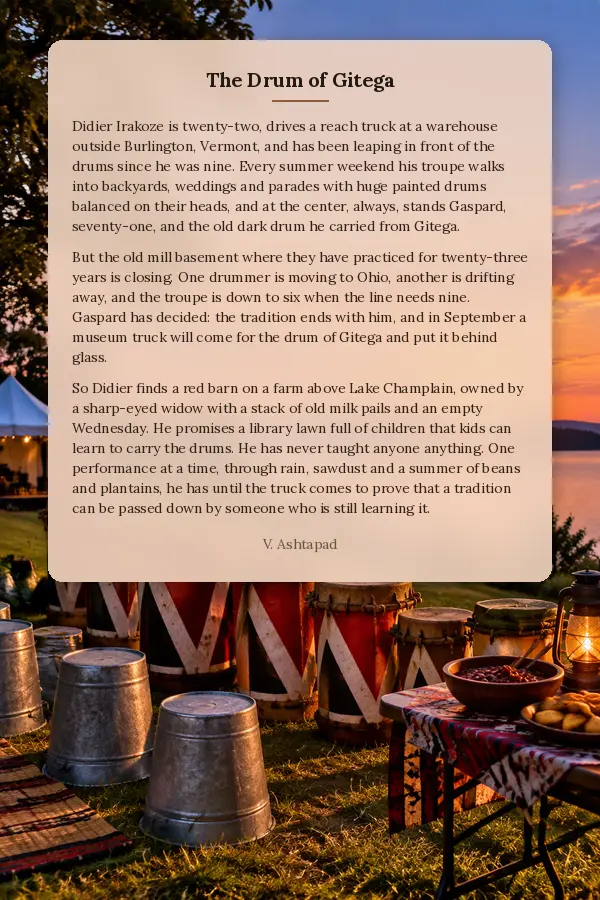
Didier Irakoze is twenty-two, drives a reach truck at a warehouse outside Burlington, Vermont, and has been leaping in front of the drums since he was nine. Every summer weekend his troupe walks into backyards, weddings and parades with huge painted drums balanced on their heads, and at the center, always, stands Gaspard, seventy-one, and the old dark drum he carried from Gitega.
But the old mill basement where they have practiced for twenty-three years is closing. One drummer is moving to Ohio, another is drifting away, and the troupe is down to six when the line needs nine. Gaspard has decided: the tradition ends with him, and in September a museum truck will come for the drum of Gitega and put it behind glass.
So Didier finds a red barn on a farm above Lake Champlain, owned by a sharp-eyed widow with a stack of old milk pails and an empty Wednesday. He promises a library lawn full of children that kids can learn to carry the drums. He has never taught anyone anything. One performance at a time, through rain, sawdust and a summer of beans and plantains, he has until the truck comes to prove that a tradition can be passed down by someone who is still learning it.
Members can react to this book and talk about it in the members' Library.
Ownership
© 2026 CRUNOD LLC. All rights reserved.
This book is owned by CRUNOD LLC. It is free to read on EternalCurrent.Online. No part of it may be copied, reprinted, sold, recorded or adapted, including as audio, film or translation, without written permission from CRUNOD LLC.
© 2026 CRUNOD LLC. All rights reserved.