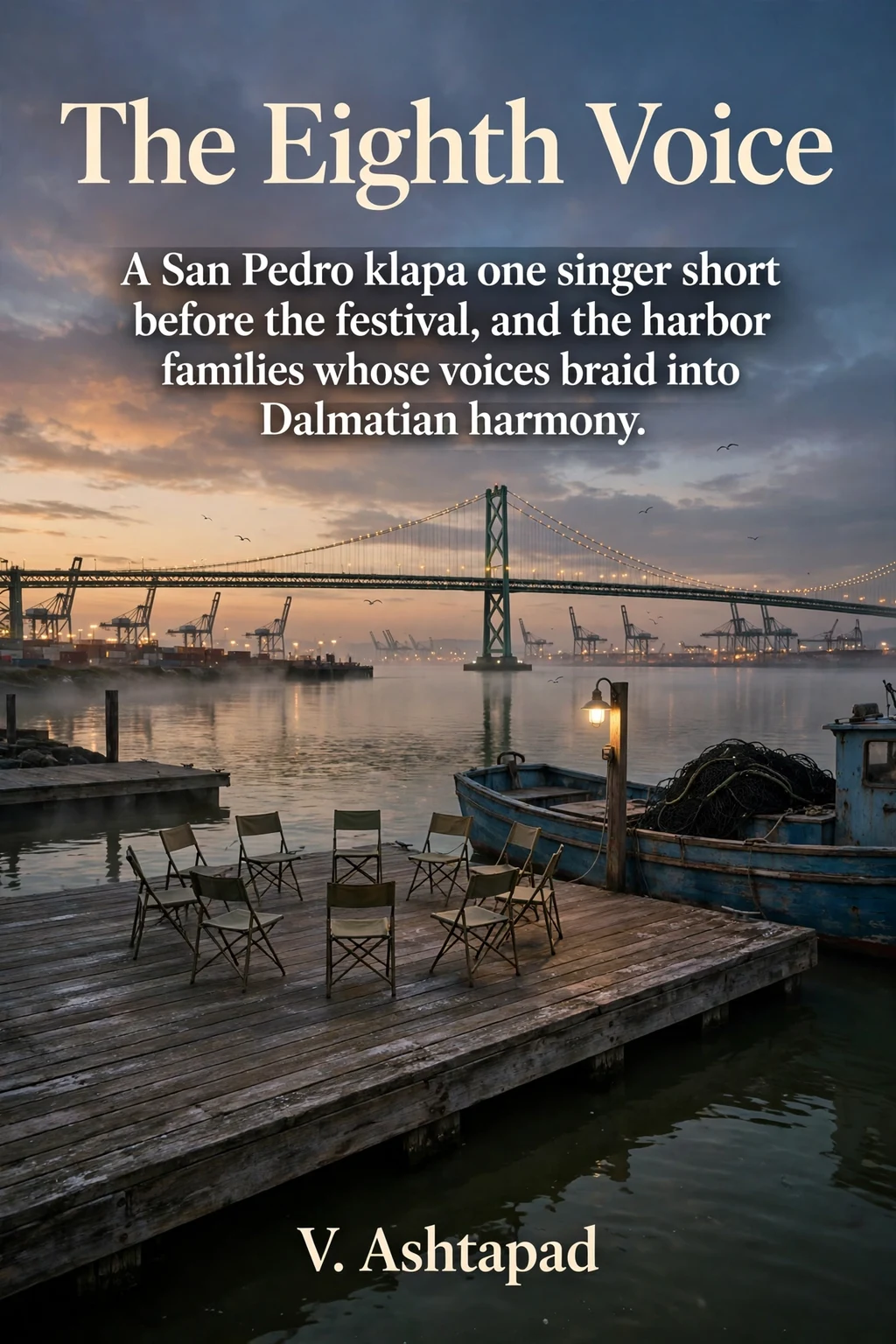
The Eighth Voice
A San Pedro klapa one singer short before the festival, and the harbor families whose voices braid into Dalmatian harmony
by V. Ashtapad
Foreword
This is a work of fiction. San Pedro, Terminal Island, Fish Harbor, the Vincent Thomas Bridge, the light at Angels Gate, the vanished tuna canneries and the Japanese American fishing village removed from Terminal Island in 1942 are real, as are the islands of Vis, Hvar and Brač, the town of Komiža, Diocletian's Palace in Split and the klapa singing tradition of Dalmatia. Fritule, brudet and prošek are real foods and drinks made in Croatian homes. Klapa Bonaca, the club hall on Ninth Street, the West Coast Klapa Gathering and every person in these pages are invented, and any resemblance to real singers, families or clubs is coincidence.
For everyone who ever sang the right part in the wrong room, where only the dishes could hear.
Slack Water
Ante Barić woke at four-forty, the way he had woken for sixty years, and lay listening to the harbor before he let himself believe the day had started.
San Pedro made a sound at that hour that nobody else seemed to hear. Not the foghorn at Angels Gate, which his wife used to call the cow, not the trucks downshifting on Harbor Boulevard. Underneath all that. A long, low hum from the container terminals across the main channel, from the cranes and reefer units and the generators of ships waiting at anchor, a note somewhere around a low G. When he told the klapa, years ago, Jure Bakotić laughed so hard he spilled his wine. But it was true. The whole port sang one note all night, and if you were a bass you could find it and sit on it.
He sat on it now, quietly, in the dark bedroom on Eleventh Street, and then he got up.
The kitchen smelled of last night's coffee and a cut lemon on the counter. While the water heated he stood at the back window. From here you could see the green towers of the Vincent Thomas Bridge, the necklace of lamps along its cables, the dark hump of Terminal Island behind it. When he bought this house in 1971 there had been six canneries over there, and some mornings the smell of cooking tuna came up the hill so thick his wife hung the laundry inside. Now the canneries were gone, and the island was a field of stacked steel boxes in colors that meant nothing to him, blue and maroon and an orange like children's medicine.
He drank his coffee standing. He was eighty-one and had been told to sit more.
The phone rang at six, which was wrong. Nobody called at six unless someone was in the hospital, and at his age that could be almost anyone he knew.
"Ante." It was Stipe Tomić, and his voice sounded like it was coming through a wet towel. "I woke you."
"Nobody wakes me. What happened?"
"Nothing happened. Everything already happened. Ana is driving me to Anacortes on Sunday."
Ana was Stipe's daughter. She lived in Washington State with a husband who built boats out of fiberglass, which Stipe considered a kind of crime, and for two years she had asked her father to come live with them, and for two years Stipe had said no: he had his apartment on Pacific Avenue, his klapa, his ocean.
"You said no to Anacortes," Ante said.
"I said no when I could climb my stairs." Stipe coughed. "I can't climb them anymore. You saw me at the last practice. I sat on the piano bench like an old woman at a wedding."
"You sang fine."
"I sang like a gull with a fishbone in its throat. Don't lie to me at six in the morning. It's a sin and it's rude."
Ante said nothing. Out the window a pelican sailed past at eye level, ugly and serene, heading for the breakwater.
"The festival is in six weeks," Stipe said.
"I know when the festival is."
"Then you know you need another first tenor. Toni can't hold the top alone. He goes flat when he's scared, and he's always scared."
"We'll find someone."
"Who? Every man in San Pedro who could sing the first tenor is either dead or in Anacortes." Stipe laughed, and the laugh turned into a cough that went on long enough that Ante held the phone away from his ear. "I'm sorry. I'm sorry, Ante. Thirty-one years."
"Thirty-two."
"You see? You keep the count. You'll find someone."
After he hung up, Ante went out on the porch in his slippers and undershirt and looked at the bridge until the sky behind it went from black to the color of a mussel shell.
Thirty-two years. They had started the klapa in 1994, in Jure's garage, because the old club choir had gotten too big and too polite, forty people standing on risers singing from paper. Ante had wanted what he remembered from Komiža, on the island of Vis, when he was a boy. Men on the riva at night after the boats came in, standing shoulder to shoulder, one of them starting a line and the rest falling in under him like water filling a footprint. No paper. No piano. You learned it by standing next to the man who knew it until you could not get it out of your body.
Klapa means a group of friends, more or less. That was what he told the Americans who asked. But it was more exact than that. It meant a number. It meant you knew who was on your left and who was on your right, and if one of them was missing, you could feel the cold where he used to stand.
* * *
At nine he walked down to the water. He did this every day, down Ninth Street past the new coffee place where the young people sat with their laptops, past the Croatian bakery that was now a Thai restaurant that still, for reasons no one could explain, sold povitica at Christmas. He crossed Harbor Boulevard at the light and went down to the fish market docks, where the sport boats were loading up with men in sunglasses and the sea lions lay on the floats like enormous wet loaves.
The boats he knew were mostly gone. The purse seiners that used to fill this harbor, big white tuna boats with crow's nests and helicopter pads that went out for months at a time off Mexico and Central America, had been sold or scrapped or gone to American Samoa decades ago. Ante had fished on them for thirty years. He had been a skiff man, then a net boss. He had seen a whole school of yellowfin turn the ocean into hammered silver from horizon to horizon. He had seen a man lose three fingers in a power block.
What was left were the squid boats and a few wetfish seiners in faded blues, their nets piled on the stern in tarry black heaps that smelled of creosote and old sardines. A Sicilian named Vince was mending web on the dock with a wooden needle. Ante watched him the way he had once watched his own father, and Vince, without looking up, said, "You want to help or you want to criticize?"
"I'm criticizing," Ante said.
"Good. Your knot was always too tight anyway."
Ante sat on a bollard. The marine layer was burning off early, and the water under the dock was the color of olive oil.
A first tenor in a klapa was a strange animal. Not the soloist, exactly, though sometimes it carried the melody. It was the top of the chord, the place where the sound went thin and bright and either held or broke. It needed a high, clean voice, not too much vibrato, not too much opera. And it needed someone who would stand in the knot and listen more than he sang. Half the good tenors in the world could not do that. They wanted the light.
Toni Zuanić, their other first tenor, was thirty-four, a math teacher at the middle school, a good man and a scared singer. Stipe was right.
Ante made the list in his head the way he used to count a net set. Jure's grandson, who had a voice but no patience. The Mardešić boy who had moved to Phoenix. Luka Vranješ had a cousin in Split, six thousand miles away.
He did not think of his son-in-law. Or, more exactly, he thought of him and then he put the thought away, the way you put a tool back on the hook so it isn't lying in the walkway.
Vince finished his patch and tied it off. "You look like somebody owes you money."
"Somebody's leaving," Ante said.
"Somebody's always leaving. That's what a harbor is." Vince spat neatly into the water. "Sing one for me tonight. The sad one. With the boat."
"They're all sad and they all have a boat," Ante said.
* * *
The club hall was on Ninth Street, a two-story stucco building painted the cream color of old piano keys, with a red-and-white checkered shield above the door and a bar on the ground floor that opened at four. Upstairs was the big room, with its parquet floor and its stage and its wall of photographs: fishing crews from the 1930s in wool caps and enormous mustaches, in front of boats named Sveti Nikola and Star of Vis; weddings; a picnic at Point Fermin in 1958 with a hundred people on blankets and a lamb on a spit. Every face Ante could name, or name the father.
The klapa practiced in the small room behind the bar, the one with the wood paneling and the folding chairs and the window that looked onto the alley. It smelled of floor wax and garlic and the faint, sour ghost of wine that had soaked into the carpet sometime in the late eighties.
By seven they were all there except Stipe. Jure, enormous, his bass so deep that when he hummed the window glass buzzed. Nick Perišić, the baritone, in steel-toed boots and a reflective vest, eyes red from the night shift. Mate Lučić, the other baritone, the joker, who owned a bakery on Gaffey and smelled of yeast. Luka Vranješ, the young one, four years out of Split, who still said "ajme" when he burned himself. Petar Mardešić, the quiet second tenor, a dental hygienist who never missed a note. And Toni, already pale.
Ante told them.
Nobody said anything for a while. Mate looked at the floor. Jure rubbed his face with both hands, a sound like sandpaper.
"Well," Jure said finally. "Shit."
"We sing tonight anyway," Ante said. "We sing the program. Toni takes the top."
"Alone?" Toni said.
"Alone tonight. Tomorrow we find someone."
They stood in the knot, the way they always stood, closer than Americans ever stood unless they were in an elevator. Ante put his hand flat on Jure's back on one side and on Nick's on the other. He hummed the note. The low G. The port's note. Jure found it under him and Nick found it above, and then the tenors, and Toni came in last and high and thin, like a wire.
It was the old song about the sardine boats going out from Komiža to Biševo, the race at night, the rowing, the lamps. It was the first song Ante had ever learned. They had sung it at every festival, every wedding, every funeral, for thirty-two years, and every time Stipe had held the long high note at the end so that it seemed to hover over them like a gull riding a thermal.
Tonight Toni reached for it, and it held for a moment, and then it wavered, and then it went flat, and the whole chord slid sideways like a stack of plates.
They stopped. Through the wall they could hear the television in the bar, a baseball crowd cheering for somebody.
"Again," Ante said.
They sang it again. It broke in the same place.
"Again," Ante said.
Luka shifted his weight. "Barba Ante. Maybe we sing something else. Something where the top sits lower. We can rearrange."
"We don't rearrange the sardine song."
"In Split we rearrange everything. It's not a museum, it's a song."
"In Split you have three hundred klapa singers," Ante said. "Here we have seven."
He heard how it sounded. He heard Toni swallow. He took his hands off the men's backs, and for a moment he felt the cold on both sides of him, as if the room had opened a window.
"All right," he said. "Something else. Luka, choose."
Luka chose a slow love song, where the top line rested in the middle of Toni's voice like a boat on a mooring. It went fine. Afterward they drank a glass of red at the bar, and Mate told a joke that nobody laughed at until everyone did. When Ante walked home up Ninth Street at ten, the bridge was lit green above the rooftops and the whole port was humming its note, and he hummed under it the whole way up the hill, and found that he could not stop.
© 2026 CRUNOD LLC. All rights reserved.
Graveyard Shift
At two in the morning on Terminal Island, Nick Perišić was ninety-five feet up in the air, in a glass box, holding forty tons of somebody's furniture over the deck of a ship from Busan.
It was a good night, clear, no wind, which meant the spreader didn't sway and the boxes went down where you put them, kissing the stack below with a soft clank he felt through the joysticks before he heard it. Below him, the ship was a long black canyon lit in sodium orange, and the lashers moved across the hatch covers in yellow vests like ants on a cutting board. Somebody down there was playing banda on a radio, in the gaps between the reefer hum and the beeping of the straddle carriers.
He had been doing this for nineteen years. Before that he had driven a hustler truck, and before that he had lashed, and before that, for one summer when he was nineteen, he had worked on one of the last tuna boats out of San Pedro, with Ante Barić as net boss, which had cured him permanently of any romance about the sea.
He set the box down and swung the empty spreader back toward the dock, and in the pause while the next truck pulled under, he looked out the side of the cab toward Fish Harbor.
From up here you could see the whole port laid out like a child's map, the main channel and the turning basin and the long arm of the breakwater out to the green light at Angels Gate, the refinery flames in Wilmington, the bridge. And on the other side of the container yard, a little rectangle of dark water with old docks and a few fishing boats and empty lots fenced in chain-link. That was where the canneries had been. Where his mother had worked for eleven years on the cleaning line, with a hairnet and a rubber apron, picking dark meat off tuna loins with a knife the size of a finger. Where, before the war, there had been a whole village of Japanese fishing families, three thousand people, with their own stores and their own school and their own language, and then in 1942 there hadn't been.
You couldn't see any of that from up here. You could see a parking lot with a forklift in it. But Nick always looked.
The truck pulled under. He grabbed the next box.
* * *
He was tired in a way that had stopped being a feeling and become a place he lived. Graveyard shift was eight hours plus the drive, and then he slept until two in the afternoon and had a few hours of being a person before he started again. On Tuesdays and Thursdays those hours were klapa practice, which meant he went to the club straight from waking up, still feeling like he had been beaten with a sock full of sand.
His wife, Dana, had asked him last spring why he kept doing it.
Dana was from Torrance, Irish and German and something she called "Ohio," and had married into the whole thing with good humor and a strong stomach for lamb. She learned to make sarma. She had sat through more klapa concerts than most of the men's Croatian wives. But one night in April, when he came home from practice and sat in the car in the driveway for twenty minutes with the engine off because he couldn't make himself go in and change for work, she came out in her robe and got into the passenger seat and said, "Nicky. Why are you still doing this?"
He didn't have a good answer. He said something about Ante, and about how the klapa needed a baritone, both true. He said his dad had sung, which was true but didn't explain anything, because his dad had been dead seventeen years and in Nick's memory had sung mostly when he'd had a few.
Dana listened. She let him go around in circles until he ran out, and then she said, "Okay. But do you like it?"
And he had sat there in the dark car, with the sprinklers ticking on the neighbor's lawn, and realized he didn't know.
* * *
At three-thirty there was a break while the ship shifted ballast, and Nick climbed down to the lunch shack at the end of the berth, where the coffee was terrible and free. Two of his gang were there, Héctor and a young woman named Precious who had just made her B-book and drove a top-handler like she was mad at it.
"Perišić," Héctor said. "You're humming."
"I'm not humming."
"You were humming. You hummed all the way down the ladder. I heard you on the radio when you keyed it."
Nick poured coffee. "It's an old song. Croatian."
"Sing it," Precious said.
"It's not a solo song. It doesn't work with one person."
"Then what's the point of humming it?"
He didn't know how to explain that in his head he could hear all the other lines around his own, Ante's bass under him and Mate beside him and the tenors above, so that even at three in the morning on a container dock he was not singing alone. That the baritone line by itself was the most boring melody in the world, five notes going nowhere, and only made sense surrounded. That this was maybe the answer to Dana's question, and he had not known it until now, with bad coffee in his hand and the smell of diesel and somebody's burrito.
"It's like a crane," he said. "One crane by itself just moves a box. You need the whole gang to work a ship."
"That's the worst explanation I ever heard," Precious said. "Sing it anyway."
So he sang it. Not the sardine song. The love song they'd done last night, the one Luka had chosen. He sang the baritone line, the five boring notes, and they were boring, and Precious and Héctor looked at him with the patient faces of people waiting for a joke to finish.
Then Héctor, who was from Michoacán and had sung in a church choir as a kid before he discovered girls, started humming something under it. Not the bass line, which he didn't know. Just a low note. A drone. And Precious, laughing, put a high note on top, a sort of wordless whoop she would later say she learned from her grandmother in Baton Rouge.
It didn't sound like klapa. It sounded like three tired dockworkers in a shack at three-thirty in the morning. But for about four seconds, there was a chord, and Nick felt it go through him like the vibration of a box seating on the stack.
"Okay," Precious said, when it fell apart. "Okay, I get it."
"That was terrible," Héctor said happily.
* * *
He drove home at seven-forty across the bridge, the sun coming up over Long Beach and turning the water to brass. At the top you could see everything: the white yachts at Cabrillo, the old theater marquee on Sixth Street, the hills of San Pedro stacked with stucco houses in cream and salmon and pale yellow, and beyond them, the long brown shoulder of Palos Verdes going out into the sea.
His mother lived up there, on Fifteenth near Alma Park, in the house he grew up in. On impulse he drove there instead of home.
Zora Perišić was seventy-two and kept the books for the club, which meant she was the only person who knew how much money it had, which made her the most powerful person in the organization, though nobody would have said so. She was in the kitchen in a housecoat printed with tiny blue anchors, frying something in a pan of oil. The kitchen smelled of hot fat and lemon zest and rakija.
"Fritule," she said, without turning around. "For the festival fundraiser. I'm practicing."
"It's eight in the morning, Mama."
"I'm seventy-two. I don't know what time it is." She lifted a golden ball out of the oil with a slotted spoon. "You look terrible. Sit."
He sat at the table, the same Formica table with the same chrome edge he had cut his chin on when he was six. On the refrigerator was a whiteboard where his niece had written a Croatian word in purple marker, with its meaning beside it: "bonaca — dead calm sea." Under that, in his mother's handwriting: "Also the name of a bad klapa."
She put a plate of fritule in front of him and dusted them with powdered sugar from a tin shaker. They were hot and soft inside, with raisins and orange peel, and tasted exactly like being nine at the Christmas dance in the big hall, running between the tables with his cousins while the adults sang.
"Ante told you," she said. "About Stipe."
"You know already?"
"I keep the books. Stipe called me to ask about his dues. He wanted to pay through December." She sat down across from him with her own coffee. "Thirty-two years he paid his dues. Never late once."
"Toni can't do it alone," Nick said.
"No."
"Ante won't change the arrangements. Luka wants to rearrange everything."
"Ante never changes anything. It's his best quality and his worst." She turned her cup in its saucer. "And you? What do you want?"
She had asked him that question his whole life in a way that made him feel she already knew the answer and was waiting to see if he did.
"I don't know," he said. "Dana asked me why I keep doing it. I didn't know what to tell her."
His mother was quiet. Through the window over the sink he could see the lemon tree, the fig, the rosemary that had grown into a monster, the plastic chair where his father used to sit and smoke and sometimes, late, sing.
"Your father," she said, "used to sing the baritone line while he shaved. Every morning. Just the baritone line. I used to think it was the dullest thing I ever heard. Five notes. It made me crazy." She smiled a little. "Then he died and I couldn't stand the quiet in the bathroom."
Nick put his fritula down.
"That's not an answer for you," she said. "It's only mine."
"Did you ever sing, Mama?"
She stood up, quickly, and went back to the stove. "Me? Ajme. Who would listen?"
She put no more dough in the oil. She turned off the burner. She stood at the stove with her back to him, and for a moment he thought she was going to say something else, and then she just said, "Go home. Sleep. You have practice at four."
He went home and slept, and did not dream, which was how he preferred it.
© 2026 CRUNOD LLC. All rights reserved.
The Vestibule
Luka Vranješ is lying on his back under the engine of a sixty-foot sportfisher at a boatyard in Wilmington, with diesel running down his wrist into his sleeve, and he is thinking about stone.
Specifically he is thinking about the Vestibule in Diocletian's Palace in Split, the round stone room where the emperor's guests once waited, and where now, in summer, a klapa of five or six men sings most evenings for tourists holding up their phones. The stone is seventeen centuries old, and the dome is open to the sky, so the sound goes up and comes back down on you like warm rain. Luka sang there from sixteen until twenty-four, two hundred nights, maybe more. He knows the exact spot to stand on the floor where his voice comes back to him a quarter second late, perfectly in tune with itself.
There is no stone like that in San Pedro. There is stucco and plywood and ceiling tiles with water stains. That is not fair, he corrects himself in his head; he is learning to be fair. There is the small room behind the bar, with wood paneling that eats the high frequencies and a carpet that eats everything else. Singing in it is like singing into a pillow.
He tightens the hose clamp, wipes his hands, and slides out into the white light of the yard.
* * *
He came here four years ago because of a woman, which is the only reason anyone does anything. Kristina was third-generation San Pedro, a Croatian last name and no Croatian at all, and she had found him singing in the Vestibule on a heritage trip with her mother. Very romantic. They emailed for a year. He came over on a fiancé visa, they married at the courthouse in Long Beach, and fourteen months later they divorced at the same courthouse, without much drama, two people who had liked each other more across an ocean than across a kitchen.
He stayed. He had the boatyard job by then, under a Komiža man's grandson who paid well and swore in a Croatian so old it made Luka laugh. He had an apartment on Seventh Street with a view of a parking lot and, if he leaned, a slice of the harbor. And he had the klapa, which he had found the second week, because when he walked into the club hall bar and ordered a beer in Croatian, the bartender, who was Jure, said, "Sing something," and Luka sang, and Jure called Ante.
He likes them. That's the problem. He likes all of them, the old man and the big man and the baker and the tired longshoreman and the hygienist and the frightened teacher and Stipe, poor Stipe, who leaves for Washington on Sunday. He likes that they practice twice a week for no money and no audience but each other and the occasional wedding. He likes how they stand, closer than any klapa in Split ever stood, as if they are afraid of falling off something.
But they sing like 1965.
They sing the way their grandfathers sang when they arrived in the twenties and the fifties and the seventies, the way the songs sounded on the island before radio. Slow. Heavy. Every chord the same weight. The old arrangements are written down, when they are written down at all, in Ante's careful hand on yellow legal paper, in a Komiža dialect that makes people in Split smile.
In Split, klapa is alive. It changes. There are young groups who sing with a guitar now, to the horror of purists. There are women's klapa who sing better than any men. There are arrangers who turn a fishing-village song inside out so that the melody is in the baritone and the tenors circle over it like birds. Luka thinks of a song as a house where you can move the furniture.
Ante thinks of a song as a church. Luka has not said this to him. He thinks it often.
* * *
That evening at practice, they are six, because Stipe is packing and Nick is late. Ante has brought a list of names on a piece of paper torn from a desk calendar. He reads it out loud. The men around the room shake their heads one after another, like a jury.
"Davor Šimunović's younger son," Ante says.
"Can't sing," says Mate. "Sounds like a dog with its foot in a door."
"Kenny Bilić."
"Kenny Bilić is sixty-nine and has a pacemaker," Jure says. "Also he hates you."
"He doesn't hate me."
"You beat him in bocce in 1988 and he still talks about it."
Ante folds the paper. He looks at Luka. "Your cousin. In Split."
"Marin? Barba, he's in Split."
"Could he come for the festival? One week. We pay the ticket."
The room goes quiet. A ticket from Split in October is maybe twelve hundred dollars. The klapa has, according to Zora, about nineteen hundred dollars in its account, which is supposed to pay for the festival entrance and the new vests and the bus.
"We can't pay the ticket," says Mate. "Zora will kill us."
"Zora won't kill us."
"She will. She'll use a fork."
Luka holds up his hands. "Even if we could. Marin sings first tenor in a klapa in Split. He sings the new way. He doesn't know these arrangements. He doesn't know this dialect. One week? He'll sound like a guest. Like a man singing at someone else's wedding."
"He'll learn," Ante says.
"Barba." Luka has learned that with Ante you come at a thing from the side, like docking in a crosswind. "Can I say something?"
Ante nods once.
"We don't need a tenor from Split. We need songs that fit the voices we have. Toni can carry a top line if we put it in the right place. I can take some of Stipe's high parts if we move the second tenor down and give Petar more. Four or five songs. We change the keys, we change who sings the melody. Not the sardine song, I know. It would sound different. Maybe better."
"Better," says Ante.
"Different," Luka says. "Maybe better."
Ante looks at him for a long time, with eyes the color of wet slate, as if reading the weather on his face. Luka holds the look. He is twenty-nine and has sung for ten thousand tourists, and still it is hard.
"Tell me," Ante says finally, "why you think the old way is wrong."
"I don't think it's wrong."
"Then tell me what you think."
So Luka tells him, longer than he meant to. He talks about the Vestibule and the way the sound comes back to you. He talks about the young klapa he heard in Omiš at the festival there when he was fourteen, girls from a school in Šibenik who sang a song about a dead sailor so beautifully that grown fishermen walked out of the square to cry where no one would see. He talks about how a song that doesn't change is a photograph of a song. He talks about how he sometimes feels, in the small paneled room, like he is singing in a museum for people who have all died.
He realizes, when he finishes, that this last part was cruel. Jure has gone red. Mate has stopped smiling.
Ante has listened the whole time without interrupting, his hands folded on his stomach like a man waiting for a bus. Now he nods slowly.
"Thank you," he says.
Luka blinks.
"I want to tell you something," Ante says, "and then you can tell me if I understood you. You think the songs should breathe. You think if we hold them too tight, they die. You heard them alive in Split, and here they sound to you like they're under glass."
"Yes," Luka says. "Something like that."
"Okay. Now you listen like I listened." Ante unfolds his hands. "When I came here in 1963, there was no Split for me. There was no Omiš festival on the television. There was no telephone to Komiža unless you went to the post office and waited three hours. What I had was these songs, the way my father sang them. If I changed them, I would have nothing to check them against. They would turn into something else, slowly, and I would not even notice. So I held them tight. Not because I'm stupid. Because I was alone, and they were the only map I had."
Luka is quiet.
"You come from a place where there are a thousand versions of every song," Ante says. "For you, changing one is like moving a chair. For us, it's like moving a lighthouse."
"I understand," Luka says, and he does, a little, for the first time.
"Good. And now I tell you the other thing." Ante almost smiles. "You might be right anyway. Write out your four songs. We'll try two."
"Two?"
"Two is generous. Don't push."
* * *
Nick arrives at seven-thirty, apologizing. They sing the old version of the love song, heavy and slow, every chord the same weight, and Luka listens to it the way Ante told him to, as a map drawn by men alone in a strange country, and it sounds to him different. Not better. Different.
Afterward he walks down to the water. It is a warm night, the air soft, smelling of kelp and diesel. The bridge is green above him. Across the channel, the cranes on Terminal Island are lit up like the skeletons of giant animals, and one of them is moving, swinging a box through the dark, and he wonders if that is Nick's, before he remembers that Nick is behind him somewhere, walking to his truck.
He takes out his phone and calls Marin in Split, where it is morning.
"Brate," Marin says, sleepy. "Is someone dead?"
"No one is dead. Listen. If I sent you something old, could you sing it? Exactly like they wrote it. No changes."
"Why would I do that?"
"Because it's a map," Luka says, and his cousin, six thousand miles away, laughs at him for a full minute, and he lets him.
© 2026 CRUNOD LLC. All rights reserved.
Ledger
Thursday, September 3. Dues received, S. Tomić, through December. $60.00. Cash, in an envelope with a note: "Zora, don't let them get lazy." Envelope smelled of aftershave.
Zora Perišić writes it in the green ledger with the fountain pen her husband gave her for their twentieth anniversary, and blots it with the square of blotting paper she has used since 2011, now so covered in backward numbers it looks like a page in a secret language.
She has kept the club's books since 1998, when the man before her, a sweet drunk named Ivo Kuzmanić, got confused about where the Christmas raffle money went, and the board needed someone nobody would suspect. Frane was alive then, singing baritone in the old club choir and shaving every morning to the same five notes, but she was already the kind of woman people treated like a widow: careful, in dark clothes, at the edge of the room. She took the books home in a shopping bag and found the raffle money in a week, in a coffee can in the storeroom under a box of decorations. Ivo cried with relief and bought her a bottle of prošek.
She has kept them since. Frane died in 2009. She kept them through that.
* * *
Friday, September 4. Bar receipts, week ending. $1,412.50. Jure says the ballgame went badly and everyone drank more. Note: order more Croatian beer before the festival. Note: the kitchen fryer is leaking again.
The ledger is green cloth over cardboard, from a stationery store on Sixth Street that no longer exists. She has twenty of them on a shelf in her hall closet, one for each year since 2007, when the old big ledger filled up. Before that it was the big ledger, a monster of red leather the club bought in 1952, too heavy to lift with one hand. In it are the dues of every man who belonged in the fifties, written by the treasurer of the time in a fat, slanted script: Barić, Bakotić, Mardešić, Zuanić, Lučić, Tomić, Perišić. Most were from Komiža, some from Brač and Hvar and Korčula. They paid a dollar a month, then two, then five. When someone died, the treasurer drew a small cross next to the name and wrote the date. When someone's wife had a baby, he wrote the baby's name in the margin, which was not his job, for twenty years, until the margins were full of tiny names.
Last spring Zora's granddaughter Ella, Nick's sister's girl, the one who lives in Torrance, spent three Saturdays photographing every page of the big ledger and putting the names in one family at a time, so that now there is a tree you can open on a computer and see who was whose cousin and godfather and who married whose sister. She started with the Perišić branch, then the Barić, and couldn't stop. Zora watched her do it and felt something closer to relief than pride, as if the names had been waiting seventy years in a closet to be let out.
She does not tell anyone that she sometimes opens the tree at night and looks at her own name, and her mother's, and her mother's mother's, on the island of Hvar, in the town of Jelsa, going back to 1820. She does not tell anyone that her mother's name has a line under it that says, in Ella's careful note, "sang at weddings, Jelsa; known for her voice."
* * *
Saturday, September 5. Festival entrance fee, West Coast Klapa Gathering. $350.00. Check no. 4471. Paid. Note: application lists eight singers. Ante says "we'll have eight." Note: we have seven.
She was born in Jelsa in 1954. Her father was a fisherman and her mother was a singer, which was not a job, only a fact. Her mother sang while she cleaned fish and while she hung laundry in the bura, the cold wind that came down off the mountains in winter and turned the sea white and made the sheets snap like gunshots. She sang while she made fritule at Christmas and while she sat with the dying. She had a low voice, lower than most women's, so low that men sometimes turned around in the street to see who was singing. In Jelsa they said she had a man's throat in a woman's neck, and meant it kindly, more or less.
Zora inherited the throat. She knew it by the time she was twelve. She could sing the tenor lines of every song the men sang on the riva at night, not an octave up, the way girls did, but right where the men sang them. Her father would hear her and laugh and say, "Zora, you'll steal their jobs."
But the men's klapa was the men's klapa. That was how it was in Jelsa in 1966. If there were women's klapa, they were in Split or Zadar, places with universities and radio stations. In Jelsa the girls sang at weddings and in the kitchen. Zora sang in the kitchen.
She came to San Pedro in 1975, at twenty-one, to marry Frane Perišić, whom she had met once, at a wedding in Jelsa, where he was visiting his cousins and she was singing. Not in the klapa. In the kitchen, through the open window, frying fritule for two hundred people, the tenor line of a song the men were singing in the courtyard. Frane told her later that he heard her through the window and couldn't figure out where the voice was coming from. He walked all around the courtyard counting the men. Then he went in the kitchen and found her there with flour on her arms.
He told her the story again at every anniversary, at home, never anywhere else; she had asked him that. It was a good story. It was nearly the last time she sang where anyone could hear.
* * *
Monday, September 7. Stipe left for Anacortes yesterday. Ana drove him. Ante followed them in his own car on the 110 as far as the 405, honked, and turned off. Nobody told me this; I heard it from Mate, who heard it from Jure, who heard it from Ante himself, who apparently said it was "nothing." Expenses: card for Stipe, signed by all members. $4.99.
The club hall kitchen has two six-burner stoves, a deep fryer and a walk-in refrigerator that hums an off-key B-flat Zora has hated for twenty years. On fundraiser Saturdays she runs the fritule there with three other women, all widows now, all from islands. They make three thousand in a morning and sell them in white paper bags at the door, five dollars a dozen.
She has sung in that kitchen for twenty years. Low, under the fryer and the hood fan and the radio, she sings the tenor lines of whatever the klapa practiced that week, because on Thursdays, doing the books at the kitchen table, she can hear them through the wall, and she has always been able to learn a part by hearing it once.
The other women know: Marica, Vesna, little Dragica who is eighty-five and shaped like a bread loaf. They know and say nothing, the way women from islands do. Once, years ago, Dragica said to her, "You should tell Ante," and Zora said, "Tell him what?" and Dragica just shook her head and went back to the dough.
Tell him what. That the seventy-two-year-old who keeps the books can sing the first tenor line of the sardine song exactly where Stipe sang it, into the hood fan, for twenty years? That she never once in fifty years in America sang where her husband's friends could hear because she was afraid, not of them, but of the way they would look at her afterward, as if she had taken off her clothes in the street?
She writes in the ledger:
Tuesday, September 8. Bought new oil for the fryer, three 35-lb jugs. $87.40. Bought powdered sugar, ten lbs. $14.20. Bought raisins, orange peel, rakija for the batter.
Then she sits with the pen over the page. Outside on Fifteenth Street a car goes by with a bass line that rattles the glass. She thinks about her mother in the bura, singing to the laundry.
Then she writes, very small, in the margin, the way the old treasurer used to write the names of babies:
Note: They need one more voice.
And under that, smaller still, so small she can barely read it:
Note: Zora, you coward.
She blots it. The blotting paper takes the words backward, and adds them to its secret book, where nobody will ever read them.
© 2026 CRUNOD LLC. All rights reserved.
Fish Harbor (Notes for Ms. Okafor)
Tereza Alvarado. U.S. History, Period 4. Junior Research Project: "A Place That Isn't There Anymore." Working notes. Not the final draft. Ms. Okafor, you said we could turn in our notes for partial credit if we showed our process, so this is my process, which is mostly chaos.
Topic: Fish Harbor and the canneries of Terminal Island, 1910 to 2001.
Why I picked it: my grandpa (Nono Ante) fished out of San Pedro for thirty years and my great-grandmother, Nona's mother, who I never met, worked at a cannery. Also, my friend Kenji's great-grandparents lived on Terminal Island before 1942, and when I told him I was doing this he said, "Do the whole thing, not just your part." So I'm trying to do the whole thing.
* * *
Note 1. What's there now.
Saturday I rode with my dad across the bridge and down Ferry Street to Fish Harbor. It is mostly parking: some old docks with squid boats tied up, a chain-link fence with port security signs, a couple of buildings that look like they were part of something bigger once. There's a big empty lot where my dad said the biggest cannery was. He remembers the smell from when he was a kid in Wilmington. He said, "On a south wind, the whole town smelled like cat food and money."
I took pictures. Cormorants were drying their wings on a piling, holding them out like they were showing off a jacket. The water was flat and green-brown, with a rainbow of oil near the dock. A man was fishing off the end with a bucket of mackerel. I asked him if he knew where the canneries were and he pointed at the parking lot and said, "Right there, mija. You're standing on it."
I put a pin on our class map at the spot, and then on every other cannery site I could find on old maps. There were a lot. I made them orange, like the old labels in the photos.
* * *
Note 2. The village.
Before World War II there was a fishing village on Terminal Island called East San Pedro, mostly Japanese and Japanese American families, about three thousand people. They had stores, a school, a baseball team, and a way of talking all their own. The men fished and the women worked in the canneries. In February 1942, after Pearl Harbor, the government gave them forty-eight hours to leave. They had to sell everything or leave it. Then they were sent to camps. The houses were bulldozed. When the war ended, most of them could not go back, because there was nothing to go back to.
Kenji's great-grandmother was nine. She told Kenji's mom she remembers her mother selling their refrigerator for five dollars to a man who drove up in a truck, and that her mother didn't cry until the man was gone.
I asked Kenji if I could use that. He asked his mom. She said yes, but to say the name: Fumiko. So, Fumiko.
There is a memorial now, on Terminal Island, near where the village was, with a gate shaped like a torii and the story of the village written out. I went with Kenji on a Sunday. It was windy. Somebody had tied a string of paper cranes nearby, faded from the sun. Kenji put his hand on the memorial and didn't say anything, so I didn't say anything either. Then we walked back to the car and he said, "Okay, that's enough of that, let's get tacos."
I put a pin for the memorial on the map. I made it white.
* * *
Note 3. Interview with Nono Ante, recorded at his kitchen table, Sunday, September 13. (He said I could record if I didn't put it "on the internet where strangers can get it." I said I would only share it with the family and Ms. Okafor. He said, "Is Ms. Okafor a stranger?" I said no. He said okay.)
This is part of the transcript, cleaned up a little. Nono doesn't really do sentences. He does waves.
Me: When did you come to San Pedro?
Nono: 1963. On a ship from Rijeka to New York and a bus from New York. Four days on the bus. I didn't speak one word of English except "thank you" and "bathroom."
Me: Why San Pedro?
Nono: Because everybody from Komiža was here. My uncle had a boat. In Komiža there were too many men and not enough fish. Here there were too many fish and not enough men. Simple.
Me: What was it like?
Nono: Like Komiža with cars. The same names on the mailboxes. You walk down Sixth Street on a Saturday, you hear more Croatian than English. The club on Ninth, the bars on Beacon Street, which you are too young to know about. And over there on the island, the canneries, all day, all night, the steam and the whistles. When a boat came in with a load, the cannery blew its whistle, and the women came running from their houses to work. Each cannery had its own whistle. The women knew them all, like birds.
Me: Did Nona work in a cannery?
Nono: Your nona, no. Her mother, yes. Your nona worked in a bank. She was very modern. (Laughs.)
Me: What do you miss?
Nono: (Long pause.) The boats coming in at night. Each boat had its own engine sound, and you knew which boat it was before you could see it. Now it's all the same sound. The big ships. The cranes. One note. (He hummed a note. I put it on the recording. It is very low. My phone almost couldn't hear it.)
Me: Do you miss Komiža?
Nono: I miss Komiža like you miss your teeth when you're old. It's not sad. It's just that you keep putting your tongue where they used to be.
Me: Tell me about the klapa.
Nono: Ah. The klapa is a disaster. Stipe is in Washington. We are seven. Seven is not a number for a klapa. Seven is a number for a week.
Me: Why don't you ask Dad?
(Long silence. I'm putting this in because Ms. Okafor said to put in the parts that are uncomfortable.)
Nono: Your father is a very good singer.
Me: So ask him.
Nono: It's not his music.
Me: It's not my music either and you're making me learn it.
Nono: You're my granddaughter.
Me: He's your son-in-law. He's been your son-in-law for nineteen years.
Nono: Tereza. Turn off the machine.
I turned it off. He talked to me for a while, and I'm not putting it in because he said not to. But he wasn't mad. He was more like confused, like someone had asked him a math question he thought he knew the answer to.
Then Then he let me turn it back on, and he told me a story I had never heard.
Nono: In 1974 I went back for the first time. Eleven years. I went to Komiža, and then to Jelsa, on Hvar, for a wedding. My friend's cousin. Two hundred people in a courtyard, lamb, wine. The klapa from Jelsa sang. Good klapa. And I'm standing there, and I hear another voice. The first tenor line. But it's not coming from the klapa. It's coming from behind me, from the kitchen window. I turn around. I don't see anyone. I think, I'm drunk. But I'm not drunk yet, it's only four o'clock. I go to the window and there is a girl, maybe twenty, frying fritule, with flour on her arms, singing the first tenor line exactly in tune. Not an octave up like a girl. Right there with the men. I never heard anything like it.
Me: Who was she?
Nono: I don't know. I never asked. I was shy then, believe it or not. A friend of mine was there, a San Pedro boy, and I think he went into the kitchen. I went to get more wine. Then I went home to San Pedro and I forgot about her. No. That's not true. I never forgot about her. I just never thought about her. It's different.
Me: Why are you telling me this?
Nono: I don't know. You asked about the klapa. It came into my head. (Pause.) Maybe because a good voice comes from where you don't expect it. Write that down for Ms. Okafor. That's a history lesson.
* * *
Note 4. Things I need to find out.
Who was the girl in the kitchen? (Not for the project. For me.)
Why does Nono think Dad's voice isn't "his music"? Dad has sung in our house my whole life. Boleros, old rancheras, oldies from the radio, the Croatian songs from the club picnics. He has a high voice that sounds like it's floating. When I was little I thought every dad could sing like that. Then I went to my friends' houses and found out no.
Is a place still a place if all that's left is a parking lot and a pin on a map?
Ms. Okafor, I think the answer to the last one is yes, but only if somebody keeps putting the pin there. Is that a thesis? Can I use it?
* * *
Note 5. Last thing.
Tonight I put the Nono recording in the family folder, where my aunt and cousins can listen, and on our family tree I wrote "Jelsa, 1974, heard a girl singing in a kitchen" under the photo of him from that year, the one where he has huge sideburns and a white shirt open at the neck and looks like a movie star from a movie about smugglers.
About an hour later, my great-aunt Vesna commented on it. All she wrote was: "Ask Zora Perišić."
I don't know what that means. Zora is the lady who keeps the books at the club. She makes the fritule. She's Nick's mom. She is very small and very strict and once told me my skirt was "an American decision."
I'm going to ask her anyway. For the project. Not for the project.
© 2026 CRUNOD LLC. All rights reserved.
Boleros in a Parked Truck
Ruben Alvarado's truck was a white 1999 Ford F-150 with a forklift dent in the tailgate and a cracked dashboard covered with a blanket his mother bought in Ensenada. It had a hundred and ninety thousand miles on it, and the radio worked on AM only. But the cab, with the windows up and the engine off, had the best acoustics of any room he had ever been in, and that included the high school gym in Wilmington, where he had sung the national anthem at graduation in 1998 and made the vice principal cry.
He sat in it now in the parking lot of the shipyard on Terminal Island, at six-fifteen in the evening, after his shift. He had been welding the hull of a barge all day. His forearms were speckled with tiny burns, his eyes gritty even through the hood, and his whole body smelled of hot metal, like pennies and sparks. In ten minutes he would drive home to Thirteenth Street, to Marija and Tess and the dog, a gray-muzzled pit mix named Chuy who believed he was a lapdog. But for ten minutes, here, he sang.
He sang "Sabor a Mí," the way his grandfather used to sing it to his grandmother in their kitchen on Lakme Avenue in Wilmington, slow, the melody hanging back behind the beat like a man walking behind a woman he loves so he can watch her. He went up to the high note his grandfather never quite reached and held it, and it floated in the cab like smoke.
Then, because he was alone, and because it had been on his mind all week, he sang the sardine song.
Of course he knew it. He had been married to Marija Barić for nineteen years and had gone to every Croatian picnic and dance and wedding and funeral in San Pedro, and the klapa had sung that song at every one. He didn't know all the words. Something about boats and night and an island. But he knew every line, every part. He knew the first tenor part best, because it was the part he would have sung if anyone had asked him.
Nobody had asked him.
He sang Stipe's long high note at the end, the one Toni couldn't hold, and held it until his ribs hurt, and when he let it go a seagull landed on the hood and looked at him with one yellow eye.
"What," Ruben said to the gull. "You got a problem?"
The gull walked to the edge of the hood and stepped off into the air.
* * *
He had met Marija at a quinceañera in 2004, a friend of a friend's, in a rented hall in Harbor City with a DJ and a chocolate fountain and three hundred people. Marija had come with a coworker from the hospital, where she was in her second year as a nurse. They ended up at the table at the back near the kitchen doors, for people who didn't know anyone.
Around eleven the DJ took a break and the birthday girl's grandfather got up with a guitar and sang old boleros, and Ruben, a little drunk, got up and sang harmony with him. It was "Bésame Mucho." When he sat down, Marija was looking at him like he had pulled a coin out of her ear.
"Where did you learn to do that?" she said.
"Do what?"
"The thing. Sing around somebody else's song. Not on top of it. Around it."
"My grandpa," he said. "He'd sing the melody and make me find the other part. If I didn't find it, no dessert."
She laughed. "My dad would love you."
Her dad did not love him.
Not openly. Ante Barić did nothing openly. He shook Ruben's hand at the first dinner and poured him a glass of the red he made every fall from Lodi grapes, and asked about his job and his family and his truck. He was always polite. In nineteen years he had never said one rude thing to Ruben, never once implied that Marija had married down. He came to Ruben's mother's house for Christmas Eve tamales every year and ate eight and told her they were better than his own mother's sarma, which was the highest compliment a Komiža man could give. When Tess was born he stood in the hospital hallway holding her and singing to her in Croatian with tears running into his collar.
But in nineteen years he had never asked Ruben to sing.
Not at the club. Not at the picnics. Not even at the house on Eleventh Street, when the klapa came over after a funeral and sang in the backyard under the lemon tree until the neighbors turned their lights on. Ruben would stand at the edge with Marija's hand in his and feel the first tenor part sitting in his throat like a swallowed stone, and he would not sing it. You don't sing at another man's table until he asks you.
* * *
That night at dinner, chicken enchiladas in his mother's green sauce and tomatoes from Ante's garden, Tess was quiet in the way that meant she was going to say something.
"I interviewed Nono," she said finally. "For my history project."
"That's great, mija," Ruben said.
"I asked him why he doesn't ask you to sing in the klapa."
Marija put her fork down. Ruben kept eating, because if he stopped eating it would be a thing, and he did not want it to be a thing.
"What did he say?" Marija said.
"He said Dad is a very good singer. And then he said it's not his music."
Ruben chewed. The green sauce had the kind of heat that comes up behind you after you've swallowed. Chuy, under the table, leaned against his leg.
"He's right," Ruben said.
"Dad."
"No, he's right. I didn't grow up with it. I don't speak the language. A klapa is guys from the same island who've been singing together since they were kids. You can't just put some welder from Wilmington in the middle of it."
"You know every song," Tess said. "I've heard you. In the truck."
"When?"
"Like a thousand times. You think the windows are soundproof."
Marija started laughing and put her napkin over her face.
"It's not funny," Ruben said, but he was smiling.
"It's a little funny," Marija said, from behind the napkin. "You sing the sardine song in the driveway. Every Thursday. When you get home from work. I thought you knew I could hear you."
He put his fork down. "I don't sing it every Thursday."
"Every Thursday," said Tess. "Because Thursday is practice night. You're practicing with them. From the driveway."
The kitchen was quiet. The dog sighed. Somewhere outside, a long way off, a ship's horn sounded in the channel, two long blasts, which meant it was leaving.
"He should ask you," Marija said, not laughing anymore.
"He won't."
"Then I'll ask him."
"No," Ruben said. And then, more gently, because he saw her face: "Mari. No. If he asks me, he asks me. If you make him ask me, it's not the same. It's like a man who gives you flowers because his wife told him to."
"So you'll just sing in the driveway for the rest of your life?"
"There are worse places to sing," Ruben said, and picked his fork back up.
After dinner he went out to the garage, where Ante's wine was aging in a barrel because the old man's own garage had a leak, and sat on an upturned bucket in the dark, in the smell of wine and motor oil and jasmine from the side window. And he sang, very quietly, not the sardine song, but "Sabor a Mí," the whole thing, all the way through, with the high note his grandfather never reached.
Then he went inside. On the kitchen calendar, in Marija's handwriting, was the date of the festival, circled in red, with a note: "Papa — 8 voices!!"
He looked at it for a while. Then he went to bed.
© 2026 CRUNOD LLC. All rights reserved.
Auditions
I'm a baker, so I get up at two-thirty in the morning, so by the time anybody else in this story is awake I have already made four hundred bread rolls, sixty loaves of the round country bread with the cross cut in the top, and a sheet of the walnut strudel the old ladies come in for on Fridays. I say this so you understand my state of mind on the night of the auditions. My state of mind was flour.
Mate Lučić. Baritone. Fifty-eight years old. Owner and only real employee of Lučić Bakery on Gaffey Street, est. 1961 by my father, who came from Brač with nothing but a sourdough starter in a jar wrapped in a sweater. That starter is still alive. I feed it every morning. It is older than I am and it has a worse personality.
I'm the one in the klapa who makes the jokes. Every klapa has one, because otherwise it's seven men in a circle with their eyes closed singing about drowned sailors, like a funeral for ourselves. Which, Luka said once, we sort of are. He apologized later. He's a good kid. He just says things like a hammer.
Anyway. The auditions.
* * *
Ante held the auditions on a Tuesday in the big room upstairs, with the parquet floor and the wall of dead fishermen. Luka put a notice in the club newsletter and on the board at the fish market and online. Jure made a sign for the bar that said "TENOR WANTED — MUST BE ALIVE" until Zora made him take it down. Zora set up a card table by the door with a clipboard and a cash box. Nobody was paying anything. She said it looked official.
Five people came. I'll tell you in order, the way a baker tells you about loaves.
Number one. A tall music student named Dylan, from the university in Long Beach, very polite, wearing a scarf in eighty degrees. He was not Croatian. He wanted, he said, "to engage with a living folk tradition." He had a beautiful voice. Trained. Huge. When he sang the scale the light fixtures trembled. Then we asked him to stand in the knot and sing the top line of a lullaby, one of the easy ones, and he sang it like an opera star on a balcony. Every note had a vibrato you could have driven a truck through. He was louder than all seven of us put together. We stopped. He looked confused.
"Was it too much?" he said.
"It was a lot," said Ante, kindly.
"I can bring it down."
He brought it down. It was still a lot, like trying to put a racehorse in a kitchen. We thanked him. On the way out he told Zora that the parquet floor had "a really interesting resonance," and she told him it was oak and to wipe his feet next time.
Number two. Kenny Bilić. Yes, that Kenny Bilić. Sixty-nine years old, pacemaker, a grudge about bocce from 1988. He came in wearing a blazer with gold buttons and walked straight up to Ante and shook his hand like they were signing a treaty.
"I heard you're short a man," he said.
"We're short a first tenor," said Ante.
"I used to sing first tenor."
"In 1979."
"Voice doesn't age," said Kenny, and sang a scale, and his voice had aged like a raisin. You could see him know it, about halfway up. He got to the top and stood there with his mouth open and nothing coming out.
Then Ante walked over and put his hand on Kenny's back, the way he does in the knot, and hummed the note an octave down. And Kenny found it down there, and held it. And for a second the two old men stood in the middle of the parquet floor humming one note together, the bocce grudge and the thirty-eight years and the pacemaker all in it.
"You'd be a good bass," Ante said.
"I don't want to be a bass," said Kenny. "Basses are furniture." And he went down to the bar and had a drink, and afterward I heard him telling Jure that Ante had "always been a showoff."
Number three. My nephew Joey. I asked him to come. It was a mistake. I'll say no more.
Number four was Marin, Luka's cousin, on a video call from Split, where it was four in the morning. Luka propped his phone on a music stand. Marin's face was in a little window, sleepy, all cheekbones and attitude, with a stone wall behind him and a cat walking along a windowsill.
Luka had sent him the old arrangement of the sardine song from Ante's yellow paper, and the boy had learned every note, even the Komiža dialect, close enough. It came out of Luka's phone tinny and small, with a delay, each phrase a half second late, like an echo from across the sea.
We tried to sing with him. Impossible. We'd come in and he'd already be ahead of us, or we'd wait and he'd wait, like seven men falling down a staircase.
After a while we stopped and just listened to him sing it alone. Into the phone, in the stone room, with the cat. It was very beautiful. Toni, who was standing next to me, wiped his eyes and pretended he had something in them.
"He's good," said Ante, when it ended.
"He's very good," said Luka.
"He's in Split," said Ante.
Marin, on the phone, shrugged. "I can come for a week," he said, in Croatian. "If you pay."
Everybody looked at Zora. Zora looked at her clipboard.
"We'll talk," said Ante.
Number five was a woman.
She was about forty, with short hair and a jean jacket, and she came in late, when we were already packing up. She stood in the doorway and said, "Is this the klapa audition?"
"Yes," said Ante, "but—"
"I sing tenor. Well, alto. Low alto. I sang with a women's group in Seattle for eight years before I moved here. I'm Croatian on my mom's side. Korčula."
There was a silence. It was not a good silence. I could feel Jure, next to me, kind of swell up, like a pufferfish.
"We're a men's klapa," Ante said. Not unkind. Just a fact. Like saying the bakery closes at six.
"I know," she said. "I just thought I'd ask."
"I'm sorry," said Ante.
"That's okay." She smiled. She had a nice smile. "It was worth asking. If you ever start a mixed one, call me." She came over to Zora's card table and wrote her name and number on the clipboard, which was the first time anybody had written anything on it all night, and Zora looked at the name for a long time after she left.
* * *
So after that it was eleven o'clock, and there was nobody.
We sat on the edge of the stage with our legs dangling like kids at a swimming pool, and Jure brought up a bottle and some paper cups.
Then we tried Luka's two rearranged songs, written out in pencil on staff paper. One was the love song, with the melody moved down to the baritone, which was me and Nick, so suddenly we were in the middle of things, which was terrifying. The other was a song about a lighthouse keeper's daughter, with the second tenors carrying the tune and Toni floating a sort of counter-line on top that never had to go higher than he was comfortable.
I'll be honest with you. No. Wait. My wife says that makes people think everything I said before was a lie. I'll be straight with you. The lighthouse song was beautiful. It sounded new and old at the same time. Toni, for once, wasn't scared. Ante, singing the bass, kept glancing at the paper like it had insulted his mother. But at the end he nodded once, which is the Ante Barić version of a standing ovation.
The love song was a mess. Me and Nick in the middle with the melody were like two guys carrying a couch through a doorway, and Luka kept saying "it's fine, it's fine," in the voice people use when it's not.
"One out of two," said Ante. "That's not bad."
"It's fifty percent," said Luka.
"For a klapa," said Jure, "fifty percent is a miracle."
* * *
Here's the thing I said, at the end, that I'm not sure I should have said.
We were walking down the stairs into the bar, where the old men who live at the club bar sat in a row like pigeons on a wire. Ante was in front of me. And I said, not loud, just to him:
"You know who can sing it."
He kept walking.
"Ante. You know. Everybody knows. He sings it in his truck. Half the neighborhood has heard him."
Ante stopped on the bottom stair. He didn't turn around.
"Mate," he said. "Go home and bake your bread."
So I went home and baked my bread. The starter was bubbling in its jar, and I fed it flour and water and talked to it, the way my father did. I told it about Kenny Bilić humming the low note, and Marin and the cat. And I told it about Ruben Alvarado, who has been coming to our picnics for nineteen years and standing at the edge with his mouth shut, and how a man can be so close to a thing that he doesn't see it, like a baker who doesn't smell bread anymore.
The starter didn't say anything. It never does. But it rose.
© 2026 CRUNOD LLC. All rights reserved.
Brudet
The rule with brudet, her mother always said, is that you never stir it. You shake the pot.
Marija Barić Alvarado stood at her father's stove on Sunday afternoon and shook the pot. It was the white enamel pot with the chipped blue rim that her mother had brought from Komiža in 1966, wrapped in a quilt in a cardboard suitcase. Inside it, layered like a sunken city, were the fish: rockfish and a whole scorpionfish from that morning's market, eel cut into rounds, a few big shrimp with their heads on. Under the fish, onions cooked soft and gold in olive oil. Over them, tomatoes, garlic, parsley, a splash of vinegar, a bay leaf, a little of her father's wine. You never touched it with a spoon, because a spoon broke the fish apart. You took the pot by its handles with a dish towel and swirled it in a slow circle, like a woman dancing with a partner who doesn't know the steps.
Her father sat behind her stirring a pot of polenta with a wooden spoon. Her mother had always made the brudet and her father the polenta, and now her mother was gone seven years and Marija made the brudet, and they both pretended this was normal.
"More vinegar," he said.
"There's enough vinegar."
"Your mother put more."
"My mother had a different vinegar. This vinegar is stronger."
"Hm," he said, and stirred.
The kitchen was full of steam and the sharp sweetness of tomato cooking down. Through the open window over the sink you could see down the hill to the harbor and the bridge and the white wedge of a cruise ship at the terminal, like a building that had wandered off and gotten lost. On the sill a row of garden tomatoes ripened beside a jar of rosemary rooting in water.
She had told Ruben she wouldn't say anything, and she had meant it, and then she had lain awake two nights listening to him not sleeping. She would say it today, and if he got angry, he could get angry at her.
But first the brudet.
* * *
They ate at the dining room table with the lace cloth, though it was only the two of them. Ruben and Tess were at his mother's in Wilmington for her birthday, and Marija would bring her a plate later; she loved brudet and called it "brew day," which made Ante laugh every time.
Her father ate with total concentration, polenta in one corner of the plate and the fish and sauce poured around it. He picked every bone out of the scorpionfish with his fingers and lined them up on the edge of the plate. He mopped the sauce with bread from Mate's bakery. He drank one glass of wine, not two, because his doctor said one, and he was a man who obeyed doctors in exactly the amount he chose to.
"It's good," he said finally. "Not enough vinegar. But good."
"Papa," she said. "I want to talk to you about Ruben."
He put down his bread. He didn't look surprised. He looked like a man who had seen weather coming across the water for an hour and was only waiting for it to arrive.
"Tereza already talked to me."
"I know. She told us. At dinner."
"She told me I had to put the uncomfortable parts in. For the teacher." He almost smiled. "She's going to be a lawyer."
"She's going to be whatever she wants," Marija said. "Papa, I'm not going to yell or tell you what to do. I just want to understand. Why won't you ask him?"
Her father picked up a fish bone, fine as a glass needle, and turned it in his fingers.
"You want to understand," he said.
"Yes."
"Then I'll try to tell you. But you have to let me get it wrong first. I don't have it in words yet."
"Okay," she said, and waited. She had learned it in twenty years of nursing: people would tell you the truth if you could stand the silence before it long enough. Most people filled it. She folded her hands on the lace and did not fill it.
He was quiet for a long time. A wind chime on the neighbor's porch tinkled, and stopped.
"When I came here," he said finally, "I was eighteen. I was nobody. I didn't speak English. I couldn't read the signs. On the boat, the American guys called me Tony because they couldn't say Ante, and I let them. At the bank, at the store, at the doctor, I was a guy who didn't understand. Fifty years. Even now. The doctor talks to me slow, like I'm a child. The girl at the pharmacy spells my name back to me wrong."
Marija nodded. She didn't say anything.
"But in the klapa," he said, "I am not a guy who doesn't understand. In the klapa I'm the one who knows. I know every note. I know where every man stands. I know how my father sang it, and his father. For two hours on Tuesday and two hours on Thursday, I'm not a foreigner. I'm home." He set the fish bone down very carefully on the edge of his plate, at the end of the row. "If Ruben comes in, the klapa is something else. Not bad. Just something else. It's American then. And I don't know if I have any place left where I'm not."
The kitchen clock ticked. Down in the harbor the cruise ship let out one long blast of its horn.
Marija let the words sit. Part of her wanted to say that her father had been an American for fifty years whether he liked it or not, and that the klapa had stopped being Komiža the day it started singing in Jure's garage on Twenty-Second Street. She thought it. She held it.
"So," she said slowly, "what you're saying is that the klapa is the one place where you're not a stranger. And you're afraid that if you let somebody in who isn't from there, you'll lose that. Not because of him. Because of what it means about how long you've been gone."
Her father looked at her. His eyes were wet, which embarrassed him, and he wiped them with his napkin, quickly, like a man brushing away a fly.
"Yes," he said. "That's it. You said it better."
"I just said it back."
"That's better." He folded the napkin. "Your mother used to do that. I would talk for an hour and make no sense, and she would say three sentences, and suddenly I knew what I meant."
Marija reached across the table and put her hand on his, a fisherman's hand, scarred across the knuckles, two fingers that hadn't straightened since a winch accident in 1979.
"Can I tell you what I think now?" she said.
"You'll tell me anyway."
"Papa. You've been in that klapa thirty-two years. You know what I've heard the whole time? You. Not Komiža. You. You're the one who knows where every man stands. If Ruben comes in, you'll still be the one who knows. You'll just know one more person." She squeezed his hand. "And he's not a stranger. He's been standing at the edge of your backyard for nineteen years waiting for you to wave him in. That's not a stranger. That's family that's too polite."
Her father looked down at their hands.
"He sings in the driveway," he said. "Tereza told me. The sardine song."
"Every Thursday."
"Is he any good?"
Marija laughed, a laugh that came out half like a sob. "Papa. He's better than Stipe."
Her father said nothing for a long moment. Then he said, very quietly, "Nobody is better than Stipe."
"Then ask him," Marija said, "and find out."
* * *
Later she washed the enamel pot the way her mother had, with a soft cloth and no soap on the chipped rim, and her father dried. They talked about the tomatoes and the neighbor's dog and the birthday page Tess was making for him, for his eighty-second, where all the cousins in Croatia and Chile and Australia were supposed to send little videos, and where so far, he complained, half of them had sent videos of their cats.
When she left, with the plate of brudet wrapped in foil for Ruben's mother, he walked her to the door. He stood on the porch in his slippers, the way he always did, until her car turned the corner.
Then, though she didn't know it until Ruben told her later, he sat at the kitchen table for a long time, and picked up the old phone on the wall, and dialed her house, and when Ruben answered, he said, without hello:
"Thursday. Seven o'clock. Don't be late. And don't sing it like a love song."
And Ruben, who had been married into this family for nineteen years and had learned a few things, said, "Okay, Papa. I'll sing it like a love song for a boat," and the old man laughed so hard he had to hang up.
© 2026 CRUNOD LLC. All rights reserved.
Letters from Anacortes
Anacortes, Washington. September 20.
Dear Ante,
My daughter says I should send an email like a person from this century, but my hands shake on the little keys and I type things like "drsr Ante" and she has to fix it and then she reads it. So I am writing on paper, and she will put a stamp on it, and if it arrives, it arrives. If it doesn't, nobody's life is ruined.
It rains here. You were right. It rains the way old men complain, not hard, but all day, every day. Everything is green. Fir trees as tall as the bridge towers, and moss on the roofs and the cars and the fences, so that the whole town looks like it was left out in the yard too long. The sea is gray-green, like a bottle. Ana's husband took me out in one of his fiberglass boats to the San Juan Islands, and the water was so cold it hurt my hand. Once, far away, a tall black fin, an orca. Ana's husband said they travel in families. I thought of you.
I have a room on the first floor. No stairs. The window looks at a garden where Ana grows kale, a vegetable that tastes like a punishment. She is good to me. Her husband is good to me even though he builds boats out of plastic. The big white ferries go out toward the islands and blow their horns, and I sit at my window and pretend it is the ferry from Vis going to Split. It's not. But it's a horn.
I want to tell you two things. One is easy and one is not.
The easy thing: Ana showed me the page where Tereza put up your recording, the canneries and the whistles and the low note. It's for the family, but Marija sent us the link last year with the old picnic photos, and I'm practically family. I listened four times. I'm sorry. The part where you say you miss Komiža like you miss your teeth — that's the best thing you ever said, and you said it to a sixteen-year-old with a telephone, not to me, which I resent.
The hard thing.
In the recording you tell the girl about the wedding in Jelsa in 1974. The voice in the kitchen. The girl with flour on her arms. You say you never found out who she was. You say a friend of yours, a San Pedro boy, went into the kitchen.
Ante, I was at that wedding. You remember? I was there with Frane Perišić. We came together on the ferry from Split, the two of us and you, three idiots in white shirts. It was Frane who went into the kitchen. And it was Frane who married the girl in the kitchen, a year later, and brought her to San Pedro, and she has been keeping the books of our club for twenty-eight years.
It was Zora.
Frane told me the whole story the night before his wedding in 1975, when we were drunk at the bar on Beacon Street. He said she sang the first tenor line better than any man in Jelsa, and that she made him promise never to tell anyone that she sang, here, in America, because she was afraid. Not of anything in particular. Afraid the way some women from the islands are afraid, of being looked at. He made me promise too. I promised.
Frane has been dead seventeen years. I have kept the promise for him seventeen years and for her fifty-one. I am eighty-four and in a room with no stairs in a town full of moss, and I think a promise can retire when a man does.
I don't know if she still sings. Fifty years is a long time. But I heard her once. Just once, in this country. In 1991, when Frane had his heart attack the first time, I went over to their house to bring food, and the back door was open, and she was in the kitchen alone, and she was singing my line. The first tenor line. Of the sardine song. Exactly where I sing it. Better than I sing it. I stood on the back step like a thief and listened to the whole thing. Then I knocked, and she stopped, and she opened the door and said "Stipe, you brought too much," and we never talked about it.
Do what you want with this. I'm only the messenger. I'm too old to sing it myself, and I'm too far away to stand next to you, and I can feel the place where I used to stand from here, sixteen hundred kilometers north, like a draft.
Don't tell her it was me. Or tell her. She'll know anyway. She always knows.
Your friend,
Stipe
P.S. Ana says I should tell you that I have started going to a seniors' singing group at the community center here. They sing American songs from the musicals. There are eleven women and one other man, who is deaf in one ear. I am the best singer in the group by a very long way. This is not a comfort.
* * *
Anacortes, Washington. October 4.
Dear Ante,
Your letter came. I can't believe you wrote back on paper. I didn't think you knew how to work a stamp.
So the son-in-law can sing. Good. I told you years ago. You never listen to me. I said at Tereza's first birthday party, I said that man sings harmony in his sleep. You said I was drunk. I was drunk. I was also right.
You say he sings the first tenor line beautifully, but with too much feeling, like a bolero. That he leans into the notes. That he makes the long high note at the end of the sardine song sound like a man under a balcony. Of course he does. He learned to sing from a grandfather who sang to a woman. We learned from fathers who sang to the sea. The sea doesn't care if you lean. A woman does. Give him time. A good singer learns where he's standing.
But you didn't answer my question, so I'll ask it again, because I'm old and I'm allowed to repeat myself. Did you talk to Zora?
I know you, Ante. You put my letter in the drawer with the old electric bills and thought, "Stipe is senile." You're going to stand at that woman's fritule table and buy a bag and say "fala" and nothing else, for the rest of your life.
Don't do it like that. Life is not long enough to be polite in. I'm telling you from a room with kale outside the window.
Your friend, still in the rain,
Stipe
© 2026 CRUNOD LLC. All rights reserved.
Frequencies
Toni Zuanić taught seventh-grade math at a middle school on the hill above Point Fermin, and he thought about sound the way he thought about everything, which was as a problem with a solution he had not found yet.
A note was a frequency. The A above middle C vibrated at four hundred and forty cycles a second. A perfect fifth was a ratio of three to two. A major third, five to four. When men stood in a knot and sang a chord, each at exactly the right ratio to the others, the waves lined up, peak with peak, and something happened that Toni privately called the lock. Everyone could hear it. A ringing above the chord, a note nobody was singing, floating near the ceiling like a balloon loose from a child's hand. Barbershop singers called it the overtone. Ante called it the angel, which Toni thought was unscientific but accurate.
When Stipe was there, the lock happened all the time. Toni could feel it in his molars.
Without Stipe, it hardly happened at all. Toni sang the top note and the chord didn't lock, and he knew it was his fault, because he was singing the note a few cycles flat, out of fear, the way a person stepping onto ice puts their foot down too softly. He had known this about himself for eleven years. It was what he lay awake about: not his students, not the fact that he was thirty-four and single and lived above a laundromat on Pacific Avenue that made his apartment smell of fabric softener, but the few cycles flat.
* * *
The first Thursday Ruben came, he stood in Stipe's place, on Toni's left, and he was so nervous his hands were shaking. Toni had known Ruben for years, distantly, as Ante's son-in-law, a big, easy man with a welder's shoulders and a laugh you could hear across a parking lot. He had never seen him nervous.
"I don't read music," Ruben whispered, while Ante was arguing with Luka about a key.
"Nobody here reads music," Toni whispered back. "Ante pretends to."
"What do I do?"
"Stand close. Closer than you want. Put your hand on my back if you need to. And listen more than you sing."
Ruben put his hand on Toni's back. It was warm and heavy and smelled faintly of metal. Ante hummed the low note, and the chord came up from the bottom, Jure and Ante, then Nick and Mate, then Luka and Petar, and then Toni and Ruben together at the top.
And it locked.
Not every chord. But on the first long note of the sardine song it locked so hard that Petar, who never reacted to anything, opened his eyes. Toni felt the angel in his teeth, and was so surprised he went flat, and it fled.
They tried again. It locked again. Ruben's voice was not like Stipe's. Stipe's had been thin and silver, a wire. Ruben's was rounder, warmer, with a little shine on it, like a copper pot. But it sat exactly on the pitch. Not a cycle off. It was the first time in eleven years Toni had sung next to someone who made him feel he could put his whole foot on the ice.
The problem came at the end. The long high note. Stipe's note.
Ruben sang it, and it was beautiful, and it was wrong. He leaned into it. He swelled it, and let it bloom, and then at the very end he gave it a little curl, a little sob of vibrato, like a man finishing a bolero under a window. The chord around him didn't know what to do. Jure frowned. Mate laughed out loud and then covered his mouth. Ante stopped the song with one raised hand.
"What was that?" Ante said.
"I don't know," Ruben said, red. "It just came out."
"Sing it straight."
He sang it straight. It was better, but you could hear him holding it back like a dog on a leash, straining toward the curl. By the end of practice Ruben looked like he had welded a ship by hand.
"It's good," Ante said, walking out. "It's very good. Next week."
Toni had never heard Ante say "very good" to anyone. Afterward Ruben stood in the alley and smoked a cigarette, which Marija had made him quit nine years ago, and said, "It's not the right voice, man. I can hear it. It's close. It's not right."
"It's three weeks," Toni said. "You'll get there."
"In three weeks? I've been singing like that for forty years. My grandpa would come back from the grave and slap me."
* * *
The Saturday before the festival was the big fritule fundraiser, and Toni had signed up to carry things, because he was single and had no excuse.
He got to the club at six in the morning. A marine layer had come in overnight and the whole town was wrapped in it, damp and gray, the streetlights on Ninth Street making orange pools on the wet pavement. You couldn't see the bridge. You could hear the foghorn at Angels Gate, slow and low, every thirty seconds, like someone breathing in their sleep.
The kitchen was already hot, the four women in their aprons, Zora and Marica and Vesna and tiny Dragica on a step stool, the fryer rumbling, the hood fan roaring, the walk-in humming its sour B-flat. Steel bowls of batter, speckled with raisins and orange zest and smelling powerfully of rakija, stood on every counter. Dragica slipped spoonfuls into the oil, where they puffed and rolled over in the bubbles like sea lions turning in the surf. Vesna fished them out with a spider, Marica tossed them in powdered sugar, and Zora counted them into white paper bags, a dozen per bag, the tops folded twice.
Toni carried oil and boxes and a forty-pound sack of flour that nearly took him down the stairs. Around eight Ruben showed up, sent by Marija with eggs and a thermos of coffee, and stayed. He took over the fryer from Vesna, who sat down gratefully with her swollen ankles up on a milk crate. He had the patience for oil.
It was about nine-thirty when Toni heard it.
He was in the corner by the walk-in, breaking down cardboard boxes, with the radio playing an old island song with an accordion, and underneath all of it, so low he almost thought it was the refrigerator, someone was singing.
The first tenor line. Of the sardine song.
Exactly where Stipe sang it. Exactly on the pitch. Not a cycle off. Thin and clear and steady as a wire strung between two poles, threading through the noise of the kitchen like a fishing line through water.
He turned around. Zora was standing at the counter with her back to the room, counting fritule into a bag. Her lips were moving. It was her.
Toni stood there with a flattened box in his hands and did the math without meaning to. A woman of seventy-two, singing at two hundred and twenty cycles, two hundred and sixty, two hundred and ninety-four, down in the male tenor range, where most women's voices thin out. A contralto, a real one, the kind there were maybe a handful of in a city. He had never heard one in a kitchen.
He looked at Ruben.
Ruben had heard it too. He was standing at the fryer with the spider in his hand, perfectly still, his head tilted like a dog hearing its name from another room. Then, very slowly, Ruben began to sing too. Not her line. Not the first tenor. He went under her, to the second tenor, the part Luka sang, and found it on the first try, and laid it under her voice like a hand under an elbow. Around it. Not on top. Around.
Zora didn't stop. Toni would remember that later. She must have heard him. She must have known. But she kept singing, and so did Ruben, and the two lines wound around each other through the steam and the oil smoke and the roar of the fan, and on the long phrase near the end, the lock came. The angel, floating above the fryer, a note neither of them was singing.
Dragica, on her step stool, put down her spoons.
Then Zora came to the long high note, Stipe's note, the one Ruben had been leaning into for two weeks like a bolero, and she sang it straight. Plain. No curl. No swell. She sang it the way a person says a true thing, without decoration, and held it, and held it, and let it go.
The kitchen was silent except for the machines.
Zora turned around. There was flour on her forearms, up to the elbow. She looked at Ruben, and then at Toni, and then past both of them, at the kitchen door.
Ante Barić was standing in the doorway in his good brown tweed jacket, a folded envelope in his hand. Toni didn't know how long he had been there. His face was open and lost, like a much younger man's.
"Jelsa," Ante said.
Zora wiped her hands on her apron. Slowly. Finger by finger.
"Took you long enough," she said.
* * *
Afterward, in the alley, Toni stood with Ruben while Ante and Zora talked in the small room behind the bar with the door closed. Ruben had his cigarettes out again but only turned the pack over in his hands.
"Well," Ruben said.
"Well," said Toni.
"That's the voice." Ruben laughed softly. "The one I've been trying to find for two weeks. It was in the kitchen."
"You found it," Toni said. "In there. You found her."
"I found the part under her. That's what my grandpa taught me. Find the other part." He put the pack back in his pocket. "Man, I'm not singing first tenor at this festival."
Toni looked at him.
"I'm not," Ruben said. "Listen to me. She doesn't lean. I lean. I'll lean on that note till the day I die, and that's fine, that's who I am, but that's not this song. This song wants somebody who doesn't need anything from it." He looked up at the fog, which was starting to burn off, a pale disk of sun showing through. "I'll learn. Next year. I'll learn to stand still. But not in one week."
"Ante won't like it."
"Ante doesn't have to like it. He has to hear it." Ruben grinned. "And anyway, he's in there right now finding out he's been wrong about two things in one month. Let's give the old man a minute before we tell him it's three."
© 2026 CRUNOD LLC. All rights reserved.
The Vote
Jure Bakotić was against it, and he wanted everyone to know he was against it, and he also wanted everyone to know that being against it did not make him a bad man.
He said this several times on Monday night, in the small room behind the bar, the eight of them in folding chairs in a circle. Seven men, and Zora. Ruben was not there. Ruben had said it was not his vote.
"I'm not a bad man," Jure said. "I want to make that clear."
"Nobody said you were a bad man," said Mate.
"You were thinking it."
"I was thinking about lunch."
Jure was sixty-six, six foot four, and two hundred and eighty pounds, about half of it voice. He had driven a forklift at the biggest cannery on Terminal Island for twenty-two years, until it closed, then run the club bar for twenty more, and he had been the low bass since the night in his garage in 1994 when Ante first said, "Let's try something." When he sang the bottom of a chord, small children at concerts looked under their seats. He was proud of very few things: a son in the Navy, a daughter who nursed with Marija at the hospital, a tomato plant that once grew eleven feet tall, and his voice.
"Here's my problem," he said. "And I want you to let me say it all before you jump on me."
"Say it," said Ante.
Jure took a breath. It took a while. It was a big breath.
"My father sang in this club's choir from 1948 to 1979. He was from Komiža, like you, Ante. He sang men's songs, with men. When he was dying, at the hospital up on the hill, he asked me to sing to him, and I sang the sardine song, the bass line, alone, and he sang the other lines in his head. I know he did. I could see his lips. And then he died. And that's—" He stopped. His face was red. "That song is the last thing my father heard. And it was men."
Nobody said anything. Through the wall, in the bar, the television was playing a game show, and someone was winning a car.
"I don't have anything against Zora," Jure said, and looked at her for the first time. "Zora, I've known you fifty years. You worked the cleaning line when I drove the lift. You're the best woman in this club and everybody knows it. I just— a klapa is a klapa. It's a men's thing. That's what it is. If we change that, we're not the thing my father sang anymore. We're something else. And I don't know what the something else is."
He sat back. The folding chair groaned.
"Okay," said Ante. "Thank you, Jure."
Ante did the thing then that Jure had watched him do with Luka in this same room a few weeks earlier, and had thought was a trick, and now was not so sure. He didn't argue. He repeated it back. He said, slowly, "What I hear you say is that the sardine song is the last thing your father heard, and you sang it to him with men's voices, and if we change who sings it, you're afraid you lose that. Not the song. Him."
Jure stared at the carpet. "Yeah. That's it."
"Okay," said Ante. "I understand that. I do."
He didn't say anything else. He let the room sit. Mate shifted in his chair. Petar, who never said anything, looked at Zora.
Then Zora spoke.
"Jure," she said. "Can I tell you something about the cleaning line?"
He looked up.
"You remember the summer of 1981, the week the big boats came in full and we worked sixteen hours a day, the whole line? On the third night, around two in the morning, the women were so tired they were crying at the tables, crying and cutting fish. And somebody started singing."
Jure's face changed.
"I remember," he said.
"Do you remember what she was singing?"
"The sardine song," Jure said slowly. "On the line. Some woman on the line. I was on the lift, outside the big doors. I heard it over the conveyors. The first tenor part. I thought it was a radio."
"It wasn't a radio."
Jure looked at her for a long time. He felt the slow arithmetic of forty-five years working itself out behind his eyes, a sum he did not want to finish.
"And then I yelled something," Jure said, very quietly. "I yelled something stupid. I yelled, 'Hey, who's the guy in there?' To be funny. And everybody laughed. And it stopped."
"Yes," said Zora.
"That was you."
"That was me. I didn't sing where anyone could hear again for forty-five years. Until Saturday." She smoothed her black skirt over her knees. "I'm not telling you to make you feel bad. You were twenty-one and stupid, and it was a joke, and the whole room laughed, not just you. I'm telling you because you said the sardine song is a men's song. It's not. It's a song. Your father sang it on the riva. My mother sang it to the laundry. The women on the line sang it at two in the morning, crying over the fish. The men just had the stage."
Jure put his face in his hands.
"Ajme," he said, through his fingers. "Ajme, Zora. I'm sorry."
"I know. It was a long time ago. Sit up. You're scaring Petar."
Petar, who was not scared, nodded gravely.
* * *
Luka had been holding the festival rules for twenty minutes. Now he read them aloud. The West Coast Klapa Gathering had three categories: men's, women's and mixed. They had registered as men's. If Zora sang, they would have to move to mixed.
"Who's in mixed?" said Nick.
Luka looked at the list. "Three groups. One from Seattle, one from San Jose, one from Vancouver. The Vancouver group won last year. They're very good. Young. They have a woman who studied in Zagreb."
"So we'll lose," said Mate.
"We'll probably lose," said Luka. "In men's we might have placed. In mixed we're the oldest group by thirty years, and we'll have two rehearsals with this lineup. We'll lose."
"Then why are we doing it?" said Mate, not angry, just asking.
Nobody answered for a while.
"Because it's the right voice," said Toni.
Everyone looked at him. He was not a man who said things in meetings. He went red.
"I'm sorry," he said. "But it is. I've been flat for eleven years. On Saturday in the kitchen I heard what the top is supposed to sound like. I won't be flat next to her. I'll stand on it. I'd rather lose in the right voice than win in the wrong one."
"That's a terrible business plan," said Mate. "But okay."
"We vote," said Ante.
They voted with hands. Ante, Luka, Nick, Mate, Petar, Toni. Six hands. Zora didn't vote, because she said it was her own name on the table. Jure sat with his arms folded.
"Jure?"
The big man looked at the floor for a long time.
"No," he said finally. "I vote no. I'm sorry. I can't put my hand up. My father wouldn't let me." He unfolded his arms and put his big hands on his knees. "But I'll sing. I'll stand next to her. I'll sing the bass as low as I can. And if my father comes to the festival from wherever he is, he can yell at me himself."
"That's fair," said Ante.
"It's not fair," said Jure. "It's just what I've got."
* * *
After the meeting, Zora walked down to the water alone, and Jure, who did not like the idea of a woman of seventy-two on the harbor at ten at night, followed half a block behind in his bar apron, feeling like a fool. It was clear and cold for October, a west wind with winter in it. She wore her black coat buttoned to the throat. She stood at the railing by the old ferry building and looked across the channel at Terminal Island, where there was no cannery to see, only a container yard and cranes and a ship being worked under lights.
Jure stopped by a lamppost. He was thinking about the forklift, and the big doors, and how loud he used to be when he was young and wanted the women on the line to notice him. Under the crane motors and the water slapping the pilings, he could hear the port's one long note, the note Ante always said was there, the low G. He had laughed at Ante for saying it. He could hear it now.
Then Zora started to sing. Out loud, at the railing, in the dark, to the water. The first tenor line of the sardine song, high and plain over the hum of the port. A man walking his dog along the promenade turned to look at her. She let him look.
Jure did not go closer. By his lamppost, so quietly it was mostly breath, he put the bass under her. She could not have heard him. That was not the point. When the song ended she stood a moment longer at the railing and then walked home up the hill, and he walked behind her, half a block back, until her porch light went on.
© 2026 CRUNOD LLC. All rights reserved.
Adjudicator's Notes
Ivana Režić had judged klapa for twenty-three years, at Omiš and Makarska and Kaštela, in squares paved with stone polished by five centuries of feet, and she had come to San Pedro mostly because the organizers paid her airfare and she had never seen the Pacific.
She was sixty-one. She had sung first soprano in a women's klapa in Split for nineteen years, until her voice went the way voices go, and then she had started judging, because she could not stop listening. She kept her notes in pencil in a small black notebook with squared paper, the kind schoolchildren use for arithmetic, in a shorthand no one else could read: a circle for a chord that locked, a slash for intonation, a wavy line for a breath taken in the wrong place.
The festival was in an old movie palace on Sixth Street, from 1931, with a painted ceiling and gold plaster and red velvet seats worn shiny on the armrests. The organizers apologized, saying the acoustics were made for movies, not voices. Ivana walked onto the stage the afternoon before and sang one note, softly, and listened to it come back from the balcony a quarter second late. She told them not to apologize.
She had expected Los Angeles: palm trees, freeways, sunglasses. She found a small town on a hill above a harbor, with lemon trees in the yards and Croatian names on the shop signs and old men on benches talking in a dialect she had not heard since her grandmother died. On her first morning she stood under the green bridge and watched the cranes across the channel moving boxes the size of houses, and a sea lion barked under the dock, and she thought it was the strangest and most familiar place she had ever been, like a cousin's face across a crowded room in a foreign city.
* * *
Saturday, October 17. Mixed category. Four groups.
Vancouver: young, polished, technically excellent. Eight voices, three women. Arrangements modern, ambitious; one key change I admired very much. Circles everywhere. A small slash in the second song, the baritones. Clear winner unless someone surprises me.
San Jose: earnest. Good blend. Weak bass. They chose too hard a program.
Seattle: lovely, warm, under-rehearsed. The first tenor, a woman of forty, Korčula family, sings beautifully. Charming group. They laughed at their own mistakes on stage, which I liked and the audience liked and the other judges did not.
San Pedro, Klapa Bonaca: oldest group in the festival by a wide margin. Average age, I would guess, sixty. Eight singers. Seven men and one woman, small, in black, perhaps seventy, standing in the first tenor position at the left end of the knot.
* * *
She would write more later, that night, in her hotel room by the freeway, in a longer hand, because the shorthand was not enough.
She would write that they did not walk out like a stage group. They walked like men coming off a boat. They came out in a loose bunch and then closed, quickly, into a knot so tight their shoulders touched, the way she remembered from the riva when she was a child and her grandfather took her to hear the fishermen. White shirts, dark red vests a little too new. The big bass at the right end was sweating. The woman at the left end was not. She stood very straight with her hands folded in front of her, like a woman waiting at a bus stop for a bus she knows will come.
The old man in the middle, the bass leader, closed his eyes and hummed a note so low that Ivana felt it in the seat of the velvet chair before she heard it.
They sang the sardine song first, the old Komiža song of the boats racing to Biševo at night. She had heard it three hundred times, in every version, sung by the best groups in Dalmatia. She had not heard this one. It was very old, slower than anyone sang it now, heavy, every chord placed on the last like a stone laid on a wall. The arrangement had been fixed, she guessed, sometime around 1960 and never touched again. Like a photograph. No. Like a map. Something someone had held onto very tightly, far from home, so as not to lose the way back.
The intonation was not perfect. A heavyset baritone with flour in the creases of his knuckles went sharp twice. The big bass was too loud in the second verse, a little proud, a little angry about something. A young man in the second tenor, with a Split accent she could hear even in the singing, kept wanting to push the tempo and the old man kept holding it back with his hand on the young man's back.
But the top.
She would try to describe the top, that night in the hotel, and fail. She would write: the first tenor line is sung by a contralto of about seventy, at pitch, with no vibrato at all and no effort that can be seen. It does not shine or float. It sits on the chord the way a gull sits on the water. Next to her, a younger man, the other first tenor, who began the song nervous, begins after the first verse to sing with a confidence I would not have predicted, as if she were holding him up. Circle, circle, circle. In the final phrase, the long high note at the end, she sings it straight, no decoration, plain as speech, and holds it longer than I thought a voice that age could hold anything, and there is an overtone above it that I have heard perhaps ten times in my life.
She would write: I have not heard the first tenor line sung by a woman like that since my grandmother, in a kitchen in Trogir, in 1972, who stopped when she saw me in the doorway.
She would write that and then look at it for a long time.
* * *
Their second song was newer, about a lighthouse keeper's daughter, the melody in the second tenors and a counter-line floating over it. It had clearly been learned in a hurry. But it had an idea in it, and the idea was good, and she wrote "who arranged?" in the margin and circled it twice.
Their third song fell apart in the middle. A baritone came in early, the other followed, and for four bars the knot was lost, and the old man had to stop and give the note again in front of three hundred people. There was a terrible silence. Then he hummed the low note, and the bass found it, and they began again from the top of the verse, and finished, and bowed, and walked off the way they came on, like men leaving a boat.
The applause was very long. A section in the middle of the hall stood up, mostly old people, and a teenage girl in the front row with a phone over her head, and next to her a big man with a welder's forearms who was shouting something in Spanish that Ivana didn't catch.
Vancouver won the mixed category. Ivana voted for them, because they deserved it. Seattle placed second. Klapa Bonaca placed third out of four, ahead of San Jose by a single point, on the strength of the first song. On her score sheet, in the space for comments, Ivana wrote: "First song, the best performance of the old style I have heard outside Dalmatia. Third song not ready. Find the arranger of the second song and keep him."
And then, after a moment, under that: "Do not lose your first tenor."
* * *
That night there was a party at the club hall on Ninth Street, and Ivana went out of politeness, intending to stay half an hour.
She stayed until one in the morning.
The big room upstairs was full: all four klapa, their families, and half of San Pedro, it seemed, at long tables covered in white paper, with jugs of red wine and grilled sardines and cabbage salad and round country bread with a cross cut in the top. A tiny old woman on a step stool was selling fritule at the door for five dollars a dozen and refused to give anyone change. There was prošek in little glasses, dark amber, that tasted so exactly of her grandfather's house that Ivana had to put the glass down and look out the window at the green lights of the bridge.
On the wall of photographs, among the old fishing crews and the picnics, someone had pinned a new one, printed that afternoon on ordinary paper: eight singers in red vests in a tight knot on the stage of the old theater, seven men and a small woman in black, eyes closed, mouths open, in the middle of a note.
The woman herself sat at a table near the stage with a ledger open, counting the fritule money. Ivana introduced herself.
"I know who you are," said the woman. "You gave us third."
"I did. I'm sorry."
"Don't be sorry. We were third." The woman licked her thumb and counted bills. "The third song was a disaster. Mate came in early. Mate always comes in early. He's a baker. He thinks everything needs to rise before it's time."
"Will you sing with them next year?" Ivana asked.
The woman stopped counting and looked across the room at the old bass leader, arguing by the bar with the big bass and the young man from Split, all with their hands.
"Ask me in January," she said. "I have the books to close."
* * *
Around midnight, somebody turned off the music and somebody else began to sing.
It was the big man with the welder's arms, the one who had been shouting in Spanish in the theater, standing by the stage with a glass of wine. He was singing a slow old Mexican bolero. Ivana knew its shape from films. He sang it beautifully, leaning into every note, swelling it, letting it curl at the end, like a man singing under a window.
The room went quiet.
On the second verse, the old bass leader set down his glass, walked over, stood next to him, and hummed a low note under the song. It was just a note, the root of the chord, the floor. Then the big bass came over, and the two baritones, and the young man from Split, and the quiet second tenor, and the nervous first tenor, one by one, each finding a note inside the Mexican song and holding it, not on top of the melody but around it, until the welder was singing his bolero in the middle of a Dalmatian klapa, eight men in a knot in a hall full of dead fishermen's photographs, and it should not have worked, and it did.
The woman in black did not join them. She sat at her table with her ledger, listening, with her pencil stopped in her hand.
The teenage girl was filming it. Ivana could see the little red light.
When it ended, the welder was laughing and wiping his eyes, and the old man had his hand flat on the welder's back, the way you put your hand on the back of a man in your own knot, and he said something to him that Ivana could not hear across the room. Later, on the stairs, she asked the girl, who was the old man's granddaughter, what he had said.
"He said, 'Next year, you stand on my left,'" the girl said. "And my dad said, 'Only if you let me lean.' And Nono said, 'Never.' And then they both laughed." She looked down at her phone. "I don't know who's going to win that one."
"Neither do I," said Ivana.
* * *
She walked back to her hotel, though the organizers had offered to drive her. It was cold and clear, with a west wind, and she went down the hill and along the harbor under the bridge, lit green against the black sky like the rigging of an enormous ship. Across the channel the cranes were working. She could hear the motors and the clank of the boxes setting down and, very faintly, a radio.
And under that, she heard something else. A long low hum, coming from everywhere and nowhere, from the ships at anchor and the generators and the refrigerated boxes and the whole great machine of the port. A single note. She stood on the empty promenade and listened to it for a long time, trying to name it.
A G, she decided. A low G.
She took out her pencil and her notebook, and under the light of a lamppost, in her private shorthand, she drew a small circle.
© 2026 CRUNOD LLC. All rights reserved.
About this book

For thirty-two years, Klapa Bonaca has stood in a tight knot in the back room of a club hall in San Pedro, singing the old songs of the Dalmatian islands exactly the way the fishermen sang them. Then their first tenor moves north, six weeks before the festival, and seven men are left with a hole at the top of every chord.
A retired tuna fisherman who will not change a note. A longshoreman who works the cranes over the vanished canneries. A newcomer from Split who thinks the songs are trapped under glass. A Mexican American son-in-law who knows every part and has never been asked. A teenage granddaughter with a history project, and a widow who keeps the club's books in green ledgers and her own secrets in the margins.
Told in twelve linked stories, each in a different voice, The Eighth Voice is a novel about harbors and harmony, about what immigrants hold too tightly and what they finally let in, and about how a song can wait fifty years in a kitchen for someone to hear it.
Members can react to this book and talk about it in the members' Library.
Ownership
© 2026 CRUNOD LLC. All rights reserved.
This book is owned by CRUNOD LLC. It is free to read on EternalCurrent.Online. No part of it may be copied, reprinted, sold, recorded or adapted, including as audio, film or translation, without written permission from CRUNOD LLC.
© 2026 CRUNOD LLC. All rights reserved.