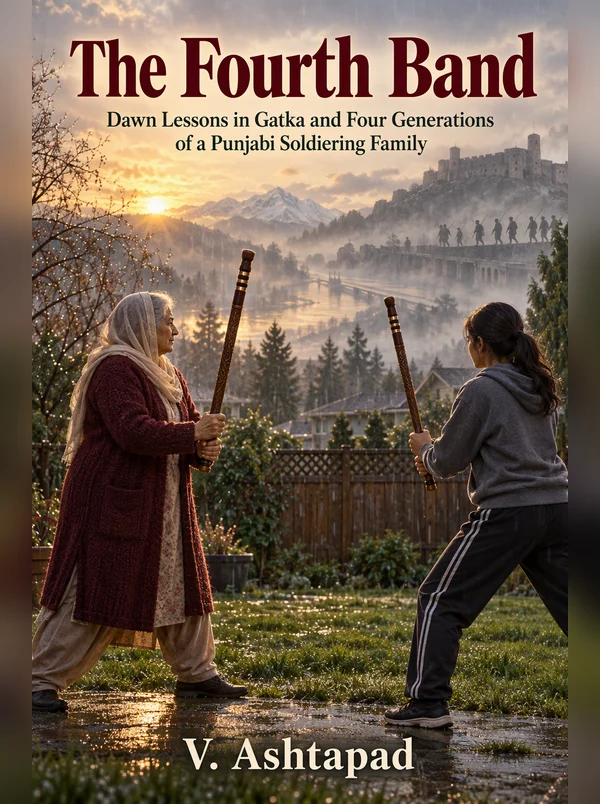
The Fourth Band
Dawn Lessons in Gatka and Four Generations of a Punjabi Soldiering Family
by V. Ashtapad
Foreword
This is a novel. Seerat Kaur Bains, her grandmother Gurmeet Kaur, the Bains, Johal and Brar families, the villages of Kalru Majra, Pandori and Kot Mehna, the stable, the hall and the farm are invented, and so is everyone in these pages apart from the soldiers of Saragarhi named in its history and a well-loved singer heard once on a radio. The history they live inside is real. On the twelfth of September 1897, twenty-one men of the 36th Sikhs held the signalling post of Saragarhi on the Samana ridge, and their battalion, today 4 Sikh of the Indian Army, still keeps the day. The same battalion fought in the mountains of Italy in 1944, at Burki in 1965 and at Siramani in the east in 1971. Doaba and Malwa, the Grand Trunk Road, the blueberry fields of the Sumas Prairie, the ferry to Nanaimo and the long streets of Newton are as real as rain. The book is set down the way Seerat lived it, one dawn lesson at a time, in a backyard in Surrey and on a roof in Punjab. The Punjabi words are her grandmother's, spoken as a Doaba family speaks them.
For every family that kept a soldier's word, and for the ones who taught their daughters to stand.
First, Stand
The fire pit was still warm when my grandmother put a stick in my hands, and that tells you most of what you need to know about her.
It was the fourteenth of January, the morning after Lohri, a little before eight, which in Surrey in January is not yet morning at all. The sky over the cedar hedge was the grey of a wet paper sack. Rain had come in off the Strait around three and was still falling in the thin, patient way it falls here all winter, not hard enough to run for and not soft enough to ignore. In the middle of our backyard the propane fire pit my father had bought because the city will not let you light a real bonfire sat under its lid, ringed with popcorn kernels the crows had not found yet and the wax-paper twists from a box of *rewri* my brother Jot had thrown at the flames by the fistful the night before, shouting the old Lohri song about Dulla Bhatti with the kind of joy only a thirteen-year-old who has been allowed to throw food at fire can feel.
I had not sung. I had sat on the back step in my hoodie with my phone, not looking at it, because the league email had come at six o'clock on Lohri evening, of all evenings, and I had read it four times.
*Dangerous play. Red card. Six-week suspension from all club fixtures, pending review.*
I play field hockey. I have played since I was nine, on the turf fields behind the recreation centre on 72nd Avenue, in a club where half the girls are named some version of Kaur and the other half are named Emma, and I am good at it, which is not something I say to be proud. It is just a fact, like the rain. On the Saturday before Lohri a defender from a Richmond club had hooked my stick and then my ankle three times in the first half, and in the second half, when she did it a fourth time, I turned around and swung. I did not hit her. I want that on the record. The ball was nowhere near us and my stick went past her shoulder close enough that she fell down out of pure surprise, and the umpire, who had seen the hooking all game and called nothing, saw the swing and called everything.
I was eighteen, nineteen in October. I was in my first year at the polytechnic campus on 72nd, studying kinesiology, which is the science of how bodies move, and I had just moved mine in a way that would follow me around for six weeks.
My grandmother had heard about it at the fire, from my mother, in Punjabi, in a low voice. Biji had said nothing at all. She had watched the flames. She had eaten four squares of *gajak*, which she is not supposed to have because of her sugar, and gone in at ten. And now it was the morning after, and she was standing on the wet lawn in her quilted maroon jacket over her salwar kameez, her white chunni wrapped over her head and twice around her neck against the cold, rubber clogs on her feet, holding out to me the carved stick that had belonged to my grandfather.
"*Pehlan khalo*," she said. First, stand.
"Biji, it's raining."
"It was raining in Italy," said my grandmother, who has never been to Italy, "and in the hills above Kohat, and in East Pakistan the whole month they were waiting. Rain is not a reason. Take it."
I took it.
I should tell you about the stick, because it is in every chapter of this, the way she is.
It is shisham, the hard brown rosewood that grows along the canal banks in Punjab, and it is a little over a metre long, about the height of my hip. My grandfather Balwant Singh Bains carved it in the winter of 1965 and 1966, in the hospital at Jalandhar Cantonment and then on a charpai in the courtyard of his father's house, while the shrapnel wound in his thigh closed and the hearing in his left ear did not come back. The handle is a horse's head, small enough to fit a palm, with the ears laid forward and a tiny groove for the mane. Below the handle a vine winds down the shaft, leaf by leaf, all the way to the iron ferrule at the bottom. And three times along the vine, at even distances, he cut a band all the way around the wood, a ring about two fingers wide, and filled each ring with tiny letters in Gurmukhi script and tiny pictures. The top band has a squared-off little fort on a ridge. The second has a hill with what might be a mule on it. The third has a canal with a bridge.
Below the third band there is a fourth. It is cut, the edges are clean, it is exactly as wide as the others. It is blank.
All my life I had seen that stick leaning by the door, first by my grandfather's chair and then, after he died nine years ago, by the hall closet, where Biji took it every evening for her walk to the end of the block and back. I had never held it like this, with both hands, in the rain, with my grandmother looking at my feet.
"Not like a hockey stick," she said. "You are holding it like you want to hit a ball to Richmond."
"I'm not holding it like anything."
"*Bas.* Enough. Put the ferrule down. Here." She tapped the grass in front of my right toe with her clog. "Hands one over the other on the top. Not squeezing. A stick is not a rope you are falling from. Feet." She tapped again. "This far. The width of your shoulders. Knees soft. Not bent, soft. Like you are standing in a boat."
"I've never been in a boat."
"You have been on the ferry ten times."
"That's not a boat. That's a building that floats."
She almost smiled. She has a way of almost smiling where only a small dent shows in her left cheek, and you have to know her to see it.
"Stand," she said.
So I stood.
Here is what nobody tells you about standing. It is the hardest thing there is. After two minutes my calves were shaking. After four, the rain had soaked through the shoulders of my hoodie and was finding its way down the back of my neck in a cold line. After six my mind had gone, in this order, to the Richmond defender, to the umpire, to my statistics assignment, to the question of whether there was any of last night's *makki di roti* left in the fridge, and to the crows, who had arrived on the neighbour's fence in a long black row and were watching the popcorn and me with equal interest. Every time my mind went somewhere, my weight went with it, forward or back, and every time it did, Biji said "*Khalo*," just the one word, stand, not loudly.
She did not stand beside me. She stood in front of me, a metre away, with nothing in her hands, her own feet the width of her shoulders, and she did not shake at all. My grandmother is eighty-four. She is five foot two. She had a cataract done on the right eye in October and still wears the dark glasses when the sun is out, which in January is never. She was standing in the rain in rubber clogs on wet grass and she was as still as the plum tree.
At ten minutes she said, "*Shabash*," which means well done, or good, or that will do. It is the word you say to a child who has carried something heavy without dropping it. "Again tomorrow. When the sky starts. Not when the sun comes. When the sky starts."
"I have class at nine."
"Then the sky will have to start early."
She took the stick back from me, checked the ferrule for mud, and walked across the lawn and up the three back steps into the kitchen, where my mother was already at the stove making tea in the big steel pan. I stood on the grass a moment longer, in the rain, with my hands empty and my legs humming.
* * *
I should explain who we are, because the story goes back a long way and I need you to be able to find us.
We live in Newton, in the part of Surrey where the houses are big and new-looking and full of people, built in the nineties with stucco fronts and double garages and a basement suite with its own door down the side, rented to students or to cousins. Our street runs off 128th, a few blocks up from where the shops on 72nd start: the sweet shop with the long glass counters of *barfi* and *jalebi*, the shop that sells suit fabric and wedding bangles, the place that does phone repairs and immigration forms and passport photos all at one counter. On a clear day, which in January is rare and therefore precious, you can see Mount Baker from the top of our street, pink at dawn and white at noon, standing up out of Washington State like it has been invited to dinner and arrived early.
In our house there are five of us. My father, Kanwaljit Singh Bains, who everyone calls Kanwal, is a captain with the Surrey fire service and works twenty-four-hour shifts, so half the time he is asleep at strange hours or not home. My mother, Rupinder, is a nurse on the surgical ward at Surrey Memorial and works days, so the house runs on her schedule and her lists. My brother Jot is thirteen and plays goal in ice hockey, wearing a black patka under his helmet that goes grey with sweat by the third period. And Biji, my father's mother, Gurmeet Kaur Bains, who came to Canada in 1990 with my grandfather and my father when my father was sixteen, and who has lived in the back bedroom with the window over the garden, since before I was born.
Before Canada, Biji taught physical education for twenty-eight years in a government girls' school in Garhshankar, in Hoshiarpur district, in the part of Punjab called Doaba, which means two waters, because it lies between the Beas and the Sutlej rivers. She taught running and kabaddi and drill and, to any girl who wanted it and some who did not, gatka.
Gatka is the old Punjabi art of the stick and the sword. Today, in a gym or at a festival, you mostly see it as a sport: two people with a *soti*, a stick about as long as your arm, in one hand and a *farri*, a small round leather shield, in the other, scoring points off each other in a circle. But it is older than the sport. It is the way the farmers and soldiers of Punjab learned to move with a weapon for hundreds of years, and the footwork underneath it, the *pentra*, is supposed to be the whole thing. Biji learned it on the flat roof of her father's house from her father, who learned it from his, and she taught it in a dirt yard behind a school to girls in plaits and blue uniforms, which in 1965 was not something many people did.
I knew all this the way you know things about your grandmother: in pieces, from other people, at weddings. I had done gatka once, at ten, at a summer camp in a community hall gym, for exactly four Saturdays, until I got bored and went back to field hockey. Biji had never offered to teach me. I had never asked.
* * *
In the kitchen that first morning, my mother looked at my soaked hoodie and at Biji and said, in English, which is the language she uses for things she wants to sound reasonable, "Mummy-ji, she has class."
"She has legs," said Biji, in Punjabi. "Class is later."
My mother handed me a towel and a steel cup of tea, the strong kind with the cardamom pods cracked into it and enough milk to make it the colour of the river after rain, and gave me the look that means *I am not taking sides but I am also not stopping this*.
Jot came down with his patka in his hand, saw me dripping, and said, "In the *rain*?"
"Rain is not a reason," I said, and heard my grandmother in my own mouth, and was annoyed.
My father came in at a quarter past eight, off a shift, smelling of the station's coffee and the cold, still in his navy work jacket, his dark blue turban a little crooked from the long night. He kissed Biji on the top of the head, the way he does, and looked out the kitchen window at the wet lawn where you could still see two flat dark patches in the grass the shape of my feet.
"What happened here?"
"Seerat is going to learn to stand," said Biji.
My father looked at me, and then at the stick, which she had leaned by the back door instead of the hall closet. Something moved in his face. It was there and gone. He poured himself tea and did not say anything else, which is my father's main way of saying something.
* * *
That night, after my statistics assignment, I went down to Biji's room with the tablet.
Two years ago my aunt in Brampton, Kulwinder Bhua, my father's elder sister, had set up a private space online for our family. It is just ours. No one gets in without being invited by someone already inside. There is a tree in it that my aunt started and that cousins in Brampton and Southall and Kalru Majra have been adding to ever since, so that by now it has two hundred and forty people in it and at least six of them are named Gurdev. There is a place for photographs and papers, and a place to record someone talking and write the words down beside it. Biji had used it exactly twice, both times to tell Kulwinder Bhua she had sent the wrong size of sweater.
"I want to record you," I said. "The words. For gatka. I don't know them."
She looked at the tablet the way she looks at any new appliance, as if it has been sent by a relative she does not entirely trust.
"Which words?"
"All of them. Pentra. Soti. What you said this morning. *Khalo*."
"You know *khalo*. You have been told to stand since you were two."
"I know it in a kitchen," I said. "I don't know it out there."
She thought about that. Then she held out her hand for the tablet, and held it close to her face, and I showed her where to press. And she said each word slowly, the way a teacher does for a class at the back of a dusty yard, and then said a sentence with each one so I would know how it lived:
*Khalo.* Stand. "*Pehlan khalo, phir turo.*" First stand, then walk.
*Pentra.* The footwork. "*Pentra hi sab kuchh aa.*" The footwork is everything.
*Soti.* The stick. "*Soti nu ghutt ke na phar.*" Don't grip the stick too tight.
*Akhara.* The training ground. She pointed out the window at the lawn, dark now, the fire pit a black shape under its lid. "*Ih saada akhara.*" That is our akhara.
I typed the words beside her voice, in the Roman letters I can manage and, underneath, in Gurmukhi, which I can read slowly, like a child sounding things out, because my mother made me go to Punjabi school on Saturdays until I was twelve and I hated every minute of it and am now, I suppose, grateful.
When we had finished she gave the tablet back and sat on the edge of her bed with her hands on her knees, looking at the stick, which she had brought in from the back door and leaned against the wardrobe.
"Biji," I said. "Why the fourth band? Why is it empty?"
"Because it is," she said. "Go to sleep. The sky starts at seven-forty."
I had looked it up. Sunrise on the fifteenth of January in Surrey was 8:06. First light, the time when the sky over the hedge goes from black to that wet-paper-sack grey, was somewhere around 7:30.
She was right, of course. She usually is about the sky.
* * *
I lay awake that night listening to the rain on the skylight in the upstairs hall and thinking about the swing. I could feel it in my shoulders still: the stick going back, the whole of my weight going into it, and the Richmond girl's face as she fell, not hurt, just astonished that anyone would do that. I had not meant to hit her. But I had meant something. That was the part I could not get to lie down.
Biji's light was on under her door. In our house you can hear everything through the floor vents, and what I heard, very faintly, was her voice, talking to someone. Not on the phone. She was talking the way she sometimes does at night, in Punjabi, low, to my grandfather, who has been dead for nine years. I could not make out the words, only the tune, which rose at the end like a question and then fell again like she had answered it herself.
Then the light went out, and the house was all rain.
Twenty-One Flashes
On the eighth morning the rain stopped, and I learned that a lawn in Surrey in January has frost in it even when you cannot see any.
I had stood every day for a week. Biji had added things one at a time, the way you add weight to a bar: first standing with the stick, then standing without it, hands loose at my sides, then standing with my eyes shut, which is much harder than it sounds because your body suddenly remembers it is a tall wobbling thing balanced on two small flat pieces. On the eighth morning, the twenty-second of January, the sky over the hedge was clear for the first time all month, a hard pale green going to yellow at the bottom where the Fraser Valley was, and the grass crunched when I walked on it and left dark footprints behind me, and my breath came out in clouds.
Biji was already out there. She had the stick and something else, a short length of bamboo about as long as her forearm, wrapped at one end with old blue electrical tape.
"Today," she said, "we salute."
"We what?"
"Before a bout, before practice, before anything with a stick, you greet the person in front of you. You greet the ground. You greet the one who taught you." She handed me the bamboo. "This is your soti for now. The stick is for standing. This is for moving."
The salute in gatka, the way Biji teaches it, is a small thing and also not small. You hold the soti upright in front of your face, the end near your forehead, and you bring it down and out in a slow arc to the ground in front of your feet, and you step back with your right foot as you do it, so that your whole body bows a little without your head going down. Then you bring the soti back up and step forward into your stance again. It takes about four seconds. Biji made me do it forty times.
"Too fast."
I did it slower.
"Now you are a tired old man getting up from a charpai. Again."
I did it again.
"Your eyes. Where are your eyes?"
"On the soti."
"The soti knows where it is. Your eyes are on me. Always on the one in front of you. You are not bowing to the ground, you are telling the other person: I see you, I am ready, I will not cheat. And then you watch them, because they might."
On the thirtieth one she said, "*Theek aa*," which is all right, and on the fortieth she said nothing at all, which from Biji is better.
Then she sat down on the upturned blue bucket by the vegetable bed, where in summer she grows methi and coriander and a stubborn row of mustard greens that never gets as tall as it would in Punjab, and she held the carved stick across her knees with her hands on either end, and she touched the top band, the one with the little fort on the ridge.
"Do you know what this is?"
I did, a little. Every family I know with a grandfather from the Sikh Regiment knows the word, the way every family in Surrey knows the word for the cold that comes off the river in February. "Saragarhi."
"What do you know?"
"Twenty-one soldiers. A fort on a mountain. They all died."
"That is the end," said Biji. "Anyone can tell you the end. Sit. I will tell you the way my father told it to me, and his father told it to him, because his father was there. Not at Saragarhi. Near it. Close enough to see."
I sat on the cold back step with the bamboo soti across my knees, the way she held hers, and I pressed record on the tablet in my pocket without asking. She saw me do it. She did not stop.
* * *
My great-great-grandfather was named Hazara Singh Johal. He was born in 1876 in Kalru Majra, the village in Hoshiarpur district where Biji was born, to a family that had a well, eleven acres, two bullocks, and more sons than the eleven acres could feed. At fifteen he walked to Jalandhar, where four years earlier a new regiment had been raised, the 36th Sikhs, and he lied about his age, which everyone did, and he was taken.
"Hazara was a small man," Biji said. "Small and strong. My father said he could carry a full sack of wheat up a ladder to the roof with one hand on the rungs. He was not clever with books. He signed his name with a thumb until the regiment taught him letters. But he could see. He had eyes like a hawk. This is why he was made a signaller."
In 1897 the 36th Sikhs were on the Samana range, a long high ridge on the North-West Frontier, above the town of Kohat, in what is now Pakistan. Along the ridge the British had built a line of forts and posts. At one end of the stretch that matters was Fort Lockhart, at the other was Fort Gulistan, and between them, on a hump of rock, was a small stone signalling post called Saragarhi. The two forts could not see each other. Saragarhi could see both. Its job was to pass messages between them by heliograph: a mirror on a tripod that catches the sun and flashes it in long and short bursts, the way you would tap out a message with a torch at night.
"Hazara was at Lockhart," said Biji. "Twenty-one years old. On the twelfth of September, in the morning, the tribes came over the hills. Thousands. Orakzai and Afridi. They had been coming all summer, all along the frontier, and now they came for the ridge. They went first for Saragarhi, because if Saragarhi fell, the two forts were blind to each other."
At Saragarhi there were twenty-one men of the 36th Sikhs under a havildar named Ishar Singh. The post had walls of stone and mud and a wooden door and not very much else. The signaller there was a young sepoy named Gurmukh Singh.
"And all day," said Biji, "the signaller at Saragarhi talked to Lockhart. With the mirror. With the sun. He told them how many were coming. He told them the wall was being broken. He told them when men were hit. And at Lockhart, on the roof, there was a man reading the flashes and writing them down for the colonel, and next to that man, holding the paper and the pencil and passing it back, so that the reader did not have to look away from the mirror even once, was my grandfather."
She tapped the top band of the stick, the little carved fort.
"My father said Hazara never forgot the light. All his life, at the end of his life when he was an old man on a charpai in the courtyard in Kalru Majra, if the sun hit a window across the lane, a bucket, the brass on a bullock's horns, he would turn his head. Every time. He was looking for the next message."
From Lockhart they could see the smoke and the crowd around the post, and the colonel tried to send men out to break through, and they could not; there were too many between. All they could do was watch the flashes and write them down. The afternoon went on. The flashes kept coming.
"And then," said Biji, and she stopped.
The crows had come. They do it every morning in Surrey: thousands of them, flying west toward Burnaby at dusk to roost and coming back east over the city at dawn to spread out across the valley for the day, in long loose ragged ribbons, talking. A ribbon of them was going over our yard right then, high up, black against the green sky, and Biji tipped her head back and watched them pass, and waited until they had gone before she went on.
"The last message," she said. "When there were only a few men left. When the wall was down and they were inside. The signaller asked permission to stop signalling. To leave the mirror and take his rifle. And Lockhart said yes."
I knew that part. I had read it somewhere, years ago, a school project in grade seven on Remembrance Day that I had done in one night with my laptop, copying dates. It was different hearing it from her. It was different knowing there was a man named Hazara on that roof holding the pencil.
"And then the mirror stopped," said Biji. "And there was no more light from Saragarhi."
The twenty-one held the post most of the day. When they were gone, the tribes went on to Gulistan, and Gulistan held, and two days later a column came up the ridge and took Saragarhi back. They found the post. They found the men.
Biji was quiet. Then she said, "My father said that Hazara wrote down every message he passed that day, afterward, from memory, in the letters the regiment taught him. He kept the paper. It was in the trunk in the house in Kalru Majra. My father showed it to me when I was a girl, once. It was falling to pieces. I do not know if it is still there."
"Is it?"
"Tejpal will look," she said. "Tejpal is selling the house."
That was the first I had heard of it.
* * *
The facts, the ones in books, I wrote down that afternoon in the library at the polytechnic between classes, with the rain starting again against the long windows and a boy at the next table asleep on his engineering notes. The Battle of Saragarhi: twelfth of September, 1897. Twenty-one men of the 36th Sikhs, Havildar Ishar Singh commanding. The signaller, Sepoy Gurmukh Singh. Each of the twenty-one was given the Indian Order of Merit, the highest award an Indian soldier could receive then. The regiment that held the ridge, the 36th Sikhs, raised at Jalandhar in 1887, became after the First World War the 4th Battalion of the 11th Sikh Regiment, and after Independence the 4th Battalion of the Sikh Regiment of the Indian Army, which still exists, which soldiers today call 4 Sikh, and which every year, on the twelfth of September, keeps Saragarhi Day.
My grandfather Balwant was in 4 Sikh. I knew that. I had known it all my life the way you know your own address. I had never once put it next to the fort on the ridge.
That evening I opened the family space and found the map. It is a map of the world with pins in it, one for every place someone in the family lives or has lived. Most of our pins are where you would expect: a fat cluster on Surrey, another on Brampton, one in Southall in London where the son of Biji's younger sister drives a bus, a scattering in Punjab.
I put a new pin on a ridge above Kohat. In the box where it asks who lived here, I wrote: *Hazara Singh Johal, 36th Sikhs, Fort Lockhart, September 1897. Biji's grandfather.* And I attached the recording from the morning, the whole twenty-two minutes of it, crows and all.
In the morning there were three hearts on it from Brampton and one comment, from my cousin Simarjit in Southall, who is twenty-five and works for a bank and has never, as far as I know, been interested in anything that happened before 2010. *Wait. OUR great-great-grandfather was at SARAGARHI??*
*Near it,* I typed back. *Close enough to see.*
* * *
The card came on the Saturday, in the ordinary post, with a United States stamp with a flag on it.
Biji gets one every January. I had never paid attention. It is a heavy cream card, always plain, no picture, and inside, in black fountain-pen ink in a slanting hand that has got shakier every year, it says *Wishing you and your family a peaceful and healthy New Year*, and then a few lines in Punjabi, and then a signature.
"Who is it from?"
"Major Mohan," said Biji. She stood it on the windowsill in her room, next to the photograph of my grandfather in his uniform with his medals. "In California. By the sea. Your grandfather met him at a reunion dinner in Delhi in 1997. They were not in the same regiment, not the same rank, not the same anything. But they sat next to each other at a long table, and they talked all night about the 1965 war and about farming, because Mohan had a farm in Haryana after the army, and your grandfather wanted to know about his peanuts. They wrote every New Year after that. When your grandfather died, Mohan kept writing. To me."
"What does he say? In the Punjabi part?"
She held it out so I could read it. It took me a while.
*The tomatoes did well. The grandchildren are taller than me. I hope your knees are better than mine.*
"That's it?"
"That is a great deal," said Biji. "He is eighty-nine. He still writes in ink."
I scanned the card into the archive in the family space, front and inside, and filed it under my grandfather's name. It seemed to belong there.
* * *
On the ninth morning, Biji did not make me salute forty times. She made me salute once.
"Properly," she said. "Like it means something."
I stood on the frost, the bamboo soti in my right hand, and brought it up in front of my face, the end near my forehead, and looked at her over it. She stood in front of me in her maroon jacket with the carved stick upright in her own hand, the horse's head under her palm. Behind her the hedge was black and the sky above it was going from green to the colour of a peach.
I thought about a mirror on a ridge. A man holding a pencil and not looking away.
I brought the soti down and out, slowly, to the frozen ground, and stepped back, and bowed without bowing my head, with my eyes on hers the whole time. Then I came back up.
My grandmother brought her own stick down and out and back, in exactly the same four seconds, and came back up, and her eyes never left mine either.
"Now," she said, "you may learn to walk."
The Footwork Is Everything
Pentra, it turns out, is a triangle that you carry around inside your feet.
Biji drew it for me on the patio with a stub of yellow chalk from Jot's old sidewalk set, on the last Sunday in January, at twenty to eight, with the patio light on because the sky had not properly started. Three points, each a big step from the others. She stood on the back point with the carved stick under her arm like a sergeant's cane and showed me: right foot forward to the front left point, left foot sweeps through, turn, now right is behind; left foot forward to the front right point, right sweeps through, turn. Front, through, turn. Front, through, turn. Your weight moves across the triangle like water rocking in a pan, never stopping, never sitting on one foot long enough to be knocked off it.
"In a bout you never stand still," she said. "Standing is for before. In the fight, a person who stands is a person who has decided to be hit."
She did it twice at full speed, at eighty-four, in her clogs, and it was the first time since I was small that I had seen my grandmother move fast. It was not fast the way I am fast on the field, all burst and lean. It was fast the way water is fast going over a stone. Her chunni swung out behind her. Her kara, the steel bangle she has worn on her right wrist since she was a child, slid down to her hand and back with a little click at each turn. Then she stopped exactly where she had started, on the back point of the triangle, and was not out of breath.
I tried. I stepped on my own heel on the first turn and nearly went into the vegetable bed.
"Again," said Biji.
I did it for forty minutes. By the end the chalk triangle was smudged into a yellow cloud, the bottoms of my sweatpants were wet to the shin, and Mrs. Gill next door had come out onto her back deck in her dressing gown with a cup of tea to watch. Mrs. Gill is from Ludhiana, has lived next to us for twenty years, and regards everything that happens in our yard as hers to comment on.
"Gurmeet-ji!" she called over the fence. "You are training her for the Olympics?"
"For life," Biji called back, without turning round.
"Life is easier!"
"Not for her," said my grandmother.
* * *
That week it got cold in the way it does in Surrey perhaps once a winter, a real cold, minus six at night, the puddles on the street frozen into grey plates and the bus shelters glittering. At the polytechnic, the heating in the old wing clanked and failed and we sat through Anatomy in our coats while the instructor drew the bones of the foot on the whiteboard and named them: talus, calcaneus, navicular, cuboid, the three cuneiforms, the five metatarsals, the phalanges.
"Twenty-six bones in each foot," she said. "Thirty-three joints. More than a hundred muscles, tendons and ligaments. And most of you have never once thought about what they are doing while you stand."
I had. I had been thinking about nothing else for two weeks.
In the evenings it was makki di roti and sarson da saag, the way it has to be in a cold week in our house: the flat yellow cornmeal bread, thick and a little crumbly, patted out between Biji's palms because a rolling pin cracks it, cooked on the iron tava and then finished straight on the gas flame so it puffs and scorches in spots, and the saag, mustard greens cooked down all afternoon with a little spinach and a fistful of cornmeal to bind it, until the whole pot is one dark green softness that smells of the fields in the cold. Biji puts a lump of white homemade butter on top of each bowl and it slides down the side and melts into a yellow pool. You eat it with your fingers, tearing the roti, scooping. There is a raw onion on the side, quartered, and a green chili for my father, and a steel glass of buttermilk.
"In the village," said Biji, at dinner, "your great-grandfather ate makki di roti every morning of the winter, cold, from the night before, with a raw onion and a handful of gur, and walked out to the fields in the fog. Every morning. Seventy-five years old, the last winter of his life, he still did it. He said a soldier who has eaten tinned biscuit in the Apennines will never complain about cold cornbread again."
"What are the Apennines?" said Jot.
"Mountains," said my father. "In Italy."
Biji looked at him. He did not look up from his saag.
* * *
On the Friday morning, at the end of the lesson, I asked her how she had learned. Not gatka; I knew it was from her father. I wanted to know the how. She was sitting on the upturned bucket, her breath smoking, the carved stick across her knees, watching me walk the triangle with my eyes on the plum tree, which she had told me to treat as my opponent.
"On the roof," she said. "Every house in a village like ours has a flat roof, *chhat*, with a little wall around it and a stair going up. In summer you sleep there, all the family, on charpais in a row, under the stars. In winter you dry the chilies there and the women sit in the sun with their knitting. And in the morning, before anyone was up, before the cows, my father took me up the stair and we did this."
"How old were you?"
"Five. The year after he came home."
Biji was born in March 1942. Her father, Kartar Singh Johal, Hazara's son, had gone overseas to join the regiment at the end of that same year. He came home in the spring of 1946.
"I did not know him," Biji said. "I want you to understand this. He came through the gate one morning in April with a kit bag on his shoulder and a uniform on, very thin, yellow from the fever they had in Italy, and my mother screamed and ran to him, and I ran the other way, behind my grandmother's legs. I was four. I thought he was a stranger come to take the buffalo. For a month I would not let him pick me up."
"What changed?"
She thought about it.
"The mare," she said.
With his gratuity, the lump of money soldiers were paid when they were discharged at the end of the war, my great-grandfather Kartar had bought a mare. A bay, red-brown with a black mane and tail and one white sock on the left hind foot, five years old, from a horse fair at a town near the Beas. Her name, which my great-grandmother gave her because she was so red in the evening light, was Laali.
"Every family that could afford it wanted a mare," Biji said. "For the work, a little, but mostly for honour. A mare at the door means the family is standing. And my father wanted one because in the army he had been in an infantry battalion, walking, walking, walking, all over Italy, up every mountain on his own two feet, and he said he had promised himself on a hill in the rain that if he came home he would never walk anywhere again that a horse could carry him."
She laughed. It is a rare thing, Biji's whole laugh, and when it comes it is surprisingly loud.
"He walked everywhere anyway. He never rode her to the fields. He said she was too good for the fields. But every evening he took her to the canal to drink, and one evening he put me up on her back in front of him and we went down the lane, the two of us, and the mare's ears went this way and that way listening to everything, and the sun was going down red over the wheat, and the canal water was red, and I forgot I was afraid of him."
"And after that he taught you gatka?"
"After that he taught me everything. To ride. To swim in the canal. To stand. He used to say a girl in a village needs three things: her own two feet, her own two hands, and her own word. The feet and hands he could teach. The word I had to keep myself."
She stood up off the bucket, and her knees cracked like twigs, and she walked over and took the bamboo soti out of my hand.
"You are thinking with your feet now," she said. "That is good. Tomorrow you start thinking with your hands. Go. You will be late."
* * *
That night I opened the tree in the family space and found the branch that leads to Biji's side. Kulwinder Bhua had started it two years ago from what she knew, and it was thin. There was Biji, Gurmeet Kaur, born 1942, Kalru Majra. Above her, her father: *Kartar Singh Johal, 1917–1992. Army?* That was all. Above him, nothing. There was no Hazara.
I added him. *Hazara Singh Johal, born 1876, Kalru Majra. 36th Sikhs, signaller, Fort Lockhart, Samana range, 1897. Died 1950, Kalru Majra.* I added Kartar's wife, my great-grandmother, whose name Biji had told me at dinner because I had asked: Pritam Kaur, of a village near Mahilpur. I fixed Kartar's line: *4th Battalion, 11th Sikh Regiment. Egypt and Lebanon, 1943 to 1944. Italy, 1944 to 1945. Came home April 1946.*
And then, because it seemed wrong to leave her out, I added Laali. You can add animals in the tree; people do, Kulwinder Bhua's cat has its own page. *Laali. Bay mare, one white sock. Bought spring 1946 with a soldier's gratuity. Too good for the fields.*
Within the hour there was a message from Kalru Majra, from Tejpal Taya, Biji's nephew, who is fifty-four and sells farm equipment and is selling the house. Strictly he is my father's cousin on his mother's side, but in a Punjabi family a cousin is a brother, and Tejpal is two years older than my father, so to me he is Taya, the word for a father's elder brother, and his wife is my Tai. It was a voice note. Tejpal Taya does not type.
"Seerat, *puttar*," it said, "I saw what you put. The mare. My father talked about that mare. The iron ring is still in the courtyard wall where they tied her. I will send a photo. Tell Bhua-ji the trunk is here. I have not opened it. It is her father's trunk, it should be her hand that opens it. We could put it on a ship. But I think she should come and get it herself. Tell her that. Tell her we are waiting."
I played it for Biji in the morning, on the back step, in the dark, before the lesson.
She listened to it twice. Then she stood up and picked up the carved stick and walked out onto the frost to the back point of the triangle, which she had redrawn in fresh chalk, bright yellow, overnight. I had not heard her go out.
"Hands," she said. "Today we start the hands."
She did not say anything about the trunk.
A Shield the Size of a Plate
The farri came out of Biji's suitcase on the first of February, wrapped in a pillowcase that smelled of mothballs and of somewhere else.
It is not the suitcase she uses. It is the other one, the big grey hard-shelled one with the broken wheel that lives on top of her wardrobe and comes down perhaps once a year, when someone is getting married and she needs the good shawls. She had me lift it down the night before, and she opened it on her bed with her back to me, and took out the pillowcase, and closed the suitcase again before I could see what else was in there.
In the morning, on the back lawn, in a fine cold drizzle with the patio light making a yellow cone in it, she unwrapped it.
A farri is a shield, but if you are picturing a knight, stop. It is round and about the size of a dinner plate. This one was thick leather, dark brown going to black at the rim, stitched around the edge with a heavy waxed thread, and on the back was a leather strap for the hand, worn smooth and shaped to a grip that was not mine. The face of it was scarred all over with little dents and scuffs, hundreds of them, the marks of other sticks.
"Garhshankar," said Biji. "From the school. I used this one for twenty years. Before that, it was the school's. Before that, I do not know. It came from the old drill master, who had it from somewhere. When I left in 1990, the headmistress said, take it, Gurmeet-ji, nobody else will use it the way you did, and I said, give it to a girl, and she said, there is no girl who wants it now, they all want to run the hundred metres for the district. So I brought it."
She held it out. I put my left hand through the strap. It fit, almost.
"It is small," I said.
"It is small on purpose. A big shield, you hide behind it. You crouch. You wait. A farri you cannot hide behind. It is too small. So you must move it. You must bring it to the stick, wherever the stick is coming. High, low, left, right. You do not wait for the blow. You go and meet it." She took the bamboo soti out of my right hand. "Stand."
I stood.
She hit me.
Not hard. But she brought the soti round at my left shoulder at a speed I was not expecting from a woman who takes four minutes to get her shoes on, and the farri was down by my hip where I had let it hang, and the bamboo tapped my shoulder with a small sharp *tock* that I felt through my jacket.
"Again," she said.
She did it four more times, at my shoulder, my ribs, my thigh, my head, slowly the second time and then faster, and by the fifth I had the farri there, held out at the length of my forearm, and the soti hit leather with a sound like a fist on a wooden gate.
"Good. That sound. Now you are listening."
For the next forty minutes, as the drizzle went to rain and back to drizzle and the sky went from black to charcoal to the colour of a pencil drawing, she walked round me slowly, tapping, and I turned on the spot and met each tap with the leather. My left shoulder burned. My forearm burned. Somewhere in the middle of it I stopped thinking about the Richmond girl, and the umpire, and how many weeks I had left, and thought only about where the next tap was coming from, and that was the first morning I understood what Biji was doing.
* * *
The suspension was half over. I had two more Saturdays of sitting in the stands at the turf field in my club jacket, watching my team lose without me, before the league's review. My coach, a former national player from Delhi with a voice like a whistle, had said very little to me since the red card except, after the first game I sat out, "Your temper is the best thing about you and the worst thing about you, Seerat. Learn which one to bring."
On the Sunday after the farri came out, I went into the garage to look for the roll of grip tape I keep for my hockey stick. Our garage, like every garage on our street, has never held a car. One side is my father's: tools, the deep freezer, twenty-kilogram sacks of rice and atta flour, thirty stacking chairs for when the whole family comes. The other side is everything else. Shelves of plastic bins with labels in my mother's handwriting: XMAS LIGHTS. JOT SKATES (OLD). WEDDING (KULWINDER'S). TAX 2009–2015.
The grip tape was in a bin marked SPORTS. Under it, in a bin with no label at all, pushed to the back of the bottom shelf behind the sacks of rice, there was a beret.
It was black, folded flat, with a cap badge on it I did not know. Under the beret was a folded tan T-shirt, the kind soldiers wear under their uniforms, gone soft with washing. Under the T-shirt was a small black box. In the box, on a bed of grey foam, was a medal.
It was not like the medals in the frame in Biji's room. It was a star, gold-coloured, four points, with a wreath of maple leaves around the middle and a crown on top, hanging from a ribbon that was green in the middle with a thin white stripe and a wider red one at each edge. Across the ribbon was a small metal bar with letters on it that meant nothing to me.
I knew my father had been in the army reserve before I was born, and a little after. I knew he had been away when I was a baby, for a while. It was one of those facts in our family that has no edges. Nobody had ever told me it was a war.
I put everything back exactly as I found it, the medal in the box, the T-shirt over it, the beret over that, the bin behind the rice. I took the grip tape and went inside and up to my room and sat on my bed with the roll of tape in my hand.
* * *
My mother was at the kitchen table that evening with her laptop and her reading glasses and a cup of the ginger tea she drinks after a long shift, doing the rota for her ward. My father was at the station. Jot was in the basement shouting at a video game. Biji was in her room with the door open and the television on low, a Punjabi channel with a long serial in which every woman is either a saint or a villain and every man is confused.
I sat down across from my mother.
"I found Papa's medal," I said. "In the garage."
She took her glasses off.
"I wasn't looking for it," I said. "I was looking for my tape."
My mother folded the glasses and put them on the table, very carefully, side by side with her pen, the way she does when she is choosing her words.
"Afghanistan," she said. "Kandahar. 2008. You were three months old. He was a reservist, in a regiment in Vancouver; he had joined when he was twenty-two, because his father and his grandfather had been soldiers and he thought he should be one too, and because the fire service liked it, and because he was young. Reservists could volunteer to go and fill in with the regular army over there. He volunteered. He was gone seven months."
"And?"
"And he came back," said my mother. "Which is the main thing. Some of them did not come back."
"Did something happen?"
She looked at me. My mother has been a nurse on a surgical ward for twenty-four years. She has a look that she uses on people who are asking her about outcomes, and she was using it on me now, kindly.
"That," she said, "is his to tell. Not mine. If you want to know, you ask him. But not this week. Let him be. It is February." She put her glasses back on. "He does not like February."
I did not understand that. I did not ask.
From Biji's room the television went quiet. She had turned it off. She did not come out.
* * *
In the morning she was on the lawn earlier than usual, and the light was different, because there was no rain at last and the clouds had lifted high and thin, and in the east, over the valley, there was a long low bar of clear sky going lemon and then white. We did the salute. We did the triangle. We did the farri, and she came at me faster than before, and I met it, and met it, and met it, and each time the bamboo hit the leather it made the flat hard sound she wanted.
When we had finished she sat on the blue bucket. I stood in front of her with the farri still on my arm.
"You were in the garage," she said.
"How do you know?"
"I live above the garage. The bins scrape." She looked at the farri. "You found it."
"Did you know it was there?"
"I am his mother," said Biji. "I know where everything is."
She told me something then that I will set down exactly, because I recorded it, because by then I recorded everything she said on that lawn.
"Your grandfather had a frame," she said. "You have seen it. In my room. His medals. He did not put them there. I did. After 1971, he gave them to me in a cloth bag and said, do what you want with these. For eleven years they were in the cloth bag in the steel cupboard. In 1982 when he retired, the paltan, the battalion, gave him a dinner, and the commanding officer's wife asked me, Gurmeet-ji, why does Subedar-sahib not wear his medals, and I had no answer. So I bought a frame in Jalandhar. I put them in it. I hung it in the room. He looked at it once. He did not say anything. But he did not take it down. And when we came to Canada he put the frame in his own suitcase, wrapped in his own shirts, and he carried it."
She was quiet.
"Some men wear them. Some men put them in a frame. Some men put them in a box behind the rice," said Biji. "It is not for the daughter to choose which. It is not even for the mother. Do you understand?"
"Yes."
"Now give me back my farri, you will stretch the strap."
* * *
That night I took the frame down from the wall in Biji's room, with her permission, and laid it on her bed, and photographed it for the family archive. I had looked at it all my life and never once read it. Under the glass, on faded green felt, there were six medals on their ribbons in two rows, with a little typed card under each one that Biji had made in 1982 on a typewriter at the school office. I copied the cards into the archive the way she had written them:
*Samar Seva Star, 1965. Raksha Medal, 1965. For the war of 1965, Burki, Lahore sector, with 4 Sikh.*
*Poorvi Star. Sangram Medal. For the war of 1971, East Pakistan, with 4 Sikh.*
*Sainya Seva Medal. Twenty Years Long Service Medal.*
Under the medals, in the bottom corner of the frame, tucked into the felt, there was a small black-and-white photograph I had never noticed: a young man in a turban and an army sweater with a stick in his hand, a straight stick, plain, standing beside a hospital bed with a nurse in a white cap at the edge of the picture, squinting at whoever was taking it. On the back, in pencil, in Biji's hand: *Jalandhar Cantt., November 1965.* It was my grandfather, twenty-seven, two months after Burki, leaning on the stick he had not carved yet.
I put that in the archive too.
By the morning Kulwinder Bhua had seen it in Brampton and written underneath. My aunt was born in 1964. She types fast and never uses punctuation.
*I was 7 in 1971 we were in the village Papa was at the war in the east Mummy kept us in the courtyard every night with the lamp out because of the blackout there were planes we could hear them over Adampur she made us sing to keep us from being scared she was 29 she taught all day and came home and did everything and at night she sat at the door with the lathi across her knees I asked her once what are you waiting for and she said for your father and for anyone who is not your father*
I read it to Biji at breakfast. She was putting butter on a paratha for Jot, the stuffed kind, with potato and green chili, crisp at the edges.
"She remembers that?" said Biji.
"She was seven."
"Hm." Biji put the paratha on Jot's plate. "I was not waiting. I was sitting. There is a difference."
"What's the difference?"
"Waiting is when you think something will happen. Sitting is when you have decided that whatever happens will find you ready." She wiped her fingers on the cloth tucked in her waistband. "Eat, Jot. You will miss the bus. Seerat, the farri tomorrow is the left hand only. Do not be late."
Piove
The second week of February the sky over the Lower Mainland opened like a bag that had been holding water since November, and we moved the akhara into the carport.
We do not have a garage you can put anything in, as I have said, but on the side of the house there is a carport my grandfather built in 1994 with my father and two uncles over one long weekend, a sloped roof of green corrugated plastic on four-by-four posts, open on three sides. Under it in winter are the recycling bins, the green waste bin, Jot's net, and a strip of concrete about four metres by six, stained with oil from the old car my parents had before I was born. Rain on corrugated plastic is louder than you would believe. When it really comes down, it is like standing inside a drum.
"Good," said Biji, the first morning, looking up at the roof with satisfaction. "Now you cannot hear yourself think. Now you will learn to strike."
A strike, in gatka, is a *vaar*. Biji says it with a long rolling *r* at the end, the way you would say it to someone you were warning. There are many of them, high and low, from the right and from the left, and in the sport they have names, and points, and rules. Biji was not interested in the names that week. She was interested in where the strike came from.
"Not the wrist," she said, catching my right wrist in her hand and holding it still. "A wrist strike is a fly swatter. Not the elbow. An elbow strike is a man slapping his donkey. Not even the shoulder. From here." She let go of my wrist and tapped the outside of my right ankle with the carved stick. "From the feet. The feet turn, the hips turn, the shoulders turn, the arm comes last, and the stick is just the end of the turning. Like the end of a whip. Like the last bit of the wave that hits the rock."
"Like a slapshot," said Jot, who had come out in his pyjamas to watch.
"Yes," said Biji, who has been to forty of his games. "Like that. Go and get dressed."
She had tied an old car tyre to one of the carport posts with nylon rope at about the height of my ribs. I hit it. I hit it two hundred times that first morning, from the right, turning from the feet, and every time I hit it with my arm instead of my feet she said "*Phir*," again, and every time I hit it the right way, the soti made a flat clean *whack* and the whole tyre jumped on its rope and the rain roared on the plastic roof, and I could not hear myself think, which was the point.
By the third morning I had a blister on the web of my right thumb. By the fifth it had broken and Biji had wrapped it, without comment, in a strip of white surgical tape from my mother's kit, and I had hit the tyre another thousand times.
* * *
It was in the carport, that week, with the rain coming down, that she told me about Italy.
She told it in pieces, between rounds, sitting on the lid of the green waste bin with the stick across her knees, so I will put it together here the way I put it together afterward in the archive, from the recordings, with the rain on all of them.
My great-grandfather Kartar Singh Johal joined the regiment in 1937, at twenty, the way his father had. By then the 36th Sikhs had a new name, the 4th Battalion of the 11th Sikh Regiment, and the men called it the Four-Eleventh. He was a sepoy, then a lance naik, then a naik. He was not tall, like his father. He was quiet. He was a good shot and a slow eater and he could not sing at all.
"Not one note," said Biji. "He would sing to the buffalo in the morning and the buffalo would leave."
When the battalion went overseas in 1941 he was kept back at the regimental centre to train recruits, because he could shoot. In the summer of 1942, in the desert in Egypt, most of the battalion was taken prisoner, and it had to be built again almost from nothing. At the end of that year, a few months after Biji was born, he went out with the men sent to rebuild it: to Egypt, where he learned what a sandstorm does to the inside of a rifle, and then to the mountains of Lebanon, where for more than a year the battalion showed other soldiers how to fight on snow and rock. Then, in the summer of 1944, across the sea to Italy, and up into the mountains.
"He did not talk about the fighting," said Biji. "Not to me. To my mother maybe. To other old soldiers, in the evenings, at the canal bridge where they sat. But to me he talked about the rain."
Italy, my great-grandfather said, was the wettest country in the world. Wetter than the monsoon. In the monsoon at least the rain was warm and it stopped and the sun came out and the fields steamed. In the mountains of Italy in autumn and winter it rained for a week and then it snowed and then it rained on the snow and the snow went to mud, and the mud was not like Punjabi mud, which is soft and brown and comes off with water. Italian mud was grey and thick like the cement they mix for a well, and it went over your boots and into them, and it took the boots off your feet when you tried to walk, and the mules sank in it to their bellies.
"The mules," said Biji. "He talked about the mules more than anything. In those mountains there were no roads for trucks. Everything went up on mules. Food, water, bullets, the wireless, the big guns in pieces. Indian mules, from the army mule companies, with Indian drivers. And at night, going up the mountain paths in the dark, in the rain, you held the tail of the mule in front of you, and the man behind you held the tail of yours, and you went up like that, a long line of men and mules holding on to each other's tails, and you could not see your own hand."
She held up her hand in the grey light of the carport, as if checking.
* * *
The best friend my great-grandfather had in the battalion was a sepoy named Dalip Singh Brar, from a village called Kot Mehna in Moga district, in Malwa, the country south of the Sutlej where the land is flat and dry and the people, according to everyone from Doaba, talk too much.
"Dalip talked too much," said Biji. "My father said. From the first day, from the training at the depot. He talked all day. He knew every song. He knew all the old ballads, the long ones the *dhadis* sing at the fairs, about the old warriors and the old lovers, Dulla Bhatti and Mirza and the rest, and he would sing them on the march to make the miles go, in a big voice, and the British officers would say, Brar, for pity's sake, and the men would say, Brar, don't stop. My father could not sing at all. So Dalip sang for both of them."
In the mountains, the two of them shared a hole in the ground, a slit trench with a groundsheet over it, for weeks at a time. Dalip had a way with the Italian farm families in the stone houses along the valleys, the old women and children who had stayed when the young men went to the war or the mountains. He learned their words faster than anyone.
"*Piove*," said Biji, carefully, in an accent that is a Doaba grandmother's idea of an Italian farmer's. "It rains. That was the first word. Dalip taught it to my father. When I was a girl and it rained in the village, my father would look up at the sky from the courtyard and say *piove*, and my mother would say, what is this nonsense, and he would laugh."
I put it in the word list in the family space that night, with her voice saying it, between *vaar* and *phir*. *Piove. Italian. It rains. Kartar Singh's word, from Dalip Singh, from an old woman in the Apennines.*
There was a farmhouse, my great-grandfather told Biji, somewhere in the mountains in the summer of 1944, with a chestnut wood behind it. The battalion was resting there a few days between one mountain and the next. An old woman lived there with two grandchildren, a girl and a small boy, and they had nothing, the armies had taken everything, but she had hidden a sack of flour ground from the last autumn's chestnuts, and she baked it flat in an iron pan over the fire with a little oil and a sprig of rosemary, brown and sweet and heavy, and gave it to the soldiers in pieces wrapped in paper. Dalip sang for her. Some ballad of Mirza and Sahiban, in the kitchen with the rain outside. She did not understand one word. She cried anyway. Then she sang something back, in Italian, and the men did not understand that either, and some of them cried too.
"My father said that was the night he understood that every country has the same songs," said Biji. "Only the words are different."
* * *
On the fourth morning in the carport, the rain eased off to a drizzle and then stopped, and in the sudden quiet you could hear the gutters running and the crows waking up in the cedars across the street. Biji did not tell me anything until I had hit the tyre three hundred times. Then she said, "Sit," and I sat on the overturned recycling bin, and she told me about the hill.
At the end of August 1944 the battalion was in the fighting on the Gothic Line, the last long chain of German defences across the north of Italy. There was a hill there. Biji called it Monte Calvo, which she said means the bald mountain, because it had no trees on its top, only rock and scrub and the holes the shells had made.
"They went up it at night," said Biji. "And they took it. And in the morning the Germans shelled it. All day. My father and Dalip were in the same hole, at the top. And in the afternoon a shell came."
She did not dramatize it. She said it in the same voice she used for the mules.
"Dalip was hit. My father was not. That is all. That is the whole difference between my father and Dalip Singh Brar: about two feet of Italian rock. My father held him. He was alive for a little while. He could not sing then. He could talk a little. And he took from inside his shirt a letter he had written to his mother, in case. Everyone had one. And he put it in my father's hand and he said, take it to her yourself. Not the post. Not the regiment. Yourself. Put it in her hand. And tell her I was singing."
She stopped.
"And my father said yes. And that was the word."
The rain had started again, softly, on the plastic roof, like fingers.
"He said yes on a hill in Italy, in 1944, holding his friend," said Biji. "And it took him two years to keep it. But he kept it."
* * *
That evening I found the Gothic Line in a library book at the polytechnic and on the old maps you can find of it online, with the Allied divisions marked in red and blue arrows going up through the mountains toward the plain of the Po, and the names of the places: Rimini on the coast, Coriano, Gemmano, San Marino, the valleys of rivers I had never heard of. I could not find Monte Calvo on any map at first. There are, it turns out, a great many bald mountains in Italy. I found one at last on a big wartime map, a small height in the hills, and I could not be sure it was the right one, and I put a pin on it anyway, and in the box I wrote, *Kartar Singh Johal and Dalip Singh Brar, August 1944. Biji says: about two feet of rock.*
I did not attach a recording to that one. I wanted to. I listened to it twice, alone, in my room, with my headphones on, my grandmother's voice and the rain, and then I closed the tablet.
At dinner my father was home, between shifts. Biji had made *kadhi*, the yellow yogurt curry with the gram-flour dumplings in it, which is what she makes when it rains, and plain rice, and there was a jar of my mother's green mango pickle on the table. My father ate two bowls without speaking. Jot talked about a save he had made in practice, a glove save on a breakaway, which he demonstrated twice with a dinner roll.
"Papa," I said, when Jot had finished. "Do you know about Dalip Singh Brar?"
My father put his spoon down.
"Biji told you," he said.
"In the carport."
He looked at his mother. She looked back at him, perfectly calm, and took a little more pickle.
"My grandfather told me about him," my father said. "When I was a boy. On the roof in Kalru Majra. I was eight, nine. He told me the same thing. The rain. The mules. The chestnuts." He picked his spoon back up and looked at it. "He told me he walked to Kot Mehna."
"Walked?" said Jot. "From where?"
"From the railway," said my father. "From the end of the line. Twenty miles, with the letter."
"Why didn't he take a bus?"
"There was no bus," said my father, and then, after a moment, "and he would not have taken one anyway."
He went back to his kadhi. I thought that was all, as it always is. But when he had finished, when he got up to take his bowl to the sink, he stopped behind my chair and put his hand on my shoulder, briefly, the way you steady yourself on something when you stand up too fast.
"Your thumb," he said. "Biji's tape. Let your mother look at it."
And then he went out to the carport, and I heard the tyre jump on its rope, once, *whack*, and then nothing, and then the door of his truck, and he was gone to the station for the night.
"He hit it from the arm," said Biji, to nobody, and went on eating.
Now You Are in a Boat
My father leaves the house at ten past four in the morning on the same late-February day every year, and every year, until this one, I was asleep.
I knew he went somewhere. It was one of the edgeless facts. Every February, on a day when he was always off shift, he left in the dark and came back after dark, and nobody asked, and my mother kept supper for him in the oven, and he ate it alone at the kitchen counter and went to bed. When I was small I thought he went fishing. When I was older I thought he went to see a friend. I was right about that, but not in the way I meant.
Two nights before, after the kadhi and the hand on my shoulder, I went and knocked on my parents' bedroom door. My father was sitting on the end of the bed polishing his work boots with a rag, the radio on low, a hockey game.
"I want to come," I said. "On the twenty-second."
He did not ask how I knew. He looked at the boot in his hand for a while.
"It's an early ferry."
"I know."
"It's a long day. It's not a fun day."
"I know."
He set the boot down on the newspaper he had spread on the carpet, and set the rag on top of it, and turned the radio off.
"Ask your grandmother," he said, "if you can miss a lesson."
* * *
I asked her. She said, "No," and then, after a moment, "Do it on the boat."
So at ten past four on that February morning I was in the passenger seat of my father's truck with the heater going and a steel thermos of Biji's tea between my knees and the bamboo soti across my lap, and we went west through the empty streets of Surrey under the orange lights, and over the river on the big bridge with the Fraser black and wide below us and the lights of the sawmills and the container cranes reflected in it, and through the long sleeping grid of Vancouver, and over the Lions Gate with its necklace of lights, and up along the edge of the mountains to Horseshoe Bay, where the first ferry to Nanaimo was waiting with its lights on in the dark like a building somebody had forgotten to switch off.
My father did not talk. I had not expected him to. He drove with both hands on the wheel at ten and two, the way they teach you at the fire service, and drank his tea from the thermos lid at the red lights, and once, on the Lions Gate, he said, "Your great-grandfather would have hated this bridge. No railing to speak of," and that was all.
The ferry left a little after six. It was still full dark. We sat in the cafeteria first, among the truck drivers and a hockey team of sleeping twelve-year-olds, and my father bought two coffees he did not drink and looked out the black window at nothing. At about a quarter to seven, as we came out past the last of the dark islands into the open water of the Strait, the window went from black to a very deep blue, and I picked up the soti and went out on deck.
* * *
The back deck of a big ferry at dawn in February is not a place anyone goes. The wind comes straight down the Strait of Georgia from the north with nothing to stop it, cold and wet and smelling of salt and diesel. The deck vibrates under your feet with the engines. Behind the ship, the wake spreads out in two long white lines across water the colour of slate, and beyond that the mainland mountains were just showing, black against a sky going violet, with snow on the tops of them catching the first of the light before anything else did.
I took out my phone. Biji had sent a voice note the night before. I had not listened to it yet; she had told me not to until I was standing.
"*Khalo*," said my grandmother's voice in my ear, small and clear against the wind. "Stand like you are in a boat. You told me you had never been in a boat. Now you are in a boat. Feet the width of your shoulders. Knees soft. Let the boat move under you. Do not fight it. Do your salute. Do your pentra, thirty times. Then go and sit with your father."
I did my salute to the wake. I did the triangle on the steel deck, front, through, turn, with the ship rolling slowly under me in the swell and the wind trying to take my hood off, and on about the twelfth time something happened that had not happened on the lawn or in the carport: I stopped fighting the ground. The deck tilted, and my weight went with it, and the triangle simply went on, tilting, rocking, like water in a pan, and I understood what Biji had meant on the first morning about standing in a boat.
When I turned at the end of the thirtieth, my father was standing at the rail by the door, watching. I did not know how long he had been there. His hands were in the pockets of his jacket and his turban was dark with spray.
"Your feet are good," he said.
"Biji says I think with my arms."
"Biji says that to everyone." He looked out at the wake. "She said it to me for six years."
I did not know that either. My father had done gatka. My father had stood on a roof in Punjab in the dark with a soti in his hand and his mother in front of him. He came over and stood beside me at the rail and we watched the light come up behind the mountains, gold now along the edges, and the water turning from slate to pewter to something almost green, and a line of black cormorants going low across it toward the islands.
"His name was Tom Garrity," my father said.
* * *
He told me most of it on the ferry, at the rail, in the wind, and the rest of it later, in the truck. I am going to tell it as simply as he did, because that was how he told it, and because I think if he had told it any other way he would not have been able to tell it at all.
He joined the reserve at twenty-two, in 1996, a regiment in Vancouver. He did it for the reasons my mother had given me and for one she had not: because his grandfather Kartar had died when he was eighteen, two years after they came to Canada, and had made him promise on the telephone from Kalru Majra, the last time they spoke, that he would not forget what the family was. My father did not know how else to remember it.
In 2007, the Canadian Army was in Kandahar, in the south of Afghanistan, and short of soldiers, and reservists were allowed to put their names forward to fill the gaps. My father put his forward. He was thirty-three. I was born that October. He left in January.
"I held you for about eleven weeks," he said. "Then I went."
In Kandahar he was with a squadron that drove the big eight-wheeled armoured vehicles along the roads and tracks of Panjwai district, west of the city: a flat green country of vineyards and mud-walled fields and mud-walled villages, with the river on one side and the desert on the other, and grape-drying huts with holes in the walls like honeycombs. In his vehicle there was a gunner named Tom Garrity. He was twenty-four. He came from Nanaimo. He had worked on the fishing boats out of the harbour since he was fifteen and he joined the army to see somewhere that was not water.
"He was funny," said my father. "That's the first thing. He was the funniest man I ever met. Not jokes. He just saw everything a little sideways. He called me Sarge-ji. He was the only one who ever called me that. He learned it off me, the ji, because I said it on the phone to my mother, and he thought it was the most polite thing he had ever heard, and he started putting it on everybody. The colonel. The cook. Colonel-ji. Nobody could stop him."
One morning in late February 2008, they were going along a road they had been along many times, between two villages, in the morning, and there was a bomb under the road.
"That's all," said my father. "That's all it was. A road and a morning and a bomb. Tom was up top. I was inside. The vehicle went up and came down on its side. I broke my arm in two places and I could not hear anything for nine days and on the left side I still can't, not properly. Tom was killed."
He said it to the water.
I thought of Biji in the carport: *about two feet of Italian rock.* My father and Tom Garrity: about a metre and a half of armoured steel, and which side of the hatch you happened to be on.
I did not say anything. I did not know there was anything to say. I stood next to him at the rail, and after a while I moved a little closer, so that my shoulder was against his arm, and he let it stay there.
* * *
Nanaimo is built on hills over a harbour, and on a February morning with the sun just out after rain it looks washed: the white boats in the marina, the seaplanes taking off one after another with a noise like enormous mosquitoes, the old wooden houses climbing up the slopes painted blue and yellow and red, and across the water the low green shapes of the islands and, very far off, the white line of the mainland mountains where we had come from.
Donna Garrity lives in a small yellow house with a deep porch on a steep street above the harbour, with a view straight down to the water between two other houses. She is seventy-eight. She was standing on the porch when we pulled up, in a long grey cardigan and running shoes, with her arms crossed against the cold, and when my father got out of the truck she came down the steps faster than a woman of seventy-eight should and put her arms around him and held on, and he held on back, and neither of them said anything, and I stood by the truck and looked at the harbour.
Then she let go and looked past him at me.
"Oh, look at you," she said. "Is this the baby?"
"This is Seerat," said my father.
"You were *this big*," said Donna, holding her hands about the size of a loaf of bread apart. "He showed us. He had a picture. Tom had it in his helmet. Your dad gave him a copy so he'd have a baby to show off. He showed you to everybody in that whole country, did you know that? Strangers. Little Afghan kids. He'd hold you up and go, This is Sarge-ji's."
I did not know that. I did not know what to do with it, standing on that steep street with the gulls going over.
She took us inside. Her kitchen smelled of coffee and of something chocolate. On the table there was a plate of squares, three layers, a crumbly chocolate and coconut base, a yellow custard middle and a hard chocolate top, which she said were Nanaimo bars, which she said with the pride of a woman whose town has given a dessert to the nation. Next to the plate was a saucepan.
"I'm making it," she said to my father. "Don't watch. I've been practising."
She was making chai. My father had taught her, she told me, in the second year, because she had asked what his mother would make for a guest, and he had said, tea, but not your kind, and she had said, so teach me. She did it now: the water and the milk together in the pan, the crushed cardamom, the slice of ginger, the black tea leaves, the sugar, the boiling up three times. It was not Biji's. It was too sweet and not strong enough. My father drank two cups and said it was the best she had made, and I think he meant that it was the best she had made.
She had a photograph of Tom on the windowsill. A big young man in a T-shirt on the deck of a fishing boat, sunburned, with red-blond hair cut short and a grin that took up most of his face, holding up a salmon that must have weighed fifteen kilos.
"He'd have liked you," Donna said to me. "He'd have teased you about the stick."
"I didn't bring the stick in."
"Your dad told me on the phone. Gatka. With his mom." She shook her head. "Your family. You don't do anything halfway, do you?"
* * *
In the afternoon we walked down to the harbour, the three of us, Donna between us with her arm through my father's, to a wooden bench on the waterfront path facing the marina. There was a small brass plate on the back of the bench. It said: THOMAS JAMES GARRITY, 1983–2008. HE ALWAYS CAME BACK WITH THE CATCH.
We sat on it. The wind had dropped. A seal put its head up between the boats and looked at us and went down again. Nobody said much.
On the way home, in the truck, in the dark again, on the evening ferry, my father told me the rest. That he had come home from Kandahar at the end of the summer of 2008 with his arm in a brace and one ear that did not work. That he had gone to Tom's funeral, here, in Nanaimo, in his uniform, and afterward Donna had held his good hand on the porch of the yellow house and said, *you'll come back, won't you, you won't just disappear, they all disappear*, and he had said, *every year*.
"And that was the word," I said.
My father looked at me in the dashboard light.
"That was the word," he said. "Eighteen years. I've never missed one. Not for a fire, not for a wedding. The year you had pneumonia, your mother said go, she's fine, I'm a nurse, go. I went."
Then he said the thing I have turned over every day since.
"My grandfather walked twenty miles to Kot Mehna with a letter in his shirt. My father carved three wars into a stick and left one blank. I get on a ferry once a year and drink a cup of very bad chai. It's not the same, Seerat. I know it's not the same. But it's what I have."
"It's the same," I said.
He did not answer. We drove up off the ferry into the lights of Horseshoe Bay and back along the dark mountain road toward the city.
Somewhere on the Lions Gate he said, "There's a letter. In the family space. I wrote it to you in Kandahar, the month before. I never gave it to you. When Kulwinder set the space up, I scanned it in and sealed it. I couldn't decide when you should read it, so I let the calendar decide. It opens on the eleventh of November."
"Remembrance Day."
"It seemed like the right day."
"Why not now?"
He kept his eyes on the road.
"Because I'm not finished being afraid of it," said my father. "Ask your grandmother if that's allowed."
When we got home it was after ten. Biji's light was on. I went and knocked, and went in, and sat at the foot of her bed, and told her: the deck, the triangle, Donna, the bench, the chai, the letter.
She listened to all of it with her hands folded on the quilt.
"Is that allowed?" I said. "To be afraid of it?"
"Being afraid is allowed," said my grandmother. "Being afraid is the first thing. Courage is only what you do next." She reached out and turned off the lamp. "Tomorrow, the tyre. Two hundred, from the feet. Your father can come if he wants."
He did not come. But in the morning, when I went out to the carport in the dark, there was a second steel thermos of tea on the lid of the green waste bin, still hot, and he had already gone to work.
Twenty Miles in May
The review was on the last Thursday of February, in a meeting room above a sports store in Burnaby, with a whiteboard nobody had cleaned.
There were three people on the panel, a man and two women from the league, and my coach in a chair against the wall, and me. I had written something on a sheet of lined paper. Biji had read it the night before, at the kitchen table, with her reading glasses low on her nose and a pencil in her hand, and had crossed out one sentence, the one that began *I was provoked*, and handed it back.
"You were," she said. "It does not matter. Read the rest."
So I read the rest. That I had swung my stick at a player when the ball was not in play. That I had not hit her but had meant to frighten her, and had. That a stick is a promise you make to the person in front of you, that you will use it only for the game, and I had broken it. That I was sorry, and I was asking to be allowed to play again, and I would not do it again.
The man from the league, who had the face of somebody who has sat through a great many of these, looked up when I got to the line about the promise.
"Where'd you get that?"
"My grandmother."
"She play?"
"She teaches gatka," I said. "It's a martial art. With sticks."
He looked at me for a second over his glasses and wrote something on his pad.
They gave me back my eligibility from the first of March, with a warning on my record for a year. On the stairs going down, my coach said, "The promise line. That was good." And then: "I'm going to hold you to it, you know."
"I know," I said. "So is she."
* * *
The next morning in the backyard, Biji picked up the farri for the first time herself.
All through February she had come at me with the bamboo soti and I had met it with the farri. Now she took the farri out of my hands, put her own left hand through the strap, and gave me the soti.
"Now you attack," she said. "I defend. Come."
I did not want to. I want to be honest about that. She was eighty-four. It was half past six in the morning, the last Friday in February, cold, the lawn grey with dew, the sky behind the hedge going from black to a thin wintry blue, and my grandmother was standing on the back point of a chalk triangle in her maroon jacket with a dinner plate of leather on her arm, and she wanted me to hit her with a stick.
"Biji—"
"Come."
I came. Slowly. A strike from the right, at the height of her shoulder, at half speed.
The farri was there before the soti was. *Tock.* And somehow, I could not have told you how, she had stepped forward and to the side as she blocked, a small easy step, front, through, and her right hand, the empty one, was resting lightly on my wrist, holding it, so that I could not draw the stick back.
"Again," she said, letting go. "And not like I am made of glass. Like I am the girl from Richmond."
So I came again, faster, and she met it, and stepped, and I came again from the left and she met that, and again high, and low, and each time the farri was there, and each time she moved, front, through, turn, and each time I ended up a little more off balance than I had started. I was eighteen and I play sixty minutes of field hockey on a Saturday without stopping, and after ten minutes of trying to hit my grandmother I was breathing like a dog in July, and she was standing on the back point of the triangle exactly where she had begun.
"*Bachaav*," she said. Defence. "You see? Defence is not standing behind the shield. Defence is moving so that the other person's strength goes past you, into nothing. You do not have to be stronger. You have to be where they are not aiming."
I wrote it down that night, all of it, word for word under her recording. *Bachaav. Defence. Where they are not aiming.*
On Saturday I played my first game back. In the second half a defender from a club in Coquitlam hooked my stick twice in a row on the same run. On the third time, I felt it coming up in me, the heat. And I stepped, front, through, and she missed the hook entirely, and went past me into nothing, and the ball was on my stick in the open circle, and I scored.
I do not think Biji understands field hockey, despite everything. But when I told her that night, she said "*Shabash*," and then, which is rarer, "*shabash, puttar*," well done, child, and put an extra spoonful of the carrot halwa she had made into my bowl.
* * *
It was a week later, in the first week of March, on a morning of thin bright cold sun with the plum tree just coming into a haze of white flowers and the crows building nests in the cedars across the street, that she told me about the walk to Kot Mehna.
She had brought something out to the lawn with her. It was folded small, in a white muslin cloth, and she held it on her knees on the blue bucket while I did my salute and my triangle and my two hundred strikes on the tyre, which we had moved out of the carport and tied to the plum tree because the rain had stopped. When I had finished, she said, "Come," and I went and sat on the grass in front of her.
"My father came home in April 1946," she said. "You know that. He was thin and yellow and he would not talk. For a month he did nothing but sleep and eat and sit at the canal bridge with the other old soldiers. He bought the mare. He took me to the canal on the mare. And then one morning in May he got up before it was light and put on his uniform, which he had not worn since the day he came home, and he put a letter in the pocket of his shirt, and a cloth with some rotis in it, and a steel tumbler, and he walked out of the village. He did not tell my mother where he was going. He told my grandfather Hazara. My grandfather said: good."
From Kalru Majra he walked to the town and took a bus to Jalandhar. At Jalandhar he took the train south across the Sutlej to Ludhiana, and there the branch line west toward Ferozepur, and got off at a small station on the far side of Moga where the train stopped for a minute and a half. From there, he had been told, Kot Mehna was "not far."
"Twenty miles," said Biji. "In May. In Malwa. Do you know what Malwa is like in May?"
I did not. I have been to Punjab three times in my life, all three in December or January, for weddings. I know fog and mustard fields and sitting on a charpai in the sun with a shawl over your knees. I did not know Malwa in May.
"Flat," said Biji. "Flat like a tava. No hills, no river, not then, the canals were fewer. The wheat is cut, so the fields are stubble, yellow, and the dust comes up off them in the wind, and the sun comes up white and stays white all day and the heat sits on top of you like a buffalo. Forty-five degrees. The road is a cart track, sand, and you walk in the sand and the sand is so hot you feel it through the soles of army boots. And every few miles a village, a few trees, a well, a pond with buffaloes lying in it up to their noses. And no shade between."
He walked it. He left the station at about nine in the morning. He stopped at the wells to fill his steel tumbler and ask the way. People gave him buttermilk. One old man gave him an onion and told him to keep it in his pocket against the heat, which is something people in Malwa believe, and he kept it there all day. He reached Kot Mehna at about four in the afternoon.
"And everyone knew whose house," said Biji. "That is a village. You say the name, Dalip Singh Brar who went to the war, and a boy runs ahead of you, and by the time you get to the gate the whole lane is there."
Dalip's mother was named Har Kaur. She was a widow. She had two younger sons and a daughter. She had received the telegram from the regiment, the one every family dreaded, in October 1944, a year and a half before, and since then she had heard nothing more. She was sitting in the shade of the courtyard wall with a spinning wheel when my great-grandfather came in through the gate in his uniform, grey with dust to the knees, and the whole lane behind him.
"And he did not say anything first," said Biji. "My father told me this. He said he had walked twenty miles thinking of what to say and when he got there he could not say any of it. He went down on one knee in front of her, in the dust, like a son, and took the letter out of his shirt, and put it in her hand. In her hand. Not on the ground. Not in her lap. In her hand, as he had promised. And then he said the only thing he could say. He said: he was singing."
Biji stopped. The crows were very loud in the cedars.
"She could not read," she said. "The letter. She could not read. Her younger son read it to her, there, in the courtyard, in front of everyone. I never knew what was in it. My father never said. He said it was not his to say."
He stayed the night in Kot Mehna. Har Kaur made him eat. In the morning, before he left to walk back the twenty miles to the railway, she went inside and came back carrying something folded in a white muslin cloth, and put it in his hands.
"She said: you have a girl. Dalip told me in his letters. You have a girl. This is for her, for the day she marries. And my father said, *Bebe*, I cannot take this. And she said: you carried my son's word twenty miles. You will carry this."
Biji unfolded the muslin cloth on her knees.
* * *
I have seen phulkari all my life. Every Punjabi family I know has one somewhere, in a trunk, on a wall, over the back of a sofa at a wedding. Most of the ones you see now are new, bright and factory-made in pink and orange and green on a cheap cotton, sold in the shops on Scott Road by the dozen. This was not that.
It was a *bagh*. Biji said the word as she unfolded it: *bagh*, which means garden, because the whole cloth is covered, every inch, so that you cannot see the ground underneath, like a garden in full bloom where you cannot see the earth. The cloth was *khaddar*, the thick handspun, handwoven cotton the village women made themselves, dyed a deep rust red. And over all of it, in a pattern of small diamonds within larger diamonds, in rows and rows, was silk. Untwisted silk floss, the colour of ripe wheat, of a lamp flame, of honey held up to light, stitched in long straight darning stitches worked from the back of the cloth, each stitch following the threads of the weave, so that the gold lay flat and caught the light differently depending on which way the stitch ran. Where the morning sun hit it, on Biji's knees, on our back lawn in Surrey, it shone. It was not bright. It was deep. It looked like a field.
"Har Kaur made this," said Biji, "for her own daughter. And then she gave it to my father for me, because her son was gone and her daughter was nine, and she said she would make another. I wore it on the day I married your grandfather, over my head, in March 1961. I was nineteen. My father put it on me himself. He told me then, in the courtyard, before the wedding party came. Where it came from. What he had walked for. He said: *dhee*, daughter, you are wearing a man's word."
I put out my hand, and then did not touch it, and she took my hand and put it on the cloth.
It was warm from the sun. The silk was smooth as water under my fingers and the khaddar underneath was rough as a sack, and you could feel, if you closed your eyes, every one of the thousands of stitches, small hard ridges in a pattern, like reading something written in a language for the hands.
"Biji," I said. "Does anyone know? In Kot Mehna? Does anyone in that family know where this went?"
"I do not know," she said. "My father went back once, in 1960. Har Kaur was dead. The younger son was there, Gurbax Singh. They sat together. After that, I do not know. It is eighty years."
* * *
I did not sleep much that night. At midnight I opened the family tree and looked at Kartar, and at the line that said *Italy, 1944 to 1945*, and then I did something I had never seen anyone do in our tree. I added someone who was not family.
You can do it. There is a way to add a person and mark them as a friend of someone in the tree, and link them by a dotted line instead of a solid one. Kulwinder Bhua had done it for her husband's best friend from college, who was at every family wedding and who everybody called Chacha.
*Dalip Singh Brar. Kot Mehna, Moga district. 4th Battalion, 11th Sikh Regiment. Killed at Monte Calvo, Italy, August 1944. Friend of Kartar Singh Johal.* And underneath, a dotted line to Kartar. And underneath that, his mother: *Har Kaur. Kot Mehna. Made the bagh.*
Then I wrote a message to the whole family space, everyone in it, all two hundred and forty, from Kalru Majra to Brampton to Southall, the first one I had ever sent to all of them.
*Does anyone know a Brar family from Kot Mehna, Moga district? Descendants of Gurbax Singh Brar, whose elder brother Dalip was killed in Italy in 1944 alongside Biji's father. Biji has something of theirs. She has had it since 1961. We would like them to know where it went.*
I sent it at 12:40 a.m. I thought it might take weeks. This is a Punjabi family. It took four days.
On the Thursday evening, Kulwinder Bhua phoned from Brampton, and I could hear her pacing her kitchen, her bangles clinking.
"Seerat. Listen. Your Phupharji's cousin in Mississauga, Pinky, her husband's sister is married in Moga. I called Pinky, Pinky called her sister-in-law, the sister-in-law asked in her husband's village, which is next to Kot Mehna, and a man there knows the family. Gurbax Singh's grandson. Hardeep Singh Brar. Do you know where he lives?"
"Where?"
"Abbotsford," said my aunt, triumphantly. "Forty minutes from your front door. He has a blueberry farm on the Sumas Prairie. His family has had it since 1998. He's probably bought blueberries from the same stall as your mother."
I went and told Biji. She was in bed, reading, her glasses on.
She took them off and put them on the quilt.
"Abbotsford," she said.
"Shall I call him?"
My grandmother looked at the bagh, which she had not put away; it was folded on the chair by the window in its white muslin, where the street light from outside fell across it.
"Not yet," she said. "First we go to Kot Mehna."
"*We?*"
"In April," said Biji. "For Vaisakhi. Tejpal is selling my father's house and my father's trunk is waiting for my hand, and I have not seen the wheat cut in thirty-six years, and you have never seen Malwa in the heat. Your last examination is on the ninth of April. I have looked. We will go to Kalru Majra. And then we will go where my father walked." She put her glasses back on. "Book the tickets. Aisle seat for me. I get up."
The Right-Hand Side
The cassette player came from the thrift store on King George Boulevard, cost four dollars and fifty cents, and smelled of someone else's basement.
Jot found it, sent on an errand to the hardware store next door, and came out with a silver portable stereo the size of a lunchbox, with a handle on top and two speakers like eyes and a cassette door that sprang open with a clunk. He carried it into the kitchen like a hockey trophy.
"For the tapes," he said. "Biji's tapes. In the shoebox."
I did not know there were tapes in a shoebox. Jot had known for years. He had found them at nine, looking for Biji's hidden *pinni*, the round winter sweets of wheat flour, ghee and nuts that she hides because of her sugar and he steals because of his age. The shoebox was on the top shelf of her wardrobe, behind the pinni tin. Inside were eleven cassettes, in their cases, labelled in my grandfather's square capitals in blue ballpoint.
Biji, when we asked, said, "Those are nothing. Old songs."
Then she said, "Which one did you play?"
We had not played any yet. We were waiting for her.
* * *
Before that, there was the wheel.
It was the middle of March, a week of strange weather: frost at dawn, then sun, then a sudden hard shower of hail that bounced on the patio like rice, then sun again, and the plum tree in full white flower and dropping petals on everything. On the lawn one morning, after the salute and the triangle and the farri, Biji took the bamboo soti from me and held it in the middle, like a baton, and began to turn it.
Slowly at first. A circle in front of her body, the stick going round like the spoke of a wheel. Then the circle moved: up over her right shoulder, down behind, round, up over the left, down, round in front again, a figure of eight drawn in the air around her, and the stick sped up as it went until it was a blur, a soft rushing sound in the cold, *whoosh, whoosh, whoosh*, and her wrists were turning over and back, and her feet were moving through the triangle underneath it all as if the stick were not there. Petals from the plum tree, falling past her, went sideways in the wind from it.
She stopped. The soti was upright in her hand. She was breathing a little harder than usual, which is to say I could see that she was breathing.
"*Chakkar*," she said. "The circle. The wheel. When you cannot see the stick, the other person cannot see where it will come from. Also, it is beautiful. At the fairs, this is what the people come to see."
"Teach me."
"I will teach you to drop it," said Biji. "That is the first month. Everyone drops it."
I dropped it. I dropped it on the lawn and on my foot and once, on the back swing, into the vegetable bed, where it took the top off a row of garlic. Biji said nothing about the garlic. On the Wednesday my father came home off a twenty-four-hour shift at half past seven in the morning and stood at the kitchen window with his coffee watching me drop it, and then he put the coffee down and came out the back door in his socks.
He held out his hand. I gave him the soti.
My father is fifty-two. He has a firefighter's shoulders and a firefighter's knees, which is to say the first are very strong and the second are not. He had not, as far as I knew, held a gatka stick in twenty years. He held it in the middle, the way Biji had. He turned it once, slowly, testing the weight. Then he started.
It was not as smooth as hers. It was faster and harder, more muscle, less water. But it was a wheel. Over the right shoulder, down behind, round, over the left, down, a figure of eight drawn in the cold air, and the soft rushing sound, and his socks on the wet grass, and his face completely still. He did it for perhaps thirty seconds. Then he stopped, and the stick was upright in his hand, and he gave it back to me.
"Wrists loose," he said. "Like you're shaking water off your hands."
He went back inside and picked up his coffee.
Biji, on her blue bucket, had not moved. But I saw her left hand, on the horse's head of the carved stick across her knees, close tight and then open again.
* * *
On the Sunday evening, all five of us were in the front room, which we call the front room though it is the only one with the good sofa and the glass cabinet of wedding plates and the big photograph of my grandfather in his turban and his medals. Jot had put the silver stereo on the coffee table. Biji was in her chair, the brown velour armchair with the crocheted cover over the back, with the shoebox on her knees. She had chosen one tape. On the label, in my grandfather's capitals, it said: KULWINDER'S HOUSE BRAMPTON. NOV 2005. PAPA-JI'S BIRTHDAY.
"Kulwinder put a recorder on the table," Biji said. "At his sixty-seventh. Everyone was there. Everyone was talking. And your Phupharji asked your grandfather about the war of sixty-five, because Phupharji's father had been in the air force at Adampur and he always wanted to compare. And your grandfather never talked about it. Never. But that night he had had a whisky and a half and the grandchildren were asleep, and he talked." She held out the tape. "I have not listened to it. Kulwinder gave it to me after he died. I put it in the box."
Jot put it in. Clunk. He pressed play.
There was a hiss, and then a roomful of noise: plates, a television, someone laughing, a child crying somewhere far off, Kulwinder Bhua's voice saying *Papa-ji, more rice?* And then, very close to the microphone, low and slow and a little hoarse, a voice I had not heard since I was ten.
"*Achha.* All right. I will tell you. Once."
My grandfather had a particular way of talking. I had forgotten it until I heard it. He spoke Punjabi with a Doaba lilt and slowly, as if each sentence had to be lifted and set down, and he turned his head a little to the right when he listened, and on the tape you could hear him do it, a small shift of the voice away from the microphone and back.
My father, on the sofa, sat forward with his elbows on his knees. My mother put her hand on his back.
* * *
I am going to set down what he said, as near as I can, in English, from the recording, which I have now listened to perhaps thirty times.
He was a naik in 1965, a section commander in 4 Sikh, twenty-seven years old. In September of that year, the war came. The battalion was in the Lahore sector, on the Punjab border, flat country, the same as home: fields of maize and sugarcane taller than a man, villages of brick and mud, canals, a few tall trees, and the heat still heavy at the end of the summer.
"Across our front," said my grandfather's voice, "was a canal. A big one. The other side had made it, to be a ditch against us. On our side of it, in front, there was a village. Burki. Not a big village. But they had made it into a fort. Every house was a fort. Concrete posts, guns, the canal behind it, the bridge."
On the night of the tenth of September, the battalion attacked Burki.
"At night. Across the fields. In the dark you could not see the man next to you, so we went holding onto each other, like this—" a pause on the tape, a rustle, as if he had reached out and taken someone's sleeve "—and the sugarcane was cutting our faces, and then we came out of the cane into the open and they saw us."
He did not describe the fighting very much. He said that it went all night. He said the battalion took the village, house by house, by morning. He said that at some point in the night, in a lane between two houses, near the bridge over the canal, something exploded beside him, and he was on the ground, and he could not hear, and his leg was wet.
"And I could not hear anything," said my grandfather on the tape. "Nothing. I could see the flashes, the guns firing, the men running past, but no sound. Like a film with the sound off. And I thought: so this is how it ends. And then I thought: no. I told her I would come back. I said it to her at the bus stand in Garhshankar. I said, I will come back, and she said, then come back. I had given my word. So I could not die there in that lane. It was not allowed."
Biji, in her armchair, made a small sound.
"So I got up," said my grandfather, "and I got my section together, all of them that were still there, six, and I took them across to the house by the bridge, where they were supposed to be. And then I sat down against the wall. And in the morning a sepoy found me and said, Naik-ji, your leg. And I looked down and I said, oh yes."
On the tape, at the table in Brampton in 2005, everybody laughed. You could hear Kulwinder Bhua laugh, and Phupharji, and somebody who I think was my mother, much younger. And then my grandfather's voice again, not laughing.
"Five men in my section did not come back from Burki," he said. "I remember their names. I will not say them at a birthday."
There was a pause on the tape. A plate. A television.
"After that I was in hospital in Jalandhar. Three months. Your mother came." This was to Kulwinder, I realised. "With you. You were one. She came alone on the bus from Garhshankar with you on her hip and a tiffin of food and she walked into the ward full of men with no legs and no arms and she found my bed and sat down on the left side of it and started talking to me. And I could not hear her. And she saw that I could not hear her. So she got up, and picked up the chair, and carried it round to the right side of the bed, and sat down again, and started again from the beginning."
The voice stopped. When it came back it was rougher.
"Forty years," it said. "Forty years she has sat on my right."
* * *
Biji had got up.
Without a word she put the shoebox on the arm of the velour chair and walked out of the front room, not fast, and down the hall to her own room, and shut the door, quietly. On the tape, Phupharji was asking a question about the bridge.
Jot reached out for the stop button. My father caught his wrist.
"Leave it," he said.
So we sat there, the four of us, in the front room, and listened to the rest of it: twenty more minutes, my grandfather's slow voice, the canal and the bridge and the tanks, the hospital ward, the winter he spent on a charpai in his father's courtyard in Pandori with a pocketknife and a shisham branch, carving. "I carved three," the voice said. "For my wife's grandfather, at Samana. For her father, in Italy. For me, at the canal. That is enough. Three is enough for one stick." And then someone, I think Kulwinder Bhua, asked, "And the fourth one, Papa? Seventy-one?" and he said, "Seventy-one is a different thing," and changed the subject to whether there was any more of the kheer.
When it ended, the tape ran on into hiss. Jot pressed stop. Clunk.
My father sat back on the sofa. He looked at the photograph of my grandfather on the wall, in his turban and his medals, unsmiling, the way old soldiers were photographed.
"I never heard that," he said. "The chair. The right side. I never heard it."
"You did," said my mother. "You were there. That's you laughing."
"I don't remember."
My mother looked at him the way she had looked at me at the kitchen table in February, kindly, as if he were a patient asking about outcomes.
"Kanwal," she said. "You stand on my right. Every time we walk anywhere. In the mall. At weddings. You don't even know you do it."
My father sat with that. Then he got up and went down the hall to Biji's room, and knocked, and went in, and shut the door. I heard their voices through the floor vent, very low, in Punjabi, for most of an hour. I did not try to make out what they said.
* * *
Later that night I put the recording into the family space. Jot helped. You play the tape into the tablet with a cable that he bought for three dollars at the phone repair place on 72nd; it took the whole length of the tape to copy it, playing it again in my room with the door closed, so I heard it twice that night. I saved it under my grandfather's name with the title on the label, KULWINDER'S HOUSE BRAMPTON. NOV 2005. And beside it I started a new word list, the words he used, so that someone who did not know them could follow: *naik*, a corporal; *paltan*, battalion; *nahar*, canal; *pul*, bridge; *kamad*, the sugarcane; *bachan*, a promise, a word given.
In the morning there was a comment under it. Not from Brampton. From Pandori, in Punjab, from a cousin of my father's I had met once at a wedding when I was six, a man named Rajinder who runs the village dairy cooperative.
*My father was in his section. Sepoy Amarjit Singh Bains. One of the six who went across to the house by the bridge. He told us Naik-ji walked them there with his leg open and never said a word about it. We did not know there was a recording. Thank you.*
I showed it to Biji at the back door, at twenty past six, before the lesson, in the dark.
She read it on the screen, holding the tablet close to her face. Then she gave it back, and took the carved stick from beside the door, and went out to the lawn where the frost was white under the patio light.
"Chakkar," she said. "Wrists loose. Like your father said."
I did it. I dropped it twice. On the third try it went round, once, twice, three times, over the right shoulder and down behind and round, before it got away from me and flew into the hedge.
"Good," said Biji. "Three is enough for one morning."
When I went in to get ready for class, my father was at the kitchen counter in his work clothes with his coffee, and as I came past him he moved, without looking up, without thinking about it, so that I was on his right.
The Roof in Kalru Majra
The peacocks start before the sky does.
That was the first thing I learned in Kalru Majra. On our first morning, the thirteenth of April, I woke on a charpai on the roof of my great-grandfather's house at a quarter to five to a sound like a cat being strangled by a trumpet, very close, and sat straight up in the dark with my heart going, and Biji, on the charpai next to mine under her cotton quilt, said without opening her eyes, "*Mor*. Peacock. On the water tank next door. He does that. Go back to sleep. Not for long."
I did not go back to sleep. I lay and watched the sky.
There is no sky in Surrey like the sky over Doaba before dawn in April. It is very big, for one thing; the land is flat as far as you can see to the south and west, and nothing stands up out of it but trees and water tanks, so the sky comes all the way down to the ground on every side like the inside of a bowl. And it changes so slowly that you cannot see it change, and then you look away and look back and it is a different colour: black, then a deep blue with the last stars in it, then a thin wash of grey along the bottom, then lilac. To the north-east, as the light came, a long low line of hills appeared out of nothing, blue-grey, wrinkled like a blanket somebody had kicked down the bed: the Shivaliks, the first foothills, with the real mountains somewhere far behind them, invisible in the haze.
The peacock called again. Another one answered it from the mango orchard beyond the lane. A tubewell started up somewhere with a slow heavy thump, *dug, dug, dug*, like a heart, and then another, and the smell came up from the fields, a dry sweet smell of ripe wheat and dust and, under it, woodsmoke from the first cooking fires.
Biji sat up at five exactly, folded her quilt into a square, and put her feet into her slippers.
"Up," she said. "Here, there is no excuse. Here, there is no rain."
* * *
We had arrived the morning before, after twenty-two hours of travelling that I will not describe except to say that Biji walked the aisle of the plane every ninety minutes from Vancouver to Delhi, as she had warned me she would, and did her own salute with a rolled-up airline magazine at the back of the plane by the toilets at three in the morning somewhere over the Arctic, to the great interest of a steward. Tejpal Taya met us at Delhi in a white car with his son Gurshan at the wheel, and Gurshan drove us north all night up the Grand Trunk Road, the great old highway that runs from the far east of the subcontinent to the far west, through the lights of Panipat and Karnal and Ambala, past trucks painted like fairground rides with tassels on their mirrors and *Horn Please* on their tailgates, until at dawn we turned off at Phagwara and drove the last hour on smaller roads through the green and gold of Doaba to Kalru Majra.
It is not a big village. About four hundred houses, a school, two shops, a dairy collection point, a pond with buffaloes in it, and a lot of new houses. The new houses were the first thing I noticed. Doaba is the part of Punjab that has sent more of its sons and daughters abroad than any other, to England and Canada and America and Italy and everywhere, and the money they send home has built houses: big ones, two and three storeys, painted pink and yellow and pale green, with marble steps and iron gates with lions on them, and on the roof of nearly every one, the water tank, which is where Doaba shows what it is thinking. On the drive in I saw a water tank shaped like an aeroplane, a big concrete jet with its wings out, painted white and blue, on top of a house whose family were in Birmingham. A water tank shaped like a football. Like an eagle with its wings spread. Like a hockey stick and ball, which Gurshan said belonged to a family in Surrey.
My great-grandfather's house was not one of those. It was the old kind: low, brick, the bricks small and thin and dark red, the walls nearly a metre thick to keep the summer out, built around a square courtyard of beaten earth with a neem tree in one corner and a hand pump in the other. Rooms opened onto the courtyard on three sides. On the fourth was the gate, a big double wooden door, its blue paint peeled almost to nothing, studded with iron. And up the side of the house, against the courtyard wall, a narrow brick stair with no railing went up to the roof.
In the courtyard wall, by the gate, at about the height of my shoulder, there was an iron ring set into the brickwork, black and rusted and worn smooth on the inside of the curve.
Biji had walked straight to it when we came in, before she greeted anyone, before she sat down, and put her hand on it.
"Laali," she said. That was all.
* * *
On the roof that first morning, in the lilac light, with the peacocks calling and the hills coming out of the haze, she taught me to turn.
"In the sport," she said, "there is one person in front of you. In life there is never one person. There is one in front and one behind. So."
She stood in the middle of the roof, which is flat and plastered and has a low wall around it about knee-high, and she had me stand behind her, and she told me to come at her with the soti whenever I wanted. Then she began her pentra, the triangle, slowly. And when I came, from behind, without warning, she was already turning, a full turn on the ball of her right foot, the carved stick sweeping round with her at the height of my knees, so that by the time I arrived where she had been, she was facing me, and the stick was touching my shin, lightly, and I was stopped.
"How did you know?"
"Your feet," said Biji. "On the roof. I can hear them. On the grass in Surrey I cannot hear them, that is why I never taught you this there. Here, the roof tells me." The dent showed in her left cheek. "My father taught me this up here. This roof. I was eight."
Down below, the house was waking up. Tejpal Taya's wife, Paramjit Tai, came out into the courtyard with a steel bucket and went to the hand pump, and the pump began to squeak and gush. The buffalo in the shed by the gate shifted and groaned. A cock crowed, late, as if embarrassed. And Gurshan came up the stair two steps at a time in a white vest and track pants, rubbing his eyes, carrying three glasses of tea on a steel tray, and stopped at the top when he saw us.
"Bhua-ji!" he said. "You are *still* doing this?"
"*Still*," said Biji, scornfully. "I never stopped. Put that down and pick up a stick."
Gurshan is twenty-two, broad and cheerful, and did gatka at school in Garhshankar for four years, until he discovered motorcycles. He and I fought on the roof that morning, in the climbing sun, soti and farri, while Biji sat on a charpai with her tea and called out "*Pentra! Pentra!*" whenever either of us forgot our feet, and Paramjit Tai stood at the bottom of the stair with her hands on her hips and told us both that if anyone fell off the roof she was not going to the hospital in Hoshiarpur in this heat.
Nobody fell off the roof. Gurshan won, four times to one. The one was mine. I turned, the way Biji had shown me, when he came from behind, and he ran into the end of my bamboo and sat down suddenly on a charpai and laughed so hard he spilled Biji's tea.
* * *
The trunk was in the back room on the north side of the courtyard, the coolest one, under a window with iron bars and no glass. It was wood, painted black, about a metre long, with iron corners, a flat lid and rope handles at each end gone hard and grey, and stencilled on the lid in white paint, faded nearly to nothing, were the letters and numbers of a soldier's name and regiment. I could make out K and SINGH and 4/11.
Tejpal Taya had not opened it. There was a padlock on the hasp, small and brass, and he gave Biji the key on a loop of red string.
The whole house came in to watch. Tejpal Taya and Paramjit Tai, Gurshan, Gurshan's younger sister Nimrat who is sixteen and was supposed to be studying for her board exams, an old neighbour in a white turban who everyone called Bapu-ji and who had known Biji's father, and two small children from next door who had come for no reason. They stood around the walls of the dark back room. I knelt beside Biji on the floor with the tablet.
She turned the key. The lock was stiff. She worked it, patiently, the way she works everything. It clicked. She lifted the lid.
The trunk smelled of naphthalene and paper and iron and of something I can only describe as the past: dry, faintly sweet, like the inside of an old book. On top was a grey army blanket folded small. Under the blanket was a khaki uniform jacket, the old kind with four pockets, the cloth gone stiff, three medal ribbons sewn above the left pocket. Under the jacket was a flat tin box. And under the box were papers, bundles of them, tied with string.
Biji lifted out the tin box. It had once held cigarettes, and the picture on the lid had worn off. Inside, wrapped separately in squares of old cotton, were medals.
She unwrapped them one by one on her knee. Three of them were my great-grandfather's, from the Second World War: two six-pointed stars of yellow metal on coloured ribbons, one ribbon in the red, white and green of Italy, and a round pale medal with a king's head. "The star for Italy," Biji said, holding that one up so the light from the barred window fell on it. "The war medal. And the other star, for all of it." Her voice was quite steady.
The fourth one was different. It was older, darker, heavier, silver gone almost black. On one side a queen's head, old and veiled. On the other, two soldiers, one British, one Indian, side by side, holding the same flag. And above the ribbon, two silver bars, clasps, with words on them in raised capitals that I read out loud, slowly, rubbing the tarnish off the letters with my thumb.
PUNJAB FRONTIER 1897–98.
SAMANA 1897.
Nobody in the room said anything. Bapu-ji, the old neighbour, took off his glasses and polished them slowly on the end of his turban.
"Hazara," said Biji. "That is my grandfather's. My father kept it."
I photographed every medal, front and back, on the cotton squares, on the floor of the back room. My hands were not quite steady.
The papers were harder. Most of them were Kartar's: his pay book, his discharge certificate, letters in Gurmukhi from my great-grandmother written for her by the village schoolmaster, a phrasebook in English and Italian with army printing on the cover, small enough for a shirt pocket, its pages soft as cloth. And at the very bottom, in a brown paper envelope that had been folded and refolded so many times it had worn through along the creases, there was a single sheet.
It had once been ruled paper. It was brown now, the colour of a dried leaf, and it had broken into eleven pieces along its folds, and the pieces had been laid back together in the envelope in the right order by someone, years ago. On it, in faded pencil, in big unsteady Gurmukhi letters written by a man who had learned to write as a grown soldier, there were lines. I could make out perhaps one word in five. Numbers. A word that might have been *wall*. A word that was certainly *door*. And near the bottom, all by itself on a line, very clearly, the word for *permission*.
Biji did not touch it. She looked at it lying in its eleven pieces in the brown envelope on the floor of her father's back room.
"He wrote it down," she said. "Afterwards. From memory. Every message."
I photographed it too, with the tablet flat above it so I would not have to move the pieces, and that night, on the roof, by the light of the screen, with the peacocks gone quiet and the stars out over the whole flat dark bowl of Doaba and a dog barking somewhere far off across the fields, I put every one of the photographs into the archive in the family space. Hazara's medal. Kartar's medals. The phrasebook. The eleven pieces. I filed them under the right names in the tree, and on Hazara's page I wrote: *The paper he kept. Biji says: he was looking for the next message.*
* * *
The next day was Vaisakhi, the first day of the harvest.
Everyone had told me about Vaisakhi and nobody had told me what it would feel like, which is like the whole country exhaling. The wheat was ready. It stood in the fields on every side of the village, waist-high, gold going on brown at the top, so dry it hissed in the wind. Before it was light the families were out in it with sickles, and the combine harvesters, rented by the hour, were already grinding along the field edges with their headlights on, and by nine the air was full of chaff and dust and the smell of cut stalks, and the first threshed grain was being bagged in the shade of the kikar trees along the field edges.
At the mela in the afternoon, on the open ground by the canal outside the next village, there was a fair: rides, sweets, glass bangles in heaps, a kabaddi match on a ring of soft dug earth with a crowd six deep shouting, and on a wooden stage under a canopy, bhangra. Young men in bright turbans with long fringed tails and loose embroidered kurtas and big chequered cloths knotted at the waist, dancing to a dhol so loud you felt it in your teeth, shoulders bouncing, arms up, jumping, shouting *balle balle* and *hoi*, while the old men in the front row sat with their hands on their knees and nodded as if checking the work.
And Gurshan brought the mare.
He keeps two, it turned out, in a shed behind his father's equipment yard: a tall white one called Chitti, which just means white, for leading wedding processions, because a groom in Doaba still rides to his wedding on a white mare if his family can arrange it, and a smaller one, a bay, red-brown with a black mane, called Sohni, which means the beautiful one, for himself. He brought Sohni to the mela on a lead rope with a red-and-gold tasselled bridle and little brass bells on her headstall, and children followed her through the crowd.
He stopped in front of Biji, who was sitting on a folding chair in the shade of a kikar with a bottle of cold lassi.
"Bhua-ji," he said. "Papa says you rode."
Biji looked at the mare for a while. The mare looked back at her with one dark eye and flicked an ear.
"Help me up," said my grandmother.
It took Gurshan, me, Tejpal Taya and a plastic stool. It took about four minutes. A crowd gathered. When she was up, sitting sideways on the mare's back on a folded blanket the way village women used to ride, her chunni over her head and the carved stick across her lap, with Gurshan at the mare's head holding the rope, she was quiet a moment, getting her balance. The mare stood very still under her, the way good horses do when they understand that the person on them is old.
Then Biji said, "*Chal*," come on, and Gurshan walked the mare slowly along the edge of the mela, past the sweet stalls and the bangle sellers and the kabaddi ring, toward the canal.
I walked beside them. The canal was wide and brown and full, running fast with the snowmelt from the hills, and the sun was going down over the wheat on the far side and turning the water red, and the mare's ears went this way and that way, listening to everything.
Biji was silent. She looked at the water.
When we came back, and they lifted her down, her face was grey with the effort and she had to sit for twenty minutes before she could walk to the car, and that night her hip hurt so much she did not sleep, and I sat up with her on the roof and rubbed mustard oil into it the way Paramjit Tai showed me, and she said "*bas, bas*," enough, and did not mean it.
"Worth it," she said, at about two in the morning, to the stars.
"Was it the same?" I asked. "As Laali?"
"No," said my grandmother. "Nothing is the same. That is not the question. The question is whether you get on."
The Jand Tree
We did the lesson at a dhaba on the Grand Trunk Road at a quarter to six in the morning, in front of eleven truck drivers, and one of them saluted back.
We had left Kalru Majra at four, in the dark, because Tejpal Taya said that if we wanted to be in Malwa and back before the heat closed in, four was already late. Gurshan drove. Biji sat in the front with her stick between her knees and her chunni wrapped over her mouth against the dust. I sat in the back with Nimrat, who had begged to come and been allowed on the condition that she brought her chemistry book, which she slept on.
We came out onto the GT Road at Phagwara, and turned south-east toward Ludhiana, and at a quarter to six, with the sky just going grey, Gurshan pulled off into a dhaba he said was the best on the whole stretch, which is something every man in Punjab says about a different dhaba.
A dhaba on the GT Road is not a restaurant. It is a piece of beaten earth beside the highway, a tin roof on poles, a clay tandoor oven sunk into a brick platform with the fire already roaring inside it, a row of huge blackened pots on gas rings, and charpais. A great many charpais, string beds on wooden legs, set out in rows in the open air with a wooden plank laid across each one for a table, so you sit cross-legged on the bed and eat off the plank. The trucks pull in nose to tail along the verge, painted in reds and greens and yellows with eyes on their fronts and flowers on their sides, and the drivers climb down stiff from the night and sit on the charpais and are fed.
At a quarter to six there were eleven of them. Sikhs mostly, big men in loose kurtas, some in turbans, some with their heads wrapped in a cloth for the night driving, drinking tea from small glasses and waiting for the first parathas off the tandoor. A boy of about twelve was going between them with a kettle. The cook, a heavy man in a vest with a towel over his shoulder, was slapping dough between his palms and leaning down into the mouth of the tandoor to press each round flat against the inside wall, so fast his arm was a blur.
Biji got out of the car, walked to an open patch of earth beside the charpais, and turned round.
"Here," she said.
I looked at the eleven truck drivers. The eleven truck drivers looked at me.
"Biji. *Here?*"
"The sky has started," said my grandmother, and held out the bamboo soti.
So I took off my sandals and stood on the cool packed earth of a GT Road dhaba in my salwar kameez with the trucks going past behind me in the half-dark, horns going, headlights sweeping, and did my salute, and did my pentra, front, through, turn, and my strikes into the air, from the feet, and my chakkar, which went round four times before I dropped it, and nobody laughed. I had thought they would laugh. Nobody laughed. The tea glasses stopped halfway to mouths. The boy with the kettle stood still. The cook leaned out of the tandoor to see.
When I finished and did my salute again, one of the drivers on the nearest charpai, an old man with a white beard down to his chest and a navy turban, put his tea glass down on the plank, and stood up, slowly, the way men his age stand up from a string bed, and faced me, and brought his right hand up flat beside his forehead and down again in a sharp, perfect, parade-ground army salute.
"*Fauji ki dhee?*" he said. A soldier's daughter?
Biji answered for me.
"A soldier's granddaughter," she said. "And great-granddaughter, and great-great. Four Sikh."
The old man's face changed. "Four Sikh?" he said. "Saragarhi wali paltan?"
"Saragarhi wali paltan," said Biji. The Saragarhi battalion.
He had been in 2 Sikh in the seventies and driving trucks for forty years since. He paid for our breakfast over Gurshan's protests and sat on our charpai talking pensions and old havildars with Biji, while the cook sent over aloo parathas from the tandoor, stuffed with spiced potato and green chili, blistered and crisp, each one with a slab of white butter melting on top, and a bowl of thick yogurt, and pickle, and lassi.
The lassi came in steel glasses as tall as my forearm, so cold that they sweated, sweet, thick, frothing at the top where the cook's boy had churned it, with a layer of yellow cream floating on top that you are supposed to eat with your fingers. Nimrat drank hers and half of mine. Biji, who is not supposed to have any, had a full glass, and looked at me over the rim of it as if daring me to tell my mother.
When we left, the old man shook my hand. He had a grip like a vice and hands like tree roots.
"Keep doing it, *beti*," he said. "Nobody's granddaughters do it any more."
* * *
At Ludhiana we left the GT Road and turned west, toward Moga, and the country changed.
I had thought all of Punjab would look like Doaba. It does not. Doaba is green, a country of small fields and many trees and the blue hills always there in the north. As we went west into Malwa, the hills disappeared behind us and did not come back, and the land flattened out until it was flat in a way I had never seen land be flat, flat like a sheet of paper, flat all the way to a horizon that shimmered and wobbled in the heat as the sun came up. The trees thinned out to straight lines of eucalyptus along the canal banks and the road. The fields were bigger and the wheat in them was already half cut, stubble and gold, the dust lifting off it in the wind in long slow brown veils. Every few kilometres a tall brick kiln chimney stood up out of the flatness, with bricks drying in red rows around it.
And in every town we passed through, in the grain markets by the road, there was wheat. Mountains of it. Golden heaps of loose grain the size of houses on the concrete floors of the market yards, with men walking on top of them in bare feet turning it with wooden shovels, and lines of tractors with trailers waiting to unload, and sacks stacked higher than the trucks, and the air full of a fine gold dust that got into the car through the closed windows and made Nimrat sneeze.
"Malwa," said Biji, with the satisfaction of someone proved right. "Now you see."
By nine the temperature on the car's dashboard said thirty-seven.
Gurshan had found the railway station on his phone. It is still there, a small yellow station building with a tin roof on a single line, a platform with two benches and a water tap, and a stationmaster asleep in a chair. No train was due until the afternoon. Gurshan parked the car in the shade of a neem tree by the platform and we got out and stood in the heat.
"From here," said Biji. "Twenty miles. That way."
The road to Kot Mehna was paved now, narrow and grey, with stubble fields on both sides and the heat already coming up off it.
"I'll walk the last part," I said.
Gurshan stared at me the way you would stare at someone who offered to climb into the tandoor.
"*Didi*, it's thirty-seven."
"He walked all of it," I said. "In May. At forty-five. I'll walk the last part."
Biji made no answer. But when, two miles short of Kot Mehna, by a field where a tubewell was pouring water into a concrete tank and two buffaloes were standing in the overflow up to their knees, I asked Gurshan to stop, she got out too.
"Biji, no," I said. "Your hip."
"I am not walking," said my grandmother. "I am going to stand here and watch you walk, and then Gurshan will drive me slowly behind you. That is all I can do. It is something."
So I walked the last two miles of the road to Kot Mehna, in the full white sun of a Malwa morning in April, at thirty-eight degrees, with a cotton dupatta over my head and a steel water bottle and the bamboo soti in my hand because I could not think what else to do with it, and the white car crawling along behind me at walking pace with my grandmother in the front seat watching me through the windscreen. The heat came off the road and up through my sandals. The stubble on both sides hissed in the wind. A man on a motorcycle with three milk cans strapped to the back slowed down to look at me and the car and sped up again. There was no shade. My shirt stuck to my back in the first ten minutes. I thought about army boots and wool uniforms and twenty miles and a letter in a shirt pocket. I thought about getting there and not being able to say anything.
At the edge of the village, by a pond with a ring of dried mud around it where the water had shrunk in the heat, there was a tree.
It was not a big tree. It was low and grey-green and twisted, its trunk thick and gnarled and split, its small feathery leaves making a thin lacy shade, and it stood all alone at the edge of the pond as if it had been there before the village and expected to be there after.
"Jand," said Biji, getting out of the car behind me. "That is a jand tree. In Malwa they are everywhere, in the old days. Mirza slept under a jand tree, in the ballad. The one Dalip sang. Sahiban's brothers found him sleeping there." She looked at it. "My father said that when he got here, before he went in to the village, he sat under a jand tree by the pond, to get his breath. And to decide what to say. And he could not decide."
We sat under it, the two of us, on the dry ground in the thin shade, for a few minutes, while Gurshan went into the village to ask for the house.
* * *
Dalip Singh Brar's family house is not there any more. Gurbax Singh, Dalip's younger brother, built a new one in the 1980s on the same plot, a two-storey house painted pale blue with a water tank on the roof shaped like a big white bird, its wings out. Gurbax died in 2009. His widow did not.
Her name is Surjit Kaur. She is ninety-three. She was sitting on a charpai in the shade of the verandah when we came in through the gate, a tiny woman in white with a white chunni and enormous thick glasses, and a great-grandchild asleep against her side, and about nine other members of the family arriving at speed from various doors because a boy had run ahead of us down the lane to say that a car had come from Doaba, from Canada, about Dalip.
That is a village, as Biji said. You say the name, and the whole lane is there.
Biji went to the charpai, and before she sat down, she bent and touched the old woman's feet, and the old woman put both hands on Biji's head. Then Biji sat beside her, and took her hand, and said in Punjabi, "I am Kartar Singh's daughter. From Kalru Majra. Who came in 1946 with the letter."
The old woman's thick glasses turned toward her.
"Kartar Singh," she said. "Who came again in 1960. He sat there." She pointed with her chin at the far end of the verandah. "With my husband. Two whole days. I made him *saag* in May, there was no saag in May, I found some. He ate it like a hungry boy." She peered at Biji. "You are the girl?"
"I am the girl."
"The bagh," said Surjit Kaur.
Biji was quiet.
"My mother-in-law told me," said the old woman. "Har Kaur. When I came here as a bride in 1950. The first thing she showed me in this house was the letter. The second thing she told me was about the bagh. She said: there is a girl in Doaba wearing my best work. She said it every year. When there was a wedding in the village and the girls wore their phulkaris, she would say, mine is better, and it is in Doaba." Surjit Kaur laughed, a high, cracked, delighted laugh. "She was proud. Oh, she was proud of that."
* * *
They still have the letter.
It lives in a steel almirah in the back room, wrapped in a red cloth, in a tin, the way everything precious lives in Punjab. A grandson's wife, a schoolteacher named Rajwant, brought it out and unwrapped it on the verandah, while the whole family stood around and the great-grandchild woke up and was given a biscuit.
It was a single sheet, folded small, the paper thin and brown, written in pencil in a neat clear Gurmukhi hand. Rajwant read it aloud. She read it slowly, the way you read something that has been read aloud many times before, and I recorded it, with permission, and Biji held Surjit Kaur's hand the whole time and did not look at anyone.
I will put it here in English, as I have it in the archive, under Dalip's name, translated by me and corrected by Biji.
*Respected Bebe-ji,*
*If this letter comes to you in the hand of Kartar Singh of Kalru Majra, then I am not coming, and you must not cry too much, because he has walked a long way and he will be tired and you must feed him first. Make him the saag even if it is not the season. He cannot sing at all, so I have been singing for both of us, and he says he will learn, but he will not.*
*It rains here every day. The people are poor and good. An old woman gave us bread made of chestnuts and I sang Mirza for her and she cried. The mountains are like our hills in Doaba but bigger and cold, and the mud is not like our mud.*
*Kartar has a daughter at home he has seen only once, when she was small enough to hold in one hand. Her name is Gurmeet. Bebe, I am asking you one thing. When she marries, give her a bagh. Your best one. From me. Tell her it is from Dalip who sang. Then I will be at the wedding.*
*Look after Gurbax and the little ones. Tell Gurbax he is the eldest now. Your son,*
*Dalip Singh.*
When Rajwant finished there was no sound on the verandah except the great-grandchild eating the biscuit and, very far away, a tubewell, thumping.
Biji sat very straight on the charpai with the old woman's hand in hers.
"My father never told me," she said at last, in a voice I had not heard from her before. "That it was Dalip who asked. He told me Har Kaur gave it. He never told me what was in the letter. He said it was not his to say."
"It was not," said Surjit Kaur simply. "It was Dalip's. Now Dalip has said it." She patted Biji's hand. "Sixty-five years you have been wearing his word and you did not know. That is how it is with a word. You do not have to know. It holds anyway."
* * *
We stayed until the worst of the heat had passed, and they fed us, of course, rotis and dal and a dish of bitter gourd and a pot of *kheer*, the slow rice pudding, cooked down all afternoon in buffalo milk, the colour of old ivory, and more lassi, and they would not let us leave until we had eaten it all.
I took photographs for the archive: the letter, both sides; the pale blue house with the white bird on the roof; the jand tree at the edge of the pond; Surjit Kaur and Biji on the charpai, side by side, two old women in white, holding hands, each looking a little away from the camera as if it were rude to stare at it.
Before we left, Surjit Kaur called Rajwant over and said something in her ear, and Rajwant fetched her phone from inside the house, and made a call, and held it out to Biji.
"Abbotsford," she said. "Hardeep. Her grandson. He has the photograph. The one of the two of them in Italy. He took it to Canada when he went. She says you must see it. She says you must go to him."
On the screen, very small, a man in his forties with a short beard going grey and a T-shirt on inside out was standing in a dark kitchen with one light on, woken in the middle of his night, holding his phone too close to his face.
"Bibi-ji?" he said. "You sat with my Dadi? Under the jand tree?" He laughed and dragged a wrist across his eyes. "Come in July. The blueberries are ready in July. Bring the girl who walked."
What the House Keeps
On the last morning on the roof, Biji did not pick up a stick at all.
She sat on her charpai in the grey before dawn with her quilt around her shoulders and her steel glass of tea in both hands, and when I came up the narrow stair with the bamboo soti and the farri, she pointed with her chin to the other end of the roof, where Nimrat was standing in a tracksuit with her hair in a long plait down her back, yawning, holding a length of plastic pipe from Tejpal Taya's yard that was about the length of a soti.
"Today," said Biji, "you teach."
"Biji, I've been doing this for three months."
"I had been doing it for three months when my father made me teach my cousin," said Biji. "She hit me in the eye. Go."
So I taught Nimrat the salute on the roof of our great-grandfather's house in Kalru Majra, on the seventeenth of April, with the Shivaliks coming up blue out of the haze in the north-east and the peacocks going off one after the other on the water tanks all round, and the tubewells starting up, thumping, and the smell of the cut wheat rising off the fields. I showed her how to hold the stick upright before her face. How to bring it down and out in an arc to the ground in front of her feet while stepping back, so that her whole body bowed without her head going down. How to keep her eyes on the person in front of her the whole time.
"Why do I have to look at you?" said Nimrat. "You're not doing anything."
And I heard myself say, "Because you're telling me: I see you, I'm ready, I won't cheat. And then you watch me, because I might."
Biji, on the charpai behind me, made a small noise into her tea that might have been a laugh.
Nimrat did forty salutes. On the fortieth she did one I could not fault. I did not tell her so. I said "*Theek aa*," all right, and saw her face fall a little and then saw it decide to try harder tomorrow, and understood something about my grandmother that I had not understood before, which is that every *theek aa* is a gift wrapped as something smaller.
Then I taught her the triangle, the pentra, and she stepped on her own heel on the first turn exactly as I had, and nearly went over the low wall into the courtyard, and I caught her by the back of her tracksuit, and Paramjit Tai, at the bottom of the stair with the milk, said something about hospitals in Hoshiarpur that I will not translate.
* * *
The house was to be signed over in the afternoon. The buyer was coming at four.
Tejpal Taya had put it in the family space a week before we arrived: an invitation, with a date and a time, the way you would for a wedding or a birthday. *Last tea in Bapu Kartar Singh's house. Friday, 17 April, from eleven. Everyone welcome. Bring your stories.* And underneath it, over the days, the answers had come in from everywhere: from the village and the villages round, *we will come*; from Brampton, Kulwinder Bhua, *we will be on the video, put the phone where we can see the courtyard*; from Southall, Biji's younger sister's son, *put me next to the neem tree*; from Surrey, my father, one word, *yes*.
From eleven they came. Old men in white turbans on bicycles. Women in bright cotton suits with dupattas over their heads and covered steel dishes of food. Children who did not know anybody and ran straight to the hand pump. Biji's cousins, in their seventies and eighties, from three villages; a retired schoolteacher who had taught with her at Garhshankar; two of the girls she had taught gatka to in the 1970s, who were now grandmothers themselves and who came in through the blue gate together, arm in arm, and saw her sitting on her charpai by the neem tree and shrieked, and ran, as much as women of sixty-five can run, and fell on her.
"Madam-ji!" they said. "Madam-ji! You are *still* alive!"
"I am still everything," said Biji.
They put charpais all round the courtyard. Paramjit Tai and the women made tea in the big brass pot on a fire of dung cakes and wood in the corner of the courtyard, the old way, because Tejpal Taya said that for the last tea in this house it would be made the old way, and they made *pakoras*, onion and potato and spinach fritters, in a deep black iron pan of mustard oil that spat and roared, and passed them round on newspaper. Gurshan propped a phone on a stool by the neem tree so Southall could see it and another on the stair so Brampton could see the whole courtyard, and every now and then somebody would go and shout into one of them, and a small voice from England or Ontario would shout back.
And people told stories. That was what the invitation had said and that was what happened. They told them sitting on the charpais with tea glasses in their hands, in loud Doaba Punjabi, interrupting each other, correcting each other. About Kartar Singh, who could not sing, singing to the buffalo. About Hazara Singh, the old signaller, sitting in this courtyard at the end of his life on a charpai and turning his head every time the sun flashed off a bucket. About Laali, the mare, who once ate an entire wedding garland off a groom's neck in the lane outside. About the year the canal flooded, the year of the locusts, the year Biji, aged fifteen, beat the headmaster's son in a running race in front of the whole school and he refused to speak to her for a year.
"He is eighty-six now," said one of the old cousins, "and he still does not speak to her."
I recorded all of it. I did not choose. I walked from charpai to charpai with the tablet and recorded whatever I was told, and by the end of the afternoon I had four hours of it, and I did not understand all of it, and that did not matter. I could understand it later. The voices were what would not be here later.
* * *
At about two, when everyone had eaten and the heat had settled on the courtyard like a lid and the old men had gone quiet on their charpais and some of them had fallen asleep, Bapu-ji, the old neighbour in the white turban, went home and came back with a tumbi.
A tumbi is the simplest instrument I have ever seen. It is a long thin wooden neck, a little longer than your forearm, stuck into a small round body made of half a dried gourd with a skin stretched over the open end, and it has one string. One. A single steel wire running from a peg at the top of the neck down over a little bridge on the skin. You hold it in your left hand, upright against your shoulder, and you pluck the string with your right forefinger, fast, over and over, *tun-tun-tun-tun*, and you change the note by pressing on the string at the top with your left. That is all. It makes a high bright twanging buzzing sound, like a very small, very cheerful insect with a lot to say, and it is the sound of every Punjabi folk song I have ever heard at a wedding, though I had never once seen one played.
Bapu-ji sat on the edge of a charpai and played it. He is eighty-nine. His fingers were bent and his nails were thick and yellow, and the tumbi went *tun-tun-tun-tun* in the hot courtyard and the sleeping old men woke up one by one and sat up.
He sang a *jugni*. A jugni, Biji said into my ear, is an old form: a little wandering spirit, the jugni, goes from place to place and in each verse she sees something, and the singer tells you what she saw, and then everyone sings the refrain. You can make up verses. That is the point. Bapu-ji sang a few old ones, about the jugni going to the city and the fair and the river, and then he began to make them up, about this house, about the people in it, and the courtyard laughed and sang the refrain back at him, and the phones on the stool and the stair laughed in small voices from England and Canada.
And then he looked at Biji, and plucked the string, *tun-tun-tun-tun*, and sang a verse about a girl from Kalru Majra who rode a red mare down to the canal in the evening with the wheat going gold, and fought the boys on the roof with a stick at dawn, and went to Canada and came back after thirty-six years with her granddaughter, who walked to Kot Mehna in the heat with a stick in her hand, and is teaching the next one.
The whole courtyard sang the refrain. I did not know the words. By the third time I did.
Biji did not sing. Biji, as I think I have said, cannot sing either; it runs in the family on her father's side. She sat on her charpai by the neem tree with the carved stick across her knees and her face perfectly still and her hand moving very slightly on the horse's head, keeping time.
* * *
The buyer came at four. His name was Sukhwinder and he was thirty-one, with a neat beard and a white shirt and very good shoes, and he had come back to Doaba after nine years working on a dairy farm in Lombardy, outside Cremona, milking four hundred cows a day for an Italian family, saving every euro, to buy an old house in the village he had grown up in.
"Not to knock it down," he said, to Tejpal Taya, to Biji, to the whole courtyard, which had gone quiet to listen. "Everybody here knocks them down. I want to keep it. The walls. The courtyard. The roof. I will fix the roof. My children will grow up in an old house. In Italy the old houses are what everybody wants. Here we throw them away."
Biji looked at him from her charpai.
"You lived in Italy," she said. "In the north."
"Nine years, Bibi-ji."
"Does it rain?"
He laughed. "*Piove sempre*," he said. "It always rains. In winter, fog. Like here in January, but cold. Grey. You cannot see the end of the barn."
"*Piove*," said Biji. "My father said that. He was there in the war."
Sukhwinder's face changed, the way the old truck driver's had at the dhaba.
"Your father was in Italy? In the war?" He sat down, uninvited, on the edge of her charpai. "Bibi-ji, there is a cemetery. Near where I worked. Not near, a few hours. For the Indian soldiers. The ones from the war. I went once, on my day off, with some boys from Jalandhar. All the names. Singh, Singh, Singh, Khan, Ram, Singh. In Italy." He shook his head. "I did not know until then. Nobody here knows. They think we are the first ones to go to Italy."
"You are not the first ones," said my grandmother.
The papers were signed at the long wooden table in the front room, with Tejpal Taya and Sukhwinder and a man from the tehsil office in a safari suit and two witnesses, and Biji, who was not on the deed but sat at the end of the table anyway with the stick upright beside her and watched every signature go down. When it was done, Sukhwinder shook everyone's hand, and then he came and stood in front of Biji.
"Bibi-ji. Is there anything you want from the house? Anything at all. It is still yours today."
Biji pointed through the door, across the courtyard, at the gate.
"The ring," she said.
It took Gurshan and Sukhwinder an hour, with a hammer and a cold chisel from Tejpal Taya's yard, working by turns in the late hot sun, to cut the iron ring out of the courtyard wall without breaking it. They took out the two thin red bricks it was set into, mortar and all, so the ring came away still sitting in its bricks, black iron in old red clay, worn smooth inside the curve by a mare's rope eighty years ago. Sukhwinder filled the hole in the wall with fresh mortar while it was still light and pressed a clean new brick into it.
"So the wall knows," he said.
* * *
That night was our last on the roof.
When everyone had gone and the courtyard was quiet and the fire in the corner had gone to embers and the peacocks had stopped, Biji asked me for the tablet.
"Show me," she said. "The one where you write a letter and it waits."
I showed her: how you could record something, a message, and choose who it was for, and choose a day, and it would sit there sealed in the family space, and nobody, not even the person it was for, could open it until that day came.
"For Jot," she said. "On his eighteenth birthday."
"That's five years."
"I know how long it is." She held out her hand. "Go downstairs."
I went downstairs. I sat in the dark courtyard on a charpai under the neem tree for twenty minutes, next to the two red bricks with the iron ring in them that Gurshan had wrapped in a feed sack for the journey, listening to my grandmother's voice on the roof above me, too low to make out, talking to my little brother five years from now. Once she stopped, and the roof went silent, and a dog barked somewhere across the fields. Then she went on.
When she called me back up, the tablet was on the charpai with the screen dark. She did not say anything about what she had recorded and I did not ask.
We lay on our charpais in a row on the roof of the old house, the way the family has slept on that roof in summer for a hundred years, and looked at the sky. It was enormous and full of stars, and over in the north-east, very faint, a light was moving along the dark line of the Shivaliks, a truck on a hill road, appearing and vanishing and appearing again between the folds of the hills.
"Biji," I said. "When Hazara saw the sun flash on things. When he turned his head. Was he sad?"
She thought about it.
"No," she said. "My father said no. He said it was the opposite. Every time the light flashed, the old man smiled. As if somebody had sent him a message. As if somebody was still there."
A light flashed far off on the hills, and went out, and flashed again.
"Go to sleep," said my grandmother. "The car is at four."
The Mare Who Carried the Grandmother
By the middle of June the sky over Surrey starts at a quarter past four, and Biji said that was a test of character, not of the sky.
She could not stand for the lessons any more, not the way she had in January. The day at the mela on Sohni's back had cost her more than she would admit, and the flight home more than that, and in May her doctor at the clinic on 72nd had sent her for an X-ray and come back and said the word *hip* in a tone that meant it was not going to get better, only managed. So my father carried a folding lawn chair out to the lawn for her, a green-and-white striped one from the garage bin marked CAMPING, and set it by the plum tree, which was now heavy with small hard green plums, and every morning at half past four she came out on my arm and lowered herself into it, carved stick across her knees, a shawl over her shoulders even in June, and taught from there.
It made no difference to the teaching. If anything she was stricter. When she could stand, she could show me. Now she had to tell me, and she told me exactly, every angle and every weight, and if I did it wrong she made me do it again until the words and the movement were the same thing.
That month she was putting it all together. Everything I had learned since January, one piece at a time, she was now stringing into a single long sequence, a form: the salute, the stance, the triangle, the turn, strikes high and low from both sides, the farri meeting them, the chakkar, the turn again, and back to the salute, so that you begin and end in the same place, facing the same way, having gone all the way round.
"Like a day," said Biji. "Like a life, if you are lucky. You come back to where you began, but now you know what it is."
It took about four minutes to do, when I did it right. The first time I did it all the way through without stopping, on the eleventh of June, at a quarter to five in the morning, with the sun about to come up in the north-east behind the hedge and the whole yard gold and dripping with dew and the robins going crazy in the cedar, Biji did not say *theek aa* or *shabash*. She said nothing at all. She nodded, once. And then she got out of the lawn chair by herself, which took a full minute and both hands on the stick, and went inside, and came back with two glasses of lassi, and we drank them on the back step in the new sun, and that was all.
* * *
In the summer I work at a boarding stable in Campbell Valley, in Langley, half an hour east of our house through the farmland, past the blueberry fields and the nurseries and the turf farms and the long white horse fences of the hobby farms. It is called Hollow Pine and it belongs to a woman named Moira Doyle who is seventy-one and was, for three years in the 1980s, a member of the RCMP Musical Ride, the troop of red-coated Mounties who ride black horses in formation and do the famous charge with their lances down. She keeps twenty-two horses, and I muck out stalls and fill buckets four mornings a week, and she pays me in cash and in riding lessons on whichever old school horse is not lame that week.
On the third Saturday in June, I took Biji.
I had asked her in May. She had said no. In June, after the form, she said yes, without explanation, the way she says most things.
My father drove us. Biji sat in the front of the truck with her stick and her dark glasses and her chunni, looking out at the fields: the blueberry bushes in long straight rows under their bird nets, just starting to turn from green to that dusky blue; the raspberry canes; the little farm stands with hand-painted signs; the barns. Most of the people working in the blueberry fields, bent over the rows in long sleeves and wide hats and scarves against the sun, were Punjabi women her age.
"Like home," she said. "Only wetter. And the fields are smaller. And everyone is old."
At Hollow Pine, Moira came out of the barn to meet us in her jeans and her rubber boots, with a lead rope over her shoulder and a dog at her heel, a black-and-white border collie named Pip who knows everyone's business. She is tall and thin with short white hair and a face that has spent seventy years outdoors, and she shook Biji's hand, carefully, the way you shake an old person's hand, and then looked at the carved stick, and then at Biji, and then at the stick again.
"That's a horse's head," she said.
"Laali," said Biji. "My father's mare."
And that, as far as I could tell, settled it. Moira took Biji's other arm and walked her slowly down the barn aisle, past all twenty-two stalls, with Pip in front, telling her the name of every horse and its age and its faults, and Biji stopped at every stall and looked, and said nothing, and listened.
At the last stall, she stopped longer.
The mare in the last stall is called Dolly. She is a bay quarter horse, red-brown with a black mane and tail, twenty-four years old, with a grey muzzle and a hollow over each eye the way old horses get, and one white sock on her left hind foot. She is the oldest horse at Hollow Pine and the gentlest. She is the one I learned on.
Biji held her open palm out over the stall door. Dolly came over, slowly, and blew on it, a long soft warm breath, and then lipped the palm, looking for a treat, and when there was none, rested her chin on Biji's hand and stayed there.
"She knows," said Moira quietly to me. "She always knows who's been round horses."
* * *
We sat in the shade by the outdoor arena for the rest of the morning, the two old women on two plastic chairs, with Pip lying at their feet and my father leaning on the rail, and I rode Dolly round the arena at a walk and a slow jog while they watched me and talked. Or Moira talked and Biji listened, at first, and then the other way round.
Moira told her about the Musical Ride. About the black horses and the red coats and the lances with their little red-and-white pennants, and the charge at the end, the whole troop coming down the arena in a line at a gallop with the lances lowered, the noise of it, and how in three years she had ridden it across the country and in England, and how she had been one of the first women ever let in, and how the first year some of the men would not speak to her.
"A lance," said Biji. "On a horse. Low."
"That's right."
"We had that. Not the same. *Neza-baazi*." Biji held her hands apart and lowered them. "Tent-pegging. At the fair in Hoshiarpur when I was a girl, every year, the cavalry came, the army horsemen, and they put a wooden peg in the ground, small, like this, and they came at it galloping with a lance, and they picked it up out of the ground on the point. At the gallop. And the people shouted. My father took me every year on the mare. He said the men who could do it could do anything."
"I've *heard* of that," said Moira, delighted. "Some of the boys did a demonstration of it once, at a show in Ontario. Oh, I'd have loved to see the real thing."
"Now they do it less," said Biji. "Now it is motorcycles."
They laughed, both of them, in the same way, a short dry laugh, like two people who have watched a great many things become motorcycles.
* * *
It was there, in the shade, with Dolly blowing dust off the arena floor and Moira's dog asleep across her feet, that Biji told the story of 1947. I had not asked. I think she told it because of the mare.
"The summer the country was divided," she said, "I was five. I remember only a little. I remember the heat. I remember there were people on the roads. I remember my mother crying and not telling me why. And I remember my father and the mare and the potter."
In Kalru Majra, before 1947, there had been a family of potters, Muslims, who had lived in the village for as long as anyone could remember. The head of the family was named Fazal Din. He made the water pots for the whole village, and the big clay jars for grain, and the tandoor oven in my great-grandfather's courtyard, and the little clay lamps for every wedding. His son Rahmat was my great-grandfather Kartar's age and had grown up with him; they had swum in the same canal and stolen from the same orchard and been beaten by the same schoolmaster.
"That August," said Biji, "everything broke. You know this. In the history books it is all there. On every side, people did terrible things to their neighbours, things that cannot be told at a birthday, as your grandfather would say. My father did not talk about those. He talked about one thing only. He said Fazal Din came to the gate at night and said: we have to go to the camp at Jalandhar, the convoys are leaving from there. The roads are not safe. Will you see us there. And my father said yes."
Kartar Singh and his own father Hazara, seventy-one years old, took their rifles and the mare and walked the potter's family from Kalru Majra to the camp outside Jalandhar. It took two nights. They went by the field tracks, not the roads. Fazal Din's mother, who was very old and could not walk, rode on Laali the whole way.
"My father said that Hazara walked at the mare's head all the way," said Biji. "Seventy-one years old. All night. With his old rifle from the Samana. And when they got to the camp, and the potter's family went in through the gate, Fazal Din's old mother leaned down from the mare and took my grandfather's face in her two hands and said something to him. My father never knew what. And then she got down, and they went in, and that was the last time anyone in Kalru Majra saw them."
She was quiet a while.
"The tandoor Fazal Din made was in our courtyard until 1983," said Biji. "Until it cracked. My mother would not let anyone else make another one. She said the bread was never the same."
Moira was silent. Then she said, "Your father and grandfather. They could have been killed. Walking a Muslim family through all that."
"Yes," said Biji.
"Why did they?"
Biji looked at her as if the question did not quite make sense.
"Because Fazal Din asked," she said. "And my father had said yes."
* * *
At the end of the morning, Moira went into the tack room and came out with a mounting block, a big wooden three-step stool, and set it by Dolly in the arena, and looked at Biji.
"Only if you want," she said.
Biji looked at my father.
My father, at the rail, opened his mouth to say something about her hip and the doctor and the X-ray. Then he closed it. He came through the gate and went to the mounting block and held out his arm.
It took the three of us and the block and about five minutes. Moira held Dolly's head. My father lifted. I steadied. And then my grandmother was sitting sideways on a twenty-four-year-old quarter horse in Langley, British Columbia, on a folded saddle blanket, the way she had sat on Sohni at the mela, the carved stick across her lap and her chunni over her head and her dark glasses on, and Dolly stood under her as still as a table.
Moira led her once round the arena at a slow walk. Pip trotted alongside. My father walked at Biji's right, with his hand on her knee, and I walked at the other side, and nobody said anything.
Halfway round, Biji took her dark glasses off and put them in the pocket of her kameez, and looked up at the sky, which was very blue and very high, with a few white clouds coming in over the mountains from the north, and then she looked down at the mare's ears, which turned back toward her and forward again, as if checking she was still there.
When we got her down, she sat in the plastic chair with her eyes shut for a quarter of an hour. The colour had gone out of her face. Her hands were shaking. My father knelt on the arena sand beside her chair and held them.
"You shouldn't have, Mummy," he said, in Punjabi.
"You let me," said Biji, without opening her eyes.
"I know."
"Why?"
My father was slow to answer. Then he said, "Because I thought if I said no you would do it anyway, at the wrong time, alone. Better I was there."
Biji opened her eyes and looked at him, kneeling in the sand in his work jeans, fifty-two years old, his turban a little crooked.
"*Shabash, puttar*," she said.
* * *
That night I opened the family space and found my great-grandfather's page. It had changed since April. After the last tea in Kalru Majra, people had started adding to it, the way you can: a sentence here, a memory there, a photograph, each one with the name of the person who added it. Kulwinder Bhua had started a page that was trying to be his whole life, from the entries, in order, and by June there were entries on it from thirty-one people, in Punjabi and English, from Kalru Majra and Garhshankar and Southall and Brampton and Surrey. The buffalo that left when he sang. The onion in his pocket in Malwa. The year of the locusts.
I added the potter. *August 1947. Fazal Din, the village potter, asked Kartar Singh to see his family safely to the camp at Jalandhar. Kartar Singh and his father Hazara, aged seventy-one, walked them there over two nights. Fazal Din's mother rode Laali. Biji says: because Fazal Din asked, and he had said yes.*
And under Laali's page, I added Dolly. *A bay mare with one white sock, Langley, BC. Carried Biji once round the arena, June. Stood as still as a table.*
Between the Rows
The Sumas Prairie used to be a lake, and on a still morning in July it remembers.
I did not know that until Hardeep Singh Brar told me, at five in the morning, standing at the end of a row of blueberry bushes with a steel cup of tea in his hand and the mist lying on his fields in a flat white sheet about a metre deep, so that the bushes stood up out of it like islands and the pickers arriving along the farm road in their wide hats and long sleeves seemed to be wading.
"A hundred years ago," he said, "all this was water. A big shallow lake, full of fish and birds. Then they drained it, in the twenties, pumped it dry, and made farms. But it is still the lowest land in the valley. The water knows where it used to live." He drank his tea. "In 2021 it came back."
He pointed with his cup across the fields toward Sumas Mountain, a long dark wooded hump to the north, and then south, to where, enormous, close, filling a quarter of the sky, Mount Baker stood up white and pink in the sunrise like a mountain somebody had painted too big for the picture.
"November," he said. "The atmospheric river. Three days of rain like I have never seen, and I have seen the monsoon in Moga. The river came over from the American side and the dike broke and the lake came back. Up to here." He held his hand flat at the height of his chest. "On this field. My father and I stayed. We had sixty acres of bushes and the pump house and four families of workers in the cabins. We got the workers out on the first night, in my neighbour's tractor, in the dark, up to the highway. Then we stayed in the pump house two days with the pumps running, until the pumps went under too."
"Weren't you afraid?"
"Of course," said Hardeep. "My father was seventy. He said to me: your grandfather's brother walked up a mountain in Italy in the dark holding a mule's tail. We can sit in a pump house." He shook his head. "He was wrong, by the way. The pump house was much worse than the mountain. The mountain did not have my mother on the phone."
* * *
We had driven out from Surrey at four, my father and Biji and I, in the truck, east along the highway through the dark with the farmland going by on both sides and the mountains along the north side of the valley slowly appearing as shapes against a sky going green. It was the eleventh of July, a Saturday, high picking season. Biji had insisted on coming at dawn.
"He said, bring the girl who walked," she said. "So you will walk. And you will do your lesson. On his land. At first light. That is what we bring."
So I did my lesson between the rows.
Hardeep found me a place at the end of a row by the farm road where the bushes stopped and there was a strip of mown grass, still grey with dew. The mist was lifting off the fields as the sun came up, peeling away in long ragged sheets, and the bushes came out of it hung all over with clusters of berries in every colour from hard green to pink to that dusty blue-black that means ripe, all of them wet and shining. Somewhere in the rows a radio was playing an old Punjabi song, Kuldeep Manak, Biji said, the voice high and fierce and wavering, the tumbi going *tun-tun-tun-tun* underneath. The pickers were going into the rows with buckets tied at their waists, mostly women, mostly my grandmother's age, in salwar kameez and big padded vests against the early cold and scarves wrapped over their heads under their sun hats, talking to each other across the bushes the whole time in Doaba and Malwa Punjabi.
Biji sat on an upturned picking crate at the end of the row with the carved stick planted in the earth beside her. My father stood behind her. Hardeep and his family stood by the truck with their tea: his mother, Kuldip Kaur, who is seventy and came to Canada in 1998 and has picked these fields every summer since; his wife, Sukhjeet; and his daughter, Manreet, who is twenty, studies to be a physiotherapist, and was wearing a hoodie from a gatka academy in Surrey I had driven past a hundred times and never gone into.
I did the salute to my grandmother. I did the whole form, all four minutes of it, from the salute round to the salute again, on the wet grass between the blueberry rows on the Sumas Prairie with the sun coming up behind Mount Baker, and I did not drop the stick.
When I finished, there was a sound I did not expect. The pickers in the nearest rows had stopped. A dozen women, their buckets at their waists, standing among the bushes with their hands full of berries, watching. One of them, an old woman in a green scarf, called out something across the bushes in Punjabi.
"What did she say?" I asked Biji.
"She said: whose girl is this," said Biji, and called back across the rows, in a voice I had not heard her use since the mela: "*Meri!*" Mine!
The women laughed and went back to picking.
And Manreet Brar came across the grass from the truck, slowly, and stopped in front of me, and lifted her right hand as if there were a soti in it, the start of a salute, and did not finish it, and said, "Your footwork is old school."
"My grandmother's," I said.
"I can tell." She grinned. "Mine is from a gym on 128th with mats and a scoreboard. We should spar. Later. When it's not a hundred people watching."
"It's twelve people."
"In my family," said Manreet, "twelve people is a hundred."
* * *
The photograph was in the farmhouse, in the front room, on a shelf above the television, in a plain black frame, next to a wedding photograph.
Kuldip Kaur took it down and gave it to Biji with both hands, and Biji took it with both hands, and sat with it on her knees on the sofa, with her reading glasses on, and looked.
It is small, about the size of a postcard, black-and-white gone brown, the corners soft. Two young men in battledress and turbans, standing in front of a stone wall with a wooden door in it. Behind them, out of focus, the slope of a hill with trees on it. The one on the left is tall and broad and grinning so widely his eyes have almost disappeared, and his arm is round the shoulders of the one on the right, who is shorter and thin and looking straight at the camera with a serious face and very dark steady eyes, as if he is waiting for the camera to make the first move. And to the right of them, in the doorway of the stone house, half in shadow, an old woman in a long dark dress and a dark headscarf, holding a pan in one hand, and in front of her two children, a girl of about ten and a small boy, both barefoot, both squinting into the sun.
On the back, in pencil, in a neat Gurmukhi hand: *Dalip and Kartar. Italy, 1944.* And underneath, in a different hand, in Roman letters, uneven, as if written by someone who had only just learned them: *Nonna Assunta. Castagne.*
"Castagne," I said. "What's castagne?"
Nobody knew. I looked it up on my phone, standing in the Brars' front room.
"Chestnuts," I said. "It means chestnuts."
Biji was quiet. She put her finger, very lightly, on the old woman in the doorway with the pan in her hand. Then she moved it to the thin young man on the right with the serious face, and left it there.
"I never saw him young," she said quietly. "Not once. He came home thin and yellow and old at twenty-nine. There are no photographs from before. Nobody in our village had a camera." She looked at the boy in the picture, looking straight at the camera, waiting. "That is my father. That is my father before."
Kuldip Kaur sat down beside her on the sofa and put her hand on Biji's back.
"It is yours," she said. "Take it. It should be with you."
Biji shook her head.
"No," she said. "It is Dalip's. He is the one smiling. He belongs in this house, with his people." She looked up at me. "Seerat. Can you make a copy? A good one. So we both have."
So I photographed it, there in the front room, with the tablet, on the coffee table in the light from the window, front and back, very carefully, five times, until I had one where you could see the grain of the stone wall and the steam rising off the pan in the old woman's hand. And I put it in our family archive, under Kartar's name and under Dalip's name, with the dotted line between them. And Manreet, who had been watching over my shoulder, said, "Can you send it to ours?" and it turned out the Brars had a private family space of their own, set up by a cousin in Calgary, and in five minutes the photograph was in theirs too, under Dalip's name, in both.
"Now," said Biji, "if one house burns down, the other house has it."
"Or floods," said Hardeep.
"Or floods."
* * *
We ate in the kitchen. There were rotis, a stack of them a hand high, soft and hot, wrapped in a cloth, and a pot of dal with tomatoes and fried garlic on top, and a dish of *karela*, bitter gourd, stuffed with onions and spices and fried until it was almost black, which Biji ate three of and I could not finish one, and pickled carrots, and thick yogurt. For dessert Kuldip Kaur put on the table a big steel bowl of blueberries, picked that morning, still cool from the cold room, with sugar sprinkled over them and a jug of cream, which is not a Punjabi dessert, and is not quite a Canadian dessert either, and is, Manreet said, what everyone on the Sumas Prairie eats in July whatever language they speak at home.
And then Biji asked me for the bag.
I had carried it from Surrey on my lap the whole way, a cloth shopping bag with handles, and inside it, folded in its white muslin, the bagh.
She unfolded it on the kitchen table, on top of a clean sheet Sukhjeet brought, pushing aside the bowl of blueberries. The light from the window came across the table and the gold silk caught it, all the thousands of stitches in their small diamonds within diamonds, and the whole thing lit up on the Brars' kitchen table like a field of ripe wheat seen from a roof.
Kuldip Kaur put both hands over her mouth.
"Har Kaur," she said through her fingers. "Har Kaur's work. My mother-in-law told me. She told me. I never thought I would see it."
The kitchen went quiet. Then Biji said, "I have worn it. My daughter wore it. It is eighty years old. I am eighty-four. If you want it to come home, to this family, I will understand. It is Har Kaur's work. It was Dalip's word."
Hardeep looked at his mother. Kuldip Kaur took her hands down from her mouth. She looked at the bagh, and then at Biji.
"Bibi-ji," she said. "In our village there is a saying. A given thing does not come back through the door. It was given. It is yours. Har Kaur would come out of the old courtyard in Kot Mehna and beat me with her spinning wheel." She smiled. "But I will tell you what you can do. When the next girl in your family marries. Bring it. Let us see it on her. Let us be there. Then Dalip is at the wedding again."
Biji folded the bagh up again, slowly, carefully, in its creases, in its muslin.
"Harleen," she said. "My daughter Kulwinder's girl. August. In Surrey. The *jaago* is on the Friday night. You will come."
"We will come," said Hardeep. "All of us."
"Bring your daughter's stick," said Biji, and looked at Manreet. "And your old-school footwork."
Manreet looked at me across the kitchen table and the bowl of blueberries and grinned.
* * *
On the way home, in the truck, Biji fell asleep against the window before we were out of Abbotsford, with the photograph of the photograph on the tablet in her lap, and my father drove west along the highway into the low sun with his sunglasses on and the radio off.
"Papa," I said, quietly, from the back seat. "There's something I want to ask."
"Then ask."
"Tom Garrity. Is he in our tree?"
My father kept his eyes on the road. A truck went past us in the fast lane, loaded with blueberry flats, and the air from it rocked our truck a little.
"No," he said.
"Can I put him in? With a dotted line? To you?"
The highway ran on west between the fields. Somewhere a sprinkler was throwing long arcs of water across a field of corn, and the low sun went through the spray and made a piece of rainbow and then it was gone behind us.
"Ask Donna," said my father, finally. "If she says yes, then yes."
I wrote to Donna Garrity that evening. She answered in the morning. She wrote in capital letters, the way some people her age do on a phone, as if it were a telegram.
*YES. TELL HIM SARGE-JI'S FAMILY HAS HIM NOW TOO. HE'D BE SO PROUD HE'D BE UNBEARABLE.*
So Tom Garrity is in our tree. *Thomas James Garrity, Nanaimo, 1983–2008. Killed in Panjwai district, Afghanistan, February 2008. Friend of Kanwaljit Singh Bains.* And a dotted line, from him to my father. It is the only line on our tree that runs to a fishing boat in Nanaimo harbour, and it is right below the one that runs to a hill in Italy.
Jaago
Manreet Brar arrived at a quarter to six on the morning of the jaago with two sotis, two farris, a gym bag, and a box of Abbotsford blueberries for my mother, and said, "Okay. Old school against the scoreboard. Let's go."
It was the fourteenth of August. The sky that morning was a clear deep blue, cloudless, the kind of August sky in the Fraser Valley that goes on for weeks without a drop of rain, so that the lawns go brown at the edges and the cedars smell of hot resin by noon. The plums on our tree were ripe at last, dark purple with a grey bloom on them, and dropping, and the wasps had found them. Biji was in her green-and-white lawn chair under the tree, the carved stick laid over her lap and a fly swatter in her other hand for the wasps.
"Salute first," she said. "Both of you. To each other. Properly."
We did. Manreet's salute was different from mine: sharper, quicker, the stick snapping down and up like a gate, the way they do it before a scored bout in the sport. Mine was Biji's, slow, four seconds, eyes up the whole way. We watched each other do it.
"Again," said Biji. "Together."
We did it together, and somewhere in the middle of it, without either of us deciding, mine got quicker and hers got slower, and we came up at the same time.
"Now," said Biji. "Fight."
I had never fought anyone but Gurshan, on a roof, and Biji, with a farri. Manreet had been competing for six years. She came at me so fast the first time that I did not see the soti, only heard it, a whistle and a crack on the leather of my farri that went up my whole arm. The second time she hit my shoulder. The third time my thigh. She was quick, much quicker than me, and she scored the way the sport teaches you to score: sharp, clean, touch and away.
"*Pentra!*" said Biji from the chair. "Seerat! Where are your feet?"
My feet were planted. I had been standing, waiting for her, the way you would behind a big shield. *A person who stands is a person who has decided to be hit.* I started to move. Front, through, turn. The triangle. And Manreet's next strike, which came at my left shoulder, went past my shoulder into the place where I had been, into nothing, and I was beside her, and my soti was resting on her wrist.
She stopped, surprised. Then she laughed.
"Okay," she said. "Okay. *That's* the old school."
We fought for half an hour, under the plum tree, until we were both soaked and the wasps had given up on us and Mrs. Gill was out on her deck again, tea in hand. Manreet won more than I did. Not by as much as at the start. And by the end, I think, she was moving a little more like water and I was striking a little more like a gate, and Biji, in the lawn chair, with the fly swatter, said "*Shabash*," to both of us at once, which I had not known she could do.
"September," she said. "Saragarhi Day. The twelfth. There is a hall. The two of you will show the people what Kot Mehna and Kalru Majra can do with sticks."
Manreet looked at me.
"Is she serious?"
"She's always serious," I said. "That's the problem."
* * *
The jaago was that night.
If you have not been to a Punjabi wedding, the jaago is the night that wakes the neighbourhood. The word means *wake up*. It comes two or three nights before the wedding, and it belongs to the *nanke*, the family of the bride's or groom's mother, who arrive at the wedding house after dark carrying a brass pot on their heads full of little clay lamps, lit, and march through the streets singing and dancing and banging on doors, to wake everyone up and tell them a wedding is coming. In the villages, the jaago went round every lane. In Surrey, it goes round the cul-de-sac.
Harleen is my cousin, Kulwinder Bhua's younger daughter, twenty-eight, a pharmacist in Brampton, marrying a boy from Surrey named Jasdeep whom she met at a cousin's wedding in exactly the way every auntie had always predicted she would. The wedding was on the Sunday, at a banquet hall on Scott Road. Kulwinder Bhua and her husband and Harleen and her sister and nine other relatives had flown in from Toronto on the Wednesday and were staying in our house and the Gills' basement suite and a hotel by the SkyTrain. And because Harleen's mother is my father's sister, Harleen's nanke, her mother's side, the family that brings the jaago, was us.
Was Biji, really. Biji was the nanke. The rest of us were her army.
My mother had spent a week on the pot. A jaago pot is a *gaagar*, a round brass water pot, and you decorate it: a ring of small clay lamps fixed around the rim with dough, and inside the pot a little platform of dough with more lamps on it, so that when they are all lit, the pot is a crown of fire. My mother had wrapped the neck of it in red and gold ribbon and tied tinsel round the lamps and tested the whole thing in the backyard twice with a fire extinguisher beside her, because she is a nurse and a firefighter's wife and has seen what happens to synthetic chunnis near open flame.
And there was the stick. Every jaago has one: a long wooden staff, decorated with ribbons and strings of little brass bells, and someone carries it at the front and bangs it on the ground with every step, *chhan-chhan-chhan*, so that the bells ring and the whole street knows you are coming. My mother had bought one from a shop on Scott Road that sells everything a wedding could possibly need, with red tassels and forty bells.
Biji looked at it in the kitchen on the Friday afternoon, while my mother was fixing the last lamps to the gaagar.
"Seerat will carry that," she said.
"You could carry your own stick, Mummy-ji," said my mother. "We could tie some bells on—"
"Nobody," said Biji, "is tying bells on Balwant's stick."
* * *
At half past nine, when it was properly dark, in the warm still August night with the smell of cut grass and barbecue smoke hanging over the whole street and the crickets going in the hedges, we lit the lamps.
There were twenty-six of us in the jaago. Biji. My mother and father, Jot. Biji's sister's family from Southall, three generations of them, who had flown in, they said, specially to see Biji carry a pot of fire on her head at eighty-four, which she did not do; my mother carried it, and then I did. Mrs. Gill from next door, who invited herself. The Brars, all of them, in their good clothes, Kuldip Kaur carrying something in a cloth bag. And at the very front, on my father's arm, in a deep blue suit and an old cream shawl, with the carved stick in her right hand, Biji.
We went out of our front door and down the driveway and into the street, my mother with the gaagar of fire on her head, steadied by Mrs. Gill's hand, glowing gold in the dark, and me in front with the jaago stick, banging it on the asphalt, *chhan-chhan-chhan*, forty bells, and all the women singing.
They sang *boliyan*. A boli is a couplet, a little two-line verse, often made up on the spot, teasing, cheeky, sometimes rude, about the in-laws, the groom, the groom's mother, the size of the groom's family's house and the smallness of their hearts, and at the end of each one everybody else joins in with the refrain, clapping, and someone jumps into the middle of the circle and dances. The Southall aunties knew a hundred of them. Mrs. Gill knew more. They sang about Jasdeep's family, who were waiting four streets away, in Punjabi so fast I caught only one word in three: that his mother had better hide her best plates; that his father's moustache was so big the bride would need a ladder; that the boys of Surrey were all very handsome but could not make a cup of tea. And the refrain came back every time, and every time the circle clapped and someone jumped in.
We went down our street, and up the next, and round the cul-de-sac at the end where the big houses are. People came out. Of course they did; that is the point. The Punjabi families came out on their front steps and the aunties joined in the singing and the uncles stood on their lawns with their arms folded, smiling, and someone's grandfather turned up from nowhere with a dhol on a strap over his shoulder and began to play it, the big deep *DHUM* and the high crack of the thin stick on the other side, *DHUM-ta-ta DHUM-ta-ta*, and then the bhangra started, the young men and Jot and my cousins jumping and shouting with their arms up in the street under the street lights.
The Manalo family from across the road came out, the Filipino family whose grandmother sells lumpia from her kitchen for every school fundraiser, and the grandmother clapped along on her front step. The old man in the corner house, Mr. Zhou, who sweeps his driveway every morning at seven whether it needs it or not and whom I had waved to my whole life without ever speaking to, came out in his slippers and stood at the end of his drive watching the pot of fire go by with an expression of great seriousness, and when Kulwinder Bhua pulled him by the sleeve into the circle, he danced, very gravely, with his hands behind his back, like a man inspecting a parade, and the whole street cheered.
And then, in the cul-de-sac, under the street light, the women made a ring for the *gidha*.
Gidha is the women's dance. It is not bhangra; it is clapping and singing and stamping in a circle, and one or two women at a time go into the middle and dance to the boliyan, acting them out: the mother-in-law with her keys, the bride with her veil, the old man with his stick. It is very funny and very fast and you have to be bold to go into the middle. Kulwinder Bhua went. Harleen went, laughing, with her hands over her face. Manreet went and did something with her shoulders that made the aunties shriek.
And then the ring went quiet. Because Biji had let go of my father's arm.
She walked into the middle of the gidha on her own, slowly, with the carved stick. She stood there under the street light in her blue suit and her cream shawl, eighty-four, with a hip that the X-ray said was not going to get better, and the women round the ring stopped clapping.
Then Mrs. Gill, to her everlasting credit, started a boli. I did not catch all of it. It was about a girl from Kalru Majra who taught the boys a lesson with a stick on the roof. And the ring came in on the refrain, clapping, louder than all night.
And my grandmother lifted the carved stick in front of her face, upright, the horse's head at her forehead, and brought it down and out, slowly, in a salute, and came back up, and then she turned it over in her hand, once, a single wheel, the chakkar, up and over and behind her and round, the shisham catching the street light all the way, the horse's head drawing a circle of gold in the dark.
Once. Just once. Then she brought it down and leaned on it.
The ring went mad. The dhol went mad. Jot was shouting. My father had his hand over his eyes. Kuldip Kaur Brar was clapping with her hands over her head. And Biji stood in the middle of it, leaning on Balwant's stick, breathing hard, with her chin up, and the dent in her left cheek came, and stayed.
* * *
At the end of the jaago, back in our front room, with the gaagar's lamps burned down to blue flickers and everybody sitting on the floor eating *ladoos* and drinking tea out of paper cups, Biji called Harleen over, and Kuldip Kaur Brar opened her cloth bag.
It was the bagh. Kuldip Kaur had asked to carry it. She unfolded it in the front room, in front of everybody, and the gold caught the light from the lamps.
Biji told it then. To the whole room. Briefly, the way she tells everything: a hill in Italy, a letter in a shirt pocket, twenty miles in May in Malwa, a mother at a spinning wheel, and a son's request. *When she marries, give her a bagh. Then I will be at the wedding.*
And she and Kuldip Kaur together put it over Harleen's head, over the heavy red-and-gold of her jaago suit, so that it fell over her shoulders and down her back, and Harleen sat very still on the floor of our front room, with tears all over her mascara, wearing Har Kaur's garden.
"Dalip Singh Brar," said Biji, "of Kot Mehna, who sang. Is at this wedding."
Before midnight Manreet's photograph of it was in both families' archives, ours and the Brars', filed under Har Kaur's name, with a line underneath in Kuldip Kaur's careful English: *Worn by Harleen at her jaago. Her work came to the wedding.*
* * *
The smoke came the next morning.
I woke at five for the lesson and the light in my room was wrong. Not dark, not dawn, but a strange flat amber, like being inside a jar of honey. I went to the window. The sky over the hedge was orange. Not the orange of a sunrise but a thick dull even orange from one side to the other, and the sun, when it came up over the houses to the north-east, was a small red disc you could look straight at, like a slice of blood orange. Everything smelled of a campfire. There was a fine grey ash on the windshield of my father's truck in the driveway.
The fires had been burning in the Interior for two weeks, up in the dry hills around Kamloops and the Okanagan; we had seen it on the news every night between the weather and the hockey trades. In the night the wind had turned and brought the smoke down the Fraser Canyon and spread it over the whole valley like a lid.
Biji was already on the back step, in her shawl, with the stick, looking up at the orange sky. She was coughing.
"No lesson," I said. "Biji. The air. You can't."
"The sky has started," she said, and coughed again, a deep wet cough that went on too long.
"It's not the sky. It's smoke."
She looked at me. She looked at the orange sky over the hedge, and the red coin of the sun, and the ash on the lawn chair under the plum tree. Then she coughed again, and this time she put her hand on the doorframe.
"*Theek aa*," she said. "Inside."
It was the first morning since the fourteenth of January that my grandmother called off a lesson herself.
The Fourth Band
For thirteen days I did the lessons alone, with my grandmother's voice in my ear and the sky the colour of rust.
She went into Surrey Memorial on the Monday after the wedding. She had danced at the jaago on the Friday, sat through the whole wedding on the Sunday in the front row of the banquet hall on Scott Road in her blue suit with the stick propped against her chair, coughing into a tissue every few minutes and refusing to go home, and stayed for the doli, the moment at the end when the bride leaves her family's side and goes with her new one, when everybody cries and throws coins over the car. Biji did not cry. She said "*Jaa, puttar, jeondi reh*," go, child, live long, and put her hand on Harleen's head through the bagh. That night she had a fever. On the Monday morning, my mother, who had been watching her for three days with the face she uses on the ward, came down at five, listened to her chest with the stethoscope she keeps in the kitchen drawer, and called my father at the station.
Pneumonia, in both lungs, made worse by the smoke. At eighty-four.
She was on the medical ward on the sixth floor of the new tower, in a bed by the window, with oxygen in thin clear tubes going into her nose and a drip in the back of her hand taped down with the same white surgical tape she had wrapped my thumb with in February. From the window, on a clear day, you can see across all of Surrey to the river and the mountains. That week you could see about four blocks, and then the orange began.
* * *
On the first morning she was in hospital, I did not go out to the lawn. I lay in bed and looked at the amber light in my window and thought: there is no point. She is not there. The air is bad. I have class at nine.
At half past five my phone buzzed. It was a voice note. From Biji, from the hospital, from the sixth floor, recorded at five twenty-eight in the morning, in a voice I barely recognized, hoarse and thin and breaking up between the words, with the beeping of a monitor somewhere behind it.
"*Khalo*," it said.
Just that.
I got up. I put on my sweatpants and my shoes and a fitted mask from my mother's kit, and went out to the lawn in the orange light, with the smoke lying over the yard and the ash on the leaves of the plum tree and the lawn chair standing empty under it with a film of grey on the seat, and I stood.
I stood for ten minutes. Then I took out the tablet and opened the family space and found the recordings. All of them, from the whole year, filed under Biji's name in the order I had made them: January, the first night, the words; *khalo*, *pentra*, *soti*, *akhara*. The salute in the frost. Saragarhi. The roof. Italy in the carport, with the rain. The mules. Burki. The farri. *Bachaav. Where they are not aiming.* Seven months of her voice, explaining, correcting, telling. I put my earbuds in and pressed play on the first one, and I did the salute, and the triangle, and the form, the whole thing, with my grandmother's voice from January in my ear saying *not like a hockey stick*, and *again*, and *from the feet*.
When I finished, I sent her a voice note back. "Done," I said. "The whole form. Twice."
She answered at seven, when the nurses had been round. "Twice is showing off. Once properly is enough. What about the chakkar?"
"I dropped it."
"*Phir*," said the voice note. Again.
That was how it went for thirteen days. Every morning I went out at first light, with the smoke thinning a little each day and then coming back when the wind turned, and every morning there was a voice note from the sixth floor, sometimes one word, sometimes a whole minute, hoarse, the monitor beeping behind it. And every morning I did the lesson alone on the empty lawn with her recordings in my ears, and then I sent her a voice note telling her what I had done, and then I went to my classes, and then in the afternoon I went to the hospital and sat by her bed.
* * *
My father sat with her in the evenings, when he was not on shift. I noticed, the first evening, that he came in and looked at the chair beside her bed, which the nurses had put on her left, by the window. And then he picked it up and carried it round the bed to her right side, by the door, where there was hardly room for it, and squeezed it in between the bed and the curtain rail, and sat down there with his good ear toward her.
Biji saw him do it. She shut her eyes. But her hand came across the blanket and found his and stayed there.
My mother came up from the surgical ward on her breaks, in her blue scrubs, and read the chart at the foot of the bed with her reading glasses on, and spoke to the nurses in the low fast voice nurses use with each other, and then sat for five minutes on the edge of the bed and rubbed Biji's feet through the blanket, without saying anything, and went back to work. Jot came after hockey and sat on the windowsill with his skates over his shoulder and told her about his saves, and she listened with her eyes shut and once, at a good one, said "*shabash*" without opening them.
And Biji, from her bed, between the oxygen and the antibiotics and the tests, ran the ward. She told the nurses from Ludhiana and Manila they were too thin. She told the doctor, a young man from Ottawa with a ponytail, that he walked like a person who had never been taught to stand, and he laughed and asked her to teach him, and she said she only taught family, and he said he would take that as a no, and she said it was a not yet.
* * *
On the eighth day, the twenty-fourth of August, the wind changed in the night and the smoke went east up the valley and away, and in the morning the sky over the hedge was clear and pale and enormous and almost cold, and the sun came up gold for the first time in two weeks, and I could see Mount Baker from the end of our street, very faint, with the snow gone grey on it at the end of the summer.
I did the form on the lawn twice, and the chakkar went round eight times before I dropped it, and I sent her a voice note that said, "Eight."
She did not answer that morning.
In the afternoon, when I came to the sixth floor, she was sitting up in the bed with the oxygen still in her nose but more colour in her face, and the window behind her was full of blue sky and the whole city, all the way to the river and the hazy mountains beyond, and she had the tablet on her lap, which my father had brought her, and she was looking at the pin map.
"Sit," she said. "Shut the door."
I shut the door. I sat in the chair, which my father had left on her right side.
"I am going to tell you seventy-one," said my grandmother.
* * *
She told it lying back against the pillows, looking at the ceiling, the oxygen hissing faintly, in a voice that was still thin but steady. I recorded it. She told me to.
In December 1971, the war came again, and this time the battalion was in the east, in what was then East Pakistan and is now Bangladesh, a thousand miles from Punjab: a country of rivers. My grandfather was a havildar by then, thirty-three, and he went with 4 Sikh into the delta in the south, the country of a hundred rivers and a thousand channels, rice fields and jute and coconut palms and villages on raised banks above the water, everything flat and green and wet, so different from the Punjab border that the men said it was like fighting inside a swamp.
"There was a place called Siramani," said Biji. "Near a big town, near a river. The battalion fought there in the middle of December, at the very end. The war was over everywhere else, and still they were fighting there, one day more. Very hard. Very bad. That is all I know. That is all he ever told me. The place, and the date, and that it was very bad."
She had been in Pandori with Kulwinder, who was seven, in his father's house. She had heard nothing for a month. The planes went over at night toward Adampur. She kept the lamp out and sat in the door with her father's old lathi across her knees. She taught all day at the school in Garhshankar, because the girls had nowhere else to be, and came home at night and sat in the door. One letter came, in the middle of December, which he must have written before Siramani, three lines on the back of a ration form: *I am well. There is too much water here. Keep the children on the roof at night and away from the road.*
He came home in February 1972, on a train to Jalandhar, and walked from the bus into the courtyard of his father's house in Pandori, where she was waiting with Kulwinder, and he was not hurt.
"Not hurt," said Biji, to the ceiling. "Not one scratch. He came through the gate and I looked at him, all of him, his arms, his legs, his face, his ears, and there was nothing. And I thought, thank you, this time nothing. And he looked at me and he did not say anything. He walked past me into the room and lay down on the charpai with his boots on and turned his face to the wall. For three days."
She was quiet.
"Burki took his ear," said my grandmother. "And his leg, a little. And five men from his section, whose names he would not say at a birthday. But Burki he could carve. He sat in his father's courtyard all that winter with a knife and a branch and he carved it. The fort for my grandfather. The mule for my father. The canal and the bridge for himself. Three bands. And when he finished, he cut a fourth. Clean. The same width. Ready. In 1966. Before anyone knew there would be another war."
She turned her head on the pillow and looked at me.
"In February 1972, after the three days, when he got up off the charpai, I brought him the stick and a knife and I put them in his lap and I said: carve it. Carve Siramani. Put it in the wood, get it out of you. And he looked at the fourth band until the light went out of the courtyard, and then he gave the knife back to me. And he said: leave it."
"Leave it," I said.
"That is all he said. Leave it. I asked him why. He would not say. He never carved again. Not one thing. He used the stick every day for forty-five years and he never touched the fourth band." She looked back at the ceiling. "So for two years I thought it was for Siramani. That it was too bad to carve. That it was a wound he would not open. And then your father was born, in 1974, and I looked at the stick by the door and the baby in the cradle, and I decided something. On my own. Without asking your grandfather. I decided the fourth band was for the war that does not come."
The oxygen hissed.
"For the child's war. The one he does not have to go to. I decided that it would stay blank because that child would never have to go. Your grandfather never said yes and he never said no. But he never carved it."
"And then Papa went," I said. "To Afghanistan."
"And then your father went," said Biji. "Thirty-four years old, a fireman in Canada with a baby girl, and he went to a war on the other side of the world because his grandfather and his great-grandfather and his father had been soldiers and he thought he had to be one too. And I could not stop him. And he came home with one ear, like his father, and a friend's name he would not say at a birthday, like his father. And he looked at the stick by the door, in 2008, when he came back, and I saw him look at it. At the fourth band."
"Did he want to carve it?"
"I do not know," said Biji. "I said to him: your war is in you, *puttar*. It is not in the wood. Leave the wood for her." She lifted her hand, with the drip taped to it, and pointed at me. "For you. That is what I said. Leave the fourth band for Seerat."
* * *
I had no answer yet. Out of the window the whole of Surrey lay in the afternoon sun, all the way to the river, rooftops and trees and the long straight roads and the SkyTrain sliding along its elevated track like a toy, and beyond the river the blue line of the North Shore mountains, clear for the first time in two weeks.
"Biji," I said. "I'm not going to join the army."
"I know that," said my grandmother.
"Then what's it for? The band?"
She looked at me with her dark eyes, from the pillow, with the oxygen in her nose, as steady as she had looked at me over the bamboo soti in the frost in January.
"It is for you to keep blank," she said. "That is the whole job. To keep it blank. To be the one in this family who does not have to go. And to know, every time you pick up that stick, what it cost, the three bands above it, so that you never once think it is nothing that it is blank." She stopped to breathe. "That is a harder thing than carving, *puttar*. Carving, any fool with a knife can do. Keeping a thing empty, on purpose, for your whole life, so that your children can see it empty, that is a word you have to give."
"Is that what you want? My word?"
"I want you to think about it," said Biji. "Not now. Not in a hospital. Think about it on the lawn. Give it to me when you are ready. And then keep it."
She shut her eyes.
"Now go home," she said. "The doctor with the ponytail is coming at four and I am going to teach him to stand."
* * *
They let her come home on the twenty-ninth of August, a Saturday, in a wheelchair as far as the car and on her own feet with the stick from the car to the front door, which took nine minutes and which she would not let anyone help with.
On the Sunday morning, at a quarter past six, with the sky clean and pale over the hedge and the first chill of September in the air and the last of the plums lying split and purple in the grass under the tree, I carried the lawn chair out of the garage, wiped the ash off it with a wet cloth, and set it under the plum tree.
When I turned round, she was standing on the back step in her maroon jacket, with her shawl and her stick, holding the doorframe.
"*Khalo*," she said.
The Ballad of the Ridge
On the twelfth of September, Saragarhi Day, the sky over the hedge started at twenty past six, and Manreet Brar was already standing on our lawn when it did.
She had driven in from Abbotsford in the dark. She stood on the grass in her black track pants and a plain white T-shirt with her hair tied back tight and her soti and farri in her hands, and when I came out the back door with mine, she did not say anything clever for once. She did the salute to Biji first, who was in the lawn chair under the plum tree in her maroon jacket with a blanket over her knees and the stick across them. Then she turned and did it to me.
We practised for an hour. Not the bout; the form, together, side by side, facing the plum tree, the way we would do it that evening. Salute, stance, triangle, turn, strike high, strike low, the farri, the chakkar, turn, salute. Over and over, until we were moving at the same time, front, through, turn, our feet landing together on the wet grass, our sticks going round in the same wheel.
The light came up while we did it, slowly, from grey to a clear cool gold, the first real autumn light of the year, low and long, throwing our shadows out across the lawn toward the fence, two of them, moving together. The robins had gone. The crows were going over in their long ribbons, east from Burnaby, talking. On the Gills' deck, Mrs. Gill was standing in her dressing gown with her tea, not saying anything, which for Mrs. Gill is a kind of speech.
When we finished, the last time, and came up out of the last salute together, Biji gave us neither *theek aa* nor *shabash*.
She said, "Hazara would have turned his head."
* * *
The hall was on the second floor of a community centre on 72nd Avenue, a long plain room with a wooden floor, a low stage at one end, folding chairs in rows, a kitchen hatch, and windows down one side that looked out over the parking lot and the playing fields toward the turf where I play on Saturdays. The local ex-servicemen's association has rented it on the second Saturday of September every year for nineteen years for a small Saragarhi Day evening: a talk, some songs, tea and samosas, a few old soldiers in blazers with their medals on. Usually, the secretary told my father, about sixty people came.
This year Biji had asked for a place on the programme, and my father had put the evening on the calendar in our family space, and Hardeep had told the Brars, and the Brars had told half of Abbotsford, and the old men of the association had passed it on wherever old men pass things, and by seven o'clock there were nearly two hundred people in the hall, and they had run out of chairs, and the young men were standing along the walls and at the back by the kitchen hatch.
Biji sat at the front, at the end of the first row, in the wheelchair from the hospital that she had agreed to use for this one evening only, on condition that nobody pushed it but my father. She was in white: a white suit, a white chunni, Balwant's carved stick upright in her right hand, the horse's head under her palm. My father stood beside her, on her right. My mother sat next to her with a bag of medicines and a bottle of water. Jot was in the second row in a shirt with a collar, under protest. The Brars were all there, Kuldip Kaur in the chair next to Biji's wheelchair, holding her hand. Donna Garrity was not there; it was too far, and she had a cold. But she had sent a message to my father in the afternoon, in capital letters, which he had shown me: *TELL THE STICK GIRL TO KNOCK THEM DEAD. NOT LITERALLY.*
On the stage, along the back wall, someone had hung a long banner with the name of the battle and the date, and below it, on a table with a white cloth, a framed print of an old drawing of the post on the ridge, with smoke around it, and a row of twenty-one small brass lamps, unlit.
* * *
The dhadis sang first.
There were three of them, men in their fifties and sixties in white kurtas and turbans the colour of saffron, sitting cross-legged on a white sheet on the stage. Two of them had dhadds. A dhadd is a small drum shaped like an hourglass, no bigger than a big hand, with a skin on each end and cords running between them; you hold it in your left hand by the waist and strike one skin with the fingers of your right, and while you strike it you squeeze the cords with your left hand, so that the skin tightens and loosens and the note rises and falls, like a voice. The third man had a sarangi: a squat bowed instrument held upright on the knee, with a broad belly covered in skin and three thick gut strings, played with a heavy curved bow, and it made a sound like a person crying in another room.
They had come from Abbotsford. Hardeep knew them. They sing at fairs, he said, and at sports days, and at anything where old heroes are remembered, and they had been singing the ballad of Saragarhi for thirty years.
The leader stood up to sing. He sang the way dhadis sing, which is not like any other singing I have heard: high and hard and fast, almost a shout, the words driven out on the beat of the two drums, *dhad-dhad-dhad*, the sarangi wailing under it, and between the verses he stopped singing and *spoke*, telling the story in plain Punjabi to the hall, walking up and down the front of the stage, pointing, his voice going low and then rising again into the next verse. He told it all. The ridge. The two forts. The post in between. The twenty-one. The thousands coming over the hills in the morning. The wall. The door. The mirror and the sun.
I watched Biji's face. She did not move. She did not take her eyes off the singer. Her hand was very still on the horse's head.
And when he came to the signaller, the dhadi stopped the drums, and the sarangi held one long low note, and he spoke into the quiet hall without singing at all.
"And on the roof of Fort Lockhart," he said, "there were men watching the light. Writing down every flash. One of them," and he turned and looked down from the stage at the front row, at the wheelchair, at my grandmother, "was a young signaller from a village in Hoshiarpur district, named Hazara Singh Johal. Who passed the pencil. And who wrote down every message himself that night, afterward, from memory, and kept it all his life. His granddaughter is with us tonight."
He had not told us he was going to do that. Hardeep had told him, it turned out; the Brars had read the archive.
The hall turned and looked at my grandmother. Two hundred people. She did not look at any of them. She lifted her chin a little and kept her eyes on the singer.
Then the drums came back, *dhad-dhad-dhad*, and the sarangi went up, and the dhadi sang the last verse, the one about the light going out on the ridge, and the hall was so quiet you could hear the sarangi's bow catch and release on the strings.
* * *
Then there was a voice message.
The secretary of the association, an old man in a blazer with the medals of the Indian Army and a regimental tie, had a laptop on a stand at the side of the stage, and he said that a letter had come for the evening, a recorded one, from California, from a retired major who had asked that it be played for Mrs. Gurmeet Kaur Bains.
It was Mohan. I had only ever seen his handwriting, on the cream cards on Biji's windowsill, and his voice matched it: slow, careful, an old man speaking English with Punjabi music under it, a little out of breath.
"Good evening," it said. "My name is Mohan. I am eighty-nine years old. I was not in the Sikh Regiment, I am sorry to say. I was in the army many years ago, and I retired in 1971, and now I grow tomatoes by the sea. In 1997 I sat at a long table in Delhi next to a subedar from 4 Sikh named Balwant Singh Bains. He could not hear me on his left side, so I moved to his right. We talked all night, about the war of 1965 and about peanuts. He asked me how deep to plant them. I told him. He wrote it on his napkin. For twenty years after that, every New Year, we wrote to each other. He never told me how his peanuts did. I think they did badly, and he was too proud." The voice laughed, a little dry cough of a laugh. "Gurmeet-ji. I am told your granddaughter is going to show us tonight what the women of your family can do with a stick. I am sorry I cannot be there to see it. I have learned in my long life that the things we carry are lighter when we put them down one at a time. I think your family knows this. Thank you."
My grandmother was looking at the laptop on its stand as if the old man were standing behind it.
"The napkin," she said, under her breath, to my father, in Punjabi. "He never told me about the napkin."
"The peanuts did badly," said my father.
"I know they did badly. I was there."
* * *
Then it was us.
Manreet and I went up the three steps onto the stage in our white T-shirts and black track pants, with our sotis and farris, and stood side by side in front of the table with the twenty-one brass lamps, facing the hall. The lights were very bright. I could not see past the third row. I could see my grandmother, at the end of the first, in her white, with the stick.
We did the salute. To the hall, to each other, and then, together, both of us, slowly, four seconds, eyes up the whole way, to Biji.
She brought the carved stick down and out and back, in the wheelchair, in exactly the same four seconds, and came back up. Her eyes did not leave mine.
Then we did the form.
I do not remember much of it. I remember the wooden floor of the stage under my bare feet, how it gave a little, like the deck of the ferry, and how my body knew that and went with it. I remember Manreet's feet landing beside mine, front, through, turn. I remember the soft rushing sound of two sticks going round together in the chakkar, *whoosh, whoosh*, louder than I had ever heard it, because the hall was so quiet. I remember the triangle. I remember thinking, at one point, very clearly, *the footwork is everything*, in my grandmother's voice. I did not drop the stick.
Then we turned to each other and fought.
Not for points. For the hall. Manreet came at me with her fast clean strikes, the gym on 128th, the scoreboard, and I met them with the farri, *tock, tock, tock*, like a fist on a wooden gate, and moved where she was not aiming, the roof in Kalru Majra, the lawn under the plum tree, and she turned with me, and I came at her, and she met me, and for perhaps two minutes on that little stage we were Kot Mehna and Kalru Majra, a sepoy who sang and a sepoy who could not, and nobody won, and that was the point.
We stopped. We came back to the place where we had started. We did the last salute together, to each other, to the hall, to my grandmother.
Nobody clapped. For a second, nobody did anything at all. Then, at the back of the hall, one of the old men in a blazer stood up. And then another one. And then the young men along the walls, and the women, and the whole hall was standing, and then they clapped.
My grandmother did not stand. She could not. She sat in the wheelchair with her chin up and the stick upright in her hand and the dent in her left cheek as deep as I had ever seen it, and my father at her right side had his hand over his eyes again, and Kuldip Kaur Brar was crying openly into her chunni, and Jot was standing on his chair shouting something I could not hear.
* * *
At the end, the secretary asked anyone in the hall who had served in any army, in any country, in any war or in no war, to stand, so they could be thanked.
The old men in blazers stood. Some young men stood, two in Canadian Army uniform, one with the turban and one without. A woman in her forties stood near the back. The man from 2 Sikh at the dhaba in Punjab would have stood; I thought of him.
My father did not stand.
He was beside my grandmother's wheelchair with his hands at his sides. He was looking at the floor.
I went down the steps off the stage, with my soti still in my hand, and walked along the front of the first row, and stood next to him. On his right.
He did not look at me. But after a moment he lifted his head. And then he stood up straight, the way you stand when someone says *khalo*, feet the width of his shoulders, knees soft, and stood there, with the old men and the young men and the woman at the back, while the hall clapped for them.
Biji, in the wheelchair, reached out without looking and took hold of the back of his jacket, and held on.
In the car going home, in the dark, she fell asleep against the window before we reached 128th, with her hand on the horse's head of the stick, and she did not wake up even when my father carried her into the house.
The Last Lesson Is the First
On the eleventh of November there was frost on the lawn again, white and hard, the first of the winter, and the sky over the hedge started at ten to seven, and I was out there before it.
I had not slept much. The letter had opened at midnight.
I had not meant to read it then. I had meant to wait until after the lesson, after the ceremony, at the end of the day, with my father. But at two minutes past twelve the tablet on my desk lit up by itself with a small notice, the way it does when something sealed in the family space reaches its day, and I lay in bed watching the light on the ceiling, and then I got up and read it.
I will come to it.
* * *
Biji was in her chair under the bare plum tree when I came out, already, in the dark, with the patio light making its yellow cone over her and the frost glittering on the grass all round. She had her maroon jacket on, and her thick shawl, and a woollen hat my mother had knitted pulled down over her chunni, and a blanket over her knees, and the carved stick across them. Her breath was smoking. She had come out by herself; I had not heard her. Since September she had been slower and quieter, and the doctor at the clinic said the lungs would take months, if they came back all the way, and she had stopped walking to the end of the block in the evenings. But every morning, at first light, she was in the chair.
And this morning, beside her on the frosty grass, in his pyjama bottoms and his hockey hoodie and his school shoes with no socks, with his hair in a bun on top of his head and a length of bamboo in his hand, was Jot.
He looked at me. He looked embarrassed. He was thirteen.
"She said I had to," he said. "She said you'd teach me."
I looked at Biji. She looked back at me from the lawn chair with perfect calm, the dent just showing in her left cheek.
"You have class at nine," I said to Jot.
"I have legs," said my brother, and then heard it come out of his mouth in her voice and looked furious, and I laughed so suddenly that the crows on the Gills' fence took off.
* * *
So the last lesson of the year was the first one.
I stood my brother on the frosty lawn in front of the plum tree, with its bare black branches and one last shrivelled leaf hanging on, and I put the bamboo soti upright in front of him with the end on the grass and his hands on top of it, one over the other.
"Not squeezing," I said. "It's not a rope you're falling off."
"I know how to hold a stick. I'm a goalie."
"Not like a hockey stick." I tapped the grass in front of his right toe with my foot. "Feet. This far. The width of your shoulders. Knees soft. Not bent, soft. Like you're standing in a boat."
"I've never been in a boat."
"You've been on the ferry ten times."
"That's not a boat. That's a building that floats."
Behind me, in the lawn chair, my grandmother made a noise into her shawl that I am fairly sure was a laugh.
"*Pehlan khalo*," I said. "First, stand."
He stood.
After two minutes his calves were shaking. After four, the cold had got into his bare ankles and he was hopping a little from foot to foot and I said "*Khalo*," just the one word, not loudly, and he stopped. After six his eyes went to the crows on the fence and his weight went with them and I said "*Khalo*." After ten I said "*Shabash*," and he let out a breath like a balloon going down, and Biji, from her chair, said nothing at all, which from Biji, as I have said, is better.
Then he went in to get ready for school, rubbing his ankles and complaining, and it was my turn.
* * *
I did the form for her. Once, properly. Not twice; twice is showing off.
The salute, to her, four seconds, eyes up the whole way. The stance. The triangle, front, through, turn, my feet crunching on the frost and leaving dark prints in the white that went round and round in the shape of the pentra. The turn, the full turn on the ball of the right foot. Strikes high and low from both sides, from the feet, the soti cutting the cold air with a small hiss. The farri, meeting nothing, meeting the place where a strike would come. The chakkar, the wheel, over the right shoulder and down behind and round and over the left, and the bamboo going round faster and faster until it was a blur and a soft rushing sound in the frozen yard, and the light coming up behind the hedge, grey, then the palest green, then a thin bar of gold right along the bottom of the sky where the valley was. And the turn again. And back to the place where I began, facing the same way, having gone all the way round. And the last salute.
When I came up out of it, my grandmother was looking at me from the lawn chair with her hands on the carved stick.
"Now," she said. "Tell me."
I knew what she meant. I had known since the hospital. I had thought about it on the lawn every morning since, the way she had told me to. I had thought about it with the stick in my hands and without it, in the smoke and in the rain and in the first frost. I had thought about the three bands: the little fort on the ridge, the hill with the mule, the canal with the bridge. I had thought about Hazara turning his head at the flash of a bucket. About Kartar on one knee in the dust at Kot Mehna. About a young havildar lying on a charpai with his face to the wall for three days, and a young mother bringing him a knife, and him giving it back. About my father on a ferry deck at dawn every February for eighteen years.
"I'll keep it blank," I said.
She did not say anything.
"The fourth band. I'll keep it blank. My whole life. And I'll pick it up every day and know what the other three cost, and I'll never once think it's nothing that it's empty. And when I have children, they'll see it empty. That's my word."
My grandmother sat very still in the lawn chair in the gold light, with the frost on the blanket over her knees.
Then she lifted the carved stick from across her lap, in both hands, and held it out to me.
The shisham was cold. The horse's head fit my palm. I could feel, under my fingers, the vine winding down the shaft, leaf by leaf, and the three bands with their tiny letters and tiny pictures, and below them the fourth, clean-edged, smooth, exactly as wide as the others. Blank.
"It is yours," said Biji. "Your grandfather carved it. I kept it. You will keep it. That is three of us. That is enough for one stick."
"Biji, you need it. For walking."
"I have the frame on the wall and the bagh in the trunk and the ring in the garage and a granddaughter who stands like a soldier," said my grandmother. "I have a walker from the hospital with tennis balls on the feet. I will manage." She almost smiled. "Go. You will be late. The ceremony is at ten forty-five and your father has been polishing his shoes since five."
* * *
He had. When I went in, he was at the kitchen table in his undershirt and his dress trousers with a tin of black polish and a cloth and his good black shoes on yesterday's newspaper, and he had polished them so hard you could see the kitchen light in them, and he was still polishing.
On the table next to the shoes was the small black box from behind the rice sacks in the garage. It was open. The gold-coloured star lay on its grey foam, with its green ribbon edged in white and red, and the little bar of letters I had not understood in February.
He saw me look at it.
"I read the letter," I said.
He stopped polishing.
* * *
The letter is in the family space, under my name and his, where it has been sealed for two years and where anyone in the family can now read it. It is one page, in blue ballpoint, in my father's handwriting when he was thirty-four, on a sheet of lined paper from a notebook, scanned crooked, with a coffee ring on one corner. I will not copy all of it here. It is mine. But I will put down the part that matters, because I think he would want the part that matters to be kept.
*Seerat. You are three months old. I am in a place called Kandahar and it is the farthest I have ever been from anything. It is dusty all day and so cold at night the water in the bottles freezes, and the vineyards are rows of bare stumps waiting for spring. I have a friend here called Tom who shows your picture to everybody.*
*I came here because my great-grandfather was at Samana and my grandfather was in Italy and my father was at the canal at Burki and I did not know any other way to remember them. I thought you had to go. I thought that was what the family was.*
*I hope you find another way. I hope you find a way to remember them that does not need a war. I don't know what it is. But you will be smarter than me, because your Biji will be teaching you, and she is smarter than all of us.*
*Whatever you find, carry it properly. That's all. Your Papa.*
* * *
At the cenotaph at a quarter to eleven, the sky was clear and blue and cold, with the sun low in the south and the long shadows of the people lying across the frosted grass of the little park, and Mount Baker standing up white and enormous over the trees to the south-east as if it, too, had come for the ceremony.
There were perhaps three hundred people. Old men in blazers and berets with rows of medals. Cadets. Families with small children on their shoulders. A pipe band tuning up behind the cenotaph, like a barnyard waking up. Everybody wore a poppy: a small red felt flower with a black centre, pinned over the heart.
We stood near the front, to the left. My mother. Jot, in his school jacket, with a poppy pinned very straight. Donna Garrity, who had come over on the first ferry that morning by herself, in a long dark coat with a poppy on it and another, a second one, in her hand, which she had brought for my father. Biji, in the wheelchair one more time, in her white suit and her thick shawl, a poppy pinned to the shawl, with the frame of my grandfather's medals on her lap under the blanket, because she said if she was going to sit in the cold for an hour she was bringing him. And my father.
He was in his dark suit and his good black shoes. His turban was navy, freshly tied, very straight. And on his left breast, over his heart, below Donna's poppy, which she had pinned on him herself in the car park with her cold fingers while he stood still and let her, was a gold-coloured star on a green-and-red ribbon.
I stood on his right. I had the carved stick in my hand.
At eleven o'clock the bugler played the Last Post. It went up into the cold blue air, long and thin and wavering, and stopped. And then there were the two minutes.
I have stood in silences on Remembrance Day every year since I was in kindergarten, in school gyms, in the cold outside the school, fidgeting, waiting for them to end. This one I did not want to end. I stood in it with the stick upright in front of me, the ferrule on the frosted grass, my hands on the horse's head, one over the other, not squeezing, feet the width of my shoulders, knees soft, like standing in a boat.
I thought about a mirror on a ridge. A man holding a pencil and not looking away. A long line of men and mules going up a mountain in the dark, holding on to each other's tails. Twenty miles of hot sand and a letter in a shirt. An old woman on a mare, leaning down from the saddle at the gate of a camp. A naik getting up in a lane by a canal because he had given his word. A young mother carrying a chair round a hospital bed. A ferry deck in February, and a very bad cup of chai, and a bench by a harbour that says HE ALWAYS CAME BACK WITH THE CATCH.
And the fourth band, under my right hand, smooth and blank and cold.
Beside me, my father was standing perfectly still, feet the width of his shoulders, his chin up, his eyes open. His left hand was at his side. Donna Garrity was holding it. On his other side, in the wheelchair, Biji had her hand on the back of his jacket again, holding on.
When the two minutes ended, the piper played the lament, and a girl from one of the high schools read the poem about the poppies in Flanders fields, in a clear, shaking voice, and the wreaths were laid, and it was over, and people began to talk and to move, and the children were let down off shoulders and ran on the frosty grass.
My father did not move for a while. Then he turned his head to the right, to me, the way my grandfather turned his head in the recording to listen.
"You found it," he said. "The other way."
I looked down at the stick. At the three bands, and the blank one. At my grandmother in her wheelchair, with the frame on her lap and the poppy on her shawl, looking up at us both.
"Biji found it," I said. "I'm just keeping it."
* * *
That night, I put three things into the family space.
A photograph of my father at the cenotaph, with Donna's poppy over the gold star, and my grandmother in her wheelchair beside him holding his jacket, and me on his right with the stick, all of us squinting into the low November sun. I filed it under all of our names, and Tom Garrity's.
A recording, two minutes long, made on the frosty lawn at seven o'clock that morning, of my brother being told to stand. *Pehlan khalo*, in my voice. It is the first recording in the word list in my voice and not my grandmother's. I typed the words beside it, in Roman letters and in Gurmukhi, slowly, like a child sounding things out, the way she taught me: *Khalo. Stand. Pehlan khalo, phir turo. First stand, then walk.*
And a message, sealed, for a child I do not have yet, to open on the day that child turns nineteen. I will not say what is in it. It is about a stick. It is about four bands, and why one of them is empty. It is about a promise, and what it is for.
Then I went downstairs and leaned the carved stick by the back door, where my grandmother had leaned it in January, the ferrule on the mat, the horse's head toward the window, so it would be the first thing I picked up in the morning.
Before I went back up, I looked through the glass at the dark yard. The frost was coming again on the lawn, very faintly, silver under the patio light, and in it, if you knew where to look, you could still see the shape my feet had made that morning: a triangle, walked round and round until the grass showed through, front, through, turn.
The sky starts at ten to seven. I will be there.
About this book
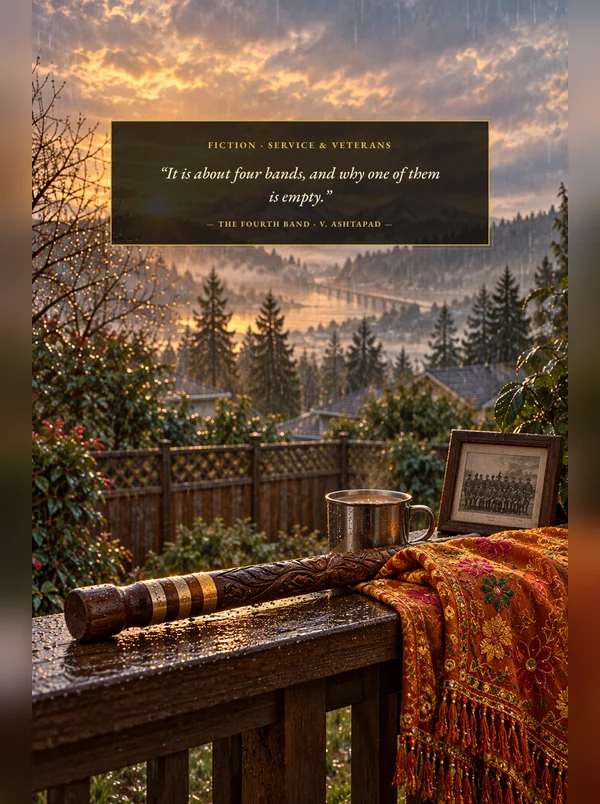
The morning after Lohri, with the rain coming down on a backyard in Surrey, British Columbia, eighty-four-year-old Gurmeet Kaur Bains puts a carved shisham stick into her granddaughter's hands and says one word: stand. Seerat is eighteen, suspended from field hockey for swinging her stick in anger, and she has never asked her grandmother about anything. Biji taught gatka, the old Punjabi art of the stick, to village girls for twenty-eight years. Now she teaches it at first light, one lesson at a time, and between the lessons she tells the family's service: her own grandfather, holding the pencil for the signallers on the Samana ridge the day Saragarhi fell, a soldier who carried his dying friend's letter twenty miles across Malwa in May, a husband deafened at a canal in 1965, and a son who still takes the first ferry to Nanaimo every February. Three wars are carved into the stick in Seerat's hands. A fourth band is cut, clean and blank. Over one year, from a roof in Hoshiarpur district to a blueberry farm on the Sumas Prairie, Seerat learns why, and what it will take to keep it that way.
Members can react to this book and talk about it in the members' Library.