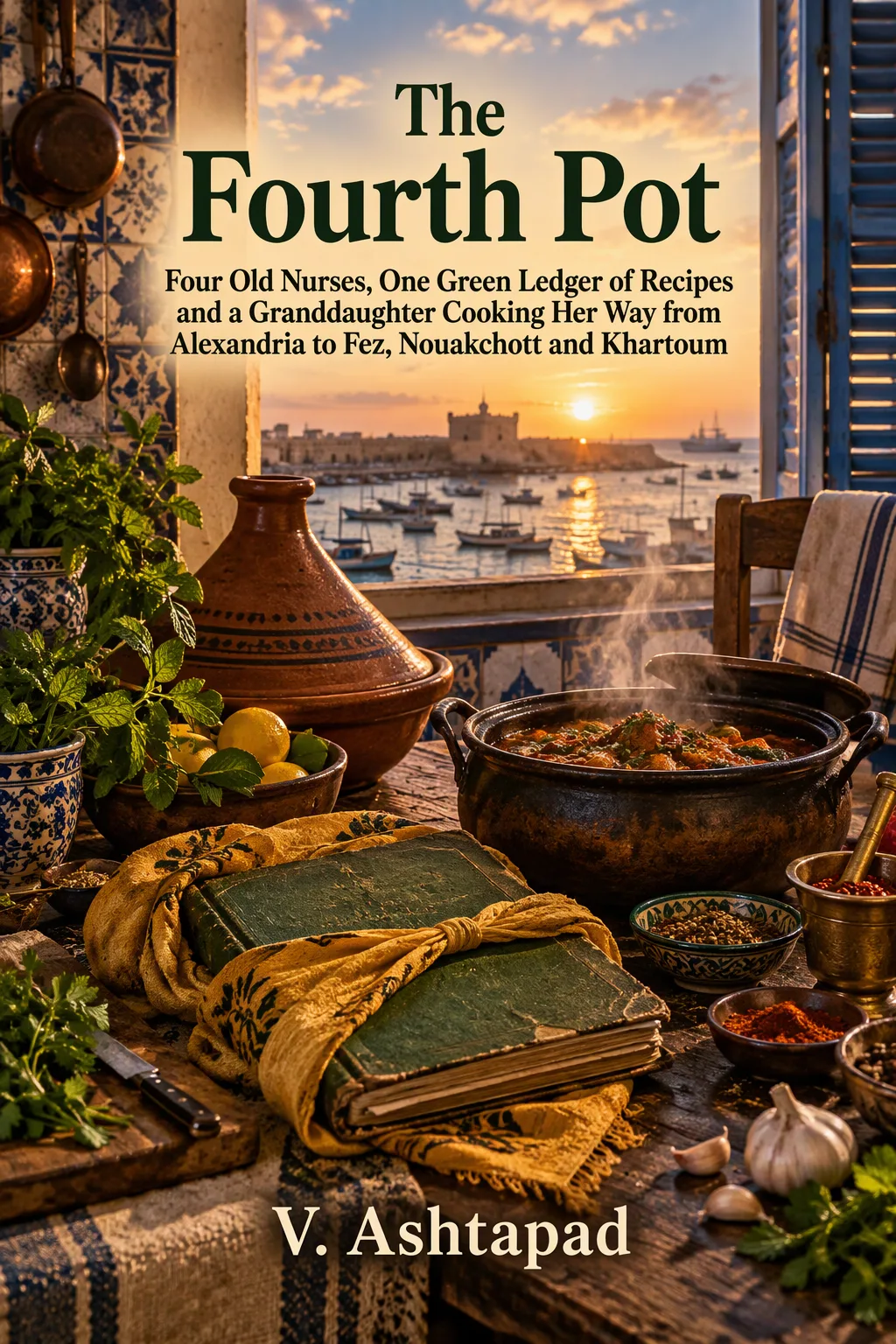
The Fourth Pot
Four Old Nurses, One Green Ledger of Recipes and a Granddaughter Cooking Her Way from Alexandria to Fez, Nouakchott and Khartoum
by V. Ashtapad
Foreword
This is a work of fiction. The sayadeya of Alexandria, the bastila and preserved lemons of Fez, the fish and rice and three-round tea of Nouakchott, and the kisra and peanut dakwa of Khartoum are real, as are the kitchens, markets and fishing beaches that keep them. Villa Nasra, the nursing school, the shop on the lane in Anfushi and everyone in this book are invented.
For the ones who can no longer lift the spoon, and still know exactly what is wrong with the soup.
Sayadeya, the Fisherman's Rice
*From the Book. In Zeinab's hand, Villa Nasra, Camp Caesar, Alexandria, winter 1958.*
SAYADEYA, THE FISHERMAN'S RICE
For four hungry girls, or six polite ones
Two large onions, sliced as thin as a fingernail.
Oil, enough to swim them.
One kilo of white fish with the heads (ask for the heads, the fishmonger will try to keep them for his own pot).
Two cups of short rice, washed until the water runs clear.
Cumin, a spoon. Salt. A bay leaf if Madame is not looking.
One tomato, one clove of garlic, one small green chili.
Fry the onions in the oil slowly, then less slowly, until they are darker than you think is wise. Not black. The color of a fisherman's arm in August. The oil will turn red-brown. This is the whole secret, and my mother hit my hand with a spoon three times before I learned it. Take out half the onions for the top.
Boil the fish heads and the bones in water with the cumin, the garlic, the tomato and the chili. Strain it. This is the broth. Fry the rice in the onion oil until every grain is shiny, then pour on the broth, a finger's width above the rice. Cover it and leave it alone. Leave it alone. Do not lift the lid to look. A rice that is looked at sulks.
Fry the fish in flour and cumin and put it on top at the end, with the onions you saved.
*In the margin, in a second hand, small and slanting: Zeinab says "darker than you think is wise" because she burned the first pot. I was there. A.O.*
---
The call came at eleven forty in the morning, which was the worst possible time, because at eleven forty in the morning in the kitchen of the Hotel Pharos the lunch buffet was twenty minutes from opening and Nour Yasir Babiker had her hands inside a tray of two hundred stuffed vine leaves.
Her phone was in the pocket of her apron. It buzzed against her hip four times, stopped, and buzzed again. She ignored it the first time because she ignored everything at eleven forty. She ignored it the second time because Chef Magdy was standing at the pass with his reading glasses on his forehead, watching the clock above the dish station as if the clock owed him money.
The third time, she wiped her hands on a towel and took it out, and saw her mother's name, and something cold went through her from the top of her head to her shoes.
"Mama."
"Your grandmother fell," Hala said. Her voice was very steady, which meant it was very bad. "In the kitchen. Umm Sayed found her on the floor. We're at the Medical Center on Port Said Street. They think it's the hip."
"I'm coming."
"Finish your shift. There's nothing you can do here except sit."
"I'm coming," Nour said again, and untied her apron.
Chef Magdy watched her walk the length of the kitchen. He did not say anything until she reached the pass, and then he took the glasses off his forehead and folded them, which was his way of saying that he was about to be reasonable.
"Twenty minutes," he said.
"My grandmother broke her hip."
He looked at her for a long moment. He was fifty-six and had a rule that nobody left before service, and she had never once seen him break it.
"Go," he said. "Rami will do your leaves. They'll be ugly. Go."
---
The taxi driver took the Corniche because he took the Corniche whatever you said to him. Nour did not see the sea. She saw her grandmother's kitchen in Anfushi: the narrow window over the sink, the blue enamel kettle, the gas bottle under the counter with the rubber hose that Nour had told her to replace two years ago. She saw the floor, which was old tile, cream and rust in a pattern of little diamonds, and slippery when wet.
Zeinab Hassan Salem was seventy-eight. She had been a nurse for thirty-four years, a ward sister for twenty of them, and she was not a woman who fell down. She was a woman who told other people how not to fall down.
At the hospital her mother was in a plastic chair in a corridor that smelled of floor cleaner and oranges, with her handbag on her lap and her shoes off. Hala was fifty-two, a teacher of geography at a girls' secondary school in Smouha, and she took her shoes off whenever she was frightened, as if she needed to feel the floor.
"She was frying onions," Hala said, before Nour had even sat down. "For sayadeya. On a Thursday, by herself, for nobody. The pan was still on the gas when Umm Sayed came in. The onions were black. The whole stairwell smelled of it, that's how Umm Sayed knew to come up."
"Is she awake?"
"She's awake. She's furious. She's been telling the young doctor how to read his own X-ray."
Nour laughed, and was ashamed of laughing, and then her mother laughed too, and they sat in the corridor with their shoulders touching until a nurse in a pale green scarf came out and said they could go in one at a time.
"You go," said Hala. "She asked for you."
---
Her grandmother was very small in the hospital bed. That was the first thing. At home, in her chair by the window, with her reading glasses on a cord and the radio murmuring about the sea, Zeinab took up the room the way a lighthouse takes up a coastline. Here she was a gray head on a white pillow, with a needle taped into the back of one hand and a sheet tucked under her arms.
The second thing was that her eyes were open and perfectly sharp.
"You came in your kitchen shoes," she said.
Nour looked down. She was still wearing the black rubber clogs she wore on the line, splashed with vine-leaf brine.
"I came fast."
"Fast. Yes. That's you." Zeinab closed her eyes and opened them again. "Sit. Not on the bed. You'll move my leg."
Nour sat. Her grandmother's hand, the one without the needle, came out from under the sheet, and Nour held it. It was dry and very warm and the knuckles were swollen in the way she had known all her life, but the grip was the same as ever. It was a nurse's grip. It told you to be quiet.
"They'll operate tomorrow," said Zeinab. "A pin, a plate, I don't know what they'll put in. The young one says I'll walk again in two months. He says it like a child saying he'll be an astronaut."
"You'll walk, Teta."
"I'll walk," said Zeinab. "I didn't say I wouldn't. I said he said it like a child." She was quiet a little while. Through the window behind her, Nour could see the top of a palm and a strip of sky and a crane at the port, moving very slowly. "I want you to do something for me."
"Anything."
"Don't say anything until you hear it. That's your trouble too."
Nour waited.
"In my kitchen," said Zeinab, "in the cupboard over the fridge, behind the box of photographs and the tin of old buttons, there's a book wrapped in a yellow cloth. Bring it to me. Tonight, if they let you. Tomorrow before they take me down, if they don't."
"Your recipe book?"
"It isn't my recipe book," said Zeinab, and her eyes were so fierce that Nour, who was thirty years old and a sous-chef at the biggest hotel on the eastern Corniche, felt about nine. "It never was. That's the point. Bring it."
---
She took a microbus to Anfushi, and when she climbed down at the corner by the fish auction she could smell the sea and the fried fish from the stalls and, under it, when she reached the stairwell of her grandmother's building, the bitter ghost of burned onions.
Umm Sayed was on the second-floor landing with her door open, as if she had been waiting. She was a heavy woman in a flowered housedress, the widow of a ship's carpenter, and she and Zeinab had lived one floor apart for forty-one years and quarreled about the stairwell light for most of them.
"I scrubbed the pan," she said. "Twice. I opened all the windows. The cat from the roof came down to see, the shameless thing. How is she?"
"Awake. Giving orders."
"Thank God," said Umm Sayed, and pressed a key into Nour's hand that Nour already had a copy of. "Take this anyway. I'll make you something. You haven't eaten. Your face is green."
The flat was very quiet. Nour stood in the doorway of the kitchen and looked at the floor. There was no sign of anything, except that the chair by the little table was pulled out at an angle, and the window over the sink was wide open, and the blue kettle had been moved from the back of the stove to the counter. The black frying pan, scrubbed twice, was upside down in the rack, and when she touched it, it was still faintly warm from the hot water.
She pulled the chair to the fridge and climbed up.
The cupboard over the fridge was the cupboard of things that had nowhere else to go. There was a shoebox of photographs held shut with a rubber band. There was the button tin, which rattled like a tambourine when she lifted it. And at the very back, lying flat, a thick shape in a yellow cloth.
It was heavier than she expected. She had to brace it against her chest to climb down.
She sat at the little table and unwrapped it.
It was a ledger. The old kind, the kind a merchant would have kept accounts in, a hand's width thick, bound in dark green cloth worn white at the corners, the spine reinforced at some point with brown tape and then, later, with a strip of what looked like the leather from an old handbag sewn on with heavy thread. There was nothing printed on the cover. Somebody, long ago, had written on a small paper label on the front, in fading blue ink: THE BOOK. Under that, in four different hands, four sets of initials. Z.H. K.B. M.A. A.O.
She opened it.
The pages were ruled in faint red and blue for columns of figures, and nobody had paid the columns any attention. Recipes ran across them from edge to edge. The first three pages were in a hand she did not know at all, an old, upright, looping hand with long tails on the letters, recipes for fish soup and quince jam and something called Monday Bread, with no name signed. Then the handwriting changed, and went on changing. Her grandmother's, which she knew from twenty years of birthday cards: square and firm, pressed hard into the paper. A neat, small, rounded one, very regular, with little drawings in the margins of a teapot, a lemon, a pigeon. A tall, quick, leaning hand that wrote in a hurry and crossed things out. And the small slanting one that had teased her grandmother about the burned onions.
There were pages glued in. Envelopes taped in, with stamps from Morocco and Sudan and Mauritania, the ink on the postmarks gone brown. A photograph slipped between two pages, black and white, of four young women in white uniforms and white caps standing on the steps of a villa with tall shuttered windows, squinting at the sun.
On the inside of the front cover, in her grandmother's firm hand: Villa Nasra, Camp Caesar. Begun October 1957. Four girls, one kitchen, one stove with three burners. Everything we know.
Umm Sayed came in with a plate of white cheese and tomato and a heel of bread, and stopped when she saw the open book.
"Ah," she said. "So she sent you for that."
"You know it?"
"Everybody in this building knows it. I asked her once could I copy her molokhia and she gave me such a look." Umm Sayed set the plate down on the very edge of the table, as far from the ledger as possible, as if the ledger might object to cheese. "Eat. Then go. She'll be lying there worrying that you've spilled something on it."
© 2026 CRUNOD LLC. All rights reserved.
Molokhia and the Gasp
*From the Book. In Zeinab's hand, Villa Nasra, January 1958. Amna's version is on the next page and it is wrong.*
MOLOKHIA WITH CHICKEN
For a cold night when someone is homesick
One chicken, cut in pieces, or the back and wings if it is the end of the month.
An onion, two cardamom pods, a bay leaf, salt.
One kilo of fresh molokhia leaves, picked off the stems, washed and dried on a cloth, then chopped with the mezzaluna until it is fine as wet grass. (Frozen is a crime. Dried is for travelers.)
For the taqleya: eight cloves of garlic, crushed; a handful of dry coriander, ground; a spoon of samna.
Boil the chicken with the onion, cardamom and bay leaf. Skim it. Take out the chicken to roast or fry, keep the broth. Bring the broth back to a boil and stir in the molokhia. It will turn bright green and thicken. Do not boil it hard after this or it falls to the bottom of the pot like a sad man.
In a small pan, fry the garlic in the samna until it is golden, add the coriander, and when it smells like your mother's kitchen, pour it into the molokhia. It will hiss. When it hisses, you must gasp. Out loud. My grandmother said that if you do not gasp, the molokhia will not be good. Khadija thinks this is ridiculous. Khadija's molokhia has never once been good.
*Under it, in the neat rounded hand: I gasped, Zeinab. You were in the bathroom. K.*
---
They operated on Friday morning and put in a pin and a plate, and Zeinab came up from the theater gray and nauseous and insulting, and by Saturday evening she was asking for the Book.
Nour had brought it in a cloth bag and kept it on her lap through the long day of waiting. Now she set it on the bed table, on top of the yellow cloth, and her grandmother looked at it for a while without touching it.
"Did you read it?"
"Some of it. Last night."
"All night, from your eyes."
"Most of the night."
Zeinab nodded as if this were a satisfactory answer to an examination question. "Then you've seen."
"I've seen four hands."
"Four girls," said Zeinab. "Four homes. Me from here, from Anfushi, a fisherman's daughter who wanted to wear a white cap. Khadija Bennani from Fez, who came on a scholarship and cried for a month because the bread was wrong. Mariem mint Ahmed, whose father traded gum arabic and dates out of a warehouse near the port, born in the desert and raised half here and half nowhere. And Amna Osman from Omdurman, who was the oldest of us and the cleverest and who had come down the Nile and then up the sea and never once let anybody see her homesick." She paused. "You know this. Your father is Amna's son. You've heard all of it."
"I've heard it in pieces. Not like this."
"Nothing is like this." Zeinab lifted her free hand and laid it flat on the green cloth cover. "Villa Nasra was a hostel for the girls of the Ramleh School of Nursing who had no family in the city. Sixteen girls. One kitchen. One old stove with three burners. Four of us couldn't stand the hostel food, so we cooked our own, every night, and there were always four of us and only three burners, so one always waited. You can imagine the fights."
Nour could imagine them very well.
"The one who waited would stand by the stove and tell the others what they were doing wrong. That's how it started. Khadija would stand there telling me my onions were burning. I'd stand there telling Amna her stew needed salt. Mariem would stand there saying nothing, which was worse. And after a few weeks we started writing it down, so that the next time the one who was waiting could cook it properly instead of complaining."
"Where did the ledger come from?"
"A stationer on Fouad Street. Secondhand. It already had some pages in it, the first three, somebody's old recipes, we never knew whose. We thought it was lucky." She took her hand off the cover. "Two years we wrote in it. Then we finished, and everybody went home. Khadija to Fez. Mariem to the new capital they were building in the sand. Amna to Khartoum. And I stayed here, and I kept it."
"For fifty-six years."
"For fifty-six years. Every time they wrote, I put the letter in it. When your father was a student at the marine college and Amna wrote to me, feed my son, he eats nothing but bread and tea, I fed him on Fridays from this book until he married my daughter just to keep eating." Her mouth moved, not quite a smile. "Turn to the back. After the jams. There's a page with nothing on it but a title."
Nour turned. Past the jams, past a recipe in Amna's slanting hand for something called gurasa with three exclamation marks after it, past a long letter from Fez folded in quarters and glued along one edge, there was a page that had been ruled and dated and left empty.
At the top, in her grandmother's hand: THE FOURTH POT. June 1959.
Under that, in the four corners of the page, four sets of initials, each in its own ink. Nothing else.
"What is it?"
"It was a dish we made together. Once. The week we finished at the school." Zeinab's voice had gone flat and tired. "One pot, from four kitchens. It was the best thing any of us ever cooked. We each said we would write it down. Each of us thought one of the others had. When I found out none of us had, it was the autumn, and they were all gone, and I tried, and I could only remember my part."
"What was your part?"
"The onions. The broth. The rice." Her grandmother's eyes were closed now. "The rest is in three other heads. Two of those heads are older than mine. One of them is going soft. Khadija's hands shake so she can't hold a cup. Mariem can't see the page any more. Amna..." She stopped. "Your father won't say it, but Hassan writes to me. Amna asks for her mother. Her mother has been gone forty years."
"I want it written," said Zeinab. "Before there's nobody left who stood at that stove. I want you to take the Book to them. Not post it. Carry it. Cook with each of them. Every recipe of theirs you can. And get the rest of the Fourth Pot out of their heads and onto that page."
"Teta. I have a job."
"You have a job," her grandmother agreed. "You have a job in a kitchen where the food is weighed on a scale and photographed for the brochures and eaten by people who don't know what country they're in. I've eaten your food at that hotel. It's very clean."
Nour flushed. "That's not fair."
"It isn't fair. I'm seventy-eight with a plate in my hip. I don't have to be fair." She opened her eyes. "Six weeks. Fez, then Nouakchott, then Khartoum. Your father will pay for the tickets; he owes me for twenty years of Fridays. And when you come home you can tell me I was a foolish old woman and go back to your clean food."
---
Zeinab came home on the Saturday after the operation, in an ambulance, with a walking frame that she hated and a list of exercises from a physiotherapist named Adel whom she liked very much because he did not talk to her as though she were stupid.
The first night Nour slept on the sofa in the sitting room and listened. Her grandmother called once, at two, because she needed the bedpan, and once at four, because she had heard a cat on the roof and wanted to know what it was doing. At six she called to say that she was awake and that Nour might as well be too.
Nour had nursed nobody in her life. She did not know how to lift a small, furious woman from a bed to a chair without hurting either of them, and the first time she tried, her grandmother said, quite calmly, "Stop. Put me down. You're going to break the other one."
"I'm sorry."
"Don't be sorry. Be correct." Zeinab pointed with one finger. "Bend your knees, not your back. Lock the wheels on the chair. You lock the wheels first, always, before anything, or the chair goes one way and the patient goes the other. Put your arm here, under mine, not around my waist. I'm not your dance partner. On three. You count. Out loud."
"One, two, three."
They moved. The chair stayed. Her grandmother landed in it with a small grunt and sat there breathing.
"Good," she said. "Thirty-four years I taught girls to do that. You're no worse than most."
---
On the Monday, Hala came after school with a bag of fresh molokhia from the vegetable seller on Ras el-Tin Street, still on the stems, and Zeinab said from her chair that if she was going to sit in her own kitchen like a guest she might as well be a useful guest.
"Pick," she said. "Just the leaves. Not the stalks. The stalks are for goats."
Nour and her mother sat at the little table and picked. It took a long time. The leaves were soft and dark and slightly sticky, and they smelled green and a little like hay, and the pile on the newspaper grew slowly while the pile of stalks grew fast.
When the leaves were dry, Zeinab had Nour bring her the mezzaluna, the curved double-handled blade that had lived in the same drawer since before Hala was born, and she rocked it over the board on her lap, slowly, for nearly a minute, while they watched. Then she gave it back.
"You," she said. "I'll tell you when."
Nour rocked. Her wrists were fast and strong from years of brunoise and chiffonade and she reduced the first pile to a dark green paste in no time at all, and her grandmother said, "Too fine. You've bruised it. Now it'll be slimy. Do the next pile slower, and listen to it."
"Listen to it?"
"It makes a sound when it's right. Like rain on the window. When it starts to sound like walking in mud, stop."
Nour did the next pile slower and, absurdly, listened. And there was a sound, a soft, crisp, rapid ticking as the blade went through the leaves, and when she had gone over it four or five times the sound did change, it grew wetter and duller, and she stopped. Her grandmother leaned over and looked and said nothing, which, from her, was praise.
They made the broth with the chicken. They made the taqleya in the small pan, the garlic going golden in the samna and the coriander going in and the whole kitchen filling with a smell that went straight to the back of Nour's throat, to her childhood, to Fridays at this table with her father loosening his belt. She lifted the pan.
"Now," said her grandmother.
Nour poured. The taqleya hit the green and hissed like a cat.
There was a silence.
"Well?" said Zeinab.
Nour looked at her mother. Hala was pressing her lips together hard.
"You're joking," said Nour.
"It won't be good," said her grandmother, quite seriously. "You heard me. It's in the Book."
So Nour Yasir Babiker, sous-chef of the Hotel Pharos, thirty years old, gasped out loud over a pot of molokhia in her grandmother's kitchen in Anfushi, and her mother laughed until she had to put her head down on the table among the stalks, and her grandmother sat in her wheelchair with her bad leg straight out on a stool and wiped her eyes with the back of her wrist and said, "There. Now it will be good."
It was.
---
That night Nour called Chef Magdy.
She had rehearsed it on the balcony, and when he answered she forgot all of it and said simply, "I need six weeks. Unpaid."
He did not answer at once. She could hear the kitchen behind him, the clatter of the dish station and someone shouting for more lemons.
"Six weeks is a long time," he said.
"I know."
"Rami wants your job. He's been waiting two years."
"I know that too."
Another silence. "Is it your grandmother?"
"It's my grandmother," said Nour. "And three other grandmothers. It's complicated."
"It always is," said Chef Magdy, and she heard him fold his glasses. "Six weeks. Not seven. On the seventh I give your locker to Rami, and I don't give it back."
© 2026 CRUNOD LLC. All rights reserved.
Feteer for a Long Road
*From the Book. In Zeinab's hand, 1958, with a later note in the same hand, 1981.*
FETEER MESHALTET
For somebody going away
Four cups of flour. A spoon of salt. Warm water, enough to make a dough as soft as an earlobe.
Samna, a great deal of it, melted. Do not count.
Knead the dough for as long as it takes to tell a long story. Divide it into four balls and let them rest under a damp cloth while you tell another. Oil the table. Take one ball and stretch it with your fingers, from the middle out, until it is so thin you can read a newspaper through it. Do not tear it. If you tear it, do not cry; patch it and say nothing.
Brush it all over with samna. Fold it like a letter, in thirds one way and thirds the other. Stretch the next ball, wrap the folded one inside it, brush, fold again. Go on until you have one fat square parcel. Bake it in the hottest oven you have until it is gold and puffed and shatters when you tap it.
Eat it with honey and cream, or with old cheese and molasses. Wrap the rest in a cloth for the road. It keeps three days. It keeps longer if the traveler is shy.
*1981: Made this for Yasir when he went home for the summer. He ate the whole thing on the train before Tanta. Amna wrote to complain. Z.*
---
Her father drove her to the old shop on the Thursday before she left.
Yasir Babiker was fifty-four, a big, slow-moving, soft-voiced man who had come down from Khartoum at nineteen to study marine engineering at the college in Abu Qir and had spent his working life in the engine rooms of cargo ships and then in a dusty office at the port, signing off other men's engine rooms. He had retired early, last spring, after his heart had given a warning that he still did not like to discuss. He drove the way he did everything, carefully and with long pauses.
"Your grandmother," he said, somewhere around the Unknown Soldier, "has asked me to tell you three things about my mother."
"Teta told you to tell me?"
"Teta tells everybody everything." He was quiet for a while. "The first thing is that my mother may not know you. She may know you one hour and not the next. Don't take it personally. Hassan says she called him by my father's name all of August."
"All right."
"The second thing is that she was the best nurse in Khartoum for thirty years and the best teacher of nurses for fifteen more, and she will still try to take your pulse when you sit down next to her. Let her." He signaled, very slowly, and turned into the lanes of Anfushi. "The third thing is that I haven't been home in four years."
Nour looked at him.
"Teta didn't tell you to tell me that."
"No," said her father. "I'm telling you that."
---
The shop was on a lane two streets back from the fish auction, between a man who repaired fishing nets and a café with green plastic chairs where old men played dominoes from morning to night. It had been her grandfather's for forty years: SALEM FRESH FISH, in faded red letters on a white board, and under that, smaller, FRIED TO ORDER. Kamal Salem had died in the winter of 2009, at seventy-five, behind his own counter, between one customer and the next, and nobody had opened it since.
Her father had the key on a ring with twenty others. The metal shutter screamed when he hauled it up, and the café men looked up from their dominoes and one of them raised his glass of tea.
"Babiker! Opening up at last?"
"Not me," said Yasir. "I can't fry an egg."
Inside, the shop was dim and smelled of dust and old salt and, very faintly, of fish, as if the walls had soaked it up for forty years and were letting it go one molecule at a time. The long tiled counter was still there, white with a blue border. The two deep fryers were still there under sheets of plastic. On the back wall was a shelf where her grandfather had kept the flour and cumin, and a hook where his apron had hung, and a calendar from a marine paint company, still on February 2009, showing a picture of a tanker at sunset.
"Your grandmother pays the rent on it," said her father. "Every month. Six years. She says she's thinking."
Nour walked the length of the counter and back. It was eight steps. She stood behind it where her grandfather had stood and looked out at the lane, at the net-mender with his wooden needle, at a gray cat sitting on a fish crate as if it owned the city.
"What's she thinking about?"
Her father took a long time to answer.
"I think," he said finally, "she's thinking about you."
---
On the Friday, the last full day, her grandmother taught her the feteer.
It was the one recipe she could not do sitting down, and she was furious about it. The dough had to be stretched on the big table in the sitting room, and stretching it needed two hands and a standing body leaning over it. Zeinab had been stretching feteer on that table since 1961. She sat in her wheelchair at the end of it with her leg up on the stool and watched Nour knead the dough with the expression of a woman watching her house burn.
"Softer."
"It's soft."
"Softer than that. Like the inside of your arm."
Nour added a little more water. She knew dough. She had never once stretched pastry by hand.
She took the first ball and pressed it flat on the oiled table and began to pull it from the middle with her fingertips. It tore at once.
"Don't cry," said her grandmother.
"I'm not crying."
"Patch it and say nothing."
Nour patched it and said nothing. She pulled again, more slowly, and it held, and grew, and thinned, until she could see the grain of the old wooden table through it, and then it tore again near the edge.
"Your fingers are in the dough," said her grandmother. "Take them out. Put them under. Use the backs of your hands." She held up her own two hands, knuckles up, fingers curled loosely under, and made a slow, opening gesture in the air, like a woman showing the size of a fish. "Under. Lift. Let it fall open. It wants to be thin. You don't have to make it. You have to let it."
Nour put her hands under the dough. It lay across her knuckles like a wet silk scarf. She lifted and opened them, slowly, and the dough slid outward over the table on its own weight, thinning as it went, and did not tear.
"There," said Zeinab.
"How did you know that?"
"My mother."
"No. I mean how did you know that's what I was doing wrong? You can't see my fingers from there."
Her grandmother looked at her as if the question were extraordinary.
"Because it's what I did wrong," she said. "In 1952. At my mother's table, with my mother sitting where I'm sitting."
They brushed and folded and stretched and wrapped until there was one fat parcel of dough on the tray, heavy with samna, and Nour took it to the oven in the kitchen. She came back and sat down at the table across from her grandmother, and found that she was trembling slightly, the way she trembled after a three-hundred-cover night.
"It's the first thing in the Book I've cooked with you," she said, "where you didn't put your hands on it once."
"Yes," said Zeinab. "Well. That's what they're for now, these hands. Pointing."
"That's not true."
"It's partly true." She shifted her leg on the stool and winced. "When I was your age I thought the cook was whoever had the spoon. And then I had an old woman in front of me who couldn't lift a spoon at all, and she was still the cook. The best one in the room." She stopped. "That's a story for another day."
"Who was she?"
"Another day," said her grandmother, and turned her face toward the kitchen, where the smell of the feteer was beginning to come through the door, butter and hot wheat, the smell of every journey anyone in this family had ever taken.
---
The feteer came out gold and puffed and shattered when you tapped it. Nour wrapped half of it in a clean cloth and put it in the top of her bag, on top of the Book in its yellow cloth, on top of her knives in their roll and her two white jackets and the clothes she had packed and unpacked three times.
At six the next morning her father drove her to the airport at Borg el-Arab, past the lake and the salt pans, with her mother in the back holding Nour's hand across the seat.
At the curb her father took the bag out of the trunk, and set it down, and then did not let go of the handle.
"Tell her," he said. "My mother. Tell her I'm coming. Before winter."
"You tell her, Baba. Call her."
"I call," he said. "Every Friday. She asks Hassan who I am." He let go of the bag. "Tell her in person. With your face. She may know your face. You have hers."
Nour hugged him, and then her mother, and then went through the doors without looking back, because if she looked back she would not go.
On the plane she unwrapped the feteer and ate a piece, very slowly, and then another, and by the time the mountains of Morocco came up under the wing she had eaten nearly all of it, and she understood exactly how her father had felt on the train to Tanta in 1981.
© 2026 CRUNOD LLC. All rights reserved.
Tea from a Sugar Cone
*From the Book. In Khadija's hand, Villa Nasra, November 1957. The teapot drawn in the margin is a good likeness.*
MINT TEA THE WAY IT IS MADE AT HOME
For anybody who comes in the door
A teapot of metal, never of clay or glass. Fill a glass with boiling water and leave it by the pot.
Green tea, the rolled kind like little pellets of shot. A spoon heaped, or two if the guest has traveled far.
Sugar, broken from the cone with the small hammer. In Egypt there is no cone, only this sand in a paper bag. We will manage.
A great fistful of fresh mint, the stems on.
Put the tea in the pot. Pour in a little of the boiling water, swirl it, and pour it away into the glass. This first water is bitter and it wakes the tea; it is not for drinking. Pour in a second little water, swirl, and keep this one aside in a clean glass: this is the spirit of the tea. Throw away the bitterness, keep the spirit.
Now put back the spirit, add the sugar and the mint, push the mint down, fill the pot with boiling water and set it on the flame until it begins to murmur. Pour one glass from as high as your arm will go, and pour it back into the pot. Do this three times. When you pour the last glass and it wears a white turban of foam, the tea is ready.
Zeinab says this is too much trouble for a drink. Zeinab drinks black tea from a glass with the bag still in it, like a soldier.
*Under it, in Zeinab's square hand: I have reformed. Partly. Z.*
---
The man who met her at the station in Fez was not the man she had expected.
She had expected Driss Bennani, Khadija's son, who had written to her grandmother in careful, formal letters for thirty years and whom Nour pictured, from the letters, as an elderly gentleman in a gray suit. Instead there was a tall young man in a dusty blue work shirt with the sleeves rolled up, who had a scrap of cardboard with BABIKER on it in black marker and who held it upside down until she pointed at it.
"Ah," he said, and turned it round. "I'm Yassine. The grandson." He looked at her bag, and then at the cloth bundle she was holding against her chest. "Is that it? The famous book?"
"That's it."
"May I?"
She hesitated, and then held it out, and he took it in both hands the way one takes a sleeping baby. His hands were broad and scarred across the knuckles and darkened in the creases with something that looked like soot and turned out, later, to be copper.
"Heavy," he said, with respect, and gave it back. "My grandmother talks about this book like a lost relative. Come. The taxi can only go as far as the gate. After that we walk."
---
They walked.
Nour had grown up in a city of streets. Alexandria had lanes, too, in the old quarters, narrow ones, but they went somewhere, they ran down to the sea, and you could always lift your head and see the sky and know which way the water was. The old city of Fez swallowed her inside thirty steps. They came through a tall gate faced with blue and green tile, and the lane beyond it sloped down and turned and turned again and narrowed and widened and went under arches and between walls so high that the sky was a ribbon of evening blue far overhead. A boy drove a donkey loaded with crates. There were smells of cedar shavings and mint and frying dough and leather.
She stopped where the lane opened suddenly into a small irregular square, and the sound hit her before she understood what it was: a ringing, many-voiced, many-rhythmed clatter, hammers on metal, dozens of them, close and far, like rain on a tin roof if the rain had been taught to sing. All around the edges of the little square, in open-fronted workshops no bigger than cupboards, men and boys sat cross-legged or crouched over enormous copper basins and pots and trays and beat them with small hammers, turning them on their knees, and the copper gleamed red and gold in the last of the light.
"This is mine," said Yassine, and pointed to one of the cupboards, where an old man in a knitted cap was hammering the lip of a cauldron so large he could have sat in it. "My master. Eleven years. And that's my bench, there, with nobody on it, because I'm carrying your bag."
---
The house was behind a plain wooden door in a lane so narrow she could touch both walls at once. The door opened into a short dark passage that turned a corner, and then, without warning, into light.
It was a courtyard, open to the sky, two floors high, with a gallery running around the upper floor on carved cedar posts. The floor was tiled from wall to wall in a pattern of interlocking stars, green and white and honey-yellow and a deep rust-red, so intricate that her eye could not hold it; it kept sliding from one star into the next. A little fountain in the middle had no water in it and a pot of geraniums instead. In the far corner, under the gallery, on a low cushioned bench against the wall, sat a small woman in a pale green robe with a white scarf over her hair, very upright, with both hands folded in her lap.
The hands were shaking. Not much. A steady fine tremor, like a leaf in a breeze, that did not stop.
"So," said Khadija Bennani. "This is Zeinab's girl."
"Yes, Lalla."
"Come here. Let me look at you. My eyes are good, it's only the rest of me that's coming apart." She looked Nour up and down, slowly, from her travel-creased shirt to her sneakers to her face. "You have Amna's chin. And Zeinab's way of standing, like a policeman. God help you. Sit."
Nour sat on the bench beside her. Up close, Khadija smelled of orange-flower water and something medicinal. Her face was narrow and finely lined, and her eyes, very dark, were full of a dry amusement that seemed to be waiting for a reason.
"You brought it?"
Nour put the bundle on her lap and unwrapped the yellow cloth.
Khadija looked at the green cover for a long time without touching it, exactly as Zeinab had done in the hospital. Then she lifted one shaking hand and laid it flat on the cover, and the shaking, Nour noticed, eased a little when the hand had something to rest on.
"Fifty-six years," said Khadija. "She never once let me take it home. Not once. She said it would be lost in the post or eaten by goats." She drew her hand back. "Is she very bad?"
"She's healing. She's angry."
"Good. Angry is healing." Khadija turned her head toward the arch that led into the house. "Latifa! The girl has come all the way from the sea and nobody has given her tea!"
"I'm making it!" called a voice from inside. "I've been making it since the door opened!"
"She's making it," said Khadija to Nour, in a lower voice. "She makes it very well. She learned it from me. But I'll tell you a secret." She leaned closer. "It's not the same. Thirty-two years she's been making my tea in my house, and it's very good, and it's not the same, and I can't tell her why, because I don't know why. My hands knew why." She held them up in the evening light, both of them, trembling steadily. "And now my hands are busy with this dance of theirs and they won't tell me."
---
Latifa came out with the tray: a round engraved tray, a silver teapot with a curved spout, six small gold-painted glasses, a bundle of mint and a little brass box. She was a strong, cheerful woman of fifty, Driss's wife, with flour on one forearm, and she set the tray down on a low table in front of the bench and took Nour's face in both hands and kissed her on each cheek several times.
"Welcome, welcome. You must be dead. Is the room all right? Did Yassine take you through the leather market? I told him not to take you through the leather market, the smell, on a first day."
"He didn't."
"Good boy." Latifa sat on a cushion by the tray and opened the brass box. Inside was a white cone of sugar, as big as a man's fist, and a little brass hammer. She set the cone on the tray and tapped it, briskly, and knocked off three rough white lumps.
Khadija watched.
Latifa rinsed the tea and threw away the first water and kept the second. She packed the mint into the pot, stems and all, and put in the sugar and the tea's spirit and filled it with water from a kettle on a brazier, and set it on the coals. Then, when it murmured, she lifted it, high, higher, until her arm was nearly straight above her head, and poured a long thin amber thread down into a glass from what seemed an impossible distance, without spilling any, and the tea crashed into the glass and foamed.
She poured it back. Three times. The fourth glass came up with a thick white collar of foam on it, and she set it in front of Nour.
"There," she said.
Nour drank. It was hot and very sweet and green and sharp with mint, and it went down her throat like a blessing after the long day. She looked over the rim of the glass at Khadija, who was watching her drink with an expression Nour could not read at all.
"It's wonderful," said Nour.
"Yes," said Khadija. "It is." She was silent a moment. "Latifa. Tomorrow, let the girl try. I'll tell her what my hands used to do. She can be my hands. We'll see if it comes back."
Latifa looked at her mother-in-law, and something went across her broad cheerful face, a small, private, complicated flicker that might have been hurt or might have been relief, and then it was gone.
"Of course, Mama," she said. "Tomorrow."
Above them, the ribbon of sky over the courtyard had gone from blue to a deep violet, and somewhere out across the city, faint and then stronger, the hammers of the coppersmiths fell silent one by one for the night.
© 2026 CRUNOD LLC. All rights reserved.
Lemons in Salt
*From the Book. In Khadija's hand, February 1958. A drawing of a lemon, cut in a cross, in the margin.*
LEMONS KEPT IN SALT
For next season, and the one after
Small lemons with thin skins, the kind that smell when you scratch them. As many as will fit in your jar, and two more.
Coarse salt. A great deal. A spoon per lemon and a spoon for the jar.
More lemons for juice.
A clean jar with a good lid. Not a jar that held pickles; the lemons will remember.
Wash the lemons. Cut each one from the top down into four, as if you were opening a flower, but stop before the bottom so it holds together. Open it and pack it full of salt. Close it up.
Put a spoon of salt in the jar. Push the lemons in, one by one, pressing hard, so the juice comes out of them. Press until it hurts your hand. When the jar is full, squeeze the other lemons over the top until the juice covers everything. Close the lid. Put it in the dark. Turn the jar over once a day for the first week, and say good morning to it.
In one month the skins are soft. In three months they are ready. Use only the skin, rinsed, cut thin; the skin is the treasure. Throw the pulp to the people who don't know better.
*In the margin, in a tall, quick, leaning hand: In my mother's house we have no lemons like this, but there is a salted fish that keeps a year in the same way, and it is the same idea. Everything good is kept in salt. M.*
---
She woke at five to the sound of the house breathing.
It was not a quiet house. Someone ran water in the kitchen below. A radio somewhere in the lane muttered the morning's news. A child cried and was hushed. Pigeons clattered on the roof. And under all of it, from the room across the gallery, came a slow, patient, rhythmic sound that took Nour a minute to recognize: a woman's voice counting. One, two, three, four. One, two, three, four.
She put on her shirt and went out onto the gallery. The door across the way was open. Inside, in the gray dawn light, Khadija lay on her back on a narrow bed with her knees bent, and a young woman in a gray tracksuit with her hair pulled back knelt at the foot of it holding one of Khadija's feet against her own shoulder, slowly pressing and releasing.
"Four," said the young woman. "Good. Other leg. Teta, the other leg."
"I know which is the other leg," said Khadija. "I have two."
The young woman looked up and saw Nour and grinned. "You're the cook. I'm Salma. The granddaughter who does the exercises. Come in, or go back to bed, but don't stand there in the door, she hates being watched."
"I don't hate being watched," said Khadija from the bed. "I hate being watched by people who aren't helping."
Nour came in.
Salma was twenty-two and in her third year of nursing at the college on the new side of the city. She showed Nour the stretches: the ankles, the knees, the slow lift of each arm over the head and down again, the fingers opened and closed and opened, each one counted.
"The neurologist says thirty minutes every morning," said Salma. "And walking. And she's supposed to do the hands herself, ten times a day, but she says she's too busy."
"I am too busy," said Khadija. "Shaking is a full-time occupation."
"Teta."
"I'm doing it." And she did, lying on her back on the bed, opening and closing her trembling hands in the air in front of her face, one, two, three, four, scowling at them as if they were students who had failed an examination. "Your grandmother," she said to Nour, between counts, "used to make the girls do this on the night shift to stay awake. Every two hours. Hands, arms, ankles. The ward sister of the female surgical ward, Zeinab Hassan. They were terrified of her."
"They still are," said Nour.
Khadija laughed, a short dry bark that turned into a cough. "Good. Somebody has to be."
---
After breakfast, which was bread and olive oil and soft cheese and a dish of honey and Latifa's tea, Khadija had herself moved from the courtyard bench to the kitchen, which took Salma and Nour together, one on each side, with Latifa going ahead to move the stool.
The kitchen was narrow and long and tiled to the ceiling in green, with a window high up in the back wall that let in a slanting bar of sunlight full of dust. There were two gas rings on the counter and a clay brazier on the floor and shelves of labeled jars. On the lowest shelf, at the back, in the dark, stood a row of five big glass jars packed with lemons, the oldest of them almost brown.
"Bring me the end one," said Khadija. "The old one. And a knife, and a dish."
Nour brought it. The lemons inside were pressed together so tightly they looked like one fruit, swimming in a cloudy golden brine. Latifa opened the lid, and the smell came up and filled the narrow room: not quite lemon any more, something deeper, softer, almost floral, almost like the smell of a woman's hair.
"Take one out. Cut away the inside. Give me the skin."
Nour did. Khadija took the soft yellow strip in her shaking fingers and put it in her mouth and closed her eyes.
"Two years," she said. "This one's two years. Still good." She opened her eyes. "Now. You want my part of the Fourth Pot?"
Nour's heart gave a jump. "Teta told you."
"Zeinab told me on the telephone that you'd come for it, yes, like a tax collector." Khadija lifted her chin. "I'll tell you this first. It was mostly mine."
"Teta said it was from four kitchens."
"Oh, four kitchens. Yes. Four women threw things into it. But the fish, which is the heart of it, the fish was mine. The marinade was mine. Without the marinade it was just Zeinab's rice with some vegetables on it."
From the stove, without turning round, Latifa said, "Mama."
"What? It's true. She can ask the others. They'll say it was theirs. They're liars." Khadija looked at the jar in Nour's arms. "Chermoula. You know chermoula?"
"Coriander, parsley, garlic, cumin, paprika, oil, lemon juice."
"That's a hotel chermoula," said Khadija. "That's a chermoula for a man in a tie. Mine has the skin of the preserved lemon in it, chopped as fine as you can, and a little of the brine, and no fresh lemon juice at all, not one squeeze. And the cumin, I roast it first, in a dry pan, until it pops. And the paprika is the sweet kind from the shop by the tanneries, not the hot one; the heat came from someone else. You rub the fish with it, inside and out, and you leave it an hour. And then..." She stopped.
"And then?"
"And then it went on top of Zeinab's rice, at the end, to steam. Under a lid. With the marinade going down into the rice." She frowned. "That's where it went. On top. I'm sure."
"Was there a sauce? Something on the side? Teta said—"
"There was something on the side," said Khadija slowly. "There was. I can taste it. Something thick. Something brown." She shook her head, and the tremor went through her whole body for a moment and then subsided. "It's gone. I can taste it and it's gone. That wasn't mine. You'll have to ask the others." She looked at Nour sharply. "Zeinab says it was for our graduation, I suppose?"
"She said the week you finished."
Khadija looked at her for a long moment.
"Did she," she said, and turned to the window, and would not say anything more about the Fourth Pot that day.
---
That afternoon Yassine took Nour to the spice shop by the tanneries, because Khadija insisted that the paprika in her kitchen was stale and that the chermoula would be a lie without fresh.
The smell came before the place did: a sharp, animal smell that made Nour's eyes water, and a man in a doorway pushed a sprig of mint into her hand and said, "For your nose, sister."
The spice shop was a deep, narrow cave with pyramids of color on trays at the front, and a white-bearded man behind a counter of scales who knew, it seemed, everybody's grandmother.
"Lalla Khadija wants the sweet one," he said, before Yassine could open his mouth. "Not the smoked. Not the hot. She sends the boy every month and every month I give him the sweet one and every month she says it's stale." He weighed it out into a paper cone, a deep red powder that smelled of sun and dried peppers. "Tell her it's from this week. Tell her I sang to it."
Afterward they climbed a dark stair inside a leather shop and came out on a roof terrace. Below them, spread out between the walls of the old houses like a painter's palette left out in the sun, were the dyeing pits of the tannery: dozens of round stone basins, white and ochre and red and brown and green, and men in shorts standing waist-deep in them, treading skins.
Nour looked for a long time. The smell came up and she held the mint to her nose.
"My grandmother," said Yassine, beside her, "used to be a nurse at the clinic down there. For the tannery workers. Burns, cuts, the lungs. Thirty-five years. She knew every man in those pits by name, and their fathers."
"I didn't know that."
"Nobody knows anything about anybody's grandmother," said Yassine. "That's why you're here, isn't it?"
---
That evening, when Latifa brought the tea tray to the courtyard, Khadija said, "Not you. Her."
Latifa set the tray down in front of Nour without a word.
Nour knocked lumps from the sugar cone with the little hammer. She rinsed the tea and poured off the bitterness and kept the spirit. She reached for the mint.
"Wait," said Khadija.
Nour stopped, the bundle of mint in her hand.
Khadija was staring at her hands. At the mint in them. She was very still, as still as Nour had yet seen her, the tremor in her own hands almost quiet.
"Rub it," she said. "Between your palms. Like this." She lifted her own hands, shaking, and pressed them together and rolled them, slowly, the way a child makes a snake out of clay. "Just a little. Before it goes in. Warm it. Bruise it."
Nour rubbed the mint between her palms. The smell came up at once, sharp and sweet, much stronger than before, and the leaves went soft and dark at the edges.
"That's it," said Khadija, very quietly. "That's what my hands did. I did it walking from the kitchen. Every day. For sixty years. I never knew I did it." She turned her head. "Latifa."
Latifa was sitting on her cushion with her hands in her lap.
"That's why it was never the same," said Khadija. "It wasn't you. It was never you. It was my hands, doing something behind my back." She held out her own trembling hands toward her daughter-in-law, palms up, and after a moment Latifa took them, and they sat like that, the two of them, while Nour poured the tea from as high as her arm would go, and got foam on the fourth glass, and set the first glass, without being told, in front of Latifa.
© 2026 CRUNOD LLC. All rights reserved.
Bastila of a Hundred Leaves
*From the Book. In Khadija's hand, April 1958, written very small to fit on one page. "For a wedding or an apology."*
BASTILA
For the people you most want to impress
For the leaves (warqa): flour, water, a pinch of salt, a little oil. A dough so wet it will not hold its shape. A round copper pan turned upside down over a low fire. Patience you do not have.
For the filling: four pigeons, or one large chicken when there are no pigeons in Alexandria that a decent girl would eat. Two onions grated. Saffron, ginger, cinnamon, pepper, a bunch of coriander and one of parsley. Butter. Eight eggs.
For the top layer: almonds, blanched and fried and pounded with sugar and cinnamon. Orange-flower water.
Cook the birds with the onions, butter, spices and herbs and enough water to cover, slowly, until the meat falls from the bones. Take out the meat in pieces. Boil down the sauce, then stir in the beaten eggs until they set soft, like a scramble that is not quite sure.
The leaves: take a handful of the wet dough and dab it on the hot pan, quickly, lightly, round and round, so it leaves a thin film like a cobweb. When the edges lift, peel it off. Again. Again. A hundred times.
Butter a round tray. Lay leaves over it, hanging over the edges. Then the almonds. Then the eggs. Then the meat. Then more leaves. Fold the hanging edges over the top, butter it, more leaves on top, tuck them under like a bedsheet. Bake until gold. Dust with sugar and cinnamon in a pattern of lines crossing.
Mariem eats only the corners. Amna eats only the middle. Zeinab eats whatever is left and says it is too sweet.
---
For two days Nour failed at the leaves.
She was a pastry cook. And the warqa defeated her, morning and afternoon, Tuesday and Wednesday, on a copper pan that Yassine had brought from the workshop, turned upside down on a charcoal brazier on the kitchen floor.
The dough was not dough. It was a wet, elastic, living mass that clung to her fingers like glue, and she was supposed to hold it in one hand and dab it onto the hot copper with a quick light circular touch so that it left behind a film thinner than paper. Her first leaf was a lump. Her second was a lump with a hole in it. Her tenth was a lump with ambitions.
Khadija sat on her stool by the door and watched.
"You're pressing."
"I'm not pressing."
"You're pressing as if you're angry with it. It doesn't like it. Touch it as if you're touching a hot stove."
"It is a hot stove."
"Then touch it like that."
Nour touched it like that. The dough left a ragged, transparent, beautiful patch on the copper, about the size of her palm, with a hole in the middle. She stared at it.
"Again," said Khadija. "Overlap. Go round. Don't stop to admire it, it's not finished."
Yassine came in from the workshop at noon on the Wednesday, with copper dust on his forearms, and watched from the doorway.
Nour peeled off a leaf the size of a dinner plate, the most complete she had made yet. It had only three holes in it. She held it up.
Yassine looked at it gravely.
"It's very nice," he said. "It looks like a map of the islands of the Pacific."
His grandmother hit him on the arm with her shaking hand, and he laughed, and so, despite herself, did Nour.
---
On the Wednesday evening Driss came home early. He was not the elderly gentleman in a gray suit from the letters either. He was fifty-four, gray-haired, with his father's long jaw and a builder's shoulders, and he restored the roofs and walls of old houses in the medina for a living.
He stood with Nour in the courtyard after dinner, while Latifa and Salma got Khadija to bed, and looked down at the floor.
"My father made this," he said.
Nour looked down too. The stars ran away under her feet in every direction, green into white into yellow into red.
"All of it?"
"All of it. Abdelkrim Bennani. A maalem of zellij, a master tile cutter. He cut every piece by hand with a hammer like an axe, from squares of glazed clay, sitting on the floor of his workshop, for two years. Then he set them face down in the pattern, every one, from memory, without a drawing, so that the pattern only showed when the whole panel was finished and turned over." He crouched and touched one of the small green pieces with his fingertip. It was shaped like a narrow leaf, no longer than his thumb. "There are four thousand six hundred and twelve pieces in this floor. He counted. He made my mother a promise when he married her that she'd have the finest floor in the lane, and it took him nine years to keep it, and when it was finished she stood in the middle of it and cried."
"Why did she cry?"
"She said she'd never be able to sweep it again without thinking of him." Driss stood up. "He died in 2004. She still sweeps it every morning. Or she did, until her hands." He was quiet. "Now Latifa sweeps it. My mother sits on the bench and watches her and tells her where she missed."
---
On Thursday morning, Nour got up before anyone and lit the brazier herself and sat on the kitchen floor with the copper pan and the bowl of wet dough.
She did not think about filo or sugar or the cold bench. She thought about her grandmother in the wheelchair saying you don't have to make it, you have to let it. She thought about touching a hot stove. She held the dough loosely in her fingers, barely holding it at all, and touched it to the copper and lifted it, touched and lifted, round and round in a spiral from the center out, quick and light, like tapping a sleeping child's back. And when she lifted the leaf off, it came away whole, round, translucent, so thin she could see the shadow of her own fingers through it.
She made another. And another. By the time Latifa came down, yawning, with her scarf pushed back, there was a stack of thirty leaves on a plate under a damp cloth, and Nour's fingertips were red and stinging and she was grinning like a fool.
Latifa lifted the cloth and looked. She put it back down.
"Don't tell her yet," she said. "Make the whole thing first. Let her see it finished."
---
They made the bastila together that afternoon, Latifa and Nour, while Khadija dozed on the courtyard bench in the sun after her exercises. They made it with chicken, because Latifa said that nobody in the lane could get pigeons any more without going all the way to the old market, and because the Book itself said chicken was acceptable in an emergency. They cooked the bird with grated onion and saffron and ginger and cinnamon until it fell apart, and they boiled the sauce down until it was thick and gold and stirred in the eggs, and Nour fried and pounded the almonds with sugar and cinnamon while Latifa told her about her own wedding, in 1983, in this courtyard, when Khadija had made a bastila so big it had to be carried in by two men on a door.
"She made the leaves herself," said Latifa. "All of them. Two days. She wouldn't let anyone help. It was her apology."
"Her apology for what?"
"For not liking me." Latifa laughed. "She thought Driss should marry a doctor. I was a girl from a family of weavers who couldn't make tea properly. She made the bastila and she brought it in on the door and she put it down in front of me, in front of everyone, and she said, I make this for the people I most want to impress, and for the people I owe an apology. Choose which one you are." Latifa was quiet. "I said both. She liked that."
They built it on the round tray: the leaves hanging over the edges, the almonds, the eggs, the meat, more leaves, folded and tucked, brushed with butter, more leaves on top, smooth as a drum. It went into the oven in the little room off the kitchen and came out an hour later deep gold and crackling and smelling of butter and cinnamon and saffron so that Salma came running down the stairs from her books.
Latifa dusted it with sugar and drew lines of cinnamon across it, crossing, in a pattern of diamonds.
They carried it out into the courtyard together and put it down on the low table in front of the bench, where Khadija was sitting with her eyes half closed and her hands in her lap.
She opened her eyes.
She looked at it for a long time. She looked at the crisp layered edge where the leaves showed, dozens of them, fine as onion skin, golden, shattering.
"Who made the leaves?"
"I did," said Nour.
"All of them?"
"All of them."
Khadija reached out one shaking hand and touched the edge of the bastila, very lightly, the way Nour had learned at last to touch the copper. A flake of pastry broke off under her fingertip and fell onto the tray.
She said nothing. She sat with her hand on the edge of the tray. Then Nour saw that she was crying, without any sound, without moving her face at all, the tears simply running down the fine lines of her cheeks and dripping off her chin onto the green robe, and Latifa sat down beside her on the bench and put an arm around her shoulders, and Khadija leaned into her daughter-in-law like a girl.
"I thought," she said finally, when she could. "I thought it was finished. The leaves. I thought it went with my hands."
"It didn't go anywhere, Mama," said Latifa. "It just went into someone else's."
Khadija wiped her face with the back of her wrist, exactly as Zeinab had done in Alexandria, and looked at Nour, and the dry amusement came back into her eyes like a lamp being lit.
"Too many holes in the third layer," she said. "But good. Cut it. From the corner. Mariem eats the corners, and she's not here, so I'll eat them for her."
© 2026 CRUNOD LLC. All rights reserved.
Msemen at Dawn
*From the Book. In Khadija's hand, October 1958. "The first thing I learned to make, at seven, standing on a box."*
MSEMEN, THE FOLDED SQUARES
For a cold morning, for a child who will not get up
Fine semolina and flour, half and half. Salt, a pinch of sugar, a little yeast if you like, though my mother said yeast was for people in a hurry. Warm water.
Oil and soft butter, mixed, in a bowl beside you. Coarse semolina in a saucer.
Knead the dough until it is smooth and stretchy, like a good argument. Make balls the size of an apricot and leave them to sleep on an oiled tray.
Oil your hands and the table. Flatten a ball and spread it with your palm until it is thin, almost clear. Rub it with the oil and butter and sprinkle on a little coarse semolina. Fold it in thirds, like a letter, then in thirds the other way, so you have a square. Flatten it again with the heel of your hand.
Cook it in a heavy pan with no oil, turning it, until it is golden and blistered and the layers start to separate. Eat it at once, torn open, with honey and butter melted together and poured in, and tea. If you are a guest you must say it is the best you have ever eaten. If you are family you may say it is a little thick.
*Under it, in Zeinab's hand: This is the same fold as my feteer. One of us stole it from the other. Z.*
*Under that, in Khadija's: Your grandmother stole it from my grandmother. Everybody knows this. K.*
---
On Saturday Latifa took Nour to the oven while the lane was still dark and the cats were still asleep on the steps.
The neighborhood oven was three lanes away, down a short flight of worn steps, behind a low arched doorway black with a hundred years of smoke. Inside it was hot as August and almost dark, lit only by the orange mouth of the great domed oven in the back wall, and by a single bulb hanging on a wire. A man in a sweat-soaked undershirt stood in front of the oven mouth with a wooden peel as long as a rowing oar, sliding round loaves in and out of the fire. Along the walls, on shelves and on the floor, were dozens of wooden boards, each one covered with a cloth, each one holding the risen bread of a different house.
"How does he know which is whose?" Nour whispered.
"He knows," said Latifa. "Every board. Every cloth. Every family's mark on the loaves. Look." She lifted the corner of her own cloth: six round flat loaves, and on each one, pressed into the dough with a fingertip, a little pattern of three dots in a triangle. "That's ours. Mama's mark. Her mother's before her. When I married in, she made me practice it for a week."
The oven man glanced over and nodded at Latifa without stopping work. "Bennani," he said, and slid their board onto the shelf by the fire.
---
They made the msemen at home, in the green kitchen, with the bread from the oven cooling in a basket on the shelf.
Khadija sat on her stool. Her hands were worse that morning. Salma said it was the cold that had come in overnight from the mountains, and indeed the air in the courtyard was sharp and clear and smelled of woodsmoke from braziers all over the lane. Khadija had got through her exercises, but slowly, and she had not been able to hold her glass of tea without Latifa's hand under it, and she was quiet in a way that Nour had already learned to watch for.
Nour made the dough and the balls and oiled the table and spread the first one out under her palm.
"Thinner," said Khadija.
Nour made it thinner. She rubbed it with butter and oil and sprinkled the coarse semolina and folded it in thirds and thirds again, and she knew as soon as she did it that her grandmother was right, that it was the same fold as the feteer, the same movement of the hands, a letter folded and folded again.
She cooked it in the heavy pan and turned it and it came up golden and blistered and puffed at the edges, and she tore it open, and the layers fell apart in her fingers, steaming, and she poured in honey and butter and put it on a plate on Khadija's knees.
Khadija tore off a corner with great difficulty. She ate it.
"A little thick," she said.
Nour laughed out loud. "So I'm family."
"You're family," said Khadija. "Of course you're family. What did you think you were?"
---
That afternoon, in the courtyard, with the sun slanting gold through the carved cedar of the gallery and falling in a long bright stripe across the stars of the floor, Khadija asked for the Book.
Nour brought it and opened it on the low table in front of her. Khadija turned the pages with one finger, slowly, past her own pages and Zeinab's, past the teapot and the lemon and the pigeon she had drawn in the margins fifty-seven years ago, past letters in her own hand from 1964 and 1972 and 1990, until she came to the empty page at the back. THE FOURTH POT. June 1959. Four sets of initials in the four corners.
She looked at it for a long time.
"I want to write my part," she said.
Nour hesitated. Salma, sitting on the step with a textbook on her knees, looked up.
"Teta," said Salma. "You can't hold a pen."
"I know I can't hold a pen. I'm not a child." Khadija did not look at her granddaughter. She looked at Nour. "You'll hold it with me."
So Nour sat beside her on the bench and put a pen in Khadija's right hand and closed her own hand around it, over the shaking fingers, and held it steady against the page. She felt the tremor go into her own wrist and up her arm, a constant fine buzzing, like holding a bee in a closed fist.
"Slowly," said Khadija. "I'll move. You follow. Don't push. Like the leaves."
They wrote. It took nearly half an hour. Khadija moved, and Nour followed, letting the pressure come from the hand inside hers, and the letters came out on the page large and wavering and strange, but legible, in the bottom right corner beside the initials K.B.:
The fish. Chermoula with the lemon skin and roasted cumin and the sweet red pepper, no fresh lemon. An hour. On top of the rice to steam, under the lid, so it weeps into it. Mostly mine.
Khadija let go of the pen and sat back against the wall, white and tired, and looked at what they had written.
"Ugly," she said. "But true."
"Mostly mine?" said Nour.
"Mostly mine," said Khadija firmly. "Let them write mostly theirs. Then it will be honest." She closed her eyes. "There was something else. On the side. And there was someone else. Ask Amna about the someone else. Amna remembers what we were cooking for. I only remember what we were cooking."
"Teta said—"
"Zeinab said graduation. I know." Khadija did not open her eyes. "Zeinab has a good memory and a soft heart, and when the two of them argue, the heart wins. Ask Amna."
After a while, without opening her eyes, she said, "You'll take it on. The Book."
"It's your turn to have it, Lalla. Teta said—"
"It was never my turn. Zeinab never once gave me a turn." Khadija opened her eyes. "Take it on to Mariem and to Amna. I can't hold it. I can't write in it except with your hand, and your hand is going away on Wednesday. It belongs where there are hands." She looked at the Book. "When it's all written, give it to someone young. Not to Zeinab. She's had it long enough."
---
On Tuesday night, the last night, Yassine took her up to the roof.
It was the flat roof of the house, reached by a steep narrow stair from the gallery, with a low wall around it and a line of washing and a few pots of herbs. From up there the whole old city lay below them in the dark, a vast tumbled crowd of flat roofs and walls and towers falling away down the valley, pricked with ten thousand lights, and the hills beyond black against a sky full of stars.
They sat on the wall. It was cold. Yassine had brought a blanket and a glass of tea for each of them.
"She asked me to make a pot," he said.
"Your grandmother?"
"Yesterday. After the bastila. She called me into her room and told me exactly what she wanted. A big pot, copper, tinned inside, with a heavy lid that fits so close you can't see the line, and two handles, and wide enough for rice for twelve. For your grandmother. To cook the Fourth Pot in, when it's written." He turned his glass in his hands. "I said I'd post it. She said no, I'd carry it. She said that's the rule now."
Nour looked at him in the starlight.
"To Alexandria?"
"She says when you've finished. When it's written. She says you'll open the shop." He smiled. "I told her you never said anything about a shop. She said you don't know yet."
"I don't know anything about a shop."
"No," said Yassine. "That's what she said. She said your grandmother doesn't know either, but she's been paying the rent for six years." He drank his tea. "My grandmother knows a great deal about other people's business. It's a form of nursing, she says. Taking the pulse."
They sat on the wall for a long time, under the cold stars, above the dark city.
---
On Wednesday morning Khadija would not let them carry her to the door.
She walked. With Salma on one side and Latifa on the other and her stick in her shaking hand, she walked the whole length of the courtyard across the four thousand six hundred and twelve pieces of her husband's floor, slowly, and stood at the mouth of the dark passage.
She took Nour's face in her two trembling hands, the way Latifa had done on the first evening, and held it.
"Tell Mariem," she said, "that I ate her corners. Tell Amna that I'm sorry about the onions in 1958. She'll know. And tell Zeinab..." She stopped, and her hands trembled against Nour's cheeks. "Tell Zeinab she was right, and I was right, and it doesn't matter any more which. Tell her that."
"I'll tell her."
"Go," said Khadija Bennani. "You'll miss your train. Yassine, take her bag, and don't go through the leather market."
© 2026 CRUNOD LLC. All rights reserved.
Green Tea and a Long Pour
*From the Book. In Mariem's hand, tall and leaning, Villa Nasra, December 1957. Several words crossed out and written again.*
TEA AS MY MOTHER MADE IT IN THE TENT
For when there is time, and if there is no time, make time
A small pot that sits on the coals. Green tea, the rolled kind, a full handful, more than seems right.
Sugar, very much. More than seems right after that.
Fresh mint if there is any. In the desert there often was not. Then the tea is plain and nobody complains.
Two small glasses for pouring. A tray. A brazier of charcoal. One person who does nothing else.
Put the tea in the pot with a little water and boil it hard on the coals until it is black and bitter. Add sugar. Pour a glass from high up, so it falls a long way and froths. Pour that glass into the other glass, from high, and back, and again, and again, until the foam stands up thick and the tea has cooled enough to drink. Taste. Pour it back into the pot. Boil. Pour. Pour. The foam is the honor of the one who serves.
Serve three rounds from the same leaves, each one with more sugar and more water. The first is strong as life. The second is sweet as love. The third is soft as the last evening. You must stay for all three or you have insulted the house.
The whole thing takes an hour. That is the reason for it.
*Under it, in Zeinab's hand: It took two hours. We missed the bus to the hospital. Sister Wadida was furious. Worth it. Z.*
---
The heat in Nouakchott was not like the heat in Alexandria.
Alexandria in October was soft and damp and smelled of the sea. This was dry, and white, and it came off the sand that lay on everything: on the wide straight avenues, on the walls of the low houses, on the roofs of the cars, in drifts in the corners of the pavements as if the desert had been sweeping itself into the city overnight and had not quite finished. The wind came from the ocean and carried sand with it, and Nour felt it on her teeth before she had walked twenty steps from the airport door.
Aicha mint Mohamed was waiting by the taxis in a melhfa of orange and turquoise, the long cloth wrapped around her and over her head and thrown back over one shoulder, and she was talking on two phones at once.
"Ten boxes," she was saying into one. "Not eight. Ten. If it's eight I'll come down there and count them myself." Into the other: "Yes, Grandmother. She's here. I can see her. She looks lost. Yes, I'll bring her straight home. Yes, I'll stop for bread." She hung up both and looked at Nour. "You're Nour."
"How did you know?"
"You're the only person who came off that plane carrying a parcel like a baby." Aicha was twenty-eight, slender and quick, with a wide mouth and a laugh that came out of her like a sneeze. She kissed Nour on both cheeks and took her bag before she could object. "My grandmother has been awake since four. She's made the tea three times already, for practice. Come. She'll want to touch your face."
---
The house was on a sandy street in one of the older quarters, a low walled compound with a metal gate painted blue, a courtyard of hard-packed sand with a single big tree in the middle of it, and rooms around the edges with long carpets on the floors and long cushions along the walls. A goat was tied in one corner. A boy of about nineteen with a soccer ball under his arm said hello very shyly and disappeared: Aicha's brother, Moctar.
Mariem mint Ahmed was sitting on a carpet under the tree, in the shade, in a melhfa of deep indigo, with a brazier of coals in front of her and a tray, two glasses and a small enameled teapot. She was a tall woman even sitting down, broad-shouldered and long-handed, with a strong, high-boned face, deeply lined, and her eyes were open and clouded over with a milky gray haze, like a window in the morning.
"Come," she said. "Come here. Sit by me."
Nour sat on the carpet beside her. Mariem's hands came up, long and dry and warm, and found her face and moved over it, slowly, the forehead, the eyebrows, the nose, the cheekbones, the chin.
"Amna's chin," said Mariem.
"Lalla Khadija said the same."
"Khadija has eyes. I have fingers. We agree." Mariem's hands went down to Nour's hands and held them and turned them over. "Burns. Here and here. A cut. A cook's hands. Zeinab's hands were like this when she was young, from the fish." She let go. "And you've brought it."
Nour put the Book in her lap.
Mariem did not look at it. She could not. She laid her two long hands on the green cloth cover and spread her fingers over it and moved them, slowly, over the worn corners and the tape on the spine and the strip of leather and the little paper label, the way she had moved them over Nour's face.
"It's fatter," she said. "She's put things in it. Letters. My letters." She found the edge of an envelope sticking out from between the pages and touched it with one fingertip. "I wrote her two hundred letters, I suppose. And she put them in here. Fat as a sheep in spring." She laughed, a deep, rough laugh. "Now. Tea."
---
She made it blind.
Nour watched and did not breathe. Mariem's hands moved over the tray and found everything without searching: the teapot, the box of tea, the cone-shaped tin of sugar, the glasses. She filled the pot from a kettle, guessing the amount by the sound of the water rising inside it, and set it on the coals, and listened to it. When it began to boil she lifted it at once, before Nour had heard anything at all. She poured a little into one glass, holding the pot higher and higher until the thread of tea was as long as her forearm, and the sound of it falling into the glass changed as it filled, and she stopped exactly at the top. She poured the glass into the second glass, from high. Back again. Again. Again. The foam rose in the glass, pale and thick as whipped cream.
"How do you know when it's full?" asked Nour. "When you can't see it?"
"How do you know when the rice is done without lifting the lid?" said Mariem.
"By the smell. By the sound. By the time."
"There you are," said Mariem. "You know already. You just don't know you know."
She poured the first round. The glass was tiny, hot, and the tea in it was dark amber under its collar of foam, and so strong and so sweet and so bitter all at once that Nour's eyes watered. She drank it in three sips, as Aicha did, and Mariem listened to her drink it, and nodded.
"Good. You didn't make a face."
"It's very strong."
"It's the first round. It's supposed to be strong." Mariem put more sugar and water in the pot and set it back on the coals. "We'll sit for all three. And then you'll tell me about Zeinab's hip and Khadija's hands. And then I'll tell you what I remember about the Fourth Pot, which is less than you want and more than Khadija, I promise you that."
---
What Mariem remembered, it turned out, was the vegetables.
She told it between the second round and the third, with the sun going down orange behind the wall and Aicha's mother, Fatimetou, coming home from the school where she taught and sitting down on the carpet beside them with a groan of relief and her shoes kicked off, exactly as Nour's own mother did.
"My mother's pot was always fish and rice," said Mariem. "Like Zeinab's sayadeya. Like a cousin of it. But in our pot the vegetables cook first in the sauce, whole, big pieces: a wedge of cabbage, carrots, a piece of pumpkin with the skin on, an eggplant, cassava when there is cassava. They give the sauce their sweetness. Then they come out and wait on a plate, and the rice cooks in the sauce, and the fish." She turned the glass in her long fingers. "In Alexandria we had no cassava. We had pumpkin and carrots and a little cabbage from the market in Ramleh, and one eggplant, which Khadija wanted for something else, and I took it. So I put in the vegetables, the way my mother did, first, in Zeinab's broth, before her rice. That was my part. And the sourness."
"Sourness?"
"Tamarind. A piece of the dried paste, soaked and squeezed. A little in the sauce. My mother always said a fish pot without sourness is a song without the drum." She sipped. "And the bottom."
"The bottom?"
Fatimetou laughed. "Oh, the bottom. Here we go."
"Be quiet, you." Mariem's clouded eyes turned toward Nour, and seemed almost to see her. "When the rice is cooked, there is a crust on the bottom of the pot. Brown. Crisp. It sticks. In our house it is the best part, and you fight for it, and the oldest person in the house gets it first. In Zeinab's house they scrape it out and throw it to the cat." She shook her head. "So I told them. Don't stir. Don't lift the lid. Leave it on the fire at the end a little longer, until you hear it crackle, like a fire of thin sticks. Then take it off. Then the crust is there."
"Teta says don't lift the lid on her rice either. She says a rice that's looked at sulks."
"Ha. That she learned from me. She used to lift it every two minutes. She was frightened of everything burning, after the onions." Mariem was quiet a moment. "The crust went to the old woman. That I remember. On the tray. We broke it off and gave her the first piece because she was the oldest. That's what I made them do."
Nour sat very still.
"The old woman?"
"The woman who kept the house. The hostel." Mariem frowned, and the frown went deep into her face. "Madame. Madame something. She was very old. She was ill, that last spring. That's what the pot was for. Wasn't it? To make her eat. Or am I thinking of another time?" She put the glass down on the tray, carefully, feeling for the edge. "I don't know. I'm seventy-seven and I can't see, and the past is a room with the lamp turned down. Things are in there. I can bump into them. I can't always see what they are."
"Teta said it was for graduation."
"Zeinab said that?" Mariem was quiet for a long time. The third round was steaming on the coals. "Then maybe it was. Zeinab was always the one who remembered dates." She lifted the pot by feel and began to pour. "Drink. The third one. Soft as the last evening. And then we'll eat, because Fatimetou has been cooking since noon and if we let her food go cold she'll never forgive either of us."
© 2026 CRUNOD LLC. All rights reserved.
Thieb with the Crust Left In
*From the Book. In Mariem's hand, March 1958. Next to it, in Zeinab's: "This is our sayadeya's cousin from the other end of the desert." Under that, in Mariem's: "It is the other way round."*
FISH AND RICE AS IT IS MADE ON THE COAST
For a family, which means for whoever is there
One large firm fish, cut in thick steaks. A whole head of garlic, a bunch of parsley, a green chili, salt, black pepper: pounded together in a mortar for the stuffing.
Oil. Two onions. A spoon of tomato paste, or three tomatoes.
Vegetables in big pieces: cabbage, carrot, pumpkin, eggplant, cassava, a bitter little eggplant if you can find it, okra if you like it.
A piece of tamarind paste, soaked in warm water and squeezed.
A piece of dried salted fish, for the depth. (In Alexandria, an anchovy from a tin. God forgive me.)
Broken rice, washed, three cups.
Cut a pocket in each fish steak and push in the pounded garlic and parsley. Fry the fish in the oil until brown on both sides, and take it out. In the same oil fry the onions and the tomato until they are dark and sweet. Add water, the dried fish, the tamarind, the vegetables. Cook until the vegetables are soft. Put back the fish for a short while. Take out the fish and the vegetables and keep them warm under a cloth.
Measure the sauce. Put the rice into the pot with enough sauce to cover it by a finger. Cover it. Leave it on a low fire. Do not stir. Do not look. At the end, listen for the crackle. Then serve the rice on a big tray, the vegetables and fish on top, and the crust broken in pieces around the edge. The oldest first.
---
Aicha's day began at half past five.
She shook Nour awake in the dark and handed her a glass of sweet milky coffee and a heel of bread and a cloth to tie over her hair against the wind, and they drove to the sea in a small battered pickup truck with two white plastic cool boxes in the back and a set of scales rattling between them on the seat.
The fishing beach ran north and south as far as Nour could see, and in the gray dawn light it was crowded with boats, hundreds of them. Long wooden canoes with high upswept prows, drawn up on the sand in rows, painted in every color Nour had ever seen and some she had not: red and yellow stripes, green with blue diamonds, white with a black eye on the prow, pink, orange, purple, with names and numbers and sayings painted on their sides. Out beyond the breakers more boats were coming in, riding the swell, their engines whining, and as each one reached the shallows a crowd of young men ran down into the surf to meet it and seize it and haul it up the beach on rolling logs, shouting, while the waves broke white around their legs.
"Every morning since I was fifteen," Aicha shouted over the noise. "Look at that one."
A boat painted red and yellow had come in loaded to the gunwales with fish, silver and gray and pink, and the men were already passing them up in plastic crates to a crowd of buyers on the sand: women in bright melhfas with big aluminum basins, men with handcarts, boys with wheelbarrows. The air was full of gulls and diesel and the smell of fish, the smell of Anfushi a thousand times over.
Nour followed Aicha into the crowd and watched her work, and was humbled. Aicha knew every boat and every captain. She knew which ones had been out too long and whose ice had melted. She picked up a fish and pressed its belly with her thumb and looked into its eye and lifted its gill with her fingernail and put it down without a word, and the boatman began to lower his price before she had said anything. In forty minutes she had filled both cool boxes with ice and fish, and paid, and written it all down in a small notebook with a pencil tied to it by a string, and was standing on the sand with her hands on her hips, breathing hard and grinning.
"Three restaurants by eight," she said. "A hotel by nine. And one of these is for my grandmother." She lifted a big pinkish-red fish out of the top box, heavy as a baby, and held it up by the gills. "For your thieb."
"You're amazing," said Nour, and meant it.
"I'm a fish woman," said Aicha. She put the fish back in the box. "My mother wants me to be a teacher. My uncles want me to be married. My grandmother wants me to be whatever I want, as long as I come home by noon to make her tea." She slammed the lid of the cool box. "One day I'll have a cold room. A real one, by the beach, with a generator, so I can buy when the price is low and sell when it's high instead of selling everything by nine before it spoils. That's all. A cold room. Nobody in my family understands why a cold room would make a person happy."
"I understand," said Nour.
Aicha looked at her for a moment over the cool boxes, with the gulls screaming overhead and the surf booming.
"Yes," she said. "I think you do."
---
They cooked it that afternoon in the courtyard, on a big gas ring set on the sand under the tree, in a wide, deep, battered aluminum pot that Fatimetou said had been in the family longer than she had.
Mariem sat on her carpet close by and directed everything by sound and smell.
"The garlic is pounded enough. I can hear it's gone soft. Stop."
"The oil's not hot. The fish isn't singing."
"Now it's singing. Turn it. Turn it! Can't you smell it?"
Nour could. She had cooked by the clock and the thermometer for ten years, by the timer and the probe and the color chart taped to the wall above the hotel fryers. She stood over the pot under the tree with the sand blowing in little gusts around her ankles and the smell of the frying fish going up into the leaves, and for the first time she cooked with her eyes half shut, the way Mariem did, listening.
"Tell me what it looks like," said Mariem.
Nour looked into the pot. The onions and tomato had gone dark in the oil, and the vegetables were bobbing in the red-brown sauce.
"The sauce is the color of a brick wall after rain," she said. "The carrots are bright orange still. The cabbage is going soft at the edges, pale green, almost white. The pumpkin skin is dark green and the inside is the color of an apricot. The eggplant's going purple-black and shiny, like wet leather. There's oil on top in little red pools, and it's moving."
Mariem was quiet. Then she said, "Again. The pumpkin."
"Like an apricot. Inside. With little threads in it, where the seeds were."
"Yes," said Mariem. She was smiling, very slightly. "Yes. I remember apricots."
Behind her, on the step of the house, Fatimetou had stopped peeling a carrot and was looking at her mother.
---
They took out the fish and the vegetables, and Nour measured the sauce into the pot over the rice by eye, a finger's width, and covered it, and lowered the flame, and sat down on the sand with Mariem and Aicha and Fatimetou to wait.
"She won't have the operation," said Fatimetou, in a low voice, to Nour, as if her mother were not sitting right there.
"I can hear you," said Mariem.
"You can't hear well, either."
"I can hear you."
"The doctor at the eye hospital says it's simple," said Aicha. "Half an hour. One eye and then the other. They put in a little lens. Everybody has it. The man who sells charcoal on our street had it in April and now he reads the newspaper."
"The man who sells charcoal is fifty-five," said Mariem. "I'm seventy-seven. And in 1986 my friend Toutou had the old kind of operation, in the old hospital, and came out with one eye that saw nothing at all. Nothing. A black stone in her face for the rest of her life." She pulled her melhfa closer around her shoulders. "I'm a nurse. I've seen what happens. I'm not going to let a boy of thirty-five cut my eyes so I can read the charcoal man's newspaper."
Nour sat on the sand and said nothing for a little while.
Then she said, "Teta Zeinab says that in thirty-four years the hardest patients were always the nurses."
Mariem snorted.
"She says they know too much and not enough. They know everything that can go wrong because they've seen it, and they don't know that it's changed, because they stopped working before it changed."
"Zeinab says a lot of things."
"She said one more," said Nour. "When I asked her why she wanted me to come here instead of posting the Book. She said, I want somebody to see their faces while they can still see each other's." Nour looked at Mariem's clouded eyes. "I think she meant Khadija's hands and Amna's memory. I don't think she knew about your eyes. You never told her."
Mariem was very still.
"No," she said finally. "I never told her."
"You told her everything for fifty-six years. Two hundred letters."
"I didn't tell her that." Mariem turned her face away, toward the pot. "Listen."
They listened. From under the lid, faint at first and then stronger, came a crisp, dry, rapid crackling, like a fire of thin sticks just catching.
"Now," said Mariem. "Now. Take it off."
Nour turned off the gas and lifted the pot and carried it to the big tray on the carpet, and turned it out, and the rice came out in a great steaming red-brown mound that smelled of tamarind and fish and garlic, and there on the bottom of the pot, when she lifted it away, was the crust: a thick golden-brown disc of rice, crisp and glossy, stuck fast to the aluminum. She scraped it off in pieces with a spoon and laid them around the edge of the tray, and set the fish and vegetables on top, and broke off the first piece of crust, and put it in Mariem's hand.
Mariem held it. She ran her thumb over its rough brown surface. She put it in her mouth, and they heard it crack between her teeth.
"Good," she said. "Good. Very good." She swallowed. "I want to see it."
"Grandmother—"
"Be quiet, Fatimetou. I'm speaking." Mariem turned her face toward Nour. "I want to see the crust. I want to see the pumpkin like an apricot. I want to see Khadija's terrible handwriting in that book and Zeinab's girl's face before she goes. Aicha. Call your boy of thirty-five with his knives. Tell him one eye. One. And if it goes black I'll haunt every one of you."
© 2026 CRUNOD LLC. All rights reserved.
Zrig on a Hot Afternoon
*From the Book. In Mariem's hand, June 1958, during the heat. Short.*
ZRIG
For the hottest hour, when nobody can cook
Milk. Camel's milk if you have a camel. Goat's if you have a goat. In Alexandria, the milkman's, and it will have to do.
Cold water, as cold as you can find. Sugar.
Put the milk in a big bowl. Pour in cold water, about as much water as milk, more if it is very hot. Add sugar. Beat it with your hand or a whisk until it froths. Pour it from one bowl to another from high up, like the tea, to cool it more and make the foam. Drink it from a big bowl passed around, everybody, one after another, not from separate glasses. That is the whole recipe. It is not food. It is mercy.
*In the margin, in Amna's slanting hand: In Omdurman we do the same with sour milk and call it something else. Everybody in the desert has invented the same mercy. A.O.*
---
On Saturday, Moctar drove them out to the camels.
He had stopped being shy of Nour sometime on Friday night, and now he drove with his elbow out of the window and talked without stopping about soccer and about how he was going to be an airline mechanic one day and see every airport in the world from underneath.
The city ended suddenly. One moment there were low houses and walls and little shops with tin roofs and the sand blowing between them; the next there was only sand, rolling away in long pale dunes under a sky so wide and so white that Nour felt her eyes stretch to take it in. Along the edge of the road, on the dunes, there were camels: dozens of them, tawny and pale, some standing, some kneeling with their legs folded under them, chewing, looking at the truck with their heavy-lidded, contemptuous eyes. A few tents of brown cloth stood among them, and a man in a pale blue robe came out of one and raised his hand.
"My grandmother's milk man," said Aicha. "Twenty years. She says no other milk tastes right."
The man milked a camel for them while they watched, the milk ringing into a wooden bowl in quick, thin streams. He handed it to Nour still warm. It was white and slightly frothy and smelled of grass and salt and something wild. She tasted it. It was thin and a little salty and faintly sweet, not like any milk she had ever drunk.
"In Alexandria," she said, "Mariem made this with milk from the milkman."
Aicha laughed. "She told me. She said it was the worst zrig of her life and she drank it every day for two summers."
---
On the drive back Aicha told her about the city.
"My grandmother came in 1961," she said. "With my grandfather, Sidi. He was a surveyor. One of the first. When they came there was nothing here. Some government buildings, half-finished. A few streets. Tents. The rest was sand. They lived in a tent for a year behind the hospital while the houses were built. My grandfather went out every morning with his instruments and his chains and his boys carrying the poles, and marked out the streets in the sand with stakes and string, and every evening the wind came and blew sand over the string, and every morning he went out and found it again."
"And your grandmother?"
"She was one of the first nurses in the hospital. Maybe the third or the fourth. She delivered babies in tents. She delivered babies in the backs of trucks. She delivered my mother's whole class at school, almost." Aicha looked out of the window at the low houses coming back. "She says the city grew up around her like a child. She says she watched it learn to walk." She was quiet a while. "Now she can't see it. She says that's the worst thing. Not that she's blind. That she can't see what it's become."
---
That evening there was music.
It was Mbarka who played, Mariem's niece, a big laughing woman of forty-five who came on Saturday nights with her ardin, a harp made from a great half-gourd covered in skin, with a long wooden neck and a fan of strings. Another woman came with a drum, and the neighbors sat on carpets under the tree with the tea going, and the goat in the corner complained.
Mbarka played. The ardin had a deep, buzzing, liquid voice, like water running over stones and a bee caught in a jar at the same time. She plucked the strings with both hands and her fingers moved so quickly Nour could not follow them, and the drum came in under it, slow and then less slow, and then Mbarka began to sing. It was a long, high, rising and falling song, with a great many verses, and between the verses the women around the courtyard made a high trilling sound with their tongues, and Mariem, on her carpet, swayed a little from side to side with her eyes closed and her hands open on her knees.
"What's it about?" Nour whispered to Aicha.
"A man who is traveling across the desert," Aicha whispered back, "and every place he stops, he remembers someone. A well, a woman. A tree, his father. A dune, his first camel. All night like that."
"Does he get home?"
"He never gets home," said Aicha. "That's the point. He gets to keep remembering."
---
The operation was on Monday morning.
The eye hospital was a long, low, white building with a waiting room full of old people sitting with their families in rows of plastic chairs, patient as stones. Nour had expected to wait outside. But Mariem, when the young doctor came for her, held on to Nour's hand and would not let go.
"This one comes with me," she said.
"Grandmother," said Fatimetou. "I'm your daughter."
"You're my daughter, and you'll cry, and I'll hear you. This one is a nurse's granddaughter twice over. She won't cry."
The doctor, who was in fact thirty-five and had a gentle round face and a voice like a radio announcer's, looked at Nour.
"Can you hold still?"
"I'm a cook," said Nour. "I can hold still in a fire."
So she sat on a stool beside the narrow bed in a small bright room that smelled of antiseptic, in a paper gown and a paper cap, and held Mariem's long dry hand, while the doctor put drops in her eye and fixed her head gently in place and bent over her with a light, and Mariem's hand gripped Nour's so hard that Nour felt her knuckles grind. It took twenty-four minutes. Nour counted them on the clock on the wall. She thought about the leaves on the copper and the crackle at the bottom of the pot.
"Good," said the doctor at last, sitting back. "Very good. You were a perfect patient, Mother."
"I'm not a perfect patient," said Mariem. "I'm a nurse. I was supervising."
---
They took the bandage off on Tuesday morning, in the courtyard, under the tree, because Mariem refused to have it done anywhere else.
The doctor had said that the eye would be blurred at first, and watery, and sensitive to light, and that it would take days to settle, and that she must not rub it. Fatimetou peeled away the tape and lifted off the pad. Mariem sat with her eye closed. Then she opened it.
Nobody spoke.
She blinked. Tears ran out of the eye, the watery tears the doctor had warned them of, and she blinked them away, and blinked again, and turned her head, slowly, from the gate to the tree to the wall. She looked down at her own hands on her knees. She looked up at the leaves of the tree, against the white sky. And then she turned her head and looked at Nour, who was sitting on the carpet in front of her.
She looked for a long time.
"Ah," said Mariem mint Ahmed. "There you are."
Her hand came up, the long dry hand that had read Nour's face on the first evening, and touched Nour's cheek, as if to make sure.
"You're very like her," she said. "Not like Amna at all, except the chin. Like Zeinab. When she was twenty, and angry with me, and standing at the stove." She laughed, wetly. "Fatimetou. Your hair's gone gray. When did your hair go gray?"
"Ten years ago, Mama," said Fatimetou, who was crying after all, just as Mariem had predicted.
"Nobody told me." Mariem turned her head again. "Where's the goat? I want to see the goat. And then I want to see the book. Bring me the book."
---
On Wednesday, the last evening, with her eye still red and weeping and a pair of dark glasses on her nose that Moctar had bought her from a stall in the market, Mariem dictated her part of the Fourth Pot.
Nour wrote it in the top left corner of the page, under M.A., in her own handwriting, which was quick and plain and a little untidy, the handwriting of a kitchen order slip:
The vegetables first, whole, in big pieces, in the broth before the rice: pumpkin with the skin, carrot, a wedge of cabbage, an eggplant. Tamarind in the sauce for sourness. Don't stir the rice. Don't lift the lid. Leave it at the end until it crackles. The crust broken and laid around the tray. The first piece to the oldest. For Madame.
When she had written it, Mariem took the pen from her and leaned over the page, with the dark glasses pushed up on her forehead and her good eye very close to the paper, and drew, slowly, at the end of the lines, a tall, leaning M.
"There," she said. "I can't write any more. My hands are fine and now one eye is fine and still I can't. Fifty years of writing letters and no more letters in me. Isn't that strange." She looked at the page. "Who was Madame? I keep writing her and I can't see her face."
"I'll ask Amna."
"Ask Amna," said Mariem. "Amna always knew everything first and said it last." She closed the Book and put her hands flat on the cover. "Tell Zeinab I can see. Tell her that before you tell her anything else. Tell her I can see, and I'm sorry I didn't tell her I couldn't."
© 2026 CRUNOD LLC. All rights reserved.
Kisra at Dawn
*From the Book. In Amna's small slanting hand, Villa Nasra, November 1957. The first of her pages. Underlined twice: "Not possible in Alexandria. Written down so I don't forget."*
KISRA
The bread of my mother's house, which is not bread
Sorghum flour, the red kind if you can get it. Water. A little of yesterday's batter to start it, or a spoon of old dough from a neighbor.
A griddle, flat and black and wide, called the doka, over a wood fire. A scraper cut from the stiff stem of a palm frond, as long as your hand, with a straight edge.
A cloth with a little oil.
The night before, mix the flour and water into a thin batter, thinner than pancakes, like heavy cream. Stir in the starter. Cover it and leave it somewhere warm. By morning it will be sour and full of bubbles and smell like a brewery.
Heat the doka until a bead of water dances on it. Wipe it with the oiled cloth. Pour on a ladle of batter and, at once, with the scraper held flat, sweep it across the griddle in one long stroke, right to left, so it spreads thin as paper. It cooks in seconds. When the edges lift, peel it off whole and fold it in quarters. Again. Again. Fifty sheets for one family's lunch.
You cannot do this unless your mother taught you at six years old. I am writing it down in case I have a daughter and forget how to teach her.
*Below it, in Zeinab's hand, much later, in blue ballpoint: Amna had two sons. Sumaya learned it from her anyway. Z., 1990.*
---
She came into Khartoum at night, after two flights and fourteen hours in an airport in Cairo, with her eyes full of sand and her body still on Nouakchott's time, and the first thing she knew of the city was the heat, which was different again: dense, dry, and smelling of dust and diesel and, somewhere under it, the river.
Her uncle Hassan met her. He was fifty-one, three years younger than her father, a teacher of chemistry at a boys' secondary school, slimmer and quicker than Yasir, with the same soft voice. He hugged her hard in the arrivals hall and held her at arm's length and looked at her face for a long time.
"You look like my mother," he said.
"Everybody keeps telling me I look like somebody."
"In this family that's what we have instead of photographs." He took her bag. "She's asleep. She sleeps early and wakes in the night. Tomorrow will be a good day or a bad day. You'll see which."
---
It was a bad morning and a good dawn.
Nour woke at five in a narrow room with a ceiling fan turning slowly overhead and a window shuttered against the light, and lay listening. There were sounds from the yard: a fire being lit, wood cracking, a pot set down on stone. Someone singing under her breath. She dressed and went out.
The house was built around a yard of beaten earth with a neem tree in the middle, and against the far wall, under a tin roof on poles, was an outdoor kitchen: a long shelf, a clay water jar sweating in the shade, and on the ground a small fire of sticks with a wide flat black griddle set over it on three stones. Her aunt Sumaya was crouched beside it on a low stool with a bowl of batter at her elbow. She was forty-eight, round-faced, quick, wearing a faded flowered housedress with a tobe of white cotton loosely over her shoulders and head, and she was humming.
Beside her, on a second stool, wrapped in a pale yellow tobe with a white scarf, sat a very small, very old woman with a face like a walnut and huge dark eyes.
The old woman looked up at Nour and her whole face changed.
"Zeinab," she said. "You've come. Come and sit. Sumaya is burning it."
"I'm not burning it, Mama," said Sumaya mildly.
"She's burning it. Zeinab, tell her. You're the one who burns things, you know what it looks like." The old woman patted the ground beside her stool. "Sit. Sit. Where have you been? Did Madame let you out?"
Nour stood very still.
Sumaya looked up at her with a small, quick, apologizing smile, and shook her head very slightly. Don't argue. Not now.
So Nour sat down on the ground beside her grandmother Amna Osman, whom she had last seen when she was eleven years old, and who now believed her to be another woman entirely, fifty-six years ago, in a hostel kitchen in Alexandria, and she said, "I'm here, Amna. Show me the kisra."
---
The batter in the bowl was gray-pink and thin and full of little bubbles, and it smelled sour and alive, like yogurt and bread and something faintly alcoholic. Sumaya wiped the black griddle with a twist of oily cloth, and the oil smoked. She dipped a ladle and poured a pool of batter onto the griddle. Then, with the palm-stem scraper in her right hand, held almost flat, she swept the batter across the hot surface in one long smooth stroke, right to left, and back, and the pool became a sheet, round, thin, lacy at the edges, with tiny holes all over it where the bubbles burst.
It cooked almost at once. Its color changed from gray-pink to a dull reddish brown. The edges curled. Sumaya slid her fingers under it and lifted it off the griddle whole, a perfect thin disc, and folded it in half and half again, and laid it on a round woven tray beside her, and wiped the griddle and poured the next one.
It took five seconds. Nour had never seen anything so fast done so gently.
"Now you," said Amna.
Sumaya handed her the scraper without a word.
Nour poured. She swept. The batter went everywhere except where she meant it to go: it bunched, it thickened, it left a bald patch in the middle and a ridge at one side like a sand dune. It burned at the ridge. She tried to lift it and it tore into three pieces.
Amna laughed. It was a high, delighted, girlish laugh.
"Zeinab! You're worse than ever. You hold it like a knife. It's not a knife. It's a wing." She reached out a small, crooked, quite steady hand and put it over Nour's hand on the scraper, and tilted it, flatter, almost parallel to the griddle. "Like this. You don't push the batter. You show it the way. Again."
Nour poured. Amna's hand stayed on hers. Together they swept, right to left, one long stroke, and back.
The sheet came out round. Thin. Whole, almost, with one small tear near the edge.
"There," said Amna, and let go. "Better. Not good. Better." She looked up at Sumaya. "This one learns fast, for an Egyptian. Madame will be pleased. Madame says the girls from the sea can't cook anything that isn't fish."
Sumaya caught Nour's eye over the old woman's head. Her face was gentle and tired and very sad.
"Yes, Mama," she said. "Madame will be pleased."
---
Later, when the kisra was stacked on the tray, fifty sheets, folded in quarters and covered with a cloth, and Amna had been helped inside to rest, Sumaya sat on her stool by the dying fire and wiped her forehead with the edge of her tobe.
"She never forgets the kisra," she said. "Never. She forgets my name. She forgets that her husband is dead. She forgets that Hassan is her son, some days. She called him Babiker for a month in August, and he answered to it, the poor man, because what else could he do. But put her by the doka and she knows exactly where my hand is wrong." Sumaya was quiet a moment. "Twenty-six years I've made it, every morning. She taught me. When I married Hassan I couldn't make kisra at all. My mother made it, but I was a city girl, I went to school, I thought I would be a doctor. My mother-in-law took one look at me and sat me down by this fire and said: we start tomorrow."
"Did you mind?"
"I minded very much." Sumaya laughed. "I cried every morning for a month. And then one morning I didn't. And now..." She looked at the folded sheets under the cloth. "Now I'm the only one who can make it the way she made it. Hiba won't learn. She's studying pharmacy. She says, Mama, they sell it in the market. Which is true. It's very good, the market kisra. It's not the same."
"Who's Madame?" Nour asked.
Sumaya shook her head.
"I don't know. She's said it since the summer. Madame wants this, Madame won't like that, Madame will be pleased. Hassan thinks it was someone in the hospital where she trained, in Alexandria. A matron." She stood up, slowly, a hand at the small of her back. "Your grandmother Zeinab will know. Ask her."
"Teta Zeinab says she only remembers her part," said Nour.
Sumaya looked down at her with her tired, kind face.
"Then ask Mama," she said. "In the night. She's clearest in the night. She wakes at three and goes to the kitchen to cook for people who've been gone fifty years. Hassan locks the gas now. Somebody has to sit up with her." She paused. "I've been the somebody since May."
"Let me," said Nour. "Tonight. Let me sit up with her."
Sumaya looked at her for a long moment, and Nour saw in her round tired face exactly what she had seen in Latifa's in the courtyard in Fez, the small private flicker that was hurt and relief at once.
"Thank you," said her aunt. "Thank you. I'll show you where the key to the gas is."
© 2026 CRUNOD LLC. All rights reserved.
Mullah Weika at Three in the Morning
*From the Book. In Amna's hand, January 1958, in pencil, very faint.*
MULLAH WEIKA
To eat with kisra, for every day of your life
Dried okra, ground to a green powder (weika). I have brought a jar from home in my suitcase. When it is finished, God help us.
Dried meat, shredded (or a little fresh beef, cut small, since we are rich now with our stipends).
Two onions, chopped very fine. Oil. A little tomato paste. Garlic. Salt. Black pepper. Dried coriander. A pinch of chili.
Fry the onions slowly in oil until they are soft and sweet and golden, and then longer, until they almost melt. Add the meat, the garlic and the tomato and fry until it is dark. Add water and let it simmer a long time. When the sauce is rich, take it off the heat and sprinkle in the weika slowly, whisking it with a little bundle of sticks or a fork so it does not make lumps, until the stew is thick and green-brown and slippery and clings to the spoon.
Tear a piece of kisra, fold it, and scoop. Zeinab says it looks like the bottom of a pond. Zeinab's molokhia looks like the bottom of a pond. We are cousins in slime.
---
Amna woke at seven minutes past three.
Nour was sitting in a plastic chair in the doorway between the old woman's room and the yard, with a blanket around her shoulders and the Book on her knees, reading by the light of the bulb in the yard. She heard the bed creak and the slap of bare feet on the tiled floor, and Amna came past her without a glance, wrapped in her yellow tobe, small and quick and absolutely certain, and went across the yard to the outdoor kitchen.
Nour followed her.
Amna was standing in front of the cold fire with her hands on her hips.
"Who let this go out?"
"It's three in the morning, Amna."
"I know what time it is. The girls will be back from the night shift at seven and there's nothing on." Amna turned and looked at her, and her eyes in the yellow light from the yard were very bright and clear. "Zeinab. Why aren't you dressed? You're on at six."
Nour thought about her grandmother's voice saying be correct.
"I'm off today," she said. "Sister Wadida changed the roster."
"Did she. Good. Then you can help." Amna went to the shelf and began to take things down: a bowl, a knife, a basket of onions, a jar. She handled each one exactly, without hesitation, as if she had put them all there herself the night before. "Light the fire. Madame hasn't eaten since Tuesday. Nothing. A spoon of soup and she pushed it away. She says the food in this place tastes of paper. She says she's eaten her last meal and she'd like it to have been better." Amna's mouth set hard. "So we'll cook her something that doesn't taste of paper."
Nour did not light the fire. She went to the gas ring on the shelf, and found the key that Sumaya had shown her, hanging on a nail behind the water jar, and unlocked the valve, and lit the ring. Amna did not seem to notice the difference.
"Onions," said Amna, and pushed the basket across the shelf. "Fine. Finer than that. Finer. You chop like a fisherman."
Nour chopped. The onions went into the oil, and Amna stood beside her at the ring and watched them go translucent and then gold.
"Longer," said Amna. "Until they give up. Until they melt."
They waited. Above them the sky was black and full of stars.
"Who's Madame?" said Nour quietly.
Amna looked at her sharply. "What do you mean, who's Madame? Have you gone soft in the head?"
"Tell me anyway. Pretend I'm new."
Amna sniffed. But she was pleased, Nour could see it; she liked to be asked. She stood stirring the onions with a wooden spoon, and she began to talk, in a low, steady, quick voice, the voice of a woman giving report at the change of shift.
"Madame Safeya Rizk. Seventy-eight years old. Widow of Monsieur Rizk, the cotton broker, who left her this villa and nothing else, so she let it to the School for the girls who had no family in the city. She sleeps in the room at the top of the stairs, the one with the balcony over the garden. Heart. Swollen ankles. Short of breath on the stairs since Christmas. Since March she can't do the stairs at all, so she stays up there, and the girls take her meals up on a tray, and she sends them down again." Amna stirred. "She's dying, Zeinab. You know she's dying. You're the one who sits with her in the evenings when you think we don't see."
Nour's throat was tight.
"She was the cook of this house," said Amna. "Did you know that? Before the School. When Monsieur was alive. Forty years. She told me. She cooked for consuls and cotton men and once for a king's cousin. She kept her recipes in a book. A big green book like a ledger." The spoon slowed. "She gave it to me. Last autumn. She called me upstairs, because I'm the oldest, and she gave it to me and she said: Don't tell the others it's mine. Let them think it came from a shop. Then they'll write in it as if it were theirs, and not be shy. I'm too old to write in it. Let it be young."
The spoon stopped altogether.
"I went to the stationer on Fouad Street," said Amna, "and I paid him a piaster to say he'd sold it to me. Khadija went to ask him afterward, because she always has to check everything, and he said yes, secondhand. Good man." She started stirring again. "The onions are ready. Give me the meat."
---
They cooked the mullah weika in the dark yard, Nour and her grandmother, at a quarter to four in the morning, in a city where Nour had been for less than three days.
Amna fried the meat with the onions until it was dark, and added the tomato and the garlic and the water, and let it simmer, and they sat on two stools beside the gas ring with their knees almost touching and watched the pot. When it was rich and thick and dark, Amna took it off the flame and gave Nour the jar of weika, the green dried okra powder, which smelled of hay and summer, and a little whisk made of sticks bound together with string.
"Slowly," she said. "Sprinkle with the left hand, beat with the right. Like rain. If it lumps I'll tell Madame you did it."
Nour sprinkled and beat. The stew went thick and green-brown and glossy, and clung to the whisk in long, slippery strands. She remembered her grandmother's line in the Book and nearly laughed: cousins in slime.
Amna tasted it from the spoon. She closed her eyes.
"Yes," she said. "That's my mother's. That's Omdurman." She opened her eyes. "Madame won't eat it. She'll say it's too heavy for her. She'll eat one bite to be polite." She looked at Nour. "That's why we have to do the other thing. The four of us. I keep telling Khadija. One pot from all four of us, and small, and bright, and something sour in it to wake up her mouth, and something rich on the side, and all of us sitting round her bed on the floor eating from the same tray so she isn't eating alone. I keep telling them. Mariem agrees. Khadija says her chermoula is enough on its own. You say you'll do your rice. Nobody listens to me."
"I'm listening," said Nour.
Amna looked at her for a long moment, in the yellow light, and something in her face loosened and changed, and for a second Nour thought she was going to say her real name.
But all she said was, "Good. Then you'll tell the others. Tomorrow." And she yawned, enormously, like a child, and put down the spoon. "I'm tired. Is it morning?"
"Nearly."
"Then I'll sleep an hour before the shift." She stood up and steadied herself on Nour's shoulder, a small light hand, and Nour stood too and turned off the gas and locked it and hung the key back on its nail. They walked back across the yard together under the fading stars, the old woman leaning on her, and at the door of her room Amna stopped.
"Zeinab," she said. "Don't sit with her alone tonight. Call me. You always try to do everything alone."
"I'll call you," said Nour.
When Sumaya came out at half past five to light the fire, she found Nour asleep in the plastic chair in the doorway, with the blanket around her and the Book open on her knees at the empty page at the back, and on the shelf of the outdoor kitchen, covered with a plate, a pot of mullah weika still faintly warm.
Sumaya lifted the plate and looked at it. Then she looked at Nour. Then she sat down on her stool by the cold doka and covered her face with her tobe and laughed and cried at once, very quietly, so as not to wake anyone.
© 2026 CRUNOD LLC. All rights reserved.
Jebena Coffee with Ginger
*From the Book. In Amna's hand, March 1958. A small drawing of a round clay pot with a long neck and a spout.*
COFFEE IN THE JEBENA
For the afternoon, and for visitors who stay too long
Green coffee beans, a handful. A spoon of ginger, dried and ground, and a little more fresh if you have it. Two cardamom pods, a clove if you are feeling grand.
A clay jebena with its long neck and spout. A tuft of horsehair or palm fiber to stop the spout.
Sugar. Little cups with no handles. A tray. A dish of incense on a coal if there is a grandmother present.
Roast the green beans in a flat pan over the coals, stirring all the time, until they are dark brown and oily and the whole street knows. Grind them with the ginger and cardamom in a mortar. Put water in the jebena and bring it to the boil on the coals. Add the coffee and spices. Let it rise up the neck, take it off, let it settle, put it back. Three times. Stop the spout with the fiber. Put sugar in the cups. Pour from high, so the coffee and the sugar meet with some force.
Three cups each, like Mariem's tea. Everybody in Africa makes you stay for three of something.
---
The good afternoon came on Tuesday.
Nour knew it the moment she came back into the yard from the market with Hiba, carrying two bags of onions and a bag of peanuts and a bunch of fresh coriander. Amna was sitting on her stool under the neem tree in a clean white tobe, with her back very straight and her hands folded, and when she saw Nour come through the gate her face did a thing it had not done in four days. It knew her.
"Yasir's girl," said Amna. "Come here."
Nour put down the bags and went and knelt in front of her.
Amna took her wrist in two fingers. Nour felt the old nurse's fingertips settle on the pulse, firmly, the way her father had told her they would on the drive to the shop in Anfushi, a lifetime ago. Amna counted under her breath, looking at the sky. Then she let go.
"Fast," she said. "You've been running. You've been running since you were born. That's Zeinab's side. Zeinab never walks if she can run." She looked at Nour's face. "How long have you been here?"
"Five days, Haboba."
"Five days." Amna's eyes filled, suddenly and completely. "Five days, and I've been calling you by someone else's name. Haven't I? Sumaya's face tells me. Hassan's. I can see it in them. They look at me like a pot that might boil over." She held Nour's face. "I'm sorry, child."
"It doesn't matter."
"It matters. Don't tell me it doesn't matter. I was a nurse. I know what matters." She let go of Nour's face and wiped her eyes with the corner of her tobe, quickly, impatiently. "Sumaya! The coffee. My granddaughter is here from Alexandria and nobody has made her coffee."
---
Sumaya made the coffee in the yard, crouching by a small charcoal brazier with a flat pan, and the smell of roasting beans rose and spread until a neighbor called over the wall to ask who had a guest. She ground them in a brass mortar with ginger and a pod of cardamom, and the ginger made Nour's nose prickle. She boiled them in the round black clay jebena with its long neck, and stuffed the spout with a tuft of fiber, and poured the coffee from high into tiny white cups already holding a spoon of sugar each. Beside the brazier a pinch of incense smoked on a coal.
Amna drank her first cup in silence, with her eyes closed.
"Your father," she said at last. "He doesn't come."
"He's coming, Haboba. Before winter. He told me to tell you. In person. With my face." Nour hesitated. "He said you might know my face, because I have yours."
Amna looked at her for a long time.
"I know it today," she said. "Tell him to come quickly. Tell him I might not know his tomorrow, and he must come anyway. It's not for me. I'll be all right. It's for him." She held out her cup to Sumaya to be filled again. "He was the one who left. He has to be the one who comes back. That's the rule. Tell him I said so."
"I'll tell him."
"And tell Zeinab..." Amna stopped. A small frown came between her brows. She was quiet for so long that Nour thought she had gone, the way Sumaya said she sometimes went, in the middle of a sentence, like a boat slipping its rope.
But when she spoke again her voice was clear.
"You came for the Fourth Pot," she said.
"Yes."
"Khadija gave you the fish. Mariem gave you the vegetables and the bottom. Zeinab gave you the rice. And they each said it was mostly theirs." Amna smiled. "And none of them gave you what was on the side, or what it was for, because Khadija never paid attention, and Mariem can't find it, and Zeinab doesn't want to." She drank. "It was for Madame."
"I know," said Nour softly. "You told me. In the night. Safeya Rizk."
Amna's eyebrows went up.
"Did I? In the night?" She thought about it. "Then I told you the truth. I always tell the truth in the night. It's the daytime I can't manage." She put down her cup. "So. What was on the side. Peanuts. Dakwa. You know dakwa?"
"Peanut paste."
"Peanut paste. Roasted, ground, loosened with lime juice and a little water, and garlic, and the green chili, so it's thick and sharp and hot all at once. My mother's. In Omdurman we put it on everything. On the eggplant, on the salad, on the fish when there's fish. I made a bowl of it and put it on the side of the tray, and everybody took a little with each mouthful. That's what woke Madame's mouth. Not the sour. Not the fish. Mariem's sour helped. But it was the dakwa." She looked up at Nour with something like her old, sharp pride. "Mostly mine."
Nour laughed. Amna laughed too.
"And the tray," said Amna. "One tray. Not four plates. Madame in her bed, propped up on her pillows, and the tray on a stool beside her, and the four of us on the floor, all round, eating with our hands from the same tray, the way we eat at home. The way Mariem eats at home. The way you ate in Anfushi when you were small, I'm sure, before your mother became a teacher and bought a table." She shook her head. "Khadija was shocked. She'd been raised with spoons. She did it anyway."
"Did Madame eat?"
Amna was quiet a long moment.
"She ate," she said. "She sat up on her pillows and looked at the tray and she said, Who did the onions? Too dark. And Zeinab said, I did, Madame. And she ate a piece of the fish, and she said, more sour, and Mariem squeezed in more tamarind, from her fingers, right there. And she took the crust when Mariem gave it to her and she bit it and she laughed. And then she took a little dakwa on her finger and tasted it and she closed her eyes and said nothing at all for a long time." Amna's eyes had gone far away. "She ate more that night than in the whole month before. And she corrected every one of us. Every one. She couldn't lift a spoon by then. She was still the cook. The best one in the room."
Nour sat on the beaten earth of the yard under the neem tree, with the incense smoke going up blue between them, and heard her grandmother's voice in the sitting room in Anfushi, with the feteer in the oven: I had an old woman in front of me who couldn't lift a spoon at all, and she was still the cook.
"Who named it?" she said. "The Fourth Pot."
"She did." Amna smiled. "Madame. When we brought it up. She said: Two years I've watched you girls from the stair. Three pots on three burners every night and one of you always waiting and quarreling. And finally you've made the fourth pot, the one nobody has to wait for. Took you long enough." She laughed softly. "That was her. She talked like that. Like Khadija, but kinder."
"When did she die?"
"Eight days later. The night after the ceremony at the School. We had our caps and our pins, and we came home and went up to show her, and she was very tired, and she said, very nice, very nice, now go and eat something. And Zeinab sat with her. Alone. She always did everything alone." Amna's voice went low. "In the morning Zeinab came down to the kitchen and stood by the stove with her hands at her sides and didn't say anything, and we knew."
The yard was very quiet. Hiba, who had been sitting on the step with her phone, had put it down.
"Zeinab never talked about her again," said Amna. "Not once. Not in fifty-six years of letters. That's why she says graduation. Graduation is a nice word. She was twenty when she came to Madame's house and twenty-one when she sat with her that night, and she loved her like a grandmother, and she was the one who held her hand. It was her first death. All nurses have a first." Amna picked up her cup and looked into it. It was empty. "I should have written it down. I was the one who knew what it was for. I thought it was Zeinab's to write. It wasn't anyone's to write. It was everyone's." She held out the cup. "Sumaya. The third one."
Sumaya poured.
"Tomorrow," said Amna, "we'll cook it. All of it. You and me and Sumaya and this one who studies pills." She nodded at Hiba. "And if I don't know you tomorrow, child, cook it anyway. Put it in front of me. Let me correct it. Even if I think you're Zeinab. Especially then."
© 2026 CRUNOD LLC. All rights reserved.
Salata Aswad and Dakwa
*From the Book. In Amna's hand, April 1958. "Dakwa" is written large and circled.*
BLACK SALAD, AND THE PASTE THAT GOES ON EVERYTHING
For the side of the tray
For the dakwa: peanuts, raw, a big cup. Garlic, two cloves. Lime juice, from three or four limes. Salt. A green chili, or a red one, or both. Water.
For the salad: two eggplants. Oil for frying. A tomato, an onion, a green pepper, all chopped small.
Roast the peanuts in a dry pan until they are brown and smell like the street outside the cinema. Rub off the skins between your hands and blow them away (outside, not in the kitchen, or Khadija will kill you). Grind the peanuts in the mortar, or on the stone, until they turn from crumbs to a thick oily paste. This takes a long time and your arm will hurt. Pound in the garlic and the chili and salt. Loosen with lime juice and a little water until it is thick but falls from the spoon. Taste. More lime. Always more lime.
For the salad: peel the eggplants and cut them in rounds, fry them in oil until they are dark and soft, and mash them with a fork. Stir in the chopped tomato, onion and pepper, and then the dakwa, as much as you like, which is a great deal. That is the black salad.
Keep a bowl of dakwa by itself on the side of every tray. Everything is better with it. Even Zeinab's fish.
---
They began at seven on Wednesday morning, and Amna did not know her.
She came out into the yard in her yellow tobe and sat down on her stool by the doka and looked at Nour with polite, bright, puzzled eyes, the way one looks at a new neighbor, and said, "Good morning. Are you one of Hiba's friends from the college?"
"Yes," said Nour. "I'm here to help with the cooking."
"Good. Sumaya needs help. She does too much." Amna folded her hands. "What are we making?"
"Something for an old woman who won't eat."
Amna nodded slowly, as if this were the most natural thing in the world.
"Then it must be small," she said. "And bright. And something sour. And something rich on the side. And everybody must sit down with her."
Nour looked at Sumaya, who was standing by the water jar with a bowl in her hands, and Sumaya looked back at her, and neither of them said anything at all.
---
It took the whole day.
Hiba roasted the peanuts in the flat pan over the charcoal, complaining, because she was a pharmacy student and had an examination on Sunday, and then rubbed off the papery red skins between her palms in the gateway and blew them out into the street, where two small boys from next door came to watch and to be given a handful. Then she ground them on the big flat grinding stone that lived under the shelf, pushing the round upper stone back and forth with both hands, while Amna sat beside her on the stool and said, "Harder. Your great-grandmother did that every day of her life with a baby on her back. Harder." And Hiba, to Nour's astonishment, did it harder, and did not complain again.
Nour fried the onions in Zeinab's way, slowly and then less slowly, until they were darker than she thought was wise, the color of a fisherman's arm in August, and the oil turned red-brown. She made a broth from fish heads and bones that Hassan had brought back from the fish market on his way from school, with cumin and garlic and a tomato and a small green chili. In the broth, first, she cooked Mariem's vegetables, in big pieces: a wedge of cabbage, two carrots, a slab of pumpkin with its green skin on, one eggplant. She soaked a piece of tamarind in warm water and squeezed it through her fingers into the pot.
She made Khadija's chermoula in the brass mortar. There was no preserved lemon in Khartoum, or none that Sumaya could find in the market. So on the Saturday before, on Sumaya's advice, Nour had cut and salted four small limes and packed them in a jar with their own juice, and now, four days later, they were soft at the edges and sharp and almost right, and she chopped the skin as fine as she could. She roasted the cumin until it popped. She pounded it with coriander and parsley and garlic and sweet red pepper and the lime skin and a little of its brine, and no fresh juice, not one squeeze, and rubbed it into a big pinkish Nile perch, inside and out, and left it an hour under a cloth.
She fried the rice in Zeinab's onion oil until every grain shone, and measured the vegetable broth over it a finger's width by eye, and laid Khadija's fish on top of the rice, and put on the heavy lid, and lowered the fire.
"Don't lift it," said Amna, from her stool. "Don't look. A rice that's looked at—"
She stopped. Her face changed. She was staring at the pot.
"Sulks," said Nour.
"Sulks," said Amna, very slowly. "Mariem said that. Mariem said that to Zeinab. In the kitchen." She put a hand up to her mouth. "In Madame's kitchen."
---
They waited for the crackle.
It came, at last, faint and dry, like thin sticks catching, and Nour turned off the fire and lifted the pot to the big round tray that Sumaya had set on a low table in the shade of the neem tree. She turned out the rice. She lifted away the pot, and there was the crust on the bottom, golden and crisp and glossy, and she scraped it off in pieces and laid them around the edge of the tray. She set the vegetables around the rice and the fish on top, steaming, red-gold with chermoula, and she put Hiba's dakwa in a small bowl at the side, thick and pale brown and flecked with chili and smelling of lime and roasted nuts.
And because the Book said so, she put the tray in front of the oldest.
Amna looked at it.
The whole family was in the yard. Hassan, home early from school, still in his tie. Mazin, nineteen, swaying with hunger. Hiba, with peanut oil on her hands. Sumaya, who sat down beside her mother-in-law and took off her shoes. And Nour, who sat on the other side, on the beaten earth, close enough to touch.
Amna looked at the tray for a long time. She looked at the crust around the edge, and the pumpkin like an apricot, and the fish, and the little bowl of dakwa on the side.
"Who did the onions?" she said. "Too dark."
"I did," said Nour.
Amna broke off a piece of the crust, because she was the oldest, and put it in her mouth, and it cracked between her teeth. She tore off a piece of the fish with her fingers and dipped it in the dakwa and ate it, and then a little of the rice, pressed into a ball in her palm the way the women in Nouakchott did, and ate that. She chewed slowly. She closed her eyes.
"More sour," she said.
Nour reached over and squeezed the last of the tamarind from the soaking bowl into the side of the rice, from her fingers, right there.
Amna tasted again. She opened her eyes and looked straight at Nour and Nour saw, quite clearly, that she did not know who she was, and also that it did not matter in the least.
"Good," said Amna Osman. "Now everybody sit and eat. Nobody eats alone in this house. Madame would never allow it."
They ate. All of them, from the one tray, with their hands, under the neem tree, while the shadows grew long across the yard and the neighbor's radio played old songs over the wall. Hassan took off his tie. Mazin ate as if he had been starved for a year. Hiba took a picture of the tray and then, at a look from her grandmother, put the phone face down on the ground and did not touch it again. Sumaya ate slowly, with her eyes on the old woman, and once, when Amna reached for the dakwa and missed, guided her hand to the bowl without a word.
When it was dark, Nour went inside and called Alexandria.
Her grandmother answered on the second ring, as if she had been sitting by the phone, which she probably had.
"Teta," said Nour. "We made it. The whole thing. In Khartoum. Haboba Amna ate it. She said the onions were too dark."
There was a silence on the line, so long that Nour thought the call had failed.
"She said that?"
"She said, who did the onions, too dark."
Another silence. Then a sound came down the line from Anfushi that Nour had never heard from her grandmother in thirty years. It was very small, and quite broken, and it went on for some time.
"That's what Madame said," said Zeinab at last, when she could. "That's exactly what she said. Who did the onions. Too dark." She breathed. "I couldn't write the page. You understand? Not because I forgot. To write the recipe I'd have had to write what it was for. And then I'd have had to write that I was the one with her when she went, and that I was twenty-one and didn't know what to do with my hands, and I held hers. And I couldn't. For fifty-six years I couldn't."
"I know, Teta. Haboba told me."
"Amna told you." A long breath. "Of course she did. She always knew everything first and said it last."
"That's what Mariem said."
"Mariem would know." Zeinab was quiet. "Come home now, habibti. Come home and write it. I'll tell you if you get it wrong."
© 2026 CRUNOD LLC. All rights reserved.
Gurasa for the Road
*From the Book. In Amna's hand, May 1958, with three exclamation marks after the title.*
GURASA!!!
For when there is no time for kisra, which is always, here
Flour, three cups. A spoon of yeast. Salt. A little sugar. Warm water, enough for a batter as thick as honey.
Oil for the pan.
Mix everything and leave it covered for an hour, until it is full of holes. Heat a heavy pan, oil it, pour in enough batter to cover the bottom as thick as your finger. Cover it with a lid. Cook it slowly until the top is set and full of little holes, like a sponge, and the bottom is brown. Do not turn it. Slide it out.
Eat it torn in pieces with any stew, or with dakwa, or with sugar and samna if you are a child. It is quick, it is fat, it is not elegant. Madame says it is peasant food. Madame ate two pieces.
*Below, in Zeinab's hand: Made this for Yasir's wedding breakfast, 1984. Amna stood behind me the whole time and said nothing. Worst ten minutes of my life. Z.*
---
She stayed ten more days, and in those days Amna knew her three times.
Once was at the doka, at dawn, on the Friday, when Nour poured and swept a sheet of kisra so thin and round and whole that Sumaya clapped, and Amna, on her stool, said, "Yasir's girl has it. Finally," and then, a minute later, asked Sumaya who the young woman was. Once was in the middle of a night, the Tuesday, when Nour was sitting up in the doorway and Amna woke and called out, not for Zeinab and not for Madame, but "Nour? Is that you? Go to bed, child, you'll ruin your eyes." And once was on the last morning.
The rest of the time Nour was Zeinab, or Hiba's friend from the college, or the girl who had come to help Sumaya, or nobody at all, a pleasant stranger in the yard. She found, to her own surprise, that she did not mind. She had come to cook, and she cooked. She cooked the mullah weika again with Amna, and ful in the mornings with sesame oil and white cheese, which Hassan ate standing up. She learned to grind peanuts on the stone until her shoulders burned. She learned to sit with Amna in the hot hour after lunch and hold her hand and talk about whatever Amna wanted to talk about, which was usually the hospital in Khartoum in 1966, or the price of onions, or a boy in Omdurman who had played the oud badly.
She learned the things Sumaya had learned alone since May. Which noises in the night meant the bathroom and which meant the kitchen. How to say yes, Mama, to things that were not true, and when not to. How to bring Amna back from the edge of a fright with a smell: a cup of coffee with ginger held near her face, a handful of crushed coriander, the onions going in the pan. How to let her do what she could still do, which was more than anyone thought, and to stand close by for what she couldn't.
"You're good at this," said Sumaya, one evening, watching her settle Amna into bed.
"I'm not. I'm only doing what you showed me."
"That's what being good at it is," said Sumaya.
---
On the Thursday, the day before her last, Hiba asked to learn the kisra.
She asked Nour, not her mother. She came out to the outdoor kitchen before dawn, in a pair of old trousers and her hair tied back, while Sumaya was still inside dressing Amna, and stood by the cold fire with her arms folded.
"Teach me," she said.
"Your mother should teach you. She's the one who can do it properly."
"I know." Hiba looked at the doka. "I asked her when I was fifteen and she said I'd never have the patience. I asked her when I was eighteen and she said I'd never have the time. I think she wants me to be a pharmacist more than she wants me to make kisra." She was quiet. "But Haboba made her learn. And you came all the way from the sea to learn. And I'm standing here, and I don't know how." She unfolded her arms. "When Haboba is gone and Mama is old, who will make it like this? The market?"
So when Sumaya came out with Amna on her arm, she found her daughter crouched by the fire on her own stool with the palm-stem scraper in her hand, and Nour beside her, and a sheet of kisra on the griddle that was lumpy and thick and torn and burned at one side.
Sumaya stopped dead.
Amna, on her arm, looked at the griddle with interest.
"Who's that?"
"That's Hiba, Mama," said Sumaya. Her voice was not quite steady. "Your granddaughter."
"She holds it like a knife," said Amna. "It's not a knife. It's a wing."
Sumaya settled the old woman on her stool. Then she sat down on the ground beside Hiba, and put out her hand, and laid it over her daughter's hand on the scraper, and tilted it flatter, almost level with the griddle, exactly the way Amna had done for Nour, and the way, Nour understood, someone had once done for Amna, and someone for her.
"You don't push it," said Sumaya. "You show it the way."
---
That evening Nour wrote Amna's part.
She wrote it in the top right corner of the page under A.O., in her quick plain kitchen hand, with Amna sitting beside her on the low cushion in the room and Hiba holding the lamp:
On the side, dakwa: roasted peanuts ground to paste, garlic, green chili, salt, lime, always more lime. Everything on one tray, not plates. The oldest at the head. Everybody sits. Nobody eats alone. It was for Madame Safeya Rizk, who kept the house and gave us the Book, and who named it.
When she had finished, she read it aloud.
Amna listened with her head on one side. She did not, Nour thought, know quite what it was, or who Madame Safeya was, that evening. But at the end she nodded firmly.
"That's right," she said. "That's all correct. Who wrote it?"
"I did."
"Good. Put your name."
Nour hesitated. Then, at the very bottom of the page, below the four corners, below the words in four hands, she wrote small: Gathered by Nour Yasir Babiker, Khartoum, November 2015.
---
Her father called that night, late, to say that he had bought a ticket.
"The ninth of December," he said. His voice down the line was thick. "To Khartoum. I've told Hassan. I'll stay a month."
"She'll be so glad, Baba."
"She won't know me."
"She might. She might not. She said to tell you to come anyway. She said it's not for her. It's for you."
There was a long silence on the line.
"That sounds like her," said her father, finally. "That sounds exactly like her."
---
On the last morning, Saturday the fourteenth, Amna knew her.
Nour came out into the yard at dawn with her bag already packed by the gate and the Book in its yellow cloth under her arm, and Amna was sitting by the doka on her stool, with Sumaya and Hiba on either side, both of them pouring and sweeping, mother and daughter, two griddles side by side on two fires. Hiba's sheets were still too thick. They were round.
Amna looked up.
"Nour," she said. "You're going."
"Yes, Haboba."
"Come here."
Nour knelt in front of her on the beaten earth. Amna took her face in her two small crooked hands and held it, and looked at it, for a long time, as if she were learning it.
"You have my chin," she said. "And Zeinab's way of standing. And Khadija's patience, which is to say none. And Mariem's ears, I think. You listen." She smiled. "You're the Fourth Pot, child. Did you know that? A bit of all of us, and nobody had to wait."
Nour could not answer.
"Go home," said Amna. "Tell Zeinab I said she can stop holding Madame's hand now. Tell her it's all right to let go. She'll know what I mean." She let go of Nour's face. "And take gurasa for the road. Sumaya made it. Yasir ate a whole one on the plane in 1980 and I want you to beat him."
Behind her, Sumaya held up a cloth-wrapped parcel, still warm, with a small apologizing smile.
When Nour looked back from the gate, Amna had already turned to the doka, and was watching Hiba's hand on the scraper, and saying something to her, low and clear, and Hiba was nodding.
© 2026 CRUNOD LLC. All rights reserved.
Sahlab in November
*From the Book. The third of the first three pages, in the old upright looping hand with the long tails. Unsigned. Under it, in pencil, in a quick plain hand, added November 2015: In the hand of Madame Safeya Rizk, cook of Villa Nasra for forty years.*
SAHLAB FOR A WINTER EVENING
For whoever comes in cold from the Corniche
A liter of fresh milk. Three spoons of sahlab powder, or two of cornstarch and a spoon of rice flour if the grocer has none. Sugar, four spoons.
A little rose water or orange-flower water. Cinnamon.
On top: chopped pistachio, a little coconut, raisins, walnuts. Whatever is in the tin.
Mix the powder with a cup of the cold milk until it is smooth as silk. Heat the rest of the milk with the sugar. When it is hot, pour in the cold mixture, stirring, and keep stirring over a low flame, never stopping, never walking away, until it thickens and coats the back of the spoon and smells of warm flowers. A minute more. Add the rose water.
Pour into cups. Cinnamon on top, then the nuts. Serve it standing at the stove, so you can see their faces when they drink.
A cook who cannot stand at the stove any more should still be at the stove. Somebody bring her a chair.
---
Her grandmother was standing up when Nour came through the door.
Not in the wheelchair. Standing, in the middle of the sitting room in Anfushi, in her old blue housecoat, with both hands on the aluminum walking frame and her feet in a pair of new white sneakers that Hala had bought her and that she clearly despised, and Adel the physiotherapist hovering beside her with one hand out, not quite touching.
"Don't," said Zeinab, to Adel. "Don't touch me. She has to see me do it."
And she walked. Four steps across the old carpet toward the door, the frame lifted and set down, lifted and set down, her lips pressed tight, her eyes on Nour's face. On the fourth step she stopped, and swayed very slightly, and Adel's hand came up, and she glared at it, and it went down again.
"There," she said. "Eight weeks. The young doctor said two months. I'm early."
Nour put down her bag and the Book and crossed the rest of the room in three steps and put her arms around her grandmother, frame and all, and held on.
"Careful," said Zeinab into her shoulder. "Careful. You'll knock me over and then where will we be." But she did not let go either.
---
They sat at the little table in the kitchen. It was a cold evening, the first really cold one, and the wind was coming off the sea and rattling the window over the sink, and somewhere in the lane below someone was frying fish.
"Tell me," said Zeinab. "In order. Don't skip."
Nour told her. Not in order, in the end, because her grandmother kept interrupting. Khadija's hands. The mint between the palms. The bastila, and the tears. The floor of four thousand six hundred and twelve pieces. The leaves on the copper. Yassine and the pot. The fishing beach in the dawn. The camel milk. The ardin. The operation.
"Mariem said to tell you first," said Nour. "Before anything else. She said, Tell Zeinab I can see. And tell her I'm sorry I didn't tell her I couldn't."
Her grandmother put a hand over her mouth.
"She never said. Two years she hasn't been able to read my letters, Fatimetou's been reading them to her, and she never said." She was quiet for a long time. "The stubborn old camel."
"Lalla Khadija said to tell you that you were right, and she was right, and it doesn't matter any more which."
Zeinab laughed, wetly. "That's as close as Khadija Bennani has ever come to an apology in sixty years. I'll have it framed."
"And Haboba Amna," said Nour, and stopped.
"Tell me."
"She said to tell you that you can stop holding Madame's hand now. She said it's all right to let go."
Her grandmother did not move. Outside, the wind banged the shutter of the flat across the lane, and someone shouted, and it stopped.
"She was seventy-eight," said Zeinab at last. "Madame. Did Amna tell you that? Seventy-eight. My age. I worked it out in the hospital, in September, lying there with my leg in the air and nothing to do but count the tiles on the ceiling. I'm the same age she was, the night I sat with her." She looked at her own hands on the table, swollen at the knuckles, square, strong. "She'd been the cook of that house for forty years. She cooked for half of Alexandria. And by that spring she couldn't hold a spoon. She lay up there in that room with the balcony and we brought her trays and she sent them back. And every evening I went up and sat with her and she told me what was wrong with what we'd made. Too much salt. Not enough lemon. The onions too dark. She couldn't cook, so she told me how. Every night. For three months." Zeinab's voice was perfectly steady. "And I thought: this is what it is to be old. To know everything and not be able to do any of it. To have your hands taken away and keep your tongue. I thought it was the cruelest thing I'd ever seen."
"Teta—"
"I thought that for fifty-six years. And then I fell down in this kitchen, and I lay on that floor with the onions burning, and I thought, now it's me." She looked up. "And then you came. And I sat in that chair and told you how to lift me, and how to chop the molokhia, and how to stretch the dough, and you did it. With your hands. And I thought, oh. Oh. That's what she was doing. She wasn't being cruel to herself. She was handing it over." Zeinab's eyes were bright. "She gave Amna the Book. I never knew that. Not until you told me on the telephone. Fifty-six years I thought those first three pages were some stranger's."
Nour reached for the Book and unwrapped it and opened it to the beginning. The first three pages, in the old upright looping hand. Fish soup. Quince jam. Monday Bread. And, on the third page, sahlab.
Zeinab put on her reading glasses, slowly, and leaned over the page, and looked at it for a long time.
"Of course it's hers," she said softly. "Of course it is. Look at the tails on the letters. She wrote the duty roster on the kitchen board every Sunday in that hand." She touched the page with one finger. "How did I not see it? I've looked at this page a thousand times."
"Maybe you didn't want to see it."
Her grandmother took off her glasses and looked at her.
"When did you get so clever?"
"In Khartoum," said Nour. "At three in the morning."
---
She made the sahlab herself, that evening, standing at the stove, with her grandmother sitting beside her in a kitchen chair pulled up close.
She mixed the powder with the cold milk until it was smooth as silk. She heated the rest with the sugar, and poured in the cold, and stirred, never stopping, never walking away. Her grandmother watched the spoon.
"Slower," said Zeinab. "You're making waves."
Nour stirred slower. The milk thickened, and coated the back of the spoon, and began to smell of warm flowers. She added the rose water. She poured it into two cups and shook cinnamon over it and the chopped pistachios from the tin on the shelf, and some coconut, and three raisins each, and she put one cup in her grandmother's hands and kept one, and drank, standing at the stove, so she could see her face.
Zeinab drank. The steam rose round her glasses and fogged them.
"Good," she said. "Not quite thick enough. Good."
---
On Monday morning Nour went to the hotel.
She went in through the staff entrance at the back and down the long white corridor into the kitchen. It was ten o'clock. Breakfast was being cleared and lunch was being prepped, and Rami was at her station on the cold line in a white jacket with his name embroidered on it, slicing smoked salmon on a machine, and he looked up and saw her and went pale.
Chef Magdy was at the pass with his glasses on his forehead.
"Six weeks," he said. "And two days."
"I know."
"I gave Rami your locker."
"I know that too. That's why I came." She took a breath. "I'm not coming back, Chef."
He looked at her for a long time. Then he took off his glasses and folded them.
"What will you do?"
"Fish," she said. "Rice. One pot a day. On a lane in Anfushi. In my grandfather's shop. For whoever comes."
Chef Magdy said nothing for so long that the man on the grill turned round to look.
"My mother," he said at last, "is eighty-one. She lives in Kafr el-Dawwar. She used to make a fish with rice and dark onions that I have never once tasted since, anywhere. I've cooked in eleven countries." He put his glasses in his pocket. "When you open, I'll bring her. And you'll make it for her, and she'll tell you what's wrong with it."
"She will," said Nour. "That's the idea."
© 2026 CRUNOD LLC. All rights reserved.
Om Ali for the Doubtful
*From the Book. In Zeinab's hand, 1971, on a page glued in. "For a family meeting."*
OM ALI
For people who have made up their minds against you
Leftover bread or pastry: feteer if there is any, or puff pastry, or yesterday's rolls, torn in pieces and dried in the oven until they crack.
A handful each of raisins, chopped almonds, pistachios, hazelnuts, a little coconut.
A liter of milk, a cup of cream, sugar, a little vanilla.
Butter a deep dish. Put in the broken bread, then the nuts and raisins, then more bread, then more nuts. Heat the milk with the sugar and vanilla and pour it over until it is just covered. Leave it for a few minutes so the bread drinks. Spread the cream on top.
Bake it in a hot oven until the top is puffed and blistered and brown in patches, like a fishing boat that has been in the sun.
Serve it hot, in the dish, in the middle of the table, with one spoon each and no plates. Nobody can stay angry while eating from the same dish. I have tested this at four weddings and one division of an inheritance.
---
The family meeting was held on the last Friday of November, at the table in the sitting room in Anfushi, where nearly every family meeting since 1961 had been held, and it went badly from the beginning.
"It's a fish shop," said Hala. "On a lane. Behind the auction. With no sign and two broken fryers and a calendar from 2009."
"I'm not going to use the fryers," said Nour.
"You're not going to use the fryers. Wonderful. What are you going to use? You'll need a stove. Gas. A license from the district. Tables. A refrigerator, a proper one, not a box with ice. Someone to wash. Someone to buy the fish at five in the morning." Hala counted them on her fingers, the way she counted the rivers of Africa for her students. "You had a salary. A good salary. A pension, in time. You were going to be head chef. Chef Magdy said so himself, to me, at your cousin's engagement."
"I was going to be head chef of a hotel," said Nour, "where the food is very clean."
Her mother flushed. "That's your grandmother talking."
"It is," said Zeinab, from her chair at the head of the table. "I said it first. She agreed with me later."
"Mama, you're not helping."
"I'm not trying to help. I'm trying to eat." Zeinab looked at the kitchen door. "Is it ready?"
Nour got up and went and brought it from the oven: the deep dish of Om Ali, blistered brown on top, bubbling at the edges, smelling of hot milk and butter and toasted nuts. She had made it with the last of a feteer she had stretched that morning, which had come out thin and whole, without a single tear. She put it down in the middle of the table, and put a spoon in front of each of them, and no plates.
Her mother looked at the dish. Then at Zeinab.
"I know what this is," said Hala. "I know what you're doing. This is the inheritance dish. You made this when Uncle Fathi wanted to sell the flat in Bacos."
"And did he sell it?"
"No."
"Then eat," said Zeinab.
---
They ate. All of them, from the one dish, the spoons going in from four sides, while the rain came down outside over the harbor and the windows steamed up.
Her father ate in silence for a while. He had been quiet all evening, sitting with his big hands folded on the table, and when he spoke at last it was in the slow, careful voice he used for things that mattered.
"I'm going to Khartoum on the ninth," he said. "For a month. I've told everyone. When I come back..." He paused, and put down his spoon. "When I come back, I would like to buy the fish."
Everyone looked at him.
"At five in the morning," said Yasir. "At the auction. I'm retired. I sit in this flat and read the newspaper three times and walk to the Corniche and back. I've been looking at fish for thirty years from the engine rooms of ships. I know the boats. I know half the captains. I can carry a crate." He looked at his wife. "And there is the money from the port. The lump sum. It's sitting in the bank doing nothing. Some of it can buy a stove."
"Yasir," said Hala.
"It was my father-in-law's shop," said Yasir. "He fed me fried fish on that counter every Thursday for four years, while your mother fed me here on Fridays. I'd like to see it open." He picked up his spoon again. "That's all."
There was a long silence round the table. The rain hammered on the glass.
"Umm Sayed will wash," said Zeinab. "She already told me. She said she's been waiting forty-one years to see the inside of my kitchen work properly and she's not going to miss it now. And the boy from the net-mender's wants to wait tables. And the café men will eat there every day if it's cheaper than the place by the fort, which it will be."
"Mama," said Hala, helplessly. "You've already arranged it all."
"I've been arranging it for six years," said Zeinab. "I've been paying the rent, haven't I? I just didn't know who it was for." She looked at her daughter across the dish, and her voice softened. "Hala. I know. I know you want her safe. I wanted you safe. I made you a teacher, and you're a wonderful teacher, and every day of your life you've been a little bit bored."
Hala opened her mouth and shut it again.
"I'm not asking you to agree," said Zeinab. "I'm asking you to eat from the same dish. That's all the recipe says."
Her mother looked down at the Om Ali for a long time. Then she dug her spoon in deep, to the bottom, where the bread was soaked through and soft and the raisins had swollen, and ate it, and closed her eyes.
"It needs more nuts," she said.
Zeinab smiled. "It always needs more nuts."
---
They worked on the shop all winter.
Yasir went to Khartoum on the ninth of December and came back on the eighth of January, thinner, quieter, with a bag of peanuts and a jar of weika from Sumaya and a cloth parcel of dried hibiscus. On the first night home he sat at the table in Anfushi and did not speak for a long time.
"She knew me," he said finally. "One morning. Only one. At the doka. I sat down next to her and she looked at me and she said, Yasir, you've gone gray. And then she said, you came back. Good. That's the rule." He was quiet. "The rest of the month I was Babiker. My father. She talked to me about the railway. She told me to wear a hat in the sun." He rubbed his face with his big hands. "It was the best month of my life, I think. I don't know how to explain that."
"You don't have to, Baba," said Nour.
The shop came together slowly. The broken fryers were sold. The tiles on the counter were scrubbed until the blue border came up bright. The old sign was taken down, and painted fresh, red on white, by the net-mender's son, and put back up exactly as it had been, SALEM FRESH FISH, but the second line underneath was new. A district inspector came, looked at Zeinab watching him from her wheelchair in the doorway, and signed the license without any questions at all. A secondhand stove arrived, six burners, heavy and black, carried in by four café men while the rest shouted advice.
Every day Nour cooked one thing from the Book on that stove. Not to sell. To learn. The fish soup in Madame Safeya's hand. Khadija's harira. Mariem's couscous with lamb, which took a whole morning. Amna's gurasa, which took ten minutes and which the café men ate faster than she could make it. Her grandmother sat beside her in a kitchen chair pulled up to the stove and tasted everything from the spoon and said what was wrong with it.
Some days her grandmother walked, with the frame, from the chair to the counter and back. By February she was walking with a stick.
"You don't need the chair anymore, Teta," said Nour one morning, watching her lower herself into it.
"I don't need it to sit," said Zeinab. "I need it to be here." She settled herself. "Somebody bring me the spoon."
© 2026 CRUNOD LLC. All rights reserved.
The Fourth Pot
*From the Book. The page at the back. Four corners in four hands, written in Fez, Nouakchott and Khartoum. The middle written in Alexandria, March 2016, in a quick plain hand, by Nour, with her grandmother sitting beside her.*
THE FOURTH POT
For Madame Safeya Rizk, who named it. For an old woman who will not eat, and for everyone sitting round her.
From Zeinab, Anfushi: Two large onions sliced as thin as a fingernail and fried slowly, then less slowly, until they are darker than you think is wise. The color of a fisherman's arm in August. Half saved for the top. A broth of fish heads and bones, with cumin, garlic, a tomato, a small green chili. Short rice washed until the water is clear, fried in the onion oil until every grain shines.
From Mariem, the coast: The vegetables cooked first, whole, in big pieces, in the broth: a wedge of cabbage, two carrots, a slab of pumpkin with the skin on, an eggplant. Taken out and kept warm. A piece of tamarind, soaked and squeezed into the broth, for sourness. The broth measured over the rice a finger's width.
From Khadija, Fez: One large firm fish, rubbed inside and out with chermoula: the skin of a preserved lemon chopped as fine as you can, a little of its brine, cumin roasted until it pops, sweet red pepper, coriander, parsley, garlic, oil, no fresh lemon. Left an hour. Laid on top of the rice under a heavy lid, so it weeps into it.
From Mariem again: Do not stir. Do not lift the lid. A rice that is looked at sulks. At the end, leave it until it crackles like a fire of thin sticks.
From Amna, Omdurman: A bowl of dakwa on the side: roasted peanuts ground to a paste, with garlic, green chili, salt, and lime, always more lime.
Turn it all out onto one tray. The crust broken in pieces around the edge. The vegetables round the rice, the fish on top, the onions over it. The first piece of crust to the oldest. Everybody sits. Nobody eats alone.
Then let the oldest at the table tell you what is wrong with it.
*In the margin, in Zeinab's square hand, pressed hard: Mostly ours. Z.*
---
Yassine came on the Wednesday, the day before the opening, on the train from Cairo, carrying the pot.
He carried it the way he had carried the Book on the first evening in Fez, in both arms, like a sleeping child, wrapped in a gray blanket, and he did not put it down until he had set it on the tiled counter of the shop. Then he untied the string and lifted off the blanket.
It was copper, hammered by hand all over in tiny overlapping facets that caught the light from the doorway and threw it back red and gold, so that the whole pot seemed to glow from inside. It was wide and deep, with two strong curved handles riveted to its sides and a heavy domed lid with a knob in the shape of a lemon. The inside was tinned, silver-bright. When Nour lifted the lid and set it back, it settled into place with a soft, final sound, and she could not see the line where it met.
"Wide enough for rice for twelve," said Yassine. "She said twelve. I made it fourteen. In case."
Zeinab, in her chair by the stove, reached out with her stick and tapped the side of the pot. It rang, a long low clear note, like a bell under water.
"Khadija Bennani," she said, "has always had more sense than she lets anybody see."
"She sends you a message," said Yassine. "She made me learn it." He stood up straight, in the middle of the little shop, with the café men watching from their green chairs across the lane and the net-mender's son in the doorway, and said, in a voice that was clearly his grandmother's: "Tell Zeinab that if she lifts this lid even once to look, I'll know. From Fez. I'll feel it in my hands."
Zeinab laughed so hard she had to hold her hip.
---
Letters had come all winter, and Nour had put every one of them in the Book, between the pages, the way her grandmother had done for fifty-six years.
A letter from Mariem in January, in Aicha's handwriting, dictated: the second eye was done, and she had been driven to the sea at dawn, to the fishing beach, and had sat on a crate in her dark glasses and watched the boats come in, every color, for two hours, and had cried, and had not been ashamed of it. At the bottom, in a tall, leaning, shaky M, the first letter she had written with her own hand in two years.
A note from Aicha in February. She had a cold room. Secondhand, from a man who was closing a restaurant, with a generator that coughed like an old uncle. Her grandmother had sold two gold bangles to pay for half of it and had refused to discuss the matter. Now Aicha bought fish when the price was low and sold when it was high, and her uncles had stopped asking when she would be married, at least for the moment.
A postcard from Salma in Fez: she had passed her examinations, and she was doing her grandmother's hand exercises with her every morning, and Khadija was now pouring her own tea once a week, from low down, with Latifa's hand under the pot.
And a letter from Hiba, in Khartoum, three pages long, about nothing in particular, the heat and her examinations and her brother's university and a boy in her class who was hopeless at chemistry, and at the very end, almost as an afterthought: Haboba still knows the kisra. I make it with Mama on Fridays now. Mine are round. Haboba says I hold it like a wing.
---
They opened on Thursday the seventeenth of March, six months to the day from the morning the onions burned.
Nour was in the shop at five. Her father came up the lane from the auction at half past six with two crates of fish on a handcart, grinning like a boy. Umm Sayed arrived at seven in a new flowered housedress with her sleeves already pinned up and inspected the sink as if it had personally insulted her. The net-mender's son swept the lane in front of the door. The café men, who were not supposed to open until eight, opened at seven to watch.
Nour fried the onions in the copper pot, slowly, then less slowly, until they were darker than she thought was wise. She made the broth. She cooked the vegetables in it, whole, and took them out. She squeezed in the tamarind. She fried the rice in the onion oil until it shone, and measured the broth over it a finger's width by eye. She laid Khadija's fish on top, rubbed with chermoula, with the skin of a lemon from a jar that she had salted herself in November and turned over every morning since and said good morning to. She put the heavy lid on, and it settled into place without a line, and she did not lift it.
At a quarter past eleven, through the closed lid, she heard the crackle.
---
At noon the shop was full.
There were only four tables, and the long counter with its blue border, and the shop was eight steps from end to end, and it was full. The café men had taken two tables and were arguing about the onions. Hala had come from school in her lunch hour with three other teachers. Adel the physiotherapist stood in a corner eating with his fingers. Chef Magdy had come, in a clean shirt and no glasses, with a very small, very upright old woman in black on his arm, whom he seated at the table nearest the counter with enormous ceremony and then sat beside, hands folded, looking nervous.
And at the head of the shop, at the end of the counter by the stove, in her kitchen chair, with her stick hooked on the back of it and her reading glasses on their cord, sat Zeinab Hassan Salem, seventy-eight, with the Book open on the counter beside her at the page at the back.
Nour carried the copper pot to the counter and turned it out onto the big round tray.
The rice came out in a great steaming mound, red-brown, smelling of the sea and tamarind and cumin and dark onion. She lifted away the pot, and there on the bottom was the crust, golden, glossy, crisp, and she scraped it free in pieces and laid them all around the edge of the tray. The vegetables, the pumpkin like an apricot. The fish on top, red-gold with chermoula. The dark onions over it all. A bowl of dakwa on the side, thick and pale and sharp with lime, made from peanuts her father had carried from Khartoum.
She broke off the first piece of crust, and put it in her grandmother's hand.
Zeinab looked at the tray. The whole shop had gone quiet. Even the café men.
She ate the crust. She ate a piece of the fish, dipped in the dakwa. She ate a little of the rice from her fingers. She closed her eyes and chewed for a long time.
"Who did the onions?" she said.
"I did," said Nour.
Her grandmother opened her eyes and looked at her across the tray.
"Too dark," she said. "Good."
And then she lifted one hand, the square, strong, swollen-knuckled hand that had lifted patients and stretched pastry and held an old woman's hand on a June night in 1959, and pointed it at the shop, at the four tables, at the café men and the teachers and the physiotherapist and the chef and his tiny fierce mother, at Umm Sayed in the kitchen doorway with a towel over her shoulder, at Yasir by the door with his empty handcart, at Yassine leaning on the counter with copper dust still in the creases of his knuckles.
"Well?" said Zeinab. "What are you waiting for? Everybody sit. Nobody eats alone."
---
That night, when the shop was swept and the copper pot was washed and dried and hanging on the hook on the back wall where her grandfather's apron used to hang, Nour sat at the counter under the one bulb and opened the Book to the inside of the back cover, which was blank.
She thought for a long time. Then she wrote, in her quick plain kitchen hand:
This book lives here now, on this counter, in this shop. Anybody may read it. Anybody who cooks a recipe from it beside someone older, and lets them say what is wrong with it, may write in it. Sign your name. Say who taught you.
Under it she wrote the date, and her name, and the name of the shop as it was painted now on the board over the door, red on white, in the net-mender's son's careful letters, the old line on top and the new one under it:
SALEM FRESH FISH
THE FOURTH POT, ONE DISH A DAY, FOR WHOEVER COMES
She closed the Book and wrapped it in its yellow cloth and put it on the shelf behind the counter, where she could reach it in the morning, next to the cumin.
© 2026 CRUNOD LLC. All rights reserved.
About this book
Nour Babiker is thirty, a sous-chef at a big hotel on the Alexandria Corniche, and she cooks fast and clean and by the gram. Then her grandmother Zeinab, a retired ward sister of seventy-eight, falls in her kitchen in Anfushi while frying onions, and from her hospital bed sends Nour for a green ledger wrapped in a yellow cloth.
The Book was begun in 1957 by four young nursing students in a hostel kitchen with three burners: an Egyptian fisherman's daughter, a girl from Fez, a girl from the Mauritanian desert and a girl from Omdurman. At the back is a page with a title, a date and four sets of initials, and nothing else. It is the one dish the four cooked together, and each of them remembers only her own part.
Now the four are old. Khadija's hands shake. Mariem cannot see. Amna does not always know who is standing beside her. Zeinab wants the page written while there is still someone left who stood at that stove, so Nour carries the Book to Fez, Nouakchott and Khartoum to cook beside each woman. One recipe at a time, she starts to learn what the Fourth Pot was really for, and why her grandmother never wrote it down.
Members can react to this book and talk about it in the members' Library.
Ownership
© 2026 CRUNOD LLC. All rights reserved.
This book is owned by CRUNOD LLC. It is free to read on EternalCurrent.Online. No part of it may be copied, reprinted, sold, recorded or adapted, including as audio, film or translation, without written permission from CRUNOD LLC.
© 2026 CRUNOD LLC. All rights reserved.