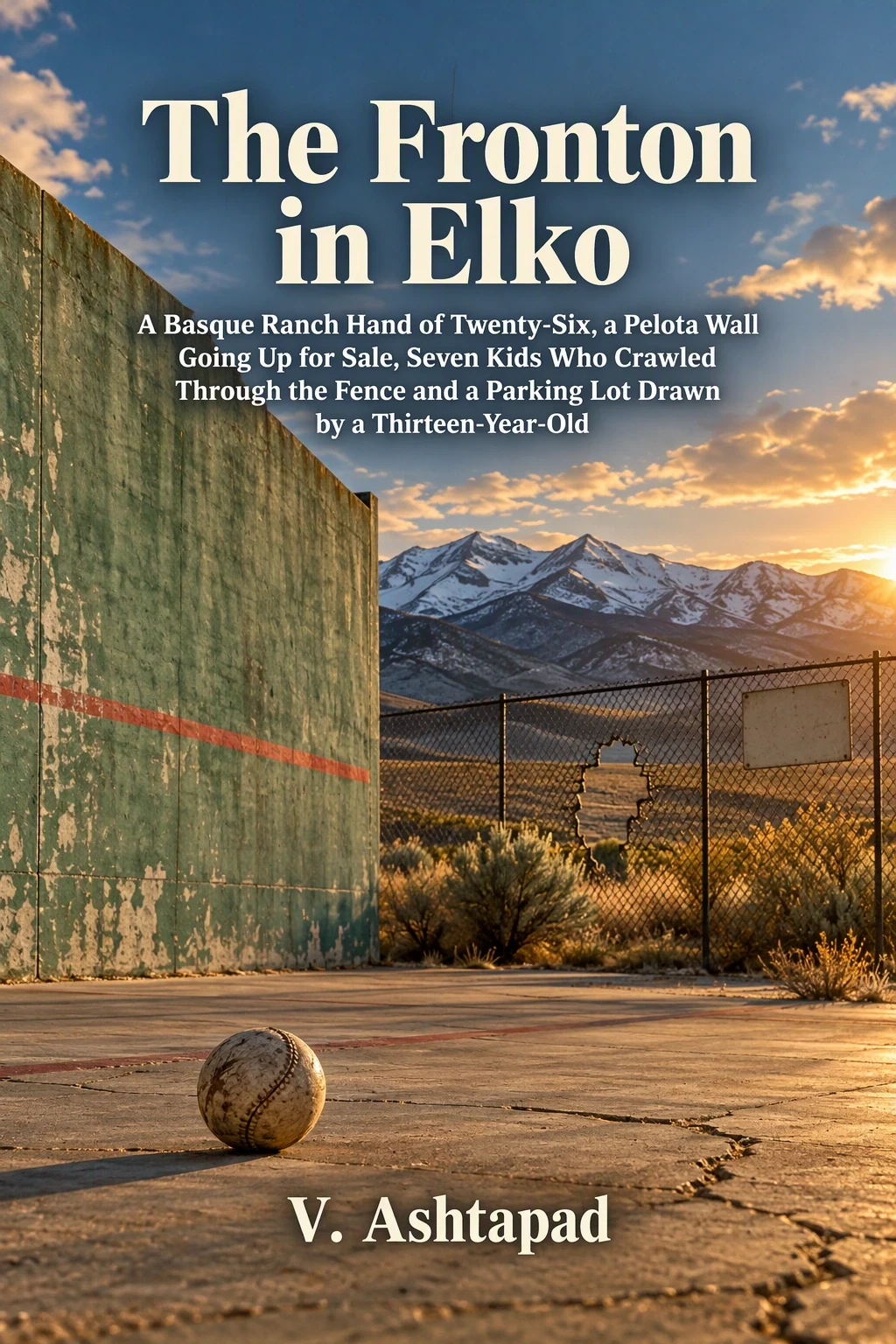
The Fronton in Elko
A Basque Ranch Hand of Twenty-Six, a Pelota Wall Going Up for Sale, Seven Kids Who Crawled Through the Fence and a Parking Lot Drawn by a Thirteen-Year-Old
by V. Ashtapad
Foreword
This is a work of fiction. Elko, Nevada, its Basque boardinghouse dining tradition, picon punch, hand pelota, the National Basque Festival and the Ruby Mountains are real. The Iturralde House, its fronton, the casino, the Basque club as described and every named person in the story are invented.
For everyone who ever got called by their name at a long table.
The Wall
Start with this about the fronton behind the Iturralde House is that it is ugly.
I'm saying it up front, because by the end of this you're going to think I'm sentimental about it, and I'm not. It's a concrete wall forty feet high and thirty-six feet wide, painted a green gone the pale shade of a dollar bill somebody ran through the wash. There's a shorter wall down the left side, and a line of red paint across the front wall at about three feet, and another line at the top, and a strip of sheet metal along the bottom that makes a sound like a pan lid when the ball hits it, which means you hit it low and you lost the point. The floor is concrete too, cracked in a pattern that looks like a map of the Humboldt River if the Humboldt River had a drinking problem. There's a chain-link fence on the open side with a hole in it you can crawl through if you're under fourteen or very motivated.
It's ugly. I love it. Those two things are allowed to be true.
I've been hitting a ball against that wall since I was six. My amona used to bring me down on Saturday mornings when she did her shopping at the market on Idaho Street, and she'd leave me there with a rubber ball while she went in for her coffee in the hotel kitchen with Mrs. Iturralde, and I'd hit that ball against the green wall for two hours and come home with my hands red and stinging and the happiest kid in Elko County.
By eleven I was playing men. By sixteen I was beating them. By twenty I was the best hand pelota player in northern Nevada, which I'll admit is like being the tallest building in Carlin, but it's a title, and I hold it, and I'm not giving it up to anybody, least of all a guy from Boise named Xabier who wears his shirt with the collar turned up.
I'm twenty-six now. I work cattle on the Vasquez place out past Lamoille, under the Rubies, six days a week from dark to dark in calving season and a little less the rest of the year. I make decent money. I drive a pickup with two hundred and eleven thousand miles on it and a dog named Txiki in the back who's smarter than me. I live with my amona in the house on Cedar Street where she's lived since 1961.
And every Saturday, and some Sundays, and any evening I'm not too tired to lift my arms, I'm at the wall.
Which is why, when I rounded the corner of the Iturralde House on the second Saturday in March with my glove bag over my shoulder and saw the sign on the chain-link fence, I just stood there.
It was one of those real estate signs. Red and white, with a phone number and a picture of a woman with very large hair. It said FOR SALE. COMMERCIAL. 0.8 ACRES. ALL OR PART. Under that, somebody had stapled a piece of paper in a plastic sleeve that said: Fronton closed to public use effective May 1. Thank you for many years. The Iturralde Family.
I read it three times.
Then I took my phone out and took a picture of it, and sent it to my amona, and then I went in through the hole in the fence because I was very motivated, and I hit the ball against the green wall for two hours until my hands were bleeding, and I lost every point I played against myself.
---
I should tell you what a Saturday at the wall looked like, back when it was just me, so you know what I thought I was losing.
I'd get up at four-thirty on the ranch days anyway, so on Saturdays my body didn't know any better and I'd be awake in the dark on Cedar Street listening to my amona's radio through the wall, the Spanish station out of Twin Falls that she claims she doesn't understand and plays every morning. I'd drink coffee standing up at the counter. I'd eat two pieces of her bread with butter and sugar on them, which she says is a crime against bread, and which she has been making for me since I was six anyway. I'd load Txiki in the back of the truck and drive the eleven blocks to Silver Street with the windows down even in March, because the cold wakes up your hands.
Downtown at seven on a Saturday is just the street sweeper and the guy who hoses off the sidewalk in front of the casino and a couple of cowboys asleep in their trucks outside the bar. The light comes over the Elko Hills behind the railroad tracks and hits the top of the green wall first, a stripe of gold across the red line at the top, and then slides down it while you warm up. By the time it reaches the tin you're sweating.
I'd hit for an hour alone. Forehand, backhand, off the side wall, back to the front. The ball going and coming. I'd play imaginary matches against men who were dead. I'd play against my father at twenty, who I'd only seen on old videotape. I'd lose to him, usually, on purpose, because it's no fun to beat a ghost.
Then about eight-thirty Mr. Goicoechea's van would pull up and Ruthie would lower the ramp and he'd roll over to the fence and watch and tell me what I was doing wrong. And about ten, a couple of the men from the bar would wander out back with coffee in paper cups and lean on the fence and argue about whether I was better than my father. And about noon, I'd sit down on the concrete with my back against the side wall in the sun and unwrap my hands and look at them, red and swollen and stinging, and feel like I'd done something.
That was it. That was the whole thing. It doesn't sound like much. I know that. But I'd done it every week of my life for twenty years and I didn't know how to be a person on a Saturday morning without it.
© 2026 CRUNOD LLC. All rights reserved.
Amona
My amona's name is Gracianne Etcheverry, and she is eighty-seven, and she has buried a husband, a son-in-law, two dogs, a daughter, and approximately four thousand chickens, and she is not afraid of anything on this earth except the dentist and the Department of Motor Vehicles.
She was sitting at the kitchen table when I came home, with my phone picture on her phone, holding it at the end of her arm because she won't wear her glasses.
"So," she said.
"So."
"The Iturralde boys."
"I guess."
"Sit down. You're bleeding on my floor."
I sat down. She got up and got the iodine out of the cupboard over the sink, the old brown bottle that's been there since before I was born and may be the same bottle, and she painted my knuckles with it while I hissed through my teeth. She's not gentle. She grew up on a sheep ranch in the hills above Jordan Valley, Oregon, the daughter of a herder who came over from a village in Bizkaia in 1912 with a coat, a knife and a letter from a cousin, and gentle wasn't on the menu.
"Mrs. Iturralde died at Christmas," she said, painting. "You know that."
"I know. I was at the funeral."
"You were at the funeral. Did you talk to the nephews?"
"I said I was sorry."
"Sorry." She capped the iodine. "Ander. Those boys are from Bakersfield. Their grandfather left this town in 1958 and never came back except for funerals. They don't know the wall. They don't know the dining room. They don't know who played there. To them it's a piece of dirt downtown with a building on it and a bill for the property tax."
"So?"
"So you said sorry and they said thank you and that was the end of it. You never told them anything." She sat back down across from me. "You should have told them about Saturdays."
"It was a funeral, Amona."
"That's the best time. People listen at funerals. They're scared."
I looked at my knuckles, orange from the iodine. Out the window the last of the snow was going gray along the fence line and the cottonwoods along the creek behind the house were just starting to think about leaves. Txiki was asleep on the porch with his nose under his tail.
"What am I supposed to do?" I said. "Buy it?"
"How much is it?"
"I don't know. A lot. It's downtown. The casino on the corner wants parking. Everybody knows that."
My amona nodded slowly. She has a way of nodding that means she's heard you and is going to ignore you.
"Your great-grandfather," she said, "came to this country with a coat and a knife. He herded sheep for Pete Itcaina for eleven years for thirty dollars a month and a can of beans. He slept in a sheep wagon in the snow. And on his one day off a month, he walked into Elko, nine miles, and he went to the Iturralde House, and he ate dinner at the long table, and he played pilota against that wall. One day a month. Eleven years." She tapped the table. "You know why?"
"Because he liked pilota."
"Because it was the only place in this whole country where somebody called him by his name."
I didn't say anything.
"That's what the wall is," she said. "It's not a wall. It's a place where somebody knows your name. You tell those boys that. Then we'll see."
---
She didn't say anything else about the nephews that night. She made dinner, which was lamb chops and fried potatoes with garlic, and we ate it at the kitchen table with the radio on low, and after the dishes she sat in her chair by the window with her mending, the way she does every night, a basket of my socks and work shirts on her lap and her needle going in and out under the lamp.
I sat on the couch and pretended to watch television.
"Ander," she said after a while, without looking up.
"Yeah."
"You remember Mrs. Iturralde's dining room. The long tables."
"Sure."
"You know where you sat? When you were small? When I brought you on Saturdays and we stayed for lunch?"
I thought about it. "At the end. By the kitchen door."
"Next to who?"
I had to think harder. Then I remembered: a big man in a sheepskin vest who smelled like woodsmoke and always gave me the heel of his bread. A man with a gray beard who spoke to me in a language I didn't know and laughed when I didn't answer. A cook from the kitchen on her break, Rosalind, younger then, who let me drink the foam off her coffee.
"I don't know their names," I said.
"No. You were six." She bit off a thread. "But they knew yours. Every one of them. You'd walk in and the whole table would say, Ander! Like you were the mayor." She threaded the needle again. "That's what you're losing. Not a wall. A table that knows your name."
I didn't say anything. I watched her needle go in and out.
"So get one back," she said. "Or make a new one. You've got six weeks."
© 2026 CRUNOD LLC. All rights reserved.
The Nephews
The Iturralde nephews' names are Pete and Donnie. Pete is fifty-eight and sells insurance. Donnie is fifty-four and does something with almonds. They both live in Bakersfield, which, if you've never been, is like Elko if Elko were flatter, hotter and had more freeways. They drove up in the third week of March to meet with the real estate lady and I ambushed them in the hotel bar.
I should explain the Iturralde House.
It was built in 1909 as a boarding house for Basque sheepherders. Two stories, brick, with a long front porch on Silver Street and rooms upstairs where the herders slept when they came into town in winter or between jobs. On the ground floor there's a bar, a long dark room with a bar along one side and pictures on the walls of men in berets and women in black dresses squinting into the sun outside the hotel in 1920 and 1935 and 1950. And behind that there's the dining room, which has two long tables that seat thirty each, family style, and for a hundred and fifteen years every night at six you could sit down at one of those tables next to a stranger and they'd bring you soup in a tureen, and then salad, and then beans, and then a plate of tongue in tomato sauce or a stew, and then the steak or the lamb you'd actually ordered, and bread, and a carafe of red wine, and you'd eat until you couldn't see.
And then out back, the wall.
Mrs. Iturralde ran it from 1971 until about two years before she died, when her legs went. After that her cook, Rosalind, a Mexican lady from Jiggs who'd worked there thirty-four years, ran it with her son. They closed the dining room in October. The bar's been open on weekends. The rooms upstairs haven't been rented since the 1990s. The whole place smells like a hundred years of garlic and pipe smoke and floor wax, and I'd know it blind.
Pete and Donnie were sitting at the end of the bar with the real estate lady, whose hair was even bigger in person. They had a folder of papers open between them and they were drinking picon punch, which I'll say for them, at least they knew what to order. Picon punch is the drink of the Basque bars in Nevada: an Italian orange bitter on ice with a splash of grenadine and soda water and a float of brandy on top, served with a lemon peel. It tastes like an orange that has had a hard life. You drink two and you can't feel your face.
I introduced myself. They remembered me from the funeral. Pete shook my hand like he was going to sell me a policy.
"Ander," he said. "The pelota guy. Aunt Marie talked about you."
"She did?"
"She said you were the best player she'd seen since my grandfather. She said you were too stubborn to go pro."
"There's no pro," I said. "Not for hand pelota. Not in this country."
"Well, she said you would've found one."
That threw me. I'd come in loaded for a fight and he'd taken the bullets out of my gun with one sentence.
So I did what my amona told me. I bought them a round, and I sat down, and I told them about Saturdays.
I told them about the rubber ball and the stinging hands. I told them about the tournament every July during the Basque festival, when players came from Boise and Reno and Bakersfield, from Bakersfield, I said, looking at them, and from France once, a pair of brothers from a village near Bayonne who beat everybody and then got so drunk on picon punch they had to be carried upstairs. I told them about my great-grandfather walking nine miles once a month. I told them it was the only place he got called by his name.
Pete listened. Donnie checked his phone twice. The real estate lady smiled the whole time with her mouth and not her eyes.
When I was finished, Pete took his time. Then: "That's a great story."
"It's not a story. It's what happened."
"I know. I mean—it's a great story, and I'm glad you told me." He turned his glass on the bar. "Ander, can I tell you something?"
"Sure."
"Our mother is eighty-four. She's in a memory care place in Bakersfield. It's a good place. It's nine thousand dollars a month." He looked at me. "Aunt Marie didn't have any kids. Everything she had goes to Mom. And Mom's got maybe two years of money left, at that place, before we have to move her somewhere worse. This building is the money. The wall is the money. That's all it is to us. I'm sorry. I wish it was something else."
I sat there.
My amona would have known what to say. I didn't. I'd come to tell them what the wall meant to me and I'd never once thought about what it meant to them, which was a mother in a room in Bakersfield who didn't know their names anymore.
"Okay," I said, finally.
"Okay?"
"Okay. I hear you." I finished my picon punch. I couldn't feel my face. "Can I have till May first? To come up with something?"
"Like what?"
"I don't know yet."
Pete looked at Donnie. Donnie looked at the real estate lady. The real estate lady looked at her folder.
"There's an offer," she said. "From the corner. For the back lot. They want to start in June."
"Then I've got till May," I said. "That's six weeks. Give me six weeks."
Pete thought about it. Then he put out his hand again, and this time it wasn't the insurance handshake. It was just a handshake.
"Six weeks," he said. "Aunt Marie would've given you six weeks."
© 2026 CRUNOD LLC. All rights reserved.
The Recruiting Problem
Here's the problem, and I knew it before I walked out of the bar: nobody plays anymore.
When my great-grandfather walked into Elko in 1915 there were maybe two hundred Basque herders working the ranges in Elko County, and every one of them could play some version of pelota, because every village in the Basque Country has a fronton, usually built right up against the side of the oldest building in the square, and the boys grow up hitting balls against it the way boys in Texas grow up throwing footballs. When my amona was a girl in the 1940s there were tournaments every Sunday. When my mother was a girl in the 1970s there were still a couple dozen men who played regular.
When I was a kid there were six. Old men. They taught me. Four of them are dead. One moved to Reno. One is Mr. Goicoechea, who is ninety-one and comes down to the wall on nice days in his wheelchair and yells at me when I get lazy with my footwork.
Me and Mr. Goicoechea. That's the league.
The young Basques in town, my cousins and the kids from the Basque club, they dance. The club has a dance group, and it's good, the kids in their white and red with the sashes, the girls' skirts flying, the boys jumping and kicking in the stick dances. They perform at the festival every year and at the county fair and once at the governor's mansion in Carson City. They learn the songs. Some of them learn a little of the language, the old folks teaching them at the club on Wednesday nights, a word here and a word there. That's all good. I'm not knocking it.
But nobody plays. Hand pelota hurts. You hit a hard ball with your bare hand, or with a thin glove that's basically a bandage, and it comes off that wall like a bullet and you hit it again. Your hands swell up. Your palms bruise. You get calluses like hooves. Kids today aren't going to do that. Why would they, when they can sit in their bedrooms and play a game where they're a space marine?
So my plan, such as it was, had two parts.
Part one: find a way to raise enough money to buy the wall from the Iturralde nephews, or enough to convince them not to sell it, which was impossible, because I had about four thousand dollars in the bank and a truck worth less than my dog.
Part two: find enough people who actually used the wall so that when I went to the county or the Basque club or whoever and said please save this, they'd say, why? And I could point at somebody besides me and a man in a wheelchair.
Part two was going to be harder.
I sat in my truck outside the hotel for an hour that evening with Txiki's head on my shoulder from the back window, and I watched the street. The casino on the corner lit up, all its lights coming on at once at seven like a slot machine paying out. A family went in with three kids. Two cowboys came out of the bar down the street. A woman walked by with a stroller. A group of teenagers came down Silver Street on bikes and scooters, five of them, loud, laughing, a couple of boys and a couple of girls and a little one trailing behind, and they stopped outside the chain-link fence by the wall, and the little one crawled through the hole.
I sat up.
The others followed him. One of them, a tall girl with a braid, stood in the middle of the cracked concrete and looked up at the green wall, forty feet of it going up into the dark. Then she bent down and picked up something off the ground and threw it at the wall.
It was a rock. It hit the green paint with a crack and bounced back and the little one ducked and they all laughed.
I got out of the truck.
---
I tried my cousins first. That was a mistake.
I have nine cousins in Elko, on my mother's side, all of them in the Basque club, all of them dancers or former dancers, and on Wednesday night after their practice I stood in the parking lot of the club hall and gave them my pitch. Two of them laughed. One of them asked if there was money. Four of them said they'd think about it, which in my family means no. One of them, Iker, who's nineteen and works at the auto parts store, said, "Ander, I love you, but I'm not hitting a rock with my hand so you can feel better about the old days."
The ninth cousin was eight and wanted to come but her mother said she was too young and would break her fingers.
Then I tried the guys from the ranch. The two young hands on the Vasquez place, both from Mexico, both about twenty, both good guys who'll work all day in the snow and never complain. I took them down to the wall on a Sunday afternoon and gave them each a ball. Héctor hit his once and looked at his palm and said something in Spanish I won't translate and handed the ball back. Alonso hit his fifty times. He was good. He had a natural swing from playing frontenis back home, which is a game a lot like pelota that they play with rackets against walls in Mexico. Then he said, "This is very fun, Ander, but I send all my money home and I work six days and on the seventh I sleep," and I couldn't argue with that.
So I had nobody. Me and Mr. Goicoechea and a dog.
Here's how it felt, sitting in that truck. It felt like being the last guy who knows a song.
© 2026 CRUNOD LLC. All rights reserved.
The Hole in the Fence
They scattered when they saw me coming, because I'm six-one and I was wearing a cowboy hat and I must have looked like a cop or somebody's angry father. The little one was fastest. He was through the hole in the fence and halfway down the alley before I got to the gate.
The tall girl with the braid didn't run. She stood her ground on the cracked concrete, arms folded, chin up.
"We weren't doing anything," she said.
"You threw a rock at my wall."
"It's not your wall."
"No," I said. "It's not." I unzipped my glove bag and took out the ball, the real one, the hard little leather ball with the hand-stitched cover that weighs a hundred grams and costs ninety dollars from a man in Gernika who makes them by hand. I held it where she could see. "But if you're going to throw something at it, throw this."
She looked at the ball. She looked at me.
"What is it?"
"A pelota ball."
"What's pelota?"
So I showed her.
I went to the serving line and I bounced the ball once and hit it, open hand, a good easy serve, and it went up the front wall with a smack like a gunshot and came back over the line and bounced and I let it go past me to the back. Then I went and got it and did it again, harder. Smack. Then I did a little rally against myself, the way I'd been doing my whole life, forehand, backhand, off the side wall, back to the front, the ball going and coming like it was on a string, my feet moving the way Mr. Goicoechea taught me, light, on the toes, never flat.
When I stopped the tall girl was staring at me with her mouth open.
So were the others. They'd come back. They were standing at the hole in the fence, four of them, the little one in front.
"You hit that with your hand?" the little one said.
"With my hand."
"Doesn't it hurt?"
"Like crazy."
"Can I try?"
His name was Fermín Arambula. He was ten. The tall girl was his sister, Dulce, fourteen. The others were their cousin Lalo, twelve, a red-haired kid named Tanner Ostrom whose dad ran cattle out by Spring Creek, thirteen, and a skinny quiet boy named Rey Pascua whose mother was a nurse at the hospital and who had come from the Philippines two years before and still didn't say much.
I let them all try.
Fermín hit the ball with his palm and yelled and shook his hand like he'd touched a stove and then said, "Again." Lalo missed the ball entirely three times and hit himself in the face on the fourth. Tanner swung like he was hitting a baseball and the ball went over the side wall into the alley and we had to go find it under a dumpster. Dulce wouldn't try at all, at first, and then when the others were looking for the ball she picked up a spare one out of my bag and went up to the serving line and bounced it once and hit it.
It went up the wall clean. Not hard. But clean. Over the line.
She didn't say anything. She just stood there looking at her hand.
And Rey, the quiet one, stood at the back of the court the whole time and watched my feet.
At nine o'clock their phones started buzzing, mothers wanting them home. They went out through the hole in the fence one at a time, Fermín last, still shaking his hand.
"Are you here tomorrow?" he said.
"I'm here every Saturday."
"Tomorrow's Sunday."
I thought about my amona saying people listen when they're scared. I thought about six weeks.
"I'm here tomorrow," I said.
---
When they were gone I stayed. I turned off nothing because there was nothing to turn off; the only light was the streetlight on Silver Street and the glow from the casino sign. The court was mostly shadow. The green wall went up into the dark and disappeared.
I sat down on the concrete with my back against the side wall, where I always sit, and Txiki came through the hole in the fence on his own, because he's smarter than me, and lay down against my leg.
I thought about Fermín shaking his hand like he'd touched a stove and saying again. I thought about Dulce looking at her palm after her one clean serve as if it belonged to somebody else. I thought about the quiet boy at the back watching my feet.
I'd been coming to that wall for twenty years and I'd never once taught anybody anything. Mr. Goicoechea and the old men taught me. I took it. I never thought about giving it to anybody, because there wasn't anybody to give it to, and because, if I'm truthful, I liked being the only one. The last guy who knows the song gets to sing it however he wants.
Txiki sighed against my leg.
Out on the street a car went by slow with its music thumping and then it was quiet again, just the freight train coming through on the tracks two blocks over, a mile long, the crossing bells going, the horn long and low the way it's been going through Elko every night since before my great-grandfather got off a train here in 1912 with a coat and a knife.
I picked up the rock Dulce had thrown. It was a piece of gravel from the alley, gray, with a white stripe through it. I put it in my pocket. I've still got it. It's on the dashboard of my truck.
Then I went home and told my amona I needed a box of the cheap rubber balls from the feed store and a roll of athletic tape and a thermos of coffee for the morning, and she looked at me over her mending for a while and said, "How many?"
"How many what?"
"How many children, Ander. I'm not a fool."
"Five," I said. "Maybe."
She put down the sock she was darning.
"Then you'll need two thermoses," she said. "Children's mothers always come to see who the man is. And they'll want coffee while they decide."
© 2026 CRUNOD LLC. All rights reserved.
Feet First
Sunday morning there were seven of them. Fermín had told people.
I'd come down at nine with a roll of athletic tape, a box of the cheap rubber balls I learned on, the ones you get at the feed store in a mesh bag for six dollars, and a thermos of coffee that my amona had sent with me along with instructions that I was to be patient and not swear in front of children. I'd already sworn twice by nine-fifteen because I'd forgotten scissors and had to tear the tape with my teeth.
The new ones were two of Tanner's cousins from Spring Creek, twin girls named Kenzie and Kaylee who were eleven and finished each other's sentences, which I found unsettling. That made seven: Dulce, Fermín, Lalo, Tanner, Rey and the twins.
I taped their hands. You have to tape them for hand pelota, especially when you're learning, or you'll bruise the bones in your palm so bad you won't be able to hold a fork. I showed them how: around the palm three times, between the thumb and first finger in a figure eight, up around the wrist, tight but not so tight your fingers turn blue. Kenzie's fingers turned blue. I did it again.
Then I made them hit the rubber balls against the wall, easy, underhand, just to feel it. Then I made them do it again. Smack. Bounce. Catch. Smack. Bounce. Catch. The rubber balls make a softer sound than the leather ones, a sort of thup, and seven of them going at once sounded like popcorn in a pan.
At ten o'clock a van pulled up on Silver Street and a woman in scrubs got out and went around to the side and opened the sliding door and lowered a ramp, and down the ramp in his wheelchair came Mr. Goicoechea.
He's ninety-one. He's a small man, smaller every year, with a face like a walnut and enormous hands, the knuckles gone lumpy from seventy years of hitting a hard ball. He wears a black beret, always, and a white shirt done up to the top button, and a cardigan his late wife knitted that has holes in both elbows. The woman in scrubs is his granddaughter, Ruthie, who brings him on nice days and sits in the van with the heater running and reads novels.
He rolled himself up to the chain-link fence and looked through it at seven kids hitting rubber balls against his wall.
"Ander," he said.
"Mr. Goicoechea."
"What is this?"
"Pelota school."
He looked at them for a while. Fermín hit a ball off the side wall and it came back and hit Lalo in the ear. Lalo yelled. The twins laughed in unison.
"Their feet are wrong," Mr. Goicoechea said.
"I know."
"All of them. Flat. Like cows." He waved a hand at me. "Open the gate."
So I unlocked the gate, which I have a key to, technically, because Mrs. Iturralde gave me one when I was fifteen and never asked for it back, and Ruthie wheeled him in over the bump onto the concrete, and he sat at the back of the court in his wheelchair and for the next two hours he taught seven children how to stand.
That's all. Just how to stand. He didn't let them hit anything. He made them stand on the balls of their feet with their knees bent and their weight forward, like a cat about to jump. He made them shuffle sideways across the court and back, never crossing their feet. He made them turn on one foot. He made them do it again. He yelled. He has a voice like a rusty gate and an accent he got from his father, who came from the same valley in Navarre as Mrs. Iturralde's husband, and when he yells at you in it you do what he says.
"Like a cat! Not a cow! Fermín, you are a cow! Tanner, you are two cows! Dulce—" He stopped. Dulce was doing it right. Weight forward, knees bent, light as a dancer. He watched her. "Dulce, you are a cat," he said, grudgingly.
Dulce didn't smile. But she stood up a little straighter.
And Rey. Rey Pascua, the quiet one. He'd been watching my feet the whole time the night before, and he'd been watching Mr. Goicoechea's hands now, the way the old man moved them to show what the feet should do, and when it was his turn to shuffle across the court he went across it like water. No sound. His sneakers barely touched the concrete.
Mr. Goicoechea stopped yelling.
"Where did you learn that?" he said.
Rey shrugged. "My uncle," he said. It was the most I'd heard him say.
"Your uncle plays?"
"Sipa," Rey said. Then, when Mr. Goicoechea looked blank: "It's a game. In the Philippines. You keep a ball in the air with your feet. You can't use your hands." He did a little hop and turned, light as a leaf. "You have to be fast."
Mr. Goicoechea looked at him. Then he looked at me.
"Ander," he said. "This one is fast."
---
At noon Ruthie came out of the van and said it was time for his lunch and his pills, and he grumbled and let her wheel him back to the ramp. At the bottom of the ramp he stopped her and turned around in his chair and looked back at the court. The seven kids were sitting on the concrete in a row against the side wall, red-faced, unwrapping their taped hands, Fermín showing everyone the blister on his palm like it was a medal.
"Next Sunday," Mr. Goicoechea said to me. "Same time. And bring better coffee. Your grandmother's coffee tastes like a sheep wagon."
"She'll be glad to hear it."
"She'll hit me with a pan." He almost smiled. Then he stopped. "Ander."
"Yeah?"
"They're closing it. The wall. Ruthie told me."
"I know."
"What are you going to do?"
I looked at the seven kids against the wall.
"This," I said.
He nodded slowly. Then Ruthie pushed him up the ramp and the door slid shut and the van pulled away down Silver Street toward the senior apartments by the river, and I stood out on the concrete holding the tape and realized I had no idea what I was doing.
© 2026 CRUNOD LLC. All rights reserved.
The Basque Club
The Basque club meets the first Tuesday of every month in its hall on the east side of town, cinderblock, single story, gravel out front, a kitchen in the back big enough to cook for four hundred, and a wall of photographs in the entry hall going back to 1959, when the club was founded by a group of men who'd been herders and had started businesses and wanted a place to dance on Saturday nights that wasn't a bar.
I'd been a member since I was born. My amona paid my dues every year in January along with her own. I'd been to maybe four meetings in my life.
The president of the club that year was a woman named Arantxa Zubiri, fifty-five, a CPA with an office on Idaho Street and the tidiest handwriting in Nevada. She'd been the one who put the club's whole history on its private pages for members a couple of years back. Every photograph from the entry hall, scanned, with names under them, which took her eighteen months, because she went around to every old person in the club with a laptop and showed them each picture and asked who's that, and who's that, and who's that one in the back with the hat. She'd recorded a lot of them talking. If you were a member you could sit at home and look at the 1962 picnic and click on a man's face and hear his daughter tell you he was a terrible singer and a wonderful father. She'd put up a map, too, of all the villages in the Basque Country that the club families came from, with pins, and you could click on a pin and see who.
I'd never looked at any of it. I'll admit that.
She let me talk at the end of the meeting, under new business, after a long discussion about whether the club's dance group should get new sashes, which they should, and whether the July festival should have a second beer garden, which it shouldn't, and a report from the treasurer that made everyone's eyes close.
I stood up. There were about forty people there, mostly old, a few my age with kids on their laps. I'd written down what I wanted to say on a feed store receipt and when I took it out of my pocket I couldn't read my own handwriting.
So I just told them.
The sign. The nephews. Pete's mother in memory care. The six weeks. Seven kids and Mr. Goicoechea on a Sunday morning. Rey's feet.
When I finished the room just sat there. Then a man in the back, Mr. Larrañaga, who's about seventy and runs a tire shop and has opinions about everything, said, "Ander, with respect, the wall was dying anyway. Nobody plays. You and the old man. That's not a sport, that's a hobby."
"Seven kids," I said.
"Seven kids for one Sunday. Wait till they get their first bruise."
"They got their first bruise. They came back."
"They came back once."
He had me there.
Then Arantxa Zubiri, who'd been taking minutes the whole time in her tidy handwriting, put down her pen.
"Ander," she said. "Who are the kids?"
I told her. Dulce and Fermín and their cousin Lalo, whose grandparents came from Jalisco and ran a restaurant on Fifth Street. Tanner and the twins, ranch kids, whose people came from Sweden and Ohio a hundred years ago. Rey, whose mother came from the Philippines and worked nights in the ER.
"None of them are Basque," Mr. Larrañaga said.
"No."
"So why should the Basque club—"
"Teo." Arantxa said it quietly but he stopped. She turned to the laptop she had open and typed something and then she turned it around so the room could see the screen, and she'd pulled up a photograph from the club's pages. Black and white, a little blurry. A group of men standing in front of the green wall. Sixteen of them, in work clothes and berets, arms around each other, squinting. Underneath it, in her tidy typing: Iturralde House fronton, Sunday tournament, August 1931.
"Look at the names," she said.
She clicked. The names came up under the faces, one by one. Etcheverry. Goicoechea. Iturralde. Larrañaga, which made Mr. Larrañaga sit up. Zubiri. And then, in the second row: Murphy. Delgado. Sorensen. Kwan.
"Kwan?" somebody said.
"Henry Kwan," Arantxa said. "His father ran the laundry on Railroad Street. He played every Sunday for twenty years. My grandmother told me about him. She said he had the best backhand in town and nobody ever let him forget he wasn't Basque, and he never let them forget he beat them anyway." She looked at Mr. Larrañaga. "Delgado was a ranch cook from Chihuahua. Murphy worked for the railroad. Sorensen was a Swede who married a girl from the boarding house. They played because it was there. Because somebody let them in." She turned the laptop back around. "The wall wasn't ever just ours, Teo. We just forgot that."
The room was quiet.
"So what do you want from us, Ander?" Arantxa said. "Money? We don't have much."
"I don't know," I said. "Help, I guess. Ideas. I don't know what I'm doing."
She almost smiled.
"Nobody does," she said. "That's what a club is for."
---
By the end of the meeting there was a plan, sort of, which is more than I'd had walking in.
The club would hold a dinner. A big one, in the Iturralde dining room, if the nephews would let us use it, family style, the old way, soup and beans and salad and tongue and lamb and steak, for as many people as the two long tables and a few extra in the bar could hold. Two hundred, maybe, in two seatings. We'd charge sixty dollars a head. Rosalind, the cook who'd worked there thirty-four years, would cook if she could be talked into it. The dance group would dance. There'd be an auction.
"And the kids play," Arantxa said. "After dinner. Out back. Under lights, if we can get lights. People need to see it."
"They're terrible," I said.
"Then make them less terrible. You've got five weeks." She was already writing in her tidy handwriting, a list, with names and jobs. Then she typed it into the club's volunteer roster on her laptop, and I watched it come up on the screen, a little grid, people's names going into boxes: setup, kitchen, tables, dishes, parking, cleanup. Mr. Larrañaga's name went into parking. He grumbled. He didn't take it out.
"Who's in charge of the kids?" somebody asked.
Arantxa typed. The box said Ander Etcheverry.
"That's not fair," I said.
"It's your wall," she said, and closed the laptop.
© 2026 CRUNOD LLC. All rights reserved.
Noemí
Dulce and Fermín's aunt came to get them the third Sunday and stood outside the chain-link fence watching for twenty minutes with her arms folded, and I could feel her watching the whole time like a hot spot on the back of my neck.
She was about my age. Dark hair pulled back tight, jeans and boots and a fleece vest with the logo of the large-animal clinic out on the Mountain City highway. She had the kind of face that's decided something and is waiting for you to prove it wrong.
At noon, when the kids were unwrapping their hands and Mr. Goicoechea was being loaded into his van, she came through the gate.
"You're Ander," she said.
"Yes, ma'am."
"Don't ma'am me. I'm twenty-five." She stuck out her hand. "Noemí Arambula. These two are my sister's. I'm watching them weekends while she does a second shift at the mine."
I shook her hand. She had a vet tech's hands, strong and chapped, a scar across the back of one that looked like a horse bite.
"They talk about you," she said. "Nonstop. Fermín showed me his blisters at the dinner table and my mother nearly fainted."
"They're doing good. Dulce especially. She's a natural."
"I know. That's why I'm here." She looked past me at the wall. "What's this for?"
"What do you mean?"
"I mean, what's it for? You've got seven kids down here every weekend, taping their hands, hitting balls, a ninety-year-old man yelling at them. Fermín says there's going to be a dinner. A show. They're going to play for two hundred people." She looked back at me. "Are you teaching them because you want them to have something? Or because you need them to save your wall?"
That stopped me.
I wanted to say the first thing. I wanted to say it so bad. But I'd been listening to my amona for twenty-six years and to Pete Iturralde for one evening, and something about the way Noemí was standing, arms folded, waiting, made me actually think about it before I opened my mouth.
"Both," I said finally.
She raised her eyebrows.
"I didn't go looking for them," I said. "They came through the hole in the fence. Dulce threw a rock at the wall. I showed her the ball because I didn't want her throwing rocks." I rubbed my neck. "But yeah. When I saw them, I thought, here's my proof. Here's my seven people. I'm not going to lie to you about that."
Noemí looked at me for a long moment.
"Okay," she said.
"Okay?"
"Okay. At least you said it." She unfolded her arms. "Here's my thing. Dulce's had a hard year. Her dad left in August. She stopped eating lunch at school because some girls said things. She quit soccer. She doesn't talk to anybody. She talks about your wall. She practices in the driveway against the garage door until my sister yells at her. She looked up videos of the pros in Spain, did you know that? There's pros. Women too. She's watched every one."
I didn't know that.
"So if you're going to use her to save your wall," Noemí said, "fine. Use her. But you'd better be here after. After the dinner and the show and whatever happens with the wall. You'd better still be here on Sunday mornings if the wall goes. In a parking lot. Against the side of the feed store. I don't care. You understand me?"
"Yes, ma'am."
"Don't ma'am me."
"Yes, Noemí."
She looked at me a second longer. Then she nodded, once, the way my amona nods, and turned around and called the kids, and Fermín came running with his blister held up, and Dulce came walking, slowly, with her taped hands in the pockets of her hoodie, and looked back at the wall over her shoulder as they went through the gate.
---
When I got home that afternoon my amona was in the kitchen making bean soup, which is what she makes on Sundays, red beans with chorizo and a ham bone and a whole head of garlic, and the house smelled like her mother's kitchen in Jordan Valley and her mother's mother's kitchen in Bizkaia. She looked at me when I came in.
"You met a girl," she said.
"I met somebody's aunt."
"You met a girl. You've got the face." She stirred. "What's her name?"
"Noemí. She's a vet tech. She yelled at me."
My amona nodded with deep satisfaction. "Good," she said. "Your grandfather yelled at me the first time we met. He said I parked my truck on his foot."
"Did you?"
"Of course I did. He was standing in the wrong place." She tasted, frowned, and salted. "Sit down. Eat. Then tell me what she said that made you think."
"How do you know she said something that made me think?"
"Because you're quiet. You're never quiet." She put a bowl in front of me. "Eat first."
© 2026 CRUNOD LLC. All rights reserved.
Michel
My father showed up the second week of April, on a Saturday, at about four in the afternoon, which is late enough to have been drinking for six hours and early enough to still be standing.
I'll tell you about my father once and then I'm not going to talk about him much, because this isn't his story, and he'd be the first to tell you that. His name is Michel Etcheverry. He's fifty-one. He was the best pelota player in Nevada before me. Better than me, maybe, at twenty. He had hands like my great-grandfather and feet like a cat and a temper like a gas stove. He married my mother when they were both nineteen and I came along a year later and she died when I was four, of an aneurysm, at the kitchen table, on a Tuesday. He started drinking about then. He hasn't stopped long since.
My amona took me. He didn't fight it. He went to Winnemucca and worked the mines and then he worked construction and then he worked whatever he could get, and he came back to Elko a couple times a year, at Christmas, at the festival, and sat on my amona's porch and was nice to me for thirty-six hours and then vanished. I used to wait for those days. I stopped waiting when I was about thirteen.
He came through the hole in the fence. Not the gate. The hole. He's not a small man and he had to crawl, and when he stood up on the other side his knees were dusty and he was laughing at himself.
"Hey, kid."
"Hey."
The kids had stopped. All seven. They'd been doing a footwork drill and now they were standing in a scatter on the concrete looking at the big man in the dirty Carhartt jacket who'd just crawled through a hole in the fence.
"Heard you've got a school going," he said. "Heard it at the bar in Carlin. Guy said Gracianne Etcheverry's grandson's got a pelota school for Mexican kids."
"They're not all Mexican."
"Whatever. Kids." He walked across the court toward me, careful, the way a man walks when the ground's farther away than it should be. He smelled like beer and cigarettes and the cab of a truck. "You got a ball?"
"Dad."
"Come on. One point. For old times. Show your students how it's done."
I didn't want to. Let me say it plain. I didn't want him on my court with my kids watching. I didn't want them seeing him like this.
But Fermín was standing ten feet away with his mouth open, and Dulce was watching with her arms folded the way her aunt folds hers, and Rey was watching my father's feet, and I thought about what Noemí said, that I'd better be here after, and I thought about what kind of here that was if I couldn't stand on my own court with my own father for one point.
So I gave him a ball.
He bounced it once. He looked at it in his hand like it was an old friend. He served.
It was beautiful. I'll say that. I'll always say that. The ball went up the front wall clean and hard and came back long, over the line, deep to the back corner, and I had to run for it, and I got it, barely, backhand off the side wall, and he was already there, he'd read it, and he hit it low and flat into the corner where the front wall meets the side and it came off both walls at once and died on the concrete and I never had a chance.
"Ha!" He threw his arms up. "Still got it!"
The kids didn't cheer. They didn't know whether to.
Then my father bent down to pick up the ball and lost his balance and sat down hard on the concrete. Just sat. Like a kid. And he stayed sitting there, ball in hand, legs out in front of him and he wasn't laughing anymore. He was looking at the wall.
"Your mother used to watch me," he said. "From over there. By the fence. She'd bring you in a stroller. You'd scream every time the ball hit the tin."
I'd never heard that.
"I'm sorry, kid," he said. Not to me. To the wall. "I'm sorry."
I stood there. The kids stood there. Out on Silver Street a truck went by with its radio playing.
Then Rey Pascua walked across the court, quiet as he does everything, and held out his hand to my father. My father looked up at him, confused. Rey didn't say anything. He just kept his hand out. And after a while my father took it, and Rey pulled, and my father got up.
"Thanks, kid," my father said.
Rey nodded and went back to his place on the court.
My father stood there a minute. Then he handed me the ball and walked out through the gate, not the hole, and I watched him go up Silver Street toward the bar on the corner, walking very carefully, and I didn't follow him.
---
That night I told my amona. She was at the stove. She didn't turn around a good while.
"He was beautiful," she said finally. "When he played. Before. People came from Reno to watch him."
"I know."
"Your mother loved to watch him. She'd bring you in the stroller."
"He said."
She turned off the burner. She turned around. She's eighty-seven and five foot one and when she looks at you a certain way you feel about four.
"Ander, listen to me. He's not your fault and he's not your job. You hear? You don't have to fix him. You don't have to save him. You don't have to forgive him tonight." She took off her apron. "But you let him play one point. With those kids watching. You didn't throw him out."
"I wanted to."
"I know you wanted to. You didn't." She hung the apron on the hook. "That's a different thing. That's a thing I didn't know you could do. Sit down. I'll heat the soup."
© 2026 CRUNOD LLC. All rights reserved.
Rosalind's Kitchen
Rosalind Ochoa agreed to cook the dinner on one condition, which was that nobody except her son Junior was allowed in her kitchen while she did it, not me, not Arantxa Zubiri, not the nephews, not the governor of Nevada if he showed up, and anybody who touched her pots would lose a hand.
"Deal," I said.
"I'm serious, Ander."
"I know you're serious."
"I've seen you cook. You cook like a man who learned from a can." She was standing in the Iturralde kitchen, which had been closed since October and smelled of cold grease and floor cleaner, with her hands on her hips, looking at the stoves the way a general looks at a battlefield. She's sixty-eight. She was born in Jiggs, which is a bar and a post office and some ranches south of town, the daughter of a Mexican cowboy and a Basque ranch cook's daughter, and she started washing dishes in this kitchen at sixteen and was running it by thirty. She knows every recipe Mrs. Iturralde ever made and about forty she made up herself and never told anybody were hers.
"How many?" she said.
"Two hundred. Two seatings."
"Two hundred." She closed her eyes. "Soup. Beans. Salad. Tongue. Chorizo. Lamb stew. Steak. Bread. That's eight courses for two hundred people in four hours with me and Junior and a dishwasher." She opened her eyes. "I need the club ladies for the bread. Arantxa can do the pudding. And I need somebody to get me forty pounds of beef tongue, which nobody in this town has had in stock since 2019."
"I'll get it."
"From where?"
"I'll get it."
---
I got it from Noemí, who knew a rancher out past Wells who did his own butchering and owed the clinic a favor for a breech calf they pulled in February in a snowstorm at two in the morning. She drove out with me on a Wednesday after work in my truck with Txiki between us on the bench seat, an hour each way, the Rubies going purple on our right as the sun went down and the long sage flats running out to the edge of the world on the left.
She didn't talk much on the way out. On the way back, with forty pounds of beef tongue in coolers in the truck bed, she talked the whole way.
She told me about growing up on Fifth Street, above her grandparents' restaurant, which served Jalisco food and was famous in Elko for its birria on Sundays, the goat stewed for hours with dried chiles and cinnamon and cloves until it fell apart, served in a bowl with the broth and onions and cilantro and fresh tortillas. She told me about her grandmother, who came across from Mexico in 1971 with three kids and no English and opened the restaurant on a loan from a Basque banker who'd once been a herder himself and remembered what it was like to arrive somewhere with nothing.
"Wait," I said. "A Basque banker loaned your grandmother money?"
"Mr. Iriarte. From the old bank on Idaho Street. He's dead now. My grandmother lit a candle for him every year on his birthday until she died." Noemí looked out the window at the dark. "She said he was the only man in Elko who looked at her and saw a business instead of a problem."
I drove for a while.
"My great-grandfather," I said, "used to say the Iturralde House was the only place in America that called him by his name."
"I know. Fermín told me. You told the kids."
"Yeah." I thought about it. "I guess your grandmother had a place like that too."
"She had a bank," Noemí said. "And then she had a restaurant. And then the restaurant was the place that called other people by their names." She was quiet. "That's how it goes, I think. Somebody lets you in. Then you let somebody in."
---
The dinner was the second Saturday in April. We sold out in four days.
Arantxa sold the tickets through the club's members' page and then through a list of everyone in town who'd ever eaten at the Iturralde House, which turned out to be everyone in town. People called her at her office on Idaho Street asking for tickets who hadn't been to a club event in twenty years. A man drove in from Salt Lake. Two sisters flew in from Boise, Basque ladies in their eighties who'd waited tables at the Iturralde in the 1950s. Pete and Donnie Iturralde came up from Bakersfield and, to their credit, bought their own tickets and sat at the long table and ate everything.
I sat at the end of the second seating with my amona on one side and Noemí on the other and the kids at the next table over, all seven of them and their families, scrubbed and combed and dressed up, Fermín in a clip-on tie.
And Rosalind brought out the food.
The soup first, in big white tureens with ladles, a garlic and bread soup thick with egg, so hot it fogged your glasses. Then the salad, iceberg lettuce in a garlicky vinaigrette, which is the only time in my life I've ever wanted to eat iceberg lettuce. Then the beans, red beans with chorizo and pork, in deep bowls. Then the tongue, sliced thin, in a tomato and pepper sauce that tasted of paprika and long cooking. Then the lamb stew, which was really Rosalind's, not Mrs. Iturralde's, though nobody would say it out loud. Then the steaks. Bread the whole time, in baskets, the club ladies' bread, crusty outside and soft as cloth in the middle. Red wine in carafes. Picon punch for anybody who wanted it, and a lot of people wanted it.
And then, at the end, without anybody asking, Rosalind came out of the kitchen herself with a tray, and on it were bowls of birria.
She set one in front of Noemí's grandfather, who's eighty-three and was sitting at the kids' table with his cane against his chair. He looked at it. He looked up at her.
"Señora," he said.
"Your wife taught me," Rosalind said. "In 1984. She came in the back door one day with a pot of it and said, try this, and I said, I'm cooking Basque, and she said, so? Cook this too." She put her hand on the old man's shoulder. "I never put it on the menu. But I made it for the staff every Sunday for forty years. Eat."
He ate. Everyone at that table ate. Then Rosalind brought out more for the rest of the room, and two hundred people who'd come for Basque food ate Jalisco birria in the Iturralde dining room, and nobody said a word about whether it belonged there.
My amona leaned over to me with her spoon.
"Ander," she said. "This is the best thing I've eaten in this building in sixty years."
"Don't tell Mrs. Iturralde."
"Mrs. Iturralde ate it every Sunday," my amona said. "In the kitchen. With the staff. Where did you think she went on Sunday afternoons?"
© 2026 CRUNOD LLC. All rights reserved.
The Show
Mr. Larrañaga, who'd been put in charge of parking and had complained about it every day for three weeks, showed up at four o'clock the day of the dinner with a flatbed truck and four light towers he'd borrowed from a road construction crew, and set them up around the fronton, and ran a cable from the hotel's back porch, and when he threw the switch at nine o'clock the green wall lit up like a stadium.
"Teo," I said.
"Don't." He coiled the cable. "My father played here. Under candles, practically. In 1940. He'd want lights."
So after the second seating, two hundred full people with their faces red from picon punch carried their chairs out the back door of the Iturralde House and set them up in rows along the chain-link fence and on the old bleachers somebody had dragged out of the club's storage, and sat in the cold April night under the construction lights, and my seven kids came out of the hotel's back door in white T-shirts and red sashes that the dance group had lent them, with their hands taped, and walked onto the court.
I'd been terrified for three weeks. I was more terrified now.
They were not good. No sense pretending. Five weeks is not long enough to learn hand pelota. Fermín was so nervous he served three balls into the tin in a row and the whole crowd groaned each time and then cheered when he finally got one up. The twins played doubles against each other and talked the whole time and nobody could tell which one won. Lalo got hit in the face again, by his own rebound, and stood there holding his nose while his grandmother screamed from the bleachers.
But they did it. They played. They moved their feet like cats, not cows, mostly. They hit the ball with their bare taped hands against the forty-foot green wall under the lights, and it made that sound, that crack like a gunshot that I'd been hearing my whole life, and every time it did two hundred people went quiet and then roared.
Mr. Goicoechea sat at the back of the court in his wheelchair in his beret and his cardigan with the holes in the elbows and yelled at them the whole time, like it was a Sunday morning.
And at the end, Dulce and Rey played a real game. Singles. First to fifteen.
I hadn't told anybody this was coming. They'd asked me two weeks before. Dulce had asked, actually, with Rey standing behind her saying nothing, and I'd said they weren't ready and she'd said she didn't care, and I'd looked at her face, and I'd said fine.
So they played. Under the lights. Dulce, fourteen, with her braid swinging, who'd quit soccer and stopped eating lunch at school, and Rey, thirteen, who'd come from the Philippines two years ago and still didn't say much and moved like water.
It was close. It was very close. Dulce had more power. Rey had more speed. She'd hit it hard to the back and he'd be there already, light as a leaf, and he'd tip it off the side wall into the corner and she'd dive for it and skin her knee on the concrete and get up. The crowd started out polite and ended up on its feet. The two old Basque ladies from Boise were screaming. Noemí's grandfather was banging his cane on the bleachers. My amona had both hands pressed to her cheeks.
At fourteen all, Rey served. It went long, to the back corner, the way my father served, and Dulce ran for it, and got it, backhand, off the side wall, and Rey was already at the front, he'd read it, and he went to hit it low into the corner where the walls meet, the shot nobody can return.
And he missed.
I saw him do it. I don't know if anyone else did. He swung a little late. On purpose. The ball went off his hand and up the wall and came back soft and high, and Dulce, who was already moving, who'd been moving since before the ball left his hand, came across the court like a cat and hit it flat into the tin line, a hair above it, and it died.
Fifteen-fourteen.
The crowd went crazy.
Dulce stood out there with her taped hand in the air and her mouth open and her face lit white under the construction lights and her knee bleeding down her shin, and she didn't move, she just stood there, and then she turned around and looked at Rey.
He shrugged. He almost smiled.
Then he walked over and shook her hand.
---
Later, much later, when the chairs were folded and the light towers were dark and Mr. Larrañaga had driven off with his flatbed and the kids had gone home with their families, I found Rey sitting by himself on the curb on Silver Street waiting for his mother to get off shift.
I sat down next to him.
"You missed it on purpose," I said.
He went quiet.
"She needed it more," he said finally.
"How do you know?"
He looked at his taped hands.
"When I came here," he said, "nobody talked to me for a year. Not at school. Nobody. Then I came through the hole in the fence and you gave me a ball." He shrugged. "She was sad. Like I was. I could tell."
I sat on the curb beside him and kept my mouth shut. Down the street the casino lights were still blinking. Up the street a dog barked.
"Don't do it again," I said finally.
"Why?"
"Because next time she'll know. And she'll never forgive you."
He thought about that. Then he nodded.
"Okay," he said.
His mother's car pulled up, a little silver hatchback with a hospital parking sticker on the windshield, and he got up and got in, and as it pulled away he lifted his taped hand to me through the window.
© 2026 CRUNOD LLC. All rights reserved.
The Number
The dinner made forty-one thousand, three hundred and twelve dollars.
Arantxa told me on the Monday, in her office on Idaho Street, the printout on the blotter and her glasses parked in her hair. Ticket sales. The auction, which had gone crazy at the end when somebody put up a pelota ball signed by Mr. Goicoechea and two ranchers from Lamoille got into a bidding war over it and it went for twenty-two hundred dollars. Donations in a jar by the door. A check from the two old ladies from Boise for five thousand dollars with a note in the memo line that said For the girl with the braid.
"It's a lot of money," Arantxa said.
"It's not enough."
"No." She took her glasses down. "The back lot appraisal came in at three hundred and eighty thousand. The casino offered four-twenty. The whole property, hotel and all, is listed at one-point-one million." She set the printout down. "Forty-one thousand is a down payment on a pickup truck, Ander. It's not a down payment on a city block."
I sat in the chair across from her desk and looked at the photographs on her wall. Her grandparents in front of a sheep wagon. Her father in a beret at the festival in 1975. Her daughter in a dance costume.
"Three weeks," I said.
"I know."
"What do I do?"
She was quiet a long time.
"You know what my grandmother used to say?" she said. "When somebody came to her with a problem? She'd say, have you asked the other side what they need? Not what they want. What they need." She tapped the printout. "You asked the nephews. You found out about their mother. That changed things. Have you asked the casino?"
"The casino wants parking."
"How do you know?"
"Everybody knows."
"Everybody knows a lot of things." She put her glasses back on. "Go ask."
---
The general manager of the casino on the corner was a man named Dwayne Kessler, fifty, from Las Vegas, with a gray suit and a Rotary pin and a handshake that was firmer than it needed to be. He saw me on a Wednesday afternoon in an office on the second floor with a window that looked down at the back lot of the Iturralde House and the green wall.
"I was at the dinner," he said, before I could start.
"You were?"
"My wife made me. She's from Ely. Her grandfather was a herder." He sat down behind the desk. "I had the tongue. I had three servings of the tongue. I'll be honest, I came in thinking I'd be the bad guy in the room, and nobody treated me like the bad guy. That old lady with the cane sat next to me and told me about her husband for an hour."
"That was probably my amona."
"Eighty-something? Tiny? Terrifying?"
"That's her."
He laughed. Then he folded his hands on the desk.
"So you're here to ask me not to buy the lot."
"No," I said. "I'm here to ask you what you need."
He looked at me like I'd said something in a language he didn't speak.
"I've been told you want parking," I said. "I've been told you want to tear down the wall and pave it. I've been told a lot of things. I haven't heard it from you. So I'm asking. What do you need?"
Kessler sat back. His eyes went to the window and the green wall.
"Forty-two spaces," he said finally. "Corporate says we need forty-two more spaces by next spring or we lose the bus tours from Salt Lake. That's thirty percent of our weekday traffic. Seniors. They come in on buses, they play the slots, they eat the buffet, they go home. The bus companies want guaranteed parking for the buses and the employees. If I don't have it, they'll go to the place in Wendover." He turned back to me. "I don't want the wall, Ander. I don't care about the wall one way or another. I need forty-two spaces."
I sat there.
"How big is the lot?" I said.
"The back lot? Point-eight acres. Including the wall."
"How much of that is the wall?"
He blinked. "I don't know. I never measured."
"Can I measure it?"
---
I measured it. With the kids.
Saturday morning, instead of practice, I brought a hundred-foot tape measure from the ranch and a notebook and seven kids, and we measured the whole back lot of the Iturralde House. Every inch. Rey held the end of the tape. Dulce wrote down the numbers because her handwriting was best. Fermín and Lalo and Tanner and the twins ran back and forth. Mr. Goicoechea supervised from his wheelchair, which mostly meant telling us we were measuring wrong.
The fronton itself, the wall and the court and the strip behind it, came to just under a quarter of an acre. The rest was a gravel yard where Mrs. Iturralde used to park her Buick, a falling-down garage, an old chicken coop, a side yard along the alley full of weeds, and a strip along the back of the hotel where the herders used to hang their laundry.
Tanner, whose dad runs cattle and who has to figure feed lots and fence lines, sat down on the concrete with Dulce's notebook and a pencil and did the math. It took him forty minutes. He wouldn't let me help.
"Forty-six," he said finally.
"Forty-six what?"
"Spaces. If you take out the garage and the chicken coop and pave the side yard and the laundry strip and the gravel yard. Regular spaces, nine by eighteen. Plus three bus spaces along the alley if you angle them." He showed me the drawing. It was very neat. "You don't need the wall. The wall's in the corner. You go around it."
I stared at the drawing.
"Tanner," I said. "Where'd you learn to do this?"
"My dad does pens like this. For cattle. You've got to figure where the gates go so they don't bunch up." He shrugged. "Buses are just big cows."
---
I took the drawing to Kessler on Monday.
He studied it the way I had. Then he called someone, an engineer in Vegas, and faxed it, an actual fax, the casino still had a fax machine, and an hour later the engineer called back and said it was rough but it would work, and the city setbacks would need checking, but it would work.
Kessler hung up.
"A thirteen-year-old drew this," he said.
"A thirteen-year-old cattle kid. He says buses are big cows."
Kessler laughed. Then he stopped laughing.
"Okay," he said. "So I buy the lot minus the wall. That's what, point-five-five acres? The nephews will want to know what that does to the price."
"I know. I'm going to call them."
"And who buys the wall?"
"The Basque club," I said. "With the forty-one thousand as down payment. And a loan. And whatever else we can get."
Kessler sat back in his chair. He looked out the window at the green wall in the afternoon light.
"My wife," he said slowly, "will kill me if I don't do something here. You understand? She'll make my life a misery. She cried at that dinner when the girl with the braid won." He rubbed his face. "What if the parking lot comes with lights?"
"What?"
"Lights. For the wall. And a new fence. With a gate, instead of a hole." He was talking faster now. "And a sign. On the casino. Home of the Elko Fronton, since 1909. The bus tours come in, the seniors get off, they see the sign, some of them walk over, they see the kids playing. That's a draw. That's something the place in Wendover doesn't have." He looked at me. "Corporate will love that. Corporate loves anything they can put on a brochure."
I didn't know what to say.
"It's not charity," Kessler said. "I want to be clear. It's a business decision. I get my forty-six spaces and a story for the brochures and my wife stops crying."
"That's fine," I said. "That's more than fine."
He stood up and put out his hand. The handshake was still firmer than it needed to be. I didn't mind.
© 2026 CRUNOD LLC. All rights reserved.
The Back Steps
My amona fell on the first of May.
It was the back steps, the three wooden steps down from the kitchen to the yard, which she'd gone down ten thousand times to feed the chickens and hang the wash. She missed the second one. She went down sideways and hit her hip on the concrete at the bottom and lay there for two hours in the cold before the mailman heard her calling and came around the side of the house.
I was out at the Vasquez place, branding. I didn't have signal. I found out at six when I drove back into town and saw four missed calls from the hospital and one from Noemí, who'd heard from Rey's mother, who was on shift in the ER when they brought her in.
Her hip was broken. They operated the next morning. She came through it fine, they said, for eighty-seven. She was mad as a wet cat. She told the surgeon he had hands like a sheepherder and she meant it as a compliment and he didn't know how to take it.
I sat with her for three days. On the third day my aunt Maialen came up from Reno. She's my mother's older sister, sixty-two, a retired schoolteacher with a house in Sparks with a spare room and a ramp already built for my uncle, who'd been in a wheelchair since a tractor rollover in 2011. Maialen took the chair on the far side of the hospital bed and held my amona's hand and looked at me across the blanket.
"Ander," she said. "She can't go back to Cedar Street."
"She can. I'll be there."
"You're out at the ranch from dark to dark. Who's there when she falls in the bathroom at two in the afternoon? Who's there when she can't get up from the chair?" Maialen's voice was gentle. She's always been gentle. She's the opposite of my amona in that way and the same in every other. "She needs someone with her. And a house with no stairs. My house has no stairs. I'm there all day."
"She won't go."
"She's already said yes," Maialen said. "This morning. Before you came."
I looked at my amona. She was looking at the ceiling with her jaw set.
"Amona."
"Don't," she said.
"You said yes?"
"I said yes." She didn't look at me. "I'm eighty-seven, Ander. My hip is made of metal. I can't feed the chickens. I can't go down the steps. I can't stand at the stove for an hour and make you bean soup." Her voice cracked. She's never once in my whole life let her voice crack. "I'm not going to make you choose between me and your wall."
"It's not about the wall."
"Everything is about the wall," she said. "Everything has always been about the wall. Since you were six years old. That's not a bad thing. That's who you are." Now her eyes came around to me. "You're going to save it. I know you are. I could see it at that dinner. And I'm not going to be the thing that stops you, an old woman you have to run home to every lunch hour to make sure she hasn't broken her neck."
I sat there holding the rail of the hospital bed. Through the window the Rubies had snow on top again, a late storm, and the cottonwoods along the river had leafed out bright green below them.
"When?" I said.
"When they let me out. Next week." She closed her eyes. "Maialen will take me down in her van. You'll bring me my things. Not the chickens. Give the chickens to the Arambula girl's grandfather. He'll know what to do with them."
---
I brought her her things on a Sunday. Maialen's house in Sparks is a ranch-style house on a street of ranch-style houses, beige stucco, a lawn, a basketball hoop over every garage. The spare room has a window that looks at a juniper bush and beyond it a freeway sound wall.
I carried in her suitcase and her sewing basket and the box of photographs from the hall closet and her mother's iron cooking pot and the brown bottle of iodine from the cupboard over the sink, because she asked for it. She sat in a recliner in Maialen's living room with her walker beside her and told me where to put everything, and I put it there, and then I sat on the couch and we didn't say anything for a while.
"Ander," she said finally. "Do you have your phone?"
"Yeah."
"Get it out. I want you to do the thing. The recording. The thing Arantxa does for the club, for the old people. I want to say something."
I got the phone out. I opened the club's pages, where Arantxa had shown me how to add a recording to a family's own private page, and I pressed the red circle and held it out to her.
She eyed the phone. Then she started talking.
She talked about the wall. About bringing me down on Saturday mornings in 1999. About her father walking nine miles once a month. About the dining room and the long tables and Mrs. Iturralde and the birria in the kitchen on Sunday afternoons. About my mother in the stroller by the fence, watching my father. About my father at twenty, people driving from Reno to see him.
Then she talked about the score. How you call a game of pelota. How the judge stands at the side of the court and calls out each point in a voice that carries, so the whole crowd can hear, the way they did it in her father's village, the way they did it in Elko in 1931.
"I'm going to call one," she said. "For you. So you have it."
And she did. She called a whole game. An imaginary one. Fifteen points. In her cracked old voice in Maialen's living room in Sparks with the freeway noise coming through the window. She called the server and the score after every point, the way they used to, in Basque first and then in English, up to fifteen, and at the end she called the winner, and the winner was me.
When she was done she sat back in the recliner.
"There," she said. "Now you've got a judge."
© 2026 CRUNOD LLC. All rights reserved.
Pete
I called Pete Iturralde on a Thursday night from the cab of my truck in the Vasquez yard with the heater blowing and Txiki asleep across my lap.
I told him everything. The forty-one thousand. Kessler. Tanner's drawing and the forty-six spaces. The lights and the fence and the sign. The Basque club offering to buy the wall and the court and the strip behind it, a quarter acre, with the dinner money down and a loan from the credit union, which Arantxa had already talked to, and a historic preservation grant from the state that Arantxa had also found, because Arantxa Zubiri is the most terrifying woman in Elko County after my amona.
Pete let the line sit quiet when I finished.
"Ander," he said. "The casino offered four-twenty for the whole back lot. If we cut out the wall, the lot's smaller. Kessler's going to offer less."
"He's offering three-forty for the rest of it," I said. "He told me. He's sending you the papers. And the club's offering ninety for the wall."
There was a pause while Pete did the math.
"That's four-thirty," he said slowly.
"Four-thirty."
"That's more than the original offer."
"Kessler says he's paying for the story," I said. "He says the brochure is worth ten grand to corporate. He says his wife made him."
Pete laughed. It went on for a while. When he stopped his voice was different.
"I went to see Mom on Sunday," he said. "I told her about the dinner. About the girl with the braid. She doesn't know who I am most days, Ander. Most days she thinks I'm the man who comes to fix the television." He was quiet. "But I told her about the wall and the kids, and she said, Aunt Marie's wall? And I said yes. And she said, I used to watch the boys play there. In 1955. Before we moved to Bakersfield. My cousin Bernard had the best serve in town. And then she told me about Bernard for ten minutes. I didn't even know she had a cousin Bernard."
I didn't say anything. Txiki shifted on my lap.
"So yeah," Pete said. "Okay. Four-thirty. I'll call Donnie. He'll say yes. He's been crying about the birria for three weeks."
"Thank you, Pete."
"Don't thank me. Thank the cattle kid." He paused. "And Ander? Send me a recording. When the kids play again. I want to play it for her. I don't know if she'll know what it is. But I want to play it."
---
After we hung up I sat in the truck a long time with the heater going and Txiki snoring and the dark coming down over the Rubies.
Then I opened the family page on my phone, the one I'd made for my amona's recording, and I added a new one. Just a few seconds of sound from the Saturday before, the kids at practice, the crack of the ball off the green wall and Fermín yelling and Mr. Goicoechea yelling louder and Dulce laughing at something Rey said that nobody else heard. I labeled it the way Arantxa labels hers: Iturralde fronton, Saturday practice, June, everybody.
I sent the link to Pete.
He wrote back an hour later, when I was home eating cold soup at the kitchen table in the empty house. Just one line.
She said, That's Bernard's wall.
I read it four times. Then I washed my bowl and went to bed and lay there in the dark on Cedar Street listening to the house without my amona's radio in it, and I thought about a woman in a room in Bakersfield who didn't know her own sons but knew a wall she'd last seen in 1955, and I thought, okay. That's what it's for.
© 2026 CRUNOD LLC. All rights reserved.
July
The National Basque Festival in Elko is the first weekend in July, and it has been since 1964, and if you've never been, I can't describe it, but I'll try.
The whole town fills up. Basques come from Boise and Reno and Bakersfield and San Francisco and Buffalo, Wyoming, and France and Spain. There's a parade down Idaho Street with the dance groups in their white and red, and floats, and a sheep wagon pulled by a pickup with an old herder sitting in the door waving his beret. There's a barbecue in the city park with whole lambs on spits and chorizo sandwiches and beans in pots the size of bathtubs. There's a morning service my amona never missed and I never attend. There's dancing all day and into the night, the jota and the stick dances and the line dances where the whole crowd joins in. There are the strongman contests, the weight carrying and the wood chopping, big men from the ranches swinging axes at logs while their families scream.
And there's the pelota tournament.
That year, for the first time since 1987, it was at the Iturralde House.
The papers were signed on June eighteenth. The Basque club owned a quarter acre of concrete and one green wall. Kessler's crew put up the new fence on the twenty-fourth, black iron with a real gate, and a sign over the gate made of welded steel letters that said ITURRALDE FRONTON 1909 that Mr. Larrañaga's tire shop guy made in his spare time. The construction lights were replaced by real ones, four tall poles at the corners. On the side of the casino, facing the lot, a banner went up: HOME OF THE ELKO FRONTON. SINCE 1909. ALL WELCOME. Kessler's corporate people wanted it to say Proudly Supporting Basque Heritage. Arantxa made them change it.
They didn't fix the cracks in the concrete. I asked them not to. The Humboldt River on the floor stayed.
---
On Saturday afternoon the tournament started at two.
Men from Boise and Reno and Bakersfield, and a pair of young brothers from a village in Navarre who'd come over on a cultural exchange and were very good and very polite and beat everybody. Xabier from Boise, with his collar turned up, who I beat in the semifinal fifteen to eleven and who shook my hand afterward and said, "You're slower than last year," and I said, "You're uglier," and we both laughed. My father, who came down from Winnemucca and sat in the bleachers in a clean shirt and didn't drink, at least not that I saw, and watched every match elbows on knees, jaw tight.
And in between the men's matches, the youth exhibition.
My seven. Plus four more who'd come through the gate since April: two little Basque girls from the dance group who'd decided they wanted to hit something instead of dancing, and Noemí's youngest cousin, and a boy named Joaquín whose dad drove one of the Salt Lake buses and who'd walked over from the casino lot on his own one afternoon in June and asked if he could try.
Eleven kids. White T-shirts. Red sashes. Taped hands.
The bleachers were full. People standing along the new iron fence three deep. Up on the casino's second floor I could see Kessler standing at his office window with a woman beside him who I guessed was his wife from Ely. On the other side of the fence, by the gate, the two old ladies from Boise in lawn chairs with an umbrella. Rosalind Ochoa in her apron, out of the kitchen for once. Mr. Goicoechea in his wheelchair at the back of the court, in his beret, with Ruthie beside him.
And on a phone propped up on a camera stand at the side of the court, where the judge would stand, my amona.
Maialen had set it up in Sparks. My amona was in the recliner in her good black dress with her walker beside her and her hair done, I could tell, by Maialen, because it was curled. She was looking straight into the camera with her chin up.
I'd asked her that morning if she wanted to call the score. Live. Through the phone. For the kids.
She'd said, "Who else is going to do it? Teo Larrañaga? He can't count."
So when Dulce and Rey walked onto the court for the exhibition final, the girl with the braid and the boy who moves like water, it was my amona's voice that called it. From a phone on a stand, two hundred and ninety miles away, through a little speaker that Rey's mother had bought at the electronics store and hooked up so it carried across the whole court. Her old cracked voice, calling the server, calling the score after every point, in Basque first and then English, the way her father's village did it, the way they did it in 1931.
They played to fifteen. Under the lights. In front of the whole town.
And this time Rey didn't miss.
He played her straight. Every point. He ran her into the corners and tipped it off the side wall and made her dive. And she dove. She skinned both knees and an elbow. She hit the ball so hard it rang off the tin like a bell. She got angry and then she got calm and then she got better. And she beat him anyway. Fifteen to thirteen.
When the last point died on the concrete my amona called it. Her voice came out of the little speaker and went across the court and into the bleachers and out through the iron fence into Silver Street.
The game, she said, and Dulce's name.
Dulce stood there with her taped hand in the air. Then she turned around and found the camera stand. She walked over to it. She bent down so her face was right in front of the phone.
"Thank you, Amona," she said.
And in Sparks, in the recliner, my amona, who has never been anybody's amona but mine, pressed her palm flat to her chest.
© 2026 CRUNOD LLC. All rights reserved.
Sunday
That was July. It's September now.
The festival's over. The Navarre brothers went home. Xabier went back to Boise with his collar up. The tourists and the dancers and the barbecue smoke are gone, and Silver Street is just Silver Street, with the casino lights coming on at seven like a slot machine paying out, and the bus from Salt Lake pulling into its angled spot along the alley twice a week.
The seniors get off. Some of them walk over to the iron fence and look through it at the green wall. A few of them come in. Last week an old man from Ogden stood at the back of the court for half an hour watching the kids and then asked me if he could try, and he hit three serves into the tin and one over the line and then had to sit down, and he told me his father had played in Elko in 1940, and did I know a man named Goicoechea, and I said, he's sitting right behind you.
Mr. Goicoechea is ninety-two now. He comes every Sunday. He's slower. Ruthie has to help him more. He still yells.
Dulce plays every day. She's fifteen. She's eating lunch at school again. Noemí told me. She found a club in Boise that plays hand pelota with women, and she's going in October to a tournament, and Arantxa is driving her, and Noemí is going too, and so am I, because Noemí said, you'd better be there after, and I am.
Rey is teaching the new ones their feet. He doesn't yell. He just shows them, quiet, and they copy him. His mother comes down on her nights off and sits on the bleachers in her scrubs and watches.
Tanner wants to be an engineer. He's already asked Kessler if he can intern at the casino next summer, doing the parking. Kessler said yes. Kessler's wife sends cookies.
My father calls sometimes. Not often. He asked last month if he could come down for a Sunday and play with the kids. I said maybe. He said he understood. I don't know yet. I'm thinking about it. I'm allowed to think about it.
The Iturralde House itself is closed. The hotel building went to Kessler with the parking lot, and he's turned the bar into a lounge for the bus tours and the dining room into a room for meetings, and the long tables are gone, sold at auction, one of them to the Basque club, where it sits in the hall under the wall of photographs. Rosalind retired. She cooks birria on Sundays at her house in Jiggs and anybody who drives out there gets a bowl. The rooms upstairs are still empty. Some nights I look up at the dark windows and think about my great-grandfather sleeping up there in 1915 after walking nine miles. I'd give a lot to buy him a drink.
So it's not all saved. That's the truth. The wall's saved. The place where they called him by his name is mostly gone.
My amona's in Sparks. She's good. Her hip's healing. She sits in Maialen's backyard in the afternoons in a lawn chair under the juniper and tells Maialen's grandkids stories about sheep, and they listen, because she's terrifying. She calls me every Sunday night. She asks about the wall first and me second. I don't mind.
On Sunday mornings, when the kids come through the iron gate at nine, I set up my phone on the camera stand at the side of the court. I open the family page. I find the recording she made in Maialen's living room in May, the whole imaginary game, fifteen points, in her cracked voice, in Basque and English.
And I press play.
And while it runs we play. The kids and me. Whoever's on the court. We don't play her game. Her game's already over, I won it in May. But her voice runs underneath ours, calling the server, calling the score, calling a game that never happened, up to fifteen, while the real ball goes up the green wall and comes back off it with a crack like a gunshot and the kids yell and Mr. Goicoechea yells louder and the bus seniors stand at the iron fence and the casino lights blink on Silver Street.
When her game ends, I start it again.
That's the way it is now. Every Sunday. A wall, a judge, and whoever comes through the gate.
It's still ugly. I still love it. Both of those things are allowed to be true.
© 2026 CRUNOD LLC. All rights reserved.
If this book stayed with you
The Jester's Sheep Bell
Book Six of the Secret Benefactor Series
Another Basque grandmother of the Great Basin, two states north, with a very different visitor.
About this book
The sign goes up on the chain-link fence in March: FOR SALE. Fronton closed to public use effective May 1.
Ander Etcheverry has hit a ball against that ugly green wall since he was six. He is the best hand pelota player in northern Nevada, which he admits is like being the tallest building in Carlin. He has four thousand dollars and six weeks.
A great-grandfather who walked nine miles once a month to be called by his name. An amona of eighty-seven who paints iodine on bleeding knuckles. A girl who threw a rock at the wall. A quiet boy who moves like water. A father who crawls through the hole in the fence. And a casino manager who needs forty-two parking spaces.
What do you save when you can't save it all?
Members can react to this book and talk about it in the members' Library.
Ownership
© 2026 CRUNOD LLC. All rights reserved.
This book is owned by CRUNOD LLC. It is free to read on EternalCurrent.Online. No part of it may be copied, reprinted, sold, recorded or adapted, including as audio, film or translation, without written permission from CRUNOD LLC.
© 2026 CRUNOD LLC. All rights reserved.