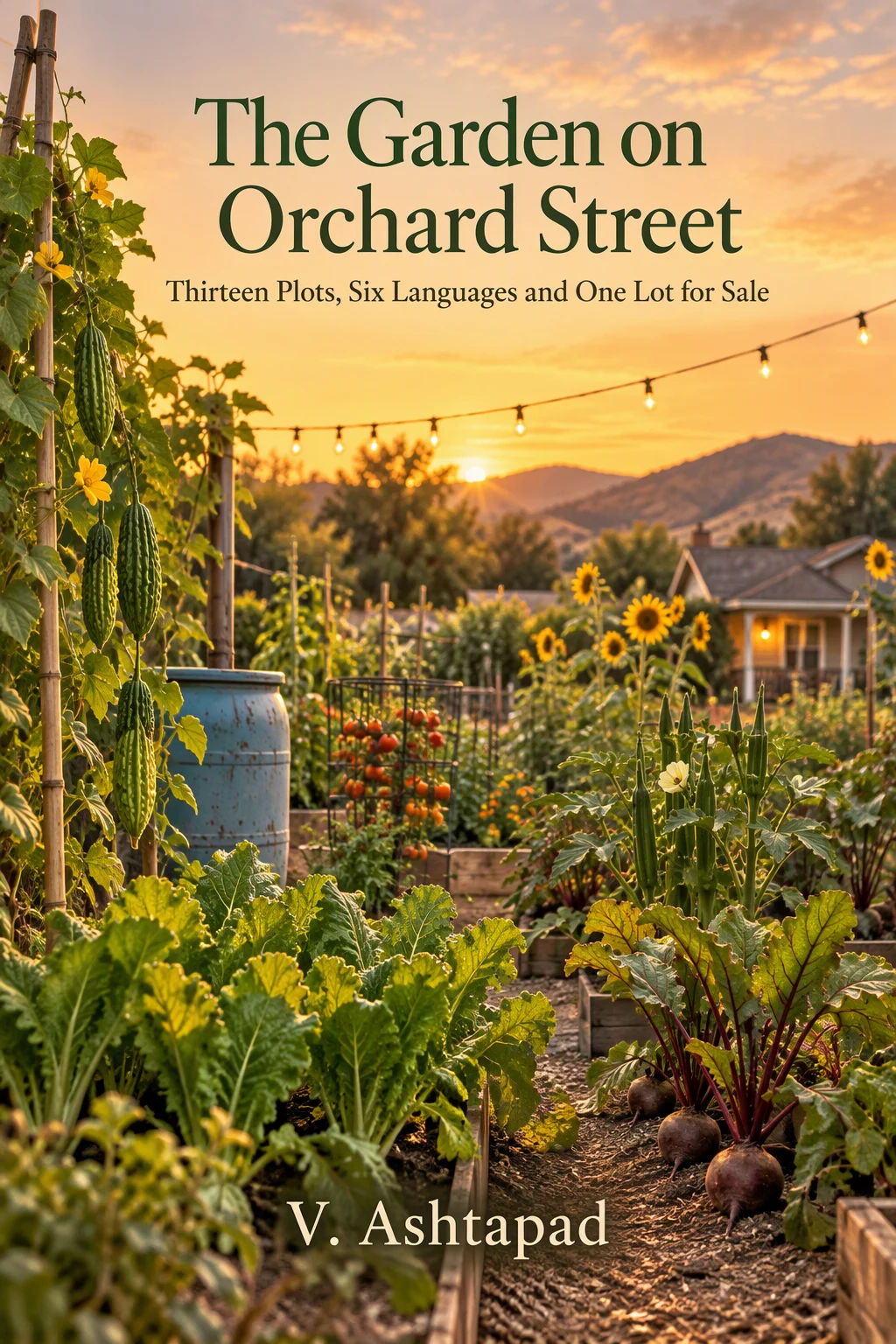
The Garden on Orchard Street
Thirteen Plots, Six Languages and One Lot for Sale
by V. Ashtapad
Foreword
This is a work of fiction. Boise, Idaho, really has welcomed families from Bhutan, Iraq, Ukraine, Bosnia, Congo, Afghanistan, Myanmar, Somalia and many other places, and community land trusts really do buy land and hold it for neighborhood use. The foods in these pages are cooked the way the families describe them.
The garden, Marjorie Lund and her son, and every gardener, child and neighbor in these pages are invented. Any likeness to real people is an accident.
For everyone who has waved from a porch at a neighbor they could not yet talk to.
Plot One: Hari
The sign went up on the chain-link fence on a Tuesday in March, while the ground was still too cold to turn, and Hari Prasad Adhikari was the first to see it because he was always the first to see anything at the garden on Orchard Street. He was eighty-two. He woke at four-thirty every morning of his life, in the camp in Nepal for nineteen years and in the apartment in Boise for eleven, and by six he had walked the eight blocks with his cane and his cloth bag and was standing at the gate of the garden, looking at his plot.
Plot One was the closest to the gate, and he had chosen it for that reason, eleven years ago, when the church lady who ran the refugee office brought him here and said, through a boy who translated badly, that there was a woman named Marjorie Lund who owned a lot behind her house and let new families grow things on it for free. Thirteen plots, each one ten feet by twenty. A spigot. A shed with a padlock and a coffee can full of donated seed packets. A fence. Marjorie's little white house on the corner, with a porch where she sat in a lawn chair in the summer evenings and waved.
Hari had grown mustard greens and bitter gourd and chilies and pumpkin vines on Plot One every summer since. He grew them the way his father grew them in the hills of southern Bhutan before the family was driven out in 1991, when Hari was already a man with children: in raised mounds, with the vines on bamboo frames, and the mustard sown thick so you could thin it and eat the thinnings. The soil in Boise was different—pale, dusty, alkaline, it took him three years to understand it—but the sun was good and the summers were long and dry, and he had learned to water at dawn.
Marjorie died in January. Hari had gone to the funeral with his granddaughter Sushma and stood in the back of a big brick building and understood almost nothing, except that people cried in English the same way they cried in Nepali.
Now there was a sign.
He could not read it. He could read Nepali, slowly, and some Dzongkha from his school days, and the numbers on the bus. The sign was in English, red and white, with a picture of a house and a telephone number and a word in large letters that he had seen before on other fences, on other lots, around Boise as the city grew and grew.
SALE.
He stood at the gate a long time. The morning was gray and cold, and a few robins were picking at the dead leaves in Plot Six. Across the alley, in the little white house, the curtains were closed, as they had been since January.
Then he took his phone out of his cloth bag—the cheap phone his son had given him, with the big buttons—and he did the thing Sushma had shown him how to do. He took a picture of the sign. He pressed the little green button. He pressed the picture of the garden, the one Sushma had made, where the families who gardened here shared their photos, and he sent it.
Then he pressed the red circle, which recorded his voice, and he said in Nepali, slowly, so whoever listened would understand:
"This sign is on our fence. I think it says the land is being sold. Someone please read it and tell us what it says. I am at the gate. I will wait."
He waited. He leaned on the fence and looked at his plot, bare and brown, and thought about the pocket of his old coat, at home in the closet, where there was a small cloth bag tied with string, and inside it, a handful of mustard seed his wife had saved from the camp's last harvest before they flew to America. He had never planted it. He had been saving it for something. He did not know what.
At 6:40 his phone made a sound. It was a message from Plot Four, from the Iraqi woman, Layla, who had taught him to grow okra. She had written in English, and then, underneath, she had recorded her voice. In Arabic. And then her teenage son had recorded it again, in English, slowly. And then Sushma, who had woken up, had recorded it again in Nepali, for him.
It said: *The land is for sale. Marjorie's son is selling it. A builder could buy it. We could lose the garden.*
Hari read the words that Sushma had written underneath, in Nepali, twice.
Then he went home and took the cloth bag of mustard seed out of his coat pocket and put it on the shelf above the kitchen sink, where he could see it.
Plot Four: Layla
Layla Hamdan had been a pharmacist in Mosul for eleven years before she was a refugee for four and a cashier at a grocery store in Boise for three. Now she was forty-four and studying at night to pass the American pharmacy exams, which required her to relearn in English everything she had known in Arabic, and some things she had known that the Americans did differently, which she found both insulting and fascinating.
She had a talent for reading forms. It came from both lives. When she called the number on the sign, at lunch on Wednesday, she had a pen and a notebook ready, and she wrote everything down.
The real estate agent was a young man who said "awesome" eleven times in nine minutes. The lot was listed for $640,000. It was zoned for residential and could hold four townhouses. There was already interest from two builders. The seller was Greg Lund, Marjorie's son, who lived in Seattle. The seller wanted to close by June.
"June," Layla said. "And the garden? The families who grow there?"
"Oh," the young man said, and she could hear him not knowing. "I mean, I don't think that's, like, part of the listing? I think it's just a vacant lot."
"It is not vacant," Layla said. "There are thirteen families."
"Awesome," he said, and then, catching himself, "I mean, not awesome. I'll let the seller know."
---
That evening she went to the garden. She did not have a reason; nothing was growing yet. But it was the only place in Boise where she felt the way she had felt in her grandmother's courtyard in Mosul, where there was a fig tree and a grapevine on a trellis and a stone basin for washing hands, and where every summer evening the women of the family sat on cushions and shelled beans and argued.
Others had come too. Hari, at his gate, as always. Oksana from Plot Seven, the Ukrainian woman, sixty-something, who had arrived two years ago and spoke very little English and grew the most beautiful beets Layla had ever seen. The Bosnian, Mr. Mehić, from Plot Nine, who had been in Boise since the war in the nineties and was the closest thing the garden had to a chief. Esperance from Plot Twelve, Congolese, with her youngest on her hip. Sushma, Hari's granddaughter, seventeen, with her phone in her hand.
They stood in a loose circle by the shed, eight people from five countries, and for a long moment no one knew how to begin, because there was no language they all shared. Layla's English was good. Mr. Mehić's was good. Sushma's was perfect. Esperance spoke French and Lingala and some English. Oksana spoke Ukrainian and Russian and almost no English. Hari spoke Nepali.
"Well," said Mr. Mehić finally, in English. "This is a problem."
Sushma laughed—she couldn't help it—and then everyone laughed, even Oksana, who had not understood the words but understood the tone.
Then Sushma held up her phone.
"I have an idea," she said. "We use the garden page. The one I made. Everybody already has it." She turned the screen so they could see: the photo of the garden at its gate, and below it, a long row of pictures—Hari's bitter gourd, Layla's okra, Oksana's beets, a video of Esperance's kids in the sprinkler, Mr. Mehić holding up a pepper the size of a shoe. "Everybody talks in their own language. Into the phone. Then somebody in their family who speaks English says it again. Then I put it in a picture. Like a sign. A picture everybody understands."
"A picture of what?" Layla asked.
Sushma thought. Then she opened a drawing app and, with her thumb, drew a simple map of the garden: thirteen rectangles, a fence, a gate, a spigot, the shed. In each rectangle, she put a little flag. A Nepali flag. An Iraqi flag. A Ukrainian flag. A Bosnian flag. A Congolese flag. Mexican, Somali, Afghan, Burmese, a few more.
Then, over the whole thing, she drew a big red X.
Everyone understood that.
"And then," Sushma said, drawing a green circle around the map, "this. Us keeping it."
Oksana said something in Ukrainian, sharp and quick. Nobody understood. She said it again, louder, frustrated, and pointed at the phone, and at the sign on the fence, and shook her head.
Layla looked at her. The woman's face was hard and closed, the way faces get when they have seen too much of a certain kind of thing. Layla knew that face. She had worn it herself for four years.
"She is afraid," Layla said slowly. "I don't know what she said. But she is afraid."
Oksana's nephew, who lived with her, was a skinny boy of fourteen named Bohdan who mostly stood behind her and looked at his phone. Layla turned to him.
"What did she say? Exactly."
Bohdan looked embarrassed. "She says—it's not polite. She says, 'Committees. Meetings. Lists of names. I have done this before. Then they come and take everything anyway, and they have your names.'"
Nobody said anything.
Then Mr. Mehić, the Bosnian, nodded slowly.
"She is right to be afraid," he said. "I also did committees. In 1992." He looked at Oksana and said something to her, carefully, in what Layla realized was Russian—bad Russian, rusty, with a Bosnian accent—and Oksana's head came up, startled, and she answered him, and for a few minutes the two of them talked, low, in a language that was neither of theirs.
Then Mr. Mehić turned back to the group.
"She will help," he said. "But no lists of names. Not on paper, not on the internet. Only our families. Only this page, which is ours."
"It is ours," Sushma said quickly. "Only the families can see it. I made it private. Nobody else."
Mr. Mehić translated. Oksana looked at the phone in Sushma's hand for a long time. Then she nodded once, sharp, like closing a door.
Plot Seven: Oksana
Oksana Kravets had been a schoolteacher in a town in the east of Ukraine near the border for thirty-four years. She had taught history to children who were now soldiers, and some of them were dead. She did not talk about it. She had come to Boise with her nephew Bohdan because her sister, Bohdan's mother, was dead, and because a family from a church here had sponsored them, and she was grateful to the family and polite to the church and did not go inside it.
What she did instead was grow beets.
She had found the garden in her first month, walking, because walking was the only thing that let her sleep. She had stood at the gate and looked at the rectangles of earth, and something in her chest that had been clenched for a year loosened very slightly. The old Nepali man at the gate had looked at her, and she had looked at him, and he had pointed to the empty plot, Plot Seven, and then to her, and raised his eyebrows. A question in no language.
She had nodded.
Now it was her third spring. She had dill and beets and garlic and a row of potatoes and, against the fence, a currant bush she had grown from a cutting a Ukrainian woman in Meridian had given her. She did not know the names of most of the other gardeners. She knew their plants. She knew that the Iraqi woman grew okra and mint and something with purple flowers she had not seen before. She knew the Congolese woman grew a green leafy thing that her children picked and ate raw, laughing. She knew the Bosnian grew peppers—long red peppers, sweet, dozens of plants—and that in September he roasted them over a fire in a barrel in his driveway and made something red and thick in big glass jars that he gave to everyone.
She did not trust committees. But she trusted plants. A beet doesn't lie. It grows or it doesn't, and you can see why.
---
In April, the garden families held what Sushma called a "story night," in the community room of the library branch two blocks away, which the librarian let them use for free on Thursday evenings. Sushma's idea was simple: the families would each tell the story of their plot, into Sushma's phone, in their own language, and someone from their family would tell it again in English, and Sushma would put the stories together with photos of each plot on the garden's page, and then they would play them for Marjorie's son, Greg, in Seattle.
"Why would he listen?" Layla asked.
"Because they're about his mom," Sushma said. "Marjorie's in everybody's story. She let us in. She waved from the porch. She brought cookies. He doesn't know any of that. He lives in Seattle."
Oksana did not want to tell her story.
She sat in the back of the library room with her arms crossed while the others went up one by one. Hari told about the camp, and the mustard, and the seed in his pocket he had never planted, and Sushma told it again in English with her voice shaking. Esperance told about her grandmother's field outside Bukavu, by the lake, where they grew cassava and the leaves were pounded with palm oil and onions and eaten with fufu, and how on her first day at the garden, Marjorie had come out with a plate of chocolate-chip cookies and tried to eat a raw cassava leaf to be polite, and made a face like a baby eating a lemon, and everyone laughed, and Esperance laughed telling it. Mr. Mehić told about his farm in the Drina valley, and the war, and the night he left, and the first summer in Boise when he could not sleep and walked the streets and found the garden and Marjorie on her porch at two in the morning, also not sleeping, and how she gave him a glass of milk and a blanket and let him sit on her porch until dawn, and they did not say a word because they did not have the words, and how he had never forgotten it.
When it was Oksana's turn, she shook her head.
Bohdan looked at her. Layla looked at her. Hari, in the front row, turned around in his chair, and looked at her with his old face that had seen everything, and did not say anything, and did not look away.
Oksana stood up.
She walked to the front of the room. She did not take the phone. She stood and looked at the floor, and then at the families, and then she spoke in Ukrainian, quietly, for about a minute, and sat down.
Bohdan stood up.
"She says," he said, and his voice cracked, because he was fourteen, "she says the first time she came here, she had not slept in a year. And the old man pointed at a plot, and she nodded, and she went home and slept for nine hours. She says that's all. She says she doesn't need to say more. She says Marjorie never met her, she only saw her from the porch, and waved, and Oksana waved back, two times. She says that was enough."
Plot Nine: Mr. Mehić
Dževad Mehić was seventy-one, and he had been an agronomist in Bosnia before the war, with a degree from the university in Sarajevo and a farm on the Drina and a wife who sang in the evenings. In Boise he had worked for twenty years at a potato processing plant, first on the line and then as a quality supervisor, and he had retired with a pension and a bad back, and his wife had died in 2019, and his children were in Chicago and Salt Lake and called on Sundays.
He was, without anyone deciding it, the chief of the garden. He knew the soil. He knew when to plant and when to wait. He had a key to the shed and a key to the spigot and he had fixed the fence twice. He was the one Marjorie had called when the water bill came.
He was also, Layla had discovered, very hard to argue with.
---
The fight was about water.
It started in May, when the garden families were meeting every week to plan. Sushma's picture-map had grown into a whole page on the garden's site: the thirteen plots, the flags, a calendar, a list of what each family could do, in pictures—a hammer for fixing things, a pot for cooking, a phone for calling, a paintbrush for signs. The families had decided, by pointing and nodding and a great deal of translating, that they would try to buy the land themselves. Sushma had found a community land trust in Boise—a nonprofit that bought land and held it forever for community use—and the land trust had said they might be interested, if the garden could show it was real, and organized, and if they could raise some of the money.
"How much?" Layla had asked.
"Ten percent. Sixty-four thousand."
Thirteen families who between them did not have sixty-four hundred.
But they had decided to try. A harvest dinner in September, in the garden, with food from every plot. The land trust would invite donors. The library would help. The newspaper might come.
And for that, Mr. Mehić said, every plot had to be perfect. Full. Beautiful. The best harvest the garden had ever had.
Which meant water.
There was one spigot. Thirteen plots. For eleven years they had shared it the way Marjorie had set it up: each family had a morning, written on a piece of cardboard nailed to the shed. Mr. Mehić now proposed a new schedule, longer watering, timed, every other day, with him in charge.
Oksana said no.
She said it in Ukrainian, then Russian, then something in English that was probably not polite. Bohdan translated: she had her own system, she watered at dawn, a little every day, the way her mother did, and her beets were the best in the garden, everyone knew it, and she would not change for a schedule.
Mr. Mehić said, in Russian, that her beets were fine, but the peppers needed deep water every two days, not a little every day, and she was using the spigot when he needed it.
Oksana said, in Russian, that he was not her boss.
Mr. Mehić said, in Bosnian, something Layla was fairly sure was a curse.
It went on. It got loud. Hari, at his gate, watched. Esperance took her children to the other end of the garden. Sushma looked at Layla, desperate.
Hari did not say anything. He never did, in a fight. He walked, slowly, with his cane, from his gate to the spigot, and turned it off.
Both of them stopped and looked at him.
He went into the shed and came out with two hoes. He handed one to Oksana and one to Mr. Mehić. Then he took Oksana by the elbow, gently, and walked her to Plot Nine, the peppers. And he took Mr. Mehić by the elbow and walked him to Plot Seven, the beets. And he pointed at the ground, and went back to his gate, and sat on his upturned bucket, and waited.
For a long minute nobody moved.
Then Oksana, with a face like a closed door, began to hoe between Mr. Mehić's peppers. And Mr. Mehić, muttering in Bosnian, began to hoe between her beets.
They worked for an hour without a word. Layla and Sushma watched from the shed. Esperance brought her children back. The sun came up over the foothills and lit the whole garden gold.
When the hour was over, Mr. Mehić straightened up, his hand on his bad back, and said in Russian, gruffly, that her beet rows were spaced exactly like his grandmother's on the Drina, a hand and a half apart, and that he had not seen that since he was a boy.
Oksana said, in Russian, that his peppers were drinking like camels, and the ground under them was dry three inches down by noon, and of course he needed deep water, any fool could see it.
Then she said something else, short.
Mr. Mehić blinked. Then he laughed—a surprised, unhappy laugh—and rubbed his face with his big hand.
"She says," he said in English, "her mother would have hit both of us with a spoon."
---
They worked it out in the end. Oksana kept her dawn hour, every day, a little water. Mr. Mehić took the evenings for the peppers, deep, every two days. Esperance took midday, because her children were at school. Sushma drew it as a clock on the garden's page, with each family's flag at its hour, and printed it and nailed it to the shed next to Marjorie's old piece of cardboard, which nobody wanted to take down.
And in June, without anyone asking, Mr. Mehić built Oksana a little rain barrel from a blue plastic drum, with a spigot at the bottom, under the downspout of the shed, so she could water her beets at dawn without waiting for the main tap.
He left it by her plot without saying anything. She found it at five in the morning. She stood looking at it for a long time.
The next day there was a jar of currant jam on the seat of his truck.
Plot Twelve: Esperance
Esperance Mukamana had five children and a husband who drove for a delivery company and worked nights, and she had a job cleaning rooms at a hotel near the airport, and she was thirty-eight years old, and she had no time for anything, and the garden was the one thing she made time for.
She made time because of the leaves.
Cassava leaves—sombe, she called them, the way her grandmother did—were the taste of home. Pounded with a wooden pestle in a mortar until they were a dark green paste, then cooked for hours with palm oil, onion, garlic, a little smoked fish, until the whole apartment smelled like her grandmother's kitchen by the lake in Bukavu, where the mountains came down to the water and the fishermen sang at night. In Boise you could buy frozen cassava leaves at the African grocery on Fairview, sometimes, if the shipment came. But they were not the same. The leaves from the garden were tender and bright and tasted of sun.
Cassava would not grow in Idaho; the winters killed it. So every spring Esperance started cuttings indoors in plastic cups on every windowsill of the apartment, and planted them out in May, and harvested the leaves all summer, and in October, before the first frost, she dug the plants and wrapped the stems in damp newspaper and kept them in a closet until spring. Her neighbors thought she was crazy. Marjorie had thought she was a genius. Marjorie had come over every week to look at the cassava, and had written down everything Esperance did, in a little notebook, because, she said, her own grandmother had kept geraniums alive through North Dakota winters the same way.
---
For the harvest dinner, Esperance was in charge of the food.
Nobody had decided this either. It was simply true. She had cooked for a hundred and twenty people at her cousin's wedding in Kampala on four propane burners and a charcoal grill, and she had opinions about quantities.
So in July she sat on an upturned bucket by the shed with Sushma's phone and recorded, one by one, every family's dish, in every language. Hari's mustard greens fried with garlic and dried chili, and his bitter gourd stuffed with spiced potato. Layla's okra stewed with tomato and lamb, and her mint lemonade, which she said was the reason Mosul had survived a thousand years. Oksana's borscht with her beets and dill and a spoon of sour cream, and her potato pancakes. Mr. Mehić's roasted peppers and the red relish—ajvar, he spelled it for her—and his wife's recipe for pita, a spiral of thin dough filled with cheese or meat or squash. The Afghan family's bolani, the Burmese family's tea-leaf salad, the Somali family's sambusa, the Mexican grandmother's tamales with squash blossoms.
Sushma put every recipe on the garden's page, with the voice recording in the family's language and a photo of the dish and the plot it came from, and a little map pin showing where in the world each one had come from, so that when you looked at the whole collection together, there was the garden on Orchard Street in the middle and lines going out from it to Bhutan and Iraq and Ukraine and Bosnia and Congo and Afghanistan and Myanmar and Somalia and Mexico, like the roots of something.
"Who will cook all of this?" Layla asked, looking at the list. "For two hundred people?"
Esperance shrugged. "Everybody," she said. "Everybody cooks their own. In their own kitchen. And brings it. That's how we do a wedding."
"But this isn't a wedding."
Esperance looked out at the garden. It was the middle of July and the garden was the fullest it had ever been: bitter gourd vines climbing Hari's bamboo frames, Layla's okra taller than her son, Oksana's beets in perfect rows, Mr. Mehić's peppers starting to turn from green to red, her own cassava waist-high and dark and glossy, the corn in Plot Ten, the Afghan family's leeks, the Burmese family's long beans hanging down like green rain.
"It's a little bit a wedding," she said.
Plot Three: Sushma
Sushma Adhikari was seventeen, a senior at Borah High School, a member of the robotics team and the Model UN, and the only person in the garden who spoke all the languages needed to talk to everyone, because the only language she needed was the phone.
That was her secret. She did not speak Arabic or Ukrainian or Bosnian or French or Lingala. She spoke Nepali and English and enough Hindi from movies to be dangerous. What she did was make a place where everybody could say what they meant in their own language, and somebody in their own family could say it again in English, and then she could make it into something everyone could see. A picture. A clock. A map. A recipe with a pin on a globe.
She had started the garden's page two years before, in Plot Three, which was her own plot, a small one between her grandfather's and the Somali family's, where she grew marigolds because her grandmother had loved them, and tomatoes because she liked them on toast. She had made the page for her grandfather, really, so he could send pictures of his bitter gourd to her uncle in Australia and her aunt in Ohio. Then the other families had asked to join. Then it was everyone's.
By August it had become something she did not have a word for.
The stories from the library story night, all thirteen, with photos. The recipes, with their pins on the map. The water clock. The list of who was doing what for the harvest dinner, in pictures. A page about Marjorie: everybody's photos of her, on the porch, with cookies, with a hose, with Mr. Mehić's peppers, with Esperance's cassava, laughing. A countdown to September twelfth. And, as of last week, a page the land trust had asked for: who the families were, how long they had gardened, what the garden meant. Sushma had made it from the stories. She had asked every family first whether their story could be shared with the land trust, and with Greg Lund, and with donors, and she had written down each answer—yes, no, only my voice, only my picture, only my first name—and set the page so that only what each family agreed to could be seen.
Oksana's answer was: only the beets. No name. No face. Just the beets, and the rain barrel.
Sushma made it exactly like that.
---
In August, Greg Lund called.
He called Mr. Mehić, because Mr. Mehić's number was the one on file with the water company, and Mr. Mehić put him on speaker in the garden, by the shed, at seven in the evening, with eight families standing around the phone.
"I listened to the stories," Greg said. He had a careful, tired voice. "The ones the girl sent. All of them. My wife and I listened to them on the drive down to Portland last weekend. Three hours."
Nobody said anything.
"I didn't know any of that," Greg said. "About my mom. The milk and the blanket. The cookies and the cassava leaf." He laughed a little, roughly. "She did make that face. When she ate something she didn't like. I forgot. I hadn't thought about that face in thirty years."
Mr. Mehić cleared his throat. "She was a good woman."
"She was a pain in the neck," Greg said. "She was my mom. She never told me about any of you. She'd say, 'Oh, the garden's fine,' when I called. That's all. 'The garden's fine.'" He stopped. "I have two kids in college and a mortgage in Seattle, and that lot is the only thing she left. I need to sell it. I'm sorry. I can't just give it away."
"We understand," Mr. Mehić said.
"But the land trust called me," Greg said. "And they said if your dinner raises enough, they'll make an offer. And I want you to know—" He paused. "I want you to know I told the builders to wait until after September twelfth. Both of them. I told them I wanted to see what the garden does."
Eight families looked at each other around the phone.
"And I'd like to come," Greg said. "To the dinner. If that's all right. My wife and I. If you'll have us."
Plot Thirteen: The Harvest
Plot Thirteen had been empty for three years, since the Somali grandmother who grew it moved to Minneapolis to live with her daughter. Nobody had taken it. Sushma said it was because everybody was waiting for the right family. Hari said it was because Marjorie wanted to keep one plot empty for whoever needed it next.
On September twelfth it held a long table.
Three long tables, actually, borrowed from the library and a church and the Bosnian community center, end to end across Plot Thirteen and into the path, with white paper tablecloths and jars of Hari's marigolds and Sushma's marigolds and Oksana's dill, and strings of lights that Mr. Mehić had hung from the shed to the fence to Marjorie's porch, where Greg Lund had said, on the phone, they could plug in.
Two hundred and twelve people came.
The families came, every one of them, with their dishes in pots and pans and foil trays and plastic tubs, and set them out along the table in a row that went from Bhutan to Mexico. The land trust came, with three donors and a woman from the city council. The library came. The newspaper came, a young reporter with a notebook and a photographer, and Sushma made sure they only photographed the families who had said yes. Neighbors came, people from the streets around Orchard who had walked past the garden for years and never come in. Esperance's cousins came from Nampa. Layla's study group came from the pharmacy program. Oksana's sponsor family came, from the church, and sat with her, and she was polite.
And Greg Lund came, with his wife, a small woman with gray hair and kind eyes, and stood at the gate for a long time looking at the garden full of people and lights and food, and then at his mother's little white house with the porch, where somebody—Hari—had put an empty lawn chair, facing the garden, the way she used to sit.
He didn't say anything. His wife took his hand.
---
They ate for three hours.
Esperance's sombe, dark and rich, scooped up with fufu. Hari's mustard greens and stuffed bitter gourd, which most people tried once and Greg Lund tried three times. Layla's okra and her mint lemonade, in a big glass jar with a tap. Oksana's borscht, bright magenta, which she ladled out herself, standing behind her pot, not smiling, until the woman from the city council said, through Bohdan, that it was the best soup she had ever had, and Oksana's mouth did something that might, on a less guarded face, have been a smile. Mr. Mehić's roasted peppers and ajvar, the red relish in its glass jars, spread on his late wife's pita. Bolani and tea-leaf salad and sambusa and tamales with squash blossoms.
After dinner, Sushma played the stories.
She had set up a little speaker and a screen against the shed, and as the sky went dark over the foothills and the lights came on, she played them, one by one, each in the family's own language first, then the English. Hari's camp and his seeds. Esperance's grandmother's field by the lake and Marjorie's cassava face, which made Greg Lund laugh out loud and then put his hand over his eyes. Mr. Mehić's night on the porch with the milk and the blanket. Layla's courtyard in Mosul with the fig and the grapevine. And at the end, Oksana's—not her voice, not her face, just a photograph of her beets in their perfect rows and the blue rain barrel beside them, and Bohdan's voice, cracking, saying: *She says Marjorie never met her. She only saw her from the porch, and waved. Two times. She says that was enough.*
When it was over, the garden was very quiet. The lights hummed. A dog barked a few blocks away.
Then the land trust director stood up, a tall woman named Carol, and said into the quiet that the donors had pledged eighty-one thousand dollars that night, which was more than the ten percent, and that the land trust would make Greg Lund an offer in the morning.
And Greg Lund stood up, holding his wife's hand, and looked at the families, and at the long table, and at his mother's empty chair on the porch.
"I'll take it," he said.
He didn't say anything else. He sat down. His wife put her arm around him.
The garden went up like a wedding.
---
Late that night, after the tables were folded and the pots were washed and the lights unplugged and the last guests gone, Hari stayed.
Sushma stayed with him. She sat on an overturned bucket by Plot One and watched her grandfather, eighty-two years old, kneel down in the dark—slowly, with his cane, one knee and then the other—in the corner of his plot by the gate, where the bitter gourd vines had finished and been pulled.
From his coat pocket he took the small cloth bag tied with string.
"Hajurba," she said softly. Grandfather. "It's September. Mustard won't grow now. It's too late. It'll freeze."
"I know," he said in Nepali. "I am not planting it to grow now. I am planting it so it is in the ground."
He untied the string. He poured the seeds, tiny and dark, his wife's seeds from the camp's last harvest, into his palm. He looked at them for a long time in the light from Marjorie's porch, which Greg Lund had left on.
Then he pressed them into the cold dirt of Plot One, one pinch at a time, and covered them with his hand.
"In the spring," he said. "Some will come up. Some won't. The ones that come up, you save the seed. You plant it next year. And the next."
"I will," Sushma said.
He looked at her. In the dark, his old face was hard to read.
"Record it," he said. "On the phone. For your children. So they know which corner. So they know whose seeds."
She took out her phone and pressed the red circle and held it toward him, and Hari Prasad Adhikari, eighty-two, from a village in the hills of southern Bhutan, by way of nineteen years in a camp in Nepal and eleven years in Boise, Idaho, told his granddaughter, in Nepali, slowly, where he had planted his wife's mustard, and why, while the porch light of a dead woman he had barely been able to talk to shone on them both, and the land under them belonged, now, to the garden.
About this book
When a SALE sign goes up on the fence of the little community garden behind Marjorie Lund's house, the thirteen families who grow there have a problem bigger than the price. They have no language in common.
Hari, eighty-two, grows bitter gourd the way his father did in Bhutan and keeps a bag of his late wife's mustard seed he has never planted. Layla studies for the American pharmacy exam at night. Oksana does not trust committees and grows the best beets in Idaho. Mr. Mehic knows the soil and will not be argued with. Esperance keeps cassava alive through Idaho winters in her closet. And seventeen-year-old Sushma has a phone, a family page and an idea.
Told one garden plot at a time, The Garden on Orchard Street is a story of neighbors who learn to work side by side, cook a harvest dinner for two hundred, and ask a grieving son to listen to the stories his mother never told him.
Members can react to this book and talk about it in the members' Library.