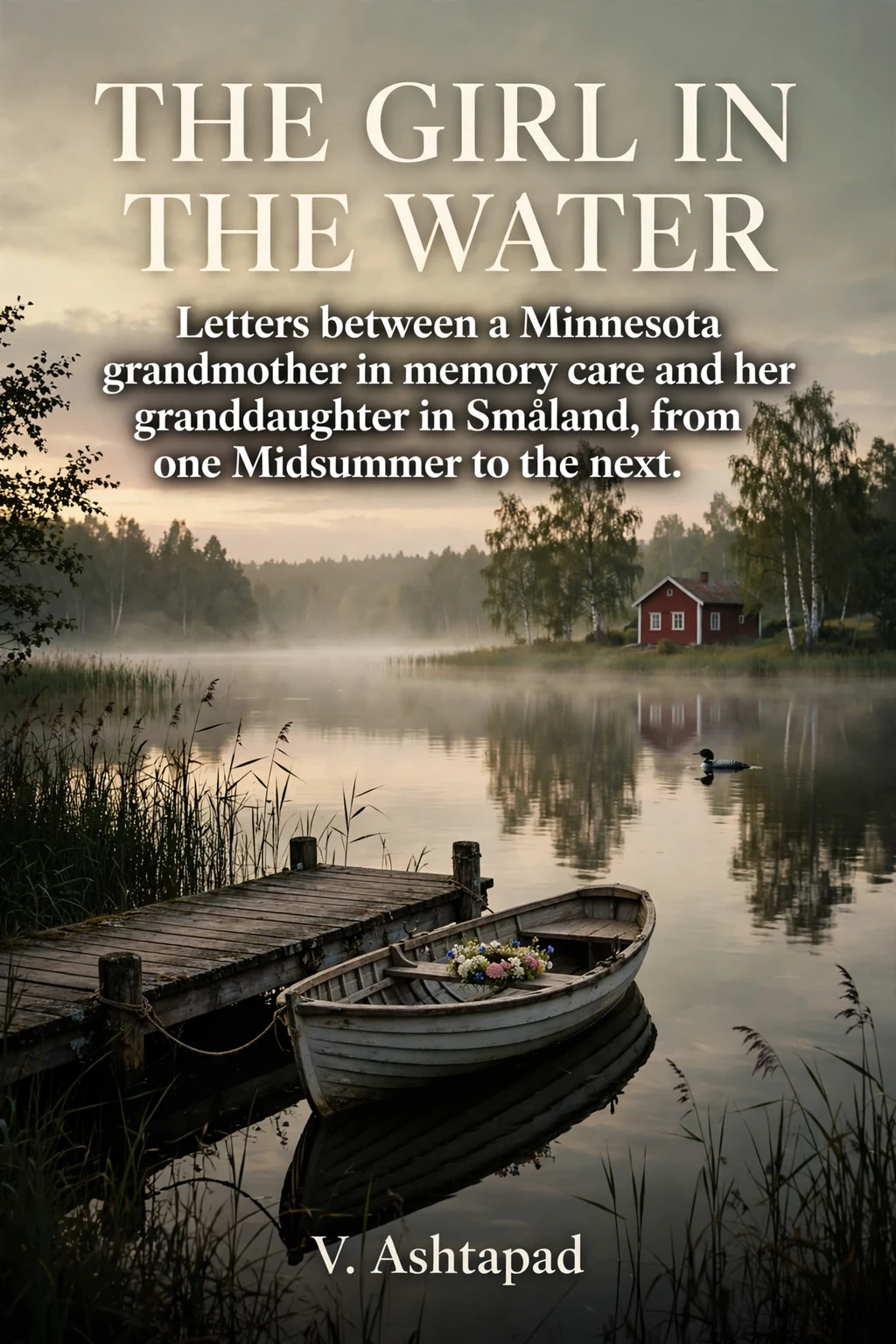
The Girl in the Water
Letters between a Minnesota grandmother in memory care and her granddaughter in Småland, from one Midsummer to the next
by V. Ashtapad
Foreword
This is a work of fiction. Lindstrom, Center City, Chisago Lake, Taylors Falls and the Chisago Lakes country of Minnesota are real, as are Växjö, Lake Trummen and its restoration, the Småland countryside, Mora and its carved horses, and the customs described here: Midsummer poles and flower crowns, crayfish parties, Lucia mornings, semla on Fat Tuesday, Walpurgis bonfires, the seven kinds of cookies, lutefisk suppers and lefse. The Swedish civic records the story follows, poll tax registers, the Gothenburg police lists of emigrants and the enclosure-era land survey maps, are real kinds of records. Solbacken Memory Care, the croft called Nybo, the farm Stora Hult, and every person in these letters are invented, and any resemblance to real people is coincidental.
For everyone who owes someone a letter, and for the hands that help write it.
Summer: The Pole and the Boxes
Solbacken Memory Care, Lindstrom, Minnesota
Midsummer Eve, Friday
Dear Linnea Margit,
I am writing this at a little desk they call mine, by a window they call mine, in a room I share with a Norwegian. I will come back to the Norwegian. First I want you to know that I have my good pen, the green one your grandfather gave me the year we put the new roof on, and that I have filled it from the bottle myself, and nobody had to help me, and nobody watched. You can tell your father that.
They put up a pole today. Not a real one. A thing about as tall as your father, made from a closet rod and two hula hoops, with plastic ivy wound around and some carnations stuck in by a girl named Kendra who runs the activities. Kendra is a Lindahl from Center City, and her great-grandmother was a Sandquist, so we are some kind of cousins the way everyone up here is some kind of cousins. She means well. She had a speaker playing a song with an accordion in it, and the song was Danish, and I did not tell her.
I wore the blue cardigan. I had them do my hair Thursday so it would hold. When the pole went up in the dayroom, eleven of us sat in a half circle and Kendra asked who remembered Midsummer from childhood, and four hands went up, and one of them was a man named Orrin who I am fairly sure was remembering the Fourth of July. Then we had strawberries on angel food cake. Not the right cake. Your great-grandmother Hilma would have made a strawberry cream cake in three layers and sent your grandfather to the Lindstrom bakery for nothing, just to get him out from under her feet.
I want to tell you clearly, before I get muddled, which happens now in the afternoons: I am glad you went. I told you so on the porch and I am telling you in ink. You are not to come home because of me. You are to go and stand in Småland and look at the lakes and come back and tell me if they look like ours. They will. Everyone says they do. That is why the old ones picked this place, because Chisago Lake looked like the water they had left, and a person can only stand so much newness at once.
The Norwegian is named June Haugen. She is ninety-one. She drove a school bus for the Rush City schools for thirty-four years and she says she never once lost a child, though she lost a dog off the back step in 1971 and still feels bad. She snores like a fishing boat with a bad motor. She asked me this morning whether Swedes eat lutefisk and I said we eat it to remind ourselves why we left. She laughed so hard the aide came in. I think we will get along. I think also she will be dead before me and I would rather not get attached, but there it is, you do not get to pick.
Write me on paper. I know you can type faster. I do not care how fast you can type.
Your Farmor,
M. E.
P.S. The loons are back on South Lindstrom. I cannot see the lake from this window but Kendra drove three of us down to the public landing on Tuesday in the van, and there was a pair out past the swimming raft, and one of them did the long call, the one that sounds like somebody asking a question they already know the answer to.
P.P.S. My house is not sold yet. Your father says it will be by fall. Do not let him give away the rag rugs.
* * *
Växjö, Sweden
June 20th, very late, which here means it is still light
Dear Farmor,
I'm writing this at 11:40 at night by the window of my apartment and I don't need a lamp. That's my first report. The sky over the lake behind the building has gone the color of the inside of a shell, pink and gray and a little green near the bottom, and it has been doing that since about nine-thirty and it's going to keep doing it until the sun comes back up a little before four. I tried to go to bed at ten. Hopeless. I got up and made coffee, which Gunvor (landlady, downstairs, widow, will explain) says is a very American thing to do at midnight and also a very Swedish thing, so I'm fitting in.
Midsummer Eve. You asked me to tell you everything, so here is everything:
1. Gunvor took me to a meadow outside town where about two hundred people had put up a real pole, birch leaves, the two hoops hanging off the crossbar like earrings, and it took twelve men and some ropes to raise it and everybody cheered when it stood up straight.
2. The flower crowns. I made one. Gunvor told me you're supposed to pick seven kinds of flowers on Midsummer night and sleep with them under your pillow and you'll dream of who you'll marry. I picked buttercups, clover, those purple ones that look like little bells, oxeye daisies, something yellow I didn't know, cow parsley, and a wild geranium. I made the crown out of birch twigs and it fell apart twice. The third one stayed on.
3. They sang "Små grodorna" and everyone hopped around the pole holding their hands up behind their heads like frog ears, grown men, an old man with a cane hopping on one leg, a teenage boy in a hoodie doing it ironically at first and then not ironically. I hopped. You told me about this song when I was five and I didn't believe you, Farmor. I thought you made it up to get me to stop whining in the car.
4. Lunch was pickled herring, three kinds, one with mustard, one with onion, one with something called matjes that was sweet. New potatoes boiled with dill. Sour cream with chives. Crispbread. Strawberries for dessert with whipped cream, and I want to point out that nobody made angel food cake.
5. I cried a little during the frog song, not because of the frogs.
My job starts Monday. I know you know what I'll be doing but I'll say it again because I like saying it: the city is restoring the lakes around town, which were in bad shape fifty years ago, sewage and runoff, and they've been pulling them back to health one at a time. I'll be measuring phosphorus and mapping where the reeds come back. For a year. Then home. I'll be in waders a lot.
Gunvor has a dachshund named Kalle who is fourteen and only walks in one direction, which is toward the bakery.
I'll write every week. On paper. I bought a box of envelopes at the supermarket and they're thinner than ours.
Love, love, love,
Linnea
P.S. I set up the family folder before I left, the one we scanned the photos into in May. Dad has the login. I put the picture of you and Grandpa at the Chisago County fair in 1961 at the top, the one where he's holding the ribbon for the rhubarb. If you want something added, tell Kendra and she can help you send it to me.
* * *
Postcard. Front: the coffee-pot water tower, Lindstrom, against a blue sky.
L. — This is so you do not forget what our water tower looks like. There is no coffee in it. I have asked. — Farmor
© 2026 CRUNOD LLC. All rights reserved.
Summer: Karl Oskar Days
Solbacken, Lindstrom
July 12
Dear Linnea Margit,
It is Karl Oskar Days and I have been to the parade, which is the first parade I have watched sitting down since I was a baby in a wagon. Kendra took six of us in the van and set us up in folding chairs on the sidewalk in front of the antique store, and I had a lemonade, and June had a root beer, and we watched the fire trucks and the men in the little go-carts and the girl on the float in the folk costume with the striped apron, and the high school band played something I did not recognize, and June said, "That's because it's from after 1980."
You will remember the statue at the end of the main street, Karl Oskar and Kristina, the two of them looking off toward the east like they forgot something on the boat. When you were small you asked me if they were your grandparents. I said no, they were made up by a man in Sweden who wrote books, and you said then why did they get a statue. I have been thinking about that question for twenty-four years. I still do not have a good answer except that people need to look at something.
Here is a thing I have not told anyone. When I was a girl, my mother had letters from Sweden. Thin blue ones, the kind that fold into their own envelope. They came from her cousin Britt, who lived on a farm or near a farm, I do not remember which. My mother read them out loud at the kitchen table on Sunday afternoons, partly in Swedish and partly translating, and my father pretended not to listen and listened to every word. I do not know what happened to the letters. I have been lying awake looking for them in my mind, room by room in the old house. I think they were in the cedar chest. I think the cedar chest went to your aunt Carol. Ask your father to ask Carol. Do not tell Carol I asked, she will make it into a project.
The food here is not bad. On Wednesday they made Swedish meatballs and a woman at my table named Bev said they were the best she ever had and I said, "Bev, these came out of a bag." She did not speak to me through dessert. Your grandfather would have said I deserved it.
June says to tell you hello from "the better Scandinavian." I told her to write her own letter.
I am well. I forget where I put my glasses about every hour, but I did that at sixty too.
Farmor
P.S. Tell me about your waders.
* * *
Växjö
July 20
Dear Farmor,
Waders: green, rubber, up to my chest, they belonged to a man named Stig who retired in March and who was apparently much taller than me, so I have to fold the tops over and clip them. I look like a tulip. I walk into Lake Trummen every Tuesday and Thursday at seven in the morning with a sampling pole and a cooler of little bottles, and the reeds come up past my shoulders and smell green and muddy and a little sweet, and there are grebes, Farmor, great crested grebes with orange ruffs that look like tiny lions. Not loons. I keep looking for loons. My colleague Johan says the loons here are up north, on the big lakes, and they're called something that sounds like "lom." I told him we have a loon on our state quarter and he did not believe me until I showed him a picture.
The lakes do look like ours. You were right. The shore here is birch and pine instead of maple and basswood, and the rocks are bigger, round gray boulders everywhere like the glacier just left last Tuesday. But the water has the same tea color near the shore, and the docks are the same gray boards, and at dusk (half past ten) there are fishermen in aluminum boats exactly like the men at the landing on South Lindstrom. One of them waved at me with the same two fingers off the steering wheel that Grandpa used.
The letters. I asked Dad about the cedar chest. He says Aunt Carol has it but it's full of quilts. He'll ask her the next time he's in Stillwater without saying you asked. (He says Carol will know immediately.) I'll keep you posted.
Also, I've started something. I've been building out a family tree from what you told me in May, the version on the computer, not the one in Grandpa's handwriting in the back of the photo album, and I'm going one group at a time so I don't lose track. So far I have your side: you, Elsie, Hilma and your father Walter, then Hilma's parents, who you said were named Nyberg and came from "near Växjö." That's all I've got. Everybody here tells me "near Växjö" is like saying "near Minneapolis." It's a big county and there are thousands of lakes in it.
Karl Oskar Days sounds like it was a good parade. I miss the cheese curds stand by the hardware store.
I think about the statue question too. My answer now would be: they got a statue because they're the only Swedes in Minnesota whose whole story anybody wrote down.
Love,
Linnea
P.S. Johan says lutefisk is "a joke your people tell about our people." I told him it is not a joke at Christmas in the community hall basement in Center City. He says the Norwegians are to blame. Please tell June.
* * *
Letter in capital letters, blue ballpoint, on lined paper torn from a pad.
DEAR LINNEA,
YOUR GRANDMOTHER SAYS I SHOULD WRITE MY OWN LETTER SO HERE IT IS. MY NAME IS JUNE HAUGEN. I AM 91. I DROVE BUS 34 YEARS. YOUR GRANDMOTHER IS A GOOD ROOMMATE EXCEPT SHE GETS UP AT FIVE TO "WRITE" AND THE PEN SCRATCHES.
TELL YOUR MAN JOHAN THE NORWEGIANS INVENTED LUTEFISK BUT THE SWEDES INVENTED BEING SNOOTY ABOUT IT.
SHE TALKS ABOUT YOU ALL THE TIME. SHE SAYS YOU ARE IN THE WATER. I SAID WHAT IS SHE, A FISH. SHE SAID A SCIENTIST.
I HAVE A GREAT GRANDSON IN FARGO WHO DOES COMPUTERS. NOBODY KNOWS WHAT HE DOES.
THAT IS ALL. IT IS HOT HERE. THE AIR IS BROKEN IN THE DAYROOM.
JUNE H.
© 2026 CRUNOD LLC. All rights reserved.
Summer: Crayfish and Carbon Paper
Växjö
August 9
Dear Farmor,
Tonight I went to my first crayfish party and I have to tell you about it before I forget any of it, because I think it might be the most Swedish thing that has ever happened to me.
Johan and his partner Sara invited me, and I had no idea what to bring, so I asked Gunvor, and she said bring aquavit and a funny hat. I brought a bottle of the caraway one (on Gunvor's advice) and wore a paper hat shaped like a crescent moon that came in a party pack with paper lanterns and paper bibs with cartoon crayfish on them. Everybody had the same hat. They strung the lanterns between two apple trees in Johan's backyard, which is about the size of a parking space, and set a long table with a paper tablecloth, and at about eight o'clock Sara came out with a platter piled with red crayfish, cooked cold in salt water with dill crowns, the whole flowering head of the dill, and set it down and everybody applauded the crayfish.
You eat them with your hands. You crack the tail, you suck the shell (loudly, it's encouraged), you sing a drinking song, you take a sip, you do it again. There's a song for every glass. I only knew the tunes because they're the same tunes as songs I know, nursery songs mostly, with different words. There was bread and a strong cheese called Västerbotten in a pie, and more herring, and a sweet mustard I want to marry.
At one point an older man at the end of the table (Sara's uncle Lennart, he worked forty years at a glassworks) asked me where my family was from and I said near Växjö and the whole table laughed, kindly, and then Lennart said, "What was the name?" and I said Nyberg and he said, "That is not a name from here. That is a name you make up when you get to America."
Farmor, is that true? He said lots of emigrants changed their names on the way, or right after, because in Sweden back then most people in the countryside didn't have family names, they had their father's first name plus -son or -dotter, so a man named Per whose father was Johan would be Per Johansson and his son would be something-Persson and everybody in a county would be Johansson and Persson and Nilsson. So when they got to Minnesota and found nine hundred Johanssons already there, they picked something new. Often from the farm name, or nature words. Ny is new, berg is mountain or hill. Lennart said "Nyberg" probably means our people came from a place called Ny-something.
I don't know why this hit me so hard. I think I thought I was looking for a name and it turns out I'm looking for a place.
Love,
Linnea (Persson? Johansdotter? who knows)
P.S. I put the pictures from the party in the little photo album the cousins share, the private one, so you can see Johan in his moon hat. Dad says Aunt Carol already commented that the crayfish look "like something you'd find under the dock and throw back." She's not wrong.
P.P.S. It's getting dark now at about nine-thirty. Already. People keep saying "the evenings are going" in a sad voice like someone has died.
* * *
Solbacken
August 15
Dear Linnea Margit,
Yes, it is true about the names. My grandfather was Per Johan, I knew that much, and my mother said once that "Nyberg was Papa's American hat," meaning something he put on to go out. She did not say what was underneath it. I wish I had asked. That is the thing about the old ones, they answered what you asked them and not one inch more, and I was nineteen and thought there would be time, and I was busy with Arvid and with my own life.
I am writing on the back of the activities calendar because I could not find my stationery. June says I put it in the drawer, and it is not in the drawer.
The crayfish party sounds like a lot of work for very little meat. Your grandfather and I ate crawdads once on a trip to New Orleans in 1979 and he said it was like eating a chicken through a keyhole. I am glad you had fun. I am glad you wore a hat.
We had a thing here this week where a man came with a guitar and sang old songs, and when he sang "You Are My Sunshine," Orrin cried, and then a lady named Dorothy who does not talk at all sang every word of the second verse, which nobody knows, and the aide had to go out in the hall a minute. I did not cry. I was surprised at Dorothy, and then I was not surprised, because I believe the songs go in a different door.
Linnea, I want to tell you about the lefse but I cannot remember what I was going to say about it.
Here is what I remember about my mother's kitchen on Sunday: the blue letters, the coffee boiled with an egg in the grounds to settle them, the cardamom bread braided in a ring, the clock that ticked loud and then louder when everybody stopped talking. My mother had a word she said when she set down the coffee. I cannot get it. It will come.
Your Farmor
P.S. Do not let your father sell the rag rugs.
* * *
Note on Solbacken letterhead, neat printing.
Dear Miss Engstrom,
My name is Fatuma Ali. I am one of the care aides on the day shift for your grandmother and Mrs. Haugen. Your grandmother asked me to put a note in with her letter so that you know she is eating well and walking every day with her walker to the end of the hall and back, three times. She does not like the walker. She calls it "the shopping cart."
She asked me to tell you also that she is "not confused, only busy." I think that is a good way to say it.
She keeps your letters in a wooden box with a painted lid, on top of the buttons. She reads them in the morning before breakfast. Sometimes she reads the same one two or three times and asks me if it is new. I tell her it is new to her that morning, and she likes that answer.
You can write to me at this address if you have questions. I will answer.
Respectfully,
Fatuma Ali, CNA
© 2026 CRUNOD LLC. All rights reserved.
Autumn: The Name That Changed at Sea
Växjö
September 4
Dear Farmor,
Today I took the train nearly three hours north to the regional archives, and I want you to picture me there, because I looked ridiculous. You have to put your coat and bag in a locker. You can only take in a pencil (pencil, not pen) and loose paper. You sit at a long wooden table under green glass lamps, and a woman with silver hair cut very short, like a cap, brings you the volumes you've ordered on a cart, and they are enormous, Farmor, as big as the Chisago County plat book in Grandpa's shed, bound in cloth that has gone brown at the corners from a hundred years of thumbs.
I was looking at two kinds of records, both kept by the government, not the church. First, the poll tax registers. Every year, every farm and croft in a district, with the names of every adult who lived there and owed the tax, and notes in the margin if someone moved or died or was too poor to pay. The handwriting is unbelievable. Long loops, everything slanting right like it's walking into a wind. Second, the police lists of people leaving through Gothenburg on the emigrant ships. Every emigrant had to register with the police before they sailed. Name, age, home district, destination. The ink on those is browner and the writing is faster, as if the clerk had a line out the door, which I'm sure he did.
Here is what I found. Or what I think I found. In the Gothenburg list for April 1881, there is a Per Johan Petersson, 22, farmhand, from Konga district in Kronoberg county, destination Chisago Lake, Minnesota. Destination Chisago Lake! The clerk wrote it as one word, "Chisagolake," like he'd never heard it before and was spelling what he heard. Same page, two lines down, a Johanna Nilsdotter, 19, maid, same district, same destination.
Farmor, were Per Johan and Johanna your grandparents? Did your mother ever say her mother's name was Johanna? Were they already married, or did they get married over there, or did they meet on the boat? I sat at that table with my pencil and I couldn't move for a while. The woman with the silver hair came by and looked at the page and said, quietly, "Ja. Many from there." That's all.
I've put the page number and a photo into the family folder, and I've added Per Johan and Johanna as "possible" on the tree, with question marks, until we know.
Love,
Linnea
P.S. The birches on the way up were going yellow at the tops, just the tops, like someone had dipped a brush.
* * *
Solbacken
September 19
Dear Linnea Margit,
Johanna. Yes. Grandma Hanna. That is what they called her, Hanna, and she had a goiter, and she kept a cow until she was past eighty in a shed behind the house on the road to Center City, and the cow's name was Rosa and the cow outlived her by two years. I have not thought about Rosa in sixty years. You brought back a cow, Linnea. That is something.
My mother said Grandma Hanna came on the boat with "a boy from home" and that the boy from home was Per Johan, and they were not married, and her own mother in Sweden did not know they were leaving together, and it was a scandal for one week until they got married in Taylors Falls, and then it was just a wedding. I always thought this was a romantic story. Now that I am old I think Hanna was nineteen and a maid and wanted to get out of somebody's kitchen.
I am sending you the cardamom bun recipe because you asked for it in your last letter. Or I think you asked. Here it is the way my mother made it. I am writing it down while I have it.
Cardamom Buns, Hilma's way.
Scald two cups milk with one stick butter.
Cool to warm like a baby's bottle.
One package yeast in a little warm water with a pinch of sugar.
Half a cup sugar.
The cardamom. You must crack the pods yourself and take out the black seeds and crush them with the rolling pin between waxed paper. Never the powder from the jar, the powder tastes like dust. About two teaspoons of the seeds when crushed.
One egg.
Salt.
Flour until it
There I stopped, Linnea. I do not know how much flour. I have made those buns four hundred times. I know it by my hands, how the dough feels when it stops sticking, like an earlobe. But the number is gone. Maybe six cups. Maybe seven. You will have to feel it.
Roll out, butter, sugar and cinnamon or more cardamom, roll up, cut, twist each one into a knot. Brush with egg. Pearl sugar on top. Hot oven. Watch them.
June says I am getting fat on the pudding cups. June is one to talk.
Farmor
P.S. I found my stationery. It was in the drawer.
* * *
Växjö
September 28
Dear Farmor,
I made the buns. I used six and a half cups of flour and felt for the earlobe, and the earlobe was there at about six and a quarter, so I stopped. Gunvor came up to supervise, which mostly meant sitting at my kitchen table with Kalle in her lap telling me that Swedish women today buy their buns at the bakery like sensible people. Then she ate three. She said, "Your grandmother's are not like ours. Less sugar. More cardamom. Older." I took it as a compliment and so should you.
Here they call cinnamon buns kanelbullar and there is a whole day for them, October 4th, with signs in every bakery window, which I think is the most reasonable holiday I have ever heard of.
I have more news. A woman in the archive reading room, a regular, about seventy, with a cane and a canvas bag full of notebooks, saw me with the Konga district volumes and asked what I was looking for. Her name is Ulla. She has been tracing her own family for thirty years and she knows the poll tax registers the way you know the Lindstrom phone book. She showed me how to follow a person backward year by year: you find them in 1880, then 1879, and so on, and when they stop appearing on one farm you look at the margin note and it tells you where they came from. "Like following deer in snow," she said.
So I followed Per Johan backward. In 1880 he was a farmhand on a farm called Stora Hult. In 1878 he was listed on a croft called Nybo, under Stora Hult, with his father Johan Persson, crofter, and his mother Stina. A note in the margin says two more children in the household, too young to be taxed.
Nybo. Ny. New place. New dwelling. There's your Nyberg, Farmor. The American hat was made out of the croft.
I sat back so fast I knocked Ulla's cane off the table.
Love,
Linnea
P.S. You asked about my waders and I'm not sure if I told you, so: they are green, they are too big, I clip them. If I told you already, now you have it twice.
© 2026 CRUNOD LLC. All rights reserved.
Autumn: Voices on the Tape
Transcribed by Linnea from a voice message left on her phone, October 8. Farmor's voice, recorded with help from Kendra in the Solbacken activity room. Brackets are mine.
"Is it going? Kendra, is it going? The red. All right.
"Linnea. This is your Farmor. Kendra says I can talk into this and you will hear me in Sweden, which I do not believe, but I am doing it anyway. [laughs] I am sitting in the — the room with the piano, the activity room. It is raining. The leaves are coming down on the parking lot, the maple by the — by the sign. All orange. Like when you jumped in the pile at the farm and came up with leaves in your mouth and you were, oh, four, and you said it tasted like toast.
"I got your letter about the — about Nybo. I had Fatuma read it to me twice because my eyes were tired. Nybo. New house. Well. I always thought we were mountain people, Nyberg, I thought there was a mountain. Grandpa Per said there was a mountain. I think he was pulling my leg my whole childhood.
"Here is what I wanted to say. [long pause] I had it. Kendra, what was I going to say? [Kendra's voice, quiet: 'About your mother's word.'] Yes. The word. My mother said a word when she put down the coffee and I could not get it, and last night I got it in my sleep and I woke June up saying it. Varsågod. Var-so-good. It means here you are, help yourself, it's for you. She said it every time. Varsågod. Put down the cup. Varsågod. She said it to the mailman.
"So that is what I wanted to say. I want you to have that.
"The other thing. [pause] I had another thing. It's gone. It will come.
"June says hello. [June, from across the room, loud: 'TELL HER I SAID THE NORWEGIANS—'] No, I'm not telling her that.
"All right. How do I stop it. Kendra. How do I —"
[end of message]
Farmor, I have listened to this eleven times. Gunvor heard "varsågod" through the floor and came up to tell me my grandmother has a Småland accent. She says it's in the vowels. She says it sounds like a radio from 1955.
* * *
Växjö
October 12
Dear Farmor,
Varsågod. Gunvor says it to me every time she puts a cup down too, and every single time I hear it now I think of you and Great-grandma Hilma and the mailman.
I'm writing down here, so it's on paper, what you said in the message about the leaves tasting like toast. I don't remember that. I'm glad you do.
Fall here is fast and wet. The lakes go a dark slate color in the morning and the reeds have turned the color of a paper bag. The birches are bare already on the hilltops. Every morning on my walk to the lab I pass an apple tree in a yard where nobody picks the apples, and they lie in the grass and the wasps get drunk on them. Everybody here carries an umbrella and nobody opens it until it's really raining, because a little rain doesn't count.
At work we're pulling out sediment cores now, long clear tubes of mud from the bottom of the lake, and you can read them like tree rings. The dark bands are the bad decades, the 1950s and 60s, when the town poured everything into Trummen. Then lighter bands as they cleaned it up. The top inch is pale and full of little shells. Johan says the lake remembers everything, it just doesn't talk about it unless you push a tube into it.
I asked Ulla about Nybo. She says crofts like that were often torn down a hundred years ago when the farms were consolidated, and the only proof they existed is a mark on the old land survey maps. She's going to help me find the map.
Love,
Linnea
P.S. Dad says the house is under contract. He says the buyers are a young couple from Forest Lake with a baby and a golden retriever. He did not say anything about the rag rugs. I'll ask.
* * *
Solbacken
October 21
Dear Linnea,
I am using the pencil today because the pen is lost. Fatuma looked. June looked. I think the pen went with my good cardigan to the laundry and the laundry is in some other building in some other town.
Your letter came. Fatuma read part of it to me because the light was bad. The lake tubes. I liked the lake tubes. Your grandfather would have liked the lake tubes. He always said Chisago Lake was cleaner than when he was a boy and dirtier than when his father was a boy and that was all a man could say about anything.
I do not know who the couple from Forest Lake is.
Tell your father I want the rugs.
I went to sit by the window and a girl from the kitchen brought me cinnamon toast. I think it was because of what I said about the leaves. People here are kind in little ways that you only see if you are slow enough.
I love you very much.
Farmor
P.S. Is it light there now? It is dark here at six.
* * *
Postcard. Front: a red wooden farmhouse with white corners, birches, a lake behind.
Farmor — This isn't Nybo, it's just a postcard from the bakery. But it's the right kind of house. The red paint is made from the copper mine in Falun, Gunvor says, and every farmhouse in Sweden wears it like a uniform. Light at 6 p.m.? No. Gone by half past five, and next week the clocks go back. — L.
© 2026 CRUNOD LLC. All rights reserved.
Autumn: The Map with the Croft on It
Växjö
November 2
Dear Farmor,
Ulla and I went to the land survey office in town on Thursday. It's not like the archive. It's a modern office with flat files, wide shallow drawers, and on a big table under a light they unrolled the enclosure map for the Stora Hult lands from 1842. When the farms were reorganized in the 1800s, a surveyor came and walked every field and drew it all, every ditch and stone wall and meadow, in ink, then washed it with watercolor, green for pasture, yellow for fields, blue for water, and a little red square for every building.
And there it is. On the edge of the Stora Hult land, where the fields turn into woods and the woods go down to a long narrow lake, there's a tiny red square and next to it in brown ink, in that slanting hand, the word Nybo. A crofter's plot, about the size of two of our old garden. A spring marked with a blue dot. A path to the lake. That's it. That's the whole of where Per Johan was a little boy.
Ulla was very calm about it. She said, "So. Now we know where to go." I was not calm about it. I asked the man at the desk if I could get a copy and he made me a scan that is so sharp you can see the surveyor's corrections.
I put a pin on the map, Farmor. I mean the online map of the area that I've been sharing with Dad and Aunt Carol and cousin Erik, the one where I've marked the archive and the lake I work on and Gunvor's building. I marked Nybo, at the place where the old map lines up with the new one. It's in a forest now. On the satellite picture it's just trees, dark green, and the long lake, which is called Hultsjön. But I lined up the spring and the bend in the shore and I think I have it within fifty yards.
I'm going to go there as soon as I can borrow a car. Johan says I'll want boots and not to go after three o'clock because it'll be dark.
Now the dark, since you asked. It's coming fast. The sun comes up around seven-thirty and it's gone soon after four. At lunch the light is low and yellow and comes in sideways through the lab windows and lights up the dust, and it already looks like evening. Everybody puts candles in their windows, real candles and electric ones, and those star-shaped paper lamps, and the whole town at four in the afternoon looks like a cake. I'm told it gets worse. I'm told December is "the cave."
I'm doing all right. A little low some days. Gunvor makes me walk Kalle to the bakery at noon whether I want to or not, which I think is a treatment she's invented.
Love,
Linnea
* * *
Solbacken
November 9
Dear Elsie,
It snowed this morning, the first one, the little dry kind that blows across the parking lot like sugar and does not stay. June and I watched it from the window. June says it is early. I say it is never early in Minnesota, it is only on time or late.
They are having the lutefisk supper at the hall Saturday and Kendra is taking whoever wants to go. I said I would go for the meatballs and the lefse and the rice pudding and I would look at the lutefisk from a safe distance, like a bear. Do you remember Papa at the lutefisk supper, how he put so much butter on it that it was really a butter supper with some fish in it? And Mama pretending she loved it and then at home eating crackers standing at the counter?
I am writing to tell you Linnea is in Sweden. She found the place where Grandpa Per was born. It is a little red square on a map. She says it is in the woods now. I wanted you to know. You always wanted to go.
Your sister,
Margit
* * *
Note from Fatuma Ali, enclosed with the above.
Dear Miss Engstrom,
Your grandmother asked me to mail this letter to you. I saw that it is addressed to Elsie. I asked her if she wanted it to go to you, and she said, "Of course it goes to Linnea, who else would read it." So I am sending it as she asked.
I am telling you so that you are not surprised. This happens sometimes in the late afternoon. It is not the same every day. In the mornings she knows you very well and talks about the lake tubes.
Mrs. Haugen tells me Elsie was her sister who passed away. I am sorry for that, and I am sorry it may be hard to read. I think the letter is for you anyway. She is telling her sister about you. That is a kind of news too.
Respectfully,
Fatuma
* * *
Växjö
November 16
Dear Fatuma,
Thank you for your note, and for asking her. I read the letter to Elsie twice and then I went for a long walk around the lake in the dark, which is all there is here after four, and I came back and read it again.
Aunt Elsie died in 1996, when I was a baby. I never knew her. I know from Farmor that she was the younger one, that she was a nurse at the hospital in Stillwater, that she never married, that she wanted to see Sweden and never went. So I suppose you're right. This was news for Elsie. Somebody went.
I wanted to ask you something, and you can tell me if it isn't your place to answer. When she writes to Elsie, should I write back as myself, or should I write back to the letter? I don't want to correct her. I also don't want to pretend to be someone I'm not, and I don't think she would want that either, the morning version of her. She was always the person at the table who would say "Well, that's not true" when Grandpa told a story wrong.
Thank you for telling me about the walking. Three times to the end of the hall. I can picture it exactly, the shopping cart squeaking.
Warmly,
Linnea Engstrom
* * *
Solbacken letterhead.
Dear Miss Linnea,
You asked a good question. I will tell you what I do, and you can decide.
I do not tell her she is wrong. I also do not tell her I am her sister or her mother if she thinks I am. I say who I am, gently, and then I ask her about the person she is thinking of. "Tell me about Elsie." Then she tells me. Sometimes she says, "Oh, I know you are Fatuma, I was just remembering." Sometimes she keeps talking to Elsie through me. Both are all right. I think what she wants most is to be listened to by someone who is not in a hurry.
My grandmother in Minneapolis, before she passed, called me by my mother's name for two years. At first I corrected her every time. Then my mother said, "Fatuma, she is not making a mistake, she is visiting." I have kept that.
So I would write to her as yourself, and you can say, "You wrote to Aunt Elsie this week, and I loved hearing what you told her." She will like that you have the letter.
The lutefisk supper was Saturday. Your grandmother ate three meatballs, two pieces of lefse with butter and sugar, a bowl of rice pudding, and one bite of lutefisk, and she made a face and said, "That is a crime against a fish." Mrs. Haugen ate two plates of it. Everyone at the table laughed.
Respectfully,
Fatuma
© 2026 CRUNOD LLC. All rights reserved.
Winter: The Dark at Three O'Clock
Växjö
December 1
Dear Farmor,
You wrote to Aunt Elsie a few weeks ago, and I loved hearing what you told her. The butter supper with some fish in it. Mama eating crackers at the counter. I didn't know either of those things, so in a way the letter was for me too, and I've kept it in the box with the others. Tell me more about Elsie when you want to. Tell me what she was like when she was little.
It's the cave now. The sun comes up at eight and goes down at three-fifteen, and on gray days, which is most days, it doesn't really come up at all, it just gets a little less dark around eleven, like someone turned a dimmer switch a quarter turn. The lakes have started to freeze at the edges, thin black ice with white air bubbles caught in it. The town smells like wet wool, woodsmoke and glögg, which is hot spiced wine with raisins and almonds in the bottom of the cup that everyone drinks starting the first week of December. Every bakery has saffron buns now, bright yellow, curled into S shapes with a raisin in each curl, and the smell of saffron comes out the door when anyone opens it.
I went to the croft. I wanted to save it for a whole letter but I can't, so here it is.
I borrowed Johan's car (a very old Volvo station wagon, mustard yellow, which he loves like a dog) on Saturday and drove an hour southeast on roads through forest so dark that I had the headlights on at noon. Ulla came with me because she said she wasn't going to let me "walk into the woods with a map like a child," and she was right. We parked at the end of a gravel road by a farm that was once Stora Hult. The main house is still there, red with white corners, and it belongs to a Dutch couple now, Anouk and Pieter, who bought it eight years ago and keep horses. Ulla told me lots of the old farms in Småland were bought by Dutch and German families who want space and quiet. Anouk came out in a puffy jacket and rubber boots and when I explained, in English, she said, "Oh! The croft! Pieter found the stones." And she walked us down.
Farmor, it's there. Not the house. The house is gone. But there's a rectangle of foundation stones, gray granite, furred with moss, in a clearing about the size of the Solbacken dayroom, and a heap of fallen stones that Pieter says was the chimney. There's a lilac bush, enormous and wild, gone all twisted, right where the door would have been. Anouk said crofters always planted lilac by the door. There's an apple tree, old and split, still standing. And there's the spring, Farmor. The blue dot. It comes out of the hillside between two rocks into a little stone basin that somebody built, and it hadn't frozen, and it was running. I put my hand in it. It was so cold my fingers ached all the way back to the car.
Down the path, which you can still follow because the trees grow around it, there's the lake. Long and narrow and black under the gray sky, with a thin edge of ice, and pines all the way around, and absolutely no sound except a crow and the water moving under the ice at the shore.
It looks like South Lindstrom in December. It really does. Same shape of shore, the way it curves. Same color of the water in winter. I stood there and thought: of course they went to Chisago Lake. They were looking for this.
Ulla stood beside me and didn't say anything while the crow called three more times, and then she said, "Good. Now we go home before it is dark," and it was two-thirty.
I took pictures and video. I'll send them to Dad and he'll bring them to you on the tablet.
Love,
Linnea
P.S. I picked up a little piece of stone from the foundation. Anouk said it was all right. I'll bring it home.
* * *
Email, December 4.
From: Tom Engstrom
To: Linnea Engstrom
Subject: Farmor, pictures, and Christmas
Lin,
Showed Mom the croft pictures yesterday on the tablet. She looked at them a long time. She pointed at the lilac and said "June 1st," like that's when it would bloom. She asked if it was the cabin up at Taylors Falls. I said no, Sweden. She said, "I know that." Then she asked to see them again.
Couple things.
1. Solbacken called. She had a small fall Tuesday in the bathroom. Nothing broken. Bruised hip. They're watching it. She's mad about it. She told the nurse she slipped on "the Norwegian's bath mat."
2. The house closed. The rugs are in my garage. I didn't give them away. You can tell her that.
3. I know you're thinking about coming home at Christmas. Don't. Not because I don't want you here. She made me promise in June that if she got worse I'd tell you to stay put. She said, "Tom, if you bring that girl home for me I'll haunt you." Her words. I'm just passing them along.
Your mom and I are going to Stillwater for Christmas Eve at Carol's and we'll do Christmas morning at Solbacken. Erik's twins want to record Mom telling the story about Dad and the ice house on Chisago Lake, the one she tells every year, so they can keep it with the old photos. I said fine as long as they let her finish it without interrupting, which they won't.
Dad
* * *
Växjö
December 6
Dad,
I read your email four times. I'm trying to answer it calmly and I'm not sure I can, so I'm writing it out first.
I know what she said in June. I was on the porch when she said it. But June was June. She was writing in pen then. She was reading her own letters. Now Fatuma reads them to her, and she writes to Elsie, and she fell in the bathroom, and you're telling me about it in item number one of a list.
I'm not saying you did anything wrong. I know you visit three times a week. I know you made the call about Solbacken when I wasn't the one who had to make it, and I know it was the right place. But I feel like I'm getting her in pieces. Pictures on a tablet, a voice message, a note from an aide. And I'm the one who left.
I could come home for Christmas. Two weeks. I have the vacation days. Johan says it's no problem.
Tell me why I shouldn't.
Lin
* * *
Email, December 7.
From: Tom Engstrom
To: Linnea Engstrom
Subject: RE:
Lin,
Okay. I hear you. You feel like you're getting her in pieces and you feel like you left. That's what you said, right? I'm not going to tell you you're wrong to feel that.
Can I tell you what it's like on this end, and then you decide?
I go three times a week. Some days she knows me. Some days I'm Dad, meaning her dad, Walter. One day in November I was "the man from the co-op." Every single visit, Lin, every one, she asks if there's a letter from you. Not "is Linnea coming." Is there a letter. When there is one, she holds it in her lap the whole time I'm there even after Fatuma reads it. When there isn't one, she says "Well, it's a long way, the mail has to go on the boat."
Your letters are the thing she's got. They come from the place she wants to hear about. If you come home, you'll be here two weeks, and she might know you and she might not, and then you'll go back and the letters will pick up again. That's fine too. I'm not saying it would be bad.
But here's the honest thing. I think if you come home she'll think something is wrong. She'll think you came because she's dying. She's sharp enough for that, at least in the mornings. And she asked me to keep that from happening.
That's what I've got. I could be wrong. If you want to come, I'll pick you up at the airport. Your call. I mean that.
Dad
* * *
Växjö
December 8
Dad,
You said she asks about the letter, not about me coming. I hadn't thought about it that way. I thought the letters were the thing I was doing because I couldn't be there. You're saying they're the thing.
Okay. I'll stay. I'll write twice a week through the holidays instead of once.
I'm sorry about the "item number one" thing. That wasn't fair. You were just telling me.
Thank you for keeping the rugs.
Lin
P.S. If you're the man from the co-op, at least it's a respected position.
© 2026 CRUNOD LLC. All rights reserved.
Winter: Saffron and an Argument
Växjö
December 13
Dear Farmor,
Today was Lucia, and I'm writing to you from the floor of my apartment, where I'm sitting with my back against the radiator and a plate of saffron buns on my knee, so excuse any yellow fingerprints.
At seven this morning, in total darkness, Gunvor knocked on my door and said, "Come, come, coat," and took me down the street to the community hall by the lake. We stood in the hall with about a hundred parents and grandparents with our coats still on and all the lights off, and then from the hallway we heard singing, very high and thin at first, and a line of children came in carrying candles (electric, for the fire code, but they flickered). The girls wore long white gowns with red sashes and the one at the front, Lucia herself, about eleven years old, had a crown of lingonberry leaves on her head with candles in it, and the boys wore white gowns and tall pointed paper hats with gold stars. They sang the Lucia song, which has the same tune as the Italian song about the boat, and a song about the star boys, and some Christmas songs, and the whole hall in the dark smelled like coffee and wet boots and saffron. Gunvor cried. She said she cries every year and it has nothing to do with anything.
Afterward there were saffron buns and gingersnaps, thin as paper, the kind you put on your palm and tap in the middle and if they break into three pieces you get a wish. Mine broke in two. Gunvor said that still counts for half a wish.
Here is my half a wish. I wish I could bring you one of these buns warm. I'm going to try to bake them for you when I'm home. I'll need your help, if you remember, about the saffron, because Gunvor says the saffron has to be ground with a sugar cube in a mortar, and I don't have a mortar, and I bet you know something else.
Love,
Linnea
* * *
Solbacken
December 15 (Fatuma writing, Margit speaking)
Dear Linnea,
Fatuma is writing for me because my hand is shaky today and I want this to be legible.
The saffron. You do not need a mortar. You put the threads in the little paper and fold it and press on it with the back of a spoon. Then you put the dust into a little warm milk and let it sit until it turns orange like a sunset. My mother did it in a teacup. Then into the dough. Do not use too much. Too much and it tastes like medicine.
We had Lucia here too. Kendra's niece came, she is ten, in the white gown, and the candles on her head were the battery kind and one of them did not work. She sang very nicely. A lady named Arlene who does not know where she is sang along with all the Swedish words. I sang too.
June and I had an argument this week and I want to tell you about it because I am not proud of it.
June said lefse is Norwegian. I said everybody in Minnesota makes it, Swedes too, my mother made it. June said my mother made it wrong. I said June's mother did not have a stove, she cooked on a rock. Then June did not talk to me for a whole afternoon. And then Fatuma came in and sat on the end of June's bed, which they are not supposed to do, and she said, "Mrs. Haugen, tell me how your mother made lefse."
June told her. It took a long time. The potatoes riced while hot, the cream, the special grill that was round, the stick for turning that her father carved from birch, how her mother rolled it with the grooved pin so thin you could read the newspaper through it. How she did it at the kitchen table in Rush City every December with the windows steamed. June got very quiet at the end.
Then Fatuma turned to me and said, "Mrs. Engstrom, tell me how your mother made it." And I said, "Just the same." Because it was. Same potatoes, same cream, the round grill. The only thing different was the stick. Mama's was maple.
June said, "Maple is all right." I said, "Birch is all right."
I think Fatuma knew exactly what she was doing.
That is all for now. I am tired. I love you. Merry Christmas.
Farmor (and Fatuma)
* * *
Postcard. Front: a Christmas pig made of marzipan, pink, with a red apple in its mouth.
Farmor — This is a marzipan pig. They give them at Christmas for luck. I'm sending you the picture and eating the pig. Twice a week through New Year's, like I promised. — L.
* * *
Transcribed by Linnea from a voice message left December 25. Farmor's voice, with her father Tom holding the phone.
"Merry Christmas, Linnea. Tom says you can hear this. Merry Christmas.
"We are having, what is it, Tom. [Tom: 'Ham and potatoes, Mom.'] Ham. They have a ham. Not lutefisk. Thank goodness. [laughs] And rice pudding, with the almond. Whoever gets the almond gets married next year. Orrin got it. [laughs harder] Orrin's ninety-four.
"I wanted to tell you about Elsie, you asked me. When Elsie was little she was afraid of the cow. Rosa. Grandma Hanna's cow. She would not go in the shed. And one day Grandma Hanna put her up on the cow's back, put her right up there, and walked them all the way around the yard, and Elsie screamed the whole way and then wanted to do it again. And from then on she was not afraid of anything. She went to nursing school in the city and lived alone and drove her own car to Duluth in a blizzard. That was Elsie. She got on the cow.
"That's all I've got. [pause] Tom, is that Linnea? [Tom: 'This is for Linnea, Mom.'] Good. Varsågod, Linnea. It's for you."
[end of message]
© 2026 CRUNOD LLC. All rights reserved.
Winter: The Horse Under the Paint
Växjö
January 10
Dear Farmor,
Happy New Year. I hope you got the photos of the fireworks over the lake. Everyone here sets them off at midnight from their own yards and balconies, so for twenty minutes the whole town is explosions, smoke, and dogs hiding under beds. Kalle slept through it, being deaf, and then woke up at 12:30 and wanted to go to the bakery.
I have the biggest news I've had all year, and I want to tell it slowly.
Before Christmas, Dad finally got into the cedar chest at Aunt Carol's (he says she knew immediately and has now made it into a project). Under the quilts, at the very bottom, in a shoe box, he found them. The blue letters. Thirty-one of them. All from Britt Nilsson, of Konga district, written between 1946 and 1963, to Great-grandma Hilma. He photographed every page and put them in the family folder and I've been reading them every night for two weeks with a dictionary and Gunvor at my elbow.
They're beautiful, Farmor. Britt had round, careful handwriting, like a schoolteacher's. She writes about the weather and the harvest and her husband Karl's bad back and her daughter who was born in 1951 and named Birgitta. She thanks Hilma for the packages, there were packages, coffee and nylon stockings and once a tin of pink canned ham that Britt did not know what to do with. She asks about "little Margit" and "little Elsie." She writes in 1952: "I am sending something for Margit's birthday with the post. It is from Dalarna, not from here, but every child in Sweden has one and I wanted Margit to have one too."
Farmor. The Dala horse. The red one on your dresser that's been on your dresser my whole life. Is that it?
The last letter is from 1963. Britt writes that she hasn't heard from Hilma in a long while and hopes she is well. That's the last one. Great-grandma Hilma died in the fall of 1963, Dad says. So Britt's letter came after.
Here's the rest. I wrote to the address on the last envelope. Of course it was sixty years old. But Ulla says people in the countryside stay put, and the farm might still be in the family. I wrote in English and in my bad Swedish, and I said who I was and whose great-granddaughter, and I mailed it on December 20th.
On January 8th I got a letter back. I'm enclosing a copy.
Love,
Linnea
* * *
Letter, enclosed. Blue ink, upright, careful English.
Dear Linnea Engstrom,
I am writing to you because your letter came to my house, which was the house of my mother Britt Nilsson. My name is Birgitta Svensson. I am the daughter that my mother wrote about. I am 74 years old. I live now in the same house with my husband Lars, near the church village, about twelve kilometers from Stora Hult.
My mother died in 1998. She spoke about the cousin in America many times. She said they stopped writing and she did not know why. She thought perhaps she had said something wrong in a letter. She worried about this. I am sorry to know now that it was because Hilma had died. I wish my mother had known that it was not because of something she said.
I have also letters. I have all of Hilma's letters to my mother, from 1946 to 1963. Twenty-nine letters. They are in a box in my attic. They are in Swedish, but the Swedish of an American, with English words in it, "the car" and "the church basement" and "the snow plow." My mother laughed at those words. I will look for them.
I remember the packages also. I remember the coffee. After the war the coffee was very bad here and the American coffee was a big event. My mother made a fika for the whole road when the package came.
About the Dala horse. Yes. My mother bought it in Mora in 1952 on a trip with the women of the dairy association. She told me she painted something under it, on the bottom, in white. I do not know what it says.
My grandson Elias, who is 17, has helped me to write this in good English. He is very good with the computer. He says to tell you he can scan my mother's letters for you and he will make a family tree of our side and you can join yours to it. I do not know exactly what this means but he says it is simple.
You are welcome here. Please come for coffee. I would like to meet the great-granddaughter of Hilma.
With warm greetings,
Birgitta Svensson
* * *
Solbacken
January 18 (Kendra writing for Margit)
Hi Linnea!
It's Kendra! Your grandma asked me to help her write back so here goes, I'm putting down exactly what she says.
"Linnea, who is Birgitta?
"No. Wait. I know. Britt's girl. Britt's baby. Mama got a letter that said Britt had a baby girl and we sent a blanket, a crocheted blanket in yellow, I remember Mama making it at the kitchen table and I was so jealous because it was going to a baby in Sweden and not to me.
"The horse. Kendra, get the horse.
"[Kendra here! I got the Dala horse off her dresser. It's about six inches tall, bright red with the painted saddle in blue and green and yellow, and it's pretty chipped on the ears. She turned it over. There's writing on the bottom, white paint, kind of faded.]
"It says, Kendra, read it to me.
"[It says: Till Margit från Britt. 1952. Glöm inte bort oss.]
"Glöm inte bort oss. Don't forget us. [She's crying a little, Linnea, but she says it's fine, she says keep writing.]
"I did, Linnea. I forgot them. When Mama died I was twenty-five and I had Tom in diapers and I put the letters in the chest and I thought I'll write to Britt, I'll write to Britt next week and tell her. And then it was ten years and then it was too late to be the person who writes after ten years. I owed her a letter for sixty years. [long pause] Write to Birgitta. Tell her I am sorry it took this long. Tell her the horse is on my dresser and I look at it every day. Tell her I didn't forget, I just didn't write. Those are not the same thing.
"That's all. I'm tired, Kendra.
"Tell her thank you for the coffee."
[That's it. She's okay, she's having a cookie now. She talks about you constantly. Happy New Year from all of us at Solbacken!! — Kendra]
© 2026 CRUNOD LLC. All rights reserved.
Winter: Semla Tuesday
Växjö
February 17, Fat Tuesday
Dear Farmor,
Today is Fat Tuesday, which here means semla day, and I am writing to you with whipped cream on my sleeve. A semla is a cardamom bun (your bun, Farmor, almost exactly your bun) with the top cut off like a little lid, the inside scooped out and mixed with almond paste, then filled back in and piled with whipped cream, and the lid put back on and dusted with powdered sugar. Some old people eat it in a bowl of hot milk. Gunvor does. She says it's the only correct way and that young people eat it like a hamburger. I ate it like a hamburger. Then I tried it in hot milk and it turned into the best bread pudding of my life.
On Sunday I went to Birgitta's for coffee.
I'll tell it in order. I took the bus out, an hour and a half through white fields and black forest, snow in the trees so heavy the birches bowed over the road like an arch. The church village is a crossroads with a store, a school, a bus shelter, and red houses strung along the road with smoke coming out of every chimney. Birgitta was waiting at the bus shelter in a long green wool coat and a fur hat, standing very straight. She's tall, Farmor. Taller than me. Silver hair in a braid down her back. She studied my face the way you would check a cup for cracks, and then she said, "You have Hilma's chin. My mother had a photograph."
Her house is yellow, not red, with white trim, and inside it is so warm and so clean and full of light that I almost cried in the hallway taking off my boots. (You always take off your boots here. There's a little bench and a basket of slippers for guests.) There were rag rugs on the floor, Farmor. Striped, blue and white and rust, just like yours. Birgitta said her mother wove them on a loom in the attic.
The table was set the way you used to set it for company: a white cloth with embroidered flowers in the corners, the good cups, and seven kinds of cookies. Lars, her husband, a quiet man with huge hands who drove a timber truck for forty years, told me that in the old days a proper coffee table had to have seven kinds, no more, no fewer, and a woman would be talked about for months if she put out six. There were oat lace cookies, thumbprint cookies with raspberry jam, little sugar-dipped ones called "dreams," and a sponge cake, and cardamom bread braided in a ring. Your mother's ring, Farmor. The same.
Then Elias came in. He's seventeen, skinny, dark-haired, with a very serious face that breaks into a huge grin when he's caught off guard. He uses a wheelchair, a sporty light one, and he moves it around the house the way some people move a bicycle, tipping it to get over the threshold into the kitchen. He'd scanned all of Hilma's letters to Britt, the whole box from the attic, and he showed them to me on his laptop at the table between the cookies. Twenty-nine letters from Great-grandma Hilma, in Swedish with English words stuck in exactly where Birgitta said: "the car," "the snow plow," "the basement," "the Fourth of July." In one she writes about you: "Margit is eight and asks a thousand questions. Yesterday she asked why the lake is the same lake in winter when it is a floor." I laughed so hard Lars had to pat my back.
Elias has built a family tree of their side, going back from Britt to Britt's mother, who was Per Johan's younger sister Anna. So Britt and Hilma were first cousins, and Birgitta and you are second cousins, and Elias and I are, he worked it out, fourth cousins. He joined our two trees together while I watched. Now there's one tree. He showed me the place where the two branches meet: Johan Persson and Stina at Nybo, with their three children, two who stayed and one who left.
Then Birgitta told me a story, and I asked if I could record it, and she said yes, so here's what she said, more or less (I've put the recording in the family folder so Dad can play it for you):
"My mother told me, when Per Johan and Johanna left for America, Anna was nine. She ran after the wagon that was taking them to the train, all the way down the road, two kilometers, in her stocking feet, because she would not put on her shoes, she was so angry. And Per Johan got down from the wagon and carried her back. And he told her: when the lilac blooms, I will be thinking of you. And for her whole life, my grandmother Anna said, when the lilac bloomed by the door at Nybo, she went and stood under it. Even after the croft was empty. Even when she was old."
Farmor, that's the lilac I saw. The huge wild one by the foundation stones. Anna's lilac. Your grandfather's lilac. In June it'll bloom again and Birgitta wants us to go there together, at Midsummer, which is the same time I'm supposed to come home.
I didn't know what to say. So I just told her, "Farmor says she didn't forget, she just didn't write." Birgitta nodded and said, "That is the same in our family. Many people did not write. But they kept the horse on the dresser."
Love,
Linnea
* * *
Solbacken
Feb 24
Linnea —
Lilac. By the door.
I remember Grandpa Per had a lilac by the door on the Center City road. Big one. Mama cut it every spring and put it in the blue pitcher.
I can not write much. Hand is no good today. I wanted to write this myself.
Love you
M.
* * *
Note from Fatuma Ali.
Dear Miss Linnea,
Your grandmother wanted to write the short letter herself. It took her almost an hour and she would not let me help. I think she was proud of it, so I am telling you that.
She is slower since the fall in December. Her hip is healed, but she walks less now, two times to the end of the hall and not three, and some days she uses the wheelchair to go to meals. She does not call it the shopping cart. She calls it "the Cadillac." Mrs. Haugen pushes it sometimes, though she is not supposed to, and the two of them go very fast down the hall and the nurses pretend not to see.
Your father played the recording of your cousin Birgitta telling the lilac story. Your grandmother listened with her eyes closed. When it ended she said, "That woman sounds just like Mama." She asked to hear it again three times.
Mrs. Haugen has been tired this month. She has a cough. The doctor is watching it.
Respectfully,
Fatuma
© 2026 CRUNOD LLC. All rights reserved.
Spring: Bonfires and an Empty Bed
Växjö
March 9
Dear Farmor,
Happy birthday! Eighty-eight! I hope you got the birthday page we made. In case nobody explained, here's what we did: Dad put up a little page just for the family, with the picture of you at sixteen in the white dress at the lake, and the one of you and Grandpa with the rhubarb ribbon, and then everyone who wanted to sent a short video. Aunt Carol and Uncle Don from Stillwater. Cousin Erik and his twins from Duluth (the twins sang, badly, on purpose). Mom. Dad. Me, at the lake in my too-big waders, waving.
And then from here: Birgitta and Lars at their kitchen table with the seven kinds of cookies, singing the Swedish birthday song, which goes "Ja, må hon leva," "Yes, may she live," and keeps going "for a hundred years," and at the end everyone shouts four hurrahs. Elias filmed it and kept laughing. And Gunvor with Kalle on her lap, saying "Grattis, Margit!" which means congratulations, and Kalle yawning. And Johan in the lab, holding up a sediment core and saying "This lake is older than you, but not by much."
Dad says you watched it four times and on the fourth time you sang the hurrahs.
The ice is going off the lake here. It goes gray, then black, then it breaks into long plates that grind against each other at night and make a sound like a door groaning. Johan says the ice goes out on Trummen about a week earlier now than when he was a boy. We're back in the waders at the end of the month.
It's getting light again. Sunrise at six-thirty. Sunset at six. I didn't realize how much I'd been holding my shoulders up around my ears all winter until they came down.
Love,
Linnea
P.S. I asked Dad to bring you the piece of stone from Nybo. He says you keep it in the button box.
* * *
Solbacken
April 3 (Kendra writing)
Dear Linnea,
This is Kendra. Your grandmother didn't ask me to write this one, I'm writing it on my own, and your dad knows I'm writing. I wanted you to hear it from someone who was here.
June Haugen passed away on Monday morning, March 30th. She had pneumonia, and she'd been in the hospital in Wyoming (the town, not the state, ha) for five days, and her family was with her. Her daughter told me she went peacefully. She was ninety-one, almost ninety-two.
Your grandmother knows. Your dad told her Tuesday, and Fatuma was there. She was very calm. She said, "Well, June was older than me," and then she asked for June's sweater, the brown cardigan with the wooden buttons that was on the back of June's chair. June's daughter said she could keep it.
But Linnea, she doesn't always remember. Some mornings she asks where June is. Fatuma told me the first time it happened she started to tell her again, and your grandmother's face just fell, it was like hearing it new. So now Fatuma says, "June isn't here right now." And your grandmother says, "Probably out driving that bus," and goes back to her coffee. I hope that's okay. We talked about it as a team and with your dad and it seemed like the kindest thing.
June's bed is empty. They'll bring someone new eventually. For now your grandmother has the room to herself and she doesn't like it. She sleeps with the light on.
I'm so sorry. I know June wrote to you once. She had that letter you wrote back to her taped to her wall, the one where you drew the loon. Her daughter took it home.
Hugs,
Kendra
* * *
Växjö
April 6
Dear Kendra,
Thank you for writing to me. Thank you for not making me hear it secondhand. I sat on my kitchen floor for a while after I read it, and then I went downstairs and told Gunvor, who never met June and cried anyway, and then we walked Kalle to the bakery in the rain and Gunvor bought me a cinnamon bun and stood with me under the awning while I ate it.
I think what you and Fatuma are doing is right. I've been thinking about it all weekend. I used to think kindness meant always telling the truth right away. Now I think sometimes the truth is already in the room, and the kind thing is not to throw it at someone twice.
Would you do something for me? June told me once in a letter that she drove bus 34 years, and Farmor says she never lost a kid. Could you find out what number her bus was? I'd like to know.
With so much thanks,
Linnea
* * *
Växjö
April 30, Walpurgis Night
Dear Farmor,
Tonight is the last night of April, and here they light enormous bonfires to say goodbye to winter. I walked down to the field by the lake with Gunvor and Johan and Sara at nine o'clock, while it was still light (light at nine!), and there was a pile of brush and old branches and pallets as tall as a house, and at dusk a man lit it with a torch and the flames went straight up into the sky, crackling, popping, sparks everywhere, so hot you had to back away, and the whole field smelled like pine pitch. A men's choir stood on the other side of the fire in white caps and sang songs to spring, low and slow, and their voices came through the smoke and the crackling, and the kids ran around in circles with sparklers.
I thought about June. I didn't know her very well, only through you and one letter in all capital letters and a lutefisk joke. But I know she drove a bus in the snow for thirty-four years, and I know she pushed your Cadillac too fast down the hall, and I know she ate two plates of lutefisk at the supper. I said goodbye to her at the fire. I hope that's all right.
Kendra found out: June's bus was number 9. I'm putting it in the family folder under her name, in a little note. She's not in our tree, but she's in our story now.
Love,
Linnea
© 2026 CRUNOD LLC. All rights reserved.
Spring: The Language Comes Back Upstairs
Solbacken letterhead.
May 4
Dear Miss Linnea,
I have something to tell you that I think will make you happy, and also maybe a little sad, so I will tell it carefully.
Two weeks ago, Kendra started a board in the dayroom where every morning she writes a word of the day from one of the languages our residents grew up with. Monday Swedish, Tuesday Norwegian, Wednesday German, Thursday Finnish, and on Friday she asked the staff, so last Friday was Somali and I wrote it myself. ("Subax wanaagsan." Good morning.) The residents read it out loud together at breakfast.
On Swedish Monday last week the word was "sommar," summer. Your grandmother read it, and then she kept going. She said a whole sentence, then another, in Swedish. Nobody at the table understood, of course. She talked for maybe five minutes. Kendra recorded part of it on her phone. She looked very happy. She was talking to someone, the way you talk to someone across a table.
Since then she speaks Swedish more and more, mostly in the morning. Sometimes she answers me in Swedish when I ask her something in English. I say, "Mrs. Engstrom, I am sorry, I only have English and Somali," and she laughs and says in English, "Oh, poor thing," and then she goes back to Swedish.
The nurse says this happens. When memory is going, sometimes the first language comes back, the one from childhood. It comes back "upstairs," the nurse said, because the newer things go first and the oldest things are underneath.
Your grandmother has not spoken Swedish since she was a little girl, your father says. He is surprised. He says he did not know she had so much of it.
I am including what Kendra recorded. Maybe your cousin can tell you what she says.
Respectfully,
Fatuma
* * *
Transcribed by Linnea from Kendra's recording, May 4, with translation help from Birgitta over the phone. Swedish rendered in English. Brackets are mine.
[Farmor's voice, in Swedish, slow, clear, a child's rhythm in it:]
"Summer. In summer we go to the lake. Papa rows. Mama has the basket with sandwiches and coffee in the bottle and a cloth over it. Elsie wants to swim and I want to swim and Mama says not until the sun is over the big pine. We wait for the sun. The sun is so slow.
"There is a loon. Papa says hush. We hush. The loon goes under and we count. One, two, three, all the way to forty. Then it comes up far away where no one is looking. Papa says the loon is the best at hide-and-seek in the whole of Minnesota.
"Mama says, varsågod, and she gives us the bread with butter and sugar. The sugar crunches.
"Grandma Hanna has a cow. Her name is Rosa. She is red, red like the horse on my dresser. Elsie is afraid. I am not afraid. I am the big one."
[Birgitta, on the phone, after hearing it: "Linnea. This is the Swedish of a little girl in 1945. It is old-fashioned. Some words are from Småland that people do not use now. It is like hearing my grandmother Anna. She says 'Pappa ror,' Papa rows, the way they said it in the countryside."]
[Then Birgitta was quiet, so quiet I could hear the clock in her kitchen, and then she said: "She is talking to her mother. I think she can do this because she is not afraid now. Do you understand? She is not afraid to make mistakes now. So it comes."]
* * *
Växjö
May 10
Dear Farmor,
Birgitta helped me understand what you said on the word-of-the-day recording. You were talking about the lake in summer, Great-grandpa Walter rowing, the sandwiches in the basket, the loon that plays hide-and-seek, the sugar on the bread. I don't think I've ever heard you talk about your father rowing. I don't think you've ever told me you counted to forty.
Here's what I want to do. I'm going to try writing to you partly in Swedish. My Swedish is terrible. It's the Swedish of a woman who measures phosphorus and buys bread. But maybe you'll like it.
Kära Farmor. Det är vår här. Syrenerna blommar snart. Jag älskar dig.
Dear Farmor. It is spring here. The lilacs bloom soon. I love you.
I asked Gunvor to check it. She said it was correct and a little bit stiff, "like a schoolbook," which I'm choosing to take as a compliment.
It's May and the light is back like a flood. The sun comes up before five and goes down after nine, and the birches have that bright, almost yellow green of brand-new leaves that only lasts about ten days, and the wood anemones are out in the forest by the thousands, white stars on the brown floor, and the cuckoo is calling. Gunvor says if you hear the first cuckoo of the year from the north it means sorrow, east is comfort, west is the best luck, and south she would not tell me. I heard mine from the west. So: the best. Accurate.
I have six weeks left in Sweden. I'm going home the day after Midsummer, but first I'm going to Nybo with Birgitta and Elias and Lars on Midsummer Eve. Birgitta says the Nybo lilac blooms late, in the shade of the spruces, and is nearly always still holding on at Midsummer.
Farmor, I want to ask you something and you can say no. Would you write a letter to Britt? I know she's gone. But Birgitta would read it at Nybo, under the lilac. You told Kendra in January that you owed her a letter for sixty years. Fatuma or Kendra could help you write it. Or Dad could record you saying it. Or you could say it in Swedish, now that the Swedish is coming back. Any way you want.
Love,
Linnea
* * *
Solbacken
May 19 (Fatuma writing, Margit speaking, partly in English and partly in Swedish; Fatuma wrote the Swedish words as best she could by the sound and Kendra helped with spelling)
Dear Britt,
It is Margit. Hilma's girl. The older one.
I am sorry I did not write. Mama died in 1963, in October, it was her heart. I had a little boy and the snow came early. I put your letters in the chest and I thought, next week. Next week. And then I was ashamed to write because it was so long. I did not know you were worried. If I had known you thought it was something you said, I would have written that same day. It was never anything you said.
Thank you for the horse. I have it on my dresser. Seventy-four years. The ears are chipped because my granddaughter played with it when she was small and I let her. It is red like Grandma Hanna's cow.
Thank you for the letters to Mama. She read them to us on Sundays. She translated. Papa pretended not to listen.
Thank you for the coffee. I think we sent the coffee and you sent the letters and I do not know which was worth more, but I think the letters.
My granddaughter Linnea found Nybo. She stood at the spring. She put her hand in the water. Your Birgitta is very kind to her.
Jag har inte glömt. I have not forgotten. I just did not write.
Varsågod, Britt. It's for you.
Your cousin,
Margit
[Fatuma's note at the bottom: She said the last lines twice. The second time was in Swedish, and I wrote down what I could hear. I am sorry for spelling. She wanted it to be signed with her own hand, so she wrote the M.]
M
© 2026 CRUNOD LLC. All rights reserved.
Spring: Packing the Long Light
Växjö
June 8
Dear Farmor,
The lab had a goodbye for me on Friday. Johan made a cake shaped like a sediment core, a long chocolate roll with stripes of cream, dark and light, and he gave a speech explaining which stripe was which decade, and everyone laughed, and then he said, "The top stripe is Linnea's year, it is the cleanest so far," and I had to look hard at the ceiling for a while. They gave me a framed print of the enclosure map with Nybo on it, the one from the land survey, which they had copied without telling me. And a pair of real waders. My size.
I'm packing. Here's what's going home with me:
Two jars of cloudberry jam for you. They're orange and tart and taste like the north.
A tin of saffron, and a little paper packet for crushing it.
A rolling pin with grooves, from Birgitta, for lefse. She says it's for June's sake. (I told her about June.)
A cheese slicer, because nobody in Minnesota knows how to slice cheese.
A new Dala horse. A little one, blue. Birgitta and I went to a market and she found it and turned it upside down and painted something on the bottom before she gave it to me. She won't tell me what. She said I'd know when I needed to look.
My too-big old waders, which I'm going to hang on Dad's garage wall.
A rag rug from Birgitta's attic. She gave me one, blue and white and rust, that her mother wove. "So the two families have the same floor," she said.
It's light all the time now. I can't sleep and I don't care. At midnight there's a glow on the north side of the sky and the birds never stop. Gunvor says I'll miss it in December. I say I'll be in Minnesota in December and I'll miss it there too.
I know you're slower now, Farmor. Dad tells me. Fatuma tells me. You don't write the letters anymore, they write for you, and I've noticed you sign with just the M. I'm not going to pretend I haven't noticed. But I want you to know that I can still hear your voice in every one, the way you used to say "Well, that's not true" at the table. It's still you. It's just written down by other hands now.
Love,
Linnea
* * *
Letter from Birgitta Svensson, June 12.
Dear Linnea,
I have your grandmother's letter to my mother. Elias printed it for me. I have read it, but I will not read it again until Midsummer Eve, at Nybo, out loud, under the lilac. I want to read it there for the first time to my mother, so to say.
I want to tell you something about my mother, so you understand why this letter is important. She did not like to say things directly. She was from the countryside, and in the countryside, we do not say "I love you" every day like the Americans. But for many years, when she was old, she would sometimes stand at the window looking toward the west and I would ask her what she was looking at. She said, "Amerika." As a joke. But I think it was not a joke.
I have asked the Dutch woman, Anouk, if we can come on Midsummer Eve. She said yes and that she will make coffee and the Dutch apple cake. So we will have Dutch cake at a Swedish croft for an American letter. Elias says this is very modern.
Lars has cut a small birch for a pole. He will tie it with leaves and flowers. It is not big. It is only for us.
Elias will record it on his phone so you can play it for your grandmother.
With warm greetings,
Birgitta
* * *
Postcard. Front: Lake Trummen at midnight, the sky pale gold, reeds dark in silhouette.
Gunvor — Thank you for the year. Thank you for the cinnamon bun under the awning. Thank you for knocking on my door at seven in the morning for Lucia. Give Kalle my love. I'll write. On paper. — Linnea
© 2026 CRUNOD LLC. All rights reserved.
Midsummer, the Second
Transcribed by Linnea from Elias's recording, Midsummer Eve, Nybo. Swedish rendered in English, with Birgitta's help afterward.
[Wind in leaves. A blackbird very close. Somebody's boots on gravel. Lars clearing his throat. Elias, behind the phone, says in English: "Okay, it's going, Mormor."]
[Birgitta's voice:] "We are at Nybo. It is Midsummer Eve. It is four o'clock in the afternoon and the sun is high. The lilac is still in bloom, late, because of the shade, purple and very strong, you can smell it from the path. Lars has put up the little pole by the foundation stones. Anouk has brought the cake. Linnea is here, with a crown of flowers that she made in the car, and it is falling to the left."
[Laughter. Linnea: "It's fine. It's always falling to the left."]
[Birgitta:] "I will read the letter from Margit to my mother."
[She reads the whole letter in English, slowly, then again in Swedish. The blackbird keeps singing through all of it. When she reaches "It was never anything you said," her voice catches, and she stops, and Lars says something low that I didn't understand, and she starts again.]
[After:] "Mamma. Here is your letter. It came."
[Long quiet. Water running. That's the spring.]
[Elias, from behind the phone, in English:] "Should I stop it?"
[Birgitta:] "No. Now we dance."
[Then the song. Five voices, badly, "Små grodorna," and the sound of feet thumping on moss, and Anouk laughing because she doesn't know the words, and Lars singing louder than anyone, and Elias singing from behind the phone and spinning his chair, I could hear the wheels on the gravel. The recording goes for three more minutes and is mostly laughing.]
* * *
Lindstrom, Minnesota
June 21
Dear Birgitta,
I'm home. I'm writing this at Dad's kitchen table at 10 p.m. and it's dark. Dark at ten! I'd forgotten. There's a moth knocking against the screen and I can hear the frogs going at the edge of the lake behind the house, the peepers, thousands of them, and somewhere far out on the water a loon, which made me put my pen down and go out on the porch in my socks.
The flight was long and I slept through Iceland. Dad picked me up at the airport. He hugged me in the parking garage for a long time and then said, "Well, you look like you've been eating," which in our family is the highest compliment.
Today I went to Solbacken. I'm going to tell you exactly what happened, because you deserve to hear it straight, and because I think I need to write it down to believe it.
Kendra had waited to have the Solbacken Midsummer party until today, Sunday, so I could be there. When I came in the side door there was a pole in the dayroom. Not the closet rod with hula hoops from last year. Dad and Kendra had gone out on Saturday and cut a real birch sapling at the edge of the Solbacken parking lot, with permission from the director, and they'd wrapped it with real birch leaves and white tree lilac from someone's yard in Center City and daisies from the ditch on Highway 8. Two wreaths hung from the crossbar. It wasn't straight. It leaned toward the window like it wanted to look out at the lake.
Farmor was in her wheelchair at the end of the half circle. She's smaller, Birgitta. I'd seen pictures. It's different. She was wearing June's brown cardigan over her blue one, and Kendra had put a little wreath of daisies on her head, and her hair is all white now and very soft. She had the red Dala horse in her lap. Fatuma was beside her.
I walked over. I knelt next to the chair. I said, "Hi, Farmor. It's Linnea."
She looked at me with that face she used to make at the table when someone told a story and she was checking whether it was true. Then she smiled, a real smile, the whole face, and she said, "Oh, you're the girl from the lake."
I said yes. I said I'd been in the lake all year. In waders.
She said, "Too big," and patted my hand.
So she knows something. She knows a girl who was in the water. She knows waders. I don't think she knows my name today. Fatuma says some mornings she still does. Today wasn't one of them.
Then Kendra played the recording Elias made, through a little speaker on the piano. The whole room listened. When your voice came through, reading the letter, Farmor sat up straight in her chair. When you read it in Swedish, she started saying the words along with you, under her breath, half a second behind, the way people follow along in a song. She knew it was her letter. I'm sure of that. When you said "Mamma, here is your letter, it came," she said, out loud, in English, "Good."
And then the frog song came on, the five of us at Nybo singing badly, and Kendra turned it up, and Farmor put her hands up behind her head like frog ears. In her wheelchair. With the daisy crown sliding off. And Orrin, who is ninety-five now, did the same, and a woman named Arlene, and Fatuma, and Kendra, and me. Twelve old people and four staff and Dad and me with our hands up behind our heads, bouncing in our chairs, in a memory care dayroom in Lindstrom, Minnesota, singing a Swedish children's song about frogs with no ears, and an old lady named Dorothy who never talks sang the second verse.
Here is the honest part, the part I don't want to leave out. After the song, Farmor got tired very quickly. Fatuma took her back to her room and I went with them. Fatuma helped her into bed. She had the red horse in her hand. I sat on the chair by the window, June's old side of the room, which is empty again (the woman who moved in in May went to the hospital). Farmor looked at me and said, "Is there a letter from Linnea?"
I had one in my bag. I'd written it on the plane, for her. So I said, "Yes. It just came." And I read it to her. My own letter, sitting right next to her, and she listened with her eyes closed, the way Fatuma said she listens. When I finished she said, "That girl writes a good letter," and fell asleep.
I sat there until an aide came in to close the blinds. I'm not going to tell you it didn't hurt. It did. It hurt in the airport-parking-garage way and in the kneeling-by-the-wheelchair way and in a new way I don't have a name for yet. She's leaving. Not all at once. In a kind of slow tide, the way the light goes out in Småland in November, a few minutes every day until one morning you realize it's dark at three.
But I keep thinking about what Dad told me in December, that it isn't me coming home that she waits for. It's the letter. I can be the letter. I can sit beside her and be the letter. That's not nothing. Some days I think it might be the whole thing.
Thank you for reading to your mother under the lilac. Thank you for the cake and the cookies and the rug. Tell Elias the recording was perfect, wheels and all. Tell Lars the pole was straighter than ours.
Love,
Linnea
P.S. I finally turned over the little blue Dala horse you gave me. I'd been saving it. Tonight I looked. On the bottom, in white paint, it says: Till Linnea. Glöm inte bort oss. Skriv.
To Linnea. Don't forget us. Write.
I will. On paper.
* * *
Letter written by Linnea on the flight from Stockholm, June 20, and read aloud at Solbacken the next day.
Dear Farmor,
I'm writing this somewhere over the ocean, in a seat by the window, and the sun hasn't gone down yet. It isn't going to. We're flying west with it, so it stays the same afternoon for hours. Midsummer the whole way home.
Yesterday I stood at Nybo, where your grandfather was a boy. The lilac was still out, Farmor, the last of it. Anna's lilac. It's taller than the house would have been, purple and wild, and the bees were so loud in it you could hear them from the path. Birgitta read your letter to Britt. She read it in English and then in Swedish, and when she got to "It was never anything you said," she had to stop. Then she said, "Mamma, here is your letter. It came." Lars put up a little pole by the foundation stones and we danced the frog song around it, five people and a wheelchair and a Dutch woman who didn't know the words. Afterward I put my hand in the spring again. In December it made my fingers ache. In June it was just cold and clean and kept running.
So here's my report, the way you asked me for one a year ago. The lakes look like ours. You were right. The old ones picked Chisago Lake because it looked like the water they left. And I think, after this year, they weren't only looking for the same water. They were looking for a place where someone would remember them standing at the edge of it. A croft is a red square on a map. A family is people who keep writing.
You kept the horse on the dresser for seventy-four years. That counts. Birgitta says so, and she would know.
I'm bringing you cloudberry jam. I'm bringing the rag rug. I'm bringing a tin of saffron and I'm going to make the buns at Dad's house and bring them to you warm. I'll crush the saffron with the back of a spoon like you told me. I'll feel for the earlobe.
The loons are back on South Lindstrom, Dad says. When you're feeling up to it, we'll take the van down to the public landing and sit and watch for one to go under, and we'll count to forty, and we'll look where no one is looking.
Varsågod, Farmor. It's for you.
Your Linnea
* * *
Postcard, found in the button box by Fatuma on June 30 and mailed on. Front: the coffee-pot water tower, Lindstrom, the same card as last summer, unused. On the back, in pencil, very large, one letter wavering and the rest of the line a drawing of a bird low on water, its neck curved, with a dotted line going down under the surface.
M
[Fatuma's note, clipped to it: She asked for a card this morning and a pencil, and she did this herself. I asked her who it was for. She said, "The girl in the water. She will know." I think that is you. — F.]
© 2026 CRUNOD LLC. All rights reserved.
About this book
Margit Engstrom is eighty-seven, newly moved into memory care in Lindstrom, Minnesota, and determined to write with her own green pen. Her granddaughter Linnea, twenty-nine, has taken a year's job restoring lakes in Småland, the corner of Sweden their family left in 1881.
Margit wants letters on paper. Linnea sends them weekly: crayfish parties, sediment cores, the winter dark at three o'clock, the slanting handwriting in the old tax registers. Margit answers with lutefisk jokes, a cardamom bun recipe she cannot finish, and news of her roommate June, a ninety-one-year-old Norwegian who drove a school bus for thirty-four years.
As the seasons turn, the letters change. Aides and an activities coordinator begin writing for Margit. A croft appears as a red square on a surveyor's map. A Dala horse on a dresser turns out to carry a message from 1952, and a cousin's family in Sweden has been waiting sixty years for an answer.
A novel in letters about memory, distance, and what it means to keep writing.
Members can react to this book and talk about it in the members' Library.
Ownership
© 2026 CRUNOD LLC. All rights reserved.
This book is owned by CRUNOD LLC. It is free to read on EternalCurrent.Online. No part of it may be copied, reprinted, sold, recorded or adapted, including as audio, film or translation, without written permission from CRUNOD LLC.
© 2026 CRUNOD LLC. All rights reserved.