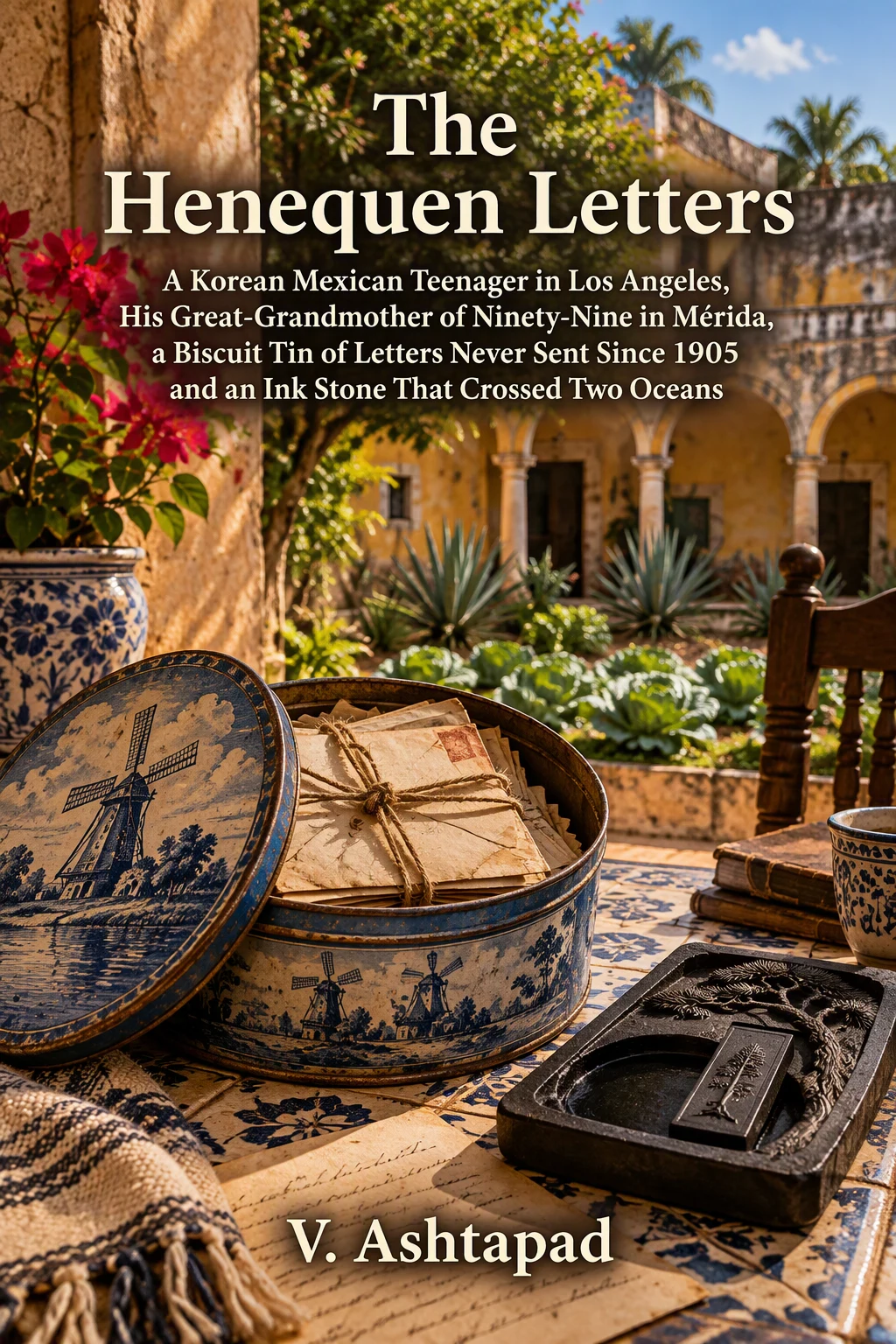
The Henequen Letters
A Korean Mexican Teenager in Los Angeles, His Great-Grandmother of Ninety-Nine in Mérida, a Biscuit Tin of Letters Never Sent Since 1905 and an Ink Stone That Crossed Two Oceans
by V. Ashtapad
Foreword
This is a work of fiction. The Korean emigrants who arrived in Yucatán on the ship Ilford in 1905, the henequen haciendas, the Korean communities of Mérida, Cuba and Los Angeles, Hanal Pixán and the Maya families of Yucatán are real. The Yi family, the letters and every named person in the story are invented.
For everyone who ended a letter with a word nobody else understood.
Joon-ho to Abuela Eulalia, Mérida — September 2026
Dear Abuela,
My mom says I have to write you a real letter. Not a text. Not a voice note. A letter, on paper, with a stamp, that goes in an airplane to Mérida and gets carried to your house on Calle 59 by a man on a motorcycle. She says it's for my college application essay, the one about "a time you connected with your heritage." She says if I write to you I'll have something real to say instead of making something up about kimchi.
So this is me writing a letter. I haven't written one since third grade, when we had to write to a soldier. I don't even know how to end it. Sincerely? Love? Do I sign my Korean name or my Mexican name?
Okay. Starting over.
Dear Abuela Eulalia,
It's Joon-ho. José Juan. Your great-grandson in Los Angeles. Pepe's son. You saw me when I was eight, at your ninetieth birthday, when we all flew down and I got sunburned at Progreso and threw up a marquesita in the rental car.
I'm seventeen now. I'm a senior at a high school in Koreatown. I run cross-country and I'm in the robotics club and I'm bad at Korean and worse at Spanish, which is a problem, because my mom's family is Korean from Seoul and my dad's family is you. Korean from Yucatán. Which nobody at my school believes is a real thing.
When I tell people my dad's family is Korean Mexican, they think I mean my mom is Korean and my dad is Mexican. And I have to explain: no, my dad is Korean AND Mexican. His family has been in Mexico since 1905. And they look at me like I said my dad is from the moon.
Mom says you have letters. She says Dad told her once that you keep a box of old letters from the family, going back to the first ship. She says if I asked, maybe you'd send copies.
I'm asking.
I'm also asking, I guess, because I want to know. Not just for the essay. For me. Because when my Korean grandmother here makes kimchi and asks why I put hot sauce on it, and when my Korean cousins in Seoul laugh at my accent, and when the Mexican kids at school call me chino, I don't have anything to say. I just stand there.
I should tell you about us, I guess, since you haven't seen us in nine years and Mom says you won't remember who's who. There are four of us. Dad (Pepe, your grandson, you know him) teaches chemistry at a public high school in Boyle Heights. Mom (Ji-yeon) teaches third grade in Koreatown, at the elementary school two blocks from our apartment. My little sister Hana is twelve and plays the cello and is, according to every adult who meets her, "an angel," which is a lie. We live in a two-bedroom place, fourth floor, in a building on Serrano Avenue with a broken elevator and a view of a parking structure. Hana and I share a room. There's a curtain down the middle. She has the window side because she says cellists need light.
Two teachers' salaries in LA means we're fine but not, like, fine fine. We eat out on Fridays. Dad drives a 2009 Camry with 240,000 miles on it that he calls El Tigre. Mom says when I get into college, if I get into college, we'll figure out the money. Dad says the same thing in Spanish. They say it a lot, which is how I know they're worried.
This essay matters, is what I'm saying.
Also, I should say, Hana says to tell you she says hi, and also that she plays the cello better than I run, which is true, and also that she wants to know if you still have the parrot that bit Dad at your ninetieth birthday. Dad says the parrot bit him because he tried to teach it a Korean word and it only knows Maya. Mom says that's not possible. Dad says Abuela Eulalia's parrot can do anything.
Mom says the stamp is enough for three pages. I'm on page two. So I'll stop.
Sincerely love,
Joon-ho (José Juan)
P.S. I've attached a picture of me at the cross-country meet. That's the jersey. Number 47. I came in ninth.
© 2026 CRUNOD LLC. All rights reserved.
Yi Sang-hun to his Mother, Incheon — May 1905, never sent
Honored Mother,
I write this on the forty-first day at sea. I do not know if it will ever reach you. There is no post on this ship. There is no land. There is only water the color of ink and a sky like a lid, and the smell of a thousand people below deck who have not washed in forty days.
The ship is called the Ilford. It is English. The sailors speak a language like birds fighting. We are a thousand and thirty-three Koreans. Men, mostly. Some wives. Some children. A baby was born two weeks ago and a very old man died four days ago, and they put him in the sea wrapped in a rice sack with a stone, and his son stood at the rail and did not cry because there were too many people watching.
You will remember that I did not want to come. You will remember that you told me to come. You said the agent from the company had promised: a warm country called Mexico, work on plantations, good pay, four years, and then home with money enough for land. You said the harvest has failed three years running. You said my brothers cannot all eat from one field. You said, Sang-hun, you are the second son, you must go.
I came.
Mother, I do not believe the agent. I have heard men talking at night. They say the contract we signed is not what they told us. They say the work is not rice but some plant none of us has ever seen. They say the warm country is very warm, and very far, and that no ship goes back.
I am twenty years old. I can read Chinese characters and Korean letters. I know the classics a little, because Father made me study before he died. I can plant rice and I can mend a fishing net and I can play the reed pipe badly. None of these things, I think, will be useful where we are going.
Before we boarded at Chemulpo, the agent made us line up on the dock and gave each of us a paper with our name and a number. Mine is 417. I have it in my shirt, against my chest. The paper is soft now from the sea air and my own sweat. The agent said the number is how they will know us when we arrive. A man next to me in the line, a butcher from Seoul named Kim, said, "So now we are numbers," and laughed, and nobody else laughed.
There are women on this ship who have bound their babies to their backs for forty days and not once let them down, even to sleep. There are boys of fourteen who said they were eighteen. There is a former soldier of the old king's army who sits by the hatch every night and sharpens a knife he is not supposed to have. There is a scholar who failed the government examinations three times and is going to Mexico, he says, because there is nobody left in Korea to be ashamed in front of. There is a fisherman from Jeju who weeps every morning at dawn and every evening at dusk and in between tells the most obscene jokes I have ever heard.
We are all poor. That is the only thing we have in common. That, and the paper with the number.
I carry with me: two shirts, the trousers I am wearing, a blanket, a small bag of rice which is almost finished, the brass spoon and chopsticks you gave me, and Father's ink stone. I will write on this ink stone in the new country. I will write you a letter every month. Perhaps one day there will be a post.
Tonight the men below are singing. A song from home, Arirang. A thousand voices in the dark, very low, so the English sailors will not shout. Some of the men are crying now, and singing anyway. I am writing by the light of a lantern someone has hung from a beam. It swings with the ship, so the shadows of the words move on the page.
Later. The same night. I could not sleep.
I went up on deck, which is forbidden after dark, but the English sailor at the hatch was asleep. The sea was very calm. There was no moon. The stars were so many and so close that I thought if I reached up I would cut my hand on them. I have never seen stars like this, Mother. Not even on the hill above our village, on the coldest night of winter, when Father took me up to see the river of stars and told me the story of the herd boy and the weaving girl, who are separated by that river and can meet only once a year, on a bridge of magpies.
I looked for them. The herd boy and the weaving girl. I could not find them. The stars here are in different places. The sky has turned. Even the stars have moved away from home.
I stood there until the sky in the east went grey. Then I came down and wrote this.
When I return, I will bring you a gift from Mexico. I do not know what it will be. Something you have never seen.
Your second son,
Sang-hun
---
*Note in Spanish on the back of the page, in pencil, in a different hand: Found in my father's ink stone box after he died, 1949. He never sent it. There was never a post to Korea. — Eulalia*
© 2026 CRUNOD LLC. All rights reserved.
Abuela Eulalia to Joon-ho, Los Angeles — October 2026
My dear Joon-ho,
Before anything else: I read your letter sitting in the doorway in my rocking chair, at five in the afternoon, when the shade comes over the front step. Ximena read me the parts in English. Then I made her read them again. Then I sent her home and read the Spanish words you wrote at the end myself, very slowly, with my magnifying glass. "Sincerely love." Ximena says that is not correct English. I say it is the most correct thing anybody has written to me in years.
Then I sat in the doorway until it got dark, holding your photograph. The jersey. Number 47. You have your great-great-grandfather's legs, very long and very thin, like a heron. He used to walk from the shop to the market in four minutes when it took everyone else ten. The neighbors called him el chino zancudo, the long-legged Chinese, which made him furious, because he was not Chinese, and which made my mother laugh, because his legs were very long.
Your letter arrived on a Tuesday. The man on the motorcycle brought it. His name is Wilberth and he has been carrying letters on Calle 59 for twenty years and he said he has never brought a letter from Los Angeles in handwriting. He stood at my gate and held it up to the sun like a fish he caught.
I want you to see where I am writing from, since you were eight last time and probably remember only the sunburn.
This is my father's house. Calle 59, between 62 and 64, in the center of Mérida. A long narrow house, the old kind, with a high ceiling and a tiled floor in a pattern of red and yellow flowers that my mother scrubbed every Saturday of her life. The front room faces the street, with two tall windows with iron bars and wooden shutters. Then a long hallway goes back, past the rooms, to a patio full of plants, and then to the kitchen, and then to the yard where the cabbages grow. My father planted the first cabbages in 1925. We have planted cabbages there every year since. Even the year of the hurricane. Even the year my husband died.
It is October, so it is hot. It is always hot. At noon the street is white, and the dogs lie in the shade of the parked cars, and the only sound is the knife-sharpener going by on his bicycle playing his little whistle. In the evenings, the neighbors bring their chairs out to the sidewalk and sit and talk until midnight, and I sit in my doorway in my rocking chair, and everyone who passes says, buenas noches, Doña Eulalia, and I say it back, ninety-nine years of buenas noches.
I live alone, except I am never alone. Ximena's family lives three houses down. Wendy is on the next street. Somebody comes every day with food I don't need and questions I've answered a hundred times. On Sundays there are twenty of us in this house. On my birthday, sixty.
I am writing back in Spanish because my English is worse than your Korean. Your mother will translate. Or use the telephone, the one that translates. Your cousin Wendy showed me how. You point it at the letter and it reads. Very clever. I don't trust it, but it's clever.
I am ninety-nine years old. My hand shakes. Forgive the writing. My great-granddaughter Ximena is sitting next to me making sure I don't put the commas in the wrong place. She is eleven. She says hello. She says your cross-country number is good. She says ninth is not bad. She is a liar, she runs too, and she says ninth is terrible. I will let you decide which part to believe.
Yes. I have the letters.
I have a box. A metal box, a biscuit tin from 1960, Danish biscuits, blue, with a windmill painted on the lid. Inside are letters, photographs, papers. From your great-great-great-grandfather, my father, Yi Sang-hun, who came on the ship. From me, from my brothers, from my husband, from my children. From your grandfather José, when he was a young man. Even from your father, Pepe, when he was at university in Mexico City and wrote me every week because he was homesick and had no money.
I will send you copies. Ximena has a telephone that makes copies. She will do it. I will send them a few at a time, so you have to read them slowly, the way they were written. Not all at once like a television.
The first one I send is my father's. The one he never sent to his mother. I found it in his ink stone box after he died.
He was twenty when he wrote it. Three years older than you.
You asked how to end a letter. In our family, at the end, we wrote the same thing. My father started it. I don't know where he got it. It's in Korean, but he wrote it in Spanish letters, so we could read it even after we forgot the Korean. It means something like: keep eating rice. Which is a very strange thing to put at the end of a letter. But it meant, stay alive. Stay strong. Come home.
Bap meogeo.
Your great-grandmother,
Eulalia Yi Canché
P.S. My mother was Maya. That's the Canché. I will tell you about her too. Nobody remembers that part.
© 2026 CRUNOD LLC. All rights reserved.
Yi Sang-hun to his Mother — August 1907, never sent
Honored Mother,
The plant is called henequen.
I have been cutting it for two years. I write to you at night in a hut with a palm roof and walls of thin sticks, on Hacienda San Antonio Xuul, two days by cart from the city of Mérida, in a region called Yucatán, where there are no rivers and no mountains and no rain for half the year, only white stone and red dust and the henequen.
The henequen grows in rows, as far as you can see, to every horizon, like an army of grey-green swords. Each plant is a cluster of leaves as long as my arm, thick and stiff and sharp at the edges, with a spine at the tip like a needle. From the leaves they make rope. All the rope for all the ships in the world, the overseer says. Binder twine for the farms in America. Every bale of wheat in the United States, he says, is tied with our henequen.
We cut the leaves with a machete. Each man must cut two thousand leaves a day. If he cuts less, he is not paid. If he is not paid, he cannot buy food at the hacienda store. If he cannot buy food, he borrows. If he borrows, he cannot leave, because he owes the hacienda, and the hacienda keeps the book.
The leaves cut your hands. All the men's hands are scarred. Mine are scarred. The juice burns. The sun burns. The stone is so white in the afternoon that some men go half blind.
The day begins at four. A bell rings in the dark, an iron bell hung from a ceiba tree by the big house, and the overseer's man walks between the huts with a lantern shouting in Spanish. We eat a tortilla and drink a cup of sour atole and walk in a line to the field, a long line, Korean and Maya together, with our machetes on our shoulders, while the stars go out one by one.
At the field, each man is given a row. Each row has maybe three hundred plants. You take the lowest leaves of each plant, the ripe ones, and leave the young ones in the middle for next year. You cut at the base, one stroke, then trim the spine from the tip, then stack the leaves in bundles of fifty, tied with a strip of the leaf itself. At noon the cart comes and takes the bundles to the machine house, where a great machine with iron teeth, powered by steam, tears the green flesh off the leaves and leaves only the fiber, long and pale as an old man's hair. They hang the fiber on lines to dry in the sun. From a distance, the drying yard looks like a field of hanging ghosts.
There is a smell to the machine house that I cannot describe to you. Green and sour and rotten all at once, like cut grass left in a jar. It gets into your clothes. It gets into your hair. When Concepción walks past me at the gate, she wrinkles her nose and says something in Maya that makes her grandmother laugh. I asked a Maya man what she said. He said, "She says you smell like money for someone else."
Mother, I do not want to frighten you. You will never read this. So perhaps I can tell you the truth.
It is very bad.
Some of the men have run. They are caught and brought back and beaten. Two have died. One of fever. One we do not talk about.
But I want to tell you also some good things, so you do not think your son is only suffering.
The Maya people work beside us. They have been cutting henequen for longer than we have, for generations. They speak their own language, not Spanish, and they look at us strangely, but they are kind. An old Maya woman who sells tortillas at the hacienda gate gave me a lemon and a chile and showed me how to eat them with salt for the heat. Her granddaughter laughed at me when I bit the chile. Her granddaughter's name is Concepción. She is seventeen. She has a laugh like a bird in a tree at dawn.
We have made a school. On Sundays, in the evening, in the hut of a man named Pak who was a teacher in Korea. Twelve children and twenty men. We teach Korean letters on a board with charcoal. We teach the children songs. We teach them to count. Pak says we must not let the children forget. He says if the children forget, then we are only henequen cutters. If they remember, we are still Korean.
Today was the festival of the patron of the hacienda. The owner, Don Eusebio, came from Mérida in a carriage with his family, all in white, the ladies with umbrellas against the sun. They stood on the porch of the big house and watched us line up, the Korean workers on one side and the Maya on the other, and the overseer read out a speech about loyalty, and the owner gave each family a pound of sugar and a piece of cloth. Then they went back inside and had lunch. We could smell it from the line. Roast pig. We had beans.
I do not tell you this to complain. I tell you because I want to remember how it felt to stand there with the sugar in my hand. Grateful and ashamed and angry, all at once. Like a dog who is given a bone by the man who beats it.
Concepción was in the Maya line. She looked at me across the yard. She did not smile. She made a face, very small, a face that said: this is ridiculous. Then she looked at the sugar in her hand and looked back at me and raised her eyebrows.
I laughed out loud. The overseer turned and stared. I had to pretend to cough.
That is the first time I thought: perhaps I can live here.
I play the reed pipe at night. I have made a new one, from a reed in the hacienda pond. It sounds different here. Lower. Sadder. The Maya children come and sit at the edge of the firelight to listen.
I have learned some words of the Maya language. Not many. Ha', water. Waaj, tortilla. Ki'imak in wóol, I am happy, which Concepción's grandmother taught me and then laughed at, because I said it wrong and it came out as something about a pig. Ya'ab, much. Chan, little. When I speak them, the Maya men smile. Not because I speak well. Because I try. The Mexican overseers never try. The Korean men mostly don't try either. They say we will go home soon, why learn.
Pak says I am wasting my time. He says I should be teaching the children Korean, not learning Maya myself. I told him: Pak, if we are going to live beside these people, we should at least be able to say thank you. He didn't answer. But the next Sunday, at the school, he asked me to teach the children the Maya word for thank you. Dios bo'otik. Twelve Korean children shouting it at once. The Maya women at the gate heard them and came to look, and put their hands over their mouths, and laughed until they cried.
The four years are nearly done. The overseer says the contract was four years. Pak says there is no ship to take us back. Pak says Korea is no longer Korea. Pak says the Japanese have taken it. I do not understand what he means. I am afraid to understand.
Your son,
Sang-hun
Bap meogeo.
---
*Note in pencil: Concepción Canché was my mother. They married in 1910. — E.*
© 2026 CRUNOD LLC. All rights reserved.
Joon-ho to Abuela Eulalia — October 2026
Dear Abuela,
I read Great-great-great-grandpa's letters about six times. Mom translated the Spanish notes and Grandma (my Korean grandma, Halmeoni) translated the Korean words, and she cried when she read the part about Arirang on the ship, and then she made me sit at the kitchen table and listen while she sang it, and then she cried more.
I didn't know any of it. Like, nothing.
I looked it up. The Ilford. 1905. A thousand thirty-three people. It's real. There's a museum in Mérida. There's a monument. There was even a K-drama about it once, my Halmeoni says, but she says it was bad, the actors were too pretty and nobody's hands were scarred.
I showed my friends at lunch. My friend Daniel, who is Mexican, his family is from Guadalajara, he read the part about the henequen and said "dude, that's basically slavery." And my friend Min, who is Korean, said "no, they signed contracts." And they had an argument about it for the whole lunch period and I just sat there eating my sandwich.
I think it's both? Like, they signed something, but they didn't know what. And then they couldn't leave.
That's kind of messed up.
Also, update: I'm taking an elective this semester called Ethnic Studies, which is new at our school this year, because the state made it a requirement. Mr. Delacruz teaches it. He's Filipino and he wears the same blue cardigan every day and he cries during documentaries. On Tuesday he did a unit on "Asian Latin Americans" and he put up a slide about the Korean henequen workers and I almost fell out of my chair.
I raised my hand. I said, "That's my family."
The whole class turned around. Mr. Delacruz took off his glasses. He said, "Seriously?" and I said, "Seriously," and he asked if I would bring something in. A letter. A photograph. Anything.
So now I have to present. In two weeks. I told him I'm still getting the letters. He said, "Take your time. That's the whole point of the unit. Nobody had time."
Hana says I'm going to be "famous for being from the moon." She's twelve. She thinks she's funny.
Also, I ran a 17:51 on Saturday. That's a personal best. I came in sixth. I'm telling you so you can tell Ximena.
The Saturday before that, I ran at Mount SAC. That's the big course in Walnut, with the hills everybody hates, Poop Out Hill and the Switchbacks. (Those are the real names. I'm not making it up.) Halfway up the Switchbacks, I was dying, and I thought about the henequen. Two thousand leaves a day. In the sun. With the spines. And I thought, he did that for four years, and I can't do two more minutes of hill?
So I passed two guys.
Coach said afterward, "What happened to you on the Switchbacks, Yi?" I said, "My great-great-great-grandpa." He looked at me weird. I didn't explain.
Anyway, I had a question. Great-great-great-grandpa wrote that Korea wasn't Korea anymore. That the Japanese took it. So he couldn't go back. Is that why the family stayed? Like, it wasn't a choice?
Also: he married Concepción. Your mom. So you're Korean and Maya and Mexican. And I'm Korean and Maya and Mexican and also Korean again. Halmeoni says that makes me "extra Korean." Daniel says it makes me "extra Mexican." I think it just makes me confused.
I'm trying to write my essay. It's due November 1. Right now it's three sentences long and one of them is about kimchi.
Bap meogeo,
Joon-ho
P.S. Is it weird to sign it like that? It feels weird. But also not.
© 2026 CRUNOD LLC. All rights reserved.
Eulalia Yi Canché to her brother Manuel, Matanzas, Cuba — March 1921
Querido Manuel,
You have been gone four months. Papá says not to write because the letters cost money and you will be too busy cutting cane to read them. I am writing anyway. I am eleven. Mamá says I am old enough to have my own opinions about postage.
It is the dry season now. The wells in the barrio are low and the water tastes of stone. Every morning before school I carry two buckets from the public well on the corner to the house, and Mamá pours them into the big clay jar in the kitchen that keeps the water cool. The jar is older than Mamá. It was her grandmother's. It sweats in the heat like a person, and if you put your cheek against it at noon, it's the coolest thing in all of Mérida.
At night the whole city smells of smoke from the milpas burning in the countryside, the farmers clearing their fields for the rain. The sky goes orange at sunset and stays orange half the night. Papá stands in the yard and looks at it and says it looks like the sky over the harbor at Chemulpo when the fishing boats burned their lamps. Then he says, "No, it doesn't," and goes inside.
I hope Cuba is good. I hope the cane is not as bad as the henequen. Papá says sugar cane is softer on the hands but worse on the back. Papá says a lot of things. Since you left with the other families he walks around the house at night and plays his pipe and won't eat.
Do you remember the day you left? At the station in Mérida? With the three hundred others going to the ship at Progreso? Mamá made you a bag of food for the journey: tortillas, a whole cochinita wrapped in banana leaves, and kimchi in a jar. Papá's kimchi, the Yucatán kind, with habanero instead of the Korean pepper, because the Korean pepper won't grow here. Remember Papá said it was the best kimchi in the world, and Mamá said it was the worst cochinita in the world, and they argued about it on the platform until the train came?
I think about that every day.
At the Korean school, Teacher Pak says we must raise money for the independence movement. For Korea. There is a government in exile, he says, in Shanghai, and they need money to fight the Japanese. Every family gives. Even the poorest. Papá gives one day's wage every month. We eat beans for a week afterward. Mamá says Korea is very far away and she has never seen it and why must her children eat beans for a country across the ocean.
Papá says: because if nobody gives, there will be no country to go back to.
Mamá says: Sang-hun, you are never going back. Look at your children. Look at your hands.
And they don't argue about that. They just go quiet.
I want to tell you something, Manuel. Something I haven't told anybody.
I don't think I am Korean. Not like Papá. I don't remember Korea, because I was never there. I speak Korean only at Teacher Pak's school and at home, and badly, and with Maya words mixed in, and Papá laughs at me. I speak Maya with Mamá and Abuela in the kitchen. I speak Spanish everywhere else.
When the Mexican girls at the market call me china, I say I'm not Chinese, I'm Korean. And they say, what's the difference? And I can't explain.
When the Korean ladies at the school say I'm too dark, I've been in the sun too much like a Maya, I say I am Maya. And they make a face.
Papá has started a new thing. Every evening, after he closes the shop, he sits in the yard by the cabbages and writes. In a little notebook. In Korean letters. He won't tell us what. When Pedrito tried to look, Papá closed the notebook and put it in his shirt and said, "That is for my mother," and then he looked so sad that Pedrito said sorry and went to bed without being told.
I think he is writing her letters. I think he has nowhere to send them.
I think that is very Korean. Mamá says it is very Maya too. She says her grandmother used to talk to the dead every evening in the kitchen, out loud, and tell them what the price of corn was.
So what am I? I'm writing to ask you, because you're older, and because you're in Cuba now with the other Korean families, and maybe in Cuba they have figured it out.
Something else happened, Manuel. Last week at the market, a woman selling oranges asked Mamá if I was her maid. Mamá was holding my hand. The woman looked at Mamá, who is Maya and wears her huipil, and at me, who has Papá's eyes, and decided I could not be her daughter. So she decided I was her maid.
Mamá didn't say anything. She bought the oranges. She paid. Then, very calmly, in front of everybody, she took one of the oranges and peeled it and gave half to me and ate the other half herself and spat the seeds onto the woman's table, one by one, while looking at her. Then we walked away.
I laughed all the way home. Mamá didn't. When we got home, she sat in the kitchen with her hands in her lap for a long time.
Then she said, in Maya, "Eulalia, they will always ask you what you are. Never answer the question. Answer with an orange."
I don't know what that means. But I think about it.
Please write back. I will pay the postage myself. I have been selling Mamá's papadzules at the gate on Saturdays.
Your little sister,
Eulalia
Bap meogeo. (I never know what to write here. Papá says it means eat rice. But we mostly eat corn.)
---
*Note in a later hand, ballpoint pen: Manuel never wrote back. He died in Matanzas in 1934, of fever. His children are in Havana. We found them in 2019. — E.Y.C.*
© 2026 CRUNOD LLC. All rights reserved.
Abuela Eulalia to Joon-ho — November 2026
My dear Joon-ho,
Ximena says I should begin with the weather, because I am old and old people begin with the weather. So. It rained yesterday for the first time in a month, a short hard rain at four o'clock that turned the street into a river for twenty minutes and then stopped as if someone had turned off a tap. The cabbages are happy. The cat from next door sat under my rocking chair the whole time and looked at me as if the rain were my fault.
Now. Your question.
You asked if it was a choice. To stay.
No. And yes. Both, like everything.
When my father's contract was finished, in 1909, there was no ship. The company had promised one and lied. And Korea was taken. In 1910, the Japanese made it part of their empire. My father had no country to go back to. His mother was there, his brothers, his village, and he could not reach them. Not by letter, not by ship. It was like a door had closed and someone had painted over it.
So he stayed. He married my mother. He worked. Later he left the hacienda and came to Mérida and opened a small shop selling vegetables and charcoal near the market. He grew cabbage in the yard for his kimchi. He learned to make cochinita pibil because my mother refused to make it for him anymore after the argument at the station. He played his pipe. He spoke Korean to us, and we answered in Spanish, and he pretended not to notice.
That was not a choice. That was what was left.
But here is the other part. The yes.
In 1945, when Korea was free again, there was a ship. A Korean man came to Mérida from the new government, from the association in Los Angeles, with a list. Anyone who wanted to return, he said, could register. Many families thought about it. My father thought about it for one month. He went to the meeting every week. He sat in the back. He did not register.
When I asked him why, he said, "Eulalia, your mother is buried here. My children are here. My hands are here." He held them up. The scars from the henequen. "These hands are Yucatecan now."
That was a choice.
I promised to tell you about my mother. So here she is. Concepción Canché Pech.
She was born in 1890 on Hacienda San Antonio Xuul, in a hut with a palm roof, to a family that had cut henequen for three generations and cut maize for a thousand years before that. She spoke Maya first. She learned Spanish at twelve, from the overseer's wife, while she scrubbed her floors. She never learned to read. She could count faster than any man I ever met, in Maya, on her fingers and on the joints of her fingers, and she knew to the centavo what the hacienda store owed us and what we owed it.
When she married my father, her mother did not speak to her for a year. A chino, her mother said. A foreigner. Who doesn't even eat tortillas properly. My grandmother came around when I was born. She came to the hut with a gift: a hammock she had woven herself, and she hung it, and put me in it, and sang to me in Maya, and from then on she came every day.
My mother taught my father to eat chile without crying. He taught her to make kimchi. She refused to make it the Korean way. She made it the Maya way, with habanero and sour orange and achiote. He said it was a crime. He ate it every day for sixty years.
She died in 1958, at sixty-eight, in the room with the window over the cabbages. My father sat with her for three days afterward. He did not eat. He played his pipe. When the neighbors came to take her, he walked behind the coffin through the streets of Mérida, all the way to the cemetery, playing Arirang on the pipe, very slowly, and the Maya women walked behind him singing their own songs, and the Korean men walked behind them, and it was the strangest funeral anyone in Mérida had ever seen, and the most beautiful.
That is where the Canché comes from. Write it down. Nobody remembers that part.
You asked what you are. Korean, Maya, Mexican, Korean again. You said you're confused.
I'm ninety-nine. I'm still confused.
But I'll tell you what my father said to me when I was twelve, after Manuel didn't write back, when I cried in the yard by the cabbages because I didn't know what I was.
He said: "Eulalia, a rope is made of many fibers. Henequen fiber, by itself, is weak. You can snap it. But twist a thousand together and they will hold a ship to a dock in a storm." He picked up a piece of rope from the shop and gave it to me. "You are not one thing. You are a rope."
I still have that piece of rope. In the biscuit tin. Ximena will take a photograph.
And now I will tell you the other thing, because it is November and the dead come back in November here.
Next week is Hanal Pixán. That's the Maya name for the days when the dead come home to eat. Everybody in Yucatán does it, the Maya way, not the Mexico City way: no skulls with sugar, no orange flowers, just food. We make mucbipollo, a big tamal baked in the ground, wrapped in banana leaves, with chicken and pork and achiote, and we put it on a table with the photographs of our dead, and candles, and a cup of water, and the things they liked.
On my table this year: my mother's photograph and a jícara of atole. My husband Felipe's photograph and a pack of his cigarettes, the brand they don't make anymore, that I've been keeping since 1993. Manuel's photograph from Cuba, with a little cup of coffee. José's photograph from Los Angeles, with a jalapeño, because he would think that was funny.
And my father's. With a small bowl of rice. And a bowl of kimchi, the Yucatán kind, with habanero. And his pipe.
Every year, I put the rice there and say, "Papá, eat." Every year, my great-grandchildren ask why Bisabuelo gets rice and everyone else gets tamales. Every year, I tell them.
This year, I'll tell them about you too.
Your essay is three sentences. That's good. Three sentences is more than most people know.
Bap meogeo,
Eulalia
P.S. It is not weird to sign like that. It is the most normal thing in this family.
© 2026 CRUNOD LLC. All rights reserved.
José Yi Martínez to Elena Hwang, Los Angeles — June 1965
Elena,
I am writing this on the bus from Mérida to Mexico City, then I will take another bus to Tijuana, and then, if the buses and the border allow, I will be in Los Angeles by the end of the month, and I will be standing at your door on Olympic Boulevard with my one suit in a paper bag.
You asked in your last letter why I want to come to America. Your father asked it too, I am sure, over dinner, with his face like a closed shop. A Korean Mexican boy from Yucatán with no money and an engineering degree from a university nobody in Los Angeles has heard of. Why does he want to marry my daughter? Why does he want to come here?
I'll tell you the truth, and you can tell your father whatever you want.
I met you at the Korean independence anniversary dinner in Mérida in 1963. You came with your father, who was on some committee from the association in Los Angeles, visiting the old families in Yucatán, the old henequen families. You were wearing a blue dress. You were very bored. You sat at the end of the long table and read a paperback novel under the tablecloth during the speeches. I sat next to you because there was no other chair.
And you looked at me and said, in English, "You don't look Korean."
And I said, in Spanish, "You don't look Mexican."
And you laughed so hard you dropped your novel in the soup.
That's why.
But also this. When you talk about Los Angeles, about Koreatown, which is small, you say, just a few streets, a few shops, a bakery, a grocery, you make it sound like a place where people like us could be something. Not Korean. Not Mexican. Something new. In Mérida, I'm the Korean. In Seoul I'd be the Mexican. I went once, to Seoul, last year, with a scholarship. Did I tell you that? I went to find my grandfather's village. I found the village. I didn't find anyone. A man in the village office looked at the old papers and said all the Yis from that family died in the war or went north. He looked at me and said, "You're from Mexico? Mexico is very far." Then he gave me a cup of barley tea and I sat in his office and drank it and could not stop shaking.
Elena, I'll tell you something else about Seoul, since I am confessing everything. On my last day there, I went to a market near the river. Gwangjang, they call it. Long rows of women at little stalls frying mung bean pancakes in big iron pans, and the oil smoking, and people sitting on low stools eating and drinking. I sat down at one stall because I was hungry and because the woman frying the pancakes looked like my great-aunt in Progreso, short and broad and fierce, with her sleeves pushed up.
I ordered in my terrible Korean. She stared at me. She asked where I was from. I said Mexico. She laughed. She asked where my family was from. I said Incheon, a village called Hwado. She stopped laughing. She said her mother's people were from near there. She asked my family name. I said Yi. She said, half the country is Yi.
Then she gave me a second pancake for free. And a cup of makgeolli, the rice wine, white and fizzy, which I had never tasted, and which tasted, I swear to you, exactly like the fresh pulque the old men sell outside the market in Mérida.
I told her that. I said, in Spanish, because I didn't have the Korean, "Esto sabe a pulque." She didn't understand a word. She laughed anyway. She patted my hand. She said something long in Korean. I understood only the end.
Bap meogeo. Eat. Eat rice.
I sat on that low stool and cried in front of the whole market.
So I don't want to be the Korean, and I don't want to be the Mexican. I want to be the one who sat next to you at the end of the table. That's who I am now.
I will tell you also about the night before I left, because I want you to know what you are marrying into. My mother made a dinner. Everybody came. Thirty-four people in the house on Calle 59. My uncles from Progreso, who fish. My cousins from Valladolid, who teach. My aunt Lupe, who sells hammocks in the market and talks so much that the hammock buyers pay just to make her stop. My grandmother's sisters from the hacienda village, very old Maya ladies in white huipils with embroidered flowers at the neck, who sat in a row by the wall and said nothing and watched everything. The old Korean men from the association, four of them left now, who came in their good shirts and sat at the head of the table with my grandfather and drank too much and sang.
They sang Arirang. Then the Maya ladies sang something in Maya. Then my cousins sang La Bamba, very badly. Then my grandfather took out his pipe and played a song I didn't know, very old, very slow, and the four old Korean men put down their glasses and closed their eyes, and one of them, Mr. Pak's son, whose father started the school on the hacienda, put his head down on the table.
Afterward I asked my grandfather what the song was. He said, "It doesn't have a name. My mother sang it when she ground the rice. I don't remember the words." He put the pipe away. He said, "Somebody in Los Angeles should know it. Learn it before you go."
So I learned it. In one night. I'll play it for you on your porch. I don't have a pipe. I'll whistle.
The bus is stopping in Villahermosa. It's very hot. A woman just got on with a basket of chickens and they're looking at me.
I should also tell you the truth about my father, so you hear it from me and not from yours. He does not want me to go. He has not said so. He has said, "Go, mijo, the world is big," and given me fifty dollars in an envelope and his own father's ink stone through my mother. But last night I heard him in the yard at two in the morning, by the cabbages, playing the pipe. Arirang. Very softly. He hasn't played it since my grandmother died.
I stood at the kitchen door in the dark and listened. I didn't go out. I think he would have been ashamed if I had, and I would have been ashamed too, and then I wouldn't have gotten on the bus.
So when your father asks what kind of family I come from, tell him that. Tell him I come from a family where a man plays a song from a country he lost, in the middle of the night, to a vegetable patch, so his son won't hear him cry.
I have with me: one suit, three shirts, my degree, a box of my father's kimchi wrapped in five plastic bags so the bus doesn't smell, which it does anyway, and my grandfather's ink stone, which my mother gave me when I left. She said Grandpa Sang-hun would want it to keep going.
One more thing, Elena. Your father will ask what I can offer. Tell him this. I have a degree in mechanical engineering, second in my class. I can fix anything with a motor. I can speak Spanish, Korean (badly), Maya (worse), and English (you'll correct me). I can cook cochinita pibil and kimchi in the same afternoon. I can sing Arirang and La Bamba. My grandfather crossed an ocean with a spoon and an ink stone and a number on a piece of paper, and he never once complained in front of his children.
I am not rich. I am the grandson of a henequen cutter. But I have never in my life been late for anything that mattered.
Tell him I'll be there by the end of the month.
I'll write you a letter on it from Los Angeles. On your porch, if your father lets me in.
José
Bap meogeo. (My family ends letters this way. It means eat rice. Don't laugh.)
© 2026 CRUNOD LLC. All rights reserved.
Joon-ho to Abuela Eulalia — November 2026
Dear Abuela,
GRANDPA JOSÉ DROPPED THE NOVEL IN THE SOUP?
I mean. Grandma Elena dropped it. You know what I mean.
I called my dad. I read him the letter over the phone. He didn't know about the soup. He didn't know Grandpa went to Seoul. He didn't know about the barley tea. He was quiet for a long time and then he said, "Your grandfather never talked about any of that." And then he said, "He talked about the soup, though. He used to say, 'I married your mother because she has terrible table manners.'"
I asked Dad tonight why he never told me any of this. About the henequen and the letters and the soup and Seoul. He was grading lab reports at the kitchen table. He put his red pen down and took his time over it. Then he said, "Because nobody told me either, mijo. Not really. Papá would say, my grandfather was Korean and came to Mexico, and that was it. Like it was a fact about the weather. Your Abuela Eulalia told me more in one summer than Papá told me in my whole life." He picked his pen back up. "I think it hurt him to say it. I think it hurts everybody. So everybody says one sentence and stops."
Then he said, "You're the first one who kept asking."
Grandpa died when I was five. I barely remember him. I remember he had big hands and smelled like car grease, because he became an engineer at an aerospace company in El Segundo, which I didn't know until Dad told me today, and he used to fix the neighbors' cars on weekends for free. I remember he made kimchi with jalapeños in a plastic bucket on the back porch and Halmeoni Elena yelled at him about it. I remember he called me "mijo" and "adeul" in the same sentence.
I didn't know any of the rest.
Abuela, I have a confession. I was going to write my essay about how I'm "proud of my heritage" and how "food connects generations." I had the whole thing outlined. Kimchi, tacos, blah blah blah. Ms. Ortega, my English teacher, would have given me a B-plus and written "good use of sensory detail" in green pen.
But now I can't write that. Because it's not true. Or it's true but it's not the point.
The point is the ink stone.
Grandpa José had it. And he wrote letters on it in Los Angeles. Dad says it's in a box in our garage. A box of Grandpa's things nobody has opened since he died. Dad says Grandma Elena couldn't open it, and then she died too, and then nobody wanted to.
Okay. Update. I opened it.
It was Saturday morning. Dad got the box down from the top shelf in the garage, behind the Christmas decorations and the camping stuff we never use. It's a cardboard box that used to hold a microwave, taped shut with brown tape that had gone yellow and brittle. On the side, in black marker, in Grandma Elena's handwriting, it says JOSÉ, and then underneath, smaller, in Korean, 아버지 (father).
Dad sat on a lawn chair in the garage and didn't open it. He just looked at it. So I got the box cutter from the toolbox and I said, "Dad?" and he said, "Go ahead," without looking at me.
Inside: a brown leather jacket that smelled like old cologne and garage. A pair of reading glasses in a case. Three notebooks full of engineering drawings, really nice ones, of engines and gears and some kind of valve. A photograph of Grandpa and Grandma Elena on their wedding day, on the steps of the courthouse downtown, both of them looking terrified. A Dodgers cap. A cassette tape labeled MÉRIDA 1971 that Dad says is a recording of Abuela Eulalia's dad playing the pipe, and that we don't have a cassette player for.
And at the bottom, wrapped in a white cotton cloth, the ink stone.
It's smaller than I imagined. Black. Heavier than it looks. Cold, even in the garage, even in LA. There's a pine tree carved on the side, almost worn away from being held. There's a crack along one corner that someone repaired a long time ago with something gold.
Dad held it for a long time. Then he gave it to me.
Then he went inside and I heard him in the bathroom running the water so nobody would hear him.
I'm going to open it.
Bap meogeo,
Joon-ho
P.S. Ximena, I looked up your 5K time on the Yucatán state youth results. You're faster than me. I'm not okay.
© 2026 CRUNOD LLC. All rights reserved.
Pepe Yi to Abuela Eulalia, from Mexico City — February 1991
Abuela,
It's two in the morning. I'm in my room at the boarding house in Coyoacán, and the lady who owns it has turned off the hot water again to save gas, and the bus outside my window has been idling for an hour, and I have an exam in organic chemistry at eight, and I'm writing to you instead of studying because I'm homesick and I don't know who else would understand.
Papá doesn't understand. When I call him in Los Angeles, he says, "Mijo, I sent you to Mexico so you would know where you came from. Now you know. Study." Mamá doesn't understand. She says, "Why can't you be homesick for Los Angeles like a normal person?" And I can't tell my friends here, because to them I'm the gringo with the Korean face who says güey wrong.
Abuela, I grew up in LA. In Koreatown. I went to Korean school on Saturdays because Mamá made me, and to the Mexican market on Sundays because Papá made me, and I never once in my life felt like I belonged in either one. I came to Mexico City for university because Papá said, go, go to the country I left, see it. So I came. And I'm homesick. But not for LA.
I'm homesick for your house.
For the tiles with the red and yellow flowers. For the cabbages in the yard. For the smell of cochinita on Sunday morning and Bisabuelo's kimchi in the big clay pot by the kitchen door. For the summer I was ten and Papá sent me to stay with you for two months, and you made me sweep the patio every morning and sit with Bisabuelo every afternoon while he played the pipe, and he taught me eleven words of Korean and four words of Maya and one terrible joke in a mixture of both that I still don't fully understand.
I've been there exactly one summer in my whole life. And it's the only place I've ever been homesick for.
Is that strange?
I'm studying chemistry because Papá wants me to be an engineer like him and I'm not good enough at math to be an engineer. I'm good at chemistry, though. I like it. I like that everything is made of something else. That if you take a thing apart, you find it's a hundred smaller things, held together by forces you can't see. That nothing is just one thing.
I think I want to teach it. Chemistry. In high school. In LA, maybe. To kids like me, who don't know what they are. I want to stand in front of them and tell them: nothing is just one thing. Water is two kinds of atoms. Salt is two. Henequen rope is a thousand fibers. You're allowed to be more than one thing. It's chemistry. It's not a choice. It's just how matter works.
Papá will be disappointed. Teachers don't make money.
Write me back, Abuela. Tell me I'm not crazy. Tell me it's okay to be homesick for a place I've only been one summer.
And tell Bisabuelo the joke still doesn't make sense.
Your grandson,
Pepe
Bap meogeo. (I eat tortas now, mostly. Close enough.)
---
*Note in pencil, Eulalia's hand: Bisabuelo died in 1971, before Pepe was born. The summer he means was 1982, with me, and the pipe was a cassette I played for him every afternoon, and the eleven words were mine. He doesn't know that. I never told him. Let him keep it. — E.*
© 2026 CRUNOD LLC. All rights reserved.
Eulalia Yi Canché to her husband Felipe, in the hospital — April 1971
Felipe,
They won't let me stay past eight. The nurse with the mustache says rules are rules. So I'm writing this at the kitchen table at midnight and I'll bring it tomorrow and read it to you if you're too tired to read.
Papá died tonight.
You knew he was sick. He's been sick for two years, with his lungs, from the charcoal smoke in the shop all those years. Tonight his breathing changed around ten o'clock. Ximena and Pedro and I were with him. He was in his bed in the back room, the one with the window over the cabbages. The radio was on, the Yucatecan trova station. He liked the guitars.
Around eleven he woke up and looked at me. And he said, in Korean, something I didn't understand. Something long. Then he said, in Spanish, "Eulalia, where's my mother?"
I didn't know what to say. His mother has been dead for fifty years, probably, in a village in Korea that we will never see.
So I said, "She's in Incheon, Papá. She's waiting for your letter."
And he smiled. And he said, "I wrote her. Every month. Tell her I wrote her."
And then he went back to sleep, and an hour later he stopped breathing.
Felipe, he never sent any of them. I found them tonight. After. In his ink stone box. Dozens of letters. To his mother. From 1905 until 1949. He wrote her every month, like he said, for forty-four years, and folded them, and put them in the box, and never sent one, because there was never a post to Korea. Or because, later, when there was, it was too late. Or because he couldn't bear to find out.
I sat on the floor and read them all. The ones in Korean I couldn't read. The ones in Spanish I could. He switched to Spanish around 1930, when he started forgetting the Korean characters. The last ones are in Spanish with Korean words mixed in, and Maya words, and the names of the grandchildren.
The last one is from 1949. It says: Mother, today my granddaughter Ximena took her first step. She walked from the cabbages to the door. She is half Korean and half Maya and half Spanish, which is too many halves. She is beautiful. When I return, I will bring her to you.
The children don't know yet. Pedro will be angry I didn't call him sooner. Ximena knows; she was here. She is twenty-two now, with her own baby on her hip, my first grandchild, and she sat on the floor beside me while I read and held the lamp and didn't say anything. When I came to the letter about her first step, she put the lamp down and put her face in her hands.
We named the baby Sang, did I tell you? After Papá. He held him last month. He said the baby has hands like a henequen cutter. Strong. He said it like a blessing. I'm not sure it is one. But I let him say it.
I don't know what to do with them, Felipe. Should I burn them? Bury them with him? Keep them?
I'm going to keep them. In a box. I'll buy a box tomorrow. A good one, with a lid that closes.
He asked for one other thing, Felipe, before he slept the last time. It was around eleven-thirty. He opened his eyes and looked at the window, at the cabbages in the dark, and said, "Eulalia. Plant them again in March. Don't let the yard go empty." I said I would. He said, "And the kimchi. Make it with habanero. Your mother's way. Not mine." I said, Papá, you always said Mamá's way was a crime. He smiled. He said, "It was. I liked the crime."
Those were the last words he said in Spanish. After that only Korean, very soft, and a few words of Maya, which surprised me. I think he was talking to my mother. I think she was there.
Come home soon. I need you to tell me I'm doing the right thing. Or that I'm doing the wrong thing, and then I'll do it anyway.
Eulalia
Bap meogeo. Eat the hospital rice even though it's bad.
© 2026 CRUNOD LLC. All rights reserved.
Abuela Eulalia to Joon-ho — December 2026
My dear Joon-ho,
Ximena says you are slower than her and you are not okay. She says that's the correct response.
You opened the box.
Your father called me. He was crying. He said, "Abuela, Joon-ho opened Papá's box. You have to see what was inside." He sent photographs on the telephone. Ximena showed me. My eyes are bad but I saw.
The ink stone. My grandfather's. Black, smooth as water, the size of your hand, with a little hollow at one end for the ink and a carving of a pine tree on the side that is almost worn away. I have not seen it since José took it on the bus to Tijuana in 1965. I cried when I saw it. Ximena gave me a tissue and told me I was being dramatic. I told her I'm ninety-nine, I'm allowed to be dramatic.
And the letters. José's letters. To Elena, before the wedding. To his children, your father and your aunts, when they were at summer camp. To me, his mother-in-law, a few. And one letter, very short, written on the stone in ink, never sent, from 1989, the year his own mother died.
To Yi Sang-hun's mother. His great-grandmother. In Incheon. Who had been dead for at least eighty years.
Your father read it to me on the telephone. It said:
*Great-grandmother, my name is José Yi Martínez. I am your son Sang-hun's grandson. I am writing to tell you that he arrived. He arrived in Mexico in 1905. He never came home. But he wrote to you every month. I have read his letters. He wanted you to know that he was alive, and that he ate rice, and that he was not alone. I am writing for him because he is gone now. I am in Los Angeles. I have three children. They are Korean and Mexican and American. I have taught them nothing. I am ashamed. But I have kept his ink stone. It is on my desk. Bap meogeo.*
Joon-ho.
I want to tell you something else about your grandfather José, since you have his ink stone now and should know whose hands it was in.
When he left for Los Angeles in 1965, I was angry. Your grandmother Elena was a stranger to us, a girl from the north with money and short hair and a father who looked at our house like it might give him a disease. José was the first of my children to leave Yucatán. My father wept at the bus station. He had not wept at the station when Manuel left for Cuba, but he wept for José. He said: that's two. Two of my blood gone across the water. He said: the sea takes everything eventually.
José wrote me every month. Like my father wrote his mother. The difference is, José sent them. Every month for thirty-six years, a letter from Los Angeles, with photographs of the children, and twenty dollars folded inside, which I told him a hundred times not to send and which he sent anyway. I kept all of those too. They are in a second tin. It has a picture of the Eiffel Tower on it. Ximena will send you those next.
So you see, it is a family of letter writers. Some of us send them. Some of us don't. All of us write them.
He said he taught them nothing. He was wrong. He taught you to open the box.
Now you have the ink stone.
You have never asked about Felipe, my husband, so I will tell you, because you have his chin and nobody has told you that either.
Felipe Martínez Euán. A mechanic. He fixed buses for the Mérida line for forty years. He had grease under his fingernails on our wedding day, and at every baptism, and at his own mother's funeral, because he said clean hands were for men who didn't work. He was Maya on his mother's side and Spanish on his father's and he could not cook anything except eggs, and he made the eggs every Sunday for fifty-one years and never once made them the same way twice.
When I married him in 1946, the old Korean ladies at the association were unhappy. Another Mexican, they said. The Yi family is disappearing. Soon there will be nothing Korean left. My father told them to mind their own kimchi.
Felipe learned to make my father's kimchi before I did. He learned because my father asked him, the year after my mother died, when Papá's hands started to shake. Every November, Felipe and Papá sat in the yard with the cabbages and the salt and the habanero and the big clay pot, and talked for hours, in Spanish, about buses and engines and baseball, and Felipe salted and Papá supervised. When Papá died, Felipe kept making it. Every November, alone, in the yard, the Maya mechanic making the Korean man's kimchi the Maya woman's way.
That's the family you come from. Nobody is one thing. Nobody even makes the kimchi.
Your grandfather José learned from Felipe. Your father learned from José, a little, in Los Angeles, in a plastic bucket. Now it's your turn. Ximena will send the recipe. It's not written down. She'll have to film it.
You know what to do with it.
Eulalia
Bap meogeo.
---
*Enclosed with this letter, a copy from the Eiffel Tower tin:*
**Elena Hwang Yi to Eulalia, Mérida — September 2001**
Dear Eulalia,
I'm writing in English because my Spanish is still embarrassing after thirty-six years, and José says you have a nephew who reads English now, and because if I write in Spanish you will correct the grammar and send it back to me in red ink, which you have done four times.
José is in the hospital at Cedars. It's his heart. The doctors say it's not the first time; they found scars from an old one he never told anyone about, from maybe ten years ago. He says he thought it was indigestion. From my kimchi. He made a joke about it to the cardiologist, who did not laugh.
He's stable. He's asleep now. I'm writing in the cafeteria with a cup of coffee that tastes like the river.
Eulalia, I want to tell you something I have never said to you. When I met José, at that dinner in Mérida, I was nineteen and I hated everything. I hated being dragged across Mexico by my father to shake hands with old men who had cut rope. I hated the heat. I hated the food, which I thought was too strange, and the people, who I thought were too poor. I hated being Korean. I hated not being Korean enough for my father's friends. I was reading an English novel under the tablecloth because English was the only thing that belonged to me and not to my father.
And then this skinny boy sat down next to me, with a Korean face and a Mexican accent, and said I didn't look Mexican. And I dropped my book in the soup.
I didn't know then what I was laughing at. I know now. I was laughing because for the first time in my life somebody had asked me the same question everybody always asked, what are you, and turned it around, and made it funny.
He has done that every day for thirty-six years.
I'm afraid, Eulalia. If something happens, I don't know who will turn the question around for me.
I'm writing because you're the only person I know who has buried a husband and kept going. Tell me how.
Elena
---
*Note at the bottom, in Eulalia's handwriting, a copy of her reply: You don't keep going. You keep writing. Letters, recipes, lists, anything. One every day. You write to him even though he can't answer, and one day you notice you're writing to your grandchildren instead. That's how. — E.*
*Below it, in pencil, a later note: José lived until 2014. Thirteen more years. She wrote him a letter every morning anyway, she told me, just in case. — E.*
© 2026 CRUNOD LLC. All rights reserved.
Joon-ho to Yi Sang-hun's Mother, Incheon — December 2026
Great-great-great-great-grandmother,
My name is Yi Joon-ho. In Mexico they would call me José Juan Yi Kang. I'm seventeen. I live in Los Angeles, in Koreatown, which is not a few streets anymore. It's huge. It's bigger than your whole village, probably. There are Korean bakeries and Korean barbecue and Korean banks and Korean karaoke and a Korean supermarket the size of a stadium. There are also Mexican taco trucks on every corner, and Salvadoran pupusa places, and Oaxacan restaurants, and a lot of the people who work in the Korean restaurants are from Guatemala and speak Korean better than I do.
I should explain where I am. I'm at the kitchen table in our apartment on Serrano, at eleven at night, with Hana asleep behind her curtain and Mom grading spelling tests on the couch and Dad on the balcony on the phone with Abuela in Mérida, speaking Spanish too fast for me to follow. The window is open. There's a helicopter somewhere over Wilshire. Someone in the next building is playing a Korean drama too loud. The taco truck on the corner of Sixth is closing up, and the guy who runs it, Don Chuy, is singing a ranchera while he scrapes the grill.
This is the loudest, most mixed-up place in the world. I think your son would have liked it.
I'm writing on your son's ink stone. My dad showed me how to grind the ink. You put a little water in the hollow and you rub the ink stick on the stone in circles, slowly, slowly, until the water turns black. It takes forever. My arm is tired. My dad says that's the point. He says Grandpa José said you can't write a letter like this fast. The stone won't let you.
I wanted to tell you some things.
Your son Sang-hun arrived. You know that. Everyone has told you. But I wanted to tell you what happened after, because nobody wrote that part.
He had seven children. Thirty-one grandchildren. I don't know how many great-grandchildren. More than a hundred. They're in Mérida, Mexico City, Tijuana, Havana, Los Angeles, Seoul, Houston, Madrid. There's a dentist and a cumbia singer and a boxer and three engineers and an architect and a woman who sells hammocks on the beach in Progreso and a guy who's a manager at a Costco in Riverside. One of your great-great-great-granddaughters is eleven and runs a 5K faster than me.
Your son's daughter, Eulalia, is still alive. She's ninety-nine. She lives in his house in Mérida on Calle 59. She grows cabbage in the yard. She has his letters to you in a biscuit tin with a windmill on it.
My cousin Wendy in Mérida helped me make a family tree. Online. It's huge. It's got everyone on it, going back to your son, and back further, to you, though we don't know your name. Your square just says "Mother of Yi Sang-hun, Incheon." Halmeoni says we should try to find your name. She says there are records in Korea. She says maybe next summer, she'll take me. To find the village. To find you.
I presented in Mr. Delacruz's class. I brought the ink stone. I ground ink in front of everybody, which took eleven minutes, and the class was totally silent for all eleven minutes, which has never happened in that room. Then I read your son's first letter, the one from the ship. Then Mom came in, because Mr. Delacruz invited parents, and she read Eulalia's letter about the rope, in Spanish, and then in Korean, and then Dad read it in English.
A girl in the back named Itzayana, whose family is Maya from Yucatán, from a town called Tekax, came up to me afterward and said her grandmother's last name is Canché. She said, "We might be cousins." We looked at each other. Then we looked at the ink stone. Then she said, "My grandma makes kimchi with habanero. She says she learned it from a Korean neighbor in Mérida in the sixties."
So now I'm calling Abuela Eulalia about that.
Here's another thing nobody wrote down. Your son ate rice every day of his life in Mexico, even when there wasn't any. When there was no rice, he ate tortillas and called them rice. When there were no tortillas, he ate beans and called them rice. Abuela Eulalia says he did it so he could keep his promise to you. Keep eating rice. Even when the word had to stretch to mean something else.
I eat a lot of rice. Korean rice at Halmeoni's, Mexican rice at Dad's family parties, the rice at the Thai place on Western that Hana likes, the arroz con pollo at Itzayana's grandmother's, which I've been to twice now. Every time, I think about your letter. Make a life where you are. Teach them to eat rice.
He did. They did. I do.
My dad's family is from Mexico and my mom's family is from Seoul. So if I go to Korea, I'll be the Mexican. And in Mexico I'll be the Korean. And here in LA I'm the kid who signs his letters "eat rice" and nobody knows why.
But Abuela Eulalia says I'm a rope. A thousand fibers twisted together. Henequen. The thing your son cut for so many years that it scarred his hands.
I'm writing my college essay about you. About him. About the letters he never sent. Ms. Ortega read the draft and didn't write anything in green pen. She just wrote at the bottom, "Thank you."
I don't know where to send this. There's no post to you either.
I'm going to put it in the biscuit tin. In Mérida. Abuela Eulalia says I can bring it in person, in the summer. With the ink stone. She says I can stay in the room with the window over the cabbages.
Bap meogeo,
Joon-ho
© 2026 CRUNOD LLC. All rights reserved.
Ximena Yi to Joon-ho — January 2027
Primo,
Abuela Eulalia told me to write you because she says my handwriting is clearer than hers now. She is sitting next to me making sure I don't put the commas in the wrong place. That is her revenge.
She wants me to tell you three things.
First: your college essay. She read it. Your mom sent it. She made me read it to her four times. The fourth time she cried and then said, "Too many adjectives." Then she said, "But the end is correct."
(She also says, about your essay: she wants to know who Ms. Ortega is and whether she is married, because a teacher who writes "Thank you" instead of a grade is the kind of person who should be in this family. I told her she is being ridiculous. She said she is ninety-nine and she is allowed.)
Second: she says when you come in the summer, you have to learn to cut henequen. There's a museum hacienda outside the city where they show tourists. She says you don't have to cut two thousand. Just one. So your hands know.
Also, by the way, Abuela says to tell you that Itzayana's grandmother from Tekax is a Canché from San Antonio Xuul, and she is our cousin, three times removed or four, nobody can agree, and she called Abuela on the telephone last Sunday and they talked for two hours in Maya and Abuela laughed so hard she had to take a pill. So you have a cousin in your Ethnic Studies class. Congratulations. Abuela says the world is a small henequen field.
Oh, and Abuela says one more small thing before the real thing, which she says I should not leave out, because small things are how you know a family is telling the truth. On Sunday, after the hacienda, we stopped at the market in Mérida on the way home and she bought a bag of marquesitas, the crispy rolled crêpes with Edam cheese inside, the kind you threw up in the rental car when you were eight. She ate two. Then she held one up and said, "For Joon-ho, when he comes. Tell him I'm keeping it. It will be stale by August. He deserves it." Then she ate that one too.
Okay, the real thing.
Third: she says she found something in the biscuit tin. Under everything. At the very bottom. She didn't know it was there.
It's a letter. In Korean. Old. Very old. On paper so thin you can see through it. Not in your great-great-great-grandpa's handwriting. In someone else's. Someone who wrote very carefully, very small.
There's a Korean lady at the Korean museum in Mérida who reads old Korean. Abuela had me take it to her. She read it and then she sat down very fast, and asked if we were sure, and then she read it again.
It's from his mother.
From Incheon. Dated 1912. It came through a ginseng merchant who traveled to Mexico. It must have gotten to Sang-hun somehow, years after it was written. And he kept it. At the bottom of the box. Under all the letters he never sent her.
The Korean lady translated it. Abuela wants you to have it. Here it is.
*My second son. I do not know if you are alive. A man came to the village who says there are Koreans in a place called Mexico. I am giving him this letter. I do not know if it will find you. If it does: I am well. Your brothers are well. The Japanese are here and everything is changed, but we are still in the house. The persimmon tree you planted by the gate gave fruit this year. I ate one for you. Do not come back. There is nothing here for you now. Make a life where you are. Marry. Have children. Teach them to eat rice. If you do these things, I will know you are alive, even if no letter ever comes. Your mother. Bap meogeo.*
Abuela says that's why he never sent his letters.
She says he didn't need to. His mother already told him. He was alive. He married. He had children. He taught them to eat rice, even if mostly they ate corn.
She says every letter he wrote, and every letter anyone in this family ever wrote, and ended with bap meogeo, was an answer to her.
She says: your essay was an answer too.
Something else, primo. Since you asked about the hacienda, I went. Last Sunday. Abuela made Papá drive us. The old Hacienda San Antonio Xuul is half ruins now, half a little museum, and half (Abuela says that's too many halves) a place where people have weddings. We walked through the old machine house where they shredded the leaves. The machines are still there, rusted, huge, like dinosaurs. There's a wall with the names of the workers from 1905, the Korean ones, painted by the museum. Yi Sang-hun is on it. Number 417.
Abuela stood in front of it for a long time. Then she asked Papá to lift her up. He did. She's ninety-nine and weighs about as much as a backpack. She touched the name with her finger.
Then she said, "Now cut one."
So I cut one. A henequen leaf, from the field behind the museum. With a machete the guide lent me. It took four tries. The edges cut my palm, two little lines, and the juice made it burn like chile. I showed Abuela. She took my hand and looked at the cuts and said, "Good. Now your hands know." Then she wrapped my hand in her handkerchief, the one with the blue flowers.
You're next, primo. In August. Don't wear good shoes.
Okay. That's all. I'm going running. My time is 19:42 now. Catch me if you can.
Bap meogeo,
Ximena
P.S. from Abuela, in her own writing, very shaky: Bring the ink stone. The persimmon tree. Let's find out if it's still there.
© 2026 CRUNOD LLC. All rights reserved.
Joon-ho to Abuela Eulalia — July 2027, written in Incheon, posted from Seoul
Abuela,
The persimmon tree. It's still there.
I'm writing this on the ink stone, on a folding table in a guesthouse in a neighborhood of Incheon that used to be a village and is now apartment towers, thirty stories tall, white and identical, with a convenience store on the ground floor of every one. Halmeoni is asleep in the other room. She snores. Hana is with us; she's asleep too, on the floor, with her cello case beside her like a person, because she wouldn't check it on the plane. Mom and Dad stayed in LA because they couldn't both get time off from summer school. Dad called this morning and asked me to describe everything. I said I'd write it. He said, "Of course you will. You're a Yi."
So here's everything.
We spent four days at the national archives in Daejeon, and two days at the county office here, with Halmeoni talking to clerks in a Korean so fast and so polite I couldn't follow any of it, and showing them the copy of Sang-hun's mother's letter from 1912, and the photograph of the ship manifest from the Ilford with his name and the number 417. The clerks were nice. They brought us barley tea. They looked through old family registers on microfilm, the kind of registers the Japanese made in 1910 that list every household.
On the fifth day, a clerk named Ms. Bae, who is about Mom's age and wears her glasses on a chain, came out from the back with a printout and sat down across from Halmeoni and started reading, and then stopped, and then started again.
She'd found him. Yi Sang-hun. Second son. Born 1885. Village of Hwado, Bupyeong County. Status: "departed overseas, 1905." Next to his name, in old handwriting, someone had added two characters later. Ms. Bae said they mean "not returned."
And above his name: his mother.
Her name was Kim Bok-soon.
Abuela, she had a name. She has a name. Kim Bok-soon. Bok means blessing. Soon means gentle, or obedient, depending on who you ask. Halmeoni says gentle. I put it on the family tree on my phone right there in the office. Her square doesn't say "Mother of Yi Sang-hun" anymore. It says Kim Bok-soon, born 1862, Hwado. I added the photograph of her letter. I recorded Halmeoni reading it out loud in Korean, so you can hear the actual words, the ones she wrote, not just the translation. I attached it to her square. Wendy says it already has forty views, all of them family.
Then Ms. Bae said, "The village of Hwado is gone. It's part of the city now. But there may be something." And she wrote down an address.
---
The address was an apartment complex. Building 104. A parking lot. A playground with a red slide. A security booth with an old man inside watching baseball on a tiny television.
Halmeoni talked to the old man for a long time. He kept shaking his head. Then he called someone on his phone. Then he came out of the booth and walked us around the back of building 104, past the recycling bins, past a row of air conditioning units dripping water, to a small fenced patch of dirt between the building and a wall. Somebody had a vegetable garden there. Peppers, lettuce, sesame leaves, a row of cabbages.
And in the corner, against the wall, a tree.
It's not big. Maybe twelve feet. Twisted. The bark is dark and cracked like a dry riverbed. Half the branches are dead. But the other half is green, with wide shiny leaves, and hanging under the leaves, small and hard and green, persimmons. Dozens of them. Not ripe yet. They ripen in the fall, Halmeoni says. They go orange like little lanterns.
The security guard said, through Halmeoni: the developers wanted to cut it down in 1998 when they built the complex. An old woman who lived in the neighborhood chained herself to it. She said her grandmother had told her it was planted by a boy who went across the sea and never came back, and that as long as it stood, his family would know where home was. The developers gave up. They built the wall around it. The old woman died in 2011. Since then, the residents keep the garden. Nobody knows exactly why. They just do.
I stood there in the parking lot behind building 104 and I couldn't say anything.
I don't know if it's really his tree. Persimmon trees can live a long time, Halmeoni says, a hundred and fifty years, two hundred, but who knows. Maybe it's a different tree, planted by someone else, and the story got attached to it, the way stories do. Maybe Sang-hun's tree was cut down in the war and somebody planted this one in the same place. Maybe the old woman made it up.
But Abuela. He planted a tree by the gate before he left. His mother ate a persimmon from it in 1912 and wrote to tell him. And a hundred and fifteen years later, there's a persimmon tree exactly where a gate would have been, with a wall around it that somebody built so nobody could cut it down.
I'm going to believe it's his.
---
Here's what we did. I hope it's okay. I hope I did it right.
Halmeoni asked the security guard if we could put something under the tree. He went and asked the residents' association, which took two hours and a lot of phone calls and one lady coming down in her slippers to look at us. Then she said yes.
So Hana took out her cello.
She sat on an overturned bucket in the vegetable garden behind building 104, with the persimmon tree over her and the air conditioners dripping and the playground kids staring, and she played Arirang. The slow version. The one Halmeoni sang at our kitchen table after she read Sang-hun's letter from the ship. A thousand voices in the dark, very low, so the English sailors won't shout.
The old man from the security booth stood there with his hat off. The lady in slippers cried. Two little kids from the playground came and sat in the dirt to listen, exactly the way the Maya children sat at the edge of the firelight on the hacienda.
When Hana finished, I ground the ink.
It took a long time. Everybody waited. I wrote a short letter on a piece of rice paper Halmeoni bought at a stationery store in the subway station. To Kim Bok-soon. I told her what I told her in December, but shorter, because now I know her name. I told her that Sang-hun arrived. That he married a Maya woman named Concepción. That he cut henequen and grew cabbages and played the pipe and wrote to her every month for forty-four years. That his daughter Eulalia is a hundred years old now and still lives in his house. That his family is a rope.
And then I folded it, and put it in a small tin box Halmeoni bought at the same store, and dug a hole with my hands at the foot of the tree, and buried it.
Bap meogeo, I wrote at the end. Like always.
---
One more thing. Then I'll stop, because the ink is drying and Hana is waking up and saying she's hungry, which in this family means everything has to stop.
Before we left, the lady in slippers went back into building 104 and came out with a plastic bag. Inside were six persimmons from last fall, dried, the way they dry them here: flat and dark orange and covered with a fine white powder, like sugar. Gotgam. She said they were from the tree. She'd made them herself. She said, through Halmeoni, "Take them to the old lady in Mexico. Tell her they're from home."
So I'm bringing them. I'm flying to Mérida in August, with the ink stone and the dried persimmons and Hana and her cello and Halmeoni, who says she wants to meet you before either of you dies, and that this is not a joke. We'll stay in the room with the window over the cabbages. I'll learn to cut one henequen leaf so my hands know. Ximena and I will race. I'll lose.
And we'll eat the persimmons together, in the yard, by the cabbages your father planted. You and me and Halmeoni and Hana and Ximena and Wendy and whoever else shows up, which will probably be sixty people.
Abuela, I think that's the letter he was trying to write. All those years. Every month. He just couldn't send it because it hadn't happened yet.
Now it has.
Your great-grandson,
Yi Joon-ho
José Juan Yi Kang
Bap meogeo.
P.S. I got into college. UC Berkeley. Ethnic Studies. Dad says, "Teachers don't make money." Then he says, "I'm so proud of you I can't breathe." He says both things about every eleven minutes.
© 2026 CRUNOD LLC. All rights reserved.
If this book stayed with you
Fill in the Blank
A Beginner's Korean Workbook, from Rochester to Busan
Another Korean American family, and another young person finding the words their elders kept.
About this book
Joon-ho is seventeen, runs cross-country in Koreatown and has to write a college essay about his heritage. So his mother makes him write a real letter, on paper, to his great-grandmother in Mérida, Yucatán.
She writes back. And she starts sending copies from a biscuit tin with a windmill on the lid.
A twenty-year-old cutting henequen in 1907 on a hacienda he cannot leave, writing every month to a mother in Korea he will never see again. A Maya girl who laughs at him for biting a chile. An eleven-year-old in 1921 who asks her brother in Cuba what she is. A young engineer on a bus to Tijuana in 1965 with his grandfather's ink stone wrapped in a shirt. A homesick chemistry student. A widow in a hospital cafeteria. And, at the bottom of the tin, one letter nobody knew was there.
Every one of them ends the same way: eat rice.
What does it mean to answer a letter a hundred and twenty years late?
Finished the book? Listen to or watch a review of it
Korean Immigrants in the Henequen Fields · Discussion
Listen · 53 min
Members can react to this book and talk about it in the members' Library.
Ownership
© 2026 CRUNOD LLC. All rights reserved.
This book is owned by CRUNOD LLC. It is free to read on EternalCurrent.Online. No part of it may be copied, reprinted, sold, recorded or adapted, including as audio, film or translation, without written permission from CRUNOD LLC.
© 2026 CRUNOD LLC. All rights reserved.