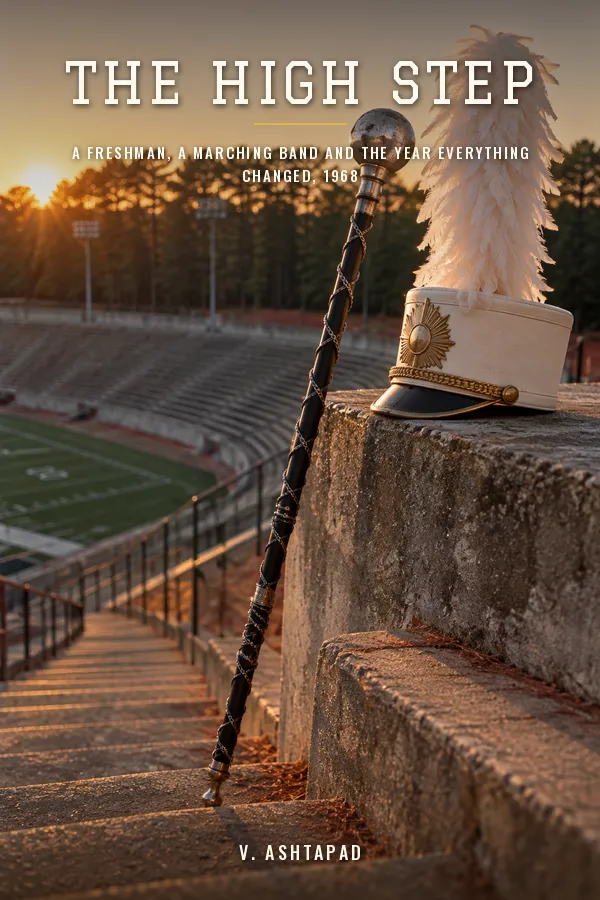
The High Step
A Freshman, a Marching Band and the Year Everything Changed, 1968
by V. Ashtapad
Foreword
This is a novel in verse, and it is fiction. Clarence Mobley, his family, his bandmates, Dr. Thornhill and Mrs. Dukes are made up, along with every other person here, as is Bellwood A&M College, its Regiment, Hill Stadium and the Lower Field. Savannah Bluff College, Bay State College and Coastal Georgia are invented too, along with their bands, and so are the snapper smack Lena Hart and the skiff Ida Bell.
The places around them are real. Pensacola, Gregory Street, Palafox Street and Bayou Chico are real, and so are Highway 90 and the towns along it, the Apalachicola and Chipola Rivers, Apalachicola Bay and its oyster houses, Mobile, Tallahassee, Quincy and Colón, Panama. The red snapper fleet that sailed out of Pensacola, the Panama Canal diggers from Barbados and the marching bands of Black colleges across the South are all real history. The walkout on the quad is imagined, and so are the reasons for it, the people in it and how it turned out.
For the sisters who count us off in the side yard, and for everyone who ever marched behind somebody brave enough to stop.
The Broom Handle
Pensacola, August, nineteen sixty-eight,
and the heat comes up off the bay
like it has somewhere to be.
Six in the morning on Gregory Street
and already the asphalt is soft enough
to take a heel print.
Already the mockingbird on the phone line
has run through every song it stole
from every car horn and screen door on the block
and started over.
I am in the side yard
with my mother's broom.
Not sweeping.
I took the straw head off in June
with a hacksaw from my father's bench,
sanded the stump, wrapped the top in friction tape
until it had a knob the size of a lemon,
and now it is a mace,
and I am a drum major,
and the clothesline is the fifty-yard line,
and the chinaberry tree is ten thousand people
on their feet.
Bernice is on the back step
eating a fig off the bush,
twelve years old and merciless.
"You look like a rooster
fighting a snake," she says.
"Count me off."
"I'm busy."
"You're eating a fig."
"That's busy."
She counts me off anyway.
She always does.
She counts like our father,
flat and even,
a man reading the gauge on a boiler:
five,
six,
seven,
eight,
and on the one I throw my knee up
until the thigh is flat as a table,
toe pointed at the ground like I'm testing water,
and I hold it,
and I hold it,
and I bring it down and the other one goes up,
and I lean back from the waist
until I can see the chinaberry upside down,
green and full of hard yellow berries,
and the sky behind it white as a sheet on the line.
My spine says no.
I tell my spine
we have an appointment.
"Your shirt came out," Bernice says.
It did.
It always does at the backbend.
Something to fix before Bellwood.
---
Bellwood A&M College,
two hundred miles east on Highway 90,
past Milton, past Crestview, past DeFuniak Springs,
past the Chipola River and the Apalachicola,
up into the red clay hills
where they grow tobacco under cheesecloth
and the pines stand in rows like a band
waiting to be told.
I have never seen it.
I have seen the band.
Once.
Two years ago at the Pensacola armory
the Bellwood Regiment came through
on a spring tour,
a hundred and forty pieces,
and when they came in off the street
the floor came up through my shoes,
the bass drums first,
a sound you don't hear so much as stand inside,
and then the horns,
horns like a wall falling toward you
and stopping an inch from your face,
and out front, alone,
a young man in a white shako
with a plume as tall as a child,
leaning back so far
his head was nearly at his heels,
and then snapping upright on the cutoff
with the whole band stopped dead behind him
like he'd caught it in his hand.
I was sixteen.
I went home and looked at the broom.
---
My mother has a book.
Not a ledger,
just a green clothbound record book
from the dime store on Palafox,
the spine taped twice.
On the first page in pencil
her grandmother's name,
written by her grandmother,
the letters leaning like tired people.
Then her grandmother's children,
each in their own hand,
some in ink, some in pencil,
one in what I swear is crayon.
Then my mother, Odessa,
in her schoolteacher's cursive.
Then my father, Leon,
in block capitals
because he will not write any other way.
Then Raymond.
Then me.
Then Bernice, who dotted her i
with a star at seven years old
and has regretted it since.
Anybody who comes to this house and is family
writes themselves in.
That's the rule.
Where you were born,
where you live now,
one thing you want written down.
Uncle Booker wrote:
caught a tarpon off Fort Pickens, 1951,
nobody believed me.
Raymond, the night before he left for the Army,
wrote:
Fort Benning, then wherever.
Tell Clarence he can have my room but not my records.
Tonight my mother sets the book on the kitchen table
by the sweet potatoes
and opens it to my line
and hands me the pencil.
Under my name I write:
Bellwood A&M, 1968.
Trying out for drum major.
My mother reads it.
"Freshmen don't make drum major," she says.
"Then I'll be the first."
"Or the first to try,"
my father says,
not looking up from his plate,
"and that's still a thing."
---
The night before I leave
Papa Jules comes over from Bayou Chico,
smelling like the bay always smells on him,
salt and tar and bait shrimp
and the cigar he says he quit.
Seventy-four years old,
forearms like hawser rope,
he went out on the snapper smacks
when he was fourteen,
out past the bar for three weeks at a time,
hand lines over the side,
forty fathoms down to the red fish in the dark,
and came home with his palms cut to ribbons
and his pockets full.
He sits on the back step where Bernice was.
He watches me.
"Lift it higher."
"It's as high as it goes."
"Your knee don't know that yet."
He tells me about the smack captains,
how the good ones never yelled,
how a crew could hear in the way a man
set his feet on deck
whether the weather was turning.
"A boat goes where the man in front is looking,"
he says.
"Not where he's pointing.
Where he's looking."
Then he goes inside for pie.
---
August on the Gulf at night,
the air so wet the stars come out soft-edged.
The tree frogs going like a snare section
that never learned a cutoff.
Down the street somebody's radio,
a bass line coming through the screen,
and Miss Tillie two doors down
calling her cat by all three of its names.
I lie in Raymond's bed.
His records are in a crate in the closet,
and a shoebox of his letters from basic,
and the poster from the Bellwood armory show
that he got for me and never told me
he went back to get it.
The room smells like him a little.
Bay rum. Motor oil.
The cardboard of the record sleeves.
I don't know where he is tonight.
Somewhere it is already tomorrow.
---
In the morning my mother packs a shoebox,
fried chicken in wax paper,
two slices of pound cake,
a jar of her pear preserves wrapped in a dish towel
that I am to return
and will not.
My father carries my suitcase to the bus station
and sets it down
and shakes my hand like I'm a man he's meeting.
Bernice hands me the broom handle
with a red ribbon tied on the knob.
"For luck," she says,
"and so they know it's ours."
The bus smells like hot vinyl and diesel
and somebody's oranges.
I get a window on the left.
Out past the city line
the land goes flat and green and endless,
pine and palmetto, pine and palmetto,
the cattle standing up to their knees in ponds,
the tin roofs of the turpentine camps
flashing like signals.
I hold the broom handle across my knees.
In my head the drums are already going,
the street beat from the armory,
that long roll
like gravel poured down a chute,
then the four hard taps
that tell a hundred and forty people
now.
Tap.
Tap.
Tap.
Tap.
I keep time on my knee
all the way to the Apalachicola,
where the bridge hums under the wheels
and the river below is brown and wide and slow
and in no hurry at all
to get anywhere I'm going.
Lower Field
The bus lets me off at a crossroads
with a filling station, a feed store,
and a sign shot full of holes.
Bellwood, Florida.
Red dirt.
Not the gray sand of home that gets in your shoes
and leaves when you shake them.
This dirt is the color of a brick
broken open,
and it means to stay.
It is in the ditches, on the tires,
on the white socks of the boy
who comes down the hill to get me
in a band jacket with the sleeves cut off.
"You Mobley?"
"Yes."
"You the one wrote Doc a letter
said you were coming to be drum major?"
I did write that letter.
I wrote it in April
on my mother's good paper.
I didn't think anybody read it out loud.
"Yes."
He looks at the broom handle with the red ribbon.
He looks at me.
"Lord," he says,
and picks up my suitcase,
and that is Lemuel Battle,
captain of the drum line,
a junior from Quincy
who will never once in nine months
call me by my first name.
---
Band camp.
Two weeks before the rest of the college comes,
the dormitory half empty and echoing,
mattresses rolled up on the springs,
the showers running orange for the first minute
like the pipes are bleeding clay.
Five-thirty, a whistle.
Six, the Lower Field.
The Lower Field is a pasture somebody mowed.
It sits in a bowl below the music building
with pines all around and no shade in the middle,
yard lines burned into the grass with lime
so they stand white and dead
in the wet green.
By seven the dew is gone.
By eight the gnats find you.
By nine the heat stands up out of the ground
and leans on the back of your neck
like a man who wants to see your cards.
Doc stands on a wooden tower at the forty
in a white short-sleeved shirt
and a bow tie.
Every day a bow tie.
A white handkerchief in his left hand
for wiping his face
and for a baton when he wants one.
Dr. Isaac Thornhill,
fifty-six years old,
thirty-one years at Bellwood,
a voice that does not need the bullhorn
he keeps by his foot anyway.
He does not say good morning.
He says:
"Band.
I can see your feet.
I should not be able to see your feet.
I should see one line of knees
as flat as the top of a table
and nothing else on this green earth."
---
Here is how the Regiment counts.
Not one-and-two-and.
It counts like this:
Horns!
(and a hundred and forty bells come up
from your hip to your face in one motion,
one sound,
the brass catching the sun all at once
like a field of tin roofs)
Mark time!
(and the knees go,
lift and plant,
lift and plant,
the high step, the chair step,
the ground taking it in the soles of your feet
and sending it back up your shins)
Forward!
(the left goes out and the line goes with it,
and if you're half an inch late
you hear it,
everyone hears it,
a sound like a dropped spoon
in a quiet house)
And under all of it
the drums.
Lemuel Battle's snares,
the tenors, the bass drums,
the cymbal line flashing,
and the cadence,
the street beat,
which every freshman learns the first morning
and which goes like this
if you say it with your mouth:
dat-da-dat,
dat-da-dat,
da-da-da DAT,
da-da-da DAT,
rrrrrrrrrrrr — DAT.
Over and over.
All morning.
Until you hear it in the shower.
Until you hear it in the cafeteria line
when a lady sets down a tray.
Until you hear it in your sleep
and your legs try to march
and you wake up sweating
with the sheet kicked to the floor.
---
My roommate is Theodore Harrell,
trombone, from Detroit,
who has never seen a pine tree this close
or a lizard on a wall
or grits.
He is six foot three
and folds into the bottom bunk like a lawn chair.
He has a reel-to-reel tape recorder
in a gray case with a handle,
his uncle's,
which he unpacks before his clothes
and sets on the desk
and plugs in and tests
by saying into the microphone,
"This is Cornelius Harrell,
Bellwood, Florida,
day one,
it is a hundred degrees in this room
and there is a bug on the ceiling
the size of a hubcap."
He plays it back.
His voice comes out thin and far away.
"Huh," he says.
"I sound like I'm from here."
He says y'all is a crime.
By Thursday he says it.
---
Ezequiel Rowe plays sousaphone
and comes from Colón, Panama,
where his grandfather went from Barbados
to dig the canal.
He speaks English
like a radio announcer from the islands,
round and musical and quick,
and Spanish to himself when he loses count,
and he carries the sousaphone
over his shoulder like a man carrying a boa constrictor
he has made his peace with.
On the second night
he takes out a composition book
and draws a map in it.
Not good.
Florida looks like a sock.
But he has drawn the coast of the Gulf
and the Caribbean underneath
and Panama like a ribbon,
and he goes up and down the hall
asking everybody where they're from
and making a dot,
and writing your name next to it
small,
in your own hand if you'll do it.
Detroit gets a dot.
Quincy gets a dot.
Cornelius writes his name sideways
because the Great Lakes are crowded.
I write Pensacola
right at the elbow
where the panhandle meets the bay.
"Pensacola," Ezequiel says.
"Good. A port.
Port people understand each other."
He shows me Colón,
the canal drawn in two careful blue lines,
and next to it in his small hand:
abuelo, 1908, a shovel.
---
The tryout is on the second Saturday.
Four of us.
Three upperclassmen and me.
Every night after the evening drill
I go back down to the Lower Field
with the broom handle,
when the band hall lights are off
and the field is gray and the lime lines glow,
and the whip-poor-wills going in the pines
and the air finally cool enough
to taste.
I do the strut.
I do the backbend.
I toss the handle and catch it
and toss it and catch it
and drop it,
and pick it up out of the wet grass,
and toss it.
I count out loud
so I can hear whether my voice carries.
Five,
six,
seven,
eight.
Up on the hill
one window in the music building
is still lit.
On the third night
it goes dark
right as I finish.
On the fourth night
it goes dark
right as I finish.
On the fifth night
I stay out an extra twenty minutes
to see.
It waits for me.
---
Inside the band hall
on the wall behind Doc's office door
are the drum majors.
Photographs in black frames,
going back to 1922,
young men in white shakos
and capes and gauntlets,
leaning back,
mid-strut,
mace raised,
some of them blurry where they moved.
On the back of every frame,
Lemuel tells me,
the drum major wrote his own name
and his town
and what he wanted you to know.
"What did they want you to know?"
"Mostly they wanted you to know
the uniform didn't fit."
I want to turn one over.
I don't.
I stand there in my practice shorts
with grass in my socks
until Doc comes out of his office
and looks at me
and looks at the wall
and goes back in
and shuts the door
without a word,
and the frames tick on their nails
in the draft from the window unit.
Tryout
Saturday.
It rained at four in the morning,
a hard short rain that hammered the tin roof
of the instrument shed
and quit,
and now at nine the Lower Field steams
like a pot just off the boil
and smells of cut grass and wet lime
and the pine straw at the edges
going sweet in the heat.
The whole band is in the bleachers.
Not ordered to be.
Just there.
A hundred and forty people in practice clothes
on splintered gray boards,
the horn players with their cases at their feet,
the flag line in a row at the top
in white blouses and pedal pushers,
the drum line standing along the fence
because the drum line never sits.
Four of us on the field.
---
Wendell Fuller.
Junior, trumpet section leader,
from Jacksonville, the Eastside,
the best high note in the Regiment
and he knows it,
and you know he knows it,
and somehow you don't hold it against him
until he opens his mouth.
Five foot eleven.
Shoulders like a door frame.
He had the assistant drum major spot last spring
and everyone has told me,
everyone,
that this is his year.
He has his own mace.
Real one.
Chrome ball, black shaft,
a chain wound down it,
white cord at the wrist.
He bought it in Jacksonville with summer money
from the cigar factory.
When he sees my broom handle
with Bernice's ribbon on it
he doesn't laugh.
That is worse.
He just nods at it
like it's a sick dog somebody brought to school.
---
Lamar Kinsey, senior, clarinet,
tall and smooth and easy,
who everybody likes
and who told me Thursday he's only trying out
"so Wendell has to sweat."
Hollis Bright, sophomore, baritone horn,
who throws a mace higher than anyone alive
and catches it maybe half the time.
And me.
Clarence Mobley.
Eighteen.
Four weeks out of Washington High.
A broom handle and a red ribbon
and a shirt I have pinned into my shorts
with two of my mother's safety pins
so it won't come out at the backbend.
---
Doc on the tower.
Mr. Pettaway,
the percussion man,
at the foot of it with a clipboard
he does not write on.
Doc says:
"Each of you will take the band
from the end zone to the fifty
and back.
Street beat in, the fight song,
the halftime cutoff.
You will call it.
You will lead it.
The band will do exactly what you tell them,
and if what you tell them is wrong
they will do that too."
He looks at the bleachers.
"Band. Exactly what they tell you.
Not what you know it should be.
Hear me?"
A hundred and forty voices:
"YES, SIR."
Off the pines it comes back:
sir,
sir.
---
I won't tell it in order.
I can't.
It went past like a train you're standing too close to.
Here is what I remember.
Lamar's whistle,
clean and long,
and the band coming down off the bleachers
into a block
without a sound,
just the shuffle of a hundred and forty pairs of shoes in wet grass,
like rain starting.
Hollis throwing the mace
up into that white sky,
the whole band tipping its heads back to watch it,
the mace coming down end over end
and Hollis under it,
and missing,
and the mace going into the turf
like a fence post,
and Hollis pulling it out
and saluting the tower with grass on the ball
and the band cheering him anyway,
because Hollis.
Wendell.
Wendell was very good.
I want that written down.
His knees were perfect.
His backbend was not as deep as mine
but his snap back up was faster,
a sound you could almost hear,
and his voice
was a trumpet voice,
it went across that field and hit the pines and came back,
and when he called the cutoff
the band stopped so clean
a crow in the pines went up hollering.
Doc said nothing.
Mr. Pettaway did not write.
---
Then me.
I walk to the end zone.
The grass is so wet it squeaks.
My shoes are my good shoes,
the only black shoes I own,
polished last night with spit and a sock,
and already there is red clay on the welts.
I turn around.
A hundred and forty people in a block,
looking at me.
Some of them are smiling,
not friendly.
Some of them are bored.
Cornelius is in the trombones
with his face held very still
so I won't see he's scared for me.
Ezequiel in the back row of sousaphones
lifts one hand off his horn
an inch.
Lemuel Battle, drum line, looking at the sky.
At the top of the bleachers
the flag line,
and one girl in the flag line
with her chin on her fist
and a yellow ribbon in her hair,
watching me
the way you'd watch a man walk onto a frozen pond.
I take a breath down to my belt.
I lift the broom handle.
I think about Papa Jules.
A boat goes where the man in front is looking.
I don't look at the band.
I look at the far end zone,
at the goal post,
white, peeling,
one wasp nest on the crossbar,
and I hold my eyes there
like there is something on that post
I need to get to
before it leaves.
---
"BAND."
My voice goes out
and I don't know if it gets there
until it comes back off the pines.
"TEN-HUT."
A hundred and forty heels in one sound.
Like a door slamming in a big house.
Whistle.
Four short.
Lemuel's sticks:
tap,
tap,
tap,
tap,
and then I'm moving
and they're moving behind me
and it's the street beat,
dat-da-dat,
dat-da-dat,
my knee coming up like somebody pulled a string,
my toe pointed at the earth,
the broom handle pumping in my right fist,
up, down, up, down,
in time,
the ribbon snapping at my wrist,
da-da-da DAT,
da-da-da DAT,
and the whole band behind me is a wave I'm surfing,
I can feel it on my back,
a hundred and forty people breathing
like one animal,
rrrrrrrrr — DAT.
At the fifty I turn.
I lean back.
All the way.
Past where it hurts.
Past where my spine sent me a telegram.
Till my head is near my heels
and I'm looking at the band upside down
and they are all looking at me,
the brass bells floating upside down like a row of gold flowers
and above them the green bleachers
and above that the grass
and above that, under my head,
the sky.
And I hold it.
One count.
Two.
Three.
Four.
The drums roll under me
like thunder rolling under a house.
And I come up,
and the safety pins hold,
and I bring the broom handle down
like I'm cutting a rope,
and the band stops.
All of it.
Not a horn rings.
Not a drum.
Nothing but the wasps on the crossbar
and somebody coughing in the last row of the bleachers,
and the steam rising off the grass.
---
I march them back.
I don't remember it.
I remember turning to the tower
and saluting
and Doc
wiping his face with the white handkerchief,
slowly,
forehead, cheeks, the back of his neck,
folding it,
putting it in his pocket.
He says:
"Dismissed. All four.
List goes up at five."
---
At five the list goes up
on the band hall door
with a thumbtack.
I'm not there.
I'm in the shower
with the water running orange
because I couldn't stand to be there.
Cornelius comes in with his shoes still on
and stands in the steam
in a T-shirt from his uncle's bowling league
and says,
"Mobley."
"What."
"Mobley," he says,
like that's the whole sentence,
and holds up two fingers
and then makes a fist,
which means nothing
in any language I know,
and is grinning so wide
I think his face is going to come apart.
---
Drum major: Mobley.
Assistant drum major: Fuller.
That's all it said.
That's what Cornelius tells me.
That night I go down to the Lower Field with the broom handle
and the window on the hill
stays lit
until midnight.
When it finally goes out
I walk up the hill
and Wendell Fuller is sitting on the band hall steps
in the dark,
his chrome mace across his knees,
and he lifts his eyes to me,
and I don't look away.
"Your knees are all right," he says.
"Your cutoff is late."
He stands up.
"Not much. Enough."
He goes in.
Coat Number Nine
The uniform room is under the band hall,
half underground,
three windows at the height of your ankles
that show nothing but red dirt and the feet of people passing.
It is the only cool room on campus.
It smells like wool,
mothballs, steam,
spray starch, machine oil,
and something under all that,
old and sweet,
like a cedar chest opened in a grandmother's house.
Mrs. Ophelia Dukes
has been the seamstress for the Regiment
since nineteen forty-one.
She is small and round,
gray hair in a net,
half-glasses on a chain,
a tape measure around her neck that she wears
the way some women wear pearls.
Her sewing machine is black with gold scrollwork
worn down to the iron where her hands go.
It sounds like a freight train
very far off
getting very close.
"Arms up," she says.
"Not like that.
Like you're surrendering to somebody you like."
---
The drum major coats hang on their own rack.
Twelve of them.
White wool, gold braid,
black velvet at the collar and cuffs,
brass buttons,
heavy as a wet quilt.
Every one has a number on a cloth tag
sewn inside the left breast.
And Mrs. Dukes has a book.
Not the kind on a shelf.
A school composition book, black-and-white marbled,
gone soft as cloth at the corners,
the fourth one, she says,
since the first three filled up.
Inside, a page for every coat.
Coat Number Nine.
Made 1946, from a bolt of Philadelphia wool
the college bought with the money from a spring tour.
Cut and sewn by O. Dukes and L. Mae Toliver.
Gold braid replaced 1953 after a rain game at Tuskegee.
And down the page,
every young man who ever wore it,
his name in his own handwriting,
and his years,
and his size when he started
and his size when he finished,
because Mrs. Dukes says
you can tell a whole lot about a young man
by what the cafeteria did to him.
"Robert Lee Tisdale.
1946 to 1949.
Thirty-eight to forty-two.
He married a girl in the clarinets
and they run a funeral home in Ocala
and send me a ham at Christmas."
"Augustus Pryor wore Number Two.
He's coming at homecoming.
You'll meet him.
Don't let him show you the strut.
He'll throw out his hip
and his wife will call me."
---
She measures me.
Chest, waist, sleeve, inseam,
the back of the neck to the waist
and the waist to the floor,
writing each number with a pencil
she sharpens with a little knife
she keeps in her apron.
"You are a stick," she says.
"A stick with ambitions.
Number Nine will swallow you."
"Can you take it in?"
"I can take in anything.
I took in a sousaphone player's trousers
during halftime once
with him in them."
She hands me the book
and a fountain pen
older than my father.
"Write yourself in."
I write:
Clarence Mobley.
1968 to
and stop.
"Leave it," she says.
"That's the part you don't know yet."
Under it I put:
Thirty-six.
She looks over her glasses.
"Thirty-five," she says,
"and I am being kind."
---
Then the shako.
Tall white bearskin,
fake, she says, since nineteen-thirty
when the real ones got moths,
with a gold chin strap
and a white plume on top
eighteen inches high.
She sets it on my head.
The world gets heavier from the top down.
My neck learns about it first.
Then my shoulders.
Then the small of my back,
which has opinions already
from three weeks of backbends.
"Lean back," Mrs. Dukes says.
I lean back.
The shako stays on.
The chin strap bites.
"Again. Farther."
I lean back farther,
till I can see the ceiling pipes,
the dust on them,
one moth asleep in the corner.
The shako stays on.
"Good. Now you know
it won't leave you.
Most of them spend the first game
worried about the hat.
Don't you be most of them."
---
And then the mace.
Doc brings it himself,
down the stairs,
holding it in both hands
like a man carrying a baby
he isn't related to.
Five feet long.
Ebony shaft.
A silver ball on the top, dented in three places,
and silver chain wrapped the whole length,
and at the bottom a silver ferrule
worn smooth.
"Nineteen-twenty-four," Doc says.
"A man named Simeon Rhodes carried it.
He made the ball himself,
in the shop over at the mechanical arts building,
from melted-down spoons
the cafeteria was throwing out.
That dent is a ball game in Daytona.
That one is a cymbal player who is now a judge.
This one nobody knows."
He holds it out.
I take it.
It is heavier than the broom handle.
Twice as heavy.
Three times.
It pulls my wrist down
and I have to set my feet.
I hold it the way he held it.
Both hands.
The silver is cold
even in this heat,
cold the way a spoon is cold
when you take it out of the drawer,
and I think about the cafeteria ladies in 1924
scraping grits off those spoons
and dropping them in a box for the junk man,
and a boy named Simeon
going through the box
with a look on his face
nobody understood
until he came back with this.
"You'll want to throw it,"
Doc says.
"You will not throw it for six weeks.
You will carry it until it weighs
what your arm weighs.
Then we'll talk about the air."
---
Wendell does not come to the fitting.
He is the assistant.
His coat is Number Four
and he wore it all last year,
and it fits him already
like it was cut for him on the first day,
and it was.
In the band hall that afternoon
he walks past me at the water fountain
and does not look,
and the trumpet section walks past behind him
and does not look,
seventeen trumpet players,
and one of them, a little sophomore named Pernell,
looks,
and gets elbowed in the ribs.
At sectionals I come by the trumpet room
to tell them Doc wants them on the field at four.
Wendell is in front of the section
with his horn on his knee.
"We heard," he says.
"Okay."
"Doc already told us. At lunch."
"Okay."
"So you didn't need to come down here."
"Okay."
He plays a high note.
Just one.
A high F above the staff,
clean as a whistle,
loud enough the glass in the door buzzes,
and holds it,
and holds it,
and the trumpets watch me,
and I stand there
until he runs out of air.
"Four o'clock," I say.
---
That night in the room
Cornelius has the reel-to-reel out
and a stack of mail from Detroit,
his mother's letters in blue envelopes,
and he is reading one to himself
and laughing.
"She wants to know
are there alligators."
"Tell her yes."
"She wants to know
do I go to bed at a decent hour."
"Tell her yes."
"She wants to know
is my roommate a nice boy
or one of these country boys
with a knife."
He looks at me.
I'm sitting on my bunk
with the mace across my knees,
running a rag
up and down the chain,
link by link,
the way Papa Jules cleans his reel,
and I have been doing it for an hour.
"I'll tell her," Cornelius says,
"it's complicated."
Outside the window the tree frogs.
Down the hall a radio,
somebody's station out of Tallahassee,
an organ and a bass line
going round and round
like water down a drain.
I put the mace under the bed
and lie down
and put my hand down
in the dark
to make sure it's there.
Ernestine Counts
The college comes back on a Tuesday.
All at once,
like a tide coming in over flats.
Cars with Georgia plates
and Alabama plates
and one from New Jersey
that the whole campus walks out to look at.
Trunks on the dormitory steps.
Mothers in hats and gloves in this heat,
fathers carrying lamps,
little brothers chasing each other
around the oak in the middle of the quad
with its gray moss hanging
like an old man's beard
in need of a trim.
Somebody's hi-fi in a window
with the bass knob turned as far as it goes,
and somebody's mother yelling
to turn that down,
and a girl on the steps of Lomax Hall
crying because her roommate brought
the same bedspread.
The cafeteria opens.
Grits, eggs, bacon,
biscuits big as a fist,
cane syrup in a steel pitcher,
coffee thin enough to read through.
At dinner: fried mullet,
collards, rice and gravy,
cornbread in squares,
and peach cobbler on Fridays
that people line up for at four-thirty
like it's a payday.
---
The flag line practices on the Lower Field
at the same hour as the drum majors.
Sixteen young women
with six-foot poles
and squares of gold silk,
in white blouses tied at the waist
and pedal pushers and white tennis shoes,
and they are better than us.
I mean that.
The drum majors stand around
looking at our feet.
The flag line stands around
looking at the sky,
and the sky is full of gold silk,
sixteen flags going up at once
and turning over once
and coming down into sixteen hands
on the same count,
the poles hitting the palms
like one clap.
The girl with the yellow ribbon
is named Ernestine Gaines.
Sophomore.
Chemistry.
Apalachicola.
I find this out the way you find things out in a band,
which is that Ezequiel
asks her where she's from
for his map,
and she writes it in his book herself,
and he comes back up the hill
and tells everyone.
---
The third week she walks over.
I'm on the twenty
counting to myself,
working the mace through the figure eight
that Doc wants on the fight song,
around the wrist, under the arm,
up, and over,
the chain singing a little against the shaft.
She stands there with her flag pole
planted in the turf like a walking stick.
"You count with your mouth," she says.
"What?"
"You move your mouth when you count.
I can see it from the top of the bleachers.
Five, six, seven, eight.
You look like you're begging the sky for rain."
"I'm not."
"I know you're not. I'm telling you what it looks like."
She has a voice that is lower than you'd think
from looking at her,
with Apalachicola in it,
a little bit of river,
a little bit of Gulf,
the vowels going long and flat
like the bay at slack tide.
"How am I supposed to count?"
"Count with your stomach."
"My stomach."
"Here."
She puts her flag pole in my hand
with the mace,
which is a lot of pole,
and puts two fingers on my belt buckle.
Not hard.
Like you'd press on a cake
to see if it's done.
"Count from here.
Not out loud.
Not in your mouth.
Here.
You want the band to feel it from the back row?
They're not going to feel your mouth."
She takes her fingers back.
She takes her flag back.
"Also you're late on the cutoff," she says.
"Wendell says that."
"Wendell is right about one thing a year.
He used it up early."
---
She's from an oyster family.
She tells me this on the steps of the library
at nine at night
when the bugs are so thick around the lamp
it looks like it's snowing upward.
Her granddaddy tonged oysters
in Apalachicola Bay for fifty years
from a skiff he built himself,
standing up in it
with the long wooden tongs like two rakes hinged,
working them open and closed down in the water,
bringing up a load of shell and mud and oysters,
culling them on the board,
throwing the little ones back.
Her grandmother shucked in the oyster house
on Water Street,
in a row with forty other women,
from before light till after,
standing in rubber boots
on a floor of crushed shell,
and they sang while they shucked
to keep the knives going,
and Ernestine used to perch on an upturned crate in the corner
when she was little
and listen.
"How did it go?"
"I'm not going to sing it to you.
I don't sing."
"You're in the band."
"I'm in the flag line. We don't sing.
We have dignity."
She tries to tell me how it went.
The leader would call
and the women would answer,
call and answer,
and the knives would come down on the count,
crack,
and the shells would come apart,
and the next call,
and the next,
until you couldn't tell if the singing was keeping time for the knives
or the knives were keeping time for the singing.
"Like a cadence," I say.
She looks at me.
"Everything isn't a cadence, Clarence."
But she smiles when she says it,
which I did not expect,
and I have to look at the bugs around the lamp
for a while
so she won't see me notice.
---
She has a photograph in her wallet.
She shows it to me on the third night
on the library steps.
A skiff on flat water,
a man standing up in it with tongs,
the town behind him low and white,
the water tower,
the bridge.
On the back,
in somebody's careful hand
that isn't hers:
Willis Gaines, my daddy's skiff, the Ida Bell,
off Cat Point, 1939.
I was 11 and took this with Mr. Rance's camera.
— Nathan Gaines
"My uncle," she says.
"He wrote that for me the summer I left.
I made him.
I made everybody in my family
write on the backs of their pictures
who's in them and when.
My mother says I'm turning the house into a museum."
"Are you?"
"Somebody should."
---
She asks about Pensacola.
I tell her about the snapper smacks.
About Papa Jules
going out forty fathoms
with a hand line,
three weeks at a time.
About Bayou Chico at sunrise,
the mullet jumping,
the smell of the net shed,
tar and creosote and old bait.
I tell her about my mother's book.
She listens with her chin on her fist
the way she did at the tryout.
When I stop she says:
"So your family writes it down,
and mine takes pictures."
"I guess."
"We'd be a good pair for a museum."
She hears it as she says it.
She picks up her flag pole.
"I have a lab at eight," she says,
and goes,
and halfway across the quad she stops
and turns around
and walks backward three steps
and calls:
"Stomach, Clarence."
And goes.
---
I go down to the Lower Field
in the dark
where nobody can see me.
I take my shirt off
because it's still eighty-five degrees at ten o'clock
and the air on my skin is wet as a dishrag.
I stand on the fifty.
I put my hand flat on my belt.
I don't move my mouth.
Five.
Six.
Seven.
Eight.
And something low and warm
starts going under my hand,
steady,
like an engine idling in a boat
waiting at the dock,
and I lift the mace,
and I count from there.
Saturday, Hill Stadium
The first home game
is the third Saturday in September,
Bellwood against Coastal Georgia,
and by noon there are cars parked on the shoulder of the highway
for a mile in both directions.
The stadium is called Hill Stadium
because it is built into a hill,
the home stands cut into the red slope
like steps in a quarry,
concrete benches the sun has been heating since seven,
and the visitors' side a set of wooden bleachers
the color of driftwood.
Smoke from the barbecue pits behind the end zone,
hickory and pork fat and vinegar sauce.
Boiled peanuts in paper sacks,
wet and salty and still hot.
Snow cones melting down children's wrists,
red and blue and green.
Old men in straw hats and suspenders.
Young women in sleeveless dresses
holding programs over their faces against the sun.
A boy selling cold drinks from a washtub of ice,
shouting a price that goes up every quarter.
---
My family comes.
My father drove the whole way,
four hours on 90,
with my mother beside him holding a cake on her lap
and Bernice and Papa Jules in the back
arguing about the radio.
They're in Section C,
row eleven,
my mother in a yellow dress
and the hat she wears to weddings,
my father in his good short-sleeved shirt
with a ballpoint clipped in the pocket,
Bernice with a cardboard sign
she made herself
that says MOBLEY
in letters so big
the Y didn't fit
and had to go around the side.
I can't see them from the tunnel.
I know exactly where they are.
---
The Regiment comes in from the top.
That's the tradition.
Not from the tunnel like the team.
From the top of the hill,
behind the home stands,
down the long concrete stairs
that split the stadium in two,
a hundred and forty people coming down steps
in white and gold
without breaking the cadence,
which is a thing nobody believes until they see it
and nobody can do until they've fallen down those stairs
at least once in August.
I stand at the top
with the shako on
and the mace in my right hand.
The sun is behind me.
I can feel my shadow going down the stairs ahead of me,
long and thin,
with the plume.
Below me,
the whole bowl of the stadium
full and loud,
ten thousand people,
the noise of them like surf on a long beach,
not one sound but all of them
crowded into one,
and the smell coming up of peanuts and smoke and cut grass
and hot concrete.
Lemuel behind me, the drum line.
Wendell at my left shoulder,
one step back,
in Number Four,
his chrome mace,
his face like a locked door.
Doc is somewhere down on the track.
I can't see him.
I raise the mace.
---
Whistle.
Four.
Lemuel:
tap.
tap.
tap.
tap.
And the drums.
But they're wrong.
They're fast.
They're fast because I'm fast.
My whistle was fast.
My heart is going like a hummingbird in a jar
and my whistle went with it
and Lemuel followed my whistle
like he's supposed to
like Doc told him,
exactly what they tell you,
and now we're coming down the stairs
at a tempo nobody has ever come down those stairs at,
the drum line hammering,
datdadat-datdadat-dadadaDAT,
the knees going up like pistons,
a hundred and forty people
taking those concrete steps
at a speed that is going to kill somebody,
and I can't fix it.
I can't slow it down.
You can't slow down a band on the stairs.
There's nowhere to put the extra time.
The crowd thinks it's wonderful.
They're on their feet.
They're screaming.
They think we did it on purpose.
---
At the bottom of the stairs
there's the track
and then the field,
and in the eight counts of the track
we're supposed to go into the fight song,
horns up,
and if the horns come up at this tempo
the trumpets are going to sound like geese in a fire.
And I hear it.
From my left.
One step behind me.
Wendell's trumpet.
He doesn't wait for the horns-up.
He just puts the horn to his face
on the last step,
by himself,
alone,
and plays the first phrase of the fight song
slow.
At the right tempo.
The real one.
Doc's tempo.
The one we drilled three hundred times on the Lower Field.
Loud.
Loud enough it cuts through the drums
and the whole crowd
and the band behind us,
and the trumpets hear it,
seventeen of them,
and they come in with him,
at his tempo,
not mine,
and the drums hear the trumpets,
and Lemuel looks at me,
and I look at Lemuel,
and I bring the mace down
on Wendell's tempo,
and Lemuel brings the drums with it,
and the band
settles
like a boat coming off a wave
and sitting back down in the water,
and we go onto the field
at the right speed
and the crowd never knows.
The crowd thinks it's all one thing.
---
I don't remember the halftime.
I remember the backbend.
At the fifty,
facing the home stands,
leaning back,
farther,
farther,
the plume brushing the grass,
upside down,
and the stands upside down
and full of people
and one cardboard sign in Section C
with a Y going around the corner.
I hold it four counts.
I come up.
I cut them off.
On time.
---
After the game
on the steps of the band hall
my family.
My mother hugs me so hard
the shako slides down over my eyes.
My father shakes my hand.
Then he doesn't let go of it.
He just stands there holding it,
a little too long,
looking at the plume.
Bernice says,
"You were fast coming down."
"I know."
"Like a rock rolling."
"I know."
"It was the best part."
Papa Jules says nothing.
He lights the cigar he quit.
He looks over at Wendell,
who is on the other end of the steps
with his own family,
a big man in a hat and a woman in purple,
and Papa Jules takes the cigar out of his mouth
and points at Wendell with it,
just once,
and puts it back.
---
My mother has brought the book.
Of course she has.
On the steps of the band hall
with the sun sliding orange behind the music building
and the moss on the oaks turning dark,
she opens it on her knee
to the page after mine
where Papa Jules made a list last Christmas,
in pencil,
of every place the Mobleys have lived
since anybody can remember.
A sawmill town in Escambia County, Alabama.
A turpentine camp near Brewton.
Warrington, by the navy yard.
Bayou Chico.
Gregory Street.
And now at the bottom,
in Papa Jules's big square hand,
fresh,
the pencil pressed so hard
it nearly came through:
Bellwood. Clarence. Saturday. Ten thousand people.
"He did that in the car," my mother says.
"Before he'd even seen it."
"He said it was a safe bet,"
Bernice says.
---
They drive home in the dark.
Four hours.
My mother will sleep.
Bernice will sleep.
My father will drive with the window down
and Papa Jules will tell him about the snapper smacks
again,
the same stories,
and my father will let him.
I take off Number Nine
in the uniform room
and hang it on the rack
and Mrs. Dukes runs her hand down the back of it
feeling for wet.
"You sweated through," she says.
"Good.
Means you were working."
Up the stairs,
the band hall dark,
except one window,
and one figure on the steps outside it.
Wendell.
I sit down two steps above him.
We sit there.
The crickets.
The far-off noise of the dormitories,
somebody's party,
somebody laughing.
"Thank you," I say.
"Don't."
"I'm going to."
"Then do it quiet."
He stands up.
He tucks the chrome mace under his arm.
"You do that again
at Homecoming," he says,
"I'll let you go."
And goes down the hill.
Thin Blue Paper
October comes in
and nothing changes but the light.
Still eighty degrees at practice.
Still gnats.
But the sun goes down earlier behind the pines,
and the shadows of the trees reach across the Lower Field
by five o'clock
like long fingers feeling for the yard lines,
and the air in the evening
has one thread in it
of something cool,
from somewhere north,
that wasn't there in September.
The sweetgums at the edge of the field
are going red at the top.
The tobacco barns on the road into town
are empty now,
the doors hanging open,
the smell of cured leaf still in them,
brown and sweet and heavy,
drifting across the highway when the wind is right.
---
The letter comes on a Wednesday.
Airmail.
Thin blue paper that folds into its own envelope.
My brother's handwriting,
which is just like my father's,
block capitals,
because Raymond would rather die
than write cursive.
I read it standing at the mailboxes.
I read it again on the stairs.
I read it a third time on my bunk
with Cornelius pretending to practice slide positions
without the trombone
so he doesn't look like he's watching.
---
CLARENCE.
MAMA SAYS YOU MADE IT.
DRUM MAJOR.
I TOLD THE WHOLE MOTOR POOL.
THEY DON'T KNOW WHAT IT IS.
I TOLD THEM IT'S THE MAN IN THE BIG HAT
WHO WALKS IN FRONT AND BENDS OVER BACKWARD.
A BOY FROM KANSAS SAID
"WHY."
I SAID BECAUSE HE CAN.
IT RAINS HERE.
NOT LIKE HOME.
HOME IT RAINS AND QUITS.
HERE IT RAINS AND THINKS ABOUT IT
AND RAINS SOME MORE.
THE MUD IS RED.
YOU'D LIKE IT.
IT'S LIKE THAT SCHOOL OF YOURS
FROM THE PICTURE MAMA SENT.
I FIX TRUCKS.
THAT'S WHAT I DO ALL DAY.
DADDY WOULD BE PROUD.
I HAVE GREASE IN PLACES
I DIDN'T KNOW A MAN HAD PLACES.
THE FOOD IS BAD.
TELL MAMA I'D GIVE A MONTH'S PAY
FOR HER FRIED CHICKEN
AND THAT DON'T MEAN MUCH
BECAUSE THEY DON'T PAY US MUCH.
HERE'S WHAT I WANT.
I WANT TO HEAR IT.
THE BAND.
I CAN'T.
SO YOU HAVE TO TELL ME.
WRITE IT DOWN.
WHAT IT SOUNDS LIKE.
ALL OF IT.
THE DRUMS AND THE HORNS AND THE PEOPLE.
I DON'T CARE IF IT'S STUPID.
I GOT A BUDDY FROM MOBILE
WHO SAYS HE'S SEEN BELLWOOD PLAY
AND I WANT TO KNOW IF HE'S LYING.
DON'T TAKE MY RECORDS OUT OF THE CRATE.
I'LL KNOW.
JUNIUS.
---
So I write it down.
I try.
I sit up three nights in the study hall
with a fountain pen
and a stack of my mother's good paper
I brought from home and wasn't supposed to,
and I try to tell my brother what a band sounds like
from inside.
Here's what I write.
---
Junius.
It starts with nothing.
A hundred and forty people standing still
at the top of the stairs
in the sun,
and the stadium below them roaring,
and the band so quiet
you can hear the flags snap.
Then four taps on the rim of a snare.
Like somebody knocking on a door
they already know is open.
Then the drums.
Junius, the drums are not a sound.
They're a floor.
They come up through the concrete
and into your feet
and up your shins
and you are standing on them
like you stand on a boat deck,
and everything else the band does
happens on top of that floor.
The snares are the top of it,
quick and dry,
like rain on a tin roof
if the rain knew what it was doing.
The tenors are the middle,
round, like somebody knocking on hollow logs.
The bass drums are the bottom.
The bass drums are the reason you came.
They hit you in the chest
and your heart gives up trying to keep its own time
and keeps theirs.
Then the horns come up.
When the trumpets come in
it's like the sun coming out from a cloud
on the water, all at once,
bright enough you squint.
The trombones are underneath them,
wide and warm,
like the bay at night.
The sousaphones are the bottom of the bottom,
Junius, they are the sound a ship makes
leaving the harbor,
that long low note you feel in your teeth.
And the crowd.
The crowd is the ocean.
It's under everything.
It never stops.
When we play loud, they get louder.
When we stop dead, on the cutoff,
everybody,
all at once,
for one second
the crowd stops too,
like they ran out of air,
and in that second
you can hear the whole stadium breathe in.
Then they scream.
Tell your buddy from Mobile he's not lying.
Tell him he doesn't know the half.
---
I read it to Cornelius.
He listens with his eyes closed,
lying on the bottom bunk,
his feet hanging off the end,
the window unit grinding.
When I'm done he doesn't say anything
about the letter.
He says,
"Why don't you just send him the band."
"What?"
He reaches over and pats the gray case
of the reel-to-reel.
---
We ask Doc.
I'm scared to.
Cornelius isn't.
Cornelius is from Detroit.
Doc is in his office
with the door half open,
writing out parts by hand
on music paper
with a fountain pen and a ruler,
a cup of coffee gone cold on a pile of scores,
the window unit dripping into a coffee can.
He listens to all of it.
The letter.
The motor pool.
The red mud.
The buddy from Mobile.
He takes off his glasses.
He says,
"Thursday. Full rehearsal.
Put it at the top of the bleachers,
not on the field,
you'll get nothing but drums on the field.
And you write on the box who played.
Every solo. Every name.
The men in that motor pool are going to hear my band,
they are going to know who they heard."
---
Thursday evening.
Five-thirty,
the shadows long across the Lower Field,
the sweetgums burning red at the top,
the sky going the color of a ripe peach
and then of the inside of a shell.
Cornelius at the top of the bleachers
with the reel-to-reel on the bench
and the microphone taped to a music stand
and an extension cord
that runs all the way down the hill
to an outlet in the instrument shed.
He's not playing tonight.
He asked Doc to let him sit out.
He sits up there with his headphones on
like a man listening for a submarine.
We play the whole show.
The street beat.
The fight song.
The halftime,
the ballad Doc arranged for the trombones
with Cornelius's part covered by a sophomore
who can't believe his luck.
The drum cadence Lemuel wrote over the summer
that nobody has a name for yet
that goes
DAT
da-DAT
da-da-DAT
da-da-da-DAT
and then stops,
and starts again from the top,
like a man climbing stairs
and catching his breath at every landing.
At the end Doc does something
he has never done in rehearsal.
He turns around on the tower
and faces the bleachers
where Cornelius is,
and lifts his handkerchief,
and the whole band,
without being told,
turns around too.
And Doc says,
loud,
to the microphone,
"Specialist Raymond Mobley.
This is the Bellwood Regiment.
Your brother is the one in front."
---
On the box, in Cornelius's handwriting
and then mine:
Bellwood A&M College Regiment.
Lower Field. Thursday, October 10, 1968.
Recorded by T. Harrell, with Dr. I. Thornhill's permission.
Drum major: C. Mobley.
Trumpet solo, fight song: W. Fuller.
Trombone ballad: R. Sims, sitting in.
Drum cadence (new, no name): written by O. Battle.
Sousaphones: E. Rowe and nineteen others.
Flags: you can't hear flags.
And then underneath,
small,
in a hand I don't know,
which Cornelius says Ernestine added
when he showed her in the cafeteria:
They were there anyway. — L.G.
---
We mail it Friday.
It weighs more than you'd think,
a reel of tape in a cardboard box.
The man at the post office in town
studies the address
and then studies me
and puts extra stamps on it
from his own drawer
and won't take the money.
Three Buses West
Away game.
Mobile, Alabama,
against Bay State College,
two hundred and fifty miles
and three yellow buses
that the college bought used from a county in Georgia
and painted gold on the sides
with a brush,
so you can see the brush marks
when the sun hits them.
We leave at four in the morning.
Dark.
Dew on everything.
The oaks dripping.
The instrument truck already loaded and gone ahead,
the sousaphones roped down in the back
like a load of giant brass snails.
The band hall lights on,
yellow in the fog,
Mrs. Dukes on the steps in a housecoat
counting uniform bags as they go past,
calling out numbers,
"Nine. Four. Twenty-two.
Twenty-two, where is your hat."
---
Bus One is drums and brass.
Bus Two is woodwinds and flags.
Bus Three is everybody who missed Bus One and Bus Two.
I ride Bus One
in the front seat behind the driver
because the drum major rides there,
because somebody decided that in 1922
and nobody has decided otherwise.
The driver is Mr. Cleophus Ware,
sixty-something,
who drives for the college
and has driven for the college
since before there were buses,
when it was a flatbed truck with benches.
He keeps a notebook on the dashboard.
Brown cardboard covers,
the spine held with friction tape.
Inside:
roads.
Every road he's driven for the Regiment
since 1937.
Where it floods in a hard rain.
Where the bridge is one lane.
Where there's a good place to get a plate of food
and where there isn't.
Where they'll sell you gas
and let the band use the restroom
and where they'll sell you gas
and not.
He's written who told him each one.
A driver from Tuskegee.
A cook from a café in Marianna.
His own wife's cousin in Mobile.
"Somebody has to know,"
he says, when he sees me looking.
"And it can't just be in my head.
I'm getting old.
My head is getting crowded."
---
The bus smells like
hair grease,
cold fried chicken,
diesel,
wet wool,
and two hundred-odd sleeping people.
Cornelius is asleep across the aisle
with his knees up past the seat in front of him
and his trombone case in his arms
like a sweetheart.
Behind me,
Lemuel Battle's drum line
is not asleep.
The drum line never sleeps.
They're drumming with their hands
on the backs of the seats,
quiet,
the street beat
on the green vinyl,
thump-ta-thump,
thump-ta-thump,
and somebody is drumming on a lunch box,
and somebody on the window glass with a ring,
tink-tink,
and somewhere in the back
Ezequiel is humming the sousaphone part
an octave too low for a human,
and it all goes along under the engine
like the band is rehearsing in its sleep.
---
Highway 90 west at dawn.
Mist lying in the low fields like milk in a saucer.
Cattle standing in it up to their bellies.
A man on a tractor with his headlights on.
A gas station with one bulb
and a dog in the door.
The Chipola River
with steam coming off it
in white curls,
and on the far bank
a heron standing on one leg
like it's waiting for someone to tell it to mark time.
Marianna.
Chipley.
Bonifay.
DeFuniak Springs and its round lake,
gray and still,
the old houses around it with their porches
and nobody up yet.
Crestview.
Milton,
and the Blackwater River black as coffee.
And then,
at a quarter to nine,
the bus comes over the long bridge
on the bay,
and there's Pensacola.
---
I didn't know we'd come this way.
I don't know why I didn't know.
It's the only way to Mobile.
My whole town is out the window
in the morning sun.
The bay, wide and blue-green and choppy,
the wind coming off the Gulf,
the pelicans going along low over the water
in a line, wingtips almost touching the waves.
The shrimp boats tied up at the docks
with their nets hanging off the outriggers
like laundry.
The navy jets out over the water,
two of them,
silver,
turning together like they're on a string.
Palafox Street.
The bank with the clock.
The dime store where my mother bought the book.
The barbershop where Mr. Kenny cut my hair
for nine years
and told me the same three jokes.
Gregory Street is four blocks over.
I can't see it.
I know exactly where it is.
My mother is in the kitchen.
It's Saturday.
She's making the grits and listening to the radio
and Bernice is still asleep
and my father is in the yard
looking at the truck engine
and Papa Jules is over at Bayou Chico
in the net shed
mending a net he'll never use
because his hands like to.
The bus doesn't stop.
It goes down Garden Street
and through the light
and out past the paper mill,
the smell of it coming in the windows,
rotten eggs and wet wood,
which is the smell of home,
which I never knew I'd miss
until I'm going past it at forty miles an hour.
Mr. Ware looks at me in the mirror.
He doesn't say anything.
He honks the horn.
Two short, one long.
For no reason.
For nobody.
Out past Perdido,
and the bridge,
and Alabama.
---
Ezequiel comes up the aisle
with his composition book
at a stoplight in Robertsdale.
He's been drawing.
The map is bigger now.
He's taped a second page onto the first
and then a third,
and now it's a long folded strip
like a road map,
with every bandmate's dot,
and now,
in red pencil,
a line.
The line is the Regiment.
Bellwood to Tallahassee in September.
Bellwood to Hill Stadium,
which is nowhere, but he drew it anyway.
Bellwood west
along every town we've passed this morning,
all the names in his small handwriting,
Marianna, Chipley, Bonifay,
down to the bay,
and a little circle around Pensacola.
"You were looking at it," he says.
"So I made it a circle."
Beside the circle,
in very small letters:
casa.
"That means house."
"I know what it means."
"Good. Then it's correct."
---
He tells me about Colón.
The canal,
the ships going through it
all day and all night
like a slow parade,
their horns going in the dark,
low,
the same note
as the sousaphones.
His grandmother's yard
with the mango tree,
and the boys on the corner
banging out rhythms on the hoods of parked cars
until the owners came out yelling.
The rain that comes at four o'clock every day
in the wet season,
so regular you set your watch.
His grandfather came from Barbados in 1908
to dig.
He came with a shovel and a cardboard suitcase,
and the suitcase is still in the house,
and inside it
his discharge paper from the canal company,
and a photograph of him
with forty other men in front of a steam shovel
so big it looks like a building,
and on the back of the photograph,
in his grandfather's hand,
which was taught by a teacher in Bridgetown
and is beautiful,
the names of all forty.
"All of them?"
"He said
if he didn't write them
nobody would."
---
Mobile.
The game is at four.
The stadium is smaller than Hill Stadium
and louder,
because it's closer,
because the Bay State fans
are right up on the rail,
and their band,
the Bay State Marching Tide,
is in the stands across the field
before we're even off the bus,
playing,
blowing at us across the grass
like a hot wind,
two hundred pieces,
brass shining,
a drum major in a red shako
on a wooden riser in the stands
leaning back and laughing.
I get off the bus.
I put on the shako.
I feel the plume go up behind me
like a flag being raised.
Wendell comes and stands at my left shoulder,
one step back,
without being told.
"They're loud," I say.
"They're loud at home," he says.
"Anybody's loud at home."
Lemuel is already at the head of the drums,
his sticks crossed over his snare,
his face like he's at a funeral
for somebody he didn't like.
I lift the mace.
Behind me a hundred and forty people take one breath.
Across the field the Bay State drum major
stops laughing
and stands up on his riser
to see what's coming,
and the wind off Mobile Bay
lifts the gold silk of the flag line behind us
all at once,
sixteen flags,
like something taking off.
The Backs of the Frames
Homecoming week
and the campus goes out of its mind.
Monday the freshmen paint the water tower.
Not allowed.
Every year.
Gold paint, a B taller than a man,
dripping,
and the dean of men stands at the bottom
in his good suit
looking up at it
hands deep in his pockets
and does not call anybody.
Tuesday the sororities start the floats
in the barn behind the agriculture building,
chicken wire and tissue paper,
thousands of little squares of gold and white
stuffed into the wire one at a time,
girls sitting on hay bales with their fingers raw
and the radio going
and the barn smelling of hay and glue
and the cows next door
who are not impressed.
Wednesday the bonfire wood comes in
on the back of a truck from the sawmill,
slabs and scrap and a whole broken pecan tree,
piled up on the edge of the Lower Field
higher than the band hall.
Thursday the alumni come.
---
They come in cars from everywhere.
Detroit, Chicago, Cleveland.
Atlanta, Birmingham, Washington.
Tampa. Miami.
One from Los Angeles,
a long white car with fins
that the freshmen walk around three times
without touching.
They come in hats.
They come in furs, in October, in Florida,
and stand sweating in them on the quad
because they bought them for this.
They hug.
They scream each other's names across the parking lot
like they've been holding them in their mouths
for twenty years.
And the old band members come
to the band hall.
---
Doc has put a table out.
Folding table,
white paper over it,
coffee in a big steel urn,
sugar cubes,
a plate of Mrs. Dukes's tea cakes
that disappears in four minutes
and is refilled from a tin
and disappears again.
And on the table,
the albums.
Twelve of them.
Big black photograph albums,
the pages black paper,
the pictures held at the corners with little paper triangles,
going back to the twenties.
The Regiment at the state fair, 1926.
The Regiment on the steps of the old music building,
the one that burned.
The Regiment in Tuskegee.
In Nashville.
In a parade in Jacksonville
with a crowd on the curb ten deep.
And under almost every picture,
nothing.
No names.
"Nobody wrote them down,"
Doc says,
"because everybody knew.
And then everybody graduated."
So that's the job.
Each one of them comes in,
gets a coffee,
gets a tea cake if they're fast,
sits down at the table,
and goes through the albums
with a white grease pencil
and writes on the black paper
under the pictures
who they are.
Only who they are.
Doc's rule.
Your own name. Your own face.
If you know somebody else,
you put a little check by them,
and somebody will write to them.
---
I sit at the far end of the table
with the sharpener
because somebody has to sharpen the grease pencils
and I'm the drum major
and Doc says the drum major
does whatever is in front of him.
A woman in a green suit,
gray at the temples,
sits a long time
with the Jacksonville parade.
Then she puts her finger on a girl
in the second row of the clarinets,
a skinny girl with her chin up
and her hat too big.
She writes under it:
Me. Viola Hart. 1937.
My mother made me wear that hat
and I hated it.
And laughs out loud,
by herself,
at the table.
---
A man with a cane
finds himself on the steps of the old music building
and writes his name
and his hometown
and then sits there with his hand flat on the page
not saying anything,
not looking up,
and his wife stands behind him
with her hand on his shoulder,
and then he writes, smaller:
The building burned in 1944.
I had my horn in it.
I bought another one
with my first paycheck from the post office
and still have it.
---
Augustus Pryor comes in at four.
Drum major, 1929 to 1932.
Coat Number Two.
Fifty-nine years old,
slim as a fence rail,
in a tan suit and a straw hat with a gold band,
and he walks into the band hall
like the floor is a little bit his.
He stops in front of the wall.
The drum majors' wall.
He looks at himself.
1931.
A young man in a white shako
leaning so far back
his plume is touching the grass.
"I was showing off,"
he says to nobody,
"and it was worth it."
Then he turns around.
He sees me.
He studies me a good while,
up and down,
like a man looking at a horse
he's thinking of buying.
"You're the freshman."
"Yes, sir."
"Thirty-five chest."
"Yes, sir."
"Mrs. Dukes told me. She tells me everything.
She tells me things I don't want to know."
He holds out his hand.
He has the biggest hands I've ever seen on a thin man.
---
"Turn me around,"
he says,
and points at his own picture.
"Sir?"
"The frame. Take it down.
Turn it around.
You want to.
I watched you look at it."
I take it down off the nail.
I turn it over.
On the back,
on the brown paper,
in pencil,
in a young man's quick hand:
Augustus Pryor.
Live Oak, Florida.
1931.
Under it:
My father said a drum major is a fool
in a tall hat.
He is right.
I'd do it again tomorrow.
---
Mr. Pryor reads it over my shoulder.
"Huh," he says.
"I'd forgot that."
Then:
"He came to one game.
My last one.
He stood at the top of the stairs at Hill Stadium
in his overalls
because he didn't own anything else,
and he watched the whole halftime,
and he went home,
and he never said a word about it.
Not one word.
Till the day he passed.
"But he kept the program.
My mother found it in his coat
after.
Folded up small
in the inside pocket.
He'd been carrying it around for nine years."
He takes the frame from me
and hangs it back on the nail
himself,
and straightens it
with one finger.
---
That night the bonfire.
The pecan tree goes up first
because it's driest,
the flames climbing it like a ladder,
the sparks going up into the dark
in a long gold river
over the Lower Field
and over the pines
and out of sight.
The heat on my face like an oven door.
The smoke smelling of pecan,
sweet,
like somebody's kitchen at Thanksgiving.
The whole college in a ring around it.
The alumni in their furs and hats
at the back, on the hill.
The band in the front
in practice clothes,
and we play the fight song
with the fire behind us
and the brass gone orange in the light
and the drum heads gone orange,
and the flag line
throwing their flags up
into the smoke
so they come down out of it
like birds out of a cloud.
Ernestine finds me after.
She has soot on her cheek
and doesn't know it.
"Tell me something," she says.
"What."
"Anything. I've been in that barn for three days
putting tissue paper in chicken wire.
I need a person to say a sentence
that isn't about the float."
So I tell her about the backs of the frames.
About Viola Hart
and her mother's hat.
About the man whose horn burned.
About Augustus Pryor's father
in his overalls
at the top of the stairs.
She listens.
The fire cracks.
A big slab falls in
and the sparks go up again,
higher.
"You're going to have to write on the back of one,"
she says.
"Someday."
"I know."
"What are you going to write?"
"I don't know."
"Don't write anything about the hat,"
she says.
"Everybody writes about the hat."
I reach over
and wipe the soot off her cheek
with my thumb.
She lets me.
The fire.
The drums going again,
somewhere behind us,
Lemuel and the line
playing the new cadence,
the one with no name,
up the stairs and catching its breath
at every landing.
Landings
Homecoming Saturday.
The parade at ten.
Floats down the main street of Bellwood,
which is two blocks long
and has a hardware store, a bank,
a café, a funeral parlor and a barber,
and every one of them has a gold ribbon on the door
whether they like us or not.
The float from the barn wins.
Ernestine's float.
A giant gold drum
made of eleven thousand squares of tissue paper,
she says,
she counted,
with the sophomore class on top of it waving
and a girl in a white dress
in the middle of the drumhead
throwing candy.
The cows next to the barn
stood at the fence all week
to watch it go.
---
The game is Bellwood against Savannah Bluff.
Nobody cares about the game.
I mean the football team cares.
The coaches care.
The man in the press box with the cigar
cares, he has money on it.
But ten thousand people
in the concrete stands of Hill Stadium,
and another two thousand
standing on the hill above it
and on the roofs of their cars
in the field behind the end zone,
have come for halftime.
Because at halftime
the Savannah Bluff Thunder
is going to play the Bellwood Regiment,
and everybody's going to find out.
---
Savannah Bluff has a hundred and ninety.
They came on four buses and a truck.
Their uniforms are maroon with silver
and their shakos are silver
and their drum major,
a senior named Ambrose Teal,
is six foot five
and was drum major last year
and the year before
and has a mace that is all silver,
the whole thing,
end to end,
and when he throws it up
in the warm-up on the far sideline
it goes so high
it catches the sun up there
and comes back down like a falling star
into his hand,
and doesn't even make him look up.
Wendell watches it.
"Well," he says.
"Well what."
"Well, that's a problem."
---
Here's what I'm not going to do.
I'm not going to tell it like a scoreboard.
There wasn't one.
There's never one for a battle of the bands.
That's the point.
Two bands in two stands,
taking turns,
throwing it back and forth across the field
until somebody in ten thousand people
decides,
and nobody ever agrees who that was.
I'm going to tell you what it sounded like.
That's all I can tell anybody.
That's what Junius asked for.
---
They go first.
They come out of their stands
and down onto the track and onto the field
with the drums going
in a cadence I have never heard,
fast and heavy, a cadence like a train on a trestle,
and the crowd on their side goes up,
the Savannah people,
a few thousand of them,
on their feet,
screaming,
and then the horns.
A hundred and ninety
is a lot of horns.
They play a popular song
that was on every radio that summer,
arranged so the trumpets scream the melody
and the trombones slide underneath like a car skidding,
and the whole thing is so loud
you feel it in the fillings of your teeth,
and Ambrose Teal leans back,
farther than me,
I see it,
I can't lie,
farther,
and throws the silver mace
while he's leaning,
and catches it,
upside down,
and comes up.
The stadium makes a sound
like a wave breaking on a jetty.
Even our side.
Even me.
---
Then it's our turn.
I'm at the top of the stairs.
The sun is going down behind me,
low and orange,
throwing my shadow down the stairs again,
long,
and the shadow of the plume.
Wendell at my left shoulder.
Lemuel behind me.
Below me,
the whole bowl full,
ten thousand,
twelve thousand,
on their feet already,
and the noise of them so big
it isn't noise anymore,
it's weather.
And across the field
a hundred and ninety maroon uniforms
standing in their block,
bells up,
waiting to see what we do.
Doc is on the track at the bottom of the stairs.
I can see him.
He's not looking up at me.
He's looking at his shoes.
He's got his handkerchief in his hand
and he's folding it,
and folding it again,
into a smaller and smaller square.
He told me in the band hall,
at noon,
"It's your call.
Whatever you call, they'll do.
I won't be up there.
That's what the drum major is for."
---
I lift the mace.
I don't blow the whistle.
I lower the mace.
And I stand there.
---
The crowd keeps screaming.
Then some of them stop,
because nothing's happening.
Then more of them stop.
Then the noise starts to go down
like water going out of a tub,
in a swirl,
from the top,
people turning to each other,
what's wrong,
what are they doing,
is something wrong,
and the band behind me
doesn't move.
A hundred and forty people
at the top of the concrete stairs
standing like posts,
horns down,
silent.
Because I'm silent.
Exactly what they tell you.
---
Then it's quiet.
Not all the way.
Twelve thousand people are never all the way quiet.
There's a baby crying somewhere,
and a man on the hill selling peanuts
who didn't get the message,
calling out the price,
and the flags snapping on the poles at the top of the stadium,
and way out past the end zone
on the highway
a truck shifting gears.
But quiet.
Quieter than a stadium has any right to be.
I can hear the wind in the plume
on my own shako.
---
I turn my head.
Only my head.
To Lemuel.
And nod.
---
And the drums come in
alone.
Just the drums.
No horns.
No whistle.
No march.
The new cadence.
Lemuel's.
The one with no name
that he wrote in his grandmother's kitchen in Quincy
over the summer
on the edge of her table with two butter knives.
DAT.
(a landing)
da-DAT.
(a landing)
da-da-DAT.
(a landing)
da-da-da-DAT,
and then a stop,
a breath,
like a man on the stairs catching his wind,
and then from the top
but louder,
DAT.
da-DAT.
da-da-DAT.
And on the first DAT
I take one step down.
On the second
one more.
And the band behind me,
on each landing,
one step,
then stop,
then one step,
a hundred and forty people
coming down the stairs of Hill Stadium
a step at a time,
on the drums,
stopping dead between,
like something very big and very patient
coming down a mountain,
and every time we stop,
the crowd draws in its breath,
and every time the drums hit
they let it out,
and by the twentieth step
they're doing it together,
twelve thousand people
breathing on Lemuel's cadence,
in,
DAT,
out,
da-DAT,
and the Savannah Bluff band
across the field
with their bells up
is breathing with it too.
I can see them.
---
At the bottom of the stairs
on the track
I turn around
and face the Regiment.
I lean back.
I don't throw the mace.
It's not thrown yet.
Doc said six weeks
and it's been five.
I just lean back
until the stairs are upside down
and the band is upside down above me
and the sky is under my head,
orange going purple,
and the first star.
And I bring the mace down.
And a hundred and forty horns
come up
all at once,
and the fight song,
the real one,
at Doc's tempo,
hits the far side of the stadium
like the whole Gulf of Mexico
arriving at one time.
---
I don't know who won.
I told you.
Nobody ever knows.
The man in the press box with the cigar
says Savannah.
The man selling peanuts says us.
Mrs. Dukes says
it isn't a contest,
it's a conversation,
and some people talk louder
and some people know when to stop talking.
Cornelius got it all on the reel-to-reel
from the top row of the stands,
with Doc's say-so and Savannah's director's too,
who came over afterward
and shook Doc's hand
and asked for a copy.
On the box Cornelius wrote:
Homecoming. October 26, 1968.
Bellwood Regiment and Savannah Bluff Thunder.
Drum major, Bellwood: C. Mobley.
Drum major, Savannah Bluff: A. Teal.
Drum cadence, Bellwood: "Landings," by O. Battle.
Named tonight.
---
Ambrose Teal finds me
at the buses.
He's taken off the silver shako
and he's just a tall tired boy from Georgia
with a towel around his neck.
"How long did you stand there?"
"I don't know."
"Forty-one seconds.
I counted.
I thought you'd frozen."
"So did I."
He laughs,
the way you laugh
when somebody tells you a thing
you're going to steal.
He shakes my hand
and gets on his bus.
On the step he turns around.
"Next year," he says,
"I'm going to stand there
for a minute flat."
The Net Shed
November takes the plume off.
The season ends the Saturday before Thanksgiving,
a cold game,
the first cold one,
a north wind coming down out of Georgia
straight through the wool of Number Nine,
the stands half empty,
the ones who came
wrapped in blankets,
blowing on their hands,
their breath going up in the lights
like the whole stadium is smoking.
The brass gets so cold
the trumpet players' lips stick.
The valve oil goes thick.
The snare heads go slack in the damp
and Lemuel tightens them at every timeout
with a key he keeps on a shoelace
around his neck,
cursing them softly
by their first names.
After the last cutoff
Doc says nothing about the season.
He says,
"Concert band, Monday, three o'clock.
Bring a pencil."
---
Concert band
is the same people
sitting down.
The band hall in winter.
Chairs in a half-circle,
music stands like a little metal forest,
the radiators knocking and hissing
and smelling of hot dust,
the windows fogged,
somebody drawing a face in the fog
with one finger.
No drum major in concert band.
I go back to what I was in high school,
third chair clarinet,
which nobody here knew,
which makes Wendell laugh so hard
he has to leave the room.
"The man in the tall hat
plays the licorice stick,"
he says when he comes back.
"I've seen everything now."
He doesn't say it mean.
He says it like a man who's found out
something about you
he can use later
and has decided not to.
---
I learn to throw the mace
in December
on the Lower Field,
alone,
at four in the afternoon,
the sky white,
the grass gone brown and stiff with frost in the shadows,
the pines black.
First a few feet.
Catching it.
Then over my head.
Then higher.
The chain sings when it spins,
a thin silver whistle,
and I learn to listen for it,
because the sound changes
at the top of the throw,
when the mace stops climbing
and turns over
and starts to come back,
and if you know that sound
you know where to put your hand
without looking.
I drop it a hundred times.
I don't drop it the hundred-and-first.
Up on the hill
the window in the music building
is lit.
---
Christmas break.
The bus home.
Highway 90 west in a cold rain,
the fields brown,
the cotton stalks black and broken,
smoke going up straight from the chimneys
of the little houses back from the road
because the air is so still,
straight up like gray strings
holding up the sky.
Pensacola in the rain.
Gregory Street.
The porch light on
in the middle of the afternoon.
My mother at the door
before I'm off the sidewalk.
---
Home.
Everything smaller than I left it.
The kitchen.
The yard.
The chinaberry,
bare now,
the hard yellow berries still hanging on it
like little lanterns somebody forgot to light.
Bernice is taller.
She's been taller for three months
and nobody told me.
She looks at me across the kitchen table
like she's deciding something.
"You walk different," she says.
"How?"
"Like you're expecting people to follow you."
"I'm not."
"I know you're not. It's just how it looks."
My mother has saved everything.
Every letter I wrote,
in a shoebox.
The program from Hill Stadium.
A newspaper clipping from the Tallahassee paper,
two inches long,
that says the Bellwood band
"was led by a freshman drum major,"
and not my name,
and she has written my name in the margin
in ink
with an arrow.
---
A letter from Junius is waiting for me
on Raymond's own bed.
Blue paper.
Block capitals.
CLARENCE.
THE TAPE CAME.
I PLAYED IT IN THE MOTOR POOL
ON A MACHINE A SERGEANT HAD
THAT HE WON IN A CARD GAME.
THEY ALL CAME.
TWENTY OF US.
THE BOY FROM KANSAS CAME.
WHEN THE DRUMS STARTED
NOBODY TALKED.
WHEN THE HORNS CAME IN
A MAN FROM BALTIMORE STOOD UP.
HE DIDN'T SAY WHY.
HE JUST STOOD UP.
THE BOY FROM KANSAS SAID
"NOW I GET IT."
WHEN THAT OLD MAN SAID MY NAME AT THE END
I HAD TO GO OUTSIDE.
THE BUDDY FROM MOBILE SAYS
HE'S BEEN TELLING THE TRUTH THIS WHOLE TIME
AND NOW WE ALL OWE HIM A DOLLAR.
I'M NOT PAYING IT.
TELL DOC THANK YOU.
TELL THE ONE WHO WROTE THE DRUMS
HE SHOULD NAME IT.
I GET OUT IN APRIL.
SAVE ME A SEAT.
JUNIUS.
---
On the twenty-third
I take Cornelius's reel-to-reel
on the city bus to Bayou Chico.
Cornelius went home to Detroit for Christmas
and left it with me
and said,
"Don't let your little sister record herself singing.
I know about little sisters.
It takes three days to erase."
Papa Jules is in the net shed.
Where he always is.
A long low building on pilings
at the edge of the bayou,
gray boards, tin roof,
the bayou water slapping underneath
when a boat goes by.
Inside it's dim and cold and smells of
tar,
creosote,
old rope,
fish scales dried on the floor,
and the kerosene heater in the corner
glowing orange through its little window.
Nets hang from the rafters
like brown clouds.
He's sitting on a crate
with a net across his knees
and a wooden needle in his hand,
going in and out,
in and out,
tying knots so fast
I can't see them happen.
His hands know the way
the way my feet know the street beat.
---
I ask him.
I ask him straight out.
Can I record him?
About the smacks.
About going out.
He keeps tying.
"Who's going to listen to that?"
"Me."
"You've heard it."
"Bernice. Bernice's kids.
Junius's kids if he has any.
The men in the motor pool."
He laughs at that.
He stops tying.
He looks at the gray case on my lap
for a long time.
"I want to hear it after," he says.
"Every word.
And if I say anything that's not so
or that's not anybody's business,
it comes off."
"Yes, sir."
"And you put my name on it.
My whole name.
Not Papa.
Not Jules.
My name."
"Yes, sir."
---
So I plug it in
to the outlet over the workbench
next to the bait freezer,
and put the microphone on a coffee can,
and push the button,
and the two reels start to turn,
slow,
and he looks at them going around
the way you'd look at a dog
you weren't sure about.
And he talks.
For two hours.
About his own father,
who came down from Alabama
to the sawmills.
About the first time he went out
on a smack called the Lena Hart,
fourteen,
seasick for four days,
the captain making him keep fishing
with his head over the rail.
About the red snapper
coming up out of forty fathoms
still flapping,
red as a fire engine,
their eyes pushed out from the change in the water.
About the ice in the hold
and the salt sores on his wrists.
About a hurricane in 1926
when they ran for the pass
and made it
and two boats didn't.
About my grandmother,
Inez,
the first time he saw her,
selling pralines at a fish fry on the bayou,
and how he bought eleven,
which is how many he had money for,
and ate them all,
and was sick again,
for her.
About singing on the boats.
How the crew sang hauling,
one man calling and the rest answering,
the lines coming up hand over hand on the count,
and how a good caller
could make three weeks out of sight of land
go by like three days.
"You'd have liked that,"
he says to me,
right into the microphone,
like he's forgot it's there.
"You'd have been the one calling."
---
When the reel runs out
he makes me play it all back.
Every word.
He sits on his crate in the cold
with his hands still on the net
not tying,
just resting there,
and listens to his own voice
come out thin and far away
across the net shed.
He takes out one thing.
A man's name,
a captain who did something in 1931
that Papa Jules says
"is between him and his grandchildren."
The rest stays.
On the box,
in pencil,
in his own big square hand,
because he takes the pencil from me
and won't give it back:
Jules Augustine Mobley.
Bayou Chico. Told December 23, 1968.
Snapper fishing out of Pensacola, 1908 to 1940.
All of it true except where I was bragging,
and I'm not saying where.
Mimeograph
February.
The azaleas go off all at once
like somebody threw a switch,
pink and white and a red so loud
it looks wet,
banks of them along every walk on campus,
the bees drunk in them by ten in the morning.
The oak on the quad drops its old leaves
and puts out new ones the same week,
so the ground under it is brown and crackling
and the branches above are a green
so new it's almost yellow.
The pollen comes.
Yellow dust on everything.
On the cars, on the steps, on the black cases of the horns,
so you write your name in it with one finger
and it's gone by lunch.
---
And the notices.
That's how it starts.
Purple ink on cheap white paper,
still damp,
the smell of the mimeograph machine on them,
sweet and chemical,
like a new pair of shoes,
taped to the door of the cafeteria,
the door of the library,
the trunk of the oak,
the door of the band hall,
where Mr. Pettaway takes it down
and folds it
and puts it in his pocket
and doesn't throw it away.
---
Here's what it's about.
I'm going to tell it plain,
because everybody on campus told it a different way
and I'm only sure of the plain parts.
Mr. Hollis Weeks,
who teaches freshman English
and has for three years,
who wears a corduroy jacket in all weather
and reads poems out loud in class
in a voice that makes the girls in the front row
put down their pens,
has been told
his contract is not renewed for next year.
Nobody has said why.
The women's dormitories
have had a curfew of nine o'clock on weeknights
since the college opened,
and a lot of people
think that is a long time.
The library closes at eight.
And the students' council
asked to meet with the president about these things
in November,
and in December,
and in January,
and the meeting
has not happened.
That's it.
That's the plain part.
The rest,
what it means,
who's right,
I heard a hundred versions
on the library steps
and in the cafeteria line
and in the showers
at one in the morning,
and they all sounded true
when the person saying them was looking at me.
---
The notice says:
Thursday. Eleven o'clock.
Walk out of class.
Stand on the quad until noon.
Quietly.
That's all.
---
And here is the problem.
At eleven-thirty on Thursday
the Regiment is supposed to march
from the band hall
across the quad
to the steps of the administration building
and play for Founders' Day.
Founders' Day is every year.
The college was founded on a Thursday in March, 1887,
by three men
who taught in a one-room schoolhouse
with eleven students
and a cow in the yard,
and there's a luncheon
and the trustees come
and the old alumni,
and the band plays the alma mater
on the steps
and the fight song going away.
Every year.
Eighty-two years.
So on Thursday at eleven-thirty
either the drum major walks the band across the quad
through the middle of a few hundred students
standing quietly
in the place where they decided to stand,
or he doesn't.
---
Ernestine is on the committee.
Of course she is.
She sits across from me in the cafeteria
with a plate of red beans she isn't eating
and a stack of notices under her elbow
still smelling of the purple ink,
and she doesn't ask me anything.
She tells me what it is.
She tells me about the girls in Lomax Hall
who work the night shift at the hospital in town
to pay their tuition
and get written up for coming in at nine-fifteen.
She tells me about Mr. Weeks
reading to her class
the week her granddaddy's skiff sank at the dock
in a storm,
and how he let her sit in the back
and not say anything
and gave her a B
she knows she didn't earn.
She doesn't say I should come.
She says,
"You're going to have to decide.
Not me. You.
And I'm not going to be mad at you
whatever you decide.
I'm going to be mad at you
if you don't."
---
Cornelius is going.
Cornelius has been going since the first notice.
Cornelius is from Detroit,
he has opinions about everything,
he had opinions in the womb,
his mother told him so in a letter.
"It's a quad," he says.
"It's grass.
We're going to stand on grass.
Where's the harm."
---
Ezequiel is not going.
He tells me in the room at night,
sitting on the edge of Cornelius's bunk
with his composition book on his knees,
not drawing.
He's on a student visa.
If something happens,
anything,
if there's a list,
if somebody writes his name on something,
he could go home to Colón
and not come back.
"I like it here," he says.
"I want to finish.
My grandmother wants me to finish.
My grandfather dug a canal
so I could finish."
He looks at the map,
the long strip of it,
all the dots,
the red line.
"I'll be at the window," he says.
"In the band hall.
I'll be watching."
---
Wendell is not going.
He says so on the band hall steps
in the evening,
the light going pink over the pines,
the azaleas smelling sweet and green and sticky
in the dark.
"I'm leading the band at eleven-thirty,"
he says,
"if you're not."
"I didn't say I wasn't."
"I know. I'm telling you.
Doc already told me.
He said, if Mobley's not there,
it's you,
and don't ask him where he went.
So I'm not asking."
He spins his chrome mace once,
on the step,
like a top.
"For the record," he says,
"I'd go if I were you."
"You just said you weren't going."
"I said if I were you.
I'm not you.
I'm a senior.
I've got a job lined up at a high school in Daytona
in September
teaching band.
They called Doc.
They're going to call Doc again.
I've got a mother in Jacksonville
who worked two jobs for this.
"You're a freshman.
You've got time to be anything."
He stands up.
"That's not advice. I don't give advice.
It's just arithmetic."
---
I call home.
From the pay phone in the hall of the dormitory,
with a stack of dimes,
the line crackling.
My mother answers on the first ring.
She always does.
I think she sits by the phone.
I tell her.
Plain.
The line hums and clicks.
I put in another dime.
Then she says,
"You have a scholarship."
"I know."
"Your father wants to talk to you."
My father gets on.
I can hear him breathing.
I can hear the television in the next room
and Bernice saying something
and my mother telling her to hush.
My father says,
"Where are you standing?"
"What?"
"Right now. Where are you standing?"
"In the hall. By the phone."
"No. Thursday.
Where are you going to be standing?"
"I don't know."
"Then that's what you need to find out,"
he says.
"Not what I think.
I'm two hundred miles away.
I can't see the quad."
He gives the phone back to my mother.
She says,
"Eat something,"
and hangs up.
---
Doc says nothing.
That's what kills me.
All week.
He runs rehearsal like it's any week.
The alma mater.
The fight song.
He stops us at bar thirty-one
eleven times
because the clarinets are flat.
He doesn't look at me any different.
He doesn't look at me at all.
Wednesday night
I walk up the hill
at ten o'clock
and his window is lit,
and I stand outside it in the dark
in the smell of azaleas
with my hand up to knock on the glass.
I don't knock.
Through the window I can see him
at his desk,
in his shirtsleeves,
the bow tie undone and hanging,
writing out parts by hand,
with a ruler,
a cup of coffee,
the radiator ticking.
He's not writing the Founders' Day music.
He's writing something new.
I can see the title at the top
of the page from where I'm standing,
upside down,
in his careful block letters:
FOR MARCHING BAND, 1969-70.
FIRST STREET BEAT.
He dips the pen.
He keeps writing.
I go down the hill.
From the Grass
Thursday.
I wake up at five
because my body thinks it's band camp
and won't be told different.
The room gray.
Cornelius asleep with one arm hanging off the bunk
to the floor.
Ezequiel's bed already made,
tight as a drum,
him gone to the band hall early
like he said.
Outside the window
a mockingbird going through its whole list,
every song it stole,
and starting over.
Like home.
---
I get dressed.
Not the uniform.
I stand in front of the closet for a long time
looking at the band jacket,
gold and white,
my name on the back in felt letters
Mrs. Dukes sewed herself.
I put on my good shirt.
My school pants.
My black shoes, the ones from the tryout,
still a little red at the welts
because red clay is a promise
it keeps.
I don't know yet.
I want that written down.
At seven in the morning
I still didn't know.
---
Nine o'clock, biology.
Frogs in pans of wax
smelling like a drugstore and a swamp.
Nobody talking about the frogs.
Ten o'clock, history.
Dr. Amberly reading from her notes
about the Louisiana Purchase
in a voice like a woman reading
a grocery list,
and looking at the clock over the door
every two minutes,
and so is everybody.
The clock is the old kind,
white face, black hands,
and the minute hand doesn't glide,
it jumps,
with a little click you can hear
in a quiet room,
every sixty seconds.
10:52.
Click.
10:53.
Click.
---
At 10:58
a girl in the second row
puts her books together,
one on top of the other,
square,
and puts her pencil in the top one
to mark the page.
At 10:59
two boys by the window do the same.
At eleven
the bell doesn't ring.
There's no bell at eleven.
But the girl stands up.
She doesn't say anything.
She doesn't look at Dr. Amberly.
She walks to the door
and out.
The two boys.
A boy in the back
I don't know.
Then three more.
Dr. Amberly stops reading.
She takes her glasses off.
She studies the door,
open,
the hall beyond it full of footsteps,
quiet ones,
lots of them,
going one way.
She puts her glasses back on.
She looks down at her notes
and keeps reading
about the Louisiana Purchase,
to whoever's left,
and her voice
has gone a little higher,
and she reads faster.
I'm sitting in the third row.
---
I hear it before I decide.
Out in the hall.
The footsteps.
A few hundred people walking in hard shoes
on old pine floors
in the same direction,
not marching,
not in step,
nobody calling a count,
and still
after a minute
they fall into it.
They do.
People walking together
fall into step.
They can't help it.
It's the oldest thing feet know.
I've heard it in the cafeteria line,
I've heard it on the stairs at Hill Stadium,
I hear it now,
the shuffle going ragged
and then slowly
finding itself,
left,
right,
left,
right,
down the hall,
down the stairs,
out the doors,
and away across the grass,
and I'm counting it.
From my stomach.
Without moving my mouth.
---
I stand up.
---
The quad at 11:06.
The big oak in the middle,
the new leaves on it so green they hum.
The azaleas around the edges.
Pollen in the air,
yellow,
floating in the sun
so you can see the light
in slanted columns
full of gold dust,
like the whole quad is underwater.
And people.
Four hundred, five hundred.
I don't know.
Standing.
Not shouting.
Not singing.
Just standing,
in their good clothes,
the girls in skirts and the boys in ties,
some of them holding their books
against their chests,
some of them holding hands,
a few of them with their eyes shut against the sun,
on the grass,
in the place they said they'd stand.
I find Cornelius by the oak
because you can always find Cornelius,
he's a head over everybody.
He doesn't say anything.
He just moves over
so there's room.
Ernestine is on the far side,
by the library steps,
with the committee.
She sees me.
She doesn't wave.
She nods,
once,
and looks away,
like a woman who won't stare
at a man walking onto a frozen pond.
---
And it's quiet.
Five hundred people
outdoors
in the middle of the morning
and quiet.
I can hear the bees in the azaleas.
I can hear a truck on the highway.
I can hear the pigeons on the roof of the library
talking among themselves.
And I can hear my own heart,
which has its own cadence,
which is going too fast,
the way my whistle went too fast
coming down the stairs in September,
and nobody is going to put a trumpet to their face
and slow it down for me
this time.
---
At 11:29
from up the hill
from the band hall
four taps on the rim of a snare.
Tap.
Tap.
Tap.
Tap.
---
I have never heard the Regiment
from outside.
Not once.
In eight months
I've always been in front of it,
with my back to it,
the sound coming over my shoulders
like a wave I'm riding.
Never in front of me.
Never coming toward me.
It comes over the top of the hill
and down the walk
that goes along the east side of the quad,
on the brick,
not on the grass,
the street beat,
dat-da-dat,
dat-da-dat,
and it's
Junius, I wish you'd been here,
it's bigger than I knew.
It's so much bigger.
It comes down the hill
like weather coming down a valley,
the drums first,
in my chest,
the horns flashing gold in the slanted light
full of pollen,
a hundred and thirty-nine people in white and gold
and out front
Wendell Fuller
in Number Four,
the chrome mace pumping,
his knees flat as a table,
his face like a locked door,
and he doesn't look at the quad.
He looks straight ahead.
At the administration building.
Where he's going.
---
The band comes down the east walk
along the edge of the quad
twenty feet from where we're standing,
and the people on the grass
don't move
and don't shout,
and the band doesn't stop
and doesn't turn,
and for about a minute
the two of them are side by side,
the people standing still
and the band going by,
and the street beat
is the only sound on that whole campus,
and on the grass
I watch five hundred people's feet,
and I swear on everything,
not one of them moves,
not one of them marches,
but I can see their knees.
I can see them want to.
---
At the corner of the quad
Wendell blows a whistle.
Two short.
And the drums stop.
And the horns come up.
And the band plays the alma mater.
Walking.
Not on the steps.
Not yet.
On the brick,
at the edge of the grass,
going by,
slow,
the way Doc arranged it in 1949,
the trombones carrying it,
wide and warm,
like the bay at night,
and on the grass,
somebody,
a girl by the library,
starts to hum.
Just the tune.
No words.
And then somebody by the oak.
And then a boy in front of me.
And it goes across the quad
like wind across a field of tall grass,
five hundred people
standing still
and humming the alma mater
with their mouths closed,
low,
so low you feel it in the ground more than hear it,
under the band,
and the band hears it.
I see it.
I see Wendell hear it.
His head doesn't move.
His mace doesn't stop.
His knees don't change.
But in the trumpets
I see Pernell,
the little sophomore,
turn his eyes,
just his eyes,
toward the grass,
and play a little softer
so he can hear.
---
The band goes on
to the administration building.
The steps.
The trustees in their dark suits
and the old alumni in their hats.
The fight song,
going away.
And on the quad
at noon
by the clock on the library,
which also jumps,
the people pick up their books
and go back to class.
That's all.
It was all it said it would be.
---
At four o'clock
I go to rehearsal.
I don't know if I'm still drum major.
Nobody's told me.
I walk down to the Lower Field
in my practice clothes
with the mace
and the whole band is already there,
on the grass,
in the block,
waiting,
and Wendell is standing at the left side,
one step back from where I stand,
where he always stands,
and he doesn't look at me.
Doc is on the tower.
He doesn't look at me either.
He just reaches into his shirt pocket
and takes out a folded piece of music paper
and holds it out over the rail,
down,
and I walk to the foot of the tower
and reach up
and take it.
FOR MARCHING BAND, 1969-70.
FIRST STREET BEAT.
Drum major's part.
"Learn it," Doc says.
"By August."
The paper is still warm from his pocket.
It smells like his coffee
and the ink of his fountain pen,
and the notes on it are small and black and close together,
like birds on a wire
waiting for a signal
to go.
Behind me
Lemuel taps the rim once,
to see if I'm ready,
and the pines along the Lower Field
throw their long shadows
across a hundred and forty pairs of white shoes
standing in the grass.
Section C, Row Eleven
April.
The president meets the students' council
on the Tuesday after Founders' Day,
two hours in the conference room
with the door shut,
and the council comes out
and nobody says much.
The women's curfew moves to ten-thirty
on weeknights,
starting in the fall.
The library stays open till eleven
during exams.
Mr. Weeks's contract
is still not renewed.
On his last day of class
he doesn't read a poem.
He brings a box of doughnuts from the bakery in town,
glazed, still warm,
the sugar going clear on the waxed paper,
and he tells them he's going to Atlanta
to finish a degree
and that the best thing anybody ever said in his class
was said by a girl from Apalachicola
about oysters.
Ernestine tells me that part.
She tells it like she's annoyed.
She's not annoyed.
---
The spring game is the third Saturday.
Football in April
is a game nobody keeps score of
except the coaches,
the team against itself,
gold against white,
and the band plays
because the band always plays,
and the stands are half full of families
in short sleeves
eating fried fish out of paper boats
from the stand the agriculture students run,
mullet and hushpuppies
and a sauce so hot
it makes old men cough.
The air is soft.
The sweetgums are full green.
The wisteria is going on the fence behind the end zone,
purple,
heavy,
so sweet you can taste it in the back of your throat
like grape candy.
---
Junius is home.
He got out the first week of April.
He took a plane to Atlanta
and a bus to Pensacola,
and my mother called the dormitory
and the girl at the desk called up the stairs
and I came down
and my mother said my name
twice,
like she was checking it still worked,
and then she said,
"He's in the kitchen,"
and then she said, "He ate four pieces,"
and then she gave the phone to my father,
and my father said,
"Your brother wants to know
if you touched his records."
I didn't.
Mostly.
---
They come for the spring game.
All of them.
My father driving,
my mother with a cake,
Bernice,
Papa Jules,
and Junius in the back seat,
my brother,
in civilian clothes,
a white shirt
and slacks
that hang on him a little,
because he's thinner,
because the Army makes you thin
and then my mother's kitchen
had only two weeks to work on it.
They sit in Section C.
Row eleven.
I know because Bernice has a new sign.
It says MOBLEY in letters
that fit this time.
She measured.
And under it, smaller,
she's added:
AND MOBLEY.
---
I come down the stairs
at the top of Hill Stadium.
No shako today.
Spring game.
Practice uniforms,
white shirts and gold pants.
Just the mace.
I can see them.
That's the strange part.
In the fall I couldn't see anything from the top of the stairs.
It was all one noise.
Ten thousand people was weather.
Today it's two thousand,
and it's afternoon,
and the light is easy,
and I can see faces,
and I can see my family,
in row eleven,
and my brother sitting at the far end of the row
on the aisle,
with his elbows on his knees,
leaning forward,
watching the top of the stairs
like a man watching the sky
for a plane he's been told is coming.
---
I blow the whistle.
On time.
Four.
Lemuel:
tap.
tap.
tap.
tap.
And down the stairs,
and onto the track,
and onto the field,
at the right tempo,
which I can feel now
in my stomach
the way you feel the floor of your own house
in the dark,
and at the fifty
I turn,
and I look up at Section C,
and I throw the mace.
---
First time.
In front of anybody.
It goes up.
It goes up into that soft April sky
over Hill Stadium,
spinning,
the chain singing,
the silver ball
made from melted cafeteria spoons in 1924
catching the sun
at the top of its throw
where the sound changes
and it stops climbing
and turns over
and I lean back
and I'm upside down,
the band upside down above me,
the stands upside down,
my brother in row eleven upside down
with his elbows propped on his knees,
and the mace is coming down
out of the sky
end over end
toward my hand,
and I don't look at it.
I don't have to.
I know where it is
from the sound.
---
I catch it.
I come up.
I bring it down.
And the band stops.
---
After the game
on the band hall steps,
in the evening,
with the light going long and gold through the pines
and the frogs starting up in the ditches
and the smell of fried fish
still drifting over from the agriculture stand.
My mother hugs me.
My father shakes my hand
and holds it.
Bernice says,
"You didn't drop it."
"I know."
"I was ready for you to drop it."
"I know."
Papa Jules says,
"You looked at where you were going."
That's all.
He goes over and stands next to Wendell's father,
the big man in the hat,
and the two of them stand there
not talking,
like two old men waiting for a bus
neither of them is going to take.
---
Junius stands at the bottom of the steps.
Not coming up.
He's looking at the band hall door.
At the drum majors' wall
through the glass,
the black frames,
the white shakos.
"Is that them?"
"That's them."
"Is that you?"
"Not yet. At the end of the year.
They take the picture at the spring concert."
"What are you going to write on it?"
I look at him.
"How do you know about the back?"
"Your girl told me," he says.
"Ernestine.
At the fish stand.
She came up and said,
'You're the brother with the records.'
And then she told me
about the frames
and Mrs. Dukes
and the man whose father kept the program
in his coat.
She told me all of it
in about two minutes
and then she announced she had to go
put away sixteen flags
and walked off."
He laughs.
I haven't heard my brother laugh
since August.
"She counts you off,"
he says.
"Did you know that?
In the stands.
She was standing at the top
with the flags
and when you came out
I saw her mouth go,
five, six, seven, eight,
like she was doing it for you."
"She tells me not to do that."
"Well," Junius says,
"she does it."
---
That night
they don't drive home.
My mother has called a cousin
in Tallahassee,
my father's cousin Ernestine,
and nobody else,
and we all go there,
to a little white house off Tennessee Street
with a porch and a fig tree,
just the family,
nobody invited who isn't,
my mother's rule,
and Ernestine has made a pot of chicken and rice
and my mother has brought the cake
and there are fourteen people on a porch
built for six.
And after supper
my mother takes out the book.
The green one.
The spine taped three times now.
She opens it to Junius's line,
where he wrote
Fort Benning, then wherever,
the night before he left.
And hands him the pencil.
---
He sits on the porch step
with the book on his knees
a long time.
Long enough the frogs start up
and Ernestine's dog comes and lies against his leg.
Then he writes.
I watch him.
Block capitals.
Of course.
HOME. APRIL 1969.
SAW MY BROTHER THROW A STICK
IN THE AIR IN FRONT OF 2,000 PEOPLE
AND CATCH IT.
HEARD THE BAND.
THE BUDDY FROM MOBILE WAS RIGHT.
He gives the pencil back to my mother.
He gets up and goes in the house
for more cake,
and my mother sits there on the step
with the book open on her lap
in the light from the screen door
and reads it
and reads it,
then once more,
with her finger under the words,
like a woman reading a recipe
she means to get exactly right.
Curtain Rod
August again.
Nineteen sixty-nine.
The same heat coming up off the red clay
like it never left,
like it was just waiting under the grass all year
for the band to come back.
The same gnats.
The same tree frogs.
The same orange water in the showers for the first minute.
Different me.
Thirty-seven chest.
Mrs. Dukes measured me in May
for the spring concert picture
and wrote it in the book under Number Nine
and looked at the number
and then at me
and said,
"The cafeteria has had its way with you,"
and was pleased.
---
The picture is on the wall.
Behind Doc's door.
Black frame.
A young man in a white shako
leaning back,
mid-strut,
mace up,
a little blurry at the plume
where he moved.
1968-69.
On the back,
in pencil,
I wrote it in the band hall in May
at eleven at night
with the radiators off for the summer
and the room smelling of valve oil and old wool
and Doc's light on down the hall.
I wrote it four times on scrap paper first.
Then I wrote:
Clarence Mobley.
Pensacola, Florida.
Gregory Street.
My sister Bernice counted me off
in the side yard with a fig in her mouth,
and my grandfather Jules Augustine Mobley
said look where you're going,
and Wendell Fuller slowed me down
on the stairs.
Ernestine Gaines taught me where to count from.
I'm not telling where.
Nothing about the hat.
---
Wendell is in Daytona.
He has a band of sixty-one
at a high school
with no money
and uniforms from 1952
and a drum line of four
and a sousaphone with a dent in the bell
the size of a dinner plate.
He wrote me in July.
On notebook paper.
In a hand like a fence,
straight and tall and no nonsense.
Mobley.
My kids can't march.
They can't play.
They can't do anything.
I love them.
Don't tell anybody.
They asked me what a drum major is
and I said
it's the man in front who knows when to stop.
Then I told them about you
standing there at Homecoming
and they didn't believe me.
Tell Lemuel the cadence works on four drums.
I tried it.
It's thinner.
It still climbs.
Your cutoff is fine.
W. Fuller.
---
Lemuel is a senior.
Captain again.
Still won't call me by my first name.
His cadence, Landings,
is on the reel-to-reel,
and on the box,
and in Doc's book of drum parts
under his name,
in his own hand,
which Doc made him write in
the day after Homecoming
even though Lemuel said
it was just something he did
with two butter knives.
---
Cornelius is back.
Two inches taller.
Impossible.
He's folded into the bottom bunk again
with his feet out the end,
and he's brought a new reel of tape from Detroit
and his mother's latest letter,
which says
she has decided I am a nice boy
after all
and not one of these country boys
with a knife,
because I wrote her a thank-you note
for the cookies she sent at Christmas,
and nobody, she says,
writes thank-you notes anymore.
"You ruined it for me," Cornelius says.
"Now she wants me to write them."
---
Ezequiel is back.
The map is five pages.
He bought tape in Colón
and a new red pencil,
and on the first night of camp
he goes up and down the hall
like he did last August
with his composition book open,
asking the freshmen where they're from,
making a dot,
handing them the pen,
your name, in your hand,
small, if you can.
New dots this year.
Gary, Indiana.
Bogalusa, Louisiana.
Two from Nassau.
One from a town in Georgia so small
it isn't on any map
and Ezequiel had to ask the boy
what was near it
and draw it from what he said:
a creek, a mill, a crossroads with a store.
"He said that's all of it," Ezequiel tells me.
"I said, then that's what goes on the map."
---
Ernestine is a junior.
Captain of the flag line.
She has a lab at eight,
a lab at two,
a job in the library in the evenings
now that it's open till eleven,
and a letter from her grandmother in Apalachicola
saying the oyster house on Water Street
has asked the old women
to come in one Saturday
and sing the shucking calls for a man from the state university
with a tape recorder
who says he wants to keep them.
Her grandmother told him
only if he wrote down every woman's name
who sang.
He said he would.
Her grandmother said,
"We'll see."
Ernestine is going home for it in October.
"Come," she says.
"To the oyster house."
"To the oyster house.
You'll hate it.
It smells like low tide in a shoe.
You'll love it."
"Okay."
"I'm not going to sing."
"I know."
"I have dignity."
"I know."
She puts two fingers on my belt buckle.
Not hard.
Like she's checking a cake.
And takes them back.
---
And the freshmen.
Forty-one of them.
They come down the hill on the first day
with their suitcases
and their mothers' shoeboxes of fried chicken,
and red dirt already on their white socks,
and they stand at the edge of the Lower Field
in the heat
looking at the burned white lime of the yard lines
and the tower
and the pines
and at me.
And there's one.
There's always one.
From Ocala.
Skinny.
Sixteen and a half, he says,
skipped a grade.
Elbows like coat hangers.
He's holding a curtain rod.
A brass curtain rod
somebody's mother is still looking for,
with a doorknob screwed onto the end of it
and electrical tape wound around the doorknob
until it looks like a mace
if you squint
and want it to.
He sees me look at it.
He holds it a little tighter.
He says,
"I wrote Doc a letter."
---
I don't laugh.
I want that written down.
I look at the curtain rod
and I look at him,
and I think about Wendell
looking at my broom handle
with Bernice's ribbon,
just nodding,
and how that was worse.
So I don't nod.
I say,
"Show me your knee."
He looks at me.
"Right here.
Right now.
Lift it.
Flat as a table.
Point the toe at the ground
like you're testing the water."
He lifts it.
It's not flat.
It's not even close.
His shirt comes out of his pants.
"Higher," I say.
"That's as high as it goes."
"Your knee doesn't know that yet."
---
The first morning.
Five-thirty.
Gray.
The dew on the Lower Field so heavy
the grass is silver,
and every step you take leaves a dark green print.
Mist in the pines.
A whip-poor-will finishing up for the night.
The smell of wet lime and cut grass
and coffee from the band hall
where Mrs. Dukes is already up
with her tape measure on.
Doc on the tower.
Bow tie.
White handkerchief.
The new street beat in my shirt pocket,
folded,
learned,
every bar.
A hundred and fifty people in a block
in practice clothes,
half asleep,
and in the back row of the trumpets
a boy from Ocala
with his curtain rod
leaning against the fence behind him
where he can see it.
Lemuel with his sticks crossed.
Ernestine at the top of the bleachers
with sixteen flags,
chin on her fist.
I walk out to the fifty.
I don't look at the band.
I look at the far goal post,
white, peeling,
a new wasp nest on the crossbar,
and the sun coming up behind it,
red,
through the mist,
so you can look straight at it
for a little while
before it gets too bright.
I put my hand flat on my belt.
I lift the mace.
Five,
six,
seven,
eight,
and Lemuel on the rim,
tap,
tap,
tap,
tap,
and a hundred and fifty knees come up
off the wet grass
together,
almost,
and the dew flies off the shoes
in a spray
that catches the red light coming through the pines
and hangs in the air
for as long as it takes
to come back down.
About this book
Pensacola, summer 1968. Clarence Mobley is eighteen, and he has been practicing with his mother's broom in the side yard while his twelve-year-old sister counts him off between bites of fig. His brother Junius is somewhere overseas fixing Army trucks. His grandfather, an old snapper fisherman, has one piece of advice: a boat goes where the man in front is looking.
Then Clarence gets on the bus to Bellwood A&M College, two hundred miles east in the red clay hills, and tries out for drum major of the famous Bellwood Regiment. Freshmen never win. He wins.
Now he has to lead a hundred and forty musicians down the concrete stairs of Hill Stadium in a shako with an eighteen-inch plume. He has to win over Wendell Fuller, the trumpet section leader who was supposed to get his job. He has to learn to count from his stomach, the way Ernestine Gaines of the flag line keeps telling him to. He has to face the Savannah Bluff Thunder at homecoming, and somehow tell his brother in letters what a band sounds like from inside. And when students plan to stand quietly on the quad on the morning the band is due to march across it, he has to decide where he will be standing.
The High Step is a verse novel of brass, drums, crowds, red dirt and first love. Turn the page, and Bernice will count you in.
Members can react to this book and talk about it in the members' Library.