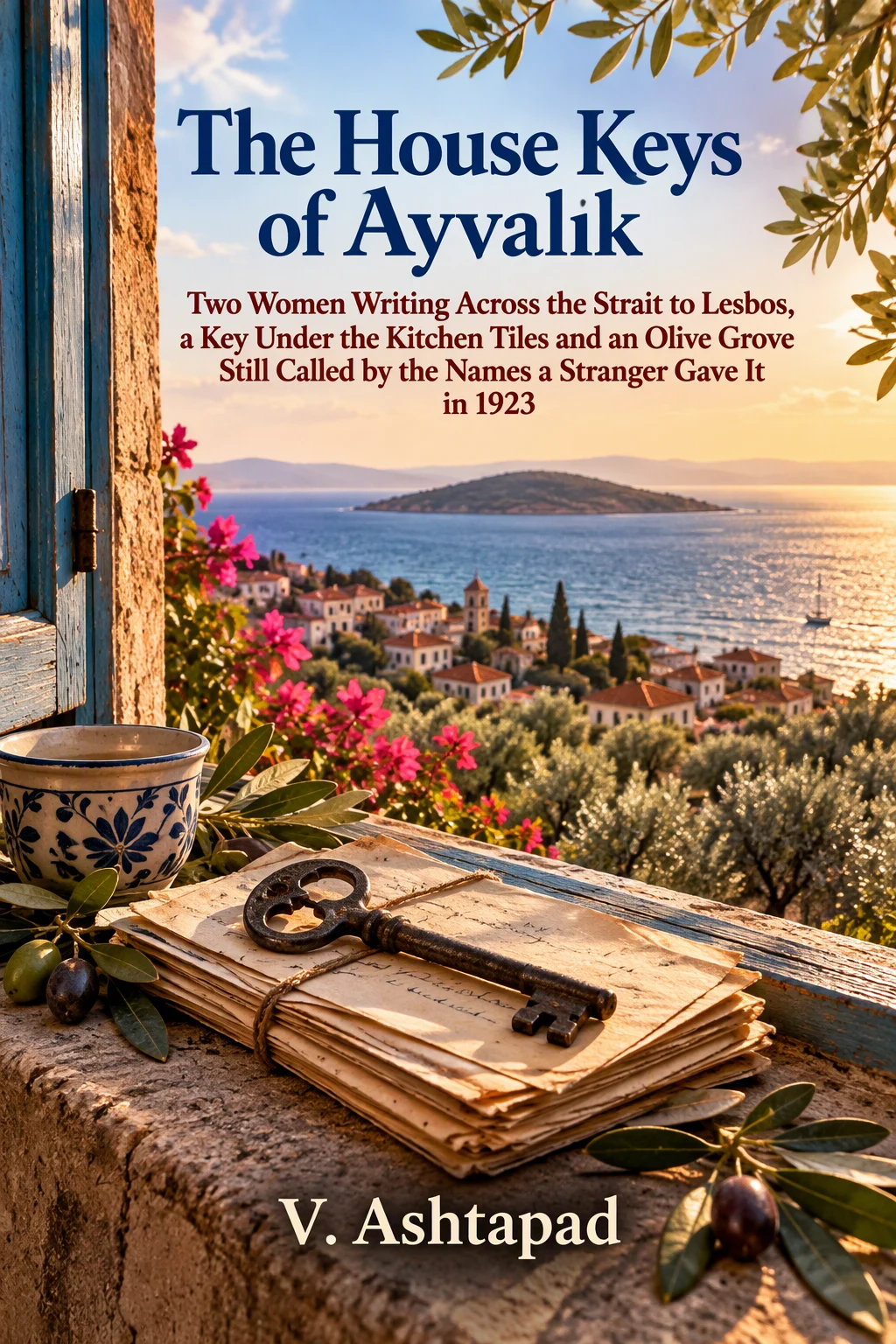
The House Keys of Ayvalık
Two Women Writing Across the Strait to Lesbos, a Key Under the Kitchen Tiles and an Olive Grove Still Called by the Names a Stranger Gave It in 1923
by V. Ashtapad
Foreword
This is a work of fiction. The 1923 population exchange between Greece and Turkey was real, as are the olive country of Ayvalık and Lesbos, the shared Adramytiani or Ayvalık olive, the old stone oil presses, the ferry across the strait and the folk tune sung with Greek and Turkish words on both coasts. The village of Ano Elies, the Kouvaras and Karaca families, the cooperative and every other named person and place in the story are invented.
For everyone who left the kindling, and everyone who kept the floor.
The Tile by the Hearth
Ayvalık, March 9, 2026
To the Kouvaras family, Ano Elies, Lesbos,
I do not know whether this letter will find anyone. I am writing the name on the envelope the way my great-grandmother said it, and I am trusting the postman in your village to know more than I do. If there is no one by that name left in Ano Elies, I ask whoever opens this to forgive a stranger for the trouble and to pass it to someone old who remembers the families.
My name is Selin Karaca. I am forty-four. I teach chemistry to sixteen-year-olds at a high school above the harbor in Ayvalık, which is a town your family will know, because I believe they lived in it. I live in a stone house on a lane that climbs from the market toward the windmill hill. The house has a blue door, green shutters that have been painted so many times they have the texture of orange peel, and a courtyard with a fig tree that sheds its leaves over everything in November and makes my husband swear in two languages, his own and the language of men who sweep.
My family has lived in this house since 1923. Before that, my great-grandmother Emine and her husband Hasan lived in Ano Elies, on Lesbos, in a house at the top of the village near a spring with a stone trough. In 1923 the two governments signed papers that sorted the people of these coasts by the official label of religion, and on that label alone a family from an olive village on Lesbos was sent across the strait to Ayvalık, and families from Ayvalık were sent across the other way. Nobody in my family asked for it. I doubt anybody in yours did either. Emine was nineteen. She had a baby on her hip and a copper pot tied to a bundle, and she was given this house by an office with a ledger.
Every child in Ayvalık learns that history in some form. What follows is the part that is ours.
Two weeks ago my husband Murat and I began to redo the kitchen. The old floor was red clay tiles, square, worn into shallow bowls where a hundred years of women stood at the stove. Some were cracked right through. "Something smooth," Murat said. "Something that does not hold crumbs." "Keep the old ones," I said. "Change only the broken ones." "You want to keep crumbs." "I want to keep the floor." We argued about it in the way married people argue about floors, which is to say we were arguing about something else, probably his mother. In the end we agreed to lift the worst row, the one in front of the hearth, and look underneath before deciding anything.
Under the third tile from the wall, set into the lime bed in a little hollow someone had scraped out on purpose, there was a bundle about the size of my hand. It was wrapped in oilcloth gone stiff as bark. "Deniz!" Murat shouted up the stairs. "Bring your phone, come and film this." "No," I said. "Why no?" "Because it is not ours." I wanted to open it the way you open something that was not meant for you, slowly, and with nobody watching.
Inside the oilcloth there was an iron key, long as my palm and fingers together, with a ring at the top rubbed smooth and a bit cut into three square teeth. There was a fold of paper so brown it looked toasted. And there was a small cloth bag that held a few olive pits, perhaps a dozen, dry and gray and light as beads.
The paper has writing on it in Greek. I cannot read Greek beyond the letters we learn from science, alpha and beta and delta and so on, so I sounded it out like a child. I can make out a name, *Ioannis Kouvaras*, written larger than the rest, and under it two lines I could not read at all. My colleague who teaches history, a careful man named Erol whose grandmother came from Crete, helped me with it over tea in the staff room. "Roughly," he said, tapping the paper, "*This is the key to the press store. For the one who keeps the trees after us.*" "Roughly?" "This last word. *After us*, maybe. Or *when we are gone*. Don't hold me to it." He held it to the window. "A man's hand. Careful. Someone not used to writing much."
I sat on my kitchen floor a long time with the key on my knees. My son Deniz came in, stepped over the open hole in the floor and took an apple. "Did somebody die?" "In a manner of speaking," I said. "A hundred years ago." "Okay," he said, and went back upstairs with his apple.
Let me tell you why I am writing, so you do not think I want something from you. I do not want anything. The house is my family's house. My children's children will grow up in it, if they want it. But my great-grandmother always said, and my mother says it still, that when Emine walked into this kitchen in the spring of 1923, it was clean. Swept. The jars in the cellar were washed and turned upside down to dry. There was a sack of coarse salt by the hearth and a basket of kindling. Someone had left the house in good order for whoever came next. My mother says Emine told it to her a hundred times, and always the same way, ending with the kindling: "They even left me kindling. Who leaves kindling for a stranger?"
All my life I have heard about that kindling. I never thought much about the hands that gathered it. Now I am holding a key that one of those hands put under a tile. I think a family who leaves kindling for strangers deserves to know that their key was found, and that it was found by someone who will take care of it.
My cousin Oğuz, who keeps our family tree on the private pages we share among relatives, telephoned within the hour. "Do not touch it again. Photograph everything first. Everything, Selin." "Yes, Oğuz." I did, and I labeled the pictures with the date and the tile and "found by Selin and Murat," and now the whole family has been sending me questions. "Is it valuable?" writes my aunt in Izmir. "Is there gold under the other tiles?" writes my uncle in Germany. My mother wants to know nothing at all yet. "I am waiting," she says, "to see who answers."
I enclose a photograph so you can see the key.
Photograph: a man's broad hand, my husband's, holding the key flat on his palm against the dark wood of our kitchen table. Beside it, the paper unfolded, held at the corners by two of my mother's glass tea cups so it will not curl. The light is from the courtyard window, late afternoon, gold, and you can see the fig tree's shadow, which in March is only branches, lying across the corner of the paper like a drawing of veins.
If anyone in your family knows this key, or the name, or what press store means, I would be grateful for any word. I will keep the key in a drawer lined with a piece of clean linen until I hear from you. If I never hear, I will keep it anyway. It has been under my family's feet for a hundred and three years. It can stay a little longer.
With respect, from the other side of the water,
Selin Karaca
P.S. "From the trees here," Erol says of the olive pits. "Almost certainly. People kept pits from a tree they loved. The way you keep a lock of hair." I cannot say whether that is so. I put them back in their little bag and they are in the drawer with the key.
© 2026 CRUNOD LLC. All rights reserved.
The Key on the Nail
Ano Elies, Lesbos, April 2, 2026
Dear Selin Karaca,
Your letter found us. It found us! The postman in Ano Elies is a man named Pavlos who has carried mail up this hill for thirty-one years on a motorbike that sounds like a goat with a cough, and he did not need to think. He brought it straight to my aunt Theodora's door, because she is the oldest Kouvaras still in the village, and she sent her neighbor's boy running down the hill to find me at the olive cooperative, where I keep the books. "A letter from Turkey," the boy said, out of breath. "With a key in it. A picture of a key. Kyria Theodora is sitting on her step holding it and she won't go in."
I am Despina Kouvara, forty-six. My great-grandfather was Ioannis Kouvaras. The name on your paper is his.
I want to answer you properly, the way you wrote to us, so this will be long. Forgive my English. I learned it from bookkeeping courses and from American films my brother rented when we were young, so I may sound like an accountant who has been in a car chase.
First, the important thing. Listen. You said your great-grandmother walked into a clean kitchen and found kindling. I need you to know that in our family we have a story with the same bones. When Ioannis and his wife Kalliope came up this hill in 1923 with my grandfather Nikos, who was five, and with whatever they could carry from Ayvalık, the office in Mytilene gave them a paper for a house at the top of the village near the spring with the stone trough. They found the door unlocked. On the windowsill there was a pot of basil, and the soil in it was damp. Someone had watered it that morning, or had asked a neighbor to water it until the next family came. My great-grandmother Kalliope told that story to her children until they could recite it with her. "The basil was wet. Who waters basil for a stranger?"
Selin, I read your letter four times before I understood: I am living in Emine's house.
My aunt Theodora lives in it now, I should say. I live lower down, nearer the cooperative, with my husband Stratos, who fishes sardines out of the gulf at Kalloni when the season is open and fixes nets and engines when it is not. Our daughter Ariadne is nineteen and studies in Athens and thinks we are all charming and impossible. But the old house up by the spring, at the top of the village, is where my grandfather grew up and where my father was born and where I spent every summer of my childhood shelling beans on the step. It is the house your Emine left. It has thick walls of gray stone, a wooden balcony that we have rebuilt twice, a bread oven in the yard shaped like half an egg, and a kitchen with a low beam I have hit my head on more times than I can count.
Now the second thing. The thing that made my aunt sit on her step and refuse to go in.
In that kitchen, on the wall to the right of the hearth, there is an iron nail. On the nail there is a key. It has been there for as long as anyone in my family can remember. It is not the key to any door in the house. We tried them all when I was ten, my brother Kostas and I, one rainy afternoon. "The big chest!" "Nothing." "The shed!" "Nothing." Every door and every chest and the shed, and it fit nothing. "Whose is it, Pappou?" I asked my grandfather. "The people who lived here before." "Why is it on the nail?" "My mother found it there when we came. With a cloth through the ring. She left it." "Can we take it down?" "No. It is not ours to move." That was all.
"Go up," my aunt said this morning, and put a ruler in my hand. "Measure it. Do not touch it. Measure it." I am enclosing what I found.
Photograph: the key on its nail, seen straight on against the whitewashed wall. The wall is not clean white anymore but the soft yellow of a century of cooking smoke, and you can see the darker ghost shape on the plaster where the key has hung so long that the smoke went around it. The key is shorter than yours, I think, with a round bow and a pipe-shaped stem and a small flat bit. The cloth through the ring was once red. It is the color of old brick now, and frayed, and my aunt would not let me untie it to measure. Beside it on the wall, for scale, I have held up my cooperative ruler. The key is eleven centimeters. My aunt's hand is in the corner of the picture. She is pointing at it as if I might miss it.
So you see. We have been keeping a key of yours too.
"Leave it to me," said my cousin's daughter, who is clever with these things, and she made a page for our family where we put photographs and old papers so the relatives in Athens and Melbourne and Toronto can see them. I put your letter there this afternoon, with your permission I hope, and the photographs. I wrote under them: *From the family of Emine and Hasan, Ayvalık.* By supper, my second cousin in Melbourne had written: "Maybe the two keys are for each other's houses? Like a treasure?" "There is no treasure," I wrote back. "There is a nail and a tile."
About the paper. Your colleague read it well, tell him. *Press store* is right. My great-grandfather Ioannis had a share in a stone olive press near the water in Ayvalık, with two other men. The store was the room at the back where they kept the oil in jars before it was sold, and the sacks, and the mats. "He talked about the press all his life," Theodora says. "The smell of the paste. The mule that turned the stone, until the year they brought an engine. The night the engine first ran, half the street came out in their nightclothes to watch." The key you found must be the key to that room. Why he put it under the kitchen tile and not on a nail, I do not know. "I am thinking," Theodora says. "I will tell you when I have thought."
The last word on the paper, the one Erol was unsure of. My aunt read your photograph with her glasses and a magnifier. "Neither," she said. "Not *after us*. Not *when we are gone*. It is a word our grandmothers used. *The ones who come next.* The next season, the next harvest, the next family at the table." *For the one who keeps the trees, the one who comes next.* She says her father would have written it that way because that is how he spoke about everything, the sardines, the olives, the children. Always about who comes next.
You asked for nothing. I believe you. We ask for nothing either. But Theodora asked me to tell you three things, and I promised I would write them in her order.
One: she was born in your Emine's house in 1934 and she has had a good life in it, and she thanks the woman who left it to her mother, even though they never met.
Two: she would like to know whether the fig tree in your courtyard is still alive. Her father spoke of a fig tree by the kitchen window in Ayvalık that gave fruit so heavy the branches touched the stones.
Three: she wants to know what Emine cooked. She says a kitchen remembers food longer than people do and she wants to know what was in this kitchen before her mother's pots.
I will add a fourth thing, which is mine. Thank you for opening the oilcloth slowly. I would have done the same.
From Ano Elies, where the spring still runs,
Despina Kouvara
P.S. The olive pits. Ioannis was known in the family for planting. He planted trees in this village until he was eighty-four. My grandfather said his father once came back from the coast with a cutting wrapped in a wet shirt. "Ioannis, where is your shirt?" his wife said. "On a tree." Perhaps your pits were a man saving seed. Perhaps they were a man keeping a lock of hair. Possibly both.
© 2026 CRUNOD LLC. All rights reserved.
What Emine Cooked
Ayvalık, April 19, 2026
Dear Despina,
May I call you Despina? After your letter I cannot go on writing "Kouvara" as if you were a tax office.
I read your letter at the kitchen table with the hole still open in the floor in front of the hearth, because Murat and I have stopped arguing about tiles. We have decided to put the old ones back. He found a man in the old quarter who still makes the clay squares by hand in a yard full of chickens, and the man will match the broken ones. "I am not putting smooth floor over that," Murat says. "Somebody hid a key there for a hundred years. No." "What else is under there?" he asks me, every night, looking at the hole. I think he is a little afraid. I think he is also a little moved, though he would rather swallow the key than say so.
Please tell your aunt Theodora the fig tree is alive. Enormous. The trunk is as thick as my waist, which is not a small measurement after two children, and it leans over the courtyard wall toward the lane so that the neighbors' children steal from it every August, and I let them, because my great-grandmother let my mother steal from it, and so on backward to whoever planted it. The branches still touch the stones when the fruit is heavy. We hold them up with forked sticks. There are three props this year already, though the figs are only green knuckles. "Every month," I told Deniz. "For her aunt. Until the fruit is ripe." "Every month?" "Every month." He groaned like a donkey, and then he went out and did it from four angles. I enclose the best.
Photograph: the fig tree in our courtyard, early morning. The new leaves are bright and wide like open hands. Under it, the old stone bench where Emine used to sit and clean greens, with a tin basin on it now full of my mother's geraniums. Behind the tree you can see the green kitchen shutters, the bottom one hanging a little crooked, and the window where, I suppose, Theodora's father once stood and looked at the same tree.
Now. What Emine cooked.
"Ask your mother," Murat said. So for this I went to my mother. Her name is Nermin. She is seventy-three, a retired seamstress, and she lives two lanes over in a narrow house that smells of starch and quince. Emine was her father's mother, her *Babaanne*, and my mother lived with her until she married. My mother has not wanted to talk about your letters. She read the first one and folded it and said, "Well." She read the second one and said, "Again. The part about the basil. Slowly." Then she went quiet the way she does when she is pinning a hem.
Yesterday I brought her a bag of the first zucchini from the market, with the flowers still on, and I asked her straight. "Anne. What did Babaanne cook, when she first came? What did she bring with her, in her hands?"
She said: "Her hands. She brought her hands. That is what she brought."
Then she put on her apron. "Sit," she said. "This will take time." She talked for three hours.
"She came from a village on Lesbos," my mother said. "Your friend's village. Everyone had olives, some had a cow, nobody had money. She cooked what grew within walking distance. And when she came here, it was the same." The same olives, the same wild greens on the hillsides in spring, the same thyme, the same sea. My mother says Emine stood on the windmill hill her first week and looked back across the water at Lesbos, which on a clear day is right there, purple and long like a sleeping animal, and she said, "They moved me from one side of the table to the other."
The first thing she cooked in this kitchen was greens. In March the hills here are full of them, just as on Lesbos: wild chicory, mallow, the bitter little dandelion, fennel, poppy leaves before the flowers come, sorrel. She went up the hill with a knife and a basket the second morning, and she came down with an apron full, and she boiled them in the copper pot she had carried across the water and dressed them with oil and lemon and salt from the sack someone had left by the hearth. My mother says she always told it like this: "I ate my first meal in that house with their salt."
The second thing she cooked was stuffed zucchini flowers, because it was the end of spring by the time she had a garden, and because she had brought seeds sewn into the hem of her skirt. My mother cooked them for me yesterday, and wrote down how, in her slanting seamstress hand. "Copy it for Theodora exactly," she said. "Do not improve anything. I know you." I would not dare.
Emine's stuffed zucchini flowers, as my mother Nermin makes them:
Pick the flowers in the morning when they are open, before the sun closes them. Take the male flowers, the ones on thin stems; leave the female ones to make zucchini. Do not wash them under the tap or they will tear. Shake them, look inside for bees, and lay them on a cloth.
For about twenty-five flowers: one cup of short rice, rinsed until the water is clear. One onion, grated. One tomato, grated, skin thrown away. A handful each of fresh mint and dill, chopped fine. A small handful of parsley. Salt, black pepper, a pinch of dried red pepper. A spoon of sugar, no more. Half a tea glass of olive oil in the filling and half a tea glass for the pot.
Mix the filling with your hands. Open each flower gently with one finger and fill it two-thirds full, not more, because the rice will grow. Fold the petal tips over like closing an envelope. Lay them in a wide pot close together so they hold each other up, in rings, the folded side down.
Pour over the rest of the oil and a tea glass of hot water with a little lemon in it. Put a small plate upside down on top so they do not float. Cook on low until the water is gone and the rice is soft, about forty minutes. Leave them in the pot until they are cold. They are eaten cold. Anyone who eats them hot is in a hurry and should be ashamed.
That last line is my mother's. "Write that too," she said. "Exactly." I promised.
While the flowers cooked, my mother told me things I had never heard. That Emine, the first winter, could not sleep in this house because it was too quiet, because in Ano Elies her mother-in-law snored through the wall and here there was nobody. That she talked to the fig tree. That she kept a small wooden box of things that had come with the house, things she did not throw away and did not use, because they were not hers to use, and that when she was old she gave the box to my mother and said, "You keep it, and you will know when to give it back." My mother has the box. She has not opened it in years. "Can I see it?" "Not yet." "Anne—" "Not yet," she said, and covered the pot.
I do not push my mother. "Push me and see," she says, and she means it. But I think she will open it.
One more thing, before I close. You said your grandfather would not take the key off the nail because it was not his to move. When I read that line to my mother, she laid her palm flat on the tabletop and held it there. Then she said, "Babaanne would have liked that man."
My cousin Oğuz has added your family to the tree he keeps, joined by a dotted line, not a solid one. "What is the line for that?" he asked me. "A family who lived in our house. A family whose house we lived in. There is no symbol." "Draw a key," I said.
With affection, from the side of the table where the figs are,
Selin
P.S. Your English is very good. You only sound like an accountant in a car chase when you are counting things, and you count things beautifully.
© 2026 CRUNOD LLC. All rights reserved.
Theodora on the Step
Ano Elies, May 3, 2026
Dear Selin,
Your mother is right. Cold is the only way. My aunt ate four of the zucchini flowers I made from Nermin's instructions, standing at the counter, which she has not done in years because her knees complain, and then she sat down and said, "These are not our flowers." "Theia!" I said. I was ready to be offended for you. Then she said, "Ours have cheese. Hers are better." I have never heard her say anything is better than ours. Not a cake, not a grandchild, not the weather in Crete. "Write down the date," Stratos said, when I told him. I did.
You asked through your letters for the old stories, and Theodora has decided to give them. She does not write anymore, her hands shake, so my daughter Ariadne came home from Athens for the long weekend and sat with her on the step with her phone. "Theia, can I record you?" "Will I sound young?" "No." "Promise." "I promise." "Then yes." Ariadne has put the recording in our family's private pages, where only the relatives can hear it, under a heading in Theodora's own words: *What my mother said about the crossing.* I have listened to it six times. I have written it out in English for you as well as I can. Where she laughed or stopped, I have tried to show it. She speaks slowly. Read it slowly.
Here is what she said. Slowly.
"My mother Kalliope was twenty-six when they left Ayvalık. My brother Nikos was five. I was not born, so I am telling you what I was told, and I was told it so many times that I have it like a song, so do not stop me.
"They came over in a fishing boat, not a big ship. A caique, painted blue and white, belonging to a man from Ayvalık who had a cousin in Mytilene. There were four families in it and the goats of one family and a sewing machine. My mother always remembered the sewing machine. It belonged to a widow who would not part with it, and the boatman said if the sea came up he would throw it over the side, and the widow said then he would have to throw her too. The sea did not come up. It was very calm. My mother said it was the calmest crossing anybody had ever seen, the water like oil in a dish, and that was the worst part, because you could see Ayvalık behind you for the whole way. All the windows. You could count the windows.
"My father did not look back. He sat in the front of the boat with a bundle on his knees and he did not look back once. My mother asked him later why not, and he said, 'Because I was looking at where we were going. Somebody had to.' That was my father.
"In the bundle there was a cutting from his best tree. He had cut it the night before from the grove behind the press, the tree he called the Bride, because when it flowered it was all white and when it fruited it bowed. He wrapped the cutting in his own wet shirt and he kept the shirt wet with seawater the whole way. My mother said salt water would kill it. He said, 'It is an olive. Salt water is its cousin.'
[She laughs here. A long laugh. Ariadne laughs too.]
"When they came up this hill, the office paper said the house by the spring. They found it clean. My mother went inside first, and there was basil on the windowsill, and the earth in the pot was wet. And the first thing my mother did, before she put down her bundle, before she sat, she went out to the spring and filled her hands and came back and watered the basil again. She said, 'Somebody was keeping it alive. Now it is my turn.'
"My father went straight down behind the house with his shirt and planted the cutting by the trough where the ground stays damp. Everybody told him it was too late in the year, too dry, it would die. It did not die. That is the big tree by the spring. You have climbed it, Despina. Everybody in this family has fallen out of it.
[A pause. Ariadne asks: Did you ever want to go back, Theia? To see Ayvalık?]
"No. Yes. No. My mother wanted to, for a long time. Then she stopped wanting it. She said the house was a house and she had a house. She said what she missed was the fig tree and the smell of the press at night and the sound of the women singing on the lane when they washed. She sang their songs to us until she died. She sang one while she cooked, about a girl going down a road in the rain with a long coat and the mud on her hem, and a young man behind her carrying her things. A happy song. Silly. The tune climbed and fell like a donkey on a hill. My mother said in Ayvalık the Turkish women next door sang the same tune with their own words, and when she was a girl they would sing it over the wall at each other, one in each language, to see who was louder.
[She hums it, a little. Her voice cracks on the high part and she stops and says, Enough, I am not a radio.]
"And the key. My mother found a key on that nail with a red cloth through it, and she said to my father, 'They forgot their key.' And my father said, 'People do not forget a key with a red cloth on it. They leave it.' So it stayed. As a girl I believed it was a magic key and I was afraid of it. When I was a young woman I thought it was sad. Now I am old and I think it was a good manner. You leave your key so the people who come after know you were not thieves in the night. You left in daylight. You locked nothing."
That is where the recording stops. Ariadne says Theodora stayed on the step a long while after. Then: "Coffee. Too much sugar. Go."
Let me tell you about the tree by the spring, since Theodora brought it into her story. It is the oldest-looking tree in the village, though it is not the oldest. It has a split trunk, twisted like rope, and a hollow at the bottom where my brother and I used to hide sardine tins full of treasure: marbles, a dead beetle, the foil from chocolates. Every family in Ano Elies knows it as the Kouvaras tree. Nobody but us knew that it came over the water in a shirt. I have walked past it ten thousand times. Yesterday I went and stood under it like a stranger.
Photograph: the tree by the spring, from below, looking up through the branches. The leaves are silver underneath and dark green on top, and the sky is so blue behind them it looks painted. The trunk at the bottom of the frame is split in two great twisted arms, and in the crook between them sits a cat, gray with a white chest, who has nothing to do with the story but would not move.
I promised you something from Kalliope's kitchen to answer Emine's flowers. Theodora chose it. "The first night every year when the sardine boats came in at Kalloni," she said. "My mother learned it here, from a neighbor. So it is ours, a Lesbos dish. Not Ayvalık." "Tell Nermin she should know what her grandmother's village eats," she said.
Kalliope's sardines in the oven, as Theodora tells it:
Two dozen fresh sardines, the small ones, cleaned and the heads off. Lay them in a clay dish, tails to the middle, like the spokes of a wheel. Between them put thin rounds of tomato and onion, a whole head of garlic in slivers, a handful of parsley. Salt. A good shower of dried oregano rubbed between your palms over the dish, so you smell it before it cooks. The juice of two lemons. Then olive oil, enough that you can see it shine in the corners, more than you think, because the oil is half the dish and the bread will want it. Into a hot oven until the edges of the tomato go dark, about half an hour. Eat it with the windows open and plenty of bread and do not count the bones.
Theodora also says: "Tell her the oil must be from this year. Old oil makes old fish."
I do not know what is in Nermin's wooden box, and I will not ask. But if she ever opens it, tell her there is an old woman on a hill on Lesbos who is also keeping things that are not hers to use.
With love from under the shirt tree,
Despina
© 2026 CRUNOD LLC. All rights reserved.
Two Names for One Tree
Ayvalık, May 24, 2026
Dear Despina,
I have to tell you something that made me sit down in the dirt. I am not a woman who sits in dirt.
After your last letter I went to see my cousin Oğuz, the one who keeps the family tree. He also keeps our olives. "Who gave us the grove?" I asked him once, when I was a girl. "The office," he said. "Who else?" When Emine and Hasan came in 1923, the office gave them this house and a strip of grove on the slope behind the old waterfront, where the stone presses were. Hasan had been an olive man in Ano Elies and he was an olive man here until he died, and his grandson's son is Oğuz, who sells insurance in town five days a week and on the other two days becomes a different man entirely, with a pruning saw and a hat that should be burned.
The grove is a twenty-minute walk from my house, out past the last stone factories along the shore. Most of those buildings stand empty now, or have become hotels where people from Istanbul pay a great deal to sleep beside a millstone. Ours was not among the big ones. It was small, with a sloping tiled roof and one chimney, and it is a shell now with a fig growing out of the doorway. The grove climbs up behind it in terraces held by dry stone walls. There are forty-one trees. Oğuz knows every one the way a teacher knows a class. "That one is lazy," he will tell you. "That one is clever. That one will break your heart in a dry year."
"Oğuz," I said, "listen. Ioannis carried a cutting across in a wet shirt. From his best tree. He called it the Bride." He was up a ladder at the time with the saw and he stopped sawing and peered down at me and said, "Which bride?"
I said, "A tree. Ioannis called his best tree the Bride."
And Oğuz came down the ladder and walked me along the second terrace to a tree near the old wall, a great wide tree with a crown like a wedding cake, and he laid his palm on its bark and said, "This one. We have always called this one the Bride. My grandfather called it that. His father called it that. I thought it was because it bows."
Despina, the trunk has a scar on the north side, low down, an old healed wound where a branch was taken off clean a very long time ago. "Oldest scar on her," Oğuz said, and ran his thumb along it. "Whoever did that knew how to cut."
That is when I sat down. In the dirt.
When I could stand again, Oğuz told me the other names. Our family has always had names for the oldest trees, and I knew some of them from childhood without ever wondering where they came from. There is one called the Sailor, which leans hard toward the sea. There is one called the Two Sisters, which is really two trunks from one root. There is one called the Miser, which gives fruit only every other year and then only a little. "I always thought Hasan named them," Oğuz said. "Now I don't know what to think. Hasan was not a man who named things. He named his donkey Donkey."
"Tell your mother," Oğuz said. "Not yet," I said. I am waiting until I understand it better. I think the answer may be in her box.
Now let me tell you the second thing that made me sit down, though this time I was already sitting, at my desk at school, with a stack of papers about the gas laws.
You wrote that Ioannis planted the cutting by the spring and everybody said it would not live. I looked up, the way a chemistry teacher looks things up, what kind of olive tree grows on Lesbos. Most of the trees on your island are a variety your farmers call Adramytiani. It means "from Adramyttium," which is the old name for Edremit, the town at the head of our gulf, half an hour from my house. And the trees in our grove, the trees all around Ayvalık, are the variety we call the Ayvalık olive, or the Edremit olive. It is the same tree. The same tree, with one name on this side for the place it grows, and one name on your side for the place it came from.
I read that and said out loud to the empty staff room, "Of course." Of course the trees went across before we did. People were carrying cuttings in wet shirts across this strait long before 1923.
"Good flowering this year," Oğuz says. The flowers are just finishing now, and the whole grove smells faintly of honey and dust, and when the wind lifts off the water the tiny white petals blow across the terraces like flour. I enclose his photograph of the Bride in flower, though by the time you have this letter she will be in fruit.
Photograph: the Bride, from the terrace below, so you see her from the knees up, the way you would look at a tall woman on a step. The crown is white with flowers, so dense it looks like the tree is wearing lace. Low on the trunk you can make out the old scar, a pale knot ringed by bark. In the bottom corner of the picture is Oğuz's terrible hat, which he left on a stone wall and refused to move for the photograph.
You gave me a fish. So, olives. This is how Oğuz cures the green ones, which is how his father did, which is how Hasan did, which is, I am now beginning to suspect, how Ioannis did, because the method came with the trees.
Cracked green olives, Oğuz's way:
Pick green olives in October, firm and pale, before they blush. Sort them; throw away any with a mark or a hole. Lay each one on a flat stone and give it one tap with a smooth river stone, enough to crack the flesh to the pit but not to break it apart. My grandfather did it with the flat of a cleaver. Oğuz uses a stone from the beach he says is the right weight. It takes all afternoon. Children are useful for this, if you can stop them eating.
Put the cracked olives in a big jar and cover them with cold water. Change the water every day for ten days, or until they are no longer bitter when you bite one. Taste every day. Make a face every day. When the face stops, they are ready.
Make a brine: for every liter of water, eighty grams of coarse salt, and test it the old way, with a fresh egg; if the egg floats so that a piece the size of a coin shows above the water, it is right. Pack the olives into clean jars with slices of lemon, cloves of garlic, a few stalks of wild fennel, and a branch of thyme. Pour the brine over them, then a finger of olive oil on top to seal it from the air. Wait a month. Eat them with bread and white cheese, in the morning, standing up, looking at the sea.
That last line is Oğuz's. "Put it in," he said. "It's the most important part."
One more small thing. Deniz, my son, who is sixteen and plays the long-necked lute badly and with great feeling, heard me reading your aunt's words aloud to Murat, the part about the song with the girl and the muddy hem. He said, "Wait. That is a song we know." He went and got his instrument and played it, the one everyone here learns as a child, about going to Üsküdar in the rain. It goes up and down like a donkey on a hill. Theodora is right. He has recorded himself playing it and wants to send it to Ariadne, so she can play it for her great-aunt. "It is interesting historically," he told me. "Historically," I said. "Yes." He changed his shirt before he recorded it.
With love from under the Bride,
Selin
© 2026 CRUNOD LLC. All rights reserved.
Small Mail in June
Postcard, Mytilene, June 6, 2026
Picture side: Mytilene harbor at dusk, the fishing boats pulled stern-first to the quay, the castle on the hill behind them going pink.
Selin, a card only, because the cooperative is in its summer accounts and I am drowning in invoices for jar lids. I read your letter about the Bride on the bench outside the bank and a man asked, "Kyria, are you all right? Do you need a doctor?" Theodora has heard about the scar. "Hm," was all she said. She went to the spring and put her hand on the shirt tree and stood there. I am writing properly when the lids let me go. D.
Note from Ariadne Kouvara to Deniz Karaca, copied into her mother's next envelope at her mother's insistence, "so it goes the slow way like everything else in this family":
Deniz, thank you for the song. I played it for my great-aunt on the step on Sunday. She kept her eyes shut through the whole thing, and then she said, "He plays like a boy who practices at night when his mother thinks he is asleep," which I think is a compliment. Then she sang the Greek words over your recording, the second time through, and I recorded that too and I am sending it back to you. It is in the folder on our family page I made for both families, the one your mother and mine can both see. I called the folder *The Strait* because I could not think of anything better. You can rename it if you have a better idea. In our version the girl is going to a different town and the young man is not her clerk, he is a fisherman, and the rain is still the same rain. Her voice is very shaky on the high note. Please do not tell her I told you that. A.
Note from Deniz Karaca to Ariadne Kouvara, also by post, written on graph paper from a chemistry notebook:
Ariadne, I am not renaming it. The Strait is good. I played my part again with her singing on top, through the speakers in our courtyard, and my grandmother Nermin came out of the kitchen, floury to the elbows, and stood under the fig tree and did not say anything until the end and then she said, "Again." So I played it again. I have never seen her stand still that long except at a funeral. Then she went back in and burned the bread. "Your fault," she said. I think she is right. D.
P.S. I do not practice at night.
P.P.S. I do sometimes.
Letter, Ayvalık, June 14, 2026
Dear Despina,
A short one, too. The figs are swelling; Deniz has photographed them; there are now five props. My mother asked me yesterday, out of nowhere, while we were hanging her sheets on the roof. "What does she look like? Theodora." "She said—" "Not what she said. What she looks like." I described your photograph, the hand pointing at the key. "A hand," my mother said. "Find me a picture of her face."
So I am asking, if Theodora is willing.
It is the first thing my mother has asked for since this began. I do not want to waste it.
S.
Photograph, enclosed in Despina's reply of June 20, with a note on the back in Despina's square accountant's hand: *She said yes and then she changed her blouse three times. This is the third blouse.*
Theodora Kouvara on the step of the house by the spring, sitting very straight, hands folded on one knee. She wears a navy blouse with small white buttons to the throat and a gray cardigan over it, though it is June, and a black headscarf tied at the back of her neck in the way of island women her age, with her white hair showing at the front in two soft waves. Her face is long, brown, creased like a walnut, with a mouth that is trying very hard not to smile and failing on one side. Behind her the door is open, and you can see into the dim kitchen as far as the hearth, and if you look very hard, a dark speck on the wall to its right, which is the key on the nail.
Note from Nermin Karaca, written on the back of an envelope that once held a dress pattern, given to Selin to put in her next letter "and do not read it":
To Theodora.
I have seen your picture. You sit like my grandmother sat. You hold your hands the same. I do not know how that is possible, but it is so.
You asked what she cooked. I have told my daughter. You asked if the fig lives. It lives. I will tell you something else when I am ready.
Nermin.
© 2026 CRUNOD LLC. All rights reserved.
Under the Bread
Ano Elies, July 11, 2026
Dear Selin,
The jar lids have let me go. The summer accounts are closed, the auditors have gone back to Mytilene with their sandwiches, and I have a whole Saturday afternoon and a pot of coffee and the shutters closed against the heat, which up here comes off the hillside in waves you can see. The cicadas are so loud that Stratos came in and said, "Listen. The trees are frying." So you get a long one.
First: Theodora has thought. Finally.
You remember she said she would tell me why Ioannis put the press key under the kitchen tile instead of leaving it on a nail. It took her two months. That is how she is. She chews a thing the way a goat chews a coat button. Last Sunday, while I was cleaning the bread oven in the yard, she called me over and said, without saying hello, "Under the bread."
I said, "What?"
She said, "When I was nine or ten, I asked my father where the key to the press was. Because I knew he had been a press man, and I knew every press has a key, and I thought he must have brought it. And he said, 'I left the press key under the bread.' And I thought it was one of his riddles, like when he said the moon was a slice of cheese the fishermen forgot. So I laughed and went away. But the hearth is where the bread is. In Ayvalık, my mother baked bread in the kitchen hearth, on the stones, under an iron cover. Your Selin found the key in front of the hearth. Under the bread."
"I always knew the rest," she said. "I never put it together." Then she told me.
"The press was not only his. Two partners. Stelios, and another man. I have lost his name. Shame on me." When the order came that they must go, the three men did not know who would have the press after them, or whether the office would give it to one family or to three or to nobody at all and let it fall down. They had pressed the autumn's oil already. There were jars of it in the store. The partners wanted to break the jars, so nobody else would have the profit. "Break them," Stelios said. "No," Ioannis said. "Oil is not profit. Oil is food. Food is for whoever is hungry." They argued. In the end the other two went down to the boats, and Ioannis went back alone in the night and locked the store with the oil still inside it, every jar full. And then he could not decide what to do with the key.
He could not leave it on the house nail, because the press was not part of the house and the house would go to one family and the press perhaps to another. He could not give it to the office. "He did not trust a ledger with oil," Theodora says. He could not take it, because then nobody could open the store and the oil would go rancid in the dark. So he did the one thing left to him. He put it where a woman who kept that kitchen for a long time would one day find it, mending the floor in front of the bread. And he wrote the note for whoever would come next.
"He thought it would be found in a year," Theodora said. "Two years. He did not think it would be a hundred. He did not think the next woman would keep the floor so well."
"Tell her," Theodora said, "her great-grandmother kept the floor too well." So, Selin. Your great-grandmother kept the floor so well that the key waited for you. I think that is the most beautiful insult anyone in my family has ever paid anyone in yours.
Now I will tell you about the press, because you are a chemistry teacher and I think you will like it, and because I have worked inside the smell of olive oil for twenty-two years and I can talk about it until you fall asleep.
The cooperative where I keep the books is at the bottom of our valley, where the road meets the river bed. The building is from the 1950s, square concrete, painted the pale yellow of a lemon peel, with a tall chimney nobody uses anymore and a yard where the trucks and the tractors and the old men with their donkeys wait their turn in harvest. Inside, it is all steel now. The olives come in sacks, they go up a belt, the leaves are blown off by a fan, they are washed, they are crushed by a hammer mill into a paste the color of wet moss, the paste is turned slowly in long troughs to let the oil gather, and then it goes into a centrifuge that spins the oil from the water and the solids. The oil comes out of a spout green and cloudy and so sharp it makes you cough. Every grower wants to taste his own. "Give me mine. No, mine first." They tip a little into a plastic cup and drink it straight, and then they cough, and then they smile like they have won a prize. The cough is the sign of good oil. It is the pepper in the fresh fruit catching your throat.
But behind the cooperative, in a shed with a tin roof, we keep the old machinery, because my father, before he died, refused to let anybody sell it for scrap. There is a stone mill, two great round millstones on their edges in a stone basin, that a mule once walked around and around. There is a stack of the old mats, round and flat like enormous gray pancakes with a hole in the middle, woven from goat hair. In the old days, you spread the paste from the millstones on the mats, one after another, and piled them on a spike into a tower as tall as a man, and then you pressed the tower, first by turning a great wooden screw and later with a hydraulic ram, and the oil and water ran out of the edges of the mats together into a stone channel, and then into settling tanks. The oil floats. The water sinks. You skim the oil off the top with a flat copper ladle. That is the whole secret, Selin. That is all it is: crush, spread, press, wait for the oil to rise.
When I was a girl my father brought me to the cooperative in harvest at night, when they ran the presses around the clock. The windows steamed. The air was hot and wet and smelled green and heavy, like cut grass and pepper and earth after rain all at once. The men wore undershirts and worked in their bare feet on the slick floor. They sang. They ate bread dipped straight into the new oil from the channel, with salt, at three in the morning. "Here, little bookkeeper," one of them said, "eat." I have never tasted anything better in my life.
"Exactly like that," Theodora says of her father's press at Ayvalık. The steamed windows, the singing, the bread at three in the morning. "It is the same work everywhere," she says. "Only the songs change, and not even those."
I am enclosing a photograph from the cooperative's own records. Our office keeps the growers' history in one place now, old ledgers photographed and the old men's stories written down when they will tell them, and I found this while I was looking for something else.
Photograph: the cooperative press floor, about 1958, black and white. A tower of round mats on its spike in the middle, glistening. Three men in undershirts around it, one with his hand on the press lever, one wiping his face with his arm, one, the youngest, grinning at the camera with a heel of bread in his fist. The young one is my grandfather Nikos, who crossed the water at five. The man with the lever is his father, Ioannis, sixty-something, thin as a stick, with a white mustache like a broom and his sleeves rolled to the shoulder. He has no interest in the photographer. All of his attention is on the oil.
One more thing and then I will let you go, because the shadows are long and Stratos is home and calling, "Despina, where is the big pan?"
Theodora is ninety-two. She has never been to Ayvalık. She says she does not want to go. But since Deniz's song and since your mother's note, she has been asking me questions she never asked before. "How long is the ferry?" "Are there steps up her lane?" "Can you sit in that courtyard in the afternoon, or does the sun come in?" Selin, I think she wants to go and is afraid to say it. I would like very much to bring her home to Ayvalık, to her father's house, once, while she can still climb the step. Would your family let her come and see her house?
Do not answer quickly. Theodora says, "Tell her: ask her mother." So: ask your mother.
With love and the smell of the cooperative still in my hair,
Despina
© 2026 CRUNOD LLC. All rights reserved.
The Shell on the Shore
Ayvalık, July 26, 2026
Dear Despina,
I took the key down to the press.
I did not tell anyone but Deniz. "Why me?" he said. "Because you will complain about the heat," I said, "and I will not cry." We went on a Tuesday evening after the worst of the sun, down through the old quarter where the lanes are so narrow two donkeys could not pass, past the shuttered stone houses with their carved doorways and their iron balconies and their little marble steps worn into soap shapes. In the evenings in July the whole town smells of jasmine and frying fish and the dust that the street sweepers raise. Women sit on chairs outside their doors and shell beans and watch you go by. "Whose daughter are you?" "Nermin's." "The teacher? The one whose husband talks too much at the market?" "That one." They nod.
At the shore, the old presses stand in a row along the water. Some of them are grand, three stories of dressed stone with high arched windows and tall brick chimneys, built in the best years of the oil trade by men who sold oil to Marseille and Odessa. Two have been made into hotels. One is a carpet shop. One is a school for sailing. And then there are the small ones, at the far end, past the boatyard, where the asphalt stops and the path is only packed earth and thistles.
Ours, yours, the one behind Oğuz's grove, is the last one before the rocks. It has a front wall of yellowish stone with one big arched doorway and two small square windows, and a back wall dug into the slope. The roof fell in long ago. A fig has grown up from inside and filled the doorway, so you have to duck under its leaves to go in. Inside, it is open to the sky. There is grass on the floor, and lizards, and the smell of warm stone and goat. In the middle there is the round stone basin of the old mill, half full of earth, and in the earth someone has planted tomatoes. Probably Oğuz. "Not me," he says. "Never."
At the back, cut into the slope, there is a low room with a curved stone ceiling, the only part of the building that still has a roof. That was the store. You can see where the jars stood: a row of round marks worn into the floor, shallow hollows, eleven of them, and the stone is darker there, almost black, the way stone goes when it has drunk oil for fifty years. The doorway to the store has two iron hinge pins still in the wall and nothing on them. There is no door. There is no lock. There has not been for a very long time.
I stood in the doorway with your great-grandfather's key in my hand and there was nothing to put it into.
"Mom," Deniz said. "There's no door."
"I can see that."
Deniz said, "Well, that is disappointing." Then he went inside the store room and walked along the row of hollows and counted them out loud, and stood in the last one, and put his hand on the ceiling, which was low enough that he could, and said, "It is cold in here. Mom. Feel it." And it was. In the middle of July, at the end of a day when the thermometer at school read thirty-eight, the store room under the slope was as cool as a cellar. Of course it was. That was the point of it. That was where the oil slept.
What did I expect? I do not know. That the key would turn something. That I would hear a click. Instead I sat on the cool stone where the eleventh jar used to stand and I thought about the man who locked this room full of oil and went down to the boats and kept his promise to whoever came next, and I thought about who that was. Who opened the store when the oil was still good. Who carried the jars out. "When Hasan got the grove, he got the store with it," Oğuz told me once, and the family story, which I had never paid attention to, is that Hasan "found oil in the rock" his first winter and it kept the family alive until his own trees bore. I always thought it was a figure of speech. I thought it meant he worked hard. Despina, I think it means he broke the old lock off with a stone, because he had no key, and found eleven jars of your great-grandfather's oil.
Deniz found something else. "Mom. Up there. Letters." On the lintel over the outside door, under the fig leaves, cut into the stone, there are letters and a date. He climbed the fig to see them before I could say be careful. "Pen," he called down. "Quick." They are Greek, and worn, but he copied them onto his hand with my pen. Three sets of initials and the year 1891. One of the sets begins with a K. He has photographed his hand for you.
Photograph: a teenage boy's palm, slightly sweaty, the letters written in blue ballpoint across the lines: three groups of two letters each, and under them 1891, with the 9 written backward and then corrected. Above his palm, out of focus, the green of fig leaves and a slice of evening sky the color of apricots.
On the way home we stopped at the bakery on the corner of our lane, which makes the famous toasted sandwiches the tourists line up for, and bought two and ate them walking, and Deniz said, "You should tell Ariadne's mom about the jars. It is the important part." So I am telling you. It is the important part.
When I got home, my mother was in my kitchen. She had let herself in, as she does, to bring me stuffed mussels and to say, "These curtains, Selin. Still." Your letter of July 11 was on the table where I had left it, open, and she had read it. She reads everything. "A seamstress who does not read every paper on a client's table," she says, "puts the pockets in the wrong place."
She was sitting upright, hands folded on one knee, the way Theodora sits in her photograph. She kept her eyes on the table when I came in. She said, "Her house."
I will write again when I can.
Selin
© 2026 CRUNOD LLC. All rights reserved.
One Small Word
Ayvalık, August 9, 2026
Dear Despina,
I have started this letter five times. "Burn it," Murat said, about the fourth. The first four are in the stove. I am going to write this one straight through and send it before I can be clever.
You asked me not to answer quickly, and to ask my mother. I did not have to ask her. She read your letter on my table, and she had answered before I was through the door.
I want to tell you what she said, all of it, because you asked a true question and you deserve a true answer, and because I think if I soften it, it will grow in the dark like something in a cellar.
She said: "Her house. Her father's house. Does she know my grandmother gave birth to four children in that house? Does she know my father was born on that kitchen floor because the midwife was late? Does she know that I was married out of that blue door, and that my mother died in the room upstairs with the window on the fig? A hundred years, and in one letter it is her house."
Then she said a thing I had never heard her say. "When I was little, in the fifties, the children at school had a name for us. The ones whose families were always here, or came from the mainland. They called the island families, more or less, *the ones in borrowed houses*." "Anne. I never knew." "It was not cruel. Children say anything, to win. But I carried it. I came home and stood in this kitchen and put my hand on the wall and said, 'Ours, ours, ours.' So the house would know." She was seven. She is seventy-three. She has been saying it to that wall ever since.
And now a kind woman on the other side of the water, whom she has come to love a little, I think, more than she will admit, has written "her house," and it went into the old place like a splinter.
I am not angry at you, Despina. I want that said first, and clearly. I knew what you meant. You meant the house her father lived in. You meant the house where the fig tree was. You meant something about roots and not something about deeds. I read it the first time and I did not even notice the word, because I have been living inside your family's stories all summer and I had already started to think of the house as ours in a bigger sense, a house with two families in it.
But I am not my mother. I did not grow up being called borrowed. And so I have been sitting with it for two weeks, trying to hear it the way she hears it, and I have understood some things.
My mother is not afraid that Theodora will take anything. She knows nobody is taking anything. She is afraid that if Theodora comes and stands in the kitchen and weeps, then everything my mother has built, every hem and every jar and every Sunday at that table, will become, all at once, a kind of borrowing. That the story of the house will turn back to 1923 and stay there. That her grandmother, who swept and planted and cooked and kept the floor so well, will become only the woman who was given someone else's kitchen.
And I have understood something about myself too, which is less flattering. When I opened that oilcloth in March, I felt it was a gift. I still feel that. But I also felt, under it, a little proud: that I was the generous one, the one reaching across. I think I have liked being the one who found the key. My mother does not have that luxury. She is the one who has to let someone walk into her kitchen.
So here is my true answer. I am sorry it is not yet a yes.
I do not know if Theodora can come. Not because the steps are steep, though they are, nine of them from the lane to the door and the third one wobbles. Because my mother has to be the one to ask her. Not me. If Theodora comes because I invited her, she will be a guest in my house. If she comes because Nermin invited her, she will be a guest in Emine's house, and that is a different thing, and I think it is the only thing that will work.
I cannot make my mother do it. She is like your aunt; she has to chew it.
She has taken back her wooden box. She came over last week and took it from the high shelf where she keeps it in my spare room, and carried it home under her arm in a shopping bag. "What are you going to do with it?" "Nothing." "Then why—" "I want it near me."
I am sending this to you and to no one else. Please read it to Theodora if you think it is right, and do not if you think it is not. I trust you to know.
The figs are almost ripe. Deniz has taken the August photograph. There are seven props now. My mother has not been in the courtyard since the day she read your letter. She used to sit under the tree every afternoon. The bench is empty, and the geraniums are thirsty.
With love, and with honesty, which I hope is a kind of love,
Selin
P.S. I have told no one in the family about any of this, not even Oğuz. I have not put it on our shared pages. Some things go in the post.
© 2026 CRUNOD LLC. All rights reserved.
What Theodora Heard
Ano Elies, August 23, 2026
Dear Selin,
I read your letter at the cooperative, in the office, with the door shut. Then I read it again in the car. Then I did not read it for three days, because I was ashamed, and I needed the shame to settle before I could see through it.
I am sorry. I am going to say it plainly, once, without explaining, because explanations are where apologies go to hide. I wrote *her house* about your mother's house. It was wrong, and it was careless, and I am sorry it went into the old place.
Now let me tell you what I did with your letter, because you should know it was listened to, not only answered.
I did not argue with it. My first feeling, I will confess, was to write back at once and say, *But I did not mean it that way.* I had the pen out. "Don't," Stratos said, from the door. Then I thought about my grandfather and the key on the nail. *It is not ours to move.* All my life I have been proud of that sentence. I have told it to tourists at the cooperative, to my daughter's teachers, to a journalist from Athens once. It is the best thing my family has ever said. And I realized that I had been very happy to be the family who did not move the key, and I had never once thought about the family whose kitchen the key was hanging in. I had never thought about what it was like for Emine's grandchildren to be told they were borrowed.
And then, because I am a bookkeeper and I check both columns, I thought about the other column. I thought about my own father. When he was a boy in Ano Elies in the 1940s, the children whose families had always been on the hill had a name for the families who came over in 1923. It meant something like *the ones from across*. My father never told me this. "Theia, did they call him anything?" I asked my aunt on Thursday. "Of course they did. He came home and hid in the shirt tree." She said it was not said with great cruelty, only the way children say anything, to win.
Selin. They were the same children. On both sides of the water. Calling our grandparents the same thing.
I took your letter up to the house by the spring on Friday evening. "Theia. Do you want me to read it to you? It is hard." "Read it. I am ninety-two, not made of sugar."
So I read it. All of it. Including the part about your mother saying *ours* to the wall, and including the part about your being proud to be the one who found the key, which I think was very brave of you to write.
Theodora listened the way she listens to the radio news, head on one side, eyes on the floor, hands quite still. When I finished, she was quiet so long I thought she had dozed. "Theia?" "I am awake. I am thinking." "The part about the wall," she said. "Again." "How old is she, the mother?" "Seventy-three." "Bring me a pen. And paper. The good paper, from the drawer. The tax office paper."
Her hands shake too much to write a whole letter, so she told me what to say and I wrote it in Greek, exactly, and then she watched me while I wrote it in English underneath, line by line, and made me read the English back to her twice so she could hear whether it sounded like her. "Give me that," she said, and signed it at the bottom herself. It took her a full minute. The signature looks like a wave on the sea.
I am enclosing it. It belongs to your mother, not to you or me. But she said you may read it first, so that you can decide whether to give it to Nermin, the same as I decided about yours. "Two daughters deciding," she said. "Good. That is how it should be."
Here is what it says, in my English.
To Nermin, daughter of the house of Emine,
My niece read me your daughter's letter. I am sorry. The word was not mine, but the mistake was in my family, so I carry it.
I want to tell you what I know about houses.
I was born in your grandmother's house. Your grandmother gave birth in my father's house. Neither of us was asked. That is the beginning, and we cannot change the beginning. But the beginning is not the house. The house is what you do in it after.
I was never in Ayvalık. My father's house is a story to me. A story with a fig tree and a hearth and the smell of the press at night. It is a good story and I am glad of it. But you cannot live in a story. You cannot sweep it. You cannot be married out of its door. Your house is a house. It is yours. It has been yours for a hundred years. Your grandmother made it so, and your mother, and you. My father would say the same. He gave up being sad about it when I was a girl. He said, "The house has a woman in it again. The house is fine."
Here is what I know about my house. Your grandmother left basil on the windowsill, and the earth was wet. My mother watered it again before she sat down. I have kept that basil going in a pot on the same windowsill for my whole life, cutting from cutting. It is not the same plant, of course. But it is the same basil. When I am gone my niece will keep it.
I am not coming to Ayvalık to see my father's house. I do not need to see it. I would only come, if ever I came, to see a woman who keeps a house as well as my mother kept this one, and to sit with her under a fig tree, if she would have me. If she would not, I will sit under my own tree and think of her kindly anyway.
I think we are two old women who have both been told we were borrowed. I think we should stop believing it.
Theodora, daughter of Ioannis and Kalliope, of the house by the spring
That is her letter.
I watched her sign it and then she folded her hands on her knee the way she does and said, "There. Now I have done something with this summer." Then: "Coffee. Too much sugar." And when I brought it: "You put the milk in wrong."
One last thing. Theodora said: if your mother would like to hear her voice and not only read her words, Ariadne can set up a recording, and Deniz can play it in your mother's kitchen, and your mother can answer, if she likes, and we will play it on the step here. Two old women talking slowly across the water, with the young ones carrying the voices back and forth. She says it would be "like the women over the wall with the song."
But only if Nermin wants it. Not because we want it. Theodora was very firm about that. She held up one finger and said, "Not because we want it."
With a full apology and with love,
Despina
P.S. Water the geraniums. Someone has to.
© 2026 CRUNOD LLC. All rights reserved.
The Box with the Sliding Lid
Ayvalık, September 20, 2026
Dear Despina,
I gave your aunt's letter to my mother on the last day of August, in her own house, at her own table, with a glass of tea in front of her. "Go," she said. "Go away while I read." I did not stay. I went out and walked down to the harbor and watched the boats unloading the morning catch, the crates of red mullet and bonito and little silver sardines shining like coins, the gulls going mad, the men shouting prices, and I stayed away an hour. When I came back she was sitting with the letter flat under her hand and the tea gone cold, and she did not look up.
She said, "Is the basil true?"
"I believe it is."
"You believe, or you know?"
"I believe, Anne."
She said, "Then she is a woman who keeps things." She folded the letter small and tucked it into her apron pocket, the pocket where she keeps her measuring tape. It is still there. She moves it from apron to apron.
On the first Sunday in September, she came to my house in the afternoon, and went out into the courtyard, and watered the geraniums, and sat on Emine's bench under the fig. "Selin. Come out here." She put the wooden box on her knees.
You have not seen it. Let me show you. It is the size of a bread loaf, dark wood, olive I think, with a lid that slides out in a groove instead of opening on hinges. The corners are worn round. Carved on the lid, very shallow, so you only see it when the sun comes from the side, is a sprig with three leaves.
My mother slid back the lid.
Inside, folded in a cloth that was once white, there were five things. I am going to list them for you, because they are your family's things.
A wooden spoon, long-handled, burnt black at the tip from stirring, with a notch cut in the handle where someone's thumb went.
A child's sock, knitted, cream wool gone yellow, small enough to fit over two of my fingers. One sock only. With a darn in the heel in red thread.
A brass thimble, dented.
A comb made of horn, with three teeth missing.
And a folded sheet of paper, the same toasted brown as the paper under the tile, written on both sides in the same careful hand.
My mother said, "These were in the house when Babaanne came. In a niche by the hearth, behind a cloth. She did not use them. She did not throw them out. She said they were not hers to use." Then she put her finger on the sock and said, "She said she could not throw away a child's sock. She had a child herself. She said somewhere a mother was missing one sock and would think about it every winter."
Despina, I think it is Nikos's sock. Your grandfather's. Five years old, crossing the water with one bare foot in his shoe.
"Well?" I said. "Open it." "I am opening it." Then my mother unfolded the paper. She cannot read Greek either, of course. But she knew what it said, because Emine had it read to her in 1923, the first winter, by a neighbor woman on our lane whose family had come over from Crete and who still spoke Greek at home, as many of the Cretan families did, all their lives. And Emine told my mother, and my mother told it to me on the bench under the fig, holding the paper the way you hold the hand of a sick person.
It is a list of the trees. Forty-one of them, the whole grove behind the press, terrace by terrace. Each one with a name and a line or two of instruction. "Call Erol," my mother said. My history colleague Erol came over that evening and read it out to us in Greek and then in Turkish, slowly, and I wrote it down in English for you. Here is the beginning, just the first terrace and part of the second, so you can hear his voice.
*The grove, from the wall up. For the one who comes next.*
*The Two Sisters. One root, two trunks. Feed both the same or the jealous one will sulk.*
*The Miser. Gives every second year and then only a little. Forgive him. His oil is the best of all.*
*The Sailor. Leans to the sea. Prop him on the water side in a wind year. Do not try to straighten him; he does not want to be straight.*
*The young one by the wall. Planted 1919, my son's year. Water him in August until he is ten.*
*The Bride. Prune her lightly and only in March. She bows when she is heavy. A cutting from her goes with me. She will not mind. She has plenty.*
There are thirty-six more. Some are only a word. One says only *Careful, wasps.* One near the top says *Old, old, older than my grandfather. Leave him alone.*
So that is where the names came from. All of them. Hasan, who named his donkey Donkey, did not name the trees. He was told their names by a man he never met, through a Cretan neighbor, in his first winter, and he kept them, and taught them to his son, who taught them to his son, who taught them to Oğuz. For a hundred years my family has been calling the trees in your great-grandfather's grove by the names he gave them, and pruning the Bride only in March, and propping the Sailor on the sea side, and forgiving the Miser, without knowing why.
Oğuz, when I showed him, went very red and then said, "The young one by the wall. That is the tall one where the first terrace ends. I always wondered why it was so straight." Then he said, "I have been watering it in August. Every year. Because my father did." Then he had to go and sit in his car for a while.
And my mother, after Erol had gone and the paper was folded again and the box closed, said one more thing, very quietly, which I am going to give you exactly. She said: "On the other side, in Ano Elies, there was a red cloth. Babaanne tied it. It was from her wedding sash. She cut a piece off the end and tied it through the house key and hung it on the nail, so the next woman would see it was left on purpose and not forgotten. She told me that only once. She said she was ashamed to cut her sash, and she was glad she did."
So now you know who tied the red cloth.
"Deniz," my mother called. "Bring your telephone. The recording one." "It's the same telephone, Babaanne." "Bring it."
I am going to write out what she said, because Ariadne will have the recording, but I want you to have it in a letter too, in your hand, on paper you can put in a drawer. Deniz recorded it in my kitchen with the door to the courtyard open, so you will hear the swallows, and the neighbor's radio, and the fig leaves. My mother sat at the table in her good blue dress. She spoke in Turkish. Deniz will send Ariadne the English. This is it, as near as we could make it.
"Theodora. This is Nermin, in Ayvalık. In the kitchen.
"I read your letter. I keep it in my apron. I do not know what else to do with it.
"You are right, we were both told we were borrowed. I believed it a long time. I do not want to believe it anymore. I am too old to carry things I do not need.
"I have your brother's sock. My grandmother kept it a hundred years. It has a red darn in the heel. I do not know who darned it, your mother or somebody before. I am keeping it until I can give it to you myself. I will not send it in the post. It has traveled enough.
"I have your father's list of the trees. My family has used it every year. The Bride is still pruned in March. Tell him, if you talk to him, wherever he is. Tell him the Miser is still forgiven.
"I would like you to come and sit under the fig with me. Not to see your father's house. To see mine. I will make the flowers. Cold. You will tell me they need cheese, and I will tell you they do not.
"That is all. I am not good at talking into a telephone. Deniz, stop it now. How do you stop it. Deniz."
That is where it stops.
Ariadne sent Theodora's answer back four days later. Deniz played it in my mother's kitchen. I will not write it out for you, because you were there on the step when it was made, I think, and you know it better than I do. But I will tell you that my mother made Deniz play it three times, and that the third time, when Theodora said, at the end, "Yes. I will come. Tell Nermin I will come, and I will bring the basil," my mother laughed, out loud—"Ha!"—a laugh I have not heard since my father was alive, and said to the telephone as if Theodora could hear her, "Bring the basil, then! And you will see whose flowers are better!"
So. October. The figs are ripe; Deniz has taken the September photograph and eaten the subject. Seven props, and two branches on the stones.
Please tell me the dates you can come. And tell Theodora about the steps. Nine of them. Murat is fixing the third one.
With all my love,
Selin
P.S. Erol says the word on the list, *for the one who comes next*, is the same word your aunt read on the paper under the tile. The same hand. The same word. Your great-grandfather wrote it twice, on two papers, and hid them in two places in one house, and both of them were kept. I think he was a man who trusted women with floors.
© 2026 CRUNOD LLC. All rights reserved.
The Table by the Spring
Ayvalık, October 21, 2026
Dear Despina,
We are home. Home! I am writing at the kitchen table with my shoes still on and salt in my hair from the ferry, because if I wait until tomorrow I will start to tidy it in my head, and I do not want to tidy it.
I will tell it in order, the way your aunt tells things. "So do not stop me," as she says.
The ferry left Ayvalık at nine in the morning. My mother wore her good blue dress and her good coat and carried a basket on her arm covered with a cloth. "Give it to me, Anne." "No." "What's in it?" "Nothing." We all knew what was in it, because the whole house had smelled of vine leaves and dill for two days. Murat carried the suitcase and a box of Oğuz's cracked olives in jars, wrapped in newspaper. Deniz carried his instrument in a case covered with stickers from a football club. I carried the key, Ioannis's press key, in its linen, in my handbag, and I touched it every few minutes the way you touch your passport.
The biggest boat my mother had ever stepped into was a rowboat. She kept to the rail for the entire crossing, even when the wind came up in the middle of the strait and the spray came over. "Nermin Hanım, please, come inside, sit," Murat begged her. She said, "My grandmother crossed this water with a baby on her hip. I can stand at a rail." So we all stood at the rail.
Behind us, Ayvalık went small: the row of stone presses along the shore, the red roofs climbing the hill, the windmill hill with its one sail, the islands at the mouth of the bay like turtles. And I understood what Theodora meant about her mother being able to count the windows. On a clear morning you can. You can see it the whole way. And ahead of us Lesbos grew from a purple line into mountains, and then into hills covered with olive trees, gray-green and soft like the fur of an animal, and then into a harbor with a castle on the hill and a waterfront of tall old houses washed in ochre, pink and white, and fishing boats, and a man selling grilled corn, and you, on the quay, waving both arms over your head like someone flagging down a plane.
"That must be her," my mother said. "Look at her. She waves like a seamstress calling for more pins."
You know the rest of the day better than I do. I will only tell you what it was like from inside us.
The drive up from Mytilene, in Stratos's van that smells of nets: the road climbing through the olives, terrace after terrace, the stone walls exactly like ours, the trees exactly like ours, the same silver underside of the leaves turning in the wind. My mother looked out the window the whole way without speaking. Once she said, "Adramytiani," trying out the word, and Stratos laughed and said, "Ayvalık," and she laughed too, and that was the first time all day her shoulders came down from her ears.
The village. I had imagined it so many times from your letters that I was afraid it would be smaller, or plainer, the way places are when you finally see them. It was not. It was the steep main lane paved with gray stones polished by feet, the square with the huge plane tree and the café under it where six old men stopped their game of backgammon to stare at us, the houses of gray stone with wooden balconies and red tile roofs and doors painted every color, green, blue, oxblood, and pots of geraniums and basil on every step. The smell of woodsmoke and of something sweet baking, and goats somewhere, and the sound of water running in a gutter beside the lane, which I later understood was coming down from the spring.
And at the top of the lane: the house.
Theodora was standing in the doorway. Not sitting on the step: standing, with her stick, in her navy blouse with the white buttons and her gray cardigan, and the black scarf, with Ariadne beside her holding her elbow. "Twenty minutes," Ariadne told me later. "Since she heard the van on the hill. I said sit, Theia. She said no."
My mother walked up the last part of the lane alone. "Wait here," she told the rest of us at the corner. "All of you." We did. She climbed the step with her basket. The two women regarded each other. They are almost exactly the same height; Deniz said afterward, "Like a mirror." I could see their faces from where I stood, and they wore the same look, the look of two women each deciding not to cry first.
Then Theodora said, in English, very carefully, a sentence she had obviously practiced: "Welcome to my house, which was your grandmother's." And my mother answered her, in Turkish, which Theodora did not understand, and then she lifted the cloth off the basket and held it out, and Theodora looked in and understood perfectly. Stuffed vine leaves. Cold. Rolled as thin as cigarettes, the way my mother has rolled them for sixty years.
Theodora said, "No cheese." And my mother said, "No cheese," in English, because she had learned those two words on the boat from Deniz for exactly this purpose. And then they were both laughing, and that was how nobody cried first.
The kitchen. I want to tell you what my mother did in the kitchen, because I think you did not see it; you were in the yard with the oven.
She stood inside the door and let her eyes go round the room slowly: the low beam, the hearth, the old stone sink, the shelf of copper pots, the window where the basil sits. And then she saw the nail. The key with the red cloth, the cloth the color of old brick. She walked over to it and stood in front of it with her hands folded and did not touch it. And Theodora came and stood next to her, and also did not touch it. And my mother said, in Turkish, so quietly I almost could not hear, "Babaanne, you cut your sash," and then she said, in Turkish to Theodora, "Thank you for not moving it," and I translated, and Theodora said, "It was not ours to move," and my mother said, when I translated that, "I know. I know. I read it."
Then she opened her handbag and took out the sock.
She had wrapped it in a piece of new white cotton, from her sewing room. She put it into Theodora's hands. Theodora unwrapped it on her palm and looked at the red darn in the heel for a long time and said, "My mother's thread. She darned everything in red. She said it made the darn proud." Then she said, "Nikos walked off that boat with one shoe empty and complained about it until he was eighty." Then she put the sock in her cardigan pocket and buttoned the pocket, and it is still there, I think. Ariadne says she has not taken the cardigan off since.
Then the table.
You had set it in the yard, under the shirt tree, by the spring, with three tables pushed together end to end and the cloths not matching, and benches and chairs borrowed from half the village. By the time the sun was going down there were twenty-six people at it. Your brother Kostas and his wife and their boys. Stratos's mother. Pavlos the postman. "I carried every letter," he said, sitting down. "I have a right." Two of your cousins up from Mytilene. Erol's cousin, by a coincidence I still cannot believe, who lives in the next village. And my family, and yours, all mixed, because you would not let anyone sit by family. "Sit anywhere," you kept saying. "On this side, at this table, nobody is from anywhere."
I am going to write down what we ate, so that one day someone in my family can make it again: Kalliope's sardines from the oven, in the clay dish, with the oregano and the tomatoes going dark, and too much oil, exactly as Theodora's letter said; and bread from the yard oven, still hot, torn by hand; a pie of wild greens and fennel in a pastry so thin you could read through it; the white sheep's cheese of your island, salty, kept in oil; my mother's vine leaves, which were gone in four minutes; Oğuz's cracked olives next to your cooperative's black ones, and everyone arguing which was better, and everyone being right; fresh walnuts that Kostas's boys cracked with stones; and figs from the tree by your aunt's back wall, purple and split, with honey from a man in the next valley; and a bottle of ouzo going cloudy in the glasses when the water went in; and coffee at the end, too sweet, for Theodora.
And then, the song.
Deniz took out his instrument. I think he had been planning it since June. He played the first verse of the old tune alone, the donkey going up and down the hill, and then he nodded at Ariadne, and she began to sing it in Greek, and Theodora sang with her, wobbling on the high note just as Ariadne promised. And then on the second time through, my mother sang it in Turkish. My mother, who does not sing. Loud. Louder than Theodora, on purpose, I am sure of it, because Theodora looked at her and sang louder still, and then my mother sang louder than that, and the two of them were shouting the song at each other across the table, one in each language, while twenty-four people laughed and clapped and Pavlos the postman banged a spoon on a bottle. Like the women over the wall in Ayvalık a hundred years ago, to see who was louder.
Ariadne recorded it. She has put it in the folder she calls *The Strait*, and I have listened to it eleven times since we left you this afternoon. Oğuz has added a pin to the little map he keeps of the places that matter to our family, the one with the house and the grove and the harbor and my father's grave. The new pin is your spring. He has labeled it *Babaanne's house. The table.*
Before we left this morning I gave the press key to Theodora to hold. "Here, Theia. Hold it." She held it a long while in both hands, turning it, feeling the three square teeth with her thumb, and said, "My father's hand was on this." Then she gave it back to me and said, "No. It stays where he put it. On your side. He put it under your bread for a reason." Then she said, "Tell Nermin I am coming in November. For the harvest. Tell her I am bringing the basil, and something else."
"What else?" I asked. "Something," she said. She would not say what else.
I will see you on the quay. I will wave both arms over my head.
All my love,
Selin
© 2026 CRUNOD LLC. All rights reserved.
Something Else, in a Wet Shirt
Ayvalık, November 16, 2026, written at your kitchen table, Selin, while you are all asleep
Dear Selin,
It is the last night. The house is asleep, and I am sitting at the table you wrote your first letter on, with a glass of your mother's linden tea going cold beside me and the fig leaves ticking against the shutters in the wind. I will leave this letter under the sugar bowl, and you will find it in the morning after we have gone down to the ferry, and you will be cross with me for writing instead of saying it. But you started this with a letter, and I want to end this part of it with one. Then we can go back to the telephone like everybody else. Possibly.
You know everything that happened. You were there for all of it. So I am going to tell you only what it was like from inside us.
The crossing. Theodora would not sit inside either. Your mother had told her about standing at the rail, and that was the end of it. She stood with Stratos on one side and Ariadne on the other, and her stick hooked over the rail, and her scarf tied tight, and the spray in her face. Halfway across, when Lesbos was behind us and Ayvalık was coming up ahead, she said to me, "My father did not look back. I am not looking back either. I am looking at where we are going. Somebody has to." And she watched Ayvalık come toward her the whole way: the windmill hill, the red roofs, the row of stone presses along the water, the windows. She was counting them. I saw her lips move.
On her lap, the whole way, in a tin bucket, was the something else. You saw it on the quay. Stratos dug it out of the ground at the foot of the shirt tree two days before, a young sucker the old tree had sent up from its roots on the side by the trough, as tall as my knee, with a good ball of earth and a cluster of white roots like a beard. "Every olive tree tries to have children at its feet," Theodora said. "Every farmer cuts them off. Three years ago I told Stratos, leave that one. I did not know why." Now she knew why. She wrapped the root ball in Stratos's shirt, the blue one, and kept it wet with water from the spring in a bottle, and then, halfway across, she unscrewed the bottle and poured a little seawater over it from Ariadne's cupped hands. "It is an olive," she said. "Salt water is its cousin." Stratos stood on deck in his undershirt in November. "Cold?" I asked. "Me? Never." He did not complain once, which for Stratos is close to a miracle.
The lane. Nine steps. The third one does not wobble anymore; Murat has fixed it with cement and a little colored tile set into the edge, blue, so you can see it coming. Theodora climbed them all, one at a time, with Ariadne behind her and Deniz in front walking backward like a man guiding a truck. "Left foot, Theia. Now right. Good. Three more." At the top, your mother was standing in the blue door. Not sitting. Standing. In her blue dress. I think they had arranged it, the two of them, without telling either of us. I think they had decided that each of them would stand in her own door once.
Your mother said, in English, carefully, a sentence she had obviously practiced: "Welcome to my house, which was your father's." And Theodora said, "Thank you. It looks well kept." And your mother said, "I know."
Then the courtyard, and the fig.
I will never forget your aunt seeing the fig. The tree that her father talked about all his life, the branches so heavy they touched the stones, and here it was in its November coat, half the leaves gone yellow and lying in drifts all over the courtyard, Murat with a broom and a face like thunder, the forked props still under the long branches, and the bench underneath with the geraniums in the tin basin. Theodora walked across the courtyard very slowly, with her stick, through the leaves, which crunched, and she put her hand on the trunk, flat, and then her cheek. She stood like that, with her cheek on the bark, with her eyes closed. Nobody moved. Even Murat put down the broom. Then she sat down on Emine's bench, and patted the place next to her, and your mother sat. The two of them sat there under the fig for the whole afternoon. They had no language. Deniz and Ariadne took turns translating until your mother waved them both away. "Go. Go play. We are fine." After that they talked in some way of their own that seemed to be mostly pointing and shaking their heads and laughing, and once, I swear it, they were arguing about the zucchini flowers, with their hands.
The harvest. Oh, Selin. The harvest.
Up the hill to the grove on the second morning, all of us, behind Oğuz in his terrible hat, with the nets and the long poles and the rakes and the empty sacks and a basket of bread and cheese and olives and a thermos of tea. The grove behind the shell of the old press, the terraces climbing, the stone walls the same gray as ours, the sea below so blue it hurt, and Lesbos lying long and purple on the other side of the strait with clouds sitting on its mountains like hats. We spread the nets under the Two Sisters first, both of them, the same, so neither would sulk. Then Stratos and Kostas and Murat and Oğuz went in with the poles and beat the branches, and the olives came down like hail, purple and green and black, bouncing on the nets with a sound like rain on a tent, and the boys went up into the trees with the little plastic rakes and combed the high branches, and the women knelt and gathered the nets in from the edges and poured the olives into the sacks and picked out the leaves and twigs, and your mother and Theodora sat on folding chairs at the end of the terrace in the sun, with blankets on their knees, supervising, which is to say criticizing.
At noon we ate under the Bride. Oğuz showed Theodora the old scar on the north side of the trunk, the clean healed wound low down. "Here, Theodora Hanım. This is where it came from." And she reached out and put her thumb in the hollow of it, exactly, as if it were a place she had been told about and had been looking for. She said, "My father's knife." Then she took her thumb away and said, "He was right. She had plenty."
We picked the Sailor, and propped his sea side. We picked the young one by the wall, which was planted in 1919, my grandfather's year, and which is a hundred and seven years old now and as straight as a mast, and Oğuz, red in the face, said to Theodora, "I still water it. In August." And Theodora said, "Good. He is not ten yet. Not in my father's counting." We did not pick the Miser, because this was not his year. We forgave him.
Then Erol, who had come up with his own basket of mandarins, took out the list, your father's list, the old toasted paper, and read the line for the empty place on the second terrace. You know the place. Between the Bride and the old wall, where there is only a stump gone silver and a ring of stones. "Frost," Oğuz said. "My father's time. Nobody replanted. Nobody could decide what to put there." Erol read the line in Greek, and then in Turkish, and Ariadne said it in English for me: *The Widow. Old and tired. When she goes, put something young in her place. Something from the family.*
So that is what we did.
Stratos and Oğuz dug the hole beside the old stump, in the red earth, deep. Theodora unwrapped the blue shirt from around the roots of the sucker from the shirt tree. And then your mother took out of her coat pocket the small cloth bag from under the tile, with the dozen olive pits, the ones Ioannis kept, and she gave them to Theodora, and Theodora shook them into her palm, and then each of them, your mother and my aunt, put six pits in the bottom of the hole. "They won't grow," Oğuz said. "Olive pits almost never do." "They are not there to grow," your mother said. "They are there to be at home."
Then Theodora opened a jar she had carried from Ano Elies, which I had not even known she had brought. It was earth from the foot of the shirt tree, by the spring. She poured half of it into the hole. Your mother took a handful of earth from under the Bride and poured it in. And then the two of them, each with one hand on the little trunk, held the young tree upright while the rest of us filled in around it with our hands, all of us on our knees in the red dirt, your family and mine, Deniz and Ariadne and the boys and Kostas and Murat and Stratos in his undershirt, pressing the earth down around the roots of a tree that came from a tree that came from this tree in a wet shirt a hundred and three years ago. Oğuz watered it with a can from the old cistern. Theodora poured in the last of the spring water from the bottle. Nobody made a speech. Your mother said, "There." Theodora said, "There." That was the speech.
Oğuz has put a flat stone at the foot of it. He says he will carve the name when we decide on one. "The Strait," says Deniz. "The Shirt," says Ariadne. "The Strait." "The Shirt." Your mother and Theodora, I think, have already decided, and are not telling.
That night we carried the sacks down to the modern mill at the edge of town, where your grove's olives have gone since the old press fell in, and we waited our turn in the yard with the other families and their tractors and trucks, under the floodlights, in the smell of crushed fruit, while the machines roared inside. It was like the cooperative at home. Exactly like. The steamed windows. The men in undershirts. And at two in the morning, the miller filled a jug from the spout for us. "Yours," he said. Our oil, the first of it, green and cloudy and so sharp it caught in our throats, and we tore bread and dipped it in and salted it and ate it standing in the yard. Everybody coughed. "Good oil!" somebody shouted. Everybody smiled. Theodora coughed hardest of all and said, "That is the sign. That is good oil."
And then the table, last night, here. In your courtyard, under the fig, with the leaves still falling on everything and Murat having given up on the broom at last. Four tables end to end and none of the cloths matching, and twenty-nine people, because Pavlos the postman came over on the ferry on purpose. "Mix up," you said. "Everybody. Mix." You would not let anyone sit by family either. You said, "On this side, at this table, nobody is from anywhere," and I laughed, because you stole it from me, and you said, "I am returning it."
You know what we ate. I will write it down anyway: your mother's stuffed zucchini flowers, cold, made from the last flowers in her neighbor's greenhouse, and Theodora ate five and said nothing about cheese; wild greens from your hillside with the new oil; mussels stuffed with rice and pine nuts and currants, the way they make them on your coast; grilled sardines from your harbor, which Theodora ate with her fingers, counting no bones; Oğuz's cracked olives; my aunt's basil, the pot she carried across in her lap, set at the center of the table so everyone could smell it; and a bottle of new oil on every table, from the grove, from Ioannis's trees, for the bread.
Deniz played. Ariadne sang. Your mother and my aunt shouted the old song at each other across the courtyard, one in each language, and the neighbors came out on their balconies and some of them sang too, the old women especially, the Turkish words, which they knew from their own grandmothers. Ariadne recorded it. It is in the folder.
Now it is three in the morning and I should sleep. The ferry is at nine. But I want to tell you one last thing.
Before she went up to bed, Theodora said, "Take me to the kitchen. Just you." She stood in front of the hearth, where the tile is. Murat set the old tiles back so carefully you cannot tell which one it was, except that your mother has put a small dish of salt on the floor exactly there, coarse salt, in a blue saucer. Theodora studied it a long while. Then she said, "She left salt. Your Emine said my mother left her salt. Now there is salt again." And then she said, "Tell Selin the house is fine. The house has a woman in it."
The house has a woman in it, Selin. It has had one for a hundred years. I am glad it was yours.
With all my love, under your sugar bowl,
Despina
© 2026 CRUNOD LLC. All rights reserved.
The One Who Comes Next
Ayvalık, December 12, 2026
Dear Despina,
Yes. I was cross with you for writing instead of saying it. I read it standing in the kitchen in my nightgown with the coffee boiling over, and then I was not cross anymore, and then I had to clean the stove.
A short letter. There is not much left to tell, and the good things are the ones you do not need to explain.
The oil is down in the cellar. Forty liters from the grove, in the old way, in clean jars on the stone shelves Emine washed and turned upside down a hundred years ago. Oğuz sent five liters of it across to you on the Thursday boat, with Pavlos, who seems to have become our postman too. "Günaydın, Nermin Hanım!" he calls up to my mother's window now. "Good morning to you, Pavlos," she calls back, in Greek, three words she has learned. You should have it by now. Do not let it sit. Theodora says old oil makes old fish.
The young tree on the second terrace has put out two new leaves since you left. "Impossible," Oğuz says. "In December? Impossible." He reported it to the whole family on our shared pages with a photograph and three exclamation marks. "Is it valuable?" writes my aunt in Izmir. "Is there gold under it?" writes my uncle in Germany. My cousins are planning to come in March, when the Bride is pruned, so they can see.
Last week Oğuz carved the stone. My mother and Theodora decided the name between them, over the telephone, through Deniz and Ariadne, in a conversation that took forty minutes. "It was my idea." "Tell her it was my idea." "She says it was hers." "Tell her she is a liar, with love." Neither of them will admit it was the other's. The stone at the foot of the tree says, in Greek on one side and Turkish on the other, in Erol's lettering and Oğuz's chisel work, the words from the paper under the tile:
*For the one who comes next.*
I have done one thing with the key. "It stays on your side," Theodora told me. "Where he put it." So I have not sent it anywhere. But I have taken it out of the drawer and the linen, and I have hung it on an iron nail that Murat put into the wall to the right of our hearth, the same side as your nail, at the same height, which you measured for me with your cooperative ruler. Through the ring I have tied a strip of cloth. My mother cut it from the hem of her blue dress, the one she wore on both doorsteps. She says she was ashamed to cut it and she is glad she did.
Under the key, in a small frame, there is a photograph of your key, Emine's key, on your nail, with the brick-colored cloth. And Ariadne tells me that under Emine's key, on your wall, there is now a small frame with a photograph of ours.
So each kitchen has its own key on a nail and a picture of the other. Nothing has moved. Everything is where it was put. And both of us can see both of them.
Photograph: our kitchen wall to the right of the hearth, in the evening, lamplit. The long iron key on its nail with a strip of faded blue cotton through the ring. Under it, the small frame with the other key, the shorter one, on its smoke-yellow wall. Below both, on the floor in front of the hearth, the blue saucer of coarse salt on the old clay tiles. And at the edge of the picture, a hand, my mother's, reaching in to straighten the frame, which did not need straightening.
The fig tree is bare now. Its branches are gray against the sky, and you can see clear through it to the lane, and over the roofs, on a clear evening, to the strait. Last night my mother and I sat on Emine's bench under it in our coats with the last of the linden tea, and the sun went down behind your island, and the lights came on along your shore, one by one, the villages up the hill, the harbor, a ferry crossing. My mother counted them. I saw her lips move.
She said, "Which one is the spring?"
"I don't know, Anne. Too far up, probably. Behind the hill."
She said, "It is that one," and pointed at a light that could have been anything. Then she said, "Tell Theodora I can see her lamp from here." Then she said, "Tell her to leave it on."
So I am telling you. Tell her.
With all my love, from the side of the table where the figs are, which is also, it turns out, the side where the trees came from, and the side where they went, and the side where they are now growing,
Selin
Postcard, Ano Elies, December 19, 2026
Picture side: the spring at the top of Ano Elies in winter, the stone trough brimming, the shirt tree's twisted trunk behind it, and in the window of the house beyond, a pot of basil and a lamp.
S. She says it is always on. It always was. You were only not looking. D.
© 2026 CRUNOD LLC. All rights reserved.
If this book stayed with you
The Pearl Door
A Wooden House on the Bosphorus, Three Empty Panels and the Family It Called Home from Nicosia, Baku and Tbilisi
Another ECO Library story with Turkish roots.
About this book
In the spring of 2026, chemistry teacher Selin Karaca lifts a cracked tile in front of her kitchen hearth in Ayvalık and finds an iron key wrapped in oilcloth, a bag of olive pits and a note in Greek signed by a man named Ioannis Kouvaras.
Her family has lived in the stone house since 1923, when two governments sent her great-grandmother across the strait from Lesbos and sent the Kouvaras family the other way. Selin writes to an address she is not sure exists. The answer comes from Despina, a bookkeeper at an olive cooperative, who has grown up beside a key of her own hanging on a nail in Emine's old kitchen.
Recipes cross the water, then songs, then olive-curing methods and a ninety-two-year-old aunt's recorded memories. But one careless word nearly closes the door between them, and two old women on opposite shores have to decide whether they were ever really living in borrowed houses.
Members can react to this book and talk about it in the members' Library.
Ownership
© 2026 CRUNOD LLC. All rights reserved.
This book is owned by CRUNOD LLC. It is free to read on EternalCurrent.Online. No part of it may be copied, reprinted, sold, recorded or adapted, including as audio, film or translation, without written permission from CRUNOD LLC.
© 2026 CRUNOD LLC. All rights reserved.