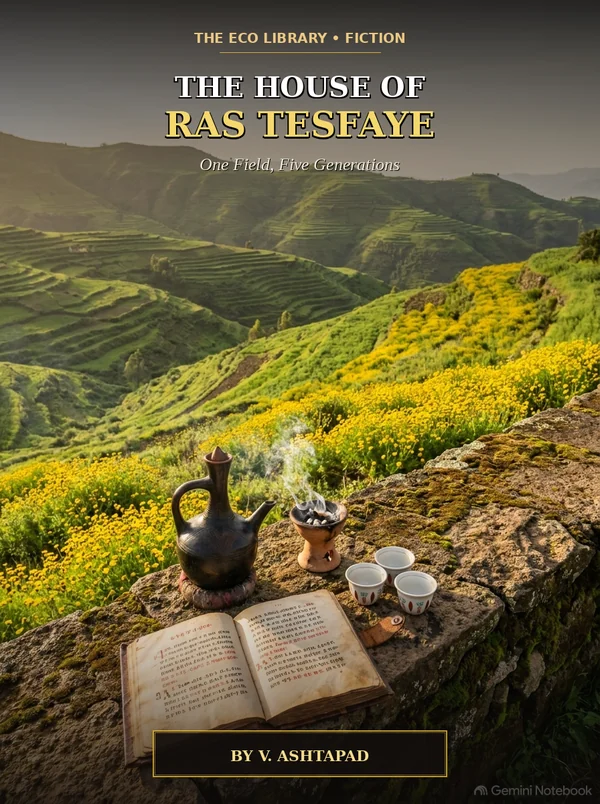
The House of Ras Tesfaye
One Field, Five Generations
by V. Ashtapad
Foreword
This is a work of fiction. The House of Ras Tesfaye, the village of Amba Debir, and every person in these pages are imagined, though the world they move through is real history: the victory at Adwa in 1896, the Italian occupation and the Patriots who resisted it, the land tenure of the northern highlands, the student cry of "Land to the Tiller," the famine in Wollo, the revolution of 1974 and the years that followed, and the long making of an Ethiopian community in Washington.
The book is written as a family history told by someone outside the family: a historian whose great-grandfather's land the house took, asked by the house's last daughter to help write its story. It is built from recorded conversations, made with consent, between elders on both sides.
It rests on a few plain convictions. That a family's memory is incomplete until it holds the memory of those it harmed. That the people who were wronged are not a chapter in someone else's story; they are the authors of their own. That an honest record is a form of respect. And that repair, where it is possible at all, is decided by those who were wronged, not offered on the terms of those who did the wrong.
Chapter 1: The Letter from Addis
The email arrived on a Tuesday at the end of September 2025, at 6:40 in the morning Washington time. It had been sent at 1:40 in the afternoon from Addis Ababa. I know this because I read the headers before I read the message. Historians check provenance first. It is a professional habit. It is also a way of not reading the message.
The subject line was in English: "Your note 47."
Note 47 sits in the third chapter of my book on land tenure in the northern highlands, a book read by perhaps four hundred people, most of whom were assigned it. The note says, in full:
> Forfeiture for arrears was applied selectively. An oral account (E.W., interviewed Silver Spring, Maryland, 2014) describes the loss of a family's rist at Amba Debir, Wollo, to the hudad of Dejazmach Tesfaye Haile in 1933. No written judgment has been located.
The writer quoted it back to me whole, set off in a block, as I would have done. Then she wrote:
"My name is Liya Dawit. I am an architect in Addis Ababa. Dejazmach Tesfaye Haile, later Ras Tesfaye, was my great-grandfather. I have read your book twice, the second time with a pencil. I would like to ask you to help write my family's history. All of it. I understand what 'all of it' may include. I am asking anyway."
She signed with her full name, a phone number, and the address of a house in Arat Kilo.
I did not answer for nine days.
I taught two seminars in those nine days. I graded. I reorganized a filing cabinet that did not need it. On the fourth day I drove to Silver Spring.
---
**Recording 1. Silver Spring, Maryland. 3 October 2025. Etenesh Wolde (87) and Meron Bekele. Recorded with consent. Amharic; translated by M.B.**
My grandmother has the buna going before I have my coat off. The coffee ceremony is not something she performs for guests. It is something she does when she intends to run the next hour. The green beans are in the flat pan over the stove ring. The recorder is on the table between us, beside six small cups without handles. A grain of frankincense smokes on a coal in a clay dish by the stove, because there is no coffee without it.
MERON: Before we start, I say it for the record. This is Etenesh Wolde. She knows the recorder is on. She can stop it at any time. She decides who may hear it.
ETENESH: Who may hear it?
MERON: That is for you to decide.
ETENESH: [she shakes the pan] Then it is for Bethlehem. And for whoever is born after her.
MERON: Bethlehem in Amba Debir.
ETENESH: Is there another Bethlehem? Write it down properly.
[the beans are carried past the recorder; she waves the smoke toward me, as is the custom]
MERON: A woman has written to me from Addis. Her family is the house of Ras Tesfaye.
[pause; she sets the pan down on the tile and does not pick it up again]
ETENESH: Which one.
MERON: A great-granddaughter. Liya Dawit. She wants me to help write the house's history.
ETENESH: [silence]
ETENESH: [she switches to English] Finally.
[she laughs, for some time]
ETENESH: [in Amharic] Ninety years, and they ask. And whom do they ask. [pause] Grind the coffee. Your arms are younger.
MERON: Do you want me to say yes?
ETENESH: I want you to say what you say to your students. Conditions.
### Commentary
The silence on the recording lasts eleven seconds. In those eleven seconds she did not look at me. She looked at the pan, which was about to burn the beans, and let it. We started the coffee over. She did not apologize for the waste, which for her is a large statement.
Bethlehem Kassa is the great-granddaughter of my grandmother's elder sister, Zenebech. She is thirty-three. She farms her family's allocated plots in Amba Debir and chairs the farmers' cooperative there. My grandmother had met her twice. Choosing Bethlehem was not sentiment. It was a ruling on where the record belongs, made in four seconds, with a coffee pan in one hand.
"Conditions" was her word, and the right one.
---
I wrote to Liya Dawit on the ninth day. The letter was four paragraphs. The second one read:
> I will help on four conditions. Every conversation is recorded, and only with the consent of the person speaking, who decides who may hear it. My own family is recorded alongside yours, beginning with my grandmother. The house's documents are opened to me as they are, without selection or editing. And the finished book states, in the house's own name, what the house did to my family.
The third paragraph read:
> You should know that E.W. in note 47 is Etenesh Wolde, my grandmother. The rist at Amba Debir was her father's. I should have said so in the note. I did not, because I was twenty-eight and wanted to be taken seriously.
Her answer came forty minutes later. "Yes. To all four. I wondered about E.W. I hoped I was wrong, and then I hoped I was right. L."
Two days later a man called my office from a Washington number. He introduced himself as Natnael Dawit, Liya's brother, a lawyer in the District. He was courteous for some time. Then he asked what I wanted.
"Accuracy," I said.
"Everyone wants something, Dr. Bekele."
"Yes. I want accuracy."
He said he would send a release for review. He did not believe me. I could hear it. A lawyer's silence is different from my grandmother's. Hers waits. His files.
---
**Recording 2. By video, Washington DC and Addis Ababa. 21 October 2025. Emebet Tsehay Asfaw (83), Liya Dawit (50) and Meron Bekele. Recorded with consent. Amharic; translated by M.B.**
Liya has set the laptop on a dining table in Arat Kilo. Her mother, Tsehay, sits beside her in a gray cardigan, very upright. Emebet is the honorific for a lady of rank; the family uses it for her and so will I. It is evening there and morning here. The connection holds.
MERON: Good evening, Emebet. Is your health good?
TSEHAY: Thanks be to God. And yours? Is your family well?
MERON: Thanks be to God, well.
TSEHAY: Your mother is well? Your grandmother?
MERON: Well, thanks be to God.
TSEHAY: And your work. They are good to you at the university?
MERON: They are good enough.
[Liya laughs; Tsehay does not]
TSEHAY: Liya tells me you write about the land. You know our family was in Wollo.
MERON: I know.
TSEHAY: And your family. From where?
MERON: Amba Debir.
[pause; nine seconds; Tsehay looks at her hands, then at Liya]
TSEHAY: Wollo is very beautiful at Meskel. The hills go yellow. [pause] You have seen it?
MERON: Not yet.
TSEHAY: You should see it.
### Commentary
The courtesies took four minutes, which is short. Translated, they read like a form. They are not a form. Each question is a door held open, and the answer says whether you will walk through it. I walked through all of them. So did she, until the name of the village.
She did not say she knew Amba Debir. She did not say she did not know it. She told me about the flowers. Meskel, the feast of the Finding of the True Cross, falls in late September, when the rains end. I wrote down the nine seconds and the flowers, because the record is what was said and also what was put in its place.
I should state my position once, so I do not have to keep stating it. I am not neutral. I am trying to be accurate. These are different jobs, and I am doing the second one. A historian whose great-grandfather lost his land to the subject of her book cannot claim the first. She can still do the second, if she shows her sources and lets the reader watch her hands.
One more note, made once. Tesfaye means "my hope." I noticed it when I first read the name in a tax register as a graduate student, and I noticed it again when Liya's email arrived. I am recording that I noticed. I will not make anything of it.
What I had on the twenty-first of October was this: a house that wanted its history written, a lawyer who did not believe me, an elder who changed the subject at the name of a village, and a grandmother who had decided in four seconds who the record was for. What I did not have was a single document from 1933. Note 47 was still true. No written judgment had been located.
Nobody had asked the house for it.
Chapter 2: Eleventh Name
Tsehay Asfaw spends the American autumn in an apartment in Takoma Park, on the second floor of a brick building near the community center. She worked thirty years as a bookkeeper within a mile of it. She told me this on the stairs, as though it were the first fact I needed.
The apartment is very clean. There is a photograph of the Emperor in the hall, small, and a larger one of her late husband in a suit beside a bridge he engineered in Maryland. There is no photograph of her father.
---
**Recording 3. Takoma Park, Maryland. 16 November 2025. Emebet Tsehay Asfaw (83) and Meron Bekele. Recorded with consent. Amharic, some English; translated by M.B.**
She has put tea out, not coffee. A bundle wrapped in white cotton sits on the table beside the recorder. She has not touched it since I came in.
MERON: For the record, the recorder is on. You may stop it. You decide who may hear it.
TSEHAY: Liya, and her son, and the family. And you, since you are making it. [pause] And your grandmother, if she wants.
MERON: Thank you.
TSEHAY: You asked about Adwa. Every family in Wollo has an Adwa. This is ours.
TSEHAY: My great-grandfather was Dejazmach Haile Wolde-Mariam. A dejazmach is a commander, a lord of a district. He held the parishes above Dessie under Ras Mikael of Wollo. When the Emperor Menelik called the country to fight the Italians, Ras Mikael went north with the Wollo men, and the Dejazmach went with Ras Mikael, and the parishes went with the Dejazmach.
MERON: How many?
TSEHAY: My father said three hundred from our parishes. My father liked round numbers. [pause] My grandfather Tesfaye was sixteen. He carried his father's shield. This is told at every Adwa day in our house. The shield was buffalo hide with silver bosses. It was lost in 1936.
MERON: What else is told?
TSEHAY: That the march was long and the men were hungry, because each man carried his own grain. That the Dejazmach went in with Ras Mikael's horsemen in the afternoon, in the valley they call Mariam Shewito, where one Italian column had lost its way. That on the evening after the battle, the boy Tesfaye could not hold a cup because his arms shook, and his father held it for him. [pause] That is the story I like best. The others are about courage. That one is about a cup.
MERON: Did he talk about the men from the parishes?
TSEHAY: He talked about his father. [pause] I will show you something.
[she unwraps the bundle; it is a Psalter, the book called the Dawit, bound in wooden boards covered with worn leather]
TSEHAY: This came from the church at Dessie to my great-grandmother. Births are written in the back. Deaths. And this.
[she opens to a page near the end; a column runs down the margin beside the text, the Dejazmach's name at its head in the red ink scribes keep for holy names and patrons, the parish men below it in black gone brown]
TSEHAY: The men of the parishes who went to Adwa. The priest wrote it when they came home. I have never read it all. The writing is old. Will you read it?
[the recording runs for two minutes and fourteen seconds while MERON reads the names aloud; at the eleventh she stops]
MERON: Gebru Wolde.
TSEHAY: Yes?
MERON: Gebru Wolde was my great-great-grandfather.
[pause; twenty-two seconds; a car passes outside]
TSEHAY: I did not know.
MERON: I know you did not.
TSEHAY: [in English] I did not know that. [in Amharic] Read the rest. Please.
[MERON reads the remaining names, nine more; the fourteenth is Yimam Ali, whom Seid Mohammed will later name as his grandfather]
### Commentary
There are twenty names in the margin list. The hand is consistent, a church scribe's. There is no date, but the entry above it, a baptism, is dated Miyazia 1888 E.C., which is April 1896. The battle was fought on 1 March 1896, Yekatit 23 in the Ethiopian calendar, and the men would have been home by Easter. The list is what it claims to be.
Tsehay said "I did not know that" in English. She uses English for business and for distance. I do not think she meant the distance. I think she meant that the sentence needed saying in a language with no courtesy in it.
When I left, she asked me whether I wished to photograph the page. I did. She held the book open herself.
---
**Recording 4. Silver Spring, Maryland. 23 November 2025. Etenesh Wolde (87) and Meron Bekele. Recorded with consent. Amharic; translated by M.B.**
I show my grandmother the photograph on my phone. She holds it far away, then close, then hands it back and asks me to read the name.
MERON: Eleventh. Gebru Wolde.
ETENESH: In their book.
MERON: In the margin.
ETENESH: [pause] Well. That is where they kept us.
[she laughs once; she does not seem amused]
MERON: Tell me Adwa the way you heard it.
ETENESH: My father told it. His father went with the parish. They walked north for weeks. Every man carried his grain on his back, and his wife roasted it before, so it would keep. My grandmother Kebedech roasted for eleven days. That is the part my mother told. My father told the walking.
MERON: And the battle?
ETENESH: My grandfather never told the battle, my father said. He told that he came home. He had a cut here [she touches her left forearm, below the elbow] that healed badly, so he could not close that hand all the way. He said it was a good trade.
MERON: A trade for what?
ETENESH: For the country. [pause] And he brought back a canteen. Italian. Metal, with a cloth cover, the cover was gone by my time. We kept water in it for the field. When I was a girl I thought it was an ordinary thing. Every house has a canteen. Then a teacher at the mission told us about Adwa, and I put my hand up and said we had one of the Italians' canteens, and the class laughed, and the teacher did not.
MERON: Where is it now?
ETENESH: It stayed in Amba Debir when I left in 1981. After that, I do not know. [pause] Someone used it for water. That is what it was for.
MERON: Did your father say anything about the Dejazmach? About the boy with the shield?
ETENESH: He said the Dejazmach was "the one who asked before he took." That was what the parish called him. [pause] You understand why they said it.
MERON: Because his son did not.
ETENESH: You said it. Not me. [she pours the second round]
### Commentary
The two families tell the same victory. The march north, the grain carried on the back, the return. Each tells it whole and alone. In Tsehay's version the parish men are a number, three hundred, rounded by her father. In my grandmother's version the Dejazmach is a phrase, borrowed from the parish. Neither version is wrong. Neither version contains the other.
It would be easy to write that the comradeship of 1896 should have protected the family in 1933. That the son of a lord who stood beside Gebru Wolde at Adwa owed Gebru's son something. I think the opposite is true, and I think the parish knew it. In 1896 the Dejazmach needed the parish. Every man who walked north with his own grain was a man the Dejazmach did not have to feed. By 1933 the war was a story told in the big house on feast days, and the parish was a set of dues. Shared memory of a victory does not create obligation in the person who remembers it as his own. It creates the opposite: a sense that the debt has already been paid, by the honor of having been led.
This is a reading. I mark it as one.
---
On 30 November Liya sent me a link to the entry for the Psalter in the house's heirloom collection. Each item there carries a short story. The Psalter's story had been written in 2019, by Liya, from what Tsehay told her: the church at Dessie, the births and deaths, "a list of the men of our parishes who marched with the Dejazmach to Adwa."
Below it there was a new line, dated two days earlier.
> The eleventh name in the list is Gebru Wolde of Amba Debir, rist-holder, who carried his own grain to Adwa and came home wounded. His granddaughter is Etenesh Wolde of Silver Spring. His great-great-great-granddaughter, Meron Bekele, read the name aloud in Takoma Park on 16 November 2025. Added with Emebet Tsehay's consent.
Under it, in the field marked "Added by," Liya had typed her mother's name and not her own.
I sent the link to my grandmother. She replied the next morning by voice message. "He is your great-great-grandfather, not great-great-great. Tell them to fix it." I checked. She was right. I told them. They fixed it.
Chapter 3: What Rist Meant
Bethlehem Kassa met me at the Kombolcha airport on the twenty-fourth of March 2026 in a white pickup that belonged to the cooperative's treasurer. She was standing beside it with her arms folded, in a denim jacket over a long skirt, and she did not hold a sign. She did not need to. I was the only passenger looking for someone.
Kombolcha sits in the valley below Dessie. The road climbs to the town in long switchbacks and then keeps climbing northwest into the hills. Bethlehem drove the way people drive roads they have known since childhood, which is to say with one hand and faster than I liked.
Before we left the airport road she pulled over.
"Before anything," she said. "Three things."
I took out my notebook.
"No photographs of houses or children unless you ask the person first. The cooperative decides what from the village is shared, and with whom. And if you record someone, they hear it back before you take it away."
"Yes," I said. "To all three."
"You agreed fast."
"They are my conditions too. I gave them to the house."
She considered this. "Then you understand why I said them first." She pulled back onto the road.
---
Amba Debir is a terraced village on a steep slope. The church of Kidus Giyorgis, Saint George, stands above the fields inside a ring of old junipers. The small mosque stands below, near the road, with a green door. The fields lie between them, which the village has always found reasonable.
It was the middle of the belg, the short rains of spring. The terraces were plowed and some were sown. The air at that height is thin and cold in the morning and bright by ten.
---
**Recording 8. Amba Debir, Wollo, in the compound of Kidus Giyorgis church. 26 March 2026. Abba Gebre-Kidan (74), Ato Seid Mohammed (86), Bethlehem Kassa (33) and Meron Bekele. Recorded with consent. Amharic; translated by M.B.**
Abba Gebre-Kidan sits on a bench against the church wall in a white gabi, the heavy cotton wrap highlanders wear against the cold. His hand cross rests in his lap. Ato Seid Mohammed sits beside him in a white cap and a brown jacket over his own gabi. Bethlehem has asked the two of them, on behalf of the cooperative, to recite the descent of the land at Gebru's slope. Abba is the priest. Seid is the one who remembers boundaries.
BETHLEHEM: The recorder is on. You both said yes. You both hear it back tonight.
ABBA GEBRE-KIDAN: Good. Seid, you begin, because you are older.
SEID: I am older by twelve years and you never let me forget it.
ABBA GEBRE-KIDAN: [laughs] Begin.
SEID: The land below the church, on the north side, from the spring to the big rock and down to the stream, was first held by Amde. Amde begat Tekle. Tekle begat Wolde-Ab. Wolde-Ab begat Haile. Haile begat Gebre. Gebre begat Wolde. Wolde begat Gebru, who went to Adwa. Gebru begat Wolde, who lost it. [pause] That is the line.
ABBA GEBRE-KIDAN: That is the line as my teacher said it to me, and as his teacher said it. There is a branch at Haile, a brother whose children went to Ambassel. They do not hold here.
MERON: How many generations from Amde to Gebru?
SEID: You count. You are the one with the notebook.
MERON: Seven.
SEID: Then seven. [pause] My father said there was a time when a man stood before the elders and said this, and if no one could say a different line, the land was his. That was the law. Not paper.
ABBA GEBRE-KIDAN: Paper came later. And paper was written by the people who could write.
### Commentary
Some definitions, given once.
Rist was the hereditary right to use land, held by anyone who could prove descent, through either father or mother, from the first holder of that land. It was not ownership in the European sense. It could not be sold outside the line. It was proved the way Seid proved it: by reciting the descent before elders, who knew the other lines and could challenge a false one. Every descendant of Amde had a claim; the families who worked the land in each generation held it for the line.
Gult was something else. It was a right granted from above, by the Emperor or a great lord, to collect tribute and dues from a piece of land and the people on it. A gult-holder did not own the land and did not work it. He collected from those who did. The Dejazmach held gult over Amba Debir. His son was confirmed in it after him; a gult held long enough by one house came to be treated as hereditary, and this one was.
Hudad was land worked directly for a lord. The produce went to his household. In 1933, Gebru's slope became hudad.
The verb in the recitation is the old Ge'ez wolede, begat. It is the root of my great-grandfather's name.
The genealogy Seid recited is legal evidence. It is the form of proof the courts of the period recognized for rist. I have read dozens of land cases from the 1920s and 1930s in which a recited line is entered into the record as the decisive fact. Historians in Addis Ababa, my own teachers among them, came to treat these lines as folklore, because they changed in the telling and because the people who recited them could not be cross-examined in an archive. The first objection is fair and applies equally to written registers, which also change in the telling. The second objection is about the convenience of historians.
I checked Seid's line against the only written fragment I had, a 1928 tithe list that names "Wolde son of Gebru" at Amba Debir. It agrees.
---
In the afternoon Seid walked the old boundary with Bethlehem and me. He uses a stick and does not lean on it.
"This one," he said, at a gray stone half buried in the edge of a terrace. "I sat on this one with Ababa Wolde. I was eight, maybe nine. He put me here and said, remember the stone. Then we walked to the next."
"Why did he walk it with you?"
"Because I was a boy and boys live longest." He tapped the stone with his stick. "He was right. Here I am." Then: "My grandfather Yimam Ali walked to Adwa with Gebru. Is he in their book too?"
I said he was. The fourteenth name.
There were five stones he was sure of and one he was not. At the uncertain one he stood for some time, then said, "Here or three steps down. Write both." I wrote both.
Bethlehem took out her phone at each stone. She did not photograph them. She opened the family map she keeps for the cooperative, dropped a pin, and held the phone toward Seid, who said a sentence into it. At the spring below the church he said: "This is the spring plot. Wolde's mother washed here. It was taken with the slope." At the top of the slope he said: "Gebru's slope begins here. The big rock is the end."
"For whom are you keeping this?" I asked her.
"For the village," she said. "If you want it, you can ask the cooperative."
I asked. She said she would put it to them in April.
---
It was Lent, the long fast before Fasika, and dinner at Bethlehem's house was fasting food: injera, the sour flatbread that serves as plate and spoon, and shiro wat, a stew of ground chickpea, thick and red with berbere. Her husband, Mesfin, was in Dessie until the next day. Her children, Hana, nine, and Kidus, six, sat across from me and practiced English.
"What is your name?" Hana asked.
"My name is Meron. What is your name?"
"My name is Hana. Are you from America?"
"I am from Washington."
"Is Washington in America?"
"Yes."
Hana nodded, satisfied, and turned to her brother, and said in Amharic, "She talks like a radio." Then I tried a Wollo expression I had learned from my grandmother, and both children laughed until Kidus had to leave the table, and Bethlehem told me, kindly, that it was a phrase only old women used.
"My grandmother is an old woman."
"Yes," said Bethlehem. "We can tell."
### Commentary
I had come to Amba Debir to collect a genealogy. I left with a set of conditions, five stones and an uncertain sixth, a map I did not hold, and a correction to my Amharic. The order is accurate. The conditions came first.
Chapter 4: Tir 1925
The Institute of Ethiopian Studies occupies the old palace at Sidist Kilo, on the campus of Addis Ababa University. The reading room is on the upper floor. It is quiet, high-ceilinged, and cold in the morning in the way stone buildings are cold at that altitude. I have worked there on and off for fifteen years. This was the first time I asked for papers by the name of a family whose descendant had written a letter authorizing me to see them.
The letter was from Liya. The house's papers had been deposited in 1968 by Dejazmach Asfaw, her grandfather, along with other Wollo estate records, and had been catalogued but not much read. The archivist, who has known me since I was a graduate student, read Liya's letter, looked at me over it, and said, "So. You found the family."
"The family found me."
"That is worse," she said, and went to get the boxes.
---
The judgment was in the second box, in a folder with three others from the same court. It is a single sheet of heavy paper, written in a clerk's hand, with a round seal stamped in violet ink at the foot. The seal reads, in Ge'ez script, "Dejazmach Tesfaye Haile, Wollo."
I read it four times before I copied it. I give it here in full.
> In the name of the Father, the Son and the Holy Spirit, one God. > > The court of Dejazmach Tesfaye Haile, sitting at his house at Dessie, on the 14th day of Tir in the year 1925 of Mercy. > > Concerning Wolde son of Gebru, of the parish of Amba Debir. The steward of the Dejazmach states that Wolde owes dues and tithe of the harvest of 1924, and that he has not paid them though asked three times. Wolde states that the harvest failed and he has paid what he could. The steward states that others whose harvest failed have found the means to pay. > > The court finds the arrears proved. The rist of Wolde at Amba Debir, being the slope below the church from the spring to the rock and the spring field, is forfeit to the Dejazmach for the arrears, and is to be his hudad from this day. Wolde and his household may remain on it as chisegna and shall give the third. > > Sealed.
Judgment of the court of Dejazmach Tesfaye Haile, 14 Tir 1925 E.C. / 22 January 1933. Institute of Ethiopian Studies, Addis Ababa University, MS. 2214/3. Translated by M.B.
A chisegna was a tenant. The third, siso, was the share of the harvest a tenant gave to the holder.
The judgment has no witness list. Most judgments of this court that I have seen have one. It has no reference to the borrowing that "others" had used to "find the means," but the phrase is there, and it pointed me to the ledger.
---
The steward's ledger was in the third box. It covers 1931 to 1934 and records, by household and by parish, what each household owed under the gult and what it paid. The hand is careful. The arithmetic is correct. I checked it.
For the harvest of 1924 E.C., the ledger shows Wolde Gebru's arrears at four and a half dawula of grain, the dawula being the large sack measure of the north. On the same page, three lines down, it shows a household I will call by its initial, Kh., at eleven. Beside Kh. the steward has written "lent by the house, to be repaid with the next harvest." Beside Wolde there is nothing. Two pages on, under Tir, there is a single line beside Wolde's name: "forfeit, see the court."
Kh. kept its land. The ledger shows its loan repaid in 1934, with an increase.
Steward's ledger of the house of Dejazmach Tesfaye Haile, 1923-1926 E.C. / 1931-1934. Institute of Ethiopian Studies, MS. 2214/5. Translated by M.B.
---
**Recording 10. By telephone, Addis Ababa and Silver Spring, Maryland. 7 April 2026. Etenesh Wolde (87) and Meron Bekele. Recorded with consent. Amharic; translated by M.B.**
It is late at night in Addis and afternoon in Silver Spring. My grandmother has asked me to read her the judgment before she says anything. I read it. She asks me to read the part about "others" again.
ETENESH: Others found the means. [pause] They borrowed from the house. My father would not borrow.
MERON: Why not?
ETENESH: He said, a man who borrows from the house works for the house twice. Once for the dues and once for the loan. He said he would rather lose a year than lose the next ten.
MERON: Tell me the day they came.
ETENESH: I was not born. I tell it as he told it. [pause] It was after Timkat. Cold. [Timkat: Epiphany, 19 January] The steward came with two men. Not soldiers, house men. They did not come into the house. They stood at the edge of the slope. The steward said the words from the court. My father listened. Then he said, "Is that all?" The steward said yes. My father said, "Then go, it is cold." And they went.
MERON: That was all?
ETENESH: That was all on that day. The next morning he went out and plowed the same slope. My mother asked him why, if it was not his. He said, "Because it is the same dirt." [pause] He said that many times in his life. The same dirt.
### Commentary
My great-grandfather's account and the judgment agree on everything they both contain. The judgment contains the law. His account contains the weather and the next morning.
---
**Recording 11. Addis Ababa, the Asfaw house, Arat Kilo. 9 April 2026. Ato Mulugeta Bezabih (89) and Meron Bekele, Liya Dawit present. Recorded with consent. Amharic; translated by M.B.**
Ato Mulugeta's line kept the house's accounts for three generations. He sits in the restored front room of the Arat Kilo house in a dark suit and a tie. He has the judgment in front of him in my transcription. He has read it before I arrive.
MULUGETA: Dues were dues. Everyone in Wollo paid them. The Ras did not make the law. The law was the law.
MERON: The court was his.
MULUGETA: The court was the court of the district. He sat in it because he held the district. This was how it was done.
MERON: May I show you one more document?
MULUGETA: Of course.
[MERON places the transcription of the ledger page in front of him; he puts on his reading glasses; he reads it; he takes the glasses off, puts them on again, and reads it a second time]
MULUGETA: [silence; thirty-one seconds]
MULUGETA: This is the steward's hand. I know the hand.
MERON: Yes.
MULUGETA: [pause] I would like to stop now.
MERON: We will stop.
[recorder stopped at his request]
### Commentary
Liya asked me afterward whether I would keep his recording. I said only if he agreed. She asked him the next morning. He agreed, on the condition that the recording include his request to stop. "So no one thinks I ran away," he said. He did not say what he would have said if he had continued. I do not know. His thirty-one seconds are in the record because he asked that they be.
---
That evening Liya and I sat on her roof terrace. The house is at the top of a lane and the roof looks toward the university and Entoto beyond. It was cool. She had poured two glasses of water. It was Holy Week and she was fasting until dark, so neither of us drank. From the churches below, the chanting went on.
"Four and a half," she said. "And the other one eleven."
"Yes."
"So it was not about the grain."
"I think it was about the borrowing. A household that refuses a loan from the house is a household that has said it does not need the house. If that household keeps its land, the parish learns that you can refuse. If it loses its land, the parish learns that you cannot." I paused. "A lesson to a parish does not look like anger, in a ledger. It looks like a blank space beside one name and a note beside another."
She was quiet for a while. Then she said, "Write it."
"It will be in your family's book."
"I know where it will be. Write it."
---
The next week Liya's family office entered the judgment and the ledger into the house's records, with the shelf marks and with my name in the field for source. She sent me the entries to check. I corrected one date. The note on Mulugeta's recording, in her hand, said: "Kept with his consent. He asked to stop at the ledger. Keep the request."
Chapter 5: Abet
My grandmother keeps the tin box on the top shelf of her bedroom closet, behind a stack of folded netela, the light cotton shawls with woven borders that she wears to church. It is a square biscuit tin, British, with most of the paint worn off the lid. I had seen it all my life. I had been told it held papers. I had not been told which.
She took it down herself on the nineteenth of April, a Sunday, after church, the first Sunday after Fasika, with the fast over. She would not let me reach for it.
---
**Recording 14. Silver Spring, Maryland. 19 April 2026. Etenesh Wolde (87) and Meron Bekele. Recorded with consent. Amharic; translated by M.B.**
The tin is on the table. My grandmother sits with both hands flat on its lid.
MERON: Recorder is on. You decide who hears it.
ETENESH: Bethlehem, and after her. And you can play it for the woman in Takoma Park. If she asks.
MERON: Emebet Tsehay.
ETENESH: If she asks. Not if you offer.
[she lifts the lid; inside are a string of wooden prayer beads, two photographs, a baptism certificate, a school report, and a paper folded small]
ETENESH: My mother kept this tin. Before that it was a cloth bundle. She put the papers in the tin in the year of the Italians, because of the rain and because of the Italians. When she died in 1980 it came to me. I carried it through Sudan in a flour sack.
[she unfolds the paper; it has been folded into eighths; the creases are brown]
ETENESH: This is the petition. My father's copy. The scribe made two. One for the court and one for him.
MERON: May I read it?
ETENESH: Read it to me. My eyes do not like his writing.
[MERON reads]
> Abet! Abet! To the court of the King of Kings, held at Dessie by his son the Crown Prince. > > I am Wolde son of Gebru son of Wolde of the parish of Amba Debir. My land below the church, the slope from the spring to the rock and the spring field, is my rist from Amde, as the elders of the parish will say before the court. In the year 1924 the harvest failed in all the parish. I paid what I could. The Dejazmach Tesfaye Haile in his own court took my rist for what I could not pay and made it his hudad. Others in the parish owed more and kept their land. I ask the court of the King of Kings to hear the elders and give back my rist to my line. > > My father went to Adwa with the Dejazmach Haile. > > Written for Wolde son of Gebru, Megabit 1926. > > [Beside it, a thumbprint in ink.]
Petition of Wolde Gebru to the imperial court at Dessie, Megabit 1926 E.C. / March 1934. Family copy, in the keeping of Etenesh Wolde, Silver Spring, Maryland. Translated by M.B.
ETENESH: He could not write his name. He put his thumb on it twice, to be sure.
ETENESH: "My father went to Adwa with the Dejazmach Haile." He put that at the end. The scribe said take it out, it is not law. My father said leave it in.
MERON: Tell me the walk.
ETENESH: It is three hours to Dessie from Amba Debir, four with a sack. He was quick. He left before light with a sack of barley. Half for the scribe, half for himself. The scribe sat near the court gate. My father told him what to write and paid him in grain, a measure, because he had no coins. Then the scribe told him the court would not sit until the next day. So he slept outside the gate with the other men who had come. There were many. They lit a fire. Somebody had a masenqo, the one-string fiddle, and played until somebody else told him to stop.
MERON: And the next day?
ETENESH: The next day he stood with the others and cried "Abet." That is what you cry. It means, master, hear me. They cry it until someone from the court comes out and takes the paper. A clerk took his paper. He walked home. [pause] Then he waited.
MERON: What came back?
ETENESH: Look under the petition.
[MERON lifts a second slip of paper, small, with a court stamp]
> Referred to the court of the Dejazmach Tesfaye Haile, whose district it is.
ETENESH: One line. Six months he waited for one line. To send it back to the man who took it. [pause; in English] Very efficient.
### Commentary
The petition was made in the right form, to the right court, through a paid scribe, with an appeal to the evidence the law recognized: the recited descent, the elders who would say it. The imperial court at Dessie was, in 1934, the Crown Prince's. It referred the petition down to the court that had made the original judgment. Referral to the district court was common practice for land disputes in that decade. It was not a ruling. It was the absence of one.
I want to be exact about what the tin shows, because it is easy to read a story like this as a story of people who had things done to them. Wolde Gebru refused a loan rather than accept a decade of double labor. He plowed the slope the next morning. He walked to the Emperor's court within fourteen months, paid a scribe, made two copies, kept one, and insisted on a sentence the scribe said was irrelevant. His wife moved the papers into a tin against rain and occupation. His daughter carried the tin across a border in a flour sack. Every legal road that existed for a farmer in Wollo in 1934 was used. The road ended at the house that took the land, because the roads were built that way.
That is the record. It is a record of agency, constrained. It is not a record of passivity.
---
**Recording 15. Takoma Park, Maryland. 26 April 2026. Emebet Tsehay Asfaw (84) and Meron Bekele. Recorded with consent. Amharic; translated by M.B.**
Tsehay had asked to hear the petition. My grandmother's condition was satisfied. I read it to her from my transcription, in Amharic, at her table.
[MERON reads the petition; when she finishes, there is a silence of forty-eight seconds]
TSEHAY: Read the last line again.
MERON: "My father went to Adwa with the Dejazmach Haile."
TSEHAY: [pause] And the reply.
MERON: "Referred to the court of the Dejazmach Tesfaye Haile, whose district it is."
TSEHAY: [pause] My grandfather was not a man who was told no.
MERON: Do you mean by the court?
TSEHAY: I mean by anyone. [pause] I was ten when he died. I remember that people did not finish their sentences near him. They waited to see where he was going, and then they agreed. My father was the same with him. Everyone was. [pause] I did not think about who that cost. You think about the man at the table. You do not think about the man at the gate.
[she picks up her tea; it is cold; she drinks it anyway]
TSEHAY: Turn it off for a moment, please.
[recorder stopped at her request; restarted six minutes later]
TSEHAY: You can put in what I said. Not what I said when it was off.
MERON: Yes.
### Commentary
That is the first time anyone in the house has said, in my hearing, that the cost had a location. It was a small sentence and she said it in a level voice. I record it without adjectives.
---
My great-grandmother, Desta Ayele, kept the tin and the songs. She was born in 1902 and married at fifteen and died in Amba Debir in 1980, the year before my grandmother left. Every recipe my family uses came through her, and most of the harvest and threshing songs my grandmother knows.
At the end of the session on the nineteenth, after the petition, I asked my grandmother whether her mother had sung about the land.
She thought about it. Then she sang two lines, in a low, clear voice, the threshing rhythm unmistakable:
*The ox goes around, the grain comes down,* *whose grain is it, the ox does not ask.*
She stopped. "That is enough," she said. "The rest is long."
I sent the two lines to Bethlehem that evening as a voice message, with the transcript beneath it. The reply came at six the next morning, her time. It was a voice message too. An old woman's voice, unsteady on the first note and then steady, sang two more lines:
*The ox does not ask, the ox does not keep,* *but the hill remembers who plowed it.*
Under it, Bethlehem had typed: "Fatuma, Seid's sister. She says your grandmother sings it too slow."
I played it for my grandmother. She listened to it twice and said, "Fatuma. She sang it too fast when we were girls. She has not changed."
She asked me to play it a third time.
Chapter 6: The Hills
**Recording 12. Arat Kilo, Addis Ababa. 9 April 2026. Emebet Tsehay Asfaw (84) and Meron Bekele. Recorded with consent. Amharic; translated by M.B.**
TSEHAY: You want Maychew first. Everyone begins with Maychew because the Emperor was there.
MERON: I want to begin where you begin.
TSEHAY: After Maychew the army came apart. The Emperor went to Jerusalem. My grandfather did not go anywhere. He went up. [she lifts one hand, flat, and raises it] He had perhaps two hundred men in the first year. He did not submit. The Italians sent letters with offers. A title, a salary, the district back under their flag. My grandmother kept one of those letters for many years so she could tell people he had used the back of it to write a list of rifles.
[the tea is poured; Liya's housekeeper leaves the room]
TSEHAY: Five years. He moved at night. He knew every path above Dessie from boyhood. The Italians held the town and the road. He held the hills. When the British came with the Emperor in 1941, my grandfather's men came down to Dessie and he was not a young man anymore. He was past sixty. They made him Ras four years later for those five years. That is the title on his grave.
MERON: What did your grandmother say about those years?
TSEHAY: That he came home twice and both times he slept in his boots. And that he swore, as the Patriots did, not to cut his hair until the Italians were gone, and came down to Dessie in 1941 with it to his shoulders. [pause] And that he was proud and it was right for him to be proud. I agree with her. You may write that I agree with her.
### Commentary
I have checked what can be checked. Dejazmach Tesfaye's band is named in two British liaison reports from early 1941, described as small, steady, and well informed about the road. I have no record of the Italian letter. I believe it existed.
The Patriots, the arbegnoch, kept the occupation from ever becoming a settled government in the northern hills. That is a fact of the history, not a courtesy to the house. He was one of them for five years at an age when most men stop. Leaving that out of this book would be a lie of omission, and I have promised Liya the other kind of book.
---
**Recording 13. Kazanchis, Addis Ababa. 11 April 2026. Ato Mulugeta Bezabih (89) and Meron Bekele. Recorded with consent. Amharic; translated by M.B.**
MULUGETA: You should know about Mebrek.
MERON: The horse.
MULUGETA: You have heard.
MERON: Liya mentioned him.
MULUGETA: A gray stallion. The name means lightning. In 1939, near the Mille road, the Ras was nearly taken. The horse carried him out. Up a slope no horse should climb. My uncle was there and told it at every Meskel until he died. When Mebrek was old the Ras would not let anyone ride him. He grazed where he liked. That was the Ras's word: where he likes.
MERON: Where did he like?
MULUGETA: [a short laugh] Wherever the grass was best, I suppose. Why?
MERON: I may ask you again later.
### Commentary
He knew why. He did not ask a second time.
The record from the occupation that matters most to this book is not a horse. It is a register.
> Commissariato di Dessiè. Registro dei terreni, parish of Amba Debir, 1938 (1930 E.C.). Entry 14: terraced fields, lower slope, with spring plot below the church. Holder: Tesfaye Haile, "absent." Cultivator: Wolde Gebru, tenant, one third of the harvest. Note in a second hand: "holder in rebellion; dues to be collected by the appointed chief." > > Institute of Ethiopian Studies, Addis Ababa University, Italian administrative papers, MS. 2417, f. 31. Translated from the Italian by M.B.
The occupiers did not survey Amba Debir. They copied. Their clerk sat with the house's own lists from the 1933 judgment and wrote the Ras's claim into a foreign ledger while the Ras was in the hills shooting at the men who employed the clerk. The note in the second hand makes him a rebel and keeps him the owner. Wolde Gebru, in the same line, remains the tenant. Two governments disagreed about everything except who farmed whose field.
The third went to a different collector. It still went.
---
**Recording 16. Silver Spring, Maryland. 26 April 2026. Etenesh Wolde (88) and Meron Bekele. Recorded with consent. Amharic; translated by M.B.**
ETENESH: I was three when the Italians left. So this is my mother's story. I tell it as she told it, and she was not a woman who decorated.
MERON: Go on.
ETENESH: There was a barn on the lower slope. Our barn, on our land, which was not our land. Men came at night. Sometimes four, sometimes ten. My father fed them. Injera, shiro if there was shiro, kolo, roasted barley, if there was nothing. They slept in the barn and left before light. Some of them were the Ras's men. My mother knew because they said so. They were proud of it.
MERON: Did your father know they were the Ras's men?
ETENESH: Of course he knew. [pause] He never refused them. Not once. My mother asked him once, after the first winter, why he fed the men of the man who took his land. He said, "They are hungry, and they are fighting for the country. The land is a different case." That was his word. A case. As if he were still in court.
MERON: Was he still in court?
ETENESH: In his head he was always in court. [she switches to English] He was the most patient litigant in Wollo.
[laughter; she switches back]
ETENESH: There is also the horse.
MERON: Mebrek.
ETENESH: You know his name? We did not call him that. We called him the gray one. In 1942 or 1943, after the war, the Ras's horse was put out to graze where it liked. It liked our seed barley. My father had the seed in sacks under the eaves, for planting. The horse came in the night and opened a sack with its teeth. Most of a sack. My mother wanted to go to the compound and ask for the seed to be replaced.
MERON: Did she?
ETENESH: My father said no. He said, "If I go to the house about a horse, they will think I have forgotten the land." So he borrowed seed from Seid's father. Never from the house.
### Commentary
I have now heard the same animal described as the savior of a commander and as a thief of seed. Both accounts are precise. Neither speaker knew the other's.
I will not make a parable of them. A horse that carried a man up an impossible slope in 1939 is the same horse that was later allowed to graze where it liked, and the second fact follows from the first. The house honored what the horse had done by letting it range freely. The cost of that honor landed in a farmer's seed sacks, and the farmer declined to send the bill because he was pursuing a larger claim. That is what the record shows. It does not resolve.
The village has never denied the Ras's courage. I asked Seid about this in March, at the boundary, and he looked at me as if I had asked whether the hills were steep. "He fought," he said. "Everyone knows he fought. My father carried messages for his men. What does that have to do with the field?" For Seid, courage and the field were two separate entries. For the house, for eighty years, the first entry was allowed to stand for the second. The village kept them in different columns. So does this book.
Wolde Gebru fed the men of the man who had taken his land, for five years, at risk to his family. I do not think he did it out of forgiveness. I think he did it because he was a citizen of a country under occupation and he knew the difference between a war and a lawsuit. That is not a lesser thing than riding up a slope.
---
*27 April 2026.*
Liya called this morning. The house's records include an entry for the Ras among its historical figures: dates, titles, the Patriot years, the grave at Debre Tesfa Mariam. It was written, she thinks, by her uncle Yohannes in the 1990s and has not been changed since. Under the years there was no line for 1933.
She asked me to draft one. I wrote: "1933. His court declared the rist land of Wolde Gebru of Amba Debir forfeit for arrears and made it his own demesne. The family worked it as tenants until 1975."
I sent the draft to Bethlehem before I sent it to Liya. That was the order we had agreed. Bethlehem answered the same evening in a voice message, standing somewhere with wind behind her. She approved it with one change. She wanted "the family" to read "Wolde Gebru's family," so that nobody in a hundred years could wonder which.
Liya entered it as Bethlehem approved it. It now sits above the line for 1936, which begins, "Commanded Patriot forces in the hills above Dessie." I did not ask her to reorder them. Chronology did that.
Chapter 7: Siso
> Land tax register, Wollo province, Dessie district, parish of Amba Debir, 1936 E.C. / 1944. Entry 22: "Gebru's slope" and spring plot below Kidus Giyorgis. Holder of record: Dejazmach Tesfaye Haile, by judgment of his court, Tir 1925 E.C. Classification: hudad, worked by tenant. Tenant: Wolde Gebru. Assessed tax: payable by holder. Remarks: none. > > Institute of Ethiopian Studies, Addis Ababa University, Wollo land tax papers, MS. 3302, f. 118. Translated by M.B.
### Commentary
The 1944 Land Tax Proclamation was meant to make the restored state legible to itself. Every province, every parish, every holder, every assessment. In Amba Debir the clerks did not walk the fields. They read the house's judgment of 1933 and the Italian register of 1938 and found that the two agreed. Agreement was treated as proof.
"Remarks: none." The petition of 1934 was not mentioned. Its referral back to the Ras's own court had closed it, as far as the state was concerned, in a single line. The register is the moment the taking stopped being an act and became a fact. After 1944 no clerk anywhere would have to decide anything about Gebru's slope again. They would only copy.
Three years after the Emperor came home, his government confirmed the title of a man who had spent the occupation in the hills, and nobody in the capital would have seen any reason not to. I have read the reasoning in the register. It is very short.
---
**Recording 19. Silver Spring, Maryland. 3 May 2026. Etenesh Wolde (88) and Meron Bekele. Recorded with consent. Amharic; translated by M.B.**
[the recorder is on the table between us; Etenesh has a pencil and the back of a pharmacy receipt]
ETENESH: You want to know what siso was. I will show you what siso was. Write down a harvest.
MERON: I don't know a harvest.
ETENESH: Ten. Ten loads of teff and barley together, a good year. Three and a third to the house. Not a third of the profit. A third of the grain, off the threshing floor, before anything. The steward's man stood there while we threshed. Then the asrat, the tithe, which the steward also took. Then seed for next year, you cannot eat your seed. Then the tax the government said the holder paid, which the holder found a way to collect from the tenant in labor. Three days at the compound every month in the dry season, my father, sometimes my mother. Then what was left was ours.
MERON: How much was left?
ETENESH: In a good year? Enough. In a bad year, my mother counted the injera. Not the grain. The injera. She knew how many we could make from a sack and she knew how many days until harvest and she did the division at night by the fire. She was better at division than the steward. [she switches to English] She would have made a good bookkeeper. [back to Amharic] Do not put that in. Tsehay was a bookkeeper. It will sound like I am making a point.
MERON: Are you making a point?
ETENESH: Always. Leave it in.
[pause]
ETENESH: My mother said I would go to school. My father said the mission school in Dessie was for Christians who wanted to become Protestants. My mother said I was Orthodox and would remain Orthodox and would also learn to read. She won. She sold her silver neck cross to pay for the first year and told my father she had lost it. He knew. He bought her a brass one and said nothing. That is how they argued.
MERON: How far was the school?
ETENESH: Three hours walking. I stayed in Dessie in the week with a cousin of Seid's mother. A Muslim house. They fed me on Wednesdays and Fridays without meat because they knew I was fasting. Nobody told them to.
### Commentary
I have reproduced her arithmetic as she wrote it on the receipt. It is not exact for every year. It was not meant to be. It is a model, the way an economist would build one, constructed by an eighty-eight-year-old nurse with a pencil in under a minute.
There is a version of a chapter on tenancy that would linger on hunger. Etenesh will not give me one, and the record does not need one. The siso is a fraction. The tenant's life under it was a series of calculations made correctly by people who were never given credit for making them. Desta Ayele divided sacks into days in her head and was right. Wolde Gebru kept the case open in his head for thirty-six years. Their daughter went to school on a lie about a necklace that everyone in the house understood.
---
**Recording 20. Silver Spring, Maryland. 3 May 2026, continued. Etenesh Wolde (88) and Meron Bekele. Recorded with consent. Amharic; translated by M.B.**
ETENESH: Meskel. You have asked about Meskel. Every year the Ras lit a demera, the great bonfire of Meskel eve, in the compound above Dessie. The whole district came. Tenants too. Especially tenants. It was expected.
MERON: Where did you stand?
ETENESH: [a long look] That is the right question. Who taught you that?
MERON: You did.
ETENESH: The house's family stood on the steps. The guests from Dessie, the officials, in front of the fire, close. The tenants on the far side. Same fire. The smoke went where the wind went. Some years it went into the faces of the officials and we were very happy.
[laughter]
ETENESH: The children of the house came down sometimes, to see the fire fall. When the demera falls you look which way it falls, it tells you about the year. One year a girl from the house stood next to me. Maybe eight years old, in a white dress with a blue border. She watched the fire and then she watched me, and then her nurse came and took her back to the steps. That is all. Nobody said anything.
MERON: Was it Tsehay?
ETENESH: I do not know. There were many girls in that house. [pause] I would like to think so. It would make a good story. I do not trust it for that reason.
---
**Recording 23. Takoma Park, Maryland. 17 May 2026. Emebet Tsehay Asfaw (84) and Meron Bekele. Recorded with consent. Amharic; translated by M.B.**
MERON: Do you remember your grandfather's funeral?
TSEHAY: I was ten. 1952. My mother brought us from Addis on the road through Kombolcha. It took two days. For a Ras the burial waited, and the district waited with it. And the procession from the compound to Debre Tesfa Mariam. All the priests of the district. Umbrellas, the embroidered ones. And the old Patriots in front of the coffin, in lion's-mane headdresses, shouting the fukera, the war boasts, for him.
MERON: Who walked?
TSEHAY: Everyone. The family behind the coffin, then the officials, then the district. Hundreds. I remember the tenants because of one thing. They wept. Men from the villages, in gabi, weeping on the road. I was confused. I asked my mother why the farmers were crying for my grandfather. She said, "Because he was their lord." That was the whole answer. I did not ask again. [pause] I have thought about it more in the last six weeks than in seventy years.
### Commentary
Etenesh was at that funeral too. She was fourteen, home from school for the burial because her father required it. I asked her, on 3 May, what her father did. She said he walked in the procession with the other men of Amba Debir from the compound to the church, all the way, and stood at the grave, and came home.
I asked what he said.
"He said, 'He fought for the country. God keep him.' And then he said, 'Now we will see what the son does.'" She stopped there. When I asked whether he wept, she said, in English, "That's enough about funerals," and got up to put water on.
I do not know if Wolde Gebru wept. I know some men from the villages did. Tsehay at ten took the weeping as love. A historian at forty takes it as many things at once: grief for a man known all one's life; fear of what a new lord would do; the formal mourning a district owed a Ras, performed well because it was owed. Grief is not approval. It is not disapproval either. It is not a vote. The men on that road had lost their land to him, had fed his soldiers, had stood on the far side of his fire. They walked behind his coffin to his grave. All of those things are true, and none of them cancels another.
---
*18 May 2026.*
Etenesh dictated her mother's Meskel dabo to me today, the great round loaf baked in a covered pot and cut only after the blessing, for the family's recipe keeper, which Almaz maintains. She gave exact measures, in cups and in the old tin can that was the family's measure in Amba Debir, which she says held two and a half cups. "My mother never gave measures," she said. "She said, 'Until it looks right.' I am tired of guessing. I am eighty-eight years old and I want to know what right looks like in numbers." She made Almaz read it back twice.
Almaz asked if it should be shared with anyone. Etenesh said, "With Bethlehem. Not the house. The house had their own baker."
Chapter 8: Next Year
**Recording 25. Silver Spring, Maryland. 7 June 2026. Etenesh Wolde (88) and Meron Bekele. Recorded with consent. Amharic; translated by M.B.**
ETENESH: I was twenty-four. Two years a nurse. I still lived in the hostel of the nursing school because it was cheap and the matron liked me. My father came to Addis in Hamle, July, in the rains. He was sixty-seven. He came by bus to Kombolcha and by truck from there. He had never been to Addis.
MERON: Why then?
ETENESH: Because the Ras was ten years dead and the son had not come to Dessie once to look at the fields. My father had waited to see what the son would do. Ten years was long enough to see. He had the petition written again by the son of the first scribe in Dessie. Same land, same genealogy, back to the first holder. He said a new man should hear the whole case.
MERON: How did you find the house?
ETENESH: Everyone knew the house. Arat Kilo, near the Miyazia 27 monument, the one for the liberation. We went on a Saturday. There was a gate in a stone wall and a guard. My father said who he was and where he came from, and the guard went in, and we waited.
ETENESH: We waited from morning until the afternoon. It rained twice. I had brought bread. My father would not eat it at the gate. He said a man waiting to be heard should not be seen chewing.
[pause]
ETENESH: Then they let us into the courtyard. The Dejazmach came down from the house. A tall man, a gray suit, very correct. He greeted my father properly. I will say that. He asked after the harvest. He asked after the church. My father gave him the petition with both hands and asked if his daughter might read it aloud, because he wanted it read in that place by his own blood. The Dejazmach nodded. I read it. All of it. Standing in the courtyard. The genealogy took a long time.
MERON: What did the Dejazmach say?
ETENESH: He listened to the end. He was quiet. Then he said, "This is an old matter. My father's court decided it. I will look into it. Next year." [she says the two words in Amharic, then again in English] Next year. Then he shook my father's hand. My father thanked him. We left.
MERON: Was there anyone else in the courtyard?
ETENESH: Servants. The secretary. And on the veranda above, a young foreigner. A ferenji. Thin, dark hair, a white shirt. A guest, I thought. He was sitting with a book when we came in. When my father stood up from the bench to hand over the petition, the young man stood up too. On the veranda, by himself. He stayed standing until we left.
MERON: Did he say anything?
ETENESH: Nothing. He did not know Amharic, I think. But he stood when an old man stood. I noticed because nobody else did. [she switches to English] You notice things like that when you are twenty-four and angry.
### Commentary
"Next year" is a phrase that does not need translating, but it needs one note. In Amharic, as Etenesh said it, it is the ordinary phrase for the coming year, the year after this one. It is not a vague "someday." A man who says it has named a time. The word was le-amet. It is also the blessing said at every feast: may God bring us to next year. My great-grandfather had said it every Meskel of his life.
Wolde Gebru went home on the truck to Kombolcha and walked the rest. He waited the year, and six more. He died in Tikimt 1962 E.C., October 1969, on Gebru's slope, in the house he had built on it as a tenant. There is no reply to the second petition in the Institute's papers, in the house's papers, or in the family's tin. There is no record that the matter was ever looked into. Next year did not come because it was never scheduled.
---
**Recording 26. Arat Kilo, Addis Ababa. 14 June 2026. Emebet Tsehay Asfaw (84) and Meron Bekele. Recorded with consent. Amharic; translated by M.B.**
[we are in the same house; the courtyard is visible from the window; Liya restored the veranda in 2022]
TSEHAY: 1962. I was twenty. My first year at the university. We had a guest that year, a young Portuguese. He worked for a coffee exporter, one of the firms near the Merkato, learning the trade. His family were in wine. My father knew someone who knew his father. He stayed with us from Timkat until the rains, January to July.
MERON: What was he like?
TSEHAY: Polite. Homesick. He wrote letters to his mother every week, I remember that because the servants teased him for using so many stamps. He taught my brother Yohannes card games, Portuguese games, and Yohannes cheated, and he let him. He asked about everything. Why the priests carried umbrellas. Why we ate with our right hand only. What the word for every dish was. He wrote the words down in a small notebook. [a short laugh] He pronounced them terribly.
MERON: Do you remember a farmer coming to the gate that year, with a petition? An old man and his daughter, a nurse?
TSEHAY: [pause] People came to the gate. Often. My father received many people.
MERON: In the rains. A Saturday. The petition was read aloud in the courtyard.
TSEHAY: I do not remember it.
[the tea is poured; nobody drinks]
TSEHAY: I do not remember it. I was at the university much of the time. I was twenty. I was not thinking about my father's visitors.
### Commentary
She said she did not remember it twice. I am recording that she said it twice because she did. I am not drawing a conclusion from it. A woman of twenty in 1962, living in a large household, might very well not have been in the courtyard on a particular Saturday. She might also have been. The second statement came after the tea was poured, in the same words, and I have no way to weigh it against the first except by the fact that there was a second.
---
**Recording 27. Kazanchis, Addis Ababa. 15 June 2026. Ato Mulugeta Bezabih (89) and Meron Bekele. Recorded with consent. Amharic; translated by M.B.**
MERON: The Portuguese guest in 1962. What do you remember?
MULUGETA: A guest of the house. Nothing more.
MERON: Did your predecessor keep a record of petitions received that year?
MULUGETA: There was a book of visitors. It did not survive 1975. Many things did not.
MERON: Do you remember a petition from Amba Debir?
MULUGETA: I was twenty-five. I was not yet secretary. [pause] There were petitions from Wollo every year. The Dejazmach did not decide land. The courts decided land.
MERON: His father's court decided this land.
MULUGETA: [after a long silence] A guest of the house. Nothing more. Shall we stop for today?
[recorder stopped at his request]
### Commentary
I have two memories of one afternoon. One is detailed to the bread and the rain and the color of a shirt. One is an absence, stated twice. A third, from Mulugeta, is not about the afternoon at all; it is about a guest, and it repeats.
Historians are trained to distrust a single witness, and not to say so aloud when the witness is their grandmother. I distrust nothing Etenesh has told me about 1962 that I can check, and everything I can check has held: the date of the rains, the bus route, the scribe's son in Dessie, who is in the town's church register as a scribe from 1958. But the decisive words, "next year," exist in exactly one memory, and the person who said them is dead, and the people of his house were not there or do not remember.
I wanted a third witness. I said so to Liya on her terrace that evening, and she said, "The ferenji on the veranda," and we both laughed, because it was absurd.
---
*16 June 2026.*
It was less absurd the next morning. Liya's family keeps their records in the house's private network, including what my academic colleagues would call a relational map: who knew whom, who stayed where, who married whom. The family calls it the Story Web. I added the 1962 courtyard as an event, with the date range Etenesh gave and the names she gave, and connected Wolde Gebru, Etenesh, Asfaw, and the secretary of that year.
The house's records already had the young guest. Tsehay's mother had entered him decades ago, in her own handwriting, later scanned: "The Portuguese boy, 1962, Yohannes's card games." His line ran outward, through a coffee exporter in the Merkato, to a family in the upper Douro that made wine. Someone in the house had, at some point, added the name of the family's estate.
The young man had written home every week. The servants had teased him about the stamps.
I do not know whether a mother in Portugal kept her son's letters from a season in Addis Ababa sixty-four years ago. Some mothers do. I wrote the estate's name on an index card and put it in my wallet, which is not how a historian is supposed to keep a lead.
Chapter 9: Land to the Tiller
**Recording 29. Silver Spring, Maryland. 28 June 2026. Etenesh Wolde (88) and Meron Bekele. Recorded with consent. Amharic; translated by M.B.**
[Etenesh has the tin box on her lap; she takes out a folded sheet of thin paper, mimeographed, the ink gone purple]
ETENESH: Tadesse gave me this in Yekatit 1957 E.C. February 1965. He was nineteen. Eight years younger than me. Our parents' last child. He was at the university in his second year, very proud, very thin, with glasses he did not need, I think, he wore them to look serious. He came to the hostel on a Sunday and gave me this folded inside a newspaper.
MERON: Did he say why?
ETENESH: He said, "Read it. You of all people should read it." Then he ate everything I had and left.
[she reads the heading aloud]
ETENESH: "Meret le arashu." Land to the tiller. That was the slogan. The students marched to Parliament with it. Some were arrested. Tadesse was not, that time. He was very disappointed.
[laughter]
MERON: Did you agree with it?
ETENESH: I was a nurse. I worked twelve hours. I agreed with it in the way you agree that rain is wet. My father was tilling land that was his and paying a third of it to a house in Addis Ababa that had not looked at it in thirteen years. What was there to agree with? It was a description.
MERON: And your father?
ETENESH: I sent the leaflet to him through a cousin. He had someone read it to him. He sent back a message: "Tell Tadesse the students have discovered what every chisegna in Wollo has known since he was born. Tell him to study." [pause] He was proud. He would never have said it.
> "Land to the Tiller." Mimeographed leaflet, Haile Selassie I University, Addis Ababa, Yekatit 1957 E.C. / February 1965. One sheet, folded in eighths. Private collection of Etenesh Wolde, Silver Spring, Maryland; kept in the family's tin box with the 1934 petition.
---
**Recording 30. Takoma Park, Maryland. 5 July 2026. Emebet Tsehay Asfaw (84) and Meron Bekele. Recorded with consent. Amharic; translated by M.B.**
TSEHAY: I was there too. Not marching. In 1965 I was in my fourth year. I watched from the library steps.
MERON: What did you think?
TSEHAY: [a long pause] I have never said this to my family. Not my husband. Not Liya.
MERON: You don't have to say it now.
TSEHAY: I agreed with them. I stood on the steps and I thought, they are right. And then I went home to Arat Kilo for dinner and my father talked about the troublemakers and I said nothing. I said nothing for nine years. And then there was nobody left to say it to.
[recorder runs; nobody speaks for forty seconds]
TSEHAY: You may put it in. I would like Liya to read it rather than hear it from me. That is cowardly. Put that in also.
### Commentary
Tadesse Wolde and Tsehay Asfaw were students at the same university in the same month of the same year. One marched with the leaflet. The other watched from the library steps and agreed. I have found no evidence that they ever met, and I have looked. It would be convenient for this book if they had. They did not, as far as anyone can tell me, and I am not going to arrange it.
What Tsehay told me is not a confession of anything that needs forgiving. It is a confession of silence at a dinner table. That is a very common sin in houses like hers, and in houses like mine, and I record it because she asked me to and because it is evidence. The slogan was heard inside the house. It was understood. It was agreed with, by at least one member. The house's own record of 1965 now says so, because she said so.
---
**Recording 31. Amba Debir, Wollo. 19 July 2026. Ato Seid Mohammed (86), Bethlehem Kassa (34), and Meron Bekele, with Etenesh Wolde (88) by telephone from Silver Spring. Recorded with consent. Amharic; translated by M.B.**
[the cooperative's office, one room, a blackboard with the planting schedule; rain on the tin roof]
MERON: 1973. What do you remember first?
SEID: The rains failing twice. The belg in 1972, then the kiremt. [the short spring rains, then the long summer rains] You can survive one. Two is arithmetic.
ETENESH: [on the phone] I came up from Dessie in Hidar 1965 by our calendar, November 1972. I was working in the hospital there then. My sister Zenebech's husband, Alemu, and I made the count. Every household in the parish. How many people. How much grain. How many animals still alive. How many days.
SEID: She had a ledger. A school exercise book with a blue cover.
ETENESH: Green.
SEID: Blue.
ETENESH: [in English] It was green, Seid.
[laughter]
SEID: We pooled seed. My father insisted on it. Christian and Muslim households together. The rule was, nobody eats the seed. Whatever else happens, the seed goes in the ground when the rain comes, because otherwise there is no next year either.
ETENESH: We sent the count to the district officer in Dessie. We sent it to the provincial office. Alemu borrowed a truck from a merchant in Kombolcha to bring grain from the market at Hayq, and the road was closed at the bridge by order. Nobody would say whose order.
MERON: What did the house know?
ETENESH: Ask the house.
### Commentary
I asked the house. On 5 July, after the recording about the library steps, Tsehay told me that the household in Arat Kilo knew in the spring of 1973 that there was trouble in Wollo, "as everyone in government knew." Her father spoke of it as a matter of grain prices and of the district being badly managed. The family's steward in Dessie wrote that the harvest dues would be small. She did not remember any discussion of relieving the dues. "I do not think it was discussed," she said. "I think that is the answer." She did not try to make it a better one.
The famine in Wollo was hidden from most of the country, and from the world, until late 1973. The center was silent. The edges were not. At the edges, in Amba Debir, a nurse and a farmer counted every household with a pencil, a Muslim elder's father pooled the seed of two faiths under one rule, a truck was borrowed and turned back, and the parish kept the seed in the ground. Some households did not last. The count records which. I have read it. I am not going to reproduce the numbers here because the cooperative has asked me not to, and because the numbers belong to the families in them.
Seid added something after I thought we had finished. His father's rule about the seed had a second clause. A household that had pooled seed and then could not plant, because its people were too few or too weak, did not lose its share. The others planted it, and the harvest was held in that household's name until someone came back to claim it. Two households came back, in 1975 and 1976. Their grain was waiting.
"That was the law of the parish," Seid said. "Not the government's law. Ours." Bethlehem, who had heard this before, wrote it on the blackboard under the planting schedule, then rubbed it out and wrote it in the cooperative's minute book instead, where it would last.
What I will reproduce is the method. A census, by hand, of a parish under strain, done by the people of the parish, sent upward to an administration that did not answer. The exercise book survives in the cooperative's office. It is green.
---
*24 July 2026.*
Bethlehem sent me, as voice messages, the cooperative's own oral history of 1973. Eleven members recorded it last year, one at a time, at the office, with consent. Each recording ends with the speaker saying who it is for. Most said "the cooperative." Two said "my grandchildren only." One said "anyone who asks properly."
Bethlehem's note, transcribed beneath the first message: "You may hear all of them. You may quote the ones marked for the cooperative, with names. The two for grandchildren, no. The house may not hear these unless the cooperative votes." I have honored each line of that note in this chapter, and I will honor it in every chapter after.
Chapter 10: The Radio
**Recording 33. Takoma Park, Maryland. 9 August 2026. Emebet Tsehay Asfaw (84) and Meron Bekele. Recorded with consent. Amharic; translated by M.B.**
TSEHAY: In September the Emperor was taken from the palace in a small blue car. Everyone says that, the small blue car, and it is true, but we did not see it. We heard. On the second of Meskerem, the radio. My father sat in the front room with the radio on the table and did not turn it off for three days.
MERON: What did he say?
TSEHAY: Very little. He said the committee would want lists. He was right. He went to the ministry every day until he was told not to come. Then he stayed at home in his suit. Every day, in his suit. My mother asked him to take it off. He said a man should be dressed when they come.
MERON: When did they come?
TSEHAY: In the autumn. The radio read names and told the men to present themselves. His was read. I will not say more about that day. He went. He was dressed.
[pause]
TSEHAY: On the morning of 24 November there was the radio again. A list of names. The announcer read slowly. My mother sat in the chair by the window. I sat on the floor beside her because I was thirty-two and I did not know where else to sit. They read his name. My mother did not move. When the list was finished she turned the radio off herself. That is all I will tell you about that night.
MERON: That is enough.
TSEHAY: Some weeks later, a soldier came to the gate with a parcel. His coat. The gray one he wore to the ministry. My mother took it into her room. She did not wash it. She folded it and put it in the trunk at the foot of her bed. When the house was taken in 1975, the coat went with her to her sister's. When she died in Washington in 1989, it was still folded.
### Commentary
Sixty prisoners, most of them former officials of the imperial government, were executed without trial on the night of 23 November 1974. Their names were read on the radio the next day and the day after. Dejazmach Asfaw Tesfaye was among them. I have the list. I am not going to quote it. Tsehay gave me a radio, a chair, a coat, and a woman folding it. That is the account, and it is complete.
---
> Proclamation No. 31 of 1975, "A Proclamation to Provide for the Public Ownership of Rural Lands," 25 Yekatit 1967 E.C. / 4 March 1975. Article 3: "As of the effective date of this Proclamation, all rural lands shall be the collective property of the Ethiopian people." Article 3(2): no person or organization shall hold rural land in private ownership. Later articles free every tenant from payment to a landlord. > > Negarit Gazeta, 34th year, no. 26. Translated by M.B.
> Amba Debir peasant association, allocation book, 1967-1968 E.C. Household of Wolde Gebru, deceased; widow Desta Ayele and heirs: two plots, upper slope, near the threshing floor, for use. Lower terraces ("Gebru's slope"): allocated to the household of [name withheld at the cooperative's request], four persons. Spring plot below the church: to the association for common use. > > Kept by the Amba Debir farmers' cooperative. Consulted with permission, 19 July 2026.
### Commentary
The news of the Proclamation reached Amba Debir on a market day, through a radio in a Dessie shop. Seid told me that men walked home shouting, and the women met them on the path with ililta, the high ululation kept for weddings and victories. The tenancy was over. Nobody would ever again stand on a threshing floor while the steward's man measured a third.
The peasant association was formed within months. Its committee, which included Zenebech's husband Alemu, allocated use rights by household size and need, as the law required. Desta Ayele, a widow of seventy-three, received two upland plots. Gebru's slope went to a family of four who had no land at all. By the standards of 1975, and by the standards I would apply myself, it was a fair allocation. Desta Ayele, Seid told me, said so at the meeting. Then she went home and did not speak for the rest of the day.
The land was returned. It was returned to the Ethiopian people, which is to say to everyone and therefore to nobody by name. A forty-two-year-old wrong ended by an act that did not mention it. The house lost the land without ever giving it back. The family got their freedom from the third, but not their slope. Both changes came from the same page of the Gazette, and neither side's claim was ever heard.
The family that received Gebru's slope in 1975 still farms it, three generations later. They are members of the cooperative. Bethlehem has asked me not to name them, and has told me, plainly, that nothing in this book will be allowed to make their tenure less secure. That is the first condition of repair I was given in Amba Debir, months before anyone used the word.
---
**Recording 34. Silver Spring, Maryland. 16 August 2026. Etenesh Wolde (88) and Meron Bekele. Recorded with consent. Amharic; translated by M.B.**
ETENESH: Tadesse. You have waited to ask. I will tell it once.
MERON: Only what you want.
ETENESH: He was teaching in Dessie by then. A high school. In 1978, in Ginbot, in May, he went to Addis for a meeting. He wrote to me from there, a short letter, about a book he wanted me to send him. He did not come back to Dessie. We asked. We were told to stop asking. Our mother asked until she died in 1980. I asked until I left in 1981. He was thirty-two.
[pause]
ETENESH: Stop it now, please.
[recorder stopped at her request]
### Commentary
I stopped it. She did not ask me to start it again that day, and I did not.
I know what readers of a chapter like this one may want. They may want me to set the coat beside the letter about the book, the Dejazmach beside the schoolteacher, and declare the revolution an equal sorrow to both houses. I will not do that, and I owe an explanation.
Both men were taken by the same state within four years of each other. One death was announced; the other never has been. Asfaw's death was announced. His name was read aloud, and his family received his coat. Tadesse's was never announced. His family received nothing, not even the fact. Asfaw died because of what his house had been. Tadesse died, as far as anyone can tell, because of what he believed the country should become, which included the end of houses like Asfaw's. The two griefs are equal in the way that all grief is equal to the person who carries it. They are not the same grief. To make them symmetrical in print would be to tidy something that both women have refused, for fifty years, to tidy.
---
**Recording 35. Takoma Park, Maryland. 23 August 2026. Emebet Tsehay Asfaw (84) and Meron Bekele. Recorded with consent. Amharic; translated by M.B.**
MERON: You were held from 1974.
TSEHAY: From December 1974 until 1981. Seven years. Alem Bekagn. With many women of many families.
MERON: Is there anything you want recorded?
TSEHAY: The dates. And that the women taught each other. Those who could read taught those who could not. Those who could knit taught the rest, with thread unpicked from the borders of our own netelas. By the end, everyone could do both. [pause] That is all. That is all I will say about it, now or later. Please write that I said so.
### Commentary
I have written that she said so.
What restraint owes the dead is not silence. It is accuracy about what is known and refusal to invent what is not. I know the dates. I know about a coat, a radio, a letter about a book, and thread unpicked from the borders of shawls. Everything else belongs to the people who were there, and they have chosen what to give. The record is not incomplete because they withheld. It is complete to the edge of their consent, and that edge is part of the record.
---
*30 August 2026.*
Two biographies were begun this week, in two families, independently. Liya started one of her grandfather Asfaw in the house's Story Teller, from Tsehay's recordings and the ministry papers. Almaz started one of Tadesse in ours, from Etenesh's recordings, the leaflet, and the letter about the book.
Neither knew about the other until Liya mentioned hers on a call. Almaz was silent, then said she had one too.
They agreed, without me, that each family would send the other its draft before publishing anything, and that each would have the right to point out a fact but not to change a sentence. Etenesh, told of the arrangement, said, "Good. And nobody puts them on the same page."
Chapter 11: Columbia Road
**Recording 18. Silver Spring, Maryland. 2 May 2026. Etenesh Wolde (88) and Meron Bekele. Recorded with consent. Amharic, with English where marked; translated by M.B.**
ETENESH: You want the road to Sudan.
MERON: I want what you want to give.
ETENESH: That is a historian's answer. [she laughs] I will give you the arithmetic. Not the road.
MERON: All right.
ETENESH: Your mother was nineteen. Your grandfather was forty-eight and had a bad knee. I was forty-three. We had money for eleven days if we ate once a day, and we did not know how many days it would be. In Khartoum we were two years. I washed hospital linen. Nobody asked a refugee if she was a nurse. My papers were in Addis Ababa in a drawer, or they were ash. I never found out which.
MERON: And when you came here?
ETENESH: Nineteen eighty-three. October. Cold. [she switches to English] Very, very cold. [Amharic] I was forty-five. A woman at the resettlement office said, "Here you are an aide." So I was an aide. At night I studied with a dictionary. Your grandfather tested me at the kitchen table. In nineteen eighty-six I passed the board examination. He bought a cake from a Greek bakery on Connecticut Avenue. It was terrible. We ate all of it.
[pause]
ETENESH: Write that he bought the cake.
### Commentary
I have written both. She knows. We agreed that the eleven days are hers to cut before publication, and she has not cut them. I record that as a decision, not as an absence of one.
The resettlement records show the pattern Etenesh describes: credentials lost or unprovable, professionals placed one or two rungs below where they had stood. The community that formed on Columbia Road and later along U Street was built by people demoted on arrival who then promoted themselves, slowly, at kitchen tables.
The house's arrival was different, and the same. Tsehay was released in 1981. She will not say how. She came to Washington in 1983 with her husband, Ato Dawit Gebre-Medhin, and their two children. Natnael was eleven. Liya was eight. She had been born in 1975, in the first months of her mother's detention, and raised by her father and his sister. She had known her mother for two years.
---
**Recording 21. Takoma Park, Maryland. 9 May 2026. Emebet Tsehay Asfaw (84) and Meron Bekele. Recorded with consent. Amharic and English; translated by M.B.**
TSEHAY: I did the books for a dry cleaner first. Then for nine businesses on Carroll Avenue at once. I was good. I am still good.
MERON: Did anyone know who you had been?
TSEHAY: Some of the Ethiopians knew. They knew my father's name. Some were kind about it in a way that was worse than unkind. [pause] The Americans did not know anything. That was a rest. For the first time in my life nobody stood up when I came into a room. I liked it, Meron. I am telling you so you know I am not pretending.
MERON: And Liya?
TSEHAY: Liya learned English in four months. She corrected my vowels at dinner. [she switches to English] She thought we were poor. We were, a little. [Amharic] It was good for her. I did not say so at the time.
### Commentary
Two families from the same district, both arrived in 1983, both settled within six miles of each other in Montgomery County. For thirty-five years they shopped at the same Ethiopian groceries on Georgia Avenue, bought the same injera from the same woman in Silver Spring, and stood at the same Timkat services. They did not meet.
---
**Recording 22. Silver Spring, Maryland. 16 May 2026. Etenesh Wolde (88) and Meron Bekele. Recorded with consent. Amharic and English; translated by M.B.**
[Etenesh has a photograph on the table, in a plastic sleeve. Twenty-two people around a cake in a waiting room hung with paper snowflakes. On the back, in blue ballpoint: "Clinic party, Dec. 17, 1999."]
ETENESH: That one is me. That one is Dr. Kanwar. Padmini.
MERON: She is wearing a paper crown.
ETENESH: From the crackers. She kept it on all night. She said it was the first crown in her family anybody had earned.
MERON: Tell me about the night shift.
ETENESH: The clinic stayed open until midnight on Thursdays. Most nights were busy. When a patient spoke only Amharic, she asked for me by name. Not "the interpreter." Me. That night was not busy. It was raining. We sat in the back with tea. She asked me where I was from. People asked that every day. I said Wollo. She asked what my father did. I said he was a farmer. She asked whose land. [pause] Nobody had ever asked me that. Not here.
MERON: What did you say?
ETENESH: I told her. All of it. The judgment, the slope, the gate in nineteen sixty-two. It took maybe forty minutes. She did not interrupt once. When I finished she said her own family had been a royal house too, in India, in the desert, and that they owed people things. She said it plainly, like a diagnosis. She did not apologize to me for something that was not hers. She did not tell me it was a long time ago. She said, "Who has the papers?" I said I had the petition, in a tin. She said, "Keep the tin dry."
ETENESH: [she switches to English] A good doctor. She listened to the patient, not the chart.
### Commentary
Dr. Padmini Kanwar worked at the clinic from 1997 to 2002. Etenesh had worked there since 1986 and had told no one outside the family about the land in the sixteen years since she arrived in the United States. She told a pediatrician from Rajasthan on a wet Thursday because the pediatrician asked the second question and not only the first.
"What did your father do" asks about a man. "Whose land" asks about a relation of power. Padmini's family had held a great deal. She knew what the question was.
---
**Recording 22, continued.**
MERON: You told me once that you saw Tsehay. Here.
ETENESH: Nineteen eighty-eight. A Sunday in March. A church in northwest Washington, in the courtyard after the liturgy. Everybody in white. I was with your grandfather. She was with her mother, Woizero Yeshi, who was old then and leaning on her arm.
MERON: How did you know her?
ETENESH: I knew Yeshi's face from the gate in Arat Kilo. And the daughter has her grandfather's jaw. The Ras's. I saw that jaw across the Meskel fire every year until I was fourteen. You do not forget a jaw.
MERON: Did you speak?
ETENESH: No.
MERON: Why not?
ETENESH: [long pause] What would I say? "Good morning, I am the daughter of your tenant"? In the churchyard, in front of everybody, with her mother on her arm? She had been in Alem Bekagn. Everybody knew that. My brother had been taken too, and he did not come back. I stood there and I thought: she has also lost. And then I thought: that does not give my father his slope. Both thoughts were true. So I said nothing. [she switches to English] I lit a candle and went home.
MERON: Did she see you?
ETENESH: She looked at me. She did not know me. Why would she? We were never people the house needed to remember.
### Commentary
I asked Tsehay about that Sunday in a later recording. She does not remember it. She remembers the church, and her mother's last good spring, and nothing else from that March. I believe her.
The diaspora suspended the hierarchy. It did not dissolve it. In a Washington churchyard a Ras's granddaughter and a tenant's daughter stood on equal asphalt. But one of them had carried the other's family in memory since 1952, and the other did not know the first one existed. Memory runs downhill. People remember the ones who had power over them. The powerful are not required to remember anyone.
I add here, because accuracy requires it, that Etenesh chose the silence. Nobody imposed it. She has made clear to me that she does not regret it, and that she is not certain she would choose it again.
---
*Present day. My office, Washington. 20 May 2026.*
My mother keeps our family's records, with the patience of a pharmacist. On the globe in our family's private network there is an arc she drew in 2015: Amba Debir to Dessie, Dessie to Addis Ababa, Addis Ababa to Khartoum, Khartoum to Washington. The Khartoum leg has no date on it. My grandmother would not give her one.
Liya sent me the house's arcs last week, with Tsehay's permission. Arat Kilo to Washington, 1983. Washington to Arat Kilo, 2019. A dotted line for Lij Yohannes to Toronto.
This afternoon I put both on one screen. The arcs leave the highlands two years apart. They land within six miles of each other in Maryland. They lie there, side by side, for thirty-five years, and they do not touch.
One of the house's arcs goes home. Ours has nowhere to go home to.
Chapter 12: The Return
**Recording 5. Arat Kilo, Addis Ababa. 17 January 2026. Liya Dawit (50) and Meron Bekele. Recorded with consent. English, with Amharic where marked; transcribed by M.B.**
[The upstairs room of the Arat Kilo house. Scaffolding outside one window. The recorder is on a drafting table, between a roll of plans and a plate of kolo.]
LIYA: When the city sold it back to us in 2021 there were eleven families living in it. Not squatters. Tenants of the city, with leases. Some of them had been here since 1976. One woman had raised four children in what was my grandmother's sewing room.
MERON: What happened to them?
LIYA: The city rehoused them in condominiums in Ayat. That was the condition of the sale. [pause] I tell myself they were glad. Two of them were. One of them still comes back on Sundays to look at the jacaranda.
MERON: You know her name.
LIYA: Woizero Askale Teferi. She planted the jacaranda. In 1981. [she laughs, not happily] So my grandfather's house has a tree in the courtyard that a city tenant planted, and every architect who visits tells me it is the best thing on the property. They are right.
MERON: Why did you come back in 2019?
LIYA: Because the government said come back, and for once I believed a government. Because my father was dead and my mother was seventy-seven and kept saying "before I die" about Addis in a voice I did not like. Because I had spent twenty-five years designing parking structures in Virginia. [she switches to Amharic] And because I wanted to be from somewhere in the present tense.
### Commentary
Liya is the only person in this book who has bought back what the revolution took from her family. She knows exactly how that sentence reads. She has asked me to print it as written.
The house at Arat Kilo was nationalized in July 1975 with the rest of the urban rental housing. It was divided, leased, subdivided and repaired by people who did not own it, for forty-six years. Liya's restoration keeps the subdivisions in one wing. She calls that wing "the record."
---
*Jan Meda, Addis Ababa. 19 January 2026.*
My first Timkat in Ethiopia. I had seen it in Washington my whole life, in church parking lots in Maryland. I was not prepared for the scale. Jan Meda before dawn is a city of white: shawls, netelas, gabis, the umbrellas of the priests in velvet and gold. The tabotat, the consecrated tablets that stand for the Ark of the Covenant, had spent the night in tents by the water. At first light the water was blessed and the priests flung tsebel, holy water, over the crowd with branches and plastic hoses, and the crowd surged toward it.
Amanuel, fifteen, stood in front of me so he would be hit first. He was. He turned around soaked and delighted and said, in English, "That's the whole point." Liya said, in Amharic, that it was not the whole point. He said it was most of the point.
Tsehay watched from a folding chair on the edge, wrapped in two gabis. She did not get wet. I think that was by arrangement.
---
**Recording 6. Addis Ababa. 20 January 2026. Ato Samuel Habte, Liya Dawit, Meron Bekele, and Samuel's mother, Woizero Mulu (spoke briefly). Recorded with consent. Amharic and English; translated by M.B.**
[Dinner at Samuel's parents' house in Gerji. Kitfo, warm with mitmita, the hot chili powder, with ayib, the fresh crumbly cheese, and kocho, the flat bread made from enset.]
WOIZERO MULU: You do not eat kocho in Wollo.
MERON: No. Enset does not grow there. It is a southern crop.
WOIZERO MULU: Then you have been eating half a cuisine. [to Liya] She is too thin.
LIYA: She is a historian. They eat paper.
### Commentary
Enset, the false banana, feeds a great part of southern Ethiopia and is not grown in the northern highlands at all. I record it because the Gurage table was the only one in Addis where nobody asked me which family I came from. Samuel's mother asked what I studied. When I told her, she said, "Good. Then you will know we were never anyone's tenants," which is not quite true of the south either, and which I did not dispute at dinner.
---
*Debre Tesfa Mariam, above Dessie. 24 September 2026.*
In late 2021 the war reached Dessie. I will say only that in the months after, the elders of both faiths in the district began walking up to their churches, mosques and graveyards to see what was still standing, and that the habit outlasted the reason for it.
The house keeps a record of its own church and graves. A cousin in Dessie, Ato Berhanu, walks up once a month, photographs the stones and enters a note. Liya asked if I would go with him on the September visit, three days before Meskel. The rains were ending. The hills were turning yellow with adey abeba, the Meskel daisy.
Ras Tesfaye Haile is buried on the east side of the church, under a stone with a cross and the lion of his rank cut into it. The inscription gives his titles, his years and "Arbegna," Patriot. It does not mention Amba Debir. There is no reason it would.
Ato Berhanu photographed the stone from three sides and typed: "Lichen on the north face. Inscription legible. Visitor: Dr. Meron Bekele, Washington." He showed me the screen before he saved it and asked if that was how I wanted my name. I said it was.
I stood at the grave of the man who took my great-grandfather's land for perhaps four minutes. I had expected to feel something large. What I felt was that the stone was small, smaller than the ones at Kidus Giyorgis, and that lichen does not care whose grave it is.
---
**Recording 52. Telephone, Dessie to Silver Spring. 25 September 2026. Etenesh Wolde (88), Liya Dawit (51) and Meron Bekele. Recorded with consent. Amharic; translated by M.B.**
[Liya asked to make this call herself. Meron is on the line.]
LIYA: Woizero Etenesh, I want to ask you something properly. Our family has kept a private network for many years. Our records, our recordings, our places. I would like to invite your family into it. All of you. Everything Meron has recorded could live in one place, both sides.
[pause]
ETENESH: No.
LIYA: I understand if —
ETENESH: You do not understand yet. Listen. They may visit ours. By invitation.
LIYA: [pause] Yes.
ETENESH: My daughter keeps our records. She has kept them since before you came back. We will send you what we choose, recording by recording. You will send us what you choose. Nobody keeps the other's house. [she switches to English] We tried that once.
LIYA: Yes, Woizero.
ETENESH: Good. Now tell me about the jacaranda. Meron says it is beautiful.
### Commentary
I had not told Etenesh about the jacaranda. I had told my mother, who tells her everything.
Liya did not argue. I record that because it would have been easy to argue. She had made a generous offer in good faith and been told no by an eighty-eight-year-old woman on a bad line, and the correct response was to say yes, Woizero, and wait. She did.
The asymmetry is the point. For ninety years one family kept the record of the other. The house knew the arrears of every household in Amba Debir to the measure of grain. Amba Debir knew the house only from the outside. A shared archive kept by the house, however open, would repeat that shape in a gentler material. My grandmother heard the shape before I did.
Since that call, the two families send each other recordings one at a time. Each carries a line saying who it is for.
---
*Amba Debir. 26 September 2026. The eve of Meskel.*
On the eve of Meskel Bethlehem asked me, at the edge of the demera fire, whether the house's records listed Kidus Giyorgis among its places of importance. I said I believed so, as a parish under the old gult.
"Then we will add it to ours first," she said. "Under our name."
She did it before the fire burned down, on her own phone, with Abba Gebre-Kidan reading the church's founding date aloud to her from memory and Seid Mohammed correcting the spelling of a donor's name. The entry reads: "Amba Debir Kidus Giyorgis. Parish of the people of Amba Debir." The house was sent the entry the next morning. Liya asked if she could use the same wording in the house's records. Bethlehem said yes, and that the house's own earlier wording should be kept underneath, dated, so that anyone could see it had been changed and when.
In the morning Hana marked a cross on my forehead with ash from the fire, as the village does, and then inspected her work.
Return means something particular for a house that left. It can buy back a building. It can tend a grave. For a family that never held title to anything the house could recognize, there is no building to buy and no deed to restore. What there is, it turns out, is the right to name a church.
Chapter 13: Lisbon
*Lisbon. 23 October 2026.*
The heritage weekend was held in Belém, in a long white hall by the river, in rooms named for navigators. My panel, "Oral History as Evidence," met in one of them on Friday afternoon. There were four of us and about sixty chairs, thirty of them occupied. A British academic spoke about consent forms for forty minutes. I spoke for twelve, about rist genealogies recited before elders as proof of title, and about the century in which the capital decided that a thing said aloud in a village was not a document.
A man in the third row asked whether oral testimony was not, by its nature, biased. I said yes. I said the 1944 land tax register was also biased, and had a seal on it. He wrote that down. I do not know whether he agreed.
The hotel coffee was unforgivable. I was raised on my grandmother's buna. I drank it anyway, three times a day, as a matter of professional endurance.
---
*Lisbon. 24 October 2026.*
The four families had been invited separately and met in the gaps: coffee breaks, a lunch on a terrace, a walk along the river that half the conference took at once. I had been told who would be there. I had not been told how ordinary it would feel.
On Saturday, across the main hall after the morning session, I saw the Kazemori granddaughter and the Kesarmer cousin, Rina and Tara, arguing about tea. Tara was explaining, with both hands, that milk was not a crime but a correction. They were laughing too hard to finish a sentence. I did not go over. It was not my argument, and it looked like a good one.
Liya had flown over with me from Washington, where she had spent a week with her brother. She watched them with me and said, "That is what it looks like when two houses have nothing to settle." I said I was not sure that was true of theirs either. She said, "No. But they have settled enough to argue about tea."
At lunch the Kesarmer cousin who had translated his great-grandmother's diary, Kabir, found me at the end of a table. He had a message on his phone and asked if I wanted to hear it or read it. I asked to hear it.
It was Padmini Kanwar's voice, recorded in her kitchen in Delhi. "Please tell Etenesh," she said, "that I still have the photograph from the party. Tell her I kept the crown too, for a while. Tell her I am glad someone finally asked her family's side properly. And tell her the tin should still be kept dry."
I sent it to my grandmother with the transcript. She replied within four minutes. Her reply was one line: "Tell the doctor I am still listening to the patient."
---
*Lapa, Lisbon. 24 October 2026, evening.*
Mrs. Elspeth Lennox de Valverde hosted the dinner at her apartment in Lapa. She is eighty-six, walks with a stick she treats as an inconvenience, and abandoned her own seating plan in the first ten minutes. I will not describe the dinner. It is hers.
I will record one exchange. She knew before we arrived which house Liya was from; that was why we had been invited. Over the soup, I told her that I was writing the history of the house of Ras Tesfaye from the side of a family it had wronged, and that I was interested in 1962.
"So am I," she said. "My husband, Tomás, lodged with that house from January to July of that year. He spoke of Addis Ababa all his life. More than he spoke of anything that came after it."
I asked whether he had written letters home.
"Thirty-one," she said. "To his mother, and some to his sister. I have read all of them, and there is one sentence about the gate I have never understood." She looked at Liya, and then at me. "I think it may be yours."
At the end of the evening she brought out the letters and let me photograph every page. She said that was not enough, and asked me to come back in the morning and read them properly.
---
**Recording 61. Lapa, Lisbon. 25 October 2026. Elspeth Lennox de Valverde (86) and Meron Bekele, Inês Valverde present. Recorded with consent. English.**
[Sunday morning. A table by the window. A box of thirty-one letters in Portuguese, on thin airmail paper. Mrs. Valverde's granddaughter Inês pours the coffee, which is excellent.]
ELSPETH: That one. The one with the coffee ring. Read it aloud, would you? My eyes are better for numbers than for his handwriting.
MERON: My Portuguese is a reader's, not a speaker's.
ELSPETH: So was his Amharic. Go on.
> Tomás de Valverde to his mother, Dona Isabel Maria de Valverde. Addis Ababa, 21 July 1962. Private collection of Elspeth Lennox de Valverde, Lisbon. Translated by M.B., checked by E.L.V. > > This afternoon, Mother, I saw something I must tell someone and cannot tell anyone here. In the afternoon an old farmer came to the gate with his daughter, who is a nurse, in a white dress and a white shawl. He had a paper. The servants let them into the courtyard because he would not leave. The Dejazmach came down. The daughter read the paper aloud, standing very straight, in Amharic I could not follow except for the names, and the old man stood beside her with his stick and did not look at the ground. A servant told me afterward it was about land, his land, which the Dejazmach's father took thirty years ago. The Dejazmach listened to the whole thing. Then he said two words, kindly. The servant told me they meant "next year." I have written the word in my notebook as lammet, and will no doubt say it wrong. I did not need telling. Everyone in the courtyard understood them. > > I stood up when the old man stood up. I don't know why. And then I sat down again and said nothing, Mother, nothing at all, because I am a guest and it is not my country and I did not know the law. All of that is true. I am still ashamed. I think I will be ashamed of it for a long time. I have not told the family here that I saw. Please do not mention it in your letters. They read them to me.
ELSPETH: [after a long pause] "I will be ashamed of it for a long time." He was. He never said what it was. I asked him once, in the nineties, why he never went back to Ethiopia. He said, "I left something unpaid there." I thought he meant a bar tab.
### Commentary
I read the letter twice. I photographed both sides with her permission. Then I walked for an hour along the river to Cais do Sodré and back, before I trusted myself to call Silver Spring.
For four months this book had held two memories of one afternoon. Etenesh's: a courtyard, her father, a petition read aloud by her own voice, the Dejazmach's "next year," and a young foreigner on the veranda who stood up. Tsehay's: a homesick guest who taught her brother card games, and no petition, which she said twice she did not remember. Mulugeta's: a guest of the house, nothing more.
Tomás de Valverde was the only person in that courtyard who belonged to neither family. He wrote down what he saw within hours, to the one person he could tell, and asked her to keep it from the house. It confirms Etenesh in every particular that can be checked: the white dress, the stick, the reading aloud, the answer. It is the only outside evidence that the house knew, and chose. Etenesh did not need confirming. The record did, because the record will be read by people who were not in the courtyard.
It was kept for sixty-four years by another family, in a folder of a dead man's letters, because his widow does not throw paper away.
---
**Recording 62. Telephone, Lisbon to Silver Spring. 25 October 2026. Etenesh Wolde (88) and Meron Bekele. Recorded with consent. Amharic and English; translated by M.B.**
[Meron reads the letter aloud in Amharic translation. Etenesh does not interrupt.]
ETENESH: [silence of almost a minute] The white dress. I borrowed it from my roommate. It was too long.
MERON: He stood up.
ETENESH: I told you he stood up.
MERON: You did.
ETENESH: [she switches to English] So. Someone else saw.
[pause]
ETENESH: [Amharic] He was ashamed. Good. That is the right thing to be. It is not enough. But it is the right thing.
---
*Lisbon. 26 October 2026.*
Before I left, Mrs. Valverde and I agreed what would happen to the letter. The original stays in Lisbon, in her box, with her family. A copy of the letter, with my translation and her note on where the original is kept, has been entered in the heirloom collection of my family, at my mother's hands, and in the house's, at Liya's. Each entry names who keeps the original and who made the translation. Etenesh asked that the roommate's dress be mentioned. It is.
A conscience is not evidence of anything except itself. But a conscience written down and kept by strangers can outlast every person in the courtyard. A young man who said nothing in 1962 is, in 2026, the third witness.
Chapter 14: Buna at Bethlehem's
*Kombolcha to Amba Debir. 14 November 2026.*
Tsehay asked for the front seat and then did not speak for the first forty minutes. Liya drove. Amanuel sat behind his grandmother with a bag of oranges and a paper map he had printed in Addis, because he wanted, he said, to see where the roads actually went. I sat behind Liya with the recorder off.
Above Dessie the road climbs into the cold. Mount Tossa was clear. The harvest was in on the lower terraces and still standing on the high ones, and men were threshing on a hard-packed floor beside the road with a team of oxen walking a slow circle. Tsehay watched them until we had passed.
"I have never been," she said, to nobody in particular. "Eighty-four years. My grandfather's land. I have never been."
Liya said, "It isn't his land, Emaye." Mother. Tsehay said, "I know whose land it is. That is why I have never been."
At the turn below the village, where the track leaves the paved road, Bethlehem was waiting with the cooperative's pickup. She shook Liya's hand, and mine, and bowed low to Tsehay and kissed her hand, the greeting the young give the old, and Tsehay kissed her cheeks in return. She did not use the house's titles. She said, "You are welcome, Emebet," which any village says to any elder lady, which is courtesy, and then, "The road is bad. Hold on," which is information.
---
**Recording 70. Amba Debir, at the house of Bethlehem Kassa. 14 November 2026. Present: Bethlehem Kassa (34), Ato Seid Mohammed (86), Abba Gebre-Kidan, Emebet Tsehay Asfaw (84), Liya Dawit (51), Amanuel Samuel (15), Meron Bekele. Joined by video: Etenesh Wolde (88), Silver Spring. Recorded with consent; Bethlehem chose who the recording is for: "the cooperative, both families, and the school." Amharic; translated by M.B.**
[Bethlehem's main room. Fresh grass on the floor. Incense. Bethlehem's daughter, Hana, roasts the green coffee beans in a long-handled pan over the coals and carries the smoking pan around the room so that each guest can take the smell. Tsehay wears a gabi over her netela. Seid sits nearest the door. The jebena, the clay coffee pot, is on the coals.]
BETHLEHEM: We will drink first. Then we will talk. That is the order.
[Before the first round, Seid says the coffee blessing, as Wollo elders do, and Abba Gebre-Kidan answers with his own. The first round, abol, is poured. Nobody speaks during it.]
### Commentary
Buna has three rounds. The first, abol, is the strongest. The second, tona, is brewed again from the same grounds. The third, baraka, means blessing. It is rude to leave before the third. Everyone in the room knew this, including Amanuel, who had been warned in the car.
Bethlehem had set the order. It was her house.
---
**Recording 70, continued.**
[The second round, tona, has been poured.]
BETHLEHEM: Emebet. You said you have something to read.
TSEHAY: Yes. [she unfolds a paper; her hands are steady] This is the line we have agreed will go in the history of our house. I wrote it with my daughter and with Meron. Bethlehem has seen it. I will read it in Amharic, because that is the language it was done in.
[She reads.]
TSEHAY: "In Tir of the year 1925, our ancestor Ras Tesfaye Haile used the judgment of his own court to take the rist land of Wolde Gebru of Amba Debir, whose father, Gebru Wolde, had marched with our house to Adwa. The debt was smaller than others for which our house gave loans. The family petitioned the Emperor's court, and the petition was sent back to our own. They worked their own land for us as tenants for forty-two years. In 1962 Wolde Gebru came to our door in Addis Ababa, and our house said next year, and it did not —"
[She stops. Ten seconds. Nobody moves. Liya does not reach for her. Bethlehem does not.]
TSEHAY: "— and it did not keep its word. This was a wrong. It was done by our house, and we write it in our own book."
[pause]
TSEHAY: That is all of it.
### Commentary
Her voice failed on "it did not." She found it again alone. I record that nobody helped her because the help would have been a kind of interruption, and everyone in the room, including Liya, understood that the sentence had to be finished by the person whose family owed it.
The text is plain. It does not say "regrettable." It does not say "different times." Tsehay struck both phrases from the first draft herself, in September, at the dining table at Arat Kilo, with a red pen. Mulugeta, who saw the draft, asked her to restore "different times." She did not.
---
**Recording 70, continued.**
SEID: [after a while] I will answer for the elders. Emebet, you read it well. It is true. Every word I can check is true. The ones I cannot check, Meron has checked.
TSEHAY: Thank you, Ato Seid.
SEID: I am not finished.
TSEHAY: Forgive me.
SEID: That is the thing. You will want that word, and I am not able to give it to you. Not because I am angry. I am too old to be angry with a lady who was not yet born when it happened. I cannot give it because it is not mine. Wolde Gebru is dead. Desta is dead. Zenebech is dead. The ones who can forgive are under the ground at Kidus Giyorgis, and they did not leave instructions. [pause] Etenesh is alive. She may say what she likes. I am telling you only what the elders of this village can say, and it is this: it is written now. We heard it. That is a beginning. It is not an end.
ABBA GEBRE-KIDAN: [quietly] He speaks for the church also.
TSEHAY: I understand.
SEID: [he switches to a lighter tone] Good. Your grandfather's horse also ate Wolde's seed barley. You can put that in the book if there is room.
[Laughter, including Tsehay's.]
### Commentary
No forgiveness was asked for in words, and none was offered. I had worried, in the car, that Tsehay would ask, and that the room would be pressed into giving something for the sake of the guest. She did not ask. Seid answered the question anyway, because it was in the room whether anyone said it or not.
An apology does not oblige anyone to absolve. I have read this sentence in a dozen books on transitional justice. I had not seen it done, at a coffee ceremony, by a Muslim elder answering a Christian noblewoman in a Christian farmer's house, with a priest agreeing.
---
**Recording 70, continued.**
BETHLEHEM: Now I will say what we want. The cooperative met three times. These are not my words; they are the members' words.
[She reads from a lined notebook. The full list is in the next chapter.]
BETHLEHEM: And what we do not want. We do not want to be thanked for our patience. We do not want a plaque with the house's name on it anywhere in Amba Debir. We do not want anyone from the house to speak for us, in Addis or in America or in a book. If the book speaks for us, it speaks in our words, and we read it first.
LIYA: Yes.
BETHLEHEM: You say yes very quickly.
LIYA: I have had a year to think about it.
BETHLEHEM: [after a pause] Good.
[Baraka, the third round, is poured. Bethlehem's tablet, propped on the rekebot, the low coffee table, has been showing Etenesh's face throughout.]
ETENESH: [over video] Bethlehem. Turn me toward her.
[The tablet is turned to face Tsehay.]
ETENESH: Emebet Tsehay.
TSEHAY: Woizero Etenesh.
ETENESH: I saw you once. In a churchyard in Washington. You did not know me.
TSEHAY: I did not. I am sorry for that also.
ETENESH: You read it well.
TSEHAY: My voice did not hold.
ETENESH: It should not have held. [pause] Is the coffee good?
TSEHAY: It is very good.
ETENESH: [she switches to English] Better than mine, I think. Do not tell my granddaughter.
[Laughter. Recorder stopped at Bethlehem's request; the families eat.]
---
*Amba Debir. 14 November 2026, evening.*
After dinner, injera with shiro and two lambs, one slaughtered by Bethlehem's cousin and one by Seid's grandson, so that every guest at the table could eat, as Wollo households have always arranged it, Seid sat by the stove with the tablet on his knee and watched the slideshow Bethlehem had made of the village's places: the church above the fields, the mosque below, the spring, the threshing floor, the boundary stones he had walked with Wolde Gebru as a boy. He named every person in a photograph from the 1970s, a group in front of the peasant association office, eleven people, two of them children. He named the children last. One of them was Bethlehem's father, Kassa.
Bethlehem's family had a question that week, the one the family asks itself on Sundays and answers in turns. Her daughter had chosen it before anyone knew who was coming: "Who walked the boundary with you?"
Seid answered it for the children before bed. He said, "Wolde Gebru. And now Meron, and your mother." He did not mention the house. Tsehay heard him not mention it, and nodded.
Chapter 15: What Repair Is Possible
*Washington. 3 December 2026.*
This chapter was meant to contain my conclusions. It does not. The conclusions belong to the people of Amba Debir, and they reached them in three meetings of the cooperative in October and November 2026, without me in the room. Bethlehem read them aloud at her house on 14 November. I set them down here as she read them, with the reasons the members gave and the house's answer to each.
> Decisions of the Amba Debir farmers' cooperative on the history of the House of Ras Tesfaye. Amba Debir, Hidar 2019 E.C. / November 2026. Read by Bethlehem Kassa, chair. Cooperative records, Amba Debir. Translated by M.B. and approved by the cooperative.
**One. The truth, written.** The wrong of 1933 is to be written in the house's own book and in the village's own record, in Amharic and in English, in the names of both families. The village's record is kept by the cooperative. The house may read it when the cooperative chooses to share it.
The members' reason, as Bethlehem gave it: "A thing written only in their book is still their thing." The house agreed. The line Tsehay read is now in both.
**Two. The papers, opened.** Every document the house holds that concerns Amba Debir, its land, its dues and its people is to be opened to the cooperative permanently, without editing, including what the house would prefer had not been kept. The house agreed. Liya sent the first set in November. Mulugeta, who keeps the oldest of them, delivered his part in person to Liya's office at Arat Kilo, in a briefcase, and asked that it be noted that he had not removed anything. It is noted. I have checked. He had not.
**Three. The names, read.** Each Yekatit 23, at the parish commemoration of Adwa at Kidus Giyorgis, the names of the men of Amba Debir who marched in 1896 are to be read aloud, Gebru Wolde's among them, from the list in the house's Psalter. A member of the house is to read them, standing with the village, not in front of it. The house agreed. Amanuel has asked to be the first reader. The cooperative has said it will consider it.
**Four. The stone.** A boundary stone is to be set at the corner of Gebru's slope, marking the land as it was held before 1933. It is to carry no house name. Seid Mohammed and Bethlehem chose the stone from the riverbed and set it on 15 November, the morning after the buna, with two of Seid's grandsons and a borrowed iron bar. I was present. So was Tsehay, who stood at the edge of the terrace, as she had been asked to. The stone has nothing carved on it at all. Seid said the village knows what it means and nobody else needs to.
The slope itself belongs to the state, as all rural land in Ethiopia does, and has been allocated for fifty years to another family of Amba Debir, who farm it well. The stone does not claim the land. Nobody asked them to give anything up, and they were consulted before the stone was set. They agreed. Their grandmother brought a dabo wrapped in a cloth, and Abba Gebre-Kidan blessed it before it was cut.
**Five. The money.** The house offered funds for a scholarship in Wolde Gebru's name, to be administered by the house's family office for students from Amba Debir. The cooperative declined it in that form. The reason, in the members' words: "A gift that the giver manages is still the giver's." If the house wishes to give, the cooperative will decide whether to accept, what the money is for and when, or not at all. The house is not to attach its name or a condition.
Liya called me the night she received this. She said, "I wanted Wolde Gebru's name on it, so that every year someone would have to ask why." I said I understood. She said, "They are right, though." She said it twice. The house accepted. No money has changed hands. The cooperative has not said whether it ever will.
---
*Washington. 8 December 2026.*
Natnael Dawit signed the release for publication on 4 December, in his office on K Street, with Liya on the phone and me across the desk. He had read every chapter. He had asked for nine changes; I made four, which corrected facts, and declined five, which softened them. He accepted that.
"I'm signing," he said, "because it's true. I've checked it the way I'd check an opposing brief, and I can't break it." He capped the pen. "I'm not going to the village."
I asked why.
"Because I'd go there to feel better," he said. "And that isn't what it's for."
I record his position as he gave it. It is further than he was in October 2025, when he asked me what I wanted and did not believe the answer. It is not as far as his sister. He knows that, and said so.
---
**Recording 74. Silver Spring, Maryland. 12 December 2026. Etenesh Wolde (88) and Meron Bekele. Recorded with consent. Amharic and English; translated by M.B.**
[A small glass of tej, the honey wine, each, which Etenesh has decanted from a bottle a neighbor brought from a wedding in early November, before the fast. She holds hers but does not drink.]
MERON: This is the last one for the book.
ETENESH: Then ask well.
MERON: What do you want said?
ETENESH: That my father was not a sad man. People will read this and think he was sad for forty years. He was angry for forty years, which is different, and he was also funny, and he farmed better than anyone on that hill, including on land that was not his anymore. Say that. Say he sang badly and knew it.
MERON: And what will you not say?
ETENESH: [pause] Whether it is enough.
MERON: You don't have to.
ETENESH: I know I don't have to. I am telling you I won't. [she switches to English] It is not the kind of question that gets one answer. [Amharic] Ask me every year. Ask Bethlehem every year. One year someone will say yes. Maybe not me.
[She drinks a little of the tej.]
ETENESH: It is too sweet. Write that also.
---
**Recording 75. Arat Kilo, Addis Ababa. 20 December 2026. Emebet Tsehay Asfaw (84), Amanuel Samuel (15), Liya Dawit (51) and Meron Bekele. Recorded with consent. Amharic and English; translated by M.B.**
[Amanuel asked for this recording. He has a list of questions on his phone. This is the last one.]
AMANUEL: Emaye. If you had been Ras, would you have given it back?
[Tsehay looks at him for a long time. Then she answers.]
### Commentary
Her answer was not short, and it was honest, and I am not going to print it. I asked her whether I could. She said I could. I have chosen not to, and she agreed with my reasons when I gave them. The question was his. The answer was hers to give to him, and it belongs in their family's record, where he will be able to find it when he is older and needs to.
I will say only this: she did not tell him what he wanted to hear, and he thanked her anyway.
---
*Washington. 31 December 2026.*
Two more recordings were made this month that nobody will hear for a long time. Etenesh recorded a message for Bethlehem's daughter, Hana, who is nine, to be opened in 2050, which Etenesh made Almaz write also as 2042, by our calendar. Tsehay recorded one for Amanuel, for the same year. Each family keeps its own. Neither has told the other what is in it. I have not asked.
I wrote this last commentary first in my memoir, the private journal nobody reads, a week ago. Then I cut most of it. What remains is this.
At the start of this work I wrote that I was not neutral, only trying to be accurate. I still believe the two jobs are different. But I have learned that accuracy is not the end of the work. It is the condition for beginning it. A house's history is now true where it was false. That does not return a field. It does not raise anyone from Kidus Giyorgis. It does not give my great-grandfather the year he was promised.
What it does is set the terms. The people of Amba Debir now hold the record of what was done to them, and the right to say what is owed, and when, and whether it has been paid. They have said some of it. They have said that the rest will be decided later, by them.
Repair, in this book, is not an event. It is a practice, done again each Yekatit, each time a paper is opened, each time someone in the house asks and is told no. It is not finished. It may never be. The people who were wronged will decide when it is enough.
They have not decided yet.
About this book
In 1896 a farmer from the hills above Dessie marched to Adwa beside his lord and helped Ethiopia defeat an invading army. In 1933 that lord's son took the farmer's land. For the next forty years the family worked its own fields as tenants, petitioned the Emperor, sheltered the very Patriots who had taken from them, and waited for a "next year" that never came.
Ninety years later, the last daughter of the House of Ras Tesfaye asks a Washington historian to help write her family's history. The historian is the farmer's great-granddaughter. She says yes on one condition: everything goes in. Through recorded conversations with her own grandmother, the house's elders, and the village that remembers the old field lines, from a buna ceremony in the Wollo highlands to a letter found in Lisbon, five generations of a noble Ethiopian house are written down from the side of those it wronged, and one question is asked plainly: when land cannot be given back, what repair is possible, and who decides?
Members can react to this book and talk about it in the members' Library.