
The House with Horns
A Minangkabau Family Home Tells a Hundred Years of Its Women and Its Wandering Men
by V. Ashtapad
Foreword
This is a work of fiction. West Sumatra is real, and so are many of the places in these pages: Mount Marapi and its smoke, the Sianok canyon and its morning mist, the town of Bukittinggi and its clock tower market, the carving and weaving village of Pandai Sikek, the rainy pass at Padang Panjang, the waterfall in the Anai valley, the port city of Padang, and the cities across the water where the men of these hills have long gone to work.
Everything else is invented. There is no village called Koto Ilalang, no Singgalang Jaya bus company, no restaurant of that name in Kuala Lumpur. Saripah, Rukiah, Nurlela, Yusnidar, Puti and every other person in this book are imagined, and any likeness to real people is an accident. The house, too, is imagined, though houses very like it still stand in the valleys below the mountain, and some of them are still being mended.
For the women who kept the house, and for the men who kept coming back up the path.
The Carver from Pandai Sikek
I was finished on a Thursday in the dry season of 1926, though finished is a word the women of my family use loosely. A house is finished the way a field is finished: someone stops for the day, the light goes, and in the morning there is more.
What I remember first is the smell of myself. Fresh-cut surian wood smells sharp and sweetish, like a split cucumber left in the sun, and my posts had been standing in the yard for a year, drying under palm leaves, before the men raised them. When they were raised they kept a little of their green breath, and I breathed it out for weeks, through every joint. My floor planks were still pale. My roof was new palm-fiber thatch, black and coarse as a buffalo's tail, laid thick over a frame of bamboo and bent timber, and at each end of me, and at the two ends of my wings, it swept up into points. Four horns, then, and two smaller ones over the side rooms. People say a rumah gadang has horns because of a buffalo that won a fight a long time ago. I have heard the story told nine ways in a hundred years and I will not tell it a tenth. I only know that when the first wind of the afternoon came off Marapi and found my horns, I hummed.
The mountain was smoking that week. It smokes most weeks, a soft gray ribbon from the top that leans whichever way the weather wants. In the mornings the cloud sat on its shoulders like a shawl and the terraces below it were silver with standing water, each one a mirror the size of a mat, and the buffalo stood in them up to the knees and did not care about anything. I could see all that from where I stand. I could not see the canyon. The canyon is to the west, past the coconut palms and the last terraces, where the land falls away without warning into the Sianok gorge, and I have never once looked into it. I know it only from the mist. On cool mornings a white breath rises out of it and drifts east over the fields, thin as gauze, and touches my carved front wall, and is gone. When people came back from the rim they would talk about the cliffs, red and green, straight down, and the river at the bottom like a gray thread. I believed them. I had the mist as proof.
The woman who made me was Saripah. She did not lift a single post, but she made me. She stood in the yard every day of the building with her arms folded inside her shawl and a betel-stained smile that frightened the men more than shouting would have. She was not tall. She had a face like a walnut and she chewed slowly, and when she disagreed with a carpenter she would simply go on chewing until he looked again at what he had done.
"That one is crooked," she said, the first time I heard her voice.
The head carpenter, a big man with a belly like a rice sack, put his hand on the post. "It is the wood, Nenek. The wood has a twist in it."
"Then the wood is crooked," said Saripah. "Take it out."
They took it out. It took six men all afternoon, and the head carpenter sang a song about women and wood under his breath, a song with a falling tune and a joke at the end that made the younger men cough, and Saripah let him sing it because the post was out.
I was built for her daughters. That is what a rumah gadang is for. The house and the rice land and the gold go down through the women; the men are born in the house, grow up in it, and then belong to it the way a kite belongs to the person holding the string. Saripah had one daughter living, Rukiah, who was nineteen, and one son, Ilyas, sixteen, and a husband who visited from his own mother's house across the river in the evenings and was polite to everyone and carried no weight in any decision whatsoever. He brought sugar cane for Ilyas, who was too old for it and ate it anyway. I liked him in the way I would come to like most husbands, which is with a certain pity.
My rooms were laid out along the back: five sleeping rooms in a row, each with its own small door, for the daughters and the daughters' daughters to come. In front of them ran the long hall, open from end to end, where everyone would sit and eat and argue and sleep in a line when there were guests. At each end the floor rose a step, a raised place for the most honored, where brides would sit and elders would lean on cushions. The kitchen was a separate building behind, joined by a short covered walk, so that the smoke and the smell of chili would reach me but the fire would not. Saripah had insisted on that.
All of this was done by midyear. What was not done was the carving.
The carver came from Pandai Sikek, on the slope across the valley, where the men carve and the women weave and everyone tells you so within a minute of meeting them. His name was Kasim. He was twenty-seven, thin as a fence pole, with a long neck and very large hands, and he came up the path in the first week of the dry season with two boys behind him carrying his chisels wrapped in oiled cloth. He did not look at the women. He looked at me. He walked once around me slowly, touching each wall with the flat of his palm, and then he stood back by the rice barns and squinted up at my front with its blank planks waiting.
"Surian," he said. "Good. It will hold a fine line."
"It had better," said Saripah.
He began the next morning. I will tell you what it is like to be carved, because nobody else can. It is like being told what you are. Before Kasim, my walls were only walls. He would stand in front of a plank with a stick of charcoal and draw, very fast, without a ruler, curling lines that came back on themselves: vines, ferns uncurling, the shapes of things that grew in the hills around me. Then the chisels. The small ones first, a tapping I felt in my bones, a hundred light knocks a minute, the wood chips falling pale and curled like shavings of coconut. Then the gouges, deeper, and the smell of the wood opening again, that cucumber sweetness. By noon there would be a fern on me that had not been there at dawn, and I would know I was a house where ferns grew.
He named the patterns aloud to the boys as he cut. Some were plants. Some were animals. There was one that was the tracks of a duck walking home in a line, because, he said, a family should come home in order. There was one shaped like a fern tip still rolled tight, which he said meant a child who will grow if you wait. There was a pattern of interlocking hooks he called a cat lying down, and the boys laughed at that every time, and every time he said, "Look again," and they looked again and it was a cat.
The colors came after. He ground the red from earth and the black from soot and a little resin, and there was a yellow he would not explain, and he filled the hollows of the carving so that my front wall, by the end of the dry season, glowed in the afternoon like the inside of a pomegranate.
Rukiah watched him.
She thought nobody noticed. I noticed, but I am a house; I notice the way a pond notices a leaf, without any choice. She was weaving that year, on the loom under the hall, between my posts, where it was cool and the chickens came to complain. Her loom was the old kind, a backstrap loom, the cloth tied to a beam and the other end tied around her waist, so that she leaned back to make it tight and forward to let it go, all day, like someone rowing. She was weaving songket. If you have never seen songket you must imagine silk in a deep red, as red as a betel mouth, and through it, row by row, gold thread lifted and laid in patterns, so that the cloth is not covered in gold but has gold rising out of it, the way a pattern rises in the mist on the terraces when the sun comes through. Every few rows she had to count the threads on her fingers and lift a long flat stick. A shawl could take her three months.
From under the hall she could see Kasim's feet on the ladder and his shadow on the ground. She could hear him. She did not look up very often. But I could feel the loom. When he was working well, a long run of taps, she leaned back harder and the beam creaked in my post. When he stopped, she stopped.
"Your gold is going crooked," said her mother one afternoon, coming down the steps with a tray of sweet potato.
"It is not," said Rukiah.
"It will be," said Saripah, and handed the tray up to the carver herself.
That was all. That was how it began, and in my experience that is how it usually begins in this family: a woman says one sentence that sounds like it is about cloth.
The rains came at the end of the year. I had been waiting for them without knowing it. The first one came at four in the afternoon, as it often does here, after a day so heavy that the chickens lay down in the dust with their wings open and Saripah sat in the hall fanning herself with a woven tray. The sky over Marapi turned the color of wet slate. The smoke from the mountain vanished into it. Then the wind came across the terraces and flattened the young rice in a long silver wave, and the coconut palms leaned and clattered, and the first drops hit my horns.
I had never been rained on. You must understand that. I had been wood in a forest and wood in a yard, and wood is used to rain, but a house is a new thing, and I had never had rain on my roof and people underneath. It came all at once, a roar on the palm thatch, deep and soft, like many hands slapping a drum covered in cloth. It ran down the sweep of my roof and off the points of my horns in four silver ropes and splashed into the mud. Inside, in the hall, it was suddenly dim and cool and smelled of wet earth and wet fiber and the smoke from the kitchen fire that the rain was pressing down. The chickens crammed under my floor. The carver came down his ladder with the chisels held against his chest to keep them dry and stood under my eaves, dripping, and looked out at the water falling off the horns.
"It holds," he said, to nobody.
Rukiah was under the hall at the loom. She had covered the cloth with a mat. She said, also to nobody, "It is supposed to hold."
He looked down at her through the gap in my floor planks. I felt him lean. He said, "Your mother says your gold is crooked."
"My mother says many things."
"I have noticed," said Kasim, and Rukiah laughed, a short surprised laugh, and then covered it with her hand.
And there it was: they were talking under me and over me in the rain, a carver and a weaver, and neither of them was looking at the other, and both of them were looking at me. I decided then, if a house can decide, that I would keep them. It is not my place to keep anyone. The women decide. But a house can lean a little toward what it likes.
The rain stopped near dusk. It does that too. The clouds pulled back from the mountain and the smoke stood up again from the summit, pink in the last light, and the terraces below filled with the evening sky, every square of water holding a square of orange. Frogs started up in all of them at once. From the kitchen came the scratch of a coconut being grated, and then chili frying in oil. Saripah lit the lamp in the hall. She walked the length of me with it, from one raised end to the other, and looked at every corner of the roof for leaks.
There were none. She stood under the center of me where my tallest post goes up into the dark of the roof, and she put her hand on it, flat, the way the carver had.
"Good," she said.
That was the whole speech. I have heard many speeches made inside me since, some of them very long, and that is still the one I keep. Then she went to see about the rice.
Kasim finished the front wall eleven days later. On the last morning he carved a small thing, low on the right side, by the steps, where only children and chickens would see it. It was a fern tip, rolled tight. He did not color it. He cleaned his chisels with a rag and oiled them, and wrapped them, and the boys carried them down the path, and he walked behind them toward Pandai Sikek with his long neck bent and his large hands empty.
Rukiah did not watch him go. She sat at the loom and wove six rows of gold, perfectly straight. Then she stopped, folded her hands, and studied the rolled fern by the steps for a long time, until her mother called her to help with the fire.
Gold Thread
It was Saripah who sent for him. People from other places are always surprised by that, and the men of my family, when they go away, spend a good part of their lives explaining it to people in coffee shops. Here the bride's side asks. The women of the house talked it over in the hall for three evenings, low, with the lamp turned down to save oil, and the mamak of the family, Saripah's own brother, a gray old man named Sutan Basa who lived in his mother's house down the slope and walked up with a stick, was called in to sit with them and be told what he had decided.
"He is from Pandai Sikek," said Sutan Basa, as if this were an argument against.
"He carved the front wall," said Saripah.
"I know he carved the front wall. I can see the front wall." He looked at me. I believe he approved. He was a man who liked a thing done properly, and he had walked around me twice on his stick the first week the carving was finished. "He has no rice land."
"He has his hands."
"Hands," said Sutan Basa, with great sorrow, and accepted a cup of coffee.
So in the fourth month of 1927 a small party went down the slope and across the valley and up the other side to Pandai Sikek, with betel in a brass box and cakes wrapped in banana leaf and Sutan Basa in his best headcloth leading them, to ask the carver's family whether their son might be spared. I did not go. I never go. I stood in the yard and watched them out of sight between the coconut palms and then I watched the path for two days, the way I would watch paths for a hundred years. They came back on the third afternoon, dusty, and Sutan Basa walked straight into my hall and sat down on the raised end without being asked and said, "Well, they kept us waiting," and everyone knew it was yes.
The cooking began nine days before the wedding.
I have smelled a great deal of rendang in my life. It is the smell I know best after wood smoke and rain. But that first time, in 1927, I had not yet smelled it made in quantity, and I did not know what was coming. On the first day the women of the family, and the women from the other houses of the clan, and two aunts who had walked in from Padang Panjang, sat in my kitchen and on my steps and under my eaves and grated coconuts. They grated for a whole morning. The sound of it was like rain that would not decide whether to start. They squeezed the white meat in cloths and the milk ran into big clay basins, thick and sweet, and the hens stalked about under the floor eating the dropped shreds. In the afternoon came the pounding: shallots, garlic, ginger, galangal, turmeric root that stained everyone's fingers orange, and red chilies, basket after basket of them, until the air in the kitchen made the young girls cough and run outside and laugh and come back.
Then the meat went into the great iron pans with the coconut milk and the paste, and lemongrass, and turmeric leaves tied in knots, and kaffir lime leaves, and they lit the fires.
And they stirred. That is the whole secret, and it is no secret at all. They stirred for hours. The milk boiled, and spat, and thickened, and turned from white to the color of milky coffee to the color of river clay. The women took turns at the paddle, two at a time, telling stories, complaining about their husbands, singing a little. Night came and they kept stirring. The oil began to separate and shine. The smell changed with every hour. At first it was sweet and green from the leaves and the milk. Then it was hot and sharp. Then, very late, past midnight, when the lamp in my kitchen was the only light in the whole village and the frogs had worn themselves out, it went deep and brown and roasted, a smell like the scorched end of good coffee and the skin of a fire and something else underneath that I can only call patience. The meat went dark as the bark of an old tree. By dawn there was no sauce left at all, only dark crumbled spice clinging to every piece, and the women sat back against my posts with their arms aching and ate rice with a little of it on their fingers to test.
"Too much salt," said one of the Padang Panjang aunts.
"Then do not eat it," said Saripah, and ate.
They made gulai too, yellow with turmeric and swimming in coconut milk, and jackfruit gulai for the people who did not want so much meat, and a sambal of green chilies that I could smell from the far end of my hall. They made sticky rice cakes. They made a mountain of cooked rice in the courtyard, steaming in woven baskets. They borrowed plates from every house in the village. I had never held so many plates. Every one of them was a different pattern and every one would have to be returned to the correct house, and for a week afterward the girls of the village walked back and forth across the terraces holding stacks of plates against their bellies and arguing about whose was whose.
Rukiah did not cook. She was the bride. She sat in the second room from the east end, which was to be hers, and the women of the clan dressed her, and she sat very still and let them.
I was proud of that room. It was small and dim, with one narrow window onto the back and a carved panel over the door that Kasim had made: vines climbing and folding back on themselves. On the wedding morning they hung it with cloth. They laid out the songket she had finished in the rains, the red one with the gold rising out of it, and they wrapped it around her as a skirt, and over her shoulders went another cloth, older, from Saripah's own mother, with the gold gone soft and brownish in places like the edge of a leaf in the dry season. On her head they built the bridal headdress: tall, glittering, heavy, a crown of gilded leaves and flowers on fine wire that shivered every time she breathed. She could barely turn her neck. She sat in it with her chin up and her eyes forward and her hands folded in her lap, and she looked like the carving over her door, all vines and gold and stillness.
"Can you breathe?" whispered Ilyas from the doorway. He was seventeen and had been sent to carry water and was doing nothing of the kind.
"No," said Rukiah.
"You look like a rice barn on a hill."
"Go away."
"A small rice barn."
"Ilyas."
He went away, grinning, and spilled the water on my steps.
The groom came in the afternoon. That is the custom. The bride's side fetches him; a party goes to bring him from his mother's house, and they come back in procession along the paths between the terraces with a drum and a gong, and the whole village comes out to look. I heard them before I saw them. The drum came first, a quick, bouncing rhythm on two heads, and the gong under it, round and deep, and then the high silver voice of the saluang. I had never heard one before. A saluang is a simple bamboo tube, open at both ends, with four holes, and a man plays it by blowing across the top, and he never stops blowing, because he breathes in through his nose while he breathes out through his mouth, so the sound goes on and on without a break, like water falling off a horn of the roof. It was a lonely sound for a wedding. It wavered up and down, very slow, the notes leaning into each other, and somewhere in the middle of it a man began singing, a long complaining tune with sly little turns at the ends of the lines, and the women walking with the procession laughed every time he reached a turn, because the words were about a man leaving home and finding that the girls in the city had no rice. That is a joke in this country. I would hear it again and again over a hundred years. The men who leave always complain about the rice.
Kasim came up my steps in a black jacket and a headcloth folded high, and a long cloth at his waist in dark checks, and I felt his feet on my steps and knew them: the same weight that had stood on my ladder all the dry season. He did not look up at the front wall he had carved. He looked straight ahead, the way a man walks into water that he knows is cold.
They sat side by side on the raised end of my hall. Two cushions, two figures, a great deal of gold. The guests sat on mats in a long line down the hall and out onto the steps and in the yard, and they ate. The rendang went around on its borrowed plates, and the gulai, and the rice, and the noise rose up under my roof until my horns could have lifted off. Old men told stories about weddings in their own youth that were plainly lies. Children ran in and out under my floor. A woman from the next village sang, very high, and then was pulled down by her sister. The saluang man sat on my steps and played for an hour without stopping for breath, and the sound went out over the terraces and the buffalo looked up from the water.
Late in the evening, when the guests had begun to go and the lamps had been lit and there was a great tired quiet in me, full of rice and coconut and the sweet smell of crushed flowers, Rukiah and Kasim were left alone on the raised end for a moment. The headdress was off. Her neck was red where it had pressed. He was looking at his own hands, the large carver's hands, on his knees.
"You put a fern by the steps," she said.
He did not answer at once. "Did anyone see it?"
"The chickens."
"Good," he said. "It is for them."
"It is not colored."
"Some things should be left," said Kasim, "so that they can be finished later."
Rukiah considered this. "That is a very carpenter thing to say."
"I am a very carpenter man," he said, and she laughed for the second time in her life where I could hear her, and did not cover her mouth.
So he came to live with me. That is not quite right. He came to sleep in me. A husband here, in those days, did not move his things into his wife's house. He arrived at dusk, ate what he was given, slept in the room of his wife, and in the morning before the roosters had finished arguing he went back across the valley to his mother's house and his workshop, where his chisels lived and his sisters fed him lunch. He was a guest. A loved guest, but a guest, who took off his sandals on my steps and was careful with the lamp and asked before he moved a mat. In the hall, his opinion was heard with great courtesy and then the women went on talking. In the rice fields, his labor was welcome and his advice was not. In the matter of the children, when they came, he would have tenderness and no authority, which would belong to Ilyas, the children's mamak, Rukiah's brother, a boy who could not carry a bucket of water up five steps without spilling it.
I found this enormously funny. I still do. Kasim, who had told every inch of me what I was, who knew my walls better than Saripah did, was now a visitor in his own handiwork. Every evening he came up the path in the dark with a bundle of something, sweet potato, or a fish from the river, or once a carved wooden comb for Rukiah's hair, and every evening he paused at the bottom of my steps and looked up at the front wall in the lamplight as if checking that it was still there, and then he climbed up and became a guest.
He never complained. He was not a complaining man. Only once, in the first month, sitting on the edge of my hall at dawn putting on his sandals, with the mist from the canyon drifting gray across the yard and the roosters going and Marapi just beginning to show its smoke above the cloud, I heard him say quietly to himself, "In my own house."
Then he laughed, very softly, and went down the steps, and the mist took him.
Down to Padang
Nurlela was born in the second room from the east end at the hour when the buffalo are led out, in the wet season of 1931, and she was the first person who ever began inside me.
I had been waiting four years. There had been two hopes before her that came to nothing, and each time the women had gone quiet for a month and cooked plain food, and Rukiah had sat at the loom and woven without gold, plain red, rows and rows of it, and Kasim had come up the path at dusk and sat on my steps longer than usual before he climbed them. I did not understand those months. A house understands very little about bodies. I only knew that a room was kept ready and then was not needed, and that Saripah walked my hall at night with the lamp, checking for leaks when there was no rain.
This time the midwife came up from the lower village at midnight with her basket and her betel and her wide flat feet, and she took over my second room the way a general takes a hill. The women boiled water in my kitchen. Saripah sat by the door with her arms folded inside her shawl. The rain had been falling since the afternoon, steady, without wind, a soft roar on my thatch, and the water ran off the points of my horns and into the mud in long ropes that the lamplight caught. Kasim was not allowed in. He sat in the hall at the far west end, on the raised step, with his large hands hanging between his knees, and every so often he got up and walked the length of me and then walked back, and every so often one of the aunts told him to sit down.
I will not say much about the night. It was long, and it belonged to Rukiah, and she would not want it told. Near dawn the rain thinned to a drizzle and the frogs came back all at once in the terraces, and the mist began to rise out of the canyon and drift toward me, and in the second room there came a sound new to me. It was thin and furious, like a kettle and a kitten arguing. It went straight up through my roof and out of my horns.
Kasim stood up so fast his head struck a beam. I felt it. It is the only time in his life he struck me by accident.
"A girl," said the midwife from the doorway, wiping her hands. "Loud."
"A girl," said Saripah, to the hall in general, and unfolded her arms.
You should know what that meant. Every family is glad of a child. But in a house like me, a girl is the next step on the stair. The rice land would be hers one day, and the gold, and the rooms, and me. Saripah went to the kitchen and made coffee herself, which she never did, and drank it standing in the doorway looking at the mist, and her shoulders, which had been up around her ears for four years, came down.
They named the baby Nurlela. Ilyas was the one who suggested it, on the third day, sitting on the floor of the hall with the baby in his lap like a parcel he had been told not to drop.
"It is a city name," said Sutan Basa, who had walked up on his stick to see her. He was very old now and walked very slowly, and he liked to arrive after a birth and pronounce on it.
"It is a good name," said Ilyas.
"It is a name from a song on a gramophone."
"So?"
"So nothing," said Sutan Basa, and held out his hands for the baby, and the name stayed.
Ilyas was twenty-one that year. He had grown long in the legs and narrow in the face, and he had a way of standing, one hip out, like a man leaning on a wall nobody else could see. He had not slept under my roof since he was a boy. That is the custom; a son of the house grows up in it, and then, when he is grown, there is no room in it for him, because the rooms belong to his sisters. He slept wherever the unmarried young men of the village slept, which was none of my business, and came home to eat, and to be scolded, and to borrow things. He was good at borrowing things. He borrowed Kasim's second-best jacket so often that Kasim had stopped thinking of it as his.
What Ilyas did all day, as far as I could tell, was talk. He talked in the coffee stall at the crossroads with the other young men. He talked in the fields when he was supposed to be cutting. He talked to the buffalo. He talked about Padang.
I had heard of Padang the way I had heard of the canyon: as a thing beyond the mist. Padang was down. Everything that was not here was down, because we were high, on the shoulder of the mountain, and the road from the town went down through the hills and down past the great waterfall in the Anai valley, where the water fell off a cliff right beside the road and soaked the passengers, and down through rubber and coconut and heat until it reached the sea. Padang was the sea. Padang was ships from Java and from far beyond Java, and Chinese shops and Indian cloth merchants and Dutch offices with white columns, and the smell of fish drying on racks along the river mouth. Ilyas had been there twice, for a week each time, carrying rice for a trader. He came back the second time with sunburn on his nose and a way of saying the word harbor that made the young girls of the village look at each other.
"There is a man there with a tailor's shop," he told Rukiah one evening, sitting on my steps while she nursed the baby in the doorway. "Near the harbor. A man from the next valley. He said he will take me."
"To do what?"
"To learn."
"To learn sewing."
"Tailoring," said Ilyas. "It is different."
"You cannot sew a button."
"That is why I need to learn."
Rukiah looked at him over the baby's head. She was twenty-four now and had the beginning of her mother's way of looking. "And the fields?"
"Kasim cuts better than I do."
"Kasim is not the son of this house."
"Exactly," said Ilyas. "So nobody will be disappointed in him."
I liked Ilyas very much. I want that understood before he goes. He was a poor son of the house in every way that could be measured, and he was the one who sat on my steps in the evenings and talked to me. I do not mean he knew I was listening. I mean he would sit with his back against my post, and look out over the terraces at the last light, and say whatever was in his head to the air, and the air was me.
There is a saying here, older than me, which the old men say to young men when they are slow to leave. In English it comes out something like this: Go and wander while you are of no use at home. Sutan Basa said it to Ilyas at the naming feast for Nurlela, in front of everyone, very loudly, and the whole hall laughed, and Ilyas laughed with them, and his ears turned red.
That was the same night they decided. They did not decide in front of him. The women sat in the hall after the guests had gone, Saripah and Rukiah and the two aunts, with the lamp low and the baby asleep in a cloth sling hung from my beam, rocking a little when anyone moved, and they talked about money and rice and which cousin in Padang could be trusted to feed him. Sutan Basa was sent for again, to be told. Kasim was asked his opinion and gave it carefully: that the tailor from the next valley had a good name and the boy had quick fingers when he chose to use them. Everyone listened politely. The women went on talking.
By the end of the evening, it was settled. Ilyas would go merantau. He would go down after the harvest.
I did not know yet what that word would mean to me. I know now. I have heard it said in my hall perhaps a thousand times, by mothers and sisters and uncles and once by a small boy who wanted to go merantau to the chicken coop. It means to leave the home village to make your way. It is what the men do. They go down to the coast, to the cities, across the water, and they work, and they send money back, and some of them come home in a year and some in twenty and some never, and they all, every one, come back different from how they went. The women stay with the land and the house. The men go and become stories, and then come home and tell them, and the women decide which parts to believe.
The harvest came in the dry weeks at the end of the year. The rice in the terraces had turned from green to gold and bowed over heavy, and the whole village was in the fields at once, women with small knives cutting the stalks one by one, men carrying the bundles on poles, children chasing the birds with rattles made of cans on strings. The sound of that came to me all day: rattles, shouts, the swish of the stalks, a woman's voice somewhere singing a working song, the hens screaming when someone came too close to their nests. The air smelled of cut straw and dry mud and the sweat of buffalo. In the evenings the grain was spread on mats in my yard to dry, and the chickens walked on the edges of the mats, and Rukiah chased them off with the baby on her hip.
Ilyas worked the harvest properly that year, without being shouted at. I think he was saying goodbye to it.
He left on the fourth day after the rice was in the barns. Rukiah got up in the dark and lit the kitchen fire. Saripah was already there. They had been making lemang for two days: sticky rice soaked in coconut milk with a little salt, packed into lengths of green bamboo lined with banana leaf, and the bamboo stood up in a row slanting against a long fire in the yard, and turned, and turned, for hours, until the outsides were black and split and the smell of burned bamboo and sweet rice filled my whole hall. Lemang keeps. It is the food you give to people going on a journey. When you break open the bamboo, the rice comes out in a smooth white cylinder, glossy with coconut, faintly green on the outside from the leaf, and it is good with anything and good with nothing. They wrapped six lengths for him in cloth, and a pot of rendang sealed with leaves, and some dried fish, and a little bag of chili paste for when the city rice disappointed him.
He stood in the hall with his bundle at his feet. He was wearing Kasim's second-best jacket. Kasim did not mention it.
Saripah gave him a little money tied in a knot of cloth. She did not say anything. She tapped him once on the chest with two fingers, the way you tap a melon. Rukiah gave him the baby to hold one more time, and he held her badly, too high, and she woke and complained and he gave her back.
"You will send word," said Rukiah.
"Of course."
"You will not marry some girl from the harbor."
"I will marry a princess," said Ilyas, "and bring her here to make lemang."
"She will make it badly," said Saripah, and that was her whole farewell.
He went down my steps. I felt each of his feet: five steps, the same steps he had run up with his shirt over his head in the first rain, that he had spilled water on at the wedding. At the bottom he stopped and turned around. He did not look at his mother or his sister. He looked up at me: at my front wall, Kasim's red and black ferns, and my roof, and the four horns against the gray sky. The mist was coming off the canyon in long rags and it reached him and went past him and touched my wall.
Then he went down the path between the terraces toward the town, where the bus left for the train, and the train left for the coast, with his bundle on his shoulder and one hip out, and the coconut palms took him, and he was gone.
That was the first one. That was my first leaving.
It confused me. I had only ever had people come into me: carpenters, a carver, a bride, a husband, a baby. I did not know that a house can feel the place where someone used to sit. It is like a knot in a plank. The wood grows around it but the knot is still there, and if you put your hand on it, it is a little harder than the rest.
In the evening Kasim came up the path from Pandai Sikek with a fish. He climbed my steps and sat down at the top, where Ilyas used to sit, with his back against the same post. He sat there a while, looking at the terraces filling with the dusk. Then he took off his sandals and went in to see the baby.
The Sewing Machine
Seven years is a long time for a house to listen to a path.
Word came from Ilyas in those years the way rain comes in the dry season: rarely, and all at once, and never when it was wanted. A cousin coming up from the coast would stop at my steps and say he had seen Ilyas at the harbor, thinner, with a measuring tape around his neck. A cloth trader would say Ilyas had sent greetings and a little money, and hand over the money, and it would be a little less than Ilyas had sent, and everyone knew it, and nobody said so, because the trader would carry the next one too. Once, in the fourth year, a letter came, written for him by someone else in a careful clerk's hand, and the schoolteacher from the lower village was brought up to read it aloud in my hall. It said that Ilyas was well, that the rice in Padang was bad, that he had seen a ship from Holland so big it blocked the sun on the quay, and that he was now trusted to cut cloth, not only to sweep it. Saripah had the teacher read it three times. Then she folded it into a small square and put it in the box where she kept her gold, and it stayed there.
In those seven years I changed in small ways. My palm thatch was patched twice. My front wall faded a little at the top where the afternoon sun struck hardest, the red going toward the pink of the inside of a guava, and Kasim climbed up one dry season and touched it in again with fresh color, standing on the ladder with a pot of red earth and humming. The rice barns in my yard were rethatched. A second child was born in the second room from the east end, a boy this time, Hasan, round and solemn, who did not cry when he was born but frowned, as if he had arrived somewhere he had not been told about. Sutan Basa died in his own mother's house down the slope, very old, in his sleep, and they carried him past my steps on the way to the burial ground, and Saripah stood in my doorway with her shawl over her head and watched until the procession turned the corner by the coffee stall. She did not cry. She went in and sat on the raised end of my hall in his place, and after that, when a decision needed the mamak's word, they asked her and she gave it in his voice.
Nurlela grew. By seven she was a long, quick, opinionated girl with her father's neck and her grandmother's eyes, who knew every carving on my front wall by name and corrected anyone who got one wrong. She would stand at the bottom of my steps with her hands on her hips and point.
"That one is the duck going home."
"I know it is," said Hasan, who was four.
"You said it was a snake."
"It could be a snake."
"Ducks do not go home in a line if they are a snake," said Nurlela, which was unanswerable.
So it was Nurlela who saw Ilyas first. She was in the yard, chasing hens away from the rice drying on the mats, on a hot still afternoon at the end of the dry season, when the air over the terraces wobbled and Marapi's smoke stood straight up like a stick, and she stopped and stared down the path between the coconut palms and said, "There is a man coming with a box."
It was a large box. It was carried by two porters on a pole between them, and they were sweating and cursing under it, and in front of them walked a man in a white shirt and a dark felt cap and pressed trousers and black leather shoes, very shiny, that had already been ruined by the mud between the terraces and that he was trying to keep shiny anyway by walking on the tips of his toes. He had a mustache. It was a thin mustache, carefully trimmed, and it did not suit him at all.
I knew him by his walk. One hip out.
"Amak," shouted Nurlela toward my kitchen. "Amak, there is a man with a mustache!"
Rukiah came out with her hands wet. She looked down the path. She did not shout. She put down the bowl she was carrying, very carefully, on my top step, and then she went down all five steps at once in a way I had never seen her move, and she stood at the bottom with her hands still wet and waited for him.
He set his shoes on my bottom step. He looked up at me.
"It is smaller," he said.
"You are bigger," said Rukiah. "Your face is bigger. What is that on your lip?"
"It is a mustache."
"Take it off."
"In Padang," said Ilyas, "everyone has one."
"In Padang everyone has bad rice," said Saripah from the doorway, "you told us so yourself," and then she came down too, slowly, with her hand on my post, and he went up to meet her.
The box was a sewing machine.
They brought it up my steps with a great deal of argument and set it in the middle of my hall, and the whole family stood around it as if it were a buffalo that had walked indoors. It had a black iron body, curved like the neck of a heron, with gold patterns painted on it, and a wheel on the side, and a little silver foot, and it sat on a wooden table with an iron treadle underneath, a flat iron grill you pressed with your feet, rocking. The village came to look at it. Children lay on their stomachs on my floor and looked at the treadle.
Ilyas sat down at it. He rolled up his sleeves. He took a piece of cloth from his bag, cheap printed cotton with small blue flowers on it, and laid it under the silver foot, and put his feet on the treadle, and rocked.
I did not know a sound like that could exist inside me. It was like a cricket with ambitions. It went fast and then faster, a rattling hum, the needle going up and down too quick to see, and the cloth slid forward under it with a perfect line of stitches appearing along the edge, tiny, even, like the tracks of an ant that had been told exactly where to go. Hasan screamed with joy and hid behind his grandmother. The hens under my floor went mad. Nurlela pressed her face so close to the needle that Rukiah pulled her back by the collar.
Ilyas stopped. He held up the cloth. In two minutes he had made the seam of a sleeve.
"Hm," said Saripah.
"It would take you an afternoon," said Ilyas to Rukiah, very pleased.
"I do not sew sleeves," said Rukiah. "I weave."
"It cannot weave," admitted Ilyas.
"Then what good is it?"
"It is good for sleeves," said Ilyas, and the hall laughed, and he laughed, and the mustache moved, and I think that was the moment they forgave him for it.
He stayed three months.
In those three months he was the children's mamak in full. That is something the men of this house do best when they come home: they take up the authority they were born to, all at once, and use it with enthusiasm, and then leave before anyone can see how badly they use it. He decided Hasan was old enough to go to the fields and carry the water gourd, and Hasan went for two days and fell in a terrace and was not sent again. He decided Nurlela should learn to read, properly, not only from the teacher in the lower village, and he sat with her on my steps in the evenings with a slate and a piece of chalk and a book he had brought from Padang with Dutch pictures in it, of a cow and a windmill and a girl in wooden shoes. The chalk squeaked. Nurlela pressed too hard and broke it. Ilyas gave her the second piece and she broke that too.
"Gently," said Ilyas. "Like you are tickling it."
"Why would I tickle chalk?"
"Because otherwise you will not have any chalk left," said Ilyas.
She learned fast. She was reading the book to Hasan before he left, every word, and making up new words where the pictures did not match her opinion. The girl in the wooden shoes, in Nurlela's version, went to the market at the clock tower and argued with the coconut seller.
He brought the city with him, which is what they always do. He sat in my hall in the evenings with his shirt open at the neck, eating rendang with his fingers and complaining it was too hot, as though he had not eaten it all his life, and he told stories. The harbor at dawn, the fishing boats coming in with their lamps still burning. A Chinese family who sold ice that was shaved off a block and colored with red syrup. The Dutch ladies in white dresses who came to the shop and could not decide on anything. A cinema, a big dark room where pictures moved on a wall, men riding horses and a woman crying, and the whole crowd shouting at the screen. A song he had heard on a gramophone in a coffee house near the river, a song about the sea, that he sang for the children one night. He could not sing. He had never been able to sing. The tune went up and down where it pleased, like a hen crossing a yard, and it was about a sailor and a girl on a quay, I think, and a ship that sailed out and stayed away for years, and Hasan fell asleep on his uncle's knee before the ship came back, and Nurlela demanded to know whether it did.
"Of course it came back," said Ilyas.
"How do you know?"
"Because they always come back in songs."
"And not in life?" asked Nurlela, who was seven.
Ilyas looked at her. "In life," he said, "they come back with a sewing machine."
Kasim did not say much in those months. He had always been quiet around Ilyas, the way two men are quiet who have shared a jacket. But on one evening near the end, after the children were asleep, Ilyas called him over to the machine and made him sit in front of it, and measured his shoulders with the cloth tape, and his arms, and his neck, his long carver's neck, all very seriously, writing the numbers on a scrap of paper with a pencil from behind his ear. Then he worked three evenings on the treadle, rattling under my lamp until well past the frogs. On the fourth evening he gave Kasim a jacket. It was dark blue cotton, plain, with good buttons. It fit.
"For the one I took," said Ilyas.
Kasim put it on. He did up the buttons slowly. He stood in my hall in a new jacket and looked down at himself and did not seem to know what to say, which for Kasim was usual, and then he said, "Your stitches are straight."
"They are the machine's stitches."
"Your hands are on the machine," said Kasim. He would have known. He had made all my ferns.
The reason Ilyas had come home, it turned out, was not only to show off the sewing machine, although that was most of it. He had come to say that he had a shop of his own now, a narrow room near the river in Padang with a window onto the street and his name painted over the door, and a second sewing machine, and an apprentice. And he wanted to marry. There was a girl. Her mother's family was from the Agam district, near enough, a good family, with a house of their own and rice land. Her mother sold cloth in the Padang market. He would marry into that house and live there, in Padang, as a husband, a guest, the way Kasim lived in me.
Saripah heard him out. Then she asked questions for an hour. What land. What clan. Who the girl's mamak was and what people said of him. Whether the house had a good roof. How many daughters. Whether the girl could cook.
"She makes very good gulai," said Ilyas.
"Better than your sister?"
Ilyas thought carefully. He looked at Rukiah, who sat at the far end of the hall pretending to sort chilies. "Different," he said.
"That means worse," said Rukiah.
"That means I would like to live," said Ilyas.
Saripah sent a party to Padang in the next month to see for herself. It came back with a good report and a bolt of cotton, and that was that.
He left in the rains. This time they did not wrap him lemang. He was going to a house with its own kitchen. They gave him a small songket shawl, from Rukiah's loom, red and gold, for the bride, and he folded it inside his shirt against his chest. The sewing machine stayed. He left it in my hall, on its table, for Rukiah, who said she would never use it, and who used it every week for forty years for every sleeve and every hem in the family, and who never once said so.
Saripah walked down my steps to see him off. That was unusual. She held my post on the way down. At the bottom she tapped him on the chest with two fingers again, the way you tap a melon, and this time she said, "Shave that off."
He did not. He went down the path between the terraces in the rain with his shiny shoes ruined and his mustache wet, and he did not look back at me this time, because he had a house to go to. I minded that more than I expected.
Cassava Years
I want to tell this part plainly and not for long, because it was a time when the family itself talked plainly and not for long, and I learned it from them.
Saripah was gone by then. She went in her sleep in the dry season of 1940, in the first room from the east end, which had been hers since before I had rooms, and I knew before anyone, because the house knows when a weight stops moving on its floor in the night. In the morning Rukiah found her with her shawl folded under her cheek. They carried her past my steps the way they had carried Sutan Basa, and Rukiah stood in my doorway as her mother had stood, and then went in and sat on the raised end of my hall, and it was hers.
She was thirty-three. She did not change anything for a year. Then she moved the loom.
So when the hard years came, it was Rukiah who ran me. I do not know the beginning of those years, because nobody told the beginning. One week, men came up from the town and said things had changed down on the coast, and in the town, and that there were new people in the offices and on the roads, and that everyone should be careful. The next week the price of salt doubled. The week after, a notice was read out at the crossroads by the coffee stall, and the men who heard it came up my steps very quietly and talked to Rukiah in low voices, and I learned the word for rice in a new way. Rice had always been the thing on the plate. Now it was a thing that was counted.
A share of every harvest had to go. That was the rule. It was measured in baskets in the yard of the headman's house down the slope, and carried away in carts down the road toward the town, and it did not come back. What was left was not enough. I could feel it in the rice barns in my yard, their little horns standing up over half-empty bellies, the bamboo floors creaking less under what they held. In the evening I could feel it in my kitchen. The fire burned smaller. The pots were the same pots, but the sound of the ladle in them changed; it touched the bottom sooner.
They ate cassava. Boiled, mostly, and sometimes grated and steamed into cakes with a little coconut, and sometimes the leaves too, cooked down soft with chili until they were dark green and sharp, because the leaves grew back and the root did not. They ate sweet potato. They ate young fern tips gathered from the edge of the canyon, where they grew thick on the slopes and the mist kept them tender; Nurlela went with the other girls in the early morning with baskets and came back with wet legs and fern tips curled like Kasim's carvings, rolled tight. She brought them up my steps and laid them on the floor and I recognized them. The fern by my steps, the uncolored one, the one for the chickens. There were very few chickens now.
Rendang went away for those years. That is how I measured the time, if you want to know. Not in battles or announcements; I heard none. I measured it by the absence of a smell. There was no beef and very little coconut to spare, and nobody had the oil to keep a fire going all night for a dish meant for weddings, and there were few weddings, and those there were happened at noon in a hurry with one plate each and no saluang, because nobody felt like music where it would carry.
That was the other thing. The quiet.
I had always been a loud house. People had sung in me, argued in me, laughed so hard at Ilyas's stories that the floor shook. In those years they lowered their voices. They did it without being told, the way you walk softly past a sleeping buffalo. Children were hushed. Lamps were not lit, partly because there was no oil and partly because a lit house could be seen from the road. In the evenings the family sat in my hall in the dark and talked in murmurs, and I could not see them, only feel them: where each one sat, where they shifted, a cough, a child's head falling against a shoulder. I learned their weights in those years better than I ever had. I could tell Hasan from Nurlela by how they breathed.
Ilyas came home in the second year.
He did not come with a box. He came up the path at dusk on foot, in a shirt that had been white once, with a woman beside him and a baby tied on her back. The woman was Rosna, his wife, from the house in Padang, a city woman with a round face and small feet, wearing sandals made for pavements. The shop near the river was closed, Ilyas said. There was no cloth to be had, not for any price, and the people who had bought shirts were not buying. Food in the city was worse than here. Rosna's mother had sent them up into the hills, where at least there were roots in the ground.
They had walked most of the way. Up past the great waterfall in the Anai valley, where Ilyas said the water was as loud as ever and did not care what was happening anywhere. Up through the pass at Padang Panjang. Three days, sleeping in other people's kitchens.
Rukiah met them at the bottom of my steps. She looked at her brother. He was thin. The mustache was still there, but it had lost its confidence. She looked at Rosna and the baby. Then she said, "You will need to take off those sandals in the fields, they will come apart," and went to put more water in the cassava pot.
So I had them all under my roof, which a house is not built to do. The custom says a married son lives in his wife's mother's house, and here was a married son back in his own mother's house with his wife, and his wife was a guest in a house that was not hers, and everyone was very polite about it, and it was a great strain on my floor. Rosna slept in the fifth room, the last one at the west end, which was empty. Ilyas slept in the hall on a mat, like a guest, in his own house. Nobody laughed about that. In other years someone would have.
Rosna did not know the village. She did not know which terrace was whose or how to tell when the fern tips were too old. She burned the cassava cakes the first week and wept in my kitchen and Rukiah said nothing and showed her again. But she knew things that the village did not. She knew how to stretch a little coconut milk with water and still make it taste of something. She knew how to dry fish on a rack over the kitchen smoke until it would keep for months. She knew how to make the sambal go further with green papaya pounded into it. She had learned all that in a city that ran out of things, and the village was running out of things too, so she was not a city woman long.
Kasim, in those years, carved spoons.
There was no call for front walls. Nobody was building houses. But people still needed to eat, even if it was cassava, and they needed ladles and rice paddles and spoons, and combs for their hair, and little boxes for their betel, and Kasim sat on the edge of my hall in the day with a block of wood between his knees and made them. He made them beautifully. That was the thing that amused me and also moved me; he could not do a plain thing. A rice paddle would come off his knife with a fern curling up the handle. A comb would have a duck going home along its spine. He would make six of them in a week and wrap them in a cloth and walk to the town before dawn, to the big market under the clock tower, and come home at dusk with salt, or a twist of sugar, or a few dried chilies, or once, triumphant, a small bottle of coconut oil for the lamp that they did not light.
He brought back the market too, the way the men always bring back the world. Half the stalls were empty, he said. The cloth sellers had nothing. The women who sold chilies sat behind small heaps and watched who looked at them. But the clock in the tower still struck the hours, and people still met under it and passed messages, and the steps down the hill toward the canyon were still crowded on market days with people going up and down, slower than before, carrying less.
"They have changed the roof of the clock tower," he said one evening, in the dark.
"Changed it how?" asked Rukiah.
"A new shape. Curved. Like a hat that does not belong here."
"Can they do that?"
"They have done it."
Rukiah was quiet. Then she said, "Well, they had better not come for mine," and I felt her hand go flat on my floor, and I was so pleased I creaked.
She did something that year that nobody saw but me.
She had her songket, the cloths from her loom and her mother's and her grandmother's: the wedding skirt with the gold rising out of the red, the old shoulder cloth soft as a leaf, the shawl she had kept back from the one she sent with Ilyas, and four others. Gold thread is gold. In a hungry year, gold is rice. A woman from the lower village had already traded her mother's cloth to a man from the coast for two sacks, and everyone knew it, and nobody blamed her.
One night, very late, when the hall was full of sleeping breath, Rukiah climbed up into my roof.
I had never had anyone up there except the thatchers. Under my horns, where the roof sweeps up, there is a space, dark and dry and full of the smell of old palm fiber and the dust of bats, and the beams cross each other there like the fingers of two hands. She climbed up a bamboo ladder with the cloths in a bundle wrapped in banana leaf and an old mat around that, and she wedged them up into the farthest point of the eastern horn, where the timbers meet, high over the room she was born in. She was up there a long time. I felt her knees on my beam. I felt her rest her forehead against the rafter for a moment, in the dark, and breathe.
Then she climbed down and lay on her mat and slept.
She traded her earrings that year. And a gold chain of Saripah's. And the second sewing machine bobbin case, which Ilyas never forgave her for. She did not trade the cloth. It stayed under my horn for three years, in the dry and the bat dust, and I held it. That was all I could do for anyone in those years: keep something dry.
There is not much more. The years went on. The harvests went down the road in carts. Hasan, who was ten and then eleven, learned to set traps for the small birds that came to the terraces and was very proud. Nurlela, who was twelve and then thirteen, taught the younger children of the village to read under my floor, in the shade, between the posts where the loom used to be, with a slate and a single piece of chalk that she guarded like a chili. She would not let anyone press too hard on it. The children sat in a row in the dust and read the letters out in whispers, because it was a whispering time, and I heard the alphabet go back and forth under me like rain beginning.
Rosna's baby learned to walk on my floor. His first steps went from Rosna to Rukiah, across the middle of my hall, five steps, and fell down at the end. Rukiah picked him up.
Then, one day, the men came up from the town again and said things had changed again. Very soon after that there was salt. And coconut oil. And one evening Ilyas took Rosna and the boy and went back down the road to Padang to see if his shop was still standing, and I heard later that it was, and that the second sewing machine had been taken but the first one, which he had given away, was the one that had been saved.
That night Rukiah lit the lamp. She lit it on purpose, with the shutters open, so it could be seen from the road. She walked the length of my hall with it, from one raised end to the other, the way her mother used to, checking the roof.
The next day she climbed up into my horn and brought the songket down. It smelled of bats. She shook it out in the yard in the sun, and the gold flashed, and the hens, who were back, ran screaming from the light.
Chalk
The women of my family do not leave. That was the rule I had learned in my first quarter century, and I had learned it so thoroughly that I did not think of it as a rule; I thought of it as the shape of things, like the slope of my roof. The men go down the path and come back with mustaches. The women stay, and keep the rice and the gold and the rooms, and decide.
Then Nurlela left, and came back, and I had to learn everything over.
She went in 1949, at eighteen, to the teachers' school in Padang Panjang, an hour down the road toward the coast, in the cool wet town in the pass between the mountains, where it rains more than anywhere I have heard of and the clouds sit in the streets. It was not a long way. It was not Padang, or the sea. But she went on the bus with a cloth bag and a tin trunk and her hair pinned up for the first time, and she did not come home to sleep, and for three years I had a room at the east end of me with nobody in it but her smell.
Rukiah did not like it. She said so once, in my hall, to Kasim, on the night before Nurlela went. She said, "A daughter of this house," and stopped there, and did not finish, and Kasim, who was a guest and knew it, said nothing either. Then Rukiah rose, went out to the kitchen, and made Nurlela a pot of rendang to take, the first she had made since the cassava years, and stirred it all night by herself, and in the morning gave it to her wrapped in leaves with a face like a closed door.
So it was a little like the men leaving and a little not. Nurlela came home in the holidays. She came home at the end of the fasting month each year, when everyone came home, and she slept in her room and ate in my hall, and then she went again. Each time she was a little different. The first year she came back with a way of sitting straight, her back not touching my wall, that she had learned from a teacher who struck the desks with a ruler. The second year she came back with spectacles, round, with thin wire frames, which Hasan thought were the funniest things he had ever seen and tried on and walked into my post. The third year she came back and did not leave.
She came back on a Saturday in the dry season of 1952, on the late bus, which stopped at the crossroads by the coffee stall at dusk. I heard the bus before I saw her. I had heard buses for twenty years by then, on the road below the terraces, and I knew the sound of most of them: the old one with the loose fender that rattled like a basket of pots, the green one with the horn that sounded like a goose with a cold. This one was new. It had a deep growl and a horn with two notes, one high and one low, like a man calling his buffalo, and the driver leaned on it twice at the crossroads, long, as if announcing a wedding.
"That is not a bus," said Rukiah, in my doorway, drying her hands. "That is a show-off."
Nurlela came up the path with her trunk carried by a boy and a parcel under her arm, walking fast, the way she had always walked, as if the path were late. She had the spectacles on. Her blouse was white and her skirt was a dark plain batik, and she had a watch on her wrist, a small thing on a leather strap that caught the last light. She came up my steps and put down the parcel and said, "I have been given the school."
"What school?" said Rukiah.
"Ours. The lower village. The old teacher is going to his daughter's in Payakumbuh. They want me to take the children in the morning class."
"You?"
"Me, Amak."
Rukiah looked at her. Then she said, "You will need to eat before you go each day. Children are tiring." And she went in to see about the rice, and I felt her walk the whole length of my hall to the kitchen and stop, halfway, and put her hand on the central post, and go on.
The parcel was books.
I had held one book before: the Dutch one with the cow and the windmill that Ilyas had brought, which had fallen apart in the cassava years and been used, I am sorry to say, to light the fire. Now I had forty. They came out of the tin trunk and the parcel and stacked up in Nurlela's room along the wall in piles, on the floor and on a low shelf Kasim made her in a week from the wood of a jackfruit tree, and the room smelled of them for the rest of her life: paper and glue, and the faint mildew of a town where it always rains, and dust. Some had pictures. Most did not. There were arithmetic books and books of maps and books about the bodies of animals with drawings of their insides that made Hasan, who was eighteen now and thought himself a man, go pale and leave the room. There was a book of stories from all over the archipelago, with a cover of red cloth, which she read to the little cousins in the evenings until they fell asleep in a row on my floor.
And there was chalk. She smelled of chalk from then on. Every afternoon when she came up the path from the school, she brought it with her: on her fingers, on the sleeve of her blouse, in a fine white dust on the toes of her sandals, and the smell of it came into my hall with her, dry and flat, like the inside of a seashell. Rukiah complained that it got into the rice. It did not get into the rice. But Rukiah complained.
What Nurlela brought back, more than books or chalk, was the town. The way the men always had. That was what I had not expected. She sat in my hall in the evenings and told things, the way Ilyas used to, and Kasim and Hasan and the cousins listened, and Rukiah pretended not to. The rain in Padang Panjang, she said, was so constant that the girls in her dormitory had stopped noticing it and could only sleep with it falling. The teachers' school had a garden full of lettuce, which nobody in the village had ever eaten and which Nurlela described as a leaf that tastes of water. There were girls there from all over the island, from the coast and from the south and from the far north near the lake, with different words for the same things, and they had argued for a week about the right way to cook rendang and come to no agreement.
"Ours is the right way," said Rukiah, from the kitchen door.
"That is what everyone said," said Nurlela.
"Then everyone else was wrong."
And the clock tower in the town had horns now, she said.
I felt Kasim go still.
"Horns?" he said.
"A new roof. They took off that strange curved one from the hard years and put on a roof like ours. Points at the ends. I walked past it on my way to the bus and stood under it. It looks like a house standing on a stick."
Kasim laughed. I had not heard him laugh aloud in years; he had grown quieter as he grew older, and his hands had begun to ache in the rains. "A house on a stick," he said, and laughed again, and then he went out onto my steps in the dark and looked up at my roof for a long time, at the four horns black against the stars, as if they had been paid a compliment.
She taught. I learned the rhythm of it quickly, because it took over my mornings. She was up before the roosters, eating rice and a little sambal standing up in the kitchen while her mother told her to sit down. She was down the path by the time the mist came off the canyon, walking straight through it with her books under her arm, and it closed behind her. And at noon, if the wind was right, I could hear the school. It was a long low building of planks and a zinc roof by the road, half a mile below the terraces, and on still days the voices of the children reciting came up across the water in the fields: a high, ragged chorus, all the letters, all the numbers, the names of rivers and islands and mountains chanted together in the hot air. I could hear Marapi's name in there sometimes. I liked that. The mountain I could see, being said by children I could not.
At night she sat with a lamp in her room and marked slates. Or she sat in my hall with a book. The lamp was hers now; she had bought the oil with her own money. Hasan said it was the first lamp in the family that had a salary.
There was one thing she did not do, and it was a large thing, and I knew it before she did.
She did not weave.
She had learned, as a girl. All the girls of the house learned. She could sit at the loom and do a row of plain red and a row of plain red. But the gold made her impatient. It was too slow, the counting, the lifting of the long stick, the waiting, three months for a shawl. She would sit at it for half an hour on a Sunday to please her mother and then get up with a book. And Rukiah would sit down at it after her and pick out her row, quietly, and do it again.
"You could take the morning class and still weave in the afternoon," said Rukiah one Sunday, without looking up.
"I mark slates in the afternoon."
"You could mark slates at night."
"I read at night."
"You could read less."
Nurlela closed her book. She had a way of closing a book that was like a door being shut very politely. "Amak," she said. "I am a teacher."
"You are a daughter of this house."
"I am both."
Rukiah's hands went still on the loom. I felt the beam stop creaking in my post. She was forty-five. Her hair had gray in it at the temples, and the cassava years had left her thin at the wrists. She looked at her daughter a long while, and I could not guess what she would say, and I was afraid. A house can be afraid. It is a little like a strong wind coming: everything in you braces at once.
What she said was, "Then teach me."
Nurlela did not understand. Neither did I.
"Letters," said Rukiah. "You teach the children in the lower village. Teach me. I cannot write my own name. I put a thumb on the paper when we sell the rice. My mother put a thumb. Her mother put a thumb. Teach me, and then go and teach whoever you like."
So that is what they did. Not every night. Some nights. On my floor in the hall, with the lamp between them and a slate on Rukiah's knee and a piece of the school's chalk, Nurlela taught her mother the alphabet. Rukiah pressed too hard and broke the chalk. Nurlela gave her another piece and said, "Gently. Like you are tickling it," and Rukiah said, "Who told you that," and Nurlela said, "Uncle Ilyas," and they both laughed, and I laughed in my beams, and Kasim, at the far end of the hall, smiled at the lamp and pretended he was not listening.
It took Rukiah three months. The same as a shawl. When she could do it, she wrote her name once on the slate, R and U and K and I and A and H, slowly, the letters leaning toward each other like old women walking to market, and she considered it. Then she wiped it off with her sleeve and gave the slate back.
"Good," she said, and went to the loom, and wove six rows of gold, very straight.
The next time they sold the rice, she signed.
The Bus
The man who drove the show-off bus was called Anwar, and for five years he leaned on that two-note horn at the crossroads every Saturday at dusk, and for five years Rukiah stood in my doorway drying her hands and said, "There he goes."
He drove for a company called Singgalang Jaya, which had three buses and an office the size of a rice barn behind the market in the town. His was the newest, painted cream and red, with the name of the company along the side in curling letters and a pair of eyes painted on the front above the grille, so that it looked down the road with an expression of permanent surprise. He drove it from the town down to Padang in the morning and back in the evening, every day but Friday, down the long hairpins past the Anai waterfall, where he always slowed so the passengers could get wet, and down through the rubber and the heat to the sea, and up again. A hundred and some miles a day, Hasan said. Hasan had worked it out on Nurlela's slate. He was very impressed by numbers that year.
I knew Anwar for two years before I saw him. I knew him by his horn, and by the way Nurlela came up the path on Saturdays slightly faster than she needed to, and by what she brought. A paper twist of the salted crackers they sold at the Padang bus station. A newspaper from the coast, a day old, that Kasim read in my hall with his spectacles on the end of his nose. Once, a small fish made of glass, blue, which she set on the shelf in her room among the books, and which I can tell you is still there, in my east room, and has outlived everyone who knew why.
"Who gave you that?" asked Rukiah.
"A passenger," said Nurlela.
"A passenger with a horn."
Nurlela did not answer. She had a way of not answering that she had learned from her mother.
So in 1957, after the harvest, the women of my family sent a party down the road to the town to ask the family of the bus driver whether their son might be spared, and this time I knew what would happen and did not mind waiting. The party came back in one afternoon. They came back in the bus. Anwar had driven them himself. He stopped at the crossroads and leaned on the horn, two notes, high and low, three times, and the whole village came out of their houses, and the party climbed down from the bus very dignified in their headcloths, all except Hasan, who had been sent along to carry the betel and who climbed down shouting, "Yes! They said yes! He says he can bring the whole wedding in the bus!"
That is what he did, in the end. I had seen the groom come on foot in 1927, in procession, with the drum and the gong and the saluang between the terraces. In 1957 the groom came on wheels. The bus came up the road from the town on the wedding afternoon so full that people were on the roof among the bundles, and there was a drum on the roof too, and a boy beating it, and the saluang player sitting in the front seat next to the driver with his bamboo out the window, playing into the wind. Anwar drove. He drove to his own wedding. He stopped at the crossroads and leaned on the horn, and the drum on the roof answered, and the boy almost fell off.
"Is that allowed?" said Kasim, at my doorway, in the blue jacket Ilyas had made him, which was soft at the elbows now and still fit.
"Nobody said it was not," said Rukiah.
Then the groom's party walked the last of the way up the path on foot, properly, with the drum and the saluang, because some things a bus cannot do, and Anwar came up my five steps in a black jacket and a high headcloth and a very wide grin that he was trying to fold away and could not, and I felt his feet. Heavy. Planted. A man who stood up all day and braced his legs against a moving floor. He came into my hall as if he had been in it all his life.
The cloth was ready. Only just.
Rukiah had been weaving it for a year and a half. She began the week Nurlela first came up the path too fast on a Saturday, before anyone said anything, before even Nurlela knew. It was red, the deep betel red that is our family's red, and the gold in it was a new pattern, one Rukiah had worked out herself on the backs of rice sacks with a stub of chalk, now that she could draw letters and therefore, she said, anything. It was a pattern of small diamonds linked in chains, and inside each diamond a shape like a bird's foot, and Nurlela, when she saw it, said it looked like tracks on a road.
"It is supposed to," said Rukiah.
"Whose tracks?"
"Wheels," said Rukiah, and Nurlela laughed out loud and kissed her mother's head, which in my experience was not done in this family.
She finished it eight days before the wedding, at midnight, by lamp, with her eyes aching. She cut it from the loom and folded it and sat with it in her lap in my hall for an hour, alone, with the frogs going in the terraces and the moon on the water. I do not know what she thought. Then she got up and put it in the chest in the east room and went to bed.
The wedding food was rendang again. I was glad. It had come back the year after the hard years ended and the family had cooked it ever since with a kind of vengeance, more chili, more hours, as though making up for something. The women stirred all night again under my kitchen roof and the smell came deep and brown through the covered walk and filled me to the horns. There was gulai of young jackfruit and gulai of fish. There was a sambal of green chilies and a sambal of red, and the girls argued about which was hotter and then had to drink coconut water. There was rice on borrowed plates, and the plates went back for a week across the terraces in stacks. Some things do not change. I find that a comfort.
Anwar ate everything. He ate as if he had been driving for a week. He complimented each of the aunts on a different dish, by name, and every aunt thought she had been complimented best. Rukiah watched him from the kitchen door with her arms folded inside her shawl, exactly as her mother had folded hers, and I could feel her deciding.
"He is loud," she said to Kasim that night.
"He is kind," said Kasim.
"Can you be both?"
"I have never tried," said Kasim, and she laughed and put a hand on his knee.
Anwar was a different sort of husband from Kasim. I have known nine husbands in this house, sleeping in my rooms on sufferance, and every one has had to find his own way of being a guest. Kasim's way had been silence. He had made himself small and useful and slipped out at dawn. Anwar's way was the opposite. He could not slip anywhere. He came up the path every evening after the last run, smelling of diesel and dust and the clove cigarettes his passengers smoked, and he climbed my steps and announced himself at the top like a bus stopping, and then he told everyone what had happened on the road.
That was his gift, and I loved him for it. He went down every day. He went where the men went when they went merantau, to the coast, to the sea, and came back the same night. He was a merantau every day and home every evening, and he brought me news like no one before him. A landslide below the waterfall, cleared by noon. A wedding party from Pariaman on his bus who had sung the whole way and given him a whole cake. The price of cloves in Padang. The size of the ships at the new harbor south of the city. A woman who got on at Padang Panjang with a goat and insisted it was her nephew. He told it all in a voice that filled my hall, and the children of the village came and sat on my steps in the dusk to hear him, and Kasim smoked his own pipe at the far end and listened and shook his head and laughed.
And, because the house noticed, Nurlela was different with him. She was not straight-backed. She sat with her shoulder against my wall.
The bus took Hasan away a week after the wedding.
He was twenty-three. He had been talking about Jakarta since he was fifteen, the way Ilyas had talked about Padang, except that Hasan did not talk to the buffalo; he talked to his sister's husband. There was a cousin of Anwar's who had a cloth stall in Jakarta, in the big cloth market at Tanah Abang, and who needed a young man who could count, and Hasan could count. He had counted everything for years: the miles of Anwar's route, the bundles in the harvest, the gold rows in his mother's shawls. Rukiah had decided. Nurlela had agreed. Kasim had been asked and had said, carefully, that the boy had a good head. Ilyas had sent word up from Padang that he would meet him at the harbor and see him onto the ship.
He went before dawn, on the first bus down. Anwar's bus.
They had made lemang. Of course they had. The bamboo stood in a row against the long fire in the yard the evening before, turning, the black outsides splitting, the smell of sweet rice and burned green cane going up into the dark around my horns, and Hasan sat by the fire with Nurlela and turned the bamboo for her and did not say much. He was not a talker. He was a frowner. He had frowned since the day he was born. But he sat very close to his sister, and once she laid her palm on his neck the way you hold a child steady in a river.
Rukiah wrapped it all for him at four in the morning: the lemang in cloth, and a pot of rendang sealed with leaves, and dried fish, and a little bag of chili paste. I had seen this bundle before. I would see it many times again. It was the same bundle she had watched her mother wrap for Ilyas twenty-six years earlier, and she wrapped it with the same knots.
"The rice in Jakarta will be bad," she said.
"I know, Amak."
"Do not marry a girl from the market."
"Amak."
"If you do," said Rukiah, "bring her here and I will look at her."
Kasim walked him down the path. That was not the custom; it was the mamak's place, and Ilyas was in Padang. But Kasim did it anyway, in the dark, in the blue jacket, with a lamp, and I watched the two of them go down between the terraces, the lamp swinging, the old carver with his long neck and the young man with his bundle, and the first gray of morning coming up behind Marapi, and the smoke just showing. At the crossroads the bus was waiting with its lights on and its engine growling and its painted eyes surprised. I heard the door bang. I heard Anwar shout something cheerful. Then the horn: two notes, high and low, held long, so that it went out across all the terraces and up the slope to my steps and in at my door, into the hall where Rukiah was standing with her hands wrapped in her shawl, and Nurlela beside her.
"There he goes," said Rukiah.
It was the first time she had said it about anyone but the bus.
Lemang
At the end of the fasting month everyone comes home. That is how it is here; it is the one time in the year the paths fill up instead of emptying. For a week before, the buses come up from the coast so loaded that they lean on the bends, and the men who went merantau climb down at the crossroads in new shirts with bags of presents and children who do not know which house is theirs, and the whole village smells of smoke and coconut and burned bamboo, because every family is making lemang.
Hasan had come home for it twice in twelve years. Both times alone, both times for four days, both times frowning slightly at everything as though checking it against a list. In 1969 he wrote ahead. He wrote in his own hand, which surprised everyone, on paper with the name of his stall printed at the top, and Nurlela read it aloud in my hall. He would come for two weeks. He would bring his wife. And the children.
"What wife?" said Rukiah.
"He married," said Nurlela, reading. "Four years ago. In Jakarta. Her name is Sri."
"Sri," said Rukiah, as you might name a fruit you have never seen. "Where is she from?"
Nurlela read further. "Solo."
There was a short silence in my hall, the kind that comes when a family is calculating distance.
"That is in Java," said Rizal, who was eleven and knew his maps.
"I know where it is," said Rukiah. She did not, entirely. Nobody in my family had ever been farther than the coast except Hasan, and he had not told her. "Did he ask anyone?"
"He is telling us now," said Nurlela gently.
"That is not asking."
"No, Amak."
Rukiah was sixty-two. Kasim was seventy and sat most of the day now on the edge of my hall in the sun with his stiff hands in his lap, and when she turned to him he raised his eyebrows in the way that meant he had no authority in the matter and was grateful for it. So she said, "Well. We will see her," and went to count the bamboo.
They came on the evening bus. Anwar drove it; he had swapped routes to make sure. He leaned on the horn at the crossroads, high and low, high and low, five times, which was excessive even for him, and the village came out, and I saw them come up the path in the last light between the terraces, the rice tall and green on both sides and the water in the ditches glinting: Hasan in front, heavier now, a little bald, in a pressed shirt; two small children, a boy and a girl, holding hands and staring at the buffalo as if the buffalo might be the ones in charge; and behind them a woman in a long fitted blouse and a batik cloth of a brown and cream pattern I had never seen, walking slowly, small steps, as if the path were a floor that might be polished.
She stopped at the bottom of my steps. She looked up at me. She looked for a long time at my roof and my horns, and at my front wall with its red and black ferns going a little pale at the top again.
"Oh," she said, in a language strange to me, and then, in the one everyone in school learned, "It has horns."
"Yes," said Hasan, with some pride.
"You did not say it had horns."
"I said it was a traditional house."
"There are many kinds of traditional house," said Sri, and came up my steps, and took off her sandals at the top, and her feet were small and very light and I liked her immediately.
There is a difficulty in my family with wives who are not from here. It is not unkindness. It is arithmetic. A child belongs to its mother's clan. A child born to a woman of my house belongs to my house: to its rooms and rice land and gold, and to the women who decide. But a child born to a son of my house belongs to its mother's people, and if its mother has no clan, because she is from Solo and has never heard of such a thing, then the child is, in the eyes of the old aunts down the slope, a little bit of nobody. A guest of a guest.
The aunts said this on the first evening, quietly, at the far end of my hall, when they thought nobody heard. I heard. So did Yusnidar.
Yusnidar was nine. She was Nurlela's daughter and Anwar's, round-cheeked and grave, with a habit of standing in the kitchen doorway watching what the women's hands were doing. She liked the kitchen better than the school. It was her mother's great disappointment and her grandmother's secret satisfaction. She could already grate a coconut faster than the cousins and knew by smell when the rendang had turned from the brown of river clay to the brown of tree bark. And because she was nine and went to Nurlela's school, she spoke the language that everyone learned there, the one Sri spoke, as well as she spoke ours.
So she became Sri's tongue. Nobody arranged it. On the first morning Sri came into my kitchen in her fitted blouse, wanting to help, and the women of my family looked at her and spoke to her in our language, fast, with the jokes in it, and she smiled and did not understand a word, and Yusnidar stood up from the coconut and went to stand beside her.
"Grandmother says you can wash the bamboo," said Yusnidar.
"Is that what she said?"
"She said it more rudely," said Yusnidar. "I am being polite."
Sri laughed, a high surprised laugh like a bird going up from the rice, and the women of my family, who had not understood what was funny, laughed as well because laughing is catching, and that was the beginning.
The lemang was made the day before the end of the month. I have described it before, I know. I will describe it again, because it is never the same twice. Green bamboo cut from the grove behind the rice barns, lengths as long as a forearm, each one lined inside with a fresh banana leaf rolled tight. Sticky rice soaked overnight, white and heavy, and coconut milk poured over it thick as cream, and salt. The rice packed in by hand and the milk poured in after it until it reached the top. Then the long fire in the yard, a trench of embers along the ground with a rail of wood above it, and the bamboo leaned against the rail in a row, twenty, thirty, forty of them, slanting over the heat like the masts of boats in a harbor. And then the turning. For four hours. Every few minutes someone has to turn each tube a little so it cooks even, and the outside goes from green to yellow to brown to black and splits in long cracks, and the milk inside bubbles up out of the top and spits into the coals, and the smell. The smell is sweet and smoky and a little scorched, like rice and fire making friends.
Sri turned the bamboo. She had wrapped her good batik up around her knees and taken off her bracelets and she crouched by the fire with Yusnidar on one side and Rukiah on the other. Her face went red in the heat. She burned her fingers twice and put them in her mouth and laughed.
"In Solo," she said, through Yusnidar, "we do not do this."
"What do you do?" asked Rukiah, through Yusnidar.
"We make a chicken in coconut milk. Pale, yellow, with a little sugar."
Yusnidar translated. There was a pause by the fire. Every woman of my family turned to look at Sri.
"Sugar," said Rukiah.
"A little."
"In the chicken."
"Yes, Mother."
Rukiah turned a bamboo. She turned it very carefully. "Tomorrow," she said, "you will make it, and we will see."
She made it. In my kitchen, on the morning of the holiday, while the village visited from house to house in new clothes and the children ran from step to step collecting sweets. It was pale and golden and smelled of lemongrass and galangal and, yes, a little sugar, and the women of my family ate it in my long hall with their fingers, somber as judges. And then Nurlela had a second spoonful. And then one of the aunts from down the slope had a third. And Anwar, who had come up from the road for the holiday, ate a whole plate, loudly, and said it was the finest food he had tasted in Java, and Sri said, "You have never been to Java," and he said, "Now I have."
Rukiah ate one mouthful and said, "Sweet," and put down her hand, and then, a little later, when she thought nobody was looking, had another.
I want to say what Sri saw in me, because the people from outside always see what we have stopped seeing. On the second evening she sat in my hall at dusk and watched how the family arranged itself. The women in the middle, near the lamp. Rukiah on the raised end. Nurlela beside her with a book. The girls in the kitchen doorway. And the men at the edges. Kasim on the far raised step with his pipe. Anwar on my top step with his legs out. Hasan, who in Jakarta, she said, ran his stall and his house and his children and his money, sitting near the door on a mat like a visitor, eating what he was given, saying very little.
"Who decides," she asked Hasan, in their language, "here?"
"Amak," said Hasan. "And my sister."
"Not you?"
"I am the mamak," said Hasan. "I have a voice for my sister's children. They ask me. Then they decide."
Sri thought about this. "So here," she said slowly, "you are a guest."
"In my own mother's house. Yes."
She began to laugh. She laughed until she had to put her head down on her knees, and Hasan, frowning at first, began to smile, and Yusnidar, who had heard all of it, ran into the kitchen to tell her grandmother, and Rukiah came to the doorway wiping her hands to look at the woman from Solo laughing in her hall, and her face did something it had not done in years. It went soft.
"She is not stupid," said Rukiah to Nurlela, later, in the dark.
"No, Amak."
"The children have no clan."
"No, Amak."
Rukiah was quiet. Outside it had begun to rain, the late soft rain of the dry season, not a storm, only a hushing on my thatch, and the last coals of the lemang fire hissed in the yard.
"Then they will have this house," she said. "When they come. They can sleep in the fifth room. Tell the aunts."
Nurlela did not answer. I felt her lean her shoulder on my wall.
On the last morning Kasim did a thing I had not seen him do in years. He took out his chisels. They had been wrapped in oiled cloth in a basket in the east room since the end of the hard years, when his hands began to stiffen, and he unwrapped them on my top step in the sun. Sri's two children sat on either side of him. He took a small block of surian, the same wood as my walls, and with his slow bent fingers he cut, over the whole morning, a little panel the size of a hand. It was a fern tip, rolled tight. He gave it to the girl.
"For her room," he said. "When she comes."
Sri did not need a translation. She held it in both hands and looked at it, and then up at my front wall, at the ferns, and then down, at the bottom of my steps, where the old uncolored one was still curled by the post for the chickens, darker now, soft at the edges, forty years of rain on it. She saw it. Hardly anyone saw it. She looked at Kasim, and he nodded once.
They went down on Anwar's bus. Sri turned at the bottom of the path and waved. She waved at me. Not at the family, who were already turning back to the kitchen; at me, at my roof, at my horns. I had never been waved at.
I decided I would keep her too.
Plates for Kuala Lumpur
They took my hair off in the dry season of 1979.
That is how it felt. I had worn palm-fiber thatch since the first rain: black, coarse, thick as a forearm, laid in bundles over my bamboo frame and swept up into my horns. It was patched every few years and replaced entirely twice, in 1946 and in 1961, by old men from the lower village who knew how to do it and sang while they worked, a long tune that went up the roof with them bundle by bundle. By 1979 those old men were very old, or gone, and their sons were in Padang and Jakarta and Pekanbaru driving trucks and selling cloth, and nobody in the village wanted to spend a month on a roof in the sun for what the family could pay. And the thatch was failing. It leaked in three places over the hall and one over the east room, where Nurlela's books were. That decided it.
"Zinc," said Nurlela.
"Never," said Rukiah.
They had this conversation for a year. Rukiah was seventy-two, and small now, and moved slowly through my hall with one hand on the wall, and she still sat on the raised end in the evenings and still had the final word, but she had begun to let her daughter say the words before it. Nurlela was forty-eight and the head teacher of the lower school, which now had three rooms and a flag and a bell, and she had the habit of authority. They were two women who decided, in one house. It was a long year.
"The rain will be loud," said Rukiah.
"The books are getting wet."
"Move the books."
"Amak, I cannot move the roof."
What ended it was a night in the wet season when the leak over the east room became a stream and ran down onto Kasim's chisels, in their basket in the corner where they had been since he died. He had gone five years before, in 1974, at seventy-five, sitting on my top step in the late afternoon sun with his pipe gone out in his hand, and Rukiah had found him there, and had sat down beside him on the step and stayed until dark before she called anyone. I will not say more. He was a guest in me for forty-seven years, and he made my walls, and I knew his weight on my steps better than any. That is enough. The chisels had stayed in the basket in the east room, wrapped in oiled cloth, and nobody used them, and the rain found them.
In the morning Rukiah unwrapped them and dried them one by one on her skirt, and saw the first orange bloom of rust on the largest gouge, and said, "Zinc, then."
The men came from the town with the sheets on a truck. They were gray and corrugated and they flashed in the sun like the scales of a fish, and when the men carried them up the ladders they rang. They took the old thatch off in a day. I cannot describe that well. The roof is not my walls or my posts; it is something more like my skin, my weather-face, the part of me the rain knows. It came off in great black heaps that they threw down into the yard, and the dust and the bats came with it, and for one night I stood with only my bamboo frame against the sky, ribs showing, and the stars came through, and the mist from the canyon in the early morning came into my hall from above and lay on the floor.
Then the zinc. They nailed it down in long overlapping sheets, banging all day, and shaped it at my horns with tin snips and hammering, folding it up into the points, so that my horns became gray metal points instead of black fiber ones, sharper, thinner, catching the light. The village came to look. Children threw stones at it to hear it ring and were chased.
It was hot. That was the first thing. By noon the sun on the zinc turned the air under my roof thick, and the heat came down into the hall like breath from an oven, and the family moved their mats to the edges near the windows and fanned themselves and complained, and Rukiah said nothing, which was worse.
And then the rain.
The first rain on the zinc came in the afternoon three weeks later, the way rain does here, after a heavy gray morning with Marapi hidden and the smoke lost in cloud. I had heard rain on my roof for fifty-three years. I knew it the way you know a person's voice: the soft first patter on the fiber, the hush, the deep roar like cloth-covered drums when it got going, the long ropes of water off my horns. This was not that. This was gravel thrown into a pan. This was a hundred children running across a bridge. It struck the metal so hard that the family in my hall stopped talking in the middle of their sentences because they could not hear themselves, and the baby of a cousin woke and screamed and could not be heard screaming, and the water came off the new zinc horns not in ropes but in sheets, splashing, and the noise filled me up from the floor to the points so there was no room in me for anything else.
I could not hear the frogs. That was what I minded. In fifty-three years I had always heard the frogs in the terraces after rain, all of them at once, a sound like the whole valley breathing out. Now the rain stopped and my roof went on ticking and dripping and cooling, loud as a clock, and under it the frogs were far away, faint, as if someone had closed a door between us.
But the books were dry. I give Nurlela that.
Rizal left in the same year. Perhaps that is why I remember the zinc so bitterly; it came with a leaving.
He was twenty-one, Nurlela's eldest, Anwar's son, broad and cheerful and loud like his father, with his grandfather Kasim's long hands, which he used for nothing in particular. He had failed the examination to go to the teachers' school, twice, and his mother had stopped mentioning it, which he found worse than if she had kept on. He had worked with his father on the bus as the boy who hangs out of the door and shouts the destinations and collects the money, and he was good at it, and he hated it. He said the hairpins at the waterfall made him sick every single day for two years.
There was a cousin of Anwar's family in Kuala Lumpur. There were many of our people in Kuala Lumpur, it turned out; they had been going across the strait for a hundred years, and there was a whole quarter of that city, Kampung Baru, with wooden houses on stilts and coffee shops and restaurants that served our food, so that a man from our hills could go to Malaysia and eat rendang on the first night and complain that it was too sweet. The cousin had a restaurant. He needed a young man who could carry plates.
"Carry plates," said Nurlela.
"That is how you start," said Rizal.
"And how do you finish?"
"With your own restaurant," said Rizal, "and a car, and a gold watch."
"Your uncle Ilyas said that about the tailor's shop."
"And he got the shop."
"He did not get the car," said Rukiah, from the raised end, and everyone laughed, and Rizal laughed loudest.
He practiced the plates in my hall. You must know how our food is served in the restaurants, in Padang, and in Kuala Lumpur, and wherever our men have gone. You do not order. You sit down, and the waiter comes from the kitchen carrying every dish at once: fifteen, twenty small plates stacked up his arm from the wrist to the shoulder, each one balanced on the rim of the one below, rendang and gulai and fried fish and boiled cassava leaves and egg in chili and jackfruit and brains and lung and sambal of green and sambal of red, and he sets them all down on your table at once in a heap of color, and you eat what you want and pay for what you touch. A good waiter can carry twenty-five plates. Rizal had been told he must carry fifteen before the cousin would pay him.
He tried with the plates from the kitchen. Our own plates, and the borrowed ones from the lower village that had never quite gone back. He stood in the middle of my hall with his arm out straight and Yusnidar stacked them on it, one at a time, from the wrist up, while the little cousins sat along my walls and counted aloud.
He got to six and dropped all of them.
They were enamel, most of them, and they bounced, and rang on my floor like the zinc, and rolled under the loom, and the cousins shrieked. Rukiah, at the raised end, shut her eyes.
"Not enamel," she said. "If you break the china I will send you to Kuala Lumpur myself, on foot."
He practiced for six weeks. Every evening. Yusnidar stacked and Rizal balanced and the cousins counted. He got to eight. To ten. To twelve, walking the length of my hall from one raised end to the other with his arm straight and his tongue out at the corner of his mouth, the plates swaying like a stalk of rice in wind. My floor felt every step. I held as still as a house can hold. On the last night before he left he got to sixteen and walked the whole length of me and back and set them down before his grandmother without a sound, and the hall cheered, and the cheer was louder than the zinc.
"Good," said Rukiah.
Yusnidar had taught him something else in those weeks, quietly, in the kitchen. He could not cook. Rizal had eaten our food for twenty-one years and never once stood at the fire. And Yusnidar, nineteen, who had been running my kitchen with her grandmother since she was fifteen, who could tell the hour by the smell of the rendang, did not believe that any restaurant in Kuala Lumpur would cook it right. So in the afternoons, when their mother was at the school and their father on the road, she put him at the paddle.
"Stir," she said.
"For how long?"
"Until I tell you."
"That is not an amount of time."
"It is in this kitchen," said Yusnidar.
She taught him the paste. Shallots, garlic, ginger, galangal, turmeric, the chilies, how much of each by eye and by the feel of the pestle. She taught him when to add the leaves and when to take them out. She taught him the stages: white, then the brown of milky coffee, then river clay, then bark, and how the oil separates and shines and the spice starts to stick and you must stir harder, not softer, at the end, when your arms are aching most. She taught him the smell at each hour. He was bad at it. He burned the first pot. He was impatient with the second. The third, on the last night, she tasted with two fingers and said nothing, and he waited, and then she said, "It will do for Malaysia," and he whooped so loudly the hens fell off their perch.
He went by bus to the east coast, the long way over the mountains, and then on a boat across the strait. Anwar drove him as far as the town, and the bus there was another company's, and Anwar stood beside it in his driver's shirt and gave the other driver instructions until the other driver asked him whether he would like to drive it himself. The lemang went with Rizal, and the rendang he had made himself in a sealed pot, and the little bag of chili paste, wrapped in the knots I knew.
I did not hear him go. That is my last thing about 1979. It was raining that morning, on the new zinc, so loudly that I did not hear his feet on my steps or the bus at the crossroads or the horn. I only knew when the rain stopped and the hall was ticking and dripping and Yusnidar was standing at the kitchen door with the paddle in her hand, alone, and the far frogs starting up, and the rendang pot empty.
The Little Machine
Rizal came home in 1993 in a car, and the car did not make it to my steps.
He had hired it in Padang, at the airport, a silver thing with soft seats and cold air blowing out of the dashboard, and he had driven it up the hairpins past the Anai waterfall himself, with his wife beside him and three children in the back, honking at every bend the way his father had taught him. He drove it through the town, past the clock tower with its horned roof, past the market. He drove it out along the road below the terraces to the crossroads by the coffee stall, which was now a coffee stall with a refrigerator and a television on a shelf. And then he turned it up the path.
The path had never been made for cars. It was made for feet and buffalo and, at a stretch, a bicycle. It was the wet season. Halfway up between the terraces, the silver car sank to its axles in red mud and stayed there with its engine whining and its wheels spinning and spraying the rice, and the children in the back screamed with delight, and the village came out to watch, and a buffalo in the next terrace looked over its shoulder at the car for a long, thoughtful moment and then went back to standing in the water.
"Uda," shouted Yusnidar from my steps, with her hands on her hips. She was thirty-three. "What did you think would happen?"
"I thought it would be dry," shouted Rizal.
"It is never dry!"
"It was dry in my head!"
They got it out the next morning with two buffalo and eleven men and a great deal of advice. Rizal paid for the coffee. He paid for everything, that visit. He had his own restaurant now, in Kampung Baru in Kuala Lumpur, on a corner with a green awning, and he had named it for the village: Koto Ilalang. Thirty tables. Six waiters who could each carry twenty plates up their arms, and a cook from our own valley who made the rendang, and a sign in red letters over the door that Rizal described to me, I mean to the family, so many times that I can see it. He had married a Malaysian woman, Zaleha, a quick, plump, laughing woman whose own grandmother had crossed the strait from our hills sixty years before, so that in a way she had come home too. She had a soft accent that made the old aunts smile and a way of eating chili that made them respect her.
He had brought presents for everyone. A clock that played a tune on the hour, for his mother. A batik shirt for his father, who was sixty-five and retired from the road and spent his days at the coffee stall telling the young drivers how to take the hairpins. A gas stove, two burners, with a red cylinder, for his sister.
And for his grandmother, a small black box.
Rukiah was eighty-six. I must tell you how she was, because she would want it told right. She was small, and thin, and her back had curved over the years like the sweep of my roof, and she walked my hall with one hand on my wall all the way, and she could no longer sit at the loom for more than an hour because of her shoulders. But nothing else had left her. She heard every word in my hall. She saw every hen in the yard. She knew the price of rice in the town market and who in the lower village was courting whom and how many hours the rendang had been on the fire, and she still sat on the raised end in the evenings, on two cushions now, and still had the final word, even if Nurlela said all the words before it.
The black box was a cassette recorder. It had a handle and a little window where the tape went round, and a row of square buttons, and a small grill on the front where the voice went in.
"What is it for?" said Rukiah.
"For you to talk into," said Rizal. "About the old days. About Grandfather Kasim and the carving. About Uncle Ilyas and the sewing machine. So that the children can hear it. My children. In Kuala Lumpur they do not know any of it."
Rukiah looked at the box. Then she looked at Rizal.
"Why would I talk to a box?"
"So that your voice stays."
"My voice is staying," said Rukiah. "I am right here."
The hall laughed. Rizal laughed. But Nurlela, who was sitting beside her mother with her spectacles on, did not laugh; she picked up the black box and turned it over in her hands, and read the little writing on the buttons, and I knew her face. It was the face she had when a child at the school had asked a good question.
She did not press. That was Nurlela's way. She waited a week. She waited until Rizal had given up and was busy arguing with Yusnidar about the gas stove, and then one hot afternoon when the family was asleep after the rice and the hall was dim and still and the zinc ticked in the heat over us, she sat down by her mother on the raised end with the box in her lap.
"Amak," she said. "Tell me about the loom?"
"You know about the loom."
"Tell me anyway. For Rizal's children. I will press the button, and you can tell me, and if there is anything you do not want in the box I will take it out. You decide what goes in. And I will write your name on it, so they know it is yours. Not mine. Yours."
Rukiah was quiet for a while. Outside a hen was announcing an egg with great pride. The coconut palms were rattling a little in a wind that had come up from the canyon.
"Not the hungry years," she said at last. "Those I keep."
"Not the hungry years."
"And not your father's last day."
"No, Amak."
"The rest," said Rukiah, "you can have."
So Nurlela pressed the button, and the little wheels in the window began to turn, and her mother talked.
I heard all of it. I was the room it happened in. She talked about the dry season of 1926, when a carver came up the path from Pandai Sikek with two boys behind him, and did not look at the women, and looked at the house. She talked about the backstrap loom under my floor and the gold that went crooked and her own mother saying so. She talked about the duck going home in a line and the cat lying down and how every child in the family had been told to look again. She talked about the bus that was a show-off. She told it in her own way, which was not my way; she left things out that I would have kept and put in things I had not known, and she was wrong about the year of the second thatch, and she was right about everything else. She laughed twice. Once at Ilyas's mustache. Once at Kasim hitting his head on the beam the night Nurlela was born, which I had not known anyone else had noticed.
When it was finished, Nurlela pressed the button and the wheels stopped. She took out the little tape. On its paper label she wrote, in her careful teacher's hand: Rukiah. Koto Ilalang. 1993. The loom, the carver, the bus. Told by Rukiah herself.
"Herself," said Rukiah, reading it. She could read now, slowly. "Good."
They made four of them that visit, in the hot quiet afternoons. Nurlela labeled every one with her mother's name first. Rizal took copies back to Kuala Lumpur in his luggage, wrapped in a shirt, and the first ones stayed in my east room on Nurlela's shelf beside the blue glass fish.
The gas stove went into my kitchen too, after a long argument. Yusnidar would cook rice on it. She would boil water on it. She would make egg coffee on it in the mornings: a raw egg yolk beaten with sugar in a glass until it went pale and thick as cream, and hot black kopi poured over it in a thin stream, so that it foamed up gold, the way her father had always made it at the coffee stall and had finally taught her to make at home. But she would not make rendang on it.
"It is fire," said Rizal.
"It is not fire. It is a blue ring in a box."
"It is the same heat!"
"It does not smell," said Yusnidar. "Rendang wants wood. It wants smoke. You have a cook in your restaurant who puts it on gas, and I can taste the gas, and so can your customers, and they are too polite to tell you because you are from the hills."
"I am from here," said Rizal, stung.
"Then eat like it," said Yusnidar, and gave him a plate of the rendang she had made on wood, all night, by herself, and he ate it in silence and then had more and did not argue again.
There was a randai on the last night.
The young people of the village had a troupe; they practiced in the yard of the school in the evenings, and Rizal paid for the lamps and the food, and they came up to my yard after dark and made a circle on the packed earth in front of my steps. The whole village came. People sat on my steps and on the edge of my hall and on the low walls of the rice barns, and children climbed the coconut palms to see.
You must imagine it. Twenty young men and women in a ring, in black, the men in loose black trousers cut so full in the seat and legs that they hung like the folded sails of a boat. A lamp on a pole in the middle. The saluang player sitting at the edge with his bamboo, and beside him a man with a small drum, and a singer, an old man with a cracked high voice who had sung at Nurlela's wedding. And then the circle begins to move. It moves all together, stepping in and out, turning, the dancers sinking low on bent knees and rising, their arms going out and drawing back in movements that come from our old way of fighting, slow and sure, so that it looks like a fight that has decided to become a dance instead. And every so often, all at once, the men strike their own trouser legs with their palms, the loose black cloth pulled tight between their knees, and it makes a crack like a big drum, a deep slapping sound, all of them together, so loud the children in the palms shout. Then the circle opens, and in the middle two of them act out a scene from a long old story about a young man who leaves home and a mother who waits, while the singer tells the next part in a long wavering song and the saluang winds around it, and then the circle closes again, and the slapping, and the stepping, and the lamp swinging.
It went on until past midnight. The story took a long time to get anywhere, which is the nature of the story. Rizal's children fell asleep on my steps. Zaleha watched with her mouth open. Rukiah sat on her two cushions at my doorway and watched the whole thing without moving, and when the man in the story came back to his mother at the end, after years, changed, she nodded once, as if confirming something.
The baby came eight days after Rizal left.
Puti was born in the clinic in the town, which by then was how it was done, in a white room with a fan, and Yusnidar's husband, Hendra, a road engineer from Padang with patient eyes and a very small mustache that nobody had made him shave, drove her there in a borrowed van down the path that was still too muddy, and back. So she did not begin inside me, the way her grandmother had. But she came up my steps on the seventh day in a cloth sling against her mother's chest, in the rain, with the zinc roaring, and Rukiah was waiting for her at the top.
Rukiah held out her arms. Yusnidar put the baby in them, careful, because her grandmother's arms were thin.
The baby woke. She looked up past the old woman's face into the dim of my roof, at the beams crossing like the fingers of two hands, at the underside of my eastern horn, at the place where the songket had been kept dry in the hard years. And she did not cry. She frowned. A small, thorough frown, as though checking it against a list.
"Hasan," said Rukiah, delighted. "She has Hasan's face."
"She has her own face, Nenek," said Yusnidar.
"She has her own face," Rukiah agreed. "And this is her house."
She said it to the baby. She said it to the hall. I think she said it to me.
Below the Sea
Rukiah went in 1996, at eighty-nine, in the east room, in the wet season, with the zinc roaring over her, and I will only say that it was raining and that the rain was too loud for anyone to hear her go except me. Nurlela took the raised end. She had been saying the words for twenty years; now she had the last one too. She was sixty-five, retired from the school, still in her spectacles, and she sat on the two cushions in the evenings with a book open on her knee and did not read it, and listened to her daughter run my kitchen.
By 2007 there were telephones in me. Small ones, in pockets. They rang in the middle of the night with calls from Kuala Lumpur and Jakarta, and they made a chirping like a cricket in a jar, and the family carried them everywhere, even to the fields, even to the bathroom behind the kitchen, and talked into them while they cooked. I disliked them at first. They brought voices into my hall from places I had never been, voices that had not come up my steps. Then I grew used to it, the way I had grown used to the zinc. A house can grow used to anything. That is both its strength and its danger.
Arief was leaving for a place below the sea.
That was how Nurlela explained it to the old aunts. She had looked it up in one of her books, a big atlas with a cracked spine, and she showed them the page in my hall: a flat country at the edge of a cold sea, a great deal of it lower than the water, held back by walls of earth and stone that people had built over hundreds of years. And on the coast a city, Rotterdam, with the biggest harbor in that part of the world, so big, Arief said, that Teluk Bayur, the harbor at Padang, would fit into one of its corners and get lost.
"Then why does it not flood?" said one of the aunts.
"Because they pump," said Arief. "All day. All night. Forever."
"That sounds very tiring," said the aunt, and the others agreed, and pitied the Dutch.
He was twenty-two. Yusnidar's son, Hendra's son, born in 1985 in the clinic in the town and brought up my steps on his seventh day, and from the very beginning a boy who took things apart. He took apart the cassette recorder when he was nine and could not put it back together, and Nurlela refused to speak to him for a week. He took apart his father's van. He took apart the gas stove, to Yusnidar's fury, and put it back together better. He had gone to the university in Padang to study the building of ships and harbors, and he had done so well that a scholarship had come from the Netherlands, two years at a university in Rotterdam, to study ports. He was thin and quick and wore his hair a little too long, and he laughed at most things in me, gently, the way young men do with old houses.
"Nobody lives like this anymore," he said to his sister, sitting on my top step with his phone in his hand. "Five rooms in a row. Everyone sleeping in the same hall when there are guests. A kitchen outside. In Padang my friends live in apartments with three bathrooms."
"Do you miss them?" said Puti.
"Who?"
"The bathrooms."
Arief laughed. Puti did not. She was fourteen, and she had grown into her frown; it no longer looked like Hasan's, it looked like her own, a small vertical line between her eyebrows that appeared whenever someone said something she thought was not quite right. She was a long-legged girl who climbed things. She had climbed every coconut palm in the yard and the roofs of all three rice barns and once, when she was eleven, my front wall, using Kasim's carvings as handholds, until her mother came out of the kitchen and screamed. I had not minded. She had held on to the ferns very gently.
"It is a good house," said Puti.
"It is an old house."
"Both."
"It will be yours one day," said Arief, still teasing. "Not mine. Did you know that? All this. You get the house and the rice and Nenek's gold and the loom nobody uses, and I get to go and live in a country under the sea."
"You asked to go."
"I am saying it is unfair."
"It is how it is."
"That is not the same thing as fair," said Arief.
Puti considered this. Then she said, "When you come back, you can sleep in the hall."
"Thank you."
"On a mat."
"Thank you very much."
"Like a guest," said Puti, and went off into the kitchen, and Arief sat on my top step and laughed at the terraces, and I felt something under the laugh, like a knot in a plank. He did not know it was there. I did.
Yusnidar made rendang for him the night before. She made it on wood, all night, in the kitchen behind my covered walk, alone at first and then with Puti, who came in at midnight in her sleeping clothes and took the paddle without being asked. I listened to them stir. The fire cracking. The paddle scraping the iron. The smell going from sweet and green to hot and sharp to deep and brown and roasted. I have described it already, I know. It is still the smell I know best. Somewhere near three in the morning, Yusnidar said, very quietly, "He will not come back."
Puti stirred. "He will come back. They all come back."
"Back to visit," said Yusnidar. "Not back."
"Uncle Rizal did not come back."
"No."
"Uncle Hasan."
"No."
"Uncle Ilyas went to Padang and married into a house there and never came back."
"Well, Padang," said Yusnidar. "That is practically here."
They both laughed, tired, and the oil on the rendang began to separate and shine, and Yusnidar told her daughter to stir harder, not softer, because this was the end, when the arms ache most.
In the morning she packed it in two glass jars with metal lids, dry and dark and crumbling, and wrapped the jars in a cloth, and then in a plastic bag, and then in one of Arief's shirts.
"They will not let me take it in," said Arief. "There are rules. At the airport in Amsterdam. No meat."
"It is not meat," said Yusnidar. "It is rendang."
"It is meat, Amak."
"Then tell them it is your mother," said Yusnidar, and put it in the bottom of the suitcase herself, under his books, and zipped it.
Puti did something that morning that I would think about for a long time. While the family was in the kitchen, she went into the east room, Nurlela's room, where the books were, and took down the big atlas with the cracked spine. She did not take it far. She sat on my floor in the hall, under the window, with the atlas open, and with a piece of tracing paper she had begged from the school and a pencil she copied a map. Not a map of anywhere in particular. A map of everywhere at once: our island, and the strait, and the long chain of islands going east to Java, and up the peninsula to Malaysia, and then the great empty space of the ocean, and then, very far away at the top left of the paper, squashed against the edge, the flat country at the cold sea.
She put a dot for my village, below Marapi. She drew a little roof over it with horns, which I will admit pleased me.
Then she drew lines.
A line down to Padang. She wrote beside it: Ilyas, 1931, tailor.
A line from Padang across the sea to Jakarta. Hasan, 1957, cloth.
A line across the strait to Kuala Lumpur. Rizal, 1979, restaurant.
And then a long line, the longest, from my dot all the way to the top left corner of the paper, across all that ocean. She wrote: Arief, 2007, harbors.
She studied it. Then she took it to her grandmother on the raised end and showed it to her.
Nurlela took her spectacles off and put them on again. "That is good," she said. "You have Uncle Ilyas's year right. I would have said 1930."
"It was 1931. Great-grandmother said so on the tape."
"Did she?"
"She said it was the year you were born. She said he held you badly."
Nurlela laughed. Then she took the map in both hands and looked at it more carefully, and her face did the thing it used to do when a child at the school asked a question.
"You have only men," she said.
Puti looked. It was true. Every line was a man.
"The women do not go," she said.
"I went."
"Where?"
"Padang Panjang," said Nurlela. "Teachers' school. 1949. Three years. And I came back."
Puti took the map back and found the dot for Padang Panjang, small, in the pass between the mountains, an hour down the road. She drew a short line to it from the village, a little one, hardly a line at all, and beside it she wrote: Nurlela, 1949, teacher. And then she drew the line back again. A line going and a line coming, the same line, twice.
"There," she said.
"That is the only one with two lines," said Nurlela.
"That is because you are the only one who came back to stay," said Puti.
Arief left at ten in the morning. A cousin drove him to the new airport by the sea in a hired car, which this time stayed on the road at the bottom of the path, because the family had learned. The whole house walked down to it: Nurlela on Puti's arm, slowly; Yusnidar with the bag of chili paste she had forgotten to pack, which she pushed into his coat pocket at the last moment; Hendra, quiet, with his hand on his son's shoulder. I watched them go down between the terraces. It was the dry season and the rice was young and the water in the fields was bright, every terrace holding a square of sky, and the buffalo were out, and Marapi had a plume of smoke leaning south.
Arief turned at the bottom of the path, before he got into the car. He did not look at the family. He looked up at me, at my zinc horns flashing in the sun, at my front wall. I knew that look. I had seen it on Ilyas in 1931, on the same spot, with the mist coming past him off the canyon.
Then the car drove away toward the town, and the town toward the coast, and the coast toward a city below the sea, and Puti came back up the path alone and pinned her map to the wall of my hall with two of Nurlela's drawing pins, next to the window, where the light would not fade it.
It has five lines now. It will have more. That night Yusnidar's phone chirped at two in the morning, and it was Arief, from a bench in an airport somewhere in the middle of the world, between one plane and the next. She took the call on my top step so as not to wake her mother, in the dark, with the frogs faint under the zinc and the coconut palms black against the stars. I heard her half of it. Was he cold. Had he eaten the lemang. Was the suitcase still with him. It was. He said he could smell the rendang through the zip, and so could the man in the next seat, who had asked him, very politely, what it was. Yusnidar laughed so loudly a dog barked in the lower village. Then she sat on my step for a long while after the call ended, with the little phone glowing in her lap until it went dark by itself.
The Pillar
I am built to move. People forget that. They look at me, at my long carved walls and my heavy horns, and they think I am a thing that stands still. But the men who raised me in 1926 did not use a single nail. My posts do not go into the ground. Each one stands on a flat river stone, set level in the earth, and the beams are joined to the posts with pegs and slots and wedges of hard wood, so that every joint in me can give a little and take it back. Saripah's carpenters knew what the ground here does. The ground here is a mountain's floor. It has been shaking since before there were houses.
I had felt it shake before. Small things: a shiver in the night that rattled the plates on the shelf, a jolt that woke the hens. Once, in 1943, a long rolling shudder that made the whole hall sway like a boat and everyone sat up on their mats in the dark and waited, and then it passed. I had swayed with it. That is what I am for.
This was not that.
It came in the late afternoon, in the wet season, on a day of thick heat with cloud sitting low over the terraces and Marapi gone in it, the smoke lost. The zinc was ticking. Yusnidar was in my kitchen with the gas ring going under the rice and the wood fire going under a pot of fish gulai, yellow with turmeric, the coconut milk just beginning to tremble at the edges. Nurlela was on the raised end of my hall on her two cushions, seventy-eight, with her spectacles on and the radio beside her playing an old song about the sea in a woman's voice, very low. Hendra was at work in the town. Puti was in the yard, sixteen, sitting on the wall of a rice barn with her phone, swinging her legs.
The first thing was the hens. Every hen in the yard went silent at once. Then every dog in the village began to bark.
Then the ground came up under me.
I do not know how to tell it except as it was for me. It was as if the earth had been a mat, and someone at the far end had picked it up and shaken it, once, hard, to get the dust out. My posts jumped on their stones. All of them, all at once. My floor lifted and dropped. The joints in my beams cried out, every one, a long groaning creak that went from one end of me to the other, the pegs straining in their slots. Then the side-to-side. I swung. My horns swung through the air above me, four points of zinc tearing at the sky, and the roof sheets screamed against their nails and the noise of them was worse than any rain. The plates came off the kitchen shelf. The gulai pot slid off the fire and the yellow coconut milk spread over the floor in a great hissing wave. The clock Rizal had given Nurlela fell off the wall in the hall and played its tune on the floor, cheerfully, all the way through. Nurlela's books came down in the east room. The blue glass fish fell off its shelf.
And deep in the middle of me, in the tallest post, the one that goes up from the center of my hall into the dark of my roof, the one that Saripah put her hand on in 1926 and said Good, something went. I felt it go. A crack. A long splitting from inside, like green bamboo opening over the fire.
It lasted a minute. Perhaps less. The shaking stopped and I stood. I want that said. I stood.
Yusnidar came out of the kitchen with her sleeves soaked yellow to the elbow and ran through my hall shouting for her mother. Nurlela was sitting exactly where she had been, on the raised end, on her cushions, with both hands flat on my floor on either side of her. Her spectacles had fallen into her lap. Her face was gray.
"Amak. Out. Now."
"The tapes," said Nurlela.
"Amak!"
"The tapes and the fish. And the cloth. In the chest."
Puti was already there, up my steps two at a time. I felt her come in. She went straight past her mother and grandmother into the east room and I felt her on her knees on the floor among the fallen books, and then she came out with Nurlela's shelf box of cassettes against her chest and the blue fish in her fist, unbroken, and a bundle of songket over her shoulder in its old cloth, the gold showing at the edge. She had not been told where anything was. She knew.
They went out into the yard, all three, Nurlela between her daughter and granddaughter with her arms over their shoulders, her feet hardly touching. The neighbors were out too, everywhere, in the yards of every house, standing in the open away from the walls, holding children and phones and looking up. Someone was shouting in the lower village. A dog would not stop. The air was full of dust from the old houses and the smell of the spilled gulai and the hot dry scent of crushed palm fiber from somewhere that still had thatch, and under it all, faint, sulfur, coming down off the mountain, as it sometimes does.
Puti looked at me. She looked for a long time, standing in the mud of the yard with the cassette box in her arms.
"It is still up," she said.
"It is built to be," said Nurlela, very quietly, and sat down on the wall of the rice barn and began, at last, to shake.
Nobody in our village was hurt. I will say that once, clearly, because it is what everyone said to everyone for weeks, on the phones and at the coffee stall and across the terraces, over and over, the way you touch a post to make sure it is there. Nobody hurt. Some of the newer houses in the lower village, the ones of brick and concrete that the sons had paid for with money from Jakarta, had cracked badly, their walls opened in zigzags, and one roof had come down into an empty kitchen. The old wooden houses had swayed and stood. In the town the clock tower had stood. Further away, down toward the coast, it was worse, much worse, and the news of that came up the road for a long time afterward, and I will not tell it, because it was not mine.
That night they slept in the yard. Everyone in the village did. The ground shook again near midnight, smaller, and again before dawn, and nobody wanted a roof over them while it did. The men stretched blue plastic sheets between the rice barns and the coconut palms, and the family lay under them on mats on the wet ground, all of them, the aunts from down the slope too, because their own house had a crack across the floor wide enough to put a hand in. Hendra came home from the town at ten at night with a truck full of water and rice and stood in the dark yard and held his wife for a long time without saying anything. It rained a little. The plastic sheets drummed. The frogs, for the first time since the zinc, were loud, because I was not between them and the family; the family was out among them. I stood in the dark above them, empty, every one of my rooms empty, and listened to them breathe under the blue sheets, and I learned their weights again, the way I had learned them in the dark of the hard years. Only from outside, this time.
Arief called from Rotterdam at three in the morning.
It was nine in the evening there, he said. He had heard on the news. He had been calling for six hours and the lines had been down and he had been sitting in his small room near the harbor with his phone in his hand, he said, watching the screen, and he had not eaten. His voice came out of Yusnidar's phone into the wet dark under the plastic, thin and very far away, and everyone sat up on their mats to hear it.
"Is everyone—"
"Everyone," said Yusnidar. "Everyone, everyone. Nobody hurt."
"Nenek?"
"Here," said Nurlela, loudly, from her mat, so he would hear. "Eat something."
"And the house?"
Yusnidar was quiet. Then she said, "It is standing. Your father thinks the center post is cracked."
"Get out of it," said Arief at once. "Do not go in. Amak, do not sleep in it. It is a hundred years old, it is wood, the joints will be gone. Get an engineer from Padang. Do not let Nenek in."
"Your father is an engineer from Padang."
"A real one. A building one. Not roads."
"I heard that," said Hendra, from his mat.
They stayed outside three nights. On the fourth day, when the ground had been still for a whole day and night, Hendra went into me with a flashlight and a level and a long tape, and Puti went with him, though nobody told her she could.
I had never been examined. Not like that. He went over every post with his palm, as Kasim used to, and laid his level on my floor in every room and on every beam he could reach, and wrote numbers in a notebook. Puti held the flashlight. She shone it up into the dark of my roof where the beams crossed, and down at the base of each post where it sat on its river stone. Some of the stones had shifted. Some of the posts had walked a finger's width across them in the shaking, and stood a little out of line now, leaning like old men. The pegs in the joints had loosened and some had cracked. And in the center of me, the tallest post, the light found what I had felt: a split running up from a hand's height above the floor almost to the height of a man, along the grain, deep. You could see daylight through it in one place if you put your eye to it.
Puti put her eye to it.
"Can it be fixed?" she said.
Hendra did not answer at once. He was a careful man. He ran his fingers along the crack.
"It can be held," he said. "Bands. Iron, or a sleeve of new wood bolted on. New pegs in the joints. Jack the posts back onto the stones. That is not fixed. That is held."
"What is fixed?"
"Fixed is a new post," said Hendra. "The same wood, the same size, cut and fitted the old way. Someone who knows how. I do not know how."
"Who knows how?"
"I do not know, Puti," said Hendra, and switched off the flashlight. "Somebody in Pandai Sikek. Somebody old."
They held it. The village carpenters came in the next week with iron bands and new pegs and a big jack borrowed from the road company, and they lifted my posts one by one back onto the center of their stones, which hurt, and put new wedges in my joints, which also hurt, and bound the center post in three bands of iron, bolted through, so that I wore them like bracelets. It was not beautiful. It held.
Nurlela was the first to sleep inside me again. She insisted. On the sixth night she walked up my five steps alone, slowly, with her hand on my rail, and went into the east room and lay down on her mat among the books, which Puti had put back on the shelf in their right order, with the blue fish in its place. Yusnidar stood in the doorway and argued and Nurlela did not reply.
"Amak, if it shakes again—"
"Then it will shake," said Nurlela, "and so will I. Go to sleep."
In the morning, before anyone else was up, Puti came into my hall in the gray light with the mist from the canyon coming in at the door, and settled by the center post with her back against it, against the iron bands, and her knees up, and her phone in her hands. She was not calling anyone. She was searching. I could see the little screen glowing on her face. She looked at it for an hour while the hens started up and the mist burned off and Marapi came out of the cloud with its smoke standing up.
When her mother came out, she said, "Amak. In Padang. At the university. They have a school for building."
"Like your brother?"
"Not harbors," said Puti. "Houses."
What the Wood Is Worth
By 2024 I was leaking into eleven pans.
I will name them, because Yusnidar did, every wet season, walking my hall in the afternoon when the cloud came down over Marapi and the first drops ticked on the zinc. The big aluminum pot under the worst place over the west end. The two enamel basins from the old days, chipped, that Rizal had dropped in 1979. A plastic bucket. The pan for frying fish. Three rice bowls in the east room, one beside the shelf and two under the window, because Nurlela's books had been moved to the town by then, to Puti's rented room, to keep them dry, and the shelf stood empty except for the blue glass fish. A cooking pot in the kitchen walk. And two tins in the fifth room, where nobody slept anymore, which Yusnidar emptied once a week whether they needed it or not.
The zinc had gone brown. It had rusted along the folds and at the nails and right through in places, in small holes like the pricks of a needle, and when the sun came through them in the morning it made little round lights that moved across my floor as the day went on. I liked those, I admit. But the rain came through them too.
There were termites in the floor of the west room. The iron bands on my center post had rusted to the color of dried chili and left orange stains running down the wood. The front wall, Kasim's wall, had not been touched with color since Kasim's own last time, in 1961; the red had faded to a pinkish brown and the black to gray, and two of the panels near the top had split along the grain from the sun and the shaking and the years. The rolled fern by my steps, the one for the chickens, was so worn now that only Puti could find it.
Nurlela had gone in 2015, in the east room, in her sleep, at eighty-four. Yusnidar had the raised end. She was sixty-four and stout and quick, with her mother's spectacles now and her grandmother's way of folding her arms inside her shawl, and she ran me, and the rice land, and the coffee stall at the crossroads, which the family had bought in 2010 from the old owner's sons, who were in Jakarta. Hendra, sixty-seven, retired from the roads, sat at the coffee stall in the mornings and made egg coffee for the drivers and told them how to take the hairpins, which his father-in-law had done before him, at the same table.
So it was Yusnidar on the raised end, and Puti in and out, and Hendra at the stall, and me with my eleven pans, when Arief came home.
He came in the dry season, which was sensible. He came in a hired car that stayed at the bottom of the path. He was thirty-nine. His hair was short now and going gray at the sides, and he wore a soft dark jacket against the evening cool that nobody here would have worn in any weather, and he had a careful accent in our language now, very slight, as though some of his words had been left out in the rain somewhere and dried a little stiff. He had been in Rotterdam seventeen years. He had a Dutch wife, Femke, whom the family had met on video calls, a tall woman who laughed easily and had once tried to say the name of the village and got it so wrong that Yusnidar had laughed for a week. He had a son, Daan, six, who had come once, at three, and been frightened of the buffalo.
He had come alone this time. He said it was work. He worked for a big company that built harbors all over the world, and he had a meeting in Jakarta, and he had added four days.
He stood at the bottom of my steps and looked up at me.
He had looked up at me from that spot once before, in 2007, on the morning he left. I remembered it. Ilyas had stood there in 1931, and Hasan in 1957, and Rizal, in the rain, so I did not see him. They all looked up from there. That is where the path ends and I begin.
This time he looked longer, and his face was different. Not the way of a man leaving. The way of an engineer.
"Amak," he said. "It is falling down."
"It is not falling down," said Yusnidar from the doorway. "It is leaking."
"The zinc is gone. The posts are leaning. That center post—"
"Is held."
"Is held with rust," said Arief, and came up my steps, and I felt his feet. Heavier. A man who sat at a desk now and stood on concrete. He stopped at the top, by the post where Ilyas used to lean, and put his hand on it, and I felt him feel the soft place in the wood under the paint where the rain had got in.
He told them on the second night, after rice, in my hall, with the lamp on although there had been electric light in me for thirty years, because Yusnidar liked the lamp.
There was a man in Jakarta. A businessman, with hotels. He was building a resort on the coast of one of the eastern islands, a place for foreigners, with villas, and each villa was to be made from an old house. Real old houses. Not copies. He bought them from villages all over the archipelago, the carved walls and the posts and the old timber, and had them taken down and numbered and carried away on trucks and put up again on the coast, cleaned, oiled, with air-cooling and glass in the windows and a pool. He had a whole buyer whose job was to find them. And the buyer had seen photographs of the front walls in our valley, and the carvers' patterns, and Arief had mentioned, at a dinner, without thinking, that his family had one.
"He will pay," said Arief. He named the number.
Yusnidar did not move. Hendra put down his coffee. I did not know enough about money to understand the number. I understood their silence.
"It is enough to build you a new house," said Arief. "Here, on this land. Concrete. A proper kitchen. A roof that does not leak, a bathroom inside, a room for each of us when we come. And there would still be money. For the land. For Puti."
"For Puti," said Puti.
She was on the floor at the kitchen end of the hall, with her knees up. She was thirty-one. She had studied in Padang, the school for building, and worked for five years in an office there that surveyed old houses for the government and the universities, measuring them, drawing them, room by room, joint by joint. And then, two years ago, she had come home. She had married a schoolteacher from Payakumbuh, Fikri, a slim, dreamy man who played the saluang in the evenings on my steps, badly at first and then not badly, and who slept in the second room from the east end, Rukiah's room, as a guest, and was very careful with the lamp. She drove three days a week to Pandai Sikek, across the valley, where an old man named Rusdi kept a carving workshop that had been his grandfather's, who had been a boy apprentice alongside Kasim. She was learning to carve. She was not good yet. Her hands were cut all over.
"I do not need money," she said.
"Everyone needs money."
"I need a new post," said Puti. "And palm-fiber thatch. And surian for two panels. And someone to show me how to make the red."
"That is money, Puti."
"It is not the same money."
Arief rubbed his face. "You are talking about years of work. A whole new roof. Do you know what thatch costs now? Nobody makes it. You would have to find the old men, and there are no old men. And for what? For a house that nobody lives in—"
"I live in it."
"Three days a week."
"Amak lives in it."
"Amak should not live in it. It is not safe. One more shake and that post goes. You know it does."
"Then I will make a new one."
"Out of what? Out of what money?" He stopped. He looked at his mother. "Amak. You decide. It is your house."
That was the right thing to say, and he knew it, and he had said it on purpose, and I was impressed. He had not forgotten everything in Rotterdam.
Yusnidar did not answer. She sat on the raised end with her arms folded inside her shawl and looked at the lamp. Outside the frogs were going in the terraces, faint, under the zinc. Somewhere in the lower village a television was playing a cooking show with a lot of applause.
"I will think," she said at last.
"How long?"
"Until I have thought," said Yusnidar, and got up and went to the kitchen.
It was Puti who showed him the tree.
She did it on the third morning, on my top step, in the early cool, with the mist off the canyon still lying in the yard. The laptop was open on her knees. On its screen was the family. She had been building it for years: a private space that only the family could see, where every relative could add a name and a date and a photograph, from Kuala Lumpur and Jakarta and Melbourne and Rotterdam, and she had gone through all of Nurlela's tapes, and Rukiah's, and the old letters, and the rice sale papers with the thumbprints and then the signature, and put it all in. Arief had seen it before. He had added Daan's photograph to it himself.
He had not looked at it properly.
"Where am I?" he said.
"There."
He looked. "Why am I on the side?"
Puti said nothing. She let him look.
It went down the middle of the screen, the line. Saripah at the top, with no photograph, only a name and the year the house was built. Then Rukiah. Then Nurlela. Then Yusnidar. Then Puti. A straight line of women, mother to daughter, down the center, and all the names on it were connected to the house, to me, with a small drawing of a roof with horns. And off to each side of that line, at every generation, the sons. Ilyas. Hasan. Rizal. Arief. Their names were there. Their wives were there, Rosna and Sri and Zaleha and Femke, each one a small branch joined by a thin line. Their children were there. But the children of the sons went off to the side and kept going, outward, into other families, other lines, other houses, out of the middle and away, like the tracks of ducks that have gone somewhere else to live.
Daan was out at the edge. Arief's son, his photograph at three, frightened of the buffalo. Off the line.
"In the Netherlands," said Arief slowly, "when my colleagues asked about my family, I drew them a tree. On a napkin, at lunch. My father, his father, his father's father. Our surname. The way they do it."
"I know."
"That is not this."
"No," said Puti.
"In this one," said Arief, "I am the end of something."
"You are not the end. You are a branch. You are on the line, look, you are right there next to me. You are Amak's son. You belong to this house forever, nobody can take that away. But your son is Femke's." She looked at him. "That is how it is."
"That is not the same thing as fair," said Arief.
He said it lightly. It was the thing he had said on my top step in 2007, when he was twenty-two and she was fourteen. I remembered it, and so did she, because she laughed, and then he laughed too, and it was a real laugh, from somewhere lower down than the first one.
"Uncle Ilyas did not get the car," said Puti.
"Who said that?"
"Great-grandmother. On the tape. It is in here." She touched the screen. "You can hear it. She says it in her own voice."
He did not answer. He sat on my step beside his sister with the laptop between them and the mist going off the yard and the hens beginning, and he looked at the line down the middle of the screen for a long time.
That night it rained, out of season, a short hard rain at two in the morning. Arief was sleeping in my hall on a mat, as a guest, because that was where sons slept, and Puti had made his bed there herself and said nothing about it, and neither had he. The rain came down on the brown zinc and through the needle holes, and the pans began to ring, eleven of them, each with its own note, the aluminum pot deep and the enamel basins high and the rice bowls in the east room tinkling like a child's toy. He woke. I felt him sit up.
He sat in the dark and listened to me leak. He listened for a long time. Then he got up, and walked the length of my hall with his phone's light, and found the bucket under the west end, nearly full, and carried it carefully out to my steps, and emptied it into the yard, and brought it back and set it down exactly where it had been, and lay down again.
Panel by Panel
Puti began with my face.
She did it at dawn, every dry morning for three weeks, because that was when the light came low across the terraces from behind Marapi and struck my front wall from the side, so that every cut Kasim had made in 1926 threw a small shadow, and the ferns and the vines and the ducks stood up out of the wood as if they were still growing. At noon they flattened. At dusk they went soft. Only at dawn, she said, could you see what a chisel had done.
Fikri held a white board to throw the light back into the shadows. He held it badly the first week and well the second, and by the third week he was humming while he held it, a saluang tune with no saluang, and Puti told him to stop moving his hip. She stood on a ladder with a camera. She took each panel square on, and then from the left and the right, and then close, so close the camera could see the grain of the surian and the fine lines Kasim's smallest chisel had left inside the curls, and the old red sitting in the hollows. Then she climbed down and wrote in a notebook, and then at night she sat on the floor of my hall with her laptop and put each photograph into the family's private space with a number and a name and a line under it.
Panel one. Front wall, east end, top row. Fern uncurling. Carved by Kasim of Pandai Sikek, 1926. Color touched in by Kasim, 1938 and 1961.
Panel two. Front wall, east end, second row. Duck going home. Kasim, 1926.
There were a hundred and thirty-one of them. I had not known. I had never counted myself.
She did the inside walls too, and the carved frames over the five room doors, and the beam ends in the hall that Kasim had shaped like the heads of buffalo, and the small panel over the kitchen walk that nobody had looked at in fifty years because it was black with smoke. She cleaned it with a soft brush and warm water and found under the soot a line of ducks, eight of them, going home along a border of rice stalks, and the third duck from the left had its head turned back over its shoulder.
She took it to Rusdi.
The old carver came over from Pandai Sikek on the back of his grandson's motorbike, seventy-four years old, holding on with one hand and a bag of tools with the other, and climbed my steps with his knees cracking. He stood in front of the kitchen-walk panel for a long time. Then he laughed.
"My grandfather's," he said.
"Kasim's apprentice?" said Puti.
"He carried the chisels up this path. He was eleven. He told me so a hundred times. The old man let him do one panel, over the kitchen, where it would not matter if it was bad." Rusdi put his finger on the third duck. "He always said a family should come home in order, but somebody should check that nobody is left behind. So one duck looks back. He did it on everything his whole life. I do it too."
Puti wrote it in her notebook. Panel ninety-four. Kitchen walk. Ducks going home, one looking back. Carved by Malin of Pandai Sikek, aged eleven, 1926, under Kasim.
The duck that looked back went into the family's space that night, and by the morning, Sri's daughter had answered from Jakarta.
Her name was Wulan. She was fifty-nine, a retired nurse, Hasan's girl, the one Kasim had carved the little fern for in 1969 on my top step when she was three. She had never come to sleep in the fifth room. Life had been in Jakarta. But she had kept the fern. She sent a photograph of it: a small square of surian the size of a hand, dark with fifty-six years, hanging on a nail in a room with a pale green wall and a window full of city. Under it she wrote that her mother, Sri, had hung it there when they got home that year and that it had moved house with them four times.
Puti put it in. Panel one hundred and thirty-two. Fern, rolled tight. Kasim, 1969. Kept by Wulan, Jakarta.
So I was a hundred and thirty-two. One of me was in Jakarta. I liked that very much.
It was harder to get Yusnidar's voice.
"I am not my grandmother," she said. "I do not tell stories."
"You tell stories all day."
"That is gossip."
"Tell me the gossip, then," said Puti, "into this," and held up her phone, and her mother looked at it the way Rukiah had looked at the black box in 1993.
They made a bargain in the end. Yusnidar would talk if she could cook. Not a little cooking: rendang, the whole night, on wood, the way she had learned it from Rukiah at fifteen and taught it to Rizal at nineteen and to Puti at fourteen in the night before Arief left. Puti could hold the phone. She could keep whatever she liked, and put Yusnidar's name on it, first, the way Nurlela had always put Rukiah's. And she could leave out anything her mother said about the aunts.
So the recording is nine hours long, and most of it is a paddle scraping iron.
I was there. I heard all nine hours. The fire cracking. The coconut milk spitting. Yusnidar talking, and stopping to taste, and talking again. She talked about the stages of the rendang and what each one smelled like and what the old women had called them, and about her grandmother's hands on the paddle, and her mother's chalk getting into the rice, which she now admitted it never had. She talked about Sri burning her fingers on the lemang. She talked about Rizal dropping six enamel plates on my floor, and laughed until the paddle had to be put down. At three in the morning, when the oil was beginning to shine, she was quiet for a long time, and the recording is only fire. Then she said, "Stir harder now. This is the end, when your arms hurt most. Everyone wants to stir softer at the end. Do not."
Puti kept that part. She put it at the front.
The call was in the wet season.
Yusnidar had said she would decide when she had thought. She had thought for a year, which in my family is not long. But before she said anything she wanted to hear them all, and they were in four countries now, so Puti set the laptop on a low table in front of the raised end of my hall, and Yusnidar sat on her two cushions with her arms folded inside her shawl, and the rain came down on the brown zinc and the eleven pans rang under it, and one by one the faces appeared, each in its little square.
Rizal, in Kuala Lumpur, sixty-seven, in the back room of the restaurant with plates stacked behind him on a steel shelf. Iqbal, his son, in Melbourne, forty, at a kitchen table at six in the morning his time, with two small girls in pajamas climbing on him. Wulan in Jakarta, with the fern on the wall behind her. And Arief, in Rotterdam, at a desk in a gray room, with a gray window and a gray rain of his own falling on it.
"It is raining there too," said Yusnidar.
"It is always raining here," said Arief.
"It is never dry," said Rizal, and some of them laughed and some did not know why.
They talked for two hours. I will not tell it all. Rizal said the restaurant could pay for the thatch, all of it, if the old men could be found, and he had already asked, and there was one, eighty-one, in a village on the far side of the lake, who still knew how and had two nephews willing to learn. Iqbal said his girls had never seen the house and he wanted them to sleep in it, not in a hotel in the town, and could they have the fifth room. Wulan said the fern on her wall should come home and go back by the steps where her mother had first seen the old one, and Puti said no, it should stay in Jakarta, it was a hundred and thirty-two, it was part of the count. Arief did not say much. He listened. He had a pen in his hand and he was drawing something on a pad, and once he held it up to the screen and it was my center post, with numbers.
At the end Yusnidar unfolded her arms.
"The house stays," she said. "It is not sold, not the walls, not one panel. It is the house of this line, and it will be kept for all of you, every branch, whoever comes. Sons sleep in the hall. That is how it is. But there will be a mat for every one of you, and a room for your children when they come, and I will feed them." She looked at the screen, at each square, the way her grandmother used to look down my hall. "Puti will run the work. She decides about the wood. Arief, you will do the post."
"Me?"
"You are an engineer. A real one. Not roads."
"I heard that," said Hendra, from the kitchen door.
Arief put down his pen. He looked at his mother from Rotterdam for a long moment. Then he said, "I will need to come in the dry season. For a month."
"Then come," said Yusnidar, "and bring the boy. He can be afraid of the buffalo here."
They took off my zinc in the following dry season. It came away in brown sheets and screamed one last time on its nails and was carried down the path, and for a week I stood with only my frame again against the sky, as I had in 1979, and the mist from the canyon came in at the top of me in the mornings and lay on my floor.
Then the old man from across the lake came, with his two nephews, and the palm fiber came in bundles on trucks from three districts, black and coarse, smelling of sap and dust. They laid it in the old way, bundle by bundle up my frame, tied with split rattan, thick as a forearm, and the old man sang as he went up, a long tune that climbed with him. The nephews did not know it. By the end of the month they did. At my horns they swept the fiber up into points, black again, soft at the edges against the sky, the way I had worn them for my first fifty-three years.
And Arief came for the post.
I do not know how to tell you what it is to have your center taken out. The surian came from a forest on the slope above Pandai Sikek, cut with Rusdi's blessing and dried for a year. Arief and Puti and Rusdi and the village carpenters and Hendra and eleven men from the lower village built a frame of bamboo and jacks around my middle, and lifted my roof beams a finger's width, so slowly I felt each turn of the jack in every joint I have. Then they cut the iron bands. Then they eased the old post off its river stone, the one Saripah had touched, the one that cracked, and carried it out of me on their shoulders, and laid it in the yard. There was a hole in the middle of me for a day and a night. The rain came. It did not come in. The thatch held.
The new post went in on the second morning. It was pale and sweet-smelling, like a split cucumber in the sun, like I had smelled in the first dry season of my life. Rusdi had cut its joints the old way, pegs and slots and wedges, no nails, and Arief had measured every one of them twice and argued with him about a hair's width and lost. When they set it on the stone and let my beams down onto it, I settled. It is the only word. I settled onto my new center the way a sleeper turns over.
Puti put her hand on it, flat.
"Good," she said.
The first rain on the new thatch came at four in the afternoon, three weeks later, after a gray heavy day with Marapi gone in cloud. It came all at once, a roar, deep and soft, like many hands on a drum covered in cloth. It ran off my horns in four silver ropes. And when it stopped, near dusk, with the clouds pulling back from the mountain and the smoke standing up pink from the summit, there was no ticking. There was no dripping into pans. There was only my hall, cool and dim and smelling of wet fiber and new wood, and then, all at once, as if someone had opened a door, every frog in every terrace in the valley.
Rain, and a Child
It is the wet season of 2026, and it is two in the morning, and it is raining on my horns.
Everyone is asleep but me. I am never asleep. I have been awake for a hundred years, which is a long time to keep watch over people who mostly do not need it, and I do not mind. A house is made for this hour. In the day I am full of feet and voices and the smell of chili frying and the paddle scraping iron, and I cannot hear myself. At two in the morning, in the rain, I can.
The rain is the old rain. I want to tell you that first. It came at dusk, the way it does, after a gray heavy afternoon with the cloud low over the terraces and Marapi gone into it, and it has not stopped. It falls on the new palm-fiber thatch with a deep, soft, unending roar, the sound of many hands on a drum covered in cloth, the sound I was born to, and it runs down the sweep of my roof and off the points of my four black horns in silver ropes and splashes into the mud of the yard. Not one drop comes in. The eleven pans are stacked in the kitchen, one inside another, and Yusnidar has threatened to give them to the lower village, and has not, because she is a woman of this family and we do not throw out a pan.
Under the rain, the frogs. All of them. Every terrace on the slope, every ditch, every puddle under the rice barns. They have been going since the rain began and they will go until it stops, a sound like the whole valley breathing out, and nothing is between them and me now. I have them back.
And under the frogs, if I listen, the river at the bottom of the canyon. I have never heard that before. I am not sure I hear it now. But on a night like this, with so much water coming down off the mountain, the people who come back from the rim say the river in the gorge goes loud and brown and fast, and the sound comes up the red cliffs, and perhaps on a still night it carries this far. I will say I hear it. I am a hundred years old. I may say what I like.
Let me tell you where everyone is.
In the east room, the first one, which was Saripah's and then Rukiah's last and then Nurlela's, Yusnidar is asleep on her back with her spectacles on the floor beside her mat and one arm flung out. She snores. It is a small, regular, dignified snore, like someone politely clearing a table. She is sixty-six. On the shelf above her, where Nurlela's books used to be and are again, now that the roof is sound, the blue glass fish sits in the dark. It has been there since 1955. I do not know exactly who bought it. I know who gave it. That is enough.
In the hall, at the west end, on the raised step, nobody. Hendra is at the coffee stall overnight; there has been a landslide below the waterfall, a small one, and the trucks are stopped on the road, and the drivers want egg coffee and somewhere to complain. He will be back at dawn with the news. The men always bring the news.
In the fifth room, nobody tonight. In the dry season it held two small girls from Melbourne, Iqbal's daughters, who slept in it for three weeks and refused to sleep anywhere else in the house, and who climbed the coconut palms in the yard and were screamed at by Yusnidar exactly as Puti had been, and who learned the duck going home and the cat lying down and were told to look again. When they left, the older one wrote her name in pencil on the inside of the door frame, very small, with the year, and Yusnidar saw it and did not wipe it off. Iqbal's line is on the map in my hall now, beside the window, the paper map with Puti's lines on it from 2007, gone soft at the corners. The longest line on it is not Arief's anymore. It goes down off the bottom of the paper, south, across the empty sea, and Puti had to tape on a second sheet to finish it.
Arief and his son came in the dry season too. Daan is eight now. He was not afraid of the buffalo. He sat on my top step in the evenings with his father and Hendra and ate rendang with his fingers and said in Dutch that it was too hot, and his father told him in our language that it was not, and the boy said the word for hot in our language, carefully, and Yusnidar heard it from the kitchen and came to the door. They slept in the hall on mats, side by side, as guests. Arief made his own mat up. He did not complain once.
And in the second room from the east end, Rukiah's room, the room where Nurlela was born in a rain like this in 1931, Puti is asleep with her husband and her daughter.
The child is eleven days old.
She was not supposed to be born here. That is the first thing to say about her. She was supposed to be born in the clinic in the town, in a white room with a fan, the way her mother was. Everything was ready. A bag was packed by the door with clean cloths and a little cap. The hired car was arranged. And then, on the eleventh night before this one, in the wet season, at midnight, with the rain coming down on my new thatch so hard that the path between the terraces turned into a red stream and the road below the crossroads went under a hand's depth of brown water from the hills, she decided not to wait.
The midwife from the lower village came up the path on foot at one in the morning, in the rain, with a plastic sheet over her head and her bag in her arms and Fikri holding a flashlight in front of her and slipping, and she was the granddaughter of the woman with the wide flat feet who had come up the same path in 1931, and she had the same feet. She came up my five steps and took over my second room the way a general takes a hill.
I will not say more about the night than I said about Rukiah's. It was long, and it belonged to Puti, and she would not want it told. Yusnidar boiled water in my kitchen on the wood fire. Fikri walked the length of my hall and back and was told to sit down. Hendra stood in my doorway all night with his hand on my post and his face to the rain. Near dawn the rain thinned, and the frogs came back all at once, and the mist began to rise out of the canyon and drift toward me, white, and in the second room there was a sound.
Thin and furious. A kettle and a kitten arguing. It went straight up through my thatch and out of my horns.
I had heard it before. Ninety-five years before. In the same room. I knew it at once.
"A girl," said the midwife at the doorway, wiping her hands. "Loud."
"A girl," said Yusnidar, to the hall in general, and sat down hard on the raised end, and laughed, and cried, and laughed.
They named her Rukiah. They call her Kiah. Puti chose it, and nobody argued, though Hendra said it was an old name, and Yusnidar said, "So is this house."
On her seventh day they wrapped her, for an hour, in the songket. The red one with the gold rising out of it, Rukiah's wedding skirt from 1927, that had been kept dry under my eastern horn in the hard years and smelled of bats for a month after. It is soft now, and the gold has gone the color of old honey in places, and there is a small repair near one edge that Puti made herself with thread from Pandai Sikek. They laid the baby in it on the floor of my hall in the late afternoon, in a square of light from the door. She frowned at the roof. She looked straight up past all of them into the dim crossing of my beams, at the underside of my horn, and she frowned the small, thorough frown of a person checking something against a list.
"She has Nenek's face," said Fikri.
"She has her own face," said Puti.
That is all. Then they took the cloth back and folded it into the chest, and the baby was put in a cotton sling hung from my beam, the same beam, and she rocked a little when anyone walked past.
She is asleep now, in the second room. I can feel exactly where. A house knows weights, and hers is the smallest I have ever held: less than a hen, less than a coconut, less than a bundle of thatch. She lies between her mother and the wall, on the side nearest the window, and every few minutes she makes a small sound, not a cry, a sort of considering noise, as though she is going over the day. Fikri is asleep on the far side. His saluang is in the corner wrapped in a cloth. He has been playing it for her in the evenings, on my top step, very softly, a long wavering tune with no break in it, the breath going in through his nose and out through the bamboo all at once so the note never stops, and the baby does not sleep for it at all; she listens. Puti says it is a lullaby. It is not a lullaby. It is a song about a man leaving home and finding the rice is bad. Every saluang tune here is about that, if you go far enough into it. Nobody has told the baby.
Puti is asleep on her side, facing the child, with one hand open on the mat near the small head. Her hand is cut in three places. She has been carving again since the seventh day, a little, on my top step in the mornings, with Kasim's chisels; Rusdi sharpened them for her and took the rust off the largest gouge with a stone and oil over a whole afternoon, and said nothing, and gave them back. She is making two new panels for my front wall, to replace the two that split near the top. The first is finished. It is not a fern or a duck or a vine. It is a chain of small diamonds, and inside each one a shape like a bird's foot, or like the track of a wheel on a road. She took it from the songket her great-grandmother wove for Nurlela's wedding in 1957. She had never seen the pattern in wood. Nobody had. She cut it anyway.
It is panel one hundred and thirty-three. In the family's private space, under its photograph, she has written: Tracks on a road. Carved by Puti, 2026, from a songket pattern by Rukiah, 1957. Not yet colored.
She is waiting to color it. She says she does not know how to make the red. She says Rusdi does not entirely know either, and that she will have to work it out. I think she likes that it is not finished. Some things should be left so that they can be finished later. A very carpenter thing to say. She did not get it from me. I cannot speak. She got it from the tape, from her great-grandmother's voice telling her great-grandfather's words, in a black box, in 1993, on a hot afternoon in this hall.
The rain is easing a little now. Not stopping, only softening, the roar going down to a hush, the silver ropes off my horns going thin. The frogs are louder for it. Somewhere in the lower village a rooster has made a mistake about the hour and is being told so by another rooster. The mist will start soon. It will come up out of the canyon in an hour, white, and drift across the terraces, which are full to the brim and shining, and touch my front wall, and the new pale panel among the old red ones, and go past.
The baby makes her considering sound. Then she wakes.
I feel it before anyone. A change in the smallest weight. A stirring under the cloth. And then the sound, thin and furious, climbing, a kettle and a kitten, going up through my second room and through my beams, past the new center post that smells of cucumber in the sun, up into the dark under my eastern horn where the gold was kept dry, and out through my thatch into the rain.
Puti wakes. I feel her turn. Her cut hand finds the child. She lifts her, and murmurs something with no words in it, and the crying slows, and stops, and there is only the small wet breathing of a baby who has been fed, and the rain, and the frogs, and the river in the gorge that I will say I can hear.
I do not know what this one will do. That is the truth of a house. I cannot follow her. I will not see where she goes. She may stay. She may go down the path one morning with a bundle and a bag of chili paste and turn at the bottom and look up at me, the way they all do. Girls go too now. They come back with chalk on their fingers, or they do not come back. I will only know what she tells me when she climbs my five steps again.
But tonight she is here, in my second room, in the rain. And I am listening.
About this book
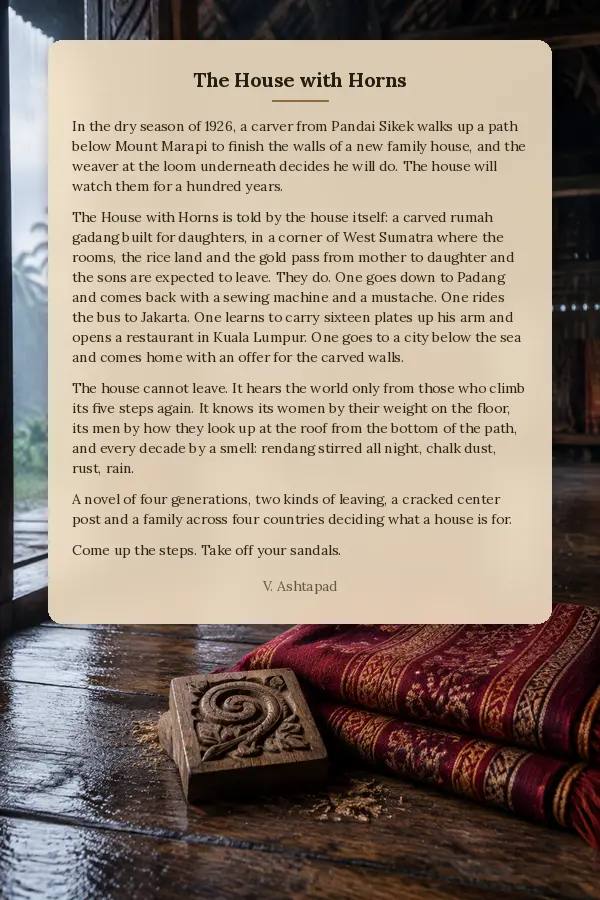
In the dry season of 1926, a carver from Pandai Sikek walks up a path below Mount Marapi to finish the walls of a new family house, and the weaver at the loom underneath decides he will do. The house will watch them for a hundred years.
The House with Horns is told by the house itself: a carved rumah gadang built for daughters, in a corner of West Sumatra where the rooms, the rice land and the gold pass from mother to daughter and the sons are expected to leave. They do. One goes down to Padang and comes back with a sewing machine and a mustache. One rides the bus to Jakarta. One learns to carry sixteen plates up his arm and opens a restaurant in Kuala Lumpur. One goes to a city below the sea and comes home with an offer for the carved walls.
The house cannot leave. It hears the world only from those who climb its five steps again. It knows its women by their weight on the floor, its men by how they look up at the roof from the bottom of the path, and every decade by a smell: rendang stirred all night, chalk dust, rust, rain.
A novel of four generations, two kinds of leaving, a cracked center post and a family across four countries deciding what a house is for.
Come up the steps. Take off your sandals.
Members can react to this book and talk about it in the members' Library.