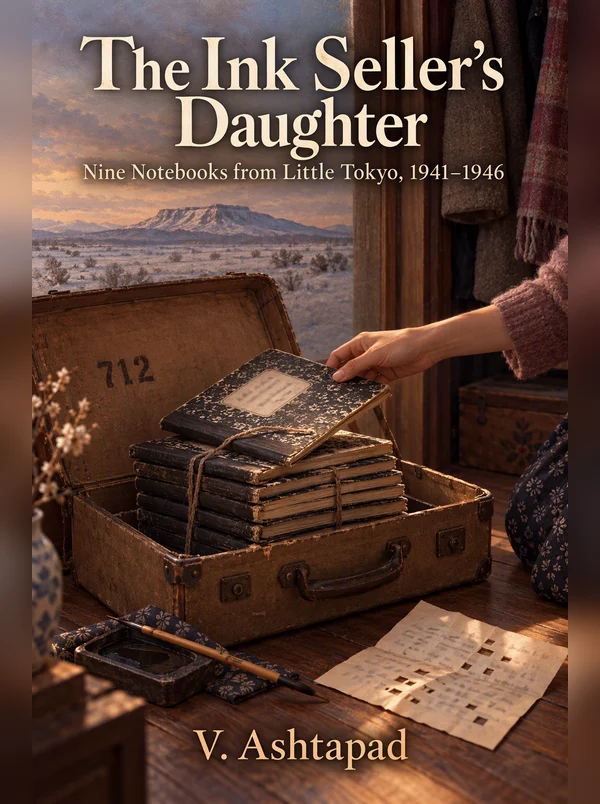
The Ink Seller's Daughter
Nine Notebooks from Little Tokyo, 1941–1946
by V. Ashtapad
Foreword
This is a work of fiction. The Imaizumi family, their shop on First Street, and everyone in these pages are invented, but the places they were sent were real, and so were the rules they lived under: the curfew, the posted orders, what could be carried, the horse stalls at Santa Anita, the barracks at Heart Mountain, the loyalty questionnaire, the young men who volunteered and the young men who refused, and the long, quiet return. The book alternates between a girl's diary kept from 1941 to 1946 and her granddaughter's year of reading it. Japanese words appear as the family used them, inside English sentences, the way they come up through a household's speech long after the language itself has gone quiet. The novel is offered to the families who kept their notebooks, their birds and their bells, and to the grandchildren still learning how to say the words.
For the ones who wrote it down, and for the ones learning to read it.
The Brass Disk
There is a brass disk set into the curb at the corner of First and San Pedro, about the size of a pocket watch, stamped with an elevation and a date. I have walked past it most of my life without knowing it was there. Then I spent nine years learning to find things like it, and now I cannot stop seeing them. Survey monuments. Benchmarks. Small fixed points that the rest of the city is measured from. When a building comes down and another goes up, when a street is widened, when a whole block changes its name and its people, the disk stays where it was set. You put your instrument over it and you know where you are.
My grandmother would say that is a lot of sentiment to hang on a piece of metal. She would be right. She usually is, and she is ninety-seven, so she has had more practice.
In April she fell in her kitchen reaching for a can of peaches on the top shelf. She did not break her hip, which the doctor at County called a miracle and which she called "landing on the good side." But she lay on the linoleum for two hours before the building manager heard her knocking on the cabinet with a soup ladle, and after that my father and his sister had a series of phone calls I was not invited to, and by the end of the month it had been decided that Baachan would move from her apartment on the ninth floor to a smaller unit on the third, where there were aides on the hall and a cord to pull beside the bed.
"It's a building," she said, when my father tried to explain the care plan for the third time. "I'm moving down six floors, Warren. I'm not going to Nebraska."
---
The ninth-floor apartment faced east, toward the river and the rail yards, with a slice of the hills behind. Baachan had lived there since 1991, after my grandfather sold the nursery in Gardena and they moved into the city to be near what she called "the old place," meaning Little Tokyo, meaning eight or nine blocks she had never fully explained. My grandfather died in 2004. She stayed on alone with his reading chair and his binoculars and her African violets, which she grew under a lamp in rows like a small, purple orchard.
She sat in the chair by the window while I packed and told me what to keep. Most of it she did not want to keep.
"The blender, no. Give it to the girl down the hall, she makes those green drinks. The good scissors, yes. Those were your grandfather's. Don't use them on paper."
"What do I use them on?"
"Nothing. You keep them."
On Thursday I started on the bedroom closet, which went back farther than it looked. Behind the winter coats there was a row of shoeboxes, each one labeled in my grandmother's square capitals: TAXES 1990–1999. WARREN SCHOOL. MAS – NURSERY. BUTTONS. Behind the shoeboxes, on the floor, pushed all the way to the wall, was a suitcase.
It was small and brown, made of some kind of pressed cardboard covered in fake leather that had worn through at the corners. The handle had been wrapped in cloth tape and then wrapped again. On the lid, painted in white, faded almost to nothing, were the letters IMAIZUMI and a number under them that I could only partly read. There was a paper tag tied to the handle with string. It was brown too, soft as felt, and the ink on it had gone pale lavender. The same number. A name, Hisae. An age: 13.
I carried it into the living room and set it down on the carpet in front of her chair.
My grandmother looked at it until I began to wonder whether I should take it away again. "Well," she said finally. "There it is."
"Is this yours?"
"It has my name on it."
"Baachan. Is this from the camp?"
"It's from before the camp." She leaned forward and touched the handle tape, just once, and sat back. "And during. And a little after. It went everywhere I went. Then it went in the closet."
"Can I open it?"
She thought about that. I want to be honest about how long she thought, because it matters to what came later. She thought long enough that I started to say never mind. Then she said, "There's nothing in it but a child's notebooks. You can open it. You don't have to read them."
The catches were stiff. Inside, the suitcase was lined with paper printed with small faded blue anchors. There was a folded square of cotton cloth, dark blue with a white pattern of waves, and inside the cloth, tied in a bundle with ordinary kitchen string, were nine composition books. Black and white marbled covers. The cheap kind. On the cover of each one, in the space where a child would write her name and her class, someone had written in brush and ink, in Japanese characters I could not read, and under that in English, in pencil, in a girl's careful loops: *Hisae Imaizumi. Book 1.* And so on, to nine.
"Who wrote on the covers?" I asked. "The Japanese part."
"My father."
"What does it say?"
"It says my name." She looked at the window. "He wrote it on every one. He wouldn't let me do it myself. He said if I was going to write in his notebooks I would do it under a proper name."
"His notebooks?"
"They came from the shop." She said it as if I knew about the shop, as if everyone did. Then she seemed to remember that I didn't. "My father had a shop on First Street. Paper and ink. Brushes, inkstones, writing paper. School supplies, too, for the Nisei children, because we needed composition books for regular school and the Japanese things for Japanese school. When we had to leave, there were nine of those left on the shelf. He gave them to me. He said, You write it down. All of it. Somebody should."
"And you did."
"I was a child. I wrote down what children write down. Who was mean to me. What we had for dinner." She waved her hand. "Put them back in the case. Put the case in the box for downstairs."
I put the notebooks back in the cloth. I did not tie the string as tight as it had been.
---
She did not say I couldn't read them. I noticed that she didn't. I am trained to notice what a boundary description leaves out, because that is where the lawsuits come from, and I lay awake that night in my apartment in Highland Park thinking about what she had and hadn't said. *You don't have to read them.* That isn't no.
On Saturday, after the movers had brought the last boxes down to the third floor and the aides had come by to introduce themselves and Baachan had told one of them, a young man from Cebu named Arnel, that his shoes were too loud, I sat with her while she ate dinner off a tray.
"I'd like to read them," I said. "The notebooks. If you'll let me."
She ate a piece of fish. She put the fork down.
"Why?"
I had thought about this. I had a speech. I didn't use it. What I said was, "Because I don't know anything. Dad doesn't know anything. You never told us, and Uncle Tad never told us, and now you're ninety-seven, and if I don't ask now, I'm going to be sixty and wishing I had."
"That's a selfish reason."
"Yes."
"Good. The unselfish ones are usually lies." She picked up the fork again. "You can read them. Don't read them to me. And don't tell me what you think of the girl. I knew her. I don't need a review."
---
I did not read them right away. That surprised me. I took the suitcase home and put it on my kitchen table and looked at it for two days, the way you look at a property line you know is going to be a problem. The paper inside was seventy, eighty years old. The pencil was soft. Some of the ink on the covers had flaked. I was afraid of handling them too much before I had done something to keep them.
So the first thing I did, before I read a single entry, was scan every page.
I borrowed a flatbed scanner from a friend at work who uses it for old plat maps, the kind that will lie flat under glass without cracking a spine, and over three evenings I went through all nine books one page at a time. I did not read as I went. I tried not to. I looked at each page only long enough to see that it was flat and square and in focus. But you cannot scan a diary page by page without your eyes catching on things. A date: *December 7, 1941.* A drawing of a horse's head in the margin. A list, numbered, that began *1. Mama's good scissors.* A whole page in Japanese, the characters pressed so hard into the paper I could see them from the back. A page where the pencil had gone through.
I put the scans in the family collection my aunt set up years ago, the one where my cousins post graduation photos and nobody else looks. I made a new folder and called it *Baachan's notebooks.* Under each book I wrote a short note: the date of the first entry and the last, how many pages, what the cover looked like, what condition the binding was in. Under Book 1, I wrote: *Cover lettering in brush and ink by her father, Genzo Imaizumi. She says it is her name. I can't read it yet.*
That *yet* was the first decision. I didn't know it was a decision when I typed it.
---
The first entry in Book 1 is dated November 30, 1941. It is a Sunday. It is half a page long. I am going to put it here the way she wrote it, because I read it on my kitchen floor at eleven o'clock on a Tuesday night with my back against the cabinet and I have not been able to put it down since.
*Papa gave me this book today because I am too old now to write in the margins of my reader for Japanese school, Ogata-sensei says it is disrespectful to the reader. Papa says a girl who wants to write in margins should have a whole book of margins. He wrote my name on the front with his best brush, the one from Kumano that I am not allowed to touch. It took him one breath. I watched. I am going to write in here every day except when I forget. Today we had curry rice at Auntie Fusa's and Tad ate four plates and Mama pretended not to see. Yoshio found a dead pigeon on the roof and wants to bury it. Mama said not in the window box. It is raining. The shop smells like wet paper and sumi, which is the best smell, and I am the only one in this family who thinks so.*
I read it twice. Then I went to the folder and found the scan of the cover and enlarged it until the brushstrokes filled the screen. Three characters for the family name, two for hers. One breath. I could see where the brush had lifted at the end of a stroke and left a fine dry tail, like the edge of a wing.
I don't know Japanese. I know about forty words, most of them food, and the ones my grandmother said under her breath when she dropped something. My father doesn't know Japanese either. He says she spoke it to her own parents when he was very small, and then one day she stopped, and he doesn't remember the day, only that afterward it was gone. I grew up in a house with a Mexican American mother who spoke Spanish to her sisters on the phone and English to us, and a Japanese American father who spoke English to everyone, and I thought that was what a family sounded like.
I looked at the brushstrokes until two in the morning. Then I went online and found a Saturday Japanese class for adults that met in a community room four blocks from my grandmother's building, and I signed up before I could argue myself out of it.
When I told her, the next Sunday, she was quiet for a while.
"What for?" she said.
"So I can read the covers."
She laughed. It was a short laugh, not unkind. "It'll take you a year to read the covers."
"Then it'll take me a year."
She looked out the window of the new apartment, which faces west now.
"My father would have liked you," she said. "He liked people who took a year."
Book One: The Smell of Wet Paper
*From the note under Book 1 in the family collection: Composition book, marbled cover, 46 pages used of 60. First entry November 30, 1941; last entry February 28, 1942. Pencil, with two pages in ink. Some drawings in the margins (horses, a cat, the shop sign). Page 19 has a hole worn through where she erased the same word several times. — C.N.*
---
**December 3, 1941. Wednesday.**
Japanese school until 6. Ogata-sensei made us do *ei* again, the character for eternal, because it has all eight strokes in it and if you can write *ei* you can write anything, he says. Mine looked like a spider that fell in the ink. He held it up and said, Imaizumi-san's spider has very good posture. Everybody laughed but it was nice laughing, he is not a mean teacher. Mitzi's looked like a broom.
At the shop Papa was cutting hanshi for the Saturday class at the church and he let me count the sheets. Five hundred. I counted them twice to be sure. Papa never counts twice. He says if you count right the first time, the second time is just showing off.
**December 5. Friday.**
Tad got paid at the produce market and brought home a whole crate of persimmons that were too soft to sell. Mama made the face she makes. Then she cut one open and ate it standing up at the sink with the juice going down her wrist, and then she was not making the face anymore.
**December 7. Sunday.**
I don't know what to write.
We were in the back of the shop after lunch because Papa does the books on Sunday and Mama does the mending and Yoshio and I are supposed to be quiet. Mr. Tsuji from the hardware store came to the front door and knocked on the glass even though the sign said closed, and Papa went, and Mr. Tsuji said something I didn't hear, and Papa turned on the radio on the counter, which he never does in the daytime.
The man on the radio said Japanese airplanes bombed Pearl Harbor in Hawaii this morning. He kept saying it in different ways. Ships. Sailors. He said the word *treachery* so many times I stopped knowing what it meant.
Mama put her needle down very carefully, she put it through the cloth so it would not get lost, and she did not pick it up again.
Tad came home from his friend's house running. He said there were people standing on the corners on First Street, just standing, not talking. He said a hakujin man in a car slowed down and looked at him and drove away.
Papa did not say anything for a long time. Then he said in Japanese, Close the shutters, and Tad closed them, and it was dark in the shop at three o'clock in the afternoon, and that is the strangest thing that has happened in my whole life.
**December 7, later. Night.**
Two men came to the Teramoto house next door and took Mr. Teramoto. They were very polite. They had hats. Mrs. Teramoto stood on the step in her apron. One of the men said, Ma'am, it's just questions.
Mitzi's father telephoned Papa at 9 and said they took Ogata-sensei too. And the man from the Japanese Association. And the judo teacher. Papa said yes, yes, yes into the telephone. Then he hung it up and sat in his chair with his coat still on.
I asked him why they took Ogata-sensei, he is just a teacher. Papa said, Because he is a teacher.
I don't understand that and I don't think Papa does either.
**December 8. Monday.**
At school Mr. Pettibone made us listen to the President on the radio in the auditorium. The President said a date which will live in infamy. Everybody stood up for the anthem after. I stood up. I sang. Mitzi sang. There were five of us Japanese in my homeroom and we all sang louder than anybody, I don't know why, it just happened. A boy named Norman in the row behind said under his breath, Look at the Japs singing. Ruthie Kaplan turned around and told him to shut up. I didn't know Ruthie liked me. Maybe she doesn't. Maybe she just doesn't like Norman.
Tad went to the recruiting office downtown after work to join the Army. He stood in line two hours. The sergeant looked at him and said come back later, son. He did not say when later was.
**December 10.**
The bank will not let Papa have his money. They said all the Issei accounts are frozen. Papa says frozen like it is a funny word. He has forty dollars in the cash drawer and the money people owe him from the Japanese school order, which they may not pay now because the school is closed. The school is closed. I didn't write that yet.
Mama says we will eat okazu with more rice and less okazu. Yoshio said what is the difference, and Mama said, You will find out.
**December 12.**
Papa and Mama were up late in the kitchen. I could smell smoke. When I went down in the morning the stove was cold and there was ash in the sink and the photograph of Papa's brother in the uniform was gone from the drawer. Also the letters from Wakayama in the tin with the cranes on it. Also the Japanese records, Mama's records, the ones with the singing lady.
I asked Mama where the records went. She said, Away.
The brushes are still on the shelf in the shop. The good ones from Kumano in the long box. I checked. I asked Papa if he was going to burn those too. He looked at me like I had said something very bad. He said, Those are tools. You don't burn tools.
**December 21.**
I have not written because there is nothing good to write and Ogata-sensei said a diary is not a complaint box. But he is not here. He is at a place in the mountains called Tuna Canyon that his wife says is a detention station, and then maybe Montana. So I can complain if I want.
Here is my complaint. Yoshio cried at night because he heard Mrs. Teramoto crying through the wall. He is seven. He doesn't understand. I am twelve and I don't understand either but I know how to cry with a pillow.
**December 25.**
Christmas. We are not Christian but we always have a little tree in the shop window because the customers like it, and this year Papa said no tree. Then on the 23rd he went out and came back with one anyway. It is very small. Yoshio put the pigeon feather on top. Tad gave me a fountain pen he bought secondhand from a man on Los Angeles Street. It leaks a little. I am writing with it now. You can tell.
**December 31.**
Mama made the New Year food the same as always, only less. No mochitsuki at the Okadas' this year, the men do not want to be seen together in a yard pounding with big hammers, Papa says somebody would call the police and say it is a secret army. I thought he was making a joke. He wasn't.
Mama wrapped one piece of mochi from the store in a furoshiki and put it on the shelf by the register, where the kagami mochi always goes. One small round one. Not two stacked up. She said one is enough this year. She said in Japanese, Something is better than nothing, and then in English, Something is better than nothing, as if one of us would not understand.
**January 17.**
Tad's friend Saburo got a letter from the draft board. It says he is classified 4-C. That means enemy alien. Saburo was born at the French Hospital on Hill Street the same as Tad. Tad laughed so hard when he read it that he had to sit down on the curb. Then he stopped laughing all at once. I don't think I will forget that.
**January 29.**
The newspaper says all the Japanese have to leave the places by the ocean and the oil fields and the airplane factories. It has a map with lines. Papa read it with his glasses on and his finger moving. We are not inside the lines. Mama said, Not yet, and Papa said, Tama, and she did not say anything after that.
I love when Papa says Mama's name like that. It is the only time I hear it.
**February 20.**
Today's word in my vocabulary book for English is *precaution*. I am writing it down because Mr. Pettibone used it twice in one day about two different things. The fire drill is a precaution. The President signed a paper yesterday, it was in the morning newspaper, and Mr. Pettibone said that is a precaution too. He did not look at us when he said it. He looked at the clock.
**February 22.**
Yoshio asked me what the President's paper says. I said it says the Army can tell people where to live. He said, us? I said I don't know. He said, Can we take the cat? We do not have a cat. He wants one. He has been asking since he was four.
I said yes, if we go, we can take a cat.
That was a lie and I knew it was a lie. I am writing it down so I will remember I did it.
**February 26.**
Families from Terminal Island are coming into Little Tokyo with everything they own in trucks and on their backs. The Navy gave them two days to get off the island. Two days! Papa took one family into the back room of the shop, a mother and a grandmother and three little girls, the father was taken in December like Mr. Teramoto. They sleep on the floor on the hanshi cartons. The grandmother does not speak English at all and she talks like a fisherman, Mama says, very loud and very rough, and she calls Papa a fancy man because he wears a vest. Papa laughed for the first time in I don't know how long.
The little girls smell like fish, and so does everything they brought, and now the shop smells like fish and wet paper and sumi, and nobody minds.
**February 28.**
I asked Papa what I should write in here now. Everybody is scared and nobody will say so. If I write it down then it is written.
He was grinding ink. He grinds ink every night even when there is nothing to write, he says it calms the hand. He moved the stick in circles on the stone, in circles, in circles. The water went from clear to gray to black. He said, Write what you see. Not what you think. What you think changes. What you see stays.
So here is what I see. Papa's hands. The inkstone with the chip on the corner from when Tad was a baby and knocked it off the counter. Three little girls asleep on the cartons. Mama sewing a button on Tad's good shirt. Yoshio drawing a cat.
This is the last page of Book One. Papa says I have to fill it to the bottom or it is wasting paper. So: the stick goes around. The water goes black. That is all I see. That is everything.
Family Words
The Saturday class met in a room that smelled of carpet shampoo and green tea, on the second floor of a community building with a parking structure underneath that I learned to hate within a week. There were nine of us. Tomono-sensei was a small woman in her fifties from Sendai who wore a different cardigan every week and wrote on the whiteboard faster than anyone I have ever seen write on anything. On the first morning she went around the table and asked each of us why we had come.
A young couple were moving to Osaka. A man in his seventies with a pressed plaid shirt and very white hair said his name was Glenn Hirota, he was Sansei, he had retired from thirty-four years at the post office, and his granddaughter had just gone to Kyoto for a semester and was writing home in Japanese to show off.
"I want to show off back," he said.
When it was my turn I said my grandmother had kept a diary in camp, and her father had written her name on the covers, and I wanted to be able to read it.
Tomono-sensei looked at me for a moment longer than she had looked at the others. Then she uncapped a marker and wrote, on the far side of the board where it would stay all morning, a single character. It had a little roof at the top and a hook coming down.
"Ei," she said. "Eternal. It has all eight basic strokes. If you can write this one, you can write anything. We will not start here. We will end here. Maybe a year."
I did not tell her about the spider with very good posture. I wrote down the character in my notebook and drew a box around it and went home and found the entry for December 3, 1941, and read it again, and sat for a while.
---
By the second week of May I had read through Book Three. I read slowly, one entry at a time, and I made notes the way I would on a field book: dates, places, names, anything I needed to check. When I didn't understand something, I wrote it down. Most of what I didn't understand was Japanese.
The diary is in English. My grandmother was a Nisei girl in a Los Angeles public school, and her English is clean and quick and sometimes very funny. But the Japanese words come through it the way pebbles come up through a dirt road. *Okazu.* *Hanshi.* *Sumi.* *Nii-chan*, which shows up for the first time in March and which I eventually figured out was what she called her brother. *Gaman*, which comes up once in Book Two and then everywhere. *Shikata ga nai*, which she writes once and then crosses out.
My aunt Colleen had started a family words list years ago in the collection, back when her kids were small. It had six entries, all from my late grandfather, who used to swear in a mixture of Japanese and Spanish he'd picked up from the men who worked at the nursery. *Bakatare.* *Ay, chihuahua.* Each one had a line for what it meant and a line for how to say it, typed out in her best guess at spelling: *bah-kah-TAH-reh.*
I added fourteen words in one evening. I typed what each one meant, as far as I could figure out from context and a dictionary, and then I wrote a guess at how to say it, and then I printed the page and took it to my grandmother on Sunday.
She was in her chair by the west window with a lap blanket and a crossword. She does the crossword in pen. She looked at the page for a while without her glasses and then put her glasses on and looked at it again.
"Where did you get these?"
"From the notebooks."
"I didn't use all these."
"You did. I can show you the pages."
She didn't want to see the pages. She ran her finger down the list. When she got to *okazu*, she stopped.
"That's not how you say it."
"How do you say it?"
"You say it like there's no hurry." She said it: *okazu*, three level syllables, no stress on anything, the *z* soft as a bee. "You've got a big mountain in the middle. Oh-KAH-zoo. That's how a hakujin would say it."
"What's okazu, exactly? I put 'side dish.'"
"It's whatever goes with the rice." She shrugged. "If you have a lot of money, it's fish. If you don't, it's a piece of tsukemono and some soy sauce and you call it okazu anyway, to be polite to yourself."
I wrote it down. She watched me write.
"Hanshi," I said. "Is that right?"
"Hanshi." Her mouth made it lighter than I had. "Paper. The thin kind, for practice. My father sold it by the five hundred."
"You counted it."
She looked at me over her glasses.
"It's in the notebook," I said. "December third."
"I counted everything in that shop," she said, after a moment. "I liked counting. I was a boring child."
We went through all fourteen. She corrected eleven. Some corrections were small, a vowel too long or too short. Some were large. *Gaman* I had right, she said, but I said it like I was reading it off a box. She said it the way you would lift something heavy without making a noise about it. When she came to *shikata ga nai* she read it silently and went on to the next one without saying it.
"Baachan."
"That one you can look up."
At the bottom of the page I had put *Nii-chan*. She looked at it longer than she had looked at any of the others.
"That's what you called Uncle Tad."
"Everybody's older brother is Nii-chan," she said. "It's not a name. It's just—" she moved her hand, a small flat motion, as if smoothing a sheet. "It's what you call the one who goes first."
---
When I got home I opened the family words list and went back through all the entries and fixed them. Under each pronunciation guess I added her correction in brackets: *[Baachan: "like there's no hurry."]* I knew that wasn't what the line was for. I didn't care. It was the only description that worked.
Then I sat with the cursor blinking in the empty line under *Nii-chan* and thought about what I had not asked.
There is a button on that list that lets you record how a word is said. My aunt had never used it. I had never used it. It would have been easy, the next Sunday, to hold my phone near my grandmother and say, Would you say these into this, so I can hear them when you're not here. I imagined saying exactly that sentence and I imagined her face. I closed the laptop.
---
On a Wednesday after work I went looking for the shop.
The diary gives the address once, on the inside cover of Book One, under a sticker shaped like a pencil: *Imaizumi Paper & Ink, 3— East First Street*, the rest of the number torn away with the corner of the sticker. In the 1940 city directory, which I found on the library's website after an hour of trying, there were eleven businesses with Japanese names on that block and one of them was *Imaizumi G. stationer.* The number was there. I stood across the street from it at six-thirty in the evening with the light going orange on the brick.
The building is still standing. It is on the stretch of First Street that has a historical designation, which means somebody fought for it in the eighties and somebody fought again in the nineties, and you can feel the fight in it, the way the cornices have been carefully repainted and the old signs kept or copied. The ground floor of what had been my great-grandfather's shop was now a store that sold phone cases, plush animals with enormous eyes, and keychains shaped like rice balls. A young woman behind the counter was scrolling on her phone. Two teenagers were taking pictures of each other holding a stuffed shrimp.
Above the shop, on the second floor, there were two windows with the blinds half down. In the diary, the family lived up there. Five people in three rooms, the stairs at the back, the bathroom down the hall shared with the Teramotos. When Yoshio found the pigeon, he found it on that roof.
I took out my phone and pulled up the scanned page from February 28, 1942, the inkstone and the cartons and the little girls asleep. I held it up beside the real window, the way I hold an old plat map up against a fence line to see whether the fence has wandered. Nothing lined up. Of course nothing did. The window was just a window. But I stood there until the young woman inside looked up, and saw me, and gave me the polite wary smile you give a stranger on the sidewalk who has been staring too long, and I lowered the phone and smiled back and walked on.
I don't know what I wanted. I think I wanted it to look like it had been taken.
---
My father called that night. He calls on Wednesdays. He is seventy, retired from thirty-eight years of dentistry in Gardena, and he has the patient, slightly too cheerful phone voice of a man who spent his career telling people this won't hurt.
"How's your grandmother?"
"She corrected my pronunciation."
He laughed. "Of what?"
I told him about the list. I told him about *okazu* and *hanshi* and how she said *gaman*. I told him she wouldn't say *shikata ga nai*.
He was quiet for a second. "I've heard her say that one," he said. "When I was a kid. If the car broke down or something. She'd say it in the driveway, under her breath, then she'd go get Dad."
"Did she ever speak Japanese to you? Like, actually speak it. Sentences."
"No." He didn't have to think. "She spoke it to her mother on the phone until Grandma Imaizumi died. That was, what—I was six or seven. I remember sitting on the floor in the hall listening to her and not knowing any of it. Then afterward, nothing. I took Spanish in high school. Your mom tells that story at every party."
"Did you ever ask her why?"
"Why what?"
"Why she stopped."
"Cel." He sighed. It was not an impatient sigh. "You didn't ask your grandmother things. You didn't ask Uncle Tad things. It wasn't that kind of family. Nobody sat you down and said don't. You just—" he searched for it. "You just knew where the floor was soft."
I wrote that down too, after we hung up. Not in the words list. On the yellow pad I keep for field notes. *You just knew where the floor was soft.*
---
On Saturday, at the end of class, Glenn Hirota stopped me in the hallway by the water fountain.
"Your grandmother," he said. "What camp?"
"Santa Anita first. Then Heart Mountain."
He nodded slowly, as if adding a figure to a column. "My folks were Poston. Arizona. My dad never said one word about it until he was eighty. Then you couldn't shut him up." He looked at me. "Don't wait for eighty. That's my advice. Nobody asked for it."
"She's ninety-seven."
"Then you're already late," he said kindly, and patted my arm, and went down the stairs to the parking structure, holding the rail.
Book Two: One Suitcase Each
*Note under Book 2: First entry March 2, 1942; last entry May 7, 1942. 58 pages. Two lists in this book, both numbered. The second list has a line drawn through two items and the word "NO" in someone else's handwriting, an adult's, in pencil. The page edge is stained brown at the bottom right, possibly tea. — C.N.*
---
**March 2, 1942.**
New book. Papa wrote my name on the front at the counter this morning, one breath, same as before. Then he looked at the shelf where the composition books are and counted them with his eyes, and I knew what he was doing. There are eight left. He didn't say anything. He gave me this one and put the other seven on the high shelf behind the inkstones where nobody would buy them.
Nobody is buying anything anyway.
**March 14.**
The Terminal Island grandmother has a name. It is Mrs. Sakata. She showed me how to mend a net with Mama's darning needle and a ball of string. You make a loop and a knot and a loop and a knot, and if you do it right, the holes are all the same size. She says the holes are the most important part. A net that is all string catches nothing.
They are going to a hostel at the church on Saturday. The little girls cried. The smallest one gave Yoshio a shell. He has put it with the pigeon feather.
**March 20.**
Papa walked me to the bus stop for school because Mama said I should not walk alone anymore. On the way he said, Hisae, if anybody says anything to you, you do not answer. You look at them like a tree looks at a dog.
I asked him how a tree looks at a dog.
He thought. He said, Without opinion.
**March 27.**
Curfew starts tonight. All Japanese, alien or citizen, have to be home from eight at night to six in the morning. And no more than five miles from home.
Tad says, So I'm a citizen in the daytime.
Mama told him to stop talking like that. He said Mama, what else can I talk like, and went upstairs.
At eight o'clock Papa locked the shop door and stood there with the key a long time. Then he came up and we had dinner and the street outside was so quiet you could hear the streetcar three blocks away.
**April 3.**
Mitzi's family got their notice. They are leaving on the 10th for a place called Manzanar, in the Owens Valley, which is in the desert by the mountains. Mitzi looked it up on the big map at school. She says it is next to a lake that isn't there anymore because the city took the water.
I asked if we would go there too. Papa said nobody knows. They put up notices by area. Our area hasn't been posted.
**April 9.**
Mitzi came over after school to say goodbye. We sat on the roof where the pigeon was. She gave me her copy of *Anne of Green Gables* and I gave her my good eraser, the gum kind from Papa's case. We decided we will write every week. We decided we will not cry, and then we did, but only a little, and only Mitzi first.
She said, Do you think we'll come back?
I said, Of course. Where else would we go?
Then we were both quiet because we didn't know.
**April 10.**
Mitzi is gone. I went to the corner and watched the buses. There were soldiers. Somebody's grandmother had a tag on her coat like a package. Everybody had tags. I didn't see Mitzi. I saw her father's hat.
**April 14.**
A man came to buy the stock. Papa had put a little card in the window that said SALE in English and in Japanese, very beautifully written, the best sign on the whole street, and now the men who come are the kind of men who read signs like that.
This one wore a brown suit and chewed a toothpick and walked through the whole shop touching things. He picked up the box of Kumano brushes and turned it over and looked at the price on the bottom and laughed. He said, Who's gonna pay that, mister? He said he would give Papa one hundred and twenty dollars for everything. The shelves too. The counter. The paper cutter. The ink. All the paper.
Papa didn't say anything.
The man said, Look, I'm doing you a favor. You can't take it with you, and I'm the only guy who's asked, am I right?
Papa said, You are right, you are the only one.
He did not sell. Not yet. He said he would think. The man left the toothpick on the counter.
After he left Mama picked the toothpick up with a piece of hanshi, like it was something dead, and put it in the stove.
**April 18.**
Papa sold to the man for one hundred and forty dollars. He got twenty more by saying the paper cutter was German. I don't know if it is German. Tad says Papa has never told a lie in his life before today and he's very good at it.
The Kumano brushes Papa did not sell. He took them out of the box before the man came back. Also the inkstone with the chipped corner, and two ink sticks from Nara, and one sheaf of hanshi, a hundred sheets, wrapped in brown paper. And the seven composition books from the high shelf. He put them all on the kitchen table upstairs and said, These are not stock.
**April 22.**
Our notice is up. It is on the telephone pole outside the fish market and on the door of the church and on the side of the bank. It says INSTRUCTIONS TO ALL PERSONS OF JAPANESE ANCESTRY at the top in big letters. It says we have to report on May 6 with what we can carry.
What we can carry is this:
Bedding and linens (no mattress) for each member of the family Toilet articles Extra clothing Knives, forks, spoons, plates, bowls and cups for each member of the family Essential personal effects
It says the size and number of packages is limited to that which can be carried by the individual or family group. It says no pets.
Yoshio read that part twice. Then he went to his room. He doesn't even have a cat.
**April 25.**
Mama has a rule. One suitcase each, and the bedding rolled in a canvas bag that Tad and Papa will carry between them. She bought two more suitcases on Los Angeles Street from a man who was selling them for three times what they cost last month. They are cardboard. She says cardboard is light, and light is what we need.
We each get to make a list.
**MY LIST**
1. Mama's good scissors (she asked me to carry them, they are for flowers, not for paper) 2. Two dresses, the blue and the green 3. My sweater 4. Underthings 5. Shoes (the brown pair) 6. My plate and bowl and chopsticks and fork 7. The seven composition books from the high shelf 8. Mitzi's book 9. ~~My blue bear~~ NO 10. ~~Ogata-sensei's reader~~ NO
The NO is Mama's writing. She went through everybody's list with a pencil. She said I am too old for the bear. She said Ogata-sensei's reader is a Japanese book and it is better not to carry Japanese books. I said Papa is carrying a Japanese inkstone. She said an inkstone is a stone.
I gave the bear to the Teramoto baby. I hid the reader in the bottom of the trunk that is going to storage at the church, wrapped in my winter slip.
**April 28.**
Here are everybody's lists, as close as I can remember, because I was too shy to ask to copy them.
Papa: his clothes, his reading glasses, the inkstone, the Nara ink, the brushes (the Kumano ones, rolled in a bamboo mat), the hanshi, his abacus, a ledger from the shop with the names of everybody who owes him money, and the brass bell from the shop door. He unscrewed it himself. I don't know what he will do with a shop bell.
Mama: her clothes, her sewing box, the family photographs in the album, the silk furoshiki with the waves, a kenzan, which is the heavy little pinholder with the needles for flower arranging. It weighs as much as a brick. Papa said, Tama, it is very heavy. Mama said, Then I will carry it.
Tad: his clothes, his baseball glove, his good shirt, a box of baseball cards he says he is too old for and is taking anyway, and a picture of a girl named Kiyoko that he thinks nobody knows about. Everybody knows about it.
Yoshio: his clothes, the pigeon feather, the shell from the Terminal Island girl, and forty drawings of cats.
**May 2.**
We gave away the furniture. We gave the icebox to the Mexican family on Vignes Street, the Villaseñors, who used to buy Papa's ledgers for their bakery. Mrs. Villaseñor cried. She said, Señor Imaizumi, we will keep it for you. Papa said no, no, use it, it is better to use things. She said she would keep it anyway. She brought us a whole box of pan dulce the next day and Yoshio ate three of the pink ones before Mama could stop him.
The landlord will rent the rooms upstairs and the shop downstairs to somebody else. He said he was sorry. He said it like a man reading the weather.
**May 5.**
Last night in the shop. The shelves are empty. The man took the counter yesterday. Papa swept the floor anyway. He swept it for an hour. When he was done he took a sheet of the hanshi out of the brown paper and set it on the floor because there is no counter, and knelt, and ground the ink in the stone with the chip in it, and wrote one character very big. Then he let it dry and folded it in four and put it in his inside pocket.
I asked him what he wrote. He said, You'll be able to read it someday. That's not an answer.
**May 6.**
We are tagged. The tags are the same as the one on the old lady by the bus in April. The number is our family number. It is on the tags and on the suitcases and on the bedding bag. Papa painted it on the lids of the suitcases himself, in white, in English numbers, very neat. Even the numbers are calligraphy when Papa does it.
We walked to the church on San Pedro with everything. It is four blocks. Mama carried her suitcase and the kenzan wrapped in the furoshiki. She did not let anyone help. Tad and Papa carried the bedding bag between them. Yoshio carried his suitcase on his head like the men who carry crates at the produce market. A soldier laughed at him. It was a nice laugh. He was a young soldier. He looked like Tad.
There were women from the neighborhood handing out coffee and doughnuts. There was a lady from a relief committee who wrote down the names of people who wanted to send letters. There were buses. We waited four hours.
**May 6, later.**
Santa Anita. It is the racetrack in Arcadia. I have seen it in the newspaper. The famous horse raced here.
We came through the gate and there were soldiers and a fence and the grandstand and behind that the mountains, very close, very blue. Rows and rows of long barns. They took us to a barn. They told us our unit. It is a horse stall. They have painted it white, but they painted over everything, the straw and the dirt and the rest, and when the sun comes through the cracks you can see the hairs from the horses stuck in the paint.
It smells. I am not going to write what it smells like.
Mama put the kenzan on the shelf by the door, the one where the horse people kept the bridles. She put it down very carefully, like it was the first thing in a new house.
**May 7.**
Yoshio says we got Seabiscuit's stall. A boy in the next stall says they got Seabiscuit's stall. Mitzi's cousin in Barn 9 says the same. Tad says Seabiscuit must have been a very busy horse.
I laughed so hard my stomach hurt. I don't know why. It wasn't that funny. Papa looked at me and then he laughed too, and then Mama, and we sat on the canvas bag in our white stall that smells like you know what, laughing at a horse, and that was our first night.
The Reader
The pencil in Book Two had gone faint in places, the graphite polished almost to nothing where her hand had rubbed across it, and on the page for April 14, 1942, there were three lines I could not read even with the scan blown up to the size of a door. I could make out *toothpick*. I could make out *one hundred and twenty*. The rest was a gray shine.
I brought the printout to her on a Sunday in June. She was on the third floor long enough now to have opinions about it. The woman across the hall, Mrs. Esquivel, watched telenovelas with the volume all the way up, which my grandmother claimed to hate and which I had twice found her listening to through the open door with her crossword forgotten in her lap.
"I can't read this part," I said. "The man who came to buy the stock."
She did not take the page right away. She looked at it on my knee from where she sat.
"Why do you need to read it? You know what happened. He bought it."
"I want to know what he said."
"He said what they all said." But she held out her hand. I gave her the page and she held it close to her face and then far away, and then she put on her glasses and held it at the middle distance where old eyes like things, and I watched her mouth start to move before any sound came out, as if she were finding her place in a song.
"*He picked up the box of Kumano brushes,*" she read, "*and turned it over and looked at the price on the bottom and laughed.*"
Her voice was not her voice. I mean it was, it was the same thin, dry, slightly hoarse ninety-seven-year-old voice that told the physical therapist he counted too loud. But it was reading. It went where the sentences went. And the sentences were a thirteen-year-old girl's, quick and flat and furious under the flatness, and my grandmother read them without changing a word, without softening anything, the way you would read a deposition.
"*He said, Who's gonna pay that, mister?*" She did the man's voice. Not much. A little lower, a little looser. Just enough.
She read to the end of the entry. She read the toothpick and the stove. Then she kept going, into April 18, without my asking, and I sat very still in the chair beside her as if a bird had landed on the arm of it.
"*Papa sold to the man for one hundred and forty dollars,*" she read. "*He got twenty more by saying the paper cutter was German.*" She stopped. She lowered the page.
"It was German," she said. "It was a good paper cutter. My brother didn't know anything."
---
That was the first afternoon. She read for forty minutes and stopped in the middle of a sentence and said she was tired, and she was, it was in her face and her hands. I took the page back and thanked her and she waved me off.
In the car in the parking structure I sat with the engine off until the motion light over my space clicked out.
I had not recorded it. It had not occurred to me until she had already started, and then I had been afraid to move. Now I sat there and tried to hold the shape of it in my head, the man's voice, *It was German*, and felt it already starting to go.
---
The next Sunday I asked her.
I had practiced how to ask it. I didn't use the practice this time either. What I said was, "Baachan, last week when you read. Could I keep that? Could I record you, if you read some more?"
"Record me."
"Just your voice. Reading. So when I'm reading the pages I can hear how they go."
She looked at me over her glasses, and I thought of my father on the phone: *you just knew where the floor was soft.* I was standing on it. I knew I was standing on it.
"Who listens to it?"
"Me. Dad, if he wants. Aunt Colleen. The cousins. It goes with the pages, in the family folder. Nobody else."
"Your cousins don't read anything."
"Then nobody else."
She looked out the window. The light was coming in low and gold through the haze, the way it does in June, laying a stripe across the carpet.
"I won't read all of it," she said.
"You don't have to read all of it."
"There are parts I won't read."
"Okay."
"You don't ask me why."
"Okay."
She held out her hand for the notebook. Not the printout, this time. The real one. Book Two. I took it out of the cloth and put it in her hand and she held it for a moment the way you would hold a small animal that might bolt, and then she opened it, and I held my phone in my lap with the red dot going, and she read.
---
She read *April 22*, the notice on the telephone pole. When she came to the list of what could be carried, she read it slowly, item by item, the way it was printed. *Bedding and linens (no mattress) for each member of the family.* She read *no pets*. She paused there, and I thought she was going to stop, but she only took a breath and went on to Yoshio reading it twice.
She read *April 25*. She read *Mama's good scissors*. She read *two dresses, the blue and the green.* She read *My plate and bowl and chopsticks and fork.* She read *the seven composition books* and lifted her head and looked at the suitcase, which I had brought along and set on the floor by the door, and then went back down to the page.
She read *My blue bear*. She read *NO*.
"Mama said I was too old." She said it to the page, not to me. "I was thirteen. I was too old. That was right."
Then she skipped the next line.
I know she skipped it because I had read it twenty times. *Ogata-sensei's reader. NO.* She went straight from the bear to *The NO is Mama's writing*, and read that, and read the whole paragraph about the Japanese book and the inkstone being a stone, but she read it as if the reader had never been on the list, and then she read about giving the bear to the Teramoto baby, and stopped before *I hid the reader in the bottom of the trunk that is going to storage at the church.*
She closed the book on her finger.
I did not say anything. I had promised.
"That's enough today," she said.
---
I listened to the recording that night in my kitchen with the scans open on the laptop. It is twenty-six minutes long. In the background you can hear the aide's cart going past twice, and Mrs. Esquivel's television through the wall, a woman shouting *¡Mentiroso!* at someone, and once, near the end, a helicopter. I didn't edit any of it out.
I put the file in the collection under Book Two, next to the scans, with a note: *Read by Hisae Nagai (née Imaizumi), age 97, from the original notebook. Pages for April 14 through April 25, 1942. She chose which entries to read.* I nearly deleted that last sentence twice, and then I left it.
Then I did something I am not proud of. I went to the page for April 25, the scan of it, and enlarged the line she had skipped. *~~Ogata-sensei's reader~~ NO.* I looked at it until the pixels came apart. I don't know what I thought I would see. A girl's pencil. A mother's pencil drawn through it. A word that meant no.
---
On Tuesday I was out in the field with my crew setting control points along the river south of the rail yards, where the county is doing work on a storm channel. We had a new tech, Gilbert Ochoa, twenty-four, good with the instrument, who asked a lot of questions at lunch because he had not yet learned that surveyors are supposed to be taciturn. He saw me writing something in the margin of my field book while I ate.
"What's that?"
"Hiragana."
"What's it say?"
"It says *a*. Then *i*. Then *u*." I showed him. Five little shapes on the green-ruled page between a column of bearings and a sketch of a manhole. *A, i, u, e, o.* Tomono-sensei had given us the first row on the second week and told us to write each one fifty times. "That's as far as I've gotten."
"Why are you learning Japanese?"
"My grandmother."
"She doesn't speak English?"
"She speaks better English than you."
He laughed. "So why?"
"She stopped speaking Japanese before I was born," I said. "Before my dad was born, kind of. And now there's this thing she wrote when she was a kid, and her father wrote her name on it, and I want to be able to read her name."
Gilbert thought about it. He's from Pico Rivera. His grandparents are from Zacatecas.
"My abuela only talks to me in Spanish," he said. "Even though she knows I'm bad at it. She says if she talks to me in English I'll never get better." He shrugged. "My mom says it's because her English is worse than she pretends."
"Maybe both."
"Maybe both," he agreed, and went back to his sandwich, and then after a minute he said, "Write the *a* again," and I wrote it, and he copied it into the margin of his own field book, upside down, crooked, a little shape like a figure falling forward.
---
She read again the next Sunday, and the one after that. She did not read in order. She would open whatever book I brought and turn pages until something caught her, and read from there, and stop when she stopped. She read about Yoshio and the forty drawings of cats and laughed in the middle of a sentence, and I kept the laugh. She read about the brass bell her father unscrewed from the shop door and stopped and said, "I don't know what happened to that bell," and then went on.
She read about Mitzi on the roof.
When she came to *Do you think we'll come back?*, she read it in a voice I didn't recognize, a younger voice, light, almost careless. Then she read *Of course. Where else would we go?* in her own.
"Mitzi lived in Chicago," she said, when she was done. "After. She married a man from Fresno and they had a dry cleaner on Clark Street. We wrote every week for fifty years. Then every month. Then she got sick." She closed the notebook on her finger again. "That's enough today."
In the parking structure, before I started the car, I played that part back. The two voices. The light one asking and the old one answering. I played it three times. Then I sat with my hands on the wheel and watched a man in a security vest drive slowly past on a golf cart, checking the stalls one by one, the way you would walk a fence line, looking for what had been left behind.
Book Three: The Color of the Mess Hall
*Note under Book 3: May 11 to September 2, 1942. 60 pages, every page used, the last one written sideways up the margin. There is a pressed leaf between pages 30 and 31, eucalyptus by the smell, which is still faint. Baachan read pages 12–20 and 41–44 aloud. — C.N.*
---
**May 11, 1942.**
We are in Barn 17. There are mess halls by color. We are Blue. The lines for Blue start before the bell and go along the side of the barn and around the corner. Tad says if you are late you eat at the end of the world. Yesterday was Vienna sausages, canned spinach, a slice of white bread, and rice with canned apricots on top. Apricots on the rice! Mama looked at it and looked at it. Then she ate it. Then she said, Well, it is a fruit.
The mattress ticking is canvas. You fill it yourself from a big pile of straw by the stables. Yoshio filled his so full he rolls off. Mine is too flat. Papa says a flat bed is good for the back. Papa's back has hurt since we came.
**May 14.**
There are eighteen thousand people here, the boy in the next stall says. More than in Arcadia. The grandstand is full of people walking because there is nowhere else to walk. You can walk around the racetrack. It is a mile. I walked it four times with a girl from Barn 9 named Sumiko Ikeda who is from Gardena and talks faster than Ogata-sensei writes. She wants to be a reporter. She says there is going to be a newspaper here, there is already a name, and she is going to be on it if she has to stand in the door every day until they let her in.
**May 19.**
Tad got a job at the camouflage net factory. Only citizens can do it. They sit in the grandstand under the big roof weaving strips of burlap into nets for the Army, all day, with the dust going up their noses. They make them green and brown and the color of sand. He comes home with his hands dyed. He says, Look, I'm helping. Then he coughs for five minutes.
Mama made him wash with the lye soap. His hands are still green.
**May 23.**
School started in the grandstand. There are no desks, we sit on the seats where the racing people sat, and the teachers are Nisei college girls who are not really teachers. My English teacher is twenty and wears lipstick. She read us a poem by Emily Dickinson about a bird that came down the walk and bit an angleworm in halves, and Yoshio, who is not even in my class, came over and sat behind us to listen because he liked the angleworm.
**May 30.**
A letter from Mitzi at Manzanar! The envelope had a stamp and everything. She says the wind is so bad the sand comes in through the knotholes in the floor and you wake up with it in your teeth. She says the mountains are so tall it is like living in a bowl. She says she is helping in a children's library they made in a barrack. She says, Hisa, there are no horses here. That is my one complaint, I miss the horses.
That's Mitzi. I laughed out loud in the line for Blue and a man turned around and looked at me.
**June 3.**
Papa made a corner. In the stall there is the door and then the three walls, and on the back wall there is a little shelf the horse people used. Mama has the kenzan on it. Papa took the board off a crate the oranges came in, he sanded it with a rock for two days, and he put it on two more crates and made a low table. On the table he put the inkstone and the brushes in their bamboo mat.
He has not written anything yet. He just set them out.
**June 9.**
Mama found flowers. Not flowers, weeds. Along the fence by Barn 23 there is a ditch and in the ditch there is something with tiny yellow flowers and long thin leaves, and some tall grass with feathery tops, and a broken branch of the eucalyptus that hangs over from the outside. She cut them with the good scissors, and I held them so the stems wouldn't bend, and we walked back like two ladies coming from a flower shop.
She set them in the kenzan in a tin can she got from the mess hall cook, a big can that peaches came in. One branch tall. One grass middle. One yellow weed low and leaning out. She looked at it from the door, and then from the floor, and moved the low one a little.
Mrs. Inouye from the stall across came over to look. She said in Japanese, Weeds. Mama said, in Japanese, Yes. Mrs. Inouye said, Well, it's very good weeds.
**June 16.**
The net workers stopped working today. Tad too. They sat down in the grandstand with their arms folded. Tad says it is because of the food and the heat and the dust, and they want masks, and the citizens are paid less than anybody outside, and the WCCA men will not listen. He says he is not a troublemaker. Mama says then why are you sitting in the grandstand with your arms folded. He says, Because everybody else is. Papa didn't say anything at dinner. After dinner he said to Tad, If you sit, sit all the way. Don't sit halfway. That is the worst.
I don't understand Papa sometimes. I think that means he is on Tad's side.
**June 20.**
Visitors! There is a visitors' area at the front, with a fence and a long table and soldiers walking up and down. You have to have a permit and you can talk half an hour.
Mrs. Villaseñor came. Mrs. Villaseñor from the bakery. She came on the streetcar and then a bus and then walked, in her best shoes, with her daughter Amparo who is my age, carrying a pink box. The soldiers opened the box and looked inside and poked the bread with a pencil. Amparo looked like she wanted to bite him.
Mrs. Villaseñor held Mama's hands across the table, which you are not supposed to do, and the soldier saw and did not say anything. She said the icebox is in her kitchen and she put a sign on it that says IMAIZUMI. She said, so nobody forgets. Mama couldn't talk. Mama, who always talks. Papa said thank you, thank you, and bowed so low his forehead was nearly on the table.
Amparo asked me what it was like inside. I didn't know what to say. I said, It smells like horses. She said, That's all? I said, No, but that's the first thing.
We ate the pan dulce in the stall that night with the door open. Yoshio saved a pink one for the Seabiscuit boy next door.
**June 28.**
Tad pitched in a game today, Barn 17 against the Gardena boys from the parking lot barracks. They play on the infield of the racetrack, which is very strange, with the grandstand there and nobody in it but us. Tad struck out the first three batters. The fourth one hit it over everybody's head and it rolled almost to the far turn. Tad stood on the mound with his hands on his hips and laughed. He looked like a person again.
**July 12.**
Papa wrote today.
It was very early. Before Blue opened. I woke up because I heard the stick on the stone, the circles, around and around. He knelt at the orange-crate table with a sheet of hanshi and wrote four characters down the middle. Then he sat and looked at them until the ink dried. Then he folded the sheet and put it in the ledger with the names of people who owe him money.
He said it was a poem by a Chinese poet. About rivers. That's all he would say.
I think he did it because Mr. Ogata wrote a letter. It came yesterday from Montana, from a place called Fort Missoula. The letter was cut by the censor in three places, with little rectangles out of it like windows. Papa read it through the windows. He said, He is well. He says the mountains are very beautiful. He says to practice.
**July 25.**
Sumiko got on the newspaper! The *Pacemaker*. She is the youngest one, she brings coffee and cuts stencils and sometimes they let her write a paragraph about a talent show. She showed me her paragraph. It has her name on it. She cried a little. I pretended not to see.
She wants me to write something. I said I don't write things, I just write in here. She said, Then that's writing.
**August 4.**
Something bad happened today.
Soldiers and the police came into all the barns this morning to search for things that are against the rules. Hot plates. Knives. Anything in Japanese. They went stall by stall. They took Mrs. Inouye's hot plate that she uses for her husband's medicine tea. They took Japanese books from people. They took a record player.
Then in the afternoon a crowd got angry, near the grandstand, and some men thought somebody was an informer, a man who was telling on people, and they chased him and hit him. I didn't see. Tad saw. He came home white in the face. He said, They were our people doing it, Hisa. It wasn't the soldiers. It was us.
Then the Army came with guns and everybody had to go to their stalls and stay there.
Papa's inkstone is a stone. Papa's brushes are brushes. They didn't take them. But Papa put the four-character poem in his shirt this morning before they came, under his undershirt, against his skin, and he did not take it out until now. I saw him. It is wrinkled from him sweating. He smoothed it with the side of his thumb and looked at it and put it back in the ledger.
**August 10.**
Everybody says we are going to leave Santa Anita. They are building real camps. Some people say Arkansas, some say Colorado, some say Wyoming. Nobody knows which. There is a list. The list changes.
Mama says the word for this in Japanese is shikata ga nai. It cannot be helped.
I wrote that, and now I'm crossing it out. I don't want it in here.
**August 18.**
Our list came. We are going to Heart Mountain. It is in Wyoming. Sumiko is going too, her whole barn. I looked at Wyoming on the map in the grandstand school. It is a square. It is all the way up. The teacher with the lipstick said, Oh, it's beautiful country, cowboys and everything, and then she looked like she was sorry she said it.
Yoshio wants to know if there are horses. I said probably. He said, Real ones?
**August 30.**
Packed again. One suitcase each. It's easier the second time. That is a sad thing to know how to do.
Mama emptied the peach can in the ditch. She dried the kenzan with her handkerchief and wrapped it in the furoshiki. She left the yellow weeds on the ground where they would get sun. She said they are from here, they should stay here.
**September 2.**
On the train. The blinds have to be down. Soldiers at each end of the car. You can peek if you are careful. I peeked. Desert. More desert. A little town with a water tower and a dog. Desert. Papa says tomorrow will be Utah because of the color of the ground.
The seats are hard and old and covered in green velvet worn down to the threads. Yoshio is asleep on Mama. Tad is asleep sitting up, with his glove on his hand like he is waiting for something to be thrown to him. Papa is awake. He is looking at the edge of the blind where there is a line of light.
I am writing very small because this is the last page. I asked Mama for the next book. She said not until we get there. She said, start the new book in the new place. She said a new place should get a clean page.
Every Place They Were Sent
In my work, a map is an argument. Every line on a survey plat is a claim that somebody may someday have to defend. This corner is here. This fence is a foot and a half onto your neighbor's land. This easement runs under your garage. You don't draw a line unless you can stand behind it.
So when I started the map, I was slow about it.
It began as a practical thing. By the end of June I had read through Book Four and I was losing track. Barn 17. Blue mess hall. Fort Missoula. Manzanar. The church on San Pedro Street. Vignes Street. The place called Tuna Canyon that Mrs. Teramoto said was a detention station. I had them scattered across my yellow pad in no order, and I wanted them in one place where I could see them against each other.
The family collection has a map you can drop pins into. One of my cousins used it once for a road trip and never again. I cleared his pins out—Zion, a brewery in Flagstaff—and started over.
I put the first pin on First Street. Not the store with the plush shrimp. The building. I wrote in the note: *Imaizumi Paper & Ink, ground floor; family lived on the second floor. Genzo, Tama, Tadashi, Hisae, Yoshio. Until May 6, 1942.*
The second pin was the church on San Pedro where they had reported with their suitcases. The third was Santa Anita.
Then I sat there with the cursor hovering over Wyoming and did not click.
---
I went to Santa Anita on a Saturday morning in early July, after class. The racetrack is still a racetrack. It sits at the foot of the San Gabriels in Arcadia with the same long art deco grandstand you can see in the old photographs, green and cream, and the same mountains behind it, close enough that in the morning the light comes over them in a sheet. On weekend mornings during the season they let the public into a corner of the grounds to watch the horses work out. You can buy coffee and a breakfast burrito and stand at a rail.
I stood at the rail. The horses came around the far turn in the early light in twos and threes, the exercise riders standing in the stirrups, the horses breathing in big rough bursts you could hear before you could see them. Dirt kicked up in little clods. It was beautiful. I had not expected that, and it made me angry, and then I wasn't angry, I was just standing there.
The barns are in the backstretch, where the public doesn't go. I could see the tops of them from the rail, long low roofs in rows. I don't know if any of them are the same barns. I don't think so. The track has been rebuilt more than once. Somewhere back there, or under the parking lots of the shopping mall next door where the Army put up the extra barracks, there had been eighteen thousand people and a blue mess hall and a woman cutting yellow weeds with a pair of good scissors.
A man next to me at the rail, older, in a windbreaker with the name of a feed company on it, asked if I had a horse running.
"No," I said. "My grandmother lived here."
He looked at me, puzzled. Then he understood. I watched it happen in his face. He was quiet for a minute.
"In the barns," he said.
"Barn 17."
He nodded. He looked out at the track. A gray horse went by, alone, galloping easy, the rider sitting very still. "My dad was a groom here after the war," he said. "He used to say they found things for years. In the stalls. When they tore out the old boards. Combs. Buttons. A kid's marble." He shook his head. "He kept a box of it. I don't know what happened to the box."
I didn't know what to say to that. I said thank you, which was the wrong thing, and he said sure, which was also the wrong thing, and we stood there and watched the gray horse come around again.
---
I put the pin on Santa Anita that night. In the note I wrote: *Assembly center, May 6–Sept 2, 1942. Barn 17, Blue mess hall. Tad worked in the camouflage net factory in the grandstand. Hisae walked the track with Sumiko Ikeda.*
Then I did Wyoming. Heart Mountain is in the northwest corner of the state, between the towns of Cody and Powell, in a wide basin under a mountain that the camp was named for. The block where my grandmother's family lived—Block 22, which I learned from the return address on a letter Mitzi had written to her and which Baachan had folded into the back of Book Four—was near the eastern side of the camp. I found a camp plan from a university archive and lined it up with the satellite image of the fields that are there now. The barracks are gone. There are irrigated fields, circles and rectangles of green and brown, and a dirt road where a camp street used to be. The roads of the camp are still visible as faint lines in the crops, the way an old property line can show up in a field from the air even when nobody has fenced it in sixty years.
I put the pin as close as I could.
Then I put pins for everyone else. Mitzi at Manzanar. Ogata-sensei: Tuna Canyon, in the hills above the city; then Fort Missoula, in Montana; then, I had found out from a letter quoted in Book Five, a camp at Santa Fe. Mr. Teramoto, as far as the diary knew. The Terminal Island family, to the hostel at the church, and then nowhere, because the diary lost them.
Then I put a pin at Camp Shelby, Mississippi. And then I sat back.
---
I brought it to her on my laptop the next Sunday. I had never shown her anything on a screen for longer than a photo of the cousins' kids. She put on her glasses and leaned in, and I zoomed out until the whole country was there with the pins standing up across it like a little forest.
"What's this?"
"Every place the family was sent."
She looked at it without saying anything, her glasses sliding down her nose. Then she reached out, carefully, one finger, and touched the screen near Wyoming, and the map jumped and zoomed in on Nebraska.
"I didn't do that," she said.
"It's okay." I zoomed back out. "You touch it and it moves."
"I don't want it to move."
"I'll do it. Tell me where."
She told me where. She told me, in order. She went through the pins one by one, the way she'd gone through the words list, correcting. The church on San Pedro was not the church I had marked; it was the one across the street. I moved it. The Heart Mountain pin was in the right block but too far north; their barrack was at the south end, near the latrine, "which was the good end in winter and the bad end in summer." I moved it.
When I got to Camp Shelby she said, "That's Tad."
"Yes."
"Where's the rest of Tad?"
I didn't understand at first. Then I did. "I haven't gotten there yet. In the notebooks."
"He was in Italy. He was in France. He was in a hospital in a place in France I can't say the name of, and then a hospital in Virginia." She looked at me. "Put those."
"I don't know where they are yet."
"Then find out." She sat back. "If you're going to put every place, put every place. Don't put half a person."
---
She had more. I wrote them on my pad as she said them, in the order she said them, which was not chronological and was not geographical either and was, I think now, the order in which they came up through the water for her.
"The train," she said. "Put the train."
"The train isn't a place."
"We lived on it three days. Put a line."
I drew a line from Santa Anita to Heart Mountain, the rough route, through the desert and Utah, as close as I could figure. She watched me draw it.
"And the hospital in Cody," she said. "Yoshio had his appendix out in Cody. They took him in an Army truck. Mama went with him. Papa wasn't allowed. He walked around the block for two days."
I added it. I didn't know about that; it wasn't in the notebooks I'd read yet. I added it anyway.
"And Vignes Street."
"Vignes Street?"
"The Villaseñors. The bakery." She tapped the arm of her chair, not the screen. "It was nine blocks from the shop. Mrs. Villaseñor kept our icebox the whole war. She put our name on it."
"Baachan, that's not a place you were sent."
"Put it on anyway." She was looking at the window, not at me. "It's where the icebox was."
I put it on. I put it on in a different color, because I didn't know what else to do with it. In the note I wrote: *Villaseñor bakery, Vignes Street. The Imaizumis' icebox was kept here from May 1942, with a sign on it.*
My mother, when I told her about it on the phone, was quiet for a second, and then she laughed, and then she said, "Your grandmother asked me once, a long time ago, when you were a baby, if I was related to some Villaseñors. I said no, my family's Arredondo. She said, I know, I know. I just thought I'd ask." My mother was quiet again. "I thought it was a strange question. She never said why."
---
Before I left that Sunday, my grandmother asked to see the whole map one more time. I zoomed out. The pins stood up across the West, and down into Mississippi, and then nothing, a big blank ocean on the right, waiting.
"It looks like somebody dropped a box of pins," she said.
"That's what it is."
"No." She shook her head slowly. "If you drop pins, they go everywhere. These went where they were told."
I didn't answer. I closed the laptop. She sat back in her chair and folded her hands.
"Put Mitzi's dry cleaner on there," she said, eyes closed. "Clark Street. Chicago. And the nursery in Gardena. And this building." She opened her eyes. "Put where we went after, too. Otherwise it looks like we're still out there."
Book Four: Thirty Below
*Note under Book 4: September 5, 1942 to January 31, 1943. 60 pages. The cover is warped; it was wet at some point and dried. Pages 33 to 36 are in Japanese, in pencil, with hiragana and a few kanji, some of them corrected in ink by another hand. Baachan says the ink corrections are her father's. She read the English pages. She has not read 33 to 36. — C.N.*
---
**September 5, 1942. Heart Mountain, Wyoming.**
Clean page, new place.
The train stopped at a siding in the middle of nothing. There was a platform made of boards and some Army trucks and a soldier with a list. They put us in the back of the trucks with the suitcases and drove us up a dirt road. The dust came up behind us so thick you couldn't see the next truck. Everybody's hair turned white. Yoshio looked like an old man. Then he laughed and he looked like Yoshio again with white hair.
At the top of the road there it was. Barracks. Hundreds of them. Long and low and black, covered with tar paper, in rows and rows that went on until they were just lines. A tall fence with barbed wire. Towers with soldiers.
And behind all of it the mountain. It is not shaped like a heart. Papa says it's shaped like a heart if the heart is very tired and lying on its side. Mama told him to be quiet. But she smiled. She said in Japanese, Hāto Maunten, like it was a Japanese word, and it sounded so funny we all said it. Hāto Maunten. Now it is our word for it.
**September 6.**
Our room is in Block 22. It is twenty feet by twenty feet. There are five Army cots, a potbelly stove, one light bulb hanging from a wire, and a broom. That is all. The walls are boards with cracks between them. You can see light through the walls. You can see the Hashimoto family's light through the walls too, and hear them. They are a mother and a grandmother and two boys. The grandmother snores like a truck going uphill.
Mama stood in the middle of the room and turned around once, slowly. Then she said, Well. Then she untied the furoshiki and took out the kenzan and put it on the windowsill.
Papa says, Now it's a house.
**September 9.**
The latrine has no doors on the toilets. Just a row of them. Women and girls in one building and men and boys in another, but no doors, no walls between. Mama and I went together at five in the morning before anybody else. Mama held her coat open in front of me like a curtain. Then I held mine in front of her.
I don't want to write any more about that.
**September 14.**
Dust storm. You can't describe it. It comes from the west like a wall and then you are inside it. It came through the cracks and the knotholes and under the door. When it was over there was dust on our blankets, in our food, in the water bucket, in Yoshio's ears. Mama swept for an hour. Then she sat on her cot with the broom across her knees and didn't say anything.
Then she got up and went to the canteen and bought newspapers and flour, and she made paste, and she and Tad pasted newspaper over every crack in the wall. Every single one. The room has headlines all over it now. ALLIES ADVANCE. ROMMEL. A department store sale on girdles. Tad put that one by Papa's cot to make him laugh.
**September 22.**
Papa works in the mess hall. He washes dishes. Twelve dollars a month. Papa who had a shop, Papa who wrote the best sign on First Street, stands at a big metal sink with his sleeves rolled up and washes the plates of three hundred people three times a day. He comes back with his fingers wrinkled like old plums.
He doesn't complain. He never complains. But last night he did not grind ink. He sat on the edge of his cot and looked at his hands.
Tad works on the canal crew digging the big irrigation ditch. Sixteen dollars a month because it's heavy work. He comes home dirtier than he has ever been in his life and eats like two people.
**October 5.**
School started. Real school, sort of. It is in a barrack like ours, with benches, and no books yet except what the teachers brought. Some of the teachers are hakujin from outside. My English teacher is from Iowa. She is young and wears two sweaters. She says she came because she read about the camps in a magazine and she felt it was the right thing. She says that a lot. I like her anyway. She lends me her books.
**October 19.**
Mr. Kumagai lives on the other side of the Hashimotos. He is an old bachelor, Issei, from Kagoshima, and he used to be a carpenter in Boyle Heights. He doesn't talk much. He sits on the step of his unit with a pocket knife and a piece of wood and whittles. I thought he was just making sticks smaller. Today he showed me. It is a bird. A little bird, the size of my thumb, with a round head and a fat chest. He said it is a chickadee. He saw one on the fence. He made it from a piece of root that he dug up by the ditch.
He said, You want it? I said, It's yours. He said, I make another one. I have time.
It is on the windowsill next to Mama's kenzan.
**November 2.**
Yoshio got sick. His stomach. He was crying and curled up and hot. The doctor at the camp hospital, a Japanese doctor from Los Angeles, said it was his appendix and he needed to go to the hospital in Cody, which is the town nearby. They took him in an Army truck. Mama went with him. Papa was not allowed to go. One parent only.
Papa walked around the block. Around and around. In the dark. In the cold. I went out at midnight and he was still walking. I walked with him. We didn't talk. Every time we passed our door Papa looked at the window like Yoshio might be there.
**November 4.**
Yoshio is all right! Mama came back on the truck today and said the doctor in Cody took it out and it was the size of a finger and Yoshio wants to keep it. They will not let him keep it. He is staying in Cody for a week. Mama says the nurses gave him ice cream. He has never been happier in his life.
Papa sat down on his cot when Mama told him and put his face in his hands and stayed like that for a long time. I didn't know grown-ups did that.
**November 11.**
Snow!
**November 12.**
Snow is very cold. Nobody told me.
**November 20.**
The Army gave out coats. They are old Navy coats, wool, dark blue, from the last war, with big buttons with anchors on them. They are all huge. Mine comes to my ankles. Yoshio's would go to his ankles if he were here. Mama sewed mine smaller. Then she sewed all of ours smaller. Then she sewed the Hashimotos'. Now ladies come to our door with their coats and Mama sits on her cot by the stove and sews them smaller and they pay her with canteen scrip or tea or one time a jar of real umeboshi that somebody's sister mailed from Chicago.
**December 8.**
Papa started a class. Two nights a week, in the mess hall after the dishes, for the Issei men who want to practice shodo. He asked the block manager and the block manager asked the adult school and now it's a class. Six men came the first night. They didn't have brushes. Papa had brought the Kumano brushes from Los Angeles, six of them in the bamboo mat. He gave each man one. He said, Please be careful, these are very old and very expensive, and then he laughed, a big laugh, the first one since the shop.
They write on newspaper because the hanshi is almost gone. They write on the backs of mess hall menus. They write on paper bags. Mr. Kumagai came. He writes very badly. Papa told him his writing looks like a bird scratching. Mr. Kumagai said, Thank you, I know a lot about birds.
**December 31.**
Last night of the year. There is no mochi.
In Los Angeles all the men would go to somebody's yard on the 28th or 29th and pound the rice in the big wooden mortar, the usu, with the big wooden mallets, the kine. Ten men taking turns. The women turning the rice between the hits, very fast, with wet hands, so they don't get smashed. It goes like a heart. Thump. Turn. Thump. Turn. And all the children standing around waiting for the first pieces with sweet bean paste, and burning their mouths, and not caring.
Last year there wasn't any because everybody was scared. This year there isn't any because there is no usu, no kine, no sweet rice, and the mess hall rice is the regular kind and it is counted.
Mama saved rice. A little at a time, from her own plate, for a week. I didn't know until tonight. She pressed it into three tiny balls between her palms, the size of walnuts, and put one on top of another on top of another, like a snowman, on a piece of hanshi on the windowsill next to the kenzan and the chickadee. Not real mochi. Just rice. But it was the shape.
Papa looked at it and did not touch it. He said, Next year, we make an usu. Mr. Kumagai can make an usu. There is a cottonwood by the river that the wind knocked down.
Mama said, Next year. In Japanese, rainen. And then, like before, in English, Next year. As if one of us would not understand.
**January 1, 1943.**
The mess hall had a special New Year breakfast. There was ham. There were canned peaches. There was a speech by the block manager. The cooks, who are mostly Issei men who used to cook in restaurants on First Street, had made a little bit of ozoni, the New Year soup, from somewhere, I don't know how, with a piece of chicken and a piece of carrot and no mochi in it. Everybody got a spoonful in a cup.
Mrs. Hashimoto's grandmother cried. She drank the spoonful and cried and said it was the best ozoni she ever had in her life.
It was not. It was a little bit of broth. But I think it was, also.
**January 10.**
Papa says I am losing my Japanese. He listened to me talk to Mrs. Hashimoto's grandmother and he said I sound like a hakujin girl reading a train schedule.
Now I have to write in Japanese one page a week, for him. He checks it in ink. He is very strict. He says, You are going to lose it if you don't use it, and if you lose it, you will lose your mother, because your mother will be talking and you will be standing there with your mouth open.
That is a terrible thing to say. I am going to do the page.
**January 31.**
Thirty below, the radio in the mess hall said. Thirty. Papa didn't go outside to check.
Mr. Kumagai gave Yoshio a bird too, now that Yoshio is home. It is a sparrow. Yoshio sleeps with it in his hand. Mama says he will break it. He hasn't yet.
The newspaper on the wall over my cot says ALLIES ADVANCE. I read it every night before I go to sleep. I don't know where they are advancing. It just sounds like going forward.
Thursday Cards
I had been visiting my grandmother on Sundays for years before I found out what she did on Thursdays.
It came about by accident. In the middle of July the county shut down our project on the river for a week while a contractor fixed a mistake in the concrete forms, and I found myself with a Thursday afternoon and nowhere to be. I drove to Little Tokyo. I parked in the structure. I went up to the third floor with a box of the soft butter cookies she likes from the bakery on Second Street, and her door was open, and her chair was empty, and the aide on the hall, Arnel, told me she was down in the community room.
"Thursday," he said, as if that explained it.
The community room is on the ground floor, off the lobby. It has a piano nobody plays and four round tables. At the table by the window my grandmother was sitting across from a Black man in a gray cardigan and a flat cap, and between them on the table was a scatter of small, thick, brightly colored cards I didn't recognize.
"You're cheating," my grandmother was saying.
"I am not cheating. I am winning. It looks similar from where you sit."
"That's a plum. That's not a cherry."
"That," said the man, laying a card down with a small, satisfied snap, "is a plum *with a poem on it*, which you taught me, which is worth five, which means I have"—he counted, touching each card with one long finger—"the red poems. All three. Which you also taught me."
My grandmother looked at the cards. She looked at him. She said something under her breath I didn't catch.
Then she saw me in the doorway.
"Celeste," she said. "Why aren't you working?"
---
His name was Lionel Thibodeaux. He was eighty-eight. He stood up when she introduced me, all the way up, slowly, gripping the chair back, and shook my hand, and told me he had heard a great deal about me and most of it was complaints about my driving.
"I drive fine."
"You drive like a surveyor," my grandmother said. "Stopping to look at everything."
The cards were hanafuda. Flower cards. Forty-eight of them, four for each month, each month a plant. My grandmother's set was older than my father. The edges were soft as cloth. She had played with her mother, she said, and then with my grandfather's mother, and then with nobody for a long time.
"And then with this man," she said, "who learns too fast."
They played on Thursdays. They had played on Thursdays for six years, since Lionel moved into the building after his wife died. Hanafuda on the first and third Thursdays. On the second and fourth, bid whist, which he had taught her, and at which, he said, she was ruthless.
I sat down. I gave them each a cookie. I watched them play one more round, which my grandmother won, and which made her so cheerful she offered Lionel a second cookie, which he took. And I did not understand, until later, that I was in the middle of something that had started a long time before me.
---
It was Lionel who told me. Not her.
When she went to the restroom down the hall, slowly, with her walker and with Arnel hovering a respectful distance behind her, Lionel gathered the cards into a stack and squared them and said, without looking up, "She tell you about First Street?"
"Some. I've been reading her diary from the war."
He looked up then.
"The war," he said. "So you're up to where?"
"Wyoming. The winter of '43."
He nodded slowly. He set the stack of cards down in the exact center of the table.
"Then you haven't got to me yet."
I didn't say anything. He laughed a little, softly, at my face.
"My family came out from Lake Charles in 1943," he said. "My daddy got on at the shipyard down in Wilmington, building Liberty ships. There wasn't a place to live in this whole city for a colored family. Not one. They had the covenants then, you know about those? On the deeds. No Negroes, no Mexicans, no Orientals. Half the city." He made a sweeping motion with his hand, the whole city. "But down here, all these buildings were standing empty. The Japanese had been sent off. So people came. Our people. From Texas and Louisiana and Arkansas. There were thousands of us down here. They called it Bronzeville."
"I've read a little about it."
"Little Tokyo became Bronzeville in about six months," he said. "Clubs. Churches in the storefronts. Barbecue. The music—oh, the music. My mama said you could walk down First Street on a Saturday night and hear three bands at once." He smiled. "I was five. I didn't go to the clubs. But I heard 'em through the window."
"Which window?"
He took his time answering.
"Second floor," he said. "Over your great-granddaddy's paper store. We lived up there. Eleven of us in three rooms. My mama ran a beauty shop downstairs in the store part. Odessa's. She had two chairs and a hot comb and a radio." He leaned back in his chair. "That's where I met your grandmother. October of 1945. She came and stood on the sidewalk outside my mama's shop with her whole family and their suitcases, and she looked at the window, and she looked at us, and she was the angriest-looking girl I ever saw in my life."
---
My grandmother came back from the restroom. She looked at us both. She sat down. She looked at the cards in the center of the table.
"He told you," she said.
"Some," Lionel said. "Not all."
"He tells everyone."
"I told her because you never would have." He said it gently. "You'd have let her get to the end of that diary and find me on the page and think we just met at the mailbox."
My grandmother didn't answer. She picked up the stack of cards and began to shuffle them, the way you shuffle hanafuda, which is not the way you shuffle a deck of playing cards; she held the stack in one hand and drew small packets off the top with her thumb and dropped them back underneath, over and over, the cards making a soft, dry clicking.
"I was angry," she said finally. "I was sixteen. I thought they took our house."
"We didn't take your house. We rented it from a man who rented it from a man."
"I know that now."
"You knew it then. You just didn't want to." He was smiling a little. "Then you came around."
"Then I came around." She dealt. Eight cards to him, eight to her, eight face-up on the table in two rows. Her hands were steady. "Don't tell her the rest. She has to read it."
"I won't tell her the rest."
"You'll tell her the katakana."
"I won't tell her the katakana," Lionel said, and looked at me, and winked, and picked up his cards.
---
That night I opened my grandmother's timeline. The family collection had a timeline for each of the grandparents that my aunt had started and nobody had finished. My grandmother's had a birth date and place—March 18, 1929, at home above the shop on First Street, delivered by a Japanese midwife whose name nobody had written down—and a marriage date, and the births of my father and my aunt, and my grandfather's death, and the move to this building, and nothing else.
Over the previous two months I had been filling it in from the notebooks. December 7, 1941. May 6, 1942. September 5, 1942. Yoshio's appendix in Cody. Each one with a note and a link to the page it came from. The early years were filling up. You could see the shape of them.
And then there was the stretch after. From the end of the war to my father's birth. Ten years, almost. In the timeline it was nothing at all: a long empty bar, with *1946* at one end and *1956* at the other and blank screen between. I had not noticed how long it was until that night. It looked like a section of road on a map where the surveyor didn't get out of the truck.
I added one entry. *October 1945. Returns to First Street. Meets Lionel Thibodeaux, age seven, whose family lives above the old shop.* I linked it to nothing, because I didn't have the page yet. I just put it there, in the place it would go, so I'd know where I was going.
---
The next Saturday was the start of Obon season in Little Tokyo. One of the temples on First Street closed off its parking lot for the weekend and strung lanterns over it in rows, red and white, and put up a wooden tower in the middle with a little roof, and on Saturday evening when the heat had broken, people came and danced around it in a circle.
I brought my grandmother in a wheelchair, which she hated, and which she accepted on the condition that I park her where she could see but not "in the middle like a float." We found a spot by the edge near the food booths. Lionel came too, on his cane, in a short-sleeved shirt with a pattern of palm trees.
The dance is a circle that goes around and around the tower. People of every age dance it. Each song has its own steps, simple, repeating. You clap twice, step forward, turn your hands like you are scooping water, step back. Some dances use a fan. Some use a small cotton towel held between the hands. You learn by watching the person in front of you. Nobody minds if you're bad at it.
The music came through big speakers on the tower. Recorded mostly, old songs with a singer whose voice was high and bright and a little wobbly with age, the recording I mean. For one dance, a woman sat on the tower and played the shamisen live, a long-necked instrument with three strings and a square body, plucked with a big flat pick. The sound was dry and sharp and fast, like someone snapping beans, and under it, holding everything up, the slower pulse of the singer and the dancers' clapping.
Then the speakers played a song that made the oldest dancers laugh and lift their towels higher. My grandmother's mouth moved on one line of it, without sound.
"The coal miners' song," she said, when I bent down to her. "Mama had it on a record. The singing lady." She didn't say what had happened to the record. She didn't have to. I had read December 12, 1941.
My grandmother watched without moving. She didn't clap. She didn't say anything. But I saw her right hand, in her lap, turning a little at the wrist on the scooping-water step. Every time. Never missing it.
Lionel saw it too. He leaned down to her.
"Hisae," he said. "You want to go round once?"
"I'm ninety-seven."
"I'm eighty-eight. I'll push."
"You'll fall over."
"Then we'll both be on the ground," he said, "and they'll have to dance around us."
She looked at him the way she looks at a crossword clue she suspects of cheating, and then she put her hands on the wheels of her own chair and pushed off before I could get to the handles. Lionel took them, one hand, the other on his cane, and the two of them went slowly into the circle, between a girl in a yellow cotton kimono and a man with a baby on his shoulders, and went around once, the whole way, while the shamisen snapped and the lanterns swung, and my grandmother lifted her hands off the wheels and clapped, twice, on the beat, and turned her hands to scoop the water, and did not look at me once until they came back around.
Book Five: Sagebrush in a Tin Can
*Note under Book 5: February 9 to September 14, 1943. 60 pages. A strip of white cotton cloth, about four inches long, is folded between pages 22 and 23. It has three small knots of red thread tied in a row. Baachan read pages 1–21 and 40–60. When she reached page 22 she held the cloth for a while and gave the book back. — C.N.*
---
**February 9, 1943.**
There are papers. Everybody over seventeen has to fill out a paper. The Issei get one kind and the Nisei get another kind. Everybody is talking about two of the questions. Number 27 and number 28. They have become names. In the mess hall people don't say *did you fill out the paper*, they say *what did you put on 27 and 28*.
Number 27 asks the Nisei boys if they will serve in the Army wherever they are sent.
Number 28 asks if you will swear to be loyal to the United States and give up any loyalty to the Emperor of Japan.
Tad read his at the table in our room with the stove going. He read it twice. He said, Give up what? I never had any. It's like asking if I'll stop beating my wife. I don't have a wife.
Papa said, Tadashi. Quiet.
**February 11.**
The Army is making a new unit. All Japanese American. Volunteers. There was a meeting in the mess hall. An officer came and talked. Some of the young men stood up and asked why they should volunteer from behind barbed wire. Some of them shouted. One man said, Let our families out first, then ask us. People clapped. The officer said that was not for him to decide.
Tad didn't stand up. He didn't shout. He didn't clap either. He sat with his arms crossed like in the grandstand at Santa Anita.
**February 16.**
The Issei paper asked Papa the same question 28. Will he give up loyalty to the Emperor. But Papa cannot be an American citizen. The law says Issei can never become citizens, no matter how long they live here. So if he says yes, he gives up Japan and he is not American. He is nothing. A man with no country.
Papa sat with the paper for three nights. He didn't grind ink. He sat with the paper.
Then they changed the question for the Issei. Now it asks if he will obey the laws and not interfere with the war. Papa read the new one and put on his glasses and wrote Yes very neatly in English. He said, That I can do. I have never interfered with anything in my life. That is my whole problem.
**February 22.**
Mama answered her paper today. She wrote yes and yes. I asked her if it was hard. She said in Japanese, Kodomo no tame ni.
For the sake of the children.
I said, but what about you? She said, I am the children's mother. That is what about me.
**February 28.**
Tad volunteered.
He went to the administration building after work without telling anyone and came home and sat down at the table and said it. Like he was saying he got a job. I volunteered.
Mama put down the sewing. Papa put down his tea. Yoshio looked at all of us.
Nobody said anything for a long time. The stove ticked.
Then Papa said, Why?
Tad said, Because somebody has to go first, Otōsan. And if nobody goes first, they'll say none of us would.
Papa said, And if you go first, they will say you are a fool, here, in this block. Some of them will not speak to you.
Tad said, I know.
Papa looked at him for a very long time. Then he got up and went to the orange-crate table and knelt and began to grind ink. Around and around. We all watched him. Nobody spoke. When the ink was black he took a sheet of the last of the hanshi from Los Angeles, there are only nine sheets left, and wrote one character, very big, and let it dry. He gave it to Tad without saying anything.
Tad looked at it. He said, I can't read this one, Otōsan. Papa said, You will.
**March 4.**
Some of the people in the block are not talking to Tad. Mr. Hashimoto is not talking to Tad. He says the boys who volunteer are dogs who wag their tails at the people who put us here. He said it in the latrine where Tad could hear.
Other people come by to shake his hand. Mrs. Inouye's sister from Block 9 brought him a pair of socks she knitted.
It is very hard to be in a block where half the people want to shake your hand and half the people want to spit. Tad says it is like the World Series.
**March 20.**
Only a few boys from the whole camp volunteered. Thirty-something, Sumiko says, out of thousands. She knows because the newspaper printed the names. Tad's name is in the newspaper. She gave me a copy. I am keeping it in the back of this book.
**April 6.**
Mama is making a senninbari for Tad. It is a long strip of white cloth, a belt, that a soldier wears under his clothes. A thousand women each tie one knot of red thread on it, and then the soldier is protected. It is an old custom from Japan. Mama said she does not believe it does anything. She is making it anyway.
She went to every unit in Block 22 with the cloth and a needle and red thread. Then to Block 21. Then Block 23. Women came to the door and tied a knot and said something, wished him well. Even Mrs. Hashimoto tied one, while Mr. Hashimoto was at work.
I tied three. Mama said one per woman. I said I am three women: one for Los Angeles, one for Santa Anita, and one for here. She let me.
**May 18.**
Tad left for the Army today.
There is nothing else to write about today.
**May 19.**
They went in a truck to the train, to a camp in Mississippi called Camp Shelby where the new unit is training. Six boys from our camp. Their families stood at the gate. Some people from the blocks came and some didn't. A man played a harmonica. Somebody's little sister held a sign she made that said GO FOR IT. Somebody else said that's not how you say it. The little sister didn't care.
Tad wore the senninbari under his shirt. I saw the edge of it at his collar when he hugged Mama. He hugged Papa. Papa didn't know what to do. He put his hand on Tad's back like he was checking if it was warm. Then he stepped back and bowed. Tad bowed back.
Tad hugged me last. He said in my ear, Keep writing it down, Hisa. All of it. I want to read it after.
**May 30.**
Spring here is very short and very windy. But things grow. The government farm on the other side of the camp is growing vegetables and the mess hall food is better now. There are real tomatoes. There is real cabbage. The men in the kitchen are making tofu now in big wooden boxes, and the block next to ours is making their own shoyu, and on Fridays there is sometimes fish that the Japanese cooks fry the way they did on First Street. Papa says this camp is going to start to taste like home and he doesn't know if that is good or bad.
Mama planted morning glories along the front of the barrack. And daikon in a little patch. And a row of something she won't tell me, she says I'll see.
**June 12.**
Mama's ikebana.
There are no flowers yet except her morning glories, which are too young to cut. So she goes out past the barracks to the edge of the ditch and she cuts sagebrush, which is gray-green and smells like a medicine cabinet, and greasewood, which is dark and twisty and has thorns, and the cattails from where the canal leaks. She puts them in the kenzan in a tin can that the mess hall gave her, a big can with the label soaked off. One branch of sagebrush up high, like the sky. One cattail in the middle, like a person. One greasewood low, leaning, like the earth.
She says in ikebana there is always heaven and earth and the person between. She says you can do it with anything. She says the best teacher she ever had in Wakayama did an arrangement once of three pieces of dry grass and a stone and people cried.
Mrs. Hashimoto came to look. Then Mrs. Inouye. Then three ladies from Block 21 who had heard. Now there is a class on Wednesday afternoons on the steps of our barrack, eight ladies with tin cans and kitchen knives and scissors and weeds, and Mama walks behind them and moves things one inch.
**June 30.**
Letter from Tad in Mississippi!
It is so hot he says he sweats in his sleep. The boys from Hawaii and the boys from the mainland do not get along. The Hawaii boys talk pidgin and play ukulele and gamble and fight. They call the mainland boys kotonks, Tad says because that is the sound a coconut makes when it's empty and you knock on it, which means our heads. The mainland boys call them buddhaheads. There were fistfights. He says it is getting better. He says some of the Hawaii boys went on a trip to visit one of the camps in Arkansas, and after they saw the barbed wire and the towers they came back quiet, and they don't call him kotonk so much now.
He says he is doing fine. He says the food is terrible, worse than Blue. He says send cookies if we have any. We do not have any. Mama is going to find some.
**July 24.**
Obon!
It was in the open space by the high school. The men built a little tower out of scrap lumber and painted it and hung lanterns from it made of paper and wire that the art class made. Mrs. Okumura from Block 25 brought her shamisen, which she somehow brought all the way from Los Angeles through Santa Anita in her suitcase, I don't know how, maybe she only brought one dress. She sat on the tower with it on her knee. It is a long neck and a little square body covered with skin, three strings, and she plays it with a big flat pick shaped like a gingko leaf. It sounds bright and twangy, and a little bit sad even when the song is happy. Two men sang with her. Their voices went up and down and up like a road in the mountains.
We danced in a big circle. Around and around the tower. The ladies who have kimono wore them. Most people don't. Mama had made me a summer kimono out of a bedsheet she dyed blue with something from the canteen, and drew white circles on it with chalk and then went over them with house paint. It looked almost real. I looked almost real in it.
You go around and around. Clap, clap. Step. Turn your hands like you are scooping up water from the river and throwing it over your shoulder. Step back. Around. All the blocks together. Old men and little children. Even the soldiers in the tower nearest us were watching, and one of them tapped his foot.
Mama danced. I have never seen Mama dance. She danced like the ladies in the pictures of Wakayama. Very small steps. Her hands very soft.
Papa didn't dance. He stood at the edge with Mr. Kumagai and watched, and when Mama came around past him he said something to her that I couldn't hear, and she laughed with her hand over her mouth like a girl.
**August 15.**
The mystery row came up. It is shiso, the leaf with the jagged edge that smells like nothing else in the world. Mama got the seeds from a lady in Block 9 whose sister sent them from Denver. Mama put one leaf on top of my rice at dinner, in the mess hall, very fast, like a secret. I ate it and closed my eyes and I was in the kitchen on First Street. I didn't tell her that. I think she knew.
**September 14.**
I have been doing the Japanese pages for Papa every week. He corrects them in ink. Tonight he gave me back my page and there was only one red mark on it. One! He said, Better. He said, Your mother can talk now and you will understand her.
I said, Papa, I always understand her.
He said, You understand the words. That is not all of it. Keep going.
This is the last page of Book Five. Tad has the character Papa wrote him. He told me in his letter he keeps it folded in his helmet liner. He still can't read it. He says it doesn't matter. He says, I know what it means, Hisa. It means he's not mad.
Hāto Maunten
My father had never been to Wyoming. He told me this on the plane from Denver to Cody, a regional jet so narrow that his shoulder touched the window, while we bumped through the afternoon air over the Bighorn Basin and the woman across from us gripped her armrest and counted under her breath in Portuguese.
"I didn't think about it," he said. "Isn't that strange? Seventy years old. I've been to Japan twice. I've been to Italy, with your mother. I never once thought, I should go see where they were."
"Did she ever ask you to?"
"She never asked me to do anything." He looked out the window at the land going by below, tan and folded and empty, crossed with the silver thread of a river. "That was the thing about your grandmother. She never asked. You just found out later what she would have wanted, if she'd asked."
---
The pilgrimage happens every summer at the end of July. I had found it on the interpretive center's website in June and bought the plane tickets without telling anyone, and then I had told my father, and he had been quiet on the phone for so long I thought the call had dropped, and then he said, "Yes. Okay. Yes."
My grandmother did not come. Ninety-seven, a hip that didn't like stairs, a plane you have to climb into: nobody suggested it, not even her. But when I told her we were going, she was quiet the way my father had been quiet, and then she said, "Tell me if the wind is still there."
"What do you mean?"
"Just tell me."
---
The camp site is about thirteen miles from Cody on the road to Powell, in a wide valley with the mountain standing over it to the west. We drove out early on Saturday morning in a rented car. The light was enormous. In Los Angeles the light comes through haze and over buildings and down between things; there, it came from everywhere at once, from a sky so big and so blue it made my eyes ache, and it lay across the land without anything to stop it.
The mountain is not shaped like a heart. I want to be clear about that. It is a great tilted wedge of limestone, steep on one side and long on the other, sitting by itself out in front of the larger range like something left behind. From some angles, I suppose, if you were lonely and wanted it to be, you could see a heart in it. A tired one, lying on its side.
My father stood in the parking lot and looked at it with the car keys still in his hand.
"Hāto Maunten," I said.
He turned. "What?"
"That's what they called it. In the family. Her mother said it like it was a Japanese word, and they all started saying it."
He looked at the mountain again. "Hāto Maunten," he said, trying it, and then laughed, a sudden short laugh, surprised out of him. "That sounds exactly like Grandma Imaizumi. I can hear her."
---
There were a few hundred people at the pilgrimage. Old people in folding chairs with sun hats and canes, many of them former incarcees who had been children here, and their children and grandchildren and great-grandchildren in T-shirts printed with their family names and their barrack numbers. Speeches, some very good and one very long.
The interpretive center is a long low building made to look like the barracks, dark-sided, set at the edge of the old camp. Inside there are photographs and the names of everyone who was sent here, on a wall, more than ten thousand of them, and a reconstructed room twenty feet by twenty feet with five Army cots and a potbelly stove and a single bulb hanging on a wire.
I stayed in the doorway of that room. My father went in. He walked to the middle of it and turned around once, slowly.
I didn't tell him what he had just done. I didn't tell him that his grandmother had done the same thing, in the same kind of room, eighty-four years before, and then said *Well*, and untied a furoshiki and put a pinholder on the windowsill. I just watched him do it.
On the wall of names we found them. IMAIZUMI, GENZO. IMAIZUMI, HISAE. IMAIZUMI, TADASHI. IMAIZUMI, TAMA. IMAIZUMI, YOSHIO. In a row, alphabetical, between a family named Imai and a family named Inaba. My father ran his finger across them, not touching. He didn't say anything.
---
Most of the camp is farmland now. After the war the government broke the site up and sold it off to homesteaders, many of them veterans, and the barracks were sold too, for a dollar apiece or close to it, and hauled away to become farmhouses and sheds and chicken coops all over that part of the state. What is left at the site itself is the chimney of the hospital boiler house, tall and brick and solitary, a couple of root cellars, some foundations, a few buildings that have been brought back.
The rest is fields.
I had brought my own receiver. I want to be honest that this is a strange thing to bring to a pilgrimage, and that my father raised his eyebrows when I took it out of my backpack in the motel room the night before. But I had spent two months lining up a scanned camp plan with the satellite imagery, and the block where my grandmother had lived was out there in one of those fields, under alfalfa or sugar beets or nothing, and I wanted to stand where it was.
After the speeches, we walked. Out along the edge of the old camp road, past the last of the pilgrims, along a gravel lane between fields. The receiver beeped in my hand as it found the satellites, one by one. My father walked beside me with his hands in his pockets.
At the corner of a field of something green and knee-high, I stopped. I checked the screen. I walked twenty steps along the fence and checked again. The coordinates I had worked out for the south end of the barrack in Block 22—the end near the latrine, the good end in winter and the bad end in summer—were about forty feet inside the fence, in the green.
We didn't climb the fence. It was someone's crop. We stood at the wire and looked at the place.
There was nothing there. Green leaves moving. A sprinkler line, long and silver on wheels, ticking somewhere far off. Above us the sky. To the west, the mountain.
And the wind.
It came from the west, off the mountain, steady and dry and warm, carrying the smell of sage from the unplowed ground along the road. It moved the green leaves of the crop in long waves, one after another, the way the wind moves water. It pushed at my shirt and my hair. It did not stop. The whole time we stood there, it did not stop.
"Well," my father said. "There it is."
---
In the motel that night I opened the map and moved the pin for Block 22 forty feet south and twelve feet west, to the place where we had stood at the fence. It was a small correction. Nobody else would ever notice it. In the note I added: *Visited July 25, with Dad. The site is a farm field now. We stood at the fence.*
Then I opened the family words list and added a new entry. *Hāto Maunten.* For the meaning I wrote: *Heart Mountain, the way Great-grandmother Tama said it. The family's word.* For how to say it, I typed it out as best I could—*HAH-toh MOWN-ten*—and looked at it, and knew it was wrong, and didn't know how to fix it.
I called my grandmother from the edge of the motel bed. It was eight o'clock in Los Angeles. She picked up on the fifth ring, which meant Arnel had handed her the phone.
"It's Celeste."
"I know who it is."
"We went. Dad and me. We stood where the barrack was."
She didn't say anything.
"Baachan, how do you say it? Hāto Maunten. I'm putting it on the list and I don't know how to write it."
There was a long pause on the line. I could hear Mrs. Esquivel's television through her wall. Then my grandmother said it, *Hāto Maunten*, in a voice I did not know she owned: higher, quicker, with a lift in the middle, the long *a* stretched out and the end clipped short. Not her voice at all. Her mother's.
"Like that," she said, in her own voice again.
"Like that," I said. I wrote it down. Not the spelling. In brackets, after the spelling: *[Baachan, doing her mother.]*
"Is the wind still there?" she asked.
"Yes."
"From the west?"
"From the west. It didn't stop the whole time."
She was quiet again. Then she said, "Good," and I didn't know what she meant, and I didn't ask.
---
On the road out the next morning, before the airport, I asked my father to pull over. There was a wide gravel shoulder along the highway, public land, where the sagebrush grew right down to the edge of the pavement in silver-gray clumps. I got out with my grandfather's scissors, which I had put in my bag at the last minute without knowing why, and cut three stems: one long, one middle, one short and leaning. I wrapped the cut ends in a wet paper towel from the motel and put them in a plastic bag.
My father watched me do it from the driver's seat.
"Is that allowed?"
"It's the shoulder of a highway, Dad."
"I meant on the plane."
"It's a weed," I said, which is what his great-grandmother's neighbor had said, in another language, about something else. *It's very good weeds.*
---
My grandmother was in her chair by the west window when I brought them to her on Sunday afternoon. I put the bag in her lap. She opened it and the smell came up into the room, that medicine-cabinet, rain-on-dust smell, and she closed her eyes.
Then she opened them and called down the hall for Arnel.
He came. She told him to look on the top shelf of the bedroom closet, behind the hatboxes, for a small wooden box with a sliding lid. He brought it. She slid the lid open. Inside, wrapped in a faded blue cotton cloth with a white pattern of waves, was a heavy round thing the size of a hockey puck, made of lead, covered on one face with rows of short brass needles, a little bent, a little green.
The kenzan.
"You had it," I said.
"Of course I had it," she said. "My mother carried it to Wyoming. You think I'd throw it out?"
She asked for a bowl. Arnel found her a soup bowl from the kitchenette, white, plain. She put the kenzan in the bottom and asked for water and Arnel poured it. Then she took the sagebrush out of the bag, one stem at a time, and looked at each one, and turned it in her fingers. She asked for the scissors. I gave her my grandfather's. She trimmed the long stem at an angle, a quarter inch, and pressed it onto the needles at the back, tilted. Then the middle one. Then the short one, low, leaning out toward the window, toward the light.
She looked at it. She moved the low one an inch.
"Heaven," she said, touching the air above the tall stem. "Person. Earth." She sat back. "My mother would have done it better."
Arnel, standing in the doorway with the empty water pitcher, said quietly, "It looks pretty good to me, ma'am."
"You're from Cebu," my grandmother said. "What do you know about sagebrush?"
But she let it stay on the windowsill. It was still there, gray and dry and smelling faintly of rain, three weeks later.
Book Six: Letters with Windows in Them
*Note under Book 6: October 3, 1943 to September 20, 1944. 60 pages. Tucked inside the back cover: a newspaper clipping, three inches of one column, with a paragraph signed H.I.; two V-mail letters, photographically reduced, very small; one regular letter from Italy with five rectangles cut out of it. Baachan read all the English pages in this book, in two Sundays. She read the letters too. — C.N.*
---
**October 20.**
Letter from Mitzi. Her family is leaving Manzanar for Chicago. Her father has a job at a factory that makes something for the war, she doesn't know what, it's secret. They can leave because her father passed the clearance and somebody in Chicago sponsored them. She says, Hisa, there is a big lake there that's like an ocean, and it's still there, nobody took it.
Lots of people from here are going too. Chicago. Denver. Cleveland. Salt Lake. A boy from my English class went to Minneapolis. They are not allowed to go back to California. Only east.
I asked Papa if we will go. Papa said, Where? I have no shop in Chicago. I have no shop in Denver. Here I have a class.
**November 10.**
Mr. Kumagai has made thirty-one birds. He lines them up on a shelf he built over his cot. He showed me. Chickadees, sparrows, a robin with a red chest, a little owl, a magpie that is black and white with a long tail, which he says he sees out by the coal pile every morning stealing things.
Some of them he paints. He has a tiny set of paints somebody sent him and he has made brushes from his own hair, he says, and from a cat's tail, he says, I don't know whose cat.
He asked if he could borrow my colored pencils, the ones a school class in Pennsylvania sent me for Christmas. I said yes. He used the red for the robin and the brown for a wren and gave them back. He said a pencil is a good friend because it doesn't argue.
**December 24.**
Tad is home!
Not home. Here. He got a furlough before they go overseas and he came all the way from Mississippi on the train and then the bus and then he walked up to the gate in his uniform with his duffel bag and the soldier in the guardhouse had to check his papers. A soldier checking a soldier's papers to get into a camp with barbed wire. Tad said the guard was embarrassed. He said, Sorry, buddy. Tad said, That's okay, buddy. They're both from Ohio, it turns out. No, the guard is from Ohio. Tad is from First Street.
He is bigger. His face is brown from the sun. He has a short haircut that makes his ears stick out. Mama touched his face like she was checking if it was real. Papa shook his hand. Then Papa did a strange thing. He put both his hands on Tad's arms, at the top, by the shoulders, and held on, and just looked at him. For a long time.
Yoshio wanted to wear the hat. Tad let him.
**December 26.**
Some people in the block still don't talk to Tad. Mr. Hashimoto went the other way when he saw him outside the latrine.
But other people came to our door. All day. Ladies who tied knots on the senninbari came to see the boy who was wearing it. Mrs. Inouye's sister brought a whole tin of rice crackers she had been saving. The boys from Tad's old baseball team came and made him tell about Mississippi. He told them about the heat and the mud and the Hawaii boys and the ukuleles and how they all have to learn to march together. He didn't tell them about anything else.
At night when everybody went to bed I heard him talking to Papa very quietly by the stove. In Japanese. I didn't know Tad's Japanese was that good. I couldn't hear the words.
**December 30.**
The usu! Mr. Kumagai and three men from the block made it from the cottonwood by the river, the one the wind knocked down last winter. It took them two months. It is a big round stump, hollowed out in the top like a bowl, and sanded and sanded until it's smooth inside. The kine are made from the branches. And the block managers got sweet rice somehow, from a supplier in Denver, enough for every block to have a little.
The men pounded in the space behind the mess hall in the snow. Thump. Turn. Thump. Tad took a turn. He was very good at it. He swung the kine like a baseball bat. The lady turning the rice, Mrs. Okumura who plays the shamisen, yelled at him not to swing so hard or she would lose her fingers. Everybody laughed. The steam came up off the rice into the cold air like a ghost.
We had real mochi for New Year. Two little round ones stacked on the windowsill with the kenzan. And a piece each in the ozoni, which had a real piece of mochi in it this year, soft and stretchy, and Mrs. Hashimoto's grandmother didn't cry this time. She ate two bowls.
**January 4, 1944.**
Tad went back. He has to go overseas soon. Nobody knows where.
**January 22.**
The government says Nisei boys can be drafted now. Not volunteer. Drafted. The same as anybody.
There is a group in camp that says no. They say: First give us back our rights, then draft us. They have meetings in the mess halls and they print papers. Sumiko says the camp paper is against them and she is not allowed to write about them except bad things, and she doesn't know what she thinks.
George Hashimoto, the older Hashimoto boy, the one who is nineteen, got his notice. He says he will not go.
**March 6.**
George Hashimoto did not report for his Army physical. Now he is arrested. A lot of the boys who refused are arrested. They took them to the county jail in Cheyenne. It is going to be a trial.
Mrs. Hashimoto cried through the wall all night. The grandmother didn't snore. That's how I knew she was awake.
I don't know what's right. Tad went. George won't go. They both say they are doing it because they are Americans. Papa says they are both right and that's what makes it hard. Mama says she is going to take Mrs. Hashimoto some tea.
**May 12.**
Tad's letter. He's on a ship. He can't say where to. The letter is very small. It is a V-mail. They take a picture of your letter and make it tiny and print it on photo paper so it takes up less room on the airplanes. You have to read it with a magnifying glass. Papa has a magnifying glass from the shop, for checking the hairs on the brushes. He read it first, and then again. Then he passed it to Mama with the glass.
**May 20.**
My first paragraph in the camp paper!
Sumiko asked me to write about the ikebana ladies for a little corner they have about what people in the blocks are doing. I wrote it at the mess hall table on the back of a menu. I wrote about the sagebrush and the cattails and the tin cans and the kitchen knives, and heaven and earth and the person between, and how Mama walks behind the ladies and moves things one inch. Sumiko cut it shorter. She took out my best sentence. She said it was too much. She was right.
They printed it with my initials, H.I. Mama read it. She can read English very slowly, with her finger. She took a long time. Then she folded it and put it in her sewing box and didn't say anything. But tonight at dinner she gave me her canned peaches.
**June 30.**
Three weeks ago we heard on the radio the Allies landed in France, and everybody in the mess hall stood up and cheered. Tonight the radio said our boys are in Italy. The 442nd. Fighting. They said the name of a place. I couldn't hear it.
**July 18.**
A letter from Tad. A real one, not V-mail, on thin paper. He is in Italy. He says it is very beautiful and very old and very hot. There are olive trees and stone walls and little towns on hills. He says the Italian ladies give them tomatoes and wine and cry when they see their faces because they think they are Japanese soldiers, and then they find out they are Americans and cry again.
Then there are five holes in the letter. Five little rectangles cut out with a razor, very neat, by the censor. You can look through them and see the table.
After the holes he says, The boys are fine. Some of the boys. Don't worry. I'm eating like a horse. Seabiscuit, ha ha.
Papa held the letter up to the window. The light came through the holes onto his face in five little squares. He held it there a long time. He was trying to read what wasn't there.
**August 2.**
A gold star in the next block. A family in Block 21. Their son was killed in Italy. The flag in the window. All the ladies went over. Mama went over with tea.
The mess hall was quiet at dinner. Nobody cheered for anything.
**August 9.**
I asked Papa what Tad's character said. The one Papa wrote him the night he volunteered. He keeps it in his helmet.
Papa was quiet. Then he said, It is one of the first characters children learn. Very easy. Five strokes.
I said, what does it mean?
He said, When you can read it, you will not need me to tell you. Then he said, in Japanese, very low, almost to himself, Tadashi wa yomenakute mo ii. It's all right if Tadashi can't read it.
**August 30.**
Mr. Kumagai gave me the robin. The one with the red pencil chest. He said I should have it because the red was mine.
He has forty-four birds now. I asked him what he will do with them when we leave. He said, Leave? He laughed. He said, I will fill a suitcase with birds. What else does a man need?
**September 20.**
Another letter from Tad. Shorter. One hole only. He says they had a rest and now they're moving. He says it's getting colder. He says he is still wearing the senninbari and it is very dirty and he will not wash it because that would be bad luck, and it smells so bad the other boys make him sleep at the end of the row.
He says, Tell Hisa to keep writing.
I am, Nii-chan. This is the bottom of Book Six. I am down to three books. Papa says I write too much. Then he says, No, that's all right. Write.
Names in Black Stone
My great-uncle Tad died in 2011, when I was nineteen. I remember him as a tall, slightly stooped man who wore a cardigan to every family party regardless of the weather and who limped—not much, but you noticed it on stairs. He laughed easily. He was a pharmacist in Monterey Park for forty years.
I did not know, until September, that he had been wounded in France.
I mean I knew it the way you know things in a family. I knew he was "in the war." I knew the word *442nd* the way I knew the word *Gardena*: a place things came from. But I had never once heard him say anything about it, and I had never asked, and nobody had ever told me not to.
---
His daughter Carolyn is seventy-five. She lives in Alhambra and has the same easy laugh he had. I called her in August, after I had finished reading Book Six and started on Book Seven and had to stop, for a while, and put the notebook down.
"I have his box," she said on the phone. "I've had it since he died. I never opened it all the way." She was quiet. "I opened it partway once. Then I closed it."
"Would you bring it?"
"Bring it where?"
I told her where.
---
The monument is on Central Avenue at the edge of Little Tokyo, a block from the museum, in a small plaza with a few young trees and benches. It is a long curved wall of black granite, polished so smooth you can see yourself in it, about the height of a person at its tallest. On its face, in rows and columns, are the names of more than sixteen thousand Japanese American soldiers who served in the Second World War. They are grouped by unit. Small, plain capitals, in the stone.
We went on a Saturday morning in late September, before the heat. My father drove my grandmother; I met them there. Carolyn came on the light rail from Alhambra with a shopping bag on her arm. My grandmother looked up at her from the wheelchair and said, "You got old," and Carolyn said, "You didn't, Auntie," and they both laughed, and then Carolyn bent down and held her for a long time, the shopping bag swinging against the chair.
We found him. It took a few minutes; the wall is long and the names are small. Carolyn found him first. She stopped, and pointed, and didn't say anything.
IMAIZUMI TADASHI.
My grandmother asked to be pushed closer. I pushed her until the footrests of the chair were nearly at the base of the wall. She leaned forward. She looked at it while one bus went by on Central and then another. She did not reach out to touch it. In the polished granite, behind the name, I could see her reflection: the white hair, the glasses, the blanket on her lap. Her face was very still.
"He would hate this," she said finally.
Carolyn laughed, a short, wet sound. "He would."
"He'd say, What's my name doing up there with all the heroes. I was just a guy from First Street."
"He did say that," Carolyn said. "When they built it. He wouldn't come to the dedication. Mom had to drag him the next year."
"I know," said my grandmother. "I was there. He stood right here and complained the whole time." She sat back in the chair. "Then he cried in the car. Don't tell anybody that."
---
Carolyn's shopping bag held a shoebox. A men's shoebox, size eleven, gone soft at the corners. We sat on a bench in the shade with the box on Carolyn's knees, and my grandmother's chair pulled up beside it, and my father standing a little apart with his hands in his pockets, and Carolyn opened it.
On top was his discharge paper, folded in thirds. Under that, in a small hinged case, a Purple Heart, the purple ribbon faded almost to gray. Under that, a bundle of photographs held with a rubber band so old it had melted into a sticky ring. Young men in uniform squinting into the sun in front of a stone wall. A street in a town with a church tower. A group of soldiers sitting on a wall with mess tins, laughing at something out of frame. On the back of that one, in pencil: *Italy. Summer '44. Most of these boys.* The sentence stopped there.
Under the photographs was a long strip of white cotton cloth. It was folded small and it was not white anymore; it had gone the brown of a paper bag, stiff, stained in places with darker marks I did not want to think about. Along its length, in rows, were hundreds of tiny knots of thread that had once been red and were now brown.
My grandmother made a sound. A small one. She held out her hands. Carolyn put the cloth in them.
She did not unfold it. She held it in her lap, folded, and ran her thumb along one edge, slowly, over the knots, the way you would run your thumb along the teeth of a comb. Near one end she stopped. There were three knots in a row, close together, a little apart from the others.
"Those are mine," she said.
Nobody said anything.
"One for Los Angeles," she said. "One for Santa Anita. One for Hāto Maunten." She held the cloth. "Mama said one per woman. I said I was three women. She let me."
---
At the very bottom of the box, under everything, was a square of paper.
It was folded in four, then folded again, and it was so soft it was almost cloth. It had been wet and dried more than once. The folds had worn thin as tissue. Carolyn lifted it out with two fingers and held it in her palm and looked at my grandmother.
"That was in his helmet," my grandmother said. "Open it."
Carolyn unfolded it on her knee, carefully, one fold at a time. It was a sheet of thin practice paper, *hanshi*, and in the middle of it, in faded black ink, large and quick, was a single character. Five strokes. A short slanting stroke at top left, then three horizontals stacked like the rungs of a ladder, the bottom one longest, and one long vertical down through the middle of them.
I knew it.
I knew it. I had learned it in Tomono-sensei's room three weeks before, writing it fifty times in the margin of my field book between a column of angles and a sketch of a fire hydrant. It is one of the first characters children learn. It is in the word for *student* and in the word for *birthday* and in the word for *raw*. Tomono-sensei had drawn it on the board and said its readings, and then said, "But the first meaning, the root, is—" and made a small gesture with her hand, upward, like something coming out of the ground.
"*Ikiru*," I said. "To live."
My grandmother looked at me, and kept looking, while a pigeon walked between the wheels of her chair.
"He said he didn't need to read it," she said. "He said he knew it meant Papa wasn't mad." She looked at the paper on Carolyn's knee. "He was right. It meant that too."
---
My father had been quiet all morning. On the drive home—I rode with them, and Carolyn took the train back to Alhambra with the shoebox on her lap—he talked.
"He taught me to pitch," he said. "Uncle Tad. When I was ten, eleven. He'd come over on Sundays and we'd go in the backyard. He couldn't run much because of the leg, so he'd just stand there and catch, and tell me what I was doing wrong. He was a good teacher. He'd say, Don't throw with your arm, throw with your whole self." He drove for a while. "Fourth of July, every year, there'd be the barbecue at our house, and when it got dark and the fireworks started down at the park, he'd go home. Every year. He'd just say goodnight and go. Mom would walk him to his car. I thought he didn't like fireworks. I was thirty before I thought about why."
My grandmother was in the back seat with her eyes closed. I thought she was asleep.
"He liked fireworks fine," she said, without opening her eyes. "He didn't like the sound."
---
That night I added his places to the map.
From the discharge paper I had the campaigns, and from the photographs and a few hours of reading I had the rest. His company sailed from Virginia in the spring of 1944 and landed at Naples and went north up the west side of Italy through the summer, through hill towns with stone walls and olive groves, to the Arno River. In the fall they shipped to Marseille, in France, and went north by truck and train to the Vosges Mountains, near the German border, and fought through the forest in October in cold rain and fog. Near the end of that month they were sent to reach a battalion of Texans who had been cut off on a ridge, and they reached them, and it cost them more men than they rescued. He was wounded somewhere in those hills. The paper had the date. Then a hospital in France, then a ship, then a hospital in Virginia, and finally, in the spring of 1946, a train home.
I put a pin for each of them. Naples. The Arno. Marseille. Bruyères. The ridge. The hospital in Virginia. They went across the blank ocean on the right side of the map and stood up in Europe in a short, crooked line, and then came back.
My grandmother had said, *don't put half a person.* So I put the last pin too: the pharmacy in Monterey Park, where he counted pills for forty years and talked with customers about their grandchildren and never once, as far as any of us knows, told anyone where he had been.
---
The next Sunday I brought Book Six. I asked her if she would read the letters in the back. She had already read the diary pages, but the letters she had skipped. She took them out of the envelope. The two tiny V-mails, which she read with a magnifying glass Arnel found in the activities room, and the regular letter from Italy on thin paper with its five neat rectangles cut out.
I held my phone in my lap. The red dot went.
She read it in her own voice, flat and plain. *It is very beautiful and very old and very hot.* She read about the olive trees and the Italian ladies. Then she came to the first hole.
She stopped. She looked through it at her blanket. Then she said, in exactly the same tone as the rest of the letter, "Hole."
She read the next line. Then: "Hole."
She read the whole letter that way. Every word he wrote, and every word the censor took, the same voice for both. Five holes. *The boys are fine. Some of the boys.* Hole. *Seabiscuit, ha ha.*
When she finished she folded the letter along its old creases and slid it into the envelope again, and handed me the envelope, and closed her eyes.
I put the recording in the collection under Book Six. I didn't add a note. I tried to write one three times and then I left the space empty, which is something I never do.
Book Seven: The Birds of Block 22
*Note under Book 7: October 10, 1944 to August 20, 1945. 60 pages. Four entries are written entirely in Japanese (November 13, November 14, December 2, and August 16). A yellow telegram form, folded twice, is pasted onto the inside back cover with flour paste. Baachan read the English entries. She read the telegram. When she came to the first Japanese entry she said, "That one I'll do later." — C.N.*
---
**October 10, 1944.**
Tad is in France. A V-mail came. He says they went on a ship again and now they're in France. He says it's raining all the time and it's cold and the forests are very thick and dark, like in the fairy tales, like the woods where the witch lives. He says the French people are very nice to them. He says, Don't worry.
Every letter says don't worry. Mama says that is how you know to worry.
**October 30.**
The radio says the 442nd rescued a battalion of soldiers from Texas who were trapped on a mountain in France. Everybody in the mess hall cheered. Some of the old men had tears. Mr. Hashimoto, who doesn't talk to Tad, stood up and clapped. He was the first one to stand up. I saw it.
Papa didn't cheer. He sat with his tea. He said, That will have cost a lot.
**November 12.**
A telegram came today.
The man from the administration building brought it to our door himself. Everybody in the block saw him coming. When he comes himself, it's a telegram, and when it's a telegram, everybody knows. Doors opened all along the barrack. People stood in them and didn't come out.
Mama took it. She didn't open it. She gave it to Papa. Papa opened it. He read it. He read it again. Then he said in English, Wounded. Wounded. And he said it in Japanese. And he sat down on the step.
It says, THE SECRETARY OF WAR DESIRES ME TO EXPRESS HIS DEEP REGRET THAT YOUR SON PRIVATE FIRST CLASS TADASHI IMAIZUMI WAS SERIOUSLY WOUNDED IN ACTION. It says the date. It says in France. It says MAIL ADDRESS FOLLOWS DIRECT FROM HOSPITAL WITH DETAILS.
Mama said, Wounded. Not.
She didn't finish.
Papa said, Wounded, Tama. Only wounded. And she sat down next to him on the step and they held hands. I have never seen them hold hands. Not once. In my whole life.
All the doors along the barrack closed again, quietly, one by one. That was the kindest thing. To close the doors.
**November 13.**
(This entry is written in Japanese.)
**November 14.**
(This entry is written in Japanese.)
**November 20.**
Letter from the hospital. Not from Tad, from a nurse, writing for him. A lieutenant. Her handwriting is very round. She says Private Imaizumi has wounds to his left leg and his hip from shell fragments and he had an operation and he is doing as well as can be expected. She says he asked her to write that he is still eating like a horse. She says he asked her to write ha ha. She wrote ha ha.
Mama asked me to read it out loud three times. Then she asked me to read the ha ha part again.
**December 2.**
(This entry is written in Japanese.)
**December 18.**
Big news in the mess hall. The government says the West Coast is open. We can go back to California, starting in January. The camps will close. All of them. Before the end of next year.
I thought everybody would cheer, like the Texans. Nobody cheered. Everybody just looked at each other.
The old people are scared. They say, Go back where? Our houses are gone. Our shops are gone. Our farms are gone, somebody else is farming them. We have nothing there. Here, at least, there is a roof and the mess hall.
Papa didn't say anything at dinner. After, at the stove, he said to Mama, quietly, We have nothing here either.
**January 8, 1945.**
A real letter from Tad! In his own handwriting. It's shaky. He says he's sorry about the handwriting, his hand is fine, he's just writing lying down. He says he's in a hospital in France in a town he can't name with nurses who give him extra pudding. He says his leg is going to stay on. He says, Tell Otōsan, it worked.
I gave the letter to Papa and pointed to that line. Papa read it. He didn't say anything. He put the letter in the ledger with the four-character poem from Santa Anita and the names of people who owe him money, and closed it, and sat with it on his knees.
**February 1.**
The first families are leaving. To California. The Nakatanis from our block went to Pasadena where they have a friend from before the war. The Wadas went to Sacramento. The government gives you twenty-five dollars and a train ticket. That's all. Twenty-five dollars.
At night the empty units are dark. The barrack is getting quieter. You can hear the wind more.
**March 3.**
Mitzi's letter from Chicago. She has a job after school at a dime store. She is going to a high school that has three thousand kids, and five of them are Japanese, and everybody thinks she is Chinese. She says she gave up correcting them. She says, Hisa, I am forgetting how to talk to old people. My mother says I sound like a radio.
I wrote back. I told her I am doing Japanese pages for Papa every week. I told her I'll teach her, after. She will hate that.
**May 8.**
The war in Europe is over!
The mess hall cheered this time. Everybody. Yoshio stood on a table and somebody's grandmother pulled him down by his belt. Mr. Kumagai, who never says anything, said in English, Very good. Very good. Very good.
Tad is in Virginia now in an Army hospital. He wrote that they put him on a ship with all the other boys who were hurt, a hospital ship, painted white with red crosses. He says when they came into the harbor the ones who could stand stood at the rail.
**May 30.**
Mr. Kumagai has fifty-seven birds now. He made a new shelf. He had to.
I asked him again what he will do with them when the camp closes. He said, Fifty-seven birds, one suitcase. He shrugged. He said, Maybe I will make a bigger suitcase. Then he said, Maybe I will let them go.
I didn't understand. They're wood. He laughed at my face. He has a very nice laugh when he does it, which is about twice a year.
**June 22.**
The Hashimotos left. George Hashimoto is in prison in Kansas. At a federal penitentiary. He was found guilty with the others last summer. Mrs. Hashimoto and the grandmother and the little boy are going to Denver to live with Mrs. Hashimoto's sister.
Before they left Mr. Hashimoto came to our door. He hasn't talked to Tad in two years. He asked Papa, How is your son's leg. Papa said, Better. Mr. Hashimoto said, Good. He bowed. Papa bowed. He left.
The grandmother hugged me. She smelled like camphor. I am going to miss her snoring through the wall.
**August 7.**
The radio says the Americans dropped a new kind of bomb on Japan. On Hiroshima. One bomb, one whole city. Nobody in the mess hall said anything. Nobody cheered. Lots of people in this camp are from Hiroshima. Lots of people have family there.
Mrs. Inouye's whole family is from there. Her mother. Her brothers.
Mama sat with her all night.
**August 10.**
Another one. Nagasaki.
Papa has been very quiet. He is from Wakayama. There was a newspaper story last month that said our planes bombed Wakayama city too, with fire. Papa read it and didn't say anything. His sister is there. His sister's children. He has not had a letter since 1941.
I keep thinking of the photograph of Papa's brother in the uniform, the one Papa burned in the stove on First Street. Is his brother alive? Was he in the war? Was he in a place where Tad was? No. Tad was in Europe. But I keep thinking it anyway.
**August 15.**
It's over. Japan surrendered. The whole war is over.
Some people cheered. Some people didn't. Some of the old Issei went into their units and closed the doors. Mrs. Okumura sat on her step with her shamisen in her lap and didn't play it.
Yoshio asked me who won. I said, We did. He said, Which we? I didn't know what to say. He's eleven. That's a good question for eleven.
**August 16.**
(This entry is written in Japanese.)
**August 20.**
Papa says we are going back to Los Angeles. Not to Chicago. Not to Denver. To Los Angeles. He says it's the only place he ever had anything, and if he has to start with nothing, he will start with nothing there.
Mama says yes.
Mr. Kumagai says he's staying until the end. He says he wants to see the last truck. He's carving a bird now that's bigger than the others, as big as my hand, and he won't say what kind it is.
This is the last page of Book Seven. There are two books left. Papa says, That's good. Two books is enough for going home.
What Was Carried
In November I made an inventory of the suitcase.
It is the kind of thing a surveyor does. When you take over a job, you don't trust the last person's notes; you find every monument yourself and write down what you found. *Found 2" iron pipe, bent, 0.3' below grade.*
So on a Saturday afternoon, after class, I put the suitcase on my kitchen table and opened it and took out everything that was in it, one thing at a time, and wrote each one down.
The cloth with the waves. The nine notebooks. A loose sheet of yellowed newspaper, which turned out to be a page of the camp paper from May 1944 with a paragraph signed *H.I.* about women arranging sagebrush in tin cans. A rubber band, dry and broken in two. A wooden bird the size of my thumb, round-headed, fat-chested, unpainted, worn smooth on the back as if someone had carried it in a pocket for years. I had not noticed it before; it had been wrapped inside the waves cloth at the very bottom, under the notebooks, and I had never unfolded the cloth all the way.
A chickadee. *He said, You want it? I said, It's yours. He said, I make another one. I have time.*
I held it for a while. Then I wrote it down. *Carved bird (chickadee per Book 4, Oct. 19, 1942), by Mr. Kumagai, Block 22. Unpainted. Wear on back.*
Then I took a photograph of every item, front and back, with a ruler beside it for scale, and put the photographs in the family collection with notes, the way I had done with the scans.
And then, because I was being thorough, because that is the job, I ran my fingers along the inside of the empty suitcase, along the paper lining with its faded blue anchors, the way you run your hand along the inside of a wall you are about to open.
In the bottom left corner, the lining was loose. Not torn. Unglued along one edge, about four inches, and pressed back down flat. Under it, against the cardboard, something crinkled.
---
It was a sheet of hanshi folded in four.
I knew what it was before I unfolded it. I sat with it in my hand at the kitchen table for maybe five minutes before I did. Then I unfolded it, very slowly, over a clean towel, the way I had watched Carolyn unfold her father's square on the bench in the plaza.
One character. Large. The ink still black, blacker than the ink in Tad's square, because this one had not been wet, had not been in a helmet in the rain in the Vosges. It had been in a pocket, and then in the lining of a cardboard suitcase in a closet behind the winter coats.
*He took a sheet of the hanshi out of the brown paper and set it on the floor because there is no counter, and knelt, and ground the ink in the stone with the chip in it, and wrote one character very big. Then he let it dry and folded it in four and put it in his inside pocket. I asked him what he wrote. He said, You'll be able to read it someday.*
It was ten strokes. I counted them twice. On the left, two short vertical marks like a pair of tally lines. On the right, a stack of horizontals with a shape like a little cover, and a long vertical coming down through the bottom of it like a post.
I could read it.
I had learned it in October. Tomono-sensei had taught it to us inside a verb, the way she taught most characters, so we'd learn the sound and the meaning together. It's a basic word. It's in the first textbook. You learn it in the same week you learn the words for *go* and *come*.
*Kaeru.* To return. To go home.
---
I did not call her. I don't know why. I think I needed to sit with it first, the way she sat with things. I folded it back along its own folds and put it in a clear sleeve and put the sleeve back in the suitcase on top of the notebooks, not in the lining. I didn't scan it yet. I didn't photograph it. I wanted to show it to her before it was anywhere else.
---
Thanksgiving was at my parents' house in Gardena. It always is. My mother's sisters come with their husbands and their children and their children's children, and my aunt Colleen comes from San Diego, and there are two turkeys and my tía Pilar's tamales.
My father picked my grandmother up in the morning. When I got there at noon she was installed in the good armchair in the living room, the one by the front window, with a plate of olives on the side table and two of my mother's great-nephews sitting at her feet watching her do the crossword, because she had told them that if they could find a word she couldn't, she would give them a dollar, and they had not won yet.
I waited until after dinner. Until the dishes were in the sink and the football game was on and the little kids were asleep in a pile on my parents' bed and the grownups were in the kitchen arguing about the pie. I took the suitcase out of my car, where I had put it that morning, and brought it into the living room, and set it down on the rug at her feet, the way I had in April, on the ninth floor.
She looked at it. She looked at me.
"I took everything out," I said. "To write it down. To keep track."
"Of course you did."
"I found the chickadee."
Her face changed. Just a little, around the eyes.
"I forgot that was in there," she said. "I used to carry it. In high school. In my coat."
"And I found this."
I took the clear sleeve out of the suitcase and gave it to her.
She held it in her lap without looking at it. Then she looked.
"You read it," she said.
"*Kaeru*."
She didn't say anything. In the kitchen my mother laughed at something, high and loud, and one of my tías said *ay, no*, and a pan clanged in the sink.
"He wrote it the night before," my grandmother said finally. "On the floor of the shop. You know that, you read it."
"Yes."
"He carried it the whole time. Santa Anita. Hāto Maunten. In his pocket, every day. Four years. It was soft by the end. In 1946, when we finally had a place, two rooms in Boyle Heights, he took it out and gave it to me." She looked at the paper. "He said, It's done now. You keep it." She was quiet. "I put it in the lining so it wouldn't get lost. Then I forgot it. That's not true. I didn't forget it. I put it where I wouldn't have to see it."
"Why?"
She didn't answer that. She looked at the paper. Then she looked at me, over her glasses, the way she had looked at me in April when I asked if I could read the notebooks.
"Because it wasn't done," she said. "He said it was done. It wasn't. We came back. But we didn't come back to anything. You can't go home to a place that isn't there. My father knew that. He gave it to me anyway." She held the sleeve in both hands. "He wanted somebody to have it who would believe it."
---
Later, when the pie argument had been settled and the pie eaten, and my father had brought out coffee, my grandmother asked him if he still had the bell.
My father looked puzzled. "What bell?"
"The brass bell. On your garage door. The side door."
"That old thing?" He laughed. "It's been on there forever. Since we bought the house. Dad put it up. I figured it came from the nursery."
"It came from the nursery," my grandmother said. "It came to the nursery from Boyle Heights. It came to Boyle Heights from First Street." She looked at him. "My father unscrewed it from the shop door the week before we left. He carried it in his suitcase to Santa Anita and to Wyoming and back. He hung it on every door we had after. When he died your father put it on the door at the nursery. When we sold the nursery your father took it off and put it on your garage." She shrugged. "You never asked."
My father didn't say anything. He got up. He went out through the kitchen to the garage. We heard the side door open, and we heard, very faintly, the bell ring as it swung—a small, bright, ordinary sound, the sound a shop makes when someone comes in—and then the door closed, and it rang again.
He came back in after a minute. He sat down. He didn't say anything for a while.
"I've heard that bell," he said, "ten thousand times."
---
That night, after my parents' house had emptied out and my father had driven my grandmother back to Little Tokyo, I sat in my old bedroom, which is now my mother's sewing room, and opened my grandmother's timeline on my laptop.
The long empty bar between 1946 and 1956 was still there.
On the drive back to my apartment, I had been thinking about it. About the lining. About things put where you wouldn't have to see them. On Sunday, when I went to see her, I brought the laptop and opened the timeline on her tray table, and I didn't say anything. I just turned it toward her.
She studied the empty space the way I study a gap in somebody else's field notes.
"Ask me," she said.
So I asked. And she answered, in short flat sentences, not looking at me, looking at the screen, and I typed.
*June 1947. Graduates from Roosevelt High School, Boyle Heights.*
*1947–1953. Works as a clerk-typist at a wholesale produce company on Central Avenue. The owner is a Jewish man from Minsk who hires Nisei girls when other firms won't.*
*1951. Meets Masaji Nagai at a Nisei club picnic in Elysian Park. He is a gardener. He fixes her friend's flat tire with a stick.*
*April 1953. Marries Masaji Nagai.*
*1953. Moves to Gardena.*
*June 1956. Warren born at a hospital in Torrance.*
When she said that one, she stopped. I waited.
"I talked to him in Japanese," she said. "In the hospital. The first day. I didn't think about it. It's what came out. A nurse heard me. A nice nurse. She meant well." My grandmother looked at the screen. "She said, Oh, honey. Don't confuse him. He's an American."
I didn't move.
"I didn't say anything to her. I wanted to tell her my brother left half his hip in France for the right to be called that. I didn't. I looked at her like a tree looks at a dog." She almost smiled. "That's from my father."
"I know. I read it."
"After that I didn't speak Japanese to Warren. I spoke it to my mother on the phone. Every day. Until she died. Then there was no one." She was quiet for a long time. "I thought, if he only has English, nobody can ever point at his mouth. Nobody can ever say, *Him, too.* That was the reason. It was a good reason. I'm not sorry."
"Okay."
"I'm a little sorry."
She looked at the timeline. The empty bar was filled now. Not completely. Not with everything. But there were marks on it, at intervals, like monuments set along a road, so that someone coming later could find their way.
"Put my mother," she said. "When she died. September 1962. Put that I stopped then."
I put it in. *September 1962. Tama Imaizumi dies. Hisae stops speaking Japanese.*
Then she reached over, carefully, and with one finger moved the cursor, so that it blinked at the end of the line. She didn't type anything. She just left it blinking there.
"Not stopped," she said. "Put it away." She looked at me. "Write that."
I deleted *stops speaking Japanese*. I typed *puts away her Japanese.*
She read it and nodded and closed the laptop herself.
Book Eight: Bronzeville
*Note under Book 8: October 2, 1945 to March 30, 1946. 60 pages. On page 37 there is a word written eleven times in katakana, in two different hands: one careful and practiced, one large and wobbly. Baachan read this whole book aloud over three Sundays, in order, without skipping. She read the katakana page twice. — C.N.*
---
**October 2, 1945. Heart Mountain.**
Book Eight. Papa wrote my name on it at the table in our room, on the orange-crate table he brought from Santa Anita. The stove was cold because it isn't cold yet. Well, it's cold. But not stove cold. He wrote it in one breath, and then he looked at it and said, Your name is the only thing I have written in a month.
We leave on the 18th.
**October 9.**
Mr. Kumagai gave away his birds.
He came out on his step this morning with all of them in a box. Fifty-nine. He sat on the step and every child in Block 22 who came by got one. He chose. He looked at each child and then he looked in the box and chose. Yoshio got the magpie with the long tail. Little Akiko Wada's cousin got an owl. A boy who stutters got a meadowlark, the bird with the yellow chest that sings on the fence posts in the morning, and Mr. Kumagai said to him, This one, very good voice. The boy didn't say anything. He held it in both hands.
By lunchtime the box was empty. Mr. Kumagai sat on his step with nothing in his hands. I asked him if he was sad. He said, A bird in a box is not a bird. I told you. I let them go.
Then I understood.
**October 15.**
He finished the big one. He brought it to Papa wrapped in a dish towel.
It is a crane. Not a bird from here. From Japan. The tall white one with the red on top of its head and the long neck and the long legs, standing on one foot. He made it from the cottonwood that was left over from the usu. He painted the red on its head with something from the hospital, he wouldn't say what. It is as tall as my hand from my wrist to my fingertips.
He said to Papa, in Japanese, For your new shop.
Papa said, I have no shop.
Mr. Kumagai said, Then for the next one.
Papa held it for a long time. Then he gave Mr. Kumagai one of the Kumano brushes. The best one. Mr. Kumagai didn't want to take it. Papa made him. They bowed to each other at the same time and almost knocked heads.
**October 18.**
We left.
Twenty-five dollars each and a train ticket. One suitcase each. Again. Papa's suitcase has the crane in it now, wrapped in his good shirt. Mama's has the kenzan. Mine has the books and the chickadee. Yoshio's has the magpie and forty new drawings, of birds now, not cats.
Mr. Kumagai stood at the gate. He is staying until they close it. He didn't wave. He just stood there, hands clasped behind him as always, until the truck went down the hill and the dust came up and I couldn't see him.
I looked back at the mountain until it was gone too. It looked the same. It looked exactly the same as the day we came. I don't know why I thought it would look different.
**October 21. Los Angeles.**
Union Station. Nobody looked at us. I thought everybody would look at us. Nobody looked at all.
That was almost worse.
**October 22.**
We are living at the hostel in the temple on First Street. The temple gym is full of cots in rows, like Santa Anita without the horses. Families with sheets hung up between them for walls. There's a kitchen in the back where the ladies take turns. Mama is already in charge of something. Mama is always in charge of something by the second day.
**October 23.**
I went to see the shop.
I didn't tell anybody. I walked down First Street in the afternoon by myself. It's not Little Tokyo anymore. Or it is, but it's something else on top. The signs are different. There's a barbecue place where the fish market was. There are Negro people everywhere, families and old men on chairs on the sidewalk and little kids running, and music coming from somewhere, a trumpet, very loud, in the middle of the afternoon.
The shop is a beauty parlor. It says ODESSA'S in pink letters on the glass where Papa's sign was. There are two chairs inside and two ladies in them with their hair being done and a radio on the counter, our counter, no, not our counter, the man took our counter, but in the same place.
I stood on the sidewalk and looked at it. I was so angry I could hardly breathe. I don't know who I was angry at. At the pink letters.
Upstairs in our window there was a little boy. He was looking down at me. I looked up at him. He waved. I didn't wave back.
**October 24.**
I told Papa. He was quiet. Then he said, Show me.
The whole family went. Papa and Mama and Yoshio and me. We stood on the sidewalk with our suitcases because we were going to look at a room on Jackson Street after. I didn't want to carry mine. Mama made me. She said, Don't leave it anywhere.
The lady who owns the shop came out. Mrs. Odessa Thibodeaux. She is tall and wears a white uniform like a nurse and has her hair wrapped up. She looked at us standing there with our suitcases. She looked at Papa. Papa looked at the window where his sign was.
She said, This was yours.
Papa said, Yes.
She was quiet for a while. Then she said, We didn't take it from you. We rented it from a man who rented it from a man. You understand?
Papa said, Yes. I understand. He said it very politely, in his best English, the English he used for the bank.
Then she said, You all had lunch? and before anybody could say anything she held the door open.
We went in. We sat in the two chairs and on the bench where the ladies wait. Mrs. Thibodeaux brought down from upstairs a big pot of red beans and rice and some cornbread, and bowls, and spoons, and the ladies who were getting their hair done moved over to make room, one of them with her hair half done and pins sticking out. Nobody said much. Papa ate very carefully. He said it was very good. It was very good.
The little boy from the window came down and stared at us. His name is Lionel. He is seven. He has a sister named Bettye who is thirteen and wouldn't come down. He asked Yoshio if he was Chinese. Yoshio said no. He asked if he was Japanese. Yoshio said, American. Lionel said, Me too. Then they went out back to throw a ball against the wall.
I didn't say anything the whole time. I was rude. Mama told me on the way to Jackson Street that I was rude.
I don't care. Yes I do.
**October 30.**
The room on Jackson Street was gone by the time we got there. So was the next one. There are no rooms anywhere. Everybody who came back is looking. The soldiers who came home are looking. The people who came from the South for the war jobs are looking. There is nowhere for anybody.
We are still at the hostel. Papa got work. A man from the hostel, Mr. Fukuda, has a gardening truck and needs a helper. Papa mows lawns where the rich hakujin live. He comes home with grass on his trouser cuffs. He doesn't say anything about it. He never says anything about anything.
**November 4.**
Mrs. Villaseñor still has the icebox.
Mama and I took the streetcar to Vignes Street. The bakery is still there. Amparo is still there, taller than me now, working the counter. Mrs. Villaseñor came out from the back with flour on her arms up to the elbows and saw Mama and screamed. A good scream. She hugged Mama so hard I thought something would break.
She took us to the kitchen. The icebox was there. Our icebox. With a piece of cardboard taped to the front, faded, that said IMAIZUMI in big black letters. Three and a half years.
Mama put her hand on the cardboard. She couldn't say anything. She tried. She couldn't.
We don't have anywhere to put it. Mrs. Villaseñor said she would keep it until we do. She said, It waited this long, it can wait.
**November 15.**
I went back to Odessa's. By myself. I don't know why.
Lionel was out front drawing on the sidewalk with a piece of chalk. He was drawing a car. It wasn't good. I sat down on the curb next to him. He asked me what my name was. I told him. He said, That's a hard name. I said, Lionel is a hard name. He said, No it isn't. I said, In Japanese it is.
He wanted to know how to write it in Japanese.
**November 16.**
I asked Papa if I could use a brush. He looked at me over his glasses. Then he gave me one of the Kumano brushes, and a little of the Nara ink, and two sheets of the hanshi. He has eleven sheets left in the whole world.
I wrote Lionel's name in katakana, which is the kind of writing for words that come from other languages. *Ra-i-o-ne-ru.* Five little shapes, straight and sharp. I wrote it big on one sheet and gave him the brush and let him try on the other sheet.
He made a mess. Ink on his hands, ink on his shirt, ink on Mrs. Thibodeaux's front step, which she was not happy about. But he wrote it. Eleven times, right here on this page, under mine, because we ran out of hanshi on the third try. His *ne* looks like a chair falling over. He was so proud. He took the hanshi upstairs and his mother put it on the wall with a thumbtack next to a picture of Joe Louis.
Mrs. Thibodeaux came down and looked at me. She said, You come around, didn't you? I didn't know what to say. I said, Yes, ma'am. She said, Good. Took you long enough.
**December 10.**
Ogata-sensei is at the hostel.
He came last week from New Mexico. He was in the camp in Santa Fe all this time, and before that Montana. He is very thin. His wife and children went to his wife's sister in Utah and he doesn't know yet if they will come back here. He sleeps in the cot two rows over from us.
He recognized me right away. He said, Imaizumi-san. Are you practicing?
I showed him my Japanese pages from Book Seven. The ones Papa corrected. He read them sitting on his cot with his glasses down his nose, slowly. He was quiet for a long time. Then he said, Imaizumi-san's spider has grown up.
I almost cried. I didn't. Then I did, a little, and he pretended not to see.
**December 11.**
He asked me about his reader. The Japanese reader he lent me in 1941, the one Mama crossed off my list. He asked if it was safe.
The trunks that were stored at the church were broken into. In 1943. Mama found out when we got back. Somebody broke the lock and took everything. Our trunk was empty. My winter slip was gone and the reader inside it.
I told him it was safe.
I don't know why I said it. He was so thin. He looked so happy that I had been practicing. I couldn't.
That's the second lie I wrote down in these books. I'm writing it down so I'll remember. Maybe someday I'll tell him.
**February 3, 1946.**
We have a place! Two rooms on Fickett Street in Boyle Heights, over a garage behind a house where a Russian family lives. The landlady speaks Russian and some English and no Japanese, and Mama speaks Japanese and some English and no Russian, and somehow by the end of the first day they were trading pickles over the fence.
Papa hung the shop bell on the door. It rings every time. It's very loud for two rooms. Yoshio says it's like living in a store with nothing in it.
Papa says, Not nothing.
**March 30.**
Tad is coming home.
A letter from the hospital in Virginia. He is discharged. He walks with a cane. He will come on the train in April. He says, Make room.
There is no room. There are two rooms. Mama is already rearranging them.
This is the end of Book Eight. There is one book left. Papa wrote my name on it yesterday. He wrote it slower this time. He said, The last one. He said, Make it count.
The Pounding
In the middle of December, on a Sunday when the rain had finally come and the windows of the third floor were streaked and gray, my grandmother asked me to bring Book Seven.
I brought it. She held it on her lap for a while without opening it, the way she does. The radiator ticked. Down the hall Mrs. Esquivel's television was playing a Christmas special, a choir of children singing something in Spanish, very high and slightly off.
"The ones in Japanese," she said. "I said I'd do them later."
"You don't have to."
"It's later." She opened the book. She turned the pages, past the telegram pasted to the inside of the back cover, past the nurse's letter, until she came to November 13, 1944. A page and a half in pencil, the characters small and close together, a few of them pressed so hard the paper had shined.
"Are you going to do the thing?" she said. "With the phone?"
I took it out. I held it in my lap. The red dot went.
She read.
---
For six months I had listened to her read in English, in that flat, clear, deposition voice, and I had gotten used to it. This was not that voice. It was quieter and quicker, and it moved differently, the sentences rising a little and falling off at the ends, like someone walking down a hill in short steps. It sounded younger. It sounded, I realized after a minute, like someone talking to herself.
I did not understand most of it. After eight months of class I could order lunch and say that I was a surveyor. That is not enough to understand a frightened fifteen-year-old writing in the dark in Wyoming.
But I understood some of it.
I understood *Nii-chan*. It came three times. I understood *Mama* and *Papa*, which she had written in katakana, the way you'd write a foreign word. I understood *te*, hand, near the end. I understood *kowai*, which is *scary*, *afraid*, which Tomono-sensei had taught us in October in a lesson about haunted houses, and which came twice in one sentence.
And in the middle of the second page, I understood *ikite iru*.
She read it in the same quick quiet voice as everything else. But I heard it. *Ikite*—from *ikiru*, to live. *Ikite iru*: is living. Is alive. Nii-chan is alive.
When she finished she was quiet for a while. Then she read the November 14 entry. Then she closed the book.
"What does it say?" I asked. "The first one. Can you tell me?"
She looked at the window.
"It says I was scared," she said. "It says he's alive. It says Mama held Papa's hand and I'd never seen that. It says I'm writing it in Japanese so Yoshio can't read it, because he's ten and he'll be scared too." She was quiet. "It says I promised I would never be scared like that again. That's a stupid thing to promise. I was fifteen."
"I understood *ikite iru*," I said.
She turned and looked at me, and kept looking.
"Show me," she said.
I got up and went to her side and she held the book open and I found it on the page. Her pencil, eighty-two years old. The same character I had seen on the soft square from Tad's helmet, the five strokes, the short slant and the three rungs and the long post. Smaller. Pressed so hard into the paper you could feel it from the back.
I put my finger next to it, not on it.
She looked at it. Then she looked at me.
"Hm," she said. Just that. And handed me the book.
---
The mochitsuki was on the Saturday after Christmas, in the plaza between the community center and the theater. It happens every year. I had never been. My father had never been. My grandmother had not been since, she said, "the year they started doing it with the machine," which nobody could pin down, and which Lionel said was a slander, because the machine was only for backup.
We went. All of us. My father and mother, up from Gardena. Carolyn, on the train from Alhambra. Lionel, in his flat cap and a wool overcoat that he said was older than me. My grandmother, in the wheelchair, in a quilted coat and a knitted hat, and on her lap, under the blanket, the small wooden box with the sliding lid.
The plaza was full. In the middle, under a white canopy, there were two big mortars. One was stone, gray granite, heavy as a car engine. The other was wood, a great hollowed stump, dark and smooth with use. The mallets leaned against them, long-handled, with heads like small barrels. Off to one side, wooden steaming boxes stood stacked over burners, and the whole plaza smelled of hot rice.
The volunteers tipped a box of steamed rice into the wooden usu. Two men with mallets began. First the slow part, the pressing, leaning their weight on the mallet heads, grinding the grains down. Then, when it had come together into a rough mass, they lifted the mallets and began to pound.
Thump.
A woman knelt beside the usu with a bowl of water. Between each blow, in the half-second when the mallet was in the air, she reached in with wet hands and turned the mass of rice, folded it, flipped it, and pulled her hands out.
Thump. Turn. Thump. Turn.
The rhythm picked up. Thump-turn-thump-turn. The man's mallet came down where her hands had been a quarter-second before. She didn't flinch. She didn't look up. Her hands went in and out of the usu like the needle of a sewing machine, and the crowd around the canopy began to count the blows out loud, in Japanese, *ichi, ni, san, shi*, and then to call out a rhythm, a chant, short and sharp, two syllables, over and over.
My grandmother sat in her wheelchair at the front of the crowd where Lionel had cleared a space for her. She watched the woman's hands. She didn't say anything.
*It goes like a heart*, she had written. *Thump. Turn. Thump. Turn.*
---
My father pounded. A volunteer gave him a mallet and showed him how to hold it and he stood at the usu in his good jacket and raised it high and let it fall, and the woman's hands went in and out, and he lifted it again. He did it twenty times. When he stepped back he was red in the face and grinning like a boy.
"Don't throw with your arm," my grandmother said to him as he came past her chair. "Throw with your whole self."
He stopped. He looked at her.
"Tad said that," he said.
"Tad got it from Papa," she said. "Papa said it about the brush."
Lionel pounded. He was eighty-eight. A volunteer, a big young man in a happi coat, stood behind him with his hands on the mallet handle too, and they lifted it together and brought it down together, slowly, five times, and the crowd cheered every one. When he was done Lionel raised the mallet over his head, with help, like a man who had won a prize fight, and a little girl in the front row screamed with joy.
Then it was my turn.
The mallet was heavier than I expected. The handle was smooth, polished by I don't know how many hands. I stood at the usu and the volunteer woman knelt beside it with her bowl of water and looked up at me, and I saw that she was older than I'd thought, sixty maybe, and that she was completely calm.
"Just come straight down," she said. "I'll be out of the way. Trust me."
I lifted it. I brought it down.
Thump.
Her hands went in. Turned. Out.
Thump.
I don't know how many times. I lost count. At some point the counting in the crowd became the rhythm in my arms and I stopped thinking about it. The steam came up off the rice into my face. The mass in the usu went from rough and grainy to smooth to shining. It began to stretch and pull back when the mallet lifted, like something alive.
Thump. Turn.
When the volunteer said *okay, good*, I stepped back, and my arms were shaking, and I looked for my grandmother.
She was watching me. She hadn't moved.
---
They took the mochi from the usu to the long tables where the women and the children were pinching it off in pieces and rolling them into rounds with floured hands, quickly, before it cooled. Some went into a bowl of sweet bean paste. Some went into a bowl of roasted soybean flour mixed with sugar, the color of sand. Some, the bigger rounds, were set aside in pairs, one smaller on top of one larger, for the New Year.
A volunteer brought a paper plate to my grandmother. Two small pieces, still warm, one dark with bean paste and one dusted in the sand-colored flour.
She ate the one with the flour first. Slowly. She closed her eyes.
I crouched beside her chair. I had practiced the sentence for two weeks. In the car, at work, in the shower. Tomono-sensei had helped me with it after class. I had written it in my field book in hiragana and gone over it until I could say it without looking.
"Baachan," I said. "*Omochi, oishii desu ka?*"
Is the mochi good?
It was a very small sentence. A child's sentence. My grandmother opened her eyes and looked at me.
She didn't answer right away. Behind us, the thumping had started again at the stone usu, and the crowd was counting. Lionel was standing a little way off with my parents, eating.
Then my grandmother said, in Japanese, "*Oishii yo.*"
It's good.
And then, still in Japanese, more. A whole sentence. Not quick and quiet like the diary, not her mother's voice, not the deposition voice. Her own voice, the one she uses to tell Arnel his shoes are too loud, but in a language I had never in my life heard her speak to anyone.
I didn't understand all of it. I understood *okāsan*, mother. I understood *onaji*, same.
"*Mō ichido*," I said. Once more. It was one of the first things Tomono-sensei taught us. *When you don't understand, don't pretend. Say mō ichido.*
My grandmother looked at me. Something moved in her face. She said it again, slower, the way you would say something to a child, or to a student, each word set down separately like stones across a creek.
"*Okāsan no to, onaji aji ga suru.*"
It tastes the same as my mother's.
I understood it. All of it. I don't know if I can explain what that was like. I'm a surveyor. I deal in measurements, and I don't have one for it.
"*Hai*," I said. Yes. Because I didn't know what else to say in either language.
She nodded. She took the second piece of mochi, the one with the bean paste, and broke it in half with her fingers, and gave me half.
Then she said one more thing. Quietly, looking not at me but at the usu, where the steam was going up into the cold gray afternoon and a new pair of strangers was lifting the mallets.
"*Yatto kaette kita ne.*"
*Kaette.* From *kaeru*. Ten strokes. Two tally marks on the left and a post coming down through a little cover on the right.
We finally came back, didn't we.
---
That night I opened the family words list. Under *Hāto Maunten* and *Nii-chan* and *gaman* and *okazu* I added a new entry: *kaeru.* To return. To go home.
I didn't type how to say it. I left the space empty, and on New Year's Day, when I went to see her with two small rounds of mochi stacked one on top of the other on a square of white paper, I brought the laptop and opened the list and turned it toward her, and showed her the button I had never asked her to press.
She looked at it until the screen dimmed and I had to touch the trackpad to wake it.
Then she leaned forward toward the laptop, and said the word, once, clearly. *Kaeru.* And sat back.
It's there now. Anyone in the family can hear it. Three syllables, level, no hurry, the way she said *okazu* in May. Her voice. In Japanese. For whoever comes next.
Book Nine: Make It Count
*Note under Book 9: April 8 to December 31, 1946. 52 pages used of 60. Eight blank pages at the end. On the inside front cover, in brush: her name, written by her father, and under it, in pencil, "The last one." Baachan read this book aloud in January, the week after New Year, in two sittings. She did not skip anything. — C.N.*
---
**April 8, 1946. Fickett Street.**
Last book. Papa says make it count. I don't know how to make a book count. I am going to do what he said the first time, at the shop, before anything. Write what I see.
**April 19.**
Tad is home.
We went to Union Station, all of us, Papa in his good vest and Mama in her hat and Yoshio in a clean shirt that was clean for about ten minutes. The train was late. We waited two hours in the big chairs. Papa didn't sit. He stood by the gate the whole time with his hands behind his back like Mr. Kumagai.
Then there were soldiers coming through, a lot of them, with bags, and people running to them and screaming, and then there was Tad. He's thin. He has a cane. He walks with his left leg a little stiff, swinging it out. He has a ribbon on his uniform.
Kiyoko was there too. Kiyoko of the picture. Her family came back from Chicago in January. She didn't tell us she was coming. She got there first. She was hugging him before Mama could get through the people, and Mama stopped, and stood there, and waited, and let her.
Then Mama. Then me. Then Yoshio, who jumped on him and almost knocked him down, cane and everything, and Tad laughed so loud people turned around.
Then Papa.
Papa didn't hug him. Papa put his hands on Tad's arms at the top, by the shoulders, the way he did at Hāto Maunten, and held on. Tad held his arms too. They stood like that in the middle of Union Station with people going around them like water around a rock. Neither of them said anything. I don't think they needed to.
**April 20.**
Five people in two rooms. Six when Kiyoko visits, which is every day. Tad sleeps on the floor on a pad because the cot hurts his hip. Yoshio sleeps next to him. Yoshio follows him everywhere. To the bathroom. Tad says, Yo-chan, I'm not going to disappear. Yoshio says, You did before.
**April 21.**
Tonight after dinner Papa got up and went to his suitcase in the corner and took out the paper. The one from the floor of the shop. The night before we left. He's carried it in his inside pocket for four years. Santa Anita. Hāto Maunten. The hostel. It's soft now, like cloth.
He gave it to me.
He said, It's done now. You keep it.
I said, Papa, I still can't read it.
He said, You will. And then, in Japanese, very low, Everybody is here. That's what it says. Everybody is here.
I don't think that's what it says. I think that's what it means.
**May 2.**
The icebox came home. Mr. Fukuda brought it on the gardening truck from Vignes Street with Papa and Tad. Tad can't lift, so he directed. Mrs. Villaseñor and Amparo came too, on the truck, sitting on the lawnmowers. The cardboard sign is still on it. IMAIZUMI. Mama won't take it off.
The landlady came out from the house to see what the noise was. Mrs. Villaseñor and Mama and the landlady stood in the yard around the icebox, three ladies who speak three different languages, and somehow they all talked for an hour.
**May 20.**
Roosevelt High. I go now. Eleventh grade. It's very big. There are Mexican kids and Jewish kids and Russian kids and Negro kids and Japanese kids who came back from every camp, Manzanar and Poston and Gila and Rohwer and everywhere, and we all compare which camp was worst like it's a contest. The Poston kids always win. It was a hundred and twenty degrees.
Amparo is in my history class. She sits behind me and pokes me with her pencil when the teacher says something stupid.
**June 3.**
Today in English class the teacher, who is new and from Ohio, found out I was Japanese and said, Oh, say something in Japanese for us, Hisae! In front of everybody. Like a trick.
I didn't. I looked at her like a tree looks at a dog. She got red and went on with the lesson.
After, Amparo said, Why didn't you? I said, Because it's not a trick. She thought about it. She said, Yeah. When they ask me to say something in Spanish I always say *enchilada* and sit down.
**June 28.**
Mr. Kumagai wrote a letter. He is in Pasadena working for a carpenter who builds houses for soldiers coming home. He lives in a room over a garage too. He says everybody in California lives over a garage now. He says he has started carving again. He says Pasadena has hummingbirds and they are very hard to carve because they will not hold still long enough to look at.
At the end he says, I shipped something to you with the government freight when the camp closed. It went to the warehouse downtown. Go and get it. It is too heavy for me to carry and too big for a suitcase.
**July 4.**
Fireworks at the park on Hollenbeck. Everybody went. Kiyoko made a picnic. When it got dark and the first ones went up, the big boom, Tad stood up. He said he was tired. He said he would walk home.
Kiyoko went with him. Nobody said anything.
Yoshio asked me, Why doesn't Tad like fireworks? I said, He likes them. He doesn't like the sound.
I don't know how I knew that. I just knew.
**July 15.**
The radio said the President reviewed the 442nd in Washington today, on the Ellipse, in the rain. He pinned a ribbon on their flag. He said, You fought not only the enemy but you fought prejudice, and you have won. The announcer said it was raining hard and the President stood in it anyway.
Tad listened on the radio in our kitchen, sitting on the icebox. He didn't say anything until it was over. Then he said, It's raining in Washington. I hope the boys have their ponchos.
That's all he said.
**August 12.**
Ogata-sensei is going to Utah. To his wife and children. He came to Fickett Street to say goodbye. He brought me a present, wrapped in newspaper. It's a book. A Japanese reader. Not his old one, a different one, newer, from a shop in Salt Lake his brother-in-law sent him.
He said, Since you have kept the old one safe, you may keep this one too.
I couldn't say anything. I couldn't tell him. He was so happy. He bowed and left and I stood in the yard with the book in the newspaper.
I'm going to write him a letter and tell him the truth. I'm going to. I'm writing it down here so I have to.
**September 3.**
Mr. Fukuda drove Papa and me to the warehouse downtown with Mr. Kumagai's claim slip. There were rows and rows of crates and trunks and boxes from all the camps, the things people shipped, piled up to the ceiling.
Ours was a big crate. Very heavy. The warehouse man and Mr. Fukuda had to use a hand truck.
We opened it in the yard on Fickett Street.
It's the usu. The cottonwood usu. The one Mr. Kumagai and the men made from the tree by the river at Hāto Maunten. Packed in straw and burlap. And the two kine, tied together with wire.
Papa sat down on the edge of the crate. He sat there a long time with his hand on the rim of the usu. Then he laughed. He laughed until he had to wipe his eyes.
**October 30.**
I wrote to Ogata-sensei. I told him the truth about the reader. That the trunk was broken into, that it was gone, that I said it was safe because I couldn't stand to tell him. I said I am very sorry. I said it is the second lie I wrote down in my diary and I didn't want it to be the last thing.
**November 22.**
Ogata-sensei wrote back. A short letter. In Japanese. Papa helped me with two of the characters. I knew all the rest.
He said, A book is paper. A student is not paper. The book I lent you was to make a student. Whether it is in a trunk or a thief's house or at the bottom of the sea, it did its work.
He said, Your Japanese is better in this letter than in December. Keep practicing.
He said, Imaizumi-san's spider has very good posture now.
**December 29.**
Mochitsuki.
In the yard on Fickett Street, behind the garage. The first one since 1940. Everybody came.
Mr. Kumagai came from Pasadena on two streetcars with his new hummingbird in his pocket, unpainted. The Villaseñors came with a box of pan dulce and Amparo and her two little brothers. The landlady came out with her husband and a jar of pickles. Mrs. Thibodeaux came with Lionel and Bettye and a pot of red beans, because, she said, I don't know what mochi is but I know a party. Kiyoko and her parents. Mr. Fukuda and his wife. People from the hostel. People I didn't know. People kept coming.
The men steamed the sweet rice in boxes Mr. Kumagai built over the washtub on a fire in the yard. The steam went up into the cold air, into the pepper tree, like a cloud that got lost.
Then they put the rice in the usu. Our usu. Hāto Maunten cottonwood, in a yard in Boyle Heights.
Papa took the first turn with the kine. He hasn't held a kine since before the war. He swung it once to feel it, then he brought it down. Thump. Mama knelt by the usu with a bowl of water. She reached in. Turned. Out.
Thump. Turn. Thump. Turn.
Like a heart.
Tad took a turn. He can't stand very well with the hip, so he leaned against the usu with one hand and swung with the other, and Mama yelled at him the way Mrs. Okumura yelled at him in 1943, not so hard or I'll lose my fingers. Everybody laughed.
Lionel took a turn. He is eight. He couldn't lift the kine. Tad stood behind him and they lifted it together, very slowly, and brought it down together, and Lionel shouted, and Mrs. Thibodeaux shouted, and Amparo's little brothers shouted, and the landlady clapped her hands and said something in Russian that sounded very happy.
I took a turn. I've never done it before. Girls don't, usually. Papa handed me the kine and didn't say anything about girls. He said, Don't throw with your arm. Throw with your whole self.
I did. Thump. Mama's hands went in. Turned. Out.
She looked up at me. She didn't say anything. She didn't have to.
**December 30.**
The kagami mochi is on top of the icebox. Two rounds, the small one on the big one. Mr. Kumagai's crane is next to it. And the chickadee from 1942 is next to that, because I put it there.
Mama said, in Japanese, It's a good year. And then in English, It's a good year. As if one of us would not understand.
I understand everything she says. I have for a while. I think she knows.
**December 31, 1946.**
Last page. Not the last page of the book. There are eight more. But the last page I'm going to write.
Papa asked me tonight if I'm going to get another book. I said I don't know. He said, You don't have to. He said, You wrote it down. All of it. Somebody should, and you did. Now you can just live in it.
So I'm going to stop here. I'll leave the rest of the pages clean. Mama says a new place should get a clean page. Maybe this is a new place. I can't tell yet.
Here is what I see. The stove. Tad asleep on his pad with Yoshio asleep against his back. Papa at the table grinding ink, around and around, for nothing, just to calm his hand. Mama sewing. The bell over the door. The icebox with our name on it.
I am going to write the last line in Japanese, for Papa, and then in English, as if someone will not understand.
帰ってきた。来年も。
We came back. Next year, too.
---
*Note added to Book 9, the first week of the new year: The last line is in Japanese and then in English. I can read both. — C.N.*
About this book
In the back of her grandmother's closet, behind the winter coats, Celeste Nagai finds a cardboard suitcase with a family number painted on the lid. Inside are nine composition books, the last stock of a paper and ink shop on First Street in Los Angeles, each one marked with a girl's name in her father's brush. Between 1941 and 1946, Hisae Imaizumi filled them: the night the shutters came down, the horse stall at Santa Anita, the tar-paper winters under Heart Mountain, a brother's letters from Italy with holes cut in them, and a return to a Little Tokyo that other families now called home. Eighty years later, Hisae is ninety-seven and has not spoken Japanese aloud in decades. Celeste, a land surveyor who has never read a word of it, sets out to learn enough to read the name on the covers. Told in two voices, the girl who wrote it all down and the granddaughter learning to hear it, this is a novel about what a family carries, and what it puts away.
Members can react to this book and talk about it in the members' Library.