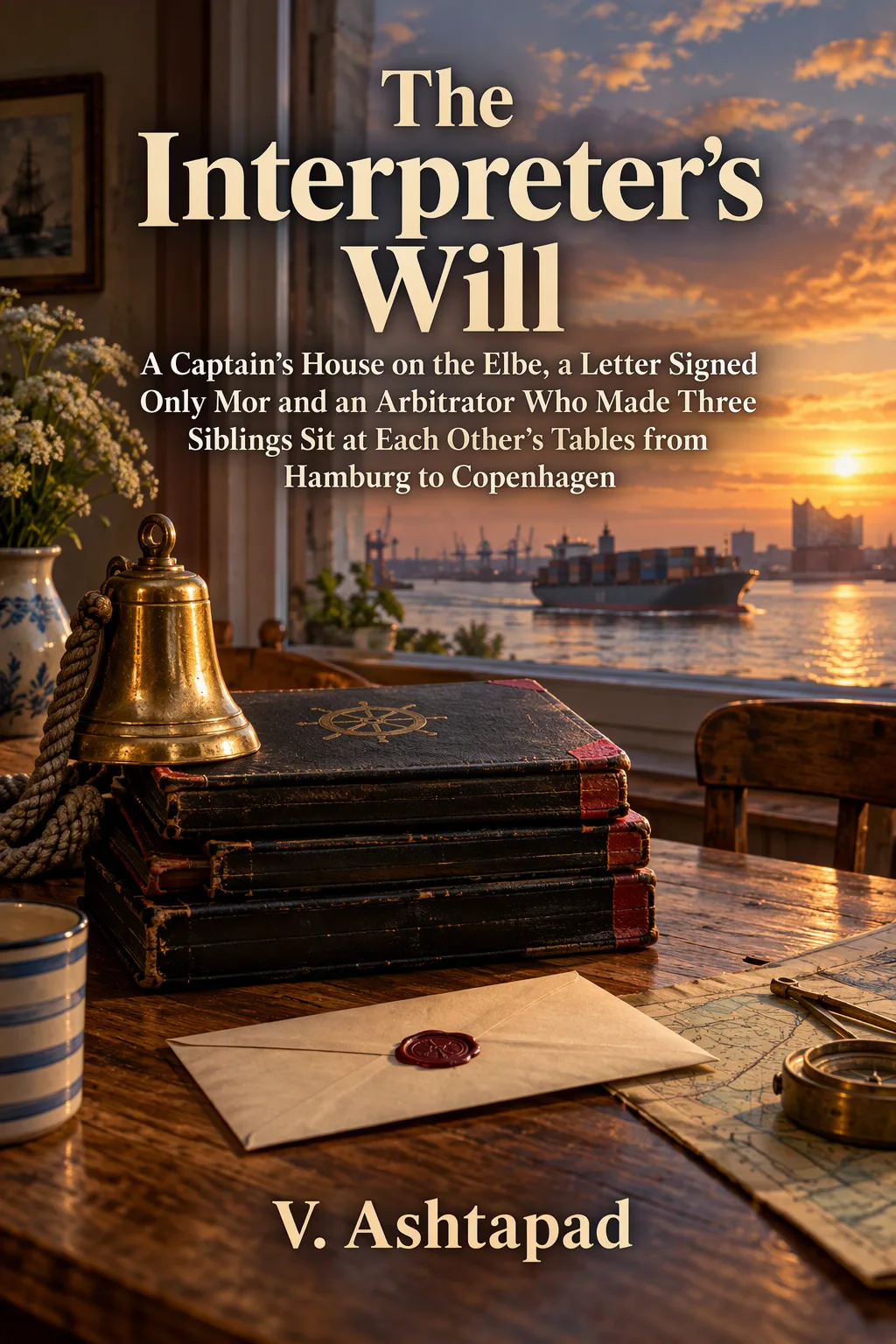
The Interpreter's Will
A Captain's House on the Elbe, a Letter Signed Only Mor and an Arbitrator Who Made Three Siblings Sit at Each Other's Tables from Hamburg to Copenhagen
by V. Ashtapad
Foreword
This is a work of fiction. German law really does let a person name an arbitrator in her will to settle her heirs' disputes, and the Elbe pilots of Hamburg, the tugboat crews of Rotterdam, the coffeehouses and wine taverns of Vienna, the cheese dumplings of Liechtenstein and the year-round harbor swimmers of Copenhagen are real. The Hartmann family, the house at Övelgönne, the Café Lindhuber, the Bakker lunchroom, the tribunal and everyone in this book are invented.
For everyone who waited for the end of the sentence.
Hamburg: Room 217
Every room has a pitch. People think that is a thing piano tuners say to sound mysterious, but it is only physics. Air in a box rings at the frequency the box allows, and if you stand quietly enough you can hear it under the ventilation and the footsteps and the coughing. Room 217 of the Hamburg Regional Court rang at something near a low A flat, a little sour, the way a hall sounds when it has been painted too many times.
I stood in the doorway and listened to it because I did not want to look at my brother and my sister.
It was Thursday, the twenty-first of May, 2026, a quarter to ten in the morning. Outside, the plane trees along the Sievekingplatz were throwing light around the way plane trees do in May, as if they had just been given it and could not decide where to put it. Inside, the room had pale wood benches, a long raised bench for the judges with three empty chairs behind it, a coat of arms on the wall, a clock that ran four minutes fast, and two tables facing the bench, one on the left and one on the right.
At the table on the left sat my brother, Matthias Hartmann, fifty-five years old, tug captain in the port of Rotterdam, in a dark blue suit that somebody else had chosen for him. He had our father's shoulders and our mother's way of sitting with his hands folded flat, one on top of the other, as if he were keeping something warm. Beside him sat his lawyer, a tall Dutchman with a white beard trimmed close and reading glasses pushed up into his hair.
At the table on the right sat my sister, Anke Hartmann, fifty-seven, harbor pilot, in a gray jacket with the sleeves pushed up to her elbows. She had come straight from a night shift. I could tell because she had the pilot's look, the look of someone who has spent hours on a bridge wing in the dark watching a three-hundred-meter ship go exactly where she told it. Beside her sat her lawyer, a woman about my own daughter's age plus twenty-six years, with short hair the color of wet sand and a fountain pen she kept capping and uncapping.
And I sat on the public bench behind both of them, in the second row, because I was not a party to anything. I was only the youngest. Lena Gruber, born Hartmann, fifty-one, piano technician, of Vienna.
Our mother had been dead for fifteen weeks.
---
The judges came in at ten by the real time, which was four past by the clock. Three of them in black robes with velvet facings: a presiding judge with silver hair cut short and two younger associates, a man and a woman, carrying files. Everyone stood. Everyone sat. The presiding judge put on her glasses, looked down at the file, looked up at the two tables, and then, surprisingly, looked at me.
"And you are?" she said.
"The sister," I said. "The other sister."
"You are named in the will?"
"Yes."
"But not a party to this action."
"No. Nobody asked me."
There was a small sound from the Dutchman that might have been a laugh. The presiding judge wrote something down.
"Very well," she said. "My name is Brandes. I preside over this civil chamber. We are here in the matter of Hartmann against Hartmann. The claimant, Mr. Matthias Hartmann, represented by Mr. de Wit, asks this court to declare that a handwritten letter by the late Ilse Hartmann, dated the fourteenth of August, 2025, at Copenhagen, is a valid addition to her will, with the result that the house at Övelgönne passes to him. The defendant, Ms. Anke Hartmann, represented by Dr. Voss, contests the letter. Before we go to the substance, Dr. Voss, I understand you have raised an objection."
The lawyer with the sand-colored hair stood. She capped the pen.
"Yes, Your Honor. The defendant objects that this court has no jurisdiction to hear the matter. The will of the late Mrs. Hartmann, dated the third of June, 2019, and held in the official custody of the probate court here in Hamburg, contains an arbitration clause. All disputes among her children concerning the will, and, I quote, anything I write after it, are to be decided by a named arbitrator. Under the Code of Civil Procedure a testator may order exactly that. Where such a clause exists and the defendant raises it before arguing the merits, this court must find the action inadmissible."
"Mr. de Wit?"
The Dutchman stood up and pulled his glasses down out of his hair, which took a moment.
"Your Honor, my client does not dispute that the clause exists. He disputes that it is sensible."
"That is not a ground I can apply."
"I know. I wanted it in the record." He looked down at his file and then up again, and his voice changed, became plainer. "We filed here because my client hoped a German court would settle this quickly and without anybody having to sit at anybody's table. That is his honest reason. He would like it noted that he tried."
"It is noted," said Judge Brandes.
She took a sheet of paper from the file. I knew which sheet it was. I had a photocopy of it in my handbag, folded in four, worn soft at the folds from fifteen weeks of being taken out and put back.
"I will read the clause into the record," said the judge, "because I think everyone here should hear it read by someone who is not related to the person who wrote it."
She read it slowly and well. She had a good voice for reading, low and unhurried.
"Should my children disagree about anything in this will or anything I write after it, no court shall decide. Alois Frick of Vaduz shall decide as sole arbitrator. He shall hear each of them at his or her own table, in the city where each of them lives, and all three shall be present at every hearing. Every witness shall speak in the language of their kitchen, and someone shall interpret, so that everyone speaks slowly enough to be heard. I was an interpreter for forty years. I know what I am asking."
She put the sheet down.
Nobody in Room 217 moved. The ventilation hummed its sour A flat. My sister was looking straight ahead at the coat of arms. My brother had unfolded his hands and was looking at them.
"Your mother," said Judge Brandes, "was Ilse Hartmann, née Thorsen."
"Yes," said Anke and Matthias together. It was the first word I had heard them say at the same time in twenty-two years.
"She interpreted in this building."
"From 1971 to 2011," said Anke.
"I know. I was a junior judge in 1999. She interpreted for me in a shipping case, a Danish engineer who would not stop talking." The judge took off her glasses. "She stood up in the middle of his testimony and told me, very politely, that the witness was speaking too fast for anyone to understand him in any language, including his own, and that she would wait until he slowed down. He slowed down. I have never forgotten it."
She put her glasses back on.
"The objection is well founded. The court has no discretion. The action is dismissed as inadmissible. The claimant bears the costs. The parties are referred to the arbitrator named in the will." She closed the file. "I wish you all a good deal of patience. It seems you are going to need it."
---
Outside, on the stone steps under the plane trees, the four of them stood in two pairs, three meters apart, the way people stand at a bus stop when they have all just been told the bus is not coming.
I stood between them, because that is where I have always stood.
"Well," said Mr. de Wit, to nobody in particular. "That was very efficient."
"You knew it would go that way," said Dr. Voss.
"Of course I knew. Everybody knew. My client wanted to try." He held out his hand to her. "Bram de Wit. We will be seeing a great deal of each other, I think. We should be friends."
She shook it. "Henrike Voss. We should be adversaries, Mr. de Wit. That is what my client is paying me for."
"In Rotterdam we manage to be both."
"In Hamburg we prefer to keep them in separate drawers."
My brother was lighting a cigarette. He had stopped smoking in 2009. I knew that because Sanne, his wife, had told me on the phone that year, the only time she and I had ever talked without him in the room. He saw me looking and said, "Don't."
"I didn't say anything."
"You were going to."
"I was going to say Mama kept an ashtray for you in the kitchen drawer. The green glass one. It's still there."
He looked at the cigarette, and then at me, and then he put it out against the stone balustrade, very carefully, and put the stub in his jacket pocket.
"How do you know it's still there?" he said.
"Because I looked. In February. After the funeral. You didn't come to the house."
"No."
"Anke made soup. There was enough for thirty people. There were nine of us."
Across the three meters of stone, my sister said, "It was lentil. It froze well. I ate it until April."
It was the first thing she had said to him directly in fifteen weeks, and it was not even to him. It was to the air beside him. But he heard it. I watched him hear it. He turned his head a few degrees toward her and then turned it back.
"Vaduz," said Mr. de Wit, putting his glasses back up into his hair. "Has anyone here been to Vaduz?"
"Our mother had," said Anke.
"Then you will have to tell us about it on the train," said Mr. de Wit cheerfully, and Dr. Voss closed her eyes for a moment, as if she were already counting the hours.
---
I walked down to the harbor afterward on my own. I had a train to Vienna at four. I had a Bösendorfer in Döbling to regulate on Friday and an old Förster upright in a school in Favoriten on Saturday, and a husband who had texted me nine times since breakfast to ask how it was going, each text a little more Viennese than the last, until the ninth just said: Catastrophe? Yes or no.
I wrote back: Not a catastrophe. A referral. To Liechtenstein.
He wrote back: That is worse. I have never met anyone from Liechtenstein. Is it even real?
I sat on the steps at the Landungsbrücken, where the ferries come in, and ate a fish sandwich, herring with onions on a soft white roll, because that is what you do at the Landungsbrücken whether you are hungry or not. The Elbe was brown and fast and full of light. A container ship as long as a street was sliding past toward the sea, its hull a wall of red and blue boxes, and two tugs were working it off the quay, one pushing, one pulling, their wakes crossing and recrossing behind them.
Our father had driven a tug like that for thirty-four years. Matthias had driven one with him for eleven. Anke now climbed up the sides of ships like that one on a rope ladder in the middle of the night and told their captains where to go.
I tune pianos. I have always been the one in the family who works indoors.
I took the photocopy out of my bag and unfolded it. Not the clause. The other page, the one that had started all of this, the letter Anke found in our mother's last logbook in March and carried, without a word to either of us, straight to the probate court, because the law says you must, and Anke has never in her life not done what the law says.
I had read it perhaps two hundred times. I read it again, on the steps, with the herring in my other hand and the gulls watching the herring.
Copenhagen, 14 August 2025.
My three,
I have been thinking about the house for a year and here is my last word on it. The house at Övelgönne shall go to Matthias. Not because Anke has not earned it. She has earned it ten times over, and she knows it, and she will be angry, and she is allowed to be. It shall go to Matthias because his father's name is on the door and his father's bell is in the hall and he has not walked through that door in twenty-one years. A house cannot wait forever for someone. Neither can I.
Everything else stays as I wrote it in 2019.
Mor
That was all. Three short paragraphs in my mother's small upright hand, every line as level as a ruled rail, in blue ink, on a page torn from the back of a lined notebook. And at the bottom, not her name, not Ilse Hartmann, not even Mama, which is what the three of us called her in Hamburg, but the Danish word, Mor, the word she used only when she was very tender or very angry, three letters with a little flick on the r and a single straight line drawn under them.
Anke's lawyer said a signature like that was not a signature. Matthias's lawyer said the law did not care what you signed as long as everyone knew who you were. Anke said our mother had been forgetting the names of streets by then. Matthias said nothing at all. He had flown in from Rotterdam for a hearing he knew he would lose, and lost it, and lit a cigarette, and put it out.
And our mother, who had spent forty years in rooms like Room 217 making sure that every person in them was understood, had arranged from beyond the grave for her three children to be sent to a man in Vaduz who would make us sit at one another's tables.
I folded the letter back into four. A gull came down on the step beside me and looked at the roll.
"No," I told it, in German, and then, because the gull did not seem convinced, in Danish, which our mother would have found funny. The gull left. I finished the roll. The tugs had the ship off the quay now and were walking it down the river toward the sea, one at the bow and one at the stern, slow and patient, two small boats moving one enormous one by never letting go of it.
© 2026 CRUNOD LLC. All rights reserved.
Hamburg: What the Letter Said
I should explain about the logbooks, because without the logbooks none of it makes sense.
Our father, Karl Hartmann, kept a log the way every captain keeps a log: the date, the time, the wind, the tide, the vessel assisted, the berth, anything unusual. He kept it for the tug company because he had to. And when he married our mother in 1968, on a gray day in Copenhagen in front of nine guests and a registrar with a cold, he gave her a logbook of her own as a wedding present. A real one, bound in black cloth with red corners, with columns ruled for wind and tide.
"For the house," he told her. "Every ship needs one."
She was twenty-two. She had just moved to Hamburg to a pilot's house on the Elbe that had belonged to the Hartmanns since 1897, a narrow brick house with white windows and a green door in a row of narrow brick houses along a footpath at Övelgönne, with the river thirty steps from the front gate and the big ships going past so close that the glasses shook in the cupboard. She did not know anyone. She spoke German well and Hamburg not at all.
So she kept the log. For fifty-eight years. She wrote in German and in Danish and occasionally, when she had been working all day in a Dutch shipping case, in Dutch, and sometimes in all three on one page, depending on which language the thought had arrived in. She did not keep it like a diary. She kept it like a log. The date, the weather, the river. Who came to the house. What was eaten. What was said. She was an interpreter, and an interpreter writes down what was said, not what she thought about it.
Most of the time.
By the end there were fifty-two of them on the shelf in the hall under the bell from our father's old tug, all bound in black cloth with red corners, because after the first one she bought them herself from the same stationer in the Grosse Bleichen until the stationer closed in 2012, and then she bought a box of forty from the stationer's widow, enough, she said, for the rest of her life and a little after.
She had used twelve of them.
---
Our mother died on Monday, the second of February, in the hospital in Altona, of pneumonia on top of the slow failing of a heart that had been, her doctor said, simply worn out from beating. She was seventy-nine. Anke was with her. Anke had been with her for six years by then, since she moved back into the house in 2020 when our mother fell on the stairs and broke her wrist and forgot, for the first time, the word for wrist in all three of her languages.
I came from Vienna on the Tuesday. Matthias came from Rotterdam on the Thursday. The funeral was on Friday the thirteenth, which our mother would have enjoyed; she collected bad omens the way some people collect thimbles, and laughed at all of them.
Matthias came to the funeral. He stood at the back. He did not come to the house afterward for the soup.
The probate court opened the 2019 will in March. Anke had always known what was in it, because our mother had read it to her at the kitchen table on the day she wrote it, and Anke had told me, and I had never told Matthias, because Matthias and I talked twice a year about the weather in our respective cities. The house to Anke. The savings, about a hundred and eighty thousand euros after forty years of a court interpreter's salary and a tug captain's pension, in three equal parts. Our father's tug bell to Matthias. The logbooks to "whichever of my children reads every one of them." And the clause about Alois Frick of Vaduz and the tables.
We had all three laughed about the clause, back in 2019, when Anke told me. I remember laughing on the phone in my kitchen in Vienna with a set of hammer shanks soaking in the sink.
"She's making sure we never fight," I said.
"She's making sure that if we fight, it costs us three train tickets each," said Anke. "That's a different thing."
Then, on Saturday the twenty-first of March, Anke sat down in the hall of the house with the last logbook, number fifty-two, because she could not bear to read it and could not bear not to. And a folded sheet of lined paper fell out from between the last written page and the first blank one.
She read it standing up. Then she sat down on the stairs. Then she called me.
"She's given the house to Matthias," she said.
I was at the time in a church hall in Ottakring with my arm inside a grand piano up to the shoulder, so I said something that does not need to go in this account.
"In a letter," said Anke. "In Copenhagen. In August. At Birthe's, it must be. She signed it Mor."
"Read it to me."
She read it to me. She read it in a flat, careful pilot's voice, the voice she uses on the radio to the bridge of a ship, every word separate. When she got to she will be angry, and she is allowed to be, her voice did not change at all, and that was how I knew how angry she was.
"What are you going to do?" I said.
"Take it to the court on Monday," said Anke. "You have to. If you find a will, you have to hand it in. It's the law."
"Is it a will?"
"I don't know. That's not for me to decide. That's why you hand it in."
"You could—" I said, and stopped, because I did not know what I was going to say. You could put it back in the book. You could pretend it fell out somewhere else. You could burn it in the stove in the kitchen that Mama never let anyone replace.
"I could what?" said Anke.
"Nothing. You couldn't. I know."
"No," she said. "I couldn't."
On Monday the twenty-third of March she took it to the probate court in a clear plastic sleeve, and a clerk stamped it, and it was copied and sent to all three of us, and in April a lawyer in Rotterdam named Bram de Wit filed a suit in the Hamburg Regional Court on behalf of my brother, and in May a judge who had once been told by our mother to slow down a Danish engineer sent us all to Liechtenstein.
---
That evening, on the train home, somewhere between Hanover and Würzburg, with the fields going purple outside and a man across the aisle eating a sausage from a paper bag, I took out my phone and wrote to my brother. Not a text. An email, because I wanted to be able to write it more than once before sending it.
I wrote: Why do you want it?
I changed nothing. I sat looking at those four words for an hour. Then I sent them.
He wrote back at eleven-forty at night, when I was in a taxi from the Westbahnhof with my overnight bag on my knees and the Gürtel lights going past.
He wrote: I don't. I want to know if she meant it.
I read it twice. Then I wrote: And if she did?
He did not answer that one. Not that night, and not for a long time.
---
Florian was waiting up for me, of course. He had made Kaiserschmarrn, which is what he makes when he does not know what else to do, a big torn pancake with raisins, fried in butter in the iron pan and dusted with sugar, with plum compote from his mother's jars on the side. It was midnight. He put it on the table in front of me with a fork and a glass of water and sat down across from me in his waiter's shirt with the sleeves rolled up, because he had come straight from the café and not changed.
"Eat," he said. "Then tell me. Then we will go to bed and you will lie awake and I will pretend to sleep."
So I ate, and then I told him.
Florian has been head waiter at the Café Lindhuber on the Neustiftgasse for twenty-nine years. He is fifty-four. He has the Viennese gift, which is to treat every disaster as a small personal insult and every small personal insult as a disaster, so that in the end everything comes out about level. He listened to all of it, the judge, the clause, the steps, the cigarette, the four words and the reply, with his chin on his fist and his eyes half-closed, the way he listens to a regular complaining that the Melange is not as hot as it was in 1998.
When I finished he said, "So. Your mother has organized a tour."
"A tour?"
"Hamburg, Rotterdam, Vienna. Liechtenstein, for the headquarters. Copenhagen, I suppose, eventually, because of the aunt. Five cities. Everybody visits everybody. Everybody sits at everybody's table. Everybody eats everybody's food." He pushed the compote toward me. "It is a family reunion, Lena. With a judge, so nobody can leave early."
"It's a lawsuit."
"In Vienna we would call that a family reunion."
I laughed, for the first time in fifteen weeks. It came out wrong, like a note on a piano with a cracked soundboard, but it came out.
"She was very clever, your mother," said Florian. "I always said so. I was afraid of her for eleven years."
"You were never afraid of anyone."
"I was afraid of her. At our wedding she watched me carry six plates on one arm and said, in that voice, Very impressive, Florian, now let's see how you carry the seventh." He shook his head. "I have never found out what the seventh plate was. I think about it every day at work."
He took my empty plate, stacked it on his forearm out of habit, and carried it to the sink.
© 2026 CRUNOD LLC. All rights reserved.
Vaduz: The Rules of the Table
You do not arrive in Liechtenstein so much as discover that you are already in it.
There is no airport. There is no train station in Vaduz. You take a train to Sargans, on the Swiss side, or to Feldkirch, on the Austrian side, and then you take a yellow bus along a valley road, and the Rhine is on one side, wide and pale green and fast, running between stone embankments, and the mountains are on the other side, very close and very steep, and somewhere along the way, without any fuss, the signs change and the houses look a little more prosperous and a little more particular, and there is a castle on a cliff above a small town, and that is Vaduz.
It was Friday, the third of July. I had come from Vienna by the night train to Feldkirch and then the bus, with a thermos of Florian's coffee and a bag of apricots from the Naschmarkt. Anke and Dr. Voss had come from Hamburg by way of Zurich and Sargans. Matthias and Mr. de Wit had driven from Rotterdam, nine hours, because, Mr. de Wit said, a Dutchman in a car is a free man and a Dutchman on a Swiss train is a prisoner of punctuality.
We met at the bus stop in the center of town at nine-fifteen, all of us early, all of us pretending not to have been early.
Alois Frick's house was a twenty-minute walk uphill from the center, on a narrow road that wound up between gardens and then between rows of vines. It was already warm. The vines were in full leaf, bright green, with small hard clusters of grapes the size of peppercorns hanging under the leaves, and the earth between the rows was pale and stony. Below us the town spread out along the valley, a few hundred roofs, a white church spire, the long low government buildings. Across the Rhine, Switzerland went up into the sky in a wall of gray and green.
"Is it always this tidy?" said Mr. de Wit, stopping to breathe.
"Yes," said Dr. Voss, who was not breathing hard at all.
"How do you know?"
"I looked it up."
"You looked up whether a country is tidy?"
"I looked up the arbitrator. I like to know what kind of place produces a person."
The house was at the top of the vines. It was a white house with green shutters and a steep roof and a bench by the front door, and on the bench sat a small old man in a gray cardigan, reading a newspaper, with a pair of walking boots beside him and a straw hat on his knee. When he saw us coming up the last stretch of the road he folded the newspaper, put on the hat, stood up, and came down the path to the gate to meet us.
"Good," he said. "You all came."
He was seventy-six. I had looked it up too. Dr. Alois Frick, born 1950 in Vaduz, studied law in Innsbruck and Zurich, judge at the court in Vaduz for twenty-six years, then for fifteen years an arbitrator in shipping and trade disputes in Hamburg and London and Rotterdam, then retired to grow grapes. He was perhaps a head shorter than me. He had a long, mild, brown face with deep lines beside the mouth, as if he had spent a great many years trying not to smile at inappropriate moments, and very clear gray eyes.
He shook hands with each of us. He shook hands with Anke and held on a moment longer.
"You are the pilot," he said. "She talked about you. She said you could bring a ship into the Waltershof basin in fog with your eyes shut."
"Not with my eyes shut," said Anke.
"No. She said you would say that too."
He shook hands with Matthias and did not hold on longer. He only looked at him for a second, in a careful way, the way I look at a piano before I open the lid.
"Mr. Hartmann," he said.
"Dr. Frick."
"Alois, please. In this house I am only a judge from ten until one. After one I am a man who has made too much lunch." He turned to me. "And you are the one who listens for a living."
"I tune pianos."
"Yes. That is what I said."
---
He held the hearing in his kitchen.
He apologized for this. He said that strictly speaking a constituting hearing ought to be held at the seat of the arbitration, which, since the will was governed by German law and our mother had lived in Hamburg, was Hamburg, but that the seat of an arbitration is a legal idea and not a place, and that hearings could be held wherever was most convenient, and that it was most convenient for him to be at his own table, since he was seventy-six and his knees did not like trains.
"And also," he said, "I thought it fair. If you are all going to sit at each other's tables, you should first sit at mine. Then you will know how it is done."
The kitchen was big and low, with a wooden table that could seat twelve, scrubbed pale, with a jug of wild flowers in the middle and a woman's reading glasses folded beside it. There was an old green tile stove in one corner, cold for summer, and a window that looked straight down the vines to the valley. Copper pans hung from a rail. On the wall was a framed sheet of postage stamps, dozens of them, small and brilliant, mountains and flowers and paintings and old men in hats.
"My wife collects," said Alois, seeing me look. "I only frame. Rosmarie is at the market. She will be back for lunch. She has made me promise to have you finished by one."
He sat at the head of the table. He put Anke and Dr. Voss on his left and Matthias and Mr. de Wit on his right, facing them, and me at the foot, facing him, where I could see everybody. On the table in front of him there was a single blue folder, a fountain pen, a glass of water, and a small brass kitchen timer shaped like a beehive.
There was also an extra person, whom nobody had expected: a woman in her sixties with gray-blond hair tied back and a green linen dress, who came in from the garden with a notebook and sat down at Alois's elbow.
"This is Karin Holm," said Alois. "She will be the tribunal's interpreter."
"We all speak German," said Dr. Voss.
"Yes. And your mother wrote that every witness must speak the language of their kitchen and someone must interpret. I have read that sentence perhaps fifty times. I do not think it means only the witnesses who do not speak German. I think it means everybody." He looked at Karin. "Mrs. Holm worked with your mother for twenty-two years in the Hamburg courts. Danish, German, Dutch. Your mother trained her. Your mother also, I think, would have found it amusing that I hired her."
Karin Holm smiled at the three of us. "She called me her apprentice until I was fifty," she said. "I was very annoyed. I miss it."
Anke was looking at her hard. "You came to the funeral," she said. "You stood by the door."
"Yes. I didn't want to intrude."
"You should have come to the house. There was soup."
"Yes," said Karin. "I heard."
---
Then Alois picked up the brass beehive and turned it until it ticked.
"The rules," he said. "There are not many. Mr. de Wit and Dr. Voss know the formal ones, and I will put those in a procedural order and send it to everybody, and it will be very dull. These are the other rules. They are your mother's, mostly. I have only written them down."
He held up one finger.
"First. Nobody speaks over anybody. Not counsel, not parties, not witnesses, not me. If you interrupt, you buy lunch for the tribunal. I am serious. I have a good appetite and so does Mrs. Holm."
"How do we object, then?" said Mr. de Wit.
"You raise your hand and wait until the person has finished their sentence. Then I will hear you. A sentence, Mr. de Wit, not a paragraph. I am not unreasonable."
He held up two fingers.
"Second. Every hearing is held at the table of the person whose city it is. Hamburg, Anke's table, at the house. Rotterdam, Matthias's table. Vienna, Lena's table. I have also decided, since the most important witness is eighty-four years old and lives in Copenhagen, that she will be heard at her own table, and that we will all go there."
"Birthe," said Matthias. It was the first word he had spoken since he sat down.
"Birthe Thorsen. Your mother's sister. Yes. I have written to her. She wrote back. I will read you her reply." He opened the blue folder and took out a postcard of a yellow house by a canal. He read the back of it aloud. "Dear Judge. Fine. Come at the end of October, when the tourists have gone home. Bring the children. I will feed them. Don't let them bring flowers, I have nowhere to put them. Birthe."
Anke made a sound I had not heard her make since she was about fourteen. It was very nearly a laugh.
He held up three fingers.
"Third. All three of you are present at every hearing. All of it. Not counsel instead of you. You. That is not my rule. It is in the will. I know it is expensive and inconvenient and that one of you climbs ships at night and one of you drives tugs in shifts and one of you has a Bösendorfer in Döbling."
I stared at him. "How do you know about the Bösendorfer?"
"Your husband wrote to me. He wanted to know if Liechtenstein was real." He did not smile. "I assured him it was."
He held up four fingers.
"Fourth. When a witness is speaking, you listen. You do not take notes while they speak, except counsel, who must. You do not look at your phones. You do not look at each other to see how the other one is taking it. You look at the person speaking. Your mother wrote to me once, many years ago, after a very bad day in a very bad case in Hamburg, that most of the cruelty she had seen in courtrooms came from people waiting for their turn to talk. I would like to see if we can avoid that."
He put the beehive down. It ticked on the scrubbed wood.
"And fifth," he said. "And then we will talk about schedules, and then we will have lunch. At the end, when every witness has been heard and every argument made, I will decide. I will decide according to the law, because that is my job and because your mother would not have chosen me if she wanted anything else. I will not decide according to who is nicest, or who cried, or who has the most beautiful kitchen. But I will also not decide until I have heard everything. Not most things. Everything. So if there is something you are not saying, I would be grateful if you said it eventually. Before Copenhagen, ideally. Birthe Thorsen is eighty-four and I do not think she will want us to come back."
He looked around the table, at each of us in turn, and then at the timer.
"Are those rules acceptable to everybody?"
"Yes," said Dr. Voss, after a moment.
"Yes," said Mr. de Wit. "With one question. What happens if you interrupt?"
"Then I buy lunch," said Alois Frick. "It has not happened yet. I have been doing this for forty-one years."
© 2026 CRUNOD LLC. All rights reserved.
Vaduz: The Envelope
There was one more thing before lunch, and it came out of the blue folder last, and it was thick.
It was a large brown envelope, the padded kind you send books in, sealed with brown tape, and on the front, in my mother's hand, in blue ink, it said: For Alois. To be opened when the last of them has been heard. You will know when.
He laid it on the table in front of him, on top of the folder, and folded his hands on it.
"I must disclose this," he said. "Your mother sent it to me by post from Copenhagen. It arrived on the twentieth of August last year. There was a covering note, which I will read to you, and which I will give to both counsel in copy. The envelope itself I have not opened."
He read the note. It was short.
Dear Alois, I am sending you this because you are the only person I know who will not open it before he is supposed to. It is not a will. There is nothing in it about the house or the money or anything else that a court would care about. It is one of my logbooks and a letter. If my children ever come to you, keep it until they have all been heard, and then open it in front of them. If they never come to you, burn it in your tile stove one cold night and drink a glass of your terrible wine for me. Ilse.
Nobody laughed at the terrible wine, though I think Alois wanted somebody to.
Dr. Voss had her hand up before he finished. She had it up at the elbow, very straight, the way a girl at a good school holds it up. Alois finished, and laid the note down, and nodded to her.
"With respect," she said. "The tribunal cannot hold a document from the testator that the parties have not seen. If it is relevant, we have a right to it now. If it contains anything testamentary, it must by law go to the probate court, not stay in a farmhouse in Liechtenstein."
"It is not a farmhouse," said Alois mildly. "We have vines. It is a different thing. But your point is a good one." He turned. "Mr. de Wit?"
"I agree with my colleague," said Mr. de Wit. "That doesn't happen often, so I'd like it in the record also. But I'll add one thing. If it is a logbook, then it's part of the estate. The logbooks are left to whichever of the three reads every one. Somebody can't read every one if one of them is sitting in your folder."
There was a silence. I was looking at the envelope. It was about the size and thickness of a book. Of one book. Bound in black cloth, I thought, with red corners.
"Which logbook?" I said.
Everyone looked at me.
"Sorry," I said. "I know I'm not a party. But which one?"
"I don't know," said Alois. "It is sealed. I have not opened it."
"There are fifty-two on the shelf in the hall," said Anke. "There have always been fifty-two. I've dusted them every Saturday for six years. She was writing in number fifty-two when she went into the hospital."
"Then perhaps there were fifty-three," said Alois. "Or perhaps one of the fifty-two on the shelf is not what it says on the spine. I don't know. I would like to propose something, and if all three of you and both counsel agree, I will put it in the procedural order. If you don't, I will rule on it, and you can be angry with me instead of with each other, which may be useful."
He put his hand flat on the envelope.
"I propose that it stays sealed until the end, as she asked. Not because she asked, but because she has told us it contains nothing about property, and because opening a sealed letter from your mother in the middle of a dispute about her house seems to me a bad idea for everybody. At the end, before I make any award, I open it here or wherever we are, in front of all of you. If there is anything in it that a court would care about, it goes that same day to the probate court in Hamburg, and I will drive it there myself, though my knees will complain. And the logbook in it, if there is one, will count as one of the logbooks for the purposes of the will."
Dr. Voss looked at Anke. Anke was looking at the envelope.
"I'd want it sealed in front of us," said Dr. Voss. "Again. Now. With our signatures across the tape."
"Good," said Alois, and took a roll of brown tape out of the kitchen drawer, as if he had known all along that someone would ask, and we each signed across it in turn, Anke first in her square pilot's capitals, then Matthias in a quick slanting scrawl like our father's, then the two lawyers, then Karin Holm, then, because Alois pushed the pen down the table to me, I signed too. Lena Gruber. I had to press hard for the pen to take on the tape.
Then he put the envelope back in the blue folder, and the blue folder in the drawer under the table, and the beehive went off with a little rattling ring, and he looked at it and said, "One o'clock. Good. Rosmarie will be pleased."
---
Rosmarie Frick came in through the garden door as if she had been waiting behind it, which I expect she had. She was a tall, broad, gray-haired woman of seventy-four with a market basket on each arm and a laugh that started before she was through the door.
"Has he made his speech about the rules?" she said. "Did he do the fingers? He always does the fingers."
"He did the fingers," said Mr. de Wit.
"Five?"
"Five."
"Then he likes you. When he doesn't like people he only does three."
She made us Käsknöpfle. She made it in front of us, at the stove, while we sat at the scrubbed table, and nobody was a party or a lawyer or a judge while she did it. She beat flour and eggs and water and salt together in a big bowl with a wooden spoon until the dough was smooth and stretchy and blistered with air, and then she pressed it through a perforated board into a pot of boiling salted water, a little at a time, so that small soft dumplings fell into the water and rose to the top, and she skimmed them out with a slotted spoon into a warm dish and layered them with grated cheese, two kinds, a sharp mountain one and a soft sour one from the valley, layer after layer, dumplings and cheese and dumplings and cheese, until the dish was full and the cheese was melting into threads. Then she fried onions in butter in a black pan until they were brown and sweet and crisp at the edges and piled them on top.
"Apple sauce," she said, putting a bowl of it beside the dish. "On the side. Not on top. Alois puts it on top. He was raised badly."
"I was raised in Vaduz," said Alois.
"That is what I said."
We ate. Anke ate two helpings without speaking, which for Anke is an essay of praise. Mr. de Wit ate three and asked for the recipe, and Rosmarie told him it had no recipe, you just did it until it was right, and he said that was the most Liechtenstein thing he had ever heard. Matthias ate slowly, and I saw him put a spoonful of apple sauce on top, not on the side, and catch Alois's eye, and Alois raise his glass to him very slightly.
The wine was from the vines outside the window. It was a pale red, thin and sour and cold.
"It is terrible," said Alois, pouring Matthias a second glass. "Your mother was right. I make it anyway. A man should make something he is bad at, so he remembers how other people feel."
---
After lunch, while the lawyers went over dates with Karin at the end of the table and Rosmarie made coffee, Alois took his straw hat and asked if anybody wanted to walk in the vines. Matthias and I went. Anke stayed. I saw her look at the drawer under the table where the envelope was.
We walked down between two rows, in the green shade of the leaves. It smelled of hot earth and sulfur, the yellow powder Alois dusted on the vines against mildew. He stopped now and then and turned a leaf over to look at the underside, or pinched off a shoot.
"How did you know her?" said Matthias.
"Hamburg, 1988. A Danish shipowner and a Dutch charterer and a cargo of frozen fish that arrived not frozen. Very boring. Four weeks. She interpreted the Danish witnesses and I was the third arbitrator, the one in the middle, the one who has to make the other two agree." He turned a leaf. "On the second day, the Dutch counsel interrupted the Danish captain eleven times in one hour. I counted. On the twelfth time your mother stopped interpreting. She just stopped. She folded her hands on the table and looked at the Dutch counsel until he stopped talking. And then she said, Shall I interpret what he said, or what you said over him? Because I can't do both, and neither can anyone else in this room."
Matthias laughed. It was a short, startled sound, and he looked surprised to have made it.
"That sounds like her," he said.
"Yes. After the case was over, we had dinner, she and I and two other arbitrators, and she told me that most people do not want to be agreed with. They want to be heard to the end. She said if you let a person finish, all the way to the end of what they were going to say, half the time they talk themselves round to the other side on their own." He pinched off a shoot and dropped it at the foot of the vine. "I have used that for thirty-eight years. I have never told anybody where I got it."
We walked on a little.
"Why you?" said Matthias. "Why did she pick you? She knew dozens of judges."
Alois stopped. He took off his hat and looked at the inside of it, as if the answer were written in the band.
"She asked me that too," he said. "In 2019, on the telephone, before she wrote the will. She asked if I would do it. I said, why me, Ilse? I am retired. I grow sour grapes. And she said, Because you are the only judge I ever worked with who never once finished someone else's sentence for them." He put the hat back on. "I said that was not much of a qualification. She said, Alois, for my children, it is the only one that matters."
He looked at Matthias, and then at me.
"So," he said. "I am told I am a qualified person. Let us see if she was right."
Down in the valley the church bell rang two. Somewhere on the Swiss side a train went along the river, small as a toy, silver in the sun. Matthias stood between the vines with his hands in his jacket pockets, and I saw his fingers move inside the right pocket, turning something over, and I knew it was the cigarette stub from the steps in Hamburg, six weeks ago, that he had never thrown away.
© 2026 CRUNOD LLC. All rights reserved.
Vienna: Fifty-One Logbooks
Anke scanned them.
I did not ask her to. Nobody asked her to. Procedural Order Number One, which arrived from Vaduz on the tenth of July, eleven pages long and as dull as Alois had promised, said in paragraph fourteen that the logbooks were to remain in the custody of Ms. Anke Hartmann at the house at Övelgönne, that each party was to have reasonable access to them, and that copies might be made at the expense of the party requesting them. Nobody requested them. And on the eighteenth of July a link arrived in my email from my sister, with no message, only a subject line: Logbooks 1 to 52 (51).
She had scanned every page. On the copier at the pilot station at Seemannshöft, she told me later, between ships, at night, over three weeks. Nine thousand four hundred pages. Every page numbered in the corner in pencil first, in her square capitals, so that if a page stuck to another one she would know.
Fifty-one, because one of the fifty-two on the shelf, when she took it down, turned out not to be a logbook at all.
It was number thirty-seven. The spine said 37 in our mother's white ink, like all the others, and the cloth was black and the corners were red. But when Anke opened it, it was empty. Every page blank, ruled, never written on. One of the stationer's widow's forty, with a number painted on the spine to fill a gap on the shelf.
Thirty-seven ran from September 2003 to December 2004. I did not need to check. I knew what year it was.
---
I read them on the balcony.
Our flat is on the fourth floor of an old building on the Kaiserstrasse in the seventh district, with tall windows and a balcony the width of a bathtub, looking down into a courtyard with a chestnut tree. In July the chestnut is so full of leaves that you cannot see the other side of the courtyard, only green, and the balcony is like a nest. I sat out there every evening that summer, after work, with the tablet on my knees and a glass of white wine and water, the summer drink the Viennese make by cutting cheap wine with soda until it is barely wine at all, and read my mother.
I read them in order. Number one, 1968. The first entry, in Danish, in a younger, rounder hand: 4 October. Wind west, strong. River very gray. K. on night shift. The house is cold and smells of his grandmother. I have scrubbed the kitchen twice. I do not know where anything is kept, including myself.
I had to put the tablet down after that one and look at the chestnut tree for a while.
She wrote the way an interpreter writes. Short. Exact. What was said, in the language it was said in. Our father appeared on every page and almost never said anything worth writing down except about the river. K.: East wind tomorrow. K.: The Holländer at berth four has a captain who cannot steer. K.: Your coffee is too strong. K.: No, it isn't. She wrote down what ships went past. She wrote down what she cooked, and when it went wrong. Labskaus, first attempt. K. ate it. K. would eat a tarred rope if it came with a fried egg on top. She wrote down which cases she had worked that day, never the names, only the languages and the length. Danish into German, nine hours, a dispute about herring. The judge thanked me. He has never thanked me before. Something is wrong with him.
Then Anke arrived, in number two, on the second of April 1969, at six in the morning: A girl. Large. Furious. Has K.'s chin and my opinion of everything.
And Matthias, in number three, on the twentieth of January 1971: A boy. Quiet. Looks at everything as if it might be a ship. K. cried. Do not tell him I wrote that down.
And me, in number six, on the fourteenth of March 1975: Lena. Small. Listened to the room for a long time before she cried. The midwife said she has never seen a baby do that. I said, she is deciding whether the room is worth crying in.
---
Florian came out onto the balcony one night in late July with two plates of cold Tafelspitz, the boiled beef sliced thin, with apple and horseradish sauce and chive sauce in little bowls and fried potatoes still warm from the pan, and found me crying over number nine.
"What has she said now?" he said, sitting down on the other chair, the one with the broken slat.
"Nothing. It's 1978. It's my third birthday. She's written down everything I said all day."
"What did you say?"
"I told the man at the bakery that his bread was out of tune."
Florian considered this, chewing.
"Well," he said. "Was it?"
I laughed and cried at the same time and nearly knocked the wine over.
Resi, our daughter, who is twenty and studying architecture at the Technical University and who lives with us still because rents in Vienna are a catastrophe, came out with her own plate and sat on the floor of the balcony with her back to the railing, because there were only two chairs.
"Read me one," she said. "One where Oma was cross."
So I went forward to number fourteen, 1983, the year Anke was fourteen and wanted to be a pilot like the men on the launches and our father told her girls could not be pilots and our mother wrote, in three languages on one page, what she thought of that.
I read it out, rendering the Danish and the Dutch into German for Resi, who has only school Danish, the way our mother would have, slowly.
K. says girls cannot be pilots. I said, which part of the job requires anything a girl does not have. He said, the ladder. I said, Karl, I have watched you go up that ladder for fifteen years and the ladder has never once asked you what you keep in your trousers. He laughed so much he had to sit on the stairs. Anke heard all of it from the landing. She will be a pilot now if it kills all three of us.
Resi laughed until she had to put her plate down. Florian laughed with his eyes closed, which is how he laughs at things he thinks are too good to watch.
"I should have met her more," said Resi when she stopped. "I only met her at Christmas. She always gave me socks."
"Everybody got socks," I said.
"Yes, but she always gave me two pairs that didn't match and said they were for listening in. I never knew what she meant."
I didn't either. I wrote it down in my own notebook, the little one I use for pianos, between a note about a Steinway's damper felts and the address of a school in Simmering.
---
There were things in the logbooks I did not understand.
Our mother wrote almost nothing that was not literal. But every September from 2008 onward there was an entry on the eleventh, and every one of them was the same shape, and every one of them was strange.
11 September 2008. D. Apple cake. He is one.
11 September 2009. D. Apple cake. He is walking. He walked to me.
11 September 2010. D. Apple cake, with cream this time. He is taller.
And so on, every year, D. Apple cake. He is taller. Sometimes a word more. He knows the word for gull. He beat me at cards. He asked me why I talk funny and I told him I talk three kinds of funny and he wanted to learn all of them. Then, in 2024: D. Apple cake. He is taller than me now. That is not difficult.
In 2025 there was no entry on the eleventh of September. There was one on the twelfth, in a shakier hand. Telephoned D. Could not go. Told her it is all arranged now and not to worry.
D., I thought. A woman, by 2025. A friend somewhere, a former colleague, with a son. Our mother had a great many friends none of us had ever met, from forty years of courtrooms. Interpreters, clerks, a ferry captain from Esbjerg. I made a note of the dates in my piano notebook and did not think about it again until September.
---
And then I came to number thirty-six, and the end of it, and the shelf where thirty-seven should have been.
Number thirty-six ran from May 2002 to August 2003. In it our father was alive. In it Matthias, thirty-one, then thirty-two, came to Sunday lunch at the house with his laundry and a girl from Rotterdam named Sanne who ate three helpings of our mother's red berry pudding with cream and said it was not quite as good as her own mother's vla, and our mother wrote: I like her. She lies badly. And in it Anke, newly qualified as a harbor pilot, the first woman in eleven years at Seemannshöft, brought home a ship's captain's thank-you note from a Danish container ship and our mother framed it and hung it in the hall beside the bell. And in it I telephoned from Vienna every second Sunday and talked about pianos, and our mother wrote: Lena talked about pianos. I did not understand any of it. I could listen to her for an hour.
The last entry in number thirty-six was 31 August 2003. Wind southwest, light. River brown. K. and M. both on day shift, Möwe, the Waltershof basin. Anke on a night. Lena on the telephone. Everybody where they should be. I cannot remember the last time I could write that. New book tomorrow.
And then nothing. Number thirty-seven blank. Number thirty-eight beginning in January 2005, in a hand that I would not have known was hers, small and pressed and tight, with no weather and no river at all, only: 3 January 2005. Back to work. Danish into German, six hours. I managed.
Sixteen months, missing. Our father's death, on Tuesday, the ninth of March 2004, at the wheel of the Möwe in the Waltershof basin, at fifty-nine minutes past eleven in the morning, of a heart that stopped. His funeral, a week later. Whatever happened at his funeral, between my mother and my brother, that sent Matthias back to Rotterdam that same night and kept him out of the house at Övelgönne for twenty-two years.
I had been there. I had turned twenty-nine two days before. I had stood in the second row, as I always do, and I had heard Anke give the eulogy, standing very straight, every word separate, in her radio voice. And afterward, at the house, there had been an argument in the kitchen. I had not heard it. I had been in the front room holding our great-aunt's hand, and I had heard only the kitchen door bang, and the front door after it, and then our mother standing in the hall, quite still, looking at the bell.
Nobody ever told me what was said. I never asked. I was the youngest, and I lived in Vienna, and I had a piano exam in four weeks, and when I came home at Christmas nobody mentioned Matthias, and the next Christmas nobody mentioned him either, and after a while the not-mentioning became a piece of furniture in the house, like the tile stove, something you walked around without seeing.
I sat on the balcony with the blank thirty-seven on the screen, page after page of ruled lines and no words, because Anke had scanned even those, every empty page numbered in pencil in the corner, and I thought about a thick brown envelope in a drawer under a kitchen table in Vaduz.
Then I wrote to my sister.
I wrote: You scanned the blank one.
She wrote back in four minutes. She was on a night shift; I could tell from the time.
She wrote: The order said all of them.
I wrote: Thank you. For doing it.
There was a long gap. A ship coming up the river, I thought. A ladder.
Then she wrote: Somebody has to read them all. It was never going to be me.
© 2026 CRUNOD LLC. All rights reserved.
Övelgönne: Anke's Table
The house had not changed, and that was the first thing that hurt.
On Thursday the thirteenth of August, at nine-forty in the morning, I came along the footpath from the ferry pier with the river on my left, wide and brown and glittering, and the row of little houses on my right behind their front gardens, hollyhocks and roses and hydrangeas gone blue from the iron in the soil, ship's figureheads and old anchors and lanterns on every gatepost the way there always had been, and there it was. Narrow brick. White windows. Green door. The brass plate beside the door that said K. HARTMANN and under it, smaller, added in 1971 when she got her certification, I. HARTMANN, INTERPRETER. Danish, German, Dutch.
Anke had polished the plate. It had always been her job.
Matthias was already there. He was standing on the footpath on the river side, opposite the gate, with his back to the river and his hands in his pockets, looking at the door. Mr. de Wit was standing a little way off, very carefully looking at a container ship.
I walked up and stood beside my brother. Neither of us said anything for long enough that a whole ship went past behind us, four hundred meters of it, and its wash came in a minute later and slapped along the sand of the beach below the footpath.
"Twenty-two years," he said.
"Twenty-two years and five months."
"You counted."
"Mama counted. It's in the logbooks. Every March."
He looked at me then.
"What does she write?"
"Just the number. Eighteen years. Nineteen years. Nothing else."
He looked back at the door. The green paint was new. The bell beside the door was the same old brass pull bell it had always been. Somewhere inside, I knew, on the wall of the hall above the shelf of logbooks, our father's ship's bell from the Möwe was hanging on its bracket where our mother had hung it in the summer of 2004, when the company scrapped the boat and gave her the bell.
"I can't," said Matthias.
"You have to. It's in the will. All three of us, at every hearing."
"I know what's in the will."
Behind us, on the river, a tug went past, pushing upstream with nothing in tow, bright red, its bow wave curling white. Matthias turned his head and watched it all the way past, the way he used to when he was a boy and every tug on the Elbe had a name he knew.
Then the green door opened, and Alois Frick put his head out, in his gray cardigan, with a coffee cup in his hand.
"Good," he said. "You all came. Your sister has made rolls with cinnamon. Come in before Mr. de Wit eats them."
And Matthias, because there was nothing else to do and because, I think, it is very hard to refuse a small old man in a cardigan, walked up the path, through the door, into the house.
He stopped in the hall. He did not look at the bell. He looked at the floor, at the old black-and-white tiles, at one particular tile near the foot of the stairs that had been cracked since 1979, when he dropped a ship's model on it at eight years old, and which our mother never let anyone replace because, she said, it was the only thing in the house he had ever broken.
He stood on it. I watched him find it with his foot without looking down.
---
The kitchen at Övelgönne is long and narrow and runs from the front of the house to the back, with a window at each end, the river in the front window and the little back garden with the washing line in the back one. The table is old pine, eight feet long, with our mother's chair at the river end, the one with arms, and five plain chairs. Anke had brought in two more from the front room and borrowed two from the neighbor, Mrs. Petersen, and there were cups and plates laid all the way down and a basket of Franzbrötchen in the middle, the flat curled Hamburg pastries, buttery and sticky with cinnamon and sugar, still warm, and a pot of coffee and a pot of tea, and Alois was sitting in a plain chair, not in our mother's chair, which stood empty at the end.
Anke stood by the stove with her arms folded.
"Sit down, Anke," said Alois. "It is your table. You should be at it."
"I'll stand."
"You may stand. But the witness sits. And you are the first witness."
So she sat. Not in our mother's chair. In the plain one next to it, with her back to the river.
Karin Holm sat at Alois's elbow with her notebook. The two lawyers took their places, Dr. Voss beside Anke, Mr. de Wit across from her, beside Matthias. I sat at the garden end, where I could see everyone and the river beyond them through the front window, the ships going past behind my sister's head all morning like the painted backdrop of a play nobody had told the ships they were in.
Alois turned the beehive until it ticked.
"Ms. Hartmann," he said. "You are heard as a party. You speak German in your kitchen?"
"German," said Anke. "And Danish when I'm angry. She did that too."
"Then Mrs. Holm will listen for both. Dr. Voss, she is yours."
---
From the record, Övelgönne, Thursday, 13 August 2026, morning session. Examination of Ms. Anke Hartmann by Dr. Voss.
VOSS: When did you move back into this house?
ANKE HARTMANN: April 2020. She fell on the stairs and broke her wrist. I came over from my flat in Ottensen to help for a week. I stayed six years.
VOSS: Why?
ANKE HARTMANN: Because she couldn't do the stairs. Because she started leaving the gas on. Because somebody had to.
VOSS: Did anyone else offer?
ANKE HARTMANN: Lena offered. Lena came for two weeks every summer and one week at Christmas and she paid for a woman to come in the mornings for two years, which I never asked her to do and which she never mentioned. Matthias sent money every month from 2021. I didn't know it was him. It came from a Dutch bank. I thought it was Mama's pension from somewhere.
(Mr. Hartmann looks up. The witness does not look at him.)
VOSS: Describe your mother's memory in the last two years of her life.
ANKE HARTMANN: She had good days and bad days. On good days she was exactly herself. She did the crossword in Danish and corrected the Danish crossword. On bad days she called me Birthe and asked where Karl was.
VOSS: How many bad days?
ANKE HARTMANN: By 2025, maybe two a week. Then more.
VOSS: In August 2025 she traveled to Copenhagen to her sister. Who arranged that?
ANKE HARTMANN: She did. She booked it herself on the telephone. She wouldn't let me come. She said I needed a holiday from her and she needed a holiday from me.
VOSS: Were you worried?
ANKE HARTMANN: I was terrified. I put her on the train at the Hauptbahnhof and Birthe met her in Copenhagen and called me. She was there eleven days. She called me every evening.
VOSS: Did she mention the house?
ANKE HARTMANN: No.
VOSS: Did she mention changing her will?
ANKE HARTMANN: No.
VOSS: Did she ever, at any time, in the six years you lived with her, say to you that she wanted Matthias to have the house?
(Long pause.)
ANKE HARTMANN: No. She said she wanted him to come home. That's not the same thing.
VOSS: When you found the letter in March, what did you think?
ANKE HARTMANN: I thought she'd written it on a bad day.
VOSS: Why?
ANKE HARTMANN: Because she promised me the house. In 2019, at this table. She read me the will. She said, it's yours, you're the one who stayed. She didn't break promises. Not on good days.
VOSS: And yet you took the letter to the probate court.
ANKE HARTMANN: Yes.
VOSS: Why?
ANKE HARTMANN: Because the law says you have to.
VOSS: Was that the only reason?
(Pause.)
ANKE HARTMANN: She'd have known if I hadn't.
---
Alois let the beehive tick for a moment after Dr. Voss sat back. Behind Anke's head, through the window, a white cruise ship was coming up the river with people waving from the decks, hundreds of tiny arms, and nobody in the kitchen waved back.
"Thank you," Alois said. "Mr. de Wit."
Mr. de Wit pulled his glasses down out of his hair. He did not stand up. He leaned forward with his arms on the table, as if he were about to ask Anke for the salt.
"Ms. Hartmann," he said. "I will be quick. I am Dutch. We are not good at long questions."
"Fine."
"You said your mother had good days and bad days."
"Yes."
"On the bad days, what did she write in the logbook?"
Anke blinked. It was the first question that had surprised her.
"She didn't. On bad days she didn't write anything. Or she wrote the date and the weather and stopped."
"So if I want to know whether the fourteenth of August, 2025, was a good day or a bad day, I could look at the logbook."
"She was in Copenhagen. Number fifty-two was here, on the shelf. She didn't take it."
"No," said Mr. de Wit. "She tore a page out of the back of a different one. A blank one. One of the forty from the stationer's widow." He held up the copy of the letter. "The paper is the same ruling. Your own scan shows it. Page sixty-one of the blank book on the shelf marked thirty-seven is missing. Torn out cleanly. You numbered the pages yourself in pencil, Ms. Hartmann. Sixty, sixty-two. No sixty-one."
The kitchen was absolutely quiet. Even the beehive seemed to tick more softly.
"She took the blank book to Copenhagen," said Mr. de Wit, gently now. "She tore out a page to write the letter. She brought the blank book back and put it on the shelf in the gap where the real thirty-seven had been. And the real thirty-seven is in a brown envelope in Vaduz." He put the copy down. "Does that sound to you like something a woman does on a bad day?"
Dr. Voss's hand was up, very straight.
Alois waited for Mr. de Wit to finish his sentence, which he had. Then he nodded to her.
"Counsel is testifying," said Dr. Voss. "And the witness can't know what her mother did in Copenhagen."
"Yes," said Alois. "Both of those are true. Mr. de Wit, ask a question or stop."
"I'll stop," said Mr. de Wit. He looked at Anke. "I am sorry, Ms. Hartmann. You did beautiful work with the scanner. It is the best scan of anything I have ever seen. That is the problem with careful people. They show everything."
Anke looked at him for a long moment. Then she looked, for the first time all morning, past him, at our brother.
"Did you know?" she said. "About the page?"
"No," said Matthias. "Bram found it. Two weeks ago. I didn't believe him."
"Why not?"
Matthias opened his mouth and shut it again. He looked at the Franzbrötchen in the basket. He looked at our mother's empty chair.
"Because if she did that on purpose," he said, "then she planned all of it. And then she meant it."
© 2026 CRUNOD LLC. All rights reserved.
Övelgönne: The Doctor
Dr. Jürgen Lüders came at two, on a bicycle, in a linen jacket, carrying his medical bag even though nobody was ill, because, he said, he had carried it for thirty-six years and felt undressed without it. He was sixty-four, the family doctor from Ottensen who had looked after our mother since 1990 and had been, for the last four years, coming down the footpath to the house every second Tuesday with his bag and a tin of the ginger biscuits she liked.
He sat at the table in the chair Anke had sat in, and he looked around at all of us with tired, kind, pouched eyes, and said, "Well. She'd have liked this. Everybody in her kitchen at once."
"You speak German in your kitchen, Doctor?" said Alois.
"Hamburg. But I'll try German, for the record."
It was the closest thing to a joke anyone had made since lunch, and Karin Holm smiled into her notebook.
---
From the record, Övelgönne, Thursday, 13 August 2026, afternoon session. Examination of Dr. Jürgen Lüders by Dr. Voss.
VOSS: Did Mrs. Hartmann have a diagnosis of dementia?
LÜDERS: She had a diagnosis of mild cognitive impairment from the memory clinic at Eppendorf in 2022. Vascular, probably. Small changes. Not Alzheimer's. In 2024 they called it early vascular dementia.
VOSS: What does that mean in practice?
LÜDERS: It means the lights flicker. They don't go out all at once. Some days the whole house is lit. Some days it's one room at a time.
VOSS: In August 2025, how many rooms?
LÜDERS: I saw her on the fifth of August, a Tuesday, before she went to Copenhagen. She was bright. She told me the name of every ship that went past the window while I took her blood pressure. She told me I was getting fat. She was right. I saw her again on the twenty-sixth, the Tuesday after she came back. She was tired from the journey and she couldn't find the word for stethoscope. She called it the listening thing. Then she found it and was very cross with herself.
VOSS: So you can't say what her condition was on the fourteenth.
LÜDERS: No. I wasn't in Copenhagen. I can say what she was like on either side of it.
VOSS: Would a person in her condition be able to understand that she was making a will?
LÜDERS: On a good day, yes. On a bad day, I would not have let her sign for a parcel.
VOSS: Thank you, Doctor.
---
Mr. de Wit asked him three questions.
"Did she ever, on a bad day, write in a straight line?"
The doctor frowned. "I don't follow."
"In my own father's last years," said Mr. de Wit, "his handwriting went downhill on the page. Every line a little lower than the last, as if the words were tired. On good days it stayed straight. Did you notice anything like that in Mrs. Hartmann?"
The doctor thought about it for a long time. Behind his head a ship went past with a gray hull and a Danish flag at the stern, and he turned and looked at it as if it might help.
"Yes," he said. "Now that you say it. Her prescription requests. She wrote them for me on little cards. On the bad weeks they sloped. On the good weeks they were straight as a ruler. She was very proud of her handwriting. She was trained in it, you know. In the old days interpreters took notes by hand in the courtroom."
Mr. de Wit slid the copy of the letter across the table to him. "Does that slope?"
Dr. Lüders put on a pair of half-glasses from his breast pocket and looked at it for a long time.
"No," he said. "That's a good day. That's a very good day." He looked up. "I'm not a handwriting expert."
"No," said Mr. de Wit. "We have one of those coming. In Vienna. Second question. Did she ever talk to you about her son?"
The doctor took off the half-glasses.
"Every second Tuesday for four years," he said. "Every visit."
"What did she say?"
Dr. Voss's hand went up. Alois waited until Mr. de Wit had finished his short question, which he had, and nodded.
"Relevance," said Dr. Voss. "And it's hearsay of the deceased."
"Hearsay is admissible in arbitration," said Alois. "I will decide how much it weighs. Relevance I will allow, because if she talked about her son every second Tuesday it may tell me something about what she intended in August. Go on, Doctor."
The doctor put the half-glasses back in his pocket.
"She said she'd said something to him once that he heard wrong. She said she'd been an interpreter for forty years, and the one sentence in her life that mattered she got wrong, in her own kitchen, in her own language. She said she'd written to him and he'd sent the letters back. She said she'd decided to stop trying to explain and wait for him to ask. And she said—" He stopped. He looked at Matthias. "Are you sure you want this in front of everybody, son?"
Matthias's hands were flat on the table, one over the other.
"Yes," he said.
"She said, he's like his father, he'll never ask. So I'll have to arrange for someone to make him."
Nobody moved. Even Mr. de Wit seemed to have forgotten his third question.
"Third question," said Alois quietly, after a while. "Mr. de Wit?"
"I withdraw it," said Mr. de Wit. "I don't need it anymore."
---
The neighbor, Mrs. Petersen, gave evidence after that, for twenty minutes, at Anke's table, about the gas being left on twice in 2024 and about the evening in July 2025 when our mother came to her door at eleven at night looking for Karl. She was eighty-one and wore a cardigan with anchors on it and had brought her own cup. She was a good witness, plain and fair, and she gave Dr. Voss everything Dr. Voss asked for. And then, when Mr. de Wit asked her whether she had ever seen Ilse Hartmann write anything on a bad day, she said, "Write? She didn't even read on a bad day. She sat on the bench by the gate and watched the ships. On good days she read me the Danish news and told me which bits were lies."
She finished her tea and looked around the kitchen at the three of us, one at a time.
"She was so proud of all three of you," she said. "She just never said it to any of you. She said it to me. Over the fence. Every day for fifty years. I could tell you what each of you had for your school lunch in 1981." She stood up and took her cup. "That's all. I'm going home to feed my cat."
---
At six, Alois stopped the beehive and said that we would sit again in the morning at nine for any further questions and the parties' short statements, and that he and Karin were going to walk along the river to the museum harbor to look at the old ships, and that the rest of us were free, and that he hoped, without in any way making it a rule, that we would not all go to separate restaurants.
We went to separate restaurants.
Dr. Voss and Mr. de Wit went together, actually, to a fish place in Ottensen, arguing all the way up the hill about whether the law of Liechtenstein had anything useful to say about anything. Anke stayed in the house. Matthias went down onto the beach and sat on the big round boulder they call the Old Swede, the one that has been lying on the Övelgönne sand since the ice brought it, and smoked a cigarette, and did not put it out this time.
I went down after him with two Fischbrötchen from the kiosk by the ferry pier, smoked mackerel on a crusty roll with onion and pickle, and a bottle of the cheap pale beer they sell there, and sat on the sand below the boulder with my back against it.
The sun was going down the river toward the sea, enormous and orange, and the cranes on the far side at Waltershof stood up against it like a row of herons. The water came in over the sand in long brown slaps every time a ship passed. Children were building something elaborate with a moat. A dog ran into the river and out again and shook itself over a couple on a blanket, who screamed and laughed.
"She sent money," said Matthias, above me. "I sent money. Every month. And she thought it was from someone else."
"Anke thought it was from someone else. I don't think Mama did."
He was quiet. I handed up a Fischbrötchen without looking and he took it.
"Did you know?" he said. "About the funeral. What she said."
"No. I heard the door. That's all. Nobody told me anything. Nobody ever does. I'm the one who lives in Vienna and talks about pianos."
"I'll tell you," he said. "Not now. In Rotterdam. At my table. Bram says I have to say it under questioning anyway or the arbitrator won't count it. So I'll say it there, once, to all of you." He ate some of the roll. "I've never said it out loud. Not to Sanne. Not to anyone. Twenty-two years. I don't know if I'll be able to."
"You'll be able to."
"How do you know?"
"Because there'll be a little old man from Liechtenstein looking at you as if he has all day," I said, "and a kitchen timer ticking, and nobody allowed to interrupt you. Nobody's ever not interrupted you in your whole life, Matthias. You've never had the chance to get to the end of anything."
He laughed, very low. Then he said, "Lena."
"What?"
"Does Anke hate me?"
I turned and looked up at him. He was sitting on the Old Swede with his knees up, as he used to at twelve, with the Fischbrötchen in one hand and the cigarette burning down in the other, and he looked, in the orange light, exactly like the photograph of our father at the same age that hung in the upstairs hall.
"I don't know," I said. "I've never asked her. Nobody in this family asks anything."
Up on the footpath, behind the hollyhocks, the kitchen light came on at the house. I could see Anke moving in the window, clearing the cups, all those borrowed cups, one at a time, carrying them to the sink. She did not look out. Then she did. She stood at the front window with a cup in her hand and looked down across the footpath and the sand at the two of us by the boulder, for a long time.
Then she put the cup down and came out of the green door, and down the path, and across the footpath, and down the wooden steps onto the beach, in her socks, with a bottle of our mother's Danish aquavit in one hand and three small glasses upside down on the fingers of the other.
She stood in front of us on the sand.
"She'd have wanted us to have it," she said. "She bought it in Copenhagen last August. It's been in the freezer. I wasn't going to open it alone."
She poured three glasses, cold and clear and thick with frost, and handed one to Matthias on the boulder and one to me on the sand, and kept one.
Nobody made a toast. We drank it the Danish way, which our mother taught us when we were far too young, looking each other in the eye before and after. It tasted of caraway and dill and cold. A ship went past, and its wash came in and ran up the sand and soaked Anke's socks to the ankle, and she did not move, and none of us laughed, and then all of us did.
© 2026 CRUNOD LLC. All rights reserved.
Rotterdam: Matthias's Table
Rotterdam does not have an old town. It has a few old streets that survived, and the rest of it is new, and it is new on purpose, loudly, all at once, glass and steel and towers that lean and a market hall shaped like a horseshoe laid on its side with fruit and vegetables painted forty meters high across the inside of the arch. It is a city that seems to have decided long ago that looking back was for other people. And then, in the southwest, by the river, there is Delfshaven, which is the small old harbor that did survive, with its tall narrow brick houses leaning slightly over the water, and a windmill, and bridges you could step across in four strides, and boats moored nose to tail along both sides of the canal.
My brother lives in Delfshaven. I had never been to his house.
It was Thursday, the tenth of September, a soft gray day with rain coming and going off the river in fine sheets that did not so much fall as hang. I had come from Vienna on the night train to Cologne and then on to Rotterdam, and I walked from the station with my bag on my shoulder, through the new city and down to the old one, and found the address on the Voorhaven, on the east side of the canal: a tall house of dark red brick with a step gable and a hook in the top of the gable for hauling furniture up, because the stairs inside Dutch houses are too narrow for anything larger than a person, and on the ground floor, behind a big window steamed at the corners, a lunchroom.
It had a painted sign over the window. BAKKER. LUNCHROOM. SINDS 1961.
Inside, it was warm and bright and smelled of butter and coffee and cinnamon. There were eight small tables with checked cloths and a long counter with a glass case full of cakes, and behind the counter a woman of fifty-two with thick fair hair piled up and held with a pencil, in a striped apron, slicing an apple pie the size of a car wheel with a long knife. She looked up when the bell over the door rang.
"Lena," she said. "You look like him. Sit. You want coffee."
It was not a question. Sanne Bakker does not ask questions she already knows the answer to. She is Dutch.
---
The hearing was upstairs, in their kitchen, on the second floor, up a staircase so steep I had to use my hands. The kitchen was white and blue, with tiles behind the stove painted with little blue ships and windmills, and a window that looked down onto the canal, onto the roof of a moored barge with geraniums in pots on it and a bicycle chained to the rail. The table was long and plain, scrubbed wood, much like ours at Övelgönne, I thought, and then I thought perhaps he had chosen it for that.
Alois was already there, and Karin, and both lawyers. Anke came up the stairs last, after me, with her hands on the steps like a pilot coming up a ladder, and stood at the top and looked around the kitchen for a long time.
"Moin," she said finally, to nobody in particular, which is what you say in Hamburg at any hour of the day.
"Hoi," said Sanne, who had come up behind her with a tray. "Sit down, Anke. You're making the room nervous."
Matthias sat at the head of his own table. It took him some time to get there. He kept getting up to fetch things: milk, a cloth, another chair. Finally Sanne put her hand on his shoulder and pushed him down into the chair, not gently, and put a cup of coffee in front of him and said something to him in Dutch, low, and he laughed and stayed sat.
"What did she say?" said Alois to Karin, who was taking her seat.
"She said, you've been waiting twenty-two years to sit down at a table with your sisters, now sit," said Karin. "Roughly. It was ruder."
Alois turned the beehive.
"Mr. Hartmann," he said. "Your table. Your city. What language is your kitchen?"
Matthias looked at Sanne, who was leaning against the counter with her arms folded.
"Dutch," he said. "Mostly. German when I'm tired. Danish never. I haven't spoken Danish since 2004."
"Then you will speak whichever you like, and Mrs. Holm will follow. Mr. de Wit."
---
From the record, Rotterdam, Thursday, 10 September 2026, morning session. Examination of Mr. Matthias Hartmann by Mr. de Wit.
DE WIT: Tell the tribunal about your father.
MATTHIAS HARTMANN: He was a tug captain. On the Elbe. Thirty-four years. He drove the Möwe for the last twenty of them, a harbor tug, Voith drive, twenty-eight meters. I went on board with him when I was fourteen in the summer holidays and never wanted to do anything else. Deckhand at eighteen. Mate at twenty-four. By 2004 I'd been on the Möwe with him eleven years. We worked the same shifts. We didn't talk much. You don't, on a tug. You watch the line. You watch the other man's hands. I could tell from the back of his neck what he was going to do with the wheel before he did it.
DE WIT: On the ninth of March 2004, where were you?
MATTHIAS HARTMANN: Here. In Rotterdam. At an interview, with a towage company on the Waalhaven. Sanne and I had been together two years. She had the lunchroom from her mother. She couldn't move to Hamburg. So I was going to move here. I hadn't told my father yet. I'd swapped my shift with a young deckhand named Ole so I could come for the interview. I told my father I had the dentist.
DE WIT: What happened?
MATTHIAS HARTMANN: At one minute to twelve, in the Waltershof basin, he was holding a container ship off the quay at Burchardkai, and his heart stopped, and he fell against the wheel. Ole got him off it and called the harbor. Ole was twenty. He brought the tug in on his own. They said later he did everything right. They said it wouldn't have made any difference who was on board. It was his heart.
DE WIT: Did you believe them?
MATTHIAS HARTMANN: No.
DE WIT: Why not?
MATTHIAS HARTMANN: Because I'd have seen it. On the back of his neck. Before it happened. I'd have seen it.
(Pause.)
MATTHIAS HARTMANN: I know that's not true. I knew it then. It doesn't help.
DE WIT: The funeral was a week later.
MATTHIAS HARTMANN: Tuesday the sixteenth. At the cemetery chapel in Altona and then at the house. Anke spoke. She stood up at the front and spoke for eleven minutes without a piece of paper and without stopping, about the river and the Möwe and how he taught her to read the tide off the pilings. It was very good. Everyone said so. I sat in the third row and I couldn't stand up. I'd been going to say something. I'd written something on the back of a tide table. I couldn't stand up.
DE WIT: And afterward, at the house?
(Long pause. The witness looks at the tribunal.)
ALOIS FRICK: Take your time, Mr. Hartmann. I have all day. Mrs. Holm has all day. Your wife, I think, has a lunchroom to run, but she will forgive us.
SANNE BAKKER (from the counter): I have a girl in today. Take your time.
MATTHIAS HARTMANN: At the house, afterward, I went into the kitchen. My mother was at the stove. She was making coffee for forty people in the big enamel pot. I told her. About the interview. About the dentist. About Ole. I told her I'd been in Rotterdam when he died because I'd lied to him to come here and look for a job. I told her I'd been going to leave anyway.
And she turned around from the stove and she looked at me and she said it in Danish. Five words. She only spoke Danish to us when she was so happy she couldn't think or so angry she couldn't see.
She said: It should have been you.
---
The kitchen did not move. Down below, on the canal, a man was poling a small flat boat along under the bridge with a load of crates, and the pole knocked once on the stone, a hollow wooden sound, and that was the only sound there was.
I looked at Anke. You are not supposed to, under Rule Four, look at each other to see how the other one is taking it. I looked anyway. Anke was looking at Matthias with her face completely white, the way it goes on the radio when a ship's captain does something nobody expects.
Alois let the silence go on. He did not touch the beehive.
"Mr. de Wit," he said at last, very quietly. "Do you have further questions?"
"One," said Mr. de Wit. He did not look at his file. "What did you do?"
Matthias looked at his hands.
"I put the tide table on the counter," he said. "The one I'd written on. I went out the back door, and round the side, through the front garden, and out of the gate. I didn't go back for my coat. I got the night train to Rotterdam from Altona at ten past nine. I phoned the towage company in the morning and took the job. I phoned Sanne from the station and she came and got me." He looked up. "I didn't go back. To the house. Until four weeks ago. When Dr. Frick opened the door with a coffee cup."
"Thank you," said Mr. de Wit. "That's all."
He took his glasses off and put them on the table and rubbed his eyes with the heels of his hands, the way people do when they have been reading too long, though he had not been reading anything.
---
Alois called a break. He said ten minutes, but it was nearly half an hour, because when Sanne went down to the lunchroom to fetch apple cake she came back up with a whole one and a bowl of whipped cream and a stack of plates and a fork in her pencil-pinned hair, and set it down in the middle of the table, and cut it into twelve without asking anyone if they wanted any.
It was a Dutch apple cake, tall and deep, with a crust like shortbread and a lattice on top, and inside it was packed solid with apple, sharp and sweet at once, with cinnamon and raisins and a little lemon. She put a big spoonful of cream beside each slice, unsweetened, the way the Dutch do, so that the cake is sweet enough for both.
"My mother's," she said. "Sixty-five years in this building. Same recipe. Same tin."
Anke ate a forkful. She stopped. She looked at the cake on her plate for a long moment with an odd expression, as if she had heard a song somewhere she half remembered.
"Mama made this," she said. "Not often. Once a year, maybe. In September. With the cream like this, not sweet. I asked her once where she got the recipe and she said she'd picked it up from someone."
Sanne said nothing at all. She stood at the counter and cut herself a slice and ate it standing up, looking out of the window at the canal.
I got out my piano notebook. I turned back past the Steinway's damper felts to the page where I had written the September dates from the logbooks. D. Apple cake. He is taller.
I looked across the table at my brother's wife, at her back, at the pencil in her hair.
And I did not say anything, because it was not my table and it was not my turn, and because there was a rule about interrupting, and because I have been listening for a living for twenty-nine years and I know that the moment to bring in a note is not when you first hear it, but when the rest of the chord is ready for it.
© 2026 CRUNOD LLC. All rights reserved.
Rotterdam: Five Words
Dr. Voss cross-examined my brother for one hour and four minutes. I know because I watched the clock on the wall above Sanne's stove, which was shaped like a ship's wheel and kept perfect time, as you would expect in the house of a tug captain.
I had been dreading it. I had watched her in Hamburg, in Room 217 and in our mother's kitchen, and I had seen how she worked, which was the way a good piano technician regulates an action: one tiny adjustment at a time, each one exact, each one measured, until the whole mechanism does what she wants and nobody can say at what point it changed. I thought she would take him apart.
She did not. She did something worse. She was kind to him, and she was exact.
---
From the record, Rotterdam, Thursday, 10 September 2026, afternoon session. Cross-examination of Mr. Matthias Hartmann by Dr. Voss.
VOSS: Mr. Hartmann, do you want the house?
MATTHIAS HARTMANN: I don't know.
VOSS: You sued for it.
MATTHIAS HARTMANN: I sued to find out if she meant it.
VOSS: Those aren't the same thing. If the tribunal finds the letter valid, the house becomes yours. Will you live in it?
MATTHIAS HARTMANN: My life is here. My work. My wife's lunchroom. My son.
VOSS: Will you sell it?
MATTHIAS HARTMANN: No.
VOSS: Will you let your sister go on living in it?
MATTHIAS HARTMANN: She can live in it for the rest of her life. I'd never ask her to leave.
VOSS: So you would own a house you won't live in, that your sister has lived in and cared for, that your mother promised her in 2019.
MATTHIAS HARTMANN: Yes.
VOSS: Why would you want that?
MATTHIAS HARTMANN: I don't want it. I want—
(Pause.)
MATTHIAS HARTMANN: I want to know why she'd do that to Anke. If she meant it, then she did it for a reason. I want to know the reason.
VOSS: You've told us your mother said five words to you in 2004. It should have been you. What did you understand her to mean?
MATTHIAS HARTMANN: That it should have been me on the Möwe. Not him. That if I'd been at the wheel, he'd be alive. Or that it should have been me who died.
VOSS: Which?
MATTHIAS HARTMANN: I've never known. Both. It doesn't matter. Either way, she wished it was me.
VOSS: Did you ask her which?
MATTHIAS HARTMANN: No.
VOSS: Ever? In twenty-two years?
MATTHIAS HARTMANN: No.
VOSS: You telephoned her on her birthday every year. Your sister has told us. Four minutes. Every eleventh of May.
MATTHIAS HARTMANN: Yes.
VOSS: Did she try to raise it in those calls?
MATTHIAS HARTMANN: Every time. In the first years. She'd say, Matthias, about what I said. And I'd say, Happy birthday, Mama, I have to go, there's a ship. After about five years she stopped.
VOSS: She wrote to you.
MATTHIAS HARTMANN: Yes.
VOSS: How many times?
MATTHIAS HARTMANN: Fourteen. Between April 2004 and December 2006.
VOSS: What did they say?
MATTHIAS HARTMANN: I don't know. I sent them back.
VOSS: Unopened?
MATTHIAS HARTMANN: Unopened.
VOSS: All fourteen?
MATTHIAS HARTMANN: All fourteen.
VOSS: Mr. Hartmann, your mother was a professional interpreter for forty years. Her whole life's work was making sure people were understood. You heard five words in Danish, in a kitchen full of people, at your father's funeral, on the worst day of your life. You decided what they meant. And then for twenty-two years you never once let her tell you what she meant. Is that fair?
(Long pause.)
MATTHIAS HARTMANN: Yes. That's fair.
VOSS: And now, after her death, you have brought a claim against your sister, who stood up at that funeral and spoke when you couldn't, and stayed in Hamburg when you left, and nursed your mother for six years, so that you can find out what your mother meant by a letter. When you would not let her tell you what she meant by five words.
(Mr. de Wit raises his hand.)
ALOIS FRICK: Is the question finished, Dr. Voss?
VOSS: Yes.
ALOIS FRICK: Mr. de Wit?
DE WIT: That isn't a question. It's a closing speech.
ALOIS FRICK: Yes. It is. Dr. Voss, it was a very good closing speech, and I will hear it again at the end, I expect, and it will still be good. For now, ask him something or let him go.
VOSS: One more question, then. Mr. Hartmann. If your mother were sitting at this table now, what would you ask her?
---
Matthias did not answer for a long time.
He looked at the window, at the gray rain hanging over the canal. He looked at Sanne at the counter. He looked at Anke, which under Rule Four he was not supposed to do, and Alois did not stop him. He looked at me.
Then he said, "I'd ask her what she'd have said if I'd stayed in the kitchen. If I'd stood there. If I'd let her finish."
"Thank you," said Dr. Voss, very quietly. "No more questions."
She capped her pen. Her hand, I saw, was shaking very slightly, and she put it in her lap under the table so that nobody would see.
---
Afterward, when Alois had stopped the beehive and said we would resume at nine in the morning with Mrs. Bakker, and Karin had closed her notebook, and the lawyers had gone down the steep stairs one after the other with their hands on the steps, Anke stayed sitting at Matthias's table.
So did Matthias. So did I. Sanne went down to close the lunchroom and did not come back up, and I understood that she had done it on purpose.
The rain had stopped. The light over the canal had gone yellow, the thin washed yellow of a Dutch evening after rain, and the bricks of the houses on the far side were glowing as if they had been warmed from inside. A heron was standing on the roof of the moored barge among the geraniums, perfectly still, looking down into the water.
"I didn't know," said Anke.
"I know," said Matthias.
"I didn't know she said anything to you. I was in the front room with Uncle Henning and the neighbors. I heard the door. I thought you'd had a fight about the job. I thought you'd left because of the job and because of Sanne and because you didn't want to be in the house. I thought—" She stopped. She put both her hands flat on his table. "I thought you'd left me to do it all. Him. Her. The house. Everything. I've thought that for twenty-two years."
"I did leave you to do it all."
"Yes. But not because you didn't care. That's different."
"Is it?"
"Yes," said Anke. "It's very different. It's the difference between a ship that's lost its engines and a ship that's ignoring the pilot."
He laughed. It was a cracked, astonished sound.
"Which am I?"
"I don't know yet," said Anke. "I've only had an afternoon."
She stood up. She went to his window and stood looking down at the heron.
"I spoke for eleven minutes," she said, with her back to us. "At his funeral. Without paper. Everybody said it was good. Nobody asked me if I wanted to. Mama looked at me and then at you, and you were sitting in the third row looking at the floor with a tide table on your knee, and nobody else was going to stand up, so I stood up. I've been standing up ever since. I didn't know you'd written something. If I'd known you'd written something, I'd have sat down." She turned around. "Do you still have it? The tide table?"
"I left it on the counter," said Matthias. "In the kitchen. I never saw it again."
© 2026 CRUNOD LLC. All rights reserved.
Rotterdam: The Lunchroom Witness
Sanne Bakker gave evidence at nine o'clock on Friday morning, the eleventh of September, at her own kitchen table, in Dutch, with her hair pinned up with the pencil and her apron still on, because she had been down in the lunchroom since six baking.
It was her son's nineteenth birthday. Joost was downstairs, minding the counter. You could hear him through the floor, laughing with a customer, and the bell over the door going.
"Dutch," Sanne said, before Alois could ask. "In my kitchen we speak Dutch. My husband's German is very good but he swears in it, so I don't allow it before noon."
Karin interpreted that. Alois inclined his head as if accepting a ruling from a higher court.
---
From the record, Rotterdam, Friday, 11 September 2026, morning session. Examination of Mrs. Sanne Bakker by Mr. de Wit, interpreted from Dutch by Mrs. Holm.
DE WIT: Mrs. Bakker, when did you last see your mother-in-law?
SANNE BAKKER: On the eleventh of September 2024. Here. Downstairs. In the lunchroom. At the table by the window, the one with the wobble. She had apple cake with cream and a pot of tea and she beat my son at cards.
(Mr. Hartmann looks up.)
DE WIT: How often had she come?
SANNE BAKKER: Every year. On Joost's birthday. From his first, in 2008, to his seventeenth, in 2024. Seventeen times. She came on the morning train from Hamburg and left on the evening one. She never stayed the night. She never came upstairs. She sat downstairs at the table by the window, and I brought her apple cake, and when Joost came home from school, or later from college, she gave him a present and they played cards and she taught him words. Danish. German. She said a boy should have all his grandmother's languages even if he never used them.
DE WIT: Where was your husband?
SANNE BAKKER: At sea. On shift. Tug crews here work a week on and a week off. Every year in August I looked at the rota. If he was on a week off for Joost's birthday, I wrote to her, and she didn't come that year, and she came the next day instead, or the day after, when he'd gone back on. Some years she came on the twelfth or the thirteenth. But always within the week.
DE WIT: Did your husband know?
SANNE BAKKER: No.
DE WIT: Why not?
(The witness looks at Mr. Hartmann for a long moment. Then she answers him, not counsel.)
SANNE BAKKER: Because in 2004 you came off the night train with no coat and you told me you never wanted her near our life again. And I didn't agree with you. I'd met her. I'd sat at her table and lied about her pudding. I knew she didn't mean what you thought she meant. Nobody could mean that. Not her. But you were so hurt that you couldn't hear anything. So I gave her one afternoon a year downstairs, and I gave you everything else, and I decided I would carry it until one of you was ready to put it down.
(Pause.)
SANNE BAKKER: I'm sorry. I'm not sorry I did it. I'm sorry I didn't tell you. Those are different things. Your sister explained it yesterday. Something about ships.
---
Matthias put his hands over his face.
He did not make a sound. He simply sat at the head of his own table with his hands over his face, and we sat around him, and Rule Four said we must look at the person speaking, and the person speaking was Sanne, and so we looked at Sanne, all of us, and she stood there in her apron with her arms folded and her chin up and looked back at us, a fair-haired Dutch woman of fifty-two with flour on her forearms, and she did not cry, and she did not look away.
Alois waited a long time.
"Mrs. Bakker," he said. "Did she ever tell you what she meant? In 2004?"
"No," said Sanne. "I asked her. The first time. In 2008, when she came. I said, what did you say to him? And she said, Sanne, I will tell him, not you. That's the only way it can be put right. If I tell you, you'll tell him, and he'll hear it in your voice and not in mine, and it will still be wrong." She shrugged. "I thought she was being stubborn. She was. She was also right."
"Did she say how she would tell him?"
"She said she'd written it down. At the time. That night. She said it was in the book for that year." Sanne looked at Anke. "She said she'd make sure he read it. Somehow. She said she had a plan, and that I would hate it, and that Anke would hate it more."
Dr. Voss's hand went up and then, slowly, came down again before Alois could look at it.
"Did she ever mention the house?" said Mr. de Wit.
"Once. In 2024. The last time. She said, Sanne, when I'm gone, there'll be a fight about the house. Don't stop it. Let it happen. It's the only way I can get them all in a room."
---
Then Joost came up.
He was not a witness, strictly. Alois had not listed him. But Sanne went to the top of the stairs at ten and called down something in Dutch, and the bell over the lunchroom door rang, and a minute later a very tall boy came up the stairs two at a time, with his hands not on the steps at all, nineteen years old that morning, thin and fair, with his mother's hair and his grandmother's eyebrows and his father's hands, and stood at the top of the stairs in a striped apron like his mother's and looked at all of us.
"Hallo," he said, in German. Then, to Anke, quite seriously, as if he had practiced it: "Moin. You're the pilot." Then, to me: "You're the piano one. She said you'd be the one who listened." Then he turned to Matthias and said in Dutch, and Karin did not interpret it because she did not need to, "Papa. I'm sorry."
Matthias took his hands off his face.
He looked at his son for a long time. Joost stood there, tall and miserable, nineteen, with flour on his apron from the morning's baking.
"What did she teach you?" Matthias said, at last, in German. His voice was rough. "Oma. On your birthdays. What words?"
Joost thought about it.
"Gull," he said. "In all three. Måge. Möwe. Meeuw." He counted them on his fingers. "Tide. Tug. Mother. Grandmother. Bell. And the one she said was the most important word in every language and the one people say least."
"Which one?"
"Sorry," said Joost. "She made me learn it in all three. She said most families don't need more than that, if they say it at the right time. She said hers had forgotten how."
He looked at his father.
"She said you'd ask me one day," he said. "She said if you did, I should tell you she was sorry for every day since. She said I should say it in Danish, but I can never remember the Danish. So I'm saying it in Dutch. Is that all right?"
And my brother, who had not spoken Danish since 2004, said, "Yes. That's all right." And then he said one word in Danish, very quietly, to his son. The one his son had just said in Dutch.
---
In the evening there was the birthday.
I had heard about Dutch birthdays. Florian had warned me, from a waiter's experience of Dutch tourists: everyone sits in a circle, he said, and nobody moves for four hours, and they congratulate you on other people's birthdays, and it is the most terrifying social event in Europe. He was not entirely wrong.
The lunchroom was closed, with a paper sign in the door, and the tables pushed back against the walls and every chair in the building, and three borrowed from the neighbors, arranged in a big circle in the middle. People came in out of the dusk in twos and threes: Sanne's sister and her husband, Sanne's cousins, four of Joost's friends from college, two tug captains Matthias worked with, large silent men with enormous hands, a neighbor from across the canal with a dog. Each one, as they came in, went all the way around the circle, shaking every hand, saying congratulations to every single person, not only to Joost but to Sanne and Matthias, and to Alois and Karin, whom they had never met, and to both lawyers, and to Anke, and to me.
"Congratulations," said one of the tug captains gravely, shaking my hand.
"Thank you," I said. "On what?"
"On your nephew," he said, surprised, as if I had asked what water was for.
Then everybody sat down in the circle, and there was coffee and more apple cake, and then, after exactly one slice and one coffee each, Sanne's sister came round with a tray of small glasses of cold beer and a plate of cheese cut into cubes with a toothpick in each, and a bowl of mustard, and then hot little round fried croquettes, crisp outside and molten inside, the kind that burn the roof of your mouth and you eat another one anyway. And people talked across the circle, loudly, directly, about everything: house prices, the price of herring, someone's hip operation, the cyclist who had nearly killed someone's aunt on the Schiedamseweg, whether Germans were allowed to have opinions about Dutch cheese.
Mr. de Wit was in his element. He explained Liechtenstein to Sanne's cousins for twenty minutes and none of them believed a word.
Alois sat beside Sanne's oldest aunt, a tiny woman of ninety in a purple cardigan, who told him exactly what she thought of the government, the weather, the municipality, the tram service and her late husband, in that order, and Alois listened to every word with his eyes half closed, nodding, and never once interrupted, and at the end of it she patted his knee and told Sanne in Dutch, loudly, that he was the first man she had met since 1961 who knew how to listen, and that if he were not married she would have him, and Karin interpreted this for him, and he went red to the ears.
Anke sat between the two tug captains. I had never seen her so comfortable. They talked about bollard pull and fog and the idiots who handled container ships out of Antwerp, in a mixture of German and Dutch and English and hand gestures, and at one point all three of them were laughing so hard that Sanne's aunt told them to keep it down.
Dr. Voss sat very straight beside me and ate four croquettes and burned her mouth on every one.
"I don't like this case anymore," she said to me, quietly, under the noise.
"No?"
"I'm good at my job. I'm going to keep doing it. My client is entitled to the best I can do." She took another croquette. "But I don't like it." She ate it. She burned her mouth. "I hate these things," she said, with her eyes watering, "they're perfect."
---
At ten o'clock, Joost stood up in the middle of the circle.
He was a little drunk, in the cheerful way of nineteen, and he had a glass of beer in one hand. He looked around at all of us, at his Dutch family and his German family and a judge from Liechtenstein and a Danish interpreter and two lawyers and two tug captains and a neighbor's dog.
"My oma," he said, in Dutch, then caught himself and said it again in German, so that we would all understand, slowly, the way she had taught him to speak to people who were not from his kitchen. "My Oma Ilse came here every year on my birthday. She sat at that table. The one with the wobble." He pointed. "She always said the same thing when she left. She said, Joost, next year your father will be here. And he never was. And she always came back anyway." He raised the glass. "So. This year he's here. And she isn't. She'd say that's typical of this family."
Everybody laughed. Everybody raised a glass. And Matthias, in his chair in the circle, between his wife and his sister, raised his too, and I saw Anke, without looking at him, put her hand on his forearm, on the sleeve of his shirt, for about as long as it takes a ship to pass a single piling, and then take it away.
© 2026 CRUNOD LLC. All rights reserved.
Vienna: My Own Table
On the morning of Thursday the eighth of October I cleared my workbench off the kitchen table for the first time in eleven years.
It took an hour. My kitchen table in the Kaiserstrasse is where I do the small work, the work I bring home: a tray of hammers from a Blüthner in Hietzing waiting to be reshaped, a set of dampers from a school piano in Simmering soaking off their old felt in a dish, my tuning hammers in their roll, three tins of center pins sorted by size, my files and needles and the little steam iron I use on felts, and in the middle of it all, always, a plate with whatever I was eating when I last stopped to think. Florian calls it the operating theater. Resi, when she was small, called it the piano hospital and brought me her dolls to fix.
I packed it all into boxes and put the boxes on the balcony under a plastic sheet, and scrubbed the table, and found underneath the workbench mess that it was a good table, cherry wood, which I had forgotten, with a burn mark near one corner from 2009 that I remembered the moment I saw it. Florian's Gugelhupf tin, set down too hot. We had argued about it for a week.
Florian came in at eight with two bags from the bakery and stood in the doorway and looked at the bare table.
"Catastrophe," he said. "It's naked."
"It's a hearing."
"In Vienna we put a cloth on a table before we let strangers see it naked." He went to the drawer and got out his mother's white damask cloth, the one with the embroidered border that comes out at Christmas, and spread it over the table with one practiced flick of the arms, the way he spreads a cloth at the café, so that it settled square with every edge hanging the same, and smoothed it with both palms. "There. Now it's a table."
---
They came at nine-thirty, up four flights of stone stairs with the old iron banister: Alois first, slowly, with his straw hat in his hand, then Karin, then the lawyers, then Anke and Matthias together. They had come on the same train from Hamburg. I knew because Anke had texted me from somewhere around Nuremberg: He snores. Then, an hour later: He brought sandwiches. Mama's kind. Egg and cress. I don't know how he remembered.
Alois stood in my kitchen doorway with his hat in his hands and looked around for a long time, at the tall window, the courtyard and the chestnut tree, turning now, the leaves going yellow-brown and starting to come down, at the white cloth and the cups and the Gugelhupf Florian had made at six that morning, tall and fluted and dusted with sugar, at my old upright piano against the far wall, a black Viennese Schweighofer from 1911 with brass candleholders that I had restored over three winters, at my tuning hammers on the windowsill, where I had left them because I could not bear to put them on the balcony.
"Good," he said. "This is a room where people listen."
---
It was Alois who examined me. I had no lawyer. I had never thought I would need one.
"You are a party, Mrs. Gruber," he said, when everyone was seated and the beehive was ticking on the white damask. "You have been a party since Vaduz. The will makes all three of you parties to any dispute about it, whether you have a claim or not. I am sorry nobody told you that clearly in Hamburg. I am telling you now."
"I didn't think anybody would need to hear from me," I said.
"No. I noticed that. It is one of the reasons we are here." He folded his hands. "What language is your kitchen?"
I thought about it.
"German," I said. "Viennese, when Florian's in it. Danish to myself, sometimes, when I'm counting beats on a unison. I don't know why. She used to count in Danish."
"Then Mrs. Holm will listen for all three."
---
From the record, Vienna, Thursday, 8 October 2026, morning session. Examination of Mrs. Lena Gruber by the tribunal.
FRICK: When did you last speak to your mother before the fourteenth of August, 2025?
LENA GRUBER: The Sunday before. The tenth. She phoned me from Birthe's. She told me Birthe had made her cycle to the harbor and back and she thought she might die, and that Copenhagen had too many bicycles and not enough patience.
FRICK: And after?
LENA GRUBER: The same evening. The fourteenth. Thursday. At about nine at night. I was here, at this table, working on a set of hammers. She phoned again.
FRICK: Was that usual? Two calls in a week?
LENA GRUBER: No. She phoned every second Sunday. Since 1997. Never on a Thursday.
FRICK: What did she say?
LENA GRUBER: She asked me a question about tuning.
FRICK: What question?
LENA GRUBER: She asked me what I hear when two strings are almost the same note but not quite. On a piano, most notes have two or three strings. They have to be tuned to exactly the same pitch. If they're a tiny bit apart, you hear beats. A wobble in the sound. Wah-wah-wah. Like the two strings are arguing. I told her that. She said, how do you stop them arguing? I said, you don't make them the same by force. You leave one where it is, and you bring the other one toward it, very slowly, and you listen, and the wobble gets slower and slower and slower as they get closer, and then at the very end it stops, and there's just one note. And she said, how long does that take? I said, for a good tuner, a few seconds a string. For a bad one, all afternoon. She said, I'm a very bad tuner, Lena. And she laughed. And then she said, that's what I've done today. I've left one where it was, and I've moved the other. Now somebody has to listen until it stops.
FRICK: Did you understand what she meant?
LENA GRUBER: No. I thought she meant Birthe. They'd always argued. I thought she'd made up a quarrel with her sister. I said, that's good, Mama, and she said, it isn't good yet, it will be good, and then she said she had to go because Birthe was making her eat herring at nine o'clock at night like a barbarian.
FRICK: How did she sound?
LENA GRUBER: Like herself. Completely. Like she did when she'd won an argument in court. A bit pleased with herself. A bit tired.
FRICK: Was she confused at all?
LENA GRUBER: No. She remembered the name of the school in Simmering I'd been working at in July. She asked about the Förster. I'd forgotten I'd told her about the Förster.
FRICK: Mrs. Gruber, you have read the logbooks.
LENA GRUBER: Fifty-one of them.
FRICK: Every page?
LENA GRUBER: Every page of every one. Nine thousand four hundred pages. On my balcony, since July. Including the blank one my sister scanned. I read every page of that too. To be sure.
FRICK: Why?
(Pause.)
LENA GRUBER: Because nobody else was going to. Because the will says the books go to whoever reads them all, and I knew Anke couldn't, and I knew Matthias wouldn't. And because—
FRICK: Go on.
LENA GRUBER: Because I'm the one who left and never had a fight about it. Matthias left with a door banging. Anke stayed. I just went to Vienna to learn pianos at twenty-two and never came back, and nobody minded, and nobody asked me anything ever again, because I was the easy one. I phoned every second Sunday and talked about pianos for an hour, and she listened to all of it, and she never told me anything. Not about Matthias. Not about her memory. Not about the apple cake in Rotterdam. Nothing. She told the neighbor. She told the doctor. She told Sanne. She told Birthe. She never told me. I thought if I read every page, I'd find out what I'd missed. Why she never told me anything.
FRICK: Did you find out?
LENA GRUBER: Yes. In number forty-four. 2015. My fortieth birthday. She wrote: Lena telephoned. Forty today. She sounded happy. She is the only one of my three who is happy, and I will not put my sorrows on her. Let her have one parent who did not lean on her.
(The witness stops.)
FRICK: Take your time.
LENA GRUBER: I'm sorry. I didn't think I'd— I'm sorry.
FRICK: In this kitchen, Mrs. Gruber, you never need to say sorry for stopping. Mrs. Holm and I will wait.
(Long pause. Mr. Gruber, at the stove, puts a glass of water in front of the witness without a word and goes back.)
LENA GRUBER: She thought she was protecting me. And I thought she didn't need me. And we were both wrong for twenty-two years, every second Sunday, for an hour at a time.
---
Mr. de Wit asked me two questions, gently. Had our mother ever, in any of her calls in 2025, sounded confused about who I was or where I lived? No. Had she ever before asked me anything about tuning? No. Never once in twenty-eight years. She had always said it was the one thing about my work she didn't need to understand, because she could hear it was right.
Dr. Voss asked me more. She asked me whether I accepted that a woman with a vascular dementia could sound perfectly clear on the telephone for ten minutes and still not understand what she had written that afternoon. I said I didn't know; I was not a doctor; I could only say what I heard. She asked whether I had, in fact, any idea what our mother was referring to when she talked about moving one string toward another, and I said no, not then; I thought I had a better idea now. She asked what I thought now, and Mr. de Wit raised his hand, and Alois waited for her to finish the sentence and then said that a party's opinion about what her mother meant was exactly the sort of thing the tribunal was there to decide for itself, and Dr. Voss accepted that and moved on.
And then she asked me one more question, and capped her pen, and did not uncap it again.
"Mrs. Gruber," she said. "You have no claim in this arbitration. You aren't asking for anything. What do you want?"
I looked at the two of them, at my brother and my sister, sitting side by side on the far side of my white tablecloth, Matthias with his hands folded flat one over the other, Anke with her arms folded across her chest, the two of them at the same angle to the table without knowing it, like two strings on the same pin.
"I want them to stop beating," I said. "I don't care who gets the house."
---
At one o'clock, Florian put lunch on the table.
He had not been asked to. He was to be a witness the next morning and, strictly, should not have been in the room during my evidence at all, and Dr. Voss had raised it, and Alois had considered it carefully and ruled that since it was Mr. Gruber's kitchen as much as mine, and since he had not been asked by anyone to say anything about the fourteenth of August, he could stay at the stove on condition that he did not speak, and Florian had said, in Viennese, that he had been a waiter for twenty-nine years and had heard a great many things at a great many tables and had never once repeated any of them, and Karin had interpreted this as "Agreed," which Florian said was a scandalous mistranslation.
He made Wiener Schnitzel, because there are some things a Viennese will not compromise on even in a legal proceeding. Veal, beaten thin as paper between two sheets of plastic with the flat of a heavy pan, dipped in flour and egg and fine breadcrumbs, and fried in a big iron pan in an inch of hot lard with a little butter for flavor, the pan shaken back and forth the whole time so that the fat washed over the top and the breadcrumbs rose away from the meat in golden waves, like a crust on a lake. He served them on warm plates hanging over the edges, with lemon wedges and parsley potatoes and a cucumber salad in sour cream with sweet paprika, and a bowl of lamb's lettuce with pumpkin seed oil, dark green, nutty, from his cousin's farm in Styria.
Mr. de Wit ate his in silence and then put down his knife and fork and said, "This is the best thing I have ever eaten in a legal proceeding."
"Of course it is," said Florian. "I was serving it to lawyers in 1997, when you were still eating sandwiches out of paper in The Hague."
"How did you know I was in The Hague in 1997?"
"You have the face of a man who once ate sandwiches out of paper in The Hague."
Anke laughed so suddenly that she had to put her glass down.
© 2026 CRUNOD LLC. All rights reserved.
Vienna: The Signature
Florian was heard at the café.
This was his own idea, and he put it to Alois with great formality on Thursday evening, standing in the kitchen doorway in his waiter's jacket, which he had put on specially for the purpose, and Alois listened with his eyes half closed and then said that the will said every witness at their own table, and that if Mr. Gruber considered his table to be the third marble table from the window at the Café Lindhuber, the tribunal was in no position to argue.
So at nine o'clock on Friday morning the ninth of October the tribunal sat in the Café Lindhuber on the Neustiftgasse, which has been on the Neustiftgasse since 1889 and has not changed its mind about anything since. High ceilings, the plaster gone the color of milky coffee from a century of smoke and steam. Tall windows with half-curtains on brass rods. Bentwood chairs with cane seats, worn smooth. Round marble tables on cast-iron feet. Red velvet benches along the walls, rubbed bald in the places where the regulars sit. A long rack by the door with newspapers clamped in wooden holders, a dozen languages. A glass case of cakes, a billiard table under a green-shaded lamp at the back, and an old upright piano by the stairs, which I have been tuning for Florian's employer every March and September for nineteen years, and which is, I can tell you, flat in the middle octaves no matter what I do, because the café is too warm in winter.
The regulars were already in. It was a Friday. There was a retired schoolmaster with his newspaper and his glass of water; a couple of young women with laptops sharing a slice of strudel; an old man in a green hunting jacket who had sat at the same table by the radiator every morning since before Florian started, and who looked at the arbitral tribunal as it came through the door, two lawyers, an interpreter, a judge from Liechtenstein in a straw hat and three Hartmanns, and said loudly to nobody, "Well. Now they're letting anybody in."
Florian seated us at the third marble table from the window and pulled a second one alongside it with a scrape and a flick of a cloth. Then he took everyone's order. He would not hear of anyone else doing it.
"Melange," said Alois.
"Einspänner," said Mr. de Wit, who had been studying the menu as if for an examination.
"Black," said Anke.
"A small black," said Florian, writing nothing down, because he never writes anything down. "And for the gentleman from Rotterdam, a large brown, which he will not like, and then he will order what I choose for him."
He brought them on small silver trays, each cup with its own glass of water and a spoon laid across the top of the glass, the old way. The Melange with its milk foam. The Einspänner in a tall glass, black coffee under a white cap of whipped cream, which Mr. de Wit looked at in astonishment, as if someone had handed him a small cumulus cloud. And for Matthias, without being asked, a large brown, which Matthias tasted and put down and pushed slightly away, and two minutes later Florian took it back and set in its place a Verlängerter, a black coffee lengthened with hot water, plain and strong, which Matthias tasted and looked up at him and said, "How did you know?"
"Tug captain," said Florian. "You drink coffee like engine oil. Every tug captain who comes in here does."
"How many tug captains come in here?"
"You are the first. But I could tell."
---
From the record, Vienna, Friday, 9 October 2026, morning session, at the Café Lindhuber. Examination of Mr. Florian Gruber by Mr. de Wit.
DE WIT: When did you last see your mother-in-law?
FLORIAN GRUBER: Christmas 2025. At Övelgönne. The twenty-fourth to the twenty-seventh of December. We came every Christmas, Lena and Resi and I. Twenty-three Christmases in that house. I know where every saucepan lives. I could find the corkscrew in the dark.
DE WIT: How was she?
FLORIAN GRUBER: On the twenty-fourth, bad. She called me Karl twice and asked who I was once. On the twenty-fifth, very good. She beat me at cards and told me my hair was going. On the twenty-sixth, good in the morning, tired in the afternoon.
DE WIT: Did she say anything to you about Copenhagen?
FLORIAN GRUBER: Yes. On the twenty-fifth. In the kitchen. Everyone else was in the front room. I was carrying plates. I always carry the plates at Christmas. I can't help it. My hands do it by themselves. I had six on my left arm. And she stood in front of me, and she took a seventh plate off the dresser, and she put it on my arm, on top of the others.
DE WIT: Why?
FLORIAN GRUBER: At our wedding in 2002 she said to me, very impressive, Florian, now let's see you carry the seventh. I never knew what she meant. Twenty-three years I wondered. So I said, Ilse, at last, what is the seventh plate? And she said, the seventh plate is the one you carry for someone who isn't at the table yet. You carry it anyway. Then when they come, there's a place for them.
(The witness pauses. The old man in the green jacket at the next table has put down his newspaper.)
FLORIAN GRUBER: And then she said, I've done something in Copenhagen that Anke will hate. It is a seventh plate. Don't tell Lena. She'll try to fix it before it's finished. She always tries to fix things before they're finished. I said, what have you done? And she said, I've made sure they'll all have to come to the table. Even the one who isn't here.
DE WIT: Did she say what she'd done?
FLORIAN GRUBER: No. She took the seventh plate off my arm and put it back on the dresser and said, you can stop carrying it now, Florian, I've got it.
DE WIT: Did you tell your wife?
FLORIAN GRUBER: No. She asked me not to.
DE WIT: Not even after the letter was found?
FLORIAN GRUBER: Not even then. I promised. I told Dr. Frick. He wrote to ask what I knew, in June. I'm a waiter. I keep what I hear at the table. It is the whole job.
---
I was sitting at the end of the marble table, and I looked at my husband, who had known since June and had made me Kaiserschmarrn and Tafelspitz and Schnitzel and said nothing, all summer, every evening on the balcony while I cried over the logbooks, and who was now standing beside the café table in his waiter's jacket with his hands behind his back, looking straight ahead at the arbitrator, very upright, as if he were waiting to take an order.
He did not look at me. Under Rule Four, he was not allowed to.
Dr. Voss cross-examined him for exactly six minutes. Was Mrs. Hartmann's memory not, on his own evidence, poor on the twenty-fourth and patchy on the twenty-sixth? It was. Had she ever, in his hearing, used the words will or house or Matthias in that conversation on the twenty-fifth? She had not. Was it possible she was referring to something else she had done in Copenhagen entirely? Florian considered this.
"Anything is possible, Dr. Voss," he said. "In Vienna, everything is possible and nothing is certain. But she knew exactly what she meant. She was looking at me the way she looked at me at our wedding. She was looking at me like a woman who has just won at cards."
---
The handwriting expert gave evidence in the afternoon, back at my kitchen table, on the white damask, with a lamp and a magnifier on a stand and a stack of photographs in plastic sleeves.
She was Dr. Ursula Kern, fifty-eight, a forensic document examiner from the third district, who had examined documents for the Viennese courts for twenty-four years. She was small and precise and wore a gray suit and white cotton gloves, and she spread her photographs on my table in rows, like a hand of patience.
She had been retained by both sides jointly, at Alois's suggestion in July, so that there would be one expert and not two arguing. She had the letter itself, the original, in a clear sleeve, released for one day from the probate court in Hamburg and couriered to Vienna under seal; and she had forty-three other samples of our mother's hand from 1971 to 2026, logbook pages and Christmas cards and shopping lists and prescription requests to Dr. Lüders and, from the archive of the Hamburg courts, eleven certified translations bearing our mother's official signature as a sworn interpreter.
"First," she said. "Is it her hand? Yes. Beyond any reasonable doubt. Letter forms, slant, spacing, the way she makes the capital M, which is quite unusual, she begins it from the right. I have no hesitation."
"Second. Was it written at one sitting?" She slid a photograph forward, a hugely enlarged image of the paper under a raking light. "Yes. Same pen. Same ink throughout. Same pressure. No pauses longer than a few seconds. No corrections. No hesitations at the beginnings of words, which is what you see when a writer is unsure of what comes next. This was written by somebody who knew exactly what she was going to say before she started. Possibly she had written it before, on another paper, and was copying a fair version. I can't say."
"Third. Signs of decline." She laid out two more photographs side by side: a prescription card from September 2025 and the letter. On the card the lines went downhill, every line a little lower than the one before, the letters loosening at the ends of words. On the letter the lines ran level from edge to edge as if laid along a rule. "In the samples from 2024 and 2025, about one in three shows the features I would associate with a tired or impaired writer. Downward drift. Tremor in the upstrokes. Letters left unfinished. The letter shows none of them. If I had to put it in a pile, I would put it in the pile with her best work from 2023 and earlier."
"Fourth." She took off one glove and picked up the magnifier and turned it so that we could all see, one by one, the bottom of the page. "The signature."
Mor. Three letters, a flick on the r, a single straight line underneath.
"She underlines it," said Dr. Kern. "That is significant. I have looked at every sample I was given. In her private writing, her cards and notes and lists, she signs Mor or Mama or Ilse, and she never once underlines. Not once in thirty-two samples. On all eleven of her certified court translations, which she signed as a sworn interpreter, she underlined her signature with a single straight stroke. Exactly this stroke. Same length relative to the name, same pressure, same small hook at the right end where the pen leaves the paper." She put the magnifier down. "In my opinion, the writer underlined that signature in the way she had underlined official documents for forty years. Whether that means she intended it as an official document is not a question of handwriting. That is for the tribunal."
---
Then the lawyers argued about the signature, at my kitchen table, for an hour and a half, while the light went gold and then gray in the courtyard and the chestnut leaves came down past the window one at a time.
Mr. de Wit read aloud from the Civil Code, paragraph 2247, the rule for handwritten wills. He read the part that says the testator should sign with first and last name, and then he read, slowly and with great pleasure, the part after it, which says that if the testator signs in some other way, that is enough, so long as it is enough to establish who wrote it and that she was serious.
"Who wrote it is beyond doubt," he said. "The expert has told us. Was she serious? She underlined it the way she underlined her sworn work. She wrote, here is my last word on the house. She wrote it level and clean on what the doctor himself called a very good day. And then she came home and she told Mr. Gruber, with a plate in her hand, that she had made sure everyone would have to come to the table. If that's not serious, I don't know what the word means in German. It means something in Dutch."
Dr. Voss argued the other way, and she argued it very well. She said Mor was the word on every note our mother left on the kitchen table: gone to the market, Mor; soup in the pot, Mor; don't forget your key, Mor. She said it was the most private, least formal word our mother possessed, and that a woman who had certified eleven thousand pages of legal translation in her life knew perfectly well how to sign a legal document, and that if she had wanted to make a will she would have written Ilse Hartmann at the bottom, as she did in 2019, in front of Anke, at this same kind of kitchen table. The underline, she said, could as easily be habit as intention; the level lines could as easily be a good hour as a good day; and the burden was not on the letter to prove it was a joke. It was on the claimant to prove it was a will.
"That is the wrong way round," said Mr. de Wit.
"It is exactly the right way round," said Dr. Voss.
"The burden of proving incapacity is on whoever contests the will."
"I'm not arguing incapacity, Mr. de Wit. I'm arguing intent. Did she mean this sheet of paper to be her will? Or did she mean it to be a letter to her children? Those are not the same, even in Dutch."
And Alois sat between them with his eyes half closed and let them each finish every sentence all the way to the end, and the beehive ticked on the white damask, and Karin wrote, and nobody bought lunch.
---
That night we went to a wine tavern in Stammersdorf, at the very edge of the city, where the tram stops and the vineyards begin.
Florian chose it. It was a small family Heuriger in a low old farmhouse with a courtyard, open, as the custom is, only a few weeks a year, and you know it is open because a bundle of pine branches hangs over the gate on a pole with a lantern. Inside the courtyard were long wooden tables and benches under a walnut tree, the walnuts coming down now and cracking on the cobbles, and outdoor heaters glowing orange, and inside a low room with whitewashed walls and more long tables. You go to a counter and point at what you want: cold roast pork with crackling, blood sausage, liptauer, a sharp spread of soft cheese and paprika and caraway, horseradish, pickled peppers, boiled eggs, potato salad, dark bread. They give you your wine in a quarter-liter glass mug with a handle, young wine, this year's, so new it is still a little cloudy, from the vines you can see from the gate going up the hill in the dark.
And in the corner, two old men and a young woman were playing: a violin, a guitar with a second neck of bass strings, and an accordion, the music the Viennese have played in their wine taverns for two hundred years, sweet and sad and a little drunk, waltzes and songs about wine and death and Vienna. The old man on the violin played with his eyes shut.
We sat at the end of a long table: Alois and Karin, the two lawyers, who had stopped arguing on the tram and were now discussing, with great seriousness, whether Liechtenstein had a navy, Florian and Resi, and the three of us. Matthias was opposite me. Anke was beside me.
Halfway through the second mug, Anke said, without turning her head, "I'm sorry."
I looked at her.
"For the easy one," she said. "We used to say it. Matthias and I. When we were children. Lena's the easy one. Lena's fine. She's got her pianos. We said it about you for forty years and never once asked if it was true."
"It's partly true."
"Partly true isn't true. You're a pilot, you know that, or you'd know it if you were. A channel that's partly deep enough will still put you on the mud." She drank some of the cloudy wine. "I read number forty-four last night. In the hotel. After what you said. Your fortieth birthday. I read it nine times."
"You've started reading them?"
"I've started reading the ones about you," said Anke. "It's a start."
Across the table, Matthias was listening to the violin with his eyes shut, exactly the way the old man was playing it. When the waltz ended he opened them and said, "Florian. What's this one called? The next one."
Florian listened to the first bars as the old man began.
"It's a song about a man who comes home after many years," he said, "and finds his mother's house is a wine tavern and nobody remembers him. So he sits down and drinks, and at the end of the night the landlady says, you're the one who left, I knew you the moment you came in, I've kept your glass."
"Is that true?" said Matthias. "Is that what it's about?"
"No," said Florian. "It's about a horse. But it should be."
And my brother laughed, there in the courtyard under the walnut tree, so loudly that the old man on the violin opened his eyes and smiled at him and played the next verse a little slower, so he would not miss any of it.
© 2026 CRUNOD LLC. All rights reserved.
Copenhagen: Birthe's Kitchen
Our aunt met us at the central station on her bicycle.
Not near the bicycle. On it. She was sitting astride a black upright bicycle with a wooden crate strapped to the front and a wicker basket strapped to the back, at the curb outside the station, with one foot on the pedal and one on the ground, in a navy wool coat and a red knitted hat, at a quarter past eight on the morning of Thursday the twenty-ninth of October, in a thin cold rain. She was eighty-four years old. She looked us up and down as we came out of the doors, the three of us and two lawyers and an interpreter and a judge from Liechtenstein in a straw hat, which she looked at longest.
"You'll want a better hat than that," she said to Alois in German. "This is Denmark. Put your bags in the crate. I'll take the bags. You walk. It's twenty-five minutes. Follow the bicycle."
And she pushed off into the traffic, which in Copenhagen is mostly bicycles, a river of bicycles four abreast in their own lane, and we followed her on foot through the rain, across the big square with its town hall and its tall tower, down a street of tall old houses painted ochre and pink and cream, over a bridge and along a canal, losing sight of the red hat every few minutes among the hundreds of other cyclists and then seeing it again, bobbing ahead of us, always exactly at the speed of a person walking briskly, never faster, never slower.
"How does she know how fast we're walking?" said Mr. de Wit, out of breath. "She hasn't looked back once."
"She ran a bicycle shop for forty years," said Matthias. "She can hear a chain that needs oil from across the street. She can hear seven people walking."
---
Christianshavn is an island, or a set of islands, built on the water across the harbor from the old city, with canals running between the streets and the old warehouses and the merchants' houses along them. Our aunt lives on the second floor of a yellow house on the Overgaden, facing a canal crowded on both sides with boats, old wooden sailing boats and little motor launches and long low houseboats with smoking chimneys and pots of herbs and bicycles on their roofs. Below her windows, in the canal, a man in a woolen hat was varnishing the rail of a wooden boat in the rain, one long patient stroke at a time, under a tarpaulin.
Her kitchen was small and white and very warm, with a window onto the canal and a long table under it covered in an oilcloth printed with lemons. On every flat surface there were candles, lit, at a quarter to nine in the morning, a dozen at least, in glass holders and brass holders and saucers, on the table and the windowsill and the shelf over the stove, the way Danes light candles at all hours from October to April and see nothing odd in it. The room smelled of coffee and warm rye bread and wet wool from our coats on the hooks.
On the wall by the window hung a framed photograph of two girls on a beach, in old-fashioned bathing suits, squinting into the sun, one about eleven and one about seven, the younger one holding a crab up to the camera by one claw and shrieking.
"That's her," said Birthe, seeing me look. "1953. Hornbæk. She caught it. She made me carry it home in my hat. She was always making me carry things." She put a coffee pot on the table. "Sit. All of you. Not you." This to Alois. "You sit there. At the end. That's the judge's chair."
"How do you know?" said Alois, sitting in it.
"Because it's the one my husband sat in when he was telling me what to do," said Birthe. "It didn't work for him either."
---
From the record, Copenhagen, Thursday, 29 October 2026, morning session, at the home of Mrs. Birthe Thorsen. Examination of Mrs. Thorsen by Mr. de Wit, interpreted from Danish by Mrs. Holm.
DE WIT: Mrs. Thorsen, your sister stayed with you in August last year.
BIRTHE THORSEN: Eleven days. Thursday the seventh to Monday the eighteenth. In that room. She slept in my bed and I slept on the sofa because she snored and I didn't want to hear it.
DE WIT: How was she?
BIRTHE THORSEN: Old. Like me. She had two bad days. The Saturday, the ninth, she was tired from the train and didn't know where the bathroom was. And the sixteenth, also a Saturday, she called me Mor at breakfast. She thought I was our mother. Then she came back and was cross with herself for an hour. The other nine days she was Ilse. Bossy. Funny. Correcting my Danish. I've spoken Danish for eighty-four years, Mr. de Wit. She lived in Germany for fifty-seven and she still corrected my Danish.
DE WIT: Tell us about the fourteenth.
BIRTHE THORSEN: It was a Thursday. Warm. She woke me up at seven and said, we're going to the harbor bath. I said, you're seventy-nine. She said, so are you, nearly. I said, I'm eighty-three. She said, then you'll go first. We cycled to Islands Brygge. She went in. She swam twenty strokes and got out blue and said it was the best thing she'd done all year. Then we came back here and she asked me for paper and a pen and sat down at this table where you are sitting and wrote it.
DE WIT: Wrote what?
BIRTHE THORSEN: Her will. About the house.
DE WIT: Did she call it that?
BIRTHE THORSEN: She said, Birthe, I'm going to write my will about the house now, and you're going to watch, because although the Germans don't need a witness I want one. Those were her words. In Danish. I can say them in Danish if your interpreter wants to check.
(Mrs. Holm indicates that it is not necessary.)
DE WIT: What did she write on?
BIRTHE THORSEN: First on my shopping pad. The one on the fridge. She wrote it out, and crossed things out, and wrote it again. Then she took a book out of her bag. A black book like her others, with the red corners. Empty. One of the spare ones. She'd brought it from Hamburg. She had me get out my old tin of white enamel from the shop, the paint we used to put the frame numbers on bicycles, and she painted three and seven on the spine with my smallest brush, and let it dry on the windowsill. Then she tore a page out of the back of it, very carefully, with a ruler, and copied what she'd written onto it. Fair. Slowly. Without stopping.
DE WIT: Do you still have the shopping pad?
BIRTHE THORSEN: Of course I still have it. I'm Danish. We don't throw away paper that's only been used on one side.
---
She got up and went to the fridge and took down, from under a magnet shaped like a herring, a small lined notepad with a pencil on a string, and turned back two pages, and laid it on the lemon oilcloth in front of Alois.
He put on his reading glasses. He looked at it for a long time. Then he turned it round so that both lawyers could see it, and then, after a moment, he pushed it down the table to Anke.
I leaned over to look. It was our mother's hand, quicker and looser than on the letter, in pencil, the draft of the same three paragraphs, almost word for word. There were only two changes.
In the first line she had written My children, and crossed it out, and written My three above it.
And in the second paragraph, after Not because Anke has not earned it, she had first written: Anke will understand. She always does.
That was crossed out with three hard lines, so hard the pencil had nearly gone through the paper. And beside it, squeezed into the margin, she had written instead what was in the letter: She has earned it ten times over, and she knows it, and she will be angry, and she is allowed to be.
Anke looked at it without moving.
"Did she say why?" said Alois quietly. "Mrs. Thorsen. The crossing out."
Birthe sat down again. She folded her hands on the oilcloth. They were big, knotted, square hands, a mechanic's hands, with old black grease worked so deep into the creases of the knuckles that forty years of soap had never got it out.
"She wrote Anke will understand," said Birthe. "And then she put the pencil down and looked at it. And she said, no. That's what everybody has always said about Anke. Anke will understand. Anke will manage. Anke will stand up. Anke will stay. Anke will do the soup. And Anke always does, and nobody ever asks her if she minds. She said, I have been saying it for fifty-six years. I'm not going to say it in my will." Birthe looked down the table at my sister. "And then she said, she'll fight this. Good. She's never fought for anything for herself in her whole life. Let her fight once, and win or lose it, and know she was allowed to."
---
Anke stood up.
Under Rule Three she could not leave, and under Rule Four she should have been looking at the witness, and she did neither and both: she stood up from the table and went to the window and stood with her back to us, looking down at the man varnishing his boat in the rain, and her shoulders were completely still, and I knew from forty years of watching her that she was holding on to the windowsill with both hands to keep them that way.
Alois let her stand there. He did not say anything. He did not touch the beehive. He nodded to Mr. de Wit to go on, quietly, and Mr. de Wit, for once in his life, lowered his voice.
"Mrs. Thorsen, what did she do with the letter? The fair copy."
"Folded it in four and put it in her handbag. She said she'd put it in the last book on the shelf at home where Anke would find it. She said Anke would find it because Anke reads everything to the last page, she was born that way."
"And the book with thirty-seven on the spine?"
"Back in her bag. She said it was going home to fill the hole on the shelf. So nobody would notice the hole until somebody was looking for it."
"Was there another book? A real one?"
"Yes," said Birthe. "Thirty-seven. The real one. She'd brought it from Hamburg too. In the bottom of her bag, wrapped in a tea towel. That same afternoon she wrapped it in brown paper with a letter on top, and we cycled to the post office on Torvegade, and she sent it by registered post to Liechtenstein." She looked at Alois. "To you. She said, Alois will know what to do. He's the only man I ever met who could wait for the end of a sentence."
"Did she tell you what was in it? The logbook?"
"She didn't need to. I know what year it was. I was at the funeral."
"Do you know what she said? In the kitchen? To Matthias?"
Birthe looked down the table, past the lawyers and the candles, at my brother, who was sitting with his hands flat on the lemon oilcloth one over the other, the way our mother used to sit.
"Yes," she said. "She telephoned me that night. The sixteenth of March 2004. At two in the morning. She told me everything she said and everything she meant."
"What did she mean?"
"No," said Birthe.
Mr. de Wit blinked. "I'm sorry?"
"No. I won't tell you. It isn't mine to tell. She wrote it down. The same night. In that book. In her own words." She turned to Alois, at the end of the table, in her late husband's chair. "You've got it. In a drawer, I suppose. Open it when she told you to. Don't ask an old woman to say it for her. That's what she spent twenty-two years refusing to let anybody do."
© 2026 CRUNOD LLC. All rights reserved.
Copenhagen: The Harbor Bath
Dr. Voss cross-examined our aunt for forty minutes, after lunch, and lost every exchange, and was fair about it, and I liked her more at the end of it than I had at the start of the day.
Lunch was smørrebrød, and Birthe would not let anyone help, though she let me carry plates because, she said, I had my mother's hands and could be trusted not to let anything fall. She laid it out on the lemon oilcloth on two big wooden boards: dark rye bread, dense and sour and full of whole grains, cut thin and buttered to the edges, each slice topped differently and stacked high. Pickled herring, pale and silvery, with raw red onion rings and capers. Sliced boiled egg fanned over a heap of tiny pink shrimp with a spoon of mayonnaise and a sprig of dill. Warm liver pâté with crisp bacon and fried mushrooms and a slice of pickled beetroot bleeding purple into it. Cold roast pork with crackling and sweet-sour red cabbage. Potato, sliced cold over the bread, with chives and crisp fried onions. There were rules about the order, herring first, then the fish, then the meat, then cheese, and she enforced them.
"Not that one yet," she said to Mr. de Wit, who had reached for the pork. "Herring. Then shrimp. You're Dutch. You know about herring."
"In Holland we eat herring raw, by the tail, standing up in the street."
"In Denmark we sit down," said Birthe, "because we're civilized." And then, to Karin, in Danish, which Karin interpreted with a perfectly straight face: "Tell him I'm joking. Dutch people can't tell."
At some point during the liver pâté, Mr. de Wit, explaining something to Alois about the law of evidence in Holland, talked straight over the end of a sentence of Birthe's about cod, and Alois held up one finger without looking at him and said, "Lunch, Mr. de Wit," and Mr. de Wit stopped, and went red to the beard, and said, "Hamburg. The Labskaus is on me," and the whole table laughed, and Birthe asked what was going on, and when Karin explained, she said that it was the best rule she had ever heard and that she would have used it on her husband for forty-four years if she had thought of it.
---
From the record, Copenhagen, Thursday, 29 October 2026, afternoon session. Cross-examination of Mrs. Birthe Thorsen by Dr. Voss, interpreted from Danish by Mrs. Holm.
VOSS: Mrs. Thorsen, you're eighty-four.
BIRTHE THORSEN: Yes. And you're forty-six and you still can't park a bicycle. I watched you from the window. You put it against the wrong post. The council will take it away.
VOSS: How can you be sure of your memory of the fourteenth of August last year?
BIRTHE THORSEN: Because I have the shopping pad. Because I have the receipt from the post office on Torvegade for a registered parcel to Vaduz, which I kept, because the woman at the counter had never sent anything to Liechtenstein before and charged us too much. Because my sister swam twenty strokes in eighteen degrees of water at seventy-nine and then wrote her will at my table. You don't forget a day like that. I'm old. I'm not a sieve.
VOSS: Your sister had two bad days while she stayed with you.
BIRTHE THORSEN: Yes. I told the Dutchman. The ninth and the sixteenth.
VOSS: On the bad days, did she write anything?
BIRTHE THORSEN: No. On the bad days she sat in the window and watched the boats and asked me where Karl was. And I told her Karl was at work. Every time. Because it was kinder. That's what you do.
VOSS: So you can tell good days from bad ones.
BIRTHE THORSEN: Anyone who has loved an old person can tell. You can tell by the eyes before they've said anything. On the fourteenth she had her courtroom eyes. The ones she had when some man was talking too fast and she was going to stop him.
VOSS: Did she say why she didn't simply tell Matthias, herself, while she was alive?
BIRTHE THORSEN: She did tell him. Fourteen times. She wrote fourteen letters. He sent them back. She kept them. Did nobody tell you that? They're in the bottom drawer of her desk in the front room in Hamburg. In a ribbon. Unopened. With his handwriting across the front of every one. Return to sender.
(Mr. Hartmann looks at Ms. Hartmann. Ms. Hartmann shakes her head. She did not know.)
VOSS: Then why the letter in August? Why the house? Why not a fifteenth letter?
BIRTHE THORSEN: Because he'd have sent the fifteenth back. And because she'd stopped wanting to be the one who explained. She wanted to be the one who was asked. She said, if I leave him the house, he'll have to ask why. And if he asks why, he'll have to go to Alois. And if he goes to Alois, he'll have to sit at Anke's table and Lena's table and his own, and listen to all of them to the end, and they'll have to listen to him. She said, it's the only courtroom in Europe where I can make sure nobody talks over anybody. She said, I'm an interpreter. I'm going to interpret my family to itself, and I'm going to do it from the grave, because I couldn't do it in my kitchen.
VOSS: And the house? Did she care at all who had the house?
BIRTHE THORSEN: Of course she cared. It was Karl's grandfather's house. It was her whole life. But she said—
(The witness stops and looks at Ms. Hartmann, who has returned to the table.)
BIRTHE THORSEN: She said the house wasn't the point. She said, once they've all been heard, they'll know what to do with it better than I do. They're not children. They're three grown people who stopped talking. Let them start, and then let them decide.
VOSS: Thank you, Mrs. Thorsen. No more questions.
BIRTHE THORSEN: Good. You did that well. Better than you park.
---
That was all the evidence.
Alois asked both counsel whether there were any further witnesses, and both said no. He asked each of us whether there was anything else we wished him to hear before the final hearing, and none of us could speak, and he nodded as if that were an answer. He set the final hearing for Saturday the seventh of November, at ten in the morning, at Övelgönne, at Anke's table, where it had started. Closing statements, short, from counsel. And then, he said, the parties, each of them, one final word, which he did not want written by any lawyer. And then, when the last of them had been heard, the envelope.
Then he stopped the beehive, and folded his reading glasses, and stood up from Birthe's late husband's chair, and went to the window and looked down at the man under the tarpaulin, who was still varnishing the same rail, one long stroke at a time.
"Mrs. Thorsen," he said. "Your neighbor has been varnishing that rail since a quarter to nine."
"Since 1987," said Birthe. "It's never finished. That's the point of a wooden boat."
---
In the morning, at seven, in the dark, she took us to the harbor bath.
Not all of us. The lawyers were on an early flight; Alois and Karin were sensibly asleep. But at half past six, there was a knock on the door of the guesthouse room I was sharing with Anke on the Strandgade, and there was Birthe on the step in her red hat with her bicycle, and a towel rolled under her arm, and Matthias, behind her, looking as though he had been woken by an air horn.
"Up," she said. "It's Friday. I swim on Fridays. Your mother swam with me. Now you swim with me. All three of you. Get your coats."
It was a long walk along the harbor in the dark, the water black and still on our left, the old warehouses on our right with a few windows lit, cyclists going past with their lamps like a stream of fireflies, and then across a long bridge for bicycles and walkers only, and down onto a broad quay on the far side where, out in the harbor, built out on the water on wooden decks and pontoons, was a set of pools enclosed by wooden walkways. Not heated. The harbor itself, the seawater of the city, fenced off in long lanes, with ladders down into it. The water temperature was written in chalk on a board at the gate: ten degrees.
There were already people in it. Old people, mostly, men and women Birthe's age, in bathing caps and woolen hats, going down the ladders without a word into the black water and swimming twenty slow strokes out and twenty back and coming up the ladders steaming in the cold air like horses, pink as shrimp, laughing, and wrapping themselves in big robes and drinking coffee from flasks on the wooden benches.
Birthe took off her coat. She had her swimsuit on under her clothes. She took off her shoes and her socks and her red hat and folded them on the bench and went down the ladder into the harbor of Copenhagen without hesitating at any rung at all, eighty-four years old, and pushed off, and swam.
I looked at Anke. Anke looked at Matthias. Matthias looked at the water.
"I don't have a swimsuit," he said.
"Neither do I," said Anke. "Mama swam in her underwear in Hornbæk in 1953. It's in the photograph."
"That's not in the photograph."
"It is if you look."
She took her coat off. Then her jacket. Then her boots. And my sister, the harbor pilot, who has gone up the side of ships on a rope ladder in the dark in a northwesterly gale more times than anyone can count, went down a wooden ladder into ten degrees of seawater in a T-shirt and a pair of cycling shorts, and gasped so loudly that two old Danish women on the bench applauded.
Then Matthias. Then me.
It was so cold it was not cold. It was a kind of noise. It went through every part of me at once, like striking a tuning fork against the bone, a pure single note of cold from scalp to heels. I could not breathe. Then I could. Then I swam, because there was nothing else to do. Twenty strokes out into the black lane, the water like silk and iron, the sky beginning to go gray at the edges over the cranes, Birthe ahead of us with her white head above the water like a seal's, steady, never looking back.
At the end of the lane, at the far ladder, the three of us came up together and hung on the rungs, gasping, teeth going, side by side.
"I'm going to withdraw," said Anke, with her teeth chattering so hard I could barely understand her. "My objection. In Hamburg. I'm going to tell Henrike tonight."
"No," said Matthias. "Don't."
"Why not?"
"Because I don't want it if you just give it to me. That's not why I came."
"I'm not giving it to you. Mama gave it to you. I'm only saying she was right. She knew her own mind. She knew it better than any of us. I'm not going to stand at her table and say she didn't, just so I can keep the house."
"Then what do you want?"
Anke looked at him, hanging on the ladder in the black water, with her hair plastered flat and her lips going blue.
"I want to be asked," she said. "Once. What I want. By somebody. I've never been asked."
My brother looked at her for a long time. The water slapped against the pontoon. A gull went over, low, looking at us.
"Anke," he said. "What do you want?"
She opened her mouth. And then she began to laugh, there in the harbor, hanging on a ladder at seven in the morning in ten degrees of water, laughing so hard she nearly lost her grip.
"I don't know," she said. "Nobody's ever asked. I'll have to think about it. Give me a week."
"You've got till Saturday," said Matthias. "Then a little man from Liechtenstein is going to make us all say it out loud."
"Out," said Birthe, from the ladder beside us, already halfway up it, steaming. "All of you. Out. You've been in long enough. Ilse would have been out already and drinking my coffee."
© 2026 CRUNOD LLC. All rights reserved.
Övelgönne: Closing
The seventh of November was a Saturday of high, fast, white clouds, and an east wind, and the river running out to the sea at full ebb, brown and quick, with the light coming and going on it as the clouds crossed the sun.
Anke had polished the brass plate. She had polished the bell. The kitchen table was laid all the way down, with Mrs. Petersen's two chairs again, and our mother's chair empty at the river end, and a basket of Franzbrötchen. There was a pot of Labskaus on the back of the stove, enormous, enough for thirty, corned beef and potato and beetroot mashed together pink with onion, with herring and pickled cucumbers in bowls beside it and a frying pan ready for the eggs, and a handwritten note propped against the pot that said: PAID FOR BY MR. DE WIT. Mr. de Wit read it and laughed so much he had to sit down on the stairs.
Birthe had come. She had taken the train on Friday, alone, at eighty-four, and refused to let anyone meet her at the station, and arrived at the green door on Friday evening with a small suitcase and a bag of rye bread and said that she had decided to see how it ended, since she'd been made to swim in it. Sanne had come, and Joost, on the night train from Rotterdam. Florian had come, and Resi, from Vienna. They sat in a row on the old bench under the window at the garden end, like the public gallery in Room 217, and were not allowed to speak, and did not.
Alois turned the beehive at ten o'clock exactly. The brown envelope lay in front of him on the table, under his folded hands, with our six signatures across the tape.
"Closing statements," he said. "Short ones, please. I have heard everything you could possibly say at length. Dr. Voss."
---
Dr. Voss stood up. She had no notes. She capped the pen and put it down.
"The law is this," she said. "A handwritten letter can be a will, if the person writing it meant it to be her will and was able, that day, to know what she was doing. My client has argued that on the fourteenth of August, 2025, Ilse Hartmann did not mean this letter to be her will, or could not. I was instructed to argue it. I have argued it as well as I can."
She looked down the table at Anke. Anke nodded once.
"My client has instructed me this morning," said Dr. Voss, "to withdraw her objection. She accepts that the letter of the fourteenth of August, 2025, is a valid addition to her mother's will, and that her mother knew exactly what she was doing when she wrote it. She asks me to say, in her words, not mine: I will not stand at my mother's table and say she did not know her own mind. She knew it better than all of us." Dr. Voss sat down. "That is my closing."
There was a sound from the bench under the window. It was Birthe, blowing her nose.
"Mr. de Wit," said Alois.
Mr. de Wit pulled his glasses down out of his hair. He looked at them for a moment, and then he took them off altogether and laid them on the table.
"I have nothing to add," he said. "My colleague has made my closing for me, and better than I would have. I will only say that I have practiced law for thirty-four years, in two countries, in five languages, and this is the first case I have ever had in which I wanted both sides to win. I'm Dutch. It's very uncomfortable." He sat back. "That's all."
---
"Then," said Alois, "the parties."
He looked at the three of us in turn.
"I am not asking for argument. The argument is over. I am asking each of you for one final word, in the language of your kitchen. Anything you have not said. Anything you want me to hear before I open your mother's envelope. Ms. Hartmann first, because it is your table."
Anke stood up. She did not need to. She stood anyway, the way she had stood at our father's funeral, very straight, at the place where she had been sitting, with her hands at her sides. Through the window behind her, a container ship was coming down the river on the ebb, enormous, slow, its bow cutting the brown water into a white curl, and the pilot launch was running alongside it, and I knew that somewhere on that bridge wing one of Anke's colleagues was standing in the wind telling its captain where to go.
"My brother asked me in Copenhagen what I want," she said. "In the harbor. Nobody had ever asked me before. I said I'd need a week. I've had a week."
She looked at Matthias.
"I want to stay in this house," she said. "I want to keep the plate polished. I want to keep walking to work at Seemannshöft along the beach at four in the morning. And I want my brother to come home. Not to live. I know his life is in Rotterdam. To come home. Christmas. Birthdays. The eleventh of May, instead of phoning for four minutes. I want there to be a room here that's his, and one that's Lena's, so they don't have to ask. I want Joost to learn the tide off the pilings on this beach. I want the seventh plate on the table." She stopped. "That's what I want. I don't care whose name is on the paper. Mama put his. That's fine. I want him to come through the door."
She sat down.
Alois inclined his head. "Mrs. Gruber."
I did not stand up. I had nothing to stand for. I sat at the garden end where I always sat, with the whole long table and everyone at it and the river behind them in the window.
"I've said what I want," I said. "In Vienna. I want them to stop beating against each other. They've stopped. I can hear it." I looked at Alois. "The only other thing is the logbooks. I've read fifty-one. I haven't read thirty-seven. If I'm to be the one who reads them all, I want to read it last. After them. It's theirs before it's mine."
"Mr. Hartmann," said Alois.
Matthias stood up.
He stood up at his sister's table in his mother's kitchen, in the house he had left by the back door twenty-two years and eight months before without his coat, and he looked down the table at the empty chair at the river end, our mother's chair with its arms, and then at Alois, and then at the envelope under Alois's hands.
"I'm going to take the house," he said. "Because she gave it to me. Because she meant it, and I spent twenty-two years refusing to hear what she meant, and I'm not going to do it again. I'm going to take it. And then on Monday, in front of a notary in Hamburg, I'm going to give half of it to my sister, as a gift, because that's what my father would have done, and because it's hers, it's been hers since 2004, I just didn't know it until I sat at her table and heard what it cost. And I'm going to come home. Christmas. Birthdays. The eleventh of May. And the room Anke means is the one at the top of the stairs with the window on the river. It was mine when I was a boy. I'd like it back." He swallowed. "That's all. That's my word."
He started to sit, and then he stood up again.
"No," he said. "One more. Anke. I'm sorry. For the soup. For all of it. For every day you stood up because I couldn't."
And he sat down, and put his hands flat on the table one over the other, and Anke, beside him, without looking at him, put her own hand on top of both of his, the way you put a hand on a ship's rail in a swell, not to hold on, but to feel it move.
---
Alois let the beehive tick. He let it tick for a long time. Through the window the container ship slid past, and its wash came in a minute later along the sand, and the glasses in the cupboard shook very slightly, as they have been shaking since 1897.
Then he reached out and turned the beehive back to zero, and it gave its small rattling ring, and stopped.
"Good," he said. "The last of them has been heard."
He took a small folding knife out of his cardigan pocket, an old one with a horn handle, and opened it, and slit the brown tape across our six signatures, very carefully, so that each name was cut cleanly in half and none was torn.
© 2026 CRUNOD LLC. All rights reserved.
Övelgönne: Logbook Thirty-Seven
Inside the brown envelope was a smaller white one, and a book wrapped in a blue-and-white checked tea towel.
The white envelope said, in our mother's hand: Alois. Read this first, to yourself. The tea towel was Birthe's; she said so, from the bench, in a cracked voice, and then put her hand over her mouth.
Alois read the note to himself. It was one page. He read it twice. Then he folded it and put it in his cardigan pocket with the knife, and nobody asked what it said, and he never told us, and I have never asked. Then he unwrapped the tea towel.
Black cloth. Red corners. On the spine, in our mother's white ink, a little faded, 37.
He did not open it. He looked at it for a moment in his hands, and then he stood up and walked down the long table, past both lawyers, past Karin, past Anke, and laid it on the table in front of my brother.
"She asks," said Alois, "that you open it first, and find the sixteenth of March 2004, and read it to yourself. Then, if you want, aloud. She asks that if you cannot read it aloud, Mrs. Holm should read it, because it is in Danish, and because Mrs. Holm is the best interpreter she ever trained, and because she would like, for once, to be interpreted by somebody else."
Matthias looked at the book.
Then he opened it, and turned the pages, slowly, past January and February 2004, past the ninth of March, which was a whole page and which I saw him stop at and put his palm flat on for a moment without reading, and on, to the sixteenth.
Something fell out from between the pages and slid onto the table.
It was a folded sheet of paper, small, thin, printed on one side in faded blue with columns of numbers: high water, low water, times and heights, Hamburg St. Pauli, March 2004. And on the back, in pencil, in a young man's quick slanting scrawl like our father's, closely written, a dozen lines.
Matthias stared at it.
"The tide table," said Anke. Her voice was hardly there. "She kept it."
He did not touch it. He looked at the page of the logbook for a long time, reading, his lips not moving. He turned the page and read the next one. Then he looked up, at Karin, at the other side of the table, and held the book out to her, open, across the white Franzbrötchen and the cups.
"Please," he said. "I can't. Not in Danish. I haven't got it anymore."
Karin Holm took the book. She held it as I have seen her hold a document in a courtroom, flat on both palms, at the level of her chest. She put on her reading glasses. She looked at the page for a moment in silence, the way an interpreter looks at a text before she starts, to hear the whole shape of it first.
And then she interpreted our mother.
---
16 March 2004. Tuesday. Wind east, strong. River very high and gray. I did not look at the ships today.
We buried Karl.
On Sunday the seventh, two days before, he sat at this table after supper with his feet on the other chair, which I have told him for thirty-six years not to do, and he said, Ilse, if anything happens to me, let the boy speak. Not Anke. Anke will want to, and she will do it well, she does everything well. But the boy talks to the river better than any of us, and he never gets the chance, because Anke and I always talk first. Let him have it. I said, nothing is going to happen to you, take your feet off my chair. He took his feet off my chair.
Today in the chapel nobody stood up. I looked at Matthias, and he was looking at the floor with a paper on his knee, and I knew he had written something, and I could not make my mouth say his name in front of all those people. And Anke saw me look, and thought I meant her, and stood up. She spoke for eleven minutes without paper and it was very good. She is a good girl. She has always stood up when nobody else would.
Afterward in the kitchen he told me where he had been on the ninth. Rotterdam. A job. He had lied to his father to go. He said it to me at the stove with his face like a child who has broken something, and I knew he thought it was his fault, all of it, the heart, the wheel, the basin, and I wanted to tell him that his father had asked for him, that his father wanted him to speak, that it was supposed to be his voice in that chapel today and not Anke's.
I said it in Danish because I could not see. I said, it should have been you.
I meant: it should have been you who stood up. Your father wanted you to speak.
I saw his face. I saw what he heard. I have watched four thousand people hear a sentence wrong in forty years in courtrooms and I know exactly what it looks like, the second it lands, before they have even understood it themselves. I saw it land.
I should have said the rest. Five more words. Your father asked for you. That was all it needed. Five more words and I am a professional and I could not find them in any of my three languages. I stood at the stove with the coffee pot in my hand and I could not finish my own sentence.
He went out the back. By the time I had put the pot down and got to the front gate he was at the end of the footpath by the ferry pier, running, without his coat. I called him. The wind was east. It took my voice upriver and away from him.
He left a tide table on the counter. On the back of it is what he wrote for his father. I have read it eleven times tonight. It is better than Anke's. Do not ever tell Anke I wrote that. It is better than anything I could have said either.
I am going to keep it in this book until he comes back for it.
I am an interpreter. Tomorrow I will write to him and explain. If he does not read it I will write again. I will write until he hears it. Karl would say, Ilse, you cannot interpret for someone who has put his hands over his ears. Karl would be right. He usually was, about everything except his feet on my chair.
Wind east tonight. River very high. Nobody where they should be.
---
Karin stopped. She took off her reading glasses. She did not close the book. She laid it open on the table in front of her, on her two palms, and looked at Matthias over it.
"That's all," she said. "For that day."
Nobody in the kitchen moved. On the bench under the window, Birthe had both hands over her face. Sanne had her arm around Joost, who was nineteen and crying openly the way only the very young and the very old can cry, without minding who sees. Florian had his eyes shut. Dr. Voss was looking at the table. Mr. de Wit had his glasses in his hand and was not putting them on.
Anke said, very quietly, "He asked for you."
"Yes," said Matthias.
"Dad asked for you. Not me."
"He asked for me because he knew you'd always be there," said Matthias. "That's what she wrote. You always stood up. He knew that. He wanted to give me one thing you didn't have to do."
Anke put her face in her hands, then. Just for a moment. Then she took her hands away and wiped her eyes with the back of her wrist, a pilot's gesture, quick and impatient, as if wiping spray off a bridge window.
"Read it," she said. "The tide table. Read it now. Here. You've waited long enough."
---
He picked up the tide table.
He unfolded it with both hands. He looked at it for a long time. It was twenty-two years and eight months old, and the pencil had rubbed and faded at the folds, and some of the words, I could see from the garden end, had gone gray and soft and nearly vanished, and he held it closer to his face and tilted it to the light from the river window.
Alois turned the beehive. Not to start it. To stop it. He laid it on its side on the table, silent.
"Take all the time you need, Mr. Hartmann," he said. "There is no clock now."
And my brother stood up at the table where he had been born, in a house he had not slept in for twenty-two years, and read aloud, in German, in a voice that started out cracking and ended almost steady, the eulogy he had written at thirty-three on the back of a tide table for his father, a tug captain on the Elbe.
I am not going to write down what it said. It is his. It was eleven lines. It was about the back of a man's neck, and what you can read there if you have watched it for eleven years from the deck of a tug, and about the tide coming in over the pilings at Övelgönne and our father teaching all three of us to read it off the green weed line. And it was about how a tug never moves a ship by force, only by staying with it, always, pushing and pulling and never once letting go, until the big ship is where it needs to be.
When he finished, he folded the tide table back along its old folds, and laid it back in logbook thirty-seven, at the sixteenth of March, where our mother had kept it.
Then he walked out of the kitchen and into the hall, and we heard him stop there, on the cracked tile at the foot of the stairs, under the shelf of logbooks, and reach up, and take hold of the lanyard of the brass bell from the Möwe.
He rang it once. One clear long note, very bright, very hard, that filled the whole narrow house from the tiles to the roof and went on ringing in the plates on the dresser and the glasses in the cupboard and the strings of the old upright in the front room long after his hand had let go of the rope.
I know that note. I have known it since I was born. It is a very high B flat, a little sharp.
Our mother said it was the only thing in the house that was never out of tune.
© 2026 CRUNOD LLC. All rights reserved.
Övelgönne: The Award
The award was signed at the kitchen table at four in the afternoon on Saturday the seventh of November, by the light of the river window and two of Birthe's candles, which she had brought from Copenhagen in her suitcase because, she said, she did not trust Germans to have any.
It was a short award. Awards on agreed terms usually are. Alois wrote it out by hand first, with his fountain pen, at the river end of the table, while the rest of us ate Labskaus with fried eggs on top and pickled cucumbers and the herring, and Mr. de Wit was presented by Florian with a bill written on a café order pad, itemized, in Viennese, which Karin declined to interpret; and then Dr. Voss typed it up on her laptop and printed it on Mrs. Petersen's printer next door, and Mrs. Petersen came back with the pages in her cardigan with the anchors on it and stayed for the egg.
I have a copy. I keep it in logbook fifty-two, at the back, where the letter was. This is what it says, without the paragraphs about jurisdiction and costs and the seat of the arbitration, which are as dull as Alois promised.
The parties having been heard at their own tables in Hamburg, Rotterdam and Vienna, and the witness Mrs. Thorsen at hers in Copenhagen, the tribunal records the following terms, agreed by all three parties:
One. The handwritten letter of Ilse Hartmann dated the fourteenth of August, 2025, at Copenhagen, signed Mor, is a valid addition to her will of the third of June, 2019. The house at Övelgönne passes to Matthias Hartmann.
Two. Matthias Hartmann will transfer a one-half share in the house to Anke Hartmann, by deed before a notary in Hamburg, as a gift. The two will hold it together. Anke Hartmann will live in it for as long as she chooses. The room at the top of the stairs with the window on the river is kept for Matthias Hartmann. The room beside it is kept for Lena Gruber. Neither of them need ask.
Three. The bell of the tug Möwe, left to Matthias Hartmann, remains in the hall, on its bracket, above the logbooks.
Four. The tribunal finds that Lena Gruber has read every logbook but one, and that she will read the thirty-seventh tonight, last, at this table, as she asked. The logbooks pass to her. She directs that they remain on the shelf in the hall, where they belong, and that anybody in the family may read any of them, at any time, without asking.
Five. Each party bears their own costs. The tribunal waives its fee, save for one lunch, which has been paid.
Six. The parties have asked the tribunal to record one further term, which has no legal effect whatsoever and which the tribunal records anyway. Every eleventh of May, the family will eat together at this table. A seventh plate will be laid.
Signed, Alois Frick, sole arbitrator. Seat of the arbitration: Hamburg. Hearings held: Vaduz, Hamburg, Rotterdam, Vienna, Copenhagen, Hamburg.
---
We all signed it after he did. The three of us, because we had to. Then, because Alois pushed the pen down the table, everyone else: both lawyers, Karin, Birthe, Sanne and Joost, Florian and Resi, and Mrs. Petersen, who said she had never signed anything legal in her life except her marriage certificate and her cat's vaccination card. None of the other signatures meant anything in law. Alois said that was not the point. He said our mother had wanted everyone at the table, and so everyone at the table should sign.
Then he capped his pen and put it in his cardigan pocket with the knife and the note he had never shown us, and stood up, and took his straw hat off the hook by the door, and said, "Good. I have a train in the morning. Rosmarie will want to know how it ended."
"How will you tell her?" said Matthias.
Alois thought about it.
"I will tell her that I was right about your mother," he said. "She was the only interpreter I ever worked with who never once finished someone else's sentence for them. Not even her own children's. She waited twenty-two years for you to finish yours. That is a very long time to wait in a courtroom." He put the hat on. "I will also tell her that the Labskaus was better than her Käsknöpfle. And then I will sleep in the garden shed."
---
That evening, after the dishes, when the lawyers had gone up the hill to the station together, arguing about whether there was any law at all in Liechtenstein concerning seventh plates, and Alois and Karin had walked along the river to their hotel, and Birthe was asleep in our mother's room, and Sanne and Joost and Florian and Resi were in the front room playing cards and accusing each other of cheating in three languages, I sat down at the end of the kitchen table with logbook thirty-seven, and read it.
All of it. From the first of September 2003, wind southwest, light, river brown, everybody where they should be, to the last day of December 2004. The whole sixteen months. The ninth of March, which I will not write about. The funeral. The fourteen letters, each one noted on the day it went: Wrote to M. Wrote to M. Wrote to M. And each one noted on the day it came back. Returned. Returned. Returned. The summer of 2004, when the company scrapped the Möwe and gave her the bell, and she hung it in the hall herself, standing on a kitchen chair, and wrote: The bell is up. It rings sharp. So did he. And on the last page, the thirty-first of December 2004, in a hand as small and pressed and tight as the first page of number thirty-eight: Wind none. River gray. I will start a new book tomorrow and leave this one open. Somebody will come for it.
When I had finished, it was nearly midnight. Anke and Matthias were sitting at the other end of the table, at the river end, either side of our mother's chair, not talking, a bottle of Birthe's aquavit between them, watching the ships go past in the dark with all their lights on, the way the three of us used to watch them from the upstairs window when we were children and were supposed to be asleep.
I closed thirty-seven. I stood up and went out into the hall and put it on the shelf, in the gap between thirty-six and thirty-eight, where the blank one had been. The blank one I took down and carried back to the kitchen and laid on the table, with a pen beside it, at our mother's place.
"What's that for?" said Anke.
"Fifty-three," I said. "Somebody has to keep the log."
My sister looked at the empty book for a long time.
"Not me," she said. "I'd only write the weather."
"Mama only wrote the weather," said Matthias. "Most days."
"Then you do it."
"I'm in Rotterdam."
"So write it in Rotterdam. Write it in Dutch. She'd like that."
They argued about it, quietly, for a few minutes, the way two people argue when they have both already decided and are only enjoying the argument, and I left them to it, and went into the front room, where the old Danish upright stood against the wall, our grandmother's piano from Copenhagen, black, with a crack in the music desk, that I have tuned every summer since I was twenty-two.
The card game had stopped. Florian was asleep in the armchair with his mouth open. Sanne and Joost and Resi were watching me.
I opened the lid. I took my tuning hammer from my jacket pocket, where it has lived since 1997, and set it on the pin of the A above middle C, and struck the key, and listened.
It was out. Only a little. Two strings almost the same note and not quite, beating against each other, a slow wobble in the sound, the kind most people never hear and some people hear all their lives. I left the first string where it was. I put the hammer on the pin of the second and turned it, so slightly that you could not see the hammer move, and struck the key again, and listened, and turned it again, and struck it again.
The beating slowed. Slower. Slower. In the kitchen, behind me, I heard my brother laugh at something my sister said, and my sister laugh back, and a chair scrape, and the clink of the bottle on the glasses.
And then, between one stroke of the key and the next, the beating stopped, and there was only one note in the room.
© 2026 CRUNOD LLC. All rights reserved.
About this book
Ilse Hartmann spent forty years as a court interpreter in Hamburg, making sure everyone in every courtroom was understood. Her own family is another matter. Since his father's funeral in 2004, her son Matthias has not set foot in the narrow brick house on the Elbe, and her daughter Anke, a harbor pilot, has quietly carried everything he left behind.
Now Ilse is dead, and a letter has turned up in her last logbook, written in Copenhagen and signed with one Danish word, Mor, handing the house to the son who walked out. Anke contests it. But the will holds a clause nobody took seriously: no court may decide. A retired judge from Vaduz must hear each child at their own table, in their own city, with all three present and an interpreter at every hearing, so that everyone speaks slowly enough to be heard.
Told by Lena, the youngest, a Vienna piano tuner who has always listened from the second row, the case travels from a Liechtenstein kitchen to a Rotterdam lunchroom, a Viennese café and an aunt's candlelit table in Copenhagen. Witness by witness, the testimony turns up things none of them knew. And in the arbitrator's drawer waits a sealed envelope, to be opened only when the last of them has been heard.
Members can react to this book and talk about it in the members' Library.
Ownership
© 2026 CRUNOD LLC. All rights reserved.
This book is owned by CRUNOD LLC. It is free to read on EternalCurrent.Online. No part of it may be copied, reprinted, sold, recorded or adapted, including as audio, film or translation, without written permission from CRUNOD LLC.
© 2026 CRUNOD LLC. All rights reserved.