
The Jester's Button Tin
Book Three of the Secret Benefactor Series
by V. Ashtapad
Foreword
Every family has someone who holds the bottom: the person who stands still so that someone else can fly. In many families we never learn their whole story, because they are too busy holding everyone up to tell it.
This book visits Lowell, Massachusetts, where generations of newcomers have rebuilt their lives along the canals, and where a large Cambodian American community has kept its food, its dances and its New Year alive half a world from where they began. The years of war and loss that brought many families there are part of this story, as they are part of real families, but they are told the way a grandmother might tell them: briefly, carefully, and only when she chooses.
The people, the circus, the restaurant, the mill and the Ontario fair town in these pages are invented. The love of a family arguing over a recipe is not.
For the ones who held the bottom, and for the neighbors who met the bus with mittens.
The Twins Who Disagreed About Everything
"He's too tall," said Ambrose Pell.
"He's exactly tall enough," said Ignatius Pell.
"Tall clowns frighten the toddlers. It's a known fact."
"It is not a known fact. It is a thing you said in 1983 and have been repeating ever since, like a parrot with a pension."
The two old men stood shoulder to shoulder on the steps of a tired green ticket wagon, and they were so exactly alike that Arthur Pendelton, standing in the April sleet below them with his canvas duffel and his brass seltzer bottle, had the dizzy feeling of looking at one man and his reflection in a shop window. Both were small and round. Both had white mustaches waxed into fishhooks. Both wore red ringmaster coats with frogged gold braid, buttoned to the chin against the wind coming off the canal. The only difference Arthur could find was in their hats. Ambrose wore a black bowler. Ignatius wore a gray top hat that had been sat on at least once in its long career and had come back from the experience with a permanent lean to the left.
"Gentlemen," Arthur said, "I can stoop."
"He can stoop," said Ignatius, triumphant.
"Anyone can stoop. Stooping is not a skill. Can he fall?"
That was a question Arthur understood. He set down his duffel, set the seltzer bottle on top of it, took one thoughtful step backward and put his heel squarely on a frozen puddle he had noticed when he arrived. The rest was physics and a great deal of practice. His feet went out in front of him like a pair of startled ducks. His arms windmilled. He hung in the air a moment longer than gravity normally allows, long enough to raise one finger as if he had just remembered something important, and then he came down on the gravel in a sitting position with a squelch that echoed off the mill wall behind them.
He sat there in the sleet with great dignity and took a red foam nose out of his breast pocket and fitted it on.
"I believe," he said, "the ground was expecting me."
Ambrose Pell's mustache twitched once, the way a dog's ear twitches in its sleep.
"Hire him," he said.
"I said that four minutes ago."
"You said he was the right height. I said hire him. It's an entirely different argument."
* * *
The Pell Brothers Calliope Circus had set up for the spring in the yard of the old Cardwell Mill, on the edge of Lowell, Massachusetts, where a canal ran along one side of the lot as straight and dark as a ruler laid on a desk.
Arthur had come up from Boston on the commuter train that morning and walked from the station through a city built by people who loved right angles and red clay. Mill after mill rose along the water, their chimneys standing out of the rooflines like exclamation points. Some were apartments now; one, near the river, had a museum sign and a row of looms behind the glass. The Cardwell held a few small shops and, at the far corner, a restaurant with a hand-painted sign. Its upper floors were empty, a pigeon looking out of one window like a landlord.
The tent was blue and gold, with a single ring and room for five hundred people if the people were friendly, and a dozen trailers stood in a horseshoe around it. A llama with a long, offended face watched Arthur from behind a pen of portable fencing, chewing slowly, like a magistrate deciding a sentence.
And at the very end of the row, crooked, dented and silver, sat a trailer Arthur would have known anywhere.
He had bought the Sardine Can from Peg Hartley over the winter for one dollar and a promise never to tell anyone how much it leaked. Peg had sent it east on a flatbed with her nephew driving, along with a note that said, in its entirety, *Don't let anybody fix the east window. It's how you'll know it's yours.* It had arrived in Lowell two days ahead of him. Somebody had already parked it badly. He felt the small, foolish happiness of seeing an old dog waiting on a porch.
* * *
The twins interviewed him properly in the ticket wagon, which smelled of popcorn and liniment.
"Name," said Ambrose.
"Bippo."
"Real name," said Ignatius.
"Arthur. But it's Bippo who does the falling. Arthur mostly watches."
"Last circus?"
"A good one," Arthur said. "Family outfit. I don't carry their name around, and I'd thank them not to carry mine. Before that I spent a summer with a carnival on the coast of Maine, where I discovered I can be seasick on dry land if the Ferris wheel is near enough to the water."
"We should explain," said Ignatius, laying down the pen with the air of a man surrendering a sword, "that my brother and I have not agreed on anything since the Carter administration."
"We agreed on the llama," Ambrose said.
"We agreed to *keep* the llama. We have never agreed on its name."
"Its name is Professor."
"Its name is Doctor. It has more education than a professor. It went to a petting zoo in Vermont for three years."
The llama, as if it knew it was being discussed, made a low, disapproving hum outside the window.
"So we take turns," Ambrose went on. "I am ringmaster on odd nights, and he is ringmaster on even nights, and on the thirty-first of any month we flip a coin, and on leap day we close."
"Who decides what?"
"Whoever is wearing the bowler," said Ambrose, and "Whoever is wearing the top hat," said Ignatius, at the same instant.
* * *
The terms were simple. Two walkarounds before every show. Three spots in the ring. Help at teardown. A share of the cook trailer's suppers, which were prepared by a former aerialist from Ponce named Nilda Rosario who had fallen twenty feet into a net in 1991, decided she had seen enough of the ceiling, and taken up rice and beans with the same fierce precision she had once brought to the triple pirouette.
"Three weeks here in Lowell," Ignatius said. "Then three weeks of small towns going west across New York, and then we cross into Ontario for the Wexley Fair. Our rigger is from Wexley. His mother has threatened to disown him if we don't play it." He turned a scuffed tablet around on the desk to show a long list of names, every family on the lot with its trailer number, its act, and who to call if the generator caught fire. "You go on here. Everybody on the show is on it. Every town we play, the locals who help us go on it too. Saves a great deal of shouting."
"It saves *some* shouting," said Ambrose.
"The rigger's mother," Ignatius went on, "is very persuasive."
"She's ninety-one," said Ambrose. "She has nothing to lose."
"You have a passport?" Ambrose asked.
"I have a passport," said Arthur. Nothing printed in it said what he used to be, for which he had always been grateful.
"One more thing." Ambrose took off the bowler and set it on the desk, and Ignatius, after a moment's struggle with himself, took off the top hat and set it beside it. Without their hats they looked more alike than ever, and older. "There's a family act with us this spring. Lowell people. The Flying Keos. The grandmother started it when her children were small, and now it's the grandchildren up there. They live right here, on the other side of that wall. The family runs the restaurant in the corner of the mill."
"We've had them every spring for eleven years," said Ignatius. "They're the best thing in the show."
"They're the best thing in the show," Ambrose agreed, and Arthur understood that he had just witnessed the second agreement in a single day.
"But there's trouble in the family," Ignatius said quietly. "Some of them want to keep the act going and some of them want to let it go. We don't know which side is going to win. So what we're asking is this. Be kind to them. Make them laugh. And whatever you hear, it stays in the yard."
"Everything I hear stays somewhere," said Arthur, and that was true too, though not in the way they imagined.
* * *
That night, after a supper of Nilda's chicken and rice eaten standing up in the cook trailer's steamy doorway, Arthur let himself into the Sardine Can for the first time since Ohio.
It was exactly as small as he remembered, and the east window still had its water stain, shaped like a map of a country nobody had discovered. He unpacked the yellow polka-dot trousers, the violet shoes, the orange wig on its foam head, and put the spare nose in his left sock, as always.
Then he took out a small, flat tin, its lid faded to the brown of an old photograph and lettered in old-fashioned script: BARLOW'S THROAT PASTILLES. He opened it on the shelf. Inside were buttons. Hundreds of them. Shirt buttons and coat buttons, horn and bone and brass, a glass button like a drop of honey, a leather one shaped like a tiny soccer ball, a mother-of-pearl one with a chip out of its edge. His grandmother Nell had kept them for sixty years, cut from worn-out clothes before the clothes went for rags, because, she used to say, a button outlives the shirt, and somebody always needs one.
He had taken the tin down from the shelf in California in January, and he had not been able to say exactly why he wanted it on the road. He knew now, a little. He turned the buttons over with one finger, listening to them whisper against the tin.
After midnight he clipped the little microphone in place behind his ear.
"Reginald."
"Arthur." The dry voice came from Edinburgh, where it was already tomorrow. "You sound wet through."
"I fell on purpose in a puddle, and I was hired by two men who are the same man arguing with himself. There is a llama with two names. There's a family act called the Flying Keos, and the owners are worried about them."
"Shall I make inquiries?"
"Not yet." Arthur looked out of the leaky east window at the dark bulk of the mill, at the one lit window on its ground floor, where someone was still working late in the restaurant kitchen, a shadow moving back and forth past the glass. "First I'll listen. I haven't heard their story yet. I've only heard that it has two endings and they can't agree on which one is true."
"That," said Sterling, "is most families."
"Yes," said Arthur, and smiled, and took off the nose for the night. "That's why I like them."
The Flying Keos
The first thing Arthur learned about the Flying Keos was that they rehearsed before the sun did.
He was up at his usual quarter past four, made his tea strong in the dented enamel mug, and wrote his single page. *Sleet. Two ringmasters. A llama with a disputed identity.* Then he wound a scarf twice around his neck and went out to look at the tent in the dark.
It was not dark. A work light was burning inside it, and from beneath the sidewall came the steady rhythm of feet landing on a mat. *Thup.* A pause. *Thup.* A voice, not loud, saying one word in a language Arthur did not know. Then *thup* again.
He lifted the canvas a few inches and looked in.
A young man stood in the center of the ring with his feet planted wide, as square and steady as a kitchen table. On his shoulders stood a girl of about seventeen, in a gray sweatshirt with LOWELL HIGH across the front, her arms out, her chin up, her black ponytail swinging. While Arthur watched, she bent her knees and went up into the air, a back somersault so clean it looked as if somebody had drawn it with a compass, and came down again onto the same shoulders, in the same place, with the same *thup*.
"Again," said the voice.
At the edge of the ring, in a folding chair with a blanket over her knees, sat a small woman in a quilted coat with a long bamboo pole across her lap. She had a round, calm face and eyes that did not leave the girl for an instant. She was the one saying *again*, gently, as if it were a fact about the morning.
Off to one side, a boy of about eleven was doing cartwheels along the ring curb, very fast, with his tongue between his teeth. Every fourth cartwheel he looked up to see whether anybody had noticed. Nobody had. He did a fifth one, and it went wrong at the end, and he sat down hard on the sawdust and said a word in English that his grandmother clearly understood, because the end of the bamboo pole swung around and tapped him, very lightly, on the top of the head.
"Pich," said the woman.
"Sorry, Yiey."
Arthur let the canvas fall and went to find his costume.
* * *
He had decided over the winter that Bippo needed a new coat.
It was a frock coat of electric green corduroy, two sizes too small, that reached his hips in front and his knees in back. Down the front, in a single long row from collar to hem, Arthur had sewn forty-one buttons, every one of them different, every one of them taken from his grandmother's tin. Down the other side he had cut forty-one buttonholes. He had cut them, with great care and an old pair of Nell's shears, so that not one of them was the right size for the button across from it.
He came into the tent at half past six already buttoned wrong, and stopped in the center of the ring and noticed it, very slowly, the way a man notices he has walked out of the house in his slippers. He undid a button and did it up in a different wrong hole. By the time he reached the bottom there was one button left over and no hole at all, and he stood looking at that button, holding it up between his gloved finger and thumb, with the expression of a man who has just been handed a baby at a bus station.
The boy, Pich, was the first to laugh. He laughed the way children laugh when they are trying not to, through his nose, with his whole body shaking. Then the girl on the mat started. Then even the young man, the steady one, put his face in his towel.
The grandmother did not laugh. She watched, and at the end, when Bippo gave up and tied the coat closed with a length of rope he pulled out of his trouser leg (it went on for a long time, the rope, eleven feet of it, and then a sock on the end), she lifted one hand and pointed at him with the bamboo pole.
"Too many button," she said. "Not enough hole."
"Madam," said Bippo, bowing so deeply the coat creaked, "that is the story of my life."
Something moved in her face. It was not a smile, quite. It was more like the place where a smile would be later.
"Ah-kun," she said, and Arthur did not know what it meant then, but he heard the warmth in it and bowed again.
* * *
They introduced themselves over thermos tea on the ring curb, the girl doing most of the work.
"I'm Sreyneang, but everyone says Neang. That's Bona, my brother, he's the base. He's going to tell you he's not the strongest guy in Lowell. He's lying. That's Pich, he's eleven, he's mostly a cartwheel with a mouth. And that's our yiey." She said the word with something like a bow in it. "Grandmother. Keo Chantou. Mrs. Keo, if you're being formal. Yiey if you're family. She'll tell you which one you are."
"Which one am I?" Arthur asked.
Neang said something to her grandmother in Khmer. The grandmother looked Bippo up and down, from the orange wig to the violet shoes, and replied with a short sentence that made Bona laugh into his tea.
"She says you're a clown," Neang translated, "and you can be whatever clowns are."
"That," said Bippo, "is the most accurate job description I've ever been given."
He learned the act's shape in that first half hour. Bona, twenty-one, broad and quiet, caught his sister the way a good bridge carries traffic, without commentary. Neang flew, at the end off a teeterboard her grandfather had built, three somersaults high. Pich's tumbling runs kept the audience busy while the big tricks were set. The act had been going in one form or another since 1994, when Chantou had first put her own two children up on her shoulders at a carnival in a supermarket parking lot in Dracut and charged a quarter a look.
"The supermarket gave her a free chicken afterward," Neang said. "She still talks about the chicken. It's the first money the act ever made, and it was poultry."
"The best currency," said Bippo. "You can't eat a dollar."
"And Ta, our grandfather, he was the base for twenty years. Then Dad. Now Bona. Mom made Ta a page, after. Everybody in Lowell leaves him notes on it." Neang's voice went a little careful there, the way a person's steps go careful on a stair with a loose board.
Bona looked at his shoes.
* * *
At seven a man came across the mill yard from the restaurant with a clipboard and an apron under his jacket, in his early forties, with the grandmother's calm face but none of the calm. He nodded at Bippo as a man nods at a lamp post he has been told is friendly, and said something to Chantou in Khmer.
She answered him in a long, level sentence.
He answered her in a shorter one.
"That's our dad," Neang said quietly. "Visal. He runs the restaurant. He does the money."
"Is the money a problem?"
"The money is always a problem," said Bona, unexpectedly, without looking up. "The van's got a hundred and ninety thousand miles on it. The rigging needs recertifying. The insurance went up again. Dad says we lose about four hundred dollars every week we're on the road, and the restaurant has to make it back." He shrugged his heavy shoulders. "He's not wrong."
"He's not *right*," said Neang.
"I didn't say he was right. I said he's not wrong."
"That's a coward's sentence."
"It's a math sentence."
At the edge of the ring, Visal had opened his clipboard and was showing his mother a column of figures, running a pen down it. Chantou did not look at the clipboard. She looked at the ring. Then she looked at her son, and she said one word, and Arthur did not need a translator for that one, because he had heard it already that morning.
"Again," Neang murmured beside him. "She just told him to add it up again."
Visal closed the clipboard with a snap. He said something in English, to nobody in particular, about the lease, and the mill, and a letter, and then he turned and walked back across the yard toward the corner of the building where the restaurant's hand-painted sign hung above the door. Arthur could read it now that the light was up. LITTLE KAMPOT, it said, in red letters, with a painted bowl of noodles steaming beneath it, and below that, smaller, in a different hand: KHMER FOOD SINCE 1998.
Pich had come to sit beside Bippo on the ring curb without being asked. He was examining the buttons on the green coat one at a time, the way a jeweler examines a tray of rings.
"How many grandmothers did you have?" Pich asked. "To have this many buttons?"
"Only one," said Bippo. "But she lived a long time, and she never threw anything away."
Pich nodded as if this explained everything. Then he said, in a voice much lower than his cartwheel voice, "Dad wants us to stop. Bona's going to stop anyway, he's going to be a firefighter. If Bona stops there's no base. And if there's no base, there's no act." He picked at a loose thread on the green coat. "Yiey says we can't stop. She says the act isn't ours to stop."
"Whose is it?"
The boy thought about it. "I don't know," he said honestly. "She never says that part."
Bippo looked across the ring at the small woman in the folding chair. She had put the bamboo pole across her knees again. She was not looking at her grandchildren now. She was looking up, past the rigging, past the tent's blue and gold peak, at the place where the canvas met the sky, the way people look at a window in a house where they used to live.
"Then that," said Bippo quietly, "is the part I'd most like to hear."
Noodles on Shuttle Street
Shuttle Street ran along the front of the Cardwell Mill for exactly one block, and in that block it managed to be three different centuries at once.
At the canal end it was the eighteen-forties: granite curbs worn smooth as soap and the mill going up in patient red brick to a bell tower that had once told two thousand farm girls when to go back to the looms. In the middle it was the nineteen-seventies: a laundromat with orange chairs, a shoe-repair shop with a neon boot, a barber cutting the same haircut since the moon landing. And at the far corner, where the street bent toward the river, it was right now: a bright door, a window full of steam, a chalkboard on the sidewalk that said in two alphabets, one curling and one plain, KUY TEAV TODAY, NUM BANH CHOK SATURDAY, AMOK WHEN YIEY SAYS SO.
Arthur read the last line twice and went in.
Monday was the circus's dark day, so he wore a gray cardigan and a flat cap, with the red nose in his pocket like a lucky coin. The restaurant was long and narrow, with a pressed-tin ceiling, a counter with stools, and a pass-through window into the kitchen, where the steam came from. Above the pass-through hung a framed photograph of a tall, thin, smiling man with very large hands, holding a little girl above his head as if she weighed nothing at all.
It was eight in the morning and the place was full. Old men in windbreakers sat over bowls of soup with the concentration of chess players, and two city workers in orange vests argued amiably about the Red Sox.
"Clown," said a voice from the kitchen window, not loudly.
He turned. Mrs. Keo was looking at him through the steam, her gray hair tucked under a cotton cap.
"How did you know?" he asked. "I'm in disguise."
She tapped her own nose with one finger, and then pointed at his feet. He looked down. He had put on his plain brown shoes. He had also, out of long habit, laced them with the violet laces from the size twenty-twos.
"Sit," she said. "Eat."
* * *
The bowl that came out of the kitchen five minutes later was carried by Neang, in an apron, with her schoolbag still over her shoulder and a pencil behind her ear.
"Kuy teav," she said, setting it down. "Rice noodles. Pork broth. Yiey starts the bones at four in the morning. That's ground pork, that's sliced pork, that's a shrimp, that's fried garlic. Bean sprouts and lime and herbs on the side, you put them in yourself. Don't put in all the chili at once. Every white guy puts in all the chili at once."
"I'm not every white guy," said Arthur. "I'm a clown."
"Clowns are worse," said Neang. "Clowns think everything's a dare."
He added the bean sprouts, and the lime, and a careful, respectful amount of chili, and he tasted the broth.
Some flavors are simply good, and some have a long story folded up inside them like a letter in an envelope. The broth was the second kind, clear and deep and faintly sweet, with something toasted underneath. He ate half the bowl without speaking. When he looked up, Mrs. Keo was watching him again through the pass-through, and when she saw his face she nodded once, satisfied, and went back to her pots.
"She does that to everyone," Neang said, sliding onto the stool beside him. She had a tablet with her and opened it on the counter. "She watches the first spoon. If you make a face, she adds something. If you don't make a face, she adds something anyway, because she says nobody's honest on the first spoon."
"What are you working on?"
"Her recipes." Neang turned the screen toward him. "She never wrote anything down. Ever. It's all in her hands. So this year I've been standing next to her and typing while she cooks, and then I go back and add what she says while she's doing it, because what she says is half the recipe."
Arthur leaned over. It was a page for the kuy teav. There was a list of ingredients, with amounts that had clearly been argued over and corrected, some of them crossed through and rewritten. Under the steps there was a second column, in a different color, and Neang had titled it simply *Yiey says*.
*Yiey says: you don't measure the bones, you count them. One for each person who will be hungry and two for the pot.*
*Yiey says: if the broth is cloudy you were in a hurry. Start again tomorrow and be sorry.*
*Yiey says: Visal uses too much sugar. Don't tell him I wrote this. (Neang note: she made me write it.)*
*Yiey says: in the camp we had no pork, so we put in the smell of pork with dried shrimp and hope. Hope is not an ingredient. Buy pork.*
Arthur read that last line twice. Neang watched him read it.
"She says things like that," she said, a little defensively, "and then she just keeps chopping, like she didn't say anything."
"Which camp?" Arthur asked gently.
Neang hesitated. Then she shook her head. "That's her story. She tells it when she wants to. She doesn't always want to." She scrolled down. There were other pages: amok, num banh chok, a sour soup with fish and pineapple, a dessert of sticky rice and mango, something called *prahok ktiss* with a note at the top in capital letters, *DO NOT LET THE CLOWN TRY THIS ONE YET.*
"Did she tell you to write that?"
"I wrote that one myself," said Neang, and for the first time since he'd met her, she grinned.
* * *
The rush thinned around nine. The old men did not leave; they opened a newspaper in Khmer and began to disagree about all of it.
A woman came out from the back carrying a crate of limes. She was in her early forties, slender, with very straight shoulders and the kind of grace that is visible even in a person carrying limes. She set the crate down, looked at Arthur, looked at his laces, and smiled.
"You're the clown. I'm Thida. Neang's mother. I'm sorry about Pich."
"What has Pich done?"
"Nothing yet," said Thida. "I'm apologizing in advance. It saves time."
She taught classical dance on Saturdays at the community center on Middlesex Street. She had grown up in Long Beach, the other big Cambodian community in America, and come east twenty-four years ago for a summer workshop and never gone home, because a skinny boy who worked in his parents' restaurant had made her a bowl of kuy teav and then fallen off a ladder trying to impress her.
"He broke his wrist," Thida said. "I signed the cast. That was that."
"Dad says he didn't fall," said Neang. "He says the ladder left."
From the kitchen came a sound like a pot being set down harder than pots need to be set down.
Visal came out through the swinging door with an envelope in his hand. He saw Arthur and gave him the lamp-post nod again, then went to the register and stood there turning the envelope over and over, as if it might improve if it were looked at from enough sides.
"Is that the letter?" Thida asked quietly.
"Second one." Visal set it on the counter. It was thick, cream-colored, with a logo of a stylized mill tower printed in gold in the corner. HAVERILL RIVERWORKS. "He's closed on the building. The whole mill. He wants the upper floors for condos and the ground floor for, quote, 'a curated retail and dining experience.'"
"What's a curated dining experience?" Neang asked.
"It's a restaurant that costs four times as much and doesn't have the old men," said Visal. He did not say it bitterly. He said it the way a man reads a weather forecast. "Our lease is up at the end of September. He's offering a renewal. At triple the rent." He looked at his wife. "We can't. Not with the van. Not with the insurance on the rigging. Not with the act losing money every week we're on the road. I've done the numbers four times."
"Yiey told you to do them again."
"I did them again. That was the fourth time. The numbers don't care who tells them to do anything."
He went back into the kitchen. The swinging door swung behind him, and then swung back, and then came to a stop.
* * *
Arthur finished his soup slowly. When he paid at the register, he noticed a sheet of paper taped beside it, under a magnet shaped like a chili pepper. It was a printout, and at the top it said NEW YEAR FESTIVAL, SATURDAY THE 18TH. VOLUNTEERS. Below that was a list of jobs, food tent, games, water station, cleanup, setup, music, and beside each job a column of names.
"The whole neighborhood signs up on the same list," Neang said, seeing him look. "The community center, the dance school, the restaurants, the youth soccer team, everybody. You put your name in once and it goes to everybody's list, and then when somebody needs four people to carry tables at seven in the morning, they can see who said yes and who said maybe and who said 'only if there's coffee.' I print it out for Yiey because she likes to look at paper."
Arthur studied it. Mr. Pen, tables. Mrs. Soeun, rice. The Lowell High Cambodian Club, games. And at the very bottom, in a newer row, added in pencil by someone who had then also typed it in: *Pell Brothers Calliope Circus: two ponies, one llama, two ringmasters (they will argue), one clown?*
"The question mark is for you," said Neang.
Arthur took the pencil from behind her ear, gently, the way one takes a pencil from a sleeping cat, and he crossed out the question mark, and wrote beside the clown in his fine, old-fashioned hand: *Yes. Whatever clowns are.*
Neang read it. Then she gave him a look he could not quite read, the look of someone deciding whether a door is a door or a painting of one.
"She's going to like that," she said finally. "She's not going to say so. But she's going to like it."
Behind the pass-through, Mrs. Keo was skimming the broth, her face bent over the steam, not looking at them at all, and humming. It was a slow tune that went round and came back, the same few bars each time. "Her mother's song," Neang said, low. "From weddings, back in the village. She only hums it at the stove. If you ask her to sing it, she stops." But when Arthur went out into Shuttle Street, the bell over the door ringing behind him, he glanced back through the window, and she was standing at the glass with the ladle in her hand, watching the clown in the gray cardigan walk away up the old granite curb toward the canal.
The Monkey General and the Mile of Canals
The community center on Middlesex Street had been a bank once, and it had never entirely gotten over it. It still had marble steps, a brass railing worn bright by a century of hands, and a vault in the basement whose great round door now stood permanently open, propped with a cinder block, and held folding chairs.
On Saturday morning the big upstairs room, which had once been where serious men in vests decided who could borrow money, was full of children in bare feet.
There were about twenty of them, most between six and fourteen, in practice clothes: cotton pants, T-shirts, and, tied around the waists of the older girls, lengths of bright cloth that would one day be silk. At the front of the room stood Thida Keo, very straight, with a small speaker at her feet that played a recording of an orchestra Arthur had never heard before: a xylophone that seemed to be made of water, a high, reedy oboe that curled and climbed, and under it all a pair of small cymbals keeping time, *ching, chhap, ching, chhap*, like someone patiently tapping two teacups together.
Arthur stood at the back by the radiator in his gray cardigan, having been invited by Pich, who had told him, with grave importance, that it was "the only thing I'm better at than cartwheels, and you have to see it, but you're not allowed to laugh, unless it's funny, and it won't be."
"Fingers," said Thida.
Twenty small hands came up. Arthur watched, fascinated. The children bent their fingers backward from the knuckles, slowly, until they curved like the tips of ferns, or the eaves of an old palace roof, or the back of a wave just before it falls.
"Every gesture is a word," Thida said, walking slowly down the line. "This one is a flower. This one is a flower that has opened. This one is a flower that has fallen and is being picked up again. You are not moving your hands. You are speaking with them. Keep your elbows soft. Sophal, your elbow looks like it's waiting for a bus."
A little girl giggled and softened her elbow.
At the end of each phrase Thida stopped and made them say the gesture's name in Khmer, all together, before they were allowed to do it again. Some of the children said the words the way they said the names of their grandparents' dishes, carefully, as if the word might spill. "If you lose the name," Thida told Arthur, "the hand forgets what it means. Then it is only exercise."
The older girls practiced the slow, deep-kneed walk of the classical dancers, their hands moving through shapes Thida called *kbach*, each with its own meaning. A girl of thirteen held a pose for a full minute, one heel lifted behind her, and did not tremble once, and Arthur, who could stand on his head for nine seconds in a good year, felt a deep respect.
Then the music changed. The xylophone went quick and the drums came in, and Pich, along with three other boys, came bounding out from the side of the room in a way that was not slow at all.
"The monkeys," Thida said to Arthur over her shoulder, with the faint weariness of a mother who has accepted a great deal. "In the old dance stories there's a great general of the monkeys. The monkey roles have always been the boys' roles. They're the acrobats."
Pich was a revelation. In the circus ring Arthur had seen him as a bright, fast, slightly frantic tumbler, always looking up to see whether anybody had noticed. Here he did not look up at all. He crouched with his knees wide and his hands curled at his chest, and he scratched his head with one foot, and he peered around the room under his palm as if searching the horizon for enemies, and every movement was exact and funny and somehow fierce. When he did a cartwheel at the end of the phrase it was a monkey's cartwheel, low and quick and sly, landing in a crouch with a little sideways flick of the wrist, like a cat saying *what?*
It was funny. Arthur did not laugh. He clapped very quietly against his own knee, and when Pich looked over at the end, he gave him one solemn nod, clown to monkey, professional to professional.
Pich turned pink to the ears.
* * *
After class, Thida showed Arthur the clipboard by the door.
"Costumes," she said. "For the New Year festival. Twenty kids, twenty costumes, and every costume has to be sewn, because you can't buy them here and the ones from Phnom Penh cost more than the parents make in a week. So I put out the call." She turned the clipboard toward him. It was another printout from the same shared list the restaurant used. Under *Dance costumes, sewing*, there were eleven names. Under *Dance costumes, can't sew but will bring food to people who are sewing*, there were twenty-six. "It always works out this way," Thida said. "The food column wins every time."
"Is there a column for clowns who can sew?"
Thida looked at him. "Can you?"
"My grandmother was a seamstress for fifty years. I can hem, I can patch, and I can sew on buttons in the wrong place on purpose."
Thida took the pen off its string and handed it to him without a word, and he signed.
* * *
In the afternoon, Pich took him to see the canals.
Pich had arranged it alone, in a single breath at the end of class: "You don't know about the canals, I'll show you, I did a report." The April sun had come out at last, and the brick of the mills glowed the color of a cut peach. They walked along the Pawtucket Canal, Pich a few steps ahead, turning every fifty feet to deliver information.
"There are five point six miles of canals in Lowell. They dug them by hand. Mostly Irish guys with shovels. Before that the Pawtucket Canal was for boats to get around the falls, but then these rich guys from Boston came and said, wait, the water falls down thirty feet here, what if we made it fall through a wheel." Pich spread his arms. "And then the wheel turns a belt and the belt turns a shaft and the shaft goes up through the whole building and turns *every single loom*. One river, ten thousand looms. That's the whole city."
"That," said Arthur, "is an excellent sentence. One river, ten thousand looms."
"I know. I got an A." Pich walked backward, which on a canal path is an act of faith. "And the girls who ran the looms came from farms. Some of them were like fifteen. They wrote a whole magazine about their lives. And when they cut the pay, they went on strike." He thought about this. "Yiey says they were brave. She says when you're far from home and somebody tells you to be quiet, it takes a lot to stand up in front of everybody and talk."
They came to a stone wall beside the water where a great iron gate hung in a granite frame, its lower edge suspended above the canal, rusted the color of a robin's breast.
"That's the gate," Pich said, lowering his voice the way people do near something old. "The engineer built it so if the river ever flooded, they could drop it down and close the canal and save the city. Everybody laughed at him. They called it his folly. Then the river flooded, and they dropped it, and the city didn't drown." He looked up at the gate. "And then it flooded again a long time later, in the nineteen-thirties, and they dropped it again. It worked again."
"So the man everybody laughed at," said Arthur, "turned out to be holding the door."
Pich was quiet for a minute. A pair of mallards went by on the dark water, the male very pleased with himself, the female ignoring him.
"I like the monkey dancing more than the circus," Pich said suddenly, to the ducks. "Don't tell Yiey. Don't tell Neang, she'll tell Yiey. In the circus you have to be scared all the time. Not scared like scared. Scared like careful. Like if you mess up, Bona's going to drop Neang, and Neang's going to get hurt, and it's going to be your fault because you were supposed to be the one making people look at you while they set the board." He picked up a pebble and turned it over. "In the monkey dancing you can be funny on purpose. Nobody falls on their head if you're funny."
"Does Yiey know you love the dancing?"
"She knows I go. She doesn't know I *love* it." He threw the pebble in the canal. It went *plip*. "If I say I love it more, and Bona says he's going to be a firefighter, and Dad says we lose four hundred dollars a week, then it's three against two. And then the act is over. And it'll be my fault."
Arthur sat down on the granite curb by the water. After a moment, Pich sat down beside him.
"May I tell you something about that gate?" Arthur asked.
"I know everything about the gate."
"You know everything about the engineering of the gate. I'd like to tell you something about the gate's feelings."
Pich looked at him with deep suspicion, which Arthur took as permission.
"That gate," said Arthur, "has been hanging there for a hundred and seventy years, doing nothing. Nobody looks at it except boys doing reports. The water goes underneath it every day. But it isn't the gate's job to stop the water every day. Its job is to be ready on the one day it matters. The rest of the time, it just has to be there. Still hanging. Still in one piece." He nodded at the canal. "I don't think an act ends because one person loves something else as well. I think it ends when everyone stops being there. You can love the monkey general and still be in the gate, Pich."
The boy considered this, frowning.
"That doesn't make sense," he said finally.
"It made more sense in my head," Arthur admitted.
"It's okay," said Pich generously. "Clowns aren't supposed to make sense. That's their whole thing."
They walked back along the canal in the late afternoon light, and at the end of the path, where it turned toward Shuttle Street, Pich did one monkey cartwheel on the crushed stone, low and sly, and landed in a crouch with a flick of the wrist, and did not look up afterward to see whether anybody had noticed.
Arthur noticed anyway. He always did.
The Word for Knee
The van died on Tuesday morning in the mill yard with a sound like a large animal sighing in its sleep, and it did not wake up again.
Gord Lachance, the Pells' rigger, lay underneath it for twenty minutes and came out with grease to his elbows and the expression of a doctor who has seen the X-rays. He was a long, gentle, sandy-haired man from Ontario who spoke slowly and said "eh" only when he was tired, and he said it now.
"Starter's gone, eh. And the alternator's thinking about it. I can get the parts by Thursday."
"Thursday's too late," said Neang. She was standing by the passenger door with her schoolbag on one shoulder, a plastic folder of papers under her arm, and her grandmother's coat over the other arm. "Yiey's appointment is at ten. It took six weeks to get it."
Gord looked at his pickup, full of rigging, and at the twins, who were arguing about whether a cloud meant rain. Then everyone, gradually, looked at the clown.
"I have a license," Arthur said. "I haven't used it since a rather long time ago, but I'm told it's like riding a unicycle."
"Nobody's ever told you that," said Neang.
"No," Arthur admitted. "But it sounded encouraging."
* * *
Arthur drove Gord's pickup across Lowell at precisely the speed limit, while Mrs. Keo watched the road as if she personally were responsible for it and Neang did chemistry homework in the back.
"You have a test," Arthur observed, in the rearview mirror.
"Fourth period."
"Will you make it?"
"If the doctor's on time." Neang did not look up. "Doctors are never on time. That's why I'm doing the homework now. I'm going to do the reading in the waiting room and then I'm going to take the test without having lunch. It's fine. It's always fine."
Mrs. Keo said something in Khmer, short and low.
"She says I'm a good girl," said Neang, flatly, in the voice of someone reading a cereal box.
* * *
The community health center was glass and pale wood set among the triple-deckers like a polite visitor in a crowd of uncles. The waiting room held a Brazilian grandmother with a toddler, a man with his arm in a sling, two Cambodian women who greeted Mrs. Keo with quick bows over pressed palms, and a Congolese father reading a picture book aloud in French.
Neang checked in, answered nine questions on her grandmother's behalf, signed three forms, and opened her chemistry book. Then her phone buzzed.
"Mrs. Soeun dropped out of the rice table for Saturday," she said. "Her son's getting married." She tapped through the shared volunteer list with her thumb, scrolling past names until she found what she wanted. "Okay. Mr. Pen's nephew said 'anything except games.' Rice isn't games." Tap. "Done."
"Do you do this for everyone?"
"I do this for everyone who asks," said Neang, "which is everyone." She went back to chemistry.
Arthur, who had nothing to do and had never been good at doing it, became aware that the Brazilian toddler was staring at him. The toddler had enormous eyes and a pacifier and the air of a small, sticky detective. Arthur took a single brass button out of his cardigan pocket and showed it to her, then closed his fist around it, then opened his fist, and the button was gone. The toddler's eyes widened. He reached behind her ear and found it there. She took the pacifier out of her mouth in order to gasp more effectively.
By the time they called Mrs. Keo's name, the button had turned up in a sling, a picture book and a Cambodian lady's scarf, and the Congolese father had stopped reading entirely.
"You're not even wearing the nose," Neang murmured, getting up.
"The nose," said Arthur, "is only for people who need to be told."
* * *
The exam room was small and very clean, and the nurse practitioner was a tall woman named Theodora Hennessey, with gray streaks in her hair, reading glasses pushed up on her head, and a voice that had clearly told a great many people a great many things they did not want to hear and had learned to be kind about it.
"Mrs. Keo," she said. "We have a phone interpreter available, if you'd like. Khmer is on the line. It might take a few minutes to connect."
Mrs. Keo looked at the phone on the desk. Then she looked at her granddaughter and said, in English, very clearly, "Neang."
"She wants me," said Neang. She had heard this sentence so many times in her life that it had worn smooth, like the brass railing on the community center steps.
So Neang sat on the hard plastic chair beside the exam table, with her chemistry book on the floor and her grandmother's purse on her lap, and she became the bridge.
It went well for the first five minutes. *How are you feeling* was easy. *Any changes since your last visit* was easy. *Does it hurt when you walk* was easy, and Yiey said a little, and Neang said a little, and both of them knew that it was more than a little, because Neang had watched her grandmother come up the restaurant stairs sideways all spring, one step at a time, like a crab.
Then Theodora Hennessey looked at the X-rays on the screen and took her glasses down off her head and put them on, and Neang felt the room change.
"The cartilage in your right knee is almost entirely gone," the nurse practitioner said gently. "That's the cushion between the bones. What you have now is bone against bone. That's why it hurts. That's why it swells at night. The injections helped last fall, but we're past where injections are going to help much. I think it's time to talk to the orthopedic surgeon about a knee replacement."
Neang opened her mouth to translate and found that she did not have the words.
She knew the word for knee. *Chongkong.* She knew the word for bone. She knew the word for pain, and for swelling, and for doctor. But *cartilage*? Her Khmer was the Khmer of the restaurant kitchen and her grandmother's stories and arguments about the Red Sox with the old men; it was not the Khmer of operating rooms. *Replacement* she could say, more or less: they will take out the old one and put in a new one. It sounded, when she said it out loud, as if they were going to change a tire.
She said it anyway. She tried. She used her hands. She pointed at the X-ray. She said, *the soft thing between the bones, the thing like the white part at the end of a chicken bone, that's gone, it's all gone, Yiey.*
Her grandmother listened. Her face did not change.
Then she said something short, and shook her head once.
Neang turned back to Theodora Hennessey. Her throat felt strange.
"She says no," she said. "She says not now. She says after the season."
"How long is the season?"
Neang asked. Her grandmother answered.
"She says until the circus doesn't need her."
Theodora Hennessey considered the old woman on the table, and then the girl in the plastic chair, and Neang saw something in her face that she did not like at all: pity, though not for her grandmother.
"Mrs. Keo," the nurse practitioner said, slowly and carefully, speaking directly to the old woman, not to Neang, "I understand. I'm going to put in the referral anyway, so it's there when you're ready. And I want you to promise me no more standing for an hour at a time. Sit when you can. Ice it at night. Neang, will you tell her that?"
Neang told her that.
Then her grandmother said something else, something longer, and looked away at the wall, at a poster of the human spine in many colors.
"What did she say?" Theodora Hennessey asked.
Neang looked at her chemistry book on the floor. It was ten minutes to fourth period.
"She said thank you," she said. "She said you're very kind."
That was not what her grandmother had said. What her grandmother had said was: *Don't tell your father. If you tell your father, he'll use it. He'll say, look, even her knee says stop.*
And Neang, who had been translating for her grandmother since she was eight years old, at the bank and the pharmacy and the parent-teacher conferences of her own older brother and the gas company and the polling place and the funeral home, discovered in that small clean room that there was no word in either language for what it felt like to have to choose which sentences got carried across.
* * *
She came out to the waiting room twelve minutes before her test with her face very carefully arranged.
Arthur stood up. He did not ask anything. He picked up her chemistry book from where she had left it on the chair and held it out to her, and she took it.
"I'll drive your grandmother home," he said. "You run. It's six blocks. You'll make it if you don't stop at the light on the corner, and you won't, because you're seventeen."
Neang looked at him. Then she looked back at the exam room door, where her grandmother was coming out slowly, one hand on the frame.
"She's okay," Neang said. "It's just her knee. It's nothing."
"It's not nothing," said Arthur gently. "But it's also not yours to carry alone. Go take your test."
She went. Through the glass wall of the waiting room he watched her cross the parking lot at a dead run, her schoolbag bouncing, her ponytail swinging, and go straight through the yellow light at the corner without slowing down at all.
Mrs. Keo came and stood beside him. She leaned, just a little, on his arm, and did not mention it, and he did not mention it either.
"Chongkong," she said, tapping her right knee with one finger, and then she said, in careful English, the first full English sentence he had ever heard her make that had nothing to do with food: "She translate everything. Since she small. Too much. I know." She looked at the door Neang had gone through. "But who else?"
Arthur did not have an answer for that, yet. He opened the door for her, and they walked out into the thin April sunshine together, slowly, one step at a time.
The Man Who Built the Board
The teeterboard was the oldest thing in the Pell Brothers Calliope Circus, older than either of the twins' mustaches, and it did not belong to the Pells at all.
It lived on its own little wheeled cradle under a canvas cover at the back of the tent, and on show nights Bona rolled it out himself, alone, and would not let anyone else touch it. It was a single plank of oak, fourteen feet long and nearly three inches thick, worn pale in the middle where a thousand landings had polished it, with a steel fulcrum bolted underneath and a rubber pad at each end. Along one edge, if you crouched and looked closely, you could see faint gray lettering that had nearly worn away: SEC. 4 ROW 11.
"It was a bleacher," Bona said. "From the old high school stadium. They tore down the stands in ninety-six and put them out on the curb, and my grandfather walked past and saw this plank and stood there for about an hour. Then he went home and got Dad, and they carried it back on their shoulders. Two miles." He ran his thumb along the letters. "Somebody sat right here and watched football for fifty years. Then my grandfather turned it into a thing that throws my sister into the air."
It was nine-thirty on Wednesday night, the evening show over, the old men from the restaurant drifting out onto Shuttle Street arguing about which twin had been funnier. Arthur sat on the ring curb with the green coat unbuttoned at last across his knees.
The coat had gone over beautifully. He had spent four minutes trying to button it while Ignatius waited at the microphone with increasingly desperate politeness, and the children in the front row had begun shouting advice. *That one! No, that one! The fish! Put the fish in the top!* A small boy had finally climbed over the ring curb to help him, and together they had buttoned the coat entirely wrong in a brand-new way, and then the boy had taken a bow, and the whole tent had stood up for him. It was the best thing Arthur had done in a ring in years, and it had been done mostly by a six-year-old named Rafi.
Now Bona was sitting beside him with a towel around his neck, looking at the board.
"Your grandfather," Arthur said. "Ta."
"Ta Sarin." Bona's voice did something on the name, a small dip, like a car going over a seam in the road. "He died three years ago. February. Right in the restaurant kitchen, at five in the morning, starting the broth." He was quiet a moment. "Heart. They said it was quick."
Arthur waited.
Bona took his phone out of his pocket and turned it over in his big hands a few times. Then he unlocked it and opened something and held it out without looking at Arthur, the way a person hands over a letter they've been carrying for a while.
* * *
It was a page made for one man.
At the top was a photograph Arthur had already seen, framed above the pass-through in the restaurant: the tall, thin man with the very large hands, holding a little girl over his head. Under it was his name in two alphabets, the curling one and the plain one, and the years, and a line in English that someone had written carefully: *He held us up.*
Below that, the page went on and on.
There were photographs. Sarin as a young man, impossibly skinny, in front of a long low building with a sign in Thai. Sarin in a factory in Lowell in a hairnet, holding up a green circuit board, grinning like he'd caught a fish. Sarin in the ring, broad-backed in a sequined vest, with Visal at about twelve standing on his shoulders, both of them with their arms out wide.
There was a recording, a short one, which Bona pressed without a word. For about eight seconds there was nothing but kitchen noise, the hiss of a burner, a pot lid, and then a man's laugh, high and delighted and helpless, the laugh of someone who has just been told a joke he did not see coming. Then a woman's voice in Khmer, scolding, and the laugh again, even harder. Then it stopped.
"That's Yiey telling him he put salt in the dessert," said Bona. "He used to do it on purpose. Once a year. Just to hear her yell."
And then there were the notes. Dozens of them, left by people Arthur had never heard of, in Khmer and English and once in Portuguese, under the photographs.
*Lok Sarin fixed my bicycle for free in 1991. I was nine. He said pay me when you're a millionaire. I'm not a millionaire yet, Ta. I'm working on it.* That one was signed by someone who was now, according to his little profile picture, a dentist in Worcester.
*He gave us soup every Tuesday the winter my husband lost his job. He never once said why.*
*He taught me to catch at the Dracut parking lot carnival in 1995. I was the first kid who wasn't family. I'm a physical therapist now. Every time I spot a patient I hear him say "eyes up, hands soft."*
*Ta, it's Pich. I did a report on the canals. I got an A. You would have said "of course." Yiey says hi but she won't write here because she says you know already.*
Arthur read until he came to the end. Then he scrolled back up to the top and looked at the tall thin man holding the little girl up in the air.
"The girl is Neang," he said.
"Yeah. Neang was two." Bona took the phone back gently. "The page was Mom's idea. After. She said everybody kept telling stories about him at the restaurant, and then the stories would just kind of float away, and she wanted somewhere they could land. So she made it, and put the link on the wall by the register, and people just started... coming." He shrugged. "There are like four hundred notes now. People I've never met. Some lady in Long Beach wrote that he lent her father money for a bus ticket in 1984 at the camp and never asked for it back. Yiey didn't even know about that one. She read it and went out to the yard for an hour."
* * *
"Neang says you're going to be a firefighter," Arthur said after a while.
Bona pulled the towel off his neck and folded it into a smaller and smaller square.
"The night Ta died," he said, "I was the one who called. I was eighteen. I found him on the kitchen floor and I called and I did the compressions like they teach you in health class, and I was counting out loud, and I was so scared I couldn't feel my arms. And they got there in four minutes. Four. And the first guy in, he was older, gray mustache, he got down on the floor next to me and he put his hand on my back and he said, 'You did good, son. We've got him now. You did good.'" Bona stopped folding. "They couldn't save him. It was too big. But I've thought about that guy every day for three years. That he got down on the floor with me. That he said *we*." He set the towel down. "I took the exam last fall. I passed. I'm on the list. The academy starts the second of June."
"Does your grandmother know?"
"She knows I took the test. She doesn't know I got in." Bona looked at the teeterboard. "If I go, there's no base. Pich is eleven. Dad's knees are worse than hers. There's nobody else who can catch Neang off the board. Ta built it, and Dad caught on it, and then me, and if I go to the academy..." He made a small motion with his hands, a plank going down, and stopping.
"And if you stay?"
"Then I'm the guy who stayed because he felt too guilty to go." Bona laughed, short and humorless. "Ta would hate that. He'd put salt in my dessert."
* * *
Arthur reached into the pocket of the green coat that lay across his knees. He felt among the loose things there, a pencil stub, a spare red nose, a length of string, until his fingers found what they were looking for.
It was a button. A plain one, dark brown horn, about the size of a quarter, with four holes and a faint rim worn smooth on one side where a thumb had pushed it through a buttonhole thousands of times. He held it out in his gloved palm.
"This came off my grandfather's work coat," he said. "He was a carpenter, as it happens. My grandmother cut it off the coat the week after he died, and she kept it in a tin with all the others for forty years. I'd like you to have it."
Bona looked at the button and then at Arthur, puzzled. "Why?"
"Because a button is a very small thing with a very particular job," said Arthur. "It doesn't hold anything up. It isn't strong. You could break it with your thumb. All it does, all day long, is hold two sides of something together, so the coat stays one coat instead of two pieces of cloth flapping around in the wind. And it does that without asking either side to become the other." He set the button in Bona's big palm and closed the fingers over it, gently. "You don't have to choose between being the boy who catches his sister and the man who gets down on the floor with a stranger. You're allowed to be the button."
Bona sat holding his fist closed for a long time.
"That's the strangest thing anyone's ever said to me," he said finally.
"I'm a clown," said Arthur. "It's in the contract."
* * *
Very late that night, in the Sardine Can, with the tea going cold in the dented mug and the east window making its small noises in the wind, Arthur fitted the microphone behind his ear.
"Reginald. Two things, and then perhaps a third."
"I have a pen."
"First. A company called Haverill Riverworks has just bought the Cardwell Mill on Shuttle Street in Lowell. I'd like to know everything about the purchase. Who lent the money. What they owe. Whether they're as comfortable as their gold-lettered envelopes suggest."
"Second?"
"The community health center on the west side of the city. Find out how many people they see who speak Khmer, and how many Khmer-speaking medical interpreters they have on staff. I suspect the answer to the second question is a very small number with a lot of children standing in for it."
Sterling's pen scratched. "And the third?"
Arthur looked through the window at the dark tent, where the oak plank from Section Four, Row Eleven was resting under its canvas cover.
"The third I don't know yet," he said. "There's a grandmother who learned all this somewhere, a long time ago. Someone taught her. I haven't heard where."
"Will you ask?"
"No," said Arthur. "I'll wait to be told. That's the only way the true version ever comes."
A Birthday Nobody Wrote Down
"January first," said Neang, "is the most popular birthday in my whole family."
She was sitting cross-legged on the floor of the props tent on Thursday afternoon, in a ring of old photographs, while Arthur sat on a water bucket sewing a sequined collar onto a dance costume with a needle that had been his grandmother's.
"Yiey's is January first. Ta's was January first. Great-Uncle Rith's, he lives in Long Beach, January first. Half the old men at the restaurant, January first." Neang slid a rubber band off a stack of pictures. "When they got to the camp, nobody had papers. Papers were the first thing that got lost. So when the officers wrote down everybody's information to send them to America, they asked, 'When were you born?' and people said, 'I don't know, the year of the monkey,' or, 'It was the rainy season,' or, 'My mother said I was born the week the river flooded the rice.' And the guy with the clipboard wrote down January first. Over and over. Thousands of people."
"So the official record," said Arthur, "says your grandmother was born on the same day as a quarter of Lowell."
"Basically. Her driver's license says January first, 1963. But she says that's not true either. She thinks she's a year older. Maybe two." Neang shrugged. "So we don't celebrate in January. We celebrate at New Year. Our New Year, in April. Everybody gets a year older at New Year anyway, that's how it used to work back home. So her birthday is the festival. We just make it her day too."
"And this year is special?"
"This year she's sixty-three by the license and sixty-four or sixty-five by her own count, and nobody can agree, so Dad says we're just going to call it 'Yiey's Birthday, Year Unknown, Probably Fine.'" Neang turned the tablet toward him. "I'm making her a page. Everybody records a little video, like a minute, saying happy birthday, and I put them all together, and then on Saturday after the festival we sit down with her and play them. My aunt in Philadelphia already did one. Great-Uncle Rith did one from Long Beach, but he held the camera upside down, so it's mostly his ceiling and his voice. It's still good. You can hear him crying a little at the end. He says it's allergies."
"Allergies are very common in Long Beach," said Arthur.
"That's what I told him."
She scrolled. There were already a dozen little squares on the page, each with a face frozen mid-word: two of the old men from the restaurant squeezed into one frame, a row of Thida's dance children doing the *kbach* for a flower opening, the youngest forgetting and waving.
"I need the circus," Neang said. "All of you. Will you do it?"
* * *
The Pell Brothers Calliope Circus did not, as an organization, know how to do anything in fewer than three attempts.
Nilda Rosario did hers first, in the cook trailer doorway, wiping her hands on her apron. "Señora Keo," she said into the tablet, very formally, "for eleven springs you have come into my kitchen and told me my rice is too wet. Every year I tell you you're wrong. Every year you are right. Happy birthday. Next year I will make it too dry, just to see your face." Then she blew a kiss and redid it twice anyway, and the third version was the same as the first.
Gord Lachance did his from a stepladder in the rigging. "Mrs. Keo, happy birthday, eh," he said, and paused for a long time, and added, "That board your husband built is the best-made thing on this whole lot. I check it every week. I don't have to. I just like to." He paused again. "That's all, eh." And it was, and it was perfect.
The twins were a catastrophe.
They refused to record together. Ambrose spoke for three minutes about the Flying Keos joining the show eleven years ago in a rainstorm in Nashua. Ignatius spoke for three minutes and ten seconds about the same day, in Manchester.
"It was Nashua," said Ambrose, who had been listening from behind the wagon.
"It was Manchester. I remember the diner."
"There's a diner in Nashua."
"There's a *better* diner in Manchester."
"Leave them both in," Arthur whispered to Neang. "Put them one after another. She'll like it."
"She will, actually," said Neang, and she did.
* * *
Then it was the clown's turn.
He did it in full regalia, because Neang insisted: yellow polka-dot trousers, violet shoes, orange wig, blue stars painted fresh around his eyes. He stood in the center of the empty ring in the afternoon light, and Pich sat on the ring curb, and Arthur cleared his throat.
"Mrs. Keo," he began, with great solemnity. "Madam. Yiey. On the occasion of your birthday, whose date is unknown, I have prepared a gift, whose nature is also unknown."
He drew out a small cardboard box tied with string. Inside it was another box, and inside that another, and inside that, after he had flung an alarming amount of tissue paper over his shoulder and stood in a small blizzard of it, a single slightly squashed cupcake with one candle on it.
He looked around for a match. He found one in his left shoe. He struck it on the sole of the right shoe. The match did not light. He struck it on the seat of his trousers. It did not light. He struck it on the llama, who had wandered in through the open tent flap at some point and was watching the proceedings with professional interest. The llama looked at him. The match lit.
Bippo thanked the llama with a deep bow. He lit the candle. He held the cupcake up to the tablet and took an enormous breath, and Pich, on the ring curb, said "No, wait, she has to blow it out, not you," too late, and the clown blew the candle out with such force that the tissue-paper snow rose up all around him again.
Then he stood in the settling paper and said, quite simply, in his own voice, with the nose still on:
"Happy birthday, whichever one it is. I'm very glad you were born, on whatever day you were. The world would have been short one excellent cook and one excellent coach and at least three excellent acrobats, and it would never have known what it was missing. I've only known you a week, and I already would."
Neang lowered the tablet. Her eyes were very bright.
"Okay," she said. "Okay. That one's going at the end."
* * *
Afterward, while Pich chased the llama out with a broom, Neang showed him the other thing she was making.
"It's her life," she said. "In order. Like a line, with years on it and things that happened and pictures where we have pictures. I started it at Christmas, because if I don't do it now, Yiey's never going to sit still for it."
The line ran across the screen, and Arthur followed it with his eyes.
*About 1962 or 1963. Born in a village near Battambang. Rainy season. Her mother said the river was high.*
*1975 to 1979.* There was a gap after that, a short bare stretch of the line with no pictures at all, and only one sentence typed under it: *Yiey says: we don't put these years in pictures. We put them in the soup.*
*1979. Walked to the Thai border with her older brother. He did not make it. She did.* The brother's name was there, and a little candle beside it that someone had added.
*1979 to 1984. The camp. Learned to tumble.* There was a question mark after it, and in smaller letters: *Ask Yiey about this part. She won't say.*
*1983. Married Ta Sarin in the camp. He was the tallest man in Section C.*
*1984. Dad born in the camp, in the dry season, small and loud.*
*February 1985. Arrived in Lowell, with Dad in a blanket. It was snowing. First thing she ever ate in America was a donut. She thought it was bread that had gone wrong.*
*1988. Aunt Sophea born, the first American in the family.*
*1987 to 1997. Night shift, circuit boards. Ta too.*
*1994. First act. Dracut. Paid in chicken.*
*1998. Little Kampot opens.*
And so on, down the years, the line getting thicker with photographs as it went, until it reached the present, three years ago, a small candle, and *Ta Sarin*. And then a few more dots after that. Bona's graduation. Pich's report on the canals. *This spring: the circus comes to the mill yard. A clown with too many buttons.*
"I put you in," said Neang. "Is that okay?"
"I'm honored," said Arthur, and was.
He scrolled back to the bare stretch of years, and to the dot with the question mark. There was one photograph attached to it. It was small and faded, the colors gone to orange and pale blue the way old snapshots go, as if they had been left in a sunny window for forty years. It showed two thin girls of sixteen or seventeen in a dusty yard. One was standing on a pile of what looked like rice sacks. The other was standing on her shoulders, arms flung out wide, laughing. Behind them, out of focus, stood a man in a straw hat holding a long bamboo pole.
"Which one is your grandmother?" Arthur asked.
"The bottom one," said Neang. "The one holding everybody up." She touched the girl on top with her fingertip. "I don't know who the other girl is. I found the picture in a cookie tin in Yiey's closet. I asked her once, and she just looked at it, and then she said, 'Bopha,' and went to make rice. That's all I know. A name."
"Bopha," said Arthur.
"It means flower." Neang closed the tablet. "Every time I put it on the line, I feel like I'm putting in a door, and I don't have the key."
Arthur looked at the closed tablet for a moment, and then out through the tent flap at the corner of the mill, where the restaurant's steam window glowed in the dusk.
"Sometimes," he said, "the person holding the key is just waiting for the right day to be asked."
"Like her birthday?"
"Like her birthday," said Arthur. "Whichever one it is."
Powder, Rope and a Scarf with a Knot in It
On the morning of the New Year festival, the ball fields at the far end of Middlesex Street woke up in colors they had not worn all winter.
By seven the tables were going up, carried by exactly the people on the list: Mr. Pen's nephew, now somehow in charge of games; the Lowell High Cambodian Club in red T-shirts; and two ringmasters disagreeing about which end of a table was the front. Paper lanterns went up between the light poles, and the xylophone music floated across the wet grass until people came out onto their porches in bathrobes to listen.
Arthur arrived in costume at a quarter past seven, leading the llama on a rope, with two ponies following behind on another rope held by Pich, and was immediately put to work.
"You're on water," said Neang, consulting the list on her tablet. She was wearing a red silk blouse and a skirt in a deep green brocade, and somehow also sneakers and a fanny pack, and she looked like a princess who had been made treasurer. "Not the drinking water. The other water."
"What other water?"
Neang pointed. At the edge of the field, a dozen teenagers were filling buckets and squirt guns and plastic pitchers at a hose bib, with expressions of tremendous anticipation.
"For good luck," she said. "You wash away the old year. Gently. You're supposed to sprinkle the elders on the hands, very respectfully." She paused. "The teenagers do not do it very respectfully."
"And the powder?" Arthur had noticed a card table stacked with bags of baby powder.
"Also luck. Also teenagers." She looked at him with something that in a less dignified person might have been glee. "You're going to be very lucky today, Bippo."
* * *
He was the luckiest clown in the history of Massachusetts.
Within an hour his trousers were soaked to the knee and his wig had gone a ghostly apricot with baby powder. Every child had discovered that the large man in the violet shoes would stand still with his eyes closed, like a statue in a fountain, and be splashed for luck. A girl of four with a small plastic watering can in the shape of an elephant had splashed him eleven times. When an elderly woman in a lavender sweater came up to him and gently poured a little water from a silver bowl over his gloved hands, as was proper, and murmured a wish for him in Khmer, he was so surprised by the gentleness of it that he bowed nearly to the grass, and his wig fell off, and the elephant girl gave his bare head a sprinkle of luck too.
At eleven there was the game Neang called *chol chhoung*. Two long lines formed facing each other across the grass, girls on one side and boys on the other, and a long checked scarf, the kind everyone called a *krama*, was knotted into a soft heavy ball and thrown back and forth over everybody's heads. If you threw it and someone caught it, they threw it back. If it hit you, you had to come out and sing, or dance, or do something to entertain everyone before you could go back to your line.
Bippo was hit four times in five minutes by girls who threw with alarming accuracy, the last time by Neang herself, who walked back to her table afterward like a gunfighter in a Western. He sang, performed the courtship display of the North American wild turkey, and finally made a button vanish and found it in the knot of the krama, and gave it to the elephant-watering-can girl, who accepted it as her due.
"That," said Pich, at his elbow, very seriously, "was actually good."
"Thank you. Don't tell anyone."
* * *
At noon the dancers performed on the plywood stage.
Thida had worked a kind of miracle. Twenty children in costumes that had been sewn, every stitch, by eleven volunteers who could sew and fed by twenty-six who could not, came out in a line under the paper lanterns. The older girls wore silk in deep gold and green with high tiered crowns that someone had built from cardboard and gold paint and glued sequins, and they moved in their slow, deep, gliding walk with their fingers bent back like the tips of ferns, and the field, which had been loud all morning with water fights and laughter and a loudspeaker announcing raffle numbers, went entirely quiet.
The old women in the front row, the ones who had poured water so gently over Bippo's hands, were weeping without wiping their faces. Arthur, standing at the back with his powdered wig in his hands, understood something he had not understood before: that this was not a show for them at all. It was a kind of proof. That something they had carried across the world in their bodies, and nearly lost, and had not been able to put down, had been picked up by children who had never seen the country it came from, and was still alive, and still beautiful, under paper lanterns on a ball field in Massachusetts.
Then the monkeys bounded on, and the crowd laughed, and the spell broke in the best possible way. Pich was the monkey general. He scratched and peered and somersaulted and crouched, and at the end of the dance he did a low, sly cartwheel all the way across the front of the stage and landed in a crouch at his grandmother's feet, and flicked his wrist at her, *what?*, and she laughed out loud.
Arthur had never heard her laugh before. It was high and surprised and helpless, like the laugh on the page Bona had shown him. As if she had learned it from someone.
* * *
The circus performed at two in a roped-off square of grass, the twins sharing the microphone, which meant each said every sentence once. Then the Flying Keos.
Bona rolled the oak board out onto the grass himself. Neang stood at one end in her practice leotard, the silk skirt folded on a chair beside her grandmother. Pich did his tumbling runs. And then, at the end, Bona and Gord jumped onto the high end of the board together, and Neang went up into the bright April air, one, two, three somersaults, and came down onto her brother's shoulders, and the crowd, which was half of Cambodian Lowell and a good number of other people who had come for the noodles, rose up all at once.
Mrs. Keo had been standing at the edge of the square with her bamboo pole the whole time. She had not sat down. Arthur had watched her not sit down. He had seen her shift her weight off her right leg, and then back, and then off again.
It was Visal who saw it too.
He had come over from the food tent in his apron, carrying two plates of num banh chok for his mother, and he stopped, and looked at her standing, and looked at her right knee, and then he set the plates down very carefully on a folding chair. When the applause died away, he walked over to his daughter at the end of the board and said, in a low voice that was still not low enough, "We're not going to Canada."
Neang went still. "What?"
"I've decided. Lowell's the last stop. Bona's going to the academy in June. You know that. We'll finish the three weeks here and then we'll be done. The van's dead. The rent's tripling. And look at her." He did not point. He did not need to. "She's been standing for two hours. She's going to stand for two hours every night in every town between here and Ontario, and I'm not going to let her."
"She wants to go."
"She wants a lot of things."
"You don't even know," said Neang. Her voice was rising. People were looking. Arthur saw Thida, across the grass, start toward them. "You don't even *know*, Dad, because you don't go with her to anything. I do. I went with her to the clinic on Tuesday. I'm the one who had to tell her the bone's rubbing on the bone. I'm the one who had to tell her she needs a new knee. In Khmer, which I don't even know the words for, so I had to say it like a car. And she said don't tell you. She said if I told you, you'd use it." Neang's eyes filled. "And you just did. You just did it without me even telling you."
There was a silence on that corner of the ball field.
Bona had come down off the board. He was standing very still, with one hand closed in his pocket, around something small.
Visal looked at his daughter, and then, slowly, at his mother.
Mrs. Keo had not moved. She was standing exactly where she had been, with the bamboo pole held upright beside her like a staff, and her face was perfectly calm. She looked at her son. She looked at her granddaughter. She looked at her grandson with his hand in his pocket. Then she said something in Khmer, not loud, three or four words, and handed the bamboo pole to Pich, who took it without understanding, and turned, and walked away across the ball field toward Middlesex Street, slowly, one step at a time, not limping, though it cost her something not to.
"What did she say?" Arthur asked Pich quietly.
Pich was holding the pole with both hands, as if it might go off.
"She said, 'Tonight. Everybody. At the restaurant.'" He swallowed. "And then she said, 'Bring the clown.'"
What the Rice Sacks Held
Little Kampot closed at nine on Saturdays. By a quarter past, the chairs had been turned up onto every table except the long one down the middle, which had been made by pushing six tables together end to end and covering them with two paper tablecloths that did not quite meet.
Around it sat the people Mrs. Keo had summoned and a number she had not, because in a neighborhood like this one word of a summons travels faster than the person who made it. Visal sat at one end with his apron still on. Neang sat with her tablet, red-eyed, not looking at her father. Pich sat on the floor against the counter with the bamboo pole across his knees; he had not let go of it all afternoon. The old men from the morning tables had stayed, and the two ladies from the clinic, and three dance mothers, and Nilda, and Gord on a stool too small for him, and both twins, for once not talking. By the door, with the powder only mostly washed out of his eyebrows, sat the clown.
Mrs. Keo came out of the kitchen last, carrying a pot.
She set it down where the two tablecloths did not meet and lifted the lid, and the smell filled the room at once: coconut and lemongrass and something deep and golden underneath. Inside, nested together, were dozens of small cups folded out of banana leaf and pinned with toothpicks, each one full of something pale and custardy with a curl of red chili on top.
"Amok," said Neang quietly, for the benefit of the circus. "Fish. Steamed in leaves. With the paste she makes by hand. It takes all day. She only makes it when—" She stopped.
"When it's something," Thida finished.
Mrs. Keo sat down at the head of the table. She did not say anything. She looked at Neang and nodded at the tablet.
* * *
So first they watched the birthday wishes.
Neang put them up on the old television above the counter: the aunt in Philadelphia, Great-Uncle Rith's ceiling, the dance children opening their flowers, Nilda, Gord on his ladder, Ambrose saying Nashua and Ignatius saying Manchester, at which the whole table laughed, even Visal, and Mrs. Keo covered her mouth. And last the clown in his tissue-paper blizzard. *I'm very glad you were born, on whatever day you were.*
When it ended, nobody spoke for a while. Mrs. Keo was looking at the blank screen.
Then she turned to her granddaughter and said something in Khmer, and Neang, after a moment, translated it in a voice that shook only a little.
"She says now she will tell the part with the question mark."
* * *
What follows is how she told it, carried across into English by her granddaughter, and, when Neang did not know a word, by Mr. Pen, who had been a schoolteacher once and supplied it softly without looking up. It is shorter than it was in that room.
*When the bad years ended, I was sixteen. I don't talk about those years. Everyone at this table who is old enough knows why, and everyone who is young enough, I hope, will never need to know the way we know. I will say only this. In those years, they wanted us to forget everything. Our families. Our names. Our songs. Our dances. They wanted us to be empty, so they could put in what they wanted. Anyone who knew something beautiful hid it. Teachers said they were farmers. Dancers said they were cooks. My mother had sung at weddings in our village, and for four years I never heard her sing.*
*My brother and I walked to the border. He was older. He carried me when I couldn't walk. He didn't arrive. I did. I don't have a picture of him. I have his name. Neang has put it on the line with a candle. That is enough.*
*The camp was very big. Bamboo and blue plastic and dust. You waited for water and rice and for a letter that said some country would take you. Some people waited ten years.*
*But in the camp there was a man named Vuthy.*
At the name, Mr. Pen looked up. So did one of the ladies from the clinic, and she said something softly and put her hand to her cheek.
*Kru Vuthy. Teacher Vuthy. Before the bad years he had been a performer, an acrobat, in a troupe that traveled to all the towns in the provinces. He had survived by saying he was a fisherman. He had never told anyone. But in the camp, when the aid workers started a program for the children, to teach drawing and music and dance so we would have something to do besides wait, Kru Vuthy went to them, and he said: I can teach them to fly.*
*He had nothing. No mats. No ropes. So he took old rice sacks, the empty ones from the aid trucks, and we stuffed them with straw and dry grass, and that was our floor. He cut a long bamboo pole, and that was his hand when he could not reach us. In the morning the dancers practiced on one side of the shed, with the old teachers who had survived, the ones who remembered the gestures. And in the afternoon, on the same rice sacks, Kru Vuthy taught us to tumble. Same floor. Same children. He said they are not two things. He said the dancers keep the old stories in their hands, and the acrobats keep the joy in their feet, and a people needs both, or it is only half a people.*
*He said: they tried to make us forget. So we will remember in our bodies, where nobody can reach.*
*My partner was a girl named Bopha. She was smaller than me, and braver, and she laughed all the time, even when there was nothing to laugh about. Especially then. I was the bottom. She was the top. Every afternoon for one year, she stood on my shoulders on the rice sacks and threw her arms out like that,* and here Mrs. Keo lifted her own arms a little from the table, just a little, *and Kru Vuthy stood behind us with his pole and said, again, again, again.*
*Then one day a country took her. Canada. A town with a name I couldn't say. She cried. I cried. We promised to write. She wrote one letter, I think, maybe two. But I moved to another section of the camp when I married Ta, and the letters went to the old section, and I never got them. And then I came here, and I didn't know her address, and she didn't know mine. More than forty-five years.*
*And Kru Vuthy stayed. When the camps closed, he went back to Cambodia. I never heard from him again. Maybe he's still alive, maybe he isn't. I don't know.*
*So when people ask why I won't stop the act, this is why. It's not mine to stop. It's his. It's Bopha's. It's every child who stood on those rice sacks when there was nothing else to stand on. It's Ta, who carried the board two miles. I am only holding the bottom. I'm only the one who is still here.*
* * *
The room was very quiet. The amok sat steaming in the clay pot.
Then Mrs. Keo turned in her chair and looked down the long table at her son, and said something to him directly, in Khmer, and this time Neang did not translate, because she was crying too hard, and Thida did not translate, because it was not hers to say. But Arthur, by the door, did not need it translated. He could see it land on Visal's face. He could see a man who had done the numbers four times look at his mother and understand, maybe for the first time, what she had been adding up all along.
Then she turned to Bona.
"Bona," she said, in English. "Firefighter."
Bona's head came up so fast his chair creaked. "Yiey. How did you—"
"Gord tell Nilda. Nilda tell Mrs. Soeun. Mrs. Soeun tell me." She waved a hand, as if the movement of information through this neighborhood were simply weather. "Go. Ta would be proud. Ta would put salt in your dessert."
Bona put his face in his hands. His shoulders shook. One big fist, Arthur noticed, was still closed around something small.
Then she turned to Neang. She reached across the corner of the table and took her granddaughter's wrist, and said something in Khmer, low and long, and Neang listened with her eyes shut.
"She says she's sorry," Neang said finally, without opening her eyes. "For the words. For making me carry them since I was eight. She says she was afraid that if anyone else carried them, they would drop something." She opened her eyes. "She says I didn't drop anything. Not once."
Last, Mrs. Keo looked down at the floor by the counter, where her youngest grandson was sitting against the cabinet with the bamboo pole across his knees.
"Pich," she said. "Monkey general."
Pich went red to the hair.
"I see," said his grandmother, in English. "I always see. You love. Good." And then in Khmer, something that made Mr. Pen at the end of the table smile behind his hand.
"What did she say?" Pich whispered to Bona.
Bona wiped his face. "She said Kru Vuthy taught dancers and acrobats on the same floor. She said you're the first one in the family who figured out you don't have to choose."
* * *
Nobody decided anything that night. They ate the amok. It was the best thing Arthur had eaten in his long and well-fed life, and when Mrs. Keo saw his face on the first spoon, she did not add anything.
Much later, when the old men had gone home and the twins had gone back to the yard still not arguing, which worried everyone, Arthur found her alone in the kitchen, wiping down the counter with her weight on her left leg. He took out of his pocket a button, the glass one, the color of honey, with a tiny bubble trapped inside it like a seed. He set it on the clean counter beside her rag.
She looked at it, then at him.
"For holding two sides together," he said. "Without asking either one to be the other."
She picked it up and held it to the light, and the honey glass glowed.
"Kru Vuthy," she said, slowly, "would like you."
Then she put the button in her apron pocket and went back to wiping the counter, and Arthur walked to the canal in the dark, where the old gate hung over the water, ready, with the name Bopha going around in his head like a ball tossed across a field.
The Society for Ordinary Tuesdays
"I have news," said Reginald Sterling, "of three kinds. Bad, interesting, and frankly improbable. In which order would you like them?"
It was four in the morning on Sunday. Arthur sat on the bunk in the Sardine Can with his knees drawn up and the dented mug of tea balanced on one kneecap.
"Bad first," he said. "Always bad first. It gets the furniture out of the way."
"Haverill Riverworks," said Sterling, and Arthur could hear papers moving on a desk three thousand miles away. "Mr. Trent Haverill is not a villain, which disappointed my junior associates very much. He is a forty-four-year-old man from Andover with a good tailor, a great deal of enthusiasm, and much less money than his envelopes suggest. He bought the Cardwell Mill with a short-term bridge loan from a Boston lender at an interest rate I would describe as unfriendly. The loan comes due in October. His plan was to triple the ground-floor rents in September, show the higher income to a larger bank, and refinance. If the ground-floor tenants leave instead of paying, the arithmetic fails, the lender takes the building, and the lender, I assure you, will not be sentimental about noodle soup."
"So he's a man standing on a teeterboard," said Arthur, "and the other end is in the air. Go on."
"Interesting. The community health center. They see, by their own count, a little over four thousand patients a year whose first language is Khmer. They have one Khmer-speaking medical interpreter on staff. Part-time. Her name is Mrs. Sokha Meas. She is sixty-eight and was supposed to retire two years ago. For everyone else there is a telephone line, which many older patients will not use, because, as the clinic director put it, a voice on a speaker is a stranger, and these are people who have had good reason to be wary of strangers asking questions. So they bring their grandchildren. The director estimates that a third of her elderly Khmer-speaking patients are interpreted for by someone under the age of eighteen."
Arthur set the mug down on the shelf.
"She has been trying to fund a training program for three years," Sterling added, more quietly. "Bilingual adults from the community, properly trained and properly paid. She has the curriculum and a waiting list. She lacks only the money, which is the usual thing people lack."
"And the improbable?"
There was a pause on the line.
"You asked me to look for a woman named Bopha," Sterling said. "Born around 1963 or 1964. In a Thai border camp in 1980. Resettled to a Canadian town whose name Mrs. Keo could not pronounce. I have not had a puzzle that good since the matter of the missing Orkney ferry timetable. Canada took in some sixty thousand refugees from Southeast Asia in 1979 and 1980, many sponsored by small groups of neighbors, and those groups made the local paper. A young woman in my office read two years of small-town Ontario newspapers. It took nine days, and she now wishes to be an archivist." "The *Wexley Weekly Courier*, April the seventeenth, 1980. Page three. 'Curling Club Ladies Welcome Young Newcomer.' There's a photograph. Six women in cardigans in front of a curling rink, looking very determined, and between them a thin girl of about sixteen in a borrowed winter coat three sizes too big, holding a pair of mittens as if she's not certain what they're for. The caption says her name is Bopha. The article says the Ladies' Section of the Wexley Curling Club raised her sponsorship by holding bake sales for four months, and that she'll be living with a widow named Mrs. Isobel Tamblyn on Concession Road Nine."
Arthur sat very still. He was thinking of a line on a girl's screen in the props tent, a dot with a question mark beside it and a single name under a faded photograph.
"Wexley," he said.
"I thought you'd notice."
"The Pells' rigger is from Wexley. The circus plays the Wexley Fair in five weeks."
"Yes," said Sterling. "That's what I meant by improbable. I have checked further. In 1986 she married a dairy farmer named Ewan Fairbairn. He died in 2019. She still lives on the farm, on the same concession road, about two miles from where the fair is held. She has two grown sons. She grows vegetables in a greenhouse and is, according to forty years of the *Courier*, the most decorated exhibitor in the history of the Wexley Fair's preserves division. She has won the red-pepper jelly category twenty-two times. There is apparently some bitterness about this among the other entrants." A rustle. "She is, in the photographs from last summer's fair, still laughing. In every single one."
* * *
"Reginald," Arthur said at last. "Here is what I'd like."
"I have a pen."
"First, the mill. I'd like a new owner to approach Mr. Haverill this week, before he does anything frightened. Offer him a fair price, a little more than he paid, enough that he walks away whole and his lender is paid in full and nobody has to be ashamed at the bank. He's not a villain. He doesn't need to be punished. He just needs to be allowed to step off the board."
"And the new owner is?"
Arthur looked at his own page from the day before, open on the shelf, with nothing grand on it at all. "The Society for Ordinary Tuesdays."
Sterling made a small noise that, in a less disciplined man, might have been a laugh. "I'll file the papers. And its intentions?"
"The ground-floor leases renewed for twenty-five years at the current rent, with cost-of-living increases and nothing more. One condition on the restaurant's lease, which I want written in exactly these words: *The tenant shall continue to serve num banh chok on Saturday mornings, for as long as anyone in the neighborhood wants it.*"
"That's an unusual clause."
"It's the only one that matters. Next. The third floor of the mill is empty, with sixteen-foot ceilings and windows on three sides. I'd like it offered to the restaurant tenant, at a dollar a year, for use as a studio for youth classes in tumbling and classical dance, under one roof, on the same floor. Not to any family by name. To the tenant, at their discretion. If they don't want it, they can let it to whoever does."
Sterling's pen was moving fast.
"Fund the director's program. All of it. Training, salaries, five years to start, and then let's see what she's made of it. I'd like it named." He paused. He had never named one of these after a stranger before. "The Kru Vuthy Fund for Khmer Medical Interpreting."
There was a pause from Edinburgh.
"Arthur," said Sterling carefully. "That is a name you heard at a private table. If it appears on a plaque, the people at that table will know that someone who was in the room did this."
"There were twenty-two people in that room," said Arthur, "including a bench of old men who've been gossiping since the Ford administration. By Tuesday that story will have been told to four hundred people, every one of whom will have improved it. The twins will suspect each other and enjoy it immensely, and Great-Uncle Rith will be blamed for everything, as I understand is customary." He smiled. "Kru Vuthy taught a whole camp of children to fly with rice sacks and a bamboo pole and nobody ever thanked him. I'd like his name on the thing that lets a seventeen-year-old girl go to her chemistry test."
Sterling was silent a moment longer.
"Very well," he said. "And the improbable?"
"The improbable," said Arthur, "I'm not going to touch. Not directly. Two women who stood on each other's shoulders for a year on a pile of rice sacks don't need a clown to introduce them. They only need to be in the same room at the same time, and to look up." He considered. "Does the Wexley Fair have an agricultural hall?"
"There is apparently a building just for rabbits."
"Then I'd like the Wexley Agricultural Society to receive a small, unexpected gift this month, from an anonymous friend of the fair, for a special exhibit in that hall this year. Something about the town's history. Its neighbors. The people who came there and the people who welcomed them. They'll ask the old families for photographs. I suspect one of them will have a photograph of two girls on a pile of sacks."
"And if she doesn't?"
"Then we'll have given a small town a nice exhibit," said Arthur, "and nothing is lost."
* * *
The letters arrived at Little Kampot ten days later, by courier, in envelopes so thick and cream-colored that Visal nearly put them straight in the recycling. Arthur was at the counter with a bowl of kuy teav. He watched Visal read the first one twice, hand it to Thida, and walk into the kitchen. He heard a pot set down, very gently this time, a low unsteady sentence in Khmer, a silence, and then Mrs. Keo, quite loudly, in English: "*Who?*"
By lunchtime the whole of Shuttle Street knew, and the old men at the morning tables had established that the Society for Ordinary Tuesdays was a front for a software millionaire in Seattle, a Celtics player whose grandmother had loved num banh chok, the federal government, or Great-Uncle Rith.
When the second envelope was opened, the one about the third floor, Neang read it out loud to her father, in the kitchen, standing between the stove and the cutting board. When she got to the part that said *for use as a studio for youth classes in tumbling and classical dance, under one roof, on the same floor*, her voice stopped working, and Thida had to take it from her and finish.
Mrs. Keo listened to the whole thing with her hand in her apron pocket. Arthur, at the counter, could see the shape of her fingers through the cloth. They were closed around something small and round.
She did not look at the clown. She looked out through the steam window at the mill yard, at the blue and gold tent, at the oak board resting under its canvas cover.
"Same floor," she said. That was all. And then she went back to the stove, and put the bones on for tomorrow.
Teardown at Six in the Morning
The telephone call came on the last Friday in Lowell, at the worst possible moment, which is to say during the lunch rush, when Neang was carrying four bowls of kuy teav on one arm and a pitcher of iced coffee in the other hand and her grandmother was at the stove with a cleaver.
It was the restaurant's old beige landline by the register, answered by whoever was closest and least busy. That was Arthur, pretending to read the sports page.
"Little Kampot," he said. "We have soup."
"Oh," said a woman's voice, startled. "I'm sorry. I was looking for Mrs. Keo Chantou. This is Sokha Meas, at the health center. I'm the interpreter."
"One moment, please." Arthur covered the receiver. "Mrs. Keo. The health center."
Mrs. Keo looked up from her cleaver with profound suspicion. Neang came at a run to take the phone, and stopped, because her grandmother was already coming around the counter herself. She took the receiver. A voice came out of it speaking Khmer, warm and quick, and Mrs. Keo's face changed. She turned her back to the room and leaned one shoulder against the wall and settled in.
"That's Mrs. Meas," she whispered. "She's the only one at the clinic who speaks Khmer. She was supposed to retire. She's a hundred."
"She sounds about sixty-eight," said Arthur.
"Same thing."
The conversation went on for eleven minutes, and the lunch rush flowed around it like a river round a rock. Twice she laughed, and once Arthur saw her touch the corner of her eye with one knuckle. When she hung up, she looked at the phone on its hook as though a bird had landed on her windowsill.
"Yiey?" said Neang.
Her grandmother turned around. She said something in Khmer, slowly. Then, to make sure the clown understood, because she seemed to have decided that he should understand everything now, she said it again in English.
"Clinic have new money. Somebody give. For Khmer interpreter. Not telephone. Real person, in room. They train new people, start now. Mrs. Meas teach them. She say she don't retire now, she too busy." She held up one finger. "Surgery, my knee, July twelve. Mrs. Meas come in the room. Whole time. Before, after." She looked at Neang. "You don't come."
Neang stared at her. "I don't come?"
"You come," said her grandmother. "You hold my hand. You bring me soup. You don't *talk*." She reached out and tapped her granddaughter's forehead, once, gently, the way she tapped Pich with the bamboo pole. "Mrs. Meas talk. You only granddaughter. Only that."
And Neang Keo, who had carried every word for her grandmother since the age of eight, put the empty pitcher down and put both hands over her face and laughed and cried at the same time, so that nobody could tell which, least of all her.
"What is the money called?" asked Thida quietly from the end of the counter. "Did she say?"
Mrs. Keo was silent for a moment.
"The Kru Vuthy Fund," she said.
* * *
The name went down Shuttle Street like a lit fuse. By evening the dance mothers had decided it was one of the twins. Ambrose denied it at once; Ignatius, finding his brother's denial suspicious, declined to deny anything, was universally believed to be the donor by suppertime, and enjoyed it very much. Arthur, meanwhile, walked into a tent pole eleven times in the evening show and was beyond suspicion of anything, including competence.
* * *
Visal found him after the show, behind the props wagon, scrubbing the blue stars off his face with cold cream and a towel.
He stood with his hands in his jacket pockets and looked at the canal, and Arthur went on scrubbing, and waited.
"I did the numbers again," Visal said finally. "Fifth time."
"And?"
"And they're different now. The restaurant's got twenty-five years. I'll be the old man at the morning table." He almost smiled. "Gord fixed the van and wouldn't let me pay for the parts. And somebody's giving us a whole floor of that mill for a dollar a year. Thida's measured it three times. She cried each time."
"Those are very different numbers."
"Those are very different numbers. So I can't say no to Canada because of money. Her knee's getting fixed, and she's *promised* she'll sit in a chair for the whole tour and only stand for the last trick. Bona will base one more run and take the bus home from Ontario the day after the fair." He looked down at his shoes. "So I've got no reasons left. Just the ones I had underneath all the other ones."
Arthur folded the towel.
"What were those?"
Visal let the question sit.
"I was the flyer," he said. "When I was a kid. My dad was the base. Every night for six years, I went up off that board and he caught me. Every single night. Later, when his back went, I was the base, and Bona flew off me before he got too heavy and we switched. And then Dad was gone, and I came into the kitchen at five in the morning and he was on the floor, and Bona was doing the compressions, and I thought..." He stopped. "I thought, I'm never getting on that board again, and sooner or later I'm going to have to stop my kids getting on it too. Because the board's the thing that's going to break. Something's going to break. And I'm the one who does the numbers, so I'm supposed to see it coming."
"And now?"
"Now my mother told a story at a table about rice sacks," said Visal, "and I realized the board's not the thing that breaks. The board's the thing that's kept everybody up. For almost fifty years. In a camp, in a parking lot, in a mill yard." He shook his head. "I've been doing the numbers on the wrong thing."
Arthur reached into the pocket of the green coat, which was hanging on a nail on the props wagon. He found a button. It was a big one, black, with a brass rim, off an old naval peacoat, heavy as a coin.
"My grandmother used to say a button holds two sides together without asking either one to become the other," he said. "A coat doesn't need to be all left side. It needs something in the middle that remembers they belong together."
Visal took the button and turned it over.
"You're a strange clown," he said.
"I'm told that frequently."
"Did you give one to my mother?"
"I gave one to everyone who needed holding together," said Arthur. "There are a lot of buttons in that coat."
Visal put the button in his pocket. Then he held out his hand, and Arthur shook it, and Visal went back across the yard toward the restaurant, and halfway there he stopped and turned around and called back, "Neang's going to Canada! You tell her! I'm not doing it, she'll scream!"
* * *
She screamed. It was heard on the far side of the canal.
* * *
The last show in Lowell was on Saturday night, and it rained, and it did not matter, because the tent was full and stayed full, and when the Flying Keos came on there were so many people from Shuttle Street in the bleachers that the twins, for once, both stopped talking and just watched.
Mrs. Keo sat for the whole act. She sat at the edge of the ring in a canvas director's chair that had appeared that afternoon with no explanation, its back painted in careful gold letters by someone who had used a ruler: YIEY. She held her bamboo pole across her knees. And when Bona and Gord jumped onto the high end of the oak board, and Neang went up, she stood, only for that, leaning on the pole, and said *again* very softly, and her granddaughter turned three times in the air under the blue and gold canvas and came down into her brother's hands as if she had been born there.
Teardown was called for six o'clock on Sunday morning.
At a quarter to six, in a cold drizzle, Arthur came out of the Sardine Can in his work clothes with his gloves in his hand and stopped on the step.
The mill yard was full of people.
The Lowell High Cambodian Club in rain ponchos, the dance mothers with thermoses, Mr. Pen and his nephew, the shoe-repair man holding a socket wrench as if he had waited his whole life to be asked, and more still arriving at the gate with coffee and pink bakery boxes.
Neang was standing in the middle of the yard in a yellow raincoat with her tablet held up under its hood, directing traffic.
"I put it on the list," she said, when she saw his face. "Last night. *The circus needs hands at six on Sunday morning, for the people who helped us.* That's all I wrote." She looked around the crowded yard, and her voice wobbled. "There were forty-one yeses by midnight. Forty-one, Bippo. Same as your buttons."
"That," said Arthur, "is either a coincidence or a very good sign."
"Yiey says it's both. She says there's no difference."
The tent came down by nine. The llama was persuaded, after a long negotiation, into its trailer, and the oak board went last, rolled up the ramp of the repaired van by Bona alone, with his grandmother watching from her chair under an umbrella held by the shoe-repair man. By ten the mill yard was empty gravel again, with a faint pale circle where the ring had been.
At the corner, the door of Little Kampot opened, and the smell of kuy teav came out into Shuttle Street, the bones started at four that morning, as always, by the old woman who had been holding the bottom all along.
Officer Desrosiers Asks About the Llama
From the top of the Thousand Islands Bridge, on a clear morning in late May, you can see what the name means: island after island scattered down the blue St. Lawrence like crumbs on a tablecloth, some just big enough for one house, one tree and one very determined family of geese.
The Pell Brothers Calliope Circus crossed it at a quarter past eight in a convoy of nine vehicles, in a formation Ambrose called a column and Ignatius called a parade. Arthur rode in the van between Pich and a cooler, with Mrs. Keo upright in the front seat and her hand on the passport in her purse.
She had not been out of the country since 1985. Arthur had learned that in Watertown, at a gas station, where she had taken the new passport out of its envelope for the first time and turned it over in her hands without speaking.
"Last time I cross a border," she had said finally, "I walk. Nobody give me paper. Nobody stamp. Just walk and walk and hope." She put the passport back in the envelope. "Now I have a van. And a clown."
"And a llama," said Pich.
"And a llama," she agreed, and that had seemed to make it better.
* * *
At the border post on the far side, the circus was waved into the commercial lane, where a stout officer with a clipboard and the expression of a man who has seen everything came out to meet them. His name tag said DESROSIERS. He stopped at the twins' car.
"Purpose of your visit?"
"Entertainment," said Ambrose.
"Enrichment," said Ignatius at the same moment.
Officer Desrosiers looked from one to the other. He looked at their hats. He wrote something down and moved on without asking a single follow-up question, which Arthur thought showed tremendous wisdom.
At the livestock trailer he stopped for a long time.
"Two ponies," he said, reading. "One llama." He looked through the slats. The llama looked back. "Name?"
"Professor," called Ambrose from the car.
"Doctor," called Ignatius.
Officer Desrosiers lowered the clipboard. "The permit," he said slowly, "says Reginald."
Both twins went silent. Arthur, in the van, became extremely interested in the floor mat.
"It's a long story," Gord said, leaning out of his pickup window. "The vet in Vermont filled out the paperwork, eh. The twins couldn't agree. The vet put down the name of his own uncle."
"Well," said Officer Desrosiers, after a long pause, "that's who's crossing." He made a mark. "Welcome to Canada, Reginald."
* * *
Then he came to the van.
He took the five passports through the window. Bona told him about the fire academy, and the officer said his brother-in-law was a firefighter in Kingston, best job, worst hours. He asked Neang if she was the one who flew, because his daughter would want an autograph, and she went pink. He looked at Pich's and asked him if he was bringing anything into Canada, and Pich said "Just a monkey general," and then had to explain, and the officer listened to the whole explanation with complete seriousness.
Then he looked at Mrs. Keo's passport. He looked at it for some time.
"Mrs. Keo," he said. "Place of birth, Cambodia. Is this your first time in Canada?"
Neang turned in her seat to translate, and her grandmother held up one hand, very slightly, without looking away from the officer, and Neang stopped.
"First time," said Mrs. Keo, in English. "But my friend come here. Long time. Nineteen-eighty. A little town. Ladies sponsor her. With cake."
Officer Desrosiers looked at her over the passport.
"My mother," he said, "was in one of those groups. In Cornwall. Nineteen-seventy-nine. Our whole street. We sponsored a family of six." He was quiet a moment. "The youngest boy's an engineer in Ottawa now. He still comes for Christmas dinner. Every year. My mother's ninety, and she still sets a place for him first."
Mrs. Keo looked at him. She put her palms together in front of her chest and bowed her head over them, just slightly, the way the old women had bowed in the clinic waiting room.
The officer, after a moment's hesitation, did the same thing back, awkwardly, with the clipboard still in one hand.
Then he stamped the passport, harder than was strictly necessary, and handed all five back through the window.
"Welcome to Canada, Mrs. Keo," he said. "I hope you find your friend."
"Ah-kun," she said. "Thank you."
Then he came to the clown.
He held out his hand for Arthur's passport, and Arthur gave it to him, and the officer read it, and looked up.
"Arthur Pendelton," he said. "Occupation?"
"Clown."
"Previous occupation?"
Arthur paused. It was the first time in a very long time that anyone had asked him that question directly, in an official capacity, with a stamp in his hand.
"I used to work in an office," he said. "I wasn't very happy there. I'm much happier now."
Officer Desrosiers studied him, and then the violet shoes on the floor of the van, the brass seltzer bottle in the duffel, and the green coat with its forty-one mismatched buttons.
"I believe you," he said, and stamped the passport, and handed it back.
* * *
Beyond the border the road ran through farm country, past stone houses and fences made of whole tree stumps laid on their sides with their roots in the air like wooden spiders.
Somewhere past the third village, Neang turned around in her seat and looked at Arthur.
"You didn't give me one," she said. "A button."
Arthur had wondered when she would notice.
"No," he said. "I didn't."
"You gave Bona one. You gave Dad one. You gave Yiey one. She keeps it in her apron. She thinks nobody knows." Neang's voice was carefully light. "So why not me?"
Arthur reached into the green coat beside him. He felt among the buttons for a moment, and then he took out one he had been saving. It was mother-of-pearl, small and round and white, with a rainbow sheen when it caught the light, and a little chip out of one edge, as if someone had once bitten it to see if it was real.
"Because you've been the button," he said, holding it out to her, "since you were eight years old. Between your grandmother and the bank. Between your grandmother and the clinic. Between your grandmother and your father. Holding both sides together. Never dropping anything. And nobody ever gave you one, because everybody thought you were the coat." He set it in her palm. "This one's chipped. It still works. That's the whole point of it."
Neang looked down at the little pearl button for a long time.
"I'm not going to cry in a van," she said finally.
"Of course not," said Arthur.
She didn't. She put the button in the pocket of her jacket and zipped the pocket and turned around to face the road, and her grandmother, in the front seat, without saying anything, reached over and took her hand and held it the rest of the way to Wexley.
At a gas station outside Kingston, while the others bought chips, Neang opened her grandmother's timeline and added a new dot at the end of the line: *May. First time out of America since she arrived in 1985. Crossed into Canada with a passport, a stamp, a van, a llama named Reginald, and a clown. Nobody had to walk.* Then she showed it to her grandmother, who read it twice and said it was correct, except that the llama's name was Professor.
Red-Pepper Jelly, Twenty-Two Times
The Wexley Agricultural Society Fair had been held every year since 1867 on the same thirty acres at the edge of town, except for two years during a war and one year when the grandstand blew down, and it had the settled, unhurried air of an event that expected to go on doing so for another hundred and sixty years.
There was a half-mile dirt track for harness racing and a Sunday heavy horse pull, with Belgians the size of garden sheds. There were cattle, sheep and poultry barns and, as Sterling had promised, a building just for rabbits, with a sign over the door that said PLEASE CLOSE THE DOOR, THEY KNOW. There was peameal bacon on a bun, and a trailer announcing BEST BUTTER TARTS IN ONTARIO, with a smaller sign underneath, added by someone else: ALLEGEDLY.
And in the middle of it all, on a little rise, stood the Agricultural Hall: a long, white wooden building from 1888, with a cupola on top and tall narrow windows all down both sides, where for one weekend a year the whole county brought the best thing it had made and laid it on a table to be judged.
The circus set up behind the cattle barns, on a field that smelled of clover and, when the wind changed, of cattle. Arthur did not mind. He had smelled worse things in boardrooms.
* * *
The fair secretary, Midge Tamblyn, was a brisk woman of fifty in a fleece vest and rubber boots who moved through the fairgrounds the way a sheepdog moves through a field.
"You're on the list," she told the twins, scrolling. "Circus, two shows a day, Friday through Monday. Volunteers for parking Saturday from the Legion, volunteers for the rabbit building from 4-H, volunteers for the Ag Hall from the Women's Institute." She looked up. "And we've got a new exhibit in the hall this year, so if any of your people want to see it, it's open from nine."
"What sort of exhibit?" asked Arthur, very innocently.
"Neighbours," said Midge. "History thing. Somebody gave the Society a grant out of nowhere, a nice one, and said it had to be for an exhibit about the town's people. Who came, who welcomed them. So we put out a call on the list for old photos and stories. I thought we'd get a few. We got four hundred." She shook her head. "My grandmother's in it. She sponsored a refugee girl in 1980 with the curling club ladies. Took her in, on our farm, on Concession Nine. I was a baby. I grew up thinking Bopha was my aunt." She smiled. "Well. She *is* my aunt. Just not on paper."
Arthur kept his face very still.
"Is she still in Wexley?" he asked.
"Is she still in Wexley," said Midge, and laughed. "She's in the preserves tent right now, setting up. Red-pepper jelly. Twenty-two first prizes. The other jelly ladies have formed a sort of resistance movement." She tapped her radio. "Go and see her, if you like. She loves the circus. She says it reminds her of something."
* * *
The preserves were displayed in the Agricultural Hall, along with the quilts and the baking and the vegetables and the children's art, on long trestle tables covered in white paper, under the tall windows.
The light came in sideways and gold. Down one wall hung a hundred quilts, so that the room felt like the inside of an enormous patchwork coat. Down the middle stood the baking, the butter tarts in rows of six awaiting the judges like soldiers awaiting inspection. Along the far wall, catching the sun like stained glass, stood the preserves, ruby and amber and green.
At the end of that table, a small woman in a denim shirt and a straw sun hat was arranging her jars with the care of someone setting a table for royalty.
She was about Mrs. Keo's age, smaller and thinner, quick as a sparrow, her face creased from forty-five Ontario summers in a greenhouse, and she was talking as she worked to an elderly lady from the Women's Institute.
"No, no, no, Wilma, I don't need luck. Luck is for people who use store-bought pectin." And she laughed. It was a laugh that went all the way up and stayed there, like a kite.
Arthur came down the hall slowly in his plain clothes.
"Is that one," he said, pointing, "the famous one?"
The woman turned. She looked him up and down: the gray cardigan, the flat cap, the violet laces in his plain brown shoes, which he had once again forgotten to change.
"You're the clown," she said.
"How does everyone know?"
"Your feet." She pointed. "Also, Gord's mother called me." She tilted her head. "Do you want to try it? I always bring a spare jar, because people ask, and I'm vain."
She opened a small jar from a basket under the table and spread a spoonful of red jelly on a cracker and handed it to him. It was sweet and hot at the same time, with something underneath it, sharp and green and lemony, that he could not place and then suddenly could.
"Lemongrass," he said.
Her eyebrows went up. "Nobody ever gets that. Twenty-two years, the judges have never once gotten that. They write 'unusual citrus note.'" She looked at him again, more carefully. "Where did a clown learn lemongrass?"
"From a lady in Massachusetts," said Arthur, "who makes soup that tastes like a story."
Something flickered across her face, very fast, like a bird crossing a window.
"I grow it myself," she said. "In the greenhouse. You can't get it here, or you couldn't, in 1980. I brought seeds from the camp, sewn into my coat. Nobody knew. The customs man never looked." She laughed again, but more quietly. "Forty-five years, and that lemongrass is still going. I give it to all the Vietnamese and Lao families who came after. Half of eastern Ontario's lemongrass comes from my coat."
"That's quite a coat."
"It was quite a coat," she agreed. "Borrowed. From Mrs. Isobel Tamblyn. Three sizes too big. I still have it." She put the lid back on the jar. "You'll come to the show tonight? Gord's mother says the acrobats are wonderful this year. A family from America. Cambodian, she said. I don't know any Cambodians in Massachusetts. I don't know any Cambodians anywhere anymore, except my sons, and they say they're from Wexley." She smiled. "Which they are."
"I'll be there," said Arthur. "I'll be the one falling down."
* * *
He walked slowly up the other side of the hall, past the children's art (a great many cows, and a hockey player who might also have been a bear), to the far end, where the new exhibit had been set up on tall freestanding boards.
WELCOME, NEIGHBOUR, said the banner across the top. WEXLEY, 1867 TO TODAY.
The boards were crowded with photographs: Scottish settlers at a log house, a Dutch family in 1953, a Ugandan Asian family in 1972 at the hardware store they still owned, Vietnamese and Cambodian and Lao faces in 1979 and 1980 in borrowed winter coats, a Syrian family in 2016 holding a ribbon for their eggplant. Around every one were pictures of the neighbors who had met them at the bus, in cardigans and plaid jackets, looking determined.
In the middle of the 1980 board, between the newspaper clipping of the curling club ladies and a photograph of a skinny girl in an enormous coat holding a pair of mittens, there was one more picture.
It was small and faded, gone orange and pale blue, the way old snapshots go. It showed two thin girls in a dusty yard. One was standing on a pile of rice sacks. The other was standing on her shoulders, arms flung out wide, laughing. Behind them, out of focus, stood a man in a straw hat holding a long bamboo pole.
The card beneath it was in the same small, quick handwriting as the jelly labels.
*Lent by Bopha Fairbairn. Khao-I-Dang camp, Thailand, 1980. That's me on top. On the bottom is my best friend, Chantou. I have looked for her for forty-five years. If anybody knows her, please tell her I still have the mittens.*
Arthur stood in front of the board for a long time, with his cap in his hands and the gold light from the tall windows falling across the rows of photographs, until a lady from the Women's Institute came by and asked him, very kindly, if he was all right, and he said he was, he was only thinking about a pair of mittens, and she said, "Oh, yes. Bopha's mittens. Everybody in town knows about those," and patted his arm and went to see about the butter tarts.
The Mittens
It was Pich who got them into the Agricultural Hall, and Pich never knew it was not his own idea.
On Saturday morning, over Nilda's breakfast of eggs and fried plantain behind the cattle barns, the clown happened to mention, to nobody in particular, that the butter-tart judging was at ten o'clock in the white hall on the hill, and that he had heard from a lady in the Women's Institute that when the judging was done, the tarts that did not win were cut into quarters and handed out to whoever was standing nearest.
Pich put down his fork.
"How many tarts?"
"I believe there were sixty-one entries."
Pich did the arithmetic with his lips moving. "That's two hundred and forty quarters. Minus the winners." He turned to his grandmother. "Yiey. We have to go."
Mrs. Keo, who had slept badly in a strange bed and whose knee was complaining about the damp, said something short about being too old to stand in line for pastry.
"You don't have to stand," said Neang, who had seen something in the clown's face, though she could not have said what. "I'll bring your chair."
So at a quarter to ten Neang carried the director's chair with YIEY on its back up the hill to the Agricultural Hall, and Pich ran ahead, and their grandmother came behind on her bamboo pole. Arthur, in full costume, happened at ten o'clock to be outside the hall's east wall juggling three bags of kettle corn for small children, and if he could see through one of the tall windows, that was merely an accident of architecture.
* * *
What happened inside, Neang told him later, and this is how she told it.
They saw the quilts first, and Yiey touched one, blue stars on white, and said it was like her mother's stitching. Then Pich planted himself at the end of the butter-tart table like a dog at a dinner party.
Neang set up the chair near the far wall, where there was room. And Yiey didn't sit in it. She was looking at the tall boards with the photographs on them, at the banner across the top that said WELCOME, NEIGHBOUR, and she leaned on her bamboo pole and walked over to read them, because she always read everything, even signs in languages she didn't know, because she said you never knew what a sign might be trying to tell you.
She went slowly down the boards. The Scottish family. The Dutch barn. The family in front of the hardware store. She stopped at the Vietnamese and Cambodian faces from 1979 and 1980, in their borrowed coats, and looked at each one carefully, the way she looked at everyone, searching. Neang came and stood beside her.
And then her grandmother stopped walking.
Neang said afterward that she didn't see the photograph at first. She saw her grandmother's hand. It came up off the bamboo pole and reached out toward the board, and stopped in the air about an inch from it, and stayed there, not touching, trembling a very little, the way your hand trembles when you reach toward a candle flame to see if it's real.
Then Neang saw it. Two thin girls in a dusty yard. A pile of rice sacks. One standing on the other's shoulders with her arms flung wide. A man in a straw hat with a bamboo pole.
"Yiey," she whispered. "That's yours. That's the picture from the cookie tin. How is that—"
Her grandmother was reading the card underneath. She read English slowly, with her lips moving, the way Pich did arithmetic. Neang read it with her, silently.
*Lent by Bopha Fairbairn. Khao-I-Dang camp, Thailand, 1980. That's me on top. On the bottom is my best friend, Chantou. I have looked for her for forty-five years. If anybody knows her, please tell her I still have the mittens.*
Mrs. Keo turned to her granddaughter. Her face was perfectly calm, the way it always was, the calm of somebody holding a great weight very carefully so that it will not fall.
"Mittens," she said. "What is mittens?"
Neang opened her mouth to translate, and found that she was laughing and crying at the same time, which was getting to be a habit.
"Gloves," she said. "Gloves with no fingers. For the snow."
"Ah," said her grandmother. And then, very quietly, in Khmer, "She was so scared of the snow. She said she was going somewhere where the water falls out of the sky in pieces. I told her she'd get used to it." Her voice cracked on the last word. "Where is she?"
Neang turned around. A woman in a fleece vest with a radio on her hip was standing at the end of the board, watching them, and had clearly been watching them for some time.
"Excuse me," said Neang. "Do you know Bopha Fairbairn?"
"She's my aunt," said Midge Tamblyn. Her voice had gone strange. "She's at the preserves table. At the end. Right—" and she pointed, down the long gold length of the hall, past the quilts and the tarts and the children's cows, to the far wall where the jars of jelly were catching the sun.
* * *
Bopha was talking. Of course she was. She was talking to Wilma from the Women's Institute about pectin, and laughing about something, with her straw hat pushed back on her head, and she did not see them coming. Neang walked on one side of her grandmother and Midge walked on the other, and the bamboo pole tapped on the old pine floorboards, *tock, tock, tock*, all the way down the hall, and people began to turn and look, the way people do when they feel something happening in a room before they know what it is.
Twenty feet away, Mrs. Keo stopped.
She did not call out. She stood there leaning on her pole, and she looked at the small woman in the denim shirt with her back half turned, and she said, not loudly, one word, in a voice Neang had never heard her use before. A girl's voice. A voice from very far away.
"*Bopha.*"
The woman at the preserves table went entirely still.
Then she turned around.
The two of them stood and looked at each other across twenty feet of pine floor and forty-five years. Nobody in the hall said anything. The judges at the butter-tart table had stopped with their knives in the air. Pich had stopped chewing. Wilma from the Women's Institute had put her hand over her mouth.
Bopha Fairbairn said something in Khmer. It came out rusty and halting, the Khmer of a girl who had stopped speaking it at sixteen, and Neang told Arthur later that it was not even a full sentence. It was only: *Chantou. The bottom. You're the bottom.*
And Mrs. Keo said, "*Chaa.* Yes. Still the bottom."
And then Bopha laughed, that laugh like a kite going up, and came across the floor at a speed no sixty-two-year-old woman should be able to move, and they did not so much embrace as collide, and the bamboo pole went clattering across the floor and nobody picked it up, and the two of them stood holding on to each other in the middle of the Wexley Agricultural Hall, rocking a little, back and forth, under the tall windows and the hundred hanging quilts, both of them talking at once in two languages and neither of them finishing a single sentence.
* * *
Through the window at the far east end of the hall, a clown in a powdered orange wig, juggling three bags of kettle corn, dropped all three of them at once.
The children around him shrieked with delight, assuming it was part of the act. He let them think so. He bent down and picked up the bags, very slowly, and when he stood up again, he kept his face turned toward the window for a moment longer than juggling required, and then he took a large polka-dot handkerchief out of his trouser pocket and blew his nose so loudly that a pony in the next field looked up.
"Are you crying?" asked a small girl in a hockey sweater.
"Clowns don't cry," said Bippo. "We leak. It's a design flaw."
* * *
Inside, things had become, Neang reported, extremely Canadian.
The judges suspended the judging, Wilma went to put the kettle on, Midge radioed for Gord's mother, and Bopha, still holding on to Chantou's hands, had turned to the hall at large and announced, in English, loudly, "This is my best friend! We were acrobats! I'm going to show you!"
"No," said Neang.
"No," said Midge.
"*Ot te!*" said Mrs. Keo, which means no, firmly, in Khmer.
Bopha was already dragging a wooden folding chair across the floor. She set it down directly behind her friend. Then, with the help of Wilma, who had come back without the kettle, and over the protests of everyone in the hall, she climbed up onto the chair in her rubber garden boots, and stood there, wobbling slightly, a little higher than Chantou's head, and put her two hands down onto her friend's shoulders, the way she had every afternoon for a year on a pile of rice sacks in the dust.
Chantou, below her, stood up very straight. She set her feet. She lifted her chin. Her right knee, Neang said later, must have been killing her. She did not show it at all.
And Bopha Fairbairn, sixty-two years old, red-pepper jelly champion of Wexley twenty-two times running, threw both her arms out wide and laughed.
The whole Agricultural Hall stood up and applauded: the judges, the Women's Institute, the children, the farmers who had come in to look at the vegetables, Pich with butter tart on his chin, and Gord's mother, ninety-one, arriving at the door just in time on the arm of a teenage parking volunteer, who cried out, "Oh, Bopha, you *found* her," and burst into tears.
Then Bopha climbed down off the chair, which took some time and the assistance of three people, and she held her friend's face in both her hands.
"I still have the mittens," she said. "I'll show you. I kept them for you. I thought you would come."
"I came," said Chantou Keo. "Late."
Then, very quietly, so that only the two of them and Neang heard it, she began to hum the slow tune from the restaurant stove, the one she would not sing for anybody. Bopha listened to the first bars with her eyes shut, and then hummed the next ones herself, a little flat, a girl's half of a song she had last heard on a pile of rice sacks.
"Forty-five years late," said Bopha. "You were always late. Kru Vuthy used to say you were the slowest girl in the camp." And then she stopped laughing, and her face changed, and she said something else, in Khmer, quietly, and Neang saw her grandmother's eyes close.
"What did she say?" Pich whispered, at Neang's elbow.
Neang put her arm around her little brother's shoulders.
"She said she has a letter," Neang said. "From Kru Vuthy. From 2005. He was alive. He was teaching kids again, in Battambang, until he died. And in the letter he asked her if she ever found the bottom girl."
That night, on the timeline, Neang took the question mark off *1979 to 1984. The camp. Learned to tumble.* In its place she wrote: *Teacher: Kru Vuthy. Partner: Bopha. Found again in Wexley, Ontario, in the Agricultural Hall, between the quilts and the jelly.*
The Same Floor
The letter from Kru Vuthy was a single sheet of thin blue airmail paper, folded in three, written in Khmer in a careful, old-fashioned hand, and Bopha Fairbairn had kept it for twenty-one years in the inside pocket of a borrowed winter coat three sizes too big for her, along with a pair of red wool mittens.
She brought it all to the circus on Sunday afternoon in a hardware-store bag and laid it out on Nilda's supper table between the hot sauce and the paper plates.
The mittens were small and much darned, with a white snowflake knitted into the back of each. "Mrs. Tamblyn made them," Bopha said. "Isobel. She met me at the bus in Kingston with these in her hand. I didn't know what they were. I thought they were some kind of Canadian food." She laughed. "I tried to wear them on my feet."
Mrs. Keo picked one up and held it, turning it over, and said nothing for a long time.
Neang read the letter aloud, first in Khmer and then in English, sitting on an upturned bucket with Pich leaning on her shoulder. Kru Vuthy had written it in 2005 from Battambang, where he had gone home when the camps closed. He was teaching again, he said, in a schoolyard, a few afternoons a week, with old tires instead of rice sacks. There was a young man who helped him now. The children were very bad at tumbling and very good at laughing, which he said was the correct order in which to learn. He was old and his hands shook, but he could still hold the pole. At the end he had written:
*Did you ever find the bottom girl? Chantou. The slow one with the strong legs. I think about her. Every teacher has one student who teaches him something back. She taught me that the one on the bottom is the one who decides whether anybody flies. If you find her, tell her I said so.*
Bopha had written back, she told them, and sent money every year after that, through a cousin in Phnom Penh, until 2011, when the cousin wrote to say the old teacher had died in his sleep, in the spring, after a day in the schoolyard.
Nobody at the table said anything for a while. A cow in the barn behind them made a long, low, comfortable sound. Somewhere on the midway the carousel organ was playing a waltz.
"Neang," said Mrs. Keo finally.
"Yes, Yiey."
"Make him a page. Like Ta."
So that evening, cross-legged on the grass behind the cattle barns between her grandmother and Bopha, Neang made a page for a man none of the younger Keos had met. There was only one photograph of him, the out-of-focus man in the straw hat. Under it she put his name in both alphabets, the letter, and the line her grandmother chose, in Khmer and then in English:
*He taught us to fly when there was nothing to stand on.*
Then she sent the link to the list the whole neighborhood in Lowell used. By the time the evening show began, there were eleven notes on the page. One was from the dentist in Worcester. One was from the physical therapist who had been the first child who wasn't family. One was from a woman in Long Beach who wrote that her mother had also learned to tumble on rice sacks at Khao-I-Dang, from a man in a straw hat, and had told her about it every New Year until the day she died, and that she had never known his name until tonight.
* * *
Visal drove all night.
He closed the restaurant at nine on Sunday, left the morning to Mr. Pen's nephew with forty-one written instructions, and was in Wexley by six. Arthur found him at half past, asleep in a borrowed car with a button on a string around his neck, black and brass-rimmed. He woke when the clown tapped on the window.
"Is she here?" he asked. "Bopha?"
"She's been here since five. She brought muffins. She and your mother are in the cook trailer arguing about how much lemongrass goes in amok. Nilda is refereeing. It's been very loud."
Visal laughed. Then he put his face in his hands for a moment.
"I've heard about Bopha my whole life," he said. "I never thought she was real. I thought she was like Kru Vuthy. A story."
"They're both real," said Arthur. "That's what stories are, mostly. Real things somebody kept."
* * *
Neang had spent most of Sunday night on her tablet, too, at the recipe pages, because Bopha had opinions.
*Bopha says: a stalk of lemongrass in the amok paste, not a stalk and a half. She says Yiey always used too much, even in the camp, even when we didn't have any. (Yiey says: in the camp we had NO lemongrass. How can I use too much of nothing?)*
*Bopha says: her red-pepper jelly is the same paste as Yiey's amok, without the fish, with sugar. She figured it out in 1981 and never told anybody in Wexley. Yiey says this is stealing. Bopha says this is preserving. They are still arguing. (Neang note: put a spoonful of the jelly on the side of the amok. Don't tell either of them. It's really good.)*
* * *
The last show of the Wexley Fair was Monday afternoon, Victoria Day, under a sky so blue it looked painted, with the fireworks set up on the far side of the half-mile track for later.
In the front row, under a sign that said RESERVED: FAMILY, sat Gord's mother, Midge, Bopha in her borrowed coat though it was eighty degrees, her two sons, Thida, and Visal, with the button around his neck.
When the Flying Keos came on, Ignatius, in the top hat, did not introduce them as the Flying Keos.
He looked at his brother, in the bowler, and his brother nodded, and he read from a card Neang had written for him.
"Ladies and gentlemen," Ignatius said, his voice echoing under the canvas. "In 1980, in a camp on the Thai border, a teacher named Vuthy taught a group of children to fly, on a floor made of rice sacks. Two of those children are here today, for the first time together in forty-five years. This act belongs to them. And to him."
Then he stepped back, and his brother stepped back, and for the first time in the history of the Pell Brothers Calliope Circus, neither of them said anything else at all.
The act went as it always went, Bona square and steady, Pich bright and quick, Neang high and clean. And then, at the end, when the oak board from Section Four, Row Eleven had been rolled into place, two men stepped up onto the high end of it together instead of one: Bona, and his father.
Visal had not been on the board since the winter his father died. He put one hand on Bona's back, and they looked across at Neang, small and ready.
At the edge of the ring, Mrs. Keo stood up from her director's chair, leaning on the pole.
"Again," she said softly.
The two men jumped. The board went down under them with a deep wooden *thock*, and Neang went up into the light, one, two, three somersaults, so high her ponytail nearly brushed the bale ring, and came down into her brother's hands, and her father's hands were there too, beside his son's, just in case, though they were not needed.
The tent rose up. But the act was not finished.
Pich ran out into the center of the ring, and his grandmother set down her bamboo pole, and walked out to meet him. She took her stance. She set her feet. Bona lifted his little brother by the waist, high, and set him, gently, standing on his grandmother's shoulders.
Pich did not do anything fancy. He did not need to. He stood there on his grandmother's shoulders in the middle of the ring with his arms flung out wide, laughing, exactly the way a girl named Bopha had stood on rice sacks in 1980, and his grandmother stood beneath him with her chin up and her knee, Arthur knew, on fire, and her face perfectly calm, holding the bottom.
In the front row, Bopha Fairbairn stood up in her enormous coat and threw her own arms out wide, too.
It lasted perhaps five seconds. Then Bona lifted Pich down, and Mrs. Keo walked back to her director's chair and sat, and did not stand again, and the tent was so loud that the Belgians in the barn beyond it began to stamp in their stalls.
* * *
That night, after the fireworks, the Keos told the twins what they had decided.
The Flying Keos would go on. Bona would go to the academy, and come home to Shuttle Street on his days off, and teach the older kids to base on the third floor of the Cardwell Mill. Thida would teach dance on the same floor. Neang would teach tumbling, and run the list, and go to college in the fall in Lowell, and fly with the Pells every summer for as long as she wanted to. Pich would do both, monkey and acrobat, and so would anyone else who walked up three flights of stairs and asked. Yiey would get a new knee in July, and sit in her chair, and say *again*. And Bopha would come down for the Water Festival in August, with jelly.
"What will you call the studio?" asked Ambrose.
Mrs. Keo answered without needing a translator.
"Same Floor," she said.
The twins looked at each other and, for the third time that spring, agreed.
* * *
Before dawn on Tuesday, the clown was gone.
Bona found the green corduroy coat on his grandmother's director's chair when he went to roll the oak board up into the van. It was folded neatly, with all the remaining buttons still on it, every one different, every one in the wrong place. Pinned to the collar was a note in fine, old-fashioned handwriting.
*For Same Floor. Too many buttons, not enough holes. Somebody will always need one. Please don't look for me. Look for each other instead. That's the better trick. — B.*
The Sardine Can was hitched to the back of Gord's pickup, with a second note taped to its east window, addressed to the twins: *Hold this for me in winter quarters, or give it to whoever needs it. You've never heard of me. Please keep arguing; it's the best thing in the show.*
Ambrose read the note. Then Ignatius read it.
"He means me," said Ambrose. "I'm the best thing in the show."
"He means *us*," said Ignatius, and for once, his brother didn't argue.
Rain on the Window in Edinburgh
For the first time in all the years they had worked together, Arthur Pendelton went to see Reginald Sterling in person.
He took the train up from London on a gray October afternoon and walked from Waverley Station into the Old Town with an umbrella that did not work, to a narrow black door whose brass plate had been polished until the name was gone. Sterling said anyone who needed the name already knew it. His office was four flights up: a coal fire, a desk the size of a rowing boat, and a window streaming with rain. Sterling himself was smaller than Arthur had expected, and older, with a neat white beard and a cardigan more worn at the elbows than Arthur's own, and when the clown came in shaking water off his useless umbrella, he stood up behind the rowing boat and said, with no change at all in his dry voice, "You're taller in person. And wetter."
"It's Scotland," said Arthur. "I was told it's always raining."
"I'm glad someone listens to me." Sterling came around the desk and shook his hand, and held it a moment longer than a handshake needed. "Sit by the fire. I'll pour. And then I'll give you your report the old-fashioned way, from a piece of paper, across a table, like civilized people."
* * *
The tea came in porcelain cups so thin the firelight showed through them. Arthur took the dented enamel mug out of his coat pocket and poured his into that instead, and Sterling watched without comment, which was the kindest thing he could have done.
"Lowell," said Sterling, opening a folder. "Mrs. Keo Chantou had her right knee replaced on the twelfth of July. Mrs. Sokha Meas was in the room from the first consultation to the last, and has written to the clinic director, who forwarded it to the Society for Ordinary Tuesdays, which forwarded it to me, a note I will read you in full: 'She was a terrible patient and a wonderful woman. Her granddaughter held her hand and did not have to say one word.'"
Arthur held the mug in both hands and said nothing.
"Mrs. Keo was walking without a cane by the end of August. She has been told not to stand on the oak board, and has, I am informed, already stood on the oak board. The Kru Vuthy Fund trained its first fourteen interpreters over the summer. Nine are Khmer speakers. Five speak other languages the clinic needed. The youngest is twenty-two; the oldest is seventy-one, a retired schoolteacher named Mr. Pen, who apparently corrects the doctors' grammar."
Arthur laughed into his tea.
"The Cardwell Mill. Mr. Haverill sold at a price that paid his lender in full, and is building modest houses now, because, quote, 'it turns out I'd rather be the guy people are glad to see.' The ground-floor tenants have signed their leases. The num banh chok clause has been described by the restaurant's attorney as 'the strangest thing I've ever notarized,' and by the old men at the morning tables as 'obviously Rith.'"
"And the third floor?"
Sterling turned a page, and for the first time his voice changed a little.
"Same Floor opened on the first Saturday of September. Sixty-three children enrolled the first week. There is a waiting list of forty. Mrs. Thida Keo teaches dance in the mornings. Miss Sreyneang Keo, who has started at the university in Lowell and is studying, I'm told, nonprofit management, teaches tumbling in the afternoons and, in her spare time, runs what she calls 'the list,' which appears to coordinate most of the west side of the city. Mr. Bona Keo graduated from the fire academy in August. He teaches the older boys to be bases on his days off. On his first day on an engine company, he was sent to a kitchen fire in a triple-decker, and the captain, a man with a gray mustache, apparently recognized him."
Arthur set the mug down on the hearth very carefully.
"And Pich?"
"Master Pich," said Sterling, "has been cast as the monkey general in the New Year performance next spring, and has added a cartwheel which, I am told, has been officially described by his grandmother as 'too much,' which in that family appears to be the highest form of praise." He paused. "And Mrs. Bopha Fairbairn came to Lowell for the Water Festival in August with a case of red-pepper jelly and both her sons. She and Mrs. Keo watched the long boat races on the Merrimack from folding chairs on the riverbank, and argued about lemongrass for three days. She has entered the jelly at the Wexley Fair again for next year. She has told the Women's Institute that the paste is now officially a family recipe, shared, and that the other jelly ladies may as well give up."
* * *
"There's post," Sterling said. "Two items, forwarded from the Pells' winter quarters through a box in Concord. My new junior associate believes you are a retired spy. The one who became an archivist believes you are a retired magician. I have corrected neither."
He handed Arthur two envelopes across the hearth.
The first was a letter on lined paper in round, quick handwriting.
*Dear Bippo,*
*I know you said not to look for you, so I'm not. I'm just sending this to the circus and Ambrose says it might find you and Ignatius says it won't, so I guess we'll see who's right.*
*We hung up your coat. The green one. Yiey said it was too good to cut up, so we nailed a long rail across the front of the studio, under the big windows, and we hung it there, and then she made every kid who signs up take one button off the coat and sew it onto the big curtain that goes across the end of the room, wherever they want, in the wrong place. There are sixty-three buttons on the curtain now. We ran out of yours in the first week, so the kids started bringing their own. Some of them are from their grandmothers' coats. One is a Red Sox button. One is from a firefighter's uniform. Bona's.*
*I still have mine. The chipped one. I sewed it onto my jacket, the inside, where nobody can see it.*
*I still translate for Yiey sometimes. At the store. At the bank. But it's different now, because now it's a choice and not a job. I didn't know there was a difference until there was.*
*Mrs. Meas gave me the word list from the interpreter training. I learned the word for cartilage. I learned forty words I didn't have. Yiey tests me at the stove, and when I get one right she tells Pich to say it too, so now Pich knows the Khmer for kneecap and uses it as an insult. Bopha calls every Sunday, and Yiey makes her talk only Khmer for the first ten minutes. Bopha says her mouth is getting its old shape back.*
*Somebody bought the mill. Somebody started a fund with Kru Vuthy's name on it. Somebody gave the Wexley Fair money for an exhibit that just happened to have a picture from a cookie tin. Great-Uncle Rith has started to believe it was him, and has been buying everybody dinner.*
*I'm not saying who I think it was. I'm just saying you're very bad at being a clown who doesn't make sense, because everything you said made sense, eventually.*
*Your friend, Neang*
*P.S. Yiey says to tell you there's a place for you at the morning table. She says she'll know you by your shoelaces.*
* * *
The second envelope was smaller and stiffer. Inside it was a single index card, printed from the recipe pages, with a typed list of ingredients for fish amok and, around the margins, crowding every white space, notes in two different hands, one in Khmer and one in English, the English in Neang's round writing translating the Khmer beside it.
*Yiey says: for the clown, who ate four. Bopha says one stalk of lemongrass. I say one and a half. You decide. You are old enough.*
*Yiey says: if you don't have banana leaf, use a cup. If you don't have a cup, use your hands. If you don't have fish, come to Lowell.*
And at the bottom, in English, in a slow, careful hand that was not Neang's:
*Ah-kun. — Chantou*
Arthur read the card three times, and Sterling became deeply absorbed in a document about a ferry timetable.
* * *
Before he left, Arthur took out of his coat the old pastille tin, BARLOW'S THROAT PASTILLES, its lid faded brown as an old photograph. He opened it on Sterling's desk. It was much emptier than it had been in April. There were perhaps two hundred buttons left, rattling at the bottom.
He took out his leather-bound book of memories and opened it to a clean page. In his fine calligraphy, he wrote:
*Book Three Complete: Lowell and Wexley. A grandmother who was only holding the bottom. A girl who carried every word and finally put some down. A firefighter who got down on the floor. A father who did the numbers on the wrong thing. A monkey general who didn't have to choose. Two girls on a pile of rice sacks, and a teacher who was asked about, forty-five years later, by name. None of them mine. All of them kept.*
Beneath it, he drew a small doodle: a green coat with far too many buttons, hanging on a rail under a tall window, and a llama looking at it with an expression of mild disapproval.
Then he wrote his ordinary page, the one he wrote every morning. Rain. A coal fire. An old friend's face, finally. An index card.
"Arthur," said Sterling, as the clown was buttoning his coat to go, every button in the right hole for once. "I hesitate to mention it."
"You never hesitate to mention anything, Reginald. You simply pause first, for effect."
"Quite. There is a small family circus that winters in a converted curling rink outside Brandon, Manitoba. The grandfather builds unicycles by hand. The granddaughter wants to take the show to the north, where there are towns that have not seen a circus in thirty years. And they are, I'm told, short one clown. I merely note it."
Arthur took a button from the tin on the desk. It was a small, plain, red one, glass, no bigger than a pea. He looked at it a moment, and then he put it in his pocket, beside the spare red nose, and closed the tin.
"Reginald," he said, "is it very cold in Manitoba?"
"It is famously cold in Manitoba."
"Then I'll need mittens," said Arthur, and opened the narrow black door onto the rain.
About this book
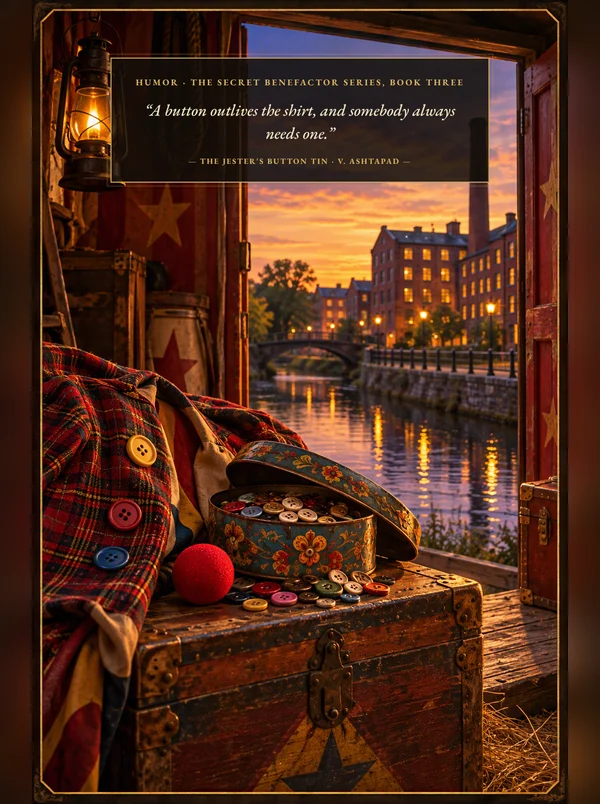
Bippo the Clown has a coat with forty-one buttons, none of them in the right hole, and a small tin of his grandmother's buttons in his pocket. Behind the red nose, retired billionaire Arthur Pendelton has joined the Pell Brothers Calliope Circus, run by twin ringmasters who have not agreed on anything in decades, for a spring stand in the yard of an old mill in Lowell, Massachusetts.
Next door is a Khmer noodle shop, and inside it a family of acrobats who cannot decide whether their act should live or end. A grandmother who learned to tumble on rice sacks in a refugee camp. A granddaughter who has translated every hard word for her since she was eight. A grandson bound for the fire academy, a boy who would rather dance, and a father who keeps doing the numbers.
Between canal walks, New Year water fights and a border crossing with a llama, Bippo listens. And by the time the circus reaches a country fair in Ontario, an old friendship is waiting in the jelly aisle.
Members can react to this book and talk about it in the members' Library.