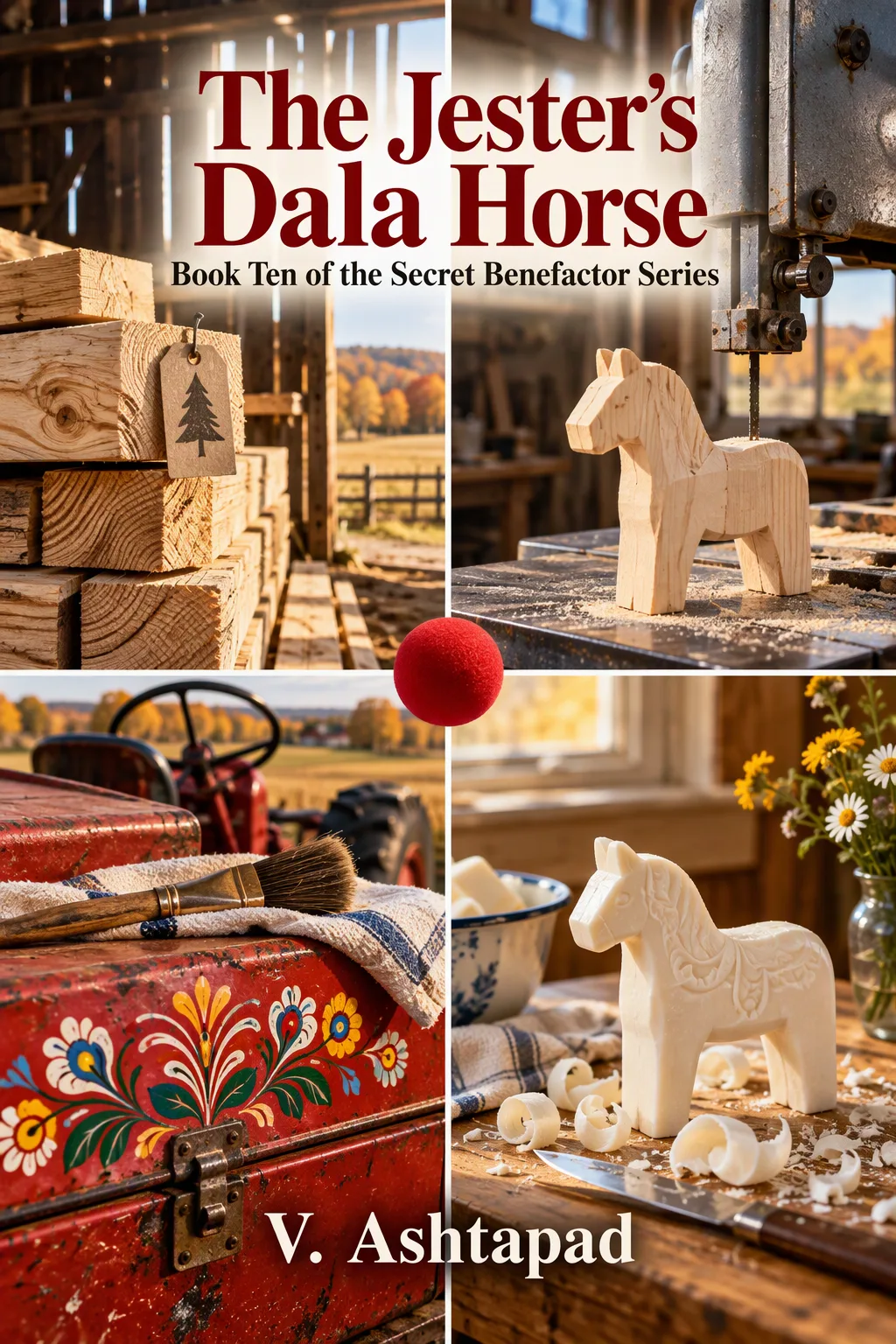
The Jester's Dala Horse
Book Ten of the Secret Benefactor Series
by V. Ashtapad
Foreword
This is a work of fiction. Lindsborg, Kansas, is real, and so are its Swedish roots, its red horses and its festival. The shop, the carver, the barn, the farm and everyone in them are invented.
For everyone who ever sat on a curb and watched through the window.
Friday: The Red Horses
Lindsborg, Kansas, was the reddest town Arthur Pendelton had ever seen, and he had once spent a winter in a circus in Lapland.
It sat on the prairie in the middle of the state, in the valley of the Smoky Hill River, where the land was so flat and the sky so big that driving toward it across the wheat fields in the Sardine Can on a Friday afternoon at the end of September felt like driving across the bottom of an ocean that had been drained. The wheat was cut. The stubble stood gold in long rows to the horizon in every direction. Grain elevators stood up out of it every ten miles, white, like the steeples of some flat country. And then, at the end of a long straight road, under a water tower painted with a blue and yellow flag, there was a town of brick and limestone and painted wood where every surface that could hold paint had been painted, and most of it red.
Red doors. Red shutters. Red trim on white houses. Red benches on Main Street. A red barber pole. A red fire hydrant painted with tiny yellow flowers. And horses. Everywhere, horses. Wooden horses, chunky and stiff-legged and blunt-nosed, with short upright manes and round chests and little tails, painted bright red with saddles and bridles and harnesses picked out in white and blue and yellow and green, in curling flourishes and petals and leaves, like the borders of an old valentine. There were small ones in every shop window, on shelves, in rows. There were big ones, life-size, fiberglass, on the sidewalks in front of the bank and the post office and the library and the bakery and the funeral home, each painted differently, one with sunflowers, one with stars, one in the uniform of the high school football team, one in a tuxedo.
There was one on top of the grain elevator. Twelve feet tall. Red.
Arthur drove down Main Street at a walking pace, because the Sardine Can did not like to go any faster through towns, and because he liked to see a place the first time slowly, the way you read the first page of a letter. It was five o'clock. The light was long and gold and came straight down the street from the west, so that every red door shone. A boy on a bicycle with a fishing rod tied to the crossbar passed him and looked back at the trailer, which was silver and dented and shaped, as Sterling had once observed, like something a large animal had been tinned in, and grinned. Two old women on a red bench outside the post office stopped talking to watch him go by. A man on a ladder was hanging a blue and yellow flag from a lamppost and paused with the flag in his hand.
Halfway down the street there was a shop with a tall front window full of horses, and a red door with a horse carved on it, and something about the window made Arthur look twice. He did not know what. The light, perhaps. The horses in it were gray. It took him a moment to understand that they were not gray at all. They were red, like every other horse in Lindsborg. They were only very dusty.
He drove on. He did not stop. He had learned long ago that the first thing you notice in a town is usually the thing that matters, and that it was best not to let the town see you notice it.
"Dalahäst," said Reginald Sterling, in his ear, as Arthur parked the Sardine Can behind the Lutheran church at the edge of town, where the pastor had said he could stay for two weeks if he did not run a generator after ten. "The Dala horse. From the province of Dalarna, in Sweden, where the men cut timber in the forest in the long winters and whittled horses by the fire for their children out of scrap pine. Then they started painting them. Then they started selling them. Then Sweden decided they were the national symbol, and now there are more Dala horses in the world than there are Swedes."
"And in Kansas?"
"In 1869," said Sterling, "a group of very stubborn Swedish farmers from Värmland bought a valley on the prairie because it reminded them of nothing whatsoever about home, which was the point, and called it Lindsborg. Their great-great-grandchildren have been painting it red ever since." Paper moved. "Every other October they hold a festival. Svensk Hyllningsfest. Swedish homage. Folk dancing, a parade, smörgåsbord, a great many people in costume eating a great many pancakes. It starts a week from tonight."
"A week," said Arthur. "You're spoiling me."
"I am being prudent," said Sterling. "The last time I gave you three days, you spent two of them falling off things." Paper moved. "Also, the pastor is very particular about generators. You will want to be on his good side before the town arrives. They say the town triples in size." A pause. "I have asked the pastor whether there is a quiet corner of the lot. He says there is no such thing as a quiet corner during Hyllningsfest, only corners that are less loud, and that he has saved you the least loud."
"That's kind of him."
"It is extremely kind of him," said Sterling, "and I would like you to remember it when he asks you to help fold chairs."
"And the carver?"
Sterling was quiet for a moment.
"His name is Gunnar Dahlgren," he said. "He is eighty-two. He has carved the town's horses by hand for fifty-four years, in a shop on Main Street, the last one in the country who does it the old way, from a block of pine with a knife. He had a stroke in June. His right hand doesn't close." A pause. "He is left-handed for nothing but his fork. He has not been in the shop since."
© 2026 CRUNOD LLC. All rights reserved.
Saturday: The Shop with the Horse on the Door
The shop was on Main Street between a coffee house and a store that sold Swedish linens, a narrow brick building with a tall front window and a red door with a carved horse on it, and a hand-painted sign above the window that said DAHLGREN'S DALA HORSES · HAND CARVED SINCE 1972 in white letters on blue with a border of yellow and red flowers so intricate that Arthur, standing on the sidewalk in his gray coat with a paper cup of coffee from next door, found himself counting the petals.
The window was full of horses. Hundreds of them, on glass shelves, in every size from one the length of his thumb to one the size of a dog. Most were red. Some were blue, some black, some unpainted, the bare pale pine showing the marks of the knife. Every one was painted in the same curling flourishes, white and yellow and green and blue, saddle and bridle and harness, and every one was different.
There was a sign on the door, handwritten, taped to the inside of the glass.
*Closed until further notice. Thank you. — G.D.*
The dust on the shelves behind it was half an inch deep.
---
"He won't come out," said the woman who ran the coffee house next door, a big cheerful woman of sixty named Karin, in a red apron with a horse embroidered on the pocket, who had come out with a coffeepot to refill Arthur's cup without being asked. "His sister-in-law brings him groceries. Helen. She's the only one he'll open the door to. And she says he just sits in the kitchen. Looking at his hand."
"What about the festival?"
Karin looked at the window full of dusty horses.
"Every Hyllningsfest since 1973," she said, "Gunnar sits in that window with a block of pine and a knife and carves a horse, start to finish, in front of everybody. It takes him the whole festival. Three days. People stand on the sidewalk and watch. Kids press their noses on the glass. On Saturday night he paints it, and on Sunday he gives it to whatever child has watched him the longest." She shook her head. "Fifty years. Some of those kids have grandchildren now. They still have their horse."
"And this year?"
"This year the window's dusty," said Karin, "and the town's very quiet about it." She poured more coffee. "Nobody wants to say it. If Gunnar doesn't carve, there's no one. He never took an apprentice. Not one. Fifty-four years. He said nobody had the patience." She looked at Arthur. "He's not a bad man. He's just a Swede."
---
He spent the rest of Saturday walking.
That was the other thing Sterling had taught him, long ago: in a new town you do not ask, you walk, and you buy small things, and you let people tell you what they were going to tell you anyway. He walked the length of Main Street twice. He bought a pair of wool socks with horses on them from the linen shop, and a postcard of the grain elevator, and a jar of lingonberry jam from a church sale on a folding table outside the bank, where a woman in a striped apron told him that the jam was from her grandmother's recipe and that her grandmother had been impossible.
He went into the public library, a square brick building with a fiberglass horse outside it painted with the covers of books, because he always went into the library. Inside, on the circulation desk, under a glass dome like a cake stand, stood a carved horse the size of a cat. It was red. On its saddle, among the flowers, so small he had to bend down to read them, were the words *Read, and the world comes to you*, painted in white.
"Gunnar Dahlgren," said the librarian, a young man in a cardigan with a horse on it, seeing him look. "1991. For the new building. He carved it in the shop window during that year's festival and then walked it down here himself on the Monday, under his arm, and put it on the desk, and left. Didn't say a word." The librarian looked at it fondly. "There's a sign-up sheet to dust it. It's booked through June."
At eleven he crossed the street to the bakery, which stood exactly opposite the shop with the dusty window, and which smelled from the sidewalk of butter and cardamom and something burning very slightly, in a good way. Inside there was a long glass case of breads and pastries, cardamom twists and cinnamon buns and braided loaves dusted with sugar, and round fried doughnuts rolled in sugar and spice, and behind the case a small dark-haired woman in a white apron and a hairnet, who was arguing pleasantly on the phone in Spanish with someone who was clearly her son, and who held up one finger to Arthur, *one minute*, and then said, in English, into the phone, "Because I said so, that's why," and hung up.
"Teenagers," she said. "What can I get you?"
He bought a cardamom doughnut. He asked what was in it, and she told him, and he asked how long she had worked there, and she told him that too: twelve years. Her name was Marisol. She had come from Guanajuato, by way of Dodge City and a meatpacking plant she did not want to talk about, and she had walked into this bakery in 2014 looking for any job at all and been hired by the owner, an old Swedish woman, because she could braid bread faster than anyone the old woman had ever seen.
"My grandmother made bread in Guanajuato," she said, shrugging. "Braided. For the Day of the Dead. Swedish bread, Mexican bread. The hands don't care."
Arthur looked out the bakery window, across the street, at the dusty horses.
"Have you been in there?" he said.
Marisol followed his eyes. Her face changed.
"Never," she said. "Twelve years across the street. He waves, sometimes. In the morning. He's very polite." She wiped the glass case with a cloth that did not need wiping. "My little girl calls it the horse window. She asks me every day when he's coming back." She looked at Arthur. "What do I tell her? I don't know him. Nobody knows him. Only Helen."
---
At four he went back to the church, because the pastor had asked to see him, and found Pastor Erikson in the parking lot in a sweatshirt and running shorts, painting the lines of the parking spaces with a roller on a pole.
He was a lean, cheerful man of fifty with a gray crew cut and white paint on his knees, and he shook Arthur's hand without wiping his own, so that Arthur came away with a white palm and decided not to mention it.
"You're settled?" said the pastor. "The trailer's level? There's a spigot by the kitchen door. Use all the water you like. Nobody's used it since the youth group washed cars in July and flooded the basement." He looked at the Sardine Can, tucked in at the far corner of the lot under a cottonwood tree, silver in the late light. "What brings a retired person to Lindsborg two weeks before Hyllningsfest? If you don't mind my asking. Most people come the day before and leave the day after, with a stomachache."
"I like to see a place before it puts on its good clothes," said Arthur.
The pastor laughed. "Then you've come to the right week. Come and see the kitchen. Everyone should see the kitchen."
He led Arthur in through the side door, down a short hall that smelled of floor wax and old coffee, and switched on the lights.
It was an ordinary church kitchen. Steel sinks. Coffee urns. A big old range with six burners. Stacks of white cups. But the cupboards, all along two walls, from the counter to the ceiling, were painted. Every door. Red, the deep old red of a barn, and on the red, in white and yellow and green and blue, flowers. Curling leaves, twining stems, petals opening dark to light, buds, tendrils, all of it running from one door to the next across the whole wall without a break, as though a garden had grown up the cupboards in the night and been caught there at dawn.
"Nineteen fifty-two," said the pastor. "One woman. A farmer's wife from south of town. Did every door by hand, over one winter, for nothing. She came from the old country. Dalarna, I think." He looked up at the flowers. "The ladies' circle wanted to paint over them in 1978. Something called *harvest gold*. There was very nearly a war."
Arthur looked at the cupboards for a long time. He looked at one flower in particular, low on a door by the sink, where the paint had been worn pale by seventy years of hands reaching for the coffee filters, and was still, under the wear, the most beautiful flower he had seen in a month.
"What was her name?" he said.
"I don't know," said the pastor. "Isn't that terrible? I should know. Helen Swanson would know. Helen knows everything." He switched off the lights. "Ask her tomorrow. She'll be at the coffee hour. She's always at the coffee hour. She does the cookies."
---
---
That night, in the Sardine Can behind the Lutheran church, with the prairie wind rocking the trailer on its blocks and the stars over Kansas so many and so bright it looked as though someone had spilled them, Arthur sat at the fold-down table with the leather-bound book of memories and wrote a list.
*Gunnar Dahlgren. Carver. Right hand gone. Fifty-four years. No apprentice. Festival in six days. Sits in his kitchen looking at his hand.*
He looked at it for a long time.
He thought of the horse under the glass dome at the library, and the dusty ones in the window, and the woman at the bakery saying *nobody knows him*. He thought of the cupboards in the church kitchen. A man who had carved horses for a whole town for fifty-four years, and walked one down to the library under his arm without a word, and put the dust on a sign-up sheet for half a year, was not a man who had kept himself apart from that town. He was a man who had given it everything except a way in.
Then he wrote, under it, a question. The question Sterling had taught him to ask, long ago, before anything else, in every town: not *What does he need?* but *What did he never let go of?*
He did not know the answer yet. He went to sleep with the wind rocking the trailer and dreamed of red horses running across a flat gold field, all of them going one direction, all of them carved by the same hand.
© 2026 CRUNOD LLC. All rights reserved.
Sunday: Helen
He found Helen Swanson at the Lutheran church on Sunday morning, after the service, at the coffee hour, in the fellowship hall, which had a linoleum floor and long tables with paper cloths and a portrait of a stern bearded Swede in a frock coat who had founded the town, and seventeen kinds of cookies.
She was seventy-nine, tall and thin and straight, with white hair cut in a short practical bob and very blue eyes and the kind of face that had decided long ago not to be impressed by anything. She was standing at the end of the cookie table, arranging the cookies on the plates so that no two of the same kind touched.
Arthur stood beside her in his gray coat with a paper cup of coffee and watched her do it.
"You're the man with the trailer," said Helen Swanson, without looking up. "Behind the church. Pastor Erikson says you're a retired person."
"Yes."
"Retired from what?"
"Many things," said Arthur.
She looked up at him then, with her very blue eyes, for a long moment.
"That's not an answer," she said.
"No," Arthur agreed.
She went back to the cookies. "Which ones are those?" he asked, pointing at a plate of small brown ones, thin as paper, crisp, shaped like hearts.
"Pepparkakor," said Helen. "Ginger snaps. Swedish. You roll them so thin you can read the newspaper through them. My mother's recipe." She moved a pepparkaka a quarter of an inch away from a sugar cookie. "These are spritz. These are drömmar, dream cookies, with hartshorn, which smells like ammonia when they bake and tastes like nothing on earth. These are rosettes, fried on an iron. These are krumkake, which are Norwegian, and should not be here, but Mrs. Holm is Norwegian and nobody has the heart."
Arthur ate a pepparkaka. It shattered in his mouth like a thin sheet of ice, and then there was ginger and cinnamon and clove and cardamom and something black and dark, molasses, and it was gone.
"You're supposed to make a wish," said Helen, without looking at him. "If you put one in your palm and press it with one finger in the middle and it breaks in three pieces, you get a wish. Everybody knows that."
"I ate it whole."
"Then you've wasted it," said Helen Swanson, and moved a spritz cookie a quarter of an inch to the left. "Take another. Do it properly this time."
He took another. He put it on his palm and pressed it in the middle with one finger. It broke into three pieces, almost exactly equal.
Helen looked at his palm. She looked at him.
"Well," she said. "Don't tell me what it was. It doesn't work if you tell."
"Your brother-in-law," he said.
Helen Swanson's hands stopped on the cookies.
---
They talked in the church kitchen, among the coffee urns and the stacked cups and the long steel sinks, because Helen said if they talked in the fellowship hall the whole town would know by noon and it was none of the whole town's business.
Arthur stood with his back against the painted cupboards. He had not forgotten the pastor's question. He looked for a moment at the flowers by the sink, the worn ones, and decided that it could wait. In his experience, the question a person came to ask was rarely the one that mattered, and the one that mattered was usually standing right behind it, waiting for its turn.
Gunnar had married her sister Margit in 1966. Margit had died in 2019. Helen had been a widow since 2008. So for six years, Helen said, she had been taking Gunnar his groceries and his mail and telling him to cut his hair, and he had been telling her to mind her own business, and it had been, she said, the best arrangement either of them had ever had.
"Then June," she said. "He was in the shop. Carving. Alone, of course. He's always alone. I found him on the floor. The knife still in his hand." She looked out the kitchen window at the parking lot. "The doctors say he's lucky. He can talk, he can walk, he can feed himself. His left side is fine. It's just the right hand. It won't close. It won't hold a knife." She was quiet. "He has not been back in the shop. Not once. I go in every week and dust and he won't even ask me how it looks."
She picked up a cup from the stack and dried it with a towel, though it was already dry.
"Do you know what he did for my sister? Every year? On their anniversary?" She did not wait for Arthur to answer. "He carved her a horse. Fifty-three years, fifty-three horses. A small one, the size of your hand, and he painted it, and on the saddle, in among the flowers, so small you'd need your glasses, he painted the year. They're all on a shelf in the bedroom. In a row. Fifty-three of them. Every one of them different." She put the cup down. "The last one was 2019. She died in the March. He carved the horse anyway, in June, on the date, and put it on the shelf. That's the one at the end. It's not painted. He never painted it."
"Why not?"
"Because she wasn't there to see it," said Helen Swanson, as if it were obvious. "You don't finish a horse for nobody."
Arthur thought about that. He thought about a shelf in a bedroom on Second Street with fifty-three horses on it, and one at the end with no paint, and an old man sitting in the kitchen below it looking at his hand.
"Perhaps," he said, "he hasn't found the somebody yet."
Helen looked at him sharply.
"You're a very odd retired person," she said.
"So I'm told."
"What did he never let go of?" said Arthur.
Helen turned and looked at him with her very blue eyes.
"That's a strange question," she said. "For a retired person."
"It's the only one I know how to ask."
She was quiet for a long time, among the urns.
"The whole thing," she said finally. "He never let go of any of it. He did everything himself. He picked the wood himself, from the lumberyard, every board. He cut the blanks himself on the bandsaw. He carved every horse himself, with his own knife. He mixed his own paint. He painted every flourish himself. He never let anybody touch one part of it. Not Margit. Not me. Not any of the boys who came in over the years wanting to learn." She folded her arms. "He said a horse was one thing. One hand, from the tree to the paint. If you broke it into parts, it wasn't a horse anymore. It was a product."
Arthur did not say anything.
"Now he has one hand," said Helen Swanson, "and it's the wrong one."
© 2026 CRUNOD LLC. All rights reserved.
Monday: Ruth's Barn
The first part of a horse is the wood, and the wood was in Ruth Peterson's barn.
Helen told him. Helen, it turned out, after one conversation in a church kitchen, had decided that the retired person with the trailer was going to be useful, and she was a woman who, once she had decided something, did not waste time. She telephoned him at seven on Monday morning on a cell phone the pastor had lent him, and said, "Ruth Peterson. Out on the Marquette road. Four miles. Big red barn. She's eighty-eight. Bring doughnuts. The ones with cardamom. From the bakery. Not the grocery store. She'll know."
Ruth Peterson knew. She opened the box of cardamom doughnuts on the hood of Arthur's borrowed truck in front of her barn at eight in the morning and smelled them and looked at him over her glasses and said, "Good. Helen told you."
She was very small and very old and very brown from the sun, in a man's work shirt and overalls and a straw hat, with hands like knotted rope, and she had run the lumberyard in Lindsborg with her husband for fifty-one years and alone for nine more after he died, until she sold it to a chain in 2015.
"Gunnar bought his wood from us," she said. "Every board. From 1972. Pine. Eastern white pine, from Minnesota and Wisconsin, clear, no knots, slow grown, tight grain. You can't carve fast pine. It splits. It fuzzes. It fights the knife." She took a doughnut. "He'd come in once a year, in the fall, and go through every board in the yard with his hands. Every one. Two, three hundred boards. He'd pick out twenty. Then he'd bring them back to us and we'd stack them in the barn to dry. Two years. Sometimes three. In the dark, with air between them, up off the floor. You have to be patient with wood. It has to stop being a tree."
She took a second doughnut and looked at it, and then at Arthur.
"My husband, Walt, used to say Gunnar Dahlgren was the only customer who ever made him nervous," she said. "Walt was a big man. Served in Korea. Not much made him nervous. But Gunnar would come into the yard every October and walk the stacks, slow, putting his hands on every board, and not say a word, and Walt would follow him around like a boy behind a school principal, waiting to hear if he'd passed." She laughed, a short dry laugh like a branch breaking. "One year, 1983, Gunnar went through every board in the yard and picked nothing. Not one board. He said the pine that year had grown too fast. Wet summer up north. He said he could feel it. Walt called the mill in Wisconsin, and the man at the mill said, how the devil does he know that, and Walt said, I have no idea, but he's right, isn't he? And the man said, yes."
She ate the doughnut in three bites.
"After Walt died, Gunnar came in that October like always. Walked the stacks. Picked his twenty boards. And when he paid, he said, *I'm sorry about Walt.* That's all. Four words." She brushed the sugar off her overalls. "Most words I ever heard him say in one go. I've never forgotten it."
She finished her doughnut and wiped her fingers on her overalls and walked to the barn and slid the big door open on its rusted track.
---
Inside, in the dim, in the smell of dust and hay and old oil and something sweet and resinous and clean underneath it all, like the inside of a pencil, there was wood.
Stacks of it. Long pale boards in neat stacks the height of a man, on rails of old timber up off the dirt floor, with thin strips of wood laid between every layer so the air could move through. Six stacks. Seven. Along the whole back wall of the barn. Each stack had a tag nailed to the end, a piece of cardboard, with a year written on it in faded pencil. *2021. 2022. 2023. 2024.*
"He bought his last load in October," said Ruth Peterson. "Before the stroke. Twenty boards. Out there, on the end." She pointed. "Those are ready now. Bone dry. Best batch he ever picked. He said so." She looked at the stacks in the dim light from the door. "And the rest. Five years' worth. He always kept five years ahead. In case." She shook her head. "Nobody's going to carve it now. I suppose I'll sell it to the chain store for shelving."
Arthur walked along the stacks. He put his hand flat on the end of a board, the way Ruth had said Gunnar did. It was cool and smooth and very slightly warm underneath, like the flank of an animal.
"No," said Ruth, behind him. "Both hands. Flat. And don't hurry it. He never hurried it." She came and stood at his elbow and put her own small knotted hands flat on the next board, one beside the other, and closed her eyes. "Now. What do you feel?"
Arthur closed his eyes. He felt wood. Smooth wood, cool, a little rough at the edges where the saw had been.
"Wood," he said.
"Everybody feels wood. Feel past it." Her eyes were still shut. "This one's heavy for its size. See? Dense. That's slow growth. Cold winters, short summers. The rings are close. This one"—she moved her hands to the next board—"is lighter. Grew faster. Softer. It'll carve easy and it won't hold an edge on the ears. Gunnar would put that one back." She opened her eyes and looked at Arthur. "You don't feel that, do you?"
"No."
"No. It takes about ten years." She took her hands off the wood. "Walt never got it. Fifty-one years in the lumber business and he never once felt the difference. He used to stand beside me while I did this and say, *Ruthie, you're making it up.* And I'd pick a board, and he'd send it to the mill in Wisconsin to be tested, and I'd be right." She smiled for the first time, and it took fifty years off her. "He stopped saying I was making it up in about 1970."
"Who else knows how to pick it?" he said.
Ruth looked at him.
"Nobody," she said. "Only me. And Gunnar."
"Would you teach someone?"
The old woman was quiet for a long time, in the doorway of her barn, with the prairie wind coming in past her and moving the dust in the shafts of light.
"Nobody ever asked," she said.
© 2026 CRUNOD LLC. All rights reserved.
Tuesday: Luis and the Bandsaw
The second part of a horse is the blank, and the blank was in the high school shop.
---
But on Monday night, before he knew any of that, Arthur tried to make one himself.
He had come back from Ruth Peterson's barn with a scrap of pine in his coat pocket, an offcut the length of his hand that she had let him take from the floor under the 2024 stack, and after his supper, which was soup from a can and a cardamom doughnut he had saved, he sat at the fold-down table in the Sardine Can under the lamp, with the wind rocking the trailer on its blocks, and took out his pocketknife, and looked at the wood.
He had no idea how to begin. He had watched a great many people do a great many things in a great many towns, and he had learned that watching was not the same as knowing, but he had never learned it as quickly as he did that night. He drew a horse on the side of the wood with a pencil. It looked like a horse. He began to cut. The knife went in and stopped. He pushed. The knife jumped out of the wood and across the ball of his thumb, and he sat for a moment looking at the thin red line rising on his skin with a kind of interest, as if it belonged to someone else, and then got up and found a bandage in the cupboard over the sink.
He carved for two hours. He took off a great deal of wood and very little of it was in the right place. At eleven he put down the knife and looked at what he had. It was not a horse. It was the idea of a horse that a person might have if he had only ever had one described to him over a bad telephone line.
"Reginald," he said, putting in the earpiece.
"Arthur." Paper. "It's five in the morning in Edinburgh."
"I've cut myself."
"Badly?"
"Instructively."
There was a pause.
"You're carving," said Sterling.
"I'm attempting to."
"Good," said Sterling, and Arthur could hear him settling back in his chair. "Nobody listens to a man explain a thing he has never tried. Least of all a carver. Go to bed. Use a bandage. Tomorrow, try going with the grain."
"Which way is the grain?"
"I have no idea," said Sterling. "I am a man who has spent his life giving things away. I have never made one." The paper stopped. "Find someone who knows."
---
Arthur found it there on Tuesday afternoon because Helen told him to go, and because the shop teacher, a big slow man named Mr. Haglund who had been teaching woodshop in Lindsborg for thirty-one years, had once, in 1994, as a boy of sixteen, gone into Dahlgren's Dala Horses and asked Gunnar to teach him to carve and been told no.
"He said I didn't have the patience," said Mr. Haglund, in the shop, among the table saws and the drill presses and the long workbenches scarred with forty years of initials, in the smell of sawdust and machine oil. "He was right. I didn't. I went into teaching instead." He laughed. "Now I have the patience of a saint. I teach fourteen-year-olds to use bandsaws."
"Do any of them have the patience?"
Mr. Haglund thought about it. Then he turned around and called across the shop, over the scream of a router.
"Ochoa!"
---
Luis Ochoa was fifteen, small and wiry, with black hair cut short and a hooded sweatshirt with the sleeves pushed up and safety goggles on his forehead, and he was the only person in the shop not making noise. He was at the far bench, alone, with a piece of basswood the size of a brick clamped in a vise, and a knife, a plain cheap carving knife from a hardware store, and he was carving.
It was a horse. Arthur saw it from across the shop, and stopped walking.
It was rough, unfinished, the knife marks big and raw, but it was a horse. The chunky round chest, the stiff legs, the blunt nose, the little upright mane. It was not a copy of the ones in Gunnar's window. It was its own horse. It was standing a little differently, leaning forward, as if it had just noticed something in the distance and was about to walk toward it.
"Where did you learn that?" said Arthur.
Luis looked up. He looked at the gray-haired man in the gray coat. He looked at Mr. Haglund. He shrugged.
"Videos," he said. "Online. And the window."
"The window?"
"Mr. Dahlgren's window." Luis put down his knife. "My mom works at the bakery on Main. Across the street. When I was little she'd take me to work in the summers and I'd sit on the curb and watch him through the window. All day. For like five summers." He looked at the horse in the vise. "He never saw me. I don't think. He never looks up."
"Did you ever go in?"
Luis looked at him as if he had asked whether he had ever walked into the sea.
"No," he said. "He doesn't let anybody in."
Arthur looked at the horse in the vise for a while, at the way it leaned forward. Then he looked at his own thumb, in its bandage.
"Which way does the grain go?" he said.
Luis looked at the bandage, and then at Arthur's face, and something in his own face, which had been guarded and polite, opened a little, the way a boy's face does when an adult admits to being bad at something.
"Along," he said. He picked up the basswood horse and ran his thumbnail down its neck, from the ears to the chest. "See? Like the lines in your fingertip. You cut along them, it comes off nice. You cut across, it tears. You cut into them, the wrong way, it splits, and the knife goes where it wants." He looked at the bandage again. "It went where it wanted, huh?"
"It did."
"Basswood's easier than pine," said Luis. "Pine's got hard lines and soft lines. Summer wood and winter wood. You have to feel it." He put the horse back in the vise. "Mr. Dahlgren uses pine. Only pine. I've never had any good pine. The lumber store in Salina only has the cheap kind, all knots." He shrugged. "My sister says I'm going to be the second-best horse carver in Kansas. She's seven. She thinks Mr. Dahlgren is like a hundred and fifty."
"He's eighty-two," said Arthur.
"That's what I told her. She said that's basically a hundred and fifty." Luis picked up his knife again, the cheap one, and held it out to Arthur handle first. "Here. Try. On the basswood. Not on my horse. On the end, there."
Arthur took the knife. He set it against the end of the block where Luis pointed.
"No. Lower. Thumb on the back of the blade, like this." Luis reached over and moved Arthur's thumb with two fingers, impatiently, the way a boy corrects an adult who is being slow. "Now push with your thumb, not your arm. Small. Like you're peeling an apple. Small."
Arthur pushed with his thumb. A curl of pale wood came off, thin and whole, and fell onto the bench.
He looked at it. He looked at Luis.
"See?" said Luis, and almost smiled. "Along."
---
Mr. Haglund showed Arthur the bandsaw. A big old one, cast iron, painted gray, from 1962, with a blade like a ribbon of steel running down through a slot in the table and around two wheels the size of steering wheels. Gunnar had donated it to the school in 1998 when he bought a new one for the shop.
"He cuts the blanks on one of these," said Mr. Haglund. "The rough shape. Side profile. Then front profile. Then he's got a block that's more or less a horse, and he carves it from there. Takes him about twenty minutes to cut a blank. Takes everybody else an hour and they ruin half of them." He looked across the shop at Luis, who had gone back to his horse. "Ochoa can do it in twelve. I've timed him. I don't know how. He just sees it."
Mr. Haglund put his big hand on the cast-iron table of the bandsaw, where the paint was worn through to bright metal by thirty years of boards sliding across it.
"When Gunnar gave the school this saw," he said, "I went to his shop to say thank you. 1998. I was a young teacher then. I hadn't been in that shop since he turned me down, four years before, and I stood in the doorway like I was sixteen again." He laughed at himself. "And he looked up from his bench and said, *You're the Haglund boy.* Four years, and he remembered. And he said, *Now you can teach them to cut blanks. That's the hard part. Nobody believes it, but that's the hard part. Anybody can carve a horse out of a good blank.*" Mr. Haglund shook his head. "Then he went back to carving and didn't say another word. I stood there for five minutes. Then I went home."
"Did he mean it? About the blanks?"
"I thought he was being polite," said Mr. Haglund. "He's not polite, though. Took me about ten years to figure that out." He looked across the shop at the boy at the far bench. "He meant it."
Arthur stood by the old gray bandsaw for a long time.
"Does he know about the wood?" he said finally. "In Ruth Peterson's barn?"
Mr. Haglund looked at him blankly.
"No," he said. "Why would he?"
© 2026 CRUNOD LLC. All rights reserved.
Wednesday: Dale's Toolbox
The third part of a horse is the paint, and the paint was on a toolbox on a tractor on a farm south of town, where nobody had thought to look for it, because it belonged to a six-foot-four wheat farmer named Dale Hultquist who weighed two hundred and sixty pounds and had been a defensive tackle at Kansas State.
Arthur found it by accident. He found it because Bippo went to the farmers' market on Wednesday.
---
He had not planned to. He had been in the Sardine Can at noon on Wednesday, looking at his list, which had grown. *Wood: Ruth Peterson, 88, barn, five years of pine, nobody asked. Blank: Luis Ochoa, 15, bandsaw, twelve minutes, sat on the curb five summers, never went in.* He had circled both. Under them he had written *Paint:* and nothing.
On the corner of the table, on a folded paper towel, lay the horse, two nights along. It was better than it had been on Monday, in the sense that a man who has fallen down a staircase twice is better at it than a man who has fallen down it once. On Tuesday night he had gone with the grain, mostly, and cut himself only twice. It had four legs, of three different lengths, and a nose that kept getting longer every time he tried to fix it, and he had begun, against his own judgment, to be fond of it.
Gunnar painted his own horses. Everybody said so. Gunnar mixed his own paint and painted every flourish himself, the kurbits, the curling leaves and petals and flowers that ran across every Dala horse's saddle and harness, that came from the old painters of Dalarna who had painted them on the walls and cupboards and wedding chests of farmhouses in the eighteenth century, in a style of their own that nobody outside Dalarna could quite copy. Gunnar had learned it from his grandmother, who had come from Dalarna in 1903. He had never taught it to anyone. If he could not hold a brush, it was gone.
So Arthur did what he did when he did not know what to do. He put on the orange wig and the coat with the blue stars and the enormous yellow shoes and painted his face in his grandmother's foxed mirror with the four broken pieces of white in the top tray, and went to the farmers' market on Main Street to make balloon animals for children, because sometimes, Sterling said, the answer only comes when you are being ridiculous in public.
He made a dachshund. He made a giraffe. He made, at the request of a solemn girl of seven in a red dress, a Dala horse, out of a red balloon, which was not easy, and which came out looking like a dachshund with ambitions.
It had taken him four balloons. The first had burst with a bang that sent a flock of sparrows up off the awning of the linen shop and made an old man at the honey stall sink into a crouch, as if he had heard something on a battlefield sixty years before. The second came out with five legs. The third came out, inexplicably, as a swan. The children who had gathered around him, nine or ten of them by then, in their Saturday-morning clothes on a Wednesday because school had let out early for a teachers' meeting, laughed louder at every one, and Bippo bowed lower after each, and bumped into the honey stall, and apologized to the honey, and the old man who had crouched stood up again and laughed too, and that was worth all four balloons.
The solemn girl took it and looked at it for a long time.
"It needs flowers," she said.
"I don't have any flowers," said Bippo.
The girl turned around and pointed across the street, to where the farmers had parked their trucks along the curb behind the market stalls, and a big green tractor was parked at the end of the row on a trailer, with a sign on it that said *Hultquist Farms · Sweet Corn · Last of the Season*.
"He does," she said.
---
The toolbox was bolted to the side of the tractor, behind the big rear wheel. It was an ordinary steel toolbox, the kind every farmer has, three feet long, with a hinged lid. It had been painted red.
And on the red, in white and yellow and green and blue, in curling flourishes, across the whole lid and down the sides, there were flowers.
Kurbits. Leaves and petals and tendrils and buds, curling and opening and twining, in the old style, the Dalarna style, so fine and so free and so perfectly balanced that Bippo, in his enormous yellow shoes, stood in front of the tractor and forgot, for a moment, that he was a clown.
"Don't touch it," said a voice behind him.
Bippo turned. Dale Hultquist was six foot four and two hundred and sixty pounds, in a seed cap and a canvas coat and work boots the size of footballs, holding a box of sweet corn, and his face, which was large and red and weathered, had gone a darker red.
"It's just a toolbox," said Dale Hultquist. "My grandma did it."
The solemn girl in the red dress looked up at him.
"No, she didn't," she said. "You did. I saw you. Last summer. In your barn. With a little brush."
Dale Hultquist looked at the girl. He looked at the clown. He looked, for a long moment, at the toolbox on the side of his tractor, with its flowers.
Then he put down the box of sweet corn on the trailer bed, very carefully, as if it might break, and sat down on the bumper of his truck, and put his enormous hands over his face.
---
"My grandma taught me," he said, later, on the bumper, with the clown beside him and the solemn girl, whose name was Ximena, sitting on the trailer eating an ear of raw corn like an apple. "When I was a kid. Seven, eight. In her kitchen. She came from Dalarna. She painted everything. The cupboards. The chairs. The breadbox. She had a little brush made of squirrel hair and she'd sit me on a stool and show me. The C-stroke. The S-stroke. How you load the brush with two colors so the petal goes dark to light." He took his hands off his face. "I was good. She said I was good. Better than her."
"What happened?"
Dale Hultquist laughed, short and hard.
"I was eight," he said. "I took a painted box to school. For show-and-tell. A little box I'd done for my mom, with flowers on it." He looked at the toolbox. "And the boys laughed. For the rest of the year. All of grade school. *Dale paints flowers. Dale paints flowers like a girl.*" He shook his head. "So I stopped. I played football. I got big. I got very, very big. Nobody laughed at me after that." He looked at his hands. "I didn't pick up a brush for forty years. Then my grandma died. In 2018. And I went to clean out her house, and I found her brush. The squirrel one. In a coffee can." He was quiet. "So I did the toolbox. At night. In the barn. With the door shut. Took me a whole winter." He glanced at the girl. "Apparently not shut enough."
"My mom buys your corn," said Ximena, with her mouth full. "On Saturdays. At your farm. I went to look at the cows."
"I don't have cows."
"I know," said Ximena. "I looked anyway. And then I looked in the barn."
Dale Hultquist put his face back in his hands for a moment, and his shoulders shook, and it took Bippo a moment to understand that the big man was laughing.
When he had stopped, Bippo sat quietly on the bumper beside him, a clown in an orange wig and yellow shoes beside a defensive tackle in a seed cap, and looked at the toolbox with its flowers.
"Would you paint one more thing?" said Bippo. "Something small. Very small. Nobody would see you do it. Nobody would know it was you."
Dale looked at him sideways under the brim of the cap.
"What kind of thing?"
"Anything with a lid," said Bippo. "Something an old man could hold in his left hand."
The big farmer was quiet for a long time. A truck went by on Main Street. Ximena worked her way along her ear of corn, steadily, row by row, like a typewriter, and did not look at all concerned.
"I'm not saying yes," said Dale Hultquist.
"No," Bippo agreed.
"I'm not saying anything," said Dale. "I'm going home. I've got corn to sell." He did not get up.
Instead he reached into the pocket of his canvas coat and took out a small coffee can with a plastic lid, the kind that held ground coffee once, and turned it over in his huge hands. It rattled faintly. He did not open it. He looked at it for a while, the way a man looks at a letter he has carried for a long time and not answered, and then put it back in his pocket and buttoned the flap.
Bippo did not ask what was in it. Ximena did not ask either, which, Bippo would learn, was the only time all week that Ximena Ochoa did not ask about something.
Ximena chewed her corn.
"It's the best one in town," she said. "Better than Mr. Dahlgren's."
Dale Hultquist went very red again.
"Don't ever say that," he said. "Not where anybody can hear."
© 2026 CRUNOD LLC. All rights reserved.
Thursday: The Knife
The fourth part of a horse is the knife, and the knife was in Gunnar Dahlgren's hand, which would not close.
---
But first, at dawn, there was the wood.
Mr. Haglund drove Luis Ochoa out to Ruth Peterson's barn on the Marquette road at a quarter to seven on Thursday morning, in his own pickup, before school, with Luis's mother's written permission folded in his shirt pocket and two thermoses of coffee on the dashboard. Arthur met them there with a box of cardamom doughnuts. Ruth had been up since five. She was standing in the open door of her barn in her overalls and her straw hat with the sun coming up red behind her across the stubble fields, and she looked at the boy getting out of the truck in his hooded sweatshirt and safety goggles pushed up on his head, and then at Arthur.
"This is him?"
"This is him."
"He's small," said Ruth.
"So are you," said Luis, before he could stop himself, and went red.
Mr. Haglund, getting out of the driver's side with the thermoses, stopped with one foot on the running board and closed his eyes, as a man does when a student says the thing he has been praying the student would not say in front of the principal.
Ruth Peterson looked at him for a long moment over her glasses. Then she laughed, the branch-breaking laugh, and turned around and walked into the barn, and said over her shoulder, "Come on, then. Bring the doughnuts."
---
She taught him for an hour. She made him take off his gloves. She made him walk the stacks the way Gunnar walked them, slowly, with both palms flat on every board, and she stood behind him and asked him questions. *Is it cold or warm? Is it heavy for its size or light? Run your thumb across the end. What do you feel?* At first he said he didn't know. Then, around the third stack, he stopped saying that. He stopped at a board on the 2024 stack and put his hands on it and stood there, very still, with his head on one side.
"This one's different," he said.
"How?"
"I don't know. It's—" He frowned. "The lines are closer. On the end. And it's heavier. Like it's got more in it."
Ruth Peterson did not say anything. She reached past him and turned the board over, so the end of it faced them, and there, on a piece of cardboard tacked to the wood, in faded pencil, in a hand that was not hers, it said: *2024. G.D. Best yet.*
Luis stared at it.
"He picked that one," he said. "Mr. Dahlgren. Himself."
"He picked every board on that stack," said Ruth. "But that one's the one he wrote on." She looked at the boy. "You found it with your hands. In one hour. Took me ten years to learn that." She pulled the board out of the stack and put it in his arms. It was eighteen inches long, pale and clean. "Take that one to the old man. Take another one for yourself, for your blank. Pick it. Don't ask me which."
Luis picked. It took him ten minutes. Ruth watched him do it with her arms folded and her face giving away nothing at all, and when he chose, she nodded once, and turned away, and Arthur, standing by the barn door with the doughnut box, saw her wipe her eyes on the back of her knotted hand and pretend it was the dust.
Mr. Haglund stood just inside the barn door through all of it, with a thermos in each hand, and did not offer advice once, which Arthur suspected was the hardest thing he had done in thirty-one years of teaching.
"Ruth," he said, when Luis had chosen. "I bought lumber from you for twenty years for that shop. You never once let me walk the stacks."
"You never once asked," said Ruth Peterson.
Mr. Haglund opened his mouth. Then he shut it again, and looked at the boy holding his two boards against his chest like a pair of schoolbooks, and laughed, and handed Ruth a thermos.
---
Luis cut the blank in the high school shop at eight fifteen, before first period, on the old gray bandsaw from 1962, with Mr. Haglund holding a stopwatch. Eleven minutes and forty seconds.
When Arthur got back to the Sardine Can at nine there was something on the step. A bundle, wrapped in a clean feed sack and tied with baler twine. Inside it was an old cigarette tin, rusted at the corners, the kind men had carried in their shirt pockets when Arthur was a boy, with its lid painted red and covered in flowers, and inside the tin, wrapped in a handkerchief, a small brush with a squirrel-hair tip. There was a note, folded very small, in big square capitals in pencil.
*IT WAS GRANDMA'S. THE TIN AND THE BRUSH. I WANT THE BRUSH BACK. DON'T TELL ANYBODY. D.H.*
---
Bippo went to see him on Thursday, at noon, the day before the festival. He did not go as Bippo. He went as Arthur, in his gray coat, with Helen Swanson, who had a key.
"He won't talk to you," said Helen, on the step of the little white house on Second Street with the red shutters and the red door and the carved horse on the mailbox. "He won't talk to anybody. Don't take it personally. He's been not talking to me since 1966."
She opened the door.
---
Gunnar Dahlgren was sitting at the kitchen table.
He was a big man, or had been: tall and heavy-shouldered, gone thin now, in a flannel shirt buttoned to the neck, with a white beard trimmed short and a long Scandinavian face like a weathered gate and eyes the same very pale blue as his sister-in-law's, which were looking, as Karin at the coffee house had said, at his hand.
His right hand lay on the kitchen table on a dish towel, palm up. It was a carver's hand, enormous, the fingers thick and scarred with fifty-four years of nicks and cuts, the ball of the thumb hard as wood. It lay open on the towel. The fingers curled a little, loosely, like a hand asleep. They did not move.
In front of it, on the table, was a knife.
It was a carving knife, old, with a short curved blade and a handle of dark wood worn pale and smooth and shiny in one place, on one side, where a thumb had rested on it for half a century.
He did not look up when they came in.
"Gunnar," said Helen. "This is Arthur. He's a retired person. He's staying at the church."
Gunnar did not say anything.
Arthur sat down across the table. He did not speak. He looked at the knife for a long time, and at the hand, and at the old man looking at the hand.
Then he reached into his gray coat and took out four things and put them on the table, one at a time, in a row, in front of the knife.
---
A board of white pine, eighteen inches long, pale and clean and bone dry, from the end of the last stack in Ruth Peterson's barn. On its end, in faded pencil, a tag. *2024. G.D. Best yet.*
A blank. A rough horse, cut from a second board of the same pine on a gray cast-iron bandsaw from 1962 in the Lindsborg High School woodshop, in eleven minutes and forty seconds, by a boy of fifteen who had sat on the curb outside a shop window on Main Street for five summers and never gone in. The chunky chest. The stiff legs. The blunt nose. It was leaning a little forward, as if it had noticed something in the distance.
A cigarette tin, old, rusted at the corners, its lid painted red, and on the red, in white and yellow and green and blue, in curling flourishes, kurbits. Leaves and petals and buds, twining, so fine and so free. Inside it, a brush, small, with a handle gone dark with age and a tip of squirrel hair.
And a horse.
A small one. The size of a thumb. Carved, roughly, very badly, by someone who had no idea what he was doing, out of a scrap of the same pine, with a pocketknife, at the fold-down table of a leaking trailer behind the Lutheran church, over three nights, with a great deal of blood. It was lopsided. One leg was shorter than the others. Its nose was too long. It looked, as Ximena had said of the balloon, like a dachshund with ambitions.
It had been painted, very badly, red.
---
Gunnar Dahlgren looked at the four things on his kitchen table for a long time.
He looked at the board, and at the tag on its end in his own handwriting. He looked at the blank, the rough horse, leaning forward. He looked at the cigarette tin with its flowers, and the squirrel-hair brush. He looked, longest, at the terrible little horse.
Then he looked up, for the first time, at Arthur.
"Who made the blank?" he said. His voice was deep and slow, with the long vowels of the prairie under it and something older under that.
"A boy named Luis Ochoa. He's fifteen. He used to sit on the curb across the street and watch you through the window. Five summers."
Gunnar was quiet for a long time.
"The little one," he said. "With the baseball cap. On the curb by the bakery." He looked at the blank. "I saw him. Every day. I thought he was waiting for his mother."
"He was," said Arthur. "And watching you."
Gunnar touched the cigarette tin with the fingers of his left hand.
"Who painted this?"
"A farmer named Dale Hultquist. He's sixty. His grandmother came from Dalarna in 1903. She taught him in her kitchen when he was eight. He stopped when the boys at school laughed. He did a toolbox on his tractor last winter, at night, with the barn door shut."
Gunnar looked at the tin for a long time.
"Hultquist," he said. "His grandmother was Brita Hultquist. She painted the cupboards in the church kitchen in 1952." He opened the tin. He looked at the brush. "This is her brush."
"Yes."
"She was the best painter in Lindsborg," said Gunnar Dahlgren. "Better than me. I never told her." He put the brush down very gently. "I never told anybody."
Then he looked at the terrible little horse.
"And this?"
"Me," said Arthur.
Gunnar picked it up in his left hand. He turned it over. He looked at the lopsided legs and the long nose and the bad red paint for a long, long time, with his long gate of a face doing nothing at all.
"This," he said finally, "is the worst horse I have ever seen."
"Yes."
"The grain is going the wrong way. You carved against it. Here. And here." He pointed with his left thumb. "That's why it split. That's why there's blood on it." He turned it again. "And you didn't seal it before you painted. So the paint soaked in. It'll fade in a year."
"I didn't know," said Arthur.
"No," said Gunnar Dahlgren. "Nobody told you."
He looked at the knife on the table in front of him, the old one, with the dark handle worn pale in one place. Then, slowly, he reached out with his left hand and picked it up.
Nobody in the kitchen moved.
He held it in his left fist the way a child holds a spoon. He turned it over. He tried to settle his thumb on the worn place in the handle, the place where his right thumb had rested for fifty-four years, and the left thumb did not fit it. It lay on the wrong side. He turned the knife the other way, and it fit even less. He took the terrible little horse in the fingers of his right hand, which would not close but would, if he pushed it, pin a thing against the dish towel, and he set the blade to its lopsided neck, and tried to take one curl off it.
The knife slipped. It skated off the pine and across the towel and stopped, a quarter of an inch from the open palm of his right hand.
Gunnar looked at it for a long time. Then he put the knife down on the table, very gently, beside the horse, the way you would put down something that belonged to someone else.
"Left-handed," he said, "for nothing but my fork."
"Gunnar," said Helen, from the stove.
"I know," said Gunnar Dahlgren. "I know, Helen." He did not look at her. He looked at the four things on the table. "That's what these are for."
He put the terrible little horse down on the table beside the blank, the board, the tin and the knife. Then he looked at his own right hand, lying open on the dish towel, and then at Helen, standing by the stove with her arms folded and her very blue eyes very bright.
"There are four people," he said slowly, "and four parts."
"Five," said Helen. "If you count the knife."
© 2026 CRUNOD LLC. All rights reserved.
Friday: The Window
At nine o'clock on Friday morning, the first day of Svensk Hyllningsfest, the dust was gone from the shelves of Dahlgren's Dala Horses on Main Street, and the sign on the door was gone, and the red door with the carved horse on it was standing open to the street.
In the window, in the old chair, sat Gunnar Dahlgren.
He did not have a knife. His right hand lay open in his lap on a dish towel. His left hand rested on the arm of the chair. He was wearing a red vest embroidered with yellow flowers and a white shirt and black knee breeches and white stockings and black shoes with silver buckles, the costume of a farmer from Dalarna in the eighteenth century, which he had worn at every Hyllningsfest since 1973, and which Helen had let out at the waist on Thursday night and taken in at the shoulders.
---
The dust had come off on Thursday night.
Gunnar had not said he would come. He had said, at the kitchen table, after *five if you count the knife*, nothing at all for a long time, and then, "Helen. Call them," and gone into his bedroom and shut the door. So Helen called them. Ruth Peterson came at seven in her truck with a broom and a bucket. Dale Hultquist came at a quarter past, in the dark, parked a block away, and came in through the back door from the alley, looking over his shoulder. Luis Ochoa came with his mother, Marisol, from the bakery across the street, still in her white apron, and with his little sister, Ximena, who had insisted, at the top of her voice, that she was not staying home when the horse window was being opened, not tonight, not ever.
Arthur came last, in his gray coat. Ximena looked up at him from the floor, where she was already sitting cross-legged among the dusty horses, and frowned.
"You look like somebody," she said.
"I'm told I have a very ordinary face," said Arthur.
"No," said Ximena, considering him. "You have a sad nose." And she went back to the horses.
They dusted for two hours. Every shelf. Every horse. Hundreds of them, one at a time, taken down from the glass and wiped with soft cloths and put back, red and blue and black and bare pine, and as the dust came off, the colors came up, so that the window went slowly, shelf by shelf, from gray to red, the way a face comes back into color when a person who has fainted begins to come around. Marisol and Helen did the top shelves, on chairs. Ruth swept. Dale did the big horses, the ones the size of dogs, lifting them down as if they were eggs. Luis cleaned the bandsaw, the new one, from 1998, which had not been touched since June, and oiled it, and ran it once, and the sound of it filled the shop, high and singing.
At nine the back door opened, and Gunnar Dahlgren came in.
He came in slowly, from the alley, in his flannel shirt, with his right hand held against his chest in the other one. He had walked from Second Street. Nobody had heard him coming. He stood in the doorway of his own shop for the first time since June and looked at it: the shelves, the horses, the window going red, the bandsaw, his bench at the back with the stool pushed under it, and the six people and one child who had stopped whatever they were doing and were standing very still, looking at him.
He walked to his bench. He put his left hand flat on it. The wood of the bench was dark and smooth and scarred and covered in fifty-four years of small cuts, and in one place, at the front edge, it was worn into a shallow curve where a right forearm had rested for half a century while a right hand worked a knife.
He stood with his hand on the bench for a long time.
"Somebody," he said finally, without turning around, "is going to have to sweep under there. Nobody ever sweeps under there."
Ximena was under the bench with a dustpan before anyone else could move.
Around him, in the window, there were four people.
---
Ruth Peterson was on a stool at the left, eighty-eight, in her overalls and her straw hat, with a stack of pine boards beside her from the end of her barn, going through them one by one with her knotted hands, running her palms along every face, turning them to the light, smelling them, and sorting them into two piles. To the right, the ones that would carve. To the left, the ones for shelving. A sign in front of her, in Helen's careful handwriting, said: THE WOOD.
Luis Ochoa was at the back, fifteen, in safety goggles and his hooded sweatshirt and an apron that went to his knees, at the new bandsaw, the one Gunnar had bought in 1998, cutting blanks. He drew the side profile of a horse on the end of a board with a pencil and a template Gunnar had made in 1972 out of a piece of tin, and fed the board into the singing blade, and turned it, and turned it, and in eleven minutes and change a rough horse came out of the wood, and he set it on the shelf and started another. His sign said: THE BLANK.
Dale Hultquist was at the right, sixty, six foot four, two hundred and sixty pounds, in his seed cap and a borrowed apron printed with small pink roses, which was the only one that fit him, at a table with a dozen jars of paint and his grandmother's squirrel-hair brush, painting kurbits on a horse that Gunnar had carved in May, before the stroke, and never finished. He loaded the brush with two colors, white and yellow, and laid down a C-stroke, and an S-stroke, and a petal went dark to light on the red saddle like a flower opening. His sign said: THE PAINT. He had not looked at the street once. His face was very red.
And at the front, beside Gunnar's chair, on a low stool, sat a girl of seven in a red dress with a horse in her lap and a knife.
---
It was not a real knife. It was a butter knife from Helen's kitchen. And the horse was not pine. It was soap. A big bar of white soap from the drugstore, which Gunnar had told Luis to cut into a blank on the bandsaw, because, he said, that was how his grandfather had started him, in Dalarna, in 1951, at seven. Soap. A butter knife. Nobody gets hurt. You learn which way the grain goes, because soap has a grain too, if you know how to see it.
Ximena Ochoa sat on the stool with the soap horse in her lap and the butter knife in her fist and her tongue between her teeth and carved, very slowly, a curl of white soap off the horse's round chest.
Gunnar Dahlgren watched her hands.
"Toward you," he said. "No. Away. Always away. The knife goes away from the body. If it slips, it slips into the air." He leaned forward in his chair. "Now feel it. Feel where it wants to go. It wants to go along. Not across. Along. Like stroking a cat."
Ximena carved another curl. It came off long and clean and fell into her lap.
"Like that," said Gunnar.
Behind her, at the bandsaw, her brother looked up from his blank.
"Told you," said Luis, to nobody in particular. "Away from the body."
"You did not tell me," said Ximena, without looking up. "You told me *don't cut your fingers off or Mom will kill you.* That's different."
Gunnar Dahlgren made a sound in his chest that nobody in the shop had heard in a long time. Helen, at the counter, turned around very fast to look at him. It was a laugh. A short one, rusty, like a gate that had not been opened all summer, but a laugh.
---
Across the street, at the bakery window, Marisol Ochoa stood with a tray of cardamom twists in her hands and did not put it down for a long time.
Karin came out of the coffee house next door with a pot of coffee and went into the shop without knocking and poured a cup for everyone, including Ximena, whose cup was mostly milk, and stood in the doorway for a while with the pot in her hand. Mr. Haglund came at noon on his lunch hour and stood at the back of the crowd with his arms folded and his chin up, the way a man stands to watch his son play ball. Pastor Erikson came, in his collar, and stood beside him, and they did not speak to each other, and did not need to.
Outside, on the sidewalk, in the October sunshine, under the red benches and the life-size fiberglass horses and the blue and yellow flags on every lamppost, people had stopped.
First a few. Then a dozen. Then a crowd. They stood on the sidewalk in their costumes, the women in striped aprons and embroidered bodices and white caps, the men in knee breeches and vests, the children in red, with paper plates of Swedish pancakes and lingonberries in their hands, and they looked in the window of Dahlgren's Dala Horses at an old man in a chair with his hand in his lap, and four people around him, each doing one part of a thing he had always done alone, and a little girl in the middle carving a horse out of soap.
Nobody said anything. Nobody needed to. Some of them, the old ones, the ones who had pressed their noses on this glass in 1973 and 1981 and 1995 and still had their horses, were crying.
A clown stood at the back of the crowd, in an orange wig and a coat with blue stars, with a red balloon horse in his white-gloved hand, and did not make a sound.
© 2026 CRUNOD LLC. All rights reserved.
Saturday: The Pole and the Pancakes
On Saturday there was a parade.
It went down Main Street at ten in the morning in a wind straight off the prairie that snapped every blue and yellow flag on every lamppost like a whip and blew the paper napkins off the pancake tables in white flocks. Floats from the churches and the bank and the Lions Club and the 4-H. A high school marching band in red and gold, playing a Swedish march badly and with great joy. The college choir, in robes, on a hay wagon pulled by a tractor, singing. Folk dancers, in rows, in their costumes, stamping and turning and clapping, the girls' skirts flaring, the boys leaping and slapping the soles of their own shoes. A man on stilts dressed as a Viking, which Helen said was historically inaccurate and which the children loved more than anything else in the parade.
And a tractor. A big green one, pulling a hay wagon, driven by a six-foot-four farmer in a seed cap who did not look at the crowd once and whose face was the color of a beet. On the side of the tractor, behind the big rear wheel, bolted on, a red toolbox covered in kurbits, so fine and so free that people on the sidewalks pointed. On the wagon, in a chair, under a red umbrella against the sun, an old man in knee breeches and a red vest, with his hand in his lap. Beside him, on bales of straw, a boy of fifteen in safety goggles, an old woman in overalls and a straw hat, and a girl of seven in a red dress holding up a soap horse over her head with both hands, as high as she could, so that everyone on Main Street could see it.
Arthur watched it go by from the curb outside the linen shop, in his gray coat, among the crowd, with a paper cup of Karin's coffee going cold in his hand. He was not in costume. He was not anyone. Nobody looked at him at all, and he had arranged it that way, and still, when the wagon went past and the old man in the chair under the red umbrella turned his head, very slightly, and found him in the crowd and held his eyes for a moment, and nodded once, Arthur found he had to look down at his coffee.
Ximena, on the hay bales, did not look at him. She was looking at everyone. But as the wagon passed the coffee house, she lowered the soap horse for a moment and turned around on her bale and stared straight back down the street at the curb outside the linen shop, frowning, the way she had frowned at him on Thursday night among the dusty horses, as if she were trying to remember where she had seen a sad nose before.
Then the band started again and she turned back and held up the horse.
---
At the end of the parade, in the park by the river, there was a Maypole.
It had stood there since Midsummer, in June, when the whole town raised it, a tall wooden pole wrapped in birch branches and wildflowers with a crossbar and two hoops hanging from it like the arms and the skirts of a dancer, and danced around it until dark. In October the leaves on it had gone brown and dry and rattled in the wind. Nobody had taken it down. Nobody ever did, until the first snow.
They danced around it again on Saturday. The folk dancers first, in their rows, and then everyone. Circle dances, holding hands, around and around the dry brown pole in the wind, to an accordion and two fiddles, the old Swedish tunes. *Små grodorna*, the little frogs, in which everyone hops and makes frog noises and children laugh until they fall down. A clown in an orange wig, hopping, badly, between Helen Swanson and Karin from the coffee house, and making frog noises so convincing that a real dog, a beagle, in the crowd, barked at him.
And pancakes. Everywhere. On every corner. On folding tables under awnings, from griddles the size of doors. Swedish pancakes, thin as crepes, rolled or folded in quarters, with lingonberries, sharp and red and sweet, and a spoonful of whipped cream. Plates of them. Stacks of them. Helen said that over the three days of Hyllningsfest the town of Lindsborg, population three thousand, made and ate approximately forty thousand pancakes, and that this was not an exaggeration but a statistic, and that she had the figures from the Lions Club.
Arthur ate eleven. He did not tell Helen.
He ate the eleventh at a folding table under an awning outside the Lions Club, sitting beside her on a bench in the wind, while the folk dancers went past in their rows and the accordion played on in the park behind them. Helen had a single pancake on a paper plate and had not touched it. She was watching the street.
"Margit would have liked you," she said, after a while.
Arthur did not know what to say to that, so he said nothing, which seemed to be the right answer.
"She liked people who didn't explain themselves. She said it left room." Helen cut her pancake into precise squares with the side of her plastic fork, and did not eat any of them. "Gunnar was like that when she met him. The winter of nineteen sixty-five. He came into her father's store to buy nails and didn't say a word, and she said to me that night, *That man has a whole country inside him and he isn't going to tell anybody about it.* And she married him in June to find out." Helen looked at her squares of pancake. "She never did find out. Not all of it. She said that was the best part."
"Did you like him?"
"I thought he was the most irritating man in the state of Kansas," said Helen Swanson. "I still do." She put a square of pancake in her mouth at last, and chewed it, and swallowed. "He's let five people into that shop in three days. He hasn't let five people in, all together, in fifty years. I've been trying since 1966." She looked at Arthur sideways with her very blue eyes. "You're going to tell me you had nothing to do with that."
"I had very little to do with it."
"Retired from what?" said Helen.
"Many things," said Arthur.
"You keep saying that." She looked at the street again, at the gap in the crowd where the Viking on stilts had just gone by. "That's not an answer either. But I'll take it, for now. Eat your pancake. You've got lingonberry on your coat."
He looked. He had. He did not know how long it had been there, or how many people had seen it, and he decided, as he wiped it off, that it did not matter.
---
At four o'clock, back at the shop, in the window, Gunnar Dahlgren finished a horse.
He did not carve it. He could not. He sat in his chair with his right hand open in his lap, and he looked at the horse Luis had cut on the bandsaw that morning from a board Ruth had chosen, and he told Luis, with his left hand pointing and his deep slow voice, every cut. *Here. Along. Now the chest. Round it. No. Rounder. Feel it. It wants to be round. Let it.* And Luis, with Gunnar's knife in his hand, the old one with the dark wood handle worn pale and smooth in one place where a thumb had rested for half a century, carved.
It took three hours. The crowd on the sidewalk did not leave.
When the horse was done, Gunnar took it in his left hand and turned it over and looked at it for a long time.
"Good," he said.
Luis went red under his goggles.
"Not as good as mine," said Gunnar. "But good." He handed it back. "Next year, better. The year after, maybe as good. The year after that—" He stopped. He looked at the boy for a long moment. "I should have let you in. On the curb. When you were six. I saw you. I should have opened the door."
Luis did not say anything.
"I'm opening it now," said Gunnar Dahlgren. "Tuesdays and Thursdays. After school. Four to six. Bring your own knife. Not that cheap one. I'll give you one."
Then Dale Hultquist sealed it, and painted it red, and laid down the kurbits on the saddle and the harness with his grandmother's squirrel-hair brush, white and yellow and green and blue, the C-stroke, the S-stroke, the petal going dark to light, while Gunnar watched every stroke and said nothing at all, and the crowd on the sidewalk did not make a sound.
When it was finished, Gunnar looked at the kurbits for a long time.
"Brita Hultquist," he said, "would say you've got the green too dark."
Dale went red to his seed cap.
"She would be right," said Gunnar. "And it would still be the best painting on any horse in Lindsborg." He looked at the big farmer. "Including mine."
© 2026 CRUNOD LLC. All rights reserved.
Sunday: The First Horse
On Sunday afternoon, the last day of Hyllningsfest, at three o'clock, in the window of Dahlgren's Dala Horses, a child painted the first horse of the new shop.
That was how Helen put it on the town's page that night, under the photographs, and it was how everyone in Lindsborg said it afterward, though it was not, strictly, accurate. The new shop did not have a name yet. It would be called, after a long argument in Helen's kitchen on Sunday night, DAHLGREN, OCHOA, HULTQUIST & PETERSON, which Gunnar said was too long to fit on the sign and which Dale Hultquist said he would paint, with a border, so it would fit. And the horse was not the first horse. It was a soap horse. It was the one Ximena Ochoa had been carving with a butter knife on a stool beside Gunnar's chair for three days, curl by curl, while the crowd watched, until on Sunday at noon it stood finished in her lap: lopsided, a little, with one leg shorter than the others and the nose too long and the chest not quite round.
It looked, everybody agreed, exactly like a horse.
Gunnar told her she could paint it.
"What color?" said Ximena.
"Red," said Gunnar.
"Why always red?"
Gunnar thought about it. The whole of Main Street, on the other side of the glass, seemed to lean in to hear.
"Because in Dalarna," he said, "a long time ago, when the men made these in the winter, by the fire, red was the paint they had. They made it from the earth near the copper mine. It was cheap. It was everywhere. Every barn in Sweden was red because of it." He looked at the soap horse. "So the horses were red because that was what there was. And then for two hundred years, nobody wanted to change it. Not because it was the best. Because it was theirs."
Ximena considered this.
"Can I do the flowers blue?"
"You can do the flowers," said Gunnar Dahlgren, "any color you like."
---
Dale gave her the brush. Not his grandmother's. A new one, small, with a red handle, from a box of them he had ordered from a shop in Dalarna on Thursday night, twelve brushes, one for every child in Lindsborg who wanted one. He showed her the C-stroke on a scrap of paper. Then the S-stroke. Then how to load the brush with two colors, white on one side and yellow on the other, so the petal went dark to light.
Ximena sat on the stool in her red dress with the soap horse on the table in front of her, painted red by Dale that morning, and the brush in her small fist, and her tongue between her teeth, and laid down a petal on its saddle.
It wobbled.
She looked at it. She looked up at Gunnar.
"It wobbled," she said.
"That's a beginning," said Gunnar Dahlgren. "Once more."
She did it again. It wobbled less.
She did it nine times, nine petals, on the saddle of the soap horse, while the whole of Main Street stood on the sidewalk in the October sun and watched, and the wind from the prairie snapped the blue and yellow flags, and inside the window an old man with one hand that would not close leaned forward in his chair and watched her hands, and a boy in safety goggles and a big farmer in a rose-printed apron and an old woman in a straw hat stood behind her, not touching, not helping, only there.
On the tenth petal, it was right.
The crowd on the sidewalk, which had not made a sound for three days, broke into applause so loud that the man on stilts dressed as a Viking, passing at the end of the block, turned around to see what had happened and fell over.
---
Afterward, while Ximena held up the soap horse to the glass for the whole of Main Street to see, and the crowd clapped again, Ruth Peterson came and stood beside Luis at the back of the shop by the bandsaw.
"Tuesdays and Thursdays," she said. "Four to six. That's him."
"Yeah."
"Saturdays are me," said Ruth Peterson. "Nine to noon. At the barn. Bring a thermos." She looked at the boy, who was looking at her through his safety goggles with his mouth a little open. "Somebody has to learn which wood to tell him to buy, after I'm gone. And he's not going to live forever either, whatever Helen says. Somebody's going to have to walk those stacks." She tapped him once on the chest with a knotted finger. "Five years ahead. In case."
And at the front of the shop, by the window, Dale Hultquist bent down very low beside Gunnar's chair, so that his big red face was level with the old man's, and said something nobody else could hear, and held out his grandmother's squirrel-hair brush, the old one, on the flat of his huge palm.
Gunnar looked at it. Then he shook his head, slowly, and closed Dale's fingers over it with his own left hand.
"Brita gave it to you," he said. "Not to me. You keep it." He let go. "But come Tuesdays. And bring the green. We'll get the green right."
Dale nodded. He started to straighten up. Gunnar put out his left hand and held his sleeve.
"There's a horse," said Gunnar, very low, "on a shelf in my bedroom. At the end of the row. It was for Margit. 2019. It isn't painted." He let go of the sleeve. "When you've got the green right. Not before."
Dale Hultquist looked at him for a long moment. Then he nodded once, the way his grandmother must have nodded when somebody asked her to paint a whole wall of cupboards for nothing, and went back to his rose-printed apron and his jars of paint, and did not trust himself to say anything at all.
---
At the end of Hyllningsfest, in the custom that had stood since 1973, Gunnar Dahlgren gave the finished horse, the one Luis carved and Dale painted, to the child who had watched the longest.
He did not give it to Ximena. She had not watched. She had carved.
He gave it to a solemn boy of nine from Salina who had stood on the sidewalk with his nose pressed to the glass for three days, from nine in the morning until dusk, with his mother bringing him pancakes, and who had not said one word to anyone.
The boy took the horse in both hands. He looked at it for a long time.
"Can I come in?" he said. "Next time?"
"Tuesdays and Thursdays," said Gunnar. "Four to six. Bring your own soap."
© 2026 CRUNOD LLC. All rights reserved.
Book Ten Complete
That night, behind the Lutheran church, in the Sardine Can, with the prairie wind rocking the trailer on its blocks and the stars spilled over Kansas and the smell of pancakes still in his wig, Arthur sat at the fold-down table and took off Bippo's face in his grandmother's foxed mirror, slowly, with cold cream and a cloth.
Then he opened the paint box and looked at the four broken pieces of his grandmother's old white in the top tray, in their faded velvet, for a long time.
Then he took out the terrible little horse.
Gunnar had given it back to him, on Thursday, at the kitchen table, after he said it was the worst horse he had ever seen. He had given it back and said, *Keep it. So you remember which way the grain goes.* It was still lopsided. One leg was still shorter. The nose was still too long. The red paint had soaked in, the way Gunnar said it would, and had already begun to fade.
Arthur put it in the top tray of the paint box, in the velvet, beside the four broken pieces of white.
It fit.
---
He opened the leather-bound book of memories at the ribbon, and wrote:
*Book Ten Complete: Lindsborg, Kansas. A carver who did every part himself for fifty-four years and found out there were four people in his town who each knew one. A woman with five years of pine in her barn whom nobody asked. A boy who sat on a curb for five summers and was finally let in. A farmer who painted flowers with the barn door shut. A girl who carved a horse out of soap. I only carved a bad one. They told me which way the grain goes.*
Under it he drew a small red horse with a lopsided leg and a long nose and, on its saddle, nine wobbly petals and a tenth that was right.
Then, because every day got one, he wrote the ordinary page beneath it: the wind, the tea, eleven pancakes, a beagle that barked at a frog.
He did not write down the last thing, because it did not belong to him.
At ten o'clock, walking back to the church from Helen's kitchen, where the argument about the sign had at last run out of breath and Dale Hultquist had gone home with a pencil sketch of a border in his shirt pocket, Arthur had come down Main Street in the dark. The festival was over. The flags were still up, snapping on the lampposts in the wind, and paper napkins lay in the gutters like fallen leaves, and every shop was dark.
Except one.
There was a light in the window of Dahlgren's Dala Horses. A single lamp, at the back, on the bench. And in the old chair in the window, alone, in his flannel shirt, with the red vest folded on the shelf beside him, sat Gunnar Dahlgren, with a small unpainted horse in his left hand, the one from the end of the shelf in his bedroom, turning it slowly in the lamplight, looking at it.
He was not looking at his right hand. Arthur noticed that. The right hand lay in his lap on the dish towel, the way it always did now, and he was not looking at it at all.
Arthur stood across the street in the dark doorway of the bakery for a while, in his gray coat, with his hands in his pockets. He did not cross. He did not knock. There are some doors that a man has to open from the inside, and there are some rooms that a man needs to sit in alone after he has opened them, and Arthur had learned, in a great many towns, to tell the difference between a door that was waiting for him and one that was not.
After a while the old man got up and set the bare little horse on the bench at the back, beside the jars of paint, where a big farmer would find it, one Tuesday, when the green was right. Then he turned off the lamp.
Arthur walked home to the trailer under the stars.
---
He put in the earpiece.
"Reginald."
"Arthur. I'm told you made frog noises."
"Convincingly."
"A beagle in Salina has filed a complaint," said Sterling. Paper moved. "Helen Swanson has written to the pastor, who has written to my archivist, who has a cousin in McPherson, to say that a retired person staying behind the church left the parking space cleaner than he found it and that she would like to know his name."
"What did you tell her?"
"I told her," said Sterling, "that he did not have one. She wrote back to say that this was the second most irritating answer she had ever received from a man, the first being from her late brother-in-law in 1966, and that she was going to put a horse in the window of the new shop with no name on it anyway, at the end of the shelf, a bad one, lopsided, with a long nose, painted badly red, for the retired person, so he could see it if he ever came back." A pause. "She asked me to tell you it's a dachshund with ambitions."
Arthur laughed, alone, in the trailer, in the wind.
"How are the hands?" said Sterling.
Arthur looked at them under the lamp. There were five bandages, two on the left and three on the right, and a long thin pale line across the ball of the right thumb that would, he suspected, be there for the rest of his life.
"Educated," he said.
"Mm." Paper moved. "My archivist informs me that a box of twelve small brushes was ordered on Thursday night from a supplier in Mora, in Dalarna, to a farm address south of Lindsborg, and that the farmer in question paid for them himself, with a credit card, at two in the morning, and asked for the fastest possible delivery, and wrote in the box marked *Comments* the single word *Please*." A pause. "There was nothing for us to do."
"No."
"I find I rather like that," said Sterling. "A town that needs nothing from us but a nudge. It's restful." The paper rustled again. "I have one more thing from the archivist. She was asked by Pastor Erikson whether the retired person's foundation, if he had one, might like to buy the new shop a sign. A big one, long enough for four names."
"What did she tell him?"
"She told him," said Sterling, "that she had been informed the sign was already being painted, with a border, by a man who had asked for nobody's help, and that the foundation, if it existed, would not dream of interfering." Arthur heard him smile. "Which is the first time in thirty years she has said something to a pastor that was entirely true."
---
"Nova Scotia," said Sterling, after a while.
"In the winter?"
"In the spring. A town on the South Shore called Lunenburg, which built wooden schooners for two hundred years, and still has, I'm told, exactly one man who knows how to build a dory by eye." The paper stopped. "He's ninety-one."
"There's a festival."
"There's always a festival," said Sterling. "You'll want a warmer nose."
Arthur did not reach for either of them. He knew where they were: one in each pocket of the cardigan, the felt one Vira made from a sweater for the ice palace and the old rubber one, and both of them tonight smelled faintly of pine, and of lingonberries, and of a shop on Main Street where the door had been opened, after fifty-four years, from the inside.
© 2026 CRUNOD LLC. All rights reserved.
About this book
For fifty-four years Gunnar Dahlgren has carved the red Dala horses of Lindsborg, Kansas, by hand in a shop on Main Street, doing every part of it himself: choosing the pine, cutting the blank, carving the horse, painting the curling flowers. He never took an apprentice. Nobody, he said, had the patience.
In June a stroke took his right hand. The Swedish festival is a week away, and for the first time since 1973 the window where he carves a horse in front of the whole town is full of dust.
Bippo the clown, otherwise known as Arthur Pendelton, retired, very rich and very quiet, parks his leaking trailer behind the church and asks the one question he always asks: not what does he need, but what did he never let go of? The answer is everything. So Arthur goes looking for the people in town who each hold one part of it: an eighty-eight-year-old lumber woman with five years of seasoned pine in her barn, a fifteen-year-old who can cut a blank on a bandsaw in twelve minutes, a six-foot-four wheat farmer who paints flowers with the barn door shut, and a seven-year-old girl with a butter knife and a bar of soap.
Finished the book? Listen to or watch a review of it
Secrets of Lindsborg's Dala Horses · Discussion
Listen · 26 min
Members can react to this book and talk about it in the members' Library.
Ownership
© 2026 CRUNOD LLC. All rights reserved.
This book is owned by CRUNOD LLC. It is free to read on EternalCurrent.Online. No part of it may be copied, reprinted, sold, recorded or adapted, including as audio, film or translation, without written permission from CRUNOD LLC.
© 2026 CRUNOD LLC. All rights reserved.