
The Jester's Diving Helmet
Book Seven of the Secret Benefactor Series
by V. Ashtapad
Foreword
This is a novel. Arthur Pendelton, the Hrynchuk Family One-Ring Circus, the Anemoni, Halkitis Bakery, the islanders' club and its archive, Auction Night and every person in these pages are invented. Tarpon Springs, Dodecanese Boulevard, the Anclote River, Anclote Key and the islands of Kalymnos, Symi and Halki are real places, used here fictionally; the circus winter quarters on the Gulf coast is a general picture, not any one real place or company.
For more than a century, families from the Dodecanese islands have dived for sponges in the Gulf of Mexico, first in brass helmets and canvas suits weighing more than the men inside them, and the old ways of the docks still live in their kitchens, bakeries and dances. The mihanikos, the Kalymnian dance of the diver who comes up wrong and is helped back to his feet by the music, is described here as families describe it. Greek and Haitian Creole words appear lightly and in their common forms, and the songs are described rather than quoted.
For the ones who held the line at the top, and for everyone still waiting to be asked.
Lead Shoes
Nobody had told Arthur Pendelton that the shoes would be made of lead.
He found out at a quarter past seven on a gray January morning, sitting on an upturned fish crate on the deck of a sponge boat on the Anclote River, when a tall old woman in a black cardigan knelt in front of him, took hold of his left ankle as if it belonged to her, and fitted onto his foot a boot with a wooden sole, a brass toe and, bolted underneath it all, a slab of gray metal the size of a hardcover dictionary.
"Twenty pounds," she said. "Each. Lift."
Arthur lifted. His foot rose perhaps an inch off the deck and came down again with a sound like a dropped anvil, and the whole boat shivered.
"Good," said Fotini Karvounis. "Now the other one."
The boat was called the Anemoni. She was forty-two feet long, white with a band of sea green, her name lettered on her bow in Greek and English in a hand touched up so many times it had grown slightly fat. She lay against the dock on Dodecanese Boulevard among a dozen others like her, and the river under them was the color of strong tea and steaming in the cold.
It was forty-eight degrees, which Arthur had been told was not what Florida was for. A wind had come down overnight out of Georgia, the old men said, as though Georgia had done it on purpose, and it set the strings of dried sponges in front of the shops along the boulevard swinging like bunches of brown balloons. The air smelled of diesel and wet rope, and under that, rank and not entirely unpleasant once you had decided to live with it, of sponges.
* * *
The suit came next.
It lay on the hatch cover beside him like a deflated man: a one-piece garment of heavy canvas sandwiched with rubber, patched in a dozen places with darker squares, with thick rubber cuffs at the wrists and a broad flat collar at the neck pierced with brass studs. It smelled of old rubber and river and, faintly, of mastic gum and sponge brine.
"You go in from the top," said Fotini. "Feet first. Like a letter into an envelope."
She was eighty-three years old and nearly as tall as he was, a long, bony, straight-backed woman with a long face and gray hair pinned up in a knot, and on a chain around her neck, instead of reading glasses, she wore a pair of half-moon spectacles held on by a string of tiny brass fishing swivels. A threaded needle was stuck through the collar of her cardigan, with a tail of waxed linen hanging from it, and it was always there, as other people's watches are.
Getting into it took two people. The second was Ronel Désir, the Anemoni's deckhand, a broad, quiet man of about thirty with a shaved head, a gray hooded sweatshirt and forearms like coils of hawser, who held the collar open while Arthur stepped down into the legs and then shook him down into the suit, gently, the way you shake flour to the bottom of a sack.
"Arms," said Fotini.
The cuffs were the worst. They were made to grip a man's wrists tight enough to keep the Gulf out, and the hands had to go through them first. Fotini took a bar of yellow soap from her cardigan pocket, wet it in a bucket of river water, and soaped his hands and wrists all over, briskly, as if he were six. Then Ronel put two fingers into each cuff and stretched it, and Arthur pushed, and the rubber gave all at once with a wet slap and his hand came out the far end like a calf being born.
"He has good wrists," Ronel said to Fotini.
"He has an office wrist," said Fotini. "Soft. The cuff likes him."
Then a belt of lead blocks, and the corselet, a breastplate of dull brass shaped like a bib, lowered over his head and bolted down at the shoulders with brass wing nuts that Ronel tightened one and then its opposite with a short iron wrench. By the last nut Arthur could no longer see his own feet.
"How much is all of this?" he asked.
"With the helmet," said Ronel, "a hundred and seventy pounds. Give or take a sandwich."
"And without the helmet?"
Fotini and Ronel looked at each other.
"We are not discussing the helmet," said Fotini.
* * *
Arthur was on the Anemoni because of a hip.
The hip belonged to a retired plumber named Lakis Stavrou, who for thirty-three years had closed the spring festival on the docks as Kapetan Kalamari, a comic diver lowered into the Anclote in front of the whole town who came up, over and over, with things that had no business being in a river. A bowling ball. The mayor's car keys. Once, famously, in 2004, a live and very angry blue crab clamped to his glove. In November Lakis had been given a new hip, and his surgeon had forbidden him any body of water larger than a bathtub.
The festival was called Auction Night. Once a year, on a Saturday in April, the merchants of the docks revived for a single evening the old open-air sponge auction that had been held in the courtyard of the sponge exchange in their grandparents' time. There was a parade of boats up the river in the afternoon, and music in the evening, and dancing, and the comic diver in between.
The chairman of Auction Night was a retired pharmacist named Andreas Kourtis, a long, gray, mournful man who delivered all news in the tone of a man reading out side effects. In December he had received a letter from a small Canadian circus wintering, for reasons of its own, an hour and a half down the coast, offering its clown. He had regarded this as the most suspicious thing that had ever happened to him, telephoned every other possibility in Florida, and called the circus back.
The reasons of its own were a roof. The curling rink outside Brandon where the Hrynchuk Family One-Ring Circus had always wintered was having its roof replaced, and in November Lesia Hrynchuk had stood in the rink looking up at a large square of Manitoba sky and announced that for one winter the show would go south like a sensible bird. She had found them a pole barn at the old winter quarters down the Gulf coast, where small shows from all over the continent had wintered for generations. Then she had looked at the letter from the sponge docks on her desk and said only, "A diving clown. Does he swim?"
"He can hold his breath," Arthur had said.
* * *
"Stand," said Fotini.
It took both of them to lever him up off the fish crate, and he stood on the deck in a hundred and fifty-odd pounds of canvas, rubber, brass and lead, swaying slightly, with his bare head sticking up out of the collar like a turtle's.
"Walk," said Fotini.
He walked. That is to say, he lifted his left foot with an effort that he felt in his back teeth, moved it forward six inches and set it down, clang, and then did the same with the right. He was facing the stern. The stern was nine feet away. At this rate, he calculated, he would reach it by lunch.
On the dock a small crowd had collected, and at the edge of it stood a boy of about seventeen, tall and narrow, with a shock of black hair and a school jacket, photographing the boat from bow to stern in a careful row, like someone who had been told to.
Arthur reached the cleat at the stern rail, turned around with enormous difficulty, and attempted a bow.
A man in a hundred and fifty pounds of diving dress cannot bow. What Arthur produced was a slow, stately tilt from the ankles, like a sawed-through tree considering its options, and he would have gone on tilting until he met the deck if Ronel had not stepped in front of him and put one hand flat on the brass breastplate and stood him back up.
On the dock, the boy with the phone laughed out loud, and then looked embarrassed, and then took a picture.
"That's Steli," said Ronel. "The captain's grandson. He is making the archive."
"The archive of what?"
"Of the boats. Every boat on these docks since there were boats, the old pictures from the families and the new ones he takes. Who built her, who captained her, who drowned off her." Ronel said it simply, as a man lists the parts of an engine. "He takes the Anemoni every Saturday, same place, same angle. He says in a hundred years somebody will want to know what she looked like on a Saturday."
* * *
Then the ladder.
The idea was that Arthur would climb down it until the water was at his chest and learn what the suit did when the river got hold of it. Nobody was mentioning the helmet.
Ronel backed him to the rail and lifted his feet over it one at a time, and Arthur went down, clang, clang, holding the side rails with his soaped and rubber-cuffed hands, into the brown water.
The cold came first, through everything, through the canvas and the rubber and the wool long johns Fotini had made him put on underneath, a hard flat cold that gripped his legs. Then the weight. As the water rose up his body the weight went out of the lead, the way it goes out of a heavy child the moment you set it down in a bath, until by the time the river was lapping at the brass of the corselet he felt almost light. And then, the strangest thing: the water pressing in. It pushed the air in the suit up toward his chest, flattened the canvas against his legs and ribs like a giant hand smoothing a sheet, and held him there, squeezed and floating and heavy all at once.
He stood on the bottom rung with the Anclote at his collarbone and listened. The gulls and the traffic on the boulevard had gone thin and far, and through the brass of the collar came a low knocking, the Anemoni's hull moving against the dock.
"Well?" said Fotini, from the rail above.
"It's like being held," said Arthur, "by someone very large who has not decided whether they like me."
Fotini looked down at him over her spectacles.
"Yes," she said. "That is the Gulf."
* * *
A voice spoke from the wheelhouse door.
It was a deep voice, rough as a rasp, in Greek, and it said something short. Fotini did not turn around. She answered, also in Greek, also short, to the river, and Ronel, standing between them on the deck with his hands in the pouch of his sweatshirt, looked from one to the other and translated, without being asked, into English.
"The captain says: whatever the clown wears in April, he does not wear that man's helmet on this boat." A pause. "Kyria Fotini says: then on this boat he does not wear my suit."
The man in the wheelhouse door was short and broad and very brown, about eighty, with a white stubble of beard under a faded blue cap with a broken visor, and a body like a barrel that has been rolled down a great many docks. He had a mug of coffee in one fist. He looked at the clown in the river, at the old woman at the rail, at the boy on the dock with his lowered phone.
"Pappou," said the boy.
The captain said something else, quieter, in Greek, and went back into the wheelhouse and shut the door.
"What did he say?"
"He said good morning to his grandson," said Ronel. "And that the clown is welcome." He considered. "And that the coffee is cold. The last part is to me."
They hauled him out ten minutes later with a winch and a great deal of language, and Fotini found a leak at the left knee and began to mend it there in the cold wind, while the captain stayed in his wheelhouse with the door closed.
* * *
"They have not spoken to each other," Arthur said that night, "in fifty-seven years. The deckhand told me that much, and not a word more."
He was in the Sardine Can, parked under a moss-hung live oak at the edge of the winter quarters. Through the leaking east window he could see the lit window of a rigging tower where somebody's flyers were still practicing, the catcher's voice coming across the sand: hep, and a pause, and hep.
"Not directly," he said. "She speaks to the river and he speaks to the coffee, and the Haitian deckhand translates them both into English, though they both speak it perfectly well."
Edinburgh considered this.
"How very efficient," said Reginald Sterling. "And what is it that they are not saying?"
"I have no idea," said Arthur. "But it is about a helmet. And it weighs considerably more than the shoes."
The Oven from Halki
The only place on Dodecanese Boulevard with a light on at five in the morning was the bakery, and Arthur, who had not slept past four o'clock in thirty years, found it on his second visit the way a moth finds a porch.
It stood at the quiet end of the docks, where the shops gave way to net sheds and a boatyard: a narrow two-story building of pale yellow stucco with a green awning, a wooden door with a brass handle worn bright in the shape of a hand, and in the front window, painted in gold letters that had been retouched so often they stood slightly proud of the glass, HALKITIS BAKERY, 1958, and under that, in Greek, something Arthur could not read. Behind the window, under a single bulb, a woman in a white apron was throwing flour at a table.
He knocked on the glass. She looked up, wiped her hands on her apron, came and unlocked the door, and looked him up and down.
"You're the clown," she said. "From the Anemoni. Ronel told me. The one who bowed."
"I attempted a bow."
"He said you nearly went into the river face first in a hundred and fifty pounds of lead." She stood back to let him in. "Come in before you let the warm out. We don't open till seven. You can sit on the flour sacks. Don't touch the dough. Do you drink coffee?"
"Very much."
"Then you're not a tourist," said Popi Halkitis, and went to the back to make it.
* * *
The bakery was one long room, front to back, and most of it was oven.
It filled the whole rear wall: a great low dome of whitewashed brick as broad as a car, with an iron door in the front of it at waist height, and a chimney going up through the ceiling, and an apron of worn red tile in front where generations of feet had stood. A fire of split oak was burning down to coals inside it. Arthur could hear it: a soft ticking and settling, like a house at night. The heat came off it across the whole room so that the front window, though it was barely fifty degrees outside, ran with condensation, and the flour in the air hung gold under the bulb.
Popi came back with two small cups of thick sweet coffee on a tin tray and a glass of water, set it down on a flour sack beside him, and went back to the table.
She was fifty-six, square and quick, with short black hair going gray at the temples and her grandmother's nose, she said, which was a Halki nose and could smell bread burning through two walls. She cut a mound of dough into pieces with a steel scraper, weighed none of them, and every piece came out the same size. She rolled each one under her palms into a long rope, folded it, twisted it, brushed it with egg, rolled it in a tray of sesame seeds and laid it on a long wooden peel, and her hands never stopped once while she told him about the oven.
"My grandfather built it. Nikitas Halkitis. He came from Halki in 1951, the little island next to Rhodes, you know it? No. Nobody knows it. Three hundred people now, maybe. When his own grandfather was a boy there were thousands, and half the men dived for sponges, and when the sponges failed they went to Tarpon Springs, family after family, like birds. He was a baker's son. He worked on the boats for six years to save, and he hated every day of it, he said the sea is for people who don't like bread." She twisted a rope of dough. "Then in 1957 he built this oven. With his hands. And the floor of it, the floor you bake on, he would not use American brick. He wrote to his brother on Halki and his brother sent him forty floor tiles from their father's oven, in the hold of a freighter, as ballast. Packed in straw. Forty. Thirty-nine came."
"What happened to the fortieth?"
"Somebody in the Port of Tampa has a very nice doorstop." She slid the peel into the oven with one long practiced push and pulled it out empty. "So the bread in this town stands on Halki clay. Seventy years. My father baked on it. Now me."
* * *
At half past five the door at the back of the shop opened on a staircase, and Ronel Désir came down it in his gray sweatshirt with his boots in his hand.
He lived upstairs. He had rented the room over the bakery, he told Arthur, for six years, since the week he came to Tarpon Springs, and it was the warmest room in the state of Florida from October to March and the hottest room in the world from April to September, and he would not change it for a palace, because at half past five every morning the whole of it smelled of bread.
Popi gave him coffee and a twist of sesame bread straight from the oven, too hot to hold, and he held it anyway, passing it from hand to hand, and sat down on the flour sacks beside Arthur to put on his boots.
"You slept?" said Popi.
"I slept."
"Liar. I heard you walking at two."
"I was thinking at two," said Ronel. "That is different." He tore the bread in half and gave Arthur the larger piece without looking at him. "Today the captain wants the hose fixed. The long one. He says it has a leak. I say it has no leak. He says, Ronel, I have been listening to hoses for sixty years, it has a leak. So today I look for a leak that does not exist."
"And if you find it?"
"Then he is right, and I buy the coffee." Ronel laced his boot. "If I don't, he is still right. He says I didn't look hard enough."
He had come, he said, from a fishing town on the southern coast of Haiti, a place of small boats pulled up on a beach under coconut palms, and his father had fished there, and his father's father, and Ronel from the age of ten had dived for conch. No tank, no hose. A mask and a breath, down twenty feet, thirty, forty, to the grass beds where the big queen conch lay, and up again with one in each hand. He had dived like that for fifteen years.
"Then my uncle started with the compressor," he said. "A man came with a compressor on his boat and a long hose. You could stay down an hour. Go deeper. Bring up lobster, a whole sack. Good money." He finished his boot. "Nobody told them how to come up. They came up fast. Every year some man on our beach couldn't walk. My uncle, my mother's brother, the first summer. Now he walks with a stick." He stood up and stamped his boots onto his feet. "So when I came here and saw the old men, the ones with the canes, I knew already what they had. I didn't have to ask."
"The captain calls him the Haitian," said Popi from the table. "For two years. Then for two years he calls him Ronel. And last summer, on the boat, a line parts and Ronel catches it before it takes the captain's head off, and the captain says to him, in Greek, paidi mou. My child. And then he pretends he said something else."
"He said something else," said Ronel.
"He said paidi mou."
"He said, Ronel, the line." Ronel put the last of the bread in his mouth, took his coffee cup to the sink and washed it, which Arthur noticed nobody had asked him to do, and went out of the front door into the dark with his hands in his sweatshirt pouch, toward the river.
* * *
At six o'clock the sky behind the boatyard began to go pale, and Popi took a cardboard box down from a shelf over the sink and put it in Arthur's lap.
"Since you're sitting," she said. "Hold this. Don't drop it. If you drop it I'll put you in the oven."
It was full of small manila cards, perhaps two hundred of them, soft and brown with handling, each the size of a playing card with a hole punched at one end, and some with a bit of old string still knotted through the hole. They were printed, in faded black ink, with a few lines in English: LOT No. ____ . BOAT ____ . GRADE ____ . STRINGS ____ . And every one of them had been turned over, and on the back, in pencil and blue ink and once in what looked like eyebrow pencil, in a small, cramped, upright hand, in Greek, someone had written a recipe.
"Auction tags," said Popi. "From the exchange. In the old days every string of sponges had one tied on, for the buyers. My grandmother's brother was a clerk at the exchange. He brought her home a box of the blank ones and she used them for everything. Shopping lists. Letters. Recipes." She turned one over in his lap with a floury finger. "That's the koulouria. That's the paximadia, the rusks, the ones for the boats, that keep a month at sea. That's my grandfather's Christmas bread. And that one there is the honey pie from Halki that nobody makes anymore because you need a cheese nobody sells. She wrote all of them in Greek, and half of them she didn't finish, because she knew the rest."
"How do you know the rest?"
"I watched her," said Popi. "Thirty years. That's the only way. A card says, flour, as much as it takes. As much as what takes? It takes what it takes."
She had begun, she told him, in the evenings after closing, to photograph them, one at a time, both sides, the printed side with the empty lot number and the side with her grandmother's handwriting, and to put them up on the family's shelf of recipes, the private one her cousin in Athens had set up, where the Halkitis cousins in Tampa and Melbourne and Rhodes could see them. Under every photograph she typed the recipe out properly in English and in Greek, with the rest of it, the part her grandmother had known: how much flour it takes, and how you know.
"A hundred and twelve so far," she said. "My cousin in Melbourne made the koulouria last week from the card. She sent a picture. They looked like car tires. I told her, it says the dough should feel like your earlobe, and she said, whose earlobe? So now I have to write whose earlobe." She shook her head. "Everybody wants the recipe. Nobody wants to stand at the table for thirty years."
* * *
The mail came at a quarter to seven, pushed through the slot by a carrier who knew there would be coffee, and Popi stood leafing through it on the tile and stopped at one envelope.
It was long and white, with a window, and a return address printed in blue in a city in another state. She opened it at the table with her thumb, leaving a floury print on the flap. She read it. Then she read it again, standing quite still in the middle of the bakery with the light coming up gray in the window behind her and the oven ticking.
Then she folded it in thirds, quite neatly, and put it in the pocket of her apron, and went back to the dough.
Arthur did not ask. He sat on the flour sacks with the box of auction tags in his lap and drank his coffee and watched her hands, which had not stopped all morning, and which now, he saw, were working a little faster than before, and a little harder, as if the dough had said something she did not agree with.
At seven she turned the sign in the door and the first customers came in out of the cold: two old men in caps who wanted paximadia and the news, a nurse coming off a night shift, a young mother with a baby in a sling, a sponge merchant with a ring of keys, and every one of them said kalimera to Popi and she said kalimera back, and nothing about her face had changed in the slightest.
* * *
When he left, at half past seven, with a paper bag of sesame twists for the Hrynchuks and a warning not to let Vira near them because she would want the recipe, Popi came to the door with him, and put something in his hand.
It was a bundle of the auction tags. Blank ones, from the bottom of the box: thirty or forty of them, never written on, with their string still knotted through the holes.
"My grandmother had too many," she said. "Take some. Clowns need paper."
He put them in his cardigan pocket, beside the pastille tin.
"And the burnt ones in the bottom of the bag," said Popi, "are for you. Don't tell Fotini I gave you the burnt ones. She taught me to dance when I was nine and she still thinks she's in charge of me."
She went back in. Through the steamed window, as he walked away along the boulevard toward the river, Arthur saw her take the folded letter out of her apron pocket and look at it once more, and then lay it face down on the shelf above the sink, under the box of recipes, where she would not have to see it while she worked.
The Dance of the Bent Diver
Fotini Karvounis lived four streets back from the river in a small wooden house the color of a robin's egg, with a tin roof, a sagging porch and a sour orange tree in the front yard so heavy with fruit that the oranges lay in the grass like dropped lamps. The porch was screened. On it, under a bare bulb, at a long table made of a door laid across two sawhorses, she mended the divers' suits of the Gulf coast, and had done so since 1972.
"Not all of them," she said. "There are not so many now. The demonstration boats, for the tourists. The festival suits. Two in a museum in Louisiana that send them to me by the mail in a box, every spring, like a sick dog to the vet." She did not look up. "Sit. Mind the patches. Do you want coffee or do you want to work?"
"Is there a difference?"
"Here," said Fotini, "no."
She gave him coffee and work. The work was holding things. She was patching the left knee of the dress from the Anemoni, laid out flat across the door-table like a small rowboat, and she needed someone to hold the canvas taut and someone to hold the patch and someone to hold the flashlight, and since there was only Arthur he held them all, for a while at once.
The porch smelled of rubber cement and orange blossom and, from a pot on a hot plate in the corner, of beans cooked with tomato and onion and a great deal of olive oil. There was a radio on the windowsill, turned very low, playing something with a violin in it. Behind the screen the orange tree moved in the wind, and a mockingbird in it was doing an impression of a car alarm.
* * *
She sang while she worked.
She did not seem to know she was doing it. It began under her breath while she was cutting a patch to shape with a pair of long tailor's shears, and grew a little as she smoothed it on, and Arthur, holding the flashlight, kept very still so as not to stop it.
It was a slow song, in Greek, in a low, dry voice with a sort of crack down the middle of it, and it went up at the end of every line and hung there, the way a voice does when it is calling across water, and then came down. He did not understand the words. He understood that it was old, and that it was sad in a way that had long ago decided to be patient about it.
"What is the song?" he asked, when she stopped.
Fotini put down the shears. She looked at him over her swivel-chained spectacles as if he had caught her at something.
"From Kalymnos," she said. "My island. In the spring, every year, the boats went out from Pothia, the harbor, for the sponges. Not here. To Africa. To the coast of Libya, Egypt. Six months, seven months. The night before, a feast, the divers spending all their money because maybe there is no point saving it. In the morning, the boats go, and the women stand on the quay and sing this until you can't see them anymore, and then they go home and wait till October." She picked up the shears again. "My mother sang it. Her mother. I sang it on the quay at Pothia the last spring before we came to America, and I sang it here, on this dock, every time my father went out to the grounds, and for other men too." She cut, and did not say which men. "Now I sing it to the suits."
"Does anyone else know it?"
"The old women. Six. Maybe five, since Christmas." She smoothed the patch down with the side of her thumb. "The young girls know the dances. The troupe. They have nice costumes from Athens and they dance very well, for the tourists, on the stage. But a dance on a stage is not a dance on a quay. They know the steps. They don't know who they're for."
* * *
Inside, the house was small and dim and very clean, three rooms and a kitchen, and it smelled of furniture polish and the beans.
The front room was full of boats, photographs of them on every wall, decks stacked high with sponges like bales of hay and men in caps squinting at the camera. And on a small round table under the front window, on a white crocheted cloth, sitting by itself in the light as other people might keep a lamp, a helmet.
It was brass, or mostly brass, with a dull reddish copper crown. Round as a bell jar, with three round windows set in it, front and two sides, each with a grille of brass bars across the glass, and the front one on a hinge so that it could be screwed open. Fittings bristled from its back, a gooseneck for the air hose, a valve. It had been polished so often and for so long that the brass had gone soft and gold and the edges of the bars had rounded like river stones. And on the left side of the crown, just above the side window, there was a dent, a shallow fist-sized dent, that nobody had ever beaten out.
"Stamatis," said Fotini.
She did not touch it. She stood beside it with her hands folded in front of her.
"My husband. He wore that one from 1958, when he was sixteen, until 1971. After that, not for diving. Only for the festival." She looked at the dent. "1958. A boat swung into him on the bottom off Anclote Key. The helmet saved his head. He said, after that, the helmet and he had an understanding."
"And after 1971?"
Fotini did not answer at once.
Over the helmet, on the wall, there was a photograph in a cheap gold frame of a wedding. The colors had gone orange, the way they went in the early seventies. A tall girl with a long face, laughing, in a white dress with a high lace collar. Beside her a thin dark man of about thirty in a black suit, not laughing, standing very straight, leaning on a cane.
* * *
"In 1971," said Fotini, "he got the bends."
She said the English word carefully, as if she had decided long ago which language it belonged in.
"Off the grounds. Out there." She lifted her chin toward the window and the river and the whole Gulf beyond it. "He came up too fast and the air went bad in his blood. Bubbles. Like a bottle of soda. You know what it does? It goes to the joints, the spine. Some men it kills. Some men it lets go after a week in the chamber, sore. Some men it keeps a piece of." She looked at the man with the cane. "It kept his left leg. And the hearing in one ear. Forty years he walked with a cane, and he never dived again for work, and every April, on Auction Night, for twenty-three years, he put on that helmet and went down off a boat in front of the whole town to look for a frozen turkey, so the children would laugh. And then he came up, and took it off, and danced the mihanikos. When his back would not let him go down anymore, he gave the turkey to Lakis, and only danced."
"The mihanikos?"
Fotini looked at him for a long moment. Then she went out to the porch and came back with a plain old cane of dark wood, its crook handle worn pale, and stood in the middle of the small front room with it.
"I can't do it anymore," she said. "I'll show you what it is. You imagine the music."
* * *
She showed him.
She began standing stiff, with the cane, her left leg held straight and dragging, her weight hanging on the stick, her face turned a little to one side as if the light hurt it. A man, she said, a diver, who has come up wrong. The music starts. A violin, a laouto, the island tune. He hears it. He wants to dance. Everybody is dancing. He tries a step, on the bad leg, and it will not hold him, and he goes down.
She did not go down. She bent her knees an inch and tipped her shoulders and let the cane slide, and Arthur, who had spent his life studying falls, saw the whole fall in the inch.
He gets up. On the stick. The music goes on. He tries again. A little better. He goes down again. Gets up. And slowly, slowly, as the music goes on, the music is helping him, the leg begins to answer, the step comes back, the shoulders come back, he leans on the cane less, and less, until at the end, when the music is fastest, he lifts the cane over his head in both hands, and throws it away, and dances the last of it whole.
She did not throw the cane. She lifted it a few inches off the floor and held it there, her arm trembling slightly, and then set the tip back down on the rug.
"It's a man's dance," she said. "From my island. Every man on Kalymnos knew someone with a cane. Some years half the young men who went to Africa didn't come back whole, or didn't come back. So they made a dance about it. Not to cry. To get up." She leaned on the cane, her own weight now, and Arthur was not sure whether she was still showing him or not. "When Stamatis danced it, the first year, people laughed. They thought he was making a joke of his leg. The second year nobody laughed."
"And now?"
"Now nobody dances it." She went and put the cane back in its corner. "The old men are too old. The troupe boys say it's a sad dance. A dance about a man who can't walk. They want to do the ones where you jump." She sat down at the sewing table and picked up her needle. "For seventeen years, since he died, on Auction Night, the musicians play every tune but that one. And I stand there. And nobody asks me."
* * *
"In my trade," said Arthur, after a while, "falling down is most of the art."
"Then you know." She threaded the needle without looking at it. "Then you know the fall is the easy part. Anybody can fall. Every drunk on the boulevard can fall. It's getting up so people believe it that is the dance."
She sewed for a while.
"Kyria Fotini," said Arthur. "The captain."
"What about him."
"He won't have that helmet on his boat."
"No."
"May I ask why?"
The needle went in and out.
"You can ask him," said Fotini. "He's the one who crosses the street when he sees my hat coming. Fifty-seven years. Every time. He sees my hat, he finds something very interesting in a shop window on the other side." She knotted the thread and bit it off. "One day I'll buy a new hat. Then we'll see."
* * *
Before he left she showed him her telephone, which she held at arm's length like a hot dish.
"My cousin's grandson," she said. "In Pothia. He puts up pictures for the family, every Sunday, of the harbor. Kalymnos. So I can see." She made him scroll for her, because her thumb was too dry, she said, and the telephone did not believe in her. The pictures came up sharp and bright and blue: a curve of harbor under bare brown mountains, pastel houses climbing the slopes behind it like seats in a theater, fishing boats tied stern-to along the quay. The light in them looked washed.
"Stop," said Fotini.
He stopped. It was a picture of a narrow street going up a hill, stepped, whitewashed, with a blue door halfway up it on the left.
"My father's house," she said. "The blue door. Somebody else lives there now. A dentist." She looked at it for a long moment, the telephone at arm's length, the blue door very small in the middle of it. "Every Sunday he takes one with the door in it. I never asked him to. He just does." "Good boy. The dentist painted the door the wrong blue."
* * *
He walked back to the docks at dusk.
The wind had dropped. The shops along Dodecanese Boulevard were bringing in their strings of sponges for the night, and from a taverna at the corner came the smell of lamb on charcoal and a bouzouki, played well, by somebody who was not trying to impress anybody. On the river the Anemoni lay dark at her mooring, with a single light on in the wheelhouse, and in the light Arthur could see the broad shape of the captain, sitting alone, with his cap off, doing something with his hands.
He took one of Popi's grandmother's blank auction tags out of his cardigan pocket and sat on a bench by the water and wrote on it, under the streetlamp, in his small neat hand, filling in the printed lines.
LOT No. 1. BOAT: none yet. GRADE: sheepswool, the finest. STRINGS: one dance, about getting up. RESERVE: none.
Under it, after some thought, he drew a very small round helmet with three windows.
He walked the four streets back to the robin's-egg house and tied it by its string to the handle of the screen door, where a woman going out to her porch at dawn to sing to the suits would find it, and went home to the winter quarters in the dark.
Tallow on the Lead
The Anemoni went out at a quarter to six on the last Saturday in January, in the dark, with the engine thudding under the deck like a slow heart and the river lying black and flat as oil between the dock lights.
Arthur stood at the stern because he had been told to stand there and touch nothing. Ronel was coiling hose on the foredeck. Steli sat on the hatch cover with his school jacket zipped to the chin and a thermos between his knees, half asleep. And in the wheelhouse, lit green from below by the dials, stood Kapetan Mihalis Saris, eighty-one years old, steering with one hand and drinking coffee with the other, who had said exactly two words to Arthur at the dock: "Stern. There."
They went down the Anclote past dark boatyards and sleeping houses on stilts, out between the mangroves, and the river opened. Ahead, the long low shape of Anclote Key came up out of the water with its old iron lighthouse standing on it like a blown-out candle, and then they were past it, and the Gulf of Mexico began.
It was not blue. Arthur had expected blue. At dawn in January it was the color of pewter, with a low swell coming in from the west, long and slow and so smooth that the boat lifted on each one and set down again like someone breathing in their sleep. The air was cold and wet and tasted of salt.
* * *
Two hours out, the captain throttled down and came out of the wheelhouse with a lead.
It was a cone of gray metal about the size and shape of a large pear, tied to a long thin line marked off at intervals with knots and scraps of colored rag, and in the flat bottom of it there was a hollow. The captain sat down on the gunwale, took a tin from his jacket pocket, opened it, and with his thumb pressed a lump of something white and greasy into the hollow, smoothing it flat.
"Tallow," said Steli, who had woken up. "Mutton fat. Don't ask him where he gets it, it's a whole story."
"I'm not going to ask."
"Good," said Steli. "It's forty minutes."
The captain let the lead go over the side, counting the rags as the line ran out through his fingers. When it went slack he held it a moment with his eyes narrowed, as if listening on a telephone, then hauled it in hand over hand and turned the lead over and looked at the tallow.
Stuck in it were grains of sand, gray and white, and a crumb of broken shell, and a single thread of something green.
"Hard," said the captain, to nobody. In Greek, and then in English, for the clown. "Sand on rock. A little grass. Twelve fathoms." He held out the lead to Arthur, as if he were showing him a coin. "Sheepswool likes this. Rock with a little grass. The yellow, the grass sponge, they grow anywhere, they are cheap, like pigeons. The sheepswool, the good one, she is particular. She likes a hard bed and moving water and nobody bothering her."
"Pappou," said Steli. "There's a depth sounder. It cost eleven thousand dollars. It shows the bottom in color."
"Your sounder shows me the bottom," said the captain. "The tallow shows me what the bottom is made of." "Your sounder never smelled anything."
Steli had his phone out. He held it toward his grandfather, and his grandfather, without seeming to notice, said the Greek word for it again, slowly, the word for hard bottom, and then the word for the grass, and the word for a sand that sings under the keel when the anchor drags, and Steli tapped something after each one.
"He has a list," Steli told Arthur, not quite quietly enough. "Words for the bottom. He knows sixty of them. I'm recording him saying all of them. When you tap a word it plays his voice. My cousins in Symi say nobody's talked like that since 1950."
"I can hear you," said the captain.
"I know, Pappou. Say the one for mud that smells."
The captain said it. It was a long word, and Arthur thought, from the way the old man said it, that it was also rude.
* * *
Ronel dived at eight.
Not in the old dress. In a wetsuit with a weight belt and a mask that covered half his face, and a hose that ran from the mask back to a compressor on the deck that chugged and shuddered in a cloud of its own exhaust. He sat on the gunwale and looked at the captain, and the captain looked at the water and nodded once, and Ronel went over backward with a hand over his mask and was gone.
After that there were only the bubbles, coming up in a slow, moving patch on the gray water, boiling, breaking, drifting a little as the man under them moved across the bottom seventy feet down, and the captain stood at the rail with the hose running through his hands, paying it out and taking it in, never once taking his eyes off them. Steli tended the compressor. Arthur stood at the stern and touched nothing, and watched the old man's hands on the hose, and understood for the first time that every man who had ever gone down off this boat had been held up here, at the other end of a tube, by somebody's hands.
Thirty minutes. Then a sharp tug on the hose, two, and the captain began to bring it in.
Ronel came up the ladder with a net bag over his shoulder that took two of them to haul aboard. It landed on the deck with a heavy wet slap, and Arthur saw that he had imagined sponges all wrong.
They were black. Every one of them, round and lumpy and the size of a man's head, covered in a slick black skin like the skin of a liver, oozing gray water through it, and so heavy that when Arthur was told to pick one up it sagged in his hands like a bag of wet sand. And the smell. It came up off the deck in a wave, rich and rank and marine, like a low tide that had been left in a closed car.
"Sheepswool," said the captain, and for the first time since Arthur had met him, he smiled.
* * *
They spent the afternoon cleaning them.
You laid the sponges out in rows on the deck, Ronel showed him, and let the black skin die in the air. Then you beat them. Each one with a short wooden paddle, on a board, hard, and the skin split and peeled and black water ran out of it across the deck and into the scuppers. Then you squeezed them in a bucket of seawater, and beat them again, and squeezed, and rinsed, and every time, a little more of what was inside came out of the black: something pale and golden and soft, a mesh of tiny tunnels and chambers, light as a bird's nest when it was dry and astonishingly heavy when it was not, which held water the way a cupped hand holds it, and gave it back when you asked.
By two o'clock Arthur's cardigan was black to the elbows and smelled as if it had been buried at sea, and he had found that he did not want to stop.
"My grandfather says the sponge is the only animal that's all house," said Steli, beating beside him. "No heart. No brain. Just rooms, and the sea going through them." He squeezed a sponge out over the side. "He says that's why the old men like them. They understand them."
* * *
At three o'clock the captain sent Steli below for a pencil to mark the day's count in the logbook, and Steli was a long time about it, and the captain sent Arthur after him, for a second pencil, in case the first one was lost.
The little cabin under the wheelhouse was a cave of charts. Rolled, folded, pinned to the bulkhead, stacked in a long shallow drawer under the bunk: old paper charts of the Gulf, soft as cloth from handling, marked all over in pencil in two or three different hands with crosses and circles and numbers and Greek letters. Steli was sitting on the bunk with the drawer open, not looking for a pencil, holding a folded letter.
He looked up when Arthur came in. He did not put it away. He seemed, if anything, relieved to be found.
It was on heavy paper with a university's crest on it, a university in Maine, and Arthur saw the words Ocean Engineering, and Congratulations, and further down, in bold, May 1.
"Don't," said Steli.
"I wasn't going to."
"I know. I mean." The boy folded it again along its creases, which had been folded and unfolded so often that they had gone white and furry. "Nobody knows. My parents don't know. I got it in December. I keep it in here because he never opens this drawer, he says he knows every chart in it by heart." He put it back under a chart of the waters off Anclote Key. "If I go, she goes to strangers. He told me when I was nine. He said, Steli, when I'm gone, the Anemoni is yours, nobody else's, she doesn't go to strangers. My dad gets seasick in a bathtub. My dad is a respiratory therapist, he helps people breathe all day at the hospital, Pappou says it's a waste of a pair of lungs." He shut the drawer. "So it's me. Or it's nobody."
"Do you want the boat?"
Steli looked at him.
"I want the boat," he said. "I want Maine. I want to know why the beds on the old charts are empty and the new ones are where nobody ever looked. I want to build the thing that finds them. And I want to be on deck when he drops the lead." He stood up. "You can't do both. Maine's fourteen hundred miles. And he's eighty-one."
He took a pencil from a jar on the shelf, where there had been several pencils all along, and handed Arthur another, and went back up the ladder.
* * *
Coming home, in the late afternoon, with the sun going down behind them into the Gulf in a long red smear and the cleaned sponges strung on cords along the rigging, swinging, dripping, a hundred and forty of them, the captain let Steli steer.
After a while the captain came out and stood at the stern rail beside Arthur and looked back at the way they had come, at the dark water and the red sky, and did not say anything for a long time.
Then he lifted his chin toward the west.
"My brother is out there," he said.
Arthur waited.
"Lefteris. Older than me. Three years." "The best diver on the docks. He sang. Every boat wanted him. 1971, in June, a squall came down on us off the grounds, out there, fifty miles. I had his hose in my hands." He held them up, the thick brown hands, as if they still had the hose in them. "Stamatis Karvounis went down after him. Stamatis came up. My brother did not come up." He put his hands on the rail. "That man's helmet came up out of the water that day with that man's head in it. That's all. That's why."
"That's why it doesn't come on your boat."
"That's why I don't look at it," said Mihalis Saris. "Fifty-seven years."
Steli, at the wheel, was looking straight ahead through the glass with both hands on the spokes, and Arthur could tell from the back of his neck that he had heard every word, and had heard it before, and had never once been told any more than that.
* * *
They came up the Anclote in the dusk with the lighthouse blinking behind them and the dock lights coming on along the boulevard. Steli brought the Anemoni alongside the dock so gently that she barely kissed it, and his grandfather said nothing about that at all, which Steli told Arthur afterward was the highest compliment he had ever received.
On the dock, waiting, stood a tall old woman in a black cardigan with a bundle in her arms. The mended dress, folded small, tied with a strip of canvas.
She did not look at the wheelhouse. She held the bundle out over the water, and Ronel took it from her, and she said something to him in Greek and turned to go.
Then she stopped, and turned back, and looked at the sponges hanging in the rigging, golden in the dock lights.
"Sheepswool," she said, in English, to the river. "Good bed. Hard bottom with a little grass." And walked away up the boulevard.
That night Steli put the day on the family's map, the one he and his cousins in Symi kept: a pin fifty miles out in the Gulf, with a photograph of a deck full of black sponges and his grandfather's voice saying the word for hard bottom, and beside it, at the edge of a cluster of pins going back eighty years, one pin with no photograph at all, which Steli had made two summers before from nothing but an old man's say-so, labeled in Greek and English: Lefteris's Garden. Somewhere out here. Lost 1971.
Winter Quarters
The winter quarters woke at six, and it woke the way a farm wakes, from the animals outward.
First the horses, in the long shed by the gate, a dozen of them from three different shows, stamping and blowing in the cold and calling to the woman who fed them. Then a camel, somewhere behind the rigging towers, making a noise like a drain. And then, one by one, the people, coming out of trailers and bunkhouses and converted school buses in sweatshirts and practice tights with mugs in their hands, walking across the sandy lanes under the live oaks toward the barns, where the lights were already on.
It was a strange, lovely place, and Arthur had come to love it more than he admitted. Forty acres of sand and palmetto and slash pine at the edge of a small town, behind a chain-link fence that had been patched so often it was more patch than fence, and inside it, the whole of a trade at rest. Practice barns with roofs forty feet high, for the flyers. A wire strung between two poles under a tin awning, where a girl of fourteen walked back and forth every morning in a pink sweatshirt with a paper fan in each hand while her grandmother called out corrections from a lawn chair. Old wagons from shows that had closed, parked in a row under the oaks, their paint peeling, their gilt gone gray, Spanish moss hanging off their roofs like the beards of retired admirals. Everybody's laundry on everybody's lines.
The Hrynchuk barn was at the far end, by the drainage canal, and the first thing Arthur heard every morning as he walked to it from the Sardine Can was Taras, swearing at a wheel.
* * *
Taras Hrynchuk was eighty-one, and he was building a unicycle eight feet tall.
"Seven feet I have done," he said. "Seven feet is for a young man. Eight feet is for a man who has nothing left to prove and wants to prove it anyway." He was sitting on an upturned bucket in the middle of the barn floor with the great wheel between his knees, truing the spokes with a wrench. "In Manitoba I build in the cold. In Florida I build in the cold. Nobody told me Florida has cold."
"Nobody tells anybody," said Vira, from the stove in the corner, where something with beets in it was going in a pot the size of a barrel. "It's a secret. They keep it for the tourists."
The terriers had discovered lizards. Small green ones, quick as thought, that lived on every post and wall in the winter quarters and turned brown when they were annoyed and puffed out a pink flap under their chins at anything that came near them. Bohdan's three terriers had spent six weeks trying to catch one. The lizards had taken to sitting on the barn's door frame, just out of reach, puffing their pink flaps at the terriers in a manner that Bohdan said was deliberate and Vira said was personal.
Lesia was in the office corner at a folding table with her laptop and a calendar on the wall, crossing off dates in red. Strawberry fair. Citrus fair. A cattlemen's rodeo. "Florida," she said, without looking up, "is the only place I ever booked where they ask if the alligator is real and are disappointed when I say no."
"It's a very good alligator," said Arthur, who rode a unicycle over it twice a night.
"It's eleven feet of plastic and a bicycle pump," said Lesia, "and I love it dearly. But this is Florida, Arthur. They have the original."
* * *
Ronel came on a Sunday in February, with Steli driving his mother's car.
Fotini had decided it at her sewing table on a Thursday. Ronel had told him afterward, at the bakery, in a voice of mild astonishment, the way a man describes being hit by a very slow car.
"She says to me: you have seen a man with a cane. Your uncle. I say yes. She says: then you know what it is to watch a man try to stand up. I say yes. She says: then you dance the mihanikos at Auction Night. I say, Kyria Fotini, I'm not Greek. I'm from Haiti. I can't dance any Greek dance. I can barely dance a Haitian dance, my sisters laugh at me." He had shaken his head. "She says: Stamatis was not born knowing it either. You have eight weeks. Go to the clown and learn how to fall."
So he had come to learn how to fall.
He stood in the middle of the Hrynchuks' practice ring in his gray sweatshirt and his rubber boots, which Arthur made him take off, and in his socks, looking around at the barn, at the old trapeze rig hanging in the dark of the roof, with the expression of a man who has walked into a stranger's kitchen during a family argument and is waiting to be told where to sit.
Steli sat on the ring curb with his phone and his knees up.
"Lesson one," said Arthur. "Everyone thinks a fall is about the floor. It's about the air."
* * *
He showed him.
A clown's fall, he said, is a lie told by the whole body. It has to look like the worst thing that has ever happened to a man and it has to be the safest thing he does all day. The secret is that you are never really falling. You are lying down, very quickly, in an order you have chosen. You give the floor the parts of you that can spare it, the calf, the thigh, the buttock, the back, the shoulder, in that order, one after another, like a man unrolling a carpet, so that no single part of you takes the whole of the floor at once. You never put out a hand. A hand is a broken wrist. You keep your chin tucked so your head does not meet the ground before the rest of you. And you breathe out as you go down, all the way, so there is nothing in your chest for the floor to knock out.
"And the face," said Arthur. "The face is the only part that is allowed to tell the truth. The rest is technique."
He fell. A great slow toppling fall, sideways, from his full height, his arms flung up and his eyes wide with outrage, and he landed in the sawdust in a long soft roll and lay there with his cardigan full of shavings, looking up at the roof.
Ronel stared at him.
"That didn't hurt," he said.
"Not in the least."
"It looked like it hurt."
"That," said Arthur, getting up, "is the whole of my trade."
Ronel tried. The first time he went down like a tree, straight, all at once, flat on his back, and the breath went out of him in a grunt and the terriers fled. The second time he put a hand out, and Arthur made him do it again. The fifth time he went down in an order. Calf, thigh, hip, back, shoulder. He lay in the sawdust and blinked at the roof.
"Ah," he said.
* * *
But the mihanikos, Taras pointed out, from his bucket, was not about falling.
He had been watching for half an hour with his chin on his fist. Now he set down his wrench and got up, slowly, with a hand on the wheel, and came across the barn floor into the ring.
"Your clown teaches you to fall," he said to Ronel. "Good. Anybody with a little training can fall. My terriers fall all day. But in this dance the man gets up. A man who falls is funny. A man who gets up is the show." He looked down at Ronel in the sawdust. "Watch."
He lay down on the sawdust. It took him some time. He was eighty-one, and he did it in stages, like a camel. Then he lay on his back, quite still, for a moment. And then he got up.
He did not do it quickly. He did it the way Arthur had seen acrobats do it at the end of a hard trick, when they want the audience to see every bit of the strength it takes. He rolled to one side. He brought one knee under him. He pushed up with one hand flat on the ground and the other arm out for balance, and his back came up, and his head came up last, and he rose onto his feet in one long continuous line, slow and heavy and certain, and at the very top of it, when he was standing straight, he lifted his chin and opened his arms.
"There," said Taras. "Like that. Every time. Up from the floor like bread rising. Not like a man looking for his glasses."
Ronel looked at the old man for a long moment.
"Again," he said. "Please."
* * *
They worked till noon. Ronel fell a hundred times and got up a hundred times, and by the end the getting-up had begun to look, faintly, like Taras's, and his sweatshirt was gray with sawdust, and Vira had fed him two bowls of borscht and a plate of pampushky with garlic, which he said was the best thing he had eaten in Florida and which she said he could have every Sunday if he would stop calling her ma'am.
At noon, sitting on the ring curb with his bowl, Ronel took out his phone.
"My mother," he said. "Sunday. She calls at noon. If I don't answer she calls my sisters and tells them I'm dead."
The face on the screen was round and brown and laughing, in a yellow head scarf, and behind her there was blue sky and the trunk of a palm tree and the edge of a tin roof, and somewhere off the screen, loud, a rooster. She talked very fast in Kreyòl and Ronel talked back, and then Ronel turned the phone around and showed his mother the barn, and the old man with the eight-foot wheel, and the woman at the stove, and the clown, and his mother shrieked with laughter and said something that made Ronel duck his head.
"She says, now I'm in the circus, she always knew it."
Then Steli, from the curb, said something to Ronel quietly, and Ronel asked his mother something, and the laughing face on the screen went still and thoughtful.
And she began to sing.
It was a work song, Ronel said afterward. The song the women on their beach sang when the men brought the conch in, sitting in a row in the shade with knives, knocking the animals out of the shells and cleaning them. It had a call and an answer. His mother sang the call. And Ronel, sitting on the ring curb of a Ukrainian circus in a barn in Florida with sawdust in his collar and a bowl of borscht on his knee, sang the answer back to her, softly, without seeming to decide to, and his mother sang the next call, and he answered that too.
Steli recorded it. Afterward, at the folding table in Lesia's office corner, with Ronel leaning over his shoulder, he typed it out: the Kreyòl as Ronel spelled it for him, line by line, and under every line Ronel's English, and saved it in the place Ronel's family kept their pictures, with the date, so that his sisters could have it, and their children.
"She never sang that for me," said Ronel, watching him type. "Not since I was small. I never asked." He was quiet. "My grandmother sang it. Her mother. There's a line about a boat with no sail that is only in our town. Nobody else knows it."
"Now it's written down," said Steli.
"Piti piti," said Ronel. "Little by little." He finished his borscht. "Piti piti zwazo fè nich li. Little by little the bird builds its nest. My mother says it about everything. Laundry. Money. Me."
"The Greeks say siga siga," said Steli. "Slowly, slowly. My grandfather says it about everything. Coming up from a dive. Boiling an octopus. Me."
"Then everybody says the same thing," said Ronel. "It's only the birds that are different."
* * *
When they had gone, in the late afternoon, Taras came and sat on the ring curb beside Arthur, with the sun coming in low and gold through the open doors of the barn and lighting up the sawdust where Ronel had fallen a hundred times.
"I saw that dance," he said.
Arthur turned.
"1973. Maybe '74. My father's show wintered in Florida one year. A dark day in April, we go up the coast to the sponge docks to eat, because a man from the cookhouse says the lamb is good. There is a festival. Boats. Music. A man comes up out of the river in a brass helmet with a turkey in his arms. Everybody laughs. Then he takes off the helmet and he dances, with a stick." Taras looked at the sawdust. "He was a professional. I thought, that man has been with a show. Nobody falls like that by accident." He shook his head slowly. "Then my father says, Taras, look at his leg. That leg is not a trick."
He was quiet for a while.
"The second time round," he said, "nobody laughed." Then he got up off the curb in one long slow line, the way he had shown them, and went back to his wheel.
Inside the Crown
"Saturdays," said Fotini Karvounis, "I polish him."
She said it on the porch, on the first Saturday in February, holding out her two hands, palms down, over the door-table, and Arthur saw that they were shaking. Not much. A fine fast tremor, like a wire in a wind.
"In the cold they do this," she said. "In March they stop. Every year. But he doesn't wait till March. Seventeen years I polish him on Saturday and I'm not going to stop because Georgia sent us a wind." She put her hands in her cardigan pockets. "You have office hands. Soft. Brass likes soft. Go."
So he polished the helmet.
She set him up at the kitchen table on a folded bedsheet with the helmet in front of him and a tin of polish and a stack of soft rags cut from old undershirts, and a toothbrush, and a bowl of warm water with vinegar in it, and a little wooden pick like a chopstick sharpened to a point, and then she sat across from him with her coffee and watched every stroke.
It was harder than it looked. The helmet alone weighed the better part of thirty pounds, and every time he turned it on the sheet it wanted to roll. The brass took the polish greedily on the broad smooth curves of the crown and fought it everywhere else. In the seams, where the bonnet was joined to the neck-ring, in the grilles across the windows, around the bolts and the gooseneck and the little brass valve at the back, a white salt crust had worked its way into the joints over the years and set like mortar, and under the salt, in the deepest crevices, a green bloom of verdigris, soft as moss.
"The pick," said Fotini. "Gently. You're not digging potatoes."
He used the pick. He used the toothbrush and the vinegar. He worked at the grille of the left-hand window for twenty minutes, bar by bar, until the white came out of the corners in tiny flakes and the brass under it came up gold, and Fotini nodded once.
"Stamatis did it in ten," she said. "But he was in a hurry. He wanted to go and argue at the coffee house."
* * *
At eleven, she let him open the faceplate.
It unscrewed, a quarter-turn and then round and round on its hinge, and swung open like a small round door, and the smell came out at him. Rubber, and old metal, and kerosene from somewhere long ago, and under those, faint and close and unmistakably human, the smell of breath. Fifty years of a man's breath, breathed in and out against the inside of the brass at the bottom of the Gulf, and kept.
"Put your head in," said Fotini.
"I beg your pardon?"
"You're going to wear it in April. If the captain ever lets it on his boat. Put your head in it now, in my kitchen, so you know what it's like before there is water outside. Everybody has to do it once on dry land." She considered. "Stamatis put his head in it the first time in his father's kitchen four streets from here when he was six and couldn't get it out. They had to grease his ears with olive oil."
Arthur lowered the helmet over his head.
It was not like a hat. It was like a room. The weight came down on his shoulders through the neck-ring, solid and enormous, and all at once the kitchen went away. The sounds went first: the radio on the sill, the mockingbird, the tap dripping in the sink, all of it muffled and flattened and pushed far off, as if the whole world were happening in the next house. In its place he heard his own breathing, loud, close, coming back to him off the curved brass an inch from his ears, every breath twice. He heard his heart. He heard the small wet click of his own throat swallowing.
And the light. It came in through the three round windows, the front one open and the two side ones closed behind their grilles, and inside the brass it went soft and gold and greenish, the color of light at the bottom of a pond, and lay on the inside of the crown in three overlapping circles, moving a little whenever he did.
He stayed inside it for some time.
When he looked up, into the crown, in the green-gold light from the left-hand window, he saw that something had been scratched there.
* * *
He took the helmet off, slowly, and set it on the sheet, and sat for a moment while the kitchen came back.
Then he took the flashlight from the drawer where Fotini kept it, and tipped the helmet onto its side, and shone the light up into it through the open faceplate.
The marks were high in the crown, where no one would see them unless they were wearing it and looking up, or doing what he was doing now. They had been made with something sharp, a nail, perhaps, or the point of a knife, and made hard and deep, and the brass had darkened in the cuts so that they stood out like old ink. There were three lines. The first was a group of numbers, three of them, with a small circle after them like a degree sign. The second was another number, followed by two Greek letters he did not know. The third was a number and a word, and he did know the word, because the captain had used it on the boat over the tallow, and it meant fathoms.
And under them, by itself, a single Greek capital: a shape like a tent, or the roof of a house with no walls. Λ.
Fotini had not moved from her chair across the table. She had watched him take the helmet off. She had watched him find the flashlight. She had watched him read, and she had not said anything, and her hands were in her lap now, quite still. It was not cold in the kitchen.
"You've seen these," said Arthur.
"Every Saturday since I married him," said Fotini.
* * *
She told him some of it. Not all.
She had come to Tarpon Springs in 1964, at nineteen, with her father, a diver from Pothia, and her mother, and two brothers, and one suitcase of clothes and one of cooking pots. And in the summer of 1969, at a wedding on the docks, the best dancer at the wedding, a diver of twenty-five from a Symi family with a laugh you could hear from the river, had asked her to dance three times, and the third time he had asked her for something else.
"Lefteris Saris," she said. "The captain's brother. We were to be married in the autumn of 1971. My mother had bought the cloth."
Arthur did not say anything.
"In June the squall came. Off the grounds. Fifty miles out. You know this part, the captain told you, I can see it on your face. Lefteris went down, and something went wrong on the bottom. And Stamatis Karvounis, who was the second diver on that boat, and who was Lefteris's friend since they were boys on these docks, went down after him." She looked at the helmet. "And Stamatis came up. And Lefteris didn't."
"And Stamatis was bent."
"They brought him in on the deck like a dead man. Three weeks in the hospital in the chamber. When he came out, he had a cane and one ear and he was twenty-nine years old." She put her hands flat on the table. "I went every day. Every day for three weeks I sat beside that chamber with my mother's cloth in my bag. At first I went to ask him what happened to Lefteris. Then I went because he was the only other person in this town who knew what I knew." She was quiet. "He asked me in 1973. On the dock, on Auction Night, after he danced. He said, Fotini, I'm half a man and I'm the wrong one. I said, then we'll make one out of the two of us. We were married thirty-eight years."
"And the marks?"
"He made them the same night. In June 1971. On the boat, coming in, lying on the deck in the dark. He asked for the helmet and a nail. The men thought he was out of his head. He was out of his head." She looked at the marks, which she could not see from where she sat. "But he made them. And they are right. He told me once. They are where."
"Where Lefteris is."
"Where Lefteris is."
* * *
Arthur waited a long time before he asked the next thing, and when he asked it, he asked it very gently.
"Does the captain know?"
Fotini Karvounis looked at him across her kitchen table with her long face perfectly still.
"There is something," she said, "that belongs to Mihalis Saris. It is not mine. I have kept it for him, because my husband asked me to, on the day he asked me to marry him, and on the day he died. Fifty-five years." She picked up her coffee and found that it was finished, and set it down again. "It is not mine to carry across the street. He has to come for it. He has to ask." She stood up, slowly, with a hand on the table. "He crosses the street from my hat."
She went to the stove and put the coffee on again, with her back to him.
"Finish the left side," she said, in a different voice. "You missed the bolts."
* * *
He finished the left side. He did the bolts, and the gooseneck, and the valve, and the neck-ring, and the three grilles, and last of all, with great care, the outside of the shallow fist-sized dent on the crown, which he polished till it shone like the inside of a spoon.
When it was done Fotini came and stood over it and looked at it for a while, and then took her telephone out of her cardigan pocket and held it out at arm's length toward him.
"My nephew in Pothia," she said, "made a page for Stamatis. For the family. With his pictures, the boats, the wedding, the festivals. Every year on Auction Night I put a picture there of the helmet." She did not look at Arthur. "This year, take it for me. My hands."
He took the picture, of the helmet on the white sheet in the kitchen with the light from the window on its crown, and found the page on her telephone, and put it there. Under the wedding picture, and a picture of a thin man in a brass helmet on the deck of a sponge boat in 1975 with a frozen turkey in his arms, grinning, and a picture of the same man at seventy, at a kitchen table, with a cane against his chair and the same helmet in front of him, polishing.
Under the new one, Fotini made him type, in English: Saturday. Clean. Waiting for April.
* * *
"Reginald," said Arthur, that night. "I need a fund."
"You always need a fund."
"For divers. The ones who still go down for a living, on this coast, the sponge men and the commercial divers and the young ones coming up. Proper training. Proper certification. Proper safety. Whoever wants it and can't pay for it." He was sitting on the step of the Sardine Can under the live oak, in the dark, with the winter quarters asleep around him and the camel making its drain noise somewhere behind the towers. "And something for the families of the ones who didn't come up. To record their stories, if they want to. Before the people who remember them are gone."
"A name?"
Arthur thought of a diver hanging on a line in green water, waiting, while the air in his blood found its way out a breath at a time.
"The Slow Ascent Fund," he said.
Paper moved in Edinburgh.
"Fitting," said Sterling. "A great many things are lost by coming up too quickly." A pause. "Is there anything else?"
"There's a building," said Arthur. "On Dodecanese Boulevard. Yellow stucco. A green awning. I'd like to know who owns it, and since when, and what they paid, and what they intend to do with an oven they can't move."
When the call was over he took one of Popi's grandmother's blank tags from his cardigan pocket, and wrote on it by the light from his own doorway.
LOT No. 2. BOAT: the one that came home. GRADE: kept at depth. STRINGS: one. RESERVE: bring it up slowly.
And under it, a very small round helmet with three windows.
He tied it, early the next morning, to the screen door of the robin's-egg house, below the first one, which was still there, and which, he saw, someone had untied, and read, and tied back on again with a neater knot.
A Norther
The helmet Bippo the Clown rehearsed in, for six weeks, was a stockpot.
It was a big one, aluminum, from the back of Popi's bakery, where it had been used for forty years to boil the syrup for the honey puffs, and Ronel had cut a round hole in one side of it with a can opener and fixed a jar lid over the hole with a hinge made from a coat hanger, so that it opened and shut like a porthole. It had two handles, which stuck out on either side of Bippo's head like ears. It weighed about four pounds. It smelled powerfully of honey.
Lakis Stavrou's helmet, the real one, the one Kapetan Kalamari had worn for thirty-three years, was on the mantelpiece of Lakis's house on Pinellas Avenue, and Lakis had told Andreas Kourtis on the telephone that a helmet was like a toothbrush, and that while he still had his own teeth nobody else was going to use it. Andreas had relayed this to Arthur in the tone of a man announcing a recall.
Stamatis Karvounis's helmet was on a crocheted cloth in a robin's-egg house four streets from the river, polished every Saturday, waiting for April.
So there was the stockpot.
* * *
The rehearsals were on the Anemoni, at the dock, on Tuesday afternoons, and by the second week in February they had become, without anyone announcing it, one of the attractions of Dodecanese Boulevard.
People came out of the shops to watch. Tourists stopped with their ice creams. The routine, as Andreas had laid it out, was simple: the diver is dressed on deck, the helmet goes on, he climbs down the ladder into the river, and the crowd waits, and then he comes up with something absurd, and goes back down, and comes up with something worse. Since Bippo could not, in a stockpot, actually go under the water, he went down the ladder to his chest, and Ronel, crouching on the deck out of sight, handed him the absurd things over the side, and he raised them out of the river with enormous surprise.
A rubber boot. A bowling pin. A dinner plate with a fried egg glued to it. A single high-heeled shoe, which he examined at length, and then tried to put on over the lead one.
And every time, the honey. Within ten minutes of going down the ladder, every Tuesday, Bippo was attended by a cloud of small black flies that had come from all over the docks to visit the stockpot, and by the third week, by a pelican, which sat on the piling beside the ladder with its great beak tucked into its chest and watched the stockpot with an air of deep and personal interest.
"The bird thinks you're a fish," said Steli, filming from the dock.
"The bird," said Bippo, through the jar lid, "is welcome to apply."
In the wheelhouse door, every Tuesday, with his coffee, the captain stood and watched it all and said nothing. But on the third Tuesday, when the pelican finally lost patience and reached over and closed its beak with a hollow tonk on the top of the stockpot, Arthur, inside it, heard a sound from the wheelhouse that he had not heard before, a short rough bark, quickly smothered, that Ronel said afterward was the first time he had heard the captain laugh on the boat in six years.
* * *
That night the wind came round.
It had been warm all day, almost close, with the sky going white and still and a long oily swell coming up the river from the Gulf that set the boats nodding at the docks for no reason. At six it went dead calm. At a quarter to nine, while Arthur was helping Popi scrub out the stockpot in the bakery's back sink, the light bulb over the table swung once on its cord all by itself, and the bakery's front door rattled, and Popi looked up from the sink and said, "Here it comes."
It came from the northwest, a wall of cold air with a squall line on its leading edge, and it hit the docks all at once. The temperature dropped fifteen degrees in twenty minutes. The rain came sideways off the river in long gray ropes. Every halyard on every boat on Dodecanese Boulevard began to scream at once, and an awning across the street tore loose from one corner and began to beat like a wing.
Ronel came down the back stairs two at a time with his boots in his hand.
"The Anemoni," he said, and was out of the door.
* * *
By the time Arthur reached the dock, in Popi's spare raincoat, which came to his knees, the river had come up two feet and was going the wrong way.
The wind was driving it, pushing the water up out of the Gulf and into the mouth of the Anclote, so that it ran upstream, black and fast and chopped white, against the boats. They were all bucking at their moorings, every one, rising and falling and slamming against the pilings with a sound of splintering. Men were coming out of the dark along the boulevard in raincoats and undershirts and one in a bathrobe, shouting, running to their boats, doubling lines. On the Anemoni's deck, in the light from her wheelhouse, Arthur saw Ronel at the bow and Steli at the stern, and the captain between them in the middle of the deck in his blue cap with the rain pouring off its broken visor, bawling orders in Greek.
The stern line had chafed. Arthur saw it as he came running down the dock. The thick rope from the Anemoni's stern to the piling had been rubbing for years against the edge of the dock's concrete, and the strands had gone furry and thin, and as he watched, in the light, one of them parted, and the stern of the boat swung out into the black river a foot, and then another, and the bow line went bar-tight and groaned.
"Line!" shouted Steli. "Pappou, the stern line!"
The captain was already moving. He went aft across the slick deck in the rain at a speed Arthur would not have believed of a man of eighty-one, with a new coil of rope in his arms, and at the stern rail, where the deck dropped a little toward the scuppers and the water was washing across it ankle-deep, his foot went.
He went down on the wet deck, hard, sideways, toward the open stern, where the boat was swinging out over black water.
Ronel caught him.
Arthur did not see where Ronel had come from. One moment he was at the bow, and the next he was at the stern, on his knees on the streaming deck with one arm hooked around a cleat and the other around the captain's chest, holding him, the old man's weight hanging half over the gunwale and the river running underneath. He held him for what seemed a long time, and then he pulled, and the captain came back over the rail onto the deck, and Ronel held onto him there.
Steli had the new line. Arthur, on the dock, took the end from him and got it around the piling, twice, three times, without the faintest idea of what knot he was making, and Steli jumped down beside him and undid it and made it properly, and between them they hauled the Anemoni's stern back in to the dock and made her fast.
* * *
At two in the morning, in the bakery, the wind was still going but the worst of it had passed out into the Gulf, and the rain had slowed to a cold steady drizzle, and the oven was lit.
Popi had lit it at eleven, though there would be no customers in the morning, because there was nothing else she knew how to do in a storm. Now the four men sat around the flour table in the warm gold light in towels and blankets, drinking her coffee: Ronel with a cut on his forehead, which Popi had cleaned and taped; Steli in his school jacket, wet through; Arthur in her spare raincoat, which he had not taken off; and the captain, in a gray wool blanket, with his cap on the table beside him upside down, drying.
The captain had not said anything for an hour. Now he looked at the oven.
"My brother's weather," he said.
Nobody answered.
"June 1971. Like this. The sky goes white. The water goes like oil. Then from nowhere, out of the northwest." He turned his cup on the table. "My father was the captain. I had my brother's hose. Stamatis had the second." He stopped, and the bakery was very quiet, except for the oven. "That's all. My father brought the boat home and never went out again. He sold her the next spring. I bought her back in 1980. She's the Anemoni." He looked at the cup. "Fifty-seven years, I hear that wind, I'm on that deck."
Ronel, beside him, said nothing. But he put his own cup down on the table and pushed the plate of rusks Popi had set out over toward the captain, with one finger, an inch.
The captain looked at the plate. Then at the cut on Ronel's forehead. Then he took a rusk.
* * *
Steli walked out with Arthur at three, when Popi made them all go home, and stood with him under the dripping green awning, looking at the river. It was still running the wrong way, but slower, and the boats were quieter, and along the boulevard the palms had shed half their fronds into the street like a crowd dropping its coats.
"I have to tell somebody something," said Steli. "And you're the only one in town who's not related to anybody."
"I'm related to a great many people," said Arthur. "None of them are here."
Steli put his hands in his wet jacket pockets.
"The archive," he said. "The boats. Since October I've been scanning the photos at the islanders' club, upstairs, in the room over the hall, where they keep everything. Kyria Despo runs it, she's ninety, she lets me use the scanner on Thursdays if I put everything back exactly where it was. She's like a customs officer. She keeps a card for everything in a wooden drawer, every picture, every letter, every logbook, and on every card it says who gave it and who's allowed to see it." He looked at the river. "Some of them say nobody till 2040. Some of them say family only. One of them says not to be shown to the man's second wife."
"And?"
"And last Thursday I was looking for a picture of the Anemoni from 1975 and I found a card for a logbook." Steli took a breath. "A dive log. The old divers all kept them, every bearing and every fathom and every pound they brought up, and when they quit, a lot of them gave the logs to the club. There are about thirty on the shelf. You can read most of them. But one of them is locked in the safe, and the card says." He stopped, and then said it in a flat voice, as if reading. "S. Karvounis. Diver. Log begun 1962. Greek, with English typed 1972. Restricted. To be read by Mihalis Saris, when he asks. Not before. While my wife lives, in her presence if she wishes."
The awning dripped.
"Kyria Despo caught me reading it," said Steli. "She took the card out of my hand and put it back in the drawer and said, Stylianos, the rule of this room is that a thing goes to the person it was left for, when they come for it, and not to the people who are curious. She said, do you understand? I said yes." He looked at Arthur. "I don't know if I should tell him. He'll think I was snooping. He'll think I'm taking her side. Nobody in my family says that man's name. All I ever got is what you heard on the boat, and what he said tonight."
Arthur looked at the river for a while.
"May I tell you something I've learned," he said, "in a long career of carrying things for people?"
"Okay."
"The heaviest thing in the world," said Arthur, "is something you are keeping for someone else. You can carry your own secrets for years. They fit you. But a thing you are holding for another person gets heavier every day they don't come for it." He turned up the collar of Popi's raincoat. "You don't have to decide tonight. But I'd decide before May."
Steli did not answer. But at seven o'clock the next morning, when the wind had dropped and the sun came up cold and clean over the boatyard, Arthur, coming down the boulevard to the bakery, saw the captain at the Anemoni's stern, splicing a new eye into the stern line, and Ronel beside him holding the rope, and heard the old man say, quite clearly, without looking up from the splice, in Greek and then, as if to make sure, in English: "Efharisto, palikari. Thank you, brave one."
Ronel went on holding the rope. Arthur, passing on the dock, kept his face perfectly still.
Name Day at the Bakery
On the tenth of February, Halkitis Bakery gave away honey puffs to anyone named Babis, and to anyone who had known a Babis, and by nine in the morning it appeared that every person on the Gulf coast of Florida had known one.
"My father," said Popi, frying. "Haralambos. Babis. Today is his name day. Every year since 1958 the bakery gives loukoumades to every Babis who comes in the door, free. My grandfather started it, for his son. My father kept it, for himself. Now he's been gone eleven years and I keep it for him, and every year there are more Babises." She lifted a basket of golden puffs out of the oil and shook it. "Last year a man from Ohio came in and said he had a cousin named Babis. In Ohio. I gave him two."
The honey puffs were made in a cauldron of oil on a gas ring at the back of the shop, because the oven was for bread and nothing else, and Popi made them the way her grandmother's auction tag said, with a fist. She took up a handful of the soft, yeasty batter and squeezed it through the ring of her thumb and forefinger, and a ball of it popped out of the top of her fist like a bubble, and she flicked it off into the oil with a wet spoon, and it sank, and rose, and swelled, and turned gold, and she did it again, so fast that the oil was crowded with them in a minute, bobbing and spinning like a harbor full of small boats. When they were done she drained them and drowned them in warm honey syrup from the stockpot, which had been scrubbed for the occasion, and showered them with cinnamon and chopped walnuts, and they went out over the counter on paper plates as fast as she could fry them.
The line went out of the door. It went along the front of the boatyard. It had in it sponge merchants and fishermen and nurses and schoolchildren on a teacher workday and a party of tourists from Minnesota who had no idea what was happening and were having the time of their lives. Ronel worked the counter. Arthur, who had come in at five, washed plates.
* * *
At ten, the family tree came out.
It came out because a very old man in the line, in a tweed cap, named a village, and Popi stopped frying.
"Which?" she said.
"Chorio," said the old man. "My mother. Up the hill. Above Emporio."
"So was my grandmother's," said Popi. She wiped her hands, took her phone out of her apron, and held it out to the old man across the counter, scrolling, while the oil spat behind her and Ronel quietly took over the fist. "Look. My cousin in Athens keeps it. Everybody from Halki, every branch, we add them one at a time when somebody finds a name. Look, this is Emporio, the harbor, these are all the families from the harbor. And this is Chorio. Up the hill. Under the castle."
Arthur, drying a plate, looked over her shoulder. It was a family tree like a city, spreading out across the screen in boxes and lines, and every box had a village name in it under the name of the person. Most of the boxes said Emporio, Halki. A good many said Chorio, Halki. And then, as the branches came down the generations, the village names changed, all at once, around 1910 and 1920 and 1950, like birds changing direction: Tarpon Springs, Florida. Tarpon Springs. Tarpon Springs. Tampa. Melbourne, Australia. Rhodes. Tarpon Springs.
"Nobody lives in Chorio now," Popi told Arthur. "Not for generations. It was the old village, up the hill, safe from pirates. Then the pirates stopped and everybody moved down to the harbor and Chorio fell down. Now it's stone walls and goats and a castle on top. My cousin goes up there every summer and takes pictures of the walls and puts them on the tree, next to the names." She found something on the screen and turned it to the old man. "There. That's your mother's family. That's the same wall."
The old man in the tweed cap took the phone in both hands and looked at it for a long time, while his honey puffs went cold on their plate. Then he gave it back and said something to Popi in Greek, and she nodded, and added him. One more box. His name, and under it, in the place for a village, at his insistence, both: Chorio, Halki, and Tarpon Springs.
* * *
At eleven Fotini Karvounis came in for her honey puffs, in a black hat.
At five past eleven the captain came in for his.
The line, which knew everything, went quiet. Popi, at the counter, did not look up from the fist. Ronel, beside her, became very interested in the walnuts.
There was only one table in the bakery, a small round one in the corner by the window, with two chairs, where old men read the paper in the mornings. Fotini was sitting at it. She had a plate of honey puffs and a small coffee and she was looking out of the window at the river, at nothing.
The captain stood in the doorway in his blue cap and looked at the table, and at the hat, and at the plate. Then, with a face of stone, he crossed the shop to the corner and sat down in the other chair, with his back to her.
The chairs were back to back. The table was very small. Their shoulders were about four inches apart.
Popi brought him his plate and his coffee and set them on the table, in front of him, on his side of it, which was also, unavoidably, her side, and went back to the oil without a word. The whole bakery ate its honey puffs and watched the corner without watching it.
They ate. The captain ate fast, the way men eat on a boat. Fotini ate slowly, one at a time, looking at the river. Neither of them looked around. Their elbows did not touch. And when there was one honey puff left in the middle of the small round table, between the two plates, exactly halfway, swimming in syrup, they both reached for it at the same moment, and both stopped, with their forks an inch apart, and neither of them moved.
The bakery stopped chewing.
Ronel came out from behind the counter with a knife. He reached between them, without hurry, and cut the last honey puff exactly in half, and went back behind the counter.
Fotini ate her half. The captain ate his. Then he put money on the table, though the honey puffs were free, and got up and went out, and his shoulder, on the way, passed her black hat by about an inch.
"That's the closest," said Popi, very quietly, frying, "in fifty-seven years."
* * *
The letter came out at four, when the line was gone and the floor was sticky with syrup and the oil was cooling and Arthur and Popi and Ronel were sitting on the flour sacks in the afternoon light with nothing left to give away.
She took it from under the box of auction tags on the shelf over the sink and handed it to Ronel, not to Arthur, and Ronel read it, and his face did not change at all, and he handed it to Arthur.
It was from a company in another state, which had bought the building in November. It was very polite. It thanked Ms. Halkitis for her many years of tenancy. It informed her that from the first of May the rent would rise from two thousand one hundred dollars a month to six thousand five hundred, in line, it said, with the market. It invited her to renew on those terms by the thirtieth of April, or to vacate. It mentioned, in a closing paragraph, that the new owners had a vision for the property as a tasting room and event space celebrating the heritage of the sponge docks, and would welcome her input.
"Heritage," said Popi.
"You can't pay it," said Ronel. It was not a question.
"I can pay it for three months. Then I sell my car. Then I sell my mother's ring. Then I close." She looked at the oven. "I could find another place. There are empty shops on the boulevard. Smaller. Cheaper. I could put in a nice steel oven from a restaurant supply, gas, with a thermostat, like everybody."
"And the floor," said Arthur.
Popi did not answer. She looked at the oven for a long time, at the low whitewashed dome and its iron door and the worn red tiles in front of it where three generations had stood.
"You can't move a floor," she said finally. "You can take it up. You can try. My cousin asked a man, a mason, a good one. He said those tiles have been fired four thousand times since 1958, they're like biscuits now, you lift them and they come up in your hands like crackers." She folded the letter. "So I bake on them till the thirtieth of April. And then that's the end of Halki clay."
Ronel was looking at the ceiling. Arthur understood, a moment late, that he was looking at his own room.
"I'll find you something, Ronel," said Popi. "Don't look like that. There's always a room."
"I'm not looking like anything," said Ronel. "I'm looking at the ceiling."
* * *
That Sunday, as on every Sunday, a message arrived from Kuba Kurek in Chicago, all lowercase, all facts.
kuba here. i have nine chords now and a tune. it is a wedding tune and it goes around in a circle so you don't have to know where it ends, dziadek says that is the best kind. babcia says real sponges are for washing babies and cars and never the same one for both. she wants to know if the greek lady cuts paper. i said probably not, she sews diving suits. babcia says sewing is cutting that changed its mind. pola says the lily wall got a new pigeon.
Arthur wrote back that the Greek lady did not cut paper, but did cut rubber, and that she had very decided views on sewing, and that he would pass on Babcia's.
* * *
"The building," said Sterling, that night, "was sold in November for a little under two million dollars, to a company that buys old buildings in small waterfront towns, refits them as event spaces with exposed brick, and sells them on in five years at a considerable profit. It owns eleven others. It has never, as far as my archivist can establish, kept a single tenant who was there before it arrived." Paper moved. "She would like me to add that she has been reading about Halki for a week and has developed strong feelings about it."
"Is the company willing to sell?"
"Everyone is willing to sell, Arthur. It is a matter of the price and the patience." A pause. "You want a land trust."
"I want the building owned by something that will never sell it," said Arthur, "and will lease the ground floor to the bakery for as long as there is a bakery, at the rent it paid before November, and the room upstairs to whoever needs it. On one condition."
"Which is?"
"That the oven stays lit."
There was a short silence from Edinburgh.
"A name?" said Sterling.
Arthur thought of thirty-nine floor tiles packed in straw in the hold of a freighter in 1957, crossing the Atlantic in the dark at the bottom of a ship as ballast: the weight carried low, out of sight, so the ship will not roll over in a storm.
"The Ballast Trust," he said.
"I shall have to explain it to the lawyers," said Sterling. "They will think it is about boats."
"It is about boats," said Arthur.
He took one of Popi's grandmother's blank auction tags out of his pocket, and wrote on it.
LOT No. 3. BOAT: a freighter, 1957. GRADE: Halki clay. STRINGS: thirty-nine. RESERVE: not for sale.
He drew a very small round helmet under it, and in the morning, at five, when Popi unlocked the door to him and went back to the oven, he tied it by its string to the iron handle of the oven door, where she would find it the next time she reached for the fire.
The Rule of the Archive
The long hose had a leak after all.
Ronel found it on the first Monday of March, sixty feet along a hundred and twenty feet of black rubber laid out in loops down the length of the dock: a pinhole on the underside, invisible, which showed itself only when the hose was under pressure and you ran a soapy rag along it and a single bubble swelled out of the rubber like a pearl and burst. He stood looking at it for some time with the rag in his hand.
"Coffee's on me," he said.
"Of course it is," said the captain, without looking up from his splice. "I heard it in January."
They mended it on the Anemoni's deck in the afternoon sun, the three of them, the captain and the deckhand and the clown, with the hose across their knees: cut out the bad section, fit a brass coupling, clamp it, test it. The weather had turned. The northers had stopped coming. The air was soft and seventy degrees and smelled of salt and jasmine from somebody's fence along the river, and the mullet were jumping in the Anclote, three and four at a time, for no reason the captain would explain except that they were mullet.
"Ronel," said the captain, after a while. "There's a letter for you in the wheelhouse. It came to the boat. Who sends letters to a boat?"
* * *
The letter was from something called the Slow Ascent Fund, in a long envelope of stiff gray paper with a diving helmet printed small on the flap.
Ronel read it at the wheelhouse door with the hose clamp still in his hand. Then he read it again. Then he gave it to the captain, who read it, holding it at arm's length, and gave it back, and went back to his splice, and the splice did not go well.
It offered Ronel Désir a place on a commercial diving course at a school on the Gulf coast, six months, beginning in the summer: the training, the certifications, the housing, and his wages for every week he was away, so that he could keep his room and his place on the boat. It had been recommended, it said, by people who had seen him work. It said nothing else.
"It's a mistake," said Ronel.
"It has your name on it," said the captain. "Spelled right. Nobody spells your name right. I don't spell your name right."
"Who would recommend me?"
The captain looked at the splice.
"Go," he said.
"Who dives for you?"
"Nobody dives for me for six months. I'm eighty-one. I can wait six months. I've been waiting for things my whole life, I'm very good at it." He put down the marlinspike. "In six months you come back with the paper and you're the only man on these docks who can go down in anything, the old dress, the new rig, whatever they invent next. Then you dive for me." He picked the marlinspike up again. "Then maybe I pay you more."
Ronel stood in the wheelhouse door with the letter in his hand, and Arthur saw his face do something it had not done in the two months Arthur had known him, which was to come apart for a moment, completely, and then come back together.
"Mèsi," he said.
"Don't thank me," said the captain. "I didn't send it. I don't know who sent it. Thank the clown, he's always standing around when the mail comes."
* * *
Steli came down the dock at four, from school, and sat on the hatch cover and did not say anything for a long time.
The captain had gone up to the coffee house. Ronel had gone to telephone his mother. Arthur was coiling the mended hose.
"I'm not going," said Steli.
Arthur went on coiling.
"To Maine. I decided. I'm going to tell them I'm not coming, before May first, and then I'm going to tell my grandfather I'm staying on the boat, and then I'm going to tell my parents I got in and I'm not going, and they're going to kill me." He looked at the river. "It's the right thing. He's eighty-one. Who takes the boat out when he can't? Ronel's going to be gone six months. If I go, the Anemoni sits at the dock till she rots or he sells her to a tour company and they paint her pink and put a speaker on her."
"Is that what you want?"
"It's not about what I want."
"No," said Arthur. "I don't suppose it is." He laid the last loop of the hose down on the deck. "May I tell you about my grandmother?"
Steli looked at him, surprised.
"Nell. She was a seamstress in Pittsburgh. She let out trousers for steelworkers for forty years, and most of them never knew her name. Every day she wrote three lines in a cheap notebook. The weather. Who came in. What she cooked." He sat down on the gunwale. "After she died I found forty years of those notebooks in a box. In one of them she had written that someday I would want to know who she was, and that she hoped it was enough." He looked at the boy. "She did her duty every day of her life, Steli. Nobody ever told her she was allowed to want something besides."
Steli was quiet for a long time.
"That's not fair," he said.
"No," agreed Arthur.
* * *
The captain came back from the coffee house at five with a newspaper under his arm and his phone in his hand, and he was furious.
"It's gone," he said to Steli. "The picture. The one of my father on the deck with the big sponge. I was making it bigger, to see his face. I do this," he did something with two fingers, "and it's gone. And another one. And another one."
"Pappou. You deleted them."
"I made them bigger."
"You pressed the wrong thing. Three times." Steli held out his hand, and his grandfather, after a moment, gave him the phone, the way a man hands over his car keys after an accident. Steli did something to it for some minutes. "Okay. They're back. I had copies. And now you're on look-only."
"What is look-only?"
"It means you can look at everything, and make it as big as you want, and you can't delete anything ever again. Like the old ladies at the club."
The captain took his phone back and looked at it with deep suspicion. He made a picture bigger. He made it smaller. He made it bigger again. Nothing disappeared. He looked at his grandson.
"Look-only," he said.
"Like the old ladies."
"Hm." He made his father's face bigger, on the deck in 1949, with a sponge in his arms the size of a sheep, grinning. "It's better," he admitted. "Now nobody can blame me."
* * *
Later, when Steli had gone home and the dock lights had come on, Arthur sat with the captain on the Anemoni's stern in the warm dark and listened to him talk about his brother, because the captain had begun, without being asked, and Arthur had learned long ago that when a man begins like that you do not interrupt him with a question.
Lefteris had sung. That was the first thing. On deck, under water, in the coffee house, at weddings. He had a high, strong voice and he sang the island songs from Symi that their mother had brought, and the Kalymnian ones he picked up from the men on the docks, and once, at a wedding, an American song from the radio in Greek, which he translated as he went and got all the words wrong.
He had been the best diver of his year. He could stay down longer than anyone and he came up with more, and he came up laughing. And in the summer of 1970 he had come up from a dive fifty miles out with a bag so full of sheepswool that it took three men to haul it aboard, and he had sat on the deck with his helmet in his lap and laughed till he cried, and he would not tell anyone where it was.
"He called it the Garden," said the captain. "He said the sponges grew there like cabbages. In rows. He said, Mihalis, I'll tell you where, on my wedding day, it'll be your present. And I'll tell Fotini, and she'll be the richest wife on the docks." The captain looked at the water. "He went back three times that summer and the next. Always alone, with my father, and me on the hose. Always he made us look the other way when he took the bearing. A joke." He was quiet. "In June the squall came. And the Garden went down with him. I looked for it twenty years. Every bed fifty miles out. I never found it."
"And Stamatis?"
The captain's face closed like a door.
"Stamatis came up," he said. "And two years later he married my brother's girl. In my brother's suit, nearly. The same tailor." He turned the cap in his hands. "Fifty-seven years, I cross the street."
"Did you ever ask him?" said Arthur. "What happened? On the bottom?"
"Ask him what?"
"Anything."
The captain was silent for a long moment.
"He knew where I lived," he said.
"So did you," said Arthur, very mildly. "Where he lived. Four streets from the river. It's blue."
The captain did not answer. He put his cap back on. After a while he got up and went into the wheelhouse and turned off the light, and Arthur sat on in the dark at the stern for a little, and then went home.
* * *
He wrote a tag on the bench by the river under the streetlamp, before he went.
LOT No. 4. BOAT: the Anemoni. GRADE: palikari. STRINGS: whatever he has in his hands. RESERVE: already certified by the Gulf.
He drew the very small helmet, and walked to the bakery, which was dark, and went round the side to the staircase that led up to the warmest room in Florida, and tied the tag by its string to the bottom of the railing, where a man coming down at half past five with his boots in his hand would find it.
* * *
He did not see Steli tell his grandfather. Nobody did. He heard about it the next day, from Popi, who had heard it from Ronel, who had heard it from Steli himself on the back stairs at six in the morning, white as flour.
The boy had gone down to the dock at nine o'clock that night, after his homework, and found the captain still sitting in the dark in the wheelhouse with the light off. He had sat down on the step. And he had told him all of it: the club, the scanner, Kyria Despo's wooden drawer, the card, the green safe in the corner, the words on the card.
To be read by Mihalis Saris, when he asks. Not before.
The captain had not said anything for a long time. Then he had asked one thing.
"Who else knows?"
"Kyria Despo," said Steli. "And the clown."
The captain had sat in the dark wheelhouse for a while longer, Steli said, with his hands on the wheel of a boat that was going nowhere, tied fast to the dock, the river ticking softly against her hull.
"The clown," he had said at last, to the wheel, "knows everything in this town. He's worse than the old ladies." And then, after another long time: "Steli. Go home. Tell your mother I'm fine."
"Are you?"
"I'm eighty-one," his grandfather had said, without taking his hands off the wheel. "I'm thinking." And Steli had left him there, and looked back once from the end of the dock, and seen the wheelhouse light come on, and the old man's broad shape bending over the long drawer under the bunk where the charts were kept.
Siga Siga
The islanders' club was a plain two-story building of tan block on a side street two blocks from the docks, with a hall downstairs for dances and name-day suppers and card games, and upstairs, at the top of a narrow staircase with a rubber tread on every step, one long room under the roof where the club kept everything it had ever been given.
Kyria Despo kept the room. She was ninety, small and round and fierce, deaf in her left ear and not at all in her right, in a black dress and white sneakers, and she sat at a wooden desk inside the door with a wooden card drawer at her elbow and a ledger in front of her, and nobody, Steli said, had ever got past her without signing it, including a congressman in 2011.
The captain signed it.
He had put on a jacket. Arthur had never seen him in one. It was dark blue and too tight across the shoulders and smelled of the closet, and under it he wore a white shirt buttoned to the neck, and he had left his cap in the truck, and without it his head looked naked and old. He wrote his name in the ledger in slow block capitals, MIHALIS SARIS, and the date, and put the pen down, and stood in front of the desk.
Kyria Despo looked up at him. She did not say anything.
"I'm here," said the captain, "to ask."
"Ask what?"
He looked at her. Behind him, at the top of the stairs, Steli and Arthur stood very still.
"To read what Stamatis Karvounis wrote," said the captain. "In his logbook. I'm asking."
Kyria Despo turned her good ear toward him.
"Again," she said. "The card says when he asks. I want to be sure I heard it."
The captain's jaw worked.
"I am asking," he said, louder, so that it went down the long room under the roof and came back off the far wall, "to read what Stamatis Karvounis left for me."
Kyria Despo nodded once, as if a customs form had been filled in correctly. She opened the wooden drawer, found a card without looking, read it, and got up from her desk and went to the old green safe in the corner, which had come up the street from the sponge exchange in 1962, and worked its dial with her back to them, and swung the heavy door open.
"The card also says," she said, with her back to them, "in his wife's presence, if she wishes." She took out a dive logbook bound in cracked black oilcloth, swollen at the edges from salt, with a folded sheaf of typed paper tucked inside the front cover. "I telephoned her this morning. When your grandson called to ask what time. She said she wished."
* * *
Fotini Karvounis was sitting at the far end of the room by the window, in her black cardigan, with her hands in her lap.
Arthur had not seen her when they came in. The room was long and dim, lined from floor to ceiling with shelves of boxes and binders, and the walls between the shelves were covered with photographs of boats and crews and weddings and island harbors, and she had been sitting quite still at the end of it in a straight wooden chair with her back to the light, the way she sat on her porch to sing to the suits.
The captain saw her. He stopped.
For a moment Arthur thought he would turn around and go back down the narrow stairs. He did not. He walked down the long room between the shelves, slowly, to the table by the window, and pulled out a chair on the other side of it, facing her, and sat down. Kyria Despo laid the logbook on the table between them, opened it where a length of white cotton string marked the place, and unfolded the typed sheaf beside it, yellow at the edges.
"The English," she said. "The young teacher from the high school typed it for him, in 1972. For anyone who can't follow the Greek." She looked at Arthur. "He can sit. He's the clown. He doesn't count."
Arthur sat, at the end of the table. Steli sat beside him, with the typed English. Kyria Despo turned the logbook a quarter turn, so that it faced the captain.
* * *
The front of the book was ordinary. Column after column in pencil, beginning in April 1962, in a young man's upright hand: date, boat, bearing, fathoms, minutes down, and the catch in pounds, sheepswool and yellow and grass and wire. Now and then a note crowded into the margin. A hammerhead under the boat. A cracked valve. *L. sang the whole way out.*
The columns stopped on a page dated June 11, 1971. On the pages after that the hand changed. It was the same hand, but it leaned now, and pressed, and in two places the nib had gone through the paper, the hand of a man of twenty-nine writing in Greek with a board across his knees.
Fotini did not move. The captain, across the table from her, had gone the color of the club's tan walls.
Steli read the English under his breath for Arthur, following the typed lines with his finger. He read slowly. Some of the words he read twice.
"I am writing this for Mihalis Saris. For nobody else. If he never asks, it stays here, it doesn't matter, it is only a book.
"June the eleventh, 1971. Fifty miles out. Twelve fathoms. Lefteris was down forty minutes in the Garden. Every other time, he made us all look the other way when he took the bearing. A joke. That day, I looked. I was the second diver. I was on deck, dressed, with my helmet off, waiting my turn.
"The squall came from the northwest. You could see it coming across the water, white. The captain said, bring him up. Mihalis pulled on the hose. Four times. No answer. The hose was fast on something. Stuck. Mihalis pulled and pulled. The boat was beginning to swing.
"I said, put my helmet on. The captain said no. I said, put it on. Mihalis was crying. He was twenty-four. I went down Lefteris's hose, hand over hand, without a line on me, without waiting, too fast, the captain shouting.
"I found him. On the bottom, at the edge of the Garden, under a ledge. The hose had gone under the ledge when the boat swung, and a piece of the rock had come down on it. I could not move it. I had my hand on his helmet. I knocked on it. He knocked back, once."
Steli stopped reading. On the page there were three blank lines, as if the pen had been put down for a long time, and then the leaning hand went on, smaller.
"Then my own hose came tight. The boat was dragging. The anchor was dragging and the boat was going and both our hoses were going with it, and the captain had five men on that deck and two in the water and the squall on top of him. He had to choose. He chose. He had them haul me. I fought it. I held onto Lefteris's helmet. They hauled me off him like a fish off a hook. Twelve fathoms in a minute. I was out before I reached the top.
"When I woke on the deck they told me the hose had parted. Lefteris's. The captain had them cut it."
Fotini had shut her eyes.
"The captain came to the hospital. Every day. He sat by the chamber and didn't say anything. On the last day he said, Stamatis, my son Mihalis will hate the man who came up. Let him hate somebody. If he knows I chose, he will hate his father, and his father has to live in the same house. I said, Kapetan, let him hate me. I can carry it. I have a cane now. I have something to lean on.
"I scratched the place in my helmet that night. On the deck, coming home. The bearing from the buoy, the minutes, the fathoms. So the Garden was not lost. So Lefteris was not lost. When Mihalis asks, give it to him. It's his. It was always his brother's present.
"Mihalis. Your father was right. Don't hate him. Don't hate me either, if you can help it, but if you can't, all right. I came up. That's all I did wrong.
"Fotini knows. I asked her to keep it. Don't be angry with her. She is the strongest person on these docks, and she kept it because I asked."
* * *
After that the pencil columns began again, in October 1971, and ran on for eleven more years of boats and bearings and catch, with a fight at a wedding in 1974 noted in the margin. And on the inside of the back cover, without any warning, he had written out the words of a song.
Steli began to put it into English and stopped after one line, because across the table Fotini had begun to sing it in Greek, very low, with her eyes still shut. It was the song she sang to the suits. Arthur knew it at once from the slow line going up at the end and hanging there, as if calling across water. Under the last verse, in pencil, Stamatis had written: *Lefteris, on the way out, June 11. So it is not only in my head.*
Then she stopped, and the long room was quiet.
Nobody moved. Kyria Despo, at her desk by the door, had her hand over her mouth.
The captain sat across the table from Fotini Karvounis with his big brown hands flat on the wood in front of him. He looked at his hands. He looked at them for a very long time, the way he had held them up on the stern of the Anemoni in January, as if they still had a hose in them.
"My father," he said, in English. Then he said something in Greek. Then he stopped.
"He died in 1979," he said. "My father. He never went out again. Not one day. He sat at the coffee house and looked at the river for eight years." His voice was quite steady. "I thought he was grieving. He was. I thought it was for Lefteris." He looked at his hands. "It was for both of us."
Fotini opened her eyes.
"All those years," said the captain to her. "You knew."
"Yes."
"You let me cross the street."
"Yes," said Fotini. "You were very good at it. You never once walked into a lamppost."
* * *
He stood up.
He did it slowly, with both hands on the table, and stood for a moment in his tight blue jacket by the window with the afternoon light on him, and Arthur thought he looked, for that moment, every one of his eighty-one years and none of them.
Then he went round the table.
He did not put a hand on her shoulder. He stood in front of her chair, a short broad old man in front of a tall thin old woman, and he held out his arm, crooked at the elbow, the way the young men on the docks used to hold out their arms on Auction Night when they wanted to walk a girl home along the river.
"Kyria Fotini," he said. "I'll walk you home."
She looked at the arm for a moment. Then she took it.
They went down the long room between the shelves, slowly, she on his arm, and past Kyria Despo at her desk, and down the narrow stairs one rubber tread at a time, siga siga, and out into the street. Arthur and Steli followed at a distance. At the corner of Dodecanese Boulevard, where the traffic came along the river and the sponge shops had their strings out in the sun and the tourists were eating ice cream, the captain stopped at the curb, and looked both ways, and then, with Fotini on his arm, crossed the street to her side of it.
* * *
At the robin's-egg house he stopped at the screen door, where two auction tags hung on their strings from the handle.
"The helmet," he said. "Bring it to the boat on Saturday."
"You'll let it on?"
"I'll carry it," said the captain. "From your door to my boat. Myself. Down the middle of the boulevard. Let everybody look." He looked at her. "And then I want the bearing."
"It's in the crown."
"I know where it is," said the captain. "I want you to read it to me. It's your husband's hand. I'll take it from you." He put his cap back on, which he had taken from the truck on the way, and settled it. "And then we go and get my brother's present."
Fotini looked at him for a long moment from her doorstep.
"I'm coming," she said.
"You haven't been on a boat since 1971."
"Then it's time," said Fotini Karvounis. "Siga siga. I'm eighty-three. Everything is slow." And she went in, and shut the screen door, and through it Arthur saw her go straight to the round table under the front window and stand there beside the helmet on its white crocheted cloth, not touching it, with both her hands pressed flat against her chest.
Twelve Fathoms
On Saturday morning at ten o'clock, Kapetan Mihalis Saris carried Stamatis Karvounis's helmet down the middle of Dodecanese Boulevard in both arms, like a man carrying a sleeping child, and the whole of the sponge docks came out to watch him do it.
Nobody had announced it. Nobody needed to. By the time he came out of the robin's-egg house with the helmet against his chest and Fotini beside him in her black hat, word had gone round the docks the way word always went round them, faster than the telephone and slightly ahead of the truth, and the sidewalks along the river were lined with people. Shopkeepers in their doorways. Old men from the coffee house with their cups. Popi in her apron with flour to the elbows. Kyria Despo in her white sneakers. Andreas Kourtis, looking as if he had been told that a medication had no side effects at all and did not believe it.
The captain did not look at any of them. He walked down the middle of the boulevard at an old man's pace, with the brass shining in the March sun, and Fotini walked beside him at the same pace, and when they reached the Anemoni's berth he stepped down onto the deck, carefully, and set the helmet on the hatch cover, on a folded white sheet that Ronel had laid there, and stood back from it.
Then he turned around and held out his hand to Fotini, and she took it, and stepped down onto a sponge boat for the first time in fifty-seven years.
* * *
They went out on the last Thursday in March, on a morning so still that the Anclote lay like a sheet of glass all the way to the mouth, with the mangroves standing upside down in it.
Five of them, and the helmet. The captain at the wheel. Steli, who had taken the day off school with a note from his father that said only, Family business, and was signed in a hand that shook slightly. Ronel. Arthur at the stern. Fotini on a folding chair lashed to the deck under the wheelhouse awning, in her black cardigan and a wide straw hat Popi had lent her, with a blanket over her knees. And on the hatch cover, in its sheet, Stamatis Karvounis's helmet, with the dress folded beside it and the lead shoes.
On the evening before, at Fotini's kitchen table, she had read the marks in the crown aloud to the captain, one line at a time, in Greek, holding the helmet tipped toward the lamp while he wrote them down on the back of a chart in pencil. A bearing in degrees from the old sea buoy off the mouth of the river. A number of minutes run at a certain speed. Twelve fathoms. And the single letter, at the bottom, which she did not read aloud, and which he did not write down.
"The buoy's gone," Steli had said. "They moved it in 1986. It's not where it was."
The captain had opened the long drawer under the bunk on the Anemoni, the one he never opened because he knew every chart in it by heart, and taken out a chart from 1969 with the old buoy marked on it in his father's hand, and laid it on the table, and looked at his grandson.
"Then find where it was," he had said.
Steli had found it, at one in the morning, with the old chart and the new one side by side and a ruler and his phone.
* * *
Two and a half hours out, at the end of the minutes, the captain throttled down, and the engine dropped to a murmur, and the Anemoni lay on the flat gray-green water fifty miles from anywhere with no land in sight in any direction and the sky white with haze all around.
He took out the lead. He thumbed tallow into the hollow from the tin. He let it go over the side, and the line ran out through his fingers, rag after rag, and stopped. Twelve fathoms. He hauled it in, hand over hand, and turned it over.
Sand. A crumb of rock. A thread of green.
He studied the tallow without a word. Then he held it out, not to Steli, not to Arthur, but to the woman on the folding chair under the awning.
Fotini leaned forward and looked at the tallow.
"Hard," she said. "With a little grass."
* * *
Ronel dressed on the hatch cover.
Fotini dressed him. She would not let anyone else. She got up out of her chair and came across the deck on Steli's arm and stood over him the way she had stood over Arthur in January, and soaped his wrists, and worked his hands through the cuffs, and fitted the lead shoes, and buckled the belt, and watched the captain bolt the corselet down, nut and opposite nut, with the short iron wrench. When it came to the helmet, she lifted it herself, with both hands, though they shook. Then she lowered it over Ronel's head and set it on the neck-ring and turned it, a sharp eighth of a turn, until it locked, and the captain screwed the faceplate shut.
She knocked twice on the brass, with her knuckles, on the dented place.
Inside the helmet, Ronel lifted one hand.
The captain took the air hose himself. Steli took the lifeline. Arthur stood at the stern and touched nothing, and watched Ronel go down the ladder, rung by rung, heavy and slow, into the gray-green Gulf, until the water closed over the copper crown and there was nothing but the bubbles.
* * *
He was down twenty minutes.
The bubbles moved off a little way from the boat, slowly, and then stopped, and stayed in one place, boiling quietly on the flat water. The captain paid out hose with both hands and did not take his eyes off them. Nobody spoke. Under the awning, Fotini sat very straight with her hands in her lap.
At eighteen minutes the lifeline jerked in Steli's hands. Once.
"All well," said the captain, very quietly, as if to himself.
At twenty minutes, two jerks, and the captain began to bring him in.
Not fast. Arthur had thought it would be fast. It was the slowest thing he had ever seen. The captain brought the hose in a few feet at a time, with long waits between, his lips moving, counting, and Steli brought the lifeline in with him, and the bubbles came up the water toward the boat in stages, rising and stopping, rising and stopping. At fifteen feet, under the surface, so close that Arthur could see the copper of the helmet shining green through the water like a lamp in a fog, they stopped altogether, and the captain looked at his watch.
"Three minutes," he said. "Then three more at ten. Because I say so."
"Pappou, the tables say..."
"The tables weren't on this boat in 1971," said the captain. "Siga siga."
They waited the six minutes. Arthur watched the copper lamp hanging in the green water beside the boat, perfectly still. Then the captain brought him in the last of the way, and Ronel's hand came up out of the water onto the bottom rung of the ladder, and something golden in it.
* * *
They got the helmet off him on the hatch cover. Ronel sat for a long time on the sheet in the dress and the lead shoes with his shaved head shining wet and his eyes closed, breathing.
Then he opened his eyes and looked at the captain.
"It's there," he said.
He told it slowly. The green going darker as he went down, the weight going out of the lead, and nothing to hear but his own breathing. A floor of pale sand. A ledge of gray rock running off into the green, low and long, like a wall in a field. And along the foot of the ledge, and on top of it, and in among the grass beyond it, as far as he could see in the green light, which was not very far: sponges. Sheepswool. Big ones, the size of hats, the size of a man's chest, dark and round and soft, sitting in the grass in long uneven rows, as if somebody had planted them.
"Like cabbages," said Ronel. "He was right. Like a garden."
The captain did not say anything.
"Under the ledge," said Ronel, more slowly, "there is nothing. Sand. A little rock. I looked. I looked a long time." He looked at the captain. "Only one thing. A piece of brass. The end of an old hose, a coupling, very old, all grown over, pink and white with coral. It's part of the rock now." He was quiet. "I put my hand on it. I didn't move it. I didn't think it was mine to move."
The captain nodded, once.
Ronel held out the golden thing in his hand. It was a single sheepswool sponge, cut clean at the base, the size of a grapefruit, still black-skinned and streaming, and he held it out across the deck to the woman under the awning.
"For you," he said. "From the Garden. The captain said only one."
Fotini Karvounis took it in both hands. It was heavy with the Gulf, and it ran through her fingers onto the blanket on her knees, and she did not seem to notice.
* * *
The captain went into the wheelhouse and came out with something wrapped in an oilcloth.
He unwrapped it at the rail. It was a knife, a sponge diver's knife, a short heavy blade on a wooden handle worn dark and smooth, with a lanyard of old braided cord through a hole in the end.
"My brother's," he said. "He left it on the deck that morning. He took the spare." He looked at it in his hands. "Fifty-seven years, it's in my wheelhouse. In a drawer. I never used it."
He held it out over the side, over the place where the bubbles had been, and opened his hand.
It went into the water without a splash and was gone into the green.
Then Fotini began to sing.
She sang from her chair, under the awning, with the wet sponge in her lap. The song from the quay at Pothia. The one the women sang when the boats went out, until they could not see them anymore. Her voice went out over the flat water with nothing to stop it, low and dry and cracked down the middle, and went up at the end of every line and hung there, calling across water. And the captain, standing at the rail, after the second line, came in under her, in his rough deep voice, very quietly, singing the same song. He knew every word. Arthur saw Steli look at his grandfather in astonishment.
"Lefteris," said the captain, when it was done. That was all. He put his cap back on.
* * *
On the way home, with the sun going down behind them and Ronel asleep on the hatch cover under a blanket and Fotini dozing in her chair with the sponge in a bucket of seawater at her feet, Steli put the Garden on the family's map.
A pin, fifty miles out, where there had been only a question mark. A photograph of a dark sponge in an old woman's hands. A photograph of a brass helmet on a white sheet on a hatch cover. The bearing, from the old buoy, typed in, and the minutes, and the fathoms. And under it, in Greek and English, he wrote: Lefteris's Garden. Found again, by his brother's boat, his friend's helmet and his friend's wife.
Then, standing there, he made a page.
A page for Lefteris Saris, born 1944, Tarpon Springs, of a family from Symi; lost June 11, 1971, in the Gulf; a diver who sang. He put on it the only photograph the family had, which Steli had scanned at the club in October without knowing whose it was: a young man on the deck of a sponge boat, laughing, with a helmet in his lap. And he left the rest of the page empty, for whoever wanted to write on it.
The captain, at the wheel, had been watching him over his shoulder.
"Steli," he said.
"Pappou?"
"Maine."
Steli went very still.
"The clown didn't tell me," said the captain, looking ahead through the glass at the river mouth coming up out of the dusk, with the lighthouse beginning to blink. "Your father told me. The university sent a second letter to the house in February, about a dormitory. He's been waiting for you to tell me yourself, and he's been driving me crazy." He moved the wheel a spoke. "My brother kept a secret on a boat. Look where it got us. Fifty-seven years." He was quiet. "No more secrets on my boat. Go to Maine. Come back in June. Bring me the thing that finds them."
"And the Anemoni?"
"The Anemoni has waited for people before," said Mihalis Saris. "She waited for me eight years. Take the wheel. You're better at the river."
Steli took the wheel. His grandfather stood behind him in the wheelhouse door with one hand on the frame, and between them they brought the Anemoni up the Anclote in the last of the light, toward the docks, where somebody had already turned on the lamp over the bakery door.
Auction Night
Two envelopes arrived by the same morning's mail in the second week of April, and by lunchtime the whole of Dodecanese Boulevard knew what was in both.
The first came to Halkitis Bakery from a land trust nobody had heard of, with an address in Tampa and a small drawing of a ship's hold on its letterhead, and it informed Ms. Kalliopi Halkitis, with regret for any confusion, that the building had changed hands again. The Ballast Trust had acquired it from its previous owners at the end of March. The trust wished to offer the bakery a lease of ninety-nine years, renewable, at the rent paid before November, and the room above at the same terms to its present tenant. It had a single condition, set out in a paragraph by itself. The oven was to stay lit.
Popi read it standing in the middle of the bakery with flour on her hands. Then she sat down on the flour sacks and read it again, and then she got up and went to the oven and stood in front of it with the letter against her apron, and on the iron handle of the oven door, where it had hung on its string since February, the auction tag swung a little in the heat.
The second letter came to the Anemoni, addressed to Kapetan Mihalis Saris and Mr. Stylianos Saris, both, from a marine laboratory up the coast. It described a three-year survey of the sponge beds of the eastern Gulf, old and new, which would charter local sponge boats and their captains every summer and pay a summer wage to one student crewman per boat. It hoped the Anemoni would be among them, and that her captain would share what he knew of the old beds, and in particular it hoped to study a bed recently reported at twelve fathoms, fifty miles out, to be left unharvested as a reference site, so that it could be watched growing. Funding was provided in part by a charitable fund concerned with the safety and heritage of working divers.
The captain read it on the stern, at arm's length. Then he handed it to Steli without a word, and went into the wheelhouse and closed the door, and stayed there for some time.
* * *
The Hrynchuks came up the coast on the Saturday morning in a convoy and parked in the lot behind the sponge exchange, and by noon the terriers had met their first pelican and come off second best.
The circus played in the afternoon in the courtyard of the exchange, under the old arches, with the crowd sitting on the low walls of the sponge stalls. Taras rode the new eight-foot unicycle for the first time in public, very slowly, looking down at the crowd from an enormous height with an expression of profound calm, and nobody breathed. The terriers ran the wrong way. Lesia walked on stilts with a sponge on her head. Cyril and Halyna and Vange played from the steps.
And Vira, at a folding table at the edge of the courtyard, sold borscht beside Popi's table of honey puffs and sesame twists, and the two of them sold out by three o'clock and went and sat together on a sponge stall with their shoes off.
"That," said Vira, of the honey puffs, "is a good doughnut."
"It's not a doughnut," said Popi. "It's a loukoumas."
"It's fried."
"Many things are fried."
* * *
At four o'clock the boats came up the river.
They came in a long line from the mouth of the Anclote under a high blue sky, every sponge boat on the docks, with flags strung from their masts and their horns going one after another as they passed. People lined the riverbank six deep. On the Anemoni, which came last, at the place of honor, stood her captain at the wheel in his blue cap, and on the foredeck, in a folding chair, in a black hat, Fotini Karvounis, and beside her, on its white sheet, in the sun, the helmet.
And on the hatch cover, being dressed, Bippo the Clown.
Fotini dressed him in front of the whole river. She soaped his wrists. She fitted the lead shoes, and the belt, and the corselet over his orange wig and his blue stars and his red nose, while the crowd on the bank shrieked. Ronel bolted it down. And when the Anemoni came alongside her own berth at the docks and stopped, Fotini stood up out of her chair, and lifted the helmet in both hands, which did not shake at all now, and lowered it over the clown's head, and locked it with an eighth of a turn, and knocked twice on the dented place.
Inside, the world went away. The horns, the crowd, the gulls, all of it pressed flat and pushed off into the next house, and in its place his own breath, twice, off the brass, and the hiss of air coming in at the back of his head, where the captain had the hose.
He went down the ladder.
* * *
The Anclote at the docks was eleven feet deep and the color of tea with milk in it, and at the bottom, standing on soft mud with a cloud of it rising round his knees, Arthur could see perhaps three feet, all of it brown-gold and dim. He could feel the weight of the river on him, all over, pressing the suit in against his ribs, holding him, not unkindly.
Ronel had laid the things out on the bottom that morning, on a line, so that the clown could find them by walking along it with his hand, and he found them.
He came up the ladder the first time with a rubber boot. He emptied it over his own helmet. He went down again and came up with a bowling pin, and then a dinner plate with an egg glued to it, and then, to a howl of delight from a man on the bank in a walking cast, a single crutch with a large tag on it that said, in Lakis Stavrou's handwriting, RETURN TO OWNER.
He went down a fifth time and was down longer, and came up slowly, and in his rubber-cuffed glove, which he raised into the air above the water with enormous dignity, was a pair of reading glasses.
Andreas Kourtis, on the dock, went white, and then red, and put both hands to his face.
"Those are mine," he said. "I lost them in March. Off the end of the dock. Leaning over to look at a manatee." He took them from the clown's glove with trembling fingers, and put them on, and looked at the crowd through them, and for the first time in living memory, Andreas Kourtis laughed.
Ronel, at the rail, studied the river with great interest. He had found them on the bottom that morning, laying the line. He had not said anything to anybody. He had simply put them at the end.
* * *
The last time, Bippo came up the ladder with a blue crab clamped to the thumb of his glove.
That had not been in anybody's plan. The crab was large and furious and entirely sincere, and it hung from his thumb by one claw with the other raised at the crowd like a boxer, and Bippo, inside the helmet, regarded it through the faceplate with an expression of such profound and personal betrayal that the whole bank of the river came apart. Lakis Stavrou, on his cane, wept with laughter on a bollard and shouted that it was the same crab, the same one, from 2004, it had come back for him. Even the captain, with the air hose in his hands, bowed his head over it and shook.
Ronel unhooked the crab, gently, and dropped it back into the Anclote, and then turned Bippo around on the ladder, still dripping, to face the crowd, and Bippo attempted a bow.
A man in a hundred and seventy pounds of diving dress cannot bow. He tilted, stately, slow, from the ankles, like a tree considering its options, and Ronel stepped in front of him and put a hand flat on the brass breastplate and stood him back up, exactly as he had in January. And the crowd, who had not seen it in January, went off like a firework.
* * *
The auction was at dusk, in the courtyard of the exchange, under strings of lights hung between the old arches, and it was conducted, for the first time in its history, by an auctioneer who was smiling.
Andreas Kourtis stood on a crate with his found glasses on and a gavel in his hand, and sold sponges. Strings of them, laid out on burlap in the old stalls, sheepswool and yellow and grass and wire, each with a manila tag tied on, filled in by the captains. The buyers walked among them pressing a sponge here and there with a thumb, the way their grandfathers had, and gave their bids on slips to Kyria Despo, who would accept no slip that had not been properly filled in.
On Popi's table at the entrance to the courtyard, beside the honey puffs, there was a stack of calendars.
She had had them printed in March, a hundred and fifty, when she thought it would be the bakery's last year, and had told nobody what they were for. Twelve months, and for every month a photograph of a boat on Dodecanese Boulevard from Steli's archive, old and new, and beside it a photograph of one of her grandmother's auction tags, both sides, and the recipe written out, with the rest of it, the part you only know from standing at the table: how much flour it takes, and how you know. Across the top, in Greek and English, it said HALKITIS BAKERY AND THE BOATS OF THE DOCKS. On the cover was the oven.
They sold out in an hour. The last one went to a man from Minnesota who had been at the name day in February and still had no idea what anything was, and who said it was the best calendar he had ever owned.
* * *
At nine o'clock the musicians from the club came out into the middle of the courtyard. A violin, a laouto, and a tsambouna, the island bagpipe, a goatskin bag with a double pipe that made a high, buzzing, reedy sound that went straight up off the flagstones into the warm night.
They played the island tunes, and the troupe danced, in their costumes from Athens, very well. And then the violinist, a thin man of seventy with a white mustache, looked across the courtyard at the tall old woman in the black hat sitting on a sponge stall, and she nodded once, and he lifted his bow, and played a tune that had not been played on Auction Night in seventeen years.
The courtyard went quiet. The old people knew it in the first bar.
Ronel came out from among the arches with a cane.
* * *
He came out stiff, his left leg dragging, his weight hanging on the stick, his face turned a little to one side as if the light hurt it. The music went on. He heard it. He tried a step, and the leg would not hold him, and he went down, all of him, onto the flagstones.
Arthur, standing in the dark under an arch with his wig in his hand, watched him do it, calf, thigh, hip, back, shoulder, an old clown's lie told perfectly, so that it looked like the worst thing that had ever happened to a man, and the whole courtyard flinched.
Then he got up. Not fast. He rolled, and brought one knee under him, and pushed up with a hand flat on the stone, his back coming up and his head last, in one long continuous line, like bread rising, and the old people in the courtyard made a sound Arthur had heard once before, from rows of folding chairs on a street in Boise, a long low soft collective Ah.
He went down again. He got up again. The music was faster now. He leaned on the cane less. He was dancing, a little, on the bad leg, a step and a step, and the tsambouna went up and up, and the violin went with it, and the old men along the walls of the courtyard had begun, one by one, to clap.
At the end, when the music was fastest, Ronel lifted the cane over his head in both hands and threw it.
It went up into the lights, turning, and came down at the edge of the crowd, and Mihalis Saris put up one big brown hand and caught it.
Then the captain stepped out into the courtyard with the cane under his arm. He crossed the flagstones to the sponge stall where Fotini Karvounis sat in her black hat, and he held out his other arm to her, crooked at the elbow, and she took it, and stood. And while Ronel danced the last of the mihanikos whole in the middle of the courtyard, with Steli beside him now and two of the troupe boys and then three old men who had not danced it since they were young, the captain and the seamstress walked once, slowly, round the edge of the dancers, arm in arm, siga siga, under the lights, in front of everybody, at the pace of an old woman who had decided to be in no hurry at all.
The Strings Go North
The letter from Manitoba came to the winter quarters in the last week of April, when the barns were half empty and the shows were leaving one by one up the long roads north, and Lesia read it standing at her folding table in the corner of the Hrynchuk barn with a roll of packing tape in her other hand.
It was from the owner of the curling rink outside Brandon. The new roof was finished. It had been finished, he wrote, rather better than he had planned, with insulation in it, and new heaters along the walls, and a proper floor laid over the old ice-pad for a ring, because a foundation interested in small shows that winter in cold places had heard about the work and asked if it might pay for the parts of it he could not. He did not know who they were. They had asked him not to make a fuss.
Lesia put the letter down on the table and looked across the barn at her grandfather, who was taking the eight-foot unicycle apart into pieces small enough to fit in a truck.
"Five, Dido," she said. "That's five."
"The Prime Minister," said Taras, without looking up, "has a roof."
* * *
Arthur went up to the docks for the last time on the first Saturday in May, in the spare pickup, at four in the morning, and the light was on in the bakery.
Popi let him in. She did not say anything about it being early. She gave him coffee and a sesame twist too hot to hold and sat him on the flour sacks, and went back to the table, and her hands did not stop.
On the shelf over the sink, where the long white envelope had lain face down under the box of recipes all winter, there was a framed letter now, with a small drawing of a ship's hold on its letterhead, propped against the wall. The tag Arthur had tied to the oven door in February was still there, its string gone brown with the heat. And the oven was ticking, softly, settling, like a house at night, with thirty-nine floor tiles from Halki at the bottom of it, fired four thousand times and holding.
"Ronel goes in June," said Popi. "The diving school. Six months. He says he'll keep the room. I said you'll keep the room or I'll put you in the oven." She twisted a rope of dough. "The captain says he'll come every Saturday while Ronel's gone and eat breakfast here and complain about the coffee, so I won't miss anybody."
"And Steli?"
"Steli sent the money to Maine on Tuesday. His father cried. His grandfather says Maine is very cold and very far and full of lobsters, which are not a serious animal." She laid the twist on the peel. "In June he comes back for the survey. In the summers he's crew. Three years. Ronel dives, when he's back with his paper. The captain steers. The professors sit on the hatch cover and ask the captain to say the sixty words for the bottom, and he pretends he's annoyed." She slid the peel into the oven with one long push. "My grandmother used to say the sea takes and the sea gives back and you never get to choose which. She was wrong. This year we chose."
* * *
At six, Ronel came down the back stairs with his boots in his hand and the auction tag that had hung from the bottom of the railing since March tied by its string to the zipper of his sweatshirt, where he had worn it, Popi said, every day.
He sat down on the flour sacks beside Arthur and put on his boots, and drank his coffee, and then took out his phone.
"Look," he said. "The page."
It was the page Steli had made on the Anemoni on the way home from the Garden: a young man on a deck in 1970, laughing, with a helmet in his lap. Lefteris Saris, 1944 to 1971, a diver who sang. And under it, where Steli had left the page empty for whoever wanted to write on it, people had written.
His cousins in Symi, nine of them, in Greek, with photographs of a harbor with houses painted ochre and rose and yellow going up the hill in steps, and one of a small house with green shutters that had been his grandmother's. Kyria Despo, in English, one line: Received and filed. Lakis Stavrou, with a photograph of a blue crab. Popi, a photograph of a plate of honey puffs, and a line: For a man who never got to the name day. Andreas Kourtis, three paragraphs about the Auction Night of 1970, when Lefteris had sung from the top of a mast. Ronel himself, in Kreyòl and in English, both: Piti piti. I put my hand on your brass and left it where it was.
The captain had written one line, in Greek, which Ronel translated for him. Your present came. I'm sorry it took so long.
And at the bottom, the last, in Greek, a few lines that Fotini Karvounis had dictated to Steli at her kitchen table with the helmet in front of her, and which Steli had put into English underneath, carefully, with her standing over his shoulder correcting him.
I kept my mother's cloth. Fifty-seven years, in a drawer, folded. On Saturday I cut it and made a cover for your brother's helmet, which is my husband's helmet, which is going to sit on your brother's boat now, by the wheel, where both of you can see the river. It was good cloth. My mother had an eye.
* * *
There was one more entry, below Fotini's, in English, from somebody none of them knew.
I was twenty-four years old in the winter of 1972, a new teacher at the high school who had learned her Greek in Athens, and I did not understand what Mr. Karvounis was giving me. I typed his pages into English at his kitchen table and locked them in the club safe beside his logbook, as he asked, and went north and taught other things for forty years. I am seventy-eight now. I want to thank Mr. Saris for asking. A thing that is left for someone is only half there until they come for it. Margaret Lowe, Vermont.
"Who told her?" said Ronel. "How did she know?"
Arthur drank his coffee.
"Somebody far away," he said, "who reads everything."
* * *
He went to the robin's-egg house last.
Fotini was on her porch at the door-table under the bulb, with the needle in her collar and a diving dress spread out in front of her, a new one, or rather an old one that had come to her that week in a box from Louisiana. She did not look up when he opened the screen door.
"You're going," she said.
"Tomorrow."
"To the cold place."
"To a curling rink," said Arthur, "with a very nice new roof."
She cut a patch with the long tailor's shears, and smoothed it on, and did not say anything for a while. The orange tree had finished dropping its oranges and was in blossom now, and the smell came through the screen so thick and sweet it was nearly a sound. On the windowsill the radio was playing something with a violin in it. On the screen door, by their strings, three auction tags hung in a row from the handle, LOT No. 1 and LOT No. 2 and a third one, which Arthur had not tied there.
"Read it," said Fotini. "It's for you."
He untied it.
It was one of Popi's grandmother's tags, and it was filled in, every line, in Steli's square hand from her dictation, and tied to it by its string was a small dry sponge, pale and coarse and stiff, the cheapest kind there is.
LOT No. last. BOAT: a trailer with a hole in the window. GRADE: wire. STRINGS: one clown. SOLD, to the docks. Returnable every April.
And under it, in a long, slanting, shaky hand, in ink, very small, Fotini had drawn a round helmet with three windows.
"Wire," she said, cutting. "The worst sponge in the Gulf. Hard. Scratchy. Nobody wants it. It lasts forever." She smoothed the patch. "Go home. Come back in April. Bring the shoes."
* * *
That night, in the Sardine Can, under the live oak at the winter quarters, with the barns dark and most of the shows gone and the camel, who wintered there all year round, making its drain noise somewhere behind the towers, he did his packing.
A long leather sheath came down from the shelf over the bunk. Inside it, oiled, were the iron sheep shears of Tomas Urkiaga, which a woman from Boise had left on his step in Ketchum in October with a note telling him to bring them back when he had something to cut. He had cut something. On a Thursday in April, in a back room of the sponge exchange, he had sat at a bench beside a clipper of seventy who had trimmed sponges for the buyers since she was a girl, and had trimmed one sheepswool sponge from the Anemoni's last trip into a clean round shape, the way she showed him, with Tomas Urkiaga's shears, snick, snick, the golden fibers falling on the bench like hair at a barber's. The clipper had said it was the worst-trimmed sponge she had ever seen and had offered him a job.
He packed the sponge in the sheath beside the shears, and addressed it to a sheep wagon on the Bench in Boise, and wrote on the back of one of Popi's grandmother's tags: Something cut. Badly. Returned with thanks.
* * *
Then he took down the leather-bound book of memories and opened it at the ribbon, and wrote in his fine calligraphy:
Book Seven Complete: Dodecanese Boulevard and the Garden. A seamstress who kept a thing at depth for fifty-five years and was asked for it at last. A captain who crossed the street the other way. A boy who stopped keeping a letter in a drawer. A diver from another island who fell perfectly and got up like bread rising. A baker standing on thirty-nine tiles of Halki clay who kept the fire in. A man who came up, and was blamed, and did not mind, so long as somebody remembered where. I only wore the helmet. They brought it up slowly.
Under it he drew a doodle: a round brass helmet with three windows and an orange wig sticking out of the faceplate, with a blue crab hanging from its side by one claw.
After that came the ordinary page. Orange blossom. Tea. A wire sponge on the table, the worst in the Gulf, lasting forever.
He fitted the earpiece.
"Reginald."
"Arthur. I gather you went to the bottom of a river and came back with a pharmacist's spectacles."
"A diver laid them there. I only lifted them." He looked at the wire sponge. "The teacher in Vermont. Your archivist found her."
"My archivist," said Sterling, "spent a week on the telephone with every retired teachers' association in New England, in the voice she uses on bank managers, until somebody admitted to remembering a colleague who had once typed Greek for the sponge divers in Florida. She did not tell the teacher what to write. She only told her the logbook had been asked for." A pause. "She has asked me to tell you she has taken up Kalymnian dancing at a school above a fish shop in Leith, and that she is very bad at it, and that she falls down beautifully."
Arthur laughed so loudly that somewhere out in the dark, behind the towers, the camel answered.
"Arthur," said Sterling. "I hesitate to mention it."
"You have never in your life hesitated."
"I pause. It is a craft." Paper moved in Edinburgh. "There is a city on the Mississippi in Minnesota where a grandmother from the mountains of Laos sews whole villages into cloth. Rice terraces, the long walk out, the river crossing, the camps, the new snow, every person a stitch high. Her granddaughter says nobody reads the cloth anymore. And there is a winter carnival in that city, I am told, with an ice palace and a parade, that would very much like a clown who does not mind the cold." Paper again. "I only mention it."
Arthur felt in his cardigan pocket for the spare. The rule of his trade was older than he was: never fewer than two noses.
He put it on and pressed it once, a long low squeak in the dark, so soft that nothing in the winter quarters stirred.
"Cloth," he said. "Reginald, I have a very good needle in Tarpon Springs who would be glad to give me lessons."
About this book
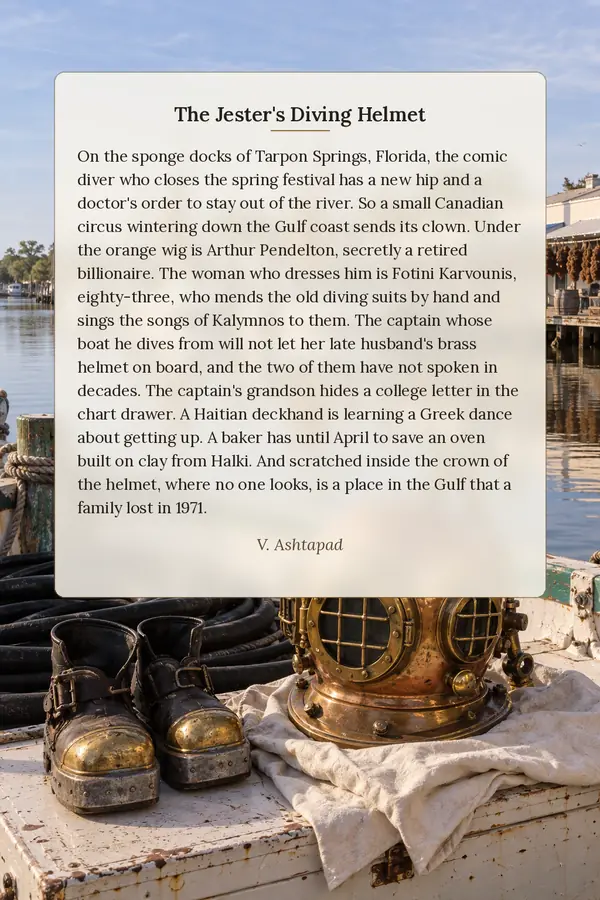
On the sponge docks of Tarpon Springs, Florida, the comic diver who closes the spring festival has a new hip and a doctor's order to stay out of the river. So a small Canadian circus wintering down the Gulf coast sends its clown. Under the orange wig is Arthur Pendelton, secretly a retired billionaire.
The woman who dresses him is Fotini Karvounis, eighty-three, who mends the old diving suits by hand and sings the songs of Kalymnos to them. The captain whose boat he dives from will not let her late husband's brass helmet on board, and the two of them have not spoken in decades. The captain's grandson hides a college letter in the chart drawer. A Haitian deckhand is learning a Greek dance about getting up. A baker has until April to save an oven built on clay from Halki.
And scratched inside the crown of the helmet, where no one looks, is a place in the Gulf that a family lost in 1971.
Members can react to this book and talk about it in the members' Library.