
The Jester's Notebook
Book Two of the Secret Benefactor Series
by V. Ashtapad
Foreword
This is a fictional story. Arthur Pendelton, the Hartley Bros. & Daughters Family Circus, the town of Linden Falls and every person in these pages are imagined. Like Book One, the story is told to carry the values this site is built on: generosity given quietly, respect for the stories of those who came before us, and the belief that a life written down, one ordinary day at a time, becomes a story worth passing on.
For everyone who has ever thought their own days were too ordinary to write down. They are not.
A Clown Walks into Ohio
Linden Falls announced itself the way small Ohio towns do, without any fuss at all. First the grain elevator, a gray concrete giant against a sky the color of weak tea. Then the river, slow and brown under a green iron bridge. Then Main Street: two blocks of old red brick, a hardware store with rakes in the window, a coffee shop with a copper kettle painted on the glass, and a diner whose neon sign had lost its first letter years ago and now said only "OT'S."
Arthur Pendelton stepped down at the courthouse square with one canvas duffel, one brass seltzer bottle, and the quiet happiness of a man arriving somewhere nobody knew his name. He wore plain trousers, a cardigan with patched elbows, and a straw hat. The red foam nose was in his breast pocket, and the spare was in his left sock, because a clown who loses his only nose is just a man in large shoes.
"Fairgrounds?" he asked an old gentleman on a bench, dressed for church on a Tuesday.
The gentleman pointed with his cane. "Over the tracks. Follow the smell of horses. Hartleys came in Sunday. They're all right, the Hartleys."
"That's the best review a circus can get," Arthur said, and tipped his hat.
He walked through late August, noticing everything, the way he always did, including a long low building marked MAPLE GROVE SENIOR CENTER whose ramp had been patched three times in three different colors of concrete.
He made a small note of that ramp in his head. Then he crossed the tracks and smelled the horses.
* * *
The Hartley Bros. & Daughters Family Circus had settled on the county fairgrounds like a village that meant to stay. The big top was red and white and faded at the peaks. Trailers made a crooked ring around it, and a cook truck with BIG LOU'S hand-painted on the side breathed onions and coffee over the grass.
Under the awning of a green office trailer sat a woman in her sixties with silver hair pulled back hard, a denim work shirt, and reading glasses on a beaded chain. She was writing on a clipboard in short, decisive strokes, the way a judge signs things.
"You're blocking my light," she said without looking up.
"Margaret Hartley?"
"Peg. Nobody calls me Margaret but the bank, and I don't like the bank." She looked up, and Arthur felt himself measured, weighed, and nearly filed. "We don't hire roustabouts over forty."
"I'm not a roustabout," Arthur said. "I'm a clown."
She put the glasses on, which was apparently how she looked at clowns. "Every drifter up that road is a clown or a cousin. You'd be amazed how many cousins I've got."
He fitted on the nose, took one step toward her table, and caught his plain brown shoe on absolutely nothing. It was a beautiful fall. It went on far longer than a fall ought to. He pinwheeled, waltzed half around the awning pole, and sat down at last on an overturned bucket with a soft, defeated squeak of his nose against his own knee.
Peg Hartley did not laugh. But the corner of her mouth moved, the way a curtain moves when someone behind it has decided to look out.
"Sit on the chair. The bucket's for the horses."
* * *
The interview was conducted the Hartley way, which is to say it was a long, careful conversation in which Peg asked questions sideways and watched what his hands did while he answered.
"Name?"
"Bippo."
"Your name."
"Arthur. But Bippo shows up for work more reliably."
"Last outfit?"
"A little outfit in a valley out west," he said. "Good people. Fine goats. Terrible taste in music."
"That's not a name."
"No, ma'am," Arthur said gently. "They were kind to me. When I leave a place, I try to leave it the way I'd want to be left. I don't carry their name around the country, and I hope they don't carry mine. If that costs me the job, I understand."
Peg tapped the pencil against the clipboard. It was the first answer she had not expected, and he watched her turn it over, looking for the place where the lie was glued on. She did not find one, because there was none.
"Most fellows brag about who they worked for. Usually somebody big, dead, or in Florida."
"I've never worked for anybody big," Arthur said, which was entirely true. He had only been somebody big, and he had not enjoyed it.
"What do you do in the ring?"
"I fall down in ways people haven't seen before. I lose arguments with props. I once lost a debate with a tuba."
"Tell me about the tuba."
So he told her, the way he told everything, as if it had happened to a slightly sillier cousin. A summer evening in a town he did not name. A salute to the ringmaster that somehow ended with his foot all the way down the bell of a tuba. The tuba player, a solemn man named Ferris, decided the show must go on and kept playing, and Bippo hopped around the ring attached to him like a sad brass boot while the crowd wept with laughter, certain it was planned. "Afterward," Arthur said, "Ferris told me it was the finest low C of his career. He said it had more feeling in it, coming up through a clown."
Peg's pencil had stopped.
"You're older than my clowns usually are."
"Older than most things here, except that grain elevator."
"Then tell me why a man your age wants to sleep in a trailer and eat Lou's chili for three weeks in Linden Falls." She leaned forward, and her voice lost its edge and found something more dangerous: real curiosity. "Men your age who show up here are running from something. A wife. A judge. A bottle. Which is it?"
Arthur took off the red nose and set it on the table between them, which, for a clown, is like taking off a hat in church.
"I spent most of my life in rooms where nobody laughed," he said. "Long tables. Water in cold glass pitchers. Serious people deciding serious things, and not one of them ever told a story that didn't end in a number. One day I realized I couldn't remember the last time anyone had told me about their grandmother. So I left. I'm not running from anything, Mrs. Hartley. I'm running toward the people who still tell stories. In my experience, they're under canvas, or at a diner counter, or on a bench outside a courthouse."
Peg looked at him for a long time.
"My granddad used to say you can tell a liar by how fast he answers," she said finally. "Liars are quick. They've practiced."
"And honest men?"
"Honest men are slow, and they look at their shoes." She glanced down. "Yours don't look like clown shoes."
"The real ones are in the bag. Size twenty-two, violet with lime-green dots. I don't wear them on buses. I tried once, and a woman mistook me for a lawn ornament."
Peg Hartley laughed, one short bark she clearly had not authorized, and put her hand over her mouth as if to push it back in.
* * *
She tested him anyway. She had not kept a family circus alive through three generations, two recessions, and one tornado by hiring on charm.
"My granddaughter Tilly is six," she said. "She's been crying since Sunday because her goldfish didn't survive the drive. Lou made pancakes shaped like fish, which in hindsight was a mistake."
On the steps of a blue trailer sat a small girl with her chin on her knees, glaring at the grass as if it had done something unforgivable.
He walked over in his plain brown shoes, sat on the bottom step, not too close, and looked at the grass too.
"I knew a goldfish once," he said after a while. "Bravest fish in the state. He lived in a mixing bowl on a windowsill by the railroad tracks, and every time a train went by he swam three laps as fast as he could, because he believed he was racing it. He never won. Not once. But he never stopped racing, either."
Tilly's chin came off her knees. "What was his name?"
"Admiral. What was yours?"
"Pickles."
"That," Arthur said with enormous seriousness, "is the finest name for a fish I have ever heard. What did Pickles like?"
It came out in a rush: the plastic castle, the way he came up for food like a tiny orange submarine. Arthur listened to all of it as if it were the most important report he had ever been given. When she finished, he put the nose back on and squeaked it once, softly, like a full stop at the end of a sentence. Tilly giggled. It came out wet and surprised, but it was a giggle.
* * *
"One week," Peg said, back at the table. She turned the clipboard so he could see: ARTHUR (BIPPO). TRIAL. 7 DAYS. "Walkaround before the matinee, two spots in the ring, and help at teardown if your back allows. Make my audience laugh and don't make my crew miserable, you stay. You drink, you steal, you bother the aerialists, you go. Trailer at the end of the row. Silver, dented. Leaks when it rains from the east." She looked at him over the glasses one more time. "And Arthur. That valley out west. If anybody comes asking, I never heard of you."
He understood this was a gift, and that she did not give many. "Thank you, Peg."
The trailer was small and round-shouldered, dented as if a bull had once lost an argument with it. There was a cot, a fold-down shelf, and a window that looked out at the grain elevator. Arthur set the seltzer bottle on the shelf and looked around with deep satisfaction.
"Well," he said aloud, "it's no castle. It's a sardine can."
Late that night he fitted the tiny microphone behind his ear.
"I'm in, Reginald. One-week trial. The owner sees straight through people. I like her enormously."
"Did she see through you?" asked the dry voice from Edinburgh.
"She saw exactly as much as was true," Arthur said, looking toward the dark town and its patched ramp. "Which is all I ever want anyone to see."
The Trial Week
Arthur woke at a quarter past four, as he always did, to the particular darkness that belongs only to fairgrounds: the smell of cold dew on canvas, a horse shifting its weight somewhere, the far-off clank of a freight train crossing the river bridge.
He lit the little burner, set the kettle on, and while it muttered toward a boil he took down the enamel mug. It was white once, with a thin blue rim, and it had a dent in its side the shape of a thumbprint. He had owned finer cups. None of them had ever tasted right before dawn.
Tea, strong, with a splash of milk. Then the notebook, and one page.
He did not write anything grand. He never did. He wrote that the trailer leaked a little after all, though it had not rained from the east. He wrote that Tilly Hartley had drawn a picture of Pickles on the side of the blue trailer in chalk, and that nobody had washed it off. He wrote the date at the top and nothing at the bottom, because a page, he believed, did not need to end with a conclusion. It only needed to be honest about the day.
Then he closed the book, rinsed the mug, and put on the yellow trousers.
* * *
A trial week in a family circus is not a single test. It is a hundred small ones, administered by people who do not tell you they are testing you.
Big Lou tested him at breakfast. Lou was a vast, bald man with forearms like hams and a voice like a gravel truck backing up, and he ladled oatmeal into Arthur's bowl with the air of a judge passing sentence.
"New clown," Lou said. "Last new clown complained about my oatmeal."
Arthur tasted it with great ceremony, closed his eyes, and sighed. "Lou," he said, "I have eaten oatmeal on three continents, and I have never had oatmeal with this much personality."
Lou squinted. "That good or bad?"
"It's honest," Arthur said. "It doesn't pretend to be anything but oatmeal. I respect that in a porridge."
The next morning there was a spoonful of brown sugar on top that nobody else got.
The strongwoman tested him on the second day. Her name was Bernadette Szabo, she could bend a horseshoe the way other people fold a napkin, and she was not fond of clowns, because the last one had squirted her with seltzer before a lift and she had nearly dropped a pony. Arthur found her at the practice ring, chalking her hands, and he did not reach for the seltzer bottle. He set it on the ground between them, very slowly, like a man surrendering a pistol.
"Madam," he said, "I give you my solemn oath. This bottle will never be pointed at anyone holding livestock."
Bernadette looked at the bottle, then at him, then lifted him off the ground by his suspenders, which creaked like an old porch, held him there for a thoughtful moment, and set him down again.
"Good," she said. "Now we understand each other."
The juggling family tested him without meaning to. There were five of them, the Marchetti brothers and their wives and an uncle who juggled only pans, and they practiced in a tight circle behind the cook truck, clubs and rings flashing in the low sun. Arthur stood at the edge, enchanted. When the uncle dropped a frying pan, Arthur did not laugh. He picked it up, looked into it as if it were a mirror, straightened his orange wig, and handed it back with a deep bow. The uncle laughed so hard he dropped two more.
And Gus Hartley, the ringmaster, tested him in the ring itself. Gus was tall and thick-shouldered, with his mother's gray eyes and a red coat that had been let out twice.
"Two spots," Gus said on Wednesday. "Three minutes each. Don't go long. The horses get restless."
Bippo's first spot was the simplest thing in the world. He came out to sweep the ring between acts with a broom twice as tall as he was, and the broom would not cooperate. It swept left when he swept right. It tangled in his shoes. It stood up by itself, apparently, and he bowed to it and invited it to dance, and the two of them waltzed around the ring curb while the band, catching on, struck up something in three-quarter time. The children shrieked.
He came out in two minutes and fifty seconds. Gus looked at his watch, then at the clown, and nodded once.
* * *
On Thursday, the rain came from the east.
It came in the middle of the night, hard and sideways, and by morning the lot was a lake of brown mud. The crew was out before dawn with shovels and straw, and Arthur, mug in hand, stepped out of the Sardine Can in his plain clothes and rubber boots to help.
That was when he first noticed the boy.
He could not have been more than seventeen. He was thin in the way that comes from growing faster than meals arrive, with a shock of dark hair plastered flat by rain and a gray sweatshirt soaked through. He was working at the far end of the lot, alone, digging a drainage trench around the base of a quarter pole, and he was doing it properly: angled, so the water ran downhill toward the ditch instead of pooling under the canvas. Nobody had told him to. Arthur watched for five full minutes, and the boy never once looked up to see if anyone was watching.
"Who's that?" Arthur asked Lou, who was handing out coffee from the cook-truck window.
"Caleb," Lou said. "Came on in Wapakoneta. Talked Gus into a job. Works like a mule and eats like a bird."
Arthur kept watching through the long wet day. He saw the boy haul straw bales two at a time when the older hands took them one by one. He saw him calm a skittish pony by standing beside it and talking low, his hand flat on its neck, until the animal stopped trembling. He saw him lie on his back in the mud beneath the generator truck with a wrench, and the coughing engine smooth into a purr. And when Lou rang the iron triangle for supper, Arthur saw the boy take his plate to the edge of the light and eat with his back against a wheel, quickly, the way a person eats when he is not certain there will be more.
That night, walking back to the Sardine Can, Arthur passed the props wagon. It was a long, low trailer stacked with ring curbs and pedestals and painted tubs, parked on a rise where the mud was thinnest. Underneath it, between the axles, he saw the pale edge of a sleeping bag tucked behind a sheet of plywood, and a pair of work boots set neatly side by side, toes pointed out, the way a soldier leaves them.
Arthur stood very still for a moment. Then he walked on, quietly, so his boots would not squelch.
* * *
On Friday night the crew gathered at Lou's long table under a string of bulbs, and somebody asked the new clown for a story. It was a test too, Arthur knew. A clown who couldn't spin a yarn at supper was only half a clown.
"Did I ever tell you," he said, "about the tent that wanted to fly?"
Nobody had heard it, so he told them. He told them about a big top on the high plains that was so proud of its red and white stripes that it grew tired of being staked to the ground every night. One evening a wind came across the wheat, and the tent saw its chance. It pulled up its own stakes, one at a time, very politely, so as not to wake the crew, and it rose into the sky like a great striped jellyfish and floated off toward the moon.
"It flew for three days," Arthur said. "Over Kansas. Over Missouri. A farmer in Iowa claimed it rained popcorn on his soybeans. But here's the thing." He lowered his voice, and the whole table leaned in. "A tent with nobody under it is just a big piece of cloth. Nobody laughed inside it. Nobody clapped. Nobody fell in love on its bleachers. It was free, and it was the loneliest thing in the sky. So on the fourth day it came down, very gently, right back in the field where it started, and it waited for the crew to come and put its stakes back in."
"That's not true," said Bernadette, smiling.
"Every word," said Arthur. "Ask the soybeans."
The table roared. Even Peg, at the far end with her clipboard and her coffee, allowed her mouth to move. But Arthur was watching the edge of the light, where a thin boy sat with his back to a wagon wheel, and he saw that Caleb had stopped eating to listen, and that he did not start again until the story was over.
* * *
On Sunday, the last day of the trial, Peg found him at the Sardine Can just after dawn. He was on the step with his dented mug, his notebook open on his knee.
She looked at the notebook. He did not close it, and he did not offer it to her either. She seemed to approve of both.
"Bernadette says you can stay," she said. "The Marchettis say you can stay. Lou gave you brown sugar, which I've never seen in thirty years. And my granddaughter wants to know if you can come to Pickles's memorial service, which is at four, behind the blue trailer." She took out her pencil, crossed out one word on the clipboard, and turned it so he could see. The word was TRIAL. "Don't make me sorry."
"Peg," Arthur said, "may I ask you something?"
She waited.
"The boy. Caleb. The one who sleeps under the props wagon."
Her face did not change, but her eyes did. "I know where he sleeps," she said quietly. "I know a lot of things I don't say. He hasn't asked for anything, and he hasn't told me anything, and until he does, I'm letting him keep his pride." She tucked the pencil behind her ear. "You might be better at getting a word out of him than I am. Or you might not. Either way, go slow."
"Slow," Arthur agreed, "is the only speed I've got."
The Boy under the Props Wagon
Arthur went slow.
For three days he did nothing but say good morning. He said it at the cook truck, where Caleb took his oatmeal without sugar and his coffee without anything. He said it at the horse lines, where the boy was already brushing down the ponies before the grooms were awake. He said it on Tuesday at the generator truck, where Caleb was lying on his back in the grass, half under the chassis, and Arthur addressed his remarks to a pair of worn work boots.
"Good morning, boots."
There was a pause from beneath the truck. Then, grudgingly: "Morning."
On Wednesday, Arthur added a second sentence. "Lou says you fixed the generator."
"Fuel filter," said the boots. "Wasn't hard."
"It was hard for the four men who looked at it before you."
The boots said nothing to that, but Arthur thought they looked a little pleased.
* * *
On Thursday night, after the evening show, when the crowd had drained away toward the parking field and the lot had gone soft and quiet under the bulbs, Arthur collected two plates of Lou's pot roast and two slabs of cornbread and walked up the little rise to the props wagon.
He did not look underneath it. He sat down on an overturned tub ten feet away, set one plate on another tub beside him, and began to eat.
After a while a voice came from under the wagon. "That for somebody?"
"It's for whoever wants it," Arthur said. "Lou made too much. Lou always makes too much. I think it's a philosophy."
Another long pause. Crickets. Then the plywood shifted, and Caleb crawled out, brushing straw from his sweatshirt, and sat on the far end of the tub with the plate on his knees. He ate the way he always ate, fast and with his shoulders hunched, and Arthur did not say a word until the cornbread was gone.
"You gonna tell Peg?" Caleb said at last. He jerked his chin at the wagon. "About that."
"Peg knows."
The boy went very still. "Since when?"
"Since before I did, I'd guess. Peg knows where every stake on this lot is driven. She told me she was letting you keep your pride until you asked for something. That's a rare kindness, from a woman who doesn't hand them out like candy."
Caleb stared at the dark shape of the big top for a long moment. His jaw worked. Arthur could see him deciding whether to be angry, and then deciding he was too tired.
"I'm not a charity case," the boy said.
"No," Arthur agreed. "You're the best hand on this lot. Everyone knows it. You dug the trench nobody asked for, you fixed the generator nobody could fix, and you got that gray pony to stop shaking when the grooms couldn't get near her. A charity case doesn't do any of that. A charity case waits to be helped."
The boy's ears went faintly red in the bulb light. He looked down at his hands. They were big hands for a thin boy, scarred across the knuckles, the hands of somebody who had been working since he could reach a latch.
"Where'd you learn it?" Arthur asked. "The pony."
It came slowly, the way water comes up a pump that hasn't been used in a while: a cough of air, a trickle, and then, unexpectedly, a stream.
There had been a dairy farm, Caleb said, down the road from where he grew up, in the hills of western Pennsylvania where the towns were named after saints and the mills had been closed since before he was born. A man named Mr. Kessler ran it, with sixty Holsteins and a barn that smelled of hay and warm milk and diesel. Caleb had started going over there when he was nine, the year his mother left. He went at first just to be somewhere that wasn't home. Mr. Kessler had put a pitchfork in his hand without asking any questions, and by eleven the boy could milk, and by thirteen he could rebuild a vacuum pump, and by fifteen Mr. Kessler said he had better hands with a nervous heifer than any vet in the county.
"What happened to Mr. Kessler?"
"Sold out. Two winters ago. Milk prices." Caleb shrugged, a small, hard shrug. "Bank took most of it. He moved to his daughter's in Maryland."
"And home?"
The boy was quiet so long that Arthur thought he had pushed too far. Then: "My dad drinks." He said it flatly, the way you report weather. "Not always. But more, after the farm closed and I didn't have anywhere to go in the mornings. The house got loud. Then it got real quiet, which was worse. So I left." He picked at a splinter on the tub. "I'm seventeen. I'm not stupid. I know what happens to kids who leave. I figured a circus moves around enough that nobody's going to come looking, and if they did, I'd be in the next county."
"Has anybody come looking?"
Caleb gave a short laugh with no humor in it. "No, sir."
Arthur let that sit. He did not offer an opinion about the father, or about the mother who had left, or about the town with the saint's name. He had learned, long ago, that a person telling you the hardest thing in their life does not want your verdict. They want to know you heard it.
"Thank you for telling me," he said.
* * *
"Can I tell you a story in return?" Arthur asked after a while. "Stop me if it's boring. Most people do."
Caleb almost smiled. "Go ahead."
"There was once a lighthouse keeper on a rock off the coast of Maine," Arthur said. "Forty years he kept that light. And every night, before he went to bed, he wrote in the logbook, because the government said he had to. Wind northwest. Lamp lit at seven. Fog at midnight. That's all they asked for. Wind and lamp and fog."
"Sounds boring," Caleb said.
"Exceptionally. And the keeper thought so too. But he was a lonely man, out on that rock, and after a few years he started adding things. Just small things, in the margins. Fixed the wing of a gull. Saw a whale, I think. Mary's birthday, sent a letter on the supply boat. Bread burned again." Arthur's voice softened. "After he died, his granddaughter found all forty years of logbooks in a crate. She'd only ever known him as a gruff old man who didn't say much at Christmas. And she sat down and read every margin, and by the end she knew him better than anyone alive. She knew he loved a woman named Mary for forty years. She knew he saved birds. She knew he never once learned to bake bread, and never once stopped trying." He paused. "The government only wanted the wind and the fog. But the margins were where the man was."
Caleb was looking at him now, directly, for the first time.
"Is that true?"
"Truer than the tent that flew," Arthur said. "Somebody I loved very much taught me what margins are worth. I'll tell you about her someday."
He reached into the deep pocket of his coat and brought out a composition notebook, the cheap kind with the black-and-white marbled cover, still in its plastic wrap. He had bought it that morning at the hardware store on Main Street, along with two yellow pencils, which he had sharpened with his pocketknife on the walk back. He set the notebook and one pencil on the tub between them.
"What's this for?"
"For your margins. Write in it every day. Anything at all. What Lou burned. What the gray pony did. What the generator sounded like before and after. What you were thinking when it rained from the east."
"Why?"
"Because what you write down is what matters to you," Arthur said. "You won't know that at first. You'll think you're writing nonsense. But if you do it every day, one day you'll turn back through those pages and find out who you are. And someday, Caleb, those pages are going to add up to something. A history. A story worth handing to somebody. Maybe a son or a daughter. Maybe just yourself at forty, who'll want very much to know what seventeen was like."
The boy turned the notebook over in his big, scarred hands. "I'm not a writer. I barely finished junior year."
"Neither was the lighthouse keeper. He just wrote down the bread."
"What if nothing happens?"
"Then write that nothing happened, and what nothing looked like. Nothing has a color, if you look at it long enough."
Caleb looked at the notebook for a long time. Arthur could see him deciding again, the way he had decided earlier whether to be angry. It was the face of someone who had learned not to want things, because wanting led to disappointment. Arthur had once seen that face in his own shaving mirror.
"I'll pay you for it," Caleb said stiffly.
"You can't," Arthur said. "This one costs one page a day. Pay in stories. That's the only currency I take."
* * *
Arthur gathered up the plates and walked back down the rise toward the Sardine Can. He did not look back, because looking back would have made it a gift with strings, and he wanted this one to have no strings at all.
He wrote his own page late that night, at the fold-down shelf, by the light of a battery lantern. He wrote about pot roast and a gray pony and a dairy farm in the hills of Pennsylvania that a bank had swallowed. He wrote down Mr. Kessler's name, and the words sixty Holsteins, and the words better hands than any vet in the county. He underlined nothing. He never did. But he read those lines twice before he closed the book.
Before he turned in, he stepped outside to look at the stars.
Up on the little rise, under the props wagon, a small circle of flashlight glowed through the gap behind the plywood. Arthur stood perfectly still and listened. Across the wet grass, faint and halting and absolutely unmistakable, came the scratch of a pencil on paper.
It stopped. It started again. It kept going.
Arthur smiled in the dark, squeaked the spare nose in his pocket once, very softly, for luck, and went to bed.
The Clown on Main Street
Monday was the circus's dark day, and on dark days Bippo went to town in full regalia, because a clown who only exists inside the tent is a clown with a very small kingdom.
He set out from the fairgrounds at half past eight. The yellow polka-dot trousers rode high under his ribs, the elastic suspenders creaking at every step like a rocking chair on a porch. The size-twenty-two violet shoes with lime-green dots slapped the pavement with a sound like a seal applauding. The orange wig caught the morning sun and blazed. Blue stars were painted fresh around his eyes, the carnation in his lapel was loaded with lavender water, and the red nose sat at a jaunty angle, with its understudy in his left sock.
Linden Falls received him the way it received weather. Two boys on bicycles circled him three times and then rode alongside, shouting questions.
"Are you a real clown?"
"Only on weekdays," said Bippo. "On weekends I'm a pirate."
"Where's your boat?"
"Parked in Lake Erie," Bippo said gravely. "Your parking spaces are tiny."
A woman in a flowered apron came out of the bakery to watch and stayed in the doorway, laughing, with flour on her chin.
He had a destination: the Copper Kettle, two doors down from the old courthouse, which Lou had told him made the only cup of coffee in the county that did not taste like a tire. He was almost there when he saw the girl on the bench.
* * *
She was sitting on the iron bench in front of the courthouse lawn, under a maple that had just begun to turn at the edges. She was perhaps twenty-five, thin, in a denim jacket too warm for the morning and a pair of paint-stained jeans, and she had a sketchbook open on her knees. She was drawing, fast and intent, with a stub of charcoal.
What caught Arthur's eye was not the drawing but what she was looking at. An older woman with a cane was crossing the courthouse lawn, and the girl's eyes were fixed on her with a hunger that was not quite an artist's. She was studying the woman's face the way a person studies a map of a country she was born in and has never seen. When the woman turned toward the post office, the girl's charcoal stopped, and she let out a breath that seemed to cost her something.
Then she looked up and saw an enormous clown standing ten feet away, staring at her.
"No," she said.
"I haven't asked anything yet."
"You were going to ask me to draw you. Everybody with a funny hat asks me to draw them." She closed the sketchbook halfway. "I don't draw clowns."
"Very wise," Bippo said. "Clowns are notoriously difficult to draw. You get the nose wrong and suddenly it's a tomato with ambitions." He sat down on the far end of the bench, which groaned. His shoes extended so far across the sidewalk that a man walking by had to step over them like a puddle. "I'll tell you a secret, though. I'm only a clown on the outside. On the inside I'm a deeply serious accountant named Gerald."
Her mouth twitched. She fought it, but it twitched. "Gerald."
"Gerald has never once laughed. Gerald irons his socks."
That did it. She laughed, short and surprised, and then looked annoyed with herself for laughing, which Arthur had seen before. It was the face of somebody who had not laughed in a while and was not sure she was allowed to.
"I'm getting coffee," he said, rising with a creak of suspenders. "Gerald insists on buying you one, as an apology for my appearance. He's very correct about these things."
He did not wait for her to refuse. He went into the Copper Kettle, where a young man behind the counter took one look at him and dropped a spoon. Arthur ordered two coffees, black, and a cinnamon roll the size of a hubcap, and when he came back out the girl was still on the bench. He considered that an enormous victory.
* * *
Her name was June. She gave it reluctantly, as if it were a coin she might need later.
She wrapped both hands around the paper cup and held it without drinking, and Arthur noticed that her hands trembled, very slightly, and that there were gray half-moons under her eyes that no amount of sleep had touched. Once, when a truck backfired out on the highway, she flinched hard and pressed her hand against the pocket of her denim jacket, the way a person touches a sore tooth, to make sure it is still there. Arthur saw it, and filed it away, and said nothing at all.
"So what were you drawing?" he asked instead. "If not clowns."
She hesitated. Then, slowly, she turned the sketchbook around.
It was full of faces. Women's faces, all of them older, fifty and sixty and seventy, sketched in quick charcoal on the courthouse lawn and at the grocery and on the bench outside the library. A woman laughing. A woman frowning at a parking meter. A woman with her hand at her throat. They were good, Arthur thought. They were very good. But they had something in common beyond their age, something in the angle of the jaw and the set of the eyes, as if the artist had been searching every one of them for the same feature and not quite finding it.
"You're looking for someone," he said softly.
June shut the book.
For a long moment she did not answer. Then she said to the coffee, "I was adopted. Out of foster care. I don't know who my mother is. I just know she might be from around here, or she might be from Alaska. I don't know anything." She laughed again, but this time it was a different kind of laugh, thin and cracked down the middle. "So I draw every woman over fifty in three counties and see if any of them have my chin. That's normal, right? Totally normal hobby."
"I've seen stranger hobbies," Arthur said. "I once knew a man who collected the sound of doors closing."
She looked at him sideways.
"He had them on tape," Arthur said. "Hundreds. A barn door in Vermont. A cathedral in Spain. His mother's kitchen door, the screen kind, with a spring. He said the kitchen door was the only one that sounded like home."
June was quiet. Then, almost against her will, she opened the sketchbook again and turned to a page near the back. It was a door. Just a door, drawn in pencil, with a small square window and a brass knob and three steps leading up to it. Next to it on the facing page was the same door again. And on the page after that. Seven doors, eight, all the same door, all in plain gray pencil.
"I don't know where it is," she said. "I've been drawing it since I was a little kid. Every foster home. Every caseworker's office. I don't know if it's real or if I made it up."
"Why only pencil?" Arthur asked gently.
"Because I don't know what color it is."
* * *
Arthur did not try to fix it. There was no fixing it on a Monday morning on a courthouse bench with a cinnamon roll. Instead he did what he always did when a heart opened a crack and there was nothing yet to put through it. He told a story.
"Did you ever hear about the button that fell off a coat?"
June wiped her eyes roughly with her sleeve. "Is this a clown story?"
"It's a Gerald story. Much more serious." He settled back on the bench. "Once there was a brass button on a good wool coat, and one winter day it came loose and fell and rolled under a heavy dresser in the front hall. And there it stayed. Years went by. The button lay there in the dust with the lost pennies and a marble, and it thought, well, that's that. The coat has forgotten me. Someone has sewn on a new button by now, a shinier one. Nobody's looking."
"Sad button," June said.
"Very. Then one spring, somebody finally moved the dresser to paint the wall, and there was the button, blinking in the light. And the old woman who found it picked it up and said, 'Oh. There you are.' And she went to the closet, and she took out the coat. And the coat still had a gap where the button had been. Every other button was there, but she had never sewn on a new one. All those years, she'd worn the coat with one button missing, because she always believed the old one would turn up."
June was very still.
"Lost things don't always know they're being kept a place for," Arthur said quietly. "That's all. It's just a story about a button."
The bell over the Copper Kettle jingled. The old woman with the cane came back from the post office and crossed the lawn again, and June did not watch her this time. She was looking at the clown.
"You're a weird clown," she said finally.
"Thank you. Nicest thing anyone's said to me all week."
She almost smiled. Then she picked up the charcoal, flipped to a clean page, and, frowning with concentration, began to draw a big, ridiculous man with stars around his eyes and a nose like a tomato with ambitions.
"I thought you didn't draw clowns."
"I'm not," June said, without looking up. "I'm drawing Gerald."
Arthur sat perfectly still and let her draw. And when she tore the page out at last and handed it to him, he saw that she had caught him exactly: not the wig, not the shoes, but the eyes inside the painted stars, which were kind, and older than they pretended to be, and watching her with careful hope.
He folded the drawing and put it in his breast pocket, over his heart. Then he said goodbye, and squeaked the nose once for her, and walked off down Main Street with the seal-applause of his shoes echoing off the brick.
He did not look back. But at the corner he stopped beside the hardware store window and, in the reflection of the glass, saw that she was still on the bench, holding the sketchbook open to the page of gray doors, and that she had not closed it.
Fragments
The bench outside the Copper Kettle was green once, a long time ago, before forty Ohio winters had peeled it down to a soft driftwood gray. By the second morning Bippo walked past it, he had begun to think of it as June's bench, the way some people think of a pew as theirs, or a stool at a counter. She was there again, knees drawn up, sketchbook propped against them, a paper cup of coffee going cold beside her hip.
He did not stop right away. That was a lesson from a long life of knocking on doors that did not want to open: a person who has been hurt watches the first approach very carefully, and the second approach even more carefully, and only on the third does she decide whether you are weather or company. So he squeaked his nose at a pigeon, tipped an imaginary hat to the hardware store, held the coffee shop door for an old man with a cane, and came back out with two cinnamon rolls in a waxed paper bag.
"I have made a terrible mistake," he announced, sitting at the far end of the bench, a polite yard of gray wood between them. "I ordered one cinnamon roll, and the young lady behind the counter heard 'two,' and I was too much of a coward to correct her. Now I am in possession of a surplus. It is a burden. Would you relieve me of it?"
June looked at the bag, then at the painted blue stars around his eyes, then back at her sketchbook. "You did that on purpose."
"I do almost nothing on purpose," Bippo said. "Ask anyone at the circus. Yesterday I walked into a tent pole on purpose, and I meant to do it gracefully."
The corner of her mouth moved. It was not a smile, exactly. It was the place where a smile would go if one ever came back. She took the roll.
* * *
Up close, in morning light, she looked younger than twenty-six and older at the same time. Her hands were steady when she drew and not so steady when she lifted the cup. There were shadows under her eyes that no amount of sleep seemed to have touched. The sketchbook was full of doors. Brick doorways, screen doors, a barn door hanging off one hinge. One of them, he noticed without seeming to notice, appeared again and again, always in plain gray pencil.
"You like doors," he said.
"I don't know what I like." She turned a page so he could not see. "I draw what my hand wants to draw."
They ate for a while in silence. A grain truck rumbled down Main Street toward the elevator, and the whole bench trembled with it. Finally she said, to the street rather than to him, "I was in foster care until I was five. Three houses. Then the Hales adopted me. Good people. Quiet. They died a couple years ago, both of them, a year apart." She picked at the edge of the waxed paper. "When I went to find out where I came from, the records were sealed. You fill out forms. You wait. You get a letter that says a lot of nothing very politely."
"I am sorry," Bippo said, and meant it, and did not add anything else, because in his experience most of the harm in the world was done by people who could not stop at the first sentence.
"I came to Linden Falls because one form had the county name on it. That's it. That's my whole map. A county." She laughed, short and dry. "I've been here six weeks. I sit on a bench and draw doors."
Then, after a long pause, the harder part came out, in a flat voice, the way people say things they have practiced saying only to themselves. She had hurt her back lifting crates at a warehouse job the year her parents died. There had been a prescription, and then the prescription ran out, and then there were other ways of getting pills, and somewhere in there the pills stopped being about her back. "They make it quiet," she said. "Not good. Just quiet. And then the quiet costs more every week, and I hate myself on Tuesday for what I did on Monday." She pressed the heel of her hand against one eye. "I don't know why I'm telling a clown this."
"Because a clown is the least frightening thing on Main Street," he said gently. "Nobody has ever been judged by a man in violet shoes. It would be ridiculous."
* * *
He did not lecture her. He had sat through enough board meetings in his other life to know that a lecture is only a way for the speaker to feel better. Instead he folded his gloved hands on his yellow polka-dot knee and told her a story.
"Out west there was a woman who lived by a river," he began, "and every morning she walked the bank and picked up one piece of broken china from the mud. Just one. A blue rim here, a white chip there, a bit of a painted rose. Her neighbors thought she was mad. 'What will you do with a bucket of broken plates?' they asked. She said she didn't know. She only knew that she couldn't stop picking them up.
"Years went by. One winter, when the river froze and there was nothing to do, she poured out the bucket on her kitchen table and began to fit the pieces together. Most of them belonged to nothing. But slowly, out of the rubble, came most of a single plate. A blue rim. A painted rose in the middle. And when she turned it over, there on the back, in faded ink, was a name. Her grandmother's name. The house where her grandmother had lived had once stood upriver, and had washed away in a flood before the woman was born."
June was quiet. A breeze turned the pages of her sketchbook, and he saw doors, doors, doors.
"She didn't find the whole plate," Bippo said. "Some pieces were gone forever. But she found enough to know where she came from. And she only found it because she picked up one small piece every day, even when it seemed foolish."
"That's a nice story," June said, guarded. "Is it true?"
"It is true in the way that matters," said Bippo. "The details may have been improved by a clown."
* * *
What he suggested next he suggested as if it had just occurred to him, though he had been turning it over since the first morning. "That sketchbook," he said. "Have you ever written in it? Not drawn. Written."
"Written what?"
"Your day. What you ate. Who you saw. What made you angry, what made you want a pill and what you did instead, and what you did when you didn't do instead." He held up one gloved hand before she could bristle. "Not for anyone else. Not for me. For you. And this is the important part. Any little scrap of memory that floats up, no matter how silly. A smell. A color. A song somebody hummed. A word on a sign. Write it down the moment it comes, before it sinks again."
"I don't remember anything from before the Hales. I was a baby, practically."
"Then you will write down nothing," he said cheerfully, "and you will have lost nothing. But the mind is a river, and things come loose from the mud when you are not looking for them. You draw the same door, June. Your hand knows something. Let your pencil go and ask it."
She looked down at the open page, at a door she had drawn three days ago without knowing why, and something passed over her face that she quickly put away.
Then he reached into the pocket of his trousers, past the satellite tablet she would never see, and took out a small white card. He had found it pinned to the corkboard by the Copper Kettle's register, under a flyer for a lost beagle. He set it on the bench between them, not in her hand. It said COUNTY RECOVERY SERVICES, with a counselor's name and a phone number, and on the back someone had written in ballpoint: Support group, Tuesdays and Thursdays 7 p.m., basement of the church with the white steeple on Elm Street. Coffee. No questions asked.
June's face closed like a fist. "I knew it. I knew there was a catch. You're one of those."
"One of what?"
"People who think they can fix me with a pamphlet."
"Oh, I can't fix anything," Bippo said. "I can't even fix my own suspenders. Listen." He let them creak, loudly, and she very nearly laughed against her will. "A notebook is a good thing. I believe in it the way some people believe in church. But a notebook is a flashlight, not a doctor. The pills are bigger than a notebook, and they are bigger than you alone, and that is not a failure of yours. It is just what they are. There are people whose whole job is to walk that road beside you. That's all the card is. A road with company on it."
She did not pick it up. She stood, gathered her pencils, and shoved the sketchbook into her canvas bag with more force than it deserved. "Thanks for the roll," she said stiffly, and walked off toward the river.
Bippo sat alone on the gray bench. The card sat where he had left it. He did not move it toward her end. He finished his coffee, squeaked his nose once at the pigeon for luck, and went to work.
* * *
That afternoon, during the matinee warm-up, a boy from the juggling family came running across the yard with a message. A young woman had come by the gate asking for "the clown with the stars," and when told he was busy, had said never mind, never mind, it wasn't important.
The next morning the bench was empty when he passed it. The card was gone.
He did not know whether the wind had taken it, or a street sweeper, or a girl with a canvas bag who had circled back after dark. He decided not to know. Some things, he had learned, were meant to be found out later, in their own time, one small piece at a time.
He walked on toward the Copper Kettle with his shoes clacking on the old brick, and he hummed to himself, and if anyone had looked closely beneath the greasepaint they would have seen that the clown was praying.
The Sardine Can at Midnight
At midnight the fairgrounds of Linden Falls belonged to the crickets. The big top stood dark against the stars like a sleeping animal, its guy lines humming faintly in the river breeze. Somewhere near the cook truck a generator coughed itself to sleep. The last light in the whole circus yard glowed inside a dented silver trailer parked crooked at the end of the row, between the props wagon and a rusted water tank.
The Sardine Can had earned its name honestly. It was eleven feet long, and Arthur Pendelton, who had once owned a corporate jet with a shower in it, could touch both walls at once while sitting on the bunk. The ceiling had a dent the exact shape of a previous owner's head. The tiny stove had two burners, one of which worked. He loved it beyond reason.
He sat at the fold-down table in a gray flannel robe, his face scrubbed pink and bare, the orange wig sleeping on its foam head beside the sink like a contented cat. The squeaky red nose rested on a folded handkerchief, and beside it lay the spare, because a clown without a spare nose is a man tempting fate. His tea steamed in the dented enamel mug. On the table in front of him lay his leather-bound book, open to a blank page, and a box of crayons with the corners worn soft.
He drew a cow first. It was not a good cow. It had five legs, because he had miscounted, and a smile that suggested it knew something. Beneath the cow he drew a pencil, and beside the pencil, a little stack of books with a mortarboard perched on top. Then he sat back and looked at it for a long time.
On the next page, he drew a door and left it uncolored. He drew a small white card beside it, and a river, and a woman picking up something from the mud.
The tablet chimed.
* * *
"Good morning, Arthur," said Mr. Reginald Sterling, whose morning it was. Behind him, through the tall window of the Edinburgh office, a pewter sky was considering rain. He wore a three-piece suit and the expression of a man who had already had two meetings and expected to be disappointed by a third. "Or good evening. I can never keep track of which side of the world you've wandered to."
"Ohio," said Arthur. "Linden Falls. Population six thousand and one clown."
"Yes, I've had the pleasure of explaining that to Fenwick." Sterling adjusted his spectacles. "Young Fenwick from the trust accounts desk came into my office yesterday holding a utility receipt. He asked me, with the face of a man defusing a bomb, why our most significant private client had a forwarding address of 'The Sardine Can, Hartley Bros. and Daughters, Fairgrounds Gate B.' I told him it was a tax strategy. He wrote it down."
Arthur laughed, softly, so as not to wake the strongwoman two trailers over. "Poor Fenwick."
"Poor Fenwick indeed. He has begun to look at me as if I might be part of a cult." Sterling folded his hands. "Now. You have drawn something. I can tell by your face. Show me the crayon evidence."
Arthur turned the tablet's camera toward the book.
Sterling studied it for a long, judicial moment. "That is a cow with five legs."
"It is a dairy farm," Arthur said. "With room in it for a boy. A boy who gets up before the roustabouts and works after they quit, and sleeps under a wagon because he's too proud to ask for a bunk. He has hands for animals and machines, Reginald. He fixed the generator truck last week with nothing but a fuel filter, and Big Lou nearly adopted him on the spot. He needs a place with a roof, and a person who will teach him, and a way to finish school without anyone treating him like a charity case."
"And the books with the hat?"
"The diploma. He's seventeen. He left before senior year."
Sterling was already making a note, his fountain pen scratching. "I'll have someone quietly look at what the trusts hold in the northern part of the state, and what might be suitable. I make no promises yet."
"You never make promises, Reginald. That's why I trust you."
"And the door?"
Arthur was quiet for a moment. "A young woman. I won't say more yet. She's carrying more than one person should carry, and she's carrying some of it the wrong way. What she needs first isn't money. It's help, the real kind, and she has to choose it herself. I can only leave the door unlocked." He touched the crayon drawing of the card. "Yesterday I left a card on a bench. This morning it was gone. That's all I know."
"Hmm," Sterling said, which from him was a paragraph of sympathy.
* * *
The tea had gone lukewarm. Arthur turned the mug in his hands, and the dent caught the lamplight.
"May I ask you something, Arthur?" Sterling said. "In thirty years I've never quite asked it, and Fenwick is not the only one who wonders. Why the notebooks? Why do you make them all write? The boy, the woman. You did it last season as well. A pencil, a notebook, 'write a page a day.' You could simply pay off their troubles and be done with it."
Arthur did not answer right away. He reached under the bunk and pulled out a flat wooden cigar box, its lid held shut with a rubber band. He had carried it through three continents and four boardrooms and two circuses. He set it on the table and opened it.
Inside lay a small notebook with a green cardboard cover, soft as cloth with age, its corners rounded off by a kitchen drawer opened and shut ten thousand times.
"My grandmother," he said. "Nell Pendelton. She was a seamstress in Pittsburgh. She altered wedding dresses and let out the trousers of steelworkers who ate too well at Christmas. When I was a boy I spent summers in her kitchen, under the table, playing with spools, and she was the quietest person I ever knew. She hardly spoke about herself. I thought she was simply an old woman who sewed."
He opened the notebook gently, the way one opens a bird's wing.
"Every night, after the dishes, she sat at the kitchen table and wrote three lines. Never more. Then she put the notebook back in the drawer with the string and the rubber bands. I thought it was a grocery list. When she died, I was nineteen and too busy being important to come home for more than the funeral. My mother found a whole drawer of these. Forty years of them. Three lines a night."
He read aloud, from a page brown at the edges:
"'Sold the good scissors to pay the coal. Arthur came. He laughed at the cat for an hour. That was worth the scissors.'"
Sterling said nothing.
Arthur turned a page. "'Hands bad today. Finished the Kowalski girl's veil anyway. She will be married in it on Saturday and never know my name, and that is right.'"
He closed the book.
"I learned more about my grandmother from these pages than from nineteen years of sitting at her table," he said. "I learned she had been hungry, and kept it from us. I learned she paid for my first school shoes with a brooch her own mother gave her. I learned she was funny. She was so funny, Reginald, and she never let anyone see it but the notebook. If she hadn't written those three lines a night, she would have been a stranger to me forever. A kind old woman who sewed. That's all I'd have had."
He looked up at the screen. The bare face beneath the absent greasepaint was older than the clown's, and much more tired, and very gentle.
"The money," he said, "the money is just a tool. It buys farms, and fixes roofs, and pays a counselor's salary. Good. But the notebook is how a person becomes known. To their children. To the people who come after. To themselves, even, on a bad Tuesday. Most people go through their whole lives thinking nothing they did was worth writing down. And then they are gone, and there is nothing left of them but a name on a stone. My grandmother left me a whole woman in a kitchen drawer. I'd like to help a few more people leave something like that."
* * *
For once, Mr. Reginald Sterling of Sterling & Montgomery had nothing dry to say. He took off his spectacles, polished them on a handkerchief that did not need it, and put them back on.
"Well," he said at last. "I shall tell Fenwick it is not a cult. It is a grandmother."
Arthur laughed, and the trailer creaked around him like an old ship.
"Before you go," Sterling added, "your next entity name. For when the time comes. You know my associates insist on something gentle and untraceable."
Arthur looked down at the green notebook in its cigar box. "The Nell Pendelton Lantern Fund," he said. "She used to leave a lamp in the kitchen window when I came home late. Let's leave a few lamps on in Linden Falls."
"Noted," Sterling said, and wrote it down with real care. "Goodnight, Arthur."
"Goodnight, Reginald."
The screen went dark. Arthur put the green notebook back in its box and slid it under the bunk. His morning page would come at dawn, as it always did, with the tea. But tonight he opened the leather book to a fresh page and did something he had not done in years: he wrote three lines, exactly the way Nell had.
Left a card on a bench. It was gone in the morning. Drew a cow with five legs. Told Reginald about Nell, finally.
He looked at it for a moment, and thought they might be the best three lines he had written all year. Then he turned off the lamp. Outside, the crickets went on keeping their own small record of the night.
Seniors in the Front Row
The Maple Grove van arrived at the fairgrounds twenty minutes early, which was the only way the Maple Grove van ever arrived anywhere. It was a white fifteen-passenger shuttle with a wheelchair lift that groaned like a sea shanty and a hand-lettered sign in the back window: SENIORS ON BOARD, PLEASE BE PATIENT. Out of it, one careful step at a time, came eleven residents in cardigans and windbreakers, two walkers with tennis balls on their feet, one wheelchair, and a slender, harried activities director named Rosalind Petty, who was carrying a clipboard, a tote bag of water bottles, and a look of quiet hope.
Gus Hartley, the ringmaster, had saved them the whole front row on the east side, close enough to smell the sawdust. Peg had insisted on it. "Old folks paid for half the bleachers in this business," she'd said, peering over her reading glasses. "Front row, cushions, and somebody walks them to the restroom if they ask."
Bippo watched them settle in from a gap in the backstage curtain. Most of them were already smiling, the way people do when they are somewhere new after a long stretch of somewhere the same. A man in a Vietnam veterans cap was pointing at the high wire. Two ladies were sharing a bag of kettle corn with the solemn concentration of diamond cutters.
And at the end of the row, in the aisle seat nearest the exit, sat a small woman in a navy blue coat buttoned all the way to her throat, though it was a warm afternoon. Her white hair was pinned in a tight bun. Her purse sat squarely on her lap, both hands on its clasp, as if she expected the circus to try to steal it. Her mouth was a straight line drawn with a ruler.
"That one's Mrs. Doss," whispered one of the juggling girls, who had a cousin who worked the Maple Grove kitchen. "Evelyn Doss. My cousin says she sent back her oatmeal four times last week because it was 'gluey.' She made the chaplain cry once."
"Did she," said Bippo, with deep professional interest.
* * *
The matinee rolled out the way a good matinee should. The strongwoman lifted a piano with a little girl playing it. The jugglers kept seven clubs in the air and then, at a nod from Gus, eight. And then it was Bippo's turn, and he came tumbling out of the curtain in his size-twenty-two violet shoes, tripped over absolutely nothing, rolled twice, and came up holding a bouquet of plastic daisies that he presented with tremendous ceremony to the front row.
The veteran took one. The kettle corn ladies took one each and giggled like schoolgirls. Bippo worked his way down the row with low, sweeping bows until he reached the aisle seat and Mrs. Evelyn Doss.
She looked at the daisy. She looked at him.
"It's plastic," she said, loudly enough for three rows to hear.
"Madam," Bippo said, with wounded dignity, "so is my nose." He squeezed it. It squeaked. The children in the second row shrieked.
Mrs. Doss did not shriek. She took the daisy between two fingers, as if it were something the cat had dragged in, and dropped it into her purse and snapped the clasp. "You missed a spot," she said, pointing to his chin, where the white greasepaint had worn thin. "You look like a wall somebody gave up on painting."
The front row gasped. Rosalind Petty closed her eyes.
Bippo touched his chin, looked at his glove in horror, and then turned to the whole grandstand and cried, "I have been CRITIQUED!" He staggered backward, clutched his heart, fell over into the sawdust, and lay there, twitching one violet shoe, until a juggler came out with a feather duster and briskly dusted his face. The crowd roared.
When he got up, he glanced back at the aisle seat. Mrs. Doss was not laughing. But her ruler of a mouth had shifted, just a degree, the way a door shifts when the wind leans on it. And she was watching him with eyes that were very sharp and very, very tired.
* * *
After the show, the Maple Grove van had to wait for the wheelchair lift, which had decided to rest. Rosalind was on her knees beside it with a screwdriver and a phone, saying "please" to both. The residents sat on a bench in the shade of the cook truck while Big Lou handed out lemonade, and Bippo, still in full costume, wandered over with his hands in his enormous pockets.
Mrs. Doss sat at the end of the bench, a little apart, coat still buttoned.
"May I?" he asked, indicating the empty space beside her.
"It's a free country," she said. "More or less."
He sat. The suspenders creaked. She glanced at them with contempt.
"I apologize for the spot," he said. "I've been meaning to repaint my chin for years. It's a matter of finding the time."
"Hm." She sipped her lemonade and made a face. "Too sweet. Everything's too sweet now. In my day we made lemonade that could take the rust off a fender."
"In my day," said Bippo, "I was given lemonade only on Sundays, and it was mostly water with a rumor of lemon."
That earned him a sideways look. A real one.
"I'll tell you a story, if you'll let me," he said. "It's short. I tell a lot of them. It's a professional hazard."
"I can't stop you. I've got bad knees."
"Once," Bippo began, "in a forest in the north, there lived a porcupine. Every creature in the forest knew the porcupine was difficult. If a rabbit came too close, she bristled. If a deer said good morning, she bristled. If the wind blew too hard, she bristled at the wind. The other animals said she had a terrible temper, and they gave her a wide circle, and in the winters she sat all alone under her pine tree.
"One cold evening an old owl came and sat on the branch above her. 'Why do you bristle at everybody?' asked the owl. And the porcupine said, 'I didn't use to. When I was young, I had five little ones to keep alive in this forest, and foxes everywhere, and no one to help me. I had to bristle at everything, all night, every night, for years and years, or they'd have been eaten. And now they're grown and gone off to other forests, and I can't remember how to put the quills down.'
"And the owl said, 'Do your little ones know that? Why you bristle?' And the porcupine said, 'No. They think I'm just prickly.'"
Bippo stopped there. He took a sip of his own lemonade, which was in fact much too sweet.
Mrs. Doss was very still. Her hands had gone tight on the clasp of her purse.
"How does it end?" she said at last, without looking at him.
"I don't know yet," he said. "I'm still working on it."
* * *
The wheelchair lift made a noise like a goose with opinions and began, slowly, to work. Rosalind let out a small cheer. The residents began the long business of getting up.
Mrs. Doss did not get up. She looked across the fairground at the big top, its striped canvas glowing in the late sun.
"Five," she said. "I had five. My husband died when the youngest was eleven months old. Walked out to the car one morning to go to the foundry and his heart just quit. I was twenty-nine." She said it flatly, the way people speak of weather in other states. "I worked the bakery on Front Street. Opened at four in the morning, ovens, bread, then home to get them off to school, then back for the afternoon shift, cakes and pies, then home to make supper and check the homework. Nineteen years of that. I slept in the chair more nights than the bed."
"That's a long time to bristle," Bippo said quietly.
"I was hard on them." Her voice did not change, but her chin did. "I had to be. There was no money for mistakes. No money for anything. If one of them was sick, I had to work anyway. If one of them cried, I didn't have time to sit and hold him. I yelled. I yelled about shoes left in the hall and milk spilled and every little thing, because I was so tired I couldn't see straight. And now they're grown, and good people, all of them. Columbus, Atlanta, Phoenix, Seattle. They call on my birthday. They send flowers at Christmas. They never come. And I don't blame them." She sniffed sharply. "Who wants to visit a porcupine?"
Bippo said nothing. Some silences are a kind of company.
"I want them to know," she said, quite fiercely now. "Not to feel sorry for me. I don't want anyone's pity, I've had enough of it to last two lifetimes. I want them to know why. What it was like. That I tried. That I lay awake every night afraid one of them would get sick and I'd lose the job and we'd lose the house. That every loaf of bread I made at four in the morning, I made for them. I'd like to write it down, before my mind goes the way of my knees. All of it. So when I'm gone, they'll have something besides a woman who sent back the oatmeal."
"Mrs. Doss!" Rosalind called from the van. "We're ready for you!"
Evelyn Doss stood, slowly, with the help of the bench arm. She buttoned the top button of her coat, which was already buttoned. Then she reached into her purse, took out the plastic daisy, and looked at it for a moment.
"You still need to fix your chin," she said, and walked away toward the van without looking back. But the daisy, Bippo noticed, went into her coat pocket instead of back into the purse, where she could feel it with her hand.
He sat on the bench in the long gold light until the van had turned out of the fairground gate. Then he took out his leather book and a stub of pencil and drew, very carefully, a porcupine with her quills laid down flat, sitting at a kitchen table with a pen in her paw.
The Pages That Go Missing
Maple Grove Senior Center sat at the end of Sycamore Street in a long, low brick building that had been an elementary school before the town ran out of children and into grandparents. The hallways still had hooks at the height of a six-year-old's shoulder, now used for canes. The whole place smelled of floor wax, coffee, and the faint, sweet ghost of a hundred years of chalk.
Bippo came on a Monday morning, the circus's dark day, wearing a compromise: the yellow polka-dot trousers and the creaking suspenders, the violet shoes, the carnation, but no wig and only a small dab of red on his nose. "Half a clown," he told the woman at the front desk. "For people with heart conditions."
Rosalind Petty came hurrying down the hall to meet him, cardigan sleeves pushed to the elbows, a smudge of blue marker on her cheek. "You actually came," she said, sounding astonished. "People say they'll visit. They mean it, too. And then life happens."
"Life happens to me constantly," Bippo said. "I keep a seltzer bottle for it."
She laughed, a tired, grateful laugh, and led him through the common room, where a television murmured about the weather to no one, and a jigsaw puzzle of a covered bridge lay three-quarters finished on a card table. Two women were playing gin rummy with the intensity of a world championship. At the far end, by the window, sat Evelyn Doss, coat off for once, in a pale blue blouse buttoned to the collar. She saw him come in and immediately looked out the window as if something remarkable were happening to a bird feeder.
"She's been asking if you'd come," Rosalind murmured. "In her way. Which is to say, she told me twice that she hoped you wouldn't."
* * *
Rosalind's office had once been a supply closet, and it still believed it was. Shelves of construction paper and glue sticks climbed to the ceiling. There was a desk the size of a cutting board, a single chair, and a cardboard box on the floor labeled in thick marker: MEMORY BOOKS.
"Let me show you something," she said. "It's the thing that keeps me up at night."
She knelt and opened the box. Inside lay a jumble of spiral notebooks and composition books, a dozen or more, some with names on the covers in shaky handwriting: HAROLD M. DOROTHY. FRANK, ROOM 12. She picked up one and opened it, and the first half was full of careful, slanting cursive, and then it simply stopped, the last pages torn out along the wire.
"Last spring I got everybody writing," she said. "I read an article about how good it is for them, writing their life stories. They loved it. Harold wrote about the war. Dorothy wrote about her mother's boarding house in Cincinnati, the whole thing, every boarder. Do you know how many stories are in this building? Forty people. Three thousand years of living, give or take." She held up the torn notebook. "And then the pages walk away. Someone tears one out to write a phone number. A notebook goes to the laundry in a sweater pocket. A grandson takes one home to read and it ends up under a car seat. Frank's daughter cleared his room after he passed and threw his out with the magazines, by mistake. She called me crying. She didn't even know he'd written anything until it was gone."
She set the book down very gently, as though it might bruise.
"I asked the board for money for computers, or tablets, or some kind of program that would keep it all safe. Somewhere the families could see it, too. Our whole activities budget is forty dollars a month. That's markers and bingo prizes. The answer was a very kind no." She brushed at the marker on her cheek and only made it worse. "So we keep using notebooks. And we keep losing pages. And every time somebody passes, I think, there goes a library."
Bippo looked at the box for a long moment. Under the greasepaint his jaw had set in a way that thirty years of executives in Geneva and Tokyo would have recognized and been nervous about. When he spoke, though, his voice was mild.
"May I tell you a story, Mrs. Petty?"
"Roz. And yes. Please. I could use one."
* * *
"There was an old man in a little town out west," Bippo said, settling on an overturned crate of construction paper, "who had a great many grandchildren, and a very bad heart. The doctor told him he would not see most of them grow up. So the old man went down to the hardware store and bought a big tin box with a lid, and every evening that winter he sat at his kitchen table and wrote letters.
"He wrote one for each grandchild's sixteenth birthday. He wrote one for the day each of them graduated, and one for the day each of them got their first job, and he made a guess, a very good guess, at which of them would someday get married, and he wrote one for each wedding day. On the outside of every envelope he wrote a date. And he gave the tin box to his eldest daughter and made her promise on her mother's Bible to deliver every letter on the very day written on it, not one day before.
"Then, in the spring, he died, just as the doctor said. And for thirty years after that, envelopes kept arriving. On birthdays. At graduations. A grandson opened one on his wedding morning, standing in his rented tuxedo, and it said, 'I knew you'd pick a good one, and I hope she's smarter than you are, and I am sorry I can't dance at your wedding, but I am dancing somewhere anyway.' He read it aloud at the reception, and there wasn't a dry eye in the hall."
Roz had her hand over her mouth.
"The only trouble," Bippo said, "was the tin box. The daughter moved twice. The basement flooded once. Two letters were lost forever, and nobody ever knew what they said. And the old man was lucky. He had a daughter who kept her promises. Not everybody does."
* * *
Evelyn Doss pretended not to notice when he sat down across from her at the window. She went on pretending for a full minute while a cardinal worked over the bird feeder.
"You came," she said finally. "I told her you wouldn't."
"I'm terribly unreliable," Bippo agreed. "It's the only reliable thing about me. Mrs. Doss, I have been thinking about your porcupine."
"It wasn't my porcupine. It was your porcupine."
"Then I've been thinking about mine." He leaned forward, elbows on his yellow knees. "You said you wanted to write it all down. Why you were hard. What it cost. So your children would understand. Mrs. Petty showed me the box. Pages go missing here."
"I know they do. Dorothy lost forty pages about the boarding house. She cried for a week." Evelyn's mouth tightened. "That's why I haven't started. What's the use of writing it all down if it ends up wrapped around a fish?"
"Then let me tell you about something that exists," Bippo said, "and you can tell me whether it's foolishness."
He told her plainly, without a single joke, which made her look at him harder than any joke had.
There were places now, he said, safe places kept online, where a person could write her life story chapter by chapter and never lose a page. Where she could speak into a little microphone and save her own voice, telling a story out loud, so that her great-grandchildren would hear exactly how she said "Front Street" and how she laughed. Where she could add old photographs, scanned in or snapped with a phone: the bakery, the children on the porch steps, her husband in his foundry clothes. And where she, and she alone, could decide which family member saw which part. One story for Columbus and another for Seattle. Something only for the oldest. Something private for herself until she decided otherwise.
"And there's one more thing," he said. "You can write a message today and choose the date it will be delivered. Years from now, if you like. A grandchild's graduation. A wedding day. And it arrives on that day, in your words and in your voice, whether you're sitting right here at this window or not."
Evelyn Doss did not move. The cardinal flew off.
"Even after," she said.
"Even after."
Her hand went to the pocket of her cardigan, where something plastic made a faint crinkle. She did not take it out.
"My granddaughter in Seattle," she said slowly. "She's twenty-three. She's got a young man. Her mother says it's serious." Her voice did something difficult and then straightened itself out by force of will. "I won't make it to Seattle. Not with these knees. Not for a wedding."
"You could be there anyway," Bippo said.
She looked at him then, really looked, and the ruler-straight line of her mouth went crooked and stayed that way.
"We don't have any such thing here," she said. "You heard Roz. Forty dollars a month. Bingo prizes."
"I heard," said Bippo.
"So it's foolishness."
"It's not foolishness," he said. "It's only not here yet."
She snorted, a small, unladylike, entirely human sound. "You're a very strange man."
"I'm a clown, Mrs. Doss. It's in the contract."
* * *
That night, in the Sardine Can, Arthur did not draw a porcupine. He drew a tin box with its lid open, and envelopes flying out of it like birds, each one stamped with a little date. Beneath it he drew a row of forty small notebooks, and then, with great care, a padlock around them, and then he crossed out the padlock and drew a lamp in a window instead.
He looked at it a long while before he picked up the tablet.
"Reginald," he said, when the Edinburgh office answered, "how much does it cost to stop a library from burning down?"
There was a pause on the line, and then the scratch of a fountain pen.
"Tell me about the library, Arthur," said Mr. Sterling.
Coffee at Dot's
Dot's Diner opened at five-thirty, and by five-forty the same six men were always in the same three booths, as if the vinyl had been molded to fit them. The grill hissed. Behind the counter, the pie case hummed under its own small light like a jewelry display: lattice-top cherry, coconut cream with peaks as tall as a church steeple, and a lone wedge of rhubarb that nobody ever seemed to order and nobody ever let Dot stop making.
On the second Wednesday of the Linden Falls run, the bell over the door jingled at a quarter to six, and in walked a clown.
Gus Hartley had asked him to hand out flyers along Main Street at seven, and there was no sense in changing twice. So the yellow polka-dot trousers creaked into Dot's on their yellow elastic suspenders, the size-twenty-two violet shoes slapped the checkerboard tile, and the orange wig caught the light from the pie case and glowed like a small sunrise.
The diner went silent.
"Good morning," Arthur said, removing an imaginary hat. "I have been told this is the finest establishment in Ohio for coffee, gossip and pie. I am only allowed the first two before noon. Doctor's orders."
The waitress, a woman named Marla with a pencil stuck through her bun, looked him up and down. "Who's your doctor?"
"A seal named Doctor Flippers. Very strict. Never lets me finish a sentence without barking."
Somebody in the corner booth snorted into his eggs. Marla's mouth twitched. She poured coffee into a heavy white mug without asking, the way she did for everyone, and pointed with the pot at the one empty stool at the counter.
Arthur sat and wrapped both gloved hands around the mug without drinking, as he did with his dented enamel mug of tea every morning.
"You with the circus out at the fairgrounds?" asked the man on the next stool. He was in his seventies, with a feed-store cap and forearms like fence posts. "Hartley outfit?"
"For three weeks, if they don't find me out."
"Find out what?"
"That I'm not actually funny. It's all the shoes. Take away the shoes and I'm just a tall man with a bad haircut."
That earned a real laugh. The man stuck out a hand. "Walt Kemper. Farmed soybeans on the river road forty-one years."
"Bippo," said Arthur, shaking the hand. "I farm nothing but trouble, and the yield is excellent."
* * *
It started, as it always did, with a question.
"How long you been doing this?" asked one of the men from the corner booth, a retired mail carrier everyone called Stamps.
"Long enough to know that a clown is just a man who fell down once in public and decided to make a career of it," Arthur said. "Would you like to hear about the bravest thing I ever saw under a big top?"
Six heads turned. Marla leaned on the counter with the coffeepot resting on her hip.
"It was a little outfit in a valley out west," Arthur began, "and we had an elephant named Rosie. Gentle as a grandmother, smart as a banker. Now, Rosie had one terror in this world, and it was a mouse."
"That's an old wives' tale," said Stamps.
"So is everything worth telling," Arthur said. "One night a mouse ran across the ring right in the middle of her act. Rosie froze. Twelve hundred people held their breath. And then a little girl in the front row, maybe six years old, stood up on her seat and shouted, 'Rosie, he's smaller than your toenail!'"
He paused to let them picture it.
"And Rosie looked down at her own foot. Looked at the mouse. Looked at her foot again. You could see her doing the arithmetic. Then she lifted that great gray foot, very slowly, and stepped right over the mouse like a lady stepping over a puddle on her way to church. The crowd went wild. The mouse, I am told, retired to Florida."
Walt slapped the counter. Stamps shook his head, grinning. "That true?"
"Every word that matters," said Arthur. "Most of what scares us is smaller than our toenail. We just need somebody in the front row to tell us so."
There was a short silence that was not quite laughter and not quite anything else. A man in a work jacket at the far end of the counter, who had not looked up once, looked up now.
Arthur told one more before six-thirty, a tall tale about a winter so cold the words froze in the air and had to be thawed on the stove before anyone could hear them. Walt ordered a slice of the rhubarb pie, and Dot herself came out of the kitchen to see who on earth had made that happen.
* * *
The bell jingled again at six-forty, and a young man came in shaking rain from an umbrella that had seen better years. He wore a blue oxford shirt with the sleeves already rolled and the distracted look of a man carrying a list longer than the day.
"Morning, Mayor," said Marla, and poured.
"Morning, Marla. Walt. Stamps." He stopped when he saw the wig. "And good morning to you, sir. You must be the famous Bippo. My daughter has talked about nothing else since Saturday. Apparently you squirted the ringmaster with a flower and he pretended to drown."
"He's a professional," Arthur said. "He drowns twice a day and three times on Sundays."
The young man laughed and held out his hand. "Daniel Reyes. I'm the mayor, for my sins."
What Arthur noticed, and would write down the next morning in his own notebook, was what came after the handshake. Daniel Reyes did not glance around to see who was watching the mayor greet a man in violet shoes. He took the stool on Arthur's other side, set his umbrella against the counter, and turned his whole body toward him, the way a man does when he means to listen.
"Walt tells me you've had this place in stitches," he said. "I'm sorry I missed it."
"I'll do an encore," Arthur said, "but only if the mayor tells me something first. What keeps a man your age up at night in a town this pretty?"
Daniel blinked. Then he laughed, a little ruefully, and wrapped his hands around his own mug. "You noticed the bags under my eyes."
The mayor looked down the counter at Walt, at Stamps, at the man in the work jacket. His voice dropped, not secretive, just honest.
"Beds," he said. "Senior-care beds. Linden Falls is six thousand people, and nearly a third of them are over sixty-five. These men built this town. Walt's dad helped pour the foundation of the grain elevator. And when they can't live alone anymore, there's Maple Grove, which has forty beds and a waiting list longer than my arm. After that, it's an hour's drive to the next county. Families split up. People leave the town they spent their whole lives in, to go die among strangers."
Walt was very still.
"My wife Mae's on that list," Walt said quietly. "Number nineteen."
"I know, Walt," Daniel said. He did not say it like a politician. He said it like a neighbor. "I know she is."
* * *
They talked until the coffee went cold. The mayor had numbers in his head: beds, staffing ratios, the cost of a commercial kitchen. He had names in his head, too, dozens of them, and he spoke each one as though it belonged to someone he would see at church on Sunday, which it usually did.
Arthur listened. He did not offer anything. He did not ask a single question that a clown would have no business asking. But under the orange wig, behind the painted stars, something in him quietly sat up straight.
"You must think I'm mad," Daniel said at last, "pouring my heart out to a circus clown at seven in the morning."
"I think," said Arthur slowly, "that you're the only person in this diner who hasn't asked me to do a trick."
The mayor smiled. "You were already doing one. You got Walt Kemper to eat rhubarb pie. That's the closest thing to a miracle Linden Falls has seen since the 1988 sectional title."
"Then let me give you a story for the road. Free of charge, though the usual price is a story in return."
"Deal."
"There was once a lamplighter in a small town," Arthur said, "back when someone had to walk the streets every evening and light each lamp by hand. One night a boy asked him, 'Doesn't it make you sad? You light one lamp, and by the time you reach the end of the street, the first one is too far behind for you to see.' And the lamplighter said, 'Son, I don't light them so I can see them. I light them so everyone else can find their way home.'"
Daniel Reyes looked at his cold coffee for a long moment.
"That's a good one," he said quietly.
"It's the only kind I keep."
The mayor stood, picked up his umbrella and laid two dollars on the counter for both mugs before Arthur could object. Then he did something none of the regulars would have expected. He reached into his shirt pocket, took out a small spiral pad, and wrote something down.
"What's that?" Arthur asked.
"The lamplighter. I'm going to tell it to Sophie tonight." He hesitated by the door, rain silvering the glass behind him. "Bippo, my wife makes a pot roast on Thursdays that could end wars. Would you come to supper? The kids would lose their minds. And honestly," he added, with a lopsided grin, "I'd like to hear more about that elephant."
Arthur pressed a gloved hand to his heart. The carnation on his lapel gave a tiny, involuntary squirt of lavender water, and the whole counter laughed.
"Mr. Mayor," he said, "I would be honored."
When the bell had jingled shut, Marla topped off his untouched coffee anyway.
"He's a good one," she said. "Works himself half to death for this town. Doesn't get a lot back."
Arthur watched the young man hurry up Main Street under his tired umbrella, stopping to hold the door of the hardware store for a woman with a walker.
"No," he said softly. "Not yet."
The Porch Swing
The Reyes house sat at the end of Willow Street, where the sidewalk gave up and turned into a gravel path. It was small and white, with green shutters that needed paint and a porch that leaned very slightly toward the river, as if it were listening for something. A porch swing hung from two rusted chains at one end. A tricycle lay on its side in the grass. Somebody had drawn a hopscotch board on the front walk in pink chalk, and the rain earlier that week had softened every number into a pastel cloud.
Arthur stood at the bottom of the steps on Thursday evening in a gray cardigan, a pressed shirt and ordinary brown shoes, holding a peach pie from Dot's in a white cardboard box. He had thought long and hard about the costume. In the end he had compromised. The orange wig was folded in his left cardigan pocket. The squeaky red nose was in his right.
The screen door banged open before he could knock.
"Is it him? Is it him?" A small girl with two dark braids and a missing front tooth skidded to a halt on the porch boards and stared. Her face fell by visible degrees. "You're not a clown. You're just a man."
"Sophie," called a woman's voice from inside, half laughing and half mortified.
Arthur crouched until he was level with the girl. He looked left. He looked right. Then he slipped the red nose out of his pocket, popped it on, and squeezed it.
*Honk.*
Sophie Reyes shrieked with joy, so loudly that a dog three houses down began to bark in sympathy.
"Ben!" she yelled into the house. "BEN! It IS him! He was in DISGUISE!"
* * *
Lucy Reyes was slim and quick, with flour on one cheek and a dish towel over her shoulder. She shook Arthur's hand firmly, took the pie with real gratitude, and apologized three times for the state of the house, which was cluttered with crayons and laundry baskets and smelled so overwhelmingly of pot roast that Arthur felt his knees go weak.
"Daniel's still on the phone with the county," she said, rolling her eyes toward a closed door down the hall. "Something about a culvert. There's always something about a culvert."
Ben, who was four, had not yet decided about the clown. He watched from behind his mother's legs with enormous brown eyes and a stuffed rabbit clutched by one ear. Arthur did not try to win him over. He simply sat down on the living room rug, took the orange wig out of his pocket, and set it on the floor between them like a small, fluffy animal.
Then he ignored it completely and began talking to Lucy about the weather.
Within four minutes, Ben had crept out from behind the sofa. Within six, he had poked the wig with one finger. Within eight, he was wearing it, sitting in Arthur's lap, and demanding to know whether clowns had mothers.
"Everybody has a mother," said Arthur. "Mine made the best potato soup in Pennsylvania. And my grandmother could sew a button back on so tight it would outlast the coat."
"Can you sew?"
"Badly. I once sewed my own sleeve to the tablecloth and dragged the whole Thanksgiving dinner onto the floor."
Ben laughed so hard the wig slid down over his eyes.
* * *
Supper was at a round kitchen table with one leg shimmed by a folded church bulletin. Daniel came in at last, tie gone, apologizing, and kissed Lucy on the cheek and both children on the tops of their heads before he sat down. He looked more tired than he had at Dot's. But when he said grace, holding Sophie's small hand on one side and Arthur's large one on the other, his voice was steady and full.
"And thank you for friends who come to supper," he finished. "Even the ones in disguise."
"Amen," said Sophie, with tremendous emphasis.
The pot roast was everything that had been promised. There were carrots soft as butter, potatoes crisp at the edges, and gravy that Arthur, who had eaten in some of the most expensive dining rooms on four continents, privately ranked above any of them. He said so, in slightly plainer words, and Lucy blushed to the roots of her hair.
"Daddy says you told a story about an elephant," Sophie said.
"I did. But I have a better one tonight. Would you like the one about the stubborn turtle?"
Two heads nodded. Ben, still wearing the wig, nodded so hard it fell into his mashed potatoes.
"Once upon a time," said Arthur, wiping the wig off with a napkin and handing it back with great ceremony, "there was a little town by a river, and in the middle of the road into that town lived a turtle named Horace. One day a great big storm washed a log across the road. Every cart and wagon stopped. The horses snorted. The farmers shouted. Everyone said, 'Somebody should move that log.' And then they all went home to wait for somebody."
"Did somebody come?" asked Sophie.
"Horace came. He put his little shoulder against that great big log, and he pushed. All day. He moved it about the width of a pea. The crows laughed at him. The squirrels said he was a fool. But the next morning, a rabbit passing by saw Horace pushing and thought, well, if a turtle can do it. So the rabbit pushed too. And the morning after that, a raccoon joined them, and then a deer, and then a very large and grumpy badger who was mostly there to complain. And by the end of the week, the log rolled off into the river with a big splash, and the whole town cheered."
"For the badger?" asked Ben.
"For Horace," said Arthur. "Because nobody would have pushed if he hadn't started first, even when it looked hopeless."
He did not look at Daniel when he said it. He did not have to. Across the table, Lucy reached over and laid her hand on her husband's wrist.
* * *
After supper the children were bathed, protested and finally tucked in, and the grown-ups took their coffee out onto the porch. The air smelled of cut grass and river water. Fireflies blinked over the yard like a slow, silent applause. Lucy curled into a wicker chair with her feet under her, and Daniel sat on the swing beside Arthur, who rocked it gently with one ordinary brown shoe.
"I wrote three grant applications for senior housing this year," Daniel said, after a while. He said it to the yard, not to Arthur. "State program, federal program, a private foundation in Cleveland. I did them myself, at this table, after the kids were asleep. Lucy proofread them."
"Twice," said Lucy.
"Twice. And three letters came back. *We regret. Highly competitive cycle. We encourage you to reapply.*" He laughed without much humor. "The last one said our community 'lacked sufficient matching resources.' Which is a polite way of saying we're too small and too poor to be helped, because we're small and poor."
The swing creaked. A truck rumbled across the bridge in the distance.
"There's an old hardware building on Second Street," Daniel went on. "It's been empty eleven years. Good brick, good bones, right on the bus line, two blocks from the clinic. I walk past it every morning and I can see it. Bright rooms. A kitchen. People who've lived here their whole lives, staying here. Grandkids visiting on Sundays." He shook his head. "And then I go to the office and look at the budget, and it goes away again."
"He doesn't sleep," said Lucy quietly. "He gets up at four and sits at the kitchen table with a legal pad."
"Lucy."
"Well, you do." She looked at Arthur. "He gave up a job in Columbus to come back and run for this. Better pay. Better everything. He said somebody had to love this town on purpose."
Daniel looked down at his coffee, embarrassed.
Arthur did not speak for a long while. He watched the fireflies. He thought about a seamstress in Pittsburgh, and a kitchen drawer full of notebooks, and how a whole life can disappear if nobody keeps it.
"Mr. Mayor," he said at last, "may I tell you what I see from this swing?"
"Please."
"I see a man who could have gone anywhere and came home. I see a porch that needs paint, because the paint money went to Little League uniforms, I'd wager." Daniel's ears went pink, which was answer enough. "And I see a man pushing a very large log, one pea at a time, while the crows laugh." He set the swing rocking again. "Turtles don't get thank-you letters, Daniel. But they're the reason the road opens."
Lucy wiped her eyes with the dish towel, which she had somehow carried out to the porch without noticing.
* * *
It was nearly eleven when Arthur walked back toward the fairgrounds, the wig in one pocket and the nose in the other. Main Street was asleep. The grain elevator stood against the stars like a pale cathedral.
At the corner of Second Street he stopped in front of a long brick building with soaped-over windows and a faded painted sign that still read HARDWARE in letters a foot high. He stood there for some time, hands in his cardigan pockets, looking at it the way another man might look at a painting in a museum.
Then he took out his notebook, and under the streetlight, he drew a very small turtle pushing a log toward a door.
June's Pages
The church basement smelled of burnt coffee, floor wax and the faint sweetness of a sheet cake somebody had brought for a birthday. Folding chairs stood in a lopsided circle under fluorescent lights that ticked and flickered. A hand-lettered sign taped to the door read, in careful blue marker, ALL WELCOME. YOU DON'T HAVE TO TALK.
June Hale had sat in the chair nearest the stairs for two meetings in a row, in case she needed to leave. On the third, a Tuesday, she moved two chairs in.
Nobody made a fuss about it. That was the thing she was slowly learning to love about the room. A retired bus driver named Hal ran the group with endless patience. A woman her own age with a nurse's watch pinned to her sweater nodded at her across the circle. When it came around to June, Hal only looked at her, eyebrows raised, ready to move on if she shook her head.
"I'm June," she said. Her voice came out smaller than she meant it to. "I've been doing the counselor once a week. And coming here. It's been six days since I took anything I shouldn't."
There was no applause. There was something better: a murmur, warm and low, like a congregation saying amen.
"I used them so I wouldn't have to feel the empty part," June went on, staring at her own hands. "The part where I don't know where I come from. The counselor says the empty part is still going to be there. I just have to learn to sit next to it without running." She swallowed. "So I've been writing. Every day. A clown told me to."
That got a laugh, a kind one, and Hal grinned.
"Well," he said, "I've heard worse advice from people in better shoes."
* * *
It was true, about the writing.
She had bought a fat spiral notebook with a cover in a shade of green nobody would choose on purpose. Every night she filled at least one page. Some nights, six.
At first she wrote only what Bippo had suggested that afternoon on the bench, his orange wig trembling in the breeze on Main Street: what you did today. Anything at all. The weather. What you ate. Who was kind to you.
*Rained. Toast. The woman at the Copper Kettle gave me the burnt muffin for free and said it was "rustic." I think that was kindness.*
Then, the way the clown had said it might, other things began to slip in at the edges. Not memories, exactly. Splinters of them.
*The smell of lilacs makes my chest hurt and I don't know why.*
*Someone used to braid my hair too tight. Not mean. Just in a hurry.*
*There was a door. It was blue. Not sky blue. Darker. Like a robin's egg left out in the rain.*
She underlined that one twice, then sat staring at it until the streetlight outside her window clicked on.
* * *
"Tell me about the door," Bippo said.
They were sitting on her bench on the courthouse lawn, the same bench where they had met. He was in full costume again, because he was on his way to the afternoon matinee, and a flock of children on bicycles had already circled them twice to stare at his violet shoes. He had a paper cup of tea from the Copper Kettle balanced on one enormous knee.
"That's the problem," June said. "There's nothing to tell. It's just a door. Blue. Old. Big, like a church door, with iron hinges shaped like leaves." She paused. "And there's singing behind it."
"What kind of singing?"
She closed her eyes. A grain truck rumbled past toward the elevator.
"A hymn," she said slowly. "An old one. Something about a river." Then, without quite deciding to, she began to hum. The tune came out of her the way water comes out of the ground, from somewhere she had not known was there. Her voice cracked on the high note. She stopped, embarrassed.
Bippo had gone very still.
"'Shall we gather at the river,'" he said softly, "'where bright angel feet have trod.'"
June stared at him. "How do you know that?"
"My grandmother sang it while she sewed. Every Pittsburgh woman of a certain age could sing it in her sleep." He turned his paper cup slowly in his gloved hands. "June, may I tell you a short story?"
She almost rolled her eyes. Instead she said, "You're going to anyway."
"Quite right." He settled back, and the bench creaked under him. "There was once a tailor who lost a single silver thimble. He searched the whole shop for a week. He turned out every drawer, shook out every bolt of cloth. Nothing. At last, worn out, he sat down to mend an old coat, and as he sewed, he started humming a tune his mother used to sing. And halfway through the second verse, he remembered: he had been humming that very song the morning he lost the thimble, standing at the window, watching the rain. He went to the window. And there it was, caught in the crack of the sill, shining like a little moon."
June waited. "That's it?"
"That's it. Sometimes the song remembers where we put things, even when we don't." He tapped the green cover of the notebook in her lap. "You have a door and a hymn. That's two thimbles. Doors stay put for a very long time, June. Churches especially. Someone, somewhere, knows which one is blue."
* * *
The county library was a square brick building with a copper cupola gone green as a pond. Inside it was cool and quiet, smelling of paper and radiator dust.
The librarian in charge of local history was a small, sharp woman named Mrs. Okafor, who wore cardigans in August on principle and kept a magnifying glass on a ribbon around her neck. She listened to June's description without interrupting once. When June got to the iron hinges shaped like leaves, Mrs. Okafor lifted one finger.
"Wait," she said, and disappeared into the stacks.
She came back with a thin booklet, stapled at the spine, its cover photograph faded to the colors of weak tea. *One Hundred Years of Faith: Carrow's Ferry Methodist Church, 1891 to 1991.*
"Carrow's Ferry is forty minutes downriver," Mrs. Okafor said. "Little town. Smaller than us, if you can believe that. Their church door has been painted the same blue since the Depression. A ladies' auxiliary voted on it and nobody has had the nerve to change it since." She opened the booklet to a page near the middle and turned it around.
There it was. A tall arched door, darker than the sky, with iron hinges curling across it like ivy leaves.
June did not make a sound. She just put her hand flat on the page, the way you put your hand on a window when someone you love is on the other side.
Bippo, who had folded himself into a library chair much too small for him, said nothing at all. He had learned long ago that the most important moments of other people's lives need no clown.
It took two more hours, and a reel of the old Carrow's Ferry weekly newspaper on the library's ancient microfilm reader, which clanked and whirred like a sewing machine with a cold. June knew only three things from the little the state had finally let her see of her sealed records: her own birth date, the county, and that her birth mother had been nineteen. Mrs. Okafor knew how to search for a nineteen-year-old in a small town.
The church choir notices ran every week. A photograph from one spring showed a row of young women in white blouses on the church steps, in front of the blue door. The caption named them left to right. The third girl had June's chin. She had June's way of tilting her head, as if listening for something just out of earshot.
*Clara Wells,* the caption said.
Then, three years later, on a page nobody would ever read by accident, a short notice in plain type. Clara Ann Wells, twenty-two, of Carrow's Ferry. A beloved soprano in the Methodist choir. Gone far too young, after an illness. Survived by her parents, now also gone, and by her sister, Ruth Wells Ambler, of Carrow's Ferry.
June read it four times. Mrs. Okafor quietly slid a box of tissues across the table and withdrew.
"She died," June whispered. "All this time I was angry at her for not coming to find me, and she died."
Bippo leaned forward. The painted stars around his eyes were wet, and he did not bother to hide it.
"She sang," he said gently. "That's what you remembered. Not the leaving. The singing. Somebody stood you by that door often enough that it went into your bones, June. That was not an accident. That was a gift."
June pressed the heel of her hand against her mouth. Then she reached into her bag, took out the green notebook, and opened it to a clean page. Her hand shook, then steadied.
"Ruth Wells Ambler," she said, writing it down. "Carrow's Ferry."
"An aunt," said Bippo.
"Maybe. If she's still there." June looked up, frightened and lit from within at the same time. "What if she doesn't want to know me?"
"Then you will have learned that, and survived it, and you will still have the door and the song." He paused. "But I've met a lot of people in a lot of towns, and I have noticed one thing. Sisters who lose a sister do not usually stop looking for what's left of her."
* * *
That night June wrote eleven pages.
She wrote about the microfilm reader and Mrs. Okafor's magnifying glass. She wrote about the girl in the white blouse with her chin. She wrote three drafts of a letter to a woman named Ruth. Then, on a fresh page, she took a pencil from her sketchbook and drew the blue door, every leaf of every hinge.
On Thursday she went back to the church basement and moved one more chair in toward the middle. When it came to her turn, she did not look at her hands.
"I'm June," she said. "Eight days. I found my mother. Sort of. I'm going to tell you about it." She took a breath. "But first I need to tell you about a door."
Caleb's Hands
The storm came in over the cornfields at a quarter past four, and it came the way Ohio storms do in late summer: politely at first, a few fat drops and a cool breath of wind, and then all at once, as if somebody had kicked open the door of the sky.
The second matinee had already let out. The last families were hurrying across the fairground lot with programs held over their heads when the first gust caught the big top and made the whole canvas boom like a drum. Peg Hartley came out of the office trailer with her reading glasses swinging on their chain and a radio in her fist.
"Weather service says sixty-mile gusts within the hour," she shouted. "Sidewalls down, quarter poles out, center poles stay up. Everybody on the ropes. Now!"
Arthur had been in the Sardine Can scrubbing off his greasepaint. He came running in his suspenders and his undershirt, with half the blue stars still around his eyes, and found the lot already alive. The juggling family were rolling up sidewall in a long, flapping line. Big Lou had chained the cook truck's awning and was handing out rain slickers from a cardboard box like a man passing out hymnals.
And Caleb Rourke was already up on the bale ring.
Arthur saw him first as a shape against the bruised sky: a thin boy in a soaked gray sweatshirt, thirty feet up, one arm hooked around a steel guy line, freeing a jammed shackle with a wrench he had apparently carried up in his teeth.
He did not come down until the shackle came free. Then he slid down the line hand over hand, landed lightly in the mud, and was off toward the next stake before anyone could scold him.
"That boy," Peg said beside Arthur, "is going to give me a heart attack."
* * *
It took two hours. By the end, the wind had dropped to a grumble, the rain had settled into a steady, sullen drizzle, and the big top sagged safely on its center poles like a great tired animal lying down to sleep. The lot was a lake of brown mud studded with stakes.
The generator truck had died at the worst moment, of course. One minute the work lights were blazing; the next, the whole lot went dark except for flashlights and the lightning. Arthur, holding a rope he had been told to hold and not let go of under any circumstances, watched a single beam bob across the mud toward the generator.
When he could leave his rope, he followed it.
Caleb was on his back under the generator housing in two inches of water, a flashlight in his mouth, both hands deep inside the engine. Big Lou crouched beside him holding an umbrella over the work, which was mostly a gesture.
"Fuel line," Caleb said around the flashlight. "Water in the filter. Somebody left the cap loose." He twisted something, swore softly, twisted again. "Lou, hand me that rag. The blue one."
Lou handed it to him with the solemnity of a surgical nurse.
There was a cough, a rattle and a shudder, and then the generator roared to life. Every light on the lot blazed on at once.
Caleb slid out, plastered in mud from crown to boots, and blinked into the light as if surprised to find so many people looking at him.
"Where'd you learn that?" Lou asked.
Caleb shrugged, wiping his hands on the blue rag. "The dairy down the road from us had a generator just like this one. When the power went out, the milking machines stopped. Cows don't wait. Mr. Kessler used to let me hold the light. Then he let me hold the wrench." He shrugged again. "Then he didn't have to come out at all."
* * *
Later, when the lot was quiet and the rain had softened to a whisper on the Sardine Can's tin roof, Arthur brewed tea in his dented enamel mug and a second cup in a chipped one with a cartoon pig on it. He carried both through the mud to the animal tent.
The circus kept four ponies, a pair of trick goats, and a gray mule named Duchess with the temperament of a retired schoolteacher. Arthur found Caleb in the end stall with Duchess, who was still trembling, her ears flicking at every far-off rumble.
The boy was just standing beside her with one hand flat on her neck, talking to her in a low, steady voice about nothing at all: the generator, the mud, a girl at the matinee who had dropped her whole bag of popcorn and laughed instead of crying. And Duchess, who had once kicked a veterinarian, leaned her great gray head against his chest and let out a long, shuddering sigh.
Arthur waited at the stall door until Caleb noticed him.
"She doesn't like thunder," Caleb said, a little defensive.
"Nobody likes thunder," said Arthur, handing him the pig mug. "Thunder has terrible manners."
Caleb almost smiled. He took the tea. They stood there together in the warm animal smell of hay and wet hide, listening to the rain.
"You still writing?" Arthur asked.
Caleb's hand went, without thinking, to the back pocket of his jeans. The composition notebook was there, its black-and-white marbled cover curled and soft from being carried everywhere. He had wrapped it in a sandwich bag against the rain.
"Every day," he said. Then, after a moment: "It's mostly stupid stuff."
"May I see some of the stupid stuff?"
Caleb hesitated for a long time. Then he handed it over, and turned to brush Duchess's mane so he would not have to watch.
* * *
Arthur sat on an upturned bucket under the work light and read.
The handwriting was cramped and careful, the pencil pressed hard, as if the boy did not trust the words to stay on the paper unless he dug them in.
*Day 1. Set up the seat wagons. Gus says I am fast. I don't know what else to write. Bippo said anything. So: there was a cat under the cook truck. Orange. Lou calls him Tax Man because he always shows up for his cut.*
*Day 2. Fixed the latch on the pony trailer. It was bent, not broken. Most things are bent, not broken. Mr. Kessler used to say that.*
*Day 3. Duchess let me pick up her back left hoof today. Nobody else can. I think she just needed someone to go slow.*
*Day 4. Dreamed about the farm road at home. The milk truck at five in the morning. The way the barn smells in winter when the cows are all in, warm like bread. I didn't know I missed it till I wrote it down.*
*Day 5. Called Dad from Lou's phone. He didn't pick up. Wrote this instead.*
That one was only two lines. Arthur read it twice and turned the page carefully, the way you step around something sleeping.
*Day 6. Peg said "good work, Rourke" in front of everybody. I acted like it wasn't anything. Writing it here so I remember that it was.*
*Day 7. Big storm. Fixed the generator. Duchess was scared. So was I, a little, up on the bale ring. Didn't tell anybody. Telling you. (Who am I talking to? I don't know. Somebody later, I guess.)*
The last line was still fresh, the graphite shiny under the light. He must have written it only minutes before Arthur came in.
Arthur closed the notebook and sat with it on his knees. The rain ticked on the canvas. Duchess shifted her weight and blew softly through her nose.
"Caleb," he said at last, "do you know what this is?"
The boy kept brushing. "A notebook full of nothing."
"It's a man's hands," Arthur said. "On every page. Fixing a latch. Holding a hoof. Holding a light for somebody so he could learn to hold the wrench. You know what you love, son. You love things that need a patient pair of hands. Animals that are frightened. Machines that are stuck. You wrote it down seven times without noticing."
Caleb stopped brushing.
"And this," Arthur went on, tapping the cover gently, "*Somebody later, I guess.* That's exactly right. Somebody later. Maybe your own children. Maybe some boy just like you, sleeping under a wagon somewhere, who reads it and thinks, *well, if he made it, maybe I will.*"
For a long moment Caleb said nothing. Then he crossed the stall, took the notebook back, slid it into its sandwich bag and into his pocket, and kept his hand on it.
"Can I tell you something dumb?" he said.
"Those are my favorite kind."
"I want to work on a farm again. A real one. Cows. An orchard, maybe. Fix the tractors, take care of the animals. Finish school, even." He laughed, short and embarrassed. "Nobody's going to hire a dropout who sleeps in a circus. I know that."
Arthur did not promise anything. He had learned a long time ago that promises made in stalls at midnight were too heavy for boys to carry. Instead he squeezed the spare red nose in his pocket once, for luck.
"Then write that down too," he said. "Tonight. Word for word. What you just told me. Things written down have a way of finding the road."
* * *
At two in the morning, in the Sardine Can, the satellite tablet glowed blue on the fold-down table. Reginald Sterling's voice came through the bone-conduction microphone, dry as Edinburgh toast.
"You sound damp, Arthur."
"I held a rope in a thunderstorm, Reginald. I was magnificent."
"I have no doubt." A pause. "And?"
Arthur opened his own notebook. Beside today's page, below the line *Most things are bent, not broken*, he drew a small doodle: a cow with a wrench tucked behind one ear, standing beneath an apple tree.
"Nothing yet," he said softly, studying the drawing. "But I'd like you to start looking at farms. Northern Ohio. Dairy, and an orchard if we can find one. Good people. The patient kind."
On the other end of the line, very faintly, Reginald Sterling sighed the long, fond sigh of a man reaching for a fresh legal pad.
Evelyn's First Chapter
The first frost had not come to Linden Falls yet, but it was thinking about it. Mornings came with a silver breath on the fairground grass, and by nine o'clock the maples along Main Street had begun, one branch at a time, to set themselves on fire.
Bippo walked to Maple Grove Senior Center in full costume, because that was the only way the residents would let him in. His size-twenty-two violet shoes announced him from the end of the hallway, squeak, slap, squeak, and by the time he reached the sunroom three people were already smiling and one was pretending not to.
Mrs. Evelyn Doss sat at the card table by the window, where the light was best. She had a yellow legal pad clamped to a clipboard, a red pen, a black pen, and a battered square tin with faded gold lettering on the lid that said HOFFMAN'S BAKERY, FRONT STREET, EST. 1938.
"You're late," she said without looking up.
"I was told ten o'clock."
"It is ten-oh-four. Clowns are always early or late. Never on time. It's a professional defect." She tapped the pen against the pad. "Sit. You're blocking my light, and you smell like popcorn."
Bippo sat. The folding chair complained beneath him, and his elastic suspenders gave a long yellow creak.
"What's in the tin?" Bippo asked.
Evelyn lifted the lid as though it held the crown jewels. Inside lay a neat stack of yellow pages, each one numbered in the upper corner in red ink. One. Two. Three. All the way to twenty-six.
"They lose things here," she said. "Not on purpose. The girls are run off their feet. Somebody spills coffee, somebody tidies up, somebody's grandson takes the notebook home to make copies and the notebook goes to live in the back seat of a sedan in Toledo. So I number every page, and I keep them in the tin, and the tin stays with me." She closed the lid with a firm little click. "Until you people find me the machine you promised."
"I didn't promise," Bippo said gently. "I said I'd hope."
"You said it with your face," Evelyn said. "Same thing."
* * *
She had been writing for eleven days, she told him, ever since the afternoon he had sat in this same chair and described a place where a person could put down her whole life, her voice, her photographs, and choose which child got to read which page. The activities director had brought her the legal pads from the supply closet. The tin had come out of the back of her own closet, where it had held buttons for forty years.
"I emptied the buttons into a coffee can," Evelyn said. "The buttons can wait. I'm eighty-four."
"What have you written?"
She narrowed her eyes at him over her glasses. "You want me to read it to you."
"Only if you want to."
"I don't." She took out page nine anyway. She smoothed it flat the way a baker smooths flour from a board.
"'I got up at three-ten every morning for nineteen years,'" she read. "'Not three. Three-ten. I gave myself ten minutes because I was a widow with five children and those ten minutes were the only thing in the world that nobody else needed. I lay there in the dark and listened to them breathe. The twins snored. My oldest talked in her sleep, mostly about horses. My youngest boy slept with one foot out of the blanket, always the left. Then I got up and went to Hoffman's and put my arms in the dough up to the elbow.'"
The sunroom had gone quiet.
"'At seven I came home and got them off to school, and at eight I went back to Hoffman's for the counter shift, and at four I came home again. I brought the broken cookies in a white paper sack. Mr. Hoffman let me take them. My children thought broken cookies were a special kind. They thought the bakery made them that way on purpose, for us. I never told them different.'"
She stopped. Her mouth worked a little at one corner.
"'They think I was hard,'" she read, more quietly. "'I was hard. You can't knead dough with soft hands. But I want them to know that I lay there every morning for ten minutes and counted them, and I was never once short.'"
She set the page back in the tin and looked out the window at the maples.
Bippo did not say anything for a long moment. Then he reached up and gave his red nose a single, very small squeak, the softest sound it could make.
"What was that for?" Evelyn asked sharply.
"Applause," said Bippo. "The quiet kind."
Evelyn Doss made a noise that was very close to a laugh.
* * *
"Tell me a story," she said. "You tell everybody else stories."
"All right," said Bippo.
He folded his white-gloved hands on the card table.
"There was once a baker in a little town by a river," he began, "who kept a crock of sourdough starter on the shelf above her oven. It had come to her from her mother, who had it from her mother, and nobody knew how old it really was. Every single day, no matter how tired she was, she fed it. A cup of flour. A cup of water. A stir with a wooden spoon. Skip too many days and it dies, and you can't buy that kind of thing at the store."
Evelyn nodded once. She knew.
"Now this baker had a habit. Anybody who came in and asked, she'd give them a spoonful of it in a paper cup. When she was very old, and then when she was gone, her children worried that her bread had gone with her. But that spring, all over town, in a hundred kitchens, people were baking her bread. They'd kept feeding the spoonful she gave them. It turned out she'd been passing herself on, one cup at a time, the whole time."
He tapped the lid of the tin with one gloved finger.
"Writing is like that. A little every day. Feed the crock."
Evelyn studied him for a long time with the expression of a woman checking a cake with a toothpick.
"That's a good one," she said finally. "Did you make it up?"
"Only the part that isn't true," said Bippo, and she snorted.
* * *
It was Bippo who noticed the phone. It sat in her cardigan pocket, an old flip phone with a cracked hinge held together by a strip of medical tape, and twice during their talk she had touched it without taking it out.
"Who are you not calling?" he asked.
Evelyn's mouth went tight. "My granddaughter. Annie. She's in Seattle. My youngest boy's girl." She turned the phone over in her hand. "She called on my birthday and I was short with her. I didn't mean to be. My hip was bad and the girls had brought the wrong cake, and she asked was I eating, and I said what business is it of yours what I eat, from two thousand miles away." She looked down. "That was in March."
"It's September," Bippo said.
"I can count, thank you."
"You could read her a page."
"She doesn't want to hear an old woman read about cookies."
"You don't know that," Bippo said. "I'd bet my spare nose on it, and I'm very attached to my spare nose."
She glared at him. Then she opened the phone, squinted at the tiny buttons, and pressed one, and held the phone to her ear, and her free hand found the lid of the bakery tin and gripped it.
It rang four times. Bippo could hear it, faint and tinny. Then a young woman's voice, surprised and bright and a little frightened all at once: "Grandma? Is everything okay?"
"Everything's fine," Evelyn said gruffly. "Nobody's dead. I'm calling because I wrote something and a clown told me to read it to you."
A pause on the other end. "A what?"
"Never mind the clown. Do you want to hear it or not?"
"Yes," Annie said. "Yes, Grandma. I want to hear it."
So Evelyn Doss took page nine back out of the tin and read it again into a taped-together phone, about three-ten in the morning and the twins snoring and the left foot out of the blanket and the broken cookies in the white paper sack. Her voice did not shake until the last line, and then only slightly.
On the other end of the line there was a sound Bippo knew very well. It was the sound of someone crying who did not want the person on the phone to hear.
"Dad used to tell us about those cookies," Annie said finally. "He said they were the best thing he ever ate. He never said they were broken."
"Well, they were."
"Grandma." A breath. "I was going to write you. I'm getting married. Next June. The fourteenth. I wanted to ask you properly but I didn't know if you'd..." She stopped. "I didn't know."
Evelyn sat very still. Outside, a red leaf let go of its branch.
"June is a long way off," Evelyn said. "And my heart doctor doesn't let me go farther than Sandusky."
"I know," said Annie softly. "I just wanted you to know."
They talked for eleven more minutes. Bippo went to study a bulletin board about a potluck, so as not to listen, and listened anyway.
When she snapped the phone shut, Evelyn's eyes were wet and furious.
"That machine," she said. "The one that sends a letter on a day you pick. Even if you're not around anymore to send it."
"Yes."
"I want it. I want to write Annie something for the fourteenth of June, and I want it to get there whether I do or not." She pointed the red pen at him like a rolling pin. "You said when the center gets it. You said when, not if. I heard you."
"I did say when," said Bippo.
"Then it had better be when."
* * *
That night in the Sardine Can, under the single bulb, Arthur Pendelton washed the blue stars from around his eyes, poured tea into the dented enamel mug, and opened his notebook. Beneath the date he drew a loaf of bread with two small wings, and beside it a crock with a wooden spoon, and beside that a tiny calendar page with the number fourteen circled three times in red.
Then, because he had promised his grandmother long ago, he wrote his page.
Closing Night in Linden Falls
On the last night of the Linden Falls run, the big top glowed on the fairgrounds like a lantern somebody had set down in a field and forgotten to pick up. Every string of bulbs was lit. The smell of Big Lou's kettle corn hung over the parking lot so thick that people arrived already hungry. By seven Peg Hartley had stopped counting heads, taken her reading glasses off their chain, and folded them into her pocket, which everyone on the lot knew meant she was happy and would deny it.
Bippo was behind the props wagon, sitting on an upturned crate, lacing his violet shoes. Caleb Rourke was beside him, coiling a length of rope with the steady, even turns of someone who had done it a thousand times and still cared how it came out.
"Last night," Caleb said. He said it the way he said most things, as if it might cost money.
"Last night here," said Bippo. "Tomorrow we roll for Fremont, and the night after that somewhere else."
Caleb nodded and kept coiling. The composition notebook stuck out of his back pocket, its marbled cover gone soft at the corners, the spine cracked white in two places. He had written in it every day since the clown gave it to him. Bippo knew because Caleb had told him, once, in a voice so offhand it practically shouted.
"You want a story before the show?" Bippo asked.
"You're going to tell me one either way."
"That's true. It's a short one." Bippo tied a double knot the size of a doorknob. "There was a circus once, out west, where the main tent stood through a windstorm that knocked down the grain elevator in the next town. People said it was luck, or the elephant, which was ridiculous, because there wasn't any elephant. But the old boss canvasman knew. It was one tent peg. One kid had driven it the night before, in the rain, after everybody else had gone in for supper. He'd done it twice, because the first time it didn't feel right. Nobody saw him do it. He never mentioned it. And that one peg held the corner, and the corner held the side, and the side held the whole tent."
Caleb's hands had stopped moving.
"What happened to the kid?" he asked.
"Oh," Bippo said, standing up and giving his suspenders a creak. "He did fine. People like that usually do. Somebody's always watching, even when you think nobody is."
* * *
The stands were full when the lights went down.
In the front row, on the left, sat eight residents of Maple Grove Senior Center, brought in the center's old white van with a wheelchair lift that only worked if you hit it. Evelyn Doss sat on the end with a wool blanket over her knees and the bakery tin in her lap, because she did not trust anyone to watch it while she was gone.
Three rows behind them, Mayor Daniel Reyes sat with Lucy beside him and Ben asleep on her shoulder before the show had properly started. Sophie sat on her father's knee in a paper crown from the concession stand, holding a cone of cotton candy nearly as big as her head and refusing every offer of help with it.
And high up in the back corner of the bleachers, where the tent hands were allowed to sit if their work was done, Caleb Rourke perched with his elbows on his knees and the notebook resting on top of them.
June Hale came in late.
She came in at the edge of the light during the juggling family's act, and she was not alone. Beside her walked a woman of perhaps fifty-five, small and straight-backed, in a blue raincoat, with a face that made Bippo, watching from behind the curtain, catch his breath. It was the shape of the eyes. It was the way both of them paused at the bottom of the bleachers and looked up at the same moment, the same tilt of the head, as if the whole tent were a page they were trying to read.
June had told him about the phone calls. Three weeks of pages, a hymn she could hum but not name, a blue door, the name of a river town in a church booklet, and then the county librarian with her magnifying glass and her microfilm, and a choir photograph from twenty-six years before. Then the calls. Two of them, long, at night. Her birth mother's sister. Her aunt.
Tonight was the first time they had stood in the same place.
They found two seats near the aisle. June sat stiffly, her sketchbook clutched to her chest like a shield. The woman in the blue raincoat sat beside her and, after a moment, without looking, took one of June's hands in both of hers and held it on her knee.
Bippo watched June's shoulders come down an inch. Then another.
* * *
He did his best show that night. Everyone said so afterward, even Gus Hartley.
He did the bit with the seltzer bottle and the umbrella that opened the wrong way. He did the lavender carnation, which got the mayor square in the eye, and Sophie's paper crown fell off from laughing. He went into the front row and solemnly asked Evelyn Doss whether she would hold his spare nose for safekeeping, and she said absolutely not, it was probably full of germs, and held it anyway, for the entire second half, in her fist on top of the bakery tin.
Then, near the end, came the part that had not been in any rehearsal.
The lights went soft. The band dropped to a single trumpet. Bippo walked to the center of the ring with nothing in his hands but a cheap composition notebook, the same black-and-white marbled kind they sold at the hardware store on Main Street. He opened it and pretended to read, his painted face very serious, moving his lips. He turned a page. He laughed silently at something. He turned another page and wiped an imaginary tear. Then he closed the notebook, held it against his heart, and bowed to it, deeply, the way a man bows to a queen.
It was a small, silly, wordless thing. Nobody laughed. Up in the back corner of the bleachers, Caleb Rourke's hand moved to his pocket. In the front row, Evelyn's fingers tightened on the tin. And near the aisle, June Hale looked down at her own sketchbook, and the woman in the blue raincoat leaned over and said something into her ear, and June began, very quietly, to cry, in the good way, the way rain comes after a long dry month.
Bippo straightened up, squeaked his nose once, and fell over his own shoes. The whole tent roared.
* * *
After the show, in the trampled grass behind the bleachers, June found him. The woman in the blue raincoat waited a few steps off, giving them room.
"She brought pictures," June said. Her voice was raw. "Of my mom. She had my eyes. I mean, I have hers. She sang in the choir at a church with a blue door. That's the door. That's my door." She laughed and wiped her face with the heel of her hand. "She was nineteen. She got sick when I was two. She wrote a letter before she signed the papers. My aunt kept a copy all this time. It says she wanted me to have a life with somebody who could take care of me. It says she loved me." June shook her head. "I spent my whole life thinking somebody threw me away."
"Nobody threw you away," Bippo said softly.
"I'm still going to group," June said quickly, as if he might take something back. "Tuesdays and Thursdays. And I see the counselor Monday. I had a bad night last week. I called someone from group instead of..." She stopped. "I called. That's what I'm saying. I'm still counting days. It's ten."
"Ten is a good number," said Bippo. "It's ten good numbers in a row."
"My aunt wants me to come down for Thanksgiving. I said yes." She held up the sketchbook. Half the pages were drawings now. Half were words. "I don't know what to do with all this."
"You'll know," Bippo said. "You've got a gift for getting things out of people. Other people have stories stuck in them, too. Some of them are old and stubborn and smell faintly of cinnamon."
June laughed and did not understand him, and he did not explain.
* * *
The circus slept hard on closing night, the way people sleep after a good last show. By four in the morning the whole lot was dark except for one bulb in the window of a dented silver trailer at the edge of the field.
Arthur Pendelton sat at the fold-down table with his tea going cold in the enamel mug and wrote four notes in a plain, careful hand. He did not sign any of them with his own name.
To Caleb he wrote: *Keep writing every day. Even the dull days. Especially the dull days. They add up to a life. You drove that peg twice. I saw. B.*
To June: *Your pages are yours. Keep going to Tuesdays and Thursdays. When you're ready, somebody in this town needs exactly what you have. B.*
To Mrs. Evelyn Doss, care of Maple Grove: *When. Not if. Keep the spare nose. Feed the crock. B.*
To Mayor Daniel Reyes: *A good man carrying a town gets tired. Let it carry you a little. Thank you for the coffee, and for treating a clown like a citizen. B.*
He packed the costume into its trunk, wig and shoes and seltzer bottle and squirting carnation, and set a second red nose on top of the four envelopes on the table, along with the key to the Sardine Can and a line for Peg: *Thank you for the trial week. I promise I was exactly what I said I was. Mostly.*
When Peg Hartley came by at six with her clipboard, the trailer door stood open and the morning fog was drifting through it. She read her line twice. Then she put her reading glasses on, read it a third time, and stood there on the step for a long while with the red nose in her palm.
"Forty years of reading drifters," she said to nobody, "and I never once figured that one out."
Down on the road, the fog swallowed the taillights of a car that was already gone.
Mysterious Letters
The letter found Caleb Rourke in Fremont, eight days after Linden Falls, on a gray morning that smelled of cut corn and diesel.
Peg Hartley brought it herself. She held the envelope out in front of her like something that might go off. It was thick and cream-colored, and it had his name typed on it, his whole name, *Mr. Caleb J. Rourke, care of Hartley Bros. & Daughters Family Circus*. Nobody had called him mister in his life.
"Forwarded from winter quarters," Peg said. "Open it before I die of curiosity."
He opened it standing up, by the props wagon, with his hands not quite steady.
*Dear Mr. Rourke,* it said. *My name is Hank Ostrander. I manage Whitcomb Hollow Farm, a dairy and apple orchard of three hundred and ten acres outside Norwalk, in northern Ohio. We milk ninety Holsteins and keep forty acres in apples and pears. Your name came to us from someone who has watched you work, who tells us you are good with animals, good with machines, and better than most at showing up.*
*We would like to offer you a position as a farmhand and apprentice. The position includes a furnished room above the machine shed, three meals a day at our table, and a fair wage. It also includes help finishing your high school diploma through the county's evening program, which my wife Marian teaches in, and which we would expect you to complete. I will be your mentor. I have been called worse.*
*If you are interested, we would ask one thing first. Please write us a letter about yourself, in your own words, and send it to the address below.*
Caleb read it three times. Then he looked up at Peg.
"Did you do this?"
Peg took her glasses off their chain and put them back on, which was what she did instead of lying. "A man called the office two weeks ago. Asked for a reference on a tent hand named Rourke. I gave him one."
"What did you say?"
"The truth," Peg said. "I said you'd driven pegs in the rain after everybody else went to supper and you drove them twice when they didn't feel right. I said if he didn't hire you, I'd keep you, and I don't keep anybody." She turned to go, then stopped. "You'll want to say yes, son. Places like that don't come twice."
* * *
He did not know how to write a letter about himself. He sat under the props wagon that night with a flashlight and a sheet of paper, and for an hour it stayed white.
What was there to say? That he was seventeen. That he had left a house in western Pennsylvania where the television was always on and his father was always asleep or angry in front of it. That he was good at one thing, which was working until the work was done.
Then his hand went to his back pocket, the way it did ten times a day now, and found the composition notebook, soft as cloth.
He opened it to the first page.
*Day 1. Hauled canvas. Peg yelled at me. Ate twice. The clown gave me this notebook. He says write anything. This is anything.*
He turned the page.
*Day 4. The black-and-white pony was favoring her right front. Nobody saw. I picked a stone out of the frog of her hoof with a nail. She leaned on me after. Ponies know.*
*Day 7. Fixed the generator in the storm. Water in the fuel line. Lou gave me extra pie. I didn't tell anybody but I used to fix the milking machines at the Kessler place when I was twelve. Mr. Kessler said I had hands for it.*
*Day 7, later. Storm. Took the whole side down in forty minutes. My shoulders hurt. Bippo said I worked like a man who was building something. I don't know what I'm building.*
*Day 10. Last night in Linden Falls. Bippo told a story about a tent peg. I think it was about me. I don't know how he knew I did that.*
There were eighteen entries. Most of them looked like nothing. A pony's hoof. Pie. A fuel line. And yet, laid end to end, they were the plainest truth anyone had ever told about him, and he was the one who had told it.
He thought of the note Peg had handed him the morning Bippo disappeared, which now lived inside the back cover. *They add up to a life.*
Caleb picked up the pen and began to write. *Dear Mr. Ostrander. I am good with cows. I can prove it.* Then he copied out the pony, and the generator, and the Kessler place, and at the bottom he wrote, *I keep a notebook every day. I would like to keep doing that at your farm, if that is allowed.*
Hank Ostrander's reply came by return mail, five days later, in a square, slanted hand.
*It is more than allowed. We'll need somebody to keep the herd log. Come as soon as you can. Marian is making up the room.*
* * *
In Linden Falls, the frost had finally come, and the activities director at Maple Grove Senior Center stood at the front desk holding a letter.
The letter was from something called The Bakery Ovens Trust, which no one at Maple Grove had ever heard of. It said, in four short paragraphs, that the trust had learned of the center's work through a member of the community and wished to provide a grant, renewable for five years, for technology for the residents. Tablets with large screens and simple controls. Training for staff and residents. A secure place online where each resident could write the story of their life, record their own voice reading it, add photographs, choose which family members could see which parts, and schedule letters to be delivered on future dates, a birthday, a graduation, a wedding, even after the writer was gone. There was money for an aide, and for a weekly writing-and-art hour with a paid instructor.
The note at the bottom said only: *Pages should not get lost. Stories should not either.*
She read it twice. Then she walked straight to the sunroom, where Evelyn Doss sat at the card table by the window with her red pen and the bakery tin, and laid the letter in front of her without a word.
Evelyn read it. She read the last line twice. Her hand moved, almost without her noticing, to the pocket of her cardigan, where a squeaky red foam nose had been living for two weeks.
"When," she said quietly. "Not if."
Then, louder: "Tell them I want mine first."
* * *
June Hale saw the flyer on the corkboard at the county library. *Maple Grove Senior Center seeks instructor for weekly Writing and Art Hour. Paid position. Patience required.* The librarian tapped it with one finger.
"You'd be good at that," she said. "You've got a way of getting things out of people."
June stood there a long time. Twenty-four days. Group on Tuesdays and Thursdays in the church basement, burned coffee and people who did not flinch. The counselor on Mondays, who had told her last week, gently, that wanting to be useful to someone else was one of the best signs she knew. Some nights were still hard, and she called someone from group instead of doing the other thing. But the days kept adding up.
She took the flyer down and put it in her sketchbook.
Her first writing-and-art hour met on a Wednesday, with eight residents around two pushed-together tables and new tablets still in their boxes on the shelf. Her hands shook as she passed out pencils and index cards.
"I want you to draw a door," she said. "Any door you remember. The door of a house you lived in, or a church, or a store. Then on the card, write one thing that happened on the other side of it."
There was a long silence. Then a man began to draw a barbershop door in Toledo. And Evelyn Doss, at the end of the table, drew a door with a little bell over it and the word HOFFMAN'S painted on the glass, and on the card, in red ink, she wrote: *Through this door every morning at three-thirty. Nineteen years. Never late once.*
"That's beautiful, Mrs. Doss," June said.
"It's accurate," said Evelyn. "That's better."
Afterward, stacking chairs, June asked the activities director who had paid for all of it, the tablets and the pencils and her own small, astonishing paycheck.
"A trust," the director said. "Some foundation. They asked us not to make a fuss about it, and frankly I'm afraid if I ask too many questions it'll go away."
June nodded. She pictured a kind old banker in a gray suit. It never once crossed her mind to picture a pair of violet shoes.
* * *
The last letter came to the mayor's office in the old courthouse on a Friday afternoon, while Daniel Reyes sat over a stack of grant denials.
It was from The Linden Falls Hearthstone Foundation, and it was three pages long, and by the bottom of the first page he had stood up without knowing it.
The foundation wished to fund the construction of a new senior residence and day center for Linden Falls, with sixty beds and room to grow. The town would choose the site and the name. And it asked that the building be made, from the ground up, for remembering: every resident's room wired for a tablet, a quiet studio for recording voices, a family room with a big screen so that a woman in Linden Falls could have supper with her son in Phoenix, and a secure place for every resident to keep their stories and share them, on their own terms, with the people they loved.
Then he looked at the corner of his desk, where a plain envelope had been propped against his pencil cup for three weeks, and he read that one too, though he knew it by heart. *Let it carry you a little.*
He called Lucy.
That night, on the porch swing, with Ben asleep across both their laps, Sophie leaned her head against her father's arm.
"Did the clown do it?" she asked.
Daniel laughed, softly, so as not to wake Ben. "Clowns don't have that kind of money, sweetheart."
"Bippo might," Sophie said, and yawned, and fell asleep before he could argue.
The Notebook on the Terrace
In California, the fog burned off the ocean by ten, and by eleven the terrace of the villa was full of a clean, white light that made the old stone balustrade look as if it had been freshly baked.
Arthur Pendelton sat at the marble table in a linen shirt with his sleeves rolled up, a pot of tea at his elbow, and the dented enamel mug in his hand. He had brought the mug home from Ohio. There were nicer cups in the house, a whole cabinet of them, porcelain so thin you could see your thumb through it. He did not want any of them. The mug had a dent in its side the shape of a thumbprint, and it had been to Linden Falls.
The satellite tablet chimed. Mr. Reginald Sterling appeared on the screen, in his Edinburgh office, with rain sheeting down the window behind him and a file folder open on his desk.
"Good morning, Arthur. Or good evening. I have long since stopped keeping track of which it is for you."
"Good morning, Reginald. Is it raining?"
"It is Scotland," Sterling said. "It is always raining. Shall I begin?"
"Please."
Sterling adjusted his glasses. "Whitcomb Hollow Farm. Mr. Ostrander reports that young Mr. Rourke arrived on the bus from Fremont with one duffel bag and a composition notebook, and that he was in the milking parlor at five the next morning before anyone had shown him where it was. He has enrolled in the county's evening diploma program. Mrs. Ostrander reports he is behind in algebra and ahead in everything else. He has been put in charge of the herd log." Sterling turned a page. "Mr. Ostrander added a personal line, which I will read verbatim. 'Whoever sent us this boy, tell them thank you, and tell them he is the best hire I have made in thirty years.'"
Arthur set the mug down very carefully on the marble.
"Go on."
"Maple Grove. Twenty-two tablets delivered, staff trained, the aide hired. Mrs. Evelyn Doss was, I am told, the first resident to sit down with one, and she informed the trainer that she had been waiting since September and did not intend to wait any further. The weekly writing-and-art hour is full and has a waiting list of its own. The instructor, a Miss Juniper Hale, is described by the activities director as 'a gift.' Miss Hale has also, I understand, spent Thanksgiving with her aunt."
"And she doesn't know."
"She does not know," Sterling said. "No one at Maple Grove knows. The Bakery Ovens Trust remains, to the best of everyone's knowledge, an eccentric charity with an interest in pastry."
Arthur laughed, and it echoed off the stone.
"And the town?"
"The Linden Falls Hearthstone Foundation has approved the architect's plans. Sixty beds. The town council voted unanimously on the site, a field by the river below the grain elevator, and on the name. They have called it Maple Grove Commons, so that the old center and the new one will be a single family. The groundbreaking was on Saturday." Sterling cleared his throat. "Mayor Reyes made a speech. It was four minutes long. I am told it was the shortest speech a mayor has given in Linden Falls in recorded history, and that he ended it by saying, quote, 'A clown once told me a town can carry the people who carry it. Let's find out.' His daughter was then permitted to turn the first shovel of dirt. She was wearing, I am told, a paper crown."
Arthur looked out at the ocean for a while without saying anything.
"Pay in stories," he said at last.
"Pay in stories," Sterling agreed. "There is also post. Two items, forwarded through the Hartley winter quarters, which forward to a post office box in Columbus, which forwards to me, which forwards to you. My junior associates believe you are in witness protection."
"Read them, Reginald."
"I would rather you did. I have scanned them." The screen flickered, and a page appeared.
* * *
It was written in pencil on lined paper torn carefully from a composition notebook, the ragged edge trimmed with scissors.
*Dear Bippo,*
*I don't know where you are so I am sending this to the circus and Peg says it might find you. Peg says a lot of things.*
*I am at a farm near Norwalk. There are ninety cows. I know all their names now except two of the heifers who look exactly alike and I think they switch on purpose. There is an old tractor in the shed nobody could start for six years. I started it on Tuesday. Mr. Ostrander didn't say anything but he went and got his wife to come look.*
*I have a room with a window that looks at the orchard. I have a desk. I never had a desk.*
*I am still writing every day. I am on my third notebook. Mr. Ostrander says the herd log is the best he has seen, and I didn't tell him it's the same as what you told me to do, just with cows. Last week I went back and read the first one from the beginning. It's weird. It's like reading about somebody I used to know. I think you were right that it adds up to something. I think maybe someday when I'm old I'll give them to somebody so they know where I came from and that it turned out okay.*
*I don't know who told the farm about me. Peg says it was her and I believe her mostly. But I wanted to tell you anyway because you were the one who gave me the notebook.*
*Your friend, Caleb Rourke*
*P.S. I drive every fence post twice.*
Arthur read it twice. Then he took off his reading glasses and pressed his thumb and forefinger against his eyes for a moment, and Sterling, in Edinburgh, was decent enough to look at his folder.
"The second item," Sterling said gently, after a while. "From Maple Grove."
It was on stationery from the center, in red ink, in a hand that did not waste a single stroke.
*Clown,*
*They gave us the machine. I have written sixty-one pages and recorded nine of them out loud, which I hate, because I sound like my mother. I put in a picture of the bakery and one of all five of mine on the front steps in 1974, the year the twins lost their teeth at the same time.*
*I scheduled my first letter today. It goes to Annie on the fourteenth of June, at four o'clock in the afternoon Seattle time, which is when she says they will cut the cake. It will get there whether I am there or not. You don't get to read it. It's not for you.*
*My son in Atlanta called on Sunday. He had read the part about the broken cookies. He cried on the telephone, which he hasn't done since he was nine. I told him to stop it. Then I didn't hang up.*
*The girl who runs our Wednesday art hour is very good. She makes us draw doors. She doesn't know anything about you and I'm not going to tell her, because I've decided that is how you want it, and because I am an old woman and I am allowed to keep a secret.*
*I still have your nose. You can't have it back.*
*E. Doss*
* * *
When the call ended, Arthur sat on the terrace for a long time with the two letters on the table in front of him, weighted down against the sea breeze by the dented mug.
Then he went inside, to the small study at the end of the hall, and took down from the top shelf a cardboard box gone soft with age. Inside were eleven thin notebooks, the cheap kind that used to be sold in kitchen drawers, their covers faded soft as old flannel. On the front of each, in a careful, old-fashioned hand, was a year, and a name. *Nell Pendelton.*
He opened the top one at random. Three lines, as always, in pencil.
*Hemmed four pairs of trousers for Mr. Abernathy. Little Arthur came by after school and ate all the oatmeal cookies. He asks a hundred questions. Someday he will want to know who I was. I hope this is enough.*
"It was," Arthur said aloud, to no one, and put the notebook back with great care.
He returned to the terrace and opened his own leather-bound book of memories to a clean page. The ocean was shining. Far below, a pelican folded itself up and dropped into the water like a closed umbrella.
He wrote in his fine calligraphy:
*Book Two Complete: Linden Falls. A boy with a notebook and a farm that needed him. A daughter who found her mother's door. A baker with a letter waiting for a June wedding. A mayor who let his town carry him. Four stories begun. None of them mine. All of them kept.*
Below it, after a moment, he drew a small doodle: a composition notebook with a pair of violet shoes sticking out from underneath it, as if the notebook had fallen on a clown.
Then he wrote his page, the ordinary one, the one he wrote every morning. The fog. The tea. Two letters. A pelican.
The tablet chimed again.
"Arthur," said Sterling, "I hesitate to mention it, but there is a fishing town in Maine. A lighthouse keeper's widow, a cannery that closed, a high school with no art teacher, and a summer carnival short one comedic act. I merely note it."
Arthur reached into his pocket. A clown, as any professional will tell you, never travels with only one nose, and since Ohio he had been very careful to carry two.
He pinched the squishy red foam onto his face and gave it a long, triumphant squeak.
"Reginald," he said, grinning, "tell the Maine carnival that Bippo the Clown is on his way."
About this book
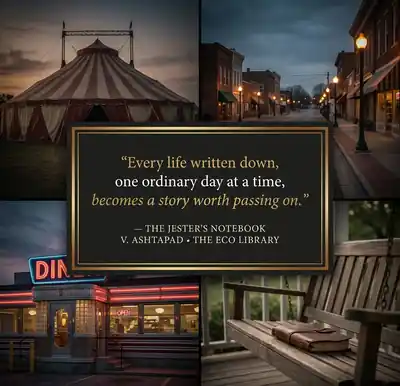
Bippo the Clown has a new circus, a new trailer he calls the Sardine Can, and a strict rule never to say where he worked before. Behind the red nose, retired billionaire Arthur Pendelton is listening again, this time in the small river town of Linden Falls, Ohio.
There is a runaway boy who works harder than anyone on the lot. A young woman on a Main Street bench, searching for the mother she never knew and fighting a pain she cannot name. A sharp-tongued grandmother at the senior center who wants her scattered family to know why she is the way she is. And a young mayor with a cozy house, two kids, and a town full of elders with nowhere left to go.
To each of them, Bippo gives the same small, strange gift: a notebook, and the advice to write down one ordinary day at a time. The rest, as always, arrives quietly, from nobody in particular.
Members can react to this book and talk about it in the members' Library.