
The Jester's Paint Box
Book Nine of the Secret Benefactor Series
by V. Ashtapad
Foreword
This is a work of fiction. There are Romanian American families all over metropolitan Detroit, and the hora, cozonac, sarmale and painted eggs are real. Bucharest Court, the hall, the bakery, the festival and everyone in them are invented.
For everyone who has ever been pulled into the line.
Ice Palace, Thawing
The ice palace in St. Paul came down on the second Tuesday in February, and Arthur Pendelton watched it go from a folding chair in the snow with a paper cup of cocoa going cold between his mittens.
It had been a magnificent thing. Twenty-six thousand blocks of ice cut from a lake north of the city and stacked by cranes into towers and turrets and arches four stories high, lit from inside at night in colors that changed every minute, rose and green and a blue so pale it looked like the inside of a seashell, and for three weeks people had come by the thousand to walk through its halls in their parkas and touch its walls with their bare hands and take photographs of their children's faces lit purple. Bippo had worked the front gate every evening, in his orange wig and his star-spangled coat and a warmer nose, a felt one, red, stitched by Vira from the sleeve of an old sweater, which Sterling had insisted on and which had turned out to be, at twenty below, the single most important piece of clothing he owned.
Now the cranes were back. They lifted the blocks down one at a time and dropped them on a flatbed with a crash like a dinner service falling down a staircase, and the ice broke into great glittering chunks that steamed in the sun, and the palace that had stood so proudly for three weeks went down in an afternoon to a heap of cloudy rubble that a man with a front loader pushed into a pile and left to melt.
"Rather sad," said the voice in his ear.
"Rather," said Arthur.
"Everything that is made of ice," said Reginald Sterling, in Edinburgh, where it was ten at night and raining, "is a lesson in the virtue of having somewhere else to go." Paper moved. "Speaking of which."
---
Arthur waited. He had learned long ago that Sterling's paper could not be hurried, any more than Sterling himself, who had once told him that a fortune should be given away the way a good clown falls down a staircase: slowly, in disguise, and never in a straight line.
"Detroit," said Sterling.
"In February?"
"In May. But you'll want to get there early. There's a festival." More paper. "Romanian. The Hora de Mai. It has been held every first Saturday in May since 1951 in a union hall in Warren, which is a city just north of Detroit that consists, as far as I can tell, of car plants and the places people go to eat after working in car plants. The hall has been sold. To a company that stores tires. The festival has nowhere to go."
"That's one."
"The festival's oldest dancer is eighty-nine," said Sterling. "Her name is Viorica Moldovan. She has danced at every Hora de Mai since 1951, when she was fourteen and newly arrived from a displaced persons camp in Austria. Her daughter in Phoenix wants her to move there in June. She has agreed. She says she will not dance at the last festival, because she does not want to be remembered as an old woman who could not keep up." He paused. "That's two."
"And the other two?"
"I don't know yet," said Sterling. "That's your job. There are always four." The paper stopped. "My archivist has a cousin whose husband plays the cimbalom in the festival band. She says the band is in a state of collective mourning. She says nobody has painted an egg in that community since a woman named Elena Rusu died two years ago, and that the man who used to bake the festival bread has stopped answering his telephone." A pause. "She said one more thing. She said the festival has been looking for someone to run the children's games. The usual man retired. He was a clown."
Arthur looked at the heap of melting ice.
"I'll need a new paint box," he said.
© 2026 CRUNOD LLC. All rights reserved.
The Paint Box
His paint box had been his grandmother's.
It was a flat wooden case, mahogany, the size of a large book, with brass corners and a brass clasp gone soft and green with age, and when you opened it, it unfolded into three levels, like a fishing tackle box, with little compartments lined in faded red velvet. His grandmother had been a stage actress in London between the wars, in theaters so small the audiences could hear you breathe, and she had carried this box to every one of them. In it there were still, eighty years later, the stubs of her greasepaint sticks in their tin tubes, the colors worn down to half an inch: Number Five, a pinkish flesh; Number Nine, a dark rose; Lake, which was a crimson for drawing lines; and a cake of white so old it had cracked like a dry riverbed. There were her powder puffs, gone gray. There was a hare's foot, for blending. There was a small round mirror on a hinge, foxed at the edges, in which Arthur had painted Bippo's face on every working day for longer than he liked to count.
He did not use her sticks. They were too old and too precious and too small. He used new ones, which he kept in the bottom tray. But he kept hers in the top, in their velvet, where he could see them every morning when he opened the box.
On the second morning in Warren, in the Sardine Can, parked behind a closed bowling alley on Van Dyke Avenue with its east window still leaking and the March sleet ticking on the aluminum roof, he opened the box and found that the white had finally broken.
The old cracked cake, which had held together for eighty years, had come apart in the cold into four pieces.
He sat on the fold-down bed with the box on his knees and looked at it for a long time.
That afternoon he drove into Detroit to buy a new white.
There was a shop he had found in an old directory, on a side street off Woodward Avenue in the theater district, between a shuttered jeweler and a place that sold wigs for weddings, and it was still there: a narrow brown storefront with THEATRICAL SUPPLY painted on the glass in gold letters gone thin, and inside, under a pressed-tin ceiling, a long counter with glass cases full of greasepaint and spirit gum and crepe hair in every color a beard can be, and false noses on a rack, and a smell he had known his whole life, of powder and cold cream and old wood.
The woman behind the counter was eighty if she was a day. She had a pencil through her gray bun and half-glasses on a chain. She looked at the gray-haired man in the gray coat who came in out of the sleet, and then she looked, without being asked, at the box under his arm, and her face changed.
"Oh," she said. "Oh, my. Is that mahogany?"
He put it on the counter and opened it. She leaned over it with her glasses on her nose and looked into the little velvet compartments for a long time without touching anything, the way people look into a cradle.
"London," she said at last. "Between the wars. Those tins. They stopped making those tins before I was born." She looked at the four broken pieces of white in the top tray. "And that's done for, I'm afraid. The old cakes go like that in the end. The oil dries out of them. You can't bring them back."
"I know."
"I can sell you a new one. Good white. Very smooth." She was already reaching under the counter. Then she stopped, and looked at the broken pieces again, and then at him. "Or I could glue that one for you. I've done it. A little cocoa butter, a little warm wax, you press it together in a mold. It won't be the same. But it'll hold. It'll look whole."
Arthur looked at the four pieces in their velvet.
"No," he said. "Thank you. I'll take the new one. I'll keep those as they are."
She looked at him over her half-glasses for a long moment. Then she nodded slowly, as if he had passed some test he had not known he was taking, and rang up the new white, and wrapped it in tissue paper, and when he reached for his wallet she put her hand flat on the counter.
"Whose was it?" she said.
"My grandmother's."
"Then you're right," said the woman. "You don't glue your grandmother." She pushed the little parcel across the counter toward him. "No charge. Go away before I change my mind."
---
He had come early, as Sterling said. The festival was eight weeks away. He had driven the Sardine Can down from Minnesota through Wisconsin and around the bottom of Lake Michigan in a snowstorm that closed Interstate 94 for six hours, during which he had sat in a truck stop outside Kalamazoo eating pie and playing gin rummy with a long-haul trucker from Alabama who cheated with great skill and no shame. He had arrived in Warren on the first of March and found it exactly as Sterling described: long straight roads, very wide, lined with car plants and the places people go to eat after working in car plants, under a sky the color of an old nickel.
The Romanians were on the east side. Not all of them, not anymore; they had spread out over sixty years to the suburbs in every direction, to Sterling Heights and Troy and Rochester Hills, where the big houses were. But on the east side of Warren there were still a few blocks where the old community lived, around a little street called Bucharest Court that ran off Hoover Road: small brick houses with neat lawns and rose bushes wrapped in burlap for the winter and grapevines trained on wire over the back fences, and a grocery called Carpați with a hand-painted sign, and a bakery called Brutăria Popescu with no sign at all, and on the corner, behind a chain-link fence, the union hall.
It was a long low building of yellow brick with a flat roof and a row of high windows and a door with a steel awning, and over the door, in tiles set into the brick, in red and blue and yellow, were the words: UAW LOCAL 412 · ROMANIAN AMERICAN HALL · 1951. There was a padlock on the door. There was a sign on the fence: SOLD. ACME TIRE & STORAGE. NO TRESPASSING.
---
Arthur stood at the fence in the sleet in his own clothes, which were a gray overcoat and a tweed cap and a scarf, and nobody looked at him twice, because nobody ever did. That was the great secret of his life, the thing Sterling had taught him in Zurich. A clown is seen by everyone. A gray-haired man in a gray coat is seen by no one.
He was still standing there when a woman came out of the bakery across the street, without a coat, and walked straight over to him through the sleet in her slippers.
She was thirty-five, perhaps, small and fierce, with black hair cut very short and paint on her hands. Not flour. Paint. Red and gold and black, under her nails and in the creases of her knuckles and in a long streak up the inside of one wrist.
"You're not from Acme," she said.
"No."
"Good." She folded her paint-stained arms against the cold. "Because I've been watching you stand there for twenty minutes and if you were from Acme I was going to say something unforgivable." She looked at the padlock on the door. "My grandfather laid that tile. Over the door. In 1951. He was a mason before the war. In Sibiu. Then he was a welder at the Dodge plant for thirty years, and on weekends he laid tile." She looked at Arthur. "They're going to paint over it. Acme. I asked. They said it's not their brand."
"I'm sorry," said Arthur.
"Everybody's sorry," said the woman. She held out a hand, paint and all. "Dana Ionescu. I paint signs. By hand. Nobody wants them anymore. Do you need a sign?"
© 2026 CRUNOD LLC. All rights reserved.
Dana's Shop
Dana Ionescu's sign shop was in the back half of the bakery, behind a plywood wall, and it was the most beautiful room Arthur had seen since a theater in Edinburgh in 1987.
It had been a storeroom once. There were still flour hooks in the ceiling. Now there were brushes. Hundreds of them, in coffee cans and jars and old cocoa tins on every shelf, every size from a single hair to a wide flat thing you could have painted a barn with, the handles stained every color there was. There were cans of sign enamel stacked to the ceiling, the old kind, thick and glossy, that took a day to dry and lasted fifty years. There were books of gold leaf, thin as breath, in a drawer. There was a long easel along one wall with a sheet of plywood on it, and on the plywood, half finished, a sign.
It said BRUTĂRIA POPESCU in letters a foot high, red, outlined in black, shadowed in gold. Around the letters, in the corners, she was painting a border: a pattern of small geometric shapes, diamonds and stars and zigzags and stylized flowers, in red and black and gold, repeating, endlessly intricate, like something embroidered.
Arthur stood in front of it with his cap in his hands.
"It's from my grandmother's blouse," said Dana, behind him. She was making coffee on a hot plate in a little long-handled pot. "Her ie. The embroidered blouse. Every village in Romania had its own pattern, its own colors. You could tell where a woman was from by her sleeves. This is from Mărginimea Sibiului, the villages under the mountains near Sibiu. My grandmother stitched it when she was sixteen. Before the war. It's the only thing she brought." She poured the coffee into two small cups, thick and black, with the grounds still in it. "I paint it into every sign I do. Nobody notices. That's fine. I notice."
"Who's the sign for?"
"Mihai. The baker. Out front." Dana handed him a cup. "His father ran the bakery for forty years with no sign. Everybody knew where it was. Then his father died, and Mihai took over, and he said he wanted a sign, a real one, like the old days. He paid me half." She drank her coffee. "Then he stopped answering his phone. He comes in at four, he bakes, he goes home. He doesn't talk to anybody. The festival asked him to do the bread this year, like his father always did, and he said no." She looked at the half-finished sign. "I don't know if he wants it anymore."
---
Arthur looked at the sign for a long time.
"I'm looking for work," he said.
Dana looked at him over her cup.
"I'm handy," said Arthur. "I can hold a ladder. I can mix paint. I can sweep. I worked in theaters for many years." This was true. "I'm in town until May. I'm staying in a trailer behind the bowling alley. I'm a—" He paused. "I'm a retired person. With time."
Dana did not say anything for a long moment. Then she put down her cup and went to a shelf and came back with a brush. It was a long thin one, a liner, with a handle stained red and gold.
"Can you paint a straight line?" she said.
"I don't know."
"Nobody knows," said Dana Ionescu, "until they try." She pointed at the plywood. "The border. The bottom edge. I've drawn it in pencil. Red. Don't stop in the middle. If you stop in the middle, it wobbles. Breathe out and go."
Arthur took the brush. He dipped it in the red enamel, which was thick and glossy and smelled of linseed and turpentine and something sweet, like a toffee apple. He stood in front of the plywood. He looked at the pencil line, three feet long, perfectly straight. He breathed out.
He went.
It wobbled.
Dana looked at it. "Well," she said. "That's honest." She took a rag and a little turpentine and wiped it off in one stroke. "Again."
He did it again. It wobbled less.
"Again."
He did it eleven times. On the twelfth, it was straight. Or nearly. Dana looked at it for a long time with her head on one side.
"Okay," she said. "You're hired. Eight dollars an hour. Starting tomorrow. I'll teach you the border. You'll be terrible for a month."
© 2026 CRUNOD LLC. All rights reserved.
Viorica's Feet
He found the oldest dancer on the second Saturday, at the grocery, buying cabbage.
He knew her before Dana told him. He would have known her anywhere. She was tiny, smaller than his grandmother had been, in a black wool coat and a black headscarf tied under her chin, with a cane in one hand and a mesh bag in the other, and she moved down the aisle of Carpați between the jars of pickled peppers and the tins of sardines and the shelves of sunflower oil and the bins of dried beans with a walk that was not a walk at all. It was a step. Light, quick, every foot placed exactly, the cane barely touching the floor, as if the aisle were a dance floor and she were waiting for the music to start.
She stopped at the cabbages. She picked one up and weighed it in her hand and put it down. She picked up another.
"Too heavy," she said, in English, without looking at him. "They all are, this time of year. In March the cabbage is old and full of water. For sarmale, you want it light. Sour. From the barrel." She looked at the grocer behind the counter, a heavy bald man in an apron, and said something in Romanian, sharp and fast. The grocer spread his hands. She sighed and put the cabbage in her bag.
Then she turned and looked up at Arthur, standing there in his gray coat with his own basket, which held a loaf of bread and a jar of plum jam and nothing else.
"You're Dana's American," said Viorica Moldovan. "The one with the trailer. Who can't paint a straight line."
"I'm improving."
"So am I," said the old woman. "At eighty-nine." She looked at his basket. "That's not food. That's breakfast for a mouse. Come."
---
Her house was the third on Bucharest Court, small, brick, with a rose bush in burlap by the steps and a grapevine on wires over the back fence, dead now and gray, waiting. Inside it was very warm and very clean and smelled of cabbage and dill and wood polish, and every surface in the front room was covered with something embroidered. Runners on the tables. Cushions on the sofa. A cloth over the television. Towels hung on the walls, long and narrow, white linen with red and black stitching at each end, arranged around photographs in frames. And the photographs. Hundreds. On every wall. All of dancers.
Young women in white blouses with embroidered sleeves and dark wraparound skirts and red sashes, in long lines, arms linked, feet in the air. Young men in white shirts and tight white trousers and black vests and wide leather belts, leaping. Children in costume, solemn, at the front. And in the middle of all of them, in photograph after photograph, decade after decade, getting older in every one, a small woman with a straight back and quick feet, always at the head of the line.
"Every Hora de Mai," said Viorica, behind him. "Since 1951. Seventy-five of them. I missed one. 1963. I had my daughter that week." She put the kettle on. "I went in 1964 with her in a basket on the stage."
Arthur looked at the first photograph. It was black and white and very small, a little square with a white border, and it showed a girl of fourteen, very thin, with dark braids and enormous eyes, in a borrowed blouse too big for her, standing at the end of a line of older women in a bare hall with high windows. She was not dancing. She was watching their feet.
"The camp," said Viorica, seeing where he was looking. "In Austria. Four years. After the war. My mother and me. My father was gone." She did not say where. "We came on a ship in 1951. To Detroit, because a cousin worked at Dodge. We had nothing. In the camp I had nothing. Not one toy. But the women in the camp danced. In the evenings, in the barracks, in the mud. With no music. Only clapping. And I watched their feet, and I learned." She poured the tea into glasses. "When we came here, the first week, the cousin took us to the hall. The union had just built it. And the women were dancing. Real music, a band, a cimbalom. And somebody pushed me into the line."
She handed him a glass of tea. It was linden, pale gold, sweet with honey, and it smelled like a summer afternoon.
"I have been in the line," said Viorica Moldovan, "ever since."
She drank her tea. Then she put the glass down on the embroidered runner and looked at Arthur's feet, in their sensible brown shoes, on her clean floor.
"Stand up," she said.
He stood up.
"In the camp," said Viorica, "there was no music. I told you. So the women made the music with their hands." She clapped, once, sharply, and then again, a slow steady beat, and then a quick double one, and then the slow again. "Like that. And the feet listened to the hands." She clapped. "Right foot. Cross the left behind. Right foot. Now the left foot forward, and back." She clapped. "Again. Three to the right, one back. That's all a hora is. Three to the right and one back. A child can do it. A child can do it better than you."
He did it. He did it in her small warm front room among the photographs of seventy-five years of dancers, in his sensible brown shoes, while a tiny old woman in a black headscarf sat in her chair by the window and clapped the time. He went three steps to the right and one back, and bumped the sofa, and three steps to the right and one back, and nearly took a framed photograph of 1968 off the wall with his elbow.
"No," said Viorica. "You're looking at your feet."
"Where should I look?"
"At the person next to you." She clapped. "In the line, there is always a person next to you. On this side and on that side. You hold their hands. You feel where they go. You don't need to see your own feet. Their hands tell you." She stopped clapping. "Nobody learns the hora by looking down. The ones who look down fall over. The ones who hold on, don't."
He stood in the middle of her rug, a little out of breath.
"There's nobody next to me," he said.
Viorica Moldovan looked at him for a long time with her black eyes, in her chair by the window.
"No," she said at last. "There isn't. Not today." She picked up her glass of tea again. "Sit down. You'll break something. My daughter will say I let a strange man dance in the house, and she'll be right."
---
"Sterling's archivist says you won't dance this year," said Arthur, and then could have bitten his tongue, because nobody here knew who Sterling was or what an archivist was or why a gray-haired American in a trailer would know anything at all about an old woman's plans.
But Viorica only looked at him with her black eyes and did not seem surprised.
"Everybody knows," she said. "My daughter told the whole of Bucharest Court, so I couldn't change my mind." She sat down in a chair by the window. "I'm going to Phoenix in June. She has a house with a pool and a room for me with its own bathroom and a nice girl from Guatemala who comes in the afternoons. It's very kind. It's the right thing. I'm eighty-nine. I fell twice last winter. On the steps. In the ice." She looked out at the rose bush in its burlap. "But I won't dance at the last one. I won't be the old woman they hold up. Who can't keep up with the music. Who they make room for and clap for because she's old." She put down her glass. "I would rather they remember me in the photographs."
Arthur did not say anything.
"And there's no hall," said Viorica. "So maybe there won't be a last one. Maybe it just ends." She shrugged, a small hard shrug. "Seventy-five years. Everything ends."
"Not always," said Arthur. "Sometimes it moves."
She looked at him for a long moment.
"You're a strange man," she said. "For a painter's helper."
© 2026 CRUNOD LLC. All rights reserved.
The Clown Comes to Bucharest Court
That night, after the linden tea, Arthur walked.
He walked the way he always walked in a new town before he did anything at all, in his gray coat and his tweed cap, with his hands in his pockets, slowly, as if he had nowhere in particular to be, which was the truest disguise he owned. He walked down Bucharest Court past the dark windows and the roses in their burlap. He walked along Hoover Road past the padlocked hall and the bakery with no sign and the grocery with its shutter down. He walked a mile north in the cold, with the trucks going by and the sleet turned to a fine dry snow, until the road ran beside a fence, and behind the fence, under a row of tall lamps, there was a parking lot.
It was enormous. It was empty. It was new: the asphalt black as a piano, the lines on it so freshly painted they glowed white under the lamps, and the snow falling on it and lying for a moment and melting, because the ground underneath still held a little of the day. Beyond it, the plant, long and low and dark, with a light on in one window and the water tower standing over everything like a tin giant.
Arthur stood at the fence for a long time.
Then he went along the fence to where the gate was, which was open, because nobody locks a parking lot, and walked out onto the asphalt, and began, very carefully, to pace it out. Heel to toe. Twenty paces. Forty. Sixty. He turned at the corner of a row of lines and paced the other way. Sixty. He stood in the middle of the square he had walked, in the falling snow, under the lamps, and turned slowly round, and in his mind he saw a circle on it, going round.
He went back to the Sardine Can and put in the earpiece.
"Reginald."
"Arthur. It's three in the morning."
"You're awake."
"I am always awake," said Sterling. "It's one of the burdens of a long life and a great deal of money." Paper moved. "What do you need?"
"A floor."
There was a pause from Edinburgh.
"How big?"
"Sixty feet. Square. Wood. Something that can go down on asphalt in a morning and come up in an evening and not hurt an old woman's knees." Arthur looked out at the dark lot behind the bowling alley, where the snow was falling on his own small patch of pavement. "There are companies that do it. For weddings. For tents."
"There are always companies that do it," said Sterling. "That is the great consolation of the modern world." The pen scratched. "And who will ask the car plant if they may borrow its parking lot?"
"Not me."
"No," Sterling agreed. "Never you." The pen stopped. "Arthur. Do you know who will ask?"
"I think," said Arthur, "that a woman who learned to dance in the mud will ask, if someone gives her a reason to put on her coat."
Sterling was quiet for a long time.
"There will be a card under your door by breakfast," he said at last. "Don't ask me how." "Do try not to fall down any stairs before then."
"I'm planning to fall down some tomorrow."
"I know," said Sterling. "That's why I said it."
---
Bippo came to Bucharest Court on the third Sunday in March, which was the day the festival committee held its emergency meeting in the basement of the Orthodox church on Hoover Road, because it was the only room big enough that was not padlocked.
He came because Sterling's archivist's cousin had told the committee that she had found someone to run the children's games, and the committee had said, in its state of collective mourning, *Fine, bring him*. And so at two in the afternoon, in the church basement, under a low ceiling with fluorescent lights and a portrait of a bearded bishop and a long folding table covered in a lace cloth and plates of walnut cookies, thirty-one grim Romanian Americans between the ages of nineteen and ninety looked up from their coffee to see the door at the top of the stairs open and a clown come down it.
He was wearing the orange wig and the coat with the blue stars and a pair of enormous yellow shoes, and his face was painted white, with a red nose and two blue diamonds over his eyes and a wide red smile drawn on over his own. He had painted it that morning in the Sardine Can in his grandmother's foxed mirror, with new sticks from the bottom tray, and the four broken pieces of her old white cake in the top tray in their velvet, where he could see them.
He came down the stairs. On the fourth step from the bottom, one of the enormous yellow shoes caught on the edge of the step and he fell, slowly, magnificently, arms windmilling, down the last three stairs and onto the linoleum floor of the church basement, flat on his back, with a sound like a sack of potatoes.
There was a silence.
Then, from somewhere at the back, a child laughed.
Then another. Then a teenager. Then the bald grocer from Carpați, in a sport coat, laughed so hard he spilled his coffee. And then the whole basement, all thirty-one of them, grim and mourning and furious about the hall, was laughing, helplessly, at a clown on his back on the floor under the portrait of the bishop.
Bippo lay there for a while, looking at the ceiling. Then he lifted one enormous yellow shoe in the air and waved it.
---
The meeting went on for three hours, and it was a disaster.
There was no hall. That was the first problem, and the second, and the third. They had called every hall in Macomb County and every hall in Oakland County and two in Windsor, across the river in Canada. Nobody had the first Saturday in May. The Polish hall was booked for a wedding. The Ukrainian hall was booked for a wedding. The Lebanese hall was booked for two weddings, at once, in two rooms, and the man there had laughed at them on the phone. The church basement was too small. The high school gym wanted forty thousand dollars for insurance. A park would not let them put in a dance floor, and you could not dance a hora on grass, said everyone over sixty, all at once; your feet would sink, you would twist an ankle, the whole line would fall down like dominoes.
"We could cancel," said the committee chairman, a tired gray man named Nicolae Stan, who had been chairman for twenty-two years and looked as though he had aged forty of them that winter. "One year. Then find something for next year."
"There won't be a next year," said a woman at the end of the table. "If we stop one year, we stop."
"Viorica's leaving," said someone else.
Everyone looked at the corner of the basement, where the oldest dancer sat very upright in a folding chair with her cane across her knees and her black headscarf tied under her chin, saying nothing at all.
"And there's no bread," said someone. "Mihai said no."
"And there's no eggs," said someone else. "For the children's table. Since Elena."
And the whole basement went quiet.
---
Bippo had been sitting on the floor by the stairs through all of this, quietly, with three small children in his lap and four more around him, doing the trick with the scarf that went into one ear and out the other, which he had learned long ago from an old music-hall clown and had performed perhaps eleven thousand times since and which never, ever stopped working on anyone under eight.
Now he stood up. He set the children down. He walked to the long table, in his enormous yellow shoes, very carefully, so as not to fall, which made the children laugh again, and stopped in front of Nicolae Stan.
He took a piece of paper out of his star-spangled coat. He unfolded it. He laid it on the lace tablecloth among the walnut cookies.
It was a photograph, printed on an office printer, of a parking lot.
It was a very big parking lot. Flat and smooth and newly paved, with the lines freshly painted, white on black, and lamps on tall poles. Behind it, low and enormous and made of brick, with a water tower and a row of sawtooth skylights along its roof, was a car plant.
Nicolae Stan looked at it.
"That's the Hoover Road plant," he said slowly. "The transmission plant. My father worked there."
Bippo nodded.
"They repaved the lot last fall," said someone. "For the new shift."
"It's empty on Saturdays," said someone else. "No Saturday shift since the last contract."
"It's flat," said the bald grocer from Carpați. "It's very flat."
"You can't dance a hora on asphalt," said a woman over sixty. "It's too hard. Your knees. You need a floor."
Bippo reached into his coat again. This time he took out a small business card, white, plain, and put it on the photograph.
It said: *Allegheny Event Flooring. Portable hardwood dance floors. Any size. Pittsburgh, PA.*
Nicolae Stan looked at the card. He looked at the clown.
"Who pays for the floor?" he said.
Bippo put one white-gloved finger to his red-painted lips. Then he turned around and walked back across the basement to the children, very carefully, in his enormous yellow shoes, and did not fall, and sat down on the floor, and pulled the scarf out of the ear of a little boy in a sweater vest, who screamed with delight.
Behind him, in the corner, the oldest dancer had not moved. But she was looking at the clown, and her black eyes were very bright.
© 2026 CRUNOD LLC. All rights reserved.
Mihai's Ovens
He began on the baker at four o'clock on a Tuesday morning at the end of March, in his own clothes, by knocking on the back door of Brutăria Popescu with two cups of coffee.
Mihai Popescu opened it. He was forty-four, big and soft and pale, with flour in his eyebrows and in the hair on his forearms and dark circles under his eyes like bruises. He looked at the gray-haired man in the gray coat on his back step in the dark with two cups of coffee, and he did not say anything at all.
"I work for Dana," said Arthur. "In the back. I'm early. She's not in until eight. I wondered if you needed a hand."
"No."
"I'm very good at holding things."
Mihai looked at him. Behind him, in the bakery, the ovens were roaring, three big steel deck ovens along the back wall with their doors glowing at the seams, and the air that came out the back door into the cold March dark was so warm and so heavy with the smell of yeast and butter and caramelizing sugar that Arthur, who had eaten nothing since a cheese sandwich at six the evening before, felt his knees go.
"Fine," said Mihai Popescu. "Hold this."
He handed Arthur a sack of flour. It weighed fifty pounds.
---
He held things for three weeks.
He held sacks of flour and trays of dough and the long wooden peel that Mihai slid the loaves into the ovens with, and he held the door when the delivery van came at six, and he held his tongue, which was the hardest thing of all. Mihai did not talk. He worked. He worked as if something was chasing him, from four in the morning until noon, in silence, shaping and proofing and baking two hundred loaves a day: round country loaves with a cross cut on top, and long braided loaves glazed with egg, and covrigi, the ring-shaped breads studded with poppy seeds and coarse salt that the old men bought by the bagful for their coffee, and plăcinte, flaky pastries filled with sweet cheese and raisins or with sour cherries, and once a week, on Fridays, a dozen loaves of something Arthur had never seen before, which Mihai made at five in the morning with the radio off and his back to the room.
It was cozonac. A sweet bread, rich with eggs and butter and milk, and before he rolled it, Mihai spread the dough with a dark paste of ground walnuts and cocoa and sugar and rum and lemon zest and rolled it up like a carpet, and then twisted two of the rolls together, and laid them in a tall pan, and when it came out of the oven an hour later and you cut it, the inside was a spiral, dark and light and dark and light, like the grain of a polished wood.
Mihai made twelve every Friday. He did not sell them. He wrapped them in brown paper and put them in a box by the back door, and at noon he drove them somewhere, and came back without them.
On the third Friday, Arthur asked.
---
Mihai did not answer for a long time. He was scraping a bowl. Then he put the bowl down.
"My father's recipe," he said. "Cozonac. You make it at Easter. At Christmas. At weddings. At the Hora de Mai." He looked at the twelve loaves cooling on the rack. "My father made the festival bread for forty years. Two hundred cozonac. For everybody. Every family took one home." He wiped his hands on his apron. "He died two years ago. In February. And I wasn't here."
Arthur waited.
"I was in Chicago," said Mihai. "Working at a hotel. Pastry chef. I left this bakery when I was twenty-two because I didn't want to make covrigi for old men for the rest of my life. I wanted to make—" He laughed, short and ugly. "Croissants. Macarons. Little tarts with gold leaf on them for people who never ate them. My father said I was ashamed of where I came from. I said he was stuck in 1951. We didn't talk for twenty years. Then he got sick. My sister called me. I said I would come at Easter." He looked at the cozonac. "He died in February."
The ovens roared.
"So I came home," said Mihai, "and took over the bakery, and now I make covrigi for old men, every day, and I hate it, and every Friday I make his cozonac, his exact recipe, and I drive it to the cemetery and I leave it on his grave, and the next Friday it's gone, and I don't know who takes it, and I don't care." He picked up the bowl again. "The festival asked me to make the bread. Like him. Two hundred cozonac." He shook his head. "I can't. I'm not him. I never was."
Arthur did not say anything for a long time.
"Do you know who takes them?" he said finally. "From the grave?"
"No."
"I think," said Arthur, "it might be worth finding out."
---
They found out the following Friday. They drove to the cemetery at noon in Mihai's van, with the twelve cozonac in their brown paper on the seat between them, and Mihai left them on the grave, a plain gray stone in a row of plain gray stones with Romanian names, and then they drove the van around the corner and parked behind a hedge and waited.
At four o'clock, an old woman came. She came on foot, in a black coat and a black headscarf tied under her chin, with a cane and a mesh bag, walking with a step that was not a walk at all. She stopped at the grave. She stood for a long time with her head bowed. Then she put the twelve cozonac, very carefully, into her mesh bag, and turned, and walked away down the path between the stones, light and quick, every foot placed exactly.
Mihai sat in the van with his hands on the wheel and stared.
"Viorica," he said. "Viorica Moldovan."
---
She told them at her kitchen table, over linden tea, with the twelve cozonac in a stack on the counter behind her.
"I take them to the people who can't come," she said. "Every Friday. The old ones. The ones in the nursing home on Twelve Mile. The ones who can't drive anymore. The widows. Twelve houses, twelve loaves." She shrugged. "Your father did it for forty years. Every Friday, he baked twelve extra and drove them around in that terrible van. He never told anybody. I only knew because I was one of the twelve. After my husband." She looked at Mihai. "When he died, I thought, who will bring the cozonac now? And then the next Friday, there were twelve on his grave. Exactly his. I could smell it from the gate." She put her hand on Mihai's floury wrist. "So I took them around. To his twelve houses. And I told them it was from him."
Mihai Popescu put his face in his hands at the old woman's kitchen table and cried like a child, with flour in his eyebrows, for a long time, and Viorica did not say anything at all, only kept her hand on his wrist, and Arthur looked out the window at the grapevine on its wires over the back fence, which, he saw, had begun, at the tips of its gray dead-looking canes, to bud.
© 2026 CRUNOD LLC. All rights reserved.
The Border
In April, Arthur's days had two halves, and they smelled different.
From four in the morning until eight he held things for Mihai in the front of the bakery, in the roar of the ovens, and smelled of yeast and butter and poppy seed. At eight he took off the apron and washed his hands at the steel sink and went through the door in the plywood wall into the back, where Dana was already at the easel with her coffee in its long-handled pot, and from eight until noon he smelled of linseed and turpentine and toffee-apple enamel. At night in the Sardine Can he smelled of both, and when he lay down on the fold-down bed it was like sleeping in a pastry that had been varnished.
He was terrible for a month, as promised.
Dana started him on lines. Only lines. Straight ones, on scrap plywood, in red, three feet long, over and over, until he could breathe out and go and not wobble, or not much. Then curves, which were worse. Then the simplest of the shapes in the border, the little diamond, which was four lines that had to meet in four points exactly, and which he painted, by his own count, two hundred and twelve times on the backs of old signs before Dana let him near the real one.
"You hold the brush like a pen," she said, on the second morning. "Everybody does. That's why they wobble. A pen is for writing. You're not writing. You're pulling." She took his hand, paint and all, and turned it, so that the brush lay along the length of his fingers and the handle came up between his thumb and his first knuckle. "Like that. Now the line comes from your arm. Not your fingers. Your fingers lie. Your arm doesn't."
He painted his two hundred and thirteenth diamond. It was better.
"My grandmother used to say that about the needle," said Dana. "Embroidery. She said, the needle tells the truth about how you're feeling. If you're angry, it pulls too tight. If you're sad, it goes slack." She looked at his diamond. "You're very calm, for an American."
"I'm very old, for an American."
"You're not that old." She looked at him over her cup, sideways, for longer than was comfortable. "You know there was a clown at the church meeting? In March? He fell down the stairs."
"I heard."
"He fell down them," said Dana, "exactly the way you'd fall down them if you'd practiced it for forty years." She drank her coffee. "Little Sorin Stan says the clown has very clean hands. He says he noticed, because clowns are supposed to be dirty." She put the cup down and went back to her easel. "Little Sorin Stan is seven and notices everything. It's very annoying."
Arthur painted his two hundred and fourteenth diamond and said nothing at all, and it was the straightest he had done yet.
---
The tile was Dana's idea.
She came in on a Monday in the middle of April with her eyes red and her short black hair standing up on one side as if she had slept on it badly, and did not make the coffee, and stood in front of the easel without picking up a brush.
"They did it," she said. "Acme. Saturday. A man with a roller and a bucket of gray." She did not look at him. "Over the door. My grandfather's tile. *Romanian American Hall, 1951.* I walked past this morning. You can still see the letters a little, through the paint. Like a ghost." She put her hands in her pockets. "By summer you won't."
Arthur waited.
"So I'm going to paint it," said Dana Ionescu. "On a board. The whole thing, the letters, the colors, the size, exactly. I measured it in February. I have photographs. I'm going to paint it on a board, and wherever the festival ends up, if there's a festival, it's going to hang over the band." She turned around and looked at him with her red eyes. "And you're going to hold the ladder."
They did it in the second half of April, in the afternoons, after the Popescu sign was done. A board sixteen feet long and two feet high, which Mihai's cousin cut for them from a sheet of marine plywood and which took up the whole back room from wall to wall, so that they had to edge around it sideways like crabs. Dana drew the letters from her photographs in chalk, the square heavy capitals of 1951, and Arthur ruled the guide lines, and she painted the letters, red and blue and yellow, each one built up in little square strokes so that it looked from across the room like a row of tiles, and he painted the background, cream, around them, slowly, with a wide brush, not touching the edges. She did the edges.
She did not paint *UAW Local 412*. She said her grandfather would not have minded. She said he had laid the tile but he had always said the hall belonged to the dancers, not to the union, and certainly not to Acme.
They painted side by side, without talking much, with the radio on low to a station from Windsor that played old songs, and the long board between them on its trestles like a table set for a very thin banquet. Once, in the middle of a long cream stretch, Dana began to hum something under her breath that was not on the radio, slow, in three, and stopped when she noticed him listening.
"My grandmother's," she said. "She sang it when she stitched. I don't know the words. I only know the tune." She bent to her letter again. "Maybe that's enough. Maybe the tune is the part that holds."
---
The Popescu sign was finished on the twentieth of April, a Monday, three days after the cemetery.
Dana let him paint the last line. The bottom edge of the border, the red one, three feet long, that he had wiped off eleven times on his first day. He stood in front of the easel with the liner brush lying along his fingers the way she had shown him, and dipped it, and looked at the pencil line, and breathed out.
He went.
It wobbled. Not much. Once, near the end, a small tremor, where his arm had remembered something it should not have.
He looked at it with dismay. Dana reached past him for the rag.
Then she stopped, with the rag in her hand, and looked at the line for a long time with her head on one side.
"No," she said. "Leave it."
"It wobbles."
"I know." She put the rag down. "Leave it. That's where you breathed in."
That morning, at nine, for the first time since Arthur had come to Bucharest Court, Mihai Popescu came through the door in the plywood wall into the back room. He stood in his floury apron in front of the finished sign, with its foot-high red letters outlined in black and shadowed in gold and its border of diamonds and stars and zigzags and flowers from a blouse stitched by a girl of sixteen, for a long time. Then he took an envelope out of the pocket of his apron and put it on the paint table, by the cans.
"The other half," he said. "Sorry it's late." He looked at the sign. "My father would have said it was a waste of money. Everybody knows where the bakery is." He was quiet. "Can you put it up before the festival? Wherever it is?"
"Saturday morning," said Dana. "Early. Before anybody's up."
"Saturday morning," said Mihai, and went back through the door to his ovens, and they heard him, a moment later, on the other side of the plywood wall, begin to whistle.
Dana looked at Arthur. Arthur looked at the sign.
"He hasn't whistled," said Dana Ionescu, "in two years."
© 2026 CRUNOD LLC. All rights reserved.
Twelve Houses
On the twenty-fourth of April, a Friday, Mihai drove the twelve loaves himself.
He had not said that he would. He had only said, on the Monday, to nobody in particular, while he was scraping a bowl, that his father's van needed its oil changed and that he had changed it. And on the Friday at five in the morning, with the radio off and his back to the room, he made the cozonac, and at noon he wrapped the twelve loaves in brown paper and put them in the box by the back door, and then, instead of driving to the cemetery, he stood at the back door with his keys in his hand and looked at Arthur.
"She'll need someone to carry them," he said. "Her hands. And she won't let me. She says I drive too fast and carry too slow." He jingled the keys. "You're good at holding things."
So the three of them went. Mihai drove. Viorica sat in the passenger seat in her black coat and her black headscarf with her cane between her knees and gave directions in a voice that did not expect to be questioned, in Romanian and English, mixed, without seeming to notice which was which. Arthur sat in the back on an upturned milk crate among the bread racks with the box of cozonac on his knees, and the van, which was terrible, exactly as advertised, bucked and rattled on every pothole on Twelve Mile Road, and the loaves rose and settled in their brown paper like small sleeping animals.
---
The first house was a brick bungalow in Sterling Heights with a ramp up to the door, where a man named Grigore lived alone with a parrot. He was ninety-one. He had worked beside Mihai's father on the line at Dodge for twenty-two years, before Mihai's father left to bake. He opened the door in a bathrobe, saw Viorica, saw the brown paper, and then saw Mihai standing behind her on the ramp, and his face went still.
"You're the boy," he said. "The one in Chicago."
"Yes," said Mihai.
The old man looked at him for a long time. Then he reached out and took the loaf from Arthur, without looking at Arthur at all, and held it against his chest in both arms.
"Your father talked about you," he said, "every Friday. For twenty years. On this ramp. *My son makes cakes with gold on them for rich people in Chicago.*" He shook his head. "He said it the way you'd say, *My son is an astronaut.*"
Behind him, in the dim front room, the parrot, which was gray with a red tail and had been listening with its head on one side, said something in Romanian, very clearly, in a man's deep voice.
Grigore laughed, a short wet laugh, and wiped his eyes.
"Your father taught him that," he said. "Twenty years ago. Every Friday, at the door. It means *the bread is here, open up, you old goat.*" He looked at the parrot. "He still says it. Every Friday. At noon. Even these two years, when nobody came."
Mihai did not say anything. On the way back to the van he walked very fast and did not look at either of them.
---
The second house was an apartment over a dry cleaner in Hamtramck, up a flight of stairs that Viorica climbed in her quick light step one at a time with the cane, refusing every hand, where two sisters lived, both widows, both over eighty, who argued about whose turn it was to cut the bread and gave Mihai a jar of sour cherries in syrup that they said his father had always liked. The third was the nursing home on Twelve Mile, where Arthur carried four loaves down a long bright corridor smelling of floor polish and boiled vegetables to four rooms, in each of which someone sat by a window, and in one of which a very old woman, who could not speak anymore, took Mihai's floury hand and held it against her cheek and would not let it go for ten minutes. The fourth was a house in Warren where nobody answered, and Viorica took a key from under a flowerpot without hesitation and let herself in and put the loaf on the kitchen table beside a note in Romanian that said, she told them, *From Popescu. Eat it before it goes stale, you stubborn old goat.*
At every house, someone said something about Mihai's father.
He had fixed a gutter. He had driven someone to the hospital at two in the morning. He had come to a funeral in the snow when nobody else did. He had sung, once, at a wedding, badly. He had never once, in forty years, missed a Friday, not even the week of his own wife's funeral, when he had made the twelve loaves at four in the morning with his eyes running and delivered them in his black suit.
"He never told me," said Mihai, in the van, between the ninth house and the tenth, with his hands on the wheel at a red light on Van Dyke. "Any of it. Not one word. I thought he just baked. I thought he baked and was angry at me and that was all."
"He was angry at you," said Viorica, in the passenger seat, looking straight ahead through the windshield. "Also he baked. Also he did this." She tapped her cane once on the floor of the van. "A man can do three things."
The light changed. Mihai drove on.
---
The twelfth loaf was not for a house on the list. It had belonged, until February, to a retired machinist named Petru on Ryan Road, who had died in his sleep on the coldest night of the winter, and since then Viorica had been taking it home and eating it herself, she said, out of respect.
Viorica had them stop at the end of Bucharest Court, outside the last house, the one with the blinds down. She sat in the van and looked at it for a while. Then she turned in her seat and looked at Arthur on his milk crate.
"Ion Rusu," she said. "Elena's Ion. He was never one of the twelve. Elena was alive. She fed him." She looked back at the house. "But I think now maybe he should be. Put it on the step. By the pot. Don't knock. He won't answer."
Arthur took the twelfth cozonac in its brown paper up the short path to the last house on Bucharest Court, past the closed blind in the front window, and put it on the step beside the empty soup pot, and came back.
They waited in the van for five minutes, the three of them, with the engine running. The blind did not move.
"Sunday," said Viorica, to nobody, and Arthur, on his milk crate in the back among the bread racks, wondered for one moment whether the old woman knew a great deal more than she had ever let anyone see. Then Mihai put the van in gear and drove them home.
© 2026 CRUNOD LLC. All rights reserved.
The Egg Painter's Husband
The widower was named Ion Rusu, and he lived alone in the last house on Bucharest Court with the blinds down, and nobody had seen him since the funeral except the man who delivered his groceries and the woman from the church who left soup on his step every Sunday and found the empty pot there every Monday.
"He's not well," said Viorica. "Since Elena. Two years. He doesn't go out. He doesn't answer the door. His son tried. His son came from Cleveland every weekend for six months. Ion wouldn't let him in." She shook her head. "They had words. At the funeral. I don't know what. Something about the casket, the priest, the music. Something stupid. The kind of thing men fight about when they can't fight about what they're really fighting about." She poured more tea. "His son stopped coming. Now they don't speak. Two years. And the eggs."
"The eggs?"
"Elena painted eggs," said Viorica. "Like in Bucovina, where she was from. Ouă încondeiate. With wax and a little tool and dye. The most beautiful eggs you ever saw. Every year, for the children's table at the Hora de Mai, she painted a hundred. And every child got one to take home." She looked at Arthur. "Since she died, no eggs. Nobody else knows how. Not like her. She tried to teach. Nobody had patience." She put down her glass. "Her tools are in that house. Her wax, her dyes, her kistka. Ion won't open the room."
---
On the Saturday morning, the day after the twelve houses, Arthur walked to the end of Bucharest Court at seven with the bread from Mihai's first batch under his arm, in his gray coat, slowly, as if he were going nowhere in particular.
The cozonac was gone from the step.
The brown paper was there. It had been folded, neatly, in quarters, and put inside the empty soup pot, and the lid had been put back on the pot.
He stood on the sidewalk and looked at the folded paper in the pot for a long time. Then he looked at the front window, where the blind was down, and at the edge of the blind, where it did not quite meet the frame, and where, for one moment, there might have been a shadow.
He walked on, around the corner, and back to the Sardine Can, and that afternoon he spent three hours at the fold-down table cleaning the hare's foot and the gray powder puffs and the little round foxed mirror on its hinge, very carefully, one at a time, until the brass on the mirror's hinge shone, and he did not tell anyone why.
---
Bippo went to the last house on Bucharest Court on the last Sunday in April, at four in the afternoon, in the orange wig and the coat with the blue stars and the enormous yellow shoes, with his grandmother's paint box under his arm.
He knocked. Nobody answered. He knocked again. Nobody answered.
So he sat down on the front step, in the thin April sunshine, beside the empty soup pot, and opened the paint box on his knees, and took out the little round foxed mirror on its hinge, and began, very slowly and carefully, to repaint his face.
It took a long time. He took off the old white with cold cream and a cloth. He put on new white from a stick from the bottom tray, smoothing it with his fingertips. He drew the blue diamonds over his eyes with a fine brush. He drew the wide red smile. He powdered it all with one of his grandmother's gray powder puffs. He did it the way he had been taught, long ago, by an old clown named Wally who had worked the music halls before the war: without hurry, without looking around, as if the whole world were only you and the mirror, and the face you were making, and the person you were about to be.
He was halfway through the smile when the blind in the front window moved.
He did not look up. He went on painting.
After a while, the door opened behind him, and a voice said, in English, rough and cracked as if it had not been used in a long time, "What are you doing on my step?"
Bippo held up the mirror. He did not turn around. He tilted it so that it caught the face of the man in the doorway behind him: an old man, white-haired, unshaven, in a cardigan with holes at the elbows, with eyes that had not slept.
The old man looked at himself in the clown's mirror for a long time.
Then he looked at the paint box on Bippo's knees. At the little velvet compartments. At the four broken pieces of the old white cake in the top tray.
"That's broken," said Ion Rusu.
Bippo nodded.
"Why do you keep it?"
Bippo put the mirror down. He took out the four broken pieces of his grandmother's greasepaint, one at a time, and laid them on his white-gloved palm, and held them up to the old man.
Ion Rusu stared at them. And then, slowly, he sat down on the step beside the clown, in his cardigan with the holes, and put his face in his hands.
---
He talked for two hours, on the step, in the going light, with the clown beside him saying nothing, painting nothing, only listening. About Elena, who had been born in a village in Bucovina in the north of Romania under the mountains, where the painted monasteries stood, and where every woman painted eggs in the spring the way her mother had and her mother's mother, and who had come to Detroit in 1971 as a bride of twenty and never once, in fifty years, missed a spring. About her eggs. About how she sat at the kitchen table every evening from the first thaw to May with her little tool, the kistka, a tiny funnel of brass on a stick, which she heated in a candle flame and filled with beeswax and drew with, on a raw white egg, lines so fine you could hardly see them, and then dipped the egg in yellow dye, and drew more lines, and dipped it in red, and drew more, and dipped it in black, and then held it to the candle and melted all the wax off, and there, under the wax, appeared the pattern: stars and wheat and ram's horns and the wolf's tooth, in white and yellow and red against the black, so intricate and so perfect that it took your breath away.
About how she had died in March, two years ago, at the kitchen table, with an egg in her hand, half finished.
About the funeral, and his son, and the stupid thing they fought about, which was whether the egg should go in the casket with her. Ion had wanted it to. His son had said no, it should stay, it should be finished, by someone, it was the last one.
"And he was right," said Ion Rusu, on the step, to his hands. "He was right. And I said a terrible thing to him. In front of everyone. In front of his mother's casket." He shook his head. "And I put the egg in the drawer. In her room. And I closed the door. And I have not opened it for two years."
Bippo did not say anything. He reached into the paint box. He took out the four pieces of his grandmother's broken white, and held them out again on his palm.
Ion looked at them for a long time.
"You keep the broken ones," he said slowly, "because they're hers."
Bippo nodded.
"Not because they work."
Bippo shook his head.
"Because she used them."
Bippo closed his hand over the four pieces. Then he opened it again. Then he did something Bippo almost never did. He spoke as himself. Quietly, in his own voice, Arthur Pendelton's voice, the voice of a man who had sold three companies and given away most of a fortune and buried a grandmother who had been a stage actress in London between the wars.
"I'll sit with you," he said. "When you open the door."
© 2026 CRUNOD LLC. All rights reserved.
The Last Egg
They opened the door on the first of May, the day before the festival, at nine in the morning, and Ion Rusu's son was there.
He had driven from Cleveland. He was fifty, a tall heavy man in a Cleveland football jacket, an engineer at a plant that made brake parts, and he stood on the step of his father's house at nine in the morning with his car keys still in his hand and an expression on his face of a man walking into a room he expects to be shot in.
Ion had called him. On the evening of the last Sunday in April, after the clown left, at nine o'clock, from the kitchen telephone on the wall, which he had not used in two years. He had said four words. Viorica, who heard it from the woman from the church, who heard it from the son's wife, said that the four words were *I was wrong. Come.*
The son had said, *Okay, Tata*. And hung up. And driven three hours on the first of May, and stood now on the step.
Ion opened the door.
They did not hug. They were not men who hugged. They stood in the doorway, the old man in his cardigan with the holes and the big man in his football jacket, and looked at each other for a long time.
Then Ion said, "Your mother's room," and turned around, and walked down the hall, and his son followed him, and so did a gray-haired man in a gray coat who had been sitting on the step since eight with two cups of coffee.
---
The room was small and very neat. A sewing machine under a cover. A shelf of books in Romanian. A window with lace curtains, and through the window, the grapevine on its wires, in leaf now, bright green. And on the table by the window, under a cloth, everything: the little brass kistka on its stick, a candle in a holder, a block of beeswax in a saucer, six jars of dye in a row, yellow and orange and red and green and blue and black, gone dry and cracked at the top, and a basket of raw white eggs, long since gone bad, which Ion's son carried out to the garbage without a word.
And in the drawer, wrapped in a handkerchief, the last egg.
Ion took it out. He held it in his palm. It was half finished. Elena had drawn the first lines in wax and dipped it in yellow and drawn the second and dipped it in red. The wax was still on it. Under the wax, you could not see anything at all. It was only a dark red egg, covered in a fine web of creamy lines, like a map of a country no one had visited.
"She was going to dip it in black," said Ion. "Then melt the wax. Then you would see." His hand was shaking. "I don't know what it is. I don't know what she drew. I never asked."
His son took it from him. Very gently. He held it up to the window.
"Then we'll find out," he said.
---
They did it at the kitchen table, the three of them, at noon, with a new candle and new dye from the craft store on Van Dyke, which Arthur had bought at eight that morning before he sat down on the step. Ion's son mixed the black dye, following the instructions on the packet, in one of his mother's old jars. Ion lowered the half-finished egg into it on a spoon. They waited ten minutes. Nobody spoke.
Then Ion lifted it out. It was black. Only black, glossy, wet, with the faint raised web of the wax on it like veins.
He held it to the candle flame. Very close. Turning it slowly. And the wax began to melt.
It went shining first, then liquid, then it wiped away on a soft cloth in Ion's shaking hand, and under it, where the wax had been, appeared the pattern.
It came out of the black like stars coming out at dusk. First a ring of white around the middle of the egg, a band of tiny triangles, the wolf's tooth, Ion said, in a whisper. Then above it and below it, in yellow, eight-pointed stars. Then in red, in the spaces between the stars, a pattern of curling lines that went around and around the egg, joining, separating, joining again. And then, at the very top, where the egg came to its point, and at the very bottom, in white, two small shapes Ion did not recognize at all.
He turned the egg in the candlelight and stared at them.
"What is it?" said his son.
"I don't know," said Ion. "That's not Bucovina. That's not any pattern I know."
Arthur leaned forward. He looked at the two small white shapes, at the top and the bottom of the egg, very carefully.
They were letters. Very small, drawn in wax with a brass kistka by a woman of seventy-two at a kitchen table with a candle, in her careful script.
At the top: *I*.
At the bottom: *A*.
Ion stared at them. Then he made a sound Arthur had never heard a man make. Then he put the egg down, very carefully, on the cloth, and turned to his son.
"Ion," he said. "And Andrei."
His son did not move.
"Her two men," said Ion Rusu. "Top and bottom. Holding it together." He put his hands over his face. "She knew. She knew we would fight. She always knew. She drew us on it so we would have to sit at this table together to see it."
His son put his big arms around his father, in the kitchen, at the table, in front of the egg.
Arthur got up very quietly and went out the back door and sat on the step in the April sun beside the grapevine, and did not go back in for a long time.
© 2026 CRUNOD LLC. All rights reserved.
The Floor
The floor came from Pittsburgh on the morning of the second of May on two flatbed trucks, in four hundred panels of polished oak, each one three feet square, interlocking, and it took six men from Allegheny Event Flooring and forty-one Romanian Americans and one clown three hours to lay it on the newly painted lines of the Hoover Road transmission plant's Saturday-empty parking lot, in a square sixty feet on a side, under the water tower and the sawtooth skylights.
Nobody knew who had paid for it. Nicolae Stan had asked Allegheny. Allegheny had said it had been paid for in full in March, by a foundation in Edinburgh that supported traditional dance. Nicolae Stan had called the foundation. A very polite man with a Scottish accent had said that the foundation's donors preferred to remain anonymous and wished the Hora de Mai every success.
The plant said yes to the parking lot because Nicolae Stan's father had worked there for thirty-one years, and the plant manager's grandmother had been born in Sibiu, and Viorica Moldovan had gone to his office in her black coat and her headscarf with her cane and a box of Mihai Popescu's covrigi and sat down across his desk and told him about a camp in Austria in 1947 where the women danced in the mud with no music, and he had said yes before she finished.
---
They laid it at dawn.
The trucks came in through the gate of the Hoover Road plant at six, two long flatbeds with Pennsylvania plates and the panels stacked on them in shrink-wrapped towers, and the six men from Allegheny got down in their work gloves and looked at the crowd waiting for them on the empty lot in the gray light, and stopped.
There were forty-one of them. Nobody had asked them to come. Nicolae Stan had said, at the committee meeting on Thursday, that the flooring company would lay the floor, it was their job, it was in the contract. And at a quarter to six on Saturday morning there were forty-one Romanian Americans standing on the newly painted lines in their work clothes, with thermoses, the bald grocer from Carpați and the cimbalom player and Dana with paint on her hands and the committee and a dozen teenagers who had been told by their grandmothers that they were going, and the two sisters from Hamtramck, and Nicolae Stan himself in a pair of overalls that had belonged to his father, and in the middle of them all, in an orange wig and a coat with blue stars and a pair of enormous yellow shoes, a clown.
The foreman from Allegheny looked at the clown for a long time.
"Okay," he said finally. "Okay. Each panel's forty pounds. Two people per panel. The tongue goes in the groove. If it doesn't go, don't force it, call me." He looked at the clown again. "Not him."
But it was him, as it turned out, that the children followed. There were children, of course, there are always children; they had come with the teenagers and the grandmothers. And the clown could not carry a forty-pound panel, it emerged, without his enormous yellow shoes getting in the way, so that he carried each one in a long staggering zigzag across the lot as if it were trying to escape from him, and set it down, and stepped back to admire it, and fell over it. And every time he fell, the children laughed. And every time the children laughed, the grown-ups carrying their panels across the lot in pairs laughed too, and stopped arguing about which way the tongue went into the groove, and the floor went down faster.
It went down from the middle out, the way the foreman said, in a growing square, the oak panels locking together one by one with a soft wooden knock like a door closing in another room. By half past seven it was the size of a kitchen. By eight it was the size of a church. By nine it was done, sixty feet on a side, pale gold in the low May sun, smelling faintly of floor wax and sawdust, lying on the black asphalt among the white lines like a pond.
---
At a quarter past nine, a car pulled in through the gate, and the woman from the church got out of the driver's seat and went round and opened the passenger door.
Viorica Moldovan got out.
She came across the lot in her black coat and her black headscarf, slowly, with her cane, in her quick light step, and the forty-one stopped what they were doing, and the six men from Allegheny stopped coiling their straps, and she came to the edge of the floor and stopped.
She looked at it. All of it. Sixty feet of pale oak, end to end.
She put out her cane and tapped it on the first panel, twice, the way you would tap on a door.
Then she stepped onto it.
She stood on the edge of the floor with both feet. She shifted her weight from one foot to the other, slowly, feeling. She took one step to the right, and another, and another, light and quick, on the polished oak. And one step back.
Nobody on the whole lot made a sound.
Viorica Moldovan stood still on the floor and looked down at her small black shoes on the pale wood for a long moment. Then she looked up, at the forty-one and the six men from Pittsburgh and the clown standing among the children with his enormous yellow shoes, and her face did nothing at all.
"It will do," she said, and got off.
---
At ten, Dana's board went up.
They hung it on the flatbed truck where the band would be, across the back of the stage, on two poles that Mihai's cousin had welded into brackets on the truck's sides, and it took six people and a ladder that a gray-haired man in a gray coat held at the bottom, steadily, without a word, while Dana Ionescu stood at the top in her paint-stained jeans and tightened the last bolt.
Sixteen feet long. Red and blue and yellow on cream, in square heavy capitals built up in little strokes like a row of tiles:
ROMANIAN AMERICAN HALL · 1951
Dana came down the ladder and stood beside the man who had held it and looked up at it for a long time.
"My grandfather would have hated the cream," she said. "He'd have said it was too yellow." She wiped her hands on her jeans. "He'd have said it was the best thing anybody ever did."
The gray-haired man did not say anything. When she turned to look at him, he had already gone, across the lot toward the gate, with his hands in the pockets of his gray coat, and a few minutes later, at the other end of the floor, a clown in an orange wig appeared with a bag of balloons and began at once to fall over the children's table.
---
By noon there was a festival.
There were tents around the floor, white, rented, which nobody admitted to paying for either, and under them, long tables with lace cloths. There was the band on a flatbed truck at one end: a cimbalom, the big hammered zither with a hundred strings, played by Sterling's archivist's cousin's husband with two little padded hammers so fast you could not see his hands; and two violins, and an accordion, and a double bass, and a man with a pan flute who played it like a bird. There were the dancers, in costume, a hundred and twenty of them, from four years old to seventy, the women in the white blouses with the embroidered sleeves, every village's pattern, every village's color, and the dark wraparound skirts and the red sashes, and the men in white with black vests and the wide leather belts studded with brass.
There was food. Sarmale, cabbage rolls stuffed with pork and rice, simmered for hours with smoked ribs and dill, made by forty women in forty kitchens on Bucharest Court and brought in forty pots. Mici, little grilled sausages of beef and lamb and garlic, without casings, sizzling on a grill made from an oil drum, served with mustard and bread. Mămăligă, cornmeal porridge as yellow as the sun, turned out on a board and cut with a thread, with sour cream and sheep's cheese. Pickled peppers and pickled green tomatoes and pickled watermelon. A plum brandy called țuică that the old men poured into little glasses from bottles with no labels and that Arthur, unwisely, tried once.
And in the middle of the longest table, in the place of honor, on a white cloth, two hundred cozonac.
Mihai Popescu had made them. All of them. He had started on Wednesday night at ten and had not stopped until six on Saturday morning. He had made them from his father's recipe, exactly, the walnut and the cocoa and the rum and the lemon, rolled like a carpet and twisted and baked tall, and he had made them, Dana said, crying the whole time, and the bakery smelled of it for a week. And when he set the last one down on the white cloth on the long table at the festival, Viorica Moldovan came and stood beside him and looked at them for a long time and then said, in Romanian, something Dana would not translate, and Mihai went red to the roots of his floury hair.
Over the bakery's front door on Bucharest Court, that morning, for the first time in forty-four years, there had been a sign. A foot-high BRUTĂRIA POPESCU in red, outlined in black, shadowed in gold, and around it, in the corners, a border of diamonds and stars and zigzags and stylized flowers from a blouse stitched by a girl of sixteen in a village under the mountains near Sibiu before the war. The bottom edge of the border was a little wobbly, if you looked closely. Dana said she had left it that way on purpose.
---
And at the children's table, under its own white tent, beside a clown in an orange wig with a scarf that went in one ear and out the other, there were eggs.
Not a hundred. Thirty-one. Ion Rusu and his son Andrei had painted them, at the kitchen table on Bucharest Court, every evening for a week, with Elena's kistka and a new one Andrei had ordered online, from a video Andrei found of an old woman in Bucovina demonstrating the technique, which they had watched eleven times. They were not like Elena's. The lines wobbled. The stars had seven points, some of them, or nine. One of Andrei's was supposed to be a ram's horn and looked, everybody agreed, like a sheep that had been in an accident.
The children did not care. They lined up at the table, in their costumes, and each one was given an egg in a nest of tissue paper in a little box, and they held them up to the sun in their small hands and turned them, and some of them, the little ones, gasped.
In the middle of the table, by itself, on a stand Ion had made from a wire hanger, under a small glass bell from a cheese shop, was one egg that was not given away. Black, with white and yellow and red. A band of wolf's teeth. Eight-pointed stars. And at the top and bottom, two small white letters.
© 2026 CRUNOD LLC. All rights reserved.
The Last Line
At two o'clock, the clown ran the children's games, which was, after all, what he had been hired for.
He ran them on the oak floor, before the dancing, while the grown-ups ate. There was a sack race in old flour sacks from Brutăria Popescu, which left every child on Bucharest Court white to the waist. There was a race with wooden spoons and wooden eggs, painted by Dana that week in red and gold so that nobody would cry over a real one. There was a game of statues, in which the cimbalom player played a few bars and stopped, and everyone had to freeze, and the clown went round the frozen children making faces at them until they laughed and were out, and nobody, in eleven rounds, could make one small boy in a sweater vest laugh at all.
He was seven. His name was Sorin Stan, and he was Nicolae Stan's grandson, and he stood frozen in the middle of the floor at the end of the last round with his arms out like a scarecrow and his face perfectly solemn while the clown did everything a clown can do in front of him, the scarf from the ear and the enormous shoes and the slow magnificent fall, and Sorin did not even blink.
So the clown gave up. He stood up off the floor and brushed down his coat with the blue stars and bowed to the boy, very low, the way you would bow to a king, and held out a white-gloved hand to shake.
Sorin Stan unfroze. He shook the clown's hand gravely. Then he turned it over, and looked at the palm of the white glove, and at the clean white cuff above it, for a long time, the way his grandfather looked at the minutes of a meeting.
"You have very clean hands," he said. "For a clown."
The clown looked at his glove, as if surprised to find it there. Then he looked at the boy. Then he reached into his star-spangled coat and took out a round red sponge nose from the bag of spares he kept for children, and put it on the end of Sorin Stan's small solemn face.
And Sorin Stan laughed. Out loud, all at once, helplessly, in the middle of the oak floor, so hard that he sat down, and the whole children's tent cheered, and the boy was out, and did not care.
---
At four o'clock, the band played the hora.
It is the oldest dance there is, in that part of the world. Older than the countries. A circle. Everybody in it, holding hands, young and old, men and women, strangers and family, and the circle moves, three steps to the right and one step back, three steps to the right and one step back, round and round, slowly at first and then faster and faster as the music builds, until the circle is spinning and the faces are flushed and someone is shouting and the music is going so fast the cimbalom player's hands are a blur, and then it stops, all at once, and everybody laughs.
It began with the dancers in costume. Then their families came in. Then their neighbors. Then the band's wives. Then the plant manager, in his golf shirt, pulled in by a girl of six in an embroidered blouse. Then Mihai Popescu, in his floury apron. Then Dana Ionescu, with paint on her hands. Then Ion Rusu and his son Andrei, holding hands in the line, the old man in a new cardigan with no holes in it and the big man in his football jacket. Then the clown, in his orange wig and his star-spangled coat and his enormous yellow shoes, who tripped on the first step and nearly brought down half the circle and was caught by two grandmothers who held him up between them by the elbows for the rest of the dance, scolding him in Romanian the whole time.
The circle grew. It grew until it filled the whole floor, three hundred people, four, holding hands on four hundred panels of polished oak on the newly painted lines of a car plant's parking lot under a water tower, going round.
Viorica Moldovan was not in it.
She sat at the edge of the floor, in a folding chair, very upright, in her black coat and her black headscarf, with her cane across her knees, and watched their feet.
---
Arthur saw her. He saw her from the line, between his two scolding grandmothers, going round. He saw her every time the circle brought him past her chair. He saw her small hard face, and her black eyes, which were not on the dancers' faces but on their feet. Watching. The way she had watched the women in the camp in Austria in 1947, in the mud, with no music.
On the fourth time round, he let go.
He let go of the two grandmothers, who were outraged, and stepped out of the circle, very carefully, in his enormous yellow shoes, and walked to the edge of the floor, and stopped in front of Viorica Moldovan's chair.
He did not say anything. He held out his white-gloved hand.
She looked at it.
"No," she said.
He did not move.
"I told you," said Viorica. "I won't be the old woman they hold up."
Bippo knelt down. On the oak floor, in front of her chair, in his star-spangled coat. He looked up at her. And then he did the thing Bippo almost never did, the thing he had done on a step on Bucharest Court the week before, and spoke as himself, quietly, so only she could hear.
"They're not holding you up," said Arthur Pendelton. "You're holding them."
Viorica looked at him for a long time.
Then she looked past him, at the circle. Three hundred people, four, holding hands, going round. Three steps to the right and one step back. And she saw, Arthur knew, what he had seen from inside it. That half of them did not know the steps. That the plant manager was going the wrong way. That Andrei Rusu kept stepping on his father's feet. That the little ones were being dragged along by the big ones and the old ones were being carried by the young, and that nobody, nobody at all, was keeping up with the music.
That was the whole point. That had always been the point. Nobody kept up. You held on.
She put down her cane.
---
She came into the circle between the clown and Mihai Popescu, with one small hand in each of theirs, and the circle opened for her and closed around her, and the band, which had seen, which had been watching her for seventy-five years, slowed down. Not much. Only a little. Only enough. And the cimbalom player, Sterling's archivist's cousin's husband, lifted his padded hammers and brought them down on the hundred strings in a long shimmering run like water falling, and then began the tune again from the beginning, the oldest tune, the one they had played in the hall on Hoover Road in 1951 when a girl of fourteen in a borrowed blouse was pushed into the line.
Three steps to the right and one step back.
Her feet did not miss one. Not one. Light and quick, every foot placed exactly, on the polished oak, at eighty-nine, between a baker and a clown, going round.
Afterward, nobody remembered her as the old woman they held up. Afterward, everyone said the same thing, at the long table, over the cozonac and the țuică, and on the festival's page that night, under the photographs, two hundred and six comments, every one of them some version of the same sentence, in English and in Romanian.
*Viorica led the line.*
© 2026 CRUNOD LLC. All rights reserved.
Book Nine Complete
Viorica Moldovan went to Phoenix in June, as she had promised her daughter, to the house with the pool and the room with its own bathroom and the nice girl from Guatemala in the afternoons. But she did not stay there.
She went in June and came back in September, because, she told her daughter, there was a Romanian community in Phoenix but its dancers did not know how to hold a line, and because Mihai Popescu had a room over the bakery now that he had cleaned out and painted and put a new bed in, and a ramp on the back step, and a girl from Bucharest Court who came in the afternoons, and because twelve old people on Twelve Mile Road expected a cozonac on Fridays and somebody had to tell Mihai which house was which. Her daughter said that was ridiculous. Viorica said she was eighty-nine and would decide for herself what was ridiculous. Her daughter came at Christmas and slept in the room over the bakery for a week and ate so much cozonac she said she would never fit in her clothes again, and went back to Phoenix in January, and said, on the phone, to her mother, *Okay. Okay, Mama. You were right.*
Mihai Popescu made two hundred cozonac for the Hora de Mai the next year, and the year after. He made covrigi for the old men every morning, and complained, and did not stop. On Fridays he drove twelve loaves around in his father's terrible van, with Viorica in the passenger seat telling him where to turn.
Dana Ionescu painted forty-one hand-lettered signs that year, for shops in Warren and Hamtramck and Dearborn, every one with a border from a blouse stitched in a village under the mountains, and nobody noticed, and she did.
Ion Rusu and his son Andrei painted eggs every spring at the kitchen table on Bucharest Court, from the first thaw to May, and drove them to the festival, and the children did not care that some of the stars had nine points.
Dana's board did not go back into the back room. The bakery took it. Mihai had it bolted to the wall of the shop inside, over the counter, above the covrigi, where the old men could read it while they waited for their coffee, *Romanian American Hall, 1951*, red and blue and yellow on a cream that was a little too yellow, and when people asked him why a bakery had a sign for a hall, he said the hall had not gone anywhere, it had only moved, and gave them a poppy-seed ring for free so they would stop asking.
---
That night, the night of the festival, in the Sardine Can behind the closed bowling alley on Van Dyke Avenue, with the east window leaking a little in the spring rain and the smell of grilled mici still in his hair, Arthur sat at the fold-down table with his grandmother's paint box open in front of him and the leather-bound book of memories beside it, and took off Bippo's face, slowly, with cold cream and a cloth, in the foxed mirror.
When he was done, he opened the book at the ribbon, and wrote:
*Book Nine Complete: Warren, Michigan, and a parking lot that was flat enough. A dancer who would not be held up and found out she had been holding everyone. A baker who left bread on a grave and found out who was taking it. A sign painter who put her grandmother's sleeves on every shop in Macomb County. A widower and his son who sat at a table to see what she drew. I only knelt on the floor. The circle was already going round.*
Under it he drew a small paint box, open, with a clown's red nose sitting in the top tray beside four broken pieces of white.
Then, because every day got one, he wrote the ordinary page beneath it: the rain, the tea, a cozonac in brown paper on the fold-down bed, left on the step of the Sardine Can at dusk by someone who had not knocked.
---
He put in the earpiece.
"Reginald."
"Arthur. I'm told you danced."
"Badly."
"Nobody keeps up," said Sterling. "I'm told that's the point." Paper moved. "My archivist's cousin's husband, the cimbalom player, who has not telephoned anyone for any reason since 2011, telephoned my archivist this evening to say that in sixty years of playing the Hora de Mai he has never once slowed down for anyone, and that he did today, for one tune, and that he would like the clown to know it was not for the clown."
Arthur laughed.
"There's something else," said Sterling. "The old woman. Viorica. She asked my archivist's cousin to find out the clown's name. So she could write it on the festival's page, with the photographs, with the dancers."
Arthur did not say anything.
"I told her," said Sterling, "that the clown's name was Bippo, and that he did not have another one, and that if she wanted to thank him, she could teach a child the hora." A pause. "She said she was already teaching nine. She said that was a very stupid answer, and that she would put the clown on the page anyway, with no name, in the line, between the baker and the dancer, where he belonged."
---
"Kansas," said Sterling, after a while.
"Kansas."
"Lindsborg. A small town on the prairie that was settled by Swedes in 1869 and has, ever since, painted every surface it can find red and blue and yellow, and carved wooden horses." The paper stopped. "The man who carves the horses has had a stroke."
Arthur looked at the four broken pieces of white in his grandmother's paint box, in their faded velvet, on the fold-down table, in the leaking trailer, in the rain.
"When?"
"In the autumn," said Sterling. "There's a festival. There's always a festival." A pause. "You'll want to bring the box."
Arthur closed the paint box. He did not reach for the noses. He knew where they were: one in each pocket of the cardigan, the felt one Vira had made from an old sweater for the ice palace, and the old rubber one that had been with him longer than the Sardine Can, and both of them, tonight, smelled faintly of walnuts and rum and lemon, and of a parking lot that had been, for one afternoon, a hall.
© 2026 CRUNOD LLC. All rights reserved.
About this book
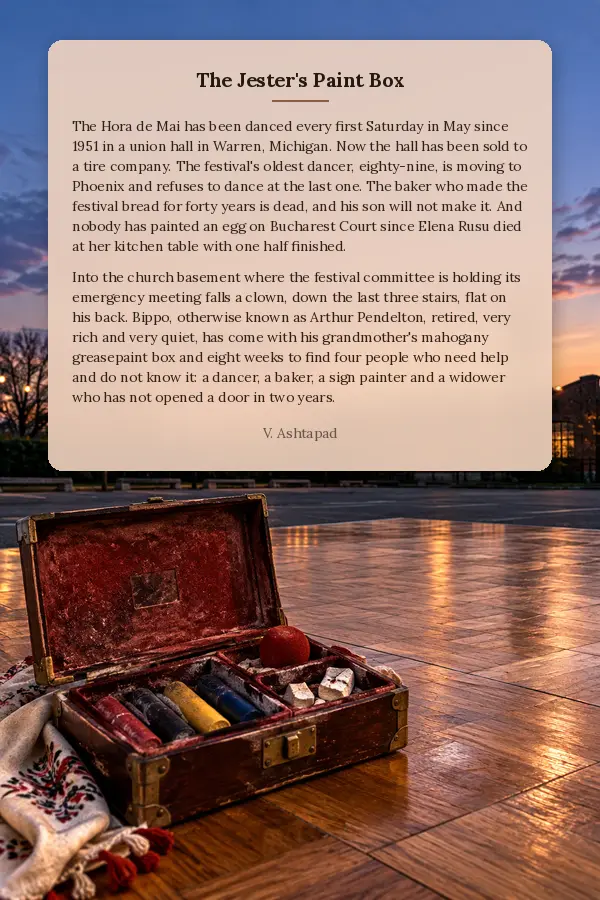
The Hora de Mai has been danced every first Saturday in May since 1951 in a union hall in Warren, Michigan. Now the hall has been sold to a tire company. The festival's oldest dancer, eighty-nine, is moving to Phoenix and refuses to dance at the last one. The baker who made the festival bread for forty years is dead, and his son will not make it. And nobody has painted an egg on Bucharest Court since Elena Rusu died at her kitchen table with one half finished.
Into the church basement where the festival committee is holding its emergency meeting falls a clown, down the last three stairs, flat on his back. Bippo, otherwise known as Arthur Pendelton, retired, very rich and very quiet, has come with his grandmother's mahogany greasepaint box and eight weeks to find four people who need help and do not know it: a dancer, a baker, a sign painter and a widower who has not opened a door in two years.
Finished the book? Listen to or watch a review of it
How a Clown Saved Detroit's Romanian Heritage · Discussion
Listen · 55 min
Members can react to this book and talk about it in the members' Library.
Ownership
© 2026 CRUNOD LLC. All rights reserved.
This book is owned by CRUNOD LLC. It is free to read on EternalCurrent.Online. No part of it may be copied, reprinted, sold, recorded or adapted, including as audio, film or translation, without written permission from CRUNOD LLC.
© 2026 CRUNOD LLC. All rights reserved.