
The Jester's Ticket Punch
Book Five of the Secret Benefactor Series
by V. Ashtapad
Foreword
There is an old way of cutting paper in the forest country north of Warsaw. You fold a single sheet of colored paper, take up a pair of shears made for sheep, and cut away everything that is not a tree, or a star, or a bird. When you open the fold, both halves match. For generations, families in the Kurpie region hung these cutouts on the beams of their houses and made new ones every spring. In the high country under the Tatras, some two hundred and seventy miles to the south, the highlanders kept a different art: small fierce fiddle bands of three, playing tunes that climb and break and land a step later than the ear expects.
Both arts crossed the ocean to Chicago, which for more than a century held one of the largest Polish communities in the world, along the long diagonal of Milwaukee Avenue and in the highlanders' halls of the Southwest Side. And a few hours north, in Baraboo, Wisconsin, the Ringling brothers wintered their circus on the river for more than thirty years; the old winter quarters still stand there as a museum, and smaller shows kept wintering in the farms around the town long after the big one left. Those places and that history are real.
The people in this book, the circus, the ballroom, the bakery, the farm and the tune are invented. The habit of keeping a secret out of love, and of letting someone else keep theirs, belongs to a great many families.
For everyone who learned to see with their hands, and for the grandchildren who held still long enough to be taught.
Nine Chandeliers and a Sparrow
The Mazurka Ballroom had nine chandeliers, and Irene Dudek wanted it understood, before a single truck was unloaded, that every one of them was older than the circus, older than the trucks, and very probably older than anybody's grandfather.
"Nineteen twenty-four," she said, pointing up with a ring of keys. "My grandfather brought them from a hotel in Milwaukee that was being torn down. He paid for them with a year of Saturday dances. Nobody hangs from them. Nobody throws anything at them. Nobody rides a bicycle near them with a teacup on his head."
"It's a unicycle," said Taras Hrynchuk.
"Then nobody rides a unicycle near them with a teacup on his head."
Taras looked up at the chandeliers for a long time with his hands behind his back, the way he looked at a sky before a stand, and then at Irene, who was seventy-one, small and square in a red wool coat with a fox collar, and had not taken off her boots. Outside, the snow was coming down Milwaukee Avenue in long slants, and the trucks of the Hrynchuk Family One-Ring Circus sat at the curb in a row with their engines ticking, nine hundred miles of Minnesota and Wisconsin salt crusted up their doors.
"I will ride," Taras said at last, "in the center of the floor. Under the middle one. I will look up at it the whole time, with respect."
"You will look where you're going," said Irene.
"Madam," said Taras, "for sixty years I have not looked where I'm going. It is how I stay on."
* * *
It had begun with a cousin in Brandon.
Irene Dudek's cousin Bożena, who had married a grain inspector and moved to Manitoba in 1979 and never once in all the years since stopped complaining about the cold, had taken her grandchildren to the Christmas show the Hrynchuks put on every year in their curling rink. She had sat on a hay bale in a parka watching a bald man of seventy-eight pedal backward on a seven-foot unicycle, and three small dogs refuse to jump through a hoop, and a tall clown in violet shoes try for a quarter of an hour to fasten a jacket that had no buttonholes, and she had gone home and telephoned Chicago.
"Irene," she had said. "Your carnival is dying."
"My carnival is fine."
"Your carnival had forty people at the last ball. You told me. You cried."
"I had a cold."
"Bring them," Bożena had said. "The circus. To the ballroom. For carnival. The little children will come for the dogs, and the parents will come for the children, and the grandparents will come because the parents need someone to drive. Then you have three generations in the ballroom. When did you last have three generations in the ballroom?"
Irene had not answered that. She had telephoned Lesia Hrynchuk the next morning instead.
So in the third week of January, when any sensible circus was asleep, the Hrynchuks had driven south out of the prairie to play three weeks of Polish carnival in a ballroom on the Northwest Side of Chicago: two shows on Saturdays and Sundays, one on weeknights, with the old floor cleared down the middle for a ring, and the chandeliers above, and the stage at the far end for Cyril Mapp's band. The stand would end on the last night of carnival, which in Chicago meant the Tuesday before Lent, when the whole city ate doughnuts. Lesia had needed the money for the north tour in the spring. Vira had needed to see, with her own eyes, what Chicago was doing to doughnuts. And Taras had looked at a photograph of the Mazurka's floor and said only, "Maple. Very good. A man could fall on that and be proud."
* * *
The ballroom had no box office. It had never needed one. For a hundred years people had paid at a little window in the cloakroom, to whoever was minding the coats, and then gone in.
"So you are the door," said Taras to Arthur.
They were in the cloakroom, among the empty hangers, which chimed against each other whenever anybody breathed. Taras had a wooden cigar box under his arm, and he opened it on the counter as if it held a family jewel.
Inside, on a nest of yellowed tissue, lay a ticket punch. It was steel, nickel worn through to brass at the grips, with a spring like a small coiled snake between the handles and a little cup underneath to catch what it cut. Taras lifted it out and squeezed it once in the air. It made a sound like a cricket that had made a decision.
"My father's," he said. "From his show. Nineteen fifty-one to nineteen eighty-nine. Every ticket. Then my daughter makes us use the computer and the barcodes, and this one goes in the box." He took a strip of old pasteboard from the box, slid it into the jaws and squeezed. When he held it up, there was a small hole in the middle of it in the shape of a bird. "Sparrow," he said. "My father's mark. Nobody else's punch makes a sparrow. In nineteen fifty-four a man in Saskatoon tries to sneak in his whole family on tickets with a little round hole. My father looks. He says, sir, where is my bird? Six people, back out into the snow."
He put the punch in Arthur's hand and closed Arthur's fingers over it.
"Three weeks. Every ticket. A sparrow in each one. And you are polite."
"I am always polite."
"You are a clown," said Taras. "It's different."
Bippo the Clown had a new waistcoat for the winter, which Arthur had sewn himself over Christmas from a bolt of red felt that Vira had found at a farm auction. It had eleven buttonholes down the front and no buttons at all, except the small red glass button from Edinburgh, which he had moved over from last year's tartan jacket and sewn on at the very bottom, under the last hole, where it could not possibly reach any of them. With it went the yellow polka-dot trousers on their creaking yellow elastic suspenders, the size-twenty-two violet shoes with lime-green dots, the orange wig, the blue stars painted around his eyes, a carnation, the brass seltzer bottle and, from this evening on, a ticket-taker's peaked cap with a cardboard brim, and the ticket punch on a long brass chain that went twice around his neck and still hung to his belt.
Arthur slipped the little cup off the bottom of the punch and looked inside. A paper sparrow lay in it, perfectly cut, no bigger than a fingernail.
He did not throw it away. He put it in the old pastille tin in his pocket, among the last of his grandmother's buttons, without quite knowing why.
* * *
On the first night there were a hundred and twelve people, which Irene said was a disappointment, and which she said with her eyes shining.
They came in out of the snow stamping and shaking themselves like dogs, and lined up at the cloakroom window, and Bippo took their tickets one by one, examined each of them with a jeweler's loupe that was really the bottom of a jelly glass, punched it, presented it back with a bow and then, very often, refused to let go of it, so that they had a small tug-of-war across the counter before the ticket came free with a snap and he fell over backward into the coats.
Most of the people were Polish, or had been Polish, or were married to somebody who was. Arthur heard the language all around him in the cloakroom: in the long vowels of the grandmothers, in the quick flat Chicago Polish of men in Bears jackets, in the polite, careful, schoolroom Polish of children being made to say good evening to Mrs. Dudek. He heard Spanish from a family with three little girls in matching snowsuits. He heard Ukrainian from Vira, at the coffee urn, arguing with a woman about sugar. And he heard English from almost everybody under twenty, in the bored, kind tone teenagers use when they have been brought somewhere.
About twenty minutes before the show, the door opened and a family came in together the way a weather front comes in.
First came a heavy man in a transit authority parka with snow on his shoulders, holding the door with his back. Then a boy of about eleven, very thin, in a stocking cap with a pompom, who walked straight up to the counter and stood looking at the ticket punch with his whole face. Then a girl of sixteen or so with her hood up and her hands in her pockets and paint, Arthur noticed, ground into the skin around her thumbnails. Then, on the man's arm, very slowly, a tiny old woman in a black coat and a fur hat and dark glasses, who held a white cane folded in her hand like a closed umbrella and did not use it.
And last of all, in no hurry whatever, a tall old man in a black felt hat with a band of small white shells around the crown, who stopped in the doorway, knocked the snow off the hat against his knee, put it back on, and said something in Polish to nobody in particular that made the woman minding the coffee urn laugh out loud.
"Five," said the man in the parka, holding out the tickets. "Kurek."
"I told you it was tonight," the boy said over his shoulder, to the tiny woman, without taking his eyes off the punch. "Babcia, I put it on the family calendar. Circus, Mazurka, Thursday. With a clown face. You said you'd never heard of it."
"I heard of it," said the old woman. "I said I didn't believe it."
Bippo took them. He examined them through the jelly glass. He punched the first, the second, the third, the fourth, and with a great deal of business, holding the punch in both hands and squinting, he punched the fifth, and handed them all back with a bow.
The tiny old woman took hers. She did not look at it. She held it in both gloved hands and then, deliberately, drew off one glove with her teeth and ran the tip of her forefinger over the hole.
"A sparrow," she said, in English. Her voice was low and precise, with a scrape in it. "Badly cut."
"Mama," said the man in the parka.
"The tail is like a spoon." She held it up toward the light, though Arthur could see she was not seeing it. "A sparrow's tail is a little fork. Who cut this?"
"A machine, madam," said Bippo. "In nineteen fifty-one."
"Then the machine should be ashamed." She put her glove back on. "Wojtek. Come. The clown has a sparrow with a spoon."
The old man in the shell hat had been looking past all of them, into the ballroom, at the cleared floor and the ring curb and the trapeze rigging hanging in the dark between the chandeliers, and at the band setting up on the stage. Something in his face had gone still and private. He came back to them slowly.
"Józia," he said, "don't insult the man's sparrow."
Then he looked at the boy, who was still standing at the counter as if he had grown there.
"Kuba," he said. "Move. Don't stand there like a towner."
He took his wife's arm and went in.
Arthur, who had been on the lots of more circuses than he admitted to and was still learning the language, stood in the cloakroom among the swinging hangers with the punch in his hand.
Towner. It was an old word, a show word. It meant anybody who was not with the circus. Anybody who belonged to the town, and gawked, and got in the way. He had heard Taras use it, and the Pell twins, and once a very old elephant man in Ohio. He had never heard it come out of a civilian.
"Bippo," said Lesia, behind him, with a clipboard. "Places. Dido's warming up the unicycle and Irene is standing under the chandelier with her arms folded."
* * *
That night, in the Sardine Can, which was parked in the alley behind the Mazurka between a dumpster and the kitchen door with an extension cord running in through the window, Arthur emptied the cup of the ticket punch onto his bunk. A hundred and twelve paper sparrows lay on the blanket, white and buff and pink, depending on the ticket. He looked at the tails. Józefa Kurek was right. They were spoons.
He put them all in the pastille tin.
Then he hooked the little microphone behind his ear.
"Reginald."
"Arthur. It is four in the morning in Edinburgh, which is very nearly your hour. Are you in Chicago, or are you in a snowbank outside it?"
"In an alley. Behind a ballroom. With nine chandeliers."
"How very continental."
"Reginald," said Arthur, "a man came in tonight in a highlander's hat. Eighty-five or more. Polish. And he called his grandson a towner."
There was a short pause from Scotland.
"I'm not familiar with the term."
"You wouldn't be," said Arthur. "That's the point. Nobody would. Unless they'd been with a show."
He looked at the tin of paper sparrows.
"I think," he said, "I'd like to know where he learned it."
Cherry Pie at the Long Bar
Wojciech Kurek drank his tea at the end of the Mazurka's long bar every afternoon at two o'clock, in a glass, with a slice of lemon squeezed against the bottom by a spoon, and he had done so, Irene said, since before she was tall enough to see over the bar.
"He doesn't pay," she told Arthur. "He never paid. My father said, a man who played for us thirty years doesn't pay for tea. Then he played for us fifty years, so now nobody even asks. He comes, he sits, he drinks his tea, he tells my bartender how to cut a lemon, he goes home. Since 2019 he doesn't play. He only sits."
"Why 2019?"
Irene looked at Arthur over her glasses. He was out of costume, in his gray cardigan and plain trousers, a tall, mild, elderly man helping the circus carry chairs. She had decided on the first day that he was the circus's accountant, and nothing he said had changed her mind.
"Ask him," she said. "He likes accountants. They listen."
* * *
The ballroom by daylight was a different animal. Without its chandeliers lit it was mostly windows, tall and arched down both sides, with the snow light coming in flat and gray across the maple floor and the sound of Milwaukee Avenue through the glass: buses sighing at the stop, a man shoveling, a truck backing up somewhere with its patient beep. Under the windows ran a row of framed photographs going back a century, men in high collars, brides in dresses like collapsed cakes, an accordion band of four brothers with identical haircuts, the 1970s in brown and orange. In the middle of the floor, under the center chandelier, the Hrynchuk ring curb sat red and white and faintly embarrassed, like a guest who had arrived too early.
The old man was alone at the bar with his glass. He had the hat off and on the bar beside him, crown down, and Arthur could see the shells close up now: small white cowrie shells, a row of them sewn around the black band, each with its little toothed mouth.
"May I?" said Arthur.
Wojtek Kurek looked at him. He had a long, lean, weathered face, clean-shaven, with a big nose and very pale blue eyes under white brows, and his hands on the bar were enormous, the knuckles swollen, the nails ridged. He was dressed like a man going to an office in 1962: a gray suit, a white shirt and no tie, the top button done.
"You're the money man," he said.
"I carry chairs."
"Money man carries chairs." He considered this. "Good circus. Sit."
Arthur sat. The bartender, a young man with a beard, brought him tea without being asked, in a glass, with lemon, and Wojtek took the spoon out of Arthur's glass and squeezed the lemon against the bottom properly, and gave it back.
"You played here," said Arthur.
"Fifty-four years." Wojtek turned his glass on the bar, a quarter turn. "Every carnival. Every wedding, half the weddings. New Year. The highlanders' ball. Kapela Kurek. Three men. Me, prym." He lifted his left hand and made the shape of a fiddle under his chin, without the fiddle. "First fiddle. The one who says where we go. Bolek, my cousin, sekund. Second fiddle. He plays the chords, like this," and his right hand went chop, chop, chop across the bar, a short hard stroke. "He is the floor. And Gienek on the basy. Big fiddle, three strings. He is the..." He looked for the word in the air. "He is the cellar. Under the floor."
"And in 2019?"
"In 2019 Bolek goes." Wojtek said it flatly. "Heart. Shoveling snow. I said to him a hundred times, Bolek, you are eighty, pay a boy. He says a boy shovels badly. So. And Gienek, after the funeral, his daughter takes him to Florida. Clearwater. Ninety years old, he sits by a swimming pool and calls me to say it's warm." He drank his tea. "So the kapela is me."
"You could play alone."
The old man looked at him for a moment with real pity.
"A highlander alone with a fiddle," he said, "is a man talking to himself in the street. People cross to the other side."
* * *
The house band came in at three to rehearse for the evening, and Arthur understood, within about a minute, a great deal more about Wojtek Kurek.
They were called the Avondale Aces. They had played the Mazurka on Saturdays since 1988: a concertina, a trumpet, a clarinet, a drummer and an electric bass, five men in their sixties in matching maroon vests, and they played Chicago polka, which Arthur had never heard properly before. It was a wonderful noise. It came at you like a happy dog. The concertina pumped, the trumpet and clarinet wound around each other, the drummer laid down a fat steady two-beat, and the whole thing rolled down the empty ballroom so that Arthur's foot began to go before he had given it permission.
Wojtek did not move at all.
"Chicago polka," he said, when they had finished the first number. He said it the way a man might say, canned fish. "Music for pushing a car."
"It's very cheerful."
"So is a car that starts." He set down his glass. "Polka is from the lowlands. Polka is a dance for people with flat feet who live in a field. I am from the mountains. Under the Tatras. Podhale." He tapped the shells on his hat. "We have better music, worse soil, and nicer hats."
"Kurek!" called the concertina player from the stage, cheerfully. "You want to sit in? We'll play one of yours!"
"You don't know one of mine," said Wojtek, without turning around.
"We know the one about the bear!"
"That is not about a bear," said Wojtek, to Arthur, very quietly. "That is about a girl. The bear is in it only one verse. Forty years they play it, they think it's about a bear."
* * *
At half past three, Taras Hrynchuk came in from the alley in his parka with a unicycle over his shoulder like a rifle, saw the hat on the bar and stopped dead.
"Górale," he said.
Wojtek turned around on his stool and looked at the bald, broad old man with the unicycle, and his white eyebrows went up.
"Hutsul?" he said.
"My grandmother." Taras set the unicycle carefully against the bar. "From the mountains. From the other side of the mountains from you. Same mountains. Different side. She came to Manitoba in 1911 with a sheepskin coat and a sack of seeds and a very bad temper."
"So." Wojtek examined him with great interest. "Your people make the cheese wrong."
"My people make the cheese perfectly. Your people smoke it until it tastes like a shoe."
"A good shoe."
"Is there such a thing as a good shoe to eat?"
"Ask a highlander," said Wojtek, and something happened at the corner of his mouth, and Taras laughed out loud, the big bark that the circus heard maybe twice a season, and pulled out the stool beside him.
Arthur sat between them for the next hour and listened to two old Carpathian men from opposite slopes of the same range, one by way of Chicago and one by way of the Canadian prairie, compare sheep, hats, cheese, axes, weddings, grandmothers, the proper way to sharpen a scythe, and how far you could hear a man calling from one mountain to the next, which Taras said was three miles and Wojtek said was three miles if the man was Ukrainian and seven if he was a góral. They agreed on almost nothing. They were having, Arthur could tell, the time of their lives.
At a quarter to five, Irene came out of her office and asked whether some of the gentlemen would help set out chairs for the evening, since the circus seemed to have stopped working entirely.
Taras got up at once. Wojtek got up too, more slowly, with his hand flat on the bar, and as he passed Arthur he muttered, under his breath, in English, in a tone of long-suffering and ancient complaint:
"Cherry pie."
Arthur kept his face perfectly still.
Cherry pie was another show word. It meant extra work: the work nobody had hired you for, that you did anyway because the show had to go on, setting chairs, hauling water, picking up after the elephants when the man whose job it was had gone to town. He had never heard it used except by a person who had once been paid by the day to haul canvas.
He set out his own row of chairs. He said nothing at all.
* * *
At five, the boy came.
He came straight from school, with his backpack on and his stocking cap pulled down over his eyebrows, and stood at the edge of the ring curb watching Bohdan run the terriers through their evening rehearsal. The terriers ran, as always, in the opposite direction from the one indicated. The boy watched this with the expression of a scientist who has seen something that disproves a theory.
"They're doing it wrong on purpose," he said, when Arthur came and stood beside him.
"Are they?"
"The middle one is. He looks at the man first. Then he goes the other way." He turned his head. He had his grandfather's pale eyes, set in a narrow, serious, olive-skinned face. "You're the clown. Without the makeup."
"I'm the man who carries the chairs."
"You're the clown," said the boy. "You stand the same. My grandmother says you can tell anybody by how they stand. She can't see faces anymore, so she does it by standing and walking. She knew you were tall from how the ticket came down." He held out his hand to shake. "Kuba Kurek. Jakub. Kuba. I'm eleven. Do you need an assistant?"
"For what?"
"For the door. The ticket punch. I could do the ones on the left and you do the ones on the right."
Arthur considered him. "What would you charge?"
"Nothing. I'd just want to do it."
"That," said Arthur, "is the most expensive kind of help there is. But I'll ask the owner."
Kuba nodded, as if this were a reasonable answer, and swung his backpack off his shoulder and took out a folder. He seemed to feel that, since they were now in negotiations, Arthur ought to see his work. Inside was a school project, a large sheet of paper with a tree drawn on it in green marker, and boxes on the branches, and names.
"Family tree," he said. "For social studies. We have to put three generations and where everybody came from."
Arthur looked. *Mom: Lourdes Anaya Kurek, b. Chicago, Back of the Yards. Her mom and dad from Jalisco, Mexico.* *Dad: Ryszard (Rich) Kurek, b. Chicago.* *Babcia: Józefa Kurek, b. 1942, Kurpie, Poland. Came 1966.* And at the top, in a box with a little drawing of a hat with dots on it, *Dziadek: Wojciech (Wojtek) Kurek, b. 1939, Podhale, Poland (mountains). Came 1961.*
Under it, in a smaller box, Kuba had written *1961 to 1964:* and then nothing. Just a question mark, gone over several times, so that it had nearly worn through the paper.
"What's that?"
"That's the hole," said Kuba. "Everybody has where they worked. Dziadek worked at the machine shop from 1964 till he retired. But before that is three years and he only says one thing." He made his voice low and flat and exactly like his grandfather's. "'On a farm. In Wisconsin. Boring.' Every time. Same words. Babcia says he's lying. She says it like she doesn't mind." He shut the folder. "My teacher says I can put 'farm work, Wisconsin.' But I don't like a hole."
Across the ballroom, Wojtek Kurek was setting out the last row of chairs, with his hat back on, very straight and very exact, each chair a hand's width from the next, the way a man sets out seats who has been taught to do it for an audience of a thousand by somebody shouting.
"Neither do I," said Arthur.
The Number 56
The Number 56 bus runs down Milwaukee Avenue on a long diagonal, from Jefferson Park on the far Northwest Side all the way into the Loop, cutting across the square grid of Chicago at an angle like a knife across a waffle. It is one of the oldest roads in the city. It was a Native trail before it was a plank road, and a plank road before it was a streetcar line, and for a hundred and fifty years it has carried, in one direction or another, most of the Poles who ever lived in Chicago.
Arthur got on at the stop outside the Mazurka at a quarter to eight on Saturday morning with a canvas shopping bag and a list from Vira, and found Rich Kurek at the wheel.
"The chair man," said Rich. He had a heavy, patient, unshaven face under the transit authority cap, and the look of a man who had been awake since four. "Kuba says you're the clown."
"Kuba is a very observant boy."
"Kuba is a pain in the neck." Rich checked his mirror and pulled out into the traffic, smoothly, the whole long bus leaning into the curb and away. "He told me last night you're hiring him. He told his mother. He told his grandmother. He told the dog. We don't have a dog. He told the neighbor's dog."
"I said I would ask the owner."
"Then ask the owner fast," said Rich. "Or he'll ask her himself."
* * *
Arthur sat in the sideways seat just behind the driver, where he could see the road through the big front window, and the city went by.
Avondale first, in the snow: two-flats and three-flats in yellow brick and red brick, their porches heaped white, a Polish deli with smoked sausages hanging in the window like a curtain of rope, a Mexican bakery with its windows fogged, a Polish travel agency offering cheap flights to Kraków, a tire shop, a laundromat with steam pouring out of a vent at the sidewalk, a corner tavern with a hand-lettered sign promising pierogi on Fridays. Then the river, the North Branch, black and steaming between banks of dirty ice. Then the long run under the expressway, where the bus went into shadow and the noise of the traffic overhead came down through the roof like weather. Then Logan Square and its tall column with the eagle on top, and on into Wicker Park and Bucktown, where the old Polish storefronts had turned into coffee shops with plants hanging in the windows and the young people waiting at the stops were dressed, as far as Arthur could tell, as lumberjacks.
And all the way, the passengers.
Rich knew them. Not by name, mostly, but he knew them. He knew the young man in the hospital scrubs who got on at Diversey and fell asleep before he sat down. He knew the two Ecuadorian roofers who rode to the end of the line every Saturday with their lunches in plastic bags. He knew the girl with the cello case who always tried to pay with a twenty. And he knew the old ladies.
There were five of them by Belmont, in fur hats and wool coats and rubber boots, each with a little wheeled shopping cart in a tartan pattern, and they came up the steps one after another, slowly, each saying "*Dzień dobry*" to the driver, and Rich said, "Morning," and "Morning," and "Watch your step," and "Morning," in English, every time, in the same friendly voice.
The fifth lady, the smallest, stopped at the farebox and said something to him in Polish, longer, with a question at the end of it.
"I'm good, Pani Helena," said Rich in English. "Ma's good. Sit down before I start."
She sat down with a little huff, as if she had heard this answer many times and did not think much of it.
* * *
"You understand them," Arthur said, a few stops later, when the bus was stopped at a red light and the ladies were deep in a discussion about the price of butter.
"Every word."
"You don't answer in Polish."
Rich was quiet for half a block.
"I went to kindergarten in 1975," he said. "I had maybe twenty words of English. Yes, no, bathroom, thank you, and the names of the Chicago Bears. That's it. Everything else in my head was Polish. My mother's Polish and my father's Polish, which are two different languages, by the way, if you ask either of them." He turned the big wheel, hand over hand. "First day, the teacher reads my name off the list. Ryszard. She can't say it. She says, we'll call you Richard. Fine. I'm Richard. Then at recess the kids find out I can't talk to them. They had a word for me, and it wasn't Richard." He shrugged, a small movement inside the parka. "So I learned English. Fast. Really fast. By Christmas I talked like a kid from the South Side. And at home I answered my mother in English, and she answered me in Polish, and that's how we've talked for fifty years."
"And your own children?"
"Pola's got maybe fifty words. Food, mostly. Kuba's got more." Something came into his voice that might have been a laugh. "But here's the thing nobody believes. Kuba's best language with his grandmother isn't Polish. It's Spanish."
Arthur turned his head.
"My mother worked thirty years at the candy factory on the West Side," said Rich. "Half the line were Mexican ladies. She learned Spanish there, and then better Spanish from the soap operas. My wife's family is from Jalisco. So Kuba gets home from school, he goes to his grandmother's, and the two of them sit in the kitchen and talk in Spanish about which telenovela husband is cheating. My father comes in, they switch to faster Spanish. He says it's a conspiracy. It is a conspiracy."
The light changed. The bus moved.
"And the music?" said Arthur.
He said it lightly. Rich's hands did not move on the wheel at all, but his shoulders did, a little, inside the parka.
"Who told you about the music?"
"Your father mentioned a kapela. Three men. A cellar under the floor."
Rich drove for a while.
"I played basy," he said at last. "From when I was nine. My father put me on it because Gienek's back was going, and you need somebody to hold the big fiddle up. Three strings. You don't even use your fingers much, it's mostly the bow, hard, on the beat. Boom. Boom. A child can do it. I did it five years. Every wedding, every highlanders' ball on Archer Avenue, every carnival at the Mazurka, little Ryszard in the white wool trousers with the embroidery on the thighs and the hat with the shells, sawing away at a fiddle bigger than him, and all the old ladies pinching my face."
"And then?"
"Eighth grade talent show." He pulled into a stop. The doors hissed. Nobody got on. The doors hissed shut. "I thought, I'll do something real. Everybody else is lip-syncing Madonna. I'll do the real thing. I wore the whole outfit. I played the basy with a tape of my father and Bolek on a boom box. I thought, they'll see." He pulled out. "They saw."
The bus went on down Milwaukee Avenue in the snow.
"I put the basy in the basement the next day," said Rich. "My father didn't talk to me for a month. Then he found a man from the highlanders' club to play bass, and then Gienek's back got better, and nobody said anything about it again. That was 1984." He glanced up at the mirror, at the five old ladies in their fur hats. "It's still down there. Under the Christmas decorations. My wife wants to sell it on the internet. My father says if she does, he'll move to Florida with Gienek."
* * *
At Division Street, where Milwaukee and Ashland and Division cross in a tangle of three avenues and make a triangle of sidewalk in the middle, Arthur got off, because Vira's list said that the best poppy seed in Chicago was to be had at a particular deli there.
He stood for a while on the triangle in the snow. There was a fountain in the middle, turned off for the winter, with a writer's words carved around the rim, and on every side the old buildings of what had once been the Polish downtown: church domes over the rooftops, a bank built like a temple, walk-ups with their cornices crusted in ice, and a few blocks down a large solemn building that held, Rich had told him, a Polish museum with a grand piano that had belonged to a famous pianist. The shop signs were in English now, and Spanish, and some in Polish.
Then he caught the 56 back the other way. It was not Rich's bus this time. He sat by the window with Vira's poppy seed in his lap and thought about a boy of fourteen standing on a school stage in white wool trousers, playing to a tape recording of his father.
* * *
He found Rich again at a quarter past one, by arrangement, at the far end of the line in Jefferson Park, where the drivers took their break in the terminal. Rich was eating a sandwich out of wax paper and drinking coffee from a steel thermos, and when Arthur sat down across from him he pushed half the sandwich over without a word. It was rye bread and some kind of smoked ham and horseradish so strong that Arthur's eyes watered.
"My mother," said Rich, of the horseradish. "She grates it herself. She says Chicago horseradish is for babies."
They ate.
Then Rich wiped his fingers on the wax paper, took out his phone and scrolled through it for a while, and turned it around on the table.
"Since you're interested in the music," he said.
It was a video, a little shaky, taken on somebody's phone from among the tables at a wedding. A banquet hall, white tablecloths, a crowd. And at the front, on a low stage, three old men: a stout one with a fiddle sawing out chords, chop, chop, chop; a frail one with an enormous three-stringed bass, his bow going like a pump handle; and in the middle, tall and straight in a shell-banded hat, Wojtek Kurek, ten years younger, with his fiddle tucked low and his eyes closed and his head thrown back, playing a high, fierce, strange, leaping tune that did not sound like any polka in the world. It went up and up, and broke off, and came down in a place Arthur did not expect, and started up again. Partway through, all three men sang, a shout of a song in harsh close harmony that made the hair on Arthur's arms stand up, and the wedding crowd roared.
"My cousin's wedding," said Rich. "2015. Pola put it up in the family's pages a couple of years ago, after Bolek. Bolek's the one with the chords. Gienek's on the basy." He watched it. "Gienek's ninety now. He's got a pool."
The video ended. Rich turned the phone back over and looked at it for a moment.
"My father hasn't touched the fiddle since that funeral," he said. "It's on top of the wardrobe in the bedroom, in the case. My mother can't see it anymore. But she knows where it is. She says she can hear it not playing."
He put the phone away and screwed the cap onto his thermos.
"Come Thursday," he said. "For dinner. Kuba won't shut up about you, and my mother wants to meet the man with the bad sparrow. Six o'clock." He stood up, and settled his cap, and looked down at Arthur with an expression that was not quite a smile. "Wear the makeup if you want. My father won't notice. He's seen worse."
Two Dinners and a Suitcase
The Kureks lived in a yellow-brick two-flat on a side street off Belmont, four blocks from the river, with the grandparents on the first floor and Rich and Lourdes and the children on the second, and a staircase between them that, Lourdes said, had not had its door closed since 2010.
"We tried," she said, taking Arthur's coat in the front hall. She was a brisk, round, pretty woman of fifty-three in hospital-blue scrubs she had not had time to change out of, a school nurse with a whistle still around her neck. "The first year after Pola was born. Rich said, privacy. We closed the door. My mother-in-law opened it to bring soup. We closed it. She opened it to bring a blanket. We closed it. She took the door off the hinges while we were at work and put it in the basement." She hung up his coat. "That was sixteen years ago. It's still down there. Next to the basy."
"You've met the basy," said Arthur.
"Everybody's met the basy," said Lourdes. "It's the biggest thing in the basement after the furnace. Go in. She's been cooking since three. Don't touch anything on the counter or she'll put salt in your coffee."
* * *
The first-floor kitchen was long and narrow and very hot, with a window over the sink fogged blind by steam and, on the sill, a row of geraniums in coffee cans that were blooming, unreasonably, in January. Everything in it was in its place. Arthur saw that at once, the way you see it in a ship's galley: the knives on a magnetic strip in order of size, the jars on the shelf with their labels turned out though the woman who used them could not read the labels, a wooden spoon in a crock, a towel on a hook, the salt in a dish to the left of the stove and the pepper in a dish to the right, and on the floor in front of the stove a little rubber mat, worn white in two places where two small feet had stood for fifty years.
Józefa Kurek stood on the mat in a flowered apron, stirring a pot with her head tipped a little sideways, the way a bird listens.
"The sparrow man," she said, without turning around.
"Good evening, madam."
"Good evening. Sit. Kuba, give him a chair that doesn't wobble. Not that one. The other one." She tasted from the spoon. "You walk heavy for a tall man. Your left shoe squeaks."
"It's my working shoe."
"Then you should be working." She reached to her left without looking and took a pinch of salt from the dish and threw it in the pot. "Wojtek! The man is here. Stop pretending to be asleep."
From the front room came a long, resigned, theatrical sigh, and the sound of a newspaper being folded.
* * *
Dinner was two dinners, set side by side on a long table covered in an oilcloth with cherries printed on it.
At one end, Józefa's: a sour rye soup, pale and fragrant, with slices of white sausage and halves of hard-boiled egg floating in it; a platter of potato-and-cheese pierogi fried in butter with onions until their edges had gone brown and lacy; a bowl of beets grated with horseradish that made Arthur's nose run for ten minutes. At the other end, Lourdes's: a big enamel pot of red pozole she had made on Sunday and brought down the stairs, with its little dishes around it of shredded cabbage and sliced radishes and lime wedges and dried oregano and chopped onion, and a stack of tostadas in a paper bag.
"We don't mix them," said Kuba, handing Arthur a bowl for each. "You can have both, but not in the same bowl. That's the rule."
"Who made the rule?"
"Babcia and my other grandma. In 2008. At the wedding." He thought. "Pola says there was an incident."
"There was an incident," said Lourdes.
"There was no incident," said Józefa. "Your mother put lime in my soup."
"She was trying to help."
"Żurek is sour already. It does not need help."
Wojtek sat at the head of the table in his shirtsleeves and ate everything from both ends without comment, steadily, like a man stoking a furnace, and every so often said something in Polish to his wife, low, and she answered him in Polish, sharp, and twice he laughed. Then Józefa said something in Spanish to Lourdes, quick, and Lourdes laughed so hard she had to put down her spoon, and Kuba said something in Spanish that made both of them laugh more, and Wojtek put down his own spoon and looked from one to the other with deep suspicion.
"Spanish," he said to Arthur. "Every night. Conspiracy."
"What did they say?"
"I don't know. That's how I know it's about me."
Pola sat at the corner of the table with her hood down for once, eating pozole with one hand and her phone face down beside her plate under the other, and said almost nothing. She had her grandmother's small, sharp face and her mother's dark hair, cut short and blunt as if she had done it herself in a mirror, which she had. The paint around her thumbnails was blue tonight. When Arthur passed her the radishes she looked at him for a long, measuring moment, as if he were a wall she was thinking about.
* * *
After dinner, while Lourdes and Rich did the dishes and argued about the Bears, Kuba took Arthur on a tour of the hallway.
It was a long dim hall running from the front door to the kitchen, papered in a faded stripe, and it was hung from end to end with paper.
Cut paper. Dozens of pieces, each in a plain frame. Each one cut from a single sheet of colored paper, folded and cut and opened out flat: deep green, black, dark red, royal blue, an orange like a pumpkin. And each one symmetrical, left mirroring right, because it had been cut on the fold. Most were tall and narrow, a central stem rising from a little base and branching out on both sides, with curling leaves and tiny birds sitting on the branches, and stars and flowers and spirals blooming out of it, all of it so fine and lacy that the light from the hall lamp seemed to come through it.
"Wycinanki," said Kuba, carefully. "That means cutouts. Babcia's from Kurpie. That's a forest, north of Warsaw. In Kurpie they only do one color. In other places they do lots of colors layered on top of each other with roosters, but Babcia says that's for people who can't decide."
"These are all hers?"
"Every one." Kuba stopped at a dark green one, eye level for an eleven-year-old, near the kitchen. "This is mine. She cut it the day I was born. Everybody gets one. It's called a leluja. That means lily, but it doesn't look like a lily, it looks like a tree." He showed Arthur the little birds on the branches, eleven of them, and then, very close to the base, cut into the stem, a small letter K. "And this is Pola's. And Dad's, that's the old one. And Mom's, she got hers when she married Dad, Babcia said she couldn't have been born in our family but she could be cut into it."
Beside each frame, in a small neat hand on a card, someone had typed a few lines and pinned them up. *Kuba's leluja, 14 March 2015. Green, because it was snowing and Babcia wanted spring. Eleven birds because she was cutting while waiting for the hospital to call and she got nervous.*
"Pola did the cards," said Kuba. "Two summers ago. She asked Babcia about every one and wrote it down and took pictures and put them up for the whole family to see, with the story. There's a hundred and nine. Some are in the bedroom."
Arthur looked at the cards. They were short and plain and exactly right, and some of them were very funny, and one of them, beside a black one near the door, said only *1966. Cut on the ship coming over. The paper was a menu.*
At the far end of the hall, by the kitchen window, there was a nail in the wall with no frame on it. From the nail, by a loop of string, hung a pair of shears.
They were big, old, blunt-nosed iron shears, nearly a foot long, with no finger holes at all, just two broad blades joined in a single loop of springy steel at the back, so that you squeezed them in your fist and they opened again by themselves.
"Sheep shears," said Kuba. "For shearing sheep. That's what they cut with in Kurpie. Her mother's. She brought them in her suitcase." He looked at them. "She doesn't anymore."
"Since when?"
"Since Ciocia Marianna," said Kuba. "Last spring."
* * *
Ciocia Marianna lived in a brown cardboard suitcase with leather corners, which Wojtek brought out from the bedroom after the coffee and set on the kitchen table among the cups as if it were the main course.
Józefa's older sister. Born 1938, in the same village in the Kurpie forest. She had stayed when Józefa left. And every month for sixty years, from the spring of 1966 until last March, she had written to her sister in Chicago, on thin blue airmail paper that folded up to make its own envelope, and Józefa had written back. Marianna had died at eighty-eight, in her sleep, in the same village. The last letter had come three weeks after the funeral, delayed in the mail, as if she had wanted the last word.
There were more than seven hundred of them in the suitcase, in rubber-banded bundles, by year.
"I can't read them now," said Józefa. She sat with her hands folded on the oilcloth, her dark glasses pushed up into her white hair, her eyes a pale clouded gray, looking at a point just to the left of the suitcase. "The middle of my eyes is gone. I see the edges. I see you are tall, and the window is there, and Kuba is moving too much. But a letter is in the middle. So Wojtek reads me one. Every Thursday."
"I read beautifully," said Wojtek.
He chose a bundle, apparently at random, and took one out, and unfolded it with great ceremony, and put on a pair of reading glasses so old that one arm was held on with fishing line.
Something fell out of the letter onto the table.
It was a small piece of folded paper. Józefa's hand went to it at once, before anyone else moved, and found it on the oilcloth by touch, and unfolded it in her fingers. A little cutout, no bigger than a playing card, in dark red, of a branching stem with two birds.
She ran her fingers over it, slowly, from the base up, the way a person reads a face.
"Leluja," she said. "Nineteen seventy-one. She was angry with her husband." Her fingertip found a place halfway up. "Feel. The stem leans. When she was angry she leaned the stem." She held it out, and after a moment Kuba took it and passed it to Arthur, and Arthur felt it too: a tiny tilt, right where she had said.
"Every letter," said Józefa. "Every letter, a little one. And I sent her one back. Seven hundred. Sixty years. A conversation in paper." She folded her hands again. "Read, Wojtek."
Wojtek read.
He read in Polish, in a slow, rich, rolling voice that seemed to go on a great deal longer than the letter. Arthur could see the page from where he sat. It was one side of blue airmail paper, in a cramped upright hand, perhaps twenty lines. Wojtek read for nearly ten minutes. There were pauses for effect. There was, at one point, unless Arthur was very much mistaken, a passage in which somebody imitated a cow. Kuba's eyes got rounder and rounder. Józefa listened with her eyes closed and a small, perfectly still smile.
At the corner of the table, Pola had turned her phone over. She had a dictionary open on it, and she had pulled the letter's envelope toward her and was looking from the cramped handwriting to the screen and back, frowning, her lips moving.
When Wojtek had finished, and folded the letter, and taken off his glasses, Pola looked up.
"Dziadek," she said. It was the first word Arthur had heard her say all evening. "Where's the part about the cow?"
"In the letter."
"It's not in the letter. I found 'rain.' I found 'potatoes.' I found 'Tadek has a new tractor,' I think. There's no cow."
"It is between the lines," said Wojtek with dignity. "Marianna wrote a great deal between the lines. You need experience."
"Babcia," said Pola. "He's making it up."
Józefa did not open her eyes.
"Of course he's making it up," she said. "He has been making it up since the summer. It's very good. Tadek's cow can count to four now." She reached out, unerringly, and patted her husband's large swollen hand on the oilcloth, twice. "Next week she learns to count to five."
* * *
Arthur went down to the basement at the end of the evening, because Lourdes needed the folding chairs brought up for Sunday, and Kuba said he knew where they were, and they were behind the basy.
The basy lay along the wall under a slope of cardboard boxes marked XMAS in black marker: a big, dark, three-stringed bass in a canvas cover gone gray with dust, lying on its side like a sleeping animal. Next to it, leaning against the wall, was a plain white-painted door.
Arthur moved the boxes off the basy, carefully, one at a time, to reach the chairs. He did not touch the canvas. But when he sat down on a crate for a moment to catch his breath, he found he had put his hand on the top of the case anyway, and left a clean print in the dust in the shape of his palm.
He looked at it for some time.
"Don't tell my dad," said Kuba, from the stairs.
"Tell him what?"
"That you touched it," said Kuba. "He'd want to know why."
A Fork That Is Trying
The message came to the ballroom on Saturday morning by way of Kuba, who delivered it to Arthur at the cloakroom counter word for word, in his grandmother's voice, with her chin.
"Babcia says: bring your machine. Ten o'clock. The man should learn what a sparrow is before he punches a thousand of them wrong."
"Did she say anything else?"
Kuba thought. "She said wear the shoes that don't squeak. And she said to tell you she's not cutting. She's only teaching. She said it twice."
* * *
Józefa had cleared the kitchen table and covered it with newspaper, and on the newspaper she had laid out, in a row, square by square, sheets of colored paper: a glossy kind, thin and stiff, shiny on one side and white on the back, in deep green and red and black and a blue like a winter evening. Beside them, a bone folder worn smooth as a pebble, a dish of paste, and a stack of old magazines to work on.
The shears were still on their nail by the window.
"Sit," she said. "Give me your hands."
Arthur gave them. She took them in her own small, dry, very strong ones and felt them all over, the backs and the palms and each finger, quickly and impersonally, the way a tailor takes a measurement.
"Big," she said. "Soft. You never worked with them."
"I used to work in an office."
"I can feel the office." She let go. "Well. The scissors don't care. Fold."
He folded. She made him fold a green square in half, corner to corner, and then in half again, and run the bone folder down every crease, hard, until the paper lay flat and sharp-edged under his hand like something ironed.
"For a sparrow," she said, "you fold once. The sparrow is one side. The fold is the middle of his back. You cut one side of him and when you open, he is two sides. Like a person. Everybody is two sides, cut from one." She put a pair of ordinary kitchen scissors into his hand, closing his fingers over the loops. "Cut."
He cut.
What came out, when he opened it, was a symmetrical green object with a lump at one end and several prongs at the other, which Kuba, leaning over his shoulder, examined and identified as a fork.
Józefa held out her hand for it. She felt it all over with her fingertips, gravely, from beak to tail.
"This is a fork," she agreed. "Again."
The second was a comb. The third, she said, after a long and thoughtful examination, was a small garden rake that had been in an accident. The fourth had no head. The fifth had two heads, because he had cut through the fold, and fell apart into a pair of flat green halves on the newspaper, and lay there like the evidence in a trial.
"In Kurpie," said Józefa, "a child of six can cut a sparrow. My mother made us cut sparrows for a winter before she let us near a star. You," she said, "are a child of six who has been in an office."
"Is there hope?"
"There is always hope. There is not always time." She put out her hand, and he put a fresh green square into it. "You cut what you want to keep. That is your trouble. You go around the bird like a man walking around a puddle. You must cut what you don't want. Cut away the outside. The bird is what's left."
* * *
"He's cutting it like a stencil," said a voice from the doorway.
Pola was standing at the foot of the stairs in sweatpants and a paint-stiff hoodie, with a mug of coffee in one hand and her hair flattened on one side from sleeping. Arthur did not know how long she had been there. Long enough, apparently.
"Like a what?" said Józefa.
"A stencil. You cut out the shape you want, and you throw the shape away, and you keep the hole. Then you put the hole on a wall and spray through it." Pola came in and set down her coffee and picked up the five-pronged fork and turned it over. "He's doing it backward from a stencil and backward from you. He's cutting out the bird and keeping the bird. But he's thinking about the bird. You have to think about the hole."
Józefa had turned her head toward the girl, and her face had gone very still.
"Who taught you that?"
"Nobody. Videos. I don't know." Pola shrugged. "I do stencils."
"Show me."
There was a short silence.
"You can't see it, Babcia."
"Then I'll feel it."
Pola went up the stairs two at a time, and came back with a flat black portfolio, the kind art students carry, held together with duct tape at the corners, and she opened it on the table beside the newspaper, and took out a sheet of thin card, and laid it in front of her grandmother.
It was a stencil. Arthur could see it from where he sat: a sheet of card the size of a record sleeve, and cut into it, with a blade so sharp and a hand so sure that the edges looked drawn, a bird. A small fat bird on a curling branch, with its tail in a little fork. And around it, cut out of the same card, stars, and a stem rising with leaves, so that the whole sheet was more hole than card, a lace of empty space.
Józefa's hands went to it. They traveled over it slowly, the way they had traveled over Marianna's angry lily, from the bottom up, along every edge, into every curve, the forked tail, the little round eye, the branch. Her fingers stopped on the stem. They went back and felt it again.
"This is mine," she said.
Pola said nothing.
"This is my bird. This is from the hall. Third from the door, the blue one, 1988, the year your father went to college." Józefa's voice did not rise at all. "You cut my bird with a knife."
"An X-Acto," said Pola. "It's a craft knife."
"A knife is for bread."
"You can't cut card with shears that size. It's too thick. I tried. I tried with the kitchen scissors, they bend it." Pola's voice had gone up a little, and then she stopped it and brought it back down, the way her father did on the bus. "I didn't take it. I just. I copied it. I copied like twenty of them. The birds, mostly. The stars. I took pictures in the hall and blew them up and cut them."
"For what?"
Pola picked up her coffee and looked into it.
"For walls," she said.
"What walls?"
"Just walls, Babcia."
Józefa sat for a moment with her hands flat on the stencil. Then she turned her face to Arthur, a little to the left of where he was, as if she were looking at his shoulder.
"You," she said. "Clown. Give me your bird."
He gave her the latest disaster, a green sparrow with a tail like a soup ladle.
She felt it once. She made a small sound in her throat, of physical pain. Then she put it down, and pushed back her chair, and got up, and walked to the window, five steps, without touching anything on the way, and reached up, and took the shears down from the nail.
* * *
Nobody moved.
She sat down again. She took a red square from the pile without feeling for the color, just the top one, and folded it in half against the edge of the table and ran her thumbnail down the crease. She took the shears in her right fist, the loop of steel at the back sitting in her palm like the handle of a bucket, the long blunt blades pointing away. She closed her eyes. They had not been much use to her for some time, but she closed them anyway, as if out of politeness.
And she cut.
The shears were enormous and the paper was small and her hands were eighty-four years old, and it did not matter in the slightest. The blades opened and closed with a soft rhythmic snick, snick, the paper turning in her left hand against them, never stopping, never hesitating, a little curl of red falling away, and another, and another, onto the newspaper. It took about forty seconds. Then she put the shears down, and unfolded the paper, and laid it on the table in front of Arthur.
A sparrow. Plump, alert, its head cocked. A round eye. Its wing in three overlapping feathers, each feather notched. And its tail, a small, neat, perfect fork.
"That," said Józefa, "is a sparrow."
Kuba let out his breath.
She was already folding another sheet. Black, this time, longer, folded along its length. And the shears went again, faster, the paper turning, turning, and what lay on the newspaper when she opened it was a lily. A leluja. A tall tree-shaped thing with a stem and curling arms and leaves like flames and four little birds sitting on the branches, two and two, and at the very top a star.
She sat back. She ran her hands over it once, base to star, and her mouth moved a little.
"Since March," she said. "Since Marianna. I didn't want to. I thought, who would I send it to." She found the shears on the table and put her hand on them. "This is my mother's. From the sheep. Sixty years in my hand, before that forty in hers. In Kurpie we cut with what we had. We had sheep."
"Babcia," said Pola.
She had her phone out. She was not pointing it at anything. She was holding it in her lap, with both hands, and she was looking at her grandmother's hands, not her face.
"Can I," she said, and stopped. "Can I record you? Just your voice. Saying what you're doing. What every part is called. I don't know any of the words. The fold, the teeth on the edge, the birds. I'll put it with the cards. So it's there."
Józefa was quiet for a moment.
"You asked," she said.
"Yes."
"Marianna always asked," said Józefa. "When she drew me, when we were girls. Before she started. Józia, can I? Every time. Even when I was asleep, she would wake me up to ask if she could draw me asleep." She put her hand out flat on the table, toward Pola, palm up, and Pola, after a second, put her own hand in it. "Yes. You can. Ask me every time. And when you have the words, you will say them back to me, in Polish, until you say them right."
"That could take a while."
"I'm eighty-four," said her grandmother. "Everything takes a while."
* * *
They worked until half past twelve, when Arthur had to go back to the ballroom for the afternoon show. Pola recorded. Józefa named things. The fold, *zgięcie*. The little saw-teeth cut along an edge, *ząbki*, little teeth. A small bird, *ptaszek*. A star, *gwiazda*. A little tree, *drzewko*. Pola repeated them in a flat, careful, Chicago voice, and her grandmother made her say each one six or seven times, and corrected her vowels with a precision that made Kuba wince, and Pola did not seem to mind at all.
Arthur cut nine more sparrows. The ninth had a head, two wings and a tail that Józefa, after long examination, described as "a fork that is trying."
Before he left, he took the ticket punch from its chain and a blank ticket from his waistcoat pocket, a plain buff pasteboard from the stack Irene kept in the cloakroom, and on it, in his small neat hand, he wrote: ADMIT ONE. TO HER OWN SHEARS.
He punched it once, through the middle. Then he hung it on the empty nail by the window, by the hole, where the sparrow had been cut out of it.
Józefa found it there that evening, Kuba reported, when she went to hang the shears back up. She felt the ticket. She felt the hole.
"Spoon," she said.
But she left it on the nail, and hung the shears over it.
The Wall Under the Railroad
The walls, it turned out, were one wall, and it belonged to a railroad.
It was a viaduct three blocks from the Kureks' house, where an old freight line crossed over a side street on a low iron bridge set on massive abutments of gray concrete, streaked with rust and a century of soot. Trucks ground under it. Pigeons lived in it. The concrete on both sides had been tagged and painted over and tagged again so many times that it had layers like a cake, and on the north abutment, the side you saw walking toward the river, there were birds.
Arthur saw them on Sunday evening, walking back from the bakery with a box of rolls for Vira. He stopped in the slush and looked up.
Twenty-three birds. Cut paper, pasted flat to the concrete, the paper so thin and the paste so well brushed that from a few steps away they seemed to be printed on the wall. Some were black, some deep green, some red. Sparrows with forked tails. A rooster, which he suspected was a joke at the expense of the lowland cutters with their many colors. A pair of birds facing each other on a curling branch. Stars between them. And in the middle, taller than Arthur, a lily: a black leluja rising from the sidewalk, its stem branching, its arms full of birds, the top of it reaching almost to the iron girders, where real pigeons sat in a row looking down at it as if it might be a rival.
It was beautiful. It was also, very plainly, against the law.
* * *
The police patrol caught Pola at eleven-fifteen that same night, on a stepladder, with a bucket of wheat paste and a brush and a roll of red paper birds under her arm, adding a twenty-fourth.
They were not unkind. They were two young officers who had been sent by a call from somebody in an apartment across the street, and they stood at the bottom of the ladder and looked up at the lily for some time, and one of them said, "Did you do all this?" and Pola said yes, and the other one said, "Huh," and then they drove her home in the back of the squad car and rang the doorbell, and Rich came down the stairs in his undershirt, and was given a citation, and a hearing date in March, and a piece of paper with a number on it that made him sit down on the stairs.
All of this Arthur learned on Monday afternoon from Kuba, who arrived at the cloakroom white-faced and out of breath with his backpack still on.
"They're going to wash it," he said. "The city. Tomorrow at nine. Dad got a call. There's a truck that comes with a water thing and blasts it off." He swallowed. "Pola's not talking to anybody. Dad's not talking to Pola. Mom's talking to everybody. Dziadek says in his day you'd get a smack and that was the end of it. And Babcia doesn't know."
"Doesn't know what?"
"That they're her birds," said Kuba. "Nobody told her. Pola told her it was walls. She never said where."
* * *
At a quarter to nine on Tuesday morning there were, under the viaduct, in the cold: one small white city truck with a tank and a coiled hose and a pressure washer on the back; one crew chief in a reflective vest; one young crewman in another; one sixteen-year-old girl with her hood up and her hands in her pockets, standing in the slush across the street as if she had not come; one eleven-year-old boy who should have been in school; and one clown.
Bippo had come in full costume. He had considered this carefully over his four-fifteen tea and decided that it was the only thing to do. The orange wig, the blue stars, the yellow trousers, the red waistcoat with its eleven empty buttonholes, the violet shoes, the ticket punch on its chain. He stood under the viaduct between the truck and the wall with the brass seltzer bottle in one hand and a stack of paper tickets in the other, and he bowed to the crew chief.
The crew chief, who was about sixty, with a gray mustache and a face like a kind walnut, looked at him for a long moment.
"No," he said.
"Good morning," said Bippo.
"I don't know what this is," said the crew chief. "But no."
"This," said Bippo, "is a performance. It is called The Clown Who Was Too Slow to Get Out of the Way." He held up a ticket. "Admission is free. It lasts approximately as long as it takes a young woman to photograph twenty-three birds properly."
The crew chief looked over his shoulder, across the street, at Pola. Then at the wall. Then at the lily. He was quiet for a while. His crewman, who was about twenty-five, was already filming Bippo on his phone with an expression of uncomplicated joy.
"Teódulo Cervantes," said the crew chief at last, and took the ticket, and looked at it. "Twenty years on this truck. I've been asked for a lot of things under a viaduct. I've never been given a ticket by a clown." He turned it over. "What's the hole?"
"A sparrow."
"It's got a tail like a spoon."
"So I'm told," said Bippo.
Teódulo Cervantes put the ticket in the pocket of his vest. Then he raised his voice, not much.
"Miss. You want pictures, take pictures. You got fifteen minutes. I got a schedule."
Pola crossed the street like a shot.
* * *
She photographed every bird, close and far, with her phone and then with a better camera Kuba had run home to get, while the crewman held a flashlight against the gray morning and Bippo stood guard over the hose, falling over it periodically to show that it was not yet in use. Teódulo Cervantes stood in front of the lily with his hands in his vest pockets.
"My grandmother did this," he said, after a while, to nobody in particular. "Not this. Like this. In Puebla. Papel picado. You know it?"
"Tissue paper," said Kuba. "Flags. My mom's family puts them up for parties. With the holes."
"Tissue paper. Fifty sheets at a time, stacked up, in all the colors. She'd lay a pattern on top and cut through all fifty with a chisel and a hammer. Tap, tap, tap, all day, in the back room. Birds. Flowers. Skeletons riding bicycles for the Day of the Dead. Then my uncles strung them across the street on ropes for the fiesta, and the wind came through them, and the light, and the whole street was colored." He looked at the black lily. "When the paper's cut right, you don't look at the paper. You look at the holes."
"That's what my grandmother says," said Pola, without lowering the camera.
"Smart woman."
"She cut these," said Pola. "I mean. She drew them. A long time ago. With sheep shears. I just copied."
"With what?"
"Sheep shears."
Teódulo Cervantes considered this.
"You people," he said, "are very strange," and it was clear that he meant it as a compliment.
* * *
They had been there eleven minutes when Lourdes's car pulled up at the curb, with Rich driving, in his transit parka, on his way to a late shift, and Józefa in the passenger seat in her fur hat.
Nobody had told her. Somebody, it appeared, had told her.
Rich came around and opened her door, and she got out with his help and stood on the curb with her folded cane in her hand, and turned her head a little, listening: the traffic, the idling truck, the pigeons, the crewman's phone playing back a recording of a clown falling over a hose.
"Where is it?" she said.
"Ma."
"Ryszard. Where is the wall."
Rich looked at his daughter across the slush. Pola had lowered the camera. Her face had gone very white.
Then Rich took his mother's arm, without another word, and walked her across the sidewalk, slowly, under the iron bridge, to the abutment, and lifted her hand, and put it flat on the concrete, on the stem of the lily, about a foot up from the ground.
Józefa stood there.
Her hand moved. Up the stem, over the cold rough concrete, feeling for the edge of the paper, finding it, the slight raised ridge of it, following it out along a branch. She found a bird. She traced it, beak to tail. She went up, as high as she could reach, standing on her toes in her rubber boots, and found another, and another, and a star.
"My birds," she said.
"Babcia," said Pola. "I'm sorry. I should've..."
"Are they all mine?"
"Most of them. Some I made up. The rooster's mine."
"The rooster is terrible," said Józefa, with great satisfaction. "Too many feathers. Lowland." She took her hand away from the wall, and put it back again, on the stem, and kept it there, and turned her clouded eyes up toward the top of the lily, where she could not possibly see anything but a gray shape against the iron. "How big is it?"
"Up to the bridge. About eleven feet."
Józefa was quiet for a while.
"In Kurpie," she said, "the cutouts went on the walls of the house. Above the beds. On the beams. Every spring we took down the old ones, black from the smoke from the stove, and cut new ones. My mother said a house without them looked like a face without eyebrows." She patted the wall twice, the way she had patted Wojtek's hand. "Eleven feet. On a railroad. Marianna would have died."
Then she turned around and said, in the general direction of Teódulo Cervantes, in a voice of perfect courtesy:
"Thank you for waiting. You can wash it now."
* * *
The crewman did the washing. Teódulo Cervantes went and sat in the truck with the door open, writing on a clipboard, and did not watch.
The birds came off quickly. The paper went soft under the spray and slid down the concrete in gray clots and lay in the slush. The lily went last. Pola stood across the street with her arms crossed tight and watched every bit of it, and her grandmother stood beside her with a hand on her arm and listened to it, and neither of them said anything.
When it was done, Teódulo Cervantes got out of the truck and came over with a printed sheet of paper.
"I'm not supposed to give you this," he said. "So I'm not giving it to you. I'm dropping it." He held it out, and let go, and Pola caught it. "City's got a program. Murals. Legal ones. On viaducts, even. You need permission from the railroad. You need the alderman. You need insurance and a sponsor and a design that a committee likes, and usually you need to be an artist with a website and about forty years old." He looked at her. "Nobody gives that to sixteen-year-olds."
"Nobody gives anything to sixteen-year-olds," said Pola.
"Then be the first," said Teódulo Cervantes, and got back in his truck, and drove off under the viaduct with the hose bouncing behind him.
* * *
Bippo had one ticket left in his waistcoat. He wrote on it, punched it, and gave it to Pola on the sidewalk, and went back to the ballroom without waiting to see what she did with it.
That night, Kuba reported, she had pinned the photographs of every one of the twenty-three birds, and the lily, on the map the family kept of its places, under a new pin, between her grandmother's village in the Kurpie forest and the highlanders' hall on Archer Avenue. *Viaduct, Avondale. Up 9 days. Washed 9:24 a.m.* And next to it she had stuck, with a piece of tape, a photograph of a punched buff ticket that said ADMIT ONE. TO A WALL THAT SAYS YES.
At a quarter past four the next morning, Arthur clipped the microphone behind his ear.
"Reginald. I need a fund."
"You always need a fund."
"For public walls. For murals by young people working with an elder. A grant, a sponsor, the insurance, someone patient to talk to railroads and aldermen. Open call. Chicago first. Very dull."
"A name?"
Arthur thought of a forked tail, and a pair of iron shears with no finger holes.
"Something with sheep in it," he said.
Sterling was silent for a moment. "The Bellwether Fund," he said. "A bellwether is the ram that wears the bell and leads the flock. He is, I should mention, castrated."
"Perhaps leave that off the letterhead," said Arthur.
Fat Thursday
"Thursday," said Józefa Kurek. "Not Tuesday. In Poland it is Thursday. Fat Thursday. The last Thursday before Lent, the whole country eats doughnuts until it can't stand up, and on Tuesday they are finished and sensible. In Chicago they wait until Tuesday, and then they line up outside the bakeries at five in the morning in the snow, like people waiting for a bus to the moon." She sniffed. "Chicago is always late. It's the wind. It blows everything backward."
"So we make them Thursday," said Vira Hrynchuk.
"We make them Thursday."
They were standing in the Mazurka's kitchen, which was large and old and tiled in white like a public pool, with two black iron stoves the size of cars and a long steel table down the middle, and between them on the table were two bowls of dough under two clean towels, rising. They had met, the two of them, for the first time, about forty minutes earlier. They were already, Arthur could see, either the closest of friends or about to go to war. It was hard to tell with grandmothers.
Vira was seventy-four, a tall stout woman with her gray hair in a braid wound around her head and forearms like a baker's, which she was. She had fed the Hrynchuk circus for forty years. In Ukrainian, she explained, the doughnuts were pampushky, and you made them sweet with jam, or you made them savory and brushed them with garlic and oil and ate them with borscht, and either way they were better than anything else.
"Garlic," said Józefa, in a tone of polite horror. "On a doughnut."
"On a little bun. It's not a doughnut. It's a bun."
"It's fried."
"Many things are fried."
"In my village," said Józefa, "a woman who put garlic on a fried thing would not get married."
"In my village," said Vira, "she would get married twice."
Arthur, in his apron, was sent to the dry storeroom for more flour.
* * *
The trouble, of course, was the frying.
Józefa could not see the oil. She could not see the color of the dough as it browned, which is the whole art of it. She had made pączki every year of her life, in Kurpie and in Chicago, a hundred at a time, for the neighbors and the parish hall and the candy factory and her children's schools, and for the last three years she had not made them at all, because the last time, Lourdes said, she had burned her wrist, and Rich had taken the big pot away and put it in the basement next to the basy.
"So you'll tell me," said Józefa to Vira.
Vira looked at her for a moment.
"I'll tell you," she said.
So they did it together. That was the thing Arthur would remember, later, more than the doughnuts. Vira stood at the stove with her eyes and Józefa stood beside her with her hands. Józefa rolled out the dough, by feel, on the floured steel, to a thickness she judged with the flat of her palm, and cut the rounds with the rim of a glass, and pinched them, and set them on a tray to rise again under a towel, and every single one came out the same size as the one before. Then she stood at the stove beside Vira and tipped her head and listened to the oil.
"Not yet," she said.
"It's hot."
"It's hot. It's not ready. Listen." The oil made a low, faint, busy sound in the pot. "When it's ready it sings like a kettle with a cold. A little rough. Wait."
They waited. Arthur did not hear any difference at all. Vira, he thought, did not either, at first. Then something changed in the pot, a small roughening of the sound, and both women said "Now," together, and looked at each other, and Vira laughed.
Vira lowered the first ones in with a slotted spoon. Józefa stood close, listening, her face turned to the steam.
"Turn," she said, after a time.
"They're not brown yet."
"They're brown."
Vira turned one. It was perfectly golden, with a pale ring around its middle like a belt.
"How do you know?"
"The sound changes when the bottom is done," said Józefa. "It gets quieter. Like a child when it's finished crying." She held out her hand, palm up, over the stove, feeling the heat come up. "And the smell. You'll learn. In thirty years."
"I have thirty years," said Vira.
"Then start now," said Józefa.
* * *
They filled the pączki with rose-petal jam, which Józefa had brought in a jar from a Polish deli and pronounced acceptable, and with plum butter, and they rolled them in sugar while they were still warm. Vira's pampushky came out of the second pot, smaller and rounder, and half of them got jam and half got a brush of garlic and oil and chopped dill, and the kitchen smelled so strongly of fried dough and garlic and roses that the Avondale Aces, rehearsing on the stage, stopped in the middle of a number and came to the kitchen door in a body, like cattle at a gate.
Taras and Wojtek were called in to judge.
They sat side by side on two stools at the end of the steel table, both in their good jackets, Wojtek in his shell hat, and each was given a plate of pączki and a plate of pampushky, and they ate slowly and in total silence, with the gravity of two men on a jury.
Then Taras wiped his mouth.
"The Ukrainian one," he said, "is better."
Vira folded her arms.
"The Polish one," said Wojtek, "is better."
Józefa folded hers.
"It is a tie," said Taras, after a pause in which he looked at his sister-in-law, and Wojtek looked at his wife.
"A tie," agreed Wojtek.
"Out," said Vira and Józefa together, and both men were put out of the kitchen with their plates, and sat at the bar for the rest of the afternoon finishing both kinds, and agreeing at length, in three languages, that women were impossible and dough was a miracle.
Arthur ate one of each. He gave the matter serious thought. Then he went out to the ballroom without voting, juggling a pączek, a pampushka and an orange, and dropped all three at once on purpose when he saw Kuba coming in the door from school, so that the boy would have something to laugh at before he had to tell anyone how his sister was.
* * *
Irene Dudek came into the kitchen at five, when the two pots were cooling and the two women were sitting at the steel table with their shoes off and their feet on a crate, drinking tea. She had a picture frame under her arm, wrapped in a dish towel.
"I found it," she said. "In my father's office. Under the Christmas lights." She looked at Józefa, then at Arthur, then back. "Is she allowed to know?"
"Know what?" said Józefa.
Irene unwrapped it and put it on the table.
It was a black-and-white photograph of the ballroom, unmistakably the same room: the arched windows, the chandeliers, a sign in Polish strung across the stage. A ball in full cry. The floor jammed with dancers, the men in dark suits and the girls in pale full-skirted dresses, all of them blurred with motion, and on the stage, sharp and clear, three young men with fiddles and a bass. The one in the middle was tall and lean, in a felt hat with a band of shells. His fiddle was tucked low and his head was thrown back, and he was not looking at the crowd. He was looking at one corner of the dance floor, where a small dark-haired girl in a pale dress with a ruffled collar was dancing with a big fair young man in a checked suit.
On the bottom, in white ink, someone had written: *Bal karnawałowy. Luty 1967.*
"February 1967," said Irene. "Carnival ball. My father took it. That's Wojtek in the middle. Bolek on the left, he had hair then. And Gienek." She turned the frame a little toward Józefa, uselessly, and then, catching herself, took the old woman's hand and laid it on the glass, on the corner of the dance floor. "And that's you."
Józefa's fingers rested on the glass.
"I know that dress," she said. "I made it. On my aunt's machine, above the shop. From a curtain."
"Who's the man?" said Vira.
"A butcher's son. Zdzisiek. Very handsome. Very stupid." Józefa smiled, very slightly. "He danced like a wardrobe being moved."
"And then?" said Arthur.
"And then the music stopped." Józefa took her hand off the glass. "In the middle. The middle of a tune. Everybody standing on one foot. And the tall one with the hat climbed down off the stage with his fiddle and walked through the whole ballroom, everybody watching, and said to Zdzisiek, excuse me. And to me, may I. And I said," and here she drew herself up on the stool, "I said, I don't dance with fiddlers."
"What did he say?" asked Irene, who had evidently never heard this part.
"He said, then I will stop being a fiddler for one dance." Józefa picked up her tea. "So he gave his fiddle to Zdzisiek to hold, and Zdzisiek stood there in the middle of the floor like a man holding a baby, and Bolek and Gienek started again without him, and we danced." She drank. "He danced worse than Zdzisiek. Much worse. Highlanders can't waltz. They jump."
"And you married him."
"In October." She set down the cup. "I didn't like him much. I liked the music. And I liked that he stopped it." She was quiet for a moment. "Sixty years in October. Wojtek thinks I've forgotten."
"Has he forgotten?"
"Wojtek," said Józefa, "has never forgotten anything in his life. He only pretends, so he can remember it later in front of people."
* * *
Pola came for her grandmother at six, in her mother's car, and stood in the kitchen doorway and was shown the photograph, and looked at it for a long time without saying anything. Then she took a picture of it with her phone, carefully, square on, so the glass did not shine, and asked Irene if she could have a proper copy, and Irene said she could.
That night the photograph went up on the family's map too, at the Mazurka's pin on Milwaukee Avenue, under the birthday cards and the wedding pictures and a video of a highlanders' ball. *February 1967. Carnival ball. Dziadek stops the music. Babcia's dress (curtain).*
And under it, a small line that Józefa dictated to Pola, word by word, and made her read back twice:
*She said she didn't dance with fiddlers. She was right. He jumps.*
The Cellar Under the Floor
"Teach me," said Kuba.
It was Friday afternoon, the last weekend of carnival, and the boy was sitting at the end of the Mazurka's bar beside his grandfather, with his legs swinging and a glass of tea with a slice of lemon his grandfather had squeezed properly for him. He had been working the left side of the cloakroom window all week, punching sparrows with a solemnity that made grown men apologize for being late. He had, Irene said, a future in customs.
"Teach you what?" said Wojtek.
"Fiddle. Highlander fiddle. Your fiddle."
Wojtek turned his glass a quarter turn on the bar.
"No."
"Why?"
"Because then I teach you, and you play, and you play alone, and you are a boy talking to himself in the street." He drank. "Fiddle is one-third of a kapela. You want to learn one-third of something?"
"I'd learn the other thirds after."
"Hah." Wojtek looked at Arthur, who was on the other side of the boy with his own tea, out of costume. "You hear him? The other thirds after. Like a sandwich." He put down his glass. "The prym, he plays the tune. The sekund, he plays the floor. The basy, the cellar. Without the floor, the tune falls through. Without the cellar, the floor falls in. You can't learn the tune and then go buy a floor at the hardware store."
"Then who's the floor?"
"Bolek was the floor."
Kuba was quiet a moment.
"And who's the cellar?"
His grandfather did not answer. Instead, with an air of a man making a decision he would regret, he took a large old phone out of the breast pocket of his suit, and held it at arm's length, and stabbed at it with one big finger for some time, and put it on the bar on speaker.
It rang four times.
"*Wojtek!*" roared a voice from the phone, so loud that the young bartender jumped. "*Wojtek, it's eighty-one degrees! I'm sitting by the pool! There's a lady here from Kraków, she's ninety-two, she does the backstroke!*"
"Gienek," said Wojtek. "Turn down your ear."
"*What?*"
"Turn down your ear!"
There was a pause, and a series of electronic whistles, and the voice came back a degree lower, an old, high, cracked, delighted voice with the same rolling highland vowels as Wojtek's.
"*What do you want? You never call. I call you.*"
"My grandson wants to learn the fiddle."
"*Good!*"
"He wants to learn, and then he needs a floor and a cellar."
"*So?*"
"So I'm calling the cellar," said Wojtek, "to say the cellar is in Florida."
There was a silence from Clearwater. In it, faintly, Arthur could hear water splashing and somebody laughing and a radio playing something with steel drums in it.
"*Wojtek,*" said Gienek. "*I'm ninety. My back is a ruin. I can't hold up the basy anymore. I can hold up a glass of orange juice, on a good day, with two hands.*" Another pause. "*But your boy played. Ryszard. He played five years. He was good. Better than me, at that age. He had the arm.*"
"He won't play."
"*Did you ask him?*"
Wojtek looked at the bar.
"*Forty years,*" said the old voice from Florida, "*and you never asked him. You just waited for him to come down the stairs with it. Like a goat waiting for the fence to fall over.*" A pause. "*You are two stubborn mules from the same field. You know what you do with two mules? You don't push. You put a carrot in front.*"
"What carrot?"
"*How do I know? I'm in Florida.*" The splashing again. "*The lady from Kraków is getting out of the pool. I have to go. Wojtek. Teach the boy. Somebody will be the cellar. Somebody always is.*"
The line went dead.
Wojtek sat for a long time looking at the phone on the bar.
Then he put it away, and finished his tea, and stood up, and said to his grandson, with the air of a man surrendering a fortress:
"Sunday. Two o'clock. Bring clean hands."
* * *
On Saturday morning Halyna came down with the flu.
She lay in her bunk in the band trailer under three blankets and a terrier, and when Cyril put his head in to ask whether she might manage the evening show if he propped her up, she said something in Ukrainian that made Vira, passing with soup, cover the terrier's ears.
Cyril came and found Arthur in the cloakroom.
"I've got no bottom," he said.
Cyril Mapp was the calmest man Arthur had ever known, and he said this the way he said everything, mildly, sorrowfully, as if reporting the weather in a town he did not live in. But his long face was longer than usual.
"Without Halyna I've got a trombone, my own two feet on the drums, and whatever Lesia can do with a cowbell. That's fine for the parade. That's fine for the unicycles. It is not fine for you." He leaned on the cloakroom counter. "Your ladder routine. Seven falls. Every one of them lands on her tuba. Bomp. That's the joke. Without the bomp, a man falling off a ladder isn't funny. He's a man lying on the floor. People call an ambulance."
"I could fall less."
"You could fall less," agreed Cyril. "And it would be less funny." He looked out through the cloakroom window at the ballroom, where Bohdan was walking the terriers in a slow circle under the chandeliers. "I need a low note, Arthur. One. Every time you land. Anybody who can play one low note on time, seven times. That's the whole part."
Arthur said nothing at all for a moment.
From the left side of the cloakroom window, where he was counting a box of blank tickets for the evening, Kuba Kurek looked up.
"I know where there's a low note," he said.
* * *
Lourdes Anaya Kurek was, as it turned out, a woman who had been waiting sixteen years for an excuse to get the basy out of her basement.
She arrived at the Mazurka's alley door at four o'clock that afternoon in her own car, a small red hatchback, with the back seat folded down and the passenger seat tipped all the way flat, and the basy lying across both of them in its gray canvas cover with its scroll sticking out between the front seats and resting on the dashboard like a passenger with a long neck. Kuba was crammed in the back beside it, holding the bow in its case on his knees like a rifle.
"He'll kill me," she said cheerfully to Arthur, as they slid it out together. "Then he'll kill you. Then his father will kill both of us for letting the canvas get wet. Is it wet?"
"It's dry."
"Then we only die twice. He's off at six. It's on the family calendar, I checked, he'll come straight here." She looked at the instrument, standing up now in the alley, taller than her, gray with dust. "Where do you want it?"
They carried it up onto the stage and stood it in the back corner behind Cyril's drums, and took off the canvas. Underneath it was dark old wood, a deep reddish brown, scratched and dented, with three thick gut strings and a carved scroll at the top and, burned into the wood of the back, in small careful letters, *R.K. 1979.*
Cyril came and looked at it. He put out one long finger and plucked the lowest string, and a note came out of it so deep and soft and round that the boards of the stage hummed under their feet.
"Oh," said Cyril, quietly. "Well. That'll do."
Kuba laid the bow across the chair beside it. Arthur took a ticket out of his waistcoat, wrote on it, punched it, and tucked it under the bow.
ADMIT ONE. TO THE BOTTOM NOTE.
* * *
Rich came at seven, with his father and mother and Pola, as he had every Saturday that month, to sit at their usual table at the edge of the ring with a pitcher of beer and a basket of rye bread. He was in a good mood. He had had a quiet shift. He stood in the cloakroom line in his parka, and gave his ticket to his son on the left side of the window, and watched Kuba punch it with exaggerated care, and grinned at him, and went into the ballroom, and stopped.
He stood there a long time, looking at the stage.
Then he turned around and looked at his wife, who was hanging up her coat, and who looked back at him with an expression of perfect innocence.
"Lourdes."
"Halyna has the flu," said Lourdes. "The clown needs a bomp."
"A what?"
"A bomp. Ask him. I don't do the music."
Rich did not ask anybody. He walked his mother to the table and sat her down and sat down himself with his back to the stage and poured a beer and did not touch it.
The show began. The parade, the unicycles, the stilts. Taras pedaled backward under the center chandelier with the teacup on his head, looking up at it the whole time, with respect. The terriers ran the wrong way, and the middle one looked at Bohdan first. Halfway through, the lights came down, and Cyril played a small, dramatic, rising run on the trombone, and Bippo the Clown came out in his red waistcoat carrying a stepladder much too tall for the room.
The routine was simple. He set up the ladder. He climbed it, to change a light bulb that did not exist. He fell off. He climbed it again. He fell off again. Seven times, each fall more elaborate, the ladder fighting back, the waistcoat flapping, the violet shoes in the air.
The first fall landed in silence. A big, clumsy, flat-on-his-back fall onto the maple floor, and nothing. Not a sound from the stage. A small uncertain laugh from the crowd, and then quiet.
He lay there a moment. Then he got up, looking puzzled, and climbed again.
The second fall landed in silence too. He lay on the floor on his back with his arms out, and this time he did not get up. He turned his head slowly and looked at the stage. At the tall dark instrument standing alone in the back corner. Then, in the silence, he looked at the audience, and lifted one hand off the floor, and pointed, plaintively, at the basy.
Heads turned. Two hundred people looked at the stage, and then, following the clown's pointing finger as it moved slowly across the room, at a heavy man in a transit authority parka sitting at a table by the ring with his back to everything.
Rich Kurek did not turn around.
His father, beside him, leaned over and said something in Polish, low. Rich did not answer. His mother put her hand on his arm.
On the floor, Bippo let his pointing hand drop, and lay there, and waited.
The ballroom waited too. Someone laughed, and was shushed. A child said, very loudly, "Is he hurt?" Kuba stood frozen at the edge of the ring with his hands clenched.
And Rich Kurek put down his beer, and stood up, and pulled his parka off and dropped it on his chair, and walked up the steps onto the stage in his work shirt with the transit badge still pinned to it, and picked up the bow from the chair, and the ticket fell out from under it and fluttered to the floor, and he did not pick it up. He took the basy by its neck and tipped it toward him, and set his feet, and looked down at the clown on the floor.
Bippo got up. He climbed the ladder. He reached for the light bulb that did not exist. He fell.
*BOOM.*
The note went through the old ballroom like a door slamming in a castle. The chandeliers shivered. The whole floor came up through the soles of everybody's feet. And two hundred people laughed so suddenly and so hard that a man at the back fell off his chair.
Fourth fall. *BOOM.* Fifth. *BOOM.* By the sixth, Rich was ahead of him, leaning into the bow, waiting, and when the ladder went over sideways and the clown went with it, he hit the note and then, without meaning to, without deciding anything, let it walk down, *boom, boom-boom,* three steps, like a man falling down a flight of stairs, and the room shrieked. On the seventh, the last, the big one, the clown went off the very top of the ladder with his arms out like a man diving into a pool, and Rich held the bow off the string, held it, held it, until the clown actually hit the floor, a whole long second after anyone expected, and then *BOOM*.
* * *
At the table afterward, Rich drank his beer in one long swallow and set down the glass and did not look at anybody.
"That's not music," he said at last. "That's falling down."
"Falling down in time," said Wojtek, "is music." He reached across and took a piece of rye bread from the basket and buttered it with great care. "You were late on the third one."
"I didn't play the third one. I played starting on the third one."
"Then you were late on the fourth one."
Rich looked at his father. His father did not look back. He was eating his bread. But under the table, Arthur saw, standing at the edge of the ring with his seltzer bottle and his wig askew, the old man's right foot was still going, very softly, on the floor, in time to nothing at all.
First of May
The fiddle came down from the top of the wardrobe on Sunday at a quarter to two, and Józefa, who was in the kitchen with her back to the bedroom door and could not have seen anything if she had been facing it, said, "Ah," quietly, to the geraniums, at the exact moment Wojtek lifted the case.
"She heard the dust," said Kuba later. "She says it sounds different when it moves."
The lesson took place at the kitchen table, among the coffee cups, with Arthur present by invitation as what Wojtek called a witness and Józefa called the audience. The case was black and battered, held shut with a belt. Inside, on faded green plush, lay a small dark fiddle, narrower than the violins Arthur had seen in concert halls, its varnish worn almost to the bare wood where a chest and a hand had rested for sixty-five years, and its bow, and a cake of rosin in a twist of newspaper, and a photograph of three young men in shell hats that had faded to the color of tea.
Wojtek did not play it. He tuned it, slowly, with his head bent close, turning the pegs a hair at a time, plucking each string and listening as if the fiddle were telling him something private after a long absence. Then he gave it to his grandson.
"Not under the chin," he said. "Low. Here. On the chest. Like you're holding a cat that doesn't like you."
Kuba held it low on his chest, like a cat that did not like him.
"Now. You don't play the tune."
"Why not?"
"Because first you learn to be the floor." Wojtek put the bow into the boy's hand and closed his big swollen fingers over the small ones. "Three strings at once. Short. Hard. On the beat. Like chopping wood. *Raz.* One. *Raz.* One." He guided the bow down across the strings, and a harsh, buzzing, three-note chord came out of the little fiddle like a goat clearing its throat. "Again. *Raz.*"
Kuba chopped. The goat cleared its throat.
"Again."
They did it for an hour. Nothing else. One chord, chopped, on the beat, while Wojtek tapped his foot on the linoleum and Józefa, at the stove, beat time with a wooden spoon against the edge of a pot. At the end of the hour Kuba's arm was trembling and his face was bright red and the chord had stopped sounding like a goat and started sounding, very faintly, like a floor.
"Good," said his grandfather. "Next Sunday, two chords."
"Can I learn a tune next Sunday?"
"Next Sunday," said Wojtek, "you learn two chords."
* * *
That night, after the last Sunday show of carnival, the Mazurka was empty except for the bartender wiping down, and Taras's unicycles leaning in a row against the ring curb like bicycles outside a school, and two old men at the end of the long bar.
Arthur had washed off his face and taken off the wig and was in his cardigan again. Wojtek had stayed after his family went home. He said Rich would come back for him. He said he was not tired. He had his hat on the bar, crown down, and a glass of tea gone cold in front of him, and he was looking at the ring in the middle of the floor under the darkened chandeliers.
"Your boy has a good arm," said Arthur.
"He has his father's arm. His father had my arm. I had my mother's arm. She beat carpets." Wojtek turned his glass. "Ryszard was good. Gienek's right. He was better than Gienek." He was quiet. "He'll never touch it again."
"He touched it last night."
"Last night was a clown falling down. That's not music. He said so himself."
Arthur drank his tea.
"It's a pity," he said, mildly, looking at the ring, "to see a First of May give up so easily."
The bartender went on wiping. A bus sighed at the stop outside. Wojtek Kurek did not move at all, for a long time.
Then he turned his head very slowly and looked at Arthur, and his pale eyes under the white brows were not angry. They were, if anything, delighted.
"Where'd you hear that?"
"On a lot," said Arthur. "In Ohio, I think. An old man who'd been with the bulls. He said it about me. A First of May. A greenhorn. Somebody who joins up in the spring and doesn't know a stake from a pole."
"And you said it about my son."
"I said it about whoever it fits."
Wojtek put his head back and laughed. Not loudly. It came up out of his chest in a long, low, rolling wheeze, and his shoulders shook with it, and he wiped his eyes with one big knuckle.
"Sixty-four years," he said. "Sixty-four years, and a clown at a Polish bar, in a cardigan. Cherry pie. I said it, didn't I? With the chairs."
"And towner. On the first night."
"Towner." He shook his head. "I didn't even hear myself." He picked up the cold tea and drank it. "Does anybody else know?"
"Nobody heard it but me."
"My wife?"
"I wouldn't know."
Wojtek looked at him for a while longer. Then he looked back at the ring, and set the empty glass down, and spoke to the ring instead of to Arthur.
* * *
"I came in '61. October. To my uncle on Milwaukee Avenue. I was twenty-one. I had a fiddle, a sheepskin vest and four words of English, and three of them were swear words I learned on the ship. My uncle worked in a meatpacking plant. He said, you'll work there too. I went one day. One day. All that blood and all that noise and the floor slippery, and the smell, and no sky. I'm from the mountains. I came out at the end of the shift and walked down to the lake and stood on the rocks till it was dark and I thought, I'll go home. I'll swim."
He turned the glass.
"In April a circus came. A little one. Dellwood Brothers Overland Circus. Big name, small show. Two rings, one elephant, eight horses, a lion so old he slept through his own act. They set up on a lot out past the city line, west, and my uncle's neighbor's boy went to see, and came back and said they were hiring men to put up the tent. So I went. I stood in a line with a lot of other men who didn't speak English, and a big man with a red face walked down the line and looked at our hands. And then the wind came up and a line got fouled at the top of the center pole, and the canvas was flapping like a sail, and everybody was shouting, and I didn't understand any of it, so I just climbed."
"The pole."
"The pole. No rope. Like a fir tree at home when the sheep got a bell caught." He shrugged. "I fixed the line. I came down. The red-faced man was Mr. Dellwood. He said something to me. I didn't understand it. Later I found out it was, 'Are you crazy?' I said yes. It was one of my four words. I was hired."
Arthur laughed. He could not help it.
"Two seasons," said Wojtek. "1962. 1963. All over. Illinois, Indiana, Iowa, Wisconsin, Minnesota, the Dakotas. Every town a field and every field a town. I learned English from the canvas boss and the cook. I learned to drive stakes. I learned the words, all of them. Towner. Cherry pie. First of May. Hey Rube, when the towners came at night to fight. I played in the cookhouse after supper. They liked it. They didn't understand it, but they liked it. The cook was from Kentucky. She played the fiddle too, a different kind, very fast, and she taught me hers and I taught her mine, and we played each other's tunes so badly the dogs howled."
"And the winter?"
Wojtek was quiet.
"The winter," he said, "was Baraboo."
He said the name the way Józefa had said the name of her village.
"Baraboo, Wisconsin. You know it? The Ringling brothers came from there, long ago, when it was the biggest circus in the world. They wintered there. On the river. Then they left, but everybody else still came. Little shows. Like birds to a tree that used to be a big tree. Mr. Dellwood had a farm, outside town, toward the bluffs. A big red barn for the horses and the ring stock, and a shed for the wagons, and a house, and the elephant in a barn by herself with a stove. So we wintered there. Five men stayed through. The rest went home. I had no home to go to that winter. My uncle had moved in with a widow."
He turned the glass a full circle.
"Cold," he said. "You don't know cold. I'm from the Tatras and I didn't know cold. The barn froze. The water froze in the buckets. We slept in the tack room over the horses for the heat. At night I couldn't sleep, so I played. Quietly. In the dark. To the horses. There was one mare, white, a ring horse, old, and she had a habit. She stamped. When I played she stamped. But not in fours, like a polka, and not in threes, like a waltz. She stamped five, and then waited, and five, and then waited. Like a highlander tune. You know our tunes don't go in fours? They go in fives, sometimes. Up and up and then a step you don't expect. So I played to her. Every night. Till I had a tune. My own. The first one I ever made."
"What did you call it?"
"*Zimowa*," said Wojtek. "Winter. The winter one." He was silent a moment. "In the spring Mr. Dellwood's girl, Verna, fifteen, his daughter, she used to sit on a bale in the barn and listen. Like your Kuba follows you. She'd hum it back to me wrong, and I'd tell her she was wrong, and she'd say it was better her way."
"And then?"
"And then the fall of '63 the show came through Chicago, and my uncle had found me a job in a machine shop on Elston Avenue, a real job, with a pension, with a roof. And I'd had a letter from my father." Wojtek smiled, crookedly. "My father wrote: *Son, we hear you are working with elephants. Whatever you are doing, do not tell your mother.* So I didn't tell my mother. And then I didn't tell my uncle's friends at the highlanders' club, because a highlander who ran off with a circus is a clown, not a man. And then I met a girl at a carnival ball who said she didn't dance with fiddlers, so I certainly didn't tell her I'd been a canvasman for a show with a sleeping lion."
He turned the empty glass upside down on the bar.
"And then it was too late," he said. "A secret is like a tooth. You forget it's there, until you bite down on something."
* * *
"And *Zimowa*?" said Arthur, after a while.
Wojtek laughed again, softly.
"Every highland band in Chicago plays it," he said. "Archer Avenue, Jefferson Park, every wedding, every ball. They think it's from the mountains. Old. Two hundred years. They say, it's a very old *nuta*, from Podhale, nobody knows who made it. I brought it to the kapela in '64 and I said, here's one I learned from an old man at home. Bolek believed me. Gienek believed me. Everybody believed me. There's a band in Kraków plays it now, on a record. A professor wrote it down in a book." He shook his head. "A tune from a barn in Wisconsin, made up by a boy who was cold, for a white horse who couldn't count to four."
"Will you tell them?"
"Who? Kraków?" He snorted. "Let it be old. Every tune is old. It just has to wait long enough." He picked up his hat and turned it in his hands, and ran his thumb along the shells. "My grandchildren keep everything now. My granddaughter puts it all in the computer. My voice. My wife's voice. Pictures with the dates. Everything on the map with a pin." He looked at Arthur. "Not this. Not yet. You understand me?"
"I understand you."
"It's mine," said Wojtek Kurek. "I'll know when."
The alley door opened. Rich came in from the cold with snow on his shoulders and the car keys in his hand, and stood looking at the two old men at the end of the bar.
"Ready, Pa?"
"Ready," said his father, and put on his hat, and got down off the stool with one hand flat on the bar, and as he went past Arthur, he leaned down, very slightly, and said in his ear:
"You're no First of May either, money man. You stand like an old hand."
The Last Night of Carnival
At ten minutes to five on the morning of Paczki Day, in the dark, with the temperature at nine degrees and a wind coming down Milwaukee Avenue off the lake that went through wool as if it were lace, there were already a hundred and forty people standing in line outside the Rogalik Bakery.
Arthur counted them from the alley mouth beside the Mazurka, across the street, with his tea steaming in the dented mug. The line went from the bakery's lit and steaming window down the block, around the corner, and out of sight. Men in hunting caps. Office workers in long coats with their phones glowing. Students who had clearly not been to bed. A family of six in matching knit hats with pompoms. A city bus driver, not Rich, in uniform, with a list. And all along the line, every ten or fifteen people, an old woman in a fur hat with a tartan shopping cart, standing stiff and small against the wind, stamping her boots.
Kuba arrived at five past five, by arrangement, wearing three sweaters under his parka and his grandfather's spare scarf, with a note in his pocket from his mother explaining to his school that he had a dentist's appointment. Lourdes had written it at eleven o'clock the night before, at the kitchen table, laughing so hard she had to write it twice.
"Do you have the punch?" he said.
"I have the punch."
"Do you have the tickets?"
Arthur opened his parka. Underneath, he was in the full costume: wig, stars, waistcoat, the punch on its chain, and three hundred blank buff tickets from Irene's cloakroom in the eleven pockets that held nothing else.
"Then let's go," said Kuba.
* * *
The idea had come from Pani Helena, though she did not know it. She had told Rich on the bus that last year she had stood two hours in the line at the Rogalik, and the year before a woman from her building had fainted on the sidewalk, and this year she was eighty-nine and would rather go without pączki than die for them, but would not go without pączki.
The Rogalik Bakery's owner, Mr. Zbigniew Wróbel, a big pale man covered in flour to the eyebrows, came out on his step at a quarter past five to find a clown at his door with a ticket punch, explaining a plan.
It was a simple plan. Anyone over seventy, or with a small child, or who simply could not stand in the wind any longer, would be given a ticket with a number on it and a sparrow punched in it, and could go across the street, where the Mazurka Ballroom was open, and warm, and had coffee in an urn, and chairs, and a clown. When their number came up, a boy would come and get them.
Mr. Wróbel looked at Bippo. He looked across the street at the ballroom, where Irene Dudek was standing in the open door in her red coat with the fox collar, under the marquee, with her arms folded and the lights blazing behind her.
"She agreed to this?" he said.
"She suggested the coffee."
"Irene Dudek suggested something free?"
"It's carnival," said Bippo. "She says even she can be generous for one day a year."
Mr. Wróbel's name, Kuba had already informed Arthur, meant sparrow. He looked at the punch on its chain. He looked at the hole in the ticket. He looked at the tail.
"That's a terrible sparrow," he said.
"I've been told."
"Fine," said Mr. Wróbel, and went back in to his ovens.
* * *
By seven, the Mazurka was full.
Sixty-one old women, nine old men, fourteen mothers with small children and one large man with a broken leg, all in rows of folding chairs under the chandeliers, drinking Irene's coffee and eating nothing, because nobody would eat before the pączki. The noise was tremendous, Polish mostly, with Spanish and Ukrainian and English threaded through it. Vira had been adopted by a table of women from Jackowo who were explaining to her at length why pampushky were really Polish. Taras rode the unicycle very slowly around the ring for the children, looking up at the center chandelier with respect.
And every ten minutes or so the door opened and Kuba came in from the cold with his cheeks scarlet and his nose running and his breath smoking, and stood on a chair, and called out a number, in English and then, carefully, in Polish, and an old woman got up and gathered her cart and her coat and went out across the street to the bakery as proudly as a bride, holding her ticket with the sparrow in it.
Bippo stood at the door, punching tickets, each one handed back with a bow. One very small lady tried to give him a spare pączek in a paper napkin. He refused it. She put it in his waistcoat pocket anyway, and he wore it there, in a growing stain of rose jam, for the rest of the morning.
At eight-thirty, Pani Helena's number came up.
She stood in front of Bippo at the door with her cart, a tiny round woman in a hat like a cake, and looked up at him for a long moment.
"You're the one on Ryszard's bus," she said, in English. "In the cardigan."
Arthur kept his face perfectly still under the paint.
"I'm a clown, madam."
"Hm." She looked at the ticket in her hand. "Ryszard says you're the money man for the circus."
"I'm the door."
"Ryszard," said Pani Helena, "spoke Polish to me on the bus yesterday."
She let that sit.
"Three words," she said. "When I got off. *Uważaj na schody.* Watch the stairs." She tucked the ticket into her coat. "Fifty years I ride that bus, since before he was the driver, since he was a boy on it with his mother. Not one word. Yesterday, three." She took hold of her cart. "I don't know what you did, Mr. Door. I'm eighty-nine. I don't need to know."
She went out across the street to the bakery, very upright, through the wind.
* * *
The last night of carnival at the Mazurka Ballroom was the fullest Irene Dudek had seen it since 1994.
She said this afterward to her cousin in Brandon, on the telephone, at one in the morning, crying, and Bożena said, "Do you have a cold?" and Irene said, "Three generations, Bożena. Three. In the ballroom. The grandmothers and the parents and the little ones." And Bożena said, "I told you," and Irene said, "You told me," and they both cried, at different ends of the continent, in the dark.
There were three hundred and eight people. The cloakroom ran out of hangers by seven, and coats were laid on the bar, and then on the stage steps, and then on Taras. The Avondale Aces played before the show, and the floor around the ring was full of couples doing the polka in their parkas. The circus played to a roar from the moment Taras came pedaling out under the chandeliers to the end. Halyna was back, pale and furious, on the tuba. But for the ladder routine she put the tuba down on her chair and folded her arms and looked across the stage at the man in the transit badge standing behind the basy, and nodded at him once, the way one professional nods to another, and Rich hit every fall, all seven, and walked the sixth one down the stairs.
And from the chandeliers, by threads so fine you could not see them, hung birds.
Irene had refused, at first. Nothing hangs from the chandeliers, she said. Nineteen twenty-four. A year of Saturday dances. And Pola had stood in front of her in the empty ballroom that afternoon with a shoebox in her arms, and opened it, and Irene had looked inside, and said, "Well. Paper doesn't count."
There were a hundred and nine of them. Pola and her grandmother had cut them, at the kitchen table, over two days and nights, Józefa cutting by touch with the sheep shears and Pola with the craft knife from card, side by side, one of each, a sparrow from the old woman and then a sparrow from the girl. Every color in the hallway. They turned slowly in the warm air rising from three hundred people, under the old crystal, and the light came through them and moved on the walls, and threw little shadows of birds across the faces of the dancers.
* * *
At a quarter past eleven, when the show was over and the ring had been rolled back and the floor was full of dancers again, the Avondale Aces finished a polka, and the concertina player stepped up to the microphone.
"We have," he said, "a guest."
Wojtek Kurek was already on the stage. Nobody had seen him go up. He was standing in the middle of it in his gray suit and his shell hat with the small dark fiddle tucked low on his chest, and on his left, on a folding chair, very straight, holding a borrowed child's fiddle, sat his grandson, white as paper. And on his right, behind the basy, his son.
"*Raz*," said Wojtek to Kuba, quietly, under the noise.
Kuba chopped. One chord. The only one he knew.
And the old man took it, that one chord, that small hard buzzing floor, and played a tune on top of it. An old wedding tune, simple, going round and round in a circle so that it never needed more than the one chord under it, and Rich came in underneath, on the basy, *boom*, on the first beat of every bar, a cellar under the floor, and suddenly the three of them were a kapela.
It was not good. It was rough and it was loud and Kuba lost the beat twice and found it again. And it was the best thing Arthur had heard all winter. He stood at the edge of the floor in his waistcoat with his wig in his hand and watched, across the room, how the highlanders in the crowd, twenty or thirty of them, men and women in their seventies and eighties who had come from Archer Avenue on the strength of a rumor, put down their glasses one by one and turned toward the stage. Then one of them shouted, a long high wild *hej!*, and they were on the floor.
Józefa was sitting at the family's table, with her cane folded in her lap and her face turned toward the stage, listening.
Arthur went over and bowed.
"I don't dance with clowns," she said.
"Then I'll stop being a clown for one dance."
She considered this. Then she put up her hand, and he helped her to her feet, and led her onto the floor among the highlanders. It was immediately clear that he could not dance to this music and neither, at eighty-four, with her eyes, could she, and so they did not try. They stood in the middle of the floor, under the turning paper birds, and she held his arm, and swayed, and he swayed with her, and over her head he could see her husband on the stage with his eyes closed and his head thrown back and the shells on his hat flashing, and her son's bow arm going like a pump handle, and her grandson chopping his one chord, chopping it, chopping it, with his tongue between his teeth.
"Tell me," said Józefa into his waistcoat. "Is Ryszard smiling?"
Arthur looked.
"No," he said. "He's concentrating very hard."
"Good," she said. "His father smiles. It makes him rush."
Lourdes recorded the whole of it on her phone, for the family's pages and for Gienek in Clearwater, who watched it the next morning beside his pool and telephoned at seven to say that the boy was rushing and the father was perfect.
At midnight the music stopped, all at once, in the middle of a phrase, as it had stopped at the Mazurka on the last night of carnival since 1924, and three hundred people stood on one foot, and then cheered.
* * *
The circus left Chicago two days later in the gray light of a Thursday morning, nine vehicles in a line with the Sardine Can bumping along at the end, north toward the Wisconsin line and then west.
Before it went, Arthur made a last round with the punch.
On the nail in Józefa's kitchen, under the sheep shears, beside the ticket that said TO HER OWN SHEARS, he left nothing at all. She had one.
To Kuba, at the cloakroom window, on his last shift, he gave the punch itself to hold for one ticket, his own, and let him write it. Kuba wrote, after a great deal of thought, in capital letters: ADMIT ONE. SECOND CHAIR. And punched it, and the sparrow came out with its spoon of a tail, and Kuba caught it in his palm, and asked if he could keep it. Arthur said he could. Then Kuba took an old black film canister out of his parka pocket, and opened it, and showed him: it was nearly full. Every sparrow from every ticket he had punched on the left side of the window for two weeks, nine hundred and some, saved without a word to anyone. He dropped the new one in with the others and snapped the lid on.
And to Wojtek, at the end of the long bar, in the last of the afternoon light, with his glass of tea and the lemon properly squeezed, he gave a ticket that he had written that morning at a quarter past four.
The old man held it at arm's length and read it without his glasses, and his white eyebrows went up, and then down.
ADMIT ONE. WHEN YOU KNOW.
He put it in the band of his hat, among the shells, and did not say anything, and finished his tea.
North, and the Elephant Letter
The north was everything Lesia Hrynchuk had promised and several things she had not.
It was the Burntwood River at Thompson, black and fast between banks of rotten ice in the last week of April, and a nickel smelter's stack against a sky so wide it seemed to have no top. It was the hydro town of Gillam in May, where the arena manager had been told about the alligator and asked for it by name, and where Taras turned seventy-nine on a Tuesday and was given a cake shaped like a unicycle by the junior hockey team, who had made it themselves and were very proud that it stood up. It was The Pas on the Saskatchewan, where the snow went out of the streets in a single warm afternoon and left every child in town ankle-deep in mud and delighted. And at the very end of it, in the second week of June, it was the long slow train north across the muskeg to Churchill on the shore of Hudson Bay, with the trucks chained down on flatcars behind and the terriers in a passenger car with their noses pressed to the window, watching the stunted spruce go by for two days as if they expected one of them to try something.
The show played Churchill twice, in the town's big community complex with the bay outside the windows still white with breaking ice. The grandmothers came, with the children. Lesia stood at the back of the hall during the second show with her arms crossed and her face doing something complicated, and when it was over she went back to the office trailer and took the last pin out of the map on the wall, and put it in a little dish on her desk, and sat looking at the empty map for some time.
"Who did this, Dido?" she said again, that night, at supper.
"The Prime Minister," said her grandfather, eating. "I told you. He heard about the alligator."
* * *
Vange Doucet joined them at The Pas, three days after her high school graduation in Louisiana, with the accordion in its microwave box and a suitcase full of shorts that were of no use whatever north of the fifty-fourth parallel. She turned eighteen on the train to Churchill. Cyril gave her a chair in the band, paid properly, and Vira gave her a sweater, and Halyna, who did not believe in birthdays, gave her a cigar, which she did not smoke but kept.
"Pépère called," she told Arthur, on the platform at Churchill, with the cold wind off the bay making her eyes water. "He played me the birthday tune and hung up. Same as last year. He says to tell the man in the cardigan he's still not asking."
"About what?"
"He didn't say," said Vange. "He said you'd know."
She had heard about the Mazurka. Everybody on the show had heard about the Mazurka. On the long train north, Kuba Kurek's videos had come down the line one after another to Arthur's phone: the ladder and the basy, the ballroom full of turning paper birds, three generations on a stage under the chandeliers. Vange watched the last one six times in a row on the platform, holding the phone close against the wind, with her head on one side, the way she listened to a tune she meant to steal.
"The old man plays the fiddle on his chest," she said. "Like Pépère."
"The old way."
"And the boy only knows one chord." She played it back again. "And the old man made the whole tune go round it. So it'd fit." She was quiet. "That's a grandfather," she said, and gave him back the phone.
* * *
The news from Chicago came all through the spring, in pieces, most of it from Kuba, who wrote to Arthur once a week, on Sundays, in long careful messages with no capital letters and a great many facts.
In March, the citation hearing. *the lady judge said pola had to do 40 hours community service and pola said could she do it with mr cervantes on the truck and the judge said who is mr cervantes and mr cervantes was THERE in the back he came on his day off and he stood up and said me your honor. so pola is cleaning graffiti off walls for 40 hours. she says it is the worst and best thing. she says you learn a lot about walls.*
In April, a letter, which Kuba photographed and sent whole: heavy cream paper, a small drawing of a sheep wearing a bell, and an open call from the Bellwether Fund for Public Walls for viaduct murals painted by young artists working with an elder from their community, paint, scaffolding, insurance and permits paid. *one page application!!!* Kuba had written underneath. *babcia says that means it is a trick. pola is applying anyway. babcia is the elder. she says she is elder than anyone.*
In May: *WE GOT IT.*
And all through those months, on Thursday evenings, Pola read to her grandmother.
She read Marianna's letters. Not all seven hundred. One a week, chosen at random from the suitcase, in order to be fair, Józefa said, to the years. She read them slowly, in Polish, from the cramped upright handwriting, with a dictionary on her phone and her grandmother correcting every vowel, and it took her an hour to read a single page, and she recorded every one of them, with permission asked each time, so that the family had the letter and the reading and the corrections all together, in her voice and her grandmother's, and could hear the two of them argue over the word for "turnip."
Wojtek sat in the front room during these readings with the newspaper and pretended not to listen. Every so often, when Pola finished a letter, he would call out, without lowering the paper, "Where's the cow?" and Pola would call back, "There's no cow, Dziadek," and he would say, "Then you're not reading it right."
In the second week of June, Pola drew a letter from the 1967 bundle.
Kuba sent Arthur the recording. He sent it with no message at all, only the file, at eleven at night on a Thursday, as if he had not known what to say about it.
Arthur listened to it the following morning, at a quarter past four, in the Sardine Can, parked in a gravel lot beside the train station at Churchill with the light already full in the sky at that hour, because it hardly got dark there in June.
Pola's flat Chicago voice, stumbling through the Polish. Józefa's low voice, correcting. And then Pola stopping, and laughing, and saying in English, "Wait. Wait. Babcia. Is this right? *Słonie*? That's elephants. Right? Elephants?"
"Read it," said Józefa's voice.
Pola read it in Polish, and then, haltingly, she translated it.
"*So your highlander has asked. You say he is a good man and plays like the devil. I am glad. But Józia, tell me. Does he still smell of elephants? You said in March he did. You said you could smell the barn on his good suit at the carnival ball and you knew at once, and the widow his uncle lives with told you the rest at her bakery counter. Have you told him you know? I think you should not. A man should have one secret his wife lets him keep. It gives him something to do.*"
There was a long silence on the recording.
"Babcia," said Pola. "You knew?"
"Of course I knew."
"About the circus? Dziadek was in a circus?"
"Two years. Canvas. And one winter on a farm in Wisconsin, with the horses." Józefa's voice was perfectly calm. "I knew the second week. His good suit smelled of horse. Sawdust horse."
"Babcia. Sixty years. You never told him?"
"Why should I?" said Józefa. "He was enjoying it."
Another silence.
"Don't tell him either," said her grandmother. "Pola. Promise me. He's eighty-seven. At his age a man needs a hobby."
* * *
The Bellwether mural went up in the second and third weeks of July, while the Hrynchuk circus was playing county fairs in Minnesota and Wisconsin in a heat so thick the terriers refused to perform until noon.
Arthur saw it on the show's dark day, the Monday, having taken the early train from Milwaukee into Union Station and the 56 bus out from there, in his cardigan, with a paper bag of cherries from a fruit stand in Wisconsin.
He got off at Belmont and walked the three blocks to the viaduct in the hot still air, past porches crowded with geraniums and old men in undershirts and children running through an open hydrant, and came around the corner, and stopped.
The railroad had given permission for both abutments, north and south, facing each other across the street.
On the north side, where the paper birds had been, there was a lily. A leluja eleven feet tall, rising from the sidewalk to the iron girders, painted black on a ground of pale cream, a single color, the Kurpie way, its stem branching and branching, its curling arms full of birds. Sparrows with forked tails. Stars. A rooster, very small, very far down at the bottom left, in a corner, apologizing. And all around it, framing it, a border of tiny cut-paper saw-teeth, *ząbki*, little teeth, the whole length of the wall.
And on the south side, facing it, color. Rows and rows of papel picado, painted as if they were hanging across the wall on painted strings, in hot pink and orange and turquoise and yellow and lime: birds with spread wings, flowers, a sun, and, among them, a single skeleton riding a bicycle, very cheerfully, with a sparrow on his handlebars.
"My mother," said Lourdes, coming up beside him with a cold can of soda in each hand, and giving him one. "Her mother cut them in Jalisco for every wedding in the village. Teódulo's grandmother did them in Puebla, so he got to draw the skeleton. My mother insisted on the colors. Józefa said it would look like a candy store. My mother said she'd worked in a cookie bakery for thirty years and should know. There was an incident."
"Another one."
"A small one. They're friends now. They do the telenovela on Wednesdays." She drank. "Go look at it close. Go touch it."
Arthur crossed the street. He put his hand on the black lily.
It was rough under his palm. Raised. Every edge of every line, every curve of every leaf, every forked tail, every one of the tiny saw-teeth in the border, had been built up a little proud of the wall with something gritty mixed into the paint, so that the whole lily stood out under his fingers like the lines on a map for the blind.
"Sand," said Pola. She had come out from under the shade of the girders in a paint-spattered T-shirt and cut-off jeans, with her hair tied back in a rag, and she stood beside him with her arms folded and did not look at him. "Fine sand. In the black. Every edge. Teódulo's guys showed me how. It took four days." She looked up at the lily. "So she can read it."
On a lawn chair under the bridge, in the shade, in a flowered housedress and her dark glasses, with a glass of iced tea on the concrete beside her, sat Józefa Kurek. She had her face turned toward the wall, and her right hand resting on it, flat, on the lowest branch, and every so often, while they watched, the hand moved a little, up, or along, and found a bird, and stopped there.
A Red Barn Toward the Bluffs
The letter inviting the Hrynchuk Family One-Ring Circus to a week's stand at the county fairgrounds in Baraboo, Wisconsin, in the middle of August, had come to the office trailer in Churchill in June, with the bay outside the window full of white ice grinding against itself like teeth.
The fair committee was delighted to report that a sponsor who wished to remain unnamed had offered to cover the fee, the lot and the fuel, in honor, the sponsor said, of the long tradition of small circuses wintering in Baraboo.
Lesia read it twice and went to find her grandfather.
"That's twice," she said. "Somebody likes us, Dido."
"Everybody likes us," said Taras. "We have an alligator."
"Somebody with money likes us."
Taras took the phone from her and read the email, moving his lips. Then he gave it back and looked out of the window at the ice for a long time, and when he spoke his voice had changed.
"Baraboo," he said. "My father took me once. Nineteen fifty-eight. I was ten. He said, Taras, every circus man has to see Baraboo once, the way a salmon goes back up the river. We stood on the bank by the old winter quarters, by the barns where the Ringlings kept the elephants, and he took off his hat." He was quiet. "We go. I don't care who pays. We go."
* * *
Baraboo in August was green and gold and so hot the air shook.
The town sat in a bowl of low wooded hills along a slow brown river, with a courthouse square of old brick storefronts and an ornate theater on one side of it with a marquee and gilded boxes inside, built a century ago by one of the Ringling brothers, who had wanted his hometown to have the finest playhouse in Wisconsin. Outside town the cornfields ran up to the edges of the hills, tasseled out and taller than a man, and in the stubble of the wheat fields, already cut, sandhill cranes stalked in pairs, gray and red-capped and as tall as children, calling to one another in long wooden rattles that carried for miles. To the south rose the bluffs, purple-gray in the haze, where the ancient quartzite of the Baraboo Range broke through the woods in cliffs above a lake.
The circus set up at the fairgrounds on Wednesday, in a heat that softened the tar on the lot. On Thursday, the dark day before the stand opened, Taras took the whole company to see the old winter quarters.
It was a museum now, run by the state, on the bank of the Baraboo River where the Ringling brothers had wintered their show for more than thirty years. Some of the original buildings still stood in a row along the water: low, long, plain barns of red brick and stone and wood, the elephant house, the ring barn where the horses had been trained through the Wisconsin winters, the wardrobe building, the camel house. Inside a newer hall, longer than a football field, stood the wagons. More than two hundred circus wagons, the guide said, from every big show and small show in the country. Bandwagons carved all over with gilded lions and swans and mirrors. Tableau wagons crowded with carved figures and painted scenes from places none of their drivers had ever been. Cage wagons with sunburst wheels. A steam calliope with its rows of brass whistles, silent, waiting for someone to light the boiler. Some were taller than a house. Some were plain as farm carts.
Taras walked down the long rows of wagons with his cap in his hands and did not say a word for forty minutes. At the end he sat down on a bench in front of a small, plain, battered red cage wagon from some forgotten show in Missouri, with faded lettering on the side and one wheel replaced, and wiped his eyes with the heel of his hand, and said to Lesia, "That one. That one is a working wagon. The others are for show. That one carried something."
Bohdan's terriers were not permitted inside. They waited in the truck with the windows down and Vange keeping them company, playing them two-steps on the accordion, which the terriers, Vange reported, considered an insult.
* * *
The Kureks arrived on Friday afternoon in a rented van with Rich at the wheel and Lourdes beside him with the map, and Józefa and Wojtek in the middle row, and Pola and Kuba in the back among the bags and a cooler and the basy, which lay along the floor between them like a long dark passenger, and Kuba's fiddle, which he had insisted on carrying on his lap for all three and a half hours.
Arthur met them at the fairgrounds gate in his cardigan.
Wojtek got out of the van slowly, in his gray suit, in that heat, with his hat on. He stood in the gravel lot with his hand on the van door and looked around: at the tent going up on the fairground, red and white, at the trucks, at the wooded hills beyond, at the sky. He took a long breath through his nose.
"It smells the same," he said.
Then he looked at Arthur, and his pale eyes were very steady.
"I know where you're going to take me," he said. "Don't take me. I'll go myself."
He reached up and took the buff ticket out of his hatband, ADMIT ONE. WHEN YOU KNOW, and looked at it, and put it back.
"Ryszard," he said. "Tomorrow morning. Early. Before it's hot. You drive. I'll tell you the way."
"What way, Pa?"
"Toward the bluffs," said Wojtek Kurek, and got back into the van.
* * *
They went at seven on Saturday morning, the whole family, with Arthur in the back beside the basy because Kuba had insisted, and because, Arthur suspected, Wojtek wanted a witness.
Wojtek directed from the middle row, from a memory sixty-four years old. Left at the end of town. Past a church with a white steeple. Straight on, a long way, between corn. Then right, on a county road, toward the bluffs rising purple in front of them. "There used to be a gas station. Here. With a dog." There was no gas station. There was a farm implement dealer with a row of green tractors. "Then a school. A little one, one room." There was a stone foundation in a field with a lilac bush growing out of it. "Then left. At the big oak." There was no oak. There was a stump the size of a kitchen table, gray with age, and Wojtek looked at it as they passed and said quietly, in Polish, something that made Józefa reach back without turning around and find his knee and hold it.
And then, at the end of a gravel lane, between two fields of corn, a barn.
It was very large and very old and very red, or had been red; it was mostly the color of a brick that had been rained on for a hundred years. Its roof sagged a little in the middle like a tired horse. Beside it stood a long low shed with its doors open on emptiness, and a white farmhouse with a deep porch and a tin roof, and a vegetable garden gone to riot, tomatoes and squash and sunflowers ten feet tall.
On the porch, in a rocking chair, sat an old woman shelling peas into a bowl.
Rich stopped the van. Nobody got out.
"Pa," said Rich. "Where are we?"
Wojtek did not answer for a moment. He was looking at the barn.
Behind him, Pola lifted her phone toward the barn, and then lowered it again without taking the picture. Later, she thought. If he says yes.
Then he opened the van door and climbed down, slowly, with his hand on the frame, and stood in the gravel in his suit and his shell hat in the long early light. He took off the hat. He walked, not toward the house, but toward the barn, across the yard, through the long grass, and stopped at the big double door, which hung open a foot on its rusted track, and put his hand flat on the weathered wood.
The family got out of the van one by one and stood in the lane.
The old woman on the porch had stopped shelling. She put the bowl of peas down on the boards beside her chair, and got up, carefully, with a hand on the porch rail, and came down the steps into the yard in her housedress and her canvas shoes. She was small and wiry and burned brown by eighty summers, with short white hair and a straw hat, and she walked across the yard toward the tall old man at the barn door, and stopped about ten feet from him, and looked at him for a long time.
Then she began to hum.
It was a tune. A strange, high, leaping tune, going up and up, and then a step nobody expected, five bars where there should have been four, and a pause, and again. She hummed it wrong. She hummed it so wrong that even Arthur, who had heard it only once, in the long low rolling wheeze of an old man's voice in an empty ballroom, could tell. She flattened the high note and she rushed the pause and she put a little turn in the third bar that had not been there at all.
Wojtek Kurek turned around.
"Still wrong," he said.
"Still better," said Verna Dellwood Ehlke.
* * *
They sat in the barn for two hours, on hay bales that Verna's grandson had stacked for them that morning, at her request, after a telephone call from a polite man in a cardigan earlier in the week, the details of which she did not discuss.
The barn was cool and dim and smelled of old hay and older dust and, very faintly, of something sweet and animal that Kuba said was horse and Verna said was memory, because there had been no horses in it since 1981. Swallows went in and out through a broken board high up near the roof, in long curving swoops, and light came in through the cracks between the planks in thin gold bars, full of floating chaff.
At the back was a tack room, with a ladder up to a loft above it.
"That's where we slept," said Wojtek. "Five men. Over the horses. For the heat." He pointed with his hat. "The white mare was there. Third stall. Her name was Baroness. She was very old and very proud and she did not like the cold." He pointed at the floor. "She stamped. Here. Five. And then wait. And five."
And he told them.
He told it all, the way he had told Arthur, from the beginning: the meatpacking plant and the lake and the pole and the canvas boss and the cook from Kentucky and the towns and the stakes and the winter and the cold and the mare, and the tune that every highland band in Chicago played at every wedding, and that a band in Kraków had put on a record as a very old tune from the mountains, and that a professor had written down in a book. He told it in English, for Lourdes and for Verna, and every so often, when he could not find a word, in Polish, and Józefa translated it, and Kuba translated the translation into Spanish for his mother, which was unnecessary, and nobody stopped him.
He told them about his father's letter. *Whatever you are doing, do not tell your mother.*
When he had finished, there was a long silence in the barn. The swallows went in and out.
"Sixty-four years," said Rich, at last. He was sitting on a bale with his big hands hanging between his knees, staring at his father as if he had never seen him before. "Pa. Sixty-four years. You never said a word."
"I'm saying it now."
"Ma." Rich turned. "Ma, did you hear? He was with a circus. Pa. A canvasman."
"I heard," said Józefa.
"You're not surprised?"
"I'm very surprised," said Józefa. "That he told."
Wojtek turned his head very slowly.
"Józia," he said.
"Since 1967," said his wife. She folded her hands on the cane across her lap. "The second week. You came to take me walking in your good suit, and it smelled of horse. Sawdust horse. And the widow your uncle lived with told me everything, at her bakery counter, for one coffee cake. I wrote to Marianna. Marianna said, don't tell him. She said a man should have one secret his wife lets him keep. It gives him something to do." She turned her face toward him, a little to the left, as she always did. "So I let you keep it. Sixty years. You kept it very nicely."
Wojtek Kurek stared at her.
Then he looked at his granddaughter, who had gone scarlet to her hairline.
"You knew," he said to Pola.
"Since June," said Pola. "The elephant letter. She made me promise. She said you needed a hobby."
The old man put his head back against the wall of the barn where he had slept as a boy, and closed his eyes, and laughed until he cried, and Verna, who did not understand half of it, laughed with him, and the swallows went in and out, and Kuba, sitting cross-legged on the floor of the third stall, with his fiddle on his lap, began very quietly to chop out a chord. And then another chord. Two of them. Five times, and a wait.
Five, and a Wait
The Saturday evening show at the fairgrounds in Baraboo sold out by four in the afternoon, which had not happened to the Hrynchuk Family One-Ring Circus in the United States in living memory, and Lesia stood at the ticket table with the cash box and said, several times, to nobody, "Who are all these people?"
They were Baraboo. Farm families in from the county with their children scrubbed and their hair wet. Old men in seed caps who had worked for the little shows that wintered there in the fifties and sixties, and who walked the lot before the doors opened looking at the stakes and the guy lines and nodding to each other, as if checking on a relative's work. Two retired clowns from a show that had closed in 1974, who asked with great formality to see Bippo's shoes. And in the front row, on the red-painted ring curb itself, where Taras had put a cushion for her, sat Verna Dellwood Ehlke, in a clean blouse, with her grandson beside her and her straw hat on her knees.
The tent was hot and full and smelled of trampled grass and popcorn and sweat and the sweet dust of the ring. The sides were rolled up a foot to let the evening air in under the canvas, and through the gap, all around, you could see the gold light going down over the cornfields and, very far off, the bluffs turning from purple to blue.
* * *
The show ran as it always ran: the parade, the unicycle with the teacup, Lesia on stilts, the terriers running the wrong way. The people of Baraboo, who had seen more circuses than anyone in America, clapped for the unicycle in a way that made Taras ride an extra lap. Bippo did the alligator and the ladder, with Halyna's tuba landing every fall, and a new piece he had worked up over the summer in which he tried to fasten the single red glass button at the bottom of his waistcoat into each of the eleven buttonholes above it in turn, failed in eleven different ways, and finally buttoned the waistcoat to the tablecloth on the props table and walked off dragging the table behind him, scattering juggling clubs.
And then the lights went down, and Taras came into the ring in his plain black jacket, without the teacup, and stood in the center, and waited for quiet.
"Ladies and gentlemen of Baraboo," he said. "My father brought me here in 1958. I was ten. He said, every circus man must come once to Baraboo. Tonight I am seventy-nine and I came." He turned his cap in his hands. "Tonight we have a guest. He was a circus man too. Two seasons, a long time ago. He wintered here, on a farm out by the bluffs. He has something he wants to give back. Please." He stepped aside.
They came in from the back door of the tent, the three of them, under a single white spotlight that Bohdan was working from a ladder.
Wojtek first, in his gray suit, with the top button done, and the shell hat, and the small dark fiddle tucked low on his chest. Then Kuba, in a white shirt and a borrowed vest, with his own fiddle, a little three-quarter one that his grandfather had bought him in April from a man on Archer Avenue, and a face so pale the freckles stood out on it like spots on an egg. Then Rich, with the basy, tall and dark, held by its neck, its big round body rolling a little on its end pin as he walked.
Behind them, though nobody looked at her, Lourdes carried a folding chair for the basy, and Józefa came on Pola's arm, with her cane folded, and the two of them sat down on the ring curb at the edge of the light, beside Verna.
Wojtek stood in the middle of the ring and looked out at the tent.
"I don't make speeches," he said, in English, in his high careful voice that carried to the top row without trying. "So. Short. In the winter of nineteen sixty-two I was twenty-three years old. Three miles from here. In a barn. Five men and eight horses and one elephant and a lion who slept. I was cold. I couldn't sleep. So I played to the horses. There was a white mare, Baroness, very old. She stamped. Not four. Five." He lifted his foot and stamped, five times, on the sawdust, and then held still, and then five times again. "Like that. So I made a tune. For her. And I took it to Chicago, and I said it was old. From the mountains. From an old man in Poland." He looked toward the ring curb, at the white-haired woman in the clean blouse. "Verna knows. She was fifteen. She sat on a bale in the barn and sang it wrong."
"Better," called Verna.
The tent laughed.
"Tonight I bring it back," said Wojtek. "So the barn knows I didn't forget. And so my grandchildren know where it's from." He tucked the fiddle low against his chest. "It's called *Zimowa*. The winter one. In August it sounds stupid. Never mind."
He looked at his son. He looked at his grandson.
"*Raz*," he said.
* * *
Arthur had heard the tune twice: once in an old man's wheeze at the end of a bar in February, and once in an old woman's wrong hum in a farmyard. He had not heard it played.
It went up. That was the first thing. Wojtek's bow went up the strings and the tune went with it, high and thin and fierce, like a voice calling from one mountain to another across a valley, and under it Kuba's two chords came in, chop, chop, a hard little floor, and under that Rich's bow came down on the basy, *boom*, and the floor of the ring shook. Up again, higher, and then the step that nobody expected, five bars where the ear wanted four, the tune hanging there in the air for a breath with its foot lifted, and then landing, hard, and starting up again.
Bippo the Clown came into the ring on the second time round.
He came in on all fours, under a white bedsheet with two holes cut for eyes and a long tail of frayed rope pinned to the back of it, and a sparrow cut from black paper pinned to the forehead, which was the best he could do, at short notice, for a white ring mare named Baroness. He did not do anything clever. He walked, slowly, very slowly, around the ring curb, with immense dignity, his head nodding, and at the end of every phrase of the tune he stopped, and lifted one violet shoe from under the sheet, and stamped. Five times. And waited, with his foot in the air.
The children got it first. A little girl in the third row stamped with him on the fifth time round, five, on the wooden bleacher, and her brother joined her, and then a whole row of children, and then their parents, and by the third time the clown went past the bandstand the entire tent was stamping, four hundred people on the wooden bleachers in the hot summer dark, five, and wait, five, and wait, so that the canvas trembled with it and the center pole hummed and the ground under the ring came up through everybody's feet like a heartbeat.
Wojtek played with his eyes closed.
On the fourth time round, Vange Doucet came down from the bandstand with her accordion and stood beside Rich, and listened for half a phrase with her head on one side, and found the tune, and came in under it, soft, filling the space between the fiddle and the floor with a long sweet breathing chord, as if she had been born on a different mountain altogether and was answering from across the valley. Cyril came in behind her on the trombone, very low, very quiet, a long note under everything. Halyna put a brush on the snare.
On the ring curb, Józefa sat with her face turned toward the music and her feet in their black shoes stamping five, and wait, five, and wait, and her hand on Verna's arm.
Pola was not stamping. She was standing at the edge of the light with her phone held up in both hands, recording, as her grandfather had told her to that morning, in the barn, when she had asked him, and he had said: *Now. Now you can. Put it with the date. And put the horse's name.*
* * *
When it was over, the tent did not applaud at once. There was a pause, the kind of pause a room takes when it has been somewhere and has to come back. Then Verna Ehlke stood up off the ring curb, eighty years old, in her clean blouse, and started clapping, slowly, with her hands over her head, and four hundred people got up after her.
Wojtek took his fiddle down from his chest and bowed, very slightly, from the neck, the way a man bows who has never been told how. Rich stood holding the basy by its neck and looking at his father. Kuba sat on his folding chair with his little fiddle on his knee, staring out at the standing tent, with his mouth open.
The clown under the bedsheet stood up on his hind legs, which brought the house down a second time, and walked out of the ring through the back door with his rope tail dragging.
* * *
Later, after the tent had emptied and the night had come down cool at last over the fairgrounds, and the cookhouse was serving Vira's varenyky and Lourdes's tamales and a great quantity of Wisconsin sweet corn that the fair committee had left in a heap by the door, Verna Ehlke came to find Wojtek at the long picnic table with an envelope in her hand.
She put it down in front of him without a word.
Inside was a photograph. A small square snapshot with a deckled edge, gone brown, of the inside of a cookhouse tent on a winter night. A long table. A stove. Men in coats with their sleeves rolled. A heavy woman in an apron at one end with a fiddle under her chin, laughing. And at the other end, in a sheepskin vest, very young, very thin, with a mop of black hair and his fiddle tucked low on his chest and his eyes shut, a boy of twenty-three.
On the back, in pencil, in a girl's round hand: *Polish Bill and Aunt Merle. Cookhouse. Jan. 1963.*
"Polish Bill," said Wojtek. "I forgot. They called me Polish Bill. They couldn't say Wojciech."
"I couldn't either," said Verna. "I still can't. I've been calling you Polish Bill in my head for sixty-four years."
Józefa, across the table, held out her hand, and Wojtek put the photograph in it, and she ran her fingers over it, though there was nothing to feel but the smooth paper and the deckled edge.
"So thin," she said. "I can feel it. You were so thin."
That night the photograph went on the family's map, at a new pin in the fields outside Baraboo, Wisconsin, beside the photograph Pola had taken that morning of a red barn at the end of a gravel lane. And with it, the recording. *Zimowa. The winter one. Made by Wojciech Kurek ("Polish Bill"), Dellwood farm, Baraboo, winter 1962–63, for Baroness, a white ring mare. Played at Baraboo, August, by Wojciech, Ryszard and Jakub Kurek. With Vange Doucet. Stamping: everybody.*
* * *
Arthur was carrying a stack of folding chairs back to the props truck at midnight when Józefa caught his sleeve in the dark. She had come out of the cookhouse alone, without her cane, and found him, she said afterward, by his left shoe.
"Clown," she said. "How many sparrows do you have?"
"Sparrows?"
"From the machine. The bad ones. With the spoons. You keep them. Kuba says you keep them in a tin."
Arthur put down the chairs.
"A tin full," he said. "From the winter. And the summer. Every ticket."
"Good," said Józefa Kurek. "Give them to Kuba before you go. All of them. Don't ask me why." She let go of his sleeve. "You'll find out at Christmas. If you're lucky."
She turned and walked back toward the lit door of the cookhouse, five steps, and then six, without touching anything, and was gone.
A Tree Full of Sparrows
The package came to the curling rink outside Brandon on the eighteenth of December, in a snowstorm, in a flat cardboard box nearly three feet tall marked DO NOT BEND in Kuba's capital letters on all four sides and, on the fifth, in a different hand, DO NOT BEND, CLOWN.
Arthur did not open it until a quarter past four the next morning, in the Sardine Can, parked for the winter at the far end of the rink beside the unicycles. Tea, black and strong, in the dented mug. The ticket punch hanging on its chain from a hook by the leaking east window, where Taras had told him he could keep it, since nobody else would ever be able to make it cut a decent sparrow.
Inside the box, between two sheets of stiff card, was a letter, and under the letter, wrapped in tissue, something flat and dark.
He read the letter first. He had learned, over the years, to read the letter first.
* * *
*Dear Bippo,*
*Babcia says to write it in order, so here is the order.*
*One. In September a letter came from a foundation in Milwaukee nobody ever heard of. The Second Fold Fellowship, for young folk artists. It said I could go and study paper cutting for two weeks in October with master cutters in Kurpie, with an elder of my choice, everything paid. One page application. Babcia said it was a trick again. Then she felt the letter all over with her fingers, the way she does, and she stopped at the bottom corner, and she didn't say anything for a really long time. Then she said, "We go." That's all. I looked at the corner after. There's a little hole punched in it. A sparrow. The tail is a fork.*
*I'm not asking. Dziadek says nobody in this family asks anymore. He says his father told him don't tell your mother, and his wife told him nothing for sixty years, and his granddaughter can keep her mouth shut too.*
*Two. The anniversary. October second, at the Mazurka. Sixty years. Mom made a page for it for the whole family and everybody wrote on it. I'll tell you who. Gienek sent a video from the pool in Clearwater, he shouted "STO LAT" which means may you live a hundred years, and then the lady from Kraków swam into the picture and shouted it too. Verna wrote, "To Polish Bill and the girl who knew." Mrs. Dudek wrote three paragraphs and then a fourth one apologizing for the length. Pani Helena wrote "Finally." Teódulo Cervantes sent a picture of the mural with a pigeon sitting on the lily. Vange sent a recording of her grandfather playing a birthday tune on the fiddle and hanging up. Mr. Hrynchuk wrote, "A handshake does not thaw. Also a marriage." And somebody with no name put up a picture of a punched ticket that said ADMIT TWO. SIXTY YEARS. Babcia had me read that one three times.*
*Then the kapela played. Dziadek and Dad and Kuba. Kuba has five chords now. And in the middle of a tune Dziadek stopped. Everybody stopped. On one foot. And he came down off the stage, really slow, with his fiddle, and walked all the way across the ballroom, and stood in front of Babcia, and said, "May I?" And she said, "I don't dance with fiddlers." And he said, "Then I'll stop being a fiddler for one dance," and he gave the fiddle to Kuba to hold, and Kuba didn't hold it. Kuba took it up on the stage and played the tune where Dziadek left off. Badly. But he played it. And Dad came in under him on the basy, and they danced.*
*Dziadek still can't waltz. He jumps.*
*Then Dad made the toast. In Polish. The whole thing. It was short and the grammar was terrible and Babcia cried.*
*Three. Kurpie.*
*We went October tenth. Me and Babcia and Dad, because Mom said Dad needed to go more than anyone. Babcia hadn't been back since 1966. Sixty-one years. We flew to Warsaw and drove two hours north in a rented car through flat fields and then into a forest. A real forest, Bippo, the Green Forest, pines forever, and little wooden houses with carved trim on the windows painted blue and green, and sand roads, and storks' nests on the poles, empty because the storks had already gone to Africa.*
*Ciocia Marianna's granddaughter met us. Agnieszka. She's twenty-four and she cuts too. She works at a museum in the town and she teaches kids on Saturdays and she cuts with sheep shears exactly like Babcia, and when she saw Babcia's hands the first time she cried and then she grabbed them and felt them all over the way Babcia does to people, and Babcia laughed.*
*She had a chest. Wooden, painted, with flowers. Inside was every cutout Babcia ever sent Ciocia Marianna. Seven hundred and twenty. In order. Every month for sixty years. A little one in every letter. Marianna kept them all in envelopes with the dates. So now there are two halves. Seven hundred and twenty in a chest in Kurpie and seven hundred and some in a suitcase in Avondale. Agnieszka and I are going to photograph both halves and put them side by side by date, so you can see the conversation. Babcia's lily for March 1971 next to Marianna's angry one. We already started. It's going to take forever. Babcia says that's correct.*
*We went to the village. Babcia's mother's house is still there but somebody else lives in it, a young family, and they let us in. Babcia walked around the main room with her hand on the wall. Then she stopped under a beam, and reached up, and touched it, and there were little nail holes in the wood in a row. She said, that's where my mother hung the cutouts. Every spring, new ones. The family that lives there didn't know. Now they do. Agnieszka cut them a new one before we left, and Babcia told her where to put it, and it's back on the beam.*
*Babcia stood in the forest the last day by herself for a long time. I asked her after if she could see it. She said no. She said she didn't need to see it. She said she needed to stand in it.*
*Four. Dad.*
*Dad talks Polish on the bus now. Not all the time. Pani Helena says it's a scandal, she has to talk to him the whole ride. He says Kuba is going to the highlanders' Saturday school on Archer Avenue in January for music and he's going to drive him there and sit in the back and pretend not to learn anything.*
*Five. Wigilia. That's Christmas Eve. We do the supper with twelve dishes, Polish ones from Babcia and Mexican ones from Mom's family, tamales next to the pierogi, that's the rule since the incident. And there's a custom. You set one extra place at the table with a plate and a chair, for somebody who isn't there. For the traveler. For whoever comes in from the cold. Babcia says this year the extra place is yours. She says you won't come, because you're in a curling rink in Canada, but it's yours anyway. She says if you ever come, any year, on the twenty-fourth, knock, the chair is there.*
*Six. Babcia dictated a letter to Kuba, for when he's eighteen. And one to me, for when I'm twenty-one. They're sealed. They're with Marianna's suitcase. We're not allowed to open them. Kuba already tried to feel his through the envelope. Babcia says he takes after her.*
*Seven. The thing in the box.*
*Babcia says don't look at it with your eyes first. She says close them and feel it, the way she did. Then look.*
*Your friend,* *Pola Kurek*
* * *
Arthur put the letter down on the bunk.
He did as he was told. He unwrapped the tissue with his eyes closed, and laid the thing on his knees, and put his hands on it.
Paper. Heavy, smooth, cut. A stem, rising from a base, straight and strong under his fingers, and then branching. He followed the branches out, one way and then the other, mirror to mirror, as Józefa had taught him on a winter morning in Avondale, from the bottom up. Curling arms. Leaves like flames. A star at the top. And all along every branch, from the base to the star, small raised shapes, glued on, hundreds of them, thousands, so many that the branches were thick with them, each one no bigger than a fingernail, each one with a little rounded head, and a body, and at the end of the body, under his fingertip, a smooth round spoon of a tail.
He opened his eyes.
It was a tree. A Kurpie tree, a *drzewko*, cut in black paper with a pair of sheep shears by a woman who could not see it, nearly three feet tall. And on its branches, in buff and white and pink and yellow and blue, sat every paper sparrow that had ever fallen out of the bottom of Taras Hrynchuk's father's ticket punch in the hands of a clown and a boy: three weeks of carnival in a Chicago ballroom, a morning of pączki in the snow, a north tour to Hudson Bay, a summer of county fairs, a night in Baraboo. Kuba's canister and Arthur's tin. Thousands of them. Every one with a bad tail. Crowding the branches like a flock that had found a tree in winter and settled in it, all at once, and decided to stay.
Pinned at the base, on a small card, in Pola's hand, a note dictated word by word:
*Spoons. All of them. A tree doesn't care what kind of bird. J.K.*
* * *
He sat with it on his knees for a long time.
Then he fitted the microphone behind his ear.
"Reginald."
"Arthur. You sound as if something has happened. Has the rink thawed?"
"Someone sent me a tree."
"Ah," said Sterling, who had been told nothing about any tree and asked nothing about it. Paper moved in Edinburgh. "Then let me give you the year while you look at it. The Bellwether Fund has approved six new walls in Chicago for next summer, and has inquiries from Milwaukee, Detroit and Winnipeg, the last of which wishes to paint a viaduct with a curling stone on it. The Baraboo fair committee says its anonymous sponsor will be welcome any year. The Second Fold Fellowship reports that its first fellow has come home from the Kurpie forest with nine hundred photographs and a cousin." A pause. "And my archivist would like to make a confession."
Arthur looked up.
"She bought a ticket punch," said Sterling. "In the spring. On the internet. Apparently they are not as rare as Mr. Hrynchuk believes. Hers also cuts a sparrow. She had heard about yours, as she hears about everything. And when she sent the fellowship letter to Chicago in September, she punched the corner." Another pause. "She says she wanted the elder to know which flock it came from. She says she is very sorry. She does not sound sorry."
Arthur did not say anything for a moment.
"What does her sparrow look like?" he said.
"She says," said Sterling, "that the tail is a fork. A perfect little fork. She is very proud of it."
Arthur laughed, out loud, in the dark at a quarter to five in the morning, in a trailer in a curling rink, so loudly that one of Bohdan's terriers, asleep in a nest of horse blankets by the rink door, lifted its head and barked once.
"Tell her," he said, "that it's the wrong sparrow. Tell her the right ones all have spoons."
* * *
He took down the leather-bound book of memories, found the next blank page and wrote, in his fine calligraphy:
*Book Five Complete: Avondale and Baraboo. A canvasman who kept a secret for sixty-four years from a wife who was keeping it for him. A tune that waited in a barn until it was old enough to come home. A girl who cut her grandmother's birds into a railroad and was washed off and went back with permission. A bus driver who said three words and then a toast. A boy on the floor, and a man in the cellar, and an old woman cutting by touch who said a tree does not care what kind of bird. I only punched the tickets. They let themselves in.*
Under the entry went a doodle: a small fat sparrow with a spoon for a tail, perched on the carved scroll of a three-stringed bass, wearing a black hat with a row of shells around the crown.
After that, as always, came the morning page. Snow. Tea. A letter in order, one to seven. A tree on my knees.
Sterling coughed, very delicately.
"Arthur. I hesitate to mention it."
"You have never once hesitated."
"I pause for effect. It is an art." Paper moved. "There are mountains in Idaho where, a hundred years ago, young men from the Basque country herded sheep alone all summer, for years at a time, in the high aspen groves. They were lonely. They carved their names into the white bark of the trees, and the dates, and their villages, and sometimes their sweethearts, and sometimes very rude pictures of their employers. The trees are dying now, as aspens do. The carvings are going with them. And in Boise, I'm told, there is a grandmother with a pair of sheep shears and a great many opinions, and a summer festival short one comedic act. I merely note it."
Arthur reached into the pocket of his cardigan. Old rule of the trade: a clown never travels with one nose.
He pressed the spare on, and squeezed it once, a long thin squeak, very softly, so as not to wake the terriers.
"Sheep shears," he said. "Reginald, I have had some training."
Then he took a blank buff ticket from the stack on the shelf, and the punch from its hook, and wrote across the ticket in his small neat hand, ADMIT ONE, and stopped, and thought, and left the rest of it blank, and punched it, and caught the sparrow in his palm as it fell.
About this book
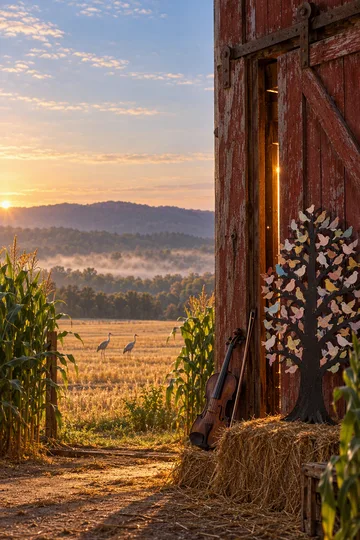
In a Polish ballroom on Milwaukee Avenue, under nine chandeliers that nobody is allowed to touch, the Hrynchuk Family One-Ring Circus has come to play three weeks of carnival in the dead of a Chicago winter. The ballroom has no box office, so the clown is the door. Behind the red nose and a waistcoat with eleven buttonholes and no buttons, retired billionaire Arthur Pendelton punches every ticket with an old circus punch that leaves a sparrow-shaped hole.
The Kurek family comes on opening night. A grandmother who can no longer see her famous paper cutouts, and stopped making them when her sister's letters stopped. A highland fiddler of eighty-seven who will not play alone, and who uses circus words no civilian should know. A bus driver who answers his mother only in English. A granddaughter pasting cut-paper birds on a railroad viaduct at night. A boy who wants the second chair.
Between doughnut rivalries, a seven-fall ladder routine that needs one low note, and a tune that everyone in Chicago believes is two hundred years old, the trail leads north to a red barn outside Baraboo, Wisconsin, where somebody has been humming it wrong for sixty-four years.
Members can react to this book and talk about it in the members' Library.